EP2204237A2 - Geordneter mesoporöser Kohlenverbundstoffkatalysator, Verfahren zu dessen Herstellung und Brennstoffzelle, die diesen verwendet - Google Patents
Geordneter mesoporöser Kohlenverbundstoffkatalysator, Verfahren zu dessen Herstellung und Brennstoffzelle, die diesen verwendet Download PDFInfo
- Publication number
- EP2204237A2 EP2204237A2 EP09180758A EP09180758A EP2204237A2 EP 2204237 A2 EP2204237 A2 EP 2204237A2 EP 09180758 A EP09180758 A EP 09180758A EP 09180758 A EP09180758 A EP 09180758A EP 2204237 A2 EP2204237 A2 EP 2204237A2
- Authority
- EP
- European Patent Office
- Prior art keywords
- omc
- composite catalyst
- nitrogen
- ruthenium
- precursor
- Prior art date
- Legal status (The legal status is an assumption and is not a legal conclusion. Google has not performed a legal analysis and makes no representation as to the accuracy of the status listed.)
- Granted
Links
Images


Classifications
-
- B—PERFORMING OPERATIONS; TRANSPORTING
- B01—PHYSICAL OR CHEMICAL PROCESSES OR APPARATUS IN GENERAL
- B01J—CHEMICAL OR PHYSICAL PROCESSES, e.g. CATALYSIS OR COLLOID CHEMISTRY; THEIR RELEVANT APPARATUS
- B01J35/00—Catalysts, in general, characterised by their form or physical properties
- B01J35/60—Catalysts, in general, characterised by their form or physical properties characterised by their surface properties or porosity
- B01J35/64—Pore diameter
- B01J35/647—2-50 nm
-
- H—ELECTRICITY
- H01—ELECTRIC ELEMENTS
- H01M—PROCESSES OR MEANS, e.g. BATTERIES, FOR THE DIRECT CONVERSION OF CHEMICAL ENERGY INTO ELECTRICAL ENERGY
- H01M4/00—Electrodes
- H01M4/86—Inert electrodes with catalytic activity, e.g. for fuel cells
- H01M4/90—Selection of catalytic material
- H01M4/92—Metals of platinum group
-
- B—PERFORMING OPERATIONS; TRANSPORTING
- B01—PHYSICAL OR CHEMICAL PROCESSES OR APPARATUS IN GENERAL
- B01J—CHEMICAL OR PHYSICAL PROCESSES, e.g. CATALYSIS OR COLLOID CHEMISTRY; THEIR RELEVANT APPARATUS
- B01J35/00—Catalysts, in general, characterised by their form or physical properties
- B01J35/40—Catalysts, in general, characterised by their form or physical properties characterised by dimensions, e.g. grain size
- B01J35/45—Nanoparticles
-
- B—PERFORMING OPERATIONS; TRANSPORTING
- B01—PHYSICAL OR CHEMICAL PROCESSES OR APPARATUS IN GENERAL
- B01J—CHEMICAL OR PHYSICAL PROCESSES, e.g. CATALYSIS OR COLLOID CHEMISTRY; THEIR RELEVANT APPARATUS
- B01J21/00—Catalysts comprising the elements, oxides, or hydroxides of magnesium, boron, aluminium, carbon, silicon, titanium, zirconium, or hafnium
- B01J21/18—Carbon
-
- B—PERFORMING OPERATIONS; TRANSPORTING
- B01—PHYSICAL OR CHEMICAL PROCESSES OR APPARATUS IN GENERAL
- B01J—CHEMICAL OR PHYSICAL PROCESSES, e.g. CATALYSIS OR COLLOID CHEMISTRY; THEIR RELEVANT APPARATUS
- B01J23/00—Catalysts comprising metals or metal oxides or hydroxides, not provided for in group B01J21/00
- B01J23/16—Catalysts comprising metals or metal oxides or hydroxides, not provided for in group B01J21/00 of arsenic, antimony, bismuth, vanadium, niobium, tantalum, polonium, chromium, molybdenum, tungsten, manganese, technetium or rhenium
- B01J23/24—Chromium, molybdenum or tungsten
- B01J23/28—Molybdenum
-
- B—PERFORMING OPERATIONS; TRANSPORTING
- B01—PHYSICAL OR CHEMICAL PROCESSES OR APPARATUS IN GENERAL
- B01J—CHEMICAL OR PHYSICAL PROCESSES, e.g. CATALYSIS OR COLLOID CHEMISTRY; THEIR RELEVANT APPARATUS
- B01J23/00—Catalysts comprising metals or metal oxides or hydroxides, not provided for in group B01J21/00
- B01J23/38—Catalysts comprising metals or metal oxides or hydroxides, not provided for in group B01J21/00 of noble metals
- B01J23/40—Catalysts comprising metals or metal oxides or hydroxides, not provided for in group B01J21/00 of noble metals of the platinum group metals
-
- B—PERFORMING OPERATIONS; TRANSPORTING
- B01—PHYSICAL OR CHEMICAL PROCESSES OR APPARATUS IN GENERAL
- B01J—CHEMICAL OR PHYSICAL PROCESSES, e.g. CATALYSIS OR COLLOID CHEMISTRY; THEIR RELEVANT APPARATUS
- B01J23/00—Catalysts comprising metals or metal oxides or hydroxides, not provided for in group B01J21/00
- B01J23/38—Catalysts comprising metals or metal oxides or hydroxides, not provided for in group B01J21/00 of noble metals
- B01J23/40—Catalysts comprising metals or metal oxides or hydroxides, not provided for in group B01J21/00 of noble metals of the platinum group metals
- B01J23/44—Palladium
-
- B—PERFORMING OPERATIONS; TRANSPORTING
- B01—PHYSICAL OR CHEMICAL PROCESSES OR APPARATUS IN GENERAL
- B01J—CHEMICAL OR PHYSICAL PROCESSES, e.g. CATALYSIS OR COLLOID CHEMISTRY; THEIR RELEVANT APPARATUS
- B01J23/00—Catalysts comprising metals or metal oxides or hydroxides, not provided for in group B01J21/00
- B01J23/38—Catalysts comprising metals or metal oxides or hydroxides, not provided for in group B01J21/00 of noble metals
- B01J23/40—Catalysts comprising metals or metal oxides or hydroxides, not provided for in group B01J21/00 of noble metals of the platinum group metals
- B01J23/46—Ruthenium, rhodium, osmium or iridium
- B01J23/462—Ruthenium
-
- B—PERFORMING OPERATIONS; TRANSPORTING
- B01—PHYSICAL OR CHEMICAL PROCESSES OR APPARATUS IN GENERAL
- B01J—CHEMICAL OR PHYSICAL PROCESSES, e.g. CATALYSIS OR COLLOID CHEMISTRY; THEIR RELEVANT APPARATUS
- B01J23/00—Catalysts comprising metals or metal oxides or hydroxides, not provided for in group B01J21/00
- B01J23/38—Catalysts comprising metals or metal oxides or hydroxides, not provided for in group B01J21/00 of noble metals
- B01J23/40—Catalysts comprising metals or metal oxides or hydroxides, not provided for in group B01J21/00 of noble metals of the platinum group metals
- B01J23/46—Ruthenium, rhodium, osmium or iridium
- B01J23/468—Iridium
-
- B—PERFORMING OPERATIONS; TRANSPORTING
- B01—PHYSICAL OR CHEMICAL PROCESSES OR APPARATUS IN GENERAL
- B01J—CHEMICAL OR PHYSICAL PROCESSES, e.g. CATALYSIS OR COLLOID CHEMISTRY; THEIR RELEVANT APPARATUS
- B01J23/00—Catalysts comprising metals or metal oxides or hydroxides, not provided for in group B01J21/00
- B01J23/70—Catalysts comprising metals or metal oxides or hydroxides, not provided for in group B01J21/00 of the iron group metals or copper
- B01J23/74—Iron group metals
- B01J23/745—Iron
-
- B—PERFORMING OPERATIONS; TRANSPORTING
- B01—PHYSICAL OR CHEMICAL PROCESSES OR APPARATUS IN GENERAL
- B01J—CHEMICAL OR PHYSICAL PROCESSES, e.g. CATALYSIS OR COLLOID CHEMISTRY; THEIR RELEVANT APPARATUS
- B01J23/00—Catalysts comprising metals or metal oxides or hydroxides, not provided for in group B01J21/00
- B01J23/70—Catalysts comprising metals or metal oxides or hydroxides, not provided for in group B01J21/00 of the iron group metals or copper
- B01J23/74—Iron group metals
- B01J23/75—Cobalt
-
- B—PERFORMING OPERATIONS; TRANSPORTING
- B01—PHYSICAL OR CHEMICAL PROCESSES OR APPARATUS IN GENERAL
- B01J—CHEMICAL OR PHYSICAL PROCESSES, e.g. CATALYSIS OR COLLOID CHEMISTRY; THEIR RELEVANT APPARATUS
- B01J23/00—Catalysts comprising metals or metal oxides or hydroxides, not provided for in group B01J21/00
- B01J23/70—Catalysts comprising metals or metal oxides or hydroxides, not provided for in group B01J21/00 of the iron group metals or copper
- B01J23/74—Iron group metals
- B01J23/755—Nickel
-
- B—PERFORMING OPERATIONS; TRANSPORTING
- B01—PHYSICAL OR CHEMICAL PROCESSES OR APPARATUS IN GENERAL
- B01J—CHEMICAL OR PHYSICAL PROCESSES, e.g. CATALYSIS OR COLLOID CHEMISTRY; THEIR RELEVANT APPARATUS
- B01J37/00—Processes, in general, for preparing catalysts; Processes, in general, for activation of catalysts
- B01J37/0009—Use of binding agents; Moulding; Pressing; Powdering; Granulating; Addition of materials ameliorating the mechanical properties of the product catalyst
- B01J37/0018—Addition of a binding agent or of material, later completely removed among others as result of heat treatment, leaching or washing,(e.g. forming of pores; protective layer, desintegrating by heat)
-
- B—PERFORMING OPERATIONS; TRANSPORTING
- B01—PHYSICAL OR CHEMICAL PROCESSES OR APPARATUS IN GENERAL
- B01J—CHEMICAL OR PHYSICAL PROCESSES, e.g. CATALYSIS OR COLLOID CHEMISTRY; THEIR RELEVANT APPARATUS
- B01J37/00—Processes, in general, for preparing catalysts; Processes, in general, for activation of catalysts
- B01J37/02—Impregnation, coating or precipitation
- B01J37/0201—Impregnation
- B01J37/0205—Impregnation in several steps
-
- B—PERFORMING OPERATIONS; TRANSPORTING
- B01—PHYSICAL OR CHEMICAL PROCESSES OR APPARATUS IN GENERAL
- B01J—CHEMICAL OR PHYSICAL PROCESSES, e.g. CATALYSIS OR COLLOID CHEMISTRY; THEIR RELEVANT APPARATUS
- B01J37/00—Processes, in general, for preparing catalysts; Processes, in general, for activation of catalysts
- B01J37/08—Heat treatment
- B01J37/082—Decomposition and pyrolysis
- B01J37/084—Decomposition of carbon-containing compounds into carbon
-
- H—ELECTRICITY
- H01—ELECTRIC ELEMENTS
- H01M—PROCESSES OR MEANS, e.g. BATTERIES, FOR THE DIRECT CONVERSION OF CHEMICAL ENERGY INTO ELECTRICAL ENERGY
- H01M4/00—Electrodes
- H01M4/86—Inert electrodes with catalytic activity, e.g. for fuel cells
- H01M4/90—Selection of catalytic material
- H01M4/9016—Oxides, hydroxides or oxygenated metallic salts
-
- H—ELECTRICITY
- H01—ELECTRIC ELEMENTS
- H01M—PROCESSES OR MEANS, e.g. BATTERIES, FOR THE DIRECT CONVERSION OF CHEMICAL ENERGY INTO ELECTRICAL ENERGY
- H01M4/00—Electrodes
- H01M4/86—Inert electrodes with catalytic activity, e.g. for fuel cells
- H01M4/90—Selection of catalytic material
- H01M4/9075—Catalytic material supported on carriers, e.g. powder carriers
- H01M4/9083—Catalytic material supported on carriers, e.g. powder carriers on carbon or graphite
-
- H—ELECTRICITY
- H01—ELECTRIC ELEMENTS
- H01M—PROCESSES OR MEANS, e.g. BATTERIES, FOR THE DIRECT CONVERSION OF CHEMICAL ENERGY INTO ELECTRICAL ENERGY
- H01M4/00—Electrodes
- H01M4/86—Inert electrodes with catalytic activity, e.g. for fuel cells
- H01M4/90—Selection of catalytic material
- H01M4/92—Metals of platinum group
- H01M4/923—Compounds thereof with non-metallic elements
-
- H—ELECTRICITY
- H01—ELECTRIC ELEMENTS
- H01M—PROCESSES OR MEANS, e.g. BATTERIES, FOR THE DIRECT CONVERSION OF CHEMICAL ENERGY INTO ELECTRICAL ENERGY
- H01M4/00—Electrodes
- H01M4/86—Inert electrodes with catalytic activity, e.g. for fuel cells
- H01M4/90—Selection of catalytic material
- H01M4/92—Metals of platinum group
- H01M4/925—Metals of platinum group supported on carriers, e.g. powder carriers
- H01M4/926—Metals of platinum group supported on carriers, e.g. powder carriers on carbon or graphite
-
- H—ELECTRICITY
- H01—ELECTRIC ELEMENTS
- H01M—PROCESSES OR MEANS, e.g. BATTERIES, FOR THE DIRECT CONVERSION OF CHEMICAL ENERGY INTO ELECTRICAL ENERGY
- H01M8/00—Fuel cells; Manufacture thereof
- H01M8/10—Fuel cells with solid electrolytes
-
- H—ELECTRICITY
- H01—ELECTRIC ELEMENTS
- H01M—PROCESSES OR MEANS, e.g. BATTERIES, FOR THE DIRECT CONVERSION OF CHEMICAL ENERGY INTO ELECTRICAL ENERGY
- H01M8/00—Fuel cells; Manufacture thereof
- H01M8/10—Fuel cells with solid electrolytes
- H01M2008/1095—Fuel cells with polymeric electrolytes
-
- H—ELECTRICITY
- H01—ELECTRIC ELEMENTS
- H01M—PROCESSES OR MEANS, e.g. BATTERIES, FOR THE DIRECT CONVERSION OF CHEMICAL ENERGY INTO ELECTRICAL ENERGY
- H01M8/00—Fuel cells; Manufacture thereof
- H01M8/10—Fuel cells with solid electrolytes
- H01M8/1009—Fuel cells with solid electrolytes with one of the reactants being liquid, solid or liquid-charged
- H01M8/1011—Direct alcohol fuel cells [DAFC], e.g. direct methanol fuel cells [DMFC]
-
- Y—GENERAL TAGGING OF NEW TECHNOLOGICAL DEVELOPMENTS; GENERAL TAGGING OF CROSS-SECTIONAL TECHNOLOGIES SPANNING OVER SEVERAL SECTIONS OF THE IPC; TECHNICAL SUBJECTS COVERED BY FORMER USPC CROSS-REFERENCE ART COLLECTIONS [XRACs] AND DIGESTS
- Y02—TECHNOLOGIES OR APPLICATIONS FOR MITIGATION OR ADAPTATION AGAINST CLIMATE CHANGE
- Y02E—REDUCTION OF GREENHOUSE GAS [GHG] EMISSIONS, RELATED TO ENERGY GENERATION, TRANSMISSION OR DISTRIBUTION
- Y02E60/00—Enabling technologies; Technologies with a potential or indirect contribution to GHG emissions mitigation
- Y02E60/30—Hydrogen technology
- Y02E60/50—Fuel cells
-
- Y—GENERAL TAGGING OF NEW TECHNOLOGICAL DEVELOPMENTS; GENERAL TAGGING OF CROSS-SECTIONAL TECHNOLOGIES SPANNING OVER SEVERAL SECTIONS OF THE IPC; TECHNICAL SUBJECTS COVERED BY FORMER USPC CROSS-REFERENCE ART COLLECTIONS [XRACs] AND DIGESTS
- Y02—TECHNOLOGIES OR APPLICATIONS FOR MITIGATION OR ADAPTATION AGAINST CLIMATE CHANGE
- Y02P—CLIMATE CHANGE MITIGATION TECHNOLOGIES IN THE PRODUCTION OR PROCESSING OF GOODS
- Y02P70/00—Climate change mitigation technologies in the production process for final industrial or consumer products
- Y02P70/50—Manufacturing or production processes characterised by the final manufactured product
Definitions
- One or more embodiments relate to an ordered mesoporous carbon composite catalyst, a method of manufacturing the same, and a fuel cell using the same.
- a polymer electrolyte membrane fuel cell (PEMFC) or a direct methanol fuel cell (DMFC) is a power generating system that generates direct current (DC) electricity from an electrochemical reaction of hydrogen or methanol, and oxygen, and has a structure where an anode, a proton conductive membrane, and a cathode are sequentially stacked in the order stated, wherein a reaction liquid/gas is supplied to the anode and the cathode.
- catalysts In the anode, catalysts generate protons by oxidizing hydrogen or methanol. The generated protons pass through the proton conductive membrane and react with oxygen by catalysts in the cathode, thereby generating electricity.
- the function of a catalyst is important in a fuel cell having such a structure.
- Pt particles dispersed in an amorphous carbon support are used for both the anode and the cathode, and in the DMF, PtRu is used for the anode and Pt particles or Pt particles dispersed in an amorphous carbon support are used for the cathode.
- the amount of a catalyst used may be reduced in order to obtain price competitiveness of a fuel cell. Accordingly, studies relating to developing a catalyst that does not use Pt at all are being actively conducted.
- One or more embodiments include a catalyst having improved activity, a method of manufacturing the same, and a fuel cell using the same.
- one or more embodiments may include an ordered mesoporous carbon (OMC) composite catalyst including: OMC; and metal particles and at least one component selected from a group consisting of nitrogen (N) and sulfur (S) included in the OMC.
- OMC ordered mesoporous carbon
- one or more embodiments may include a method of manufacturing a carbon composite catalyst, the method including: ; impregnating an ordered mesoporous silica (OMS) with a mixture of at least one selected from the group consisting of a nitrogen-containing carbon precursor, and sulfur-containing carbon precursor, a metal precursor, and a solvent; drying and heat-treating the impregnated OMS; carbonizing the dried and heat-treated OMS to obtain a carbon-OMS composite; and removing the OMS from the carbon-OMS composite to obtain the carbon composite catalyst.
- OMS ordered mesoporous silica
- one or more embodiments may include an ordered mesoporous carbon composite catalyst and which is manufactured according to the method above.
- one or more embodiments may include a fuel cell including: a cathode; an anode; and an electrolyte disposed between the cathode and the anode, wherein at least one of the cathode and the anode includes an OMC composite catalyst for oxygen reduction reaction, including: OMC; and metal particles included in the OMC and at least one of nitrogen (N) and sulfur (S).
- OMC composite catalyst for oxygen reduction reaction including: OMC; and metal particles included in the OMC and at least one of nitrogen (N) and sulfur (S).
- An ordered mesoporous carbon (OMC) composite catalyst includes an OMC having mesopores, a transition metal dispersed in the OMC, and nitrogen or sulfur, or both nitrogen and sulfur.
- OMC composite catalyst metal particles such as ruthenium particles, and nitrogen and/or sulfur are uniformly dispersed in an OMC structure. A mutual synergy effect is generated, since nitrogen and sulfur are coordinated near the metal particles, such as ruthenium particles, and the supplying of oxygen and discharging of water are smoothly performed by using the mesopores and structural regularity of the OMC.
- the transition metal may be at least one of ruthenium, palladium, iridium, iron, cobalt, molybdenum, and nickel.
- the mesopores of the OMC composite catalyst have an average diameter of about 6 to about 10 nm, and the OMC composite catalyst has a specific surface area of about 500 to about 1200 m 2 /g, and a pore volume of about 1.2 to about 1.8 m 2 /g. Also, an average particle size of metal particles dispersed in the OMC composite catalyst is about 1 to about 50 nm.
- the activity of the OMC composite catalyst is excellent.
- a metal is dispersed in an OMC having mesopores and including at least one component selected from a group consisting of nitrogen and sulfur, the supply of a reactant or diffusion of a product is convenient.
- sulfur is included in the OMC, the stability of metal particles increases since sulfur has excellent interaction with and coherence to the metal particles, and thus, the initial activity of the OMC composite catalyst is maintained.
- agglomeration of the metal particles during a high temperature operation or a long operation is effectively suppressed.
- the metal may be at least one of ruthenium, palladium, iridium, iron, cobalt, molybdenum, and nickel.
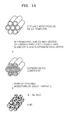
- FIG. 1A is a schematic diagram illustrating a method of forming an OMC composite catalyst, according to an embodiment.
- a ruthenium precursor is used as an embodiment of a transition metal precursor.
- a carbon-silica composite is formed by adding at least one of a nitrogen-containing carbon precursor and a sulfur-containing carbon precursor (carbonization catalyst), a metal precursor, and a solvent to an ordered mesoporous silica (OMS) template as a nano template, and then drying, heat-treating, and carbonizing the resultant.
- OMS ordered mesoporous silica
- the OMS template has an X-ray diffraction peak of below 2° since pores are regularly arranged in the OMS.
- the OMS template is removed from the carbon-silica composite so as to obtain the OMC composite catalyst according to the current embodiment.
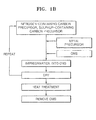
- FIG. 1B is a diagram illustrating a method of manufacturing an OMC composite catalyst, according to an embodiment.
- a precursor mixture is obtained by mixing at least one of a nitrogen-containing carbon precursor and a sulfur-containing carbon precursor, a metal precursor, and a solvent.
- the nitrogen-containing carbon precursor may be at least one selected from a group consisting of quinoxaline, propylenediamine, 4,4-dipyridyl and phenanthroline.
- the sulfur-containing carbon precursor may function as a carbonization catalyst in addition to being a carbon precursor.
- An example of the sulfur-containing carbon precursor includes para-toluene sulfonic acid.
- the amount of the sulfur-containing carbon precursor may be about 30 to about 90 parts by weight based on 100 parts by weight of the nitrogen-containing carbon precursor.
- the metal precursor may be at least one selected from a group consisting of ruthenium chloride, molybdenum chloride, iron chloride, and cobalt chloride, and the amount of the metal precursor may be about 20 to about 120 parts by weight based on 100 parts by weight of the nitrogen-containing carbon precursor.
- the solvent may be any solvent that uniformly dissolves the nitrogen-containing carbon precursor, the sulfur-containing carbon precursor, and the metal precursor.
- the solvent include water, acetone, methanol, ethanol, isopropyl alcohol, n-propyl alcohol, butanol, dimethyl acetamide, dimethyl formamide, dimethyl sulfoxide, N-methyl-2-pyrrolidone, tetrahydrofuran, tetrabutyl acetate, n-butyl acetate, m-cresol, toluene, ethylene glycol, gamma butyrolactone, and hexafluoroisopropanol (HFIP).
- the solvents may be used alone or in combination.
- the precursor mixture prepared as above is impregnated in an OMS, dried, heat treated, and carbonized, so as to prepare a carbon-silica composite.
- the OMS is a molecular sieve material having a structure in which 1-dimensional (1 D) pores are connected to micropores, although the structure is not limited thereto.
- the OMS may also be a molecular sieve material having a 3D connection structure, such as, for example, MCM-48 having a cube structure, SBA-1 having another cube structure, SBA-15 having a hexagonal structure, or KIT-1 and MSU-1 having a structure where pores are irregularly connected in 3D.
- Additional examples of the molecular sieve material include various ordered mesoporous molecular sieve materials having a structure in which long directional 1 D pores are connected to the micropores.
- the amount of OMS into which the precursor mixture is impregnated may be about 0.5 to about 30 parts by weight based on 100 parts by weight of the precursor mixture.
- a carbon structure may be sufficiently formed in the silica pores.
- the temperature of the impregnation is not limited, and may be room temperature (about 20°C to about 25°C).
- the impregnated precursor mixture may be dried, if desired.
- the temperature of the drying is not limited, and may be room temperature.
- the impregnated precursor mixture may be dried in a decompressed atmosphere.
- the heat treatment may be performed at about 50 to about 400°C. When the temperature is within the above range, uniformity of the OMC is excellent.
- the heat-treated resultant may be directly carbonized, but, as an alternative, the above processes may be repeated 2 to 10 times. In other words, the heat-treated resultant may be impregnated with the precursor mixture, and then, heat-treated as above. This process may be further repeated or carbonization may be performed.
- the heat-treated resultant is directly carbonized without repeating the above processes, a carbon structure may not be completely formed in the pores of the OMS, and when the above processes are repeated more than 10 times, further repetitions may not provide improvement.
- the heat-treated resultant is carbonized.
- the precursor mixture impregnated in the OMS is graphitized via the carbonization.
- the carbonization is performed by further heat-treating the heat-treated resultant at about 600 to about 1500°C by heating, such as in an electric furnace.
- the carbonization may be performed in a non-oxidizing atmosphere.
- the non-oxidizing atmosphere may be one of a vacuum atmosphere, a nitrogen atmosphere, and an inert gas atmosphere.
- the OMS is removed from the carbon-silica composite obtained as above by using a solvent that selectively dissolves the OMS.
- Examples of the solvent that selectively dissolves the OMS include a hydrofluoric acid (HF) aqueous solution and a sodium hydroxide (NaOH) aqueous solution.
- the concentration of the HF aqueous solution may be about 5 to about 47 wt%, and the concentration of the NaOH aqueous solution may be about 5 to about 30 wt%.
- the OMS turns into a soluble silicate via alkali melting or carbonate fusion, and is known to form SiF 4 , which easily erodes by reacting with HF.
- An OMC composite catalyst is prepared by selectively removing the OMS.
- the OMC composite catalyst obtained as above includes uniformly arranged pores, as confirmed from an X-ray diffraction analysis.
- the amount of metal particles may be about 0.05 to about 0.45 parts by weight, for example about 0.1 to about 0.3 parts by weight, based on 1 part by weight of the OMC. When the amount of metal particles is within the above range, activity of the OMC composite catalyst is excellent. Also in the OMC composite catalyst, the amount of at least one of sulfur and nitrogen may be about 0.005 to about 0.1 parts by weight based on 1 part by weight of the OMC.
- the activity of the OMC composite catalyst is excellent.
- the OMC composite catalyst includes both sulfur and nitrogen, a mixed atomic ratio of nitrogen to sulfur is from about 1:3 to about 9:1.
- the mixed atomic ratio of nitrogen to sulfur is from about 4.14:1 to about 4.75:1.
- an atomic ratio of the sum total of nitrogen and sulfur with respect to the metal particles is from about 3.75 to about 4.54.
- an atomic ratio of nitrogen with respect to the metal particles is from about 3.03 to about 3.75, and an atomic ratio of sulfur with respect to the metal particles is 0.73:0.79.
- an atomic ratio of sulfur with respect to the metal particles is about 0.96.
- the metal particles may be ruthenium.
- the OMC composite catalyst according to the current embodiment includes micropores and mesopores in a suitable ratio.
- a micropore has a diameter below about 2 nm
- a mesopore has a diameter of about 2 to about 50 nm.
- An average diameter of pores of the OMC composite catalyst is about 6 to about 10 nm. Since the average diameter of the pores of the OMC composite catalyst is larger than an average diameter of pores of a general OMC, i.e., about 3 to less than 5 nm, the OMC composite catalyst easily transmits materials.
- a full width at half maximum (FWHM) pore size distribution using a nitrogen absorption characteristic may be 5 nm or lower, or more specifically, about 1 to about 4.5 nm, in the OMC composite catalyst.
- an average diameter and distribution characteristics of mesopores may be measured by using Tristar 3000 analyzer by Micromeritics.
- the distribution characteristics of mesopores may be calculated from a nitrogen absorption curve by using a Barrett-Joyner-Halenda (BJH) method, wherein the average diameter is the largest value from a peak having the largest strength from among peaks in the distribution characteristics of the mesopores.
- BJH Barrett-Joyner-Halenda
- the FWHM is calculated by fitting a peak having the largest strength in the distribution characteristics of mesopores by using a generally used mathematical model (Lorentzian or Gaussian).
- a BET specific surface area according to ordered mesopores forming the OMC composite catalyst may be about 500 to about 1200 m 2 /g.
- the OMC composite catalyst is easily prepared without deterioration of the activity of the OMC composite catalyst.
- a major peak of Bragg's 2 ⁇ angle to CuK-alpha characteristic X-ray wavelength 0.1541 nm is located at about 0.5° to about 1.2°.
- a sub-peak of Bragg's 2 ⁇ angle to a CuK-alpha characteristic X-ray wavelength 0.1541 nm is displayed about 1.21° to about 3°.
- a structure (space group) of the OMC may be determined by analyzing the locations of such peaks.
- the major peak and sub-peak are determined by the intensity of the peak.
- the amount of ruthenium as a metal may be from 10 ⁇ 1 wt% to 30 ⁇ 3 wt%, the amount of nitrogen (N) may be 5 ⁇ 2 wt%, and the amount of sulfur may be 2 ⁇ 1 wt%, based on a result of EDX analyzing the ordered mesoporous transition metal carbon composite.
- the OMC composite catalyst manufactured as described above includes ruthenium-nitrogen and ruthenium-sulfur components that may be used as an oxygen reduction catalyst, and has uniform mesopores that may increase the supply and diffusion of a reactant and a product. Accordingly, catalyst activity for oxygen reduction increases when the OMC composite catalyst is used.
- the OMC composite catalyst may be used in home fuel cells or portable fuel cells for mobile devices, such as lap tops, mobile phones, and in cars or buses.
- the fuel cell includes a cathode, an anode, and an electrolyte film disposed between the cathode and the anode.
- at least one of the cathode and the anode includes the OMC composite catalyst according to the embodiment described above.
- Catalyst activity of the fuel cell using the OMC composite catalyst is maintained even when the fuel cell is operated for a long time or at a high temperature.
- the fuel cell may be a PEMFC or a DMFC.
- the structure and method of manufacturing the fuel cell are not limited, and examples thereof are disclosed in various documents, and thus, details thereof are omitted herein.
- Example 1A Preparation of Ordered Mesoporous Carbon Composite Catalyst Including Nitrogen and Sulfur (Quinoxaline is used as Nitrogen-Containing Precursor, and Amount of Ruthenium is 0.1 Parts by Weight based on 1 Part by Weight of OMC that forms Ordered Mesoporous Transition Metal Carbon Composite)
- a first ruthenium precursor solution was prepared as follows.
- nitrogen-containing carbon precursor 0.512 g of quinoxaline (purity 99%) based on 1 g of MSU-H used as an OMS template was used. 0.150 g of ruthenium chloride was used as a ruthenium precursor, wherein the amount of ruthenium is 0.1 parts by weight based on 1 part by weight of the synthesized OMC. The nitrogen-containing carbon precursor and the ruthenium precursor were mixed to prepare a mixture.
- the first ruthenium precursor solution was prepared by mixing and completely dissolving 0.96 g of distilled water and 0.337 g of para-toluene sulfonic acid constituting a sulfur-containing carbon precursor and a carbonization catalyst in the above mixture.
- a second ruthenium precursor solution was prepared in the same manner as the first ruthenium precursor solution, except that 70% of the amount of the first ruthenium precursor solution was used.
- a first impregnation process was performed by putting OMS, which is used as a template and the first ruthenium precursor solution prepared above in a teflon bottle and shaking the teflon bottle.
- the mixture inside the teflon bottle was dried and reacted in an oven at 160°C for 6 hours in order to form an oligomer.
- the color of the mixture darkened as time passed.
- the resultant was cooled down at room temperature, and then, a second impregnation process was performed by using the second ruthenium precursor solution. Then, the impregnated resultant was reacted in the oven at 160°C for 6 hours. If the impregnated resultant is reacted for too long, a carbon precursor evaporates too much, and thus, about 6 hours are suitable.
- the composite power obtained as above was carbonized at 900°C under a nitrogen gas atmosphere. Here, the temperature was increased up to 900°C for 5 hours, and maintained constant at 900°C for 2 hours.
- the resultant was processed by using a HF solution so as to remove the OMS. Accordingly, an OMC composite catalyst ⁇ Ru-N-S-OMC ⁇ was obtained.
- Example 1B Preparation of Ordered Mesoporous Carbon Composite Catalyst Including Nitrogen and Sulfur (Quinoxaline is used as Nitrogen-Containing Precursor, and Amount of Ruthenium is 0.2 Parts by Weight based on 1 Part by Weight of OMC)
- OMC composite catalyst ⁇ Ru-N-S-OMC ⁇ having different amount of ruthenium was prepared in the same manner as Example 1A above, except that 0.337 g of ruthenium chloride were used so that the amount of ruthenium was 0.2 parts by weight based on 1 part by weight of the OMC synthesized while preparing the first ruthenium precursor solution.
- Example 1C Preparation of Ordered Mesoporous Carbon Composite Catalyst Including Nitrogen and Sulfur (Quinoxaline is used as Nitrogen-Containing Precursor, and Amount of Ruthenium is 0.3 Parts by Weight based on 1 Part by Weight of OMC)
- OMC composite catalyst ⁇ Ru-N-S-OMC ⁇ having different amount of ruthenium was prepared in the same manner as Example 1A above, except that 0.557 g of ruthenium chloride were used so that the amount of ruthenium was 0.3 parts by weight based on 1 part by weight of the OMC synthesized while preparing the first ruthenium precursor solution.
- Example 2A Preparation of OMC Composite Catalyst Including Nitrogen and Sulfur (Propylene Diamine is used as Nitrogen-Containing Carbon Precursor)
- An OMC composite catalyst ⁇ Ru-N-S-OMC ⁇ was prepared in the same manner as Example 1A, except that 0.871 g of propylene diamine was used instead of 0.512 g of quinoxaline as the nitrogen-containing precursor.
- Example 2B Preparation of OMC Composite Catalyst Including Nitrogen and Sulfur (Propylene Diamine is used as Nitrogen-Containing Carbon Precursor)
- OMC composite catalyst ⁇ Ru-N-S-OMC ⁇ having different amount of ruthenium was [e] prepared in the same manner as Example 2A above, except that 0.337 g of ruthenium chloride were used so that the amount of ruthenium was 0.2 parts by weight based on 1 part by weight of the OMC synthesized while preparing the first ruthenium precursor solution.
- Example 2C Preparation of OMC Composite Catalyst Including Nitrogen and Sulfur (Propylene Diamine is used as Nitrogen-Containing Carbon Precursor)
- OMC composite catalyst ⁇ Ru-N-S-OMC ⁇ having different amount of ruthenium was prepared in the same manner as Example 2A above, except that 0.577 g of ruthenium chloride were used so that the amount of ruthenium was 0.3 parts by weight based on 1 part by weight of the OMC synthesized while preparing the first ruthenium precursor solution.
- Example 3A Preparation of OMC Composite Catalyst Including Sulfur (Para-Toluene Sulfonic Acid is used as Sulfur-Containing Carbon Precursor)
- An OMC composite catalyst ⁇ Ru-S-OMC ⁇ was prepared in the same manner as Example 1A, except that the first ruthenium precursor solution and the second ruthenium precursor solution are prepared as below.
- the first ruthenium precursor solution was prepared by preparing a para-toluene sulfonic acid aqueous solution by completely mixing and dissolving 0.96 g of distilled water and 0.810 g of para-toluene sulfonic acid constituting a sulfur-containing carbon precursor and a carbonization catalyst, and then mixing the para-toluene sulfonic acid aqueous solution with 0.281 g of ruthenium chloride constituting a ruthenium precursor so that the amount of ruthenium is 0.1 part by weight based on 1 part by weight of the OMC.
- the second ruthenium precursor is prepared in the same manner as the first ruthenium precursor solution, except that 70% of the amount of the first ruthenium precursor solution was used.
- Example 3B Preparation of OMC Composite Catalyst Including Sulfur (Para-Toluene Sulfonic Acid is used as Sulfur-Containing Carbon Precursor)
- OMC composite catalyst ⁇ Ru-S-OMC ⁇ having different amount of ruthenium was prepared in the same manner as Example 3A above, except that 0.634 g of ruthenium chloride were used so that the amount of ruthenium was 0.2 parts by weight based on 1 part by weight of the OMC synthesized while preparing the first ruthenium precursor solution.
- Example 3C Preparation of OMC Composite Catalyst Including Sulfur (Para-Toluene Sulfonic Acid is used as Sulfur-Containing Carbon Precursor)
- OMC composite catalyst ⁇ Ru-S-OMC ⁇ having different amount of ruthenium was prepared in the same manner as Example 3A above, except that 1.09 g of ruthenium chloride were used so that the amount of ruthenium was 0.3 parts by weight based on 1 part by weight of the OMC synthesized while preparing the first ruthenium precursor solution.
- OMC composite catalyst ⁇ Mo-N-S-OMC ⁇ was prepared in the same manner as Example 1A above, except that 0.323 g of molybdenum chloride was used instead of 0.150 g of ruthenium chloride while preparing the first and second ruthenium precursor solution.
- OMC composite catalyst ⁇ Fe-N-S-OMC ⁇ was prepared in the same manner as Example 1A above, except that 0.283 g of iron chloride was used instead of 0.150 g of ruthenium chloride while preparing the first and second ruthenium precursor solution.
- OMC composite catalyst ⁇ Co-N-S-OMC ⁇ was prepared in the same manner as Example 1A above, except that 0.238 g of ruthenium chloride was used instead of 0.150 g of ruthenium chloride and 0.871 g of propylene diamine was used instead of 0.512 g of quinoxaline while preparing the first and second ruthenium precursor solution.
- OMC composite catalyst ⁇ RuFe-N-S-OMC ⁇ was prepared in the same manner as Example 1A above, except that 0.150 g of ruthenium chloride and 0.234 g of ferric nitrate (II) were used instead of 0.150 g of ruthenium chloride, while preparing the first and second ruthenium precursor solution.
- OMC composite catalyst ⁇ RuCo-N-S-OMC ⁇ was prepared in the same manner as Example 1A above, except that 0.150 g of ruthenium chloride and 0.070 g of cobalt chloride were used instead of 0.150 g of ruthenium chloride and 0.871 g of propylene diamine was used instead of 0.512 g of quinoxaline as a nitrogen-containing precursor while preparing the first and second ruthenium precursor solution.
- Example 9A Preparation of OMC Composite Catalyst Including Nitrogen (Propylene Diamine is used as Nitrogen-Containing Carbon Precursor)
- An OMC composite catalyst ⁇ Ru-N-OMC ⁇ was prepared in the same manner as Example 1A, except that the first ruthenium precursor solution and the second ruthenium precursor solution are prepared as below.
- the first ruthenium precursor solution was prepared by preparing a mixture by completely mixing and dissolving 0.96 g of distilled water and 0.34 g of nitric acid constituting a nitrogen-containing carbon precursor and a carbonization catalyst, and then mixing the mixture with 0.150 g of ruthenium chloride constituting a ruthenium precursor so that the amount of ruthenium is 0.1 part by weight based on 1 part by weight of the OMC.
- the second ruthenium precursor is prepared in the same manner as the first ruthenium precursor solution, except that 70% of the amount of the first ruthenium precursor solution was used.
- Example 9B Preparation of OMC Composite Catalyst Including Nitrogen (Propylene Diamine is used as Nitrogen-Containing Carbon Precursor)
- OMC composite catalyst ⁇ Ru-N-OMC ⁇ having different amount of ruthenium was prepared in the same manner as Example 3A above, except that 0.337 g of ruthenium chloride were used so that the amount of ruthenium was 0.2 parts by weight based on 1 part by weight of the OMC synthesized while preparing the first ruthenium precursor solution.
- Example 9C Preparation of OMC Composite Catalyst Including Nitrogen (Propylene Diamine is used as Nitrogen-Containing Carbon Precursor)
- OMC composite catalyst ⁇ Ru-N-OMC ⁇ having different amount of ruthenium was prepared in the same manner as Example 3A above, except that 0.577 g of ruthenium chloride were used so that the amount of ruthenium was 0.3 parts by weight based on 1 part by weight of the OMC synthesized while preparing the first ruthenium precursor solution.
- Comparative Example 1 Preparation of OMC Catalyst Supported by Ruthenium (When the amount of ruthenium is 0.1 parts by weight based on 1 part by weight of OMC)
- a carbon precursor undergoes an impregnation process twice.
- a first carbon precursor solution was prepared as follows.
- sucrose (reagent grade) based on 1 g of MSU-H used as an OMS template was used as a carbon precursor.
- the carbon precursor was mixed and completely dissolved in 0.96 g of distilled water and 0.264 g of sulfuric acid used as a carbonization catalyst.
- OMS used as a template and the carbon precursor were put into a Teflon bottle, and the Teflon bottle was shaken in order to perform a first impregnation process. Then, the mixture was dried and reacted at 100°C for 6 hours and at 160°C for 6 hours in order to form an oligomer. As time passed, the color of the mixture darkened.
- the resultant was cooled down at room temperature, and then, a second impregnation process was performed on the cooled down resultant by using the second carbon precursor solution. Then, the resultant was reacted at 100°C for 6 hours and at 160°C for 6 hours.
- a composite powder prepared as above was carbonized at 900°C under a nitrogen gas atmosphere. Here, the temperature was increased up to 900°C for 5 hours and maintained at 900°C for 2 hours.
- the resultant was processed by using an HF solution so as to remove the OMS, and thus, an OMC composite was obtained.
- ruthenium chloride was dissolved in 1 g of ethanol, and then, 1 g of ordered mesoporous carbon was impregnated in an ethanol solution of ruthenium chloride. Then, the mixture was completely dried at 80°C in an oven.
- the resultant was heat-processed by increasing the temperature up to 200°C for 5 hours, maintaining 200°C for 2 hours in a hydrogen atmosphere, and increasing the temperature up to 350°C for 30 minutes, and then, maintaining 350°C for 3 hours. Accordingly, the OMC with Ru ⁇ Ru/OMC ⁇ was prepared.
- Comparative Example 2 Preparation of OMC Catalyst Supported by Ruthenium (When the amount of ruthenium is 0.2 parts by weight based on 1 part by weight of OMC)
- OMC catalyst with Ru ⁇ Ru/OMC ⁇ having different amount of ruthenium was prepared in the same manner as Comparative Example 1, except that 0.646 g of ruthenium chloride was used so that the amount of ruthenium was 0.2 parts by weight based on 1 part by weight of the OMC synthesized in order to add ruthenium to the OMC.
- Comparative Example 3 Preparation of OMC Catalyst Supported by Ruthenium (When the amount of ruthenium is 0.3 parts by weight based on 1 part by weight of OMC)
- OMC catalyst with Ru ⁇ Ru/OMC ⁇ having different amount of ruthenium was prepared in the same manner as Comparative Example 1, except that 1.109 g of ruthenium chloride was used so that the amount of ruthenium was 0.3 parts by weight based on 1 part by weight of the OMC synthesized in order to add ruthenium to the OMC.
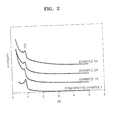
- FIG. 2 is a graph showing results of X-ray Diffraction (XRD) analysis of OMC composite catalysts manufactured according to Examples 1A, 2A, 3A, and Comparative Example 1.
- FIG. 2 illustrates a result of small-angle XRD analysis.
- a major peak of Bragg's 2 ⁇ angle to CuK-alpha characteristic X-ray wavelength 0.1541 nm is displayed about 0.5° to about 1.2°.
- the OMC composite catalysts prepared according to Examples 1A, 2A, and 3A have structural regularity with mesoporous regime.
- FIG. 3 is a graph showing the pore size distribution of the OMC ruthenium composite catalysts according to Examples 1A, 2A, and 3A,and Comparative Example 1.
- Table 1 shows BET surface areas, pore volumes, and average diameter of pores of the OMC composite catalysts of Examples 1A, 2A, 3A, and 9A, and Comparative Example 1.
- Table 1 BET Surface Area (m 2 /g) Pore Volume (cm 3 /g) Average Diameter of Pores (nm)
- Example 1A 910 1.25 6.0
- Example 2A 955 1.60 7.5
- Example 3A 1064 1.55 8.0
- the OMC ruthenium carbon composite catalysts prepared according to Examples 1A, 2A, 3A, and 9A have similar or bigger BET surface area and similar or larger pore volumes compared to the catalyst prepared according to Comparative Example 1. Also, the OMC ruthenium carbon composite catalysts prepared according to Examples 1A, 2A, 3A, and 9A have larger average diameter of pores compared to the catalyst of Comparative Example 1.
- Table 2 below lists amounts of each element measured by performing energy dispersive x-ray (EDX) analysis on the OMC composite catalysts of Examples 1A, 2A, and 3A, and Comparative Example 1, and shows atomic concentration. Table 2 shows an atomic concentration (at%).
- EDX energy dispersive x-ray
- Example 1A 5.96 1.25 1.59 3.75 0.79
- Example 2A 7.04 1.71 2.33 3.02 0.73
- Example 3A 1.55 1.62 - 0.96 Comparative Example 1 - - 1.52 - -
- the OMC composite catalysts prepared in Examples 1A and 2A include about 5 to about 7 at% of nitrogen, but the N/Ru ratio value is lower since some of the propylene diamine used as the nitrogen-containing carbon precursor in Example 2A evaporates during carbonization. Sulfuric acid, used as the carbonization catalyst in Comparative Example 1, is completely removed during a heat treating process, and thus, both nitrogen and sulfur are not left.
- Fuel cells are manufactured in the same manner as Evaluation Example 1A, except that the OMC composite catalysts of Examples 1B and 1C are used instead of the OMC composite catalyst of Example 1A.
- Fuel cells are manufactured in the same manner as Evaluation Example 1A, except that the OMC composite catalysts of Examples 2A, 2B, and 2C are used instead of the OMC composite catalyst of Example 1A.
- Fuel cells are manufactured in the same manner as Evaluation Example 1A, except that the OMC composite catalysts of Examples 3A, 3B, and 3C are used instead of the OMC composite catalyst of Example 1A.
- Fuel cells were manufactured in the same manner as Evaluation Example 1A, except that the OMC composite catalysts of Examples 4 through 11 were used instead of the OMC composite catalyst of Example 1A.
- a fuel cell was manufactured in the same manner as Evaluation Example 1, except that the OMC composite catalyst with ruthenium of Comparative Example 1 was used instead of the OMC composite catalyst of Example 1.
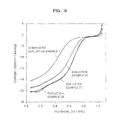
- Oxygen reduction reaction (ORR) characteristics of the half cells prepared according to Evaluation Examples 1A, 2A, and 3A and Comparative Evaluation Example 1 were measured at room temperature by saturating oxygen in a 0.1 M HClO 4 solution, and results thereof are illustrated in FIG. 4 .
- the ORR characteristics are evaluated according to a rotation disk electrode method in which current density values are measured in a voltage of 0.6 to 0.8 V and compared while scanning in a voltage in a range of 0 to 1.0 V at a rate of about 5 mV/s to induce oxygen reduction reaction.
- NHE denotes a normal hydrogen electrode.
- a rotation number of the rotation disk electrode is about 1600 rpm per minute.
- the half cells of Evaluation Examples 1A, 2A, and 3A have higher efficiency compared to the half cell of Comparative Evaluation Example 1.
- ORR characteristics of the half cells prepared according to Evaluation Examples 1A, 1B, and 1C and Comparative Evaluation Example 1 are measured at room temperature by saturating oxygen in a 0.1 M HClO 4 solution, and results thereof are illustrated in FIG. 5 .
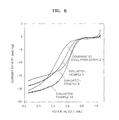
- ORR characteristics of the half cells prepared according to Evaluation Examples 2A, 2B, and 2C and Comparative Evaluation Example 1 are measured at room temperature by saturating oxygen in a 0.1 M HClO 4 solution, and results thereof are illustrated in FIG. 6 .
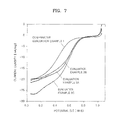
- ORR characteristics of the half cells prepared according to Evaluation Examples 3A, 3B, and 3C and Comparative Evaluation Example 1 are measured at room temperature by saturating oxygen in a 0.1 M HClO 4 solution, and results thereof are illustrated in FIG. 7 .
- FIGS. 5 through 7 The ORR characteristics of FIGS. 5 through 7 are evaluated in the same manner as in FIG. 4 .
- ORR characteristics of the half cells prepared according to Evaluation Examples 1A, 5, and 6 and Comparative Evaluation Example 1 are measured at room temperature by saturating oxygen in a 0.1 M HClO 4 solution, and results thereof are illustrated in FIG. 8 .
- the ORR characteristics of FIG. 8 are evaluated in the same manner as in FIG. 4 .
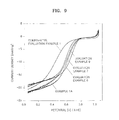
- ORR characteristics of the half cells prepared according to Evaluation Examples 1A, and 7 through 9 and Comparative Evaluation Example 1 are measured at room temperature by saturating oxygen in a 0.1 M HClO 4 solution, and results thereof are illustrated in FIG. 9 .
- the ORR characteristics of FIG. 9 are evaluated in the same manner as in FIG. 4 .
- the catalyst activity of the OMC composite catalyst with respect to oxygen reduction is improved compared to conventional OMC catalysts.
- the OMC composite catalyst By using the OMC composite catalyst, a fuel cell having an excellent oxygen reduction reaction is manufactured.
Landscapes
- Chemical & Material Sciences (AREA)
- Engineering & Computer Science (AREA)
- Chemical Kinetics & Catalysis (AREA)
- Materials Engineering (AREA)
- Organic Chemistry (AREA)
- General Chemical & Material Sciences (AREA)
- Electrochemistry (AREA)
- Life Sciences & Earth Sciences (AREA)
- Manufacturing & Machinery (AREA)
- Sustainable Development (AREA)
- Sustainable Energy (AREA)
- Physics & Mathematics (AREA)
- Thermal Sciences (AREA)
- Catalysts (AREA)
Applications Claiming Priority (1)
| Application Number | Priority Date | Filing Date | Title |
|---|---|---|---|
| KR20080138718 | 2008-12-31 |
Publications (3)
| Publication Number | Publication Date |
|---|---|
| EP2204237A2 true EP2204237A2 (de) | 2010-07-07 |
| EP2204237A3 EP2204237A3 (de) | 2012-10-03 |
| EP2204237B1 EP2204237B1 (de) | 2017-08-09 |
Family
ID=42122893
Family Applications (1)
| Application Number | Title | Priority Date | Filing Date |
|---|---|---|---|
| EP09180758.6A Active EP2204237B1 (de) | 2008-12-31 | 2009-12-24 | Geordneter mesoporöser Kohlenverbundstoffkatalysator, Verfahren zu dessen Herstellung und Brennstoffzelle, die diesen verwendet |
Country Status (2)
| Country | Link |
|---|---|
| EP (1) | EP2204237B1 (de) |
| KR (1) | KR101572120B1 (de) |
Cited By (5)
| Publication number | Priority date | Publication date | Assignee | Title |
|---|---|---|---|---|
| WO2014011831A1 (en) * | 2012-07-11 | 2014-01-16 | Stc.Unm | Carbendazim-based catalytic materials |
| CN108232208A (zh) * | 2016-12-22 | 2018-06-29 | 现代自动车株式会社 | 用于燃料电池的混合型催化剂及用于制造其的方法 |
| CN110327923A (zh) * | 2019-08-08 | 2019-10-15 | 广东工业大学 | 一种生物质糖醇氢解催化剂及其制备方法和应用 |
| CN112072121A (zh) * | 2020-07-30 | 2020-12-11 | 温州大学 | 一种三维有序大孔过渡金属氧化物复合材料及其制备方法和催化剂应用 |
| CN114792812A (zh) * | 2022-04-11 | 2022-07-26 | 河南师范大学 | 一种Fe、N共掺杂有序介孔碳基锌-空气电池阴极氧还原催化剂的制备方法 |
Families Citing this family (7)
| Publication number | Priority date | Publication date | Assignee | Title |
|---|---|---|---|---|
| KR101206913B1 (ko) * | 2010-11-16 | 2012-11-30 | 한국에너지기술연구원 | 메조기공이 형성된 다공성 탄소재료의 제조방법 및 이를 이용하여 제조된 연료전지용 촉매의 담지체 |
| KR101453486B1 (ko) * | 2012-05-03 | 2014-10-23 | 한양대학교 산학협력단 | 카본 황 복합체의 제조 방법, 이에 의하여 제조된 카본 황 복합체 및 이를 포함하는 전기 화학 소자 |
| KR101911432B1 (ko) * | 2012-06-18 | 2019-01-04 | 삼성전자주식회사 | 복합 담체, 이의 제조 방법, 이를 포함한 전극 촉매 및 상기 전극 촉매를 포함한 막-전극 접합체 및 연료 전지 |
| KR20150028882A (ko) | 2013-08-30 | 2015-03-17 | 국립대학법인 울산과학기술대학교 산학협력단 | 촉매 및 그의 제조방법 |
| CN104538648B (zh) * | 2014-12-10 | 2017-01-25 | 北京化工大学 | 一种石墨烯负载铂钴合金纳米粒子复合催化剂及其制备方法 |
| KR101661587B1 (ko) * | 2016-01-22 | 2016-10-04 | 울산과학기술원 | 셀프 담지 촉매의 제조방법 |
| CN110010905A (zh) * | 2019-03-14 | 2019-07-12 | 复旦大学 | 一种三维有序方形孔介孔碳载单原子铁氮催化剂的制备方法 |
Family Cites Families (3)
| Publication number | Priority date | Publication date | Assignee | Title |
|---|---|---|---|---|
| US6248691B1 (en) * | 1998-02-10 | 2001-06-19 | Corning Incorporated | Method of making mesoporous carbon |
| EP1652251A4 (de) * | 2003-07-16 | 2008-07-23 | Kyungwon Entpr Co Ltd | Nanostrukturierte metall-kohlenstoff-zusammensetzung für einen elektrodenkatalysator einer brennstoffzelle und herstellungsprozess dafür |
| US7867941B2 (en) * | 2006-12-29 | 2011-01-11 | Samsung Sdi Co., Ltd. | Sulfur-containing mesoporous carbon, method of manufacturing the same, and fuel cell using the mesoporous carbon |
-
2009
- 2009-12-24 EP EP09180758.6A patent/EP2204237B1/de active Active
- 2009-12-28 KR KR1020090131848A patent/KR101572120B1/ko active Active
Non-Patent Citations (1)
| Title |
|---|
| None |
Cited By (9)
| Publication number | Priority date | Publication date | Assignee | Title |
|---|---|---|---|---|
| WO2014011831A1 (en) * | 2012-07-11 | 2014-01-16 | Stc.Unm | Carbendazim-based catalytic materials |
| CN104812488A (zh) * | 2012-07-11 | 2015-07-29 | Stc.Unm公司 | 基于贝芬替的催化材料 |
| CN104812488B (zh) * | 2012-07-11 | 2017-03-15 | Stc.Unm 公司 | 基于贝芬替的催化材料 |
| CN108232208A (zh) * | 2016-12-22 | 2018-06-29 | 现代自动车株式会社 | 用于燃料电池的混合型催化剂及用于制造其的方法 |
| CN110327923A (zh) * | 2019-08-08 | 2019-10-15 | 广东工业大学 | 一种生物质糖醇氢解催化剂及其制备方法和应用 |
| CN110327923B (zh) * | 2019-08-08 | 2022-05-10 | 广东工业大学 | 一种生物质糖醇氢解催化剂及其制备方法和应用 |
| CN112072121A (zh) * | 2020-07-30 | 2020-12-11 | 温州大学 | 一种三维有序大孔过渡金属氧化物复合材料及其制备方法和催化剂应用 |
| CN112072121B (zh) * | 2020-07-30 | 2021-10-08 | 温州大学 | 一种三维有序大孔过渡金属氧化物复合材料及其制备方法和催化剂应用 |
| CN114792812A (zh) * | 2022-04-11 | 2022-07-26 | 河南师范大学 | 一种Fe、N共掺杂有序介孔碳基锌-空气电池阴极氧还原催化剂的制备方法 |
Also Published As
| Publication number | Publication date |
|---|---|
| EP2204237B1 (de) | 2017-08-09 |
| EP2204237A3 (de) | 2012-10-03 |
| KR20100080420A (ko) | 2010-07-08 |
| KR101572120B1 (ko) | 2015-11-27 |
Similar Documents
| Publication | Publication Date | Title |
|---|---|---|
| US8791043B2 (en) | Ordered mesoporous carbon composite catalyst, method of manufacturing the same, and fuel cell using the same | |
| EP2204237B1 (de) | Geordneter mesoporöser Kohlenverbundstoffkatalysator, Verfahren zu dessen Herstellung und Brennstoffzelle, die diesen verwendet | |
| KR101408041B1 (ko) | 황 함유 중형 다공성 탄소, 그 제조방법 및 이를 이용한 연료전지 | |
| KR100612896B1 (ko) | 중형 다공성 탄소체 및 그의 제조방법 | |
| KR100708730B1 (ko) | 중형 다공성 탄소, 그 제조방법 및 이를 이용한 연료전지 | |
| KR101911432B1 (ko) | 복합 담체, 이의 제조 방법, 이를 포함한 전극 촉매 및 상기 전극 촉매를 포함한 막-전극 접합체 및 연료 전지 | |
| KR100741078B1 (ko) | 중형 다공성 탄소, 그 제조방법 및 이를 이용한 연료전지 | |
| KR100696463B1 (ko) | 고농도 탄소 담지 촉매, 그 제조방법, 상기 촉매를 이용한촉매전극 및 이를 이용한 연료전지 | |
| KR100751350B1 (ko) | 헤테로원자 함유 중형 다공성 탄소, 그 제조방법 및 이를이용한 연료전지 | |
| KR101213475B1 (ko) | 중형 다공성 탄소 복합체, 그 제조방법 및 이를 이용한연료전지 | |
| EP2804244A1 (de) | Sauerstoffreduktionskatalysator und verfahren zu seiner herstellung | |
| KR102381910B1 (ko) | 다공성 질소 도핑 고흑연성 탄소체, 이를 포함하는 촉매 및 이의 제조방법 | |
| JP7144378B2 (ja) | 燃料電池触媒担体用の黒鉛化炭素多孔体、燃料電池触媒、及び燃料電池触媒層の製造方法 | |
| Hamzehie et al. | Synthesis–structure–performance correlation for poly-aniline–Me–C non-precious metal cathode based on mesoporous carbon catalysts for oxygen reduction reaction in low temperature fuel cells | |
| JP7785239B2 (ja) | 固体高分子型燃料電池の触媒担体用炭素材料、固体高分子型燃料電池用触媒層、及び燃料電池 | |
| Kakaei et al. | Microwave synthesis of platinum catalyst on fluorine-doped carbon foam for proton exchange membrane fuel cell: Half-Cell and single-cell evaluation | |
| WO2026005070A1 (ja) | 固体高分子型燃料電池の触媒担体用炭素材料、固体高分子型燃料電池用触媒層、及び燃料電池 | |
| JP2024099354A (ja) | 触媒担体、それを用いた白金系触媒担持体およびそれらの製造方法 | |
| JP2024127510A (ja) | 燃料電池用電極触媒及びそれを備える固体高分子型燃料電池 |
Legal Events
| Date | Code | Title | Description |
|---|---|---|---|
| PUAI | Public reference made under article 153(3) epc to a published international application that has entered the european phase |
Free format text: ORIGINAL CODE: 0009012 |
|
| AK | Designated contracting states |
Kind code of ref document: A2 Designated state(s): AT BE BG CH CY CZ DE DK EE ES FI FR GB GR HR HU IE IS IT LI LT LU LV MC MK MT NL NO PL PT RO SE SI SK SM TR |
|
| PUAL | Search report despatched |
Free format text: ORIGINAL CODE: 0009013 |
|
| RAP1 | Party data changed (applicant data changed or rights of an application transferred) |
Owner name: SAMSUNG ELECTRONICS CO., LTD. |
|
| AK | Designated contracting states |
Kind code of ref document: A3 Designated state(s): AT BE BG CH CY CZ DE DK EE ES FI FR GB GR HR HU IE IS IT LI LT LU LV MC MK MT NL NO PL PT RO SE SI SK SM TR |
|
| RIC1 | Information provided on ipc code assigned before grant |
Ipc: B01J 23/44 20060101ALI20120829BHEP Ipc: B01J 23/75 20060101ALI20120829BHEP Ipc: B01J 23/46 20060101ALI20120829BHEP Ipc: H01M 8/10 20060101ALI20120829BHEP Ipc: B01J 37/08 20060101ALI20120829BHEP Ipc: H01M 4/90 20060101ALI20120829BHEP Ipc: B01J 35/10 20060101ALI20120829BHEP Ipc: B01J 23/28 20060101ALI20120829BHEP Ipc: B01J 35/02 20060101AFI20120829BHEP Ipc: B01J 21/18 20060101ALI20120829BHEP Ipc: B01J 37/02 20060101ALI20120829BHEP Ipc: B01J 23/745 20060101ALI20120829BHEP Ipc: B01J 23/755 20060101ALI20120829BHEP Ipc: H01M 4/92 20060101ALI20120829BHEP Ipc: B01J 37/00 20060101ALI20120829BHEP |
|
| 17P | Request for examination filed |
Effective date: 20130403 |
|
| 17Q | First examination report despatched |
Effective date: 20151111 |
|
| RIC1 | Information provided on ipc code assigned before grant |
Ipc: B01J 23/46 20060101ALI20161221BHEP Ipc: B01J 35/02 20060101AFI20161221BHEP Ipc: B01J 37/00 20060101ALI20161221BHEP Ipc: H01M 8/1011 20160101ALN20161221BHEP Ipc: B01J 35/10 20060101ALI20161221BHEP Ipc: B01J 23/75 20060101ALI20161221BHEP Ipc: B01J 37/08 20060101ALI20161221BHEP Ipc: H01M 8/1018 20160101ALN20161221BHEP Ipc: B01J 23/28 20060101ALI20161221BHEP Ipc: B01J 21/18 20060101ALI20161221BHEP Ipc: H01M 4/90 20060101ALI20161221BHEP Ipc: B01J 37/02 20060101ALI20161221BHEP Ipc: B01J 23/745 20060101ALI20161221BHEP Ipc: H01M 8/10 20160101ALI20161221BHEP Ipc: H01M 4/92 20060101ALI20161221BHEP Ipc: B01J 23/755 20060101ALI20161221BHEP Ipc: B01J 23/44 20060101ALI20161221BHEP |
|
| RIC1 | Information provided on ipc code assigned before grant |
Ipc: B01J 23/44 20060101ALI20170118BHEP Ipc: B01J 35/02 20060101AFI20170118BHEP Ipc: B01J 37/02 20060101ALI20170118BHEP Ipc: B01J 37/08 20060101ALI20170118BHEP Ipc: H01M 8/1011 20160101ALN20170118BHEP Ipc: B01J 23/46 20060101ALI20170118BHEP Ipc: H01M 4/92 20060101ALI20170118BHEP Ipc: B01J 37/00 20060101ALI20170118BHEP Ipc: B01J 23/745 20060101ALI20170118BHEP Ipc: H01M 4/90 20060101ALI20170118BHEP Ipc: B01J 35/10 20060101ALI20170118BHEP Ipc: B01J 23/75 20060101ALI20170118BHEP Ipc: B01J 21/18 20060101ALI20170118BHEP Ipc: B01J 23/28 20060101ALI20170118BHEP Ipc: H01M 8/1018 20160101ALN20170118BHEP Ipc: B01J 23/755 20060101ALI20170118BHEP Ipc: H01M 8/10 20160101ALI20170118BHEP |
|
| GRAP | Despatch of communication of intention to grant a patent |
Free format text: ORIGINAL CODE: EPIDOSNIGR1 |
|
| INTG | Intention to grant announced |
Effective date: 20170224 |
|
| GRAS | Grant fee paid |
Free format text: ORIGINAL CODE: EPIDOSNIGR3 |
|
| GRAA | (expected) grant |
Free format text: ORIGINAL CODE: 0009210 |
|
| AK | Designated contracting states |
Kind code of ref document: B1 Designated state(s): AT BE BG CH CY CZ DE DK EE ES FI FR GB GR HR HU IE IS IT LI LT LU LV MC MK MT NL NO PL PT RO SE SI SK SM TR |
|
| REG | Reference to a national code |
Ref country code: GB Ref legal event code: FG4D |
|
| REG | Reference to a national code |
Ref country code: CH Ref legal event code: EP Ref country code: AT Ref legal event code: REF Ref document number: 916228 Country of ref document: AT Kind code of ref document: T Effective date: 20170815 |
|
| REG | Reference to a national code |
Ref country code: IE Ref legal event code: FG4D |
|
| REG | Reference to a national code |
Ref country code: DE Ref legal event code: R096 Ref document number: 602009047611 Country of ref document: DE |
|
| REG | Reference to a national code |
Ref country code: FR Ref legal event code: PLFP Year of fee payment: 9 |
|
| REG | Reference to a national code |
Ref country code: NL Ref legal event code: MP Effective date: 20170809 |
|
| REG | Reference to a national code |
Ref country code: LT Ref legal event code: MG4D |
|
| REG | Reference to a national code |
Ref country code: AT Ref legal event code: MK05 Ref document number: 916228 Country of ref document: AT Kind code of ref document: T Effective date: 20170809 |
|
| PG25 | Lapsed in a contracting state [announced via postgrant information from national office to epo] |
Ref country code: NO Free format text: LAPSE BECAUSE OF FAILURE TO SUBMIT A TRANSLATION OF THE DESCRIPTION OR TO PAY THE FEE WITHIN THE PRESCRIBED TIME-LIMIT Effective date: 20171109 Ref country code: HR Free format text: LAPSE BECAUSE OF FAILURE TO SUBMIT A TRANSLATION OF THE DESCRIPTION OR TO PAY THE FEE WITHIN THE PRESCRIBED TIME-LIMIT Effective date: 20170809 Ref country code: FI Free format text: LAPSE BECAUSE OF FAILURE TO SUBMIT A TRANSLATION OF THE DESCRIPTION OR TO PAY THE FEE WITHIN THE PRESCRIBED TIME-LIMIT Effective date: 20170809 Ref country code: AT Free format text: LAPSE BECAUSE OF FAILURE TO SUBMIT A TRANSLATION OF THE DESCRIPTION OR TO PAY THE FEE WITHIN THE PRESCRIBED TIME-LIMIT Effective date: 20170809 Ref country code: NL Free format text: LAPSE BECAUSE OF FAILURE TO SUBMIT A TRANSLATION OF THE DESCRIPTION OR TO PAY THE FEE WITHIN THE PRESCRIBED TIME-LIMIT Effective date: 20170809 Ref country code: SE Free format text: LAPSE BECAUSE OF FAILURE TO SUBMIT A TRANSLATION OF THE DESCRIPTION OR TO PAY THE FEE WITHIN THE PRESCRIBED TIME-LIMIT Effective date: 20170809 Ref country code: LT Free format text: LAPSE BECAUSE OF FAILURE TO SUBMIT A TRANSLATION OF THE DESCRIPTION OR TO PAY THE FEE WITHIN THE PRESCRIBED TIME-LIMIT Effective date: 20170809 |
|
| PG25 | Lapsed in a contracting state [announced via postgrant information from national office to epo] |
Ref country code: IS Free format text: LAPSE BECAUSE OF FAILURE TO SUBMIT A TRANSLATION OF THE DESCRIPTION OR TO PAY THE FEE WITHIN THE PRESCRIBED TIME-LIMIT Effective date: 20171209 Ref country code: GR Free format text: LAPSE BECAUSE OF FAILURE TO SUBMIT A TRANSLATION OF THE DESCRIPTION OR TO PAY THE FEE WITHIN THE PRESCRIBED TIME-LIMIT Effective date: 20171110 Ref country code: BG Free format text: LAPSE BECAUSE OF FAILURE TO SUBMIT A TRANSLATION OF THE DESCRIPTION OR TO PAY THE FEE WITHIN THE PRESCRIBED TIME-LIMIT Effective date: 20171109 Ref country code: PL Free format text: LAPSE BECAUSE OF FAILURE TO SUBMIT A TRANSLATION OF THE DESCRIPTION OR TO PAY THE FEE WITHIN THE PRESCRIBED TIME-LIMIT Effective date: 20170809 Ref country code: LV Free format text: LAPSE BECAUSE OF FAILURE TO SUBMIT A TRANSLATION OF THE DESCRIPTION OR TO PAY THE FEE WITHIN THE PRESCRIBED TIME-LIMIT Effective date: 20170809 Ref country code: ES Free format text: LAPSE BECAUSE OF FAILURE TO SUBMIT A TRANSLATION OF THE DESCRIPTION OR TO PAY THE FEE WITHIN THE PRESCRIBED TIME-LIMIT Effective date: 20170809 |
|
| PG25 | Lapsed in a contracting state [announced via postgrant information from national office to epo] |
Ref country code: CZ Free format text: LAPSE BECAUSE OF FAILURE TO SUBMIT A TRANSLATION OF THE DESCRIPTION OR TO PAY THE FEE WITHIN THE PRESCRIBED TIME-LIMIT Effective date: 20170809 Ref country code: DK Free format text: LAPSE BECAUSE OF FAILURE TO SUBMIT A TRANSLATION OF THE DESCRIPTION OR TO PAY THE FEE WITHIN THE PRESCRIBED TIME-LIMIT Effective date: 20170809 Ref country code: RO Free format text: LAPSE BECAUSE OF FAILURE TO SUBMIT A TRANSLATION OF THE DESCRIPTION OR TO PAY THE FEE WITHIN THE PRESCRIBED TIME-LIMIT Effective date: 20170809 |
|
| REG | Reference to a national code |
Ref country code: DE Ref legal event code: R097 Ref document number: 602009047611 Country of ref document: DE |
|
| PG25 | Lapsed in a contracting state [announced via postgrant information from national office to epo] |
Ref country code: SK Free format text: LAPSE BECAUSE OF FAILURE TO SUBMIT A TRANSLATION OF THE DESCRIPTION OR TO PAY THE FEE WITHIN THE PRESCRIBED TIME-LIMIT Effective date: 20170809 Ref country code: SM Free format text: LAPSE BECAUSE OF FAILURE TO SUBMIT A TRANSLATION OF THE DESCRIPTION OR TO PAY THE FEE WITHIN THE PRESCRIBED TIME-LIMIT Effective date: 20170809 Ref country code: EE Free format text: LAPSE BECAUSE OF FAILURE TO SUBMIT A TRANSLATION OF THE DESCRIPTION OR TO PAY THE FEE WITHIN THE PRESCRIBED TIME-LIMIT Effective date: 20170809 Ref country code: IT Free format text: LAPSE BECAUSE OF FAILURE TO SUBMIT A TRANSLATION OF THE DESCRIPTION OR TO PAY THE FEE WITHIN THE PRESCRIBED TIME-LIMIT Effective date: 20170809 |
|
| PLBE | No opposition filed within time limit |
Free format text: ORIGINAL CODE: 0009261 |
|
| STAA | Information on the status of an ep patent application or granted ep patent |
Free format text: STATUS: NO OPPOSITION FILED WITHIN TIME LIMIT |
|
| 26N | No opposition filed |
Effective date: 20180511 |
|
| REG | Reference to a national code |
Ref country code: CH Ref legal event code: PL |
|
| PG25 | Lapsed in a contracting state [announced via postgrant information from national office to epo] |
Ref country code: SI Free format text: LAPSE BECAUSE OF FAILURE TO SUBMIT A TRANSLATION OF THE DESCRIPTION OR TO PAY THE FEE WITHIN THE PRESCRIBED TIME-LIMIT Effective date: 20170809 |
|
| REG | Reference to a national code |
Ref country code: IE Ref legal event code: MM4A |
|
| PG25 | Lapsed in a contracting state [announced via postgrant information from national office to epo] |
Ref country code: MT Free format text: LAPSE BECAUSE OF NON-PAYMENT OF DUE FEES Effective date: 20171224 Ref country code: LU Free format text: LAPSE BECAUSE OF NON-PAYMENT OF DUE FEES Effective date: 20171224 |
|
| REG | Reference to a national code |
Ref country code: BE Ref legal event code: MM Effective date: 20171231 |
|
| PG25 | Lapsed in a contracting state [announced via postgrant information from national office to epo] |
Ref country code: IE Free format text: LAPSE BECAUSE OF NON-PAYMENT OF DUE FEES Effective date: 20171224 |
|
| PG25 | Lapsed in a contracting state [announced via postgrant information from national office to epo] |
Ref country code: CH Free format text: LAPSE BECAUSE OF NON-PAYMENT OF DUE FEES Effective date: 20171231 Ref country code: BE Free format text: LAPSE BECAUSE OF NON-PAYMENT OF DUE FEES Effective date: 20171231 Ref country code: LI Free format text: LAPSE BECAUSE OF NON-PAYMENT OF DUE FEES Effective date: 20171231 |
|
| PG25 | Lapsed in a contracting state [announced via postgrant information from national office to epo] |
Ref country code: MC Free format text: LAPSE BECAUSE OF FAILURE TO SUBMIT A TRANSLATION OF THE DESCRIPTION OR TO PAY THE FEE WITHIN THE PRESCRIBED TIME-LIMIT Effective date: 20170809 Ref country code: HU Free format text: LAPSE BECAUSE OF FAILURE TO SUBMIT A TRANSLATION OF THE DESCRIPTION OR TO PAY THE FEE WITHIN THE PRESCRIBED TIME-LIMIT; INVALID AB INITIO Effective date: 20091224 |
|
| PG25 | Lapsed in a contracting state [announced via postgrant information from national office to epo] |
Ref country code: CY Free format text: LAPSE BECAUSE OF NON-PAYMENT OF DUE FEES Effective date: 20170809 |
|
| PG25 | Lapsed in a contracting state [announced via postgrant information from national office to epo] |
Ref country code: MK Free format text: LAPSE BECAUSE OF FAILURE TO SUBMIT A TRANSLATION OF THE DESCRIPTION OR TO PAY THE FEE WITHIN THE PRESCRIBED TIME-LIMIT Effective date: 20170809 |
|
| PG25 | Lapsed in a contracting state [announced via postgrant information from national office to epo] |
Ref country code: TR Free format text: LAPSE BECAUSE OF FAILURE TO SUBMIT A TRANSLATION OF THE DESCRIPTION OR TO PAY THE FEE WITHIN THE PRESCRIBED TIME-LIMIT Effective date: 20170809 |
|
| PG25 | Lapsed in a contracting state [announced via postgrant information from national office to epo] |
Ref country code: PT Free format text: LAPSE BECAUSE OF FAILURE TO SUBMIT A TRANSLATION OF THE DESCRIPTION OR TO PAY THE FEE WITHIN THE PRESCRIBED TIME-LIMIT Effective date: 20170809 |
|
| P01 | Opt-out of the competence of the unified patent court (upc) registered |
Effective date: 20230530 |
|
| REG | Reference to a national code |
Ref country code: DE Ref legal event code: R079 Ref document number: 602009047611 Country of ref document: DE Free format text: PREVIOUS MAIN CLASS: B01J0035020000 Ipc: B01J0035000000 |
|
| PGFP | Annual fee paid to national office [announced via postgrant information from national office to epo] |
Ref country code: DE Payment date: 20251111 Year of fee payment: 17 |
|
| PGFP | Annual fee paid to national office [announced via postgrant information from national office to epo] |
Ref country code: GB Payment date: 20251113 Year of fee payment: 17 |
|
| PGFP | Annual fee paid to national office [announced via postgrant information from national office to epo] |
Ref country code: FR Payment date: 20251124 Year of fee payment: 17 |