EP2184651A2 - Power supply circuitry for inductive heating element - Google Patents
Power supply circuitry for inductive heating element Download PDFInfo
- Publication number
- EP2184651A2 EP2184651A2 EP09175691A EP09175691A EP2184651A2 EP 2184651 A2 EP2184651 A2 EP 2184651A2 EP 09175691 A EP09175691 A EP 09175691A EP 09175691 A EP09175691 A EP 09175691A EP 2184651 A2 EP2184651 A2 EP 2184651A2
- Authority
- EP
- European Patent Office
- Prior art keywords
- control mode
- power
- frequency
- control
- power supply
- Prior art date
- Legal status (The legal status is an assumption and is not a legal conclusion. Google has not performed a legal analysis and makes no representation as to the accuracy of the status listed.)
- Withdrawn
Links
- 238000010438 heat treatment Methods 0.000 title claims abstract description 45
- 230000001939 inductive effect Effects 0.000 title claims description 9
- 230000006698 induction Effects 0.000 claims abstract description 26
- 238000001514 detection method Methods 0.000 claims abstract description 24
- 230000003247 decreasing effect Effects 0.000 claims description 9
- 230000001965 increasing effect Effects 0.000 description 11
- 230000007423 decrease Effects 0.000 description 8
- 238000010586 diagram Methods 0.000 description 6
- 239000003990 capacitor Substances 0.000 description 5
- 230000005674 electromagnetic induction Effects 0.000 description 3
- 238000000034 method Methods 0.000 description 3
- 229910052777 Praseodymium Inorganic materials 0.000 description 1
- 229910052774 Proactinium Inorganic materials 0.000 description 1
- 239000000919 ceramic Substances 0.000 description 1
- 230000008859 change Effects 0.000 description 1
- 229910052736 halogen Inorganic materials 0.000 description 1
- 150000002367 halogens Chemical class 0.000 description 1
- 229910052745 lead Inorganic materials 0.000 description 1
- 238000004519 manufacturing process Methods 0.000 description 1
- 239000000463 material Substances 0.000 description 1
- 239000002184 metal Substances 0.000 description 1
- 229910052751 metal Inorganic materials 0.000 description 1
- 238000012986 modification Methods 0.000 description 1
- 230000004048 modification Effects 0.000 description 1
- 230000008569 process Effects 0.000 description 1
- 230000009467 reduction Effects 0.000 description 1
- 230000011218 segmentation Effects 0.000 description 1
- 229910052720 vanadium Inorganic materials 0.000 description 1
Images





Classifications
-
- G—PHYSICS
- G03—PHOTOGRAPHY; CINEMATOGRAPHY; ANALOGOUS TECHNIQUES USING WAVES OTHER THAN OPTICAL WAVES; ELECTROGRAPHY; HOLOGRAPHY
- G03G—ELECTROGRAPHY; ELECTROPHOTOGRAPHY; MAGNETOGRAPHY
- G03G15/00—Apparatus for electrographic processes using a charge pattern
- G03G15/20—Apparatus for electrographic processes using a charge pattern for fixing, e.g. by using heat
- G03G15/2003—Apparatus for electrographic processes using a charge pattern for fixing, e.g. by using heat using heat
- G03G15/2014—Apparatus for electrographic processes using a charge pattern for fixing, e.g. by using heat using heat using contact heat
-
- H—ELECTRICITY
- H05—ELECTRIC TECHNIQUES NOT OTHERWISE PROVIDED FOR
- H05B—ELECTRIC HEATING; ELECTRIC LIGHT SOURCES NOT OTHERWISE PROVIDED FOR; CIRCUIT ARRANGEMENTS FOR ELECTRIC LIGHT SOURCES, IN GENERAL
- H05B6/00—Heating by electric, magnetic or electromagnetic fields
- H05B6/02—Induction heating
- H05B6/10—Induction heating apparatus, other than furnaces, for specific applications
- H05B6/14—Tools, e.g. nozzles, rollers, calenders
-
- G—PHYSICS
- G03—PHOTOGRAPHY; CINEMATOGRAPHY; ANALOGOUS TECHNIQUES USING WAVES OTHER THAN OPTICAL WAVES; ELECTROGRAPHY; HOLOGRAPHY
- G03G—ELECTROGRAPHY; ELECTROPHOTOGRAPHY; MAGNETOGRAPHY
- G03G15/00—Apparatus for electrographic processes using a charge pattern
- G03G15/20—Apparatus for electrographic processes using a charge pattern for fixing, e.g. by using heat
- G03G15/2003—Apparatus for electrographic processes using a charge pattern for fixing, e.g. by using heat using heat
- G03G15/2014—Apparatus for electrographic processes using a charge pattern for fixing, e.g. by using heat using heat using contact heat
- G03G15/2039—Apparatus for electrographic processes using a charge pattern for fixing, e.g. by using heat using heat using contact heat with means for controlling the fixing temperature
- G03G15/205—Apparatus for electrographic processes using a charge pattern for fixing, e.g. by using heat using heat using contact heat with means for controlling the fixing temperature specially for the mode of operation, e.g. standby, warming-up, error
-
- G—PHYSICS
- G03—PHOTOGRAPHY; CINEMATOGRAPHY; ANALOGOUS TECHNIQUES USING WAVES OTHER THAN OPTICAL WAVES; ELECTROGRAPHY; HOLOGRAPHY
- G03G—ELECTROGRAPHY; ELECTROPHOTOGRAPHY; MAGNETOGRAPHY
- G03G2215/00—Apparatus for electrophotographic processes
- G03G2215/20—Details of the fixing device or porcess
- G03G2215/2003—Structural features of the fixing device
- G03G2215/2016—Heating belt
- G03G2215/2025—Heating belt the fixing nip having a rotating belt support member opposing a pressure member
- G03G2215/2032—Heating belt the fixing nip having a rotating belt support member opposing a pressure member the belt further entrained around additional rotating belt support members
Definitions
- the present invention relates to power supply circuitry for an inductive heating element.
- a fixing apparatus of the induction heating type may be incorporated in an image forming apparatus, and the power supply circuitry may be used to supply power to an inductive heating element in such fixing apparatus.
- the image forming apparatus generally contains a fixing device for fixing a toner image transferred to a recording material.
- a fixing device for fixing a toner image transferred to a recording material.
- a heating type device using a ceramic heater or a halogen heater has conventionally been used in many cases.
- an electromagnetic induction heating type device has begun to be used (refer to Japanese Patent Application Laid-Open No. 2000-223253 ).
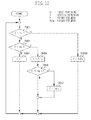
- Fig. 12 illustrates a simple frequency control method employed for power control of a power supply unit, which supplies power to a fixing device of the induction heating type.
- detected power P is compared with target power Po.
- the frequency is increased by a predetermined value fa.
- the frequency is decreased by a predetermined value fb.
- the frequency is maintained.
- Fig. 13 illustrates a simple frequency control method employed for temperature control of the fixing device.
- steps 5001 and 5002 a detected temperature T is compared with a target temperature To.
- the frequency is increased by a predetermined value fa.
- the frequency is decreased by a predetermined value fb.
- the frequency is maintained.
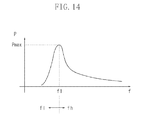
- Fig. 14 illustrates a relationship between a driving frequency f and power P.
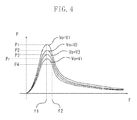
- maximum power Pmax is supplied to a coil at a resonance frequency f1.
- supplied power is reduced when the frequency changes to a high-frequency side or a low-frequency side relative to the resonance frequency f1.
- It is also possible to control the power by controlling the driving frequency within a frequency range fl below the resonance frequency f1.
- the driving frequency for a switching element which is used to supply power to the coil, is set higher than the resonance frequency.
- the driving frequency becomes higher than the resonance frequency, switching losses of the switching element may increase. Losses are particularly conspicuous when a large-power operation is performed in a state in which the driving frequency deviates from the resonance frequency.
- both a boosting circuit and a de-boosting circuit are required, thus leading to a great increase in production cost and circuit size.
- Fig. 1 is a sectional diagram illustrating a configuration of an image forming apparatus according to an exemplary embodiment of the present invention.
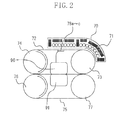
- Fig. 2 is a sectional diagram illustrating a configuration of a fixing device.
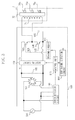
- Fig. 3 is a circuit diagram illustrating a configuration of a power supply unit of the fixing device.
- Fig. 4 illustrates a relationship between a driving frequency of a coil and power.
- Fig. 5 illustrates a relationship between an output voltage of a boosting circuit and power.
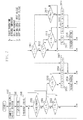
- Fig. 6 is a control flowchart for a fixing device according to a first exemplary embodiment of the present invention.
- Fig. 7 is a control flowchart for a fixing device according to a second exemplary embodiment of the present invention.
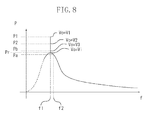
- Fig. 8 illustrates a relationship among a driving frequency, an output voltage of a boosting circuit and power according to the second exemplar embodiment.
- Fig. 9 is a table illustrating a relationship among power, an output voltage of a boosting circuit and a driving frequency according to a third exemplary embodiment of the present invention.
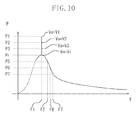
- Fig. 10 illustrates a relationship in changes between the output voltage of the boosting circuit and the driving frequency according to the third exemplary embodiment.
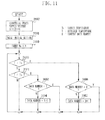
- Fig. 11 is a control flowchart for a fixing device according to the third exemplary embodiment.
- Fig. 12 is a power control flowchart based on frequency control of a conventional fixing device.
- Fig. 13 is a temperature control flowchart based on the frequency control of the conventional fixing device.
- Fig. 14 illustrates a relationship between a driving frequency of a coil and power.
- Fig. 1 is a sectional diagram illustrating a configuration of a color image forming apparatus according to a first exemplary embodiment of the present invention.
- the apparatus is an image forming apparatus that uses an electrophotography process.
- a fixing device 7 fixes the toner image transferred to the recording paper P, so that a color image is obtained.
- the fixing device 7 has a configuration of the electromagnetic induction heating type.
- FIG. 2 is a sectional diagram illustrating the configuration of the fixing device of the electromagnetic induction heating type.
- a fixing belt 72 is a metal belt serving as a heating member, which includes a conductive heating element, and its surface is covered with a rubber layer of 300 ⁇ m.
- the fixing belt 72 rotates around rollers 73 and 74 in a shown arrow direction.
- a fixing belt 75 rotates around rollers 76 and 77 in a shown arrow direction.
- An induction heating coil 71 is located in a coil holder 70 opposite the fixing belt 72, which includes a conductive heating element.
- An AC current flows through the coil 71 to generate a magnetic field, so that the conductive heating element of the belt 72 generates heat by itself.
- Thermistors 78a, 78b and 78c are located in contact with center, rear, and front sides of the belt 72 in a depth direction to detect a temperature of the belt 72.
- the thermistors 78a, 78b and 78c are resistors that exhibit resistance values higher as a temperature is lower.
- an AC current flowing through the coil 71 is increased or decreased so that the temperature detected by the center thermistor 78a reaches 190° C, which is a target temperature.
- Upper and lower pads 90 and 91 apply pressure of about 40 kg weight on the belts 72 and 75.
- Fig. 3 is a block diagram illustrating a configuration of a power supply unit 100, which supplies power to the fixing device 7 of the induction heating type.
- An AC power source 500 supplies power to the power supply unit 100.
- An AC voltage from the AC power source 500 is rectified by a diode bridge 101, and the rectified voltage is smoothed by a filter capacitor 102.
- a resonance capacitor 105 constitutes a resonance circuit with the coil 71.
- a boosting circuit 108 boosts a DC voltage rectified by the diode bridge 101, and its boosting ratio is variable. For example, the boosting ratio changes within a range of 1 to 3.
- First and second switching elements 103 and 104 control power supplied to the coil 71.
- a switch driving circuit 112 drives the switching elements 103 and 104 with switch driving signals 121 and 122.
- the boosting circuit 108, switching elements 103, 104, switch driving circuit 112 and capacitor 105 form part of a driving signal generator which supplies coil driving signals to the coil 71.
- a control unit 113 controls the boosting circuit 108 and the switch driving circuit 112.
- a power detection circuit 111 detects input power from the AC power source 500.
- a temperature detection circuit 114 detects a temperature of the belt 72 based on signals from the thermistors 78a to 78c.
- the control unit 113 determines power to be supplied to the coil 71 based on a detection result from the power detection circuit 111 and a detection result from the temperature detection circuit 114, and determines driving frequencies of the switch driving signals 121 and 122 output from the switch driving circuit 112 and a boosting ratio of the boosting circuit 108 so that power supplied to the coil 71 reaches the determined power.
- the switching elements 103 and 104 are alternately turned ON/OFF according to the switch driving signals 121 and 122 to supply coil driving signals (a high-frequency current) to the coil 71.
- Fig. 4 illustrates a relationship between frequencies of the switch driving signals 121 and 122 of the switching elements 103 and 104 output from the switch driving circuit 112 and power supplied to the coil 71.
- Fig. 5 illustrates a relationship between an output voltage Vo of the boosting circuit 108 and power P when frequencies f of the driving signals 121 and 122 are equal to the resonance frequency f1.
- the frequency control mode is a mode (first control mode) for controlling power to be supplied by changing the driving frequency of the switching element within a range of frequencies equal to or higher than a predetermined frequency in a state where the boosting ratio of the boosting circuit 108 is maintained at a predetermined boosting ratio.
- the voltage control mode is a mode (second control mode) for controlling power to be supplied by changing the boosting ratio of the boosting circuit 108 within a range of ratios equal to or higher than a predetermined boosting ratio in a state where the driving frequency of the switching element is maintained at a predetermined frequency.
- Fig. 6 is a flowchart illustrating power control for the fixing device 7 executed by the control unit 113.
- a temperature T of the center of the belt 72, at which the thermistor 78a is located is controlled to a target temperature To.
- the control unit 113 initially sets a mode of power control to the frequency control mode at the time of starting an operation.
- the initial setting of the mode to the frequency control mode is for the purpose of gradually increasing power from a low power state to increase the temperature of the belt 72 at the time of starting control.
- the control unit 113 determines whether the control mode is the voltage control mode at a point of this time. When determining that the mode is the frequency control mode, then in steps 1001 and 1002, the control unit 113 compares the detected temperature T based on an output of the thermistor 78a with the target temperature To.
- step 1007 to decrease the temperature of the belt 72, the control unit 113 increases the frequency by a predetermined value fb. The processing then returns to step 1000.
- the control unit 113 is required to increase the temperature of the belt 72.
- step 1003 the control unit 113 determines whether a value obtained by decreasing the frequency by a predetermined value fa is higher than a resonance frequency f1, in other words, whether the value satisfies "f-fa ⁇ f1".
- f-fa ⁇ f1 in step 1006 to increase the temperature of the belt 72, the control unit 113 decreases the frequency by the predetermined value fa. The processing then returns to step 1000.
- step 1005 the control unit 113 sets the frequency to f1.
- step 1008 the control unit 113 switches the mode of power control from the frequency control mode to the voltage control mode. The processing then returns to step 1000.
- step 1000 When determining in step 1000 that the mode of power control is the voltage control mode at a point of this time, then in steps 1011 and 1012, the control unit 113 compares the detected temperature T based on the output of the thermistor 78a with the target temperature To. In the case of T ⁇ To, the control unit 113 is required to increase the temperature of the belt 72. Then in step 1017, the control unit 113 determines whether power P supplied to the coil 71 is less than upper limit power Pmax. If it is not the case that P ⁇ Pmax, the control unit 113 maintains an output voltage Vo of the boosting circuit 108 as it is. The processing then returns to step 1000.
- step 1019 the control unit 113 sets the boosting ratio to increase the output voltage Vo of the boosting circuit 108 by a predetermined value Vb.
- the processing then returns to step 1000.
- step 1013 the control unit 113 determines whether a value obtained by decreasing the output voltage Vo of the boosting circuit 108 by a predetermined value Va is lower than an input voltage Vi of the boosting circuit 108, in other words, whether the value satisfies "Vo-Va ⁇ Vi" .
- step 1016 the control unit 113 sets the boosting ratio to decrease the output voltage Vo of the boosting circuit 108 by the predetermined value Va.
- the resonance frequency f1 is about 25 kHz.
- the voltage Vi is about 140 V and the reference power Pr at this time is 500 W.
- the power supply unit 100 operates in the voltage control mode where the driving frequency is maintained at 25 kHz when supplying a power larger than 500 W, and operates in the frequency control mode (driving frequency 25 kHz or higher) where the output voltage of the boosting circuit 108 is maintained at 140 V when supplying a power smaller than 500 W.
- Fig. 7 is a flowchart illustrating power control executed by the control unit 113 in the second exemplary embodiment.
- a temperature T of the center of the belt 72, at which the thermistor 78a is located is controlled to a target temperature To.
- the power supplied when the boosting ratio of the boosting circuit 108 is set to a predetermined boosting ratio (boosting ratio 1) and the driving frequency of the switching element is set to a predetermined frequency (resonance frequency f1) is used as a reference power Pr.
- step 1997 the control unit 113 detects a voltage of the commercial power source 500.
- step 1998 the control unit 113 sets a power Pa and a power Pb, which are used as references for switching between the voltage control mode and the frequency control mode according to a voltage detection value.
- the power Pa is set to a first predetermined power lower than the reference power Pr.
- the power Pb is set to a second predetermined power larger than the reference power Pr.
- a relationship among Pa, Pb, and Pr is Pa ⁇ Pr ⁇ Pb as illustrated in Fig. 8 .
- step 1999 the control unit 113 initially sets the mode of power control to the frequency control mode.
- the initial setting of the mode to the frequency control mode is for the purpose of gradually increasing power from low power at the time of starting control.
- the control unit 113 determines whether the mode of power control is the voltage control mode at a point of this time. When determining that the mode is not the voltage control mode but the frequency control mode, then in steps 2001 and 2002, the control unit 113 compares a detected temperature T with the target temperature To. In the case of T > To, then in step 2007, the control unit 113 increases the frequency by a predetermined value fb. The processing then returns to step 2000. In the case of T ⁇ To, then in step 2003, the control unit 113 compares power P supplied to the coil 71 with the set value Pa.
- step 2006 the control unit 113 decreases the frequency by a predetermined value fa.
- the processing then returns to step 2000.
- step 2008 the control unit 113 switches the mode of power control to the voltage control mode.
- step 2000 when determining in step 2000 that the mode of power control is the voltage control mode at a point of this time, then in steps 2011 and 2012, the control unit 113 compares the detected temperature T with the target temperature To. In the case of T ⁇ To, then in step 2017, the control unit 113 determines whether power P is less than upper limit power Pmax. If it is not the case that P ⁇ Pmax, the control unit 113 maintains the output voltage Vo of the boosting circuit 108. The processing then returns to step 2000. In the case of P ⁇ Pmax, then in step 2019, the control unit 113 increases the output voltage Vo of the boosting circuit 108 by the predetermined value Vb. The processing then returns to step 2000.
- the resonance frequency f1 is about 25 kHz.
- the voltage of the commercial power source 500 is 100 V
- the voltage Vi is about 140 V
- the power Pr at a point of this time is 500 W in the configuration of the fixing device 7 according to the present exemplary embodiment.
- the power Pa is set to 470 W
- the power Pb is set to 530 W.
- the power Pr is 720 W.
- the power Pa is set to 690 W
- the power Pb is set to 750 W.
- Configurations of an image forming apparatus and a power supply unit according to a third exemplary embodiment of the present invention are similar to those of the first and second exemplary embodiments.
- the control unit 113 has a table storing data as illustrated in Fig. 9 .
- the stored data is divided into a plurality of sets of data numbered from 1 to 8.
- Each set of data corresponds to a different power P (P1 to P7 or 0) and indicates a relationship between the output voltage Vo of the boosting circuit 108 and the driving frequency f applicable at the power concerned.
- the control unit 113 selects one of the data sets (combination of output voltage Vo (boosting ratio) and driving frequency f) in the table according to a difference between the target temperature and the detected temperature of the fixing device 7.
- Fig. 10 is a graphic representation of the relationship indicated in the table illustrated in Fig. 9 .
- the control unit 113 selects the voltage control mode when power higher than Pr is necessary, and the frequency control mode when power lower than Pr is necessary.
- Fig. 11 is a flowchart illustrating power control executed by the control unit 113 according to the third exemplary embodiment.
- the temperature T of the center of the conductive heating element 72, at which the thermistor 78a is located is controlled to a target temperature To.
- step 2997 the control unit 113 detects the voltage of the commercial power source 500.
- step 2998 the control unit 113 sets a table of combinations of output voltages Vo and driving frequencies f of the boosting circuit as illustrated in Fig. 9 . More specifically, the control unit 113 determines whether the commercial AC power source is a 100 V or 200 V system. The control unit 113 sets a table for 100 V in the case of the 100 V system, and a table for 200 V in the case of the 200 V system. The control unit 113 may set different tables depending on countries or regions where the image forming apparatus is installed.
- step 2999 the control unit 113 sets a data set number, indicating a combination of the output frequency Vo of the boosting circuit and the driving frequency f, to 8.
- the data set number 8 indicates a power stop state.
- step 3000 the control unit 113 compares the detected temperature T with the target temperature To. In the case of T > To, then in step 3006, the control unit 113 determines whether a data number X set at this point in time (hereinafter referred to as a current data set number) is 8, in other words, a stop state. If the data set number is 8, the control unit 113 maintains the data set number X as it is. The processing then returns to step 3000. If the data set number is not 8, the processing proceeds to step 3007.
- the control unit 113 changes the combination to that of Vo and f set by a number higher by one than the current data set number X.
- step 3001 If it is not the case that T > To in step 3000, the processing proceeds to step 3001. If T ⁇ To in step 3001, then in step 3002, the control unit 113 determines whether the current data set number X is 1, in other words, maximum power setting. If the data set number X is 1, the control unit 113 maintains the data set number as it is. The processing then returns to step 3000. If in step 3002 the data set number X is not 1, the processing proceeds to step 3004. In step 3004, to increase power to be supplied to the induction heating coil 71, the control unit 113 changes the combination to a combination of Vo and f set by a number lower by one than the current data set number X.
- changing the boosting ratio while driving the switching element with the resonance frequency enables changes in power while reducing losses of the switching element.
- changing the driving frequency of the switching element enables power control without needing any de-boosting circuit.
- One embodiment of the present invention can provide a fixing apparatus (7) comprising: an induction heating coil (71) configured to heat a heat generating member including a conductive heating element; a boosting circuit (108) configured to boost a DC voltage obtained by rectifying AC power; a switching element (103, 104) configured to input a DC voltage boosted by the boosting circuit and to supply a high-frequency current to the induction heating coil; a driving circuit (112) configured to drive the switching element; temperature detection means (114) configured to detect a temperature of the heat generating member; and control means (113) configured to control power supplied to the induction heating coil by controlling a boosting ratio of the boosting circuit and a driving frequency of the switching element by the driving circuit so that the temperature detected by the temperature detection means reaches a target temperature, wherein the control means is configured to selectively execute a first control mode for controlling the power supplied to the induction heating coil by changing the driving frequency of the switching element within a range of frequencies equal to or higher than a predetermined frequency and a second control mode for controlling the
- control means is configured to maintain the boosting ratio of the boosting circuit at the predetermined boosting ratio in the first control mode, and to maintain the driving frequency of the switching element at the predetermined frequency in the second control mode.
- control means is configured to select one of the first control mode and the second control mode based on the temperature detected by the temperature detection means, the boosting ratio, and the driving frequency.
- control means is configured to execute the first control mode at the time of starting an operation of the fixing apparatus.
- the control means in a state where the first control mode is selected, when the temperature detected by the temperature detection means is lower than the target temperature, if a value obtained by decreasing a driving frequency that is set when the temperature is detected by the temperature detection unit by a predetermined value is lower than the predetermined frequency, the control means is configured to switch from the first control mode to the second control mode. In one embodiment, in a state where the second control mode is selected, when the temperature detected by the temperature detection means is higher than the target temperature, if a value obtained by decreasing a boosting ratio that is set when the temperature is detected by the temperature detection unit by a predetermined value is lower than the predetermined boosting ratio, the control means is configured to switch from the second control mode to the first control mode.
- the control means in a state where the first control mode is selected, when the temperature detected by the temperature detection means is lower than the target temperature, and the power to be supplied to the induction heating coil is set higher than first predetermined power, the control means is configured to switch front the first control mode to the second control mode, and wherein the first predetermined power is power smaller than the power supplied to the induction heating coil when the boosting ratio of the boosting circuit is equal to the predetermined boosting ratio and the driving frequency is equal to the predetermined frequency.
- the control means in a state where the second control mode is selected, when the temperature detected by the temperature detection means is higher than the target temperature, and the power to be supplied to the induction heating coil is set lower than second predetermined power, the control means is configured to switch from the second control mode to the first control mode, and wherein the second predetermined power is power larger than the power supplied to the induction heating coil when the boosting ratio of the boosting circuit is equal to the predetermined boosting ratio and the driving frequency is equal to the predetermined frequency.
- control means is configured to increase the power to be supplied to the induction heating coil when the temperature detected by the temperature detection means is lower than the target temperature, to decrease the power to be supplied to the induction heating coil when the temperature detected by the temperature detection means is higher than the target temperature, to select the first control mode when the power to be supplied is smaller than the predetermined power, and to select the second control mode when the power to be supplied is larger than the predetermined power.
- predetermined power is power supplied to the induction heating coil when the boosting ratio of the boosting circuit is equal to the predetermined boosting ratio and the driving frequency is equal to the predetermined frequency.
- the apparatus further comprises a table configured to store data indicating a relationship between the boosting ratio and the driving frequency corresponding to the power to be supplied, wherein in the data of the table, the boosting ratio and the driving frequency are determined according to the first control mode within a range in which the power to be supplied is smaller than the predetermined power, and are determined according to the second control mode within a range in which the power to be supplied is larger than the predetermined power.
Landscapes
- Physics & Mathematics (AREA)
- General Physics & Mathematics (AREA)
- Electromagnetism (AREA)
- Fixing For Electrophotography (AREA)
- General Induction Heating (AREA)
- Control Or Security For Electrophotography (AREA)
Applications Claiming Priority (1)
| Application Number | Priority Date | Filing Date | Title |
|---|---|---|---|
| JP2008288944A JP5317633B2 (ja) | 2008-11-11 | 2008-11-11 | 定着装置 |
Publications (1)
| Publication Number | Publication Date |
|---|---|
| EP2184651A2 true EP2184651A2 (en) | 2010-05-12 |
Family
ID=41720604
Family Applications (1)
| Application Number | Title | Priority Date | Filing Date |
|---|---|---|---|
| EP09175691A Withdrawn EP2184651A2 (en) | 2008-11-11 | 2009-11-11 | Power supply circuitry for inductive heating element |
Country Status (6)
| Country | Link |
|---|---|
| US (2) | US8461497B2 (enExample) |
| EP (1) | EP2184651A2 (enExample) |
| JP (1) | JP5317633B2 (enExample) |
| KR (1) | KR101438847B1 (enExample) |
| CN (1) | CN101738915B (enExample) |
| RU (1) | RU2404550C1 (enExample) |
Cited By (1)
| Publication number | Priority date | Publication date | Assignee | Title |
|---|---|---|---|---|
| CN104561470A (zh) * | 2015-02-02 | 2015-04-29 | 扬中市盛达电器制造有限责任公司 | 并联谐振中频焊接热处理装置 |
Families Citing this family (7)
| Publication number | Priority date | Publication date | Assignee | Title |
|---|---|---|---|---|
| EP2692202B1 (de) * | 2011-03-30 | 2017-01-04 | BSH Hausgeräte GmbH | Induktionsheizvorrichtung |
| JP5375872B2 (ja) | 2011-04-27 | 2013-12-25 | コニカミノルタ株式会社 | 誘導加熱装置及び画像形成装置 |
| JP2015014682A (ja) | 2013-07-04 | 2015-01-22 | 株式会社リコー | 定着装置及び画像形成装置 |
| JP5886251B2 (ja) * | 2013-08-19 | 2016-03-16 | 京セラドキュメントソリューションズ株式会社 | 画像形成装置及び画像形成方法 |
| EP3066514B1 (en) * | 2013-11-08 | 2019-02-20 | Bank Of Canada | Optically variable devices, their production and use |
| CN105338674B (zh) * | 2014-07-02 | 2019-04-30 | 浙江苏泊尔家电制造有限公司 | 一种电磁加热方法及采用该方法的电磁加热的电饭煲 |
| JP6483399B2 (ja) | 2014-10-23 | 2019-03-13 | エイチピー プリンティング コリア カンパニー リミテッド | 誘導加熱方式画像定着装置及び誘導加熱方式画像定着装置駆動プログラム |
Citations (1)
| Publication number | Priority date | Publication date | Assignee | Title |
|---|---|---|---|---|
| JP2000223253A (ja) | 1999-01-29 | 2000-08-11 | Canon Inc | 加熱装置 |
Family Cites Families (15)
| Publication number | Priority date | Publication date | Assignee | Title |
|---|---|---|---|---|
| SU1525841A1 (ru) * | 1986-10-20 | 1989-11-30 | Производственное Объединение "Таллиннский Электротехнический Завод Им.М.И.Калинина" | Устройство дл управлени преобразователем частоты со звеном посто нного тока |
| SU1725405A1 (ru) * | 1989-05-22 | 1992-04-07 | Уфимский авиационный институт им.Серго Орджоникидзе | Способ регулировани электрического режима индукционной электротермической установки |
| JP2002124370A (ja) * | 2000-10-13 | 2002-04-26 | Ricoh Co Ltd | 誘導加熱装置及び該誘導加熱装置を備えた画像処理装置 |
| US6930293B2 (en) * | 2002-02-04 | 2005-08-16 | Canon Kabushiki Kaisha | Induction heating apparatus, heat fixing apparatus and image forming apparatus |
| JP2004004205A (ja) * | 2002-05-30 | 2004-01-08 | Canon Inc | 定着装置及び画像形成装置 |
| US20040238530A1 (en) * | 2003-01-31 | 2004-12-02 | Matsushita Electric Industrial Co., Ltd. | Electric power apparatus, electromagnetic induction fixing apparatus and image forming apparatus using the same |
| JP4035146B2 (ja) * | 2003-02-20 | 2008-01-16 | 松下電器産業株式会社 | 加熱定着装置及びその制御方法 |
| JP4301244B2 (ja) * | 2003-10-30 | 2009-07-22 | パナソニック株式会社 | 誘導加熱調理器 |
| JP4444076B2 (ja) * | 2004-11-15 | 2010-03-31 | 株式会社東芝 | 誘導加熱調理器 |
| CN101010989B (zh) * | 2005-06-02 | 2011-05-11 | 松下电器产业株式会社 | 感应加热装置 |
| DE602006016117D1 (de) * | 2005-06-02 | 2010-09-23 | Panasonic Corp | Induktionsheizgerät |
| JP4893120B2 (ja) * | 2005-06-17 | 2012-03-07 | パナソニック株式会社 | 誘導加熱装置 |
| EP1838138B1 (en) * | 2006-03-20 | 2013-02-27 | Ricoh Company, Ltd. | Booster circuit for enhanced induction heating unit, power-supply unit, and image forming apparatus using the same |
| JP2007286495A (ja) * | 2006-04-19 | 2007-11-01 | Canon Inc | 加熱装置及び画像形成装置 |
| US9724777B2 (en) * | 2009-04-08 | 2017-08-08 | Hakko Corporation | System and method for induction heating of a soldering iron |
-
2008
- 2008-11-11 JP JP2008288944A patent/JP5317633B2/ja not_active Expired - Fee Related
-
2009
- 2009-11-09 KR KR1020090107478A patent/KR101438847B1/ko not_active Expired - Fee Related
- 2009-11-10 RU RU2009141638/07A patent/RU2404550C1/ru not_active IP Right Cessation
- 2009-11-10 US US12/615,879 patent/US8461497B2/en not_active Expired - Fee Related
- 2009-11-11 EP EP09175691A patent/EP2184651A2/en not_active Withdrawn
- 2009-11-11 CN CN2009102216508A patent/CN101738915B/zh not_active Expired - Fee Related
-
2013
- 2013-05-15 US US13/894,795 patent/US8768192B2/en not_active Expired - Fee Related
Patent Citations (1)
| Publication number | Priority date | Publication date | Assignee | Title |
|---|---|---|---|---|
| JP2000223253A (ja) | 1999-01-29 | 2000-08-11 | Canon Inc | 加熱装置 |
Cited By (1)
| Publication number | Priority date | Publication date | Assignee | Title |
|---|---|---|---|---|
| CN104561470A (zh) * | 2015-02-02 | 2015-04-29 | 扬中市盛达电器制造有限责任公司 | 并联谐振中频焊接热处理装置 |
Also Published As
| Publication number | Publication date |
|---|---|
| KR20100053447A (ko) | 2010-05-20 |
| US20100119248A1 (en) | 2010-05-13 |
| JP5317633B2 (ja) | 2013-10-16 |
| CN101738915A (zh) | 2010-06-16 |
| RU2404550C1 (ru) | 2010-11-20 |
| US20130251391A1 (en) | 2013-09-26 |
| KR101438847B1 (ko) | 2014-09-05 |
| JP2010117431A (ja) | 2010-05-27 |
| US8768192B2 (en) | 2014-07-01 |
| US8461497B2 (en) | 2013-06-11 |
| CN101738915B (zh) | 2012-05-30 |
Similar Documents
| Publication | Publication Date | Title |
|---|---|---|
| US8768192B2 (en) | Fixing apparatus of induction heating type for fixing image formed on sheet | |
| KR101375503B1 (ko) | 유도 가열 회로 및 화상 형성 장치 | |
| US6889018B2 (en) | Fixing unit | |
| US7184697B2 (en) | Fixing apparatus having an induction heating control circuit | |
| JP6843696B2 (ja) | 電源装置及び画像形成装置 | |
| US20110131434A1 (en) | Image forming apparatus and power control method | |
| EP1531370A1 (en) | Method and apparatus for image forming capable of effectively performing an image fixing | |
| JP6452105B2 (ja) | 画像形成装置 | |
| JP6671871B2 (ja) | 定着装置 | |
| US20060131301A1 (en) | Image heating apparatus | |
| US9606482B2 (en) | Fixing apparatus | |
| JP5308965B2 (ja) | 電源装置及び定着装置 | |
| JP2008089986A (ja) | 画像形成装置 | |
| JP4944546B2 (ja) | 電気機器および画像形成装置 | |
| JP3718622B2 (ja) | 誘導加熱装置 | |
| JP2013029746A (ja) | 画像形成装置 | |
| JP4779573B2 (ja) | 画像形成装置 | |
| JP2011253196A (ja) | 画像形成装置 | |
| JP2008145990A (ja) | 加熱装置及びそれを用いた画像形成装置 | |
| JP5577436B2 (ja) | 電源装置及び定着装置 | |
| JP6362491B2 (ja) | 定着装置 | |
| JP2007140329A (ja) | 画像形成装置及び定着装置 | |
| JP2017153182A (ja) | 電力制御装置 | |
| JP3395487B2 (ja) | 誘導加熱定着装置 | |
| JP2020030382A (ja) | 画像加熱装置及びこれを用いた画像形成装置 |
Legal Events
| Date | Code | Title | Description |
|---|---|---|---|
| PUAI | Public reference made under article 153(3) epc to a published international application that has entered the european phase |
Free format text: ORIGINAL CODE: 0009012 |
|
| AK | Designated contracting states |
Kind code of ref document: A2 Designated state(s): AT BE BG CH CY CZ DE DK EE ES FI FR GB GR HR HU IE IS IT LI LT LU LV MC MK MT NL NO PL PT RO SE SI SK SM TR |
|
| AX | Request for extension of the european patent |
Extension state: AL BA RS |
|
| STAA | Information on the status of an ep patent application or granted ep patent |
Free format text: STATUS: THE APPLICATION IS DEEMED TO BE WITHDRAWN |
|
| 18D | Application deemed to be withdrawn |
Effective date: 20170601 |