EP2160435B1 - Toughened adhesive material - Google Patents
Toughened adhesive material Download PDFInfo
- Publication number
- EP2160435B1 EP2160435B1 EP08770580A EP08770580A EP2160435B1 EP 2160435 B1 EP2160435 B1 EP 2160435B1 EP 08770580 A EP08770580 A EP 08770580A EP 08770580 A EP08770580 A EP 08770580A EP 2160435 B1 EP2160435 B1 EP 2160435B1
- Authority
- EP
- European Patent Office
- Prior art keywords
- adhesive material
- epoxy
- weight
- less
- impact modifier
- Prior art date
- Legal status (The legal status is an assumption and is not a legal conclusion. Google has not performed a legal analysis and makes no representation as to the accuracy of the status listed.)
- Not-in-force
Links
- 239000000463 material Substances 0.000 title claims abstract description 228
- 239000000853 adhesive Substances 0.000 title claims abstract description 177
- 230000001070 adhesive effect Effects 0.000 title claims abstract description 177
- 239000004609 Impact Modifier Substances 0.000 claims abstract description 50
- 239000003795 chemical substances by application Substances 0.000 claims abstract description 28
- 229920000647 polyepoxide Polymers 0.000 claims abstract description 28
- 239000003822 epoxy resin Substances 0.000 claims abstract description 27
- 239000003981 vehicle Substances 0.000 claims abstract description 14
- 239000004593 Epoxy Substances 0.000 claims description 43
- 229920000642 polymer Polymers 0.000 claims description 29
- 229920001169 thermoplastic Polymers 0.000 claims description 20
- 239000004416 thermosoftening plastic Substances 0.000 claims description 20
- 238000000034 method Methods 0.000 claims description 19
- 229920000570 polyether Polymers 0.000 claims description 19
- 239000013034 phenoxy resin Substances 0.000 claims description 15
- 229920006287 phenoxy resin Polymers 0.000 claims description 15
- 229920001577 copolymer Polymers 0.000 claims description 14
- 230000004913 activation Effects 0.000 claims description 13
- 150000001412 amines Chemical class 0.000 claims description 13
- 239000004721 Polyphenylene oxide Substances 0.000 claims description 11
- PPBRXRYQALVLMV-UHFFFAOYSA-N Styrene Chemical compound C=CC1=CC=CC=C1 PPBRXRYQALVLMV-UHFFFAOYSA-N 0.000 claims description 10
- 239000005077 polysulfide Substances 0.000 claims description 9
- 229920001021 polysulfide Polymers 0.000 claims description 9
- 150000008117 polysulfides Polymers 0.000 claims description 9
- 229920009204 Methacrylate-butadiene-styrene Polymers 0.000 claims description 7
- 229920002635 polyurethane Polymers 0.000 claims description 7
- 239000004814 polyurethane Substances 0.000 claims description 7
- 239000004850 liquid epoxy resins (LERs) Substances 0.000 claims description 6
- 229920000058 polyacrylate Polymers 0.000 claims description 4
- XECAHXYUAAWDEL-UHFFFAOYSA-N acrylonitrile butadiene styrene Chemical compound C=CC=C.C=CC#N.C=CC1=CC=CC=C1 XECAHXYUAAWDEL-UHFFFAOYSA-N 0.000 claims description 3
- 239000004676 acrylonitrile butadiene styrene Substances 0.000 claims description 3
- 229920000122 acrylonitrile butadiene styrene Polymers 0.000 claims description 3
- 230000003213 activating effect Effects 0.000 claims description 3
- LKAVYBZHOYOUSX-UHFFFAOYSA-N buta-1,3-diene;2-methylprop-2-enoic acid;styrene Chemical compound C=CC=C.CC(=C)C(O)=O.C=CC1=CC=CC=C1 LKAVYBZHOYOUSX-UHFFFAOYSA-N 0.000 claims description 3
- ACYXOHNDKRVKLH-UHFFFAOYSA-N 5-phenylpenta-2,4-dienenitrile prop-2-enoic acid Chemical compound OC(=O)C=C.N#CC=CC=CC1=CC=CC=C1 ACYXOHNDKRVKLH-UHFFFAOYSA-N 0.000 claims description 2
- 229920000800 acrylic rubber Polymers 0.000 claims description 2
- VZIBAPMSKYQDFH-UHFFFAOYSA-N buta-1,3-diene;2-methylprop-2-enoic acid;prop-2-enenitrile;styrene Chemical compound C=CC=C.C=CC#N.CC(=C)C(O)=O.C=CC1=CC=CC=C1 VZIBAPMSKYQDFH-UHFFFAOYSA-N 0.000 claims description 2
- 239000004604 Blowing Agent Substances 0.000 abstract description 20
- 239000000945 filler Substances 0.000 abstract description 20
- 238000004519 manufacturing process Methods 0.000 abstract description 8
- 238000007789 sealing Methods 0.000 abstract description 5
- 230000003014 reinforcing effect Effects 0.000 abstract 1
- -1 boron trichloride amine Chemical class 0.000 description 30
- IISBACLAFKSPIT-UHFFFAOYSA-N bisphenol A Chemical compound C=1C=C(O)C=CC=1C(C)(C)C1=CC=C(O)C=C1 IISBACLAFKSPIT-UHFFFAOYSA-N 0.000 description 24
- 239000011162 core material Substances 0.000 description 23
- 239000011257 shell material Substances 0.000 description 21
- 239000007787 solid Substances 0.000 description 17
- 239000000203 mixture Substances 0.000 description 16
- 229920001971 elastomer Polymers 0.000 description 13
- 229920005989 resin Polymers 0.000 description 13
- 239000011347 resin Substances 0.000 description 13
- 229940106691 bisphenol a Drugs 0.000 description 11
- 239000004615 ingredient Substances 0.000 description 11
- KAKZBPTYRLMSJV-UHFFFAOYSA-N Butadiene Chemical compound C=CC=C KAKZBPTYRLMSJV-UHFFFAOYSA-N 0.000 description 10
- 239000000758 substrate Substances 0.000 description 10
- 239000011258 core-shell material Substances 0.000 description 9
- 239000007788 liquid Substances 0.000 description 9
- 239000000126 substance Substances 0.000 description 9
- 230000015572 biosynthetic process Effects 0.000 description 8
- GYZLOYUZLJXAJU-UHFFFAOYSA-N diglycidyl ether Chemical class C1OC1COCC1CO1 GYZLOYUZLJXAJU-UHFFFAOYSA-N 0.000 description 8
- 239000000806 elastomer Substances 0.000 description 8
- 229920000459 Nitrile rubber Polymers 0.000 description 7
- 229920001187 thermosetting polymer Polymers 0.000 description 7
- 229920000578 graft copolymer Polymers 0.000 description 6
- LNEPOXFFQSENCJ-UHFFFAOYSA-N haloperidol Chemical compound C1CC(O)(C=2C=CC(Cl)=CC=2)CCN1CCCC(=O)C1=CC=C(F)C=C1 LNEPOXFFQSENCJ-UHFFFAOYSA-N 0.000 description 6
- RAXXELZNTBOGNW-UHFFFAOYSA-N imidazole Natural products C1=CNC=N1 RAXXELZNTBOGNW-UHFFFAOYSA-N 0.000 description 6
- KUBDPQJOLOUJRM-UHFFFAOYSA-N 2-(chloromethyl)oxirane;4-[2-(4-hydroxyphenyl)propan-2-yl]phenol Chemical compound ClCC1CO1.C=1C=C(O)C=CC=1C(C)(C)C1=CC=C(O)C=C1 KUBDPQJOLOUJRM-UHFFFAOYSA-N 0.000 description 5
- ISWSIDIOOBJBQZ-UHFFFAOYSA-N Phenol Chemical compound OC1=CC=CC=C1 ISWSIDIOOBJBQZ-UHFFFAOYSA-N 0.000 description 5
- 239000004952 Polyamide Substances 0.000 description 5
- QGBSISYHAICWAH-UHFFFAOYSA-N dicyandiamide Chemical compound NC(N)=NC#N QGBSISYHAICWAH-UHFFFAOYSA-N 0.000 description 5
- 238000005187 foaming Methods 0.000 description 5
- 229920003229 poly(methyl methacrylate) Polymers 0.000 description 5
- 229920002647 polyamide Polymers 0.000 description 5
- 239000005060 rubber Substances 0.000 description 5
- VVQNEPGJFQJSBK-UHFFFAOYSA-N Methyl methacrylate Chemical compound COC(=O)C(C)=C VVQNEPGJFQJSBK-UHFFFAOYSA-N 0.000 description 4
- VYPSYNLAJGMNEJ-UHFFFAOYSA-N Silicium dioxide Chemical compound O=[Si]=O VYPSYNLAJGMNEJ-UHFFFAOYSA-N 0.000 description 4
- 125000001931 aliphatic group Chemical group 0.000 description 4
- 125000003118 aryl group Chemical group 0.000 description 4
- PXKLMJQFEQBVLD-UHFFFAOYSA-N bisphenol F Chemical compound C1=CC(O)=CC=C1CC1=CC=C(O)C=C1 PXKLMJQFEQBVLD-UHFFFAOYSA-N 0.000 description 4
- 235000013877 carbamide Nutrition 0.000 description 4
- 239000006260 foam Substances 0.000 description 4
- 239000011521 glass Substances 0.000 description 4
- 239000004926 polymethyl methacrylate Substances 0.000 description 4
- 230000002787 reinforcement Effects 0.000 description 4
- BPSIOYPQMFLKFR-UHFFFAOYSA-N trimethoxy-[3-(oxiran-2-ylmethoxy)propyl]silane Chemical group CO[Si](OC)(OC)CCCOCC1CO1 BPSIOYPQMFLKFR-UHFFFAOYSA-N 0.000 description 4
- XSQUKJJJFZCRTK-UHFFFAOYSA-N Urea Chemical compound NC(N)=O XSQUKJJJFZCRTK-UHFFFAOYSA-N 0.000 description 3
- 239000002253 acid Substances 0.000 description 3
- 150000001252 acrylic acid derivatives Chemical class 0.000 description 3
- 239000002318 adhesion promoter Substances 0.000 description 3
- 230000005587 bubbling Effects 0.000 description 3
- 239000004202 carbamide Substances 0.000 description 3
- 125000003178 carboxy group Chemical group [H]OC(*)=O 0.000 description 3
- 239000011248 coating agent Substances 0.000 description 3
- 238000000576 coating method Methods 0.000 description 3
- 150000001875 compounds Chemical class 0.000 description 3
- 238000004132 cross linking Methods 0.000 description 3
- 238000013016 damping Methods 0.000 description 3
- 238000009472 formulation Methods 0.000 description 3
- 150000002734 metacrylic acid derivatives Chemical class 0.000 description 3
- 229910052751 metal Inorganic materials 0.000 description 3
- 239000002184 metal Substances 0.000 description 3
- 239000000178 monomer Substances 0.000 description 3
- 239000000049 pigment Substances 0.000 description 3
- 229920000728 polyester Polymers 0.000 description 3
- 229920000573 polyethylene Polymers 0.000 description 3
- 229920003048 styrene butadiene rubber Polymers 0.000 description 3
- HPILSDOMLLYBQF-UHFFFAOYSA-N 2-[1-(oxiran-2-ylmethoxy)butoxymethyl]oxirane Chemical class C1OC1COC(CCC)OCC1CO1 HPILSDOMLLYBQF-UHFFFAOYSA-N 0.000 description 2
- KUDUQBURMYMBIJ-UHFFFAOYSA-N 2-prop-2-enoyloxyethyl prop-2-enoate Chemical compound C=CC(=O)OCCOC(=O)C=C KUDUQBURMYMBIJ-UHFFFAOYSA-N 0.000 description 2
- 229930185605 Bisphenol Natural products 0.000 description 2
- VTYYLEPIZMXCLO-UHFFFAOYSA-L Calcium carbonate Chemical compound [Ca+2].[O-]C([O-])=O VTYYLEPIZMXCLO-UHFFFAOYSA-L 0.000 description 2
- RTZKZFJDLAIYFH-UHFFFAOYSA-N Diethyl ether Chemical compound CCOCC RTZKZFJDLAIYFH-UHFFFAOYSA-N 0.000 description 2
- MWRWFPQBGSZWNV-UHFFFAOYSA-N Dinitrosopentamethylenetetramine Chemical compound C1N2CN(N=O)CN1CN(N=O)C2 MWRWFPQBGSZWNV-UHFFFAOYSA-N 0.000 description 2
- 229920002943 EPDM rubber Polymers 0.000 description 2
- RRHGJUQNOFWUDK-UHFFFAOYSA-N Isoprene Chemical compound CC(=C)C=C RRHGJUQNOFWUDK-UHFFFAOYSA-N 0.000 description 2
- 239000005062 Polybutadiene Substances 0.000 description 2
- 239000004698 Polyethylene Substances 0.000 description 2
- CDBYLPFSWZWCQE-UHFFFAOYSA-L Sodium Carbonate Chemical compound [Na+].[Na+].[O-]C([O-])=O CDBYLPFSWZWCQE-UHFFFAOYSA-L 0.000 description 2
- XTXRWKRVRITETP-UHFFFAOYSA-N Vinyl acetate Chemical compound CC(=O)OC=C XTXRWKRVRITETP-UHFFFAOYSA-N 0.000 description 2
- XLOMVQKBTHCTTD-UHFFFAOYSA-N Zinc monoxide Chemical compound [Zn]=O XLOMVQKBTHCTTD-UHFFFAOYSA-N 0.000 description 2
- 150000001242 acetic acid derivatives Chemical class 0.000 description 2
- NIXOWILDQLNWCW-UHFFFAOYSA-M acrylate group Chemical group C(C=C)(=O)[O-] NIXOWILDQLNWCW-UHFFFAOYSA-M 0.000 description 2
- 239000000654 additive Substances 0.000 description 2
- 150000008064 anhydrides Chemical class 0.000 description 2
- 229920006231 aramid fiber Polymers 0.000 description 2
- 239000011324 bead Substances 0.000 description 2
- 230000008901 benefit Effects 0.000 description 2
- WPYMKLBDIGXBTP-UHFFFAOYSA-N benzoic acid Chemical compound OC(=O)C1=CC=CC=C1 WPYMKLBDIGXBTP-UHFFFAOYSA-N 0.000 description 2
- CQEYYJKEWSMYFG-UHFFFAOYSA-N butyl acrylate Chemical compound CCCCOC(=O)C=C CQEYYJKEWSMYFG-UHFFFAOYSA-N 0.000 description 2
- 210000003850 cellular structure Anatomy 0.000 description 2
- 239000000919 ceramic Substances 0.000 description 2
- 239000007795 chemical reaction product Substances 0.000 description 2
- 239000003086 colorant Substances 0.000 description 2
- 239000000539 dimer Substances 0.000 description 2
- 125000003700 epoxy group Chemical group 0.000 description 2
- 229920001038 ethylene copolymer Polymers 0.000 description 2
- 239000005038 ethylene vinyl acetate Substances 0.000 description 2
- 238000001125 extrusion Methods 0.000 description 2
- 239000000835 fiber Substances 0.000 description 2
- WNLRTRBMVRJNCN-UHFFFAOYSA-N hexanedioic acid Natural products OC(=O)CCCCC(O)=O WNLRTRBMVRJNCN-UHFFFAOYSA-N 0.000 description 2
- 125000002887 hydroxy group Chemical group [H]O* 0.000 description 2
- 239000012535 impurity Substances 0.000 description 2
- 229910052500 inorganic mineral Inorganic materials 0.000 description 2
- 229910052618 mica group Inorganic materials 0.000 description 2
- 239000011707 mineral Substances 0.000 description 2
- 239000003607 modifier Substances 0.000 description 2
- 238000010422 painting Methods 0.000 description 2
- 239000008188 pellet Substances 0.000 description 2
- 229920001200 poly(ethylene-vinyl acetate) Polymers 0.000 description 2
- 229920002239 polyacrylonitrile Polymers 0.000 description 2
- 229920002857 polybutadiene Polymers 0.000 description 2
- 239000002861 polymer material Substances 0.000 description 2
- 229920001451 polypropylene glycol Polymers 0.000 description 2
- 229920001296 polysiloxane Polymers 0.000 description 2
- 239000000843 powder Substances 0.000 description 2
- 230000009257 reactivity Effects 0.000 description 2
- 150000004756 silanes Chemical class 0.000 description 2
- 239000000454 talc Substances 0.000 description 2
- 229910052623 talc Inorganic materials 0.000 description 2
- 150000003672 ureas Chemical class 0.000 description 2
- CZGWDPMDAIPURF-UHFFFAOYSA-N (4,6-dihydrazinyl-1,3,5-triazin-2-yl)hydrazine Chemical compound NNC1=NC(NN)=NC(NN)=N1 CZGWDPMDAIPURF-UHFFFAOYSA-N 0.000 description 1
- WTFAGPBUAGFMQX-UHFFFAOYSA-N 1-[2-[2-(2-aminopropoxy)propoxy]propoxy]propan-2-amine Chemical compound CC(N)COCC(C)OCC(C)OCC(C)N WTFAGPBUAGFMQX-UHFFFAOYSA-N 0.000 description 1
- VILCJCGEZXAXTO-UHFFFAOYSA-N 2,2,2-tetramine Chemical compound NCCNCCNCCN VILCJCGEZXAXTO-UHFFFAOYSA-N 0.000 description 1
- RNFJDJUURJAICM-UHFFFAOYSA-N 2,2,4,4,6,6-hexaphenoxy-1,3,5-triaza-2$l^{5},4$l^{5},6$l^{5}-triphosphacyclohexa-1,3,5-triene Chemical compound N=1P(OC=2C=CC=CC=2)(OC=2C=CC=CC=2)=NP(OC=2C=CC=CC=2)(OC=2C=CC=CC=2)=NP=1(OC=1C=CC=CC=1)OC1=CC=CC=C1 RNFJDJUURJAICM-UHFFFAOYSA-N 0.000 description 1
- HZAXFHJVJLSVMW-UHFFFAOYSA-N 2-Aminoethan-1-ol Chemical compound NCCO HZAXFHJVJLSVMW-UHFFFAOYSA-N 0.000 description 1
- KXGFMDJXCMQABM-UHFFFAOYSA-N 2-methoxy-6-methylphenol Chemical compound [CH]OC1=CC=CC([CH])=C1O KXGFMDJXCMQABM-UHFFFAOYSA-N 0.000 description 1
- QTWJRLJHJPIABL-UHFFFAOYSA-N 2-methylphenol;3-methylphenol;4-methylphenol Chemical compound CC1=CC=C(O)C=C1.CC1=CC=CC(O)=C1.CC1=CC=CC=C1O QTWJRLJHJPIABL-UHFFFAOYSA-N 0.000 description 1
- 125000003903 2-propenyl group Chemical group [H]C([*])([H])C([H])=C([H])[H] 0.000 description 1
- XOJWAAUYNWGQAU-UHFFFAOYSA-N 4-(2-methylprop-2-enoyloxy)butyl 2-methylprop-2-enoate Chemical compound CC(=C)C(=O)OCCCCOC(=O)C(C)=C XOJWAAUYNWGQAU-UHFFFAOYSA-N 0.000 description 1
- NLHHRLWOUZZQLW-UHFFFAOYSA-N Acrylonitrile Chemical compound C=CC#N NLHHRLWOUZZQLW-UHFFFAOYSA-N 0.000 description 1
- 229920003319 Araldite® Polymers 0.000 description 1
- 239000004156 Azodicarbonamide Substances 0.000 description 1
- 239000005711 Benzoic acid Substances 0.000 description 1
- OKTJSMMVPCPJKN-UHFFFAOYSA-N Carbon Chemical compound [C] OKTJSMMVPCPJKN-UHFFFAOYSA-N 0.000 description 1
- 229920000049 Carbon (fiber) Polymers 0.000 description 1
- RWSOTUBLDIXVET-UHFFFAOYSA-N Dihydrogen sulfide Chemical class S RWSOTUBLDIXVET-UHFFFAOYSA-N 0.000 description 1
- BRLQWZUYTZBJKN-UHFFFAOYSA-N Epichlorohydrin Chemical compound ClCC1CO1 BRLQWZUYTZBJKN-UHFFFAOYSA-N 0.000 description 1
- 229920000271 Kevlar® Polymers 0.000 description 1
- 239000005909 Kieselgur Substances 0.000 description 1
- 239000006057 Non-nutritive feed additive Substances 0.000 description 1
- 239000004677 Nylon Substances 0.000 description 1
- 229920003171 Poly (ethylene oxide) Polymers 0.000 description 1
- 229920001665 Poly-4-vinylphenol Polymers 0.000 description 1
- 229920002873 Polyethylenimine Polymers 0.000 description 1
- 239000004642 Polyimide Substances 0.000 description 1
- 229920002367 Polyisobutene Polymers 0.000 description 1
- 239000004743 Polypropylene Substances 0.000 description 1
- 239000004793 Polystyrene Substances 0.000 description 1
- 229920001328 Polyvinylidene chloride Polymers 0.000 description 1
- 239000004113 Sepiolite Substances 0.000 description 1
- 229920002125 Sokalan® Polymers 0.000 description 1
- 239000002174 Styrene-butadiene Substances 0.000 description 1
- BZHJMEDXRYGGRV-UHFFFAOYSA-N Vinyl chloride Chemical compound ClC=C BZHJMEDXRYGGRV-UHFFFAOYSA-N 0.000 description 1
- 239000000619 acesulfame-K Substances 0.000 description 1
- ACOGMWBDRJJKNB-UHFFFAOYSA-N acetic acid;ethene Chemical class C=C.CC(O)=O ACOGMWBDRJJKNB-UHFFFAOYSA-N 0.000 description 1
- NIXOWILDQLNWCW-UHFFFAOYSA-N acrylic acid group Chemical group C(C=C)(=O)O NIXOWILDQLNWCW-UHFFFAOYSA-N 0.000 description 1
- 229920006243 acrylic copolymer Polymers 0.000 description 1
- 229920006397 acrylic thermoplastic Polymers 0.000 description 1
- 150000008360 acrylonitriles Chemical class 0.000 description 1
- 238000007259 addition reaction Methods 0.000 description 1
- 239000001361 adipic acid Substances 0.000 description 1
- 235000011037 adipic acid Nutrition 0.000 description 1
- 150000001335 aliphatic alkanes Chemical class 0.000 description 1
- 150000001336 alkenes Chemical class 0.000 description 1
- 125000005250 alkyl acrylate group Chemical group 0.000 description 1
- 150000001408 amides Chemical group 0.000 description 1
- 239000003963 antioxidant agent Substances 0.000 description 1
- 239000004760 aramid Substances 0.000 description 1
- 150000004982 aromatic amines Chemical class 0.000 description 1
- 150000008378 aryl ethers Chemical class 0.000 description 1
- XOZUGNYVDXMRKW-AATRIKPKSA-N azodicarbonamide Chemical compound NC(=O)\N=N\C(N)=O XOZUGNYVDXMRKW-AATRIKPKSA-N 0.000 description 1
- 235000019399 azodicarbonamide Nutrition 0.000 description 1
- 235000010233 benzoic acid Nutrition 0.000 description 1
- 239000004305 biphenyl Substances 0.000 description 1
- 235000010290 biphenyl Nutrition 0.000 description 1
- 125000006267 biphenyl group Chemical group 0.000 description 1
- ZPOLOEWJWXZUSP-WAYWQWQTSA-N bis(prop-2-enyl) (z)-but-2-enedioate Chemical compound C=CCOC(=O)\C=C/C(=O)OCC=C ZPOLOEWJWXZUSP-WAYWQWQTSA-N 0.000 description 1
- WTEOIRVLGSZEPR-UHFFFAOYSA-N boron trifluoride Chemical class FB(F)F WTEOIRVLGSZEPR-UHFFFAOYSA-N 0.000 description 1
- DQXBYHZEEUGOBF-UHFFFAOYSA-N but-3-enoic acid;ethene Chemical compound C=C.OC(=O)CC=C DQXBYHZEEUGOBF-UHFFFAOYSA-N 0.000 description 1
- NTXGQCSETZTARF-UHFFFAOYSA-N buta-1,3-diene;prop-2-enenitrile Chemical compound C=CC=C.C=CC#N NTXGQCSETZTARF-UHFFFAOYSA-N 0.000 description 1
- IRLQAJPIHBZROB-UHFFFAOYSA-N buta-2,3-dienenitrile Chemical class C=C=CC#N IRLQAJPIHBZROB-UHFFFAOYSA-N 0.000 description 1
- MTAZNLWOLGHBHU-UHFFFAOYSA-N butadiene-styrene rubber Chemical compound C=CC=C.C=CC1=CC=CC=C1 MTAZNLWOLGHBHU-UHFFFAOYSA-N 0.000 description 1
- 125000000484 butyl group Chemical group [H]C([*])([H])C([H])([H])C([H])([H])C([H])([H])[H] 0.000 description 1
- 229910000019 calcium carbonate Inorganic materials 0.000 description 1
- 229910052799 carbon Inorganic materials 0.000 description 1
- 239000004917 carbon fiber Substances 0.000 description 1
- 150000004649 carbonic acid derivatives Chemical class 0.000 description 1
- 238000006555 catalytic reaction Methods 0.000 description 1
- 230000008859 change Effects 0.000 description 1
- 239000002666 chemical blowing agent Substances 0.000 description 1
- 239000004927 clay Substances 0.000 description 1
- 230000015271 coagulation Effects 0.000 description 1
- 238000005345 coagulation Methods 0.000 description 1
- 230000001010 compromised effect Effects 0.000 description 1
- 238000010276 construction Methods 0.000 description 1
- 229930003836 cresol Natural products 0.000 description 1
- 238000005520 cutting process Methods 0.000 description 1
- 239000011353 cycloaliphatic epoxy resin Substances 0.000 description 1
- GUJOJGAPFQRJSV-UHFFFAOYSA-N dialuminum;dioxosilane;oxygen(2-);hydrate Chemical compound O.[O-2].[O-2].[O-2].[Al+3].[Al+3].O=[Si]=O.O=[Si]=O.O=[Si]=O.O=[Si]=O GUJOJGAPFQRJSV-UHFFFAOYSA-N 0.000 description 1
- 238000010981 drying operation Methods 0.000 description 1
- 238000007720 emulsion polymerization reaction Methods 0.000 description 1
- 238000005516 engineering process Methods 0.000 description 1
- HGVPOWOAHALJHA-UHFFFAOYSA-N ethene;methyl prop-2-enoate Chemical compound C=C.COC(=O)C=C HGVPOWOAHALJHA-UHFFFAOYSA-N 0.000 description 1
- QHZOMAXECYYXGP-UHFFFAOYSA-N ethene;prop-2-enoic acid Chemical class C=C.OC(=O)C=C QHZOMAXECYYXGP-UHFFFAOYSA-N 0.000 description 1
- 125000001495 ethyl group Chemical group [H]C([H])([H])C([H])([H])* 0.000 description 1
- STVZJERGLQHEKB-UHFFFAOYSA-N ethylene glycol dimethacrylate Chemical compound CC(=C)C(=O)OCCOC(=O)C(C)=C STVZJERGLQHEKB-UHFFFAOYSA-N 0.000 description 1
- 229920006225 ethylene-methyl acrylate Polymers 0.000 description 1
- 239000005043 ethylene-methyl acrylate Substances 0.000 description 1
- 230000001747 exhibiting effect Effects 0.000 description 1
- 239000010433 feldspar Substances 0.000 description 1
- 239000002657 fibrous material Substances 0.000 description 1
- 239000003063 flame retardant Substances 0.000 description 1
- 125000000524 functional group Chemical group 0.000 description 1
- 230000009477 glass transition Effects 0.000 description 1
- 125000003827 glycol group Chemical group 0.000 description 1
- 239000012760 heat stabilizer Substances 0.000 description 1
- 238000010438 heat treatment Methods 0.000 description 1
- 229910052900 illite Inorganic materials 0.000 description 1
- 150000002460 imidazoles Chemical class 0.000 description 1
- 239000012948 isocyanate Substances 0.000 description 1
- 150000002513 isocyanates Chemical class 0.000 description 1
- NLYAJNPCOHFWQQ-UHFFFAOYSA-N kaolin Chemical compound O.O.O=[Al]O[Si](=O)O[Si](=O)O[Al]=O NLYAJNPCOHFWQQ-UHFFFAOYSA-N 0.000 description 1
- 229910052622 kaolinite Inorganic materials 0.000 description 1
- 239000004761 kevlar Substances 0.000 description 1
- 239000000314 lubricant Substances 0.000 description 1
- 229910044991 metal oxide Inorganic materials 0.000 description 1
- 150000004706 metal oxides Chemical class 0.000 description 1
- VNWKTOKETHGBQD-UHFFFAOYSA-N methane Chemical compound C VNWKTOKETHGBQD-UHFFFAOYSA-N 0.000 description 1
- 239000010445 mica Substances 0.000 description 1
- 239000004005 microsphere Substances 0.000 description 1
- 238000002156 mixing Methods 0.000 description 1
- 229910052901 montmorillonite Inorganic materials 0.000 description 1
- 238000000465 moulding Methods 0.000 description 1
- SWXPTWPWDSJGGK-UHFFFAOYSA-N n'-[2-[2-(2-aminoethylamino)ethylamino]ethyl]ethane-1,2-diamine;n'-(2-aminoethyl)ethane-1,2-diamine Chemical compound NCCNCCN.NCCNCCNCCNCCN SWXPTWPWDSJGGK-UHFFFAOYSA-N 0.000 description 1
- 239000012802 nanoclay Substances 0.000 description 1
- 229910052757 nitrogen Inorganic materials 0.000 description 1
- QJGQUHMNIGDVPM-UHFFFAOYSA-N nitrogen group Chemical group [N] QJGQUHMNIGDVPM-UHFFFAOYSA-N 0.000 description 1
- VGIBGUSAECPPNB-UHFFFAOYSA-L nonaaluminum;magnesium;tripotassium;1,3-dioxido-2,4,5-trioxa-1,3-disilabicyclo[1.1.1]pentane;iron(2+);oxygen(2-);fluoride;hydroxide Chemical compound [OH-].[O-2].[O-2].[O-2].[O-2].[O-2].[F-].[Mg+2].[Al+3].[Al+3].[Al+3].[Al+3].[Al+3].[Al+3].[Al+3].[Al+3].[Al+3].[K+].[K+].[K+].[Fe+2].O1[Si]2([O-])O[Si]1([O-])O2.O1[Si]2([O-])O[Si]1([O-])O2.O1[Si]2([O-])O[Si]1([O-])O2.O1[Si]2([O-])O[Si]1([O-])O2.O1[Si]2([O-])O[Si]1([O-])O2.O1[Si]2([O-])O[Si]1([O-])O2.O1[Si]2([O-])O[Si]1([O-])O2 VGIBGUSAECPPNB-UHFFFAOYSA-L 0.000 description 1
- 229910000273 nontronite Inorganic materials 0.000 description 1
- 229920003986 novolac Polymers 0.000 description 1
- 229920001778 nylon Polymers 0.000 description 1
- 150000007524 organic acids Chemical class 0.000 description 1
- 235000005985 organic acids Nutrition 0.000 description 1
- 150000007530 organic bases Chemical class 0.000 description 1
- 125000000466 oxiranyl group Chemical group 0.000 description 1
- 239000003973 paint Substances 0.000 description 1
- 239000002245 particle Substances 0.000 description 1
- 229920001568 phenolic resin Polymers 0.000 description 1
- 239000005011 phenolic resin Substances 0.000 description 1
- ZUOUZKKEUPVFJK-UHFFFAOYSA-N phenylbenzene Natural products C1=CC=CC=C1C1=CC=CC=C1 ZUOUZKKEUPVFJK-UHFFFAOYSA-N 0.000 description 1
- 229920002627 poly(phosphazenes) Polymers 0.000 description 1
- 229920002401 polyacrylamide Polymers 0.000 description 1
- 239000004584 polyacrylic acid Substances 0.000 description 1
- 229920000768 polyamine Polymers 0.000 description 1
- 239000004417 polycarbonate Substances 0.000 description 1
- 229920000515 polycarbonate Polymers 0.000 description 1
- 229920001721 polyimide Polymers 0.000 description 1
- 229920001195 polyisoprene Polymers 0.000 description 1
- 229920001470 polyketone Polymers 0.000 description 1
- 230000000379 polymerizing effect Effects 0.000 description 1
- 229920000193 polymethacrylate Polymers 0.000 description 1
- 229920000098 polyolefin Polymers 0.000 description 1
- 235000013824 polyphenols Nutrition 0.000 description 1
- 229920006380 polyphenylene oxide Polymers 0.000 description 1
- 229920001155 polypropylene Polymers 0.000 description 1
- 229920002223 polystyrene Polymers 0.000 description 1
- 229920001343 polytetrafluoroethylene Polymers 0.000 description 1
- 239000004810 polytetrafluoroethylene Substances 0.000 description 1
- 239000011118 polyvinyl acetate Substances 0.000 description 1
- 229920002689 polyvinyl acetate Polymers 0.000 description 1
- 229920000915 polyvinyl chloride Polymers 0.000 description 1
- 239000004800 polyvinyl chloride Substances 0.000 description 1
- 238000002360 preparation method Methods 0.000 description 1
- 230000001737 promoting effect Effects 0.000 description 1
- SCUZVMOVTVSBLE-UHFFFAOYSA-N prop-2-enenitrile;styrene Chemical compound C=CC#N.C=CC1=CC=CC=C1 SCUZVMOVTVSBLE-UHFFFAOYSA-N 0.000 description 1
- FBCQUCJYYPMKRO-UHFFFAOYSA-N prop-2-enyl 2-methylprop-2-enoate Chemical compound CC(=C)C(=O)OCC=C FBCQUCJYYPMKRO-UHFFFAOYSA-N 0.000 description 1
- 238000005086 pumping Methods 0.000 description 1
- 229910052903 pyrophyllite Inorganic materials 0.000 description 1
- 239000010453 quartz Substances 0.000 description 1
- 230000005855 radiation Effects 0.000 description 1
- 230000009467 reduction Effects 0.000 description 1
- 238000007142 ring opening reaction Methods 0.000 description 1
- 150000003839 salts Chemical class 0.000 description 1
- 229910000275 saponite Inorganic materials 0.000 description 1
- 229910000276 sauconite Inorganic materials 0.000 description 1
- 239000000565 sealant Substances 0.000 description 1
- 229910052624 sepiolite Inorganic materials 0.000 description 1
- 235000019355 sepiolite Nutrition 0.000 description 1
- 229910052604 silicate mineral Inorganic materials 0.000 description 1
- 239000000377 silicon dioxide Substances 0.000 description 1
- 229910000029 sodium carbonate Inorganic materials 0.000 description 1
- 239000002904 solvent Substances 0.000 description 1
- 238000001694 spray drying Methods 0.000 description 1
- 238000003756 stirring Methods 0.000 description 1
- 239000004575 stone Substances 0.000 description 1
- 238000003860 storage Methods 0.000 description 1
- 229920000638 styrene acrylonitrile Polymers 0.000 description 1
- 239000011115 styrene butadiene Substances 0.000 description 1
- 150000003440 styrenes Chemical class 0.000 description 1
- 229940124530 sulfonamide Drugs 0.000 description 1
- 150000003456 sulfonamides Chemical class 0.000 description 1
- 150000003457 sulfones Chemical class 0.000 description 1
- 235000007586 terpenes Nutrition 0.000 description 1
- ISXSCDLOGDJUNJ-UHFFFAOYSA-N tert-butyl prop-2-enoate Chemical compound CC(C)(C)OC(=O)C=C ISXSCDLOGDJUNJ-UHFFFAOYSA-N 0.000 description 1
- 150000003512 tertiary amines Chemical class 0.000 description 1
- 150000003673 urethanes Chemical class 0.000 description 1
- 229910052902 vermiculite Inorganic materials 0.000 description 1
- 239000010455 vermiculite Substances 0.000 description 1
- 235000019354 vermiculite Nutrition 0.000 description 1
- 238000009736 wetting Methods 0.000 description 1
- 229910052882 wollastonite Inorganic materials 0.000 description 1
- 239000010456 wollastonite Substances 0.000 description 1
- 239000011787 zinc oxide Substances 0.000 description 1
- UMGLWJIVIBWZCW-UHFFFAOYSA-L zinc;benzenesulfinate Chemical compound [Zn+2].[O-]S(=O)C1=CC=CC=C1.[O-]S(=O)C1=CC=CC=C1 UMGLWJIVIBWZCW-UHFFFAOYSA-L 0.000 description 1
Images
Classifications
-
- C—CHEMISTRY; METALLURGY
- C08—ORGANIC MACROMOLECULAR COMPOUNDS; THEIR PREPARATION OR CHEMICAL WORKING-UP; COMPOSITIONS BASED THEREON
- C08G—MACROMOLECULAR COMPOUNDS OBTAINED OTHERWISE THAN BY REACTIONS ONLY INVOLVING UNSATURATED CARBON-TO-CARBON BONDS
- C08G59/00—Polycondensates containing more than one epoxy group per molecule; Macromolecules obtained by polymerising compounds containing more than one epoxy group per molecule using curing agents or catalysts which react with the epoxy groups
- C08G59/18—Macromolecules obtained by polymerising compounds containing more than one epoxy group per molecule using curing agents or catalysts which react with the epoxy groups ; e.g. general methods of curing
- C08G59/40—Macromolecules obtained by polymerising compounds containing more than one epoxy group per molecule using curing agents or catalysts which react with the epoxy groups ; e.g. general methods of curing characterised by the curing agents used
- C08G59/50—Amines
- C08G59/5006—Amines aliphatic
- C08G59/502—Polyalkylene polyamines
-
- C—CHEMISTRY; METALLURGY
- C08—ORGANIC MACROMOLECULAR COMPOUNDS; THEIR PREPARATION OR CHEMICAL WORKING-UP; COMPOSITIONS BASED THEREON
- C08J—WORKING-UP; GENERAL PROCESSES OF COMPOUNDING; AFTER-TREATMENT NOT COVERED BY SUBCLASSES C08B, C08C, C08F, C08G or C08H
- C08J5/00—Manufacture of articles or shaped materials containing macromolecular substances
- C08J5/12—Bonding of a preformed macromolecular material to the same or other solid material such as metal, glass, leather, e.g. using adhesives
-
- C—CHEMISTRY; METALLURGY
- C09—DYES; PAINTS; POLISHES; NATURAL RESINS; ADHESIVES; COMPOSITIONS NOT OTHERWISE PROVIDED FOR; APPLICATIONS OF MATERIALS NOT OTHERWISE PROVIDED FOR
- C09J—ADHESIVES; NON-MECHANICAL ASPECTS OF ADHESIVE PROCESSES IN GENERAL; ADHESIVE PROCESSES NOT PROVIDED FOR ELSEWHERE; USE OF MATERIALS AS ADHESIVES
- C09J163/00—Adhesives based on epoxy resins; Adhesives based on derivatives of epoxy resins
-
- C—CHEMISTRY; METALLURGY
- C09—DYES; PAINTS; POLISHES; NATURAL RESINS; ADHESIVES; COMPOSITIONS NOT OTHERWISE PROVIDED FOR; APPLICATIONS OF MATERIALS NOT OTHERWISE PROVIDED FOR
- C09J—ADHESIVES; NON-MECHANICAL ASPECTS OF ADHESIVE PROCESSES IN GENERAL; ADHESIVE PROCESSES NOT PROVIDED FOR ELSEWHERE; USE OF MATERIALS AS ADHESIVES
- C09J5/00—Adhesive processes in general; Adhesive processes not provided for elsewhere, e.g. relating to primers
- C09J5/06—Adhesive processes in general; Adhesive processes not provided for elsewhere, e.g. relating to primers involving heating of the applied adhesive
-
- C—CHEMISTRY; METALLURGY
- C09—DYES; PAINTS; POLISHES; NATURAL RESINS; ADHESIVES; COMPOSITIONS NOT OTHERWISE PROVIDED FOR; APPLICATIONS OF MATERIALS NOT OTHERWISE PROVIDED FOR
- C09J—ADHESIVES; NON-MECHANICAL ASPECTS OF ADHESIVE PROCESSES IN GENERAL; ADHESIVE PROCESSES NOT PROVIDED FOR ELSEWHERE; USE OF MATERIALS AS ADHESIVES
- C09J9/00—Adhesives characterised by their physical nature or the effects produced, e.g. glue sticks
-
- C—CHEMISTRY; METALLURGY
- C08—ORGANIC MACROMOLECULAR COMPOUNDS; THEIR PREPARATION OR CHEMICAL WORKING-UP; COMPOSITIONS BASED THEREON
- C08K—Use of inorganic or non-macromolecular organic substances as compounding ingredients
- C08K3/00—Use of inorganic substances as compounding ingredients
- C08K3/34—Silicon-containing compounds
-
- C—CHEMISTRY; METALLURGY
- C08—ORGANIC MACROMOLECULAR COMPOUNDS; THEIR PREPARATION OR CHEMICAL WORKING-UP; COMPOSITIONS BASED THEREON
- C08K—Use of inorganic or non-macromolecular organic substances as compounding ingredients
- C08K5/00—Use of organic ingredients
- C08K5/54—Silicon-containing compounds
- C08K5/541—Silicon-containing compounds containing oxygen
- C08K5/5435—Silicon-containing compounds containing oxygen containing oxygen in a ring
-
- C—CHEMISTRY; METALLURGY
- C08—ORGANIC MACROMOLECULAR COMPOUNDS; THEIR PREPARATION OR CHEMICAL WORKING-UP; COMPOSITIONS BASED THEREON
- C08L—COMPOSITIONS OF MACROMOLECULAR COMPOUNDS
- C08L2666/00—Composition of polymers characterized by a further compound in the blend, being organic macromolecular compounds, natural resins, waxes or and bituminous materials, non-macromolecular organic substances, inorganic substances or characterized by their function in the composition
- C08L2666/02—Organic macromolecular compounds, natural resins, waxes or and bituminous materials
- C08L2666/04—Macromolecular compounds according to groups C08L7/00 - C08L49/00, or C08L55/00 - C08L57/00; Derivatives thereof
-
- Y—GENERAL TAGGING OF NEW TECHNOLOGICAL DEVELOPMENTS; GENERAL TAGGING OF CROSS-SECTIONAL TECHNOLOGIES SPANNING OVER SEVERAL SECTIONS OF THE IPC; TECHNICAL SUBJECTS COVERED BY FORMER USPC CROSS-REFERENCE ART COLLECTIONS [XRACs] AND DIGESTS
- Y10—TECHNICAL SUBJECTS COVERED BY FORMER USPC
- Y10T—TECHNICAL SUBJECTS COVERED BY FORMER US CLASSIFICATION
- Y10T156/00—Adhesive bonding and miscellaneous chemical manufacture
- Y10T156/10—Methods of surface bonding and/or assembly therefor
Definitions
- the present invention relates generally to an adhesive material, formation of the adhesive material, and application of the material to components of articles of manufacture such as automotive vehicles.
- US 2004/221953 A1 is directed to a method of forming an activable adhesive material to bond articles such as automotive vehicle parts (see paragraphs [0001] and [0052]).
- the table IV of US 2004/221953 A1 discloses one of those compositions, which includes - an epoxy resin, a thermoplastic polyether, an epoxy /elastomer adduct (as an epoxy flexibilizer), a flexibilizer (as an impact modifier), dicyandiamide (as a curing agent).
- US 5 240 645 A is directed to adhesive sealants to be used for automobile constructions.
- the mixture is extruded to form a thin tape and is applied onto the substrate, after which it is cured by exposure to elevated temperature (see column 1 lines 15-25 and column 3 lines 55-67).
- the example of discloses the composition which includes a cycloaliphatic epoxy resin, an elastomer/epoxy adduct (as an epoxy flexibilizer), acrylic nitrile rubber and styrene butadiene block copolymer (as impact modifiers), boron trichloride amine (as a curing agent).
- US 5 194 502 is directed to a method of bonding car bodies with an activatable adhesive material (see column 1 lines 5-15).
- the table 1 discloses one of those compositions, which includes a bisphenol-based epoxy resin, a urethane-modified epoxy resin (as an epoxy flexibilizer) or a NBR-modified resin (as an impact modifier), dicyandiamide (as a curing agent).
- the present invention contemplates a method of forming and applying an adhesive material comprising the steps of forming an adhesive material that includes at least 7% and less than 40% by weight epoxy resin having a liquid epoxy resin at 23°C at least 3% and less than 40% by weight of a copolymer having a thermoplastic polyether, that is a phenoxy resin at least 3% and less than 40% by weight that is a phenoxy resin impact modifier, at least 5% and less than 60% by weight epoxy flexibilizer, and 0,001% to 9% a curing agent; disposing the adhesive material as a part upon a release material; removing the 0,001% to 9% adhesive material from the release material and locating the adhesive material upon or adjacent a first surface of the automotive vehicle; and activating the adhesive material to foam and thermoset the adhesive material such that the adhesive material bonds to the first surface and a second surface of the automotive vehicle, wherein the adhesive material has an impact strength of greater than 15 N/mm at temperatures less than -30° C using an ISO-11343 impact Wedge Peel with 0.8
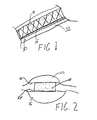
- Fig. 1 is a perspective view of an adhesive part that includes an exemplary adhesive material in accordance with an aspect of the present invention.
- Fig. 2 is a sectional view of an exemplary adhesive material adhered to substrates according to an aspect of the present invention.
- the present invention is predicated upon provision of an improved adhesive material, and articles incorporating the same.
- the adhesive material is typically employed for providing structural adhesion to a first surface, a second surface, or both of one or more components of an article of manufacture such as an automotive vehicle.
- the adhesive material can additionally or alternatively provide structural reinforcement, sealing, baffling, acoustical damping properties or a combination thereof within a cavity of, or upon a surface of a structure, or to one or more structural members (e.g., a body panel or structural member) of an article of manufacture (e.g., an automotive vehicle).
- the adhesive material is an activatable material.
- the phrase activatable material includes any material that may be activated to melt, flow, cure (e.g., thermoset), expand, foam or a combination thereof by an ambient condition or another condition.
- the material may expand, foam, flow, melt, cure, a combination thereof, or the like upon exposure to a condition such a heat, pressure, chemical exposure, combinations thereof or the like.
- the adhesive material is a latent cure material.
- the adhesive material includes adhesive polymeric material (e.g., epoxy resin or the like) a flexibilizer (e.g., epoxy flexibilizer), An impact modifier, a curing agent and optionally a blowing agent and a filler.
- the activatable material includes:
- Percentages herein refer to weight percent, unless otherwise indicated.
- Epoxy resin is used herein to mean any of the conventional epoxy materials containing at least one epoxy functional group.
- the epoxy resins can be difunctional, trifunctional, multifunctional, combinations thereof or otherwise.
- the term epoxy resin can be used to denote one epoxy resin or a combination of multiple epoxy resins.
- the polymer-based materials may be epoxy-containing materials having one or more oxirane rings polymerizable by a ring opening reaction.
- the adhesive material includes at least 7 % and less than 40% by weight epoxy resin and even possibly between about 15% and about 25% by weight epoxy resin. As an example, it is contemplated that weight percentages may be lower or higher when other ingredients such as the impact modifier, flexibilizer, filler, alternative polymers, combinations thereof, or the like are used in greater or lesser weight percentages.
- the epoxy may be aliphatic, cycloaliphatic, aromatic, or the like.
- the epoxy may be supplied as a solid (e.g., as pellets, chunks, pieces or the like) or a liquid (e.g., an epoxy resin) or both.
- a resin is a solid resin if it is solid at a temperature of 23 °C and is a liquid resin if it a liquid at 23 °C.
- an epoxy resin is added to the adhesive material to increase the adhesion, flow properties, or both of the material.
- One exemplary epoxy resin may be a phenolic resin, which may be a novalac type or other type resin.
- bisphenol A resin bisphenol F resin, a combination thereof or the like may be employed.
- various mixtures of several different epoxy resins may be employed as well. Examples of suitable epoxy resins are sold under the tradename DER ® (e.g., DER 331, DER 661, DER 662), commercially available from the Dow Chemical Company, Midland, Michigan.
- DER ® e.g., DER 331, DER 661, DER 662
- the epoxy resin is comprised of at least 50%, more typically at least 70% and even possibly at least 90% (e.g., substantially entirely or entirely) by weight thereof of liquid epoxy resin (e.g., a resin that has a molecular weight such that it is liquid at 23 °C).
- liquid epoxy resin e.g., a resin that has a molecular weight such that it is liquid at 23 °C.
- Such liquid epoxy resin typically has a viscosity at a temperature of 23 °C of at least 5000, more typically at least 8000 and even possibly at least 11,000 cps, but typically less than 30,000, more typically less than 22,000 and even possibly less than 15,000 cps, although higher and lower values may also be possible unless otherwise stated.
- the liquid epoxy resin typically has an epoxy equivalent weight of at least 80, more typically at least 150 and even possibly at least 185 g/eq, but typically less than 300, more typically less than 220 and even possibly less than 195 g/eq, although higher and lower values may also be possible unless otherwise stated.
- Preferred liquid resins include diglycidyl ethers that may be aromatic phenol based (bisphenol A or F) and are sold under the tradename DER 331, commercially available from the Dow Chemical Company and EPON 828 and EPON 863, commercially available from Hexion Specialty Chemicals.
- the flexibilizer can be provided as a single flexibilizer or as a combination of multiple different flexibilizers.
- Preferred flexibilizers are epoxidized polysulfides sold under the tradenames EPS-350 and EPS-80, commercially available from Akzo-Nobel.
- An example of another preferred flexibilizer is an epoxy-dimer acid elastomer sold under the tradenames HYPOX DA 323, commercially available from CVC Specialty Chemicals.
- An example of another preferred flexibilizer is a polyurethane modified epoxy sold under the tradenames GME-3210 and GME-3220, commercially available from GNS Technologies.
- the adhesive material may substantially maintain impact strength (e.g., impact resistance) at low temperatures, while minimizing the reduction of T g (e.g., as compared to other flexibilizers).
- amine or epoxy terminated polyethers such as JEFFAMINE D-2000, commercially available from Huntsman and DER ® 732, commercially available from the Dow Chemical Company. All of the individual flexibilizers discussed herein may be used separately or in combination with each other in the adhesive material of the present invention, unless otherwise stated.
- the flexibilizer is typically a substantial portion of the overall adhesive material.
- the flexibilizer is at least 5%, and less than 60% by weight of the adhesive material,
- the adhesive material is includes at least one impact modifier.
- the impact modifier at least 13% and even still more typically at least 20% by weight of the adhesive material less than 40% an even more typically less than 30% by weight of the adhesive materials.
- the term "impact modifier can include one impact modifier or plural impact modifiers.
- the impact modifier can include thermoplastics, thermosets or thermosettables, elastomers, combinations thereof or the like.
- the impact modifier includes a core/shell polymer (which may include elastomer), or a combination thereof.
- the impact modifier can include variable amounts of core/shell polymer, unless otherwise stated. However, in one preferred embodiment of the present invention, the impact modifier includes a substantial portion of core/shell impact modifier. In one preferred embodiment, the impact modifier is compromised of at least 60%, more typically at least 80% and even possibly at least 97% core/shell polymer or impact modifier.
- the term core-shell impact modifier denotes an impact modifier wherein a substantial portion (e.g., greater than 30%, 50%, 70% or more by weight) thereof is comprised of a first polymeric material (i.e., the first or core material) that is substantially entirely encapsulated by a second polymeric material (i.e., the second or shell material).
- the first and second polymeric materials as used herein, can be comprised of one, two, three or more polymers that are combined and/or reacted together (e.g., sequentially polymerized) or may be part of separate or same core/shell systems.
- the first and second polymeric materials of the core/shell impact modifier can include elastomers, polymers, thermoplastics, copolymers, other components, combinations thereof or the like.
- the first polymeric material, the second polymeric material or both of the core/shell impact modifier include or are substantially entirely composed of (e.g., at least 70%, 80%, 90% or more by weight) one or more thermoplastics.
- Exemplary thermoplastics include, without limitation, styrenics, acrylonitriles, acrylates, acetates, polyamides, polyethylenes, or the like.
- Preferred core/shell impact modifiers are formed by emulsion polymerization followed by coagulation or spray drying.
- coagulated grades of core/shell impact modifiers have been found particularly desirable for promoting adhesion to surfaces having impurities thereon such as dirt, oil (e.g., metal stamping oil) or the like.
- Such impact modifiers can cause adhesive failure to be less likely (as opposed to cohesive failure) for adhesives having formulations such as those described herein for clean surfaces and/or for surface with impurities thereon.
- the impact modifier can be formed of, or at least include a core-shell graft co-polymer.
- useful core-shell graft copolymers are those where hard containing compounds, such as styrene, acrylonitrile or methyl methacrylate, are grafted onto core made from polymers of soft or elastomeric containing compounds such as butadiene or butyl acrylate.
- hard containing compounds such as styrene, acrylonitrile or methyl methacrylate
- core-shell polymers the cores of which are made from butyl acrylate but can be based on ethyl isobutyl, 2-ethylhexel or other alkyl acrylates or mixtures thereof.
- the core polymer may also include other copolymerizable containing compounds, such as styrene, vinyl acetate, methyl methacrylate, butadiene, isoprene, or the like.
- the core polymer material may also include a cross linking monomer having two or more nonconjugated double bonds of approximately equal reactivity such as ethylene glycol diacrylate, butylene glycol dimethacrylate, and the like.
- the core polymer material may also include a graft linking monomer having two or more nonconjugated double bonds of unequal reactivity such as, for example, diallyl maleate and allyl methacrylate.
- the shell portion may be polymerized from methyl methacrylate and optionally other alkyl methacrylates, such as ethyl, butyl, or mixtures thereof methacrylates. Up to 40 percent by weight or more of the shell monomers may be styrene, vinyl acetate, vinyl chloride, and the like. Additional core-shell graft copolymers useful in embodiments of the present invention are described in U.S. Pat. Nos. 3,984,497 ; 4,096,202 ; 4,034,013 ; 3,944,631 ; 4,306,040 ; 4,495,324 ; 4,304,709 ; and 4,536,436 .
- core-shell graft copolymers examples include, but are not limited to, "MBS" (methacrylate-butadiene-styrene) polymers, which are made by polymerizing methyl methacrylate in the presence of polybutadiene or a polybutadiene copolymer rubber.
- MBS methacrylate-butadiene-styrene
- the MBS graft copolymer resin generally has a styrene butadiene rubber core and a shell of acrylic polymer or copolymer.
- Examples of other useful core-shell graft copolymer resins include, ABS (acrylonitrile-butadiene-styrene), MABS (methacrylate-acrylonitrile-butadiene-styrene), ASA (acrylate-styrene-acrylonitrile), all acrylics, SA EPDM (styrene-acrylonitrile grafted onto elastomeric backbones of ethylene-propylene diene monomer), MAS (methacrylic-acrylic rubber styrene), and the like and mixtures thereof.
- ABS acrylonitrile-butadiene-styrene
- MABS methacrylate-acrylonitrile-butadiene-styrene
- ASA acrylate-styrene-acrylonitrile
- SA EPDM styrene-acrylonitrile grafted onto elastomeric backbones of ethylene-propylene diene monomer
- MAS methacryl
- One preferred impact modifier is a core/shell polymer includes a shell of polymethyl methacrylate (PMMA) or acrylonitrile polymer or copolymer and a core of butadiene or styrene butadiene material.
- PMMA polymethyl methacrylate
- PARALOID commercially available from Rohm & Haas Co.
- Preferred grades of PARALOID are sold under the designations EXL-2691A or EXL-2650A.
- Another preferred grade is sold under the tradename CLEARSTRENGTH E-950, commercially available from Arkema.
- preferred core/shell impact modifiers include those with a relatively soft acrylate core (e.g., polybutyl acrylated or other low Tg acrlyate) and a hard acrylate shell (e.g., PMMA).
- Preferred grades of these type of impact modifiers are sold under the tradename DURASTRENGTH D-440 commercially available from Arkema and Paraloid EXL-2300 and 2314 commercially available from Rohm and Haas.
- Additional impact modifier may be provided as particulate (e.g., ground or pulverized) elastomer or rubber or adduct thereof (e.g., carboxy terminated butadiene acrylonitrile rubber or adduct thereof). Such modifier will typically have a relatively low Tg as discussed below.
- desirable impact modifiers of this type include HYPOX RK 8-4, commercially available from CVC specialty chemicals or Araldite ES 1522, commercially available from Huntsman Chemical.
- Particularly preferred are solid epoxy adducts of a carboxylated, solid, high molecular weight nitrile rubber. It may also be desirable to include another nitrile rubber such as a hydrogenated butadiene nitrile rubber as part of the whole of the impact modifier.
- the impact modifier in one aspect of the present invention, it can be desirable for a portion or the entirety of the impact modifier to form a discrete secondary phase in the adhesive material, although not required unless otherwise stated.
- the relatively low Tg is below -20 °C, more typically below -50°C and even possibly below -70 °C.
- the core, the shell, or both can have the relatively low Tg.
- the core can have a relatively low Tg while the shell may have a higher Tg and potentially be compatible with the rest of the adhesive material (i.e., the portion of the adhesive material that is not part of the secondary phase) and even potentially be reactive with at least a portion of the rest of the adhesive material.
- One or more curing agents and/or curing agent accelerators are added to the adhesive material. Amounts of curing agents and curing agent accelerators can vary. Exemplary ranges for the curing agents or curing agent accelerators present in the adhesive material range from about 0.001 % by weight to about 9 % by weight and more typically from about 2% to about 6% by weight.
- the curing agents assist the adhesive material in curing by crosslinking of the polymers, epoxy resins, other ingredients in the material or a combination thereof. It is also preferable for the curing agents to assist in thermosetting the activatable material.
- Useful classes of curing agents include agents that cross-link the epoxy resin and/or other ingredients by addition reaction or catalyzed reaction.
- the curing agent materials can be selected from aliphatic or aromatic amines or their respective adducts, amidoamines, polyamides, cycloaliphatic amines, anhydrides, polycarboxylic polyesters, isocyanates, phenol-based resins (e.g., phenol or cresol novolak resins, copolymers such as those of phenol terpene, polyvinyl phenol, or bisphenol-A formaldehyde copolymers, bishydroxyphenyl alkanes or the like), dihydrazides, sulfonamides, diamino diphenyl solfone, anhydrides, mercaptans, imidazoles, ureas, tertiary amines, BF3 complexes or mixtures thereof.
- Particular preferred curing agents include modified and unmodified polyamines or polyamides such as triethylenetetramine, diethylenetriamine tetraethylenepentamine, cyanoguanidine, dicy
- the curing agents may be activated by mixing with the other ingredients of the adhesive material or by exposure to a condition such a radiation, moisture, pressure or the like.
- the curing agent is latent and heat activated.
- An accelerator for the curing agents e.g., a modified or unmodified urea such as methylene diphenyl bis urea, an imidazole, blocked amine or a combination thereof
- a modified or unmodified urea such as methylene diphenyl bis urea, an imidazole, blocked amine or a combination thereof
- blowing agents may be added to the adhesive material for producing inert gasses that form, as desired, an open and/or closed cellular structure within the activatable material. In this manner, it may be possible to lower the density of articles fabricated from the material. In addition, the material expansion can help to improve adhesion, sealing capability, acoustic damping, or both.
- the adhesive material may also be without or substantially without (e.g., less than 0.17 by weight) any blowing agent. Amounts of blowing agents and blowing agent accelerators can vary widely within the adhesive material depending upon the type of cellular structure desired, the desired amount of expansion of the adhesive material, the desired rate of expansion and the like.
- Exemplary ranges for the amounts of blowing agents and blowing agent accelerators in the activatable material range from about 0.001 % by weight to about 5 % by weight and are preferably in the adhesive material in fractions of weight percentages.
- the adhesive material exhibits relatively low or no expansion and/or foaming.
- the amount of blowing agent is typically less than 2%, more typically less than 1% and even more typically less than 0.5% by weight of the adhesive material.
- the blowing agent may include one or more nitrogen containing groups such as amides, amines, and the like.
- suitable blowing agents include dinitrosopentamethylenetetramine, azodicarbonamide, dinitrosopentamethylenetetramine, 4,4 i -oxy-bis-(benzenesulphonylhydrazide), trihydrazinotriazine and N, N i -dimethyl-N,N i -dinitrosoterephthalamide.
- Physical blowing agents may additionally or alternatively be employed.
- solvent filled polymeric shells that soften and expand upon exposure to heat may be used.
- An accelerator for the blowing agents may also be provided in the activatable material.
- Various accelerators may be used to increase the rate at which the blowing agents form inert gasses.
- One preferred blowing agent accelerator is a metal salt, or is an oxide, e.g. a metal oxide, such as zinc oxide.
- Other preferred accelerators include organic bases such as urea and organic acids such as adipic or benzoic acid. Zinc benzene sulfinate may also be a desirable accelerator.
- the adhesive material will typically include one or more additional polymers (e.g., copolymers), which can include a variety of different polymers, such as thermoplastics, elastomers, thermosets, thermosettables combinations thereof or the like.
- additional polymers e.g., copolymers
- polymers that might be appropriately incorporated into the adhesive material include halogenated polymers, polycarbonates, polyketones, urethanes, polyesters, silanes, sulfones, allyls, olefins, styrenes, acrylates, methacrylates, epoxies, silicones, phenolics, rubbers, polyphenylene oxides, terphthalates, acetates (e.g., EVA), acrylates, methacrylates (e.g., ethylene methyl acrylate polymer) or mixtures thereof.
- additional polymers e.g., copolymers
- polystyrene e.g., polyethylene, polypropylene
- polystyrene polyacrylate, poly(ethylene oxide), poly(ethyleneimine), polyester, polyurethane, polysiloxane, polyether, polyphosphazine, polyamide, polyimide, polyisobutylene, polyacrylonitrile, poly(vinyl chloride), poly(methyl methacrylate), poly(vinyl acetate), poly(vinylidene chloride), polytetrafluoroethylene, polyisoprene, polyacrylamide, polyacrylic acid, polymethacrylate.
- polyolefin e.g., polyethylene, polypropylene
- polystyrene polyacrylate
- poly(ethylene oxide) poly(ethyleneimine)
- polyester polyurethane
- polysiloxane polyether
- polyphosphazine polyamide
- polyimide polyisobutylene
- polyacrylonitrile poly(vinyl chloride)
- these polymers can comprises a small portion or a more substantial portion of the adhesive material (e.g., up to 85% by weight or greater).
- the one or more additional polymers comprises about 0.1% to about 50%, more preferably about 1% to about 20% and even more preferably about 5% to about 15% by weight of the adhesive material.
- thermoplastic polyethers and/or thermoplastic epoxy resins in the adhesive material.
- Such material can assist in providing dimensional stability (e.g., reduce cold flow) to the adhesive material.
- the one or more thermoplastic polyethers preferably comprise between about 1% and about 90% by weight of the adhesive material, more preferably between about 3% and about 40% by weight of the adhesive material and even more preferably between about 10% and about 15% by weight of the adhesive material.
- more or less thermoplastic polyether may be employed depending upon the intended use of the adhesive material.
- thermoplastic polyethers typically include pendant hydroxyl moieties.
- Particularly desirable thermoplastic polyethers are phenoxy resins.
- phenoxy resin is a polyhydroxyether, with ether linkages along the polymer backbone and pendant hydroxyl groups.
- An exemplary phenoxy resin useful in the current invention is the reaction product of a phenol based difunctional epoxy resin and a difunctional phenol (for example the reaction product of bisphenol A epoxy with bisphenol A).
- a similar material may also be synthesized directly from a bisphenol (for example bisphenol A) and epichlorohydrin.
- the terminal epoxy group may be ring opened to generate a terminal alpha glycol group.
- Phenoxy resins useful in the invention have weight-average molecular weights of at least about 5,000, more typically at least about 25,000 and still more typically at least about 50,000 but less than about 100,000, more typically less than about 75,000 and still more typically less than about 60,000, although greater or lower weights are possible unless otherwise stated.
- Exemplary grades of phenoxy resin useful in the invention include PAPHEN Phenoxy Resin PKHH and PKHJ commercially available from Inchem Corp., Rockhill, South Carolina.
- thermoplastic polyethers can include aromatic ether/amine repeating units in their backbones.
- Other exemplary thermoplastic polyethers include, without limitation, polyetheramines, poly(amino ethers), copolymers of monoethanolamine and diglycidyl ether, combinations thereof or the like. Examples of additional thermoplastic polyethers and their methods of formation are disclosed in U.S. Patents Nos. 5,275,853 ; 5,464924 and 5,962,093 .
- thermoplastic polyethers can provide the adhesive material with various desirable characteristics such as desirable physical and chemical properties for a wide variety of applications as is further described herein.
- the adhesive material may include one or more ethylene polymers or copolymers such as ethylene acrylates, ethylene acetates, or the like. Ethylene methacrylate and ethylene vinyl acetate are two preferred ethylene copolymers.
- the adhesive material may also include one or more fillers, including but not limited to particulated materials (e.g., powder), beads, microspheres, or the like.
- the filler includes a material that is generally non-reactive with the other components present in the adhesive material. While the fillers may generally be present within the adhesive material to take up space at a relatively low weight, it is contemplated that the fillers may also impart properties such as strength, dimensional stability, and impact resistance to the activatable material.
- fillers examples include silica, diatomaceous earth, glass, clay (e.g., including nanoclay), talc, pigments, colorants, glass beads or bubbles, glass, carbon or ceramic fibers, nylon or polyamide fibers (e.g., Kevlar), antioxidants, and the like.
- suitable fillers include, without limitation, wollastonite, talc, vermiculite, pyrophyllite, sauconite, saponite, nontronite, montmorillonite or mixtures thereof.
- Clays usable for the adhesive material may be calcined or uncalcined.
- Clays that may be used as fillers may include clays from the kaolinite, illite, chloritem, smecitite or sepiolite groups, which may be calcined.
- the clays may also include minor amounts of other ingredients such as carbonates, feldspars, micas and quartz.
- one or more mineral or stone type fillers such as calcium carbonate, sodium carbonate or the like may be used as fillers.
- silicate minerals such as mica may be used as fillers.
- the fillers in the adhesive material can range from 2 % or less to 70 % or greater by weight of the adhesive material, but more typical from about 8 to 40 % by weight of the adhesive material.
- the adhesive material may include from about 0 % to about 3 % by weight, and more preferably slightly less that 1 % by weight clays or similar fillers.
- Powdered (e.g. about 0.01 to about 50, and more preferably about 1 to 25 micron mean particle diameter) mineral type filler can comprise between about 5 % and 70 % by weight, more preferably about 10 % to about 50% by weight.
- additives, agents or performance modifiers may also be included in the adhesive material as desired, including but not limited to a UV resistant agent, a flame retardant, a heat stabilizer, a colorant, a processing aid, a lubricant, a reinforcement/filler (e.g., chopped or continuous glass, ceramic, aramid, or carbon fiber, particulates or the like).
- a UV resistant agent e.g., a flame retardant, a heat stabilizer, a colorant, a processing aid, a lubricant, a reinforcement/filler (e.g., chopped or continuous glass, ceramic, aramid, or carbon fiber, particulates or the like).
- adhesion promoter can be desirable for certain embodiments. Although, many adhesion promoters may be used, amine or epoxy functional molecules such as amine or epoxy functional silanes have been found to be particularly desirable.
- One exemplary adhesion promoter is a glycidoxypropyl trimethoxy silane sold under the tradename Z-6040, commercially available from Dow Corning.
- the material When determining ingredients for the adhesive material, it may be important to form the material such that it will only activate (e.g., flow, foam or otherwise change states) at appropriate times or temperatures. For instance, in some applications, it is undesirable for the material to be reactive at room temperature or otherwise at the ambient temperature in a production environment. More typically, the activatable material becomes activated to flow at higher processing temperatures. As an example, temperatures such as those encountered in an automobile assembly plant may be appropriate, especially when the activatable material is processed along with the other components at elevated temperatures or at higher applied energy levels, e.g., during painting preparation steps. Temperatures encountered in many coating operations (e.g., in a paint and/or e-coat curing oven, dry operations or the like), for instance, range up to about 250°C or higher.
- the adhesive material can be accomplished according to a variety of new or known techniques.
- the adhesive material is formed as a material of substantially mixed and or homogeneous composition prior to activation thereof.
- various combining techniques may be used to increase or decrease the concentration of certain components in certain locations of the activatable material.
- the adhesive material is formed by supplying the components of the material in solid form such as pellets, chunks and the like, in liquid form or a combination thereof.
- the components are typically combined in one or more containers such as large bins or other containers.
- the containers can be used to intermix the components by rotating or otherwise moving the container. Thereafter, heat, pressure or a combination thereof may be applied to soften or liquidize the components such that the components can be intermixed by stirring or otherwise into a substantially mixed or homogenous composition.
- the adhesive material may be formed by heating one or more of the components that are generally easier to soften or liquidize such as the polymer based materials to induce those components into a mixable state. Thereafter, the remaining components may then be intermixed with the softened components.
- the material can be provided individually, as admixtures or combinations thereof to an extruder.
- the extruder then mixes the materials to form the adhesive materials.
- the adhesive material may be fully mixed and formed and then fed to an extruder for dispensing as discussed further below.
- the temperature of the components may be important to assure that the temperature of the components remains below certain activation temperatures that might cause the adhesive material to activate (e.g., form gasses, flow, cure or otherwise activate).
- the adhesive material contains a blowing agent
- it. is typically desirable to maintain the temperature of the adhesive material below a temperature that will activate the blowing agent, curing agent, or both during formation of the adhesive material or before the adhesive material is applied to a surface.
- Various machines such as extruders, or otherwise have been designed to applying heat, pressure or both to materials.
- the material is typically applied to a surface or substrate and activated.
- Activation of the material may include at least some degree of foaming or bubbling in situations where the activatable material includes a blowing agent. Such foaming or bubbling can assist the activatable material in wetting a substrate and forming an intimate bond with the substrate.
- the activatable material may be activated to soften and/or flow without foaming or bubbling and may still substantially wet the substrate to form an intimate bond. Formation of the intimate bond will typically but not necessarily occur upon curing of the adhesive material.
- the adhesive material may be applied and activated in different ways and at different times.
- exemplary uses of the adhesive material are discussed below to illustrate preferred methodologies of application and activation of the adhesive material.
- the adhesive material may used for, amongst others, reinforcement, sealing and adhering, acoustic baffling or the like.
- Example of potential uses for the adhesive material are disclosed in U.S. Patent No. 7,125,461 and U.S. Patent Application Serial No. 11/757,499 .
- the adhesive material has been found particularly useful as a structural adhesive material.
- the adhesive material 10 is typically put in contact with at least an attachment surface 20 of a first substrate 22 also, typically and an attachment surface 24 of a second substrate 26. Such contacting may occur prior to activation of the adhesive material, during activation of the adhesive material or a combination thereof.
- the adhesive may be contacted with one of the surfaces and then activated to flow, expand or both to contact the other surface.
- the adhesive material may be contacted and pressed between the surfaces and subsequently activated.
- the surfaces 20, 24, substrates 22, 26 or both may be part of single component or member or two or more components or members that are attached to each other by the adhesive material and optional additional attachments.
- the surfaces 20, 24 and substrates 22, 26 are part of components of an automotive vehicle.
- the adhesive material is typically activated at an elevated temperature in an automotive coating drying operation (e.g., at temperatures common to e-coat or automotive painting operations (temperatures typically above 120 or 150°C)) to adhere to the surfaces 20, 24.
- Contact with attachment surface of the first member and the second member may occur prior to or during activation and curing of the material. Examples of structural adhesive applications are disclosed in U.S. Patent Application Serial Nos. 10/234,902 ; 10/386,287 ; 60/451,811 .
- the adhesive material of the present invention may be applied to a surface manually or automatically (e.g., through direct extrusion onto a surface).
- the adhesive material is applied as a preformed part.
- the adhesive material is shaped to form an adhesive material part of substantially predetermined dimension, for example by molding or by extrusion and/or cutting. Thereafter, the adhesive material part is then manually applied, automatically applied or a combination thereof to a surface or surfaces.
- adhesive material parts 30 are disposed upon (e.g., extruded onto) a release material 32 (e.g., release paper) such that they can later be remove and manually applied, automatically applied or a combination thereof to one or more surfaces as already described herein.
- a handling layer 32 may be applied to the adhesive material 36 since the adhesive material, as a part or otherwise, may be substantially tacky prior to application.
- the handling layer 34 may be a film, a coating, a powder, a fibrous material, a web, combinations thereof or the like. Examples of suitable handling layers are disclosed in U.S. Patent No. 6,811,864 and U.S. Patent Application Publication 2004/0076831 .
- an adhesive material part may be provided with a layer (from less than about 10 microns to about 2 cm (e.g., on the order of less than about 1 mm)) that is generally free of tack for facilitating handling.
- the structural adhesive material, the layer, or both may be formed of the adhesive material of the present invention.
- forming the adhesive material into a pre-formed part can provide advantages. It can avoid the need for bulky and expensive pumping and dispending equipment. It can provide for easier application of adhesive material in locations where pumpable adhesives are difficult to apply, particularly locations that are hard to reach.
- the adhesive material parts can be pre-applied to surfaces of components such as metal stampings such that the adhesive material is supplied to an assembly operation PIA (part-in-assembly) (e.g., the adhesive material is supplied to the assembly as the component to which the material has been applied is assembled to the assembly).
- PIA part-in-assembly
- the adhesive material can also exhibit desirable resistance to "wash off" in, for example, e-coat and/or phosphating operations.
- embodiments of the adhesive material are capable of exhibiting desirable properties.
- embodiments of the adhesive material have shown relatively high impact strengths at room temperature (about 23°C) or below, at -30 °C or below and even at -40 °C or below as measured by ISO 11343.
- the samples when samples of the adhesive were tested using ISO11343 Impact Wedge Peel with 0.8 mm thick EG-60 Adherends, the samples, at the temperatures discussed, can exhibit impact wedge peel strengths greater than 15 N/mm, more preferably greater than 20 N/mm, more preferably greater than 25 N/mm, more preferably greater than 30 N/mm, still more preferably greater than 35 N/mm, even more preferably greater than 40 N/mm and even 45 N/mm for bondlines of both 0.2 mm and/or 1.0 mm.
- the adhesive material has an impact strength of greater than 15 N/mm at temperatures less than -30° C using an ISO-11343 Impact Wedge Peel with 0.8 mm thick EG-60 Adherends.
- the samples may exhibit impact wedge strengths of greater than 20 N/mm at temperatures less than -30° C. Still furthermore, the samples may exhibit impact wedge strengths of greater than 15 N/mm at temperatures of about -40° C or possibly lower. While these strengths are typically desirable for the adhesive material of the present invention, they are not necessarily required unless specifically recited.
- Embodiments of the material can also exhibit relatively high peel strengths, tensile strengths, compressive strengths, or combinations thereof. Moreover, embodiments of the material have exhibited relatively high degrees of adhesion at -40 °C or lower.
- Table A is provided showing exemplary formulation A of of adhesive materials according to one or more aspects of the present invention. The numbers provided are weight percents of the individual ingredients in the adhesive material.
- TABLE A A Diglycidyl Ether of Bisphenol A Liquid (EEW -187 g/eq) 37.6 Diglycidyl Ether of Bisphenol A Solid (EEW ⁇ 525 g/eg) Diglycidyl Ether of Bisphenol A Solid (EEW ⁇ 925 g/eq) Butanediol Diglycidyl Ether Dimer Acid Modified Epoxy Aromatic Epoxidized Polysulfide Aliphatic Epoxidized Polysulfide Amine terminated polyether (2000 MW) 12.0 Epoxidized Polypropylene Glycol (EEW ⁇ 320 g/eq) MBS Core Shell Impact Modifier 25.0 Solid Nitrile Rubber/ Solid Epoxy Adduct Carboxy Terminated Butadiene Solid Epoxy Adduct Phenoxy Resin 15.4 Calcined Kaolin Clay 5.0 Dicyandi
- Table B is provided showing exemplary formulations B and C embodiments of adhesive materials according to one or more aspects of the present invention. The numbers provided are weight percents of the individual ingredients in the adhesive material.
- TABLE B B C Diglycidyl Ether of Bisphenol A Liquid (EEW -187 g/eq) 18.4 25.4 Diglycidyl Ether of Bisphenol A Solid (EEW ⁇ 525 g/eq) Diglycidyl Ether of Bisphenol A Solid (EEW ⁇ 925 g/eq) Butanediol Diglycidyl Ether 3.0 Dimer Acid Modified Epoxy Aromatic Epoxidized Polysulfide 30.0 Aliphatic Epoxidized Polysulfide 15.0 Amine terminated polyether (2000 MW) 8.0 Epoxidized Polypropylene Glycol (EEW -320 g/eq) 3.0 MBS Core Shell Impact Modifier 25.0 25.0 Solid Nitrile Rubber/ Solid Epoxy Adduct Carboxy Terminated Butadiene Solid Epoxy Adduct Phenoxy
- amount of ingredient in tables A and B may be varied by ⁇ 5%, ⁇ 20%, ⁇ 40% of the values listed and that those variances are considered to be ranges of ingredients for the adhesive material of the present invention. For example, a value of 10 ⁇ 20% results in a range of 8 weight percent to 12 weight percent of the adhesive material.
Landscapes
- Chemical & Material Sciences (AREA)
- Organic Chemistry (AREA)
- Health & Medical Sciences (AREA)
- Chemical Kinetics & Catalysis (AREA)
- Medicinal Chemistry (AREA)
- Polymers & Plastics (AREA)
- Engineering & Computer Science (AREA)
- Manufacturing & Machinery (AREA)
- Materials Engineering (AREA)
- Adhesives Or Adhesive Processes (AREA)
- Sealing Material Composition (AREA)
- Adhesive Tapes (AREA)
- Materials For Medical Uses (AREA)
Priority Applications (2)
| Application Number | Priority Date | Filing Date | Title |
|---|---|---|---|
| SI200830564T SI2160435T1 (sl) | 2007-06-12 | 2008-06-10 | Utrjen adhezivni material |
| PL08770580T PL2160435T3 (pl) | 2007-06-12 | 2008-06-10 | Materiał klejowy odporny na obciążenia dynamiczne |
Applications Claiming Priority (3)
| Application Number | Priority Date | Filing Date | Title |
|---|---|---|---|
| US94340307P | 2007-06-12 | 2007-06-12 | |
| US94876507P | 2007-07-10 | 2007-07-10 | |
| PCT/US2008/066413 WO2008157129A1 (en) | 2007-06-12 | 2008-06-10 | Toughened adhesive material |
Publications (2)
| Publication Number | Publication Date |
|---|---|
| EP2160435A1 EP2160435A1 (en) | 2010-03-10 |
| EP2160435B1 true EP2160435B1 (en) | 2012-01-11 |
Family
ID=39832599
Family Applications (1)
| Application Number | Title | Priority Date | Filing Date |
|---|---|---|---|
| EP08770580A Not-in-force EP2160435B1 (en) | 2007-06-12 | 2008-06-10 | Toughened adhesive material |
Country Status (10)
| Country | Link |
|---|---|
| US (1) | US8702889B2 (pl) |
| EP (1) | EP2160435B1 (pl) |
| JP (1) | JP5807299B2 (pl) |
| KR (1) | KR101526026B1 (pl) |
| CN (1) | CN101772532B (pl) |
| AT (1) | ATE541001T1 (pl) |
| ES (1) | ES2377168T3 (pl) |
| PL (1) | PL2160435T3 (pl) |
| PT (1) | PT2160435E (pl) |
| WO (1) | WO2008157129A1 (pl) |
Families Citing this family (75)
| Publication number | Priority date | Publication date | Assignee | Title |
|---|---|---|---|---|
| JP4870447B2 (ja) * | 2006-02-22 | 2012-02-08 | 富士フイルム株式会社 | カラーフィルタ用インクジェットインク、カラーフィルタ、およびそれらの製造方法、ならびにそれらを用いた液晶表示装置 |
| US8105460B2 (en) | 2006-09-08 | 2012-01-31 | Zephyros, Inc. | Handling layer and adhesive parts formed therewith |
| US20080105992A1 (en) * | 2006-11-08 | 2008-05-08 | Zephyros | Mixed masses sealant |
| US20080265516A1 (en) * | 2006-11-08 | 2008-10-30 | Zephyros, Inc. | Two stage sealants and method of forming and/or using the same |
| GB0806434D0 (en) | 2008-04-09 | 2008-05-14 | Zephyros Inc | Improvements in or relating to structural adhesives |
| US8067484B2 (en) * | 2010-03-12 | 2011-11-29 | Trillion Science, Inc. | Latent hardener with improved barrier properties and compatibility |
| US8044154B2 (en) * | 2009-06-12 | 2011-10-25 | Trillion Science, Inc. | Latent hardener for epoxy compositions |
| DE102009028180A1 (de) * | 2009-08-03 | 2011-02-10 | Henkel Ag & Co. Kgaa | Verfahren zum Befestigen eines Magneten auf oder in einem Rotor oder Stator |
| DK2295235T3 (da) * | 2009-08-20 | 2013-07-29 | Siemens Ag | Fiberforstærket plaststruktur og fremgangsmåde til fremstilling af den fiberforstærkede plaststruktur |
| EP2475730B1 (en) | 2009-09-11 | 2014-10-08 | 3M Innovative Properties Company | Curable and cured adhesive compositions |
| WO2011031429A1 (en) | 2009-09-11 | 2011-03-17 | 3M Innovative Properties Company | Curable and cured adhesive compositions |
| GB201007793D0 (en) | 2010-05-10 | 2010-06-23 | Zephyros Inc | Improvements in or relating to structural adhesives |
| GB201012595D0 (en) | 2010-07-27 | 2010-09-08 | Zephyros Inc | Oriented structural adhesives |
| WO2012064724A2 (en) | 2010-11-12 | 2012-05-18 | 3M Innovative Properties Company | Curable and cured compositions |
| EP2638092B1 (en) | 2010-11-12 | 2014-08-27 | 3M Innovative Properties Company | Curable and cured compositions |
| US20140150970A1 (en) | 2010-11-19 | 2014-06-05 | Ppg Industries Ohio, Inc. | Structural adhesive compositions |
| US20120128499A1 (en) | 2010-11-19 | 2012-05-24 | Desai Umesh C | Structural adhesive compositions |
| CN102176309A (zh) * | 2010-12-30 | 2011-09-07 | 汉得利(常州)电子有限公司 | 超声波传感器用隔音材料及其制备方法 |
| GB201102672D0 (en) | 2011-02-15 | 2011-03-30 | Zephyros Inc | Improved structural adhesives |
| EP2813525B1 (en) | 2012-02-07 | 2018-01-03 | Kaneka Corporation | Toughness modifier for curable resin, and curable resin composition |
| EP2821437B1 (en) * | 2012-03-01 | 2022-08-17 | Sumitomo Bakelite Company Limited | Resin composition for rotor fixing, rotor, and automotive vehicle |
| CN104520397B (zh) | 2012-07-30 | 2017-06-13 | 泽费罗斯股份有限公司 | 粘合剂沉积用方法和设备 |
| ES2588362T3 (es) * | 2012-08-23 | 2016-11-02 | 3M Innovative Properties Company | Película adhesiva estructural |
| KR101640631B1 (ko) * | 2012-12-12 | 2016-07-18 | 제일모직주식회사 | 편광판용 접착 필름, 이를 위한 접착제 조성물, 이를 포함하는 편광판 및 이를 포함하는 광학 표시 장치 |
| CN104837931B (zh) * | 2012-12-20 | 2017-12-01 | 陶氏环球技术有限责任公司 | 无线通信塔用的聚合物复合材料组件 |
| EP4083154A1 (en) * | 2013-02-22 | 2022-11-02 | Zephyros Inc. | Method for formation and application of adhesive |
| CN103146334B (zh) * | 2013-03-29 | 2014-08-20 | 黑龙江省科学院石油化学研究院 | 一种阻燃型的中温固化环氧胶膜及其制备方法 |
| WO2014176512A2 (en) * | 2013-04-26 | 2014-10-30 | Zephyros, Inc | Bonding dissimilar materials with adhesive paste |
| US9701093B2 (en) | 2013-04-30 | 2017-07-11 | Zephyros, Inc. | Surface conforming activatable adhesive bodies and methods of making same |
| WO2015011687A1 (en) | 2013-07-26 | 2015-01-29 | Zephyros Inc | Thermosetting adhesive films including a fibrous carrier |
| US9976027B2 (en) | 2013-10-29 | 2018-05-22 | Kaneka Corporation | Polymer fine particle-containing curable resin composition having improved storage stability |
| US10113087B2 (en) | 2014-01-31 | 2018-10-30 | Somar Corporation | Adhesive sheet |
| US11154755B2 (en) | 2014-02-20 | 2021-10-26 | Parsons Xtreme Golf, LLC | Golf club heads and methods to manufacture golf club heads |
| US11541288B2 (en) | 2014-02-20 | 2023-01-03 | Parsons Xtreme Golf, LLC | Golf club heads and methods to manufacture golf club heads |
| US11167187B2 (en) | 2014-02-20 | 2021-11-09 | Parsons Xtreme Golf, LLC | Golf club heads and methods to manufacture golf club heads |
| US11344775B2 (en) | 2014-02-20 | 2022-05-31 | Parsons Xtreme Golf, LLC | Golf club heads and methods to manufacture golf club heads |
| US12290724B2 (en) | 2014-02-20 | 2025-05-06 | Parsons Xtreme Golf, LLC | Golf club heads and methods to manufacture golf club heads |
| US12311239B2 (en) | 2014-02-20 | 2025-05-27 | Parsons Xtreme Golf, LLC | Golf club heads and methods to manufacture golf club heads |
| US11731013B2 (en) | 2014-02-20 | 2023-08-22 | Parsons Xtreme Golf, LLC | Golf club heads and methods to manufacture golf club heads |
| GB201411586D0 (en) | 2014-06-30 | 2014-08-13 | Hexcel Composites Ltd | Adhesive composition |
| KR20160018895A (ko) * | 2014-08-07 | 2016-02-18 | (주)이레화학상사 | 자동차용 접착제 조성물 및 그 제조방법 |
| US20170218237A1 (en) | 2014-08-12 | 2017-08-03 | 3M Innovative Properties Company | Film adhesive |
| GB201417985D0 (en) * | 2014-10-10 | 2014-11-26 | Zephyros Inc | Improvements in or relating to structural adhesives |
| EP3218157A1 (en) | 2014-11-14 | 2017-09-20 | Zephyros Inc. | Multi-shot injection molded method and product |
| JP6034440B1 (ja) * | 2015-04-28 | 2016-11-30 | 日本写真印刷株式会社 | 加飾シート、成形品の製造方法及び成形品 |
| US10005935B2 (en) | 2015-05-01 | 2018-06-26 | Lord Corporation | Adhesive for rubber bonding |
| EP3294547A1 (en) | 2015-05-14 | 2018-03-21 | Zephyros Inc. | Localized panel stiffener |
| EP4049840B1 (en) * | 2015-07-06 | 2026-01-28 | Zephyros Inc. | Heat bonding of low energy surface substrates |
| WO2017095912A1 (en) | 2015-11-30 | 2017-06-08 | Zephyros, Inc. | Adhesive resins and films for composites and tapes and methods of using the same |
| US10695962B2 (en) | 2016-03-18 | 2020-06-30 | Zephyros, Inc. | Members for directing expandable material for baffling, sealing, reinforcing |
| US20200032117A1 (en) | 2016-05-26 | 2020-01-30 | Zephyros, Inc. | Solid polymeric adhesive compositions having high use temperature, and articles and methods thereof |
| CN106223110B (zh) * | 2016-08-19 | 2018-02-02 | 刘奎然 | 一种抗腐蚀的美术用纸的制备方法 |
| US11426640B2 (en) | 2017-11-03 | 2022-08-30 | Parsons Xtreme Golf, LLC | Golf club heads and methods to manufacture golf club heads |
| US11192003B2 (en) | 2017-11-03 | 2021-12-07 | Parsons Xtreme Golf, LLC | Golf club heads and methods to manufacture golf club heads |
| CN108864469A (zh) * | 2017-05-12 | 2018-11-23 | 江苏纳纤新材料科技有限公司 | 一种干法发泡制备酚醛泡沫的方法 |
| EP3421527B1 (de) | 2017-06-28 | 2023-11-15 | Henkel AG & Co. KGaA | Zusammensetzung mit leichtfüllstoff |
| US11707653B2 (en) | 2017-11-03 | 2023-07-25 | Parsons Xtreme Golf, LLC | Golf club heads and methods to manufacture golf club heads |
| US11786786B2 (en) | 2018-02-12 | 2023-10-17 | Parsons Xtreme Golf, LLC | Golf club heads and methods to manufacture golf club heads |
| JP7411577B2 (ja) * | 2018-05-29 | 2024-01-11 | ディディピー スペシャルティ エレクトロニック マテリアルズ ユーエス,エルエルシー | 一液型エポキシ接着剤混合物を使用する接合方法 |
| CN112334211A (zh) | 2018-06-14 | 2021-02-05 | 泽菲罗斯有限公司 | 用于过滤应用的反应型粘合剂 |
| CN109054674A (zh) * | 2018-06-26 | 2018-12-21 | 重庆中田化工有限公司 | 一种汽车用复合型补强阻尼胶片及其制备方法 |
| WO2020028316A1 (en) | 2018-08-02 | 2020-02-06 | Zephyros, Inc. | Baffling member with rivet tab |
| JP7256022B2 (ja) * | 2019-02-05 | 2023-04-11 | 日東シンコー株式会社 | 熱硬化性接着剤、及び、接着シート |
| EP3921485A1 (en) | 2019-02-07 | 2021-12-15 | Zephyros, Inc. | Attachment systems for pultruded, extruded, and molded parts |
| KR102853200B1 (ko) * | 2019-06-25 | 2025-08-29 | 주식회사 두산 | 접착 조성물 및 이를 포함하는 커버레이 필름 및 인쇄회로기판 |
| CN110452647A (zh) * | 2019-07-25 | 2019-11-15 | 张家港爱科思汽车配件有限公司 | 一种汽车耐冲击固态结构胶 |
| EP4004470B1 (en) | 2019-07-31 | 2024-01-17 | Zephyros, Inc. | Heat exchange panel |
| CN111500238B (zh) * | 2020-06-19 | 2021-10-15 | 昆明耐维科技有限公司 | 一种用于超声波实时断轨监测系统的保护胶及其制备方法 |
| CN112500822A (zh) * | 2020-11-23 | 2021-03-16 | 上海汉司实业有限公司 | 一种发泡型结构胶及其制备方法 |
| WO2022251024A1 (en) | 2021-05-25 | 2022-12-01 | Zephyros, Inc. | Heat exchange panel |
| CN113549300A (zh) * | 2021-08-20 | 2021-10-26 | 广东四会互感器厂有限公司 | 一种环氧树脂组合物、制备方法及其应用 |
| JP7779066B2 (ja) * | 2021-10-01 | 2025-12-03 | 株式会社レゾナック | 接着剤 |
| KR20230124350A (ko) * | 2022-02-18 | 2023-08-25 | 박해동 | 상온 접착력을 보유한 열융착형 테이프 및 이의 제조방법 |
| CN115403981B (zh) * | 2022-10-10 | 2023-08-29 | 长沙岱华科技有限公司 | 一种水性保护胶及其制备方法 |
| CN118909556B (zh) * | 2024-10-12 | 2024-12-24 | 湖南盛业土工材料制造有限公司 | 一种用于混凝土路面修复的自粘型卷材及其制备方法 |
Family Cites Families (39)
| Publication number | Priority date | Publication date | Assignee | Title |
|---|---|---|---|---|
| US3984497A (en) | 1971-12-13 | 1976-10-05 | Rohm And Haas Company | Acrylic modifiers for polycarbonamides |
| US3944631A (en) | 1974-02-01 | 1976-03-16 | Stauffer Chemical Company | Acrylate-styrene-acrylonitrile composition and method of making the same |
| US3985703A (en) | 1975-06-24 | 1976-10-12 | Rohm And Haas Company | Process for manufacture of acrylic core/shell polymers |
| US4034013A (en) | 1975-11-13 | 1977-07-05 | Rohm And Haas Company | Impact and melt strength improvement of poly(alkylene terephthalate) |
| US4096202A (en) | 1976-06-09 | 1978-06-20 | Rohm And Haas Company | Impact modified poly(alkylene terephthalates) |
| US4175156A (en) | 1978-05-19 | 1979-11-20 | Usm Corporation | Composite film adhesive |
| US4304709A (en) | 1979-11-01 | 1981-12-08 | Hooker Chemicals & Plastics Corp. | Polymer blends with improved hydrolytic stability |
| JPS56118816A (en) | 1980-02-26 | 1981-09-18 | Toagosei Chem Ind Co Ltd | Manufacture of molded laminate for automobile ceiling |
| US4306040A (en) | 1980-11-03 | 1981-12-15 | Monsanto Company | Multiphase core//shell polymers |
| JPS58156899A (ja) | 1982-03-15 | 1983-09-17 | 化成オプトニクス株式会社 | 放射線像変換スクリ−ン |
| US4495324A (en) | 1983-10-24 | 1985-01-22 | Allied Corporation | Glass reinforced polyamide composition containing acrylic core/shell polymer |
| US5240645A (en) * | 1989-08-07 | 1993-08-31 | United Technologies Automotive, Inc. | Weldable sealant containing electrically conductive fibers |
| JP3019354B2 (ja) | 1990-02-27 | 2000-03-13 | 株式会社ブリヂストン | 内装材用積層体 |
| DE69129055T2 (de) | 1990-10-03 | 1998-08-06 | Dow Chemical Co | Hydroxy-funktionalisierte Polyetheramine zur Verwendung als Sperrschicht bei sauerstoffempfindlichen Materialien |
| JP2750217B2 (ja) * | 1990-11-20 | 1998-05-13 | サンスター技研株式会社 | 自動車構造用一液型エポキシ系接着剤 |
| US5212261A (en) | 1990-12-17 | 1993-05-18 | Henkel Research Corporation | Latent, heat-curable epoxy resin compositions containing metal carboxylate curing systems |
| US5290857A (en) * | 1991-09-04 | 1994-03-01 | Nippon Zeon Co., Ltd. | Epoxy resin adhesive composition |
| ES2148213T3 (es) * | 1992-07-09 | 2000-10-16 | Vantico Ag | Suspensiones endurecibles a base de resinas epoxi. |
| US5464924A (en) | 1994-01-07 | 1995-11-07 | The Dow Chemical Company | Flexible poly(amino ethers) for barrier packaging |
| US6111013A (en) | 1995-08-04 | 2000-08-29 | Forbo International S.A. | Polymer product manufacture |
| US5962093A (en) * | 1997-10-22 | 1999-10-05 | The Dow Chemical Company | Thermally stable polyetheramines |
| US6136732A (en) | 1998-08-20 | 2000-10-24 | E.R Technologies | Adhesive composition comprising a powder impregnated non-woven web, composite articles containing said adhesive, and processes for making the same |
| US6486256B1 (en) * | 1998-10-13 | 2002-11-26 | 3M Innovative Properties Company | Composition of epoxy resin, chain extender and polymeric toughener with separate base catalyst |
| CA2405584A1 (en) * | 2000-04-10 | 2002-10-08 | Henkel Kommanditgesellschaft Auf Aktien | Impact-resistant epoxy resin compositions |
| US6887914B2 (en) | 2001-09-07 | 2005-05-03 | L&L Products, Inc. | Structural hot melt material and methods |
| CA2471368A1 (en) * | 2001-12-21 | 2003-07-03 | Henkel Teroson Gmbh | Expandable epoxy resin-based systems modified with thermoplastic polymers |
| US6846559B2 (en) | 2002-04-01 | 2005-01-25 | L&L Products, Inc. | Activatable material |
| US20040076831A1 (en) | 2002-10-02 | 2004-04-22 | L&L Products, Inc. | Synthetic material and methods of forming and applying same |
| US6811864B2 (en) | 2002-08-13 | 2004-11-02 | L&L Products, Inc. | Tacky base material with powder thereon |
| US20040204551A1 (en) | 2003-03-04 | 2004-10-14 | L&L Products, Inc. | Epoxy/elastomer adduct, method of forming same and materials and articles formed therewith |
| US7125461B2 (en) * | 2003-05-07 | 2006-10-24 | L & L Products, Inc. | Activatable material for sealing, baffling or reinforcing and method of forming same |
| ATE352576T1 (de) * | 2004-03-12 | 2007-02-15 | Dow Global Technologies Inc | Epoxidharz klebstoffzusammensetzung |
| KR101303246B1 (ko) * | 2005-08-24 | 2013-09-06 | 헨켈 아일랜드 리미티드 | 개선된 내충격성을 갖는 에폭시 조성물 |
| US20070090360A1 (en) | 2005-10-20 | 2007-04-26 | Vishay General Semiconductors, Llc | Blanket implant diode |
| US7892396B2 (en) | 2006-06-07 | 2011-02-22 | Zephyros, Inc. | Toughened activatable material for sealing, baffling or reinforcing and method of forming same |
| US8105460B2 (en) | 2006-09-08 | 2012-01-31 | Zephyros, Inc. | Handling layer and adhesive parts formed therewith |
| US20080105992A1 (en) | 2006-11-08 | 2008-05-08 | Zephyros | Mixed masses sealant |
| US7825324B2 (en) * | 2006-12-29 | 2010-11-02 | Alcatel-Lucent Usa Inc. | Spreading thermoelectric coolers |
| US20080299317A1 (en) | 2007-05-29 | 2008-12-04 | Hable Christopher T | Acrylate adhesive material and method of use therefor |
-
2008
- 2008-06-10 PT PT08770580T patent/PT2160435E/pt unknown
- 2008-06-10 JP JP2010512296A patent/JP5807299B2/ja not_active Expired - Fee Related
- 2008-06-10 KR KR1020097027498A patent/KR101526026B1/ko not_active Expired - Fee Related
- 2008-06-10 ES ES08770580T patent/ES2377168T3/es active Active
- 2008-06-10 PL PL08770580T patent/PL2160435T3/pl unknown
- 2008-06-10 US US12/136,333 patent/US8702889B2/en active Active
- 2008-06-10 WO PCT/US2008/066413 patent/WO2008157129A1/en not_active Ceased
- 2008-06-10 EP EP08770580A patent/EP2160435B1/en not_active Not-in-force
- 2008-06-10 CN CN2008801017318A patent/CN101772532B/zh not_active Expired - Fee Related
- 2008-06-10 AT AT08770580T patent/ATE541001T1/de active
Also Published As
| Publication number | Publication date |
|---|---|
| KR20100031115A (ko) | 2010-03-19 |
| CN101772532A (zh) | 2010-07-07 |
| JP2010529285A (ja) | 2010-08-26 |
| ATE541001T1 (de) | 2012-01-15 |
| EP2160435A1 (en) | 2010-03-10 |
| US8702889B2 (en) | 2014-04-22 |
| ES2377168T3 (es) | 2012-03-23 |
| PT2160435E (pt) | 2012-02-08 |
| WO2008157129A1 (en) | 2008-12-24 |
| KR101526026B1 (ko) | 2015-06-04 |
| CN101772532B (zh) | 2013-03-13 |
| PL2160435T3 (pl) | 2012-06-29 |
| US20080308212A1 (en) | 2008-12-18 |
| JP5807299B2 (ja) | 2015-11-10 |
Similar Documents
| Publication | Publication Date | Title |
|---|---|---|
| EP2160435B1 (en) | Toughened adhesive material | |
| EP2675860B1 (en) | Improved structural adhesives | |
| US10800462B2 (en) | Reinforcement structure | |
| EP1620521B2 (en) | Activatable material for sealing, baffling or reinforcing and method of forming same | |
| EP2024195B1 (en) | Method of sealing, baffling or reinforcing a portion of an automotive vehicle | |
| US7438782B2 (en) | Activatable material for sealing, baffling or reinforcing and method of forming same | |
| EP1490451A1 (en) | Activatable material | |
| US20150000839A1 (en) | Structural adhesives | |
| EP2569384A2 (en) | Improvements in or relating to structural adhesives | |
| EP3274397B1 (en) | Reinforcement member comprising a structural adhesive on a polyester carrier | |
| JP2021534266A (ja) | 改善された破壊ひずみを有する高弾性率構造発泡体材料 | |
| EP3204460A1 (en) | Improvements in or relating to structural adhesives |
Legal Events
| Date | Code | Title | Description |
|---|---|---|---|
| PUAI | Public reference made under article 153(3) epc to a published international application that has entered the european phase |
Free format text: ORIGINAL CODE: 0009012 |
|
| 17P | Request for examination filed |
Effective date: 20100112 |
|
| AK | Designated contracting states |
Kind code of ref document: A1 Designated state(s): AT BE BG CH CY CZ DE DK EE ES FI FR GB GR HR HU IE IS IT LI LT LU LV MC MT NL NO PL PT RO SE SI SK TR |
|
| AX | Request for extension of the european patent |
Extension state: AL BA MK RS |
|
| DAX | Request for extension of the european patent (deleted) | ||
| 17Q | First examination report despatched |
Effective date: 20100908 |
|
| GRAP | Despatch of communication of intention to grant a patent |
Free format text: ORIGINAL CODE: EPIDOSNIGR1 |
|
| GRAS | Grant fee paid |
Free format text: ORIGINAL CODE: EPIDOSNIGR3 |
|
| GRAA | (expected) grant |
Free format text: ORIGINAL CODE: 0009210 |
|
| AK | Designated contracting states |
Kind code of ref document: B1 Designated state(s): AT BE BG CH CY CZ DE DK EE ES FI FR GB GR HR HU IE IS IT LI LT LU LV MC MT NL NO PL PT RO SE SI SK TR |
|
| REG | Reference to a national code |
Ref country code: GB Ref legal event code: FG4D |
|
| REG | Reference to a national code |
Ref country code: CH Ref legal event code: EP |
|
| REG | Reference to a national code |
Ref country code: AT Ref legal event code: REF Ref document number: 541001 Country of ref document: AT Kind code of ref document: T Effective date: 20120115 |
|
| REG | Reference to a national code |
Ref country code: IE Ref legal event code: FG4D |
|
| REG | Reference to a national code |
Ref country code: PT Ref legal event code: SC4A Free format text: AVAILABILITY OF NATIONAL TRANSLATION Effective date: 20120131 |
|
| REG | Reference to a national code |
Ref country code: SE Ref legal event code: TRGR |
|
| REG | Reference to a national code |
Ref country code: DE Ref legal event code: R096 Ref document number: 602008012699 Country of ref document: DE Effective date: 20120315 |
|
| REG | Reference to a national code |
Ref country code: ES Ref legal event code: FG2A Ref document number: 2377168 Country of ref document: ES Kind code of ref document: T3 Effective date: 20120323 |
|
| REG | Reference to a national code |
Ref country code: RO Ref legal event code: EPE |
|
| REG | Reference to a national code |
Ref country code: NL Ref legal event code: VDEP Effective date: 20120111 |
|
| LTIE | Lt: invalidation of european patent or patent extension |
Effective date: 20120111 |
|
| REG | Reference to a national code |
Ref country code: PL Ref legal event code: T3 |
|
| REG | Reference to a national code |
Ref country code: SK Ref legal event code: T3 Ref document number: E 11486 Country of ref document: SK |
|
| PG25 | Lapsed in a contracting state [announced via postgrant information from national office to epo] |
Ref country code: HR Free format text: LAPSE BECAUSE OF FAILURE TO SUBMIT A TRANSLATION OF THE DESCRIPTION OR TO PAY THE FEE WITHIN THE PRESCRIBED TIME-LIMIT Effective date: 20120111 Ref country code: BG Free format text: LAPSE BECAUSE OF FAILURE TO SUBMIT A TRANSLATION OF THE DESCRIPTION OR TO PAY THE FEE WITHIN THE PRESCRIBED TIME-LIMIT Effective date: 20120411 Ref country code: NL Free format text: LAPSE BECAUSE OF FAILURE TO SUBMIT A TRANSLATION OF THE DESCRIPTION OR TO PAY THE FEE WITHIN THE PRESCRIBED TIME-LIMIT Effective date: 20120111 Ref country code: IS Free format text: LAPSE BECAUSE OF FAILURE TO SUBMIT A TRANSLATION OF THE DESCRIPTION OR TO PAY THE FEE WITHIN THE PRESCRIBED TIME-LIMIT Effective date: 20120511 Ref country code: BE Free format text: LAPSE BECAUSE OF FAILURE TO SUBMIT A TRANSLATION OF THE DESCRIPTION OR TO PAY THE FEE WITHIN THE PRESCRIBED TIME-LIMIT Effective date: 20120111 Ref country code: NO Free format text: LAPSE BECAUSE OF FAILURE TO SUBMIT A TRANSLATION OF THE DESCRIPTION OR TO PAY THE FEE WITHIN THE PRESCRIBED TIME-LIMIT Effective date: 20120411 Ref country code: LT Free format text: LAPSE BECAUSE OF FAILURE TO SUBMIT A TRANSLATION OF THE DESCRIPTION OR TO PAY THE FEE WITHIN THE PRESCRIBED TIME-LIMIT Effective date: 20120111 |
|
| PG25 | Lapsed in a contracting state [announced via postgrant information from national office to epo] |
Ref country code: FI Free format text: LAPSE BECAUSE OF FAILURE TO SUBMIT A TRANSLATION OF THE DESCRIPTION OR TO PAY THE FEE WITHIN THE PRESCRIBED TIME-LIMIT Effective date: 20120111 Ref country code: GR Free format text: LAPSE BECAUSE OF FAILURE TO SUBMIT A TRANSLATION OF THE DESCRIPTION OR TO PAY THE FEE WITHIN THE PRESCRIBED TIME-LIMIT Effective date: 20120412 Ref country code: LV Free format text: LAPSE BECAUSE OF FAILURE TO SUBMIT A TRANSLATION OF THE DESCRIPTION OR TO PAY THE FEE WITHIN THE PRESCRIBED TIME-LIMIT Effective date: 20120111 |
|
| REG | Reference to a national code |
Ref country code: AT Ref legal event code: MK05 Ref document number: 541001 Country of ref document: AT Kind code of ref document: T Effective date: 20120111 |
|
| PG25 | Lapsed in a contracting state [announced via postgrant information from national office to epo] |
Ref country code: CY Free format text: LAPSE BECAUSE OF FAILURE TO SUBMIT A TRANSLATION OF THE DESCRIPTION OR TO PAY THE FEE WITHIN THE PRESCRIBED TIME-LIMIT Effective date: 20120111 |
|
| PG25 | Lapsed in a contracting state [announced via postgrant information from national office to epo] |
Ref country code: EE Free format text: LAPSE BECAUSE OF FAILURE TO SUBMIT A TRANSLATION OF THE DESCRIPTION OR TO PAY THE FEE WITHIN THE PRESCRIBED TIME-LIMIT Effective date: 20120111 Ref country code: DK Free format text: LAPSE BECAUSE OF FAILURE TO SUBMIT A TRANSLATION OF THE DESCRIPTION OR TO PAY THE FEE WITHIN THE PRESCRIBED TIME-LIMIT Effective date: 20120111 |
|
| PLBE | No opposition filed within time limit |
Free format text: ORIGINAL CODE: 0009261 |
|
| STAA | Information on the status of an ep patent application or granted ep patent |
Free format text: STATUS: NO OPPOSITION FILED WITHIN TIME LIMIT |
|
| 26N | No opposition filed |
Effective date: 20121012 |
|
| PG25 | Lapsed in a contracting state [announced via postgrant information from national office to epo] |
Ref country code: MC Free format text: LAPSE BECAUSE OF NON-PAYMENT OF DUE FEES Effective date: 20120630 Ref country code: AT Free format text: LAPSE BECAUSE OF FAILURE TO SUBMIT A TRANSLATION OF THE DESCRIPTION OR TO PAY THE FEE WITHIN THE PRESCRIBED TIME-LIMIT Effective date: 20120111 |
|
| REG | Reference to a national code |
Ref country code: CH Ref legal event code: PL |
|
| REG | Reference to a national code |
Ref country code: DE Ref legal event code: R097 Ref document number: 602008012699 Country of ref document: DE Effective date: 20121012 |
|
| REG | Reference to a national code |
Ref country code: CH Ref legal event code: PL |
|
| REG | Reference to a national code |
Ref country code: IE Ref legal event code: MM4A |
|
| PG25 | Lapsed in a contracting state [announced via postgrant information from national office to epo] |
Ref country code: LI Free format text: LAPSE BECAUSE OF NON-PAYMENT OF DUE FEES Effective date: 20120630 Ref country code: IE Free format text: LAPSE BECAUSE OF NON-PAYMENT OF DUE FEES Effective date: 20120610 Ref country code: CH Free format text: LAPSE BECAUSE OF NON-PAYMENT OF DUE FEES Effective date: 20120630 |
|
| PG25 | Lapsed in a contracting state [announced via postgrant information from national office to epo] |
Ref country code: MT Free format text: LAPSE BECAUSE OF FAILURE TO SUBMIT A TRANSLATION OF THE DESCRIPTION OR TO PAY THE FEE WITHIN THE PRESCRIBED TIME-LIMIT Effective date: 20120111 |
|
| PG25 | Lapsed in a contracting state [announced via postgrant information from national office to epo] |
Ref country code: LU Free format text: LAPSE BECAUSE OF NON-PAYMENT OF DUE FEES Effective date: 20120610 |
|
| PG25 | Lapsed in a contracting state [announced via postgrant information from national office to epo] |
Ref country code: HU Free format text: LAPSE BECAUSE OF FAILURE TO SUBMIT A TRANSLATION OF THE DESCRIPTION OR TO PAY THE FEE WITHIN THE PRESCRIBED TIME-LIMIT Effective date: 20080610 |
|
| PGFP | Annual fee paid to national office [announced via postgrant information from national office to epo] |
Ref country code: GB Payment date: 20150618 Year of fee payment: 8 Ref country code: ES Payment date: 20150626 Year of fee payment: 8 Ref country code: PT Payment date: 20150611 Year of fee payment: 8 Ref country code: SK Payment date: 20150609 Year of fee payment: 8 Ref country code: CZ Payment date: 20150525 Year of fee payment: 8 Ref country code: TR Payment date: 20150527 Year of fee payment: 8 Ref country code: SE Payment date: 20150618 Year of fee payment: 8 Ref country code: SI Payment date: 20150526 Year of fee payment: 8 Ref country code: RO Payment date: 20150528 Year of fee payment: 8 |
|
| PGFP | Annual fee paid to national office [announced via postgrant information from national office to epo] |
Ref country code: IT Payment date: 20150623 Year of fee payment: 8 Ref country code: PL Payment date: 20150522 Year of fee payment: 8 |
|
| REG | Reference to a national code |
Ref country code: FR Ref legal event code: PLFP Year of fee payment: 9 |
|
| PG25 | Lapsed in a contracting state [announced via postgrant information from national office to epo] |
Ref country code: CZ Free format text: LAPSE BECAUSE OF NON-PAYMENT OF DUE FEES Effective date: 20160610 Ref country code: RO Free format text: LAPSE BECAUSE OF NON-PAYMENT OF DUE FEES Effective date: 20160610 |
|
| REG | Reference to a national code |
Ref country code: SE Ref legal event code: EUG |
|
| PG25 | Lapsed in a contracting state [announced via postgrant information from national office to epo] |
Ref country code: PT Free format text: LAPSE BECAUSE OF NON-PAYMENT OF DUE FEES Effective date: 20161212 Ref country code: SE Free format text: LAPSE BECAUSE OF NON-PAYMENT OF DUE FEES Effective date: 20160611 |
|
| GBPC | Gb: european patent ceased through non-payment of renewal fee |
Effective date: 20160610 |
|
| REG | Reference to a national code |
Ref country code: SK Ref legal event code: MM4A Ref document number: E 11486 Country of ref document: SK Effective date: 20160610 |
|
| REG | Reference to a national code |
Ref country code: SI Ref legal event code: KO00 Effective date: 20170228 |
|
| PG25 | Lapsed in a contracting state [announced via postgrant information from national office to epo] |
Ref country code: SK Free format text: LAPSE BECAUSE OF NON-PAYMENT OF DUE FEES Effective date: 20160610 Ref country code: GB Free format text: LAPSE BECAUSE OF NON-PAYMENT OF DUE FEES Effective date: 20160610 Ref country code: SI Free format text: LAPSE BECAUSE OF NON-PAYMENT OF DUE FEES Effective date: 20160611 |
|
| REG | Reference to a national code |
Ref country code: FR Ref legal event code: PLFP Year of fee payment: 10 |
|
| PG25 | Lapsed in a contracting state [announced via postgrant information from national office to epo] |
Ref country code: IT Free format text: LAPSE BECAUSE OF NON-PAYMENT OF DUE FEES Effective date: 20160610 |
|
| PG25 | Lapsed in a contracting state [announced via postgrant information from national office to epo] |
Ref country code: PL Free format text: LAPSE BECAUSE OF NON-PAYMENT OF DUE FEES Effective date: 20160610 |
|
| PG25 | Lapsed in a contracting state [announced via postgrant information from national office to epo] |
Ref country code: ES Free format text: LAPSE BECAUSE OF NON-PAYMENT OF DUE FEES Effective date: 20160611 |
|
| REG | Reference to a national code |
Ref country code: FR Ref legal event code: PLFP Year of fee payment: 11 |
|
| REG | Reference to a national code |
Ref country code: ES Ref legal event code: FD2A Effective date: 20181204 |
|
| PGFP | Annual fee paid to national office [announced via postgrant information from national office to epo] |
Ref country code: FR Payment date: 20210622 Year of fee payment: 14 Ref country code: DE Payment date: 20210618 Year of fee payment: 14 |
|
| PG25 | Lapsed in a contracting state [announced via postgrant information from national office to epo] |
Ref country code: TR Free format text: LAPSE BECAUSE OF NON-PAYMENT OF DUE FEES Effective date: 20160610 |
|
| REG | Reference to a national code |
Ref country code: DE Ref legal event code: R119 Ref document number: 602008012699 Country of ref document: DE |
|
| PG25 | Lapsed in a contracting state [announced via postgrant information from national office to epo] |
Ref country code: FR Free format text: LAPSE BECAUSE OF NON-PAYMENT OF DUE FEES Effective date: 20220630 |
|
| PG25 | Lapsed in a contracting state [announced via postgrant information from national office to epo] |
Ref country code: DE Free format text: LAPSE BECAUSE OF NON-PAYMENT OF DUE FEES Effective date: 20230103 |