EP2129626B1 - Verfahren zur herstellung von titandioxid durch oxidation von titantetrachlorid - Google Patents
Verfahren zur herstellung von titandioxid durch oxidation von titantetrachlorid Download PDFInfo
- Publication number
- EP2129626B1 EP2129626B1 EP07856539.7A EP07856539A EP2129626B1 EP 2129626 B1 EP2129626 B1 EP 2129626B1 EP 07856539 A EP07856539 A EP 07856539A EP 2129626 B1 EP2129626 B1 EP 2129626B1
- Authority
- EP
- European Patent Office
- Prior art keywords
- reactor
- titanium tetrachloride
- flow
- oxygen
- titanium
- Prior art date
- Legal status (The legal status is an assumption and is not a legal conclusion. Google has not performed a legal analysis and makes no representation as to the accuracy of the status listed.)
- Active
Links
- GWEVSGVZZGPLCZ-UHFFFAOYSA-N Titan oxide Chemical compound O=[Ti]=O GWEVSGVZZGPLCZ-UHFFFAOYSA-N 0.000 title claims description 21
- 238000000034 method Methods 0.000 title claims description 19
- XJDNKRIXUMDJCW-UHFFFAOYSA-J titanium tetrachloride Chemical compound Cl[Ti](Cl)(Cl)Cl XJDNKRIXUMDJCW-UHFFFAOYSA-J 0.000 title claims description 13
- 239000004408 titanium dioxide Substances 0.000 title claims description 10
- 238000004519 manufacturing process Methods 0.000 title description 7
- 230000001706 oxygenating effect Effects 0.000 title 1
- 239000002245 particle Substances 0.000 claims description 34
- 238000001816 cooling Methods 0.000 claims description 27
- 239000007789 gas Substances 0.000 claims description 16
- 238000006243 chemical reaction Methods 0.000 claims description 10
- QVGXLLKOCUKJST-UHFFFAOYSA-N atomic oxygen Chemical compound [O] QVGXLLKOCUKJST-UHFFFAOYSA-N 0.000 claims description 9
- 239000001301 oxygen Substances 0.000 claims description 9
- 229910052760 oxygen Inorganic materials 0.000 claims description 9
- 239000007787 solid Substances 0.000 claims description 6
- 230000005484 gravity Effects 0.000 claims description 3
- 238000002360 preparation method Methods 0.000 claims 1
- 229910010413 TiO 2 Inorganic materials 0.000 description 12
- 239000000049 pigment Substances 0.000 description 8
- 238000009826 distribution Methods 0.000 description 5
- 239000000725 suspension Substances 0.000 description 5
- 238000004140 cleaning Methods 0.000 description 4
- 238000009991 scouring Methods 0.000 description 4
- 230000015572 biosynthetic process Effects 0.000 description 3
- 238000007254 oxidation reaction Methods 0.000 description 3
- 238000012546 transfer Methods 0.000 description 3
- IJGRMHOSHXDMSA-UHFFFAOYSA-N Atomic nitrogen Chemical compound N#N IJGRMHOSHXDMSA-UHFFFAOYSA-N 0.000 description 2
- 239000003082 abrasive agent Substances 0.000 description 2
- 239000000654 additive Substances 0.000 description 2
- VSCWAEJMTAWNJL-UHFFFAOYSA-K aluminium trichloride Chemical compound Cl[Al](Cl)Cl VSCWAEJMTAWNJL-UHFFFAOYSA-K 0.000 description 2
- 238000013461 design Methods 0.000 description 2
- 230000000694 effects Effects 0.000 description 2
- 239000011541 reaction mixture Substances 0.000 description 2
- VEXZGXHMUGYJMC-UHFFFAOYSA-M Chloride anion Chemical compound [Cl-] VEXZGXHMUGYJMC-UHFFFAOYSA-M 0.000 description 1
- KZBUYRJDOAKODT-UHFFFAOYSA-N Chlorine Chemical compound ClCl KZBUYRJDOAKODT-UHFFFAOYSA-N 0.000 description 1
- ZAMOUSCENKQFHK-UHFFFAOYSA-N Chlorine atom Chemical compound [Cl] ZAMOUSCENKQFHK-UHFFFAOYSA-N 0.000 description 1
- 239000006004 Quartz sand Substances 0.000 description 1
- VYPSYNLAJGMNEJ-UHFFFAOYSA-N Silicium dioxide Chemical compound O=[Si]=O VYPSYNLAJGMNEJ-UHFFFAOYSA-N 0.000 description 1
- 229910052783 alkali metal Inorganic materials 0.000 description 1
- -1 alkali metal salts Chemical class 0.000 description 1
- 239000000460 chlorine Substances 0.000 description 1
- 229910052801 chlorine Inorganic materials 0.000 description 1
- 239000012141 concentrate Substances 0.000 description 1
- 239000000498 cooling water Substances 0.000 description 1
- 238000005265 energy consumption Methods 0.000 description 1
- 238000009434 installation Methods 0.000 description 1
- 230000005923 long-lasting effect Effects 0.000 description 1
- 238000012423 maintenance Methods 0.000 description 1
- 239000000203 mixture Substances 0.000 description 1
- 238000012986 modification Methods 0.000 description 1
- 230000004048 modification Effects 0.000 description 1
- 229910052757 nitrogen Inorganic materials 0.000 description 1
- 230000003647 oxidation Effects 0.000 description 1
- 230000001590 oxidative effect Effects 0.000 description 1
- 238000010992 reflux Methods 0.000 description 1
- 238000000926 separation method Methods 0.000 description 1
- 238000009827 uniform distribution Methods 0.000 description 1
- XLYOFNOQVPJJNP-UHFFFAOYSA-N water Substances O XLYOFNOQVPJJNP-UHFFFAOYSA-N 0.000 description 1
Images
Classifications
-
- C—CHEMISTRY; METALLURGY
- C01—INORGANIC CHEMISTRY
- C01G—COMPOUNDS CONTAINING METALS NOT COVERED BY SUBCLASSES C01D OR C01F
- C01G23/00—Compounds of titanium
- C01G23/04—Oxides; Hydroxides
- C01G23/047—Titanium dioxide
-
- C—CHEMISTRY; METALLURGY
- C01—INORGANIC CHEMISTRY
- C01G—COMPOUNDS CONTAINING METALS NOT COVERED BY SUBCLASSES C01D OR C01F
- C01G23/00—Compounds of titanium
- C01G23/04—Oxides; Hydroxides
- C01G23/047—Titanium dioxide
- C01G23/07—Producing by vapour phase processes, e.g. halide oxidation
Definitions
- the invention relates to the production of titanium dioxide by oxidation of titanium tetrachloride and the subsequent cooling of the titanium dioxide particle gas mixture in a cooling section, wherein the gas-particle flow is set in rotation.
- a commercially used process for the production of titanium dioxide pigment the so-called chloride process, based on the fact that titanium tetrachloride (TiCl 4 ) is reacted with a preheated oxidizing gas such as oxygen, air, etc. as well as certain additives in a tubular reactor to titanium dioxide and chlorine gas.
- the oxidation reaction is highly exothermic, so that the reaction mixture after complete conversion temperatures of about 1500 ° C.
- the TiO 2 pigment particles formed are cooled in a subsequent reactor cooling section below about 400 ° C and separated from the gas stream. Cooling immediately after completion of particle formation must be rapid to prevent further particle growth.
- the tube reactor or the reactor cooling section is cooled from the outside with water from here on.
- the scouring particles concentrate by weight shortly after their addition on the lower third of the pipe circumference. While this area of the inner wall is thoroughly cleaned of adhering pigment, higher areas of the perimeter are insufficiently cleaned and the cooling of the gas suspension is insufficient. Nevertheless, to a sufficient heat transfer To come, usually the metered amount of abrasive particles is significantly increased. This burdens the system for the production, metering and separation of the abrasive particles, which, among other things, causes increased costs for energy consumption and maintenance.
- the US Pat. No. 6,419,893 B1 describes a method for more efficient removal of the TiO 2 deposits on the inner wall of the reactor cooling section.
- According to US Pat. No. 6,419,893 B1 are located at least in a portion of the reactor cooling section on the inner wall helically extending ribs as guide elements, whereby the abrasive particles are guided in a helical flow through the cooling section.
- the ribs are arranged with a slope of 2 to 6 °.
- the US 2006/0133989 A1 discloses an overall helically designed reactor cooling section, whereby an improved cleaning of the inner wall is to be achieved with the abrasive particles.
- the DE 1 259 851 discloses a process for the production of titanium dioxide by reaction in the gas phase, in which a part of the gaseous reaction components is introduced tangentially into the reactor.
- This method is designed on the one hand by the tangential introduction of a reaction component to reduce formation of deposits on the reactor walls and on the other hand to achieve rapid mixing of the reaction components by generating a backflow (so-called "swirl flow").
- the swirl flow is further enhanced by the fact that the cross-section of the reactor widens conically in the flow direction.
- Swirl Flow leads to different residence times of the individual particles in the reactor.
- the U.S. Patent 3,725,526 describes a process for the production of titanium dioxide in the rutile modification, wherein the titanium tetrachloride is introduced into the reactor at an angle between 0 ° and 45 ° perpendicular to the reactor axis.
- a narrow particle size distribution is important. To produce a narrow particle size distribution, however, it is not a matter of rapid mixing of the reaction components but of a narrow residence time distribution of the TiO 2 particles in the reactor, so that any type of backflow in the reactor should be avoided.
- the invention has for its object to provide a comparison with the prior art improved method, on the one hand to effectively rid of the inner wall of the tubular reactor and the reactor cooling section with the aid of abrasive particles of TiO 2 deposits and thus to achieve better cooling performance and on the other hand TiO 2 pigment to produce with narrow grain size distribution.
- the object is achieved by a process for the production of titanium dioxide particles in a cylindrical tubular reactor by reaction of titanium tetrachloride and an axially introduced, oxygen-containing gas and subsequent cooling of the particles in a subsequent reactor cooling section with the addition of abrasive particles, characterized in that Titanium tetrachloride is introduced in the cross-sectional plane of the tubular reactor, but deviating from the radial direction in the tubular reactor and that the flow rate of the oxygen-containing gas is more than 20 m / s, in particular at least 40 m / s.
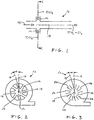
- tubular reactor is understood to mean that part of the reactor in which the TiCl 4 oxidation reaction and TiO 2 particle formation take place (see FIG. Fig. 1 , No. 10).
- the reactor cooling section is understood to be the adjoining part of the tubular reactor, where the reaction is stopped by rapid cooling and the gas suspension is further cooled.
- various additives and gases such as aluminum chloride, chlorine, nitrogen, alkali metal salts etc. are introduced into the reactor together with the TiCl 4 .
- TiCl 4 is understood to mean the oxygen-free stream consisting essentially of TiCl 4 .
- O 2 should be understood here and below to mean the oxygen-containing gas stream.
- the invention is based on the recognition that an essential part of the heat removal takes place at the beginning of the reactor cooling section, where the high temperature of the TiO 2 gas suspension produces a high driving temperature gradient to the pipe inner wall.
- the abrasive effect of the abrasive particles can be significantly improved by the Scouring particle flow or the entire flow is set in rotation. Due to the rotation and the centrifugal force, the abrasive particles are distributed over the entire circumference of the pipe and at the same time pressed against the wall, whereby it is uniformly and intensively cleaned.
- the TiCl 4 is preferably introduced into the reactor (10) via nozzles (12).
- nozzles are to be understood as meaning all types of discharges as well as channels, pipes, etc. and all types of nozzles as well as Venturi or Laval nozzles.
- the reactor (10) has a cylindrical shape with a longitudinal axis (14). Oxygen is introduced along the longitudinal axis (14) into the reactor (10).
- TiCl 4 is introduced via nozzles (12) in the tangential direction into the reactor (10), not in the radial direction.
- FIG. 2 shows a cross section through the reactor (10), wherein the radius is indicated by the line (16).
- the TiCl 4 is introduced into the reactor (10) in a tangential direction indicated by the line (18).
- the line (18) deviates from the radial direction (16) by the angle ⁇ .
- the nozzles (12) may be distributed at a common axial position on the circumference of the reactor (10) ( Fig. 2 ). Alternatively, the nozzles (12) can also be positioned offset from one another axially.
- the TiCl 4 can also be introduced into the reactor via a slot-like opening (20) ( Fig. 3 ). In this embodiment, guide plates (22) in the slot-like opening (20), which are employed at a corresponding angle ⁇ , cause the tangential direction of the flow.
- the entire flow - reaction mixture and abrasives - in the tube reactor (10) and in the reactor cooling section in rotation by the metered titanium tetrachloride is introduced tangentially into the tube reactor (10). Due to its high specific gravity, the TiCl 4 introduces a substantial tangential momentum into the flow sufficient to produce a long-lasting rotation. Tangential introduction of the TiCl 4 into the tubular reactor (10) means that the introduction in the cross-sectional plane of the tubular reactor (10), but in an angular range of ⁇ > 0 ° to ⁇ 90 °, preferably 1 ° to 15 ° and in particular 5 ° to 10 ° to the radial direction ( FIGS. 2 and 3 ).
- reflux flows (swirl flow) in the reactor (10) can be largely avoided, thereby achieving a uniform residence time for all TiO 2 particles in the reactor (10).
- the axially introduced O 2 flow has a flow velocity of more than 20 m / s, in particular at least 40 m / s and the tubular reactor (10) has a cylindrical shape. Under these conditions, it is possible to introduce a high tangential momentum to achieve a strong cleaning effect without generating swirl flow.
- the ratio of specific impulses (ratio of products of flow velocity and specific gravity) of the tangentially introduced (TiCl 4 ) to the axially introduced (O 2 ) reaction component is at least about 100.
- the improvement of the heat transfer to the wall of the cooling section by the TiCl 4 introduction according to the invention can be further improved if the abrasive particles are largely scattered when they are introduced into the tubular reactor (10) whereby a uniform distribution of abrasives and thus a uniform cleaning of the reactor wall are effected , Scattering can be achieved by causing the stream of scouring particles to rotate strongly before introduction into the reactor. This rotation can be achieved, for example, in that the metering nozzle is designed similar to a cyclone into which the flow of abrasive particles is introduced tangentially by means of pneumatic conveying.
- the invention is distinguished from the method according to US Pat. No. 6,419,893 B1 and US 2006/0133989 A1 characterized in that on the one hand, the entire flow is set in rotation and thus the cleaning of the inner wall and the cooling of the gas suspension are optimized. Furthermore, no complex design measures downstream of the TiCl 4 supply are required, such as wear-sensitive internal installations or the helical design of the entire reactor cooling section.
- the invention is further characterized over the method according to DE 1 259 851 characterized in that, despite the high tangential momentum of the TiCl 4 flow Swirl Flow is avoided and TiO 2 pigment particles with narrow particle size distribution and thus improved lightening power (TS) can be produced.
- 12 t / h TiCl 4 are introduced by means of 10 circular nozzles in a tubular reactor having an inner diameter of about 0.3 m and reacted with preheated oxygen-containing gas.
- the nozzles are positioned at a common axial position in the tubular reactor and distributed evenly around the circumference. All nozzles are made tangential in the same direction in the cross-sectional plane in the manner in which they deviate by an angle ⁇ of 6 ° from the radial direction.
- ⁇ 6 ° from the radial direction.
Landscapes
- Chemical & Material Sciences (AREA)
- Organic Chemistry (AREA)
- Life Sciences & Earth Sciences (AREA)
- Environmental & Geological Engineering (AREA)
- General Life Sciences & Earth Sciences (AREA)
- Geology (AREA)
- Inorganic Chemistry (AREA)
- Inorganic Compounds Of Heavy Metals (AREA)
Description
- Die Erfindung betrifft die Herstellung von Titandioxid durch Oxidation von Titantetrachlorid und die nachfolgende Kühlung der Titandioxidpartikel-Gasmischung in einer Kühlstrecke, wobei die Gas-Partikel-Strömung in Rotation versetzt ist.
- Ein kommerziell angewendetes Verfahren zur Herstellung von Titandioxid-Pigment, das sogenannte Chloridverfahren, beruht darauf, dass Titantetrachlorid (TiCl4) mit einem vorerhitzten oxidierenden Gas wie Sauerstoff, Luft etc. sowie mit bestimmten Additiven in einem Rohrreaktor zu Titandioxid und Chlorgas umgesetzt wird. Die Oxidationsreaktion ist stark exotherm, so dass das Reaktionsgemisch nach vollständigem Umsatz Temperaturen von über 1500 °C aufweist. Die gebildeten TiO2-Pigmentpartikel werden in einer sich anschließenden Reaktor-Kühlstrecke auf unter etwa 400 °C abgekühlt und vom Gasstrom abgetrennt. Die Abkühlung direkt nach Abschluss der Partikelbildung muss schnell erfolgen, um weiteres Partikelwachstum zu verhindern. Dazu wird von hier ab der Rohrreaktor bzw. die Reaktor-Kühlstrecke von außen mit Wasser gekühlt.
Allerdings wird der Wärmeübergang in das Kühlwasser durch Anlagerung von TiO2-Pigmentpartikeln an der Innenwand des Rohrreaktors bzw. der Reaktor-Kühlstrecke stark gehemmt. Aus diesem Grund werden gemäßUS 2,721,626 Scheuerteilchen (Scrub Solids) in die Reaktor-Kühlstrecke eingebracht, die an den Innenwänden angelagertes Pigment ablösen sollen. Als Scrub Solids werden in diesem Patent abrasive Partikel wie Quarzsand oder aggregierte TiO2-Partikel mit Korngrößen von etwa 0,15 bis 6,35 mm verwendet. Die Scrub Solids werden an einem oder mehreren Punkten der Reaktor-Kühlstrecke in die TiO2-Gassuspension eingeführt. - In der horizontalen Reaktor-Kühlstrecke konzentrieren sich die Scheuerteilchen gewichtsbedingt bereits kurz nach ihrer Zugabe auf dem unteren Drittel des Rohrumfangs. Während dieser Bereich der Innenwand gründlich von anhaftendem Pigment gereinigt wird, werden höher gelegene Bereiche des Umfangs unzureichend abgereinigt und die Abkühlung der Gassuspension ist ungenügend. Um dennoch zu einem ausreichenden Wärmeübergang zu kommen, wird üblicherweise die dosierte Menge Scheuerteilchen deutlich erhöht. Dies belastet das System zur Herstellung, Dosierung und Abtrennung der Scheuerteilchen, wodurch u. a. erhöhte Kosten für Energieverbrauch und Instandhaltung entstehen.
- Die
US 6,419,893 B1 beschreibt ein Verfahren zur effizienteren Entfernung der TiO2-Anlagerungen an der Innenwand der Reaktor-Kühlstrecke. GemäßUS 6,419,893 B1 befinden sich zumindest in einem Teilbereich der Reaktor-Kühlstrecke an der Innenwand schraubenförmig verlaufende Rippen als Leitelemente, wodurch die Scheuerteilchen in einer schraubenförmig verlaufenden Strömung durch die Kühlstrecke geführt werden. Die Rippen sind mit einer Steigung von 2 bis 6° angeordnet. - Die
US 2006/0133989 A1 offenbart eine insgesamt helikal gestaltete Reaktor-Kühlstrecke, wodurch eine verbesserte Abreinigung der Innenwand mit den Scheuerteilchen erreicht werden soll. - Die
DE 1 259 851 offenbart ein Verfahren zur Herstellung von Titandioxid durch Reaktion in der Gasphase, bei dem ein Teil der gasförmigen Reaktionskomponenten tangential in den Reaktor eingeleitet wird. Dieses Verfahren ist darauf ausgelegt, einerseits durch die tangentiale Einleitung einer Reaktionskomponente eine Ansatzbildung an den Reaktorwänden zu vermindern und andererseits eine rasche Durchmischung der Reaktionskomponenten durch Erzeugung einer Rückströmung (sog. "Swirl Flow") zu erreichen. Der Swirl Flow wird dadurch weiter verstärkt, dass sich der Querschnitt des Reaktors konusartig in Strömungsrichtung erweitert. Allerdings führt Swirl Flow zu unterschiedlich langen Verweilzeiten der einzelnen Partikel im Reaktor. - Die
U.S. Patentschrift 3,725,526 beschreibt ein Verfahren zur Herstellung von Titandioxid in der Rutil-Modifikation, wobei das Titantetrachlorid in einem Winkel zwischen 0° und 45° senkrecht zu der Reaktorachse in den Reaktor eingeleitet wird. - Für die Titandioxid-Pigmentqualität, insbesondere das Aufhellvermögen (tinting strength TS) ist eine enge Korngrößenverteilung wichtig. Zur Erzeugung einer engen Korngrößenverteilung kommt es jedoch nicht auf eine rasche Durchmischung der Reaktionskomponenten sondern auf eine enge Verweilzeitverteilung der TiO2-Partikel im Reaktor an, so dass jede Art von Rückströmung im Reaktor vermieden werden sollte.
- Der Erfindung liegt die Aufgabe zugrunde, ein gegenüber dem Stand der Technik verbessertes Verfahren anzugeben, um einerseits die Innenwand des Rohrreaktors und der Reaktor-Kühlstrecke mit Hilfe von Scheuerteilchen effektiv von TiO2-Anlagerungen zu befreien und damit eine bessere Kühlleistung zu erzielen und andererseits ein TiO2-Pigment mit enger Korngrößenverteilung zu erzeugen.
- Die Aufgabe wird gelöst durch ein Verfahren zur Herstellung von Titandioxid-Partikeln in einem zylindrischen Rohrreaktor durch Reaktion von Titantetrachlorid und einem axial eingeleiteten, sauerstoffhaltigen Gas und anschließender Kühlung der Partikel in einer sich anschließenden Reaktor-Kühlstrecke unter Zugabe von Scheuerteilchen, dadurch gekennzeichnet, dass das Titantetrachlorid in der Querschnittsebene des Rohrreaktors, aber abweichend von der radialen Richtung in den Rohrreaktor eingeführt wird und dass die Strömungsgeschwindigkeit des sauerstoffhaltigen Gas mehr als 20 m/s insbesondere mindestens 40 m/s beträgt.
- Weitere vorteilhafte Ausführungen der Erfindung sind in den Unteransprüchen beschrieben.
- Die Erfindung wird mit Hilfe der
Figuren 1, 2 und 3 erläutert, ohne dass damit eine Einschränkung beabsichtigt ist. -
Figur 1 stellt schematisch den Längschnitt durch den Reaktor dar. -
Figur 2 ist eine Querschnittsansicht entlang des Schnitts 2-2 inFig. 1 für eine Ausführung der Erfindung und -
Figur 3 ist eine Querschnittsansicht entlang des Schnitts 2-2 inFig. 1 für eine andere Ausführung der Erfindung. - Hier und im Folgenden wird unter Rohrreaktor der Teil des Reaktors verstanden, in dem die TiCl4-Oxidationsreaktion und die TiO2-Partikelbildung stattfinden (s.
Fig. 1 , Nr. 10). Als Reaktor-Kühlstrecke wird der sich anschließende Teil des rohrförmigen Reaktors verstanden, wo die Reaktion durch schnelle Kühlung abgebrochen und die Gassuspension weiter abgekühlt wird. Üblicherweise werden zusammen mit dem TiCl4 verschiedene Additive und Gase wie Aluminiumchlorid, Chlor, Stickstoff, Alkalisalze etc. in den Reaktor eingeleitet. Hier und im Folgenden soll unter "TiCl4" der sauerstofffreie, im Wesentlichen aus TiCl4 bestehende Strom verstanden werden. Unter "O2" soll hier und im Folgenden der sauerstoffhaltige Gasstrom verstanden werden. - Die Erfindung geht von der Erkenntnis aus, dass ein wesentlicher Teil der Wärmeabfuhr am Anfang der Reaktor-Kühlstrecke erfolgt, wo die hohe Temperatur der TiO2-Gassuspension ein hohes treibendes Temperaturgefälle zur Rohr-Innenwand erzeugt. In diesem Teil kann die abrasive Wirkung der Scheuerteilchen deutlich verbessert werden, indem die Scheuerteilchen-Strömung oder die gesamte Strömung in Rotation versetzt wird. Durch die Rotation und die Fliehkraft werden die Scheuerteilchen über den gesamten Umfang des Rohres verteilt und zugleich an die Wand gedrückt, wodurch diese gleichmäßig und intensiv abgereinigt wird.
- Bezugnehmend auf
Figuren 1 bis 3 wird das TiCl4 bevorzugt über Düsen (12) in den Reaktor (10) eingeführt. Im Rahmen der Erfindung werden unter Düsen alle Arten von Einleitungen wie auch Kanäle, Rohre etc. und alle Arten von Düsen wie auch Venturi- oder Laval-Düsen verstanden. Der Reaktor (10) hat eine zylindrische Form mit einer Längsachse (14). Sauerstoff wird entlang der Längsachse (14) in den Reaktor (10) eingeführt. TiCl4 wird über Düsen (12) in tangentialer Richtung in den Reaktor (10) eingeführt, nicht in radialer Richtung.Figur 2 zeigt einen Querschnitt durch den Reaktor (10), wobei der Radius mit der Linie (16) gekennzeichnet ist. Das TiCl4 wird in den Reaktor (10) in einer tangentialen Richtung, die durch die Linie (18) gekennzeichnet ist, eingeführt. Die Linie (18) weicht von der radialen Richtung (16) um den Winkel α ab.
Die Düsen (12) können an einer gemeinsamen axialen Position auf dem Umfang des Reaktors (10) verteilt sein (Fig. 2 ). Alternativ können die Düsen (12) auch axial zu einander versetzt positioniert sein.
In einer weiteren Ausführung der Erfindung kann das TiCl4 auch über eine schlitzartige Öffnung (20) in den Reaktor eingeführt werden (Fig. 3 ). Bei dieser Ausführung bewirken Leitbleche (22) in der schlitzartigen Öffnung (20), die mit einem entsprechenden Winkel α angestellt sind, die tangentiale Richtung der Strömung. - Erfindungsgemäß wird die gesamte Strömung - Reaktionsgemisch und Scheuerteilchen - im Rohrreaktor (10) und in der Reaktor-Kühlstrecke in Rotation versetzt, indem das zudosierte Titantetrachlorid tangential in den Rohrreaktor (10) eingeführt wird. Aufgrund seines hohen spezifischen Gewichts führt das TiCl4 einen erheblichen tangentialen Impuls in die Strömung ein, der ausreicht, eine lang anhaltende Rotation zu erzeugen.
Tangentiale Einführung des TiCl4 in den Rohrreaktor (10) bedeutet, dass die Einführung in der Querschnittsebene des Rohrreaktors (10), aber in einem Winkelbereich von α >0° bis <90°, bevorzugt 1° bis 15° und insbesondere 5° bis 10° zur radialen Richtung erfolgt (Fig. 2 und 3 ). - Überraschenderweise können bei dem erfindungsgemäßen Verfahren Rückströmungen (Swirl Flow) im Reaktor (10) weitgehend vermieden und dadurch eine gleichmäßige Verweilzeit für alle TiO2-Partikel im Reaktor (10) erreicht werden. Im Gegensatz zur Lehre der
DE 1 259 851 wird dies dadurch erreicht, dass die axial eingeführte O2-Strömung eine Strömungsgeschwindigkeit von mehr als 20 m/s insbesondere mindestens 40 m/s aufweist und der Rohrreaktor (10) eine zylindrische Form besitzt. Unter diesen Voraussetzungen ist es möglich, einen hohen tangentialen Impuls einzubringen, um eine starke Reinigungswirkung zu erreichen, ohne Swirl Flow zu erzeugen. Das Verhältnis der spezifischen Impulse (Verhältnis der Produkte aus Strömungsgeschwindigkeit und spezifischem Gewicht) der tangential eingeleiteten (TiCl4) zur axial eingeleiteten (O2) Reaktionskomponente beträgt mindestens etwa 100. - Die Verbesserung des Wärmeübergangs zur Wand der Kühlstrecke durch die erfindungsgemäße TiCl4-Einleitung kann weiter verbessert werden, wenn die Scheuerteilchen bei ihrer Einführung in den Rohrreaktor (10) weitgehend zerstreut werden wodurch eine gleichmäßige Verteilung der Scheuerteilchen und demzufolge eine gleichmäßige Abreinigung der Reaktorwand bewirkt werden. Die Zerstreuung kann erreicht werden, indem der Strom der Scheuerteilchen vor Einführung in den Reaktor in starke Rotation versetzt wird. Diese Rotation kann beispielsweise dadurch erreicht werden, dass der Dosierstutzen ähnlich einem Zyklon ausgeführt ist, in den der Strom der Scheuerteilchen mittels pneumatischer Förderung tangential eingeleitet wird.
- Die Erfindung zeichnet sich gegenüber den Verfahren gemäß
US 6,419,893 B1 undUS 2006/0133989 A1 dadurch aus, dass einerseits die gesamte Strömung in Rotation versetzt und somit die Abreinigung der Innenwand und die Kühlung der Gassuspension optimiert werden. Weiterhin sind keine aufwendigen konstruktiven Maßnahmen stromabwärts von der TiCl4-Zuführung erforderlich, wie verschleißempfindliche Inneneinbauten oder die schraubenförmige Ausführung der gesamten Reaktor-Kühlstrecke. Die Erfindung zeichnet sich des Weiteren gegenüber dem Verfahren gemäßDE 1 259 851 dadurch aus, dass trotz des hohen tangentialen Impulses der TiCl4-Strömung Swirl Flow vermieden wird und TiO2-Pigmentpartikel mit enger Korngrößenverteilung und damit verbessertem Aufhellvermögen (TS) hergestellt werden können. - Die Erfindung wird nachfolgend beispielhaft erläutert, ohne dass damit eine Einschränkung beabsichtigt ist.
12 t/h TiCl4 werden mittels 10 kreisrunder Düsen in einen Rohrreaktor mit einem Innendurchmesser von ca. 0,3 m eingeführt und mit vorerhitztem sauerstoffhaltigem Gas zur Reaktion gebracht. Die Düsen sind an einer gemeinsamen axialen Position im Rohrreaktor positioniert und gleichmäßig über den Umfang verteilt. Alle Düsen sind in gleicher Richtung in der Querschnittsebene in der Weise tangential angestellt, in dem sie um einen Winkel α von 6° von der radialen Richtung abweichen. Mit dieser Konfiguration wird der Bedarf an Scheuerteilchen gegenüber einer rein radialen Anordnung der Düsen von etwa 2,0 auf 1,2 t/h gesenkt.
Claims (7)
- Verfahren zur Herstellung von Titandioxid-Partikeln in einem zylindrischen Rohrreaktor durch Reaktion von Titantetrachlorid und einem axial eingeleiteten, sauerstoffhaltigen Gas und Kühlung der Partikel in einer sich anschließenden Reaktor-Kühlstrecke unter Zugabe von Scheuerteilchen,
dadurch gekennzeichnet,
dass das Titantetrachlorid in der Querschnittsebene des Rohrreaktors, aber abweichend von der radialen Richtung in den Rohrreaktor eingeführt wird und dass die Strömungsgeschwindigkeit des sauerstoffhaltigen Gases mehr als 20 m/s insbesondere mindestens 40 m/s beträgt. - Verfahren nach Anspruch 1, dadurch gekennzeichnet,
dass das Titantetrachlorid unter einem Winkel α zwischen >0° und <90°, bevorzugt unter einem Winkel zwischen 1° und 15° und besonders bevorzugt unter einem Winkel zwischen 5° und 10° zur radialen Richtung eingeführt wird. - Verfahren nach Anspruch 1 oder 2 dadurch gekennzeichnet,
dass das Titantetrachlorid mittels Einzeldüsen eingeführt wird. - Verfahren nach Anspruch 3 dadurch gekennzeichnet,
dass die Düsen axial gegeneinander versetzt sind. - Verfahren nach Anspruch 1 oder 2 dadurch gekennzeichnet,
dass das Titantetrachlorid durch eine schlitzförmige Öffnung, welche abweichend von der radialen Richtung angeordnete Leitbleche aufweist, eingeführt wird. - Verfahren nach einem oder mehreren der vorangegangenen Ansprüche dadurch gekennzeichnet,
dass der Scheuerteilchen-Strom vor Einführung in den Reaktor in starke Rotation versetzt wird. - Verfahren nach einem oder mehreren der vorangegangenen Ansprüche dadurch gekennzeichnet,
dass das Produkt aus Strömungsgeschwindigkeit und spezifischem Gewicht des TiCl4-Stroms gegenüber dem gleichen Produkt des O2-Stroms mindestens etwa das 100fache beträgt.
Applications Claiming Priority (3)
| Application Number | Priority Date | Filing Date | Title |
|---|---|---|---|
| DE102006060988 | 2006-12-20 | ||
| DE102007048553A DE102007048553A1 (de) | 2006-12-20 | 2007-10-09 | Verfahren zur Herstellung von Titandioxid durch Oxidation von Titantetrachlorid |
| PCT/EP2007/010780 WO2008077476A2 (de) | 2006-12-20 | 2007-12-11 | Verfahren zur herstellung von titandioxid durch oxidation von titantetrachlorid |
Publications (2)
| Publication Number | Publication Date |
|---|---|
| EP2129626A2 EP2129626A2 (de) | 2009-12-09 |
| EP2129626B1 true EP2129626B1 (de) | 2019-01-23 |
Family
ID=39431960
Family Applications (1)
| Application Number | Title | Priority Date | Filing Date |
|---|---|---|---|
| EP07856539.7A Active EP2129626B1 (de) | 2006-12-20 | 2007-12-11 | Verfahren zur herstellung von titandioxid durch oxidation von titantetrachlorid |
Country Status (10)
| Country | Link |
|---|---|
| EP (1) | EP2129626B1 (de) |
| JP (1) | JP5409379B2 (de) |
| CN (1) | CN101547865B (de) |
| AU (1) | AU2007338499B2 (de) |
| DE (1) | DE102007048553A1 (de) |
| MX (1) | MX2009005234A (de) |
| RU (1) | RU2440297C2 (de) |
| SA (1) | SA110320025B1 (de) |
| TW (1) | TWI422527B (de) |
| WO (1) | WO2008077476A2 (de) |
Families Citing this family (4)
| Publication number | Priority date | Publication date | Assignee | Title |
|---|---|---|---|---|
| CN107720815A (zh) * | 2017-11-14 | 2018-02-23 | 黄林海 | 一种金红石型二氧化钛的生产方法 |
| CN109704397A (zh) * | 2019-02-15 | 2019-05-03 | 河南佰利联新材料有限公司 | 一种生产高耐候半成品二氧化钛的方法 |
| WO2021212405A1 (zh) * | 2020-04-23 | 2021-10-28 | 东华工程科技股份有限公司 | 氯化法钛白氧化反应器 |
| CN112275247B (zh) * | 2020-09-30 | 2022-05-24 | 河南佰利联新材料有限公司 | 一种燃烧环 |
Citations (1)
| Publication number | Priority date | Publication date | Assignee | Title |
|---|---|---|---|---|
| US6419893B1 (en) * | 2000-09-18 | 2002-07-16 | Kerr-Mcgee Chemical Llc | Process for producing and cooling titanium dioxide |
Family Cites Families (9)
| Publication number | Priority date | Publication date | Assignee | Title |
|---|---|---|---|---|
| DE1206399B (de) * | 1963-04-27 | 1965-12-09 | Bayer Ag | Verfahren zur Durchfuehrung von Gasphasenreaktionen |
| DE1442690A1 (de) * | 1964-01-04 | 1969-04-17 | Bayer Ag | Verfahren zur Durchfuehrung von Gasphasenreaktionen |
| DE1259851B (de) * | 1965-04-15 | 1968-02-01 | Bayer Ag | Verfahren zur Herstellung von anorganischen, festen Produkten durch Gasphasenreaktion |
| BE755089A (fr) * | 1969-08-20 | 1971-02-22 | Montedison Spa | Reacteur et procede pour la fabrication de dioxyde de titane dequalite pigmentaire |
| US3663283A (en) * | 1969-10-02 | 1972-05-16 | Richard A Hebert | Process and apparatus for the production of finely-divided metal oxides |
| JPH03252315A (ja) * | 1990-02-27 | 1991-11-11 | Osaka Titanium Co Ltd | 高純度酸化チタンの製造方法 |
| DE69702236T2 (de) * | 1996-07-25 | 2001-02-15 | Kerr-Mcgee Chemical Llc (N.D.Ges.D.Staates Delaware), Oklahoma City | Verfahren und vorrichtung zur herstellung von titandioxid |
| US6350427B1 (en) * | 1999-07-27 | 2002-02-26 | Kerr-Mcgee Chemical Llc | Processes for reacting gaseous reactants containing solid particles |
| US20020155059A1 (en) * | 2001-04-24 | 2002-10-24 | Tekna Plasma Systems Inc. | Plasma synthesis of titanium dioxide nanopowder and powder doping and surface modification process |
-
2007
- 2007-10-09 DE DE102007048553A patent/DE102007048553A1/de not_active Withdrawn
- 2007-11-19 TW TW096143630A patent/TWI422527B/zh not_active IP Right Cessation
- 2007-12-11 WO PCT/EP2007/010780 patent/WO2008077476A2/de not_active Ceased
- 2007-12-11 RU RU2009127656/05A patent/RU2440297C2/ru not_active IP Right Cessation
- 2007-12-11 AU AU2007338499A patent/AU2007338499B2/en active Active
- 2007-12-11 JP JP2009541828A patent/JP5409379B2/ja active Active
- 2007-12-11 EP EP07856539.7A patent/EP2129626B1/de active Active
- 2007-12-11 MX MX2009005234A patent/MX2009005234A/es active IP Right Grant
- 2007-12-11 CN CN200780044640.0A patent/CN101547865B/zh active Active
- 2007-12-12 SA SA110320025A patent/SA110320025B1/ar unknown
Patent Citations (1)
| Publication number | Priority date | Publication date | Assignee | Title |
|---|---|---|---|---|
| US6419893B1 (en) * | 2000-09-18 | 2002-07-16 | Kerr-Mcgee Chemical Llc | Process for producing and cooling titanium dioxide |
Also Published As
| Publication number | Publication date |
|---|---|
| SA110320025B1 (ar) | 2014-06-25 |
| WO2008077476A2 (de) | 2008-07-03 |
| MX2009005234A (es) | 2009-06-05 |
| JP5409379B2 (ja) | 2014-02-05 |
| RU2440297C2 (ru) | 2012-01-20 |
| AU2007338499A1 (en) | 2008-07-03 |
| AU2007338499B2 (en) | 2012-11-01 |
| DE102007048553A1 (de) | 2008-06-26 |
| CN101547865A (zh) | 2009-09-30 |
| CN101547865B (zh) | 2013-02-27 |
| JP2010513196A (ja) | 2010-04-30 |
| TWI422527B (zh) | 2014-01-11 |
| EP2129626A2 (de) | 2009-12-09 |
| RU2009127656A (ru) | 2011-01-27 |
| WO2008077476A3 (de) | 2008-11-20 |
| TW200846288A (en) | 2008-12-01 |
Similar Documents
| Publication | Publication Date | Title |
|---|---|---|
| DE10260733A1 (de) | Verfahren und Anlage zur Wärmebehandlung von eisenoxidhaltigen Feststoffen | |
| DE3809313A1 (de) | Verfahren und vorrichtung zum kuehlen von partialoxidationsgas | |
| DE1222896B (de) | Vorrichtung zur Durchfuehrung von Gasphasenreaktionen | |
| WO2008077476A2 (de) | Verfahren zur herstellung von titandioxid durch oxidation von titantetrachlorid | |
| DE68908648T2 (de) | Apparat zum Entfernen von festen Teilchen aus einem Fluid. | |
| DE2041150C3 (de) | Vorrichtung zur Herstellung von Titandioxidpigment | |
| DE2062794B2 (de) | Verfahren und Vorrichtung zum Beschichten von Brennstofftellchen für Kernreaktoren | |
| DE1299602B (de) | Verfahren und Vorrichtung zur kontinuierlichen Herstellung von feinteiligen und hitzebestaendigen Oxyden | |
| EP0980287B1 (de) | Verfahren zur einstellung einer zirkulierenden wirbelschicht und verwendung des verfahrens | |
| DE2260096C2 (de) | Verfahren zur Herstellung von Titandioxid mit Pigmenteigenschaften in Form von Teilchen mit vorbestimmter Teilchengröße | |
| CH497914A (de) | Verfahren zur Durchführung von Reaktionen zwischen gas- bzw. dampfförmigen oder zwischen gasförmigen und festen Reaktionspartnern | |
| DE2005010A1 (de) | ||
| DE3609847A1 (de) | Reaktor und verfahren zur herstellung von furnaceruss | |
| DE3040603C2 (de) | Zentrifugalabscheider | |
| EP2106518B1 (de) | Vorrichtung zur separierung von einem feststoff und einem gas sowie anlage zur zementherstellung | |
| WO2005063373A1 (de) | Verfahren und vorrichtung zum eindüsen von sauerstoff in einen synthesereaktor | |
| EP2288861B1 (de) | Vorrichtung zur durchführung chemischer und/oder physikalischer reaktionen zwischen einem feststoff und einem gas | |
| AT405522B (de) | Verfahren zum behandeln teilchenförmigen materials im wirbelschichtverfahren sowie gefäss und anlage zur durchführung des verfahrens | |
| DE202016006668U1 (de) | Vorrichtung zur Kühlung und Reinigung eines Feststoffe enthaltenden Heißgasstromes | |
| EP2397220B1 (de) | Strömungsgenerator | |
| DE1592526C3 (de) | Verfahren und Vorrichtung zur Herstellung von feinteiligem Titandioxid durch Umsetzung von Titantetrachlorid mit Sauerstoff | |
| DE2600162C (de) | Verfahren und Vorrichtung zur Umsetzung eines Reaktionsteilnehmers in Partikelform mit einem gasförmigen Reaktionsteilnehmer | |
| DE10260736A1 (de) | Verfahren und Anlage zur Wärmebehandlung von feinkörnigen Feststoffen | |
| AT263526B (de) | Vorrichtung zur Behandlung von aus Pflanzenprodukten stammenden Pasten mittels Bleichungsreagentien | |
| DE2600162B2 (de) | Verfahren und Vorrichtung zur Umsetzung eines Reaktionsteilnehmers in Partikelform mit einem gasförmigen Reaktionsteilnehmer |
Legal Events
| Date | Code | Title | Description |
|---|---|---|---|
| PUAI | Public reference made under article 153(3) epc to a published international application that has entered the european phase |
Free format text: ORIGINAL CODE: 0009012 |
|
| 17P | Request for examination filed |
Effective date: 20090620 |
|
| AK | Designated contracting states |
Kind code of ref document: A2 Designated state(s): AT BE BG CH CY CZ DE DK EE ES FI FR GB GR HU IE IS IT LI LT LU LV MC MT NL PL PT RO SE SI SK TR |
|
| DAX | Request for extension of the european patent (deleted) | ||
| 17Q | First examination report despatched |
Effective date: 20100325 |
|
| STAA | Information on the status of an ep patent application or granted ep patent |
Free format text: STATUS: EXAMINATION IS IN PROGRESS |
|
| GRAP | Despatch of communication of intention to grant a patent |
Free format text: ORIGINAL CODE: EPIDOSNIGR1 |
|
| RIC1 | Information provided on ipc code assigned before grant |
Ipc: C01G 23/047 20060101ALI20180831BHEP Ipc: C09C 1/36 20060101ALI20180831BHEP Ipc: C01G 23/07 20060101AFI20180831BHEP |
|
| STAA | Information on the status of an ep patent application or granted ep patent |
Free format text: STATUS: GRANT OF PATENT IS INTENDED |
|
| GRAS | Grant fee paid |
Free format text: ORIGINAL CODE: EPIDOSNIGR3 |
|
| INTG | Intention to grant announced |
Effective date: 20181011 |
|
| GRAA | (expected) grant |
Free format text: ORIGINAL CODE: 0009210 |
|
| STAA | Information on the status of an ep patent application or granted ep patent |
Free format text: STATUS: THE PATENT HAS BEEN GRANTED |
|
| AK | Designated contracting states |
Kind code of ref document: B1 Designated state(s): AT BE BG CH CY CZ DE DK EE ES FI FR GB GR HU IE IS IT LI LT LU LV MC MT NL PL PT RO SE SI SK TR |
|
| REG | Reference to a national code |
Ref country code: GB Ref legal event code: FG4D Free format text: NOT ENGLISH |
|
| REG | Reference to a national code |
Ref country code: CH Ref legal event code: EP |
|
| REG | Reference to a national code |
Ref country code: AT Ref legal event code: REF Ref document number: 1091302 Country of ref document: AT Kind code of ref document: T Effective date: 20190215 |
|
| REG | Reference to a national code |
Ref country code: IE Ref legal event code: FG4D Free format text: LANGUAGE OF EP DOCUMENT: GERMAN |
|
| REG | Reference to a national code |
Ref country code: DE Ref legal event code: R096 Ref document number: 502007016577 Country of ref document: DE |
|
| GRAT | Correction requested after decision to grant or after decision to maintain patent in amended form |
Free format text: ORIGINAL CODE: EPIDOSNCDEC |
|
| RAP2 | Party data changed (patent owner data changed or rights of a patent transferred) |
Owner name: KRONOS INTERNATIONAL, INC. |
|
| REG | Reference to a national code |
Ref country code: NL Ref legal event code: FP |
|
| PG25 | Lapsed in a contracting state [announced via postgrant information from national office to epo] |
Ref country code: SE Free format text: LAPSE BECAUSE OF FAILURE TO SUBMIT A TRANSLATION OF THE DESCRIPTION OR TO PAY THE FEE WITHIN THE PRESCRIBED TIME-LIMIT Effective date: 20190123 Ref country code: ES Free format text: LAPSE BECAUSE OF FAILURE TO SUBMIT A TRANSLATION OF THE DESCRIPTION OR TO PAY THE FEE WITHIN THE PRESCRIBED TIME-LIMIT Effective date: 20190123 Ref country code: LT Free format text: LAPSE BECAUSE OF FAILURE TO SUBMIT A TRANSLATION OF THE DESCRIPTION OR TO PAY THE FEE WITHIN THE PRESCRIBED TIME-LIMIT Effective date: 20190123 Ref country code: PT Free format text: LAPSE BECAUSE OF FAILURE TO SUBMIT A TRANSLATION OF THE DESCRIPTION OR TO PAY THE FEE WITHIN THE PRESCRIBED TIME-LIMIT Effective date: 20190523 Ref country code: PL Free format text: LAPSE BECAUSE OF FAILURE TO SUBMIT A TRANSLATION OF THE DESCRIPTION OR TO PAY THE FEE WITHIN THE PRESCRIBED TIME-LIMIT Effective date: 20190123 Ref country code: FI Free format text: LAPSE BECAUSE OF FAILURE TO SUBMIT A TRANSLATION OF THE DESCRIPTION OR TO PAY THE FEE WITHIN THE PRESCRIBED TIME-LIMIT Effective date: 20190123 |
|
| PG25 | Lapsed in a contracting state [announced via postgrant information from national office to epo] |
Ref country code: BG Free format text: LAPSE BECAUSE OF FAILURE TO SUBMIT A TRANSLATION OF THE DESCRIPTION OR TO PAY THE FEE WITHIN THE PRESCRIBED TIME-LIMIT Effective date: 20190423 Ref country code: GR Free format text: LAPSE BECAUSE OF FAILURE TO SUBMIT A TRANSLATION OF THE DESCRIPTION OR TO PAY THE FEE WITHIN THE PRESCRIBED TIME-LIMIT Effective date: 20190424 Ref country code: LV Free format text: LAPSE BECAUSE OF FAILURE TO SUBMIT A TRANSLATION OF THE DESCRIPTION OR TO PAY THE FEE WITHIN THE PRESCRIBED TIME-LIMIT Effective date: 20190123 Ref country code: IS Free format text: LAPSE BECAUSE OF FAILURE TO SUBMIT A TRANSLATION OF THE DESCRIPTION OR TO PAY THE FEE WITHIN THE PRESCRIBED TIME-LIMIT Effective date: 20190523 |
|
| REG | Reference to a national code |
Ref country code: DE Ref legal event code: R097 Ref document number: 502007016577 Country of ref document: DE |
|
| PG25 | Lapsed in a contracting state [announced via postgrant information from national office to epo] |
Ref country code: SK Free format text: LAPSE BECAUSE OF FAILURE TO SUBMIT A TRANSLATION OF THE DESCRIPTION OR TO PAY THE FEE WITHIN THE PRESCRIBED TIME-LIMIT Effective date: 20190123 Ref country code: IT Free format text: LAPSE BECAUSE OF FAILURE TO SUBMIT A TRANSLATION OF THE DESCRIPTION OR TO PAY THE FEE WITHIN THE PRESCRIBED TIME-LIMIT Effective date: 20190123 Ref country code: DK Free format text: LAPSE BECAUSE OF FAILURE TO SUBMIT A TRANSLATION OF THE DESCRIPTION OR TO PAY THE FEE WITHIN THE PRESCRIBED TIME-LIMIT Effective date: 20190123 Ref country code: EE Free format text: LAPSE BECAUSE OF FAILURE TO SUBMIT A TRANSLATION OF THE DESCRIPTION OR TO PAY THE FEE WITHIN THE PRESCRIBED TIME-LIMIT Effective date: 20190123 Ref country code: RO Free format text: LAPSE BECAUSE OF FAILURE TO SUBMIT A TRANSLATION OF THE DESCRIPTION OR TO PAY THE FEE WITHIN THE PRESCRIBED TIME-LIMIT Effective date: 20190123 Ref country code: CZ Free format text: LAPSE BECAUSE OF FAILURE TO SUBMIT A TRANSLATION OF THE DESCRIPTION OR TO PAY THE FEE WITHIN THE PRESCRIBED TIME-LIMIT Effective date: 20190123 |
|
| PLBE | No opposition filed within time limit |
Free format text: ORIGINAL CODE: 0009261 |
|
| STAA | Information on the status of an ep patent application or granted ep patent |
Free format text: STATUS: NO OPPOSITION FILED WITHIN TIME LIMIT |
|
| 26N | No opposition filed |
Effective date: 20191024 |
|
| PG25 | Lapsed in a contracting state [announced via postgrant information from national office to epo] |
Ref country code: SI Free format text: LAPSE BECAUSE OF FAILURE TO SUBMIT A TRANSLATION OF THE DESCRIPTION OR TO PAY THE FEE WITHIN THE PRESCRIBED TIME-LIMIT Effective date: 20190123 |
|
| PG25 | Lapsed in a contracting state [announced via postgrant information from national office to epo] |
Ref country code: TR Free format text: LAPSE BECAUSE OF FAILURE TO SUBMIT A TRANSLATION OF THE DESCRIPTION OR TO PAY THE FEE WITHIN THE PRESCRIBED TIME-LIMIT Effective date: 20190123 |
|
| REG | Reference to a national code |
Ref country code: DE Ref legal event code: R119 Ref document number: 502007016577 Country of ref document: DE |
|
| REG | Reference to a national code |
Ref country code: CH Ref legal event code: PL |
|
| REG | Reference to a national code |
Ref country code: BE Ref legal event code: MM Effective date: 20191231 |
|
| PG25 | Lapsed in a contracting state [announced via postgrant information from national office to epo] |
Ref country code: MC Free format text: LAPSE BECAUSE OF FAILURE TO SUBMIT A TRANSLATION OF THE DESCRIPTION OR TO PAY THE FEE WITHIN THE PRESCRIBED TIME-LIMIT Effective date: 20190123 |
|
| PG25 | Lapsed in a contracting state [announced via postgrant information from national office to epo] |
Ref country code: IE Free format text: LAPSE BECAUSE OF NON-PAYMENT OF DUE FEES Effective date: 20191211 Ref country code: FR Free format text: LAPSE BECAUSE OF NON-PAYMENT OF DUE FEES Effective date: 20191231 Ref country code: LU Free format text: LAPSE BECAUSE OF NON-PAYMENT OF DUE FEES Effective date: 20191211 Ref country code: DE Free format text: LAPSE BECAUSE OF NON-PAYMENT OF DUE FEES Effective date: 20200701 |
|
| PG25 | Lapsed in a contracting state [announced via postgrant information from national office to epo] |
Ref country code: BE Free format text: LAPSE BECAUSE OF NON-PAYMENT OF DUE FEES Effective date: 20191231 Ref country code: LI Free format text: LAPSE BECAUSE OF NON-PAYMENT OF DUE FEES Effective date: 20191231 Ref country code: CH Free format text: LAPSE BECAUSE OF NON-PAYMENT OF DUE FEES Effective date: 20191231 |
|
| REG | Reference to a national code |
Ref country code: AT Ref legal event code: MM01 Ref document number: 1091302 Country of ref document: AT Kind code of ref document: T Effective date: 20191211 |
|
| PG25 | Lapsed in a contracting state [announced via postgrant information from national office to epo] |
Ref country code: AT Free format text: LAPSE BECAUSE OF NON-PAYMENT OF DUE FEES Effective date: 20191211 Ref country code: CY Free format text: LAPSE BECAUSE OF FAILURE TO SUBMIT A TRANSLATION OF THE DESCRIPTION OR TO PAY THE FEE WITHIN THE PRESCRIBED TIME-LIMIT Effective date: 20190123 |
|
| PG25 | Lapsed in a contracting state [announced via postgrant information from national office to epo] |
Ref country code: HU Free format text: LAPSE BECAUSE OF FAILURE TO SUBMIT A TRANSLATION OF THE DESCRIPTION OR TO PAY THE FEE WITHIN THE PRESCRIBED TIME-LIMIT; INVALID AB INITIO Effective date: 20071211 Ref country code: MT Free format text: LAPSE BECAUSE OF FAILURE TO SUBMIT A TRANSLATION OF THE DESCRIPTION OR TO PAY THE FEE WITHIN THE PRESCRIBED TIME-LIMIT Effective date: 20190123 |
|
| P01 | Opt-out of the competence of the unified patent court (upc) registered |
Effective date: 20230524 |
|
| PGFP | Annual fee paid to national office [announced via postgrant information from national office to epo] |
Ref country code: NL Payment date: 20241004 Year of fee payment: 18 |
|
| PGFP | Annual fee paid to national office [announced via postgrant information from national office to epo] |
Ref country code: GB Payment date: 20241001 Year of fee payment: 18 |