EP2118900B1 - Sram avec alimentation électrique élastique pour marges de lecture et d'écriture augmentées - Google Patents
Sram avec alimentation électrique élastique pour marges de lecture et d'écriture augmentées Download PDFInfo
- Publication number
- EP2118900B1 EP2118900B1 EP08728583A EP08728583A EP2118900B1 EP 2118900 B1 EP2118900 B1 EP 2118900B1 EP 08728583 A EP08728583 A EP 08728583A EP 08728583 A EP08728583 A EP 08728583A EP 2118900 B1 EP2118900 B1 EP 2118900B1
- Authority
- EP
- European Patent Office
- Prior art keywords
- power supply
- supply line
- memory device
- reference voltage
- sram
- Prior art date
- Legal status (The legal status is an assumption and is not a legal conclusion. Google has not performed a legal analysis and makes no representation as to the accuracy of the status listed.)
- Active
Links
Images

Classifications
-
- G—PHYSICS
- G11—INFORMATION STORAGE
- G11C—STATIC STORES
- G11C11/00—Digital stores characterised by the use of particular electric or magnetic storage elements; Storage elements therefor
- G11C11/21—Digital stores characterised by the use of particular electric or magnetic storage elements; Storage elements therefor using electric elements
- G11C11/34—Digital stores characterised by the use of particular electric or magnetic storage elements; Storage elements therefor using electric elements using semiconductor devices
- G11C11/40—Digital stores characterised by the use of particular electric or magnetic storage elements; Storage elements therefor using electric elements using semiconductor devices using transistors
- G11C11/41—Digital stores characterised by the use of particular electric or magnetic storage elements; Storage elements therefor using electric elements using semiconductor devices using transistors forming static cells with positive feedback, i.e. cells not needing refreshing or charge regeneration, e.g. bistable multivibrator or Schmitt trigger
- G11C11/413—Auxiliary circuits, e.g. for addressing, decoding, driving, writing, sensing, timing or power reduction
- G11C11/417—Auxiliary circuits, e.g. for addressing, decoding, driving, writing, sensing, timing or power reduction for memory cells of the field-effect type
- G11C11/419—Read-write [R-W] circuits
-
- G—PHYSICS
- G11—INFORMATION STORAGE
- G11C—STATIC STORES
- G11C11/00—Digital stores characterised by the use of particular electric or magnetic storage elements; Storage elements therefor
- G11C11/21—Digital stores characterised by the use of particular electric or magnetic storage elements; Storage elements therefor using electric elements
- G11C11/34—Digital stores characterised by the use of particular electric or magnetic storage elements; Storage elements therefor using electric elements using semiconductor devices
- G11C11/40—Digital stores characterised by the use of particular electric or magnetic storage elements; Storage elements therefor using electric elements using semiconductor devices using transistors
- G11C11/41—Digital stores characterised by the use of particular electric or magnetic storage elements; Storage elements therefor using electric elements using semiconductor devices using transistors forming static cells with positive feedback, i.e. cells not needing refreshing or charge regeneration, e.g. bistable multivibrator or Schmitt trigger
- G11C11/413—Auxiliary circuits, e.g. for addressing, decoding, driving, writing, sensing, timing or power reduction
- G11C11/417—Auxiliary circuits, e.g. for addressing, decoding, driving, writing, sensing, timing or power reduction for memory cells of the field-effect type
-
- G—PHYSICS
- G11—INFORMATION STORAGE
- G11C—STATIC STORES
- G11C5/00—Details of stores covered by group G11C11/00
- G11C5/14—Power supply arrangements, e.g. power down, chip selection or deselection, layout of wirings or power grids, or multiple supply levels
- G11C5/147—Voltage reference generators, voltage or current regulators; Internally lowered supply levels; Compensation for voltage drops
Definitions
- Static random access memory (SRAM) cells can be implemented using cross- coupled logic gates which maintain logic states representing data values. Ideally, SRAM cells should hold their stored logic states despite possible changes in voltage, temperature, or other operating conditions. Unfortunately, existing SRAM cell designs often fail to provide high degrees of read stability.
- the internal nodes of the SRAM cell may be vulnerable to read disturbance.
- the internal SRAM nodes may be inadvertently charged through the access transistors to rise above a trip voltage of the SRAM cell, thereby causing the SRAM cell to inadvertently switch logic states.
- the Static Noise Margin is a "figure of merit" which measures read stability and read margin. See Benton H. Calhoun and Anantha Chandrakasan, Analyzing Static Noise Margin for Subthreshold SRAM in 65nm CMOS, http://www-mtl.mit.edu/researchgroups/icsystems/pubs/conferences/2005/bcalhoun_esscirc2005_pap er.pdf (September 2005 ). See also Evert Seevinck, Frans J. List, Jan Lohstroh, Static- Noise Margin Analysis of MOS SRAM Cells, IEEE JOURNAL OF SOLID-STATE CIRCUITS, Vol. SC-22, No. 5, pp. 748-754 (October 1987 ).
- a designer can reduce the ratio between the sizes of the NMOS driver transistor and the NMOS pass transistor in a SRAM cell.
- the variation from the desired ratio between the driver and the pass transistor can be significant.
- the variation from the desired ratio can be as large as 10:1.
- an additional pair of PMOS transistors is added to the SRAM cell so that the overall ratio of the PMOS transistors to the NMOS transistors in the SRAM cell is minimized.
- the additional pair of PMOS transistors also makes the SNM curve symmetrical, resulting in a wider "eye.” This approach tries to minimize the variation in size ratio between the NMOS driver and pass transistors by counter-balancing voltages in the SRAM cell.
- adding a pair of PMOS transistors alleviates the problem slightly, such an approach has its own drawbacks. The PMOS transistors eventually get so strong that they pull nodes in the SRAM cell high when they should not be pulled high, leading to poor read stability.
- US 7,092,280 discloses a CMOS static random access memory (SRAM) array with dynamically asymmetric cells, an integrated circuit (IC) chip including the SRAM and a method of accessing data in the SRAM.
- SRAM static random access memory
- IC integrated circuit
- Each column of cells is connected to a pair of column supply lines supplying power to the column.
- a higher voltage is applied to one column supply line in each pair of the columns being accessed to unbalance cells in the columns being accessed. Unbalanced cells become asymmetric during accesses and the supply imbalance favors the data state being written/read.
- An embodiment of the invention enables an increase read stability, decrease read disturbance, improve the SNM, and improve read margin for an SRAM memory cell.
- An embodiment of this invention provides a memory device that includes: a reference voltage; a first and a second power supply line; a static random access memory (SRAM) cell with cross-coupled first and second logic gates, with the first power supply line and the second power supply line respectively supplying the first and the second logic gates; and an elastic power header device provides, during a write operation of the first SRAM cell, different power levels on the first power supply line and the second power supply line and that provides, during a read operation, a programmable resistance in the first power supply line and the second power supply line.
- SRAM static random access memory
- an elastic power header device that provides a memory device with a first and second power supply lines.
- the elastic power device includes: (1) a first path having first and second power differences between a reference voltage and, respectively, the first and second power supply lines; (2) second and third paths that are coupled between the reference voltage and, respectively, the first and second power supply lines wherein, during a write operation, resistance in either the second path or the third path is varied to provide a power difference between the first and second power supply lines; and (3) fourth and fifth paths that are coupled between the reference voltage and, respectively, the first and second power supply lines wherein, during a read operation, a programmable resistance is provided in a selected one of the fourth path or the fifth path.
- Various embodiments of this invention include methods of operating the above or similar memory devices, and computer-readable media that use hardware description languages (HDLs) to describe the above or similar memory devices.
- HDLs hardware description languages
- FIG. 1 is a conceptual block diagram showing circuit 100, in which a number of SRAM cells are connected to an elastic power header device, in accordance with one embodiment of the invention.
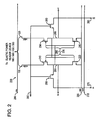
- FIG. 2 shows circuit 200, which implements an SRAM cell suitable for use as any of SRAM cells 110 of Figure 1 , in accordance with an embodiment of the invention.
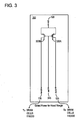
- FIG. 3 illustrates circuit 300, which implements an elastic power header device in accordance with an embodiment of the invention.
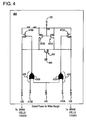
- FIG. 4 illustrates circuit 400, which may be also be used to implement elastic power header device 180 of Figure 1 , in accordance with another embodiment of the invention.
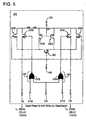
- FIG. 5 illustrates circuit 500, which implements elastic power header device 180 of Figure 1 , in accordance with another embodiment of the invention.
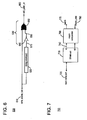
- Figure 6 shows circuit 600, which provides a low-going pulse, which may be used to provide write enable signal 425 during a read or write operation in elastic power header circuit 180 of Figure 1 , in accordance with an embodiment of the invention.
- Figure 7 illustrates an example of a content-addressable memory (CAM) cell that may be implemented using the SRAM cell circuits disclosed above.
- CAM content-addressable memory
- an elastic power header device improves the read margin and read stability of a memory cell, such as an SRAM cell.
- an elastic power header device described herein acts as a programmable resistance to allow the power supply lines to reach a voltage equal to a desired reference voltage, without experiencing a threshold drop. Therefore, an elastic power header device of the present invention provides additional flexibility in both read margin and read stability. The additional flexibility may also be varied with an adjustment voltage, which can be used to fine-tune and control the read margin.
- Figure 1 is a conceptual block diagram showing circuit 100, in which a number of SRAM cells 110 are connected to elastic power header device 180, in accordance with an embodiment of the invention.
- elastic power header device 180 Several possible circuit implementations for elastic power header device 180 are illustrated in Figs. 3 through 5 , as further described herein.
- SRAM cells 110 are each connected to power supply lines 125 and 135.
- each of SRAM cells 110 may be implemented by cross-coupled logic gates (e.g., cross-coupled inverters).
- Elastic power header device 180 may also act as "split power switch” that provide voltages of power supply lines 125 and 135 from power supply voltage 120 ("V dd ")
- Split power switches are discussed, for example, in U.S. patent application, entitled “Split Power Switch for Memory Cells" ("Copending Application"), serial no. 60/888,006, filed on February 2, 2007 .
- voltages of power supply lines 125 and 135 are slightly different, to facilitate writing into an SRAM cell.
- the disclosure of the Copending Application is hereby incorporated by reference to provide background for the split power technique.
- Elastic power header device 180 selectively adjusts the voltages provided to power supply lines 125 and 135, in response to one or more control signals 150.
- elastic power header device 180 may be configured to provide substantially reference voltage 120 during a read operation, while allowing the voltage of one of power supply lines 125 and 135 to fall during an appropriate write operation of SRAM cells 110.
- SRAM cells 110 are shown in Figure 1 as a single column of memory cells connected to a single split power switch 140, it is understood that Figure 1 is merely illustrative.
- additional groups of SRAM cells 110 connect to power supply lines 125 and 135, and additional elastic power header devices 180 may be used to provide power to these additional groups of SRAM cells.
- the additional SRAM cells may share power supply lines 125 and 135 under control by a single elastic power header device 180.
- the single column of memory cells may be split into multiple sub-columns, each sub-column having its own power supply lines 125 and 135 but sharing the same bit line.
- bit lines 270 and 280 are connected with each of SRAM cells 110-1 through 110-N.
- SRAM cells 110-1 through 110-N may share bitlines 270 and 280.
- bit lines may not be shared by all of SRAM cells 110-1 through 110-N.
- a first set of bit lines may be provided to SRAM cells 110-1 and 110-2, and a second set of bit lines may be provided to SRAM cell 110-N.
- SRAM cells 110-1 and 110-2 may use bit lines separate from those used by SRAM cell 110-N.
- any desired combination of shared and/or unshared bit lines may be used.
- FIG. 2 shows circuit 200, which implements an SRAM cell that is suitable for use as any of SRAM cells 110 of Figure 1 , in accordance with an embodiment of the invention.
- circuit 200 includes cross-coupled inverters 225 and 245 implemented by PMOS transistors 210 and 230 and NMOS transistors 220 and 240, respectively.
- PMOS transistor 210 connects to power supply line 135, while PMOS transistor 230 connects to power supply line 125.
- NMOS transistors 220 and 240 each connect to reference voltage 295 ("V ss ") which may correspond, for example, to ground.
- Figure 2 further shows that n-well and p-well voltages 205 and 215 (labeled V nw and V pw , respectively), each may differ from either reference voltage 120 or reference voltage 295.
- the n-well voltage 205 must be greater than or equal to the maximum of power supply lines 125 or 135.
- the n-well voltage is often the same line as reference voltage 120 ("V dd ").
- the n-well voltage 205 is not the same line as either power supply lines 125 or 135, but it may happen to have the same voltage as power supply lines 125 or 135.
- Access or pass transistors 250 and 260 connect to word line 290 and bit lines 270 and 280, and internal nodes 255 and 265, respectively.
- elastic power header device 180 provides that the voltage of each of power supply lines 125 and 135 is approximately reference voltage 120.
- elastic power header device 180 maintains each of power supply lines 125 and 135 at approximately reference voltage 120.
- bit lines 270 and 280 are precharged to an intermediate voltage, and word line 290 may then be set to a logic high voltage, so that access transistors 250 and 260 becomes conducting to allow inverters 225 and 245 to drive the stored logic values at nodes 255 and 265 to bit lines 270 and 280.
- elastic power header device 180 permits the voltage of power supply line 125 to fall below reference voltage 120, while maintaining the voltage of power supply line 135 at approximately reference voltage 120.
- nodes 255 and 265 are initially at logic low and logic high, respectively.
- NMOS transistor 220 and PMOS transistor 230 are conducting, while PMOS transistors 210 and NMOS transistor 240 are non-conducting.
- bit lines 270 and 280 are driven to logic high and logic low, respectively, by appropriate write circuitry (not shown), as word line 290 is driven to logic high to turn on access transistors 250 and 260. Accordingly, bit line 280 pulls node 265 down from logic high to logic low. Because PMOS transistor 230 is initially conducting, its current acts to pull up the voltage at node 265. However, with power supply line 125 falling below reference voltage 120, resulting in less current flowing in transistor 230 than would otherwise flow, bit line 280 can more rapidly turn on PMOS transistor 210 which, in turn, turns on NMOS transistor 240 to pull down node 265. By maintaining the voltage of power supply line 135 approximately at reference voltage 120, transistor 210 allows the voltage at node 255 to be more rapidly pulled up.
- writing the opposite logic state i.e., to bring node 255 to logic low and node 265 to logic high
- writing the opposite logic state may be facilitated by allowing power supply line 135 to fall below reference voltage 120, while maintaining power supply line 125 at approximately reference voltage 120.
- FIG 3 illustrates circuit 300, which implements an elastic power header device (e.g., elastic power header device 180 of Figure 1 ), in accordance with an embodiment of the invention.
- Circuit 300 improves read margin.
- Circuit 300 includes resistive transistors 320A and 320B, which connect reference voltage 120 to power supply lines 125 (labeled “levdd”) and 135 (labeled “rivdd”), respectively.
- Transistors 320A and 320B are shown in Figure 3 as being implemented by PMOS transistors.
- Adjustment voltage 345 (labeled "vref"), provided at the gate electrodes of resistive transistors 320A and 302B, adjusts the effective resistance of transistors 320A and 320B.
- adjustment voltage 345 (1) may be fixed at a predetermined voltage, (2) may be a dynamically adjusted voltage, or (3) may be controlled by a thermal-sensing self-calibration circuit to automatically adjust to a proper voltage.
- resistive transistors 320A and 320B When maintained in the linear region, resistive transistors 320A and 320B can each pull power supply lines 125 and 135 to reference voltage 120. Within this region, the adjustment voltage 345 flexibly fine-tunes main resistive transistors 320A and 320B to be as close to reference voltage 120 as desired, taking into consideration the current drawn by the switching SRAM cell, thereby achieving improved read margin and increased read stability. Adjustment voltage 345 may also be used effectively to improve write margin in a write operation, as illustrated by Figure 5 .
- FIG. 4 illustrates circuit 400, which may be also be used to implement elastic power header device 180 of Figure 1 , in accordance with another embodiment of the invention. Circuit 400 improves write margin.
- Circuit 400 receives write data signals 410A (labeled “blb”) and 410B (labeled “bl”), and a write enable signal 425 (labeled "wyb”).
- Signals 410A, 410B and 425 selectively adjusts the voltages at power supply lines 125 and 135 through logic circuit 490, which includes NOR gates 430A and 430B.
- NOR gates 430A and 430B controls gate electrodes of transistors 470A and 470B.
- Transistors 450A, 450B, 470A and 470B connect power supply lines 125 and 135, respectively, to reference voltage 120.
- Each of transistors 470A and 470B selectively provides reference voltage 120 to power supply lines 125 and 135, respectively, in response to signals 410A-B and 425.
- NOR gate 430A provides a logic low output value, except when write data signal 410A and write enable signal 425 are both at logic low.
- NOR gate 430B provides a logic low output, except when write data signal 410B and write enable signal 425 are both at logic low.
- both transistors 470A and 470B remain turned on except during write operations, at which time one turns off to permit the voltage of one of power supply lines 125 or 135 to drop.
- write enable signal 425 is at logic high, so that transistors 470A and 470B are both conducting to maintain power supply lines 125 and 135 at reference voltage 120.
- Circuit 400 also includes clamper transistors 450A and 450B, shown in Figure 4 as being implemented by NMOS transistors. As shown in Figure 4 , the gate and drain terminals of clamper transistors 450A and 450B connect to reference voltage 120, so that power supply lines 125 and 135 are maintained approximately at reference voltage 120 minus a threshold voltage. Accordingly, clamper transistors 450A and 450B each maintain a minimum voltage at the corresponding one of power supply lines 125 and 135, when transistors 470A or 470B is turned off in response to signals 410A, 410B and 425.
- write data signals 410A and 410B are implemented as complementary signals during a write operation (when write enable signal 425 is at logic low), only one of transistors 470A and 470B is conducting.
- write data signal 410A is at logic high (write data signal 410B is at logic low) value in a write operation
- NOR gate 430A provides a logic low value to maintain transistor 470A conducting, while switching off transistor 470B.
- power supply line 125 remains at substantially reference voltage 120, while power supply line 135 falls to reference voltage 120 minus the threshold voltage of transistor 450B.
- the voltage difference in power supply lines 125 and 135 facilitates the write operation in the selected memory cell.
- Circuit 400 also includes weak keeper transistor 460 having its gate electrode controlled by reference voltage 495, which may be the ground reference in this embodiment.
- weak keeper transistor 460 provides a weak current flowing between power supply lines 125 and 135 to limit the voltage difference between power supply lines 125 and 135, in response to leakage currents in SRAM circuit 200.
- FIG. 5 illustrates circuit 500, which implements elastic power header device 180 of Figure 1 , in accordance with another embodiment of the invention.
- Circuit 500 improves both read margin and write margin.
- circuit 500 includes, in addition to the elements of circuit 400 of Figure 4 , additional resistive transistors 520A and 520B (shown implemented by PMOS transistors) are respectively provided across reference voltage 120 and a corresponding one of power supply lines 125 and 135.
- additional resistive transistors 520A and 520B shown implemented by PMOS transistors
- like elements in circuits 400 and 500 are provided the same reference numerals.
- circuit 500 behaves substantially the same as circuit 400.
- Such an adjustment voltage may be provided during a write operation so that, as explained above, circuit 500 may improve write margin in the same manner as circuit 400.
- the adjustment voltage 545 is set so that resistive transistors 520A and 520B are turned on in the linear region, during a read operation, while at the same time signals 410A, 410B and 425 are kept at logic low, then circuit 500 operates similar to circuit 300, i.e., with the benefit of an improved read margin.
- circuit 500 provides both improved read margin and improved write margin.
- Circuit 600 which provides a low-going pulse, which may be used to provide write enable signal 425 a logic low state of sufficient duration during a read or write operation in elastic power header circuit 180 of Figure 1 , in accordance with an embodiment of the invention.
- Circuit 600 includes a delay element block 620 implemented by appropriate circuitry to delay the input signal, so that, for a brief time period, because of inverter 640, a high-going signal transition at input terminal 610 causes output terminal 660 of NAND gate 650 to go to logic low. At other times, inverter 640 ensures that output terminal 660 of NAND gate 650 is at logic high.
- Embodiments incorporating various features disclosed herein may be implemented in embedded or standalone SRAM memory devices, caches, register files, multi-port memories, translation lookaside buffers (TLBS), content-addressable memories (CAMS), ternary CAMS (TCAMS), or other appropriate devices to operate at lower voltages as compared to traditional six transistor SRAM cells.
- TLBS translation lookaside buffers
- CAMS content-addressable memories
- TCAMS ternary CAMS
- FIG. 7 illustrates an example of a content-addressable memory (CAM) cell that may be implemented using the SRAM cell circuits disclosed above.
- CAM memory device 700 includes SRAM cell 710 and match comparator 760.
- SRAM cell 710 may be implemented, for example, by circuit 200 of Figure 2 .
- SRAM cell 710 includes a read/write port 720 implemented, for example, by access transistors 250 and 260 of circuit 200.
- a logic state and its complement stored in SRAM cell 710 are provided to match comparator 760 (e.g., as bit lines 270 and 280of circuit 200).
- Match comparator 760 compares a data value received at match-data port 780 against the value stored in SRAM cell 710.to provide an output value for match signal 770.
- the elastic power header device includes transistors and an adjustable bias to mimic a programmable resistor. Adjustment can be continuously adjustable or step-wise adjustable.
- the adjustment bias can also be either an adjustable current or an adjustable voltage, even though it will be referred to as an adjustment voltage hereafter.
- This transistor and adjustment voltage combination is utilized in an SRAM cell for read operations.
- a transistor can be held to operate at an adjustable strength such as in linear or saturation region by an adjustment voltage. This in turn varies the resistance in the transistor and allows the voltage on a power supply line to approximate a reference voltage, for instance, V dd .
- the resistance of the elastic power header device can also be made programmable. Properties of the elastic power header device may be programmed before processing, or set "on-the-fly.” This implementation improves the read margin of the SRAM cell.
- the elastic power header device includes actual programmable resistors, instead of transistors, which have resistance values that may be varied in a SRAM cell during a read. The read margin of the SRAM cell is thereby improved.
- the elastic power header device includes transistors and a logic circuit used during a write operation.
- the transistors and the logic circuit act like a switch to affect the relative resistances in split-power lines. In this manner, the write operation is optimally performed, thereby improving the write margin of the SRAM cell.
- the elastic power header device includes transistors, an adjustment voltage, and a logic circuit to be used during both a read operation and a write operation. In this manner, the elastic power header device improves both the read margin and the write margin of the SRAM cell.
- the elastic power header device splits the power supply into two power supply lines using a programmable resistor to control the effective resistances in the split power lines.
- One advantage of such an elastic power header device is improved read margin achieved by improving read stability, reducing read disturbance and improving SNM.
- the elastic power header device also improves both the read and write margin of the SRAM cell simultaneously.
- the elastic power header device in accordance with the various embodiments described herein may be used with SRAM cells providing multiple bidirectional or unidirectional read or write ports.
- a positive reference voltage 120 has been described herein, the techniques of the invention are equally applicable when applied to a negative reference voltage (e.g., ground).
- a negative reference voltage e.g., ground
- the embodiments of the invention, including the various circuits for implementing elastic power header device 180 described herein can provide reliable voltage operation ranges for the connected SRAM cells, despite possible variations in individual circuit components.
- HDL hardware description language
- Applicable HDLs include those at the layout, circuit netlist, register transfer, and/or schematic capture levels. Examples of HDLs include, but are not limited to: GDS II and OASIS (layout level); various SPICE languages, and IBIS (circuit netlist level); Verilog and VHDL (register transfer level); and Virtuoso custom design language and Design Architecture-IC custom design language (schematic capture level). HDL descriptions may also be used for a variety of purposes, including but not limited to layout, behavior, logic and circuit design verification, modeling and/or simulation.
Landscapes
- Engineering & Computer Science (AREA)
- Power Engineering (AREA)
- Microelectronics & Electronic Packaging (AREA)
- Computer Hardware Design (AREA)
- Static Random-Access Memory (AREA)
- Semiconductor Memories (AREA)
- Electronic Switches (AREA)
- Keying Circuit Devices (AREA)
- Synchronisation In Digital Transmission Systems (AREA)
- Inks, Pencil-Leads, Or Crayons (AREA)
- Electrophonic Musical Instruments (AREA)
Claims (13)
- Dispositif de mémoire comprenant :une première ligne d'alimentation électrique (125) ;une deuxième ligne d'alimentation électrique (135) ;une cellule de mémoire vive statique - SRAM - (110) comprenant une première porte logique (230) et une deuxième porte logique (210) qui sont couplées mutuellement, dans laquelle la première ligne d'alimentation électrique alimente la première porte logique et la deuxième ligne d'alimentation électrique alimente la deuxième porte logique ; etun dispositif collecteur d'alimentation (180 ; 400 ; 500) configuré pour faire varier sélectivement des niveaux d'alimentation, le dispositif collecteur d'alimentation étant connecté entre une tension de référence (120) et chacune de la première ligne d'alimentation électrique et de la deuxième ligne d'alimentation électrique,dans lequel le dispositif collecteur d'alimentation est configuré pour fournir, durant une opération d'écriture de la cellule SRAM, des niveaux d'alimentation différents sur la première ligne d'alimentation électrique et de la deuxième ligne d'alimentation électrique, caractérisé en ce que le dispositif collecteur d'alimentation est configuré pour fournir, durant une opération de lecture, une première résistance (470A) dans la première ligne d'alimentation électrique et une deuxième résistance (470B) dans la deuxième ligne d'alimentation électrique, les première et deuxième résistances étant sensiblement égales ; etdans laquelle le dispositif collecteur d'alimentation comprend un circuit logique (490) configuré pour recevoir un ou plusieurs signaux de données d'écriture (410A, 410B) et un signal de validation d'écriture (425) et pour délivrer une sortie en fonction des niveaux du ou des signaux de données d'écriture et du signal de validation d'écriture pour faire varier sélectivement les niveaux d'alimentation sur la première ligne d'alimentation électrique et de la deuxième ligne d'alimentation électrique.
- Dispositif de mémoire selon la revendication 1, dans lequel au moins une des première et deuxième résistances comprend une résistance programmable.
- Dispositif de mémoire selon la revendication 1, dans lequel, durant l'opération d'écriture, la première ligne d'alimentation électrique a au moins un d'un niveau de tension différent de la deuxième ligne d'alimentation électrique ou d'un flux de courant différent de la deuxième ligne d'alimentation électrique.
- Dispositif de mémoire selon la revendication 1, dans lequel, durant l'opération d'écriture, celle de la première et de la deuxième lignes d'alimentation électrique qui a un niveau d'alimentation électrique supérieur est déterminé par la valeur du bit de donnée qui est écrit.
- Dispositif de mémoire selon la revendication 1, dans lequel, durant l'opération de lecture, une différence de niveau d'alimentation électrique entre la première ligne d'alimentation électrique et la deuxième ligne d'alimentation électrique dépend du courant soutiré à partir de chaque ligne d'alimentation électrique.
- Dispositif de mémoire selon la revendication 1, dans lequel, durant l'opération d'écriture, les niveaux d'alimentation électrique différents sont fournis par une résistance variable dans l'une sélectionnée des lignes d'alimentation électrique pour faciliter l'écriture dans la première cellule SRAM.
- Dispositif de mémoire selon la revendication 1, dans lequel les niveaux d'alimentation électrique différents entre la première ligne d'alimentation électrique et la deuxième ligne d'alimentation électrique durant l'opération d'écriture correspond à une chute de tension de seuil aux bornes d'un transistor.
- Dispositif de mémoire selon la revendication 1, comprenant en outre un circuit de maintien pour limiter la différence entre la première ligne d'alimentation électrique et la deuxième ligne d'alimentation électrique.
- Dispositif de mémoire selon la revendication 1, dans lequel le dispositif de mémoire est configuré pour l'utilisation dans au moins un parmi : un dispositif de mémoire SRAM incorporé, un dispositif de mémoire SRAM autonome, une mémoire cache, un fichier de registre, une mémoire multiport, une mémoire tampon en parallèle de traduction, une mémoire adressable par contenu ou une mémoire adressable par contenu ternaire.
- Dispositif de mémoire selon la revendication 1, dans lequel au moins une des première et deuxième résistances comprend un transistor.
- Dispositif de mémoire selon la revendication 1, lequel comprend :un premier parcours conducteur, couplé entre une tension de référence et les deux d'une première ligne d'alimentation électrique et d'une deuxième ligne d'alimentation électrique, configuré pour fournir la première différence de niveau d'alimentation entre la tension de référence de chacune de la première ligne d'alimentation électrique et de la deuxième ligne d'alimentation électrique ;un deuxième parcours conducteur, couplé entre la tension de référence et la première ligne d'alimentation électrique ;un troisième parcours conducteur, couplé entre la tension de référence et la deuxième ligne d'alimentation électrique, dans lequel, en réponse à une opération de lecture, une résistance dans l'un sélectionné parmi le deuxième parcours conducteur et le troisième parcours conducteur est maintenu dans une plage de valeurs prédéterminée durant une opération d'écriture pour fournir une différence de niveau d'alimentation électrique entre la première ligne d'alimentation électrique et la deuxième ligne d'alimentation électrique ;un quatrième parcours conducteur, couplé entre la tension de référence et la première ligne d'alimentation électrique ; etun cinquième parcours conducteur, couplé entre la tension de référence et la deuxième ligne d'alimentation électrique, dans lequel, en réponse à une opération d'écriture, la résistance dans l'un sélectionné parmi le quatrième et le cinquième parcours conducteurs est varié pour fournir une résistance.
- Dispositif de mémoire selon la revendication 1, dans lequel le dispositif collecteur d'alimentation comprend :un premier parcours conducteur couplé entre la tension de référence et la première ligne d'alimentation électrique ; etun deuxième parcours conducteur couplé entre la tension de référence et la deuxième ligne d'alimentation électrique ; dans lequel, en réponse à une opération de lecture, la résistance relative entre le premier parcours conducteur et le deuxième parcours conducteurs est maintenu dans une plage de valeurs prédéterminée.
- Procédé pour obtenir une marge de lecture améliorée dans le dispositif de mémoire selon l'une quelconque des revendications 1 à 12, le procédé comprenant :le maintien, durant une opération de lecture du dispositif de mémoire, d'une résistance sensiblement égale dans chacune de la première ligne d'alimentation électrique et de la deuxième ligne d'alimentation électrique pour fournir un niveau d'alimentation supérieur à une valeur prédéterminée ; etla variation, durant une opération d'écriture du dispositif de mémoire, d'une résistance dans l'une sélectionnée parmi la première ligne d'alimentation électrique et la deuxième ligne d'alimentation électrique pour fournir une différence de niveau d'alimentation entre la première ligne d'alimentation électrique et la deuxième ligne d'alimentation électrique, dans lequel la variation comprend :la réception d'un signal de données d'écriture et d'un signal de validation d'écriture au niveau du circuit logique ; etle circuit logique délivrant sélectivement une sortie pour faire varier les niveaux d'alimentation sur la première ligne d'alimentation électrique et sur la deuxième ligne d'alimentation électrique sur la base des niveaux du signal de données d'écriture et du signal de validation d'écriture.
Applications Claiming Priority (6)
| Application Number | Priority Date | Filing Date | Title |
|---|---|---|---|
| US88800607P | 2007-02-02 | 2007-02-02 | |
| US11/932,555 US7952910B2 (en) | 2007-02-02 | 2007-10-31 | Memory device with split power switch |
| US11/932,967 US7672187B2 (en) | 2007-02-02 | 2007-10-31 | Elastic power for read and write margins |
| US11/932,643 US20080266995A1 (en) | 2007-02-02 | 2007-10-31 | Method of selectively powering memory device |
| US11/938,196 US7869263B2 (en) | 2007-02-02 | 2007-11-09 | Elastic power for read margin |
| PCT/US2008/052496 WO2008097783A2 (fr) | 2007-02-02 | 2008-01-30 | Alimentation électrique élastique pour marges de lecture et d'écriture |
Publications (3)
| Publication Number | Publication Date |
|---|---|
| EP2118900A2 EP2118900A2 (fr) | 2009-11-18 |
| EP2118900A4 EP2118900A4 (fr) | 2010-04-21 |
| EP2118900B1 true EP2118900B1 (fr) | 2011-08-17 |
Family
ID=39676026
Family Applications (2)
| Application Number | Title | Priority Date | Filing Date |
|---|---|---|---|
| EP08728581.3A Active EP2118717B1 (fr) | 2007-02-02 | 2008-01-30 | Mémoire à commutation d'alimentation dédoublée et procédés correspondants |
| EP08728583A Active EP2118900B1 (fr) | 2007-02-02 | 2008-01-30 | Sram avec alimentation électrique élastique pour marges de lecture et d'écriture augmentées |
Family Applications Before (1)
| Application Number | Title | Priority Date | Filing Date |
|---|---|---|---|
| EP08728581.3A Active EP2118717B1 (fr) | 2007-02-02 | 2008-01-30 | Mémoire à commutation d'alimentation dédoublée et procédés correspondants |
Country Status (5)
| Country | Link |
|---|---|
| US (4) | US7952910B2 (fr) |
| EP (2) | EP2118717B1 (fr) |
| AT (1) | ATE521067T1 (fr) |
| TW (2) | TWI394173B (fr) |
| WO (2) | WO2008097783A2 (fr) |
Families Citing this family (24)
| Publication number | Priority date | Publication date | Assignee | Title |
|---|---|---|---|---|
| JP2007193928A (ja) * | 2005-12-19 | 2007-08-02 | Matsushita Electric Ind Co Ltd | 半導体記憶装置 |
| US7570537B2 (en) * | 2007-07-12 | 2009-08-04 | Sun Microsystems, Inc. | Memory cells with power switch circuit for improved low voltage operation |
| TWI399748B (zh) * | 2009-01-15 | 2013-06-21 | Univ Hsiuping Sci & Tech | 寫入操作時降低電源電壓之雙埠靜態隨機存取記憶體 |
| KR101034616B1 (ko) * | 2009-11-30 | 2011-05-12 | 주식회사 하이닉스반도체 | 센스앰프 및 반도체 메모리장치 |
| US8320203B2 (en) * | 2010-03-26 | 2012-11-27 | Intel Corporation | Method and system to lower the minimum operating voltage of register files |
| JP2012038401A (ja) | 2010-08-11 | 2012-02-23 | Elpida Memory Inc | 半導体装置及び半導体装置の電源制御方法 |
| US8427896B1 (en) | 2011-11-15 | 2013-04-23 | International Business Machines Corporation | Dynamic wordline assist scheme to improve performance tradeoff in SRAM |
| US8729908B2 (en) | 2012-02-29 | 2014-05-20 | International Business Machines Corporation | Static noise margin monitoring circuit and method |
| TWI494945B (zh) * | 2012-03-29 | 2015-08-01 | Nat Univ Chung Cheng | Single-ended read random access memory device |
| US9317087B2 (en) * | 2012-04-26 | 2016-04-19 | Ravindraraj Ramaraju | Memory column drowsy control |
| US9019751B2 (en) | 2013-03-01 | 2015-04-28 | Qualcomm Incorporated | Process tolerant circuits |
| US9627038B2 (en) * | 2013-03-15 | 2017-04-18 | Intel Corporation | Multiport memory cell having improved density area |
| TWI562163B (en) * | 2013-07-04 | 2016-12-11 | United Microelectronics Corp | Memory cell array |
| US9105355B2 (en) * | 2013-07-04 | 2015-08-11 | United Microelectronics Corporation | Memory cell array operated with multiple operation voltage |
| TWI528361B (zh) * | 2013-12-10 | 2016-04-01 | 智原科技股份有限公司 | 靜態記憶胞 |
| US9595307B2 (en) | 2014-05-22 | 2017-03-14 | Samsung Electronics Co., Ltd. | Volatile memory device and system-on-chip including the same |
| US9570155B2 (en) | 2015-06-09 | 2017-02-14 | Globalfoundries Inc. | Circuit to improve SRAM stability |
| US10049724B2 (en) * | 2016-06-07 | 2018-08-14 | Intel Corporation | Aging tolerant register file |
| US9922701B2 (en) * | 2016-08-08 | 2018-03-20 | Taiwan Semiconductor Manufacturing Company Limited | Pre-charging bit lines through charge-sharing |
| US10236036B2 (en) * | 2017-05-09 | 2019-03-19 | Micron Technology, Inc. | Sense amplifier signal boost |
| US11133039B2 (en) * | 2018-10-12 | 2021-09-28 | Taiwan Semiconductor Manufacturing Company, Ltd. | Power switch control in a memory device |
| US11967365B2 (en) * | 2019-06-11 | 2024-04-23 | Arm Limited | Bitcell architecture with time-multiplexed ports |
| US12482520B2 (en) * | 2022-11-23 | 2025-11-25 | The Trustees Of Columbia University In The City Of New York | 6T-SRAM-based digital computing-in-memory circuits supporting flexible input dimension |
| KR20240111461A (ko) | 2023-01-10 | 2024-07-17 | 삼성전자주식회사 | 정적 랜덤 액세스 메모리의 메모리 셀 어레이 및 이를 포함하는 정적 랜덤 액세스 메모리 |
Family Cites Families (23)
| Publication number | Priority date | Publication date | Assignee | Title |
|---|---|---|---|---|
| US4686391A (en) | 1986-05-08 | 1987-08-11 | Genrad, Inc. | Fast-acting comparison circuit |
| JPH07111824B2 (ja) * | 1986-12-15 | 1995-11-29 | 株式会社東芝 | 半導体メモリ |
| KR0136074B1 (ko) * | 1992-09-11 | 1998-06-01 | 세키자와 스토무 | 개량된 소프트 에러 저항을 갖는 mos형 sram, 고전위 전원 전압 강하 검출 회로, 상보 신호 천이 검출 회로 및 개량된 내부신호 시간 마진을 갖는 반도체 장치 |
| US5870331A (en) | 1997-09-26 | 1999-02-09 | Advanced Micro Devices, Inc. | Application-specific SRAM memory cell for low voltage, high speed operation |
| JP3183245B2 (ja) * | 1998-03-06 | 2001-07-09 | 日本電気株式会社 | 半導体記憶装置 |
| US6117722A (en) * | 1999-02-18 | 2000-09-12 | Taiwan Semiconductor Manufacturing Company | SRAM layout for relaxing mechanical stress in shallow trench isolation technology and method of manufacture thereof |
| KR100346832B1 (ko) * | 2000-01-12 | 2002-08-03 | 삼성전자 주식회사 | 스태틱 랜덤 억세스 메모리 소자 및 그 제조 방법 |
| US6801994B2 (en) * | 2000-12-20 | 2004-10-05 | Microsoft Corporation | Software management systems and methods for automotive computing devices |
| JP2003045187A (ja) * | 2001-08-02 | 2003-02-14 | Mitsubishi Electric Corp | 半導体記憶装置 |
| JP4030383B2 (ja) | 2002-08-26 | 2008-01-09 | 株式会社ルネサステクノロジ | 半導体装置およびその製造方法 |
| US6771095B1 (en) * | 2002-11-22 | 2004-08-03 | Analog Devices, Inc. | Level translating digital switch |
| JP3906166B2 (ja) * | 2003-02-25 | 2007-04-18 | 株式会社東芝 | 半導体記憶装置 |
| JP2004362695A (ja) * | 2003-06-05 | 2004-12-24 | Renesas Technology Corp | 半導体記憶装置 |
| US7165165B2 (en) * | 2004-03-16 | 2007-01-16 | Intel Corporation | Anticipatory power control of memory |
| US7129765B2 (en) * | 2004-04-30 | 2006-10-31 | Xilinx, Inc. | Differential clock tree in an integrated circuit |
| US7092280B2 (en) * | 2004-11-22 | 2006-08-15 | International Business Machines Corp. | SRAM with dynamically asymmetric cell |
| JP4912016B2 (ja) * | 2005-05-23 | 2012-04-04 | ルネサスエレクトロニクス株式会社 | 半導体記憶装置 |
| US7403426B2 (en) | 2005-05-25 | 2008-07-22 | Intel Corporation | Memory with dynamically adjustable supply |
| US7060549B1 (en) | 2005-07-01 | 2006-06-13 | Advanced Micro Devices, Inc. | SRAM devices utilizing tensile-stressed strain films and methods for fabricating the same |
| JP5100035B2 (ja) | 2005-08-02 | 2012-12-19 | ルネサスエレクトロニクス株式会社 | 半導体記憶装置 |
| JP4929668B2 (ja) * | 2005-10-12 | 2012-05-09 | 富士通セミコンダクター株式会社 | 半導体メモリ |
| US7376001B2 (en) * | 2005-10-13 | 2008-05-20 | International Business Machines Corporation | Row circuit ring oscillator method for evaluating memory cell performance |
| JP2007193928A (ja) * | 2005-12-19 | 2007-08-02 | Matsushita Electric Ind Co Ltd | 半導体記憶装置 |
-
2007
- 2007-10-31 US US11/932,555 patent/US7952910B2/en active Active
- 2007-10-31 US US11/932,643 patent/US20080266995A1/en not_active Abandoned
- 2007-10-31 US US11/932,967 patent/US7672187B2/en active Active
- 2007-11-09 US US11/938,196 patent/US7869263B2/en active Active
-
2008
- 2008-01-30 WO PCT/US2008/052496 patent/WO2008097783A2/fr not_active Ceased
- 2008-01-30 WO PCT/US2008/052493 patent/WO2008097782A1/fr not_active Ceased
- 2008-01-30 AT AT08728583T patent/ATE521067T1/de not_active IP Right Cessation
- 2008-01-30 EP EP08728581.3A patent/EP2118717B1/fr active Active
- 2008-01-30 EP EP08728583A patent/EP2118900B1/fr active Active
- 2008-02-01 TW TW097103973A patent/TWI394173B/zh active
- 2008-02-01 TW TW097103958A patent/TWI389130B/zh active
Also Published As
| Publication number | Publication date |
|---|---|
| TW200849271A (en) | 2008-12-16 |
| US20080186791A1 (en) | 2008-08-07 |
| EP2118717B1 (fr) | 2013-08-21 |
| US7869263B2 (en) | 2011-01-11 |
| EP2118717A1 (fr) | 2009-11-18 |
| ATE521067T1 (de) | 2011-09-15 |
| US20080273412A1 (en) | 2008-11-06 |
| US20080186795A1 (en) | 2008-08-07 |
| US7672187B2 (en) | 2010-03-02 |
| WO2008097783A2 (fr) | 2008-08-14 |
| TW200847178A (en) | 2008-12-01 |
| TWI394173B (zh) | 2013-04-21 |
| TWI389130B (zh) | 2013-03-11 |
| US7952910B2 (en) | 2011-05-31 |
| WO2008097783A3 (fr) | 2008-10-23 |
| US20080266995A1 (en) | 2008-10-30 |
| EP2118717A4 (fr) | 2010-04-07 |
| EP2118900A4 (fr) | 2010-04-21 |
| EP2118900A2 (fr) | 2009-11-18 |
| WO2008097782A1 (fr) | 2008-08-14 |
Similar Documents
| Publication | Publication Date | Title |
|---|---|---|
| US7672187B2 (en) | Elastic power for read and write margins | |
| US7872935B2 (en) | Memory cells with power switch circuit for improved low voltage operation | |
| Wang et al. | Sub-threshold design for ultra low-power systems | |
| TWI259939B (en) | A power gating structure with concurrent data retention and intermediate modes | |
| KR101601827B1 (ko) | 개선된 저전압 기록 속도 비트셀 | |
| US9111606B2 (en) | Tracking bit cell | |
| US9349437B2 (en) | Memory cell having built-in read and write assist | |
| JP2005117037A (ja) | Soiおよびバルクのキャッシュ容量を高める方法 | |
| TWI700706B (zh) | 記憶體裝置 | |
| Yabuuchi et al. | 13.3 20nm High-density single-port and dual-port SRAMs with wordline-voltage-adjustment system for read/write assists | |
| JP2010272190A (ja) | 半導体記憶装置 | |
| US20090129191A1 (en) | Structure for SRAM voltage control for improved operational margins | |
| US20070211517A1 (en) | System and method for operating a memory circuit | |
| KR101705172B1 (ko) | 반도체 메모리 장치 | |
| US10482950B2 (en) | Static random access memory devices including a plurality of storage cells and a read/write circuit | |
| Mishra et al. | Static noise margin and power dissipation analysis of various SRAM topologies | |
| US7626853B1 (en) | Method of operating memory cell providing internal power switching | |
| Dhindsa et al. | A novel differential 9T cell SRAM with reduced sub threshold leakage power | |
| Zanjani et al. | A new subthreshold half-select free SRAM with dynamic feedback cut-off for low-power and high speed applications | |
| CN201910251U (zh) | 一种带自适应漏电流切断机制的存储单元电路 | |
| Karthika et al. | Power analysis of bit interleaving 9T SRAM array | |
| Tawfik et al. | Stability enhancement techniques for nanoscale SRAM circuits: A comparison | |
| Gomase et al. | Stability analysis of SRAM cell for energy reduction using deep sub micron technology | |
| Abu-Rahma et al. | Variation-Tolerant SRAM Write and Read Assist Techniques | |
| TW200419575A (en) | Low-power high-performance storage circuitry and related methods |
Legal Events
| Date | Code | Title | Description |
|---|---|---|---|
| PUAI | Public reference made under article 153(3) epc to a published international application that has entered the european phase |
Free format text: ORIGINAL CODE: 0009012 |
|
| 17P | Request for examination filed |
Effective date: 20090828 |
|
| AK | Designated contracting states |
Kind code of ref document: A2 Designated state(s): AT BE BG CH CY CZ DE DK EE ES FI FR GB GR HR HU IE IS IT LI LT LU LV MC MT NL NO PL PT RO SE SI SK TR |
|
| RIN1 | Information on inventor provided before grant (corrected) |
Inventor name: WENDELL, DENNIS Inventor name: LIU, JUN Inventor name: FUNG, DANIEL Inventor name: BHATIA, AJAY Inventor name: LIH, YOLIN Inventor name: BALASUBRAMANIAN, SHYAM |
|
| A4 | Supplementary search report drawn up and despatched |
Effective date: 20100318 |
|
| RIC1 | Information provided on ipc code assigned before grant |
Ipc: G11C 11/419 20060101AFI20100312BHEP |
|
| DAX | Request for extension of the european patent (deleted) | ||
| RIC1 | Information provided on ipc code assigned before grant |
Ipc: G11C 11/419 20060101AFI20110106BHEP |
|
| RTI1 | Title (correction) |
Free format text: SRAM WITH ELASTIC POWER SUPPLY FOR IMPROVED READ AND WRITE MARGINS |
|
| GRAP | Despatch of communication of intention to grant a patent |
Free format text: ORIGINAL CODE: EPIDOSNIGR1 |
|
| GRAS | Grant fee paid |
Free format text: ORIGINAL CODE: EPIDOSNIGR3 |
|
| GRAA | (expected) grant |
Free format text: ORIGINAL CODE: 0009210 |
|
| AK | Designated contracting states |
Kind code of ref document: B1 Designated state(s): AT BE BG CH CY CZ DE DK EE ES FI FR GB GR HR HU IE IS IT LI LT LU LV MC MT NL NO PL PT RO SE SI SK TR |
|
| REG | Reference to a national code |
Ref country code: GB Ref legal event code: FG4D |
|
| REG | Reference to a national code |
Ref country code: CH Ref legal event code: EP |
|
| REG | Reference to a national code |
Ref country code: IE Ref legal event code: FG4D |
|
| REG | Reference to a national code |
Ref country code: DE Ref legal event code: R096 Ref document number: 602008008946 Country of ref document: DE Effective date: 20111020 |
|
| RAP2 | Party data changed (patent owner data changed or rights of a patent transferred) |
Owner name: ORACLE AMERICA, INC. |
|
| REG | Reference to a national code |
Ref country code: NL Ref legal event code: VDEP Effective date: 20110817 Ref country code: GB Ref legal event code: 732E Free format text: REGISTERED BETWEEN 20111110 AND 20111116 |
|
| REG | Reference to a national code |
Ref country code: DE Ref legal event code: R082 Ref document number: 602008008946 Country of ref document: DE Representative=s name: WSL PATENTANWAELTE PARTNERSCHAFT MBB, DE Effective date: 20111020 Ref country code: DE Ref legal event code: R081 Ref document number: 602008008946 Country of ref document: DE Owner name: ORACLE AMERICA, INC., REDWOOD CITY, US Free format text: FORMER OWNER: MONTALVO SYSTEMS, INC., SANTA CLARA, CALIF., US Effective date: 20111020 |
|
| LTIE | Lt: invalidation of european patent or patent extension |
Effective date: 20110817 |
|
| PG25 | Lapsed in a contracting state [announced via postgrant information from national office to epo] |
Ref country code: NO Free format text: LAPSE BECAUSE OF FAILURE TO SUBMIT A TRANSLATION OF THE DESCRIPTION OR TO PAY THE FEE WITHIN THE PRESCRIBED TIME-LIMIT Effective date: 20111117 Ref country code: FI Free format text: LAPSE BECAUSE OF FAILURE TO SUBMIT A TRANSLATION OF THE DESCRIPTION OR TO PAY THE FEE WITHIN THE PRESCRIBED TIME-LIMIT Effective date: 20110817 Ref country code: LT Free format text: LAPSE BECAUSE OF FAILURE TO SUBMIT A TRANSLATION OF THE DESCRIPTION OR TO PAY THE FEE WITHIN THE PRESCRIBED TIME-LIMIT Effective date: 20110817 Ref country code: SE Free format text: LAPSE BECAUSE OF FAILURE TO SUBMIT A TRANSLATION OF THE DESCRIPTION OR TO PAY THE FEE WITHIN THE PRESCRIBED TIME-LIMIT Effective date: 20110817 Ref country code: IS Free format text: LAPSE BECAUSE OF FAILURE TO SUBMIT A TRANSLATION OF THE DESCRIPTION OR TO PAY THE FEE WITHIN THE PRESCRIBED TIME-LIMIT Effective date: 20111217 Ref country code: NL Free format text: LAPSE BECAUSE OF FAILURE TO SUBMIT A TRANSLATION OF THE DESCRIPTION OR TO PAY THE FEE WITHIN THE PRESCRIBED TIME-LIMIT Effective date: 20110817 Ref country code: PT Free format text: LAPSE BECAUSE OF FAILURE TO SUBMIT A TRANSLATION OF THE DESCRIPTION OR TO PAY THE FEE WITHIN THE PRESCRIBED TIME-LIMIT Effective date: 20111219 |
|
| REG | Reference to a national code |
Ref country code: AT Ref legal event code: MK05 Ref document number: 521067 Country of ref document: AT Kind code of ref document: T Effective date: 20110817 |
|
| PG25 | Lapsed in a contracting state [announced via postgrant information from national office to epo] |
Ref country code: GR Free format text: LAPSE BECAUSE OF FAILURE TO SUBMIT A TRANSLATION OF THE DESCRIPTION OR TO PAY THE FEE WITHIN THE PRESCRIBED TIME-LIMIT Effective date: 20111118 Ref country code: CY Free format text: LAPSE BECAUSE OF FAILURE TO SUBMIT A TRANSLATION OF THE DESCRIPTION OR TO PAY THE FEE WITHIN THE PRESCRIBED TIME-LIMIT Effective date: 20110817 Ref country code: PL Free format text: LAPSE BECAUSE OF FAILURE TO SUBMIT A TRANSLATION OF THE DESCRIPTION OR TO PAY THE FEE WITHIN THE PRESCRIBED TIME-LIMIT Effective date: 20110817 Ref country code: SI Free format text: LAPSE BECAUSE OF FAILURE TO SUBMIT A TRANSLATION OF THE DESCRIPTION OR TO PAY THE FEE WITHIN THE PRESCRIBED TIME-LIMIT Effective date: 20110817 Ref country code: LV Free format text: LAPSE BECAUSE OF FAILURE TO SUBMIT A TRANSLATION OF THE DESCRIPTION OR TO PAY THE FEE WITHIN THE PRESCRIBED TIME-LIMIT Effective date: 20110817 Ref country code: AT Free format text: LAPSE BECAUSE OF FAILURE TO SUBMIT A TRANSLATION OF THE DESCRIPTION OR TO PAY THE FEE WITHIN THE PRESCRIBED TIME-LIMIT Effective date: 20110817 |
|
| PG25 | Lapsed in a contracting state [announced via postgrant information from national office to epo] |
Ref country code: BE Free format text: LAPSE BECAUSE OF FAILURE TO SUBMIT A TRANSLATION OF THE DESCRIPTION OR TO PAY THE FEE WITHIN THE PRESCRIBED TIME-LIMIT Effective date: 20110817 |
|
| PG25 | Lapsed in a contracting state [announced via postgrant information from national office to epo] |
Ref country code: SK Free format text: LAPSE BECAUSE OF FAILURE TO SUBMIT A TRANSLATION OF THE DESCRIPTION OR TO PAY THE FEE WITHIN THE PRESCRIBED TIME-LIMIT Effective date: 20110817 Ref country code: CZ Free format text: LAPSE BECAUSE OF FAILURE TO SUBMIT A TRANSLATION OF THE DESCRIPTION OR TO PAY THE FEE WITHIN THE PRESCRIBED TIME-LIMIT Effective date: 20110817 |
|
| PG25 | Lapsed in a contracting state [announced via postgrant information from national office to epo] |
Ref country code: RO Free format text: LAPSE BECAUSE OF FAILURE TO SUBMIT A TRANSLATION OF THE DESCRIPTION OR TO PAY THE FEE WITHIN THE PRESCRIBED TIME-LIMIT Effective date: 20110817 Ref country code: HR Free format text: LAPSE BECAUSE OF FAILURE TO SUBMIT A TRANSLATION OF THE DESCRIPTION OR TO PAY THE FEE WITHIN THE PRESCRIBED TIME-LIMIT Effective date: 20111026 Ref country code: EE Free format text: LAPSE BECAUSE OF FAILURE TO SUBMIT A TRANSLATION OF THE DESCRIPTION OR TO PAY THE FEE WITHIN THE PRESCRIBED TIME-LIMIT Effective date: 20110817 Ref country code: IT Free format text: LAPSE BECAUSE OF FAILURE TO SUBMIT A TRANSLATION OF THE DESCRIPTION OR TO PAY THE FEE WITHIN THE PRESCRIBED TIME-LIMIT Effective date: 20110817 |
|
| PLBE | No opposition filed within time limit |
Free format text: ORIGINAL CODE: 0009261 |
|
| STAA | Information on the status of an ep patent application or granted ep patent |
Free format text: STATUS: NO OPPOSITION FILED WITHIN TIME LIMIT |
|
| PG25 | Lapsed in a contracting state [announced via postgrant information from national office to epo] |
Ref country code: DK Free format text: LAPSE BECAUSE OF FAILURE TO SUBMIT A TRANSLATION OF THE DESCRIPTION OR TO PAY THE FEE WITHIN THE PRESCRIBED TIME-LIMIT Effective date: 20110817 |
|
| 26N | No opposition filed |
Effective date: 20120521 |
|
| PG25 | Lapsed in a contracting state [announced via postgrant information from national office to epo] |
Ref country code: MC Free format text: LAPSE BECAUSE OF NON-PAYMENT OF DUE FEES Effective date: 20120131 |
|
| REG | Reference to a national code |
Ref country code: CH Ref legal event code: PL |
|
| REG | Reference to a national code |
Ref country code: DE Ref legal event code: R097 Ref document number: 602008008946 Country of ref document: DE Effective date: 20120521 |
|
| REG | Reference to a national code |
Ref country code: IE Ref legal event code: MM4A |
|
| PG25 | Lapsed in a contracting state [announced via postgrant information from national office to epo] |
Ref country code: LI Free format text: LAPSE BECAUSE OF NON-PAYMENT OF DUE FEES Effective date: 20120131 Ref country code: CH Free format text: LAPSE BECAUSE OF NON-PAYMENT OF DUE FEES Effective date: 20120131 |
|
| PG25 | Lapsed in a contracting state [announced via postgrant information from national office to epo] |
Ref country code: IE Free format text: LAPSE BECAUSE OF NON-PAYMENT OF DUE FEES Effective date: 20120130 |
|
| PG25 | Lapsed in a contracting state [announced via postgrant information from national office to epo] |
Ref country code: ES Free format text: LAPSE BECAUSE OF FAILURE TO SUBMIT A TRANSLATION OF THE DESCRIPTION OR TO PAY THE FEE WITHIN THE PRESCRIBED TIME-LIMIT Effective date: 20111128 |
|
| PG25 | Lapsed in a contracting state [announced via postgrant information from national office to epo] |
Ref country code: BG Free format text: LAPSE BECAUSE OF FAILURE TO SUBMIT A TRANSLATION OF THE DESCRIPTION OR TO PAY THE FEE WITHIN THE PRESCRIBED TIME-LIMIT Effective date: 20111117 |
|
| PG25 | Lapsed in a contracting state [announced via postgrant information from national office to epo] |
Ref country code: MT Free format text: LAPSE BECAUSE OF FAILURE TO SUBMIT A TRANSLATION OF THE DESCRIPTION OR TO PAY THE FEE WITHIN THE PRESCRIBED TIME-LIMIT Effective date: 20110817 |
|
| PG25 | Lapsed in a contracting state [announced via postgrant information from national office to epo] |
Ref country code: HR Free format text: LAPSE BECAUSE OF FAILURE TO SUBMIT A TRANSLATION OF THE DESCRIPTION OR TO PAY THE FEE WITHIN THE PRESCRIBED TIME-LIMIT Effective date: 20110817 |
|
| PG25 | Lapsed in a contracting state [announced via postgrant information from national office to epo] |
Ref country code: TR Free format text: LAPSE BECAUSE OF FAILURE TO SUBMIT A TRANSLATION OF THE DESCRIPTION OR TO PAY THE FEE WITHIN THE PRESCRIBED TIME-LIMIT Effective date: 20110817 |
|
| PG25 | Lapsed in a contracting state [announced via postgrant information from national office to epo] |
Ref country code: LU Free format text: LAPSE BECAUSE OF NON-PAYMENT OF DUE FEES Effective date: 20120130 |
|
| PG25 | Lapsed in a contracting state [announced via postgrant information from national office to epo] |
Ref country code: HU Free format text: LAPSE BECAUSE OF FAILURE TO SUBMIT A TRANSLATION OF THE DESCRIPTION OR TO PAY THE FEE WITHIN THE PRESCRIBED TIME-LIMIT Effective date: 20080130 |
|
| REG | Reference to a national code |
Ref country code: FR Ref legal event code: PLFP Year of fee payment: 9 |
|
| REG | Reference to a national code |
Ref country code: FR Ref legal event code: PLFP Year of fee payment: 10 |
|
| REG | Reference to a national code |
Ref country code: FR Ref legal event code: PLFP Year of fee payment: 11 |
|
| REG | Reference to a national code |
Ref country code: DE Ref legal event code: R082 Ref document number: 602008008946 Country of ref document: DE Representative=s name: DENDORFER & HERRMANN PATENTANWAELTE PARTNERSCH, DE Ref country code: DE Ref legal event code: R082 Ref document number: 602008008946 Country of ref document: DE Representative=s name: KELLER SCHNEIDER PATENTANWALTS GMBH, DE |
|
| P01 | Opt-out of the competence of the unified patent court (upc) registered |
Effective date: 20230523 |
|
| PGFP | Annual fee paid to national office [announced via postgrant information from national office to epo] |
Ref country code: GB Payment date: 20251211 Year of fee payment: 19 |
|
| PGFP | Annual fee paid to national office [announced via postgrant information from national office to epo] |
Ref country code: FR Payment date: 20251208 Year of fee payment: 19 |
|
| PGFP | Annual fee paid to national office [announced via postgrant information from national office to epo] |
Ref country code: DE Payment date: 20251203 Year of fee payment: 19 |
|
| REG | Reference to a national code |
Ref country code: DE Ref legal event code: R082 Ref document number: 602008008946 Country of ref document: DE Representative=s name: KELLER SCHNEIDER PATENTANWALTS GMBH, DE |