EP2102015B1 - Optisches aufzeichnungsmaterial, optisches aufzeichnungsmedium sowie aufzeichnungs- und wiedergabeverfahren für das optische aufzeichnungsmedium - Google Patents
Optisches aufzeichnungsmaterial, optisches aufzeichnungsmedium sowie aufzeichnungs- und wiedergabeverfahren für das optische aufzeichnungsmedium Download PDFInfo
- Publication number
- EP2102015B1 EP2102015B1 EP08703416A EP08703416A EP2102015B1 EP 2102015 B1 EP2102015 B1 EP 2102015B1 EP 08703416 A EP08703416 A EP 08703416A EP 08703416 A EP08703416 A EP 08703416A EP 2102015 B1 EP2102015 B1 EP 2102015B1
- Authority
- EP
- European Patent Office
- Prior art keywords
- group
- optical recording
- layer
- recording
- substituent group
- Prior art date
- Legal status (The legal status is an assumption and is not a legal conclusion. Google has not performed a legal analysis and makes no representation as to the accuracy of the status listed.)
- Not-in-force
Links
- 230000003287 optical effect Effects 0.000 title claims abstract description 174
- 239000000463 material Substances 0.000 title claims abstract description 63
- 238000000034 method Methods 0.000 title claims description 34
- -1 cyanine compound Chemical class 0.000 claims abstract description 96
- 150000001875 compounds Chemical class 0.000 claims abstract description 49
- 125000001424 substituent group Chemical group 0.000 claims description 145
- 239000000758 substrate Substances 0.000 claims description 92
- 125000000217 alkyl group Chemical group 0.000 claims description 71
- 125000003118 aryl group Chemical group 0.000 claims description 49
- 229910052751 metal Inorganic materials 0.000 claims description 35
- 239000002184 metal Substances 0.000 claims description 35
- 125000004432 carbon atom Chemical group C* 0.000 claims description 34
- 239000013522 chelant Substances 0.000 claims description 21
- 125000000623 heterocyclic group Chemical group 0.000 claims description 21
- 125000003710 aryl alkyl group Chemical group 0.000 claims description 17
- 125000002023 trifluoromethyl group Chemical group FC(F)(F)* 0.000 claims description 15
- 125000003545 alkoxy group Chemical group 0.000 claims description 14
- 125000000449 nitro group Chemical group [O-][N+](*)=O 0.000 claims description 13
- 229910052782 aluminium Inorganic materials 0.000 claims description 12
- BOLDJAUMGUJJKM-LSDHHAIUSA-N renifolin D Natural products CC(=C)[C@@H]1Cc2c(O)c(O)ccc2[C@H]1CC(=O)c3ccc(O)cc3O BOLDJAUMGUJJKM-LSDHHAIUSA-N 0.000 claims description 12
- 125000004435 hydrogen atom Chemical group [H]* 0.000 claims description 11
- 238000002156 mixing Methods 0.000 claims description 11
- VMGAPWLDMVPYIA-HIDZBRGKSA-N n'-amino-n-iminomethanimidamide Chemical compound N\N=C\N=N VMGAPWLDMVPYIA-HIDZBRGKSA-N 0.000 claims description 11
- 125000001997 phenyl group Chemical group [H]C1=C([H])C([H])=C(*)C([H])=C1[H] 0.000 claims description 11
- 125000001624 naphthyl group Chemical group 0.000 claims description 10
- 125000004429 atom Chemical group 0.000 claims description 9
- XAGFODPZIPBFFR-UHFFFAOYSA-N aluminium Chemical compound [Al] XAGFODPZIPBFFR-UHFFFAOYSA-N 0.000 claims description 8
- 125000001797 benzyl group Chemical group [H]C1=C([H])C([H])=C(C([H])=C1[H])C([H])([H])* 0.000 claims description 7
- 125000004093 cyano group Chemical group *C#N 0.000 claims description 7
- 125000001449 isopropyl group Chemical group [H]C([H])([H])C([H])(*)C([H])([H])[H] 0.000 claims description 7
- 230000001678 irradiating effect Effects 0.000 claims description 6
- 125000002723 alicyclic group Chemical group 0.000 claims description 5
- 125000001183 hydrocarbyl group Chemical group 0.000 claims 1
- 239000010410 layer Substances 0.000 abstract description 368
- 239000000975 dye Substances 0.000 abstract description 61
- 239000002356 single layer Substances 0.000 abstract description 13
- 239000011241 protective layer Substances 0.000 description 22
- 239000010408 film Substances 0.000 description 19
- 125000002496 methyl group Chemical group [H]C([H])([H])* 0.000 description 18
- 125000005843 halogen group Chemical group 0.000 description 17
- 229920005989 resin Polymers 0.000 description 16
- 239000011347 resin Substances 0.000 description 16
- 238000004544 sputter deposition Methods 0.000 description 16
- 238000000576 coating method Methods 0.000 description 15
- 125000003342 alkenyl group Chemical group 0.000 description 14
- 239000011248 coating agent Substances 0.000 description 14
- 125000004433 nitrogen atom Chemical group N* 0.000 description 13
- 125000004430 oxygen atom Chemical group O* 0.000 description 12
- ANRHNWWPFJCPAZ-UHFFFAOYSA-M thionine Chemical compound [Cl-].C1=CC(N)=CC2=[S+]C3=CC(N)=CC=C3N=C21 ANRHNWWPFJCPAZ-UHFFFAOYSA-M 0.000 description 11
- 239000000853 adhesive Substances 0.000 description 10
- 230000001070 adhesive effect Effects 0.000 description 10
- PXHVJJICTQNCMI-UHFFFAOYSA-N Nickel Chemical compound [Ni] PXHVJJICTQNCMI-UHFFFAOYSA-N 0.000 description 9
- 238000010521 absorption reaction Methods 0.000 description 9
- 238000011156 evaluation Methods 0.000 description 9
- 229910052757 nitrogen Inorganic materials 0.000 description 9
- VYPSYNLAJGMNEJ-UHFFFAOYSA-N Silicium dioxide Chemical compound O=[Si]=O VYPSYNLAJGMNEJ-UHFFFAOYSA-N 0.000 description 8
- 150000002430 hydrocarbons Chemical group 0.000 description 8
- 125000004434 sulfur atom Chemical group 0.000 description 8
- XEEYBQQBJWHFJM-UHFFFAOYSA-N Iron Chemical compound [Fe] XEEYBQQBJWHFJM-UHFFFAOYSA-N 0.000 description 7
- 238000005229 chemical vapour deposition Methods 0.000 description 7
- 125000002887 hydroxy group Chemical group [H]O* 0.000 description 7
- 229920005668 polycarbonate resin Polymers 0.000 description 7
- 239000004431 polycarbonate resin Substances 0.000 description 7
- 230000035945 sensitivity Effects 0.000 description 7
- KDLHZDBZIXYQEI-UHFFFAOYSA-N Palladium Chemical compound [Pd] KDLHZDBZIXYQEI-UHFFFAOYSA-N 0.000 description 6
- 125000003178 carboxy group Chemical group [H]OC(*)=O 0.000 description 6
- 229910052802 copper Inorganic materials 0.000 description 6
- 239000010949 copper Substances 0.000 description 6
- 230000031700 light absorption Effects 0.000 description 6
- 229910052759 nickel Inorganic materials 0.000 description 6
- 238000003860 storage Methods 0.000 description 6
- 229910052717 sulfur Inorganic materials 0.000 description 6
- 125000003282 alkyl amino group Chemical group 0.000 description 5
- 125000004414 alkyl thio group Chemical group 0.000 description 5
- 125000001769 aryl amino group Chemical group 0.000 description 5
- 125000005110 aryl thio group Chemical group 0.000 description 5
- 125000004104 aryloxy group Chemical group 0.000 description 5
- 229910052681 coesite Inorganic materials 0.000 description 5
- 230000000052 comparative effect Effects 0.000 description 5
- 229910052906 cristobalite Inorganic materials 0.000 description 5
- 239000007789 gas Substances 0.000 description 5
- 239000002861 polymer material Substances 0.000 description 5
- 239000000377 silicon dioxide Substances 0.000 description 5
- LIVNPJMFVYWSIS-UHFFFAOYSA-N silicon monoxide Chemical compound [Si-]#[O+] LIVNPJMFVYWSIS-UHFFFAOYSA-N 0.000 description 5
- 229910052682 stishovite Inorganic materials 0.000 description 5
- 238000005979 thermal decomposition reaction Methods 0.000 description 5
- 229910052905 tridymite Inorganic materials 0.000 description 5
- 229910052725 zinc Inorganic materials 0.000 description 5
- 239000011701 zinc Substances 0.000 description 5
- NBUKAOOFKZFCGD-UHFFFAOYSA-N 2,2,3,3-tetrafluoropropan-1-ol Chemical compound OCC(F)(F)C(F)F NBUKAOOFKZFCGD-UHFFFAOYSA-N 0.000 description 4
- 125000004450 alkenylene group Chemical group 0.000 description 4
- 125000004453 alkoxycarbonyl group Chemical group 0.000 description 4
- 230000015572 biosynthetic process Effects 0.000 description 4
- 125000004122 cyclic group Chemical group 0.000 description 4
- 230000000694 effects Effects 0.000 description 4
- 125000005842 heteroatom Chemical group 0.000 description 4
- 125000002883 imidazolyl group Chemical group 0.000 description 4
- 229910010272 inorganic material Inorganic materials 0.000 description 4
- 229910052742 iron Inorganic materials 0.000 description 4
- 238000010030 laminating Methods 0.000 description 4
- 229910003465 moissanite Inorganic materials 0.000 description 4
- 125000002971 oxazolyl group Chemical group 0.000 description 4
- 229910052763 palladium Inorganic materials 0.000 description 4
- MWWATHDPGQKSAR-UHFFFAOYSA-N propyne Chemical group CC#C MWWATHDPGQKSAR-UHFFFAOYSA-N 0.000 description 4
- 125000003226 pyrazolyl group Chemical group 0.000 description 4
- 125000000714 pyrimidinyl group Chemical group 0.000 description 4
- 125000000719 pyrrolidinyl group Chemical group 0.000 description 4
- 229910010271 silicon carbide Inorganic materials 0.000 description 4
- 229910052709 silver Inorganic materials 0.000 description 4
- 239000002904 solvent Substances 0.000 description 4
- 239000003381 stabilizer Substances 0.000 description 4
- 229910052720 vanadium Inorganic materials 0.000 description 4
- 125000000391 vinyl group Chemical group [H]C([*])=C([H])[H] 0.000 description 4
- ZWEHNKRNPOVVGH-UHFFFAOYSA-N 2-Butanone Chemical compound CCC(C)=O ZWEHNKRNPOVVGH-UHFFFAOYSA-N 0.000 description 3
- UHOVQNZJYSORNB-UHFFFAOYSA-N Benzene Chemical compound C1=CC=CC=C1 UHOVQNZJYSORNB-UHFFFAOYSA-N 0.000 description 3
- OKTJSMMVPCPJKN-UHFFFAOYSA-N Carbon Chemical group [C] OKTJSMMVPCPJKN-UHFFFAOYSA-N 0.000 description 3
- RYGMFSIKBFXOCR-UHFFFAOYSA-N Copper Chemical compound [Cu] RYGMFSIKBFXOCR-UHFFFAOYSA-N 0.000 description 3
- YMWUJEATGCHHMB-UHFFFAOYSA-N Dichloromethane Chemical compound ClCCl YMWUJEATGCHHMB-UHFFFAOYSA-N 0.000 description 3
- RTZKZFJDLAIYFH-UHFFFAOYSA-N Diethyl ether Chemical compound CCOCC RTZKZFJDLAIYFH-UHFFFAOYSA-N 0.000 description 3
- LFQSCWFLJHTTHZ-UHFFFAOYSA-N Ethanol Chemical compound CCO LFQSCWFLJHTTHZ-UHFFFAOYSA-N 0.000 description 3
- XEKOWRVHYACXOJ-UHFFFAOYSA-N Ethyl acetate Chemical compound CCOC(C)=O XEKOWRVHYACXOJ-UHFFFAOYSA-N 0.000 description 3
- KFZMGEQAYNKOFK-UHFFFAOYSA-N Isopropanol Chemical compound CC(C)O KFZMGEQAYNKOFK-UHFFFAOYSA-N 0.000 description 3
- OKKJLVBELUTLKV-UHFFFAOYSA-N Methanol Chemical compound OC OKKJLVBELUTLKV-UHFFFAOYSA-N 0.000 description 3
- ZMXDDKWLCZADIW-UHFFFAOYSA-N N,N-Dimethylformamide Chemical compound CN(C)C=O ZMXDDKWLCZADIW-UHFFFAOYSA-N 0.000 description 3
- 241000219843 Pisum Species 0.000 description 3
- JUJWROOIHBZHMG-UHFFFAOYSA-N Pyridine Chemical group C1=CC=NC=C1 JUJWROOIHBZHMG-UHFFFAOYSA-N 0.000 description 3
- WYURNTSHIVDZCO-UHFFFAOYSA-N Tetrahydrofuran Chemical group C1CCOC1 WYURNTSHIVDZCO-UHFFFAOYSA-N 0.000 description 3
- FZWLAAWBMGSTSO-UHFFFAOYSA-N Thiazole Chemical group C1=CSC=N1 FZWLAAWBMGSTSO-UHFFFAOYSA-N 0.000 description 3
- HCHKCACWOHOZIP-UHFFFAOYSA-N Zinc Chemical compound [Zn] HCHKCACWOHOZIP-UHFFFAOYSA-N 0.000 description 3
- 125000005115 alkyl carbamoyl group Chemical group 0.000 description 3
- 125000004448 alkyl carbonyl group Chemical group 0.000 description 3
- 125000005431 alkyl carboxamide group Chemical group 0.000 description 3
- 125000005153 alkyl sulfamoyl group Chemical group 0.000 description 3
- 125000002947 alkylene group Chemical group 0.000 description 3
- 239000000956 alloy Substances 0.000 description 3
- 229910045601 alloy Inorganic materials 0.000 description 3
- 125000003277 amino group Chemical group 0.000 description 3
- 125000005116 aryl carbamoyl group Chemical group 0.000 description 3
- 125000005129 aryl carbonyl group Chemical group 0.000 description 3
- 125000005161 aryl oxy carbonyl group Chemical group 0.000 description 3
- 125000003917 carbamoyl group Chemical group [H]N([H])C(*)=O 0.000 description 3
- 229910052804 chromium Inorganic materials 0.000 description 3
- 239000011651 chromium Substances 0.000 description 3
- 229910017052 cobalt Inorganic materials 0.000 description 3
- 239000010941 cobalt Substances 0.000 description 3
- GUTLYIVDDKVIGB-UHFFFAOYSA-N cobalt atom Chemical compound [Co] GUTLYIVDDKVIGB-UHFFFAOYSA-N 0.000 description 3
- 125000000113 cyclohexyl group Chemical group [H]C1([H])C([H])([H])C([H])([H])C([H])(*)C([H])([H])C1([H])[H] 0.000 description 3
- 238000000313 electron-beam-induced deposition Methods 0.000 description 3
- 229910052737 gold Inorganic materials 0.000 description 3
- 125000003387 indolinyl group Chemical group N1(CCC2=CC=CC=C12)* 0.000 description 3
- 239000011147 inorganic material Substances 0.000 description 3
- 238000007733 ion plating Methods 0.000 description 3
- WPBNNNQJVZRUHP-UHFFFAOYSA-L manganese(2+);methyl n-[[2-(methoxycarbonylcarbamothioylamino)phenyl]carbamothioyl]carbamate;n-[2-(sulfidocarbothioylamino)ethyl]carbamodithioate Chemical compound [Mn+2].[S-]C(=S)NCCNC([S-])=S.COC(=O)NC(=S)NC1=CC=CC=C1NC(=S)NC(=O)OC WPBNNNQJVZRUHP-UHFFFAOYSA-L 0.000 description 3
- 238000004519 manufacturing process Methods 0.000 description 3
- VLKZOEOYAKHREP-UHFFFAOYSA-N n-Hexane Chemical compound CCCCCC VLKZOEOYAKHREP-UHFFFAOYSA-N 0.000 description 3
- 239000011368 organic material Substances 0.000 description 3
- 125000004193 piperazinyl group Chemical group 0.000 description 3
- 238000005268 plasma chemical vapour deposition Methods 0.000 description 3
- 125000003373 pyrazinyl group Chemical group 0.000 description 3
- PBMFSQRYOILNGV-UHFFFAOYSA-N pyridazine Chemical group C1=CC=NN=C1 PBMFSQRYOILNGV-UHFFFAOYSA-N 0.000 description 3
- 238000004528 spin coating Methods 0.000 description 3
- 125000000999 tert-butyl group Chemical group [H]C([H])([H])C(*)(C([H])([H])[H])C([H])([H])[H] 0.000 description 3
- 229910052719 titanium Inorganic materials 0.000 description 3
- 239000010936 titanium Substances 0.000 description 3
- 238000002834 transmittance Methods 0.000 description 3
- 238000001771 vacuum deposition Methods 0.000 description 3
- GPPXJZIENCGNKB-UHFFFAOYSA-N vanadium Chemical compound [V]#[V] GPPXJZIENCGNKB-UHFFFAOYSA-N 0.000 description 3
- 229920002554 vinyl polymer Polymers 0.000 description 3
- RNFJDJUURJAICM-UHFFFAOYSA-N 2,2,4,4,6,6-hexaphenoxy-1,3,5-triaza-2$l^{5},4$l^{5},6$l^{5}-triphosphacyclohexa-1,3,5-triene Chemical compound N=1P(OC=2C=CC=CC=2)(OC=2C=CC=CC=2)=NP(OC=2C=CC=CC=2)(OC=2C=CC=CC=2)=NP=1(OC=1C=CC=CC=1)OC1=CC=CC=C1 RNFJDJUURJAICM-UHFFFAOYSA-N 0.000 description 2
- XNWFRZJHXBZDAG-UHFFFAOYSA-N 2-METHOXYETHANOL Chemical compound COCCO XNWFRZJHXBZDAG-UHFFFAOYSA-N 0.000 description 2
- 125000004493 2-methylbut-1-yl group Chemical group CC(C*)CC 0.000 description 2
- ZCYVEMRRCGMTRW-UHFFFAOYSA-N 7553-56-2 Chemical group [I] ZCYVEMRRCGMTRW-UHFFFAOYSA-N 0.000 description 2
- CSCPPACGZOOCGX-UHFFFAOYSA-N Acetone Chemical compound CC(C)=O CSCPPACGZOOCGX-UHFFFAOYSA-N 0.000 description 2
- HEDRZPFGACZZDS-UHFFFAOYSA-N Chloroform Chemical compound ClC(Cl)Cl HEDRZPFGACZZDS-UHFFFAOYSA-N 0.000 description 2
- VYZAMTAEIAYCRO-UHFFFAOYSA-N Chromium Chemical compound [Cr] VYZAMTAEIAYCRO-UHFFFAOYSA-N 0.000 description 2
- IAZDPXIOMUYVGZ-UHFFFAOYSA-N Dimethylsulphoxide Chemical compound CS(C)=O IAZDPXIOMUYVGZ-UHFFFAOYSA-N 0.000 description 2
- YLQBMQCUIZJEEH-UHFFFAOYSA-N Furan Chemical group C=1C=COC=1 YLQBMQCUIZJEEH-UHFFFAOYSA-N 0.000 description 2
- OFBQJSOFQDEBGM-UHFFFAOYSA-N Pentane Chemical compound CCCCC OFBQJSOFQDEBGM-UHFFFAOYSA-N 0.000 description 2
- 239000006087 Silane Coupling Agent Substances 0.000 description 2
- GWEVSGVZZGPLCZ-UHFFFAOYSA-N Titan oxide Chemical compound O=[Ti]=O GWEVSGVZZGPLCZ-UHFFFAOYSA-N 0.000 description 2
- RTAQQCXQSZGOHL-UHFFFAOYSA-N Titanium Chemical compound [Ti] RTAQQCXQSZGOHL-UHFFFAOYSA-N 0.000 description 2
- XLOMVQKBTHCTTD-UHFFFAOYSA-N Zinc monoxide Chemical compound [Zn]=O XLOMVQKBTHCTTD-UHFFFAOYSA-N 0.000 description 2
- 238000000862 absorption spectrum Methods 0.000 description 2
- 239000000654 additive Substances 0.000 description 2
- 230000000996 additive effect Effects 0.000 description 2
- 238000000137 annealing Methods 0.000 description 2
- 239000002216 antistatic agent Substances 0.000 description 2
- 125000003785 benzimidazolyl group Chemical group N1=C(NC2=C1C=CC=C2)* 0.000 description 2
- 125000001246 bromo group Chemical group Br* 0.000 description 2
- 125000000484 butyl group Chemical group [H]C([*])([H])C([H])([H])C([H])([H])C([H])([H])[H] 0.000 description 2
- 125000000609 carbazolyl group Chemical group C1(=CC=CC=2C3=CC=CC=C3NC12)* 0.000 description 2
- 125000002915 carbonyl group Chemical group [*:2]C([*:1])=O 0.000 description 2
- 150000003857 carboxamides Chemical class 0.000 description 2
- 125000001309 chloro group Chemical group Cl* 0.000 description 2
- 150000004696 coordination complex Chemical class 0.000 description 2
- 230000007423 decrease Effects 0.000 description 2
- 239000002270 dispersing agent Substances 0.000 description 2
- 229920001971 elastomer Polymers 0.000 description 2
- 239000003822 epoxy resin Substances 0.000 description 2
- 125000001495 ethyl group Chemical group [H]C([H])([H])C([H])([H])* 0.000 description 2
- 238000001704 evaporation Methods 0.000 description 2
- 239000003063 flame retardant Substances 0.000 description 2
- 125000001153 fluoro group Chemical group F* 0.000 description 2
- 229910052732 germanium Inorganic materials 0.000 description 2
- 150000004820 halides Chemical class 0.000 description 2
- 229910052738 indium Inorganic materials 0.000 description 2
- 229920000554 ionomer Polymers 0.000 description 2
- 229910052741 iridium Inorganic materials 0.000 description 2
- 125000000959 isobutyl group Chemical group [H]C([H])([H])C([H])(C([H])([H])[H])C([H])([H])* 0.000 description 2
- 125000001972 isopentyl group Chemical group [H]C([H])([H])C([H])(C([H])([H])[H])C([H])([H])C([H])([H])* 0.000 description 2
- 239000007788 liquid Substances 0.000 description 2
- 239000000314 lubricant Substances 0.000 description 2
- UAEPNZWRGJTJPN-UHFFFAOYSA-N methylcyclohexane Chemical compound CC1CCCCC1 UAEPNZWRGJTJPN-UHFFFAOYSA-N 0.000 description 2
- 229910052750 molybdenum Inorganic materials 0.000 description 2
- 125000004573 morpholin-4-yl group Chemical group N1(CCOCC1)* 0.000 description 2
- 229920005615 natural polymer Polymers 0.000 description 2
- 229910052758 niobium Inorganic materials 0.000 description 2
- 239000010955 niobium Substances 0.000 description 2
- QJGQUHMNIGDVPM-UHFFFAOYSA-N nitrogen group Chemical group [N] QJGQUHMNIGDVPM-UHFFFAOYSA-N 0.000 description 2
- 150000002832 nitroso derivatives Chemical class 0.000 description 2
- 125000000587 piperidin-1-yl group Chemical group [H]C1([H])N(*)C([H])([H])C([H])([H])C([H])([H])C1([H])[H] 0.000 description 2
- 239000004014 plasticizer Substances 0.000 description 2
- 229920006122 polyamide resin Polymers 0.000 description 2
- 229920000647 polyepoxide Polymers 0.000 description 2
- 229920001225 polyester resin Polymers 0.000 description 2
- 239000004645 polyester resin Substances 0.000 description 2
- 229920001296 polysiloxane Polymers 0.000 description 2
- 230000008569 process Effects 0.000 description 2
- 125000002943 quinolinyl group Chemical group N1=C(C=CC2=CC=CC=C12)* 0.000 description 2
- 125000001567 quinoxalinyl group Chemical group N1=C(C=NC2=CC=CC=C12)* 0.000 description 2
- 229910052703 rhodium Inorganic materials 0.000 description 2
- 239000010948 rhodium Substances 0.000 description 2
- 239000005060 rubber Substances 0.000 description 2
- 229910052707 ruthenium Inorganic materials 0.000 description 2
- 125000002914 sec-butyl group Chemical group [H]C([H])([H])C([H])([H])C([H])(*)C([H])([H])[H] 0.000 description 2
- 125000003548 sec-pentyl group Chemical group [H]C([H])([H])C([H])([H])C([H])([H])C([H])(*)C([H])([H])[H] 0.000 description 2
- 229910052711 selenium Inorganic materials 0.000 description 2
- 229910052710 silicon Inorganic materials 0.000 description 2
- 238000003892 spreading Methods 0.000 description 2
- 230000007480 spreading Effects 0.000 description 2
- 239000004094 surface-active agent Substances 0.000 description 2
- VZGDMQKNWNREIO-UHFFFAOYSA-N tetrachloromethane Chemical compound ClC(Cl)(Cl)Cl VZGDMQKNWNREIO-UHFFFAOYSA-N 0.000 description 2
- 229920001187 thermosetting polymer Polymers 0.000 description 2
- XOLBLPGZBRYERU-UHFFFAOYSA-N tin dioxide Chemical compound O=[Sn]=O XOLBLPGZBRYERU-UHFFFAOYSA-N 0.000 description 2
- 125000001425 triazolyl group Chemical group 0.000 description 2
- 229910052726 zirconium Inorganic materials 0.000 description 2
- DTGKSKDOIYIVQL-WEDXCCLWSA-N (+)-borneol Chemical group C1C[C@@]2(C)[C@@H](O)C[C@@H]1C2(C)C DTGKSKDOIYIVQL-WEDXCCLWSA-N 0.000 description 1
- SCYULBFZEHDVBN-UHFFFAOYSA-N 1,1-Dichloroethane Chemical compound CC(Cl)Cl SCYULBFZEHDVBN-UHFFFAOYSA-N 0.000 description 1
- UGUHFDPGDQDVGX-UHFFFAOYSA-N 1,2,3-thiadiazole Chemical group C1=CSN=N1 UGUHFDPGDQDVGX-UHFFFAOYSA-N 0.000 description 1
- JYEUMXHLPRZUAT-UHFFFAOYSA-N 1,2,3-triazine Chemical group C1=CN=NN=C1 JYEUMXHLPRZUAT-UHFFFAOYSA-N 0.000 description 1
- 125000005918 1,2-dimethylbutyl group Chemical group 0.000 description 1
- BCMCBBGGLRIHSE-UHFFFAOYSA-N 1,3-benzoxazole Chemical group C1=CC=C2OC=NC2=C1 BCMCBBGGLRIHSE-UHFFFAOYSA-N 0.000 description 1
- RYHBNJHYFVUHQT-UHFFFAOYSA-N 1,4-Dioxane Chemical compound C1COCCO1 RYHBNJHYFVUHQT-UHFFFAOYSA-N 0.000 description 1
- OCJBOOLMMGQPQU-UHFFFAOYSA-N 1,4-dichlorobenzene Chemical compound ClC1=CC=C(Cl)C=C1 OCJBOOLMMGQPQU-UHFFFAOYSA-N 0.000 description 1
- 125000004973 1-butenyl group Chemical group C(=CCC)* 0.000 description 1
- 125000006218 1-ethylbutyl group Chemical group [H]C([H])([H])C([H])([H])C([H])([H])C([H])(*)C([H])([H])C([H])([H])[H] 0.000 description 1
- 125000006017 1-propenyl group Chemical group 0.000 description 1
- FZKCAHQKNJXICB-UHFFFAOYSA-N 2,1-benzoxazole Chemical group C1=CC=CC2=CON=C21 FZKCAHQKNJXICB-UHFFFAOYSA-N 0.000 description 1
- XKLNOVWDVMWTOB-UHFFFAOYSA-N 2,3,4,9-tetrahydro-1h-carbazole Chemical group N1C2=CC=CC=C2C2=C1CCCC2 XKLNOVWDVMWTOB-UHFFFAOYSA-N 0.000 description 1
- HBEDSQVIWPRPAY-UHFFFAOYSA-N 2,3-dihydrobenzofuran Chemical group C1=CC=C2OCCC2=C1 HBEDSQVIWPRPAY-UHFFFAOYSA-N 0.000 description 1
- ZNQVEEAIQZEUHB-UHFFFAOYSA-N 2-ethoxyethanol Chemical compound CCOCCO ZNQVEEAIQZEUHB-UHFFFAOYSA-N 0.000 description 1
- 125000006176 2-ethylbutyl group Chemical group [H]C([H])([H])C([H])([H])C([H])(C([H])([H])*)C([H])([H])C([H])([H])[H] 0.000 description 1
- 125000006040 2-hexenyl group Chemical group 0.000 description 1
- 125000003229 2-methylhexyl group Chemical group [H]C([H])([H])C([H])([H])C([H])([H])C([H])([H])C([H])(C([H])([H])[H])C([H])([H])* 0.000 description 1
- 125000005916 2-methylpentyl group Chemical group 0.000 description 1
- 125000006024 2-pentenyl group Chemical group 0.000 description 1
- 125000000094 2-phenylethyl group Chemical group [H]C1=C([H])C([H])=C(C([H])=C1[H])C([H])([H])C([H])([H])* 0.000 description 1
- 125000003903 2-propenyl group Chemical group [H]C([*])([H])C([H])=C([H])[H] 0.000 description 1
- 125000004975 3-butenyl group Chemical group C(CC=C)* 0.000 description 1
- 125000004337 3-ethylpentyl group Chemical group [H]C([H])([H])C([H])([H])C([H])(C([H])([H])C([H])([H])[H])C([H])([H])C([H])([H])* 0.000 description 1
- 125000003542 3-methylbutan-2-yl group Chemical group [H]C([H])([H])C([H])(*)C([H])(C([H])([H])[H])C([H])([H])[H] 0.000 description 1
- 125000003469 3-methylhexyl group Chemical group [H]C([H])([H])C([H])([H])C([H])([H])C([H])(C([H])([H])[H])C([H])([H])C([H])([H])* 0.000 description 1
- 125000005917 3-methylpentyl group Chemical group 0.000 description 1
- XURABDHWIADCPO-UHFFFAOYSA-N 4-prop-2-enylhepta-1,6-diene Chemical compound C=CCC(CC=C)CC=C XURABDHWIADCPO-UHFFFAOYSA-N 0.000 description 1
- 125000006043 5-hexenyl group Chemical group 0.000 description 1
- NIXOWILDQLNWCW-UHFFFAOYSA-M Acrylate Chemical compound [O-]C(=O)C=C NIXOWILDQLNWCW-UHFFFAOYSA-M 0.000 description 1
- 239000004925 Acrylic resin Substances 0.000 description 1
- 229940126062 Compound A Drugs 0.000 description 1
- XDTMQSROBMDMFD-UHFFFAOYSA-N Cyclohexane Chemical compound C1CCCCC1 XDTMQSROBMDMFD-UHFFFAOYSA-N 0.000 description 1
- 239000004593 Epoxy Substances 0.000 description 1
- JOYRKODLDBILNP-UHFFFAOYSA-N Ethyl urethane Chemical compound CCOC(N)=O JOYRKODLDBILNP-UHFFFAOYSA-N 0.000 description 1
- NLDMNSXOCDLTTB-UHFFFAOYSA-N Heterophylliin A Natural products O1C2COC(=O)C3=CC(O)=C(O)C(O)=C3C3=C(O)C(O)=C(O)C=C3C(=O)OC2C(OC(=O)C=2C=C(O)C(O)=C(O)C=2)C(O)C1OC(=O)C1=CC(O)=C(O)C(O)=C1 NLDMNSXOCDLTTB-UHFFFAOYSA-N 0.000 description 1
- 244000043261 Hevea brasiliensis Species 0.000 description 1
- 239000004831 Hot glue Substances 0.000 description 1
- ZOKXTWBITQBERF-UHFFFAOYSA-N Molybdenum Chemical compound [Mo] ZOKXTWBITQBERF-UHFFFAOYSA-N 0.000 description 1
- YNAVUWVOSKDBBP-UHFFFAOYSA-N Morpholine Chemical group C1COCCN1 YNAVUWVOSKDBBP-UHFFFAOYSA-N 0.000 description 1
- FXHOOIRPVKKKFG-UHFFFAOYSA-N N,N-Dimethylacetamide Chemical compound CN(C)C(C)=O FXHOOIRPVKKKFG-UHFFFAOYSA-N 0.000 description 1
- 229930192627 Naphthoquinone Natural products 0.000 description 1
- 229910052779 Neodymium Inorganic materials 0.000 description 1
- CTQNGGLPUBDAKN-UHFFFAOYSA-N O-Xylene Chemical compound CC1=CC=CC=C1C CTQNGGLPUBDAKN-UHFFFAOYSA-N 0.000 description 1
- 229920002319 Poly(methyl acrylate) Polymers 0.000 description 1
- XBDQKXXYIPTUBI-UHFFFAOYSA-M Propionate Chemical compound CCC([O-])=O XBDQKXXYIPTUBI-UHFFFAOYSA-M 0.000 description 1
- KJTLSVCANCCWHF-UHFFFAOYSA-N Ruthenium Chemical compound [Ru] KJTLSVCANCCWHF-UHFFFAOYSA-N 0.000 description 1
- BUGBHKTXTAQXES-UHFFFAOYSA-N Selenium Chemical group [Se] BUGBHKTXTAQXES-UHFFFAOYSA-N 0.000 description 1
- 229910007991 Si-N Inorganic materials 0.000 description 1
- 229910004541 SiN Inorganic materials 0.000 description 1
- 229910006294 Si—N Inorganic materials 0.000 description 1
- 239000002174 Styrene-butadiene Substances 0.000 description 1
- YTPLMLYBLZKORZ-UHFFFAOYSA-N Thiophene Chemical group C=1C=CSC=1 YTPLMLYBLZKORZ-UHFFFAOYSA-N 0.000 description 1
- ATJFFYVFTNAWJD-UHFFFAOYSA-N Tin Chemical compound [Sn] ATJFFYVFTNAWJD-UHFFFAOYSA-N 0.000 description 1
- QCWXUUIWCKQGHC-UHFFFAOYSA-N Zirconium Chemical compound [Zr] QCWXUUIWCKQGHC-UHFFFAOYSA-N 0.000 description 1
- KXKVLQRXCPHEJC-UHFFFAOYSA-N acetic acid trimethyl ester Natural products COC(C)=O KXKVLQRXCPHEJC-UHFFFAOYSA-N 0.000 description 1
- 125000005073 adamantyl group Chemical group C12(CC3CC(CC(C1)C3)C2)* 0.000 description 1
- 150000001298 alcohols Chemical class 0.000 description 1
- 229920006271 aliphatic hydrocarbon resin Polymers 0.000 description 1
- 229920000180 alkyd Polymers 0.000 description 1
- 230000004075 alteration Effects 0.000 description 1
- 150000001408 amides Chemical class 0.000 description 1
- 125000004397 aminosulfonyl group Chemical group NS(=O)(=O)* 0.000 description 1
- PYKYMHQGRFAEBM-UHFFFAOYSA-N anthraquinone Natural products CCC(=O)c1c(O)c2C(=O)C3C(C=CC=C3O)C(=O)c2cc1CC(=O)OC PYKYMHQGRFAEBM-UHFFFAOYSA-N 0.000 description 1
- 150000004056 anthraquinones Chemical class 0.000 description 1
- 125000005428 anthryl group Chemical group [H]C1=C([H])C([H])=C2C([H])=C3C(*)=C([H])C([H])=C([H])C3=C([H])C2=C1[H] 0.000 description 1
- 150000001491 aromatic compounds Chemical class 0.000 description 1
- 229920006272 aromatic hydrocarbon resin Polymers 0.000 description 1
- 230000002238 attenuated effect Effects 0.000 description 1
- ZSIQJIWKELUFRJ-UHFFFAOYSA-N azepane Chemical group C1CCCNCC1 ZSIQJIWKELUFRJ-UHFFFAOYSA-N 0.000 description 1
- 239000000987 azo dye Substances 0.000 description 1
- 125000003828 azulenyl group Chemical group 0.000 description 1
- 230000004888 barrier function Effects 0.000 description 1
- 125000000499 benzofuranyl group Chemical group O1C(=CC2=C1C=CC=C2)* 0.000 description 1
- IOJUPLGTWVMSFF-UHFFFAOYSA-N benzothiazole Chemical group C1=CC=C2SC=NC2=C1 IOJUPLGTWVMSFF-UHFFFAOYSA-N 0.000 description 1
- 125000004196 benzothienyl group Chemical group S1C(=CC2=C1C=CC=C2)* 0.000 description 1
- 125000003354 benzotriazolyl group Chemical group N1N=NC2=C1C=CC=C2* 0.000 description 1
- 125000002619 bicyclic group Chemical group 0.000 description 1
- 230000000903 blocking effect Effects 0.000 description 1
- MTAZNLWOLGHBHU-UHFFFAOYSA-N butadiene-styrene rubber Chemical compound C=CC=C.C=CC1=CC=CC=C1 MTAZNLWOLGHBHU-UHFFFAOYSA-N 0.000 description 1
- 229910052793 cadmium Inorganic materials 0.000 description 1
- 229910052791 calcium Inorganic materials 0.000 description 1
- 229920002678 cellulose Polymers 0.000 description 1
- 235000010980 cellulose Nutrition 0.000 description 1
- 239000000919 ceramic Substances 0.000 description 1
- 239000003795 chemical substances by application Substances 0.000 description 1
- 150000001805 chlorine compounds Chemical class 0.000 description 1
- MVPPADPHJFYWMZ-UHFFFAOYSA-N chlorobenzene Chemical compound ClC1=CC=CC=C1 MVPPADPHJFYWMZ-UHFFFAOYSA-N 0.000 description 1
- 125000000259 cinnolinyl group Chemical group N1=NC(=CC2=CC=CC=C12)* 0.000 description 1
- 125000006165 cyclic alkyl group Chemical group 0.000 description 1
- 125000000753 cycloalkyl group Chemical group 0.000 description 1
- 125000000582 cycloheptyl group Chemical group [H]C1([H])C([H])([H])C([H])([H])C([H])([H])C([H])(*)C([H])([H])C1([H])[H] 0.000 description 1
- JHIVVAPYMSGYDF-UHFFFAOYSA-N cyclohexanone Chemical compound O=C1CCCCC1 JHIVVAPYMSGYDF-UHFFFAOYSA-N 0.000 description 1
- 125000000640 cyclooctyl group Chemical group [H]C1([H])C([H])([H])C([H])([H])C([H])([H])C([H])(*)C([H])([H])C([H])([H])C1([H])[H] 0.000 description 1
- 125000001559 cyclopropyl group Chemical group [H]C1([H])C([H])([H])C1([H])* 0.000 description 1
- 238000013461 design Methods 0.000 description 1
- 238000011161 development Methods 0.000 description 1
- 229940117389 dichlorobenzene Drugs 0.000 description 1
- 238000007598 dipping method Methods 0.000 description 1
- 238000001035 drying Methods 0.000 description 1
- 239000000428 dust Substances 0.000 description 1
- 238000005516 engineering process Methods 0.000 description 1
- 150000002148 esters Chemical class 0.000 description 1
- 150000002170 ethers Chemical class 0.000 description 1
- 125000006232 ethoxy propyl group Chemical group [H]C([H])([H])C([H])([H])OC([H])([H])C([H])([H])C([H])([H])* 0.000 description 1
- 125000005448 ethoxyethyl group Chemical group [H]C([H])([H])C([H])([H])OC([H])([H])C([H])([H])* 0.000 description 1
- 125000005745 ethoxymethyl group Chemical group [H]C([H])([H])C([H])([H])OC([H])([H])* 0.000 description 1
- 125000003983 fluorenyl group Chemical group C1(=CC=CC=2C3=CC=CC=C3CC12)* 0.000 description 1
- 125000002541 furyl group Chemical group 0.000 description 1
- QZQVBEXLDFYHSR-UHFFFAOYSA-N gallium(III) oxide Inorganic materials O=[Ga]O[Ga]=O QZQVBEXLDFYHSR-UHFFFAOYSA-N 0.000 description 1
- 230000014509 gene expression Effects 0.000 description 1
- 239000011521 glass Substances 0.000 description 1
- 239000010931 gold Substances 0.000 description 1
- 229910052735 hafnium Inorganic materials 0.000 description 1
- LNEPOXFFQSENCJ-UHFFFAOYSA-N haloperidol Chemical compound C1CC(O)(C=2C=CC(Cl)=CC=2)CCN1CCCC(=O)C1=CC=C(F)C=C1 LNEPOXFFQSENCJ-UHFFFAOYSA-N 0.000 description 1
- 125000004051 hexyl group Chemical group [H]C([H])([H])C([H])([H])C([H])([H])C([H])([H])C([H])([H])C([H])([H])* 0.000 description 1
- 239000012943 hotmelt Substances 0.000 description 1
- 229930195733 hydrocarbon Natural products 0.000 description 1
- 125000003453 indazolyl group Chemical group N1N=C(C2=C1C=CC=C2)* 0.000 description 1
- LPAGFVYQRIESJQ-UHFFFAOYSA-N indoline Chemical group C1=CC=C2NCCC2=C1 LPAGFVYQRIESJQ-UHFFFAOYSA-N 0.000 description 1
- 125000001041 indolyl group Chemical group 0.000 description 1
- RSAZYXZUJROYKR-UHFFFAOYSA-N indophenol Chemical compound C1=CC(O)=CC=C1N=C1C=CC(=O)C=C1 RSAZYXZUJROYKR-UHFFFAOYSA-N 0.000 description 1
- 150000002484 inorganic compounds Chemical class 0.000 description 1
- 230000002452 interceptive effect Effects 0.000 description 1
- GKOZUEZYRPOHIO-UHFFFAOYSA-N iridium atom Chemical compound [Ir] GKOZUEZYRPOHIO-UHFFFAOYSA-N 0.000 description 1
- 125000001977 isobenzofuranyl group Chemical group C=1(OC=C2C=CC=CC12)* 0.000 description 1
- 125000004491 isohexyl group Chemical group C(CCC(C)C)* 0.000 description 1
- 125000000904 isoindolyl group Chemical group C=1(NC=C2C=CC=CC12)* 0.000 description 1
- 125000002183 isoquinolinyl group Chemical group C1(=NC=CC2=CC=CC=C12)* 0.000 description 1
- 125000005956 isoquinolyl group Chemical group 0.000 description 1
- 125000001786 isothiazolyl group Chemical group 0.000 description 1
- 150000002576 ketones Chemical class 0.000 description 1
- 229910001635 magnesium fluoride Inorganic materials 0.000 description 1
- 229910052748 manganese Inorganic materials 0.000 description 1
- 239000011572 manganese Substances 0.000 description 1
- 239000012528 membrane Substances 0.000 description 1
- 150000002736 metal compounds Chemical class 0.000 description 1
- 150000002739 metals Chemical class 0.000 description 1
- 125000005641 methacryl group Chemical group 0.000 description 1
- 125000001434 methanylylidene group Chemical group [H]C#[*] 0.000 description 1
- 125000000956 methoxy group Chemical group [H]C([H])([H])O* 0.000 description 1
- 125000004184 methoxymethyl group Chemical group [H]C([H])([H])OC([H])([H])* 0.000 description 1
- GYNNXHKOJHMOHS-UHFFFAOYSA-N methyl-cycloheptane Natural products CC1CCCCCC1 GYNNXHKOJHMOHS-UHFFFAOYSA-N 0.000 description 1
- 125000004372 methylthioethyl group Chemical group [H]C([H])([H])SC([H])([H])C([H])([H])* 0.000 description 1
- 239000000203 mixture Substances 0.000 description 1
- 239000011733 molybdenum Substances 0.000 description 1
- 125000004108 n-butyl group Chemical group [H]C([H])([H])C([H])([H])C([H])([H])C([H])([H])* 0.000 description 1
- 125000003136 n-heptyl group Chemical group [H]C([H])([H])C([H])([H])C([H])([H])C([H])([H])C([H])([H])C([H])([H])C([H])([H])* 0.000 description 1
- 125000001280 n-hexyl group Chemical group C(CCCCC)* 0.000 description 1
- 125000000740 n-pentyl group Chemical group [H]C([H])([H])C([H])([H])C([H])([H])C([H])([H])C([H])([H])* 0.000 description 1
- 125000004123 n-propyl group Chemical group [H]C([H])([H])C([H])([H])C([H])([H])* 0.000 description 1
- 150000002791 naphthoquinones Chemical class 0.000 description 1
- 125000004923 naphthylmethyl group Chemical group C1(=CC=CC2=CC=CC=C12)C* 0.000 description 1
- 229920003052 natural elastomer Polymers 0.000 description 1
- 239000000025 natural resin Substances 0.000 description 1
- 229920001194 natural rubber Polymers 0.000 description 1
- 125000001971 neopentyl group Chemical group [H]C([*])([H])C(C([H])([H])[H])(C([H])([H])[H])C([H])([H])[H] 0.000 description 1
- GUCVJGMIXFAOAE-UHFFFAOYSA-N niobium atom Chemical compound [Nb] GUCVJGMIXFAOAE-UHFFFAOYSA-N 0.000 description 1
- 239000003921 oil Substances 0.000 description 1
- 239000003960 organic solvent Substances 0.000 description 1
- 230000010355 oscillation Effects 0.000 description 1
- WCPAKWJPBJAGKN-UHFFFAOYSA-N oxadiazole Chemical group C1=CON=N1 WCPAKWJPBJAGKN-UHFFFAOYSA-N 0.000 description 1
- 125000003538 pentan-3-yl group Chemical group [H]C([H])([H])C([H])([H])C([H])(*)C([H])([H])C([H])([H])[H] 0.000 description 1
- 125000001147 pentyl group Chemical group C(CCCC)* 0.000 description 1
- 125000001828 phenalenyl group Chemical group C1(C=CC2=CC=CC3=CC=CC1=C23)* 0.000 description 1
- 239000005011 phenolic resin Substances 0.000 description 1
- 125000004344 phenylpropyl group Chemical group 0.000 description 1
- LFSXCDWNBUNEEM-UHFFFAOYSA-N phthalazine Chemical group C1=NN=CC2=CC=CC=C21 LFSXCDWNBUNEEM-UHFFFAOYSA-N 0.000 description 1
- IEQIEDJGQAUEQZ-UHFFFAOYSA-N phthalocyanine Chemical compound N1C(N=C2C3=CC=CC=C3C(N=C3C4=CC=CC=C4C(=N4)N3)=N2)=C(C=CC=C2)C2=C1N=C1C2=CC=CC=C2C4=N1 IEQIEDJGQAUEQZ-UHFFFAOYSA-N 0.000 description 1
- 125000003386 piperidinyl group Chemical group 0.000 description 1
- 125000005936 piperidyl group Chemical group 0.000 description 1
- 239000004033 plastic Substances 0.000 description 1
- 229920003023 plastic Polymers 0.000 description 1
- 229910052697 platinum Inorganic materials 0.000 description 1
- BASFCYQUMIYNBI-UHFFFAOYSA-N platinum Substances [Pt] BASFCYQUMIYNBI-UHFFFAOYSA-N 0.000 description 1
- 229920001084 poly(chloroprene) Polymers 0.000 description 1
- 229920000768 polyamine Polymers 0.000 description 1
- 229920000515 polycarbonate Polymers 0.000 description 1
- 239000004417 polycarbonate Substances 0.000 description 1
- 229920005672 polyolefin resin Polymers 0.000 description 1
- 229920005990 polystyrene resin Polymers 0.000 description 1
- 238000002360 preparation method Methods 0.000 description 1
- 230000002265 prevention Effects 0.000 description 1
- 125000001436 propyl group Chemical group [H]C([*])([H])C([H])([H])C([H])([H])[H] 0.000 description 1
- 125000000561 purinyl group Chemical group N1=C(N=C2N=CNC2=C1)* 0.000 description 1
- 125000005412 pyrazyl group Chemical group 0.000 description 1
- 125000001725 pyrenyl group Chemical group 0.000 description 1
- 125000002098 pyridazinyl group Chemical group 0.000 description 1
- 125000004076 pyridyl group Chemical group 0.000 description 1
- 125000000168 pyrrolyl group Chemical group 0.000 description 1
- WVIICGIFSIBFOG-UHFFFAOYSA-N pyrylium Chemical compound C1=CC=[O+]C=C1 WVIICGIFSIBFOG-UHFFFAOYSA-N 0.000 description 1
- 125000002294 quinazolinyl group Chemical group N1=C(N=CC2=CC=CC=C12)* 0.000 description 1
- 125000005493 quinolyl group Chemical group 0.000 description 1
- 239000013557 residual solvent Substances 0.000 description 1
- 229910052702 rhenium Inorganic materials 0.000 description 1
- MHOVAHRLVXNVSD-UHFFFAOYSA-N rhodium atom Chemical compound [Rh] MHOVAHRLVXNVSD-UHFFFAOYSA-N 0.000 description 1
- 238000007761 roller coating Methods 0.000 description 1
- 239000011669 selenium Substances 0.000 description 1
- 239000004065 semiconductor Substances 0.000 description 1
- 239000010944 silver (metal) Substances 0.000 description 1
- 238000005507 spraying Methods 0.000 description 1
- 239000011115 styrene butadiene Substances 0.000 description 1
- 229920003048 styrene butadiene rubber Polymers 0.000 description 1
- 150000003462 sulfoxides Chemical class 0.000 description 1
- 229910052715 tantalum Inorganic materials 0.000 description 1
- 229910052713 technetium Inorganic materials 0.000 description 1
- GKLVYJBZJHMRIY-UHFFFAOYSA-N technetium atom Chemical compound [Tc] GKLVYJBZJHMRIY-UHFFFAOYSA-N 0.000 description 1
- 125000001973 tert-pentyl group Chemical group [H]C([H])([H])C([H])([H])C(*)(C([H])([H])[H])C([H])([H])[H] 0.000 description 1
- 238000012360 testing method Methods 0.000 description 1
- 125000003039 tetrahydroisoquinolinyl group Chemical group C1(NCCC2=CC=CC=C12)* 0.000 description 1
- 125000001412 tetrahydropyranyl group Chemical group 0.000 description 1
- 125000004853 tetrahydropyridinyl group Chemical group N1(CCCC=C1)* 0.000 description 1
- 125000000147 tetrahydroquinolinyl group Chemical group N1(CCCC2=CC=CC=C12)* 0.000 description 1
- 125000003831 tetrazolyl group Chemical group 0.000 description 1
- 229920005992 thermoplastic resin Polymers 0.000 description 1
- 125000000335 thiazolyl group Chemical group 0.000 description 1
- 125000001544 thienyl group Chemical group 0.000 description 1
- 239000010409 thin film Substances 0.000 description 1
- BRNULMACUQOKMR-UHFFFAOYSA-N thiomorpholine Chemical group C1CSCCN1 BRNULMACUQOKMR-UHFFFAOYSA-N 0.000 description 1
- OKYDCMQQLGECPI-UHFFFAOYSA-N thiopyrylium Chemical compound C1=CC=[S+]C=C1 OKYDCMQQLGECPI-UHFFFAOYSA-N 0.000 description 1
- 229910052718 tin Inorganic materials 0.000 description 1
- 229910052723 transition metal Inorganic materials 0.000 description 1
- 150000003624 transition metals Chemical class 0.000 description 1
- 239000012780 transparent material Substances 0.000 description 1
- 125000003960 triphenylenyl group Chemical group C1(=CC=CC=2C3=CC=CC=C3C3=CC=CC=C3C12)* 0.000 description 1
- AAAQKTZKLRYKHR-UHFFFAOYSA-N triphenylmethane Chemical compound C1=CC=CC=C1C(C=1C=CC=CC=1)C1=CC=CC=C1 AAAQKTZKLRYKHR-UHFFFAOYSA-N 0.000 description 1
- 229910052721 tungsten Inorganic materials 0.000 description 1
- XLYOFNOQVPJJNP-UHFFFAOYSA-N water Substances O XLYOFNOQVPJJNP-UHFFFAOYSA-N 0.000 description 1
- 239000001993 wax Substances 0.000 description 1
- 239000001018 xanthene dye Substances 0.000 description 1
- 239000008096 xylene Substances 0.000 description 1
- 229910052727 yttrium Inorganic materials 0.000 description 1
Images

Classifications
-
- G—PHYSICS
- G11—INFORMATION STORAGE
- G11B—INFORMATION STORAGE BASED ON RELATIVE MOVEMENT BETWEEN RECORD CARRIER AND TRANSDUCER
- G11B7/00—Recording or reproducing by optical means, e.g. recording using a thermal beam of optical radiation by modifying optical properties or the physical structure, reproducing using an optical beam at lower power by sensing optical properties; Record carriers therefor
- G11B7/24—Record carriers characterised by shape, structure or physical properties, or by the selection of the material
- G11B7/241—Record carriers characterised by shape, structure or physical properties, or by the selection of the material characterised by the selection of the material
- G11B7/242—Record carriers characterised by shape, structure or physical properties, or by the selection of the material characterised by the selection of the material of recording layers
- G11B7/244—Record carriers characterised by shape, structure or physical properties, or by the selection of the material characterised by the selection of the material of recording layers comprising organic materials only
- G11B7/249—Record carriers characterised by shape, structure or physical properties, or by the selection of the material characterised by the selection of the material of recording layers comprising organic materials only containing organometallic compounds
- G11B7/2492—Record carriers characterised by shape, structure or physical properties, or by the selection of the material characterised by the selection of the material of recording layers comprising organic materials only containing organometallic compounds neutral compounds
-
- B—PERFORMING OPERATIONS; TRANSPORTING
- B41—PRINTING; LINING MACHINES; TYPEWRITERS; STAMPS
- B41M—PRINTING, DUPLICATING, MARKING, OR COPYING PROCESSES; COLOUR PRINTING
- B41M5/00—Duplicating or marking methods; Sheet materials for use therein
- B41M5/26—Thermography ; Marking by high energetic means, e.g. laser otherwise than by burning, and characterised by the material used
-
- C—CHEMISTRY; METALLURGY
- C09—DYES; PAINTS; POLISHES; NATURAL RESINS; ADHESIVES; COMPOSITIONS NOT OTHERWISE PROVIDED FOR; APPLICATIONS OF MATERIALS NOT OTHERWISE PROVIDED FOR
- C09B—ORGANIC DYES OR CLOSELY-RELATED COMPOUNDS FOR PRODUCING DYES, e.g. PIGMENTS; MORDANTS; LAKES
- C09B23/00—Methine or polymethine dyes, e.g. cyanine dyes
-
- C—CHEMISTRY; METALLURGY
- C09—DYES; PAINTS; POLISHES; NATURAL RESINS; ADHESIVES; COMPOSITIONS NOT OTHERWISE PROVIDED FOR; APPLICATIONS OF MATERIALS NOT OTHERWISE PROVIDED FOR
- C09B—ORGANIC DYES OR CLOSELY-RELATED COMPOUNDS FOR PRODUCING DYES, e.g. PIGMENTS; MORDANTS; LAKES
- C09B23/00—Methine or polymethine dyes, e.g. cyanine dyes
- C09B23/0066—Methine or polymethine dyes, e.g. cyanine dyes the polymethine chain being part of a carbocyclic ring,(e.g. benzene, naphtalene, cyclohexene, cyclobutenene-quadratic acid)
-
- C—CHEMISTRY; METALLURGY
- C09—DYES; PAINTS; POLISHES; NATURAL RESINS; ADHESIVES; COMPOSITIONS NOT OTHERWISE PROVIDED FOR; APPLICATIONS OF MATERIALS NOT OTHERWISE PROVIDED FOR
- C09B—ORGANIC DYES OR CLOSELY-RELATED COMPOUNDS FOR PRODUCING DYES, e.g. PIGMENTS; MORDANTS; LAKES
- C09B23/00—Methine or polymethine dyes, e.g. cyanine dyes
- C09B23/02—Methine or polymethine dyes, e.g. cyanine dyes the polymethine chain containing an odd number of >CH- or >C[alkyl]- groups
- C09B23/06—Methine or polymethine dyes, e.g. cyanine dyes the polymethine chain containing an odd number of >CH- or >C[alkyl]- groups three >CH- groups, e.g. carbocyanines
-
- C—CHEMISTRY; METALLURGY
- C09—DYES; PAINTS; POLISHES; NATURAL RESINS; ADHESIVES; COMPOSITIONS NOT OTHERWISE PROVIDED FOR; APPLICATIONS OF MATERIALS NOT OTHERWISE PROVIDED FOR
- C09B—ORGANIC DYES OR CLOSELY-RELATED COMPOUNDS FOR PRODUCING DYES, e.g. PIGMENTS; MORDANTS; LAKES
- C09B57/00—Other synthetic dyes of known constitution
- C09B57/007—Squaraine dyes
-
- C—CHEMISTRY; METALLURGY
- C09—DYES; PAINTS; POLISHES; NATURAL RESINS; ADHESIVES; COMPOSITIONS NOT OTHERWISE PROVIDED FOR; APPLICATIONS OF MATERIALS NOT OTHERWISE PROVIDED FOR
- C09B—ORGANIC DYES OR CLOSELY-RELATED COMPOUNDS FOR PRODUCING DYES, e.g. PIGMENTS; MORDANTS; LAKES
- C09B67/00—Influencing the physical, e.g. the dyeing or printing properties of dyestuffs without chemical reactions, e.g. by treating with solvents grinding or grinding assistants, coating of pigments or dyes; Process features in the making of dyestuff preparations; Dyestuff preparations of a special physical nature, e.g. tablets, films
- C09B67/0033—Blends of pigments; Mixtured crystals; Solid solutions
-
- C—CHEMISTRY; METALLURGY
- C09—DYES; PAINTS; POLISHES; NATURAL RESINS; ADHESIVES; COMPOSITIONS NOT OTHERWISE PROVIDED FOR; APPLICATIONS OF MATERIALS NOT OTHERWISE PROVIDED FOR
- C09B—ORGANIC DYES OR CLOSELY-RELATED COMPOUNDS FOR PRODUCING DYES, e.g. PIGMENTS; MORDANTS; LAKES
- C09B69/00—Dyes not provided for by a single group of this subclass
- C09B69/02—Dyestuff salts, e.g. salts of acid dyes with basic dyes
-
- G—PHYSICS
- G11—INFORMATION STORAGE
- G11B—INFORMATION STORAGE BASED ON RELATIVE MOVEMENT BETWEEN RECORD CARRIER AND TRANSDUCER
- G11B7/00—Recording or reproducing by optical means, e.g. recording using a thermal beam of optical radiation by modifying optical properties or the physical structure, reproducing using an optical beam at lower power by sensing optical properties; Record carriers therefor
- G11B7/24—Record carriers characterised by shape, structure or physical properties, or by the selection of the material
- G11B7/2403—Layers; Shape, structure or physical properties thereof
- G11B7/24035—Recording layers
- G11B7/24038—Multiple laminated recording layers
-
- G—PHYSICS
- G11—INFORMATION STORAGE
- G11B—INFORMATION STORAGE BASED ON RELATIVE MOVEMENT BETWEEN RECORD CARRIER AND TRANSDUCER
- G11B7/00—Recording or reproducing by optical means, e.g. recording using a thermal beam of optical radiation by modifying optical properties or the physical structure, reproducing using an optical beam at lower power by sensing optical properties; Record carriers therefor
- G11B7/24—Record carriers characterised by shape, structure or physical properties, or by the selection of the material
- G11B7/241—Record carriers characterised by shape, structure or physical properties, or by the selection of the material characterised by the selection of the material
- G11B7/242—Record carriers characterised by shape, structure or physical properties, or by the selection of the material characterised by the selection of the material of recording layers
- G11B7/244—Record carriers characterised by shape, structure or physical properties, or by the selection of the material characterised by the selection of the material of recording layers comprising organic materials only
- G11B7/246—Record carriers characterised by shape, structure or physical properties, or by the selection of the material characterised by the selection of the material of recording layers comprising organic materials only containing dyes
-
- G—PHYSICS
- G11—INFORMATION STORAGE
- G11B—INFORMATION STORAGE BASED ON RELATIVE MOVEMENT BETWEEN RECORD CARRIER AND TRANSDUCER
- G11B7/00—Recording or reproducing by optical means, e.g. recording using a thermal beam of optical radiation by modifying optical properties or the physical structure, reproducing using an optical beam at lower power by sensing optical properties; Record carriers therefor
- G11B7/24—Record carriers characterised by shape, structure or physical properties, or by the selection of the material
- G11B7/241—Record carriers characterised by shape, structure or physical properties, or by the selection of the material characterised by the selection of the material
- G11B7/242—Record carriers characterised by shape, structure or physical properties, or by the selection of the material characterised by the selection of the material of recording layers
- G11B7/244—Record carriers characterised by shape, structure or physical properties, or by the selection of the material characterised by the selection of the material of recording layers comprising organic materials only
- G11B7/246—Record carriers characterised by shape, structure or physical properties, or by the selection of the material characterised by the selection of the material of recording layers comprising organic materials only containing dyes
- G11B7/247—Record carriers characterised by shape, structure or physical properties, or by the selection of the material characterised by the selection of the material of recording layers comprising organic materials only containing dyes methine or polymethine dyes
- G11B7/2472—Record carriers characterised by shape, structure or physical properties, or by the selection of the material characterised by the selection of the material of recording layers comprising organic materials only containing dyes methine or polymethine dyes cyanine
-
- G—PHYSICS
- G11—INFORMATION STORAGE
- G11B—INFORMATION STORAGE BASED ON RELATIVE MOVEMENT BETWEEN RECORD CARRIER AND TRANSDUCER
- G11B7/00—Recording or reproducing by optical means, e.g. recording using a thermal beam of optical radiation by modifying optical properties or the physical structure, reproducing using an optical beam at lower power by sensing optical properties; Record carriers therefor
- G11B7/24—Record carriers characterised by shape, structure or physical properties, or by the selection of the material
- G11B7/241—Record carriers characterised by shape, structure or physical properties, or by the selection of the material characterised by the selection of the material
- G11B7/242—Record carriers characterised by shape, structure or physical properties, or by the selection of the material characterised by the selection of the material of recording layers
- G11B7/244—Record carriers characterised by shape, structure or physical properties, or by the selection of the material characterised by the selection of the material of recording layers comprising organic materials only
- G11B7/246—Record carriers characterised by shape, structure or physical properties, or by the selection of the material characterised by the selection of the material of recording layers comprising organic materials only containing dyes
- G11B2007/24612—Record carriers characterised by shape, structure or physical properties, or by the selection of the material characterised by the selection of the material of recording layers comprising organic materials only containing dyes two or more dyes in one layer
-
- G—PHYSICS
- G11—INFORMATION STORAGE
- G11B—INFORMATION STORAGE BASED ON RELATIVE MOVEMENT BETWEEN RECORD CARRIER AND TRANSDUCER
- G11B7/00—Recording or reproducing by optical means, e.g. recording using a thermal beam of optical radiation by modifying optical properties or the physical structure, reproducing using an optical beam at lower power by sensing optical properties; Record carriers therefor
- G11B7/24—Record carriers characterised by shape, structure or physical properties, or by the selection of the material
- G11B7/241—Record carriers characterised by shape, structure or physical properties, or by the selection of the material characterised by the selection of the material
- G11B7/252—Record carriers characterised by shape, structure or physical properties, or by the selection of the material characterised by the selection of the material of layers other than recording layers
- G11B7/257—Record carriers characterised by shape, structure or physical properties, or by the selection of the material characterised by the selection of the material of layers other than recording layers of layers having properties involved in recording or reproduction, e.g. optical interference layers or sensitising layers or dielectric layers, which are protecting the recording layers
- G11B2007/25705—Record carriers characterised by shape, structure or physical properties, or by the selection of the material characterised by the selection of the material of layers other than recording layers of layers having properties involved in recording or reproduction, e.g. optical interference layers or sensitising layers or dielectric layers, which are protecting the recording layers consisting essentially of inorganic materials
- G11B2007/25706—Record carriers characterised by shape, structure or physical properties, or by the selection of the material characterised by the selection of the material of layers other than recording layers of layers having properties involved in recording or reproduction, e.g. optical interference layers or sensitising layers or dielectric layers, which are protecting the recording layers consisting essentially of inorganic materials containing transition metal elements (Zn, Fe, Co, Ni, Pt)
-
- G—PHYSICS
- G11—INFORMATION STORAGE
- G11B—INFORMATION STORAGE BASED ON RELATIVE MOVEMENT BETWEEN RECORD CARRIER AND TRANSDUCER
- G11B7/00—Recording or reproducing by optical means, e.g. recording using a thermal beam of optical radiation by modifying optical properties or the physical structure, reproducing using an optical beam at lower power by sensing optical properties; Record carriers therefor
- G11B7/24—Record carriers characterised by shape, structure or physical properties, or by the selection of the material
- G11B7/241—Record carriers characterised by shape, structure or physical properties, or by the selection of the material characterised by the selection of the material
- G11B7/252—Record carriers characterised by shape, structure or physical properties, or by the selection of the material characterised by the selection of the material of layers other than recording layers
- G11B7/257—Record carriers characterised by shape, structure or physical properties, or by the selection of the material characterised by the selection of the material of layers other than recording layers of layers having properties involved in recording or reproduction, e.g. optical interference layers or sensitising layers or dielectric layers, which are protecting the recording layers
- G11B2007/25705—Record carriers characterised by shape, structure or physical properties, or by the selection of the material characterised by the selection of the material of layers other than recording layers of layers having properties involved in recording or reproduction, e.g. optical interference layers or sensitising layers or dielectric layers, which are protecting the recording layers consisting essentially of inorganic materials
- G11B2007/2571—Record carriers characterised by shape, structure or physical properties, or by the selection of the material characterised by the selection of the material of layers other than recording layers of layers having properties involved in recording or reproduction, e.g. optical interference layers or sensitising layers or dielectric layers, which are protecting the recording layers consisting essentially of inorganic materials containing group 14 elements except carbon (Si, Ge, Sn, Pb)
-
- G—PHYSICS
- G11—INFORMATION STORAGE
- G11B—INFORMATION STORAGE BASED ON RELATIVE MOVEMENT BETWEEN RECORD CARRIER AND TRANSDUCER
- G11B7/00—Recording or reproducing by optical means, e.g. recording using a thermal beam of optical radiation by modifying optical properties or the physical structure, reproducing using an optical beam at lower power by sensing optical properties; Record carriers therefor
- G11B7/24—Record carriers characterised by shape, structure or physical properties, or by the selection of the material
- G11B7/241—Record carriers characterised by shape, structure or physical properties, or by the selection of the material characterised by the selection of the material
- G11B7/252—Record carriers characterised by shape, structure or physical properties, or by the selection of the material characterised by the selection of the material of layers other than recording layers
- G11B7/257—Record carriers characterised by shape, structure or physical properties, or by the selection of the material characterised by the selection of the material of layers other than recording layers of layers having properties involved in recording or reproduction, e.g. optical interference layers or sensitising layers or dielectric layers, which are protecting the recording layers
- G11B2007/25705—Record carriers characterised by shape, structure or physical properties, or by the selection of the material characterised by the selection of the material of layers other than recording layers of layers having properties involved in recording or reproduction, e.g. optical interference layers or sensitising layers or dielectric layers, which are protecting the recording layers consisting essentially of inorganic materials
- G11B2007/25711—Record carriers characterised by shape, structure or physical properties, or by the selection of the material characterised by the selection of the material of layers other than recording layers of layers having properties involved in recording or reproduction, e.g. optical interference layers or sensitising layers or dielectric layers, which are protecting the recording layers consisting essentially of inorganic materials containing carbon
-
- G—PHYSICS
- G11—INFORMATION STORAGE
- G11B—INFORMATION STORAGE BASED ON RELATIVE MOVEMENT BETWEEN RECORD CARRIER AND TRANSDUCER
- G11B7/00—Recording or reproducing by optical means, e.g. recording using a thermal beam of optical radiation by modifying optical properties or the physical structure, reproducing using an optical beam at lower power by sensing optical properties; Record carriers therefor
- G11B7/24—Record carriers characterised by shape, structure or physical properties, or by the selection of the material
- G11B7/241—Record carriers characterised by shape, structure or physical properties, or by the selection of the material characterised by the selection of the material
- G11B7/252—Record carriers characterised by shape, structure or physical properties, or by the selection of the material characterised by the selection of the material of layers other than recording layers
- G11B7/257—Record carriers characterised by shape, structure or physical properties, or by the selection of the material characterised by the selection of the material of layers other than recording layers of layers having properties involved in recording or reproduction, e.g. optical interference layers or sensitising layers or dielectric layers, which are protecting the recording layers
- G11B2007/25705—Record carriers characterised by shape, structure or physical properties, or by the selection of the material characterised by the selection of the material of layers other than recording layers of layers having properties involved in recording or reproduction, e.g. optical interference layers or sensitising layers or dielectric layers, which are protecting the recording layers consisting essentially of inorganic materials
- G11B2007/25716—Record carriers characterised by shape, structure or physical properties, or by the selection of the material characterised by the selection of the material of layers other than recording layers of layers having properties involved in recording or reproduction, e.g. optical interference layers or sensitising layers or dielectric layers, which are protecting the recording layers consisting essentially of inorganic materials containing sulfur
-
- G—PHYSICS
- G11—INFORMATION STORAGE
- G11B—INFORMATION STORAGE BASED ON RELATIVE MOVEMENT BETWEEN RECORD CARRIER AND TRANSDUCER
- G11B7/00—Recording or reproducing by optical means, e.g. recording using a thermal beam of optical radiation by modifying optical properties or the physical structure, reproducing using an optical beam at lower power by sensing optical properties; Record carriers therefor
- G11B7/24—Record carriers characterised by shape, structure or physical properties, or by the selection of the material
- G11B7/241—Record carriers characterised by shape, structure or physical properties, or by the selection of the material characterised by the selection of the material
- G11B7/252—Record carriers characterised by shape, structure or physical properties, or by the selection of the material characterised by the selection of the material of layers other than recording layers
- G11B7/258—Record carriers characterised by shape, structure or physical properties, or by the selection of the material characterised by the selection of the material of layers other than recording layers of reflective layers
- G11B7/259—Record carriers characterised by shape, structure or physical properties, or by the selection of the material characterised by the selection of the material of layers other than recording layers of reflective layers based on silver
Definitions
- the present invention relates to an optical recording material that can be used in optical recording area, an optical recording medium using the optical recording material, and a method for recording and reproducing on an optical recording medium, and particularly relates to an optical recording material using a cyanine compound and a squarylium compound material.
- optical recording media such as reproduction-only DVDs (digital versatile discs), recordable DVDs (DVD+RW, DVD+R, DVD-RW, DVD-RAM etc.) have been put to practical use.
- DVD+R, DVD+RW and the like are positioned as an extension of technologies of conventional recordable CD-R and recordable CD-RW (recordable compact disc).
- DVDs+R and DVDs+RW are designed so that the recording density (track pitch, signal mark length) and its substrate thickness and the like can meet DVD conditions from CD conditions to secure reproduction compatibility with reproduction-only DVDs.
- a DVD+R is produced similarly to a CD-R, by forming a recording layer on a substrate and laminating an information recording substrate with a reflective layer formed on the recording layer with another substrate having the same shape as the information recording substrate.
- an organic dye-based material is used.
- CD-R has a high-reflectance (65%) which satisfies the CD standard.
- the recording layer needs to satisfy a specific complex refractive index with a wavelength of recording and reproduction light.
- the reason for using an organic dye-based material in a recording layer of CD-R is that light absorption properties of an organic dye-based material are more suitable than those of an inorganic material. Light absorption properties are also needed in DVDs.
- FIG. 1 is a cross-sectional view showing a DVD structure having two recording layers.
- a first substrate 101 and a second substrate 102 are laminated to each other with sandwiching an intermediate layer 105 formed of an ultraviolet curable resin therebetween.
- a first recording layer 103 is formed, on the inner surface of the second substrate 102, a second recording layer 104 is formed.
- the first recording layer 103 is formed as a semi-transparent film and is formed using a dielectric film and the like.
- the second recording layer is formed as a reflective film and is formed of a metal film.
- the first recording layer 103 On the surface of the first recording layer 103, convexoconcave recording marks are formed, and recording signals are read by an effect of reflecting and interfering a reproduction laser beam. Since in the DVD illustrated in FIG. 1 , signals are read from the two recording layers, a storage capacity can be obtained at a maximum of about 8.5GB.
- the thickness of the first substrate 101 and the thickness of the second substrate 102 are respectively about 0.6 mm, and the thickness of the intermediate layer 105 is about 50 ⁇ m.
- the first recording layer 103 serving as a semi-transparent film is formed so as to have a reflectance of about 30%, and a laser beam irradiated to reproduce the second recording layer 104 is a reflected beam of which about 30% of the total quantity of light is reflected at the first recording layer 103 and attenuates. Then, the laser beam is reflected at the reflective film of the second recording layer 104, further attenuates at the first recording layer 103 and thereafter is emitted from the optical recording medium.
- signals stored in the respective recording layers can be reproduced by focusing the laser beam as a reproduction beam so as to be brought to a focus on the first recording layer or the second recording layer and detecting a reflected beam.
- the wavelength of a recording and reproduction laser beam is about 650 nm.
- DVDs+R and DVDs-R are studied as optical recording media based on a single-sided two-layer type recording and reproducing method (for example, see Patent Literature 1).
- a single-sided single layer recording medium of DVD is set to achieve a standard recording/reproduction linear velocity of 3.49 m/s
- a single-sided two-layer recording medium of DVD is set to achieve a standard recording/reproduction linear velocity of 3,83 m/s.
- it is required to respond to achieve a recording linear velocity 12 times to 18 times higher than these standard linear velocities.
- thermal interference of recording marks easily occurs and a signal jitter is increased.
- single-sided two-layer optical recording media even though it is a single-sided two-layer optical recording medium as described in Patent Literature 1, has a problem that a sufficient recording speed and a sufficient recording sensitivity cannot be obtained as compared to conventional single-sided single-layer recording media.
- a second recording layer there is a problem that it is difficult to form recording marks thereon because a second recording layer has a different layer structure from those of existing CDs-R and DVDs+R.
- a substrate, a dye layer, a reflective layer and a protective layer are formed in this order as viewed from the light incident side of the medium.
- a laminated layer, (an organic protective layer), a recording layer, a reflective layer and a substrate are formed in this order as viewed from the light incident side (as viewed from a laser beam that has been optically transmitted to the first recording layer).
- the surrounding environment of forming recording marks on a second recording layer differs between a two-layer recording and reproducing medium and a CD-R or the like. For this reason, it is difficult to control of forming recording marks when a recording linear velocity is high, and recording and reproducing properties such as a modulation degree and a jitter that can be used in DVD systems are hardly obtained.
- cyanine dyes As dye materials for DVD recording layer, cyanine dyes, azo dyes, squarylium dyes and the like have been put into practical use. Of these materials, as a dye material suitable for high-speed recording performance, cyanine dyes are proposed (for example, see Patent Literature 2 and Patent Literature 3). However, cyanine dyes are not capable of securing a practical durability. Specifically, it is difficult for a cyanine dye to retain data in a disc durability test under high-temperature and high-humidity environment such as 80°C-85% RH.
- the current situation is that it is desired to immediately develop a single-sided single-layer optical recording medium that is excellent in durability and enables obtaining excellent signal properties even at a recording speed of 12 times to 18 times higher than the standard recording speed and to develop a single-sided two-layer recording and reproduction type optical recording medium.
- the present invention is proposed in view of the present situation and aims to solve the various conventional problems and to achieve the following objects. Specifically, the present invention aims to provide an optical recording material that enables obtaining excellent signal-recording properties even at a high-speed recording and is excellent in durability in a single-sided single-layer optical recording medium and a single-sided two-layer optical recording medium having a first recording layer and a second recording layer, an optical recording medium using the optical recording material, and a method for recording and reproducing an optical recording medium using the optical recording medium.
- an optical recording medium having useful and improved optical properties as a DVD optical recording disc system using a laser having a wavelength range of 645 nm to 675 nm could be obtained by using a cyanine compound (may be referred to as "cyanine dye") having a specific structure and a squarylium compound as dyes used for recording layer.
- cyanine dye may be referred to as "cyanine dye”
- the present invention is based on the findings.
- the present invention is composed of the optical recording materials, the optical recording medium and the method for recording and reproducing an optical recording medium as described below (1) to (13).
- the present invention can provide a single-sided single-layer optical recording medium and a single-sided two-layer optical recording medium that can solve the above-mentioned conventional problems, are excellent in durability and enable obtaining excellent recording signal properties.
- the optical recording medium of the present invention has, as a single-sided single-layer recording medium, a substrate and a recording layer containing an organic dye on the substrate and further has a reflective layer and a protective layer in accordance with necessity.
- the optical recording medium of the present invention has, as a single sided two-layer optical recording medium, a first information layer and a second information layer with interposition of an intermediate layer formed therebetween and further has other layers in accordance with necessity.
- the first information layer according to a first embodiment of the optical recording medium of the present invention has a first substrate, and a reproduction-only first recording layer composed of a reflective film formed on the first substrate and further has other layers in accordance with necessity.
- the first information layer according to a second embodiment of the present invention has a first substrate, at least a first recording layer containing an organic dye and a first reflective layer (semi-transparent layer) formed in this order on or above the first substrate, and further has other layers such as a protective layer, an undercoat layer and a hard coat layer in accordance with necessity.
- the first information layer has the same layer structure as that of a single-sided single layer recording medium except that the reflective layer is semi-transparent.
- the second information layer has a second substrate, at least a reflective layer, a second recording layer containing an organic dye and a protective layer formed in this order on or above the second substrate and further has other layers such as a protective layer, an undercoat layer and a hard coat layer in accordance with necessity.
- the optical recording medium is irradiated with a laser beam having a recording wavelength of 580 nm to 720 nm from the first substrate surface side to thereby perform at least any one of recording and reproducing signal information stored in the first recording layer and the second recording layer.
- a recording mark is formed on the second recording layer with reproduced light that has attenuated at the first recording layer and a reflective layer (or the second reflective layer), it induces more light attenuation by just the amount of light absorbed to the first recording layer than the light attenuation in two-layered ROM (DVD-ROM etc.).
- DVD-ROM two-layered ROM
- a high recording sensitivity is hardly obtained at the second recording layer.
- focus offset easily occurs due to optical aberration, and recording marks widen, which easily increases cross-talk between adjacent tracks.
- the groove shape of the second substrate causes an increase in cross-talk.
- the second recording layer contain a cyanine compound having a specific structure (A) (may be referred to as "cyanine compound (A)" and at least one selected from squarylium compounds (I);
- a protective layer be formed in contact with the second recording layer as a deformation prevention layer to prevent thermal deformation; and further, (iii) the depth of a guide groove formed on the second substrate be optimized to obtain a high-reflectance from the second recording layer.
- the recording layer contains a cyanine compound (A) and at least one selected from squarylium compounds represented by the following general formula (I) (may be referred to as "squarylium compound (I)".
- Ra, Rb, Rc and Rd represent independently a hydrogen atom, an alkyl group that may have a substituent group, an aryl group that may have a substituent group or an aralkyl group that may have a substituent group.
- Ra, Rb, Rc and Rd preferably have 10 or less carbon atoms, and more preferably are alkyl groups having 1 to 4 carbon atoms.
- the following cyanine compound (A') is more preferable.
- a squarylium compound in which an aluminum complex having a benzyl group at tertiary site of an indolinium group is formed is particularly preferable because it causes less cross-talk.
- R 1 and R 2 may be the same to each other or different from each other and respectively represent an alkyl group that may have a substituent group, an aralkyl group that may have a substituent group, an aryl group that may have a substituent group or a heterocyclic group that may have a substituent group;
- Q represents a metal atom having a coordinating ability;
- q is an integer of 2 or 3;
- R 3 and R 4 may be the same to each other or different from each other, and respectively represent an alkyl group that may have a substituent group, an aralkyl group that may have a substituent group, or an aryl group that may have a substituent group, and R 3 and R 4 may be bound to each other to form an alicyclic hydrocarbon ring or a heterocyclic ring;
- R 5 represents a hydrogen atom, an alkyl group that may have a substituent group, an aralkyl group that may have a substituent group or an aryl group that
- Q is preferably aluminum.
- R 1 is a phenyl group
- R 2 is preferably an unsubstituted or a halogen-substituted alkyl group.
- R 2 be an alkyl group having a branched chain.
- R 2 be a trifluoromethyl group or an isopropyl group.
- each of "R 3 " and “R 4 " is preferably an unsubstituted aryl group and more preferably a benzyl group.
- R 6 is preferably a naphthyl group that is formed with a benzene ring.
- alkyl groups each having 1 to 6 straight chain or branched carbon atoms and cyclic alkyl groups each having 3 to 8 carbon atoms are exemplified.
- Examples thereof include methyl group, ethyl group, propyl group, isopropyl group, butyl group, isobutyl group, sec-butyl group, tert-butyl group, pentyl group, isopentyl group, 1-methylbutyl group, 2-methylbutyl group, tert-pentyl group, hexyl group, cyclopropyl group, cycloheptyl group and cyclooctyl group.
- the aralkyl group preferably has 7 to 19 carbon atoms, and more preferably 7 to 15 carbon atoms. Examples thereof include benzyl group, phenethyl group, phenylpropyl group and naphthylmethyl group.
- the aryl group preferably has 6 to 18 carbon atoms and more preferably 6 to 14 carbon atoms. Examples thereof include phenyl group, naphthyl group, anthryl group and azulenyl group.
- halogen atom examples include chlorine atoms, bromine atoms, fluorine atoms and iodine atoms.
- Examples of the metal atom having a coordinating ability M include aluminum, zinc, copper, iron, nickel, chrome, cobalt, manganese, iridium, vanadium, and titanium. Of these, aluminum is particularly preferable in terms that an optical recording medium exhibits excellent optical properties with use of aluminum.
- the aromatic ring formed by two adjacent R 6 bound to adjacent carbon atoms preferably has 6 to 14 carbon atoms. Examples thereof include benzene rings and naphthalene rings.
- heterocyclic ring in the heterocyclic group examples include a five-membered or six-membered monocyclic aromatic or alicyclic heterocyclic ring containing at least one atom selected from nitrogen atoms, oxygen atoms and sulfur atoms; a dicyclic or tricyclic nitrogen atom in which three-membered to eight-membered rings are condensed; and a condensed or an alicyclic heterocyclic ring containing at least one atom selected from oxygen atoms and sulfur atoms.
- pyridine rings examples thereof include pyridine rings, pyrazine rings, pyrimidine rings, pyridazine rings, quinoline rings, isoquinoline rings, phthalazine rings, quinazoline rings, quinoxaline rings, naphthylidine rings, cinnoline rings, pyrrole rings, pyrazole rings, imidazole rings, triazole rings, tetrazole rings, thiophene rings, furan rings, thiazole rings, oxazole rings, indole rings, isoindole rings, indazole rings, benzimidazole rings, benzotriazole rings, benzothiazole rings, benzooxazole rings, purine rings, carbazole rings, pyrrolidine rings, piperidine rings, piperazine rings, morpholine rings, thiomorpholine rings, homopiperidine rings, tetrahydropyridine rings, tetrahydroquinoline rings, tetra
- substituent groups of the aralkyl group, the aryl group, the alkoxy group, the heterocyclic group and the aromatic ring formed by two adjacent R 6 bound to adjacent carbon atoms preferably has 6 to 14 carbon atoms, one to five substituent groups each of which may be the same to each other or different from each other are exemplified. Specific examples thereof include hydroxyl group, carboxyl group, halogen atom, alkyl group, alkoxy group, nitro group, and unsubstituted or substituted amino group. Examples of the halogen atom, the alkyl group and the alkoxy group are the same ones described above.
- substituent group of the alkyl group one to three substituent groups each of which may be the same to each other or different from each other. Specific examples thereof include hydroxyl group, carboxyl group, halogen atom and alkoxy group. Examples of the halogen atom and the alkoxy group are the same ones described above.
- Examples of the substituent group of the amino group include one to two alkyl groups each of which may be the same to each other or different from each other. Examples of the alkyl group are the same ones described above.
- the squarylium compound represented by General Formula (I) can be produced according to a typical production method described in WO02/50190 .
- Table 1 Specific examples of the squarylium compound are shown in Table 1.
- “Ph” represents a phenyl group
- “CF 3 " represents a trifluoromethyl group
- CH 3 " represents a methyl group
- “t-Bu” represents a tertiary butyl group
- "i-Pr” represents an isopropyl group
- "cyclohexyl” represents a six-membered ring formed of R 3 bound to R 4 .
- Table 1 No. Dye Structure R1 R2 R3 R4 R5 R6 Q q No. 1 Ph CF 3 CH 3 CH 3 CH 3 naphthyl Al 3 No. 2 Ph CF 3 CH 3 CH 3 benzyl CH 3 Al 3 No.
- a mixing ratio, A/I, of the cyanine compound (A) and the squarylium compound (I) is preferably 10/90 to 70/30 by weight ratio.
- the cyanine compound (A) and the squarylium compound (I) are preferably contained at 50% by weight or more in the optical recording material.
- the additive amount of the cyanine compound (A) is lower than 10% in the mixing ratio, high-speed recording properties (jitter and recording sensitivity at the time of recording at 16X speed) are likely to degrade, and when more than 70%, the reflectance and the durability are likely to degrade.
- a light-proof agent in the recording layer.
- a light-proof material include formazan metal chelate complexes, azo compounds, diimmonium compounds, bisthiol metal complexes and nitroso compounds.
- a formazan metal chelate compound in which a metal complex composed of a formazan compound represented by the following General Formula (II) or General Formula (III) and a metal is formed in the recording layer, because the storage stability of the optical recording medium is improved.
- a ring A, a ring B and a ring C respectively represent an unsubstituted or a substituted nitrogen-containing five-membered or nitrogen-containing six-membered ring; and Z, Z 1 and Z 2 respectively represent an atom group that can give the ring A, the ring B and the ring C.
- These atom groups may include hetero atoms, besides carbon atoms. Examples of the hetero atoms include nitrogen atom (-N-), sulfur atom (-S-), oxygen atom (-O-), and selenium atom (-Se-).
- the ring D in this case includes heterocyclic rings, besides carbon rings.
- the number of carbon atoms constituting the carbon ring is preferably 6 to 20 and more preferably 6 to 10. Specific examples thereof include benzene rings, naphthalene rings, and cyclohexane rings.
- the number of atoms constituting the heterocyclic ring is preferably 5 to 20 and more preferably 5 to 14.
- pyrrolidine rings examples include pyrrolidine rings, thiazole rings, imidazole rings, oxazole rings, pyrazole rings, pyridine rings, pyridazine rings, pyrimidine rings, pyrazine rings, quinoline rings, indoline rings, and carbazole rings.
- ring A, the ring B and the ring C include thiazole rings, imidazole rings, thiadiazole rings, oxazole rings, triazole rings, pyrazole rings, oxadiazole rings, pyridine rings, pyridazine rings, pyrimidine rings, pyrazine rings and triazine rings.
- substituent group that is bound to the ring A, the ring B or the ring C include a halogen atom, a nitro group, a cyano group, a hydroxyl group, a carboxyl group, an amino group, a carbamoyl group, an alkyl group that may have a substituent group, an aryl group that may have a substituent group, a heterocyclic ring that may have a substituent group, an alkoxy group that may have a substituent group, an aryloxy group that may have a substituent group, an alkylthio group that may have a substituent group, an arylthio group that may have a substituent group, an alkylamino group that may have a substituent group, an arylamino group that may have a substituent group, an alkoxycarbonyl group that may have a substituent group, an aryloxycarbonyl group that may have a substituent group, an alkylcarboxamide group that
- alkyl group that may have a substituent group, an aryl group that may have a substituent group, an alkylcarbonyl group that may have a substituent group, an arylcarbonyl group that may have a substituent group, an alkenyl group that may have a substituent group, a heterocyclic ring group that may have a substituent group or an alkoxycarbonyl group that may have a substituent group.
- the alkyl group and the alkenyl group in this case include chained ones and cyclic ones.
- the alkyl group and the alkenyl group include chained ones and cyclic ones.
- the number of carbon atoms in the alkyl group is preferably 1 to 15 and more preferably 1 to 8.
- the number of carbon atoms in the alkenyl group is preferably 2 to 8 and more preferably 2 to 6.
- B represents an alkyl group that may have a substituent group, an alkenyl group that may have a substituent group or an aryl group that may have a substituent group.
- the alkyl group and the alkenyl group in this case include chained ones and cyclic ones.
- the number of carbon atoms in the alkyl group is preferably 1 to 15 and more preferably 1 to 8.
- the number of carbon atoms in the alkenyl group is preferably 2 to 8 and more preferably 2 to 6.
- the number of carbon atoms in the aryl group is preferably 6 to 18 and more preferably 6 to 14.
- B 1 and B 2 respectively represent an alkylene group that may have a substituent group, an alkenylene group that may have a substituent group or an allylene group that may have as substituent group.
- the alkyl group and the alkenylene group in this case include chained ones and cyclic ones.
- the number of carbon atoms in the alkylene group is preferably 1 to 15 and more preferably 1 to 8.
- the number of carbon atoms in the alkenylene group is preferably 2 to 8 and more preferably 2 to 6.
- the number of carbon atoms in the allylene group is preferably 6 to 18 and more preferably 6 to 14.
- Each of the alkyl groups preferably has 1 to 15 carbon atoms.
- Specific example thereof include straight chain-alkyl groups such as methyl group, ethyl group, n-propyl group, n-butyl group, n-pentyl group, n-hexyl group, n-heptyl group, n-octyl group, n-nonyl group and n-decyl group; branched alkyl groups such as isobutyl group, isoamyl group, 2-methylbutyl group, 2-methylpentyl group, 3-methylpentyl group, 4-methylpentyl group, 2-ethylbutyl group, 2-methylhexyl group, 3-methylhexyl group, 4-methylhexyl group, 5-methylhexyl group, 2-ethylpentyl group, 3-ethylpentyl group, 2-methylheptyl group, 3-methylheptyl group, 4-methylhepty
- Each of these alkyl groups may be substituted by a hydroxyl group, a halogen atom, a nitro group, a carboxyl group, a cyano group or the like or may be substituted by an aryl group, a heterocyclic group or the like that may have a specific substituent group (for example, may be substituted by a halogen atom or a nitro group). Further, each of these alkyl groups may be substituted by another hydrocarbon group such as any one of the alkyl groups via a hetero atom such as an oxygen atom, a sulfur atom, and a nitrogen atom.
- alkyl group substituted by the another hydrocarbon group via an oxygen atom examples include alkyl groups substituted by an alkoxy group, an aryloxy group or the like, such as methoxymethyl group, methoxyethyl group, ethoxymethyl group, ethoxyethyl group, buthoxyethyl group, ethoxyethoxyethyl group, phenoxyethyl group, methoxypropyl group, and ethoxypropyl group.
- alkoxy group and the aryloxy group may have a substituent group.
- alkyl group substituted by the another hydrocarbon group via a sulfur atom examples include alkyl groups substituted by an alkylthio group, an arylthio group or the like, such as methylthioethyl group, ethylthioethyl group, ethylthiopropyl group, and phenylthioethyl group.
- alkylthio group and the arylthio group may have a substituent group.
- alkyl group substituted by the another hydrocarbon group via a nitrogen atom examples include alkyl groups substituted by an alkylamino group, an arylamino group or the like such as dimethylaminoethyl group, diethylaminoethyl group, diethylaminopropyl group, and phenylaminomethyl group.
- alkylamino group and the arylamino group may have a substituent group.
- the alkenyl group preferably has 2 to 6 carbon atoms. Specific examples thereof include vinyl group, allyl group, 1-propenyl group, methacryl group, crotyl group, 1-butenyl group, 3-butenyl group, 2-pentenyl group, 4-pentenyl group, 2-hexenyl group, 5-hexenyl group, 2-heptenyl group, and 2-octenyl group. Examples of the substituent group of the alkenyl group are the same ones as described in the alkyl groups.
- aryl group examples include phenyl group, naphthyl group, anthranil group, fluorenyl group, phenalenyl group, phenanthranil group, triphenylenyl group, and pyrenyl group.
- alkylene group and the alkenylene group For the alkylene group and the alkenylene group, the above-mentioned alkyl groups and alkenyl groups from each of which one hydrogen atom is removed are exemplified.
- the aryl group and the allylene group may be respectively substituted by an alkyl group, an alkenyl group, a hydroxyl group, a halogen atom, a nitro group, a carboxyl group, a cyano group, a trifluoromethyl group, an aryl group that may have a specific substituent group (for example, may be substituted by a halogen atom or a nitro group), or a heterocyclic group that may have a specific substituent group (for example, may be substituted by a halogen atom or a nitro group).
- the alkyl group the alkenyl group, and the aryl group
- the same ones as described above are exemplified.
- the halogen atom those described below are exemplified.
- heterocyclic group examples include furyl group, thienyl group, pyrroly group, benzofuranyl group, isobenzofuranyl group, benzothienyl group, indolynyl group, isoindlynyl group, calbazolyl group, pyridyl group, piperidyl group, quinolyl group, isoquinolyl group, oxazolyl group, isooxyazolyl group, thiazolyl group, isothiazolyl group, imidazolyl group, pyrazolyl group, benzimidazolyl group, pyrazyl group, pyrimidinyl group, pyridazinyl group, and quinoxalinyl group.
- the heterocyclic group may be substituted by a hydroxyl group may be substituted by a hydroxyl group, an alkyl group, a halogen atom, a nitro group, a carboxyl group, a cyano group, an aryl group that may have a specific substituted group (for example, may be substituted by a halogen atom or a nitro group), or a heterocyclic group or the like that may have a specific substituent group (for example, may be substituted by a halogen atom or a nitro group), and may also be substituted by a hydrocarbon group such as the above-mentioned alkyl group via a hetero atom such as an oxygen atom, a sulfur atom and a nitrogen atom.
- a hydrocarbon group such as the above-mentioned alkyl group via a hetero atom such as an oxygen atom, a sulfur atom and a nitrogen atom.
- the alkyl group the alkenyl group, and the ary
- halogen atom examples include fluorine atoms, chlorine atoms, bromine atoms, and iodine atoms.
- the alkoxy group that may have a substituent group is not particularly limited as long as it is an alkoxy group in which an alkyl group that may have a substituent group is directly bound to an oxygen atom.
- the alkyl group and the substituent group the above-mentioned specific examples thereof can be exemplified.
- the aryloxy group that may have a substituent group is not particularly limited as long as it is an aryloxy group in which an aryl group that may have a substituent group is directly bound to an oxygen atom.
- the above-mentioned specific examples thereof can be exemplified.
- the alkylthio group that may have a substituent group is not particularly limited as long as it is an alkylthio group in which an alkyl group that may have a substituent group is directly bound to a sulfur atom.
- the alkyl group and the substituent group the above-mentioned specific examples thereof can be exemplified.
- the arylthio group that may have a substituent group is not particularly limited as long as it is an arylthio group in which an aryl group that may have a substituent group is directly bound to a sulfur atom.
- the above-mentioned specific examples thereof can be exemplified.
- the alkylamino group that may have a substituent group is not particularly limited as long as it is an alkylamino group in which an alkyl group that may have a substituent group is directly bound to a nitrogen atom.
- alkyl groups may be bound to each other to form a ring which contains an oxygen atom or a nitrogen atom, like a piperidino group, morpholino group, pyrrolidinyl group, piperazinyl group, indolinyl group, and isoindolynyl group.
- the arylamino group that may have a substituent group is not particularly limited as long as it is an arylamino group in which an aryl group that may have a substituent group is directly bound to a nitrogen atom.
- the above-mentioned specific examples thereof can be exemplified.
- the alkylcarbonyl group that may have a substituent group is not particularly limited as long as it is an alkylcarbonyl group in which an alkyl group that may have a substituent group is directly bound to carbon atoms of a carbonyl group.
- the alkyl group and the substituent group the above-mentioned specific examples thereof can be exemplified.
- the arylcarbonyl group that may have a substituent group is not particularly limited as long as it is an arylcarbonyl group in which an aryl group that may have a substituent group is directly bound to carbon atoms of a carbonyl group.
- the above-mentioned specific examples thereof can be exemplified.
- the alkoxycarbonyl group that may have a substituent group is not particularly limited as long as it is an alkoxycarbonyl group in which an alkyl group that may have a substituent group is directly bound to an oxygen atom.
- the alkyl group and the substituent group the above-mentioned specific examples thereof can be exemplified.
- the aryloxycarbonyl group that may have a substituent group is not particularly limited as long as it is an aryloxycarbonyl group in which an aryl group that may have a substituent group is directly bound to an oxygen atom.
- the above-mentioned specific examples thereof can be exemplified.
- the alkylcarboxamide group that may have a substituent group is not particularly limited as long as it is an alkylcarboxamide group that may have a substituent group is directly bound to carbon atoms of a carboxamide.
- the above-mentioned specific examples can be exemplified.
- the arylcarboxamide group that may have a substituent group is not particularly limited as long as it is an arylcarboxamide group in which an aryl group that may have a substituent group is directly bound to carbon atoms of a carboxamide.
- the above-mentioned specific examples thereof can be exemplified.
- the alkylcarbamoyl group that may have a substituent group is not particularly limited as long as it is an alkylcarbamoyl group in which an alkyl group that may have a substituent group is directly bound to nitrogen atoms of a carbamoyl group.
- the alkyl group and the substituent group the above-mentioned specific examples thereof can be exemplified.
- alkyl groups may be bound to each other to form a ring which contains an oxygen atom or a nitrogen atom, like a piperidino group, morpholino group, pyrrolidinyl group, piperazinyl group, indolinyl group, and isoindolynyl group.
- the arylcarbamoyl group that may have a substituent group is not particularly limited as long as it is an arylcarbamoyl group in which an aryl group that may have a substituent group is directly bound to nitrogen atoms of a carbamoyl group.
- the aryl group and the substituent group the above-mentioned specific examples thereof can be exemplified.
- the alkylsulfamoyl group that may have a substituent group is not particularly limited as long as it is an alkylsulfamoyl group in which an alkyl group that may have a substituent group is directly bound to nitrogen atoms of a sulfamoyl group.
- the alkyl group and the substituent group the above-mentioned specific examples thereof can be exemplified.
- Metal component of the formazan metal chelate compound are not particularly limited as long as it is a metal or a metal compound that can form formazan and chelate.
- Examples thereof include titanium, vanadium, chrome, manganese, iron, cobalt, nickel, copper, zinc, zirconium, niobium, molybdenum, technetium, ruthenium, rhodium, palladium, oxides thereof and halides thereof.
- vanadium, manganese, iron, cobalt, nickel, copper, zinc, and palladium are particularly preferable.
- chlorides are preferable.
- the thermal decomposition temperature of an organic dye in the recording layer is preferably in the range of 150°C to 300°C.
- the thermal decomposition temperature is more than 300°C, the recording sensitivity of the recording layer may degrade, and in particular, high-speed recording properties are hardly obtained.
- the thermal decomposition temperature is less than 150°C, thermal stability of the optical recording medium may degrade and recording marks may easily widen.
- the thermal decomposition temperature of the organic dye can be easily measured by using a general-purpose thermobalance.
- the layer thickness of a second recording layer of the single sided two-layer optical recording medium is preferably 40 nm to 100 nm (400 angstroms to 1,000 angstroms) and more preferably 50 nm to 80 nm.
- the layer thickness of the second recording layer is less than 40 nm, excellent jitter properties and excellent modulation degrees may not be obtained.
- the layer thickness is more than 100 nm, cross-talk may be likely to increase, and a jitter value may be likely to increase.
- a ratio (thickness of recording guide groove portions / thickness of recording inter-guide groove portions) the thickness of the second recording layer at guide groove portions and the thickness of the second recording layer at the inter-guide groove portions is preferably in the range of 80% to 100%.
- a maximum absorption wavelength or an absorption peak wavelength of the organic dye in the recording layer is preferably 580 nm to 630 nm.
- the maximum absorption wavelength or the absorption peak wavelength of the organic dye in the recording layer is within the range, it is preferable in terms of recording sensitivity and reflectance.
- the protective layer to be formed on the second recording layer also has an effect as a barrier layer to protect the recording layer from the intermediate layer, and thus two or the substrates can be easily laminated using an adhesive capable of dissolving an organic dye as the intermediate layer.
- materials used for the protective layer include inorganic materials having high-optical transparency such as SiO, SiO 2 , Si-N, MgF 2 , SnO 2 , SnS, ZnS, and ZnS-SiO 2 . Of these, materials mainly containing ZnS which has low-crystallinity and has a high-refractive index are particularly preferable.
- Preferred examples of the material mainly containing ZnS include, besides ZnS-SiO 2 , ZnS-SiC, ZnS-Si, ZnS-Ge, ZnS-ZnO-GaN, and ZnS-ZnO-In 2 O 3 -Ga 2 O 3 .
- a ZnS content ratio in the material mainly containing ZnS is preferably 60 mol% to 90 mol% in terms of crystallinity.
- the layer thickness of the protective layer is not particularly limited and may be suitably selected in accordance with the intended use, however, when a material having a high-refractive index (n > 2) is selected, a peak variation in reflectance occurs depending on the layer thickness of the protective layer, and thus it is preferable to select a layer thickness with which a reflectance near the reflection peak can be obtained.
- the layer thickness of the material mainly containing ZnS is preferably 5 nm to 30 nm and more preferably 80 nm to 180 nm. Within the above-mentioned layer thickness range, a satisfactory reflectance and a satisfactory recording signal modulation degree (contrast) can be obtained.
- the guide groove depth of the second substrate is preferably 20 nm to 60 nm (200 angstroms to 600 angstroms). By setting the guide groove depth to 20 nm to 60 nm, light attenuation caused by the presence of a guide groove formed on the second substrate can be easily prevented, and a second recording layer having a high-reflectance can be easily obtained.
- FIG. 3 and FIG. 4 respectively show a layer structure of an information layer of the single-sided two-layer optical recording medium of the present invention.
- FIG. 3 is a view schematically showing a layer structure of the first information layer
- FIG. 4 is a view schematically showing a layer structure of the second information layer.
- a recording mark forming portion 4 (mark forming portion) on a first information layer is formed in a groove portion (substrate groove portion) 6 of a first substrate 1.
- a single-sided single layer optical recording medium has a layer structure similarly to the first information layer of the single-sided two-layer optical recording medium and has a layer structure in which a first information layer and a dummy substrate are laminated via an adhesive.
- a recording mark forming portion 14 on a second information layer is formed in an inter-guide groove site (substrate inter-guide groove portion) 17 of a second substrate 11.
- the shape of groove formed on the first substrate 1 is different from the shape of groove formed on the second substrate 11.
- a groove depth of a groove formed on the first substrate is preferably 150 nm to 200 nm (1,500 angstroms to 2,000 angstroms), and a groove width (bottom width) thereof is preferably 0.1 ⁇ m to 0.35 ⁇ m.
- interface reflection can be utilized. The reason is that as shown in FIG.
- the inside of the groove tends to be filled up with a dye used in a layer coating solution
- the interfacial surface shape between the first recording layer and the reflective layer are determined by the fill ration and the groove shape of the substrate, and thus by forming a groove within the above-mentioned range on the first substrate, interface reflection can be utilized.
- a single-sided single-layer optical recording medium allows for having the same design as that of the first substrate.
- a groove depth of a groove formed on the second substrate is preferably 20 nm to 60 nm (200 angstroms to 600 angstroms), and a groove width (bottom width) thereof is preferably 0.1 ⁇ m to 0.35 ⁇ m.
- the groove width (bottom width) of the second substrate is preferably 0.1 ⁇ m to 0.35 ⁇ m.
- the groove width of the second substrate is less than 0.1 ⁇ m or more than 0.35 ⁇ m, the shape of recording marks may easily become nonuniform and the jitter value may easily increase.
- FIG. 5 shows one example of a layer structure of the optical recording medium according to the first embodiment of the present invention.
- a first recording layer 203 is a reproduction-only recording layer
- a second recording layer 207 is a recording and reproducing recording layer.
- the optical recording medium is composed of a first substrate 201, a second substrate 202, the first recording layer 203 composed of a reproduction-only reflective film, an intermediate layer 205, a protective layer 206, the second recording layer containing an organic dye 207, and a second reflective layer 208. Any one of recording and reproducing is performed by means of a laser beam irradiated from the first substrate surface side.
- FIG. 6 shows one example of a layer structure of the optical recording medium according to the second embodiment of the present invention.
- both a first recording layer 209 and a second recording layer 207 are used for recording and reproducing.
- the optical recording medium is composed of a first substrate 201, the first recording layer containing an organic dye 209, a first reflective layer 210, a second substrate 202, an intermediate layer 205, a protective layer 206, the second recording layer containing an organic dye 207, and a second reflective layer 208. Any one of recording and reproducing is performed by means of a laser beam irradiated from the first substrate surface side.
- the optical recording media shown in FIG. 5 and FIG. 6 may also be structured as an optical recording medium of a single-layer recording layer, namely, without having the first recording layer.
- the optical recording medium of the present invention has a configuration, similarly to those of DVD+R and CD-R, of which a high-reflectance can be obtained by multiple interference of both interfacial surfaces of the organic dye-containing recording layers (dye recording layers).
- These recording layers preferably have optical properties in which a refractive index n is high and an attenuation coefficient k is relatively low. It is particularly preferable that the refractive index and the attenuation satisfy the expressions, n > 2, and 0.03 ⁇ k ⁇ 0.2.
- Such optical properties can be obtained by utilizing properties of the long-wavelength end of the absorption band of the dye recording layers.
- the first recording layer in the first information layer a recording layer composed of a reflective film of reproduction-only, and a recording layer containing an organic dye are exemplified.
- the second recording layer in the second information layer contains a cyanine compound (A) and a squarylium compound (I).
- the total weight of the cyanine compound (A) and the squarylium compound (I) is preferably 50% by weight or more to the total weight of the optical recording material.
- the total weight of the cyanine compound (A) is less than 50% by weight, it is difficult to maintain a high-speed recording performance and durability.
- optical recording material used for the second recording layer may contain materials other than the cyanine compound (A) and the squarylium compound (I). Suitable materials will be described below.
- the reflective film is a film composed of a metal or an alloy that is similar to reflective layer materials to be hereinafter described, and information pits are formed thereon.
- the organic dye in the first recording layer contain, as just in the caser of the second recording layer, a cyanine compound (A) and a squarylium compound (I), and may contain other materials in accordance with the intended use.
- the other materials include cyanine dyes, tetraazapolphyrazin dyes, phthalocyanine-based dyes, pyrylium-based/thio pyrylium-based dyes, azulenium-based dyes, squarylium-based dyes, squarylium metal chelate compounds, formazan chelate-based dyes, metal complex-based dyes such as Ni and Cr, naphthoquinone-based/anthraquinone-based dyes, indophenol-based dyes, indoaniline-based dyes, triphenylmethane-based dyes, triallyl methane-based dyes, aluminum-based/diimmonium-based dyes, and nitroso compounds.
- At least one selected from tetraazapolphyrazin dyes, cyanine-based dyes, azo-based dyes, squarylium-based dyes, squarylium metal chelate compounds and formazan chelate-based dyes is preferable in terms that a maximum absorption wavelength of light absorption spectrum or an absorption peak wavelength of the organic dye-containing recording layer is within the range of 580 nm to 630 nm, desired optical properties can be easily obtained with a laser beam wavelength (about 650 nm), and the layer formability and the optical properties can be easily controlled by application of a solvent.
- the layer thickness of the first recording layer is preferably 10 nm to 500 nm (100 angstroms to 5,000 angstroms) and more preferably 40 nm to 80 nm (400 angstroms to 800 angstroms).
- the layer thickness of the first recording layer is less than 10 nm, the recording sensitivity may degrade, and when more than 500 nm, the reflectance may be lowered.
- the first recording layer can be formed by a commonly used method such as evaporation method, sputtering method, CVD (Chemical Vapor Deposition) method, and solution application method, and can be produced by a method of producing an optical recording medium, which will be described below.
- first recording layer and the second recording layer may further contain other components in accordance with necessity, for example, a polymer material, a stabilizer, a dispersing agent, a flame retardant, a lubricant, an antistatic agent, a surfactant, a plasticizer and the like.
- polymer material for example, various materials such as an ionomer resin, a polyamine-based resin, a vinyl resin, a natural polymer, silicone, liquid rubber, a silane coupling agent and the like may be dispersed and mixed therein for use.
- the stabilizer include transition metal complexes.
- the second recording layer can also be formed by a commonly used method such as evaporation method, sputtering method, CVD (Chemical Vapor Deposition) method, and solution application method, and can be produced by a method of producing an optical recording medium, which will be described below.
- the substrate must be transparent to a used laser beam only when any one of recording and reproducing is performed from a substrate surface side. When any one of recording and reproducing is performed from a recording layer side, the substrate is unnecessary to be transparent.
- the second substrate since a laser beam having a recording wavelength of 580 nm to 720 nm is irradiated from the first substrate surface side, the second substrate may be transparent or opaque to a used laser beam as long as the first substrate is transparent.
- a material used for the substrates is not particularly limited and may be suitably selected in accordance with the intended use.
- a plastic such as polyester resin, acrylate resin, polyamide resin, polycarbonate resin, polyolefin resin, phenol resin, and epoxy resin; a glass, a ceramics, a metal or the like can be used.
- the substrates are usually formed in a disc shape.
- the track pitch of the substrates is preferably 0.7 ⁇ m to 1.0 ⁇ m, and in the case of application for DVD storage capacity, the track pitch is about 0.74 ⁇ m.
- a material that can exhibit a high-reflectance to a used laser beam is preferable.
- a material that can exhibit a high-reflectance to a used laser beam examples include metals or semi-metals such as Mg, Se, Y, Ti; Zr, Hf, V, Nb, Ta, Cr, Mo, W, Mn, Re, Fe, Co, Ni, Ru, Rh, Pd, Ir, Pt, Cu, Ag, Au, Zn, Cd, Al, Ca, In, Si, Ge, Te, Pb, Po, Sn, Si and SiC.
- Au, Al and Ag are particularly preferable in terms that a high-reflectance can be obtained.
- Each of these materials may be used alone or in combination with two or more or may be used as an alloy.
- the layer thickness of the reflective layer is preferably 5 nm to 300 nm (50 angstroms to 3,000 angstroms), and when the reflective layer is used as a semi-transparent layer for the first recording layer, the layer thickness is preferably 5 nm to 30 nm (50 angstroms to 300 angstroms) and more preferably 10 nm to 15 nm (100 angstroms to 150 angstroms).
- the first recording layer is a reflective film of reproduction-only and is a recording layer containing an organic dye and a reflective layer is further formed thereon, it is preferable to adjust the layer thickness of the reflective layer so as to have a light transmittance of 40% or more.
- the reflective layer When the reflective layer has a thinner thickness, it is preferable in that the light transmittance hardly attenuates.
- the additive amount of the metal is preferably around 0.2% by mass to 2% by mass.
- the layer thickness of the reflective layer is not particularly limited and may be suitably selected in accordance with the intended use, and it is preferably 100 nm to 300 nm (1,000 angstroms to 3,000 angstroms).
- the hard coat layer to be formed on s substrate surface is used for the purposes of (1) protecting the recording layer (reflection absorption layer) from scratch, dust, smear and the like, (2) increasing the storage stability of the recording layer (reflection absorption layer), (3) and increasing the reflectance.
- the inorganic material or the organic material as described in the undercoat layer can be used.
- the organic material for example, SiO, SiO 2 etc. are preferably used.
- thermosoftening resins hot-melt resins and ultraviolet curable resins
- ultraviolet curable resins such as polymethyl acrylate resins, polycarbonate resins, epoxy resins, polystyrene resins, polyester resins, vinyl resins, celluloses, aliphatic hydrocarbon resins, aromatic hydrocarbon resins, natural rubbers, styrene butadiene resins, chloroprene rubbers, waxes, alkyd resins, drying oils and rosins are preferably used.
- the ultraviolet curable resins are particularly preferable as the hard coat layer to be formed on the substrate surface in terms of its excellence in productivity.
- the ultraviolet curable resins are also particularly preferable as the protective layer in terms of its excellence in productivity.
- the layer thickness of the hard coat layer to be formed on the substrate surface is not particularly limited and may be suitably selected in accordance with the intended use, and it is preferably 0.01 ⁇ m to 30 ⁇ m and more preferably 0.05 ⁇ m to 10 ⁇ m.
- a material used for the intermediate layer is not particularly limited as long as it is a transparent material capable of bonding the first information layer and the second information layer, and may be suitably selected in accordance with the intended use. However, in view of productivity, it is preferable to use an acrylate-based, epoxy-based, urethane-based ultraviolet curable adhesive or thermoset adhesive; a hot-melt adhesive or the like.
- the layer thickness of the intermediate layer is not particularly limited and may be suitably selected in accordance with optical conditions for a used recording and reproducing system.
- the layer thickness of the intermediate layer is preferably 40 ⁇ m to 70 ⁇ m.
- the undercoat layer is used for the purposes of (1) increasing adhesion property, (2) blocking intrusion of water, gas or the like, (3) increasing the storage stability of the recording layer, (4) increasing the reflectance, (5) protecting the substrate and the recording layer from solvents, and (6) forming a guide groove, guide pit or preformat.
- a polymer material for example, various polymer materials such as ionomer resin, polyamide resin, vinyl resin, natural resin, natural polymer, silicone, and liquid rubber, or a silane coupling agent.
- inorganic compounds for example, SiO 2 , MGF 2 , SiO, TiO 2 , ZnO, TiN, and SiN; and further to use a metal or semi-metal, for example, Zn, Cu, Ni, Cr, Ge, Se, Au, Ag and Al.
- a metal for example, Al, Ag and the like
- an organic thin film having metal glossiness for example, methyne dye, xanthene dye and the like.
- an ultraviolet curable resin for example, a thermosetting resin, a thermoplastic resin or the like.
- the layer thickness of the undercoat layer is not particularly limited and may be suitably selected in accordance with the intended use, and it is preferably 0.01 ⁇ m to 30 ⁇ m and more preferably 0.05 ⁇ m to 10 ⁇ m.
- each of the undercoat layer, the protective layer and the hard coat layer to be formed on a substrate surface may contain other components in accordance with necessity, such as a stabilizer, a dispersing agent, a flame retardant, a lubricant, an antistatic agent, a surfactant, a plasticizer and the like.
- the method for producing a single-sided two-layer optical recording medium of the present invention includes at least a first information layer forming step, a second information layer forming step and a laminating step and further includes other steps in accordance with necessity.
- the first information layer forming step includes at least a first reflective layer forming step and a first recording layer forming step and further includes other steps in accordance with the intended use.
- a substrate with the first recording layer formed thereon can be produced in similar processes to those of conventional DVDs+R and DVDs-ROM.
- the first recording layer forming step is a step in which a first recording layer coating solution containing an organic dye is applied over the surface of a first substrate on which at least any one of groove and pits are formed, and the applied coating solution is dried to form a first recording layer.
- the organic dye contains a cyanine compound (A) and a squarylium compound (I).
- Examples of the method of applying the first recording layer coating solution include spinner coating method, spray coating method, roller coating method, dipping method and spin-coating method. Of these, spin-coating method is desirable from the viewpoint that the layer thickness can be controlled by adjusting the concentration and viscosity of the first recording layer coating solution and the dry temperature of a used solvent.
- the organic solvent used in the coating is not particularly limited and may be suitably selected in accordance with the intended use.
- examples thereof include alcohols such as methanol, ethanol, isopropyl alcohol, and 2,2,3,3-tetrafluoropropanol; ketones such as acetone, methylethylketone, cyclohexanon; amides such as N,N-dimethylformamide, N,N-dimethylacetoamide; sulfoxides such as dimethylsulfoxide; ethers such as tetrahydrofuran, dioxane, diethyl ether, and ethylene glycol monomethylether; esters such as methyl acetate, ethyl acetate; aliphatic halogenated hydrocarbons such as chloroform, methylene chloride, dichloroethane, and carbon tetrachloride; aromatic compounds such as benzene, xylene, monochlorobenzene, and dichlorobenzene
- the first reflective layer forming step is a step in which a reflective layer is formed on the first recording layer by a film formation method.
- the film formation method include vacuum evaporation method, sputtering method, plasma CVD method, optical CVD method, ion-plating method, and electron-beam deposition method. Of these methods, sputtering method is preferable in terms of its excellence in mass-productivity and film quality.
- the second information layer forming step includes at least a second reflective layer forming step, a second recording layer forming step and a protective layer forming step, and further includes other steps in accordance with necessity.
- a substrate with the second recording layer formed thereon can be produced in similar processes to those of conventional DVDs+R and DVDs-ROM.
- the second reflecting layer forming step is a step in which a reflective layer is formed by a film formation method on the surface of a second substrate on which at least any one of groove and pits are formed.
- Examples of the film formation method include vacuum evaporation method, sputtering method, plasma CVD method, optical CVD method, ion-plating method, and electron-beam deposition method. Of these methods, sputtering method is preferable in terms of its excellence in mass-productivity and film quality.
- the second recording layer forming step is a step in which a second recording layer coating solution containing a cyanine compound (A) and a squarylium compound (I) is applied over the surface of the second reflective layer, and the applied coating solution is dried to form a second recording layer.
- a method of applying the second recording layer coating solution is the same as that described above in the first recording layer.
- the protective layer forming step is a step in which a protective layer is formed on the second recording layer.
- a method of forming the protective layer include vacuum evaporation method, sputtering method, plasma CVD method, optical CVD method, ion-plating method, and electron beam deposition method. Of these, sputtering method is preferable in terms of its excellence in mass-productivity and film quality.
- the laminating step is a step in which the first information layer and the second information layer are laminated to each other via an intermediate layer so that the first recording layer and the second recording layer respectively face the inside.
- an adhesive be delivered by drops to the surface of the second information layer with the protective layer formed thereon, the first information layer be placed on the second information layer with spreading uniformly spreading the adhesive, and then the first and second information layers be cured by ultraviolet irradiation. It is preferable to use an UV curable adhesive capable of being cured by ultraviolet irradiation in terms of obtaining high-light transmittance.
- Examples of the other steps include undercoat layer forming step and a hard coat layer forming step.
- the method for recording and reproducing on an optical recording medium of the present invention includes performing at least any one of recording and reproducing signal information stored in the first recording layer and the second recording layer by irradiating the optical recording medium of the present invention with a laser beam having a recording wavelength of 580 nm to 720 nm.
- an optical recording medium of the present invention is irradiated with a recording light beam (for example, a laser beam having an oscillation wavelength of 650 nm) via an object lens while rotating the optical recording medium at a predetermined liner velocity or a predetermined constant angular velocity.
- a recording light beam for example, a laser beam having an oscillation wavelength of 650 nm
- the first recording layer and the second recording layer respectively absorb the light to locally increase the temperature thereof, for example, pits are formed and the optical properties of the recording layers are changed, thereby information can be recorded on the first recording layer and the second recording layer.
- the information recorded as described above can be reproduced by irradiating the optical recording medium with a laser beam while rotating the optical recording medium at a predetermined linear velocity from the first substrate surface side and detecting reflecting light thereof.
- an optical recording apparatus of the present invention information is recorded on an optical recording medium by irradiating the optical recording medium with a laser beam from a light source, and the optical recording medium is the optical recording medium of the present invention.
- the optical recording apparatus is not particularly limited and may be suitably selected in accordance with the intended use.
- the optical recording apparatus is equipped with a laser light source such as a semiconductor laser that emits a laser beam, a condenser lens configured to condense the laser beam emitted from the laser light source to an optical recording medium mounted on a spindle, a laser beam photodetector configured to detect part of the laser beam emitted from the laser light source, and an optical device configured to lead the laser beam emitted from the laser light source to the condenser lens and the laser beam photodetector, and is further equipped with other units in accordance with necessity.
- a laser light source such as a semiconductor laser that emits a laser beam
- a condenser lens configured to condense the laser beam emitted from the laser light source to an optical recording medium mounted on a spindle
- a laser beam photodetector configured to detect part of the laser beam emitted from the laser light source
- an optical device configured to lead the laser
- a laser beam emitted from a laser light source is led to a condenser lens by means of an optical device, the laser beam is condensed and irradiated by the condenser lens onto an optical recording medium to thereby record information on the optical recording medium.
- the optical recording apparatus leads part of the laser beam emitted from the laser light source to the laser photodetector and controls the quantity of light of the laser light source based on the detected amount of laser beam by the laser photodetector.
- the laser photodetector is configured to convert a detected amount of laser beam into a voltage or a current and to output it as a detected amount signal.
- Examples of the other units include a controlling unit.
- the controlling unit is not particularly limited as long as it can control operations of each of the above-mentioned units, and may be suitably selected in accordance with the intended use. Examples thereof include equipment such as sequencers and computers.
- the optical recording apparatus of the present invention allows for obtaining excellent recording signal properties and uses an optical recording medium of the present invention capable of preventing cross-talk amount between recording marks, information can be stably recorded at a high-reflectance and with a high-modulation degree.
- a second substrate composed of a polycarbonate resin having a diameter of 120 mm and a thickness of 0.57 mm with a convexoconcave pattern of a guide groove having a depth of 33 nm, a groove width (bottom width) of 0.25 ⁇ m and a track pitch of 0.74 ⁇ m was prepared.
- the surface of the AgIn reflective layer was spin-coated with a coating solution in which a cyanine compound (A) and a squarylium metal chelate compound represented by Compound No.
- a first substrate composed of a polycarbonate resin having a diameter of 120 nm and a thickness of 0.58 mm
- DVD-ROM information pits were formed on the first substrate.
- a reflective layer composed of AgIn (about 99.5/0.5) was formed so as to have a thickness of 10 nm, thereby preparing a first information layer.
- the first information layer and the second information layer were laminated to each other using an ultraviolet curable adhesive (KAYARAD DVD802, manufactured by Nippon Kayaku Co., Ltd.) to thereby prepare a two-layered optical recording medium having a layer structure as shown in FIG. 5 .
- DVD signals (8-16) were recorded under conditions of a wavelength of 659 nm, a lens NA of 0.65 and a linear velocity of 30.64 m/s (8X speed), and thereafter, the reproducing properties thereof were evaluated under DVD ROM reproduction conditions of a wavelength of 650 nm, a lens NA of 0.60 and a linear velocity of 3.83 m/s. Then, it was possible to obtain evaluation results satisfying the DVD+R standard.
- the evaluation results are as follows. Reflectance after recording (I14H): 22%, modulation degree (I14/I14H): 63%, Jitter: 7.1%, and PIsum 8:50 or less.
- ODU1000 manufactured by PULSTEC INDUSTRIAL CO., LTD was used for an optical recording apparatus to evaluate recording. Further, the optical recording medium with information recorded therein was stored under the environment of 80°C and a relative humidity of 85% for 100 hours, and then PIsum 8 was measured. As a result, the PIsum8 was 8:50 or less, and it was recognized that the optical recording medium had excellent durability.
- a second information layer was prepared on a second substrate composed of a polycarbonate resin having a diameter of 120 nm and a thickness of 0.57 mm with a convexoconcave pattern of a guide groove having a depth of 33 nm, a groove width (bottom width) of 0.25 ⁇ m and a track pitch of 0.74 ⁇ m.
- a first substrate composed of a polycarbonate resin having a diameter of 120 mm and a thickness of 0.58 mm with a convexoconcave pattern of a guide groove having a depth of 160 nm, a groove width (bottom width) of 0.25 ⁇ m and a track pitch of 0.74 ⁇ m was prepared.
- a surface of the first substrate was spin-coated with a coating solution in which the cyanine compound (A) and a squarylium metal chelate compound represented by Compound No. 8 as shown in Table 1 were dissolved in 2,2,3,3-tetrafluoropropanol to thereby form a first recording layer having a thickness of about 50 nm on the first substrate.
- the mixing weight ratio (A/No. 8) of the cyanine compound (A) to the squarylium compound (No. 8) was set at 40/60.
- a reflective layer composed of AgIn (99.5/0.5) having a thickness of 10 nm was formed by sputtering using Ar as a sputtering gas, thereby preparing a first information layer.
- the first information layer and the second information layer were laminated to each other using an ultraviolet curable adhesive (KAYARAD DVD802, manufactured by Nippon Kayaku Co., Ltd.) to thereby prepare a two-layered optical recording medium having a layer structure as shown in FIG. 6 .
- the recording and reproducing properties were evaluated in the same manner as in Example 1, and it was possible to obtain evaluation results satisfying the DVD+R standard on both the first recording layer and the second recording layer.
- the optical recording medium with information recorded therein was stored under the environment of 80°C and a relative humidity of 85% for 100 hours, and then PIsum 8 was measured. As a result, the PIsum8 was 8:50 or less, and it was recognized that the optical recording medium had excellent durability.
- An optical recording medium was prepared in the same manner as in Example 2 except that the squarylium metal chelate compound used in the second recording layer in Example 2 was changed to a squarylium compound No. 11 as shown in Table 1, and the mixing weight ratio (A/No.11) of the cyanine compound A to the squarylium compound No. 11 was set at 15/85.
- the second recording layer of the obtained optical recording medium recording and reproducing properties were evaluated in the same manner as in Example 2. As a result, it was verified that the optical recording medium had signal properties satisfying the DVD+R standard and excellent durability. Table 2 shows the evaluation results.
- An optical recording medium was prepared in the same manner as in Example 2 except that the squarylium metal chelate compound used in the first recording layer in Example 2 was changed to a squarylium compound No. 1 as shown in Table 1, and the mixing weight ratio (A/No. 1) of the cyanine compound (A) to the squarylium compound No. 1 was set at 50/50. As a result, it was verified that the optical recording medium had signal properties satisfying the DVD+R standard and excellent durability. Table 2 shows the evaluation results.
- Optical recording media were prepared in the same manner as in Example 2 except that the mixing ratio of the cyanine compound (A) to the squarylium metal chelate compound used in the second recording layer in Example 2 was changed to those described in Table 2. On the obtained optical recording media, recording and reproducing properties were evaluated in the same manner as in Example 2. As a result, it was verified that each of the optical recording media had signal properties satisfying the DVD+R standard and excellent durability. Table 2 shows the evaluation results.
- An optical recording medium was prepared in the same manner as in Example 2 except that in the second recording layer, only a squarylium metal chelate compound No. 1 as shown in Table i was used.
- DVD signals (8-16) were recorded under conditions of a wavelength of 659 nm, a lens NA of 0.65 and a linear velocity of 30.64 m/s (8X speed), and thereafter, the reproducing properties thereof were evaluated under DVD ROM reproduction conditions of a wavelength of 650 nm, a lens NA of 0.60 and a linear velocity of 3.83 m/s. Then, the recording power dependency of jitter property was evaluate d. It was verified that the optical recording medium of Example 2 had more excellent jitter property than that of the optical recording medium of Comparative Example 1. Table 2 shows the results.
- An optical recording medium was prepared in the same manner as in Example 2 except that a compound represented by Structural Formula (IV) was used as a cyanine dye, a squarylium metal chelate compound No. 2 as shown in Table 1 was used instead of the squarylium metal chelate compound No. 8, and the mixing ratio (IV/No. 2) was set at 60/40 (IV/No. 2).
- a compound represented by Structural Formula (IV) was used as a cyanine dye
- a squarylium metal chelate compound No. 2 as shown in Table 1 was used instead of the squarylium metal chelate compound No. 8
- the mixing ratio (IV/No. 2) was set at 60/40 (IV/No. 2).
- DVD signals (8-16) were recorded under conditions of a wavelength of 659 nm, a lens NA of 0.65 and a linear velocity of 30.64 m/s (8X speed), and thereafter, the reproducing properties thereof were evaluated under DVD ROM reproduction conditions of a wavelength of 650 nm, a lens NA of 0.60 and a linear velocity of 3.83 m/s. Specifically, recording power dependency of jitter property was evaluated. It was verified that the optical recording medium of Example 2 had more excellent jitter property than that of the optical recording medium of Comparative Example 2. FIG. 7 shows the results. Further, the optical recording medium was inferior in durability to the optical recording medium of Example 2.
- a first substrate composed of a polycarbonate resin having a diameter of 120 mm and a thickness of 0.60 mm with a convexoconcave pattern of a guide groove having a depth of 160 nm, a groove width (bottom width) of 0.25 ⁇ m and a track pitch 0.74 ⁇ m was prepared.
- the surface of the first substrate was spin-coated with a coating solution in which the cyanine compound (A), a squarylium metal chelate compound No. 8 as shown in Table 1 and further a formazan metal chelate compound represented by the following Structural Formula (IV) were mixed at a mass ratio (A/No. 8/IV) of 4/3/3 and the mixture was dissolved in 2,2,3,3-tetrafluoropropanol to thereby form a first recording layer having a thickness of about 45 nm.
- the formazan metal chelate compound was added as a light resistance stabilizer.
- a reflective layer composed of AgIn (99.5/0.5) having a thickness of 100 nm was formed by sputtering using Ar as a sputtering gas, thereby forming a first information layer.
- the first information layer and a polycarbonate dummy substrate having the same shape as the first substrate were laminated to each other using an ultraviolet curable adhesive (KAYARAD DVD802, manufactured by Nippon Kayaku Co., Ltd.) to thereby prepare a single-sided single-layer optical recording medium.
- an ultraviolet curable adhesive (KAYARAD DVD802, manufactured by Nippon Kayaku Co., Ltd.)
- DVD signals (8-16) were recorded under conditions of a wavelength of 659 nm, a lens NA of 0.65 and a linear velocity of 55.84 m/s (16X speed), and thereafter, the reproducing properties thereof were evaluated under DVD ROM reproduction conditions of a wavelength of 650 nm, a lens NA of 0.60 and a linear velocity of 3.49 m/s. Then, the recording power dependency of jitter property was evaluated. As a result, it was verified that the optical recording medium had signal properties satisfying the DVD+R standard.
- FIG. 8 shows the results.
Landscapes
- Chemical & Material Sciences (AREA)
- Organic Chemistry (AREA)
- Chemical Kinetics & Catalysis (AREA)
- Physics & Mathematics (AREA)
- Optics & Photonics (AREA)
- Optical Record Carriers And Manufacture Thereof (AREA)
- Thermal Transfer Or Thermal Recording In General (AREA)
Claims (13)
- Optisches Aufzeichnungsmaterial, umfassend:eine durch die allgemeine Formel (A) dargestellte Cyaninverbindung,
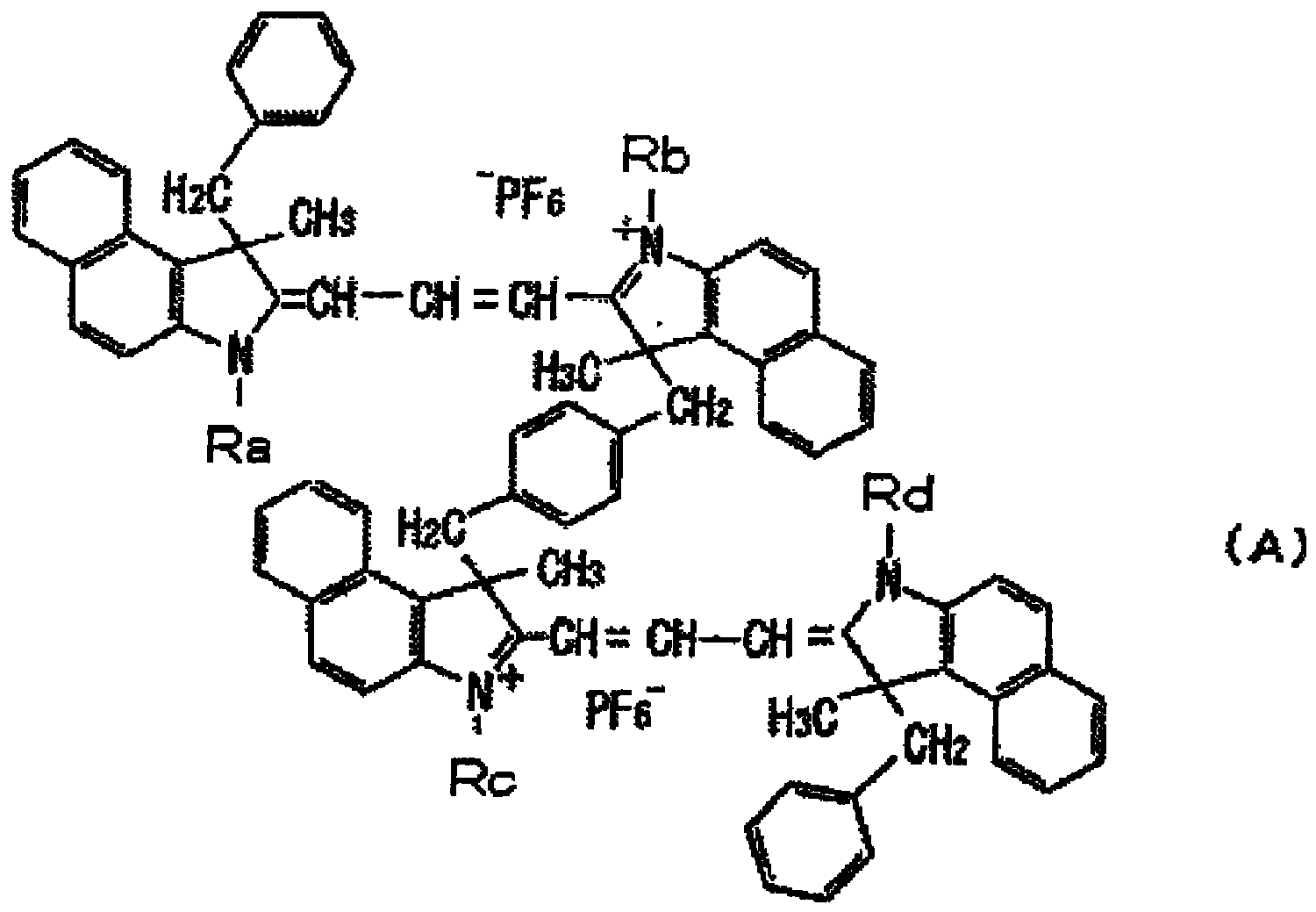 worin Ra, Rb, Rc und Rd unabhängig voneinander ein Wasserstoffatom, eine Alkylgruppe die eine Substituentengruppe haben kann, eine Arylgruppe die eine Substituentengruppe haben kann oder eine Aralkylgruppe die eine Substituentengruppe haben kann darstellen, undeine durch die allgemeine Formel (I) dargestellte Squaryliumverbindung
 "Q" ein Metallatom mit einer Koordinationsfähigkeit darstellt; "q" eine ganze Zahl von 2 oder 3 ist; R3 und R4 gleich miteinander oder verschieden voneinander sein können und jeweils eine Alkylgruppe die eine Substituentengruppe haben kann, eine Aralkylgruppe die eine Substituentengruppe haben kann oder eine Arylgruppe die eine Substituentengruppe haben kann darstellen und R3 und R4 miteinander verbunden sein können, um einen alicyclischen Kohlenwasserstoffring odereinen heterocyclischen Ring zu bilden; R5 ein Wasserstoffatom, eine Alkylgruppe die eine Substituentengruppe haben kann, eine Aralkylgruppe die eine Substituentengruppe haben kann oder eine Arylgruppe die eine Substituentengruppe haben kann darstellt; R6 ein Wasserstoffatom, eine Alkylgruppe die eine Substituentengruppe haben kann, eine Aralkylgruppe die eine Substituentengruppe haben kann, eine Arylgruppe die eine Substituentengruppe haben kann, eine Nitrogruppe, eine Cyanogruppe odereine Alkoxygruppe die eine Substituentengruppe haben kann darstellt; "p" eine ganze Zahl von 0 bis 4 ist; wenn hierbei "p" eine ganze Zahl von 2 bis 4 ist, jedes R6 gleich miteinander oder verschieden voneinander sein kann, und ferner zwei aneinander angrenzende R6 an zwei aneinander angrenzende Kohlenstoffatome gebunden sein könne, um einen aromatischen Ring zu bilden, der eine Substituentengruppe haben kann.
 - Optisches Aufzeichnungsmaterial gemäß Anspruch 1, wobei das Mischungsverhältnis A/I der Cyaninverbindung (A) und der Squaryliumverbindung (I) gewichtsmäßig 10/90 bis 70/30 beträgt.
- Optisches Aufzeichnungsmaterial gemäß Anspruch 1, wobei "Q" Aluminium ist.
- Optisches Aufzeichnungsmaterial gemäß irgendeinem der Ansprüche 1 bis 3, wobei R1 eine Phenylgruppe ist und R2 eine unsubstituierte oder Halogensubstitiuierte Alkylgruppe ist.
- Optisches Aufzeichnungsmaterial gemäß Anspruch 4, wobei R2 eine Trifluormethylgruppe ist.
- Optisches Aufzeichnungsmaterial gemäß Anspruch 4, wobei R2 eine Alkylgruppe mit einer verzweigten Kette ist.
- Optisches Aufzeichnungsmaterial gemäß Anspruch 6, wobei R2 eine Isopropylgruppe ist.
- Optisches Aufzeichnungsmaterial gemäß irgendeinem der Ansprüche 1 bis 7, wobei R3 und R4 gleich miteinander oder verschieden voneinander und jeweils eine Benzylgruppe sein können, die eine Substituentengruppe haben kann.
- Optisches Aufzeichnungsmaterial gemäß irgendeinem der Ansprüche 1 bis 8, wobei R5 eine Benzylgruppe ist.
- Optisches Aufzeichnungsmaterial gemäß irgendeinem der Ansprüche 1 bis 9, wobei R6 eine mit einem Benzolring gebildete Naphthylgruppe ist.
- Optisches Aufzeichnungsmedium, umfassend:ein Substrat, undeine Aufzeichnungsschicht, ausgebildet auf dem Substrat, welche ein optisches Aufzeichnungsmaterial gemäß irgendeinem der Ansprüche 1 bis 10 umfasst.
- Optisches Aufzeichnungsmedium gemäß Anspruch 11, wobei die Aufzeichnungsschicht ferner eine Formazan-Chelatverbindung umfasst.
- Verfahren zum Aufzeichnen und Wiedergeben auf einem optischen Aufzeichnungsmedium, umfassend:Durchführen von irgendeinem aus Aufzeichnen und Wiedergeben von Signalinformation durch Bestrahlen eines optischen Aufzeichnungsmediums gemäß Anspruch 11 mit einem Laserstrahl, der eine Aufzeichnungswellenlänge von 580 nm bis 720 nm hat, von der Seite von dessen Substrat aus.
Applications Claiming Priority (3)
| Application Number | Priority Date | Filing Date | Title |
|---|---|---|---|
| JP2007004856 | 2007-01-12 | ||
| JP2007015040A JP4880488B2 (ja) | 2007-01-12 | 2007-01-25 | 光記録材料および光記録媒体、並びに光記録媒体記録再生方法 |
| PCT/JP2008/050562 WO2008084879A1 (en) | 2007-01-12 | 2008-01-10 | Optical recording material, optical recording medium, and recording and reproducing method of optical recording medium |
Publications (3)
| Publication Number | Publication Date |
|---|---|
| EP2102015A1 EP2102015A1 (de) | 2009-09-23 |
| EP2102015A4 EP2102015A4 (de) | 2011-06-29 |
| EP2102015B1 true EP2102015B1 (de) | 2012-08-22 |
Family
ID=39608763
Family Applications (1)
| Application Number | Title | Priority Date | Filing Date |
|---|---|---|---|
| EP08703416A Not-in-force EP2102015B1 (de) | 2007-01-12 | 2008-01-10 | Optisches aufzeichnungsmaterial, optisches aufzeichnungsmedium sowie aufzeichnungs- und wiedergabeverfahren für das optische aufzeichnungsmedium |
Country Status (8)
| Country | Link |
|---|---|
| US (1) | US8431207B2 (de) |
| EP (1) | EP2102015B1 (de) |
| JP (1) | JP4880488B2 (de) |
| KR (1) | KR101059426B1 (de) |
| CN (1) | CN101616808B (de) |
| CA (1) | CA2675289C (de) |
| TW (1) | TWI359846B (de) |
| WO (1) | WO2008084879A1 (de) |
Families Citing this family (2)
| Publication number | Priority date | Publication date | Assignee | Title |
|---|---|---|---|---|
| JP5258666B2 (ja) * | 2009-04-22 | 2013-08-07 | 株式会社半導体エネルギー研究所 | 発光装置の作製方法および成膜用基板 |
| KR102485749B1 (ko) * | 2016-11-17 | 2023-01-05 | 소니그룹주식회사 | 가역성 기록 매체 및 가역성 기록 매체용 도료 및 외장 부재 |
Family Cites Families (17)
| Publication number | Priority date | Publication date | Assignee | Title |
|---|---|---|---|---|
| US6737143B2 (en) * | 2001-06-14 | 2004-05-18 | Ricoh Company Ltd. | Optical recording medium, optical recording method and optical recording device |
| TWI224784B (en) | 2002-02-15 | 2004-12-01 | Sony Corp | Rewritable optical information recording medium and recording/reproducing method, recording/reproducing device |
| EP1626400A4 (de) | 2003-05-22 | 2008-05-14 | Ricoh Kk | Optisches aufzeichnungsmedium |
| JP3698708B2 (ja) | 2003-08-07 | 2005-09-21 | 旭電化工業株式会社 | シアニン化合物、光学記録材料及び光学記録媒体 |
| CN1867980A (zh) * | 2003-10-10 | 2006-11-22 | 三井化学株式会社 | 光记录介质以及用于该光记录介质的化合物 |
| JP2005205874A (ja) | 2003-12-26 | 2005-08-04 | Tdk Corp | 光記録材料及び光記録媒体 |
| JP2005302261A (ja) | 2004-03-19 | 2005-10-27 | Ricoh Co Ltd | 光記録媒体 |
| JP2005319728A (ja) * | 2004-05-11 | 2005-11-17 | Ricoh Co Ltd | 光記録媒体、並びにこれを用いる記録再生方法及び光記録装置 |
| JP2006044241A (ja) | 2004-06-30 | 2006-02-16 | Ricoh Co Ltd | 光記録媒体、並びに記録再生方法及び光記録装置 |
| JP2006065934A (ja) * | 2004-08-25 | 2006-03-09 | Tdk Corp | 光ディスク |
| WO2006051922A1 (en) | 2004-11-10 | 2006-05-18 | Ricoh Company, Ltd. | Optical recording medium, recording and reproducing method thereof, and optical recording and reproducing apparatus |
| JP4660217B2 (ja) | 2005-01-31 | 2011-03-30 | 株式会社東芝 | 記憶媒体、再生方法、記録方法、再生装置及び記録装置 |
| US20060174256A1 (en) | 2005-02-03 | 2006-08-03 | Tohru Yashiro | Optical recording medium, production method thereof, and, method and apparatus for recording and reproducing optical recording medium |
| WO2006104021A1 (en) * | 2005-03-25 | 2006-10-05 | Ricoh Company, Ltd. | Optical recording medium, and optical recording method and optical recording apparatus thereof |
| JP2006305920A (ja) * | 2005-04-28 | 2006-11-09 | Tdk Corp | 光記録材料、光記録材料溶液並びに光記録媒体及びその製造方法 |
| WO2007105297A1 (ja) * | 2006-03-13 | 2007-09-20 | Kabushiki Kaisha Hayashibara Seibutsu Kagaku Kenkyujo | メチン系色素とその用途 |
| JP2008074904A (ja) | 2006-09-19 | 2008-04-03 | Ricoh Co Ltd | スクアリリウム化合物・金属錯体とそれを用いた光記録媒体、記録再生方法および光記録装置 |
-
2007
- 2007-01-25 JP JP2007015040A patent/JP4880488B2/ja not_active Expired - Fee Related
-
2008
- 2008-01-10 CA CA2675289A patent/CA2675289C/en not_active Expired - Fee Related
- 2008-01-10 EP EP08703416A patent/EP2102015B1/de not_active Not-in-force
- 2008-01-10 CN CN200880002053XA patent/CN101616808B/zh not_active Expired - Fee Related
- 2008-01-10 WO PCT/JP2008/050562 patent/WO2008084879A1/en not_active Ceased
- 2008-01-10 KR KR1020097014416A patent/KR101059426B1/ko not_active Expired - Fee Related
- 2008-01-10 US US12/522,778 patent/US8431207B2/en not_active Expired - Fee Related
- 2008-01-11 TW TW097101242A patent/TWI359846B/zh not_active IP Right Cessation
Also Published As
| Publication number | Publication date |
|---|---|
| KR101059426B1 (ko) | 2011-08-25 |
| JP4880488B2 (ja) | 2012-02-22 |
| US8431207B2 (en) | 2013-04-30 |
| CN101616808A (zh) | 2009-12-30 |
| EP2102015A4 (de) | 2011-06-29 |
| CA2675289C (en) | 2012-12-18 |
| CN101616808B (zh) | 2012-01-11 |
| TW200842167A (en) | 2008-11-01 |
| EP2102015A1 (de) | 2009-09-23 |
| JP2008188770A (ja) | 2008-08-21 |
| TWI359846B (en) | 2012-03-11 |
| WO2008084879A1 (en) | 2008-07-17 |
| US20100118680A1 (en) | 2010-05-13 |
| CA2675289A1 (en) | 2008-07-17 |
| KR20090087508A (ko) | 2009-08-17 |
Similar Documents
| Publication | Publication Date | Title |
|---|---|---|
| US7223521B2 (en) | Squarylium-metal chelate compounds and optical recording media | |
| JP4094250B2 (ja) | 光記録媒体、これを用いる光記録方法および光記録装置 | |
| EP2102015B1 (de) | Optisches aufzeichnungsmaterial, optisches aufzeichnungsmedium sowie aufzeichnungs- und wiedergabeverfahren für das optische aufzeichnungsmedium | |
| US6936323B2 (en) | Optical recording medium, and method and device using the same | |
| EP2052033B1 (de) | Squaryliumverbindung, davon gebrauch machendes optisches aufzeichnungsmedium, aufzeichnungs-/wiedergabeverfahren und optisches aufzeichnungsgerät | |
| EP1768853B1 (de) | Optisches aufzeichnungsmedium, aufzeichnungs- und wiedergabeverfahren dafür und optische aufzeichnungsvorrichtung | |
| US20100027393A1 (en) | Optical recording medium, optical recording apparatus, and system to prepare contents-recorded optical recording medium | |
| JP3739724B2 (ja) | 光記録媒体、これを用いる光記録方法及び光記録装置 | |
| JP2005319728A (ja) | 光記録媒体、並びにこれを用いる記録再生方法及び光記録装置 | |
| JP4094251B2 (ja) | 光記録媒体、これを用いる光記録方法および光記録装置 | |
| JP4087194B2 (ja) | 光記録媒体、光記録方法及び光記録装置 | |
| JP4094252B2 (ja) | 光記録媒体、これを用いる光記録方法および光記録装置 | |
| JP3739722B2 (ja) | 光記録媒体、これを用いる光記録方法及び光記録装置 | |
| JP4252874B2 (ja) | 光記録媒体 | |
| JP4250021B2 (ja) | 光記録媒体、これを用いる光記録方法及び光記録装置 | |
| JP2006048892A (ja) | 光記録媒体、その記録再生方法及び光記録装置 | |
| JP4078145B2 (ja) | 光記録媒体 | |
| JP2008091001A (ja) | 光記録媒体 | |
| EP2041748A1 (de) | Optisches aufzeichnungsmedium, optische aufzeichnungsvorrichtung und system zur herstellung eines optischen aufzeichnungsmediums mit aufgezeichneten inhalten |
Legal Events
| Date | Code | Title | Description |
|---|---|---|---|
| PUAI | Public reference made under article 153(3) epc to a published international application that has entered the european phase |
Free format text: ORIGINAL CODE: 0009012 |
|
| 17P | Request for examination filed |
Effective date: 20090713 |
|
| AK | Designated contracting states |
Kind code of ref document: A1 Designated state(s): AT BE BG CH CY CZ DE DK EE ES FI FR GB GR HR HU IE IS IT LI LT LU LV MC MT NL NO PL PT RO SE SI SK TR |
|
| RIN1 | Information on inventor provided before grant (corrected) |
Inventor name: NAKAMURA, YUKI Inventor name: MATSUMOTO, IPPEI Inventor name: OHMI, FUMIYA Inventor name: YASHIRO, TOHRU Inventor name: HAYASHI, MASAHIRO Inventor name: MIZUKAMI, SATOSHI |
|
| RIN1 | Information on inventor provided before grant (corrected) |
Inventor name: OHMI, FUMIYA Inventor name: MIZUKAMI, SATOSHI Inventor name: HAYASHI, MASAHIRO Inventor name: MATSUMOTO, IPPEI Inventor name: NAKAMURA, YUKI Inventor name: YASHIRO, TOHRU |
|
| DAX | Request for extension of the european patent (deleted) | ||
| A4 | Supplementary search report drawn up and despatched |
Effective date: 20110530 |
|
| REG | Reference to a national code |
Ref country code: DE Ref legal event code: R079 Ref document number: 602008018183 Country of ref document: DE Free format text: PREVIOUS MAIN CLASS: B41M0005260000 Ipc: C09B0023060000 |
|
| RIC1 | Information provided on ipc code assigned before grant |
Ipc: C09B 57/00 20060101ALI20111109BHEP Ipc: G11B 7/246 20060101ALI20111109BHEP Ipc: C09B 23/06 20060101AFI20111109BHEP Ipc: C09B 69/02 20060101ALI20111109BHEP |
|
| GRAP | Despatch of communication of intention to grant a patent |
Free format text: ORIGINAL CODE: EPIDOSNIGR1 |
|
| GRAS | Grant fee paid |
Free format text: ORIGINAL CODE: EPIDOSNIGR3 |
|
| GRAA | (expected) grant |
Free format text: ORIGINAL CODE: 0009210 |
|
| AK | Designated contracting states |
Kind code of ref document: B1 Designated state(s): AT BE BG CH CY CZ DE DK EE ES FI FR GB GR HR HU IE IS IT LI LT LU LV MC MT NL NO PL PT RO SE SI SK TR |
|
| REG | Reference to a national code |
Ref country code: GB Ref legal event code: FG4D |
|
| REG | Reference to a national code |
Ref country code: CH Ref legal event code: EP |
|
| REG | Reference to a national code |
Ref country code: IE Ref legal event code: FG4D |
|
| REG | Reference to a national code |
Ref country code: AT Ref legal event code: REF Ref document number: 572002 Country of ref document: AT Kind code of ref document: T Effective date: 20120915 |
|
| REG | Reference to a national code |
Ref country code: DE Ref legal event code: R096 Ref document number: 602008018183 Country of ref document: DE Effective date: 20121018 |
|
| REG | Reference to a national code |
Ref country code: NL Ref legal event code: VDEP Effective date: 20120822 |
|
| REG | Reference to a national code |
Ref country code: AT Ref legal event code: MK05 Ref document number: 572002 Country of ref document: AT Kind code of ref document: T Effective date: 20120822 |
|
| REG | Reference to a national code |
Ref country code: LT Ref legal event code: MG4D Effective date: 20120822 |
|
| PG25 | Lapsed in a contracting state [announced via postgrant information from national office to epo] |
Ref country code: HR Free format text: LAPSE BECAUSE OF FAILURE TO SUBMIT A TRANSLATION OF THE DESCRIPTION OR TO PAY THE FEE WITHIN THE PRESCRIBED TIME-LIMIT Effective date: 20120822 Ref country code: LT Free format text: LAPSE BECAUSE OF FAILURE TO SUBMIT A TRANSLATION OF THE DESCRIPTION OR TO PAY THE FEE WITHIN THE PRESCRIBED TIME-LIMIT Effective date: 20120822 Ref country code: FI Free format text: LAPSE BECAUSE OF FAILURE TO SUBMIT A TRANSLATION OF THE DESCRIPTION OR TO PAY THE FEE WITHIN THE PRESCRIBED TIME-LIMIT Effective date: 20120822 Ref country code: NO Free format text: LAPSE BECAUSE OF FAILURE TO SUBMIT A TRANSLATION OF THE DESCRIPTION OR TO PAY THE FEE WITHIN THE PRESCRIBED TIME-LIMIT Effective date: 20121122 Ref country code: AT Free format text: LAPSE BECAUSE OF FAILURE TO SUBMIT A TRANSLATION OF THE DESCRIPTION OR TO PAY THE FEE WITHIN THE PRESCRIBED TIME-LIMIT Effective date: 20120822 Ref country code: IS Free format text: LAPSE BECAUSE OF FAILURE TO SUBMIT A TRANSLATION OF THE DESCRIPTION OR TO PAY THE FEE WITHIN THE PRESCRIBED TIME-LIMIT Effective date: 20121222 |
|
| PG25 | Lapsed in a contracting state [announced via postgrant information from national office to epo] |
Ref country code: PT Free format text: LAPSE BECAUSE OF FAILURE TO SUBMIT A TRANSLATION OF THE DESCRIPTION OR TO PAY THE FEE WITHIN THE PRESCRIBED TIME-LIMIT Effective date: 20121224 Ref country code: GR Free format text: LAPSE BECAUSE OF FAILURE TO SUBMIT A TRANSLATION OF THE DESCRIPTION OR TO PAY THE FEE WITHIN THE PRESCRIBED TIME-LIMIT Effective date: 20121123 Ref country code: SE Free format text: LAPSE BECAUSE OF FAILURE TO SUBMIT A TRANSLATION OF THE DESCRIPTION OR TO PAY THE FEE WITHIN THE PRESCRIBED TIME-LIMIT Effective date: 20120822 Ref country code: BE Free format text: LAPSE BECAUSE OF FAILURE TO SUBMIT A TRANSLATION OF THE DESCRIPTION OR TO PAY THE FEE WITHIN THE PRESCRIBED TIME-LIMIT Effective date: 20120822 Ref country code: SI Free format text: LAPSE BECAUSE OF FAILURE TO SUBMIT A TRANSLATION OF THE DESCRIPTION OR TO PAY THE FEE WITHIN THE PRESCRIBED TIME-LIMIT Effective date: 20120822 Ref country code: LV Free format text: LAPSE BECAUSE OF FAILURE TO SUBMIT A TRANSLATION OF THE DESCRIPTION OR TO PAY THE FEE WITHIN THE PRESCRIBED TIME-LIMIT Effective date: 20120822 |
|
| PG25 | Lapsed in a contracting state [announced via postgrant information from national office to epo] |
Ref country code: NL Free format text: LAPSE BECAUSE OF FAILURE TO SUBMIT A TRANSLATION OF THE DESCRIPTION OR TO PAY THE FEE WITHIN THE PRESCRIBED TIME-LIMIT Effective date: 20120822 |
|
| PG25 | Lapsed in a contracting state [announced via postgrant information from national office to epo] |
Ref country code: CZ Free format text: LAPSE BECAUSE OF FAILURE TO SUBMIT A TRANSLATION OF THE DESCRIPTION OR TO PAY THE FEE WITHIN THE PRESCRIBED TIME-LIMIT Effective date: 20120822 Ref country code: RO Free format text: LAPSE BECAUSE OF FAILURE TO SUBMIT A TRANSLATION OF THE DESCRIPTION OR TO PAY THE FEE WITHIN THE PRESCRIBED TIME-LIMIT Effective date: 20120822 Ref country code: EE Free format text: LAPSE BECAUSE OF FAILURE TO SUBMIT A TRANSLATION OF THE DESCRIPTION OR TO PAY THE FEE WITHIN THE PRESCRIBED TIME-LIMIT Effective date: 20120822 Ref country code: ES Free format text: LAPSE BECAUSE OF FAILURE TO SUBMIT A TRANSLATION OF THE DESCRIPTION OR TO PAY THE FEE WITHIN THE PRESCRIBED TIME-LIMIT Effective date: 20121203 Ref country code: DK Free format text: LAPSE BECAUSE OF FAILURE TO SUBMIT A TRANSLATION OF THE DESCRIPTION OR TO PAY THE FEE WITHIN THE PRESCRIBED TIME-LIMIT Effective date: 20120822 |
|
| PG25 | Lapsed in a contracting state [announced via postgrant information from national office to epo] |
Ref country code: CY Free format text: LAPSE BECAUSE OF FAILURE TO SUBMIT A TRANSLATION OF THE DESCRIPTION OR TO PAY THE FEE WITHIN THE PRESCRIBED TIME-LIMIT Effective date: 20120822 Ref country code: SK Free format text: LAPSE BECAUSE OF FAILURE TO SUBMIT A TRANSLATION OF THE DESCRIPTION OR TO PAY THE FEE WITHIN THE PRESCRIBED TIME-LIMIT Effective date: 20120822 Ref country code: IT Free format text: LAPSE BECAUSE OF FAILURE TO SUBMIT A TRANSLATION OF THE DESCRIPTION OR TO PAY THE FEE WITHIN THE PRESCRIBED TIME-LIMIT Effective date: 20120822 Ref country code: PL Free format text: LAPSE BECAUSE OF FAILURE TO SUBMIT A TRANSLATION OF THE DESCRIPTION OR TO PAY THE FEE WITHIN THE PRESCRIBED TIME-LIMIT Effective date: 20120822 |
|
| PLBE | No opposition filed within time limit |
Free format text: ORIGINAL CODE: 0009261 |
|
| STAA | Information on the status of an ep patent application or granted ep patent |
Free format text: STATUS: NO OPPOSITION FILED WITHIN TIME LIMIT |
|
| 26N | No opposition filed |
Effective date: 20130523 |
|
| PG25 | Lapsed in a contracting state [announced via postgrant information from national office to epo] |
Ref country code: BG Free format text: LAPSE BECAUSE OF FAILURE TO SUBMIT A TRANSLATION OF THE DESCRIPTION OR TO PAY THE FEE WITHIN THE PRESCRIBED TIME-LIMIT Effective date: 20121122 |
|
| PG25 | Lapsed in a contracting state [announced via postgrant information from national office to epo] |
Ref country code: MC Free format text: LAPSE BECAUSE OF NON-PAYMENT OF DUE FEES Effective date: 20130131 |
|
| REG | Reference to a national code |
Ref country code: CH Ref legal event code: PL |
|
| REG | Reference to a national code |
Ref country code: DE Ref legal event code: R097 Ref document number: 602008018183 Country of ref document: DE Effective date: 20130523 |
|
| REG | Reference to a national code |
Ref country code: IE Ref legal event code: MM4A |
|
| PG25 | Lapsed in a contracting state [announced via postgrant information from national office to epo] |
Ref country code: LI Free format text: LAPSE BECAUSE OF NON-PAYMENT OF DUE FEES Effective date: 20130131 Ref country code: CH Free format text: LAPSE BECAUSE OF NON-PAYMENT OF DUE FEES Effective date: 20130131 |
|
| PG25 | Lapsed in a contracting state [announced via postgrant information from national office to epo] |
Ref country code: IE Free format text: LAPSE BECAUSE OF NON-PAYMENT OF DUE FEES Effective date: 20130110 |
|
| PG25 | Lapsed in a contracting state [announced via postgrant information from national office to epo] |
Ref country code: MT Free format text: LAPSE BECAUSE OF FAILURE TO SUBMIT A TRANSLATION OF THE DESCRIPTION OR TO PAY THE FEE WITHIN THE PRESCRIBED TIME-LIMIT Effective date: 20120822 |
|
| PG25 | Lapsed in a contracting state [announced via postgrant information from national office to epo] |
Ref country code: TR Free format text: LAPSE BECAUSE OF FAILURE TO SUBMIT A TRANSLATION OF THE DESCRIPTION OR TO PAY THE FEE WITHIN THE PRESCRIBED TIME-LIMIT Effective date: 20120822 |
|
| PG25 | Lapsed in a contracting state [announced via postgrant information from national office to epo] |
Ref country code: HU Free format text: LAPSE BECAUSE OF FAILURE TO SUBMIT A TRANSLATION OF THE DESCRIPTION OR TO PAY THE FEE WITHIN THE PRESCRIBED TIME-LIMIT; INVALID AB INITIO Effective date: 20080110 Ref country code: LU Free format text: LAPSE BECAUSE OF NON-PAYMENT OF DUE FEES Effective date: 20130110 |
|
| REG | Reference to a national code |
Ref country code: FR Ref legal event code: PLFP Year of fee payment: 9 |
|
| REG | Reference to a national code |
Ref country code: FR Ref legal event code: PLFP Year of fee payment: 10 |
|
| REG | Reference to a national code |
Ref country code: FR Ref legal event code: PLFP Year of fee payment: 11 |
|
| PGFP | Annual fee paid to national office [announced via postgrant information from national office to epo] |
Ref country code: FR Payment date: 20190124 Year of fee payment: 12 Ref country code: GB Payment date: 20190121 Year of fee payment: 12 Ref country code: DE Payment date: 20190123 Year of fee payment: 12 |
|
| REG | Reference to a national code |
Ref country code: DE Ref legal event code: R119 Ref document number: 602008018183 Country of ref document: DE |
|
| GBPC | Gb: european patent ceased through non-payment of renewal fee |
Effective date: 20200110 |
|
| PG25 | Lapsed in a contracting state [announced via postgrant information from national office to epo] |
Ref country code: DE Free format text: LAPSE BECAUSE OF NON-PAYMENT OF DUE FEES Effective date: 20200801 Ref country code: GB Free format text: LAPSE BECAUSE OF NON-PAYMENT OF DUE FEES Effective date: 20200110 Ref country code: FR Free format text: LAPSE BECAUSE OF NON-PAYMENT OF DUE FEES Effective date: 20200131 |