EP2049249B1 - Katalysator für die tieftemperaturkonvertierung und verfahren zur tieftemperaturkonvertierung von kohlenmonoxid und wasser zu kohlendioxid und wasserstoff - Google Patents
Katalysator für die tieftemperaturkonvertierung und verfahren zur tieftemperaturkonvertierung von kohlenmonoxid und wasser zu kohlendioxid und wasserstoff Download PDFInfo
- Publication number
- EP2049249B1 EP2049249B1 EP07787708A EP07787708A EP2049249B1 EP 2049249 B1 EP2049249 B1 EP 2049249B1 EP 07787708 A EP07787708 A EP 07787708A EP 07787708 A EP07787708 A EP 07787708A EP 2049249 B1 EP2049249 B1 EP 2049249B1
- Authority
- EP
- European Patent Office
- Prior art keywords
- catalyst
- weight
- oxide
- hydrogen
- low
- Prior art date
- Legal status (The legal status is an assumption and is not a legal conclusion. Google has not performed a legal analysis and makes no representation as to the accuracy of the status listed.)
- Not-in-force
Links
Images

Classifications
-
- H—ELECTRICITY
- H01—ELECTRIC ELEMENTS
- H01M—PROCESSES OR MEANS, e.g. BATTERIES, FOR THE DIRECT CONVERSION OF CHEMICAL ENERGY INTO ELECTRICAL ENERGY
- H01M8/00—Fuel cells; Manufacture thereof
- H01M8/06—Combination of fuel cells with means for production of reactants or for treatment of residues
- H01M8/0662—Treatment of gaseous reactants or gaseous residues, e.g. cleaning
- H01M8/0668—Removal of carbon monoxide or carbon dioxide
-
- B—PERFORMING OPERATIONS; TRANSPORTING
- B01—PHYSICAL OR CHEMICAL PROCESSES OR APPARATUS IN GENERAL
- B01J—CHEMICAL OR PHYSICAL PROCESSES, e.g. CATALYSIS OR COLLOID CHEMISTRY; THEIR RELEVANT APPARATUS
- B01J23/00—Catalysts comprising metals or metal oxides or hydroxides, not provided for in group B01J21/00
- B01J23/70—Catalysts comprising metals or metal oxides or hydroxides, not provided for in group B01J21/00 of the iron group metals or copper
- B01J23/76—Catalysts comprising metals or metal oxides or hydroxides, not provided for in group B01J21/00 of the iron group metals or copper combined with metals, oxides or hydroxides provided for in groups B01J23/02 - B01J23/36
- B01J23/80—Catalysts comprising metals or metal oxides or hydroxides, not provided for in group B01J21/00 of the iron group metals or copper combined with metals, oxides or hydroxides provided for in groups B01J23/02 - B01J23/36 with zinc, cadmium or mercury
-
- B—PERFORMING OPERATIONS; TRANSPORTING
- B01—PHYSICAL OR CHEMICAL PROCESSES OR APPARATUS IN GENERAL
- B01J—CHEMICAL OR PHYSICAL PROCESSES, e.g. CATALYSIS OR COLLOID CHEMISTRY; THEIR RELEVANT APPARATUS
- B01J37/00—Processes, in general, for preparing catalysts; Processes, in general, for activation of catalysts
- B01J37/02—Impregnation, coating or precipitation
- B01J37/03—Precipitation; Co-precipitation
-
- C—CHEMISTRY; METALLURGY
- C01—INORGANIC CHEMISTRY
- C01B—NON-METALLIC ELEMENTS; COMPOUNDS THEREOF; METALLOIDS OR COMPOUNDS THEREOF NOT COVERED BY SUBCLASS C01C
- C01B3/00—Hydrogen; Gaseous mixtures containing hydrogen; Separation of hydrogen from mixtures containing it; Purification of hydrogen; Reversible storage of hydrogen
- C01B3/02—Production of hydrogen; Production of gaseous mixtures containing hydrogen
- C01B3/06—Production of hydrogen; Production of gaseous mixtures containing hydrogen by reaction of inorganic compounds containing electro-positively bound hydrogen with inorganic reducing agents
- C01B3/12—Production of hydrogen; Production of gaseous mixtures containing hydrogen by reaction of inorganic compounds containing electro-positively bound hydrogen with inorganic reducing agents by reaction of water vapour with carbon monoxide
- C01B3/16—Production of hydrogen; Production of gaseous mixtures containing hydrogen by reaction of inorganic compounds containing electro-positively bound hydrogen with inorganic reducing agents by reaction of water vapour with carbon monoxide using catalysts
-
- B—PERFORMING OPERATIONS; TRANSPORTING
- B01—PHYSICAL OR CHEMICAL PROCESSES OR APPARATUS IN GENERAL
- B01J—CHEMICAL OR PHYSICAL PROCESSES, e.g. CATALYSIS OR COLLOID CHEMISTRY; THEIR RELEVANT APPARATUS
- B01J21/00—Catalysts comprising the elements, oxides, or hydroxides of magnesium, boron, aluminium, carbon, silicon, titanium, zirconium, or hafnium
- B01J21/06—Silicon, titanium, zirconium or hafnium; Oxides or hydroxides thereof
- B01J21/066—Zirconium or hafnium; Oxides or hydroxides thereof
-
- B—PERFORMING OPERATIONS; TRANSPORTING
- B01—PHYSICAL OR CHEMICAL PROCESSES OR APPARATUS IN GENERAL
- B01J—CHEMICAL OR PHYSICAL PROCESSES, e.g. CATALYSIS OR COLLOID CHEMISTRY; THEIR RELEVANT APPARATUS
- B01J23/00—Catalysts comprising metals or metal oxides or hydroxides, not provided for in group B01J21/00
- B01J23/007—Mixed salts
-
- B—PERFORMING OPERATIONS; TRANSPORTING
- B01—PHYSICAL OR CHEMICAL PROCESSES OR APPARATUS IN GENERAL
- B01J—CHEMICAL OR PHYSICAL PROCESSES, e.g. CATALYSIS OR COLLOID CHEMISTRY; THEIR RELEVANT APPARATUS
- B01J37/00—Processes, in general, for preparing catalysts; Processes, in general, for activation of catalysts
- B01J37/0009—Use of binding agents; Moulding; Pressing; Powdering; Granulating; Addition of materials ameliorating the mechanical properties of the product catalyst
-
- C—CHEMISTRY; METALLURGY
- C01—INORGANIC CHEMISTRY
- C01B—NON-METALLIC ELEMENTS; COMPOUNDS THEREOF; METALLOIDS OR COMPOUNDS THEREOF NOT COVERED BY SUBCLASS C01C
- C01B2203/00—Integrated processes for the production of hydrogen or synthesis gas
- C01B2203/10—Catalysts for performing the hydrogen forming reactions
- C01B2203/1041—Composition of the catalyst
- C01B2203/1076—Copper or zinc-based catalysts
-
- C—CHEMISTRY; METALLURGY
- C01—INORGANIC CHEMISTRY
- C01B—NON-METALLIC ELEMENTS; COMPOUNDS THEREOF; METALLOIDS OR COMPOUNDS THEREOF NOT COVERED BY SUBCLASS C01C
- C01B2203/00—Integrated processes for the production of hydrogen or synthesis gas
- C01B2203/10—Catalysts for performing the hydrogen forming reactions
- C01B2203/1041—Composition of the catalyst
- C01B2203/1082—Composition of support materials
-
- H—ELECTRICITY
- H01—ELECTRIC ELEMENTS
- H01M—PROCESSES OR MEANS, e.g. BATTERIES, FOR THE DIRECT CONVERSION OF CHEMICAL ENERGY INTO ELECTRICAL ENERGY
- H01M8/00—Fuel cells; Manufacture thereof
- H01M8/10—Fuel cells with solid electrolytes
- H01M2008/1095—Fuel cells with polymeric electrolytes
-
- Y—GENERAL TAGGING OF NEW TECHNOLOGICAL DEVELOPMENTS; GENERAL TAGGING OF CROSS-SECTIONAL TECHNOLOGIES SPANNING OVER SEVERAL SECTIONS OF THE IPC; TECHNICAL SUBJECTS COVERED BY FORMER USPC CROSS-REFERENCE ART COLLECTIONS [XRACs] AND DIGESTS
- Y02—TECHNOLOGIES OR APPLICATIONS FOR MITIGATION OR ADAPTATION AGAINST CLIMATE CHANGE
- Y02E—REDUCTION OF GREENHOUSE GAS [GHG] EMISSIONS, RELATED TO ENERGY GENERATION, TRANSMISSION OR DISTRIBUTION
- Y02E60/00—Enabling technologies; Technologies with a potential or indirect contribution to GHG emissions mitigation
- Y02E60/30—Hydrogen technology
- Y02E60/50—Fuel cells
-
- Y—GENERAL TAGGING OF NEW TECHNOLOGICAL DEVELOPMENTS; GENERAL TAGGING OF CROSS-SECTIONAL TECHNOLOGIES SPANNING OVER SEVERAL SECTIONS OF THE IPC; TECHNICAL SUBJECTS COVERED BY FORMER USPC CROSS-REFERENCE ART COLLECTIONS [XRACs] AND DIGESTS
- Y02—TECHNOLOGIES OR APPLICATIONS FOR MITIGATION OR ADAPTATION AGAINST CLIMATE CHANGE
- Y02P—CLIMATE CHANGE MITIGATION TECHNOLOGIES IN THE PRODUCTION OR PROCESSING OF GOODS
- Y02P20/00—Technologies relating to chemical industry
- Y02P20/50—Improvements relating to the production of bulk chemicals
- Y02P20/52—Improvements relating to the production of bulk chemicals using catalysts, e.g. selective catalysts
Definitions
- the invention relates to a catalytic composition and a process for the low-temperature conversion of carbon monoxide (CO) and water (H 2 O) to carbon dioxide (CO 2 and hydrogen (H 2 ), in particular for use in fuel cell systems.)
- the invention further relates to a process for the production such a catalyst, wherein the catalyst is a chromium-free, non-pyrophoric contact for the Wassergasshiftretician based on a Hydrotalcitphase precursor.
- the process for the production of hydrogen by the conversion reaction (also: shift reaction) of H 2 O and CO to H 2 and CO 2 in a fluid medium in particular for the production of hydrogen in a gas stream, mainly from hydrogen, water and carbon monoxide
- the primary purpose of the process is to generate high purity hydrogen for fuel cell applications, in particular for use with fuel cells based on proton exchange membranes (PEMs).
- PEMs proton exchange membranes
- Fuel cells convert chemical energy directly into electrical energy, avoiding mechanical processes. They are proposed as an energy source for various applications.
- a fuel cell can be two to three times more effective than previous internal combustion engines and shows very low emissions of toxins such as carbon monoxide (CO), nitrogen oxides (NO x ) or hydrocarbons.
- Fuel cells including PEM fuel cells (also known as SPE-, solid polymer electrolyte, fuel cells) generate the electrical energy by reaction between hydrogen as the reducing agent and oxygen as the oxidizing agent, both of which are added to the cell.
- PEM fuel cells also known as SPE-, solid polymer electrolyte, fuel cells
- anode and cathode are separated from each other by a membrane, which is usually constructed of an ion exchange resin.
- the material used for the anode and cathode is usually a fine mixture of ion exchange resin and carbon particles, intensively mixed with catalyst grains used.
- hydrogen gas is electrolytically oxidized to protons on an anode made of platinum on conductive carbon black.
- the protons pass through the membrane, which may be a fluorosulfonic acid polymer.
- Fuel cells need both an oxygen and a hydrogen source to function.
- the oxygen can simply be removed in pure form (as O 2 ) from the air.
- hydrogen is not present in sufficient quantity in the air to fuel cell applications.
- the low energy density (by volume) of isolated hydrogen gas compared to conventional hydrocarbons makes the direct supply of fuel cells with hydrogen unfavorable for most applications, since a very large volume of hydrogen gas would be needed to obtain the same energy, which in a very large amount smaller volume of conventional hydrocarbons such as natural gas, alcohol or oil is included. Therefore, the conversion of said hydrocarbon based fuels to hydrogen gas is an attractive source of hydrogen for fuel cell applications.
- H 2 meaning hydrogen, which for fuel cells contains sufficiently low concentrations of sulfur components and CO
- the production of hydrogen gas from naturally occurring hydrocarbons is widespread in the chemical industry, for example for the preparation of ammonia from nitrogen and hydrogen or in the production of alcohol.
- a variety of steps that require different, sophisticated catalysts are used in industrial production of hydrogen. For example, a series of reactions is typically needed to reduce the concentration of CO below the thresholds required, e.g. B. 50 ppm to press. Many of these stages require high pressures (eg above 70 bar), high reaction temperatures (in some cases above 800 ° C.) and use self-heating, pyrophoric catalysts.
- the water gas shift reaction is a well-known catalytic reaction which, among other applications, is also used for the production of hydrogen in a gas stream by chemical reaction of CO with water vapor and proceeds according to the following stoichiometry: CO + H 2 O ⁇ CO 2 + H 2
- the reaction for the process requires a catalyst.
- Typical catalysts for this reaction are based on combinations of iron oxide with chromium oxide (at high temperatures around 350 ° C) or mixtures of copper and zinc materials (at low temperatures around 250 ° C). If the WGS is operated at temperatures below 300 ° C, it is called a low temperature conversion (TTK).
- WGS catalysts The currently commercially used water gas shift catalysts (WGS catalysts) show a number of disadvantages for fuel cell applications. Many commercial WGS catalysts are self-heating and pyrophoric when exposed to atmospheric oxygen. Commercial high-temperature WGS catalysts based on iron-chromium in the reduced state reach temperatures of about 400 ° C when exposed to atmospheric conditions. A similar picture shows commercial copper-zinc-based low-temperature WGS catalysts in the reduced state, which reach temperatures of up to 750 ° C on contact with atmospheric oxygen. The contact of air with WGS catalysts containing copper oxide in the reduced state on ceria, leads to a temperature increase of about 500 to 600 ° C, platinum-ceria WGS catalysts undergo similar temperature increases by about 400 ° C. In many cases, such a rapid and violent increase in temperature leads to sintering of the catalyst, which can lead to a permanent destruction of the contact. Such a temperature increase can also cause the reduced contact to spontaneously ignite in air.
- WGS catalysts have been intensively researched. Review by Jaques Barbier and Daniel Duprez, Applied Catalysis B: Environmental 4 (1994) 105-140 "Steam effects in three way catalysts", addressing a number of catalytic systems, including alumina-supported systems, ceria promoters and a range of noble metal systems containing platinum (Pt), rhodium (Rh) and palladium (Pd ).
- WO 02/26619 A2 describes a catalyst with low pyrophoricity for the WGS reaction, which preferably contains Cu as an active composition on alumina with an addition of cerium and chromium oxide, wherein the support material is impregnated with the active components. Chromium oxides are considered to be carcinogenic and are thus also undesirable admixtures to catalysts, as they greatly hinder the handling for the customer.
- Pyrophoric catalysts have a distinct disadvantage. Long and accurate protocols are necessary to perform activation and passivation so that contact with air is stable. In addition, special equipment is needed for these protocols, such as flowmeters. Due to the exothermic nature of the reduction of copper contact, activation of a typically pyrophoric copper low temperature conversion (TTK) catalyst requires intensive monitoring of both the temperature and the dosage of the reducing gas (usually hydrogen) via a carrier gas (usually nitrogen or natural gas). he follows. In a typical activation procedure, a small amount of hydrogen in a carrier gas is added to the catalyst at low temperatures. Then, the temperature of the catalyst bed is slowly raised to an intermediate temperature. When this is reached, the concentration of hydrogen in the carrier gas is gradually increased.
- TTK pyrophoric copper low temperature conversion
- the object of the invention was thus to provide such a WGS catalyst.
- the invention thus provides a chromium-free catalyst as described in claims 1 to 6.
- the invention further relates to a process for the preparation of such a catalyst and to a process for the low-temperature conversion of carbon monoxide and water to carbon dioxide and hydrogen, as described in claims 7 and 8 and in claims 9 and 10.
- the invention relates to the use as described in claim 11
- the catalyst of the invention comprises a mixed oxide of at least CuO, ZnO and Al 2 O 3 , more preferably at least CuO, ZnO, Al 2 O 3 and ZrO 2 .
- M is copper and zinc, but may additionally contain other divalent metal cations, for example Fe, Co, Mg, Ca, Mn, Ni, Sr, Ba, preferably Mg, Ca, Sr, Ba or Ni.
- M III may be aluminum, but may additionally contain other trivalent metal cations, for example selected from the series of lanthanides, La, Sc, Y, Ga, In or else Fe, preferably elements selected from the series of lanthanides, La, Sc or Y.
- At least an Al 2 O 3 content of 17.5% by weight must be present in the contact.
- the mixed oxide advantageously additionally contains zirconium oxide in an amount of from 0 to 10% by weight, preferably from 1 to 7% by weight, particularly preferably from 2 to 5% by weight.
- the ZrO 2 ensures that the layer structure is "broken up" so that the single-action active sites are more catalytically accessible. In order to achieve this advantageous effect, in particular embodiments, for example, about 2.5 wt .-% ZrO 2 used.
- the mixed oxide further oxides, such as alkaline earth metal oxides, have. If such further oxides are contained in the mixed oxide, then at most in an amount of 25% by weight, preferably at most 10% by weight.
- the catalyst according to the invention may contain, in addition to the above-described mixed oxide in small amounts, of course further compounds, such as occur, for example, as customary impurities.
- the catalyst according to the invention is chromium-free.
- the precursor of the catalyst according to the invention is present according to the invention essentially as hydrotalcite.
- other structures such as aluminum oxides o. ⁇ ., Occur.
- substantially means at least 80% by weight, advantageously at least 90% by weight, particularly preferably at least 95% by weight.
- the hydrotalcite structure is detected by XRD.
- the preparation of the catalyst according to the invention for the low-temperature conversion of carbon monoxide and water to hydrogen and carbon dioxide can be carried out by precipitation of precursor substances.
- starting materials are copper, zinc and aluminum and optionally other elements, as already described above, used.
- the aluminum content can be presented in various structural variants, for example as boehmite or aluminasol.
- Suitable starting materials for the other metals are their salts in the form of nitrates, chlorides, carbonates, acetates or sulfates. Particular preference is given to using the nitrates, carbonates and acetates of the metal cations.
- the precipitation phase is essentially a hydrotalcite.
- special attention must be paid to the observance of pH and temperature.
- the precipitation is advantageously carried out in a basic medium.
- a mixed solution of soda and NaOH is used for this, more preferably a mixed solution of 2 molar NaOH and 0.3 molar soda solution.
- the precipitation can also be carried out by other basic solutions. It preferably proceeds at a pH greater than 7.2, more preferably at a pH greater than 7.5.
- the precipitation is advantageously carried out at a temperature between 10 and 80 ° C, preferably between 15 and 50 ° C, more preferably between 20 and 40 ° C.
- the catalyst is washed in a conventional manner, dried, possibly still calcined and tabletted with graphite or another lubricant.
- the tabletting may be followed by another calcination.
- the catalyst prepared according to the invention is not pyrophoric.
- the pyrophoricity of a material is determined in accordance with EC Directive 92/69 / EEC, Annex A.13.
- Another possible test is the "self-ignition test” with the Grewer test (VDI 2263, sheet 1, chapter 1.4.1), in which the temperature increase of a sample of 10 ml volume is observed when the sample is brought into contact with atmospheric oxygen.
- Another test option is the "wire basket method" which is used to classify the autoignition behavior for transport purposes (GGVS / ADR Annex A, UN Recommendations on the Transport of Dangerous Goods, Model Regulations, Section 2.4.3.2f and Manual of Tests and Criteria , Section 33.3).
- the catalyst according to the invention has no pyrophoricity according to the three abovementioned tests.
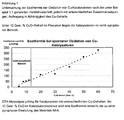
- illustration 1 shows the dependence of the exotherm on the Cu content of Cu catalysts resulting from the hydrotalcite precursor.
- the catalytic activity of the catalyst according to the invention is comparable to existing systems. However, it is advantageous that the catalyst undergoes no loss of activity when changing atmospheres and steam condensation. Since both steps are typical conditions when switching off or switching on a fuel cell system, it is important that atmospheric change or water vapor condensation does not lead to any harmful loss of activity.
- the catalyst according to the invention is stable, durable and economical to produce.
- the risk of sintering the active mass in contact with air is very low. It shows sufficient hardness and lateral compressive strength even after use and condensation under water vapor.
- the catalyst according to the invention can be used in any desired form, for example as a coating of a monolith, as a shaped body in extruded or tablet form or as a powder.
- a stable shape is preferred to avoid abrasion and dusting.
- the present invention meets all the requirements placed on an improved WGS catalyst.
- the catalyst of the invention is thus suitable for generating hydrogen from a gas stream and practicable for use in fuel cell applications.
- the inventive method for the low temperature conversion of carbon monoxide and water to carbon dioxide and hydrogen differs from conventional methods of the prior art by the use of a chromium-free catalyst containing a mixed oxide of at least copper oxide, zinc oxide and aluminum oxide, wherein the Katalysatorprecursor is present substantially as hydrotalcite and the content of copper oxide is at most 20 wt .-%.
- the WGS reaction can be carried out under the usual conditions.
- it takes place at temperatures of 150 to 350 ° C, more preferably at temperatures of 180 to 320 ° C.
- the catalyst is also suitable in WGS reactions which occur at temperatures for which conventional TTK catalysts of the prior art can be used.
- the process according to the invention for producing hydrogen gas from a gas stream or a gas sample from CO and water is carried out.
- the catalyst of the present invention may be utilized in an intermediate step of a chemical process for generating hydrogen from a gas stream by WGS reaction.
- the invention provides a WGS catalyst and method of use, wherein the risk of pyrophoricity is significantly reduced by the contact of air with reduced catalysts.
- solution 1 1.031 kg of Cu nitrate solution (19.4%), 9.983 kg of Zn nitrate solution (18.03%) and 5.388 kg of Al nitrate solution (8.12%) were mixed (solution 1). 0.1462 kg of Zr carbonate was dissolved in 0.179 kg of HNO 3 (69.3%) (solution 2).
- Solution 3 was prepared from 2 molar NaOH and 0.3 molar soda solution. Solution 3 was presented, with solutions 1 and 2 added in parallel.
- the mixture was heated to 50 ° C and stirred for 1 hour.
- the pH was 8.0 at the end.
- the sample was then filtered, washed, dried, annealed at 550 ° C for four hours, and finally tabletted with graphite.
- Example 1.2 Comparative Example (analogous to WO 02/26619 A2)
- Example 2 Al 2 O 3 balls DD-442 were annealed at 500 ° C (surface 230 m 2 / g). Solutions of cerium nitrate, chromium nitrate and copper nitrate were sprayed onto the spheres one after the other and calcined at 500 ° C. in each case after impregnation.
- Example 1.3 Comparative Example (Typical High-Copper-Containing Catalyst) Synthesis of a catalyst of the composition: 49% by weight of CuO, 30% by weight of ZnO, 18.5% by weight of Al 2 O 3 , 2.5% by weight. % ZrO 2
- Nitrate solutions of Cu, Zn and Al were mixed in the ratio of the oxides (wt .-%) 49: 30: 18.5.
- zirconium carbonate was dissolved in the ratio of the oxides 2.5% by weight in concentrated nitric acid.
- a mixed solution of caustic soda and soda were prepared. The solutions were combined, stirred and the catalyst precursor precipitated. The sample was then filtered as in Example 1.1, washed, dried, annealed at 550 ° C for four hours and finally tabletted.
- Example 1.4 Comparative Example (low CuO content on Al 2 O 3 )
- Example 1.5 Comparative Example (Addition of Cr 2 O 3 )
- Example 1.1 The procedure was analogous to Example 1.1, wherein in addition a Cr nitrate solution (in solution 1) was added.
- Example 1.6 Comparative Example (without Al 2 O 3 )
- Example 1.7 Comparative Example (with Ce 2 O 3 instead of Al 2 O 3 )
- Example 1.1 The procedure was analogous to Example 1.1, wherein instead of Al nitrate solution, a Ce nitrate solution was used.
- Example 1.1 The procedure was analogous to Example 1.1, wherein a portion of the alumina (13 wt .-%) was added as Versal.
- Example 1.9 (Variation of the composition - addition of Fe 2 O 3 )
- Example 1.1 The procedure was analogous to Example 1.1, wherein in addition an Fe nitrate solution (in solution 1) was added.
- illustration 1 shows a study of the exothermicity of the oxidation of Cu catalysts according to the production instructions mentioned in Example 1.1, but with different Compositions and application depending on the Cu content. Under 12 wt .-% CuO content in the precursor while the catalysts are in the non-pyrophoric range.
- the catalyst was introduced into a heatable reactor. The volume was adjusted so that in each case always the same amount of active material copper was in the reactor. The catalyst was reduced under hydrogen and at elevated temperature.
- a gas composition of 4 vol.% CO, 8 vol.% CO 2 , 28 vol.% N 2 , 30 vol.% H 2, and 30 vol.% H 2 O was passed over the catalyst at a GHSV of Given 7,500 h -1 .
- a temperature ramp between 130 and 300 ° C was run through and found the temperature at which the catalyst reaches the equilibrium of the reaction.
- Example 2.1 In the apparatus described in Example 2.1, several changes of atmosphere were carried out on the catalyst at about 200 ° C. The percentage refers to the change in CO concentration in the exhaust gas.
- the 20% given for the first catalyst therefore means that the CO concentration has been reduced by the atmospheric changes by 20% compared to the value before the change of atmosphere. This in turn indicates that the catalyst has become significantly more active.
- Example 2.1 In the apparatus described in Example 2.1, the water vapor condensation was carried out on the catalyst. Subsequently, the catalyst was brought back under reformate to 130 ° C and run through the temperature ramp described in Example 2.1. It was found the temperature at which the catalyst now reaches the equilibrium of the reaction.
- Example 2.1 The experiment was carried out analogously to Example 2.1, but with a GHSV of 5,000 h -1 and a gas composition of 8 vol.% CO, 10 vol.% CO 2 , 43 vol.% H 2 , 26 vol.% H 2 O has been set.
- the catalyst reached the thermodynamic equilibrium at 220 ° C.
- Example 2.1 Example 1.1 230 ° C Example 1.2 240 ° C Example 1.3 > 300 ° C Example 1.4 250 ° C Example 1.5 260 ° C Example 1.6 280 ° C Example 1.7 > 300 ° C Example 1.8 245 ° C Example 1.9 235 ° C Example 1.10 240 ° C Example 1.11 235 ° C Example 1.12 260 ° C Example 1.13 220 ° C Example 1.14 215 ° C catalyst Change due to change of atmosphere [%] Reaching the GGW after water vapor condensation [° C] Description Example 2.2 Description Example 2.3 Example 1.1 -20% over 16 h [1] 230 ° C [1] Example 1.2 +/- 0% over 16 h [1] 240 ° C [1] Example 1.3 +/- 0% over 28 h [2] > 300 ° C [2] 1 Mech. Hardness after removal still good (lateral compressive strength> 5 N). 2 Mech. Hardness after removal insufficient
- a Cr-free comparative catalyst showed a significantly worse performance than the catalysts of the invention.
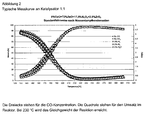
- Figure 2 shows a typical trace of catalyst 1.1.
- Figure 3 shows change of atmosphere on catalyst 1.1.
Landscapes
- Chemical & Material Sciences (AREA)
- Chemical Kinetics & Catalysis (AREA)
- Engineering & Computer Science (AREA)
- Organic Chemistry (AREA)
- Materials Engineering (AREA)
- General Chemical & Material Sciences (AREA)
- Sustainable Energy (AREA)
- Electrochemistry (AREA)
- Life Sciences & Earth Sciences (AREA)
- Sustainable Development (AREA)
- Manufacturing & Machinery (AREA)
- Health & Medical Sciences (AREA)
- General Health & Medical Sciences (AREA)
- Combustion & Propulsion (AREA)
- Inorganic Chemistry (AREA)
- Catalysts (AREA)
- Hydrogen, Water And Hydrids (AREA)
- Carbon And Carbon Compounds (AREA)
Priority Applications (1)
| Application Number | Priority Date | Filing Date | Title |
|---|---|---|---|
| EP07787708A EP2049249B1 (de) | 2006-07-26 | 2007-07-19 | Katalysator für die tieftemperaturkonvertierung und verfahren zur tieftemperaturkonvertierung von kohlenmonoxid und wasser zu kohlendioxid und wasserstoff |
Applications Claiming Priority (3)
| Application Number | Priority Date | Filing Date | Title |
|---|---|---|---|
| EP06117843 | 2006-07-26 | ||
| PCT/EP2007/057450 WO2008012255A2 (de) | 2006-07-26 | 2007-07-19 | Katalysator für die tieftemperaturkonvertierung und verfahren zur tieftemperaturkonvertierung von kohlenmonoxid und wasser zu kohlendioxid und wasserstoff |
| EP07787708A EP2049249B1 (de) | 2006-07-26 | 2007-07-19 | Katalysator für die tieftemperaturkonvertierung und verfahren zur tieftemperaturkonvertierung von kohlenmonoxid und wasser zu kohlendioxid und wasserstoff |
Publications (2)
| Publication Number | Publication Date |
|---|---|
| EP2049249A2 EP2049249A2 (de) | 2009-04-22 |
| EP2049249B1 true EP2049249B1 (de) | 2012-05-23 |
Family
ID=38634636
Family Applications (1)
| Application Number | Title | Priority Date | Filing Date |
|---|---|---|---|
| EP07787708A Not-in-force EP2049249B1 (de) | 2006-07-26 | 2007-07-19 | Katalysator für die tieftemperaturkonvertierung und verfahren zur tieftemperaturkonvertierung von kohlenmonoxid und wasser zu kohlendioxid und wasserstoff |
Country Status (7)
| Country | Link |
|---|---|
| US (1) | US9343767B2 (https=) |
| EP (1) | EP2049249B1 (https=) |
| JP (1) | JP5281572B2 (https=) |
| CN (1) | CN101495226B (https=) |
| CA (1) | CA2658453C (https=) |
| DK (1) | DK2049249T3 (https=) |
| WO (1) | WO2008012255A2 (https=) |
Families Citing this family (12)
| Publication number | Priority date | Publication date | Assignee | Title |
|---|---|---|---|---|
| JP5477561B2 (ja) * | 2009-09-09 | 2014-04-23 | 戸田工業株式会社 | 炭化水素を分解する多孔質触媒体及びその製造方法、炭化水素から水素を含む混合改質ガスを製造する方法、並びに燃料電池システム |
| WO2011132957A2 (ko) * | 2010-04-21 | 2011-10-27 | 에스케이이노베이션주식회사 | 나노미터 크기의 구리계 촉매, 그 제조 방법 및 이를 이용한 카르복시산의 직접수소화를 통한 알코올 제조방법 |
| GB201015605D0 (en) | 2010-09-17 | 2010-10-27 | Magnesium Elektron Ltd | Inorganic oxides for co2 capture from exhaust systems |
| JP5871312B2 (ja) * | 2011-01-17 | 2016-03-01 | 国立研究開発法人産業技術総合研究所 | 微粒子凝集体の製造方法、水蒸気改質触媒、水蒸気改質触媒の製造方法及び、水素製造方法 |
| CN103466546B (zh) * | 2013-09-06 | 2015-04-15 | 清华大学 | 一种将双功能吸附剂应用于吸附增强式水蒸气重整和水气变换反应的中温变压吸附方法 |
| GB201519133D0 (en) | 2015-10-29 | 2015-12-16 | Johnson Matthey Plc | Process |
| WO2017072481A1 (en) | 2015-10-29 | 2017-05-04 | Johnson Matthey Public Limited Company | Water-gas shift catalyst |
| GB201519139D0 (en) | 2015-10-29 | 2015-12-16 | Johnson Matthey Plc | Process |
| CN105833876B (zh) * | 2016-04-15 | 2019-03-26 | 西安向阳航天材料股份有限公司 | 一种高活性铜锌铝低温变换催化剂及其制备方法 |
| EP3254760A1 (en) * | 2016-06-07 | 2017-12-13 | L'air Liquide, Societe Anonyme Pour L'etude Et L'exploitation Des Procedes Georges Claude | Process to synthesize a catalyst performing water-gas shift reaction at a high temperature |
| CN109621967B (zh) * | 2018-12-26 | 2022-03-11 | 西安向阳航天材料股份有限公司 | 一种铜系低温变换催化剂的制备方法 |
| CN114824320A (zh) * | 2022-03-07 | 2022-07-29 | 国网综合能源服务集团有限公司 | 一种具有铜包覆氧化锌界面的铜基催化剂的制备方法及其低温催化水煤气变换反应的应用 |
Family Cites Families (7)
| Publication number | Priority date | Publication date | Assignee | Title |
|---|---|---|---|---|
| US5272017A (en) * | 1992-04-03 | 1993-12-21 | General Motors Corporation | Membrane-electrode assemblies for electrochemical cells |
| EP1000658B1 (en) * | 1998-11-16 | 2006-09-13 | China Petrochemical Corporation | A copper-containing catalyst, a process for the preparation and use thereof |
| US20020061277A1 (en) | 2000-09-25 | 2002-05-23 | Engelhard Corporation | Non-pyrophoric water-gas shift reaction catalysts |
| US6627572B1 (en) * | 2002-03-22 | 2003-09-30 | Sud-Chemie Inc. | Water gas shift catalyst |
| US6693057B1 (en) * | 2002-03-22 | 2004-02-17 | Sud-Chemie Inc. | Water gas shift catalyst |
| WO2004058631A2 (en) * | 2002-12-20 | 2004-07-15 | Honda Giken Kogyo Kabushiki Kaisha | Noble metal-free nickel catalyst formulations for hydrogen generation |
| US7081144B2 (en) * | 2003-04-04 | 2006-07-25 | Texaco Inc. | Autothermal reforming in a fuel processor utilizing non-pyrophoric shift catalyst |
-
2007
- 2007-07-19 US US12/373,057 patent/US9343767B2/en not_active Expired - Fee Related
- 2007-07-19 CA CA2658453A patent/CA2658453C/en not_active Expired - Fee Related
- 2007-07-19 JP JP2009521229A patent/JP5281572B2/ja not_active Expired - Fee Related
- 2007-07-19 WO PCT/EP2007/057450 patent/WO2008012255A2/de not_active Ceased
- 2007-07-19 DK DK07787708.2T patent/DK2049249T3/da active
- 2007-07-19 CN CN2007800282877A patent/CN101495226B/zh not_active Expired - Fee Related
- 2007-07-19 EP EP07787708A patent/EP2049249B1/de not_active Not-in-force
Also Published As
| Publication number | Publication date |
|---|---|
| JP2009544464A (ja) | 2009-12-17 |
| DK2049249T3 (da) | 2012-09-10 |
| US9343767B2 (en) | 2016-05-17 |
| US20100012895A1 (en) | 2010-01-21 |
| EP2049249A2 (de) | 2009-04-22 |
| WO2008012255A2 (de) | 2008-01-31 |
| CA2658453C (en) | 2014-03-04 |
| CN101495226B (zh) | 2012-06-20 |
| CA2658453A1 (en) | 2008-01-31 |
| CN101495226A (zh) | 2009-07-29 |
| WO2008012255A3 (de) | 2008-04-17 |
| JP5281572B2 (ja) | 2013-09-04 |
Similar Documents
| Publication | Publication Date | Title |
|---|---|---|
| EP2049249B1 (de) | Katalysator für die tieftemperaturkonvertierung und verfahren zur tieftemperaturkonvertierung von kohlenmonoxid und wasser zu kohlendioxid und wasserstoff | |
| EP3116826B1 (de) | Yttriumhaltiger katalysator zur hochtemperatur kohlendioxidhydrierung, und/oder reformierung sowie ein verfahren zur hochtemperatur kohlendioxidhydrierung und/oder reformierung | |
| DE69511787T2 (de) | Hohe Temperatur beständiger Oxydationskatalysator seine Herstellung und Anwendung für Verbrennungsverfahren | |
| EP0901982B1 (de) | Verfahren und Katalysator zur Dampfreformierung von Methanol | |
| DE60110079T2 (de) | Katalysator zum abbau von distickstoffoxid sowie methode zur durchführung von verfahren, welche die bildung von distickstoffoxid beinhalten | |
| EP1136441B1 (de) | Verfahren zur katalytischen Umsetzung von Kohlenmonoxid in einem Wasserstoff enthaltenden Gasgemisch | |
| EP2812111B1 (de) | Verfahren zur reformierung von kohlenwasserstoffen in gegenwart eines hexaaluminathaltigen katalysators | |
| EP3576871B1 (de) | Mangandotierte nickel-katalysatoren zur methanisierung von kohlmonoxid and kohldioxid | |
| EP2490804B1 (de) | Katalysator für die wasserdampfreformierung von methanol | |
| DE4422227C2 (de) | Katalysator zur Reduktion von Kohlendioxid | |
| DE69920379T2 (de) | Palladium-Ceroxid-Trägerkatalysator und Verfahren zur Herstellung von Methanol | |
| DE2342909B2 (de) | Katalysator zur Reduktion von Stickstoffoxiden | |
| EP0011150A1 (de) | Verfahren zur Herstellung von Methanol durch Hydrierung von Kohlenoxiden sowie Verfahren zur Herstellung eines Katalysators für diese Hydrierung | |
| DE10013894A1 (de) | Verfahren zur katalytischen Umsetzung von Kohlenmonoxid in einem Wasserstoff enthaltenden Gasgemisch mit verbessertem Kaltstartverhalten und Katalysator hierfür | |
| WO1998026858A1 (de) | Verfahren zur reduktion von stickoxiden | |
| DE112013001920T5 (de) | Katalysator für die Hochtemperaturverbrennung | |
| EP1249275B1 (de) | Katalysator und Verfahren zur Entfernung von Kohlenmonoxid aus einem Reformatgas, und Verfahren zur Herstellung des Katalysators | |
| DE69905736T2 (de) | Die selektive oxidation von kohlenmonoxid in wasserstoff enthaltenden gasen | |
| DE10058365A1 (de) | Katalysator und Verfahren zur selektiven Oxidation von Kohlenmonoxid in einem Wasserstoff-enthaltenden Gas sowie Brennstoffzellsystem vom Festpolymerelektrolyttyp, welches einen solchen Katalysator nutzt | |
| WO2018141646A1 (de) | Eisen- und mangandotierte nickel-methanisierungskatalysatoren | |
| EP2125201B1 (de) | Verfahren zur selektiven methanisierung von kohlenmonoxid | |
| DE10048160A1 (de) | Dimethylether-Reformierkatalysator und Brennstoffzellenvorrichtung | |
| WO2012025897A1 (de) | Hochaktive konvertierungskatalysatoren | |
| DE102006018529B4 (de) | Modifizierter Hopcalit-Katalysator, Verfahren zu dessen Herstellung und dessen Verwenden | |
| EP1515910A1 (de) | Verfahren zur herstellung von wasserstoffhaltigen gasen |
Legal Events
| Date | Code | Title | Description |
|---|---|---|---|
| PUAI | Public reference made under article 153(3) epc to a published international application that has entered the european phase |
Free format text: ORIGINAL CODE: 0009012 |
|
| 17P | Request for examination filed |
Effective date: 20090226 |
|
| AK | Designated contracting states |
Kind code of ref document: A2 Designated state(s): AT BE BG CH CY CZ DE DK EE ES FI FR GB GR HU IE IS IT LI LT LU LV MC MT NL PL PT RO SE SI SK TR |
|
| AX | Request for extension of the european patent |
Extension state: AL BA HR MK RS |
|
| DAX | Request for extension of the european patent (deleted) | ||
| GRAP | Despatch of communication of intention to grant a patent |
Free format text: ORIGINAL CODE: EPIDOSNIGR1 |
|
| GRAC | Information related to communication of intention to grant a patent modified |
Free format text: ORIGINAL CODE: EPIDOSCIGR1 |
|
| GRAS | Grant fee paid |
Free format text: ORIGINAL CODE: EPIDOSNIGR3 |
|
| GRAA | (expected) grant |
Free format text: ORIGINAL CODE: 0009210 |
|
| AK | Designated contracting states |
Kind code of ref document: B1 Designated state(s): AT BE BG CH CY CZ DE DK EE ES FI FR GB GR HU IE IS IT LI LT LU LV MC MT NL PL PT RO SE SI SK TR |
|
| REG | Reference to a national code |
Ref country code: GB Ref legal event code: FG4D Free format text: NOT ENGLISH |
|
| REG | Reference to a national code |
Ref country code: CH Ref legal event code: EP |
|
| REG | Reference to a national code |
Ref country code: AT Ref legal event code: REF Ref document number: 558796 Country of ref document: AT Kind code of ref document: T Effective date: 20120615 |
|
| REG | Reference to a national code |
Ref country code: IE Ref legal event code: FG4D Free format text: LANGUAGE OF EP DOCUMENT: GERMAN |
|
| REG | Reference to a national code |
Ref country code: DE Ref legal event code: R096 Ref document number: 502007009919 Country of ref document: DE Effective date: 20120719 |
|
| REG | Reference to a national code |
Ref country code: NL Ref legal event code: T3 |
|
| REG | Reference to a national code |
Ref country code: DK Ref legal event code: T3 |
|
| REG | Reference to a national code |
Ref country code: LT Ref legal event code: MG4D Effective date: 20120516 |
|
| PG25 | Lapsed in a contracting state [announced via postgrant information from national office to epo] |
Ref country code: SE Free format text: LAPSE BECAUSE OF FAILURE TO SUBMIT A TRANSLATION OF THE DESCRIPTION OR TO PAY THE FEE WITHIN THE PRESCRIBED TIME-LIMIT Effective date: 20120523 Ref country code: FI Free format text: LAPSE BECAUSE OF FAILURE TO SUBMIT A TRANSLATION OF THE DESCRIPTION OR TO PAY THE FEE WITHIN THE PRESCRIBED TIME-LIMIT Effective date: 20120523 Ref country code: LT Free format text: LAPSE BECAUSE OF FAILURE TO SUBMIT A TRANSLATION OF THE DESCRIPTION OR TO PAY THE FEE WITHIN THE PRESCRIBED TIME-LIMIT Effective date: 20120523 Ref country code: CY Free format text: LAPSE BECAUSE OF FAILURE TO SUBMIT A TRANSLATION OF THE DESCRIPTION OR TO PAY THE FEE WITHIN THE PRESCRIBED TIME-LIMIT Effective date: 20120523 Ref country code: IS Free format text: LAPSE BECAUSE OF FAILURE TO SUBMIT A TRANSLATION OF THE DESCRIPTION OR TO PAY THE FEE WITHIN THE PRESCRIBED TIME-LIMIT Effective date: 20120923 |
|
| PG25 | Lapsed in a contracting state [announced via postgrant information from national office to epo] |
Ref country code: PT Free format text: LAPSE BECAUSE OF FAILURE TO SUBMIT A TRANSLATION OF THE DESCRIPTION OR TO PAY THE FEE WITHIN THE PRESCRIBED TIME-LIMIT Effective date: 20120924 Ref country code: SI Free format text: LAPSE BECAUSE OF FAILURE TO SUBMIT A TRANSLATION OF THE DESCRIPTION OR TO PAY THE FEE WITHIN THE PRESCRIBED TIME-LIMIT Effective date: 20120523 Ref country code: LV Free format text: LAPSE BECAUSE OF FAILURE TO SUBMIT A TRANSLATION OF THE DESCRIPTION OR TO PAY THE FEE WITHIN THE PRESCRIBED TIME-LIMIT Effective date: 20120523 Ref country code: GR Free format text: LAPSE BECAUSE OF FAILURE TO SUBMIT A TRANSLATION OF THE DESCRIPTION OR TO PAY THE FEE WITHIN THE PRESCRIBED TIME-LIMIT Effective date: 20120824 |
|
| BERE | Be: lapsed |
Owner name: BASF SE Effective date: 20120731 |
|
| PG25 | Lapsed in a contracting state [announced via postgrant information from national office to epo] |
Ref country code: RO Free format text: LAPSE BECAUSE OF FAILURE TO SUBMIT A TRANSLATION OF THE DESCRIPTION OR TO PAY THE FEE WITHIN THE PRESCRIBED TIME-LIMIT Effective date: 20120523 Ref country code: EE Free format text: LAPSE BECAUSE OF FAILURE TO SUBMIT A TRANSLATION OF THE DESCRIPTION OR TO PAY THE FEE WITHIN THE PRESCRIBED TIME-LIMIT Effective date: 20120523 Ref country code: SK Free format text: LAPSE BECAUSE OF FAILURE TO SUBMIT A TRANSLATION OF THE DESCRIPTION OR TO PAY THE FEE WITHIN THE PRESCRIBED TIME-LIMIT Effective date: 20120523 Ref country code: CZ Free format text: LAPSE BECAUSE OF FAILURE TO SUBMIT A TRANSLATION OF THE DESCRIPTION OR TO PAY THE FEE WITHIN THE PRESCRIBED TIME-LIMIT Effective date: 20120523 |
|
| PG25 | Lapsed in a contracting state [announced via postgrant information from national office to epo] |
Ref country code: MC Free format text: LAPSE BECAUSE OF NON-PAYMENT OF DUE FEES Effective date: 20120731 Ref country code: PL Free format text: LAPSE BECAUSE OF FAILURE TO SUBMIT A TRANSLATION OF THE DESCRIPTION OR TO PAY THE FEE WITHIN THE PRESCRIBED TIME-LIMIT Effective date: 20120523 |
|
| REG | Reference to a national code |
Ref country code: CH Ref legal event code: PL |
|
| PLBE | No opposition filed within time limit |
Free format text: ORIGINAL CODE: 0009261 |
|
| STAA | Information on the status of an ep patent application or granted ep patent |
Free format text: STATUS: NO OPPOSITION FILED WITHIN TIME LIMIT |
|
| PG25 | Lapsed in a contracting state [announced via postgrant information from national office to epo] |
Ref country code: CH Free format text: LAPSE BECAUSE OF NON-PAYMENT OF DUE FEES Effective date: 20120731 Ref country code: ES Free format text: LAPSE BECAUSE OF FAILURE TO SUBMIT A TRANSLATION OF THE DESCRIPTION OR TO PAY THE FEE WITHIN THE PRESCRIBED TIME-LIMIT Effective date: 20120903 Ref country code: LI Free format text: LAPSE BECAUSE OF NON-PAYMENT OF DUE FEES Effective date: 20120731 |
|
| 26N | No opposition filed |
Effective date: 20130226 |
|
| REG | Reference to a national code |
Ref country code: IE Ref legal event code: MM4A |
|
| PG25 | Lapsed in a contracting state [announced via postgrant information from national office to epo] |
Ref country code: BE Free format text: LAPSE BECAUSE OF NON-PAYMENT OF DUE FEES Effective date: 20120731 |
|
| REG | Reference to a national code |
Ref country code: DE Ref legal event code: R097 Ref document number: 502007009919 Country of ref document: DE Effective date: 20130226 |
|
| PG25 | Lapsed in a contracting state [announced via postgrant information from national office to epo] |
Ref country code: IE Free format text: LAPSE BECAUSE OF NON-PAYMENT OF DUE FEES Effective date: 20120719 Ref country code: MT Free format text: LAPSE BECAUSE OF FAILURE TO SUBMIT A TRANSLATION OF THE DESCRIPTION OR TO PAY THE FEE WITHIN THE PRESCRIBED TIME-LIMIT Effective date: 20120523 Ref country code: BG Free format text: LAPSE BECAUSE OF FAILURE TO SUBMIT A TRANSLATION OF THE DESCRIPTION OR TO PAY THE FEE WITHIN THE PRESCRIBED TIME-LIMIT Effective date: 20120823 |
|
| REG | Reference to a national code |
Ref country code: AT Ref legal event code: MM01 Ref document number: 558796 Country of ref document: AT Kind code of ref document: T Effective date: 20120731 |
|
| PG25 | Lapsed in a contracting state [announced via postgrant information from national office to epo] |
Ref country code: AT Free format text: LAPSE BECAUSE OF NON-PAYMENT OF DUE FEES Effective date: 20120731 |
|
| PG25 | Lapsed in a contracting state [announced via postgrant information from national office to epo] |
Ref country code: TR Free format text: LAPSE BECAUSE OF FAILURE TO SUBMIT A TRANSLATION OF THE DESCRIPTION OR TO PAY THE FEE WITHIN THE PRESCRIBED TIME-LIMIT Effective date: 20120523 |
|
| PG25 | Lapsed in a contracting state [announced via postgrant information from national office to epo] |
Ref country code: LU Free format text: LAPSE BECAUSE OF NON-PAYMENT OF DUE FEES Effective date: 20120719 |
|
| PG25 | Lapsed in a contracting state [announced via postgrant information from national office to epo] |
Ref country code: HU Free format text: LAPSE BECAUSE OF FAILURE TO SUBMIT A TRANSLATION OF THE DESCRIPTION OR TO PAY THE FEE WITHIN THE PRESCRIBED TIME-LIMIT Effective date: 20070719 |
|
| REG | Reference to a national code |
Ref country code: FR Ref legal event code: PLFP Year of fee payment: 10 |
|
| PGFP | Annual fee paid to national office [announced via postgrant information from national office to epo] |
Ref country code: NL Payment date: 20160725 Year of fee payment: 10 |
|
| PGFP | Annual fee paid to national office [announced via postgrant information from national office to epo] |
Ref country code: IT Payment date: 20160721 Year of fee payment: 10 Ref country code: DK Payment date: 20160726 Year of fee payment: 10 Ref country code: GB Payment date: 20160729 Year of fee payment: 10 |
|
| PGFP | Annual fee paid to national office [announced via postgrant information from national office to epo] |
Ref country code: FR Payment date: 20160727 Year of fee payment: 10 |
|
| PGFP | Annual fee paid to national office [announced via postgrant information from national office to epo] |
Ref country code: DE Payment date: 20160930 Year of fee payment: 10 |
|
| REG | Reference to a national code |
Ref country code: DE Ref legal event code: R119 Ref document number: 502007009919 Country of ref document: DE |
|
| REG | Reference to a national code |
Ref country code: DK Ref legal event code: EBP Effective date: 20170731 |
|
| REG | Reference to a national code |
Ref country code: NL Ref legal event code: MM Effective date: 20170801 |
|
| GBPC | Gb: european patent ceased through non-payment of renewal fee |
Effective date: 20170719 |
|
| REG | Reference to a national code |
Ref country code: FR Ref legal event code: ST Effective date: 20180330 |
|
| PG25 | Lapsed in a contracting state [announced via postgrant information from national office to epo] |
Ref country code: DE Free format text: LAPSE BECAUSE OF NON-PAYMENT OF DUE FEES Effective date: 20180201 Ref country code: GB Free format text: LAPSE BECAUSE OF NON-PAYMENT OF DUE FEES Effective date: 20170719 Ref country code: NL Free format text: LAPSE BECAUSE OF NON-PAYMENT OF DUE FEES Effective date: 20170801 |
|
| PG25 | Lapsed in a contracting state [announced via postgrant information from national office to epo] |
Ref country code: FR Free format text: LAPSE BECAUSE OF NON-PAYMENT OF DUE FEES Effective date: 20170731 |
|
| PG25 | Lapsed in a contracting state [announced via postgrant information from national office to epo] |
Ref country code: DK Free format text: LAPSE BECAUSE OF NON-PAYMENT OF DUE FEES Effective date: 20170731 |
|
| PG25 | Lapsed in a contracting state [announced via postgrant information from national office to epo] |
Ref country code: IT Free format text: LAPSE BECAUSE OF NON-PAYMENT OF DUE FEES Effective date: 20170719 |