EP2032529B1 - Metal(iv) tetra-amidinate compounds and their use in vapor deposition - Google Patents
Metal(iv) tetra-amidinate compounds and their use in vapor deposition Download PDFInfo
- Publication number
- EP2032529B1 EP2032529B1 EP07796442A EP07796442A EP2032529B1 EP 2032529 B1 EP2032529 B1 EP 2032529B1 EP 07796442 A EP07796442 A EP 07796442A EP 07796442 A EP07796442 A EP 07796442A EP 2032529 B1 EP2032529 B1 EP 2032529B1
- Authority
- EP
- European Patent Office
- Prior art keywords
- metal
- group
- hafnium
- zirconium
- vapor
- Prior art date
- Legal status (The legal status is an assumption and is not a legal conclusion. Google has not performed a legal analysis and makes no representation as to the accuracy of the status listed.)
- Active
Links
Images
Classifications
-
- C—CHEMISTRY; METALLURGY
- C07—ORGANIC CHEMISTRY
- C07C—ACYCLIC OR CARBOCYCLIC COMPOUNDS
- C07C257/00—Compounds containing carboxyl groups, the doubly-bound oxygen atom of a carboxyl group being replaced by a doubly-bound nitrogen atom, this nitrogen atom not being further bound to an oxygen atom, e.g. imino-ethers, amidines
- C07C257/10—Compounds containing carboxyl groups, the doubly-bound oxygen atom of a carboxyl group being replaced by a doubly-bound nitrogen atom, this nitrogen atom not being further bound to an oxygen atom, e.g. imino-ethers, amidines with replacement of the other oxygen atom of the carboxyl group by nitrogen atoms, e.g. amidines
- C07C257/14—Compounds containing carboxyl groups, the doubly-bound oxygen atom of a carboxyl group being replaced by a doubly-bound nitrogen atom, this nitrogen atom not being further bound to an oxygen atom, e.g. imino-ethers, amidines with replacement of the other oxygen atom of the carboxyl group by nitrogen atoms, e.g. amidines having carbon atoms of amidino groups bound to acyclic carbon atoms
-
- C—CHEMISTRY; METALLURGY
- C07—ORGANIC CHEMISTRY
- C07F—ACYCLIC, CARBOCYCLIC OR HETEROCYCLIC COMPOUNDS CONTAINING ELEMENTS OTHER THAN CARBON, HYDROGEN, HALOGEN, OXYGEN, NITROGEN, SULFUR, SELENIUM OR TELLURIUM
- C07F7/00—Compounds containing elements of Groups 4 or 14 of the Periodic Table
-
- C—CHEMISTRY; METALLURGY
- C07—ORGANIC CHEMISTRY
- C07F—ACYCLIC, CARBOCYCLIC OR HETEROCYCLIC COMPOUNDS CONTAINING ELEMENTS OTHER THAN CARBON, HYDROGEN, HALOGEN, OXYGEN, NITROGEN, SULFUR, SELENIUM OR TELLURIUM
- C07F11/00—Compounds containing elements of Groups 6 or 16 of the Periodic Table
-
- C—CHEMISTRY; METALLURGY
- C07—ORGANIC CHEMISTRY
- C07F—ACYCLIC, CARBOCYCLIC OR HETEROCYCLIC COMPOUNDS CONTAINING ELEMENTS OTHER THAN CARBON, HYDROGEN, HALOGEN, OXYGEN, NITROGEN, SULFUR, SELENIUM OR TELLURIUM
- C07F9/00—Compounds containing elements of Groups 5 or 15 of the Periodic Table
-
- C—CHEMISTRY; METALLURGY
- C23—COATING METALLIC MATERIAL; COATING MATERIAL WITH METALLIC MATERIAL; CHEMICAL SURFACE TREATMENT; DIFFUSION TREATMENT OF METALLIC MATERIAL; COATING BY VACUUM EVAPORATION, BY SPUTTERING, BY ION IMPLANTATION OR BY CHEMICAL VAPOUR DEPOSITION, IN GENERAL; INHIBITING CORROSION OF METALLIC MATERIAL OR INCRUSTATION IN GENERAL
- C23C—COATING METALLIC MATERIAL; COATING MATERIAL WITH METALLIC MATERIAL; SURFACE TREATMENT OF METALLIC MATERIAL BY DIFFUSION INTO THE SURFACE, BY CHEMICAL CONVERSION OR SUBSTITUTION; COATING BY VACUUM EVAPORATION, BY SPUTTERING, BY ION IMPLANTATION OR BY CHEMICAL VAPOUR DEPOSITION, IN GENERAL
- C23C16/00—Chemical coating by decomposition of gaseous compounds, without leaving reaction products of surface material in the coating, i.e. chemical vapour deposition [CVD] processes
- C23C16/22—Chemical coating by decomposition of gaseous compounds, without leaving reaction products of surface material in the coating, i.e. chemical vapour deposition [CVD] processes characterised by the deposition of inorganic material, other than metallic material
- C23C16/30—Deposition of compounds, mixtures or solid solutions, e.g. borides, carbides, nitrides
- C23C16/34—Nitrides
-
- C—CHEMISTRY; METALLURGY
- C23—COATING METALLIC MATERIAL; COATING MATERIAL WITH METALLIC MATERIAL; CHEMICAL SURFACE TREATMENT; DIFFUSION TREATMENT OF METALLIC MATERIAL; COATING BY VACUUM EVAPORATION, BY SPUTTERING, BY ION IMPLANTATION OR BY CHEMICAL VAPOUR DEPOSITION, IN GENERAL; INHIBITING CORROSION OF METALLIC MATERIAL OR INCRUSTATION IN GENERAL
- C23C—COATING METALLIC MATERIAL; COATING MATERIAL WITH METALLIC MATERIAL; SURFACE TREATMENT OF METALLIC MATERIAL BY DIFFUSION INTO THE SURFACE, BY CHEMICAL CONVERSION OR SUBSTITUTION; COATING BY VACUUM EVAPORATION, BY SPUTTERING, BY ION IMPLANTATION OR BY CHEMICAL VAPOUR DEPOSITION, IN GENERAL
- C23C16/00—Chemical coating by decomposition of gaseous compounds, without leaving reaction products of surface material in the coating, i.e. chemical vapour deposition [CVD] processes
- C23C16/22—Chemical coating by decomposition of gaseous compounds, without leaving reaction products of surface material in the coating, i.e. chemical vapour deposition [CVD] processes characterised by the deposition of inorganic material, other than metallic material
- C23C16/30—Deposition of compounds, mixtures or solid solutions, e.g. borides, carbides, nitrides
- C23C16/40—Oxides
- C23C16/405—Oxides of refractory metals or yttrium
Definitions
- This invention relates to novel compounds containing metals in the +4 oxidation state bonded to four amidinate ligands. This invention also relates to the use of these compounds as precursors for vapor deposition of metal-containing layers.
- high-k dielectrics Electrically insulating materials with high dielectric constants
- DRAMs dynamic random access memories
- Aluminum oxide and tantalum oxide are currently in commercial use in DRAMs, and oxides, nitrides and silicates of hafnium and zirconium are being tested as alternatives for future use.
- These high-k materials may also be used as insulators in future transistors in microelectronic devices.
- Electrically conductive nitrides of metals such as tantalum, tungsten, hafnium, zirconium, titanium, niobium and molybdenum have a variety of applications and potential applications, such as barriers against the diffusion of copper, and as electrodes for capacitors and transistors in microelectronic devices. These refractory metals also find use as adhesion-promoting layers for copper, and as electrodes or electrical interconnections.
- Vapor deposition is a preferred method for making these materials.
- Vapor deposition is a generic term that comprises chemical vapor deposition (CVD) and atomic layer deposition (ALD).
- CVD chemical vapor deposition
- ALD atomic layer deposition
- CVD chemical vapor deposition
- one or more vapors are delivered to a surface on which solid material is deposited; the chemical reactions that convert the vapor to a solid are initiated by means such as heat, light or electrical excitation (plasma activation).
- plasma activation atomic layer deposition
- ALD atomic layer deposition
- ALD atomic layer deposition
- ALD atomic layer deposition
- W09/08322 describes the chemical vapor deposition of transition metal nitrides, e.g. titanium nitride.
- One aspect of the invention includes novel compounds containing metals in the +4 oxidation state bonded to four amidinate ligands.
- these ligands comprise N,N' -dialkylamidinate ligands.
- Preferred metals include hafnium, zirconium, tantalum, niobium, tungsten, molybdenum, tin, tellurium and uranium.
- the compound has the structural formula in which M is a metal in the +4 oxidation state and each of R 1 through R 12 are independently selected from the group consisting of hydrogen, hydrocarbon groups, substituted hydrocarbon groups, alkylsilyl, and alkylamino groups.
- the hydrocarbon group is selected from the group consisting of alkyl, cycloalkyl, alkenyl, cycloalkenyl, alkynyl and cycloalkynyl groups and the substituted hydrocarbon group consisting of fluoride derivatives of hydrocarbons.
- the metal M is selected from the group consisting of zirconium, hafnium, tin, tantalum, niobium, tungsten, molybdenum, uranium, rhenium, platinum, osmium, iridium, ruthenium, palladium, titanium, rhodium, vanadium, cerium and lead, or the metal M is selected from the group consisting of hafnium, zirconium, tantalum, niobium, tungsten, molybdenum, tin, tellurium and uranium.
- At least one of R 1 through R 12 is a lower alkyl having 5 or less carbons.
- R 1 through R 12 is selected from the group consisting of lower alkyls having 5 or less carbons and hydrogen.
- R 1 , R 3 , R 4 , R 6 , R 7 , R 9 , R 10 and R 12 are alkyl groups that are un-branched at the ⁇ -position.
- Another aspect of the present invention includes a process for depositing films comprising metals using the novel compounds according to one or more embodiments of the invention.
- the process includes exposing a heated surface to the vapor of one or more volatile metal tetra-amidinate compounds.
- Exemplary deposition methods include Chemical Vapor Deposition (CVD) and Atomic Layer Deposition (ALD).
- the process includes exposing the substrate to a source of oxygen, and the thin film comprises a metal oxide.
- the source of oxygen comprises water vapor, or dioxygen, or ozone.
- the process includes exposing the substrate to a source of nitrogen, and the thin film comprises a metal nitride.
- the source of nitrogen comprises ammonia.
- the vapor is obtained by vaporizing a solid metal tetra-amidinate compound, or by vaporizing a liquid metal tetra-amidinate compound.
- the vapor is obtained by vaporizing a metal tetra-amidinate at a temperature in the range of 100 to 250°C.
- the surface is at a temperature in the range of about 200 to 500°C.
- the present invention provides thermally stable, volatile metal compounds that are suitable for use in vapor deposition processes, including chemical vapor deposition and atomic layer deposition.
- Preferred compounds include volatile metal(IV) tetrakis( N,N'- dialkylamidinates) complexes.
- M is a metal in the +4 oxidation state
- R n applies equally to each of R 1 through R 12 , unless otherwise specified.
- R n are lower alkyl groups containing 5 or less carbons. In one or more embodiments, R n are a mixture of hydrogen and lower alkyl groups. In preferred embodiments R n are chosen from the group comprising methyl, ethyl and n-propyl. These small alkyl groups are preferred because they are small enough to fit into the structure 1 with very stable chelate binding. In one or more embodiments, one or more of R 1 , R 3 , R 4 , R 6 , R 7 , R 9 , R 10 , or R 12 are hydrocarbon groups lacking a branched ⁇ -carbon. As used herein, an ⁇ -carbon is a carbon bound directly to one nitrogen of an amidinate ligand.
- Alkyl groups that branch at the ⁇ -carbon are less preferred because they are likely to cause too much crowding to fit into structure 1.
- the branched alkyl groups will generally provide less stable metal amidinates. Nonetheless, branched groups are contemplated according to one or more embodiments, in particular, where a larger metal center is used or the branching occurs beyond the ⁇ -carbon.
- Exemplary tetravalent metals that may be used in one or more embodiments of the invention include zirconium, hafnium, tin, tantalum, niobium, tungsten, molybdenum, uranium, rhenium, platinum, osmium, iridium, ruthenium, palladium, titanium, rhodium, vanadium, cerium, tellurium and lead.
- Tetravalent metal ions having relatively larger ionic radii form tetra-amidinate complexes that are particularly stable; those metals include zirconium, hafnium, tin, tantalum, niobium, tungsten, molybdenum, tellurium and uranium.
- Tetravalent metal ions having relatively smaller ionic radii that form tetra-amidinate include rhenium, platinum, osmium, iridium, ruthenium, palladium, titanium, rhodium and vanadium.
- the amidinate ligand is symmetric, e.g., the N-bound R groups such as R 1 and R 3 or R 4 and R 6 , etc., are the same in formula 1.
- the amidinate ligand is asymmetric, e.g., R 1 and R 3 are different in formula 1.
- the carbon-bound R group, e.g., R 2 in formula 1 can be the same or different.
- metal tetrakis( N,N '-dialkylamidinate) compounds are prepared using N,N' -dialkylamidines.
- Symmetric amidines may be formed by condensation of amines with nitriles catalyzed by lanthanum trifluoromethanesulfonate (also known as lanthanum triflate), La(CF 3 SO 3 ) 3 :
- Amines in which R 1 is a methyl or ethyl group are so volatile that they must be confined within a pressure vessel during the reaction.
- the byproduct ammonia may be released from the pressure vessel by a backpressure regulator.
- Complete reaction takes a few days at room temperature, or shorter periods at higher temperatures and pressures.
- a less expensive catalyst for this reaction can be made from mixed triflates of the naturally-occurring mixture of lanthanum metals ("misch metal").
- Unsymmetrical amidines can be prepared according to the following reactions:
- Metal amidinates can be prepared by exchange reactions in which a metal dialkylamide is reacted with an amidine. Alternately, the amidine can be converted to its alkali salt by reaction with butyllithium or with sodium amide or with potassium hydride. The alkali amidinate can then undergo a salt metathesis reaction with a metal chloride to form the metal amidinate.
- a more commonly-used method to form lithium amidinates is to react a carbodiimide with a lithium alkyl. This conventional synthetic route is more effective when the R 1 and R 3 alkyl groups are branched at the ⁇ -position, because the corresponding carbodiimides are more stable.
- the metal tetra-amidinate compounds may be used to form metal-containing films in a vapor deposition process.
- Vapors of the compounds according to one or more embodiments may be used to deposit materials such as metals, metal oxides, metal nitrides, metal oxynitrides, metal sulfides and the like.
- These vapor deposition processes include CVD and ALD.
- CVD a vapor of the metal tetra-amidinate is supplied to the surface, optionally along with a co-reactant gas or vapor.
- ALD a vapor of the metal tetra-amidinate and a co-reactant are supplied to the surface in alternating time periods.
- CVD processing is described, for example, in US Patent 5,139,999 and in the " Handbook of Chemical Vapor Deposition: Principles, Technology and Applications” by Hugh O. Pierson (2nd edition, Noyes Publications, 1999 ).
- ALD processing is described in US Patent 6,969,539 and in the article " Atomic Layer Deposition” by M. Ritala and M. Leskela, vol. 1, p. 103 of the Handbook of Thin Film Materials (Ed. H. Nalwa, Academic Press, 2002 ).
- Oxides may be formed using co-reactants such as water vapor, dioxygen, ozone, hydrogen peroxide and alcohols or a plasma formed from an oxygen-containing gas or vapor.
- Nitrides may be formed using co-reactants such as ammonia, a hydrazine or a plasma formed from a nitrogen-containing gas or vapor.
- Sulfides may be formed using co-reactants such as hydrogen sulfide or a plasma formed from a sulfur-containing gas or vapor.
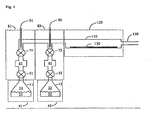
- FIG. 1 An apparatus for carrying out ALD is shown schematically in cross-section in Fig. 1 .
- carrier gas such as nitrogen
- a tetra-amidinate precursor 21 is held in vessel 11 that is heated in oven 41 to a temperature sufficient to form its vapor 31.
- Vapor 31 of the tetravalent amidinate precursor flows into evacuated chamber 61 in oven 81 when valve 51 is opened.
- Valve 51 is then closed and valve 71 opened to allow an aliquot of precursor vapor to flow over the substrate 130 inside heated furnace 120.
- Valve 71 is then closed and time is allowed for excess unreacted precursor to be purged from chamber 110 along with volatile reaction byproducts.
- the second reagent 22, such as water or ammonia, is placed in vessel 12, usually kept at room temperature. Vapor 32 of the second reagent is allowed to flow into vapor space 62 by opening valve 52, which is then closed. Valve 72 is opened to allow an aliquot of the second reagent to flow into the deposition chamber 110. Valve 72 is then closed and time is allowed for unreacted excess of the second reagent to be purged from the deposition chamber 110 along with volatile reaction byproducts. This cycle of operations is then repeated to build up the desired thickness of coating on substrate 130.
- the apparatus may include a vessel housing a tetra-amidinate precursor that is heated to a temperature to form its vapor.
- the tetra-amidinate precursor vapor flows from the vessel and into a heated furnace housing the substrate. Additional co-reactant vapors may be introduced into the heated furnace with the tetra-amidinate precursor, or the co-reactant vapors may be premixed with the tetra-amidinate vapor prior to their exposure to the heated substrate.
- An exhaust system removes by-products and unreacted reactants from the furnace.
- the tetra-amidinate precursor may be used as a neat liquid, in solution in the appropriate solvent, or as a solid.
- Suitable deposition conditions such as temperatures for vaporization and deposition, pressures, flow rates, and co-reactants may be readily determined by one of skill in the art.
- Exemplary ALD and CVD conditions include substrate temperatures of 200 to 500°C, and more preferably 300 to 400°C, vapor pressures in the range of 13.3 Pa to 1333.2 Pa (0.1 to 10 Torr), and more preferably 133.3 to 666.6 Pa (1 to 5 Torr), vaporization temperatures of about 100 to 250°C, and more preferably 150 to 200°C, ALD doses of 1 to 100 nmol cm -2 of deposited surface, and more preferably 2 to 20 nmol cm -2 , and ALD exposures of 1.33 Pa sec to 1333.2 Pa-sec (0.01 Torr-sec to 10 Torr-sec), and more preferably 13.3 Pa sec to 133.3 Pa sec (0.1 to 1 Torr-sec).
- the ALD exposures needed to cover features with high aspect ratios increase approximately as the square of the aspect ratio.
- thermogravimetric analysis T 1/2
- T 1/2 thermogravimetric analysis
- the lithium salt of N,N '-dimethylacetamidine was prepared by dissolving one volume of N,N' -dimethylacetamidine in 5 volumes of dry ether and cooling the solution to -78°C. An equal molar amount of butyllithium dissolved in hexanes was added slowly while stirring. The reaction mixture was allowed to warm to room temperature. The ether and pentane were removed under reduced pressure. Then the white solid residue was dissolved in dry dioxane. The resulting solution of N,N '-dimethylacetamidinato-lithium in dioxane was used in some of the following examples.
- This compound was prepared by ligand exchange in a way similar to that described in Example 2 for Zr( i Bu-AMD) 4 , using N,N' -dimethylacetamidine in place of N,N '-di- iso -butylacetamidine.
- ZrCl 4 was reacted with the lithium salt of N,N' -dimethylacetamidine dissolved in dioxane (salt metathesis reaction). This reaction mixture was heated to reflux for 8 hours. After evaporation of the dioxane, the solid residue was extracted with pentane.
- This product is more volatile than tetrakis( N,N' -di- iso butylacetamidinato)hafnium(IV), the product of Example 3 because its T 1/2 value from the TG curve is 221°C. Its residue after evaporation is negligible, less than 1%, and its melting point is about 171°C.
- a dioxane solution of lithium N,N' -dimethylpropionamidinate was prepared by the method described in Example 4, using propionitrile in place of acetonitrile. This solution was then used with ZrCl 4 in the salt metathesis method described in Example 5 to prepare tetrakis( N,N' -dimethylpropionamidinato)zirconium(IV). This compound may also be prepared by a ligand exchange reaction similar to the one described in Example 2.
- This compound was prepared from HfCl 4 by the salt metathesis reaction described in Example 7. It may also be prepared by a ligand exchange reaction similar to the one described in Example 1.
- a dioxane solution of lithium N,N'-dimethylbutyramidinate was prepared by the method described in Example 4, using butyronitrile in place of acetonitrile. This solution was then used with ZrCl 4 in the salt metathesis method described in Example 5 to prepare tetrakis( N,N' -dimethylbutyramidinato)zirconium(IV).
- This compound may also be prepared by a ligand exchange reaction similar to the one described in Example 1. The compound is a liquid at room temperature, so it was purified by distillation instead of sublimation.
- This compound was prepared from HfCl 4 by the salt metathesis reaction described in Example 9. It may also be prepared by a ligand exchange reaction similar to the one described in Example 1. The compound is a liquid at room temperature, so it was purified by distillation instead of sublimation.
- a dioxane solution of lithium N,N' -diethylacetamidinate was prepared by the method described in Example 4, using ethylamine in place of methylamine. This solution was then used with ZrCl 4 in the salt metathesis method described in Example 5 to prepare tetrakis( N,N '-diethylacetamidinato)zirconium(IV). It may also be prepared by a ligand exchange reaction similar to the one described in Example 1.
- 1 H NMR benzene-d 6 , ppm
- This compound was prepared from HfCl 4 by the salt metathesis method described in Example 11. It may also be prepared by a ligand exchange reaction similar to the one described in Example 1.
- Anal. Calcd. for C 24 H 52 N 8 Hf C 45.67, H 8.30, N 17.75. Found: 46.17, H 7.93, N 17.27. Its T 1/2 value is 264°C and it evaporates leaving a negligible residue.
- This compound was prepared in two steps from tantalum pentachloride.
- the first step involved the addition under nitrogen at -78°C of an ether solution of tantalum pentachloride (0.95 mmol, 331 mg in 20 mL ether) to a solution of lithium N,N '-diethylacetamidinate (2 mmol in 20 mL ether, prepared in situ from the amidine and a hexanes solution (2.6 M) of n -butyl lithium).
- the intermediate tentatively described as trischloro-bis( N,N' -diethylacetamidinato)tantalum(V) was partially soluble in ether, giving an orange solution.
- tetrakis( N,N '-dimethylacetamidinato) tungsten(IV) is prepared using tungsten(IV) chloride, WCl 4 ;
- tetrakis( N,N' -dimethylacetamidinato)tin(IV) is prepared using tin(IV) chloride, SnCl 4 ;
- tetrakis( N,N '-dimethylacetamidinato)tellurium(IV) is prepared from TeCl 4 ;
- tetrakis( N,N '-dimethylacetamidinato)uranium(IV) is prepared in using uranium(IV) chloride, UCl 4 .
- Example 15 Atomic layer deposition of hafnium oxide from tetrakis( N,N'- dimethylbutyramidinato)hafnium ( IV) and ozone.
- 10 nmol cm -2 doses of the vapor of tetrakis( N,N '-dimethylpropionamidinato)hafnium(IV) from a direct liquid injection system at 200°C are introduced with an exposure of 1333.2Pa-sec (10 Torr-sec) in to an ALD reactor at 400°C, alternately with 20 nmol cm -2 doses of ozone at an exposure of 1333.2Pa-sec (10 Torr-sec).
- a film of hafnium oxide is deposited conformally inside narrow holes with high aspect ratio of 80:1.
- Example 16 Atomic layer deposition of hafnium oxide from tetrakis( N,N'- dimethylbutyramidinato)hamium( IV) and water vapor.
- 10 nmol cm -2 doses of the vapor of tetrakis( N , N '-dimethylpropionamidinato)hafnium(IV) from a direct liquid injection system at 200°C are introduced with an exposure of 10 Torr-sec in to an ALD reactor at 400°C, alternately with 20 nmol cm -2 doses of water vapor at an exposure of 1333.2 Pa-sec (10 Torr-sec).
- a film of hafnium oxide is deposited conformally inside narrow holes with high aspect ratio of 80:1.
- Example 17 Atomic layer deposition of hafnium nitride from tetrakis( N,N '-dimethylbutyramidinato)hafnium(IV) and ammonia.
- 10 nmol cm -2 doses of the vapor of tetrakis( N,N '- dimethylpropionamidinato)hafnium( IV) from a direct liquid injection system at 200°C are introduced with an exposure of 10 Torr-sec in to an ALD reactor at 400°C, alternately with 20 nmol cm -2 doses of ammonia at an exposure of 10 Torr-sec.
- a film of hafnium nitride is deposited conformally inside narrow holes with high aspect ratio of 80:1.
- the potassium salt of methylamine is heated to about 100 °C until it decomposes to yield the same product N,N '-dimethylformamidine as Ex. 18.
- Example 20 Synthesis of tetrakis( N,N '-dimethylformamidinato)hafnium(IV).
- tetrakis( N,N '-dimethylformidinato)hafnium(IV) is a preferred precursor for vapor deposition of hafnium-containing materials.
- a liquid at room temperature it may be supplied as a liquid solution in a solvent with a similar boiling point. Suitable solvents include polyethers, such as triglyme or tetraglyme.
- the room-temperature liquid tetrakis( N,N '-dimethylbutyramidinato)hafnium(IV) may be used for neat liquid delivery to a vaporization system.
- Example 21 Synthesis of tetrakis( N,N '-dimethylformamidinato)zirconium(IV).
Landscapes
- Chemical & Material Sciences (AREA)
- Organic Chemistry (AREA)
- Inorganic Chemistry (AREA)
- General Chemical & Material Sciences (AREA)
- Chemical Kinetics & Catalysis (AREA)
- Engineering & Computer Science (AREA)
- Materials Engineering (AREA)
- Mechanical Engineering (AREA)
- Metallurgy (AREA)
- Chemical Vapour Deposition (AREA)
- Organic Low-Molecular-Weight Compounds And Preparation Thereof (AREA)
- Formation Of Insulating Films (AREA)
Applications Claiming Priority (3)
| Application Number | Priority Date | Filing Date | Title |
|---|---|---|---|
| US81720906P | 2006-06-28 | 2006-06-28 | |
| US11/581,986 US7264486B2 (en) | 2005-10-17 | 2006-10-17 | Electrical connector |
| PCT/US2007/014768 WO2008002546A1 (en) | 2006-06-28 | 2007-06-26 | Metal(iv) tetra-amidinate compounds and their use in vapor deposition |
Publications (2)
| Publication Number | Publication Date |
|---|---|
| EP2032529A1 EP2032529A1 (en) | 2009-03-11 |
| EP2032529B1 true EP2032529B1 (en) | 2012-10-17 |
Family
ID=40328880
Family Applications (1)
| Application Number | Title | Priority Date | Filing Date |
|---|---|---|---|
| EP07796442A Active EP2032529B1 (en) | 2006-06-28 | 2007-06-26 | Metal(iv) tetra-amidinate compounds and their use in vapor deposition |
Country Status (5)
| Country | Link |
|---|---|
| EP (1) | EP2032529B1 (enExample) |
| JP (2) | JP5555872B2 (enExample) |
| KR (1) | KR101467587B1 (enExample) |
| CN (2) | CN101500989B (enExample) |
| WO (1) | WO2008002546A1 (enExample) |
Families Citing this family (38)
| Publication number | Priority date | Publication date | Assignee | Title |
|---|---|---|---|---|
| EP2018642A4 (en) | 2006-05-12 | 2009-05-27 | Advanced Tech Materials | LOW TEMPERATURE DEPOSITION OF STORAGE MATERIALS |
| EP2032529B1 (en) * | 2006-06-28 | 2012-10-17 | President and Fellows of Harvard College | Metal(iv) tetra-amidinate compounds and their use in vapor deposition |
| CN102352488B (zh) | 2006-11-02 | 2016-04-06 | 诚实公司 | 对于金属薄膜的cvd/ald有用的锑及锗复合物 |
| TWI480977B (zh) * | 2007-04-09 | 2015-04-11 | 哈佛大學校長及評議會 | 銅內連線用的氮化鈷層及其製造方法 |
| JP5437594B2 (ja) * | 2007-06-05 | 2014-03-12 | ローム・アンド・ハース・エレクトロニック・マテリアルズ,エル.エル.シー. | 有機金属化合物 |
| TWI471449B (zh) | 2007-09-17 | 2015-02-01 | Air Liquide | 用於gst膜沈積之碲前驅物 |
| US8834968B2 (en) | 2007-10-11 | 2014-09-16 | Samsung Electronics Co., Ltd. | Method of forming phase change material layer using Ge(II) source, and method of fabricating phase change memory device |
| KR101458953B1 (ko) | 2007-10-11 | 2014-11-07 | 삼성전자주식회사 | Ge(Ⅱ)소오스를 사용한 상변화 물질막 형성 방법 및상변화 메모리 소자 제조 방법 |
| SG152203A1 (en) | 2007-10-31 | 2009-05-29 | Advanced Tech Materials | Amorphous ge/te deposition process |
| US20090215225A1 (en) | 2008-02-24 | 2009-08-27 | Advanced Technology Materials, Inc. | Tellurium compounds useful for deposition of tellurium containing materials |
| JP2011522120A (ja) | 2008-05-29 | 2011-07-28 | レール・リキード−ソシエテ・アノニム・プール・レテュード・エ・レクスプロワタシオン・デ・プロセデ・ジョルジュ・クロード | 膜堆積用のテルル前駆体 |
| US8802194B2 (en) | 2008-05-29 | 2014-08-12 | L'Air Liquide, Société Anonyme pour l'Etude et l'Exploitation des Procédés Georges Claude | Tellurium precursors for film deposition |
| US8636845B2 (en) | 2008-06-25 | 2014-01-28 | L'Air Liquide, Société Anonyme pour l'Etude et l'Exploitation des Procédés Georges Claude | Metal heterocyclic compounds for deposition of thin films |
| US8236381B2 (en) | 2008-08-08 | 2012-08-07 | L'air Liquide Societe Anonyme Pour L'etude Et L'exploitation Des Procedes Georges Claude | Metal piperidinate and metal pyridinate precursors for thin film deposition |
| US8330136B2 (en) | 2008-12-05 | 2012-12-11 | Advanced Technology Materials, Inc. | High concentration nitrogen-containing germanium telluride based memory devices and processes of making |
| US8691668B2 (en) | 2009-09-02 | 2014-04-08 | L'Air Liquide, Société Anonyme pour l'Etude et l'Exploitation des Procédés Georges Claude | Dihalide germanium(II) precursors for germanium-containing film depositions |
| SE534233C2 (sv) | 2010-01-26 | 2011-06-07 | Formox Ab | Katalysator för framställning av aldehyd |
| WO2011095849A1 (en) | 2010-02-03 | 2011-08-11 | L'air Liquide, Societe Anonyme Pour L'etude Et L'exploitation Des Procedes Georges Claude | Chalcogenide-containing precursors, methods of making, and methods of using the same for thin film deposition |
| WO2011119175A1 (en) | 2010-03-26 | 2011-09-29 | Advanced Technology Materials, Inc. | Germanium antimony telluride materials and devices incorporating same |
| WO2011146913A2 (en) | 2010-05-21 | 2011-11-24 | Advanced Technology Materials, Inc. | Germanium antimony telluride materials and devices incorporating same |
| JP5873494B2 (ja) * | 2010-08-27 | 2016-03-01 | シグマ−アルドリッチ・カンパニー、エルエルシー | モリブデン(iv)アミド前駆体及び原子層堆積法におけるそれらの使用 |
| CN102418084A (zh) * | 2011-12-14 | 2012-04-18 | 无锡迈纳德微纳技术有限公司 | 一种源气隔离的固态源原子层沉积装置和方法 |
| WO2014070682A1 (en) | 2012-10-30 | 2014-05-08 | Advaned Technology Materials, Inc. | Double self-aligned phase change memory device structure |
| CN104307572B (zh) * | 2014-10-16 | 2016-06-22 | 山西大学 | 一种脒基铝金属催化剂及其制备方法 |
| KR102344660B1 (ko) | 2015-05-27 | 2021-12-29 | 에이에스엠 아이피 홀딩 비.브이. | 몰리브덴 또는 텅스텐 함유 박막의 ald용 전구체의 합성 및 사용 |
| KR101581314B1 (ko) | 2015-07-20 | 2015-12-31 | (주)마이크로켐 | 텅스텐 전구체 및 이를 포함하는 텅스텐 함유 필름 증착방법 |
| US10662527B2 (en) | 2016-06-01 | 2020-05-26 | Asm Ip Holding B.V. | Manifolds for uniform vapor deposition |
| US10358407B2 (en) | 2016-10-12 | 2019-07-23 | Asm Ip Holding B.V. | Synthesis and use of precursors for vapor deposition of tungsten containing thin films |
| US10643838B2 (en) * | 2017-06-20 | 2020-05-05 | Applied Materials, Inc. | In-situ formation of non-volatile lanthanide thin film precursors and use in ALD and CVD |
| CN108641073B (zh) * | 2018-04-17 | 2020-09-29 | 山西大学 | 一种三核有机亚锡金属催化剂及其制备方法和应用 |
| US11492701B2 (en) | 2019-03-19 | 2022-11-08 | Asm Ip Holding B.V. | Reactor manifolds |
| CN110128373B (zh) * | 2019-06-12 | 2023-03-24 | 鸿翌科技有限公司 | 哌嗪基锡配合物及其制备方法、薄膜、太阳能电池 |
| KR20210048408A (ko) | 2019-10-22 | 2021-05-03 | 에이에스엠 아이피 홀딩 비.브이. | 반도체 증착 반응기 매니폴드 |
| TWI865725B (zh) | 2020-02-10 | 2024-12-11 | 荷蘭商Asm Ip私人控股有限公司 | 高深寬比孔內的氧化鉿之沉積 |
| CN115380038A (zh) * | 2020-04-10 | 2022-11-22 | 株式会社Adeka | 脒基化合物、其二聚体化合物、薄膜形成用原料以及薄膜的制造方法 |
| TW202200828A (zh) | 2020-06-24 | 2022-01-01 | 荷蘭商Asm Ip私人控股有限公司 | 含鉬薄膜的氣相沉積 |
| KR20230157999A (ko) | 2021-03-18 | 2023-11-17 | 가부시키가이샤 아데카 | 주석 화합물, 박막 형성용 원료, 박막, 박막의 제조 방법 및 할로겐 화합물 |
| KR102806563B1 (ko) * | 2022-05-11 | 2025-05-16 | 한국화학연구원 | 신규한 유기주석 화합물 및 이를 이용한 박막의 제조방법 |
Family Cites Families (7)
| Publication number | Priority date | Publication date | Assignee | Title |
|---|---|---|---|---|
| US5139825A (en) * | 1989-11-30 | 1992-08-18 | President And Fellows Of Harvard College | Process for chemical vapor deposition of transition metal nitrides |
| US6255414B1 (en) * | 1998-09-01 | 2001-07-03 | E. I. Du Pont De Nemours And Company | Polymerization of olefins |
| EP1543177A1 (en) * | 2002-07-12 | 2005-06-22 | President And Fellows Of Harvard College | Vapor deposition of tungsten nitride |
| CN1726303B (zh) * | 2002-11-15 | 2011-08-24 | 哈佛学院院长等 | 使用脒基金属的原子层沉积 |
| US7396949B2 (en) * | 2003-08-19 | 2008-07-08 | Denk Michael K | Class of volatile compounds for the deposition of thin films of metals and metal compounds |
| JP4639686B2 (ja) * | 2004-07-27 | 2011-02-23 | Jsr株式会社 | 化学気相成長材料及び化学気相成長方法 |
| EP2032529B1 (en) * | 2006-06-28 | 2012-10-17 | President and Fellows of Harvard College | Metal(iv) tetra-amidinate compounds and their use in vapor deposition |
-
2007
- 2007-06-26 EP EP07796442A patent/EP2032529B1/en active Active
- 2007-06-26 JP JP2009518210A patent/JP5555872B2/ja active Active
- 2007-06-26 KR KR1020097001242A patent/KR101467587B1/ko active Active
- 2007-06-26 WO PCT/US2007/014768 patent/WO2008002546A1/en not_active Ceased
- 2007-06-26 CN CN2007800298108A patent/CN101500989B/zh active Active
- 2007-06-26 CN CN2012104614215A patent/CN102993050A/zh active Pending
-
2013
- 2013-04-09 JP JP2013081411A patent/JP2013209375A/ja active Pending
Also Published As
| Publication number | Publication date |
|---|---|
| JP2009542654A (ja) | 2009-12-03 |
| EP2032529A1 (en) | 2009-03-11 |
| KR101467587B1 (ko) | 2014-12-01 |
| WO2008002546A1 (en) | 2008-01-03 |
| CN101500989B (zh) | 2012-12-19 |
| CN102993050A (zh) | 2013-03-27 |
| KR20090024803A (ko) | 2009-03-09 |
| JP5555872B2 (ja) | 2014-07-23 |
| JP2013209375A (ja) | 2013-10-10 |
| CN101500989A (zh) | 2009-08-05 |
Similar Documents
| Publication | Publication Date | Title |
|---|---|---|
| EP2032529B1 (en) | Metal(iv) tetra-amidinate compounds and their use in vapor deposition | |
| US7638645B2 (en) | Metal (IV) tetra-amidinate compounds and their use in vapor deposition | |
| JP2009542654A5 (enExample) | ||
| US10914001B2 (en) | Volatile dihydropyrazinly and dihydropyrazine metal complexes | |
| US9453036B2 (en) | Group 11 mono-metallic precursor compounds and use thereof in metal deposition | |
| CN1726303B (zh) | 使用脒基金属的原子层沉积 | |
| US9029189B2 (en) | Bicyclic guanidines, metal complexes thereof and their use in vapor deposition | |
| US20090136677A1 (en) | Metal Complexes of Tridentate Beta-Ketoiminates | |
| US20060177577A1 (en) | Processes for the production of organometallic compounds | |
| JP2016540038A (ja) | アミドイミン配位子を含む金属複合体 | |
| JP5181292B2 (ja) | 非対称配位子源、低対称性金属含有化合物、およびそれらを含むシステムと方法 | |
| JP2023535588A (ja) | 誘電体膜の形成方法、新規な前駆体、及び半導体製造におけるそれらの使用 | |
| WO2001066816A1 (en) | Liquid sources for cvd of group 6 metals and metal compounds |
Legal Events
| Date | Code | Title | Description |
|---|---|---|---|
| PUAI | Public reference made under article 153(3) epc to a published international application that has entered the european phase |
Free format text: ORIGINAL CODE: 0009012 |
|
| 17P | Request for examination filed |
Effective date: 20081219 |
|
| AK | Designated contracting states |
Kind code of ref document: A1 Designated state(s): AT BE BG CH CY CZ DE DK EE ES FI FR GB GR HU IE IS IT LI LT LU LV MC MT NL PL PT RO SE SI SK TR |
|
| AX | Request for extension of the european patent |
Extension state: AL BA HR MK RS |
|
| RIN1 | Information on inventor provided before grant (corrected) |
Inventor name: LEHN, JEAN-SEBASTIEN Inventor name: LI, HUAZHI Inventor name: GORDON, ROY, G. |
|
| 17Q | First examination report despatched |
Effective date: 20100708 |
|
| GRAP | Despatch of communication of intention to grant a patent |
Free format text: ORIGINAL CODE: EPIDOSNIGR1 |
|
| GRAS | Grant fee paid |
Free format text: ORIGINAL CODE: EPIDOSNIGR3 |
|
| DAX | Request for extension of the european patent (deleted) | ||
| GRAA | (expected) grant |
Free format text: ORIGINAL CODE: 0009210 |
|
| AK | Designated contracting states |
Kind code of ref document: B1 Designated state(s): AT BE BG CH CY CZ DE DK EE ES FI FR GB GR HU IE IS IT LI LT LU LV MC MT NL PL PT RO SE SI SK TR |
|
| REG | Reference to a national code |
Ref country code: GB Ref legal event code: FG4D |
|
| REG | Reference to a national code |
Ref country code: CH Ref legal event code: EP |
|
| REG | Reference to a national code |
Ref country code: IE Ref legal event code: FG4D |
|
| REG | Reference to a national code |
Ref country code: AT Ref legal event code: REF Ref document number: 579842 Country of ref document: AT Kind code of ref document: T Effective date: 20121115 |
|
| REG | Reference to a national code |
Ref country code: DE Ref legal event code: R096 Ref document number: 602007026171 Country of ref document: DE Effective date: 20121213 |
|
| REG | Reference to a national code |
Ref country code: AT Ref legal event code: MK05 Ref document number: 579842 Country of ref document: AT Kind code of ref document: T Effective date: 20121017 |
|
| REG | Reference to a national code |
Ref country code: NL Ref legal event code: VDEP Effective date: 20121017 |
|
| REG | Reference to a national code |
Ref country code: LT Ref legal event code: MG4D |
|
| PG25 | Lapsed in a contracting state [announced via postgrant information from national office to epo] |
Ref country code: LT Free format text: LAPSE BECAUSE OF FAILURE TO SUBMIT A TRANSLATION OF THE DESCRIPTION OR TO PAY THE FEE WITHIN THE PRESCRIBED TIME-LIMIT Effective date: 20121017 Ref country code: FI Free format text: LAPSE BECAUSE OF FAILURE TO SUBMIT A TRANSLATION OF THE DESCRIPTION OR TO PAY THE FEE WITHIN THE PRESCRIBED TIME-LIMIT Effective date: 20121017 Ref country code: SE Free format text: LAPSE BECAUSE OF FAILURE TO SUBMIT A TRANSLATION OF THE DESCRIPTION OR TO PAY THE FEE WITHIN THE PRESCRIBED TIME-LIMIT Effective date: 20121017 Ref country code: NL Free format text: LAPSE BECAUSE OF FAILURE TO SUBMIT A TRANSLATION OF THE DESCRIPTION OR TO PAY THE FEE WITHIN THE PRESCRIBED TIME-LIMIT Effective date: 20121017 Ref country code: IS Free format text: LAPSE BECAUSE OF FAILURE TO SUBMIT A TRANSLATION OF THE DESCRIPTION OR TO PAY THE FEE WITHIN THE PRESCRIBED TIME-LIMIT Effective date: 20130217 Ref country code: ES Free format text: LAPSE BECAUSE OF FAILURE TO SUBMIT A TRANSLATION OF THE DESCRIPTION OR TO PAY THE FEE WITHIN THE PRESCRIBED TIME-LIMIT Effective date: 20130128 |
|
| PG25 | Lapsed in a contracting state [announced via postgrant information from national office to epo] |
Ref country code: PT Free format text: LAPSE BECAUSE OF FAILURE TO SUBMIT A TRANSLATION OF THE DESCRIPTION OR TO PAY THE FEE WITHIN THE PRESCRIBED TIME-LIMIT Effective date: 20130218 Ref country code: BE Free format text: LAPSE BECAUSE OF FAILURE TO SUBMIT A TRANSLATION OF THE DESCRIPTION OR TO PAY THE FEE WITHIN THE PRESCRIBED TIME-LIMIT Effective date: 20121017 Ref country code: LV Free format text: LAPSE BECAUSE OF FAILURE TO SUBMIT A TRANSLATION OF THE DESCRIPTION OR TO PAY THE FEE WITHIN THE PRESCRIBED TIME-LIMIT Effective date: 20121017 Ref country code: SI Free format text: LAPSE BECAUSE OF FAILURE TO SUBMIT A TRANSLATION OF THE DESCRIPTION OR TO PAY THE FEE WITHIN THE PRESCRIBED TIME-LIMIT Effective date: 20121017 Ref country code: GR Free format text: LAPSE BECAUSE OF FAILURE TO SUBMIT A TRANSLATION OF THE DESCRIPTION OR TO PAY THE FEE WITHIN THE PRESCRIBED TIME-LIMIT Effective date: 20130118 Ref country code: PL Free format text: LAPSE BECAUSE OF FAILURE TO SUBMIT A TRANSLATION OF THE DESCRIPTION OR TO PAY THE FEE WITHIN THE PRESCRIBED TIME-LIMIT Effective date: 20121017 |
|
| PG25 | Lapsed in a contracting state [announced via postgrant information from national office to epo] |
Ref country code: AT Free format text: LAPSE BECAUSE OF FAILURE TO SUBMIT A TRANSLATION OF THE DESCRIPTION OR TO PAY THE FEE WITHIN THE PRESCRIBED TIME-LIMIT Effective date: 20121017 |
|
| PG25 | Lapsed in a contracting state [announced via postgrant information from national office to epo] |
Ref country code: CZ Free format text: LAPSE BECAUSE OF FAILURE TO SUBMIT A TRANSLATION OF THE DESCRIPTION OR TO PAY THE FEE WITHIN THE PRESCRIBED TIME-LIMIT Effective date: 20121017 Ref country code: EE Free format text: LAPSE BECAUSE OF FAILURE TO SUBMIT A TRANSLATION OF THE DESCRIPTION OR TO PAY THE FEE WITHIN THE PRESCRIBED TIME-LIMIT Effective date: 20121017 Ref country code: DK Free format text: LAPSE BECAUSE OF FAILURE TO SUBMIT A TRANSLATION OF THE DESCRIPTION OR TO PAY THE FEE WITHIN THE PRESCRIBED TIME-LIMIT Effective date: 20121017 Ref country code: SK Free format text: LAPSE BECAUSE OF FAILURE TO SUBMIT A TRANSLATION OF THE DESCRIPTION OR TO PAY THE FEE WITHIN THE PRESCRIBED TIME-LIMIT Effective date: 20121017 Ref country code: BG Free format text: LAPSE BECAUSE OF FAILURE TO SUBMIT A TRANSLATION OF THE DESCRIPTION OR TO PAY THE FEE WITHIN THE PRESCRIBED TIME-LIMIT Effective date: 20130117 |
|
| PLBE | No opposition filed within time limit |
Free format text: ORIGINAL CODE: 0009261 |
|
| STAA | Information on the status of an ep patent application or granted ep patent |
Free format text: STATUS: NO OPPOSITION FILED WITHIN TIME LIMIT |
|
| PG25 | Lapsed in a contracting state [announced via postgrant information from national office to epo] |
Ref country code: RO Free format text: LAPSE BECAUSE OF FAILURE TO SUBMIT A TRANSLATION OF THE DESCRIPTION OR TO PAY THE FEE WITHIN THE PRESCRIBED TIME-LIMIT Effective date: 20121017 Ref country code: IT Free format text: LAPSE BECAUSE OF FAILURE TO SUBMIT A TRANSLATION OF THE DESCRIPTION OR TO PAY THE FEE WITHIN THE PRESCRIBED TIME-LIMIT Effective date: 20121017 |
|
| 26N | No opposition filed |
Effective date: 20130718 |
|
| REG | Reference to a national code |
Ref country code: DE Ref legal event code: R097 Ref document number: 602007026171 Country of ref document: DE Effective date: 20130718 |
|
| PG25 | Lapsed in a contracting state [announced via postgrant information from national office to epo] |
Ref country code: CY Free format text: LAPSE BECAUSE OF FAILURE TO SUBMIT A TRANSLATION OF THE DESCRIPTION OR TO PAY THE FEE WITHIN THE PRESCRIBED TIME-LIMIT Effective date: 20121017 |
|
| PG25 | Lapsed in a contracting state [announced via postgrant information from national office to epo] |
Ref country code: MC Free format text: LAPSE BECAUSE OF FAILURE TO SUBMIT A TRANSLATION OF THE DESCRIPTION OR TO PAY THE FEE WITHIN THE PRESCRIBED TIME-LIMIT Effective date: 20121017 |
|
| REG | Reference to a national code |
Ref country code: CH Ref legal event code: PL |
|
| REG | Reference to a national code |
Ref country code: IE Ref legal event code: MM4A |
|
| PG25 | Lapsed in a contracting state [announced via postgrant information from national office to epo] |
Ref country code: LI Free format text: LAPSE BECAUSE OF NON-PAYMENT OF DUE FEES Effective date: 20130630 Ref country code: CH Free format text: LAPSE BECAUSE OF NON-PAYMENT OF DUE FEES Effective date: 20130630 Ref country code: IE Free format text: LAPSE BECAUSE OF NON-PAYMENT OF DUE FEES Effective date: 20130626 |
|
| PG25 | Lapsed in a contracting state [announced via postgrant information from national office to epo] |
Ref country code: MT Free format text: LAPSE BECAUSE OF FAILURE TO SUBMIT A TRANSLATION OF THE DESCRIPTION OR TO PAY THE FEE WITHIN THE PRESCRIBED TIME-LIMIT Effective date: 20121017 |
|
| PG25 | Lapsed in a contracting state [announced via postgrant information from national office to epo] |
Ref country code: TR Free format text: LAPSE BECAUSE OF FAILURE TO SUBMIT A TRANSLATION OF THE DESCRIPTION OR TO PAY THE FEE WITHIN THE PRESCRIBED TIME-LIMIT Effective date: 20121017 |
|
| PG25 | Lapsed in a contracting state [announced via postgrant information from national office to epo] |
Ref country code: LU Free format text: LAPSE BECAUSE OF NON-PAYMENT OF DUE FEES Effective date: 20130626 Ref country code: HU Free format text: LAPSE BECAUSE OF FAILURE TO SUBMIT A TRANSLATION OF THE DESCRIPTION OR TO PAY THE FEE WITHIN THE PRESCRIBED TIME-LIMIT; INVALID AB INITIO Effective date: 20070626 |
|
| REG | Reference to a national code |
Ref country code: FR Ref legal event code: PLFP Year of fee payment: 10 |
|
| REG | Reference to a national code |
Ref country code: FR Ref legal event code: PLFP Year of fee payment: 11 |
|
| REG | Reference to a national code |
Ref country code: FR Ref legal event code: PLFP Year of fee payment: 12 |
|
| P01 | Opt-out of the competence of the unified patent court (upc) registered |
Effective date: 20230509 |
|
| PGFP | Annual fee paid to national office [announced via postgrant information from national office to epo] |
Ref country code: DE Payment date: 20250627 Year of fee payment: 19 |
|
| PGFP | Annual fee paid to national office [announced via postgrant information from national office to epo] |
Ref country code: GB Payment date: 20250627 Year of fee payment: 19 |
|
| PGFP | Annual fee paid to national office [announced via postgrant information from national office to epo] |
Ref country code: FR Payment date: 20250625 Year of fee payment: 19 |