EP2019840B1 - Antagonistischer, monoklonaler anti-human-cd40-antikörper - Google Patents
Antagonistischer, monoklonaler anti-human-cd40-antikörper Download PDFInfo
- Publication number
- EP2019840B1 EP2019840B1 EP07747426A EP07747426A EP2019840B1 EP 2019840 B1 EP2019840 B1 EP 2019840B1 EP 07747426 A EP07747426 A EP 07747426A EP 07747426 A EP07747426 A EP 07747426A EP 2019840 B1 EP2019840 B1 EP 2019840B1
- Authority
- EP
- European Patent Office
- Prior art keywords
- antibody
- cell
- cells
- ch5d12
- human
- Prior art date
- Legal status (The legal status is an assumption and is not a legal conclusion. Google has not performed a legal analysis and makes no representation as to the accuracy of the status listed.)
- Active
Links
Images





Classifications
-
- C—CHEMISTRY; METALLURGY
- C07—ORGANIC CHEMISTRY
- C07K—PEPTIDES
- C07K16/00—Immunoglobulins [IGs], e.g. monoclonal or polyclonal antibodies
- C07K16/18—Immunoglobulins [IGs], e.g. monoclonal or polyclonal antibodies against material from animals or humans
-
- C—CHEMISTRY; METALLURGY
- C07—ORGANIC CHEMISTRY
- C07K—PEPTIDES
- C07K16/00—Immunoglobulins [IGs], e.g. monoclonal or polyclonal antibodies
- C07K16/18—Immunoglobulins [IGs], e.g. monoclonal or polyclonal antibodies against material from animals or humans
- C07K16/28—Immunoglobulins [IGs], e.g. monoclonal or polyclonal antibodies against material from animals or humans against receptors, cell surface antigens or cell surface determinants
-
- A—HUMAN NECESSITIES
- A61—MEDICAL OR VETERINARY SCIENCE; HYGIENE
- A61P—SPECIFIC THERAPEUTIC ACTIVITY OF CHEMICAL COMPOUNDS OR MEDICINAL PREPARATIONS
- A61P1/00—Drugs for disorders of the alimentary tract or the digestive system
- A61P1/04—Drugs for disorders of the alimentary tract or the digestive system for ulcers, gastritis or reflux esophagitis, e.g. antacids, inhibitors of acid secretion, mucosal protectants
-
- A—HUMAN NECESSITIES
- A61—MEDICAL OR VETERINARY SCIENCE; HYGIENE
- A61P—SPECIFIC THERAPEUTIC ACTIVITY OF CHEMICAL COMPOUNDS OR MEDICINAL PREPARATIONS
- A61P19/00—Drugs for skeletal disorders
- A61P19/02—Drugs for skeletal disorders for joint disorders, e.g. arthritis, arthrosis
-
- A—HUMAN NECESSITIES
- A61—MEDICAL OR VETERINARY SCIENCE; HYGIENE
- A61P—SPECIFIC THERAPEUTIC ACTIVITY OF CHEMICAL COMPOUNDS OR MEDICINAL PREPARATIONS
- A61P25/00—Drugs for disorders of the nervous system
-
- A—HUMAN NECESSITIES
- A61—MEDICAL OR VETERINARY SCIENCE; HYGIENE
- A61P—SPECIFIC THERAPEUTIC ACTIVITY OF CHEMICAL COMPOUNDS OR MEDICINAL PREPARATIONS
- A61P29/00—Non-central analgesic, antipyretic or antiinflammatory agents, e.g. antirheumatic agents; Non-steroidal antiinflammatory drugs [NSAID]
-
- A—HUMAN NECESSITIES
- A61—MEDICAL OR VETERINARY SCIENCE; HYGIENE
- A61P—SPECIFIC THERAPEUTIC ACTIVITY OF CHEMICAL COMPOUNDS OR MEDICINAL PREPARATIONS
- A61P35/00—Antineoplastic agents
-
- A—HUMAN NECESSITIES
- A61—MEDICAL OR VETERINARY SCIENCE; HYGIENE
- A61P—SPECIFIC THERAPEUTIC ACTIVITY OF CHEMICAL COMPOUNDS OR MEDICINAL PREPARATIONS
- A61P37/00—Drugs for immunological or allergic disorders
-
- A—HUMAN NECESSITIES
- A61—MEDICAL OR VETERINARY SCIENCE; HYGIENE
- A61P—SPECIFIC THERAPEUTIC ACTIVITY OF CHEMICAL COMPOUNDS OR MEDICINAL PREPARATIONS
- A61P37/00—Drugs for immunological or allergic disorders
- A61P37/02—Immunomodulators
-
- A—HUMAN NECESSITIES
- A61—MEDICAL OR VETERINARY SCIENCE; HYGIENE
- A61P—SPECIFIC THERAPEUTIC ACTIVITY OF CHEMICAL COMPOUNDS OR MEDICINAL PREPARATIONS
- A61P37/00—Drugs for immunological or allergic disorders
- A61P37/02—Immunomodulators
- A61P37/06—Immunosuppressants, e.g. drugs for graft rejection
-
- C—CHEMISTRY; METALLURGY
- C07—ORGANIC CHEMISTRY
- C07K—PEPTIDES
- C07K16/00—Immunoglobulins [IGs], e.g. monoclonal or polyclonal antibodies
- C07K16/18—Immunoglobulins [IGs], e.g. monoclonal or polyclonal antibodies against material from animals or humans
- C07K16/28—Immunoglobulins [IGs], e.g. monoclonal or polyclonal antibodies against material from animals or humans against receptors, cell surface antigens or cell surface determinants
- C07K16/2878—Immunoglobulins [IGs], e.g. monoclonal or polyclonal antibodies against material from animals or humans against receptors, cell surface antigens or cell surface determinants against the NGF-receptor/TNF-receptor superfamily, e.g. CD27, CD30, CD40, CD95
-
- C—CHEMISTRY; METALLURGY
- C07—ORGANIC CHEMISTRY
- C07K—PEPTIDES
- C07K2317/00—Immunoglobulins specific features
- C07K2317/20—Immunoglobulins specific features characterized by taxonomic origin
- C07K2317/24—Immunoglobulins specific features characterized by taxonomic origin containing regions, domains or residues from different species, e.g. chimeric, humanized or veneered
-
- C—CHEMISTRY; METALLURGY
- C07—ORGANIC CHEMISTRY
- C07K—PEPTIDES
- C07K2317/00—Immunoglobulins specific features
- C07K2317/70—Immunoglobulins specific features characterized by effect upon binding to a cell or to an antigen
- C07K2317/76—Antagonist effect on antigen, e.g. neutralization or inhibition of binding
Definitions
- the invention relates to human, humanized and monoclonal antibodies with decreased immunogenicity, uses and methods of production thereof.
- the invention in particular relates to antagonistic anti-human CD40 monoclonal antibodies.
- the CD40 molecule is a 50 kDa type I membrane glycoprotein and is expressed on B cells, monocytes/macrophages, dendritic cells (DCs) and activated endothelial cells. 1-6 Under certain conditions, CD40 can also be found on fibroblasts, epithelial cells and keratinocytes. 7 CD40 ligand (CD40L, CD154), a 32 kDa type II integral membrane glycoprotein, is transiently expressed on activated CD4 + T cells and a small population of activated CD8 + T cells. 8,9 In addition, CD40L has been found on a number of other cell types after activation, including mast cells, basophils, B cells, eosinophils, DCs and platelets. 10,11
- CD40L-CD40 interaction in the pathophysiology of various autoimmune diseases (for review, see reference 12 ).
- An anti-mouse CD40L monoclonal antibody (Mab) effectively prevents mucosal inflammation and interferon-y production by lamina limbal CD4 + T cells in TNBS-induced colitis.
- the CD40-CD40L interaction can be antagonized with monoclonal antibodies (Mabs) against either CD40L or CD40.
- Mabs monoclonal antibodies
- the expression of CD40L on activated platelets has resulted in thrombo-embolic events during treatment of humans with IgG 1 anti-human CD40L Mabs at higher dose levels and termination of the development of these Mabs. 17,19 Antagonizing CD40 therefore seems a more attractive approach.
- the non-stimulatory antagonistic activity of Mab 5D12 (anti-human CD40) was demonstrated in various in vitro studies using different CD40-bearing cell types 20,22 and chimeric 5D12 (ch5D12) antagonist activity was validated in vivo using various non-human primate disease models.
- ch5D12 is a molecularly engineered human IgG 4 antibody containing the murine variable domains of the heavy and light chains of 5D12 and was constructed to reduce the potential for immunogenicity and to enhance the in vivo half-life of the murine 5D12 Mab when used in humans.
- T cells from inflamed mucosa exhibit a higher proliferative capacity, 28,29 and secrete increased amounts of IFN- ⁇ and IL-2.
- Increased levels of T-cell associated cytokine mRNA transcripts have been found in mucosal biopsies from Crohn's disease patients.
- 33 A dominant role of CD40L on the activated CD4 + T cells has been suggested in our studies on CD40/CD40L expression in Crohn's disease lesions.
- CD40L can mediate a strong activation of CD40-bearing cells, predominantly B cells and macrophages, thus resulting in increased production of TNF- ⁇ and IL-12 in lesions.
- the antibody 5D12 or at least the variable domains thereof, have a murine background.
- the present invention provides variants of the heavy and light chain variable domains of 5D12.
- the invention provides an anti-CD40 antibody comprising a light chain variable region and a heavy chain variable region, said heavy chain variable region comprising an amino acid sequence wherein:
- polypeptide comprising an amino acid sequence of formula (I) wherein:
- Said polypeptide comprises extensive sequence identity with the heavy chain variable domain of the 5D12 antibody, however, the polypeptide is less immunogenic in a human individual administered as such or in the context of an antibody comprising said polypeptide.
- X 1 -X 5 several amino acids may be present as indicated.
- a binding molecule comprising a polypeptide of the invention has good CD40 binding properties. It has been noted that production of the antibody in a cell varies somewhat with the kind of amino acid at the indicated positions. This will be detailed elsewhere herein below.
- the abovementioned polypeptide essentially spans the variable domain of the heavy chain of the murine 5D12 antibody.
- the amino acid sequence is altered at several positions with respect to murine sequence.
- the altered polypeptide couples good binding properties, while at the same time being well tolerated by humans provided with the polypeptide.
- various amino acids can be inserted without dramatically reducing and/or altering at least immunological properties of the polypeptide when compared to the original murine polypeptide.
- a polypeptide comprising a G, A, V, L, P, F, M, W, C, N, Q, S, T, Y, D, E, K, R or H at position X 1 .
- X 1 is G, A, V, L, P, F or M
- X 2 is G, A, V, L, I, P, F or M
- X 3 is G, A, V, L, I, P, F, M
- X 4 is G, A, V, L, I, P, F, M
- X 5 is G, A, V, L, I, P, F, M, W, C, N, Q, S, T or Y.
- polypeptides are better suited for high level production in a mammalian cell. Particularly in the context of an antibody.
- polypeptides are better suited for high level antibody production while at the same time exhibiting good tolerance properties in a human.
- the invention further provides an antibody as claimed comprising polypeptide of formula (I) wherein X 1 is L;X 2 is I; X 3 is P; X 4 is M; and/or X 5 is S.
- This polypeptide is particularly preferred because of its excellent production properties in the context of an antibody that mimics the binding and pharmacological properties of antibody ch5D12 whereas immunological properties are improved in humans when compared to the murine or ch5D12 antibody and wherein at least production of the polypeptide is not dramatically reduced when compared to the murine or chimeric counterpart.
- the invention further provides an antibody as claimed comprising a polypeptide of formula (I) wherein X 1 is I;X 2 is V; X 3 is P; X 4 is M; and/or X 5 is S.
- This polypeptide is particularly preferred because of its excellent production properties in the context of an antibody that mimics the binding and pharmacological properties of antibody ch5D12 whereas immunological properties are improved in humans when compared to the murine or ch5D12 antibody and wherein at least production of the polypeptide is not dramatically reduced when compared to the murine or chimeric counterpart.
- the invention preferably provides a polypeptide according to the invention, wherein: X 1 is I and X 2 is V; X 1 is L and X 2 is I; or X 1 is L and X 2 is V.
- the polypeptides are particularly preferred in combination with an X 3 is P; X 4 is M; and X 5 is either F or S;
- the invention provides a polypeptide according to the invention, wherein: X 1 is L; X 2 is V; X 3 is L; X 4 is L and X 5 is F. Production of antibodies comprising said polypeptide is very good, while simultaneously providing improved immunological properties in humans when compared to ch5D12. Further described is a polypeptide comprising amino acid sequence GFSX 1 S RYSVY WX 2 R, wherein: X 1 is L and X 2 is I; or X 1 is I and X 2 is V.
- This polypeptide comprises a modified CDR1 of a 5D12 heavy chain variable fragment.
- This CDR1 comprises at least one different amino acid when compared to the CDR1 of the heavy chain variable fragment of antibody 5D12.
- This amino acid change both leads to improved immunological properties of a modified 5D12 or ch5D 12 antibody wherein the modification comprises at least a replacement of the corresponding sequence of said polypeptide in 5D12 or ch5D12 with a polypeptide of the invention, whereas at the same time enabling good production of the antibody in a mammalian cell.
- a heavy chain variable domain comprises 113 amino acids.
- the polypeptide can be generated synthetically or by a cell. Preferably said heavy chain variable domain is produced by a cell. In nature at least five types of heavy chain exist: ⁇ , ⁇ , ⁇ , ⁇ and ⁇ , wherein each type defines a class of immunoglobulins.
- a polypeptide as described may be used as a binding body directly or may be incorporated into an antibody. When incorporated into an antibody the polypeptide is preferably combined with a constant part of an antibody heavy chain. To this end the invention further provides an antibody heavy chain comprising a polypeptide of formula (I) as claimed.
- the art knows many derivatives and analogues of variable domain antibodies. However, currently many different parts, derivatives and/or analogues of antibodies are in use.
- Non-limiting examples of such parts, derivatives and/or analogues are, single chain Fv-fragments, monobodies, VHH, Fab-fragments, artificial binding proteins such as for example avimers, and the like.
- a common denominator of such specific binding bodies is the presence of a heavy chain variable domain.
- a binding body comprising a polypeptide of formula (I).
- a preferred binding body is an antibody, as an antibody comprises a naturally occurring structure. Therefore, the invention in a preferred embodiment provides an antibody comprising a polypeptide according to the invention.
- a binding body is preferably a binding body that is well tolerated in an animal. Tolerance of an animal for a polypeptide is governed by many different aspects. Immunity, be it T-cell mediated, B-cell mediated or other is one of the variables that are encompassed in tolerance of the animal for a polypeptide. As mentioned above, the 5D12 antibody has a murine background. The polypeptide of formula (I) has a reduced immunogenicity in human. It is therefore sometimes referred to as a deimmunized variant of the heavy chain variable domain of 5D12. Thus in an aspect the invention provides an antibody comprising an epitope specificity of a 5D12 antibody, wherein the heavy chain of said antibody is a polypeptide of formula (I).
- Deimmunized as used herein is defined as less immunogenic in an animal than the original antibody.
- a polypeptide of formula (I) is deimmunized when compared to the heavy chain in 5D12 through the removal of known human T cell epitopes.
- T cell epitopes are amino acid sequences within proteins with the capacity to bind to MHC class II molecules. By removal of the T cell epitopes the antibody is less immunogenic.
- a variable domain of the invention is further humanized, such as for instance veneered. By using veneering techniques, exterior residues which are readily encountered by the immune system are selectively replaced with human residues to provide a hybrid molecule that comprises either a weakly immunogenic or substantially non-immunogenic veneered surface.
- An animal as used in the invention is preferably a mammal, more preferably a primate, most preferably a human.
- An antibody according to the invention preferably comprises a constant region of a human antibody. According to differences in their heavy chain constant domains, antibodies are grouped into five classes, or isotypes: IgG, IgA, IgM, IgD, and IgE. These classes or isotypes comprise at least one of said heavy chains that is named with a corresponding Greek letter.
- the invention provides an antibody according to the invention wherein said constant region is selected from the group of IgG, IgA, IgM, IgD, and IgE constant regions, more preferably said constant region comprises an IgG constant region, more preferably an IgG 1 constant region, preferably a mutated IgG 1 constant region, most preferably said constant region is an IgG 4 constant region.
- said IgG 4 constant region is preferably a human IgG 4 constant region.
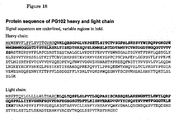
- the IgG 4 antibody of the invention comprises the constant regions of the heavy and light chain amino acid sequence as depicted in figure 18 .
- the IgG 4 antibody of the invention comprises the heavy and light chain amino acid sequence as depicted in figure 18 .
- constant region of IgG 4 Some variation in the constant region of IgG 4 occurs in nature and/or is allowed without changing the immunological properties of the resulting antibody. Typically between about 1-5 amino acid substitutions are allowed in the constant region.
- An antibody with an IgG 4 constant region or a mutated IgG 1 constant region has at least most of the pharmacological properties of an antibody but does not bind complement, and will thus not induce depletion of the cell its binds to in vivo.
- said constant region is a constant region of a human antibody.
- the invention provides a nucleic acid encoding an antibody according to the invention.
- a nucleic acid as used in the invention is typically but not exclusively a ribonucleic acid (RNA) or a deoxyribonucleic acid (DNA).
- Alternative nucleic acids are available for a person skilled in the art, such as for instance peptide nucleic acids (PNA).
- a nucleic acid according to the invention is for instance comprised in a cell. When said nucleic acid is expressed in said cell, said cell produces a polypeptide and/or a binding body and/or an antibody according to the invention. Therefore, the invention in one embodiment provides a cell comprising an antibody according to the invention and/or a nucleic acid according to the invention.
- Said cell is preferably an animal cell, more preferably a mammal cell, more preferably a primate cell, most preferably a human cell.
- a suitable cell is any cell capable of comprising and preferably of producing an antibody according to the invention and/or a nucleic acid according to the invention.
- the invention further provides a cell comprising an antibody according to the invention.
- a cell comprising an antibody according to the invention.
- said cell produces said antibody.
- said cell is a hybridoma cell, a Chinese hamster ovary (CHO) cell, an NS0 cell or a PER-C6TM cell.
- said cell is a CHO cell.
- a cell culture comprising a cell according to the invention.
- Various institutions and companies have developed cell lines for the large scale production of antibodies, for instance for clinical use. Non-limiting examples of such cell lines are CHO cells, NS0 cells or PER.C6TM cells. These cells are also used for other purposes such as the production of proteins.
- Cell lines developed for industrial scale production of proteins and antibodies are herein further referred to as industrial cell lines.
- the invention provides the use of a cell line developed for the large scale production of protein and/or antibody for the production of an antibody of the invention.
- the invention further provides a method for producing an antibody comprising culturing a cell of the invention and harvesting said antibody from said culture.
- said cell is cultured in a serum free medium.
- said cell is adapted for suspension growth.
- an antibody obtainable by a method for producing an antibody according to the invention.
- the antibody is preferably purified from the medium of the culture.
- said antibody is affinity purified.
- a cell of the invention is for instance a hybridoma cell line, a CHO cell, an NS0 cell or another cell type known for its suitability for antibody production for clinical purposes.
- said cell is a human cell.
- a preferred example of such a cell line is the PER.C6TM cell line or equivalent thereof.
- said cell is a CHO cell or a variant thereof.
- GS Glutamine synthetase
- a polypeptide of formula (I) in said antibody comprises X 1 -X 5 wherein:
- a heavy chain variable region wherein at least one of X 1 , X 2 , X 3 , X 4 or X 5 is the same as an amino acid at the corresponding position in a sequence that is shown by the invention to yield specifically good expression levels and wherein further at least one of X 1 , X 2 , X 3 , X 4 or X 5 is the same as an amino acid at the corresponding position in a 5D12 amino acid sequence.
- An advantage of a polypeptide wherein at least one of X 1 , X 2 , X 3 , X 4 or X 5 is the same as an amino acid at the corresponding position in a 5D12 amino acid sequence is that a binding body comprising such a polypeptide shows a better expression level than a polypeptide wherein none of X 1 , X 2 , X 3 , X 4 or X 5 are the same as an amino acid at the corresponding position in a 5D12 amino acid sequence.
- said better expression level is believed to be due to the fact that an amino acid at the position of X 1 , X 2 , X 3 , X 4 and/or X 5 contributes to a proper assembly of a binding body when said amino acid is the same as an amino acid at the corresponding position in a 5D12 amino acid sequence.
- an antibody comprising a polypeptide of formula (I) shows non-stimulatory antagonistic activity.
- a polypeptide according to the invention is therefore particularly suited for ameliorating a symptom of an inflammatory disorder.
- an antibody comprising a binding body of the invention is a monoclonal antibody.
- Monoclonal antibody technology allows for production of large amounts of essentially pure antibodies, thus obtaining predictable products. Therefore, the invention in one embodiment provides an antagonistic anti-human CD40 monoclonal antibody comprising a polypeptide according to the invention.
- a binding body according to the invention is all the more suitable for that purpose since it is in one embodiment deimmunized compared to a mouse 5D12 and/or a chimeric 5D12. Therefore, a binding body of the invention has a reduced immunogenicity and an enhanced half-life in humans compared to a mouse 5D12 and/or a chimeric 5D12. As a result thereof, a binding body of the invention has a sustainable pharmaceutical potential against various inflammatory disorders.
- the invention provides a deimmunized antagonistic anti-human CD40 monoclonal antibody according to the invention.
- the present invention provides 5D12 like molecules that comprise amino acid alterations with respect to the 5D12 amino acid sequence, wherein the alterations are at least in the heavy chain variable domain and preferably also in the light chain variable domain.
- the invention further describes a binding body comprising an amino acid sequence of formula (II) wherein:
- Said binding body is preferably an antagonistic anti-human CD40 monoclonal antibody according to the invention.
- An X selected from X 6 , X 7 , X 8 , X 9 , X 10 or X 11 is selected from a group resembling an amino acid at a corresponding position in a 5D12 amino acid sequence and/or resembling an amino acid at a corresponding position in a sequence that is shown by the invention to yield good expression levels, as shown in example 2. Therefore, a binding body as described herein preferably comprises an amino acid sequence of formula (II) wherein:
- the invention provides an antagonistic anti-human CD40 monoclonal antibody according to the invention comprising a polypeptide of formula (II) of the invention comprising an amino acid sequence as follows.
- the invention provides an antibody as claimed comprising a polypeptide of formula (II) of the invention wherein X 6 is T or S, X 7 is D or Q, X 8 is Q or P, X 9 is V or A, X 10 is V or L and X 11 is F or Y. More preferably wherein: X 6 is T, X 7 is Q, Xsis P, X 9 is A, X 10 is V and X 11 is Y.
- 5D12-like antibodies comprising a polypeptide of formula (I) and the preferred polypeptide of formula (II) combine good expression levels in a producing cell with good tolerance properties and pharmacodynamic properties in a human.
- An anti human-CD40 antagonist antibody of the invention comprises a heavy chain variable domain amino acid sequence of formula (I) and a light chain variable domain amino acid sequence of formula (II) as claimed.
- Such an antibody has good characteristics. It is of course possible to generate variants of such an original antibody by modifying one or more amino acids therein. Many of such variants will behave more or less similar when compared to said original. Such variants are also described herein. There are many ways to modify an antibody of the invention. A non-limiting example of such a modification is an antibody comprising a pyro-glutamate instead of a glutamate. Other non-limiting examples of such modifications are an insertion, deletion, inversion and/or substitution of one or more amino acids when compared to said original antibody.
- the present invention provides means and methods for generating such a variant. It also provides tests for determining the characteristics of said a variant. Also described is a variant of an original antibody of the invention said variant comprising an insertion, deletion, inversion and/or substitution of between about 1 to 10 amino acids when compared to the amino acid sequence of said original antibody. Preferably said insertion, deletion, inversion and/or substitution does not comprise the amino acids at position X 1 and position X 2 of the heavy chain variable domain of formula (I) of the original antibody.
- Said insertion, deletion, inversion, and/or substitution of between about 1 to 5 amino acids can be in any part of the antibody not being or involving the amino acids at positions X 1 and X 2 .
- said insertion, deletion, inversion, and/or substitution of between about 1 to 5 amino acids is in said heavy chain amino acid sequence or said light chain amino acid sequence when compared to the corresponding chain amino acid sequence in said original antibody.
- said insertion, deletion, inversion, and/or substitution of between about 1 to 5 amino acids is in said heavy chain amino acid sequence when compared to said heavy chain sequence of said original antibody.
- said method further comprises generating an antibody producer cell line that produces said selected antibody. This producer cell line can be said further cell line, or yet another cell line that produces said selected antibody.
- the invention provides a pharmaceutical composition comprising an antibody according to the invention, a nucleic acid according to the invention and/or a cell according to the invention. Also, the invention provides an antibody according to the invention, a nucleic acid according to the invention and/or a cell according to the invention for use as a medicament. Preferably a medicament for ameliorating a symptom of an autoimmune disorder and/or an inflammatory disorder and/or for reducing graft rejection and/or for the treatment of CD40 positive cancers.
- said autoimmune and/or an inflammatory disorder is selected from the group of inflammatory bowel disease, rheumatoid arthritis, systemic lupus erythematosus, multiple sclerosis, psoriasis, bullous pemphigoides and atopic dermatitis.
- a polypeptide as described herein is particularly suited for ameliorating a symptom of an inflammatory disorder because of its non-stimulatory CD40 antagonizing properties
- a polypeptide as described is suitable for ameliorating a symptom of several disorders.
- An inflammatory disorder as used in the invention is defined as any disease that involves an inflammatory component.
- an inflammatory disorder specifically includes an autoimmune disorder and/or graft rejection.
- the central role of CD40-CD40L interaction in the initiation, amplification and prolongation of immune responses makes a polypeptide as described specifically suitable for immune modulation in an autoimmune disorder.
- CD40 and CD40L in order to illustrate the role of CD40 and its ligand in inflammatory disorders.
- the CD40 molecule is a 50 kDa type I membrane glycoprotein and is expressed on B cells, monocytes/macrophages, and dendritic cells (DCs) 45-50 .
- DCs dendritic cells
- CD40 can be found on endothelial cells (ECs), fibroblasts, epithelial cells and keratinocytes 51 .
- CD40 ligand gp39, TBAM, TRAP, CD40L, CD154
- CD40L a 32 kDa type II integral membrane glycoprotein
- CD40L has been found on a number of other cell types after activation, including mast cells, basophils, B cells, eosinophils, DCs and platelets 54,55 .
- CD40L Engagement of CD40 by CD40L triggers a number of biological events in B cells including proliferation, expression of activation markers, immunoglobulin (Ig) production, isotype switching, homotypic adhesion and rescue from apoptosis 56,57 .
- Ig immunoglobulin
- the distribution of the CD40 molecule is not restricted to B cells as was originally postulated.
- Freshly isolated human monocytes express low levels of the CD40 molecule, which can be up-regulated by culture in the presence of IFN- ⁇ 47-49,58 .
- CD40 ligation of monocyte/macrophages induces the secretion of large amounts of proinflammatory mediators such as IL-1, TNF- ⁇ and IL-12, which induce inflammatory responses and tumoricidal activity 47-49,58 , and rescue them from apoptosis 48 .
- CD40 ligation also causes DCs to enhance their differentiation and activation, to enhance expression of costimulatory molecules such as CD86, CD80 and CD58, to increase cytokine production, and to inhibit apoptosis 50,59 .
- CD40 signaling can induce expression of intercellular adhesion molecule 1 (ICAM-1), vascular cell adhesion molecule 1 (VCAM-1) and E-selectin on ECs 55 .
- IAM-1 intercellular adhesion molecule 1
- VCAM-1 vascular cell adhesion molecule 1
- E-selectin E-selectin
- a specific role for CD40 and its ligand is demonstrated in murine models of autoimmune disease.
- Animal model studies have clearly indicated the involvement of the CD40L-CD40 interaction in the pathophysiology of various autoimmune diseases. In these studies, using mice suffering from spontaneous or experimental autoimmune diseases, interfering with CD40L-CD40 interactions had clear beneficial effects.
- a Mab to murine CD40L was shown to prevent or reduce disease symptoms in collagen-induced arthritis, experimental allergic encephalomyelitis (EAE; an animal model for MS), in (SWR x NZB)F1 lupus mice and in non-obese diabetic (NOD) mice that spontaneously develop T-cell dependent autoimmune diabetes.
- EAE experimental allergic encephalomyelitis
- SWR x NZB non-obese diabetic
- CD40-CD40L interactions also play a role in the pathogenesis of inflammatory bowel diseases, which includes Crohn's disease and ulcerative colitis.
- CD40L transgenic mice with high transgene copy numbers were shown to acquire lethal inflammatory bowel disease marked by infiltration of CD40 + cells and CD40L + T cells into diseased tissues 67 .
- Anti-CD40L Mab effectively prevent mucosal inflammation and IFN- ⁇ production by lamina intestinal CD4 + T cells in animals with colitis that had been induced by 2,4,6-trinitrobenzene sulfonic acid 44 .
- Multiple sclerosis is an autoimmune disease of the central (cerebrospinal) nervous system.
- MS multiple sclerosis
- the hardened areas of nerve tissue are called plaques.
- the symptoms, severity, and course of multiple sclerosis are highly variable, depending partly on the sites of the plaques and the extent of the deterioration of the white matter.
- the deterioration of white matter in the nervous system slows nerve impulses leading to nervous system incoordination.
- EAE Experimental autoimmune encephalomyelitis
- CNS central nervous system
- Marmosets immunized with rhMOG a recombinant protein representing the extracellular fragment of human MOG (amino acids 1-125) develop EAE in 100% of the cases, which is due to the presence of the monomorphic MHC class II susceptibility element Caja-DRB*W1201 in the repertoire of each monkey 82,84,85,107 .
- a particularly useful aspect of this model for therapy development is that lesions developing in the brain white matter can be visualized and tentatively characterized with clinically relevant magnetic resonance imaging techniques 92,105 . Longitudinal analysis of the brain white matter lesions with magnetic resonance imaging (MRI) showed a progressive increment of the volume and persistent inflammatory activity in the majority of the lesions. Furthermore, the characterization of the CNS pathology with MRI and previously described histological criteria 101 revealed that the majority of the lesions are in an early active stage 106 .
- MRI magnetic resonance imaging
- the rhMOG-induced EAE model has been used to test whether antibodies targeting co-stimulatory molecules of antigen presenting cells (APC) and T-cells are a potential treatment for MS.
- APC antigen presenting cells
- CD154 plays an important role in various immunopathogenic processes that operate in EAE, including B-cell activation, antigen-presenting cell (APC) activation, initiation of antigen-specific T-cell responses and induction of macrophage effector functions 90,93,97,7 .
- a study performed in 1996 confirmed that mice treated with an antibody against CD154 are protected against EAE 88 .
- a clinical trial in MS patients with antibody against CD154 was stopped due to unexpected side-effects that were not observed in the animal experiments 17 .
- the mouse monoclonal antibody (Mab) 5D12 (mu5D12) has been raised against human CD40.
- the 5D12 antibody appeared a potent inhibitor of CD40-CD40L mediated activation on several cell types and, unlike most other anti-CD40 Mabs, does not exert CD40 stimulatory activity 21,22,39 .
- Both the mouse anti-human CD40 antibody mu5D12 and the chimeric version of this antibody, ch5D12 displayed strong suppressive effects on the development of CNS white matter lesions and neurological deficit in the marmoset EAE model and showed no marked side-effects 23,24 .
- CD40 is prominently expressed within the CNS white matter lesions of MS patients as well as EAE-affected rodents 88 and non-human primates 95 .
- That CD40 bearing APC within the CNS such as infiltrated macrophages as well as perivascular and parenchymal glia cells, contribute significantly to the pathogenesis of EAE has been elegantly shown in bone marrow chimeric mice 83 .
- Psoriasis is an inflammatory skin disease afflicting 1-2% of the population.
- T cells and keratinocytes in the lesions are activated and express activation markers and co-stimulatory molecules. It is thought that some costimulatory molecules expressed on keratinocytes and T cells interact with each other and that these interactions contribute to disease activity 108-110 .
- One such set of molecules may be CD40, which is expressed on activated keratinocytes, and CD154 (CD40 ligand), which is transiently expressed on activated CD4+ T cells.
- CD40-CD154 ligation between T cells and keratinocytes may release from these cells inflammatory mediators that are seen in abundance in psoriatic lesions.
- CD40, CD154, and CD40-CD154 interactions have recently been reviewed 111 .
- Cultured keratinocytes also express CD40; expression is enhanced by IFN-treatment. Ligation of highly expressed CD40 on IFN-gamma treated keratinocytes (referred to as CD40++ keratinocytes throughout this paper) with CD154 results in up-regulation of ICAM and increased production of cytokines 112-114.
- CD154 acts as one of the signals for production by keratinocytes of chemokines and complement, which are found in abundance in psoriatic lesions 115 .
- CD40 ligation induces the release of chemokines (IL-8, RANTES, and MCP-1) 116 .
- chemokines IL-8, RANTES, and MCP-1
- Pasch et al. showed that the CD40-related release of the chemokines IL-8, MCP-1 and to a lesser extent of RANTES was inhibited by the antagonistic anti-CD40 antibody 5D12 116 .
- antagonist anti-CD40 mAb 5D12 may at least in part have an effect on the inflammation seen in psoriatic lesions.
- US2003/0165499 discloses a measurable anti-psoriatic effect of the 5D12 and other antagonistic anti-CD40 antibodies in a SCID mouse xenogeneic transplant model system that is used as a model for psoriasis treatment, showing that antagonistic anti-CD40 antibodies may be used for the treatment of psoriasis.
- a therapeutic effect of 5D12 in this in vivo system was demonstrated
- said autoimmune and/or an inflammatory disorder comprises inflammatory bowel disease.
- said inflammatory bowel disease comprises ulcerative colitis (UC) or Crohn's disease (CD).
- a polypeptide according to the invention is suited for treatment of diverse inflammatory disorders, including autoimmune disorders and graft rejection. Therefore, the invention in one embodiment provides a method for ameliorating a symptom of an autoimmune disorder and/or an inflammatory disorder and/or for reducing graft rejection.
- the invention provides use of an antibody according to the invention, a nucleic acid according to the invention and/or a cell according to the invention for the manufacture of a medicament for ameliorating a symptom of an autoimmune disorder and/or an inflammatory disorder and/or for reducing graft rejection.
- Ameliorating a symptom as used in the invention is defined as ameliorating at least one symptom of a disorder at least partially.
- the invention is of specific interest for autoimmune and/or inflammatory disorders for which at present no efficient treatment exists.
- these disorders are rheumatoid arthritis, systemic lupus erythematosus, multiple sclerosis, psoriasis, inflammatory bowel disease, bullous pemphigoides and atopic dermatitis.
- a polypeptide as described herein, optionally comprised in a binding body as described or a cell of the invention and/or encoded by a nucleic acid of the invention, is specifically suited for ameliorating a symptom of an autoimmune and/or inflammatory disorder as defined properties of a polypeptide as described allow for interfering with a CD40-CD40L pathway in a specific manner.
- the invention in one embodiment provides a use an antibody according to the invention, a nucleic acid according to the invention and/or a cell according to the invention for the manufacture of a medicament for ameliorating a symptom of an autoimmune disorder and/or an inflammatory disorder and/or for reducing graft rejection, wherein said autoimmune and/or said inflammatory disorder is selected from the group of rheumatoid arthritis, systemic lupus erythematosus, multiple sclerosis, psoriasis, inflammatory bowel disease, bullous pemphigoides and atopic dermatitis.
- Subjects could not have received treatment with cyclosporin A or methotrexate within 3 months before screening nor were they allowed to have prior exposure to treatment with Mabs.
- the average age of all subjects enrolled was 35.8 years of whom seven were males and 11 were females. All subjects were of Caucasian ethnicity. No apparent differences between patients in the different cohorts at inclusion were observed (Table 1), with the exception that in the lower three dose groups the majority of the subjects were females, while the highest dose group (10.0 mg/kg) consisted of only male subjects.
- ECG electrocardiogram
- vital signs vital signs
- physical examinations history of Crohn's disease signs and symptoms
- baseline laboratory values There were no significant differences regarding baseline characteristics amongst the four dose cohorts.
- ch5D12 is a molecularly engineered human IgG4 antibody containing the variable domains of the heavy and light chains of Mab 5D12 parent version. This Mab has been shown to bind to CD40-bearing cells and to antagonize CD40 mediated activation of various cells 20-27 .
- ch5D12 was administrated in an open label, single dose, multi-centre trial, studying four dose levels. There were five subjects in each treatment group except for the final dose cohort in which only three subjects were enrolled. Single administration at dose levels of 0.3, 1.0, 3.0, and 10.0 mg/kg of ch5D12 was done intravenously. After completing recruitment into one dose group, recruitment into the next group was only started when safety had been established at the current dose level.
- Clinical disease activity was assessed at each visit weekly for the first 28-day period and a subsequent last visit at day 56. Two subjects (3.0 mg/kg dose cohort) withdrew from the study after the day 28 assessments but their data are included in the evaluation. Subjects were to remain stable on the same dose of their current medication during the course of the study. No un-allowed concomitant medication was used during the study. Response to ch5D12 treatment was defined as a decrease in CDAI of ⁇ 100 points and clinical disease remission was defined as a CDAI of ⁇ 150 (total score) and a decrease of CDAI of at least 100.
- Serum concentrations of ch5D12 were determined by ELISA as previously described 27 .
- blood was collected in heparin tubes and diluted twofold in PBS.
- Peripheral blood mononuclear cells (PBMC) were isolated by gradient centrifugation (Lymphoprep, Nycomed, Roskilde, Denmark) and 500 000 cells were stained with FITC-labelled ch5D12 and PerCP-labelled anti-CD20 (Becton-Dickinson, Mountain View, CA, USA) and incubated on ice for 30 min.
- FITC-labelled ch5D12 and PerCP-labelled anti-CD20 Becton-Dickinson, Mountain View, CA, USA
- Mucosal biopsies from ileum and colon obtained during ileocolonoscopy prior to treatment on day 0 and on day 28 with a standard forceps were fixed in formalin 6% for routine analysis. Additional samples were immediately snap-frozen in Tissue-Tek optimum cutting temperature compound (Miles Laboratories Inc, Naperville, IL, USA) in liquid nitrogen cooled isopentane. Samples were stored at -80 °C until further use. Formalin fixed samples were routinely paraffin processed. Five-micrometer thick sections were prepared and stained with haematoxylin and eosin. The sections were analysed using a Leitz Wetzlar microscope (Wetzler, Germany). A total of four semi-serial sections for each sample were analysed.
- the frozen samples were used for immunohistochemical analysis, which was performed using a panel of Mabs to assess the presence of different subsets of lymphocytes and monocytes/macrophages.
- the panel was completed with Mabs directed against CD40 and CD40L.
- Immunohistochemical staining was performed on cryostat sections, dried overnight at room temperature, and fixed in absolute acetone for 10 min.
- CD3 clone: UCHT1, 1/10 dilution
- CD4 clone: MT310, 1/10 dilution
- CD8 clone: 144B, 1/20 dilution
- CD19 clone: HD37, 1/30 dilution
- CD40 clone: 5D12, 1/100 dilution
- CD68 clone: Kp1, 1/50 dilution
- CD154 clone: M90, 1/10 dilution
- the secondary Mab was a biotin-labelled anti-mouse immunoglobulin (1/400 dilution; Dako) applied for 30 min.
- Dako biotin-labelled anti-mouse immunoglobulin
- sections were also incubated in methanol solution containing 0.3% (v/v) H 2 O 2 for 20 min. After three washes with PBS, the avidin/biotin peroxidase-labelled complex (Dako) was added. In between the incubations, the sections were washed in phosphate buffered saline at pH 7 for 15 min.
- reaction product was visualized by incubating the section for 10 min in 0.05 m acetate buffer at pH 4.9, containing 0.05% 3-amino-9-ethyl-carbazole (Janssen, Beerse, Belgium) and 0.01% H 2 O 2 , resulting in a bright-red immunoreactive site. Afterwards, the slides were faintly counterstained with Harris haematoxylin, rinsed with distilled water and a cover-slip was applied with glycerol. Controls, which were negative, consisted of an omission of a primary or secondary antibody, use of chromogen alone, and use of irrelevant isotype-matched mouse IgG (vimentin; Dako).
- Paraffin sections stained with haematoxylin and eosin were all analysed by the same pathologist (K. G.) blinded for the origin of the samples. Disease activity was assessed using a histological numerical score 40 of which the maximum activity corresponded to 16. The immunohistochemically stained sections were also analysed in a blinded fashion. For 15 sets of biopsies, positively staining cells were counted in high power fields (magnification ⁇ 40). The fields were chosen according to the highest density of stromal cells. The number was expressed as a percentage of the total number of mononuclear cells in the stroma.
- PHA phytohemagglutinin mitogen
- CD3 and CD19 were percentages of T cells and B cells within the lymphocytic population, whereas, CD4 and CD8 cells were reported as percentages of CD3 cells. Only CD14 (monocytic population) is shown as a percentage of the total CD45 population.
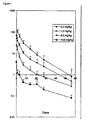
- the mean peak levels of ch5D12 after a single i.v. injection were dose-dependent and dose-proportional ( Figure 1 ). After 24 h, approximately 50% of the administrated ch5D12 could be detected in serum in the highest three dose cohorts. For the 0.3 mg/kg cohort, only 15% was present in serum after 24 h. From non-human primate studies, a t1/2ß of 8-10 days has been calculated 27 which was confirmed by the current human data. Complete coating of CD40 on peripheral blood B cells was not achieved by the infusion of 0.3 mg/kg as determined by an ex vivo competition assay using FITC-labelled ch5D12 (not shown).
- the change from the baseline to day 28 histopathology activity score is shown in Figure 3 .
- Samples from the ileum of nine patients and samples from the colon of 11 patients at day 0 were available. In four cases, the ileum was not involved at screening while five patients had active ileal disease. The mean histology score at day 0 for those with active disease was 4.6 (range 3-7). The mean histology score for the five patients decreased to 1.0 (range 0-3) at day 28. In four of 11 patients, the colon was not involved at day 0 and the colonic samples from these patients remained normal at day 28. In seven patients the colon was clearly involved with a mean histology score at day 0 of 4.5 (range 2-12). This decreased at day 28 to a mean score of 1.7 (range 0-7).
- the score at day 28 was either 0 indicating a normal biopsy or 1 indicating only architectural abnormalities.
- the colonic score of one subject decreased, but the other colonic scores in this group remained high and the ileum score even increased.
- the higher dose cohorts either the ileum or colon or both decreased in the activity score at day 28 after treatment with ch5D12.
- a positive response [as defined in Ref. (41)] was observed in 81% (9/11) of subjects.
- seven subjects with active disease at day 0 showed reduced neutrophil activity to the point that neutrophils were not present in their biopsies at day 28.
- the pattern for the CD19+ B cells was comparable with that observed for the T cells.
- the amount of the B cells had normalized in all cases except for the one patient from the low-dose group.
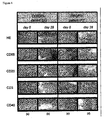
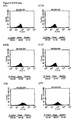
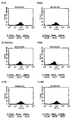
- Figure 4 shows representative examples of the decrease of all three major cell types (T cells, B cells and monocyte/macrophage cells) in ileum biopsies of patient 011 (activity score: 7) and colonic biopsies of patient 012 (activity score: 12) before ch5D12 administration and at day 28 after ch5D12 administration.
- SAEs serious adverse events
- PBMC isolated at various time-points prior and after treatment were stimulated by the polyclonal T-cell activator PHA.
- PHA polyclonal T-cell activator
- Anti-ch5D12 antibodies were not detectable in the two lower dose cohorts throughout the entire study. In the 3.0 mg/kg cohort, one subject was found to have mounted an anti-ch5D12 response, although the signal was very low and could only be detected in the undiluted day 28 sample of this patient. In the highest dose group, another subject had anti-ch5D12 antibodies on day 28 and day 56 of the study. These could be detected with a 1:64 dilution. Therefore, only two subjects had a possible immune response to ch5D12 administration.
- ch5D12 In this open label, multi-centre trial, four dose levels of ch5D12 were administrated to subjects with moderate to severe Crohn's disease. Eighteen subjects were enrolled, with five subjects in each treatment group except for the final dose cohort in which only three subjects were enrolled. ch5D12 serum levels increased dose-dependently and the long serum half-life that was observed in cynomolgus monkeys 27 was confirmed in humans. This study shows the feasibility of antagonizing CD40-mediated cell activation using ch5D12, in the absence of major side effects. The CDAI analysis indicates that 72% of subjects experienced a clinical response and 22% experienced a remission during the study.
- ch5D12 has shown functional activity in a rhesus monkey renal transplantation model 25 and when used as immune suppressive strategy to prevent immune responses against adenoviral particles and their products 26 .
- a tissue cross-reactivity study on human and cynomolgus tissues showed that ch5D12 bound to the cell surface of B cells and DCs in lymphoid organs. No unexpected cross-reactivity was observed on either human or cynomolgus tissues.
- a safety and tolerability evaluation for ch5D12 was performed in cynomolgus monkeys, in which weekly administration of ch5D12 for 4 weeks was shown to be safe and without any side-effects in all monkeys.
- the CD40-CD154 (CD40L) co-stimulatory pathway has been validated in animal models as a promising clinical target for treatment of autoimmune disease and transplantation rejection. 15 Potentially the CD40-CD154 interaction can be inhibited by targeting either CD40 or CD154. All previous studies have focused on antagonizing CD154, which is selectively expressed on activated T cells and platelets. 8-11 Human clinical studies using an anti-human CD154 Mab have been halted because of thromboembolic events 12-14 . As this anti-CD154 Mab is constructed as a humanized IgG1, which binds extremely well to Fc-receptors, the anti-CD154 Mab may cross-link CD154 to Fc-receptors resulting in the formation of blood clots.
- CD40 was reported to be constitutively expressed on platelets and found to be functionally important using soluble CD154 as stimulus for platelet activation. These stimulatory effects that resulted in activation of platelets were abrogated by addition of anti-CD154 or anti-CD40 Mabs 42 .
- the IgG 4 Fc part of the ch5D12 Mab backbone has reduced capability to bind to Fc-receptors expressed on platelets as compared with an IgG 1 backbone. Further discrimination between the two approaches comes from the fact that ch5D12 targets B cells, monocytes, macrophages and DC, while an anti-CD154 Mab targets mainly activated T cells, resulting in markedly different clinical strategies. No indications of thromboembolism in any of the patients treated in this study were observed.
- ch5D12 The effect of ch5D12 is largely based on the interference with CD40 mediated cell activation.
- CD40 triggering induces cytokine and chemokine secretion by macrophages and DC, and enhances the antigen presenting capacity of the latter.
- a number of other inflammatory cytokines, such as IL-8 and IL-12 39 are induced by CD40 triggering and therefore ch5D12 might have anti-inflammatory properties in addition to the prevention of TNF- ⁇ production. Whether the effects observed depend mainly on a reduced T-cell activation, or a reduced release of cytokines and chemokines, awaits further investigation.
- the murine variable regions of 5D12 were cloned. Briefly, from lysated cells using Qiagen total RNA was isolated. By RT-PCR using the oligo's 5' CAG GTS MAR CTS SAG SAG TC W GG 3' and 5' GCA TGT ACT AGT AAT TTT TVT TGT CCA CYT TGG TGC T 3' to amplify the VH region and using the oligo's 5'CGA TAC GAS MTY CAG CTG ACC CAG TCT CCA 3' and 5'GAC TCA TCT AGA TAC ACT CAT TCC TGT TGA AGC TCT TG 3' to amplify the VL region of mu5D12.
- V-regions were recloned in pcDNA3002 ( Marissen et al, J. of Virol, 2005: 79:4672-4678 ), together with genomic sequences encoding human IgG 4 and human kappa to construct a chimeric IgG 4 immunoglobulin expression plasmid.
- T-cell epitopes In collaboration with Biovation using their proprietary DeImmunisation technology within the V regions potential T-cell epitopes were identified.
- Helper T cell epitopes comprise short amino acid sequences within proteins with the capacity to bind to MHC class II molecules. By removal of the T cell epitopes the antibody can no longer trigger T cell help and the subsequent immunogenicity against it.
- Identification was done using Peptide Threading.
- the Peptide Threading approach is a computer-based method for predicting the binding of peptides (small amino acid sequences) to 18 different human MHC class II molecules based on known structures solved by X-ray crystallography. Furthermore an analysis was done to search the V regions for the presence of known human T cell binding peptides from a database ( www.wehil.wehi.edu.au ).
- V regions Based on the primary murine V region amino acid sequences, surface humanized (veneered) V regions were designed. Within these veneered VH sequence 8 potential T-cell epitopes and within the veneered VL region 4 T-cell epitopes were identified. Identified T-cell epitopes were removed by amino acid substitution. Based on this analysis the DNA sequences encoding the deimmunized VH and VL region were synthesized and recloned in the pcDNA3002-hIgG 4 -kappa expression plasmid.
- the QuickChange Site-Directed Mutagenesis kit of Stratagene was used according to the manufacturer's protocol. In table 4 the used oligonucleotides are shown. Briefly, the plasmid was denatured followed by annealing of the sense and anti-sense primers containing the desired mutation. By cycling (30 sec 95°C; 30 sec 55°C; 600 sec 68°C) for 16 times using a Biometra T gradient PCR machine the mutagenic sequences were incorporated. The non-mutated parental plasmid was digested using DpnI, which only cuts methylated DNA.
- plasmids were generated using the oligonucleotides as shown in table 6. Two mutagenesis rounds were required to create double mutants (Table 7). Plasmids were used to transform XL1-blue competent cells.
- PER.C6TM (Crucell). Briefly, the day before the transfection PER.C6TM were trypsinized and counted. Cells were plated in DMEM substituted with 10% FCS at a density of 4 x 10 5 cells per well in a T24 well plate. Next day medium was replaced with 0.5 ml fresh medium. For each well 1 ⁇ g of plasmid DNA was diluted into 50 ⁇ l of OPTI-MEM I, which was combined with equal volume OPTI-MEM I containing 3 ⁇ l LipoFectAMlNE 2000 (LF2000) reagent (Invitrogen).
- DNA-LF2000 reagent complexes 100 ⁇ l were directly added to each well.
- the transfected cells were incubated at 37°C in a CO 2 incubator. After 48h the supernatants were analyzed for antibody expression.
- the amount of expressed antibody was measured by a sandwich ELISA. Briefly, 96 wells EIA/RIA plates (Corning 3590) were coated o/n at 4°C with polyclonal antibody anti-human IgG (Jackson 109-005-088) diluted 1/1000 in PBS (100 ⁇ l/well). After blocking with PBS containing 0.05% Tween and 1% BSA, plates were 3x washes with PBS-0.05% Tween. Subsequently as standard purified chimeric 5D12 was applied in titration starting at 400 ng/ml to zero in triplo. Samples (transient supernatants) also applied in titration.
- JY cells are EBV transformed human B-cells, which express CD40. Briefly, 100,000 JY cells were incubated with 100 ⁇ l supernatant from the transient expression experiment at 4°C for 20 minutes. To remove unbound antibody cells were washed with PBS containing 0.05% NaAzide and 1% BSA. As secondary antibody 1/100 diluted FITC labeled anti-human IgG (Jackson 109-095-127) was used. After 20 minutes incubation at 4°C cells were washed. Finally cell samples were measured on a FACScan (BD).
- BD FACScan
- VH region 8 first base of potential epitope: position 27, 30, 43, 46, 57, 61, 77 and 83
- VL region 4 position 7, 13, 28 and 86
- N-X-T/S N-glycosylation site
- DI5D12 fully deimmunized 5D12
- ch5D12 ch5D12
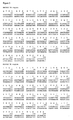
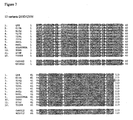
- each substitution can influence the characteristics of the expressed antibody. Therefore to investigate the influence of each changed position in the VH region on the characteristics of the antibody 12 additional variants were designed ( figure 7 ). In each variant 1 position was changed back to the original murine amino acid sequence.
- Each plasmid contains the human IgG 4 backbone to which the VH regions were linked and the human kappa region to which the VL regions were linked.
- the other 13 plasmids are deimmunized versions, in which the deimmunized VL region is used in combination with the deimmunized VH region or one of the 12 VH variants shown in figure 7 .
- PER.C6TM cells were transfected with the 14 plasmids using LipoFectamine2000.
- the tested variants can be divided in 3 groups: no or low improvement on the expression level (Q5E, K13A, E16Q, T17S and STS60NSA), variants P45L, M48L, S79F and T108S restore the expression levels as compared with ch5D12 (PG100) up to 40%, while the I29L and I37V variants restore the level above 50%. Specially the substitution at position 29 (I to L) seems to have large influence on the expression levels. The I29L variant was subsequently renamed PG102 antibody.
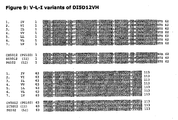
- Figure 9 shows the V-L-I variants that were designed in alignment with ch5D12 (PG100), DI5D12 and PG102 (I29L variant).
- V-L-I variants additional pcDNA3002 expression plasmids were constructed that contain the human IgG 4 backbone to which the VH region of one of the variants was linked and the human kappa region to which the VL regions were linked, as described above.
- PER.C6TM cells were transfected with the plasmids using LipoFectamine2000. After 48 hour the transient supernatants from each transfection were harvested and analysed for antibody expression. To exactly determine the various expression levels, all supernatants were analysed by quantitative ELISA measuring antibody levels. As shown in table 8, the various combinations of a V, L or I on positions 29 and 37 are associated with variable production levels. This further demonstrates that not just all V, L and I substitutions ultimately lead to higher production levels.
- Lonza Biologics (Lonza) was requested by PanGenetics BV to undertake the construction, selection and evaluation of a GS-CHO cell line expressing the human recombinant IgG 4 /kappa antibody PG102 (I29L variant).
- the cell lines were constructed by transfecting CHOK1SV host cells with vectors generated using Lonza's Glutamine Synthetase (GS) Gene Expression System ( WO2003054172 ). The gene sequences were supplied by PanGenetics.
- the cell line CHOK1SV is a suspension variant of the Chinese hamster ovary (CHO) cell line CHOK1, which has been adapted to chemically defined, animal component-free (CDACF) medium ( Bebbington et al (1192) Biotechnology 10:169-75 ; de la Cruz Edmonds MC et al (2006) Mol. Biotechnol. 34:179-90 ).
- CDACF animal component-free
- Cells were revived from vials of cryopreserved stocks by rapidly warming to 37 °C and diluting into approximately 50 mL of growth medium.
- the cryoprotectants were removed by centrifuging the cells, discarding the supernatant and resuspending the cells in fresh growth medium.
- cultures were expanded in a suitable volume of growth medium and subcultured every 4 days for growth in CDACF medium.
- the containers used were: 125 mL shake flasks (for a culture volume of 10 to 30 mL), 250 mL shake flasks (for a culture volume of 30 to 50 mL), 500 mL shake flasks (for a culture volume of 50 to 100 mL), 1 L roller bottles (for a culture volume of 100 to 200 mL), or 2 L roller bottles (for a culture volume of 200 to 400 mL).
- the headspace of each culture was gassed with 5% v/v CO 2 in air and the flasks sealed.
- the cultures were then incubated at 35.5 to 37.0 °C on a shaking platform rotating at 140 ⁇ 5 rpm.
- Total and viable cell concentrations were obtained by aseptically removing a sample of culture, staining the non-viable cells with Trypan Blue and microscopic examination using a modified Fuchs-Rosenthal haemocytometer. When appropriate, samples were diluted prior to counting.
- the total and viable cell concentrations were determined using a CASY-1 particle counter or a V i -CELL XR automated cell counter.
- CASY-1 counter a sample of culture was aseptically removed from each flask, diluted with Casyton buffer and the number of viable and total cells determined. Viable and non-viable cells were distinguished by size. Percentage viability was calculated as the ratio of viable cells to total cells multiplied by 100.
- V i -CELL XR counter 0.7 mL of cell culture was aseptically removed and an automated Trypan Blue count was performed. A series of camera pictures and a computer analysis algorithm are used to identify and count the viable and non-viable cells. For all counting methods, percentage viability was calculated as the ratio of viable to total cells multiplied by 100.
- the 96-well plates were incubated for approximately 3 to 4 weeks, following transfection to allow colony formation.
- the colonies were examined microscopically to verify that they were of a suitable size (covering greater than 60% of the bottom of the well), and that only one colony was present in each well.
- the culture supernatant was then assayed for antibody production using Lonza's ELISA assay for assembled antibody, described under "assembly ELISA".
- the percentage confluence of the well was assessed at the time of sampling. The value obtained by dividing the assay result by percentage confluence was used to rank the cell lines.
- the selected cell lines were allowed to multilayer and then re-fed with CD-CHO/25 ⁇ M MSX. After feeding, the cultures were returned to the incubator for a further four to seven days until the medium turned orange/yellow again and the cells lifted from the flasks.
- Suspension cultures were initiated from confluent T25 flask cultures.
- the suspension cultures were inoculated at a concentration of 0.05 to 0.2 x 10 6 viable cells/mL in 125 mL shake flasks containing CD-CHO/25 ⁇ M MSX medium. If the viable cell concentration did not reach 0.05 x 10 6 viable cells/mL after a maximum of 14 days in T25 flasks, 15 mL of each culture was automatically progressed into 15 mL of CD-CHO/25 ⁇ M MSX in 125 mL shake flasks. The cell lines were then serially subcultured into fresh CD-CHO/25 ⁇ M MSX medium, at an inoculation concentration of 0.2 x 10 6 viable cells/mL, on a 4 day subculture regime, until acceptable and reproducible growth characteristics were obtained.
- a bolus addition of the nutrient feed SF40 was made. Further bolus additions were made at approximately 24, 48 and 72 hours after the initial addition.
- a second feed (SF41) was applied once cell concentrations greater than 4.0 x 10 6 viable cells/mL were obtained. Samples of cultures were taken at appropriate intervals, centrifuged and the supernatants stored at -20 ⁇ 5 °C until assayed for antibody concentration by Protein A HPLC. Harvest supernatants from each overgrown culture were stored at -20 ⁇ 5 °C. The ten overgrown cultures with the highest antibody concentrations were further assessed for quality of the antibody produced.
- Samples were assessed for aggregate levels using the gel permeation high performance liquid chromatography (GP-HPLC) method before Protein A purification and antibody characterisation by reduced and non-reduced sodium dodecylsulphate poly acrylamide gel electrophoresis (SDS-PAGE) and isoelectric focusing (IEF) analysis and matrix assisted laser desorption ionisation time of flight mass spectrometry (MALDI TOF-MS) oligosaccharide analysis.
- GP-HPLC gel permeation high performance liquid chromatography
- IEF isoelectric focusing
- MALDI TOF-MS matrix assisted laser desorption ionisation time of flight mass spectrometry
- N f N i + 1 Ln ⁇ 2 . Ln ⁇ X f X i
- N f Generation number at time f
- N i Generation number at time i
- X f Viable cell concentration (cells/mL) at time f
- X i Viable cell concentration (cells/mL) at time i and f > i
- the time integral of the area under the growth curve (the time integral of the viable cell concentration (IVC); 10 9 cells.h/L) was calculated by summing the area (approximated to a right angle trapezium) between adjacent cell concentration values. The areas were calculated by multiplying the mean of the two viable cell concentrations (cells/mL) by the elapsed time between the two determinations (h). This method is based on that described by Renard et al. (1988) in Biotechnology Letters 10 (2) pages 91-96 .
- the overall specific production rate (q P overall: mg/10 9 cells/h) was calculated by linear regression analysis of the antibody concentration (mg/L) against the time integral of viable cell concentration. The slope of this line is equal to q P overall.
- the antibody concentration of supernatant samples was determined using an ELISA that measures assembled human IgG. This involved capture of assembled antibody in samples and standard onto a 96-well plate coated with goat anti-human IgG Fc. Bound antibody was revealed with goat anti-human light chain linked to horseradish peroxidase and the chromogenic substrate tetramethylbenzidine. Colour development was proportional to the mass of antibody present in the sample. The concentration was determined using a standard curve generated using an IgG standard (Lot number L07387/5/2)
- Gravity fed rmp Protein A Sepharose columns (5 mL) were prepared. The columns were cleaned before use with 6 M guanidine HCl and equilibrated with 50 mM glycine/glycinate-250 mM NaCl buffer, pH 8.0. The pH of the column load material was adjusted to pH 8.0 ⁇ 0.1 before application to the column.
- the rmp Protein A affinity column was washed with equilibration buffer and eluted with 0.1 M glycine buffer, pH 3.5. The column eluates were neutralised to approximately pH 7.0 with 2 M Tris Base and dialysed against Dulbecco's phosphate buffered saline in preparation for IEF and SDS PAGE analyses.
- the cell culture samples were prepared for analysis by protein A purification. Electrophoresis was carried out using 4 to 20% precast Novex polyacrylamide gels. For reducing SDS PAGE, samples were reduced using 2-mercaptoethanol and denatured by SDS at pH 8.0. Samples were heated for 2.0 ⁇ 0.5 minutes before they were loaded onto the gel (10 ⁇ g per lane). Non-reduced SDS PAGE was performed using the same gels and Novex non-reducing sample buffer (2-mercaptoethanol is not added). Samples were heated for a standard time of 1.0 ⁇ 0.5 minutes before they were loaded onto the gel (4 ⁇ g per lane). Following electrophoresis, proteins were visualised by staining for 75 minutes with Coomassie brilliant blue R250 and destained with methanol/acetic acid.
- the cell culture samples were prepared for analysis by protein A purification. IEF analysis was carried out using pre-cast agarose IEF gels, pH 3 to pH 10. Approximately 10 ⁇ g protein sample per lane was loaded onto the gel and then pre-focused for 70 Vh. After removal of the sample application strip, electrophoresis was continued for 1500 Vh (1500 V, 20 mA, 25 W per gel).
- the IEF gels were fixed in a trichloroacetic acid: sulphosalisylic acid: methanol solution and then stained with Coomassie Brilliant Blue R250 (Lot numbers of Coomassie Blue 003/L11905/118 and 003/L11905/131). The gels were then destained and dried. (Lot numbers of destain 003/L11905/117 and 003/L11905/121).
- the GP-HPLC method separates protein components according to their size. Large components, such as protein aggregates; are too large to penetrate the matrix particles to any great extent and therefore eluted from the column ahead of smaller components, such as protein monomer. Smaller components, such as fragments, penetrate the matrix more easily and eluted after the monomer. This technique was therefore used to separate antibody monomer from both aggregates and fragments.
- the monomeric component was identified by its characteristic retention time and position, relative to calibration markers.
- the proportion of sample components was determined by calculation of the peak areas of each component relative to the total integrated peak area.
- the oligosaccharide analysis of the PG102 antibody produced by each cell line was performed by MALDI TOF-MS using a MicromassTM MALDI-LR coupled with delayed extraction.
- the MALDI TOF-MS was operated in reflectron configuration with positive ion mode.
- the instrument was calibrated using a mixed N-glycan standard.
- Antibody was purified from harvest supernatants using a POROS Protein A column. The purified fractions were collected and the disulphide bonds were reduced with dithiothreitol followed by alkylation of the reduced thiols using iodoacetate. Oligosaccharides were released using the enzyme N-glycanase (PNGaseF) and were sandwiched between two layers of super-dihydroxy benzoic acid (super-DHB) matrix on the target plate for MALDI TOF-MS analysis.
- PNGaseF N-glycanase
- super-DHB super-dihydroxy benzoic acid
- the PG102 gene sequence was used by Lonza to constructed the double gene vector pPG102/DGV (not shown) that was used to transfect the CHOK1SV host cell line by electroporation.
- Six sets of transfections were performed using the vector pPG102/DGV and supernatants of 255 transfectants were screened for antibody production in 96-well plates by assembly ELISA. Detectable antibody levels were produced by 99.6% of the screened transfectants. Forty three high ranking transfectants were selected for further evaluation in 24-well plates.
- the growth and productivity characteristics of the 23 selected cell lines were evaluated in fed-batch shake flask culture. Singlet cultures were prepared for each cell line. Two feeds, SF40 and SF41, were added to the cultures when the viable cell concentration met the feeding criteria. The protocol used for the feed regime mimicks as closely as technically possible, Lonza's generic GS-CHO fermentation process. Growth and productivity data for the 23 selected cell lines are presented in Table 9. Protein A HPLC analysis of the harvested supernatants of the fed-batch shake flask cultures showed that four cell lines produced antibody concentrations of greater than 1000 mg/L. Cell line L107 produced the highest antibody concentration, 1674 mg/L.
- Protein A purified samples analysed by SDS PAGE under reducing conditions were also comparable to each other, exhibiting the heavy chain band at approximately 50 kDa and the light chain band at approximately 25 kDa (Data not shown).
- IEF analysis showed that the integrity of the Protein A purified antibody samples from the selected cell lines demonstrated comparable profiles, with six primary bands (3 major and 3 minor bands) in the pI range 8.15 to 9.30 for all cell lines except L97, M92 and M59. These three cell lines exhibited three major and two minor bands. Additional bands were observed in samples J3 and J4, although these may not all be visible on the gel image.
- the oligosaccharide analysis of the antibody produced by each of the ten cell lines selected for further evaluation in fed-batch shake flask cultures was determined by MALDI TOF-MS
- the predominant oligosaccharide structures in the antibody obtained from the ten cell lines were G0F and G1F, which are typical N-linked oligosaccharide structures observed on antibodies.
- Relatively low levels of oligomannose structures were detected with the highest level of 6.7% of total glycans measured for antibody derived from cell line L52.
- Oligomannose-5 (man-5) structures were observed in all samples at a range of 1.1 to 4.6% of total glycans. All of the samples analysed contained comparable levels of oligosaccharides and relatively low concentrations of man-5 (data not shown).
- PSS pre-seed stocks
- Cell line L107 was selected as the lead cell line as it exhibited the highest harvest antibody concentration of the 23 cell lines evaluated, along with acceptable growth and product quality characteristics ( Figure 11A ).
- Cell line L25 exhibited the second highest harvest antibody concentration of the twenty three cell lines evaluated, along with acceptable growth and product quality characteristics ( Figure 11B ). Therefore cell line L25 was selected as the first back-up cell line.
- Cell line M95 exhibited the third highest harvest antibody concentration of the twenty three cell lines evaluated, and had acceptable growth and product quality characteristics ( Figure 11C ). On this basis cell line M95 was selected as the second back-up cell line.
- Pre-seed stocks (20 vials per stock) were cryopreserved for each of the three selected cell lines. These stocks were stored in vapour phase liquid nitrogen refrigerators. Cell lines L107, L25 and M95 were renamed DC1, DC2 and DC3 respectively.
- Lonza Biologics was requested to undertake the construction, selection and evaluation of a GS-CHO cell line expressing the human recombinant IgG 4 /kappa antibody PG102.
- the gene sequence was supplied by PanGenetics and vectors were generated using Lonza's Glutamine Synthetase (GS) Gene Expression System.
- the cell line CHOK1SV a suspension variant of the Chinese hamster ovary (CHO) cell line CHO-K1 adapted to chemically defined, animal component-free medium, was transfected by electroporation.
- Three cell lines (L107, L25 and M95) were selected for further evaluation based on growth, productivity and product quality data. Pre-seed stocks of 20 vials of each cell line were cryopreserved. The three cell lines were renamed DC1, DC2 and DC3 respectively.
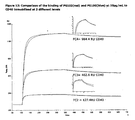
- ch5D12 (PG100) and PG102 (I29L variant) binding to human CD40 were compared by surface plasmon resonance at a constant temperature of 25.0 °C, using a Biacore 3000 instrument.
- Recombinant human CD40 extracellular domain fused to human IgG1-Fc domain (huCD40-Fc; R&D Systems catalogue number 149-CD-50) was used as the target antigen in these experiments.
- HuCD40-Fc (1 ⁇ g/mL in 10mM acetate buffer, pH 5.0) was coupled via the amine groups of Lys residues to carbodiimide-activated Biacore CM5 chips, resulting in an antigen immobilization level of 127.4 RU.
- dilution series of ch5D12 (PG100) and PG102 were prepared in Biacore Running Buffer (HEPES-buffered saline containing EDTA and surfactant; HBS-EP) Kinetic analyses were performed at a flow rate of 30 ⁇ L/min. Samples were allowed to bind for 4 min and to dissociate for 5 min, at the same flow rate. The chip surface was then regenerated for 30 seconds using 30mM NaOH and a baseline re-established in HBS-EP for 2.5 min before injection of the next sample. Alternate samples of PG102 and ch5D12 (PG100) were injected, increasing in concentration for the first set of replicates at each dilution and then decreasing for the second set of replicates.
- HBS-EP Biacore Running Buffer
- BIAcore control software (Version 3.2) was used for data collection and BIAevaluation software (Version 4.1) was used for analysis of kinetic data. Binding parameters were calculated using two different models of molecular interaction: a bivalent analyte model and Langmuir 1:1 binding model.
- the calculated affinities of the two antibody variants differed between models, however, the estimates of the dissociation constants (KD) obtained for each antibody with the same model were comparable; 2.71 ⁇ 10 -10 M and 2.37 ⁇ 10 -10 M for ch5D12 (PG100) and PG102 respectively using the Langmuir model and 5.25 ⁇ 10 -9 M and 5.41 ⁇ 10 -9 M using the bivalent analyte model.
- KD dissociation constants
- JY cells expressing human CD40 were blocked with 5% human serum for 30 min at room temperature.
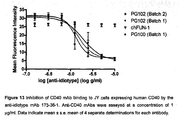
- the anti-idiotype antibody to murine mAb 5D12 (clone 173-36-1) was pre-incubated at varying concentration (0 - 10 ⁇ g/mL) with either ch5D12 (PG100) (1 ⁇ g/mL), PG102 (1 ⁇ g/mL), or negative control chimaeric anti-huCD86 antibody (chFUN-1; 1 ⁇ g/mL) in a total volume of 50 ⁇ L/tube and incubated for 15 min.
- JY cells were washed with FACS buffer (1x PBS, 1% BSA and 0.05 % sodium azide) and supernatant was discarded.
- JY cells were resuspended in FACS buffer to a concentration of 2x10 6 cells/mL. 50 ⁇ L of the JY cell suspension was added to the pre-incubated antibody mixes to give a final volume of 100 ⁇ L/tube. Cells were incubated for 30 min at 4 °C before washing with 4 ml FACS buffer/tube and the supernatant discarded. The cell pellet was resupended in 100 ⁇ L of diluted goat-anti-human IgG-FITC (Jackson Immunoresearch Labs. Cat. No. 109-095-127) in FACS buffer (1:100) and incubated for 30 min at 4 °C. Cells were washed with 4 ml FACS buffer and supernatant was discarded. The pellet was resuspended in 200 ⁇ L FACS buffer and bound antibody was measured using a FACScan flow cytometer (Becton Dickinson).
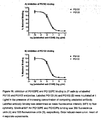
- the anti-idiotype mAb 173-36-1 inhibited PG102 and ch5D12 (PG100) binding to huCD40 expressed on JY cells in a concentration-dependent manner ( Figure 13 ).
- the binding of chFUN-1 to CD86 that is also expressed on JY cells was not influenced by mAb 173-36-1.
- Table 12 shows a summary of calculated -logIC50 values for anti-idiotype-mediated inhibition of ch5D12 (PG100) and PG102 binding to JY cells.
- ELISA plates (Costar EIA/RIA plate, Corning catalogue number 3590) were coated with 100 ⁇ L/well huCD40-muIg (Ancell, catalogue number 504-020), diluted to 250 ng/mL in PBS and incubated overnight at 4 °C in a humid environment. Plates were washed 3 times with 200 ⁇ L/well wash buffer (0.05% Tween-20 in PBS). Subsequently, plates were blocked with 200 ⁇ L/well blocking buffer (5% BSA Fraction V [Roche, catalogue number 735094] in wash buffer) and incubated for 1 h at 37 °C (humid environment). Plates were washed 3 times with wash buffer.
- Test antibodies (ch5D12 (PG100), PG102, and negative control chimaeric anti-huCD86 antibody chFUN-1) were diluted in the range 0-1200 ng/mL in blocking buffer and transferred to assay plates in a final volume of 100 ⁇ L/well, followed by incubation for 1 h at 37 °C (humid environment). Plates were washed 3 times with wash buffer followed by addition of 100 ⁇ l/well goat anti-human kappa-AP detection antibody (Southern Biotech Associates catalogue number 2060-0) diluted 1:1000 in blocking buffer. Plates were incubated for 1 h at 37 °C in a humid environment before washing 3 times with wash buffer and a further single wash with PBS.
- PNP substrate was prepared by adding 1 tablet p-Nitrophenyl Phosphate tablets (Sigma, catalogue number N-2765) in 15 mL PNP substrate buffer (12.1 g Tris, 5.84 g NaCl, 1.02 g MgCl 2 .6H 2 O in 1L H 2 O (adjusted to pH 9.6 with HCl). PNP substrate was added to assay plates at 100 ⁇ L/well. Plates were incubated for several minutes (max 30 min) at 37 °C to allow colour development before the reaction was stopped by addition of 3M NaOH. Colour intensity was determined at 405 nm using a micro plate reader (Biorad, model 550).
- CD40-expressing JY cells were washed with FACS buffer (1x PBS, 1 % BSA and 0.05 % sodium azide). Supernatant was discarded and JY cells were resuspended in FACS buffer to a concentration of 2x10 6 cells/mL. Thereafter, 50 ⁇ L of the JY cell suspension was added to 50 ⁇ L of each of the test antibodies (ch5D12 (PG100), PG102, and negative control chimaeric anti-huCD86 antibody chFUN-1) prepared in the concentration range 0-900 ng/mL and incubated for 30 min at 4 °C. Cells were washed with 4 ml FACS buffer/tube and supernatant was discarded.
- FACS buffer 1x PBS, 1 % BSA and 0.05 % sodium azide
- Antibody 173-36-1 is directed against the variable regions of the ch5D12 (PG100) precursor, murine mAb 5D12, and did not inhibit binding of an anti-CD86 isotype control antibody.
- the half-maximal binding concentration of PG102 and ch5D12 (PG100) was determined by ELISA analysis of antibody binding to human CD40-Fc, and by FACS analysis of binding to JY cells. In ELISA assays there was no significant difference between the half-maximal binding concentration of PG102 and ch5D12 (PG100) for any batch tested.
- JY cells Epstein-Barr virus-transformed human B lymphoblastoid cell line
- IMDM Iscove's Modified Dulbecco's Medium
- FCS heat-inactivated foetal calf serum
- FCS heat-inactivated foetal calf serum
- PG100 Unlabelled ch5D12
- PG102 Protein-binding protein
- Antibodies were custom-labelled with PE by AbD Serotec (Oxford, UK). For each FACS analysis the following protocol was used. JY cells were harvested from cell culture and counted. Subsequently 1 x 10 5 CD40-expressing JY cells /200 ⁇ L incubation buffer (PBS, 1% BSA, 0.05% sodium azide) were incubated with 1 ⁇ g/mL labelled ch5D12 (PG100) or PG102 antibodies, in the presence of varying concentration (0-10 ⁇ g/mL) of unlabelled competing ch5D12 (PG100) or PG102, for 30 min at 4-8°C.
- PBS 1% BSA, 0.05% sodium azide
- Unlabelled ch5D12 (PG100) and PG102 antibodies displayed similar inhibitory characteristics in these assays ( Figure 16 ).
- These -log IC 50 values correspond top PG102 and ch5D12 (PG100) concentrations of approximately 20-30 ng/mL (i.e. ⁇ 130-200pM).
- PG102 The functionality of PG102 was measured using a cell-based functional bioassay. Briefly, on day 1, THP-1 and Jurkat 39.8/50 human cells were cultured in Iscove's Modified Dulbecco's Medium (IMDM, BioWhittaker, catalogue number BE 12-722F supplemented with 10 % foetal bovine serum (Gibco, ref 10270-106) and 50 ⁇ g/mL gentamycin (Invitrogen, catalogue number 15750-045). THP-1 cells were pulsed with rhuIFN-y at 1000 units/mL of cell culture.
- IMDM Iscove's Modified Dulbecco's Medium
- Gibco foetal bovine serum
- gentamycin Invitrogen, catalogue number 15750-045
- THP-1 and Jurkat 39.8/50 cells were required at a concentration of 4 x 10 5 cells/mL.
- the THP-1 and J39.8/50 cells were counted and their viability determined.
- Cells were then diluted to a concentration of approximately 1 x 10 6 cells/mL, Cell suspensions were mixed 1:1 and incubated at 37 °C in a humidified 5 % CO 2 atmosphere for 48h,
- THP-1 and J39.8/50 cells were washed as follows (In the case of THP-1 cells the wash step was to remove the IFN-y): 5 mL of IFN-y pulsed THP-1 and J39.8/50 cell suspension were transferred to a 50 mL falcon tube. 40 mL of Hank's Balanced Salt Solution (HBSS) was added, and the cells were centrifuged at 1500 rpm (using IEC centrifuge) for 6 min. The supernatant was discarded. The cell pellet was resuspended in pre-warmed IMDM supplemented with 10 % FCS. The THP-1 cells and J39.8%50 cells were adjusted to a concentration of 4 x 10 5 cells/mL.
- HBSS Hank's Balanced Salt Solution
- test sample ch5D12 (PG100) or PG102 (I29L variant) was serially diluted in warmed IMDM medium supplemented with 10% foetal bovine serum to obtain final assay concentrations in the range 0 - 160 ng/mL.
- the THP-1, J39.8/50 and test sample(s) were added in triplicate to round bottomed cell culture plates (NunclonTM) in the following order: 50 ⁇ L of THP-1 cells (equivalent to 2 x 10 4 cells per well), 50 ⁇ L of the test sample and 50 ⁇ L J39.8/50 cells. The total volume was 150 ⁇ l per well.
- the cell culture plates were wrapped in porous cling film and incubated at 37 °C in a humidified 5 % CO 2 atmosphere for 48 h.
- PG102 (1291 variant) and ch5D12 (PG100) showed similar inhibitory effects on evoked IL-8 release by THP-1 cells ( Figure 17 ).
- Calculated -log IC 50 values for the two antibodies were 8.42 and 8.28, respectively. These values correspond to IC 50 concentrations of approximately 30pM.
- ch5D12 can prevent B-cell activation and proliferation 27 .
- Safety studies were repeated for PG102 using a more prolonged protocol. Briefly, a 13 week intravenous toxicity study in cynomolgus monkey with a 14 week recovery period was designed, using 3 dose levels (0, 25 and 100 mg/kg i.v.) and 26 monkeys (6 monkeys (3M, 3F) per treatment group, plus 4 monkeys (2M, 2F) as recovery groups in each active treatment arm). The following measurements were done: TK, anti-PG102 response, flow cytometry (including CD40 coating of PBMC), lymph node biopsy and standard toxicology assessments such as haematology and immunohistochemistry.
- Anti-CD40 mAb (batch) -log half-maximal binding concentration n ch5D12 (PG100) (Batch 1) 7.54 ⁇ 0.03 4 ch5D12 (PG100) (Batch 2) 7.53 ⁇ 0.02 2 ch5D12 (PG100) (Batch 3) 7.48 ⁇ 0.10 2 ch5D12 (PG100) (Batch 4) 7.37 ⁇ 0.10 2 PG102 (Batch 1) 7.45 ⁇ 0.04 4 PG102 (Batch 2) 7.47 ⁇ 0.04 4 Table 14: Summary of calculated -log half-maximal binding concentration values for ch5D12 (PG100) and PG102 binding to JY cells expressing human CD40, as determined by ELISA. Data indicate the mean of duplicate determinations.
- a -log half-maximal binding concentration of 7.45 corresponds to a concentration of 35 ng/ml ( ⁇ 200 pmol).
Landscapes
- Health & Medical Sciences (AREA)
- Chemical & Material Sciences (AREA)
- Organic Chemistry (AREA)
- Immunology (AREA)
- Medicinal Chemistry (AREA)
- General Health & Medical Sciences (AREA)
- Life Sciences & Earth Sciences (AREA)
- Pharmacology & Pharmacy (AREA)
- Public Health (AREA)
- General Chemical & Material Sciences (AREA)
- Veterinary Medicine (AREA)
- Chemical Kinetics & Catalysis (AREA)
- Animal Behavior & Ethology (AREA)
- Nuclear Medicine, Radiotherapy & Molecular Imaging (AREA)
- Bioinformatics & Cheminformatics (AREA)
- Engineering & Computer Science (AREA)
- Biochemistry (AREA)
- Proteomics, Peptides & Aminoacids (AREA)
- Molecular Biology (AREA)
- Genetics & Genomics (AREA)
- Biophysics (AREA)
- Rheumatology (AREA)
- Physical Education & Sports Medicine (AREA)
- Neurology (AREA)
- Biomedical Technology (AREA)
- Pain & Pain Management (AREA)
- Transplantation (AREA)
- Orthopedic Medicine & Surgery (AREA)
- Neurosurgery (AREA)
- Peptides Or Proteins (AREA)
- Preparation Of Compounds By Using Micro-Organisms (AREA)
- Medicines Containing Antibodies Or Antigens For Use As Internal Diagnostic Agents (AREA)
- Micro-Organisms Or Cultivation Processes Thereof (AREA)
- Investigating Or Analysing Biological Materials (AREA)
- Medicines That Contain Protein Lipid Enzymes And Other Medicines (AREA)
- Medicines Containing Material From Animals Or Micro-Organisms (AREA)
Claims (31)
- Anti-CD40-Antikörper, umfassend eine variable Region einer leichten Kette und eine variable Region einer schweren Kette, wobei die variable Region der schweren Kette eine Aminosäuresequenz

 umfasst, wobei:
 X1 I ist und X2 V ist;X1 L ist und X2 I ist;X1 V ist und X2 V ist;X1 L ist und X2 L ist; oderX1 L ist und X2 V ist; undX3 G, A, V, L, I, P, F, M, W, C, N, Q, S, T, Y, D, E, K, R oder H ist;X4 G, A, V, L, I, P, F, M, W, C, N, Q, S, T, Y, D, E, K, R oder H ist; undX5 G, A, V, L, I, P, F, M, W, C, N, Q, S, T, Y, D, E, K, R oder H ist; undwobei die variable Domäne der leichten Kette eine Aminosäuresequenz

 umfasst, wobei:
 X6 N, Q, S, T, Y, W oder C ist;X7 D, E, N, Q, S, T, Y, W oder C ist;X8 N, Q, S, T, Y, G, A, V, L, I, P, F, M, W oder C ist;X9 G, A, V, L, I, P, F, M ist;X10 G, A, V, L, I, P, F, M ist; undX11 N, Q, S, T, Y, G, A, V, L, I, P, F, M, W oder C ist.
 - Antikörper nach Anspruch 1, wobei:X3 G, A, V, L, I, P, F, M ist;X4 G, A, V, L, I, P, F, M ist; undX5 G, A, V, L, I, P, F, M, W, C, N, Q, S, T oder Y ist.
- Antikörper nach Anspruch 1 oder Anspruch 2, wobei:X3 G, A, V, L, I, P, F, M ist;X4 G, A, V, L, I oder M ist; undX5 P, F, W, N, Q, S, T oder Y ist.
- Antikörper nach Anspruch 3, wobei:X1 L ist;X2 I ist;X3 P ist; undX4 M ist; und X5 S ist.
- Antikörper nach Anspruch 1, wobei:X3 P ist;X4 M ist; undX5 F ist oder X5 S ist, vorzugsweise S.
- Antikörper nach Anspruch 1, wobei:X1 L ist; X2 V ist; X3 L ist; X4 L ist und X5 F ist.
- Antikörper nach einem der Ansprüche 1-6, umfassend eine konstante Region eines Humanantikörpers, vorzugsweise eine IgG-konstante Region.
- Antikörper nach Anspruch 7, wobei die konstante Region eine Region ist, die mangelhaft an Komplementaktivierung ist, vorzugsweise eine humane IgG4-konstante Region oder eine mutierte humane IgG1-konstante Region.
- Nukleinsäure, codierend einen Antikörper nach einem der Ansprüche 1-8.
- Zelle, umfassend einen Antikörper nach einem der Ansprüche 1-8 und/oder eine Nukleinsäure nach Anspruch 9.
- Antikörper nach einem der Ansprüche 1-8, wobei der Antikörper ein antagonistischer, monoklonaler anti-human CD40 Antikörper ist.
- Antagonistischer, monoklonaler anti-human CD40 Antikörper nach Anspruch 11, wobei der Antikörper de-immunisiert ist.
- Antikörper nach Anspruch 12, wobei:X6 T oder S ist, X7 D oder Q ist, X8 Q oder P ist, X9 V oder A ist, X10 V oder L ist und X11 F oder Y ist.
- Antikörper nach einem der Ansprüche 12-13, wobei:X6 T ist, X7 Q ist, X8 P ist, X9 A ist, X10 V ist und X11 Y ist.
- Nukleinsäure, die einen Antikörper nach einem der Ansprüche 12-14 codiert.
- Zelle, umfassend einen Antikörper nach einem der Ansprüche 12-14 oder eine Nukleinsäure nach den Ansprüchen 9 oder 15.
- Zelle nach Anspruch 16, die den Antikörper produziert.
- Zelle nach Anspruch 10, 16 oder 17, welche eine Hybridomazelle, eine Chinahamster-Eierstockzelle, eine NSO-Zelle oder eine PER-C6™-Zelle ist.
- Zellkultur, umfassend eine Zelle nach einem der Ansprüche 16-18.
- Verfahren zur Herstellung eines Antikörpers, umfassend Kultivieren einer Zelle nach einem der Ansprüche 10, 16-18 und Ernten des Antikörpers aus dieser Kultur.
- Pharmazeutische Zusammensetzung, umfassend einen Antikörper nach einem der Ansprüche 1-8, 11-13, eine Nukleinsäure nach Anspruch 9 oder 15 und/oder eine Zelle nach einem der Ansprüche 10 oder 16-18.
- Antikörper nach einem der Ansprüche 1-8, 11-14, eine Nukleinsäure nach Anspruch 9 oder 15 und/oder eine Zelle nach einem der Ansprüche 10 oder 16-18 zur Verwendung als Medikament.
- Verwendung eines Antikörpers nach einem der Ansprüche 1-8, 11-14, einer Nukleinsäure nach Anspruch 9 oder 15 und/oder einer Zelle nach einem der Ansprüche 10 oder 16-18 zur Herstellung eines Medikaments zur Verbesserung eines Symptoms einer Autoimmunkrankheit und/oder einer Entzündungskrankheit und/oder zur Verminderung einer Transplantatabstoßung und/oder zur Behandlung CD40 positiver Tumore.
- Verwendung nach Anspruch 23, wobei die Autoimmunerkrankung und/oder eine Entzündungserkrankung ausgewählt ist aus der Gruppe von rheumatoider Arthritis, systemischem Lupus erymatosus, multipler Sklerose, Psoriasis, bulbösem Pemphigoid und atopischer Dermatitis.
- Verwendung nach Anspruch 23, wobei die Autoimmunerkrankung und/oder eine Entzündungserkrankung eine entzündliche Darmerkrankung umfasst.
- Verwendung nach Anspruch 23, wobei die entzündliche Darmerkrankung eiternde Colitis (UC) oder Morbus Crohn (CD) umfasst.
- Verfahren zur Auswahl eines antagonistischen anti-human CD40-Antikörpers, umfassend Erzeugen einer ersten Zelllinie, die einen originalen antagonistischen anti-human CD40-Antikörper produziert, und Bestimmen der Menge des originalen Antikörpers, die durch die erste Zelllinie produziert wird, wobei der originale Antikörper die -Aminosäuresequenz der leichten Kette

 und die
Aminosäuresequenz der variablen Domäne der schweren Kette-
 umfasst, wobei X1 und X2 paarweise ausgewählt sind aus der Gruppe bestehend aus X1 = I und X2 = V; X1 = L und X2 = I; X1 = V und X2 = V; X1 = L und X2 = L; oder X1 = L und X2 = V,
wobei die Methode ferner umfasst
Erzeugen von mindestens einer weiteren Zelllinie, die eine Variante des originalen Antikörpers produziert, wobei die Variante des Antikörpers ein modifizierter originaler Antikörper ist, umfassend eine Einfügung, Entfernung, Inversion und/oder Substitution zwischen ungefähr 1 bis 5 Aminosäuren im Vergleich zu dem originalen Antikörper, wobei die Modifizierung nicht aus einer Modifizierung der Aminosäuren an der/den Position(en), identifiziert durch X1 und X2, besteht, und Bestimmen der Menge der Variante des Antikörpers, die durch die mindestens eine weitere Zelllinie produziert wird,
die Methode ferner umfassend das Auswählen einer Variante des Antikörpers, die in einer Menge produziert wurde, die mindestens 50 % der Menge des originalen Antikörpers war. - Verfahren nach Anspruch 27, wobei die Einfügung, Entfernung, Inversion und/oder Substitution von ungefähr 1 bis 5 Aminosäuren in der Aminosäuresequenz der schweren Kette oder der Aminosäuresequenz der leichten Kette erfolgt, im Vergleich zu der entsprechenden Kettenaminosäuresequenz in dem originalen Antikörper.
- Verfahren nach Anspruch 28, wobei die Einfügung, Entfernung, Inversion und/oder Substitution von ungefähr 1 bis 5 Aminosäuren in der Aminosäuresequenz der schweren Kette erfolgt, im Vergleich zu der - Aminosäuresequenz der schweren Kette des originalen Antikörpers.
- Verfahren nach einem der Ansprüche 27-29, ferner umfassend das Erzeugen einer Antikörper produzierenden Zelllinie, die den ausgewählten Antikörper produziert.
- Verfahren nach Anspruch 30, ferner umfassend das Sammeln des ausgewählten Antikörpers.
Priority Applications (1)
| Application Number | Priority Date | Filing Date | Title |
|---|---|---|---|
| EP07747426A EP2019840B1 (de) | 2006-05-09 | 2007-05-09 | Antagonistischer, monoklonaler anti-human-cd40-antikörper |
Applications Claiming Priority (4)
| Application Number | Priority Date | Filing Date | Title |
|---|---|---|---|
| US79881906P | 2006-05-09 | 2006-05-09 | |
| EP06076028A EP1854810A1 (de) | 2006-05-09 | 2006-05-09 | De-immunisierter und antagonister monoclonaler Antikörper gegen CD40, der aus der ch5D12 Antikörper abgeleitet ist |
| PCT/NL2007/050202 WO2007129895A2 (en) | 2006-05-09 | 2007-05-09 | Deimmunized antagonistic anti-human cd40 monoclonal antibody from the ch5d12 antibody |
| EP07747426A EP2019840B1 (de) | 2006-05-09 | 2007-05-09 | Antagonistischer, monoklonaler anti-human-cd40-antikörper |
Publications (2)
| Publication Number | Publication Date |
|---|---|
| EP2019840A2 EP2019840A2 (de) | 2009-02-04 |
| EP2019840B1 true EP2019840B1 (de) | 2012-12-19 |
Family
ID=37635851
Family Applications (2)
| Application Number | Title | Priority Date | Filing Date |
|---|---|---|---|
| EP06076028A Withdrawn EP1854810A1 (de) | 2006-05-09 | 2006-05-09 | De-immunisierter und antagonister monoclonaler Antikörper gegen CD40, der aus der ch5D12 Antikörper abgeleitet ist |
| EP07747426A Active EP2019840B1 (de) | 2006-05-09 | 2007-05-09 | Antagonistischer, monoklonaler anti-human-cd40-antikörper |
Family Applications Before (1)
| Application Number | Title | Priority Date | Filing Date |
|---|---|---|---|
| EP06076028A Withdrawn EP1854810A1 (de) | 2006-05-09 | 2006-05-09 | De-immunisierter und antagonister monoclonaler Antikörper gegen CD40, der aus der ch5D12 Antikörper abgeleitet ist |
Country Status (20)
| Country | Link |
|---|---|
| US (1) | US8669352B2 (de) |
| EP (2) | EP1854810A1 (de) |
| JP (1) | JP5179474B2 (de) |
| KR (1) | KR101506348B1 (de) |
| CN (1) | CN101490086B (de) |
| AR (1) | AR060998A1 (de) |
| AU (1) | AU2007249031B9 (de) |
| BR (1) | BRPI0711355A2 (de) |
| CA (1) | CA2651565A1 (de) |
| CL (1) | CL2007001335A1 (de) |
| DK (1) | DK2019840T3 (de) |
| ES (1) | ES2406163T3 (de) |
| IL (1) | IL195196A (de) |
| MX (1) | MX2008014304A (de) |
| NO (1) | NO20085104L (de) |
| NZ (1) | NZ572756A (de) |
| RU (1) | RU2491295C2 (de) |
| TW (1) | TWI455947B (de) |
| WO (1) | WO2007129895A2 (de) |
| ZA (2) | ZA200810381B (de) |
Families Citing this family (53)
| Publication number | Priority date | Publication date | Assignee | Title |
|---|---|---|---|---|
| JP5250548B2 (ja) | 2006-06-21 | 2013-07-31 | エムユーエスシー ファウンデーション フォー リサーチ ディベロップメント | 疾患の治療のための補体h因子の標的化 |
| ME01699B (me) | 2009-07-02 | 2014-09-20 | Musc Found For Res Dev | Metode za stimulaciju regeneracije jetre |
| BR112012002574A2 (pt) | 2009-08-06 | 2020-11-03 | Genentech, Inc. | método para aprimorar a remoção de vírus na purificação de proteínas |
| US10239937B2 (en) | 2009-11-05 | 2019-03-26 | Alexion Pharmaceuticals, Inc. | Treatment of paroxysmal nocturnal hemoglobinuria, hemolytic anemias and disease states involving intravascular and extravascular hemolysis |
| WO2011109280A1 (en) | 2010-03-05 | 2011-09-09 | Lerner Research Institute | Methods and compositions to treat immune-mediated disorders |
| LT2796467T (lt) * | 2010-03-31 | 2018-05-10 | Boehringer Ingelheim International Gmbh | Anti-cd40 antikūnai |
| SG185483A1 (en) | 2010-05-14 | 2012-12-28 | Univ Colorado Regents | Improved complement receptor 2 (cr2) targeting groups |
| US9815890B2 (en) | 2010-06-22 | 2017-11-14 | The Regents Of The University Of Colorado, A Body Corporate | Antibodies to the C3d fragment of complement component 3 |
| AR083847A1 (es) | 2010-11-15 | 2013-03-27 | Novartis Ag | Variantes de fc (fragmento constante) silenciosas de los anticuerpos anti-cd40 |
| WO2012125569A2 (en) | 2011-03-11 | 2012-09-20 | Beth Israel Deaconess Medical Center, Inc. | Anti-cd40 antibodies and uses thereof |
| CN103842382B (zh) | 2011-04-21 | 2017-03-15 | 百时美施贵宝公司 | 拮抗cd40之抗体多肽 |
| SMT202000091T1 (it) | 2011-10-13 | 2020-05-08 | Bristol Myers Squibb Co | Polipeptidi anticorpali che antagonizzano cd40l |
| US10413620B2 (en) | 2012-08-17 | 2019-09-17 | The Regents Of The University Of Colorado, A Body Corporate | Light-emitting versions of the monoclonal antibody to C3D (MAB 3D29) for imaging |
| JP2015535212A (ja) | 2012-08-17 | 2015-12-10 | ザ・リージエンツ・オブ・ザ・ユニバーシテイ・オブ・コロラド、ア・ボデイー・コーポレイト | 補体活性化を検出するための組成物および方法 |
| CA2914924A1 (en) * | 2013-06-13 | 2014-12-18 | Fast Forward Pharmaceuticals B.V. | Cd40 signalling inhibitor and a further compound, wherein the further compound is a bile acid, a bile acid derivative, an tgr5-receptor agonist, an fxr agonist or a combination thereof, for the treatment of chronic inflammation, and the prevention of gastrointestinal cancer or fibrosis. |
| EP2883883A1 (de) | 2013-12-16 | 2015-06-17 | Cardio3 Biosciences S.A. | Therapeutische Ziele und Mittel zur Behandlung von ischämiebedingten Reperfusionsschäden |
| US10435475B2 (en) | 2014-03-07 | 2019-10-08 | Bristol-Myers Squibb Company | Method of using antibody polypeptides that antagonize CD40 to treat IBD |
| DK3178931T3 (en) | 2014-08-07 | 2021-03-22 | Daiichi Sankyo Co Ltd | Anti-orai1-antistof |
| US20170233485A1 (en) * | 2014-08-18 | 2017-08-17 | Biogen Ma Inc. | Anti-cd40 antibodies and uses thereof |
| HK1245010A1 (zh) | 2014-12-10 | 2018-08-24 | 明尼苏达大学董事会 | 用於治疗疾病的遗传修饰的细胞、组织和器官 |
| AU2016270640B2 (en) | 2015-05-29 | 2022-03-10 | Abbvie Inc. | Anti-CD40 antibodies and uses thereof |
| PT3307322T (pt) | 2015-09-04 | 2021-04-23 | Primatope Therapeutics Inc | Anticorpos anti-cp40 humanizados e as suas utilizações referência cruzada relativa às aplicações associadas |
| ES2906823T3 (es) | 2015-09-30 | 2022-04-20 | Janssen Biotech Inc | Anticuerpos agonistas que se unen específicamente a CD40 humano y métodos de uso |
| SG11201810509PA (en) | 2016-06-20 | 2018-12-28 | Kymab Ltd | Anti-pd-l1 antibodies |
| CA3055433A1 (en) * | 2017-03-29 | 2018-10-04 | Glycotope Gmbh | Humanized anti-cd40 antibodies |
| CA3064298A1 (en) | 2017-06-01 | 2018-12-06 | Shanghai Hengrui Pharmaceutical Co., Ltd. | Anti-cd40 antibody, antigen binding fragment thereof and medical use thereof |
| CA3076872A1 (en) | 2017-11-03 | 2019-05-09 | Novartis Ag | Anti-cd40 antibodies for use in treatment of sjogren's syndrome |
| EP3752532A1 (de) | 2018-02-12 | 2020-12-23 | Diabetes-Free, Inc. | Verbesserte antagonistische monoklonale anti-human-cd40-antikörper |
| WO2019198019A1 (en) | 2018-04-13 | 2019-10-17 | Novartis Ag | Anti-cd40 antibodies for use in prevention of graft rejection |
| US11976123B2 (en) | 2018-04-20 | 2024-05-07 | Lyvgen Biopharma Holdings Limited | Anti-CD40 antibodies and uses thereof |
| EP3806848A2 (de) | 2018-06-15 | 2021-04-21 | Flagship Pioneering Innovations V, Inc. | Erhöhung der immunaktivität durch modulation von postzellulären signalisierungsfaktoren |
| CN116063495A (zh) | 2018-09-28 | 2023-05-05 | 礼进生物医药科技(上海)有限公司 | 具有经过工程化的Fc结构域的抗CD40结合分子及其治疗用途 |
| WO2020070288A1 (en) | 2018-10-05 | 2020-04-09 | INSERM (Institut National de la Santé et de la Recherche Médicale) | Methods and systems for controlling the agonistic properties of antibody variable domains by light |
| WO2020102454A1 (en) | 2018-11-13 | 2020-05-22 | Regents Of The University Of Minnesota | Cd40 targeted peptides and uses thereof |
| WO2020108611A1 (zh) | 2018-11-30 | 2020-06-04 | 江苏恒瑞医药股份有限公司 | 抗cd40抗体、其抗原结合片段及其医药用途 |
| CA3121291A1 (en) | 2018-11-30 | 2020-06-04 | Jiangsu Hengrui Medicine Co., Ltd. | Cd40 antibody pharmaceutical composition and use thereof |
| TW202033558A (zh) | 2019-01-11 | 2020-09-16 | 瑞士商諾華公司 | 化膿性汗腺炎治療中使用的抗cd40抗體 |
| EP3962493A2 (de) | 2019-05-03 | 2022-03-09 | Flagship Pioneering Innovations V, Inc. | Verfahren zur modulation der immunreaktivität/konzentration von irf oder sting oder zur behandlung von krebs mit der verabreichung eines sting-modulators und/oder eines purinergischen rezeptormodulators oder eines postzellularen signalisierungsfaktors |
| US20220195061A1 (en) | 2019-05-08 | 2022-06-23 | Novartis Ag | Anti-cd40 antibodies for use in treatment of tidm and insulitis |
| AU2019465294A1 (en) | 2019-09-11 | 2022-03-24 | Novartis Ag | A method for preventing human virus associated disorders in patients |
| EP4076434A1 (de) | 2019-12-17 | 2022-10-26 | Flagship Pioneering Innovations V, Inc. | Kombination von antikrebstherapien mit induktoren der eisenabhängigen zellulären zerlegung |
| US20230355804A1 (en) | 2020-06-29 | 2023-11-09 | Flagship Pioneering Innovations V, Inc. | Viruses engineered to promote thanotransmission and their use in treating cancer |
| SI4284512T1 (sl) | 2021-01-28 | 2025-06-30 | Regeneron Pharmaceuticals, Inc. | Sestavki in postopki za zdravljenje sindroma sproščanja citokinov |
| CA3214085A1 (en) | 2021-03-31 | 2022-10-06 | Darby Rye Schmidt | Thanotransmission polypeptides and their use in treating cancer |
| JP2024525475A (ja) | 2021-06-29 | 2024-07-12 | フラグシップ パイオニアリング イノベーションズ ブイ,インコーポレーテッド | タノトランスミッションを促進するように操作された免疫細胞及びその使用 |
| WO2023020475A1 (en) * | 2021-08-16 | 2023-02-23 | Utc Therapeutics (Shanghai) Co., Ltd. | Cd40-targetting antibodies and uses thereof |
| CN117500816B (zh) | 2021-08-26 | 2025-03-28 | 映恩生物制药(苏州)有限公司 | 一种甾体化合物及其缀合物 |
| US12234294B2 (en) | 2021-11-05 | 2025-02-25 | Kiniksa Pharmaceuticals, Gmbh | Pharmaceutical composition of a humanized anti-CD40 antibody |
| US20250249278A1 (en) | 2022-04-14 | 2025-08-07 | Institut National de la Santé et de la Recherche Médicale | Methods for controlling the tumor cell killing by light |
| EP4598946A1 (de) | 2022-10-05 | 2025-08-13 | Flagship Pioneering Innovations V, Inc. | Für trif und zusätzliche polypeptide codierende nukleinsäuremoleküle und deren verwendung bei der behandlung von krebs |
| US20240269251A1 (en) | 2023-01-09 | 2024-08-15 | Flagship Pioneering Innovations V, Inc. | Genetic switches and their use in treating cancer |
| WO2025184567A1 (en) | 2024-03-01 | 2025-09-04 | Regeneron Pharmaceuticals, Inc. | Methods and compositions for re-dosing aav using anti-cd40 antagonistic antibody to suppress host anti-aav antibody response |
| US20250277048A1 (en) | 2024-03-01 | 2025-09-04 | Regeneron Pharmaceuticals, Inc. | The use of cd40 inhibitors for inhibiting an immune response and enabling immunogen administration and re-administration |
Family Cites Families (8)
| Publication number | Priority date | Publication date | Assignee | Title |
|---|---|---|---|---|
| GB9125768D0 (en) | 1991-12-04 | 1992-02-05 | Hale Geoffrey | Therapeutic method |
| EP1834671A3 (de) * | 1992-07-09 | 2013-05-22 | Novartis Vaccines and Diagnostics, Inc. | Ein Verfahren zur Erregung von Antikörpern gegen Zelloberflächemoleküle |
| US5874082A (en) | 1992-07-09 | 1999-02-23 | Chiron Corporation | Humanized anti-CD40 monoclonal antibodies and fragments capable of blocking B cell proliferation |
| WO1998003670A1 (en) | 1996-07-23 | 1998-01-29 | Tanox Pharma B.V. | Induction of t cell tolerance using a soluble molecule that can simultaneously block two costimulatory pathways |
| EP1724282B1 (de) * | 1997-05-21 | 2013-05-15 | Merck Patent GmbH | Verfahren zur Herstellung von nicht-immunogenen Proteinen |
| US6051228A (en) * | 1998-02-19 | 2000-04-18 | Bristol-Myers Squibb Co. | Antibodies against human CD40 |
| AR039067A1 (es) * | 2001-11-09 | 2005-02-09 | Pfizer Prod Inc | Anticuerpos para cd40 |
| US7563443B2 (en) * | 2004-09-17 | 2009-07-21 | Domantis Limited | Monovalent anti-CD40L antibody polypeptides and compositions thereof |
-
2006
- 2006-05-09 EP EP06076028A patent/EP1854810A1/de not_active Withdrawn
-
2007
- 2007-05-09 TW TW096116566A patent/TWI455947B/zh not_active IP Right Cessation
- 2007-05-09 ZA ZA200810381A patent/ZA200810381B/xx unknown
- 2007-05-09 CN CN200780025878.9A patent/CN101490086B/zh active Active
- 2007-05-09 JP JP2009509467A patent/JP5179474B2/ja active Active
- 2007-05-09 CA CA002651565A patent/CA2651565A1/en not_active Abandoned
- 2007-05-09 AU AU2007249031A patent/AU2007249031B9/en active Active
- 2007-05-09 US US11/801,344 patent/US8669352B2/en active Active
- 2007-05-09 MX MX2008014304A patent/MX2008014304A/es active IP Right Grant
- 2007-05-09 NZ NZ572756A patent/NZ572756A/xx not_active IP Right Cessation
- 2007-05-09 WO PCT/NL2007/050202 patent/WO2007129895A2/en not_active Ceased
- 2007-05-09 AR ARP070102017A patent/AR060998A1/es not_active Application Discontinuation
- 2007-05-09 DK DK07747426.0T patent/DK2019840T3/da active
- 2007-05-09 BR BRPI0711355-2A patent/BRPI0711355A2/pt not_active IP Right Cessation
- 2007-05-09 RU RU2008148303/10A patent/RU2491295C2/ru not_active IP Right Cessation
- 2007-05-09 CL CL2007001335A patent/CL2007001335A1/es unknown
- 2007-05-09 EP EP07747426A patent/EP2019840B1/de active Active
- 2007-05-09 KR KR1020087030080A patent/KR101506348B1/ko active Active
- 2007-05-09 ES ES07747426T patent/ES2406163T3/es active Active
-
2008
- 2008-11-10 IL IL195196A patent/IL195196A/en active IP Right Grant
- 2008-12-09 NO NO20085104A patent/NO20085104L/no not_active Application Discontinuation
-
2009
- 2009-12-23 ZA ZA2009/09185A patent/ZA200909185B/en unknown
Non-Patent Citations (1)
| Title |
|---|
| SUZANNE L. ZEBEDEE ET AL: "Human combinatorial antibody libraries to hepatitis B surface antigen", PROC.NATL. ACAD. SCI., vol. 89, 1992, pages 3175 - 3179 * |
Also Published As
Similar Documents
| Publication | Publication Date | Title |
|---|---|---|
| EP2019840B1 (de) | Antagonistischer, monoklonaler anti-human-cd40-antikörper | |
| JP7765397B2 (ja) | 新規抗lilrb4抗体および派生産物 | |
| AU2006308860B2 (en) | Uses of anti-CD40 antibodies | |
| EP1810979B1 (de) | STABILISIERTE HUMANE IgG4-ANTIKÖRPER | |
| JP2015535820A (ja) | Kir3dl2結合剤 | |
| AU2020414265A1 (en) | Anti-human HVEM (TNFRSF14) antibodies and uses thereof | |
| EP1272205A1 (de) | SIALOADHESIN FAKTOR-2 ANTIKöRPER | |
| HK1131627B (zh) | 来自ch5d12抗体的去免疫拮抗性抗人cd40单克隆抗体 | |
| MX2008005658A (en) | Uses of anti-cd40 antibodies | |
| HK1122579B (en) | Uses of anti-cd40 antibodies |
Legal Events
| Date | Code | Title | Description |
|---|---|---|---|
| PUAI | Public reference made under article 153(3) epc to a published international application that has entered the european phase |
Free format text: ORIGINAL CODE: 0009012 |
|
| 17P | Request for examination filed |
Effective date: 20081203 |
|
| AK | Designated contracting states |
Kind code of ref document: A2 Designated state(s): AT BE BG CH CY CZ DE DK EE ES FI FR GB GR HU IE IS IT LI LT LU LV MC MT NL PL PT RO SE SI SK TR |
|
| AX | Request for extension of the european patent |
Extension state: AL BA HR MK RS |
|
| R17D | Deferred search report published (corrected) |
Effective date: 20081231 |
|
| 17Q | First examination report despatched |
Effective date: 20090902 |
|
| DAX | Request for extension of the european patent (deleted) | ||
| GRAP | Despatch of communication of intention to grant a patent |
Free format text: ORIGINAL CODE: EPIDOSNIGR1 |
|
| GRAS | Grant fee paid |
Free format text: ORIGINAL CODE: EPIDOSNIGR3 |
|
| GRAA | (expected) grant |
Free format text: ORIGINAL CODE: 0009210 |
|
| AK | Designated contracting states |
Kind code of ref document: B1 Designated state(s): AT BE BG CH CY CZ DE DK EE ES FI FR GB GR HU IE IS IT LI LT LU LV MC MT NL PL PT RO SE SI SK TR |
|
| REG | Reference to a national code |
Ref country code: GB Ref legal event code: FG4D |
|
| REG | Reference to a national code |
Ref country code: CH Ref legal event code: EP |
|
| REG | Reference to a national code |
Ref country code: AT Ref legal event code: REF Ref document number: 589394 Country of ref document: AT Kind code of ref document: T Effective date: 20130115 |
|
| REG | Reference to a national code |
Ref country code: DE Ref legal event code: R096 Ref document number: 602007027484 Country of ref document: DE Effective date: 20130207 |
|
| REG | Reference to a national code |
Ref country code: DK Ref legal event code: T3 |
|
| REG | Reference to a national code |
Ref country code: SE Ref legal event code: TRGR |
|
| RAP2 | Party data changed (patent owner data changed or rights of a patent transferred) |
Owner name: FAST FORWARD PHARMACEUTICALS B.V. |
|
| PG25 | Lapsed in a contracting state [announced via postgrant information from national office to epo] |
Ref country code: LT Free format text: LAPSE BECAUSE OF FAILURE TO SUBMIT A TRANSLATION OF THE DESCRIPTION OR TO PAY THE FEE WITHIN THE PRESCRIBED TIME-LIMIT Effective date: 20121219 |
|
| REG | Reference to a national code |
Ref country code: NL Ref legal event code: T3 |
|
| REG | Reference to a national code |
Ref country code: CH Ref legal event code: PUE Owner name: FAST FORWARD PHARMACEUTICALS B.V., NL Free format text: FORMER OWNER: PANGENETICS B.V., NL Ref country code: NL Ref legal event code: SD Effective date: 20130508 Ref country code: CH Ref legal event code: NV Representative=s name: BOVARD AG, CH |
|
| REG | Reference to a national code |
Ref country code: DE Ref legal event code: R081 Ref document number: 602007027484 Country of ref document: DE Owner name: FAST FORWARD PHARMACEUTICALS B.V., NL Free format text: FORMER OWNER: PANGENETICS B.V., UTRECHT, NL Effective date: 20130321 |
|
| REG | Reference to a national code |
Ref country code: LT Ref legal event code: MG4D |
|
| PG25 | Lapsed in a contracting state [announced via postgrant information from national office to epo] |
Ref country code: SI Free format text: LAPSE BECAUSE OF FAILURE TO SUBMIT A TRANSLATION OF THE DESCRIPTION OR TO PAY THE FEE WITHIN THE PRESCRIBED TIME-LIMIT Effective date: 20121219 Ref country code: LV Free format text: LAPSE BECAUSE OF FAILURE TO SUBMIT A TRANSLATION OF THE DESCRIPTION OR TO PAY THE FEE WITHIN THE PRESCRIBED TIME-LIMIT Effective date: 20121219 Ref country code: GR Free format text: LAPSE BECAUSE OF FAILURE TO SUBMIT A TRANSLATION OF THE DESCRIPTION OR TO PAY THE FEE WITHIN THE PRESCRIBED TIME-LIMIT Effective date: 20130320 |
|
| REG | Reference to a national code |
Ref country code: ES Ref legal event code: FG2A Ref document number: 2406163 Country of ref document: ES Kind code of ref document: T3 Effective date: 20130605 |
|
| REG | Reference to a national code |
Ref country code: GB Ref legal event code: 732E Free format text: REGISTERED BETWEEN 20130523 AND 20130529 |
|
| PG25 | Lapsed in a contracting state [announced via postgrant information from national office to epo] |
Ref country code: IS Free format text: LAPSE BECAUSE OF FAILURE TO SUBMIT A TRANSLATION OF THE DESCRIPTION OR TO PAY THE FEE WITHIN THE PRESCRIBED TIME-LIMIT Effective date: 20130419 Ref country code: BG Free format text: LAPSE BECAUSE OF FAILURE TO SUBMIT A TRANSLATION OF THE DESCRIPTION OR TO PAY THE FEE WITHIN THE PRESCRIBED TIME-LIMIT Effective date: 20130319 Ref country code: CZ Free format text: LAPSE BECAUSE OF FAILURE TO SUBMIT A TRANSLATION OF THE DESCRIPTION OR TO PAY THE FEE WITHIN THE PRESCRIBED TIME-LIMIT Effective date: 20121219 Ref country code: SK Free format text: LAPSE BECAUSE OF FAILURE TO SUBMIT A TRANSLATION OF THE DESCRIPTION OR TO PAY THE FEE WITHIN THE PRESCRIBED TIME-LIMIT Effective date: 20121219 Ref country code: EE Free format text: LAPSE BECAUSE OF FAILURE TO SUBMIT A TRANSLATION OF THE DESCRIPTION OR TO PAY THE FEE WITHIN THE PRESCRIBED TIME-LIMIT Effective date: 20121219 |
|
| PG25 | Lapsed in a contracting state [announced via postgrant information from national office to epo] |
Ref country code: RO Free format text: LAPSE BECAUSE OF FAILURE TO SUBMIT A TRANSLATION OF THE DESCRIPTION OR TO PAY THE FEE WITHIN THE PRESCRIBED TIME-LIMIT Effective date: 20121219 Ref country code: PL Free format text: LAPSE BECAUSE OF FAILURE TO SUBMIT A TRANSLATION OF THE DESCRIPTION OR TO PAY THE FEE WITHIN THE PRESCRIBED TIME-LIMIT Effective date: 20121219 Ref country code: PT Free format text: LAPSE BECAUSE OF FAILURE TO SUBMIT A TRANSLATION OF THE DESCRIPTION OR TO PAY THE FEE WITHIN THE PRESCRIBED TIME-LIMIT Effective date: 20130419 |
|
| PLBE | No opposition filed within time limit |
Free format text: ORIGINAL CODE: 0009261 |
|
| STAA | Information on the status of an ep patent application or granted ep patent |
Free format text: STATUS: NO OPPOSITION FILED WITHIN TIME LIMIT |
|
| REG | Reference to a national code |
Ref country code: AT Ref legal event code: PC Ref document number: 589394 Country of ref document: AT Kind code of ref document: T Owner name: FAST FORWARD PHARMACEUTICALS B.V., NL Effective date: 20130927 |
|
| 26N | No opposition filed |
Effective date: 20130920 |
|
| PG25 | Lapsed in a contracting state [announced via postgrant information from national office to epo] |
Ref country code: CY Free format text: LAPSE BECAUSE OF FAILURE TO SUBMIT A TRANSLATION OF THE DESCRIPTION OR TO PAY THE FEE WITHIN THE PRESCRIBED TIME-LIMIT Effective date: 20121219 |
|
| PG25 | Lapsed in a contracting state [announced via postgrant information from national office to epo] |
Ref country code: MC Free format text: LAPSE BECAUSE OF FAILURE TO SUBMIT A TRANSLATION OF THE DESCRIPTION OR TO PAY THE FEE WITHIN THE PRESCRIBED TIME-LIMIT Effective date: 20121219 |
|
| REG | Reference to a national code |
Ref country code: DE Ref legal event code: R097 Ref document number: 602007027484 Country of ref document: DE Effective date: 20130920 |
|
| PG25 | Lapsed in a contracting state [announced via postgrant information from national office to epo] |
Ref country code: MT Free format text: LAPSE BECAUSE OF FAILURE TO SUBMIT A TRANSLATION OF THE DESCRIPTION OR TO PAY THE FEE WITHIN THE PRESCRIBED TIME-LIMIT Effective date: 20121219 |
|
| PG25 | Lapsed in a contracting state [announced via postgrant information from national office to epo] |
Ref country code: HU Free format text: LAPSE BECAUSE OF FAILURE TO SUBMIT A TRANSLATION OF THE DESCRIPTION OR TO PAY THE FEE WITHIN THE PRESCRIBED TIME-LIMIT; INVALID AB INITIO Effective date: 20070509 |
|
| REG | Reference to a national code |
Ref country code: FR Ref legal event code: PLFP Year of fee payment: 10 |
|
| REG | Reference to a national code |
Ref country code: FR Ref legal event code: PLFP Year of fee payment: 11 |
|
| PGFP | Annual fee paid to national office [announced via postgrant information from national office to epo] |
Ref country code: DK Payment date: 20170524 Year of fee payment: 11 Ref country code: IE Payment date: 20170519 Year of fee payment: 11 Ref country code: CH Payment date: 20170519 Year of fee payment: 11 |
|
| PGFP | Annual fee paid to national office [announced via postgrant information from national office to epo] |
Ref country code: AT Payment date: 20170522 Year of fee payment: 11 Ref country code: BE Payment date: 20170519 Year of fee payment: 11 Ref country code: FI Payment date: 20170511 Year of fee payment: 11 Ref country code: ES Payment date: 20170628 Year of fee payment: 11 Ref country code: SE Payment date: 20170519 Year of fee payment: 11 Ref country code: IT Payment date: 20170526 Year of fee payment: 11 Ref country code: LU Payment date: 20170519 Year of fee payment: 11 |
|
| PGFP | Annual fee paid to national office [announced via postgrant information from national office to epo] |
Ref country code: TR Payment date: 20170427 Year of fee payment: 11 |
|
| REG | Reference to a national code |
Ref country code: FR Ref legal event code: PLFP Year of fee payment: 12 |
|
| PGFP | Annual fee paid to national office [announced via postgrant information from national office to epo] |
Ref country code: FR Payment date: 20180522 Year of fee payment: 12 |
|
| REG | Reference to a national code |
Ref country code: CH Ref legal event code: PL |
|
| REG | Reference to a national code |
Ref country code: DK Ref legal event code: EBP Effective date: 20180531 Ref country code: SE Ref legal event code: EUG |
|
| REG | Reference to a national code |
Ref country code: AT Ref legal event code: MM01 Ref document number: 589394 Country of ref document: AT Kind code of ref document: T Effective date: 20180509 |
|
| REG | Reference to a national code |
Ref country code: BE Ref legal event code: MM Effective date: 20180531 |
|
| PG25 | Lapsed in a contracting state [announced via postgrant information from national office to epo] |
Ref country code: SE Free format text: LAPSE BECAUSE OF NON-PAYMENT OF DUE FEES Effective date: 20180510 Ref country code: FI Free format text: LAPSE BECAUSE OF NON-PAYMENT OF DUE FEES Effective date: 20180509 Ref country code: AT Free format text: LAPSE BECAUSE OF NON-PAYMENT OF DUE FEES Effective date: 20180509 |
|
| REG | Reference to a national code |
Ref country code: IE Ref legal event code: MM4A |
|
| PG25 | Lapsed in a contracting state [announced via postgrant information from national office to epo] |
Ref country code: LI Free format text: LAPSE BECAUSE OF NON-PAYMENT OF DUE FEES Effective date: 20180531 Ref country code: CH Free format text: LAPSE BECAUSE OF NON-PAYMENT OF DUE FEES Effective date: 20180531 |
|
| PG25 | Lapsed in a contracting state [announced via postgrant information from national office to epo] |
Ref country code: LU Free format text: LAPSE BECAUSE OF NON-PAYMENT OF DUE FEES Effective date: 20180509 |
|
| PG25 | Lapsed in a contracting state [announced via postgrant information from national office to epo] |
Ref country code: IE Free format text: LAPSE BECAUSE OF NON-PAYMENT OF DUE FEES Effective date: 20180509 Ref country code: IT Free format text: LAPSE BECAUSE OF NON-PAYMENT OF DUE FEES Effective date: 20180509 |
|
| PG25 | Lapsed in a contracting state [announced via postgrant information from national office to epo] |
Ref country code: DK Free format text: LAPSE BECAUSE OF NON-PAYMENT OF DUE FEES Effective date: 20180531 Ref country code: BE Free format text: LAPSE BECAUSE OF NON-PAYMENT OF DUE FEES Effective date: 20180531 |
|
| REG | Reference to a national code |
Ref country code: ES Ref legal event code: FD2A Effective date: 20190913 |
|
| PG25 | Lapsed in a contracting state [announced via postgrant information from national office to epo] |
Ref country code: ES Free format text: LAPSE BECAUSE OF NON-PAYMENT OF DUE FEES Effective date: 20180510 |
|
| PG25 | Lapsed in a contracting state [announced via postgrant information from national office to epo] |
Ref country code: FR Free format text: LAPSE BECAUSE OF NON-PAYMENT OF DUE FEES Effective date: 20190531 |
|
| REG | Reference to a national code |
Ref country code: DE Ref legal event code: R082 Ref document number: 602007027484 Country of ref document: DE Representative=s name: VEREENIGDE OCTROOIBUREAUX V.O., DE Ref country code: DE Ref legal event code: R081 Ref document number: 602007027484 Country of ref document: DE Owner name: DIABETES-FREE, INC., NEW YORK, US Free format text: FORMER OWNER: FAST FORWARD PHARMACEUTICALS B.V., UTREOHT, NL |
|
| REG | Reference to a national code |
Ref country code: GB Ref legal event code: 732E Free format text: REGISTERED BETWEEN 20200813 AND 20200819 Ref country code: NL Ref legal event code: PD Owner name: DIABETES-FREE, INC.; US Free format text: DETAILS ASSIGNMENT: CHANGE OF OWNER(S), ASSIGNMENT; FORMER OWNER NAME: FAST FORWARD PHARMACEUTICALS B.V. Effective date: 20200807 |
|
| PG25 | Lapsed in a contracting state [announced via postgrant information from national office to epo] |
Ref country code: TR Free format text: LAPSE BECAUSE OF NON-PAYMENT OF DUE FEES Effective date: 20180509 |
|
| PGFP | Annual fee paid to national office [announced via postgrant information from national office to epo] |
Ref country code: NL Payment date: 20250522 Year of fee payment: 19 |
|
| PGFP | Annual fee paid to national office [announced via postgrant information from national office to epo] |
Ref country code: DE Payment date: 20250522 Year of fee payment: 19 |
|
| PGFP | Annual fee paid to national office [announced via postgrant information from national office to epo] |
Ref country code: GB Payment date: 20250520 Year of fee payment: 19 |