EP2007132A1 - Nachtsichteinrichtung - Google Patents
Nachtsichteinrichtung Download PDFInfo
- Publication number
- EP2007132A1 EP2007132A1 EP07739704A EP07739704A EP2007132A1 EP 2007132 A1 EP2007132 A1 EP 2007132A1 EP 07739704 A EP07739704 A EP 07739704A EP 07739704 A EP07739704 A EP 07739704A EP 2007132 A1 EP2007132 A1 EP 2007132A1
- Authority
- EP
- European Patent Office
- Prior art keywords
- night vision
- light
- vision apparatus
- peaks
- elimination filter
- Prior art date
- Legal status (The legal status is an assumption and is not a legal conclusion. Google has not performed a legal analysis and makes no representation as to the accuracy of the status listed.)
- Granted
Links
Images


Classifications
-
- H—ELECTRICITY
- H04—ELECTRIC COMMUNICATION TECHNIQUE
- H04N—PICTORIAL COMMUNICATION, e.g. TELEVISION
- H04N23/00—Cameras or camera modules comprising electronic image sensors; Control thereof
- H04N23/50—Constructional details
- H04N23/55—Optical parts specially adapted for electronic image sensors; Mounting thereof
-
- H—ELECTRICITY
- H04—ELECTRIC COMMUNICATION TECHNIQUE
- H04N—PICTORIAL COMMUNICATION, e.g. TELEVISION
- H04N23/00—Cameras or camera modules comprising electronic image sensors; Control thereof
- H04N23/70—Circuitry for compensating brightness variation in the scene
- H04N23/74—Circuitry for compensating brightness variation in the scene by influencing the scene brightness using illuminating means
Definitions
- the present invention relates to a night vision apparatus, and in particular relates to a night vision apparatus suitable as a night vision apparatus for a vehicle, that improves the field of view at night or the like using light ranging from the visible light region to the infrared light region.
- a night vision apparatus for a vehicle in which light is irradiated using an illuminating device such as a headlamp that emits visible light and infrared light in a traveling direction such as the forward direction of the vehicle, an image of light reflected from a subject is captured using an imaging element of a camera, and the image is displayed on a monitor inside the vehicle.
- an illuminating device such as a headlamp that emits visible light and infrared light in a traveling direction such as the forward direction of the vehicle
- an image of light reflected from a subject is captured using an imaging element of a camera, and the image is displayed on a monitor inside the vehicle.
- Japanese Unexamined Patent Publication JP-A 2004-142561 discloses a configuration in which with respect to a light source that emits light having a wavelength ranging from the ultraviolet light region to the infrared light region, two filters are used to absorb light in the visible light region (380 to 780 nm) and to pass light in the infrared light region (780 nm or more), so that an image that is not be tinged with red can be displayed using infrared transmission light, and the field of view at night or in bad weather can be enlarged without dazzling a driver of an oncoming vehicle.
- Japanese Unexamined Patent Publication JP-A 2003-259363 discloses a method for making an obstacle such as a pedestrian hidden in halation more visible, by reducing halation in an image, by performing data processing to lower the brightness of a high intensity portion that causes halation so that halation from a high intensity light source does not occur.
- a night vision apparatus for a vehicle in which infrared light is used for capturing information on a distant area that is not visible, visible light is used for capturing information on the vicinity of the vehicle, and both pieces of information are displayed on a display inside the vehicle.
- an image displayed is based on only infrared transmission light.
- the sensitivity of an image is lowered. Accordingly, there is the problem that an obstacle such as a pedestrian around the vehicle cannot be recognized, or a white line drawn near the vehicle cannot be confirmed.
- the invention has been made in order to solve the problems described above, and it is an object thereof to provide a night vision apparatus that can assist in enlarging the field of view at night or in bad weather, and can obtain image with high sensitivity over a range from a distant area to an area close to the apparatus by receiving light ranging from the visible light region to the infrared light region.
- the invention is directed to a night vision apparatus, comprising:
- a number of the peaks is at least three, and the optical band elimination filter cuts only a peak having a highest intensity among the at least three peaks. Furthermore, it is preferable that a number of the peaks is at least three, and the optical band elimination filter cuts only a peak having a highest intensity and a peak having a second highest intensity among the at least three peaks.
- a light-blocking band of the optical band elimination filter has a half maximum of a blocking ratio in a wavelength band of 490 to 570 nm, or 530 to 610 nm.
- a light-blocking band width of the optical band elimination filter is 50 to 100 nm.
- the optical band elimination filter has two light-blocking bands that differ in cutoff wavelength, which is a wavelength at which a blocking ratio is a half maximum.
- the invention is directed to a vehicle equipped with a night vision apparatus, in which the night vision apparatus described above is equipped.
- the invention is directed to a small boat equipped with a night vision apparatus, in which the night vision apparatus described above is equipped.
- the optical band elimination filter is used that cuts only a part of peaks among a plurality of peaks in the visible light region.
- the optical band elimination filter when used, no halation is caused in the night vision apparatus by visible light that is emitted from the outside such as a low beam of an oncoming vehicle.
- an obstacle's e.g., a pedestrian
- an output image necessary for display on the image display portion and the like becomes clear over a range from an area closer to the apparatus to a distant area, and thus the field of view of the night vision apparatus is enlarged.
- the peak intensity of light in the visible light region emitted from a low beam received by the imaging camera tends to be higher than that of light in the infrared light region, because objects to be detected are closer to the vehicle in the case of the low beam. Conversely, the intensity of light received from the infrared light source tends to be lower.
- the detail of the wavelength spectrum of light that is emitted from the low-beam light source of a headlamp shows that there are several high intensity peaks throughout the entire wavelength of the visible light region, and information on the vicinity of the vehicle can be obtained from a low beam based on the peak intensity.
- the peak intensity of the wavelength at which peaks exist is cut or reduced not on all high intensity peaks from the low-beam light source, but on only a part of peaks among high intensity peaks that cause high intensity increasing the image peak intensity.
- a light-blocking band of the optical band elimination filter has a half maximum of a blocking ratio in a wavelength band of 490 to 570 nm, or 530 to 610 nm, because this configuration makes it possible to achieve matching of the image intensity in the visible light region with that in the infrared light region while keeping the sensitivity in the visible light region.
- a light-blocking band width of the optical band elimination filter is 50 to 100 nm, because this configuration does not reduce the sensitivity in the visible light region.
- the optical band elimination filter has two light-blocking bands that differ in cutoff wavelength, which is a wavelength at which a blocking ratio is a half maximum, so that this configuration makes it possible to cut peaks in two light-blocking bands.
- the night vision apparatus of the invention it is possible to let the driver visually confirm directly image information obtained by the night vision apparatus, to give, by means of sounds, light, or vibrations, the driver warning to the effect that an obstacle, another vehicle, or the like on the road is detected, for example, and to control a movement of the vehicle based on image information obtained by the night vision apparatus.
- the night vision apparatus of the invention it is possible to let the operator visually confirm directly image information obtained by the night vision apparatus, and to give, by means of sounds, light, or vibrations, the operator warning to the effect that an obstacle such as a sunken rock, another boat, another small boat, or the like is detected, for example.
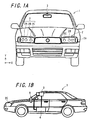
- Figs. 1A and 1B show an exemplary vehicle 1 equipped with a night vision apparatus for a vehicle, as a preferable example of a night vision apparatus according to the invention.
- Fig. 1A is a schematic front view.
- Fig. 1B is a schematic side view.
- headlamps 2 are arranged as illuminating devices in the front portion of the vehicle 1.
- the headlamps 2 are constituted by high-beam light sources 2A, low-beam light sources 2B, and infrared light sources 2C.
- the infrared light sources 2C are arranged on the center side of the vehicle.
- an imaging camera 3 having a sensitivity over a range from the visible light region to the infrared light region is disposed at a rearview mirror portion in the front portion of the driver's seat inside the vehicle 1. That is to say, the imaging camera 3 detects light over a range from the visible light region to the infrared light region.
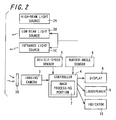
- a controller 4 is disposed inside the vehicle. Asshown in Fig. 2 , a vehicle-speed signal from a vehicle-speed sensor 5, a rudder-angle signal from a rudder-angle sensor 6, and an image signal from the imaging camera 3 are inputted to the controller 4.
- the controller 4 has an image processing portion 7.
- the image processing portion 7 processes an image signal from the imaging camera 3, and outputs the processed signal to a display 8 functioning as an image display portion that is installed in the front portion of the driver's seat inside the vehicle 1.
- a display 8 functioning as an image display portion that is installed in the front portion of the driver's seat inside the vehicle 1.
- an image based on video captured by the imaging camera 3 is displayed on the display 8.
- the controller 4 has a function of changing the orientation of the imaging camera 3 based on a vehicle-speed signal from the vehicle-speed sensor 5 and a rudder-angle signal from the rudder-angle sensor 6.
- the controller 4 can also send a signal as appropriate to warning notification means such as a loudspeaker 9 or an indicator 10, for example, in a case where an obstacle such as a pedestrian exists in front of the vehicle.
- Fig. 2 an example is shown in which an output image is outputted to the display 8 functioning as an image display portion.
- the output image can be outputted not only to the image display portion, but also to a vehicle control system or to a storage apparatus installed in the vehicle. Also, the output image can be transmitted to a transmission system such as a navigation system.
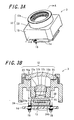
- Fig. 3A shows a schematic perspective view of the detail of the imaging camera 3.
- Fig. 3B shows a cross-sectional view taken along line A-A in Fig. 3A .
- the imaging camera 3 includes a lens member 12 (a first lens 12a, a second lens 12b, and a third lens 12c) that mainly condenses light from a subject, an imaging element 13 on which an image of light from the lens member 12 is formed and converted into an electric signal, and an imaging substrate 14 on which the imaging element 13 is mounted.
- the lens member 12 and the imaging substrate 14 are overlaid with a predetermined gap interposed therebetween, and fixed with fixing pins 18.
- the first lens 12a is in contact with a face of a lens holding portion 15a of a front case 15 on the side of a subject, and pressed by a retainer 23 from the side of a subject.
- the retainer 23 is fixed on the side face of the lens holding portion 15a, for example, with an adhesive or a solder.
- the second lens 12b and the third lens 12c are press-fitted into an opening portion 15b that is open in the lens holding portion 15a, and fixed, for example, with an adhesive or a solder.
- a mask or an aperture may be provided at an appropriate position of the lens member 12, or the outer circumference of the first lens 12a may be fixed by the lens holding portion 15a as the second lens 12b and the like.
- the imaging element 13 is constituted by, for example, a CCD (charge coupled device) image sensor, or a CMOS (complementary MOS) image sensor.
- the imaging element 13 is accommodated in a cavity 24a of a sub-substrate 24, and sealed by a glass rid 25.
- electronic components such as an IC, a capacitor, a coil, and a resistor, for processing an electric signal from the imaging element 13, a connector (not shown) for connecting a cable (not shown) that connects the imaging substrate 14 and an ECU (not shown), and the like are arranged.
- the cable connected to the connector (not shown) is connected to an external connector that is inserted into and fixed at a back face case (not shown), and further extended to an external cable.
- a filter layer is formed on one main face of a flat plate made of glass.
- borosilicate glass can be used in which silica is 10%, boron oxide is 10%, barium oxide is 2%, antimony oxide is 2%, titanium oxide is 2%, and zinc oxide is 20%.
- the optical band elimination filter is configured such that on one main face of the borosilicate glass flat plate, sequentially are formed one layer of aluminum oxide (thickness 58 nm), five layers, each consisting of titanium oxide (thickness 83 nm) and silica (thickness 130 nm), in which the titanium oxide and the silica alternate, one layer of titanium oxide (thickness 83 nm), and one layer of aluminum oxide (thickness 58 nm).
- this optical band elimination filter When the wavelength at which the blocking ratio is a half maximum at both ends of a light-blockingband is taken as a cutoff wavelength, this optical band elimination filter has an optical property in which the light-blocking band has a center wavelength of 570 nm, and cutoff wavelengths at both ends of 530 nm and 610 nm respectively.
- the optical band elimination filter described above has the configuration in which the filter layer is formed only on one main face of the flat plate.
- the configuration is not limited to this, and the filter layer may be formed on both main faces of the flat plate.
- the filter layer that is formed on one main face is configured such that the light-blocking band has cutoff wavelengths of 530 nm and 580 nm
- the filter layer that is formed on the other main face is configured such that the light-blocking band has cutoff wavelengths of 560 nm and 610 nm.
- an optical band elimination filter is obtained that has an optical property in which the light-blocking band has cutoff wavelengths at both ends of 530 nm and 610 nm respectively for light passing from one main face to the other main face.
- the optical band elimination filter also can be configured by forming a filter layer on a main face of the first lens 12a, the second lens 12b, or the third lens 12c.
- the optical band elimination filter also can be configured by forming a filter layer on a main face of the glass rid 25 that is attached on the upper face of the sub-substrate 24 so as to seal the imaging element 13, or by forming a filter layer on a surface of a microlens (not shown) on the surface of the imaging element 13.
- Figs. 4A and 4B show an exemplary spectrum of light that is emitted from the headlamps 2 and received by the imaging camera 3.
- the imaging camera 3 receives both a spectrum of reflected light that has a plurality of peaks mainly in the visible light region (380 to 780 nm), is emitted from the low-beam light sources 2B for obtaining information on the vicinity of the vehicle when recognizing a white line or the like, and is reflected by an object, and a spectrum of reflected light that has peaks in the infrared light region (780 nm or more), is emitted from the infrared light sources 2C for obtaining information on a distant area that is not visible at night, and is reflected by an object.
- the intensity of reflected light that is received by the imaging camera 3 is not determined only based on the intensity of light that is emitted from a light source, but depends also on the distance between the light source and an object. More specifically, the intensity is lowered as the distance between the light source and the object increases. Thus, the sensitivity to the light from the infrared light sources 2C for viewing a distant object tends to be lower than that to the light from the low-beam light sources 2B for viewing an object around the vehicle.
- the optical band elimination filter 30 is disposed between the lens member 12 and the imaging element 13.
- Fig. 5 shows an example of the transmission property of the optical band elimination filter 30.
- the optical band elimination filter 30 in Fig. 5 has a half maximum d of the blocking ratio in 530 to 610 nm in the light-blocking band.
- the optical band elimination filter 30 in a case where the optical band elimination filter 30 is not used, or in a case where no peak can be cut, the image intensity of information on the vicinity of the apparatus based on light that is emitted from the low-beam light sources 2B increases, and thus an image of information on a distant area based on light that is emitted from the infrared light sources 2C becomes relatively less visible.
- detection of an obstacle around the vehicle and recognition of a white line, which otherwise would be displayed based on a signal in the visible light region cannot be performed.
- the optical band elimination filter 30 preferably cuts only two peaks, namely the peak having the highest intensity and the peak having the second highest intensity, among the five or more peaks, because this processing makes it possible to reduce the peaks so as to achieve matching of the intensity in the visible light region with that in the infrared light region while keeping the sensitivity in the visible light region.
- High intensity discharge lamps have various wavelength spectra that vary depending on the type of the light sources, as shown in Figs. 4A and 4B .
- the light-blocking band of the optical band elimination filter 30 preferably has a half maximum d of the blocking ratio in 490 to 570 nm, or 530 to 610 nm in the light-blocking band, because this configuration makes it possible to effectively achieve balance of the image intensity in the visible light region with that in the infrared light region while keeping the sensitivity in the visible light region.
- the light-blocking band width of the optical band elimination filter 30 is preferably 50 to 100 nm, because this band width increases the sensitivity of an image in the visible light region.
- the infrared light sources 2C are provided as dedicated light sources that are different from the low-beam light sources 2B, but a configuration also may be adopted in which the infrared light sources 2C are used also as the low-beam light sources 2B.
- the shape of the filter of the infrared light sources 2C is not limited to those described above.
- the night vision apparatus of the invention is not limited to a night vision apparatus for a vehicle, and can be also applied to a monitoring camera and the like appropriately.
- the night vision apparatus of the invention can be equipped inavehicle.
- a vehicle equipped with the night vision apparatus of the invention can let the driver visually confirm directly image information obtained by the night vision apparatus, can give, by means of sounds, light, or vibrations, the driver warning to the effect that an obstacle, another vehicle, or the like on the road is detected, for example, and can control a movement of the vehicle based on image information obtained by the night vision apparatus, as in vehicles equipped with conventional night vision apparatuses.
- the vehicle equipped with the night vision apparatus of the invention can be realized by equipping a vehicle with the night vision apparatus of the invention, specific examples of the vehicle including not only railroad trains, electric railcars, automobiles, and other passenger vehicles, and freight cars, but also bicycles, motorized bicycles, rides in theme-parks, and carts in golf courses, for example.
- the night vision apparatus of the invention can be equipped in a small boat.
- a small boat equipped with the night vision apparatus of the invention can let the operator visually confirm directly image information obtained by the night vision apparatus, and can give, by means of sounds, light, or vibrations, the operator warning to the effect that an obstacle such as a sunken rock, another boat, another small boat, or the like is detected, for example, as in conventional cases.
- the small boat equipped with the night vision apparatus of the invention can be realized by equipping a small boat with the night vision apparatus of the invention, specific examples of the small boat including boats that can be operated with a license for small boats or without a license, such as hand rowing boats, dinghies, wet bikes, small bass boats equipped with an outboard motor, inflatable boats (rubber dinghies) equipped with an outboard motor, fishing ships, leisure fishing boats, workboats, houseboats, towing boats, sports boats, fishing boats, yachts, offshore yachts, and cruisers, which have a gross tonnage of less than 20 tons, and pleasure boats having a gross tonnage of 20 tons or more.
- boats that can be operated with a license for small boats or without a license such as hand rowing boats, dinghies, wet bikes, small bass boats equipped with an outboard motor, inflatable boats (rubber dinghies) equipped with an outboard motor, fishing ships, leisure fishing boats, workboats, houseboats, towing boats, sports boats, fishing boats, yacht
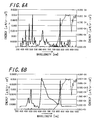
- a vehicle was prepared that had headlamps as light sources with the light-emitting property shown in Figs. 6A and 6B and in which an optical band elimination filter with the light-blocking band in Table 1 was disposed inside an imaging camera. At night, this vehicle was stopped on a road with a white line drawn on the left side, and a person in white clothes was made to stand as an obstacle near the white line. Both the low-beam light sources and the infrared light sources of the vehicle were on.
- Sample 3 corresponds to light of a high intensity discharge lamp (HID illumination light source 1: HID1) received with the wavelength spectrum in Fig. 4A , and passed through the optical band elimination filter in Fig. 5 to be corrected to have the wavelength spectrum in Fig. 6A .
- Sample 4 corresponds to light of a high intensity discharge lamp (HID illumination light source 2: HID2) received with the wavelength spectrum in Fig.
Landscapes
- Engineering & Computer Science (AREA)
- Multimedia (AREA)
- Signal Processing (AREA)
- Studio Devices (AREA)
- Lighting Device Outwards From Vehicle And Optical Signal (AREA)
- Closed-Circuit Television Systems (AREA)
- Camera Bodies And Camera Details Or Accessories (AREA)
- Transforming Light Signals Into Electric Signals (AREA)
Applications Claiming Priority (2)
| Application Number | Priority Date | Filing Date | Title |
|---|---|---|---|
| JP2006087805 | 2006-03-28 | ||
| PCT/JP2007/056266 WO2007111317A1 (ja) | 2006-03-28 | 2007-03-26 | 暗視装置 |
Publications (3)
| Publication Number | Publication Date |
|---|---|
| EP2007132A1 true EP2007132A1 (de) | 2008-12-24 |
| EP2007132A4 EP2007132A4 (de) | 2009-05-13 |
| EP2007132B1 EP2007132B1 (de) | 2013-05-08 |
Family
ID=38541234
Family Applications (1)
| Application Number | Title | Priority Date | Filing Date |
|---|---|---|---|
| EP07739704.0A Ceased EP2007132B1 (de) | 2006-03-28 | 2007-03-26 | Nachtsichteinrichtung |
Country Status (5)
| Country | Link |
|---|---|
| US (1) | US7767964B2 (de) |
| EP (1) | EP2007132B1 (de) |
| JP (1) | JP4594423B2 (de) |
| CN (1) | CN101411178B (de) |
| WO (1) | WO2007111317A1 (de) |
Families Citing this family (11)
| Publication number | Priority date | Publication date | Assignee | Title |
|---|---|---|---|---|
| KR20110140010A (ko) * | 2010-06-24 | 2011-12-30 | 삼성전자주식회사 | 근적외광 신호를 이용한 이미지 센서 |
| JP5921112B2 (ja) * | 2010-08-20 | 2016-05-24 | 株式会社日立国際電気 | 画像監視システムおよびカメラ |
| MX2013009893A (es) * | 2011-02-28 | 2013-10-30 | Nanoholdings Llc | Bloqueador de luz visible con paso de luz infrarroja para dispositivos de conversion positiva. |
| US20130083195A1 (en) * | 2011-09-30 | 2013-04-04 | Jeffrey Thomas Remillard | Polarization-based anti-blinding night vision system, vehicle comprising same, and method therefor |
| JP6205923B2 (ja) * | 2013-07-11 | 2017-10-04 | 株式会社デンソー | 走行支援装置 |
| DE102014115292A1 (de) * | 2014-10-21 | 2016-04-21 | Connaught Electronics Ltd. | Verfahren zum Bereitstellen von Bilddateien von einem Kamerasystem, Kamerasystem und Kraftfahrzeug |
| DE102015005697B4 (de) * | 2015-05-04 | 2019-10-02 | Mekra Lang Gmbh & Co. Kg | Kamerasystem für ein Kraftfahrzeug |
| US9842868B2 (en) * | 2015-10-26 | 2017-12-12 | Sensors Unlimited, Inc. | Quantum efficiency (QE) restricted infrared focal plane arrays |
| CN105785990B (zh) * | 2016-02-26 | 2019-01-11 | 江苏科技大学 | 基于全景环视的船只停泊系统及障碍物识别方法 |
| CN105799593B (zh) * | 2016-03-18 | 2019-01-25 | 京东方科技集团股份有限公司 | 车辆辅助行驶装置 |
| JP6181278B1 (ja) * | 2016-12-22 | 2017-08-16 | Jig−Saw株式会社 | 可視光波長変換部を有する頭部装着型映像提示装置 |
Family Cites Families (12)
| Publication number | Priority date | Publication date | Assignee | Title |
|---|---|---|---|---|
| JPS56135809A (en) * | 1980-03-26 | 1981-10-23 | Hino Kinzoku Sangyo Kk | Filter for astronominal observation |
| JPH10108206A (ja) | 1996-09-27 | 1998-04-24 | Toshiba Lighting & Technol Corp | カラービデオカメラ、テレビドアホン及び監視装置 |
| US6861809B2 (en) * | 1998-09-18 | 2005-03-01 | Gentex Corporation | Headlamp control to prevent glare |
| JP2002320139A (ja) * | 2001-04-19 | 2002-10-31 | Matsushita Electric Ind Co Ltd | カメラ装置 |
| JP2003259363A (ja) | 2002-02-27 | 2003-09-12 | Denso Corp | ナイトビジョン装置 |
| FR2839138B1 (fr) * | 2002-04-30 | 2005-01-07 | Valeo Vision | Dispositif projecteur bifonction pour vehicule automobile |
| JP2004032243A (ja) * | 2002-06-25 | 2004-01-29 | Sanyo Electric Co Ltd | 撮像装置および光学フィルタ |
| JP2004142561A (ja) | 2002-10-23 | 2004-05-20 | Ichikoh Ind Ltd | 赤外照明光源及び車両用灯具 |
| US7081991B2 (en) * | 2003-03-14 | 2006-07-25 | Rockwell Collins, Inc. | Dye-based filter |
| JP2005032625A (ja) * | 2003-07-08 | 2005-02-03 | Ichikoh Ind Ltd | 車両用暗視装置の投光装置 |
| DE10335189A1 (de) * | 2003-07-30 | 2005-03-03 | Daimlerchrysler Ag | Vorrichtung zur Sichtverbesserung bei Kraftfahrzeugen |
| DE102004001556A1 (de) * | 2004-01-10 | 2005-08-04 | Robert Bosch Gmbh | Nachtsichtsystem für Kraftfahrzeuge mit partiellem optischem Filter |
-
2007
- 2007-03-26 EP EP07739704.0A patent/EP2007132B1/de not_active Ceased
- 2007-03-26 WO PCT/JP2007/056266 patent/WO2007111317A1/ja not_active Ceased
- 2007-03-26 JP JP2008507497A patent/JP4594423B2/ja not_active Expired - Fee Related
- 2007-03-26 US US12/294,606 patent/US7767964B2/en not_active Expired - Fee Related
- 2007-03-26 CN CN2007800110067A patent/CN101411178B/zh not_active Expired - Fee Related
Also Published As
| Publication number | Publication date |
|---|---|
| CN101411178A (zh) | 2009-04-15 |
| JPWO2007111317A1 (ja) | 2009-08-13 |
| WO2007111317A1 (ja) | 2007-10-04 |
| EP2007132A4 (de) | 2009-05-13 |
| US7767964B2 (en) | 2010-08-03 |
| JP4594423B2 (ja) | 2010-12-08 |
| EP2007132B1 (de) | 2013-05-08 |
| US20090101820A1 (en) | 2009-04-23 |
| CN101411178B (zh) | 2011-10-05 |
Similar Documents
| Publication | Publication Date | Title |
|---|---|---|
| EP2007132B1 (de) | Nachtsichteinrichtung | |
| US8451107B2 (en) | Imaging system for vehicle | |
| US7619680B1 (en) | Vehicular imaging system with selective infrared filtering and supplemental illumination | |
| US20180015879A1 (en) | Side-view mirror camera system for vehicle | |
| CN100413324C (zh) | 车载夜视摄象机系统,显示装置和显示方法 | |
| JPH05294183A (ja) | 車載監視カメラ装置 | |
| JP4688196B2 (ja) | 自動車用暗視システム | |
| US7889230B2 (en) | Vehicle rear side video monitoring system | |
| JP2006248363A (ja) | 運転者照明装置、運転者撮影装置および運転者監視装置 | |
| US11146715B2 (en) | Camera system, driver/passenger monitoring system, moving vehicle, image capturing method, and non-transitory storage medium | |
| JP2005051790A (ja) | 車内の視認性を改善するための装置 | |
| JP7258847B2 (ja) | 車両用映像システム | |
| US20070272837A1 (en) | Vehicle occupant detection device | |
| JP2016182911A (ja) | 車両用の視認補助装置および車両 | |
| JP2007091186A (ja) | 車両周囲状況の撮影表示方法および撮影表示システム | |
| JP2009029350A (ja) | 車両の乗員検知装置 | |
| JP3764317B2 (ja) | 車載用周辺視認装置 | |
| JP2005001948A (ja) | 合わせガラスおよびその製造方法 | |
| JP4504085B2 (ja) | 監視カメラ付きバックミラー | |
| TWM600267U (zh) | 行車監控警示系統 | |
| CN221293242U (zh) | 一种用于电子外后视镜的亮度调整装置 | |
| JP2007050749A (ja) | 自動車周囲監視装置 | |
| JP4620640B2 (ja) | ヘッドライトモジュール | |
| KR20230131399A (ko) | 차량 인식 장치 | |
| JP2004051057A (ja) | 車両用暗視装置 |
Legal Events
| Date | Code | Title | Description |
|---|---|---|---|
| PUAI | Public reference made under article 153(3) epc to a published international application that has entered the european phase |
Free format text: ORIGINAL CODE: 0009012 |
|
| 17P | Request for examination filed |
Effective date: 20081028 |
|
| AK | Designated contracting states |
Kind code of ref document: A1 Designated state(s): DE |
|
| DAX | Request for extension of the european patent (deleted) | ||
| RBV | Designated contracting states (corrected) |
Designated state(s): DE |
|
| A4 | Supplementary search report drawn up and despatched |
Effective date: 20090415 |
|
| 17Q | First examination report despatched |
Effective date: 20090630 |
|
| REG | Reference to a national code |
Ref country code: DE Ref legal event code: R079 Ref document number: 602007030330 Country of ref document: DE Free format text: PREVIOUS MAIN CLASS: H04N0005225000 Ipc: H04N0005235000 |
|
| RIC1 | Information provided on ipc code assigned before grant |
Ipc: H04N 5/235 20060101AFI20120822BHEP Ipc: H04N 5/225 20060101ALI20120822BHEP |
|
| GRAP | Despatch of communication of intention to grant a patent |
Free format text: ORIGINAL CODE: EPIDOSNIGR1 |
|
| GRAS | Grant fee paid |
Free format text: ORIGINAL CODE: EPIDOSNIGR3 |
|
| GRAA | (expected) grant |
Free format text: ORIGINAL CODE: 0009210 |
|
| AK | Designated contracting states |
Kind code of ref document: B1 Designated state(s): DE |
|
| REG | Reference to a national code |
Ref country code: DE Ref legal event code: R096 Ref document number: 602007030330 Country of ref document: DE Effective date: 20130704 |
|
| PLBE | No opposition filed within time limit |
Free format text: ORIGINAL CODE: 0009261 |
|
| STAA | Information on the status of an ep patent application or granted ep patent |
Free format text: STATUS: NO OPPOSITION FILED WITHIN TIME LIMIT |
|
| 26N | No opposition filed |
Effective date: 20140211 |
|
| REG | Reference to a national code |
Ref country code: DE Ref legal event code: R097 Ref document number: 602007030330 Country of ref document: DE Effective date: 20140211 |
|
| PGFP | Annual fee paid to national office [announced via postgrant information from national office to epo] |
Ref country code: DE Payment date: 20200310 Year of fee payment: 14 |
|
| REG | Reference to a national code |
Ref country code: DE Ref legal event code: R119 Ref document number: 602007030330 Country of ref document: DE |
|
| PG25 | Lapsed in a contracting state [announced via postgrant information from national office to epo] |
Ref country code: DE Free format text: LAPSE BECAUSE OF NON-PAYMENT OF DUE FEES Effective date: 20211001 |