EP2006944A2 - Festoxidbrennstoffzelle - Google Patents
Festoxidbrennstoffzelle Download PDFInfo
- Publication number
- EP2006944A2 EP2006944A2 EP07740525A EP07740525A EP2006944A2 EP 2006944 A2 EP2006944 A2 EP 2006944A2 EP 07740525 A EP07740525 A EP 07740525A EP 07740525 A EP07740525 A EP 07740525A EP 2006944 A2 EP2006944 A2 EP 2006944A2
- Authority
- EP
- European Patent Office
- Prior art keywords
- separator
- plate
- fuel cell
- electrode layer
- solid oxide
- Prior art date
- Legal status (The legal status is an assumption and is not a legal conclusion. Google has not performed a legal analysis and makes no representation as to the accuracy of the status listed.)
- Withdrawn
Links
Images

Classifications
-
- H—ELECTRICITY
- H01—ELECTRIC ELEMENTS
- H01M—PROCESSES OR MEANS, e.g. BATTERIES, FOR THE DIRECT CONVERSION OF CHEMICAL ENERGY INTO ELECTRICAL ENERGY
- H01M8/00—Fuel cells; Manufacture thereof
- H01M8/02—Details
- H01M8/0202—Collectors; Separators, e.g. bipolar separators; Interconnectors
- H01M8/0204—Non-porous and characterised by the material
- H01M8/0206—Metals or alloys
-
- H—ELECTRICITY
- H01—ELECTRIC ELEMENTS
- H01M—PROCESSES OR MEANS, e.g. BATTERIES, FOR THE DIRECT CONVERSION OF CHEMICAL ENERGY INTO ELECTRICAL ENERGY
- H01M8/00—Fuel cells; Manufacture thereof
- H01M8/02—Details
- H01M8/0202—Collectors; Separators, e.g. bipolar separators; Interconnectors
- H01M8/0204—Non-porous and characterised by the material
- H01M8/0206—Metals or alloys
- H01M8/0208—Alloys
- H01M8/021—Alloys based on iron
-
- H—ELECTRICITY
- H01—ELECTRIC ELEMENTS
- H01M—PROCESSES OR MEANS, e.g. BATTERIES, FOR THE DIRECT CONVERSION OF CHEMICAL ENERGY INTO ELECTRICAL ENERGY
- H01M8/00—Fuel cells; Manufacture thereof
- H01M8/02—Details
- H01M8/0202—Collectors; Separators, e.g. bipolar separators; Interconnectors
- H01M8/0204—Non-porous and characterised by the material
- H01M8/0223—Composites
-
- H—ELECTRICITY
- H01—ELECTRIC ELEMENTS
- H01M—PROCESSES OR MEANS, e.g. BATTERIES, FOR THE DIRECT CONVERSION OF CHEMICAL ENERGY INTO ELECTRICAL ENERGY
- H01M8/00—Fuel cells; Manufacture thereof
- H01M8/02—Details
- H01M8/0202—Collectors; Separators, e.g. bipolar separators; Interconnectors
- H01M8/0258—Collectors; Separators, e.g. bipolar separators; Interconnectors characterised by the configuration of channels, e.g. by the flow field of the reactant or coolant
- H01M8/0263—Collectors; Separators, e.g. bipolar separators; Interconnectors characterised by the configuration of channels, e.g. by the flow field of the reactant or coolant having meandering or serpentine paths
-
- H—ELECTRICITY
- H01—ELECTRIC ELEMENTS
- H01M—PROCESSES OR MEANS, e.g. BATTERIES, FOR THE DIRECT CONVERSION OF CHEMICAL ENERGY INTO ELECTRICAL ENERGY
- H01M8/00—Fuel cells; Manufacture thereof
- H01M8/10—Fuel cells with solid electrolytes
- H01M8/12—Fuel cells with solid electrolytes operating at high temperature, e.g. with stabilised ZrO2 electrolyte
- H01M2008/1293—Fuel cells with solid oxide electrolytes
-
- Y—GENERAL TAGGING OF NEW TECHNOLOGICAL DEVELOPMENTS; GENERAL TAGGING OF CROSS-SECTIONAL TECHNOLOGIES SPANNING OVER SEVERAL SECTIONS OF THE IPC; TECHNICAL SUBJECTS COVERED BY FORMER USPC CROSS-REFERENCE ART COLLECTIONS [XRACs] AND DIGESTS
- Y02—TECHNOLOGIES OR APPLICATIONS FOR MITIGATION OR ADAPTATION AGAINST CLIMATE CHANGE
- Y02E—REDUCTION OF GREENHOUSE GAS [GHG] EMISSIONS, RELATED TO ENERGY GENERATION, TRANSMISSION OR DISTRIBUTION
- Y02E60/00—Enabling technologies; Technologies with a potential or indirect contribution to GHG emissions mitigation
- Y02E60/30—Hydrogen technology
- Y02E60/50—Fuel cells
Definitions
- the present invention relates to a flat plate stacked type solid oxide fuel cell in which a plurality of power generation cells are connected via separators, and more particularly to a solid oxide fuel cell in which the high temperature oxidation resistance of the separator is improved.
- the above described solid oxide fuel cell has been attracting attention as a third generation fuel cell for power generation.
- the solid oxide fuel cell there are proposed three types: a cylindrical type, a monolithic type, and a flat plate stacked type.
- Any type of the solid oxide fuel cells has a laminated structure in which a solid electrolyte formed of an oxide ion conductor is sandwiched between an air electrode layer and a fuel electrode layer.
- the solid oxide fuel cell is configured in such a way that a plurality of power generation cells consisting of the laminated body and a plurality of separators are alternately laminated through a fuel electrode current collector or an air electrode current collector to form a stack structure.
- oxygen (air) as oxidant gas is supplied to the air electrode layer side of the power generation cell, and fuel gas (H 2 , CO, CH 4 , and the like) is supplied to the fuel electrode layer side.
- fuel gas H 2 , CO, CH 4 , and the like.
- Both the air electrode layer and the fuel electrode layer are made porous so as to enable the gas to reach their boundary surface with the solid electrolyte layer.
- the oxygen supplied to the air electrode layer side reaches near the boundary surface with the solid electrolyte layer through the pore in the air electrode layer, and there, the oxygen receives an electron from the air electrode layer to be ionized to oxide ion (O 2- ).
- oxide ion is diffusively moved in the solid electrolyte layer toward the direction of the fuel electrode layer.
- the oxide ions When reaching near the boundary surface with the fuel electrode layer, the oxide ions react there with the fuel gas to produce a reaction gas (exhaust gas), such as H 2 O and CO 2 , and emits electrons to the fuel electrode layer.
- a reaction gas such as H 2 O and CO 2
- the electrons can be taken out as an electromotive force by an external circuit to another route.
- the separator has a function of supplying reactive gas to the power generation cell and of electrically connecting the power generation cells to each other.
- the separator is required to have excellent electric conductivity, and hence a heat-resistant alloy, such as stainless steel, is usually used as a base material of the separator.
- the metal separator is used at a high temperature of 700 to 1000°C of the fuel cell operating temperature.
- a film mainly made of the base material for example, a film made of chromium oxide and the like, is formed on the metal surface. This results in a problem that the contact resistance between the separator and the current collector is increased according to the growth of the film, and that the electrical connecting function between the power generation cells is thereby deteriorated. This phenomenon is remarkable in particular on the fuel electrode side of the separator.
- the increase in the resistance due to the oxide film significantly influences the performance and life of the cell.
- Patent Document 1 discloses a metal separator which is formed of a heat-resistant alloy, and in which an Ni plating layer is provided on the fuel electrode surface side of the separator and an LaCrO 3 based plating layer is provided on the air electrode surface side
- Patent Document 2 discloses a metal separator in which mixed powder made of conductive ceramic powder and metal powder is plasma-sprayed on a heat-resistant alloy.
- the plating method and the plasma spray method are used for forming the metal protective film, it is thus difficult to increase the thickness of the protective film. This results in a problem that during a long period of use, the protective film on the metal surface is absorbed in the base material by mutual diffusion, and that the base material is thereby exposed on the surface. In addition, the cost for forming the protective film by the plating and the plasma spray coating is high.
- an object of the present invention is to provide a solid oxide fuel cell which is capable of preferably maintaining the electric conductivity between power generation cells even for a long period of use, by improving the high temperature oxidation resistance of the fuel electrode side surface of the metal separator.
- the solid oxide fuel cell according to the present invention is featured in that in a flat plate stacked type solid oxide fuel cell in which a fuel electrode layer and an oxidant electrode layer are respectively arranged on both sides of a solid electrolyte layer, and in which a metal separator is arranged on the outside of each of the fuel electrode layer and the oxidant electrode layer, a protective plate having more excellent high temperature oxidation resistance than that of the metal separator is joined on the fuel electrode layer side surface of the metal separator.
- the separator and the protective plate are joined to each other by diffusion joining, or the like.
- the separator is configured, for example, by laminating a plurality of metal plates.
- the plurality of metal plates are diffusion joined to each other, and the metal plate is diffusion joined to the protective plate. Thereby, the plurality of metal plates and the protective plate are integrated together.
- the protection plate is made of, for example, Ni or Cu.
- the metal separator is made of, for example, a heat-resistant alloy of an Fe-base alloy, and nickel plating and/or Ag plating is applied to the surface of the metal separator.
- the protective plate having excellent high temperature oxidation resistance is joined to the fuel electrode layer side surface of the separator, and hence there is no possibility that the fuel gas enters into the joined portion of the members.
- the separator is surely protected from the fuel electrode atmosphere by the protection plate, so that the excellent electric conductivity can be maintained even in a long period of use.
- the separator and the protective plate are diffusion joined to each other.
- the high joining strength of the joined portion prevents the protective plate from being separated even in a high temperature atmosphere.
- the separator is surely protected from the fuel electrode atmosphere by the protective plate, so that the excellent electric conductivity can be maintained even in a long period of use.
- the separator has the multilayer structure configured by the plurality of metal plates, the plurality of metal plates and the protective plate are integrally joined by diffusion joining. Thus, it is possible to easily manufacture the separator having excellent high temperature oxidation resistance.
- the separator when the protective plate is made of Ni and Cu, the separator is surely protected from the high temperature and high humidity fuel electrode atmosphere because of the excellent high temperature oxidation resistance of Ni and Cu. Thus, the separator is enabled to maintain the excellent electric conductivity even in a long period of use.
- the high temperature oxidation resistance of the separator itself can be further improved by applying Ni plating and/or Ag plating to the surface of the separator, in addition to the above described arrangement of the protective plate.
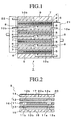
- Figure 1 shows a configuration of a solid oxide fuel cell (fuel cell stack) according to the present invention.
- Figure 2 and Figure 4 show configuration examples of the separator in Figure 1 .
- Figure 3 shows an appearance of the separator.
- a fuel cell stack 1 is configured by stacking, in order, a power generation cell 5 in which a fuel electrode layer 3 and an air electrode layer 4 are respectively arranged on both sides of a solid electrolyte layer 2, a fuel electrode current collector 6 provided on the outside of the fuel electrode layer 3, an air electrode current collector 7 provided on the outside of the air electrode layer 4, and a separator 8 provided on the outside of each of the current collectors 6 and 7 (the uppermost and lowermost separators are end plates 9).
- the solid electrolyte layer 2 is formed of stabilized zirconia (YSZ) obtained by adding yttria, and the like.
- the fuel electrode layer 3 is formed of a metal such as Ni or a cermet such as Ni-YSZ.
- the air electrode layer 4 is formed of LaMnO 3 , LaCoO 3 , and the like.
- the fuel electrode current collector 6 is configured by a sponge-like porous sintered metal plate made of Ni, and the like.
- the air electrode current collector 7 is configured by a sponge-like porous sintered metal plate made of Ag, and the like.
- the separator 8 has a function to electrically connect between the power generation cells 5, and hence is required to have excellent electric conductivity.
- an Fe-base alloy such as SUS430 which is excellent in mechanical strength, corrosion resistance, temperature resistance, and the like.
- a fuel gas passage 10a through which fuel gas is introduced from a fuel manifold 21 and discharged from the surface facing the fuel electrode layer 3
- an oxidant gas passage 10b through which the air as oxidant gas is introduced from an oxidant manifold 22 and discharged from the surface facing the air electrode layer 4.
- one of the end plates 9 on the both ends has only the fuel gas passage 10a, and the other of the end plates 9 has only the oxidant gas passage 10b.
- the separator 8 has, for example as shown in Figure 2 , a five-layer structure comprising: an inner metal plate 16 which is formed of an upper plate 12, a middle plate 11 and a lower plate 13; and upper and lower outer metal plates 14 and 15 stacked on the outsides of the inner plate 16.
- an inner metal plate 16 which is formed of an upper plate 12, a middle plate 11 and a lower plate 13
- upper and lower outer metal plates 14 and 15 stacked on the outsides of the inner plate 16.
- each of the metal plates 11 to 15 there is used a quadrangular metal plate (for example, SUS430) having a thickness of about 0.5 mm.
- recessed grooves 12a and 12b are provided on the upper plate 12, groove holes 11a and 11b are provided in the middle plate 11, and recessed grooves 13a and 13b are provided on the lower plate 13.
- the fuel gas passage 10a as shown in Figure 1 is formed of the recessed groove 12a, the groove hole 11a, and the recessed groove 13a which correspond to each other, and that the oxidant gas passage 10b is formed of the recessed groove 12b, the groove hole 11b, and the recessed groove 13b which correspond to each other.
- a fuel gas discharge port 17 which communicates with the end of the fuel gas passage 10a is provided in the central portion of the outer metal plate 14, and an oxidant gas discharge port 18 which communicates with the end of the oxidant gas passage 10b is provided in the central portion of the outer metal plate 15.
- the plurality of metal plates 11 to 15 are joined together and integrated, so as to configure a quadrangular separator 8 in which the spiral fuel gas passage 10a and the spiral oxidant gas passage 10b are provided as shown in Figure 3 .
- a protective plate 20 having more excellent high temperature oxidation resistance than that of the separator 8 is joined by diffusion joining to the outer metal plate 14, in such a state where the protective plate 20 overlaps and covers the upper surface of the outer metal plate 14 which is the surface of each separator 8 on the fuel electrode current collector 6 side.
- the protective plate 20 can be formed of Ni or Cu.
- the thickness of the protective plate 20 is preferably set to 0.01 to 0.5 mm. In the present embodiment, the protective plate 20 having a thickness of about 0.1 mm is used for the outer metal plate 14 having a thickness of about 0.5 mm.
- a through hole 20a which communicates with the fuel gas discharge port 17 of the outer metal plate 14 is provided substantially in the central portion of the protective plate 20 so that the fuel gas introduced into the fuel gas passage 10a of the separator 8 can be introduced to the side of the fuel electrode current collector 6 via the through hole 20a.
- the above described diffusion joining is a joining method in which respective members are heated and pressed so that an alloy layer (diffusion layer) of the members is formed between the joining surfaces of the members to thereby integrate (join) the members.
- diffusion joining it is possible to reliably join the members, that is, to reliably join the outer metal plate 14 with the protective plate 20, and possible to obtain excellent airtightness in the joined portion.
- the fuel gas enters into the joined portion in high temperature fuel electrode atmosphere.
- the high joining strength of the joined portion prevents the protective plate 20 from being separated.
- the separator 8 since Ni and Cu forming the protective plate 20 have highly excellent oxidation resistance in the high temperature and high humidity fuel electrode atmosphere, the separator 8 is surely protected from the fuel electrode atmosphere by the protective plate 20, and the growth of the high temperature oxidation film is prevented. Thereby, the separator 8 can be maintained to always have excellent electric conductivity. As a result, it is possible to realize a solid oxide fuel cell which has a long lifetime, and the performance of which is not deteriorated even in a long period of use. Further, the Ni plate and Cu plate can be supplied at low cost as compared with a plating layer, and hence it is possible to reduce the cost.
- the Ni plate and the SUS plate have substantially a same diffusion temperature.
- the plurality of metal plates 11 to 15 and the protective plate 20 made of Ni can be simultaneously joined and integrated together by diffusion joining.
- the separator 8 which has a multilayer structure and excellent high temperature oxidation resistance.
- the metal plates 11 to 15 are also surely joined to each other by diffusion joining, so that it is possible to obtain excellent airtightness and strong joining property in each joined portion.
- the separator 8 has the five layer structure which is configured by respectively arranging the upper and lower outer metal plates 14 and 15 on the outsides of the inner metal plate 16 formed of the plurality of metal plates of the upper plate 12, the middle plate 11 and the lower plate 13.
- the separator 8 may of course have a three layer structure configured by an upper plate 32, a middle plate 31 and a lower plate 33 as shown in Figure 4 .
- groove holes 31a and 31b are provided in the middle plate 31, and the fuel gas discharge port 17 which communicates with the end of the fuel gas passage 10a is provided in the central portion of the upper plate 32.
- the oxidant gas discharge port 18 which communicates with the end of the oxidant gas passage 10b is provided in the central portion of the lower plate 33.
- the protective plate 20 is also joined to the upper plate 32 by diffusion joining. Note that the upper plate 32 and the lower plate 33 have a thickness of about 1 mm, the middle plate 31 has a thickness of about 0.5 mm, and the protective plate 20 has, for example, a thickness of about 0.1 mm.
- the separator 8 it is of course possible to configure the separator 8 by a single plate.
- the separator 8 in the case where the separator 8 is configured to have the multilayer structure of the plurality of thin metal plates as described above, the reaction gas inner flow passages 10a and 10b having a complicated form, such as the spiral form, can also be comparatively easily formed.
- the separator 8 configured as described above has advantages that the manufacturing cost thereof can be reduced and that the separator 8 itself can be made thin and reduced in weight.
- the separator 8 itself when Ni plating and silver plating are applied to the separator 8 itself, or when Ni plating or silver plating is applied to the separator 8 itself, the high temperature oxidation resistance of the separator itself can be improved. This is preferred because more excellent electric conductivity is secured.
- the present invention is configured such that the protective plate having excellent high temperature oxidation resistance is joined to the fuel electrode layer side surface of the separator by diffusion joining. This makes it possible to improve the high temperature oxidation resistance of the fuel electrode side surface of the metal separator. As a result, it is possible to provide a solid oxide fuel cell which has a long lifetime and which is capable of preferably maintaining the electric conductivity between the power generation cells even in a long period of use.
Landscapes
- Chemical & Material Sciences (AREA)
- Life Sciences & Earth Sciences (AREA)
- Engineering & Computer Science (AREA)
- Manufacturing & Machinery (AREA)
- Sustainable Development (AREA)
- Sustainable Energy (AREA)
- Chemical Kinetics & Catalysis (AREA)
- Electrochemistry (AREA)
- General Chemical & Material Sciences (AREA)
- Composite Materials (AREA)
- Fuel Cell (AREA)
Applications Claiming Priority (2)
| Application Number | Priority Date | Filing Date | Title |
|---|---|---|---|
| JP2006098399A JP2007273303A (ja) | 2006-03-31 | 2006-03-31 | 固体酸化物形燃料電池 |
| PCT/JP2007/057089 WO2007116822A1 (ja) | 2006-03-31 | 2007-03-30 | 固体酸化物形燃料電池 |
Publications (3)
| Publication Number | Publication Date |
|---|---|
| EP2006944A2 true EP2006944A2 (de) | 2008-12-24 |
| EP2006944A9 EP2006944A9 (de) | 2009-07-29 |
| EP2006944A4 EP2006944A4 (de) | 2011-11-30 |
Family
ID=38581116
Family Applications (1)
| Application Number | Title | Priority Date | Filing Date |
|---|---|---|---|
| EP07740525A Withdrawn EP2006944A4 (de) | 2006-03-31 | 2007-03-30 | Festoxidbrennstoffzelle |
Country Status (4)
| Country | Link |
|---|---|
| US (1) | US20100304265A1 (de) |
| EP (1) | EP2006944A4 (de) |
| JP (1) | JP2007273303A (de) |
| WO (1) | WO2007116822A1 (de) |
Cited By (1)
| Publication number | Priority date | Publication date | Assignee | Title |
|---|---|---|---|---|
| WO2013053374A1 (en) * | 2011-10-14 | 2013-04-18 | Topsoe Fuel Cell A/S | Stack assembly |
Families Citing this family (6)
| Publication number | Priority date | Publication date | Assignee | Title |
|---|---|---|---|---|
| WO2009059443A1 (de) * | 2007-11-07 | 2009-05-14 | Almus Ag | Bipolzelle für brennstoffzellenstapel |
| JP5396967B2 (ja) * | 2009-03-30 | 2014-01-22 | 三菱マテリアル株式会社 | 固体酸化物形燃料電池 |
| JP5469050B2 (ja) * | 2010-12-17 | 2014-04-09 | 日本電信電話株式会社 | 平板型固体酸化物形燃料電池スタック |
| JP2015165454A (ja) * | 2014-02-28 | 2015-09-17 | 三菱日立パワーシステムズ株式会社 | 燃料電池モジュールおよび燃料電池モジュールの製造方法 |
| US11361357B2 (en) * | 2016-11-18 | 2022-06-14 | The Neiman Marcus Group Llc | Method, system, and computer program product for data attribution of items and contextual content creation of coordinating groups for the items |
| FR3162316A1 (fr) * | 2024-05-14 | 2025-11-21 | Genvia | Procédé de fabrication d’interconnecteurs pour dispositifs électrochimiques à oxyde solide et interconnecteur pour dispositifs électrochimiques à oxyde solide |
Family Cites Families (9)
| Publication number | Priority date | Publication date | Assignee | Title |
|---|---|---|---|---|
| JPH0536425A (ja) * | 1991-02-12 | 1993-02-12 | Tokyo Electric Power Co Inc:The | 固体電解質型燃料電池用合金セパレータ及びその製造 方法 |
| RU2174728C2 (ru) * | 1994-10-12 | 2001-10-10 | Х Пауэр Корпорейшн | Топливный элемент, использующий интегральную технологию пластин для распределения жидкости |
| JP4136062B2 (ja) | 1998-04-13 | 2008-08-20 | 東邦瓦斯株式会社 | セパレータ材 |
| US6054231A (en) * | 1998-07-24 | 2000-04-25 | Gas Research Institute | Solid oxide fuel cell interconnector |
| AUPQ078899A0 (en) * | 1999-06-04 | 1999-06-24 | Ceramic Fuel Cells Limited | A fuel cell gas separator |
| KR20040002847A (ko) * | 2000-11-16 | 2004-01-07 | 미쓰비시 마테리알 가부시키가이샤 | 고체 전해질형 연료전지 및 그것에 사용하는 공기극 집전체 |
| JP4124005B2 (ja) * | 2003-03-28 | 2008-07-23 | 日産自動車株式会社 | 燃料電池 |
| JP4462050B2 (ja) * | 2004-02-09 | 2010-05-12 | 三菱マテリアル株式会社 | 固体酸化物形燃料電池 |
| JP4517764B2 (ja) * | 2004-08-04 | 2010-08-04 | 三菱マテリアル株式会社 | 燃料電池用セパレータおよび固体酸化物形燃料電池 |
-
2006
- 2006-03-31 JP JP2006098399A patent/JP2007273303A/ja active Pending
-
2007
- 2007-03-30 EP EP07740525A patent/EP2006944A4/de not_active Withdrawn
- 2007-03-30 US US12/294,729 patent/US20100304265A1/en not_active Abandoned
- 2007-03-30 WO PCT/JP2007/057089 patent/WO2007116822A1/ja not_active Ceased
Cited By (4)
| Publication number | Priority date | Publication date | Assignee | Title |
|---|---|---|---|---|
| WO2013053374A1 (en) * | 2011-10-14 | 2013-04-18 | Topsoe Fuel Cell A/S | Stack assembly |
| CN103875111A (zh) * | 2011-10-14 | 2014-06-18 | 托普索燃料电池股份有限公司 | 堆叠组件 |
| CN103875111B (zh) * | 2011-10-14 | 2016-10-19 | 托普索公司 | 堆叠组件 |
| US9865896B2 (en) | 2011-10-14 | 2018-01-09 | Haldor Topsoe A/S | Stack assembly comprising flexible compression force mat |
Also Published As
| Publication number | Publication date |
|---|---|
| WO2007116822A1 (ja) | 2007-10-18 |
| EP2006944A4 (de) | 2011-11-30 |
| EP2006944A9 (de) | 2009-07-29 |
| JP2007273303A (ja) | 2007-10-18 |
| US20100304265A1 (en) | 2010-12-02 |
Similar Documents
| Publication | Publication Date | Title |
|---|---|---|
| US6949307B2 (en) | High performance ceramic fuel cell interconnect with integrated flowpaths and method for making same | |
| EP2851984B1 (de) | Leitfähiges element, zellenstapel, elektrochemisches modul und elektrochemische vorrichtung | |
| KR20070091324A (ko) | 고 비출력 고체 산화물 연료 전지 스택 | |
| EP2006944A9 (de) | Festoxidbrennstoffzelle | |
| EP2586088B1 (de) | Brennstoffzelle | |
| JP5023429B2 (ja) | 平板積層型燃料電池 | |
| JP4462050B2 (ja) | 固体酸化物形燃料電池 | |
| JP4900364B2 (ja) | 燃料電池 | |
| JP4306304B2 (ja) | 燃料電池用セパレータ | |
| JP5079991B2 (ja) | 燃料電池セル及び燃料電池 | |
| KR102114627B1 (ko) | 연료 전지 발전 단위 및 연료 전지 스택 | |
| JP5177847B2 (ja) | 電気化学装置 | |
| JP5588888B2 (ja) | 燃料電池スタックおよび燃料電池 | |
| JP4984374B2 (ja) | 燃料電池 | |
| JP5017857B2 (ja) | 燃料電池用のセパレータおよび固体酸化物形燃料電池 | |
| JP5920880B2 (ja) | 積層型固体酸化物形燃料電池の実装構造 | |
| JP4517764B2 (ja) | 燃料電池用セパレータおよび固体酸化物形燃料電池 | |
| JP5017777B2 (ja) | 燃料電池用セパレータ、セパレータの製造方法および固体酸化物形燃料電池 | |
| JP5203635B2 (ja) | 固体酸化物形燃料電池スタック及びモノリス形固体酸化物形燃料電池 | |
| JP4513396B2 (ja) | 固体酸化物形燃料電池 | |
| JP5727429B2 (ja) | セパレータ付燃料電池セル,および燃料電池 | |
| JP5062786B1 (ja) | 燃料電池の構造体 | |
| CN111971837B (zh) | 固体氧化物型燃料电池单元 | |
| JP2005310700A (ja) | 燃料電池 | |
| JP2008053044A (ja) | 固体電解質形燃料電池及びその製造方法 |
Legal Events
| Date | Code | Title | Description |
|---|---|---|---|
| PUAI | Public reference made under article 153(3) epc to a published international application that has entered the european phase |
Free format text: ORIGINAL CODE: 0009012 |
|
| PUAB | Information related to the publication of an a document modified or deleted |
Free format text: ORIGINAL CODE: 0009199EPPU |
|
| 17P | Request for examination filed |
Effective date: 20080930 |
|
| AK | Designated contracting states |
Kind code of ref document: A2 Designated state(s): AT BE BG CH CY CZ DE DK EE ES FI FR GB GR HU IE IS IT LI LT LU LV MC MT NL PL PT RO SE SI SK TR |
|
| A4 | Supplementary search report drawn up and despatched |
Effective date: 20111031 |
|
| RIC1 | Information provided on ipc code assigned before grant |
Ipc: H01M 8/12 20060101ALI20111025BHEP Ipc: H01M 8/02 20060101AFI20111025BHEP |
|
| DAX | Request for extension of the european patent (deleted) | ||
| STAA | Information on the status of an ep patent application or granted ep patent |
Free format text: STATUS: THE APPLICATION IS DEEMED TO BE WITHDRAWN |
|
| 18D | Application deemed to be withdrawn |
Effective date: 20120530 |