EP2002243B1 - Analyse raman - Google Patents
Analyse raman Download PDFInfo
- Publication number
- EP2002243B1 EP2002243B1 EP07732297.2A EP07732297A EP2002243B1 EP 2002243 B1 EP2002243 B1 EP 2002243B1 EP 07732297 A EP07732297 A EP 07732297A EP 2002243 B1 EP2002243 B1 EP 2002243B1
- Authority
- EP
- European Patent Office
- Prior art keywords
- tablet
- raman
- dosage formulation
- radiation
- formulation
- Prior art date
- Legal status (The legal status is an assumption and is not a legal conclusion. Google has not performed a legal analysis and makes no representation as to the accuracy of the status listed.)
- Revoked
Links
Images



Classifications
-
- G—PHYSICS
- G01—MEASURING; TESTING
- G01N—INVESTIGATING OR ANALYSING MATERIALS BY DETERMINING THEIR CHEMICAL OR PHYSICAL PROPERTIES
- G01N21/00—Investigating or analysing materials by the use of optical means, i.e. using sub-millimetre waves, infrared, visible or ultraviolet light
- G01N21/62—Systems in which the material investigated is excited whereby it emits light or causes a change in wavelength of the incident light
- G01N21/63—Systems in which the material investigated is excited whereby it emits light or causes a change in wavelength of the incident light optically excited
- G01N21/65—Raman scattering
-
- A—HUMAN NECESSITIES
- A61—MEDICAL OR VETERINARY SCIENCE; HYGIENE
- A61B—DIAGNOSIS; SURGERY; IDENTIFICATION
- A61B5/00—Measuring for diagnostic purposes; Identification of persons
- A61B5/41—Detecting, measuring or recording for evaluating the immune or lymphatic systems
- A61B5/414—Evaluating particular organs or parts of the immune or lymphatic systems
- A61B5/417—Evaluating particular organs or parts of the immune or lymphatic systems the bone marrow
-
- G—PHYSICS
- G01—MEASURING; TESTING
- G01N—INVESTIGATING OR ANALYSING MATERIALS BY DETERMINING THEIR CHEMICAL OR PHYSICAL PROPERTIES
- G01N33/00—Investigating or analysing materials by specific methods not covered by groups G01N1/00 - G01N31/00
- G01N33/22—Fuels; Explosives
-
- G—PHYSICS
- G07—CHECKING-DEVICES
- G07D—HANDLING OF COINS OR VALUABLE PAPERS, e.g. TESTING, SORTING BY DENOMINATIONS, COUNTING, DISPENSING, CHANGING OR DEPOSITING
- G07D7/00—Testing specially adapted to determine the identity or genuineness of valuable papers or for segregating those which are unacceptable, e.g. banknotes that are alien to a currency
- G07D7/06—Testing specially adapted to determine the identity or genuineness of valuable papers or for segregating those which are unacceptable, e.g. banknotes that are alien to a currency using wave or particle radiation
- G07D7/12—Visible light, infrared or ultraviolet radiation
- G07D7/1205—Testing spectral properties
-
- G—PHYSICS
- G01—MEASURING; TESTING
- G01N—INVESTIGATING OR ANALYSING MATERIALS BY DETERMINING THEIR CHEMICAL OR PHYSICAL PROPERTIES
- G01N21/00—Investigating or analysing materials by the use of optical means, i.e. using sub-millimetre waves, infrared, visible or ultraviolet light
- G01N21/62—Systems in which the material investigated is excited whereby it emits light or causes a change in wavelength of the incident light
- G01N21/63—Systems in which the material investigated is excited whereby it emits light or causes a change in wavelength of the incident light optically excited
- G01N21/65—Raman scattering
- G01N2021/653—Coherent methods [CARS]
- G01N2021/656—Raman microprobe
Definitions
- the present invention relates to a method for determining one or more properties of a tablet pharmaceutical dosage formulation.
- US 6,919,556 discusses the need for manufacturers of pharmaceutical products to monitor properties of tablets and other dosage formulations as they are produced. Traditionally, this has been achieved by taking samples from a batch of products to a laboratory for post-production testing. US 6,919,556 discusses using Raman spectral analysis of pharmaceutical tablets on the production line itself. A laser beam is directed to a Raman probe in front of which a tablet is positioned. A small proportion of the illumination photons are inelastically Raman scattered in the surface region of the illuminated tablet. Backscattered Raman photons are collected by the probe and are directed to a spectrograph for analysis.
- WO97/22872 a continually changing surface region of a tablet is exposed to an incident laser beam through a conical aperture through which scattered Raman photons are also detected.
- the surface region is continually changed by rotating the tablet behind the apex of the conical aperture and varying the distance from the centre of rotation to the conical apex.
- the Raman signal is still heavily biased towards the illuminated surface of the tablet.
- US 2004/0263843 discloses a Raman spectroscopy system including an optical probe assembly including a photonic crystal fiber light guide, and a sample vial having single crystalline walls.
- WO 97/22872 describes Raman analysis of a pharmaceutical tablet using a backscattering geometry.
- WO 01/57500 relates to a sample presentation apparatus for use in analysing equipment for pharmaceutical products, for example solid dosage forms such as a tablet, a pellet, or a capsule.
- Kontoyannis and Orkoula, Talanta, Vol. 41, no. 11, 1994, pages 1981-1984 discusses quantitative non-destructive determination of salicylic acid acetate in aspirin tablets by Raman spectroscopy.
- the invention seeks to address these objects and the problems of the related prior art.
- a method of probing a sample in particular the bulk or interior, or an interior portion of a sample, and especially of a diffusely scattering or turbid sample, by directing incident radiation at a first surface, surface region, area or portion of the sample, collecting forward scattered radiation from a second surface, surface region, area or portion of the sample, and detecting Raman radiation, arising from Raman scattering of said incident radiation within said sample, in the collected radiation.
- This may be applied to the mass production of a plurality of similar discrete objects, by carrying out these steps on each object and, for each object, analysing the detected Raman radiation to determine one or more characteristics of each object.
- the forward scattered Raman radiation contains information from the full scattering depth between the first and second surface regions.
- use of a backscattering geometry only provides information from a shallow depth beneath the illuminated surface.
- the method may particularly be applied to diffusely scattering solid samples.
- the invention provides a method of determining one or more properties of a tablet pharmaceutical dosage formulation, as set out in claim 1.
- the analyzed Raman signal is less representative of the surface of the dosage formulation and more representative of the whole contents of the formulation, and therefore more representative of the material to which a subject given the formulation will be exposed, for example after digestion.
- a region of impurity away from the illuminated surface may be detected. Properties which may be detected in this way include the presence of different polymorphs, hydrated forms, solvates, and salt forms, in particular of active pharmaceutical substances. Other properties include the presence of remnant chemical reagents and other impurities.
- Analysis may be based on proximity of a measured Raman signal to an ideal or predefined template, on analytical decomposition of detected Raman spectra using known spectra of likely impurities, or by analysing features such as spectral shifts and widths of spectral lines and peaks.
- the pharmaceutical dosage formulation may be a coated tablet.
- the method may also be used to analyze a tablet dosage formulation contained within an envelope or package, such as a tablet in a blister pack.
- Methods of the invention may be used to test a plurality of pharmaceutical dosage formulations, for example on a mass production line or in a test facility, by applying the method to each of the dosage formulations.
- the method may also include collecting backscattered radiation, detecting Raman radiation in said backscattered radiation, and using the results of the detection in determining one or more properties of the formulation.
- the dosage formulation will be held or supported in a carrier.
- This carrier may have one or more inner surfaces facing said dosage formulation, and at least part of these surfaces may be mirrored so that radiation is reflected back into the formulation to increase the amount of detected Raman radiation and improve the sensitivity of the method.
- a suitably mirrored enclosure will have the effect of improving the degree to which the detected Raman radiation reflects properties of the whole formulation.
- the carrier may comprise a first aperture through which the first surface of said dosage formulation is exposed to said incident radiation, and a second aperture through which Raman radiation is received from the second surface of said dosage formulation.
- the incident radiation is generated using one or more lasers.
- Spectral information such as line strengths, widths, or full spectra, obtained from the detected Raman light, may be used in a variety of ways for further analysis, such as by comparison with template or "ideal" spectral information, by decomposition into two or more known or expected spectral data groups or spectra, or by measuring line shifts in frequency or width.
- Apparatus for putting methods of the invention into effect are also described, for example apparatus for analysing a pharmaceutical dosage formulation, comprising a carrier for retaining a dosage formulation, illumination optics arranged to direct incident radiation to a first surface region of a said formulation, and reception optics arranged to receive and detect transmitted Raman radiation from a second surface region of said formulation, the second region surface being spaced from said first surface region.
- the illumination optics may be as simple as a laser source abutted against or directed at the first surface region, or more sophisticated arrangements could be used.
- the reception optics will comprise collection optics, and a spectrometer, filters or other spectral selection apparatus arranged to detect or isolate one or more elements, wavelengths or other aspects of said Raman radiation.
- a Fourier Transform spectroscopy arrangement could be used, or one or more suitable spectral filters with one or more suitable photo detectors.
- the apparatus will also comprise an analyser implemented as a computer, dedicated electronics, or some mix of the two, and arranged to derive one or more properties of the dosage formulation from said detected Raman radiation.
- the apparatus will also comprise a laser source for generating the incident, or probe radiation.
- a pharmaceutical dosage formulation in the form of a tablet 10, which is held in a carrier 12 such that at least part of each of the upper 11 and lower 13 surfaces of the tablet are exposed.
- the carrier may be provided, for example, as part of a production line or a post-production testing facility.
- Light generated by a laser 14 is directed to illumination optics 16 above the carrier which cause the upper surface of the tablet to be exposed to the laser light.
- Receiving optics 18 are disposed below the carrier arranged to receive light scattering out of the lower surface of the tablet. This light is directed to a spectrographic detector 20, and results from the spectrographic detector 20 are passed to a computer implemented analyser 22.
- Suitable wavelengths for the incident laser light are around the near infrared part of the spectrum, for example at 827 nm with a laser power of about 88 mW as used in the example discussed below in the "Experimental Example” section, where further details of suitable optical arrangements for the illumination, receiving and detection optics can be found. However, any other suitable wavelengths may be used.
- Raman photons having particular wavelengths depends on the chemical structure of the tablet, so that chemical properties of the tablet such as polymorph types, degrees of hydration and the presence of impurities and undesired salt and solvate forms can be deduced by analysing the scattered Raman photons.
- the computer analyser 22 uses the spectral results from the detector 20 in this way to deduce one or more properties of the tablet. These properties could be used, for example, to reject a tablet because of excessive levels of a particular polymorph or impurity.
- the spectrographic detector could take a variety of known forms such as a conventional spectrograph, a Fourier Transform spectrograph, or one or more filters in conjunction with one or more photo detectors.
- FIG 2 an alternative construction of the carrier is illustrated.
- surfaces of the carrier abutting the tablet 10 are mirrored either in full or in part so as to reflect photons, which might have otherwise been absorbed at the carrier, back into the tablet.
- the density of photons within the tablet is thereby increased, and so is the intensity of Raman photons collected by receiving optics 18.
- the degree to which the carrier encloses the tablet may vary, for example providing only small apertures for illumination of the tablet and to receive forward scattered Raman photons.
- the carrier 30 of figure 2 is divided into upper 32 and lower 34 portions, and the tablet is accepted between the portions, but other geometries could be used. This mirroring may be used in other embodiments of the invention.
- Figure 3 illustrates an arrangement in which the illumination optics 40 also comprises receiving optics to collect backscattered Raman photons. These are passed to a separate spectrographic detector 42, or alternatively to the detector 20 used to detect forward scattered photons, for detection and subsequent analysis. In this way, forward scattered and back scattered photons may be detected and analysed at the same time, or at different times, and these various alternatives may be used in other embodiments of the invention.
- the tablet is of generally rectangular cross section, perhaps 10mm across and 4mm deep, and circular when viewed from above.
- the tablet is spherical and therefore contained in a suitably adapted carrier 50.
- the example of figure 4 also illustrates that to derive bulk properties of the tablet using a transmission geometry it is not necessary to place the illumination and receiving optics in confrontation, directly across a tablet, although this may frequently be a preferred configuration for evenly distributed sampling of the tablet bulk.
- the illumination optics face downwards and the receiving optics collect light emerging from an aperture in the side rather than the bottom of the carrier, transverse to the direction of illumination.
- the surface of the tablet illuminated by the illumination optics should at least be separated or spaced from the surface from which scattered light is received by the receiving optics.
- the general method described herein may be used to determine characteristics of a turbid medium such as a tablet or other dosage formulation when within an envelope such as packaging, for example a tablet already packaged for distribution and sale in a blister pack.
- a turbid medium such as a tablet or other dosage formulation
- an envelope such as packaging
- a tablet already packaged for distribution and sale in a blister pack This is illustrated in the example of figure 5 in which a tablet 10 within blister pack 55 is probed using illumination and receiving optics 16, 18 disposed laterally across the width of a tablet.
- This arrangement is useful in the conventional case of the upper membrane 57 of the blister pack being or comprising a metal or metalised foil, or other layer transmitting insufficient of the illumination photons. Comparing this arrangement with that of figure 1 , the blister pack 55 is acting as carrier 12.
- the lower blister pack membrane 57 is preferably translucent or transparent, for example being partly or wholly formed of a translucent white plastic, to enable light to pass sufficiently for the technique to work. If both the upper and lower membranes 56, 57 allowed sufficient light to pass, an arrangement of optics more like that of figure 1 could be used.
- the described techniques may be used to analyse not just tablets non-invasively, but also other forms of dosage formulations such as capsules, by suitable configuration of the carrier, illumination and receiving optics.
- the described method enables the suppression of interfering surface Raman and fluorescence signals, observed with conventional Raman backscattering approaches, originating from the capsule shell, and revealing of the Raman spectra of active pharmaceutical ingredients contained within the capsule.
- the same principals also apply to other turbid, scattering media, and may also be readily applied in other fields such as probing of living tissue in depth, non-invasively. For example, in-depth probing of bone, cartilage, bone marrow, brain, nerves, lipids, blood through skin and teeth may be probed.
- Such analysis of living tissue may, for example, be used to detect physiological conditions such as disease.
- Other examples include the characterization of jewellery, such as jades and pearls, or corn and other kernels and seeds for their oil or oleic acid concentrations in quality control and high throughput screening.
- a Monte Carlo model was used to simulate the transport of illumination and Raman photons scattering within a turbid medium such as the pharmaceutical tablet 10 of figure 1 to 4 .
- the model was used to calculate the relative intensities of backscattered and forward scattered Raman photons as a function of their depth within the turbid medium. Briefly, both the elastically (illumination) and non-elastically (Raman) scattered photons were individually followed as they propagated through the medium in random walk-like fashion in three-dimensional space. A simplified assumption was made that in each step a photon propagated in a straight line over a distance t and thereafter its direction was fully randomised at the next scattering event.
- the propagation distance, t over which the photon direction is randomised, can be crudely approximated as the transport length of the scattering medium ( lt ) ( Brenan C. and Hunter I., Journal of Raman Spectroscopy 27, p561, 1996 ) which is defined in a similar manner as the average distance photons must travel within the sample before deviating significantly from their original direction of propagation.
- the modelled sample 60 is illustrated in figure 6 .
- the sample was modelled as a uniform turbid medium apart from an intermediate-layer 66 having a different Raman signature to represent a heterogenous impurity, the intermediate layer having a thickness d2 with a top surface located at depth d1 .
- the bulk sample medium was located at depths z1 such that d1>z1>0 and d3>z1>(d1+d2) , and the intermediate layer of a different Raman signature at depths z2 such that d1+d2 ⁇ z2 ⁇ d1.
- the parameters d2 and d3 were fixed at 0.5 mm and 4 mm respectively, and d1 was varied from 0 to 3.5 mm to represent different depths of the interlayer 66 within the bulk of the sample 60.
- the model assumed that all the illumination photons were first placed at a depth equal to the transport length lt and symmetrically distributed around the origin of the co-ordinate system x,y.
- the beam radius of the incident light r was 3 mm and the beam was given a uniform 'top-hat' intensity profile with all the photons having equal probability of being injected into the sample at any point within its cross-section.
- the Raman light was collected firstly at the top sample surface 62 from the illumination area of the incident light, and separately on the opposite side of the sample 64 symmetrically around the projection axis of the top collection/laser illumination area.
- the laser beam photons were propagated through the medium by translating each individual photon in a random direction by a step t. At each step there was a given probability that the photon would be converted to a Raman photon. The absorption of photons was assumed to be insignificant in this simulation.
- This parameter is expressed as optical density for the conversion of laser beam photons to Raman light. That is, for example, an optical density (OD) of 1 or 2 per 1 mm corresponds to the 10-fold or 100-fold decrease of the number of illumination photons through conversion to Raman photons, respectively, passing through an overall propagation distance of 1 mm.
- the optical density accounting for the conversion of illumination photons into Raman photons was set to 0.01 per mm-.
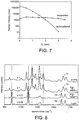
- the number of Raman photons originating in the intermediate layer 66 and collected as backscattered photons at the upper surface 62, and transmitted photons at the lower surface 64, are shown in figure 7 .
- the transmission geometry clearly provides a more representative sampling of the bulk of the sample interior than the conventional backscattering geometry, while permitting a satisfactory sensitivity.
- the model also reveals that an increase in sample thickness from 1 mm to 4 mm results in a 58% increase of the Raman signal detected in the backscattering geometry. In simplistic terms, this could be wrongly interpreted as extra Raman photons (amounting to 37 % of the overall Raman signal observed for 4 mm tablet) being produced in the extra 3 mm thickness added to the top 1 mm sample layer. However, the model of a 4 mm-thick sample indicates that 88 % of Raman signal originates in the top 1 mm layer and only 12 % originates within the remaining 3 mm of sample thickness.
- the extra 3 mm of material not only contributes with extra production of Raman photons but also reduces the loss of Raman photons originated within the 1 mm-layer at the lower surface 64.
- the increase in backscattered Raman photons through the addition of a further 3 mm of sample is also accomplished by returning Raman photons originating near the upper surface back towards the upper surface from where they may emerge and be collected.
- some illumination photons are scattered back towards the upper surface 62 allowing them to originate still more Raman photons within the top 1 mm layer.
- a two-layer sample was composed of a paracetamol tablet (500 mg, thickness 3.9 mm, circular diameter 12.8 mm, Tesco, PL Holder: The Wallis Laboratory Ltd. FOP234 MH/DRUGS/357) placed against a 2 mm thick fused silica cuvette with 300 ⁇ m windows filled with trans-stilbene ground powder. The cell width and length were 10 mm and 40 mm. Some measurements were taken with an illumination laser beam directed at the tablet, and some at the cuvette, in each case taking measurements of both backscattered and forward scattered (transmitted) Raman photons.
- the illumination laser beam was generated using an attenuated 115 mW temperature stabilised diode laser operated at 827 nm (Micro Laser Systems, Inc, L4 830S-115-TE).
- the laser power at the sample was 88 mW and the laser spot diameter was about 4 mm.
- the beam was spectrally purified by removing any residual amplified spontaneous emission components from its spectrum using two 830 nm band pass filters (Semrock). These were slightly tilted to optimise their throughput for the 827 nm laser wavelength.
- the beam was incident on the sample at about 45 degrees.
- the beam was polarised horizontally at the surface.
- the incident spot on the sample surface was therefore elliptical with the shorter radius being 2 mm and the longer 2.8 mm.
- Raman light was collected using a 50 mm diameter lens with a focal length of 60 mm.
- the scattered light was collimated and passed through a 50 mm diameter holographic notch filter (830 nm, Kaiser Optical Systems, Inc) to suppress the elastically scattered component of light.
- the filter was also slightly tilted to optimise suppression for the 827 nm elastic scatter.
- a second lens, identical to the first, was then used to image, with a magnification of 1:1, the sample surface onto the front face of an optical fibre probe.
- the laser illumination spot was imaged in such a way so that it coincided with the centre of the probe axis.
- the fibre probe was comprised of 7 fibres placed tightly packed at the centre of the probe.
- the fibres were made of silica with a core diameter of 200 ⁇ m, cladding diameter of 230 ⁇ m and numerical aperture of 0.37. Sleeves were stripped on both ends for tighter packing of the fibres.
- the bundle was custom made by C Technologies Inc.
- Raman spectra were collected using a deep depletion liquid nitrogen cooled CCD camera (Princeton Instruments, SPEC10 400BR LN Back-Illuminated Deep Depletion CCD, 1340 x 400 pixels) by binning the signal from all the 7 fibres vertically. The Raman spectra were not corrected for the variation of detection system sensitivity across the detected spectral range.
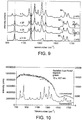
- FIG. 8 shows spectra obtained from a conventional backscattering geometry applied to the two layered sample with the paracetamol illuminated (curve 70) and the cuvette illuminated (curve 72). Backscatter results for the paracetamol only (curve 74) and the cuvette only (curve 76) are also shown for reference.
- Figure 9 shows spectra obtained using the transmission geometry with the paracetamol illuminated (curve 80) and the cuvette illuminated (curve 82), with transmission results for the paracetamol only (curve 84) and the cuvette only (curve 86) are also shown for reference.
- Figure 9 demonstrates how, in an environment where tablets are being tested, an anomalous layer will be detected irrespective of its position relative to the illuminating radiation. If the paracetamol tablet used in this experiment had a thick layer of an impurity at the back, a conventional backscattering approach would not be able to detect its presence. The transmission geometry approach would detect the impurity layer irrespective of its depth within the sample.
- the backscatter and transmission measurements using the paracetamol tablet without the cuvette show that the diminishment of the overall Raman intensity when going from the conventional backscattering to the transmission geometry was only by a factor of 12, thereby still allowing short exposure times to be used with reasonable sensitivity.
- a good Raman signal was observed in the transmission geometry even through a stack of two paracetamol tablets (7.8 mm thick) and it was still detectable through a stack of three paracetamol tablets (11.7 mm thick), with the signal diminishing by a factor of 16 and 400 respectively, compared with only one tablet monitored in the transmission geometry.
- the large illumination areas applicable in transmission geometry with pharmaceutical tablets and other dosage formulations also make it possible to use substantially higher laser powers without damaging the sample. This can be used to achieve further reductions in exposure times if required, in particular if combined with large area receiving optics.
- the same experimental arrangement was used to obtain a conventional backscatter Raman spectrum, and a transmission Raman spectrum, for a variety of different pharmaceutical capsules, having a variety of different coloured shell sections.
- the coloured capsule shells induced a large degree of fluorescence which had a deleterious effect on the signal to noise ratio of the measured Raman spectra.
- the upper curve is a spectrum obtained using the conventional backscatter geometry, with any Raman spectral features of the pharmaceutical ingredients completely obscured by a fluorescence signal.
- the lower curve is a spectrum obtained using the described forward scattering geometry and although weaker than the backscatter signal, the useful Raman spectral peaks are very clearly visible.
- the described technique may also be applied to diagnostic test technologies. Many clinical and other diagnostic tests are today carried out by an assay carried on a membrane. A sample which may contain a particular analyte is applied to the membrane, or to a pad coupled to the membrane, carrying one or more diagnostic reagants. Frequently, the results of a diagnostic test are detected optically, for example by means of a colour change, the visibility of a coloured band against a white membrane, or similar. Particular types of such diagnostic test arrangements include lateral flow, flow through, solid phase and agglutination formats.
- a typical lateral flow test arrangement is shown in figure 11 .
- a liquid sample containing the analyte to be detected is applied to a membrane 100 at entry point 102 and passes, by capillary action, along the membrane through a filter 104.
- the membrane is typically made of a translucent, light scattering material such as nitrocellulose, supported on a transparent or translucent substrate 105 which could, for example, be of glass, paper, or a plastic.
- the sample liquid is brought into contact with a signal reagant 106, with which relevant reactions occur as the liquid assay flows along the strip.
- the complex of the analyte and the signal reagant is captured and detected optically, for example using the illumination optics 110 and collection optics 112 illustrated, or as discussed elsewhere in this document .
- the signal reagant could be a biotag such as a Nanoplex (RTM) biotag provided by Oxonica Inc. A wide variety of alternatives and modifications to the illustrated arrangement are known.
- the described technique may be used in the optical detection stage of a lateral flow test such as that illustrated in figure 11 , or of other membrane based diagnostic tests.
- probe light is directed to a first surface of the membrane at the detection region 108.
- the probe light scatters within the membrane and scattered light is collected at the opposite, second surface, in a transmission geometry.
- Some of the scattering is Raman scattering from one or more optically active reagants, tags or markers which express optically the presence of the analyte by expression of particular Raman spectral features. Therefore, one or more Raman spectral features of the collected light can be used to determine or quantify presence of the analyte, or other characteristics of the material held within or upon the membrane at the detection region.
- Raman spectroscopy techniques may be used to enhance detection of the expressed Raman spectral features, including resonance Raman, Surface Enhanced Raman spectroscopy, and Surface Enhanced Resonance Raman spectroscopy.
Landscapes
- Health & Medical Sciences (AREA)
- Life Sciences & Earth Sciences (AREA)
- General Health & Medical Sciences (AREA)
- Physics & Mathematics (AREA)
- General Physics & Mathematics (AREA)
- Immunology (AREA)
- Pathology (AREA)
- Chemical & Material Sciences (AREA)
- Analytical Chemistry (AREA)
- Biochemistry (AREA)
- Toxicology (AREA)
- Engineering & Computer Science (AREA)
- Nuclear Medicine, Radiotherapy & Molecular Imaging (AREA)
- Spectroscopy & Molecular Physics (AREA)
- Molecular Biology (AREA)
- Veterinary Medicine (AREA)
- Hematology (AREA)
- Vascular Medicine (AREA)
- Biophysics (AREA)
- Biomedical Technology (AREA)
- Heart & Thoracic Surgery (AREA)
- Medical Informatics (AREA)
- Public Health (AREA)
- Surgery (AREA)
- Animal Behavior & Ethology (AREA)
- Medicinal Chemistry (AREA)
- Food Science & Technology (AREA)
- Investigating, Analyzing Materials By Fluorescence Or Luminescence (AREA)
- Credit Cards Or The Like (AREA)
- Apparatus For Radiation Diagnosis (AREA)
- Optical Measuring Cells (AREA)
Claims (15)
- Procédé de détermination d'une ou plusieurs propriétés d'une formulation posologique pharmaceutique de type comprimé (10), le comprimé ayant des surfaces circulaires opposées espacées par l'axe mineur d'une coupe transversale généralement rectangulaire du comprimé, le procédé comprenant de :exposer une première surface (11) de ladite formulation à un rayonnement incident ;recevoir un rayonnement ;détecter des éléments dispersés par effet Raman dans ledit rayonnement reçu ; etdéterminer une ou plusieurs desdites propriétés à partir desdits éléments dispersés par effet Raman détectés, caractérisé en ce que :l'étape de réception est une étape de réception depuis une seconde surface de ladite formulation espacée de ladite première surface, des éléments dudit rayonnement incident étant diffusés vers l'avant à travers ladite formulation depuis ladite première surface (11),et en ce que les première et seconde surfaces sont les surfaces circulaires du comprimé.
- Procédé selon la revendication 1, dans lequel ladite formulation posologique pharmaceutique disperse de manière diffuse ledit rayonnement incident entre lesdites première et seconde surfaces.
- Procédé selon la revendication 1 ou 2, dans lequel la formulation posologique pharmaceutique (10) comprend un matériau solide à dispersion diffuse.
- Procédé selon l'une quelconque des revendications 1 à 3, comprenant en outre de collecter des éléments rétro-dispersés dudit rayonnement incident, et de détecter des éléments dispersés par effet Raman parmi lesdits éléments rétro-dispersés.
- Procédé selon l'une quelconque des revendications précédentes, dans lequel ladite formulation posologique est retenue dans un support (12) ayant une ou plusieurs surfaces intérieures faisant face à ladite formulation posologique.
- Procédé selon la revendication 5, dans lequel au moins une partie des surfaces intérieures a une propriété de miroir de manière à refléter le rayonnement en retour dans ladite formulation posologique.
- Procédé selon la revendication 6, dans lequel ledit support (12) comprend une première ouverture à travers laquelle la première surface de ladite formulation posologique est exposée audit rayonnement incident, et une seconde ouverture à travers laquelle les éléments dispersés vers l'avant sont reçus depuis la seconde surface de ladite formulation posologique.
- Procédé selon la revendication 7, dans lequel ledit rayonnement incident est généré en utilisant un ou plusieurs lasers (14).
- Procédé de test d'une pluralité de formulations posologiques pharmaceutiques comprenant l'application du procédé selon l'une quelconque des revendications précédentes à chacune des formulations posologiques.
- Procédé selon l'une quelconque des revendications précédentes, dans lequel la formulation posologique pharmaceutique comprend un objet solide trouble.
- Procédé selon l'une quelconque des revendications précédentes, dans lequel lesdites une ou plusieurs propriétés comprennent l'une ou plusieurs parmi une propriété de forme polymorphe, une propriété de forme hydratée, une propriété de forme solvate, une propriété de forme saline, et une propriété de degré de cristallinité.
- Procédé selon l'une quelconque des revendications 1 à 10, dans lequel lesdites une ou plusieurs propriétés incluent une ou plusieurs indications de matières de départ utilisées dans des réactions chimiques pour former un composant de ladite formulation posologique.
- Procédé d'analyse de la masse d'une formulation posologique pharmaceutique de type comprimé, consistant à diriger un rayonnement incident vers ladite formulation posologique et à détecter un rayonnement de Raman dispersé dans la formulation posologique en utilisant une géométrie de transmission, selon l'une quelconque des revendications précédentes.
- Procédé selon l'une quelconque des revendications précédentes, dans lequel la formulation posologique pharmaceutique est un comprimé enrobé, et les une ou plusieurs propriétés sont des propriétés d'une partie intérieure du comprimé enrobé.
- Procédé selon l'une quelconque des revendications précédentes, dans lequel la formulation posologique pharmaceutique est un comprimé dans un emballage blister.
Priority Applications (1)
| Application Number | Priority Date | Filing Date | Title |
|---|---|---|---|
| EP18209601.6A EP3477285B1 (fr) | 2006-04-05 | 2007-04-05 | Analyse raman |
Applications Claiming Priority (2)
| Application Number | Priority Date | Filing Date | Title |
|---|---|---|---|
| GBGB0606891.0A GB0606891D0 (en) | 2006-04-05 | 2006-04-05 | Raman Analysis Of Pharmaceutical Tablets |
| PCT/GB2007/001249 WO2007113566A2 (fr) | 2006-04-05 | 2007-04-05 | Analyse raman |
Related Child Applications (2)
| Application Number | Title | Priority Date | Filing Date |
|---|---|---|---|
| EP18209601.6A Division EP3477285B1 (fr) | 2006-04-05 | 2007-04-05 | Analyse raman |
| EP18209601.6A Division-Into EP3477285B1 (fr) | 2006-04-05 | 2007-04-05 | Analyse raman |
Publications (2)
| Publication Number | Publication Date |
|---|---|
| EP2002243A2 EP2002243A2 (fr) | 2008-12-17 |
| EP2002243B1 true EP2002243B1 (fr) | 2019-04-03 |
Family
ID=36539406
Family Applications (4)
| Application Number | Title | Priority Date | Filing Date |
|---|---|---|---|
| EP06808690.9A Active EP1952129B1 (fr) | 2005-11-25 | 2006-11-27 | Filtrage de sécurité au moyen de l'analyse de raman |
| EP18209601.6A Active EP3477285B1 (fr) | 2006-04-05 | 2007-04-05 | Analyse raman |
| EP07732306.1A Active EP2010042B1 (fr) | 2006-04-05 | 2007-04-05 | Analyse tissulaire par effet raman |
| EP07732297.2A Revoked EP2002243B1 (fr) | 2006-04-05 | 2007-04-05 | Analyse raman |
Family Applications Before (3)
| Application Number | Title | Priority Date | Filing Date |
|---|---|---|---|
| EP06808690.9A Active EP1952129B1 (fr) | 2005-11-25 | 2006-11-27 | Filtrage de sécurité au moyen de l'analyse de raman |
| EP18209601.6A Active EP3477285B1 (fr) | 2006-04-05 | 2007-04-05 | Analyse raman |
| EP07732306.1A Active EP2010042B1 (fr) | 2006-04-05 | 2007-04-05 | Analyse tissulaire par effet raman |
Country Status (8)
| Country | Link |
|---|---|
| US (3) | US7911604B2 (fr) |
| EP (4) | EP1952129B1 (fr) |
| JP (2) | JP2009536317A (fr) |
| CN (2) | CN101460091B (fr) |
| AU (2) | AU2007232350A1 (fr) |
| CA (2) | CA2647730A1 (fr) |
| GB (3) | GB0606891D0 (fr) |
| WO (2) | WO2007113566A2 (fr) |
Families Citing this family (56)
| Publication number | Priority date | Publication date | Assignee | Title |
|---|---|---|---|---|
| DK1078959T3 (da) * | 1999-08-27 | 2002-05-27 | Degussa | Ovnkønrøg, fremgangsmåde til fremstilling deraf samt anvendelse deraf |
| GB0606891D0 (en) * | 2006-04-05 | 2006-05-17 | Council Cent Lab Res Councils | Raman Analysis Of Pharmaceutical Tablets |
| US8325337B2 (en) * | 2007-07-13 | 2012-12-04 | Purdue Research Foundation | Time resolved raman spectroscopy |
| SE531527C2 (sv) * | 2007-10-01 | 2009-05-12 | Bioresonator Ab | Förfarande vid och en anordning för opåverkad materialundersökning |
| HUE049642T2 (hu) | 2007-12-07 | 2020-09-28 | Vertex Pharma | 3-(6-(1-(2,2-Difluorbenzo[d][1,3]dioxol-5-il)-ciklopropánkarboxamido)-3-metilpiridin-2-il)-benzoesav szilárd formái |
| CN102883658B (zh) * | 2009-11-19 | 2016-06-22 | 调节成像公司 | 用于使用结构化照明经由单元件检测来分析浑浊介质的方法和设备 |
| US20120092663A1 (en) * | 2010-10-14 | 2012-04-19 | Kull Linda S | Transmission raman spectroscopy analysis of seed composition |
| DE102011002181A1 (de) * | 2011-04-19 | 2012-10-25 | Bundesdruckerei Gmbh | Verfahren und Vorrichtung zur Überprüfung von Sicherheitsmerkmalen in Sicherheitsdokumenten |
| RU2014129036A (ru) | 2011-12-16 | 2016-02-10 | Глэксо Груп Лимитед | Устройство для исследования образцов с помощью рамановского излучения |
| NZ727015A (en) | 2012-01-25 | 2017-12-22 | Vertex Pharma | Formulations of 3-(6-(1-(2,2-difluorobenzo[d][1,3]dioxol-5-yl) cyclopropanecarboxamido)-3-methylpyridin-2-yl)benzoic acid |
| JP6195850B2 (ja) * | 2012-02-24 | 2017-09-13 | パウル・シェラー・インスティトゥート | 人体組織の微小石灰化の複数の異なるタイプの非侵襲的分類システム |
| KR102251749B1 (ko) | 2012-11-07 | 2021-05-13 | 모듈레이티드 이미징, 아이엔씨. | 효율적인 변조 이미지 진단 |
| DE112014000813T5 (de) * | 2013-02-14 | 2015-10-29 | Verisante Technology, Inc. | Optischer Standard zur Kalibrierung von Spektralmess-Systemen |
| US9983136B2 (en) | 2013-05-27 | 2018-05-29 | Indian Institute Of Science | Method and an apparatus for obtaining sample specific signatures |
| US9606062B2 (en) * | 2013-05-27 | 2017-03-28 | Indian Institute Of Science | Method and a system for detection of hazardous chemicals in a non-metallic container |
| KR20150010392A (ko) * | 2013-07-19 | 2015-01-28 | 케이맥(주) | 결정화된 실리콘의 검사 방법 및 장치 |
| US20150022802A1 (en) * | 2013-07-22 | 2015-01-22 | Frederick Harold LONG | Spectroscopy detection system and method for material identification |
| CA2930199C (fr) * | 2013-11-12 | 2022-10-25 | Vertex Pharmaceuticals Incorporated | Procede de preparation de compositions pharmaceutiques pour le traitement de maladies a mediation assuree par le cftr |
| CN103743717B (zh) * | 2013-12-03 | 2015-09-23 | 中国工程物理研究院化工材料研究所 | 炸药cl-20晶型定量分析拉曼特征区域确定方法 |
| CN104749158B (zh) * | 2013-12-27 | 2020-12-11 | 同方威视技术股份有限公司 | 珠宝玉石鉴定方法及装置 |
| US9295420B2 (en) | 2014-01-29 | 2016-03-29 | Hong Kong Applied Science and Technology Research Institute Company Limited | Transmission-reflectance swappable Raman probe for physiological detections |
| US10436716B2 (en) * | 2014-09-24 | 2019-10-08 | Smiths Detection, Inc. | Ubiquitous transmissive raman spectroscopy for stand-off detection |
| WO2016054609A1 (fr) * | 2014-10-02 | 2016-04-07 | Mks Technology (D/B/A Snowy Range Instruments) | Spectromètre |
| GB201503911D0 (en) * | 2015-03-09 | 2015-04-22 | Renishaw Plc | Transmission raman spectroscopy |
| CN104730060A (zh) * | 2015-03-20 | 2015-06-24 | 扬州大学 | 一种体外简便模拟骨密度可控下降及快速检测方法 |
| US10288814B2 (en) | 2015-03-25 | 2019-05-14 | Board Of Regents Of The University Of Texas System | Variable spatial offset fiber optic probe for optical spectography and imaging |
| GB201511574D0 (en) * | 2015-07-01 | 2015-08-12 | Stfc Science & Technology | Clinical thermometer |
| WO2017066399A1 (fr) * | 2015-10-15 | 2017-04-20 | The Usa, As Represented By The Secretary Of The Navy | Spectroscopie raman de gaz à l'état de trace dans des guides d'ondes fonctionnalisés |
| US10365229B2 (en) | 2015-12-31 | 2019-07-30 | Kaiser Optical Systems, Inc. | Real-time characterization of pharmaceutical tablet coatings using Raman spectroscopy |
| WO2017178310A1 (fr) * | 2016-04-13 | 2017-10-19 | Koninklijke Philips N.V. | Système et procédé de détection de la peau d'un sujet humain |
| US11092494B1 (en) | 2016-05-31 | 2021-08-17 | MKS Technology | Spectrometer |
| GB201618260D0 (en) | 2016-10-28 | 2016-12-14 | Science And Tech Facilities Council The | Detection of pH |
| US10119917B2 (en) * | 2016-11-11 | 2018-11-06 | B & W Tek LLC | Apparatus and method for bidirectional Raman spectroscopy |
| US10119916B2 (en) * | 2016-11-11 | 2018-11-06 | B&W Tek Llc | Light delivery and collection device for measuring Raman scattering of a sample |
| JPWO2018134980A1 (ja) | 2017-01-20 | 2019-12-12 | オリンパス株式会社 | 軟骨組織の分析装置 |
| CN110914675A (zh) | 2017-04-11 | 2020-03-24 | 瑞艾迪粒子系统有限责任公司 | 用于颗粒悬浮物的基于显微镜的图像获取和基于拉曼光谱的材料分析的液体池单元 |
| CN108398418B (zh) * | 2018-03-16 | 2020-12-04 | 华东理工大学 | 一种内参比表面增强拉曼测试试纸、制备方法与应用 |
| CN108577874B (zh) * | 2018-05-21 | 2021-09-17 | 达影医疗(中山)有限公司 | 乳腺摆位压迫装置及乳腺x线摄影系统 |
| JP7075285B2 (ja) | 2018-05-29 | 2022-05-25 | 株式会社堀場製作所 | 薬剤分析に用いられる検量線設定方法 |
| CN109060766A (zh) * | 2018-09-27 | 2018-12-21 | 珠海彩晶光谱科技有限公司 | 一种基于表面增强拉曼光谱的体液药物浓度的测量方法和检测装置 |
| GB2572662B (en) | 2018-10-05 | 2020-06-03 | Res & Innovation Uk | Raman spectrometer |
| GB2581154B (en) * | 2019-02-05 | 2022-09-28 | Colvistec Ag | Amorphous pharmaceutical compositions |
| EP3986248B1 (fr) | 2019-06-19 | 2025-03-19 | Syddansk Universitet | Système et procédé de tomodensitométrie raman (raman-ct) |
| GB201910801D0 (en) * | 2019-07-29 | 2019-09-11 | Agilent Tech Lda Uk Limited | Raman analysis of pharmaceutical dosage forms |
| DE102019219949A1 (de) * | 2019-12-18 | 2021-06-24 | Robert Bosch Gmbh | Substrat |
| GB202004010D0 (en) | 2020-03-19 | 2020-05-06 | Res & Innovation Uk | Detection of water content in tissue |
| EP4127678B1 (fr) | 2020-03-26 | 2025-03-19 | Innovative Photonic Solutions, Inc. | Procédé de sélection de longueurs d'onde d'excitation raman dans une sonde raman à sources multiples |
| GB2594980B (en) | 2020-05-14 | 2025-01-01 | Agilent Tech Lda Uk Limited | Spectral analysis of a sample |
| GB2596804A (en) | 2020-07-06 | 2022-01-12 | Agilent Tech Lda Uk Limited | Raman analysis of pharmaceutical dosage forms |
| US11304605B2 (en) * | 2020-07-20 | 2022-04-19 | 123IV, Inc. | Self-administered, non-invasive, transcutaneous viral detector |
| JP7270582B2 (ja) * | 2020-07-20 | 2023-05-10 | アンリツ株式会社 | 分光測定装置 |
| US11898959B2 (en) * | 2020-12-07 | 2024-02-13 | Harry Owen | Solids analysis using Raman spectroscopy |
| CN114460058B (zh) * | 2021-02-20 | 2025-07-22 | 海南聚能科技创新研究院有限公司 | 一种光谱仪检测装置 |
| US11974726B2 (en) | 2021-09-27 | 2024-05-07 | Ai Biomed Corp. | Tissue detection systems and methods |
| US12279758B2 (en) * | 2021-09-27 | 2025-04-22 | Ai Biomed Corp. | Tissue detection systems and methods |
| GB2635293A (en) | 2022-02-08 | 2025-05-07 | Res & Innovation Uk | Detection using SERS probes |
Citations (3)
| Publication number | Priority date | Publication date | Assignee | Title |
|---|---|---|---|---|
| US3442591A (en) * | 1965-03-06 | 1969-05-06 | Hitachi Ltd | Apparatus for measuring the raman effect of samples of infinitesimal quantities |
| FR2566903A1 (fr) * | 1984-06-29 | 1986-01-03 | Schrader Bernhard | Dispositif recepteur d'echantillon pour la spectrometrie, methode de mesure de la luminescence et de la diffusion et application du dispositif recepteur d'echantillon |
| WO2001057500A1 (fr) * | 2000-01-31 | 2001-08-09 | Astrazeneca Ab | Appareil et methode d'analyse |
Family Cites Families (111)
| Publication number | Priority date | Publication date | Assignee | Title |
|---|---|---|---|---|
| US3516744A (en) | 1966-05-20 | 1970-06-23 | Perkin Elmer Corp | Sampling arrangement for laser-raman systems |
| US3770350A (en) | 1972-07-24 | 1973-11-06 | Bell Telephone Labor Inc | Method utilizing an optical fiber raman cell |
| US3909132A (en) | 1974-06-11 | 1975-09-30 | Allied Chem | Spectroscopic temperature measurement |
| JPS6058820B2 (ja) | 1979-07-31 | 1985-12-21 | 工業技術院長 | 透明物質の表面分析方法 |
| US4645340A (en) | 1983-06-01 | 1987-02-24 | Boston University | Optically reflective sphere for efficient collection of Raman scattered light |
| AU565295B2 (en) * | 1983-10-13 | 1987-09-10 | Matsushita Electric Industrial Co., Ltd. | Fluid deflecting assembly |
| US5139025A (en) | 1983-10-14 | 1992-08-18 | Somanetics Corporation | Method and apparatus for in vivo optical spectroscopic examination |
| US4570638A (en) | 1983-10-14 | 1986-02-18 | Somanetics Corporation | Method and apparatus for spectral transmissibility examination and analysis |
| GB8514992D0 (en) * | 1985-06-13 | 1985-07-17 | British Nuclear Fuels Plc | Differentiation technique |
| US4784486A (en) | 1987-10-06 | 1988-11-15 | Albion Instruments | Multi-channel molecular gas analysis by laser-activated Raman light scattering |
| US4945239A (en) | 1989-03-29 | 1990-07-31 | Center For Innovative Technology | Early detection of breast cancer using transillumination |
| GB9002360D0 (en) * | 1990-02-02 | 1990-04-04 | De La Rue Co Plc | Ink composition and components thereof |
| GB9009132D0 (en) * | 1990-04-24 | 1990-06-20 | Gersan Ets | Method and apparatus for examining an object |
| US5261410A (en) | 1991-02-07 | 1993-11-16 | Alfano Robert R | Method for determining if a tissue is a malignant tumor tissue, a benign tumor tissue, or a normal or benign tissue using Raman spectroscopy |
| EP0573535B1 (fr) | 1991-02-26 | 2000-12-27 | Massachusetts Institute Of Technology | Systemes et procedes de spectroscopie moleculaire, permettant d'etablir le diagnostic des tissus |
| US5194913A (en) * | 1991-03-20 | 1993-03-16 | The United States Of America As Represented By The United States Department Of Energy | Fiber-optic apparatus and method for measurement of luminescence and raman scattering |
| US5506678A (en) | 1992-02-24 | 1996-04-09 | Hewlett Packard Company | System for collecting weakly scattered electromagnetic radiation |
| JP3271304B2 (ja) * | 1992-06-30 | 2002-04-02 | 株式会社島津製作所 | 飛行時間形イオン散乱分光装置 |
| US5371368A (en) | 1992-07-23 | 1994-12-06 | Alfano; Robert R. | Ultrafast optical imaging of objects in a scattering medium |
| US5746210A (en) | 1993-02-26 | 1998-05-05 | David A. Benaron | Device and method for detection, localization, and characterization of inhomogeneities in turbid media |
| US5565982A (en) | 1994-05-31 | 1996-10-15 | Recon Exploration | Apparatus and method for time resolved spectroscopy |
| DE69509662T2 (de) | 1994-08-20 | 1999-10-21 | Renishaw Plc, Wotton-Under-Edge | Detektor für explosive substanzen |
| JP3295869B2 (ja) | 1994-09-08 | 2002-06-24 | 株式会社ニコン | ラマン分光測定方法 |
| US5625458A (en) | 1994-11-10 | 1997-04-29 | Research Foundation Of City College Of New York | Method and system for imaging objects in turbid media using diffusive fermat photons |
| US5660181A (en) | 1994-12-12 | 1997-08-26 | Physical Optics Corporation | Hybrid neural network and multiple fiber probe for in-depth 3-D mapping |
| US5919140A (en) | 1995-02-21 | 1999-07-06 | Massachusetts Institute Of Technology | Optical imaging using time gated scattered light |
| US5615673A (en) | 1995-03-27 | 1997-04-01 | Massachusetts Institute Of Technology | Apparatus and methods of raman spectroscopy for analysis of blood gases and analytes |
| BR9601329A (pt) * | 1995-04-14 | 1998-01-13 | Fuji Xerox Co Ltd | Rolo transportador de cinta e aparelho formador de imagem |
| US5999836A (en) | 1995-06-06 | 1999-12-07 | Nelson; Robert S. | Enhanced high resolution breast imaging device and method utilizing non-ionizing radiation of narrow spectral bandwidth |
| US5636633A (en) | 1995-08-09 | 1997-06-10 | Rio Grande Medical Technologies, Inc. | Diffuse reflectance monitoring apparatus |
| US5760399A (en) | 1995-10-02 | 1998-06-02 | Foss Nirsystems, Inc. | Measurement of transmission spectra of pharmaceutical tablets |
| JPH09127001A (ja) | 1995-10-31 | 1997-05-16 | Ajinomoto Co Inc | 密封材料の非破壊検査法 |
| SE513163C2 (sv) | 1995-12-20 | 2000-07-17 | Astrazeneca Ab | Anordning och metod för spektrometri |
| JPH09184809A (ja) | 1995-12-30 | 1997-07-15 | Koyo Ozaki | 散乱光測定装置 |
| GB9609793D0 (en) * | 1996-05-10 | 1996-07-17 | Ciba Geigy Ag | Pigment compositions |
| US5866430A (en) | 1996-06-13 | 1999-02-02 | Grow; Ann E. | Raman optrode processes and devices for detection of chemicals and microorganisms |
| US5842995A (en) | 1996-06-28 | 1998-12-01 | Board Of Regents, The Univerisity Of Texas System | Spectroscopic probe for in vivo measurement of raman signals |
| US5873831A (en) | 1997-03-13 | 1999-02-23 | The University Of Utah Technology Transfer Office | Method and system for measurement of macular carotenoid levels |
| WO1999001750A1 (fr) | 1997-07-02 | 1999-01-14 | Spectra Code, Inc. | Systeme raman utile pour une identification rapide d'echantillons |
| GB2328016B (en) | 1997-08-08 | 2001-04-25 | Pfizer Ltd | Spectrophotometric analysis |
| SE9704873D0 (sv) | 1997-12-23 | 1997-12-23 | Astra Ab | Sampling apparatus |
| US6289230B1 (en) | 1998-07-07 | 2001-09-11 | Lightouch Medical, Inc. | Tissue modulation process for quantitative noninvasive in vivo spectroscopic analysis of tissues |
| SE9802690D0 (sv) | 1998-08-07 | 1998-08-07 | Astra Ab | Mixing apparatus |
| GB9819732D0 (en) | 1998-09-11 | 1998-11-04 | Renishaw Plc | Tool conditioning monitoring |
| ES2257074T3 (es) | 1998-10-07 | 2006-07-16 | Ecole Polytechnique Federale De Lausanne (Epfl) | Metodo para medir localmente y en superficie las propiedades de dispersion y de absorcion de medios turbios. |
| US6352502B1 (en) | 1998-12-03 | 2002-03-05 | Lightouch Medical, Inc. | Methods for obtaining enhanced spectroscopic information from living tissue, noninvasive assessment of skin condition and detection of skin abnormalities |
| SE9903423D0 (sv) | 1999-09-22 | 1999-09-22 | Astra Ab | New measuring technique |
| AU2001231042A1 (en) | 2000-01-21 | 2001-07-31 | Stephen T Flock | Optical measurements of bone composition |
| SE0000522D0 (sv) | 2000-02-17 | 2000-02-17 | Astrazeneca Ab | Mixing apparatus |
| US6610351B2 (en) * | 2000-04-12 | 2003-08-26 | Quantag Systems, Inc. | Raman-active taggants and their recognition |
| US7113814B2 (en) | 2000-07-13 | 2006-09-26 | Virginia Commonwealth University | Tissue interrogation spectroscopy |
| JP2002085385A (ja) | 2000-09-21 | 2002-03-26 | Sadako Honda | 血糖値の測定方法および測定装置 |
| IL138683A0 (en) | 2000-09-25 | 2001-10-31 | Vital Medical Ltd | Apparatus and method for monitoring tissue vitality parameters |
| WO2002029705A1 (fr) * | 2000-10-04 | 2002-04-11 | Tokyo Gas Company Limited | Methode de lecture non destructrice pour etiquette isotopique |
| SE0100283D0 (sv) | 2001-01-31 | 2001-01-31 | Astrazeneca Ab | Sampling apparatus |
| US6925514B1 (en) * | 2001-03-30 | 2005-08-02 | Agere Systems Inc. | Multi-protocol bus system and method of operation thereof |
| US6954667B2 (en) | 2001-06-28 | 2005-10-11 | Chemimage Corporation | Method for Raman chemical imaging and characterization of calcification in tissue |
| JP2003010189A (ja) | 2001-07-04 | 2003-01-14 | Communication Research Laboratory | 生体機能情報撮像装置 |
| DE60218188T2 (de) | 2001-09-12 | 2007-10-25 | Gersan Establishment | Untersuchung eines diamanten |
| US6610977B2 (en) | 2001-10-01 | 2003-08-26 | Lockheed Martin Corporation | Security system for NBC-safe building |
| US20050037615A1 (en) | 2001-11-06 | 2005-02-17 | Dario Cabib | In-line spectroscopy for process monitoring |
| US6825928B2 (en) | 2001-12-19 | 2004-11-30 | Wisconsin Alumni Research Foundation | Depth-resolved fluorescence instrument |
| US6975891B2 (en) * | 2001-12-21 | 2005-12-13 | Nir Diagnostics Inc. | Raman spectroscopic system with integrating cavity |
| US6873868B2 (en) | 2001-12-31 | 2005-03-29 | Infraredx, Inc. | Multi-fiber catheter probe arrangement for tissue analysis or treatment |
| US6654118B2 (en) | 2002-02-04 | 2003-11-25 | Ortho-Mcneil Pharmaceutical, Inc. | Method and apparatus for obtaining molecular data from a pharmaceutical specimen |
| EP1335199A1 (fr) | 2002-02-11 | 2003-08-13 | Bayer Corporation | Dispositif non-invasif de détermination d'analytes dans des fluides physiologiques |
| KR100622649B1 (ko) | 2002-02-14 | 2006-09-18 | 토시노리 카토 | 생체기능진단장치 |
| US6919556B1 (en) | 2002-02-22 | 2005-07-19 | Monocle Technologies, Inc. | System and method for monitoring and evaluating solid and semi-solid materials |
| AU2002236343A1 (en) | 2002-02-28 | 2003-09-09 | Erasmus Universiteit Rotterdam | Depth selective ph measurement and uv exposure measurement |
| SE0200782D0 (sv) | 2002-03-14 | 2002-03-14 | Astrazeneca Ab | Method of analysing a pharmaceutical sample |
| US7647092B2 (en) | 2002-04-05 | 2010-01-12 | Massachusetts Institute Of Technology | Systems and methods for spectroscopy of biological tissue |
| US7197562B2 (en) | 2002-04-05 | 2007-03-27 | Infocus Corporation | Projector device management system |
| IL151745A (en) | 2002-09-12 | 2007-10-31 | Uzi Sharon | Explosive detection and detection system |
| US8088628B2 (en) | 2002-09-30 | 2012-01-03 | Intel Corporation | Stimulated and coherent anti-stokes raman spectroscopic methods for the detection of molecules |
| US20040142484A1 (en) | 2002-09-30 | 2004-07-22 | Intel Corporation | Spectroscopic analysis system and method |
| EP2522293A2 (fr) | 2002-10-23 | 2012-11-14 | Palomar Medical Technologies, Inc. | Dispositif de phototraitement utilisable conjointement avec des substances réfrigérantes et topiques |
| EP1567852B1 (fr) | 2002-12-02 | 2007-06-06 | River Diagnostics B.V. | Utilisation de la spectroscopie raman a nombre d'onde eleve pour mesurer des tissus |
| US6897951B2 (en) | 2003-02-14 | 2005-05-24 | Raman Systems, Inc. | Probe assemblies for Raman spectroscopy |
| JP4136704B2 (ja) | 2003-02-19 | 2008-08-20 | 株式会社島津製作所 | 光計測装置用のプローブとそれを用いたマルチチャンネル光計測装置 |
| JP2004271220A (ja) | 2003-03-05 | 2004-09-30 | Toshiba Ceramics Co Ltd | 石英ガラスの評価装置及び方法 |
| EP2301439A1 (fr) | 2003-03-05 | 2011-03-30 | InfraReDx, Inc. | Agencement de sonde de cathéter pour l'analyse de tissus par application d'énergie rayonnante et par collecte d'énergie rayonnante |
| JP2004294150A (ja) | 2003-03-26 | 2004-10-21 | Univ Waseda | 分光分析装置及び分光分析法 |
| US7110109B2 (en) | 2003-04-18 | 2006-09-19 | Ahura Corporation | Raman spectroscopy system and method and specimen holder therefor |
| EP1634061A4 (fr) | 2003-04-30 | 2007-11-21 | Univ Mcgill | Methode et systeme pour mesurer la concentration de lactate in vivo |
| WO2004102186A1 (fr) * | 2003-05-15 | 2004-11-25 | Gleb Igorevich Andreev | Procede pour constituer une base de donnees pour determiner des agents biologiques et des substances chimiques |
| US7242469B2 (en) | 2003-05-27 | 2007-07-10 | Opto Trace Technologies, Inc. | Applications of Raman scattering probes |
| RU2269116C2 (ru) * | 2003-06-18 | 2006-01-27 | Глеб Игоревич Андреев | Устройство для формирования базы данных для определения биологических агентов и химических веществ |
| US7396650B2 (en) | 2003-06-27 | 2008-07-08 | Commissariat A L'energie Atomique | Method for dosing a biological or chemical sample |
| JP4388318B2 (ja) * | 2003-06-27 | 2009-12-24 | オリンパス株式会社 | 画像処理装置 |
| JP2007524833A (ja) | 2003-07-01 | 2007-08-30 | ザ リージェンツ オブ ザ ユニバーシティ オブ ミシガン | 骨組織の状態を診断するための方法および装置 |
| JP2005070009A (ja) | 2003-08-28 | 2005-03-17 | Toyota Motor Corp | 分光分析装置 |
| US20060249423A1 (en) | 2003-11-28 | 2006-11-09 | Mika Reijonen | Method and apparatus to identify and separate medicinal preparations and dosages thereof |
| US7148963B2 (en) | 2003-12-10 | 2006-12-12 | Kaiser Optical Systems | Large-collection-area optical probe |
| US7697576B2 (en) | 2004-05-05 | 2010-04-13 | Chem Image Corporation | Cytological analysis by raman spectroscopic imaging |
| CN1584555A (zh) | 2004-06-01 | 2005-02-23 | 浙江大学 | 一种基于低分辨拉曼光谱的石油产品质量快速测定仪 |
| US7796243B2 (en) | 2004-06-09 | 2010-09-14 | National Research Council Of Canada | Detection and monitoring of changes in mineralized tissues or calcified deposits by optical coherence tomography and Raman spectroscopy |
| WO2006091223A2 (fr) * | 2004-06-30 | 2006-08-31 | Chemimage Corporation | Procede multimodal d'identification d'agent dangereux |
| WO2006083316A2 (fr) * | 2004-06-30 | 2006-08-10 | Chemimage Corporation | Procede multipoint pour l'identification d'agents dangereux |
| US7564546B2 (en) | 2004-06-30 | 2009-07-21 | Chemimage Corporation | Dynamic imaging of biological cells and other subjects |
| US7269245B2 (en) | 2004-07-30 | 2007-09-11 | Bruker Axs, Inc. | Combinatorial screening system and X-ray diffraction and Raman spectroscopy |
| GB0426993D0 (en) | 2004-12-09 | 2005-01-12 | Council Cent Lab Res Councils | Apparatus for depth-selective raman spectroscopy |
| WO2006078980A2 (fr) | 2005-01-20 | 2006-07-27 | Chemimage Corporation | Procede de spectroscopie raman d'imagerie de tomodensitometrie |
| JP4595571B2 (ja) | 2005-02-04 | 2010-12-08 | セイコーエプソン株式会社 | 顕微ラマン分光装置及び顕微ラマン分光測定方法 |
| WO2006127766A1 (fr) | 2005-05-25 | 2006-11-30 | Bayer Healthcare Llc | Procedes d'utilisation de l'information de spectre raman dans la determination des concentrations d'une substance a analyser |
| JP2009508571A (ja) | 2005-09-16 | 2009-03-05 | ザ リージェンツ オブ ザ ユニバーシティ オブ ミシガン | 検体の表面直下の組成を計測する方法及びシステム |
| GB0606891D0 (en) * | 2006-04-05 | 2006-05-17 | Council Cent Lab Res Councils | Raman Analysis Of Pharmaceutical Tablets |
| WO2007060467A1 (fr) | 2005-11-25 | 2007-05-31 | The Science And Technology Facilities Council | Filtrage de securite au moyen de l'analyse de raman |
| WO2007113570A1 (fr) | 2006-04-05 | 2007-10-11 | The Science And Technology Facilities Council | Analyse tissulaire par effet raman |
| US7603151B2 (en) | 2006-08-22 | 2009-10-13 | Bayer Healthcare Llc | Non-invasive methods of using spectral information in determining analyte concentrations |
| CA2661952A1 (fr) | 2006-08-22 | 2008-02-28 | Bayer Healthcare Llc | Procedes non invasifs pour l'utilisation d'informations spectrales dans la determination de concentrations d'analytes |
| JP4862730B2 (ja) * | 2007-04-05 | 2012-01-25 | コニカミノルタセンシング株式会社 | 脈波データ解析方法、システム、プログラム |
-
2006
- 2006-04-05 GB GBGB0606891.0A patent/GB0606891D0/en not_active Ceased
- 2006-08-17 GB GBGB0616376.0A patent/GB0616376D0/en not_active Ceased
- 2006-09-21 GB GB0618635A patent/GB2432661A/en active Pending
- 2006-11-27 US US12/085,346 patent/US7911604B2/en active Active
- 2006-11-27 EP EP06808690.9A patent/EP1952129B1/fr active Active
-
2007
- 2007-04-05 CN CN2007800207096A patent/CN101460091B/zh not_active Expired - Fee Related
- 2007-04-05 WO PCT/GB2007/001249 patent/WO2007113566A2/fr not_active Ceased
- 2007-04-05 JP JP2009503651A patent/JP2009536317A/ja active Pending
- 2007-04-05 EP EP18209601.6A patent/EP3477285B1/fr active Active
- 2007-04-05 US US12/083,073 patent/US8085396B2/en active Active
- 2007-04-05 US US12/225,928 patent/US8259902B2/en active Active
- 2007-04-05 AU AU2007232350A patent/AU2007232350A1/en not_active Abandoned
- 2007-04-05 AU AU2007232354A patent/AU2007232354A1/en not_active Abandoned
- 2007-04-05 WO PCT/GB2007/001289 patent/WO2007113581A1/fr not_active Ceased
- 2007-04-05 EP EP07732306.1A patent/EP2010042B1/fr active Active
- 2007-04-05 JP JP2009503653A patent/JP2009538156A/ja active Pending
- 2007-04-05 CA CA002647730A patent/CA2647730A1/fr not_active Abandoned
- 2007-04-05 CA CA002648228A patent/CA2648228A1/fr not_active Abandoned
- 2007-04-05 EP EP07732297.2A patent/EP2002243B1/fr not_active Revoked
- 2007-04-05 CN CNA2007800207908A patent/CN101460831A/zh active Pending
Patent Citations (3)
| Publication number | Priority date | Publication date | Assignee | Title |
|---|---|---|---|---|
| US3442591A (en) * | 1965-03-06 | 1969-05-06 | Hitachi Ltd | Apparatus for measuring the raman effect of samples of infinitesimal quantities |
| FR2566903A1 (fr) * | 1984-06-29 | 1986-01-03 | Schrader Bernhard | Dispositif recepteur d'echantillon pour la spectrometrie, methode de mesure de la luminescence et de la diffusion et application du dispositif recepteur d'echantillon |
| WO2001057500A1 (fr) * | 2000-01-31 | 2001-08-09 | Astrazeneca Ab | Appareil et methode d'analyse |
Non-Patent Citations (20)
| Title |
|---|
| B. SCHRADER, F. NERDEL, G. KRESZE: "Verfahren zur Aufnahme der RAMAN-Spektren von Festkoirpern als Presslingen", ZEITSCHRIFT FUR PHYSIKALISCHE CHEMIE, vol. 12, 1 January 1957 (1957-01-01), pages 132 - 138, XP055723923 |
| BERNHARD SCHRADER AND GERHARD BERGMANN: "Die Intensit�t des Ramanspektrums polykristalliner Substanzen", FRESENIUS' JOURNAL OF ANALYTICAL CHEMISTRY, vol. 225, no. 2, June 1967 (1967-06-01), pages 230 - 247, ISSN: 0937-0633 * |
| BERNHARD SCHRADER: "Fortschritte in Der Technik Der Ramanspektroskopie", CHEMIE-ING. TECHN., vol. 39, no. 17, 1 January 1967 (1967-01-01), pages 1008 - 1016, XP055723922 |
| CONFOCAL RAMAN MICROSCOPY-IMAGING IN PHARMACEUTICAL RESEARCH, March 2006 (2006-03-01) |
| ENGLISH TRANSLATION OF D15 |
| ENGLISH TRANSLATION OF D16 |
| JACQUES HAESLER: "Construction of a New Forward and Backward Scattering Raman Optical Activity Spectrometer and Graphical Analysis of Measured and Calculated Spectra for (R)- [2 H1,2H2,2H3]- Neopentane", THESIS, 16 March 2006 (2006-03-16), XP055671402 |
| JOHANSSON ET AL.: "Characterization of different laser irradiation methods for quantitative Raman tablet assessment", JOURNAL OF PHARMACEUTICAL AND BIOCHEMICAL ANALYSIS, vol. 39, 2005, pages 510 - 516, XP005039050 |
| JOHANSSON ET AL.: "Time-Resolved NIR/Vis Spectroscopy for Analysis of Solids: Pharmaceutical Tablets", vol. 56, no. 2, 2002, pages 725 - 7321, XP055671410 |
| KONTOYANNIS C G ET AL: "Quantitative non-destructive determination of salicylic acid acetate in aspirin tablets by Raman spectroscopy", TALANTA, ELSEVIER, AMSTERDAM, NL, vol. 41, no. 11, 1 November 1994 (1994-11-01), pages 1981 - 1984, XP026552396, ISSN: 0039-9140, [retrieved on 19941101], DOI: 10.1016/0039-9140(94)00169-3 * |
| KONTOYANNIS ET AL.: "Quantitative non-destructive determination of salicyclic acid acetate in aspirin tablets by Raman spectroscopy", TALANTA, vol. 41, no. 11, 1994, pages 1981 - 1984, XP026552396 |
| MATOUSEK ET AL.: "Bulk Raman Analysis of Pharmaceutical Tablets", APPLIED SPECTROSCOPY, vol. 60, no. 12, 1 December 2006 (2006-12-01), pages 1353, XP055671399 |
| MATOUSEK ET AL.: "Subsurface probing in diffusely scattering medium using spatially offset Raman spectroscopy", APPLIED SPECTROSCOPY, vol. 59, no. 4, 2005, pages 393 - 400, XP008075254 |
| MYRICK ET AL.: "Elimination of Background in Fiber-Optic Raman Measurements", APPLIED SPECTROSCOPY, vol. 44, no. 4, 1990, pages 565 - 570, XP000116784 |
| POTMA ET AL.: "optics and phonics news", CARS MICROSCOPY FOR BIOLOGY AND MEDICINE, 2004, pages 41 - 45, XP055671406 |
| PURE APPL. CHEM., vol. 69, 31 December 1997 (1997-12-31) - 1997, pages 1451 - 1468, Retrieved from the Internet <URL:http://old.iupac.org/reports/V/spectro/partXVIII.pdf> [retrieved on 20100204] * |
| SCHRADER ET AL., DIE INTERSITAT DES RAMANSPEKTRUMS POLYKRISTALLINER SUBSTANZEN, 2 November 1966 (1966-11-02) |
| SCHRADER ET AL.: "Laser -based molecular spectroscopy for chemical analysis:Raman scattering processes", INTERNATIONAL UNION OF PURE AND APPLIED CHEMISTRY, 1997, XP055671401 |
| THOMAS M. NIEMCZYK, MIRIAM M. DELGADO-LOPEZ, AND FRITZ S. ALLEN: "Quantitative Determination of Bucindolol Concentration in Intact Gel Capsules Using Raman Spectroscopy", ANAL. CHEM., vol. 70, no. 13, 1 July 1998 (1998-07-01), XP093258348, DOI: 10.1021/ac971252u * |
| VANKEIRSBILCK ET AL.: "Applications of Raman spectroscopy in pharmaceutical analysis", TRAC TRENDS IN ANALYTICAL CHEMISTRY, vol. 21, no. 12, 2002, pages 869 - 877, XP004399339 |
Also Published As
| Publication number | Publication date |
|---|---|
| CA2647730A1 (fr) | 2007-10-11 |
| EP2010042B1 (fr) | 2021-05-26 |
| CN101460091B (zh) | 2011-12-14 |
| WO2007113566A3 (fr) | 2007-11-29 |
| EP3477285B1 (fr) | 2025-04-23 |
| EP2002243A2 (fr) | 2008-12-17 |
| US8085396B2 (en) | 2011-12-27 |
| EP1952129A1 (fr) | 2008-08-06 |
| JP2009536317A (ja) | 2009-10-08 |
| WO2007113566A2 (fr) | 2007-10-11 |
| US7911604B2 (en) | 2011-03-22 |
| CN101460831A (zh) | 2009-06-17 |
| US8259902B2 (en) | 2012-09-04 |
| EP3477285A1 (fr) | 2019-05-01 |
| CA2648228A1 (fr) | 2007-10-11 |
| US20090141271A1 (en) | 2009-06-04 |
| US20090238333A1 (en) | 2009-09-24 |
| EP1952129B1 (fr) | 2021-10-27 |
| GB0618635D0 (en) | 2006-11-01 |
| AU2007232350A1 (en) | 2007-10-11 |
| EP2010042A1 (fr) | 2009-01-07 |
| WO2007113581A1 (fr) | 2007-10-11 |
| GB2432661A (en) | 2007-05-30 |
| GB0616376D0 (en) | 2006-09-27 |
| US20090244533A1 (en) | 2009-10-01 |
| GB0606891D0 (en) | 2006-05-17 |
| AU2007232354A1 (en) | 2007-10-11 |
| CN101460091A (zh) | 2009-06-17 |
| JP2009538156A (ja) | 2009-11-05 |
Similar Documents
| Publication | Publication Date | Title |
|---|---|---|
| US8085396B2 (en) | Raman analysis | |
| EP1828753B1 (fr) | Dispositif de spectroscopie raman a profondeur selective | |
| Matousek et al. | Noninvasive Raman spectroscopy of human tissue in vivo | |
| EP2130029B1 (fr) | Eclairage d'un milieu à diffusion diffuse | |
| Matousek | Deep non-invasive Raman spectroscopy of living tissue and powders | |
| Matousek et al. | Bulk Raman analysis of pharmaceutical tablets | |
| US8054463B2 (en) | Method and system for measuring sub-surface composition of a sample | |
| AU769370B2 (en) | Method and apparatus for spectrometric analysis of turbid, pharmaceutical samples | |
| AU2002243137B2 (en) | New measuring technique | |
| CN105334204B (zh) | 一种基于傅里叶变换拉曼光谱分析方法 | |
| Qin et al. | Introduction to Raman chemical imaging technology | |
| Duy et al. | Axially perpendicular offset Raman scheme for reproducible measurement of housed samples in a noncircular container under variation of container orientation | |
| Baria | Multimodal imaging for tissue diagnostics by combined two-photon and Raman microscopy | |
| WO2007060467A1 (fr) | Filtrage de securite au moyen de l'analyse de raman |
Legal Events
| Date | Code | Title | Description |
|---|---|---|---|
| PUAI | Public reference made under article 153(3) epc to a published international application that has entered the european phase |
Free format text: ORIGINAL CODE: 0009012 |
|
| 17P | Request for examination filed |
Effective date: 20080328 |
|
| AK | Designated contracting states |
Kind code of ref document: A2 Designated state(s): AT BE BG CH CY CZ DE DK EE ES FI FR GB GR HU IE IS IT LI LT LU LV MC MT NL PL PT RO SE SI SK TR |
|
| 17Q | First examination report despatched |
Effective date: 20090324 |
|
| DAX | Request for extension of the european patent (deleted) | ||
| RAP1 | Party data changed (applicant data changed or rights of an application transferred) |
Owner name: AGILENT TECHNOLOGIES LDA UK LIMITED |
|
| GRAP | Despatch of communication of intention to grant a patent |
Free format text: ORIGINAL CODE: EPIDOSNIGR1 |
|
| STAA | Information on the status of an ep patent application or granted ep patent |
Free format text: STATUS: GRANT OF PATENT IS INTENDED |
|
| INTG | Intention to grant announced |
Effective date: 20181107 |
|
| GRAS | Grant fee paid |
Free format text: ORIGINAL CODE: EPIDOSNIGR3 |
|
| GRAA | (expected) grant |
Free format text: ORIGINAL CODE: 0009210 |
|
| STAA | Information on the status of an ep patent application or granted ep patent |
Free format text: STATUS: THE PATENT HAS BEEN GRANTED |
|
| AK | Designated contracting states |
Kind code of ref document: B1 Designated state(s): AT BE BG CH CY CZ DE DK EE ES FI FR GB GR HU IE IS IT LI LT LU LV MC MT NL PL PT RO SE SI SK TR |
|
| REG | Reference to a national code |
Ref country code: GB Ref legal event code: FG4D |
|
| REG | Reference to a national code |
Ref country code: CH Ref legal event code: EP Ref country code: AT Ref legal event code: REF Ref document number: 1116350 Country of ref document: AT Kind code of ref document: T Effective date: 20190415 |
|
| REG | Reference to a national code |
Ref country code: DE Ref legal event code: R096 Ref document number: 602007058010 Country of ref document: DE |
|
| REG | Reference to a national code |
Ref country code: IE Ref legal event code: FG4D |
|
| REG | Reference to a national code |
Ref country code: SE Ref legal event code: TRGR |
|
| REG | Reference to a national code |
Ref country code: NL Ref legal event code: MP Effective date: 20190403 |
|
| REG | Reference to a national code |
Ref country code: LT Ref legal event code: MG4D |
|
| REG | Reference to a national code |
Ref country code: AT Ref legal event code: MK05 Ref document number: 1116350 Country of ref document: AT Kind code of ref document: T Effective date: 20190403 |
|
| PG25 | Lapsed in a contracting state [announced via postgrant information from national office to epo] |
Ref country code: NL Free format text: LAPSE BECAUSE OF FAILURE TO SUBMIT A TRANSLATION OF THE DESCRIPTION OR TO PAY THE FEE WITHIN THE PRESCRIBED TIME-LIMIT Effective date: 20190403 |
|
| PG25 | Lapsed in a contracting state [announced via postgrant information from national office to epo] |
Ref country code: CZ Free format text: LAPSE BECAUSE OF FAILURE TO SUBMIT A TRANSLATION OF THE DESCRIPTION OR TO PAY THE FEE WITHIN THE PRESCRIBED TIME-LIMIT Effective date: 20190403 Ref country code: PT Free format text: LAPSE BECAUSE OF FAILURE TO SUBMIT A TRANSLATION OF THE DESCRIPTION OR TO PAY THE FEE WITHIN THE PRESCRIBED TIME-LIMIT Effective date: 20190803 Ref country code: ES Free format text: LAPSE BECAUSE OF FAILURE TO SUBMIT A TRANSLATION OF THE DESCRIPTION OR TO PAY THE FEE WITHIN THE PRESCRIBED TIME-LIMIT Effective date: 20190403 Ref country code: LT Free format text: LAPSE BECAUSE OF FAILURE TO SUBMIT A TRANSLATION OF THE DESCRIPTION OR TO PAY THE FEE WITHIN THE PRESCRIBED TIME-LIMIT Effective date: 20190403 Ref country code: FI Free format text: LAPSE BECAUSE OF FAILURE TO SUBMIT A TRANSLATION OF THE DESCRIPTION OR TO PAY THE FEE WITHIN THE PRESCRIBED TIME-LIMIT Effective date: 20190403 |
|
| PG25 | Lapsed in a contracting state [announced via postgrant information from national office to epo] |
Ref country code: LV Free format text: LAPSE BECAUSE OF FAILURE TO SUBMIT A TRANSLATION OF THE DESCRIPTION OR TO PAY THE FEE WITHIN THE PRESCRIBED TIME-LIMIT Effective date: 20190403 Ref country code: BG Free format text: LAPSE BECAUSE OF FAILURE TO SUBMIT A TRANSLATION OF THE DESCRIPTION OR TO PAY THE FEE WITHIN THE PRESCRIBED TIME-LIMIT Effective date: 20190703 Ref country code: GR Free format text: LAPSE BECAUSE OF FAILURE TO SUBMIT A TRANSLATION OF THE DESCRIPTION OR TO PAY THE FEE WITHIN THE PRESCRIBED TIME-LIMIT Effective date: 20190704 Ref country code: PL Free format text: LAPSE BECAUSE OF FAILURE TO SUBMIT A TRANSLATION OF THE DESCRIPTION OR TO PAY THE FEE WITHIN THE PRESCRIBED TIME-LIMIT Effective date: 20190403 |
|
| REG | Reference to a national code |
Ref country code: BE Ref legal event code: MM Effective date: 20190430 |
|
| REG | Reference to a national code |
Ref country code: DE Ref legal event code: R026 Ref document number: 602007058010 Country of ref document: DE |
|
| PG25 | Lapsed in a contracting state [announced via postgrant information from national office to epo] |
Ref country code: IS Free format text: LAPSE BECAUSE OF FAILURE TO SUBMIT A TRANSLATION OF THE DESCRIPTION OR TO PAY THE FEE WITHIN THE PRESCRIBED TIME-LIMIT Effective date: 20190803 Ref country code: LU Free format text: LAPSE BECAUSE OF NON-PAYMENT OF DUE FEES Effective date: 20190405 Ref country code: AT Free format text: LAPSE BECAUSE OF FAILURE TO SUBMIT A TRANSLATION OF THE DESCRIPTION OR TO PAY THE FEE WITHIN THE PRESCRIBED TIME-LIMIT Effective date: 20190403 |
|
| PLBI | Opposition filed |
Free format text: ORIGINAL CODE: 0009260 |
|
| PLAX | Notice of opposition and request to file observation + time limit sent |
Free format text: ORIGINAL CODE: EPIDOSNOBS2 |
|
| PG25 | Lapsed in a contracting state [announced via postgrant information from national office to epo] |
Ref country code: SK Free format text: LAPSE BECAUSE OF FAILURE TO SUBMIT A TRANSLATION OF THE DESCRIPTION OR TO PAY THE FEE WITHIN THE PRESCRIBED TIME-LIMIT Effective date: 20190403 Ref country code: MC Free format text: LAPSE BECAUSE OF FAILURE TO SUBMIT A TRANSLATION OF THE DESCRIPTION OR TO PAY THE FEE WITHIN THE PRESCRIBED TIME-LIMIT Effective date: 20190403 Ref country code: EE Free format text: LAPSE BECAUSE OF FAILURE TO SUBMIT A TRANSLATION OF THE DESCRIPTION OR TO PAY THE FEE WITHIN THE PRESCRIBED TIME-LIMIT Effective date: 20190403 Ref country code: DK Free format text: LAPSE BECAUSE OF FAILURE TO SUBMIT A TRANSLATION OF THE DESCRIPTION OR TO PAY THE FEE WITHIN THE PRESCRIBED TIME-LIMIT Effective date: 20190403 Ref country code: RO Free format text: LAPSE BECAUSE OF FAILURE TO SUBMIT A TRANSLATION OF THE DESCRIPTION OR TO PAY THE FEE WITHIN THE PRESCRIBED TIME-LIMIT Effective date: 20190403 |
|
| 26 | Opposition filed |
Opponent name: STRAWMAN LIMITED Effective date: 20191220 |
|
| PG25 | Lapsed in a contracting state [announced via postgrant information from national office to epo] |
Ref country code: BE Free format text: LAPSE BECAUSE OF NON-PAYMENT OF DUE FEES Effective date: 20190430 Ref country code: IT Free format text: LAPSE BECAUSE OF FAILURE TO SUBMIT A TRANSLATION OF THE DESCRIPTION OR TO PAY THE FEE WITHIN THE PRESCRIBED TIME-LIMIT Effective date: 20190403 |
|
| PG25 | Lapsed in a contracting state [announced via postgrant information from national office to epo] |
Ref country code: TR Free format text: LAPSE BECAUSE OF FAILURE TO SUBMIT A TRANSLATION OF THE DESCRIPTION OR TO PAY THE FEE WITHIN THE PRESCRIBED TIME-LIMIT Effective date: 20190403 |
|
| PG25 | Lapsed in a contracting state [announced via postgrant information from national office to epo] |
Ref country code: IE Free format text: LAPSE BECAUSE OF NON-PAYMENT OF DUE FEES Effective date: 20190405 |
|
| PG25 | Lapsed in a contracting state [announced via postgrant information from national office to epo] |
Ref country code: SI Free format text: LAPSE BECAUSE OF FAILURE TO SUBMIT A TRANSLATION OF THE DESCRIPTION OR TO PAY THE FEE WITHIN THE PRESCRIBED TIME-LIMIT Effective date: 20190403 |
|
| PLBB | Reply of patent proprietor to notice(s) of opposition received |
Free format text: ORIGINAL CODE: EPIDOSNOBS3 |
|
| PG25 | Lapsed in a contracting state [announced via postgrant information from national office to epo] |
Ref country code: CY Free format text: LAPSE BECAUSE OF FAILURE TO SUBMIT A TRANSLATION OF THE DESCRIPTION OR TO PAY THE FEE WITHIN THE PRESCRIBED TIME-LIMIT Effective date: 20190403 |
|
| PG25 | Lapsed in a contracting state [announced via postgrant information from national office to epo] |
Ref country code: HU Free format text: LAPSE BECAUSE OF FAILURE TO SUBMIT A TRANSLATION OF THE DESCRIPTION OR TO PAY THE FEE WITHIN THE PRESCRIBED TIME-LIMIT; INVALID AB INITIO Effective date: 20070405 Ref country code: MT Free format text: LAPSE BECAUSE OF FAILURE TO SUBMIT A TRANSLATION OF THE DESCRIPTION OR TO PAY THE FEE WITHIN THE PRESCRIBED TIME-LIMIT Effective date: 20190403 |
|
| RDAF | Communication despatched that patent is revoked |
Free format text: ORIGINAL CODE: EPIDOSNREV1 |
|
| APAH | Appeal reference modified |
Free format text: ORIGINAL CODE: EPIDOSCREFNO |
|
| APBM | Appeal reference recorded |
Free format text: ORIGINAL CODE: EPIDOSNREFNO |
|
| APBP | Date of receipt of notice of appeal recorded |
Free format text: ORIGINAL CODE: EPIDOSNNOA2O |
|
| APBQ | Date of receipt of statement of grounds of appeal recorded |
Free format text: ORIGINAL CODE: EPIDOSNNOA3O |
|
| P01 | Opt-out of the competence of the unified patent court (upc) registered |
Effective date: 20230711 |
|
| APBU | Appeal procedure closed |
Free format text: ORIGINAL CODE: EPIDOSNNOA9O |
|
| REG | Reference to a national code |
Ref country code: DE Ref legal event code: R064 Ref document number: 602007058010 Country of ref document: DE Ref country code: DE Ref legal event code: R103 Ref document number: 602007058010 Country of ref document: DE |
|
| RDAE | Information deleted related to despatch of communication that patent is revoked |
Free format text: ORIGINAL CODE: EPIDOSDREV1 |
|
| RDAF | Communication despatched that patent is revoked |
Free format text: ORIGINAL CODE: EPIDOSNREV1 |
|
| PGFP | Annual fee paid to national office [announced via postgrant information from national office to epo] |
Ref country code: SE Payment date: 20250310 Year of fee payment: 19 |
|
| PGFP | Annual fee paid to national office [announced via postgrant information from national office to epo] |
Ref country code: FR Payment date: 20250310 Year of fee payment: 19 |
|
| PGFP | Annual fee paid to national office [announced via postgrant information from national office to epo] |
Ref country code: GB Payment date: 20250306 Year of fee payment: 19 |
|
| PGFP | Annual fee paid to national office [announced via postgrant information from national office to epo] |
Ref country code: DE Payment date: 20250305 Year of fee payment: 19 |
|
| RDAG | Patent revoked |
Free format text: ORIGINAL CODE: 0009271 |
|
| STAA | Information on the status of an ep patent application or granted ep patent |
Free format text: STATUS: PATENT REVOKED |
|
| PGFP | Annual fee paid to national office [announced via postgrant information from national office to epo] |
Ref country code: CH Payment date: 20250501 Year of fee payment: 19 |
|
| REG | Reference to a national code |
Ref country code: CH Ref legal event code: PL |
|
| 27W | Patent revoked |
Effective date: 20250313 |
|
| GBPR | Gb: patent revoked under art. 102 of the ep convention designating the uk as contracting state |
Effective date: 20250313 |
|
| REG | Reference to a national code |
Ref country code: SE Ref legal event code: ECNC |