EP1998334A2 - Fotografiergerät und Steuerverfahren dafür - Google Patents
Fotografiergerät und Steuerverfahren dafür Download PDFInfo
- Publication number
- EP1998334A2 EP1998334A2 EP08251881A EP08251881A EP1998334A2 EP 1998334 A2 EP1998334 A2 EP 1998334A2 EP 08251881 A EP08251881 A EP 08251881A EP 08251881 A EP08251881 A EP 08251881A EP 1998334 A2 EP1998334 A2 EP 1998334A2
- Authority
- EP
- European Patent Office
- Prior art keywords
- image
- photographing
- break
- moving image
- photographing operation
- Prior art date
- Legal status (The legal status is an assumption and is not a legal conclusion. Google has not performed a legal analysis and makes no representation as to the accuracy of the status listed.)
- Granted
Links
- 238000000034 method Methods 0.000 title claims description 26
- 238000012545 processing Methods 0.000 description 35
- 238000003384 imaging method Methods 0.000 description 7
- 230000006835 compression Effects 0.000 description 5
- 238000007906 compression Methods 0.000 description 5
- 238000012546 transfer Methods 0.000 description 5
- 238000012937 correction Methods 0.000 description 4
- 238000010586 diagram Methods 0.000 description 4
- 230000003287 optical effect Effects 0.000 description 3
- 230000007704 transition Effects 0.000 description 3
- 230000006837 decompression Effects 0.000 description 2
- 230000000694 effects Effects 0.000 description 2
- 230000006870 function Effects 0.000 description 2
- 230000035945 sensitivity Effects 0.000 description 2
- 102100035353 Cyclin-dependent kinase 2-associated protein 1 Human genes 0.000 description 1
- 102100029860 Suppressor of tumorigenicity 20 protein Human genes 0.000 description 1
- 235000002017 Zea mays subsp mays Nutrition 0.000 description 1
- 241000482268 Zea mays subsp. mays Species 0.000 description 1
- 230000005540 biological transmission Effects 0.000 description 1
- 230000001413 cellular effect Effects 0.000 description 1
- 238000006243 chemical reaction Methods 0.000 description 1
- 238000004891 communication Methods 0.000 description 1
- 239000002131 composite material Substances 0.000 description 1
- 238000011156 evaluation Methods 0.000 description 1
- 238000010191 image analysis Methods 0.000 description 1
- 230000000116 mitigating effect Effects 0.000 description 1
- 229920001690 polydopamine Polymers 0.000 description 1
- 238000005070 sampling Methods 0.000 description 1
- 235000014214 soft drink Nutrition 0.000 description 1
- 230000001360 synchronised effect Effects 0.000 description 1
- 238000011144 upstream manufacturing Methods 0.000 description 1
Images


Classifications
-
- G—PHYSICS
- G11—INFORMATION STORAGE
- G11B—INFORMATION STORAGE BASED ON RELATIVE MOVEMENT BETWEEN RECORD CARRIER AND TRANSDUCER
- G11B27/00—Editing; Indexing; Addressing; Timing or synchronising; Monitoring; Measuring tape travel
- G11B27/02—Editing, e.g. varying the order of information signals recorded on, or reproduced from, record carriers
- G11B27/031—Electronic editing of digitised analogue information signals, e.g. audio or video signals
- G11B27/034—Electronic editing of digitised analogue information signals, e.g. audio or video signals on discs
Definitions
- the present invention relates to a photographing apparatus that records on a recording medium a moving image obtained by photographing a subject, and a method for controlling the photographing apparatus.
- a photographing apparatus such as digital cameras and digital video cameras that can record still images and moving images of photographed subjects on a recording medium
- a photographing apparatus proposed, for example, in Japanese Unexamined Patent Publication No. 10(1998)-229543 checks available space on the recording medium, and then calculates and indicates an available recording time of a moving image.
- image quality of a moving image to be photographed is determined based on available space on the recording medium in order to photograph a moving image of a certain length. Furthermore, in a photographing apparatus proposed in Japanese Unexamined Patent Publication No. 2002-44609 , a frame rate, at which images sequentially taken through a monitor camera are recorded on the recording medium, is adjusted based on available space on the recording medium in order to recorded a moving image of a certain length.
- a mobile terminal proposed in Japanese Unexamined Patent Publication No. 2005-117456 is provided with an edit function to add a transition effect at the first frame or the last frame of a moving image selected or inputted by the user.
- a moving image photographing operation is automatically stopped when the photographing time has reached a continuous photographing time, which has been set in advance so that the moving image photographing operation is carried out for a certain period of time, without a manual instruction by the user, such as pressing a stop button.
- a moving image taken by a photographing operation that was automatically stopped as described above is played back, the moving image abruptly ends without any sign, that is, the manner of ending presents an impression of abruptness.
- the present invention is directed to providing a photographing apparatus and a recording method for use with the photographing apparatus that provide a natural (less abrupt) end of a played back moving image even if the moving image was taken by a photographing operation that was stopped when a continuous photographing time set in advance had elapsed.
- An aspect of the photographing apparatus of the invention is a photographing apparatus for recording on a recording medium a moving image obtained by photographing a subject, the photographing apparatus including: a photographing time setting unit to set a continuous photographing time for continuing a moving image photographing operation; a break image acquiring unit to acquire a break image for intermission and a break image for ending; a determining unit to determine whether or not a next moving image photographing operation is started within a predetermined time interval after the previous moving image photographing operation is stopped when the continuous photographing time set by the setting unit has elapsed; and a recording unit to record one of the break image for intermission and the break image for ending at the end of the moving image photographed by the stopped moving image photographing operation, wherein, if the determining unit has determined that the next photographing operation is started within the predetermined time interval, the break image for intermission is recorded at the end of the moving image, and if the determining unit has determined that the next photographing operation is not started within the predetermined time interval, the break image for ending
- An aspect of the controlling method of the invention is a controlling method for controlling recording of a moving image obtained by photographing a subj ect on a recording medium, the method comprising: setting a continuous photographing time for continuing a moving image photographing operation; determining whether or not a next moving image photographing operation is started within a predetermined time interval after the previous moving image photographing operation is stopped when the continuous photographing time has elapsed; and recording one of a break image for intermission and a break image for ending at the end of the moving image photographed by the stopped moving image photographing operation, wherein, if it is determined that the next photographing operation is started within the predetermined time interval, the break image for intermission is recorded at the end of the moving image, and if it is determined that the next photographing operation is not started within the predetermined time interval, the break image for ending is recorded at the end of the moving image.
- the break image for intermission and the break image for ending may be still images or moving images.
- the break image for intermission and the break image for ending may be digest images of the moving image photographed by the stopped moving image photographing operation.
- the continuous photographing time may be set based on an input by an operator before starting the moving image photographing operation.
- break image for intermission generally refers to an image which indicates that there is an image of a scene continuing from the moving image with the break image recorded therewith, i.e., an image which can directly or indirectly tell the viewer that there is an image of a continuing scene, such as an image containing a message indicating that there is an image of a continuing scene or an image suggesting that there is an image of a continuing scene.
- break image for ending generally refers to an image which indicates that there is no image of a scene continuing from the moving image with the break image recorded therewith, i.e., an image which can directly or indirectly tell the viewer that there is no image of a continuing scene, such as an image containing a message indicating that there is no image of a continuing scene or an image suggesting that there is no image of a continuing scene.
- the operation of "recording the break image at the end of the moving image” may be achieved by recording the break image to replace the end portion of the moving image or by adding the break image at the end of the moving image.
- the photographing apparatus of the invention is applicable not only to digital cameras but also to other electronic devices with an electronic photographing function, such as cellular phones with a camera and PDAs with a camera.
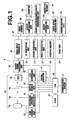
- FIG. 1 is a schematic block diagram illustrating the internal configuration of a digital camera 1 according to one embodiment of the invention.
- the digital camera 1 includes a manipulation system 2, which includes elements such as a release button, a four-directional button and a menu button.
- the manipulation system 2 forms a photographing time setting unit.
- An imaging system 10 include an imaging lens 12 formed by a focusing lens and a zooming lens.
- the focusing lens and the zooming lens forming the imaging lens 12 are movable along the optical axis by a lens driving unit 13.
- a diaphragm aperture 14 is driven by a diaphragm aperture driving unit 15.
- the diaphragm aperture driving unit 15 adjusts an aperture diameter based on aperture value data outputted from an AE/AWB processing unit 31.
- a shutter 16 is a mechanical shutter, and is driven by a shutter driving unit 17.
- the shutter driving unit 17 controls opening and closing of the shutter 16 according to a signal that is generated when a release button is pressed and shutter speed data that is outputted from the AE/AWB processing unit 31.
- the CCD 18 includes a photoelectric surface formed by a large number of two-dimensionally arranged light receiving elements.
- a light image of the subject passing through the optical system, such as the imaging lens 12 is focused on the photoelectric surface and is subjected to photoelectric conversion.
- a micro lens array for converging the light at respective pixels and a color filter array formed by regularly arrayed R, G and B color filters are disposed upstream the photoelectric surface.
- the CCD 18 stores electric charges at the respective pixels and outputs them line by line as a serial analog imaging signal synchronously with a vertical transfer clock signal and a horizontal transfer clock signal supplied from a CCD controlling unit 19.
- a time for storing the charges at the pixels is determined by an electronic shutter driving signal supplied from the CCD controlling unit 19.
- the CCD controlling unit 19 adjusts a gain of the CCD 18 to provide an analog imaging signal having a predetermined maximum value.
- the analog imaging signal taken via the CCD 18 is inputted to an analog signal processing unit 20.
- the analog signal processing unit 20 includes a correlation double sampling circuit (CDS) for removing noise from the analog signal, an automatic gain controller (AGC) for controlling a gain of the analog signal, and anA/D converter (ADC) for converting the analog signal into a digital signal.
- CDS correlation double sampling circuit
- ADC automatic gain controller
- ADC A/D converter
- a timing generator 21 generates a timing signal.
- the timing signal is supplied to the shutter driving unit 17, the CCD controlling unit 19 and the analog signal processing unit 20 to synchronize the manipulation of the release button with opening/closing of the shutter 16, transfer of the electric charges of the CCD 18, and processing by the analog signal processing unit 20.
- the digital camera 1 further includes a flash 24 that emits light as necessary during a photographing operation.
- An image input controller 25 writes the CCD raw data, which is inputted from the analog signal processing unit 20, in a frame memory 26.
- the frame memory 26 provides a workspace for various image processing (signal processing) applied to the image data, which will be described later.
- the frame memory 26 is formed, for example, by a SDRAM (Synchronous Dynamic Random Access Memory) that transfers data synchronously with a bus clock signal having a constant frequency.
- SDRAM Serial Dynamic Random Access Memory
- a display controlling unit 27 causes the image data stored in the frame memory 26 to be displayed on a monitor 28 as a live view, or causes a still image or a moving image stored in the recording medium 35 to be displayed on the monitor 28 in the playback mode.
- An AF processing unit 30 and the AE/AWB processing unit 31 determine photographing conditions based on preliminary images.
- the preliminary images are images represented by image data which is stored in the frame memory 26 when a CPU 40, upon detecting a half-press signal generated when the release button is half pressed, causes the CCD 18 to carry out preliminary photographing.
- the AF processing unit 30 detects a focal position based on the preliminary images and outputs focus driving amount data (AF processing).
- the focal position may be detected, for example, in a passive method, which utilizes the fact that a focused image of a desired subject has higher contrast than unfocused images of the subject.
- the AE/AWB processing unit 31 measures a brightness of the subject based on the preliminary images, and then determines an ISO sensitivity, an aperture value, a shutter speed, and the like, for obtaining a desired brightness of the photographed image based on the measured brightness of the subject.
- the AE/AWB processing unit 31 uses the determined ISO sensitivity data, the aperture value data and the shutter speed data as exposure setting values (AE processing), and automatically adjusts a white balance for photographing (AWB processing).
- An image processing unit 32 applies, to image data of an actually photographed image, image quality correction processing, such as tone correction, sharpness correction and color correction, and YC processing to convert the CCD raw data into YC data, which is formed by Y data representing a luminance signal, Cb data representing a blue color-difference signal and Cr data representing a red color-difference signal.
- the actually photographed image is an image represented by image data which is taken via the CCD 18 in actual photographing, which is carried out when the release button is fully pressed, and is stored in the frame memory 26 via the analog signal processing unit 20 and the image input controller 25.
- the image processing unit 32 also applies necessary processing to image data of a moving image.
- a compression/decompression processing unit 33 applies compression processing according to a certain compression format, such as JPEG, to the image data of the actually photographed image that has been subjected to the processing by the image processing unit 32, to generate an image file.
- a tag storing accompanying information, such as photographing time and date, is added to the image file, based, for example, on the Exif format. It should be noted that, during a photographing operation in a moving image photographing mode, the compression/decompression processing unit 33 compresses the image data of the moving image according to a compression format such as Motion JPEG, MPEG 1, 2 or 4, or H.264 to generate an image file of the moving image.
- a media controlling unit 34 accesses a recording medium 35 and controls writing and reading of the image file in out of the recording medium 35.
- the recording medium 35 may be any of various media such as a SmartMedia, a PC card, a CompactFlash ®, a magnetic disc, an optical disc, a magneto-optical disc or a memory stick.
- a signal processing means and an interface for use with the recording medium 35 depend on a specific medium used. Further, two or more media, which may be of the same type or different types, may be loadable in the digital camera 10. Furthermore, the recording medium 35 is not limited to a removable medium and may be a recording medium built in the digital camera 10.
- An internal memory 36 stores various constants set in the digital camera 1, programs executed by a CPU 40, and the like.
- a break image acquiring unit 37 acquires a "break image for intermission" which indicates that there is an image of a scene continuing from the current moving image, and a "break image for ending” which indicates that there is no image of a scene continuing from the current moving image.
- the break image for intermission or the break image for ending acquired by the break image acquiring unit 37 is recorded at the end of a moving image taken by a photographing operation which is stopped when a continuous photographing time set in advance has been elapsed, depending on whether or not there is an image of a continuing scene from the moving image.
- the "break image for intermission” may, for example, be an image containing a message, such as "intermission” or "to be continued", telling that there is an image of a continuing scene, or an image indicating that there is an image of a continuing scene, such as a countdown moving image counting down until the start of the movie, a moving image like a commercial message with popcorn and soft drinks shown at a theater, or an image of people seated and waiting for the movie to start.
- the "break image for ending” may, for example, be an image containing a message, such as "FIN” or "END", telling that there is no image of a continuing scene, or an image indicating that there is no image of a continuing scene, such as a moving image like an end-title roll of a movie, an image of a person or an animation character asking "Did you enjoy the movie?", or an image of people leaving their seats and going away.
- a message such as "FIN” or "END”
- break image for intermission and the “break image for ending” are not limited to the above examples, and may be any images that can directly or indirectly tell a viewer whether or not there is an image of a continuing scene.
- images inputted in advance by the user and stored in the internal memory 36 as the break image for ending and the break image for intermission may be acquired, images inputted and stored in the internal memory 36 as the break images before shipment may be acquired, or new break images may be generated based on attributes of a photographed moving image, such as a dominant hue of the image, obtained through image analysis.
- a portion of the moving image recorded in the recording medium such as a still image, a moving image, a composite image of two or more still images or moving images, or a digest image, may be acquired and combined with a message indicating whether or not there is an image of a continuing scene, to be used as the break image.
- the digest image may be generated, for example, by detecting a desired object, such as a face image, from each scene of the photographed moving image, evaluating impression of each detected image based on a position of the detected subject in the screen, a ratio of an area in the screen occupied by the detected subject or an amount of action of the detected subject, and combining a predetermined number of scenes having higher evaluation values arranged in order of time, or may be generated using any other known methods.
- a desired object such as a face image
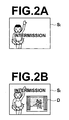
- FIGs. 2A and 2B illustrate examples of the break image for intermission acquired by the break image acquiring unit 37.
- the example shown in FIG. 2A is an image containing a message indicating that there is an image of a continuing scene, which is recorded in advance in the internal memory 36 for use in the break image
- the example shown in FIG. 2B is an image further including a portion of the photographed image recorded in the recording medium, which is inserted in an area D on the break image.
- a timer unit 38 times an elapsed time from the start of a moving image photographing operation and an elapsed time from the end of the moving image photographing operation, and outputs these values to the CPU 40.
- a communication unit 39 communicates with an external recording device, such as a computer, to send or receive image data.
- the CPU 40 controls respective units of the digital camera 1 according to signals fed from various processing units, such as the manipulation system 2 and the timer unit 38. Specifically, before or during a moving image photographing operation, the CPU 40 receives a setting of the continuous photographing time of the moving image photographing operation inputted by the user via the manipulation system 2 and stores the result of setting in the internal memory 36. It should be noted that the continuous photographing time may be set by the user or a default setting value thereof may be stored in the internal memory 36 before shipment.
- the CPU 40 stops the photographing operation when the photographing time of the moving image photographing operation inputted by the timer unit has reached the continuous photographing time, and then determines whether or not a next photographing operation is started within a predetermined time interval tk from the end of the previous photographing operation. If it is determined that the next photographing operation is started within the predetermined time interval tk, the CPU 40 controls the respective units of the digital camera 1, including the break image acquiring unit 37, to record the break image for intermission, which has been acquired in advance, at the end of the moving image photographed by the previous photographing operation. If it is determined that the next photographing operation is not started within the predetermined time interval tk, the CPU 40 controls the units of the digital camera 1 to record the break image for ending at the end of the photographed moving image.
- the recorded break image may replace the end portion of the moving image or may be added at the end of the moving image.
- the set continuous photographing time is 59 minutes and 59 seconds
- the break image for intermission or ending to be added at the end of the moving image, which has been photographed by the photographing operation carried out for the continuous photographing time of 59 minutes and 59 seconds is a moving image having a play back time of three seconds
- the break image may replace image data of the last three seconds, i.e., from 59 min. 56 sec. to 59 min. 59 sec., of the moving image, or may be just added at the end of the moving image to form a moving image of one hour and two seconds long.
- the break image may be recorded at the end of the moving image with a transition effect, such as fade-in, to provide a smooth transition from the moving image to the break image.
- a transition effect such as fade-in
- a data bus 41 connects to various processing units, the frame memory 26 and the CPU 40 for transmission of image data, various instructions, and the like.
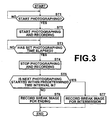
- the CPU 40 starts the process when the photographing mode is set to the moving image photographing mode, and monitors whether or not the user has pressed the release button to give instruction to start the photographing operation (step ST1). If an affirmative determination is made in step ST1, photographing and recording of a moving image is started (step ST2). Then, determination is made as to whether or not the photographing time has exceeded the set continuous photographing time (step ST3). If an affirmative determination is made in step ST3, the photographing and recording are stopped, and an image file M A generated by recording the photographed moving image is left open, i.e., left in a state where additional recording can be made (step ST4).
- step ST5 determination is made as to whether or not a next photographing operation is started within the predetermined time interval tk from the end of the stopped photographing operation. If a negative determination is made in step ST5, the break image for ending is recorded at the end of the image file M A and the file is closed (step ST6) . In contrast, if an affirmative determination is made in step ST5, the break image for intermission is recorded at the end of the image file M A and the file is closed (step ST7).
- the predetermined time interval tk may have any length, such as three seconds, as long as it allows discrimination between a continuing photographing operation and a non-continuing photographing operation such that, if a next photographing operation is started within the predetermined time interval tk after the previous photographing operation was stopped when the set continuous photographing time had elapsed, the next photographing operation is determined to be continuing from the previous photographing operation, and if a next photographing operation is started after the predetermined time interval tk, the next photographing operation is determined not to be continuing from the previous photographing operation. It should be noted that, if the set continuous photographing time is, for example, one hour, the predetermined time interval tk is preferably less than one hour.
- the recording medium 35 is a HDD, for example, that can record more than one moving images simultaneously, and when a next photographing operation is started within the predetermined time interval tk after the previous moving image photographing operation was stopped when the set continuous photographing time had elapsed, additional recording of the break image in the image file MA of the previously photographed image is carried out simultaneously with recording of the next image being photographed.
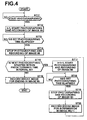
- the recording medium 35 can record only one moving image at a time, it is preferred that the additional recording of the break image is carried out after the next photographing operation is finished, as shown in FIG. 4 .
- the CPU 40 starts the process when the photographing mode is set to the moving image photographing mode, and monitors whether or not the user has pressed the release button to give instruction to start the photographing operation (step ST11) . If an affirmative determination is made in step ST11, a variable i is set to "1", and photographing of a moving image and recording in an image file M i are started (step ST12). Then, determination is made as to whether or not the photographing time has exceeded the set continuous photographing time (step ST13). If an affirmative determination is made in step ST13, the photographing and recording are stopped, and the image file M i generated by recording the photographed moving image is left open, i.e., left in a state where additional recording can be made (step ST14).
- step ST15 whether or not an instruction for starting a next photographing is given within the predetermined time interval tk from the end of the stopped moving image photographing operation is monitored. If a negative determination is made in step ST15, the break image for ending is recorded at the end of the image file M i and the file is closed (step ST16). In contrast, if an affirmative determination is made in step ST15, the variable i is incremented by one, and photographing of a next moving image and recording in a next image file M i are started (step ST17). Then, determination is made as to whether or not the photographing time has exceeded the set continuous photographing time (step ST18) .
- step ST18 If an affirmative determination is made in step ST18, the photographing and recording are stopped, and the image file M i generated by recording the photographed moving image is left open, i.e., left in a state where additional recording can be made (step ST19). Then, the break image for intermission is recorded at the end of the image file M (i-1) and the file is closed (step ST20). Then, the process returns to step ST15 and repeats operations in step ST15 and the following steps.
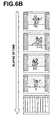
- the break image for intermission S I or the break image for ending S E is shown when the played back moving image is about to end, as shown in FIG. 6A , to tell the viewer whether or not there is an image of a scene continuing from the played back moving image. In this manner, the impression of abrupt end can be mitigated when compared to a moving image taken with a conventional photographing apparatus, as shown in FIG. 6B , for example.
- the photographing apparatus and the controlling method of the present invention when a moving image photographing operation is stopped when the continuous photographing time has elapsed, determination is made as to whether or not a next photographing operation is started within a predetermined time interval after the previous photographing operation is stopped. If it is determined that the next photographing operation is started within the predetermined time interval, the break image for intermission is recorded at the end of the moving image photographed by the stopped photographing operation, and if it is determined that the next photographing operation is not started within the predetermined time interval, the break image for ending is recorded at the end of the moving image.
- the photographed moving image being played back is about to end, the viewer can be informed of presence or absence of a further image of a continuing scene, thereby mitigating the impression of abrupt end.
- the photographing apparatus and the controlling method provide improved convenience for the user.
Landscapes
- Engineering & Computer Science (AREA)
- Multimedia (AREA)
- Studio Devices (AREA)
- Television Signal Processing For Recording (AREA)
Applications Claiming Priority (1)
| Application Number | Priority Date | Filing Date | Title |
|---|---|---|---|
| JP2007147054A JP2008301357A (ja) | 2007-06-01 | 2007-06-01 | 撮像装置及びその制御方法 |
Publications (3)
| Publication Number | Publication Date |
|---|---|
| EP1998334A2 true EP1998334A2 (de) | 2008-12-03 |
| EP1998334A3 EP1998334A3 (de) | 2008-12-10 |
| EP1998334B1 EP1998334B1 (de) | 2014-04-02 |
Family
ID=39768773
Family Applications (1)
| Application Number | Title | Priority Date | Filing Date |
|---|---|---|---|
| EP20080251881 Not-in-force EP1998334B1 (de) | 2007-06-01 | 2008-05-30 | Fotografiergerät und Steuerverfahren dafür |
Country Status (2)
| Country | Link |
|---|---|
| EP (1) | EP1998334B1 (de) |
| JP (1) | JP2008301357A (de) |
Cited By (2)
| Publication number | Priority date | Publication date | Assignee | Title |
|---|---|---|---|---|
| EP2381449A3 (de) * | 2010-04-23 | 2012-04-11 | Canon Kabushiki Kaisha | Bildverarbeitungsvorrichtung und Steuerverfahren dafür |
| US8878951B2 (en) | 2010-04-23 | 2014-11-04 | Canon Kabushiki Kaisha | Image processing apparatus and method of controlling the same |
Families Citing this family (2)
| Publication number | Priority date | Publication date | Assignee | Title |
|---|---|---|---|---|
| KR101692398B1 (ko) | 2010-08-30 | 2017-01-03 | 삼성전자주식회사 | 디지털 촬영 장치 및 디지털 촬영 장치의 제어 방법 |
| JP6098796B2 (ja) * | 2012-03-14 | 2017-03-22 | パナソニックIpマネジメント株式会社 | 画像処理装置、撮像装置、およびコンピュータプログラム |
Citations (3)
| Publication number | Priority date | Publication date | Assignee | Title |
|---|---|---|---|---|
| JP2002044609A (ja) | 2000-07-31 | 2002-02-08 | Matsushita Electric Ind Co Ltd | 映像記録装置および監視装置 |
| JP2002142145A (ja) | 2000-10-31 | 2002-05-17 | Olympus Optical Co Ltd | 電子カメラ |
| JP2005117456A (ja) | 2003-10-09 | 2005-04-28 | Casio Comput Co Ltd | 携帯端末、動画編集方法および動画編集プログラム |
Family Cites Families (8)
| Publication number | Priority date | Publication date | Assignee | Title |
|---|---|---|---|---|
| US4982305A (en) * | 1988-02-25 | 1991-01-01 | Sony Corporation | Tape recorder with automatic pause mode setting |
| JPH09205606A (ja) * | 1996-01-26 | 1997-08-05 | Olympus Optical Co Ltd | 画像撮影装置 |
| JP3581515B2 (ja) * | 1997-02-14 | 2004-10-27 | キヤノン株式会社 | 映像信号処理装置及びその方法 |
| JP4045651B2 (ja) * | 1997-11-19 | 2008-02-13 | ソニー株式会社 | 情報処理装置、情報処理方法及びプログラム記録媒体 |
| JP2002118811A (ja) * | 2000-10-11 | 2002-04-19 | Sony Corp | 撮影内容記録システムおよび撮影内容記録方法 |
| JP3885778B2 (ja) * | 2002-08-27 | 2007-02-28 | ソニー株式会社 | データ処理装置および方法、並びにプログラム |
| JP4630530B2 (ja) * | 2003-06-20 | 2011-02-09 | カシオ計算機株式会社 | 動画記録装置、電子カメラ及びプログラム |
| JP4488989B2 (ja) * | 2005-09-16 | 2010-06-23 | 株式会社東芝 | デジタルビデオカメラ装置 |
-
2007
- 2007-06-01 JP JP2007147054A patent/JP2008301357A/ja not_active Ceased
-
2008
- 2008-05-30 EP EP20080251881 patent/EP1998334B1/de not_active Not-in-force
Patent Citations (3)
| Publication number | Priority date | Publication date | Assignee | Title |
|---|---|---|---|---|
| JP2002044609A (ja) | 2000-07-31 | 2002-02-08 | Matsushita Electric Ind Co Ltd | 映像記録装置および監視装置 |
| JP2002142145A (ja) | 2000-10-31 | 2002-05-17 | Olympus Optical Co Ltd | 電子カメラ |
| JP2005117456A (ja) | 2003-10-09 | 2005-04-28 | Casio Comput Co Ltd | 携帯端末、動画編集方法および動画編集プログラム |
Cited By (3)
| Publication number | Priority date | Publication date | Assignee | Title |
|---|---|---|---|---|
| EP2381449A3 (de) * | 2010-04-23 | 2012-04-11 | Canon Kabushiki Kaisha | Bildverarbeitungsvorrichtung und Steuerverfahren dafür |
| US8848067B2 (en) | 2010-04-23 | 2014-09-30 | Canon Kabushiki Kaisha | Image processing apparatus and method of controlling the same |
| US8878951B2 (en) | 2010-04-23 | 2014-11-04 | Canon Kabushiki Kaisha | Image processing apparatus and method of controlling the same |
Also Published As
| Publication number | Publication date |
|---|---|
| EP1998334A3 (de) | 2008-12-10 |
| EP1998334B1 (de) | 2014-04-02 |
| JP2008301357A (ja) | 2008-12-11 |
Similar Documents
| Publication | Publication Date | Title |
|---|---|---|
| EP1929368B1 (de) | Verfahren und Vorrichtung zur Bildaufnahme mit Tonaufzeichnung | |
| CN101047822B (zh) | 缩略图生成装置及摄像装置 | |
| CN100579175C (zh) | 摄影装置及摄影方法 | |
| JP4444936B2 (ja) | 撮影装置および方法並びにプログラム | |
| JP4799501B2 (ja) | 撮影装置、撮影装置の制御方法およびプログラム | |
| JP2009077026A (ja) | 撮影装置および方法並びにプログラム | |
| JP4733068B2 (ja) | 撮影装置および方法並びにプログラム | |
| EP1998334B1 (de) | Fotografiergerät und Steuerverfahren dafür | |
| JP2010087722A (ja) | 撮影装置及び動画像編集方法 | |
| JP2004080376A (ja) | 動画撮像装置及び動画再生装置 | |
| JP2006303961A (ja) | 撮像装置 | |
| JP2004207805A (ja) | デジタルスチルカメラ | |
| JP2008205953A (ja) | 撮像装置、及び画像再生装置 | |
| US20100129049A1 (en) | Editing apparatus, control method of the editing apparatus, and image pickup apparatus | |
| JP2005094133A (ja) | 撮影装置 | |
| JP4179711B2 (ja) | 電子カメラ | |
| JP2010087723A (ja) | 撮影装置及び動画像編集方法 | |
| JP3913046B2 (ja) | 撮像装置 | |
| JP2008288830A (ja) | 撮像装置及びその記録方法 | |
| JP5245493B2 (ja) | 撮像装置、撮像装置制御プログラム及び撮像制御方法 | |
| JP5672330B2 (ja) | 撮像装置、撮像装置制御プログラム及び撮像制御方法 | |
| JP2010074517A (ja) | 撮像装置 | |
| KR100627070B1 (ko) | 화상 음성 기록 장치 및 재생 장치 | |
| JP2006340063A (ja) | 画像記録再生装置 | |
| JP2006019828A (ja) | 画像記録装置 |
Legal Events
| Date | Code | Title | Description |
|---|---|---|---|
| PUAI | Public reference made under article 153(3) epc to a published international application that has entered the european phase |
Free format text: ORIGINAL CODE: 0009012 |
|
| PUAL | Search report despatched |
Free format text: ORIGINAL CODE: 0009013 |
|
| AK | Designated contracting states |
Kind code of ref document: A2 Designated state(s): AT BE BG CH CY CZ DE DK EE ES FI FR GB GR HR HU IE IS IT LI LT LU LV MC MT NL NO PL PT RO SE SI SK TR |
|
| AX | Request for extension of the european patent |
Extension state: AL BA MK RS |
|
| AK | Designated contracting states |
Kind code of ref document: A3 Designated state(s): AT BE BG CH CY CZ DE DK EE ES FI FR GB GR HR HU IE IS IT LI LT LU LV MC MT NL NO PL PT RO SE SI SK TR |
|
| AX | Request for extension of the european patent |
Extension state: AL BA MK RS |
|
| 17P | Request for examination filed |
Effective date: 20090119 |
|
| AKX | Designation fees paid |
Designated state(s): DE FR GB |
|
| GRAP | Despatch of communication of intention to grant a patent |
Free format text: ORIGINAL CODE: EPIDOSNIGR1 |
|
| INTG | Intention to grant announced |
Effective date: 20131126 |
|
| GRAS | Grant fee paid |
Free format text: ORIGINAL CODE: EPIDOSNIGR3 |
|
| GRAA | (expected) grant |
Free format text: ORIGINAL CODE: 0009210 |
|
| AK | Designated contracting states |
Kind code of ref document: B1 Designated state(s): DE FR GB |
|
| REG | Reference to a national code |
Ref country code: GB Ref legal event code: FG4D |
|
| REG | Reference to a national code |
Ref country code: DE Ref legal event code: R096 Ref document number: 602008031230 Country of ref document: DE Effective date: 20140515 |
|
| REG | Reference to a national code |
Ref country code: DE Ref legal event code: R097 Ref document number: 602008031230 Country of ref document: DE |
|
| PLBE | No opposition filed within time limit |
Free format text: ORIGINAL CODE: 0009261 |
|
| STAA | Information on the status of an ep patent application or granted ep patent |
Free format text: STATUS: NO OPPOSITION FILED WITHIN TIME LIMIT |
|
| REG | Reference to a national code |
Ref country code: FR Ref legal event code: ST Effective date: 20150130 |
|
| 26N | No opposition filed |
Effective date: 20150106 |
|
| GBPC | Gb: european patent ceased through non-payment of renewal fee |
Effective date: 20140702 |
|
| REG | Reference to a national code |
Ref country code: DE Ref legal event code: R097 Ref document number: 602008031230 Country of ref document: DE Effective date: 20150106 |
|
| PG25 | Lapsed in a contracting state [announced via postgrant information from national office to epo] |
Ref country code: FR Free format text: LAPSE BECAUSE OF NON-PAYMENT OF DUE FEES Effective date: 20140602 Ref country code: GB Free format text: LAPSE BECAUSE OF NON-PAYMENT OF DUE FEES Effective date: 20140702 |
|
| PGFP | Annual fee paid to national office [announced via postgrant information from national office to epo] |
Ref country code: DE Payment date: 20160524 Year of fee payment: 9 |
|
| REG | Reference to a national code |
Ref country code: DE Ref legal event code: R119 Ref document number: 602008031230 Country of ref document: DE |
|
| PG25 | Lapsed in a contracting state [announced via postgrant information from national office to epo] |
Ref country code: DE Free format text: LAPSE BECAUSE OF NON-PAYMENT OF DUE FEES Effective date: 20171201 |