EP1968381B1 - Synergistische fungizide wirkstoffkombinationen - Google Patents
Synergistische fungizide wirkstoffkombinationen Download PDFInfo
- Publication number
- EP1968381B1 EP1968381B1 EP06723756A EP06723756A EP1968381B1 EP 1968381 B1 EP1968381 B1 EP 1968381B1 EP 06723756 A EP06723756 A EP 06723756A EP 06723756 A EP06723756 A EP 06723756A EP 1968381 B1 EP1968381 B1 EP 1968381B1
- Authority
- EP
- European Patent Office
- Prior art keywords
- methyl
- active compound
- phenyl
- carboxamide
- alkyl
- Prior art date
- Legal status (The legal status is an assumption and is not a legal conclusion. Google has not performed a legal analysis and makes no representation as to the accuracy of the status listed.)
- Expired - Lifetime
Links
- 0 Cc1c(*)[n](*)nc1* Chemical compound Cc1c(*)[n](*)nc1* 0.000 description 4
Classifications
-
- A—HUMAN NECESSITIES
- A01—AGRICULTURE; FORESTRY; ANIMAL HUSBANDRY; HUNTING; TRAPPING; FISHING
- A01N—PRESERVATION OF BODIES OF HUMANS OR ANIMALS OR PLANTS OR PARTS THEREOF; BIOCIDES, e.g. AS DISINFECTANTS, AS PESTICIDES OR AS HERBICIDES; PEST REPELLANTS OR ATTRACTANTS; PLANT GROWTH REGULATORS
- A01N37/00—Biocides, pest repellants or attractants, or plant growth regulators containing organic compounds containing a carbon atom having three bonds to hetero atoms with at the most two bonds to halogen, e.g. carboxylic acids
- A01N37/36—Biocides, pest repellants or attractants, or plant growth regulators containing organic compounds containing a carbon atom having three bonds to hetero atoms with at the most two bonds to halogen, e.g. carboxylic acids containing at least one carboxylic group or a thio analogue, or a derivative thereof, and a singly bound oxygen or sulfur atom attached to the same carbon skeleton, this oxygen or sulfur atom not being a member of a carboxylic group or of a thio analogue, or of a derivative thereof, e.g. hydroxy-carboxylic acids
-
- A—HUMAN NECESSITIES
- A01—AGRICULTURE; FORESTRY; ANIMAL HUSBANDRY; HUNTING; TRAPPING; FISHING
- A01N—PRESERVATION OF BODIES OF HUMANS OR ANIMALS OR PLANTS OR PARTS THEREOF; BIOCIDES, e.g. AS DISINFECTANTS, AS PESTICIDES OR AS HERBICIDES; PEST REPELLANTS OR ATTRACTANTS; PLANT GROWTH REGULATORS
- A01N37/00—Biocides, pest repellants or attractants, or plant growth regulators containing organic compounds containing a carbon atom having three bonds to hetero atoms with at the most two bonds to halogen, e.g. carboxylic acids
- A01N37/18—Biocides, pest repellants or attractants, or plant growth regulators containing organic compounds containing a carbon atom having three bonds to hetero atoms with at the most two bonds to halogen, e.g. carboxylic acids containing the group —CO—N<, e.g. carboxylic acid amides or imides; Thio analogues thereof
- A01N37/22—Biocides, pest repellants or attractants, or plant growth regulators containing organic compounds containing a carbon atom having three bonds to hetero atoms with at the most two bonds to halogen, e.g. carboxylic acids containing the group —CO—N<, e.g. carboxylic acid amides or imides; Thio analogues thereof the nitrogen atom being directly attached to an aromatic ring system, e.g. anilides
-
- A—HUMAN NECESSITIES
- A01—AGRICULTURE; FORESTRY; ANIMAL HUSBANDRY; HUNTING; TRAPPING; FISHING
- A01N—PRESERVATION OF BODIES OF HUMANS OR ANIMALS OR PLANTS OR PARTS THEREOF; BIOCIDES, e.g. AS DISINFECTANTS, AS PESTICIDES OR AS HERBICIDES; PEST REPELLANTS OR ATTRACTANTS; PLANT GROWTH REGULATORS
- A01N37/00—Biocides, pest repellants or attractants, or plant growth regulators containing organic compounds containing a carbon atom having three bonds to hetero atoms with at the most two bonds to halogen, e.g. carboxylic acids
- A01N37/18—Biocides, pest repellants or attractants, or plant growth regulators containing organic compounds containing a carbon atom having three bonds to hetero atoms with at the most two bonds to halogen, e.g. carboxylic acids containing the group —CO—N<, e.g. carboxylic acid amides or imides; Thio analogues thereof
- A01N37/22—Biocides, pest repellants or attractants, or plant growth regulators containing organic compounds containing a carbon atom having three bonds to hetero atoms with at the most two bonds to halogen, e.g. carboxylic acids containing the group —CO—N<, e.g. carboxylic acid amides or imides; Thio analogues thereof the nitrogen atom being directly attached to an aromatic ring system, e.g. anilides
- A01N37/24—Biocides, pest repellants or attractants, or plant growth regulators containing organic compounds containing a carbon atom having three bonds to hetero atoms with at the most two bonds to halogen, e.g. carboxylic acids containing the group —CO—N<, e.g. carboxylic acid amides or imides; Thio analogues thereof the nitrogen atom being directly attached to an aromatic ring system, e.g. anilides containing at least one oxygen or sulfur atom being directly attached to the same aromatic ring system
-
- A—HUMAN NECESSITIES
- A01—AGRICULTURE; FORESTRY; ANIMAL HUSBANDRY; HUNTING; TRAPPING; FISHING
- A01N—PRESERVATION OF BODIES OF HUMANS OR ANIMALS OR PLANTS OR PARTS THEREOF; BIOCIDES, e.g. AS DISINFECTANTS, AS PESTICIDES OR AS HERBICIDES; PEST REPELLANTS OR ATTRACTANTS; PLANT GROWTH REGULATORS
- A01N43/00—Biocides, pest repellants or attractants, or plant growth regulators containing heterocyclic compounds
- A01N43/48—Biocides, pest repellants or attractants, or plant growth regulators containing heterocyclic compounds having rings with two nitrogen atoms as the only ring hetero atoms
- A01N43/56—1,2-Diazoles; Hydrogenated 1,2-diazoles
-
- A—HUMAN NECESSITIES
- A01—AGRICULTURE; FORESTRY; ANIMAL HUSBANDRY; HUNTING; TRAPPING; FISHING
- A01N—PRESERVATION OF BODIES OF HUMANS OR ANIMALS OR PLANTS OR PARTS THEREOF; BIOCIDES, e.g. AS DISINFECTANTS, AS PESTICIDES OR AS HERBICIDES; PEST REPELLANTS OR ATTRACTANTS; PLANT GROWTH REGULATORS
- A01N57/00—Biocides, pest repellants or attractants, or plant growth regulators containing organic phosphorus compounds
- A01N57/10—Biocides, pest repellants or attractants, or plant growth regulators containing organic phosphorus compounds having phosphorus-to-oxygen bonds or phosphorus-to-sulfur bonds
- A01N57/14—Biocides, pest repellants or attractants, or plant growth regulators containing organic phosphorus compounds having phosphorus-to-oxygen bonds or phosphorus-to-sulfur bonds containing aromatic radicals
-
- A—HUMAN NECESSITIES
- A01—AGRICULTURE; FORESTRY; ANIMAL HUSBANDRY; HUNTING; TRAPPING; FISHING
- A01N—PRESERVATION OF BODIES OF HUMANS OR ANIMALS OR PLANTS OR PARTS THEREOF; BIOCIDES, e.g. AS DISINFECTANTS, AS PESTICIDES OR AS HERBICIDES; PEST REPELLANTS OR ATTRACTANTS; PLANT GROWTH REGULATORS
- A01N2300/00—Combinations or mixtures of active ingredients covered by classes A01N27/00 - A01N65/48 with other active or formulation relevant ingredients, e.g. specific carrier materials or surfactants, covered by classes A01N25/00 - A01N65/48
Definitions
- the present invention relates to novel drug combinations which consist of known carboxamides on the one hand and other known fungicidal active compounds on the other hand and are very suitable for controlling unwanted phytopathogenic fungi.
- the fungicidal action of the active compound combinations according to the invention is substantially higher than the sum of the effects of the individual active compounds. So there is an unpredictable, true synergistic effect and not just an effect supplement.
- the compounds of group (1) are generally defined by the formula (I).
- active substance combinations consist of two groups of active ingredients and each contain at least one carboxamide of the formula (I) (group 1) and at least one active compound of the stated group (2) and (3). These combinations are the active ingredient combinations A and B.
- the active compound combinations A contain, in addition to a carboxamide of the formula (I) (group 1) also (2) Tolclofos-methyl of the formula
- the active ingredient combinations B contain, in addition to a carboxamide of the formula (I) (group 1) also (3) Flutolanil of the formula
- the active compound combinations according to the invention contain, in addition to an active ingredient of the formula (I), at least one active ingredient of the compounds of groups (2) and (3). You may also contain other fungicidal Zumischkomponenten.
- the combinations according to the invention comprise active compounds of the formula (I) and a mixed partner of one of the groups (2) and (3) in the mixing ratios exemplified in Table 3 below.
- the mixing ratios are based on weight ratios.
- the ratio is to be understood as the active ingredient of the formula (I): Mischpartner.
- Table 3 Mixing ratios mix partners preferred mixing ratio particularly preferred mixing ratio (2) Tolclofos-methyl 50: 1 to 1:50 10: 1 to 1:20 (3) Flutolanil 50: 1 to 1:50 20: 1 to 1:20
- the mixing ratio should be such that a synergistic mixture is obtained.
- the mixing ratios between the compound of the formula (I) and a compound of one of the groups (2) and (3) may also vary between the individual compounds of a group.
- the active compound combinations according to the invention have a strong microbicidal action and can be used for controlling unwanted microorganisms, such as fungi and bacteria, in crop protection and in the protection of materials.
- Fungicides can be used for the control of Plasmodiophoromycetes, Oomycetes, Chytridiomycetes, Zygomycetes, Ascomycetes, Basidiomycetes and Deuteromycetes.
- Bactericides can be used in crop protection for controlling Pseudomonadaceae, Rhizobiaceae, Enterobacteriaceae, Corynebacteriaceae and Streptomycetaceae.
- the good plant tolerance of the active compound combinations in the concentrations necessary for controlling plant diseases allows treatment of whole plants (above-ground parts of plants and roots), of planting and seed, and of the soil.
- the active compound combinations according to the invention can be used for foliar application or as a mordant.
- the good plant tolerance of the usable active ingredients in the necessary concentrations for controlling plant diseases allows treatment of the seed.
- the active compounds according to the invention can thus be used as mordants.
- the present invention therefore more particularly relates to a method of protecting seeds and germinating plants from the infestation of phytopathogenic fungi by treating the seed with an agent according to the invention.
- the invention also relates to the use of the seed treatment agents of the invention for protecting the seed and the germinating plant from phytopathogenic fungi.
- the invention relates to seed which has been treated with an agent according to the invention for protection against phytopathogenic fungi.
- One of the advantages of the present invention is that because of the particular systemic properties of the compositions of the invention, treatment of the seed with these agents not only protects the seed itself, but also the resulting plants after emergence from phytopathogenic fungi. In this way, the immediate treatment of the culture at the time of sowing or shortly afterwards can be omitted.
- mixtures according to the invention can also be used in particular in the case of transgenic seed.
- compositions according to the invention are suitable for the protection of seeds of any plant variety used in agriculture, in the greenhouse, in forests or in horticulture.
- these are seeds of cereals (such as wheat, barley, rye, millet and oats), corn, cotton, soy, rice, potatoes, sunflower, bean, coffee, turnip (eg sugarbeet and fodder), peanut, vegetables ( like tomato, cucumber, onions and lettuce), lawn and ornamental plants.
- cereals such as wheat, barley, rye, millet and oats
- corn such as wheat, barley, rye, millet and oats
- peanut like tomato, cucumber, onions and lettuce
- the agent according to the invention is applied to the seed alone or in a suitable formulation.
- the seed is treated in a state in which it is so stable that no damage occurs during the treatment.
- the treatment of the seed can be done at any time between harvesting and sowing.
- seed is used which has been separated from the plant and freed from flasks, shells, stems, hull, wool or pulp.
- seed may be used which has been harvested, cleaned and dried to a moisture content below 15% by weight.
- seed can also be used, which after drying, for example, treated with water and then dried again.
- the agents according to the invention can be applied directly, ie without containing further components and without being diluted.
- suitable formulations and methods for seed treatment are known to the person skilled in the art and are described, for example, in the following documents: US 4,272,417 A . US 4,245,432 A . US 4,808,430 A . US 5,876,739 A . US 2003/0176428 A1 . WO 2002/080675 A1 . WO 2002/028186 A2 ,
- the active compound combinations according to the invention are also suitable for increasing crop yield. They are also low toxicity and have good plant tolerance.
- plants and parts of plants can be treated.
- plants are understood as meaning all plants and plant populations, such as desired and undesired wild plants or crop plants (including naturally occurring crop plants).
- Crop plants can be plants which can be obtained by conventional breeding and optimization methods or by biotechnological and genetic engineering methods or combinations of these methods, including the transgenic plants and including the plant varieties which can or can not be protected by plant breeders' rights.
- Plant parts are to be understood as meaning all aboveground and subterranean parts and organs of the plants, such as shoot, leaf, flower and root, examples of which include leaves, needles, stems, stems, flowers, fruiting bodies, fruits and seeds, and roots, tubers and rhizomes.
- the plant parts also include crops and vegetative and generative propagation material, such as cuttings, tubers, rhizomes, offshoots and seeds.
- the treatment according to the invention of the plants and plant parts with the active ingredients is carried out directly or by acting on their environment, habitat or storage space according to the usual treatment methods, e.g. by dipping, spraying, vaporizing, atomizing, spreading, spreading and in propagation material, in particular in seeds, further by single or multi-layer wrapping.
- plants and their parts can be treated.
- wild or conventional biological Breeding methods such as crossing or protoplast fusion obtained plant species and plant varieties and their parts treated.
- transgenic plants and plant cultivars which have been obtained by genetic engineering methods, if appropriate in combination with conventional methods (Genetically Modified Organisms) and their parts are treated.
- the term “parts” or “parts of plants” or “plant parts” has been described above explained.
- the treatment according to the invention may also give rise to superadditive ("synergistic") effects.
- superadditive for example, reduced application rates and / or enhancements of the spectrum of action and / or an increase in the effect of the substances and agents usable according to the invention, better plant growth, more developed root system, higher resistance of the plant or plant variety, increased growth of the shoots, higher plant vitality, increased tolerance to high or low temperatures, increased tolerance to dryness or to water or soil salinity, increased flowering efficiency, easier harvest, acceleration of ripeness, higher crop yields, larger fruits, higher plant size, greener leaf color, earlier flowering, higher quality and / or higher nutritional value the harvest products, higher sugar concentration in the fruits, higher shelf life and / or workability of the harvest products possible, which go beyond the expected effects actually.
- the preferred plants or plant varieties to be treated according to the invention to be treated include all plants which, as a result of the genetic engineering modification, obtained genetic material which gives these plants particularly advantageous valuable properties ("traits").
- traits are better plant growth, increased tolerance to high or low temperatures, increased tolerance to drought or to bottoms salt, increased flowering, easier harvesting, acceleration of ripeness, higher crop yields, higher quality and / or higher nutritional value
- transgenic plants include the important crop plants, such as cereals (wheat, rice), maize, soya, potatoes, cotton, oilseed rape and fruit plants (with the fruits apples, pears, citrus fruits and grapes), with corn, soy, potato, cotton and oilseed rape particularly highlighted become.
- Traits that are particularly emphasized are the increased defense of the plants against insects by toxins formed in the plants, in particular those which are produced by the genetic material from Bacillus thuringiensis (for example by the genes CryIA (a), CryIA (b), CryIA (c), CryIIA, CryIIIA, CryIIIB2, Cry9c Cry2Ab, Cry3Bb and CryIF, and combinations thereof) (hereinafter "Bt Rooed”).
- Bt Rooed Bacillus thuringiensis
- Traits which are furthermore particularly emphasized are the increased tolerance of the plants to certain herbicidally active compounds, for example imidazolinones, sulfonylureas, glyphosate or phosphinotricin (eg "PAT" gene).
- genes which confer the desired properties can also occur in combinations with one another in the transgenic plants.
- “Bt plants” are maize varieties, cotton varieties, soya bean varieties and potato varieties which are sold under the trade names YIELD GARD ® (for example maize, cotton, soya beans), KnockOut ® (for example maize), StarLink ® (for example maize), Bollgard ® ( cotton), NuCOTN ® (cotton) and NewLeaf ® (potato).
- herbicide-tolerant plants are maize varieties, cotton varieties and soybean varieties which are resistant under the trade names Roundup Ready ® (tolerance to glyphosate, for example maize, cotton, soya bean), Liberty Link ® (tolerance to phosphinotricin, for example oilseed rape), IMI ® (tolerance Imidazolinone) and STS ® (tolerance to sulfonylureas such as corn) are sold.
- Herbicide-resistant (conventionally grown on herbicide tolerance) plants are also the varieties marketed under the name Clearfield ® (eg corn) mentioned. Of course, these statements also apply to future or future marketed plant varieties with these or future developed genetic traits.
- the active compound combinations according to the invention can be converted into the customary formulations depending on their respective physical and / or chemical properties, such as solutions, emulsions, suspensions, powders, dusts, foams, pastes, soluble powders, granules, aerosols, suspension-emulsion concentrates, Active substance-impregnated natural and synthetic substances as well as ultra-fine encapsulations in polymeric substances and in coating compositions for seeds, as well as ULV cold and warm mist formulations.
- solutions, emulsions, suspensions, powders, dusts, foams, pastes, soluble powders, granules, aerosols, suspension-emulsion concentrates Active substance-impregnated natural and synthetic substances as well as ultra-fine encapsulations in polymeric substances and in coating compositions for seeds, as well as ULV cold and warm mist formulations.
- formulations are prepared in a known manner, e.g. by mixing the active compounds or the active compound combinations with extenders, ie liquid solvents, liquefied gases under pressure and / or solid carriers, optionally with the use of surface-active agents, ie emulsifiers and / or dispersants and / or foam-forming agents.
- extenders ie liquid solvents, liquefied gases under pressure and / or solid carriers
- surface-active agents ie emulsifiers and / or dispersants and / or foam-forming agents.
- organic solvents can also be used as auxiliary solvents.
- liquid solvents are essentially in question: Aromatics, such as xylene, toluene or alkylnaphthalenes, chlorinated aromatics or chlorinated aliphatic hydrocarbons, such as chlorobenzenes, chloroethylenes or methylene chloride, aliphatic hydrocarbons, such as cyclohexane or paraffins, for example petroleum fractions, mineral and vegetable oils, alcohols, such as butanol or glycol, and their ethers and esters , Ketones such as acetone, methyl ethyl ketone, methyl isobutyl ketone or cyclohexanone, strongly polar solvents such as dimethylformamide and dimethyl sulfoxide, and water.
- liquefied gaseous diluents or carriers are meant those liquids which are gaseous at normal temperature and under normal pressure, e.g. Aerosol propellants, such as butane, propane, nitrogen and carbon dioxide.
- Suitable solid carriers are: e.g. Ammonium salts and ground natural minerals, such as kaolins, clays, talc, chalk, quartz, attapulgite, montmorillonite or diatomaceous earth, and ground synthetic minerals, such as fumed silica, alumina and silicates.
- Suitable solid carriers for granules are: e.g. Cracked and fractionated natural rocks such as calcite, marble, pumice, sepiolite, dolomite and synthetic granules of inorganic and organic flours and granules of organic material such as sawdust, coconut shells, corn cobs and tobacco stems.
- Suitable emulsifying and / or foaming agents are: e.g.
- nonionic and anionic emulsifiers such as polyoxyethylene fatty acid esters, polyoxyethylene fatty alcohol ethers, e.g. Alkylaryl polyglycol ethers, alkyl sulfonates, alkyl sulfates, aryl sulfonates and protein hydrolysates.
- Suitable dispersants are: e.g. Lignin-sulphite liquors and methylcellulose.
- Adhesives such as carboxymethyl cellulose, natural and synthetic powdery, granular or latex polymers may be used in the formulations, such as gum arabic, polyvinyl alcohol, polyvinyl acetate, as well as natural phospholipids such as cephalins and lecithins, and synthetic phospholipids.
- Other additives may be mineral and vegetable oils.
- Dyes such as inorganic pigments, e.g. Iron oxide, titanium oxide, ferrocyan blue and organic dyes such as alizarin, azo and metal phthalocyanine dyes and trace nutrients such as salts of iron, manganese, boron, copper, cobalt, molybdenum and zinc.
- inorganic pigments e.g. Iron oxide, titanium oxide, ferrocyan blue and organic dyes such as alizarin, azo and metal phthalocyanine dyes and trace nutrients such as salts of iron, manganese, boron, copper, cobalt, molybdenum and zinc.
- the active substance content of the application forms prepared from the commercial formulations can vary within wide ranges.
- the active ingredient concentration of the use forms for controlling animal pests such as insects and acarids may be from 0.0000001 to 95% by weight of active compound, preferably between 0.0001 and 1% by weight.
- the application is done in a custom forms adapted to the application forms.
- the formulations for controlling undesired phytopathogenic fungi generally contain between 0.1 and 95% by weight of active ingredients, preferably between 0.5 and 90%.
- the active compound combinations according to the invention can be used as such, in the form of their formulations or the use forms prepared therefrom, such as ready-to-use solutions, emulsifiable concentrates, emulsions, suspensions, wettable powders, soluble powders, dusts and granules.
- the application is done in the usual way, e.g. by pouring (drenchen), drip irrigation, spraying, spraying, scattering, dusting, foaming, brushing, spreading, dry pickling, wet pickling, wet pickling, slurry pickling, encrusting, etc.
- the active compound combinations according to the invention can be present in commercially available formulations as well as in the formulations prepared from these formulations in admixture with other active ingredients, such as insecticides, attractants, sterilants, bactericides, acaricides, nematicides, fungicides, growth-regulating substances or herbicides.
- active ingredients such as insecticides, attractants, sterilants, bactericides, acaricides, nematicides, fungicides, growth-regulating substances or herbicides.
- the application rates can be varied within a substantial range, depending on the mode of administration.
- the application rates of active ingredient combination are generally between 0.1 and 10,000 g / ha, preferably between 10 and 1,000 g / ha.
- the application rates of active ingredient combination are generally between 0.001 and 50 g per kilogram of seed, preferably between 0.01 and 10 g per kilogram of seed.
- the application rates of active ingredient combination are generally between 0.1 and 10,000 g / ha, preferably between 1 and 5,000 g / ha.
- the active compound combinations can be used as such, in the form of concentrates or generally customary formulations such as powders, granules, solutions, suspensions, emulsions or pastes.
- the formulations mentioned can be prepared in a manner known per se, e.g. by mixing the active compounds with at least one solvent or diluent, emulsifier, dispersing and / or binding or fixing agent, water repellent, optionally siccatives and UV stabilizers and optionally dyes and pigments, and further processing aids.
- a synergistic effect is always present in fungicides when the fungicidal action of the active ingredient combinations is greater than the sum of the effects of the individually applied active ingredients.
- SR Colby Calculating Synergistic and Antagonistic Responses of Herbicide Combinations", Weeds 1967, 15, 20-22 ) are calculated as follows:
- the efficiency is determined in%. It means 0% an efficiency that corresponds to that of the control, while an efficiency of 100% means that no infestation is observed.
- the combination is over-additive in its effect, ie there is a synergistic effect.
- the actual observed efficiency must be greater than the expected efficiency value (E) calculated from the above formula.
- the microtest is carried out in microtiter plates with Potato Dextrose Broth (PDB) as a liquid test medium.
- PDB Potato Dextrose Broth
- the application of the active ingredients is carried out as a technical ai, dissolved in acetone or as a commercial formulation.
- a spore suspension of Pyricularia oryzae is used.
- the light transmittance in each filled well of the microtiter plates is determined by means of a spectrophotometer.
- 0% means an efficiency equivalent to the growth in the controls, while an efficiency of 100% means that no fungal growth is observed.
- the microtest is carried out in microtiter plates with Potato Dextrose Broth (PDB) as a liquid test medium.
- PDB Potato Dextrose Broth
- the application of the active ingredients is carried out as a technical ai, dissolved in acetone or as a commercial formulation.
- a spore suspension of Alternaria mali is used.
- the light transmittance in each filled well of the microtiter plates is determined by means of a spectrophotometer.
- 0% means an efficiency equivalent to the growth in the controls, while an efficiency of 100% means that no fungal growth is observed.
Landscapes
- Life Sciences & Earth Sciences (AREA)
- Agronomy & Crop Science (AREA)
- Pest Control & Pesticides (AREA)
- Plant Pathology (AREA)
- Health & Medical Sciences (AREA)
- Engineering & Computer Science (AREA)
- Dentistry (AREA)
- General Health & Medical Sciences (AREA)
- Wood Science & Technology (AREA)
- Zoology (AREA)
- Environmental Sciences (AREA)
- Agricultural Chemicals And Associated Chemicals (AREA)
- Pretreatment Of Seeds And Plants (AREA)
Abstract
Description
- Die vorliegende Erfindung betrifft neue Wirkstoffkombinationen, die aus bekannten Carboxamiden einerseits und weiteren bekannten fungiziden Wirkstoffen andererseits bestehen und sehr gut zur Bekämpfung von unerwünschten phytopathogenen Pilzen geeignet sind.
- Es ist bereits bekannt, dass bestimmte Carboxamide fungizide Eigenschaften besitzen: z.B. N-[2-(1,3-Dimethylbutyl)phenyl]-5-fluor-1,3-dimethyl-1H-pyrazol-4-carboxamid aus
WO 03/010149 DE-A 103 03 589 . Die Wirksamkeit dieser Stoffe ist gut, lässt aber bei niedrigen Aufwandmengen in manchen Fällen zu wünschen übrig. Ferner ist schon bekannt, dass zahlreiche Triazol-Derivate, Anilin-Derivate, Dicarboximide und andere Heterocyclen zur Bekämpfung von Pilzen eingesetzt werden können (vgl.EP-A 0 040 345 ,DE-A 22 01 063 ,DE-A 23 24 010 , Pesticide Manual, 9th. Edition (1991), Seiten 249 und 827,EP-A 0 382 375 undEP-A 0 515 901 ). Auch die Wirkung dieser Stoffe ist aber bei niedrigen Aufwandmengen nicht immer ausreichend. Ferner ist bereits bekannt, dass 1-(3,5-Dimethyl-isoxazol-4-sulfonyl)-2-chlor-6,6-difluor-[1,3]-dioxolo-[4,5f]-benzimidazol fungizide Eigenschaften besitzt (vgl.WO 97/06171 DE-A1-196 46 407 ,EP-B-712 396 - Es wurden nun neue Wirkstoffkombinationen mit sehr guten fungiziden Eigenschaften gefunden, enthaltend mindestens ein Carboxamid der allgemeinen Formel (I) (Gruppe 1)

- R1
- für Wasserstoff, Halogen, C1-C3-Alkyl oder C1-C3-Halogenalkyl mit 1 bis 7 Fluor-, Chlor- und/oder Bromatomen steht,
- A
- für einen der folgenden Reste A1 bis A8 steht:


- R2
- für C1-C3-Alkyl steht,
- R3
- für Wasserstoff, Halogen, C1-C3-Alkyl oder C1-C3-Halogenalkyl mit 1 bis 7 Fluor-, Chlor- und/oder Bromatomen steht,
- R4
- für Wasserstoff, Halogen oder C1-C3-Alkyl steht,
- R5
- für Halogen, C1-C3-Alkyl oder C1-C3-Halogenalkyl mit 1 bis 7 Fluor-, Chlor- und/oder Brom-atomen steht,
- R6
- für Wasserstoff, Halogen, C1-C3-Alkyl, Amino, Mono- oder Di(C1-C3-alkyl)amino steht,
- R7
- für Wasserstoff, Halogen, C1-C3-Alkyl oder C1-C3-Halogenalkyl mit 1 bis 7 Fluor-, Chlor- und/oder Bromatomen steht,
- R8
- für Halogen, C1-C3-Alkyl oder C1-C3-Halogenalkyl mit 1 bis 7 Fluor-, Chlor- und/oder Brom-atomen steht,
- R9
- für Halogen, C1-C3-Alkyl oder C1-C3-Halogenalkyl mit 1 bis 7 Fluor-, Chlor- und/oder Brom-atomen steht,
- R10
- für Wasserstoff, Halogen, C1-C3-Alkyl oder C1-C3-Halogenalkyl mit 1 bis 7 Fluor-, Chlor- und/oder Bromatomen steht,
- Überraschenderweise ist die fungizide Wirkung der erfindungsgemäßen Wirkstoffkombinationen wesentlich höher als die Summe der Wirkungen der einzelnen Wirkstoffe. Es liegt also ein nicht vorhersehbarer, echter synergistischer Effekt vor und nicht nur eine Wirkungsergänzung.
- Die Verbindungen der Gruppe (1) sind durch die Formel (I) allgemein definiert.
- Bevorzugt sind Carboxamide der Formel (I), in welcher
- R1
- für Wasserstoff, Fluor, Chlor, Methyl, Ethyl, n-, iso-Propyl, Monofluormethyl, Difluormethyl, Trifluormethyl, Monochlormethyl, Dichlormethyl oder Trichlormethyl steht,
- A
- für einen der folgenden Reste A1 bis A5 steht:

- R2
- für Methyl, Ethyl, n- oder iso-Propyl steht,
- R3
- für Iod, Methyl, Difluormethyl oder Trifluormethyl steht,
- R4
- für Wasserstoff, Fluor, Chlor oder Methyl steht,
- R5
- für Chlor, Brom, Iod, Methyl, Difluormethyl oder Trifluormethyl steht,
- R6
- für Wasserstoff, Chlor, Methyl, Amino oder Dimethylamino steht,
- R7
- für Methyl, Difluormethyl oder Trifluormethyl steht,
- R8
- für Brom oder Methyl steht,
- R9
- für Methyl oder Trifluormethyl steht.
- Besonders bevorzugt sind Carboxamide der Formel (I), in welcher
- R1
- für Wasserstoff, Fluor, Chlor, Methyl, Ethyl oder Trifluormethyl steht,
- A
- für einen der folgenden Reste A1 oder A2 steht:

- R2
- für Methyl oder iso-Propyl steht,
- R3
- für Methyl, Difluormethyl oder Trifluormethyl steht,
- R4
- für Wasserstoff oder Fluor steht,
- R5
- für Iod, Difluormethyl oder Trifluormethyl steht.
- Ganz besonders bevorzugt sind Carboxamide der Formel (I), in welcher
- R1
- für Wasserstoff oder Methyl steht,
- A
- für einen der folgenden Reste A1 oder A2 steht:

- R2
- für Methyl steht,
- R3
- für Methyl steht,
- R4
- für Fluor steht,
- R5
- für Iod oder Trifluormethyl steht.
- Ganz besonders bevorzugt werden Verbindungen der Formel (Ia) in Mischungen eingesetzt,

Ganz besonders bevorzugt werden Verbindungen der Formel (Ib) in Mischungen eingesetzt,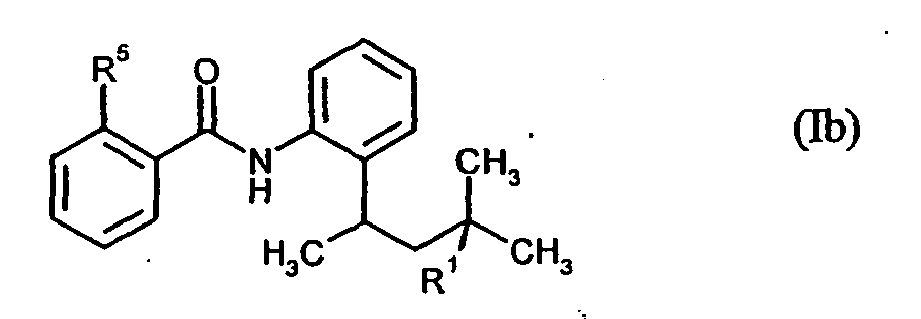
- Die Formel (I) umfasst insbesondere die folgenden bevorzugten Mischungspartner der Gruppe (1):
- (1-1) N-[2-(1,3-Dimethylbutyl)phenyl]-1,3-dimethyl-1Hpyrazol-4-carboxamid
- (1-2) N-[2-(1,3-Dimethylbutyl)phenyl]-5-fluor-1,3-dimethyl-1H-pyrazol-4-carboxamid (bekannt aus
WO 03/010149 - (1-3) N-[2-(1,3-Dimethylbutyl)phenyl]-5-chlor-1,3-dimethyl-1H-pyrazol-4-carboxamid (bekannt aus
JP-A 10-251240 - (1-4) 3-(Difluormethyl)-N-[2-(1,3-dimethylbutyl)phenyl]-1-methyl-1H-pyrazol-4-carboxamid
- (1-5) 3-(Trifluormethyl)-N-[2-(1,3-dimethylbutyl)phenyl]-5-fluor-1-methyl-1H-pyrazol-4-carboxamid (bekannt aus
DE-A 103 03 589 ) - (1-6) 3-(Trifluormethyl)-N-[2-(1,3-dimethylbutyl)phenyl]-5-chlor-1-methyl-1H-pyrazol-4-carboxamid (bekannt aus
JP-A 10-251240 - (1-7) 1,3-Dimethyl-N-[2-(1,3,3-trimethylbutyl)phenyl]-1H-pyrazol-4-carboxamid (bekannt aus
JP-A 10-251240 - (1-8) 5-Fluor-1,3-dimethyl-N-[2-(1,3,3-trimethylbutyl)phenyl]-1H-pyrazol-4-carboxamid (bekannt aus
WO 03/010149 - (1-9) 3-(Difluormethyl)-1-methyl-N-[2-(1,3,3-trimethylbutyl)phenyl]-1H-pyrazol-4-carboxamid
- (1-10) 3-(Trifluormethyl)-1-methyl-N-[2-(1,3,3-trimethylbutyl)phenyl]-1H-pyrazol-4-carboxamid
- (1-11) 3-(Trifluormethyl)-5-fluor-1-methyl-N-[2-(1,3,3-trimethylbutyl)phenyl]-1H-pyrazol-4-carboxamid (bekannt aus
DE-A 103 03 589 ) - (1-12) 3-(Trifluormethyl)-5-chlor-1-methyl-N-[2-(1,3,3-trimethylbutyl)phenyl]-1H-pyrazol-4-carboxamid (bekannt aus
JP-A 10-251240 - (1-13) N-[2-(1,3-Dimethylbutyl)phenyl]-2-iodbenzamid
(bekannt ausDE-A 102 29 595 ) - (1-14) 2-Iod-N-[2-(1,3,3-trimethylbutyl)phenyl]benzamid
(bekannt ausDE-A 102 29 595 ) - (1-15) N-[2-(1,3-Dimethylbutyl)phenyl]-2-(trifluormethyl)benzamid
(bekannt ausDE-A 102 29 595 ) - (1-16) 2-(Trifluormethyl)-N-[2-(1,3,3-trimethylbutyl)phenyl]benzamid
(bekannt ausDE-A 102 29 595 ) - Hervorgehoben sind erfindungsgemäße Wirkstoffkombinationen, die neben dem Carboxamid (1-8) 5-Fluor-1,3-dimethyl-N-[2-(1,3,3-trimethylbutyl)phenyl]-1H-pyrazol-4-carboxamid (Gruppe 1) einen oder mehrere, bevorzugt einen, Mischungspartner der Gruppen (2) und (3) enthalten.
- Hervorgehoben sind erfindungsgemäße Wirkstoffkombinationen, die neben dem Carboxamid (1-2) N-[2-(1,3-Dimethylbutyl)phenyl]-5-fluor-1,3-dimethyl-1H-pyrazol-4-carboxamid (Gruppe 1) einen oder mehrere, bevorzugt einen, Mischungspartner der Gruppen (2) und (3) enthalten.
- Hervorgehoben sind erfindungsgemäße Wirkstoffkombinationen, die neben dem Carboxamid (1-15) N-[2-(1,3-Dimethylbutyl)phenyl]-2-(trifluormethyl)benzamid (Gruppe 1) einen oder mehrere, bevorzugt einen, Mischungspartner der Gruppen (2) und (3) enthalten.
- Hervorgehoben sind erfindungsgemäße Wirkstoffkombinationen, die neben dem Carboxamid (1-13) N-[2-(1,3-Dimethylbutyl)phenyl]-2-iodbenzamid (Gruppe 1) einen oder mehrere, bevorzugt einen, Mischungspartner der Gruppen (2) und (3) enthalten.
- Im Folgenden werden bevorzugte Wirkstoffkombinationen beschrieben, die aus zwei Gruppen von Wirkstoffen bestehen und jeweils wenigstens ein Carboxamid der Formel (I) (Gruppe 1) und wenigstens einen Wirkstoff der angegebenen Gruppe (2) und (3) enthalten. Diese Kombinationen sind die Wirkstoffkombinationen A und B.
- Innerhalb der bevorzugten Wirkstoffkombinationen A und B sind solche hervorzuheben, die ein Carboxamid der Formel (I) (Gruppe 1)

Besonders bevorzugt sind Wirkstoffkombinationen A und B, enthaltend ein Carboxamid der Formel (I) (Gruppe 1)
- R1
- für Wasserstoff, Fluor, Chlor, Methyl, Ethyl oder Trifluormethyl steht,
- A
- für eine der folgenden Reste A1 oder A2:

- R2
- für Methyl steht,
- R3
- für Methyl, Difluormethyl oder Trifluormethyl steht,
- R4
- für Wasserstoff oder Fluor steht,
- R5
- für Iod oder Trifluormethyl steht.
- Ganz besonders bevorzugt sind Wirkstoffkombinationen A und B, worin das Carboxamid der Formel (I) (Gruppe 1) aus der folgenden Liste ausgewählt ist:
- (1-1) N-[2-(1,3-Dimethylbutyl)phenyl]-1,3-dimethyl-1H-pyrazol-4-carboxamid
- (1-2) N-[2-(1,3-Dimethylbutyl)phenyl]-5-fluor-1,3-dimethyl-1H-pyrazol-4-carboxamid
- (1-3) N-[2-(1,3-Dimethylbutyl)phenyl]-5-chlor-1,3-dimethyl-1H-pyrazol-4-carboxamid
- (1-4) 3-(Difluormethyl)-N-[2-(1,3-dimethylbutyl)phenyl]-1-methyl-1H-pyrazol-4-carboxamid
- (1-5) 3-(Trifluormethyl)-N-[2-(1,3-dimethylbutyl)phenyl]-5-fluor-1-methyl-1H-pyrazol-4-carboxamid
- (1-6) 3-(Trifluormethyl)-N-[2-(1,3-dimethylbutyl)phenyl]-5-chlor-1-methyl-1H-pyrazol-4-carboxamid
- (1-7) 1,3-Dimethyl-N-[2-(1,3,3-trimethylbutyl)phenyl]-1H-pyruol-4-carboxamid
- (1-8) 5-Fluor-1,3-dimethyl-N-[2-(1,3,3-trimethylbutyl)phenyl]-1H-pyrazol-4-carboxamid
- (1-9) 3-(Difluormethyl)-1-methyl-N-[2-(1,3,3-trimethylbutyl)phenyl]-1H-pyrazol-4-carboxamid
- (1-10) 3-(Trifluormethyl)-1-methyl-N-[2-(1,3,3-trimethylbutyl)phenyl]-1H-pyrazol-4-carboxamid
- (1-11) 3-(Trifluormethyl)-5-fluor-1-methyl-N-[2-(1,3,3-trimethylbutyl)phenyl]-1H-pyrazol-4-carboxamid
- (1-12) 3-(Trifluormethyl)-5-chlor-1-methyl-N-[2-(1,3,3-trimethylbutyl)phenyl]-1H-pyrazol-4-carboxamid
- (1-13) N-[2-(1,3-Dimethylbutyl)phenyl]-2-iodbenzamid
- (1-14) 2-Iod-N-[2-(1,3,3-trimethylbutyl)phenyl]benzamid
- (1-15) N-[2-(1,3-Dimethylbutyl)phenyl]-2-(trifluormethyl)benzamid
- (1-16) 2-(Trifluormethyl)-N-[2-(1,3,3-trimethylbutyl)phenyl]benzamid
- Insbesondere bevorzugt sind Wirkstoffkombinationen A und B, worin das Carboxamid der Formel (I) (Gruppe 1) aus der folgenden Liste ausgewählt ist:
- (1-2) N-[2-(1,3-Dimethylbutyl)phenyl]-5-fluor-1,3-dimethyl-1H-pyrazol-4-carboxamid
- (1-8) 5-Fluor-1,3-dimethyl-N-[2-(1,3,3-trimethylbutyl)phenyl]-1H-pyrazol-4-carboxamid
- (1-10) 3-(Trifluormethyl)-1-methyl-N-[2-(1,3,3-trimethylbutyl)phenyl]-1H-pyrazol-4-carboxamid
- (1-13) N-[2-(1,3-Dimethylbutyl)phenyl]-2-iodbenzamid
- (1-14) 2-Iod-N-[2-(1,3,3-trimethylbutyl)phenyl]benzamid
- (1-15) N-[2-(1,3-Dimethylbutyl)phenyl]-2-(trifluormethyl)benzamid
- (1-16) 2-(Trifluormethyl)-N-[2-(1,3,3-trimethylbutyl)phenyl]benzamid
- Die Wirkstoffkombinationen A enthalten neben einem Carboxamid der Formel (I) (Gruppe 1) auch
(2) Tolclofos-methyl der Formel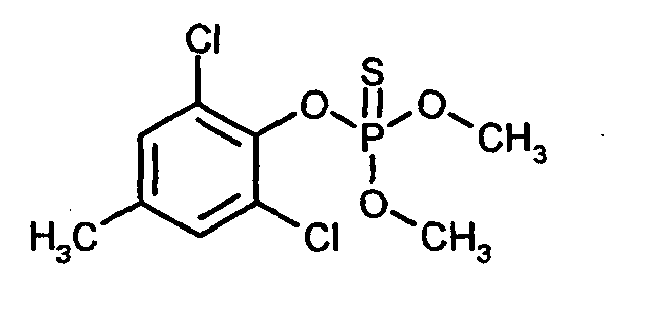
- Hervorgehoben sind die in der folgenden Tabelle 1 angeführten Wirkstoffkombinationen A:
Tabelle 1: Wirkstoffkombinationen A Nr. Carboxamid der Formel (I) Mischungspartner A-1 (1-2) N-[2-(1,3-Dimethylbutyl)phenyl]-5-fluor-1,3-dimethyl-1H-pyrazol-4-carboxamid (2) Tolclofos-methyl A-2 (1-8) 5-Fluor-1,3-dimethyl-N-[2-(1,3,3-trimethylbutyl)phenyl]-1H-pyrazol-4-carboxamid (2) Tolclofos-methyl A-3 (1-10) 3-(Trifluormethyl)-1-methyl-N-[2-(1,3,3-trimethylbutyl)phenyl]-1H-pyrazol-4-carboxamid (2) Tolclofos-methyl A-4 (1-13) N-[2-(1,3-Dimethylbutyl)phenyl]-2-iodbenzamid (2) Tolclofes-methyl A-5 (1-14) 2-Iod-N-[2-(1,3,3-trimethylbutyl)phenyl]benzamid (2) Tolclofos-methyl A-6 (1-15) N-[2-(1,3-Dimethylbutyl)phenyl]-2-(trifluormethyl)benzamid (2) Tolclofos-methyl A-7 (1-16) 2-(Trifluormethyl)-N-[2-(1,3,3-trimethylbutyl)phenyl]benzamid (2) Tolclofos-methyl - Die Wirkstoffkombinationen B enthalten neben einem Carboxamid der Formel (I) (Gruppe 1) auch
(3) Flutolanil der Formel
- Hervorgehoben sind die in der folgenden Tabelle 2 angeführten Wirkstoffkombinationen B:
Tabelle 2: Wirkstoffkombinationen B Nr. Carboxamid der Formel (I) Mischungspartner B-1 (1-2) N-[2-(1,3-Dimethylbutyl)phenyl]-5-fluor-1,3-dimethyl-1H-pyrazol-4-carboxamid (3) Flutolanil B-2 (1-8) 5-Fluor-1,3-dimethyl-N-[2-(1,3,3-trimethylbutyl)phenyl]-1H-pyrazol-4-carboxamid (3) Flutolanil B-3 (1-10) 3-(Trifluormethyl)-1-methyl-N-[2-(1,3,3-trimethylbutyl)phenyl]- 1H-pyrazol-4-carboxamid (3) Flutolanil B-4 (1-13) N-[2-(1,3-Dimethylbutyl)phenyl]-2-iodbenzamid (3) Flutolanil B-5 (1-14) 2-Iod-N-[2-(1,3,3-trimethylbutyl)phenyl]benzamid (3) Flutolanil B-6 (1-15) N-[2-(1,3-Dimethylbutyl)phenyl]-2-(trifluormethyl)benzamid (3) Flutolanil B-7 (1-16) 2-(Trifluormethyl)-N-[2-(1,3,3-trimethylbutyl)phenyl]benzamid (3) Flutolanil - Die erfindungsgemäßen Wirkstoffkombinationen enthalten neben einem Wirkstoff der Formel (I) mindestens einen Wirkstoff von den Verbindungen der Gruppen (2) und (3). Sie können darüber hinaus auch weitere fungizid wirksame Zumischkomponenten enthalten.
- Wenn die Wirkstoffe in den erfindungsgemäßen Wirkstoffkombinationen in bestimmten Gewichtsverhältnissen vorhanden sind, zeigt sich der synergistische Effekt besonders deutlich. Jedoch können die Gewichtsverhältnisse der Wirkstoffe in den Wirkstoffkombinationen in einem relativ großen Bereich variiert werden. Im Allgemeinen enthalten die erfindungsgemäßen Kombinationen Wirkstoffe der Formel (I) und einen Mischpartner aus einer der Gruppen (2) und (3) in den in der nachfolgenden Tabelle 3 beispielhaft angegebenen Mischungsverhältnisse.
- Die Mischungsverhältnisse basieren auf Gewichtsverhältnissen. Das Verhältnis ist zu verstehen als Wirkstoff der Formel (I) : Mischpartner.
Tabelle 3: Mischungsverhältnisse Mischpartner bevorzugtes Mischungsverhältnis besonders bevorzugtes Mischungsverhältnis (2) Tolclofos-methyl 50 : 1 bis 1 : 50 10: 1 bis 1 : 20 (3) Flutolanil 50 : 1 bis 1 : 50 20 : 1 bis 1 : 20 - Das Mischungsverhältnis ist in jedem Fall so zu wählen, dass eine synergistische Mischung erhalten wird. Die Mischungsverhältnisse zwischen der Verbindung der Formel (I) und einer Verbindung aus einer der Gruppen (2) und (3) kann auch zwischen den einzelnen Verbindungen einer Gruppe variieren.
- Die erfindungsgemäßen Wirkstoffkombinationen weisen eine starke mikrobizide Wirkung auf und können zur Bekämpfung von unerwünschten Mikroorganismen, wie Fungi und Bakterien, im Pflanzenschutz und im Materialschutz eingesetzt werden.
- Fungizide lassen sich Pflanzenschutz zur Bekämpfung von Plasmodiophoromycetes, Oomycetes, Chytridiomycetes, Zygomycetes, Ascomycetes, Basidiomycetes und Deuteromycetes einsetzen.
- Bakterizide lassen sich im Pflanzenschutz zur Bekämpfung von Pseudomonadaceae, Rhizobiaceae, Enterobacteriaceae, Corynebacteriaceae und Streptomycetaceae einsetzen.
- Beispielhaft aber nicht begrenzend seien einige Erreger von pilzlichen und bakteriellen Erkrankungen, die unter die oben aufgezählten Oberbegriffe fallen, genannt:
- Erkrankungen, hervorgerufen durch Erreger des Echten Mehltaus wie z.B.
Blumeria-Arten, wie beispielsweise Blumeria graminis;
Podosphaera-Arten, wie beispielsweise Podosphaera leucotricha;
Sphaerotheca-Arten, wie beispielsweise Sphaerotheca fuliginea;
Uncinula-Arten, wie beispielsweise Uncinula necator; - Erkrankungen, hervorgerufen durch Erreger von Rostkrankheiten wie z.B.
Gymnosporangium-Arten, wie beispielsweise Gymnosporangium sabinae
Hemileia-Arten, wie beispielsweise Hemileia vastatrix;
Phakopsora-Arten, wie beispielsweise Phakopsora pachyrhizi und Phakopsora meibomiae;
Puccinia-Arten, wie beispielsweise Puccinia recondita;
Uromyces-Arten, wie beispielsweise Uromyces appendiculatus; - Erkrankungen, hervorgerufen durch Erreger der Gruppe der Oomyceten wie z.B.
Bremia-Arten, wie beispielsweise Bremia lactucae;
Peronospora-Arten, wie beispielsweise Peronospora pisi oder P. brassicae;
Phytophthora-Arten, wie beispielsweise Phytophthora infestans;
Plasmopara-Arten, wie beispielsweise Plasmopara viticola;
Pseudoperonospora-Arten, wie beispielsweise Pseudoperonospora humuli oder
Pseudoperonospora cubensis;
Pythium-Arten, wie beispielsweise Pythium ultimum; - Blattfleckenkrankheiten und Blattwelken, hervorgerufen durch z.B.
Alternaria-Arten, wie beispielsweise Alternaria solani;
Cercospora-Arten, wie beispielsweise Cercospora beticola;
Cladosporium-Arten, wie beispielsweise Cladosporium cucumerinum;
Cochliobolus-Arten, wie beispielsweise Cochliobolus sativus
(Konidienform: Drechslera, Syn: Helminthosporium);
Colletotrichum-Arten, wie beispielsweise Colletotrichum lindemuthanium;
Cycloconium-Arten, wie beispielsweise Cycloconium oleaginum;
Diaporthe-Arten, wie beispielsweise Diaporthe citri;
Elsinoe-Arten, wie beispielsweise Elsinoe fawcettii;
Gloeosporium-Arten, wie beispielsweise Gloeosporium laeticolor;
Glomerella-Arten, wie beispielsweise Glomerella cingulata;
Guignardia-Arten, wie beispielsweise Guignardia bidwelli;
Leptosphaeria-Arten, wie beispielsweise Leptosphaeria maculans;
Magnaporthe-Arten, wie beispielsweise Magnaporthe grisea;
Mycosphaerella-Arten, wie beispielsweise Mycosphaerelle graminicola;
Phaeosphaeria-Arten, wie beispielsweise Phaeosphaeria nodorum;
Pyrenophora-Arten, wie beispielsweise Pyrenophora teres;
Ramularia-Arten, wie beispielsweise Ramularia collo-cygni;
Rhynchosporium-Arten, wie beispielsweise Rhynchosporium secalis;
Septoria-Arten, wie beispielsweise Septoria apii;
Typhula-Arten, wie beispielsweise Typhula incarnata;
Venturia-Arten, wie beispielsweise Venturia inaequalis; - Wurzel- und Stengelkrankheiten, hervorgerufen durch z.B.
Corticium-Arten, wie beispielsweise Corticium graminearum;
Fusarium-Arten, wie beispielsweise Fusarium oxysporum;
Gaeumannomyces-Arten, wie beispielsweise Gaeumannomyces graminis;
Rhizoctonia-Arten, wie beispielsweise Rhizoctonia solani;
Tapesia-Arten, wie beispielsweise Tapesia acuformis;
Thielaviopsis-Arten, wie beispielsweise Thielaviopsis basicola; - Ähren- und Rispenerkrankungen (inklusive Maiskolben), hervorgerufen durch z.B.
Alternaria-Arten, wie beispielsweise Alternaria spp.;
Aspergillus-Arten, wie beispielsweise Aspergillus flavus;
Cladosporium-Arten, wie beispielsweise Cladosporium spp. wie Cladosporium cladosporioides;
Claviceps-Arten, wie beispielsweise Claviceps purpurea;
Fusarium-Arten, wie beispielsweise Fusarium culmorum;
Gibberella-Arten, wie beispielsweise Gibberella zeae;
Monographella-Arten, wie beispielsweise Monographella nivalis; - Erkrankungen, hervorgerufen durch Brandpilze wie z.B.
Sphacelotheca-Arten, wie beispielsweise Sphacelotheca reiliana;
Tilletia-Arten, wie beispielsweise Tilletia caries;
Urocystis-Arten, wie beispielsweise Urocystis occulta;
Ustilago-Arten, wie beispielsweise Ustilago nuda; - Fruchtfäule hervorgerufen durch z.B.
Aspergillus-Arten, wie beispielsweise Aspergillus flavus;
Botrytis-Arten, wie beispielsweise Botrytis cinerea;
Penicillium-Arten, wie beispielsweise Penicillium expansum und Penicillium purpurogenum;
Sclerotinia-Arten, wie beispielsweise Sclerotinia sclerotiorum;
Verticilium-Arten, wie beispielsweise Verticilium alboatrum; - Samen- und bodenbürtige Fäulen und Welken, sowie Sämlingserkrankungen, hervorgerufen durch z.B.
Fusarium-Arten, wie beispielsweise Fusarium culmorum;
Phytophthora Arten, wie beispielsweise Phytophthora cactorum;
Pythium-Arten, wie beispielsweise Pythium ultimum;
Rhizoctonia-Arten, wie beispielsweise Rhizoctonia solani;
Sclerotium-Arten, wie beispielsweise Sclerotium rolfsii; - Krebserkrankungen, Gallen und Hexenbesen, hervorgerufen durch z.B.
Nectria-Arten, wie beispielsweise Nectria galligena; - Welkeerkrankungen hervorgerufen durch z.B.
Monilinia-Arten, wie beispielsweise Monilinia laxa; - Deformationen von Blättern, Blüten und Früchten, hervorgerufen durch z.B.
Taphrina-Arten, wie beispielsweise Taphrina deformans;
Degenerationserkranhungen holziger pflanzen, hervorgerufen durch z.B.
Esca-Arten, wie beispielsweise Phaemoniella clamydospora; - Blüten- und Samenerkrankungen, hervorgerufen durch z.B.
Botrytis-Arten, wie beispielsweise Botrytis cinerea; - Erkrankungen von Pflanzenknollen, hervorgerufen durch z.B.
Rhizoctonia-Arten, wie beispielsweise Rhizoctonia solani;
Helminthosporium-Arten, wie beispielsweise Helminthosporium solani; - Erkrankungen, hervorgerufen durch bakterielle Erreger wie z.B.
Xanthomonas-Arten, wie beispielsweise Xanthomonas campestris pv. oryzae;
Pseudomonas-Arten, wie beispielsweise Pseudomonas syringae pv. lachrymans;
Erwinia-Arten, wie beispielsweise Erwinia amylovora. - Bevorzugt können die folgenden Krankheiten von Soja-Bohnen bekämpft werden:
- Pilzkrankheiten an Blättern, Stängeln, Schoten und Samen verursacht durch z.B.
Alternaria leaf spot (Alternaria spec. atrans tenuissima), Anthracnose (Colletotrichum gloeosporoides dematium var. truncatum), Brown spot (Septoria glycines), Cercospora leaf spot and blight (Cercospora kikuchii), Choanephora leaf blight (Choanephora infundibulifera trispora (Syn.)), Dactuliophora leaf spot (Dactuliophora glycines), Downy Mildew (Peronospora manshurica), Drechslera blight (Drechslera glycini), Frogeye Leaf spot (Cercospora sojina), Leptosphaerulina Leaf Spot (Leptosphaerulina trifolii), Phyllostica Leaf Spot (Phyllosticta sojaecola), Pod and Stem Blight (Phomopsis sojae), Powdery Mildew (Microsphaera diffusa), Pyrenochaeta Leaf Spot (Pyrenochaeta glycines), Rhizoctonia Aerial, Foliage, and Web Blight (Rhizoctonia solani), Rust (Phakopsora pachyrhizi), Scab (Sphaceloma glycines), Stemphylium Leaf Blight (Stemphylium botryosum), Target Spot (Corynespora cassücola) - Pilzkrankheiten an Wurzeln und der Stängelbasis verursacht durch z.B.
Black Root Rot (Calonectria crotalariae), Charcoal Rot (Macrophomina phaseolina), Fusarium Blight or Wilt, Root Rot, and Pod and Collar Rot (Fusarium oxysporum, Fusarium orthoceras, Fusarium semitectum, Fusarium equiseti), Mycoleptodiscus Root Rot (Mycoleptodiscus terrestris), Neocosmospora (Neocosmopspora vasinfecta), Pod and Stem Blight (Diaporthe phaseolorum), Stem Canker (Diaporthe phaseolorum var. caulivora), Phytophthora Rot (Phytophthora megasperma), Brown Stem Rot (Phialophora gregata), Pythium Rot (Pythium aphanidermatum, Pythium irregulare, Pythium debaryanum, Pythium myriotylum, Pythium ultimum), Rhizoctonia Root Rot, Stem Decay, and Damping-Off (Rhizoctonia solani), Sclerotinia Stem Decay (Sclerotinia sclerotiorum), Sclerotinia Southern Blight (Sclerotinia rolfsii), Thielaviopsis Root Rot (Thielaviopsis basicola). - Die gute Pflanzenverträglichkeit der Wirkstoffkombinationen in den zur Bekämpfung von Pflanzenkrankheiten notwendigen Konzentrationen erlaubt eine Behandlung von ganzen Pflanzen (oberirdische Pflanzenteile und Wurzeln), von Pflanz- und Saatgut, und des Bodens. Die erfindungsgemäßen Wirkstoffkombinationen können zur Blattapplikation oder auch als Beizmittel eingesetzt werden.
- Die gute Pflanzenverträglichkeit der verwendbaren Wirkstoffe in den zur Bekämpfung von Pflanzenkrankheiten notwendigen Konzentrationen erlaubt eine Behandlung des Saatguts. Die erfindungsgemäßen Wirkstoffe können somit als Beizmittel eingesetzt werden.
- Ein großer Teil des durch phytopathogene Pilze verursachten Schadens an Kulturpflanzen entsteht bereits durch den Befall des Saatguts während der Lagerung und nach dem Einbringen des Saatguts in den Boden sowie während und unmittelbar nach der Keimung der Pflanzen. Diese Phase ist besonders kritisch, da die Wurzeln und Sprosse der wachsenden Pflanze besonders empfindlich sind und bereits ein geringer Schaden zum Absterben der ganzen Pflanze führen kann. Es besteht daher ein insbesondere großes Interesse daran, das Saatgut und die keimende Pflanze durch den Einsatz geeigneter Mittel zu schützen.
- Die Bekämpfung von phytopathogenen Pilzen, die Pflanzen nach dem Auflaufen schädigen, erfolgt in erster Linie durch die Behandlung des Bodens und der oberirdischen Pflanzenteile mit Pflanzenschutzmitteln. Aufgrund der Bedenken hinsichtlich eines möglichen Einflusses der Pflanzenschutzmittel auf die Umwelt und die Gesundheit von Menschen und Tieren gibt es Anstrengungen, die Menge der ausgebrachten Wirkstoffe zu vermindern.
- Die Bekämpfung von phytopathogenen Pilzen durch die Behandlung des Saatguts von Pflanzen ist seit langem bekannt und ist Gegenstand ständiger Verbesserungen. Dennoch ergeben sich bei der Behandlung von Saatgut eine Reihe von Problemen, die nicht immer zufrieden stellend gelöst werden können. So ist es erstrebenswert, Verfahren zum Schutz des Saatguts und der keimenden Pflanze zu entwickeln, die das zusätzliche Ausbringen von Pflanzenschutzmitteln nach der Saat oder nach dem Auflaufen der Pflanzen überflüssig machen oder zumindest deutlich verringern. Es ist weiterhin erstrebenswert, die Menge des eingesetzten Wirkstoffs dahingehend zu optimieren, dass das Saatgut und die keimende Pflanze vor dem Befall durch phytopathogene Pilze bestmöglich geschützt wird, ohne jedoch die Pflanze selbst durch den eingesetzten Wirkstoff zu schädigen. Insbesondere sollten Verfahren zur Behandlung von Saatgut auch die intrinsischen fungiziden Eigenschaften transgener Pflanzen einbeziehen, um einen optimalen Schutz des Saatguts und der keimenden Pflanze bei einem minimalen Aufwand an Pflanzenschutzmitteln zu erreichen.
- Die vorliegende Erfindung bezieht sich daher insbesondere auch auf ein Verfahren zum Schutz von Saatgut und keimenden Pflanzen vor dem Befall von phytopathogenen Pilzen, indem das Saatgut mit einem erfindungsgemäßen Mittel behandelt wird.
- Die Erfindung bezieht sich ebenfalls auf die Verwendung der erfindungsgemäßen Mittel zur Behandlung von Saatgut zum Schutz des Saatguts und der keimenden Pflanze vor phytopathogenen Pilzen.
- Weiterhin bezieht sich die Erfindung auf Saatgut, welches zum Schutz vor phytopathogenen Pilzen mit einem erfindungsgemäßen Mittel behandelt wurde.
- Einer der Vorteile der vorliegenden Erfindung ist es, dass aufgrund der besonderen systemischen Eigenschaften der erfindungsgemäßen Mittel die Behandlung des Saatguts mit diesen Mitteln nicht nur das Saatgut selbst, sondern auch die daraus hervorgehenden Pflanzen nach dem Auflaufen vor phytopathogenen Pilzen schützt. Auf diese Weise kann die unmittelbare Behandlung der Kultur zum Zeitpunkt der Aussaat oder kurz danach entfallen.
- Ebenso ist es als vorteilhaft anzusehen, dass die erfindungsgemäßen Mischungen insbesondere auch bei transgenem Saatgut eingesetzt werden können.
- Die erfindungsgemäßen Mittel eignen sich zum Schutz von Saatgut jeglicher Pflanzensorte, die in der Landwirtschaft, im Gewächshaus, in Forsten oder im Gartenbau eingesetzt wird. Insbesondere handelt es sich dabei um Saatgut von Getreide (wie Weizen, Gerste, Roggen, Hirse und Hafer), Mais, Baumwolle, Soja, Reis, Kartoffeln, Sonnenblume, Bohne, Kaffee, Rübe (z.B. Zuckerrübe und Futterrübe), Erdnuss, Gemüse (wie Tomate, Gurke, Zwiebeln und Salat), Rasen und Zierpflanzen. Besondere Bedeutung kommt der Behandlung des Saatguts von Getreide (wie Weizen, Gerste, Roggen und Hafer), Mais und Reis zu.
- Im Rahmen der vorliegenden Erfindung wird das erfindungsgemäßes Mittel alleine oder in einer geeigneten Formulierung auf das Saatgut aufgebracht Vorzugsweise wird das Saatgut in einem Zustand behandelt, in dem so stabil ist, dass keine Schäden bei der Behandlung auftreten. Im Allgemeinen kann die Behandlung des Saatguts zu jedem Zeitpunkt zwischen der Ernte und der Aussaat erfolgen. Üblicherweise wird Saatgut verwendet, das von der Pflanze getrennt und von Kolben, Schalen, Stängeln, Hülle, Wolle oder Fruchtfleisch befreit wurde. So kann zum Beispiel Saatgut verwendet werden, das geerntet, gereinigt und bis zu einem Feuchtigkeitsgehalt von unter 15 Gew.-% getrocknet wurde. Alternativ kann auch Saatgut verwendet werden, das nach dem Trocknen z.B. mit Wasser behandelt und dann erneut getrocknet wurde.
- Im Allgemeinen muss bei der Behandlung des Saatguts darauf geachtet werden, dass die Menge des auf das Saatgut aufgebrachten erfindungsgemäßen Mittels und/oder weiterer Zusatzstoffe so gewählt wird, dass die Keimung des Saatguts nicht beeinträchtigt bzw. die daraus hervorgehende Pflanze nicht geschädigt wird. Dies ist vor allem bei Wirkstoffen zu beachten, die in bestimmten Aufwandmengen phytotoxische Effekte zeigen können.
- Die erfindungsgemäßen Mittel können unmittelbar aufgebracht werden, also ohne weitere Komponenten zu enthalten und ohne verdünnt worden zu sein. In der Regel ist es vorzuziehen, die Mittel in Form einer geeigneten Formulierung auf das Saatgut aufzubringen. Geeignete Formulierungen und Verfahren für die Saatgutbehandlung sind dem Fachmann bekannt und werden z.B. in den folgenden Dokumenten beschrieben:
US 4,272,417 A ,US 4,245,432 A ,US 4,808,430 A ,US 5,876,739 A ,US 2003/0176428 A1 ,WO 2002/080675 A1 ,WO 2002/028186 A2 . - Die erfindungsgemäßen Wirkstoffkombinationen eignen sich auch zur Steigerung des Ernteertrages. Sie sind außerdem mindertoxisch und weisen eine gute Pflanzenverträglichkeit auf.
- Erfindungsgemäß können alle Pflanzen und Pflanzenteile behandelt werden. Unter Pflanzen werden hierbei alle Pflanzen und Pflanzenpopulationen verstanden, wie erwünschte und unerwünschte Wildpflanzen oder Kulturpflanzen (einschließlich natürlich vorkommender Kulturpflanzen). Kulturpflanzen können Pflanzen sein, die durch konventionelle Züchtungs- und Optimierungsmethoden oder durch biotechnologische und gentechnologische Methoden oder Kombinationen dieser Methoden erhalten werden können, einschließlich der transgenen Pflanzen und einschließlich der durch Sortenschutzrechte schützbaren oder nicht schützbaren Pflanzensorten. Unter Pflanzenteilen sollen alle oberirdischen und unterirdischen Teile und Organe der Pflanzen, wie Spross, Blatt, Blüte und Wurzel verstanden werden, wobei beispielhaft Blätter, Nadeln, Stängel, Stämme, Blüten, Fruchtkörper, Früchte und Samen sowie Wurzeln, Knollen und Rhizome aufgeführt werden. Zu den Pflanzenteilen gehört auch Erntegut sowie vegetatives und generatives Vermehrungsmaterial, beispielsweise Stecklinge, Knollen, Rhizome, Ableger und Samen.
- Die erfindungsgemäße Behandlung der Pflanzen und Pflanzenteile mit den Wirkstoffen erfolgt direkt oder durch Einwirkung auf deren Umgebung, Lebensraum oder Lagerraum nach den üblichen Behandlungsmethoden, z.B. durch Tauchen, Sprühen, Verdampfen, Vernebeln, Streuen, Aufstreichen und bei Vermehrungsmaterial, insbesondere bei Samen, weiterhin durch ein- oder mehrschichtiges Umhüllen.
- Wie bereits oben erwähnt, können erfindungsgemäß alle Pflanzen und deren Teile behandelt werden. In einer bevorzugten Ausführungsform werden wild vorkommende oder durch konventionelle biologische Zuchtmethoden, wie Kreuzung oder Protoplastenfusion erhaltenen Pflanzenarten und Pflanzensorten sowie deren Teile behandelt. In einer weiteren bevorzugten Ausführungsform werden transgene Pflanzen und Pflanzensorten, die durch gentechnologische Methoden gegebenenfalls in Kombination mit konventionellen Methoden erhalten wurden (Genetically Modified Organisms) und deren Teile behandelt Der Begriff "Teile" bzw. "Teile von Pflanzen" oder "Pflanzenteile" wurde oben erläutert.
- Besonders bevorzugt werden erfindungsgemäß Pflanzen der jeweils handelsüblichen oder in Gebrauch befindlichen Pflanzensorten behandelt.
- Je nach Pflanzenarten bzw. Pflanzensorten, deren Standort und Wachstumsbedingungen (Böden, Klima, Vegetationsperiode, Ernährung) können durch die erfindungsgemäße Behandlung auch überadditive ("synergistische") Effekte auftreten. So sind beispielsweise erniedrigte Aufwandmengen und/oder Erweiterungen des Wirkungsspektrums und/oder eine Verstärkung der Wirkung der erfindungsgemäß verwendbaren Stoffe und Mittel, besseres Pflanzenwachstum, weiter entwickeltes Wurzelsystem, höhere Beständigkeit der Pflanzenart bzw. Pflanzensorte, gesteigertes Wachstum der Schösslinge, höhere Pflanzenvitalität, erhöhte Toleranz gegenüber hohen oder niedrigen Temperaturen, erhöhte Toleranz gegen Trockenheit oder gegen Wasser- bzw. Bodensalzgehalt, erhöhte Blühleistung, erleichterte Ernte, Beschleunigung der Reife, höhere Ernteerträge, größere Früchte, höhere Pflanzengröße, grünere Blattfarbe, frühere Blüte, höhere Qualität und/oder höherer Ernährungswert der Ernteprodukte, höhere Zuckerkonzentration in den Früchten, höhere Lagerfähigkeit und/oder Bearbeitbarkeit der Ernteprodukte möglich, die über die eigentlich zu erwartenden Effekte hinausgehen.
- Zu den bevorzugten erfindungsgemäß zu behandelnden transgenen (gentechnologisch erhaltenen) Pflanzen bzw. Pflanzensorten gehören alle Pflanzen, die durch die gentechnologische Modifikation genetisches Material erhielten, welches diesen Pflanzen besondere vorteilhafte wertvolle Eigenschaften ("Traits") verleiht. Beispiele für solche Eigenschaften sind besseres Pflanzenwachstum, erhöhte (Toleranz gegenüber hohen oder niedrigen Temperaturen, erhöhte Toleranz gegen Trockenheit oder gegen Wasser- bzw. Bodensalzgehalt, erhöhte Blühleistung, erleichterte Ernte, Beschleunigung der Reife, höhere Ernteerträge, höhere Qualität und/oder höherer Ernährungswert der Ernteprodukte, höhere Lagerfähigkeit und/oder Bearbeitbarkeit der Ernteprodukte. Weitere und besonders hervorgehobene Beispiele für solche Eigenschaften sind eine erhöhte Abwehr der Pflanzen gegen tierische und mikrobielle Schädlinge, wie gegenüber Insekten, Milben, pflanzenpathogenen Pilzen, Bakterien und/oder Viren sowie eine erhöhte Toleranz der Pflanzen gegen bestimmte herbizide Wirkstoffe. Als Beispiele transgener Pflanzen werden die wichtigen Kulturpflanzen, wie Getreide (Weizen, Reis), Mais, Soja, Kartoffel, Baumwolle, Raps sowie Obstpflanzen (mit den Früchten Äpfel, Birnen, Zitrusfrüchten und Weintrauben) erwähnt, wobei Mais, Soja, Kartoffel, Baumwolle und Raps besonders hervorgehoben werden. Als Eigenschaften ("Traits") werden besonders hervorgehoben die erhöhte Abwehr der Pflanzen gegen Insekten durch in den Pflanzen entstehende Toxine, insbesondere solche, die durch das genetische Material aus Bacillus thuringiensis (z.B. durch die Gene CryIA(a), CryIA(b), CryIA(c), CryIIA, CryIIIA, CryIIIB2, Cry9c Cry2Ab, Cry3Bb und CryIF sowie deren Kombinationen) in den Pflanzen erzeugt werden (im folgenden "Bt Pflanzed"). Als Eigenschaften ("Traits") werden weiterhin besonders hervorgehoben die erhöhte Toleranz der Pflanzen gegenüber bestimmten herbiziden Wirkstoffen, beispielsweise Imidazolinonen, Sulfonylharnstoffen, Glyphosate oder Phosphinotricin (z.B. "PAT"-Gen). Die jeweils die gewünschten Eigenschaften ("Traits") verleihenden Gene können auch in Kombinationen miteinander in den transgenen Pflanzen vorkommen. Als Beispiele für "Bt Pflanzen" seien Maissorten, Baumwollsorten, Sojasorten und Kartoffelsorten genannt, die unter den Handelsbezeichnungen YIELD GARD® (z.B. Mais, Baumwolle, Soja), KnockOut® (z.B. Mais), StarLink® (z.B. Mais), Bollgard® (Baumwolle), Nucotn® (Baumwolle) und NewLeaf® (Kartoffel) vertrieben werden. Als Beispiele für Herbizid tolerante Pflanzen seien Maissorten, Baumwollsorten und Sojasorten genannt, die unter den Handelsbezeichnungen Roundup Ready® (Toleranz gegen Glyphosate z.B. Mais, Baumwolle, Soja), Liberty Link® (Toleranz gegen Phosphinotricin, z.B. Raps), IMI® (Toleranz gegen Imidazolinone) und STS® (Toleranz gegen Sulfonylharnstoffe z.B. Mais) vertrieben werden. Als Herbizid resistente (konventionell auf Herbizid-Toleranz gezüchtete) Pflanzen seien auch die unter der Bezeichnung Clearfield® vertriebenen Sorten (z.B. Mais) erwähnt. Selbstverständlich gelten diese Aussagen auch für in der Zukunft entwickelte bzw. zukünftig auf den Markt kommende Pflanzensorten mit diesen oder zukünftig entwickelten genetischen Eigenschaften ("Traits").
- Die erfindungsgemäßen Wirkstoffkombinationen können in Abhängigkeit von ihren jeweiligen physikalischen und/oder chemischen Eigenschaften in die üblichen Formulierungen überführt werden, wie Lösungen, Emulsionen, Suspensionen, Pulver, Stäubemittel, Schäume, Pasten, lösliche Pulver, Granulate, Aerosole, Suspensions-Emulsions-Konzentrate, Wirkstoff-imprägnierte Natur- und synthetische Stoffe sowie Feinstverkapselungen in polymeren Stoffen und in Hüllmassen für Saatgut, sowie ULV-Kalt- und Warmnebel-Formulierungen.
- Diese Formulierungen werden in bekannter Weise hergestellt, z.B. durch Vermischen der Wirkstoffe bzw. der Wirkstoffkombinationen mit Streckmitteln, also flüssigen Lösungsmitteln, unter Druck stehenden verflüssigten Gasen und/oder festen Trägerstoffen, gegebenenfalls unter Verwendung von oberflächenaktiven Mitteln, also Emulgiermitteln und/oder Dispergiermitteln und/oder schaumerzeugenden Mitteln.
- Im Falle der Benutzung von Wasser als Streckmittel können z.B. auch organische Lösungsmittel als Hilfslösungsmittel verwendet werden. Als flüssige Lösungsmittel kommen im Wesentlichen infrage: Aromaten, wie Xylol, Toluol oder Alkylnaphthaline, chlorierte Aromaten oder chlorierte aliphatische Kohlenwasserstoffe, wie Chlorbenzole, Chlorethylene oder Methylenchlorid, aliphatische Kohlenwasserstoffe, wie Cyclohexan oder Paraffine, z.B. Erdölfraktionen, mineralische und pflanzliche Öle, Alkohole, wie Butanol oder Glycol sowie deren Ether und Ester, Ketone, wie Aceton, Methylethylketon, Methylisobutylketon oder Cyclohexanon, stark polare Lösungsmittel wie Dimethylformamid und Dimethylsulfoxid, sowie Wasser.
- Mit verflüssigten gasförmigen Streckmitteln oder Trägerstoffen sind solche Flüssigkeiten gemeint, welche bei normaler Temperatur und unter Normaldruck gasförmig sind, z.B. Aerosol-Treibgase, wie Butan, Propan, Stickstoff und Kohlendioxid.
- Als feste Trägerstoffe kommen infrage: z.B. Ammoniumsalze und natürliche Gesteinsmehle, wie Kaoline, Tonerden, Talkum, Kreide, Quarz, Attapulgit, Montmorillonit oder Diatomeenerde und synthetische Gesteinsmehle, wie hochdisperse Kieselsäure, Aluminiumoxid und Silikate. Als feste Trägerstoffe für Granulate kommen infrage: z.B. gebrochene und fraktionierte natürliche Gesteine wie Calcit, Marmor, Bims, Sepiolith, Dolomit sowie synthetische Granulate aus anorganischen und organischen Mehlen sowie Granulate aus organischem Material wie Sägemehl, Kokosnussschalen, Maiskolben und Tabakstängel. Als Emulgier- und/oder schaumerzeugende Mittel kommen infrage: z.B. nichtionogene und anionische Emulgatoren, wie Polyoxyethylen-Fettsäureester, Polyoxyethylen-Fettalkoholether, z.B. Alkylarylpolyglycolether, Alkylsulfonate, Alkylsulfate, Arylsulfonate sowie Eiweißhydrolysate. Als Dispergiermittel kommen infrage: z.B. Lignin-Sulfitablaugen und Methylcellulose.
- Es können in den Formulierungen Haftmittel wie Carboxymethylcellulose, natürliche und synthetische pulverige, körnige oder latexförmige Polymere verwendet werden, wie Gummiarabicum, Polyvinylalkohol, Polyvinylacetat, sowie natürliche Phospholipide, wie Kephaline und Lecithine, und synthetische Phospholipide. Weitere Additive können mineralische und vegetabile Öle sein.
- Es können Farbstoffe wie anorganische Pigmente, z.B. Eisenoxid, Titanoxid, Ferrocyanblau und organische Farbstoffe, wie Alizarin-, Azo- und Metallphthalocyaninfarbstoffe und Spurennährstoffe, wie Salze von Eisen, Mangan, Bor, Kupfer, Kobalt, Molybdän und Zink verwendet werden.
- Der Wirkstoffgehalt der aus den handelsüblichen Formulierungen bereiteten Anwendungsformen kann in weiten Bereichen variieren. Die Wirkstoffkonzentration der Anwendungsformen zum Bekämpfen tierischer Schädlingen wie Insekten und Akariden kann von 0,0000001 bis zu 95 Gew.-% Wirkstoff, vorzugsweise zwischen 0,0001 und 1 Gew.-% liegen. Die Anwendung geschieht in einer den Anwendungsformen angepassten üblichen Weise.
- Die Formulierungen zur Bekämpfung unerwünschter phytopathogener Pilze enthalten im Allgemeinen zwischen 0,1 und 95 Gew.-% Wirkstoffe, vorzugsweise zwischen 0,5 und 90 %.
- Die erfindungsgemäßen Wirkstoffkombinationen können als solche, in Form ihrer Formulierungen oder den daraus bereiteten Anwendungsformen, wie gebrauchsfertige Lösungen, emulgierbare Konzentrate, Emulsionen, Suspensionen, Spritzpulver, lösliche Pulver, Stäubemittel und Granulate, angewendet werden. Die Anwendung geschieht in üblicher Weise, z.B. durch Gießen (drenchen), Tröpfchenbewässerung, Verspritzen, Versprühen, Verstreuen, Verstäuben, Verschäumen, Bestreiche, Verstreichen, Trockenbeizen, Feuchtbeizen, Nassbeizen, Schlämmbeizen, Inkrustieren usw.
- Die erfindungsgemäßen Wirkstoffkombinationen können in handelsüblichen Formulierungen sowie in den aus diesen Formulierungen bereiteten Anwendungsformen in Mischung mit anderen Wirkstoffen, wie Insektiziden, Lockstoffen, Sterilantien, Bakteriziden, Akariziden, Nematiziden, Fungiziden, wachstumsregulierenden Stoffen oder Herbiziden vorliegen.
- Beim Einsatz der erfindungsgemäßen Wirkstoffkombinationen können die Aufwandmengen je nach Applikationsart innerhalb eines größeren Bereichs variiert werden. Bei der Behandlung von Pflanzenteilen liegen die Aufwandmengen an Wirkstoffkombination im allgemeinen zwischen 0,1 und 10 000 g/ha, vorzugsweise zwischen 10 und 1 000 g/ha. Bei der Saatgutbehandlung liegen die Aufwandmengen an Wirkstoffkombination im allgemeinen zwischen 0,001 und 50 g pro Kilogramm Saatgut, vorzugsweise zwischen 0,01 und 10 g pro Kilogramm Saatgut. Bei der Behandlung des Bodens liegen die Aufwandmengen an Wirkstoffkombination im allgemeinen zwischen 0,1 und 10 000 g/ha, vorzugsweise zwischen 1 und 5 000 g/ha.
- Die Wirkstoffkombinationen können als solche, in Form von Konzentraten oder allgemein üblichen Formulierungen wie Pulver, Granulate, Lösungen, Suspensionen, Emulsionen oder Pasten angewendet werden.
- Die genannten Formulierungen können in an sich bekannter Weise hergestellt werden, z.B. durch Vermischen der Wirkstoffe mit mindestens einem Lösungs- bzw. Verdünnungsmittel, Emulgator, Dispergier- und/oder Binde- oder Fixiermittels, Wasser-Repellent, gegebenenfalls Sikkative und UV-Stabilisatoren und gegebenenfalls Farbstoffen und Pigmenten sowie weiteren Verarbeitungshilfsmitteln.
- Die gute fungizide Wirkung der erfindungsgemäßen Wirkstoffkombinationen geht aus den nachfolgenden Beispielen hervor. Während die einzelnen Wirkstoffe in der fungiziden Wirkung Schwächen aufweisen, zeigen die Kombinationen eine Wirkung, die über eine einfache Wirkungssummierung hinausgeht.
- Ein synergistischer Effekt liegt bei Fungiziden immer dann vor, wenn die fungizide Wirkung der Wirkstoffkombinationen größer ist als die Summe der Wirkungen der einzeln applizierten Wirkstoffe.
- Die zu erwartende fungizide Wirkung für eine gegebene Kombination zweier Wirkstoffe kann nach S.R Colby ("Calculating Synergistic and Antagonistic Responses of Herbicide Combinations", Weeds 1967, 15, 20-22) wie folgt berechnet werden:
- Wenn
- X
- den Wirkungsgrad beim Einsatz des Wirkstoffes A in einer Aufwandmenge von m g/ha bedeutet,
- Y
- den Wirkungsgrad beim Einsatz des Wirkstoffes B in einer Aufwandmenge von n g/ha bedeutet und
- E
- den Wirkungsgrad beim Einsatz der Wirkstoffe A und B in Aufwandmengen von m und n g/ha bedeutet,
- Dabei wird der Wirkungsgrad in % ermittelt. Es bedeutet 0 % ein Wirkungsgrad, der demjenigen der Kontrolle entspricht, während ein Wirkungsgrad von 100 % bedeutet, dass kein Befall beobachtet wird.
- Ist die tatsächliche fungizide Wirkung größer als berechnet, so ist die Kombination in ihrer Wirkung überadditiv, d.h. es liegt ein synergistischer Effekt vor. In diesem Fall muss der tatsächlich beobachtete Wirkungsgrad größer sein als der aus der oben angeführten Formel errechnete Wert für den erwarteten Wirkungsgrad (E).
- Der Mikrotest wird in Mikrotiterplatten mit Potato-Dextrose Broth (PDB) als flüssigem Versuchsmedium durchgeführt. Die Anwendung der Wirkstoffe erfolgt als technisches a.i., gelöst in Aceton bzw. als handelsübliche Formulierung. Zur Inokulation wird eine Sporensuspension von Pyricularia oryzae verwendet. Nach 4 Tagen Inkubation bei Dunkelheit und unter Schütteln (10 Hz) wird die Lichtdurchlässigkeit in jeder gefüllten Kavität der Mikrotiterplatten mit Hilfe eines Spektrophotometers ermittelt. Dabei bedeutet 0 % ein Wirkungsgrad, der dem Wachstum in den Kontrollen entspricht, während ein Wirkungsgrad von 100 % bedeutet, dass kein Pilzwachstum beobachtet wird.
- Aus der nachfolgenden Tabelle geht eindeutig hervor, dass die gefundene Wirkung der erfindungsgemäßen Wirkstoffkombination größer ist als die berechnete, d.h. dass ein synergistischer Effekt vorliegt.
Tabelle A Pyricularia oryzae - Test (in vitro) / Mikrotiterplatten Wirkstoffe Wirkstoffkonzentration
in ppmWirkungsgrad
in %gef.* ber.** (1-2) N-[2-(1,3-Dimethylbutyl)phenyl]-5-fluor-1,3-dimethyl-1H-pyrazol-4-carboxamid 0.03 20 (2) Tolclofos-methyl 0.03 13 (1-2) N-[2-(1,3-Dimethylbutyl)phenyl]-5-fluor-1,3-dimethyl-1H-pyrazol-4-carboxamid + (2) Tolclofos-methyl (1 : 1) 0.03 + 0.03 55 30 * gef. = gefundene Wirkung
** ber. = nach der Colby-Formel berechnete Wirkung - Der Mikrotest wird in Mikrotiterplatten mit Potato-Dextrose Broth (PDB) als flüssigem Versuchsmedium durchgeführt. Die Anwendung der Wirkstoffe erfolgt als technisches a.i:, gelöst in Aceton bzw. als handelsübliche Formulierung. Zur Inokulation wird eine Sporensuspension von Alternaria mali verwendet. Nach 3 Tagen Inkubation bei Dunkelheit und unter Schütteln (10 Hz) wird die Lichtdurchlässigkeit in jeder gefüllten Kavität der Mikrotiterplatten mit Hilfe eines Spektrophotometers ermittelt. Dabei bedeutet 0 % ein Wirkungsgrad, der dem Wachstum in den Kontrollen entspricht, während ein Wirkungsgrad von 100 % bedeutet, dass kein Pilzwachstum beobachtet wird.
- Aus der nachfolgenden Tabelle geht eindeutig hervor, dass die gefundene Wirkung der erfindungsgemäßen Wirkstoffkombination größer ist als die berechnete, d.h. dass ein synergistischer Effekt vorliegt
Tabelle B Alternaria mali - Test (in vitro) / Mikrotiterplatten Wirkstoffe Wirkstoffkonzentration
in ppmWirkungsgrad
in %gef.* ber.** (1-2) N-[2-(1,3-Dimethylbutyl)phenyl]-5-fluor-1,3-dimethyl-1H-pyrazol-4-carboxamid 1 83 (3) Flutolanil 1 12 (1-2) N-[2-(1,3-Dimethylbutyl)phenyl]-5-fluor-1,3-dimethyl-1H-pyrazol-4-carboxamid + (3) Flutolanil (1 : 1) 1 + 1 96 85 * gef. = gefundene Wirkung
** ber. = nach der Colby-Formel berechnete Wirkung
(2) Tolclofos-methyl der Formel

und/oder
(3) Flutolanil der Formel


Claims (13)
- Synergistische fungizide Wirkstoffkombinationen enthaltend ein Carboxamid der allgemeinen Formel (I) (Gruppe 1)
 R1 für Wasserstoff, Halogen, C1-C3-Alkyl oder C1-C3-Halogenalkyl mit 1 bis 7 Fluor-, Chlor- und/oder Bromatomen steht,A für einen der folgenden Reste A1 bis A8 steht:
 R2 für C1-C3-Alkyl steht,R3 für Wasserstoff, Halogen, C1-C3-Alkyl oder C1-C3-Halogenalkyl mit 1 bis 7 Fluor-, Chlor- und/oder Bromatomen steht,R4 für Wasserstoff, Halogen oder C1-C3-Alkyl steht,R5 für Halogen, C1-C3-Alkyl oder C1-C3-Halogenalkyl mit 1 bis 7 Fluor-, Chlor- und/oder Bromatomen steht,R6 für Wasserstoff, Halogen, C1-C3-Alkyl, Amino, Mono- oder Di(C1-C3-alkyl)amino steht,R7 für Wasserstoff, Halogen, C1-C3-Alkyl oder C1-C3-Halogenalkyl mit 1 bis 7 Fluor-, Chlor- und/oder Bromatomen steht,R8 für Halogen, C1-C3-Alkyl oder C1-C3-Halogenalkyl mit 1 bis 7 Fluor-, Chlor- und/oder Bromatomen steht,R9 für Halogen, C1-C3-Alkyl oder C1-C3-Halogenalkyl mit 1 bis 7 Fluor-, Chlor- und/oder Bromatomen steht,R10 für Wasserstoff, Halogen, C1-C3-Alkyl oder C1-C3-Halogenalkyl mit 1 bis 7 Fluor-, Chlor- und/oder Bromatomen steht,und
(2) Tolclofos-methyl der Formel
(3) Flutolanil der Formel
- Wirkstoffkombinationen gemäß Anspruch 1 enthaltend ein Carboxamid der allgemeinen Formel (I) gemäß Anspruch 1 (Gruppe 1), in welcherR1 für Wasserstoff, Fluor, Chlor, Methyl, Ethyl, n-, iso-Propyl, Monofluormethyl, Difluor-methyl, Trifluormethyl, Monochlormethyl, Dichlormethyl oder Trichlormethyl steht,A für einen der folgenden Reste A1 bis A5 steht:
 R2 für Methyl, Ethyl, n- oder iso-Propyl steht,R3 für Iod, Methyl, Difluormethyl oder Trifluormethyl steht,R4 für Wasserstoff, Fluor, Chlor oder Methyl steht,R5 für Chlor, Brom, Iod, Methyl, Difluormethyl oder Trifluormethyl steht,R6 für Wasserstoff, Chlor, Methyl, Amino oder Dimethylamino steht,R7 für Methyl, Difluormethyl oder Trifluormethyl steht,R8 für Brom oder Methyl steht,R9 für Methyl oder Trifluormethyl steht.
 - Wirkstoffkombinationen gemäß Anspruch 1 enthaltend das Carboxamid (1-8) 5-Fluor-1,3-dimethyl-N-[2-(1,3,3-trimethylbutyl)phenyl]-1H-pyrazol-4-carboxamid (Gruppe 1) und mindestens einen Wirkstoff, der aus den folgenden Gruppen (2) und (3) gemäß Anspruch 1 ausgewählt ist.
- Wirkstoffkombinationen gemäß Anspruch 1 enthaltend das Carboxamid (1-2) N-[2-(1,3-Dimethylbutyl)phenyl]-5-fluor-1,3-dimethyl-1H-pyrazol-4-carboxamid (Gruppe 1) und mindestens einen Wirkstoff, der aus den folgenden Gruppen (2) und (3) gemäß Anspruch 1 ausgewählt ist.
- Wirkstoffkombinationen gemäß Anspruch 1 enthaltend das Carboxamid (1-15) N-[2-(1,3-Dimethylbutyl)phenyl]-2-(trifluormethyl)benzamid (Gruppe 1) und mindestens einen Wirkstoff, der aus den folgenden Gruppen (2) und (3) gemäß Anspruch 1 ausgewählt ist.
- Wirkstoffkombinationen gemäß Anspruch 1 enthaltend das Carboxamid (1-13) N-[2-(1,3-Dimethylbutyl)phenyl]-2-iodbenzamid (Gruppe 1) und mindestens einen Wirkstoff, der aus den folgenden Gruppen (2) und (3) gemäß Anspruch 1 ausgewählt ist
- Verwendung von Wirkstoffkombinationen gemäß Anspruch 1 zum Bekämpfung von unerwünschten phytopathogenen Pilzen.
- Verwendung von Wirkstoffkombinationen gemäß Anspruch 1 zur Behandlung von Saatgut.
- Verwendung von Wirkstoffkombinationen gemäß Anspruch 1 zur Behandlung von transgenen Pflanzen.
- Verwendung von Wirkstoffkombinationen gemäß Anspruch 1 zur Behandlung von Saatgut transgener Pflanzen.
- Saatgut, welches mit einer Wirkstoffkombination gemäß Anspruch 1 behandelt wurde.
- Verfahren zum Bekämpfen von unerwünschten phytopathogenen Pilzen, dadurch gekennzeichnet, dass man Wirkstoffkombinationen gemäß Anspruch 1 auf die unerwünschten phytopathogenen Pilze und/oder deren Lebensraum und/oder Saatgut ausbringt.
- Verfahren zum Herstellen von fungiziden Mitteln, dadurch gekennzeichnet, dass man Wirkstoffkombinationen gemäß Anspruch 1 mit Streckmitteln und/ oder oberflächenaktiven Stoffen vermischt.
Priority Applications (1)
| Application Number | Priority Date | Filing Date | Title |
|---|---|---|---|
| PL06723756T PL1968381T3 (pl) | 2005-04-07 | 2006-03-27 | Mieszaniny substancji czynnych o synergetycznym działaniu grzybobójczym |
Applications Claiming Priority (2)
| Application Number | Priority Date | Filing Date | Title |
|---|---|---|---|
| DE102005015850A DE102005015850A1 (de) | 2005-04-07 | 2005-04-07 | Synergistische fungizide Wirkstoffkombinationen |
| PCT/EP2006/002779 WO2006105889A2 (de) | 2005-04-07 | 2006-03-27 | Synergistische fungizide wirkstoffkombinationen |
Publications (2)
| Publication Number | Publication Date |
|---|---|
| EP1968381A2 EP1968381A2 (de) | 2008-09-17 |
| EP1968381B1 true EP1968381B1 (de) | 2009-04-29 |
Family
ID=36952000
Family Applications (1)
| Application Number | Title | Priority Date | Filing Date |
|---|---|---|---|
| EP06723756A Expired - Lifetime EP1968381B1 (de) | 2005-04-07 | 2006-03-27 | Synergistische fungizide wirkstoffkombinationen |
Country Status (21)
| Country | Link |
|---|---|
| US (1) | US8134012B2 (de) |
| EP (1) | EP1968381B1 (de) |
| JP (1) | JP5000636B2 (de) |
| KR (1) | KR101333544B1 (de) |
| CN (1) | CN101188935B (de) |
| AR (1) | AR054341A1 (de) |
| AT (1) | ATE429809T1 (de) |
| BR (1) | BRPI0607031B1 (de) |
| CA (1) | CA2603982C (de) |
| DE (2) | DE102005015850A1 (de) |
| EA (1) | EA012839B1 (de) |
| EG (1) | EG25272A (de) |
| IL (1) | IL186359A0 (de) |
| MA (1) | MA29682B1 (de) |
| MX (1) | MX2007012290A (de) |
| NZ (1) | NZ562224A (de) |
| PL (1) | PL1968381T3 (de) |
| TW (1) | TW200715966A (de) |
| UA (1) | UA88956C2 (de) |
| WO (1) | WO2006105889A2 (de) |
| ZA (1) | ZA200708555B (de) |
Families Citing this family (14)
| Publication number | Priority date | Publication date | Assignee | Title |
|---|---|---|---|---|
| DE10347090A1 (de) | 2003-10-10 | 2005-05-04 | Bayer Cropscience Ag | Synergistische fungizide Wirkstoffkombinationen |
| DE102005009458A1 (de) * | 2005-03-02 | 2006-09-07 | Bayer Cropscience Ag | Pyrazolylcarboxanilide |
| DE102005022147A1 (de) * | 2005-04-28 | 2006-11-02 | Bayer Cropscience Ag | Wirkstoffkombinationen |
| DE102005025989A1 (de) * | 2005-06-07 | 2007-01-11 | Bayer Cropscience Ag | Carboxamide |
| DE102005035300A1 (de) * | 2005-07-28 | 2007-02-01 | Bayer Cropscience Ag | Synergistische fungizide Wirkstoffkombinationen |
| MX2010007808A (es) * | 2008-02-05 | 2010-08-06 | Basf Se | Composicion para la salud de plantas. |
| EP2361015A2 (de) * | 2008-10-21 | 2011-08-31 | Basf Se | Verwendung von carboxamiden an kulturpflanzen |
| US20100261694A1 (en) * | 2009-04-07 | 2010-10-14 | Eric Lam | Chemical chaperones and methods of use thereof for inhibiting proliferation of the phytopathogenic fungus Fusarium ssp. |
| EP2434881B1 (de) | 2009-05-25 | 2014-04-30 | Sumitomo Chemical Company, Limited | Zusammensetzung und verfahren zur bekämpfung von pflanzenkrankheiten |
| NZ600883A (en) | 2009-12-08 | 2013-06-28 | Basf Se | An agrochemical pesticidal mixture for increasing the yield and health of a plant |
| JP2010132707A (ja) * | 2010-03-04 | 2010-06-17 | Sumitomo Chemical Co Ltd | 有害生物防除組成物及び有害生物の防除方法 |
| JP2010120976A (ja) * | 2010-03-04 | 2010-06-03 | Sumitomo Chemical Co Ltd | 有害生物防除組成物及び有害生物の防除方法 |
| JP2010159277A (ja) * | 2010-03-04 | 2010-07-22 | Sumitomo Chemical Co Ltd | 有害生物防除組成物及び有害生物の防除方法 |
| US20160029629A1 (en) * | 2013-03-13 | 2016-02-04 | Bayer Cropscience Aktiengesellschaft | Lawn growth-promoting agent and method of using same |
Family Cites Families (21)
| Publication number | Priority date | Publication date | Assignee | Title |
|---|---|---|---|---|
| DE2324010C3 (de) | 1973-05-12 | 1981-10-08 | Bayer Ag, 5090 Leverkusen | 1-Substituierte 2-Triazolyl-2-phenoxyäthanol-Verbindungen, Verfahren zu ihrer Herstellung und ihre Verwendung zur Bekämpfung von Pilzen |
| JPS5218819A (en) * | 1975-01-21 | 1977-02-12 | Kumiai Chem Ind Co Ltd | Germicides for agricultural and gardening use |
| AU542623B2 (en) | 1980-05-16 | 1985-02-28 | Bayer Aktiengesellschaft | 1-hydroxyethyl-azole derivatives |
| KR880011105A (ko) * | 1986-05-02 | 1988-10-26 | 죤 알. 페넬 | 살균제 피리딜 스클로프로판 카르복스아미드와 이를 이용한 살균제 조성물 및 억제방법 |
| GB8903019D0 (en) | 1989-02-10 | 1989-03-30 | Ici Plc | Fungicides |
| DE4117371A1 (de) | 1991-05-28 | 1992-12-03 | Basf Ag | Antimykotische mittel, die phenylessigsaeurederivate enthalten |
| ZW8594A1 (en) | 1993-08-11 | 1994-10-12 | Bayer Ag | Substituted azadioxacycbalkenes |
| JP3470399B2 (ja) * | 1994-07-14 | 2003-11-25 | 住友化学工業株式会社 | 殺菌剤組成物 |
| JPH11514969A (ja) | 1995-08-10 | 1999-12-21 | バイエル・アクチエンゲゼルシヤフト | ハロベンゾイミダゾール類および殺微生物剤としてのそれらの使用 |
| JPH09175917A (ja) * | 1995-12-27 | 1997-07-08 | Sumitomo Chem Co Ltd | 白紋羽病または紫紋羽病の防除方法 |
| US5914344A (en) | 1996-08-15 | 1999-06-22 | Mitsui Chemicals, Inc. | Substituted carboxanilide derivative and plant disease control agent comprising same as active ingredient |
| DE19646407A1 (de) | 1996-11-11 | 1998-05-14 | Bayer Ag | Halogenpyrimidine |
| JP4112756B2 (ja) * | 1999-09-03 | 2008-07-02 | 三井化学株式会社 | 植物病害防除剤組成物 |
| JP2001072508A (ja) * | 1999-09-03 | 2001-03-21 | Mitsui Chemicals Inc | 植物病害防除剤組成物 |
| JP2001072507A (ja) | 1999-09-03 | 2001-03-21 | Mitsui Chemicals Inc | 植物病害防除剤組成物 |
| ATE340158T1 (de) | 2000-11-08 | 2006-10-15 | Syngenta Participations Ag | Pyrrolcarboxamide und pyrrolcarbothioamide und deren agrochemische verwendungen |
| DE10136065A1 (de) | 2001-07-25 | 2003-02-13 | Bayer Cropscience Ag | Pyrazolylcarboxanilide |
| DE10229595A1 (de) | 2002-07-02 | 2004-01-15 | Bayer Cropscience Ag | Phenylbenzamide |
| DE10303589A1 (de) | 2003-01-29 | 2004-08-12 | Bayer Cropscience Ag | Pyrazolylcarboxanilide |
| DE10349501A1 (de) * | 2003-10-23 | 2005-05-25 | Bayer Cropscience Ag | Synergistische fungizide Wirkstoffkombinationen |
| DE102004029972A1 (de) * | 2004-06-21 | 2006-01-05 | Bayer Cropscience Ag | Beizmittel zur Bekämpfung von phytopathogenen Pilzen |
-
2005
- 2005-04-07 DE DE102005015850A patent/DE102005015850A1/de not_active Withdrawn
-
2006
- 2006-03-27 UA UAA200712386A patent/UA88956C2/ru unknown
- 2006-03-27 EA EA200702175A patent/EA012839B1/ru not_active IP Right Cessation
- 2006-03-27 WO PCT/EP2006/002779 patent/WO2006105889A2/de not_active Ceased
- 2006-03-27 EP EP06723756A patent/EP1968381B1/de not_active Expired - Lifetime
- 2006-03-27 KR KR1020077025479A patent/KR101333544B1/ko not_active Expired - Fee Related
- 2006-03-27 MX MX2007012290A patent/MX2007012290A/es active IP Right Grant
- 2006-03-27 NZ NZ562224A patent/NZ562224A/en not_active IP Right Cessation
- 2006-03-27 AT AT06723756T patent/ATE429809T1/de active
- 2006-03-27 CA CA2603982A patent/CA2603982C/en not_active Expired - Lifetime
- 2006-03-27 DE DE502006003640T patent/DE502006003640D1/de not_active Expired - Lifetime
- 2006-03-27 BR BRPI0607031A patent/BRPI0607031B1/pt not_active IP Right Cessation
- 2006-03-27 PL PL06723756T patent/PL1968381T3/pl unknown
- 2006-03-27 US US11/910,516 patent/US8134012B2/en active Active
- 2006-03-27 JP JP2008504661A patent/JP5000636B2/ja not_active Expired - Fee Related
- 2006-03-27 CN CN2006800194496A patent/CN101188935B/zh not_active Expired - Fee Related
- 2006-04-06 AR ARP060101361A patent/AR054341A1/es not_active Application Discontinuation
- 2006-04-06 TW TW095112063A patent/TW200715966A/zh unknown
-
2007
- 2007-10-03 EG EGNA2007001054 patent/EG25272A/xx active
- 2007-10-04 ZA ZA200708555A patent/ZA200708555B/xx unknown
- 2007-10-07 IL IL186359A patent/IL186359A0/en unknown
- 2007-10-29 MA MA30334A patent/MA29682B1/fr unknown
Also Published As
| Publication number | Publication date |
|---|---|
| JP2008536828A (ja) | 2008-09-11 |
| PL1968381T3 (pl) | 2009-09-30 |
| UA88956C2 (ru) | 2009-12-10 |
| KR20070118177A (ko) | 2007-12-13 |
| EA012839B1 (ru) | 2009-12-30 |
| EP1968381A2 (de) | 2008-09-17 |
| ZA200708555B (en) | 2009-02-25 |
| IL186359A0 (en) | 2008-01-20 |
| BRPI0607031B1 (pt) | 2015-11-10 |
| MA29682B1 (fr) | 2008-08-01 |
| WO2006105889A3 (de) | 2007-04-12 |
| TW200715966A (en) | 2007-05-01 |
| DE502006003640D1 (de) | 2009-06-10 |
| WO2006105889A2 (de) | 2006-10-12 |
| EG25272A (en) | 2011-12-04 |
| CN101188935A (zh) | 2008-05-28 |
| US8134012B2 (en) | 2012-03-13 |
| DE102005015850A1 (de) | 2006-10-12 |
| US20080255071A1 (en) | 2008-10-16 |
| AR054341A1 (es) | 2007-06-20 |
| MX2007012290A (es) | 2007-10-16 |
| CA2603982A1 (en) | 2006-10-12 |
| CN101188935B (zh) | 2012-02-15 |
| KR101333544B1 (ko) | 2013-11-28 |
| BRPI0607031A2 (pt) | 2009-08-04 |
| CA2603982C (en) | 2014-01-07 |
| ATE429809T1 (de) | 2009-05-15 |
| NZ562224A (en) | 2010-04-30 |
| JP5000636B2 (ja) | 2012-08-15 |
| EA200702175A1 (ru) | 2008-04-28 |
Similar Documents
| Publication | Publication Date | Title |
|---|---|---|
| EP1916894B1 (de) | Synergistische fungizide wirkstoffkombinationen, enthaltend ein carboxamid, ein azol, ein zweites azol oder ein strobilurin | |
| EP2570029B1 (de) | Fungizide Wirkstoffkombination enthaltend Fluoxastrobin und Ipconazole | |
| EP2255657B1 (de) | Wirkstoffkombinationen | |
| EP2356906B1 (de) | Synergistische fungizide Wirkstoffkombinationen | |
| EP2220939B1 (de) | Synergistische fungizide Wirkstoffkombinationen | |
| EP2255649B1 (de) | Wirkstoffkombinationen | |
| EP2154968B1 (de) | Fungizide wirkstoffkombinationen | |
| EP2154959B1 (de) | Fungizide wirkstoffkombinationen | |
| WO2007134777A2 (de) | Fungizide wirkstoffkombinationen | |
| EP1968381A2 (de) | Synergistische fungizide wirkstoffkombinationen | |
| EP2026655A1 (de) | Fungizide wirkstoffkombinationen | |
| WO2007134776A2 (de) | Fungizide wirkstoffkombinationen | |
| EP2094088A1 (de) | Fungizide wirkstoffkombinationen | |
| DE102006011869A1 (de) | Fungizide Wirkstoffkombinationen | |
| WO2008061656A2 (de) | Ternäre fungizide wirkstoffkombinationen | |
| DE102006014723A1 (de) | Fungizide Wirkstoffkombinationen |
Legal Events
| Date | Code | Title | Description |
|---|---|---|---|
| PUAI | Public reference made under article 153(3) epc to a published international application that has entered the european phase |
Free format text: ORIGINAL CODE: 0009012 |
|
| 17P | Request for examination filed |
Effective date: 20071107 |
|
| AK | Designated contracting states |
Kind code of ref document: A2 Designated state(s): AT BE BG CH CY CZ DE DK EE ES FI FR GB GR HU IE IS IT LI LT LU LV MC NL PL PT RO SE SI SK TR |
|
| GRAP | Despatch of communication of intention to grant a patent |
Free format text: ORIGINAL CODE: EPIDOSNIGR1 |
|
| RIC1 | Information provided on ipc code assigned before grant |
Ipc: A01N 43/56 20060101AFI20080919BHEP Ipc: A01N 57/14 20060101ALI20080919BHEP Ipc: A01P 3/00 20060101ALI20080919BHEP Ipc: A01N 37/22 20060101ALI20080919BHEP Ipc: A01N 37/24 20060101ALI20080919BHEP |
|
| GRAS | Grant fee paid |
Free format text: ORIGINAL CODE: EPIDOSNIGR3 |
|
| GRAA | (expected) grant |
Free format text: ORIGINAL CODE: 0009210 |
|
| AK | Designated contracting states |
Kind code of ref document: B1 Designated state(s): AT BE BG CH CY CZ DE DK EE ES FI FR GB GR HU IE IS IT LI LT LU LV MC NL PL PT RO SE SI SK TR |
|
| REG | Reference to a national code |
Ref country code: GB Ref legal event code: FG4D Free format text: NOT ENGLISH |
|
| REG | Reference to a national code |
Ref country code: CH Ref legal event code: EP |
|
| REF | Corresponds to: |
Ref document number: 502006003640 Country of ref document: DE Date of ref document: 20090610 Kind code of ref document: P |
|
| REG | Reference to a national code |
Ref country code: IE Ref legal event code: FG4D |
|
| REG | Reference to a national code |
Ref country code: PL Ref legal event code: T3 |
|
| PG25 | Lapsed in a contracting state [announced via postgrant information from national office to epo] |
Ref country code: LT Free format text: LAPSE BECAUSE OF FAILURE TO SUBMIT A TRANSLATION OF THE DESCRIPTION OR TO PAY THE FEE WITHIN THE PRESCRIBED TIME-LIMIT Effective date: 20090429 Ref country code: PT Free format text: LAPSE BECAUSE OF FAILURE TO SUBMIT A TRANSLATION OF THE DESCRIPTION OR TO PAY THE FEE WITHIN THE PRESCRIBED TIME-LIMIT Effective date: 20090829 Ref country code: FI Free format text: LAPSE BECAUSE OF FAILURE TO SUBMIT A TRANSLATION OF THE DESCRIPTION OR TO PAY THE FEE WITHIN THE PRESCRIBED TIME-LIMIT Effective date: 20090429 Ref country code: ES Free format text: LAPSE BECAUSE OF FAILURE TO SUBMIT A TRANSLATION OF THE DESCRIPTION OR TO PAY THE FEE WITHIN THE PRESCRIBED TIME-LIMIT Effective date: 20090809 |
|
| PG25 | Lapsed in a contracting state [announced via postgrant information from national office to epo] |
Ref country code: IS Free format text: LAPSE BECAUSE OF FAILURE TO SUBMIT A TRANSLATION OF THE DESCRIPTION OR TO PAY THE FEE WITHIN THE PRESCRIBED TIME-LIMIT Effective date: 20090829 Ref country code: SE Free format text: LAPSE BECAUSE OF FAILURE TO SUBMIT A TRANSLATION OF THE DESCRIPTION OR TO PAY THE FEE WITHIN THE PRESCRIBED TIME-LIMIT Effective date: 20090729 Ref country code: SI Free format text: LAPSE BECAUSE OF FAILURE TO SUBMIT A TRANSLATION OF THE DESCRIPTION OR TO PAY THE FEE WITHIN THE PRESCRIBED TIME-LIMIT Effective date: 20090429 Ref country code: LV Free format text: LAPSE BECAUSE OF FAILURE TO SUBMIT A TRANSLATION OF THE DESCRIPTION OR TO PAY THE FEE WITHIN THE PRESCRIBED TIME-LIMIT Effective date: 20090429 |
|
| REG | Reference to a national code |
Ref country code: IE Ref legal event code: FD4D |
|
| PG25 | Lapsed in a contracting state [announced via postgrant information from national office to epo] |
Ref country code: IE Free format text: LAPSE BECAUSE OF FAILURE TO SUBMIT A TRANSLATION OF THE DESCRIPTION OR TO PAY THE FEE WITHIN THE PRESCRIBED TIME-LIMIT Effective date: 20090429 Ref country code: CZ Free format text: LAPSE BECAUSE OF FAILURE TO SUBMIT A TRANSLATION OF THE DESCRIPTION OR TO PAY THE FEE WITHIN THE PRESCRIBED TIME-LIMIT Effective date: 20090429 Ref country code: RO Free format text: LAPSE BECAUSE OF FAILURE TO SUBMIT A TRANSLATION OF THE DESCRIPTION OR TO PAY THE FEE WITHIN THE PRESCRIBED TIME-LIMIT Effective date: 20090429 Ref country code: DK Free format text: LAPSE BECAUSE OF FAILURE TO SUBMIT A TRANSLATION OF THE DESCRIPTION OR TO PAY THE FEE WITHIN THE PRESCRIBED TIME-LIMIT Effective date: 20090429 Ref country code: EE Free format text: LAPSE BECAUSE OF FAILURE TO SUBMIT A TRANSLATION OF THE DESCRIPTION OR TO PAY THE FEE WITHIN THE PRESCRIBED TIME-LIMIT Effective date: 20090429 |
|
| PG25 | Lapsed in a contracting state [announced via postgrant information from national office to epo] |
Ref country code: SK Free format text: LAPSE BECAUSE OF FAILURE TO SUBMIT A TRANSLATION OF THE DESCRIPTION OR TO PAY THE FEE WITHIN THE PRESCRIBED TIME-LIMIT Effective date: 20090429 |
|
| PLBE | No opposition filed within time limit |
Free format text: ORIGINAL CODE: 0009261 |
|
| STAA | Information on the status of an ep patent application or granted ep patent |
Free format text: STATUS: NO OPPOSITION FILED WITHIN TIME LIMIT |
|
| PG25 | Lapsed in a contracting state [announced via postgrant information from national office to epo] |
Ref country code: BG Free format text: LAPSE BECAUSE OF FAILURE TO SUBMIT A TRANSLATION OF THE DESCRIPTION OR TO PAY THE FEE WITHIN THE PRESCRIBED TIME-LIMIT Effective date: 20090729 |
|
| 26N | No opposition filed |
Effective date: 20100201 |
|
| BERE | Be: lapsed |
Owner name: BAYER CROPSCIENCE A.G. Effective date: 20100331 |
|
| PG25 | Lapsed in a contracting state [announced via postgrant information from national office to epo] |
Ref country code: MC Free format text: LAPSE BECAUSE OF NON-PAYMENT OF DUE FEES Effective date: 20100331 Ref country code: GR Free format text: LAPSE BECAUSE OF FAILURE TO SUBMIT A TRANSLATION OF THE DESCRIPTION OR TO PAY THE FEE WITHIN THE PRESCRIBED TIME-LIMIT Effective date: 20090730 |
|
| REG | Reference to a national code |
Ref country code: CH Ref legal event code: PL |
|
| PG25 | Lapsed in a contracting state [announced via postgrant information from national office to epo] |
Ref country code: CH Free format text: LAPSE BECAUSE OF NON-PAYMENT OF DUE FEES Effective date: 20100331 Ref country code: BE Free format text: LAPSE BECAUSE OF NON-PAYMENT OF DUE FEES Effective date: 20100331 Ref country code: LI Free format text: LAPSE BECAUSE OF NON-PAYMENT OF DUE FEES Effective date: 20100331 |
|
| PG25 | Lapsed in a contracting state [announced via postgrant information from national office to epo] |
Ref country code: IT Free format text: LAPSE BECAUSE OF FAILURE TO SUBMIT A TRANSLATION OF THE DESCRIPTION OR TO PAY THE FEE WITHIN THE PRESCRIBED TIME-LIMIT Effective date: 20090429 |
|
| PG25 | Lapsed in a contracting state [announced via postgrant information from national office to epo] |
Ref country code: CY Free format text: LAPSE BECAUSE OF FAILURE TO SUBMIT A TRANSLATION OF THE DESCRIPTION OR TO PAY THE FEE WITHIN THE PRESCRIBED TIME-LIMIT Effective date: 20090429 |
|
| PG25 | Lapsed in a contracting state [announced via postgrant information from national office to epo] |
Ref country code: HU Free format text: LAPSE BECAUSE OF FAILURE TO SUBMIT A TRANSLATION OF THE DESCRIPTION OR TO PAY THE FEE WITHIN THE PRESCRIBED TIME-LIMIT Effective date: 20091030 Ref country code: LU Free format text: LAPSE BECAUSE OF NON-PAYMENT OF DUE FEES Effective date: 20100327 |
|
| PG25 | Lapsed in a contracting state [announced via postgrant information from national office to epo] |
Ref country code: TR Free format text: LAPSE BECAUSE OF FAILURE TO SUBMIT A TRANSLATION OF THE DESCRIPTION OR TO PAY THE FEE WITHIN THE PRESCRIBED TIME-LIMIT Effective date: 20090429 |
|
| REG | Reference to a national code |
Ref country code: AT Ref legal event code: MM01 Ref document number: 429809 Country of ref document: AT Kind code of ref document: T Effective date: 20110327 |
|
| PG25 | Lapsed in a contracting state [announced via postgrant information from national office to epo] |
Ref country code: AT Free format text: LAPSE BECAUSE OF NON-PAYMENT OF DUE FEES Effective date: 20110327 |
|
| REG | Reference to a national code |
Ref country code: DE Ref legal event code: R081 Ref document number: 502006003640 Country of ref document: DE Owner name: BAYER INTELLECTUAL PROPERTY GMBH, DE Free format text: FORMER OWNER: BAYER CROPSCIENCE AG, 40789 MONHEIM, DE Effective date: 20141023 |
|
| REG | Reference to a national code |
Ref country code: FR Ref legal event code: PLFP Year of fee payment: 10 |
|
| REG | Reference to a national code |
Ref country code: GB Ref legal event code: 732E Free format text: REGISTERED BETWEEN 20150416 AND 20150422 |
|
| REG | Reference to a national code |
Ref country code: NL Ref legal event code: SD Effective date: 20150819 |
|
| REG | Reference to a national code |
Ref country code: FR Ref legal event code: TP Owner name: BAYER INTELLECTUAL PROPERTY GMBH, DE Effective date: 20151117 |
|
| REG | Reference to a national code |
Ref country code: FR Ref legal event code: PLFP Year of fee payment: 11 |
|
| REG | Reference to a national code |
Ref country code: FR Ref legal event code: PLFP Year of fee payment: 12 |
|
| PGFP | Annual fee paid to national office [announced via postgrant information from national office to epo] |
Ref country code: NL Payment date: 20170227 Year of fee payment: 12 Ref country code: DE Payment date: 20170321 Year of fee payment: 12 Ref country code: FR Payment date: 20170227 Year of fee payment: 12 |
|
| PGFP | Annual fee paid to national office [announced via postgrant information from national office to epo] |
Ref country code: PL Payment date: 20170316 Year of fee payment: 12 Ref country code: GB Payment date: 20170322 Year of fee payment: 12 |
|
| REG | Reference to a national code |
Ref country code: DE Ref legal event code: R119 Ref document number: 502006003640 Country of ref document: DE |
|
| REG | Reference to a national code |
Ref country code: NL Ref legal event code: MM Effective date: 20180401 |
|
| GBPC | Gb: european patent ceased through non-payment of renewal fee |
Effective date: 20180327 |
|
| PG25 | Lapsed in a contracting state [announced via postgrant information from national office to epo] |
Ref country code: NL Free format text: LAPSE BECAUSE OF NON-PAYMENT OF DUE FEES Effective date: 20180401 |
|
| PG25 | Lapsed in a contracting state [announced via postgrant information from national office to epo] |
Ref country code: DE Free format text: LAPSE BECAUSE OF NON-PAYMENT OF DUE FEES Effective date: 20181002 |
|
| PG25 | Lapsed in a contracting state [announced via postgrant information from national office to epo] |
Ref country code: GB Free format text: LAPSE BECAUSE OF NON-PAYMENT OF DUE FEES Effective date: 20180327 |
|
| PG25 | Lapsed in a contracting state [announced via postgrant information from national office to epo] |
Ref country code: FR Free format text: LAPSE BECAUSE OF NON-PAYMENT OF DUE FEES Effective date: 20180331 |
|
| PG25 | Lapsed in a contracting state [announced via postgrant information from national office to epo] |
Ref country code: PL Free format text: LAPSE BECAUSE OF NON-PAYMENT OF DUE FEES Effective date: 20180327 |