EP1966284B1 - Lösungssystem auf der basis geschmolzener ionischer flüssigkeiten, dessen herstellung sowie verwendung zur herstellung regenerierter kohlenhydrate - Google Patents
Lösungssystem auf der basis geschmolzener ionischer flüssigkeiten, dessen herstellung sowie verwendung zur herstellung regenerierter kohlenhydrate Download PDFInfo
- Publication number
- EP1966284B1 EP1966284B1 EP06829851.2A EP06829851A EP1966284B1 EP 1966284 B1 EP1966284 B1 EP 1966284B1 EP 06829851 A EP06829851 A EP 06829851A EP 1966284 B1 EP1966284 B1 EP 1966284B1
- Authority
- EP
- European Patent Office
- Prior art keywords
- cellulose
- methyl
- ethyl
- process according
- solution system
- Prior art date
- Legal status (The legal status is an assumption and is not a legal conclusion. Google has not performed a legal analysis and makes no representation as to the accuracy of the status listed.)
- Active
Links
Classifications
-
- D—TEXTILES; PAPER
- D01—NATURAL OR MAN-MADE THREADS OR FIBRES; SPINNING
- D01F—CHEMICAL FEATURES IN THE MANUFACTURE OF ARTIFICIAL FILAMENTS, THREADS, FIBRES, BRISTLES OR RIBBONS; APPARATUS SPECIALLY ADAPTED FOR THE MANUFACTURE OF CARBON FILAMENTS
- D01F2/00—Monocomponent artificial filaments or the like of cellulose or cellulose derivatives; Manufacture thereof
- D01F2/02—Monocomponent artificial filaments or the like of cellulose or cellulose derivatives; Manufacture thereof from solutions of cellulose in acids, bases or salts
-
- C—CHEMISTRY; METALLURGY
- C08—ORGANIC MACROMOLECULAR COMPOUNDS; THEIR PREPARATION OR CHEMICAL WORKING-UP; COMPOSITIONS BASED THEREON
- C08J—WORKING-UP; GENERAL PROCESSES OF COMPOUNDING; AFTER-TREATMENT NOT COVERED BY SUBCLASSES C08B, C08C, C08F, C08G or C08H
- C08J3/00—Processes of treating or compounding macromolecular substances
- C08J3/02—Making solutions, dispersions, lattices or gels by other methods than by solution, emulsion or suspension polymerisation techniques
- C08J3/09—Making solutions, dispersions, lattices or gels by other methods than by solution, emulsion or suspension polymerisation techniques in organic liquids
-
- C—CHEMISTRY; METALLURGY
- C08—ORGANIC MACROMOLECULAR COMPOUNDS; THEIR PREPARATION OR CHEMICAL WORKING-UP; COMPOSITIONS BASED THEREON
- C08B—POLYSACCHARIDES; DERIVATIVES THEREOF
- C08B1/00—Preparatory treatment of cellulose for making derivatives thereof, e.g. pre-treatment, pre-soaking, activation
-
- C—CHEMISTRY; METALLURGY
- C08—ORGANIC MACROMOLECULAR COMPOUNDS; THEIR PREPARATION OR CHEMICAL WORKING-UP; COMPOSITIONS BASED THEREON
- C08B—POLYSACCHARIDES; DERIVATIVES THEREOF
- C08B1/00—Preparatory treatment of cellulose for making derivatives thereof, e.g. pre-treatment, pre-soaking, activation
- C08B1/003—Preparation of cellulose solutions, i.e. dopes, with different possible solvents, e.g. ionic liquids
-
- C—CHEMISTRY; METALLURGY
- C08—ORGANIC MACROMOLECULAR COMPOUNDS; THEIR PREPARATION OR CHEMICAL WORKING-UP; COMPOSITIONS BASED THEREON
- C08B—POLYSACCHARIDES; DERIVATIVES THEREOF
- C08B16/00—Regeneration of cellulose
-
- C—CHEMISTRY; METALLURGY
- C08—ORGANIC MACROMOLECULAR COMPOUNDS; THEIR PREPARATION OR CHEMICAL WORKING-UP; COMPOSITIONS BASED THEREON
- C08J—WORKING-UP; GENERAL PROCESSES OF COMPOUNDING; AFTER-TREATMENT NOT COVERED BY SUBCLASSES C08B, C08C, C08F, C08G or C08H
- C08J3/00—Processes of treating or compounding macromolecular substances
- C08J3/02—Making solutions, dispersions, lattices or gels by other methods than by solution, emulsion or suspension polymerisation techniques
- C08J3/09—Making solutions, dispersions, lattices or gels by other methods than by solution, emulsion or suspension polymerisation techniques in organic liquids
- C08J3/091—Making solutions, dispersions, lattices or gels by other methods than by solution, emulsion or suspension polymerisation techniques in organic liquids characterised by the chemical constitution of the organic liquid
- C08J3/096—Nitrogen containing compounds
-
- C—CHEMISTRY; METALLURGY
- C08—ORGANIC MACROMOLECULAR COMPOUNDS; THEIR PREPARATION OR CHEMICAL WORKING-UP; COMPOSITIONS BASED THEREON
- C08L—COMPOSITIONS OF MACROMOLECULAR COMPOUNDS
- C08L1/00—Compositions of cellulose, modified cellulose or cellulose derivatives
- C08L1/02—Cellulose; Modified cellulose
-
- C—CHEMISTRY; METALLURGY
- C08—ORGANIC MACROMOLECULAR COMPOUNDS; THEIR PREPARATION OR CHEMICAL WORKING-UP; COMPOSITIONS BASED THEREON
- C08L—COMPOSITIONS OF MACROMOLECULAR COMPOUNDS
- C08L3/00—Compositions of starch, amylose or amylopectin or of their derivatives or degradation products
-
- C—CHEMISTRY; METALLURGY
- C08—ORGANIC MACROMOLECULAR COMPOUNDS; THEIR PREPARATION OR CHEMICAL WORKING-UP; COMPOSITIONS BASED THEREON
- C08L—COMPOSITIONS OF MACROMOLECULAR COMPOUNDS
- C08L3/00—Compositions of starch, amylose or amylopectin or of their derivatives or degradation products
- C08L3/02—Starch; Degradation products thereof, e.g. dextrin
-
- C—CHEMISTRY; METALLURGY
- C08—ORGANIC MACROMOLECULAR COMPOUNDS; THEIR PREPARATION OR CHEMICAL WORKING-UP; COMPOSITIONS BASED THEREON
- C08L—COMPOSITIONS OF MACROMOLECULAR COMPOUNDS
- C08L3/00—Compositions of starch, amylose or amylopectin or of their derivatives or degradation products
- C08L3/12—Amylose; Amylopectin; Degradation products thereof
-
- C—CHEMISTRY; METALLURGY
- C08—ORGANIC MACROMOLECULAR COMPOUNDS; THEIR PREPARATION OR CHEMICAL WORKING-UP; COMPOSITIONS BASED THEREON
- C08J—WORKING-UP; GENERAL PROCESSES OF COMPOUNDING; AFTER-TREATMENT NOT COVERED BY SUBCLASSES C08B, C08C, C08F, C08G or C08H
- C08J2301/00—Characterised by the use of cellulose, modified cellulose or cellulose derivatives
- C08J2301/02—Cellulose; Modified cellulose
-
- C—CHEMISTRY; METALLURGY
- C08—ORGANIC MACROMOLECULAR COMPOUNDS; THEIR PREPARATION OR CHEMICAL WORKING-UP; COMPOSITIONS BASED THEREON
- C08L—COMPOSITIONS OF MACROMOLECULAR COMPOUNDS
- C08L5/00—Compositions of polysaccharides or of their derivatives not provided for in groups C08L1/00 or C08L3/00
- C08L5/08—Chitin; Chondroitin sulfate; Hyaluronic acid; Derivatives thereof
-
- Y—GENERAL TAGGING OF NEW TECHNOLOGICAL DEVELOPMENTS; GENERAL TAGGING OF CROSS-SECTIONAL TECHNOLOGIES SPANNING OVER SEVERAL SECTIONS OF THE IPC; TECHNICAL SUBJECTS COVERED BY FORMER USPC CROSS-REFERENCE ART COLLECTIONS [XRACs] AND DIGESTS
- Y02—TECHNOLOGIES OR APPLICATIONS FOR MITIGATION OR ADAPTATION AGAINST CLIMATE CHANGE
- Y02P—CLIMATE CHANGE MITIGATION TECHNOLOGIES IN THE PRODUCTION OR PROCESSING OF GOODS
- Y02P20/00—Technologies relating to chemical industry
- Y02P20/50—Improvements relating to the production of bulk chemicals
- Y02P20/54—Improvements relating to the production of bulk chemicals using solvents, e.g. supercritical solvents or ionic liquids
-
- Y—GENERAL TAGGING OF NEW TECHNOLOGICAL DEVELOPMENTS; GENERAL TAGGING OF CROSS-SECTIONAL TECHNOLOGIES SPANNING OVER SEVERAL SECTIONS OF THE IPC; TECHNICAL SUBJECTS COVERED BY FORMER USPC CROSS-REFERENCE ART COLLECTIONS [XRACs] AND DIGESTS
- Y10—TECHNICAL SUBJECTS COVERED BY FORMER USPC
- Y10T—TECHNICAL SUBJECTS COVERED BY FORMER US CLASSIFICATION
- Y10T428/00—Stock material or miscellaneous articles
- Y10T428/29—Coated or structually defined flake, particle, cell, strand, strand portion, rod, filament, macroscopic fiber or mass thereof
- Y10T428/2913—Rod, strand, filament or fiber
- Y10T428/2933—Coated or with bond, impregnation or core
- Y10T428/2964—Artificial fiber or filament
- Y10T428/2965—Cellulosic
Definitions
- the invention relates to a process for the production of regenerated starch, regenerated cellulose and regenerated derivatives of starch and cellulose, using a solvent system containing starch, cellulose and / or derivatives of starch and cellulose, the solution system being based on a molten ionic liquid and a protic solvent or a mixture of several protic solvents.
- cellulose is the most important member of the group of organic biopolymers. Wood pulp and cotton pulp, which contains a very high proportion of cellulose, is currently the most important raw material base for the production of paper, paperboard, cellulose regenerated fibers and foils.
- NMMO N-methylmorpholine N-oxide monohydrate
- Ionic liquids can replace conventional organic solvents. They are melting organic salts at low temperatures ( ⁇ 100 ° C), representing a novel class of solvents with non-molecular, ionic character. Ionic liquids without substantial impurities have no measurable vapor pressure. Depending on the choice of cation and anion their polarity and thus their property as a solvent can be adjusted.
- the DE 10 2004 027 196 A1 describes a process for the crystallization of polymers and biopolymers, which is characterized in that one or more of the solvents used is an ionic liquid.
- the WO 03/039719 A2 describes a method for separating substances from solutions with an ionic liquid using a membrane.
- the WO 01/74906 A1 describes a process for the preparation of shaped bodies based on cellulose, which is characterized in that cellulose dissolved in tertiary amine oxide piperidonates, then deformed, coagulated and the solvent is removed.
- the US-A-1 943 176 teaches the use of organic salts of the substance classes of N-alkyl or N-aryl-substituted pyridinium chlorides mixed with nitrogenous bases (eg pyridine) to dissolve underivatized cellulose.
- nitrogenous bases eg pyridine
- the US-A-2 339 012 describes the solution of cellulose with similarly substituted pyridinium hydroxides in admixture with water or alcohols. Again, a technical realization of a number of unfavorable technical conditions for the direct solution of cellulose (eg high pressures) seems to have failed.
- the present invention therefore an object of the invention, the above-mentioned solution systems or the specified method so educate, that it economically and environmentally friendly biopolymer, in particular in the form of starch, cellulose and derivatives of starch and cellulose, to regenerate advantageous.
- the solution system contains a protic solvent or a mixture of several protic solvents, wherein in the event that the protic solvent alone is water, this is present in the solution system in an amount of more than about 5 wt .-%.
- the invention relates to a process for the preparation of regenerated starch, regenerated cellulose and regenerated derivatives of starch and cellulose, using a solvent system containing starch, cellulose and / or derivatives of starch and cellulose, the solution system being based on a molten ionic liquid and wherein a protic solvent or a mixture of a plurality of protic solvents, wherein in the case where the protic solvent alone is water, this is present in the solution system in an amount of more than 5 wt .-%, and wherein the solvent system, the protic solvent , with the exception of water, in an amount of at least 0.1% by weight, and the solution system as protic solvents, methanol, ethanol, 1-propanol, 2-propanol and / or 1-butanol, optionally in admixture with water, containing the solution system is transferred into a coagulation medium in which a L solvents is, does not dissolve the starch, cellulose and / or derivatives of star
- water is included within the scope of the teaching according to the invention, then this means that during regeneration in, for example, a coagulation medium (precipitation medium) from water, the valuable ionic liquid no longer has to be completely freed from the water or from the protic solvent, but rather the recovered one Solution may still contain water in an amount of more than 5 wt .-%, so that a complete removal of the water can be omitted. This means a lower energy consumption and a significant advantage.
- a coagulation medium precipitation medium
- the protic solvent in a coordinated amount is added to the inventive solution system, wherein in the case that the protic solvent alone is water, this in the solution system in an amount greater than 5% by weight.
- the water has the advantage over other protic solvents that it is very environmentally friendly and the viscosity of the Solution as well as the structure formation during the product consolidation positively influenced.
- the water is very inexpensive compared to comparable suitable protic solvents.
- protic solvent is understood by those skilled in the art.
- Protic solvents contain according to C. Reichardt, “Solvents and Solvent Effects in Organic Chemistry", 3rd edition, pp. 82-84, 2003, Wiley-VCH, Weinheim , Hydrogen atoms bound to electronegative elements.
- Typical examples include water, alcohols, amines (amines are aliphatic and cycloaliphatic amines to understand), acid amides and carboxylic acids. These are according to the invention to methanol, ethanol, 1-propanol, 2-propanol and / or 1-butanol.
- the alcohol is present in the solvent system in an amount of at least about 0.1% by weight, more preferably at least about 1% by weight. It is very particularly preferred if the protic solvent, in particular the alcohol, is present in the solution system in an amount of about 1 to 10% by weight, in particular in an amount of about 2 to 5% by weight.
- the protic solvents can be used mixed, which can be advantageous in individual cases. This is especially true for the addition of water in the case of alcohols.
- Such compounds may contain oxygen, phosphorus, sulfur or in particular nitrogen atoms, for example at least one nitrogen atom, preferably 1 to 10 nitrogen atoms, more preferably 1 to 5, most preferably 1 to 3 and especially 1 to 2 nitrogen atoms.
- nitrogen atom is a suitable carrier of the positive charge in the cation of the ionic liquid from which, in equilibrium, a proton or an alkyl radical can then be transferred to the anion to produce an electrically neutral molecule.
- a cation can first be generated by quaternization on the nitrogen atom of, for example, an amine or nitrogen heterocycle.
- the quaternization can be carried out by alkylation of the nitrogen atom.
- salts with different anions are obtained.
- this can be done in a further synthesis step.
- the halide can be reacted with a Lewis acid to form a complex anion from halide and Lewis acid.
- a halide ion with the desired anion is possible. This can be done by adding a metal salt with coagulation of the metal halide formed, via an ion exchanger or by displacement of the halide ion by a strong acid (with liberation of the hydrohalic acid). Suitable methods are, for example, in Angew. Chem. 2000, 112, p. 3926-3945 and the literature cited therein.
- Suitable alkyl radicals with which the nitrogen atom in the amines or nitrogen heterocycles can be quaternized are C 1 -C 18 -alkyl, preferably C 1 -C 10 -alkyl, more preferably C 1 -C 6 -alkyl, and very particularly preferably Methyl.
- the alkyl group may be unsubstituted or have one or more identical or different substituents.
- aromatic heterocycles are particularly preferred.
- Particularly preferred compounds are those which have a molecular weight below 1000 g / mol, very particularly preferably below 500 g / mol and in particular below 300 g / mol.
- the carbon-containing group contains heteroatoms, oxygen, nitrogen, sulfur, phosphorus and silicon are preferable.
- the radicals R 1 to R 9 are, in the cases in which they are in the above formulas (III) to a carbon atom (and not to a heteroatom) attached, also be bound directly via the heteroatom.
- Functional groups and heteroatoms can also be direct be adjacent, so that combinations of several adjacent atoms, such as -O- (ether), -S- (thioether), -COO- (ester), -CONH- (secondary amide) or - CONR'- (tertiary amide ), for example di (C 1 -C 4 alkyl) amino, C 1 -C 4 alkyloxycarbonyl or C 1 -C 4 alkyloxy.
- Halogens are fluorine, chlorine, bromine and iodine.
- the radical R particularly preferably represents unbranched and unsubstituted C 1 -C 18 -alkyl, such as, for example, methyl, ethyl, allyl, 1-propyl, 1-butyl, 1-pentyl, 1-hexyl, 1-heptyl, 1-octyl, 1-decyl, 1-dodecyl, 1-tetradecyl, 1-hexadecyl, 1-octadecyl, especially for methyl, ethyl, 1-butyl and 1-octyl and for CH 3 O- (CH 2 CH 2 O) m -CH 2 CH 2 - and CH 3 CH 2 O- (CH 2 CH 2 O) m -CH 2 CH 2 - with m equal to 0 to 3.
- C 1 -C 18 -alkyl such as, for example, methyl, ethyl, allyl, 1-propyl, 1-butyl, 1-pentyl, 1-hexy
- C 1 - C 18 alkyl is preferably methyl, ethyl, 1-propyl, 2-propyl, 1-butyl, 2-butyl, 2-methyl-1-propyl (isobutyl), 2-methyl-2-propyl (tert-butyl), 1-pentyl, 2-pentyl, 3-pentyl, 2-methyl-1-butyl, 3 Methyl 1-butyl, 2-methyl-2-butyl, 3-methyl-2-butyl, 2,2-dimethyl-1-propyl, 1-hexyl, 2-hexyl, 3-hexyl, 2-methyl-1 -pentyl, 3-methyl-1-pentyl, 4-methyl-1-pentyl, 2-methyl-2-pentyl, 3-methyl-2-pentyl, 4-methyl-2-pentyl, 2-methyl-3-pentyl, 2-methyl-3-pentyl
- aryl is preferably phenyl, tolyl, xylyl, ⁇ -naphthyl, ⁇ -naphthyl, 4- Diphenylyl, chlorophenyl, dichlorophenyl, trichlorophenyl, difluorophenyl, methylphenyl, dimethylphenyl, trimethylphenyl, methylphenyl, diethylphenyl, iso-propylphenyl, t-butylphenyl, dodecylphenyl, methoxyphenyl, dimethoxyphenyl, ethoxyphenyl, hexyloxyphenyl, methylnaphthyl, isopropylnaphthyl, chloronaphthyl, e
- An optionally substituted by functional groups, aryl, alkyl, aryloxy, alkyloxy, halogen, heteroatoms and / or heterocycles substituted five- to six-membered, oxygen, nitrogen and / or sulfur atoms containing heterocycle is preferably furyl, thiophenyl, pyrryl, Pyridyl, indolyl, benzoxazolyl, dioxolyl, dioxo, benzimidazolyl, benzthiazolyl, dimethylpyridyl, methylquinolyl, dimethylpyrryl, methoxyfuryl, dimethoxypyridyl or difluoropyridyl.
- Two adjacent radicals together form an unsaturated, saturated or aromatic, optionally substituted by functional groups, aryl, alkyl, aryloxy, alkyloxy, halogen, heteroatoms and / or heterocycles and optionally substituted by one or more oxygen and / or sulfur atoms and / or one or more several substituted or unsubstituted imino groups interrupted ring, it is preferably 1,3-propylene, 1,4-butylene, 1,5-pentylene, 2-oxa-1,3-propylene, 1-oxa-1,3- propylene, 2-oxa-1,3-propylene, 1-oxa-1,3-propenylene, 3-oxa-1,5-pentylene, 1-aza-1,3-propenylene, 1-C 1 -C 4 - Alkyl 1-aza-1,3-propenylene, 1,4-buta-1,3-dienylene, 1-aza-1,4-buta-1,3-dienylene or 2-aza-1,
- radicals contain oxygen and / or sulfur atoms and / or substituted or unsubstituted imino groups
- the number of oxygen and / or sulfur atoms and / or imino groups is not restricted. As a rule, it is not more than 5 in the radical, preferably not more than 4, and very particularly preferably not more than 3.
- radicals contain heteroatoms, then between two heteroatoms there are generally at least one carbon atom, preferably at least two carbon atoms.
- the radicals R 1 to R 9 independently of one another are hydrogen or C 1 -C 18 -alkyl, such as, for example, methyl, ethyl, 1-butyl, 1-pentyl, 1-hexyl, 1-heptyl, 1-octyl, phenyl, 2-hydroxyethyl, 2-cyanoethyl, 2- (methoxycarbonyl) ethyl, 2- (ethoxycarbonyl) ethyl, 2- (n-butoxycarbonyl) ethyl, N, N-dimethyl-amino, for N, N-diethylamino, for chlorine and for CH 3 O- (CH 2 CH 2 O) m -CH 2 CH 2 - and CH 3 CH 2 O- (CH 2 CH 2 O) m -CH 2 CH 2 - with m equal to 0 to 3.
- C 1 -C 18 -alkyl such as, for example, methyl, ethyl, 1-butyl, 1-
- pyridinium ions (IIIa) which may be mentioned are 1-methylpyridinium, 1-ethylpyridinium, 1- (1-butyl) pyridinium, 1- (1-hexyl) pyridinium, 1- (1-octyl) pyridinium, 1- (1 Hexyl) pyridinium, 1- (1-octyl) pyridinium, 1- (1-dodecyl) pyridinium, 1- (1-tetradecyl) pyridinium, 1- (1-hexadecyl) pyridinium, 1,2-dimethyl pyridinium , 1-ethyl-2-methylpyridinium, 1- (1-butyl) -2-methylpyridinium, 1- (1-hexyl) -2-methylpyridinium, 1- (1-octyl) -2-methylpyridinium, 1- ( 1-dodecyl) -2-methylpyridinium, 1- (1-te
- imidazolium ions may be mentioned 1-methylimidazolium, 1-ethylimidazolium, 1- (1-butyl) -imidazolium, 1- (1-octyl) -imidazolium, 1- (1-dodecyl) -imidazolium, 1 (1-Tetradecyl) -imidazolium, 1- (1-hexadecyl) -imidazolium, 1,3-dimethyl-imidazolium, 1-ethyl-3-methylimidazolium, 1- (1-butyl) -3-methylimidazolium, 1- (1 Butyl) -3-ethylimidazolium, 1- (1-hexyl) -3-methylimidazolium, 1- (1-hexyl) -3-ethylimidazolium, 1- (1-hexyl) -3-butylimidazolium, 1- (1-octyl)
- ammonium ions may be mentioned methyl tri (1-butyl) -ammonium, N, N-dimethylpiperidinium and N, N-dimethylmorpholinium.
- Examples of the tertiary amines from which the quaternary ammonium ions of the general formula (IIIu) are derived by quaternization with the abovementioned radicals R are diethyl-n-butylamine, diethyl-tert-butylamine, diethyl-n-pentylamine, diethylhexylamine, diethyloctylamine, Diethyl (2-ethylhexyl) amine, di-n-propylbutylamine, di-n-propyl-n-pentyl-amine, di-n-propylhexylamine, di-n-propyloctylamine, di-n-propyl (2-ethylhexyl ) -amine, di-isopropylethylamine, di-isopropyl-n-propylamine, di-isopropyl-butylamine, diisopropyl-pentylamine
- Preferred tertiary amines are di-iso-propylethylamine, diethyl-tert-butylamine, di-isopropyl-n-butylamine, di-n-butyl-n-pentylamine, N, N-di-n-butylcyclohexylamine and tertiary amines of pentyl isomers.
- tertiary amines are di-n-butyl-n-pentylamine and tertiary amines of pentyl isomers.
- Another preferred tertiary amine having three identical residues is triallylamine.
- guanidinium ion (IIIv) is N, N, N ', N', N ", N" -hexamethylguanidinium.
- Particularly preferred cholinium ions are those in which R 3 is selected from hydrogen, methyl, ethyl, acetyl, 5-methoxy-3-oxa-pentyl, 8-methoxy-3,6-dioxaoctyl, 11-methoxy-3, 6,9-trioxa undecyl, 7-methoxy-4-oxa-heptyl, 11-methoxy-4,8-dioxa-undecyl, 15-methoxy-4,8,12-trioxa-pentadecyl, 9-methoxy-5- oxa-nonyl, 14-methoxy-5,10-oxa-tetradecyl, 5-ethoxy-3-oxa-pentyl, 8-ethoxy-3,6-dioxo-octyl, 11-ethoxy-3,6,9-trioxa undecyl, 7-ethoxy-4-oxa
- the pyridinium ions, pyrazolinium, pyrazolium ions and imidazolinium and imidazolium ions are preferable. Furthermore, ammonium and cholinium ions are preferred.
- R a , R b , R c and R d are each independently hydrogen, C 1 -C 30 -alkyl, optionally by one or more non-adjacent oxygen and / or sulfur atoms and / or one or more substituted or unsubstituted imino groups interrupted C 2 -C 18 alkyl, C 6 -C 14 aryl, C 5 -C 12 cycloalkyl or a five to six-membered, oxygen, nitrogen and / or sulfur-containing heterocycle, two of them together having one unsaturated, saturated or aromatic, optionally interrupted by one or more oxygen and / or sulfur atoms and / or one or more unsubstituted or substituted imino groups ring, said radicals each additionally by functional groups, aryl, alkyl, aryloxy, alkoxy, halogen, heteroatoms and / or heterocycles may be substituted.
- aryl optionally substituted by functional groups, aryl, alkyl, aryloxy, alkyloxy, halogen, heteroatoms and / or heterocycles, substituted C 1 -C 18 -alkyl, for example methyl, ethyl, propyl, isopropyl, n-butyl, sec-butyl, tert.
- C 2 -C 18 -alkyl which is interrupted by one or more non-adjacent oxygen and / or sulfur atoms and / or one or more substituted or unsubstituted imino groups are, for example, 5-hydroxy-3-oxapentyl, 8-hydroxy-3,6- dioxaoctyl, 11-hydroxy-3,6,9-trioxaundecyl, 7-hydroxy-4-oxaheptyl, 11-hydroxy-4,8-dioxaundecyl, 15-hydroxy-4,8,12-trioxapentadecyl, 9-hydroxy-5- oxanonyl, 14-hydroxy-5,10-oxatetradecyl, 5-methoxy-3-oxapentyl, 8-methoxy-3,6-dioxo-octyl, 11-methoxy-3,6,9-trioxa-undecyl, 7-methoxy-4-oxahepty
- radicals When two radicals form a ring, these radicals can be taken together, for example, as fused building blocks, 1,3-propylene, 1,4-butylene, 2-oxa-1,3-propylene, 1-oxa-1,3-propylene, 2-oxa 1,3-propenylene, 1-aza-1,3-propenylene, 1-C 1 -C 4 -alkyl-1-aza-1,3-propenylene, 1,4-buta-1,3-dienylene, 1 -Aza-1,4-buta-1,3-dienylene or 2-aza-1,4-buta-1,3-dienylene mean.
- the number of non-adjacent oxygen and / or sulfur atoms and / or imino groups is basically not limited, or is limited automatically the size of the remainder or ring building block. As a rule, it is not more than 5 in the respective radical, preferably not more than 4 or very particularly preferably not more than 3. Furthermore, at least one, preferably at least two, carbon atoms (e) are generally present between two heteroatoms.
- Substituted and unsubstituted imino groups may be, for example, imino, methylimino, iso-propylimino, n-butylimino or tert-butylimino.
- C 1 to C 4 alkyl is methyl, ethyl, propyl, isopropyl, n-butyl, sec-butyl or tert-butyl.
- C 6 -C 14 -aryl substituted by functional groups are, for example, phenyl, tolyl, xylyl, ⁇ -naphthyl, ⁇ -naphthyl, 4-diphenyl, chlorophenyl, Dichlorophenyl, trichlorophenyl, difluorophenyl, methylphenyl, dimethylphenyl, trimethylphenyl, ethylphenyl, diethylphenyl, iso-propylphenyl, tert-butylphenyl, dodecylphenyl, methoxyphenyl, dimethoxyphenyl, ethoxyphenyl, hexyloxyphenyl, methylnaphthyl, isopropylnaphthyl, chloronaphth
- C 5 -C 12 -cycloalkyl which is substituted by functional groups, aryl, alkyl, aryloxy, halogen, heteroatoms and / or heterocycles are, for example, cyclopentyl, cyclohexyl, cyclooctyl, cyclododecyl, methylcyclopentyl, dimethylcyclopentyl, methylcyclohexyl, dimethylcyclohexyl, diethylcyclohexyl, butylcyclohexyl, methoxycyclohexyl, Dimethoxycyclohexyl, diethoxycyclohexyl, butylthiocyclohexyl, chlorocyclohexyl, dichlorocyclohexyl, dichlorocyclopentyl and a saturated or unsaturated bicyclic system such as norbornyl or norbornenyl.
- a five- to six-membered, oxygen, nitrogen and / or sulfur-containing heterocycle is, for example, furyl, thiophenyl, pyryl, pyridyl, indolyl, benzoxazolyl, Dioxolyl, dioxy, benzimidazolyl, benzthiazolyl, dimethylpyridyl, methylquinolyl, dimethylpyryl, methoxifuryl, dimethoxypyridyl, difluoropyridyl, methylthiophenyl, isopropylthiophenyl or tert-butylthiophenyl.
- ionic liquids with an imidazolium cation in the salt in question are of particular advantage. It is very particularly preferred here if the 1- and 3-positions or the 1-, 2- and 3-positions of the imidazolium ring are substituted by a (C 1 -C 6 ) -alkyl group. It has proven to be of particular advantage if the imidazolium cation is a 1-ethyl-3-methylimidazolium, 1,3-dimethylimidazolium or a 1-butyl-3-methylimidazolium cation.
- the above cations of the ionic liquids are also not significantly limited in the choice of the corresponding anion. It is particularly preferred if the anion to the respective cation, a halide, perchlorate, pseudohalide, sulfate, especially hydrogen sulfate, sulfile, sulfonate, phosphate, alkyl phosphate, especially the mono- and / or dialkyl phosphate Anion (preferred alkyl group methyl, ethyl or propyl group) and / or a carboxylate anion, in particular a C 1 -C 6 carboxylate anion (preferably acetate or propionate anion).
- the halide ion as the chloride, bromide and / or iodide ion
- the pseudohalide ion as cyanide, thiocyanate, cyanide and / or cyanate ion and the C 1 -C 6 - Carboxylate ion as formate, acetate, propionate, butyrate, hexanoate, maleate, fumarate, oxalate, lactate, pyruvate, methanesulfonate, tosylate and / or alkanesulfate ion.
- R a -COO - , R - aSO - 3 , R a R b PO - 4 (in which R a and R b have the meanings already described above), to which in particular the anions of Formula (CH 3 O) 2 PO 2 - and (C 2 H 5 O) 2 PO 2 - and the benzoate anion, preferably (C 2 H 5 O) 2 PO 2 - and the benzoate anion.
- R a -COO - R - aSO - 3
- R a R b PO - 4 in which R a and R b have the meanings already described above
- the anions of Formula (CH 3 O) 2 PO 2 - and (C 2 H 5 O) 2 PO 2 - and the benzoate anion preferably (C 2 H 5 O) 2 PO 2 - and the benzoate anion.
- Particularly preferred ionic liquids are: 1-ethyl-3-methylimidazolium acetate, 1,3-dimethylimidazolium acetate, 1-butyl-3-methylimidazolium acetate, 1-ethyl-3-methylimidazolium chloride, 1-ethyl-3-methylimidazolium diethyl phosphate, 1-methyl-3-methylimidazolium dimethyl phosphate, 1-ethyl-3-methylimidazolium formate, 1-ethyl-3-methylimidazolium octanoate, 1,3-diethylimidazolium acetate and 1-ethyl-3-methylimidazolium propionate.
- the molten ionic liquid has a melting point of -100 to +150 ° C, especially from -30 to +100 ° C, the range of -30 to +80 ° C being particularly is preferred.
- the ionic liquids of a melting point of more than 100 ° C can be used in particular when a thermal degradation of the dissolved carbohydrate can be excluded. In the majority of cases, however, it is advantageous not to exceed this maximum value.
- the carbohydrates are in the form of starch, cellulose and / or derivatives of starch and cellulose. It is preferred if the derivatives are present as esters or ethers.
- the esters may, for example, be cellulose acetate and cellulose butyrate and the ethers carboxymethylcellulose, hydroxyethylcellulose and hydroxypropylcellulose.
- the invention is not subject to any significant restriction.
- the starch, the cellulose and / or their derivatives in the solution system in an amount of 1 to 35 wt .-%, in particular in an amount of about 5 to 20 wt .-%, are used. If the value falls below about 1 wt .-%, then the desirable economics does not set.
- the zero viscosity of this solution system is between about 5 and 150,000 Pa.s, in particular between about 10 and 100,000 Pa.s. It is further preferred if the zero viscosity is between about 5 and 10,000 Pa.s, in particular between about 10 and 2,500 Pa.s, wherein in this context of the zero viscosity, the processing of the solution system, for example in an extruder is particularly advantageous.
- cellulose or its derivatives by means of the inventive solution system are when they have an average degree of polymerization of about 200 to 3500, in particular from about 300 to 1500.
- advantageous product properties such as strength, modulus and rigidity are achieved.
- the resulting solution system is degassed. This can be done with stirring and under vacuum.
- cellulose, starch and / or derivatives thereof may be mixed with the molten ionic liquid as defined above with a sufficient amount of protic solvent or mixture of a plurality of protic solvents until dissolved in the required amount Scope has been carried out, in particular complete, wherein in the case of the sole use of water as a protic solvent, this is present in the solution system in an amount of more than 5 wt .-%.
- the mixing of the starting components of the solution system containing carbohydrates preferably takes place under the action of high shear forces, in particular by means of an extruder.
- a twin-screw extruder has proved to be particularly advantageous.
- the dissolution is further favored by simultaneously irradiated with microwaves during mixing, in particular ultrasound comes to act.
- the dissolution of the carbohydrates is favored by raising the temperature of the solution system. Conveniently, the elevated temperature is about 20 to 150 ° C, in particular about 30 to 120 ° C.
- starch cellulose and / or derivatives of starch and cellulose can advantageously be treated or further processed and regenerated in the context of the invention.
- the cellulosic starting material is preferably present as a fibrous cellulose, in particular wood pulp, paper, paper, and / or in the form of other natural cellulose fibers.
- the natural cellulose fibers hemp, coconut, jute, bamboo and / or sisal fibers can be found to be advantageous.
- the inventive solution system containing the carbohydrates referred to above resides in the further regenerating processing when carbohydrates are in the form of starch, cellulose and derivatives of starch and cellulose.
- this solution system can be converted into a coagulation medium, in particular into a coagulation medium in which a solvent that does not dissolve the carbohydrates and is miscible with the molten ionic liquid is located. Any desired shaped bodies can arise here. It is particularly advantageous if the solution system is wet-spun, in particular also using an extruder.
- a particularly suitable non-solvent for this purpose is water and / or an alcohol, in particular methanol, ethanol, propanol and butanol, with water being particularly preferred.
- the respective non-solvent in the coagulation medium or coagulation medium is more or less identical to the protic non-solvent of the solution system introduced into the coagulation medium or coagulation bath.
- water is contained both in the solution of the carbohydrate and in the coagulation medium.
- the solution system is used as a spinning solution for producing non-fibrillating fibers.
- the solution system containing carbohydrates can be used particularly advantageously as a spinning solution for producing non-fibrillating fibers. It is preferred to use an air-gap spinning machine to obtain staple fibers and continuous fibers of high degree of crystallinity, for example a degree of crystallization KI of more than 0.5.
- the cellulose-containing solution system has a high viscosity.
- a zero viscosity (measured with a rotational viscometer) between about 5 and 150,000 Pa.s, in particular between 10 and 100,000 Pa.s, with the range of 100 to 60,000 being particularly preferred.
- the zero viscosity is between about 5 and 10,000 Pa.s, in particular between about 10 and 2500 Pa.s.
- the content of cellulose in the solution system is preferably between about 5 and 25 wt .-%, while the average degree of polymerization is in particular up to 3500, and most preferably should be between about 300 to 1500. In some cases, it is particularly advantageous to set the minimum value to about 350 and the maximum value to about 1500.
- additives can be added for adjusting particular properties of the precipitated material obtained, in particular in the form of filaments or staple fibers of cellulose.
- the additives when contemplated, can be used at various points in the process. Thus they can be used in the coagulation medium, the solution system containing the carbohydrates and / or in a subsequent step, for example in a modification medium.
- the additives may be, for example, microcapsules, pore formers, plasticizers, matting agents, flame retardants, bactericides, crosslinking agents, water repellents, antistatic agents and / or colorants. It is advantageous if only water is used as precipitant or coagulant and no additives are added. It is beyond that in some cases advantageous if an alcohol, a mixture of alcohols, a mixture of alcohol (s) and water is used as a precipitation or coagulation medium. Then it is advantageous to add no additives.
- the particular advantage of the proposal according to the invention is that the starch, cellulose, and / or derivatives of starch and cellulose precipitated in the coagulation bath or medium, in particular water, are separated without difficulty and the remaining liquid phase, if appropriate after partial evaporation, for Production of the original solution system including newly regenerated carbohydrate can be recovered and used.
- the separation can be carried out for example by filtration, centrifuging or other suitable measures.
- the invention is therefore diverse in design and has been shown circumferentially above with respect to this embodiment. However, it should beschvieban here also the resulting after the regeneration of the carbohydrate process expertise, especially in the form of regenerated cellulose fibers.
- the method of the present invention is suitable for the heeling of cellulose-based staple fibers which are non-fibrillating and characterized by a sulfur content of less than 1 mg / g, in particular less than 0.75 mg / g and a copper content of less than 20 ⁇ g / g, in particular less than 15 ⁇ g / g.
- the sulfur content is less than 0.5 mg / g, in particular less than 0.25 mg / g
- the copper content is less than 10 ⁇ g / g, in particular less than 5 ⁇ g / g.
- the information on the staple fibers according to the invention to the sulfur and copper content relate in particular to the emerging from the coagulation bath and not washed staple fibers.
- the staple fibers are characterized by an advantageous water retention capacity. This is preferably between about 50 and 300%, in particular between about 65 and 200% (wet weight - dry weight) / dry weight x 100%, according to DIN 53184). Furthermore, they show an advantageous maximum tensile strength and maximum tensile strength.
- the maximum tensile strength according to DIN EN ISO 2062 is at least 6 cN / tex, in particular at least 10 cN / tex.
- the maximum tensile elongation according to DIN EN ISO 2062 is preferably at least 4%, in particular at least 6%.
- porous staple fibers according to the invention have advantageous further properties, which have already been described above, in particular a water retention capacity according to DIN 53184 between 50 and 300%, advantageous values of water retention between 65 and 200%, the maximum tensile strength according to DIN EN ISO 2062 of at least 6 cN / tex and the maximum tensile strength of at least 4%.
- the designated molten ionic liquid is initially charged and a protic solvent, preferably water, added in an amount of in particular 6 to 15 wt .-% and mixed thoroughly.
- a protic solvent preferably water
- This solution system is then adjusted to a suitable dissolution temperature and thermostated.
- Starch or cellulose or their derivatives is then added with stirring in a practical amount, for example in an amount of 5 to 35 wt .-%, the solution system.
- This is followed by a thermostating at a suitable dissolving temperature until the dissolution of the biopolymer is largely completed.
- this solution is then filtered, degassed under vacuum and extruded on a spinning unit through spinnerets in a coagulation bath.
- the ionic liquid in the protic solvent is completely washed out and the product, for example a cellulose fiber, dried.
- the protic solvent is removed from the ionic liquid to the preferred level of about 6 to 15 weight percent water, if selected, for example, by distillation. Thereafter, the solution system is used again to dissolve biopolymers.
- This exemplary embodiment already shows that improved processing, such as flexible adjustment of product properties and particularly economical process implementation, are made possible.
- EMIM-OAc 1-ethyl-3-methylimidazolium acetate
- EMIM-OAc has the following advantages: It is a liquid at room temperature. It leads to stable spinning solutions. With EMIM-OAc cellulose can easily be dissolved up to 25% by weight. The production, filtration and degassing of the spinning solution is technically simple. Gel particles are largely excluded. There is no noticeable sensitivity to air. The spinning solutions have excellent heat stability. The addition of stabilizers is not required.
- the spinning solution viscosity can be adjusted in a wide range (10 to 10,000 Pas), which means high flexibility in the spinning process.
- the invention provides a very interesting process for the environmentally friendly production of man-made cellulosic materials. This combines high production flexibility with a broad range of mechanical properties. There are no problems with subsequent processes, such as yarn spinning, knitting, dyeing and measures to improve the use and Fabrätschtcht spur, in particular the color fastness.
- EMIM-OAc 1-ethyl-3-methylimidazolium acetate
- the solvent mixture is placed in the laboratory mixer and thermostated at 70 ° C (dissolution temperature) in a convection oven.
- 100 g of cellulose cotton Linters DP 750
- 40 s is again mixed at level 2 and heated to 90 ° C for a further 45 min.
- the cellulose solution is filtered in a pressure filter (15 ⁇ m filter cloth). The solution is stored at room temperature.
- EMIM-OAc 1-ethyl-3-methylimidazolium acetate
- 100 g of water are placed in a thermostatted autoclave (fitted with paddle stirrer and stirring motor and a filter unit) and heated to 70 ° C. with stirring.
- 100 g of cellulose cotton linters DP 750
- the autoclave is closed. Thereafter, it is stirred for 2 h at 80 ° C and a pressure of 3.5 bar.
- the cellulose solution is discharged under pressure via a needle valve via the metal mesh filter (multi-layer 15 ⁇ m) into a receiving vessel.
- the solution is stored at room temperature.
- EMIM-OAc 1-ethyl-3-methylimidazolium acetate
- 200 g of water are mixed at room temperature.
- 200 g of cellulose (cotton linters DP 750) are added to the solvent mixture.
- the mixture is added via a metering unit with an entry of 25 g / min in the extruder.
- the extruder is equipped with a screw with dynamic mixing head.
- the mixture is homogenized through a filter head with Metallsiebfilter (multi-layer 15 ⁇ m) extruded into a receiving vessel.
- the solution is stored at room temperature.
- Example 2 The procedure is as in Example 1 at a dissolution temperature of 80 ° C.
- Execution is carried out as in Example 1 at a dissolution temperature of 100 ° C.
- the procedure is as in Example 1.
- the water content of the cellulose solutions is in each case to 1 wt .-% (addition of 10 g of water), 3 wt .-% (addition 40 g of water), 5 wt .-% (addition of 50 g of water), 15% by weight (addition of 150 g of water).
- the zero viscosities of the filtered solutions measured at 95 ° C, according to Table II: Table II Water content [% by weight] Zero viscosity [Pa.s] 1 178 3 190 5 215 10 225 15 230
- Example 15 (admixture of another protic solvent)
- Example 2 The procedure is as in Example 1. Upon addition of water, an additional 10 g of ethanol is added.
- the embodiment is carried out as in Example 4.
- the cellulose concentration is increased by adding 400 g of cellulose (Linters DP 750) to 20 wt .-% in the solution.
- the solutions from Examples 1 to 4 are processed on a wet spinning plant into fibers via a 100-hole nozzle (80 ⁇ m hole diameter). Water is used as coagulation bath. Thereafter, the solvent is washed out and the fibers are dried.
- 900 g of the recyclate are placed in a laboratory mixer, thermostated at 70 ° C. (dissolving temperature) in a circulating air oven and 100 g of cellulose (cotton linters DP 750) are added. It is mixed for 40 s at level 2 and for 45 min at 90 ° C stored in a convection oven. Thereafter, 40 s is again mixed at level 2 and heated to 90 ° C for a further 45 min.
- the cellulose solution is filtered in a pressure filter (15 ⁇ m filter cloth). The solution is stored at room temperature.
- Example 1 The solution from example 1 is processed with a conventional wet spinning plant (type 1) and via an air gap to the spinneret (type 2).
- the plant or process description is shown in Table III below.
- Table III Type 1 type2 air gap - 15mm jet 100 holes / 60 ⁇ m 28 holes / 100 ⁇ m spinning temperature 80 ° C 80 ° C coagulation Water (80 ° C) Water (20 ° C) wash medium Water (60 ° C) Water (60 ° C) spin speed 20 m / min 40 m / min
- Example 20 fiber production with EMIM-CI
- Example 21 fiber production with BMIM-OAc
- Table VII Type 1 type2 air gap - 15 mm jet 100 holes / 60 ⁇ m 28 holes / 100 ⁇ m spinning temperature 60 ° C 60 ° C coagulation Water (60 ° C) Water (20 ° C) wash medium Water (60 ° C) Water (60 ° C) spin speed 20 m / min 40 m / min
- Example 22 fiber production with BMIM-CI
- the solution from example 8 was processed with the spin plants from example 19.
- the plant or process description is shown in Table IX below: Table IX Type 1 type2 air gap - 15 mm jet 100 holes / 60 ⁇ m 28 holes / 100 ⁇ m spinning temperature 80 ° C 80 ° C coagulation Water (80 ° C) Water (20 ° C) wash medium Water (60 ° C) Water (60 ° C) spin speed 20 m / min 40 m / min
- Table XII Type 1 type2 air gap - 15mm jet 100 holes / 60 ⁇ m 28 holes / 100 ⁇ m spinning temperature 100 ° C 100 ° C coagulation Water (90 ° C) Water (20 ° C) wash medium Water (60 ° C) Water (60 ° C) spin speed 20 m / min 40 m / min
- Example 26 fiber production with Linters DP 455)
- Example 27 fiber production with dissolved water content 10% by weight
- Example 15 The solution from Example 15 with a water content of 10% by weight was processed with the spinning plants from Example 19. No change in the spinning parameters was made here.
- Example 1 The solution of Example 1 is processed by a conventional spinning process (Type 1 Example 19).
- the coagulation bath and the wash baths are brought together. From this mixture, water is distilled off to a residual content of 5 wt.%.
- a spinning solution according to Example 1 is prepared again and processed again according to the type 1 spinning process of Example 19. After several cycles of the process, the dissolution properties remained unchanged, as well as the filtration, the spinnability and the fiber properties.
- the execution takes place as in example 1.
- the water addition amounts to 60 g.
- Example 31 Preparation of a hydrous cellulose solution in 1-methyl-3-methylimidazolium dimethyl phosphate (MMIM-DMP))
- the execution takes place as in example 1.
- the water addition amounts to 60 g.
- Example 34 Preparation of a water-containing cellulose / chitosan solution in 1-ethyl-3-methylimidazolium acetate (EMIM-OAc) in a laboratory mixer)
- EMIM-OAc 1-ethyl-3-methylimidazolium acetate
- the solvent mixture is introduced into the laboratory mixer, thermostated at 70 ° C. (dissolution temperature) in a circulating air oven and 80 g of cellulose (BW-Linters DP750) and 20 g of chitosan are added. It is mixed for 40 s at level 2 and stored for 45 min at 90 ° C in a convection oven. Thereafter, 40 s is again mixed at level 2 and heated to 90 ° C for a further 45 min. The cellulose-chitosan solution is filtered in a pressure filter (15 ⁇ m filter cloth). The solution is stored at room temperature.
- a pressure filter 15 ⁇ m filter cloth
- Example 35 Preparation of a water-containing cellulose / starch solution in 1-ethyl-3-1-methylimidazolium acetate (EMIM-OAc) in a laboratory mixer)
- ethyl 3-methylimidazolium acetate EMIM-OAc
- the solvent mixture is placed in the laboratory mixer, thermostated at 60 ° C (dissolution temperature) in a convection oven and 80 g of cellulose (BW-Linters DP750) and 20 g of cornstarch are added. It is mixed for 60 s at level 2 and stored for 45 min at 80 ° C in a convection oven. Thereafter, it is again mixed for 60 seconds at stage 2 and heated to 80 ° C. for a further 45 minutes.
- the cellulose starch solution is filtered in a pressure filter (15 ⁇ m filter cloth). The solution is stored at room temperature.
- This example is an embodiment of Example 17. However, ethanol is used as the coagulation bath. The resulting fibers are washed out in ethanol.
- This example is an embodiment of Example 17.
- the coagulation bath used is isopropanol.
- the resulting fibers are washed out in isopropanol.
- EMIM formate 1-ethyl-3-methylimidazolium formate
- the solvent mixture is placed in the laboratory mixer and thermostated at 70 ° C (dissolution temperature) in a convection oven.
- 0.25 g of cellulose Avicel DP 300.
- the mixture (5% by weight of cellulose, 6% by weight of water, 89% by weight of EMIM formate) is mixed for 40 s at stage 2 and stored for 45 min at 90 ° C. in a circulating air oven. Thereafter, 40 s is again mixed at level 2 and heated to 90 ° C for a further 45 min.
- the cellulose solution is filtered in a pressure filter (15 ⁇ m filter cloth). The solution is stored at room temperature.
- EMIM propionate is used.
- EEIM acetate 1,3-diethylimidazolium acetate
- the solvent mixture is placed in the laboratory mixer and thermostated at 70 ° C (dissolution temperature) in a convection oven.
- 1 g of cellulose Avicel DP 300.
- the mixture (9.1% by weight of cellulose, 9.1% by weight of water, 81.8% by weight of EEIM acetate) is mixed for 40 seconds on stage 2 and stored for 45 minutes at 90 ° C. in a circulating air oven , Thereafter, 40 s is again mixed at level 2 and heated to 90 ° C for a further 45 min.
- the cellulose solution is filtered in a pressure filter (15 ⁇ m filter cloth). The solution is stored at room temperature.
- Example 42 Preparation of a hydrous starch solution (corn amylopectin) in 1-ethyl-3-methylimidazolium acetate (EMIM acetate))
- EMIM acetate 1-ethyl-3-methylimidazolium acetate
- 5 g of water are added at room temperature for 5 min with stirring.
- the solvent mixture is placed in the laboratory mixer and thermostated at 100 ° C (dissolution temperature) in a convection oven.
- 5 g of starch oil: amylopectin from corn
- the mixture (8.3% by weight of amylopectin, 8.3% by weight of water, 83.3% by weight of EMIM acetate) is mixed for 40 seconds at stage 2 and stored for 45 minutes at 100 ° C. in a circulating air oven , Thereafter, 40 s is again mixed at level 2 and heated to 100 ° C for a further 45 min.
- the starch solution is filtered in a pressure filter (15 ⁇ m filter cloth). The solution is stored at room temperature.
Landscapes
- Chemical & Material Sciences (AREA)
- Chemical Kinetics & Catalysis (AREA)
- Polymers & Plastics (AREA)
- Organic Chemistry (AREA)
- Health & Medical Sciences (AREA)
- Medicinal Chemistry (AREA)
- Engineering & Computer Science (AREA)
- General Chemical & Material Sciences (AREA)
- Life Sciences & Earth Sciences (AREA)
- Biochemistry (AREA)
- Materials Engineering (AREA)
- Dispersion Chemistry (AREA)
- Textile Engineering (AREA)
- Organic Low-Molecular-Weight Compounds And Preparation Thereof (AREA)
- Compositions Of Macromolecular Compounds (AREA)
- Polysaccharides And Polysaccharide Derivatives (AREA)
- Processes Of Treating Macromolecular Substances (AREA)
- Artificial Filaments (AREA)
Description
- Die Erfindung betrifft ein Verfahren zur Herstellung von regenerierter Stärke, regenerierter Cellulose und von regenerierten Derivaten von Stärke und Cellulose, unter Verwendung eines Lösungssystems, das Stärke, Cellulose und/oder Derivate von Stärke und Cellulose enthält, wobei das Lösungssystem auf einer geschmolzenen ionischen Flüssigkeit basiert und ein protisches Lösungsmittel oder ein Gemisch mehrerer protischer Lösungsmittel enthält.
- Cellulose ist mit einem Anteil von etwa 700 Milliarden Tonnen am geschätzten Biomassevorrat von 1,5 Billionen Tonnen auf der Erde der wichtigste Vertreter in der Gruppe der organischen Biopolymere. Aus Holz und Baumwolle gewonnener Zellstoff, der einen sehr hohen Anteil an Cellulose enthält, ist zur Zeit die wichtigste Rohstoffbasis für die Herstellung von Papier, Pappe, Celluloseregeneratfasern und -folien.
- Zur Verarbeitung von Cellulose wurden in der Vergangenheit einige Lösungsmittelsysteme entwickelt. Von größter technischer Bedeutung ist heute nach wie vor das bereits seit langem bekannte Viskose-Verfahren. Darin wird Cellulose zunächst zum Xanthogenat derivatisiert und dann in verdünnter Natronlauge aufgelöst. Durch Regeneration in speziellen Koagulationsbädern wird die Derivatisierung rückgängig und Cellulose so verfügbar gemacht. Verfahrensbedingt entstehen allerdings große Mengen an Salzen und schwefelhaltigen Abgasen, welche mit Hilfe nachsorgender Technologien behandelt werden müssen.
- Im Zuge des zunehmenden Umweltbewusstseins der letzten Jahrzehnte wurden Entwicklungen zur Direktlösung von Cellulose mit geringerem Zwangsanfall an Abfällen und unerwünschten Emissionen forciert. Hier hat das Verfahren mit dem Lösungsmittel N-Methylmorpholin-N-oxid-mono-Hydrat (NMMO) derzeit die wichtigste technische Bedeutung erlangt. Nachteilig ist hierbei das enge Lösungsfenster im ternären System NMMO, Wasser und Cellulose, der Einsatz eines oxidierend wirkenden Lösungsmittels sowie die systembedingte Fibrillierung der hergestellten Produkte.
- Ionische Flüssigkeiten können als Ersatz für konventionelle organische Lösungsmittel dienen. Sie sind bei niedrigen Temperaturen (< 100°C) schmelzende organische Salze, die eine neuartige Klasse von Lösungsmitteln mit nicht-molekularem, ionischem Charakter darstellen. Ionische Flüssigkeiten ohne substantielle Verunreinigungen besitzen keinen messbaren Dampfdruck. Je nach Wahl des Kations und Anions kann ihre Polarität und damit ihre Eigenschaft als Lösungsmittel eingestellt werden.
- Die
DE 10 2004 027 196 A1 beschreibt ein Verfahren zur Kristallisation von Polymeren und Biopolymeren, das dadurch gekennzeichnet ist, dass eines oder mehrere der verwendeten Lösemittel eine ionische Flüssigkeit ist. - Die
WO 03/039719 A2 - Die
WO 01/74906 A1 - Die
US-A-1 943 176 lehrt die Nutzung organischer Salze der Substanzklassen der N-Alkyl- bzw. N-Arylsubstituierten Pyridiniumchloride in Mischung mit stickstoffhaltigen Basen (z.B. Pyridin) zur Lösung underivatisierter Cellulose. Diese Erfindung hat allerdings nie technisch Bedeutung erlangt. DieUS-A-2 339 012 beschreibt die Lösung von Cellulose mit ähnlich substituierten Pyridiniumhydroxiden in Mischung mit Wasser oder Alkoholen. Auch hier scheint eine technische Realisierung an einer Reihe ungünstiger technischer Voraussetzungen zur direkten Lösung von Cellulose (z.B. hohe Drücke) gescheitert zu sein. - Durch den Einsatz einer neuen Klasse ionischer Flüssigkeiten konnten die oben genannten Nachteile überwunden werden. In einer neuen Entwicklung beschreibt die
WO 2003/029329 die Verwendung insbesondere von Imidazol-basierten ionischen Flüssigkeiten. Diese sind als flexible Lösungsmittel besonders für die direkte Lösung von Cellulose in Abwesenheit von Wasser und anderen stickstoffhaltigen organischen Basen geeignet. Nachteilig ist es, dass auf den Einsatz von Wasser bei der Lösungsherstellung verzichtet werden muss. Die Beimischung von mehr als 5 Gew.-% Wasser wird ausdrücklich ausgeschlossen. Da die ionischen Flüssigkeiten aus wirtschaftlichen sowie umwelttechnischen Überlegungen nahezu vollständig zurückgewonnen werden müssen und die Produktkonsolidierung vorwiegend im wässrigen Milieu erfolgt, stellt dies eine erhebliche Einschränkung dar, die bisher eine technische Umsetzung verhinderte. Gerade die destillative Abtrennung von Wassergehalten kleiner als 5 Gew.-% gestaltet sich als technisch schwierig, äußerst energieintensiv und damit als wirtschaftlich ineffizient. - Der vorliegenden Erfindung lag daher die Aufgabe zugrunde, die eingangs bezeichneten Lösungssysteme bzw. das angegebene Verfahren so weiterzubilden, dass es wirt-schaftlich und umweltfreundlich möglich ist, Biopolymere, insbesondere in Form von Stärke, von Cellulose sowie von Derivaten von Stärke und Cellulose, vorteilhaft zu regenerieren.
- Diese Aufgabe wird durch die nachfolgend erläuterte Erfindung gelöst, die u.a. darin besteht, dass das Lösungssystem ein protisches Lösungsmittel oder ein Gemisch mehrerer protischer Lösungsmittel enthält, wobei für den Fall, dass das protische Lösungsmittel allein Wasser ist, dieses in dem Lösungssystem in einer Menge von mehr als etwa 5 Gew.-% vorliegt.
- Gegenstand der Erfindung ist ein Verfahren zur Herstellung von regenerierter Stärke, regenerierter Cellulose und von regenerierten Derivaten von Stärke und Cellulose, unter Verwendung eines Lösungssystems, das Stärke, Cellulose und/oder Derivate von Stärke und Cellulose enthält, wobei das Lösungssystem auf einer geschmolzenen ionischen Flüssigkeit basiert und ein protisches Lösungsmittel oder ein Gemisch mehrerer protischer Lösungsmittel enthält, wobei für den Fall, dass das protische Lösungsmittel allein Wasser ist, dieses in dem Lösungssystem in einer Menge von mehr als 5 Gew.-% vorliegt, und wobei das Lösungssystem das protische Lösungsmittel, mit Ausnahme von Wasser, in einer Menge von mindestens 0,1 Gew.-% enthält, und das Lösungssystem als protische Lösungsmittel Methanol, Ethanol, 1-Propanol, 2-Propanol und/oder 1-Butanol, gegebenenfalls in Vermischung mit Wasser, enthält, wobei das Lösungssystem in ein Koagulationsmedium überführt wird, in dem sich ein Lösungsmittel befindet, das die Stärke, Cellulose und/oder Derivate von Stärke und Cellulose nicht löst und mit der geschmolzenen ionischen Flüssigkeit mischbar ist.
- Wesentliches Kennzeichen ist demzufolge die Einbeziehung eines protischen Lösungsmittels in ein Lösungssystem für Stärh Cellusose und/oder Derivate von Stärke und Cellose wobei gegebenenfalls in dem Lösungssystem noch Zusatzstoffe enthalten sind. Der Stand der Technik, wie er in der
WO 2003/029329 beschrieben ist, hat sich gegen die Einbeziehung protischer Lösungsmittel gewandt, insbesondere gegen die Einbeziehung von Wasser in einer Menge von mehr als 5 Gew.-%. So soll es danach insbesondere bevorzugt sein, die Wassermenge auf weniger als 1 Gew.-% zu beschränken. Im Rahmen der Erfindung wurde nun gefunden, dass für den gesamten Prozess der Regenerierung von Kohlenhydraten, insbesondere von Cellulose, die Einbeziehung von Wasser bzw. anderen protischen Lösungsmitteln von umfassendem Vorteil ist. Wenn im Rahmen der erfindungsgemäßen Lehre Wasser einbezogen wird, dann führt dies dazu, dass bei der Regenerierung in beispielsweise einem Koagulationsmedium (Fällmedium) aus Wasser die wertvolle ionische Flüssigkeit nicht mehr vollständig vom Wasser bzw. von dem protischen Lösungsmittel befreit werden muss, sondern das wiedergewonnene Lösungssystem noch Wasser in einer Menge von mehr als 5 Gew.-% enthalten kann, so dass eine vollständige Entfernung des Wassers unterbleiben kann. Dies bedeutet einen geringeren energetischen Aufwand und einen wesentlichen Vorteil. - Somit ist es Kerngedanke der Erfindung, dass entgegen der strikten Anweisung des Standes der Technik dem erfindungsgemäßen Lösungssystem gerade ein protisches Lösungsmittel in einer abgestimmten Menge zugesetzt wird, wobei für den Fall, dass das protische Lösungsmittel allein Wasser ist, dieses in dem Lösungssystem in einer Menge von mehr als 5 Gew.-% vorliegt. Das Wasser hat gegenüber anderen protischen Lösungsmitteln den Vorteil, das es sehr umweltfreundlich ist und die Viskosität der Lösung sowie die Strukturbildung bei der Produktkonsolidlerung positiv beeinflusst. Darüber hinaus ist das Wasser gegenüber vergleichbaren geeigneten protischen Lösungsmitteln sehr kostengünstig.
- Der Grundgedanke, dass in einer ionischen Flüssigkeit, wie im Stand der Technik beschrieben, Cellulose regeneriert wird, bleibt demzufolge erfindungsgemäß erhalten. Allerdings wird der ionischen Flüssigkeit gerade ein flüssiges Nicht-Lösungsmittel für die Kohlenhydrate beigemischt, insbesondere für Cellulose, das mit der ionischen Flüssigkeit selbst mischbar ist, jedoch die Anhebung des Mischungsverhältnisses protisches Lösungsmittel/ionische Flüssigkeit in dem das Kohlenhydrat enthaltenden Lösungsmittel zur gewünschten Koagulation des Kohlenhydrats führt.
- Im Falle des Einsatzes von Wasser als alleiniges protisches Lösungsmittel ist es bevorzugt, wenn dessen Menge in dem Lösungssystem mehr als 6 Gew.-% beträgt, insbesondere zwischen 6 und 15 Gew.-% liegt. Ganz besonders bevorzugt wird der Bereich von 7 bis 12 Gew.-% Wasser. Bei der Wahl der weiteren protischen Lösungsmittel, die im Einzelfall von Vorteil sein können, unterliegt der Fachmann keiner wesentlichen Beschränkung.
- Dem Fachmann ist der Begriff "protisches Lösungsmittel" verständlich. Protische Lösungsmittel enthalten gemäß C. Reichardt, "Solvents and Solvent Effects in Organic Chemistry", 3rd edition, S. 82 - 84, 2003, Wiley-VCH, Weinheim, Wasserstoffatome, welche an elektronegative Elemente gebunden sind. Typische Beispiele hierfür sind neben Wasser, Alkohole, Amine (unter Aminen sind aliphatische und cycloaliphatische Amine zu verstehen), Säureamide und Carbonsäuren. Dabei handelt es sich Erfindungsgemäβ um Methanol, Ethanol, 1-Propanol, 2-Propanol und/oder 1-Butanol. Erfindungsgemäß liegt der Alkohol, in dem Lösungssystem in einer Menge von mindestens etwa 0,1 Gew.-%, insbesondere von mindestens etwa 1 Ges.-%, vor. Ganz besonders bevorzugt ist es, wenn das protische Lösungsmittel, insbesondere der Alkohol, in einer Menge von etwa 1 bis 10 Gew.-%, insbesondere in einer Menge von etwa 2 bis 5 Gew.-% in dem Lösungssystem enthalten ist. Die protischen Lösungsmittel können, was im Einzelfall von Vorteil sein kann, gemischt eingesetzt werden. Dies gilt insbesondere für die Zumischung von Wasser im Falle von Alkoholen.
- Bezüglich der Wahl der ionischen Flüssigkeiten zur Verwirklichung der vorliegenden Erfindung unterliegt der Fachmann keinen wesentlichen Einschränkungen. Daher sollen für die Zwecke der Erfindung besonders geeignete ionische Flüssigkeiten wie folgt dargestellt werden:
- Ionische Flüssigkeiten im Sinne der vorliegenden Erfindung sind vorzugsweise
- (A) Salze der allgemeinen Formel (I)

- (B) gemischte Salze der allgemeinen Formeln (II)
[A1]+[A2]+ [Y]n- (IIa),
wobei n = 2;
[A1]+[A2+[A3]+ [Y]n- (IIb),
wobei n = 3; oder
[A1]+[A2]+[A3]+[A4]+ [Y]n- (IIc),
wobei n = 4 und
wobei [A1]+, [A2]+, [A3]+ und [A4]+ unabhängig voneinander aus den für [A]+ genannten Gruppen ausgewählt sind und [Y]n- die unter (A) genannte Bedeutung besitzt.
- (A) Salze der allgemeinen Formel (I)
- Verbindungen, die sich zur Bildung des Kations [A]+ von ionischen Flüssigkeiten eignen, sind z.B. aus
DE 102 02 838 A1 bekannt. So können solche Verbindungen Sauerstoff-, Phosphor-, Schwefel- oder insbesondere Stickstoffatome enthalten, beispielsweise mindestens ein Stickstoffatom, bevorzugt 1 bis 10 Stickstoffatome, besonders bevorzugt 1 bis 5, ganz besonders bevorzugt 1 bis 3 und insbesondere 1 bis 2 Stickstoffatome. Gegebenenfalls können auch weitere Heteroatome wie Sauerstoff- , Schwefel- oder Phosphoratome enthalten sein. Das Stickstoffatom ist ein geeigneter Träger der positiven Ladung im Kation der ionischen Flüssigkeit, von dem im Gleichgewicht dann ein Proton bzw. ein Alkylrest auf das Anion übergehen kann, um ein elektrisch neutrales Molekül zu erzeugen. - Für den Fall, dass das Stickstoffatom der Träger der positiven Ladung im Kation der ionischen Flüssigkeit ist, kann bei der Synthese der ionischen Flüssigkeiten zunächst durch Quaternisierung am Stickstoffatom etwa eines Amins oder Stickstoff-Heterocyclus' ein Kation erzeugt werden. Die Quaternisierung kann durch Alkylierung des Stickstoffatoms erfolgen. Je nach verwendetem Alkylierungsreagens werden Salze mit unterschiedlichen Anionen erhalten. In Fällen, in denen es nicht möglich ist, das gewünschte Anion bereits bei der Quaternisierung zu bilden, kann dies in einem weiteren Syntheseschritt erfolgen. Ausgehend beispielsweise von einem Ammoniumhalogenid kann das Halogenid mit einer Lewissäure umgesetzt werden, wobei aus Halogenid und Lewissäure ein komplexes Anion gebildet wird. Alternativ dazu ist der Austausch eines Halogenidions gegen das gewünschte Anion möglich. Dies kann durch Zugabe eines Metallsalzes unter Koagulation des gebildeten Metallhalogenids, über einen Ionenaustauscher oder durch Verdrängung des Halogenidions durch eine starke Säure (unter Freisetzung der Halogenwasserstoffsäure) geschehen. Geeignete Verfahren sind beispielsweise in Angew. Chem. 2000, 112, S. 3926 - 3945 und der darin zitierten Literatur beschrieben.
- Geeignete Alkylreste, mit denen das Stickstoffatom in den Aminen oder Stickstoff-Heterocyclen beispielsweise quaternisiert sein kann, sind C1-C18-Alkyl, bevorzugt C1-C10-Alkyl, besonders bevorzugt C1-C6-Alkyl und ganz besonders bevorzugt Methyl. Die Alkylgruppe kann unsubstituiert sein oder einen oder mehrere gleiche oder verschiedene Substituenten aufweisen.
- Bevorzugt sind solche Verbindungen, die mindestens einen fünf- bis sechsgliedrigen Heterocyclus, insbesondere einen fünfgliedrigen Heterocyclus, enthalten, der mindestens ein Stickstoffatom sowie gegebenenfalls ein Sauerstoff- oder Schwefelatom aufweist. Ebenfalls insbesonders bevorzugt sind solche Verbindungen, die mindestens einen fünf- bis sechsgliedrigen Heterocyclus enthalten, der ein, zwei oder drei Stickstoffatome und ein Schwefel- oder ein Sauerstoffatom aufweist, ganz besonders bevorzugt solche mit zwei Stickstoffatomen. Weiterhin bevorzugt sind aromatische Heterocyclen.
- Besonders bevorzugte Verbindungen sind solche, die ein Molgewicht unter 1000 g/mol aufweisen, ganz besonders bevorzugt unter 500 g/mol und insbesondere unter 300 g/mol.
- Weiterhin sind solche Kationen bevorzugt, die ausgewählt sind aus den Verbindungen der Formeln (IIIa) bis (IIIw),


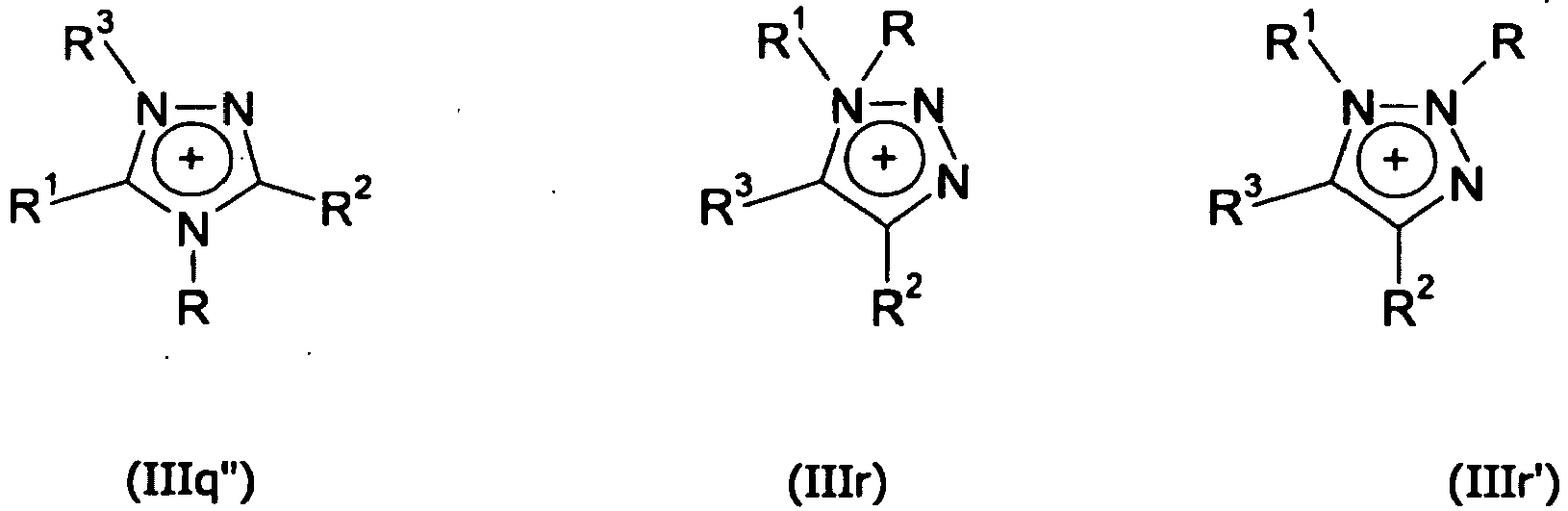


- Weitere geeignete Kationen sind Verbindungen der allgemeinen Formel (IIIx) und (II-Iy)

- In den oben genannten Formeln (IIIa) bis (IIIy) stehen
- • der Rest R für Wasserstoff, einen Kohlenstoff enthaltenden organischen, gesättigten oder ungesättigten, acyclischen oder cyclischen, aliphatischen, aromatischen oder araliphatischen, unsubstituierten oder durch 1 bis 5 Heteroatome oder funktionelle Gruppen unterbrochenen oder substituierten Rest mit 1 bis 20 Kohlenstoffatomen; und
- • die Reste R1 bis R9 unabhängig voneinander für Wasserstoff, eine Sulfo-Gruppe oder einen Kohlenstoff enthaltenden organischen, gesättigten oder ungesättigten, acyclischen oder cyclischen, aliphatischen, aromatischen oder araliphatischen, unsubstituierten oder durch 1 bis 5 Heteroatome oder funktionelle Gruppen unterbrochenen oder substituierten Rest mit 1 bis 20 Kohlenstoffatomen, wobei die Reste R1 bis R9, welche in den oben genannten Formeln (III) an ein Kohlenstoffatom (und nicht an ein Heteroatom) gebunden sind, zusätzlich auch für Halogen oder eine funktionelle Gruppe stehen können; oder
zwei benachbarte Reste aus der Reihe R1 bis R9 zusammen auch für einen zweibindigen, Kohlenstoff enthaltenden organischen, gesättigten oder ungesättigten, acyclischen oder cyclischen, aliphatischen, aromatischen oder araliphatischen, unsubstituierten oder durch 1 bis 5 Heteroatome oder funktionelle Gruppen unterbrochenen oder substituierten Rest mit 1 bis 30 Kohlenstoffatomen. - Als Heteroatome kommen bei der Definition der Reste R und R1 bis R9 prinzipiell alle Heteroatome in Frage, welche in der Lage sind, formell eine -CH2-, eine -CH=, eine -C≡ oder eine =C= -Gruppe zu ersetzen. Enthält der Kohlenstoff enthaltende Rest Heteroatome, so sind Sauerstoff, Stickstoff, Schwefel, Phosphor und Silizium bevorzugt. Als bevorzugte Gruppen seien insbesondere -O-, -S-, -SO-, -SO2-, -NR'-, -N=, -PR'-, - PR'2 und -SiR'2- genannt, wobei es sich bei den Resten R' um den verbleibenden Teil des Kohlenstoff enthaltenden Rests handelt. Die Reste R1 bis R9 können dabei in den Fällen, in denen diese in den oben genannten Formeln (III) an ein Kohlenstoffatom (und nicht an ein Heteroatom) gebunden sind, auch direkt über das Heteroatom gebunden sein.
- Als funktionelle Gruppen kommen prinzipiell alle funktionellen Gruppen in Frage, welche an ein Kohlenstoffatom oder ein Heteroatom gebunden sein können. Als geeignete Beispiele seien -OH (Hydroxy), =O (insbesondere als Carbonylgruppe), -NH2 (Amino), - NHR, -NR2, =NH (Imino), -COOH (Carboxy), -CONH2 (Carboxamid), -SO3H (Sulfo) und -CN (Cyano) genannt, insbesondere -OH (Hydroxy), =O (insbesondere als Carbonylgruppe), -NH2 (Amino), =NH (Imino), -COOH (Carboxy), -CONH2 (Carboxamid), -SO3H (Sulfo) und -CN (Cyano). Funktionelle Gruppen und Heteroatome können auch direkt benachbart sein, so dass auch Kombinationen aus mehreren benachbarten Atomen, wie etwa -O- (Ether), -S- (Thioether), -COO- (Ester), -CONH- (sekundäres Amid) oder - CONR'- (tertiäres Amid), mit umfasst sind, beispielsweise Di-(C1-C4-Alkyl)-amino, C1-C4-Alkyloxycarbonyl oder C1-C4-Alkyloxy.
- Als Halogene seien Fluor, Chlor, Brom und Iod genannt.
- Bevorzugt steht der Rest R für
- • unverzweigtes oder verzweigtes, unsubstituiertes oder ein bis mehrfach mit Hydroxy, Halogen, Phenyl, Cyano, C1- C6-Alkoxycarbonyl und/oder SO3H substituiertes C1-C18-Alkyl mit insgesamt 1 bis 20 Kohlenstoffatomen, wie beispielsweise Methyl, Ethyl, 1-Propyl, 2-Propyl, 1-Butyl, 2-Butyl, 2-Methyl-1-propyl, 2-Methyl-2-propyl, 1-Pentyl, 2-Pentyl, 3-Pentyl, 2-Methyl-1-butyl, 3-Methyl-1-butyl, 2-Methyl-2-butyl; 3-Methyl-2-butyl, 2,2-Dimethyl1-propyl, 1-Hexyl, 2-Hexyl, 3-Hexyl, 2-Methyl-1-pentyl, 3-Methyl-1-pentyl, 4-Methyl-1-pentyl, 2-Methyl-2-pentyl, 3-Methyl-2-pentyl, 4-Methyl-2-pentyl, 2-Methyl-3-pentyl, 3-Methyl-3-pentyl, 2,2-Dimethyl-1-butyl, 2,3-Dimethyl-1-butyl, 3,3-Dimethyl-1-butyl, 2-Ethyl-1-butyl, 2,3-Dimethyl-2-butyl, 3,3-Dimethyl-2-butyl, 1-Heptyl, 1-Octyl, 1-Nonyl, 1-Decyl, 1-Undecyl, 1-Dodecyl, 1-Tetradecyl, 1-Hexadecyl, 1-Octadecyl, 2-Hydroxyethyl, Benzyl, 3-Phenylpropyl, 2-Cyanoethyl, 2-(Methoxycar-bonyl)-ethyl, 2-(Ethoxycarbonyl)-ethyl, 2-(n-Butoxy-carbonyl)-ethyl, Trifluormethyl, Difluormethyl, Fluormethyl, Pentafluorethyl, Heptafluorpropyl, Heptafluorisopropyl, Nonafluorbutyl, Nonafluorisobutyl, Undecylfluorpentyl, Undecylfluorisopentyl, 6-Hydroxyhexyl und Propylsulfonsäure;
- • Glykole, Butylenglykole und deren Oligomere mit 1 bis 100 Einheiten und einem Wasserstoff oder einem C1-C8-Alkyl als Endgruppe, wie beispielsweise RAO-(CHRB-CH2-O)m CHRB-CH2- oder RAO-(CH2CH2CH2CH2O)m-CH2CH2CH2CH2O-mit RA und RB bevorzugt Wasserstoff, Methyl oder Ethyl und m bevorzugt 0 bis 3, insbesondere 3-Oxabutyl, 3-Oxapentyl, 3,6-Dioxaheptyl, 3,6-Dioxaoctyl, 3,6,9-Trioxadecyl, 3,6,9-Trioxaundecyl, 3,6,9,12-Tetraoxatridecyl und 3,6,9,12-Tetraoxatetradecyl;
- • Vinyl; und
- • Allyl
- • N,N-Di-C1-C6-alkyl-amino, wie beispielsweise N,N-Dimethylamino und N,N-Diethyl-amino.
- Besonders bevorzugt steht der Rest R für unverzweigtes und unsubstituiertes C1-C18-Alkyl, wie beispielsweise Methyl, Ethyl, Allyl, 1-Propyl, 1-Butyl, 1-Pentyl, 1-Hexyl, 1-Heptyl, 1-Octyl, 1-Decyl, 1-Dodecyl, 1-Tetradecyl, 1-Hexadecyl, 1-Octadecyl, insbesondere für Methyl, Ethyl, 1-Butyl und 1-Octyl sowie für CH3O-(CH2CH2O)m-CH2CH2- und CH3CH2O-(CH2CH2O)m-CH2CH2- mit m gleich 0 bis 3.
- Bevorzugt stehen die Reste R1 bis R9 unabhängig voneinander für
- • Wasserstoff;
- • Halogen;
- • eine funktionelle Gruppe;
- • gegebenenfalls durch funktionelle Gruppen, Aryl, Alkyl, Aryloxy, Alkyloxy, Halogen, Heteroatome und/oder Heterocyclen substituiertes und/oder durch ein oder mehrere Sauerstoff- und/oder Schwefelatome und/oder ein oder mehrere substituierte oder unsubstituierte Iminogruppen unterbrochenes C1-C18-Alkyl;
- • gegebenenfalls durch funktionelle Gruppen, Aryl, Alkyl, Aryloxy, Alkyloxy, Halogen, Heteroatome und/oder Heterocyclen substituiertes und/oder durch ein oder mehrere Sauerstoff- und/oder Schwefelatome und/oder ein oder mehrere substituierte oder unsubstituierte Iminogruppen unterbrochenes C2-C18-Alkenyl;
- • gegebenenfalls durch funktionelle Gruppen, Aryl, Alkyl, Aryloxy, Alkyloxy, Halogen, Heteroatome und/oder Heterocyclen substituiertes C6-C12-Aryl;
- • gegebenenfalls durch funktionelle Gruppen, Aryl, Alkyl, Aryloxy, Alkyloxy, Halogen, Heteroatome und/oder Heterocyclen substituiertes C5-C12-Cycloalkyl;
- • gegebenenfalls durch funktionelle Gruppen, Aryl, Alkyl, Aryloxy, Alkyloxy, Halogen, Heteroatome und/oder Heterocyclen substituiertes C5-C12-Cycloalkenyl; oder
- • einen gegebenenfalls durch funktionelle Gruppen, Aryl, Alkyl, Aryloxy, Alkyloxy, Halogen, Heteroatome und/oder Heterocyclen substituierten fünf- bis sechsgliedrigen, Sauerstoff-, Stickstoff- und/oder Schwefelatome aufweisenden Heterocyclus bedeuten; oder
- • einen ungesättigten, gesättigten oder aromatischen, gegebenenfalls durch funktionelle Gruppen, Aryl, Alkyl, Aryloxy, Alkyloxy, Halogen, Heteroatome und/oder Heterocyclen substituierten und gegebenenfalls durch ein oder mehrere Sauerstoff- und/ oder Schwefelatome und/oder ein oder mehrere substituierte oder unsubstituierte Iminogruppen unterbrochenen Ring.
- Bei gegebenenfalls durch funktionelle Gruppen, Aryl, Alkyl, Aryloxy, Alkyloxy, Halogen, Heteroatome und/oder Heterocyclen substituiertem C1- C18-Alkyl handelt es sich bevorzugt um Methyl, Ethyl, 1-Propyl, 2-Propyl, 1-Butyl, 2-Butyl, 2-Methyl-1-propyl (Isobutyl), 2-Methyl-2-propyl (tert.-Butyl), 1-Pentyl, 2-Pentyl, 3-Pentyl, 2-Methyl-1-butyl, 3-Methyl-1-butyl, 2-Methyl-2-butyl, 3-Methyl-2-butyl, 2,2-Dimethyl-1-propyl, 1-Hexyl, 2-Hexyl, 3-Hexyl, 2-Methyl-1-pentyl, 3-Methyl-1-pentyl, 4-Methyl-1-pentyl, 2-Methyl-2-pentyl, 3-Methyl-2-pentyl, 4-Methyl-2-pentyl, 2-Methyl-3-pentyl, 3-Methyl-3-pentyl, 2,2-Dimethyl-1-butyl, 2,3-Dimethyl-1-butyl, 3,3-Dimethyl-1-butyl, 2-Ethyl-1-butyl, 2,3-Dimethyl-2-butyl, 3,3-Dimethyl-2-butyl, Heptyl, Octyl, 2-Etylhexyl, 2,4,4-Trimethylpentyl, 1,1,3,3-Tetrame-thylbutyl, 1-Nonyl, 1-Decyl, 1-Undecyl, 1-Dodecyl, 1-Tridecyl, 1-Tetradecyl, 1-Pentadecyl, 1-Hexadecyl, 1-Heptadecyl, 1-Octadecyl, Cyclopentylmethyl, 2-Cyclopentylethyl, 3-Cyclo-pentylpropyl, Cyclohexylmethyl, 2-Cyclohexylethyl, 3-Cyclohexylpropyl, Benzyl (Phenylmethyl), Diphenylmethyl (Benzhydryl), Triphenylmethyl, 1-Phenylethyl, 2-Phenylethyl, 3-Phenylpropyl, α,α-Dimethylbenzyl, p-Tolylmethyl, 1-(p-Butylphenyl)-ethyl, p-Chlorbenzyl, 2,4-Dichlorbenzyl, p-Methoxybenzyl, m-Ethoxybenzyl, 2-Cyanoethyl, 2-Cyanopropyl, 2-Methoxycarbonylethyl, 2-Ethoxycarbonylethyl, 2-Butoxycarbonylpropyl, 1,2-Di-(methoxy-carbonyl)-ethyl, Methoxy, Ethoxy, Formyl, 1,3-Dioxolan-2-yl, 1,3-Dioxan-2-yl, 2-Methyl-1,3-dioxolan-2-yl, 4-Methyl-1,3-dioxolan-2-yl, 2-Hydroxyethyl, 2-Hydroxypropyl, 3-Hydro-xypropyl, 4-Hydroxybutyl, 6-Hydroxyhexyl, 2-Aminoethyl, 2-Aminopropyl, 3-Aminopropyl, 4-Aminobutyl, 6-Aminohexyl, 2-Methylaminoethyl, 2-Methylaminopropyl, 3-Methylaminopropyl, 4-Methylaminobutyl, 6-Methylaminohexyl, 2-Dimethylaminoethyl, 2-Dimethylaminopropyl, 3-Dimethylaminopropyl, 4-Dimethylaminobutyl, 6-Dimethylaminohexyl, 2-Hydroxy-2,2-dimethylethyl, 2-Phenoxyethyl, 2-Phenoxypropyl, 3-Phenoxypropyl, 4-Phenoxybutyl, 6-Phenoxyhexyl, 2-Methoxyethyl, 2-Methoxypropyl, 3-Methoxypropyl, 4-Methoxybutyl, 6-Methoxyhexyl, 2-Ethoxyethyl, 2-Ethoxypropyl, 3-Ethoxypropyl, 4-Ethoxybutyl, 6-Ethoxyhexyl, Acetyl, CmF2(m-a)+(1+)H2a+b mit m gleich 1 bis 30, 0≤a≤m und b = 0 oder 1 (beispielsweise CF3, C2F5, CH2CH2-C(m-2)F2(m-2)+1, C6F13, C8F17, C10F25, C12F25), Chlormethyl, 2-Chlorethyl, Trichlormethyl, 1,1-Dimethyl-2-chlorethyl, Methoxymethyl, 2-Butoxyethyl, Diethoxymethyl, Diethoxyethyl, 2-Isopropoxyethyl, 2-Butoxypropyl, 2-Octyloxyethyl, 2-Methoxyisopropyl, 2-(Methoxycarbonyl)-ethyl, 2-(Ethoxycarbonyl)-ethyl, 2-(n-Butoxycarbonyl)-ethyl, Butylthiomethyl, 2-Dodecylthioethyl, 2-Phenylthioethyl, 5-Hydroxy-3-oxa-pentyl, 8-Hydroxy-3,6-dioxa-octyl, 11-Hydroxy-3,6,9-trioxaundecyl, 7-Hydroxy-4-oxa-heptyl, 11-Hydroxy-4,8-dioxa-undecyl, 15-Hydroxy-4,8,12-trioxa-penta-decyl, 9-Hydroxy-5-oxa-nonyl, 14-Hydroxy-5,10-dioxa-tetradecyl, 5-Methoxy-3-oxa-pentyl, 8-Methoxy-3,6-dioxa-octyl, 11-Methoxy-3,6,9-trioxa-undecyl, 7-Methoxy-4-oxa-heptyl, 11-Methoxy-4,8-dioxa-undecyl, 15-Methoxy-4,8,12-trioxa-pentadecyl, 9-Methoxy-5-oxa-no-nyl, 14-Methoxy-5,10-dioxa-tetradecyl, 5-Ethoxy-3-oxapentyl, 8-Ethoxy-3,6-dioxa-octyl, 11-Ethoxy-3,6,9-trioxa-undecyl, 7-Ethoxy-4-oxa-heptyl, 11-Ethoxy-4,8-dioxa-undecyl, 15-Ethoxy-4,8,12-trioxa-pentadecyl, 9-Ethoxy-5-oxa-nonyl oder 14-Ethoxy-5,10-oxa-tetra-decyl.
- Bei gegebenenfalls durch funktionelle Gruppen, Aryl, Alkyl, Aryloxy, Alkyloxy, Halogen, Heteroatome und/oder Heterocyclen substituiertes und/oder durch ein oder mehrere Sauerstoff- und/oder Schwefelatome und/oder ein oder mehrere substituierte oder unsubstituierte Iminogruppen unterbrochenes C2-C18-Alkenyl handelt es sich bevorzugt um Vinyl, 2-Propenyl, 3-Butenyl, cis-2-Butenyl, trans-2-Butenyl oder CmF2(m-a)-(1-b)H2a-b mit m ≤ 30, 0 ≤ a ≤ m und b = 0 oder 1.
- Bei gegebenenfalls durch funktionelle Gruppen, Aryl, Alkyl, Aryloxy, Alkyloxy, Halogen, Heteroatome und/oder Heterocyclen substituiertes C6- C12-Aryl handelt es sich bevorzugt um Phenyl, Tolyl, Xylyl, α-Naphthyl, β-Naphthyl, 4-Diphenylyl, Chlorphenyl, Dichlorphenyl, Trichlorphenyl, Difluorphenyl, Methylphenyl, Dimethylphenyl, Trimethylphenyl, Methylphenyl, Diethylphenyl, iso-Propylphenyl, tert.-Butylphenyl, Dodecylphenyl, Methoxyphenyl, Dimethoxyphenyl, Ethoxyphenyl, Hexyloxyphenyl, Methylnaphthyl, Isopropylnaphthyl, Chlornaphthyl, Ethoxynaphthyl, 2,6-Dimethylphenyl, 2,4,6-Trimethylphenyl, 2,6-Dimethoxyphenyl, 2,6-Dichlorphenyl, 4-Bromphenyl, 2-Nitrophenyl, 4-Nitrophenyl, 2,4-Dinitrophenyl, 2,6-Dinitrophenyl, 4-Dimethylaminophenyl, 4-Acetylphenyl, Methoxyethylphenyl, Ethoxymethylphenyl, Methylthiophenyl, Isopropylthiophenyl oder tert.-Butylthiophenyl oder C6F(5-a)Ha mit 0≤a≤5.
- Bei gegebenenfalls durch funktionelle Gruppen, Aryl, Alkyl, Aryloxy, Alkyloxy, Halogen, Heteroatome und/oder Heterocyclen substituiertes C5-C12-Cycloalkyl handelt es sich bevorzugt um Cyclopentyl, Cyclohexyl, Cyclooctyl, Cyclododecyl, Methylcyclopentyl, Dimethylcyclopentyl, Methylcyclohexyl, Dimethylcyclohexyl, Diethylcyclohexyl, Butylcyclohexyl, Methoxycyclohexyl, Dimethoxycyclohexyl, Diethoxycyclohexyl, Butylthiocyclohexyl, Chlorcyclohexyl, Dichlorcyclohexyl, Dichlorcyclopentyl, CmF2(m-a)-(1-b)H2a-b mit m≤30, 0≤a≤m und b = 0 oder 1 sowie ein gesättigtes oder ungesättigtes bicyclisches System wie z.B. Norbomyl oder Norbomenyl.
- Bei gegebenenfalls durch funktionelle Gruppen, Aryl, Alkyl, Aryloxy, Alkyloxy, Halogen, Heteroatome und/oder Heterocyclen substituiertes C5-C12-Cycloalkenyl handelt es sich bevorzugt um 3-Cyclopentenyl, 2-Cyclohexenyl, 3-Cyclohexenyl, 2,5-Cyclohexadienyl oder CnF2(m-a)-3(1-b)H2a-3b mit m ≤ 30, 0≤a≤m und b = 0 oder 1.
- Bei einen gegebenenfalls durch funktionelle Gruppen, Aryl, Alkyl, Aryloxy, Alkyloxy, Halogen, Heteroatome und/oder Heterocyclen substituierten fünf- bis sechsgliedrigen, Sauerstoff-, Stickstoff- und/oder Schwefelatome aufweisenden Heterocyclus handelt es sich bevorzugt um Furyl, Thiophenyl, Pyrryl, Pyridyl, Indolyl, Benzoxazolyl, Dioxolyl, Dioxyl, Benzimidazolyl, Benzthiazolyl, Dimethylpyridyl, Methylchinolyl, Dimethylpyrryl, Methoxyfuryl, Dimethoxypyridyl oder Difluorpyridyl.
- Bilden zwei benachbarte Reste gemeinsam einen ungesättigten, gesättigten oder aromatischen, gegebenenfalls durch funktionelle Gruppen, Aryl, Alkyl, Aryloxy, Alkyloxy, Halogen, Heteroatome und/oder Heterocyclen substituierten und gegebenenfalls durch ein oder mehrere Sauerstoff- und/oder Schwefelatome und/oder ein oder mehrere substituierte oder unsubstituierte Iminogruppen unterbrochenen Ring, so handelt es sich bevorzugt um 1,3-Propylen, 1,4-Butylen, 1,5-Pentylen, 2-Oxa-1,3-propylen, 1-Oxa-1,3-propylen, 2-Oxa-1,3-propylen, 1-Oxa-1,3-propenylen, 3-Oxa-1,5-pentylen, 1-Aza-1,3-propenylen, 1-C1-C4-Alkyl-1-aza-1,3-propenylen, 1,4-Buta-1,3-dienylen, 1-Aza-1,4-buta-1,3-dienylen oder 2-Aza-1,4-buta-1,3-dienylen.
- Enthalten die oben genannten Reste Sauerstoff- und/oder Schwefelatome und/oder substituierte oder unsubstituierte Iminogruppen, so ist die Anzahl der Sauerstoff- und/oder Schwefelatome und/oder Iminogruppen nicht beschränkt. In der Regel beträgt sie nicht mehr als 5 in dem Rest, bevorzugt nicht mehr als 4 und ganz besonders bevorzugt nicht mehr als 3.
- Enthalten die oben genannten Reste Heteroatome, so befinden sich zwischen zwei Heteroatomen in der Regel mindestens ein Kohlenstoffatom, bevorzugt mindestens zwei Kohlenstoffatome.
- Besonders bevorzugt stehen die Reste R1 bis R9 unabhängig voneinander für
- • Wasserstoff;
- • unverzweigtes oder verzweigtes, unsubstituiertes oder ein bis mehrfach mit Hydroxy, Halogen, Phenyl, Cyano, C1-C6-Alkoxycarbonyl und/oder SO3H substituiertes C1-C18-Alkyl mit insgesamt 1 bis 20 Kohlenstoffatomen, wie beispielsweise Methyl, Ethyl, 1-Propyl, 2-Propyl, 1-Butyl, 2-Butyl, 2-Methyl-1-propyl, 2-Methyl-2-propyl, 1-Pentyl, 2-Pentyl, 3-Pentyl, 2-Methyl-1-butyl; 3-Methyl-1-butyl, 2-Methyl-2-butyl, 3-Methyl-2-butyl, 2,2-Dimethyl-1-propyl, 1-Hexyl, 2-Hexyl, 3-Hexyl, 2-Methyl-1-pentyl, 3-Methyl-1-pentyl, 4-Methyl-1-pentyl, 2-Methyl-2-pentyl, 3-Methyl-2-pentyl, 4-Methyl-2-pentyl, 2-Methyl-3-pentyl, 3-Methyl-3-pentyl, 2,2-Dimethyl-1-butyl, 2,3-Dimethyl-1-butyl, 3,3-Dimethyl-1-butyl, 2-Ethyl-1-butyl, 2,3-Dimethyl-2-butyl, 3,3-Dimethyl-2-butyl, 1-Heptyl, 1-Octyl, 1-Nonyl, 1-Decyl, 1-Undecyl, 1-Dodecyl, 1-Tetradecyl, 1-Hexadecyl, 1-Octadecyl, 2-Hydroxyethyl, Benzyl, 3-Phenylpropyl, 2-Cyanoethyl, 2-(Methoxycar-bonyl)-ethyl, 2-(Ethoxycarbonyl)-ethyl, 2-(n-Butoxy-carbonyl)-ethyl, Trifluormethyl, Difluormethyl, Fluormethyl, Pentafluorethyl, Heptafluorpropyl, Heptafluorisopropyl, Nonafluorbutyl, Nonafluorisobutyl, Undecylfluorpentyl, Undecylfluorisopentyl, 6-Hydroxyhexyl und Propylsulfonsäure;
- • Glykole, Butylenglykole und deren Oligomere mit 1 bis 100 Einheiten und einem Wasserstoff oder einem C1- bis C8-Alkyl als Endgruppe, wie beispielsweise RAO-(CHRB-CH2-O)m-CHRB-CH2- oder RAO-(CH2CH2CH2CH2O)m-CH2CH2CH2CH2O-mit RA und RB bevorzugt Wasserstoff, Methyl oder Ethyl und n bevorzugt 0 bis 3, insbesondere 3-Oxabutyl, 3-Oxapentyl, 3,6-Dioxaheptyl, 3,6-Dioxaoctyl, 3,6,9-Trioxadecyl, 3,6,9-Trioxaundecyl, 3,6,9,12-Tetraoxatridecyl und 3,6,9,12-Tetraoxatetradecyl;
- • Vinyl; und
- • Allyl
- • N,N-Di-C1- bis C6-alkyl-amino, wie beispielsweise N,N-Dimethylamino und N,N-Diethylamino.
- Ganz besonders bevorzugt stehen die Reste R1 bis R9 unabhängig voneinander für Wasserstoff oder C1-C18-Alkyl, wie beispielsweise Methyl, Ethyl, 1-Butyl, 1-Pentyl, 1-Hexyl, 1-Heptyl, 1-Octyl, für Phenyl, für 2-Hydroxyethyl, für 2-Cyanoethyl, für 2-(Methoxycarbo-nyl)ethyl, für 2-(Ethoxycarbonyl)ethyl, für 2-(n-Butoxycarbonyl)ethyl, für N,N-Dimethyl-amino, für N,N-Diethylamino, für Chlor sowie für CH3O-(CH2CH2O)m-CH2CH2- und CH3CH2O-(CH2CH2O)m-CH2CH2- mit m gleich 0 bis 3.
- Ganz besonders bevorzugt setzt man als Pyridiniumionen (IIIIa) solche ein, bei denen
- • einer der Reste R1 bis R5 Methyl, Ethyl oder Chlor ist und die verbleibenden Reste R1 bis R5 Wasserstoff sind;
- • R3 Dimethylamino ist und die verbleibenden Reste R1, R2, R4 und R5 Wasserstoff sind;
- • alle Reste R1 bis R5 Wasserstoff sind;
- • R2 Carboxy oder Carboxamid ist und die verbleibenden Reste R1, R2, R4 und R5 Wasserstoff sind; oder
- • R1 und R2 oder R2 und R3 1,4-Buta-1,3-dienylen ist und die verbleibenden Reste R1, R2, R4 und R5 Wasserstoff sind;
- • R1 bis R5 Wasserstoff sind; oder
- • einer der Reste R1 bis R5 Methyl oder Ethyl ist und die verbleibenden Reste R1 bis R5 Wasserstoff sind.
- Als ganz besonders bevorzugte Pyridiniumionen (IIIa) seien genannt 1-Methylpyridinium, 1-Ethylpyridinium, 1-(1-Butyl)pyridinium, 1-(1-Hexyl)pyridinium, 1-(1-Octyl)pyridinium, 1-(1-Hexyl)-pyridinium, 1-(1-Octyl)-pyridinium, 1-(1-Dodecyl)-pyridinium, 1-(1-Tetradecyl)-pyridinium, 1-(1-Hexadecyl)-pyridinium, 1,2-Dimethylpyridinium, 1-Ethyl-2-methylpyridi-nium, 1-(1-Butyl)-2-methylpyridinium, 1-(1-Hexyl)-2-methylpyridinium, 1-(1-Octyl)-2-methylpyridinium, 1-(1-Dodecyl)-2-methylpyridinium, 1-(1-Tetradecyl)-2-methylpyridi-nium, 1-(1-Hexadecyl)-2-methylpyridinium, 1-Methyl-2-ethylpyridinium, 1,2-Diethylpyridi-nium, 1-(1-Butyl)-2-ethylpyridinium, 1-(1-Hexyl)-2-ethylpyridinium, 1-(1-Octyl)-2-ethylpy-ridinium, 1-(1-Dodecyl)-2-ethylpyridinium, 1-(1-Tetradecyl)-2-ethylpyridinium, 1-(1-Hexa-decyl)-2-ethylpyridinium, 1,2-Dimethyl-5-ethyl-pyridinium, 1,5-Diethyl-2-methyl-pyridi-nium, 1-(1-Butyl)-2-methyl-3-ethyl-pyridinium, 1-(1-Hexyl)-2-methyl-3-ethyl-pyridinium und 1-(1-Octyl)-2-methyl-3-ethyl-pyridinium, 1-(1-Dodecyl)-2-methyl-3-ethyl-pyridinium, 1-(1-Tetradecyl)-2-methyl-3-ethyl-pyridinium und 1-(1-Hexadecyl)-2-methyl-3-ethyl-pyri-dinium.
- Ganz besonders bevorzugt setzt man als Pyridaziniumionen (IIIb) solche ein, bei denen
- • R1 bis R4 Wasserstoff sind; oder
- • einer der Reste R1 bis R4 Methyl oder Ethyl ist und die verbleibenden Reste R1 bis R4 Wasserstoff sind.
- Ganz besonders bevorzugt setzt man als Pyrimidiniumionen (IIIc) solche ein, bei denen
- • R1 Wasserstoff, Methyl oder Ethyl ist und R2 bis R4 unabhängig voneinander Wasserstoff oder Methyl sind; oder
- • R1 Wasserstoff, Methyl oder Ethyl ist, R2 und R4 Methyl sind und R3 Wasserstoff ist.
- Ganz besonders bevorzugt setzt man als Pyraziniumionen (IIId) solche ein, bei denen
- • R1 Wasserstoff, Methyl oder Ethyl ist und R2 bis R4 unabhängig voneinander Wasserstoff oder Methyl sind;
- • R1 Wasserstoff, Methyl oder Ethyl ist, R2 und R4 Methyl sind und R3 Wasserstoff ist;
- • R1 bis R4 Methyl sind; oder
- • R1 bis R4 Methyl Wasserstoff sind.
- Ganz besonders bevorzugt setzt man als Imidazoliumionen (IIIe) solche ein, bei denen
- • R1 Wasserstoff, Methyl, Ethyl, 1-Propyl, 1-Butyl, 1-Pentyl, 1-Hexyl, 1-Octyl, Allyl, 2-Hydroxyethyl oder 2-Cyanoethyl und R2 bis R4 unabhängig voneinander Wasserstoff, Methyl oder Ethyl sind.
- Als ganz besonders bevorzugte Imidazoliumionen (IIIe) seien genannt 1-Methylimidazolium, 1-Ethylimidazolium, 1-(1-Butyl)-imidazolium, 1-(1-Octyl)-imidazolium, 1-(1-Dodecyl)-imidazolium, 1-(1-Tetradecyl)-imidazolium, 1-(1-Hexadecyl)-imidazolium, 1,3-Dimethyl-imidazolium, 1-Ethyl-3-methylimidazolium, 1-(1-Butyl)-3-methylimidazolium, 1-(1-Butyl)-3-ethylimidazolium, 1-(1-Hexyl)-3-methyl-imidazolium, 1-(1-Hexyl)-3-ethylimidazolium, 1-(1-Hexyl)-3-butyl-imidazolium, 1-(1-Octyl)-3-methylimidazolium, 1-(1-Octyl)-3-ethylimidazolium, 1-(1-Octyl)-3-butylimidazolium, 1-(1-Dodecyl)-3-methylimidazolium, 1-(1-Dodecyl)-3-ethylimidazolium, 1-(1-Dodecyl)-3-butylimidazolium, 1-(1-Dodecyl)-3-octylimidazolium, 1-(1-Tetradecyl)-3-methylimidazolium, 1-(1-Tetradecyl)-3-ethylimidazolium, 1-(1-Tetradecyl)-3-butylimidazolium, 1-(1-Tetradecyl)-3-octylimidazolium, 1-(1-Hexadecyl)-3-methylimidazolium, 1-(1-Hexadecyl)-3-ethylimidazolium, 1-(1-Hexade-cyl)-3-butylimidazolium, 1-(1-Hexadecyl)-3-octylimidazolium, 1,2-Dimethylimidazolium, 1,2,3-Trimethylimidazolium, 1-Ethyl-2,3-dimethylimidazolium, 1-(1-Butyl)-2,3-dimethylimidazolium, 1-(1-Hexyl)-2,3-dimethyl-imidazolium, 1-(1-Octyl)-2,3-dimethylimidazolium, 1,4-Dimethylimidazolium, 1,3,4-Trimethylimidazolium, 1,4-Dimethyl-3-ethylimidazolium, 3-butylimidazolium, 1,4-Dimethyl-3-octylimidazolium, 1,4,5-Trimethylimidazolium, 1,3,4,5-Tetramethylimidazolium, 1,4,5-Trimethyl-3-ethylimidazolium, 1,4,5-Trimethyl-3-butylimidazolium und 1,4,5-Trimethyl-3-octylimidazolium.
- Ganz besonders bevorzugt setzt man als Pyrazoliumionen (IIIf), (IIIg) beziehungsweise (IIIg') solche ein, bei denen
- • R1 Wasserstoff, Methyl oder Ethyl ist und R2 bis R4 unabhängig voneinander Wasserstoff oder Methyl sind.
- Ganz besonders bevorzugt setzt man als Pyrazoliumionen (IIIh) solche ein, bei denen
- • R1 bis R4 unabhängig voneinander Wasserstoff oder Methyl sind.
- Ganz besonders bevorzugt setzt man als 1-Pyrazoliniumionen (IIIi) solche ein, bei denen
- • unabhängig voneinander R1 bis R6 Wasserstoff oder Methyl sind.
- Ganz besonders bevorzugt setzt man als 2-Pyrazoliniumionen (IIIj) beziehungsweise (IIIj') solche ein, bei denen
- • R1 Wasserstoff, Methyl, Ethyl oder Phenyl ist und R2 bis R6 unabhängig voneinander Wasserstoff oder Methyl sind.
- Ganz besonders bevorzugt setzt man als 3-Pyrazoliniumionen (IIIk) beziehungsweise (IIIk') solche ein, bei denen
- • R1 und R2 unabhängig voneinander Wasserstoff, Methyl, Ethyl oder Phenyl sind und R3 bis R6 unabhängig voneinander Wasserstoff oder Methyl sind.
- Ganz besonders bevorzugt setzt man als Imidazoliniumionen (IIII) solche ein, bei denen
- • R1 und R2 unabhängig voneinander Wasserstoff, Methyl, Ethyl, 1-Butyl oder Phenyl sind, R3 und R4 unabhängig voneinander Wasserstoff, Methyl oder Ethyl sind und R5 und R6 unabhängig voneinander Wasserstoff oder Methyl sind.
- Ganz besonders bevorzugt setzt man als Imidazoliniumionen (IIIm) beziehungsweise (IIIm') solche ein, bei denen
- • R1 und R2 unabhängig voneinander Wasserstoff, Methyl oder Ethyl sind und R3 bis R6 unabhängig voneinander Wasserstoff oder Methyl sind.
- Ganz besonders bevorzugt setzt man als Imidazoliniumionen (IIIn) beziehungsweise (IIIn') solche ein, bei denen
- • R1 bis R3 unabhängig voneinander Wasserstoff, Methyl oder Ethyl sind und R4 bis R6 unabhängig voneinander Wasserstoff oder Methyl sind.
- Ganz besonders bevorzugt setzt man als Thiazoliumionen (IIIo) beziehungsweise (II-Io') sowie als Oxazoliumionen (IIIp) solche ein, bei denen
- • R1 Wasserstoff, Methyl, Ethyl oder Phenyl ist und R2 und R3 unabhängig voneinander Wasserstoff oder Methyl sind.
- Ganz besonders bevorzugt setzt man als 1,2,4-Triazoliumionen (IIIq), (IIIq') beziehungsweise (IIIq'') solche ein, bei denen
- • R1 und R2 unabhängig voneinander Wasserstoff, Methyl, Ethyl oder Phenyl sind und R3 Wasserstoff, Methyl oder Phenyl ist.
- Ganz besonders bevorzugt setzt man als 1,2,3-Triazoliumionen (IIIr), (IIIr') beziehungsweise (IIIr'') solche ein, bei denen
- • R1 Wasserstoff, Methyl oder Ethyl ist und R2 und R3 unabhängig voneinander Wasserstoff oder Methyl sind, oder R2 und R3 zusammen 1,4-Buta-1,3-dienylen ist.
- Ganz besonders bevorzugt setzt man als Pyrrolidiniumionen (IIIs) solche ein, bei denen
- • R1 Wasserstoff, Methyl, Ethyl oder Phenyl ist und R2 bis R9 unabhängig voneinander Wasserstoff oder Methyl sind.
- Ganz besonders bevorzugt setzt man als Imidazolidiniumionen (IIIt) solche ein, bei denen
- • R1 und R4 unabhängig voneinander Wasserstoff, Methyl, Ethyl oder Phenyl sind und R2 und R3 sowie R5 bis R8 unabhängig voneinander Wasserstoff oder Methyl sind.
- Ganz besonders bevorzugt setzt man als Ammoniumionen (IIIu) solche ein, bei denen
- • R1 bis R3 unabhängig voneinander C1-C18-Alkyl sind; oder
- • R1 und R2 zusammen 1,5-Pentylen oder 3-Oxa-1,5-pentylen sind und R3 C1-C18-Alkyl, 2-Hydroxyethyl oder 2-Cyanoethyl ist.
- Als ganz besonders bevorzugte Ammoniumionen (IIIu) seien genannt Methyl-tri-(1-butyl)-ammonium, N,N-Dimethylpiperidinium und N,N-Dimethylmorpholinium.
- Beispiele für die tertiären Amine, von denen sich die quartären Ammoniumionen der allgemeinen Formel (IIIu) durch Quaternisierung mit den genannten Resten R ableiten, sind Diethyl-n-butylamin, Diethyl-tert-butylamin, Diethyl-n-pentylamin, Diethylhexylamin, Diethyloctylamin, Diethyl-(2-ethylhexyl)-amin, Di-n-propylbutylamin, Di-n-propyl-n-pentyl-amin, Di-n-propylhexylamin, Di-n-propyloctylamin, Di-n-propyl-(2-ethylhexyl)-amin, Di-isopropylethylamin, Di-iso-propyl-n-propylamin, Di-isopropyl-butylamin, Di-isopropyl-pentylamin, Di-iso-propylhexylamin, Di-isopropyloctylamin, Di-iso-propyl-(2-ethylhexyl)-amin, Di-n-butylethylamin, Di-n-butyl-n-propylamin, Di-n-butyl-n-pentylamin, Di-n-butylhexylamin, Di-n-butyloctylamin, Di-n-butyl-(2-ethylhexyl)-amin, N-n-Butyl-pyrrolidin, N-sek-Butylpyrrodidin, N-tert-Butylpyrrolidin, N-n-Pentylpyrrolidin, N,N-Dimethyl-cyclohexylamin, N,N-Diethylcyclohexylamin, N,N-Di-n-butylcyclohexylamin, N-n-Propyl-piperidin, N-iso-Propylpiperidin, N-n-Butyl-piperidin, N-sek-Butylpiperidin, N-tert-Butylpiperidin, N-n-Pentylpiperidin, N-n-Butylmorpholin, N-sek-Butylmorpholin, N-tert-Butylmorpholin, N-n-Pentylmorpholin, N-Benzyl-N-ethylanilin, N-Benzyl-N-n-propylanilin, N-Benzyl-N-iso-propylanilin, N-Benzyl-N-n-butylanilin, N,N-Dimethyl-p-toluidin, N,N-Diethyl-p-tolui-din, N,N-Di-n-butyl-p-toluidin, Diethylbenzylamin, Di-n-propylbenzylamin, Di-n-butyl-benzylamin, Diethylphenylamin, Di-n-Propylphenylamin und Di-n-Butylphenylamin.
- Bevorzugte tertiäre Amine sind Di-iso-propylethylamin, Diethyl-tert-butylamin, Di-isopro-pylbutylamin, Di-n-butyl-n-pentylamin, N,N-Di-n-butylcyclohexylamin sowie tertiäre Amine aus Pentylisomeren.
- Besonders bevorzugte tertiäre Amine sind Di-n-butyl-n-pentylamin und tertiäre Amine aus Pentylisomeren. Ein weiteres bevorzugtes tertiäres Amin, das drei identische Reste aufweist, ist Triallylamin.
- Ganz besonders bevorzugt setzt man als Guanidiniumionen (IIIv) solche ein, bei denen
- • R1 bis R5 Methyl sind.
- Als ganz besonders bevorzugtes Guanidiniumion (IIIv) sei genannt N,N,N',N',N",N"-Hexamethylguanidinium.
- Ganz besonders bevorzugt setzt man als Choliniumionen (IIIw) solche ein, bei denen
- • R1 und R2 unabhängig voneinander Methyl, Ethyl, 1-Butyl oder 1-Octyl sind und R3 Wasserstoff, Methyl, Ethyl, Acetyl, -SO2OH oder -PO(OH)2 ist;
- • R1 Methyl, Ethyl, 1-Butyl oder 1-Octyl ist, R2 eine -CH2-CH2-OR4-Gruppe ist und R3 und R4 unabhängig voneinander Wasserstoff, Methyl, Ethyl, Acetyl,-SO2OH oder - PO(OH)2 sind; oder
- • R1 eine -CH2-CH2-OR4-Gruppe ist, R2 eine -CH2-CH2OR5-Gruppe ist und R3 bis R5 unabhängig voneinander Wasserstoff, Methyl, Ethyl, Acetyl, -SO2OH oder - PO(OH)2 sind.
- Besonders bevorzugte Choliniumionen (IIIw) sind solche, bei denen R3 ausgewählt ist aus Wasserstoff, Methyl, Ethyl, Acetyl, 5-Methoxy-3-oxa-pentyl, 8-Methoxy-3,6-dioxaoctyl, 11-Methoxy-3,6,9-trioxa-undecyl, 7-Methoxy-4-oxa-heptyl, 11-Methoxy-4,8-dioxa-undecyl, 15-Methoxy-4,8,12-trioxa-pentadecyl, 9-Methoxy-5-oxa-nonyl, 14-Methoxy-5,10-oxa-tetradecyl, 5-Ethoxy-3-oxa-pentyl, 8-Ethoxy-3,6-dioxa-octyl, 11-Ethoxy-3,6,9-trioxa-undecyl, 7-Ethoxy-4-oxa-heptyl, 11-Ethoxy-4,8-dioxa-undecyl, 15-Ethoxy-4,8,12-trioxa-pentadecyl, 9-Ethoxy-5-oxa-nonyl oder 14-Ethoxy-5,10-oxa-tetradecyl. Als ganz besonders bevorzugte Choliniumionen (IIIw) seien genannt Trimethyl-2-hydroxy-ethylammonium, Dimethyl-bis-2-hydroxyethylammonium oder Methyl-tris-2-hydroxyethyl-ammonium.
- Ganz besonders bevorzugt setzt man als Phosphoniumionen (IIIx) solche ein, bei denen
- • R1 bis R3 unabhängig voneinander C1-C18-Alkyl, insbesondere Butyl, Isobutyl, 1-Hexyl oder 1-Octyl sind.
- Unter den vorstehend genannten heterocyclischen Kationen sind die Pyridiniumionen, Pyrazolinium-, Pyrazoliumionen und die Imidazolinium- sowie die Imidazoliumionen bevorzugt. Weiterhin sind Ammonium- sowie Choliniumionen bevorzugt.
- Insbesondere bevorzugt sind 1-Methylpyridinium, 1-Ethylpyridinium, 1-(1-Butyl)pyridinium, 1-(1-Hexyl)pyridinium, 1-(1-Octyl)pyridinium, 1-(1-Hexyl)-pyridinium, 1-(1-Octyl)-pyridinium, 1-(1-Dodecyl)-pyridinium, 1-(1-Tetradecyl)-pyridinium, 1-(1-Hexadecyl)-pyridinium, 1,2-Dimethylpyridinium, 1-Ethyl-2-methylpyridinium, 1-(1-Butyl)-2-methylpyridinium, 1-(1-Hexyl)-2-methylpyridinium, 1-(1-Octyl)-2-methylpyridinium, 1-(1-Dodecyl)-2-methylpyridinium, 1-(1-Tetradecyl)-2-methylpyridinium, 1-(1-Hexadecyl)-2-methylpyridinium, 1-Methyl-2-ethylpyridinium, 1,2-Diethylpyridinium, 1-(1-Butyl)-2-ethylpyridinium, 1-(1-Hexyl)-2-ethylpyridinium, 1-(1-Octyl)-2-ethylpyridinium, 1-(1-Dodecyl)-2-ethylpyridinium, 1-(1-Tetradecyl)-2-ethylpyridinium, 1-(1-Hexadecyl)-2-ethylpyridinium, 1,2-Dime-thyl-5-ethyl-pyridinium, 1,5-Diethyl-2-methyl-pyridinium, 1-(1-Butyl)-2-methyl-3-ethyl-pyridinium, 1-(1-Hexyl)-2-methyl-3-ethyl-pyridinium, 1-(1-Octyl)-2-methyl-3-ethyl-pyridinium, 1-(1-Dodecyl)-2-methyl-3-ethyl-pyridinium, 1-(1-Tetradecyl)-2-methyl-3-ethyl-pyridinium, 1-(1-Hexadecyl)-2-methyl-3-ethyl-pyridinium, 1-Methylimidazolium, 1-Ethylimidazolium, 1-(1-Butyl)-imidazolium, 1-(1-Octyl)-imidazolium, 1-(1-Dodecyl)-imidazolium, 1-(1-Tetradecyl)-imidazolium, 1-(1-Hexadecyl)-imidazolium, 1,3-Dimethyl-imidazolium, 1-Ethyl-3-methylimidazolium, 1-(1-Butyl)-3-methylimidazolium, 1-(1-Hexyl)-3-methylimidazolium, 1-(1-Octyl)-3-methylimidazolium, 1-(1-Dodecyl)-3-methylimidazolium, 1-(1-Tetradecyl)-3-methylimidazolium, 1-(1-Hexadecyl)-3-methylimidazolium, 1,2-Dimethylimidazolium, 1,2,3-Trimethylimidazolium, 1-Ethyl-2,3-dimethylimidazolium, 1-(1-Butyl)-2,3-dimethylimidazolium, 1-(1-Hexyl)-2,3-dimethylimidazolium und 1-(1-Octyl)-2,3-dimethylimidazolium, 1,4-Dimethylimidazolium, 1,3,4-Trimethylimidazolium, 1,4-Dimethyl-3-ethylimidazolium, 3-Butylimidazolium, 1,4-Dimethyl-3-octylimidazolium, 1,4,5-Trimethylimidazolium, 1,3,4,5-Tetramethylimidazolium, 1,4,5-Trimethyl-3-ethylimidazolium, 1,4,5-Trime-thyl-3-butylimidazolium,1,4,5-Trimethyl-3-octylimidazolium, Trimethyl-2-hydroxyethylammonium, Dimethyl-bis-2-hydroxyethylammonium und Methyl-tris-2-hydroxyethylammonium.
- Als Anionen sind prinzipiell alle Anionen einsetzbar.
- Das Anion [Y]n- der ionischen Flüssigkeit ist beispielsweise ausgewählt aus
- • der Gruppe der Halogenide und halogenhaltigen Verbindungen der Formel: F, Cl-, Br-, I-; BF4 -, PF6 -, CF3SO3 -, (CF3SO3)2N-, CF3CO2 -, CCl3CO2 -; CN-, -CN-, OCN-
- • der Gruppe der Sulfate, Sulfite und Sulfonate der allgemeinen Formel: SO4 2-, HSO4 -, SO3 2-, HSO3 -, RaOSO3 -, RaSO3 -
- • der Gruppe der Phosphate der allgemeinen Formel PO4 3-, HPO4 2-, H2PO4 -, RaPO 2-, HRaPO4 -, RaRbPO4 -
- • der Gruppe der Phosphonate und Phosphinate der allgemeinen Formel: RaHPO3 -, RaRbPO2 -, RaRbPO3 -
- • der Gruppe der Phosphite der allgemeinen Formel: PO3 3-, HPO3 2-, H2PO3 -, RaPO3 2-, RaHPO3 -, RaRbPO3 -
- • der Gruppe der Phosphonite und Phosphinite der allgemeinen Formel: RaRbPO2 -, RaHPO2 -, RaRbPO-, RaHPO-
- • der Gruppe der Carbonsäuren der allgemeinen Formel: RaCOO-
- • der Gruppe der Borate der allgemeinen Formel: BO3 3-, HBO3 2-, H2BO3 -, RaRbBO3 -, RaHBO3 -, RaBO3 2-, B(ORa)(ORb)(ORc)(ORd)-, B(HSO4)-, B(RaSO4)-
- • der Gruppe der Boronate der allgemeinen Formel: RaBO2 2-, RaRbBO-
- • der Gruppe der Silikate und Kieselsauresäureester der allgemeinen Formel: SiO4 4-, HSiO4 3-, H2SiO4 2-, H3SiO4 -, RaSiO4 3-, RaRbSiO4 2-, RaRbRcSiO4 -, HRaSiO4 2-, H2RaSiO4 -, HRaRbSiO4 -
- • der Gruppe der Alkyl- bzw. Arylsilan-Salze der allgemeinen Formel: RaSiO3 3-, RaRbSiO2 2-, RaRbRcSiO-, RaR bRcSiO3 -, RaRbRcSiO2 -, RaRbSiO3 2-
- • der Gruppe der Carbonsäureimide, Bis(sulfonyl)imide und Sulfonylimide der allgemeinen Formel:

- der Gruppe der Methide der allgemeinen Formel:

- Darin bedeuten Ra, Rb, Rc und Rd unabhängig voneinander jeweils Wasserstoff, C1-C30-Alkyl, gegebenenfalls durch ein oder mehrere nicht-benachbarte Sauerstoff- und/oder Schwefelatome und/oder ein oder mehrere substituierte oder unsubstituierte Iminogruppen unterbrochenes C2-C18-Alkyl, C6-C14-Aryl, C5-C12-Cycloalkyl oder einen fünfbis sechsgliedrigen, Sauerstoff-, Stickstoff- und/oder Schwefelatome aufweisenden Heterocyclus, wobei zwei von ihnen gemeinsam einen ungesättigten, gesättigten oder aromatischen, gegebenenfalls durch ein oder mehrere Sauerstoff- und/oder Schwefelatome und/oder ein oder mehrere unsubstituierte oder substituierte Iminogruppen unterbrochenen Ring bilden können, wobei die genannten Reste jeweils zusätzlich durch funktionelle Gruppen, Aryl, Alkyl, Aryloxy, Alkyloxy, Halogen, Heteroatome und/oder Heterocyclen substituiert sein können.
- Darin sind gegebenenfalls durch funktionelle Gruppen, Aryl, Alkyl, Aryloxy, Alkyloxy, Halogen, Heteroatome und/oder Heterocyclen substituiertes C1-C18-Alkyl beispielsweise Methyl, Ethyl, Propyl, Isopropyl, n-Butyl, sec-Butyl, tert.-Butyl, Pentyl, Hexyl, Heptyl, Octyl, 2-Ethylhexyl, 2,4,4-Trimethylpentyl, Decyl, Dodecyl, Tetradecyl, Hetadecyl, Octadecyl, 1,1-Dimethylpropyl, 1,1-Dimethylbutyl, 1,1,3,3-Tetramethylbutyl, Benzyl, 1-Phenylethyl, α,α-Dimethylbenzyl, Benzhydryl, p-Tolylmethyl, 1-(p-Butylphenyl)-ethyl, p-Chlorbenzyl, 2,4-Dichlorbenzyl, p-Methoxybenzyl, m-Ethoxybenzyl, 2-Cyanoethyl, 2-Cyanopropyl, 2-Methoxycarbonethyl, 2-Ethoxycarbonylethyl, 2-Butoxycarbonylpropyl, 1,2-Di-(methoxycarbonyl)-ethyl, 2-Methoxyethyl, 2-Ethoxyethyl, 2-Butoxyethyl, Diethoxymethyl, Diethoxyethyl, 1,3-Dioxolan-2-yl, 1,3-Dioxan-2-yl, 2-Methyl-1,3-dioxolan-2-yl, 4-Methyl-1,3-dioxo-lan-2-yl, 2-Isopropoxyethyl, 2-Butoxypropyl, 2-Octyloxyethyl, Chlormethyl, Trichlormethyl, Trifluormethyl, 1,1-Dimethyl-2-chlorethyl, 2-Methoxyisopropyl, 2-Ethoxyethyl, Butylthiomethyl, 2-Dodecylthioethyl; 2-Phenlythioethyl, 2,2,2-Trifluorethyl, 2-Hydroxyethyl, 2-Hydroxypropyl, 3-Hydroxypropyl, 4-Hydroxybutyl, 6-Hydroxyhexyl, 2-Aminoethyl, 2-Aminopropyl, 4-Aminobutyl, 6-Aminohexyl, 2-Methylaminoethyl, 2-Methylaminopropyl; 3-Methylaminopropyl, 4-Methylaminobutyl, 6-Methylaminohexyl, 2-Dimethylaminoethyl, 2-Dimethylaminopropyl, 3-Dimethylaminopropyl, 4-Dimethylaminobutyl, 6-Dimethylaminohexyl, 2-Hydroxy-2,2-dimethylethyl, 2-Phenoxyethyl, 2-Phenoxypropyl, 3-Phenoxypropyl, 4-Phenoxybutyl, 6-Phenoxyhexyl, 2-Methoxyethyl, 2-Methoxypropyl, 3-Methoxypropyl, 4-Methoxybutyl, 6-Methoxyhexyl, 2-Ethoxyethyl, 2-Ethoxypropyl, 3-Ethoxypropyl, 4-Ethoxybutyl oder 6-Ethoxyhexyl.
- Gegebenenfalls durch ein oder mehrere nicht-benachbarte Sauerstoff- und/oder Schwefelatome und/oder ein oder mehrere substituierte oder unsubstituierte Iminogruppen unterbrochenes C2-C18-Alkyl sind beispielsweise 5-Hydroxy-3-oxapentyl, 8-Hydroxy-3,6-dioxaoctyl, 11-Hydroxy-3,6,9-trioxaundecyl, 7-Hydroxy-4-oxaheptyl, 11-Hydroxy-4,8-dioxaundecyl, 15-Hydroxy-4,8,12-trioxapentadecyl, 9-Hydroxy-5-oxanonyl, 14-Hydroxy-5,10-oxatetradecyl, 5-Methoxy-3-oxapentyl, 8-Methoxy-3,6-dioxaoctyl, 11-Methoxy-3,6,9-trioxaundecyl, 7-Methoxy-4-oxaheptyl, 11-Methoxy-4,8-dioxa-undecyl, 15-Methoxy-4,8,12-trioxapentadecyl, 9-Methoxy-5-oxanonyl, 14-Methoxy-5,10-oxatetradecyl, 5-Ethoxy-3-oxapentyl, 8-Ethoxy-3,6-dioxaoctyl, 11-Ethoxy-3,6,9-trioxaundecyl, 7-Ethoxy-4-oxaheptyl, 11-Ethoxy-4,8-dioxaundecyl, 15-Ethoxy-4,8,12-trioxapentadecyl, 9-Ethoxy-5-oxanonyl oder 14-Ethoxy-5,10-oxatetradecyl.
- Bilden zwei Reste einen Ring, so können diese Reste gemeinsam beispielsweise als anellierter Baustein 1,3-Propylen, 1,4-Butylen, 2-Oxa-1,3-propylen, 1-Oxa-1,3-propylen, 2-Oxa-1,3-propenylen, 1-Aza-1,3-propenylen, 1-C1-C4-Alkyl-1-aza-1,3-propenylen, 1,4-Buta-1,3-dienylen, 1-Aza-1,4-buta-1,3-dienylen oder 2-Aza-1,4-buta-1,3-dienylen bedeuten.
- Die Anzahl der nicht-benachbarten Sauerstoff- und/oder Schwefelatome und/oder Iminogruppen ist grundsätzlich nicht beschränkt, bzw. beschränkt sich automatisch durch die Größe des Rests oder des Ringbausteins. In der Regel beträgt sie nicht mehr als 5 in dem jeweiligen Rest, bevorzugt nicht mehr als 4 oder ganz besonders bevorzugt nicht mehr als 3. Weiterhin befinden sich zwischen zwei Heteroatomen in der Regel mindestens ein, bevorzugt mindestens zwei Kohlenstoffatom(e).
- Substituierte und unsubstituierte Iminogruppen können beispielsweise Imino-, Methylimino-, iso-Propylimino, n-Butylimino oder tert-Butylimino sein.
- Unter dem Begriff "funktionelle Gruppen" sind beispielsweise die folgenden zu verstehen: Carboxy, Carboxamid, Hydroxy, Di-(C1-C4-Alkyl)-amino, C1-C4-Alkyloxycarbonyl, Cyano oder C1-C4-Alkoxy. Dabei ist C1 bis C4-Alkyl Methyl, Ethyl, Propyl, Isopropyl, n-Butyl, sec-Butyl oder tert.-Butyl.
- Gegebenenfalls durch funktionelle Gruppen, Aryl, Alkyl, Aryloxy, Alkyloxy, Halogen, Heteroatome und/oder Heterocyclen substituiertes C6-C14-Aryl sind beispielsweise Phenyl, Tolyl, Xylyl, α-Naphthyl, β-Naphthyl, 4-diphenyl, Chlorphenyl, Dichlorphenyl, Trichlorphenyl, Difluorphenyl, Methylphenyl, Dimethylphenyl, Trimethylphenyl, Ethylphenyl, Diethylphenyl, iso-Propylphenyl, tert.-Butylphenyl, Dodecylphenyl, Methoxyphenyl, Dimethoxyphenyl, Ethoxyphenyl, Hexyloxyphenyl, Methylnaphthyl, Isopropylnaphthyl, Chlornaphthyl, Ethoxynaphthyl, 2,6-Dimethylphenyl, 2,4,6-Trimethylphenyl, 2,6-Dimethoxyphenyl, 2,6-Dichlorphenyl, 4-Bromphenyl, 2- oder 4-Nitrophenyl, 2,4- oder 2,6-Dinitrophenyl, 4-Dimethylaminophenyl, 4-Acetylphenyl, Methoxyethylphenyl oder Ethoxymethylphenyl.
- Gegebenenfalls durch funktionelle Gruppen, Aryl, Alkyl, Aryloxy, Halogen, Heteroatome und/oder Heterocyclen substituiertes C5-C12-Cycloalkyl sind beispielsweise Cyclopentyl, Cyclohexyl, Cyclooctyl, Cyclododecyl, Methylcyclopentyl, Dimethylcyclopentyl, Methylcyclohexyl, Dimethylcyclohexyl, Diethylcyclohexyl, Butylcyclohexyl, Methoxycyclohexyl, Dimethoxycyclohexyl, Diethoxycyclohexyl, Butylthiocyclohexyl, Chlorcyclohexyl, Dichlorcyclohexyl, Dichlorcyclopentyl sowie ein gesättigtes oder ungesättigtes bicyclisches System wie Norbomyl oder Norbornenyl.
- Ein fünf- bis sechsgliedriger, Sauerstoff-, Stickstoff- und/oder Schwefelatome aufweisender Heterocyclus ist beispielsweise Furyl , Thiophenyl, Pyryl, Pyridyl, Indolyl, Benzoxazolyl, Dioxolyl, Dioxyl, Benzimidazolyl, Benzthiazolyl, Dimethylpyridyl, Methylchinolyl, Dimethylpyryl, Methoxifuryl, Dimethoxipyridyl, Diflourpyridyl, Methylthiophenyl, Isopropylthiophenyl oder tert.-Butylthiophenyl.
- Es versteht sich von selbst, dass auch im Einzelfall der Einsatz einer gezielt eingestellten Mischung verschiedener oben bezeichneter ionischer Flüssigkeiten vorteilhaft vorgenommen werden kann. Im Rahmen der Erfindung hat es sich gezeigt, dass ionische Flüssigkeiten mit einem Imidazolium-Kation in dem betreffenden Salz von besonderem Vorteil sind. Ganz besonders bevorzugt ist es hier, wenn die 1- sowie 3-Stellung oder die 1-, 2- sowie 3-Stellung des Imidazolium-Rings mit einer (C1-C6)-Alky-Gruppe substituiert sind. Von besonderem Vorteil hat es sich erwiesen, wenn das Imidazolium-Kation ein 1-Ethyl-3-methylimidazolium-, 1,3-Dimethylimidazolium- oder ein 1-Butyl-3-methylimidazolium-Kation ist.
- Die oben dargestellten Kationen der ionischen Flüssigkeiten sind auch bezüglich der Wahl des korrespondierenden Anions nicht wesentlich eingeschränkt. Besonders bevorzugt ist es, wenn das Anion zu dem jeweiligen Kation ein Halogenid-, Perchlorat-, Pseudohalogenid-, Sulfat-, insbesondere Hydrogensulfat-, Sulfilt-, Sulfonat-, Phosphat-, Alkylphosphat-, insbesondere das Mono- und/oder Dialkylphosphat-Anion (bevorzugte Alkylgruppe Me-thyl-, Ethyl- oder Propylgruppe) und/oder ein Carboxylat-Anion, insbesondere ein C1-C6-Carboxylat-Anion (vorzugsweise Acetat- oder Proprionat-Anion) ist. Es wird besonders bevorzugt, wenn das Halogenid-Ion als Chlorid-, Bromid- und/oder Iodid-Ion, das Pseudohalogenid-Ion als Cyanid-, Thiocyanat-, Cyanid- und/oder Cyanat-Ion und das C1-C6-Carboxylat-Ion als Formiat-, Acetat-, Propionat-, Butyrat-, Hexanoat-, Maleat-, Fumarat-, Oxalat-, Lactat-, Pyruvat, Methansulfonat-, Tosylat- und/oder Alkansulfate-Ion vorliegen.
- Der Ordnung halber sollen noch folgende vorteilhafte Anionen bezeichnet werden: Ra-COO-, R-aSO- 3, RaRbPO- 4 (worin Ra und Rb die vorstehend bereits dargestellte Bedeutung haben), wozu insbesondere die Anionen der Formel (CH3O)2PO2 - und (C2H5O)2PO2 - sowie das Benzoat-Anion zählen, vorzugsweise (C2H5O)2PO2 - sowie das Benzoat-Anion. Dem Fachmann ist es ohne Weiteres möglich, für den jeweiligen Anwendungsfall der Erfindung die besonders geeignete ionische Flüssigkeit einzusetzen. Besonders bevorzugte ionische Flüssigkeiten sind: 1-Ethyl-3-methylimidazolium-acetat, 1,3-Dimethylimidazolium-acetat, 1-Butyl-3-methylimidazolium-acetat, 1-Ethyl-3-methylimidazoliumchlorid, 1-Ethyl-3-methylimidazolium-diethylphosphat, 1-Methyl-3-methylimidazoliumdimethylphosphat, 1-Ethyl-3-methylimidazolium-formiat, 1-Ethyl-3-methylimidazoliumoctanoat, 1,3-Diethylimidazolium-acetat und 1-Ethyl-3-methylimidazolium-propionat. Hierunter sind ganz besonders bevorzugt: 1-Ethyl-3-methylimidazolium-acetat, 1,3-Dimethylimidazolium-acetat, 1-Butyl-3-methylimidazolium-acetat, 1-Ethyl-3-methylimidazolium-diethylphosphat, 1-Methyl-3-methylimidazolium-dimethylphosphat, 1,3-Diethylimidazoliumacetat und 1-Ethyl-3-methylimidazolium-propionat.
- Es ist ohne Weiteres ersichtlich, dass es vielfältige Möglichkeiten gibt, eine besonders geeignete ionische Flüssigkeit für den jeweiligen Anwendungszweck auszuwählen, dies insbesondere auch im Hinblick auf den jeweiligen anionischen und kationischen Teil. Unter der Vielzahl der oben dargestellten Möglichkeiten sollen nachfolgend verschiedene Anionen, Kationen sowie Anionen-/ Kationen-Paare als bevorzugt herausgestellt werden:
- Anionen: RaCOO-, worin bedeuten: Ra vorzugsweise Alkyl, insbesondere C1-C8-Alkyl und ganz besonders bevorzugt C1-C3-Alkyl, oder Phenyl; Phosphat, vorzugsweise Dialkylphosphat, insbesondere Di-(C1-C3-Alkyl)phosphat, wobei be sonders bevorzugt ist Dimethylphosphat, Diethylphosphat und Di-n-propylphosphat; Phosphonat, insbesondere O-Alkyl-alkylphosphonat, wobei besonders bevorzugt ist O-Methyl-methylphosphonat, O-Methyl-ethylphosphonat, O-Ethyl-methylphosphonat und O-Ethylethylphosphonat.
- Kationen:Verbindungen der vorstehend bereits bezeichneten Formel IIIe, insbesondere 1-Ethyl-3-methylimidazolium (EMIM), 1-Butyl-3-methylimidazolium (BMIM), 1-Ethyl-2,3-dimethylimidazolium (EMMIM) und 1-Butyl-2,3-dimethylimidazolium (BMMIM); Verbindungen der vorstehend bezeichneten Formel IIIa, insbesondere N-Alkyl-pyryidinium, besonders bevorzugt N-Methyl-pyridinium, N-Ethylpyridinium, N-Methyl-2-methylpyridinium, N-Methyl-3-methylpyridinium, N-Ethyl-2-methylpyridinium und N-Ethyl-3-methyl-pyridinium; Verbindungen der vorstehend bezeichneten Formel IIIf, insbesondere 1,2,4-Trimethyipyrazolium.
- Für eine besonders bevorzugte Kombination Anion + Kation unter den vorstehend dargestellten Möglichkeiten können angegeben werden: R a COO- + Verbindungen der vorstehend bezeichneten Formel IIIe und Phosphat + Verbindungen der vorstehend bezeichneten Formel IIIe.
- Ferner sei darauf hingewiesen, dass die nachfolgenden Darstellungen vorteilhafte Ausgestaltungen der Efindung betreffen, insbesondere die oben im Einzelnen detailliert dargestellten Verbindungen. Sollte im Einzelfall auf eine spezielle ionische Flüssigkeit Bezug genommen werden, dann ist es für den Fachmann ohne Weiteres ersichtlich, dass diese Aussagen gleichermaßen auch für die weiteren dargestellten ionischen Flüssigkeiten gelten.
- Ein möglicher Grund für den besonderen Vorteil der vorstehend bezeichneten Anionen könnte darin liegen, dass diese besonders starke Wasserstoff-bindende Akzeptoren sind und dies ein Grund für die guten Lösungsergebnisse ist. Alle diese Anionen sind als Wasserstoff-bindende Akzeptoren bekannt und nehmen an einem ausgedehnten Wasserstoff-Bindungsnetzwerk teil. Es ist dem Fachmann überlassen, hier anhand von einfachen Tests zu ermitteln, welche Anionen im Einzelfall für das jeweils gewählte Kohlenhydrat, das gelöst und regeneriert werden soll, besonders geeignet sind.
- Für die Zwecke der Erfindung ist es von Vorteil, wenn die geschmolzene ionische Flüssigkeit einen Schmelzpunkt von -100 bis +150 °C, Insbesondere von -30 bis +100 °C, aufweist, wobei der Bereich von -30 bis +80 °C besonders bevorzugt ist. Die ionischen Flüssigkeiten eines Schmelzpunktes von mehr als 100 °C können insbesondere dann eingesetzt werden, wenn ein thermischer Abbau des darin gelösten Kohlenhydrates ausgeschlossen werden kann. In der Mehrzahl der Fälle ist es jedoch vorteilhaft, diesen Höchstwert nicht zu überschreiten.
- Das oben bezeichnete Lösungssystem steht nun zur Verfügung, um darin Kohlenhydrate zu lösen und einer Regenerierung, beispielsweise in einem Koagulationsmedium, zu unterziehen.
- Erfindungsgemäβ liegen die Kohlenhydrate in Form von Stärke, Cellulose und/oder Derivaten von Stärke und Cellulose vor. Bevorzugt ist es, wenn die Derivate als Ester oder Ether vorliegen. Bei den Estern kann es sich beispielsweise handeln um Celluloseacetat und Cellulosebutyrat und bei den Ethern um Carboxymethylcellulose, Hydroxyethylcellulose und Hydroxypropylcellulose.
- Es ist vorteilhaft, das Kohlenhydrat, insbesondere Cellulose, in einem Lösungssystem zu lösen, in dem sich bereits das protische Lösungsmittel, insbesondere Wasser, befindet. Das heißt, es liegt eine homogene Lösung mit definiertem, vorab festgelegten und eingestellten Gehalt an protischem Lösungsmittel, insbesondere Wassergehalt vor. Um dieses Lösungssystem, das das Kohlenhydrat enthält, durch Koagulation zu Fasern oder ähnlichen Gebilden zu verarbeiten, wird diesem System ein weiteres protisches Lösungsmittel, beispielsweise ein Alkohol und/oder Wasser, zugegeben, was zu einer lokalen Ausfällung führt. Es liegt bei der Koagulation ein Gradient an protischem Lösungsmittel, insbesondere von Wasser, von Seiten der Koagulation hin bis zum Kern der verbleibenden Lösung vor. Diffusionskontrolliert fällt schließlich das gesamte Kohlenhydrat, insbesondere Cellulose, aus. Hierdurch wird das gewünschte ausgefällte Material erhalten. Hierauf wird später noch detailliert eingegangen.
- Bei der Quantifizierung der zu lösenden Kohlenhydrate unterliegt die Erfindung keiner wesentlichen Einschränkung. Vorzugsweise werden die Stärke, die Cellulose und/oder deren Derivate in dem Lösungssystem in einer Menge von 1 bis 35 Gew.-%, insbesondere in einer Menge von etwa 5 bis 20 Gew.-%, eingesetzt. Wird der Wert von etwa 1 Gew.-% unterschritten, dann stellt sich die wünschenswerte Wirtschaftlichkeit nicht ein.
- Im Hinblick auf die angestrebte Qualität des regenerierten Kohlenhydrats ist es zweckmäßig, die Stärke, die Cellulose und/oder deren Derivate weitgehend zu lösen. Dies begünstigt eine vorteilhafte Qualität. Daher ist es zweckmäßig, wenn das Auflösen in dem Lösungssystem bei etwa 20 bis 150 °C, insbesondere bei etwa 30 bis 120 °C, erfolgt.
- Bei der angestrebten Regenerierung der in dem Lösungssystem gelösten Kohlenhydrate, beispielsweise in einem Koagulationsmedium, ist es zweckmäßig, die Viskosität des die Kohlenhydrate enthaltenden Lösungssystems gezielt einzustellen. Zweckmäßigerweise liegt die Nullviskosität dieses Lösungssystems (gemessen mit einem Rotationsviskometer) zwischen etwa 5 und 150.000 Pa.s, insbesondere zwischen etwa 10 und 100.000 Pa.s. Weitergehend ist bevorzugt, wenn die Nullviskosität zwischen etwa 5 und 10.000 Pa.s, insbesondere zwischen etwa 10 und 2.500 Pa.s liegt, wobei in diesem Rahmen der Nullviskosität die Verarbeitung des Lösungssystems beispielsweise in einem Extruder besonders vorteilhaft ist.
- Von besonderem Wert für die Regenerierung von Cellulose bzw. deren Derivaten anhand des erfindungsgemäßen Lösungssystems ist es, wenn diese einen durchschnittlichen Polymerisationsgrad von etwa 200 bis 3500, insbesondere von etwa 300 bis 1500, aufweisen. Durch die Verarbeitung höher molekularer Cellulose (DP größer 800) werden vorteilhafte Produkteigenschaften, wie beispielsweise Festigkeit, Modul und Steifigkeit erreicht.
- Hier wie auch im Zusammenhang mit den anderen angesprochenen Kohlenhydraten ist es von Vorteil, wenn nach dem Lösungen des Kohlenhydrats das erhaltene Lösungssystem entgast wird. Dies kann unter Rühren und unter Anlegen von Vakuum erfolgen.
- Zur Herstellung des Kohlenhydrate enthaltenden Lösungssystems kann man Cellulose, Stärke und/oder Derivate hiervon, mit der geschmolzenen lonischen Flüssigkeit, wie vorstehend definiert, mit einer ausreichenden Menge an protischem Lösungsmittel bzw. Gemisch mehrerer protischer Lösungsmittel so lange mischen, bis das Auflösen in dem erforderlichen Umfang durchgeführt worden ist, insbesondere vollständig ist, wobei im Falle des alleinigen Einsatzes von Wasser als protisches Lösungsmittel dieses in dem Lösungssystem in einer Menge von mehr als 5 Gew.-% vorliegt. Zu den besonderen Ausgestaltungen dieser quantitativen Angabe sei auf die vorstehenden Ausführungen verwiesen.
- Wenn oben auf die vorteilhafte Ausgestaltung des "vollständigen Lösens" eingegangen wird, so ist das so zu verstehen, dass eine vollständige Lösung dann erhalten wir, wenn sich das Lösegemisch durch ein Filtergewebe mit einer Maschenweite von kleiner 25 Mesh filtrieren lässt, die filtrierte Lösung klar und deren Fließverhalten strukturviskos ist und die Lösung zudem keine Gelteilchen enthält und damit technisch besonders vorteilhaft weiterverarbeitbar ist.
- Das Mischen der Ausgangsbestandteile des Lösungssystems, enthaltend Kohlenhydrate, erfolgt vorzugsweise unter Einwirkung hoher Scherkräfte, insbesondere anhand eines Extruders. Hierbei hat sich ein Doppelschneckenextruder als besonders vorteilhaft erwiesen. Das Auflösen wird dadurch weitergehend begünstigt, indem beim Mischen gleichzeitig mit Mikrowellen bestrahlt wird, insbesondere Ultraschall zur Einwirkung kommt. Begünstigt wird das Auflösen der Kohlenhydrate durch Anheben der Temperatur des Lösungssystems. Zweckmäßigerweise beträgt die erhöhte Temperatur etwa 20 bis 150 °C, insbesondere etwa 30 bis 120 °C.
- Es wurde vorstehend bereits dargelegt, dass Stärke Cellulose und/oder Derivate von Stärke und Cellulose im Rahmen der Erfindung vorteilhaft behandelt bzw. weiterverarbeitet und regeneriert werden können. Von besonderem Vorteil ist das erfindungsgemäße Verfahren zur regenerierenden Aufarbeitung von Celluloseausgangsmaterialien. Das Celluloseausgangsmaterial liegt vorzugsweise als faserige Cellulose, insbesondere Holzpulpe, Unters, Papier, und/oder in Form anderer Naturcellulosefasern vor. Unter den Naturcellulosefasern können als vorteilhaft Hanf-, Kokos-, Jute-, Bambus- und/oder Sisal-Fasern herausgestellt werden. Im Hinblick auf die angestrebte optimale Qualität des regenerierten Kohlenhydrats hat es sich als zweckmäßig erwiesen, nicht nur eine oder mehrere der vorstehend angesprochenen bevorzugten Maßnahmen zu ergreifen, beispielsweise das Entgasen, sondern das Lösungssystem, das das Kohlenhydrat enthält, vor der Weiterverarbeitung über ein Filter zu filtrieren, insbesondere unter Druckbeaufschlagung oder unter Vakuum, um beispielsweise eventuell vorhandene ungelöste Teilchen, aber auch ein eventuell gebildetes Mikrogel auszuschließen. Dabei hat es sich gezeigt, dass es von Vorteil ist, wenn die Menge an Mikrogel unter 2 Gew.-% liegt. Zur Qualitätsverbesserung des erhaltenen Erzeugnisses ist es zweckmäßig, wie bereits vorstehend angesprochen, das Lösungssystem vor der Weiterverarbeitung zur Regenerierung der darin enthaltenen Kohlenhydrate zu entgasen, was zweckmäßigerweise unter Rühren und unter Vakuum durchgeführt wird. Hierüber gibt es keine speziellen Rahmenbedingungen.
- Der besondere Wert des erfindungsgemäßen Lösungssystems, das die oben bezeichneten Kohlenhydrate enthält, liegt in der weitergehenden regenerierenden Verarbeitung, wenn Kohlenhydrate in Form von Stärke, Cellulose und von Derivaten von Stärke und Cellulose vorliegen. So kann dieses Lösungssystem in ein Koagulationsmedium überführt werden, insbesondere in ein Koagulationsmedium, in dem sich ein Lösungsmittel, das die Kohlenhydrate nicht löst und mit der geschmolzenen ionischen Flüssigkeit mischbar ist, befindet. Hierbei können beliebige Formkörper entstehen. Von besonderem Vorteil ist es, wenn das Lösungssystem nassversponnen wird, insbesondere auch unter Einsatz eines Extruders. Ein für diesen Zweck besonders geeignetes Nichtlösungsmittel ist Wasser und/oder ein Alkohol, insbesondere Methanol, Ethanol, Propanol und Butanol, wobei Wasser besonders bevorzugt ist. Dabei ist es von Vorteil, dass das jeweilige Nichtlösungsmittel in dem Koagulationsmedium bzw. Koagulationsmedium mehr oder weniger mit dem protischen Nichtlösungsmittel des in das Koagulationsmedium bzw. Koagulationsbad eingebrachte Lösungssystems identisch ist. Mit anderen Worten ist es besonders vorteilhaft, wenn sowohl in der Lösung des Kohlenhydrats als auch in dem Koagulationsmedium Wasser enthalten ist. Auch ist es von Vorteil, wenn das Lösungssystem als Spinnlösung zur Herstellung nicht fibrillierender Fasern herangezogen wird. Dies ist besonders überraschend, weil es der Stand der Technik nach der
WO 2003/029329 zum Ausdruck gebracht hat, dass dann, wenn beispielsweise Wasser in einer Menge von mehr als 1 Gew.-% in dem Lösungssystem enthalten ist, dies in bemerkenswerter Weise nicht nur die Löslichkeit der Cellulose beeinträchtigt, sondern auch einen negativen Einfluss auf seine faserige Struktur hat. Gegen diese richtungsweisenden Angaben derWO 2003/029329 hat die Erfindung eine besonders vorteilhafte technische Lehre geschaffen. Der Einsatz von Wasser als wesentlicher Bestandteil der Regenerierungslösung ist unter Umweltschutzbedingungen von besonderem Wert und hat kostenmäßige Vorteile. Die ionische Flüssigkeit kann problemlos aus dem wässrigen Medium wiedergewonnen werden, ohne dass das Wasser vollständig entfernt werden muss. Bei der Entfernung des Wassers bzw. anderer protischer Lösungsmittel können beispielsweise folgende Maßnahmen ergriffen werden: Pervaporation, Umkehrosmose, Verdampfen des Wassers und/oder der einbezogenen anderen protischen Lösungsmittel. - Aufgrund vorstehender Ausführungen zeigt es sich, dass das Kohlenhydrate enthaltende Lösungssystem besonders vorteilhaft als Spinnlösung zur Herstellung nicht fibrillierender Fasern genutzt werden kann. Es ist bevorzugt, eine Luftspalt-Spinnanlage einzusetzen, um Stapelfasern und Endlosfasern hohen Kristallisationsgrades zu erhalten, beispielsweise eines Kristallisationsgrades KI von mehr als 0,5.
- Um den erfindungsgemäßen Gedanken bei der Regenerierung von Kohlenhydraten, insbesondere Cellulose, zu optimieren, ist es zweckmäßig, auch der Viskosität des Lösungssystems Aufmerksamkeit zuzuwenden. So ist es von Vorteil, wenn das Cellulose enthaltende Lösungssystem eine hohe Viskosität aufweist. Im Rahmen der Erfindung ist es zweckmäßig, eine Nullviskosität (gemessen mit einem Rotationsviskosimeter) zwischen etwa 5 und 150.000 Pa.s einzustellen, insbesondere zwischen 10 und 100.000 Pa.s, wobei der Bereich von 100 bis 60.000 besonders bevorzugt ist. Weitergehend ist es bevorzugt, wenn die Nullviskosität zwischen etwa 5 und 10.000 Pa.s, insbesondere zwischen etwa 10 und 2500 Pa.s liegt. Der Gehalt an Cellulose in dem Lösungssystem liegt vorzugsweise zwischen etwa 5 und 25 Gew.-%, während der durchschnittliche Polymerisationsgrad insbesondere bis zu 3500 beträgt, und ganz besonders bevorzugt zwischen etwa 300 bis 1500 liegen sollte. In Einzelfällen ist es besonders vorteilhaft, den Mindestwert auf etwa 350 und den Höchstwert auf etwa 1500 einzustellen.
- Zwar ist es für die erfolgreiche Verwirklichung der Erfindung nicht erforderlich, zwingend spezielle Additive einzubeziehen. Zur Einstellung besonderer Eigenschaften des gewonnenen ausgefällten Materials, insbesondere in Form von Filamenten oder Stapelfasern von Cellulose, können aber Additive hinzugefügt werden. Die Additive können, wenn sie in Betracht gezogen werden, an verschiedenen Stellen des Verfahrens eingesetzt werden. So können sie dem Koagulationsmedium, dem Lösungssystems, das die Kohlenhydrate enthält, und/oder in einem nachgeschalteten Schritt, beispielsweise in einem Modifizierungsmedium, eingesetzt werden. Bei den Additiven kann es sich beispielsweise um Mikrokapseln, Porenbildner, Weichmacher, Mattierungsmittel, Flammschutzmittel, Bakterizide, Vernetzungsmittel, Hydrophobiermittel, Antistatika und/oder Farbmittel handeln. Von Vorteil ist es, wenn allein Wasser als Fäll- bzw. Koagulationsmittel herangezogen wird und keine Additive zugesetzt werden. Darüber hinaus ist es in Einzelfällen vorteilhaft, wenn ein Alkohol, ein Gemisch von Alkoholen, ein Gemisch aus Alkohol(en) und Wasser als Fäll- bzw. Koagulationsmedium herangezogen wird. Dann ist es vorteilhaft, keine Additive zuzusetzen.
- Bei der Durchführung der Regenerierungsmaßnahme ist es besonders zweckmäßig, das die Kohlenhydrate enthaltende Lösungssystem vor der Verarbeitung zu erwärmen, insbesondere auf etwa 80 bis 120 °C, oder das Koagulationsmedium insbesondere auf eine Temperatur von etwa 40 bis 90 °C einzustellen. Durch diese Maßnahme ergibt sich der Vorteil, dass eine bevorzugte Viskosität der Lösung eingestellt und das Lösungsmittel vorteilhaft ausgewaschen wird.
- Der besondere Vorteil des erfindungsgemäßen Vorschlags stellt sich dadurch ein, dass die im Koagulationsbad bzw. -medium, insbesondere Wasser, ausgefällte Stärke, Cellulose und/oder Derivate von Stärke und Cellulose, problemlos abgetrennt und die verbleibende flüssige Phase, gegebenenfalls nach teilweisem Eindampfen, zur Herstellung des ursprünglichen Lösungssystems unter Einbeziehung neu zu regenerierenden Kohlenhydrats zurückgewonnen und eingesetzt werden kann. Das Abtrennen kann beispielsweise durch Filtration, Zentrifugieren oder andere geeignete Maßnahmen erfolgen.
- Die Erfindung ist demzufolge vielfältig ausgestaltet und wurde bezüglich dieser Ausgestaltung oben umfänglich dargestellt. Allerdings soll hier auch das nach der Regenerierung des Kohlenhydrates anfallende Verfahrenserteugnis beschvieban werden, insbesondere in Form regenerierter Cellulosefasern.
- Das Vesfahren der vorliegenden Erfindung eignetsich zur Heurellung von Spinnfasern auf der Basis von Cellulose, die nicht-fibrillierend und gekennzeichnet sind durch einen Gehalt an Schwefel von weniger als 1 mg/g, insbesondere weniger als 0,75 mg/g und einen Kupfergehalt von weniger als 20 µg/g, insbesondere von weniger als 15 µg/g. Hierbei ist es bevorzugt, dass der Schwefelgehalt weniger als 0,5 mg/g, insbesondere weniger als 0,25 mg/g, und der Kupfergehalt weniger als 10 µg/g, insbesondere weniger als 5 µg/g, beträgt. Die Angaben zu den Spinnfasern gemäß der Erfindung zum Schwefel- und Kupfergehalt beziehen sich insbesondere auf die aus dem Koagutationsbad austretenden und nicht gewaschenen Spinnfasern.
- Die Spinnfasern zeichnen sich durch ein vorteilhaftes Wasserrückhaltevermögen aus. Dieses liegt vorzugsweise zwischen etwa 50 und 300%, insbesondere zwischen etwa 65 und 200 % (Feuchtgewicht - Trockengewicht) / Trockengewicht x 100%, nach DIN 53184). Ferner zeigen sie eine vorteilhafte Höchstzugkraft und Höchstzugkraftdehnung. Die Höchstzugkraft nach DIN EN ISO 2062 beträgt mindestens 6 cN/tex, insbesondere mindestens 10 cN/tex. Die Höchstzugkraftdehnung nach DIN EN ISO 2062 beträgt vorzugsweise mindestens 4 %, insbesondere mindestens 6 %.
- Die Spinnfasern, Insbesondere die durch Nassverspinnen erhaltenen, zeichnen sich auch dadurch aus, dass sie "nicht-fibrillierend" sind. Dies bedarf der weitergehenden Erläuterung: Die nach dem NMMO-Verfahren hergestellten Lyocellfasern besitzen einen runden bis ovalen Faserquerschnitt und weisen im Gegensatz zu den Viskose- und Modalfäsern eine ausgeprägte fibrillare Struktur auf, die weitgehend homogen über den Faserquerschnitt ist Es liegen Makrofibrillen mit einem Durchmesser im Bereich 0,5 bis 1,0 µm vor, die relevant für die auffällige und in der Technik meist störende Nassfibrillation und das Pilling sind. Eine Einstufung der Fibrillation kann anhand eines nachfolgend beschriebenen Fibrilliertests durchgeführt werden:
- Es werden aus dem Probenmaterial 8 Filamente separiert. Die Fasern werden gerade auf einen Objektträger gelegt und an den Enden mit Doppelklebeband fixiert. Der Zuschnitt der Fasern auf 2 cm Länge erfolgt mittels Skalpell auf dem Objektträger. Die 8 Fasern werden mit 4 ml demineralisiertem Wasser in ein zylindrisches 20 ml-Glasgefäß (Höhe 50 mm, Durchmesser 30 mm) gefüllt. Die Probengläser werden in einen geeigneten Schüttelthermostaten (z.B. der Firma B. Braun) gespannt und 9 Stunden bei 160 U/min geschüttelt. Anschließend werden die Fasern auf einen Objektträger überführt, in VE-Wasser eingebettet und mit einem Deckglas versehen. Die Auswertung erfolgt mit einem Durchlichtmikroskop (z.B. Zeiss Axioplan). Es erfolgt eine 20-fache Objektivvergrößerung ohne Zwischenvergrößerung. Die Aufnahmen erfolgen im Phasenkontrast, so dass die abstehenden Fibrilien deutlich sichtbar dargestellt werden können. Entlang der Fasermitte wird eine Strecke von 580 µm abgemessen. Die Zählung der Einzeifasern erfolgt nur innerhalb dieser Messtrecke. Es sind diejenigen Fibrillen zu zählen, die bei dieser Vergrößerung deutlich sichtbar sind. Der Messvorgang wird pro Probe an 4 Bildern durchgenommen, die jeweils von einer anderen Faser stammen.
- Fibrillations-Bewertung: 0 bis 5 gezählte Fibrillen = Note 1; 6 bis 10 gezählte Fibrillen = Note 2; 11 bis 15 gezählte Fibrillen = Note 3; 16 bis 20 gezählte Fibrillen = Note 4; 21 bis 25 gezählte Fibrillen = Note 5.
- Gemäß den von K. Bredereck und F. Hermanutz in Rev. Prog. Color. 35 (2005), 59 zitierten Nassfibrillationsnoten weisen nach dem NMMO-Verfahren hergestellte Cellulosefasern eine Note von 4 oder 5 auf, während Normalviskose und Modal eine Note von 1 aufweisen und damit als nichtfibrillierend einzustufen sind. Die starke Nassfibrillation der aus NMMO gewonnenen Faser stellt einen gravierenden Nachteil in Textilveredlungsprozessen dar, wie z.B. in der Färbung, und erzwingt veränderte Arbeitsprozesse und maschinentechnische Zusatzmaßnahmen in der Verarbeitung. Die Herstellung fibrillationsfreier Cellulosefasern, die nach dem NMMO-Verfahren erhalten werden, ist aufgrund der Besonderheiten des Spinnprozesses (Spinnen über einen Luftspalt) nicht möglich, sondern nur durch eine spezielle Fasernachbehandlung zu erreichen. Zur Vermeidung der Fibrillierneigung von aus NMMO-Lösung gesponnenen sogenannten Lyocellfasern werden in der Fasernachbehandlung nach dem Stand der Technik reaktive, die Celluloseketten vernetzende Substanzen zugefügt. Eine Reduzierung der Fibrillation lässt sich demnach durch chemische Vernetzung bei der Nachbehandlung niemals getrockneter Fasern erreichen und hat zu den modifizierten Lyocellfasertypen Lenzing Lyocell LF (C. Rohrer, P. Retzel and H. Firgo in Man-made Fiber Yearbook (Chem. Fibers Intern.) 2001, 8 (2001) 26 und Tencel A100 (P. Alwin and J. Taylor in Melliand Textilber., 82 (2001) 196) geführt. Durch Einführung der Vernetzungsbrücken kommt es beim ersten Trocknen zu einer deutlich geringeren irreversiblen Verhornung wie bei den Standard-Lyocellfasern. Probleme bei diesen fibrillationsarmen direktgesponnenen Cellulosefasern bereitet indessen die Tatsache, dass die zur Vernetzung eingesetzten Substanzen einige der in Folgeprozessen herrschenden Bedingungen nur eingeschränkt überstehen. So ist es zum Beispiel im Falle des als Vernetzer eingesetzten Dichlorchlormonohydroxytriazins bekannt, dass fast die Hälfte des Vernetzers im Zuge einer technisch üblichen Wasserstoffperoxidbleiche abgespalten wird, so dass wieder eine verstärkte Fibrillierung der Faser erhalten wird. Von großem Vorteil wäre es demnach, wenn der Industrie direktgesponnene, nichtfibrillierende Cellulosefasern zur Verfügung gestellt werden könnten.
- Mit der Erfindung ist es nun möglich, Cellulose, die in Form von Zellstoff, Baumwolilinters etc. vorliegt, mittels einer geeigneten Löseroutine - und ohne vorhergehende Derivatisierung - in einem dafür geeigneten Lösemittel zu lösen und verspinnbare Lösungen zu erhalten, die zu den porösen Spinnfasern gemäß der Erfindung führen und die nach oben beschriebener Testmethode und Bewertungsskala eine Nassfibrillationsnote von gleich oder weniger als 2 aufweisen. Es hat sich gezeigt, dass die erfindungsgemäßen porösen Spinnfasern vorteilhafte weitere Eigenschaften aufweisen, auf die vorstehend bereits eingegangen wurde, insbesondere ein Wasserrückhaltevermögen gemäß DIN 53184 zwischen 50 und 300 %, vorteilhafte Werte des Wasserrückhaltevermögens zwischen 65 und 200 %, der Höchstzugkraft nach DIN EN ISO 2062 von mindestens 6 cN/tex und der Höchstzugkraftdehnung von mindestens 4 %.
- Zudem haben sie eine wünschenswert glatte Oberfläche. Im Rahmen der Erfindung ist es vorteilhaft, dass bei der Herstellung von Spinnfasern der Zusatz schwefelhaltiger Chemikalien des Viskoseverfahrens oder von Metallen, wie Kupfer oder Lithium oder deren Salzen, vermieden werden kann.
- Die mit dem erfindungsgemäßen komplexen Vorschlag zur Lösung der gestellten Aufgabe verbundenen Vorteile sind vielschichtig:
- Überraschenderweise wurde getunden, daß Lösungssysteme auf Basis einer speziellen ionischen Flüssigkeit Biopolymere, Insbesondere Cellulose, unter Zusatz von protischem Lösungsmittel, insbesondere von Wasser, in einer Menge von mindestens 5 Gew.-%, in Gehalten bis zu Insbesondere 35 Gew.-% lösen. Darüber hinaus werden gleichermaßen überraschend durch die gezielte Beimischung protischer Lösungsmittel, insbesondere durch Wasser, technisch wichtige Systemverbesserungen erzielt. Hierzu zählen die Erniedrigung der Viskosität des Lösungssystems, die eine vereinfachte Lösungsherstellung ermöglicht, die Stabilisierung der Verarbeitungsmasse und die Verbesserung der Verarbeitungsfähigkeit durch Änderung der Lösungsstruktur. Ferner wird der Verarbeitungsprozess flexibler und ökonomischer, da das Koagulationsmedium bereits in der Verarbeitungsmasse enthalten ist. Hierdurch werden Diffusionsvorgänge zum Auswaschen der geschmolzenen ionischen Flüssigkeit bei der Produktkonsolidierung erheblich beschleunigt.
- Bei einer beispielhaften Ausführungsform der Erfindung wird daher die bezeichnete geschmolzene ionische Flüssigkeit vorgelegt und ein protisches Lösungsmittel, vorzugsweise Wasser, in einer Menge von insbesondere 6 bis 15 Gew.-% zugegeben und intensiv gemischt. Dieses Lösungssystem wird dann auf eine geeignete Lösetemperatur eingestellt und thermostatisiert. Stärke oder Cellulose bzw. deren Derivate, wird dann unter Rühren in einer praxisgerechten Menge, beispielsweise in einer Menge von 5 bis 35 Gew.-%, dem Lösungssystem zugegeben. Es folgt eine Thermostatisierung bei einer geeigneten Lösetemperatur, bis das Auflösen des Biopolymers weitestgehend abgeschlossen ist. Bei einer bevorzugten Weiterverarbeitung wird dann diese Lösung filtriert, unter Vakuum entgast und auf einer Spinnanlage durch Spinndüsen in ein Koagulationsbad extrudiert. Dieses besteht insbesondere und vorwiegend aus dem im Lösungssystem enthaltenen protischen Lösungsmittel. Zur Produktkonsolidierung wird die ionische Flüssigkeit im protischen Lösungsmittel vollständig ausgewaschen und das Produkt, beispielsweise eine Cellulosefaser, getrocknet. Zur Rückgewinnung für einen erneuten Einsatz wird das protische Lösungsmittel von der ionischen Flüssigkeit bis zum bevorzugten Gehalt von etwa 6 bis 15 Gew.-% Wasser, wenn gewählt, beispielsweise durch Destillation entfernt. Danach wird das Lösungssystem zum Auflösen von Biopolymeren erneut eingesetzt. Diese beispielhafte Ausführungsform zeigt bereits, dass eine verbesserte Verarbeitung, wie eine flexible Einstellung von Produkteigenschaften und eine besonders wirtschaftliche Verfahrensdurchführung, ermöglicht werden.
- Im Hinblick auf die erhaltenen Spinnfasern sei noch auf folgende Vorteile hingewiesen, die sich aus der besonderen Verfahrensweise gemäß der Erfindung ergeben: Es lassen sich hervorragende Lösungsmittel für Cellulose einsetzen, insbesondere in Form von 1-Ethyl-3- methylimidazolium-acetat (EMIM-OAc). EMIM-OAc führt zu folgenden Vorteilen: Es handelt sich um eine Flüssigkeit bei Raumtemperatur. Sie führt zu stabilen Spinnlösungen. Mit EMIM-OAc kann Cellulose problemlos bis zu 25 Ges.-% gelöst werden. Die Herstellung, Filtration und das Entgasen der Spinnlösung ist technisch einfach. Gelteilchen werden weitestgehend ausgeschlossen. Es ist keine bemerkenswerte Empfindlichkeit gegenüber Luft feststellbar. Die Spinnlösungen haben hervorragende Hitzestabilität. Die Zugabe von Stabilisatoren ist nicht erforderlich. Die Spinnlösungsviskosität kann in einem weiten Bereich (10 bis 10.000 Pas) eingestellt werden, was eine hohe Flexibilität im Spinnverfahren bedeutet. Somit schafft die Erfindung ein sehr interessantes Verfahren zur umweltfreundlichen Produktion von "man made" Cellulosematerialien. Verbunden ist hiermit eine hohe Produktionsflexibilität mit einem breiten Bereich mechanischer Eigenschaften. Es treten keinerlei Probleme bei anschließenden Verfahren auf, wie dem Garnverspinnen, Stricken bzw. Wirken, Färben und bei Maßnahmen, die zur Verbesserung der Gebrauchs- und Fabrikationsechtheiten, insbesondere der Farbechtheit.
- Die Erfindung soll nachfolgend anhand verschiedener Beispiele noch näher erläutert werden. Wenn in den Beispielen von "Gewichtsprozent" gesprochen wird, dann soll sich dieses auf das Gesamtgewicht der Endlösung beziehen.
- Zu 800 g 1-Ethyl-3-methylimidazolium-acetat (EMIM-OAc) werden bei 50°C 100 g Wasser während 5 min unter Rühren zugegeben. Das Lösungsmittelgemisch wird im Labormixer vorgelegt und auf 70°C (Lösetemperatur) im Umluftofen thermostatisiert. Hierzu werden 100 g Cellulose (Baumwoll-Linters DP 750) gegeben. Es wird 40 s auf Stufe 2 gemixt und für 45 min bei 90°C im Umluftofen gelagert. Danach wird erneut 40 s auf Stufe 2 gemixt und weitere 45 min auf 90°C temperiert. Die Celluloselösung wird in einer Drucknutsche (15 µm Filtergewebe) filtriert. Die Lösung wird bei Raumtemperatur gelagert.
- In einem doppelwandigen, thermostatisierbaren Reaktionsgefäß mit Flügelrührer, Rührmotor und Rückflusskühler werden 1600 g 1-Ethyl-3-methylimidazolium-acetat (EMIM-OAc) auf 80°C erwärmt. 200 g Wasser werden während 5 min unter Rühren zugegeben. Zum Lösungsmittelgemisch werden 200 g Cellulose (Baumwoll-Linters DP 750) während 15 min zugegeben. Danach wird 2 h bei 80°C gerührt. Die Celluloselösung wird in einer Drucknutsche (15 µm Filtergewebe) filtriert. Die Lösung wird bei Raumtemperatur gelagert.
- In einem thermostatisierbaren Autoklaven (bestückt mit Flügelrührer und Rührmotor sowie einer Filtereinheit) werden 800 g 1-Ethyl-3-methylimidazolium-acetat (EMIM-OAc) und 100 g Wasser vorgelegt und unter Rühren auf 70°C erwärmt. Zum Lösungsmittelgemisch werden 100 g Cellulose (Baumwoll-Linters DP 750) gegeben. Der Autoklav wird verschlossen. Danach wird 2 h bei 80°C und einem Druck von 3,5 bar gerührt. Die Celluloselösung wird unter Druck über ein Nadelventil über den Metallsiebfilter (mehrlagig 15 µm) in ein Vorlagegefäß ausgetragen. Die Lösung wird bei Raumtemperatur gelagert.
- 1600 g 1-Ethyl-3-methylimidazolium-acetat (EMIM-OAc) und 200 g Wasser werden bei Raumtemperatur gemischt. Zum Lösungsmittelgemisch werden 200 g Cellulose (Baumwoll-Linters DP 750) gegeben. Das Gemisch wird über eine Dosiereinheit mit einem Eintrag von 25 g/min in den Extruder zudosiert. Der Extruder ist mit einer Schnecke mit dynamischem Mischkopf bestückt. Während einer Verweilzeit von 15 min und bei 100°C wird das Gemisch homogenisiert über einen Filterkopf mit Metallsiebfilter (mehrlagig 15µm) in ein Vorlagegefäß extrudiert. Die Lösung wird bei Raumtemperatur gelagert.
- Ausführung erfolgt wie in Beispiel 1 bei einer Lösetemperatur von 80°C.
- Ausführung erfolgt wie in Beispiel 1 bei einer Lösetemperatur von 75 °C.
- Ausführung erfolgt wie in Beispiel 1 bei einer Lösetemperatur von 100°C.
- Ausführung erfolgt wie in Beispiel 1 bei einer Lösetemperatur von 90 °C.
- Ausführung erfolgt wie in Beispiel 1. Als Zellstoffe werden Linters mit DP 1250, DP 455 und DP 1950 sowie ein Eucalyptuszellstoff mit DP 690 eingesetzt. Die Nullviskositäten der filtrierten Lösungen, gemessen bei 95 °C, betragen nach Tabelle I:
Tabelle I DP Nullviskosität Pa.s Linters 1250 320 Linters 455 56 Unters 1950 850 Eucalyptuszellstoff 690 180 - Ausführung erfolgt wie in Beispiel 1. Der Wassergehalt der Celluloselösungen wird jeweils auf 1 Gew.-% (Zugabe 10 g Wasser), 3 Gew.-% (Zugabe 40 g Wasser), 5 Gew.-% (Zugabe 50 g Wasser), 15 Gew.-% (Zugabe 150 g Wasser) eingestellt. Die Nullviskositäten der filtrierten Lösungen, gemessen bei 95 °C, betragen nach Tabelle II:
Tabelle II Wassergehalt [Gew.-%] Nullviskosität [Pa.s] 1 178 3 190 5 215 10 225 15 230 - Ausführung erfolgt wie in Beispiel 1. Bei Zugabe von Wasser wird zusätzlich 10 g Ethanol zugegeben.
- Die Ausführung erfolgt wie in Beispiel 4. Die Cellulosekonzentration wird durch Zugabe von 400 g Cellulose (Linters DP 750) auf 20 Gew.-% in der Lösung erhöht.
- Die Lösungen aus Beispiel 1 bis 4 werden auf einer Nassspinnanlage zu Fasern über eine 100 Loch-Düse (80 µm Lochdurchmesser) verarbeitet. Als Koagulationsbad wird Wasser eingesetzt. Danach wird das Lösemittel ausgewaschen und die Fasern werden getrocknet.
- Das Koagulationsbad aus Beispiel 17 wird thermisch auf einen Wassergehalt von 10 Gew.-% eingestellt (= Recyclat). 900 g des Recyclats werden im Labormixer vorgelegt, auf 70°C (Lösetemperatur) im Umluftofen thermostatisiert und 100 g Cellulose (Baumwoll-Linters DP 750) zugegeben. Es wird 40 s auf Stufe 2 gemixt und für 45 min bei 90 °C im Umluftofen gelagert. Danach wird erneut 40 s auf Stufe 2 gemixt und weitere 45 min auf 90 °C temperiert. Die Celluloselösung wird in einer Drucknutsche (15 µm Filtergewebe) filtriert. Die Lösung wird bei Raumtemperatur gelagert.
- Die Lösung aus Beispiel 1 wird mit einer konventionellen Nassspinnanlage (Typ 1) und über einen Luftspalt nach der Spinndüse (Typ 2) verarbeitet. Die Anlagen- bzw.- Verfahrensbeschreibung ergibt sich aus der nachfolgenden Tabelle III.
Tabelle III Typ1 Typ2 Luftspalt - 15mm Düse 100 Loch/ 60 µm 28 Loch / 100 µm Spinntemperatur 80 °C 80 °C Koagulationsmedium Wasser (80 °C) Wasser (20 °C) Waschmedium Wasser (60 °C) Wasser (60 °C) Spinngeschwindigkeit 20 m/min 40 m/min - Anhand der vorstehend beschriebenen Verfahren ergeben sich die in der nachfolgenden Tabelle IV dargestellten Fasereigenschaften:
Tabelle IV Typ1 Typ2 Feinheit (Einzelfilament) 2,5 dtex 3,5 dtex Festigkeit*** 19 cN/tex 36 cN/tex Dehnung** 15 % 10 % WRV* 95 % 65 % Kristallinität CI 56 % 71 % * Wasserrückhaltevermögen
** Höchstzugkraftdehnung
*** Höchstzugkraft - Die Lösung aus Beispiel 7 wurde mit den Spinnanlagen aus Beispiel 19 verarbeitet.
Die Anlagen- bzw. Verfahrensbeschreibung ergibt sich aus der nachfolgenden Tabelle V:Tabelle V Typ1 Typ2 Luftspalt - 15mm Düse 100 Loch/ 60 µm 28 Loch / 100 µm Spinntemperatur 100 °C 100 °C Koagulationsmedium Wasser (90 °C) Wasser (20 °C) Waschmedium Wasser (60 °C) Wasser (60 °C) Spinngeschwindigkeit 20 m/min 40 m/min - Anhand der vorstehend beschrieben Verfahren ergeben sich die in der nachfolgenden Tabelle VI dargestellten Fasereigenschaften:
Tabelle VI TYP1 Typ2 Feinheit (Einzelfilament) 2,5 dtex 3,5 dtex Festigkeit 17 cN/tex 34 cN/tex Dehnung 16 % 11 % WRV 92 % 68 % Kristallinität CI 54 % 69 % - Die Lösung aus Beispiel 6 wurde mit den Spinnanlagen aus Beispiel 19 verarbeitet.
Die Anlagen- bzw. Verfahrensbeschreibung ergibt sich aus der nachfolgenden Tabelle VII:Tabelle VII Typ1 Typ2 Luftspalt - 15 mm Düse 100 Loch/ 60 µm 28 Loch / 100 µm Spinntemperatur 60 °C 60 °C Koagulationsmedium Wasser (60 °C) Wasser (20 °C) Waschmedium Wasser (60 °C) Wasser (60 °C) Spinngeschwindigkeit 20 m/min 40 m/min - Anhand der vorstehend beschrieben Verfahren ergeben sich die in der nachfolgenden Tabelle VIII dargestellten Fasereigenschaften:
Tabelle VIII Typ1 Typ2 Feinheit (Einzelfilament) 2,0 dtex 3,1 dtex Festigkeit 14,5 cN/tex 27 cN/tex Dehnung 13,5 % 12 % WRV 110 % 84 % Kristallinität CI 36 % 56 % - Die Lösung aus Beispiel 8 wurde mit den Spinnanlagen aus Beispiel 19 verarbeitet.
Die Anlagen- bzw. Verfahrensbeschreibung ergibt sich aus der nachfolgenden Tabelle IX:Tabelle IX Typ1 Typ2 Luftspalt - 15 mm Düse 100 Loch/ 60 µm 28 Loch / 100 µm Spinntemperatur 80 °C 80 °C Koagulationsmedium Wasser (80 °C) Wasser (20 °C) Waschmedium Wasser (60 °C) Wasser (60 °C) Spinngeschwindigkeit 20 m/min 40 m/min - Anhand der vorstehend beschrieben Verfahren ergeben sich die in der nachfolgenden Tabelle X dargestellten Fasereigenschaften:
Tabelle X Typ1 Typ2 Feinheit (Einzelfilament) 2,0 dtex 3,0 dtex Festigkeit 19,5 cN/tex 29 cN/tex Dehnung 14 % 9 % WRV 104 % 76 % Kristallinität CI 42 % 57 % - Die Lösung aus Beispiel 4 wurde mit den Spinnanlagen aus Beispiel 19 verarbeitet. Hierbei wurde keine Änderung der Verfahrensparameter vorgenommen.
- Anhand der vorstehend beschrieben Verfahren ergeben sich die in der nachfolgenden Tabelle XI dargestellten Fasereigenschaften:
Tabelle XI Typ1 Typ2 Feinheit (Einzelfilament) 2,5 dtex 3,5 dtex Festigkeit 15,5 cN/tex 32 cN/tex Dehnung 17 % 11,5 % WRV 89 % 74 % Kristallinität CI 53 % 66 % - Die Lösung aus Beispiel 9 wurde mit den Spinnanlagen aus Beispiel 19 verarbeitet.
Die Anlagen- bzw. Verfahrensbeschreibung ergibt sich aus der nachfolgenden Tabelle XII:Tabelle XII Typ1 Typ2 Luftspalt - 15mm Düse 100 Loch/ 60 µm 28 Loch / 100 µm Spinntemperatur 100 °C 100 °C Koagulationsmedium Wasser (90 °C) Wasser (20 °C) Waschmedium Wasser (60 °C) Wasser (60 °C) Spinngeschwindigkeit 20 m/min 40 m/min - Anhand der vorstehend beschrieben Verfahren ergeben sich die in der nachfolgenden Tabelle XIII dargestellten Fasereigenschaften:
Tabelle XIII TYP1 Typ2 Feinheit (Einzelfilament) 2, 5 dtex 3,5 dtex Festigkeit 19 cN/tex 41 cN/tex Dehnung 14 % 7 % WRV 87 % 64 % Kristallinität CI 55 % 62 % - Die Lösung aus Beispiel 11 wurde mit der Spinnanlagen Typ2 aus Beispiel 19 verarbeitet.
Die Anlagen- bzw. Verfahrensbeschreibung ergibt sich aus der nachfolgenden Tabelle XIV:Tabelle XIV Anlage Typ2 Luftspalt 25 mm Düse 28 Loch / 100 µm Spinntemperatur 130 °C Koagulationsmedium Wasser (20 °C) Waschmedium Wasser (60 °C) Spinngeschwindigkeit 40 m/min - Anhand der vorstehend beschrieben Verfahren ergeben sich die in der nachfolgenden Tabelle XV dargestellten Fasereigenschaften:
Tabelle XV Anlage Typ2 Feinheit (Einzelfilament) 3,2 dtex Festigkeit 44 cN/tex Dehnung 6,5 % WRV 56 % Kristallinität CI 68 % - Die Lösung aus Beispiel 10 wurde mit den Spinnanlagen aus Beispiel 19 verarbeitet.
Die Anlagen- bzw. Verfahrensbeschreibung ergibt sich aus der nachfolgenden Tabelle XVI:Tabelle XVI Typ1 Typ2 Luftspalt - 10 mm Düse 100 Loch/ 60 µm 28 Loch / 100 µm Spinntemperatur 40 °C 40 °C Koagulationsmedium Wasser (40 °C) Wasser (20 °C) Waschmedium Wasser (60 °C) Wasser (60 °C) Spinngeschwindigkeit 20 m/min 40 m/min - Anhand der vorstehend beschrieben Verfahren ergeben sich die in der nachfolgenden Tabelle XVII dargestellten Fasereigenschaften:
Tabelle XVII Typ1 Typ2 Feinheit (Einzelfilament) 2,0 dtex 2,5 dtex Festigkeit 13 cN/tex 26 cN/tex Dehnung 18 % 13 % WRV 116 % 88 % Kristallinität CI 37 % 62 % - Die Lösung aus Beispiel 15 mit Wassergehalt 10 Gew.% wurde mit den Spinnanlagen aus Beispiel 19 verarbeitet. Hierbei wurden keine Änderung der Spinnparameter vorgenommen.
- Anhand der vorstehend beschrieben Verfahren ergeben sich die in der nachfolgenden Tabelle XVIII dargestellten Fasereigenschaften:
Tabelle XVIII Typ1 Typ2 Feinheit (Einzelfilament) 2,5 dtex 3,5 dtex Festigkeit 17,5 cN/tex 26,3 cN/tex Dehnung 19 % 12 % WRV 108 % 68 % Kristallinität CI 48 % 64 % - Die Lösung aus Beispiel 1 wird nach einem konventionellen Spinnverfahren (Typ1 Beispiel 19) verarbeitet. Das Koagulationsbad und die Waschbäder werden zusammengeführt. Aus dieser Mischung wird Wasser bis zu einem Restgehalt von 5 Gew.% abdestilliert. Mit dem Rückstand (EMIM-OAc + 5 Gew.% Wasser) wird erneut eine Spinnlösung nach Beispiel 1 hergestellt und erneut nach den Typ 1 Spinnverfahren aus Beispiel 19 verarbeitet. Nach mehrfachem Verfahrenszyklus blieben die Auflösungseigenschaften unverändert, des Weiteren die Filtration, die Spinnbarkeit sowie die Fasereigenschaften.
- 1 g Fasern aus Beispiel 19 wurden mittels ICP-OES Analyse nach Säureaufschluss bezüglich Kupfer- und Schwefelgehalt untersucht. In Tabelle XIX sind die Analysenergebnisse zusammengefasst:
Tabelle XIX Faser Schwefel [mg/g] Kupfer [µg/g] Typ 1 0,05 4,3 Typ 2 0,01 3,9 - Die Ausführung erfolgt wie in Beispiel 1. Die Wasserzugabe beträgt 60 g.
- Die Ausführung erfolgt wie in Beispiel 1. Die Wasserzugabe beträgt 60 g.
- Die Ausführung erfolgt wie in Beispiel 1. Bei der Zugabe von Wasser wird zusätzlich 10 g Methanol zugegeben.
- Die Ausführung erfolgt wie in Beispiel 1. Bei der Zugabe von Wasser wird zusätzlich 10 g Isopropanol zugegeben.
- Zu 800g 1-Ethyl-3-methylimidazolium-acetat (EMIM-OAc) werden bei 50 °C mit 100 g Wasser während 5 min unter Rühren zugegeben. Das Lösemittelgemisch wird im Labormixer vorgelegt, auf 70 °C (Lösetemperatur) im Umluftofen thermostatisiert und es werden 80 g Cellulose (BW-Linters DP750) und 20 g Chitosan zugegeben. Es wird 40 s auf Stufe 2 gemixt und für 45 min bei 90 °C im Umluftofen gelagert. Danach wird erneut 40 s auf Stufe 2 gemixt und weitere 45 min auf 90 °C temperiert. Die Cellulose-Chitosanlösung wird in einer Drucknutsche (15 µm Filtergewebe) filtriert. Die Lösung wird bei Raumtemperatur gelagert.
- Zu 800g Ethyl-3-methylimidazolium-acetat (EMIM-OAc) werden bei 50 °C 60 g Wasser während 5 min unter Rühren zugegeben. Das Lösemittelgemisch wird im Labormixer vorgelegt, auf 60 °C (Lösetemperatur) im Umluftofen thermostatisiert und es werden 80 g Cellulose (BW-Linters DP750) und 20 g Speisestärke zugegeben. Es wird 60 s auf Stufe 2 gemixt und für 45 min bei 80 °C im Umluftofen gelagert. Danach wird erneut 60 s auf Stufe 2 gemixt und weitere 45 min auf 80 °C temperiert. Die Cellulose-Stärkelösung wird in einer Drucknutsche (15µm Filtergewebe) filtriert. Die Lösung wird bei Raumtemperatur gelagert.
- Dieses Beispiel ist eine Ausführung des Beispiels 17. Als Koagulationsbad wird jedoch Ethanol eingesetzt. Die anfallenden Fasern werden in Ethanol ausgewaschen.
- Dieses Beispiel ist eine Ausführung des Beispiels 17. Als Koagulationsbad wird Isopropanol eingesetzt. Die anfallenden Fasern werden in Isopropanol ausgewaschen.
- Zu 4,45 g 1-Ethyl-3-methylimidazolium-formiat (EMIM-Formiat) werden bei 50 °C 0,3 g Wasser während 5 min unter Rühren zugegeben. Das Lösungsmittelgemisch wird im Labormixer vorgelegt und auf 70 °C (Lösetemperatur) im Umluftofen thermostatisiert. Hierzu werden 0,25 g Cellulose (Avicel DP 300) gegeben. Das Gemisch (5 Gew.-% Cellulose, 6 Gew.-% Wasser, 89 Gew.-% EMIM-Formiat) wird 40 s auf Stufe 2 gemixt und für 45 min bei 90 °C im Umluftofen gelagert. Danach wird erneut 40 s auf Stufe 2 gemixt und weitere 45 min auf 90°C temperiert. Die Celluloselösung wird in einer Drucknutsche (15 µm Filtergewebe) filtriert. Die Lösung wird bei Raumtemperatur gelagert.
- Die Ausführung erfolgt wie in Beispiel 38 beschrieben. Anstelle von EMIM-Formiat wird hier EMIM-Propionat herangezogen.
- Die Ausführung erfolgt wie in Beispiel 38 beschrieben. Anstelle von EMIM-Formiat wird hier EMIM-Octanoat herangezogen.
- Zu 9 g 1,3-Diethylimidazolium-acetat (EEIM-Acetat) werden bei 50 °C 1 g Wasser während 5 min unter Rühren zugegeben. Das Lösungsmittelgemisch wird im Labormixer vorgelegt und auf 70 °C (Lösetemperatur) im Umluftofen thermostatisiert. Hierzu werden 1 g Cellulose (Avicel DP 300) gegeben. Das Gemisch (9,1 Gew.-% Cellulose, 9,1 Gew.-% Wasser, 81,8 Gew.-% EEIM-Acetat) wird 40 s auf Stufe 2 gemixt und für 45 min bei 90 °C im Umluftofen gelagert. Danach wird erneut 40 s auf Stufe 2 gemixt und weitere 45 min auf 90 °C temperiert. Die Celluloselösung wird in einer Drucknutsche (15 µm Filtergewebe) filtriert. Die Lösung wird bei Raumtemperatur gelagert.
- Zu 50 g 1-Ethyl-3-methylimidazolium-acetat (EMIM-Acetat) werden bei Raumtemperatur 5 g Wasser während 5 min unter Rühren zugegeben. Das Lösungsmittelgemisch wird im Labormixer vorgelegt und auf 100°C (Lösetemperatur) im Umluftofen thermostatisiert. Hierzu werden 5 g Stärke (Herkunft: Amylopectin aus Mais) gegeben. Das Gemisch (8,3 Gew.-% Amylopectin, 8,3 Gew.-% Wasser, 83,3 Gew.-% EMIM-Acetat) wird 40 s auf Stufe 2 gemixt und für 45 min bei 100°C im Umluftofen gelagert. Danach wird erneut 40 s auf Stufe 2 gemixt und weitere 45 min auf 100°C temperiert. Die Stärkelösung wird in einer Drucknutsche (15 µm Filtergewebe) filtriert. Die Lösung wird bei Raumtemperatur gelagert.
- Anmerkung zu den Beispielen, bei denen Cellulose nassversponnen wird: Die danach erhaltenen Spinnfasern weisen sämtlich eine Nassfibrillationsnote von weniger als 2 auf.
Claims (20)
- Verfahren zur Herstellung von regenerierter Stärke, regenerierter Cellulose und von regenerierten Derivaten von Stärke und Cellulose, unter Verwendung eines Lösungssystems, das Stärke, Cellulose und/oder Derivate von Stärke und Cellulose enthält, wobei das Lösungssystem auf einer geschmolzenen ionischen Flüssigkeit basiert und ein protisches Lösungsmittel oder ein Gemisch mehrerer protischer Lösungsmittel enthält, wobei für den Fall, dass das protische Lösungsmittel allein Wasser ist, dieses in dem Lösungssystem in einer Menge von mehr als 5 Gew.-% vorliegt, und wobei das Lösungssystem das protische Lösungsmittel, mit Ausnahme von Wasser, in einer Menge von mindestens 0,1 Gew.-% enthält, und das Lösungssystem als protische Lösungsmittel Methanol, Ethanol, 1-Propanol, 2-Propanol und/oder 1-Butanol, gegebenenfalls in Vermischung mit Wasser, enthält, wobei das Lösungssystem in ein Koagulationsmedium überführt wird, in dem sich ein Lösungsmittel befindet, das die Stärke, Cellulose und/oder Derivate von Stärke und Cellulose nicht löst und mit der geschmolzenen ionischen Flüssigkeit mischbar ist.
- Verfahren nach Anspruch 1, dadurch gekennzeichnet, dass die ionische Flüssigkeit als Kation ein substituiertes oder unsubstituiertes Imidazolium-Kation enthält.
- Verfahren nach einem der Ansprüche 1 bis 2 dadurch gekennzeichnet, dass das Lösungssystem 6 bis 15 Gew.-% Wasser als protisches Lösungsmittel enthält.
- Verfahren nach Anspruch 1, dadurch gekennzeichnet, dass das Lösungssystem das protische Lösungsmittel in einer Menge von etwa 1 bis 10 Gew.-% enthält.
- Verfahren nach mindestens einem der Ansprüche 2 bis 4, dadurch gekennzeichnet, dass das Imidazolium-Kation der ionischen Flüssigkeit in der 1- sowie 3-Stellung oder in der 1-, 2- sowie 3-Stellung mit (C1-C6)-Alkylgruppen substituiert ist.
- Verfahren nach Anspruch 5, dadurch gekennzeichnet, dass das Imidazolium-Kation das 1-Ethyl-3-methylimidazolium-, 1,3-Dimethylimidazolium- oder das 1-Butyl-3-methylimidazolium-Kation ist.
- Verfahren nach mindestens einem der Ansprüche 1 bis 6, dadurch gekennzeichnet, dass das Anion der ionischen Flüssigkeit ein Halogenid-, Perchlorat-, Pseudohalogenid-, Sulfat-, Phosphat-, Alkylphosphat- oder ein C1-C6-Carboxylat-Ion ist.
- Verfahren nach mindestens einem der vorhergehenden Ansprüche, dadurch gekennzeichnet, dass die geschmolzene ionische Flüssigkeit einen Schmelzpunkt von -100 bis +150 C° aufweist.
- Verfahren nach mindestens einem der vorhergehenden Ansprüche, dadurch gekennzeichnet, dass die ionische Flüssigkeit vorliegt als 1-Ethyl-3-methylimidazolium-acetat, 1,3-Dimethylimidazolium-acetat, 1-Ethyl-3-methylimidazolium-chlorid, 1-Butyl-3-methylimidazolium-acetat, 1-Ethyl-3-methylimidazolium-diethylphosphat, 1-Methyl-3-methylimidazolium-dimethylphosphat, 1-Ethyl-3-methylimidazolium-formiat, 1-Ethyl-3-methylimidazolium-octanoat, 1,3-Diethylimidazolium-acetat und 1-Ethyl-3-methylimidazoliumpropionat.
- Verfahren nach mindestens einem der vorhergehenden Ansprüche, dadurch gekennzeichnet, dass die im Lösungssystem gelöste Cellulose bzw. deren Derivat einen durchschnittlichen Polymerisationsgrad von etwa 200 bis 3500 aufweisen und die Cellulose und/oder deren Derivate in dem Lösungsmittelsystem in einer Menge von etwa 1 bis 35 Gew.-% vorliegen.
- Verfahren nach mindestens einem der vorhergehenden Ansprüche, dadurch gekennzeichnet, dass als Derivate der Stärke und der Cellulose Ester oder Ether eingesetzt werden.
- Verfahren nach mindestens einem der vorhergehenden Ansprüche, dadurch gekennzeichnet, dass das Lösungssystem eine Nullviskosität (gemessen mit einem Rotationsviskosimeter) zwischen etwa 5 und 150000 Pa.s aufweist.
- Verfahren nach mindestens einem der vorhergehenden Ansprüche, dadurch gekennzeichnet, dass das Lösungssystem nassversponnen wird.
- Verfahren nach mindestens einem der vorhergehenden Ansprüche, dadurch gekennzeichnet, dass das die Stärke, Cellulose und/oder Derivate von Stärke und Cellulose enthaltende Lösungssystem als Spinnlösung zur Herstellung nicht fibrillierender Fasern eingesetzt wird.
- Verfahren nach Anspruch 13 oder 14, dadurch gekennzeichnet, dass eine Luftspalt-Spinnanlage eingesetzt wird, um Stapelfasern hohen Kristallisationsgrades (KI > 0,5) zu erhalten.
- Verfahren nach mindestens einem der vorhergehenden Ansprüche, dadurch gekennzeichnet, dass zur Einstellung spezieller Eigenschaften gewonnenen ausgefällten Fasermaterials Additive hinzugefügt werden, wobei die Additive dem Koagulationsmedium, dem Lösungssystem und/oder einem nachfolgenden Modifizierungsbad zugefügt werden.
- Verfahren nach Anspruch 16, dadurch gekennzeichnet, dass Additive in Form von Mikrokapseln, Porenbildnern, Weichmachern, Mattierungsmitteln, Flammschutzmitteln, Bakteriziden, Vernetzungsmitteln, Hydrophobiermitteln, Antistatika und/oder Farbmitteln herangezogen werden.
- Verfahren nach mindestens einem der vorhergehenden Ansprüche, dadurch gekennzeichnet, dass ein Alkohol, ein Gemisch von Alkoholen oder ein Gemisch von Alkohol(en) mit Wasser oder allein Wasser als Fäll- bzw. Koagulationsmedium herangezogen wird und keine Additive zugesetzt werden.
- Verfahren nach Anspruch 18, dadurch gekennzeichnet, dass als Alkohol Methanol, Ethanol, Propanol und/oder Butanol eingesetzt wird.
- Verfahren nach mindestens einem der vorhergehenden Ansprüche, dadurch gekennzeichnet, dass die im Koagulationsmedium, insbesondere in Wasser, ausgefällt Stärke, Cellulose und/oder Derivate von Stärke und Cellulose, abgetrennt und die verbleibende flüssige Phase, gegebenenfalls nach teilweisem Eindampfen, zur Herstellung des ursprünglichen Lösungsmittelsystems zurückgewonnen und wieder zur Herstellung des die Stärke, Cellulose und/oder Derivate von Stärke und Cellulose enthaltenden Lösungssystems eingesetzt wird.
Priority Applications (1)
| Application Number | Priority Date | Filing Date | Title |
|---|---|---|---|
| PL06829851T PL1966284T3 (pl) | 2005-12-23 | 2006-12-22 | Układ rozpuszczalnikowy na bazie stopionych cieczy jonowych, jego wytwarzanie oraz zastosowanie do wytwarzania regenerowanych węglowodanów |
Applications Claiming Priority (3)
| Application Number | Priority Date | Filing Date | Title |
|---|---|---|---|
| DE200510062608 DE102005062608A1 (de) | 2005-12-23 | 2005-12-23 | Lösungssystem auf der Basis geschmolzener ionischer Flüssigkeiten ein Verfahren zu dessen Herstellung sowie zur Herstellung regenerierter Kohlenydrate |
| DE102006035830A DE102006035830A1 (de) | 2006-08-01 | 2006-08-01 | Lösungssystem auf der Basis geschmolzener ionischer Flüssigkeiten, dessen Herstellung sowie Verwendung zur Herstellung regenerierter Kohlenhydrate |
| PCT/EP2006/012478 WO2007076979A1 (de) | 2005-12-23 | 2006-12-22 | Lösungssystem auf der basis geschmolzener ionischer flüssigkeiten, dessen herstellung sowie verwendung zur herstellung regenerierter kohlenhydrate |
Publications (2)
| Publication Number | Publication Date |
|---|---|
| EP1966284A1 EP1966284A1 (de) | 2008-09-10 |
| EP1966284B1 true EP1966284B1 (de) | 2013-04-17 |
Family
ID=37773005
Family Applications (1)
| Application Number | Title | Priority Date | Filing Date |
|---|---|---|---|
| EP06829851.2A Active EP1966284B1 (de) | 2005-12-23 | 2006-12-22 | Lösungssystem auf der basis geschmolzener ionischer flüssigkeiten, dessen herstellung sowie verwendung zur herstellung regenerierter kohlenhydrate |
Country Status (12)
| Country | Link |
|---|---|
| US (1) | US8163215B2 (de) |
| EP (1) | EP1966284B1 (de) |
| JP (1) | JP5371441B2 (de) |
| KR (1) | KR101370200B1 (de) |
| AU (1) | AU2006332111B2 (de) |
| BR (1) | BRPI0620365A2 (de) |
| CA (1) | CA2633623C (de) |
| DK (1) | DK1966284T3 (de) |
| ES (1) | ES2414437T3 (de) |
| PL (1) | PL1966284T3 (de) |
| WO (1) | WO2007076979A1 (de) |
| ZA (1) | ZA200806307B (de) |
Families Citing this family (92)
| Publication number | Priority date | Publication date | Assignee | Title |
|---|---|---|---|---|
| JP2008050595A (ja) * | 2006-07-27 | 2008-03-06 | Sanyo Chem Ind Ltd | セルロース類の溶解溶剤およびセルロース類の溶解方法 |
| CN101522985B (zh) | 2006-10-13 | 2013-01-16 | 巴斯夫欧洲公司 | 增溶聚合物的离子液体 |
| CN101589153A (zh) * | 2007-01-23 | 2009-11-25 | 巴斯夫欧洲公司 | 通过对可用含多原子阴离子的离子液体预处理的纤维素进行酶促水解制备葡萄糖的方法 |
| US20080188636A1 (en) * | 2007-02-06 | 2008-08-07 | North Carolina State University | Polymer derivatives and composites from the dissolution of lignocellulosics in ionic liquids |
| US8148518B2 (en) * | 2007-02-14 | 2012-04-03 | Eastman Chemical Company | Cellulose esters and their production in carboxylated ionic liquids |
| US9834516B2 (en) * | 2007-02-14 | 2017-12-05 | Eastman Chemical Company | Regioselectively substituted cellulose esters produced in a carboxylated ionic liquid process and products produced therefrom |
| US10174129B2 (en) | 2007-02-14 | 2019-01-08 | Eastman Chemical Company | Regioselectively substituted cellulose esters produced in a carboxylated ionic liquid process and products produced therefrom |
| US7674608B2 (en) | 2007-02-23 | 2010-03-09 | The University Of Toledo | Saccharifying cellulose |
| JP5563313B2 (ja) * | 2007-03-14 | 2014-07-30 | ザ・ユニバーシティ・オブ・トレド | バイオマス前処理 |
| US20080241536A1 (en) * | 2007-03-29 | 2008-10-02 | Weyerhaeuser Co. | Method for processing cellulose in ionic liquids and fibers therefrom |
| JP5339452B2 (ja) * | 2007-04-24 | 2013-11-13 | 国立大学法人東京農工大学 | イオン液体およびこのイオン液体からなるポリマー処理剤 |
| US20090084509A1 (en) * | 2007-09-28 | 2009-04-02 | Weyerhaeuser Company | Dissolution of Cellulose in Mixed Solvent Systems |
| JP2009114437A (ja) * | 2007-10-18 | 2009-05-28 | Sanyo Chem Ind Ltd | アミド変性カルボキシメチルセルロースの製造方法 |
| EP2062922A1 (de) * | 2007-11-14 | 2009-05-27 | Basf Se | Verfahren zur Herstellung von regenerierten Biopolymeren und die danach erhältlichen regenerierten Erzeugnisse |
| CN101896467A (zh) * | 2007-12-12 | 2010-11-24 | 巴斯夫欧洲公司 | 生产二取代的咪唑*盐的方法 |
| EP2229365A1 (de) * | 2007-12-14 | 2010-09-22 | Basf Se | Verfahren zur verbesserung der hydrolysestabilität ionischer flüssigkeiten |
| JP2009203467A (ja) * | 2008-01-31 | 2009-09-10 | Kri Inc | セルロースを溶解する溶媒及びセルロース溶液からの成形体 |
| US8158777B2 (en) | 2008-02-13 | 2012-04-17 | Eastman Chemical Company | Cellulose esters and their production in halogenated ionic liquids |
| US9777074B2 (en) | 2008-02-13 | 2017-10-03 | Eastman Chemical Company | Regioselectively substituted cellulose esters produced in a halogenated ionic liquid process and products produced therefrom |
| US8188267B2 (en) | 2008-02-13 | 2012-05-29 | Eastman Chemical Company | Treatment of cellulose esters |
| US8354525B2 (en) * | 2008-02-13 | 2013-01-15 | Eastman Chemical Company | Regioselectively substituted cellulose esters produced in a halogenated ionic liquid process and products produced therefrom |
| US7999355B2 (en) * | 2008-07-11 | 2011-08-16 | Air Products And Chemicals, Inc. | Aminosilanes for shallow trench isolation films |
| US8524887B2 (en) * | 2009-04-15 | 2013-09-03 | Eastman Chemical Company | Regioselectively substituted cellulose esters produced in a tetraalkylammonium alkylphosphate ionic liquid process and products produced therefrom |
| CN101871129A (zh) * | 2009-04-27 | 2010-10-27 | 盐城市兰邦工业纤维有限公司 | 高固含量碱溶羟乙基纤维素纤维纺丝原液的制备方法 |
| EP2470509A2 (de) | 2009-08-28 | 2012-07-04 | 3M Innovative Properties Company | Zusammensetzungen und artikel mit einer polymeriszierbaren ionischen flüssigkeitsmischung und härtungsverfahren |
| WO2011031442A2 (en) | 2009-08-28 | 2011-03-17 | 3M Innovative Properties Company | Polymerizable ionic liquid comprising multifunctional cation and antistatic coatings |
| EP2486175B1 (de) * | 2009-10-07 | 2015-05-20 | Grasim Industries Limited | Verfahren zur herstellung von niedrig fibrillierenden cellulosefasern |
| CA2775909A1 (en) * | 2009-10-07 | 2011-04-28 | Grasim Industries Limited | Process of manufacturing low-fibrillating cellulosic fibers |
| WO2011045231A1 (de) | 2009-10-16 | 2011-04-21 | Basf Se | Verfahren zur entfernung von kationen aus celluloseformkörpern |
| US20110133110A1 (en) * | 2009-12-04 | 2011-06-09 | Basf Se | Process for producing a polymer dispersion |
| EP2507300A1 (de) | 2009-12-04 | 2012-10-10 | Basf Se | Verfahren zur herstellung einer polymerisatdispersion |
| KR101778321B1 (ko) | 2009-12-10 | 2017-09-13 | 바스프 에스이 | 정전기 방지 열가소성 조성물 |
| WO2011086082A1 (en) | 2010-01-15 | 2011-07-21 | Basf Se | Method of chlorinating polysaccharides or oligosaccharides |
| US8884003B2 (en) * | 2010-01-15 | 2014-11-11 | Basf Se | Method of chlorinating polysaccharides or oligosaccharides |
| KR101068691B1 (ko) * | 2010-02-05 | 2011-09-29 | 한국과학기술연구원 | 셀룰로오즈 포스파이트 화합물의 제조방법 |
| DE102011005441A1 (de) | 2010-03-15 | 2011-09-15 | Basf Se | Korrosionsinhibitoren für ionische Flüssigkeiten |
| FI20105272A7 (fi) * | 2010-03-18 | 2011-09-19 | Finnish Bioeconomy Cluster Fibic Oy | Menetelmä lignoselluloosamateriaalin fibrilloimiseksi, kuidut ja niiden käyttö |
| DE102011007559A1 (de) | 2010-04-19 | 2011-10-20 | Basf Se | Verfahren zur Herstellung von Elektrolyten für die Aluminiumabscheidung |
| DE102011007566A1 (de) | 2010-04-19 | 2012-01-19 | Basf Se | Verfahren zur Herstellung von Zusammensetzungen, welche Aluminiumtrihalogenide enthalten |
| DE102011007639A1 (de) | 2010-04-23 | 2011-10-27 | Basf Se | Verfahren zur mechanischen Bearbeitung von Werkstücken mit einem Hochdruckstrahl |
| WO2011154370A1 (en) | 2010-06-10 | 2011-12-15 | Basf Se | Process for determining the purity of and reusing ionic liquids |
| US8980050B2 (en) | 2012-08-20 | 2015-03-17 | Celanese International Corporation | Methods for removing hemicellulose |
| JP5624820B2 (ja) * | 2010-07-12 | 2014-11-12 | 株式会社ブリヂストン | 精製セルロース繊維の製造方法 |
| US20130172538A1 (en) * | 2010-09-10 | 2013-07-04 | Kaneka Corporation | Method for producing porous particles, porous particles, adsorbent body, and method for purifying protein |
| US8563787B2 (en) | 2010-10-05 | 2013-10-22 | Basf Se | Preparation of homoallyl alcohols in the presence of noncovalently supported ionic liquid phase catalysts under gas-phase reaction conditions |
| JP5874993B2 (ja) * | 2010-10-20 | 2016-03-02 | 国立大学法人金沢大学 | バイオマスの前処理方法 |
| US20130248077A1 (en) * | 2010-11-30 | 2013-09-26 | Bridgestone Corporation | Purified cellulose fiber, fiber-rubber composite, and tire |
| JP5957214B2 (ja) * | 2010-11-30 | 2016-07-27 | 株式会社ブリヂストン | コードの製造方法、繊維−ゴム複合体の製造方法、及びタイヤの製造方法 |
| US20120157579A1 (en) * | 2010-12-09 | 2012-06-21 | Parent J Scott | Azolium Ionomer Derivatives of Halogenated Polymers |
| WO2012123411A1 (de) | 2011-03-15 | 2012-09-20 | Basf Se | Verfahren zum abreichern von säuren aus zusammensetzungen, welche ionische flüssigkeiten enthalten |
| US9796791B2 (en) | 2011-04-13 | 2017-10-24 | Eastman Chemical Company | Cellulose ester optical films |
| JP5792531B2 (ja) * | 2011-07-01 | 2015-10-14 | 株式会社ブリヂストン | セルロース溶液およびその製造方法 |
| BR112014009008A2 (pt) | 2011-10-14 | 2017-05-02 | Basf Se | preparação de oligossacarídeos contendo grupos amina |
| DE102012006501A1 (de) * | 2012-03-29 | 2013-10-02 | Fraunhofer-Gesellschaft zur Förderung der angewandten Forschung e.V. | Lignocellulose-Spinnlösung, Lignocellulose-Regeneratfaser sowie Verfahren zu deren Herstellung |
| WO2013164845A1 (en) * | 2012-03-30 | 2013-11-07 | Aditya Birla Science And Technology Company Ltd. | A solvent system for dissolution of pulp and polymer |
| JP2015117252A (ja) * | 2012-03-30 | 2015-06-25 | 国立大学法人 東京大学 | イオン液体含有ゲルの製造方法 |
| CN104471121A (zh) | 2012-05-21 | 2015-03-25 | 株式会社普利司通 | 精制多糖类纤维的制造方法、精制多糖类纤维、纤维-橡胶复合体和轮胎 |
| JP6002440B2 (ja) * | 2012-05-21 | 2016-10-05 | 株式会社ブリヂストン | 多糖類固形物の製造方法、多糖類固形物、コード、繊維−ゴム複合体、フィルム−ゴム複合体、及びタイヤ |
| EP2853623A4 (de) | 2012-05-21 | 2016-01-20 | Bridgestone Corp | Cord, gummi-cord-verbundstruktur und reifen |
| CN104379814A (zh) | 2012-06-15 | 2015-02-25 | 巴斯夫欧洲公司 | 在亲核试剂存在下进行有机基质的阳极氧化 |
| US20140048221A1 (en) | 2012-08-20 | 2014-02-20 | Celanese International Corporation | Methods for extracting hemicellulose from a cellulosic material |
| JP2014227619A (ja) | 2013-05-21 | 2014-12-08 | 株式会社ブリヂストン | 精製多糖類繊維の製造方法、精製多糖類繊維、及びタイヤ |
| WO2014207100A1 (en) | 2013-06-27 | 2014-12-31 | Basf Se | A process for coating paper with cellulose using a solution containing cellulose |
| WO2015053226A1 (ja) * | 2013-10-07 | 2015-04-16 | 日東紡績株式会社 | 高強度かつ高弾性セルロース長繊維 |
| WO2015163291A1 (ja) * | 2014-04-21 | 2015-10-29 | 日東紡績株式会社 | セルロース溶解液の製造方法 |
| WO2016078960A1 (de) | 2014-11-20 | 2016-05-26 | Basf Se | Verfahren zur herstellung von carbonfasern aus phosphor enthaltenden cellulosefasern |
| JP6590396B2 (ja) * | 2015-03-20 | 2019-10-16 | 国立大学法人信州大学 | セルロース多孔質糸状成形体の製造方法 |
| GB201513304D0 (en) * | 2015-07-28 | 2015-09-09 | Innospec Ltd | Compositions and Methods |
| BR102015019107B1 (pt) * | 2015-08-10 | 2021-09-08 | Universidade Estadual De Campinas - Unicamp | Processo de pré-tratamento de biomassa lignocelulósica |
| US20170043302A1 (en) * | 2015-08-12 | 2017-02-16 | North Carolina State University | Pervaporative removal of water from ionic liquid mixtures using ionomeric membranes |
| KR20170079531A (ko) * | 2015-12-30 | 2017-07-10 | 코오롱인더스트리 주식회사 | 라이오셀 섬유 및 이의 제조방법 |
| WO2017137284A1 (de) | 2016-02-11 | 2017-08-17 | Basf Se | Verfahren zur herstellung von polymerfasern aus in ionischen flüssigkeiten gelösten polymeren durch einen luftspaltspinnprozess |
| US10168080B2 (en) * | 2016-05-26 | 2019-01-01 | Yazaki Corporation | Eutectic mixtures of ionic liquids in absorption chillers |
| US11549200B2 (en) | 2017-01-30 | 2023-01-10 | Aalto University Foundation Sr | Process for making cellulose fibre or film |
| EP3632988A4 (de) * | 2017-06-02 | 2021-03-10 | Institute of National Colleges of Technology, Japan | Proteinformkörper und verfahren zu seiner herstellung, proteinlösung und proteinformkörper-weichmacher |
| EP3536831A1 (de) * | 2018-03-06 | 2019-09-11 | Lenzing Aktiengesellschaft | Lyocellfaser mit neuartigem querschnitt |
| DE102018207076B4 (de) | 2018-05-07 | 2022-02-24 | Audi Ag | Luftfeder, insbesondere für ein Fahrzeug, Fahrzeug mit wenigstens einer solchen Luftfeder sowie Verfahren zum Betreiben einer solchen Luftfeder |
| TWI855056B (zh) | 2019-04-23 | 2024-09-11 | 日商三菱瓦斯化學股份有限公司 | 組成物、以及纖維素纖維之製造方法 |
| GB2583719B (en) | 2019-05-02 | 2023-05-31 | Worn Again Tech Ltd | Recycling process |
| FI131688B1 (en) | 2019-06-12 | 2025-09-17 | Aurotec Gmbh | Thin-film treatment apparatus |
| DE102020113807A1 (de) | 2020-05-22 | 2021-11-25 | centrotherm international AG | Endlosfasern auf Basis von Cellulose und/oder Cellulosederivaten, Verfahren zu deren Herstellung sowie deren Verwendung |
| US20230407016A1 (en) * | 2020-09-22 | 2023-12-21 | Rensselaer Polytechnic Institute | Polysaccharide-including liquid material and its manufacturing method |
| CN113354850B (zh) * | 2021-06-04 | 2023-04-28 | 东华大学 | 一种纤维素/淀粉复合物的制备方法 |
| EP4396399A1 (de) | 2021-08-31 | 2024-07-10 | Apani Systems Inc. | Textilrecycling |
| JP2024543601A (ja) | 2021-12-06 | 2024-11-21 | ハイキュ マテリアルズ アーゲー | リサイクル廃原料由来の再生セルロースヤーンの製造方法 |
| WO2024245773A1 (en) | 2023-05-26 | 2024-12-05 | HeiQ AeoniQ Holding AG | Oxidative process for fabrication of regenerated cellulose yarns derived from recycled waste feedstocks |
| WO2025162806A1 (en) | 2024-01-31 | 2025-08-07 | HeiQ AeoniQ Holding AG | Process for fabrication of cellulose yarns derived from cellulose feedstocks |
| DE102024109257A1 (de) | 2024-04-03 | 2025-10-09 | Deutsche Institute Für Textil- Und Faserforschung Denkendorf | Flammgeschützte Celluloseregeneratprodukte |
| EP4650499A1 (de) | 2024-05-17 | 2025-11-19 | Aurotec GmbH | Aufwickelvorrichtung und aufwickelverfahren |
| EP4650498A1 (de) | 2024-05-17 | 2025-11-19 | Aurotec GmbH | Flüssigkeitskontaktvorrichtung |
| WO2025263495A1 (ja) * | 2024-06-21 | 2025-12-26 | オーミケンシ株式会社 | 再生セルロース繊維及びそれを含む物品、再生セルロース繊維の製造方法 |
| CN120006400B (zh) * | 2025-04-16 | 2025-07-11 | 浙江理工大学 | 一种差别化纤维素纤维及其制备方法 |
Family Cites Families (12)
| Publication number | Priority date | Publication date | Assignee | Title |
|---|---|---|---|---|
| US2339012A (en) * | 1939-08-17 | 1944-01-11 | Heeht Otto | Cellulose solution and a process of preparing such solution |
| US4367191A (en) * | 1981-03-25 | 1983-01-04 | Research Corporation | Preparation of cellulose films or fibers from cellulose solutions |
| GB9122318D0 (en) * | 1991-10-21 | 1991-12-04 | Courtaulds Plc | Treatment of elongate members |
| DE69510065T2 (de) * | 1994-08-19 | 1999-12-09 | Akzo Nobel N.V., Arnheim/Arnhem | Zelluloselösungen und hieraus hergestellte produkte |
| JPH09268424A (ja) * | 1996-03-29 | 1997-10-14 | Mitsubishi Rayon Co Ltd | 新規なセルロースエステル溶液及びそれを用いたセルロースエステルの製造方法 |
| US6331354B1 (en) * | 1996-08-23 | 2001-12-18 | Weyerhaeuser Company | Alkaline pulp having low average degree of polymerization values and method of producing the same |
| US6210801B1 (en) * | 1996-08-23 | 2001-04-03 | Weyerhaeuser Company | Lyocell fibers, and compositions for making same |
| AU4947597A (en) * | 1996-10-18 | 1998-05-15 | Michelin Recherche Et Technique S.A. | Aqueous coagulating agent for liquid crystal solutions with base of cellulose substances |
| DE10016307C2 (de) | 2000-03-31 | 2002-05-08 | Thueringisches Inst Textil | Verfahren zur Herstellung und Verarbeitung einer Celluloselösung |
| US6824599B2 (en) * | 2001-10-03 | 2004-11-30 | The University Of Alabama | Dissolution and processing of cellulose using ionic liquids |
| DE10154209A1 (de) | 2001-11-07 | 2003-05-15 | Solvent Innovation Gmbh | Verfahren zur Abtrennung von Substanzen aus Lösungen mit ionischen Flüssigkeiten unter Verwendung einer Membran |
| DE102004027196A1 (de) | 2004-06-03 | 2005-12-22 | IoLiTec A. Bösmann Dr. T. Schubert oHG | Verfahren und Lösemittel für die Kristallisation von Polymeren und Biopolymeren |
-
2006
- 2006-12-22 WO PCT/EP2006/012478 patent/WO2007076979A1/de not_active Ceased
- 2006-12-22 PL PL06829851T patent/PL1966284T3/pl unknown
- 2006-12-22 BR BRPI0620365-5A patent/BRPI0620365A2/pt not_active IP Right Cessation
- 2006-12-22 DK DK06829851.2T patent/DK1966284T3/da active
- 2006-12-22 US US12/158,869 patent/US8163215B2/en active Active
- 2006-12-22 EP EP06829851.2A patent/EP1966284B1/de active Active
- 2006-12-22 CA CA2633623A patent/CA2633623C/en not_active Expired - Fee Related
- 2006-12-22 ES ES06829851T patent/ES2414437T3/es active Active
- 2006-12-22 AU AU2006332111A patent/AU2006332111B2/en not_active Ceased
- 2006-12-22 KR KR1020087018010A patent/KR101370200B1/ko not_active Expired - Fee Related
- 2006-12-22 JP JP2008546284A patent/JP5371441B2/ja not_active Expired - Fee Related
-
2008
- 2008-07-21 ZA ZA2008/06307A patent/ZA200806307B/en unknown
Also Published As
| Publication number | Publication date |
|---|---|
| EP1966284A1 (de) | 2008-09-10 |
| WO2007076979A1 (de) | 2007-07-12 |
| AU2006332111A1 (en) | 2007-07-12 |
| CA2633623C (en) | 2015-11-24 |
| PL1966284T3 (pl) | 2013-09-30 |
| US8163215B2 (en) | 2012-04-24 |
| AU2006332111B2 (en) | 2013-04-11 |
| KR101370200B1 (ko) | 2014-03-05 |
| JP2009520846A (ja) | 2009-05-28 |
| KR20080090451A (ko) | 2008-10-08 |
| ES2414437T3 (es) | 2013-07-19 |
| DK1966284T3 (da) | 2013-07-08 |
| CA2633623A1 (en) | 2007-07-12 |
| US20080269477A1 (en) | 2008-10-30 |
| JP5371441B2 (ja) | 2013-12-18 |
| BRPI0620365A2 (pt) | 2011-11-08 |
| ZA200806307B (en) | 2013-12-23 |
Similar Documents
| Publication | Publication Date | Title |
|---|---|---|
| EP2209812B1 (de) | Verfahren zur herstellung von regenerierten biopolymeren und die danach erhältlichen regenerierten erzeugnisse | |
| US8163215B2 (en) | Method of forming regenerated carbohydrates with solvent systems based on molten ionic liquids | |
| DE102005062608A1 (de) | Lösungssystem auf der Basis geschmolzener ionischer Flüssigkeiten ein Verfahren zu dessen Herstellung sowie zur Herstellung regenerierter Kohlenydrate | |
| EP1881994B1 (de) | Lösungen von cellulose in ionischen flüssigkeiten | |
| EP1994060A1 (de) | Verfahren zum abbau von cellulose | |
| EP2035458A1 (de) | Verfahren zur acylierung von cellulose | |
| EP1994059A1 (de) | Verfahren zum abbau von cellulose in lösung | |
| EP2038307A1 (de) | Verfahren zur acylierung von cellulose mit gezieltem durchschnittlichen polymerisationsgrad | |
| WO2007147813A1 (de) | Verfahren zur silylierung von cellulose | |
| DE102006035830A9 (de) | Lösungssystem auf der Basis geschmolzener ionischer Flüssigkeiten, dessen Herstellung sowie Verwendung zur Herstellung regenerierter Kohlenhydrate | |
| EP2831318A1 (de) | Lignocellulose-spinnlösung, lignocellulose-regeneratfaser sowie verfahren zu deren herstellung | |
| DE102006011076A1 (de) | Verfahren zum Abbau von Cellulose | |
| DE102006042892A1 (de) | Verfahren zur Acylierung von Cellulose mit gezieltem durchschnittlichen Polymerisationsgrad | |
| DE102006030696A1 (de) | Verfahren zur Acylierung von Cellulose mit gezieltem durchschnittlichen Polymerisationsgrad | |
| DE102006042891A1 (de) | Verfahren zum Abbau von Cellulose |
Legal Events
| Date | Code | Title | Description |
|---|---|---|---|
| PUAI | Public reference made under article 153(3) epc to a published international application that has entered the european phase |
Free format text: ORIGINAL CODE: 0009012 |
|
| 17P | Request for examination filed |
Effective date: 20080704 |
|
| AK | Designated contracting states |
Kind code of ref document: A1 Designated state(s): AT BE BG CH CY CZ DE DK EE ES FI FR GB GR HU IE IS IT LI LT LU LV MC NL PL PT RO SE SI SK TR |
|
| RIN1 | Information on inventor provided before grant (corrected) |
Inventor name: LUTZ, MICHAEL Inventor name: MASSONNE, KLEMENS Inventor name: STEGMANN, VEIT Inventor name: GAEHR, FRANK Inventor name: HERMANUTZ, FRANK Inventor name: UERDINGEN, ERIC Inventor name: MAASE, MATTHIAS |
|
| 17Q | First examination report despatched |
Effective date: 20090608 |
|
| DAX | Request for extension of the european patent (deleted) | ||
| GRAP | Despatch of communication of intention to grant a patent |
Free format text: ORIGINAL CODE: EPIDOSNIGR1 |
|
| GRAS | Grant fee paid |
Free format text: ORIGINAL CODE: EPIDOSNIGR3 |
|
| GRAA | (expected) grant |
Free format text: ORIGINAL CODE: 0009210 |
|
| AK | Designated contracting states |
Kind code of ref document: B1 Designated state(s): AT BE BG CH CY CZ DE DK EE ES FI FR GB GR HU IE IS IT LI LT LU LV MC NL PL PT RO SE SI SK TR |
|
| REG | Reference to a national code |
Ref country code: GB Ref legal event code: FG4D Free format text: NOT ENGLISH |
|
| REG | Reference to a national code |
Ref country code: CH Ref legal event code: EP |
|
| REG | Reference to a national code |
Ref country code: IE Ref legal event code: FG4D Free format text: LANGUAGE OF EP DOCUMENT: GERMAN |
|
| REG | Reference to a national code |
Ref country code: AT Ref legal event code: REF Ref document number: 607290 Country of ref document: AT Kind code of ref document: T Effective date: 20130515 |
|
| REG | Reference to a national code |
Ref country code: DE Ref legal event code: R096 Ref document number: 502006012751 Country of ref document: DE Effective date: 20130613 |
|
| REG | Reference to a national code |
Ref country code: DK Ref legal event code: T3 |
|
| REG | Reference to a national code |
Ref country code: ES Ref legal event code: FG2A Ref document number: 2414437 Country of ref document: ES Kind code of ref document: T3 Effective date: 20130719 |
|
| REG | Reference to a national code |
Ref country code: SE Ref legal event code: TRGR |
|
| REG | Reference to a national code |
Ref country code: NL Ref legal event code: T3 |
|
| REG | Reference to a national code |
Ref country code: LT Ref legal event code: MG4D |
|
| REG | Reference to a national code |
Ref country code: PL Ref legal event code: T3 |
|
| REG | Reference to a national code |
Ref country code: HU Ref legal event code: AG4A Ref document number: E016913 Country of ref document: HU |
|
| PG25 | Lapsed in a contracting state [announced via postgrant information from national office to epo] |
Ref country code: IS Free format text: LAPSE BECAUSE OF FAILURE TO SUBMIT A TRANSLATION OF THE DESCRIPTION OR TO PAY THE FEE WITHIN THE PRESCRIBED TIME-LIMIT Effective date: 20130817 Ref country code: PT Free format text: LAPSE BECAUSE OF FAILURE TO SUBMIT A TRANSLATION OF THE DESCRIPTION OR TO PAY THE FEE WITHIN THE PRESCRIBED TIME-LIMIT Effective date: 20130819 Ref country code: SI Free format text: LAPSE BECAUSE OF FAILURE TO SUBMIT A TRANSLATION OF THE DESCRIPTION OR TO PAY THE FEE WITHIN THE PRESCRIBED TIME-LIMIT Effective date: 20130417 Ref country code: GR Free format text: LAPSE BECAUSE OF FAILURE TO SUBMIT A TRANSLATION OF THE DESCRIPTION OR TO PAY THE FEE WITHIN THE PRESCRIBED TIME-LIMIT Effective date: 20130718 Ref country code: LT Free format text: LAPSE BECAUSE OF FAILURE TO SUBMIT A TRANSLATION OF THE DESCRIPTION OR TO PAY THE FEE WITHIN THE PRESCRIBED TIME-LIMIT Effective date: 20130417 |
|
| PG25 | Lapsed in a contracting state [announced via postgrant information from national office to epo] |
Ref country code: CY Free format text: LAPSE BECAUSE OF FAILURE TO SUBMIT A TRANSLATION OF THE DESCRIPTION OR TO PAY THE FEE WITHIN THE PRESCRIBED TIME-LIMIT Effective date: 20130417 Ref country code: LV Free format text: LAPSE BECAUSE OF FAILURE TO SUBMIT A TRANSLATION OF THE DESCRIPTION OR TO PAY THE FEE WITHIN THE PRESCRIBED TIME-LIMIT Effective date: 20130417 Ref country code: BG Free format text: LAPSE BECAUSE OF FAILURE TO SUBMIT A TRANSLATION OF THE DESCRIPTION OR TO PAY THE FEE WITHIN THE PRESCRIBED TIME-LIMIT Effective date: 20130717 |
|
| PG25 | Lapsed in a contracting state [announced via postgrant information from national office to epo] |
Ref country code: EE Free format text: LAPSE BECAUSE OF FAILURE TO SUBMIT A TRANSLATION OF THE DESCRIPTION OR TO PAY THE FEE WITHIN THE PRESCRIBED TIME-LIMIT Effective date: 20130417 Ref country code: SK Free format text: LAPSE BECAUSE OF FAILURE TO SUBMIT A TRANSLATION OF THE DESCRIPTION OR TO PAY THE FEE WITHIN THE PRESCRIBED TIME-LIMIT Effective date: 20130417 |
|
| PLBE | No opposition filed within time limit |
Free format text: ORIGINAL CODE: 0009261 |
|
| STAA | Information on the status of an ep patent application or granted ep patent |
Free format text: STATUS: NO OPPOSITION FILED WITHIN TIME LIMIT |
|
| PG25 | Lapsed in a contracting state [announced via postgrant information from national office to epo] |
Ref country code: RO Free format text: LAPSE BECAUSE OF FAILURE TO SUBMIT A TRANSLATION OF THE DESCRIPTION OR TO PAY THE FEE WITHIN THE PRESCRIBED TIME-LIMIT Effective date: 20130417 |
|
| 26N | No opposition filed |
Effective date: 20140120 |
|
| REG | Reference to a national code |
Ref country code: DE Ref legal event code: R097 Ref document number: 502006012751 Country of ref document: DE Effective date: 20140120 |
|
| PG25 | Lapsed in a contracting state [announced via postgrant information from national office to epo] |
Ref country code: MC Free format text: LAPSE BECAUSE OF FAILURE TO SUBMIT A TRANSLATION OF THE DESCRIPTION OR TO PAY THE FEE WITHIN THE PRESCRIBED TIME-LIMIT Effective date: 20130417 Ref country code: LU Free format text: LAPSE BECAUSE OF FAILURE TO SUBMIT A TRANSLATION OF THE DESCRIPTION OR TO PAY THE FEE WITHIN THE PRESCRIBED TIME-LIMIT Effective date: 20131222 |
|
| REG | Reference to a national code |
Ref country code: IE Ref legal event code: MM4A |
|
| PG25 | Lapsed in a contracting state [announced via postgrant information from national office to epo] |
Ref country code: IE Free format text: LAPSE BECAUSE OF NON-PAYMENT OF DUE FEES Effective date: 20131222 |
|
| PGFP | Annual fee paid to national office [announced via postgrant information from national office to epo] |
Ref country code: GB Payment date: 20141230 Year of fee payment: 9 Ref country code: CZ Payment date: 20141218 Year of fee payment: 9 Ref country code: CH Payment date: 20141222 Year of fee payment: 9 Ref country code: DK Payment date: 20141222 Year of fee payment: 9 |
|
| PGFP | Annual fee paid to national office [announced via postgrant information from national office to epo] |
Ref country code: PL Payment date: 20141127 Year of fee payment: 9 Ref country code: NL Payment date: 20141219 Year of fee payment: 9 |
|
| PGFP | Annual fee paid to national office [announced via postgrant information from national office to epo] |
Ref country code: IT Payment date: 20141218 Year of fee payment: 9 |
|
| PGFP | Annual fee paid to national office [announced via postgrant information from national office to epo] |
Ref country code: HU Payment date: 20150227 Year of fee payment: 9 Ref country code: ES Payment date: 20150127 Year of fee payment: 9 |
|
| PGFP | Annual fee paid to national office [announced via postgrant information from national office to epo] |
Ref country code: FR Payment date: 20141230 Year of fee payment: 9 |
|
| PG25 | Lapsed in a contracting state [announced via postgrant information from national office to epo] |
Ref country code: TR Free format text: LAPSE BECAUSE OF FAILURE TO SUBMIT A TRANSLATION OF THE DESCRIPTION OR TO PAY THE FEE WITHIN THE PRESCRIBED TIME-LIMIT Effective date: 20130417 |
|
| PGFP | Annual fee paid to national office [announced via postgrant information from national office to epo] |
Ref country code: BE Payment date: 20141230 Year of fee payment: 9 |
|
| PG25 | Lapsed in a contracting state [announced via postgrant information from national office to epo] |
Ref country code: BE Free format text: LAPSE BECAUSE OF NON-PAYMENT OF DUE FEES Effective date: 20151231 |
|
| REG | Reference to a national code |
Ref country code: DK Ref legal event code: EBP Effective date: 20151231 |
|
| PG25 | Lapsed in a contracting state [announced via postgrant information from national office to epo] |
Ref country code: CZ Free format text: LAPSE BECAUSE OF NON-PAYMENT OF DUE FEES Effective date: 20151222 |
|
| REG | Reference to a national code |
Ref country code: CH Ref legal event code: PL |
|
| GBPC | Gb: european patent ceased through non-payment of renewal fee |
Effective date: 20151222 |
|
| REG | Reference to a national code |
Ref country code: NL Ref legal event code: MM Effective date: 20160101 |
|
| REG | Reference to a national code |
Ref country code: FR Ref legal event code: ST Effective date: 20160831 |
|
| PG25 | Lapsed in a contracting state [announced via postgrant information from national office to epo] |
Ref country code: LI Free format text: LAPSE BECAUSE OF NON-PAYMENT OF DUE FEES Effective date: 20151231 Ref country code: HU Free format text: LAPSE BECAUSE OF NON-PAYMENT OF DUE FEES Effective date: 20151223 Ref country code: CH Free format text: LAPSE BECAUSE OF NON-PAYMENT OF DUE FEES Effective date: 20151231 Ref country code: NL Free format text: LAPSE BECAUSE OF NON-PAYMENT OF DUE FEES Effective date: 20160101 Ref country code: GB Free format text: LAPSE BECAUSE OF NON-PAYMENT OF DUE FEES Effective date: 20151222 |
|
| PG25 | Lapsed in a contracting state [announced via postgrant information from national office to epo] |
Ref country code: FR Free format text: LAPSE BECAUSE OF NON-PAYMENT OF DUE FEES Effective date: 20151231 |
|
| PG25 | Lapsed in a contracting state [announced via postgrant information from national office to epo] |
Ref country code: IT Free format text: LAPSE BECAUSE OF NON-PAYMENT OF DUE FEES Effective date: 20151222 |
|
| PG25 | Lapsed in a contracting state [announced via postgrant information from national office to epo] |
Ref country code: DK Free format text: LAPSE BECAUSE OF NON-PAYMENT OF DUE FEES Effective date: 20151231 |
|
| PG25 | Lapsed in a contracting state [announced via postgrant information from national office to epo] |
Ref country code: PL Free format text: LAPSE BECAUSE OF NON-PAYMENT OF DUE FEES Effective date: 20151222 |
|
| PG25 | Lapsed in a contracting state [announced via postgrant information from national office to epo] |
Ref country code: ES Free format text: LAPSE BECAUSE OF NON-PAYMENT OF DUE FEES Effective date: 20151223 |
|
| REG | Reference to a national code |
Ref country code: ES Ref legal event code: FD2A Effective date: 20180710 |
|
| PGFP | Annual fee paid to national office [announced via postgrant information from national office to epo] |
Ref country code: SE Payment date: 20181228 Year of fee payment: 13 |
|
| REG | Reference to a national code |
Ref country code: DE Ref legal event code: R081 Ref document number: 502006012751 Country of ref document: DE Owner name: TECHNIKUM LAUBHOLZ GMBH (TLH), DE Free format text: FORMER OWNER: BASF SE, 67063 LUDWIGSHAFEN, DE Ref country code: DE Ref legal event code: R081 Ref document number: 502006012751 Country of ref document: DE Owner name: DEUTSCHE INSTITUTE FUER TEXTIL- UND FASERFORSC, DE Free format text: FORMER OWNER: BASF SE, 67063 LUDWIGSHAFEN, DE |
|
| REG | Reference to a national code |
Ref country code: AT Ref legal event code: PC Ref document number: 607290 Country of ref document: AT Kind code of ref document: T Owner name: DEUTSCHE INSTITUTE FUER TEXTIL- UND FASERFORSC, DE Effective date: 20190731 |
|
| REG | Reference to a national code |
Ref country code: SE Ref legal event code: EUG |
|
| PG25 | Lapsed in a contracting state [announced via postgrant information from national office to epo] |
Ref country code: SE Free format text: LAPSE BECAUSE OF NON-PAYMENT OF DUE FEES Effective date: 20191223 |
|
| REG | Reference to a national code |
Ref country code: DE Ref legal event code: R081 Ref document number: 502006012751 Country of ref document: DE Owner name: TECHNIKUM LAUBHOLZ GMBH (TLH), DE Free format text: FORMER OWNER: DEUTSCHE INSTITUTE FUER TEXTIL- UND FASERFORSCHUNG DENKENDORF, 73770 DENKENDORF, DE Ref country code: DE Ref legal event code: R081 Ref document number: 502006012751 Country of ref document: DE Owner name: TECHNIKUM LAUBHOLZ GMBH, DE Free format text: FORMER OWNER: DEUTSCHE INSTITUTE FUER TEXTIL- UND FASERFORSCHUNG DENKENDORF, 73770 DENKENDORF, DE |
|
| REG | Reference to a national code |
Ref country code: FI Ref legal event code: PCE Owner name: TECHNIKUM LAUBHOLZ GMBH |
|
| REG | Reference to a national code |
Ref country code: AT Ref legal event code: PC Ref document number: 607290 Country of ref document: AT Kind code of ref document: T Owner name: TECHNIKUM LAUBHOLZ GMBH, DE Effective date: 20220314 |
|
| P01 | Opt-out of the competence of the unified patent court (upc) registered |
Effective date: 20230525 |
|
| REG | Reference to a national code |
Ref country code: DE Ref legal event code: R081 Ref document number: 502006012751 Country of ref document: DE Owner name: TECHNIKUM LAUBHOLZ GMBH, DE Free format text: FORMER OWNER: TECHNIKUM LAUBHOLZ GMBH (TLH), 89143 BLAUBEUREN, DE Ref country code: DE Ref legal event code: R081 Ref document number: 502006012751 Country of ref document: DE Owner name: TECHNIKUM LAUBHOLZ GMBH (TLH), DE Free format text: FORMER OWNER: TECHNIKUM LAUBHOLZ GMBH (TLH), 89143 BLAUBEUREN, DE |
|
| PGFP | Annual fee paid to national office [announced via postgrant information from national office to epo] |
Ref country code: AT Payment date: 20251215 Year of fee payment: 20 |
|
| PGFP | Annual fee paid to national office [announced via postgrant information from national office to epo] |
Ref country code: FI Payment date: 20251216 Year of fee payment: 20 |
|
| PGFP | Annual fee paid to national office [announced via postgrant information from national office to epo] |
Ref country code: DE Payment date: 20251222 Year of fee payment: 20 |