EP1945839B1 - Scalloped oval bicomponent fibers with good wicking, and high uniformity spun yarns comprising such fibers - Google Patents
Scalloped oval bicomponent fibers with good wicking, and high uniformity spun yarns comprising such fibers Download PDFInfo
- Publication number
- EP1945839B1 EP1945839B1 EP20060813537 EP06813537A EP1945839B1 EP 1945839 B1 EP1945839 B1 EP 1945839B1 EP 20060813537 EP20060813537 EP 20060813537 EP 06813537 A EP06813537 A EP 06813537A EP 1945839 B1 EP1945839 B1 EP 1945839B1
- Authority
- EP
- European Patent Office
- Prior art keywords
- poly
- staple fiber
- fabric
- spun yarn
- fiber
- Prior art date
- Legal status (The legal status is an assumption and is not a legal conclusion. Google has not performed a legal analysis and makes no representation as to the accuracy of the status listed.)
- Not-in-force
Links
- 239000000835 fiber Substances 0.000 title claims abstract description 342
- -1 poly(trimethylene terephthalate) Polymers 0.000 claims abstract description 269
- 239000004744 fabric Substances 0.000 claims abstract description 185
- 229920000728 polyester Polymers 0.000 claims abstract description 77
- 229920000742 Cotton Polymers 0.000 claims abstract description 70
- 229920002215 polytrimethylene terephthalate Polymers 0.000 claims abstract description 63
- 229920000139 polyethylene terephthalate Polymers 0.000 claims abstract description 59
- 239000005020 polyethylene terephthalate Substances 0.000 claims abstract description 59
- 229920000642 polymer Polymers 0.000 claims abstract description 58
- 229920000874 polytetramethylene terephthalate Polymers 0.000 claims abstract description 17
- 239000000203 mixture Substances 0.000 claims description 46
- 238000012360 testing method Methods 0.000 claims description 29
- 239000004745 nonwoven fabric Substances 0.000 claims description 6
- 238000011161 development Methods 0.000 claims description 5
- 125000003258 trimethylene group Chemical group [H]C([H])([*:2])C([H])([H])C([H])([H])[*:1] 0.000 claims 1
- 238000011084 recovery Methods 0.000 description 17
- 238000000034 method Methods 0.000 description 15
- XLYOFNOQVPJJNP-UHFFFAOYSA-N water Substances O XLYOFNOQVPJJNP-UHFFFAOYSA-N 0.000 description 14
- 230000008602 contraction Effects 0.000 description 9
- 239000002759 woven fabric Substances 0.000 description 8
- 238000009960 carding Methods 0.000 description 7
- 238000009987 spinning Methods 0.000 description 7
- 229920001634 Copolyester Polymers 0.000 description 6
- OKKJLVBELUTLKV-UHFFFAOYSA-N Methanol Chemical compound OC OKKJLVBELUTLKV-UHFFFAOYSA-N 0.000 description 6
- 125000004432 carbon atom Chemical group C* 0.000 description 6
- 238000002156 mixing Methods 0.000 description 6
- 238000009940 knitting Methods 0.000 description 5
- LYCAIKOWRPUZTN-UHFFFAOYSA-N Ethylene glycol Chemical compound OCCO LYCAIKOWRPUZTN-UHFFFAOYSA-N 0.000 description 4
- GWEVSGVZZGPLCZ-UHFFFAOYSA-N Titan oxide Chemical compound O=[Ti]=O GWEVSGVZZGPLCZ-UHFFFAOYSA-N 0.000 description 4
- WNLRTRBMVRJNCN-UHFFFAOYSA-N adipic acid Chemical compound OC(=O)CCCCC(O)=O WNLRTRBMVRJNCN-UHFFFAOYSA-N 0.000 description 4
- WERYXYBDKMZEQL-UHFFFAOYSA-N butane-1,4-diol Chemical compound OCCCCO WERYXYBDKMZEQL-UHFFFAOYSA-N 0.000 description 4
- 239000000975 dye Substances 0.000 description 4
- 238000001704 evaporation Methods 0.000 description 4
- JFCQEDHGNNZCLN-UHFFFAOYSA-N glutaric acid Chemical compound OC(=O)CCCC(O)=O JFCQEDHGNNZCLN-UHFFFAOYSA-N 0.000 description 4
- QQVIHTHCMHWDBS-UHFFFAOYSA-N isophthalic acid Chemical compound OC(=O)C1=CC=CC(C(O)=O)=C1 QQVIHTHCMHWDBS-UHFFFAOYSA-N 0.000 description 4
- 238000012986 modification Methods 0.000 description 4
- 230000004048 modification Effects 0.000 description 4
- YMWUJEATGCHHMB-UHFFFAOYSA-N Dichloromethane Chemical compound ClCCl YMWUJEATGCHHMB-UHFFFAOYSA-N 0.000 description 3
- PEDCQBHIVMGVHV-UHFFFAOYSA-N Glycerine Chemical compound OCC(O)CO PEDCQBHIVMGVHV-UHFFFAOYSA-N 0.000 description 3
- 239000002253 acid Substances 0.000 description 3
- 125000001931 aliphatic group Chemical group 0.000 description 3
- 239000003795 chemical substances by application Substances 0.000 description 3
- RTZKZFJDLAIYFH-UHFFFAOYSA-N ether Substances CCOCC RTZKZFJDLAIYFH-UHFFFAOYSA-N 0.000 description 3
- 238000011049 filling Methods 0.000 description 3
- 229910052751 metal Inorganic materials 0.000 description 3
- 239000002184 metal Substances 0.000 description 3
- 229920000570 polyether Polymers 0.000 description 3
- 239000002243 precursor Substances 0.000 description 3
- 238000004513 sizing Methods 0.000 description 3
- DNIAPMSPPWPWGF-VKHMYHEASA-N (+)-propylene glycol Chemical compound C[C@H](O)CO DNIAPMSPPWPWGF-VKHMYHEASA-N 0.000 description 2
- YPFDHNVEDLHUCE-UHFFFAOYSA-N 1,3-propanediol Substances OCCCO YPFDHNVEDLHUCE-UHFFFAOYSA-N 0.000 description 2
- 229940035437 1,3-propanediol Drugs 0.000 description 2
- NBIIXXVUZAFLBC-UHFFFAOYSA-N Phosphoric acid Chemical compound OP(O)(O)=O NBIIXXVUZAFLBC-UHFFFAOYSA-N 0.000 description 2
- 229920013627 Sorona Polymers 0.000 description 2
- KKEYFWRCBNTPAC-UHFFFAOYSA-N Terephthalic acid Chemical compound OC(=O)C1=CC=C(C(O)=O)C=C1 KKEYFWRCBNTPAC-UHFFFAOYSA-N 0.000 description 2
- DTQVDTLACAAQTR-UHFFFAOYSA-N Trifluoroacetic acid Chemical compound OC(=O)C(F)(F)F DTQVDTLACAAQTR-UHFFFAOYSA-N 0.000 description 2
- 239000000654 additive Substances 0.000 description 2
- 229960000250 adipic acid Drugs 0.000 description 2
- 235000011037 adipic acid Nutrition 0.000 description 2
- 230000001143 conditioned effect Effects 0.000 description 2
- 238000010276 construction Methods 0.000 description 2
- 238000002788 crimping Methods 0.000 description 2
- 238000005520 cutting process Methods 0.000 description 2
- 125000004122 cyclic group Chemical group 0.000 description 2
- 239000000986 disperse dye Substances 0.000 description 2
- POULHZVOKOAJMA-UHFFFAOYSA-N dodecanoic acid Chemical compound CCCCCCCCCCCC(O)=O POULHZVOKOAJMA-UHFFFAOYSA-N 0.000 description 2
- 238000001035 drying Methods 0.000 description 2
- 230000009977 dual effect Effects 0.000 description 2
- 230000008020 evaporation Effects 0.000 description 2
- 238000009998 heat setting Methods 0.000 description 2
- NAQMVNRVTILPCV-UHFFFAOYSA-N hexane-1,6-diamine Chemical compound NCCCCCCN NAQMVNRVTILPCV-UHFFFAOYSA-N 0.000 description 2
- WGCNASOHLSPBMP-UHFFFAOYSA-N hydroxyacetaldehyde Natural products OCC=O WGCNASOHLSPBMP-UHFFFAOYSA-N 0.000 description 2
- 238000005259 measurement Methods 0.000 description 2
- 239000003921 oil Substances 0.000 description 2
- 235000019198 oils Nutrition 0.000 description 2
- 229920000166 polytrimethylene carbonate Polymers 0.000 description 2
- 238000007378 ring spinning Methods 0.000 description 2
- 159000000000 sodium salts Chemical class 0.000 description 2
- 239000007921 spray Substances 0.000 description 2
- KDYFGRWQOYBRFD-UHFFFAOYSA-N succinic acid Chemical compound OC(=O)CCC(O)=O KDYFGRWQOYBRFD-UHFFFAOYSA-N 0.000 description 2
- ARCGXLSVLAOJQL-UHFFFAOYSA-N trimellitic acid Chemical compound OC(=O)C1=CC=C(C(O)=O)C(C(O)=O)=C1 ARCGXLSVLAOJQL-UHFFFAOYSA-N 0.000 description 2
- DNIAPMSPPWPWGF-GSVOUGTGSA-N (R)-(-)-Propylene glycol Chemical compound C[C@@H](O)CO DNIAPMSPPWPWGF-GSVOUGTGSA-N 0.000 description 1
- RYHBNJHYFVUHQT-UHFFFAOYSA-N 1,4-Dioxane Chemical compound C1COCCO1 RYHBNJHYFVUHQT-UHFFFAOYSA-N 0.000 description 1
- PXGZQGDTEZPERC-UHFFFAOYSA-N 1,4-cyclohexanedicarboxylic acid Chemical compound OC(=O)C1CCC(C(O)=O)CC1 PXGZQGDTEZPERC-UHFFFAOYSA-N 0.000 description 1
- QFGCFKJIPBRJGM-UHFFFAOYSA-N 12-[(2-methylpropan-2-yl)oxy]-12-oxododecanoic acid Chemical compound CC(C)(C)OC(=O)CCCCCCCCCCC(O)=O QFGCFKJIPBRJGM-UHFFFAOYSA-N 0.000 description 1
- WTPYFJNYAMXZJG-UHFFFAOYSA-N 2-[4-(2-hydroxyethoxy)phenoxy]ethanol Chemical compound OCCOC1=CC=C(OCCO)C=C1 WTPYFJNYAMXZJG-UHFFFAOYSA-N 0.000 description 1
- FARHYDJOXLCMRP-UHFFFAOYSA-N 2-[4-[2-(2,3-dihydro-1H-inden-2-ylamino)pyrimidin-5-yl]-1-[2-oxo-2-(2,4,6,7-tetrahydrotriazolo[4,5-c]pyridin-5-yl)ethyl]pyrazol-3-yl]oxyacetic acid Chemical compound C1C(CC2=CC=CC=C12)NC1=NC=C(C=N1)C=1C(=NN(C=1)CC(N1CC2=C(CC1)NN=N2)=O)OCC(=O)O FARHYDJOXLCMRP-UHFFFAOYSA-N 0.000 description 1
- QWGRWMMWNDWRQN-UHFFFAOYSA-N 2-methylpropane-1,3-diol Chemical compound OCC(C)CO QWGRWMMWNDWRQN-UHFFFAOYSA-N 0.000 description 1
- NQDLQJNEHACJBQ-UHFFFAOYSA-N 3-(2-sulfoethyl)hexanedioic acid Chemical compound OC(=O)CCC(CC(O)=O)CCS(O)(=O)=O NQDLQJNEHACJBQ-UHFFFAOYSA-N 0.000 description 1
- SXFJDZNJHVPHPH-UHFFFAOYSA-N 3-methylpentane-1,5-diol Chemical compound OCCC(C)CCO SXFJDZNJHVPHPH-UHFFFAOYSA-N 0.000 description 1
- OYPRJOBELJOOCE-UHFFFAOYSA-N Calcium Chemical compound [Ca] OYPRJOBELJOOCE-UHFFFAOYSA-N 0.000 description 1
- FBPFZTCFMRRESA-FSIIMWSLSA-N D-Glucitol Natural products OC[C@H](O)[C@H](O)[C@@H](O)[C@H](O)CO FBPFZTCFMRRESA-FSIIMWSLSA-N 0.000 description 1
- FBPFZTCFMRRESA-JGWLITMVSA-N D-glucitol Chemical compound OC[C@H](O)[C@@H](O)[C@H](O)[C@H](O)CO FBPFZTCFMRRESA-JGWLITMVSA-N 0.000 description 1
- 241000721047 Danaus plexippus Species 0.000 description 1
- 102000004190 Enzymes Human genes 0.000 description 1
- 108090000790 Enzymes Proteins 0.000 description 1
- IAYPIBMASNFSPL-UHFFFAOYSA-N Ethylene oxide Chemical compound C1CO1 IAYPIBMASNFSPL-UHFFFAOYSA-N 0.000 description 1
- 229920006309 Invista Polymers 0.000 description 1
- 239000005639 Lauric acid Substances 0.000 description 1
- 239000004677 Nylon Substances 0.000 description 1
- ISWSIDIOOBJBQZ-UHFFFAOYSA-N Phenol Chemical compound OC1=CC=CC=C1 ISWSIDIOOBJBQZ-UHFFFAOYSA-N 0.000 description 1
- 229920003171 Poly (ethylene oxide) Polymers 0.000 description 1
- 239000004721 Polyphenylene oxide Substances 0.000 description 1
- ZLMJMSJWJFRBEC-UHFFFAOYSA-N Potassium Chemical compound [K] ZLMJMSJWJFRBEC-UHFFFAOYSA-N 0.000 description 1
- 239000004902 Softening Agent Substances 0.000 description 1
- NIXOWILDQLNWCW-UHFFFAOYSA-N acrylic acid group Chemical group C(C=C)(=O)O NIXOWILDQLNWCW-UHFFFAOYSA-N 0.000 description 1
- 230000002411 adverse Effects 0.000 description 1
- 238000010042 air jet spinning Methods 0.000 description 1
- 150000001298 alcohols Chemical class 0.000 description 1
- 125000000217 alkyl group Chemical group 0.000 description 1
- 229910000147 aluminium phosphate Inorganic materials 0.000 description 1
- 125000003277 amino group Chemical group 0.000 description 1
- 238000004458 analytical method Methods 0.000 description 1
- 239000004599 antimicrobial Substances 0.000 description 1
- 239000003963 antioxidant agent Substances 0.000 description 1
- 238000009835 boiling Methods 0.000 description 1
- 239000011575 calcium Substances 0.000 description 1
- 229910052791 calcium Inorganic materials 0.000 description 1
- 239000004359 castor oil Substances 0.000 description 1
- 235000019438 castor oil Nutrition 0.000 description 1
- 238000006243 chemical reaction Methods 0.000 description 1
- PMMYEEVYMWASQN-IMJSIDKUSA-N cis-4-Hydroxy-L-proline Chemical compound O[C@@H]1CN[C@H](C(O)=O)C1 PMMYEEVYMWASQN-IMJSIDKUSA-N 0.000 description 1
- 239000003240 coconut oil Substances 0.000 description 1
- 235000019864 coconut oil Nutrition 0.000 description 1
- 230000000052 comparative effect Effects 0.000 description 1
- 150000001875 compounds Chemical class 0.000 description 1
- 229920001577 copolymer Chemical compound 0.000 description 1
- 238000004043 dyeing Methods 0.000 description 1
- 230000000694 effects Effects 0.000 description 1
- 230000032050 esterification Effects 0.000 description 1
- 238000005886 esterification reaction Methods 0.000 description 1
- 150000002148 esters Chemical class 0.000 description 1
- 239000013538 functional additive Substances 0.000 description 1
- 235000011187 glycerol Nutrition 0.000 description 1
- ZEMPKEQAKRGZGQ-XOQCFJPHSA-N glycerol triricinoleate Natural products CCCCCC[C@@H](O)CC=CCCCCCCCC(=O)OC[C@@H](COC(=O)CCCCCCCC=CC[C@@H](O)CCCCCC)OC(=O)CCCCCCCC=CC[C@H](O)CCCCCC ZEMPKEQAKRGZGQ-XOQCFJPHSA-N 0.000 description 1
- 239000004615 ingredient Substances 0.000 description 1
- 239000004611 light stabiliser Substances 0.000 description 1
- 238000011068 loading method Methods 0.000 description 1
- 239000002932 luster Substances 0.000 description 1
- 239000003550 marker Substances 0.000 description 1
- 239000000463 material Substances 0.000 description 1
- 238000013208 measuring procedure Methods 0.000 description 1
- DNIAPMSPPWPWGF-UHFFFAOYSA-N monopropylene glycol Natural products CC(O)CO DNIAPMSPPWPWGF-UHFFFAOYSA-N 0.000 description 1
- SLCVBVWXLSEKPL-UHFFFAOYSA-N neopentyl glycol Chemical compound OCC(C)(C)CO SLCVBVWXLSEKPL-UHFFFAOYSA-N 0.000 description 1
- 229920001778 nylon Polymers 0.000 description 1
- 238000007383 open-end spinning Methods 0.000 description 1
- WXZMFSXDPGVJKK-UHFFFAOYSA-N pentaerythritol Chemical compound OCC(CO)(CO)CO WXZMFSXDPGVJKK-UHFFFAOYSA-N 0.000 description 1
- 150000003013 phosphoric acid derivatives Chemical class 0.000 description 1
- 150000003014 phosphoric acid esters Chemical class 0.000 description 1
- OJMIONKXNSYLSR-UHFFFAOYSA-N phosphorous acid Chemical class OP(O)O OJMIONKXNSYLSR-UHFFFAOYSA-N 0.000 description 1
- 230000000704 physical effect Effects 0.000 description 1
- 229920001451 polypropylene glycol Polymers 0.000 description 1
- 229920001296 polysiloxane Polymers 0.000 description 1
- 229910052700 potassium Inorganic materials 0.000 description 1
- 239000011591 potassium Substances 0.000 description 1
- 159000000001 potassium salts Chemical class 0.000 description 1
- 238000002360 preparation method Methods 0.000 description 1
- 238000012545 processing Methods 0.000 description 1
- 235000013772 propylene glycol Nutrition 0.000 description 1
- 238000009991 scouring Methods 0.000 description 1
- 150000003335 secondary amines Chemical class 0.000 description 1
- 239000002904 solvent Substances 0.000 description 1
- 239000000600 sorbitol Substances 0.000 description 1
- 235000010356 sorbitol Nutrition 0.000 description 1
- 230000003068 static effect Effects 0.000 description 1
- 229960005137 succinic acid Drugs 0.000 description 1
- 230000003746 surface roughness Effects 0.000 description 1
- 239000008399 tap water Substances 0.000 description 1
- 235000020679 tap water Nutrition 0.000 description 1
- MHSKRLJMQQNJNC-UHFFFAOYSA-N terephthalamide Chemical compound NC(=O)C1=CC=C(C(N)=O)C=C1 MHSKRLJMQQNJNC-UHFFFAOYSA-N 0.000 description 1
- 238000010998 test method Methods 0.000 description 1
- 239000004753 textile Substances 0.000 description 1
- 239000004408 titanium dioxide Substances 0.000 description 1
- 238000011179 visual inspection Methods 0.000 description 1
- 238000007382 vortex spinning Methods 0.000 description 1
- 238000009941 weaving Methods 0.000 description 1
- 210000002268 wool Anatomy 0.000 description 1
Images
Classifications
-
- D—TEXTILES; PAPER
- D01—NATURAL OR MAN-MADE THREADS OR FIBRES; SPINNING
- D01D—MECHANICAL METHODS OR APPARATUS IN THE MANUFACTURE OF ARTIFICIAL FILAMENTS, THREADS, FIBRES, BRISTLES OR RIBBONS
- D01D5/00—Formation of filaments, threads, or the like
- D01D5/253—Formation of filaments, threads, or the like with a non-circular cross section; Spinnerette packs therefor
-
- D—TEXTILES; PAPER
- D01—NATURAL OR MAN-MADE THREADS OR FIBRES; SPINNING
- D01F—CHEMICAL FEATURES IN THE MANUFACTURE OF ARTIFICIAL FILAMENTS, THREADS, FIBRES, BRISTLES OR RIBBONS; APPARATUS SPECIALLY ADAPTED FOR THE MANUFACTURE OF CARBON FILAMENTS
- D01F8/00—Conjugated, i.e. bi- or multicomponent, artificial filaments or the like; Manufacture thereof
- D01F8/04—Conjugated, i.e. bi- or multicomponent, artificial filaments or the like; Manufacture thereof from synthetic polymers
- D01F8/14—Conjugated, i.e. bi- or multicomponent, artificial filaments or the like; Manufacture thereof from synthetic polymers with at least one polyester as constituent
-
- D—TEXTILES; PAPER
- D02—YARNS; MECHANICAL FINISHING OF YARNS OR ROPES; WARPING OR BEAMING
- D02G—CRIMPING OR CURLING FIBRES, FILAMENTS, THREADS, OR YARNS; YARNS OR THREADS
- D02G3/00—Yarns or threads, e.g. fancy yarns; Processes or apparatus for the production thereof, not otherwise provided for
- D02G3/02—Yarns or threads characterised by the material or by the materials from which they are made
- D02G3/04—Blended or other yarns or threads containing components made from different materials
-
- Y—GENERAL TAGGING OF NEW TECHNOLOGICAL DEVELOPMENTS; GENERAL TAGGING OF CROSS-SECTIONAL TECHNOLOGIES SPANNING OVER SEVERAL SECTIONS OF THE IPC; TECHNICAL SUBJECTS COVERED BY FORMER USPC CROSS-REFERENCE ART COLLECTIONS [XRACs] AND DIGESTS
- Y10—TECHNICAL SUBJECTS COVERED BY FORMER USPC
- Y10T—TECHNICAL SUBJECTS COVERED BY FORMER US CLASSIFICATION
- Y10T428/00—Stock material or miscellaneous articles
- Y10T428/29—Coated or structually defined flake, particle, cell, strand, strand portion, rod, filament, macroscopic fiber or mass thereof
- Y10T428/2913—Rod, strand, filament or fiber
- Y10T428/2922—Nonlinear [e.g., crimped, coiled, etc.]
- Y10T428/2924—Composite
-
- Y—GENERAL TAGGING OF NEW TECHNOLOGICAL DEVELOPMENTS; GENERAL TAGGING OF CROSS-SECTIONAL TECHNOLOGIES SPANNING OVER SEVERAL SECTIONS OF THE IPC; TECHNICAL SUBJECTS COVERED BY FORMER USPC CROSS-REFERENCE ART COLLECTIONS [XRACs] AND DIGESTS
- Y10—TECHNICAL SUBJECTS COVERED BY FORMER USPC
- Y10T—TECHNICAL SUBJECTS COVERED BY FORMER US CLASSIFICATION
- Y10T428/00—Stock material or miscellaneous articles
- Y10T428/29—Coated or structually defined flake, particle, cell, strand, strand portion, rod, filament, macroscopic fiber or mass thereof
- Y10T428/2913—Rod, strand, filament or fiber
- Y10T428/2929—Bicomponent, conjugate, composite or collateral fibers or filaments [i.e., coextruded sheath-core or side-by-side type]
-
- Y—GENERAL TAGGING OF NEW TECHNOLOGICAL DEVELOPMENTS; GENERAL TAGGING OF CROSS-SECTIONAL TECHNOLOGIES SPANNING OVER SEVERAL SECTIONS OF THE IPC; TECHNICAL SUBJECTS COVERED BY FORMER USPC CROSS-REFERENCE ART COLLECTIONS [XRACs] AND DIGESTS
- Y10—TECHNICAL SUBJECTS COVERED BY FORMER USPC
- Y10T—TECHNICAL SUBJECTS COVERED BY FORMER US CLASSIFICATION
- Y10T428/00—Stock material or miscellaneous articles
- Y10T428/29—Coated or structually defined flake, particle, cell, strand, strand portion, rod, filament, macroscopic fiber or mass thereof
- Y10T428/2913—Rod, strand, filament or fiber
- Y10T428/2929—Bicomponent, conjugate, composite or collateral fibers or filaments [i.e., coextruded sheath-core or side-by-side type]
- Y10T428/2931—Fibers or filaments nonconcentric [e.g., side-by-side or eccentric, etc.]
-
- Y—GENERAL TAGGING OF NEW TECHNOLOGICAL DEVELOPMENTS; GENERAL TAGGING OF CROSS-SECTIONAL TECHNOLOGIES SPANNING OVER SEVERAL SECTIONS OF THE IPC; TECHNICAL SUBJECTS COVERED BY FORMER USPC CROSS-REFERENCE ART COLLECTIONS [XRACs] AND DIGESTS
- Y10—TECHNICAL SUBJECTS COVERED BY FORMER USPC
- Y10T—TECHNICAL SUBJECTS COVERED BY FORMER US CLASSIFICATION
- Y10T428/00—Stock material or miscellaneous articles
- Y10T428/29—Coated or structually defined flake, particle, cell, strand, strand portion, rod, filament, macroscopic fiber or mass thereof
- Y10T428/2913—Rod, strand, filament or fiber
- Y10T428/2933—Coated or with bond, impregnation or core
-
- Y—GENERAL TAGGING OF NEW TECHNOLOGICAL DEVELOPMENTS; GENERAL TAGGING OF CROSS-SECTIONAL TECHNOLOGIES SPANNING OVER SEVERAL SECTIONS OF THE IPC; TECHNICAL SUBJECTS COVERED BY FORMER USPC CROSS-REFERENCE ART COLLECTIONS [XRACs] AND DIGESTS
- Y10—TECHNICAL SUBJECTS COVERED BY FORMER USPC
- Y10T—TECHNICAL SUBJECTS COVERED BY FORMER US CLASSIFICATION
- Y10T442/00—Fabric [woven, knitted, or nonwoven textile or cloth, etc.]
- Y10T442/30—Woven fabric [i.e., woven strand or strip material]
- Y10T442/3065—Including strand which is of specific structural definition
- Y10T442/3089—Cross-sectional configuration of strand material is specified
- Y10T442/3114—Cross-sectional configuration of the strand material is other than circular
- Y10T442/3122—Cross-sectional configuration is multi-lobal
-
- Y—GENERAL TAGGING OF NEW TECHNOLOGICAL DEVELOPMENTS; GENERAL TAGGING OF CROSS-SECTIONAL TECHNOLOGIES SPANNING OVER SEVERAL SECTIONS OF THE IPC; TECHNICAL SUBJECTS COVERED BY FORMER USPC CROSS-REFERENCE ART COLLECTIONS [XRACs] AND DIGESTS
- Y10—TECHNICAL SUBJECTS COVERED BY FORMER USPC
- Y10T—TECHNICAL SUBJECTS COVERED BY FORMER US CLASSIFICATION
- Y10T442/00—Fabric [woven, knitted, or nonwoven textile or cloth, etc.]
- Y10T442/60—Nonwoven fabric [i.e., nonwoven strand or fiber material]
- Y10T442/608—Including strand or fiber material which is of specific structural definition
- Y10T442/609—Cross-sectional configuration of strand or fiber material is specified
- Y10T442/611—Cross-sectional configuration of strand or fiber material is other than circular
Definitions
- This invention relates to a polyester bicomponent staple fiber having a scalloped oval cross-section, and to a spun yarn comprising such polyester bicomponent staple fiber and cotton. More particularly, this invention relates to a side-by-side or eccentric sheath-core polyester bicomponent staple fiber comprising poly(trimethylene terephthalate) and at least one polymer selected from the group consisting of poly(ethylene terephthalate), poly(trimethylene terephthalate), and poly(tetramethylene terephthalate) or a combination of such members, the bicomponent staple fiber having stretch and recovery, good wicking, and good carding properties. This invention also relates to high-uniformity spun yarn having high stretch and recovery properties and comprising the scalloped oval cross-section bicomponent fiber. In addition, this invention relates to fabrics made from the spun yarn comprising such bicomponent staple fiber.
- Polyester bicomponent fibers are generally known. Polyester bicomponent fibers comprising poly(ethylene terephthalate) and poly(trimethylene terephthalate) are disclosed, for example, in United States Patent No. 3,671,379 . Polyester bicomponent fibers having a scalloped oval cross-section are disclosed, for example, in United States Patent No. 6,656,586 . Yarn comprising polyester fiber and cotton is disclosed in United States Patent No. 6,413,631 , Japanese Published Patent Application No. JP2002-115149A , and in United States Published Patent Application No. 2003/01-59423 A1 . However, such bicomponent fibers can provide poor quality yarns when combined with cotton staple. Fibers with good stretch and recovery, good wicking, and good cardability characteristics are still sought, as are yarns and fabrics comprising such fibers, for the comfort and moisture management desired for today's apparel.
- the present invention provides a polyester bicomponent staple fiber comprising poly(trimethylene terephthalate) and at least one polymer selected from the group consisting of poly(ethylene terephthalate), poly(trimethylene terephthalate), and poly(tetramethylene terephthalate) or a combination of such members, the bicomponent staple fiber having a scalloped oval cross-section shape having an aspect ratio a:b of about 2:1 to about 5:1 wherein 'a' is a fiber cross-section major axis length and 'b' is a fiber cross-section minor axis length, a polymer interface substantially perpendicular to the major axis, a cross-section configuration selected from the group consisting of side-by-side and eccentric sheath-core, a plurality of longitudinal grooves, and a groove ratio of about 1.05:1 to about 1.9:1.
- the present invention also provides a polyester bicomponent staple fiber comprising poly(ethylene terephthalate) and poly(trimethylene terephthalate), the bicomponent staple fiber having a scalloped oval cross-section shape having an aspect ratio a:b of about 2.2:1 to about 3.5:1 wherein 'a' is a fiber cross-section major axis length and 'b' is a fiber cross-section minor axis length, a polymer interface substantially perpendicular to the major axis, a cross-section configuration selected from the group consisting of side-by-side and eccentric sheath-core, a plurality of longitudinal grooves, a groove ratio of about 1.1:1 to about 1.5:1, and a tenacity at 10% elongation of about 1.0 cN/dtex to about 3.5 cN/dtex.
- the present invention also provides a polyester bicomponent staple fiber mixture comprising a first staple fiber and a second staple fiber, the first and second staple fibers each comprising poly(trimethylene terephthalate) and at least one polymer selected from the group consisting of poly(ethylene terephthalate), poly(trimethylene terephthalate), and poly(tetramethylene terephthalate) or a combination of such members, the first bicomponent staple fiber having a scalloped oval cross-section shape having an aspect ratio a:b of about 2:1 to about 5:1 wherein 'a' is a fibercross-section major axis length and ⁇ b' is a fiber cross-section minor axis length, a polymer interface substantially perpendicular to the major axis, a cross-section configuration selected from the group consisting of side-by-side and eccentric sheath-core, a plurality of longitudinal grooves, and a groove ratio of about 1.05:1 to about 1.9:1; the second staple fiber having a cross-section
- the present invention further provides a spun yarn comprising cotton and the polyester bicomponent staple fiber of the invention, the spun yarn having a cotton count of about 14 to about 60 and a quality factor of about 0.1 to about 500.
- the present invention additionally provides a spun yarn comprising cotton and the polyester bicomponent staple fiber mixture of the invention, the spun yarn having a cotton count of about 14 to about 60 and a quality factor of about 0.1 to about 500.
- the present invention also provides a fabric comprising the spun yarn of the invention.
- the present invention also provides a fabric comprising the polyester bicomponent staple fiber or the polyester bicomponent staple fiber mixture of the invention and having wicking sufficient for the fabric to be at least 60 percent dry at 14 minutes by the percent dry time test, wherein the fabric has a finished basis weight of about 3.0 ounces per square yard (102 grams per square meter) to about 8.5 ounces per square yard (288 grams per square meter).
- the present invention also provides a garment comprising the fabric of the invention.
- the present invention also provides a nonwoven fabric comprising the staple fiber of the invention.
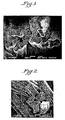
- Fig. 1 is an image of a photomicrograph (1000 x magnification) of an embodiment of the bicomponent fiber of the invention comprising poly(ethylene terephthalate) and poly(trimethylene terephthalate) and having a tetrachannel scalloped oval cross-section wherein the polymer interface is perpendicular to the major axis.
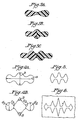
- Fig. 2 is an image of a photomicrograph (1000x magnification) of a bicomponent fiber comprising poly(ethylene terephthalate) and poly(trimethylene terephthalate) having a scalloped oval cross-section wherein the polymer interface is parallel to the major axis.
- Fig. 3A, 3B, and 3C are graphical representations of idealized cross-sections of embodiments of the bicomponent fiber of the invention.
- Fig. 4A and 4B are graphical representations showing cross-sectional dimensions of embodiments of the fiber of the invention.
- Fig. 5 shows a typical spinneret orifice for spinning fibers with a tetrachannel scalloped oval cross-section.
- Fig. 6 shows a typical spinneret orifice for spinning fibers with an octachannel scalloped oval cross-section.
- polyester bicomponent staple fiber comprising poly(trimethylene terephthalate) and having a scalloped oval cross-section shape and a polymer interface substantially perpendicular to the major axis of the cross-section gives spun yarns which have high boil-off shrinkage and unexpectedly high uniformity.
- High boil-off shrinkage indicates that the yarn possesses high stretch-and recovery properties, which is desirable for today's fabrics.
- High yarn uniformity can provide uniform fabric appearance, which is a generally desirable quality.
- the polyester bicomponent staple fiber has a wicking sufficient for a circular knit fabric comprising a spun yarn comprising 100 weight percent (wt%) of the bicomponent fiber to be at least 70 percent dry at 14 minutes by the percent dry time test.
- a fiber's wicking characteristics can provide moisture management properties to the yarn and to the fabric comprising it, which in turn can provide enhanced comfort to the wearer.
- bicomponent fibers means staple fibers in which two polymers of the same general class have a side-by-side or eccentric sheath-core cross-section configuration and includes both crimped fibers and fibers with latent crimp that has not yet been realized.
- side-by-side means that the two components of the bicomponent fiber are immediately adjacent to one another and that no more than a minor portion of either component is within a concave portion of the other component.
- Eccentric sheath-core means that one of the two components completely surrounds the other component but that the two components are not coaxial.
- aspects ratio means the ratio of the length of the major axis (a) of the fiber cross-section to the length of the minor axis (b) of the fiber cross-section. Aspect ratio may be expressed as a:b.
- groove ratio means the average distance between the surfaces of the outermost bulges, taken from the center, of a grooved fiber cross-section divided by the average distance between the grooves of the fiber cross-section.
- polymer interface means the boundary between the two polymers of the bicomponent fiber.
- substantially perpendicular to the major axis includes within its meaning coincident with or parallel to the cross-section minor axis and does not preclude deviations from parallelism with the cross-section minor axis which may be especially evident adjacent to the surface of the fiber.
- One embodiment of the invention is a polyester bicomponent staple fiber comprising poly(trimethylene terephthalate) and at least one polymer selected from the group consisting of poly(ethylene terephthalate), poly(trimethylene terephthalate), and poly(tetramethylene terephthalate) or a combination of such members, the bicomponent staple fiber having a scalloped oval cross-section shape having an aspect ratio a:b of about 2:1 to about 5:1 wherein 'a' is a fiber cross-section major axis length and 'b' is a fiber cross-section minor axis length, a polymer interface substantially perpendicular to the major axis of the cross-section, a cross-section configuration selected from the group consisting of side-by-side and eccentric sheath-core, a plurality of longitudinal grooves, and a groove ratio of about 1.05:1 to about 1.9:1.
- Another embodiment is the staple fiber of the invention wherein the aspect ratio a:b is about 2.2:1 to about 3.5:1 and the groove ratio is about 1.1:1 to about 1.5:1.
- Another embodiment is the staple fiber of the invention having a tenacity at 10% elongation of about 1.0 cN/dtex to about 3.5 cN/dtex.
- Another embodiment is the staple fiber of the invention having a wicking sufficient for a circular knit fabric comprising a spun yarn comprising 100 wt% of the bicomponent fiber to be at least 70 percent dry at 14 minutes by the percent dry time test.
- Another embodiment is the staple fiber of the invention having a tow crimp development value of about 25% to about 55% and a tow crimp index value of about 10% to about 25%.
- Another embodiment is the staple fiber of the invention having a weight ratio of at least about 30:70 and no more than about 70:30 of poly(trimethylene terephthalate) to the at least one polymer selected from the group consisting of poly(ethylene terephthalate), poly(trimethylene terephthalate), and poly(tetramethylene terephthalate) or a combination of such members.
- Another embodiment is the staple fiber of the invention, herein the fiber has a tetrachannel cross-section shape.
- Another embodiment is the staple fiber of the invention, wherein the fiber has a bichannel cross-section shape.
- Another embodiment is the staple fiber of the invention, wherein the fiber comprises poly(ethylene terephthalate) and poly(trimethylene terephthalate).
- Another embodiment is the staple fiber of the invention, wherein the fiber comprises poly(trimethylene terephthalate) and poly(trimethylene terephthalate).
- Another embodiment of the invention is a polyester bicomponent staple fiber comprising poly(ethylene terephthalate) and poly(trimethylene terephthalate), the bicomponent staple fiber having a scalloped oval cross-section shape having an aspect ratio a:b of about 2.2:1 to about 3.5:1 wherein 'a' is a fiber cross-section major axis length and 'b' is a fiber cross-section minor axis length, a polymer interface substantially perpendicular to the major axis of the cross-section, a cross-section configuration selected from the group consisting of side-by-side and eccentric sheath-core, a plurality of longitudinal grooves, a groove ratio of about 1.1:1 to about 1.5:1, and a tenacity at 10% elongation of about 1.0 cN/dtex to about 3.5 cN/dtex.
- Yet another embodiment is a spun yarn comprising cotton and the staple fiber of the invention, wherein the spun yarn has a cotton count of about 14 to about 60 and a quality factor of about 0.1 to about 500.
- Another embodiment is the spun yarn of the invention, wherein the spun yarn has a total boil-off shrinkage from about 20% to about 45%.
- Another embodiment is the spun yarn of the invention having a coefficient of variation of mass from about 13% to about 20%.
- Another embodiment is the spun yarn of the invention, wherein the bicomponent staple fiber has a tetrachannel cross-section shape.
- Another embodiment is the spun yarn of the invention, wherein the bicomponent staple fiber has a bichannel cross-section shape.
- Another embodiment is the spun yarn of the invention, wherein the bicomponent staple fiber is present at a level of about 30 weight percent to about 100 weight percent, based on total weight of the spun yam.
- Another embodiment is the spun yarn of the invention, further comprising about 30 weight percent to about 69 weight percent poly(ethylene terephthalate) monocomponent staple fiber.
- Another embodiment is the spun yarn of the invention, wherein the bicomponent staple fiber comprises poly(ethylene terephthalate) and poly(trimethylene terephthalate).
- Another embodiment is the spun yarn of the invention, wherein the bicomponent staple fiber comprises poly(trimethylene terephthalate) and poly(trimethylene terephthalate).
- Another embodiment of the invention is a spun yarn comprising cotton and a polyester bicomponent staple fiber comprising poly(ethylene terephthalate) and poly(trimethylene terephthalate), the bicomponent staple fiber having a scalloped oval cross-section shape having an aspect ratio a:b of about 2.2:1 to about 3.5:1 wherein 'a' is a fiber cross-section major axis length and 'b' is a fiber cross-section minor axis length, a polymer interface substantially perpendicular to the major axis of the cross-section, a cross-section configuration selected from the group consisting of side-by-side and eccentric sheath-core, a plurality of longitudinal grooves, a groove ratio of about 1.1:1 to about 1.5:1, and a tenacity at 10% elongation of about 1.0 cN/dtex to about 3.5 cN/dtex, wherein the spun yarn has a cotton count of about 14 to about 60 and a quality factor of about 0.1 to about 500.
- Yet another embodiment is a fabric comprising the spun yarn of the invention.
- Another embodiment is a fabric comprising the staple fiber of the invention and having wicking sufficient for the fabric to be at least 60 percent dry at 14 minutes by the percent dry time test, wherein the fabric has a finished basis weight of about 3.0 ounces per square yard (102 grams per square meter) to about 8.5 ounces per square yard (288 grams per square meter).
- Another embodiment is the fabric of the invention, wherein the finished basis weight is about 6.0 ounces per square yard (203 grams per square meter) to about 8.0 ounces per square yard (271 grams per square meter).
- the fabric of the invention comprising a polyester bicomponent staple fiber comprising poly(ethylene terephthalate) and poly(trimethylene terephthalate), the bicomponent staple fiber having a scalloped oval cross-section shape having an aspect ratio a:b of about 2.2:1 to about 3.5:1 wherein 'a' is a fiber cross-section major axis length and 'b' is a fiber cross-section minor axis length, a polymer interface substantially perpendicular to the major axis of the cross-section, a cross-section configuration selected from the group consisting of side-by-side and eccentric sheath-core, a plurality of longitudinal grooves, a groove ratio of about 1.1:1 to about 1.5:1, and a tenacity at 10% elongation of about 1.0 cN/dtex to about 3.5 cN/dtex, wherein the fabric has a finished basis weight of about 3.0 ounces per square yard (102 grams per square meter) to about 8.5 ounces
- Another embodiment is the fabric of the invention, wherein the finished basis weight is about 6.0 ounces per square yard (203 grams per square meter) to about 8.0 ounces per square yard (271 grams per square meter).
- Yet another embodiment of the invention is a polyester bicomponent staple fiber mixture
- a polyester bicomponent staple fiber mixture comprising a first staple fiber and a second staple fiber, said first and said second staple fiber each comprising poly(trimethylene terephthalate) and at least one polymer selected from the group consisting of poly(ethylene terephthalate), poly(trimethylene terephthalate), and poly(tetramethylene terephthalate) or a combination of such members
- said first bicomponent staple fiber having a scalloped oval cross-section shape having an aspect ratio a:b of about 2:1 to about 5:1 wherein 'a' is a fiber cross-section major axis length and 'b' is a fiber cross-section minor axis length, a polymer interface substantially perpendicular to the major axis, a cross-section configuration selected from the group consisting of side-by-side and eccentric sheath-core, a plurality of longitudinal grooves, and a groove ratio of about 1.05:1 to about
- Yet another embodiment is a spun yarn comprising cotton and the staple fiber mixture of the invention, wherein the spun yarn has a cotton count of about 14 to about 60 and a quality factor of about 0.1 to about 500.
- Another embodiment is a spun yarn comprising cotton and the staple fiber mixture of the invention, the spun yarn having a total boil-off shrinkage from about 20% to about 45%.
- Another embodiment is a spun yarn comprising cotton and the staple fiber mixture of the invention, the spun yarn having a coefficient of variation of mass from about 13% to about 20%.
- Another embodiment is a spun yarn comprising cotton and the staple fiber mixture of the invention, wherein the bicomponent staple fiber mixture is present at a level of about 30 weight percent to about 100 weight percent, based on total weight of the spun yarn.
- Another embodiment is a spun yarn comprising cotton and the staple fiber mixture of the invention, the spun yarn further comprising about 30 weight percent to about 69 weight percent poly(ethylene terephthalate) monocomponent staple fiber.
- Another embodiment is a spun yarn comprising cotton and the staple fiber mixture of the invention, wherein the bicomponent staple fiber mixture comprises poly(ethylene terephthalate) and poly(trimethylene terephthalate).
- Yet another embodiment is a fabric comprising a spun yarn comprising cotton and the polyester bicomponent staple fiber mixture of the invention, wherein the spun yarn has a cotton count of about 14 to about 60 and a quality factor of about 0.1 to about 500.
- Another embodiment is a fabric comprising a spun yarn comprising cotton and the polyester bicomponent staple fiber mixture of the invention, wherein the bicomponent staple fiber mixture is present at a level of about 30 weight percent to about 100 weight percent, based on total weight of the spun yam.
- Another embodiment is a fabric comprising a spun yarn comprising cotton and the staple fiber mixture of the invention, the spun yarn further comprising about 30 weight percent to about 69 weight percent poly(ethylene terephthalate) monocomponent staple fiber.
- Another embodiment is a fabric comprising a spun yarn comprising cotton and the staple fiber mixture of the invention, wherein the bicomponent staple fiber mixture comprises poly(ethylene terephthalate) and poly(trimethylene terephthalate).
- Another embodiment is a fabric comprising the staple fiber mixture of the invention and having wicking sufficient for the fabric to be at least 60 percent dry at 14 minutes by the percent dry time test, wherein the fabric has a finished basis weight of about 3.0 ounces per square yard (102 grams per square meter) to about 8.5 ounces per square yard (288 grams per square meter).
- Another embodiment is a fabric comprising the staple fiber mixture of the invention and having wicking sufficient for the fabric to be at least 60 percent dry at 14 minutes by the percent dry time test, wherein the fabric has a finished basis weight of about 6.0 ounces per square yard (203 grams per square meter) to about 8.0 ounces per square yard (271 grams per square meter).
- Yet another embodiment is a garment comprising the fabric of the invention.
- Another embodiment is a nonwoven fabric comprising the staple fiber of the invention.
- the polyester bicomponent staple fiber of the invention comprises poly(trimethylene terephthalate) and at least one polymer selected from the group consisting of poly(ethylene terephthalate), poly(trimethylene terephthalate), and poly(tetramethylene terephthalate) or a combination of such members.
- the fiber has a substantially oval cross-section shape and has a plurality of longitudinal grooves in the surface thereof. Such fibers can be considered to have a "scalloped oval" cross-section, for example of the type shown in Fig 3 .
- the average bulge angle of the inner bulges that is the average angle q between two lines tangent to the cross-section surface and laid at the point of inflection of curvature (in fibers with flat-sided grooves, the "deepest” part of the groove) on each side of each of the inner bulges, can be at least about 30°.
- the two lines tangent to the cross-section surface should cross on the same side of the fiber as the bulge whose angle is being measured. Fibers having two such grooves can be termed "bichannel”, fibers having four such grooves can be termed "tetrachannel”, six grooves "hexachannel”, eight grooves "octachannel”, and so on.
- the fiber of the invention has a substantially oval cross-section shape with an aspect ratio a:b of about 2:1 to about 5:1, for example from about 2.1:1 to about 3.9:1, or from about 2.2:1 to about 3.5:1.
- aspect ratio is too high or too low, the fiber can exhibit undesirable glitter and low dye yield, and spun yarn comprising the fiber can be of poor quality and insufficient uniformity.
- the groove ratio of the fiber cross-section may be at least about 0.75:1, for example at least about 1.05:1, or about 1.1:1, or about 1.5:1, and no greater than about 1.9:1.
- the groove ratio is too low, the fiber may provide insufficient wicking, and when it is too high, the fiber may be too easily split.
- the polyester bicomponent staple fiber of the invention has a polymer interface between the two polyesters which is substantially perpendicular to the major axis of the fiber cross-section.
- the polymer interface can be substantially linear or curved.
- the polyester bicomponent staple fiber of the invention comprises poly(trimethylene terephthalate) and at least one polymer selected from the group consisting of poly(ethylene terephthalate), poly(trimethylene terephthalate), and poly(tetramethylene terephthalate) or a combination of such members, in a weight ratio of from about 30:70 to about 70:30.
- the polymers may be, for example, poly(ethylene terephthalate) and poly(trimethylene terephthalate), poly(trimethylene terephthalate) and poly(tetramethylene terephthalate), or poly(trimethylene terephthalate) and poly(trimethylene) terephthalate, for example of different intrinsic viscosities, although different combinations are also possible.
- compositions can be similar, for example a poly(trimethylene terephthalate) homopolyester and a poly(trimethylene terephthalate) copolyester, optionally also of different viscosities.
- Other polyester bicomponent combinations are also possible, such as poly(ethylene terephthalate) and poly(tetramethylene terephthalate), or a combination of poly(ethylene terephthalate) and poly(ethylene terephthalate), for example of different intrinsic viscosities, or a poly(ethylene terephthalate) homopolyester and a poly(ethylene terephthalate) copolyester.
- polyesters comprising the fiber of the invention can be copolyesters, and "poly(ethylene terephthalate)", “poly(trimethylene terephthalate)”, and “poly(tetramethylene terephthalate)” include such copolyesters within their meanings.
- a copoly(ethylene terephthalate) can be used in which the comonomer used to make the copolyester is selected from the group consisting of linear, cyclic, and branched aliphatic dicarboxylic acids having 4-12 carbon atoms (for example butanedioic acid, pentanedioic acid, hexanedioic acid, dodecanedioic acid, and 1,4-cyclohexanedicarboxylic acid); aromatic dicarboxylic acids other than terephthalic acid and having 8-12 carbon atoms (for example isophthalic acid and 2,6-naphthatenedicarboxylic acid); linear, cyclic, and branched aliphatic diols having 3-8 carbon atoms (for example 1,3-propane diol, 1,2-propanediol, 1,4-butanediol, 3-methyl-1,5-pentanediol, 2,2-
- the comonomer can be present to the extent that it does not compromise the benefits of the invention, for example at levels of about 0.5-15 mole percent based on total polymer ingredients.
- Isophthalic acid, pentanedioic acid, hexanedioic acid, 1,3-propane diol, and 1,4-butanediol are preferred comonomers.
- the copolyester(s) can also be made with minor amounts of other comonomers, provided such comonomers do not have an adverse effect on the physical properties of the fiber.
- Such other comonomers include 5-sodium-sulfoisophthalate, the sodium salt of 3-(2-sulfoethyl) hexanedioic acid, and dialkyl esters thereof, which can be incorporated at about 0.2-4 mole percent based on total polyester.
- the (co)polyester(s) can also be mixed with polymeric secondary amine additives, for example poly(6,6'-imino-bishexamethylene terephthalamide) and copolyamides thereof with hexamethylenediamine, for example phosphoric acid and phosphorous acid salts thereof.
- polymeric secondary amine additives for example poly(6,6'-imino-bishexamethylene terephthalamide) and copolyamides thereof with hexamethylenediamine, for example phosphoric acid and phosphorous acid salts thereof.
- Small amounts for example about 1 to 6 milliequivalents per kg of polymer, of tri- or tetra-functional comonomers, for example trimellitic acid (including precursors thereto) or pentaerythritol, can be incorporated for viscosity control.
- the fiber of the present invention can also comprise conventional additives such as antistats, antioxidants, antimicrobials, flameproofing agents, dyestuffs, light stabilizers, and delustrants such as titanium dioxide, provided they do not detract from the benefits of the invention.
- conventional additives such as antistats, antioxidants, antimicrobials, flameproofing agents, dyestuffs, light stabilizers, and delustrants such as titanium dioxide, provided they do not detract from the benefits of the invention.
- the finish can be applied at a level (percent by total weight) of 0.05-0.30%.
- the finish can comprise 1) a blend of alkyl or branched phosphate esters, or 2) the potassium, calcium, or sodium salts of the corresponding phosphate acids, or a blend of the those two classes in any proportion, each of which can contain from 6 to 24 total carbon atoms in the aliphatic segments.
- the finish can also contain poly(ethylene oxide) and/or poly(propylene oxide), or short chain segments of such polyethers can be attached by esterification to aliphatic acids such as lauric acid, or by an ether linkage to alcohols such as sorbitol, glycerol, castor oil, coconut oil, or the like. Such compounds can also comprise amine groups.
- the finish can also contain minor amounts (for example less than 10%) of functional additives such as silicones or fluorochemicals.
- the finish can contain a blend of the potassium salts of mono- and di-acids containing about 18 carbons and an ethoxylated polyether containing 4-10 ethylene oxide segments made by reaction of an n-alkyl alcohol containing from 12 to 18 carbon atoms with a blend of polyethers.
- the crimps of the bicomponent fibers in the tow precursor to the staple fiber be deregistered, that is treated in such a way as to misalign the crimps of the fibers.
- the bicomponent staple tow does not require mechanical crimping in order for staple made therefrom to display good processability and useful properties.
- the bicomponent fiber can have an elongation to break of about 15% to about 50%, for example about 15% to about 35%, or for example about 15% to about 25%, or about 15% to about 20%.
- the bicomponent staple fiber can have a tow development ("CD") value of about 25% to about 55% and a crimp index (“CI") value of about 10% to about 25%.
- CD tow development
- CI crimp index
- the bicomponent staple fiber can be of any suitable length. If the bicomponent staple fiber is too short, it can be difficult to card. If it is too long, it can be difficult to spin on cotton system equipment. Accordingly, the length is typically sufficient for carding while also spinnable on cotton system equipment.
- An example of suitable bicomponent staple fiber length is about 1.3 cm to about 5.5 cm.
- the cotton can have a length of from about 2 to about 4 cm.
- the bicomponent fiber can have a linear density of about 0.7 dtex to about 3.0 dtex, for example about 0.9 dtex to about 2.5 dtex. When the bicomponent staple has a linear density above about 3.0 dtex, the yarn can have a harsh hand, and it can be hard to blend with the cotton. When it has a linear density below about 0.7 dtex, it can be difficult to card.
- the tenacity-at-break of the bicomponent staple fiber needs to be sufficient to avoid breakage during carding but not so high as to cause undesirable pilling of a fabric comprising the fiber.
- the tenacity-at-break can be, for example, about 3.2 to about 5.0 cN/dtex.
- the tenacity at 10% elongation (T10) needs to be sufficient to permit good carding of the bicomponent staple fiber, for example about 1.0 cN/dtex to about 3.5 cN/dtex, or for example about 1.8 to 3.0 cN/dtex.
- the weight ratio of one polyester to the other polyester can be about 30:70 to about 70:30, for example about 40:60 to about 60:40, or for example about 50:50.
- the bicomponent staple fiber can comprise one scalloped oval cross-section shape, or the bicomponent staple fiber can comprise a mixture of two or more cross-section shapes, at least one of the shapes having a scalloped oval cross-section.
- the bicomponent staple fiber may be a mixture of staple fibers having a tetrachannel scalloped oval cross-section shape and of staple fibers having a substantially oval cross-section shape without grooves.
- the bicomponent staple fiber may be a mixture of staple fibers having a tetrachannel scalloped oval cross-section shape and of staple fibers having a hexachannel scalloped oval cross-section shape.
- the bicomponent staple fiber may be a mixture of staple fibers, some having a tetrachannel shape, some having a hexachannel shape, and some having an octachannel shape.
- the mixture of cross-section shapes may be obtained by physically mixing staple fibers of different cross-section shapes.
- the mixture may be obtained by spinning bicomponent fibers from mixed shape capillaries, for example some capillaries providing a tetrachannel shape and some providing a hexachannel shape.
- a mixture of cross-section shapes may also be obtained by using two differently shaped spinnerets and blending the tow bands together.
- the poly(ethylene terephthalate) can have an intrinsic viscosity (IV) of about 0.50-0.65 dl/g.
- the poly(trimethylene terephthalate) can have an intrinsic viscosity of about 0.8-1.2 dl/g. It is believed that the poly(tetramethylene terephthalate)can have an intrinsic viscosity of about 0.6-1.1 dl/g.
- the ability of a fiber or fabric to wick moisture is the ability to distribute moisture to dry areas and thus increase the wet surface area. Increased surface area permits faster evaporation of the moisture and faster drying of the fabric. Fibers and fabrics which have improved wicking are generally perceived by the wearer as imparting greater comfort.
- the wicking of the scalloped oval bicomponent fiber of the invention is sufficient that fabric comprising the staple fiber and having a finished basis weight of about 3.0 ounces per square yard (oz/yd 2 ) (102 grams per square meter, g/m 2 ) to about 8.5 oz/yd 2 (288 g/m 2 ) can be at least 60 percent dry at 14 minutes by the percent dry time test.
- wicking of the scalloped oval bicomponent fiber of the invention is sufficient that a scoured, single jersey circular knit fabric of about 7.9 oz/yd 2 (268 g/m 2 ) finished basis weight and comprising a 22 Ne spun yarn comprising 100 wt% of about 1.5 denier (about 1.65 dtex) polyester bicomponent staple fiber of the invention can be at least about 70 percent dry at 14 minutes by the percent dry time test.
- the term "good wicking" is defined by the preceding statements.
- lower fabric basis weight can increase moisture wicking and reduce fabric drying time. Nonuniformities or imperfections in the fabric can influence moisture wicking and affect percent dry time test results.
- Fig. 1 is an image of a photomicrograph of the fibers prepared according to Example 1.
- the polymer interface is substantially perpendicular to the cross-section major axis.
- the blurred outline of some of the fiber cross sections is believed to be an artifact of the process used to cut the fibers.
- Fig. 2 is an image of a photomicrograph of the fibers prepared according to Comparison Example 1.
- Fig. 3A shows a graphical representation of an idealized bichannel bicomponent fiber having the polymer interface substantially perpendicular to the major axis of the fiber cross-section.
- Actual bichannel bicomponent fibers can be asymmetrical along the polymer interface, that is, the bichannel fibers may appear lopsided with more fiber cross-section area on one side of the polymer interface than on the other.
- Fig. 3B shows a graphical representation of an idealized tetrachannel bicomponent fiber having the polymer interface substantially perpendicular to the cross-section major axis.
- Fig. 3C shows a graphical representation of an idealized hexachannel bicomponent fiber having the polymer interface substantially perpendicular to the cross-section major axis.
- Fig. 4A shows an idealized cross-section of a fiber of the invention in which 'a' indicates the length of the major axis of the cross-section and 'b' indicates the length of the minor axis of the cross section.
- Fig. 4B shows a cross-section of a fiber of the invention in which 'd1' and 'd2' indicate the distances between the outermost bulges of the fiber, taken from the center, and 'c1' and 'c2' indicate the distances between the grooves of the fiber.
- Fib. 4B also shows angles q, each formed by two lines tangent to the cross-section surface and laid at the point of inflection of curvature on each side of an inner bulge.
- Cross-section aspect ratios and groove ratios of the fibers in the Examples were measured from photomicrographs of the fiber cross-sections.
- the aspect ratio of a tetrachannel fiber was calculated as a/b.
- the groove ratio of a tetrachannel fiber was calculated as (d1/c1 + d2/c2)/2.
- Fig. 5 shows a typical spinneret orifice for spinning fibers with a tetrachannel scalloped oval cross-section.
- Fig. 6 shows a typical spinneret orifice for spinning fibers with an octachannel scalloped oval cross-section.
- the scalloped oval bicomponent fibers can be spun from spin packs known in the art, for example as disclosed in United States Patent 6,656,586 , with the orifices arranged to give the desired interface orientation.
- the spun yarn of the invention has a cotton count of about 8 to about 60, for example about 14 to about 60, or about 16 to about 40, and comprises cotton and a polyester bicomponent staple fiber comprising poly(trimethylene terephthalate) and at least one polymer selected from the group consisting of poly(ethylene terephthalate), poly(trimethylene terephthalate), and poly(tetramethylene terephthalate) or a combination of such members.
- the spun yarn can have about 1 to about 70 thin regions per 1000 meters, for example about 15 to about 50 thin regions per 1000 meters.
- the spun yarn can have about 1 to about 400 thick regions, for example about 40 to about 320 per 1000 meters, and about 1 to about 200 neps per 1000 meters, for example about 10 to about 175.
- the spun yarn can have a total boil-off shrinkage of about 20% to about 45%, for example about 30% to about 45%. When the total boil-off shrinkage is less than about 20%, the stretch-and-recovery properties of the yarn are too low when the yarns are woven or knitted into fabrics.
- Yarn quality factor is a very useful measure of yarn quality, which can be calculated from the number of thin region, thick regions, neps, coefficient of variation of mass, and yarn strength.
- the spun yarn can have a yarn quality factor of about 0.1 to about 800, for example about 0.1 to about 510, or about 0.1 to about 200. When the quality factor is too high, the yarn can be insufficiently uniform.
- the spun yarn of the invention can have a coefficient of variation of mass of about 13% to about 20%, for example about 15% to about 17%.
- the spun yarn of the invention comprises the polyester bicomponent staple fiber of the invention, either as a single scalloped oval cross-section shape or as a polyester bicomponent staple fiber mixture having at least one scalloped oval cross-section shape.
- the spun yarn can have a tenacity-at-break of about 10 to about 20 cN/tex. When the tenacity is too low, yarn spinning can be difficult and weaving efficiency and fabric strength can be reduced.
- the linear density of the spun yarn can be about 0.1 to about 700 denier (110 to 770 dtex).
- the polyester bicomponent staple fiber can be present at a level of about 30 wt% to about 100 wt%, based on the total weight of the spun yarn.
- the yarn of the invention comprises less than about 30 wt% polyester bicomponent, the yarn can exhibit inadequate stretch and recovery properties.
- the spun yarn can comprise a second staple fiber selected from the group consisting of monocomponent poly(ethylene terephthalate), monocomponent poly(trimethylene terephthalate), cotton, wool, acrylic, and nylon staple fibers which can be present at about 1 wt% to about 70 wt%, based on total weight of the spun yam.
- the spun yarn of the invention can further comprise a third staple fiber selected from the same group and present at about 1 wt% to about 69 wt% based on the total weight of the spun yam; together the second and third staple fibers can be present at about 1 wt% to about 70 wt%, based on total weight of the spun yarn.
- a third staple fiber selected from the same group and present at about 1 wt% to about 69 wt% based on the total weight of the spun yam; together the second and third staple fibers can be present at about 1 wt% to about 70 wt%, based on total weight of the spun yarn.
- the staple fibers may be blended by a variety of means, for example by intimate blending.
- "Intimate blending” means the process of gravimetrically and thoroughly mixing dissimilar fibers in an opening room (for example with a weigh-panhopper feeder) before feeding the mixture to the card or of mixing the fibers in a dual feed chute on the card.
- the blended fibers are further processed by carding to form a card sliver, drawing the card sliver, doubling and redrawing the card sliver up to 3 times, converting the drawn sliver to roving, and ring-spinning the roving, for example with a twist multiplier of about 3 to 5.5, to form the spun yam.
- the yarn may be spun by commercially available processes such as ring, open end, air jet, and vortex spinning.
- Knit and woven stretch fabrics can be made from the spun yarn of the invention.
- Stretch fabric examples include circular, flat, and warp knits, and plain, twill, and satin wovens.
- the high uniformity and stretch characteristics of the spun yarn are typically carried through to the fabric as uniform appearance and high stretch and recovery, which in combination with the ability to wick and thus provide moisture management, are highly desirable for apparel.
- Garments such as pants, shirts, sportswear, uniforms, underwear, outer wear, gloves, and hats can be made from the stretch fabrics comprising the spun yarn of the invention.
- Stretch nonwoven fabrics can be made from the bicomponent staple fiber of the invention.
- Nonwoven fabrics can be used for expendable items such as wiping cloths, diapers, hospital sheets, napkins, and personal care items.
- Nonwoven fabrics can also be used as the base material for coated fabrics and in a variety of other applications, such as apparel and home furnishings.
- IV Intrinsic viscosity
- Linear density and tensile properties of the fibers were measured with a Favimat instrument from Textechno (Germany) in accordance with ASTM methods D1577 for linear density and D3822 for tenacity and elongation. Measurements were done on a minimum of 25 fibers and averages are reported.
- the fibers had substantially equal linear densities and polymer ratios of poly(ethylene terephthalate) to poly(trimethylene terephthalate). No mechanical crimp was applied to the bicomponent staple fibers in the Examples.
- tow Crimp Index a 1.2-meter sample of polyester bicomponent tow was weighed, and its denier was calculated; the tow linear density was typically about 40,000 to 50,000 denier (44,000 to 55,000 dtex). A single knot was tied at each end of the tow.
- Tension was applied to the vertical tow sample by applying a first clamp at the lower knot and hanging at least 40 mg/den (0.035 dN/tex) of weight on the knot at the upper end of the tow, which was directed over a stationary roller located at 1.1 m from the bottom end of the tow.
- the weight was selected so as to straighten the crimp from the tow without breaking the fibers. At this point the tow was essentially straight and all fiber crimp was removed.
- a second clamp was applied to the tow 100 cm above the first clamp while the weight was in place.
- references herein to crimp values of staple fibers indicate measurements made on the tow precursors to such fibers.
- Cardability of staple fibers which contained adequate finish to control static was evaluated by visual inspection of the card web and the coiling of the sliver. Fibers which produced a card web which was uniform in appearance and free of neps, and which had no coiler chokes during processing into sliver, were considered to exhibit good cardability. Fibers which did not meet these criteria were considered to have poor cardability.
- Percent dry time tests also known as percent dry with time tests or horizontal wicking determinations, were performed on fabric Comparison Examples and on fabric samples comprising spun yarn comprising the scalloped oval polyester bicomponent staple fiber. Percent dry time tests were done using a balance interfaced to a computer for automated calculations, for example a Mettler balance AE163 connected to a computer running a Mettler BalanceLink 3.0 program. The weight (W fabric ) of a circular sample of fabric 2 inches (5.1 cm) in diameter was obtained and recorded. Using an automated pipettor, 0.10 gram of tap water was placed on the balance and its exact weight (W H2O ) recorded.
- the 'true' shrinkage of the spun yarn was measured by applying a 200 mg/den (0.18 dN/tex) load, measuring the extended length, and calculating the percent difference between the before-boil-off and extended after-boil-off lengths.
- the true shrinkage of the samples was generally less than about 5%. Since true shrinkage constitutes only a minor fraction of total boil-off shrinkage, the latter is used herein as a reliable measure of the stretch-and-recovery characteristics of the spun yarns. Higher total boil-off shrinkage corresponds to desirably higher stretch-and-recovery.
- Yarn count is a term commonly used to describe the linear density of a spun yam.
- the uniformity of the spun yarns along their length was determined with a Uniformity 1-B Tester (made by Zellweger Uster Corp.) and reported as Coefficient of Variation ("CV") in percentage units.
- CV Coefficient of Variation
- yarn was fed into the Tester at 400 yds/min (366 m/min) for 2.5 minutes, during which the mass of the yarn was measured approximately every 8 mm.
- the standard deviation of the resulting data was calculated, multiplied by 100, and divided by the average mass of the yarn tested to arrive at percent CV.
- the Uniformity 1-B tester also determined an average numerical count of the number of thick regions, thin regions, and neps per 1000 yards of yarn. Thick regions in the yarn are those places having a mass at least 50% greater than the average mass.
- Thin regions in the yarn are those places having a mass at least 50% lower than the average mass.
- Neps are those places in the yarn having a mass at least 200% more than the average mass.
- Spun yarn tensile properties were determined using a Tensojet (also made by Zellweger Uster Corp.). Tenacities are reported as cN/tex.
- Fabrics are evaluated for percent elongation (available fabric stretch) under a specified load (i.e., force) in the direction of stretch.
- Three samples of dimensions 60 cm x 6.5 cm are cut from the fabric.
- the long dimension (60 cm) corresponds to the stretch direction.
- the samples are unraveled so that each is 5.0 cm in width and parallel to the grain of the fabric in the direction being tested.
- the samples are then conditioned for at least 16 hours at 20°C (+/- 2°C) and 65% relative humidity, (+/- 2%).
- a first benchmark is made across the width of each sample, at 6.5 cm from a sample end.
- a second benchmark is made across the sample width at 50.0 cm from the first benchmark. The excess fabric from the second benchmark to the other end of the sample is used to form and stitch a loop into which a metal pin can be inserted. A notch is then cut into the loop so that weights can be attached to the metal pin.
- the sample non-loop end is clamped and the fabric sample is hung vertically.
- a 30 Newton (N) weight (6.75 LB) is attached to the metal pin through the hanging fabric loop, so that the fabric sample is stretched by the weight.
- the sample is "exercised” by allowing it to be stretched by the weight for three seconds, and then manually relieving the force by lifting the weight. This is done three times.
- the weight is then allowed to hang freely, thus stretching the fabric sample.
- the distance in millimeters between the two benchmarks is measured while the fabric is under load, and this distance is designated ML.
- the original distance between benchmarks i.e., unstretched distance
- GL The original distance between benchmarks (i.e., unstretched distance)
- the three elongation results are averaged for the final result.
- the above fabric elongation test must be completed before the growth test. Only the stretch direction of the fabric is tested. For two-way stretch fabric both directions are tested. Three samples, each 55.0 cm x 6.0 cm, are cut from the fabric. These are different samples from those used in the elongation test. The 55.0 cm direction should correspond to the stretch direction. The samples are unraveled so that each is 5.0 cm in width and parallel to the grain of the fabric in the direction being tested. The samples are conditioned at temperature and humidity as in the above elongation test. Two benchmarks exactly 50 cm apart are drawn across the width of the samples.
- Circular knit fabrics are evaluated for percent stretch in the wale or course direction under a specified load in the direction of stretch.
- Two samples of dimensions 1.25 inches (3.2 centimeters) by 12 inches (30.5 centimeters) are cut from the knit fabric.
- the long dimension (12 inches, 30.5 centimeters) corresponds to the course direction for one sample and to the wale direction for the other.
- the sample is hung vertically with a clamp at each end such that the length of unstretched fabric between the clamps is set to 27.5 centimeters.
- One of the clamps is fixed in place while the other is capable of moving on a track in order to extend the fabric.
- a 6.75 pound (30 Newtons) weight is hung on the movable clamp, and the length of the extended fabric is measured in centimeters. Percent stretch in the direction measured is given as the extended fabric length divided by 27.5, converted to a percentage.
- Neps refers to the number of places per 1000 yards of yarn having a mass at least 200% more than the average mass. The number of thicks, thins, and neps reported is as measured by the Uster Uniformity 1-B tester. "Filling” refers to weft yam.
- the monocomponent poly(ethylene terephthalate) staple fiber used in some of the Comparison Examples was T-729W, which is commercially available from Invista S. à r. I.
- This fiber has a tetrachannel scalloped oval cross-section with a semi-dull luster, 1.4 denier per filament (dpf), and a cut length of 1.5 inches (3.8 cm).
- the aspect ratio of the cross-section is believed to be 2.0.
- Table 1 contains scalloped oval bicomponent fiber preparation conditions not described in the text.
- Table 2 contains scalloped oval bicomponent fiber properties not described in the text.
- Continuous bicomponent filaments of poly(ethylene terephthalate) (T211 from Intercontinental Polymers, Inc., 0.56 dl/g IV), and Sorona® brand poly(trimethylene terephthalate) (Sorona® is a registered trademark of E.I. DuPont de Nemours and Company) having an IV of 0.94 dl/g, were extruded in a 50/50 weight ratio from a block operated at 272 °C via metering pumps to a bicomponent spin pack provided with etched metering plates which joined the polymer streams directly above the counterbore of the spinneret capillaries.
- a delusterant of particulate TiO 2 was added to both polymers at a level of 0.1-0.4% by weight.
- the polymers were spun from a 288-hole spinneret in which the capillaries were 0.38 mm in depth and had a cross-section that was a 0.58 mm long slot with outward triangular bulges in the middle of each long side (maximum width 0.14 mm) and on the ends (maximum width 0.11 mm).
- the polymer interface was substantially perpendicular to the major axis of the resulting scalloped oval cross-section fiber.
- the just-spun fibers were cooled with a cross-flow of air applied at a mass ratio (air/polymer) of about 10-14, spin finish was applied with a metered contact applicator at 0.1 wt%, and the tetrachannel scalloped oval fibers were wound up on bobbins at 1000 m/min.
- the aspect ratio of the fibers was measured to be about 2.57 (see Fig. 1 ).
- the groove ratio was measured to be about 1.3:1.
- Fibers from a plurality of bobbins were combined into a tow of approximately 50,000 dtex and drawn in two stages using first and second draw ratios of 2.69 and 1.28, respectively, with a final speed of 50 m/min.
- the first draw was performed at 35 °C in a water bath, and the second draw, under a hot-water spray at 90 °C.
- the drawn tow was heat-treated at 150 °C, cooled to below 30 °C with a dilute finish oil/water spray (0.20 wt% on fiber), and passed to a puller roll operated at a slower speed than the last draw roll.
- the tow was dried at room temperature and cut to 1.5 inches (3.8 cm) staple length.
- Polyester bicomponent staple fiber was made as described in Example 1 with the following differences.
- the polymers were spun from a spinneret as shown in Figure 6 and having the following dimensions: 1.34 mm long by 0.45 mm wide at the central peak, and 0.34 mm wide at the ends.
- the poly(ethylene terephthalate) IV was 0.56, and the poly(trimethylene terephthalate) IV was 0.98.
- Draw ratios were 2.71 and 1.28, respectively.
- the fiber cross-section was an octachannel scalloped oval with a measured aspect ratio of about 1.97.
- the groove ratio was measured to be about 1.2:1.
- Polyester bicomponent staple fiber was made as described in Example 1, with the following differences.
- Bichannel scalloped oval fibers were extruded in a 60/40 weight ratio of poly(ethylene terephthalate)/poly(trimethylene terephthalate) from a 288 hole spinneret in which the capillaries were 0.25 mm in depth and had cross-sections that were 0.36 mm long slots with rounded ends of 0.18 mm diameter.
- the poly(ethylene terephthalate) IV was 0.56, the poly(trimethylene terephthalate) IV was 0.98, and the first draw ratio was 2.75.
- the fibers had a measured aspect ratio of about 2.2 and a measured groove ratio of about 1.8:1 based on the smaller outer bulge.
- Polyester bicomponent staple fiber was made as described in Example 1, with the following differences. Scalloped oval fibers (see Figure 2 ) with the polymer interface parallel to the major axis of the cross-section were spun through orifices of configuration essentially as shown in Figure 5 . The orifices were arranged to give the desired interface orientation.
- the poly(trimethylene terephthalate) IV was 0.98, the first draw ratio was 2.71, and let-down ratio was 0.85.
- the aspect ratio of the fibers was measured to be about 2.2 and the groove ratio was measured to be about 1.3:1.
- Spun yarns were prepared that comprised the polyester bicomponent staple fiber samples made in Examples 1-3, Comparative Example 1, or commercially available monocomponent poly(ethylene terephthalate) staple fiber.
- the cotton was Standard Strict Low Midland Eastern Variety with an average micronaire of 4.3 (about 1.5 denier per fiber, 91.7 dtex per fiber)).
- the bicomponent staple was intimately blended to produce the yarns.
- the cotton and the polyester bicomponent staple fiber were blended by loading both into a dual feed chute feeder, which fed a standard textile card.
- the amount of bicomponent polyester staple in each yarn was 60 wt%, based on the weight of the fiber.
- the resulting card sliver was 70 grain/yard (about 49,500 dtex).
- the data in Table 3 show that the spun yarns comprising the scalloped oval fibers of the invention have good tenacity, and excellent stretch-and-recovery properties as evidenced by the high boil-off shrinkage values.
- the spun yarns comprising the scalloped oval fibers of the invention also have high uniformity, as seen by the yarn quality factor, the %CV, and the low frequency of thicks, thins, and neps.
- the spun yarn of Comparison Example 2 which comprises a scalloped oval fiber having the polymer interface parallel to the cross-section major axis, also has tenacity and stretch-and-recovery properties comparable to those of the spun yarns comprising the staple fiber of the invention.
- Comparison Example 2 is significantly inferior, as evidenced by the higher %CV, the significantly higher frequency of thicks, thins, and neps, and the higher yarn quality factor, as compared to the spun yarns of Examples 4-7.
- the spun yarns of Comparison Examples 3 and 4 which comprise commercially available scalloped oval monocomponent poly(ethylene terephthalate) staple fiber, are seen to have the best yarn quality and the highest tenacity, but essentially no stretch-and-recovery properties as shown by the very low boil-off shrinkage values.
- Woven twill (3x1) and plain weave (1x1) fabrics were made as indicated in Table 4. Circular knit fabrics were made as indicated in Table 5. Woven and knit fabric properties are reported in Tables 6A and 6B, respectively.
- spun yarns of the invention or of comparison fibers were used as the weft (fill) or knitting yarn and 100% cotton or blended staple spun yarns were used as warp yarns.
- the warp yarns were sized before beaming. The sizing was performed on a Suziki single end sizing machine using PVA sizing agent.
- Woven fabrics were woven on a Donier air-jet loom with loom speed at 500 picks/minute. Each woven fabric sample was processed by scouring in water at 160 °F (71°C) for 30 seconds, then at 180 °F (82 °C) for 30 seconds, then at 202 °F (94 °C) for 30 seconds. Next, each fabric was de-sized using a standard enzyme process. The fabrics were then dyed following conventional procedures. The 100% polyester woven fabrics were dyed with a disperse dye at 260 °F (127°C) for 30 minutes. The woven polyester/cotton fabrics were dyed with a disperse dye, then additionally direct dyed at the boil for 30 minutes using conventional procedures.
- the fabrics were then after-scoured, treated with a softening and hydrophilic agent, and then air-dried at about 20°C until dry.
- the woven fabrics were heat set at 350 °F (177 °C) for 80 seconds. During heat setting, the fabrics were attached to the tenter frame at or slightly under their dyed width.
- Knit fabrics were knitted in a single jersey construction.
- the machine used was 42 feed, 26 inch (66 centimeter, cm) diameter, with 2232 needles circular knitting machine manufactured by Monarch Knitting Machinery Corporation (Monroe, North Carolina, USA).
- Monarch Knitting Machinery Corporation Monarch Knitting Machinery Corporation (Monroe, North Carolina, USA).
- the knit fabrics were slit and laid flat. The full open width of all fabrics at this stage was 68 inches (173 cm).
- a set of marks was made on the center of the fabrics separated by 50 cm in both the wale and course direction. All fabrics were first dispersed dyed at 266 °F (130 °C) for 20 minutes following standard dye procedures. Fabrics of Examples 13 and Comparison Example 11 were then additionally direct dyed at 185 °F (85 °C) for 60 minutes.
- the data show all the circular knit fabric samples to have about the same percent contraction in the course direction, and the knits comprising the fiber of the invention to have significantly higher percent contraction in the wale direction (37% and 33%).
- the higher wale-direction percent stretch and the higher wale-direction percent contraction results for the circular knits comprising the scalloped oval staple fiber of the invention reflect the high stretch-and-recovery properties of the bicomponent staple fiber of the invention.
- Fabric Examples 10 and 13 also demonstrated wicking sufficient for them to be at least 62 percent dry at 14 minutes by the percent dry time test.
- Fabric Examples 10 and 13 also demonstrated wicking sufficient for them to be at least 62 percent dry at 14 minutes by the percent dry time test.
- Comparison Example 5 which comprised the scalloped oval fiber having the polymer interface parallel to the major cross-section axis, was evaluated for wicking by the percent dry time test despite the surface roughness resulting from the poor yarn quality.
- the initial wicking rate of such fibers is disclosed in United States Patent 6,656,586 to be at least 3.5 cm/min as measured on a scoured single jersey circular knit fabric of about 190 grams per square meter (5.60 ounces per square yard) basis weight and comprising solely about 70 denier (78 decitex) fibers of 34 continuous filaments each, using the test method described in the referenced patent.
- Comparison Example 5 demonstrated desirable high percent stretch (22.3%) but undesirably high percent growth (3.8%), as well as relatively low wicking by the percent dry time test (47% dry at 14 minutes, 61% dry at 18 minutes).
- the fabrics of Comparison Examples 6-11 showed good wicking by the percent dry time method and very low percent growth, but also much less of the desired percent stretch.
- Percent dry with time results for circular knit fabric samples are presented in Table 7.
- Percent dry with time results for woven twill fabric samples are presented in Table 8.
- Percent dry with time results for plain weave fabric samples are presented in Table 9.
- Circular knit fabric Example 10 having a finished basis weight of 7.93 ounces per square yard (269 grams per square meter) and comprising a spun yarn comprising 100 weight percent of the scalloped oval bicomponent polyester fiber, demonstrated wicking sufficient for the fabric to be about 80 percent dry at 14 minutes. The fabric was about 96 percent dry at 18 minutes.
- Fabric Example 13 which had a finished basis weight of 7.49 ounces per square yard (254 grams per square meter) and comprised a spun yarn comprising 60 weight percent scalloped oval bicomponent polyester fiber and 40 weight percent cotton, demonstrated wicking sufficient for the fabric to be about 62 percent dry at 14 minutes. The fabric was about 77 percent dry at 18 minutes.
- Fabric Examples 9 and 12 also comprised tetrachannel scalloped oval polyester bicomponent fiber. Fabric samples 9 and 12 displayed wicking sufficient for the fabrics to be about 70 and about 74 percent dry, respectively, at 14 minutes. The fabrics were about 85 and about 91 percent dry, respectively, at 18 minutes. Finished basis weight was 6.63 ounces per square yard (225 grams per square meter) for Example 9 and 4.74 ounces per square yard (161 grams per square meter) for Example 12.
Landscapes
- Engineering & Computer Science (AREA)
- Textile Engineering (AREA)
- Mechanical Engineering (AREA)
- Chemical & Material Sciences (AREA)
- Chemical Kinetics & Catalysis (AREA)
- General Chemical & Material Sciences (AREA)
- Yarns And Mechanical Finishing Of Yarns Or Ropes (AREA)
- Artificial Filaments (AREA)
- Multicomponent Fibers (AREA)
- Knitting Of Fabric (AREA)
- Woven Fabrics (AREA)
- Nonwoven Fabrics (AREA)
- Spinning Methods And Devices For Manufacturing Artificial Fibers (AREA)
Applications Claiming Priority (2)
| Application Number | Priority Date | Filing Date | Title |
|---|---|---|---|
| US11/238,468 US8513146B2 (en) | 2005-09-29 | 2005-09-29 | Scalloped oval bicomponent fibers with good wicking, and high uniformity spun yarns comprising such fibers |
| PCT/US2006/032373 WO2007040848A1 (en) | 2005-09-29 | 2006-08-17 | Scalloped oval bicomponent fibers with good wicking, and high uniformity spun yarns comprising such fibers |
Publications (2)
| Publication Number | Publication Date |
|---|---|
| EP1945839A1 EP1945839A1 (en) | 2008-07-23 |
| EP1945839B1 true EP1945839B1 (en) | 2011-12-28 |
Family
ID=37603414
Family Applications (1)
| Application Number | Title | Priority Date | Filing Date |
|---|---|---|---|
| EP20060813537 Not-in-force EP1945839B1 (en) | 2005-09-29 | 2006-08-17 | Scalloped oval bicomponent fibers with good wicking, and high uniformity spun yarns comprising such fibers |
Country Status (10)
| Country | Link |
|---|---|
| US (1) | US8513146B2 (enExample) |
| EP (1) | EP1945839B1 (enExample) |
| JP (1) | JP4818369B2 (enExample) |
| KR (1) | KR101322154B1 (enExample) |
| CN (1) | CN101273159B (enExample) |
| AT (1) | ATE539186T1 (enExample) |
| BR (1) | BRPI0617536B1 (enExample) |
| ES (1) | ES2378250T3 (enExample) |
| TW (1) | TWI387669B (enExample) |
| WO (1) | WO2007040848A1 (enExample) |
Cited By (1)
| Publication number | Priority date | Publication date | Assignee | Title |
|---|---|---|---|---|
| US11359309B2 (en) | 2018-12-21 | 2022-06-14 | Target Brands, Inc. | Ring spun yarn and method |
Families Citing this family (16)
| Publication number | Priority date | Publication date | Assignee | Title |
|---|---|---|---|---|
| JP2010520384A (ja) * | 2007-03-05 | 2010-06-10 | コーロン インダストリーズ,インコーポレイテッド | ポリエステル原糸及びこれを含む織物 |
| US20080286513A1 (en) * | 2007-05-15 | 2008-11-20 | Invista North America S A R L | Knit fabrics and socks made therefrom incorporating high tensile nylon staple |
| CN102704019A (zh) * | 2012-06-28 | 2012-10-03 | 宁波华星轮胎有限公司 | 细旦扁平涤纶预取向丝的加工方法 |
| US10058808B2 (en) | 2012-10-22 | 2018-08-28 | Cummins Filtration Ip, Inc. | Composite filter media utilizing bicomponent fibers |
| CN103952788B (zh) * | 2014-04-10 | 2016-09-14 | 中国石化仪征化纤有限责任公司 | 一种改性聚酰胺酯短纤维及其制备方法 |
| KR20170038895A (ko) | 2014-08-07 | 2017-04-07 | 아빈티브 스페셜티 머티리얼즈 인크. | 자발권축 리본 섬유 및 그로부터 제조된 부직물 |
| KR102263901B1 (ko) * | 2014-08-20 | 2021-06-11 | 도레이 카부시키가이샤 | 위생 재료용 부직포 및 위생 재료 제품 |
| US9845555B1 (en) | 2015-08-11 | 2017-12-19 | Parkdale, Incorporated | Stretch spun yarn and yarn spinning method |
| US20190233982A1 (en) * | 2018-01-31 | 2019-08-01 | Parkdale Incorporated | Multi-length, multi-denier, multi-cross section fiber blend yarn |
| DE102018110246B4 (de) * | 2018-04-27 | 2020-12-31 | Johann Borgers GmbH | Faservliesformteil |
| US20210164131A1 (en) * | 2018-06-28 | 2021-06-03 | Dupont Industrial Biosciences Usa, Llc | Fabrics and spun yarns comprising polyester staple fiber |
| CN109183175B (zh) * | 2018-07-16 | 2021-02-26 | 大连理工大学 | 新型含二氮杂萘酮结构聚芳醚类纤维的制备工艺 |
| US11788210B1 (en) | 2018-09-10 | 2023-10-17 | Under Armour, Inc. | Athletic apparel |
| CN116113734B (zh) * | 2020-09-09 | 2024-04-05 | 尤尼吉可贸易有限公司 | 双层结构纺织纱线和编织品 |
| AU2023206000B2 (en) * | 2022-01-05 | 2024-11-14 | Fibertex Personal Care A/S | Nonwoven material comprising crimped multicomponent fibers |
| CN114908437B (zh) * | 2022-05-20 | 2023-11-07 | 常熟市海立复合材料有限公司 | 一种导湿速干型自卷曲弹性纤维及其制备方法和应用 |
Family Cites Families (38)
| Publication number | Priority date | Publication date | Assignee | Title |
|---|---|---|---|---|
| US3454460A (en) * | 1966-09-12 | 1969-07-08 | Du Pont | Bicomponent polyester textile fiber |
| US3536763A (en) * | 1967-08-30 | 1970-10-27 | Du Pont | Hydration of acrolein to hydracrylaldehyde |
| US3671379A (en) * | 1971-03-09 | 1972-06-20 | Du Pont | Composite polyester textile fibers |
| US3914488A (en) * | 1973-09-24 | 1975-10-21 | Du Pont | Polyester filaments for fur-like fabrics |
| US4156071A (en) * | 1977-09-12 | 1979-05-22 | E. I. Du Pont De Nemours And Company | Poly(ethylene terephthalate) flat yarns and tows |
| US4634625A (en) * | 1984-10-25 | 1987-01-06 | E. I. Du Pont De Nemours And Company | New fabrics, yarns and process |
| JPS6285026A (ja) | 1985-10-11 | 1987-04-18 | Toray Ind Inc | 織編物用ポリエステル複合ステ−プルフアイバ− |
| KR940011317B1 (ko) * | 1987-06-10 | 1994-12-05 | 가네보 가부시끼가이샤 | 경위 신축성 포백(經緯伸縮性布帛) 및 그 제조방법 |
| US5219506A (en) * | 1991-12-06 | 1993-06-15 | E. I. Du Pont De Nemours And Company | Preparing fine denier staple fibers |
| ATE149215T1 (de) | 1992-12-31 | 1997-03-15 | Hoechst Celanese Corp | Pillingarmes mischgarn aus polyester |
| US5723215A (en) * | 1994-09-30 | 1998-03-03 | E. I. Du Pont De Nemours And Company | Bicomponent polyester fibers |
| US5736243A (en) * | 1995-06-30 | 1998-04-07 | E. I. Du Pont De Nemours And Company | Polyester tows |
| US5968649A (en) * | 1995-06-30 | 1999-10-19 | E. I. Du Pont De Nemours And Company | Drawing of polyester filaments |
| US5626961A (en) | 1995-06-30 | 1997-05-06 | E. I. Du Pont De Nemours And Company | Polyester filaments and tows |
| US6013368A (en) * | 1995-06-30 | 2000-01-11 | E. I. Du Pont De Nemours And Company | Comfort by mixing deniers |
| US6371751B1 (en) * | 1995-06-30 | 2002-04-16 | E. I. Du Pont De Nemours And Company | Spinnerets with orifices for improved filament cross-sections |
| US5591523A (en) * | 1995-06-30 | 1997-01-07 | E. I. Du Pont De Nemours And Company | Polyester tow |
| US5874372A (en) * | 1996-10-30 | 1999-02-23 | Toyo Boseki Kabushiki Kaisha | Highly stretchable fabrics and process for producing same |
| US5834119A (en) * | 1997-01-03 | 1998-11-10 | E. I. Du Pont De Nemours And Company | Filament cross-sections |
| US5817740A (en) * | 1997-02-12 | 1998-10-06 | E. I. Du Pont De Nemours And Company | Low pill polyester |
| US6010789A (en) * | 1997-05-05 | 2000-01-04 | E. I. Du Pont De Nemours And Company | Polyester staple fiber |
| JP2000328382A (ja) | 1999-03-15 | 2000-11-28 | Teijin Ltd | 伸縮性紡績糸 |
| KR100754706B1 (ko) | 1999-06-14 | 2007-09-03 | 이 아이 듀폰 디 네모아 앤드 캄파니 | 신장 분할 방법 및 제품 |
| JP2003520303A (ja) | 2000-01-20 | 2003-07-02 | イー・アイ・デュポン・ドウ・ヌムール・アンド・カンパニー | 2成分繊維の高速紡糸方法 |
| US6685859B2 (en) | 2000-03-03 | 2004-02-03 | E. I. Du Pont De Nemours And Company | Processes for making poly(trimethylene terephthalate) yarn |
| JP2001288621A (ja) | 2000-04-03 | 2001-10-19 | Teijin Ltd | ポリエステル系複合繊維 |
| JP2002054029A (ja) | 2000-05-29 | 2002-02-19 | Toray Ind Inc | 高捲縮性ポリエステル系複合繊維 |
| US6458455B1 (en) * | 2000-09-12 | 2002-10-01 | E. I. Du Pont De Nemours And Company | Poly(trimethylene terephthalate) tetrachannel cross-section staple fiber |
| JP3680723B2 (ja) | 2000-10-12 | 2005-08-10 | 東レ株式会社 | 交織織物 |
| JP2002129433A (ja) | 2000-10-17 | 2002-05-09 | Toray Ind Inc | 高伸縮性ポリエステル系複合繊維 |
| JP3690274B2 (ja) | 2000-12-11 | 2005-08-31 | 東レ株式会社 | ポリエステル系複合糸およびその製造方法ならびに布帛 |
| JP3692931B2 (ja) | 2000-12-11 | 2005-09-07 | 東レ株式会社 | 潜在捲縮発現性を有するポリエステル系短繊維およびその製造方法 |
| US6656586B2 (en) * | 2001-08-30 | 2003-12-02 | E. I. Du Pont De Nemours And Company | Bicomponent fibers with high wicking rate |
| KR100538507B1 (ko) * | 2001-09-18 | 2005-12-23 | 아사히 가세이 셍이 가부시키가이샤 | 폴리에스테르계 복합 섬유 펀 및 그 제조 방법 |
| JP4450626B2 (ja) * | 2001-12-21 | 2010-04-14 | インビスタ テクノロジーズ エス エイ アール エル | ストレッチポリエステル/綿紡績糸 |
| US7036299B2 (en) * | 2001-12-21 | 2006-05-02 | Invista North America S.A.R.L. | Stretch polyster/cotton spun yarn |
| US20040067707A1 (en) * | 2002-10-04 | 2004-04-08 | Hamilton Lorne M. | Stretch polyester and acrylic spun yarn |
| US7195819B2 (en) * | 2004-04-23 | 2007-03-27 | Invista North America S.A.R.L. | Bicomponent fiber and yarn comprising same |
-
2005
- 2005-09-29 US US11/238,468 patent/US8513146B2/en not_active Expired - Fee Related
-
2006
- 2006-08-17 BR BRPI0617536A patent/BRPI0617536B1/pt not_active IP Right Cessation
- 2006-08-17 EP EP20060813537 patent/EP1945839B1/en not_active Not-in-force
- 2006-08-17 WO PCT/US2006/032373 patent/WO2007040848A1/en not_active Ceased
- 2006-08-17 KR KR1020087007539A patent/KR101322154B1/ko not_active Expired - Fee Related
- 2006-08-17 AT AT06813537T patent/ATE539186T1/de active
- 2006-08-17 JP JP2008533352A patent/JP4818369B2/ja not_active Expired - Fee Related
- 2006-08-17 CN CN2006800356838A patent/CN101273159B/zh not_active Expired - Fee Related
- 2006-08-17 ES ES06813537T patent/ES2378250T3/es active Active
- 2006-08-30 TW TW95131906A patent/TWI387669B/zh not_active IP Right Cessation
Cited By (2)
| Publication number | Priority date | Publication date | Assignee | Title |
|---|---|---|---|---|
| US11359309B2 (en) | 2018-12-21 | 2022-06-14 | Target Brands, Inc. | Ring spun yarn and method |
| US11767618B2 (en) | 2018-12-21 | 2023-09-26 | Target Brands, Inc. | Ring spun yarn and method |
Also Published As
| Publication number | Publication date |
|---|---|
| US20070071974A1 (en) | 2007-03-29 |
| CN101273159A (zh) | 2008-09-24 |
| EP1945839A1 (en) | 2008-07-23 |
| TW200720502A (en) | 2007-06-01 |
| KR101322154B1 (ko) | 2013-10-25 |
| TWI387669B (zh) | 2013-03-01 |
| US8513146B2 (en) | 2013-08-20 |
| JP4818369B2 (ja) | 2011-11-16 |
| ATE539186T1 (de) | 2012-01-15 |
| CN101273159B (zh) | 2012-07-04 |
| BRPI0617536B1 (pt) | 2017-02-21 |
| HK1124891A1 (en) | 2009-07-24 |
| BRPI0617536A2 (pt) | 2011-07-26 |
| ES2378250T3 (es) | 2012-04-10 |
| WO2007040848A1 (en) | 2007-04-12 |
| KR20080048047A (ko) | 2008-05-30 |
| JP2009510275A (ja) | 2009-03-12 |
Similar Documents
| Publication | Publication Date | Title |
|---|---|---|
| JP5112052B2 (ja) | 複合ファイバーおよびかかるファイバーを含む糸 | |
| EP1945839B1 (en) | Scalloped oval bicomponent fibers with good wicking, and high uniformity spun yarns comprising such fibers | |
| US6815060B2 (en) | Spun yarn | |
| US7240476B2 (en) | Stretch polyester/cotton spun yarn | |
| EP1549789B1 (en) | Stretch polyester and acrylic spun yarn | |
| EP1956121B1 (en) | Stretch polyester/cotton spun yarn | |
| JP2003155647A (ja) | ラッセルレース | |
| HK1124891B (en) | Scalloped oval bicomponent fibers with good wicking, and high uniformity spun yarns comprising such fibers | |
| JP7284882B1 (ja) | 編地、その製造方法及びそれを含む衣料 | |
| HK1105669B (en) | Bicomponent fiber and yarn comprising such fiber |
Legal Events
| Date | Code | Title | Description |
|---|---|---|---|
| PUAI | Public reference made under article 153(3) epc to a published international application that has entered the european phase |
Free format text: ORIGINAL CODE: 0009012 |
|
| 17P | Request for examination filed |
Effective date: 20080327 |
|
| AK | Designated contracting states |
Kind code of ref document: A1 Designated state(s): AT BE BG CH CY CZ DE DK EE ES FI FR GB GR HU IE IS IT LI LT LU LV MC NL PL PT RO SE SI SK TR |
|
| GRAP | Despatch of communication of intention to grant a patent |
Free format text: ORIGINAL CODE: EPIDOSNIGR1 |
|
| DAX | Request for extension of the european patent (deleted) | ||
| GRAS | Grant fee paid |
Free format text: ORIGINAL CODE: EPIDOSNIGR3 |
|
| GRAA | (expected) grant |
Free format text: ORIGINAL CODE: 0009210 |
|
| AK | Designated contracting states |
Kind code of ref document: B1 Designated state(s): AT BE BG CH CY CZ DE DK EE ES FI FR GB GR HU IE IS IT LI LT LU LV MC NL PL PT RO SE SI SK TR |
|
| REG | Reference to a national code |
Ref country code: GB Ref legal event code: FG4D |
|
| REG | Reference to a national code |
Ref country code: CH Ref legal event code: EP |
|
| REG | Reference to a national code |
Ref country code: AT Ref legal event code: REF Ref document number: 539186 Country of ref document: AT Kind code of ref document: T Effective date: 20120115 |
|
| REG | Reference to a national code |
Ref country code: IE Ref legal event code: FG4D |
|
| REG | Reference to a national code |
Ref country code: DE Ref legal event code: R096 Ref document number: 602006026752 Country of ref document: DE Effective date: 20120308 |
|
| REG | Reference to a national code |
Ref country code: ES Ref legal event code: FG2A Ref document number: 2378250 Country of ref document: ES Kind code of ref document: T3 Effective date: 20120410 |
|
| REG | Reference to a national code |
Ref country code: NL Ref legal event code: VDEP Effective date: 20111228 |
|
| PG25 | Lapsed in a contracting state [announced via postgrant information from national office to epo] |
Ref country code: LT Free format text: LAPSE BECAUSE OF FAILURE TO SUBMIT A TRANSLATION OF THE DESCRIPTION OR TO PAY THE FEE WITHIN THE PRESCRIBED TIME-LIMIT Effective date: 20111228 |
|
| LTIE | Lt: invalidation of european patent or patent extension |
Effective date: 20111228 |
|
| PG25 | Lapsed in a contracting state [announced via postgrant information from national office to epo] |
Ref country code: GR Free format text: LAPSE BECAUSE OF FAILURE TO SUBMIT A TRANSLATION OF THE DESCRIPTION OR TO PAY THE FEE WITHIN THE PRESCRIBED TIME-LIMIT Effective date: 20120329 Ref country code: SE Free format text: LAPSE BECAUSE OF FAILURE TO SUBMIT A TRANSLATION OF THE DESCRIPTION OR TO PAY THE FEE WITHIN THE PRESCRIBED TIME-LIMIT Effective date: 20111228 Ref country code: SI Free format text: LAPSE BECAUSE OF FAILURE TO SUBMIT A TRANSLATION OF THE DESCRIPTION OR TO PAY THE FEE WITHIN THE PRESCRIBED TIME-LIMIT Effective date: 20111228 Ref country code: LV Free format text: LAPSE BECAUSE OF FAILURE TO SUBMIT A TRANSLATION OF THE DESCRIPTION OR TO PAY THE FEE WITHIN THE PRESCRIBED TIME-LIMIT Effective date: 20111228 |
|
| PG25 | Lapsed in a contracting state [announced via postgrant information from national office to epo] |
Ref country code: BE Free format text: LAPSE BECAUSE OF FAILURE TO SUBMIT A TRANSLATION OF THE DESCRIPTION OR TO PAY THE FEE WITHIN THE PRESCRIBED TIME-LIMIT Effective date: 20111228 Ref country code: CY Free format text: LAPSE BECAUSE OF FAILURE TO SUBMIT A TRANSLATION OF THE DESCRIPTION OR TO PAY THE FEE WITHIN THE PRESCRIBED TIME-LIMIT Effective date: 20111228 |
|
| PG25 | Lapsed in a contracting state [announced via postgrant information from national office to epo] |
Ref country code: EE Free format text: LAPSE BECAUSE OF FAILURE TO SUBMIT A TRANSLATION OF THE DESCRIPTION OR TO PAY THE FEE WITHIN THE PRESCRIBED TIME-LIMIT Effective date: 20111228 Ref country code: CZ Free format text: LAPSE BECAUSE OF FAILURE TO SUBMIT A TRANSLATION OF THE DESCRIPTION OR TO PAY THE FEE WITHIN THE PRESCRIBED TIME-LIMIT Effective date: 20111228 Ref country code: NL Free format text: LAPSE BECAUSE OF FAILURE TO SUBMIT A TRANSLATION OF THE DESCRIPTION OR TO PAY THE FEE WITHIN THE PRESCRIBED TIME-LIMIT Effective date: 20111228 Ref country code: SK Free format text: LAPSE BECAUSE OF FAILURE TO SUBMIT A TRANSLATION OF THE DESCRIPTION OR TO PAY THE FEE WITHIN THE PRESCRIBED TIME-LIMIT Effective date: 20111228 Ref country code: BG Free format text: LAPSE BECAUSE OF FAILURE TO SUBMIT A TRANSLATION OF THE DESCRIPTION OR TO PAY THE FEE WITHIN THE PRESCRIBED TIME-LIMIT Effective date: 20120328 Ref country code: IS Free format text: LAPSE BECAUSE OF FAILURE TO SUBMIT A TRANSLATION OF THE DESCRIPTION OR TO PAY THE FEE WITHIN THE PRESCRIBED TIME-LIMIT Effective date: 20120428 |
|
| RAP2 | Party data changed (patent owner data changed or rights of a patent transferred) |
Owner name: INVISTA TECHNOLOGIES S.A.R.L. |
|
| PG25 | Lapsed in a contracting state [announced via postgrant information from national office to epo] |
Ref country code: PL Free format text: LAPSE BECAUSE OF FAILURE TO SUBMIT A TRANSLATION OF THE DESCRIPTION OR TO PAY THE FEE WITHIN THE PRESCRIBED TIME-LIMIT Effective date: 20111228 Ref country code: RO Free format text: LAPSE BECAUSE OF FAILURE TO SUBMIT A TRANSLATION OF THE DESCRIPTION OR TO PAY THE FEE WITHIN THE PRESCRIBED TIME-LIMIT Effective date: 20111228 Ref country code: PT Free format text: LAPSE BECAUSE OF FAILURE TO SUBMIT A TRANSLATION OF THE DESCRIPTION OR TO PAY THE FEE WITHIN THE PRESCRIBED TIME-LIMIT Effective date: 20120430 |
|
| REG | Reference to a national code |
Ref country code: AT Ref legal event code: MK05 Ref document number: 539186 Country of ref document: AT Kind code of ref document: T Effective date: 20111228 |
|
| PG25 | Lapsed in a contracting state [announced via postgrant information from national office to epo] |
Ref country code: DK Free format text: LAPSE BECAUSE OF FAILURE TO SUBMIT A TRANSLATION OF THE DESCRIPTION OR TO PAY THE FEE WITHIN THE PRESCRIBED TIME-LIMIT Effective date: 20111228 |
|
| PLBE | No opposition filed within time limit |
Free format text: ORIGINAL CODE: 0009261 |
|
| STAA | Information on the status of an ep patent application or granted ep patent |
Free format text: STATUS: NO OPPOSITION FILED WITHIN TIME LIMIT |
|
| 26N | No opposition filed |
Effective date: 20121001 |
|
| REG | Reference to a national code |
Ref country code: DE Ref legal event code: R097 Ref document number: 602006026752 Country of ref document: DE Effective date: 20121001 |
|
| PG25 | Lapsed in a contracting state [announced via postgrant information from national office to epo] |
Ref country code: AT Free format text: LAPSE BECAUSE OF FAILURE TO SUBMIT A TRANSLATION OF THE DESCRIPTION OR TO PAY THE FEE WITHIN THE PRESCRIBED TIME-LIMIT Effective date: 20111228 |
|
| REG | Reference to a national code |
Ref country code: CH Ref legal event code: PL |
|
| PG25 | Lapsed in a contracting state [announced via postgrant information from national office to epo] |
Ref country code: MC Free format text: LAPSE BECAUSE OF NON-PAYMENT OF DUE FEES Effective date: 20120831 |
|
| PG25 | Lapsed in a contracting state [announced via postgrant information from national office to epo] |
Ref country code: LI Free format text: LAPSE BECAUSE OF NON-PAYMENT OF DUE FEES Effective date: 20120831 Ref country code: CH Free format text: LAPSE BECAUSE OF NON-PAYMENT OF DUE FEES Effective date: 20120831 |
|
| REG | Reference to a national code |
Ref country code: IE Ref legal event code: MM4A |
|
| PG25 | Lapsed in a contracting state [announced via postgrant information from national office to epo] |
Ref country code: FI Free format text: LAPSE BECAUSE OF FAILURE TO SUBMIT A TRANSLATION OF THE DESCRIPTION OR TO PAY THE FEE WITHIN THE PRESCRIBED TIME-LIMIT Effective date: 20111228 |
|
| PG25 | Lapsed in a contracting state [announced via postgrant information from national office to epo] |
Ref country code: IE Free format text: LAPSE BECAUSE OF NON-PAYMENT OF DUE FEES Effective date: 20120817 |
|
| PG25 | Lapsed in a contracting state [announced via postgrant information from national office to epo] |
Ref country code: LU Free format text: LAPSE BECAUSE OF NON-PAYMENT OF DUE FEES Effective date: 20120817 |
|
| PG25 | Lapsed in a contracting state [announced via postgrant information from national office to epo] |
Ref country code: HU Free format text: LAPSE BECAUSE OF FAILURE TO SUBMIT A TRANSLATION OF THE DESCRIPTION OR TO PAY THE FEE WITHIN THE PRESCRIBED TIME-LIMIT Effective date: 20060817 |
|
| REG | Reference to a national code |
Ref country code: FR Ref legal event code: PLFP Year of fee payment: 11 |
|
| REG | Reference to a national code |
Ref country code: FR Ref legal event code: PLFP Year of fee payment: 12 |
|
| REG | Reference to a national code |
Ref country code: FR Ref legal event code: PLFP Year of fee payment: 13 |
|
| PGFP | Annual fee paid to national office [announced via postgrant information from national office to epo] |
Ref country code: ES Payment date: 20190902 Year of fee payment: 14 Ref country code: FR Payment date: 20190711 Year of fee payment: 14 Ref country code: IT Payment date: 20190821 Year of fee payment: 14 Ref country code: DE Payment date: 20190806 Year of fee payment: 14 Ref country code: TR Payment date: 20190807 Year of fee payment: 14 |
|
| PGFP | Annual fee paid to national office [announced via postgrant information from national office to epo] |
Ref country code: GB Payment date: 20190815 Year of fee payment: 14 |
|
| REG | Reference to a national code |
Ref country code: DE Ref legal event code: R119 Ref document number: 602006026752 Country of ref document: DE |
|
| GBPC | Gb: european patent ceased through non-payment of renewal fee |
Effective date: 20200817 |
|
| PG25 | Lapsed in a contracting state [announced via postgrant information from national office to epo] |
Ref country code: DE Free format text: LAPSE BECAUSE OF NON-PAYMENT OF DUE FEES Effective date: 20210302 Ref country code: FR Free format text: LAPSE BECAUSE OF NON-PAYMENT OF DUE FEES Effective date: 20200831 Ref country code: IT Free format text: LAPSE BECAUSE OF NON-PAYMENT OF DUE FEES Effective date: 20200817 |
|
| PG25 | Lapsed in a contracting state [announced via postgrant information from national office to epo] |
Ref country code: GB Free format text: LAPSE BECAUSE OF NON-PAYMENT OF DUE FEES Effective date: 20200817 |
|
| REG | Reference to a national code |
Ref country code: ES Ref legal event code: FD2A Effective date: 20220110 |
|
| PG25 | Lapsed in a contracting state [announced via postgrant information from national office to epo] |
Ref country code: ES Free format text: LAPSE BECAUSE OF NON-PAYMENT OF DUE FEES Effective date: 20200818 |
|
| PG25 | Lapsed in a contracting state [announced via postgrant information from national office to epo] |
Ref country code: TR Free format text: LAPSE BECAUSE OF NON-PAYMENT OF DUE FEES Effective date: 20200817 |