EP1873584A1 - Vorderflächenspiegel - Google Patents
Vorderflächenspiegel Download PDFInfo
- Publication number
- EP1873584A1 EP1873584A1 EP06746776A EP06746776A EP1873584A1 EP 1873584 A1 EP1873584 A1 EP 1873584A1 EP 06746776 A EP06746776 A EP 06746776A EP 06746776 A EP06746776 A EP 06746776A EP 1873584 A1 EP1873584 A1 EP 1873584A1
- Authority
- EP
- European Patent Office
- Prior art keywords
- film
- front surface
- surface mirror
- reflectance
- mirror
- Prior art date
- Legal status (The legal status is an assumption and is not a legal conclusion. Google has not performed a legal analysis and makes no representation as to the accuracy of the status listed.)
- Withdrawn
Links
- 239000011521 glass Substances 0.000 claims abstract description 40
- 239000000758 substrate Substances 0.000 claims abstract description 26
- 229910052751 metal Inorganic materials 0.000 claims abstract description 15
- 239000002184 metal Substances 0.000 claims abstract description 15
- 238000000992 sputter etching Methods 0.000 claims abstract description 13
- 229910044991 metal oxide Inorganic materials 0.000 claims abstract description 4
- 150000004706 metal oxides Chemical class 0.000 claims abstract description 4
- VYPSYNLAJGMNEJ-UHFFFAOYSA-N Silicium dioxide Chemical compound O=[Si]=O VYPSYNLAJGMNEJ-UHFFFAOYSA-N 0.000 claims description 40
- 229910052681 coesite Inorganic materials 0.000 claims description 20
- 229910052906 cristobalite Inorganic materials 0.000 claims description 20
- ZKATWMILCYLAPD-UHFFFAOYSA-N niobium pentoxide Chemical compound O=[Nb](=O)O[Nb](=O)=O ZKATWMILCYLAPD-UHFFFAOYSA-N 0.000 claims description 20
- 239000000377 silicon dioxide Substances 0.000 claims description 20
- 229910052682 stishovite Inorganic materials 0.000 claims description 20
- 229910052905 tridymite Inorganic materials 0.000 claims description 20
- 229910052779 Neodymium Inorganic materials 0.000 claims description 6
- 229910052749 magnesium Inorganic materials 0.000 claims description 6
- 229910052748 manganese Inorganic materials 0.000 claims description 6
- 229910052710 silicon Inorganic materials 0.000 claims description 6
- 239000010408 film Substances 0.000 description 100
- GWEVSGVZZGPLCZ-UHFFFAOYSA-N Titan oxide Chemical compound O=[Ti]=O GWEVSGVZZGPLCZ-UHFFFAOYSA-N 0.000 description 8
- 238000004544 sputter deposition Methods 0.000 description 8
- QVGXLLKOCUKJST-UHFFFAOYSA-N atomic oxygen Chemical compound [O] QVGXLLKOCUKJST-UHFFFAOYSA-N 0.000 description 7
- 230000000052 comparative effect Effects 0.000 description 7
- 238000005259 measurement Methods 0.000 description 7
- 238000000034 method Methods 0.000 description 7
- 239000001301 oxygen Substances 0.000 description 7
- 229910052760 oxygen Inorganic materials 0.000 description 7
- 150000003839 salts Chemical class 0.000 description 7
- XLYOFNOQVPJJNP-UHFFFAOYSA-N water Substances O XLYOFNOQVPJJNP-UHFFFAOYSA-N 0.000 description 7
- 230000015572 biosynthetic process Effects 0.000 description 6
- 238000005755 formation reaction Methods 0.000 description 6
- 239000007789 gas Substances 0.000 description 6
- 230000000694 effects Effects 0.000 description 5
- XKRFYHLGVUSROY-UHFFFAOYSA-N Argon Chemical compound [Ar] XKRFYHLGVUSROY-UHFFFAOYSA-N 0.000 description 4
- 238000002441 X-ray diffraction Methods 0.000 description 4
- 238000005240 physical vapour deposition Methods 0.000 description 4
- 238000002834 transmittance Methods 0.000 description 4
- 238000005299 abrasion Methods 0.000 description 3
- 229910052782 aluminium Inorganic materials 0.000 description 3
- 239000013078 crystal Substances 0.000 description 3
- 230000007547 defect Effects 0.000 description 3
- 239000005357 flat glass Substances 0.000 description 3
- 239000010955 niobium Substances 0.000 description 3
- 230000003287 optical effect Effects 0.000 description 3
- 239000010409 thin film Substances 0.000 description 3
- 238000006124 Pilkington process Methods 0.000 description 2
- XAGFODPZIPBFFR-UHFFFAOYSA-N aluminium Chemical compound [Al] XAGFODPZIPBFFR-UHFFFAOYSA-N 0.000 description 2
- 229910052786 argon Inorganic materials 0.000 description 2
- 230000009977 dual effect Effects 0.000 description 2
- 238000004299 exfoliation Methods 0.000 description 2
- 150000002500 ions Chemical class 0.000 description 2
- 230000001681 protective effect Effects 0.000 description 2
- 238000005507 spraying Methods 0.000 description 2
- BQCADISMDOOEFD-UHFFFAOYSA-N Silver Chemical compound [Ag] BQCADISMDOOEFD-UHFFFAOYSA-N 0.000 description 1
- 229910020776 SixNy Inorganic materials 0.000 description 1
- 238000010521 absorption reaction Methods 0.000 description 1
- 239000002390 adhesive tape Substances 0.000 description 1
- PNEYBMLMFCGWSK-UHFFFAOYSA-N aluminium oxide Inorganic materials [O-2].[O-2].[O-2].[Al+3].[Al+3] PNEYBMLMFCGWSK-UHFFFAOYSA-N 0.000 description 1
- 230000005540 biological transmission Effects 0.000 description 1
- 238000006243 chemical reaction Methods 0.000 description 1
- 229910052804 chromium Inorganic materials 0.000 description 1
- 230000007797 corrosion Effects 0.000 description 1
- 238000005260 corrosion Methods 0.000 description 1
- 229910052593 corundum Inorganic materials 0.000 description 1
- 230000006866 deterioration Effects 0.000 description 1
- 238000000313 electron-beam-induced deposition Methods 0.000 description 1
- 239000004744 fabric Substances 0.000 description 1
- 229910052737 gold Inorganic materials 0.000 description 1
- 239000011261 inert gas Substances 0.000 description 1
- 239000004973 liquid crystal related substance Substances 0.000 description 1
- 239000000203 mixture Substances 0.000 description 1
- 229910052758 niobium Inorganic materials 0.000 description 1
- GUCVJGMIXFAOAE-UHFFFAOYSA-N niobium atom Chemical compound [Nb] GUCVJGMIXFAOAE-UHFFFAOYSA-N 0.000 description 1
- 229910000510 noble metal Inorganic materials 0.000 description 1
- 229910052763 palladium Inorganic materials 0.000 description 1
- 230000002093 peripheral effect Effects 0.000 description 1
- 238000001020 plasma etching Methods 0.000 description 1
- 229910052707 ruthenium Inorganic materials 0.000 description 1
- 229910052709 silver Inorganic materials 0.000 description 1
- 239000004332 silver Substances 0.000 description 1
- 238000007740 vapor deposition Methods 0.000 description 1
- 229910001845 yogo sapphire Inorganic materials 0.000 description 1
Images

Classifications
-
- G—PHYSICS
- G03—PHOTOGRAPHY; CINEMATOGRAPHY; ANALOGOUS TECHNIQUES USING WAVES OTHER THAN OPTICAL WAVES; ELECTROGRAPHY; HOLOGRAPHY
- G03B—APPARATUS OR ARRANGEMENTS FOR TAKING PHOTOGRAPHS OR FOR PROJECTING OR VIEWING THEM; APPARATUS OR ARRANGEMENTS EMPLOYING ANALOGOUS TECHNIQUES USING WAVES OTHER THAN OPTICAL WAVES; ACCESSORIES THEREFOR
- G03B21/00—Projectors or projection-type viewers; Accessories therefor
- G03B21/14—Details
- G03B21/28—Reflectors in projection beam
-
- C—CHEMISTRY; METALLURGY
- C03—GLASS; MINERAL OR SLAG WOOL
- C03C—CHEMICAL COMPOSITION OF GLASSES, GLAZES OR VITREOUS ENAMELS; SURFACE TREATMENT OF GLASS; SURFACE TREATMENT OF FIBRES OR FILAMENTS MADE FROM GLASS, MINERALS OR SLAGS; JOINING GLASS TO GLASS OR OTHER MATERIALS
- C03C17/00—Surface treatment of glass, not in the form of fibres or filaments, by coating
- C03C17/34—Surface treatment of glass, not in the form of fibres or filaments, by coating with at least two coatings having different compositions
- C03C17/36—Surface treatment of glass, not in the form of fibres or filaments, by coating with at least two coatings having different compositions at least one coating being a metal
-
- C—CHEMISTRY; METALLURGY
- C03—GLASS; MINERAL OR SLAG WOOL
- C03C—CHEMICAL COMPOSITION OF GLASSES, GLAZES OR VITREOUS ENAMELS; SURFACE TREATMENT OF GLASS; SURFACE TREATMENT OF FIBRES OR FILAMENTS MADE FROM GLASS, MINERALS OR SLAGS; JOINING GLASS TO GLASS OR OTHER MATERIALS
- C03C17/00—Surface treatment of glass, not in the form of fibres or filaments, by coating
- C03C17/34—Surface treatment of glass, not in the form of fibres or filaments, by coating with at least two coatings having different compositions
- C03C17/36—Surface treatment of glass, not in the form of fibres or filaments, by coating with at least two coatings having different compositions at least one coating being a metal
- C03C17/3602—Surface treatment of glass, not in the form of fibres or filaments, by coating with at least two coatings having different compositions at least one coating being a metal the metal being present as a layer
- C03C17/361—Coatings of the type glass/metal/inorganic compound/metal/inorganic compound/other
-
- C—CHEMISTRY; METALLURGY
- C03—GLASS; MINERAL OR SLAG WOOL
- C03C—CHEMICAL COMPOSITION OF GLASSES, GLAZES OR VITREOUS ENAMELS; SURFACE TREATMENT OF GLASS; SURFACE TREATMENT OF FIBRES OR FILAMENTS MADE FROM GLASS, MINERALS OR SLAGS; JOINING GLASS TO GLASS OR OTHER MATERIALS
- C03C17/00—Surface treatment of glass, not in the form of fibres or filaments, by coating
- C03C17/34—Surface treatment of glass, not in the form of fibres or filaments, by coating with at least two coatings having different compositions
- C03C17/36—Surface treatment of glass, not in the form of fibres or filaments, by coating with at least two coatings having different compositions at least one coating being a metal
- C03C17/3602—Surface treatment of glass, not in the form of fibres or filaments, by coating with at least two coatings having different compositions at least one coating being a metal the metal being present as a layer
- C03C17/3618—Coatings of type glass/inorganic compound/other inorganic layers, at least one layer being metallic
-
- C—CHEMISTRY; METALLURGY
- C03—GLASS; MINERAL OR SLAG WOOL
- C03C—CHEMICAL COMPOSITION OF GLASSES, GLAZES OR VITREOUS ENAMELS; SURFACE TREATMENT OF GLASS; SURFACE TREATMENT OF FIBRES OR FILAMENTS MADE FROM GLASS, MINERALS OR SLAGS; JOINING GLASS TO GLASS OR OTHER MATERIALS
- C03C17/00—Surface treatment of glass, not in the form of fibres or filaments, by coating
- C03C17/34—Surface treatment of glass, not in the form of fibres or filaments, by coating with at least two coatings having different compositions
- C03C17/36—Surface treatment of glass, not in the form of fibres or filaments, by coating with at least two coatings having different compositions at least one coating being a metal
- C03C17/3602—Surface treatment of glass, not in the form of fibres or filaments, by coating with at least two coatings having different compositions at least one coating being a metal the metal being present as a layer
- C03C17/3649—Surface treatment of glass, not in the form of fibres or filaments, by coating with at least two coatings having different compositions at least one coating being a metal the metal being present as a layer made of metals other than silver
-
- C—CHEMISTRY; METALLURGY
- C03—GLASS; MINERAL OR SLAG WOOL
- C03C—CHEMICAL COMPOSITION OF GLASSES, GLAZES OR VITREOUS ENAMELS; SURFACE TREATMENT OF GLASS; SURFACE TREATMENT OF FIBRES OR FILAMENTS MADE FROM GLASS, MINERALS OR SLAGS; JOINING GLASS TO GLASS OR OTHER MATERIALS
- C03C17/00—Surface treatment of glass, not in the form of fibres or filaments, by coating
- C03C17/34—Surface treatment of glass, not in the form of fibres or filaments, by coating with at least two coatings having different compositions
- C03C17/36—Surface treatment of glass, not in the form of fibres or filaments, by coating with at least two coatings having different compositions at least one coating being a metal
- C03C17/3602—Surface treatment of glass, not in the form of fibres or filaments, by coating with at least two coatings having different compositions at least one coating being a metal the metal being present as a layer
- C03C17/3657—Surface treatment of glass, not in the form of fibres or filaments, by coating with at least two coatings having different compositions at least one coating being a metal the metal being present as a layer the multilayer coating having optical properties
- C03C17/3663—Surface treatment of glass, not in the form of fibres or filaments, by coating with at least two coatings having different compositions at least one coating being a metal the metal being present as a layer the multilayer coating having optical properties specially adapted for use as mirrors
-
- C—CHEMISTRY; METALLURGY
- C23—COATING METALLIC MATERIAL; COATING MATERIAL WITH METALLIC MATERIAL; CHEMICAL SURFACE TREATMENT; DIFFUSION TREATMENT OF METALLIC MATERIAL; COATING BY VACUUM EVAPORATION, BY SPUTTERING, BY ION IMPLANTATION OR BY CHEMICAL VAPOUR DEPOSITION, IN GENERAL; INHIBITING CORROSION OF METALLIC MATERIAL OR INCRUSTATION IN GENERAL
- C23C—COATING METALLIC MATERIAL; COATING MATERIAL WITH METALLIC MATERIAL; SURFACE TREATMENT OF METALLIC MATERIAL BY DIFFUSION INTO THE SURFACE, BY CHEMICAL CONVERSION OR SUBSTITUTION; COATING BY VACUUM EVAPORATION, BY SPUTTERING, BY ION IMPLANTATION OR BY CHEMICAL VAPOUR DEPOSITION, IN GENERAL
- C23C14/00—Coating by vacuum evaporation, by sputtering or by ion implantation of the coating forming material
- C23C14/22—Coating by vacuum evaporation, by sputtering or by ion implantation of the coating forming material characterised by the process of coating
- C23C14/225—Oblique incidence of vaporised material on substrate
-
- G—PHYSICS
- G02—OPTICS
- G02B—OPTICAL ELEMENTS, SYSTEMS OR APPARATUS
- G02B5/00—Optical elements other than lenses
- G02B5/08—Mirrors
- G02B5/0816—Multilayer mirrors, i.e. having two or more reflecting layers
- G02B5/085—Multilayer mirrors, i.e. having two or more reflecting layers at least one of the reflecting layers comprising metal
- G02B5/0858—Multilayer mirrors, i.e. having two or more reflecting layers at least one of the reflecting layers comprising metal the reflecting layers comprising a single metallic layer with one or more dielectric layers
-
- C—CHEMISTRY; METALLURGY
- C03—GLASS; MINERAL OR SLAG WOOL
- C03C—CHEMICAL COMPOSITION OF GLASSES, GLAZES OR VITREOUS ENAMELS; SURFACE TREATMENT OF GLASS; SURFACE TREATMENT OF FIBRES OR FILAMENTS MADE FROM GLASS, MINERALS OR SLAGS; JOINING GLASS TO GLASS OR OTHER MATERIALS
- C03C2217/00—Coatings on glass
- C03C2217/70—Properties of coatings
- C03C2217/78—Coatings specially designed to be durable, e.g. scratch-resistant
Definitions
- the present invention relates to a front surface mirror that is formed of a metal film and an oxide film and that is for use in a rear projection television, in which image is projected from the back surface of the screen.
- Rear projection television is one in which a display screen of CRT or the like is projected onto the screen using an optical system.
- the display light is reflected by using a mirror and is projected onto a large screen by extending the optical path with a shallow depth.
- mirrors used for rear projection televisions there are used a so-called back surface mirror that is produced by forming an Ag film on a glass substrate by a silver mirror reaction and by forming a protective film on the Ag film, and a front surface mirror that is produced by forming a metal film on the front surface of glass and by forming an oxide film thereon and that light is incident on the surface of the oxide film and is reflected from the metal film.
- the back surface mirror is superior in durability to the extent that it can be used in a bath room or the like, since the reflective film is protected by using a durable protective film.
- light is also reflected from the glass surface, besides it is reflected from the Ag film. Therefore, there are a problem of the occurrence of a double image of a display projected on the screen, and a problem of low reflectance due to the absorption of the display light by the glass substrate.
- the display light is directly incident, without the transmission through the glass, on and reflected from a metal film formed on the glass surface by physical vapor deposition method or the like. Therefore, it does not have a problem of double image and is also high in reflectance.
- Patent Publication 1 discloses a front surface mirror in which a metal film containing Ag as a main component and Pd, Au and Ru added thereto is prepared by sputtering method.
- Patent Publication 2 proposes a reflective mirror in which thin films have been formed on the substrate in the order of TiO 2 , AlO 2 , Al and TiO 2 , as a front surface mirror using Al.
- This front surface mirror has a reflectance of 90% or lower and has a drawback in hardness of the reflective film.
- Patent Publication 3 proposes a reflective mirror in which thin films have been formed in the order of SiO 2 , Al, Cr and Al 2 O 3 . Reflectance of this front surface mirror is also low, and therefore it cannot be used for rear projection mirrors.
- a reflective mirror of a reflectance-increased type in which films have been formed on the glass substrate in the order of Al, SiO 2 and TiO 2 , is used as a front surface mirror generally used.
- This film structure is, however, inferior in abrasion resistance property. In case that the surface has been stained, wiping with cloth or the like is not possible.
- Patent Publication 4 proposes a front surface mirror in which thin films have been formed on the substrate in the order of Al, SiO 2 , TiO 2 and SixNy.
- the front surface mirror of this film structure is improved in abrasion resistance.
- the structure of the A1 film is, however, not improved. Therefore, sufficient hardness and durability have not been obtained.
- Patent Publication 1 Japanese Patent Application Publication 2001-226765
- Patent Publication 2 Japanese Patent Application Publication 6-51110
- Patent Publication 3 Japanese Patent Application Publication 6-130210
- Patent Publication 4 Japanese Patent Application Publication 6-130210
- a front surface mirror having an Al film formed on the glass substrate is weak in adhesion between the glass substrate and the Al film, resulting in insufficient durability with respect to hardness, high temperature resistance, humidity resistance and salt water resistance. Thus, it has been difficult to use it for a reflective mirror of rear projection television.
- a front surface mirror used for a rear projection television in which a metal film and a metal oxide film are formed on a glass substrate in this order, the front surface mirror being characterized in that a surface of the glass substrate is reformed by ion etching and that the metal film is an Al film.
- a front surface mirror of the present invention makes it possible to provide a front surface mirror that has a high reflectance in the visible light entire region in the case of a large reflective angle necessary for the rear projection television and that is superior in durability.
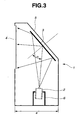
- Fig. 3 is a schematic view showing a structure of a rear projection television 1, in which a front surface mirror of the present invention is used.
- the rear projection television 1 is mainly formed of an image projector 2, a reflective mirror 3 for reflecting the image projected from the projector 2, a screen 4 for projecting thereon the image reflected by the reflective mirror 3, and the like, in a casing 5.
- the projector 2 is formed of a display apparatus, such as CRT, and an optical system for projecting the image.
- the incidence angle ⁇ of the light rays of the display image In order to decrease the depth d of the rear projection television, it is desirable to set the incidence angle ⁇ of the light rays of the display image at around the center of the reflective mirror at 45 ⁇ 25 degrees. Regarding the front surface mirror reflectance, it is desirable that the reflectance is large at an incidence angle of 45 degrees.
- the film structure 10 of the front surface mirror of the present invention is a front surface mirror, as shown in Fig. 1, in which Al film 13, SiO 2 film 14, and Nb 2 O 5 film 15 are formed in this order on a glass substrate by a physical vapor deposition method, or a front surface mirror, as shown in Fig. 2, in which SiO 2 film 12, Al film 13, SiO 2 film 14, and Nb 2 O 5 film 15 are formed in this order on a glass substrate by a physical vapor deposition method.
- the glass substrate 11 one having a glass surface, on which A1 film 13 or SiO 2 film 12 is formed, which has been subjected to ion etching treatment, prior to the film formation, is used.
- the glass substrate 11 it is possible to use a plate glass that is produced by float method. It is optional to use a so-called high flatness glass having less undulation of surface or a polished glass superior in flatness.
- the ion etching apparatus one used for apparatuses for producing LSI and the like is used.
- An inert gas of a pressure of 1-100Pa is introduced under an evacuated condition. Ions are generated in a vacuum by using a power supply such as high frequency.
- the surface of the glass is thinly etched and reformed by colliding the ions at high speed against the glass. This etched glass surface is very high in activity. It is possible to very compactly and orderly arrange the crystal structure of the Al film that is formed on this glass surface.
- the voltage of the ion etching is 600V or greater, that its treatment time is 3 seconds or longer, and that a gas mixture of oxygen and argon is used as the activated gas.
- the physical vapor deposition method it is possible to use a method such as sputtering method, vacuum vapor deposition method, electron beam deposition method or the like.
- sputtering method is recommended in view of film formation easiness, good film adhesion, and the like.
- SiO 2 film 12 on the glass surface is formed in order to further increase crystallinity of the Al film, as compared with one in which Al film 13 formed thereon is directly formed on the glass substrate. It is preferable that the thickness is 50nm or less. Furthermore, there is no particular problem, even if it is made thick to have 100nm. Crystallinity of Al is, however, almost constant, even it exceeds 50nm.
- Al film 13 is a reflective film of the front surface mirror.
- a film thickness of 60nm or greater it is possible to obtain a visible light reflectance of 90% or greater. Even if the thickness is increased in 60nm or greater, reflectance is not increased. Therefore, it suffices that the film thickness is 60nm. However, there is no particular problem even by having a thickness greater than that.
- the A1 film it is possible to use one containing 5wt% or less of at least one metal selected from Mn, Mg, Si and Nd, as an A1 corrosion resistance improvement measure. It is possible to obtain one containing Mn, Mg, Si and Nd by using a target containing Mn, Mg, Si and Nd in an aluminum target and by conducting the film formation in an inert atmosphere such as Ar gas.
- Mn, Mg, Si and Nd to be contained in the Al film for improving durability break the structure of the crystals of the Al film, resulting in lowering of reflectance. Therefore, it is preferable to lower their content as mush as possible.
- SiO 2 film 14 on the Al film also has an advantageous effect of improving adhesion between Al film 13 and the uppermost film, Nb 2 O 5 film 15.
- SiO 2 film 14 By making SiO 2 film 14 have a thickness of 30nm or greater, it is possible to obtain a front surface mirror having sufficient hardness and high temperature, high humidity resistance, as compared with one in which Nb 2 O 5 film has directly been formed on Al film.
- the thickness of SiO 2 film 14 is preferably 80 ⁇ 40 nm, in order to obtain the increased reflection effect of reflectance by the difference of refractive index between Nb2O5 and that.
- SiO 2 film 14 by sputtering under an atmosphere containing 50-100 wt% of oxygen relative to Ar gas, using a Si target.
- Nb 2 O 5 film 15 by sputtering under an atmosphere containing 50-100 wt% of oxygen relative to Ar gas, using a niobium target.
- the film is formed for the purpose of protecting the metal film and increasing reflection.
- Nb 2 O 5 15 In order to use front surface mirror 13 in a rear projection television, it is possible to obtain sufficient high temperature, high humidity resistance and abrasion resistance by setting the thickness of Nb 2 O 5 15 at 30nm or greater.
- the thickness of Nb 2 O 5 film 15 is preferably 60 ⁇ 40 nm, in order to obtain the increased reflection effect of reflectance by the difference of refractive index between SiO 2 and that.
- the front surface mirror of the present invention is one having an object of being used as a reflective mirror of rear projection television.
- the surface of the glass substrate is subjected to ion etching by using a plasma etching apparatus to reform the surface of the glass substrate into a highly active surface, followed by forming an Al film thereon.
- the surface of the glass substrate subjected to ion etching treatment is very high in activity. If an Al film is formed on this glass substrate subjected to ion etching treatment, it has been confirmed from the results of the peak height of X-ray diffraction that the crystal structure of the Al film formed thereon is very compact and orderly arranged and that the Al film is formed with no defect and with high density.
- Table 1 shows the measurement results of reflectance in the visible region of Example 1, Example 2 and Comparative Example 1. As shown in Table 1, it is possible to obtain very high reflectances in the visible region (400-700nm), in which human eye is sensible, by the Al film formed on the ion-etched glass substrate of Example 1 and Example 2, with less dependence on the reflection angle, as compared with the Al film with no ion etching treatment of Comparative Example 1.
- the Al film formed on the ion-etched glass is greatly superior in hardness, high-temperature resistance, high-humidity resistance, and saltwater resistance to the Al film with no ion etching treatment.
- Front surface mirror 3 having a film structure shown in Fig. 1 was prepared by using a washed, dried, float method, plate glass having a thickness of 3mm and a size of 600mmx600mm. All of the film formations were conducted by sputtering method. Firstly, a reactive plasma was generated by applying a voltage of 1,000v in an atmosphere of a vacuum pressure of 0.10pa with Ar 100 (sccm) and oxygen 70 (sccm), using a highfrequency power source apparatus (output: 3k, 2A) made by Schneider. While maintaining the angle between the ion etching apparatus and the glass at 45 degrees, the glass was passed below that at a speed of about 1 (mm/min) to reform the glass surface.
- a reactive plasma was generated by applying a voltage of 1,000v in an atmosphere of a vacuum pressure of 0.10pa with Ar 100 (sccm) and oxygen 70 (sccm), using a highfrequency power source apparatus (output: 3k, 2A) made by Schneider. While maintaining the angle
- SiO 2 film 12 of a thickness of 30nm was formed in an atmosphere of a vacuum degree of 0.18 (pa) with argon 200 (sccm) and oxygen 156 (sccm), using a MF (medium frequency) power source made by Advance Energy, and using a dual cathode having a Si target attached thereto.
- sccm argon 200
- sccm oxygen 156
- MF medium frequency
- Al film 13 of a thickness of 80nm was formed on the SiO 2 film in an atmosphere of Ar 300 (sccm) by using the same power source and by using a dual cathode having an Al target attached thereto.
- SiO 2 film 14 of a thickness of 80nm was formed in an atmosphere of Ar 300 (sccm), oxygen 70 (sccm) and a pressure of 0.46 (pa) by using the same power source and the cathode and by using the Si target.
- a Nb 2 O 5 film was formed by 60nm on SiO 2 film 14 by using a Nb target.
- the film formation was conducted in an atmosphere of Ar 300 (sccm), oxygen 120 (sccm) and a pressure of 0.28 (pa) by using the same power source and the cathode and by using a Nb target.
- the visible light reflectance of the obtained front surface mirror reflectance by the visible light wavelengths was measured by a spectrophotometer (U-400 type, made by Hitachi Ltd.) at an incidence angle of 8 degrees. With this, as shown in Table 1, a reflectance exceeding 90% was obtained throughout the entire wavelength. In particular, the reflectance at 400nm exceeded 90%, and therefore it was a reflective mirror that was capable of truly reproducing blue color.
- Adhesion An adhesive tape (Scotch Mending Tape 3M#800) was stick to the film, followed by taking this out. Exfoliation of the formed film per 45mm ⁇ and the number of pinholes (the number) were observed and measured by a microscope.
- Hardness A weight of 450g/cm 2 was put on the film surface with an interposal of 6 sheets of flannel. This was moved reciprocatively and slidingly by 500 times with a stroke distance of 100mm, and the change of transmittance of the sliding portion was measured. Transmittances were 0% before and after the test. Therefore, the change of transmittance by the test was 0%, too. Thus, it was confirmed that there was no problem in hardness of the film.
- Humidity Resistance A high temperature and high humidity test was conducted by allowing standing still for 24 hours in an atmosphere of 50°C and 95% RH (relative humidity). Haze and other external appearance changes of the film were observed. With this, problematic external appearance changes were not found, and it was confirmed that high temperature and high humidity resistance was sufficient.
- High-temperature resistance property A high temperature test was conducted by standing still for 24 hours in an atmosphere of 70°C. Haze and other external appearance changes of the film were observed. With this, problematic external appearance changes were not found, and it was confirmed that high temperature resistance property was sufficient.
- High and low temperature resistance property A high and low temperature cycle test was conducted by running two cycles, one cycle of which being defined as a cycle of standing still for 24 hours in an atmosphere of 40°C and 30%RH, then natural standing still for 1 hour, then standing still for 24 hours in an atmosphere of-10°C, and then natural standing still for 1 hour. Haze and other external appearance changes of the film were observed. With this, problematic external appearance changes were not found, and it was confirmed that high and low temperature cycle resistance property was sufficient.
- Salt water resistance property A salt water spraying test was conducted by standing still for 240 hours in 5% salt water atmosphere in an atmosphere of 35°C. Haze and other external appearance changes of the film were observed. With this, problematic external appearance changes were not found, and it was confirmed that salt water resistance was sufficient.
- This salt water spraying test is the severest test against front surface mirrors, and it is said to have no problem if it passes 24 hours in general. For a period of time that is 10 times this, deterioration is not generated in Example 1. Therefore, we can say that durability is far superior.
- a reflective mirror having a film structure 10 shown in Fig. 2 was prepared.
- the reflective mirror of Example 2 was prepared under the same conditions as those of Example 1, except in that SiO 2 film was not formed between the glass substrate and the Al film.
- Example 1 As a result of conducting the same durability tests as those of Example 1 against the front surface mirror of Example 2, it was confirmed that it had a sufficient durability similar to Example 1.
- a front surface mirror was prepared by conducting the same film formation, except in that the ion etching treatment of the glass substrate was not conducted. The same reflectance measurement and the durability tests as those of Example 1 were conducted.
- the reflectance measurement results are shown in Table 1. As compared with Example 1 and Example 2, the reflectance is low in short wavelength and long wavelength. It becomes further lower in case that the angle becomes further greater.
- Example 1 The same durability tests as those of Example 1 were conducted on the front surface mirror of Comparative Example 1. The results were similar to those of Example 1 with respect to adhesion, humidity resistance, high temperature resistance property and high and low temperature resistance property. Although both transmittances before and after the hardness test were 0%, numerous fine scratches occurred. In the salt water resistance test, a white haze was found at the peripheral portion in seven days, and the entirety became cloudy in 10 days. Lowering of reflectance was found. Thus, the results were inferior to those of Example 1 and Example 2. [Table 1] Incidence Angle (°) Wavelength (nm) 400 450 500 550 600 650 700 Ex. 1 8 93.9 96.0 96.5 95.9 95.0 93.7 91.4 45 94.9 96.3 96.0 95.3 94.0 92.3 90.0 Ex.
Landscapes
- Chemical & Material Sciences (AREA)
- Engineering & Computer Science (AREA)
- Chemical Kinetics & Catalysis (AREA)
- Materials Engineering (AREA)
- Organic Chemistry (AREA)
- Life Sciences & Earth Sciences (AREA)
- General Chemical & Material Sciences (AREA)
- Geochemistry & Mineralogy (AREA)
- Physics & Mathematics (AREA)
- General Physics & Mathematics (AREA)
- Inorganic Chemistry (AREA)
- Optics & Photonics (AREA)
- Mechanical Engineering (AREA)
- Metallurgy (AREA)
- Optical Elements Other Than Lenses (AREA)
- Physical Vapour Deposition (AREA)
Applications Claiming Priority (2)
| Application Number | Priority Date | Filing Date | Title |
|---|---|---|---|
| JP2005163260A JP2006337770A (ja) | 2005-06-02 | 2005-06-02 | 表面鏡 |
| PCT/JP2006/310293 WO2006129528A1 (ja) | 2005-06-02 | 2006-05-24 | 表面鏡 |
Publications (1)
| Publication Number | Publication Date |
|---|---|
| EP1873584A1 true EP1873584A1 (de) | 2008-01-02 |
Family
ID=37481457
Family Applications (1)
| Application Number | Title | Priority Date | Filing Date |
|---|---|---|---|
| EP06746776A Withdrawn EP1873584A1 (de) | 2005-06-02 | 2006-05-24 | Vorderflächenspiegel |
Country Status (5)
| Country | Link |
|---|---|
| US (1) | US20080253009A1 (de) |
| EP (1) | EP1873584A1 (de) |
| JP (1) | JP2006337770A (de) |
| CN (1) | CN101180574B (de) |
| WO (1) | WO2006129528A1 (de) |
Families Citing this family (5)
| Publication number | Priority date | Publication date | Assignee | Title |
|---|---|---|---|---|
| US9145510B2 (en) | 2007-05-30 | 2015-09-29 | Baker Hughes Incorporated | Use of nano-sized phyllosilicate minerals in viscoelastic surfactant fluids |
| JP5045261B2 (ja) * | 2007-06-20 | 2012-10-10 | セントラル硝子株式会社 | 表面鏡 |
| JP5860335B2 (ja) * | 2012-04-23 | 2016-02-16 | 株式会社神戸製鋼所 | 反射膜積層体およびその製造方法 |
| US9594195B2 (en) | 2013-02-13 | 2017-03-14 | Centre Luxembourgeois de Recherches Pour le Verre et la Ceramique (CRVC) SaRL | Dielectric mirror |
| EP3047314B1 (de) * | 2013-09-18 | 2019-02-20 | Guardian Europe S.à.r.l. | Dielektrischer spiegel |
Family Cites Families (20)
| Publication number | Priority date | Publication date | Assignee | Title |
|---|---|---|---|---|
| JPS5713406A (en) * | 1980-06-26 | 1982-01-23 | Nhk Spring Co Ltd | Reflecting mirror and its manufacture |
| JPS5843402A (ja) * | 1981-09-09 | 1983-03-14 | Ricoh Co Ltd | 高反射鏡の製造方法 |
| JPS60178402A (ja) * | 1984-02-27 | 1985-09-12 | Nippon Denso Co Ltd | ハ−フミラ− |
| EP0573163A3 (de) | 1992-06-05 | 1995-08-23 | Optical Coating Laboratory Inc | Verbesserte Haltbarkeit für eine optische Lagenstruktur wie ein Spiegel und Herstellungsverfahren für eine derartige Struktur. |
| JP2637016B2 (ja) | 1992-07-29 | 1997-08-06 | セントラル硝子株式会社 | 表面反射鏡 |
| JPH06130210A (ja) | 1992-10-15 | 1994-05-13 | Tokyo Tokushu Glass Kk | 表面反射鏡 |
| US6059416A (en) * | 1993-08-31 | 2000-05-09 | Daewoo Electronics Co., Ltd. | Actuated mirror array and method for the fabricating thereof |
| US5506642A (en) * | 1993-12-20 | 1996-04-09 | Fujitsu Limited | Projector with plastic mirror |
| JPH07301705A (ja) * | 1994-05-10 | 1995-11-14 | Kobe Steel Ltd | Al合金薄膜およびAl合金薄膜形成用スパッタリングターゲット |
| US6065843A (en) * | 1996-02-23 | 2000-05-23 | Martinez, Sr.; Eugene Eustaquio | Thin film mirror frame |
| JPH09311207A (ja) * | 1996-05-17 | 1997-12-02 | Matsushita Electric Ind Co Ltd | ミラーとフィルムとテレビジョン受像機 |
| JP4615701B2 (ja) * | 1999-12-07 | 2011-01-19 | 株式会社フルヤ金属 | 高耐熱性反射膜を用いた積層体 |
| JP2001235798A (ja) * | 1999-12-17 | 2001-08-31 | Nippon Sheet Glass Co Ltd | 反射ミラー及びこれを用いた背面投写型ディスプレイ |
| EP1213599A3 (de) * | 2000-12-07 | 2004-08-18 | Furuya Metal Co., Ltd. | Hitzebeständige reflektierende Schicht |
| US20050083460A1 (en) * | 2001-07-16 | 2005-04-21 | Nippon Sheet Glass Co., Ltd. | Semi-transmitting mirror-possessing substrate, and semi-transmitting type liquid crystal display apparatus |
| JP2003029010A (ja) * | 2001-07-16 | 2003-01-29 | Nippon Sheet Glass Co Ltd | 半透過ミラー付き基板及び半透過型液晶表示装置 |
| JP2003195022A (ja) * | 2001-12-28 | 2003-07-09 | Asahi Glass Co Ltd | 増反射積層体 |
| US6986586B2 (en) * | 2003-09-23 | 2006-01-17 | Martinez Sr Eugene | Thin film mirror |
| US7276289B2 (en) * | 2004-09-21 | 2007-10-02 | Guardian Industries Corp. | First surface mirror with metal oxide nucleation layer |
| US7678459B2 (en) * | 2004-09-21 | 2010-03-16 | Guardian Industries Corp. | First surface mirror with silicon-metal oxide nucleation layer |
-
2005
- 2005-06-02 JP JP2005163260A patent/JP2006337770A/ja active Pending
-
2006
- 2006-05-24 EP EP06746776A patent/EP1873584A1/de not_active Withdrawn
- 2006-05-24 WO PCT/JP2006/310293 patent/WO2006129528A1/ja not_active Ceased
- 2006-05-24 CN CN2006800174613A patent/CN101180574B/zh not_active Expired - Fee Related
- 2006-05-24 US US11/910,005 patent/US20080253009A1/en not_active Abandoned
Non-Patent Citations (1)
| Title |
|---|
| See references of WO2006129528A1 * |
Also Published As
| Publication number | Publication date |
|---|---|
| US20080253009A1 (en) | 2008-10-16 |
| JP2006337770A (ja) | 2006-12-14 |
| CN101180574A (zh) | 2008-05-14 |
| WO2006129528A1 (ja) | 2006-12-07 |
| CN101180574B (zh) | 2010-05-19 |
Similar Documents
| Publication | Publication Date | Title |
|---|---|---|
| JP5163742B2 (ja) | 低反射ガラスおよびディスプレイ用保護板 | |
| CA1303119C (en) | Method of manufacturing a display device and a display device madeby the method | |
| US20080131693A1 (en) | Laminate for reflection film | |
| WO1991002102A1 (fr) | Film base sur du dioxide de silicium et sa production | |
| JPH0854507A (ja) | 導電性の、コントラスト選択可能なコントラスト改良フィルター | |
| KR20050001425A (ko) | 고반사경 | |
| US20020140885A1 (en) | Heat-resistant reflecting layer, laminate formed of the reflecting layer, and liquid crystal display device having the reflecting layer or the laminate | |
| JPWO2006080502A1 (ja) | 反射防止膜付き基体 | |
| JPH0684256B2 (ja) | 単板熱線反射ガラス | |
| JPH09176837A (ja) | 透明導電膜 | |
| JP2003034828A (ja) | 電磁波シールド用のAg合金膜、電磁波シールド用Ag合金膜形成体及び電磁波シールド用Ag合金スパッタリングターゲット | |
| JP2006267561A (ja) | 光学素子およびその製造方法 | |
| JPH06102558B2 (ja) | 色ガラス板 | |
| JP4428152B2 (ja) | 高反射鏡 | |
| EP1873584A1 (de) | Vorderflächenspiegel | |
| JP2006010930A (ja) | 高反射鏡 | |
| JP2002008566A (ja) | 光吸収性反射防止ガラス基体とその製造方法 | |
| JP2007310335A (ja) | 表面鏡 | |
| JP2013509602A (ja) | 特に表示装置のための装置 | |
| JP2811885B2 (ja) | 熱線遮蔽ガラス | |
| US20080174895A1 (en) | High reflection mirror and process for its production | |
| JP2007140371A (ja) | 表面鏡 | |
| JP2005250229A (ja) | 高反射鏡 | |
| JP2006154587A (ja) | リアプロジェクションテレビ用表面鏡 | |
| KR101771069B1 (ko) | 방오 성능을 갖는 반사방지막 및 그 제조방법 |
Legal Events
| Date | Code | Title | Description |
|---|---|---|---|
| PUAI | Public reference made under article 153(3) epc to a published international application that has entered the european phase |
Free format text: ORIGINAL CODE: 0009012 |
|
| 17P | Request for examination filed |
Effective date: 20071010 |
|
| AK | Designated contracting states |
Kind code of ref document: A1 Designated state(s): DE FR GB |
|
| STAA | Information on the status of an ep patent application or granted ep patent |
Free format text: STATUS: THE APPLICATION HAS BEEN WITHDRAWN |
|
| 18W | Application withdrawn |
Effective date: 20080403 |