EP1854859B1 - Cold storage material, cold storage device and very-low-temperature cold storage refrigerator - Google Patents
Cold storage material, cold storage device and very-low-temperature cold storage refrigerator Download PDFInfo
- Publication number
- EP1854859B1 EP1854859B1 EP05743907.7A EP05743907A EP1854859B1 EP 1854859 B1 EP1854859 B1 EP 1854859B1 EP 05743907 A EP05743907 A EP 05743907A EP 1854859 B1 EP1854859 B1 EP 1854859B1
- Authority
- EP
- European Patent Office
- Prior art keywords
- regenerator
- cryocooler
- bismuth
- stage
- regenerator material
- Prior art date
- Legal status (The legal status is an assumption and is not a legal conclusion. Google has not performed a legal analysis and makes no representation as to the accuracy of the status listed.)
- Expired - Lifetime
Links
Images






Classifications
-
- C—CHEMISTRY; METALLURGY
- C09—DYES; PAINTS; POLISHES; NATURAL RESINS; ADHESIVES; COMPOSITIONS NOT OTHERWISE PROVIDED FOR; APPLICATIONS OF MATERIALS NOT OTHERWISE PROVIDED FOR
- C09K—MATERIALS FOR MISCELLANEOUS APPLICATIONS, NOT PROVIDED FOR ELSEWHERE
- C09K5/00—Heat-transfer, heat-exchange or heat-storage materials, e.g. refrigerants; Materials for the production of heat or cold by chemical reactions other than by combustion
- C09K5/08—Materials not undergoing a change of physical state when used
- C09K5/14—Solid materials, e.g. powdery or granular
-
- C—CHEMISTRY; METALLURGY
- C22—METALLURGY; FERROUS OR NON-FERROUS ALLOYS; TREATMENT OF ALLOYS OR NON-FERROUS METALS
- C22C—ALLOYS
- C22C11/00—Alloys based on lead
-
- C—CHEMISTRY; METALLURGY
- C22—METALLURGY; FERROUS OR NON-FERROUS ALLOYS; TREATMENT OF ALLOYS OR NON-FERROUS METALS
- C22C—ALLOYS
- C22C12/00—Alloys based on antimony or bismuth
-
- C—CHEMISTRY; METALLURGY
- C22—METALLURGY; FERROUS OR NON-FERROUS ALLOYS; TREATMENT OF ALLOYS OR NON-FERROUS METALS
- C22C—ALLOYS
- C22C9/00—Alloys based on copper
-
- F—MECHANICAL ENGINEERING; LIGHTING; HEATING; WEAPONS; BLASTING
- F25—REFRIGERATION OR COOLING; COMBINED HEATING AND REFRIGERATION SYSTEMS; HEAT PUMP SYSTEMS; MANUFACTURE OR STORAGE OF ICE; LIQUEFACTION SOLIDIFICATION OF GASES
- F25B—REFRIGERATION MACHINES, PLANTS OR SYSTEMS; COMBINED HEATING AND REFRIGERATION SYSTEMS; HEAT PUMP SYSTEMS
- F25B9/00—Compression machines, plants or systems, in which the refrigerant is air or other gas of low boiling point
- F25B9/14—Compression machines, plants or systems, in which the refrigerant is air or other gas of low boiling point characterised by the cycle used, e.g. Stirling cycle
-
- B—PERFORMING OPERATIONS; TRANSPORTING
- B22—CASTING; POWDER METALLURGY
- B22F—WORKING METALLIC POWDER; MANUFACTURE OF ARTICLES FROM METALLIC POWDER; MAKING METALLIC POWDER; APPARATUS OR DEVICES SPECIALLY ADAPTED FOR METALLIC POWDER
- B22F2998/00—Supplementary information concerning processes or compositions relating to powder metallurgy
-
- F—MECHANICAL ENGINEERING; LIGHTING; HEATING; WEAPONS; BLASTING
- F25—REFRIGERATION OR COOLING; COMBINED HEATING AND REFRIGERATION SYSTEMS; HEAT PUMP SYSTEMS; MANUFACTURE OR STORAGE OF ICE; LIQUEFACTION SOLIDIFICATION OF GASES
- F25B—REFRIGERATION MACHINES, PLANTS OR SYSTEMS; COMBINED HEATING AND REFRIGERATION SYSTEMS; HEAT PUMP SYSTEMS
- F25B2309/00—Gas cycle refrigeration machines
- F25B2309/003—Gas cycle refrigeration machines characterised by construction or composition of the regenerator
Definitions
- the present invention relates to a regenerator material, a regenerator, and a regenerative cryocooler.
- the present invention relates to a regenerator material having enhanced cooling capacity using a novel regenerator material suitably used for a GM (GiffordMcMahon) cycle cryocooler, a Stirling cycle cryocooler, a pulse tube cryocooler, a Vuilleumier cycle cryocooler, a Solvay cycle cryocooler or a cooling system or the like using these cryocoolers as a precooling stage, a regenerator, a regenerative cryocooler, a cooling system using the cryocooler, a superconducting magnet, a magnetic resonance imaging (MRI) apparatus, a Cryopump, a cryogenic gas purifying apparatus and a superconducting device cooling apparatus or the like.
- GM Gallium
- MRI magnetic resonance imaging
- a regenerative cryocooler is one type of cryocooler in wide use in a cryogenic range. This is provided with a regenerator referred to as a heat exchanger.
- This regenerator includes a regenerative heat exchange material in a container.
- a material having large specific heat at the object temperature as the regenerator material hasbeenused. Since the cryocooler realizes a large temperature range from room temperature to 4K, it is necessary to select a material having as large a specific heat as possible in its entire range. The temperature-dependence of specific heat of waterial is greatly different each other, and only one material cannot cover the entire temperature range. Therefore, the optimum material is combined and used according to temperature. Typically, a copper mesh screen and/or stainless steel mesh screen are used from room temperature to about 50K, and spherical lead is used at a temperature of 50K or less. Lead has specific heat higher than that of other material and a certain level of structural strength in a low temperature range of 50K or less and is at low cost. Thereby, lead has been widely used (for example, see Japanese Published Unexamined Patent Application No. 3-99162 ).
- Japanese Published Unexamined Patent Application No. 2004-225920 discloses an alloy of indium, bismuth and a third material as the regenerator material to replace lead.
- Indium has specific heat after lead at a temperature of 50Kor less, which is the idea believed harnessing the properties of indium.
- indium is a very soft metal
- indium cannot be used as it is as a regenerator material.
- the hardness of the regenerator material is enhanced to hardness required for the regenerator material by producing an alloy of indium and bismuth or another metal.
- it is inadequate to use an alloy as the regenerator material.
- the price of indium is about 3 times that of lead, and it is too expensive to use indium as the cold accumulating material.
- the present invention has been made for solving the above conventional problems. It is an object of the present invention to provide a regenerator material which is low in toxicity, easily turned into a spherical shape, having sufficient mechanical strength for use, low cost, and having a superior thermal property when used for a cryocooler.
- a regenerator material including a granular body made of bismuth or an alloy of bismuth and antimony, wherein a rate of the granular body having a grain size of 0.14mm to 1.6mm is 70% by weight or more with respect to the entire granular body, and a rate of the granular body in which a ratio of a major axis to a minor axis is 5 or less is 70% by weight or more with respect to the entire granular body.
- a surface roughness of the granular body in terms of maximum height R max may be 100 ⁇ m or less.
- At least a part of a structure of the granular body may contain an amorphous phase.
- a rate of particles having a minute defect having a length of 10 ⁇ m or more to whole particles in the granular body may be 30% by weight or less.
- a surface of the granular body may not have discoloration caused by oxidization.
- the granular bodymade of bismuth or an alloy of bismuth and antimony may be sintered and processed into a block form, a pellet form or a plate form.
- the present invention provides a regenerator filled with the regenerator material.
- the present invention provides a regenerator having a hybrid structure of two or more layers including the regenerator material and a magnetic regenerator material.
- the magnetic regenerator material may be HoCu 2 ; HoCu 2 and Gd 2 O 2 S, or GAP (GdAlO 3 ); Er 3 Ni or Er 3 Co; or Er 3 Ni or Er 3 Co and Gd 2 O 2 S or GAP (GdAlO 3 ).
- the present invention provides a regenerative cryocooler including the regenerator.
- the regenerator maybe used for a lowest temperature cooling stage.
- the regenerator may be used for a middle cooling stage, and another magnetic material having a large specific heat at 4K or lower may be used for a last cooling stage regenerator.
- the present invention provides a cooling system including: a precooling stage using the cryocooler; and at least one other cooling means.
- the present invention provides a superconducting magnet, MRI apparatus, cryopump, cryogenic gas purifying apparatus or superconducting device cooling apparatus including the cryocooler or cooling system.
- the present invention uses bismuth or an alloy of bismuth and antimony as a regenerative material, the present invention gives a comparatively low load to the environment.
- the conditions required for the regenerative material are satisfied, such as easy spheroidizing, sufficient mechanical strength for use, low cost, and excellent thermal property when used for the cryocooler.
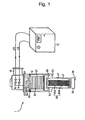
- Fig. 1 schematically shows an outline of a regenerator type cryogenic cryocooler of a first embodiment according to the present invention. With this cryocooler, the present invention is applied to a two stage type GM cryocooler.
- a cryocooler 1 of this embodiment high pressure refrigerant gas is supplied through a high pressure gas piping 12 and a high pressure valve 13 from a compressor 11.
- the refrigerant gas is collected as low pressure gas through a low pressure valve 14 and a low pressure gas piping 15.
- a first stage cold accumulator 21 and a second stage cold accumulator 31 are respectively accommodated in a first stage cylinder 2 and a second stage cylinder 3.
- Both cold accumulators 21 and 31, which are driven by a drive motor 16, are vertically reciprocated to cool the lower end side of the respective coolers.
- the first stage cold accumulator 21 and the second stage cold accumulator 31 are respectively filled with a first stage regenerator material 22 and a second stage regenerator material 32.
- the first stage regenerator material 22 is formed by laminating, for example, 970 layers of copper wire netting of mesh 150.
- a second stage cold accumulator (displacer) 31 has a laminated structure of upper and lower layers where the second stage regenerator material 32 is divided at a position where the volume ratio is almost the same.
- a low temperature side regenerator material 32B of the second layer is filled with granular HoCu 2 shot.
- a high temperature side regenerator material 32A of the first layer is filled with Bi (bismuth) prepared by crushing bulk or spherical Bi.
- Acoolingpart of the cryocooler 1 of this embodiment is constituted by a first stage cooler 21 and second stage cooler 31 which are respectively accommodated in the first stage cylinder 2 and second stage cylinder 3 integrally and continuously formed.
- a first cooling stage 23 (low temperature end) of a first stage cylinder is cooled to about 40K.
- a second stage cooling stage 33 of the second stage cylinder is cooled to, for example, 7K or less.
- Electric heaters (not shown) are respectively attached to the first cooling stage 23 and the second cooling stage 33. Heat load can be applied by the electric input to measure the cooling capacity of each of the stages.
- reference numeral 24 designates a gas passage of the first stage regenerator 21; reference numeral 25, a seal for airproofing between the first stage regenerator 21 and the first stage cylinder 2; reference numeral 26, a first stage expansion space; reference numeral 34, a gas passage of second stage regenerator; and reference numeral 36, a second stage expansion space.
- the stroke of the displacer is 25mm.
- a seal between second stage regenerator 31 and the second stage cylinder 3 is omitted.
- the purity of the granular bismuth filled as the regenerator material 32A of the high temperature side can be set to, for example, 99.99%.
- the grain size thereof is 0.14mm to 1.6mm, preferably 0.15mm to 1.4mm, and more preferably 0.22mm to 1.3mm.
- Fig. 2 shows an example of the relationship between bismuth size (grain size) and cooling capacity at 4.2K.
- the grain size of less than 0.14mm causes excessively high density of bismuthwhen the regenerator is filled with bismuth to rapidly increase the flow resistance of helium gas as a cooling medium.
- the grain size exceeds 1.6mm, the heat exchange efficiency between the granular body and the cooling medium may be remarkably reduced.
- the ratio (aspect ratio) of the largest diameter to the lowest diameter of the regenerator material made of bismuth of this embodiment is 5 or less in a three-dimensional optional direction, preferably 3 or less, more preferably 2 or less. Still more preferably, the shape of the regenerator material is preferably brought close to sphericity as much as possible. Since the aspect ratio exceeding 5 causes mechanical modification destruction easily and difficult high density filling, the cooling efficiency is reduced.
- the granular regenerator material made of bismuth is used. Furthermore, the granular regenerator material has a purity of 99.99% or more, a grain size of 0.3mm to 0. 5mm and an aspect ratio of 5 or less. Unless otherwise noted, the operating cycle by amotor 16 is 60 rpm, and the stroke of the displacer is 30mm.
- Fig. 3 shows the characteristic of volumetric specific heat in the low temperature range of bismuth used as the regenerator material by the present invention in contrast with those of materials used as other regenerator materials. Since bismuth Bi is also used for materials of cosmetics, bismuth Bi is considered to have high safety and no worry of environmental pollution. In addition, bismuth is low cost. Although the regenerator material must have a large volumetric specific heat in the target cryogenic range generally, the volumetric specific heat of bismuth is less than that of lead Pb in only Fig. 3 . However, in the range of 5K or more, bismuth has a feature which the volumetric specific heat of bismuth mostly corresponds to that of HoCu 2 which is the magnetic regenerator material. In Fig. 3 , Gd 2 O 2 S is abbreviated as GOS.
- Table 1 shows the hardness measurement results of the regenerator material evaluated in Example 1.
- the Vickers hardness of a bismuth ball is equivalent to that of lead.
- the hardness of B lot having a black surface is lower than that of A lot having a gold surface, which may be influenced by surface oxidization.
- the second stage regenerator 31 was filled with lead and bismuth, and the cooling capacities of lead and bismuth were compared.
- Fig. 4 shows the structures of the regenerators. Both lead and bismuth having a grain size of 0. 4mm to 0.5mm were used. For bismuth, spherical powder having a non-oxidized surface was sieved and used. Although the filling amount of lead was different from that of bismuth, filling volume is uniform herein, and the experiment was performed.
- Fig. 5 shows the rotationnumber-dependent properties of the lowest temperature.
- the second stage temperature T 2 of bismuth is almost the same as that of lead.
- the first stage temperature T 1 of bismuth ( ⁇ mark) is lower by about 2K than that of lead ( ⁇ mark) in the whole rotation number range.
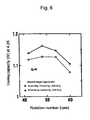
- Fig. 6 shows the rotation number-dependent properties of second stage cooling capacity during first stage no-load.
- bismuth ( ⁇ mark) exhibits higher cooling capacity than that of lead (o mark).
- the highest cooling capacity was obtained at 48 rpm.
- Fig. 7 shows the cooling capacity diagram at 60 rpm.
- the first stage temperature of bismuth was lower than that of lead. The result shows that bismuth ( ⁇ mark) shows a lower temperature than that of lead (o mark) even when load is applied to the first stage.
- Fig. 8 shows the comparison of the second stage cooling capacity when applying load to the first stage.
- bismuth ( ⁇ mark) has higher cooling capacity than that of lead (o mark) .
- a large difference of about 10% in the second stage cooling capacity at 4.2K is observed at about 45K.
- Fig. 9 shows the first stage temperature-dependent properties of the second stage cooling capacity using the conditions of bismuth as the parameter. Black points correspond to B lot, and white points correspond to A lot. Compared with the difference caused by the grain size in the same lot, the difference between lots is larger. In particular, it is understood that the difference between lots is larger in the range where the first stage temperature T 1 is higher than 40K.
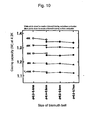
- Fig. 10 shows the difference in the second stage cooling capacities according to the grain size of bismuth.
- the first stage temperature T 1 is expressed by 5K from 25K to 45K. Black points correspond to B lot, and white points corresponds to A lot.
- the grain size is 0.4mm to 0.5mm, the difference between lots can be compared. However, it is understood that the higher the first stage temperature, the larger the difference is. On the other hand, little difference in the cooling capacities due to the grain size in the same lot can be observed.
- bismuth for 4K cryocoolers had superior performance to that of lead. Since the grain size range of bismuth may be able to be enlarged, the price thereof may also be able to be reduced compared with that of lead. However, when the surface is oxidized, the performance may be reduced.
- bismuth In order to actually use bismuth, not only the cooling capacity but also the material strength are important. However, the hardness test and the compression test showed that bismuth had higher hardness and strength than that of lead. From the above, bismuth may be able to be sufficiently used in place of lead.
- a hybrid of bismuth and other regenerator materials canbe considered. Then, a material having excellent specific heat characteristics at about 15K was selected and evaluated from the regenerator materials tried until now.
- HoCu 2 used at 4K and Er 0.7 Ho 0.3 Ni having a specific heat peak at 15K were evaluated. As shown in Fig. 3 , Er 0.7 Ho 0.3 Ni has a large specific heat peak in the vicinity of 15K. Since GOS has an extremely reduced specific heat at a temperature or more which is the specific heat peak in the vicinity of 5K, GOS was out of the target of evaluation.
- the used cryocooler is a 4.2K cryocooler having a cooling capacity of 0.5W.
- the inner diameter of the first stage is 52mm; the length thereof is 191.5mm; the inner diameter of the second stage is 25mm; and the length thereof is 165mm.
- the stroke is 25mm; the filling pressure is 19 kgf/cm 2 G; and the rotation number of a displacer motor is 60 rpm.
- the first stage regenerator is filled with 900 layers of copper screen of 150 mesh.
- the operation frequency of a compressor was 50Hz.
- Fig. 12 shows the structures of the regenerators compared in this Example.
- Fig. 13 shows the difference in the cooling capacities due to the difference in the structures of the regenerators.
- the lowest attainment temperature of the second stage was 4K or less only when the regenerator is filled with HoCu 2 .
- the lowest temperature is 2.78K in the case of the regenerator 2.
- the lowest temperature was attained in the first stage when the regenerator 3 was entirely made of bismuth.
- the cooling capacities are calculated and compared in the case of second stage temperatures 10K, 15K, 20K and first stage temperatures 50K, 60K, 70K by an interpolating method from the cooling capacity diagram.
- Fig. 14 shows second stage cooling capacity
- Fig. 15 shows first stage cooling capacity.
- the first stage cooling capacity shown in Fig. 15 is enhanced by bismuth. That is, when the second stage temperature T 2 is a low temperature in the vicinity of 10K in the case of being entirely made of bismuth (regenerator 3), the value of the first stage cooling capacity is particularly large. However, the second stage temperature gives large effects to the first stage cooling capacity. When the second stage temperature is high at 20K, the first stage cooling capacity is equivalent to or inferior to that of the hybrid regenerator. Comprehensively, as the structure of the regenerator replaced with lead, the combination of bismuth and HoCu 2 is superior.
- the regenerator material made of bismuth of this embodiment is superior in the point of being more environmentally friendly compared with lead.
- the regenerator material can be utilized as the regenerator material better than the conventional one made of lead by a combination of the regenerator material made of bismuth and magnetic regenerator material such as HoCu 2 and Gd 2 O 2 S or regenerator material of another kind.
- the magnetic regenerator material used together with HoCu 2 is not limited to the Gd 2 O 2 S.
- Examples of the magnetic regenerator materials include GAP (GdAlO 3 ) and one represented by the general formula RxO 2 S or (R1-yR'y)xO 2 S (R, R' are at least one kind of rare earth elements, 0.1 ⁇ x ⁇ 9, 0 ⁇ y ⁇ 1).
- the elements R and R' may be yttrium Y, lanthanum La, cerium Ce, praseodymium Pr, neodymium Nd, promethium Pm, samarium Sm, europium Eu, gadolinium Gd, terbium Tb, disprosium Dy, holmium Ho, erbium Er, thulium Tm or ytterbium Yb.
- Er 3 Co can also be used in place of Er 3 Ni.
- the regenerator material of the present invention is not limited to only bismuth, and may be an alloy which contains bismuth as a main component.
- alloy components include antimony (Sb). This may be contained, for example, to about 5% to 10%.
- Sb antimony
- the granular regenerator material which is made of bismuth or an alloy containing bismuth as a main component may be manufactured by a melted metal quenching method which quenches melted metal simultaneously with granulation using a rotating disk, a roll, a rotation nozzle or the like. Also, the regenerator material may be manufactured by any process such as a plasma spray method and a gas atomizing method.
- Fig. 16 shows a second embodiment of the present invention which is an MRI apparatus using a two stage type GM cryocooler of the first embodiment.
- a superconducting magnet 45 is used in order to produce a magnetic field space 48.
- This superconducting magnet 45 is immersed in liquid helium 44, and is cooled to the superconducting state.
- a heat shield 42 is provided outside a liquid helium container 43, and a vacuum vessel 41 is further provided outside.
- the liquid helium is supplied from an inlet 46, the vaporized helium is again returned to liquid by a condensing part 47 provided in the liquid helium container 43.
- the MRI apparatus 4 can be operated without supplying helium for a long period of time.
- the condensing part 47 is thermally combined with the second stage cooling stage 33 of the GM cryocooler 1, and thereby cold is continuously supplied.
- the heat shield 42 is cooled by the first cooling stage 23 of the GM cryocooler 1.
- the liquid helium 44 can be more efficiently re-condensed, and the embodiment can also correspond to the MRI apparatus having a larger evaporation amount of helium.
- cryocooler 1 was used for re-condensing the liquid helium 44 in this embodiment, the cryocooler 1 can cool the superconducting magnet 45 directly using heat conduction without using the liquidhelium.
- the heat shield canbe added to constitute a so-called shield cooling type in which the first stage cooling stage 23 and the second cooling stage 33 cool a different heat shield respectively.
- the present invention was applied to the GM cycle cryocooler.
- the object for application of the present invention is not limited thereto, and can be apparently applied to other regenerative cryocoolers such as a pulse tube cryocooler, a Joule Thompson cryocooler, a Stirling cycle cryocooler, a Vuilleuwier cycle cryocooler and a Solvay cycle cryocooler.
- Asystemusing the regenerative cryocooler according to the present invention is not limited to the MRI apparatus of the second embodiment, and can be obviously applied to an NMR apparatus, a superconducting magnet apparatus, a Cryopump, a Josephson voltage standard apparatus, a freezing mediumpurifying apparatus, a superconducting device cooling apparatus, a helium re-condensation apparatus or the like similarly.
- the shape of the regenerator material is not limited to the granular body.
- the regenerator material may be sintered and processed into a block form, a pellet form or a plate form, and filled with the regenerator.
- the regenerator material may have a mesh-shape having a mesh opening of 0.01mm to 1mm.
- the regenerator material may be coated or plated on the surface of a metal mesh having a mesh opening of 0.01mm to 1mm.
- the present invention can provide the regenerator material made of material friendly to the environment and having superior performance. Also, the present invention can provide the regenerator filled with the regenerator material, and the cryocooler provided with the regenerator. Furthermore, the present invention can provide various systems using the cryocooler.
Landscapes
- Chemical & Material Sciences (AREA)
- Engineering & Computer Science (AREA)
- Materials Engineering (AREA)
- Mechanical Engineering (AREA)
- Organic Chemistry (AREA)
- Metallurgy (AREA)
- Physics & Mathematics (AREA)
- Thermal Sciences (AREA)
- Chemical Kinetics & Catalysis (AREA)
- Combustion & Propulsion (AREA)
- General Engineering & Computer Science (AREA)
- Containers, Films, And Cooling For Superconductive Devices (AREA)
- Devices That Are Associated With Refrigeration Equipment (AREA)
Applications Claiming Priority (2)
| Application Number | Priority Date | Filing Date | Title |
|---|---|---|---|
| JP2005059648A JP2006242484A (ja) | 2005-03-03 | 2005-03-03 | 蓄冷材、蓄冷器及び極低温蓄冷式冷凍機 |
| PCT/JP2005/009775 WO2006092871A1 (ja) | 2005-03-03 | 2005-05-27 | 蓄冷材、蓄冷器及び極低温蓄冷式冷凍機 |
Publications (3)
| Publication Number | Publication Date |
|---|---|
| EP1854859A1 EP1854859A1 (en) | 2007-11-14 |
| EP1854859A4 EP1854859A4 (en) | 2013-04-03 |
| EP1854859B1 true EP1854859B1 (en) | 2015-04-08 |
Family
ID=36940917
Family Applications (1)
| Application Number | Title | Priority Date | Filing Date |
|---|---|---|---|
| EP05743907.7A Expired - Lifetime EP1854859B1 (en) | 2005-03-03 | 2005-05-27 | Cold storage material, cold storage device and very-low-temperature cold storage refrigerator |
Country Status (5)
| Country | Link |
|---|---|
| US (1) | US20080104967A1 (https=) |
| EP (1) | EP1854859B1 (https=) |
| JP (1) | JP2006242484A (https=) |
| CN (1) | CN101124289B (https=) |
| WO (1) | WO2006092871A1 (https=) |
Families Citing this family (24)
| Publication number | Priority date | Publication date | Assignee | Title |
|---|---|---|---|---|
| KR101143800B1 (ko) * | 2008-09-30 | 2012-05-11 | 캐논 아네르바 가부시키가이샤 | 진공 배기 시스템, 기판 처리 장치, 전자 디바이스의 제조 방법, 진공 배기 시스템의 운전 방법 |
| JP2010216711A (ja) * | 2009-03-16 | 2010-09-30 | Sumitomo Heavy Ind Ltd | 蓄冷器式冷凍機 |
| EP2472201B1 (en) | 2009-08-25 | 2017-10-25 | Kabushiki Kaisha Toshiba | Rare-earth cold storage material particle, rare-earth cold storage material particles, refrigerator utilizing same, measuring device, and method for producing same |
| JP5660979B2 (ja) * | 2011-06-08 | 2015-01-28 | 住友重機械工業株式会社 | クライオポンプ及び極低温冷凍機 |
| JP5840543B2 (ja) * | 2012-03-21 | 2016-01-06 | 住友重機械工業株式会社 | 蓄冷式冷凍機 |
| JP5889743B2 (ja) * | 2012-07-20 | 2016-03-22 | 住友重機械工業株式会社 | 蓄冷式冷凍機 |
| JP6165618B2 (ja) * | 2013-06-20 | 2017-07-19 | 住友重機械工業株式会社 | 蓄冷材および蓄冷式冷凍機 |
| DE102013012312A1 (de) * | 2013-07-25 | 2015-01-29 | Franz-Josef Struffert | Wärme- und Kältespeicherelement |
| JP6305193B2 (ja) | 2013-09-17 | 2018-04-04 | 住友重機械工業株式会社 | 蓄冷式冷凍機、一段蓄冷器、及び二段蓄冷器 |
| JP6245991B2 (ja) * | 2014-01-06 | 2017-12-13 | 住友重機械工業株式会社 | パルス管冷凍機 |
| JP2015143596A (ja) * | 2014-01-31 | 2015-08-06 | 住友重機械工業株式会社 | 蓄冷器および蓄冷器式冷凍機 |
| JP6500312B2 (ja) * | 2014-03-20 | 2019-04-17 | トッパン・フォームズ株式会社 | 保冷具 |
| JP6376793B2 (ja) * | 2014-03-26 | 2018-08-22 | 住友重機械工業株式会社 | 蓄冷器式冷凍機 |
| EP3199608B1 (en) * | 2014-09-25 | 2021-08-11 | Kabushiki Kaisha Toshiba | Rare-earth cold storage material particles, refrigerator using same, superconducting magnet, inspection device, and cryopump |
| EP3037746B1 (en) | 2014-12-22 | 2020-08-12 | Sumitomo Heavy Industries, Ltd. | Cryocooler and operation method of cryocooler |
| JP2017058079A (ja) | 2015-09-17 | 2017-03-23 | 株式会社東芝 | 極低温冷凍機用蓄冷材、極低温蓄冷器、蓄冷型極低温冷凍機及び蓄冷型極低温冷凍機を備えたシステム |
| JP6585017B2 (ja) | 2016-08-19 | 2019-10-02 | 株式会社東芝 | 極低温冷凍機用蓄冷材、蓄冷型極低温冷凍機、及び蓄冷型極低温冷凍機を備えたシステム |
| CN110168043B (zh) * | 2016-12-28 | 2021-05-28 | 株式会社三德 | 稀土蓄冷材料以及具有其的蓄冷器和制冷机 |
| WO2018199278A1 (ja) * | 2017-04-28 | 2018-11-01 | 株式会社三徳 | HoCu系蓄冷材並びにこれを備えた蓄冷器及び冷凍機 |
| CN108981217A (zh) | 2018-06-04 | 2018-12-11 | 中船重工鹏力(南京)超低温技术有限公司 | 蓄冷材料及采用该蓄冷材料的蓄冷式低温制冷机 |
| JP7321732B2 (ja) | 2019-03-18 | 2023-08-07 | 株式会社東芝 | 蓄冷材粒子、蓄冷器、冷凍機、超電導磁石、核磁気共鳴イメージング装置、核磁気共鳴装置、クライオポンプ、及び、磁界印加式単結晶引上げ装置 |
| CN112556231B (zh) * | 2020-12-08 | 2021-12-07 | 河南工学院 | 一种温度波动抑制装置 |
| GB2606990B (en) * | 2021-03-31 | 2023-05-24 | Leybold Dresden Gmbh | Regenerator materials, regenerators and refrigeration systems having regenerators |
| WO2025147225A2 (en) * | 2022-07-13 | 2025-07-10 | Bluefors Cryocooler Technologies, Inc. | 3k cold head regenerator design |
Family Cites Families (27)
| Publication number | Priority date | Publication date | Assignee | Title |
|---|---|---|---|---|
| JPS60204852A (ja) * | 1984-03-30 | 1985-10-16 | Tokyo Inst Of Technol | 磁気冷凍用磁性材料 |
| US5186765A (en) * | 1989-07-31 | 1993-02-16 | Kabushiki Kaisha Toshiba | Cold accumulating material and method of manufacturing the same |
| DE4009850C1 (https=) * | 1990-03-27 | 1991-11-07 | Lambda Physik Gesellschaft Zur Herstellung Von Lasern Mbh, 3400 Goettingen, De | |
| EP0498613B1 (en) * | 1991-02-05 | 1994-08-24 | Kabushiki Kaisha Toshiba | Regenerative materials |
| JPH06101915A (ja) * | 1992-09-18 | 1994-04-12 | Mitsubishi Electric Corp | 蓄冷材及びその製造方法 |
| US5593517A (en) * | 1993-09-17 | 1997-01-14 | Kabushiki Kaisha Toshiba | Regenerating material and refrigerator using the same |
| JPH07234028A (ja) * | 1994-02-22 | 1995-09-05 | Toshiba Corp | 極低温用蓄冷材およびそれを用いた極低温用蓄冷器 |
| EP0777089B1 (en) * | 1994-08-23 | 2008-10-08 | Kabushiki Kaisha Toshiba | A method of preparing a regenerator |
| EP0947785B1 (en) * | 1997-10-20 | 2003-04-23 | Kabushiki Kaisha Toshiba | Cold-accumulating material and cold-accumulating refrigerator |
| JP4551509B2 (ja) * | 1998-12-28 | 2010-09-29 | 株式会社東芝 | 蓄冷材および蓄冷式冷凍機 |
| US6318090B1 (en) * | 1999-09-14 | 2001-11-20 | Iowa State University Research Foundation, Inc. | Ductile magnetic regenerator alloys for closed cycle cryocoolers |
| JP2001172618A (ja) * | 1999-12-16 | 2001-06-26 | Ekuteii Kk | テープ型蓄冷材およびその製造方法、並びにそれを使用した蓄冷器および冷凍機 |
| US6467277B2 (en) | 2000-07-18 | 2002-10-22 | Kabushiki Kaisha Toshiba | Cold accumulating material, method of manufacturing the same and refrigerator using the material |
| JP5010071B2 (ja) | 2000-07-18 | 2012-08-29 | 株式会社東芝 | 蓄冷材,その製造方法およびその蓄冷材を用いた冷凍機 |
| JP2002295914A (ja) * | 2001-03-30 | 2002-10-09 | Ekuteii Kk | シート型蓄冷材およびその製造方法、並びにそれを使用した蓄冷器および冷凍機 |
| KR100859347B1 (ko) * | 2001-06-18 | 2008-09-19 | 고노시마 가가쿠고교 가부시키가이샤 | 희토류 산황화물 축냉재 및 축냉기 |
| US20040000149A1 (en) * | 2002-07-01 | 2004-01-01 | Kirkconnell Carl S. | High-frequency, low-temperature regenerative heat exchanger |
| JP2004099822A (ja) * | 2002-09-12 | 2004-04-02 | Toshiba Corp | 蓄冷材およびこれを用いた蓄冷式冷凍機 |
| JP2004143341A (ja) * | 2002-10-25 | 2004-05-20 | Hirofumi Wada | 蓄冷材およびこれを用いた蓄冷式冷凍機 |
| JP4256664B2 (ja) * | 2002-11-12 | 2009-04-22 | 神島化学工業株式会社 | 希土類バナジウム酸化物セラミックスの製造方法 |
| JP2004225920A (ja) * | 2002-11-27 | 2004-08-12 | Aisin Seiki Co Ltd | 蓄冷器 |
| JP4582994B2 (ja) * | 2002-12-12 | 2010-11-17 | 株式会社東芝 | 蓄冷材、その製造方法および蓄冷式冷凍機 |
| JP2004324931A (ja) * | 2003-04-22 | 2004-11-18 | Sumitomo Heavy Ind Ltd | 冷凍機用ヒートシンク |
| JP4445230B2 (ja) * | 2003-09-02 | 2010-04-07 | 住友重機械工業株式会社 | 極低温蓄冷材、蓄冷器及び冷凍機 |
| WO2006022297A1 (ja) * | 2004-08-25 | 2006-03-02 | Ulvac Cryogenics Incorporated | 蓄冷器及びクライオポンプ |
| US8253557B2 (en) * | 2007-08-07 | 2012-08-28 | Nasser Ani | System and method for tracking luggage |
| JP2010216711A (ja) * | 2009-03-16 | 2010-09-30 | Sumitomo Heavy Ind Ltd | 蓄冷器式冷凍機 |
-
2005
- 2005-03-03 JP JP2005059648A patent/JP2006242484A/ja active Pending
- 2005-05-27 WO PCT/JP2005/009775 patent/WO2006092871A1/ja not_active Ceased
- 2005-05-27 EP EP05743907.7A patent/EP1854859B1/en not_active Expired - Lifetime
- 2005-05-27 CN CN2005800483862A patent/CN101124289B/zh not_active Expired - Lifetime
- 2005-05-27 US US11/793,653 patent/US20080104967A1/en not_active Abandoned
Also Published As
| Publication number | Publication date |
|---|---|
| EP1854859A1 (en) | 2007-11-14 |
| US20080104967A1 (en) | 2008-05-08 |
| CN101124289A (zh) | 2008-02-13 |
| CN101124289B (zh) | 2010-05-12 |
| EP1854859A4 (en) | 2013-04-03 |
| JP2006242484A (ja) | 2006-09-14 |
| WO2006092871A1 (ja) | 2006-09-08 |
Similar Documents
| Publication | Publication Date | Title |
|---|---|---|
| EP1854859B1 (en) | Cold storage material, cold storage device and very-low-temperature cold storage refrigerator | |
| JP4104004B2 (ja) | 蓄冷型極低温冷凍機 | |
| US6467277B2 (en) | Cold accumulating material, method of manufacturing the same and refrigerator using the material | |
| EP1016701B1 (en) | Cold accumulating material and cold accumulation refrigerator using the same | |
| JP4445230B2 (ja) | 極低温蓄冷材、蓄冷器及び冷凍機 | |
| EP4328284A1 (en) | Magnetic cold storage material particle, cold storage device, refrigerating machine, cryopump, superconducting magnet, nuclear magnetic resonance imaging apparatus, nuclear magnetic resonance apparatus, magnetic-field-application-type single crystal pulling apparatus, and helium re-condensation apparatus | |
| JP5578501B2 (ja) | 蓄冷材、蓄冷器及び極低温蓄冷式冷凍機 | |
| JP7819280B2 (ja) | 蓄冷材粒子用造粒粒子の製造方法、蓄冷材粒子の製造方法、蓄冷器の製造方法、冷凍機の製造方法、クライオポンプの製造方法、超電導磁石の製造方法、核磁気共鳴イメージング装置の製造方法、核磁気共鳴装置の製造方法、磁界印加式単結晶引上げ装置の製造方法、及び、ヘリウム再凝縮装置の製造方法 | |
| KR20240127437A (ko) | 축랭재, 축랭재 입자, 조립 입자, 축랭기, 냉동기, 크라이오 펌프, 초전도 자석, 핵자기 공명 이미징 장치, 핵자기 공명 장치, 자계 인가식 단결정 인상 장치, 헬륨 재응축 장치 및 희석 냉동기 | |
| JP2024056758A (ja) | 蓄冷材粒子の製造方法 | |
| EP0777089A1 (en) | Cold heat accumulating material for extremely low temperatures and cold heat accumulator for extremely low temperatures using the same | |
| WO2018199278A1 (ja) | HoCu系蓄冷材並びにこれを備えた蓄冷器及び冷凍機 | |
| JP3980158B2 (ja) | 蓄冷材および蓄冷式冷凍機 | |
| JP4237791B2 (ja) | 蓄冷材の製造方法 | |
| WO2001020233A1 (en) | Ductile magnetic regenerator alloys for closed cycle cryocoolers | |
| US20190316814A1 (en) | Rare earth regenerator material, and regenerator and refrigerator each provided with same | |
| JP2004143341A (ja) | 蓄冷材およびこれを用いた蓄冷式冷凍機 | |
| US20260004958A1 (en) | Cold storage material, cold storage material particle, granulated particle, cold storage device, refrigerator, cryopump, superconducting magnet, nuclear magnetic resonance imaging apparatus, nuclear magnetic resonance apparatus, magnetic field application type single crystal pulling apparatus, helium re-condensing device, and dilution refrigerator | |
| JP2004099822A (ja) | 蓄冷材およびこれを用いた蓄冷式冷凍機 | |
| WO2025062702A1 (en) | Cold storage particle, cold storage particle group, regenerator, refrigerator, cryopump, superconducting magnet, nuclear magnetic resonance imaging apparatus, nuclear magnetic resonance apparatus, magnetic field application-type single crystal pulling-out apparatus, and helium recondensing apparatus | |
| RU2818411C1 (ru) | Материал для сохранения холода, частица материала для сохранения холода, гранулированная частица, устройство для сохранения холода, холодильник, крионасос, сверхпроводящий магнит, аппарат для визуализации ядерного магнитного резонанса, аппарат ядерного магнитного резонанса, аппарат для вытягивания монокристалла с приложением магнитного поля и устройство для повторной конденсации гелия | |
| WO2025197880A1 (ja) | 蓄冷材粒子、蓄冷材粒子群、蓄冷器、冷凍機、クライオポンプ、超電導磁石、核磁気共鳴イメージング装置、核磁気共鳴装置、磁界印加式単結晶引上げ装置、及び、ヘリウム再凝縮装置 | |
| JPH11294882A (ja) | 蓄冷材および蓄冷式冷凍機 |
Legal Events
| Date | Code | Title | Description |
|---|---|---|---|
| PUAI | Public reference made under article 153(3) epc to a published international application that has entered the european phase |
Free format text: ORIGINAL CODE: 0009012 |
|
| 17P | Request for examination filed |
Effective date: 20070723 |
|
| AK | Designated contracting states |
Kind code of ref document: A1 Designated state(s): DE GB NL |
|
| DAX | Request for extension of the european patent (deleted) | ||
| RBV | Designated contracting states (corrected) |
Designated state(s): DE GB NL |
|
| A4 | Supplementary search report drawn up and despatched |
Effective date: 20130305 |
|
| RIC1 | Information provided on ipc code assigned before grant |
Ipc: C09K 5/14 20060101AFI20130227BHEP Ipc: F25B 9/14 20060101ALI20130227BHEP |
|
| 17Q | First examination report despatched |
Effective date: 20130919 |
|
| REG | Reference to a national code |
Ref country code: DE Ref legal event code: R079 Ref document number: 602005046265 Country of ref document: DE Free format text: PREVIOUS MAIN CLASS: C09K0005080000 Ipc: C22C0009000000 |
|
| GRAP | Despatch of communication of intention to grant a patent |
Free format text: ORIGINAL CODE: EPIDOSNIGR1 |
|
| INTG | Intention to grant announced |
Effective date: 20141016 |
|
| RIC1 | Information provided on ipc code assigned before grant |
Ipc: C22C 12/00 20060101ALI20141006BHEP Ipc: C09K 5/14 20060101ALI20141006BHEP Ipc: C22C 9/00 20060101AFI20141006BHEP Ipc: C22C 11/00 20060101ALI20141006BHEP Ipc: F25B 9/14 20060101ALI20141006BHEP |
|
| GRAS | Grant fee paid |
Free format text: ORIGINAL CODE: EPIDOSNIGR3 |
|
| GRAA | (expected) grant |
Free format text: ORIGINAL CODE: 0009210 |
|
| AK | Designated contracting states |
Kind code of ref document: B1 Designated state(s): DE GB NL |
|
| RAP1 | Party data changed (applicant data changed or rights of an application transferred) |
Owner name: SUMITOMO HEAVY INDUSTRIES, LTD. |
|
| REG | Reference to a national code |
Ref country code: GB Ref legal event code: FG4D |
|
| REG | Reference to a national code |
Ref country code: NL Ref legal event code: T3 |
|
| REG | Reference to a national code |
Ref country code: DE Ref legal event code: R096 Ref document number: 602005046265 Country of ref document: DE Effective date: 20150513 |
|
| REG | Reference to a national code |
Ref country code: DE Ref legal event code: R097 Ref document number: 602005046265 Country of ref document: DE |
|
| PLBE | No opposition filed within time limit |
Free format text: ORIGINAL CODE: 0009261 |
|
| STAA | Information on the status of an ep patent application or granted ep patent |
Free format text: STATUS: NO OPPOSITION FILED WITHIN TIME LIMIT |
|
| 26N | No opposition filed |
Effective date: 20160111 |
|
| PGFP | Annual fee paid to national office [announced via postgrant information from national office to epo] |
Ref country code: NL Payment date: 20240415 Year of fee payment: 20 |
|
| PGFP | Annual fee paid to national office [announced via postgrant information from national office to epo] |
Ref country code: GB Payment date: 20240402 Year of fee payment: 20 |
|
| PGFP | Annual fee paid to national office [announced via postgrant information from national office to epo] |
Ref country code: DE Payment date: 20240328 Year of fee payment: 20 |
|
| REG | Reference to a national code |
Ref country code: DE Ref legal event code: R071 Ref document number: 602005046265 Country of ref document: DE |
|
| REG | Reference to a national code |
Ref country code: NL Ref legal event code: MK Effective date: 20250526 |
|
| REG | Reference to a national code |
Ref country code: GB Ref legal event code: PE20 Expiry date: 20250526 |
|
| PG25 | Lapsed in a contracting state [announced via postgrant information from national office to epo] |
Ref country code: GB Free format text: LAPSE BECAUSE OF EXPIRATION OF PROTECTION Effective date: 20250526 |