EP1849866B1 - Human orphan G protein-coupled receptor RUP3 - Google Patents
Human orphan G protein-coupled receptor RUP3 Download PDFInfo
- Publication number
- EP1849866B1 EP1849866B1 EP07008841A EP07008841A EP1849866B1 EP 1849866 B1 EP1849866 B1 EP 1849866B1 EP 07008841 A EP07008841 A EP 07008841A EP 07008841 A EP07008841 A EP 07008841A EP 1849866 B1 EP1849866 B1 EP 1849866B1
- Authority
- EP
- European Patent Office
- Prior art keywords
- receptor
- protein
- seq
- dna
- homo sapiens
- Prior art date
- Legal status (The legal status is an assumption and is not a legal conclusion. Google has not performed a legal analysis and makes no representation as to the accuracy of the status listed.)
- Expired - Lifetime
Links
- 102000003688 G-Protein-Coupled Receptors Human genes 0.000 title claims abstract description 84
- 108090000045 G-Protein-Coupled Receptors Proteins 0.000 title claims abstract description 84
- 241000282414 Homo sapiens Species 0.000 title abstract description 127
- 102000005962 receptors Human genes 0.000 claims description 89
- 108020003175 receptors Proteins 0.000 claims description 89
- 238000000034 method Methods 0.000 claims description 32
- 108091006027 G proteins Proteins 0.000 claims description 30
- 102000030782 GTP binding Human genes 0.000 claims description 30
- 108091000058 GTP-Binding Proteins 0.000 claims description 30
- 150000001875 compounds Chemical class 0.000 claims description 25
- 238000012216 screening Methods 0.000 claims description 19
- 239000000556 agonist Substances 0.000 claims description 13
- 208000037265 diseases, disorders, signs and symptoms Diseases 0.000 claims description 10
- 239000003446 ligand Substances 0.000 claims description 8
- 238000010168 coupling process Methods 0.000 claims description 7
- 238000005859 coupling reaction Methods 0.000 claims description 7
- XOFLBQFBSOEHOG-UUOKFMHZSA-N γS-GTP Chemical compound C1=2NC(N)=NC(=O)C=2N=CN1[C@@H]1O[C@H](COP(O)(=O)OP(O)(=O)OP(O)(O)=S)[C@@H](O)[C@H]1O XOFLBQFBSOEHOG-UUOKFMHZSA-N 0.000 claims description 7
- 230000008878 coupling Effects 0.000 claims description 6
- 201000010099 disease Diseases 0.000 claims description 6
- 229940125425 inverse agonist Drugs 0.000 claims description 6
- 239000012528 membrane Substances 0.000 claims description 6
- 210000000496 pancreas Anatomy 0.000 claims description 6
- 239000004031 partial agonist Substances 0.000 claims description 6
- 125000000539 amino acid group Chemical group 0.000 claims description 4
- 208000035475 disorder Diseases 0.000 claims description 4
- 230000035772 mutation Effects 0.000 claims description 4
- 239000008177 pharmaceutical agent Substances 0.000 claims description 3
- 125000001500 prolyl group Chemical group [H]N1C([H])(C(=O)[*])C([H])([H])C([H])([H])C1([H])[H] 0.000 claims description 3
- 238000002965 ELISA Methods 0.000 claims description 2
- 240000004808 Saccharomyces cerevisiae Species 0.000 claims description 2
- 238000001514 detection method Methods 0.000 claims description 2
- 102000027257 transmembrane receptors Human genes 0.000 abstract description 2
- 108091008578 transmembrane receptors Proteins 0.000 abstract description 2
- 108020004414 DNA Proteins 0.000 description 69
- 239000002299 complementary DNA Substances 0.000 description 29
- 210000004027 cell Anatomy 0.000 description 23
- 239000006274 endogenous ligand Substances 0.000 description 22
- 230000014509 gene expression Effects 0.000 description 22
- 210000001519 tissue Anatomy 0.000 description 21
- 239000012634 fragment Substances 0.000 description 20
- 239000013598 vector Substances 0.000 description 18
- 238000006243 chemical reaction Methods 0.000 description 15
- 108091008880 orphan GPCRs Proteins 0.000 description 15
- 108090000623 proteins and genes Proteins 0.000 description 15
- 238000003757 reverse transcription PCR Methods 0.000 description 15
- 230000000692 anti-sense effect Effects 0.000 description 13
- 238000003556 assay Methods 0.000 description 11
- 108091081024 Start codon Proteins 0.000 description 9
- 230000003321 amplification Effects 0.000 description 9
- 210000004556 brain Anatomy 0.000 description 9
- 238000003199 nucleic acid amplification method Methods 0.000 description 9
- 150000001413 amino acids Chemical class 0.000 description 8
- 238000013459 approach Methods 0.000 description 8
- 108020001507 fusion proteins Proteins 0.000 description 8
- 230000003834 intracellular effect Effects 0.000 description 8
- 108020004705 Codon Proteins 0.000 description 7
- 235000001014 amino acid Nutrition 0.000 description 7
- 229940024606 amino acid Drugs 0.000 description 7
- 210000002216 heart Anatomy 0.000 description 7
- 150000007523 nucleic acids Chemical group 0.000 description 7
- 239000013612 plasmid Substances 0.000 description 7
- 102000004169 proteins and genes Human genes 0.000 description 7
- 239000000523 sample Substances 0.000 description 7
- 230000004913 activation Effects 0.000 description 6
- 239000011543 agarose gel Substances 0.000 description 6
- 230000027455 binding Effects 0.000 description 6
- 210000001638 cerebellum Anatomy 0.000 description 6
- 210000004962 mammalian cell Anatomy 0.000 description 6
- 235000018102 proteins Nutrition 0.000 description 6
- 108700026244 Open Reading Frames Proteins 0.000 description 5
- 210000003734 kidney Anatomy 0.000 description 5
- 210000000265 leukocyte Anatomy 0.000 description 5
- 230000019491 signal transduction Effects 0.000 description 5
- 239000006144 Dulbecco’s modified Eagle's medium Substances 0.000 description 4
- 102100033374 Leukotriene B4 receptor 1 Human genes 0.000 description 4
- 108091028043 Nucleic acid sequence Proteins 0.000 description 4
- 108010006785 Taq Polymerase Proteins 0.000 description 4
- 238000004458 analytical method Methods 0.000 description 4
- 230000001413 cellular effect Effects 0.000 description 4
- 239000003814 drug Substances 0.000 description 4
- 238000004519 manufacturing process Methods 0.000 description 4
- 239000000203 mixture Substances 0.000 description 4
- 230000033458 reproduction Effects 0.000 description 4
- 210000000813 small intestine Anatomy 0.000 description 4
- 210000000952 spleen Anatomy 0.000 description 4
- 210000001550 testis Anatomy 0.000 description 4
- 210000001541 thymus gland Anatomy 0.000 description 4
- 108010014303 DNA-directed DNA polymerase Proteins 0.000 description 3
- 102000016928 DNA-directed DNA polymerase Human genes 0.000 description 3
- IAZDPXIOMUYVGZ-UHFFFAOYSA-N Dimethylsulphoxide Chemical compound CS(C)=O IAZDPXIOMUYVGZ-UHFFFAOYSA-N 0.000 description 3
- DHMQDGOQFOQNFH-UHFFFAOYSA-N Glycine Chemical compound NCC(O)=O DHMQDGOQFOQNFH-UHFFFAOYSA-N 0.000 description 3
- 101001017968 Homo sapiens Leukotriene B4 receptor 1 Proteins 0.000 description 3
- 101001121539 Homo sapiens P2Y purinoceptor 14 Proteins 0.000 description 3
- 108091026898 Leader sequence (mRNA) Proteins 0.000 description 3
- 241000124008 Mammalia Species 0.000 description 3
- 108091034117 Oligonucleotide Proteins 0.000 description 3
- 102100025808 P2Y purinoceptor 14 Human genes 0.000 description 3
- 238000010240 RT-PCR analysis Methods 0.000 description 3
- 238000012300 Sequence Analysis Methods 0.000 description 3
- 108020005038 Terminator Codon Proteins 0.000 description 3
- 238000009825 accumulation Methods 0.000 description 3
- 239000005557 antagonist Substances 0.000 description 3
- 210000000170 cell membrane Anatomy 0.000 description 3
- 230000000694 effects Effects 0.000 description 3
- 230000001605 fetal effect Effects 0.000 description 3
- 238000011534 incubation Methods 0.000 description 3
- 210000004185 liver Anatomy 0.000 description 3
- 210000004072 lung Anatomy 0.000 description 3
- 108020004999 messenger RNA Proteins 0.000 description 3
- 108020004707 nucleic acids Proteins 0.000 description 3
- 102000039446 nucleic acids Human genes 0.000 description 3
- 239000002773 nucleotide Substances 0.000 description 3
- 125000003729 nucleotide group Chemical group 0.000 description 3
- 230000037361 pathway Effects 0.000 description 3
- 230000002093 peripheral effect Effects 0.000 description 3
- 238000011160 research Methods 0.000 description 3
- 210000002966 serum Anatomy 0.000 description 3
- 125000006850 spacer group Chemical group 0.000 description 3
- 238000001890 transfection Methods 0.000 description 3
- 108091032973 (ribonucleotides)n+m Proteins 0.000 description 2
- DCXYFEDJOCDNAF-UHFFFAOYSA-N Asparagine Natural products OC(=O)C(N)CC(N)=O DCXYFEDJOCDNAF-UHFFFAOYSA-N 0.000 description 2
- 108091026890 Coding region Proteins 0.000 description 2
- 108010005415 G2A receptor Proteins 0.000 description 2
- 101001024391 Homo sapiens Neuromedin-U receptor 1 Proteins 0.000 description 2
- 101001071353 Homo sapiens Probable G-protein coupled receptor 27 Proteins 0.000 description 2
- 101000743541 Homo sapiens Vomeronasal type-1 receptor 4 Proteins 0.000 description 2
- 206010062767 Hypophysitis Diseases 0.000 description 2
- DCXYFEDJOCDNAF-REOHCLBHSA-N L-asparagine Chemical compound OC(=O)[C@@H](N)CC(N)=O DCXYFEDJOCDNAF-REOHCLBHSA-N 0.000 description 2
- CKLJMWTZIZZHCS-REOHCLBHSA-N L-aspartic acid Chemical compound OC(=O)[C@@H](N)CC(O)=O CKLJMWTZIZZHCS-REOHCLBHSA-N 0.000 description 2
- AGPKZVBTJJNPAG-WHFBIAKZSA-N L-isoleucine Chemical compound CC[C@H](C)[C@H](N)C(O)=O AGPKZVBTJJNPAG-WHFBIAKZSA-N 0.000 description 2
- ROHFNLRQFUQHCH-YFKPBYRVSA-N L-leucine Chemical compound CC(C)C[C@H](N)C(O)=O ROHFNLRQFUQHCH-YFKPBYRVSA-N 0.000 description 2
- COLNVLDHVKWLRT-QMMMGPOBSA-N L-phenylalanine Chemical compound OC(=O)[C@@H](N)CC1=CC=CC=C1 COLNVLDHVKWLRT-QMMMGPOBSA-N 0.000 description 2
- OUYCCCASQSFEME-QMMMGPOBSA-N L-tyrosine Chemical compound OC(=O)[C@@H](N)CC1=CC=C(O)C=C1 OUYCCCASQSFEME-QMMMGPOBSA-N 0.000 description 2
- 108060001084 Luciferase Proteins 0.000 description 2
- 239000005089 Luciferase Substances 0.000 description 2
- KDXKERNSBIXSRK-UHFFFAOYSA-N Lysine Natural products NCCCCC(N)C(O)=O KDXKERNSBIXSRK-UHFFFAOYSA-N 0.000 description 2
- 101100167654 Mus musculus Cmklr1 gene Proteins 0.000 description 2
- 102100035314 Neuromedin-U receptor 1 Human genes 0.000 description 2
- 102100036938 Probable G-protein coupled receptor 27 Human genes 0.000 description 2
- 108091027981 Response element Proteins 0.000 description 2
- 238000002105 Southern blotting Methods 0.000 description 2
- 102000014384 Type C Phospholipases Human genes 0.000 description 2
- 108010079194 Type C Phospholipases Proteins 0.000 description 2
- KZSNJWFQEVHDMF-UHFFFAOYSA-N Valine Natural products CC(C)C(N)C(O)=O KZSNJWFQEVHDMF-UHFFFAOYSA-N 0.000 description 2
- 241000700605 Viruses Species 0.000 description 2
- 102100038327 Vomeronasal type-1 receptor 4 Human genes 0.000 description 2
- 102000030621 adenylate cyclase Human genes 0.000 description 2
- 108060000200 adenylate cyclase Proteins 0.000 description 2
- 230000008901 benefit Effects 0.000 description 2
- 102000005936 beta-Galactosidase Human genes 0.000 description 2
- 108010005774 beta-Galactosidase Proteins 0.000 description 2
- 230000008512 biological response Effects 0.000 description 2
- 210000001159 caudate nucleus Anatomy 0.000 description 2
- 230000006552 constitutive activation Effects 0.000 description 2
- 238000011161 development Methods 0.000 description 2
- 229940079593 drug Drugs 0.000 description 2
- 239000013604 expression vector Substances 0.000 description 2
- 238000009396 hybridization Methods 0.000 description 2
- 238000002372 labelling Methods 0.000 description 2
- 239000000463 material Substances 0.000 description 2
- 230000007246 mechanism Effects 0.000 description 2
- 210000002569 neuron Anatomy 0.000 description 2
- 210000003635 pituitary gland Anatomy 0.000 description 2
- 210000002307 prostate Anatomy 0.000 description 2
- 210000002637 putamen Anatomy 0.000 description 2
- 238000012552 review Methods 0.000 description 2
- 238000007423 screening assay Methods 0.000 description 2
- 150000003384 small molecules Chemical class 0.000 description 2
- 230000005062 synaptic transmission Effects 0.000 description 2
- 238000010361 transduction Methods 0.000 description 2
- 230000026683 transduction Effects 0.000 description 2
- 238000011144 upstream manufacturing Methods 0.000 description 2
- 241000251468 Actinopterygii Species 0.000 description 1
- 239000004475 Arginine Substances 0.000 description 1
- 241000283690 Bos taurus Species 0.000 description 1
- 108091003079 Bovine Serum Albumin Proteins 0.000 description 1
- 102100036301 C-C chemokine receptor type 7 Human genes 0.000 description 1
- 101710149858 C-C chemokine receptor type 7 Proteins 0.000 description 1
- 102000000844 Cell Surface Receptors Human genes 0.000 description 1
- 108010001857 Cell Surface Receptors Proteins 0.000 description 1
- 108020004638 Circular DNA Proteins 0.000 description 1
- 101150001828 Cmklr1 gene Proteins 0.000 description 1
- 102000005636 Cyclic AMP Response Element-Binding Protein Human genes 0.000 description 1
- 108010045171 Cyclic AMP Response Element-Binding Protein Proteins 0.000 description 1
- IVOMOUWHDPKRLL-KQYNXXCUSA-N Cyclic adenosine monophosphate Chemical compound C([C@H]1O2)OP(O)(=O)O[C@H]1[C@@H](O)[C@@H]2N1C(N=CN=C2N)=C2N=C1 IVOMOUWHDPKRLL-KQYNXXCUSA-N 0.000 description 1
- 102000052510 DNA-Binding Proteins Human genes 0.000 description 1
- 101710096438 DNA-binding protein Proteins 0.000 description 1
- 206010011953 Decreased activity Diseases 0.000 description 1
- 102000004190 Enzymes Human genes 0.000 description 1
- 108090000790 Enzymes Proteins 0.000 description 1
- 241000283070 Equus zebra Species 0.000 description 1
- 102100033045 G-protein coupled receptor 4 Human genes 0.000 description 1
- 102000013446 GTP Phosphohydrolases Human genes 0.000 description 1
- 108091006109 GTPases Proteins 0.000 description 1
- WHUUTDBJXJRKMK-UHFFFAOYSA-N Glutamic acid Natural products OC(=O)C(N)CCC(O)=O WHUUTDBJXJRKMK-UHFFFAOYSA-N 0.000 description 1
- 239000004471 Glycine Substances 0.000 description 1
- 108091006065 Gs proteins Proteins 0.000 description 1
- 241000282412 Homo Species 0.000 description 1
- 101000871138 Homo sapiens G-protein coupled receptor 4 Proteins 0.000 description 1
- 101000887490 Homo sapiens Guanine nucleotide-binding protein G(z) subunit alpha Proteins 0.000 description 1
- 101000693265 Homo sapiens Sphingosine 1-phosphate receptor 1 Proteins 0.000 description 1
- 108090000144 Human Proteins Proteins 0.000 description 1
- 102000003839 Human Proteins Human genes 0.000 description 1
- ONIBWKKTOPOVIA-BYPYZUCNSA-N L-Proline Chemical compound OC(=O)[C@@H]1CCCN1 ONIBWKKTOPOVIA-BYPYZUCNSA-N 0.000 description 1
- QNAYBMKLOCPYGJ-REOHCLBHSA-N L-alanine Chemical compound C[C@H](N)C(O)=O QNAYBMKLOCPYGJ-REOHCLBHSA-N 0.000 description 1
- FFEARJCKVFRZRR-BYPYZUCNSA-N L-methionine Chemical compound CSCC[C@H](N)C(O)=O FFEARJCKVFRZRR-BYPYZUCNSA-N 0.000 description 1
- QIVBCDIJIAJPQS-VIFPVBQESA-N L-tryptophane Chemical compound C1=CC=C2C(C[C@H](N)C(O)=O)=CNC2=C1 QIVBCDIJIAJPQS-VIFPVBQESA-N 0.000 description 1
- KZSNJWFQEVHDMF-BYPYZUCNSA-N L-valine Chemical compound CC(C)[C@H](N)C(O)=O KZSNJWFQEVHDMF-BYPYZUCNSA-N 0.000 description 1
- ROHFNLRQFUQHCH-UHFFFAOYSA-N Leucine Natural products CC(C)CC(N)C(O)=O ROHFNLRQFUQHCH-UHFFFAOYSA-N 0.000 description 1
- 108090000093 Leukotriene B4 receptors Proteins 0.000 description 1
- 239000004472 Lysine Substances 0.000 description 1
- 102100040406 Lysophosphatidic acid receptor 6 Human genes 0.000 description 1
- 101710149751 Lysophosphatidic acid receptor 6 Proteins 0.000 description 1
- 241001599018 Melanogaster Species 0.000 description 1
- 102000016978 Orphan receptors Human genes 0.000 description 1
- 108070000031 Orphan receptors Proteins 0.000 description 1
- 241000276569 Oryzias latipes Species 0.000 description 1
- 108091036407 Polyadenylation Proteins 0.000 description 1
- ONIBWKKTOPOVIA-UHFFFAOYSA-N Proline Natural products OC(=O)C1CCCN1 ONIBWKKTOPOVIA-UHFFFAOYSA-N 0.000 description 1
- 108700008625 Reporter Genes Proteins 0.000 description 1
- MTCFGRXMJLQNBG-UHFFFAOYSA-N Serine Natural products OCC(N)C(O)=O MTCFGRXMJLQNBG-UHFFFAOYSA-N 0.000 description 1
- 102100025750 Sphingosine 1-phosphate receptor 1 Human genes 0.000 description 1
- AYFVYJQAPQTCCC-UHFFFAOYSA-N Threonine Natural products CC(O)C(N)C(O)=O AYFVYJQAPQTCCC-UHFFFAOYSA-N 0.000 description 1
- 239000004473 Threonine Substances 0.000 description 1
- 108090000190 Thrombin Proteins 0.000 description 1
- 108091023040 Transcription factor Proteins 0.000 description 1
- 102000040945 Transcription factor Human genes 0.000 description 1
- 241000223109 Trypanosoma cruzi Species 0.000 description 1
- QIVBCDIJIAJPQS-UHFFFAOYSA-N Tryptophan Natural products C1=CC=C2C(CC(N)C(O)=O)=CNC2=C1 QIVBCDIJIAJPQS-UHFFFAOYSA-N 0.000 description 1
- IVOMOUWHDPKRLL-UHFFFAOYSA-N UNPD107823 Natural products O1C2COP(O)(=O)OC2C(O)C1N1C(N=CN=C2N)=C2N=C1 IVOMOUWHDPKRLL-UHFFFAOYSA-N 0.000 description 1
- JLCPHMBAVCMARE-UHFFFAOYSA-N [3-[[3-[[3-[[3-[[3-[[3-[[3-[[3-[[3-[[3-[[3-[[5-(2-amino-6-oxo-1H-purin-9-yl)-3-[[3-[[3-[[3-[[3-[[3-[[5-(2-amino-6-oxo-1H-purin-9-yl)-3-[[5-(2-amino-6-oxo-1H-purin-9-yl)-3-hydroxyoxolan-2-yl]methoxy-hydroxyphosphoryl]oxyoxolan-2-yl]methoxy-hydroxyphosphoryl]oxy-5-(5-methyl-2,4-dioxopyrimidin-1-yl)oxolan-2-yl]methoxy-hydroxyphosphoryl]oxy-5-(6-aminopurin-9-yl)oxolan-2-yl]methoxy-hydroxyphosphoryl]oxy-5-(6-aminopurin-9-yl)oxolan-2-yl]methoxy-hydroxyphosphoryl]oxy-5-(6-aminopurin-9-yl)oxolan-2-yl]methoxy-hydroxyphosphoryl]oxy-5-(6-aminopurin-9-yl)oxolan-2-yl]methoxy-hydroxyphosphoryl]oxyoxolan-2-yl]methoxy-hydroxyphosphoryl]oxy-5-(5-methyl-2,4-dioxopyrimidin-1-yl)oxolan-2-yl]methoxy-hydroxyphosphoryl]oxy-5-(4-amino-2-oxopyrimidin-1-yl)oxolan-2-yl]methoxy-hydroxyphosphoryl]oxy-5-(5-methyl-2,4-dioxopyrimidin-1-yl)oxolan-2-yl]methoxy-hydroxyphosphoryl]oxy-5-(5-methyl-2,4-dioxopyrimidin-1-yl)oxolan-2-yl]methoxy-hydroxyphosphoryl]oxy-5-(6-aminopurin-9-yl)oxolan-2-yl]methoxy-hydroxyphosphoryl]oxy-5-(6-aminopurin-9-yl)oxolan-2-yl]methoxy-hydroxyphosphoryl]oxy-5-(4-amino-2-oxopyrimidin-1-yl)oxolan-2-yl]methoxy-hydroxyphosphoryl]oxy-5-(4-amino-2-oxopyrimidin-1-yl)oxolan-2-yl]methoxy-hydroxyphosphoryl]oxy-5-(4-amino-2-oxopyrimidin-1-yl)oxolan-2-yl]methoxy-hydroxyphosphoryl]oxy-5-(6-aminopurin-9-yl)oxolan-2-yl]methoxy-hydroxyphosphoryl]oxy-5-(4-amino-2-oxopyrimidin-1-yl)oxolan-2-yl]methyl [5-(6-aminopurin-9-yl)-2-(hydroxymethyl)oxolan-3-yl] hydrogen phosphate Polymers Cc1cn(C2CC(OP(O)(=O)OCC3OC(CC3OP(O)(=O)OCC3OC(CC3O)n3cnc4c3nc(N)[nH]c4=O)n3cnc4c3nc(N)[nH]c4=O)C(COP(O)(=O)OC3CC(OC3COP(O)(=O)OC3CC(OC3COP(O)(=O)OC3CC(OC3COP(O)(=O)OC3CC(OC3COP(O)(=O)OC3CC(OC3COP(O)(=O)OC3CC(OC3COP(O)(=O)OC3CC(OC3COP(O)(=O)OC3CC(OC3COP(O)(=O)OC3CC(OC3COP(O)(=O)OC3CC(OC3COP(O)(=O)OC3CC(OC3COP(O)(=O)OC3CC(OC3COP(O)(=O)OC3CC(OC3COP(O)(=O)OC3CC(OC3COP(O)(=O)OC3CC(OC3COP(O)(=O)OC3CC(OC3COP(O)(=O)OC3CC(OC3CO)n3cnc4c(N)ncnc34)n3ccc(N)nc3=O)n3cnc4c(N)ncnc34)n3ccc(N)nc3=O)n3ccc(N)nc3=O)n3ccc(N)nc3=O)n3cnc4c(N)ncnc34)n3cnc4c(N)ncnc34)n3cc(C)c(=O)[nH]c3=O)n3cc(C)c(=O)[nH]c3=O)n3ccc(N)nc3=O)n3cc(C)c(=O)[nH]c3=O)n3cnc4c3nc(N)[nH]c4=O)n3cnc4c(N)ncnc34)n3cnc4c(N)ncnc34)n3cnc4c(N)ncnc34)n3cnc4c(N)ncnc34)O2)c(=O)[nH]c1=O JLCPHMBAVCMARE-UHFFFAOYSA-N 0.000 description 1
- 239000012190 activator Substances 0.000 description 1
- 235000004279 alanine Nutrition 0.000 description 1
- 239000000074 antisense oligonucleotide Substances 0.000 description 1
- 238000012230 antisense oligonucleotides Methods 0.000 description 1
- ODKSFYDXXFIFQN-UHFFFAOYSA-N arginine Natural products OC(=O)C(N)CCCNC(N)=N ODKSFYDXXFIFQN-UHFFFAOYSA-N 0.000 description 1
- 235000009582 asparagine Nutrition 0.000 description 1
- 229960001230 asparagine Drugs 0.000 description 1
- 235000003704 aspartic acid Nutrition 0.000 description 1
- 238000000376 autoradiography Methods 0.000 description 1
- 108010058966 bacteriophage T7 induced DNA polymerase Proteins 0.000 description 1
- OQFSQFPPLPISGP-UHFFFAOYSA-N beta-carboxyaspartic acid Natural products OC(=O)C(N)C(C(O)=O)C(O)=O OQFSQFPPLPISGP-UHFFFAOYSA-N 0.000 description 1
- 238000010256 biochemical assay Methods 0.000 description 1
- 239000007853 buffer solution Substances 0.000 description 1
- 210000004899 c-terminal region Anatomy 0.000 description 1
- 125000003178 carboxy group Chemical group [H]OC(*)=O 0.000 description 1
- 108091092356 cellular DNA Proteins 0.000 description 1
- 230000008859 change Effects 0.000 description 1
- 238000010367 cloning Methods 0.000 description 1
- 210000001072 colon Anatomy 0.000 description 1
- 238000010835 comparative analysis Methods 0.000 description 1
- 238000010276 construction Methods 0.000 description 1
- 229940095074 cyclic amp Drugs 0.000 description 1
- 235000018417 cysteine Nutrition 0.000 description 1
- XUJNEKJLAYXESH-UHFFFAOYSA-N cysteine Natural products SCC(N)C(O)=O XUJNEKJLAYXESH-UHFFFAOYSA-N 0.000 description 1
- 230000003247 decreasing effect Effects 0.000 description 1
- 230000001419 dependent effect Effects 0.000 description 1
- -1 e.g. Proteins 0.000 description 1
- 229940088598 enzyme Drugs 0.000 description 1
- 210000001723 extracellular space Anatomy 0.000 description 1
- 239000012091 fetal bovine serum Substances 0.000 description 1
- 230000006870 function Effects 0.000 description 1
- 230000008303 genetic mechanism Effects 0.000 description 1
- 235000013922 glutamic acid Nutrition 0.000 description 1
- 239000004220 glutamic acid Substances 0.000 description 1
- ZDXPYRJPNDTMRX-UHFFFAOYSA-N glutamine Natural products OC(=O)C(N)CCC(N)=O ZDXPYRJPNDTMRX-UHFFFAOYSA-N 0.000 description 1
- PCHJSUWPFVWCPO-UHFFFAOYSA-N gold Chemical compound [Au] PCHJSUWPFVWCPO-UHFFFAOYSA-N 0.000 description 1
- 239000010931 gold Substances 0.000 description 1
- 229910052737 gold Inorganic materials 0.000 description 1
- 230000012010 growth Effects 0.000 description 1
- HNDVDQJCIGZPNO-UHFFFAOYSA-N histidine Natural products OC(=O)C(N)CC1=CN=CN1 HNDVDQJCIGZPNO-UHFFFAOYSA-N 0.000 description 1
- 102000052301 human GNAZ Human genes 0.000 description 1
- 230000002209 hydrophobic effect Effects 0.000 description 1
- 230000008676 import Effects 0.000 description 1
- 238000000338 in vitro Methods 0.000 description 1
- 238000001727 in vivo Methods 0.000 description 1
- 238000010348 incorporation Methods 0.000 description 1
- 230000005764 inhibitory process Effects 0.000 description 1
- 238000003780 insertion Methods 0.000 description 1
- 230000037431 insertion Effects 0.000 description 1
- 230000031146 intracellular signal transduction Effects 0.000 description 1
- 230000004068 intracellular signaling Effects 0.000 description 1
- 210000003093 intracellular space Anatomy 0.000 description 1
- AGPKZVBTJJNPAG-UHFFFAOYSA-N isoleucine Natural products CCC(C)C(N)C(O)=O AGPKZVBTJJNPAG-UHFFFAOYSA-N 0.000 description 1
- 229960000310 isoleucine Drugs 0.000 description 1
- 125000003588 lysine group Chemical group [H]N([H])C([H])([H])C([H])([H])C([H])([H])C([H])([H])C([H])(N([H])[H])C(*)=O 0.000 description 1
- 229930182817 methionine Natural products 0.000 description 1
- 244000005700 microbiome Species 0.000 description 1
- 238000012986 modification Methods 0.000 description 1
- 230000004048 modification Effects 0.000 description 1
- 238000012544 monitoring process Methods 0.000 description 1
- 210000000056 organ Anatomy 0.000 description 1
- 210000001672 ovary Anatomy 0.000 description 1
- 230000002018 overexpression Effects 0.000 description 1
- 210000005259 peripheral blood Anatomy 0.000 description 1
- 239000011886 peripheral blood Substances 0.000 description 1
- 239000000825 pharmaceutical preparation Substances 0.000 description 1
- 229940127557 pharmaceutical product Drugs 0.000 description 1
- COLNVLDHVKWLRT-UHFFFAOYSA-N phenylalanine Natural products OC(=O)C(N)CC1=CC=CC=C1 COLNVLDHVKWLRT-UHFFFAOYSA-N 0.000 description 1
- 150000003904 phospholipids Chemical class 0.000 description 1
- 230000004962 physiological condition Effects 0.000 description 1
- 210000002826 placenta Anatomy 0.000 description 1
- 125000002924 primary amino group Chemical group [H]N([H])* 0.000 description 1
- 230000008569 process Effects 0.000 description 1
- 230000001737 promoting effect Effects 0.000 description 1
- 230000000384 rearing effect Effects 0.000 description 1
- 238000001525 receptor binding assay Methods 0.000 description 1
- 230000010076 replication Effects 0.000 description 1
- 210000003079 salivary gland Anatomy 0.000 description 1
- 238000012163 sequencing technique Methods 0.000 description 1
- 210000002356 skeleton Anatomy 0.000 description 1
- 238000006467 substitution reaction Methods 0.000 description 1
- 229940126585 therapeutic drug Drugs 0.000 description 1
- 230000001225 therapeutic effect Effects 0.000 description 1
- 229960004072 thrombin Drugs 0.000 description 1
- 238000011269 treatment regimen Methods 0.000 description 1
- OUYCCCASQSFEME-UHFFFAOYSA-N tyrosine Natural products OC(=O)C(N)CC1=CC=C(O)C=C1 OUYCCCASQSFEME-UHFFFAOYSA-N 0.000 description 1
- 239000004474 valine Substances 0.000 description 1
- 210000005253 yeast cell Anatomy 0.000 description 1
Images

Classifications
-
- C—CHEMISTRY; METALLURGY
- C12—BIOCHEMISTRY; BEER; SPIRITS; WINE; VINEGAR; MICROBIOLOGY; ENZYMOLOGY; MUTATION OR GENETIC ENGINEERING
- C12N—MICROORGANISMS OR ENZYMES; COMPOSITIONS THEREOF; PROPAGATING, PRESERVING, OR MAINTAINING MICROORGANISMS; MUTATION OR GENETIC ENGINEERING; CULTURE MEDIA
- C12N15/00—Mutation or genetic engineering; DNA or RNA concerning genetic engineering, vectors, e.g. plasmids, or their isolation, preparation or purification; Use of hosts therefor
- C12N15/09—Recombinant DNA-technology
- C12N15/11—DNA or RNA fragments; Modified forms thereof; Non-coding nucleic acids having a biological activity
-
- C—CHEMISTRY; METALLURGY
- C07—ORGANIC CHEMISTRY
- C07K—PEPTIDES
- C07K14/00—Peptides having more than 20 amino acids; Gastrins; Somatostatins; Melanotropins; Derivatives thereof
- C07K14/435—Peptides having more than 20 amino acids; Gastrins; Somatostatins; Melanotropins; Derivatives thereof from animals; from humans
- C07K14/705—Receptors; Cell surface antigens; Cell surface determinants
- C07K14/72—Receptors; Cell surface antigens; Cell surface determinants for hormones
- C07K14/723—G protein coupled receptor, e.g. TSHR-thyrotropin-receptor, LH/hCG receptor, FSH receptor
-
- A—HUMAN NECESSITIES
- A61—MEDICAL OR VETERINARY SCIENCE; HYGIENE
- A61P—SPECIFIC THERAPEUTIC ACTIVITY OF CHEMICAL COMPOUNDS OR MEDICINAL PREPARATIONS
- A61P43/00—Drugs for specific purposes, not provided for in groups A61P1/00-A61P41/00
-
- C—CHEMISTRY; METALLURGY
- C07—ORGANIC CHEMISTRY
- C07K—PEPTIDES
- C07K14/00—Peptides having more than 20 amino acids; Gastrins; Somatostatins; Melanotropins; Derivatives thereof
- C07K14/435—Peptides having more than 20 amino acids; Gastrins; Somatostatins; Melanotropins; Derivatives thereof from animals; from humans
- C07K14/705—Receptors; Cell surface antigens; Cell surface determinants
Definitions
- the invention disclosed in this patent document relates to transmembrane receptors, and more particularly to endogenous, orphan, human G protein-coupled receptors ("GPCRS").
- GPCRS human G protein-coupled receptors
- the present invention relates only to Rup3; other GPCRs are discussed for reference only.
- GPCR G protein-coupled receptor
- Receptors including GPCRs, for which the endogenous ligand has been identified are referred to as "known" receptors, while receptors for which the endogenous ligand has not been identified are referred to as "orphan" receptors.
- GPCRs represent an important area for the development of pharmaceutical products: from approximately 20 of the 100 known GPCRs, 60% of all prescription pharmaceuticals have been developed. This distinction is not merely semantic, particularly in the case of GPCRs.
- the orphan GPCRs are to the pharmaceutical industry what gold was to California in the late 19 th century - an opportunity to drive growth, expansion, enhancement and development.
- GPCRs share a common structural motif. All these receptors have seven sequences of between 22 to 24 hydrophobic amino acids that form seven alpha helices, each of which spans the membrane (each span is identified by number, i.e., transmembrane-1 (TM-1), transmebrane-2 (TM-2), etc.).
- the transmembrane helices are joined by strands of amino acids between transmembrane-2 and transmembrane-3, transmembrane-4 and transmembrane-5, and transmembrane-6 and transmembrane-7 on the exterior, or "extracellular" side, of the cell membrane (these are referred to as "extracellular" regions 1, 2 and 3 (EC-1, EC-2 and EC-3), respectively).
- transmembrane helices are also joined by strands of amino acids between transmembrane-1 and transmembrane-2, transmembrane-3 and transmembrane-4, and transmembrane-5 and transmembrane-6 on the interior, or "intracellular” side, of the cell membrane (these are referred to as "intracellular” regions 1, 2 and 3 (IC-1, IC-2 and IC-3), respectively).
- the "carboxy" (“C”) terminus of the receptor lies in the intracellular space within the cell, and the "amino" (“N”) terminus of the receptor lies in the extracellular space outside of the cell.
- GPCRs are "promiscuous with respect to G proteins, i.e., that a GPCR can interact with more than one G protein. See, Kenakin, T., 43 Life Sciences 1095 (1988 ). Although other G proteins exist, currently, Gq, Gs, Gi, and Go are G proteins that have been identified. Endogenous ligand-activated GPCR coupling with the G-protein begins a signaling cascade process (referred to as “signal transduction"). Under normal conditions, signal transduction ultimately results in cellular activation or cellular inhibition. It is thought that the IC-3 loop as well as the carboxy terminus of the receptor interact with the G protein.
- GPCRs exist in the cell membrane in equilibrium between two different conformations an "inactive" state and an “active” state.
- a receptor in an inactive state is unable to link to the intracellular signaling transduction pathway to produce a biological response.
- Changing the receptor conformation to the active state allows linkage to the transduction pathway (via the G-protein) and produces a biological response.
- a receptor may be stabilized in an active state by an endogenous ligand or a compound such as a drug.
- the present invention provides a method of screening candidate compounds to identify a pharmaceutical agent for a disease or disorder state related to the pancreas, the method comprising:
- AMINO ACID ABBREVIATIONS used herein are set out in Table 1: TABLE 1 ALANINE ALA A ARGININE ARG R ASPARAGINE ASN N ASPARTIC ACID ASP D CYSTEINE CYS C GLUTAMIC ACID GLU E GLUTAMINE GLN Q GLYCINE GLY G HISTIDINE HIS H ISOLEUCINE ILE I LEUCINE LEU L LYSINE LYS K METHIONINE MET M PHENYLALANINE PHE F PROLINE PRO P SERINE SER S THREONINE THR T TRYPTOPHAN TRP W TYROSINE TYR Y VALINE VAL V COMPOSITION means a material comprising at least one component.
- ENDOGENOUS shall mean a material that a mammal naturally produces.
- ENDOGENOUS in reference to, for example and not limitation, the term "receptor,” shall mean that which is naturally produced by a mammal (for example, and not limitation, a human) or a virus.
- the term NON-ENDOGENOUS in this context shall mean that which is not naturally produced by a mammal (for example, and not limitation, a human) or a virus.
- HOST CELL shall mean a cell capable of having a Plasmid and/or Vector incorporated therein.
- a Plasmid In the case of a prokaryotic Host Cell, a Plasmid is typically replicated as a autonomous molecule as the Host Cell replicates (generally, the Plasmid is thereafter isolated for introduction into a eukaryotic Host Cell); in the case of a eukaryotic Host Cell, a Plasmid is integrated into the cellular DNA of the Host Cell such that when the eukaryotic Host Cell replicates, the Plasmid replicates.
- the Host Cell may be eukaryotic, more preferably, mammalian, and most preferably selected from the group consisting of 293, 293T and COS-7 cells.
- LIGAND shall mean an endogenous, naturally occurring molecule specific for an endogenous, naturally occurring receptor.
- NON-ORPHAN RECEPTOR shall mean an endogenous naturally occurring molecule specific for an endogenous naturally occurring ligand wherein the binding of a ligand to a receptor activates an intracellular signaling pathway.
- ORPHAN RECEPTOR shall mean an endogenous receptor for which the endogenous ligand specific for that receptor has not been identified or is not known.
- PLASMID shall mean the combination of a Vector and cDNA, Generally, a Plasmid is introduced into a Host Cell for the purposes of replication and/or expression of the cDNA as a protein.
- VECTOR sin reference to cDNA shall mean a circular DNA capable of incorporating at least one cDNA and capable of incorporation into a Host Cell.
- Receptor homology is useful in terms of gaining an appreciation of a role of the disclosed receptors within the human body. Additionally, such homology can provide insight as to possible endogenous ligand(s) that may be natural activators for the disclosed orphan GPCRs.
- any search for therapeutic compounds should start by screening compounds against the ligand-independent active state.
- GPCRs can be "active" in their endogenous state even without the binding of the receptor's endogenous ligand thereto.
- Such naturally-active receptors can be screened for the direct identification (i . e ., without the need for the receptor's endogenous ligand) of, in particular, inverse agonists.
- the receptor can be "activated” via, e . g ., mutation of the receptor to establish a non-endogenous version of the receptor that is active in the absence of the receptor's endogenous ligand.
- Screening candidate compounds against an endogenous or non-endogenous, constitutively activated version of the human orphan GPCRs disclosed herein can provide for the direct identification of candidate compounds which act at this cell surface receptor, without requiring use of the receptor's endogenous ligand.
- By determining areas within the body where the endogenous version of human GPCRs disclosed herein is expressed and/or over-expressed it is possible to determine related disease/disorder states which are associated with the expression and/or over-expression of the receptor; such an approach is disclosed in this patent document.
- the DNA sequence of the human orphan GPCR can be used to make a probe for (a) dot-blot analysis against tissue-mRNA, and/or (b) RT-PCR identification of the expression of the receptor in tissue samples.
- the presence of a receptor in a tissue source, or a diseased tissue, or the presence of the receptor at elevated concentrations in diseased tissue compared to a normal tissue can be preferably utilized to identify a correlation with a treatment regimen, including but not limited to, a disease associated with that disease.
- Receptors can equally well be localized to regions of organs by this technique. Based on the known functions of the specific tissues to which the receptor is localized, the putative functional role of the receptor can be deduced.
- G protein receptor When a G protein receptor becomes constitutively active (i.e., active in the absence of endogenous ligand binding thereto), it binds to a G protein (e.g., Gq, Gs, Gi, Go) and stimulates the binding of GTP to the G protein. The G protein then acts as a GTPase and slowly hydrolyzes the GTP to GDP, whereby the receptor, under normal conditions, becomes deactivated. However, constitutively activated receptors continue to exchange GDP to GTP.
- a non-hydrolyzable analog of GTP, [ 35 S]GTP ⁇ S can be used to monitor enhanced binding to membranes which express constitutively activated receptors.
- candidate compounds are identified using the "generic" G protein-coupled receptor assay (i.e., an assay to select compounds that are agonists, partial agonists, or inverse agonists), further screening to confirm that the compounds have interacted at the receptor site is preferred.
- a compound identified by the "generic” assay may not bind to the receptor, but may instead merely "uncouple" the G protein from the intracellular domain.
- Gs stimulates the enzyme adenylyl cyclase. Gi (and Go), on the other hand, inhibit this enzyme. Adenylyl cyclase catalyzes the conversion of ATP to cAMP; thus, constitutively activated GPCRs that couple the Gs protein are associated with increased cellular levels of cAMP. On the other hand, constitutively activated GPCRs that couple the Gi (or Go) protein are associated with decreased cellular levels of cAMP. See, generally, " Indirect Mechanisms of Synaptic Transmission," Chpt. 8, From Neuron To Brain (3rd Ed.) Nichols, J.G. et al eds. Sinauer Associates, Inc. (1992 ).
- assays that detect cAMP can be utilized to determine if a candidate compound is, e . g ., an inverse agonist to the receptor (i . e ., such a compound would decrease the levels of cAMP).
- a candidate compound e . g ., an inverse agonist to the receptor (i . e ., such a compound would decrease the levels of cAMP).
- a variety of approaches known in the art for measuring cAMP can be utilized; a most preferred approach relies upon the use of anti-cAMP antibodies in an ELISA-based format.
- Another type of assay that can be utilized is a whole cell second messenger reporter system assay. Promoters on genes drive the expression of the proteins that a particular gene encodes.
- Cyclic AMP drives gene expression by promoting the binding of a cAMP-responsive DNA binding protein or transcription factor (CREB) which then binds to the promoter at specific sites called cAMP response elements and drives the expression of the gene.
- Reporter systems can be constructed which have a promoter containing multiple cAMP response elements before the reporter gene, e . g ., ⁇ -galactosidase or luciferase.
- a constitutively activated Gs-linked receptor causes the accumulation of cAMP that then activates the gene and expression of the reporter protein.
- the reporter protein such as ⁇ -galactosidase or luciferase can then be detected using standard biochemical assays (Chen et al. 1995).
- Gq and Go are associated with activation of the enzyme phospholipase C, which in turn hydrolyzes the phospholipid PIP 2 , releasing two intracellular messengers: diacycloglycerol (DAG) and inistol 1,4,5-triphoisphate (IP 3 ).
- DAG diacycloglycerol
- IP 3 inistol 1,4,5-triphoisphate
- Increased accumulation of IP 3 is associated with activation of Gq- and Go-associated receptors. See, generally , " Indirect Mechanisms of Synaptic Transmission," Chpt. 8, From Neuron To Brain (3rd Ed.) Nichols, J.G. et al eds. Sinauer Associates, Inc. (1992 ).
- Assays that detect IP 3 accumulation can be utilized to determine if a candidate compound is, e .
- Gq-associated receptors can also been examined using an AP1 reporter assay in that Gq-dependent phospholipase C causes activation of genes containing AP1 elements; thus, activated Gq-associated receptors will evidence an increase in the expression of such genes, whereby inverse agonists thereto will evidence a decrease in such expression, and agonists will evidence an increase in such expression.
- Gq-dependent phospholipase C causes activation of genes containing AP1 elements; thus, activated Gq-associated receptors will evidence an increase in the expression of such genes, whereby inverse agonists thereto will evidence a decrease in such expression, and agonists will evidence an increase in such expression.
- Commercially available assays for such detection are available.
- an endogenous, constitutively activated orphan GPCR, or a non-endogenous, constitutively activated orphan GPCR, for screening of candidate compounds for the direct identification of inverse agonists, agonists and partial agonists provides a unique challenge in that, by definition, the receptor is active even in the absence of an endogenous ligand bound thereto. Thus, it is often useful that an approach be utilized that can enhance the signal obtained by the activated receptor.
- a preferred approach is the use of a GPCR Fusion Protein.
- a GPCR is or has been constitutively activated, using the assay techniques set forth above (as well as others), it is possible to determine the predominant G protein that couples with the endogenous GPCR. Coupling of the G protein to the GPCR provides a signaling pathway that can be assessed. Because it is most preferred that screening take place by use of a mammalian expression system, such a system will be expected to have endogenous G protein therein. Thus, by definition, in such a system, the constitutively activated orphan GPCR will continuously signal.
- this signal be enhanced such that in the presence of, e.g., an inverse agonist to the receptor, it is more likely that it will be able to more readily differentiate, particularly in the context of screening, between the receptor when it is contacted with the inverse agonist.
- the GPCR Fusion Protein is intended to enhance the efficacy of G protein coupling with the GPCR.
- the GPCR Fusion Protein is preferred for screening with a non-endogenous, constitutively activated GPCR because such an approach increases the signal that is most preferably utilized in such screening techniques, although the GPCR Fusion Protein can also be (and preferably is) used with an endogenous, constitutively activated GPCR. This is important in facilitating a significant "signal to noise" ratio; such a significant ratio is import preferred for the screening of candidate compounds as disclosed herein.
- GPCR Fusion Protein The construction of a construct useful for expression of a GPCR Fusion Protein is within the purview of those having ordinary skill in the art. Commercially available expression vectors and systems offer a variety of approaches that can fit the particular needs of an investigator.
- the criteria of importance for such a GPCR Fusion Protein construct is that the GPCR sequence and the G protein sequence both be in-frame (preferably, the sequence for the GPCR is upstream of the G protein sequence) and that the "stop" codon of the GPCR must be deleted or replaced such that upon expression of the GPCR, the G protein can also be expressed.
- the GPCR can be linked directly to the G protein, or there can be spacer residues between the two (preferably, no more than about 12, although this number can be readily ascertained by one of ordinary skill in the art).
- G protein that couples to the GPCR will have been identified prior to the creation of the GPCR Fusion Protein construct. Because there are only a few G proteins that have been identified, it is preferred that a construct comprising the sequence of the G protein (i . e ., a universal G protein construct) be available for insertion of an endogenous GPCR sequence therein; this provides for efficiency in the context of large-scale screening of a variety of different endogenous GPCRs having different sequences.
- a preferred use of the human orphan GPCRs disclosed herein may be for the direct identification of candidate compounds as inverse agonists, agonists or partial agonists (preferably for use as pharmaceutical agents). These versions of human GPCRs can also be utilized in research settings. For example, in vitro and in vivo systems incorporating GPCRs can be utilized to further elucidate and understand the roles these receptors play in the human condition, both normal and diseased, as well as understanding the role of constitutive activation as it applies to understanding the signaling cascade.
- the value in human orphan GPCRs is that its utility as a research tool is enhanced in that by determining the location(s) of such receptors within the body, the GPCRs can be used to understand the role of these receptors in the human body before the endogenous ligand therefor is identified.
- Other uses of the disclosed receptors will become apparent to those in the art based upon, inter alia , a review of this patent document.
- Mouse EST clone 1179426 was used to obtain a human genomic clone containing all but three amino acid hG2A coding sequences.
- the 5' end of this coding sequence was obtained by using 5'RACE TM , and the template for PCR was Clontech's Human Spleen Marathon-ready TM cDNA.
- the disclosed human G2A was amplified by PCR using the G2A cDNA specific primers for the first and second round PCR as shown in SEQ.ID.NO.: 39 and SEQ.ID.NO.:40 as follows: 5'-CTGTGTACAGCAGTTCGCAGAGTG-3' (SEQ.ID.NO.: 39; 1 st round PCR) 5'-GAGTGCCAGGCAGAGCAGGTAGAC-3' (SEQ.ID.NO.: 40; second round PCR).
- PCR was performed using Advantage TM GC Polymerase Kit (Clontech; manufacturing instructions will be followed), at 94°C for 30 sec followed by 5 cycles of 94°C for 5 sec and 72°C for 4 min; and 30 cycles of 94° for 5 sec and 70° for 4 min.
- An approximate 1.3 Kb PCR fragment was purified from agarose gel, digested with Hind III and Xba I and cloned into the expression vector pRC/CMV2 (Invitrogen). The cloned-insert was sequenced using the T7 Sequenase TM kit (USB Amersham; manufacturer instructions will be followed) and the sequence was compared with the presented sequence. Expression of the human G2A will be detected by probing an RNA dot blot (Clontech; manufacturer instructions will be followed) with the P 32 -labeled fragment.
- hCHN9 is a partial cDNA clone having only an initiation codon; i.e., the termination codon was missing.
- hCHN9 was used to "blast" against the data base (nr)
- the 3' sequence of hCHN9 was 100% homologous to the 5' untranslated region of the leukotriene B4 receptor cDNA, which contained a termination codon in the frame with hCHN9 coding sequence.
- PCR was performed using primers based upon the 5' sequence flanking the initiation codon found in hCHN9 and the 3' sequence around the termination codon found in the LTB4R 5' untranslated region.
- the 5' primer sequence utilized was as follows:
- hRUP4 The full length hRUP4 was cloned by RT-PCR with human brain cDNA (Clontech) as templates:
- PCR products were separated on a 1% agarose gel and a 500 bp PCR fragment was isolated and cloned into the pCRII-TOPO vector (Invitrogen) and sequenced using the T7 DNA Sequenase TM kit (Amsham) and the SP6/T7 primers (Stratagene). Sequence analysis revealed that the PCR fragment was indeed an alternatively spliced form of AI307658 having a continuous open reading frame with similarity to other GPCRs. The completed sequence of this PCR fragment was as follows:
- oligo 3 Based on the new 5' sequence, oligo 3 and the following primer:
- the sequence of the 5' RACE PCR products revealed the presence of the initiation codon ATG, and further round of 5' RACE PCR did not generate any more 5' sequence.
- the completed 5' sequence was confirmed by RT-PCR using sense primer 5'-GCAATGCAGGCGCTTAACATTAC-3' (SEQ.ID.NO.: 53; oligo 8) and oligo 4 as primers and sequence analysis of the 650 bp PCR product generated from human brain and heart cDNA templates (Clontech, Cat# 7404-1).
- the completed 3' sequence was confirmed by RT-PCR using oligo 2 and the following antisense primer:
- the full length hRUP5 was cloned by RT-PCR using a sense primer upstream from ATG, the initiation codon (SEQ.ID.NO.: 55), and an antisense primer containing TCA as the stop codon (SEQ.ID.NO.: 56), which had the following sequences:
- the full length hRUP6 was cloned by RT-PCR using primers:
- hARE-5 was cloned by PCR using the hARE5 specific primers 5'-CAGCGCAGGGTGAAGCCTGAGAGC-3' SEQ.ID.NO.: 69 (sense, 5' of initiation codon ATG) and 5'-GGCACCTGCTGTGACCTGTGCAGG-3' SEQ.ID.NO.:70 (antisense, 3' of Stop codon TGA) and human genomic DNA as template.
- TaqPlus Precision TM DNA polymerase (Stratagene) was used for the amplification by the following cycle with step 2 to step 4 repeated 35 times: 96°C, 2 minutes; 96°C, 20 seconds; 58°C, 30 seconds; 72°C, 2 minutes; and 72°C, 10 minutes
- a 1.1 Kb PCR fragment of predicated size was isolated and cloned into the pCRII-TOPO TM vector (Invitrogen) and completely sequenced (SEQ.ID.NO.:5) using the T7 DNA Sequenase TM kit (Amsham).
- hARE-4 The full length hARE-4 was cloned by PCR using the hARE-4 specific primers 5'-CTGGTGTGCTCCATGGCATCCC-3' SEQ.ID.NO.:67 (sense, 5' of initiation codon ATG) and 5'-GTAAGCCTCCCAGAACGAGAGG-3' SEQ.ID.NO.: 68 (antisense, 3' of stop codon TGA) and human genomic DNA as template.
- Taq DNA polymerase (Stratagene) and 5% DMSO was used for the amplification by the following cycle with step 2 to step 3 repeated 35 times: 94°C, 3 minutes; 94°C, 30 seconds; 59°C, 2 minutes; 72°C, 10 minutes
- a 1.12 Kb PCR fragment of predicated size was isolated and cloned into the pCRII-TOPO TM vector (Invitrogen) and completely sequenced (SEQ.ID.NO.:3) using the T7 DNA Sequenase TM kit (Amsham).
- the full length hARE-3 was cloned by PCR using the hARE-3 specific primers 5'-gatcaagcttCCATCCTACTGAAACCATGGTC-3' SEQ.ID.NO.:65 (sense, lower case nucleotides represent Hind III overhang, ATG as initiation codon) and 5'-gatcagatctCAGTTCCAATAT TCA CACCACCGTC-3' SEQ.ID.NO.:66 (antisense, lower case nucleotides represent Xba I overhang, TCA as stop codon) and human genomic DNA as template.
- TaqPlus Precision TM DNA polymerase (Stratagene) was used for the amplification by the following cycle with step 2 to step 4 repeated 35 times: 94°C, 3 minutes; 94°C, 1 minute; 55°C, 1 minute; 72°C, 2 minutes; 72°C, 10 minutes.
- hRUP3 The full length hRUP3 was cloned by PCR using the hRUP3 specific primers 5'-GTCCTGCCACTTCGAGAC ATG G-3' SEQ.ID.NO.:71 (sense, ATG as initiation codon) and 5'-GAAACTTCTCTGCCCTTACCGTC-3' SEQ.ID.NO.:72 (antisense, 3' of stop codon TAA) and human genomic DNA as template.
- TaqPlus Precision TM DNA polymerase (Stratagene) was used for the amplification by the following cycle with step 2 to step 4 repeated 35 times: 94°C, 3 minutes; 94°C, 1 minute; 58°C, 1 minute; 72°C, 2 minutes; 72°C, 10 minutes
- a 1.0 Kb PCR fragment of predicated size was isolated and cloned into the pCRII-TOPO TM vector (Invitrogen) and completely sequenced (SEQ.ID.NO.: 7) using the T7 DNA sequenase kit (Amsham).
- mammalian cells Although a variety of cells are available to the art for the expression of proteins, it is most preferred that mammalian cells be utilized. The primary reason for this is predicated upon practicalities, i . e ., utilization of, e . g ., yeast cells for the expression of a GPCR, while possible, introduces into the protocol a non-mammalian cell which may not (indeed, in the case of yeast, does not) include the receptor-coupling, genetic-mechanism and secretary pathways that have evolved for mammalian systems - thus, results obtained in non-mammalian cells, while of potential use, are not as preferred as that obtained from mammalian cells.
- COS-7, 293 and 293T cells are particularly preferred, although the specific mammalian cell utilized can be predicated upon the particular needs of the artisan.
- the general procedure for expression of the disclosed GPCRs is as follows.
- tube A will be prepared by mixing 20 ⁇ g DNA (e.g., pCMV vector; pCMV vector with receptor cDNA, etc.) in 1.2ml serum free DMEM (Irvine Scientific, Irvine, CA); tube B will be prepared by mixing 120 ⁇ l lipofectamine (Gibco BRL) in 1.2ml serum free DMEM. Tubes A and B are admixed by inversions (several times), followed by incubation at room temperature for 30-45min. The admixture can be referred to as the "transfection mixture".
- Plated 293T cells are washed with 1XPBS, followed by addition of 10ml serum free DMEM. 2.4ml of the transfection mixture will then be added to the cells, followed by incubation for 4hrs at 37°C/5% CO 2 . The transfection mixture was then be removed by aspiration, followed by the addition of 25ml of DMEM/10% Fetal Bovine Serum. Cells will then be incubated at 37°C/5% CO 2 . After 72hr incubation, cells can then be harvested and utilized for analysis.
- RNA Master Blot TM (Clontech, #7770-1) was hybridized with the endogenous human GPCR radiolabeled probe and washed under stringent conditions according manufacturer's instructions.
- RT-PCR was performed using hRUP3-specific primers and human multiple tissue cDNA panels (MTC, Clontech) as templates.
- Taq DNA polymerase (Stratagene) was utilized for the PCR reaction, using the following reaction cycles in a 40ul reaction: 94°C for 2 min; 94°C for 15 sec; 55°C for 30 sec; 72°C for 1 min; 72° C, for 10 min.
- Primers were as follows:
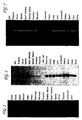
- hRUP3 As is supported by the data of Figure 3 , of the 16 human tissues in the cDNA panel utilized (brain, colon, heart, kidney, lung, ovary, pancreas, placenta, prostate, skeleton, small intestine, spleen, testis, thymus leukocyte, and liver) a single hRUP3 band is evident only from the pancreas. Additional comparative analysis of the protein sequence of hRUP3 with other GPCRs suggest that hRUP3 is related to GPCRs having small molecule endogenous ligand such that it is predicted that the endogenous ligand for hRUP3 is a small molecule.
- RT-PCR was performed using hRUP4 oligo's 8 and 4 as primers and the human multiple tissue cDNA panels (MTC, Clontech) as templates.
- Taq DNA polymerase (Stratagene) was used for the amplification in a 40ul reaction by the following cycles: 94°C for 30 seconds, 94°C for 10 seconds, 55°C for 30 seconds, 72°C for 2 minutes, and 72°C for 5 minutes with cycles 2 through 4 repeated 30 times.
- hRUP4 mRNA was found expressed in many human tissues, with the strongest expression in heart and kidney. ( see , Figure 4 ).
- a 300 bp fragment derived from the 5' end of hRUP4 was used as a probe for the Southern Blot analysis.
- the probe was labeled with 32 P-dCTP using the Prime-It II TM Random Primer Labeling Kit (Stratagene) and purified using the ProbeQuant TM G-50 micro columns (Amersham). Hybridization was done overnight at 42° C following a 12 hr pre-hybridization. The blot was finally washed at 65°C with 0.1 x SSC. The Southern blot did confirm the PCR fragments as hRUP4.
- RT-PCR was performed using the following hRUP5 specific primers:
- RT-PCR was applied to confirm the expression and to determine the tissue distribution of hRUP6.
- Oligonucleotides used based on an alignment of AC005871 and GPR66 segments, had the following sequences:
- the Vector utilized be pCMV.
- This vector was deposited with the American Type Culture Collection (ATCC) on October 13, 1998 (10801 University Boulevard., Manassas, VA 20110-2209 USA) under the provisions of the Budapest Treaty for the International Recognition of the Deposit of Microorganisms for the Purpose of Patent Procedure. The DNA was tested by the ATCC and determined to be. The ATCC has assigned the following deposit number to pCMV: ATCC #203351.
Landscapes
- Health & Medical Sciences (AREA)
- Life Sciences & Earth Sciences (AREA)
- Chemical & Material Sciences (AREA)
- Organic Chemistry (AREA)
- Genetics & Genomics (AREA)
- Engineering & Computer Science (AREA)
- General Health & Medical Sciences (AREA)
- Molecular Biology (AREA)
- Zoology (AREA)
- Medicinal Chemistry (AREA)
- Biophysics (AREA)
- Biochemistry (AREA)
- Biomedical Technology (AREA)
- Bioinformatics & Cheminformatics (AREA)
- Gastroenterology & Hepatology (AREA)
- Proteomics, Peptides & Aminoacids (AREA)
- Cell Biology (AREA)
- Immunology (AREA)
- Toxicology (AREA)
- Wood Science & Technology (AREA)
- General Engineering & Computer Science (AREA)
- Biotechnology (AREA)
- Physics & Mathematics (AREA)
- Microbiology (AREA)
- General Chemical & Material Sciences (AREA)
- Pharmacology & Pharmacy (AREA)
- Chemical Kinetics & Catalysis (AREA)
- Endocrinology (AREA)
- Animal Behavior & Ethology (AREA)
- Public Health (AREA)
- Plant Pathology (AREA)
- Nuclear Medicine, Radiotherapy & Molecular Imaging (AREA)
- Veterinary Medicine (AREA)
- Peptides Or Proteins (AREA)
- Micro-Organisms Or Cultivation Processes Thereof (AREA)
- External Artificial Organs (AREA)
- Separation Using Semi-Permeable Membranes (AREA)
- Nitrogen Condensed Heterocyclic Rings (AREA)
- Preparation Of Compounds By Using Micro-Organisms (AREA)
- Medicines That Contain Protein Lipid Enzymes And Other Medicines (AREA)
Priority Applications (1)
| Application Number | Priority Date | Filing Date | Title |
|---|---|---|---|
| CY20081100868T CY1108264T1 (el) | 1998-11-20 | 2008-08-08 | Ανθρωπινος ορφανος συζευγμενος σε g πρωτεϊνη υποδοχεας rup3 |
Applications Claiming Priority (25)
| Application Number | Priority Date | Filing Date | Title |
|---|---|---|---|
| US10921398P | 1998-11-20 | 1998-11-20 | |
| US12041699P | 1999-02-16 | 1999-02-16 | |
| US12185299P | 1999-02-26 | 1999-02-26 | |
| US12394699P | 1999-03-12 | 1999-03-12 | |
| US12394999P | 1999-03-12 | 1999-03-12 | |
| US13643799P | 1999-05-28 | 1999-05-28 | |
| US13643999P | 1999-05-28 | 1999-05-28 | |
| US13712799P | 1999-05-28 | 1999-05-28 | |
| US13656799P | 1999-05-28 | 1999-05-28 | |
| US13643699P | 1999-05-28 | 1999-05-28 | |
| US13713199P | 1999-05-28 | 1999-05-28 | |
| US14144899P | 1999-06-29 | 1999-06-29 | |
| US15665399P | 1999-09-29 | 1999-09-29 | |
| US15663499P | 1999-09-29 | 1999-09-29 | |
| US15663399P | 1999-09-29 | 1999-09-29 | |
| US15655599P | 1999-09-29 | 1999-09-29 | |
| US15729499P | 1999-10-01 | 1999-10-01 | |
| US15728099P | 1999-10-01 | 1999-10-01 | |
| US15728299P | 1999-10-01 | 1999-10-01 | |
| US15728199P | 1999-10-01 | 1999-10-01 | |
| US15729399P | 1999-10-01 | 1999-10-01 | |
| US41676099A | 1999-10-12 | 1999-10-12 | |
| US41704499A | 1999-10-12 | 1999-10-12 | |
| EP05003040A EP1584683B1 (en) | 1998-11-20 | 1999-10-13 | Human orphan g protein-coupled receptor RUP3 |
| EP99972682A EP1133559B1 (en) | 1998-11-20 | 1999-10-13 | Human orphan g protein-coupled receptor rup3 |
Related Parent Applications (1)
| Application Number | Title | Priority Date | Filing Date |
|---|---|---|---|
| EP05003040A Division EP1584683B1 (en) | 1998-11-20 | 1999-10-13 | Human orphan g protein-coupled receptor RUP3 |
Publications (3)
| Publication Number | Publication Date |
|---|---|
| EP1849866A2 EP1849866A2 (en) | 2007-10-31 |
| EP1849866A3 EP1849866A3 (en) | 2007-11-07 |
| EP1849866B1 true EP1849866B1 (en) | 2008-05-21 |
Family
ID=27586698
Family Applications (8)
| Application Number | Title | Priority Date | Filing Date |
|---|---|---|---|
| EP07008841A Expired - Lifetime EP1849866B1 (en) | 1998-11-20 | 1999-10-13 | Human orphan G protein-coupled receptor RUP3 |
| EP07001452A Ceased EP1780280A1 (en) | 1998-11-20 | 1999-10-13 | Human orphan G protein-coupled receptors |
| EP05003040A Expired - Lifetime EP1584683B1 (en) | 1998-11-20 | 1999-10-13 | Human orphan g protein-coupled receptor RUP3 |
| EP99972682A Expired - Lifetime EP1133559B1 (en) | 1998-11-20 | 1999-10-13 | Human orphan g protein-coupled receptor rup3 |
| EP10010303A Withdrawn EP2295573A1 (en) | 1998-11-20 | 1999-10-13 | Human orphan G protein-coupled receptors |
| EP10008862A Withdrawn EP2295572A1 (en) | 1998-11-20 | 1999-10-13 | Human orphan G protein-coupled receptors |
| EP10010658A Withdrawn EP2295574A1 (en) | 1998-11-20 | 1999-10-13 | Human orphan G protein-coupled receptors |
| EP05005946A Ceased EP1580271A3 (en) | 1998-11-20 | 1999-10-13 | Human Orphan G Protein-Coupled Receptors |
Family Applications After (7)
| Application Number | Title | Priority Date | Filing Date |
|---|---|---|---|
| EP07001452A Ceased EP1780280A1 (en) | 1998-11-20 | 1999-10-13 | Human orphan G protein-coupled receptors |
| EP05003040A Expired - Lifetime EP1584683B1 (en) | 1998-11-20 | 1999-10-13 | Human orphan g protein-coupled receptor RUP3 |
| EP99972682A Expired - Lifetime EP1133559B1 (en) | 1998-11-20 | 1999-10-13 | Human orphan g protein-coupled receptor rup3 |
| EP10010303A Withdrawn EP2295573A1 (en) | 1998-11-20 | 1999-10-13 | Human orphan G protein-coupled receptors |
| EP10008862A Withdrawn EP2295572A1 (en) | 1998-11-20 | 1999-10-13 | Human orphan G protein-coupled receptors |
| EP10010658A Withdrawn EP2295574A1 (en) | 1998-11-20 | 1999-10-13 | Human orphan G protein-coupled receptors |
| EP05005946A Ceased EP1580271A3 (en) | 1998-11-20 | 1999-10-13 | Human Orphan G Protein-Coupled Receptors |
Country Status (12)
| Country | Link |
|---|---|
| EP (8) | EP1849866B1 (enExample) |
| JP (5) | JP2003534767A (enExample) |
| KR (5) | KR100926209B1 (enExample) |
| AT (3) | ATE396400T1 (enExample) |
| AU (2) | AU770056B2 (enExample) |
| CA (2) | CA2645717A1 (enExample) |
| DK (3) | DK1584683T3 (enExample) |
| ES (3) | ES2243095T3 (enExample) |
| IL (2) | IL142538A0 (enExample) |
| NZ (3) | NZ527622A (enExample) |
| PT (3) | PT1133559E (enExample) |
| WO (1) | WO2000031258A2 (enExample) |
Families Citing this family (92)
| Publication number | Priority date | Publication date | Assignee | Title |
|---|---|---|---|---|
| DE69931360T2 (de) * | 1998-03-12 | 2007-02-08 | Astellas Pharma Inc. | Neue, an ein g-protein gekoppelte rezeptorproteine |
| WO1999055733A1 (en) * | 1998-04-24 | 1999-11-04 | Smithkline Beecham Corporation | Cloning of a novel 7tm receptor axor-2 |
| US6071722A (en) * | 1998-04-24 | 2000-06-06 | Smithkline Beecham Corporation | Nucleic acids encoding a G-protein coupled 7TM receptor (AXOR-1) |
| EP1155031A4 (en) * | 1998-11-03 | 2002-11-27 | Smithkline Beecham Corp | G PROTEIN TORQUE RECEPTOR, SAID AXOR-14 |
| US20030017528A1 (en) | 1998-11-20 | 2003-01-23 | Ruoping Chen | Human orphan G protein-coupled receptors |
| US7816492B2 (en) | 1998-11-20 | 2010-10-19 | Arena Pharmaceuticals, Inc. | Human G protein-coupled receptors |
| USRE42190E1 (en) | 1998-11-20 | 2011-03-01 | Arena Pharmaceuticals, Inc. | Method of identifying a compound for inhibiting or stimulating human G protein-coupled receptors |
| US6221660B1 (en) | 1999-02-22 | 2001-04-24 | Synaptic Pharmaceutical Corporation | DNA encoding SNORF25 receptor |
| EP1157038A4 (en) * | 1999-02-26 | 2005-01-19 | Smithkline Beecham Corp | CLONING OF A P2Y-LIKE 7TM RECEPTOR (AXOR17) |
| US6620615B1 (en) * | 1999-04-23 | 2003-09-16 | Curagen Corporation | G-protein coupled receptor—encoding nucleic acids |
| EP1189944A4 (en) * | 1999-06-21 | 2002-09-11 | Smithkline Beecham Corp | AXOR16, R CEPTEUR COUPL UNE PROT INE G |
| JP2003504054A (ja) * | 1999-07-13 | 2003-02-04 | メルク パテント ゲゼルシャフト ミット ベシュレンクテル ハフトング | G−タンパク質共役型受容体およびそのdna配列 |
| WO2001009313A1 (en) * | 1999-07-30 | 2001-02-08 | Merck Patent Gmbh | G-protein coupled receptor and dna sequences thereof |
| CA2382889A1 (en) * | 1999-08-27 | 2001-03-08 | Takuya Watanabe | Novel g protein-coupled receptor protein and dna thereof |
| US6998255B1 (en) | 1999-09-24 | 2006-02-14 | Solvay Pharmaceuticals B.V. | Human G-protein coupled receptor |
| GB9923177D0 (en) * | 1999-09-30 | 1999-12-01 | Pfizer Ltd | Novel polypeptide |
| US6204017B1 (en) * | 1999-10-07 | 2001-03-20 | Schering Corporation | Polynucleotide encoding a histamine receptor |
| GB9923893D0 (en) * | 1999-10-08 | 1999-12-08 | Pfizer Ltd | Novel polypeptide |
| GB9923890D0 (en) * | 1999-10-08 | 1999-12-08 | Pfizer Ltd | Novel polypeptide |
| GB9924960D0 (en) * | 1999-10-21 | 1999-12-22 | Pfizer Ltd | Novel polypeptide |
| GB9924956D0 (en) * | 1999-10-21 | 1999-12-22 | Pfizer Ltd | Novel polypeptide |
| EP1230361A2 (en) * | 1999-10-27 | 2002-08-14 | PHARMACIA & UPJOHN COMPANY | G protein-coupled receptors expressed in human brain |
| DE60036676T2 (de) * | 1999-10-29 | 2008-02-07 | Pfizer Inc. | G-protein-gekoppelte rezeptor-ähnliche proteine |
| WO2001032864A2 (en) * | 1999-11-03 | 2001-05-10 | Merck Patent Gmbh | Gpcr-kd5 polypeptides and dna sequences thereof |
| US6461836B1 (en) | 1999-11-05 | 2002-10-08 | Smithkline Beecham Corporation | Molecular cloning of a 7TM receptor (AxOR34) and screening methods thereof |
| WO2001036473A2 (en) * | 1999-11-16 | 2001-05-25 | Pharmacia & Upjohn Company | Human g protein-coupled receptors |
| US7029857B1 (en) | 1999-12-17 | 2006-04-18 | H. Lundbeck A/S | Processes for obtaining compounds employing SNORF72 receptors |
| WO2001046414A1 (fr) * | 1999-12-20 | 2001-06-28 | Banyu Pharmaceutical Co., Ltd. | Nouvelle proteine receptrice couplee a la proteine de fixation de guanosine triphosphate, bg26 |
| US6762029B2 (en) | 1999-12-23 | 2004-07-13 | Portola Pharmaceuticals, Inc. | Methods of identifying agents that modulate P2Y12 receptor activity |
| WO2001048189A1 (fr) * | 1999-12-28 | 2001-07-05 | Helix Research Institute | Nouveaux recepteurs couples a une proteine de liaison au guanosine triphosphate, genes de ces derniers, et production et utilisation de ces derniers |
| GB0001700D0 (en) * | 2000-01-25 | 2000-03-15 | Glaxo Group Ltd | Novel protein |
| CN1397019A (zh) * | 2000-02-04 | 2003-02-12 | 武田药品工业株式会社 | 筛选方法 |
| DE60127102T2 (de) * | 2000-03-14 | 2007-08-23 | Bayer Healthcare Aktiengesellschaft | Regulation des menschliches lipoxin a4 rezeptor-ähnliches protein |
| EP1268777A2 (en) * | 2000-03-17 | 2003-01-02 | Bayer Aktiengesellschaft | Regulation of human leukotriene b 4?-like g protein-coupled receptor |
| AU2001241156A1 (en) * | 2000-03-21 | 2001-10-03 | Yamanouchi Pharmaceutical Co..Ltd. | Novel leukotriene b4 receptor |
| AU2001242800A1 (en) * | 2000-03-28 | 2001-10-08 | Takeda Chemical Industries Ltd. | Novel g protein-coupled receptor protein and dna thereof |
| AU4467301A (en) * | 2000-03-31 | 2001-10-08 | Helix Research Institute | Novel guanosine triphosphate-binding protein-coupled receptor gprv53, gene thereof and production and use of the same |
| AU2001248755A1 (en) * | 2000-04-12 | 2001-10-23 | Takeda Chemical Industries Ltd. | Novel g protein-coupled receptor protein and dna thereof |
| EP1178110A1 (en) * | 2000-08-01 | 2002-02-06 | Aventis Pharma Deutschland GmbH | EDG8 receptor for sphingosine 1-phosphate , its preparation and use |
| ATE348162T1 (de) * | 2000-05-18 | 2007-01-15 | Bayer Healthcare Ag | Regulation eines menschlichen dopamine-ähnlichen g-protein gekoppelten rezeptor. |
| WO2002000719A2 (en) * | 2000-06-23 | 2002-01-03 | Tularik Inc. | Human and mouse g-protein couipled receptors |
| WO2002000725A2 (en) * | 2000-06-26 | 2002-01-03 | Akzo Nobel N.V. | G-protein coupled receptor org10 |
| AU2001281933A1 (en) * | 2000-06-30 | 2002-01-14 | Ingenium Pharmaceuticals Ag | Human g protein-coupled receptor igpcr17, and uses therof |
| AU2001271838A1 (en) | 2000-07-06 | 2002-01-21 | Bayer Corporation | Human neuropeptide y-like g protein-coupled receptor |
| EP1311546A2 (en) * | 2000-08-09 | 2003-05-21 | Millenium Pharmaceuticals, Inc. | Methods for using 14266, a human g protein-coupled receptor |
| US6790608B2 (en) | 2000-09-20 | 2004-09-14 | The Regents Of The University Of California | Methods of identifying and ADP-glucose receptor ligand, agonist or antagonist |
| WO2002036631A1 (en) * | 2000-11-01 | 2002-05-10 | Yamanouchi Pharmaceutical Co., Ltd. | Method of screening antiplatelet |
| EP1337558B1 (en) * | 2000-11-07 | 2010-09-01 | Takeda Pharmaceutical Company Limited | A "bach" g protein coupled receptor polypeptide and polynucleotide encoding this receptor |
| WO2002042461A2 (en) * | 2000-11-27 | 2002-05-30 | Arena Pharmaceuticals, Inc. | Endogenous and non-endogenous versions of human g protein-coupled receptors |
| EP1770159A1 (en) | 2000-12-01 | 2007-04-04 | Astellas Pharma Inc. | Process for manufacturing a pharmaceutical composition for treating diabetes |
| WO2002052047A2 (en) * | 2000-12-22 | 2002-07-04 | Mergen Ltd. | Methods for identifying g-protein coupled receptors associated with diseases |
| AU2002246680A1 (en) | 2000-12-22 | 2002-07-30 | University Of South Florida | Sphingosine 1-phosphate receptor gene, sppr |
| GB0100782D0 (en) * | 2001-01-11 | 2001-02-21 | Glaxo Group Ltd | Assay |
| DE60228559D1 (de) * | 2001-04-25 | 2008-10-09 | Astellas Pharma Inc | Guanosintriphosphat-bindungsprotein-gekoppelter rezeptor place 6002312 und sein gen sowie dessen produktion und verwendung |
| US7419658B2 (en) | 2001-07-09 | 2008-09-02 | Euroscreen S.A. | Isolated ligand of ChemerinR |
| US20030096299A1 (en) | 2001-07-09 | 2003-05-22 | Valerie Wittamer | Natural ligand of G protein coupled receptor ChemR23 and uses thereof |
| US7858755B2 (en) | 2001-07-09 | 2010-12-28 | Euroscreen S.A. | Monoclonal antibodies that bind Chemerin polypeptide |
| US6946244B2 (en) * | 2001-08-07 | 2005-09-20 | Euroscreen, S.A. | Methods of identifying a ligand, an agonist, and an antagonist of G protein coupled receptor GPR86 (P2Y13) |
| JP4594623B2 (ja) | 2002-04-12 | 2010-12-08 | シェーリング コーポレイション | Gタンパク質共役レセプターリガンドおよび方法 |
| AU2003261874A1 (en) * | 2002-09-02 | 2004-03-29 | Takeda Pharmaceutical Company Limited | Adrenocortical hormone secretion controller |
| WO2004033687A1 (ja) * | 2002-10-11 | 2004-04-22 | Yamanouchi Pharmaceutical Co., Ltd. | 腎不全治療薬をスクリーニングする方法 |
| US7056685B1 (en) | 2002-11-05 | 2006-06-06 | Amgen Inc. | Receptor ligands and methods of modulating receptors |
| EP1581509B1 (en) | 2002-12-20 | 2011-01-19 | Merck Sharp & Dohme Corp. | 1-(amino)indanes as edg receptor agonists |
| HRP20050696B1 (en) | 2003-01-14 | 2008-10-31 | Arena Pharmaceuticals Inc. | 1,2,3-trisubstituted aryl and heteroaryl derivatives as modulators of metabolism and the prpphylaxis and treatment of disorders related thereto such as diabetes and hyperglycemia |
| US7083933B1 (en) | 2003-05-09 | 2006-08-01 | Prosidion Limited | Methods for identification of modulators of OSGPR116 activity |
| WO2005010152A2 (en) * | 2003-06-27 | 2005-02-03 | Tanox, Inc. | Human mast cell-expressed membrane protein |
| US7524638B1 (en) | 2003-06-27 | 2009-04-28 | Osi Pharmaceuticals, Inc. | Methods for identification of modulators of OSGPR114 or OSGPR78 activity, and their use in the treatment of disease |
| DOP2006000008A (es) | 2005-01-10 | 2006-08-31 | Arena Pharm Inc | Terapia combinada para el tratamiento de la diabetes y afecciones relacionadas y para el tratamiento de afecciones que mejoran mediante un incremento de la concentración sanguínea de glp-1 |
| GB0508990D0 (en) * | 2005-05-03 | 2005-06-08 | Novartis Ag | Organic compounds |
| DE602007010420D1 (de) | 2006-04-11 | 2010-12-23 | Arena Pharm Inc | Verfahren zur verwendung des gpr119-rezeptors zur identifizierung von verbindungen zur erhöhung der knochenmasse bei einer person |
| US7638541B2 (en) | 2006-12-28 | 2009-12-29 | Metabolex Inc. | 5-ethyl-2-{4-[4-(4-tetrazol-1-yl-phenoxymethyl)-thiazol-2-yl]-piperidin-1-yl}-pyrimidine |
| EP2185544B1 (en) | 2007-07-19 | 2014-11-26 | Cymabay Therapeutics, Inc. | N-azacyclic substituted pyrrole, pyrazole, imidazole, triazole and tetrazole derivatives as agonists of the rup3 or gpr119 for the treatment of diabetes and metabolic disorders |
| BRPI0817211A2 (pt) | 2007-09-20 | 2017-05-16 | Irm Llc | composto composições como moduladores da atividade de gpr119 |
| EP2146210A1 (en) | 2008-04-07 | 2010-01-20 | Arena Pharmaceuticals, Inc. | Methods of using A G protein-coupled receptor to identify peptide YY (PYY) secretagogues and compounds useful in the treatment of conditions modulated by PYY |
| AR077642A1 (es) | 2009-07-09 | 2011-09-14 | Arena Pharm Inc | Moduladores del metabolismo y el tratamiento de trastornos relacionados con el mismo |
| EP2483281B1 (en) | 2009-10-01 | 2014-06-04 | Cymabay Therapeutics, Inc. | Substituted tetrazol-1-yl-phenoxymethyl-thiazol-2-yl-piperidinyl-pyrimidine salts |
| US8791100B2 (en) | 2010-02-02 | 2014-07-29 | Novartis Ag | Aryl benzylamine compounds |
| WO2011127051A1 (en) | 2010-04-06 | 2011-10-13 | Arena Pharmaceuticals, Inc. | Modulators of the gpr119 receptor and the treatment of disorders related thereto |
| BR112012032248A2 (pt) | 2010-06-23 | 2016-09-13 | Metabolex Inc | composições de 5-etil-2-{4-[-4(-4-tetrazol-1-il-fenoximetil)-tiazol-2-il]-piperidin-1-il}-pirimidina |
| MX2013003184A (es) | 2010-09-22 | 2013-06-07 | Arena Pharm Inc | Moduladores del receptor gpr119 y el tratamiento de transtornos relacionados con el mismo. |
| WO2012135570A1 (en) | 2011-04-01 | 2012-10-04 | Arena Pharmaceuticals, Inc. | Modulators of the gpr119 receptor and the treatment of disorders related thereto |
| WO2012145361A1 (en) | 2011-04-19 | 2012-10-26 | Arena Pharmaceuticals, Inc. | Modulators of the gpr119 receptor and the treatment of disorders related thereto |
| WO2012145603A1 (en) | 2011-04-22 | 2012-10-26 | Arena Pharmaceuticals, Inc. | Modulators of the gpr119 receptor and the treatment of disorders related thereto |
| US20140051714A1 (en) | 2011-04-22 | 2014-02-20 | Arena Pharmaceuticals, Inc. | Modulators Of The GPR119 Receptor And The Treatment Of Disorders Related Thereto |
| WO2012170702A1 (en) | 2011-06-08 | 2012-12-13 | Arena Pharmaceuticals, Inc. | Modulators of the gpr119 receptor and the treatment of disorders related thereto |
| WO2013055910A1 (en) | 2011-10-12 | 2013-04-18 | Arena Pharmaceuticals, Inc. | Modulators of the gpr119 receptor and the treatment of disorders related thereto |
| WO2014074668A1 (en) | 2012-11-08 | 2014-05-15 | Arena Pharmaceuticals, Inc. | Modulators of gpr119 and the treatment of disorders related thereto |
| US11007175B2 (en) | 2015-01-06 | 2021-05-18 | Arena Pharmaceuticals, Inc. | Methods of treating conditions related to the S1P1 receptor |
| BR112017027656B1 (pt) | 2015-06-22 | 2023-12-05 | Arena Pharmaceuticals, Inc. | Hábito cristalino de placa livre de sal de l-arginina de ácido (r)-2-(7-(4- ciclopentil-3-(trifluorometil)benzilóxi)- 1,2,3,4-tetra-hidrociclo-penta[b]indol-3- il)acético, composição farmacêutica que o compreende, seus usos e método de preparação do mesmo |
| WO2018026890A1 (en) | 2016-08-03 | 2018-02-08 | Cymabay Therapeutics | Oxymethylene aryl compounds for treating inflammatory gastrointestinal diseases or gastrointestinal conditions |
| WO2018236896A1 (en) | 2017-06-19 | 2018-12-27 | Arena Pharmaceuticals, Inc. | Compounds and methods for treatment of nafld and nash |
| BR112020024762A2 (pt) | 2018-06-06 | 2021-03-23 | Arena Pharmaceuticals, Inc. | métodos de tratamento de condições relacionadas ao receptor s1p1 |
Family Cites Families (30)
| Publication number | Priority date | Publication date | Assignee | Title |
|---|---|---|---|---|
| EP0868510A2 (en) * | 1995-11-15 | 1998-10-07 | Cor Therapeutics, Inc. | P2u2 PURINERGIC RECEPTOR |
| JP2000505644A (ja) * | 1996-01-11 | 2000-05-16 | ヒューマン ジノーム サイエンシーズ,インコーポレイテッド | ヒトgタンパク質結合レセプター |
| WO1998031810A2 (en) * | 1997-01-21 | 1998-07-23 | Schering Corporation | Mammalian chemokines; receptors; reagents; uses |
| US6221627B1 (en) * | 1997-02-24 | 2001-04-24 | Smithkline Beecham Corporation | cDNA clone HDPB130 that encodes a novel human 7-transmembrane receptor |
| US5955303A (en) * | 1997-03-06 | 1999-09-21 | Incyte Pharmaceuticals, Inc. | Human chemokine receptor-like protein |
| US6555339B1 (en) * | 1997-04-14 | 2003-04-29 | Arena Pharmaceuticals, Inc. | Non-endogenous, constitutively activated human protein-coupled receptors |
| US6060272A (en) * | 1997-05-07 | 2000-05-09 | Human Genome Sciences, Inc. | Human G-protein coupled receptors |
| EP0899332A3 (en) * | 1997-08-15 | 2000-07-05 | Smithkline Beecham Corporation | The G-protein coupled receptor HFIAO41 |
| CA2239255A1 (en) * | 1997-10-23 | 1999-04-23 | Smithkline Beecham Corporation | Cdna clone hneaa81 that encodes a human 7-transmembrane receptor |
| US5932445A (en) * | 1997-11-07 | 1999-08-03 | Incyte Pharmaceuticals, Inc. | Signal peptide-containing proteins |
| WO1999024569A1 (fr) * | 1997-11-11 | 1999-05-20 | Ono Pharmaceutical Co., Ltd. | Recepteur d'acide lysophosphatidique humain et utilisation dudit recepteur |
| US6207412B1 (en) * | 1997-11-13 | 2001-03-27 | The Regents Of The University Of California | Identification of a G protein-coupled receptor transcriptionally regulated by protein tyrosine kinase signaling in hematopoietic cells |
| WO1999042484A1 (en) * | 1998-02-20 | 1999-08-26 | Smithkline Beecham Corporation | Fishboy, a g-protein coupled receptor |
| DE69931360T2 (de) * | 1998-03-12 | 2007-02-08 | Astellas Pharma Inc. | Neue, an ein g-protein gekoppelte rezeptorproteine |
| WO1999052945A2 (en) * | 1998-04-16 | 1999-10-21 | Millenium Pharmaceuticals, Inc. | NOVEL MOLECULES OF THE BGCKr-RELATED PROTEIN FAMILY AND USES THEREOF |
| US6071722A (en) * | 1998-04-24 | 2000-06-06 | Smithkline Beecham Corporation | Nucleic acids encoding a G-protein coupled 7TM receptor (AXOR-1) |
| WO1999055733A1 (en) * | 1998-04-24 | 1999-11-04 | Smithkline Beecham Corporation | Cloning of a novel 7tm receptor axor-2 |
| SE9801455D0 (sv) * | 1998-04-24 | 1998-04-24 | Astra Pharma Inc | New receptor |
| WO2000011166A1 (en) * | 1998-08-19 | 2000-03-02 | Millennium Pharmaceuticals, Inc. | 14274 receptor, a g-protein coupled receptor related to the edg receptor family |
| JP2003532369A (ja) * | 1998-08-20 | 2003-11-05 | ミレニアム・ファーマシューティカルズ・インコーポレイテッド | Gタンパク質結合受容体である14400受容体 |
| WO2000011015A1 (en) * | 1998-08-24 | 2000-03-02 | Alphagene, Inc. | Secreted proteins and polynucleotides encoding them |
| AU5801099A (en) * | 1998-09-02 | 2000-03-21 | Millennium Pharmaceuticals, Inc. | 14926 receptor, a novel g-protein coupled receptor |
| KR20010080882A (ko) * | 1998-10-13 | 2001-08-25 | 리처드 피. 버군 쥬니어 | 구성적으로 활성화된 비내생성 인간 g 단백질 결합형수용체 |
| JP2004500013A (ja) * | 1998-10-16 | 2004-01-08 | ミレニアム・ファーマシューティカルズ・インコーポレイテッド | 新規gタンパク質共役受容体 |
| WO2000026369A1 (en) * | 1998-11-04 | 2000-05-11 | Chiron Corporation | Isolated vshk-1 receptor polypeptides and methods of use thereof |
| WO2000028028A1 (en) * | 1998-11-06 | 2000-05-18 | Millennium Pharmaceuticals, Inc. | G-protein coupled receptors, homologous to ebv-induced gpcr 2 (ebi-2). methods to seek for ligands thereof |
| US6221660B1 (en) * | 1999-02-22 | 2001-04-24 | Synaptic Pharmaceutical Corporation | DNA encoding SNORF25 receptor |
| US6689866B1 (en) * | 1999-03-09 | 2004-02-10 | Curagen Corporation | Polynucleotides and proteins encoded thereby |
| US6590938B1 (en) * | 1999-09-30 | 2003-07-08 | Conexant Systems, Inc. | DCT domain conversion of a higher definition signal to lower definition signal |
| GB9923177D0 (en) * | 1999-09-30 | 1999-12-01 | Pfizer Ltd | Novel polypeptide |
-
1999
- 1999-10-13 PT PT99972682T patent/PT1133559E/pt unknown
- 1999-10-13 NZ NZ527622A patent/NZ527622A/en not_active IP Right Cessation
- 1999-10-13 IL IL14253899A patent/IL142538A0/xx unknown
- 1999-10-13 KR KR1020087003575A patent/KR100926209B1/ko not_active Expired - Fee Related
- 1999-10-13 DK DK05003040T patent/DK1584683T3/da active
- 1999-10-13 ES ES99972682T patent/ES2243095T3/es not_active Expired - Lifetime
- 1999-10-13 DK DK99972682T patent/DK1133559T3/da active
- 1999-10-13 EP EP07008841A patent/EP1849866B1/en not_active Expired - Lifetime
- 1999-10-13 EP EP07001452A patent/EP1780280A1/en not_active Ceased
- 1999-10-13 PT PT05003040T patent/PT1584683E/pt unknown
- 1999-10-13 DK DK07008841T patent/DK1849866T3/da active
- 1999-10-13 ES ES05003040T patent/ES2289610T3/es not_active Expired - Lifetime
- 1999-10-13 ES ES07008841T patent/ES2308759T3/es not_active Expired - Lifetime
- 1999-10-13 KR KR1020077018185A patent/KR100926208B1/ko not_active Expired - Fee Related
- 1999-10-13 PT PT07008841T patent/PT1849866E/pt unknown
- 1999-10-13 AT AT07008841T patent/ATE396400T1/de active
- 1999-10-13 AT AT05003040T patent/ATE366815T1/de active
- 1999-10-13 EP EP05003040A patent/EP1584683B1/en not_active Expired - Lifetime
- 1999-10-13 JP JP2000584067A patent/JP2003534767A/ja not_active Withdrawn
- 1999-10-13 NZ NZ537625A patent/NZ537625A/en not_active IP Right Cessation
- 1999-10-13 EP EP99972682A patent/EP1133559B1/en not_active Expired - Lifetime
- 1999-10-13 EP EP10010303A patent/EP2295573A1/en not_active Withdrawn
- 1999-10-13 AU AU37904/00A patent/AU770056B2/en not_active Ceased
- 1999-10-13 EP EP10008862A patent/EP2295572A1/en not_active Withdrawn
- 1999-10-13 KR KR1020017006279A patent/KR100765039B1/ko not_active Expired - Fee Related
- 1999-10-13 CA CA002645717A patent/CA2645717A1/en not_active Withdrawn
- 1999-10-13 NZ NZ511087A patent/NZ511087A/en not_active IP Right Cessation
- 1999-10-13 CA CA002348377A patent/CA2348377C/en not_active Expired - Fee Related
- 1999-10-13 KR KR1020087003578A patent/KR100963367B1/ko not_active Expired - Fee Related
- 1999-10-13 WO PCT/US1999/023687 patent/WO2000031258A2/en not_active Ceased
- 1999-10-13 AT AT99972682T patent/ATE301673T1/de active
- 1999-10-13 KR KR1020087024998A patent/KR20080104062A/ko not_active Withdrawn
- 1999-10-13 EP EP10010658A patent/EP2295574A1/en not_active Withdrawn
- 1999-10-13 EP EP05005946A patent/EP1580271A3/en not_active Ceased
-
2001
- 2001-04-11 IL IL142538A patent/IL142538A/en not_active IP Right Cessation
-
2004
- 2004-04-28 JP JP2004132989A patent/JP2004267216A/ja not_active Withdrawn
- 2004-05-12 AU AU2004202147A patent/AU2004202147A1/en not_active Abandoned
-
2007
- 2007-05-15 JP JP2007129923A patent/JP2007209352A/ja active Pending
-
2008
- 2008-02-14 JP JP2008033839A patent/JP2008133300A/ja active Pending
-
2009
- 2009-07-03 JP JP2009159339A patent/JP2009298791A/ja not_active Withdrawn
Also Published As
Similar Documents
| Publication | Publication Date | Title |
|---|---|---|
| EP1849866B1 (en) | Human orphan G protein-coupled receptor RUP3 | |
| US7108991B2 (en) | Human orphan G protein-coupled receptors | |
| AU1769601A (en) | Endogenous and non-endogenous versions of human G protein-coupled receptors | |
| US8198049B2 (en) | Nucleic acids encoding RUP3 and methods of using same | |
| AU2007202139B8 (en) | Human Orphan G protein-coupled receptor hRUP3 | |
| USRE42190E1 (en) | Method of identifying a compound for inhibiting or stimulating human G protein-coupled receptors | |
| HK1103763B (en) | Human orphan g protein-coupled receptor rup3 | |
| HK1077081B (en) | Human orphan g protein-coupled receptor rup3 | |
| HK1077081A1 (en) | Human orphan g protein-coupled receptor rup3 | |
| HK1077082A (en) | Human orphan g protein-coupled receptors | |
| HK1155771A (en) | Human orphan g protein-coupled receptors | |
| HK1098510A (en) | Human orphan g protein-coupled receptors | |
| HK1037675B (en) | Human orphan g protein-coupled receptor rup3 | |
| EP2264068A1 (en) | Non-endogenous, constitutively activated human G protein-coupled receptors |
Legal Events
| Date | Code | Title | Description |
|---|---|---|---|
| PUAI | Public reference made under article 153(3) epc to a published international application that has entered the european phase |
Free format text: ORIGINAL CODE: 0009012 |
|
| PUAL | Search report despatched |
Free format text: ORIGINAL CODE: 0009013 |
|
| 17P | Request for examination filed |
Effective date: 20070521 |
|
| AC | Divisional application: reference to earlier application |
Ref document number: 1584683 Country of ref document: EP Kind code of ref document: P Ref document number: 1133559 Country of ref document: EP Kind code of ref document: P |
|
| AK | Designated contracting states |
Kind code of ref document: A2 Designated state(s): AT BE CH CY DE DK ES FI FR GB GR IE IT LI LU MC NL PT SE |
|
| AX | Request for extension of the european patent |
Extension state: AL LT LV MK RO SI |
|
| AK | Designated contracting states |
Kind code of ref document: A3 Designated state(s): AT BE CH CY DE DK ES FI FR GB GR IE IT LI LU MC NL PT SE |
|
| AX | Request for extension of the european patent |
Extension state: AL LT LV MK RO SI |
|
| REG | Reference to a national code |
Ref country code: HK Ref legal event code: DE Ref document number: 1103763 Country of ref document: HK |
|
| 17Q | First examination report despatched |
Effective date: 20080107 |
|
| GRAP | Despatch of communication of intention to grant a patent |
Free format text: ORIGINAL CODE: EPIDOSNIGR1 |
|
| RIC1 | Information provided on ipc code assigned before grant |
Ipc: G01N 33/566 20060101AFI20080312BHEP Ipc: C07K 14/705 20060101ALN20080312BHEP |
|
| RTI1 | Title (correction) |
Free format text: HUMAN ORPHAN G PROTEIN-COUPLED RECEPTOR RUP3 |
|
| GRAS | Grant fee paid |
Free format text: ORIGINAL CODE: EPIDOSNIGR3 |
|
| GRAA | (expected) grant |
Free format text: ORIGINAL CODE: 0009210 |
|
| GRAF | Information related to payment of grant fee modified |
Free format text: ORIGINAL CODE: EPIDOSCIGR3 |
|
| AC | Divisional application: reference to earlier application |
Ref document number: 1133559 Country of ref document: EP Kind code of ref document: P Ref document number: 1584683 Country of ref document: EP Kind code of ref document: P |
|
| AK | Designated contracting states |
Kind code of ref document: B1 Designated state(s): AT BE CH CY DE DK ES FI FR GB GR IE IT LI LU MC NL PT SE |
|
| REG | Reference to a national code |
Ref country code: GB Ref legal event code: FG4D |
|
| REG | Reference to a national code |
Ref country code: CH Ref legal event code: EP |
|
| REF | Corresponds to: |
Ref document number: 69938802 Country of ref document: DE Date of ref document: 20080703 Kind code of ref document: P |
|
| AKX | Designation fees paid |
Designated state(s): AT BE CH CY DE DK ES FI FR GB GR IE IT LI LU MC NL PT SE |
|
| REG | Reference to a national code |
Ref country code: IE Ref legal event code: FG4D |
|
| REG | Reference to a national code |
Ref country code: PT Ref legal event code: SC4A Free format text: AVAILABILITY OF NATIONAL TRANSLATION Effective date: 20080818 |
|
| REG | Reference to a national code |
Ref country code: SE Ref legal event code: TRGR |
|
| REG | Reference to a national code |
Ref country code: GR Ref legal event code: EP Ref document number: 20080402155 Country of ref document: GR |
|
| REG | Reference to a national code |
Ref country code: ES Ref legal event code: FG2A Ref document number: 2308759 Country of ref document: ES Kind code of ref document: T3 |
|
| REG | Reference to a national code |
Ref country code: HK Ref legal event code: GR Ref document number: 1103763 Country of ref document: HK |
|
| PLBE | No opposition filed within time limit |
Free format text: ORIGINAL CODE: 0009261 |
|
| STAA | Information on the status of an ep patent application or granted ep patent |
Free format text: STATUS: NO OPPOSITION FILED WITHIN TIME LIMIT |
|
| 26N | No opposition filed |
Effective date: 20090224 |
|
| PGFP | Annual fee paid to national office [announced via postgrant information from national office to epo] |
Ref country code: MC Payment date: 20120926 Year of fee payment: 14 |
|
| PGFP | Annual fee paid to national office [announced via postgrant information from national office to epo] |
Ref country code: GR Payment date: 20120917 Year of fee payment: 14 Ref country code: LU Payment date: 20121011 Year of fee payment: 14 |
|
| PGFP | Annual fee paid to national office [announced via postgrant information from national office to epo] |
Ref country code: FI Payment date: 20121010 Year of fee payment: 14 Ref country code: CY Payment date: 20120907 Year of fee payment: 14 |
|
| PGFP | Annual fee paid to national office [announced via postgrant information from national office to epo] |
Ref country code: PT Payment date: 20121016 Year of fee payment: 14 |
|
| PGFP | Annual fee paid to national office [announced via postgrant information from national office to epo] |
Ref country code: AT Payment date: 20120927 Year of fee payment: 14 |
|
| REG | Reference to a national code |
Ref country code: PT Ref legal event code: MM4A Free format text: LAPSE DUE TO NON-PAYMENT OF FEES Effective date: 20140414 |
|
| PG25 | Lapsed in a contracting state [announced via postgrant information from national office to epo] |
Ref country code: MC Free format text: LAPSE BECAUSE OF NON-PAYMENT OF DUE FEES Effective date: 20131031 |
|
| REG | Reference to a national code |
Ref country code: AT Ref legal event code: MM01 Ref document number: 396400 Country of ref document: AT Kind code of ref document: T Effective date: 20131013 |
|
| REG | Reference to a national code |
Ref country code: GR Ref legal event code: ML Ref document number: 20080402155 Country of ref document: GR Effective date: 20140505 |
|
| PG25 | Lapsed in a contracting state [announced via postgrant information from national office to epo] |
Ref country code: FI Free format text: LAPSE BECAUSE OF NON-PAYMENT OF DUE FEES Effective date: 20131013 Ref country code: GR Free format text: LAPSE BECAUSE OF NON-PAYMENT OF DUE FEES Effective date: 20140505 Ref country code: PT Free format text: LAPSE BECAUSE OF NON-PAYMENT OF DUE FEES Effective date: 20140414 Ref country code: AT Free format text: LAPSE BECAUSE OF NON-PAYMENT OF DUE FEES Effective date: 20131013 Ref country code: CY Free format text: LAPSE BECAUSE OF NON-PAYMENT OF DUE FEES Effective date: 20131013 |
|
| PGFP | Annual fee paid to national office [announced via postgrant information from national office to epo] |
Ref country code: ES Payment date: 20140911 Year of fee payment: 16 |
|
| PGFP | Annual fee paid to national office [announced via postgrant information from national office to epo] |
Ref country code: DK Payment date: 20141010 Year of fee payment: 16 |
|
| PGFP | Annual fee paid to national office [announced via postgrant information from national office to epo] |
Ref country code: IE Payment date: 20141009 Year of fee payment: 16 Ref country code: FR Payment date: 20141008 Year of fee payment: 16 Ref country code: DE Payment date: 20141007 Year of fee payment: 16 Ref country code: CH Payment date: 20141014 Year of fee payment: 16 Ref country code: SE Payment date: 20141013 Year of fee payment: 16 Ref country code: GB Payment date: 20141008 Year of fee payment: 16 |
|
| PGFP | Annual fee paid to national office [announced via postgrant information from national office to epo] |
Ref country code: NL Payment date: 20141010 Year of fee payment: 16 |
|
| PGFP | Annual fee paid to national office [announced via postgrant information from national office to epo] |
Ref country code: IT Payment date: 20141010 Year of fee payment: 16 |
|
| PGFP | Annual fee paid to national office [announced via postgrant information from national office to epo] |
Ref country code: BE Payment date: 20141013 Year of fee payment: 16 |
|
| PG25 | Lapsed in a contracting state [announced via postgrant information from national office to epo] |
Ref country code: LU Free format text: LAPSE BECAUSE OF NON-PAYMENT OF DUE FEES Effective date: 20131013 |
|
| REG | Reference to a national code |
Ref country code: DE Ref legal event code: R119 Ref document number: 69938802 Country of ref document: DE |
|
| REG | Reference to a national code |
Ref country code: DK Ref legal event code: EBP Effective date: 20151031 |
|
| REG | Reference to a national code |
Ref country code: SE Ref legal event code: EUG Ref country code: CH Ref legal event code: PL |
|
| GBPC | Gb: european patent ceased through non-payment of renewal fee |
Effective date: 20151013 |
|
| REG | Reference to a national code |
Ref country code: NL Ref legal event code: MM Effective date: 20151101 |
|
| REG | Reference to a national code |
Ref country code: IE Ref legal event code: MM4A |
|
| PG25 | Lapsed in a contracting state [announced via postgrant information from national office to epo] |
Ref country code: IT Free format text: LAPSE BECAUSE OF NON-PAYMENT OF DUE FEES Effective date: 20151013 Ref country code: CH Free format text: LAPSE BECAUSE OF NON-PAYMENT OF DUE FEES Effective date: 20151031 Ref country code: GB Free format text: LAPSE BECAUSE OF NON-PAYMENT OF DUE FEES Effective date: 20151013 Ref country code: DE Free format text: LAPSE BECAUSE OF NON-PAYMENT OF DUE FEES Effective date: 20160503 Ref country code: LI Free format text: LAPSE BECAUSE OF NON-PAYMENT OF DUE FEES Effective date: 20151031 |
|
| REG | Reference to a national code |
Ref country code: FR Ref legal event code: ST Effective date: 20160630 |
|
| PG25 | Lapsed in a contracting state [announced via postgrant information from national office to epo] |
Ref country code: NL Free format text: LAPSE BECAUSE OF NON-PAYMENT OF DUE FEES Effective date: 20151101 Ref country code: FR Free format text: LAPSE BECAUSE OF NON-PAYMENT OF DUE FEES Effective date: 20151102 Ref country code: SE Free format text: LAPSE BECAUSE OF NON-PAYMENT OF DUE FEES Effective date: 20151014 |
|
| PG25 | Lapsed in a contracting state [announced via postgrant information from national office to epo] |
Ref country code: DK Free format text: LAPSE BECAUSE OF NON-PAYMENT OF DUE FEES Effective date: 20151031 Ref country code: IE Free format text: LAPSE BECAUSE OF NON-PAYMENT OF DUE FEES Effective date: 20151013 |
|
| REG | Reference to a national code |
Ref country code: ES Ref legal event code: FD2A Effective date: 20170206 |
|
| PG25 | Lapsed in a contracting state [announced via postgrant information from national office to epo] |
Ref country code: ES Free format text: LAPSE BECAUSE OF NON-PAYMENT OF DUE FEES Effective date: 20151014 |
|
| PG25 | Lapsed in a contracting state [announced via postgrant information from national office to epo] |
Ref country code: BE Free format text: LAPSE BECAUSE OF NON-PAYMENT OF DUE FEES Effective date: 20151031 |