EP1805891B1 - Calculating and adjusting the perceived loudness and/or the perceived spectral balance of an audio signal - Google Patents
Calculating and adjusting the perceived loudness and/or the perceived spectral balance of an audio signal Download PDFInfo
- Publication number
- EP1805891B1 EP1805891B1 EP05818505A EP05818505A EP1805891B1 EP 1805891 B1 EP1805891 B1 EP 1805891B1 EP 05818505 A EP05818505 A EP 05818505A EP 05818505 A EP05818505 A EP 05818505A EP 1805891 B1 EP1805891 B1 EP 1805891B1
- Authority
- EP
- European Patent Office
- Prior art keywords
- specific loudness
- audio signal
- loudness
- modification parameters
- target specific
- Prior art date
- Legal status (The legal status is an assumption and is not a legal conclusion. Google has not performed a legal analysis and makes no representation as to the accuracy of the status listed.)
- Expired - Lifetime
Links
Images

Classifications
-
- H—ELECTRICITY
- H03—ELECTRONIC CIRCUITRY
- H03G—CONTROL OF AMPLIFICATION
- H03G3/00—Gain control in amplifiers or frequency changers
- H03G3/20—Automatic control
- H03G3/30—Automatic control in amplifiers having semiconductor devices
- H03G3/3005—Automatic control in amplifiers having semiconductor devices in amplifiers suitable for low-frequencies, e.g. audio amplifiers
-
- H—ELECTRICITY
- H03—ELECTRONIC CIRCUITRY
- H03G—CONTROL OF AMPLIFICATION
- H03G9/00—Combinations of two or more types of control, e.g. gain control and tone control
- H03G9/02—Combinations of two or more types of control, e.g. gain control and tone control in untuned amplifiers
-
- G—PHYSICS
- G10—MUSICAL INSTRUMENTS; ACOUSTICS
- G10L—SPEECH ANALYSIS TECHNIQUES OR SPEECH SYNTHESIS; SPEECH RECOGNITION; SPEECH OR VOICE PROCESSING TECHNIQUES; SPEECH OR AUDIO CODING OR DECODING
- G10L19/00—Speech or audio signals analysis-synthesis techniques for redundancy reduction, e.g. in vocoders; Coding or decoding of speech or audio signals, using source filter models or psychoacoustic analysis
- G10L19/008—Multichannel audio signal coding or decoding using interchannel correlation to reduce redundancy, e.g. joint-stereo, intensity-coding or matrixing
-
- G—PHYSICS
- G10—MUSICAL INSTRUMENTS; ACOUSTICS
- G10L—SPEECH ANALYSIS TECHNIQUES OR SPEECH SYNTHESIS; SPEECH RECOGNITION; SPEECH OR VOICE PROCESSING TECHNIQUES; SPEECH OR AUDIO CODING OR DECODING
- G10L21/00—Speech or voice signal processing techniques to produce another audible or non-audible signal, e.g. visual or tactile, in order to modify its quality or its intelligibility
- G10L21/02—Speech enhancement, e.g. noise reduction or echo cancellation
- G10L21/0208—Noise filtering
- G10L21/0216—Noise filtering characterised by the method used for estimating noise
- G10L21/0232—Processing in the frequency domain
-
- G—PHYSICS
- G10—MUSICAL INSTRUMENTS; ACOUSTICS
- G10L—SPEECH ANALYSIS TECHNIQUES OR SPEECH SYNTHESIS; SPEECH RECOGNITION; SPEECH OR VOICE PROCESSING TECHNIQUES; SPEECH OR AUDIO CODING OR DECODING
- G10L21/00—Speech or voice signal processing techniques to produce another audible or non-audible signal, e.g. visual or tactile, in order to modify its quality or its intelligibility
- G10L21/02—Speech enhancement, e.g. noise reduction or echo cancellation
- G10L21/038—Speech enhancement, e.g. noise reduction or echo cancellation using band spreading techniques
-
- G—PHYSICS
- G10—MUSICAL INSTRUMENTS; ACOUSTICS
- G10L—SPEECH ANALYSIS TECHNIQUES OR SPEECH SYNTHESIS; SPEECH RECOGNITION; SPEECH OR VOICE PROCESSING TECHNIQUES; SPEECH OR AUDIO CODING OR DECODING
- G10L25/00—Speech or voice analysis techniques not restricted to a single one of groups G10L15/00 - G10L21/00
- G10L25/03—Speech or voice analysis techniques not restricted to a single one of groups G10L15/00 - G10L21/00 characterised by the type of extracted parameters
- G10L25/21—Speech or voice analysis techniques not restricted to a single one of groups G10L15/00 - G10L21/00 characterised by the type of extracted parameters the extracted parameters being power information
-
- H—ELECTRICITY
- H03—ELECTRONIC CIRCUITRY
- H03G—CONTROL OF AMPLIFICATION
- H03G3/00—Gain control in amplifiers or frequency changers
- H03G3/20—Automatic control
-
- H—ELECTRICITY
- H03—ELECTRONIC CIRCUITRY
- H03G—CONTROL OF AMPLIFICATION
- H03G3/00—Gain control in amplifiers or frequency changers
- H03G3/20—Automatic control
- H03G3/30—Automatic control in amplifiers having semiconductor devices
- H03G3/32—Automatic control in amplifiers having semiconductor devices the control being dependent upon ambient noise level or sound level
-
- H—ELECTRICITY
- H03—ELECTRONIC CIRCUITRY
- H03G—CONTROL OF AMPLIFICATION
- H03G9/00—Combinations of two or more types of control, e.g. gain control and tone control
- H03G9/005—Combinations of two or more types of control, e.g. gain control and tone control of digital or coded signals
-
- H—ELECTRICITY
- H03—ELECTRONIC CIRCUITRY
- H03G—CONTROL OF AMPLIFICATION
- H03G9/00—Combinations of two or more types of control, e.g. gain control and tone control
- H03G9/02—Combinations of two or more types of control, e.g. gain control and tone control in untuned amplifiers
- H03G9/025—Combinations of two or more types of control, e.g. gain control and tone control in untuned amplifiers frequency-dependent volume compression or expansion, e.g. multiple-band systems
-
- H—ELECTRICITY
- H03—ELECTRONIC CIRCUITRY
- H03G—CONTROL OF AMPLIFICATION
- H03G9/00—Combinations of two or more types of control, e.g. gain control and tone control
- H03G9/02—Combinations of two or more types of control, e.g. gain control and tone control in untuned amplifiers
- H03G9/12—Combinations of two or more types of control, e.g. gain control and tone control in untuned amplifiers having semiconductor devices
- H03G9/14—Combinations of two or more types of control, e.g. gain control and tone control in untuned amplifiers having semiconductor devices for gain control and tone control
-
- H—ELECTRICITY
- H03—ELECTRONIC CIRCUITRY
- H03G—CONTROL OF AMPLIFICATION
- H03G9/00—Combinations of two or more types of control, e.g. gain control and tone control
- H03G9/20—Combinations of two or more types of control, e.g. gain control and tone control in frequency-selective amplifiers
- H03G9/24—Combinations of two or more types of control, e.g. gain control and tone control in frequency-selective amplifiers having semiconductor devices
-
- H—ELECTRICITY
- H04—ELECTRIC COMMUNICATION TECHNIQUE
- H04S—STEREOPHONIC SYSTEMS
- H04S3/00—Systems employing more than two channels, e.g. quadraphonic
- H04S3/02—Systems employing more than two channels, e.g. quadraphonic of the matrix type, i.e. in which input signals are combined algebraically, e.g. after having been phase shifted with respect to each other
-
- H—ELECTRICITY
- H04—ELECTRIC COMMUNICATION TECHNIQUE
- H04S—STEREOPHONIC SYSTEMS
- H04S2420/00—Techniques used stereophonic systems covered by H04S but not provided for in its groups
- H04S2420/03—Application of parametric coding in stereophonic audio systems
Definitions
- the invention relates to audio signal processing. More particularly, the invention relates to the measurement and control of the perceived sound loudness and/or the perceived spectral balance of an audio signal.
- the invention is useful, for example, in one or more of: loudness-compensating volume control, automatic gain control, dynamic range control (including, for example, limiters, compressors, expanders, etc.), dynamic equalization, and compensating for background noise interference in an audio playback environment.
- the invention includes not only methods but also corresponding computer programs and apparatus.
- Fletcher and Munson determined in 1933 that human hearing is less sensitive at low and high frequencies than at middle (or voice) frequencies. They also found that the relative change in sensitivity decreased as the level of the sound increased.
- An early loudness meter consisted of a microphone, amplifier, meter and a combination of filters designed to roughly mimic the frequency response of hearing at low, medium and high sound levels.
- Sound level meters of this type have been standardized but are only used for specific tasks, such as the monitoring and control of industrial noise.
- the time-varying distribution of energy along the basilar membrane of the inner ear is simulated by passing the audio through a bank of band-pass auditory filters with center frequencies spaced uniformly on a critical band rate scale.
- Each auditory filter is designed to simulate the frequency response at a particular location along the basilar membrane of the inner ear, with the filter's center frequency corresponding to this location.
- a critical-band width is defined as the bandwidth of one such filter. Measured in units of Hertz, the critical-band width of these auditory filters increases with increasing center frequency. It is therefore useful to define a warped frequency scale such that the critical-band width for all auditory filters measured in this warped scale is constant.
- Such a warped scale is referred to as the critical band rate scale and is very useful in understanding and simulating a wide range of psychoacoustic phenomena. See, for example, Psychoacoustics - Facts and Models by E. Zwicker and H. Fastl, Springer-Verlag, Berlin, 1990 .
- the methods of Stevens and Zwicker utilize a critical band rate scale referred to as the Bark scale, in which the critical-band width is constant below 500 Hz and increases above 500 Hz.
- Moore and Glasberg defined a critical band rate scale, which they named the Equivalent Rectangular Bandwidth (ERB) scale ( B. C. J. Moore, B. Glasberg, T.
- Specific loudness is a measure of perceptual loudness as a function of frequency and time and may be measured in units of perceptual loudness per unit frequency along a critical band rate scale, such as the Bark or ERB scale discussed above.
- total loudness is computed by integrating specific loudness across frequency.
- Loudness may be measured in units of phon.
- the loudness of a given sound in phon is the sound pressure level (SPL) of a 1 kHz tone having a subjective loudness equal to that of the sound.
- SPL sound pressure level
- the reference 0 dB for SPL is a root mean square pressure of 2 x 10 -5 Pascal, and this is also therefore the reference 0 phon.
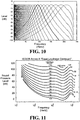
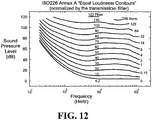
- Figure 11 shows equal loudness contours for frequencies between 20 Hz and 12.5 kHz, and for phon levels between 4.2 phon (considered to be the threshold of hearing) and 120 phon (ISO226: 1087 (E), "Acoustics - Normal equal loudness level contours").
- the phon measurement takes into account the varying sensitivity of human hearing with frequency, but the results do not allow the assessment of the relative subjective loudnesses of sounds at varying levels because there is no attempt to correct for the non-linearity of the growth of loudness with SPL, that is, for the fact that the spacing of the contours varies.
- Loudness may also be measured in units of "sone". There is a one-to-one mapping between phon units and sone units, as indicated in FIG. 11 .
- One sone is defined as the loudness of a 40 dB (SPL) 1 kHz pure sine wave and is equivalent to 40 phon.
- the units of sone are such that a twofold increase in sone corresponds to a doubling of perceived loudness. For example, 4 sone is perceived as twice as loud as 2 sone. Thus, expressing loudness levels in sone is more informative.
- specific loudness as a measure of perceptual loudness as a function of frequency and time
- specific loudness may be measured in units of sone per unit frequency.
- specific loudness has units of sone per Bark and likewise when using the ERB scale, the units are sone per ERB.
- a loudness control is a volume control that applies low- and sometimes also high-frequency boost as the volume is turned down.
- the lower sensitivity of the ear at the frequency extremes is compensated by an artificial boost of those frequencies.
- Such controls are completely passive; the degree of compensation applied is a function of the setting of the volume control or some other user-operated control, not as a function of the content of the audio signals.
- Seefeldt et al disclose, among other things, a system for measuring and adjusting the perceived loudness of an audio signal.
- a psychoacoustic model calculates the loudness of an audio signal in perceptual units.
- the application introduces techniques for computing a wideband multiplicative gain, which, when applied to the audio, results in the loudness of the gain-modified audio being substantially the same as a reference loudness. Application of such wideband gain, however, changes the perceived spectral balance of the audio.
- US 2004/0190740 A1 relates to a hearing aid device for improving the inelligibility of speech for a person with impaired hearing.
- Automatic adjustment of amplification in frequency bands depends on the detected speech signal level, the detected background noise signal level and information concerning the person's hearing loss.
- the amplification is based on a loudness model and a speech comprehension model.
- US 2002/0076072 A1 discloses a digital user loudness normalization control for implementation within a digital hearing aid or other personal amplification device having a digital signal processor.
- the control alters the input/output characteristic or loudness function of a single channel device or in each channel of a multi-channel device in response to a loudness control signal (LNC) and the input signal level.
- LNC loudness control signal
- the control system can be programmed to provide numerous modes of operation including curvilinear compression, input compression, output compression, and combinations thereof for correcting an individual's hearing impairment.
- the control for an amplification device having multiple frequency channels may include an independent loudness control signal for each frequency channel.
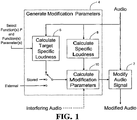
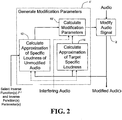
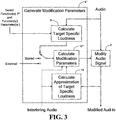
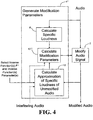
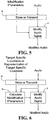
- FIGS. 1 through 4 show functional block diagrams illustrating possible feed-forward, feedback, and two versions of hybrid feed-forward/feedback implementation examples according to aspects of the invention.
- an audio signal is applied to two paths: (1) a signal path having a process or device 2 ("Modify Audio Signal") capable of modifying the audio in response to modification parameters, and (2) a control path having a process or device 4 (“Generate Modification Parameters”) capable of generating such modification parameters.
- the Modify Audio Signal 2 in the FIG. 1 feed-forward topology example and in each of the FIGS. 2-4 examples may be a device or process that modifies the audio signal, for example, its amplitude, in a frequency- and/or time-varying manner in accordance with modification parameters M received from the Generate Modification Parameters 4 (or from counterpart processes or devices 4', 4" and 4"' in each of the FIGS.
- the Generate Modification Parameters 4 and its counterparts in FIGS. 2-4 each operate at least partly in the perceptual loudness domain.
- the Modify Audio Signal 2 operates in the electrical signal domain and produces a modified audio signal in each of the FIG. 1-4 examples. Also in each of the FIG. 1-4 examples, the Modify Audio Signal 2 and the Generate Modification Parameters 4 (or its counterparts) modify the audio signal to reduce the difference between its specific loudness and a target specific loudness.
- process or device 4 includes several processes and/or devices: a "Calculate Target Specific Loudness” process or device 6 that calculates a target specific loudness in response to the audio signal or a measure of the audio signal such as the specific loudness of the audio signal, a "Calculate Specific Loudness” process or device 8 that calculates the specific loudness of the audio signal in response to the audio signal or a measure of the audio signals such as its excitation, and a “Calculate Modification Parameters” process or device 10 that calculates the modification parameters in response to the specific loudness and the target specific loudness.
- the Calculate Target Specific Loudness 6 may perform one or more functions " F ", each of which may have function parameters.
- the modification parameters are based at least in part on calculations in the perceptual (psychoacoustic) loudness domain (i.e., at least the specific loudness and, in some cases, the target specific loudness calculations).
- the calculations performed by processes or devices 6, 8 and 10 may be performed explicitly and/or implicitly.
- implicit performance include (1) a lookup table whose entries are based in whole or in part on specific loudness and/or target specific loudness and/or modification parameter calculations, and (2) a closed-form mathematical expression that is inherently based in whole or in part on specific loudness and/or target specific loudness and/or modification parameters.
- the target specific loudness ( N ⁇ [ b , t ]) may be calculated by scaling the specific loudness ( N [ b , t ]) with one or more scaling factors.
- b is a measure of frequency (
- scalings may also be employed, using multiple instances of a particular scaling and/or combinations of particular scalings. Examples of such multiple scalings are given below.
- the scaling may be a function of the audio signal or measure of the audio signal.
- the scaling may be otherwise determined or supplied. For example, a user could select or apply a time- and frequency-invariant scale factor a or a time-invariant, frequency-varying scale factor ⁇ [ b ] scaling.
- a "Select Function(s) and Function Parameter(s)" input for Calculate Target Specific Loudness 6 is shown to indicate that the device or process 6 may calculate the target specific loudness by applying one or more functions in accordance with one or more function parameters.
- the Calculate Target Specific Loudness 6 may calculate the function or functions " F " of the specific loudness of the audio signal in order to define the target specific loudness.
- the "Select Function(s) and Function Parameter(s)” input may select one or more particular functions that fall into one or more of the above types of scaling, along with one or more function parameters, such as constants ( e.g ., scale factors) pertaining to the functions.
- the scaling factors associated with a scaling may serve as a representation of the target specific loudness inasmuch as the target specific loudness may be computed as a scaling of the specific loudness, as indicated above.
- the lookup table may be indexed by scale factors and excitations, such that the calculation of specific loudness and target specific loudness are inherent in the table.
- the operation of the Generate Modification Parameters 4 is such that the calculations are based in the perceptual (psychoacoustic) loudness domain even though specific loudness and target specific loudness may not be explicitly calculated. Either there is an explicit specific loudness or there is a notional, implicit specific loudness. Similarly, either there is an explicit target specific loudness or there is a notional, implicit target specific loudness. In any case, the calculation of modification parameters seeks to generate modification parameters that modify the audio signal to reduce the difference between specific loudness and a target specific loudness.
- the Calculate Modification Parameters 10 may also receive as an optional input a measure of such a secondary interfering audio signal or the secondary interfering signal itself as one of its inputs.
- a measure of such a secondary interfering audio signal or the secondary interfering signal itself is shown in FIG. 1 (and in FIGS. 2-4 ) with a dashed lead line.
- the measure of a secondary interfering signal may be its excitation such as in the example of FIG. 17 , described below.
- the calculation of partial specific loudness assumes that a suitable measure of an interfering signal is applied not only to the respective Calculate Modification Parameters 10', 10", or 10"', but also to a "Calculate Approximation of Specific Loudness of Unmodified Audio" process or device 12 and/or a "Calculate Approximation of Target Specific Loudness” process or device 14 in order to facilitate the calculation of partial specific loudness by that function or device.
- partial specific loudness is not explicitly calculated - the Calculate Modification Parameters 10 of FIG. 1 calculates the appropriate modification parameters to make the partial specific loudness of the modified audio approximate the target specific loudness. This is explained further below under the heading "Noise Compensation.” mentioned above.
- the modification parameters M when applied to the audio signal by the Audio Signal Modifier 2, reduce the difference between the specific loudness or the partial specific loudness of the resulting modified audio and the target specific loudness.
- the specific loudness of the modified audio signal closely approximates or is the same as the target specific loudness.
- the modification parameters M may, for example, take the form of time-varying gain factors applied to the frequency bands derived from a filterbank or to the coefficients of a time-varying filter. Accordingly, in all of the FIG.
- Modify Audio Signal 2 may be implemented as, for example, a plurality of amplitude scalers, each operating in a frequency band, or a time-varying filter (e.g ., a multitapped FIR filter or a multipole IIR filter).
- a time-varying filter e.g ., a multitapped FIR filter or a multipole IIR filter.
- FIG. 2 depicts such an example in which the audio signal is also applied to a Modify Audio Signal process or device 2 in a signal path.
- the process or device 2 also receives the modification parameters M from a control path in which a Generate Modification Parameters process or device 4' in a feedback arrangement receives as its input the modified audio signal from the output of the Modify Audio Signal 2.
- the modified audio rather than the unmodified audio is applied to a control path.
- the Modify Audio Signal process or device 2 and the Generate Modification Parameters process or device 4' modify the audio signal to reduce the difference between its specific loudness and a target specific loudness.
- the process or device 4' may include several functions and or devices: a "Calculate Approximation of Specific Loudness of Unmodified Audio” process or device 12, a “Calculate Approximation of Target Specific Loudness” process or device 14, and a “Calculate Modification Parameters” process or device 10' that calculates the modification parameters.
- the process or device 12 estimates the specific loudness of the unmodified audio signal by applying the inverse function F - 1 to the specific loudness or partial specific loudness of the modified audio signal.
- the device or process 12 may calculate an inverse function F -1 , as described above. This is indicated schematically in FIG. 2 as a "Select Inverse Function(s) F -1 and Function(s) Parameter(s)" input to process or device 12.
- the "Calculate Approximation of Target Specific Loudness” 14 operates by calculating the specific loudness or partial specific loudness of the modified audio signal. Such specific loudness or partial specific loudness is an approximation of the target specific loudness.
- the approximation of the specific loudness of the unmodified audio signal and the approximation of the target specific loudness are used by the Calculate Modification Parameters 10' to derive modification parameters M, which, if applied to the audio signal by the Modify Audio Signal 2, reduce the difference between the specific loudness or the partial specific loudness of the modified audio signal and the target specific loudness.
- these modification parameters M may, for example, take the form of time-varying gains applied to the frequency bands of a filterbank or the coefficients of a time-varying filter.
- the feedback loop may introduce a delay between the computation and application of the modification parameters M.
- the Calculate Modification Parameters 10, ' the Calculate Approximation of Specific Loudness of Unmodified Audio 12, and the Calculate Approximation of Target Specific Loudness 14 may each also receive as an optional input a measure of such a secondary interfering audio signal or the secondary interfering signal itself as one of its inputs and process or device 12 and process or device 14 may each calculate the partial specific loudness of the modified audio signal.
- Such optional inputs are shown in FIG. 2 using dashed lead lines.
- FIGS, 3 and 4 show two examples of such implementations.
- the audio signal is also applied to a Modify Audio Signal process or device 2 in a signal path, but Generate Modification Parameters (4" in FIG. 3 and 4 "' in FIG. 4 ) in respective control paths each receive both the unmodified audio signal and the modified audio signal.
- the Modify Audio Signal 2 and Generate Modification Parameters modify the audio signal to reduce the difference between its specific loudness, which may be implicit, and a target specific loudness, which may also be implicit.
- the Generate Modification Parameters process or device 4' includes several functions and or devices: a Calculate Target Specific Loudness 6 as in the FIG. 1 example, a Calculate Approximation of Target Specific Loudness 14, as in the FIG. 2 feedback example, and a "Calculate Modification Parameters" process or device 10".
- the Calculate Target Specific Loudness 6 may perform one or more functions " F ", each of which may have function parameters. This is indicated schematically in FIG. 3 as a "Select Function(s) F and Function(s) Parameter(s)" input to process or device 6.
- the modified audio signal is applied to a Calculate Approximation of Target Specific Loudness 14, as in the FIG. 2 feedback example.
- Process or device 14 operates in the FIG. 3 example as it does in the FIG. 2 example by calculating the specific loudness or partial specific loudness of the modified audio signal. Such specific loudness or partial specific loudness is an approximation of the target specific loudness.
- the target specific loudness (from process or device 6) and the approximation of the target specific loudness (from process or device 14) are loudness (from process or device 14) are applied to the Calculate Modification Parameters 10" to derive modification parameters M, which, if applied to the audio signal by the Modify Audio Signal 2, reduce the difference between the specific loudness of the unmodified audio signal and the target specific loudness.
- these modification parameters M may, for example, take the form of time-varying gains applied to the frequency bands of a filterbank or the coefficients of a time-varying filter.
- the feedback loop may introduce a delay between the computation and application of the modification parameters M.
- the Calculate Modification Parameters 10" and the Calculate Approximation of Target Specific Loudness 14 may each also receive as an optional input a measure of such a secondary interfering audio signal or the secondary interfering signal itself as one of its inputs and process or device 14 may calculate the partial specific loudness of the modified audio signal.
- the optional inputs are shown in FIG. 3 using dashed lead lines.
- the Calculate Modification Parameters 10" may employ an error detecting device or function, such that differences between its target specific loudness and target specification loudness approximation inputs adjust the Modification Parameters so as to reduce the differences between the approximation of the target specific loudness and the "actual" target specific loudness. Such adjustments reduce the differences between the specific loudness of the unmodified audio signal, and the target specific loudness, which may be implicit.
- the modification parameters M may be updated based on an error between the target specific loudness, computed in the feed-forward path from the specific loudness of the original audio using the function F , and the target specific loudness approximation computed in the feedback path from specific loudness or partial specific loudnes s of the modified audio.
- the Generate Modification Parameters process or device 4' may include several functions and or devices: a Calculate Specific Loudness 8, as in the FIG. 1 feed-forward example, Calculate Approximation of Specific Loudness of Unmodified Audio 12, as in the FIG. 2 feedback example, and a Calculate Modification Parameters 10"'.
- the process or device 12 estimates the specific loudness of the unmodified audio signal by applying the inverse function F -1 to the specific loudness or partial specific loudness of the modified audio signal.
- a "Select Inverse Function(s) and Inverse Function(s) Parameter(s)" input for Calculate Approximation of Specific Loudness of Unmodified Audio 12 is shown to indicate that the device or process 12 may calculate an inverse function F -1 , as described above. This is indicated schematically in FIG.
- process or device 12 provides as another input to the Calculate Modification Parameters 10'" an approximation to the specific loudness of the unmodified audio signal.
- the Calculate Modification Parameters 10"' derives modification parameters M, which, if applied to the audio signal by the Modify Audio Signal 2, reduce the difference between the specific loudness of the unmodified audio signal and the target specific loudness, which is implicit in this example.
- the modification parameters M may, for example, take the form of time-varying gains applied to the frequency bands of a filterbank or the coefficients of a time-varying filter.
- the feedback loop may introduce a delay between the computation and application of the modification parameters M.
- the Calculate Modification Parameters 10"' and the Calculate Approximation of Specific Loudness of the Unmodified Audio 12 may each also receive as an optional input a measure of such a secondary interfering audio signal or the secondary interfering signal itself as one of its inputs and process or device 12 may calculate the partial specific loudness of the modified audio signal.
- the optional inputs are shown in FIG. 4 using dashed lead lines.
- the Calculate Modification Parameters 10"' may employ an error detecting device or function, such that differences between its specific loudness and specific loudness approximation inputs produce outputs that adjust the Modification Parameters so as to reduce the differences between the approximation of the specific loudness and the "actual" specific loudness. Because the approximation of the specific loudness is derived from the specific loudness or partial specific loudness of the modified audio, which can be viewed as an approximation of the target specific loudness, such adjustments reduce the differences between the specific loudness of the modified audio signal and the target specific loudness, which is inherent in the function or functions F -1 .
- the modification parameters M may be updated based on an error between the specific loudness, computed in the feed-forward path from the original audio, and the specific loudness approximation computed, using the inverse function or functions F -1 , in the feedback path from specific loudness or partial specific loudness of the modified audio. Due to the feedback path, practical implementations may introduce a delay between the update and application of the modification parameters.
- modification parameters M in the examples of FIGS. 1-4 when applied to a Modify Audio Signal process or device 2 reduce the difference between the specific loudness of the audio signal and the target specific loudness, in practical embodiments the corresponding modification parameters produced in response to the same audio signal may not be identical to each other.
- calculation of the specific loudness of the audio signal or the modified audio signal may advantageously employ techniques set forth in said International Patent Application No. PCT/US2004/016964 , published as WO 2004/111964 A2 , wherein the calculating selects, from a group of two or more specific loudness model functions, one or a combination of two or more of the specific loudness model functions, the selection of which is controlled by the measure of characteristics of the input audio signal.
- the description of Specific Loudness 104 of FIG. 1 describes such an arrangement.
- the unmodified audio signal and the target specific loudness or a representation of the target specific loudness may be stored or transmitted for use, for example, in a temporally and/or spatially separated device or process.
- the target specific loudness, or representation of the target specific loudness may be determined in any suitable way, as, for example, in one of the feed-forward, feedback, and hybrid feed-forward feedback arrangement examples of FIGS. 1-4 , as described above.
- a feed-forward arrangement such as in the example of FIG. 1 , is the least complex and fastest inasmuch as it avoids calculations based on the modified audio signal.
- FIG. 5 An example of transmitting or storing the unmodified audio and the modification parameters is shown in FIG. 5 , while an example of the transmitting or storing the unmodified audio and the target specific loudness or a representation of the target specific loudness is shown in FIG. 6 .
- An arrangement such as in the example of FIG. 5 may be used to temporally and/or spatially separate the application of the modification parameters to the audio signal from the generation of such modification parameters.
- An arrangement such as in the example of FIG. 6 may be used to temporally and/or spatially separate both the generation and application of the modification parameters from the generation of the target specific loudness or representation of it. Both types of arrangements make possible a simple low-cost playback or reception arrangement that avoids the complexity of generating the modification parameters or of generating the target specific loudness.
- a FIG. 5 type arrangement is simpler than a FIG. 6 type arrangement, the FIG. 6 arrangement has the advantage that the information required to be stored or transmitted may be much less, particularly when a representation of the target specific loudness, such as one or more scale factors are stored or transmitted. Such a reduction in information storage or transmission may be particularly useful in low-bitrate audio environments.
- a device or process that receives or plays back, from a store or transmit device or process, a target specific loudness or representation of a target specific loudness, generates modification parameters M by applying the target specific loudness or representation thereof to the audio signal that is also received (or to a measure of the audio signal such as its specific loudness, which may be derived from the audio signal), and applies the modification parameters M to the received audio signal.
- Such device or process may be characterized as decoding process or decoder; while the devices or processes required to produce the stored or transmitted information may be characterized as encoding processes or encoders.
- Such encoding processes or encoders are those portions of the FIGS. 1-4 arrangement examples that are usable to produce the information required by the respective decoding processes or decoders.
- Such decoding processors or decoders may be associated or operative with virtually any type of process or device that processes and/or reproduces sound.
- the unmodified audio signal and the modification parameters M produced by, for example, a modification parameter generating process or generator such as Generate Modification Parameters 4 of FIG. 1 , 4' of FIG. 2 , 4 " of FIG. 3 or 4 "' of FIG. 4 may be applied to any suitable storage or transmission device or function ("Store or Transmit") 16.
- a modification parameter generating process or generator such as Generate Modification Parameters 4 of FIG. 1 , 4' of FIG. 2 , 4 " of FIG. 3 or 4 "' of FIG. 4 may be applied to any suitable storage or transmission device or function ("Store or Transmit") 16.
- the Modify Audio Signal 2 would not be required to generate the modified audio and could be omitted if there is no requirement to provide the modified audio at the temporal or spatial location of the encoder or encoding process.
- the Store or Transmit 16 may include, for example, any suitable magnetic, optical or solid-state storage and playback devices or any suitable wired or wireless transmission and reception devices, the choice thereof not being critical to the invention.
- the played-back or received modification parameters may then be applied to a Modify Audio Signal 2, of the type employed in the examples of FIGS 1-4 , in order to modify the played-back or received audio signal so that its specific loudness approximates the target specific loudness of or inherent in the arrangement in which the modification parameters were derived.
- the modification parameters may be stored or transmitted in any of various ways. For example, they may be stored or transmitted as metadata accompanying the audio signal, they may be sent in separate paths or channels, they may be steganographically encoded in the audio, they may be multiplexed, etc.
- the unmodified audio signal and the target specific loudness or representation of the target specific loudness may be applied to any suitable storage or transmission device or function ("Store or Transmit") 16.
- Store or Transmit any suitable storage or transmission device or function
- the Store or Transmit 16 may include, for example, any suitable magnetic, optical or solid-state storage and playback devices or any suitable wired or wireless transmission and reception devices, the choice thereof not being critical to the invention.
- the played-back or received target specific loudness or representation of the target specific loudness may then be applied, along with the unmodified audio, to a Calculate Modification Parameters 10, of the type employed in the example of FIG. 1 , or to a Calculate Modification Parameters 10", of the type employed in the example of FIG.
- Modify Audio Signal 2 of the type employed in the examples of FIGS 1-4 , in order to modify the played-back or received audio signal so that its specific loudness approximates the target specific loudness of or inherent in the arrangement in which the modification parameters were derived.
- the target specific loudness or representation thereof may be most readily obtained in an encoding process or encoder of the FIG. 1 example type, the target specific loudness or representation thereof or an approximation to the target specific loudness or representation thereof may be obtained in an encoding process or encoder of the FIG. 2 through 4 example types (approximations are calculated in processes or devices 14 of FIGS. 2 and 3 and in process or device 12 of FIG. 4 ).
- the target specific loudness or representation thereof may be stored or transmitted in any of various ways. For example, it may be stored or transmitted as metadata accompanying the audio signal, it may be sent in separate paths or channels, it may be steganographically encoded in the audio, it may be multiplexed, etc.
- the use of the modification parameters derived from the stored or transmitted target specific loudness or representation to modify the audio signal may be optional and, if optional, their use may be selectable, for example, by a user.
- the modification parameters if applied to the audio signal might reduce the dynamic range of the audio signal. Whether or not to employ such dynamic range reduction could be selectable by a user.
- filter or “filterbank” are used herein to include essentially any form of recursive and non-recursive filtering such as IIR filters or transforms, and "filtered” information is the result of applying such filters.
- filterbanks implemented by transforms.
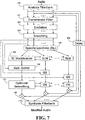
- FIG. 7 depicts greater details of an exemplary embodiment of an aspect of the invention embodied in a feed-forward arrangement.
- Audio first passes through an analysis filterbank function or device ("Analysis Filterbank") 100, which splits the audio signal into a plurality of frequency bands (hence, FIG. 7 shows multiple outputs from Analysis Filterbank 100, each output representing a frequency band, which output carries through the various functions or devices up to an synthesis filterbank, which sums the bands to a combined wideband signal, as described further below).
- the response of the filter associated with each frequency band in the Analysis Filterbank 100 is designed to simulate the response at a particular location of the basilar membrane in the inner ear.
- the output of each filter in the Analysis Filterbank 100 next passes into a transmission filter or transmission filter function (“Transmission Filter”) 101 that simulates the filtering effect of the transmission of audio through the outer and middle ear. If only the loudness of the audio were to be measured, the transmission filter could be applied prior to the analysis filterbank, but because the analysis filterbank outputs are used to synthesize the modified audio it is advantageous to apply the transmission filter after the filterbank.
- the outputs of Transmission Filter 101 next pass into an excitation function or device (“Excitation”) 102, the outputs of which simulate the distribution of energy along the basilar membrane.
- the excitation energy values may be smoothed across time by a smoothing function or device (“Smoothing”) 103.
- the time constants of the smoothing function are set in accordance with the requirements of a desired application.
- the smoothed excitation signals are subsequently converted into specific loudness in specific loudness function or device ("Specific Loudness (SL)") 104. Specific loudness is represented in units of sone per unit frequency.
- the specific loudness component associated with each band is passed into specific loudness modification function or device ("SL Modification") 105.
- SL Modification 105 takes as its input the original specific loudness and then outputs a desired or "target” specific loudness, which, according to an aspect of the present invention, is preferably a function of the original specific loudness (see the next heading below, entitled “Target Specific Loudness").
- the SL Modification 105 may operate independently on each band, or there may exist an interdependence between or among bands (a frequency smoothing as suggested by the cross-connecting lines in FIG. 7 ), depending on the desired effect.
- a gain solver function or device (“Gain Solver") 106 determines the gain that needs to be applied to each band of the output of the Analysis Filterbank 100 in order to transform the measured specific loudness into the target specific loudness.
- the Gain Solver may be implemented in various ways.
- the Gain Solver may include an iterative process such as in the manner of that disclosed in said International Patent Application No.
- the outputs from the analysis filterbank may be delayed by a delay function or device ("Delay") 109 prior to application of the gains in order to compensate for any latency associated with the gain computation.
- the Gain Solvers 106 may calculate filter coefficients that control a time-varying filter, such as a multitapped FIR filter or a multipole IIR filter. For simplicity in exposition, aspects of the invention are mainly described as employing gain factors applied to frequency bands, it being understood that filter coefficients and time-varying filters may also be employed in practical embodiments.
- the audio signal is assumed to be monophonic for simplicity of exposition.
- the audio input signal is applied to an analysis filterbank or filterbank function ("Analysis Filterbank”) 100.
- Each filter in Analysis Filterbank 100 is designed to simulate the frequency response at a particular location along the basilar membrane in the inner ear.
- the Filterbank 100 may include a set of linear filters whose bandwidth and spacing are constant on the Equivalent Rectangular Bandwidth (ERB) frequency scale, as defined by Moore, Glasberg and Baer ( B. C. J. Moore, B. Glasberg, T. Baer, "A Model for the Prediction of Thresholds, Loudness, and Partial Loudness," supra ).
- ERP Equivalent Rectangular Bandwidth
- the Bark frequency scale may be employed with reduced performance.
- ERB f 24.7 ⁇ 4.37 ⁇ f / 1000 + 1
- a warped frequency scale is defined such that at any point along the warped scale, the corresponding ERB in units of the warped scale is equal to one.
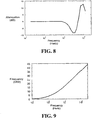
- FIG. 9 shows the relationship between the ERB scale and frequency in hertz.
- each auditory filter may be characterized by a rounded exponential function, as suggested by Moore and Glasberg.
- FIG. 10 The magnitude responses of such B auditory filters, which approximate critical banding on the ERB scale, are shown in FIG. 10 .
- the filtering operations of Analysis Filterbank 100 may be adequately approximated using a finite length Discrete Fourier Transform, commonly referred to as the Short-Time Discrete Fourier Transform (STDFT), because an implementation running the filters at the sampling rate of the audio signal, referred to as a full-rate implementation, is believed to provide more temporal resolution than is necessary for accurate loudness measurements.
- STDFT Short-Time Discrete Fourier Transform
- the STDFT described above may be more efficient using the Fast Fourier Transform (FFT).
- the Modified Discrete Cosine Transform may be utilized to implement the analysis filterbank.
- the MDCT is a transform commonly used in perceptual audio coders, such as Dolby AC-3. If the disclosed system is implemented with such perceptually coded audio, the disclosed loudness measurement and modification may be more efficiently implemented by processing the existing MDCT coefficients of the coded audio, thereby eliminating the need to perform the analysis filterbank transform.
- Transmission Filter 101 which filters each band of the filterbank in accordance with the transmission of audio through the outer and middle ear.
- FIG. 8 depicts one suitable magnitude frequency response of the transmission filter, P ( f ), across the audible frequency range. The response is unity below 1 kHz, and, above 1 kHz, follows the inverse of the threshold of hearing as specified in the ISO226 standard, with the threshold normalized to equal unity at 1 kHz.
- a measure of the audio signals' short-time energy in each filter of the Analysis Filterbank 100 after application of the Transmission Filter 101 is needed. This time and frequency varying measure is referred to as the excitation.
- the output of Excitation Function 102 is a frequency domain representation of energy E in respective ERB bands b per time period t .
- E ⁇ b t ⁇ b ⁇ E ⁇ b t + 1 - ⁇ b ⁇ E b t , where the time constants ⁇ b at each band b are selected in accordance with the desired application. In most cases the time constants may be advantageously chosen to be proportionate to the integration time of human loudness perception within band b.
- Watson and Gengel performed experiments demonstrating that this integration time is within the range of 150-175 ms at low frequencies (125-200 Hz) and 40-60 ms at high frequencies ( Charles S. Watson and Roy W. Gengel, "Signal Duration and Signal Frequency in Relation to Auditory Sensitivity” Journal of the Acoustical Society of America, Vol. 46, No. 4 (Part 2), 1969, pp. 989-997 ).
- each frequency band of the excitation is converted into a component value of the specific loudness, which is measured in sone per ERB.
- the excitation level in each band of E ⁇ [ b , t ] may be transformed to an equivalent excitation level at 1 kHz as specified by the equal loudness contours of ISO 226 ( FIG. 11 ) normalized by the transmission filter P(z) ( FIG. 12 ):
- E ⁇ 1 ⁇ kHz b t T 1 ⁇ kHz E ⁇ b t , f c b
- T l kHz ( E , f ) is a function that generates the level at 1 kHz, which is equally loud to level E at frequency f .
- T 1 kHz ( E , f ) is implemented as an interpolation of a look-up table of the equal loudness contours, normalized by the transmission filter. Transformation to equivalent levels at 1 kHz simplifies the following specific loudness calculation.
- N b t ⁇ b t ⁇ N NB b t + 1 - ⁇ b t ⁇ N WB b t ,
- N NB [ b , t ] and N WB [ b , t ] are specific loudness values based on a narrowband and wideband signal model, respectively.
- the value ⁇ [ b,t ] is an interpolation factor lying between 0 and 1 that is computed from the audio signal.
- PCT/US2004/016964 published as WO 2004/ 111964 A2 , describes a technique for calculating ⁇ [ b , t ] from the spectral flatness of the excitation. It also describes "narrowband” and "wideband” signal models in greater detail.
- TQ 1 kHz equals 4.2 dB.
- both of these specific loudness functions are equal to zero when the excitation is equal to the threshold in quiet.
- both functions grow monotonically with a power law in accordance with Stevens' law of intensity sensation.
- the exponent for the narrowband function is chosen to be larger than that of the wideband function, making the narrowband function increase more rapidly than the wideband function.
- the threshold of hearing is a probabilistic threshold (the point at which a tone is detected 50% of the time), and that a number of tones, each at threshold, presented together may sum to a sound that is more audible than any of the individual tones.
- augmenting the specific loudness functions with this property has the added benefit of making the gain solver, discussed below, behave more appropriately when the excitation is near threshold.
- the specific loudness is defined to be zero when the excitation is at or below threshold, then a unique solution for the gain solver does not exist for excitations at or below threshold. If, on the other hand, specific loudness is defined to be monotonically increasing for all values of excitation greater than or equal to zero, as suggested by Moore and Glasberg, then a unique solution does exist. Loudness scaling greater than unity will always result in a gain greater than unity and vice versa. The specific loudness functions in Eqns.
- the target specific loudness may be calculated from the specific loudness of SL 104 ( FIG. 7 ) in various ways depending on the desired application of the overall device or process.
- a target specific loudness may be calculated using a scale factor ⁇ , for example, in the case of a volume control. See Eqn. 16 below and its associated description.
- AGC automatic gain control
- DRC dynamic range control
- a target specific loudness may be calculated using a ratio of desired output loudness to input loudness. See Eqns. 17 and 18 below and their associated descriptions.
- a target specific loudness may be calculated using a relationship set forth in Eqn. 23 and its associated description.
- the Gain Solver 106 takes as its inputs the smoothed excitation E ⁇ [ b , t ] and the target specific loudness N ⁇ [ b , t ] and generates gains G [ b, t ] used subsequently for modifying the audio.
- the Gain Solvers 106 determine frequency- and time-varying gains, which, when applied to the original excitation, result in a specific loudness that, ideally, is equal to the desired target specific loudness. In practice, the Gain Solvers determine frequency- and time-varying gains, which when applied to the frequency-domain version of the audio signal results in modifying the audio signal in order to reduce the difference between its specific loudness and the target specific loudness. Ideally, the modification is such that the modified audio signal has a specific loudness that is a close approximation of the target specific loudness.
- the solution to Eqn. 14a may be implemented in a variety of ways.
- the gains may be expressed purely as a function of the excitation E ⁇ [ b , t ] and the specific loudness scaling ⁇ [ b , t ]. Therefore, the gains may be computed through evaluation of 14d or an equivalent lookup table without ever explicitly computing the specific loudness or target specific loudness as intermediate values. However, these values are implicitly computed through use of equation 14d.
- Other equivalent methods for computing the modification parameters through either explicit or implicit computation of the specific loudness and target specific loudness may be devised, and this invention is intended to cover all such methods.
- Analysis Filterbank 100 may be implemented efficiently through use of the Short-time Discrete Fourier Transform (STDFT) or the Modified Discrete Cosine Transform, and the STDFT or MDCT may be used similarly to implement Synthesis Filterbank 110.
- STDFT Short-time Discrete Fourier Transform
- MDCT Modified Discrete Cosine Transform
- X [ k , t ] represent the STDFT or MDCT of the input audio
- S b [ k ] is the response of the synthesis filter associated with band b
- d is the delay associated with delay block 109 in FIG. 7 .
- the final processed audio may then be generated through inverse Fourier or modified cosine transform of X ⁇ [ k , t ] and overlap-add synthesis, as is familiar to one skilled in the art.
- a standard volume control adjusts the loudness of an audio signal by applying a wideband gain to the audio.
- the gain is coupled to a knob or slider that is adjusted by a user until the loudness of the audio is at the desired level.
- An aspect of the present invention allows for a more psychoacoustically consistent way of implementing such a control.
- a specific loudness scaling factor is associated with the volume control adjustment instead so that the gain in each of multiple frequency bands is changed by an amount that takes into account the human hearing model so that, ideally, there is no change in the perceived spectrum.
- “constant” or “time-invariant” is intended to allow for changes in the setting of a volume control scale factor from time to time, for example, by a user.
- Such “time-invariance” is sometimes referred to as “quasi time-invariant,” “quasi-stationary,” “piecewise time-invariant,” “piecewise stationary,” “step-wise time-invariant,” and “step-wise stationary.”
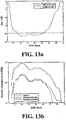
- the wideband gain required to scale the original total loudness by 0.25 (the horizontal line), as in a standard volume control, is also plotted.
- the multiband gain G [ b, t ] increases at low and high frequency bands in comparison to the middle frequency bands. This is consistent with equal-loudness contours indicating that the human ear is less sensitive at low and high frequencies.
- FIG. 13b depicts the specific loudness for the original audio signal, the wideband gain-modified signal as modified in accordance with a prior art volume control, and the multiband gain-modified signal as modified in accordance with this aspect of the invention.
- the specific loudness of the multiband gain modified signal is that of the original scaled by 0.25.
- the specific loudness of the wide-band gain modified signal has changed its spectral shape with respect to that of the original unmodified signal. In this case, the specific loudness has, in a relative sense, lost loudness at both the low and the high frequencies. This is perceived as a dulling of the audio as its volume is turned down, a problem that does not occur with the multiband modified signal whose loudness is controlled by gains derived in the perceptual loudness domain.
- a property of loudness perception which is reflected in the loudness model reflected in Equations 11a-11d, is that loudness of a signal at any frequency decreases more rapidly as signal level approaches the threshold of hearing.
- the electrical attenuation required to impart the same loudness attenuation to a softer signal is less than that required for a louder signal.
- a traditional volume control imparts a constant attenuation regardless of signal level, and therefore soft signals become "too soft" with respect to louder signals as the volume is turned down. In many cases this results in the loss of detail in the audio.
- the main "hit" of the castanet is quite loud in comparison to the reverberant echoes, but it is the reverberant echoes that convey the size of the room.
- the reverberant echoes become softer with respect to the main hit and eventually disappear below the threshold of hearing, leaving a "dry" sounding castanet.
- the loudness based volume control prevents the disappearance of the softer portions of the recordings by boosting the softer reverberant portion of the recording relative to the louder main hit so that the relative loudness between these sections remains constant.
- the multiband gains G [ b , t ] must vary over time at a rate that is commensurate with the human temporal resolution of loudness perception. Because the multiband gains G [ b , t ] are computed as a function of the smoothed excitation E ⁇ [ b , t ], selection of the time constants ⁇ b in Eqn. 8 dictates how quickly the gains may vary across time in each band b . As mentioned earlier, these time constants may be selected to be proportionate the integration time of human loudness perception within band b and thus yield the appropriate variation of G [ b , t ] over time. It should be noted that if the time constants are chosen inappropriately (either too fast or too slow), then perceptually objectionable artifacts may be introduced in the processed audio.
- the scaling may vary from band to band.
- Such an application may be useful for emphasizing, for example, the portion of the spectrum dominated by speech frequencies in order to boost intelligibility.
- AGC and DRC automatic gain and dynamic range control
- AGC and DRC Such a system is described by Robinson and Gundry ( Charles Robinson and Kenneth Gundry, "Dynamic Range Control via Metadata," 107th Convention of the AES, Preprint 5028, September 24-27, 1999, New York ).
- Traditional implementations of AGC and DRC generally utilize a simple measurement of audio signal level, such as smoothed peak or root mean square (rms) amplitude, to drive the gain modification.
- Such simple measurements correlate to some degree to the perceived loudness of the audio, but aspects of the present invention allow for more perceptually relevant AGC and DRC by driving the gain modifications with a measure of loudness based on a psychoacoustic model.
- aspects of the present invention utilize a multiband gain to shape the specific loudness in a manner that reduces or minimizes such distortions.
- Both the AGC and DRC applications employing aspects of the present invention are characterized by a function that transforms or maps an input wideband loudness L i [ t ] into a desired output wideband loudness L o [ t ], where the loudness is measured in perceptual loudness units, such as sone.
- the input wideband loudness L i [ t ] is a function of the input audio signal's specific loudness N [ b , t ]. Although it may be the same as the input audio signal's total loudness, it may be a temporally-smoothed version of the audio signal's total loudness.
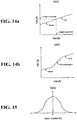
- FIGS. 14a and 14b depict examples of mapping functions typical for an AGC and a DRC, respectively.
- the audio signal's original specific loudness N [ b , t ] is simply scaled by the ratio of the desired output wideband loudness to the input wideband loudness to yield an output specific loudness N ⁇ [ b , t ].
- the input wideband loudness L i [ t ] should generally be a measure of the long-term total loudness of the audio. This can be achieved by smoothing the total loudness L [ t ] across time to generate L i [ t ].
- L i [ t ] In comparison to an AGC, a DRC system reacts to shorter term changes in a signal's loudness, and therefore L i [ t ] can simply be made equal to L [ t ]. As a result, the scaling of specific loudness, given by L o [ t ]l L t [ t ], may fluctuate rapidly leading to unwanted artifacts in the processed audio.
- One typical artifact is the audible modulation of a portion of the frequency spectrum by some other relatively unrelated portion of the spectrum. For example, a classical music selection might contain high frequencies dominated by a sustained string note, while the low frequencies contain a loud booming timpani.
- the DRC system may be expanded to operate in a multiband or frequency-variant fashion by allowing the input and output loudness to vary independently with band b .
- the input multiband loudness L i [ b , t ] is a function of the input audio signal's specific loudness N [ b , t ]. Although it may be the same as the input audio signal's specific loudness, it may be a temporally-smoothed and/or frequency-smoothed version of the audio signal's specific loudness.
- L i [ b , t ] by smoothing specific loudness N [ b , t ] across bands so that the amount of DRC applied from one band to the next does not vary as drastically.
- N [ c , t ] is the specific loudness of the audio signal
- Q ( b - c ) is the band-shifted response of the smoothing filter.
- FIG. 15 depicts one example of such a band-smoothing filter.
- the DRC function that calculates L i [ b , t ] as a function of L o [ b , t ] is fixed for every band b , then the type of change incurred to each band of the specific loudness N [ b , t ] will vary depending on the spectrum of the audio being processed, even if the overall loudness of the signal remains the same. For example, an audio signal with loud bass and quiet treble may have the bass cut and the treble boosted. A signal with quiet bass and loud treble may have the opposite occur. The net effect is a change in the timbre or perceived spectrum of the audio, and this may be desirable in certain applications.
- L i [ t ] represent a time-averaged version of the wideband input loudness
- L i [ b , t ] represent a time-averaged version of the multiband input loudness L i [ b , t ].
- the multiband input loudness is first scaled to be in the same average range as the wideband input loudness.
- the DRC function designed for the wideband loudness is then applied.
- the result is scaled back down to the average range of the multiband loudness.
- DEQ Dynamic Equalization
- a simple fixed filtering is applied to the audio in order to change its spectrum. For example, one might apply a fixed bass or treble boost.
- Such processing does not take into account the current spectrum of the audio and may therefore be inappropriate for some signals, i.e., signals that already contain a relatively large amount of bass or treble.
- DEQ the spectrum of the signal is measured and the signal is then dynamically modified in order to transform the measured spectrum into an essentially static desired shape.
- the measured spectrum should represent the average spectral shape of the audio that may be generated by smoothing the specific loudness N [ b , t ] across time.
- N [ b , t ] One may refer to the smoothed specific loudness as N [ b , t ].
- the desired spectrum EQ[b] should be normalized to have the same overall loudness as the measured spectral shape given by L [ b , t ].
- L ⁇ EQ b t ⁇ c L ⁇ c t ⁇ c EQ c ⁇ EQ b .
- One convenient way of generating the desired spectral shape EQ [ b ] is for a user to set it equal to L [ b , t ] as measured for some piece of audio whose spectral balance the user finds pleasing.
- the user may be provided a button or other suitable actuator 507 that, when actuated, causes a capture of the current measure of the audio's spectral shape L [ b , t ], and then stores this measure as a preset (in Target Specific Loudness Preset Capture and Store 506) that may later be loaded into EQ [ b ] when DEQ is enabled (as by preset select 508).
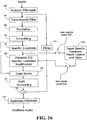
- FIG. 16 is a simplified version of FIG.
- FIG. 17 example also provides a Dynamic EQ Specific Loudness (SL) Modification 505 that provides a modification to the specific loudness measured by function or device 104 in accordance with dynamic equalization, as explained above.
- SL Dynamic EQ Specific Loudness
- N ⁇ b t ⁇ VC b t ⁇ ⁇ AGC b t ⁇ ⁇ DRC b t ⁇ ⁇ DEQ b t ⁇ N b t , where ⁇ * [ b , t ] represents the scale factors associated with process "*".
- a single set of gains G [ b , t ] may then be calculated for the target specific loudness that represents the combined processing.
- the scale factors of one or a combination of the loudness modification processes may fluctuate too rapidly over time and produce artifacts in the resulting processed audio. It may therefore be desirable to smooth some subset of these scaling factors.
- the scale factors from VC and DEQ varying smoothly over time, but smoothing the combination of the AGC and DRC scale factors may be required.
- the basic notion behind the smoothing is that the combined scale factors should react quickly when the specific loudness is increasing, and that the scale factors should be more heavily smoothed when the specific loudness is decreasing.
- N TOT b t N A b t + N N b t .
- the partial specific loudness of the audio, N A [ b , t ] is the value one wishes to control, and therefore one must solve for this value.
- N N b t E TN b t E A b t ⁇ ⁇ ⁇ E N b t + E TN b t - ⁇ E TQ b
- E TN [ b , t ] is the masked threshold in the presence of the noise
- E TQ [ b ] is the threshold of hearing in quiet at band b
- ⁇ is an exponent between zero and one.
- N A b t ⁇ E A b t + E N b t - E TN b t E A b t ⁇ ⁇ ⁇ E N b t + E TN b t - ⁇ E TQ b
- N A b t ⁇ E A b t , E N b t .
- FIG. 17 depicts the system of FIG. 7 with the original Gain Solver 106 replaced by the described Noise Compensating Gain Solver 206 (note that the multiple vertical lines between blocks representing the multiple bands of the filterbank have been replaced by a single line to simplify the diagram).
- the figure depicts the measurement of the noise excitation (by Analysis Filterbank 200, Transmission Filter 201, Excitation 202 and Smoothing 203 in a manner corresponding to the operation of blocks 100, 101, 102 and 103) that feeds into the new gain solver 206 along with the excitation of the audio (from Smoothing 103) and the target specific loudness (from SL Modification 105).
- the SL Modification 105 in FIG. 17 may simply set the target specific loudness N ⁇ [ b , t ] equal to the original specific loudness of the audio N [ b,t ] .
- the gains are calculated so that the perceived loudness spectrum of the processed audio in the presence of the noise is equal to the loudness spectrum of the audio in the absence of the noise.
- any one or combination of ones of the previously described techniques for computing the target specific loudness as a function of the original, including VC, AGC, DRC, and DEQ may be utilized in conjunction with the noise compensating loudness modification system.
- the measurement of the noise may be obtained from a microphone placed in or near the environment into which the audio will be played.
- a predetermined set of template noise excitations may be utilized that approximate the anticipated noise spectrum under various conditions.
- the noise in an automobile cabin may be pre-analyzed at various driving speeds and then stored as a look-up table of noise excitation versus speed.
- the noise excitation fed into the Gain Solver 206 in FIG. 17 may then be approximated from this look-up table as the speed of the automobile varies.
- the invention may be implemented in hardware or software, or a combination of both (e.g ., programmable logic arrays). Unless otherwise specified, the algorithms included as part of the invention are not inherently related to any particular computer or other apparatus. In particular, various general-purpose machines may be used with programs written in accordance with the teachings herein, or it may be more convenient to construct more specialized apparatus (e.g ., integrated circuits) to perform the required method steps. Thus, the invention may be implemented in one or more computer programs executing on one or more programmable computer systems each comprising at least one processor, at least one data storage system (including volatile and non-volatile memory and/or storage elements), at least one input device or port, and at least one output device or port. Program code is applied to input data to perform the functions described herein and generate output information. The output information is applied to one or more output devices, in known fashion.
- Program code is applied to input data to perform the functions described herein and generate output information.
- the output information is applied to one or more output devices, in known fashion
- Each such program may be implemented in any desired computer language (including machine, assembly, or high level procedural, logical, or object oriented programming languages) to communicate with a computer system.
- the language may be a compiled or interpreted language.
- Each such computer program is preferably stored on or downloaded to a storage media or device (e.g ., solid state memory or media, or magnetic or optical media) readable by a general or special purpose programmable computer, for configuring and operating the computer when the storage media or device is read by the computer system to perform the procedures described herein.
- a storage media or device e.g ., solid state memory or media, or magnetic or optical media
- the inventive system may also be considered to be implemented as a computer-readable storage medium, configured with a computer program, where the storage medium so configured causes a computer system to operate in a specific and predefined manner to perform the functions described herein.
Landscapes
- Engineering & Computer Science (AREA)
- Physics & Mathematics (AREA)
- Multimedia (AREA)
- Signal Processing (AREA)
- Acoustics & Sound (AREA)
- Computational Linguistics (AREA)
- Health & Medical Sciences (AREA)
- Audiology, Speech & Language Pathology (AREA)
- Human Computer Interaction (AREA)
- Quality & Reliability (AREA)
- Mathematical Physics (AREA)
- Algebra (AREA)
- Mathematical Analysis (AREA)
- Mathematical Optimization (AREA)
- General Physics & Mathematics (AREA)
- Pure & Applied Mathematics (AREA)
- Theoretical Computer Science (AREA)
- Tone Control, Compression And Expansion, Limiting Amplitude (AREA)
- Circuit For Audible Band Transducer (AREA)
- Control Of Amplification And Gain Control (AREA)
Priority Applications (1)
| Application Number | Priority Date | Filing Date | Title |
|---|---|---|---|
| EP10184647.5A EP2262108B1 (en) | 2004-10-26 | 2005-10-25 | Adjusting the perceived loudness and/or the perceived spectral balance of an audio signal |
Applications Claiming Priority (3)
| Application Number | Priority Date | Filing Date | Title |
|---|---|---|---|
| US62245804P | 2004-10-26 | 2004-10-26 | |
| US63860704P | 2004-12-21 | 2004-12-21 | |
| PCT/US2005/038579 WO2006047600A1 (en) | 2004-10-26 | 2005-10-25 | Calculating and adjusting the perceived loudness and/or the perceived spectral balance of an audio signal |
Related Child Applications (2)
| Application Number | Title | Priority Date | Filing Date |
|---|---|---|---|
| EP10184647.5A Division EP2262108B1 (en) | 2004-10-26 | 2005-10-25 | Adjusting the perceived loudness and/or the perceived spectral balance of an audio signal |
| EP10184647.5 Division-Into | 2010-09-30 |
Publications (2)
| Publication Number | Publication Date |
|---|---|
| EP1805891A1 EP1805891A1 (en) | 2007-07-11 |
| EP1805891B1 true EP1805891B1 (en) | 2012-05-16 |
Family
ID=35788286
Family Applications (2)
| Application Number | Title | Priority Date | Filing Date |
|---|---|---|---|
| EP05818505A Expired - Lifetime EP1805891B1 (en) | 2004-10-26 | 2005-10-25 | Calculating and adjusting the perceived loudness and/or the perceived spectral balance of an audio signal |
| EP10184647.5A Expired - Lifetime EP2262108B1 (en) | 2004-10-26 | 2005-10-25 | Adjusting the perceived loudness and/or the perceived spectral balance of an audio signal |
Family Applications After (1)
| Application Number | Title | Priority Date | Filing Date |
|---|---|---|---|
| EP10184647.5A Expired - Lifetime EP2262108B1 (en) | 2004-10-26 | 2005-10-25 | Adjusting the perceived loudness and/or the perceived spectral balance of an audio signal |
Country Status (11)
| Country | Link |
|---|---|
| US (23) | US8090120B2 (enExample) |
| EP (2) | EP1805891B1 (enExample) |
| JP (1) | JP5101292B2 (enExample) |
| KR (1) | KR101261212B1 (enExample) |
| CN (1) | CN101048935B (enExample) |
| AU (1) | AU2005299410B2 (enExample) |
| BR (1) | BRPI0518278B1 (enExample) |
| CA (1) | CA2581810C (enExample) |
| IL (1) | IL182097A (enExample) |
| MX (1) | MX2007005027A (enExample) |
| WO (1) | WO2006047600A1 (enExample) |
Cited By (1)
| Publication number | Priority date | Publication date | Assignee | Title |
|---|---|---|---|---|
| DE102015217565A1 (de) | 2015-09-15 | 2017-03-16 | Ford Global Technologies, Llc | Verfahren und Vorrichtung zur Verarbeitung von Audio-Signalen |
Families Citing this family (210)
| Publication number | Priority date | Publication date | Assignee | Title |
|---|---|---|---|---|
| US7928310B2 (en) * | 2002-11-12 | 2011-04-19 | MediaLab Solutions Inc. | Systems and methods for portable audio synthesis |
| JP2004320628A (ja) * | 2003-04-18 | 2004-11-11 | Mitsubishi Electric Corp | 音響装置 |
| AU2004248544B2 (en) | 2003-05-28 | 2010-02-18 | Dolby Laboratories Licensing Corporation | Method, apparatus and computer program for calculating and adjusting the perceived loudness of an audio signal |
| US8090120B2 (en) * | 2004-10-26 | 2012-01-03 | Dolby Laboratories Licensing Corporation | Calculating and adjusting the perceived loudness and/or the perceived spectral balance of an audio signal |
| US8199933B2 (en) | 2004-10-26 | 2012-06-12 | Dolby Laboratories Licensing Corporation | Calculating and adjusting the perceived loudness and/or the perceived spectral balance of an audio signal |
| EP1816891A1 (en) * | 2004-11-10 | 2007-08-08 | Hiroshi Sekiguchi | Sound electronic circuit and method for adjusting sound level thereof |
| US7653447B2 (en) | 2004-12-30 | 2010-01-26 | Mondo Systems, Inc. | Integrated audio video signal processing system using centralized processing of signals |
| US8880205B2 (en) * | 2004-12-30 | 2014-11-04 | Mondo Systems, Inc. | Integrated multimedia signal processing system using centralized processing of signals |
| US8015590B2 (en) | 2004-12-30 | 2011-09-06 | Mondo Systems, Inc. | Integrated multimedia signal processing system using centralized processing of signals |
| KR100640477B1 (ko) * | 2005-06-29 | 2006-10-30 | 삼성전자주식회사 | 디지털 멀티미디어 방송 채널에 따른 오디오 신호 출력방법 및 장치 |
| CN1928807B (zh) * | 2005-09-05 | 2010-09-29 | 鸿富锦精密工业(深圳)有限公司 | 声音输出系统及方法 |
| TW200710714A (en) * | 2005-09-09 | 2007-03-16 | Hon Hai Prec Ind Co Ltd | Sound outputting system and method |
| CN1936829B (zh) * | 2005-09-23 | 2010-05-26 | 鸿富锦精密工业(深圳)有限公司 | 声音输出系统及方法 |
| TWI316202B (en) * | 2005-09-23 | 2009-10-21 | Hon Hai Prec Ind Co Ltd | Sound outputting system and method |
| JP5460057B2 (ja) * | 2006-02-21 | 2014-04-02 | ウルフソン・ダイナミック・ヒアリング・ピーティーワイ・リミテッド | 低遅延処理方法及び方法 |
| US20110311065A1 (en) * | 2006-03-14 | 2011-12-22 | Harman International Industries, Incorporated | Extraction of channels from multichannel signals utilizing stimulus |
| TWI517562B (zh) | 2006-04-04 | 2016-01-11 | 杜比實驗室特許公司 | 用於將多聲道音訊信號之全面感知響度縮放一期望量的方法、裝置及電腦程式 |
| BRPI0709877B1 (pt) * | 2006-04-04 | 2019-12-31 | Dolby Laboratories Licensing Corp | método e aparelho para controlar uma característica de intensidade acústica particular de um sinal de áudio |
| JP5185254B2 (ja) * | 2006-04-04 | 2013-04-17 | ドルビー ラボラトリーズ ライセンシング コーポレイション | Mdct領域におけるオーディオ信号音量測定と改良 |
| KR101200615B1 (ko) | 2006-04-27 | 2012-11-12 | 돌비 레버러토리즈 라이쎈싱 코오포레이션 | 청각 이벤트 검출에 기반한 비-라우드니스를 이용한 자동 이득 제어 |
| US7760893B1 (en) * | 2006-07-26 | 2010-07-20 | Starmark, Inc. | Automatic volume control to compensate for speech interference noise |
| JP4940308B2 (ja) | 2006-10-20 | 2012-05-30 | ドルビー ラボラトリーズ ライセンシング コーポレイション | リセットを用いるオーディオダイナミクス処理 |
| US8521314B2 (en) | 2006-11-01 | 2013-08-27 | Dolby Laboratories Licensing Corporation | Hierarchical control path with constraints for audio dynamics processing |
| EP2092640A4 (en) * | 2006-12-11 | 2011-04-27 | Thx Ltd | VOLUME CONTROL WITH CONSTANT BALANCE |
| US8452028B2 (en) | 2006-12-12 | 2013-05-28 | Thx, Ltd. | Dynamic surround channel volume control |
| CN101573866B (zh) | 2007-01-03 | 2012-07-04 | 杜比实验室特许公司 | 响度补偿音量控制方法和装置 |
| KR101356206B1 (ko) * | 2007-02-01 | 2014-01-28 | 삼성전자주식회사 | 자동 오디오 볼륨 기능을 갖는 오디오 재생 방법 및 장치 |
| US8275153B2 (en) * | 2007-04-16 | 2012-09-25 | Evertz Microsystems Ltd. | System and method for generating an audio gain control signal |
| US8103008B2 (en) | 2007-04-26 | 2012-01-24 | Microsoft Corporation | Loudness-based compensation for background noise |
| US8213624B2 (en) * | 2007-06-19 | 2012-07-03 | Dolby Laboratories Licensing Corporation | Loudness measurement with spectral modifications |
| CN101790758B (zh) * | 2007-07-13 | 2013-01-09 | 杜比实验室特许公司 | 用于控制音频信号的信号处理的设备和方法 |
| CN101855901B (zh) * | 2007-08-16 | 2012-11-14 | Dts(英属维尔京群岛)有限公司 | 用于压缩数字电视的音频处理 |
| TWI350653B (en) | 2007-10-19 | 2011-10-11 | Realtek Semiconductor Corp | Automatic gain control device and method |
| WO2009057488A1 (ja) * | 2007-10-30 | 2009-05-07 | Clarion Co., Ltd. | 聴覚感度補正装置 |
| US8300849B2 (en) * | 2007-11-06 | 2012-10-30 | Microsoft Corporation | Perceptually weighted digital audio level compression |
| KR101439205B1 (ko) * | 2007-12-21 | 2014-09-11 | 삼성전자주식회사 | 오디오 매트릭스 인코딩 및 디코딩 방법 및 장치 |
| US8315398B2 (en) | 2007-12-21 | 2012-11-20 | Dts Llc | System for adjusting perceived loudness of audio signals |
| KR100888049B1 (ko) * | 2008-01-25 | 2009-03-10 | 재단법인서울대학교산학협력재단 | 부분 마스킹 효과를 도입한 음성 강화 방법 |
| KR101459319B1 (ko) | 2008-01-29 | 2014-11-07 | 삼성전자주식회사 | 오디오 볼륨 자동 조절 방법 및 장치 |
| TWI429301B (zh) * | 2008-05-05 | 2014-03-01 | Mstar Semiconductor Inc | 音量控制裝置與方法 |
| WO2010005033A1 (ja) * | 2008-07-11 | 2010-01-14 | クラリオン株式会社 | 音響処理装置 |
| WO2010013943A2 (en) * | 2008-07-29 | 2010-02-04 | Lg Electronics Inc. | A method and an apparatus for processing an audio signal |
| US20100054486A1 (en) * | 2008-08-26 | 2010-03-04 | Nelson Sollenberger | Method and system for output device protection in an audio codec |
| EP2329492A1 (en) | 2008-09-19 | 2011-06-08 | Dolby Laboratories Licensing Corporation | Upstream quality enhancement signal processing for resource constrained client devices |
| EP2347556B1 (en) | 2008-09-19 | 2012-04-04 | Dolby Laboratories Licensing Corporation | Upstream signal processing for client devices in a small-cell wireless network |
| EP2352225A1 (en) * | 2008-10-17 | 2011-08-03 | Sharp Kabushiki Kaisha | Audio signal adjustment device and audio signal adjustment method |
| US9380385B1 (en) | 2008-11-14 | 2016-06-28 | That Corporation | Compressor based dynamic bass enhancement with EQ |
| KR101391199B1 (ko) * | 2008-11-14 | 2014-05-07 | 댓 코포레이션 | 동적 볼륨 제어 및 다중-공간 처리 보호 |
| JP5270006B2 (ja) * | 2008-12-24 | 2013-08-21 | ドルビー ラボラトリーズ ライセンシング コーポレイション | 周波数領域におけるオーディオ信号ラウドネス決定と修正 |
| JP5267115B2 (ja) * | 2008-12-26 | 2013-08-21 | ソニー株式会社 | 信号処理装置、その処理方法およびプログラム |
| WO2009050306A2 (en) * | 2009-01-30 | 2009-04-23 | Phonak Ag | System and method for providing active hearing protection to a user |
| US8068185B2 (en) * | 2009-02-03 | 2011-11-29 | Ali Corporation | Volume adjusting method for channel switching of digital television |
| EP2401872A4 (en) * | 2009-02-25 | 2012-05-23 | Conexant Systems Inc | SYSTEM AND METHOD FOR REDUCING SPEAKER DISTORTION |
| EP2237269B1 (en) * | 2009-04-01 | 2013-02-20 | Motorola Mobility LLC | Apparatus and method for processing an encoded audio data signal |
| US8761415B2 (en) | 2009-04-30 | 2014-06-24 | Dolby Laboratories Corporation | Controlling the loudness of an audio signal in response to spectral localization |
| JP5439586B2 (ja) | 2009-04-30 | 2014-03-12 | ドルビー ラボラトリーズ ライセンシング コーポレイション | 低複雑度の聴覚イベント境界検出 |
| TWI503816B (zh) * | 2009-05-06 | 2015-10-11 | Dolby Lab Licensing Corp | 調整音訊信號響度並使其具有感知頻譜平衡保持效果之技術 |
| WO2010138311A1 (en) | 2009-05-26 | 2010-12-02 | Dolby Laboratories Licensing Corporation | Equalization profiles for dynamic equalization of audio data |
| WO2010138309A1 (en) | 2009-05-26 | 2010-12-02 | Dolby Laboratories Licensing Corporation | Audio signal dynamic equalization processing control |
| CN102461208B (zh) | 2009-06-19 | 2015-09-23 | 杜比实验室特许公司 | 用于可升级介质内核和引擎的用户特定特征 |
| WO2011011438A2 (en) * | 2009-07-22 | 2011-01-27 | Dolby Laboratories Licensing Corporation | System and method for automatic selection of audio configuration settings |
| US9215538B2 (en) * | 2009-08-04 | 2015-12-15 | Nokia Technologies Oy | Method and apparatus for audio signal classification |
| US8538042B2 (en) | 2009-08-11 | 2013-09-17 | Dts Llc | System for increasing perceived loudness of speakers |
| CN102576535B (zh) * | 2009-08-14 | 2014-06-11 | 皇家Kpn公司 | 用于确定音频系统的感知质量的方法和系统 |
| US9117458B2 (en) * | 2009-11-12 | 2015-08-25 | Lg Electronics Inc. | Apparatus for processing an audio signal and method thereof |
| KR101591704B1 (ko) * | 2009-12-04 | 2016-02-04 | 삼성전자주식회사 | 스테레오 신호로부터 보컬 신호를 제거하는 방법 및 장치 |
| KR20110089020A (ko) * | 2010-01-29 | 2011-08-04 | 주식회사 팬택 | 휴대용 단말기의 무선 헤드셋을 통한 음성 출력의 조절 방법 및 그 방법이 구현된 휴대용 단말기 |
| NL2004294C2 (en) * | 2010-02-24 | 2011-08-25 | Ru Jacob Alexander De | Hearing instrument. |
| EP2367286B1 (en) * | 2010-03-12 | 2013-02-20 | Harman Becker Automotive Systems GmbH | Automatic correction of loudness level in audio signals |
| CN101783656A (zh) * | 2010-03-17 | 2010-07-21 | 北京爱德发科技有限公司 | 一种音响响度控制方法、模块和装置 |
| US9998081B2 (en) | 2010-05-12 | 2018-06-12 | Nokia Technologies Oy | Method and apparatus for processing an audio signal based on an estimated loudness |
| US8457321B2 (en) * | 2010-06-10 | 2013-06-04 | Nxp B.V. | Adaptive audio output |
| JP5304860B2 (ja) | 2010-12-03 | 2013-10-02 | ヤマハ株式会社 | コンテンツ再生装置およびコンテンツ処理方法 |
| TWI496461B (zh) | 2010-12-03 | 2015-08-11 | Dolby Lab Licensing Corp | 利用多媒體處理節點之適應性處理技術 |
| JP5585432B2 (ja) * | 2010-12-16 | 2014-09-10 | ソニー株式会社 | 音響信号処理装置および方法、並びに、プログラム |
| US8855322B2 (en) * | 2011-01-12 | 2014-10-07 | Qualcomm Incorporated | Loudness maximization with constrained loudspeaker excursion |
| JP5707963B2 (ja) * | 2011-01-20 | 2015-04-30 | ヤマハ株式会社 | オーディオアンプ |
| CN102870436B (zh) * | 2011-02-24 | 2016-08-24 | 松下知识产权经营株式会社 | 绕射声衰减装置、绕射声衰减方法、以及滤波系数决定方法 |
| US8965756B2 (en) * | 2011-03-14 | 2015-02-24 | Adobe Systems Incorporated | Automatic equalization of coloration in speech recordings |
| JP5106651B2 (ja) * | 2011-03-31 | 2012-12-26 | 株式会社東芝 | 信号処理装置及び信号処理方法 |
| CN103582913B (zh) * | 2011-04-28 | 2016-05-11 | 杜比国际公司 | 有效内容分类及响度估计 |
| US20120294459A1 (en) * | 2011-05-17 | 2012-11-22 | Fender Musical Instruments Corporation | Audio System and Method of Using Adaptive Intelligence to Distinguish Information Content of Audio Signals in Consumer Audio and Control Signal Processing Function |
| US20120294457A1 (en) * | 2011-05-17 | 2012-11-22 | Fender Musical Instruments Corporation | Audio System and Method of Using Adaptive Intelligence to Distinguish Information Content of Audio Signals and Control Signal Processing Function |
| WO2013068637A1 (en) | 2011-11-08 | 2013-05-16 | Nokia Corporation | A method and an apparatus for automatic volume leveling of audio signals |
| US9712127B2 (en) * | 2012-01-11 | 2017-07-18 | Richard Aylward | Intelligent method and apparatus for spectral expansion of an input signal |
| EP2624449B1 (en) | 2012-02-01 | 2016-12-07 | Harman Becker Automotive Systems GmbH | Peak detection when adapting a signal gain based on signal loudness |
| JP5832925B2 (ja) * | 2012-02-15 | 2015-12-16 | 株式会社タムラ製作所 | 番組ラウドネス自動管理システム及びその自動管理方法 |
| US9437213B2 (en) * | 2012-03-05 | 2016-09-06 | Malaspina Labs (Barbados) Inc. | Voice signal enhancement |
| US9312829B2 (en) | 2012-04-12 | 2016-04-12 | Dts Llc | System for adjusting loudness of audio signals in real time |
| WO2013154868A1 (en) * | 2012-04-12 | 2013-10-17 | Dolby Laboratories Licensing Corporation | System and method for leveling loudness variation in an audio signal |
| EP4468291A1 (en) | 2012-05-18 | 2024-11-27 | Dolby Laboratories Licensing Corporation | System and method for dynamic range control of an audio signal |
| US8831935B2 (en) * | 2012-06-20 | 2014-09-09 | Broadcom Corporation | Noise feedback coding for delta modulation and other codecs |
| US9685921B2 (en) * | 2012-07-12 | 2017-06-20 | Dts, Inc. | Loudness control with noise detection and loudness drop detection |
| EP2693635A1 (en) * | 2012-08-01 | 2014-02-05 | Harman Becker Automotive Systems GmbH | Automatic loudness control |
| US9735746B2 (en) | 2012-08-01 | 2017-08-15 | Harman Becker Automotive Systems Gmbh | Automatic loudness control |
| EP2693636A1 (en) * | 2012-08-01 | 2014-02-05 | Harman Becker Automotive Systems GmbH | Automatic loudness control |
| EP2693637A1 (en) * | 2012-08-01 | 2014-02-05 | Harman Becker Automotive Systems GmbH | Automatic loudness control |
| CN103796136B (zh) * | 2012-10-30 | 2017-02-08 | 广州三星通信技术研究有限公司 | 保证不同音效模式输出响度及音质的设备和方法 |
| US10043535B2 (en) | 2013-01-15 | 2018-08-07 | Staton Techiya, Llc | Method and device for spectral expansion for an audio signal |
| KR102660144B1 (ko) | 2013-01-21 | 2024-04-25 | 돌비 레버러토리즈 라이쎈싱 코오포레이션 | 상이한 재생 디바이스들에 걸친 라우드니스 및 동적 범위의 최적화 |
| US9451230B1 (en) * | 2013-03-15 | 2016-09-20 | Google Inc. | Playback adjustments for digital media items |
| WO2014148848A2 (ko) * | 2013-03-21 | 2014-09-25 | 인텔렉추얼디스커버리 주식회사 | 오디오 신호 크기 제어 방법 및 장치 |
| US20160049162A1 (en) * | 2013-03-21 | 2016-02-18 | Intellectual Discovery Co., Ltd. | Audio signal size control method and device |
| CN104078050A (zh) * | 2013-03-26 | 2014-10-01 | 杜比实验室特许公司 | 用于音频分类和音频处理的设备和方法 |
| CN107093991B (zh) * | 2013-03-26 | 2020-10-09 | 杜比实验室特许公司 | 基于目标响度的响度归一化方法和设备 |
| US9559651B2 (en) | 2013-03-29 | 2017-01-31 | Apple Inc. | Metadata for loudness and dynamic range control |
| EP3564953B1 (en) * | 2013-04-05 | 2022-03-23 | Dolby Laboratories Licensing Corporation | Apparatus and methods for expanding and compressing to reduce quantization noise using advanced spectral extension |
| ES2688134T3 (es) * | 2013-04-05 | 2018-10-31 | Dolby International Ab | Codificador y decodificador de audio para codificación de forma de onda intercalada |
| US9253586B2 (en) | 2013-04-26 | 2016-02-02 | Sony Corporation | Devices, methods and computer program products for controlling loudness |
| EP2992605B1 (en) | 2013-04-29 | 2017-06-07 | Dolby Laboratories Licensing Corporation | Frequency band compression with dynamic thresholds |
| EP2802122A1 (en) * | 2013-05-07 | 2014-11-12 | Nagravision S.A. | A Media Player for Receiving Media Content from a Remote Server |
| TWM487509U (zh) * | 2013-06-19 | 2014-10-01 | 杜比實驗室特許公司 | 音訊處理設備及電子裝置 |
| JP6216553B2 (ja) * | 2013-06-27 | 2017-10-18 | クラリオン株式会社 | 伝搬遅延補正装置及び伝搬遅延補正方法 |
| JP6201460B2 (ja) * | 2013-07-02 | 2017-09-27 | ヤマハ株式会社 | ミキシング管理装置 |
| WO2015019190A2 (en) * | 2013-08-06 | 2015-02-12 | Marvell World Trade Ltd. | Systems and methods for noise reduction |
| US9521501B2 (en) | 2013-09-12 | 2016-12-13 | Dolby Laboratories Licensing Corporation | Loudness adjustment for downmixed audio content |
| CN109979472B (zh) | 2013-09-12 | 2023-12-15 | 杜比实验室特许公司 | 用于各种回放环境的动态范围控制 |
| JP6151619B2 (ja) * | 2013-10-07 | 2017-06-21 | クラリオン株式会社 | 音場測定装置、音場測定方法および音場測定プログラム |
| US10045135B2 (en) | 2013-10-24 | 2018-08-07 | Staton Techiya, Llc | Method and device for recognition and arbitration of an input connection |
| US9391575B1 (en) * | 2013-12-13 | 2016-07-12 | Amazon Technologies, Inc. | Adaptive loudness control |
| US10043534B2 (en) | 2013-12-23 | 2018-08-07 | Staton Techiya, Llc | Method and device for spectral expansion for an audio signal |
| US9608588B2 (en) * | 2014-01-22 | 2017-03-28 | Apple Inc. | Dynamic range control with large look-ahead |
| BR112016001809A2 (pt) * | 2014-01-30 | 2017-08-01 | Huawei Tech Co Ltd | compressor digital para a compressão de um sinal de áudio |
| WO2015113601A1 (en) * | 2014-01-30 | 2015-08-06 | Huawei Technologies Co., Ltd. | An audio compression system for compressing an audio signal |
| EP3108669B1 (en) | 2014-02-18 | 2020-04-08 | Dolby International AB | Device and method for tuning a frequency-dependent attenuation stage |
| US20150281830A1 (en) | 2014-03-26 | 2015-10-01 | Bose Corporation | Collaboratively Processing Audio between Headset and Source |
| US9503803B2 (en) | 2014-03-26 | 2016-11-22 | Bose Corporation | Collaboratively processing audio between headset and source to mask distracting noise |
| GB201406574D0 (en) * | 2014-04-11 | 2014-05-28 | Microsoft Corp | Audio Signal Processing |
| CN105336341A (zh) | 2014-05-26 | 2016-02-17 | 杜比实验室特许公司 | 增强音频信号中的语音内容的可理解性 |
| CN105142067B (zh) * | 2014-05-26 | 2020-01-07 | 杜比实验室特许公司 | 音频信号响度控制 |
| WO2016007947A1 (en) | 2014-07-11 | 2016-01-14 | Arizona Board Of Regents On Behalf Of Arizona State University | Fast computation of excitation pattern, auditory pattern and loudness |
| US9661435B2 (en) * | 2014-08-29 | 2017-05-23 | MUSIC Group IP Ltd. | Loudness meter and loudness metering method |
| US10842418B2 (en) | 2014-09-29 | 2020-11-24 | Starkey Laboratories, Inc. | Method and apparatus for tinnitus evaluation with test sound automatically adjusted for loudness |
| WO2016133988A1 (en) * | 2015-02-19 | 2016-08-25 | Dolby Laboratories Licensing Corporation | Loudspeaker-room equalization with perceptual correction of spectral dips |
| US20170078793A1 (en) * | 2015-03-23 | 2017-03-16 | Eric Jay Alexander | Inversion Speaker and Headphone for Music Production |
| US10136240B2 (en) | 2015-04-20 | 2018-11-20 | Dolby Laboratories Licensing Corporation | Processing audio data to compensate for partial hearing loss or an adverse hearing environment |
| CA2987702C (en) * | 2015-05-29 | 2022-06-21 | Fraunhofer-Gesellschaft Zur Foerderung Der Angewandten Forschung E.V. | Device and method for volume control |
| FI3311379T3 (fi) | 2015-06-17 | 2023-02-28 | Äänenvoimakkuuden ohjaus käyttäjän interaktiivisuuta varten audio-koodausjärjestelmissä | |
| US9837086B2 (en) | 2015-07-31 | 2017-12-05 | Apple Inc. | Encoded audio extended metadata-based dynamic range control |
| CN107925390B (zh) | 2015-08-24 | 2021-11-23 | 杜比实验室特许公司 | 音量均一化处理 |
| US9590580B1 (en) | 2015-09-13 | 2017-03-07 | Guoguang Electric Company Limited | Loudness-based audio-signal compensation |
| US10341770B2 (en) * | 2015-09-30 | 2019-07-02 | Apple Inc. | Encoded audio metadata-based loudness equalization and dynamic equalization during DRC |
| US10586552B2 (en) * | 2016-02-25 | 2020-03-10 | Dolby Laboratories Licensing Corporation | Capture and extraction of own voice signal |
| US10142731B2 (en) | 2016-03-30 | 2018-11-27 | Dolby Laboratories Licensing Corporation | Dynamic suppression of non-linear distortion |
| CN105845151B (zh) * | 2016-05-30 | 2019-05-31 | 百度在线网络技术(北京)有限公司 | 应用于语音识别前端的音频增益调整方法和装置 |
| JP6964608B2 (ja) | 2016-06-14 | 2021-11-10 | ドルビー ラボラトリーズ ライセンシング コーポレイション | メディア補償されたパススルーおよびモード切り換え |
| US10374566B2 (en) * | 2016-07-29 | 2019-08-06 | Maxim Integrated Products, Inc. | Perceptual power reduction system and method |
| US10630254B2 (en) | 2016-10-07 | 2020-04-21 | Sony Corporation | Information processing device and information processing method |
| TWI590236B (zh) * | 2016-12-09 | 2017-07-01 | 宏碁股份有限公司 | 語音信號處理裝置及語音信號處理方法 |
| WO2018107223A1 (en) * | 2016-12-13 | 2018-06-21 | QSIC Pty Ltd | Sound management method and system |
| KR102583931B1 (ko) * | 2017-01-25 | 2023-10-04 | 삼성전자주식회사 | 음향 출력 장치 및 그의 제어 방법 |
| WO2018144367A1 (en) * | 2017-02-03 | 2018-08-09 | iZotope, Inc. | Audio control system and related methods |
| US20180268840A1 (en) * | 2017-03-15 | 2018-09-20 | Guardian Glass, LLC | Speech privacy system and/or associated method |
| US10726855B2 (en) | 2017-03-15 | 2020-07-28 | Guardian Glass, Llc. | Speech privacy system and/or associated method |
| US10339947B2 (en) | 2017-03-22 | 2019-07-02 | Immersion Networks, Inc. | System and method for processing audio data |
| EP3389183A1 (en) | 2017-04-13 | 2018-10-17 | Fraunhofer-Gesellschaft zur Förderung der angewandten Forschung e.V. | Apparatus for processing an input audio signal and corresponding method |
| US10374564B2 (en) * | 2017-04-20 | 2019-08-06 | Dts, Inc. | Loudness control with noise detection and loudness drop detection |
| EP3619808A4 (en) * | 2017-05-04 | 2020-12-23 | Harman International Industries, Incorporated | AUDIO SIGNAL ADJUSTMENT METHOD AND DEVICE, AND AUDIO SYSTEM |
| WO2018226418A1 (en) | 2017-06-07 | 2018-12-13 | iZotope, Inc. | Systems and methods for identifying and remediating sound masking |
| KR102302683B1 (ko) | 2017-07-07 | 2021-09-16 | 삼성전자주식회사 | 음향 출력 장치 및 그 신호 처리 방법 |
| AT520176B1 (de) * | 2017-07-10 | 2019-02-15 | Isuniye Llc | Verfahren zum Modifizieren eines Audiosignals |
| AT520106B1 (de) * | 2017-07-10 | 2019-07-15 | Isuniye Llc | Verfahren zum Modifizieren eines Eingangssignals |
| KR102565447B1 (ko) * | 2017-07-26 | 2023-08-08 | 삼성전자주식회사 | 청각 인지 속성에 기반하여 디지털 오디오 신호의 이득을 조정하는 전자 장치 및 방법 |
| CN110799936B (zh) * | 2017-08-18 | 2024-05-03 | Oppo广东移动通信有限公司 | 音量调节方法、装置、终端设备及存储介质 |
| WO2019063547A1 (en) * | 2017-09-26 | 2019-04-04 | Sony Europe Limited | METHOD AND ELECTRONIC DEVICE FOR ATTENUATION / AMPLIFICATION OF FORMER |
| EP3688756B1 (en) * | 2017-09-28 | 2022-11-09 | Sony Europe B.V. | Method and electronic device |
| KR101992019B1 (ko) * | 2017-09-29 | 2019-06-21 | 경성대학교 산학협력단 | 음향 출력 제어 장치 및 방법 |
| US10389323B2 (en) | 2017-12-18 | 2019-08-20 | Tls Corp. | Context-aware loudness control |
| JP7323533B2 (ja) | 2018-01-09 | 2023-08-08 | ドルビー ラボラトリーズ ライセンシング コーポレイション | 望まれない音伝達の低減 |
| CN110832830B (zh) * | 2018-03-22 | 2021-07-09 | 华为技术有限公司 | 一种调节音量的方法和电子设备 |
| JP7325445B2 (ja) | 2018-04-27 | 2023-08-14 | ドルビー ラボラトリーズ ライセンシング コーポレイション | ギャップ信頼度を用いた背景雑音推定 |
| KR101942044B1 (ko) * | 2018-05-25 | 2019-01-24 | (주)유비아이사운드 | 다이나믹 부스트 오디오 신호 처리 장치 및 방법 |
| EP3811515B1 (en) | 2018-06-22 | 2022-07-27 | Dolby Laboratories Licensing Corporation | Multichannel audio enhancement, decoding, and rendering in response to feedback |
| CN112585868B (zh) * | 2018-06-22 | 2023-12-05 | 杜比实验室特许公司 | 响应于压缩反馈进行音频增强 |
| US11011180B2 (en) * | 2018-06-29 | 2021-05-18 | Guoguang Electric Company Limited | Audio signal dynamic range compression |
| US11363380B2 (en) | 2018-07-31 | 2022-06-14 | Hewlett-Packard Development Company, L.P. | Stereophonic devices |
| EP3609197B1 (en) | 2018-08-06 | 2021-04-14 | SONY Corporation | Method of reproducing audio, computer software, non-transitory machine-readable medium, and audio processing apparatus |
| KR102106707B1 (ko) * | 2018-09-18 | 2020-05-04 | 전자부품연구원 | 오디오 음량 컨트롤 방법 및 장치 |
| JP7031543B2 (ja) * | 2018-09-21 | 2022-03-08 | 株式会社Jvcケンウッド | 処理装置、処理方法、再生方法、及びプログラム |
| EP3629475A1 (en) * | 2018-09-25 | 2020-04-01 | InterDigital CE Patent Holdings | Audio device with learning and adaptive quiet mode capabilities |
| US10679602B2 (en) * | 2018-10-26 | 2020-06-09 | Facebook Technologies, Llc | Adaptive ANC based on environmental triggers |
| US11961522B2 (en) * | 2018-11-28 | 2024-04-16 | Samsung Electronics Co., Ltd. | Voice recognition device and method |
| WO2020153736A1 (en) | 2019-01-23 | 2020-07-30 | Samsung Electronics Co., Ltd. | Method and device for speech recognition |
| CN109817193B (zh) * | 2019-02-21 | 2022-11-22 | 深圳市魔耳乐器有限公司 | 一种基于时变多段式频谱的音色拟合系统 |
| CN109889170B (zh) * | 2019-02-25 | 2021-06-04 | 珠海格力电器股份有限公司 | 音频信号的控制方法和装置 |
| US10674265B1 (en) * | 2019-04-26 | 2020-06-02 | Google Llc | Background level dependent dynamic volume levels |
| EP3888084B1 (en) * | 2019-05-16 | 2025-03-19 | Samsung Electronics Co., Ltd. | Method and device for providing voice recognition service |
| CN110191396B (zh) * | 2019-05-24 | 2022-05-27 | 腾讯音乐娱乐科技(深圳)有限公司 | 一种音频处理方法、装置、终端及计算机可读存储介质 |
| CN112243151A (zh) * | 2019-07-16 | 2021-01-19 | 腾讯科技(深圳)有限公司 | 一种音频播放控制方法、装置、设备及介质 |
| EP3771202B1 (en) * | 2019-07-23 | 2023-08-30 | Top Victory Investments Limited | Method and system for automatically controlling audio output of a television device based on ambient noise |
| EP4029144B1 (en) | 2019-09-13 | 2025-07-23 | Dolby Laboratories Licensing Corporation | Dynamic range compression with reduced artifacts |
| SE543749C2 (en) | 2019-11-15 | 2021-07-13 | Hearezanz Ab | Volume dependent audio compensation |
| US11817114B2 (en) | 2019-12-09 | 2023-11-14 | Dolby Laboratories Licensing Corporation | Content and environmentally aware environmental noise compensation |
| US11032642B1 (en) | 2020-03-10 | 2021-06-08 | Nuvoton Technology Corporation | Combined frequency response and dynamic range correction for loudspeakers |
| WO2021183916A1 (en) * | 2020-03-13 | 2021-09-16 | Immersion Networks, Inc. | Loudness equalization system |
| US11288036B2 (en) | 2020-06-03 | 2022-03-29 | Microsoft Technology Licensing, Llc | Adaptive modulation of audio content based on background noise |
| US11317203B2 (en) | 2020-08-04 | 2022-04-26 | Nuvoton Technology Corporation | System for preventing distortion of original input signal |
| US11202149B1 (en) | 2020-09-11 | 2021-12-14 | Ford Global Technologies, Llc | Vehicle audio control |
| US11157114B1 (en) | 2020-09-17 | 2021-10-26 | Ford Global Technologies, Llc | Vehicle surface deformation identification |
| SE545513C2 (en) * | 2021-05-12 | 2023-10-03 | Audiodo Ab Publ | Voice optimization in noisy environments |
| US11387800B1 (en) * | 2021-05-12 | 2022-07-12 | Elite Semiconductor Microelectronics Technology Inc. | Method for dynamically adjusting weighting values to equalize input signal to generate equalizer output signal and associated parametric equalizer |
| US11757420B2 (en) * | 2021-05-19 | 2023-09-12 | Elite Semiconductor Microelectronics Technology Inc. | Method for dynamically adjusting adjustable gain value to equalize input signal to generate equalizer output signal and associated leveling equalizer |
| TWI781714B (zh) * | 2021-08-05 | 2022-10-21 | 晶豪科技股份有限公司 | 用以等化輸入訊號以產生等化器輸出訊號的方法以及參數等化器 |
| US12394402B2 (en) | 2021-12-07 | 2025-08-19 | Bose Corporation | Audio device having aware mode auto-leveler |
| CN114486286B (zh) * | 2022-01-12 | 2024-05-17 | 中国重汽集团济南动力有限公司 | 一种车辆关门声品质评价方法及设备 |
| WO2023249939A1 (en) * | 2022-06-21 | 2023-12-28 | Immersion Networks, Inc. | System and method for digital signal processing using adaptive soft clipping with lookahead |
| DE102023209048A1 (de) * | 2022-09-22 | 2024-03-28 | Apple Inc. | Verfahren und system zum verlagern von lautstärkeanpassungen von audiokomponenten |
| US12207063B2 (en) * | 2022-09-26 | 2025-01-21 | Zoom Video Communications, Inc. | Automatic audio equalization for online conferences |
| KR20240098312A (ko) | 2022-12-21 | 2024-06-28 | 서동민 | 가변 이득 증폭기를 이용한 음량 압축기 |
| CN117354676B (zh) * | 2023-10-30 | 2024-03-05 | 广州特美声电器有限公司 | 基于长距离的声音叠加放大方法 |
Family Cites Families (203)
| Publication number | Priority date | Publication date | Assignee | Title |
|---|---|---|---|---|
| US34961A (en) | 1862-04-15 | Improvement in the manufacture of gun-barrels | ||
| US2808475A (en) * | 1954-10-05 | 1957-10-01 | Bell Telephone Labor Inc | Loudness indicator |
| US4281218A (en) * | 1979-10-26 | 1981-07-28 | Bell Telephone Laboratories, Incorporated | Speech-nonspeech detector-classifier |
| DE3314570A1 (de) * | 1983-04-22 | 1984-10-25 | Philips Patentverwaltung Gmbh, 2000 Hamburg | Verfahren und anordnung zur einstellung der verstaerkung |
| US4739514A (en) * | 1986-12-22 | 1988-04-19 | Bose Corporation | Automatic dynamic equalizing |
| US4887299A (en) * | 1987-11-12 | 1989-12-12 | Nicolet Instrument Corporation | Adaptive, programmable signal processing hearing aid |
| US4953112A (en) | 1988-05-10 | 1990-08-28 | Minnesota Mining And Manufacturing Company | Method and apparatus for determining acoustic parameters of an auditory prosthesis using software model |
| US5027410A (en) * | 1988-11-10 | 1991-06-25 | Wisconsin Alumni Research Foundation | Adaptive, programmable signal processing and filtering for hearing aids |
| RU2012994C1 (ru) | 1989-03-01 | 1994-05-15 | Белорусский государственный университет | Устройство автоматической регулировки уровня сигнала |
| JPH02118322U (enExample) * | 1989-03-08 | 1990-09-21 | ||
| US5097510A (en) * | 1989-11-07 | 1992-03-17 | Gs Systems, Inc. | Artificial intelligence pattern-recognition-based noise reduction system for speech processing |
| US5369711A (en) * | 1990-08-31 | 1994-11-29 | Bellsouth Corporation | Automatic gain control for a headset |
| US5632005A (en) * | 1991-01-08 | 1997-05-20 | Ray Milton Dolby | Encoder/decoder for multidimensional sound fields |
| DE69210689T2 (de) * | 1991-01-08 | 1996-11-21 | Dolby Lab Licensing Corp | Kodierer/dekodierer für mehrdimensionale schallfelder |
| EP0517233B1 (en) | 1991-06-06 | 1996-10-30 | Matsushita Electric Industrial Co., Ltd. | Music/voice discriminating apparatus |
| US5278912A (en) * | 1991-06-28 | 1994-01-11 | Resound Corporation | Multiband programmable compression system |
| US5263188A (en) * | 1991-08-16 | 1993-11-16 | Delco Electronics Corporation | Fade compensated tone control method and apparatus |
| JP2541062B2 (ja) * | 1991-11-28 | 1996-10-09 | ヤマハ株式会社 | 音響再生装置 |
| US5363147A (en) * | 1992-06-01 | 1994-11-08 | North American Philips Corporation | Automatic volume leveler |
| DE4335739A1 (de) * | 1992-11-17 | 1994-05-19 | Rudolf Prof Dr Bisping | Verfahren zur Steuerung des Signal-/Rausch-Abstandes bei rauschbehafteten Tonaufnahmen |
| GB2272615A (en) * | 1992-11-17 | 1994-05-18 | Rudolf Bisping | Controlling signal-to-noise ratio in noisy recordings |
| US5548638A (en) | 1992-12-21 | 1996-08-20 | Iwatsu Electric Co., Ltd. | Audio teleconferencing apparatus |
| US5457769A (en) * | 1993-03-30 | 1995-10-10 | Earmark, Inc. | Method and apparatus for detecting the presence of human voice signals in audio signals |
| US5706352A (en) * | 1993-04-07 | 1998-01-06 | K/S Himpp | Adaptive gain and filtering circuit for a sound reproduction system |
| US5434922A (en) * | 1993-04-08 | 1995-07-18 | Miller; Thomas E. | Method and apparatus for dynamic sound optimization |
| BE1007355A3 (nl) * | 1993-07-26 | 1995-05-23 | Philips Electronics Nv | Spraaksignaaldiscriminatieschakeling alsmede een audio-inrichting voorzien van een dergelijke schakeling. |
| IN184794B (enExample) * | 1993-09-14 | 2000-09-30 | British Telecomm | |
| JP2986345B2 (ja) * | 1993-10-18 | 1999-12-06 | インターナショナル・ビジネス・マシーンズ・コーポレイション | 音声記録指標化装置及び方法 |
| US5530760A (en) * | 1994-04-29 | 1996-06-25 | Audio Products International Corp. | Apparatus and method for adjusting levels between channels of a sound system |
| US5500902A (en) | 1994-07-08 | 1996-03-19 | Stockham, Jr.; Thomas G. | Hearing aid device incorporating signal processing techniques |
| GB9419388D0 (en) * | 1994-09-26 | 1994-11-09 | Canon Kk | Speech analysis |
| US5548538A (en) * | 1994-12-07 | 1996-08-20 | Wiltron Company | Internal automatic calibrator for vector network analyzers |
| US5682463A (en) * | 1995-02-06 | 1997-10-28 | Lucent Technologies Inc. | Perceptual audio compression based on loudness uncertainty |
| CA2167748A1 (en) * | 1995-02-09 | 1996-08-10 | Yoav Freund | Apparatus and methods for machine learning hypotheses |
| DK0661905T3 (da) | 1995-03-13 | 2003-04-07 | Phonak Ag | Fremgangsmåde til tilpasnning af et høreapparat, anordning hertil og høreapparat |
| US5727119A (en) * | 1995-03-27 | 1998-03-10 | Dolby Laboratories Licensing Corporation | Method and apparatus for efficient implementation of single-sideband filter banks providing accurate measures of spectral magnitude and phase |
| EP0820624A1 (en) | 1995-04-10 | 1998-01-28 | Corporate Computer Systems, Inc. | System for compression and decompression of audio signals for digital transmission |
| US6301555B2 (en) * | 1995-04-10 | 2001-10-09 | Corporate Computer Systems | Adjustable psycho-acoustic parameters |
| US5601617A (en) | 1995-04-26 | 1997-02-11 | Advanced Bionics Corporation | Multichannel cochlear prosthesis with flexible control of stimulus waveforms |
| JPH08328599A (ja) | 1995-06-01 | 1996-12-13 | Mitsubishi Electric Corp | Mpegオーディオ復号器 |
| US5663727A (en) * | 1995-06-23 | 1997-09-02 | Hearing Innovations Incorporated | Frequency response analyzer and shaping apparatus and digital hearing enhancement apparatus and method utilizing the same |
| US5712954A (en) * | 1995-08-23 | 1998-01-27 | Rockwell International Corp. | System and method for monitoring audio power level of agent speech in a telephonic switch |
| US6002776A (en) | 1995-09-18 | 1999-12-14 | Interval Research Corporation | Directional acoustic signal processor and method therefor |
| US5907622A (en) * | 1995-09-21 | 1999-05-25 | Dougherty; A. Michael | Automatic noise compensation system for audio reproduction equipment |
| US6108431A (en) * | 1996-05-01 | 2000-08-22 | Phonak Ag | Loudness limiter |
| US6327366B1 (en) | 1996-05-01 | 2001-12-04 | Phonak Ag | Method for the adjustment of a hearing device, apparatus to do it and a hearing device |
| US6430533B1 (en) * | 1996-05-03 | 2002-08-06 | Lsi Logic Corporation | Audio decoder core MPEG-1/MPEG-2/AC-3 functional algorithm partitioning and implementation |
| JPH09312540A (ja) * | 1996-05-23 | 1997-12-02 | Pioneer Electron Corp | ラウドネスボリュームコントロール装置 |
| JP3765622B2 (ja) * | 1996-07-09 | 2006-04-12 | ユナイテッド・モジュール・コーポレーション | オーディオ符号化復号化システム |
| DE59713033D1 (de) * | 1996-07-19 | 2010-06-02 | Bernafon Ag | Lautheitsgesteuerte Verarbeitung akustischer Signale |
| JP2953397B2 (ja) * | 1996-09-13 | 1999-09-27 | 日本電気株式会社 | ディジタル補聴器の聴覚補償処理方法及びディジタル補聴器 |
| JPH10124092A (ja) | 1996-10-23 | 1998-05-15 | Sony Corp | 音声符号化方法及び装置、並びに可聴信号符号化方法及び装置 |
| US6570991B1 (en) * | 1996-12-18 | 2003-05-27 | Interval Research Corporation | Multi-feature speech/music discrimination system |
| US5862228A (en) * | 1997-02-21 | 1999-01-19 | Dolby Laboratories Licensing Corporation | Audio matrix encoding |
| AU744008B2 (en) | 1997-04-16 | 2002-02-14 | Semiconductor Components Industries, Llc | Filterbank structure and method for filtering and separating an information signal into different bands, particularly for audio signals in hearing aids |
| US6125343A (en) * | 1997-05-29 | 2000-09-26 | 3Com Corporation | System and method for selecting a loudest speaker by comparing average frame gains |
| JPH10341123A (ja) * | 1997-06-06 | 1998-12-22 | Matsushita Electric Ind Co Ltd | 音響再生装置 |
| US6272360B1 (en) * | 1997-07-03 | 2001-08-07 | Pan Communications, Inc. | Remotely installed transmitter and a hands-free two-way voice terminal device using same |
| US6185309B1 (en) | 1997-07-11 | 2001-02-06 | The Regents Of The University Of California | Method and apparatus for blind separation of mixed and convolved sources |
| KR100261904B1 (ko) * | 1997-08-29 | 2000-07-15 | 윤종용 | 헤드폰 사운드 출력장치 |
| US6088461A (en) * | 1997-09-26 | 2000-07-11 | Crystal Semiconductor Corporation | Dynamic volume control system |
| US6233554B1 (en) * | 1997-12-12 | 2001-05-15 | Qualcomm Incorporated | Audio CODEC with AGC controlled by a VOCODER |
| TW358925B (en) | 1997-12-31 | 1999-05-21 | Ind Tech Res Inst | Improvement of oscillation encoding of a low bit rate sine conversion language encoder |
| US6298139B1 (en) * | 1997-12-31 | 2001-10-02 | Transcrypt International, Inc. | Apparatus and method for maintaining a constant speech envelope using variable coefficient automatic gain control |
| US6182033B1 (en) * | 1998-01-09 | 2001-01-30 | At&T Corp. | Modular approach to speech enhancement with an application to speech coding |
| US6353671B1 (en) * | 1998-02-05 | 2002-03-05 | Bioinstco Corp. | Signal processing circuit and method for increasing speech intelligibility |
| JPH11225398A (ja) * | 1998-02-05 | 1999-08-17 | Matsushita Electric Ind Co Ltd | ラウドネス調整方法および補聴器 |
| JPH11239093A (ja) * | 1998-02-20 | 1999-08-31 | Nec Corp | 移動体無線通信装置 |
| CN1116737C (zh) * | 1998-04-14 | 2003-07-30 | 听觉增强有限公司 | 用户可调节的适应听力的音量控制 |
| US6311155B1 (en) * | 2000-02-04 | 2001-10-30 | Hearing Enhancement Company Llc | Use of voice-to-remaining audio (VRA) in consumer applications |
| US6498855B1 (en) | 1998-04-17 | 2002-12-24 | International Business Machines Corporation | Method and system for selectively and variably attenuating audio data |
| JP2002518912A (ja) * | 1998-06-08 | 2002-06-25 | コックレア リミティド | 聴覚装置 |
| EP0980064A1 (de) * | 1998-06-26 | 2000-02-16 | Ascom AG | Verfahren zur Durchführung einer maschinengestützten Beurteilung der Uebertragungsqualität von Audiosignalen |
| GB2340351B (en) * | 1998-07-29 | 2004-06-09 | British Broadcasting Corp | Data transmission |
| US6351731B1 (en) * | 1998-08-21 | 2002-02-26 | Polycom, Inc. | Adaptive filter featuring spectral gain smoothing and variable noise multiplier for noise reduction, and method therefor |
| US6823303B1 (en) * | 1998-08-24 | 2004-11-23 | Conexant Systems, Inc. | Speech encoder using voice activity detection in coding noise |
| US6411927B1 (en) * | 1998-09-04 | 2002-06-25 | Matsushita Electric Corporation Of America | Robust preprocessing signal equalization system and method for normalizing to a target environment |
| FI113935B (fi) * | 1998-09-25 | 2004-06-30 | Nokia Corp | Menetelmä äänitason kalibroimiseksi monikanavaisessa äänentoistojärjestelmässä ja monikanavainen äänentoistojärjestelmä |
| DE19848491A1 (de) | 1998-10-21 | 2000-04-27 | Bosch Gmbh Robert | Rundfunkempfänger zum Empfang von Radio-Daten und Verfahren zur Beeinflussung einer Klangcharakteristik eines wiederzugebenden Audiosignals in einem Rundfunkempfänger |
| US6314396B1 (en) * | 1998-11-06 | 2001-11-06 | International Business Machines Corporation | Automatic gain control in a speech recognition system |
| EP1089242B1 (en) * | 1999-04-09 | 2006-11-08 | Texas Instruments Incorporated | Supply of digital audio and video products |
| CA2372017A1 (en) * | 1999-04-26 | 2000-11-02 | Dspfactory Ltd. | Loudness normalization control for a digital hearing aid |
| US6263371B1 (en) * | 1999-06-10 | 2001-07-17 | Cacheflow, Inc. | Method and apparatus for seaming of streaming content |
| AR024353A1 (es) | 1999-06-15 | 2002-10-02 | He Chunhong | Audifono y equipo auxiliar interactivo con relacion de voz a audio remanente |
| US6442278B1 (en) * | 1999-06-15 | 2002-08-27 | Hearing Enhancement Company, Llc | Voice-to-remaining audio (VRA) interactive center channel downmix |
| US6481496B1 (en) | 1999-06-17 | 2002-11-19 | Schlumberger Technology Corporation | Well packer and method |
| US7212640B2 (en) | 1999-11-29 | 2007-05-01 | Bizjak Karl M | Variable attack and release system and method |
| FR2802329B1 (fr) * | 1999-12-08 | 2003-03-28 | France Telecom | Procede de traitement d'au moins un flux binaire audio code organise sous la forme de trames |
| US6351733B1 (en) * | 2000-03-02 | 2002-02-26 | Hearing Enhancement Company, Llc | Method and apparatus for accommodating primary content audio and secondary content remaining audio capability in the digital audio production process |
| DE10018666A1 (de) * | 2000-04-14 | 2001-10-18 | Harman Audio Electronic Sys | Vorrichtung und Verfahren zum geräuschabhängigen Anpassen eines akustischen Nutzsignals |
| US6889186B1 (en) * | 2000-06-01 | 2005-05-03 | Avaya Technology Corp. | Method and apparatus for improving the intelligibility of digitally compressed speech |
| AUPQ952700A0 (en) | 2000-08-21 | 2000-09-14 | University Of Melbourne, The | Sound-processing strategy for cochlear implants |
| JP3448586B2 (ja) * | 2000-08-29 | 2003-09-22 | 独立行政法人産業技術総合研究所 | 聴覚障害を考慮した音の測定方法およびシステム |
| US6625433B1 (en) * | 2000-09-29 | 2003-09-23 | Agere Systems Inc. | Constant compression automatic gain control circuit |
| US6807525B1 (en) * | 2000-10-31 | 2004-10-19 | Telogy Networks, Inc. | SID frame detection with human auditory perception compensation |
| DE60029453T2 (de) * | 2000-11-09 | 2007-04-12 | Koninklijke Kpn N.V. | Messen der Übertragungsqualität einer Telefonverbindung in einem Fernmeldenetz |
| US7457422B2 (en) * | 2000-11-29 | 2008-11-25 | Ford Global Technologies, Llc | Method and implementation for detecting and characterizing audible transients in noise |
| FR2820573B1 (fr) | 2001-02-02 | 2003-03-28 | France Telecom | Methode et dispositif de traitement d'une pluralite de flux binaires audio |
| WO2004019656A2 (en) | 2001-02-07 | 2004-03-04 | Dolby Laboratories Licensing Corporation | Audio channel spatial translation |
| DE10107385A1 (de) * | 2001-02-16 | 2002-09-05 | Harman Audio Electronic Sys | Vorrichtung zum geräuschabhängigen Einstellen der Lautstärken |
| US6915264B2 (en) * | 2001-02-22 | 2005-07-05 | Lucent Technologies Inc. | Cochlear filter bank structure for determining masked thresholds for use in perceptual audio coding |
| RU2206174C2 (ru) | 2001-03-05 | 2003-06-10 | Журин Дмитрий Вячеславович | Способ регулирования громкости звуковоспроизведения и устройства для его реализации |
| GB2373975B (en) | 2001-03-30 | 2005-04-13 | Sony Uk Ltd | Digital audio signal processing |
| WO2001049068A2 (de) * | 2001-04-10 | 2001-07-05 | Phonak Ag | Verfahren zur anpassung eines hörgerätes an ein individuum |
| US7461002B2 (en) * | 2001-04-13 | 2008-12-02 | Dolby Laboratories Licensing Corporation | Method for time aligning audio signals using characterizations based on auditory events |
| US7711123B2 (en) * | 2001-04-13 | 2010-05-04 | Dolby Laboratories Licensing Corporation | Segmenting audio signals into auditory events |
| US7610205B2 (en) * | 2002-02-12 | 2009-10-27 | Dolby Laboratories Licensing Corporation | High quality time-scaling and pitch-scaling of audio signals |
| US7283954B2 (en) * | 2001-04-13 | 2007-10-16 | Dolby Laboratories Licensing Corporation | Comparing audio using characterizations based on auditory events |
| DK1251715T4 (da) | 2001-04-18 | 2011-01-10 | Sound Design Technologies Ltd | Flerkanalshøreapparat med kommunikation mellem kanalerne |
| CA2354755A1 (en) | 2001-08-07 | 2003-02-07 | Dspfactory Ltd. | Sound intelligibilty enhancement using a psychoacoustic model and an oversampled filterbank |
| US7242784B2 (en) * | 2001-09-04 | 2007-07-10 | Motorola Inc. | Dynamic gain control of audio in a communication device |
| US7177803B2 (en) * | 2001-10-22 | 2007-02-13 | Motorola, Inc. | Method and apparatus for enhancing loudness of an audio signal |
| SE520466C2 (sv) * | 2001-11-12 | 2003-07-15 | Ericsson Telefon Ab L M | Metod och anordning vid en digital linjäriseringskoppling |
| US20040037421A1 (en) * | 2001-12-17 | 2004-02-26 | Truman Michael Mead | Parital encryption of assembled bitstreams |
| US7068723B2 (en) * | 2002-02-28 | 2006-06-27 | Fuji Xerox Co., Ltd. | Method for automatically producing optimal summaries of linear media |
| GB2401736B (en) * | 2002-03-01 | 2005-07-27 | Andrew Corp | Reducing peak-to-average signal power ratio |
| JP3784734B2 (ja) * | 2002-03-07 | 2006-06-14 | 松下電器産業株式会社 | 音響処理装置、音響処理方法およびプログラム |
| ES2323294T3 (es) | 2002-04-22 | 2009-07-10 | Koninklijke Philips Electronics N.V. | Dispositivo de decodificacion con una unidad de decorrelacion. |
| US7155385B2 (en) | 2002-05-16 | 2006-12-26 | Comerica Bank, As Administrative Agent | Automatic gain control for adjusting gain during non-speech portions |
| US7447631B2 (en) | 2002-06-17 | 2008-11-04 | Dolby Laboratories Licensing Corporation | Audio coding system using spectral hole filling |
| US7072477B1 (en) | 2002-07-09 | 2006-07-04 | Apple Computer, Inc. | Method and apparatus for automatically normalizing a perceived volume level in a digitally encoded file |
| JP4257079B2 (ja) | 2002-07-19 | 2009-04-22 | パイオニア株式会社 | 周波数特性調整装置および周波数特性調整方法 |
| KR100467020B1 (ko) | 2002-07-26 | 2005-01-24 | 삼성전자주식회사 | 자기 정렬된 접합영역 콘택홀을 갖는 반도체 장치 및 그제조 방법 |
| EP1527655B1 (en) | 2002-08-07 | 2006-10-04 | Dolby Laboratories Licensing Corporation | Audio channel spatial translation |
| DE10236694A1 (de) * | 2002-08-09 | 2004-02-26 | Fraunhofer-Gesellschaft zur Förderung der angewandten Forschung e.V. | Vorrichtung und Verfahren zum skalierbaren Codieren und Vorrichtung und Verfahren zum skalierbaren Decodieren |
| US7454331B2 (en) * | 2002-08-30 | 2008-11-18 | Dolby Laboratories Licensing Corporation | Controlling loudness of speech in signals that contain speech and other types of audio material |
| ATE447755T1 (de) | 2003-02-06 | 2009-11-15 | Dolby Lab Licensing Corp | Kontinuierliche audiodatensicherung |
| DE10308483A1 (de) * | 2003-02-26 | 2004-09-09 | Siemens Audiologische Technik Gmbh | Verfahren zur automatischen Verstärkungseinstellung in einem Hörhilfegerät sowie Hörhilfegerät |
| US7551745B2 (en) * | 2003-04-24 | 2009-06-23 | Dolby Laboratories Licensing Corporation | Volume and compression control in movie theaters |
| AU2004248544B2 (en) | 2003-05-28 | 2010-02-18 | Dolby Laboratories Licensing Corporation | Method, apparatus and computer program for calculating and adjusting the perceived loudness of an audio signal |
| GB0313649D0 (en) | 2003-06-13 | 2003-07-16 | Signature Ind Ltd | Activation mechanism for a personal locator beacon |
| EP1680781B1 (en) * | 2003-07-07 | 2007-03-07 | Koninklijke Philips Electronics N.V. | System and method for audio signal processing |
| TWI233090B (en) | 2003-07-24 | 2005-05-21 | Inventec Multimedia & Telecom | System and method of language translation for multimedia data |
| US20050069153A1 (en) | 2003-09-26 | 2005-03-31 | Hall David S. | Adjustable speaker systems and methods |
| CA2992125C (en) | 2004-03-01 | 2018-09-25 | Dolby Laboratories Licensing Corporation | Reconstructing audio signals with multiple decorrelation techniques and differentially coded parameters |
| RU2260174C1 (ru) | 2004-03-16 | 2005-09-10 | Тульский государственный университет (ТулГУ) | Оптико-электронное устройство для контроля угловых размеров |
| GB2413906A (en) | 2004-04-21 | 2005-11-09 | Imagination Tech Ltd | Radio volume control system |
| US7454332B2 (en) * | 2004-06-15 | 2008-11-18 | Microsoft Corporation | Gain constrained noise suppression |
| US7617109B2 (en) * | 2004-07-01 | 2009-11-10 | Dolby Laboratories Licensing Corporation | Method for correcting metadata affecting the playback loudness and dynamic range of audio information |
| US7508947B2 (en) | 2004-08-03 | 2009-03-24 | Dolby Laboratories Licensing Corporation | Method for combining audio signals using auditory scene analysis |
| US8199933B2 (en) * | 2004-10-26 | 2012-06-12 | Dolby Laboratories Licensing Corporation | Calculating and adjusting the perceived loudness and/or the perceived spectral balance of an audio signal |
| US8090120B2 (en) * | 2004-10-26 | 2012-01-03 | Dolby Laboratories Licensing Corporation | Calculating and adjusting the perceived loudness and/or the perceived spectral balance of an audio signal |
| US7729673B2 (en) | 2004-12-30 | 2010-06-01 | Sony Ericsson Mobile Communications Ab | Method and apparatus for multichannel signal limiting |
| US8265295B2 (en) * | 2005-03-11 | 2012-09-11 | Rane Corporation | Method and apparatus for identifying feedback in a circuit |
| TWI397903B (zh) | 2005-04-13 | 2013-06-01 | Dolby Lab Licensing Corp | 編碼音訊之節約音量測量技術 |
| US8280730B2 (en) * | 2005-05-25 | 2012-10-02 | Motorola Mobility Llc | Method and apparatus of increasing speech intelligibility in noisy environments |
| US20070121966A1 (en) * | 2005-11-30 | 2007-05-31 | Microsoft Corporation | Volume normalization device |
| EP2001897A2 (en) | 2006-03-22 | 2008-12-17 | Syndexa Pharmaceuticals Corporation | Compounds and methods for treatment of disorders associated with er stress |
| JP5185254B2 (ja) | 2006-04-04 | 2013-04-17 | ドルビー ラボラトリーズ ライセンシング コーポレイション | Mdct領域におけるオーディオ信号音量測定と改良 |
| BRPI0709877B1 (pt) | 2006-04-04 | 2019-12-31 | Dolby Laboratories Licensing Corp | método e aparelho para controlar uma característica de intensidade acústica particular de um sinal de áudio |
| TWI517562B (zh) | 2006-04-04 | 2016-01-11 | 杜比實驗室特許公司 | 用於將多聲道音訊信號之全面感知響度縮放一期望量的方法、裝置及電腦程式 |
| KR101200615B1 (ko) | 2006-04-27 | 2012-11-12 | 돌비 레버러토리즈 라이쎈싱 코오포레이션 | 청각 이벤트 검출에 기반한 비-라우드니스를 이용한 자동 이득 제어 |
| EP1855457B1 (en) * | 2006-05-10 | 2009-07-08 | Harman Becker Automotive Systems GmbH | Multi channel echo compensation using a decorrelation stage |
| US20080025530A1 (en) | 2006-07-26 | 2008-01-31 | Sony Ericsson Mobile Communications Ab | Method and apparatus for normalizing sound playback loudness |
| JP4952125B2 (ja) * | 2006-08-04 | 2012-06-13 | 富士通株式会社 | 負荷分散装置 |
| JP4940308B2 (ja) | 2006-10-20 | 2012-05-30 | ドルビー ラボラトリーズ ライセンシング コーポレイション | リセットを用いるオーディオダイナミクス処理 |
| US8521314B2 (en) | 2006-11-01 | 2013-08-27 | Dolby Laboratories Licensing Corporation | Hierarchical control path with constraints for audio dynamics processing |
| CN101573866B (zh) | 2007-01-03 | 2012-07-04 | 杜比实验室特许公司 | 响度补偿音量控制方法和装置 |
| TWI421856B (zh) | 2007-03-19 | 2014-01-01 | Dolby Lab Licensing Corp | 使用感知模型之語音增強技術 |
| US8213624B2 (en) | 2007-06-19 | 2012-07-03 | Dolby Laboratories Licensing Corporation | Loudness measurement with spectral modifications |
| US8300849B2 (en) * | 2007-11-06 | 2012-10-30 | Microsoft Corporation | Perceptually weighted digital audio level compression |
| US20090253457A1 (en) | 2008-04-04 | 2009-10-08 | Apple Inc. | Audio signal processing for certification enhancement in a handheld wireless communications device |
| US8315396B2 (en) | 2008-07-17 | 2012-11-20 | Fraunhofer-Gesellschaft Zur Foerderung Der Angewandten Forschung E.V. | Apparatus and method for generating audio output signals using object based metadata |
| JP2010135906A (ja) | 2008-12-02 | 2010-06-17 | Sony Corp | クリップ防止装置及びクリップ防止方法 |
| US8422699B2 (en) * | 2009-04-17 | 2013-04-16 | Linear Acoustic, Inc. | Loudness consistency at program boundaries |
| WO2010138309A1 (en) * | 2009-05-26 | 2010-12-02 | Dolby Laboratories Licensing Corporation | Audio signal dynamic equalization processing control |
| US9071214B2 (en) * | 2009-06-11 | 2015-06-30 | Invensense, Inc. | Audio signal controller |
| EP2381574B1 (en) | 2010-04-22 | 2014-12-03 | Fraunhofer-Gesellschaft zur Förderung der Angewandten Forschung e.V. | Apparatus and method for modifying an input audio signal |
| JP5903758B2 (ja) | 2010-09-08 | 2016-04-13 | ソニー株式会社 | 信号処理装置および方法、プログラム、並びにデータ記録媒体 |
| US8989884B2 (en) | 2011-01-11 | 2015-03-24 | Apple Inc. | Automatic audio configuration based on an audio output device |
| JP2012235310A (ja) | 2011-04-28 | 2012-11-29 | Sony Corp | 信号処理装置および方法、プログラム、並びにデータ記録媒体 |
| US8965774B2 (en) | 2011-08-23 | 2015-02-24 | Apple Inc. | Automatic detection of audio compression parameters |
| JP5845760B2 (ja) | 2011-09-15 | 2016-01-20 | ソニー株式会社 | 音声処理装置および方法、並びにプログラム |
| JP2013102411A (ja) | 2011-10-14 | 2013-05-23 | Sony Corp | 音声信号処理装置、および音声信号処理方法、並びにプログラム |
| WO2013087861A2 (en) | 2011-12-15 | 2013-06-20 | Fraunhofer-Gesellschaft zur Förderung der angewandten Forschung e.V. | Apparatus, method and computer programm for avoiding clipping artefacts |
| TWI517142B (zh) | 2012-07-02 | 2016-01-11 | Sony Corp | Audio decoding apparatus and method, audio coding apparatus and method, and program |
| EP2757558A1 (en) | 2013-01-18 | 2014-07-23 | Fraunhofer-Gesellschaft zur Förderung der angewandten Forschung e.V. | Time domain level adjustment for audio signal decoding or encoding |
| BR122022020284B1 (pt) | 2013-01-28 | 2023-02-28 | Fraunhofer - Gesellschaft Zur Förderung Der Angewandten Forschung E.V | Método e aparelho para reprodução de áudio normalizado de mídia com e sem metadados de ruído integrado em novos dispositivos de mídia |
| US9607624B2 (en) | 2013-03-29 | 2017-03-28 | Apple Inc. | Metadata driven dynamic range control |
| US9559651B2 (en) | 2013-03-29 | 2017-01-31 | Apple Inc. | Metadata for loudness and dynamic range control |
| US9253586B2 (en) * | 2013-04-26 | 2016-02-02 | Sony Corporation | Devices, methods and computer program products for controlling loudness |
| JP2015050685A (ja) | 2013-09-03 | 2015-03-16 | ソニー株式会社 | オーディオ信号処理装置および方法、並びにプログラム |
| CN109979472B (zh) * | 2013-09-12 | 2023-12-15 | 杜比实验室特许公司 | 用于各种回放环境的动态范围控制 |
| CN105531762B (zh) | 2013-09-19 | 2019-10-01 | 索尼公司 | 编码装置和方法、解码装置和方法以及程序 |
| US9300268B2 (en) | 2013-10-18 | 2016-03-29 | Apple Inc. | Content aware audio ducking |
| SG11201603116XA (en) | 2013-10-22 | 2016-05-30 | Fraunhofer Ges Forschung | Concept for combined dynamic range compression and guided clipping prevention for audio devices |
| US9240763B2 (en) | 2013-11-25 | 2016-01-19 | Apple Inc. | Loudness normalization based on user feedback |
| US9276544B2 (en) | 2013-12-10 | 2016-03-01 | Apple Inc. | Dynamic range control gain encoding |
| MX2016008172A (es) | 2013-12-27 | 2016-10-21 | Sony Corp | Metodo y aparato de decodificacion, y programa. |
| US9608588B2 (en) | 2014-01-22 | 2017-03-28 | Apple Inc. | Dynamic range control with large look-ahead |
| JP6259930B2 (ja) | 2014-03-25 | 2018-01-10 | フラウンホーファー−ゲゼルシャフト・ツール・フェルデルング・デル・アンゲヴァンテン・フォルシュング・アインゲトラーゲネル・フェライン | ダイナミックレンジ制御における効率的なゲイン符号化を有するオーディオ符号化装置及びオーディオ復号化装置 |
| US9654076B2 (en) | 2014-03-25 | 2017-05-16 | Apple Inc. | Metadata for ducking control |
| AU2015266343B2 (en) | 2014-05-28 | 2018-03-15 | Fraunhofer-Gesellschaft Zur Foerderung Der Angewandten Forschung E.V. | Data processor and transport of user control data to audio decoders and renderers |
| CA2947549C (en) | 2014-05-30 | 2023-10-03 | Sony Corporation | Information processing apparatus and information processing method |
| CA3212162A1 (en) | 2014-06-30 | 2016-01-07 | Sony Corporation | Information processing apparatus and information processing method |
| TWI631835B (zh) | 2014-11-12 | 2018-08-01 | 弗勞恩霍夫爾協會 | 用以解碼媒體信號之解碼器、及用以編碼包含用於主要媒體資料之元資料或控制資料的次要媒體資料之編碼器 |
| US20160315722A1 (en) | 2015-04-22 | 2016-10-27 | Apple Inc. | Audio stem delivery and control |
| US10109288B2 (en) | 2015-05-27 | 2018-10-23 | Apple Inc. | Dynamic range and peak control in audio using nonlinear filters |
| CA2987702C (en) | 2015-05-29 | 2022-06-21 | Fraunhofer-Gesellschaft Zur Foerderung Der Angewandten Forschung E.V. | Device and method for volume control |
| FI3311379T3 (fi) | 2015-06-17 | 2023-02-28 | Äänenvoimakkuuden ohjaus käyttäjän interaktiivisuuta varten audio-koodausjärjestelmissä | |
| US9934790B2 (en) | 2015-07-31 | 2018-04-03 | Apple Inc. | Encoded audio metadata-based equalization |
| US9837086B2 (en) | 2015-07-31 | 2017-12-05 | Apple Inc. | Encoded audio extended metadata-based dynamic range control |
| US10341770B2 (en) | 2015-09-30 | 2019-07-02 | Apple Inc. | Encoded audio metadata-based loudness equalization and dynamic equalization during DRC |
-
2005
- 2005-10-25 US US11/666,252 patent/US8090120B2/en active Active
- 2005-10-25 CN CN2005800367607A patent/CN101048935B/zh not_active Expired - Lifetime
- 2005-10-25 CA CA2581810A patent/CA2581810C/en not_active Expired - Lifetime
- 2005-10-25 WO PCT/US2005/038579 patent/WO2006047600A1/en not_active Ceased
- 2005-10-25 AU AU2005299410A patent/AU2005299410B2/en not_active Expired
- 2005-10-25 EP EP05818505A patent/EP1805891B1/en not_active Expired - Lifetime
- 2005-10-25 KR KR1020077008778A patent/KR101261212B1/ko not_active Expired - Lifetime
- 2005-10-25 BR BRPI0518278-6A patent/BRPI0518278B1/pt active IP Right Grant
- 2005-10-25 MX MX2007005027A patent/MX2007005027A/es active IP Right Grant
- 2005-10-25 EP EP10184647.5A patent/EP2262108B1/en not_active Expired - Lifetime
- 2005-10-25 JP JP2007539070A patent/JP5101292B2/ja not_active Expired - Lifetime
-
2007
- 2007-03-21 IL IL182097A patent/IL182097A/en active IP Right Grant
-
2011
- 2011-12-27 US US13/338,126 patent/US8488809B2/en not_active Expired - Lifetime
-
2013
- 2013-06-17 US US13/919,891 patent/US9350311B2/en active Active
-
2016
- 2016-04-29 US US15/143,501 patent/US9608584B2/en not_active Expired - Lifetime
-
2017
- 2017-02-13 US US15/431,663 patent/US9768748B2/en not_active Expired - Lifetime
- 2017-03-27 US US15/469,872 patent/US9705461B1/en not_active Expired - Lifetime
- 2017-07-28 US US15/663,558 patent/US10340869B2/en not_active Expired - Lifetime
- 2017-08-09 US US15/672,540 patent/US9960743B2/en not_active Expired - Lifetime
- 2017-08-09 US US15/672,552 patent/US9966916B2/en not_active Expired - Lifetime
- 2017-08-09 US US15/672,569 patent/US9979366B2/en not_active Expired - Lifetime
- 2017-08-09 US US15/672,519 patent/US9954506B2/en not_active Expired - Lifetime
-
2018
- 2018-12-06 US US16/211,568 patent/US10389320B2/en not_active Expired - Lifetime
- 2018-12-06 US US16/211,584 patent/US10476459B2/en not_active Expired - Lifetime
- 2018-12-06 US US16/211,579 patent/US10411668B2/en not_active Expired - Lifetime
- 2018-12-06 US US16/211,542 patent/US10361671B2/en not_active Expired - Lifetime
- 2018-12-06 US US16/211,593 patent/US10454439B2/en not_active Expired - Lifetime
- 2018-12-06 US US16/211,548 patent/US10396738B2/en not_active Expired - Lifetime
- 2018-12-06 US US16/211,586 patent/US10396739B2/en not_active Expired - Lifetime
- 2018-12-06 US US16/211,574 patent/US10389321B2/en not_active Expired - Lifetime
- 2018-12-06 US US16/211,546 patent/US10374565B2/en not_active Expired - Lifetime
- 2018-12-06 US US16/211,559 patent/US10389319B2/en not_active Expired - Lifetime
-
2019
- 2019-11-01 US US16/672,135 patent/US10720898B2/en not_active Expired - Lifetime
-
2020
- 2020-07-20 US US16/933,606 patent/US11296668B2/en not_active Expired - Lifetime
Cited By (3)
| Publication number | Priority date | Publication date | Assignee | Title |
|---|---|---|---|---|
| DE102015217565A1 (de) | 2015-09-15 | 2017-03-16 | Ford Global Technologies, Llc | Verfahren und Vorrichtung zur Verarbeitung von Audio-Signalen |
| EP3190700A1 (de) | 2015-09-15 | 2017-07-12 | Ford Global Technologies, LLC | Verfahren und vorrichtung zur verarbeitung von audio-signalen |
| US9893698B2 (en) | 2015-09-15 | 2018-02-13 | Ford Global Technologies, Llc | Method and apparatus for processing audio signals to adjust psychoacoustic loudness |
Also Published As
Similar Documents
| Publication | Publication Date | Title |
|---|---|---|
| US11296668B2 (en) | Methods and apparatus for adjusting a level of an audio signal | |
| EP2002429B1 (en) | Controlling a perceived loudness characteristic of an audio signal | |
| HK1103936B (en) | Calculating and adjusting the perceived loudness and/or the perceived spectral balance of an audio signal |
Legal Events
| Date | Code | Title | Description |
|---|---|---|---|
| PUAI | Public reference made under article 153(3) epc to a published international application that has entered the european phase |
Free format text: ORIGINAL CODE: 0009012 |
|
| 17P | Request for examination filed |
Effective date: 20070510 |
|
| AK | Designated contracting states |
Kind code of ref document: A1 Designated state(s): AT BE BG CH CY CZ DE DK EE ES FI FR GB GR HU IE IS IT LI LT LU LV MC NL PL PT RO SE SI SK TR |
|
| REG | Reference to a national code |
Ref country code: HK Ref legal event code: DE Ref document number: 1103936 Country of ref document: HK |
|
| DAX | Request for extension of the european patent (deleted) | ||
| 17Q | First examination report despatched |
Effective date: 20080402 |
|
| GRAP | Despatch of communication of intention to grant a patent |
Free format text: ORIGINAL CODE: EPIDOSNIGR1 |
|
| GRAS | Grant fee paid |
Free format text: ORIGINAL CODE: EPIDOSNIGR3 |
|
| GRAA | (expected) grant |
Free format text: ORIGINAL CODE: 0009210 |
|
| AK | Designated contracting states |
Kind code of ref document: B1 Designated state(s): AT BE BG CH CY CZ DE DK EE ES FI FR GB GR HU IE IS IT LI LT LU LV MC NL PL PT RO SE SI SK TR |
|
| REG | Reference to a national code |
Ref country code: GB Ref legal event code: FG4D |
|
| REG | Reference to a national code |
Ref country code: CH Ref legal event code: EP |
|
| REG | Reference to a national code |
Ref country code: AT Ref legal event code: REF Ref document number: 558495 Country of ref document: AT Kind code of ref document: T Effective date: 20120615 |
|
| REG | Reference to a national code |
Ref country code: IE Ref legal event code: FG4D |
|
| REG | Reference to a national code |
Ref country code: DE Ref legal event code: R096 Ref document number: 602005034237 Country of ref document: DE Effective date: 20120712 |
|
| REG | Reference to a national code |
Ref country code: NL Ref legal event code: T3 |
|
| REG | Reference to a national code |
Ref country code: HK Ref legal event code: GR Ref document number: 1103936 Country of ref document: HK |
|
| REG | Reference to a national code |
Ref country code: LT Ref legal event code: MG4D Effective date: 20120516 |
|
| PG25 | Lapsed in a contracting state [announced via postgrant information from national office to epo] |
Ref country code: LT Free format text: LAPSE BECAUSE OF FAILURE TO SUBMIT A TRANSLATION OF THE DESCRIPTION OR TO PAY THE FEE WITHIN THE PRESCRIBED TIME-LIMIT Effective date: 20120516 Ref country code: SE Free format text: LAPSE BECAUSE OF FAILURE TO SUBMIT A TRANSLATION OF THE DESCRIPTION OR TO PAY THE FEE WITHIN THE PRESCRIBED TIME-LIMIT Effective date: 20120516 Ref country code: IS Free format text: LAPSE BECAUSE OF FAILURE TO SUBMIT A TRANSLATION OF THE DESCRIPTION OR TO PAY THE FEE WITHIN THE PRESCRIBED TIME-LIMIT Effective date: 20120916 Ref country code: PL Free format text: LAPSE BECAUSE OF FAILURE TO SUBMIT A TRANSLATION OF THE DESCRIPTION OR TO PAY THE FEE WITHIN THE PRESCRIBED TIME-LIMIT Effective date: 20120516 Ref country code: CY Free format text: LAPSE BECAUSE OF FAILURE TO SUBMIT A TRANSLATION OF THE DESCRIPTION OR TO PAY THE FEE WITHIN THE PRESCRIBED TIME-LIMIT Effective date: 20120516 |
|
| REG | Reference to a national code |
Ref country code: SK Ref legal event code: T3 Ref document number: E 12239 Country of ref document: SK |
|
| REG | Reference to a national code |
Ref country code: AT Ref legal event code: MK05 Ref document number: 558495 Country of ref document: AT Kind code of ref document: T Effective date: 20120516 |
|
| PG25 | Lapsed in a contracting state [announced via postgrant information from national office to epo] |
Ref country code: LV Free format text: LAPSE BECAUSE OF FAILURE TO SUBMIT A TRANSLATION OF THE DESCRIPTION OR TO PAY THE FEE WITHIN THE PRESCRIBED TIME-LIMIT Effective date: 20120516 Ref country code: GR Free format text: LAPSE BECAUSE OF FAILURE TO SUBMIT A TRANSLATION OF THE DESCRIPTION OR TO PAY THE FEE WITHIN THE PRESCRIBED TIME-LIMIT Effective date: 20120817 Ref country code: SI Free format text: LAPSE BECAUSE OF FAILURE TO SUBMIT A TRANSLATION OF THE DESCRIPTION OR TO PAY THE FEE WITHIN THE PRESCRIBED TIME-LIMIT Effective date: 20120516 Ref country code: PT Free format text: LAPSE BECAUSE OF FAILURE TO SUBMIT A TRANSLATION OF THE DESCRIPTION OR TO PAY THE FEE WITHIN THE PRESCRIBED TIME-LIMIT Effective date: 20120917 |
|
| PG25 | Lapsed in a contracting state [announced via postgrant information from national office to epo] |
Ref country code: BE Free format text: LAPSE BECAUSE OF FAILURE TO SUBMIT A TRANSLATION OF THE DESCRIPTION OR TO PAY THE FEE WITHIN THE PRESCRIBED TIME-LIMIT Effective date: 20120516 |
|
| PG25 | Lapsed in a contracting state [announced via postgrant information from national office to epo] |
Ref country code: EE Free format text: LAPSE BECAUSE OF FAILURE TO SUBMIT A TRANSLATION OF THE DESCRIPTION OR TO PAY THE FEE WITHIN THE PRESCRIBED TIME-LIMIT Effective date: 20120516 Ref country code: DK Free format text: LAPSE BECAUSE OF FAILURE TO SUBMIT A TRANSLATION OF THE DESCRIPTION OR TO PAY THE FEE WITHIN THE PRESCRIBED TIME-LIMIT Effective date: 20120516 Ref country code: RO Free format text: LAPSE BECAUSE OF FAILURE TO SUBMIT A TRANSLATION OF THE DESCRIPTION OR TO PAY THE FEE WITHIN THE PRESCRIBED TIME-LIMIT Effective date: 20120516 Ref country code: AT Free format text: LAPSE BECAUSE OF FAILURE TO SUBMIT A TRANSLATION OF THE DESCRIPTION OR TO PAY THE FEE WITHIN THE PRESCRIBED TIME-LIMIT Effective date: 20120516 Ref country code: CZ Free format text: LAPSE BECAUSE OF FAILURE TO SUBMIT A TRANSLATION OF THE DESCRIPTION OR TO PAY THE FEE WITHIN THE PRESCRIBED TIME-LIMIT Effective date: 20120516 |
|
| PLBE | No opposition filed within time limit |
Free format text: ORIGINAL CODE: 0009261 |
|
| STAA | Information on the status of an ep patent application or granted ep patent |
Free format text: STATUS: NO OPPOSITION FILED WITHIN TIME LIMIT |
|
| 26N | No opposition filed |
Effective date: 20130219 |
|
| PG25 | Lapsed in a contracting state [announced via postgrant information from national office to epo] |
Ref country code: ES Free format text: LAPSE BECAUSE OF FAILURE TO SUBMIT A TRANSLATION OF THE DESCRIPTION OR TO PAY THE FEE WITHIN THE PRESCRIBED TIME-LIMIT Effective date: 20120827 |
|
| PG25 | Lapsed in a contracting state [announced via postgrant information from national office to epo] |
Ref country code: MC Free format text: LAPSE BECAUSE OF NON-PAYMENT OF DUE FEES Effective date: 20121031 |
|
| REG | Reference to a national code |
Ref country code: CH Ref legal event code: PL |
|
| REG | Reference to a national code |
Ref country code: DE Ref legal event code: R097 Ref document number: 602005034237 Country of ref document: DE Effective date: 20130219 |
|
| REG | Reference to a national code |
Ref country code: IE Ref legal event code: MM4A |
|
| REG | Reference to a national code |
Ref country code: HU Ref legal event code: AG4A Ref document number: E015591 Country of ref document: HU |
|
| PG25 | Lapsed in a contracting state [announced via postgrant information from national office to epo] |
Ref country code: LI Free format text: LAPSE BECAUSE OF NON-PAYMENT OF DUE FEES Effective date: 20121031 Ref country code: IE Free format text: LAPSE BECAUSE OF NON-PAYMENT OF DUE FEES Effective date: 20121025 Ref country code: BG Free format text: LAPSE BECAUSE OF FAILURE TO SUBMIT A TRANSLATION OF THE DESCRIPTION OR TO PAY THE FEE WITHIN THE PRESCRIBED TIME-LIMIT Effective date: 20120816 Ref country code: CH Free format text: LAPSE BECAUSE OF NON-PAYMENT OF DUE FEES Effective date: 20121031 |
|
| PG25 | Lapsed in a contracting state [announced via postgrant information from national office to epo] |
Ref country code: TR Free format text: LAPSE BECAUSE OF FAILURE TO SUBMIT A TRANSLATION OF THE DESCRIPTION OR TO PAY THE FEE WITHIN THE PRESCRIBED TIME-LIMIT Effective date: 20120516 |
|
| PG25 | Lapsed in a contracting state [announced via postgrant information from national office to epo] |
Ref country code: LU Free format text: LAPSE BECAUSE OF NON-PAYMENT OF DUE FEES Effective date: 20121025 |
|
| REG | Reference to a national code |
Ref country code: FR Ref legal event code: PLFP Year of fee payment: 11 |
|
| REG | Reference to a national code |
Ref country code: FR Ref legal event code: PLFP Year of fee payment: 12 |
|
| REG | Reference to a national code |
Ref country code: FR Ref legal event code: PLFP Year of fee payment: 13 |
|
| REG | Reference to a national code |
Ref country code: FR Ref legal event code: PLFP Year of fee payment: 14 |
|
| P01 | Opt-out of the competence of the unified patent court (upc) registered |
Effective date: 20230512 |
|
| PGFP | Annual fee paid to national office [announced via postgrant information from national office to epo] |
Ref country code: FI Payment date: 20240919 Year of fee payment: 20 |
|
| PGFP | Annual fee paid to national office [announced via postgrant information from national office to epo] |
Ref country code: GB Payment date: 20240919 Year of fee payment: 20 |
|
| PGFP | Annual fee paid to national office [announced via postgrant information from national office to epo] |
Ref country code: FR Payment date: 20240919 Year of fee payment: 20 |
|
| PGFP | Annual fee paid to national office [announced via postgrant information from national office to epo] |
Ref country code: NL Payment date: 20240919 Year of fee payment: 20 |
|
| PGFP | Annual fee paid to national office [announced via postgrant information from national office to epo] |
Ref country code: SK Payment date: 20240925 Year of fee payment: 20 |
|
| PGFP | Annual fee paid to national office [announced via postgrant information from national office to epo] |
Ref country code: IT Payment date: 20240919 Year of fee payment: 20 |
|
| PGFP | Annual fee paid to national office [announced via postgrant information from national office to epo] |
Ref country code: HU Payment date: 20241009 Year of fee payment: 20 |
|
| PGFP | Annual fee paid to national office [announced via postgrant information from national office to epo] |
Ref country code: DE Payment date: 20240919 Year of fee payment: 20 |
|
| REG | Reference to a national code |
Ref country code: DE Ref legal event code: R071 Ref document number: 602005034237 Country of ref document: DE |
|
| REG | Reference to a national code |
Ref country code: NL Ref legal event code: MK Effective date: 20251024 |
|
| REG | Reference to a national code |
Ref country code: SK Ref legal event code: MK4A Ref document number: E 12239 Country of ref document: SK Expiry date: 20251025 |
|
| REG | Reference to a national code |
Ref country code: GB Ref legal event code: PE20 Expiry date: 20251024 |