EP1781604B1 - Bis(thio-hydrazide amide) salts for treatment of cancers - Google Patents
Bis(thio-hydrazide amide) salts for treatment of cancers Download PDFInfo
- Publication number
- EP1781604B1 EP1781604B1 EP05762347.2A EP05762347A EP1781604B1 EP 1781604 B1 EP1781604 B1 EP 1781604B1 EP 05762347 A EP05762347 A EP 05762347A EP 1781604 B1 EP1781604 B1 EP 1781604B1
- Authority
- EP
- European Patent Office
- Prior art keywords
- methyl
- thio
- bis
- compound
- hydrazide amide
- Prior art date
- Legal status (The legal status is an assumption and is not a legal conclusion. Google has not performed a legal analysis and makes no representation as to the accuracy of the status listed.)
- Expired - Lifetime
Links
- BYMWLHHTGBHPLH-MDMDSUOFSA-N CC(C)(C)OC(N[C@H]([C@H](C(O[C@@H](C1)C(C)=C([C@H](C([C@](C)([C@H](C[C@H]2OC3)O)[C@H]([C@@H]4OC(c5ccccc5)=O)[C@@]23OC(C)=O)=O)O)C(C)(C)[C@@]14O)=O)OC(COC(C[C@@H](C(N)=O)N)=O)=O)C1=CC1)=O Chemical compound CC(C)(C)OC(N[C@H]([C@H](C(O[C@@H](C1)C(C)=C([C@H](C([C@](C)([C@H](C[C@H]2OC3)O)[C@H]([C@@H]4OC(c5ccccc5)=O)[C@@]23OC(C)=O)=O)O)C(C)(C)[C@@]14O)=O)OC(COC(C[C@@H](C(N)=O)N)=O)=O)C1=CC1)=O BYMWLHHTGBHPLH-MDMDSUOFSA-N 0.000 description 1
- RNERARQMLUTQKP-UDCGJLRISA-N CC(C)CSC(N[C@H]([C@H](C(O[C@@H](C1)C(C)=C([C@H](C([C@](C)([C@H](C[C@H]2OC3)O)[C@H]([C@@H]4OC(C5=CC=CC(C)C5)=O)[C@@]23OC(C)=O)=O)OC(C)=O)C(C)(C)[C@@]14O)=O)O)c1ccc[o]1)=O Chemical compound CC(C)CSC(N[C@H]([C@H](C(O[C@@H](C1)C(C)=C([C@H](C([C@](C)([C@H](C[C@H]2OC3)O)[C@H]([C@@H]4OC(C5=CC=CC(C)C5)=O)[C@@]23OC(C)=O)=O)OC(C)=O)C(C)(C)[C@@]14O)=O)O)c1ccc[o]1)=O RNERARQMLUTQKP-UDCGJLRISA-N 0.000 description 1
- 0 CN(*=C(CC(OC)=NN(C)C(c1ccccc1)=S)[N+](C)[O-])C(c1ccccc1)=S Chemical compound CN(*=C(CC(OC)=NN(C)C(c1ccccc1)=S)[N+](C)[O-])C(c1ccccc1)=S 0.000 description 1
- BKJIXTWSNXCKJH-UHFFFAOYSA-N CN(C(c1ccccc1)=S)NC(CC(NN(C)C(c1ccccc1)=S)=O)=O Chemical compound CN(C(c1ccccc1)=S)NC(CC(NN(C)C(c1ccccc1)=S)=O)=O BKJIXTWSNXCKJH-UHFFFAOYSA-N 0.000 description 1
- QIFCFXKJGQTRQQ-FBFUTVMPSA-N C[C@@H]([C@H]1C[C@H]2OC[C@]2([C@H]2[C@@H]([C@](C3)(C(C)(C)C([C@H]4OC(C)=O)C(C)=C3OC([C@@H]([C@H](c3ccccc3)NC(NC(C)(C)C)=O)O)=O)O)OC(c3ccccc3)=O)OC(C)=O)[C@@]12C4=O Chemical compound C[C@@H]([C@H]1C[C@H]2OC[C@]2([C@H]2[C@@H]([C@](C3)(C(C)(C)C([C@H]4OC(C)=O)C(C)=C3OC([C@@H]([C@H](c3ccccc3)NC(NC(C)(C)C)=O)O)=O)O)OC(c3ccccc3)=O)OC(C)=O)[C@@]12C4=O QIFCFXKJGQTRQQ-FBFUTVMPSA-N 0.000 description 1
Images








Classifications
-
- C—CHEMISTRY; METALLURGY
- C07—ORGANIC CHEMISTRY
- C07D—HETEROCYCLIC COMPOUNDS
- C07D305/00—Heterocyclic compounds containing four-membered rings having one oxygen atom as the only ring hetero atoms
- C07D305/14—Heterocyclic compounds containing four-membered rings having one oxygen atom as the only ring hetero atoms condensed with carbocyclic rings or ring systems
-
- A—HUMAN NECESSITIES
- A61—MEDICAL OR VETERINARY SCIENCE; HYGIENE
- A61K—PREPARATIONS FOR MEDICAL, DENTAL OR TOILETRY PURPOSES
- A61K31/00—Medicinal preparations containing organic active ingredients
- A61K31/16—Amides, e.g. hydroxamic acids
-
- A—HUMAN NECESSITIES
- A61—MEDICAL OR VETERINARY SCIENCE; HYGIENE
- A61P—SPECIFIC THERAPEUTIC ACTIVITY OF CHEMICAL COMPOUNDS OR MEDICINAL PREPARATIONS
- A61P35/00—Antineoplastic agents
-
- A—HUMAN NECESSITIES
- A61—MEDICAL OR VETERINARY SCIENCE; HYGIENE
- A61P—SPECIFIC THERAPEUTIC ACTIVITY OF CHEMICAL COMPOUNDS OR MEDICINAL PREPARATIONS
- A61P35/00—Antineoplastic agents
- A61P35/02—Antineoplastic agents specific for leukemia
-
- A—HUMAN NECESSITIES
- A61—MEDICAL OR VETERINARY SCIENCE; HYGIENE
- A61P—SPECIFIC THERAPEUTIC ACTIVITY OF CHEMICAL COMPOUNDS OR MEDICINAL PREPARATIONS
- A61P35/00—Antineoplastic agents
- A61P35/04—Antineoplastic agents specific for metastasis
-
- A—HUMAN NECESSITIES
- A61—MEDICAL OR VETERINARY SCIENCE; HYGIENE
- A61P—SPECIFIC THERAPEUTIC ACTIVITY OF CHEMICAL COMPOUNDS OR MEDICINAL PREPARATIONS
- A61P43/00—Drugs for specific purposes, not provided for in groups A61P1/00-A61P41/00
-
- C—CHEMISTRY; METALLURGY
- C07—ORGANIC CHEMISTRY
- C07C—ACYCLIC OR CARBOCYCLIC COMPOUNDS
- C07C327/00—Thiocarboxylic acids
- C07C327/38—Amides of thiocarboxylic acids
- C07C327/56—Amides of thiocarboxylic acids having nitrogen atoms of thiocarboxamide groups further bound to another hetero atom
-
- C—CHEMISTRY; METALLURGY
- C07—ORGANIC CHEMISTRY
- C07C—ACYCLIC OR CARBOCYCLIC COMPOUNDS
- C07C2601/00—Systems containing only non-condensed rings
- C07C2601/02—Systems containing only non-condensed rings with a three-membered ring
Definitions
- Certain bis(thio-hydrazide amide) compounds have been described by the present inventors as being significantly cytotoxic to cancer cells, including cancer cells that have become multi-drug resistant, and for enhancing the anti-cancer activity of other anti-cancer agents, such as taxol and Epothilone D (see, e.g., U.S. Publication Nos. 2004/0225016 A1 , 2003/0045518 and 2003/0119914 .
- novel bis(thio-hydrazide amide) disalts pharmaceutical compositions comprising a bis(thio-hydrazide amide) disalt and methods of treatment using a bis thio-hydrazide amide) disalt are disclosed.
- Y is a covalent bond or a substituted or unsubstituted straight chained hydrocarbyl group.
- R 1 -R 4 are independently -H, an aliphatic group, a substituted aliphatic group, an aryl group or a substituted aryl group, or R 1 and R 3 taken together with the carbon and nitrogen atoms to which they are bonded, and/or R 2 and R 4 taken together with the carbon and nitrogen atoms to which they are bonded, form a non-aromatic heterocyclic ring optionally fused to an aromatic ring.
- Z is -O or -S.
- M + is a pharmaceutically acceptable monovalent cation and M 2+ is a pharmaceutically acceptable divalent cation.
- One embodiment of the present invention is a pharmaceutical composition
- a pharmaceutical composition comprising a bis(thio-hydrazide amide) disalt disclosed herein and a pharmaceutically acceptable carrier or diluent.
- the pharmaceutical compositions can be used in therapy, for example, as anti-cancer agents.
- the present invention also provides compounds for use in a method of treating a subject with a cancer.
- the method comprises administering to the subject an effective amount of a bis(thio-hydrazide amide) disalt disclosed herein.
- the bis(thio-hydrazide amide) disalt is administered as a mono-therapy (i.e., as the only anti-cancer drug administered to the subject) or is co-administered with one or more other anti-cancer drugs.
- the present invention also provides for a method of preparing a bis(thio-hydrazide amide) disalt.
- the method includes the steps of combining a neutral bis(thio-hydrazide amide), an organic solvent and a base to form a bis(thio-hydrazide amide) solution; and combining the solution and an organic antisolvent, thereby precipitating a disalt of the bis(thio-hydrazide amide).
- a method of preparing a bis(thio-hydrazide amide) disalt includes the steps of combining a neutral bis(thio-hydrazide amide) and an organic solvent selected from methanol, ethanol, acetone, and methyl ethyl ketone to make a mixture; adding at least two equivalents of a base selected from sodium hydroxide, potassium hydroxide, sodium methoxide, potassium methoxide, sodium ethoxide and potassium ethoxide to the mixture, thereby forming a solution; and combining the solution and an organic antisolvent selected from pentane, hexane, cyclohexane, heptane, petroleum ether, ethyl acetate, and diethyl ether to precipitate the disalt of the bis(thio-hydrazide amide).
- a method of preparing a bis(thio-hydrazide amide) disalt includes the steps of combining a neutral bis(thio-hydrazide amide), an organic solvent and a base to form a bis(thio-hydrazide amide) solution; and separating a disalt of the bis(thio-hydrazide amide).
- a method of preparing a bis(thio-hydrazide amide) disalt includes the steps of combining a neutral bis(thio-hydrazide amide), an organic solvent and a base to form a bis(thio-hydrazide amide) solution; and combining the solution and methyl tert-butyl ether, thereby precipitating a disalt of the bis(thio-hydrazide amide).
- a method of preparing a bis(thio-hydrazide amide) disalt includes the steps of combining a neutral bis(thio-hydrazide amide) and an organic solvent selected from methanol, ethanol, acetone, and methyl ethyl ketone to make a mixture; adding at least two equivalents of a base selected from sodium hydroxide, potassium hydroxide, sodium methoxide, potassium methoxide, sodium ethoxide and potassium ethoxide to the mixture, thereby forming a solution; and combining the solution and methyl tert-butyl ether to precipitate the disalt of the bis(thio-hydrazide amide).
- the disclosed bis(thio-hydrazide amide) disalts have excellent water solubility and high bioavailability, they can be used in water-based formulations suitable for intravenous and oral administration.
- the disclosed bis(thio-hydrazide amide) disalts are relatively non-toxic, which allows the use of the disclosed disalts at relatively high doses with minimal side effects.
- the high water solubility of the compounds makes high dose formulations possible.
- the present invention also provides bis(thio-hydrazide amide) disalts for use in treating cancers, including cancers that have become multi-drug resistant.
- the disclosed bis(thio-hydrazide amide) disalts can be used to treat cancers where other drug regimens have either failed or become ineffective.
- the disclosed bis(thio-hydrazide amide) disalts are particularly effective when used in combination with other anti-cancer drugs such as taxol or an analog of taxol.
- M + is a pharmaceutically acceptable monovalent cation.
- M + is a pharmaceutically acceptable divalent cation.
- “Pharmaceutically acceptable” means that the cation is suitable for administration to a subject.
- M + or M 2+ include Li + , Na + , K + , Mg 2+ , Ca 2+ , Zn 2+ , and NR 4 + , wherein each R is independently hydrogen, a substituted or unstiastituted aliphatic group (e.g., a hydroxyalkyl group, aminoalkyl group or ammoniumalkyl group) or substituted or unsubstituted aryl group, or two R groups, taken together, form a substituted or unsubstituted non-aromatic heterocyclic ring optionally fused to an aromatic ring.
- a substituted or unstiastituted aliphatic group e.g., a hydroxyalkyl group, aminoalkyl group or ammoniumalky
- the pharmaceutically acceptable cation is Li + , Na + , K + , NH 3 (C 2 H 5 OH) + , N(CH 3 ) 3 (C 2 H 5 OH) + , arginine or lysine. More preferably, the pharmaceutically acceptable cation is Na + or K + . Na + is even more preferred.
- Z is preferably -O. More preferably, Z is -O; R 1 and R 2 are the same; and R 3 and R 4 are the same.
- R 5 and R 6 are each independently -H, an aliphatic or substituted aliphatic group, or R 5 is -H and R 6 is a substituted or unsubstituted aryl group, or, R 5 and R 6 , taken together, are a C2-C5 substituted or unsubstituted alkylene group.
- the pharmaceutically acceptable cation is as described above.
- R 1 and R 2 are each a substituted or unsubstituted aryl group; R 3 and R 4 are each a substituted or unsubstituted aliphatic group; R 5 is -H; and R 6 is -H, an aliphatic or substituted aliphatic group.
- R 1 and R 2 are each a substituted or unsubstituted aryl group; R 3 and R 4 are each an alkyl group; and R 5 is -H and R 6 is -H or methyl.
- R 1 and R 2 are each a substituted or unsubstituted phenyl group; R 3 and R 4 are each methyl or ethyl; and R 5 is -H and R 6 is -H or methyl.
- Suitable substituents for an aryl group represented by R 1 and R 2 and an aliphatic group represented by R 3 , R 4 and R 6 are as described below for aryl and aliphatic groups.
- the bis(thio-hydrazide amide) disalt is represented by Structural Formula (II) where R 1 and R 2 are each a substituted or unsubstituted aliphatic group, preferably a C3-C8 cyclo alkyl group optionally substituted with at least one alkyl group, more preferably cyclopropyl or 1-methylcyclopropyl; R 3 and R 4 are as described above for Structural Formula (I), preferably both a substituted or unsubstituted alkyl group; and R 5 and R 6 are as described above, but R 5 is preferably -H and R 6 is preferably -H, an aliphatic or substituted aliphatic group, more preferably -H or methyl.
- the bis(thio-hydrazide amide) disalt is represented by Structural Formula (II) where R 1 and R 2 are each a substituted or unsubstituted aliphatic group; R 3 and R 4 are as described above for Structural Formula (I), preferably both a substituted or unsubstituted alkyl group; and R 5 is -H and R 6 is -H or an optionally substituted aliphatic group.
- R 1 and R 2 are both a C3-C8 cycloalkyl group optionally substituted with at least one alkyl group;
- R 3 and R 4 are both as described above for Structural Formula (I), preferably an alkyl group; and R 5 is -H and R 6 is -H or an aliphatic or substituted aliphatic group.
- R 1 and R 2 are both a C3-C8 cycloalkyl group optionally substituted with at least one alkyl group;
- R 3 and R 4 are both an alkyl group; and
- R 5 is -H and R 6 is -H or methyl.
- R 1 and R 2 are both cyclopropyl or 1-methylcyclopropyl; R 3 and R 4 are both an alkyl group, preferably methyl or ethyl; and R 5 is -H and R 6 is -H or methyl.
- R 1 and R 2 are both 4-cyanophenyl; R 3 and R 4 are both methyl; R 5 is -H, and R 6 is methyl; R 1 and R 2 are both phenyl; R 3 and R 4 are both methyl; R 5 is -H, and R 6 is methyl; R 1 and R 2 are both 2,5-dimethoxyphenyl; R 3 and R 4 are both methyl; R 5 is -H, and R 6 is methyl; R 1 and R 2 are both 3-nitrophenyl; R 3 and R 4 are both methyl; R 5 is -H, and R 6 is methyl; R 1 and R 2 are both 4-chlorophenyl; R 3 and R 4 are both methyl; R 5 is -H, and R 6 is methyl; R 1 and R 2 are both 2,3-dimethoxyphenyl; R 3 and R 4 are both methyl; R 5
- M + and M 2+ is as described for Structural Formula (I), preferably Li + , Na + , K + , NH 3 (C 2 H 5 OH) + or N(CH 3 ) 3 (C 2 H 5 OH) + , more preferably Na + or K + , even more preferably Na + .
- Y is -CH 2 -.
- examples include wherein: R 1 and R 2 are both phenyl, and R 3 and R 4 are both methyl; R 1 and R 2 are both phenyl, and R 3 and R 4 are both ethyl; R 1 and R 2 are both p -cyanophenyl, and R 3 and R 4 are both methyl; R 1 and R 2 are both p -nitro phenyl, and R 3 and R 4 are both methyl; R 1 and R 2 are both 2,5-dimethoxyphenyl, and R 3 and R 4 are both methyl; R 1 and R 2 are both p -chlorophenyl, and R 3 and R 4 are both methyl; R 1 and R 2 are both 3-nitrophenyl, and R 3 and R 4 are both methyl; R 1 and R 2 are both 3-cyanophenyl, and R 3 and R 4 are both methyl; R 1 and R 2 are both 3-cyanophenyl, and R 3 and R 4 are both methyl;
- the pharmaceutically acceptable cation represented by M + and M 2+ is as described for Structural Formula (I), preferably Li + , Na + , K + , NH 3 (C 2 H 5 OH) + or N(CH 3 ) 3 (C 2 H 5 OH) + , more preferably Na + or K + , even more preferably Na + .
- Preferred examples of bis(thio-hydrazide amide) disalts of the present invention is the following:
- the pharmaceutically acceptable cation is 2 M + , wherein M + is Li + , Na + , K + , NH 3 (C 2 H 5 OH) + or N(CH 3 ) 3 (C 2 H 5 OH) + . More preferably, M + is Na + or K + . Even more preferably, M + is Na + .
- R 1 and R 2 are the same or different and/or R 3 and R 4 are the same or different.
- R 1 and R 2 are the same and R 3 and R 4 are the same.
- the disclosed bis(thio-hydrazide amide) disalts may have tautomeric forms.
- tautomeric forms of the compounds represented by, for example, Structural Formula (II) wherein Y is -CH 2 - are shown below: and It is to be understood when one tautomeric form of a disclosed compound is depicted structurally, other tautomeric forms are also encompassed.
- Certain compounds of the invention may be obtained as different stereoisomers (e.g., diastereomers and enantiomers).
- the invention includes all isomeric forms and racemic mixtures of the disclosed compounds and methods of treating a subject with both pure isomers and mixtures thereof, including racemic mixtures.
- Stereoisomers can be separated and isolated using any suitable method, such as chromatography.
- a “straight chained hydrocarbyl group” is an alkylene group, i.e., -(CH 2 ) y -, with one or more (preferably one) internal methylene groups optionally replaced with a linkage group.
- y is a positive integer (e.g., between 1 and 10), preferably between 1 and 6 and more preferably 1 or 2.
- a “linkage group” refers to a functional group which replaces a methylene in a straight chained hydrocarbyl.
- linkage groups examples include a ketone (-C(O)-), alkene, alkyne, phenylene, ether (-O-), thioether (-S-), or amine (-N(R a )-), wherein R a is defined below.
- a preferred linkage group is -C(R 5 R 6 )-, wherein R 5 and R 6 are defined above.
- Suitable substitutents for an alkylene group and a hydrocarbyl group are those which do not substantially interfere with the anti-cancer activity of the disclosed compounds.
- R 5 and R 6 are preferred substituents for an alkylene or hydrocarbyl group represented by Y.
- An aliphatic group is a straight chained, branched or cyclic non-aromatic hydrocarbon which is completely saturated or which contains one or more units of unsaturation.
- a straight chained or branched aliphatic group has from 1 to about 20 carbon atoms, preferably from 1 to about 10, and a cyclic aliphatic group has from 3 to about 10 carbon atoms, preferably from 3 to about 8.
- An aliphatic group is preferably a straight chained or branched alkyl group, e.g, methyl, ethyl, n -propyl, iso -propyl, n -butyl, sec -butyl, tert -butyl, pentyl, hexyl, pentyl or octyl, or a cycloalkyl group with 3 to about 8 carbon atoms.
- a C1-C8 straight chained or branched alkyl group or a C3-C8 cyclic alkyl group is also referred to as a "lower alkyl" group.
- aromatic group may be used interchangeably with “aryl,” “aryl ring,” “aromatic ring,” “aryl group” and “aromatic group.”
- Aromatic groups include carbocyclic aromatic groups such as phenyl, naphthyl, and anthracyl, and heteroaryl groups such as imidazolyl, thienyl, furanyl, pyridyl, pyrimidy, pyranyl, pyrazolyl, pyrroyl, pyrazinyl, thiazole, oxazolyl, and tetrazole.
- heteroaryl group may be used interchangeably with “heteroaryl,” “heteroaryl ring,” “heteroaromatic ring” and “heteroaromatic group.”
- Heteroaryl groups are aromatic groups that comprise one or more heteroatom, such as sulfur, oxygen and nitrogen, in the ring structure.
- heteroaryl groups comprise from one to four heteroatoms.
- Aromatic groups also include fused polycyclic aromatic ring systems in which a carbocyclic aromatic ring or heteroaryl ring is fused to one or more other heteroaryl rings.
- Examples include benzothienyl, benzofuranyl, indolyl, quinolinyl, benzothiazole, benzooxazole, benzimidazole, quinolinyl, isoquinolinyl and isoindolyl.
- arylene refers to an aryl group which is connected to the remainder of the molecule by two other bonds.
- 1,4-phenylene group is shown below:
- Non-aromatic heterocyclic rings are non-aromatic rings which include one or more heteroatoms such as nitrogen, oxygen or sulfur in the ring.
- the ring can be five, six, seven or eight-membered.
- heterocyclic groups comprise from one to about four heteroatoms. Examples include tetrahydrofuranyl, tetrahyrothiophenyl, morpholino, thiomorpholino, pyrrolidinyl, piperazinyl, piperidinyl, and thiazolidinyl.
- Suitable substituents on an aliphatic group including an alkylene group), non-aromatic heterocyclic group, benzylic or aryl group (carbocyclic and heteroaryl) are those which do not substantially interfere with the anti-cancer activity of the disclosed compounds.
- a substituent substantially interferes with anti-cancer activity when the anti-cancer activity is reduced by more than about 50% in a compound with the substituent compared with a compound without the substituent.
- R a -R d are each independently an alkyl group, aromatic group, non-aromatic heterocyclic group or -N(R a R b ), taken together, form a substituted or unsubstituted non-aromatic heterocyclic group.
- the alkyl, aromatic and non-aromatic heterocyclic group represented by R a -R d and the non-aromatic heterocyclic group represented by -N(R a R b ) are each optionally and independently substituted with one or more groups represented by R # .
- R # is R + , -OR + , -O(haloalkyl), -SR + , -NO 2 , -CN, -NCS, -N(R + ) 2 , -NHCO 2 R + , -NHC(O)R + , -NHNHC(O)R + , -NHC(O)N(R + ) 2 , -NHNHC(O)N(R + ) 2 , -NHNHCO 2 R + , -C(O)C(O)R + , -C(O)CH 2 C(O)R + , -CO 2 R + , -C(O)R + , -C(O)N(R + ) 2 , -OC(O)R + , -OC(O)N(R + ) 2 , -S(O) 2 R + , -SO 2 N(R + ) 2 , -S(O)R + , -
- R + is -H, a C1-C4 alkyl group, a monocyclic heteroaryl group, a non-aromatic heterocyclic group or a phenyl group optionally substituted with alkyl, haloalkyl, alkoxy, haloalkoxy, halo, -CN, -NO 2 , amine, alkylamine or dialkylamine.
- the group - N(R + ) 2 is a non-aromatic heterocyclic group, provided that non-aromatic heterocyclic groups represented by R + and -N(R + ) 2 that comprise a secondary ring amine are optionally acylated or alkylated.
- Optional substituents for a phenyl group are C1-C4 alkyl, C1-C4 alkoxy, C1-C4 haloakyl, C1-C4 haloalkoxy, phenyl, benzyl, pyridyl, -OH, -NH 2 , -F, -Cl, Br, -I, -NO 2 or -CN.
- Another embodiment of the present invention is a pharmaceutical composition
- a pharmaceutical composition comprising a bis(thio-hydrazide amide) disalt disclosed herein and a pharmaceutically acceptable carrier or diluent.
- Suitable pharmaceutically acceptable carriers may contain inert ingredients which do not inhibit the biological activity of the disclosed disalts.
- the pharmaceutically acceptable carriers should be biocompatible, i.e., non-toxic, non-inflammatory, non-immunogenic and devoid of other undesired reactions upon the administration to a subject. Standard pharmaceutical formulation techniques can be employed, such as those described in Remington's Pharmaceutical Sciences, Mack Publishing Company, Easton, PA . Formulation of the compound to be administered will vary according to the route of administration selected (e.g., solution, emulsion, capsule).
- Suitable pharmaceutical carriers for parenteral administration include, for example, sterile water, physiological saline, bacteriostatic saline (saline containing about 0.9% mg/ml benzyl alcohol), phosphate-buffered saline, Hank's solution, Ringer's-lactate and the like.
- Methods for encapsulating compositions are known in the art ( Baker, et al., "Controlled Release of Biological Active Agents", John Wiley and Sons, 1986 ).
- Another embodiment of the present invention is the use of compounds of the invention in a method of treating a subject with a cancer.
- the method of the invention can be used for a multi-drug resistant cancer as described below.
- the method comprises the step of administering an effective amount of a bis(thio-hydrazide amide) disalt described herein.
- one or more additional anti-cancer drugs are co-administered with the bis(thio-hydrazide amide) disalt. Examples of anti-cancer drugs are described below.
- the co-administered anti-cancer drug is an agent that stabilizes mictotubules, such as taxol or an analog of taxol.
- a "subject” is a mammal, preferably a human, but can also be an animal in need of veterinary treatment, e.g., companion animals (e.g., dogs, cats, and the like), farm animals (e.g., cows, sheep, pigs, horses, and the like) and laboratory animals (e.g., rats, mice, guinea pigs, and the like).
- companion animals e.g., dogs, cats, and the like
- farm animals e.g., cows, sheep, pigs, horses, and the like
- laboratory animals e.g., rats, mice, guinea pigs, and the like.
- one embodiment of the present invention is directed to the use of compounds of the invention for treating subjects with a cancer.
- Treating a subject with a cancer includes achieving, partially or substantially, one or more of the following: arresting the growth or spread of a cancer, reducing the extent of a cancer (e.g., reducing size of a tumor or reducing the number of affected sites), inhibiting the growth rate of a cancer, and ameliorating or improving a clinical symptom or indicator associated with a cancer (such as tissue or serum components).
- Cancers that can be treated or prevented by the methods of the present invention include, but are not limited to human sarcomas and carcinomas, e.g., fibrosarcoma, myxosarcoma, liposarcoma, chondrosarcoma, osteogenic sarcoma, chordoma, angiosarcoma, endotheliosarcoma, lymphangiosarcoma, lymphangioendotheliosarcoma, synovioma, mesothelioma, Ewing's tumor, leiomyosarcoma, rhabdomyosarcoma, colon carcinoma, pancreatic cancer, breast cancer, ovarian cancer, prostate cancer, squamous cell carcinoma, basal cell carcinoma, adenocarcinoma, sweat gland carcinoma, sebaceous gland carcinoma, papillary carcinoma, papillary adenocarcinomas, cystadenocarcinoma, medullary carcinoma, bronchogenic carcinoma, renal cell carcinoma,
- leukemias include acute and/or chronic leukemias, e.g., lymphocytic leukemia (e.g., as exemplified by the p388 (murine) cell line), large granular lymphocytic leukemia, and lymphoblastic leukemia; T-cell leukemias, e.g., T-cell leukemia (e.g., as exemplified by the CEM, Jurkat, and HSB-2 (acute), YAC-1(murine) cell lines), T-lymphocytic leukemia, and T-lymphoblastic leukemia; B cell leukemia (e.g., as exemplified by the SB (acute) cell line), and B-lymphocytic leukemia; mixed cell leukemias, e.g., B and T cell leukemia and B and T lymphocytic leukemia; myeloid leukemias, e.g., granulocytic leukemia
- the disclosed method is believed to be particularly effective in treating a subject with non-solid tumors such as multiple myeloma.
- the disclosed method is also believed to be particularly effective against T-leukemia (e.g., as exemplified by Jurkat and CEM cell lines); B-leukemia (e.g., as exemplified by the SB cell line); promyelocytes (e.g., as exemplified by the HL-60 cell line); uterine sarcoma (e.g., as exemplified by the MES-SA cell line); monocytic leukemia (e.g., as exemplified by the THP-1(acute) cell line); and lymphoma (e.g., as exemplified by the U937 cell line); most preferably, the method employs the disodium salt of Compound (1).
- T-leukemia e.g., as exemplified by Jurkat and CEM cell lines
- B-leukemia e.g., as exemplified by the SB cell line
- promyelocytes e.g.,
- the disclosed method is particularly effective at treating subjects whose cancer has become "multi-drug resistant".
- a cancer which initially responded to an anti-cancer drug becomes resistant to the anti-cancer drug when the anti-cancer drug is no longer effective in treating the subject with the cancer.
- many tumors will initially respond to treatment with an anti-cancer drug by decreasing in size or even going into remission, only to develop resistance to the drug.
- Drug resistant tumors are characterized by a resumption of their growth and/or reappearance after having seemingly gone into remission, despite the administration of increased dosages of the anti-cancer drug.
- Cancers that have developed resistance to two or more anti-cancer drugs are said to be "multi-drug resistant". For examples, it is common for cancers to become resistant to three or more anti-cancer agents, often five or more anti-cancer agents and at times ten or more anti-cancer agents.
- an “effective amount” is the quantity of compound in which a beneficial clinical outcome is achieved when the compound is administered to a subject with a cancer.
- a “beneficial clinical outcome” includes a reduction in tumor mass, a reduction in metastasis, a reduction in the severity of the symptoms associated with the cancer and/or an increase in the longevity of the subject compared with the absence of the treatment.
- the precise amount of compound administered to a subject will depend on the type and severity of the disease or condition and on the characteristics of the subject, such as general health, age, sex, body weight and tolerance to drugs. It will also depend on the degree, severity and type of cancer. The skilled artisan will be able to determine appropriate dosages depending on these and other factors.
- Effective amounts of the disclosed compounds typically range between about 1 mg/mm 2 per day and about 10 grams/mm 2 per day, and preferably between 10 mg/mm 2 per day and about 5 grams/mm 2 .
- an "effective amount" of the second anti-cancer agent will depend on the type of drug used. Suitable dosages are known for approved anti-cancer agents and can be adjusted by the skilled artisan according to the condition of the subject, the type of cancer being treated and the amount ofbis(thio-hydrazide amide) disalt being used.
- the disclosed bis(thio-hydrazide amide) disalts are administered by any suitable route, including, for example, orally in capsules, suspensions or tablets or by parenteral administration.
- Parenteral administration can include, for example, systemic adminstration, such as by intramuscular, intravenous, subcutaneous, or intraperitoneal injection.
- the bis(thio-hydrazide amide) disalts can also be administered orally (e.g., dietary), topically, by inhalation (e.g., intrabronchial, intranasal, oral inhalation or intranasal drops), or rectally, depending on the type of cancer to be treated. Oral and parenteral administrations are preferred modes of administration.
- the bis(thio-hydrazide amide) disalts can be co-administered with other anti-cancer agents such as Adriamycin, Dactinomycin, Bleomycin, Vinblastine, Cisplatin, acivicin; aclarubicin; acodazole hydrochloride; acronine; adozelesin; aldesleukin; altretamine; ambomycin; ametantrone acetate; aminoglutethimide; amsacrine; anastrozole; anthramycin; asparaginase; asperlin; azacitidine; azetepa; azotomycin; batimastat; benzodepa; bicalutamide; bisantrene hydrochloride; bisnafide dimesylate; bizelesin; bleomycin sulfate; brequinar sodium; bropirimine; busulfan; cactinomycin; calusterone
- anti-cancer drugs include, but are not limited to: 20-epi-1,25 dihydroxyvitamin D3; 5-ethynyluracil; abiraterone; aclarubicin; acylfulvene; adecypenol; adozelesin; aldesleukin; ALL-TK antagonists; altretamine; ambamustine; amidox; amifostine; aminolevulinic acid; amrubicin; amsacrine; anagrelide; anastrozole; andrographolide; angiogenesis inhibitors; antagonist D; antagonist G; antarelix; anti-dorsalizing morphogenetic protein-1; antiandrogen, prostatic carcinoma; antiestrogen; antineoplaston; antisense oligonucleotides; aphidicolin glycinate; apoptosis gene modulators; apoptosis regulators; apurinic acid; ara-CDP-DL-PTBA;
- therapeutic antibodies examples include but are not limited to HERCEPTIN® (Trastuzumab) (Genentech, CA) which is a humanized anti-HER2 monoclonal antibody for the treatment of patients with metastatic breast cancer; REOPRO® (abciximab) (Centocor) which is an anti-glycoprotein IIb/IIIa receptor on the platelets for the prevention of clot formation; ZENAPAX® (daclizumab) (Roche Pharmaceuticals, Switzerland) which is an immunosuppressive, humanized anti-CD25 monoclonal antibody for the prevention of acute renal allograft rejection; PANOREXTM which is a murine anti-17-IA cell surface antigen IgG2a antibody (Glaxo Wellcome/Centocor); BEC2 which is a murine anti-idiotype (GD3 epitope) IgG antibody (ImClone System); IMC-C225 which is a chimeric anti-EGFR IgG antibody (Im
- Chemotherapeutic agents that can be used in the methods and compositions of the invention include but are not limited to alkylating agents, antimetabolites, natural products, or hormones.
- alkylating agents useful for the treatment or prevention of T-cell malignancies in the methods and compositions described herein include but are not limited to, nitrogen mustards (e.g. , mechloroethamine, cyclophosphamide, chlorambucil; etc. ), alkyl sulfonates ( e.g ., busulfan), nitrosoureas ( e.g ., carmustine, lomusitne, etc .), or triazenes (decarbazine, etc .).
- nitrogen mustards e.g. , mechloroethamine, cyclophosphamide, chlorambucil; etc.
- alkyl sulfonates e.g ., busulfan
- nitrosoureas e.g
- antimetabolites useful for the treatment or prevention of T-cell malignancies in the methods and compositions of the invention include but are not limited to folic acid analog (e.g. , methotrexate), or pyrimidine analogs ( e.g., Cytarabine), purine analogs ( e.g ., mercaptopurine, thioguanine, pentostatin).
- natural products useful for the treatment or prevention of T-cell malignancies in the methods and compositions of the invention include but are not limited to vinca alkaloids ( e.g. , vinblastin, vincristine), epipodophyllotoxins ( e.g. , etoposide), antibiotics ( e.g. , daunorubicin, doxorubicin, bleomycin), enzymes ( e.g. , L-asparaginase), or biological response modifiers ( e.g ., interferon alpha).
- alkylating agents useful for the treatment or prevention of cancer in the methods and compositions described herein include but are not limited to, nitrogen mustards (e.g ., mechloroethamine, cyclophosphamide, chlorambucil, melphalan, etc .), ethylenimine and methylmelamines ( e.g ., hexamethlymelamine, thiotepa), alkyl sulfonates ( e.g. , busulfan), nitrosoureas ( e.g. , carmustine, lomusitne, semustine, streptozocin, etc .), or triazenes (decarbazine, etc .).
- nitrogen mustards e.g ., mechloroethamine, cyclophosphamide, chlorambucil, melphalan, etc .
- ethylenimine and methylmelamines e.g ., hexam
- antimetabolites useful for the treatment or prevention of cancer in the methods and compositions of the invention include but are not limited to folic acid analog (e.g. , methotrexate), or pyrimidine analogs (e.g ., fluorouracil, floxouridine, Cytarabine), purine analogs (e.g ., mercaptopurine, thioguanine, pentostatin).
- folic acid analog e.g. , methotrexate
- pyrimidine analogs e.g ., fluorouracil, floxouridine, Cytarabine
- purine analogs e.g mercaptopurine, thioguanine, pentostatin
- natural products useful for the treatment or prevention of cancer in the methods and compositions of the invention include but are not limited to vinca alkaloids ( e.g.
- hormones and antagonists useful for the treatment or prevention of cancer in the methods and compositions of the invention include but are not limited to adrenocorticosteroids (e.g. , prednisone), progestins (e.g.
- hydroxyprogesterone caproate megestrol acetate, medroxyprogesterone acetate
- estrogens e.g., diethlystilbestrol, ethinyl estradiol
- antiestrogen e.g. , tamoxifen
- androgens e.g. , testosterone propionate, fluoxymesterone
- antiandrogen e.g. , flutamide
- gonadotropin releasing hormone analog e.g. , leuprolide
- platinum coordination complexes e.g ., cisplatin, carboblatin
- anthracenedione e.g ., mitoxantrone
- substituted urea e.g. , hydroxyurea
- methyl hydrazine derivative e.g. , procarbazine
- adrenocortical suppressant e.g ., mitotane, aminoglutethimide
- the bis(thio-hydrazide amide) disalts of the present invention are believed to be particularly effective when co-administered with anti-cancer agents which act by arresting cells in the G2-M phases due to stabilization of microtubules.
- the disclosed method preferably includes co-administration of anti-cancer drugs which act by this mechanism.
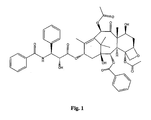
- Taxol also referred to as "Paclitaxel” is a well-known anti-cancer drug which acts by enhancing and stabilizing microtubule formation.
- the structure of Taxol is shown in Figure 1 .
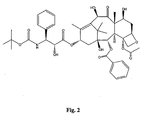
- Many analogs of taxol are known, including taxotere, the structure of which is shown in Figure 2 .
- Taxotere is also referred to as "Docetaxol”.
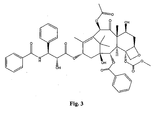
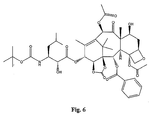
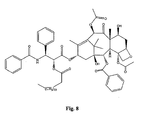
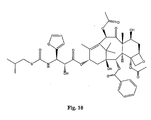
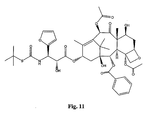
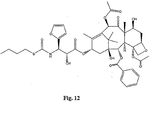
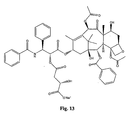
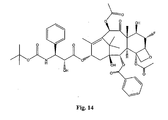
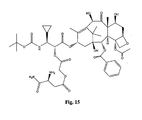
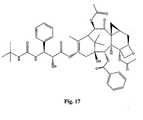
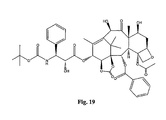
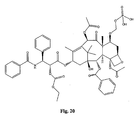
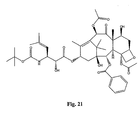
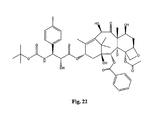
- the structures of other taxol analogs are shown in Figures 3-23 . These compounds have the basic taxane skeleton as a common structure feature and have also been shown to have the ability to arrest cells in the G2-M phases due to stabilization of microtubules.
- Taxol analog is defined herein to mean a compound which has the basic taxol skeleton and which promotes microtubule formation.
- Taxol analogs may be formulated as a nanoparticle colloidal composition to improve the infusion time and to eliminate the need to deliver the drug with Cremophor which causes hypersensitivity reactions in some patients.
- An example of a taxol analog formulated as a nanoparticle colloidal composition is ABI-007 which is a nanoparticle colloidal composition of protein-stabilized paclitaxel that is reconstituted in saline.
- taxol analogs used herein are represented by Structural Formula (VII) or (VIII):
- R 10 is a lower alkyl group, a substituted lower alkyl group, a phenyl group, a substituted phenyl group, -SR 19 , -NHR 19 or -OR 19 .
- R 11 is a lower alkyl group, a substituted lower alkyl group, an aryl group or a substituted aryl group.
- R 12 is -H, -OH, lower alkyl, substituted lower alkyl, lower alkoxy, substituted lower alkoxy, -O-C(O)-(lower alkyl), -O-C(O)-(substituted lower alkyl), -O-CH 2 -O-(lower alkyl) -S-CH 2 -O-(lower alkyl).
- R 13 is -H, -CH 3 , or, taken together with R 14 , -CH 2 -.
- R 14 is -H, -OH, lower alkoxy, -O-C(O)-(lower alkyl), substituted lower alkoxy, -O-C(O)-(substituted lower alkyl), -O-CH 2 -O-P(O)(OH) 2 , -O-CH 2 -O-(lower alkyl), -O-CH 2 -S-(lower alkyl) or, taken together with R 20 , a double bond.
- R 15 H, lower acyl, lower alkyl, substituted lower alkyl, alkoxymethyl, alkthiomethyl, -OC(O)-O(lower alkyl), -OC(O)-O(substituted lower alkyl), -OC(O)-NH(lower alkyl) or -OC(O)-NH(substituted lower alkyl).
- R 16 is phenyl or substituted phenyl.
- R 17 is -H, lower acyl, substituted lower acyl, lower alkyl, substituted, lower alkyl, (lower alkoxy)methyl or (lower alkyl)thiomethyl.
- R 19 is a lower alkyl group, a substituted lower alkyl group, a phenyl group, a substituted phenyl group.
- R 20 is -H or a halogen.
- R 21 is -H, lower alkyl, substituted lower alkyl, lower acyl or substituted lower acyl.
- R 11 is phenyl, (CH 3 ) 2 CHCH 2 -, -2-furanyl, cyclopropyl or para -toluyl;
- R 12 is -H, -OH, CH 3 CO- or -(CH 2 ) 2 - N -morpholino;
- R 13 is methyl, or, R 13 and R 14 , taken together, are -CH 2 -;
- R 14 is -H, -CH 2 SCH 3 or -
- a taxol analog can also be bonded to or be pendent from a pharmaceutically acceptable polymer, such as a polyacrylamide.
- a pharmaceutically acceptable polymer such as a polyacrylamide.
- a polymer of this type is shown in Figure 24 .
- the bis(thio-hydrazide amide) disalts disclosed herein can be prepared by a method of the invention.
- the method of preparing the disclosed bis(thio-hydrazide amide) disalts includes the steps of combining a neutral bis(thio-hydrazide amide), an organic solvent and a base to form a bis(thio-hydrazide amide) solution; and combining the solution and an organic antisolvent, thereby precipitating a disalt of the bis(thio-hydrazide amide) (e.g., compounds represented by Structural Formulas (II) and (III). Compounds of Formulas (I), (IV) and (V) are also described herein.
- the neutral forms of the disclosed bis(thio-hydrazide amide) disalts can be prepared according to methods described in U.S. Publication Nos. 2003/0045518 and 2003/0119914 , both entitled SYNTHESIS OF TAXOL ENHANCERS and also according to methods described in U.S. Publication No. 2004/0223016 A1 , entitled TREATMENT FOR CANCERS.
- At least about two molar equivalents of the base are employed for each molar equivalent of neutral bis(thio-hydrazide amide); more typically, from about 2 to about 5 equivalents, or preferably from about 2.0 to about 2.5 equivalents.
- Suitable bases can be strong enough to react with a bis(thio-hydrazide amide) to produced a disalt.
- the base can be an amine (e.g. , triethylamine, diphenylamine, butylamine, or the like); an ammonium hydroxide (e.g., tetramethyammonium hydroxide, tetrabutylammonium hydroxide, or the like); an alkali metal hydroxide (lithium hydroxide, sodium hydroxide, potassium hydroxide, or the like) an alkali metal C1-C6 alkoxide, or an alkali metal amide (e.g., sodium amide, lithium diisopropyl amide, or the like).
- amine e.g. , triethylamine, diphenylamine, butylamine, or the like
- an ammonium hydroxide e.g., tetramethyammonium hydroxide, te
- the base is sodium hydroxide, potassium hydroxide, sodium C1-C6 alkoxide, potassium C1-C6 alkoxide, sodium amide, or potassium amide, or preferably, sodium hydroxide, sodium methoxide, or sodium ethoxide.
- the base can be an alkali metal hydride (e.g. , sodium hydride, potassium hydride, or the like), a divalent metal base (e.g., magnesium oxide) a C1-C6 alkyl alkali metal ( e.g. , butyllithium), or an aryl alkali metal ( e.g., phenyllithium). More typically, the base is lithium hydride, sodium hydride, potassium hydride, butyllithium, butylsodium, butylpotassium, phenyllithium, phenylsodium, or phenylpotassium.
- alkali metal hydride e.g. , sodium hydride, potassium hydride, or the like
- a divalent metal base e.g., magnesium oxide
- C1-C6 alkyl alkali metal e.g. , butyllithium
- an aryl alkali metal e.g., pheny
- an alkali metal includes lithium, sodium, potassium, cesium and rubidium.
- the organic solvent can be any organic solvent which is stable when the base is added to a mixture of the bis(thio-hydrazide amide) and the organic solvent.
- the organic solvent is polar enough to dissolve the bis(thio-hydrazide amide) salt formed by the method to form a solution.
- the organic solvent is water-miscible.
- the organic solvent can generally be selected from a C1-C4 aliphatic alcohol (e.g., methanol, ethanol, 1-propanol, 2-propanol, or the like), a C1-C4 aliphatic ketone (e.g., acetone, methyl ethyl ketone, 2-butanone, or the like), a C2-C4 aliphatic ether ( e.g., diethyl ether, dipropyl ether, diisopropyl ether, or the like), a C2-C4 cycloaliphatic ether ( e.g., tetrahydrofuran, dioxane, or the like), dimethyl formamide, dimethyl sulfoxide, N-methyl pyrrolidone, a glycol (e.g., ethylene glycol, propylene glycol, tetramethylene glycol, or the like), an alkyl glycol ether (e.g., ethylene glycol
- the organic solvent can be selected from methanol, ethanol, propanol (e.g., 1-propanol, 2-propanol), butanol ( e.g., 1-butanol, tert -butyl alcohol, or the like), acetone, tetrahydrofuran, and methyl ethyl ketone.
- the organic solvent can be selected from methanol, ethanol, acetone, and methyl ethyl ketone.
- the organic antisolvent is a solvent that when added to the solution created by combining the base, the bis(thio-hydrazide amide) and the organic solvent, causes the bis(thiohydrazide amide) disalt to precipitate out of solution.
- the organic antisolvent can be selected from a C5-C10 alkane (e.g., pentane, petroleum ether, hexane, heptane, octane, isooctane, or the like), C5-C10 cycloalkane (e.g., cyclohexane, cyclopentane, or the like), a C3-C10 alkyl ester ( e.g ., ethyl acetate, propyl acetate, methyl butyrate, or the like, a C3-C10 alkyl ether ( e.g., methyl ethyl ether, diethyl ether, methyl propyl ether, or the like), benzene, toluene, and xylene.
- a C5-C10 alkane e.g., pentane, petroleum ether, hexane, heptane, oc
- the organic antisolvent can be selected from diethyl ether, dipropyl ether ( e.g., propyl as 1-propyl or 2-propyl), methyl propyl ether, ethyl propyl ether, methyl tert -butyl ether, methyl acetate, ethyl acetate, propyl acetate, pentane, hexane, cyclohexane, heptane, and petroleum ether.
- the organic antisolvent can be a C5-C10 alkane or C5-C10 cycloalkane.
- the organic antisolvent can be heptane; or, the organic antisolvent can be diethyl ether or ethyl acetate. In various preferred embodiments, the organic antisolvent can be methyl tert -butyl ether.
- the neutral bis(thio-hydrazide amide) can be substantially insoluble in the organic solvent, thereby forming a mixture, whereby combining the base with the mixture forms a bis(thio-hydrazide amide) solution.
- the bis(thio-hydrazide amide) solution can be clear.
- between about 0.25 and about 2.5 moles of the neutral bis(thio-hydrazide amide) are combined per each liter of organic solvent, or typically between about 0.75 and about 1.5 moles of the neutral bis(thio-hydrazide amide) are combined per each liter of organic solvent.
- about 1 mole of the neutral bis(thio-hydrazide amide) are combined per each liter of organic solvent.
- a "bis(thio-hydrazide amide) solution when formed from the organic solvent, the neutral bis(thio-hydrazide amide), and the base, can include one or more species such as the neutral bis(thio-hydrazide amide), the bis(thio-hydrazide amide) monosalt, the bis(thio-hydrazide amide) disalt, or the like.
- the organic solvent is ethanol.
- the base is about 2 molar to about 5 molar aqueous sodium hydroxide, or more preferably from about 2 to about 2.5 molar.
- the organic solvent is acetone.
- the base is about 2 molar to about 5 molar ethanolic sodium ethoxide, or more preferably from about 2 to about 2.5 molar.
- the bis(thio-hydrazide amide) disalts prepared by the present invention are the disalts disclosed herein, including those represented by Structural Formulas (II) and (III).
- the neutral bis(thio-thio-hydrazide amides) employed in the disclosed method to prepare the disalts represented by Structural Formula (II) can be represented by the following Structural Formula (II'), where the variables have the same values and preferred values as in Structural Formula (II).
- a neutral bis(thio-hydrazide amide) has at least two hydrogens (e.g . , the hydrogens bonded to the nitrogen atoms in Structural Formula (II') which can react with the bases described herein to form a disalt.
- M + is a pharmaceutically acceptable monovalent cation.
- M 2+ is a pharmaceutically acceptable divalent cation as described above.
- the organic solvent can be acetone; the base can be ethanolic sodium ethoxide; the organic solvent can be ethanol; the base can be aqueous sodium hydroxide; the antisolvent can be heptane; the neutral bis(thio-hydrazide amide) can be:
- the neutral bis (thiohydrazide amide) can be or
- Method B To a stirred solution of - N-Malonyl-bis(N'-thiobenzoyl- N'-methyl hydrazide) (0.92 g) in THF (15 mL) was added a solution of NaOH (0.184 g) in MeOH (15 mL). After 15 min stirring at room temperature, the resultant solution was concentrated and precipitated with ether to yield 1 g of a light orange powder after filtration. The physical data for the precipitate was is in accordance with that obtained from Method A.
- N-Malonyl-bis(N'-thiobenzoyl- N'-methyl hydrazide) 8g, 20 mmol
- THF 90 ml
- LDA llithium diisopropylamide
- Compound 5 was prepared according to the method described in Example 3 except that 2 equivalents of LDA were used instead of one equivalent.
- the monoethanolamine compound was made in a similar to that in Example 3 by using one equivalent of ethanolamine instead of LDA.
- the diethanolamine compound was made in a similar to that in Example 3 by using two equivalents of ethanolamine instead of one equivalent of LDA.
- the calcium compound was made in a similar to that in Example 7 by using Ca(OH) 2 instead of MgO.
- N-Malonyl-bis(N'-thiobenzoyl-N'-methyl hydrazide) (micronized), 5.006 g (12.5 mmol) was suspended in 70 mL of absolute ethanol. Into this suspension was added with stirring 12.4 mL (1 equivalent) of a 1.008 N solution of potassium hydroxide in methanol. The resulting solution was filtered through a glass acrodisc (Gelman) and concentrated to about 5 mL. Into this concentrated solution, 5 mL of ethyl acetate was added, followed by anhydrous ether until the resulting solution turned cloudy. This solution was left for crystallization overnight. A hardened precipitate was broken up with a spatula, filtered out, washed twice with anhydrous ether and vacuum-dried at 50°C to afford a monopotassium salt as pale-yellow solids (4.05 g, 70%).
- Method A N-Malonyl-bis(N'-thiobenzoyl- N'-methyl hydrazide) (micronized, 5.006 g, 12.5 mmol) was treated with 24.95 mL (2 equivalent) of 1.002 N solution of potassium hydroxide in water (volumetric standard solution, Aldrich). All material except a few particles dissolved, and 6 mL of Milli-Q water was added to afford a solution with some tiny particles remaining.
- the solution was then filtered through a glass acrodisc (Gelman), the filter was rinsed with 2 mL of Milli-Q water, and the combined solution was diluted to 50 mL with Milli-Q water and lyophilized to produce a title compound as yellow foams (6.17 g).
- Method B Alternatively, N-Malonyl-bis(N'-thiobenzoyl- N'-methyl hydrazide) (micronized, 5.006 g, 12.5 mmol) was dissolved in anhydrous THF (62 mL). Into this solution, and 25.1 mL (2 equivalent) of 1.008N solution of potassium hydroxide in methanol (volumetric standard solution, Aldrich) was added. From the resulting solution, solvent was removed under reduced pressure to leave about 5 mL of an oily residue, which was triturated with anhydrous ether until a pale yellow solid was obtained. The solid was filtered out, washed twice with anhydrous ether and vacuum-dried at 50 °C, to yield the dipotassium salt as a powder (4.3 g, 73%). NMR data were identical with those obtained above in Method A.
- the disodium compound was prepared by a similar method to that used for Example 12.
- the dipotassium compound was prepared by a method similar to that used for Example 12 except that KOH was used instead of NaOH.
- a compound was weighed and water was added to the compound such that the resulting concentration of the compound was about 100 mg/mL. The mixture was then shaken well and sonicated (about 5-10 nun at about 50°C). If the added amounts of the compound were totally solubilized, more amounts of the compound were added to the solution and the mixture was shaken well and sonicated until a suspension was achieved. The suspension was then filtered through a 0.2 ⁇ m filter. The filtered solution was diluted with DMSO. Then the mixture was analyzed by HPLC to determine the concentration of the compound.
- HPLC system consisted of the HP 1100 Model (Agilent, Wilmington, DE) equipped with a model 1100 quaternary pump, a model 1100 autosampler, a model 1100 Diode-Array Detector for UV detection at 280 nm.
- HPLC analysis was performed using a gradient mobile phase consisting of acetonitrile-water containing 0.1% formic acid. Mobile phases were degassed and filtered through a solvent filtration apparatus and pumped at a constant rate of 1.0 mL/min. Separation was made on an XTerra MS C18 analytical column, 4.6 mm i.d.
- Solubility data for each compound tested are shown below in Table 1. Table 1. Solubility Data Samples Salts Compound Solubility in water (mg/mL) A - Neutral Form of Compound 1 ⁇ 0.1 B 2Na + 1 >1000 C Li + 4 53.5 D 2Li + 5 626.0 (>500) E Na + 3 52.8 F 2K + 2 >1000 G K + 10 41.2 H Ca 2+ 9 18.9 I HEA + 6 51.5 J 2HEA + 7 231.1 (>200) K Mg 2+ 8 43.5 L Choline + 11 264.0 (>200) M 2Na + 12 >1000 N 2Na + 13 >1000 O 2K + 14 >1000
- the bis(thio-hydrazide amide) disalts for example, Compounds 1, 2, 5, 7, 12, 13 and 14, have significantly greater water solubility than the corresponding neutral or monosalt compounds.
- Compounds 1 and 2 showed significantly greater water solubility than the corresponding neutral form.
- disalts compounds, Compounds 1, 2, 5 and 7, showed much greater water solubility than the corresponding monosalt compounds, Compounds 3, 4, 6 and 10.
- Male beagle dogs were acclimated for at least one week prior to use, were fed laboratory chow and water ad libitum, and were housed in temperature and humidity controlled rooms. Compounds were prepared as a solution for intravenous injection or a capsule for oral administration. Three dogs were used for the study. Compounds were injected intravenously via cephalic vein or by oral gavage. The dose was adjusted based on the animal's body weight. Blood samples were collected at intervals of 5, 10 and 30 min and 1, 2, 4, 6, 8 and 24 hr (example) after administration of the compound and plasma samples were prepared after centrifugation (5000 rpm, 8 min) of whole blood samples.
- Compound in plasma was measured by a liquid chromatography with tandem mass spectrophotometer (LC/MS/MS) after 50 ⁇ l of these samples were extracted by protein precipitation with acetonitrile.
- the compound concentration was determined by the standard curve (concentration vs. peak area) made with the same extraction procedure of controlled plasma.
- the area under curve (AUC) was calculated using the modified trapezoidal method.
- the portion of AUC from the last measurable plasma concentration to infinity was estimated by C/k, where k was expressed by the least square regression of the log-linear concentration time points and C represents the last measurable plasma concentration. Bioavailability was calculated by AUCpo/ AUCiv.
- Bioavailability data for each compound tested are shown below in Table 2. As can be seen in Table 2, the disalt compound, Compound (1), showed much greater bioavailability than the corresponding neutral compound or monosalt compound, Compound (3). Table 2. Bioavailability Data Samples Salts Compounds Bioavailability (%) 1 - Neutral Form of Compound (1) 4.8 2 2Na + 1 80 3 Na + 3 35
- the precipitate is added to about 60 mL of acetone and stirred for 2 hours at room temperature, then collected by filtration and dried under vacuum for 1 hour at about 50 °C to yield the pure disodium salt of the compound.
- a sample of a bis(thio-hydrazide amide) (Compound 1, 15 grams) was combined with 40 mL of absolute ethanol to form a mixture as a slurry.
- Aqueous sodium hydroxide (3.0 grams NaOH in 3.0 mL H2O) was added to the mixture with stirring at room temperature, and the mixture was cooled to not exceed 35 degrees C.
- the aqueous sodium hydroxide addition vessel was rinsed with 1 mL of water and 5 mL of ethanol, and the rinses were added to the mixture. After addition, the mixture was stirred for 110 minutes.
- the resulting yellow disodium bis(thio-hydrazide amide) solution was separated into three equal portions for the following examples.
Landscapes
- Chemical & Material Sciences (AREA)
- Organic Chemistry (AREA)
- Health & Medical Sciences (AREA)
- Life Sciences & Earth Sciences (AREA)
- Veterinary Medicine (AREA)
- Public Health (AREA)
- General Health & Medical Sciences (AREA)
- Medicinal Chemistry (AREA)
- Animal Behavior & Ethology (AREA)
- Pharmacology & Pharmacy (AREA)
- General Chemical & Material Sciences (AREA)
- Nuclear Medicine, Radiotherapy & Molecular Imaging (AREA)
- Chemical Kinetics & Catalysis (AREA)
- Oncology (AREA)
- Hematology (AREA)
- Engineering & Computer Science (AREA)
- Bioinformatics & Cheminformatics (AREA)
- Epidemiology (AREA)
- Pharmaceuticals Containing Other Organic And Inorganic Compounds (AREA)
- Acyclic And Carbocyclic Compounds In Medicinal Compositions (AREA)
- Organic Low-Molecular-Weight Compounds And Preparation Thereof (AREA)
- Pyridine Compounds (AREA)
Priority Applications (4)
| Application Number | Priority Date | Filing Date | Title |
|---|---|---|---|
| SI200531790T SI1781604T1 (sl) | 2004-06-23 | 2005-06-20 | Bis (tio-hidrazid amidne) soli za zdravljenje rakov |
| PL05762347T PL1781604T3 (pl) | 2004-06-23 | 2005-06-20 | Sole bis(tiohydrazydoamidu) do leczenia nowotworów |
| MEP-2013-124A ME01644B (me) | 2004-06-23 | 2005-06-20 | BIS(TIO-HIDRAZID AMIDNE) SOLl ZA TRETMAN KANCERA |
| EP10009536A EP2305642A3 (en) | 2004-06-23 | 2005-06-20 | Bis(thio-hydrazide amide) salts for treatment of cancers |
Applications Claiming Priority (3)
| Application Number | Priority Date | Filing Date | Title |
|---|---|---|---|
| US58259604P | 2004-06-23 | 2004-06-23 | |
| US68136805P | 2005-05-16 | 2005-05-16 | |
| PCT/US2005/021642 WO2006009940A1 (en) | 2004-06-23 | 2005-06-20 | Bis(thio-hydrazide amide) salts for treatment of cancers |
Related Child Applications (1)
| Application Number | Title | Priority Date | Filing Date |
|---|---|---|---|
| EP10009536.3 Division-Into | 2010-09-14 |
Publications (2)
| Publication Number | Publication Date |
|---|---|
| EP1781604A1 EP1781604A1 (en) | 2007-05-09 |
| EP1781604B1 true EP1781604B1 (en) | 2013-08-07 |
Family
ID=34993190
Family Applications (2)
| Application Number | Title | Priority Date | Filing Date |
|---|---|---|---|
| EP05762347.2A Expired - Lifetime EP1781604B1 (en) | 2004-06-23 | 2005-06-20 | Bis(thio-hydrazide amide) salts for treatment of cancers |
| EP10009536A Withdrawn EP2305642A3 (en) | 2004-06-23 | 2005-06-20 | Bis(thio-hydrazide amide) salts for treatment of cancers |
Family Applications After (1)
| Application Number | Title | Priority Date | Filing Date |
|---|---|---|---|
| EP10009536A Withdrawn EP2305642A3 (en) | 2004-06-23 | 2005-06-20 | Bis(thio-hydrazide amide) salts for treatment of cancers |
Country Status (21)
| Country | Link |
|---|---|
| US (5) | US7385084B2 (enExample) |
| EP (2) | EP1781604B1 (enExample) |
| JP (1) | JP5362986B2 (enExample) |
| KR (1) | KR101313027B1 (enExample) |
| CN (1) | CN1993318B (enExample) |
| AU (1) | AU2005265202B2 (enExample) |
| BR (1) | BRPI0512526A (enExample) |
| CA (1) | CA2570698C (enExample) |
| DK (1) | DK1781604T3 (enExample) |
| ES (1) | ES2430373T3 (enExample) |
| HR (1) | HRP20131023T1 (enExample) |
| IL (1) | IL179632A (enExample) |
| ME (1) | ME01644B (enExample) |
| NO (1) | NO20070378L (enExample) |
| NZ (1) | NZ552159A (enExample) |
| PL (1) | PL1781604T3 (enExample) |
| PT (1) | PT1781604E (enExample) |
| RS (1) | RS52999B (enExample) |
| RU (2) | RU2406722C2 (enExample) |
| TW (1) | TWI389684B (enExample) |
| WO (1) | WO2006009940A1 (enExample) |
Families Citing this family (35)
| Publication number | Priority date | Publication date | Assignee | Title |
|---|---|---|---|---|
| TWI332943B (en) * | 2001-07-10 | 2010-11-11 | Synta Pharmaceuticals Corp | Taxol enhancer compounds |
| TWI297335B (en) * | 2001-07-10 | 2008-06-01 | Synta Pharmaceuticals Corp | Taxol enhancer compounds |
| TWI252847B (en) | 2001-07-10 | 2006-04-11 | Synta Pharmaceuticals Corp | Synthesis of taxol enhancers |
| TWI330079B (en) | 2003-01-15 | 2010-09-11 | Synta Pharmaceuticals Corp | Treatment for cancers |
| PL1781604T3 (pl) | 2004-06-23 | 2014-01-31 | Synta Pharmaceuticals Corp | Sole bis(tiohydrazydoamidu) do leczenia nowotworów |
| EP1827410A2 (en) | 2004-11-19 | 2007-09-05 | Synta Pharmaceuticals Corporation | Bis(thio-hydrazide amides) for increasing hsp70 expression |
| EP1871350A1 (en) * | 2005-04-15 | 2008-01-02 | Synta Pharmaceuticals Corporation | Methods of increasing natural killer cell activity for therapy |
| BRPI0610219A2 (pt) | 2005-04-15 | 2010-06-08 | Synta Pharmaceuticals Corp | métodos de tratamento de um ser humano com cáncer e composição de farmacêutica |
| KR20080008399A (ko) | 2005-05-16 | 2008-01-23 | 신타 파마슈티칼스 코프. | 비스(티오-히드라지드 아미드) 염의 합성 방법 |
| WO2007021881A1 (en) | 2005-08-16 | 2007-02-22 | Synta Pharmaceuticals Corp. | Bis(thio-hydrazide amide) formulation |
| US20100310587A1 (en) * | 2005-08-29 | 2010-12-09 | Academia Sinica | Immunomodulatory compositions |
| GB0607950D0 (en) * | 2006-04-21 | 2006-05-31 | Novartis Ag | Organic compounds |
| AU2007288340A1 (en) * | 2006-08-21 | 2008-02-28 | Synta Pharmaceuticals Corp. | Bis (thiohydrazide amides) for treating melanoma |
| AU2007288339B2 (en) * | 2006-08-21 | 2011-08-18 | Synta Pharmaceuticals Corp. | Compounds for treatment of proliferative disorders |
| WO2008024301A2 (en) * | 2006-08-21 | 2008-02-28 | Synta Pharmaceuticals Corp. | Bis(thiohydrazide amides) for use in preventing or delaying the recurrence of melanoma |
| US8609720B2 (en) * | 2006-08-21 | 2013-12-17 | Synta Pharmaceuticals Corp. | Compounds for treating proliferative disorders |
| WO2008024299A2 (en) * | 2006-08-21 | 2008-02-28 | Synta Pharmaceuticals Corp. | Combination with bis(thiohydrazide amides) for treating cancer |
| US7939564B2 (en) | 2006-08-31 | 2011-05-10 | Synta Pharmaceuticals Corp. | Combination with bis(thiohydrazide amides) for treating cancer |
| US9498528B2 (en) * | 2006-09-13 | 2016-11-22 | Genzyme Corporation | Treatment of multiple sclerosis (MS) |
| WO2008033494A2 (en) | 2006-09-15 | 2008-03-20 | Synta Pharmaceuticals Corp. | Purification of bis(thiohydrazide amides) |
| WO2009064374A2 (en) * | 2007-11-09 | 2009-05-22 | Synta Pharmaceuticals Corp. | Oral formulations of bis(thiohydrazide amides) |
| US8581004B2 (en) | 2008-02-21 | 2013-11-12 | Synta Pharmaceuticals Corp. | Compounds for treating proliferative disorders |
| US8633323B2 (en) * | 2008-03-31 | 2014-01-21 | Synta Pharmaceuticals Corp. | Process for preparing bis(thiohydrazide amides) |
| AU2009308502B2 (en) * | 2008-10-22 | 2013-08-01 | Synta Pharmaceuticals Corp. | Transition metal complexes of bis[thiohydrazide amide] compounds |
| JP2012506444A (ja) | 2008-10-22 | 2012-03-15 | シンタ ファーマシューティカルズ コーポレーション | ビス[チオヒドラジドアミド]化合物の遷移金属錯体 |
| US8525776B2 (en) * | 2008-10-27 | 2013-09-03 | Lenovo (Singapore) Pte. Ltd | Techniques for controlling operation of a device with a virtual touchscreen |
| US8680100B2 (en) | 2008-12-01 | 2014-03-25 | Synta Pharmaceuticals Corp. | Sulfonylhydrazide compounds for treating proliferative disorders |
| RU2400471C1 (ru) * | 2009-04-30 | 2010-09-27 | Учреждение Российской академии наук Институт органической химии им. Н.Д. Зелинского РАН (ИОХ РАН) | N-замещенные производные тиогидразидов оксаминовых кислот, способ их получения и их использование |
| US8822532B2 (en) | 2009-12-04 | 2014-09-02 | Synta Pharmaceuticals Corp. | Bis[thiohydrazide amide] compounds for treating leukemia |
| US8815945B2 (en) * | 2010-04-20 | 2014-08-26 | Masazumi Nagai | Use of bis [thiohydrazide amide] compounds such as elesclomol for treating cancers |
| JP2013545759A (ja) | 2010-11-18 | 2013-12-26 | シンタ ファーマスーティカルズ コーポレーション | 低酸素状態に基づくエレスクロモールによる治療に適した被験体の事前選択 |
| CA2854186A1 (en) * | 2011-11-10 | 2013-05-16 | Jim SANG | Administration of a bis(thiohydrazide amide) compound for treating cancers |
| US20130149392A1 (en) | 2011-12-12 | 2013-06-13 | Synta Pharmaceuticals Corp. | Method of treating non-small cell lung cancer with bis-(thiohydrazide)amide compounds |
| WO2013103795A1 (en) | 2012-01-05 | 2013-07-11 | The Board Of Trustees Of The Leland Stanford Junior University | Bis (thiohydrazide amide) compounds for treating cancers |
| US12610818B2 (en) | 2023-02-07 | 2026-04-21 | Semiconductor Components Industries, Llc | Single switch direct cooling assemblies and related methods |
Family Cites Families (78)
| Publication number | Priority date | Publication date | Assignee | Title |
|---|---|---|---|---|
| FR2097737A5 (en) | 1970-07-14 | 1972-03-03 | Berlin Chemie Veb | Virustatic 4-substd 1-acylthiosemicarbazides -from carboxylic acid - hydrazide and isothiocyanates or from carboxylic acid chloride and 4- |
| DE2037257A1 (en) | 1970-07-28 | 1972-02-03 | Farbwerke Hoechst AG, vorm. Meister Lucius & Brüning, 6000 Frankfurt | Poly-(5-amino-1,3,4-thiadiazol-2-yl) derivs prepn - intermediates for drug and polymer prodn |
| GB1272920A (en) | 1971-03-15 | 1972-05-03 | Berlin Chemie Veb | New thiosemicarbazides |
| US4012360A (en) | 1973-12-03 | 1977-03-15 | Ciba-Geigy Corporation | Bis-salicyloyl-dicarboxylic acid dihydrazides as stabilizers for polyolefines |
| JPS5091056A (enExample) | 1973-12-17 | 1975-07-21 | ||
| US4822777A (en) * | 1987-02-27 | 1989-04-18 | Liposome Technology, Inc. | Amphotericin B/cholesterol sulfate composition |
| JP2767241B2 (ja) | 1987-04-15 | 1998-06-18 | ロ−ム アンド ハ−ス コンパニ− | 殺虫性のn−(場合により置換された)−n′−置換−n,n′−ジ置換ヒドラジン |
| US6013836A (en) | 1992-02-28 | 2000-01-11 | Rohm And Haas Company | Insecticidal N'-substituted-N,N'-disubstitutedhydrazines |
| FR2697752B1 (fr) * | 1992-11-10 | 1995-04-14 | Rhone Poulenc Rorer Sa | Compositions antitumorales contenant des dérivés du taxane. |
| CH683965A5 (it) * | 1993-02-19 | 1994-06-30 | Limad Marketing Exp & Imp | Composti della classe dei ftalidrazidici come sostanza attiva in agenti antinfiammatori ed antitossici. |
| US6749868B1 (en) * | 1993-02-22 | 2004-06-15 | American Bioscience, Inc. | Protein stabilized pharmacologically active agents, methods for the preparation thereof and methods for the use thereof |
| US5665382A (en) * | 1993-02-22 | 1997-09-09 | Vivorx Pharmaceuticals, Inc. | Methods for the preparation of pharmaceutically active agents for in vivo delivery |
| US6096331A (en) * | 1993-02-22 | 2000-08-01 | Vivorx Pharmaceuticals, Inc. | Methods and compositions useful for administration of chemotherapeutic agents |
| US5916596A (en) * | 1993-02-22 | 1999-06-29 | Vivorx Pharmaceuticals, Inc. | Protein stabilized pharmacologically active agents, methods for the preparation thereof and methods for the use thereof |
| JP3746293B2 (ja) * | 1993-02-22 | 2006-02-15 | アメリカン バイオサイエンス、インコーポレイテッド | 生物製剤のインビボ送達の方法とそのための組成物 |
| US6753006B1 (en) * | 1993-02-22 | 2004-06-22 | American Bioscience, Inc. | Paclitaxel-containing formulations |
| US6537579B1 (en) * | 1993-02-22 | 2003-03-25 | American Bioscience, Inc. | Compositions and methods for administration of pharmacologically active compounds |
| US5439686A (en) * | 1993-02-22 | 1995-08-08 | Vivorx Pharmaceuticals, Inc. | Methods for in vivo delivery of substantially water insoluble pharmacologically active agents and compositions useful therefor |
| US5840746A (en) * | 1993-06-24 | 1998-11-24 | Merck Frosst Canada, Inc. | Use of inhibitors of cyclooxygenase in the treatment of neurodegenerative diseases |
| US5523325A (en) | 1993-09-09 | 1996-06-04 | Jacobson; Richard M. | Amidrazones and their use as pesticides |
| BR9507914A (pt) | 1994-06-03 | 1997-09-23 | Basf Ag | Carbamoil-carbo hidrazida processo para preparar carbamoil-carbo-hidrazida composição adequada e processo para controlar fungos nocivos uso da carbamoil-carbo-hidrazida e amino-ácido-hidrazida |
| DE69604298T2 (de) | 1995-09-22 | 2000-05-18 | Bioimage A/S, Soeborg | Varianten des grünen fluoreszenzproteins, gfp |
| US5739686A (en) * | 1996-04-30 | 1998-04-14 | Naughton; Michael J. | Electrically insulating cantilever magnetometer with mutually isolated and integrated thermometry, background elimination and null detection |
| US6235787B1 (en) | 1997-06-30 | 2001-05-22 | Hoffmann-La Roche Inc. | Hydrazine derivatives |
| GB9727524D0 (en) | 1997-12-31 | 1998-02-25 | Pharmacia & Upjohn Spa | Synergistic antitumor composition containing a biologically active ureido compound |
| TW479053B (en) | 1998-10-19 | 2002-03-11 | Agro Kanesho Co Ltd | Hydrazineoxoacetamide derivatives and pesticides |
| ES2161594B1 (es) | 1998-12-17 | 2003-04-01 | Servier Lab | Nuevos derivados de la hidrazida, su procedimiento de preparacion y las composiciones farmaceuticas que los contienen. |
| RU2191015C2 (ru) * | 1999-11-05 | 2002-10-20 | Общество с ограниченной ответственностью "Центр бифункциональных иммуномодуляторов" | Динатриевая соль n-(6-метил-2,4-диоксо-1,2,3,4-тетрагидро-5h-пиримидинсульфон)-n'- изоникотиноилгидразида, проявляющая антимикробную и иммунотропную активность, и лекарственное средство на ее основе |
| US6322303B1 (en) | 2000-05-12 | 2001-11-27 | David M. John | Dunnage bag and method of making same |
| EP1164126A1 (de) | 2000-06-16 | 2001-12-19 | Basf Aktiengesellschaft | Salicylsäurehydrazid-Derivate, Verfahren und Zwischenprodukte zu ihrer Herstellung, sie enthaltende Mittel und ihre Verwendung zur Bekämpfung von Schadpilzen |
| US6365745B1 (en) | 2000-07-14 | 2002-04-02 | Sumika Fine Chemicals Co., Ltd. | Method for producing hydrazine derivative |
| MXPA03006666A (es) | 2001-01-25 | 2004-05-31 | Guilford Pharm Inc | Compuestos de union de ciclofilina carbociclicos trisubstituidos y su uso. |
| MXPA03010054A (es) * | 2001-05-01 | 2004-04-02 | Abbott Lab | Composiciones que comprenden lopinavir y metodos para aumentar la biodisponibilidad de agentes farmaceuticos. |
| EP1387678A1 (en) | 2001-05-03 | 2004-02-11 | Max-Planck-Gesellschaft Zur Förderung Der Wissenschaften E.V. | Compounds that inhibit hsp90 and stimulate hsp70 and hsp40, useful in the prevention or treatment of diseases associated with protein aggregation and amyloid formation |
| US6602907B1 (en) | 2001-06-08 | 2003-08-05 | University Of Central Florida | Treatment of breast cancer |
| TWI332943B (en) | 2001-07-10 | 2010-11-11 | Synta Pharmaceuticals Corp | Taxol enhancer compounds |
| TWI252847B (en) | 2001-07-10 | 2006-04-11 | Synta Pharmaceuticals Corp | Synthesis of taxol enhancers |
| US6924312B2 (en) | 2001-07-10 | 2005-08-02 | Synta Pharmaceuticals Corp. | Taxol enhancer compounds |
| TWI297335B (en) | 2001-07-10 | 2008-06-01 | Synta Pharmaceuticals Corp | Taxol enhancer compounds |
| CA2468184A1 (fr) * | 2001-11-28 | 2003-06-05 | Societe De Conseils De Recherches Et D'applications Scientifiques (S.C.R A.S.) | Derives de 5-sulfanyl-4h-1,2,4-triazoles et leur utilisation en tant que medicament |
| TW200408407A (en) | 2001-11-30 | 2004-06-01 | Dana Farber Cancer Inst Inc | Methods and compositions for modulating the immune system and uses thereof |
| AU2006228035B2 (en) | 2003-01-15 | 2010-02-18 | Synta Pharmaceuticals Corp. | Bis (thio-hydrazide amide) compounds for treating multi-drug resistant cancer |
| TWI330079B (en) | 2003-01-15 | 2010-09-11 | Synta Pharmaceuticals Corp | Treatment for cancers |
| SI1611112T1 (sl) | 2003-02-11 | 2012-12-31 | Vernalis (R&D) Limited | Izoksazolne spojine kot inhibitorji vroäśinskih ĺ ok proteinov |
| KR100575251B1 (ko) | 2003-03-03 | 2006-05-02 | 재단법인서울대학교산학협력재단 | p38/JTV-1을 유효성분으로 하는 암 치료용 약학적조성물 및 암 치료용 약학적 조성물의 스크리닝 방법 |
| KR100486693B1 (ko) * | 2003-03-17 | 2005-05-03 | 삼성전자주식회사 | 금속 매립 방법 |
| EP1493445A1 (en) | 2003-07-04 | 2005-01-05 | Max-Planck-Gesellschaft zur Förderung der Wissenschaften e.V. | Inhibition of stress-induced ligand-dependent EGFR activation |
| TWI339206B (en) | 2003-09-04 | 2011-03-21 | Vertex Pharma | Compositions useful as inhibitors of protein kinases |
| KR100544347B1 (ko) * | 2003-12-11 | 2006-01-23 | 한국생명공학연구원 | 디아릴이소옥사졸계 화합물을 유효성분으로 함유하는 암 예방 및 치료용 약학적 조성물 |
| WO2005097758A1 (en) | 2004-03-26 | 2005-10-20 | Amphora Discovery Corporation | Certain triazole-based compounds, compositions, and uses thereof |
| US7011923B2 (en) * | 2004-04-07 | 2006-03-14 | International Business Machines Corporation | Negative photoresist and method of using thereof |
| PL1781604T3 (pl) * | 2004-06-23 | 2014-01-31 | Synta Pharmaceuticals Corp | Sole bis(tiohydrazydoamidu) do leczenia nowotworów |
| US20060142393A1 (en) | 2004-09-16 | 2006-06-29 | Sherman Matthew L | Bis(thio-hydrazide amides) for treatment of hyperplasia |
| EP1827410A2 (en) | 2004-11-19 | 2007-09-05 | Synta Pharmaceuticals Corporation | Bis(thio-hydrazide amides) for increasing hsp70 expression |
| US20060167106A1 (en) * | 2004-11-19 | 2006-07-27 | Mei Zhang | Compounds acting at the centrosome |
| SG164378A1 (en) | 2005-02-17 | 2010-09-29 | Synta Pharmaceuticals Corp | Compounds for the treatment of proliferative disorders |
| WO2006113493A2 (en) | 2005-04-15 | 2006-10-26 | Synta Pharmaceuticals Corp. | Methods of determining cancer prognosis via natural killer cell activity |
| EP1871350A1 (en) | 2005-04-15 | 2008-01-02 | Synta Pharmaceuticals Corporation | Methods of increasing natural killer cell activity for therapy |
| BRPI0610219A2 (pt) * | 2005-04-15 | 2010-06-08 | Synta Pharmaceuticals Corp | métodos de tratamento de um ser humano com cáncer e composição de farmacêutica |
| KR20080008399A (ko) | 2005-05-16 | 2008-01-23 | 신타 파마슈티칼스 코프. | 비스(티오-히드라지드 아미드) 염의 합성 방법 |
| WO2007021881A1 (en) | 2005-08-16 | 2007-02-22 | Synta Pharmaceuticals Corp. | Bis(thio-hydrazide amide) formulation |
| TW200804313A (en) | 2006-05-25 | 2008-01-16 | Synta Pharmaceuticals Corp | Triazole compounds that modulate HSP90 activity |
| WO2008024301A2 (en) | 2006-08-21 | 2008-02-28 | Synta Pharmaceuticals Corp. | Bis(thiohydrazide amides) for use in preventing or delaying the recurrence of melanoma |
| WO2008024299A2 (en) | 2006-08-21 | 2008-02-28 | Synta Pharmaceuticals Corp. | Combination with bis(thiohydrazide amides) for treating cancer |
| AU2007288337B2 (en) | 2006-08-21 | 2012-02-16 | Synta Pharmaceuticals Corp. | Compounds for treating proliferative disorders |
| WO2008024298A1 (en) | 2006-08-21 | 2008-02-28 | Synta Pharmaceuticals Corp. | Bis(thiohydrazide amides) for inhibiting angiogenesis |
| AU2007288340A1 (en) | 2006-08-21 | 2008-02-28 | Synta Pharmaceuticals Corp. | Bis (thiohydrazide amides) for treating melanoma |
| US8609720B2 (en) | 2006-08-21 | 2013-12-17 | Synta Pharmaceuticals Corp. | Compounds for treating proliferative disorders |
| US7939564B2 (en) | 2006-08-31 | 2011-05-10 | Synta Pharmaceuticals Corp. | Combination with bis(thiohydrazide amides) for treating cancer |
| WO2008033300A2 (en) | 2006-09-11 | 2008-03-20 | Synta Pharmaceuticals Corp. | Bis (thiohydrazide amides) formulation |
| US20100093670A1 (en) | 2006-09-14 | 2010-04-15 | Yaming Wu | Compounds for the treatment of angiogenesis |
| WO2008033494A2 (en) | 2006-09-15 | 2008-03-20 | Synta Pharmaceuticals Corp. | Purification of bis(thiohydrazide amides) |
| WO2008082579A1 (en) | 2007-01-03 | 2008-07-10 | Synta Pharmaceuticals Corp. | Method for treating cancer |
| US8093425B2 (en) * | 2007-04-30 | 2012-01-10 | Synta Pharmaceuticals Corp. | Compounds for treating proliferative disorders |
| TW200922550A (en) | 2007-08-07 | 2009-06-01 | Synta Pharmaceuticals Corp | Compounds for treating proliferative disorders |
| WO2009064374A2 (en) | 2007-11-09 | 2009-05-22 | Synta Pharmaceuticals Corp. | Oral formulations of bis(thiohydrazide amides) |
| US8637704B2 (en) | 2007-11-28 | 2014-01-28 | Synta Pharmaceuticals Corp. | Polymorphs of N-malonyl-bis(N′-methyl-N′-thiobenzoylhydrazide) |
| JP5091056B2 (ja) | 2008-08-28 | 2012-12-05 | 三甲株式会社 | 密閉容器の蓋部シール構造 |
-
2005
- 2005-06-20 PL PL05762347T patent/PL1781604T3/pl unknown
- 2005-06-20 HR HRP20131023TT patent/HRP20131023T1/hr unknown
- 2005-06-20 PT PT57623472T patent/PT1781604E/pt unknown
- 2005-06-20 CA CA2570698A patent/CA2570698C/en not_active Expired - Fee Related
- 2005-06-20 AU AU2005265202A patent/AU2005265202B2/en not_active Ceased
- 2005-06-20 BR BRPI0512526-0A patent/BRPI0512526A/pt not_active IP Right Cessation
- 2005-06-20 DK DK05762347.2T patent/DK1781604T3/da active
- 2005-06-20 EP EP05762347.2A patent/EP1781604B1/en not_active Expired - Lifetime
- 2005-06-20 NZ NZ552159A patent/NZ552159A/en not_active IP Right Cessation
- 2005-06-20 JP JP2007518152A patent/JP5362986B2/ja not_active Expired - Fee Related
- 2005-06-20 ME MEP-2013-124A patent/ME01644B/me unknown
- 2005-06-20 US US11/157,213 patent/US7385084B2/en not_active Expired - Fee Related
- 2005-06-20 RU RU2007101898/04A patent/RU2406722C2/ru not_active IP Right Cessation
- 2005-06-20 RS RS20130458A patent/RS52999B/sr unknown
- 2005-06-20 ES ES05762347T patent/ES2430373T3/es not_active Expired - Lifetime
- 2005-06-20 EP EP10009536A patent/EP2305642A3/en not_active Withdrawn
- 2005-06-20 CN CN2005800264456A patent/CN1993318B/zh not_active Expired - Fee Related
- 2005-06-20 WO PCT/US2005/021642 patent/WO2006009940A1/en not_active Ceased
- 2005-06-20 KR KR1020077001513A patent/KR101313027B1/ko not_active Expired - Fee Related
- 2005-06-21 TW TW094120599A patent/TWI389684B/zh not_active IP Right Cessation
-
2006
- 2006-11-27 IL IL179632A patent/IL179632A/en not_active IP Right Cessation
-
2007
- 2007-01-19 NO NO20070378A patent/NO20070378L/no not_active Application Discontinuation
-
2008
- 2008-04-18 US US12/148,312 patent/US7579503B2/en not_active Expired - Fee Related
-
2009
- 2009-07-15 US US12/503,661 patent/US7795313B2/en not_active Expired - Fee Related
-
2010
- 2010-08-30 US US12/871,587 patent/US8048925B2/en not_active Expired - Fee Related
- 2010-11-08 RU RU2010145056/04A patent/RU2010145056A/ru not_active Application Discontinuation
-
2011
- 2011-10-14 US US13/273,807 patent/US8461208B2/en not_active Expired - Fee Related
Non-Patent Citations (1)
| Title |
|---|
| B.J. AUNGST: "Optimising oral bioavailability of pharmaceutical leads", DRUG DEVELOPMENT 2006, 2006, Touch Briefings, GB, pages 84 - 86 * |
Also Published As
Similar Documents
| Publication | Publication Date | Title |
|---|---|---|
| US7579503B2 (en) | BIS (thio-hydrazide amide) salts for treatment of cancers | |
| US8623921B2 (en) | Bis(thio-hydrazide amide) formulation | |
| EP1583524B1 (en) | Bis (thio-hydrazide amide) compounds for treating multi-drug resistant cancer | |
| HK1104526B (en) | Bis(thio-hydrazide amide) salts for treatment of cancers | |
| MXPA06015126A (en) | Bis(thio-hydrazide amide) salts for treatment of cancers | |
| HK1084024B (en) | Bis (thio-hydrazide amide) compounds for treating multi-drug resistant cancer |
Legal Events
| Date | Code | Title | Description |
|---|---|---|---|
| PUAI | Public reference made under article 153(3) epc to a published international application that has entered the european phase |
Free format text: ORIGINAL CODE: 0009012 |
|
| 17P | Request for examination filed |
Effective date: 20070118 |
|
| AK | Designated contracting states |
Kind code of ref document: A1 Designated state(s): AT BE BG CH CY CZ DE DK EE ES FI FR GB GR HU IE IS IT LI LT LU MC NL PL PT RO SE SI SK TR |
|
| AX | Request for extension of the european patent |
Extension state: AL BA HR LV MK YU |
|
| RIN1 | Information on inventor provided before grant (corrected) |
Inventor name: KOSTIK, ELENA Inventor name: INOUE, TAKAYO Inventor name: TATSUTA, NORIAKI Inventor name: KOYA, KEIZO Inventor name: VAGHEFI, FARID Inventor name: CHEN, SHOUJUN Inventor name: SUN, LIJUN Inventor name: LIANG, GUIQING Inventor name: XIA, ZHI-QIANG |
|
| RIN1 | Information on inventor provided before grant (corrected) |
Inventor name: VAGHEFI, FARID Inventor name: KOYA, KEIZO Inventor name: INOUE, TAKAYO Inventor name: KOSTIK, ELENA Inventor name: CHEN, SHOUJUN Inventor name: SUN, LIJUN Inventor name: TATSUTA, NORIAKI Inventor name: LIANG, GUIQING Inventor name: XIA, ZHI-QIANG |
|
| REG | Reference to a national code |
Ref country code: HK Ref legal event code: DE Ref document number: 1104526 Country of ref document: HK |
|
| 17Q | First examination report despatched |
Effective date: 20080919 |
|
| RAP1 | Party data changed (applicant data changed or rights of an application transferred) |
Owner name: SYNTA PHARMACEUTICALS CORP. |
|
| RIN1 | Information on inventor provided before grant (corrected) |
Inventor name: INOUE, TAKAYO Inventor name: CHEN, SHOUJUN Inventor name: KOYA, KEIZO Inventor name: XIA, ZHI-QIANG Inventor name: SUN, LIJUN Inventor name: TATSUTA, NORIAKI Inventor name: KOSTIK, ELENA Inventor name: LIANG, GUIQING Inventor name: VAGHEFI, FARID |
|
| GRAP | Despatch of communication of intention to grant a patent |
Free format text: ORIGINAL CODE: EPIDOSNIGR1 |
|
| GRAS | Grant fee paid |
Free format text: ORIGINAL CODE: EPIDOSNIGR3 |
|
| GRAA | (expected) grant |
Free format text: ORIGINAL CODE: 0009210 |
|
| AK | Designated contracting states |
Kind code of ref document: B1 Designated state(s): AT BE BG CH CY CZ DE DK EE ES FI FR GB GR HU IE IS IT LI LT LU MC NL PL PT RO SE SI SK TR |
|
| AX | Request for extension of the european patent |
Extension state: AL BA HR LV MK YU |
|
| REG | Reference to a national code |
Ref country code: GB Ref legal event code: FG4D |
|
| REG | Reference to a national code |
Ref country code: CH Ref legal event code: EP Ref country code: AT Ref legal event code: REF Ref document number: 625707 Country of ref document: AT Kind code of ref document: T Effective date: 20130815 |
|
| REG | Reference to a national code |
Ref country code: IE Ref legal event code: FG4D |
|
| REG | Reference to a national code |
Ref country code: CH Ref legal event code: NV Representative=s name: ISLER AND PEDRAZZINI AG, CH |
|
| REG | Reference to a national code |
Ref country code: DK Ref legal event code: T3 |
|
| REG | Reference to a national code |
Ref country code: DE Ref legal event code: R096 Ref document number: 602005040754 Country of ref document: DE Effective date: 20131002 |
|
| REG | Reference to a national code |
Ref country code: PT Ref legal event code: SC4A Free format text: AVAILABILITY OF NATIONAL TRANSLATION Effective date: 20131008 |
|
| REG | Reference to a national code |
Ref country code: HR Ref legal event code: TUEP Ref document number: P20131023 Country of ref document: HR |
|
| REG | Reference to a national code |
Ref country code: RO Ref legal event code: EPE |
|
| REG | Reference to a national code |
Ref country code: SE Ref legal event code: TRGR |
|
| REG | Reference to a national code |
Ref country code: ES Ref legal event code: FG2A Ref document number: 2430373 Country of ref document: ES Kind code of ref document: T3 Effective date: 20131120 |
|
| REG | Reference to a national code |
Ref country code: NL Ref legal event code: T3 |
|
| REG | Reference to a national code |
Ref country code: HR Ref legal event code: T1PR Ref document number: P20131023 Country of ref document: HR |
|
| REG | Reference to a national code |
Ref country code: GR Ref legal event code: EP Ref document number: 20130402226 Country of ref document: GR Effective date: 20131118 |
|
| PG25 | Lapsed in a contracting state [announced via postgrant information from national office to epo] |
Ref country code: CY Free format text: LAPSE BECAUSE OF FAILURE TO SUBMIT A TRANSLATION OF THE DESCRIPTION OR TO PAY THE FEE WITHIN THE PRESCRIBED TIME-LIMIT Effective date: 20130717 |
|
| REG | Reference to a national code |
Ref country code: PL Ref legal event code: T3 |
|
| REG | Reference to a national code |
Ref country code: SK Ref legal event code: T3 Ref document number: E 15161 Country of ref document: SK |
|
| REG | Reference to a national code |
Ref country code: EE Ref legal event code: FG4A Ref document number: E008711 Country of ref document: EE Effective date: 20131104 |
|
| PG25 | Lapsed in a contracting state [announced via postgrant information from national office to epo] |
Ref country code: CY Free format text: LAPSE BECAUSE OF FAILURE TO SUBMIT A TRANSLATION OF THE DESCRIPTION OR TO PAY THE FEE WITHIN THE PRESCRIBED TIME-LIMIT Effective date: 20130807 |
|
| REG | Reference to a national code |
Ref country code: HK Ref legal event code: GR Ref document number: 1104526 Country of ref document: HK |
|
| PLBE | No opposition filed within time limit |
Free format text: ORIGINAL CODE: 0009261 |
|
| STAA | Information on the status of an ep patent application or granted ep patent |
Free format text: STATUS: NO OPPOSITION FILED WITHIN TIME LIMIT |
|
| REG | Reference to a national code |
Ref country code: HU Ref legal event code: AG4A Ref document number: E019155 Country of ref document: HU |
|
| 26N | No opposition filed |
Effective date: 20140508 |
|
| REG | Reference to a national code |
Ref country code: DE Ref legal event code: R097 Ref document number: 602005040754 Country of ref document: DE Effective date: 20140508 |
|
| PGFP | Annual fee paid to national office [announced via postgrant information from national office to epo] |
Ref country code: PT Payment date: 20150605 Year of fee payment: 11 Ref country code: FI Payment date: 20150629 Year of fee payment: 11 Ref country code: MC Payment date: 20150605 Year of fee payment: 11 |
|
| PGFP | Annual fee paid to national office [announced via postgrant information from national office to epo] |
Ref country code: IS Payment date: 20150602 Year of fee payment: 11 Ref country code: GR Payment date: 20150629 Year of fee payment: 11 |
|
| REG | Reference to a national code |
Ref country code: HR Ref legal event code: ODRP Ref document number: P20131023 Country of ref document: HR Payment date: 20160620 Year of fee payment: 12 |
|
| REG | Reference to a national code |
Ref country code: FR Ref legal event code: PLFP Year of fee payment: 12 |
|
| PGFP | Annual fee paid to national office [announced via postgrant information from national office to epo] |
Ref country code: IE Payment date: 20160629 Year of fee payment: 12 Ref country code: ES Payment date: 20160627 Year of fee payment: 12 Ref country code: BG Payment date: 20160630 Year of fee payment: 12 Ref country code: CH Payment date: 20160627 Year of fee payment: 12 Ref country code: GB Payment date: 20160627 Year of fee payment: 12 |
|
| PGFP | Annual fee paid to national office [announced via postgrant information from national office to epo] |
Ref country code: HU Payment date: 20160628 Year of fee payment: 12 Ref country code: NL Payment date: 20160626 Year of fee payment: 12 Ref country code: SI Payment date: 20160621 Year of fee payment: 12 Ref country code: FR Payment date: 20160628 Year of fee payment: 12 Ref country code: TR Payment date: 20160620 Year of fee payment: 12 Ref country code: SK Payment date: 20160620 Year of fee payment: 12 Ref country code: RO Payment date: 20160622 Year of fee payment: 12 Ref country code: PL Payment date: 20160620 Year of fee payment: 12 Ref country code: SE Payment date: 20160629 Year of fee payment: 12 Ref country code: LU Payment date: 20160705 Year of fee payment: 12 Ref country code: LT Payment date: 20160620 Year of fee payment: 12 Ref country code: BE Payment date: 20160627 Year of fee payment: 12 Ref country code: AT Payment date: 20160621 Year of fee payment: 12 Ref country code: EE Payment date: 20160627 Year of fee payment: 12 Ref country code: DK Payment date: 20160627 Year of fee payment: 12 |
|
| PGFP | Annual fee paid to national office [announced via postgrant information from national office to epo] |
Ref country code: IT Payment date: 20160627 Year of fee payment: 12 Ref country code: DE Payment date: 20160628 Year of fee payment: 12 |
|
| PGFP | Annual fee paid to national office [announced via postgrant information from national office to epo] |
Ref country code: CZ Payment date: 20160621 Year of fee payment: 12 |
|
| PG25 | Lapsed in a contracting state [announced via postgrant information from national office to epo] |
Ref country code: MC Free format text: LAPSE BECAUSE OF NON-PAYMENT OF DUE FEES Effective date: 20160630 Ref country code: FI Free format text: LAPSE BECAUSE OF NON-PAYMENT OF DUE FEES Effective date: 20160620 |
|
| REG | Reference to a national code |
Ref country code: GR Ref legal event code: ML Ref document number: 20130402226 Country of ref document: GR Effective date: 20170109 |
|
| PG25 | Lapsed in a contracting state [announced via postgrant information from national office to epo] |
Ref country code: GR Free format text: LAPSE BECAUSE OF NON-PAYMENT OF DUE FEES Effective date: 20170109 |
|
| PG25 | Lapsed in a contracting state [announced via postgrant information from national office to epo] |
Ref country code: IS Free format text: LAPSE BECAUSE OF FAILURE TO SUBMIT A TRANSLATION OF THE DESCRIPTION OR TO PAY THE FEE WITHIN THE PRESCRIBED TIME-LIMIT Effective date: 20170101 |
|
| REG | Reference to a national code |
Ref country code: DE Ref legal event code: R119 Ref document number: 602005040754 Country of ref document: DE |
|
| REG | Reference to a national code |
Ref country code: HR Ref legal event code: PBON Ref document number: P20131023 Country of ref document: HR Effective date: 20170620 |
|
| REG | Reference to a national code |
Ref country code: LT Ref legal event code: MM4D Effective date: 20170620 |
|
| REG | Reference to a national code |
Ref country code: EE Ref legal event code: MM4A Ref document number: E008711 Country of ref document: EE Effective date: 20170630 |
|
| REG | Reference to a national code |
Ref country code: DK Ref legal event code: EBP Effective date: 20170630 |
|
| REG | Reference to a national code |
Ref country code: SE Ref legal event code: EUG |
|
| PG25 | Lapsed in a contracting state [announced via postgrant information from national office to epo] |
Ref country code: CZ Free format text: LAPSE BECAUSE OF NON-PAYMENT OF DUE FEES Effective date: 20170620 Ref country code: RO Free format text: LAPSE BECAUSE OF NON-PAYMENT OF DUE FEES Effective date: 20170620 |
|
| REG | Reference to a national code |
Ref country code: CH Ref legal event code: PL |
|
| REG | Reference to a national code |
Ref country code: NL Ref legal event code: MM Effective date: 20170701 |
|
| REG | Reference to a national code |
Ref country code: AT Ref legal event code: MM01 Ref document number: 625707 Country of ref document: AT Kind code of ref document: T Effective date: 20170620 |
|
| GBPC | Gb: european patent ceased through non-payment of renewal fee |
Effective date: 20170620 |
|
| PG25 | Lapsed in a contracting state [announced via postgrant information from national office to epo] |
Ref country code: SE Free format text: LAPSE BECAUSE OF NON-PAYMENT OF DUE FEES Effective date: 20170621 |
|
| REG | Reference to a national code |
Ref country code: SK Ref legal event code: MM4A Ref document number: E 15161 Country of ref document: SK Effective date: 20170620 |
|
| REG | Reference to a national code |
Ref country code: IE Ref legal event code: MM4A |
|
| PG25 | Lapsed in a contracting state [announced via postgrant information from national office to epo] |
Ref country code: NL Free format text: LAPSE BECAUSE OF NON-PAYMENT OF DUE FEES Effective date: 20170701 |
|
| REG | Reference to a national code |
Ref country code: SI Ref legal event code: KO00 Effective date: 20180212 Ref country code: FR Ref legal event code: ST Effective date: 20180228 |
|
| PG25 | Lapsed in a contracting state [announced via postgrant information from national office to epo] |
Ref country code: IE Free format text: LAPSE BECAUSE OF NON-PAYMENT OF DUE FEES Effective date: 20170620 Ref country code: LU Free format text: LAPSE BECAUSE OF NON-PAYMENT OF DUE FEES Effective date: 20170620 Ref country code: CH Free format text: LAPSE BECAUSE OF NON-PAYMENT OF DUE FEES Effective date: 20170630 Ref country code: DE Free format text: LAPSE BECAUSE OF NON-PAYMENT OF DUE FEES Effective date: 20180103 Ref country code: LT Free format text: LAPSE BECAUSE OF NON-PAYMENT OF DUE FEES Effective date: 20170620 Ref country code: LI Free format text: LAPSE BECAUSE OF NON-PAYMENT OF DUE FEES Effective date: 20170630 Ref country code: GB Free format text: LAPSE BECAUSE OF NON-PAYMENT OF DUE FEES Effective date: 20170620 Ref country code: HU Free format text: LAPSE BECAUSE OF NON-PAYMENT OF DUE FEES Effective date: 20170621 |
|
| PG25 | Lapsed in a contracting state [announced via postgrant information from national office to epo] |
Ref country code: SK Free format text: LAPSE BECAUSE OF NON-PAYMENT OF DUE FEES Effective date: 20170620 Ref country code: AT Free format text: LAPSE BECAUSE OF NON-PAYMENT OF DUE FEES Effective date: 20170620 Ref country code: EE Free format text: LAPSE BECAUSE OF NON-PAYMENT OF DUE FEES Effective date: 20170630 Ref country code: SI Free format text: LAPSE BECAUSE OF NON-PAYMENT OF DUE FEES Effective date: 20170621 Ref country code: IT Free format text: LAPSE BECAUSE OF NON-PAYMENT OF DUE FEES Effective date: 20170620 Ref country code: FR Free format text: LAPSE BECAUSE OF NON-PAYMENT OF DUE FEES Effective date: 20170630 |
|
| REG | Reference to a national code |
Ref country code: BE Ref legal event code: MM Effective date: 20170630 |
|
| PG25 | Lapsed in a contracting state [announced via postgrant information from national office to epo] |
Ref country code: DK Free format text: LAPSE BECAUSE OF NON-PAYMENT OF DUE FEES Effective date: 20170630 Ref country code: PT Free format text: LAPSE BECAUSE OF NON-PAYMENT OF DUE FEES Effective date: 20150620 |
|
| PG25 | Lapsed in a contracting state [announced via postgrant information from national office to epo] |
Ref country code: BE Free format text: LAPSE BECAUSE OF NON-PAYMENT OF DUE FEES Effective date: 20170630 |
|
| REG | Reference to a national code |
Ref country code: ES Ref legal event code: FD2A Effective date: 20181113 |
|
| PG25 | Lapsed in a contracting state [announced via postgrant information from national office to epo] |
Ref country code: PL Free format text: LAPSE BECAUSE OF NON-PAYMENT OF DUE FEES Effective date: 20170620 Ref country code: BG Free format text: LAPSE BECAUSE OF NON-PAYMENT OF DUE FEES Effective date: 20180105 |
|
| PG25 | Lapsed in a contracting state [announced via postgrant information from national office to epo] |
Ref country code: ES Free format text: LAPSE BECAUSE OF NON-PAYMENT OF DUE FEES Effective date: 20170621 |
|
| PG25 | Lapsed in a contracting state [announced via postgrant information from national office to epo] |
Ref country code: TR Free format text: LAPSE BECAUSE OF NON-PAYMENT OF DUE FEES Effective date: 20170620 |