EP1749129B1 - Verfahren zur behandlung von flexiblen substraten - Google Patents
Verfahren zur behandlung von flexiblen substraten Download PDFInfo
- Publication number
- EP1749129B1 EP1749129B1 EP05745338.3A EP05745338A EP1749129B1 EP 1749129 B1 EP1749129 B1 EP 1749129B1 EP 05745338 A EP05745338 A EP 05745338A EP 1749129 B1 EP1749129 B1 EP 1749129B1
- Authority
- EP
- European Patent Office
- Prior art keywords
- butyl
- pigment
- weight
- alkyl
- tert
- Prior art date
- Legal status (The legal status is an assumption and is not a legal conclusion. Google has not performed a legal analysis and makes no representation as to the accuracy of the status listed.)
- Expired - Lifetime
Links
- 239000000758 substrate Substances 0.000 title claims description 63
- 238000000034 method Methods 0.000 title claims description 58
- 230000009975 flexible effect Effects 0.000 title claims description 26
- 238000011282 treatment Methods 0.000 title description 4
- 239000000049 pigment Substances 0.000 claims description 120
- -1 polypropylene Polymers 0.000 claims description 108
- 229920001038 ethylene copolymer Polymers 0.000 claims description 44
- 238000004043 dyeing Methods 0.000 claims description 41
- 230000008569 process Effects 0.000 claims description 40
- 239000004753 textile Substances 0.000 claims description 40
- 239000013011 aqueous formulation Substances 0.000 claims description 36
- 150000001732 carboxylic acid derivatives Chemical class 0.000 claims description 31
- 239000002562 thickening agent Substances 0.000 claims description 21
- VGGSQFUCUMXWEO-UHFFFAOYSA-N Ethene Chemical compound C=C VGGSQFUCUMXWEO-UHFFFAOYSA-N 0.000 claims description 17
- 239000005977 Ethylene Substances 0.000 claims description 16
- 239000001257 hydrogen Substances 0.000 claims description 16
- 229910052739 hydrogen Inorganic materials 0.000 claims description 16
- 239000003795 chemical substances by application Substances 0.000 claims description 14
- 239000004743 Polypropylene Substances 0.000 claims description 13
- 229920001155 polypropylene Polymers 0.000 claims description 13
- 239000000178 monomer Substances 0.000 claims description 12
- 229920001296 polysiloxane Polymers 0.000 claims description 12
- 125000000008 (C1-C10) alkyl group Chemical group 0.000 claims description 10
- 229920000728 polyester Polymers 0.000 claims description 10
- 239000003086 colorant Substances 0.000 claims description 9
- 239000004745 nonwoven fabric Substances 0.000 claims description 8
- 229920002647 polyamide Polymers 0.000 claims description 8
- 229920000642 polymer Polymers 0.000 claims description 7
- 239000004952 Polyamide Substances 0.000 claims description 6
- 239000004014 plasticizer Substances 0.000 claims description 6
- 239000000080 wetting agent Substances 0.000 claims description 6
- 239000004971 Cross linker Substances 0.000 claims description 5
- 239000000463 material Substances 0.000 claims description 3
- 125000000391 vinyl group Chemical group [H]C([*])=C([H])[H] 0.000 claims description 2
- 125000004435 hydrogen atom Chemical group [H]* 0.000 claims 2
- 125000001309 chloro group Chemical group Cl* 0.000 claims 1
- 239000010408 film Substances 0.000 claims 1
- 239000003112 inhibitor Substances 0.000 claims 1
- 125000000896 monocarboxylic acid group Chemical group 0.000 claims 1
- 239000001993 wax Substances 0.000 description 46
- 238000007639 printing Methods 0.000 description 44
- 125000002496 methyl group Chemical group [H]C([H])([H])* 0.000 description 40
- 125000001495 ethyl group Chemical group [H]C([H])([H])C([H])([H])* 0.000 description 35
- 125000004108 n-butyl group Chemical group [H]C([H])([H])C([H])([H])C([H])([H])C([H])([H])* 0.000 description 34
- 125000004123 n-propyl group Chemical group [H]C([H])([H])C([H])([H])C([H])([H])* 0.000 description 32
- 125000000959 isobutyl group Chemical group [H]C([H])([H])C([H])(C([H])([H])[H])C([H])([H])* 0.000 description 29
- 125000001449 isopropyl group Chemical group [H]C([H])([H])C([H])(*)C([H])([H])[H] 0.000 description 28
- 125000001972 isopentyl group Chemical group [H]C([H])([H])C([H])(C([H])([H])[H])C([H])([H])C([H])([H])* 0.000 description 27
- 238000002360 preparation method Methods 0.000 description 26
- XLYOFNOQVPJJNP-UHFFFAOYSA-N water Substances O XLYOFNOQVPJJNP-UHFFFAOYSA-N 0.000 description 23
- 239000000203 mixture Substances 0.000 description 22
- UFHFLCQGNIYNRP-UHFFFAOYSA-N Hydrogen Chemical compound [H][H] UFHFLCQGNIYNRP-UHFFFAOYSA-N 0.000 description 20
- 239000006185 dispersion Substances 0.000 description 19
- 125000001280 n-hexyl group Chemical group C(CCCCC)* 0.000 description 17
- 125000000740 n-pentyl group Chemical group [H]C([H])([H])C([H])([H])C([H])([H])C([H])([H])C([H])([H])* 0.000 description 17
- NIXOWILDQLNWCW-UHFFFAOYSA-N 2-Propenoic acid Natural products OC(=O)C=C NIXOWILDQLNWCW-UHFFFAOYSA-N 0.000 description 15
- 125000002914 sec-butyl group Chemical group [H]C([H])([H])C([H])([H])C([H])(*)C([H])([H])[H] 0.000 description 15
- 125000000999 tert-butyl group Chemical group [H]C([H])([H])C(*)(C([H])([H])[H])C([H])([H])[H] 0.000 description 15
- SMZOUWXMTYCWNB-UHFFFAOYSA-N 2-(2-methoxy-5-methylphenyl)ethanamine Chemical compound COC1=CC=C(C)C=C1CCN SMZOUWXMTYCWNB-UHFFFAOYSA-N 0.000 description 13
- 125000003542 3-methylbutan-2-yl group Chemical group [H]C([H])([H])C([H])(*)C([H])(C([H])([H])[H])C([H])([H])[H] 0.000 description 13
- QGZKDVFQNNGYKY-UHFFFAOYSA-N Ammonia Chemical compound N QGZKDVFQNNGYKY-UHFFFAOYSA-N 0.000 description 13
- 239000004744 fabric Substances 0.000 description 13
- 125000004491 isohexyl group Chemical group C(CCC(C)C)* 0.000 description 13
- 125000003136 n-heptyl group Chemical group [H]C([H])([H])C([H])([H])C([H])([H])C([H])([H])C([H])([H])C([H])([H])C([H])([H])* 0.000 description 13
- 125000001971 neopentyl group Chemical group [H]C([*])([H])C(C([H])([H])[H])(C([H])([H])[H])C([H])([H])[H] 0.000 description 13
- 229920001577 copolymer Polymers 0.000 description 11
- 239000003995 emulsifying agent Substances 0.000 description 11
- 238000009472 formulation Methods 0.000 description 11
- CIHOLLKRGTVIJN-UHFFFAOYSA-N tert‐butyl hydroperoxide Chemical compound CC(C)(C)OO CIHOLLKRGTVIJN-UHFFFAOYSA-N 0.000 description 11
- CERQOIWHTDAKMF-UHFFFAOYSA-N Methacrylic acid Chemical compound CC(=C)C(O)=O CERQOIWHTDAKMF-UHFFFAOYSA-N 0.000 description 10
- NBBJYMSMWIIQGU-UHFFFAOYSA-N Propionic aldehyde Chemical compound CCC=O NBBJYMSMWIIQGU-UHFFFAOYSA-N 0.000 description 10
- 239000000975 dye Substances 0.000 description 10
- 239000000126 substance Substances 0.000 description 10
- 239000002253 acid Substances 0.000 description 9
- 238000002844 melting Methods 0.000 description 9
- 230000008018 melting Effects 0.000 description 9
- 238000002156 mixing Methods 0.000 description 9
- 238000001035 drying Methods 0.000 description 8
- 238000006116 polymerization reaction Methods 0.000 description 8
- 125000004178 (C1-C4) alkyl group Chemical group 0.000 description 7
- KWYUFKZDYYNOTN-UHFFFAOYSA-M Potassium hydroxide Chemical compound [OH-].[K+] KWYUFKZDYYNOTN-UHFFFAOYSA-M 0.000 description 7
- 239000000460 chlorine Substances 0.000 description 7
- 239000007787 solid Substances 0.000 description 7
- 238000003756 stirring Methods 0.000 description 7
- 125000003178 carboxy group Chemical group [H]OC(*)=O 0.000 description 6
- 238000006243 chemical reaction Methods 0.000 description 6
- 239000004615 ingredient Substances 0.000 description 6
- 239000003999 initiator Substances 0.000 description 6
- 239000003921 oil Substances 0.000 description 6
- 125000001997 phenyl group Chemical group [H]C1=C([H])C([H])=C(*)C([H])=C1[H] 0.000 description 6
- 150000003254 radicals Chemical class 0.000 description 6
- HRPVXLWXLXDGHG-UHFFFAOYSA-N Acrylamide Chemical compound NC(=O)C=C HRPVXLWXLXDGHG-UHFFFAOYSA-N 0.000 description 5
- 125000000217 alkyl group Chemical group 0.000 description 5
- 125000003118 aryl group Chemical group 0.000 description 5
- ZTQSAGDEMFDKMZ-UHFFFAOYSA-N butyric aldehyde Natural products CCCC=O ZTQSAGDEMFDKMZ-UHFFFAOYSA-N 0.000 description 5
- 150000001875 compounds Chemical class 0.000 description 5
- 230000009021 linear effect Effects 0.000 description 5
- 238000004519 manufacturing process Methods 0.000 description 5
- 238000013508 migration Methods 0.000 description 5
- 125000001147 pentyl group Chemical group C(CCCC)* 0.000 description 5
- 239000002904 solvent Substances 0.000 description 5
- 238000012360 testing method Methods 0.000 description 5
- 238000012546 transfer Methods 0.000 description 5
- 125000001637 1-naphthyl group Chemical group [H]C1=C([H])C([H])=C2C(*)=C([H])C([H])=C([H])C2=C1[H] 0.000 description 4
- 125000001622 2-naphthyl group Chemical group [H]C1=C([H])C([H])=C2C([H])=C(*)C([H])=C([H])C2=C1[H] 0.000 description 4
- NBIIXXVUZAFLBC-UHFFFAOYSA-N Phosphoric acid Chemical compound OP(O)(O)=O NBIIXXVUZAFLBC-UHFFFAOYSA-N 0.000 description 4
- 239000000654 additive Substances 0.000 description 4
- 150000001298 alcohols Chemical class 0.000 description 4
- 125000001931 aliphatic group Chemical group 0.000 description 4
- 229910021529 ammonia Inorganic materials 0.000 description 4
- 239000001055 blue pigment Substances 0.000 description 4
- 230000000052 comparative effect Effects 0.000 description 4
- 125000000582 cycloheptyl group Chemical group [H]C1([H])C([H])([H])C([H])([H])C([H])([H])C([H])(*)C([H])([H])C1([H])[H] 0.000 description 4
- 125000000113 cyclohexyl group Chemical group [H]C1([H])C([H])([H])C([H])([H])C([H])(*)C([H])([H])C1([H])[H] 0.000 description 4
- 125000001511 cyclopentyl group Chemical group [H]C1([H])C([H])([H])C([H])([H])C([H])(*)C1([H])[H] 0.000 description 4
- 239000013530 defoamer Substances 0.000 description 4
- JBKVHLHDHHXQEQ-UHFFFAOYSA-N epsilon-caprolactam Chemical compound O=C1CCCCCN1 JBKVHLHDHHXQEQ-UHFFFAOYSA-N 0.000 description 4
- 150000002170 ethers Chemical class 0.000 description 4
- 229910052760 oxygen Inorganic materials 0.000 description 4
- OZAIFHULBGXAKX-UHFFFAOYSA-N 2-(2-cyanopropan-2-yldiazenyl)-2-methylpropanenitrile Chemical compound N#CC(C)(C)N=NC(C)(C)C#N OZAIFHULBGXAKX-UHFFFAOYSA-N 0.000 description 3
- GTJOHISYCKPIMT-UHFFFAOYSA-N 2-methylundecane Chemical compound CCCCCCCCCC(C)C GTJOHISYCKPIMT-UHFFFAOYSA-N 0.000 description 3
- NIXOWILDQLNWCW-UHFFFAOYSA-M Acrylate Chemical compound [O-]C(=O)C=C NIXOWILDQLNWCW-UHFFFAOYSA-M 0.000 description 3
- VHUUQVKOLVNVRT-UHFFFAOYSA-N Ammonium hydroxide Chemical compound [NH4+].[OH-] VHUUQVKOLVNVRT-UHFFFAOYSA-N 0.000 description 3
- OMPJBNCRMGITSC-UHFFFAOYSA-N Benzoylperoxide Chemical compound C=1C=CC=CC=1C(=O)OOC(=O)C1=CC=CC=C1 OMPJBNCRMGITSC-UHFFFAOYSA-N 0.000 description 3
- LYCAIKOWRPUZTN-UHFFFAOYSA-N Ethylene glycol Chemical compound OCCO LYCAIKOWRPUZTN-UHFFFAOYSA-N 0.000 description 3
- IAYPIBMASNFSPL-UHFFFAOYSA-N Ethylene oxide Chemical compound C1CO1 IAYPIBMASNFSPL-UHFFFAOYSA-N 0.000 description 3
- SGVYKUFIHHTIFL-UHFFFAOYSA-N Isobutylhexyl Natural products CCCCCCCC(C)C SGVYKUFIHHTIFL-UHFFFAOYSA-N 0.000 description 3
- 229910019142 PO4 Inorganic materials 0.000 description 3
- GOOHAUXETOMSMM-UHFFFAOYSA-N Propylene oxide Chemical compound CC1CO1 GOOHAUXETOMSMM-UHFFFAOYSA-N 0.000 description 3
- HEMHJVSKTPXQMS-UHFFFAOYSA-M Sodium hydroxide Chemical compound [OH-].[Na+] HEMHJVSKTPXQMS-UHFFFAOYSA-M 0.000 description 3
- PPBRXRYQALVLMV-UHFFFAOYSA-N Styrene Chemical compound C=CC1=CC=CC=C1 PPBRXRYQALVLMV-UHFFFAOYSA-N 0.000 description 3
- YXFVVABEGXRONW-UHFFFAOYSA-N Toluene Chemical compound CC1=CC=CC=C1 YXFVVABEGXRONW-UHFFFAOYSA-N 0.000 description 3
- ZMANZCXQSJIPKH-UHFFFAOYSA-N Triethylamine Chemical compound CCN(CC)CC ZMANZCXQSJIPKH-UHFFFAOYSA-N 0.000 description 3
- 150000007513 acids Chemical class 0.000 description 3
- 235000011114 ammonium hydroxide Nutrition 0.000 description 3
- 239000011230 binding agent Substances 0.000 description 3
- 238000000576 coating method Methods 0.000 description 3
- XCJYREBRNVKWGJ-UHFFFAOYSA-N copper(II) phthalocyanine Chemical compound [Cu+2].C12=CC=CC=C2C(N=C2[N-]C(C3=CC=CC=C32)=N2)=NC1=NC([C]1C=CC=CC1=1)=NC=1N=C1[C]3C=CC=CC3=C2[N-]1 XCJYREBRNVKWGJ-UHFFFAOYSA-N 0.000 description 3
- 239000000839 emulsion Substances 0.000 description 3
- 150000002191 fatty alcohols Chemical class 0.000 description 3
- 239000000976 ink Substances 0.000 description 3
- VKPSKYDESGTTFR-UHFFFAOYSA-N isododecane Natural products CC(C)(C)CC(C)CC(C)(C)C VKPSKYDESGTTFR-UHFFFAOYSA-N 0.000 description 3
- 239000007788 liquid Substances 0.000 description 3
- 239000002480 mineral oil Substances 0.000 description 3
- 150000001451 organic peroxides Chemical class 0.000 description 3
- 239000001301 oxygen Substances 0.000 description 3
- 150000002978 peroxides Chemical class 0.000 description 3
- 235000021317 phosphate Nutrition 0.000 description 3
- 229920005862 polyol Polymers 0.000 description 3
- 150000003077 polyols Chemical class 0.000 description 3
- 239000004800 polyvinyl chloride Substances 0.000 description 3
- 125000003548 sec-pentyl group Chemical group [H]C([H])([H])C([H])([H])C([H])([H])C([H])(*)C([H])([H])[H] 0.000 description 3
- 239000000243 solution Substances 0.000 description 3
- 238000010023 transfer printing Methods 0.000 description 3
- HGXJDMCMYLEZMJ-UHFFFAOYSA-N (2-methylpropan-2-yl)oxy 2,2-dimethylpropaneperoxoate Chemical compound CC(C)(C)OOOC(=O)C(C)(C)C HGXJDMCMYLEZMJ-UHFFFAOYSA-N 0.000 description 2
- 125000004169 (C1-C6) alkyl group Chemical group 0.000 description 2
- ADNTWSHRSHPGHG-UHFFFAOYSA-N 1,3-di(propan-2-yl)benzene;hydrogen peroxide Chemical compound OO.CC(C)C1=CC=CC(C(C)C)=C1 ADNTWSHRSHPGHG-UHFFFAOYSA-N 0.000 description 2
- MNCMBBIFTVWHIP-UHFFFAOYSA-N 1-anthracen-9-yl-2,2,2-trifluoroethanone Chemical group C1=CC=C2C(C(=O)C(F)(F)F)=C(C=CC=C3)C3=CC2=C1 MNCMBBIFTVWHIP-UHFFFAOYSA-N 0.000 description 2
- HZAXFHJVJLSVMW-UHFFFAOYSA-N 2-Aminoethan-1-ol Chemical compound NCCO HZAXFHJVJLSVMW-UHFFFAOYSA-N 0.000 description 2
- UHOVQNZJYSORNB-UHFFFAOYSA-N Benzene Chemical compound C1=CC=CC=C1 UHOVQNZJYSORNB-UHFFFAOYSA-N 0.000 description 2
- 229920000742 Cotton Polymers 0.000 description 2
- MQIUGAXCHLFZKX-UHFFFAOYSA-N Di-n-octyl phthalate Chemical compound CCCCCCCCOC(=O)C1=CC=CC=C1C(=O)OCCCCCCCC MQIUGAXCHLFZKX-UHFFFAOYSA-N 0.000 description 2
- RDOFJDLLWVCMRU-UHFFFAOYSA-N Diisobutyl adipate Chemical compound CC(C)COC(=O)CCCCC(=O)OCC(C)C RDOFJDLLWVCMRU-UHFFFAOYSA-N 0.000 description 2
- ROSDSFDQCJNGOL-UHFFFAOYSA-N Dimethylamine Chemical compound CNC ROSDSFDQCJNGOL-UHFFFAOYSA-N 0.000 description 2
- 229920005682 EO-PO block copolymer Polymers 0.000 description 2
- QUSNBJAOOMFDIB-UHFFFAOYSA-N Ethylamine Chemical compound CCN QUSNBJAOOMFDIB-UHFFFAOYSA-N 0.000 description 2
- YNQLUTRBYVCPMQ-UHFFFAOYSA-N Ethylbenzene Chemical compound CCC1=CC=CC=C1 YNQLUTRBYVCPMQ-UHFFFAOYSA-N 0.000 description 2
- PEDCQBHIVMGVHV-UHFFFAOYSA-N Glycerine Chemical compound OCC(O)CO PEDCQBHIVMGVHV-UHFFFAOYSA-N 0.000 description 2
- BAVYZALUXZFZLV-UHFFFAOYSA-N Methylamine Chemical compound NC BAVYZALUXZFZLV-UHFFFAOYSA-N 0.000 description 2
- XTXRWKRVRITETP-UHFFFAOYSA-N Vinyl acetate Chemical compound CC(=O)OC=C XTXRWKRVRITETP-UHFFFAOYSA-N 0.000 description 2
- JUIBLDFFVYKUAC-UHFFFAOYSA-N [5-(2-ethylhexanoylperoxy)-2,5-dimethylhexan-2-yl] 2-ethylhexaneperoxoate Chemical compound CCCCC(CC)C(=O)OOC(C)(C)CCC(C)(C)OOC(=O)C(CC)CCCC JUIBLDFFVYKUAC-UHFFFAOYSA-N 0.000 description 2
- 230000000996 additive effect Effects 0.000 description 2
- WNLRTRBMVRJNCN-UHFFFAOYSA-N adipic acid Chemical compound OC(=O)CCCCC(O)=O WNLRTRBMVRJNCN-UHFFFAOYSA-N 0.000 description 2
- 229910000147 aluminium phosphate Inorganic materials 0.000 description 2
- 125000002078 anthracen-1-yl group Chemical group [H]C1=C([H])C([H])=C2C([H])=C3C([*])=C([H])C([H])=C([H])C3=C([H])C2=C1[H] 0.000 description 2
- 125000000748 anthracen-2-yl group Chemical group [H]C1=C([H])C([H])=C2C([H])=C3C([H])=C([*])C([H])=C([H])C3=C([H])C2=C1[H] 0.000 description 2
- PYKYMHQGRFAEBM-UHFFFAOYSA-N anthraquinone Natural products CCC(=O)c1c(O)c2C(=O)C3C(C=CC=C3O)C(=O)c2cc1CC(=O)OC PYKYMHQGRFAEBM-UHFFFAOYSA-N 0.000 description 2
- 150000004056 anthraquinones Chemical class 0.000 description 2
- QVGXLLKOCUKJST-UHFFFAOYSA-N atomic oxygen Chemical compound [O] QVGXLLKOCUKJST-UHFFFAOYSA-N 0.000 description 2
- 235000019400 benzoyl peroxide Nutrition 0.000 description 2
- 230000015572 biosynthetic process Effects 0.000 description 2
- 229920001400 block copolymer Polymers 0.000 description 2
- CQEYYJKEWSMYFG-UHFFFAOYSA-N butyl acrylate Chemical compound CCCCOC(=O)C=C CQEYYJKEWSMYFG-UHFFFAOYSA-N 0.000 description 2
- 150000001733 carboxylic acid esters Chemical class 0.000 description 2
- 150000001735 carboxylic acids Chemical class 0.000 description 2
- 229910052801 chlorine Inorganic materials 0.000 description 2
- 239000011248 coating agent Substances 0.000 description 2
- 238000003851 corona treatment Methods 0.000 description 2
- 125000001995 cyclobutyl group Chemical group [H]C1([H])C([H])([H])C([H])(*)C1([H])[H] 0.000 description 2
- 125000006547 cyclononyl group Chemical group [H]C1([H])C([H])([H])C([H])([H])C([H])([H])C([H])([H])C([H])(*)C([H])([H])C([H])([H])C1([H])[H] 0.000 description 2
- 125000000640 cyclooctyl group Chemical group [H]C1([H])C([H])([H])C([H])([H])C([H])([H])C([H])(*)C([H])([H])C([H])([H])C1([H])[H] 0.000 description 2
- 125000001559 cyclopropyl group Chemical group [H]C1([H])C([H])([H])C1([H])* 0.000 description 2
- LSXWFXONGKSEMY-UHFFFAOYSA-N di-tert-butyl peroxide Chemical compound CC(C)(C)OOC(C)(C)C LSXWFXONGKSEMY-UHFFFAOYSA-N 0.000 description 2
- 229940031769 diisobutyl adipate Drugs 0.000 description 2
- 239000012153 distilled water Substances 0.000 description 2
- 238000005187 foaming Methods 0.000 description 2
- 235000019239 indanthrene blue RS Nutrition 0.000 description 2
- UHOKSCJSTAHBSO-UHFFFAOYSA-N indanthrone blue Chemical compound C1=CC=C2C(=O)C3=CC=C4NC5=C6C(=O)C7=CC=CC=C7C(=O)C6=CC=C5NC4=C3C(=O)C2=C1 UHOKSCJSTAHBSO-UHFFFAOYSA-N 0.000 description 2
- QQVIHTHCMHWDBS-UHFFFAOYSA-N isophthalic acid Chemical compound OC(=O)C1=CC=CC(C(O)=O)=C1 QQVIHTHCMHWDBS-UHFFFAOYSA-N 0.000 description 2
- RLSSMJSEOOYNOY-UHFFFAOYSA-N m-cresol Chemical compound CC1=CC=CC(O)=C1 RLSSMJSEOOYNOY-UHFFFAOYSA-N 0.000 description 2
- YDSWCNNOKPMOTP-UHFFFAOYSA-N mellitic acid Chemical compound OC(=O)C1=C(C(O)=O)C(C(O)=O)=C(C(O)=O)C(C(O)=O)=C1C(O)=O YDSWCNNOKPMOTP-UHFFFAOYSA-N 0.000 description 2
- 239000000155 melt Substances 0.000 description 2
- IJDNQMDRQITEOD-UHFFFAOYSA-N n-butane Chemical compound CCCC IJDNQMDRQITEOD-UHFFFAOYSA-N 0.000 description 2
- QWVGKYWNOKOFNN-UHFFFAOYSA-N o-cresol Chemical compound CC1=CC=CC=C1O QWVGKYWNOKOFNN-UHFFFAOYSA-N 0.000 description 2
- 239000012860 organic pigment Substances 0.000 description 2
- IWDCLRJOBJJRNH-UHFFFAOYSA-N p-cresol Chemical compound CC1=CC=C(O)C=C1 IWDCLRJOBJJRNH-UHFFFAOYSA-N 0.000 description 2
- DGBWPZSGHAXYGK-UHFFFAOYSA-N perinone Chemical compound C12=NC3=CC=CC=C3N2C(=O)C2=CC=C3C4=C2C1=CC=C4C(=O)N1C2=CC=CC=C2N=C13 DGBWPZSGHAXYGK-UHFFFAOYSA-N 0.000 description 2
- XNGIFLGASWRNHJ-UHFFFAOYSA-N phthalic acid Chemical compound OC(=O)C1=CC=CC=C1C(O)=O XNGIFLGASWRNHJ-UHFFFAOYSA-N 0.000 description 2
- 229940067265 pigment yellow 138 Drugs 0.000 description 2
- 229920001451 polypropylene glycol Polymers 0.000 description 2
- 229920000915 polyvinyl chloride Polymers 0.000 description 2
- 238000003825 pressing Methods 0.000 description 2
- 238000010526 radical polymerization reaction Methods 0.000 description 2
- 238000007650 screen-printing Methods 0.000 description 2
- 239000007858 starting material Substances 0.000 description 2
- KDYFGRWQOYBRFD-UHFFFAOYSA-N succinic acid Chemical compound OC(=O)CCC(O)=O KDYFGRWQOYBRFD-UHFFFAOYSA-N 0.000 description 2
- 238000004448 titration Methods 0.000 description 2
- GETQZCLCWQTVFV-UHFFFAOYSA-N trimethylamine Chemical compound CN(C)C GETQZCLCWQTVFV-UHFFFAOYSA-N 0.000 description 2
- 238000005406 washing Methods 0.000 description 2
- PUPZLCDOIYMWBV-UHFFFAOYSA-N (+/-)-1,3-Butanediol Chemical compound CC(O)CCO PUPZLCDOIYMWBV-UHFFFAOYSA-N 0.000 description 1
- QEQBMZQFDDDTPN-UHFFFAOYSA-N (2-methylpropan-2-yl)oxy benzenecarboperoxoate Chemical compound CC(C)(C)OOOC(=O)C1=CC=CC=C1 QEQBMZQFDDDTPN-UHFFFAOYSA-N 0.000 description 1
- KDGNCLDCOVTOCS-UHFFFAOYSA-N (2-methylpropan-2-yl)oxy propan-2-yl carbonate Chemical compound CC(C)OC(=O)OOC(C)(C)C KDGNCLDCOVTOCS-UHFFFAOYSA-N 0.000 description 1
- NDDLLTAIKYHPOD-ISLYRVAYSA-N (2e)-6-chloro-2-(6-chloro-4-methyl-3-oxo-1-benzothiophen-2-ylidene)-4-methyl-1-benzothiophen-3-one Chemical compound S/1C2=CC(Cl)=CC(C)=C2C(=O)C\1=C1/SC(C=C(Cl)C=C2C)=C2C1=O NDDLLTAIKYHPOD-ISLYRVAYSA-N 0.000 description 1
- OMDQUFIYNPYJFM-XKDAHURESA-N (2r,3r,4s,5r,6s)-2-(hydroxymethyl)-6-[[(2r,3s,4r,5s,6r)-4,5,6-trihydroxy-3-[(2s,3s,4s,5s,6r)-3,4,5-trihydroxy-6-(hydroxymethyl)oxan-2-yl]oxyoxan-2-yl]methoxy]oxane-3,4,5-triol Chemical compound O[C@@H]1[C@@H](O)[C@@H](O)[C@@H](CO)O[C@@H]1OC[C@@H]1[C@@H](O[C@H]2[C@H]([C@@H](O)[C@H](O)[C@@H](CO)O2)O)[C@H](O)[C@H](O)[C@H](O)O1 OMDQUFIYNPYJFM-XKDAHURESA-N 0.000 description 1
- DAFHKNAQFPVRKR-UHFFFAOYSA-N (3-hydroxy-2,2,4-trimethylpentyl) 2-methylpropanoate Chemical compound CC(C)C(O)C(C)(C)COC(=O)C(C)C DAFHKNAQFPVRKR-UHFFFAOYSA-N 0.000 description 1
- 125000004209 (C1-C8) alkyl group Chemical group 0.000 description 1
- WRIDQFICGBMAFQ-UHFFFAOYSA-N (E)-8-Octadecenoic acid Natural products CCCCCCCCCC=CCCCCCCC(O)=O WRIDQFICGBMAFQ-UHFFFAOYSA-N 0.000 description 1
- DNIAPMSPPWPWGF-GSVOUGTGSA-N (R)-(-)-Propylene glycol Chemical compound C[C@@H](O)CO DNIAPMSPPWPWGF-GSVOUGTGSA-N 0.000 description 1
- NALFRYPTRXKZPN-UHFFFAOYSA-N 1,1-bis(tert-butylperoxy)-3,3,5-trimethylcyclohexane Chemical compound CC1CC(C)(C)CC(OOC(C)(C)C)(OOC(C)(C)C)C1 NALFRYPTRXKZPN-UHFFFAOYSA-N 0.000 description 1
- ZORQXIQZAOLNGE-UHFFFAOYSA-N 1,1-difluorocyclohexane Chemical compound FC1(F)CCCCC1 ZORQXIQZAOLNGE-UHFFFAOYSA-N 0.000 description 1
- UONIWDRQOAPMNV-UHFFFAOYSA-N 1,2,3-tribromopyranthrene-8,16-dione Chemical compound C12=CC=CC=C2C(=O)C2=CC=C3C=C4C(C=C(C(=C5Br)Br)Br)=C5C(=O)C5=C4C4=C3C2=C1C=C4C=C5 UONIWDRQOAPMNV-UHFFFAOYSA-N 0.000 description 1
- CCNDOQHYOIISTA-UHFFFAOYSA-N 1,2-bis(2-tert-butylperoxypropan-2-yl)benzene Chemical class CC(C)(C)OOC(C)(C)C1=CC=CC=C1C(C)(C)OOC(C)(C)C CCNDOQHYOIISTA-UHFFFAOYSA-N 0.000 description 1
- SYRBOMODLUADBZ-RNIAWFEPSA-N 1-[(E)-[(E)-(2-hydroxynaphthalen-1-yl)methylidenehydrazinylidene]methyl]naphthalen-2-ol Chemical compound N(\N=C\C1=C(C=CC2=CC=CC=C12)O)=C/C1=C(C=CC2=CC=CC=C12)O SYRBOMODLUADBZ-RNIAWFEPSA-N 0.000 description 1
- KJCVRFUGPWSIIH-UHFFFAOYSA-N 1-naphthol Chemical compound C1=CC=C2C(O)=CC=CC2=C1 KJCVRFUGPWSIIH-UHFFFAOYSA-N 0.000 description 1
- ODBCKCWTWALFKM-UHFFFAOYSA-N 2,5-bis(tert-butylperoxy)-2,5-dimethylhex-3-yne Chemical compound CC(C)(C)OOC(C)(C)C#CC(C)(C)OOC(C)(C)C ODBCKCWTWALFKM-UHFFFAOYSA-N 0.000 description 1
- XMNIXWIUMCBBBL-UHFFFAOYSA-N 2-(2-phenylpropan-2-ylperoxy)propan-2-ylbenzene Chemical compound C=1C=CC=CC=1C(C)(C)OOC(C)(C)C1=CC=CC=C1 XMNIXWIUMCBBBL-UHFFFAOYSA-N 0.000 description 1
- LUOPFCDZQGKIDO-UHFFFAOYSA-N 2-(hydroxymethyl)prop-2-enamide Chemical compound NC(=O)C(=C)CO LUOPFCDZQGKIDO-UHFFFAOYSA-N 0.000 description 1
- FWLHAQYOFMQTHQ-UHFFFAOYSA-N 2-N-[8-[[8-(4-aminoanilino)-10-phenylphenazin-10-ium-2-yl]amino]-10-phenylphenazin-10-ium-2-yl]-8-N,10-diphenylphenazin-10-ium-2,8-diamine hydroxy-oxido-dioxochromium Chemical compound O[Cr]([O-])(=O)=O.O[Cr]([O-])(=O)=O.O[Cr]([O-])(=O)=O.Nc1ccc(Nc2ccc3nc4ccc(Nc5ccc6nc7ccc(Nc8ccc9nc%10ccc(Nc%11ccccc%11)cc%10[n+](-c%10ccccc%10)c9c8)cc7[n+](-c7ccccc7)c6c5)cc4[n+](-c4ccccc4)c3c2)cc1 FWLHAQYOFMQTHQ-UHFFFAOYSA-N 0.000 description 1
- GVNHOISKXMSMPX-UHFFFAOYSA-N 2-[butyl(2-hydroxyethyl)amino]ethanol Chemical compound CCCCN(CCO)CCO GVNHOISKXMSMPX-UHFFFAOYSA-N 0.000 description 1
- KRDXTHSSNCTAGY-UHFFFAOYSA-N 2-cyclohexylpyrrolidine Chemical compound C1CCNC1C1CCCCC1 KRDXTHSSNCTAGY-UHFFFAOYSA-N 0.000 description 1
- YIWUKEYIRIRTPP-UHFFFAOYSA-N 2-ethylhexan-1-ol Chemical compound CCCCC(CC)CO YIWUKEYIRIRTPP-UHFFFAOYSA-N 0.000 description 1
- JJRDRFZYKKFYMO-UHFFFAOYSA-N 2-methyl-2-(2-methylbutan-2-ylperoxy)butane Chemical compound CCC(C)(C)OOC(C)(C)CC JJRDRFZYKKFYMO-UHFFFAOYSA-N 0.000 description 1
- IFXDUNDBQDXPQZ-UHFFFAOYSA-N 2-methylbutan-2-yl 2-ethylhexaneperoxoate Chemical compound CCCCC(CC)C(=O)OOC(C)(C)CC IFXDUNDBQDXPQZ-UHFFFAOYSA-N 0.000 description 1
- LQJBNNIYVWPHFW-UHFFFAOYSA-N 20:1omega9c fatty acid Natural products CCCCCCCCCCC=CCCCCCCCC(O)=O LQJBNNIYVWPHFW-UHFFFAOYSA-N 0.000 description 1
- FRIBMENBGGCKPD-UHFFFAOYSA-N 3-(2,3-dimethoxyphenyl)prop-2-enal Chemical compound COC1=CC=CC(C=CC=O)=C1OC FRIBMENBGGCKPD-UHFFFAOYSA-N 0.000 description 1
- XYFRHHAYSXIKGH-UHFFFAOYSA-N 3-(5-methoxy-2-methoxycarbonyl-1h-indol-3-yl)prop-2-enoic acid Chemical compound C1=C(OC)C=C2C(C=CC(O)=O)=C(C(=O)OC)NC2=C1 XYFRHHAYSXIKGH-UHFFFAOYSA-N 0.000 description 1
- UWHCZFSSKUSDNV-UHFFFAOYSA-N 3-(aziridin-1-yl)propanoic acid;2-ethyl-2-(hydroxymethyl)propane-1,3-diol Chemical compound OC(=O)CCN1CC1.OC(=O)CCN1CC1.OC(=O)CCN1CC1.CCC(CO)(CO)CO UWHCZFSSKUSDNV-UHFFFAOYSA-N 0.000 description 1
- SOFRHZUTPGJWAM-UHFFFAOYSA-N 3-hydroxy-4-[(2-methoxy-5-nitrophenyl)diazenyl]-N-(3-nitrophenyl)naphthalene-2-carboxamide Chemical compound COc1ccc(cc1N=Nc1c(O)c(cc2ccccc12)C(=O)Nc1cccc(c1)[N+]([O-])=O)[N+]([O-])=O SOFRHZUTPGJWAM-UHFFFAOYSA-N 0.000 description 1
- TVLYPTZVJFAYSU-UHFFFAOYSA-N 4-hydroperoxy-4-methylpentan-2-one Chemical compound CC(=O)CC(C)(C)OO TVLYPTZVJFAYSU-UHFFFAOYSA-N 0.000 description 1
- FHVDTGUDJYJELY-UHFFFAOYSA-N 6-{[2-carboxy-4,5-dihydroxy-6-(phosphanyloxy)oxan-3-yl]oxy}-4,5-dihydroxy-3-phosphanyloxane-2-carboxylic acid Chemical compound O1C(C(O)=O)C(P)C(O)C(O)C1OC1C(C(O)=O)OC(OP)C(O)C1O FHVDTGUDJYJELY-UHFFFAOYSA-N 0.000 description 1
- RYUJRXVZSJCHDZ-UHFFFAOYSA-N 8-methylnonyl diphenyl phosphate Chemical compound C=1C=CC=CC=1OP(=O)(OCCCCCCCC(C)C)OC1=CC=CC=C1 RYUJRXVZSJCHDZ-UHFFFAOYSA-N 0.000 description 1
- QSBYPNXLFMSGKH-UHFFFAOYSA-N 9-Heptadecensaeure Natural products CCCCCCCC=CCCCCCCCC(O)=O QSBYPNXLFMSGKH-UHFFFAOYSA-N 0.000 description 1
- GJCOSYZMQJWQCA-UHFFFAOYSA-N 9H-xanthene Chemical compound C1=CC=C2CC3=CC=CC=C3OC2=C1 GJCOSYZMQJWQCA-UHFFFAOYSA-N 0.000 description 1
- OZAIFHULBGXAKX-VAWYXSNFSA-N AIBN Substances N#CC(C)(C)\N=N\C(C)(C)C#N OZAIFHULBGXAKX-VAWYXSNFSA-N 0.000 description 1
- NLXLAEXVIDQMFP-UHFFFAOYSA-N Ammonium chloride Substances [NH4+].[Cl-] NLXLAEXVIDQMFP-UHFFFAOYSA-N 0.000 description 1
- WVDDGKGOMKODPV-UHFFFAOYSA-N Benzyl alcohol Chemical compound OCC1=CC=CC=C1 WVDDGKGOMKODPV-UHFFFAOYSA-N 0.000 description 1
- BVKZGUZCCUSVTD-UHFFFAOYSA-M Bicarbonate Chemical class OC([O-])=O BVKZGUZCCUSVTD-UHFFFAOYSA-M 0.000 description 1
- 229910000906 Bronze Inorganic materials 0.000 description 1
- 125000005915 C6-C14 aryl group Chemical group 0.000 description 1
- OKTJSMMVPCPJKN-UHFFFAOYSA-N Carbon Chemical compound [C] OKTJSMMVPCPJKN-UHFFFAOYSA-N 0.000 description 1
- ZAMOUSCENKQFHK-UHFFFAOYSA-N Chlorine atom Chemical compound [Cl] ZAMOUSCENKQFHK-UHFFFAOYSA-N 0.000 description 1
- 244000037364 Cinnamomum aromaticum Species 0.000 description 1
- 235000014489 Cinnamomum aromaticum Nutrition 0.000 description 1
- RYGMFSIKBFXOCR-UHFFFAOYSA-N Copper Chemical compound [Cu] RYGMFSIKBFXOCR-UHFFFAOYSA-N 0.000 description 1
- 244000303965 Cyamopsis psoralioides Species 0.000 description 1
- 229920001353 Dextrin Polymers 0.000 description 1
- 239000004375 Dextrin Substances 0.000 description 1
- PGIBJVOPLXHHGS-UHFFFAOYSA-N Di-n-decyl phthalate Chemical compound CCCCCCCCCCOC(=O)C1=CC=CC=C1C(=O)OCCCCCCCCCC PGIBJVOPLXHHGS-UHFFFAOYSA-N 0.000 description 1
- UDSFAEKRVUSQDD-UHFFFAOYSA-N Dimethyl adipate Chemical compound COC(=O)CCCCC(=O)OC UDSFAEKRVUSQDD-UHFFFAOYSA-N 0.000 description 1
- MUXOBHXGJLMRAB-UHFFFAOYSA-N Dimethyl succinate Chemical compound COC(=O)CCC(=O)OC MUXOBHXGJLMRAB-UHFFFAOYSA-N 0.000 description 1
- MYMOFIZGZYHOMD-UHFFFAOYSA-N Dioxygen Chemical compound O=O MYMOFIZGZYHOMD-UHFFFAOYSA-N 0.000 description 1
- LFQSCWFLJHTTHZ-UHFFFAOYSA-N Ethanol Chemical compound CCO LFQSCWFLJHTTHZ-UHFFFAOYSA-N 0.000 description 1
- 229920000926 Galactomannan Polymers 0.000 description 1
- 235000000177 Indigofera tinctoria Nutrition 0.000 description 1
- OFOBLEOULBTSOW-UHFFFAOYSA-N Malonic acid Chemical compound OC(=O)CC(O)=O OFOBLEOULBTSOW-UHFFFAOYSA-N 0.000 description 1
- 229920000877 Melamine resin Polymers 0.000 description 1
- UIHCLUNTQKBZGK-UHFFFAOYSA-N Methyl isobutyl ketone Natural products CCC(C)C(C)=O UIHCLUNTQKBZGK-UHFFFAOYSA-N 0.000 description 1
- CNCOEDDPFOAUMB-UHFFFAOYSA-N N-Methylolacrylamide Chemical compound OCNC(=O)C=C CNCOEDDPFOAUMB-UHFFFAOYSA-N 0.000 description 1
- UEEJHVSXFDXPFK-UHFFFAOYSA-N N-dimethylaminoethanol Chemical compound CN(C)CCO UEEJHVSXFDXPFK-UHFFFAOYSA-N 0.000 description 1
- 238000005481 NMR spectroscopy Methods 0.000 description 1
- CTQNGGLPUBDAKN-UHFFFAOYSA-N O-Xylene Chemical class CC1=CC=CC=C1C CTQNGGLPUBDAKN-UHFFFAOYSA-N 0.000 description 1
- 239000005642 Oleic acid Substances 0.000 description 1
- ZQPPMHVWECSIRJ-UHFFFAOYSA-N Oleic acid Natural products CCCCCCCCC=CCCCCCCCC(O)=O ZQPPMHVWECSIRJ-UHFFFAOYSA-N 0.000 description 1
- 239000004435 Oxo alcohol Substances 0.000 description 1
- SJEYSFABYSGQBG-UHFFFAOYSA-M Patent blue Chemical compound [Na+].C1=CC(N(CC)CC)=CC=C1C(C=1C(=CC(=CC=1)S([O-])(=O)=O)S([O-])(=O)=O)=C1C=CC(=[N+](CC)CC)C=C1 SJEYSFABYSGQBG-UHFFFAOYSA-M 0.000 description 1
- ISWSIDIOOBJBQZ-UHFFFAOYSA-N Phenol Chemical compound OC1=CC=CC=C1 ISWSIDIOOBJBQZ-UHFFFAOYSA-N 0.000 description 1
- RVGRUAULSDPKGF-UHFFFAOYSA-N Poloxamer Chemical compound C1CO1.CC1CO1 RVGRUAULSDPKGF-UHFFFAOYSA-N 0.000 description 1
- NRCMAYZCPIVABH-UHFFFAOYSA-N Quinacridone Chemical compound N1C2=CC=CC=C2C(=O)C2=C1C=C1C(=O)C3=CC=CC=C3NC1=C2 NRCMAYZCPIVABH-UHFFFAOYSA-N 0.000 description 1
- XUIMIQQOPSSXEZ-UHFFFAOYSA-N Silicon Chemical compound [Si] XUIMIQQOPSSXEZ-UHFFFAOYSA-N 0.000 description 1
- BQCADISMDOOEFD-UHFFFAOYSA-N Silver Chemical compound [Ag] BQCADISMDOOEFD-UHFFFAOYSA-N 0.000 description 1
- 229920002472 Starch Polymers 0.000 description 1
- 240000004584 Tamarindus indica Species 0.000 description 1
- 235000004298 Tamarindus indica Nutrition 0.000 description 1
- GSEJCLTVZPLZKY-UHFFFAOYSA-N Triethanolamine Chemical compound OCCN(CCO)CCO GSEJCLTVZPLZKY-UHFFFAOYSA-N 0.000 description 1
- 229920001807 Urea-formaldehyde Polymers 0.000 description 1
- 238000006653 Ziegler-Natta catalysis Methods 0.000 description 1
- 239000000980 acid dye Substances 0.000 description 1
- 150000003926 acrylamides Chemical class 0.000 description 1
- 230000009471 action Effects 0.000 description 1
- 239000000853 adhesive Substances 0.000 description 1
- 230000001070 adhesive effect Effects 0.000 description 1
- 239000001361 adipic acid Substances 0.000 description 1
- 235000011037 adipic acid Nutrition 0.000 description 1
- 150000001299 aldehydes Chemical class 0.000 description 1
- 229940072056 alginate Drugs 0.000 description 1
- 235000010443 alginic acid Nutrition 0.000 description 1
- 229920000615 alginic acid Polymers 0.000 description 1
- 229910052783 alkali metal Inorganic materials 0.000 description 1
- 150000001340 alkali metals Chemical class 0.000 description 1
- 125000005600 alkyl phosphonate group Chemical group 0.000 description 1
- 150000001412 amines Chemical class 0.000 description 1
- 125000000129 anionic group Chemical group 0.000 description 1
- 239000003945 anionic surfactant Substances 0.000 description 1
- PGEHNUUBUQTUJB-UHFFFAOYSA-N anthanthrone Chemical compound C1=CC=C2C(=O)C3=CC=C4C=CC=C5C(=O)C6=CC=C1C2=C6C3=C54 PGEHNUUBUQTUJB-UHFFFAOYSA-N 0.000 description 1
- 239000002519 antifouling agent Substances 0.000 description 1
- 239000007864 aqueous solution Substances 0.000 description 1
- 239000012752 auxiliary agent Substances 0.000 description 1
- 150000001541 aziridines Chemical class 0.000 description 1
- 125000000751 azo group Chemical group [*]N=N[*] 0.000 description 1
- 239000002585 base Substances 0.000 description 1
- 238000005452 bending Methods 0.000 description 1
- 230000008901 benefit Effects 0.000 description 1
- 239000003139 biocide Substances 0.000 description 1
- QCOAPBRVQHMEPF-UHFFFAOYSA-N bis(2-methylpropyl) butanedioate Chemical compound CC(C)COC(=O)CCC(=O)OCC(C)C QCOAPBRVQHMEPF-UHFFFAOYSA-N 0.000 description 1
- UFWRCRCDRAUAAO-UHFFFAOYSA-N bis(2-methylpropyl) pentanedioate Chemical compound CC(C)COC(=O)CCCC(=O)OCC(C)C UFWRCRCDRAUAAO-UHFFFAOYSA-N 0.000 description 1
- YMEPVPIIHONYLV-UHFFFAOYSA-N bisbenzimidazo[2,1-b:1',2'-j]benzo[lmn][3,8]phenanthroline-6,9-dione Chemical compound C1=CC=C2N(C(C3=CC=C4C(N5C6=CC=CC=C6N=C5C=5C=CC6=C3C4=5)=O)=O)C6=NC2=C1 YMEPVPIIHONYLV-UHFFFAOYSA-N 0.000 description 1
- 239000010974 bronze Substances 0.000 description 1
- 239000001273 butane Substances 0.000 description 1
- OVYQSRKFHNKIBM-UHFFFAOYSA-N butanedioic acid Chemical compound OC(=O)CCC(O)=O.OC(=O)CCC(O)=O OVYQSRKFHNKIBM-UHFFFAOYSA-N 0.000 description 1
- 125000000484 butyl group Chemical group [H]C([*])([H])C([H])([H])C([H])([H])C([H])([H])[H] 0.000 description 1
- 229910052799 carbon Inorganic materials 0.000 description 1
- 150000004649 carbonic acid derivatives Chemical class 0.000 description 1
- 238000006555 catalytic reaction Methods 0.000 description 1
- 239000003093 cationic surfactant Substances 0.000 description 1
- 229920003086 cellulose ether Polymers 0.000 description 1
- 230000008859 change Effects 0.000 description 1
- 238000005352 clarification Methods 0.000 description 1
- 239000000084 colloidal system Substances 0.000 description 1
- 238000007796 conventional method Methods 0.000 description 1
- 150000004696 coordination complex Chemical class 0.000 description 1
- 238000007334 copolymerization reaction Methods 0.000 description 1
- KUNSUQLRTQLHQQ-UHFFFAOYSA-N copper tin Chemical compound [Cu].[Sn] KUNSUQLRTQLHQQ-UHFFFAOYSA-N 0.000 description 1
- YQHLDYVWEZKEOX-UHFFFAOYSA-N cumene hydroperoxide Chemical compound OOC(C)(C)C1=CC=CC=C1 YQHLDYVWEZKEOX-UHFFFAOYSA-N 0.000 description 1
- 150000003950 cyclic amides Chemical class 0.000 description 1
- 125000000753 cycloalkyl group Chemical group 0.000 description 1
- XJOBOFWTZOKMOH-UHFFFAOYSA-N decanoyl decaneperoxoate Chemical compound CCCCCCCCCC(=O)OOC(=O)CCCCCCCCC XJOBOFWTZOKMOH-UHFFFAOYSA-N 0.000 description 1
- 239000008367 deionised water Substances 0.000 description 1
- 229910021641 deionized water Inorganic materials 0.000 description 1
- 235000019425 dextrin Nutrition 0.000 description 1
- 125000000664 diazo group Chemical group [N-]=[N+]=[*] 0.000 description 1
- ISXDVFNOXYQPIA-UHFFFAOYSA-N dibutyl pentanedioate Chemical compound CCCCOC(=O)CCCC(=O)OCCCC ISXDVFNOXYQPIA-UHFFFAOYSA-N 0.000 description 1
- XEHITPCNDNWPQW-UHFFFAOYSA-N didecyl benzene-1,3-dicarboxylate Chemical compound CCCCCCCCCCOC(=O)C1=CC=CC(C(=O)OCCCCCCCCCC)=C1 XEHITPCNDNWPQW-UHFFFAOYSA-N 0.000 description 1
- 235000014113 dietary fatty acids Nutrition 0.000 description 1
- ZBCBWPMODOFKDW-UHFFFAOYSA-N diethanolamine Chemical compound OCCNCCO ZBCBWPMODOFKDW-UHFFFAOYSA-N 0.000 description 1
- OUWSNHWQZPEFEX-UHFFFAOYSA-N diethyl glutarate Chemical compound CCOC(=O)CCCC(=O)OCC OUWSNHWQZPEFEX-UHFFFAOYSA-N 0.000 description 1
- HPNMFZURTQLUMO-UHFFFAOYSA-N diethylamine Chemical compound CCNCC HPNMFZURTQLUMO-UHFFFAOYSA-N 0.000 description 1
- RXKJFZQQPQGTFL-UHFFFAOYSA-N dihydroxyacetone Chemical compound OCC(=O)CO RXKJFZQQPQGTFL-UHFFFAOYSA-N 0.000 description 1
- 239000000539 dimer Substances 0.000 description 1
- XTDYIOOONNVFMA-UHFFFAOYSA-N dimethyl pentanedioate Chemical compound COC(=O)CCCC(=O)OC XTDYIOOONNVFMA-UHFFFAOYSA-N 0.000 description 1
- 235000013870 dimethyl polysiloxane Nutrition 0.000 description 1
- DROMNWUQASBTFM-UHFFFAOYSA-N dinonyl benzene-1,2-dicarboxylate Chemical compound CCCCCCCCCOC(=O)C1=CC=CC=C1C(=O)OCCCCCCCCC DROMNWUQASBTFM-UHFFFAOYSA-N 0.000 description 1
- BSAROWVOYXDGFG-UHFFFAOYSA-N dinonyl benzene-1,3-dicarboxylate Chemical compound CCCCCCCCCOC(=O)C1=CC=CC(C(=O)OCCCCCCCCC)=C1 BSAROWVOYXDGFG-UHFFFAOYSA-N 0.000 description 1
- LERGDXJITDVDBZ-UHFFFAOYSA-N dioctyl benzene-1,3-dicarboxylate Chemical compound CCCCCCCCOC(=O)C1=CC=CC(C(=O)OCCCCCCCC)=C1 LERGDXJITDVDBZ-UHFFFAOYSA-N 0.000 description 1
- PPSZHCXTGRHULJ-UHFFFAOYSA-N dioxazine Chemical compound O1ON=CC=C1 PPSZHCXTGRHULJ-UHFFFAOYSA-N 0.000 description 1
- 239000000982 direct dye Substances 0.000 description 1
- 239000000986 disperse dye Substances 0.000 description 1
- CIKJANOSDPPCAU-UHFFFAOYSA-N ditert-butyl cyclohexane-1,4-dicarboperoxoate Chemical compound CC(C)(C)OOC(=O)C1CCC(C(=O)OOC(C)(C)C)CC1 CIKJANOSDPPCAU-UHFFFAOYSA-N 0.000 description 1
- 230000000694 effects Effects 0.000 description 1
- 239000003623 enhancer Substances 0.000 description 1
- 125000004185 ester group Chemical group 0.000 description 1
- RTZKZFJDLAIYFH-UHFFFAOYSA-N ether Substances CCOCC RTZKZFJDLAIYFH-UHFFFAOYSA-N 0.000 description 1
- 238000007046 ethoxylation reaction Methods 0.000 description 1
- 238000002474 experimental method Methods 0.000 description 1
- 239000000194 fatty acid Substances 0.000 description 1
- 229930195729 fatty acid Natural products 0.000 description 1
- 150000004665 fatty acids Chemical class 0.000 description 1
- 239000000835 fiber Substances 0.000 description 1
- 238000001914 filtration Methods 0.000 description 1
- IVJISJACKSSFGE-UHFFFAOYSA-N formaldehyde;1,3,5-triazine-2,4,6-triamine Chemical compound O=C.NC1=NC(N)=NC(N)=N1 IVJISJACKSSFGE-UHFFFAOYSA-N 0.000 description 1
- 150000004676 glycans Chemical class 0.000 description 1
- 235000011187 glycerol Nutrition 0.000 description 1
- 238000010438 heat treatment Methods 0.000 description 1
- HTENFZMEHKCNMD-UHFFFAOYSA-N helio brilliant orange rk Chemical compound C1=CC=C2C(=O)C(C=C3Br)=C4C5=C2C1=C(Br)C=C5C(=O)C1=CC=CC3=C14 HTENFZMEHKCNMD-UHFFFAOYSA-N 0.000 description 1
- FIKFOOMAUXPBJM-UHFFFAOYSA-N hepta-2,5-dienediamide Chemical compound NC(=O)C=CCC=CC(N)=O FIKFOOMAUXPBJM-UHFFFAOYSA-N 0.000 description 1
- 229920001519 homopolymer Polymers 0.000 description 1
- 229930195733 hydrocarbon Natural products 0.000 description 1
- 150000002430 hydrocarbons Chemical class 0.000 description 1
- 150000004679 hydroxides Chemical class 0.000 description 1
- 230000001771 impaired effect Effects 0.000 description 1
- 229940097275 indigo Drugs 0.000 description 1
- COHYTHOBJLSHDF-UHFFFAOYSA-N indigo powder Natural products N1C2=CC=CC=C2C(=O)C1=C1C(=O)C2=CC=CC=C2N1 COHYTHOBJLSHDF-UHFFFAOYSA-N 0.000 description 1
- 239000012948 isocyanate Substances 0.000 description 1
- 150000002513 isocyanates Chemical class 0.000 description 1
- PXZQEOJJUGGUIB-UHFFFAOYSA-N isoindolin-1-one Chemical compound C1=CC=C2C(=O)NCC2=C1 PXZQEOJJUGGUIB-UHFFFAOYSA-N 0.000 description 1
- GWVMLCQWXVFZCN-UHFFFAOYSA-N isoindoline Chemical compound C1=CC=C2CNCC2=C1 GWVMLCQWXVFZCN-UHFFFAOYSA-N 0.000 description 1
- QXJSBBXBKPUZAA-UHFFFAOYSA-N isooleic acid Natural products CCCCCCCC=CCCCCCCCCC(O)=O QXJSBBXBKPUZAA-UHFFFAOYSA-N 0.000 description 1
- BSIHWSXXPBAGTC-UHFFFAOYSA-N isoviolanthrone Chemical compound C12=CC=CC=C2C(=O)C2=CC=C3C(C4=C56)=CC=C5C5=CC=CC=C5C(=O)C6=CC=C4C4=C3C2=C1C=C4 BSIHWSXXPBAGTC-UHFFFAOYSA-N 0.000 description 1
- 150000002576 ketones Chemical class 0.000 description 1
- 229910052751 metal Inorganic materials 0.000 description 1
- 239000002184 metal Substances 0.000 description 1
- 239000000434 metal complex dye Substances 0.000 description 1
- NYGZLYXAPMMJTE-UHFFFAOYSA-M metanil yellow Chemical group [Na+].[O-]S(=O)(=O)C1=CC=CC(N=NC=2C=CC(NC=3C=CC=CC=3)=CC=2)=C1 NYGZLYXAPMMJTE-UHFFFAOYSA-M 0.000 description 1
- CRVGTESFCCXCTH-UHFFFAOYSA-N methyl diethanolamine Chemical compound OCCN(C)CCO CRVGTESFCCXCTH-UHFFFAOYSA-N 0.000 description 1
- 238000003801 milling Methods 0.000 description 1
- 235000010446 mineral oil Nutrition 0.000 description 1
- 238000012986 modification Methods 0.000 description 1
- 230000004048 modification Effects 0.000 description 1
- DNIAPMSPPWPWGF-UHFFFAOYSA-N monopropylene glycol Natural products CC(O)CO DNIAPMSPPWPWGF-UHFFFAOYSA-N 0.000 description 1
- ZIUHHBKFKCYYJD-UHFFFAOYSA-N n,n'-methylenebisacrylamide Chemical compound C=CC(=O)NCNC(=O)C=C ZIUHHBKFKCYYJD-UHFFFAOYSA-N 0.000 description 1
- UCANIZWVDIFCHH-UHFFFAOYSA-N n-(9,10-dioxoanthracen-1-yl)-7-oxobenzo[e]perimidine-4-carboxamide Chemical compound O=C1C2=CC=CC=C2C2=NC=NC3=C2C1=CC=C3C(=O)NC1=CC=CC2=C1C(=O)C1=CC=CC=C1C2=O UCANIZWVDIFCHH-UHFFFAOYSA-N 0.000 description 1
- SYSQUGFVNFXIIT-UHFFFAOYSA-N n-[4-(1,3-benzoxazol-2-yl)phenyl]-4-nitrobenzenesulfonamide Chemical class C1=CC([N+](=O)[O-])=CC=C1S(=O)(=O)NC1=CC=C(C=2OC3=CC=CC=C3N=2)C=C1 SYSQUGFVNFXIIT-UHFFFAOYSA-N 0.000 description 1
- RZKSECIXORKHQS-UHFFFAOYSA-N n-heptane-3-ol Natural products CCCCC(O)CC RZKSECIXORKHQS-UHFFFAOYSA-N 0.000 description 1
- OFBQJSOFQDEBGM-UHFFFAOYSA-N n-pentane Natural products CCCCC OFBQJSOFQDEBGM-UHFFFAOYSA-N 0.000 description 1
- OBJNZHVOCNPSCS-UHFFFAOYSA-N naphtho[2,3-f]quinazoline Chemical compound C1=NC=C2C3=CC4=CC=CC=C4C=C3C=CC2=N1 OBJNZHVOCNPSCS-UHFFFAOYSA-N 0.000 description 1
- 229920001206 natural gum Polymers 0.000 description 1
- 238000006386 neutralization reaction Methods 0.000 description 1
- 239000002736 nonionic surfactant Substances 0.000 description 1
- 239000007764 o/w emulsion Substances 0.000 description 1
- ZQPPMHVWECSIRJ-KTKRTIGZSA-N oleic acid Chemical compound CCCCCCCC\C=C/CCCCCCCC(O)=O ZQPPMHVWECSIRJ-KTKRTIGZSA-N 0.000 description 1
- 150000002924 oxiranes Chemical class 0.000 description 1
- UUEVFMOUBSLVJW-UHFFFAOYSA-N oxo-[[1-[2-[2-[2-[4-(oxoazaniumylmethylidene)pyridin-1-yl]ethoxy]ethoxy]ethyl]pyridin-4-ylidene]methyl]azanium;dibromide Chemical compound [Br-].[Br-].C1=CC(=C[NH+]=O)C=CN1CCOCCOCCN1C=CC(=C[NH+]=O)C=C1 UUEVFMOUBSLVJW-UHFFFAOYSA-N 0.000 description 1
- 239000002245 particle Substances 0.000 description 1
- WXZMFSXDPGVJKK-UHFFFAOYSA-N pentaerythritol Chemical compound OCC(CO)(CO)CO WXZMFSXDPGVJKK-UHFFFAOYSA-N 0.000 description 1
- 125000002080 perylenyl group Chemical group C1(=CC=C2C=CC=C3C4=CC=CC5=CC=CC(C1=C23)=C45)* 0.000 description 1
- CSHWQDPOILHKBI-UHFFFAOYSA-N peryrene Natural products C1=CC(C2=CC=CC=3C2=C2C=CC=3)=C3C2=CC=CC3=C1 CSHWQDPOILHKBI-UHFFFAOYSA-N 0.000 description 1
- JQCXWCOOWVGKMT-UHFFFAOYSA-N phthalic acid diheptyl ester Natural products CCCCCCCOC(=O)C1=CC=CC=C1C(=O)OCCCCCCC JQCXWCOOWVGKMT-UHFFFAOYSA-N 0.000 description 1
- IEQIEDJGQAUEQZ-UHFFFAOYSA-N phthalocyanine Chemical compound N1C(N=C2C3=CC=CC=C3C(N=C3C4=CC=CC=C4C(=N4)N3)=N2)=C(C=CC=C2)C2=C1N=C1C2=CC=CC=C2C4=N1 IEQIEDJGQAUEQZ-UHFFFAOYSA-N 0.000 description 1
- 229940110337 pigment blue 1 Drugs 0.000 description 1
- 229920000435 poly(dimethylsiloxane) Polymers 0.000 description 1
- 229920002239 polyacrylonitrile Polymers 0.000 description 1
- 229920000767 polyaniline Polymers 0.000 description 1
- 229920000515 polycarbonate Polymers 0.000 description 1
- 239000004417 polycarbonate Substances 0.000 description 1
- 238000006068 polycondensation reaction Methods 0.000 description 1
- 229920000151 polyglycol Polymers 0.000 description 1
- 239000010695 polyglycol Substances 0.000 description 1
- 229920001228 polyisocyanate Polymers 0.000 description 1
- 239000005056 polyisocyanate Substances 0.000 description 1
- ODGAOXROABLFNM-UHFFFAOYSA-N polynoxylin Chemical compound O=C.NC(N)=O ODGAOXROABLFNM-UHFFFAOYSA-N 0.000 description 1
- 229920001282 polysaccharide Polymers 0.000 description 1
- 239000005017 polysaccharide Substances 0.000 description 1
- QQONPFPTGQHPMA-UHFFFAOYSA-N propylene Natural products CC=C QQONPFPTGQHPMA-UHFFFAOYSA-N 0.000 description 1
- 235000013772 propylene glycol Nutrition 0.000 description 1
- 125000004805 propylene group Chemical group [H]C([H])([H])C([H])([*:1])C([H])([H])[*:2] 0.000 description 1
- 230000001681 protective effect Effects 0.000 description 1
- KXXXUIKPSVVSAW-UHFFFAOYSA-K pyranine Chemical compound [Na+].[Na+].[Na+].C1=C2C(O)=CC(S([O-])(=O)=O)=C(C=C3)C2=C2C3=C(S([O-])(=O)=O)C=C(S([O-])(=O)=O)C2=C1 KXXXUIKPSVVSAW-UHFFFAOYSA-K 0.000 description 1
- LLBIOIRWAYBCKK-UHFFFAOYSA-N pyranthrene-8,16-dione Chemical compound C12=CC=CC=C2C(=O)C2=CC=C3C=C4C5=CC=CC=C5C(=O)C5=C4C4=C3C2=C1C=C4C=C5 LLBIOIRWAYBCKK-UHFFFAOYSA-N 0.000 description 1
- 238000010791 quenching Methods 0.000 description 1
- IZMJMCDDWKSTTK-UHFFFAOYSA-N quinoline yellow Chemical compound C1=CC=CC2=NC(C3C(C4=CC=CC=C4C3=O)=O)=CC=C21 IZMJMCDDWKSTTK-UHFFFAOYSA-N 0.000 description 1
- 239000000985 reactive dye Substances 0.000 description 1
- 238000000518 rheometry Methods 0.000 description 1
- 238000005096 rolling process Methods 0.000 description 1
- 150000003839 salts Chemical class 0.000 description 1
- 229910052710 silicon Inorganic materials 0.000 description 1
- 239000010703 silicon Substances 0.000 description 1
- 229920002545 silicone oil Polymers 0.000 description 1
- 229910052709 silver Inorganic materials 0.000 description 1
- 239000004332 silver Substances 0.000 description 1
- 238000007711 solidification Methods 0.000 description 1
- 230000008023 solidification Effects 0.000 description 1
- 239000001593 sorbitan monooleate Substances 0.000 description 1
- 235000011069 sorbitan monooleate Nutrition 0.000 description 1
- 229940035049 sorbitan monooleate Drugs 0.000 description 1
- 238000005507 spraying Methods 0.000 description 1
- 239000008107 starch Substances 0.000 description 1
- 235000019698 starch Nutrition 0.000 description 1
- 238000003860 storage Methods 0.000 description 1
- 239000001384 succinic acid Substances 0.000 description 1
- 235000011044 succinic acid Nutrition 0.000 description 1
- 239000000988 sulfur dye Substances 0.000 description 1
- 239000004094 surface-active agent Substances 0.000 description 1
- KXYJPVZMZBJJBZ-UHFFFAOYSA-N tert-butyl 2-ethylbutaneperoxoate Chemical compound CCC(CC)C(=O)OOC(C)(C)C KXYJPVZMZBJJBZ-UHFFFAOYSA-N 0.000 description 1
- WYKYCHHWIJXDAO-UHFFFAOYSA-N tert-butyl 2-ethylhexaneperoxoate Chemical compound CCCCC(CC)C(=O)OOC(C)(C)C WYKYCHHWIJXDAO-UHFFFAOYSA-N 0.000 description 1
- VSJBBIJIXZVVLQ-UHFFFAOYSA-N tert-butyl 3,5,5-trimethylhexaneperoxoate Chemical compound CC(C)(C)CC(C)CC(=O)OOC(C)(C)C VSJBBIJIXZVVLQ-UHFFFAOYSA-N 0.000 description 1
- ZUSDEBDNDIJDMZ-UHFFFAOYSA-N tert-butyl 7-methyloctaneperoxoate Chemical compound CC(C)CCCCCC(=O)OOC(C)(C)C ZUSDEBDNDIJDMZ-UHFFFAOYSA-N 0.000 description 1
- GJBRNHKUVLOCEB-UHFFFAOYSA-N tert-butyl benzenecarboperoxoate Chemical compound CC(C)(C)OOC(=O)C1=CC=CC=C1 GJBRNHKUVLOCEB-UHFFFAOYSA-N 0.000 description 1
- JOUDBUYBGJYFFP-FOCLMDBBSA-N thioindigo Chemical compound S\1C2=CC=CC=C2C(=O)C/1=C1/C(=O)C2=CC=CC=C2S1 JOUDBUYBGJYFFP-FOCLMDBBSA-N 0.000 description 1
- 238000002834 transmittance Methods 0.000 description 1
- 125000005627 triarylcarbonium group Chemical group 0.000 description 1
- UGCDBQWJXSAYIL-UHFFFAOYSA-N vat blue 6 Chemical compound O=C1C2=CC=CC=C2C(=O)C(C=C2Cl)=C1C1=C2NC2=C(C(=O)C=3C(=CC=CC=3)C3=O)C3=CC(Cl)=C2N1 UGCDBQWJXSAYIL-UHFFFAOYSA-N 0.000 description 1
- 239000000984 vat dye Substances 0.000 description 1
- KOTVVDDZWMCZBT-UHFFFAOYSA-N vat violet 1 Chemical compound C1=CC=C[C]2C(=O)C(C=CC3=C4C=C(C=5C=6C(C([C]7C=CC=CC7=5)=O)=CC=C5C4=6)Cl)=C4C3=C5C=C(Cl)C4=C21 KOTVVDDZWMCZBT-UHFFFAOYSA-N 0.000 description 1
- KJPJZBYFYBYKPK-UHFFFAOYSA-N vat yellow 1 Chemical compound C12=CC=CC=C2C(=O)C2=CC=C3N=C4C5=CC=CC=C5C(=O)C5=C4C4=C3C2=C1N=C4C=C5 KJPJZBYFYBYKPK-UHFFFAOYSA-N 0.000 description 1
- 238000009736 wetting Methods 0.000 description 1
- 229920001285 xanthan gum Polymers 0.000 description 1
- 239000008096 xylene Substances 0.000 description 1
Classifications
-
- D—TEXTILES; PAPER
- D06—TREATMENT OF TEXTILES OR THE LIKE; LAUNDERING; FLEXIBLE MATERIALS NOT OTHERWISE PROVIDED FOR
- D06P—DYEING OR PRINTING TEXTILES; DYEING LEATHER, FURS OR SOLID MACROMOLECULAR SUBSTANCES IN ANY FORM
- D06P1/00—General processes of dyeing or printing textiles, or general processes of dyeing leather, furs, or solid macromolecular substances in any form, classified according to the dyes, pigments, or auxiliary substances employed
- D06P1/44—General processes of dyeing or printing textiles, or general processes of dyeing leather, furs, or solid macromolecular substances in any form, classified according to the dyes, pigments, or auxiliary substances employed using insoluble pigments or auxiliary substances, e.g. binders
-
- D—TEXTILES; PAPER
- D06—TREATMENT OF TEXTILES OR THE LIKE; LAUNDERING; FLEXIBLE MATERIALS NOT OTHERWISE PROVIDED FOR
- D06P—DYEING OR PRINTING TEXTILES; DYEING LEATHER, FURS OR SOLID MACROMOLECULAR SUBSTANCES IN ANY FORM
- D06P1/00—General processes of dyeing or printing textiles, or general processes of dyeing leather, furs, or solid macromolecular substances in any form, classified according to the dyes, pigments, or auxiliary substances employed
- D06P1/44—General processes of dyeing or printing textiles, or general processes of dyeing leather, furs, or solid macromolecular substances in any form, classified according to the dyes, pigments, or auxiliary substances employed using insoluble pigments or auxiliary substances, e.g. binders
- D06P1/52—General processes of dyeing or printing textiles, or general processes of dyeing leather, furs, or solid macromolecular substances in any form, classified according to the dyes, pigments, or auxiliary substances employed using insoluble pigments or auxiliary substances, e.g. binders using compositions containing synthetic macromolecular substances
- D06P1/5207—Macromolecular compounds obtained by reactions involving only carbon-to-carbon unsaturated bonds
-
- D—TEXTILES; PAPER
- D06—TREATMENT OF TEXTILES OR THE LIKE; LAUNDERING; FLEXIBLE MATERIALS NOT OTHERWISE PROVIDED FOR
- D06P—DYEING OR PRINTING TEXTILES; DYEING LEATHER, FURS OR SOLID MACROMOLECULAR SUBSTANCES IN ANY FORM
- D06P1/00—General processes of dyeing or printing textiles, or general processes of dyeing leather, furs, or solid macromolecular substances in any form, classified according to the dyes, pigments, or auxiliary substances employed
- D06P1/44—General processes of dyeing or printing textiles, or general processes of dyeing leather, furs, or solid macromolecular substances in any form, classified according to the dyes, pigments, or auxiliary substances employed using insoluble pigments or auxiliary substances, e.g. binders
- D06P1/52—General processes of dyeing or printing textiles, or general processes of dyeing leather, furs, or solid macromolecular substances in any form, classified according to the dyes, pigments, or auxiliary substances employed using insoluble pigments or auxiliary substances, e.g. binders using compositions containing synthetic macromolecular substances
- D06P1/5207—Macromolecular compounds obtained by reactions involving only carbon-to-carbon unsaturated bonds
- D06P1/525—Polymers of unsaturated carboxylic acids or functional derivatives thereof
-
- D—TEXTILES; PAPER
- D06—TREATMENT OF TEXTILES OR THE LIKE; LAUNDERING; FLEXIBLE MATERIALS NOT OTHERWISE PROVIDED FOR
- D06P—DYEING OR PRINTING TEXTILES; DYEING LEATHER, FURS OR SOLID MACROMOLECULAR SUBSTANCES IN ANY FORM
- D06P1/00—General processes of dyeing or printing textiles, or general processes of dyeing leather, furs, or solid macromolecular substances in any form, classified according to the dyes, pigments, or auxiliary substances employed
- D06P1/44—General processes of dyeing or printing textiles, or general processes of dyeing leather, furs, or solid macromolecular substances in any form, classified according to the dyes, pigments, or auxiliary substances employed using insoluble pigments or auxiliary substances, e.g. binders
- D06P1/52—General processes of dyeing or printing textiles, or general processes of dyeing leather, furs, or solid macromolecular substances in any form, classified according to the dyes, pigments, or auxiliary substances employed using insoluble pigments or auxiliary substances, e.g. binders using compositions containing synthetic macromolecular substances
- D06P1/5207—Macromolecular compounds obtained by reactions involving only carbon-to-carbon unsaturated bonds
- D06P1/525—Polymers of unsaturated carboxylic acids or functional derivatives thereof
- D06P1/5257—(Meth)acrylic acid
-
- D—TEXTILES; PAPER
- D06—TREATMENT OF TEXTILES OR THE LIKE; LAUNDERING; FLEXIBLE MATERIALS NOT OTHERWISE PROVIDED FOR
- D06P—DYEING OR PRINTING TEXTILES; DYEING LEATHER, FURS OR SOLID MACROMOLECULAR SUBSTANCES IN ANY FORM
- D06P3/00—Special processes of dyeing or printing textiles, or dyeing leather, furs, or solid macromolecular substances in any form, classified according to the material treated
- D06P3/79—Polyolefins
Definitions
- the monomers are usually dosed together or separately.
- inventive dyeing liquors may contain anti-migration agents.
- Suitable anti-migration agents are, for example, block copolymers of ethylene oxide and propylene oxide with molecular weights M n in the range from 500 to 5000 g / mol, preferably 800 to 2000 g / mol.
- Another object of the present invention are colored textile body structures, obtainable by the pigment dyeing process according to the invention.
- Dyed textile body structures according to the invention are distinguished, for example, by good wash fastnesses, good dry and wet rub fastnesses and good fastness properties, in particular by low color depth losses in the case of the kitchen brush wash.
- the content of ethylene and acrylic acid or methacrylic acid in the ethylene copolymer wax was determined by NMR spectroscopy or by titration (acid number).
- the acid number of the ethylene copolymer wax was determined by titrimetry according to DIN 53402.
- the KOH consumption corresponds to the acrylic acid or methacrylic acid content in the ethylene copolymer wax.
- the MFI was determined according to DIN 53735 at 160 ° C and a load of 325 g. Table 1: Preparation of ethylene copolymer waxes No.
- the printing parameters were: Squeegee 15 mm, stencil gauze ESTAL MONO E 55, magnetic nip 6, simple print, no pattern.
Landscapes
- Engineering & Computer Science (AREA)
- Textile Engineering (AREA)
- Chemical & Material Sciences (AREA)
- Chemical Kinetics & Catalysis (AREA)
- Treatments For Attaching Organic Compounds To Fibrous Goods (AREA)
- Paints Or Removers (AREA)
Description
- Die vorliegende Erfindung betrifft ein Verfahren zur Behandlung von textilen Körpergebilden, ausgewählt aus Filzen, Geweben, Gewirken, Nonwovens, Vliesstoffen und Watten, dadurch gekennzeichnet, dass man
- (A) mindestens ein flexibles Substrat, gewählt aus Substraten aus
- (A1) Polyacryl, Polyester, Silikon, Polyamid oder
- (A2) einem oder mehreren Polymeren auf Basis von einem Monomer der allgemeinen Formel I

- (B) 0.05 bis 40 Gew% an mindestens einem Ethylencopolymerwachs, welches 65 bis 85 Gew.-% Ethylen und 15 bis 35 Gew.-% mindestens einer ethylenisch ungesättigten Carbonsäure einpolymerisiert enthält, in vollständig oder partiell neutralisierter Form
weiterhin mindestens ein Farbmittel, gewählt aus - (C) mindestens einem Pigment und
- (D) mindestens einem Farbstoff.
- Verfahren zum Beschichten, Färben und Bedrucken von flexiblen Substraten wie beispielsweise Folien oder faserigen Substraten wie beispielsweise Geweben, Gewirken oder Nonwovens stellen an die Formulierungen hohe Anforderungen. Eine besondere Herausforderung betreffen Formulierungen, die beispielsweise das Bedrucken von Polypropylen betreffen. Mit herkömmlichen Formulierungen bedruckte Substrate aus Polypropylen weisen in vielen Fällen ungenügende Echtheiten auf, was beispielsweise die Waschechtheit und die Nassreibechtheit betrifft. Auch bei anderen flexiblen Substraten beispielsweise aus Polyvinylchlorid oder Silikon sind Behandlungsverfahren gefragt, die beispielsweise ein Bedrucken oder Färben mit guten Echtheiten gestatten.
- Weiterhin sind beispielsweise dem Verkleben von Polypropylen Grenzen gesetzt, wenn man beim Verkleben Temperaturen oberhalb des Schmelz- bzw. Erweichungspunkts von Polypropylen vermeiden will. Zwar kann man Polypropylen durch sogenannte Corona-Behandlung modifizieren, so dass anschließend ein Klebstoff hält. Corona-Behandlungen sind jedoch üblicherweise teuer, verlaufen meist nur mit geringer Effizienz und weisen nur eine geringe Lagerstabilität der Modifizierung auf.
- Es bestand daher die Aufgabe, ein Verfahren bereit zu stellen, mit dem es gelingt, textile Körpergebilde zu behandeln und die aus dem Stand der Technik bekannten Nachteile zu vermeiden. Weiterhin bestand die Aufgabe, behandelte textile Körpergebilde bereit zu stellen. Weiterhin bestand die Aufgabe, Druckpasten und Färbeflotten bereit zustellen, unter deren Verwendung sich textile Körpergebilde behandeln lassen.
- Dementsprechend wurde das eingangs definierte Verfahren gefunden.
- Das erfindungsgemäße Verfahren geht aus von mindestens einem Substrat (A), wobei unter Substraten vorzugsweise flexible Substrate verstanden werden, d.h. Substrate, die man bei Raumtemperatur mindestens einmal zerstörungsfrei manuell verformen kann, beispielsweise knicken, auf- oder abrollen, falten oder biegen. Bevorzugte Beispiele für flexible Substrate sind Textilien, im Folgenden auch textile Substrate genannt.
- Unter Textil bzw. textilen Substraten sind im Rahmen der vorliegenden Erfindung Textilfasern, textile Halb- und Fertigfabrikate und daraus hergestellte Fertigwaren zu verstehen, die neben Textilien für die Bekleidungsindustrie beispielsweise auch Teppiche und andere Heimtextilien sowie technischen Zwecken dienende textile Gebilde umfassen wie beispielsweise Markisen. Dazu gehören auch ungeformte Gebilde wie beispielsweise Flocken, linienförmige Gebilde wie Bindfäden, Fäden, Game, Leinen, Schnüre, Seile, Zwirne sowie weiterhin Körpergebilde wie beispielsweise Filze, Gewebe, Gewirke, Nonwovens, Vliesstoffe und Watten.
- Flexible Substrate (A) wählt man aus Substraten, die aus
- (A1) Polyacryl, Polyester, Silikonen, Polyamid, beispielsweise Polykondensaten von α,ω-Diamiden mit α,ω-Dicarbonsäuren oder cyclischen Amiden wie beispielsweise ε-Caprolactam, oder bevorzugt
- (A2) einem oder mehreren Polymeren auf Basis von einem Monomer der allgemeinen Formel I

-
- C1-C10-Alkyl, verzweigt oder unverzweigt, wie beispielsweise Methyl, Ethyl, n-Propyl, iso-Propyl, n-Butyl, iso-Butyl, sec.-Butyl, tert.-Butyl, n-Pentyl, iso-Pentyl, sec.-Pentyl, neo-Pentyl, 1,2-Dimethylpropyl, iso-Amyl, n-Hexyl, iso-Hexyl, sec.-Hexyl, n-Heptyl, n-Octyl, n-Nonyl, n-Decyl; besonders bevorzugt C1-C4-Alkyl wie Methyl, Ethyl, n-Propyl, iso-Propyl, n-Butyl, iso-Butyl, sec.-Butyl und tert.-Butyl und ganz besonders bevorzugt Methyl,
- -CH=CH2, -C(Cl)=CH2, -C(CH3)=CH2
- und -COOC1-C10-Alkyl, wobei C1-C10-Alkyl verzweigt oder unverzweigt sein kann und wie vorstehend definiert, hergestellt sind.
- Dabei sind unter Substraten aus einem der vorstehenden Polymeren auch solche Substrate umfasst, die einen gewissen Anteil, beispielsweise mindestens 30 Gew.-%, bevorzugt mindestens 50 Gew.-% an mindestens einem der vorstehend genannten Polymer enthalten. Beispielhaft seien Mischgewebe aus Baumwolle/Polyester oder Baumwolle/Polyamid genannt.
- Unter Polymeren auf Basis von mindestens einem Monomer der allgemeinen Formel I sind dabei im Rahmen der vorliegenden Erfindung nicht nur Homopolymere zu verstehen, sondern auch Copolymere, die einen wesentlichen Anteil, beispielsweise mindestens 50 mol-% von mindestens einem Monomer der allgemeinen Formel I einpolymerisiert enthalten können. So sind beispielsweise auch Ethylen-Propylen-Copolymerisate geeignet, die mindestens 50 mol-% Propylen einpolymerisiert enthalten können.
- Ganz besonders bevorzugt sind Substrate aus Polyvinylchlorid (PVC) und Polypropylen (PP), die nach beliebigen Verfahren hergestellt sein können. Polypropylen kann beispielsweise durch Ziegler-Natta-Katalyse oder durch Metallocenkatalyse hergestellt sein.
- Erfindungsgemäß kontaktiert man mindestens ein flexibles Substrat mit mindestens einer wässrigen Formulierung, die mindestens ein Ethylencopolymerwachs enthält, welches
- 65 bis 85 Gew.-% Ethylen und 15 bis 35 Gew.-% mindestens einer ethylenisch ungesättigten Carbonsäure einpolymerisiert enthält, wobei Angaben in Gew.-% auf das gesamte Ethylencopolymerwachs bezogen sind.
- Bevorzugt handelt es sich bei mindestens einer ethylenisch ungesättigten Carbonsäure um eine Carbonsäure der allgemeinen Formel II

- Dabei sind in Formel II die Reste wie folgt definiert:
- R2 gewählt aus Wasserstoff,
- C1-C10-Alkyl, wie Methyl, Ethyl, n-Propyl, iso-Propyl, n-Butyl, iso-Butyl, sec.-Butyl, tert.-Butyl, n-Pentyl, iso-Pentyl, sec.-Pentyl, neo-Pentyl, 1,2-Dimethylpropyl, iso-Amyl, n-Hexyl, iso-Hexyl, sec.-Hexyl, n-Heptyl, n-Octyl, n-Nonyl, n-Decyl; besonders bevorzugt C1-C4-Alkyl wie Methyl, Ethyl, n-Propyl, iso-Propyl, n-Butyl, iso-Butyl, sec.-Butyl und tert.-Butyl;
- COOH, COOCH3, COOC2H5.
- R3 gewählt aus Wasserstoff,
- C1-C10-Alkyl, wie Methyl, Ethyl, n-Propyl, iso-Propyl, n-Butyl, iso-Butyl, sec.-Butyl, tert.-Butyl, n-Pentyl, iso-Pentyl, sec.-Pentyl, neo-Pentyl, 1,2-Dimethylpropyl, iso-Amyl, n-Hexyl, iso-Hexyl, sec.-Hexyl, n-Heptyl, n-Octyl, n-Nonyl, n-Decyl; besonders bevorzugt C1-C4-Alkyl wie Methyl, Ethyl, n-Propyl, iso-Propyl, n-Butyl, iso-Butyl, sec.-Butyl und tert.-Butyl;
- Ganz besonders bevorzugt ist R2 Wasserstoff und R3 Wasserstoff oder Methyl.
- In erfindungsgemäß eingesetzten wässrigen Formulierungen enthaltene Ethylencopolymerwachse können bis zu 40 Gew.-%, bevorzugt bis zu 35 Gew.-%, bezogen jeweils auf die Summe aus Ethylen und einpolymerisierter bzw. einpolymerisierten ethylenisch ungesättigten Carbonsäure(n) eines oder mehrerer weiterer Monomere einpolymerisiert enthalten, beispielsweise
- Vinylacetat,
- einen oder mehrere ethylenisch ungesättigte Carbonsäureester, bevorzugt der Formel III
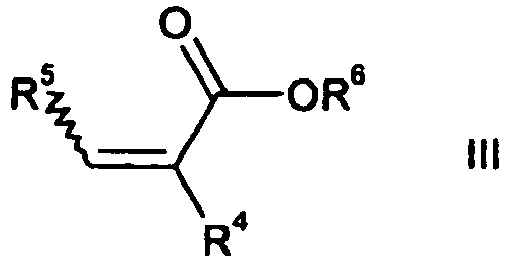
- C1-C10-Alkyl, wie Methyl, Ethyl, n-Propyl, iso-Propyl, n-Butyl, iso-Butyl, sec.-Butyl, tert.-Butyl, n-Pentyl, iso-Pentyl, sec.-Pentyl, neo-Pentyl, 1,2-Dimethylpropyl, iso-Amyl, n-Hexyl, iso-Hexyl, sec.-Hexyl, n-Heptyl, n-Octyl, n-Nonyl, n-Decyl; besonders bevorzugt C1-C4-Alkyl wie Methyl, Ethyl, n-Propyl, iso-Propyl, n-Butyl, iso-Butyl, sec.-Butyl und tert.-Butyl;
R5 gewählt aus Wasserstoff, - C1-C10-Alkyl, wie Methyl, Ethyl, n-Propyl, iso-Propyl, n-Butyl, iso-Butyl, sec.-Butyl, tert.-Butyl, n-Pentyl, iso-Pentyl, sec.-Pentyl, neo-Pentyl, 1,2-Dimethylpropyl, iso-Amyl, n-Hexyl, iso-Hexyl, sec.-Hexyl, n-Heptyl, n-Octyl, n-Nonyl, n-Decyl; besonders bevorzugt C1-C4-Alkyl wie Methyl, Ethyl, n-Propyl, iso-Propyl, n-Butyl, iso-Butyl, sec.-Butyl und tert.-Butyl;
- COOH, COOCH3, COOC2H5,
R6 gewählt aus C1-C10-Alkyl, wie Methyl, Ethyl, n-Propyl, iso-Propyl, n-Butyl, iso-Butyl, sec.-Butyl, tert.-Butyl, n-Pentyl, iso-Pentyl, sec.-Pentyl, neo-Pentyl, 1,2-Dimethylpropyl, iso-Amyl, n-Hexyl, iso-Hexyl, sec.-Hexyl, n-Heptyl, n-Octyl, n-Nonyl, n-Decyl; besonders bevorzugt C1-C4-Alkyl wie Methyl, Ethyl, n-Propyl, iso-Propyl, n-Butyl, iso-Butyl, sec.-Butyl und tert.-Butyl. - Ganz besonders bevorzugt ist R5 Wasserstoff und R4 Wasserstoff oder Methyl.
- Ganz besonders bevorzugt ist R5 Wasserstoff und R4 Wasserstoff oder Methyl und R6 gewählt aus Methyl, Ethyl, n-Butyl und 2-Ethylhexyl.
- Vorstehend beschriebene Ethylencopolymerwachse von Ethylen und ethylenisch ungesättigten Carbonsäuren kann man vorteilhaft durch radikalisch initiierte Copolymerisation unter Hochdruckbedingungen herstellen, beispielsweise in gerührten Hochdruckautoklaven oder in Hochdruckrohrreaktoren. Die Herstellung in gerührten Hochdruckautoklaven ist bevorzugt. Gerührte Hochdruckautoklaven sind an sich bekannt, eine Beschreibung findet man in Ullmann's Encyclopedia of Industrial Chemistry, 5. Auflage, Stichworte: Waxes, Bd. A 28, S. 146 ff., Verlag Chemie Weinheim, Basel, Cambridge, New York, Tokyo, 1996 . Bei ihnen verhält sich überwiegend das Verhältnis Länge/Durchmesser in Intervallen von 5:1 bis 30:1, bevorzugt 10:1 bis 20:1. Die gleichfalls anwendbaren Hochdruckrohrreaktoren findet man ebenfalls in Ullmann's Encyclopedia of Industrial Chemistry, 5. Auflage, Stichworte: Waxes, Bd. A 28, S. 146 ff., Verlag Chemie Weinheim, Basel, Cambridge, New York, Tokyo, 1996 .
- Geeignete Druckbedingungen für die Polymerisation sind 500 bis 4000 bar, bevorzugt 1500 bis 2500 bar. Die Reaktionstemperaturen liegen im Bereich von 170 bis 300°C, bevorzugt im Bereich von 200 bis 280°C.
- Die Polymerisation kann man in Gegenwart eines Reglers durchführen. Als Regler verwendet man beispielsweise Wasserstoff oder einen aliphatischen Aldehyd oder ein aliphatisches Keton der allgemeinen Formel IV

- Dabei sind die Reste R7 und R8 gleich oder verschieden und ausgewählt aus
- Wasserstoff;
- C1-C6-Alkyl wie Methyl, Ethyl, n-Propyl, iso-Propyl, n-Butyl, iso-Butyl, sec.-Butyl, tert.-Butyl, n-Pentyl, iso-Pentyl, sec.-Pentyl, neo-Pentyl, 1,2-Dimethylpropyl, iso-Amyl, n-Hexyl, iso-Hexyl, sec.-Hexyl, besonders bevorzugt C1-C4-Alkyl wie Methyl, Ethyl, n-Propyl, iso-Propyl, n-Butyl, iso-Butyl, sec.-Butyl und tert.-Butyl;
- C3-C12-Cycloalkyl wie Cyclopropyl, Cyclobutyl, Cyclopentyl, Cyclohexyl, Cycloheptyl, Cyclooctyl, Cyclononyl, Cyclodecyl, Cycloundecyl und Cyclododecyl; bevorzugt sind Cyclopentyl, Cyclohexyl und Cycloheptyl.
- In einer besonderen Ausführungsform sind die Reste R7 und R8 miteinander unter Bildung eines 4- bis 13-gliedrigen Rings kovalent verbunden. So können R7 und R8 beispielsweise gemeinsam sein: -(CH2)4-, -(CH2)5-, -(CH2)8, -(CH2)7-, -CH(CH3)-CH2-CH2-CH(CH3)- oder -CH(CH3)-CH2-CH2-CH2-CH(CH3)-.
- Gut geeignete Regler sind alkylaromatische Verbindungen, beispielsweise Toluol, Ethylbenzol oder ein oder mehrere Isomere des Xylols. Bevorzugt verzichtet man auf den Einsatz von Aldehyden und Ketonen der allgemeinen Formel IV als Regler. Besonders bevorzugt dosiert man keine weiteren Regler mit Ausnahme der sogenannten Phlegmatisierer, die zur besseren Handhabbarkeit organischen Peroxiden beigefügt werden können und ebenfalls die Funktion eines Molekulargewichtsreglers haben können.
- Als Starter für die radikalische Polymerisation können die üblichen Radikalstarter wie beispielsweise organische Peroxide, Sauerstoff oder Azoverbindungen eingesetzt werden. Auch Mischungen mehrerer Radikalstarter sind geeignet.
- Geeignete Peroxide, ausgewählt aus den kommerziell erhältlichen Substanzen, sind
- Didekanoylperoxid, 2,5-Dimethyl-2,5-di(2-ethylhexanoylperoxy)hexan, tert.-Amylperoxy-2-ethylhexanoat, Dibenzoylperoxid, tert.-Butylperoxy-2-ethylhexanoat, tert.-Butylperoxydiethylacetat, tert.-Butylperoxydiethylisobutyrat, 1,4-Di(tert.-butylperoxycarbonyl)-cyclohexan als Isomerengemisch, tert.-Butylperisononanoat 1,1-Di-(tert.-butylperoxy)-3,3,5-trimethylcyclohexan, 1,1-Di-(tert.-butylperoxy)-cyclohexan, Methyl-isobutylketonperoxid, tert.-Butylperoxyisopropylcarbonat, 2,2-Di-tert.-butylperox)butan oder tert.-Butylperoxacetat;
- tert.-Butylperoxybenzoat, Di-tert.-amylperoxid, Dicumylperoxid, die isomeren Di-(tert.-butylperoxyisopropyl)benzole, 2,5-Dimethyl-2,5-di-tert.-butylperoxyhexan, tert.-Butylcumylperoxid, 2,5-Dimethyl-2,5-di(tert.-butylperoxy)-hex-3-in, Di-tert.-butylperoxid, 1,3-Diisopropylbenzolmonohydroperoxid, Cumolhydroperoxid oder tert.-Butylhydroperoxid; oder
- dimere oder trimere Ketonperoxide der allgemeinen Formel V a bis V c.

- Dabei sind die Reste R9 bis R14 gleich oder verschieden und ausgewählt aus
- C1-C8-Alkyl wie Methyl, Ethyl, n-Propyl, iso-Propyl, n-Butyl, sec.-Butyl, iso-Butyl, tert.-Butyl, n-Pentyl, sec.-Pentyl, iso-Pentyl, n-Hexyl, n-Heptyl, n-Octyl; bevorzugt lineares C1-C6-Alkyl wie Methyl, Ethyl, n-Propyl, n-Butyl, n-Pentyl, n-Hexyl, besonders bevorzugt lineares C1-C4-Alkyl wie Methyl, Ethyl, n-Propyl oder n-Butyl, ganz besonders bevorzugt ist Ethyl;
- C6-C14-Aryl wie Phenyl, 1-Naphthyl, 2-Naphthyl, 1-Anthryl, 2-Anthryl, 9-Anthryl, 1-Phenanthryl, 2-Phenanthryl, 3-Phenanthryl, 4-Phenanthryl und 9-Phenanthryl, bevorzugt Phenyl, 1-Naphthyl und 2-Naphthyl, besonders bevorzugt Phenyl.
- Peroxide der allgemeinen Formeln V a bis V c sowie Verfahren zu ihrer Herstellung sind aus
EP-A 0 813 550 bekannt. - Als Peroxide sind Di-tert.-butylperoxid, tert.-Butylperoxypivalat, tert.-Butylperoxyisononanoat oder Dibenzoylperoxid oder Gemische derselben besonders geeignet. Als Azoverbindung sei Azobisisobutyronitril ("AIBN") beispielhaft genannt. Radikalstarter werden in für Polymerisationen üblichen Mengen dosiert.
- Zahlreiche kommerziell erhältliche organische Peroxide werden mit sogenannten Phlegmatisierern versetzt, bevor sie verkauft werden, um sie besser handhabbar zu machen. Als Phlegmatisierer sind beispielsweise Weißöl oder Kohlenwasserstoffe wie insbesondere Isododekan geeignet. Unter den Bedingungen der radikalischen Hochdruckpolymerisation können derartige Phlegmatisierer eine molekulargewichtsregelnde Wirkung haben. Im Sinne der vorliegenden Erfindung soll unter dem Einsatz von Molekulargewichtsreglern der zusätzliche Einsatz weiterer Molekulargewichtsregler über den Einsatz der Phlegmatisierer hinaus verstanden werden.
- Das Mengenverhältnis der Monomere Ethylen und ethylenisch ungesättigte Carbonsäure(n) bei der Dosierung entspricht üblicherweise nicht genau dem Verhältnis der Einheiten in den erfindungsgemäß verwendeten Formulierungen enthaltenen Ethylencopolymerwachsen, weil ethylenisch ungesättigte Carbonsäuren im Allgemeinen leichter in Ethylencopolymerwachse eingebaut werden als Ethylen.
- Die Monomere werden üblicherweise gemeinsam oder getrennt dosiert.
- Die Monomeren können in einem Kompressor auf den Polymerisationsdruck komprimiert werden. In einer anderen Ausführungsform des erfindungsgemäßen Verfahrens werden die Monomeren zunächst mit Hilfe einer Pumpe auf einen erhöhten Druck von beispielsweise 150 bis 400 bar, bevorzugt 200 bis 300 bar und insbesondere 250 bar gebracht und danach mit einem Kompressor auf den eigentlichen Polymerisationsdruck.
- Die Polymerisation kann wahlweise in Abwesenheit und in Anwesenheit von Lösemitteln durchgeführt werden, wobei Mineralöle, Weißöl und andere Lösungsmittel, die während der Polymerisation im Reaktor zugegen sind und zum Phlegmatisieren des oder der Radikalstarter verwendet wurden, im Sinne der vorliegenden Erfindung nicht als Lösemittel gelten.
- In einer Ausführungsform wird die Polymerisation in Abwesenheit von Lösemitteln durchgeführt.
- Natürlich ist es auch möglich, Ethylencopolymerwachs so herzustellen, dass man zunächst Ethylen mit mindestens einem ethylenisch ungesättigten Carbonsäureester der allgemeinen Formel III zu copolymerisieren und anschließend die Estergruppen in einer polymeranalogen Umsetzung zu verseifen, beispielsweise mit Kalilauge oder Natronlauge.
- Erfindungsgemäß eingesetzte wässrige Formulierungen enthalten 0,05 bis 40 Gew.-%, bevorzugt 10 bis 35 Gew.-% ein oder mehrere Ethylencopolymerwachse, in vollständig oder partiell neutralisierter Form.
- Zum Zwecke der partiellen oder vollständigen Neutralisation enthalten erfindungsgemäß eingesetzte wässrige Formulierungen üblicherweise eine oder mehrere basisch wirkende Substanzen, beispielsweise Hydroxide und/oder Carbonate und/oder Hydrogencarbonate von Alkalimetallen, Ammoniak, organische Amine wie beispielsweise Triethylamin, Diethylamin, Ethylamin, Trimethylamin, Dimethylamin, Methylamin, Ethanolamin, Diethanolamin, Triethanolamin, Methyldiethanolamin, n-Butyldiethanolamin, N,N-Dimethylethanolamin. Bevorzugt enthalten erfindungsgemäß eingesetzte wässrige Formulierungen so viel basisch wirkende Substanz bzw. basisch wirkende Substanzen, dass mindestens die Hälfte, bevorzugt mindestens drei Viertel der Carboxylgruppen des oder der Ethylencopolymerwachse neutralisiert ist. Basisch wirkende Substanzen kann man erfindungsgemäß eingesetzten Formulierungen beispielsweise während der Dispergierung von Ethylencopolymerwachs zusetzen.
- In einer Ausführungsform der vorliegenden Erfindung enthalten erfindungsgemäß eingesetzte wässrige Formulierungen so viel basisch wirkende Substanz bzw. basisch wirkende Substanzen, dass die Carboxylgruppen des oder der Ethylencopolymerwachse quantitativ neutralisiert sind.
- Erfindungsgemäß eingesetzte wässrige Formulierungen weisen üblicherweise einen basischen pH-Wert auf, bevorzugt sind pH-Werte von 7,5 bis 14, besonders bevorzugt von 8 oder höher und ganz besonders bevorzugt von 8,5 oder höher.
- Erfindungsgemäß eingesetzte wässrige Formulierungen enthalten vorzugsweise keine Schutzkolloide. Erfindungsgemäß eingesetzte wässrige Formulierungen sind auch ohne derartige oberflächenaktive Hilfsmittel stabil, d.h. bei einer Scherbelastung von 100 cm-1 ändert sich die Lichtdurchlässigkeit um nicht mehr als 2%, gemessen bei einer Dispersion mit einem Feststoffgehalt von 0,1 Gew.-% mit reinem Wasser als Referenz.
- Erfindungsgemäß eingesetzte wässrige Formulierung enthält neben Ethylencopolymerwachs (B)
mindestens ein Farbmittel, gewählt aus - (C) mindestens einem Pigment und
- (D) mindestens einem Farbstoff.
- Unter Pigmenten (C) sind im Rahmen der vorliegenden Erfindung praktisch nicht lösliche, dispergierte feinteilige, organische oder anorganische Farbmittel gemäß der Definition in DIN 55944 zu verstehen. Bevorzugt wählt man mindestens organisches Pigment und/oder Metallpigment aus.
-
- Monoazopigmente: C.I. Pigment Brown 25; C.I. Pigment Orange 5, 13, 36 und 67; C.I. Pigment Red 1, 2, 3, 5, 8, 9, 12, 17, 22, 23, 31, 48:1, 48:2, 48:3, 48:4, 49, 49:1, 52:1, 52:2, 53, 53:1, 53:3, 57:1, 63, 112, 146, 170, 184, 210, 245 und 251; C.I. Pigment Yellow 1, 3, 73, 74, 65, 97, 151 und 183;
- Disazopigmente: C.I. Pigment Orange 16, 34 und 44; C.I. Pigment Red 144, 166, 214 und 242; C.I. Pigment Yellow 12, 13, 14, 16, 17, 81, 83, 106, 113, 126, 127, 155, 174, 176 und 188;
- Anthanthronpigmente: C.I. Pigment Red 168 (C.I. Vat Orange 3);
- Anthrachinonpigmente: C.I. Pigment Yellow 147 und 177;
C.I. Pigment Violet 31; - Anthrachinonpigmente: C.I. Pigment Yellow 147 und 177;
C.I. Pigment Violet 31; - Anthrapyrimidinpigmente: C.I. Pigment Yellow 108 (C.I. Vat Yellow 20);
- Chinacridonpigmente: C.I. Pigment Red 122, 202 und 206;
C.I. Pigment Violet 19; - Chinophthalonpigmente: C.I. Pigment Yellow 138;
- Dioxazinpigmente: C.I. Pigment Violet 23 und 37;
- Flavanthronpigmente: C.I. Pigment Yellow 24 (C.I. Vat Yellow 1);
- Indanthronpigmente: C.I. Pigment Blue 60 (C.I. Vat Blue 4) und 64 (C.I. Vat Blue 6);
- Isoindolinpigmente: C.I. Pigment Orange 69; C.I. Pigment Red 260;
C.I. Pigment Yellow 139 und 185; - Isoindolinonpigmente: C.I. Pigment Orange 61; C.I. Pigment Red 257 und 260; C.I. Pigment Yellow 109, 110, 173 und 185;
- Isoviolanthronpigmente: C.I. Pigment Violet 31 (C.I Vat Violet 1);
- Metallkomplexpigmente: C.I. Pigment Yellow 117, 150 und 153;
C.I. Pigment Green 8; - Perinonpigmente: C.I. Pigment Orange 43 (C.I. Vat Orange 7);
C.I. Pigment Red 194 (C.I. Vat Red 15); - Perylenpigmente: C.I. Pigment Black 31 und 32; C.I. Pigment Red 123, 149, 178, 179 (C.I. Vat Red 23), 190 (C.I. Vat Red 29) und 224; C.I. Pigment Violet 29;
- Phthalocyaninpigmente: C.I. Pigment Blue 15, 15:1, 15:2, 15:3, 15:4, 15:6 und 16; C.I. Pigment Green 7 und 36;
- Pyranthronpigmente: C.I. Pigment Orange 51; C.I. Pigment Red 216 (C.I. Vat Orange 4);
- Thioindigopigmente: C.I. Pigment Red 88 und 181 (C.I. Vat Red 1);
C.I. Pigment Violet 38 (C.I. Vat Violet 3); - Triarylcarboniumpigmente: C.I. Pigment Blue 1, 61 und 62; C.I. Pigment Green 1; C.I. Pigment Red 81, 81:1 und 169; C.I. Pigment Violet 1, 2, 3 und 27; C.I. Pigment Black 1 (Anilinschwarz);
- C.I. Pigment Yellow 101 (Aldazingelb);
- C.I. Pigment Brown 22.
- Beispiele für besonders bevorzugte Pigmente (C) sind: C.I. Pigment Yellow 138, C.I. Pigment Red 122, C.I. Pigment Violet 19, C.I. Pigment Blue 15:3 und 15:4, C.I. Pigment Black 7, C.I. Pigment Orange 5, 38 und 43 und C.I. Pigment Green 7. Weitere geeignete Pigmente (C) sind metallische Pigmente wie beispielsweise Goldbronze, Silberbronze, Iriodinpigmente, Glitter.
- Der mittlere Durchmesser von im erfindungsgemäßen Verfahren eingesetztem Pigment (C) liegt üblicherweise im Bereich von 20 nm bis 1,5 µm, bevorzugt im Bereich von 300 bis 500 nm.
- In einer Ausführungsform der vorliegenden Erfindung liegt im erfindungsgemäßen Verfahren eingesetztes Pigment (C) in sphärischer oder annährend sphärischer partikulärer Form vor, d.h. das Verhältnis längster Durchmesser zu kleinster Durchmesser liegt im Bereich von 1,0 bis 2,0, bevorzugt bis 1,5.
- In einer anderen Ausführungsform der vorliegenden Erfindung liegt im erfindungsgemäßen Verfahren eingesetztes Pigment (C) in Form von Nadeln oder Stiften vor.
- Geeignete Farbstoffe (D) sind alle Textilfarbstoffe, beispielsweise Küpenfarbstoffe wie beispielsweise Indigo und seine Derivate, Direktfarbstoffe, Dispersionsfarbstoffe, Säurefarbstoffe, Metallkomplexfarbstoffe, Naphtholfarbstoffe, Schwefelfarbstoffe, Reaktivfarbstoffe und Pigmentfarbstoffe.
- Die Herstellung von erfindungsgemäß eingesetzten wässrigen Formulierungen kann man beispielsweise wie im Folgenden beschrieben durchführen. Man kann so vorgehen, dass man zunächst ein oder mehrere Ethylencopolymerwachse in Wasser dispergiert. Dazu kann man von einem oder mehreren der oben beschriebenen Ethylencopolymerwachse ausgehen. Dieses platziert man in einem Gefäß, beispielsweise einem Kolben, einem Autoklaven oder einem Kessel. In einer Variante erwärmt das oder die Ethylencopolymerwachse auf eine Temperatur über seinen Schmelzpunkt. Vorteilhaft erwärmt man auf eine Temperatur, die mindestens 10°C, besonders vorteilhaft auf eine Temperatur, die mindestens 30°C über dem Schmelzpunkt des oder der Ethylencopolymerwachse liegt. Setzt man mehrere verschiedene Ethylencopolymerwachse ein, so erwärmt man auf eine Temperatur, die über dem Schmelzpunkt des bei der höchsten Temperatur schmelzenden Ethylencopolymerwachses liegt. Vorteilhaft erwärmt man in dem Fall, dass man mehrere verschiedene Ethylencopolymerwachse einsetzt, auf eine Temperatur, die mindestens 10°C über dem Schmelzpunkt des bei der höchsten Temperatur schmelzenden Ethylencopolymerwachses liegt. Besonders vorteilhaft erwärmt man in dem Fall, dass man mehrere verschiedene Ethylencopolymerwachse einsetzt, auf eine Temperatur, die mindestens 30°C über dem Schmelzpunkt des bei der höchsten Temperatur schmelzenden Ethylencopolymerwachses liegt.
- Anschließend gibt man Wasser und eine oder mehrere basisch wirkende Substanzen und gegebenenfalls weitere Bestandteile wie beispielsweise Ethylenglykol zu, wobei die Reihenfolge der Zugabe von Wasser und der Zugabe von basisch wirkender bzw. basisch wirkenden Substanzen sowie weiterer Bestandteile beliebig ist. Wenn die Temperatur über 100°C liegt, ist es vorteilhaft, unter erhöhtem Druck zu arbeiten und das Gefäß entsprechend zu wählen. Man homogenisiert die entstehende Emulsion, beispielsweise durch mechanisches oder pneumatisches Rühren oder durch Schütteln. Anschließend kann man die so hergestellte wässrige Formulierung abkühlen.
- Danach kann man mindestens ein Farbmittel zugeben, gewählt aus (C) mindestens einem Pigment und (D) mindestens einem Farbstoff. Danach vermischt man Wasser, Ethylencopolymerwachs (B) und Farbmittel.
- Wünscht man als Farbmittel mindestens ein Pigment (C) zuzugeben, so ist es bevorzugt, Pigment (C) in Form einer sogenannten Pigmentpräparation zuzugeben, d.h. in einer mit Wasser und gegebenenfalls mindestens einem oberflächenaktiven Stoff dispergierten Form.
- Zur Durchführung des erfindungsgemäßen Verfahrens zur Behandlung von flexiblen Substraten geht man so vor, dass man mindestens ein flexibles Substrat (A) mit mindestens einer erfindungsgemäß eingesetzten wässrigen Formulierung kontaktiert.
- In einer Ausführungsform der vorliegenden Erfindung kontaktiert man (A) mit wässriger Formulierung bei Temperaturen im Bereich von 20 bis 100°C, bevorzugt bei Raumtemperatur.
- In einer Ausführungsform der vorliegenden Erfindung kontaktiert man bei Drücken im Bereich von 0,5 bar bis 10 bar, insbesondere bei Atmosphärendruck.
- In einer Ausführungsform der vorliegenden Erfindung kontaktiert man (A) mit wässriger Formulierung bei Temperaturen im Bereich von 70 bis 180°C, bevorzugt 90°C bis 120°C, und wendet dazu Drücke oberhalb Atmosphärendruck an, beispielsweise bis 10 bar.
- Erfindungsgemäßes Kontaktieren kann man beispielsweise über einen Zeitraum von 0,1 Sekunden bis 60 Minuten, bevorzugt 0,5 Sekunden bis 30 Minuten.
- Das Kontaktieren von Substrat (A) mit erfindungsgemäß eingesetzter wässriger Formulierung kann man beispielsweise durch Aufsprühen, Klotzen, Beschichten, Imprägnieren und Bedrucken, beispielsweise nach dem Ink-Jet-Verfahren, durchführen.
- Man kann Substrat (A) einmal oder mehrmals in Folge mit erfindungsgemäß eingesetzter wässriger Formulierung kontaktieren.
- Zur Durchführung des erfindungsgemäßen Verfahrens geht man bevorzugt so vor, dass man flexibles Substrat mit mindestens einer erfindungsgemäß eingesetzten wässrigen Formulierung kontaktiert und im Anschluss daran trocknet.
- Besonders bevorzugt geht man so vor, dass man vor der eigentlichen Trocknung erfindungsgemäß behandeltes Substrat vortrocknet, beispielsweise auf eine Restfeuchte im Bereich von 0,5 bis 2 Gew.-%.
- Die Vortrocknung bzw. Trocknung lässt sich auf gängigen Apparaturen durchführen. So ist sie beispielsweise, wenn man textile Substrate zu behandeln wünscht, auf allen in der Textilindustrie üblichen Fixier- und Trocknungsaggregaten durchführbar. Geeignete Trocknungs- bzw. Vortrocknungstemperaturen sind beispielsweise 50 bis 300°C, bevorzugt 70 bis 180°C.
- Danach kann man über einen Zeitraum von beispielsweise 10 Sekunden bis 60 Minuten, bevorzugt 0,5 Minuten bis 7 Minuten bei Temperaturen im Bereich von 50 bis 300°C, bevorzugt 100 bis 160°C, besonders bevorzugt 110 bis 130°C thermisch behandeln. Polyamid, Polyester, Polyvinylchlorid, modifizierte Polyester, Polyestermischgewebe, Polyamidmischgewebe, Polyacrylnitril, Polycarbonat behandelt man thermisch vorteilhaft bei Temperaturen im Bereich von 130 bis 250°C. Polypropylengewebe bevorzugt zwischen 80 und 130°C, bevorzugt 110 und 130°C. Dabei ist unter der Temperatur im Allgemeinen die Temperatur des Mediums zu verstehen, welches das zu behandelnde flexible Substrat umgibt.
- In einer Ausführungsform der vorliegenden Erfindung enthält erfindungsgemäß eingesetzte wässrige Formulierung mindestens einen weiteren Stoff (E), der ausgewählt sein kann aus Verdickern, Vernetzern, Echtheitsverbessem, Weichmachern, Entschäumern, Netzmitteln und Egalisiermitteln.
- Geeignete Vernetzer sind beispielsweise Harnstoff-Formaldehyd- und Melamin-Formaldehyd-Additionsprodukte, gegebenenfalls in Kombination mit anorganischen Salzen wie beispielsweise MgCl2·6 H2O oder NH4Cl. Andere geeignete Vernetzer sind beispielsweise freie oder blockierte Isocyanate bzw. Polyisocyanate wie beispielsweise Verbindungen der allgemeinen Formel VI

- Y1
- gewählt aus N-R15, Sauerstoff und N-H,
- Z1
- gewählt aus Wasserstoff und CO-O-R15,
- R15
- gleich oder verschieden und gewählt aus C1-C10-Alkyl, besonders bevorzugt sind Methyl und n-Butyl.
- Weitere geeignete Vernetzer sind mehrfach funktionelle Epoxide wie beispielsweise Polyglycidylether von Polyolen z.B. Pentaerythritpolyglycidylether sowie mehrfach funktionelle Aziridine wie beispielsweise Trimethylolpropan-tris(beta-aziridinylpropionat).
- Belagsverhinderer kann man beispielsweise zugeben, um während des Kontaktierens die Bildung von Belägen auf Walzen von beispielsweise Foulards zu verhindern. Geeignete Belagsverhinderer sind beispielsweise Mischungen von mehrfach alkoxylierten Alkoholen, insbesondere von mehrfach ethoxylierten Fettalkoholen.
- Als Verdicker (Verdickungsmittel) kann man natürliche oder synthetische Verdicker eingesetzen. Beispiele für natürliche Verdicker sind Alginat, Guar, Stärke, Kernmehlether, Cassia, Tamarinde Celluloseether, Dextrine wie beispielsweise natürliche Gummen, Galaktomannan, Xanthan, Polysaccharid und Mischungen der vorgenannten Stoffe. Bevorzugt ist der Einsatz von synthetischen Verdickern, beispielsweise von bei Raumtemperatur flüssigen Lösungen von synthetischen (Co-)Polymeren in beispielsweise Weißöl oder als wässrige Lösungen oder als Wasser-in-Öl-Emulsionen, vorzugsweise mit etwa 40 Gew.-% (Co-)Polymer.
- Bevorzugte Beispiele für Verdicker sind Copolymere mit 85 bis 95 Gew.-% Acrylsäure, 4 bis 14 Gew.-% Acrylamid und etwa 0,01 bis 1 Gew.-% des (Meth)acrylamidderivats der Formel VII

- Erfindungsgemäße Formulierungen können 30 bis 70 Gew.-% Weißöl enthalten. Wässrige Verdicker enthalten üblicherweise insgesamt bis zu 25 Gew.-% (Co-)Polymer, in manchen Fällen bis zu 50 Gew.-% (sogenannte Verdickerdispersionen), bezogen auf den gesamten Verdicker. Wünscht man wässrige Formulierungen eines Verdickers einzusetzen, so setzt man im Allgemeinen wässriges Ammoniak zu. Auch der Einsatz granulärer, fester Formulierungen eines Verdickers sind denkbar, um beispielsweise Emissions-frei Pigmentdrucke herstellen zu können.
- Geeignete Echtheitsverbesserer sind beispielsweise bei Raumtemperatur flüssige Silikonöle und Polysiloxane. In einer bevorzugten Variante der vorliegenden Erfindung kann man auf den Einsatz von Echtheitsverbesserern verzichten.
- Beispiele für geeignete Weichmacher sind Esterverbindungen, gewählt aus den Gruppen der mit Alkanolen vollständig veresterten aliphatischen oder aromatischen Di- oder Polycarbonsäuren und der mindestens einfach mit Alkanol veresterten Phosphorsäure.
- In einer Ausführungsform der vorliegenden Erfindung handelt es sich bei Alkanolen um C1-C10-Alkanole.
- Bevorzugte Beispiele für mit Alkanol vollständig veresterte aromatische Di- oder Polycarbonsäuren sind mit Alkanol vollständig veresterte Phthalsäure, Isophthalsäure und Mellithsäure; beispielhaft seinen genannt: Di-n-octylphthalat, Di-n-nonylphthalat, Di-n-decylphthalat, Di-n-octylisophthalat, Di-n-nonylisophthalat, Di-n-decylisophthalat.
- Bevorzugte Beispiele für mit Alkanol vollständig veresterte aliphatische Di- oder Polycarbonsäuren sind beispielsweise Adipinsäuredimethylester, Adipinsäurediethylester, Adipinsäuredi-n-butylester, Adipinsäurediisobutylester, Glutarsäuredimethylester, Glutarsäurediethylester, Glutarsäuredi-n-butylester, Glutarsäurediisobutylester, Bernsteinsäuredimethylester, Bernsteinsäurediethylester, Bernsteinsäuredi-n-butylester Bernsteinsäurediisobutylester sowie Mischungen der vorstehend genannten Verbindungen.
- Bevorzugte Beispiele für mindestens einfach mit Alkanol veresterte Phosphorsäure sind C1-C10-Alkyl-di-C6-C14-Aryl-Phosphate wie Isodecyldiphenylphosphat.
- Weitere geeignete Beispiele für Weichmacher sind mindestens einfach mit C1-C10-Alkylcarbonsäure mindestens einfach veresterte aliphatische oder aromatische Di- oder Polyole.
- Bevorzugte Beispiele für mindestens einfach mit C1-C10-Alkylcarbonsäure veresterte aliphatische oder aromatische Di- oder Polyole ist 2,2,4-Trimethylpentan-1,3-diol-monoisobutyrat.
- Weitere geeignete Weichmacher sind Polyester, erhältlich durch Polykondensation von aliphatischer Dicarbonsäure und aliphatischem Diol, beispielsweise Adipinsäure oder Bernsteinsäure und 1,2-Propandiol, vorzugsweise mit einem Mw von 200 g/mol, und Polypropylenglykolalkylphenylether, vorzugsweise mit einem Mw von 450 g/mol. Weitere geeignete Weichmacher sind mit zwei verschiedenen Alkoholen veretherte Polypropylenglykole mit einem Molekulargewicht Mw im Bereich von 400 bis 800 g/mol, wobei vorzugsweise einer der Alkohole ein Alkanol, insbesondere ein C1-C10-Alkanol sein kann und der andere Alkohol vorzugsweise ein aromatischer Alkohol, beispielsweise o-Kresol, m-Kresol, p-Kresol und insbesondere Phenol sein kann.
- Geeignete Entschäumer sind beispielsweise silikonhaltige Entschäumer wie beispielsweise solche der Formel HO-(CH2)3-Si[OSi(CH3)3]2. Auch Silikon-freie Entschäumer sind geeignet wie beispielsweise mehrfach alkoxylierte Alkohole, z.B. Fettalkoholalkoxylate, bevorzugt 2 bis 50-fach ethoxylierte vorzugsweise unverzweigte C10-C20-Alkanole, unverzweigte C10-C20-Alkanole und 2-Ethylhexan-1-ol.
- Geeignete Netzmittel sind beispielsweise nichtionische, anionische oder kationische Tenside, insbesondere Ethoxylierungs- und/oder Propoxylierungsprodukte von Fettal-koholen oder Propylenoxid-Ethylenoxid-Blockcopolymere, ethoxylierte oder propoxylierte Fett- oder Oxoalkohole, weiterhin Ethoxylate von Ölsäure oder Alkylphenolen, Alkylphenolethersulfate, Alkylpolyglycoside, Alkylphosphonate, Alkylphenylphosphonate, Alkylphosphate, oder Alkylphenylphosphate.
- Geeignete Egalisiermittel sind beispielsweise Blockcopolymerisate von Ethylenoxid und Propylenoxid mit Molekulargewichten Mn im Bereich von 500 bis 5000 g/mol, bevorzugt 800 bis 2000 g/mol. Ganz besonders besonders bevorzugt sind Blockcopolymerisate aus Propylenoxid/Ethylenoxid beispielsweise der Formel EO8PO7EO8, wobei EO für Ethylenoxid und PO für Propylenoxid steht.
- Ein weiterer Gegenstand der vorliegenden Erfindung sind textile Körpergebilde, behandelt nach dem erfindungsgemäßen Verfahren. Erfindungsgemäße textile Körpergebilde enthalten mindestens ein Ethylencopolymerwachs in gegebenenfalls vernetzter Form. Erfindungsgemäße textile Körpergebilde weisen gute Gebrauchseigenschaften auf, beispielsweise gute Echtheiten, insbesondere Waschechtheiten und Reibechtheiten wie beispielsweise Trocken- und Nassreibechtheit.
- Eine spezielle Ausführungsform der vorliegenden Erfindung ist ein Verfahren zur Herstellung von bedruckten flexiblen Substraten und insbesondere bedrucktem Textil nach dem erfindungsgemäßen Verfahren, im Folgenden auch erfindungsgemäßes Textildruckverfahren genannt.
- Zur Durchführung des erfindungsgemäßen Textildruckverfahrens kann man beispielsweise so vorgehen, dass man mindestens eine erfindungsgemäße wässrige Formulierung zu einer Druckpaste, im Folgenden auch erfindungsgemäße Druckpaste genannt, verarbeitet und danach nach an sich bekannten Methoden textile Substrate bedruckt.
- Vorteilhaft stellt man erfindungsgemäße Druckpasten durch Mischen von mindestens einer erfindungsgemäß eingesetzten wässrigen Formulierung mit im Druckprozess gängigen Hilfsmitteln und mindestens einem Pigment (C) her. Die Farbtiefe stellt man vorteilhaft durch Abstimmen des Verhältnisses Pigment (C) zu erfindungsgemäß eingesetzter wässriger Formulierung ein.
- Pigment fügt man der erfindungsgemäßen Druckpaste vorzugsweise in Form von Pigmentzubereitungen zu. Pigmentzubereitungen enthalten üblicherweise 20 bis 60 Gew.% Pigment, weiterhin Wasser und eine oder mehrere oberflächenaktive Verbindungen, beispielsweise einen oder mehrere Emulgatoren, beispielhaft seien mehrfach alkoxylierte C10-C30-Alkanole genannt.
- Das Verhältnis Pigment zu erfindungsgemäß eingesetzter wässriger Formulierung kann man in weiten Grenzen wählen. So ist es beispielsweise möglich, Pigment und erfindungsgemäß eingesetzte wässrige Formulierung in einem Gewichtsverhältnis von 20 : 1 bis 1 : 100 zu wählen. In einer bevorzugten Ausführungsform der vorliegenden Erfindung stellt man das Verhältnis Pigment zu erfindungsgemäß eingesetzter wässriger Formulierung so ein, dass das Gewichtsverhältnis von Pigment zu Feststoffanteile von erfindungsgemäß eingesetzter wässriger Formulierung im Bereich von 1 : 1 bis 1 : 30 liegt.
- Natürlich ist es auch möglich, zunächst Pigment und erfindungsgemäß eingesetzte wässrige Formulierung in einem Gewichtsverhältnis im Bereich von 20 : 1 bis 10 : 1 vorzumischen und erst unmittelbar vor dem Druck weitere erfindungsgemäß eingesetzte wässrige Formulierung oder ein konventionelles Acrylatbindemittel zuzumischen.
- Weitere gängige Hilfsmittel für Druckpasten im Textildruck sind aus Ullmann, Handbuch der technischen Chemie und Verfahrenstechnik bekannt, vergleiche beispielsweise Ullmann's Enyclopedia of Industrial Chemistry, 5. Auflage, Stichwort: Textile Auxiliaries, Bd. A26, S. 286 ff. und 296 ff., Verlag Chemie, Weinheim, Deerfield/Florida, Basel; 1996, und aus dem Textil-Hilfsmittel-Katalog, Konradin Verlag Robert Kohlhammer GmbH, D-70771 Leinfelden-Echterdingen. Als gängige Hilfsmittel seien Verdicker, Fixierer, Griffverbesserer, Entschäumer, Rheologieverbesserer, Säurespender und Emulgatoren beispielhaft genannt:
- In einer bevorzugten Ausführungsform der vorliegenden Erfindung enthalten erfindungsgemäße Druckpasten weiterhin Griffverbesserer, ausgewählt aus Silikonen, insbesondere Polydimethylsiloxanen, und Fettsäure-C1-C10-Alkylestern. Beispiele für kommerziell erhältliche Griffverbesserer, die den erfindungsgemäßen Druckpasten zugesetzt werden können, sind Acramin® Weichmacher SI (Bayer AG), Luprimol SIG®, Luprimol TX 4732 und Luprimol CW® (BASF Aktiengesellschaft).
- In einer bevorzugten Ausführungsform der vorliegenden Erfindung enthalten erfindungsgemäße Druckpasten als weitere Zusätze einen oder mehrere Emulgatoren, insbesondere dann, wenn die Druckpasten Weißöl-haltige Verdicker enthalten und als Ölin-Wasser-Emulsion anfallen. Beispiele für geeignete Emulgatoren sind aryl- oder alkylsubstituierte Polyglykolether. Kommerziell erhältliche Beispiele für geeignete Emulgatoren sind Emulgator W® (Bayer), Luprintol PE New® und Luprintol MP® (BASF Aktiengesellschaft).
- Zur Herstellung von erfindungsgemäßen Druckpasten kann man beispielsweise so vorgehen, dass man Wasser, gegebenenfalls einen Entschäumer, beispielsweise einen Entschäumer auf Silikonbasis verrührt und unter Mischen, beispielsweise unter Rühren, mindestens eine erfindungsgemäß eingesetzte wässrige Formulierung zufügt. Danach kann man einen oder mehrere Emulgatoren und das oder die Pigmente zugeben.
- Als nächstes kann man einen oder mehrere Griffverbesserer zugeben, beispielsweise eine oder mehrere Silikonemulsionen.
- Anschließend kann man ein oder mehrere Verdickungsmittel hinzufügen und unter weiterem Vermischen, beispielsweise Rühren, homogenisieren.
- Eine typische erfindungsgemäße Druckpaste enthält, jeweils pro Kilogramm erfindungsgemäßer Druckpaste
0,5 bis 400 g, bevorzugt 10 bis 250 g Ethylencopolymerwachs (B),
0 bis 100 g, bevorzugt 1 bis 5 g Emulgator,
1 bis 500 g, bevorzugt 3 bis 100 g Verdicker,
0,1 bis 500 g, bevorzugt 0,1 bis 250 g, bevorzugt 0,5 bis 120 g Pigment (C), gegebenenfalls weitere Hilfsmittel;
der Rest ist bevorzugt Wasser. - In einer Ausführungsform der vorliegenden Erfindung haben erfindungsgemäße Druckpasten bei 20°C eine Viskosität im Bereich von 0,3 bis 4000 dPa·s, bevorzugt 20 bis 200 dPa·s und besonders bevorzugt 60 bis 100 dPa·s. Viskositäten lassen sich nach gängigen Methoden bestimmen, insbesondere beispielsweise mit einem Rotationsviskosimeter, beispielsweise dem Viscotester VT02 oder VT24 der Fa. Haake Mess-Technik GmbH u. Co., Karlsruhe.
- Pigmentdruck unter Verwendung mindestens einer erfindungsgemäßen Druckpaste kann nach verschiedenen Verfahren durchgeführt werden, die an sich bekannt sind. In der Regel verwendet man eine Schablone, durch die man die erfindungsgemäße Druckpaste mit einer Rakel presst. Dieses Verfahren gehört zu den Siebdruckverfahren. Erfindungsgemäße Pigmentdruckverfahren unter Verwendung mindestens einer erfindungsgemäßen Druckpaste liefern bedruckte Substrate mit besonders hoher Brillanz und Farbtiefe der Drucke bei gleichzeitig gutem Griff der bedruckten Substrate. Gegenstand der vorliegenden Erfindung sind daher flexible Substrate, bedruckt nach dem erfindungsgemäßen Druckverfahren unter Verwendung der erfindungsgemäßen Druckpasten.
- Eine andere Ausführungsform der vorliegenden Erfindung ist ein Pigmentfärbeverfahren unter Verwendung von mindestens einer erfindungsgemäßen Formulierung, im Folgenden auch erfindungsgemäßes Pigmentfärbeverfahren genannt. Das erfindungsgemäße Färbeverfahren führt man vorzugsweise so aus, dass man mindestens ein flexibles, textiles Substrat, mit mindestens einer Färbeflotte behandelt, die mindestens eine erfindungsgemäße Formulierung enthält. Färbeflotten, die mindestens eine erfindungsgemäße Formulierung enthalten, werden im Folgenden auch erfindungsgemäße Färbeflotten genannt.
- Erfindungsgemäße Färbeflotten können als Zusatz Netzmittel enthalten, bevorzugt wenn die Netzmittel als schaumarm gelten, da bei den hohen Turbulenzen im Färbeprozess Schaumbildung die Qualität der Färbung durch Bildung von Unegalitäten beeinträchtigt wird.
- Trockene textile Gewebe, Gewirke oder Vlies, wie sie in der kontinuierlichen Pigmentfärbung eingesetzt werden, enthalten eine große Menge von Luft. Zur Durchführung des erfindungsgemäßen Pigmentfärbeverfahrens ist daher der Einsatz von Entlüftern vorteilhaft. Diese basieren beispielsweise auf Polyethersiloxan-Copolymeren. Sie können in Mengen von 0,01 bis 2 g/l in den erfindungsgemäßen Färbeflotten enthalten sein.
- Weiterhin können erfindungsgemäße Färbeflotten Antimigrationsmittel enthalten. Geeignete Antimigrationsmittel sind beispielsweise Blockcopolymerisate von Ethylenoxid und Propylenoxid mit Molekulargewichten Mn im Bereich von 500 bis 5000 g/mol, bevorzugt 800 bis 2000 g/mol.
- Weiterhin kann man den erfindungsgemäßen Färbeflotten als Zusatz einen oder mehrere Griffverbesserer zusetzen. Hierbei handelt es sich in der Regel um Polysiloxane oder um Wachse. Polysiloxane haben hierbei den Vorteil der Permanenz, während die Wachse langsam während des Gebrauchs ausgewaschen werden.
- Die Viskositäten der erfindungsgemäßen Färbeflotten liegen bevorzugt im Bereich von unter 100 mPa·s. Die Oberflächenspannungen der erfindungsgemäßen Färbeflotten sind so einzustellen, dass ein Benetzen der Ware möglich ist. Gängig sind Oberflächenspannungen von kleiner 50 mN/m.
In einer Ausführungsform der vorliegenden Erfindung enthält eine typische erfindungsgemäße Färbeflotte pro Liter - 0,5 bis 400 g, bevorzugt 20 bis 300 g Ethylencopolymerwachs (B),
- 0 bis 100 g, bevorzugt 0,1 bis 10 g Netzmittel,
- 0 bis 100 g, bevorzugt 0,1 bis 10 g Entschäumer,
- 0 bis 300 g, bevorzugt 1 bis 20 g Antibelagsmittel,
- 0 bis 100 g, bevorzugt 1 bis 50 g Antimigrationsmittel,
- 0 bis 100 g, bevorzugt 1 bis 50 g Egalisiermittel,
- 0,5 bis 25 g, bevorzugt 1 bis 12 g Pigment (C).
- Ein weiterer Aspekt der vorliegenden Erfindung ist ein Verfahren zur Herstellung erfindungsgemäßer Färbeflotten. Das erfindungsgemäße Verfahren umfasst das Vermischen von Farbmittel, beispielsweise Pigment (C), vorzugsweise in Form von Pigmentzubereitungen, die neben Pigment und Wasser ein oder mehrere oberflächenaktive Verbindungen enthalten, mit oben aufgeführten Zusätzen wie weiteren Lösemitteln, Entschäumern, Griffverbesserem, Emulgatoren und/oder Bioziden und Auffüllen mit Wasser. Zur Ausübung des Verfahrens zur Herstellung von erfindungsgemäßen Färbeflotten verrührt man üblicherweise die Komponenten der erfindungsgemäßen Färbeflotten in einem Mischbehälter, wobei Größe und Form des Mischbehälters unkritisch sind. Bevorzugt schließt sich an das Verrühren eine Klärfiltration an.
- Ein weiterer Aspekt der vorliegenden Erfindung ist ein Verfahren zum Färben von flexiblen Substraten unter Verwendung der oben beschriebenen erfindungsgemäßen Färbeflotten, im Folgenden auch als erfindungsgemäßes Färbeverfahren, insbesondere als erfindungsgemäßes Pigmentfärbeverfahren bezeichnet. Das erfindungsgemäße Färbeverfahren kann in gängigen Färbemaschinen durchgeführt werden. Bevorzugt sind Foulards, die als wesentliches Element zwei aufeinandergepresste Rollen enthalten, durch die flexibles Substrat und insbesondere Textil geführt wird. Oberhalb der Rollen ist erfindungsgemäße Färbeflotte eingefüllt und benetzt flexibles Textil substrat. Durch den Druck der Rollen wird das flexible Substrat bzw. das Textil abgequetscht und ein konstanter Auftrag gewährleistet.
- An den eigentlichen Färbeschritt schließt sich üblicherweise eine thermische Trocknung und optional eine Fixierung an. Bevorzugt trocknet man bei Temperaturen von 25 bis 300°C über einen Zeitraum von 10 Sekunden bis 60 Minuten, bevorzugt 30 Sekunden bis 10 Minuten. Wenn man zu fixieren wünscht, so fixiert man bei Temperaturen von 150°C bis 190°C über einen Zeitraum von 30 Sekunden bis 5 Minuten.
- Bevorzugt ist ein Verfahren zur Pigmentfärbung nach dem Klotzprozess.
- Erfindungsgemäß bedruckte und gefärbte Substrate zeichnen sich durch besondere Brillanz der Farben bei gleichzeitig gutem Griff der bedruckten bzw. gefärbten Substrate aus. Ein weiterer Aspekt der vorliegenden Erfindung sind daher Substrate, gefärbt nach dem oben beschriebenen Verfahren unter Verwendung der erfindungsgemäßen Färbeflotten .
- Ein weiterer Gegenstand der vorliegenden Erfindung sind gefärbte textile Körpergebilde, erhältlich nach dem erfindungsgemäßen Pigmentfärbeverfahren. Erfindungsgemäße gefärbte textile Körpergebilde zeichnen sich beispielsweise durch gute Waschechtheiten, gute Trocken- und Nassreibechtheiten sowie gute Echtheiten, insbesondere durch geringe Farbtiefeverluste bei der Kochbürstwäsche aus.
- In einer anderen Ausführungsform der vorliegenden Erfindung kontaktiert man flexible Substrate (A) und insbesondere Textil aus Polypropylen mit pigmentfreier wässriger Formulierung und trocknet im Anschluss danach. Auf flexiblem Substrat gleichmäßig verteiltes unvernetztes Ethylencopolymerwachs wirkt als Haftvermittler (Primer) und erlaubt das Verkleben mit beliebigen anderen Materialien.
- In einer anderen Ausführungsform der vorliegenden Erfindung kann man das erfindungsgemäße Verfahren zum Bedrucken von textile Körpergebilde als Transferdruckverfahren durchführen. Dazu bedruckt man ein mit Wachs, beispielsweise mit Silikonwachs beschichtetes Papier mit mindestens einer erfindungsgemäßen Druckpaste und trocknet danach das bedruckte Papier bei Raumtemperatur bis 300 °C, bevorzugt bei Raumtemperatur bis 180 °C. Das bedruckte und getrocknete Papier wird zusammen mit dem Textilmaterial auf einer heißen Presse oder einem heißen Kalander bei 70 bis 300 °C, bevorzugt 10 bis 100 s bei 100 bis 120 °C, behandelt. Während dieses Prozesses kommt es zum Erweichen/Schmelzen der Druckpaste und Übertragung und Fixierung von Papier auf das zu bedruckende 2- oder 3-dimensionale textile Körpergebilde.
- Die Erfindung wird durch Arbeitsbeispiele erläutert.
- In einem Hochdruckautoklaven, wie er in der Literatur beschrieben ist (M. Buback et al., Chem. Ing. Tech. 1994, 66, 510), wurden Ethylen und Acrylsäure bzw. Methacrylsäure gemäß Tabelle 1 copolymerisiert. Dazu wurde Ethylen (12,0 kg/h) unter dem Reaktionsdruck von 1700 bar in den Autoklaven eingespeist. Getrennt davon wurden die in Tabelle 1 angegebene Menge Acrylsäure bzw. Methacrylsäure zunächst auf einen Zwischendruck von 260 bar verdichtet und anschließend unter dem Reaktionsdruck von 1700 bar eingespeist. Getrennt davon wurde Initiatorlösung, bestehend aus tert.-Butylperoxypivalat in Isododekan (Menge und Konzentration s. Tabelle 1), unter dem Reaktionsdruck von 1700 bar in den Autoklaven eingespeist. Getrennt davon wurde die in Tabelle 1 angegebene Menge Regler, bestehend aus Propionaldehyd in Isododekan, Konzentration s. Tabelle 1, zunächst auf einen Zwischendruck von 260 bar verdichtet und anschließend mit Hilfe eines weiteren Kompressors in den Hochdruckautoklaven eingespeist. Die Reaktionstemperatur betrug 220°C. Man erhielt Ethylencopolymerwachse gemäß Tabelle 1 mit den aus der Tabelle 2 ersichtlichen analytischen Daten.
- Der Gehalt an Ethylen und Acrylsäure bzw. Methacrylsäure im Ethylencopolymerwachs wurde NMR-spektroskopisch bzw. durch Titration (Säurezahl) bestimmt. Die Säurezahl des Ethylencopolymerwachses wurde titrimetrisch nach DIN 53402 bestimmt. Der KOH-Verbrauch korrespondiert mit dem Acrylsäure- bzw. Methacrylsäure-Gehalt im Ethylencopolymerwachs. Der MFI wurde nach DIN 53735 bei 160°C und einer Belastung von 325 g bestimmt.
Tabelle 1: Herstellung von Ethylencopolymerwachsen Nr. TReaktor [°C] Ethylen [kg/h] AS [l/h] AS [kg/h] MAS [l/h] MAS [kg/h] PA in ID [ml/h] c(PA) PO in ID [l/h] c(PO) Umsatz [Gew.-%] Austrag ECW [kg/h] 1.1 220 12 0,79 0,80 - - 650 25 1,95 0,07 23 3,0 1.2 220 12 - - 1,01 1,03 600 25 2,10 0,07 25 3,2 - Unter TReaktor ist die maximale Innentemperatur des Hochdruckautoklaven zu verstehen.
Tabelle 2: Analytische Daten von Ethylencopolymerwachsen Nr. Gehalt Ethylen [Gew.-%] Gehalt AS [Gew.-%] Gehalt MAS [Gew.-%] Säurezahl [mg KOH/g ECW] MFI [g/min] Tmelt [°C] ρ (g/cm3) 1.1 79,0 21,0 - 165 10 78-88 0,96 1.2 73,4 - 26,6 173 10 65-80 n.b. - Unter "Gehalt" ist der Anteil an einpolymerisiertem Ethylen bzw. Acrylsäure bzw. Methacrylsäure im jeweiligen Ethylencopolymerwachs zu verstehen.
- Abkürzungen: AS : Acrylsäure, MAS : Methacrylsäure, PA : Propionaldehyd, ID : Isodothekan, PO : t-Butylhydroperoxid, ECW: Ethylencopolymerwachs.
- In einem 2-Liter-Autoklaven mit Ankerrührer wurde die in Tabelle 3 angegebene Menge Ethylencopolymerwachs nach Beispiel 1 vorgelegt. Es wurden die in Tabelle 3 angegebenen Mengen deionisiertes Wasser sowie Ammoniak zugesetzt und unter Rühren auf 120°C erhitzt. Nach 30 Minuten bei 120° wurde innerhalb von 15 Minuten auf Raumtemperatur abgekühlt. Man erhielt die Dispersionen 2.1 bzw. 2.2.
Tabelle 3: Herstellung von wässrigen Dispersionen von Ethylencopolymerwachs Nr. ECW Nr. Menge ECW [g] Menge NH3 [g] Menge Wasser [g] Feststoffgehalt [%] Viskosität [s] pH-Wert 2.1 1.1 25,0 3,4 71,6 25 85 9,0 2.2 1.2 25,0 3,4 71,6 25 40 8,8 - Die Viskosität wurde mit einem 5 mm Becher bei 23°C nach ISO 2431 bestimmt Die "Menge NH3" bezieht sich auf die Menge an 25 Gew.-% wässriger Ammoniaklösung.
- In einer Rührwerkskugelmühle des Typs Drais Superflow DCP SF 12 wurden miteinander vermahlen:
2640 g Pigment Blau 15:3 460 g n-C18H37O(CH2CH2O)25H 600 g Glycerin 2300 g destilliertes Wasser - Das Vermahlen wurde fortgesetzt, bis die Pigmentpartikel einen mittleren Durchmesser von 100 nm aufwiesen.
- Man verrührte in einem Rührgefäß die Ingredienzien gemäß Tabelle 4 und erhielt die Stammpasten 3.1 bis 3.4, indem man die Ingredienzien in der in der Tabelle 4 aufgeführten Reihenfolge miteinander vereinigte und verrührte. Man verrührte danach 15 Minuten mit einem Schnellrührer des Typs Ultra-Turrax mit etwa 6000 Umdrehungen/min und prüfte danach den pH-Wert. Wenn der pH-Wert unter 8 lag, stellte man einen pH-Wert von 8,5 durch Zugabe von konzentriertem wässrigen Ammoniak ein.
Tabelle 4: Herstellung von Stammpasten 3.1 bis 3.4 Stammpaste 3.1 3.2 3.3 3.4 Ingredienz [g] Destilliertes Wasser - 380 - 380 2.1 980 600 - - 2.2 - - 980 600 Verdicker 20 20 20 20 Summe 1000 1000 1000 1000 - Unter 2.1 bzw. 2.2 wird die jeweilige wässrige Dispersion 2.1 bzw. 2.2 aus Beispiel 2 verstanden.
- Als Verdicker wurde jeweils eingesetzt:
- Dispersion von
- Copolymer aus Acrylsäure (92 Gew.-%), Acrylamid (7,6 Gew.-%), Methylenbisacrylamid (0,4 Gew.-%), quantitativ neutralisiert mit Ammoniak (25%ig in Wasser), Molekulargewicht Mw von ca. 150.000g/mol
- als Wasser-in-Mineralöl-Dispersion (Volumenverhältnis 2,6 : 1) (Sdp. des Mineralöls: 190-230°C), Feststoffgehalt: 24 Gew.-%; stabilisiert mit Sorbitanmonooleat (2,5 Gew.%, bezogen auf gesamten Verdicker).
- Durch Vermischen von je 970 g Stammpaste gemäß Tabelle 4 mit jeweils 30 g blauer Pigmentpräparation aus Beispiel 3.1 wurden erfindungsgemäße Druckpasten gemäß Tabelle 5 hergestellt.
- Man erhielt erfindungsgemäße Druckpasten 4.1 bis 4.4 gemäß Tabelle 5.
Tabelle 5: Herstellung von erfindungsgemäßen Druckpasten Nr. Stammpaste Nr. Druckpaste 3.1 4.1 3.2 4.2 3.3 4.3 3.4 4.4 - Man bedruckte nach dem Siebdruckverfahren Substrate aus Polypropylengewebe, Flächengewicht 170 g/m2.
- Die Druckparameter waren: Rakel 15 mm, Schablonengaze ESTAL MONO E 55, Magnetzugstufe 6, einfacher Druck, kein Muster.
- Man trocknete im Trockenschrank bei 80°C und fixierte anschließend auf einem Fixierschrank durch fünfminütiges Erhitzen mit Heißluft bei 110°C.
- Man erhielt die erfindungsgemäßen Substrate 5.1 und 5.2, auch erfindungsgemäß bedruckte Substrate 5.1 bzw. 5.2 genannt.
- Zum Vergleich wurde ein Druck mit einer Vergleichsdruckpaste V4.5 durchgeführt, die analog zur erfindungsgemäßen Druckpaste 4.1 hergestellt worden war, jedoch war Ethylencopolymerwachs-Dispersion 2.1 ersetzt durch eine Dispersion (Acrylatbinder-Dispersion) von folgendem Copolymerisat:
- n-Butylacrylat (66 Gew.-%),
- Styrol (31 Gew.-%),
- Acrylsäure (1 Gew.-%),
- Methylolacrylamid (1 Gew.-%), Acrylamid (1 Gew-.%), quantitativ neutralisiert mit Ammoniak (25 Gew.%ig in Wasser), mit 2 Gew.%, bezogen auf Copolymerisat, an

- als Emulgator; Feststoffgehalt: 35 Gew.-%.
- Man erhielt Vergleichssubstrat V5.5.
- Die erfindungsgemäßen Substrate wurden auf Trocken- und Nassreibechtheit nach DIN EN ISO 105-X12 und Waschechtheit nach DIN EN ISO 105-C03 getestet. Bestmögliches Ergebnis: Note 5, schlechtestes mögliches Ergebnis: Note 1.
- Man erhielt die folgenden erfindungsgemäßen Substrate und Testergebnisse gemäß Tabelle 6.
Tabelle 6: Erfindungsgemäß bedruckte Substrate und Testergebnisse Druckpaste Nr. Substrat Nr. Reibechtheit trocken Reibechtheit nass Waschechtheit 4.1 5.1 3-4 4 3 4.2 5.2 3-4 3-4 3 4.3 5.3 3-4 4 3 4.4 5.4 3-4 3-4 3 V4.5 V5.5 3 1 1-2 - In einem Rührgefäß vermischte man durch Zusammenrühren:
Vollentsalztes Wasser 774 g Pigmentpräparation aus Beispiel 3.1 20 g/l (berechnet auf Pigmentpräparation) Wässrige Dispersion 2.1 bzw. 2.2 180 g/l (berechnet auf Feststoffgehalt) EO8PO7EO8 20 g/l als Antimigrationsmittel n-C12H25O(C2H4O)7H 4 g/l als Antibelagmittel HO-(CH2)3-Si[OSi(CH3)3]2 20 g/l als Entschäumer - Antimigrationsmittel: Bei dem in der allgemeinen Rezeptur eingesetzten Antimigrationsmittel EO8PO7EO8 steht stets EO für Ethylenoxid und PO für Propylenoxid. Es hat die folgenden Eigenschaften: einen Trübungspunkt in Wasser von 40°C, eine mittleren molaren Masse Mw von 1100 g/ml, Erstarrungspunkt < 5°C, Viskosität bei 25°C: 175 mPa·s.
- Mit einem Foulard (Hersteller Fa. Mathis, Typ Nr. HVF12085) wurde ein textiles Substrat (Polypropylen-Gewebe) mit jeweils einer nach 6.1 hergestellten erfindungsgemäßen Flotte gefärbt. Der Anpressdruck der Walzen betrug 2,6 bar. Es resultierte eine Flottenaufnahme von 55%. Die Auftraggeschwindigkeit betrug 2 m/min. Anschließend wurde das Textil bei 80°C in einem Umluftschrank (Hersteller: Fa. Mathis, Typ Nr. LTF89534) 60 s lang getrocknet (Umluft 50%). Die abschließende Fixierung erfolgte 5 Minuten lang bei 110°C unter Umluft (100%).
- Man erhielt die folgenden erfindungsgemäßen Substrate, auch erfindungsgemäß gefärbte Substrate genannt, und Testergebnisse gemäß Tabelle 7.
- Das Vergleichssubstrat wurde durch Färben mit einer Vergleichsflotte hergestellt, die der erfindungsgemäßen Färbeflotte F6.1 entsprach mit der Ausnahme, dass statt Dispersion 2.1 eine gleiche Menge Acrylatbinder-Dispersion eingesetzt wurde, die auch zur Herstellung der Vergleichsdruckpaste V4.5 eingesetzt wurde.
Tabelle 7: Erfindungsgemäß gefärbte Substrate und Testergebnisse Färbeflotte Nr. Substrat Nr. Reibechtheit trocken Reibechtheit nass Waschechtheit F6.1 7.1 3-4 4 3 F6.2 7.2 3-4 3-4 3 Vergleichsfärbeflotte V7.3 2 1 1-2 -
Tabelle 8: Herstellung von erfindungsgemäßen Transferdruckfarben 8.1 bis 8.2 Transferdruckfarbe 8.1 8.2 Ingredienz [g/kg] 2.1 958 --- 2.2 - 600 Vollentsalztes Wasser --- 358 HO-(CH2)3-Si[OSi(CH3)3]2 2 2 Verdicker aus Beispiel 3.2 20 20 Blaue Pigmentpräparation 3.1 20 20 Summe 1000 1000 - Ein mit Silikonwachs beschichtetes Papier wurde mit den erfindungsgemäßen Druckpasten, z.B. 8.1 und 8.2 bedruckt und danach bei 100°C getrocknet. Das bedruckte und getrocknete Papier wird zusammen mit Textil auf einer heißen Presse bei 120 °C eine Minute lang behandelt. Während dieses Prozesses kommt es zum Erweichen/Schmelzen der Druckpaste und Übertragung und Fixierung von Papier auf das zu bedruckende Textil.
Claims (9)
- Verfahren zur Behandlung von textilen Körpergebilden, gewählt aus Filzen, Geweben, Gewirken, Nonwovens, Vliesstoffen und Watten, dadurch gekennzeichnet, dass man(A) mindestens ein flexibles Substrat, gewählt aus Substraten aus(A1) Polyacryl, Polyester, Silikon, Polyamid oder(A2) einem oder mehreren Polymeren auf Basis von einem Monomer der allgemeinen Formel I

mit mindestens einer wässrigen Formulierung kontaktiert, enthaltend(B) 0,05 bis 40 Gew.-% an mindestens einem Ethylencopolymerwachs, welches 65 bis 85 Gew.-% Ethylen und 15 bis 35 Gew.-% mindestens einer ethylenisch ungesättigten Carbonsäure einpolymerisiert enthält, in vollständig oder partiell neutralisierter Form,
weiterhin mindestens ein Farbmittel, gewählt aus(C) mindestens einem Pigment und(D) mindestens einem Farbstoff. - Verfahren nach Anspruch 1, dadurch gekennzeichnet, dass es sich bei mindestens einer ethylenisch ungesättigten Carbonsäure um eine Carbonsäure der allgemeinen Formel II
 R2 gewählt aus Wasserstoff, unverzweigten oder verzweigten C1-C10-Alkyl oder COOH, COOCH3, COOC2H5,R3 gewählt aus Wasserstoff, unverzweigten oder verzweigten C1-C10-Alkyl.
 - Verfahren nach Anspruch 1 oder 2, dadurch gekennzeichnet, dass flexible Substrate aus(A2) Polypropylengewählt werden.
- Verfahren nach einem der Ansprüche 1 bis 3, dadurch gekennzeichnet, dass flexible Substrate gewählt werden aus Geweben, Gewirken und Nonwovens.
- Verfahren nach einem der Ansprüche 1 bis 4, dadurch gekennzeichnet, dass mindestens eine wässrige Formulierung(A) mindestens einen weiteren Stoff enthält, ausgewählt aus Verdickern, Vernetzem, Belagsverhinderern, Echtheitsverbessern, Weichmachern, Entschäumem, Netzmitteln und Egalisiermitteln.
- Verfahren nach einem der Ansprüche 1 bis 5, dadurch gekennzeichnet, dass man behandeltes flexibles Substrat im Anschluss an das Kontaktieren trocknet.
- Textile Körpergebilde, erhalten durch eine Verfahren nach einem der Ansprüche 1 bis 6.
- Druckpasten, enthaltend(B) mindestens eine wässrige Formulierung, die 0,05 bis 40 Gew.-% mindestens eines Ethylencopolymerwachses enthält, welches 65 bis 85 Gew.-% Ethylen und 15 bis 35 Gew.-% mindestens einer ethylenisch ungesättigten Carbonsäure einpolymerisiert enthält, in vollständig oder partiell neutralisierter Form, und(C) mindestens ein Pigment.
- Färbeflotten, enthaltend(B) mindestens eine wässrige Formulierung, die 0,05 bis 40 Gew.% mindestens eines Ethylencopolymerwachses enthält, welches 65 bis 85 Gew.-% Ethylen und 15 bis 35 Gew.% mindestens einer ethylenisch ungesättigten Carbonsäure einpolymerisiert enthält, in vollständig oder partiell neutralisierter Form, und(C) mindestens ein Pigment oder(D) mindestens einen Farbstoff.
Applications Claiming Priority (2)
| Application Number | Priority Date | Filing Date | Title |
|---|---|---|---|
| DE102004023894A DE102004023894A1 (de) | 2004-05-12 | 2004-05-12 | Verfahren zur Behandlung von flexiblen Substraten |
| PCT/EP2005/004809 WO2005113886A1 (de) | 2004-05-12 | 2005-05-04 | Verfahren zur behandlung von flexiblen substraten |
Publications (2)
| Publication Number | Publication Date |
|---|---|
| EP1749129A1 EP1749129A1 (de) | 2007-02-07 |
| EP1749129B1 true EP1749129B1 (de) | 2014-01-01 |
Family
ID=34968550
Family Applications (1)
| Application Number | Title | Priority Date | Filing Date |
|---|---|---|---|
| EP05745338.3A Expired - Lifetime EP1749129B1 (de) | 2004-05-12 | 2005-05-04 | Verfahren zur behandlung von flexiblen substraten |
Country Status (5)
| Country | Link |
|---|---|
| US (1) | US20080022466A1 (de) |
| EP (1) | EP1749129B1 (de) |
| CN (1) | CN1954116A (de) |
| DE (1) | DE102004023894A1 (de) |
| WO (1) | WO2005113886A1 (de) |
Families Citing this family (226)
| Publication number | Priority date | Publication date | Assignee | Title |
|---|---|---|---|---|
| US20100143432A1 (en) * | 2007-05-22 | 2010-06-10 | Basf Se | Method for Protecting Wood Stacks from Infestation by Wood Pests |
| EP2158354B1 (de) * | 2007-06-12 | 2012-04-04 | Basf Se | Wässrige formulierung und verfahren zur imprägnierung nicht-lebender materialien mit schützender wirkung vor schädlingen |
| PT2262945E (pt) * | 2008-03-28 | 2013-04-30 | Clariant Finance Bvi Ltd | Influenciando a reflectância no infravermelho próximo de materiais têxteis tingidos |
| US20130269064A1 (en) | 2010-11-23 | 2013-10-10 | Syngenta Participations Ag | Insecticidal compounds |
| CN103261188A (zh) | 2010-12-17 | 2013-08-21 | 先正达参股股份有限公司 | 杀虫化合物 |
| AR085318A1 (es) | 2011-02-09 | 2013-09-25 | Syngenta Participations Ag | Derivados de triazol que tienen actividad insecticida |
| BR112013023798A2 (pt) | 2011-03-22 | 2016-09-20 | Syngenta Participations Ag | compostos inseticidas |
| WO2012175474A1 (en) | 2011-06-20 | 2012-12-27 | Syngenta Participations Ag | 1,2,3 triazole pesticides |
| JP2014528957A (ja) | 2011-10-03 | 2014-10-30 | シンジェンタ パーティシペーションズ アクチェンゲゼルシャフト | 殺虫性化合物 |
| JP6494516B2 (ja) | 2012-10-31 | 2019-04-03 | シンジェンタ パーティシペーションズ アーゲー | 殺虫性化合物 |
| EP2738171A1 (de) | 2012-11-30 | 2014-06-04 | Syngenta Participations AG. | Pestizidaktive tricyclische Pyridylderivate |
| JP6488278B2 (ja) | 2013-04-02 | 2019-03-20 | シンジェンタ パーティシペーションズ アーゲー | 殺虫性化合物 |
| CN105189457A (zh) | 2013-04-02 | 2015-12-23 | 先正达参股股份有限公司 | 杀虫化合物 |
| WO2015000715A1 (en) | 2013-07-02 | 2015-01-08 | Syngenta Participations Ag | Pesticidally active bi- or tricyclic heterocycles with sulfur containing substituents |
| EP2873668A1 (de) | 2013-11-13 | 2015-05-20 | Syngenta Participations AG. | Pestizidwirksame bicyclische Heterocyclen enthaltende mit schwefelhaltigen Substituenten |
| WO2015091945A1 (en) | 2013-12-20 | 2015-06-25 | Syngenta Participations Ag | Pesticidally active substituted 5,5-bicyclic heterocycles with sulphur containing substituents |
| EP3556744B1 (de) | 2013-12-23 | 2022-06-01 | Syngenta Participations AG | Insektizide verbindungen |
| WO2015177063A1 (en) | 2014-05-19 | 2015-11-26 | Syngenta Participations Ag | Insecticidally active amide derivatives with sulfur-substituted phenyl or pyridine groups |
| WO2016016131A1 (en) | 2014-07-31 | 2016-02-04 | Syngenta Participations Ag | Pesticidally active cyclic enaminones |
| BR112017002598B1 (pt) | 2014-08-12 | 2022-03-03 | Syngenta Participations Ag | Derivados heterocíclicos ativos do ponto de vista pesticida com substituintes contendo enxofre |
| BR112017012232B1 (pt) | 2014-12-11 | 2021-08-17 | Syngenta Participations Ag | Derivados tetraciclicos ativos em termos pesticidas com substituintes contendo enxofre |
| BR112017015505B1 (pt) | 2015-01-23 | 2021-09-14 | Syngenta Participations Ag | Composto, composição pesticida, método para controle de pragas, método para a proteção de material de propagação de plantas do ataque por pragas e material de propagação revestido |
| WO2016120182A1 (en) | 2015-01-30 | 2016-08-04 | Syngenta Participations Ag | Pesticidally active amide heterocyclic derivatives with sulphur containing substituents |
| BR112017022919A2 (pt) | 2015-04-24 | 2018-07-24 | Syngenta Participations Ag | derivados policíclicos com heterociclos de anéis com cinco membros substituídos por enxofre ativos em termos pesticidas. |
| ES2762947T3 (es) | 2015-04-24 | 2020-05-26 | Syngenta Participations Ag | Derivados policíclicos con actividad plaguicida con anillos heterocíclicos de cinco miembros sustituidos con azufre |
| CN107667090B (zh) | 2015-06-05 | 2020-10-09 | 先正达参股股份有限公司 | 杀有害生物活性肟和腙衍生物 |
| WO2017001314A1 (en) | 2015-07-01 | 2017-01-05 | Syngenta Participations Ag | Pesticidally active polycyclic derivatives with sulfur containing substituents |
| BR112018000052A2 (pt) | 2015-07-01 | 2018-09-04 | Syngenta Participations Ag | derivados policíclicos ativos em termos pesticidas com substituintes contendo enxofre |
| AR106070A1 (es) | 2015-09-23 | 2017-12-06 | Syngenta Participations Ag | Benzamidas sustituidas con isoxazolina como insecticidas |
| BR112018005888A2 (pt) | 2015-09-25 | 2018-10-16 | Syngenta Participations Ag | derivados heterocíclicos ativos em termos pesticidas com substituintes contendo enxofre. |
| US10736320B2 (en) | 2015-09-25 | 2020-08-11 | Syngenta Participations Ag | Pesticidally active polycyclic derivatives with 5-membered sulfur containing heterocyclic ring systems |
| US10556884B2 (en) | 2015-09-28 | 2020-02-11 | Syngenta Participations Ag | Pesticidally active heterocyclic derivatives with sulphur containing substituents |
| BR112018010347A2 (pt) | 2015-11-23 | 2018-12-04 | Syngenta Participations Ag | derivados heterocíclicos ativos em termos pesticidas com substituintes contendo enxofre e ciclopropila |
| WO2017108569A1 (en) | 2015-12-22 | 2017-06-29 | Syngenta Participations Ag | Pesticidally active pyrazole derivatives |
| WO2017134066A1 (en) | 2016-02-05 | 2017-08-10 | Syngenta Participations Ag | Pesticidally active heterocyclic derivatives with sulphur containing substituents |
| BR112018016794B1 (pt) | 2016-02-18 | 2022-07-19 | Syngenta Participations Ag | Compostos derivados de pirazol ativos em termos pesticidas, composição pesticida, método para controle de pragas, método para a proteção de material de propagação vegetal do ataque por pragas e material de propagação vegetal |
| WO2017174449A1 (en) | 2016-04-07 | 2017-10-12 | Syngenta Participations Ag | Pesticidally active heterocyclic derivatives with sulphur containing substituents |
| WO2018015328A1 (en) | 2016-07-22 | 2018-01-25 | Syngenta Participations Ag | Urea and thiourea substituted bicycles derivatives as pesticides |
| WO2018041729A2 (en) | 2016-09-01 | 2018-03-08 | Syngenta Participations Ag | Pesticidally active heterocyclic derivatives with sulphur containing substituents |
| WO2018077565A1 (en) | 2016-10-27 | 2018-05-03 | Syngenta Participations Ag | Pesticidally active heterocyclic derivatives with sulphur and hydroxylamine substituents |
| WO2018091389A1 (en) | 2016-11-17 | 2018-05-24 | Syngenta Participations Ag | Pesticidally active heterocyclic derivatives with sulphur containing substituents |
| WO2018095795A1 (en) | 2016-11-23 | 2018-05-31 | Syngenta Participations Ag | Pesticidally active polycyclic derivatives with sulfur containing substituents |
| CN117624038A (zh) | 2016-12-01 | 2024-03-01 | 先正达参股股份有限公司 | 具有含硫取代基的杀有害生物活性杂环衍生物 |
| JP7113014B2 (ja) | 2016-12-15 | 2022-08-04 | シンジェンタ パーティシペーションズ アーゲー | 硫黄含有置換基を有する有害生物防除に活性な複素環式誘導体 |
| EP3336087A1 (de) | 2016-12-19 | 2018-06-20 | Syngenta Participations Ag | Pestizidisch wirksame azetidinsulfon-amidisoxazolin-derivate |
| EP3336086A1 (de) | 2016-12-19 | 2018-06-20 | Syngenta Participations Ag | Pestizidisch wirksame azetidinsulfon-amidisoxazolin-derivate |
| TWI793104B (zh) | 2017-02-21 | 2023-02-21 | 瑞士商先正達合夥公司 | 具有含硫取代基的殺有害生物活性雜環衍生物 |
| TW201840542A (zh) | 2017-03-22 | 2018-11-16 | 瑞士商先正達合夥公司 | 殺有害生物活性環丙基甲基醯胺衍生物 |
| WO2018172480A1 (en) | 2017-03-23 | 2018-09-27 | Syngenta Participations Ag | Insecticidal compounds |
| EP3601275A1 (de) | 2017-03-23 | 2020-02-05 | Syngenta Participations AG | Insektizide verbindungen |
| WO2018185191A1 (en) | 2017-04-05 | 2018-10-11 | Syngenta Participations Ag | Pesticidally active pyrazole derivatives |
| US11040962B2 (en) | 2017-04-05 | 2021-06-22 | Syngenta Participations Ag | Pesticidally active pyrazole derivatives |
| WO2018185187A1 (en) | 2017-04-05 | 2018-10-11 | Syngenta Participations Ag | Pesticidally active pyrazole derivatives |
| WO2018197315A1 (en) | 2017-04-25 | 2018-11-01 | Syngenta Participations Ag | Pesticidally active heterocyclic derivatives with sulfur containing substituents |
| US10894792B2 (en) | 2017-05-02 | 2021-01-19 | Syngenta Participations Ag | Pesticidally active heterocyclic derivatives with sulfur containing substituents |
| US10945435B2 (en) | 2017-05-08 | 2021-03-16 | Syngenta Participations Ag | Imidazopyrimidine derivatives with sulfur containing phenyl and pyridyl substituents |
| WO2018215304A1 (en) | 2017-05-22 | 2018-11-29 | Syngenta Participations Ag | Tetracyclic pyridazine sulphur containing compounds and their use as pesticides |
| US11071300B2 (en) | 2017-06-19 | 2021-07-27 | Syngenta Participations Ag | Pesticidally active pyrazole derivatives |
| TW201920146A (zh) | 2017-07-05 | 2019-06-01 | 瑞士商先正達合夥公司 | 具有含硫取代基之殺有害生物活性的雜環衍生物 |
| EP3649128A1 (de) | 2017-07-07 | 2020-05-13 | Syngenta Participations AG | Pestizidwirksame heterocyclische derivate mit schwefelhaltigen substituenten |
| WO2019030355A1 (en) | 2017-08-11 | 2019-02-14 | Syngenta Participations Ag | ACTIVE PYRAZOLE DERIVATIVES ON THE PESTICIDE PLAN |
| AR112673A1 (es) | 2017-08-11 | 2019-11-27 | Syngenta Participations Ag | Derivados de pirazol activos como plaguicidas |
| AR112672A1 (es) | 2017-08-11 | 2019-11-27 | Syngenta Participations Ag | Derivados de tiofeno activos como plaguicidas |
| EP3665166A1 (de) | 2017-08-11 | 2020-06-17 | Syngenta Participations AG | Pestizidwirksame pyrazolderivate |
| CN111108107B (zh) | 2017-09-18 | 2023-09-29 | 先正达参股股份有限公司 | 具有含硫取代基的杀有害生物活性杂环衍生物 |
| WO2019068820A1 (en) | 2017-10-06 | 2019-04-11 | Syngenta Participations Ag | PYRROLE DERIVATIVES ACTIVE ON THE PESTICIDE PLAN |
| US11459318B2 (en) | 2017-10-06 | 2022-10-04 | Syngenta Participations Ag | Pesticidally active pyrrole derivatives |
| WO2019076778A1 (en) | 2017-10-16 | 2019-04-25 | Syngenta Participations Ag | HETEROCYCLIC DERIVATIVES HAVING PESTICIDAL ACTIVITY HAVING SUBSTITUENTS CONTAINING SULFUR AND SULFONIMIDAMIDES |
| WO2019086474A1 (en) | 2017-10-31 | 2019-05-09 | Syngenta Participations Ag | Pesticidally active mesoionics heterocyclic compounds |
| WO2019115404A1 (en) | 2017-12-13 | 2019-06-20 | Syngenta Participations Ag | Pesticidally active mesoionic heterocyclic compounds |
| GB201721235D0 (en) | 2017-12-19 | 2018-01-31 | Syngenta Participations Ag | Polymorphs |
| WO2019138018A1 (en) | 2018-01-15 | 2019-07-18 | Syngenta Participations Ag | Pesticidally active heterocyclic derivatives with sulfur containing substituents |
| CN108560288A (zh) * | 2018-04-28 | 2018-09-21 | 句容市茂源织造厂 | 一种提高彩色包装材料染色牢度的染色方法 |
| WO2019219689A1 (en) | 2018-05-18 | 2019-11-21 | Syngenta Participations Ag | Pesticidally active heterocyclic derivatives with sulfoximine containing substituents |
| WO2019229088A1 (en) | 2018-05-30 | 2019-12-05 | Syngenta Participations Ag | Pesticidally active heterocyclic derivatives with sulfur containing substituents |
| WO2019229089A1 (en) | 2018-05-31 | 2019-12-05 | Syngenta Participations Ag | Pesticidally active heterocyclic derivatives with sulfur containing substituents |
| MX2020013188A (es) | 2018-06-06 | 2021-02-26 | Syngenta Crop Protection Ag | Derivados heterociclicos activos como plaguicidas con sustituyentes que contienen sulfoximina. |
| PY1943991A (es) | 2018-06-06 | 2020-03-09 | Syngenta Crop Protection Ag | Derivados heterocíclicos con sustituyentes que contienen azufre activos como plaguicidas |
| WO2019243263A1 (en) | 2018-06-19 | 2019-12-26 | Syngenta Participations Ag | Insecticidal compounds |
| WO2019243262A1 (en) | 2018-06-19 | 2019-12-26 | Syngenta Crop Protection Ag | Pesticidally active azetidine sulfones amide isoxazoline derivatives |
| US20210274788A1 (en) | 2018-06-19 | 2021-09-09 | Syngenta Crop Protection Ag | Pesticidally active isoxazoline derivatives containing an amide group and an azetidine sulfone group |
| US20210340131A1 (en) | 2018-06-19 | 2021-11-04 | Syngenta Crop Protection Ag | Pesticidally active isoxazoline derivatives containing an amide group and an azetidine sulfone group |
| PY1950234A (es) | 2018-06-29 | 2020-08-25 | Syngenta Participations Ag | Compuestos de azol-amida pesticidamente activos |
| PY1953918A (es) | 2018-07-13 | 2020-10-30 | Syngenta Crop Protection Ag | Compuestos heteroatomáticos bicíclicos activos como plaguicidas |
| WO2020025658A1 (en) | 2018-08-03 | 2020-02-06 | Syngenta Crop Protection Ag | Pesticidally-active bicyclic heteroaromatic compounds |
| PY1960131A (es) | 2018-08-07 | 2020-11-20 | Syngenta Crop Protection Ag | Compuestos heteroatomáticos bicíclicos activos como pesticidas |
| WO2020030754A1 (en) | 2018-08-10 | 2020-02-13 | Syngenta Crop Protection Ag | Pesticidally-active mesoionic bicyclic heteroaromatic compounds |
| WO2020035565A1 (en) | 2018-08-17 | 2020-02-20 | Syngenta Crop Protection Ag | Pesticidally-active mesoionic bicyclic heteroaromatic compounds |
| PY1974248A (es) | 2018-09-13 | 2020-08-21 | Syngenta Participations Ag | Compuestos de azol-amida pesticidamente activos |
| PY1974629A (es) | 2018-09-13 | 2021-01-11 | Syngenta Participations Ag | Compuestos de azol-amida pesticidamente activos |
| CN112752506A (zh) | 2018-09-26 | 2021-05-04 | 先正达农作物保护股份公司 | 杀昆虫化合物 |
| JP2022502386A (ja) | 2018-09-26 | 2022-01-11 | シンジェンタ クロップ プロテクション アクチェンゲゼルシャフト | 殺虫性化合物 |
| BR112021005798A2 (pt) | 2018-09-26 | 2021-06-29 | Syngenta Crop Protection Ag | derivados da ciclopropilmetilamida ativos sob o ponto de vista pesticida |
| WO2020064564A1 (en) | 2018-09-26 | 2020-04-02 | Syngenta Participations Ag | Insecticidal compounds |
| PY1980182A (es) | 2018-10-02 | 2020-08-21 | Syngenta Participations Ag | Compuestos de benceno y azina-amida activos como plaguicidas |
| PY1986700A (es) | 2018-10-19 | 2020-08-28 | Syngenta Participations Ag | Compuestos de azol-amida pesticidamente activos |
| TW202035404A (zh) | 2018-10-24 | 2020-10-01 | 瑞士商先正達農作物保護公司 | 具有含亞碸亞胺的取代基之殺有害生物活性雜環衍生物 |
| BR112021008675A2 (pt) | 2018-11-05 | 2021-08-10 | Syngenta Participations Ag | compostos de azole-amida pesticidamente ativos |
| WO2020109039A1 (en) | 2018-11-28 | 2020-06-04 | Basf Se | Pesticidal compounds |
| AR117291A1 (es) | 2018-12-14 | 2021-07-28 | Syngenta Crop Protection Ag | Compuestos heterocíclicos de cianamida con actividad pesticida |
| WO2020120694A1 (en) | 2018-12-14 | 2020-06-18 | Syngenta Participations Ag | Pesticidally-active bicyclic heteroaromatic compounds |
| WO2020127345A1 (en) | 2018-12-21 | 2020-06-25 | Syngenta Participations Ag | Pesticidally active pyrazole derivatives |
| BR112021012991A2 (pt) | 2018-12-31 | 2021-09-14 | Syngenta Crop Protection Ag | Derivados heterocíclicos pesticidamente ativos com substituintes contendo enxofre |
| WO2020141135A1 (en) | 2018-12-31 | 2020-07-09 | Syngenta Crop Protection Ag | Pesticidally active heterocyclic derivatives with sulfur containing substituents |
| WO2020164994A1 (en) | 2019-02-13 | 2020-08-20 | Syngenta Crop Protection Ag | Pesticidally active pyrazole derivatives |
| WO2020164993A1 (en) | 2019-02-13 | 2020-08-20 | Syngenta Crop Protection Ag | Pesticidally active pyrazole derivatives |
| EP3696175A1 (de) | 2019-02-18 | 2020-08-19 | Syngenta Crop Protection AG | Pestizidwirksame azol-amid-verbindungen |
| WO2020169526A1 (en) | 2019-02-18 | 2020-08-27 | Syngenta Crop Protection Ag | Pesticidally-active cyanamide heterocyclic compounds |
| TW202100015A (zh) | 2019-02-28 | 2021-01-01 | 瑞士商先正達農作物保護公司 | 具有含硫取代基之殺有害生物活性雜環衍生物 |
| TW202045011A (zh) | 2019-02-28 | 2020-12-16 | 瑞士商先正達農作物保護公司 | 具有含硫取代基之殺有害生物活性雜環衍生物 |
| WO2020182577A1 (en) | 2019-03-08 | 2020-09-17 | Syngenta Crop Protection Ag | Pesticidally active heterocyclic derivatives with sulfur containing substituents |
| WO2020182649A1 (en) | 2019-03-08 | 2020-09-17 | Syngenta Crop Protection Ag | Pesticidally active azole-amide compounds |
| JP7549601B2 (ja) | 2019-03-20 | 2024-09-11 | シンジェンタ クロップ プロテクション アクチェンゲゼルシャフト | 殺有害生物活性アゾールアミド化合物 |
| US20220183294A1 (en) | 2019-03-20 | 2022-06-16 | Syngenta Crop Protection Ag | Pesticidally active azole amide compounds |
| US20220213063A1 (en) | 2019-03-22 | 2022-07-07 | Syngenta Crop Protection Ag | N-[l-(5-BROMO-2-PYRIMIDIN-2-YL-1,2,4-TRIAZOL-3-YL)ETHYL]-2-CYCLOPROPYL-6-(TRIFLUOROMETHYL)PYRIDINE-4-CARBOXAMIDE DERIVATIVES AND RELATED COMPOUNDS AS INSECTICIDES |
| TWI853009B (zh) | 2019-03-29 | 2024-08-21 | 瑞士商先正達農作物保護公司 | 殺有害生物活性之二-醯胺化合物 |
| WO2020201398A1 (en) | 2019-04-05 | 2020-10-08 | Syngenta Crop Protection Ag | Pesticidally active diazine-amide compounds |
| WO2020208036A1 (en) | 2019-04-11 | 2020-10-15 | Syngenta Crop Protection Ag | Pesticidally active diazine-amide compounds |
| WO2020254530A1 (en) | 2019-06-18 | 2020-12-24 | Syngenta Crop Protection Ag | 7-sulfonyl-n-(1,3,4-thiadiazol-2-yl)-quinoxaline-6-carboxamide derivatives and the respective -benzimidazole-5-, -imidazo[4,5-b]pyridine-5-, -3h-furo[3,2b]pyridine-5-, -quinoline-2-, and -naphthalene-2-carboxamide derivatives as pesticides |
| CN110317420A (zh) * | 2019-06-25 | 2019-10-11 | 安徽英泰利科技有限公司 | 一种抗老化空气流量计连接胶管材料及其制备方法 |
| WO2021009311A1 (en) | 2019-07-17 | 2021-01-21 | Syngenta Crop Protection Ag | Pesticidally active heterocyclic derivatives with sulfur containing substituents |
| JP2022545266A (ja) | 2019-08-23 | 2022-10-26 | シンジェンタ クロップ プロテクション アクチェンゲゼルシャフト | 殺有害生物的に活性なピラジン-アミド化合物 |
| US12503461B2 (en) | 2019-09-20 | 2025-12-23 | Syngenta Crop Protection Ag | Pesticidally active heterocyclic derivatives with sulfur and sulfoximine containing substituents |
| UY38885A (es) | 2019-09-20 | 2021-04-30 | Syngenta Crop Protection Ag | Compuestos de azetidinil-, pirrolidinil-,piperdinil- o piperazinil-piridinil carbonilo pesticidamente activos |
| ES3055187T3 (en) | 2019-11-01 | 2026-02-10 | Syngenta Crop Protection Ag | Pesticidally active fused bicyclic heteroaromatic compounds |
| CN115003666B (zh) | 2019-12-04 | 2025-03-21 | 先正达农作物保护股份公司 | 杀有害生物活性的稠合二环杂芳香族氨基化合物 |
| WO2021122645A1 (en) | 2019-12-20 | 2021-06-24 | Syngenta Crop Protection Ag | Pesticidally active azole-amide compounds |
| US20230120895A1 (en) | 2019-12-31 | 2023-04-20 | Syngenta Crop Protection Ag | Pesticidally active heterocyclic derivatives with sulfur containing substituents |
| AR120982A1 (es) | 2020-01-06 | 2022-04-06 | Syngenta Crop Protection Ag | Derivados heterocíclicos activos como plaguicidas con sustituyentes que contienen azufre |
| WO2021144354A1 (en) | 2020-01-15 | 2021-07-22 | Syngenta Crop Protection Ag | Pesticidally-active bicyclic heteroaromatic compounds |
| US20230131903A1 (en) | 2020-01-24 | 2023-04-27 | Syngenta Crop Protection Ag | Pesticidally active fused bicyclic heteroaromatic compounds |
| WO2021151926A1 (en) | 2020-01-30 | 2021-08-05 | Syngenta Crop Protection Ag | Pesticidally active fused bicyclic heteroaromatic amino compounds |
| US12604895B2 (en) | 2020-02-11 | 2026-04-21 | Syngenta Crop Protection Ag | Pesticidally active cyclic amine compounds |
| WO2021170881A1 (en) | 2020-02-27 | 2021-09-02 | Syngenta Crop Protection Ag | Pesticidally active diazine-bisamide compounds |
| WO2021175822A1 (en) | 2020-03-02 | 2021-09-10 | Syngenta Crop Protection Ag | Pesticidally amidine-substituted benzoic acid amide compounds |
| WO2021213929A1 (en) | 2020-04-20 | 2021-10-28 | Syngenta Crop Protection Ag | Pesticidally active substituted 1,3-dihydro-2h-imidazo[4,5-c]pyridin-2-one derivatives with sulfur containing substituents |
| JP7746286B2 (ja) | 2020-04-30 | 2025-09-30 | シンジェンタ クロップ プロテクション アクチェンゲゼルシャフト | 硫黄含有置換基を有する殺有害生物的に活性な複素環式誘導体 |
| WO2021224409A1 (en) | 2020-05-06 | 2021-11-11 | Syngenta Crop Protection Ag | Pesticidally active heterocyclic derivatives with sulfur containing substituents |
| WO2022013417A1 (en) | 2020-07-17 | 2022-01-20 | Syngenta Crop Protection Ag | Pesticidally active heterocyclic derivatives with sulfur containing substituents |
| WO2022017975A1 (en) | 2020-07-18 | 2022-01-27 | Syngenta Crop Protection Ag | Pesticidally active heterocyclic derivatives with sulfur containing substituents |
| CN116018344B (zh) | 2020-08-31 | 2026-03-03 | 先正达农作物保护股份公司 | 具有含硫取代基的杀有害生物活性的杂环衍生物 |
| JP2023540274A (ja) | 2020-09-01 | 2023-09-22 | シンジェンタ クロップ プロテクション アクチェンゲゼルシャフト | 硫黄含有置換基を有する殺有害生物的に活性な複素環式誘導体 |
| UY39402A (es) | 2020-09-02 | 2022-03-31 | Syngenta Crop Protection Ag | Derivados con actividad pesticida de 3-oxo-isoindolina-5-il o 5-oxo-7h-pirrolo [3,4-b]piridina-3-il con sustituyentes que contienen azufre |
| PY2175588A (es) | 2020-09-02 | 2022-06-14 | Syngenta Crop Protection Ag | Derivados heterocíclicos con sustituyentes que contienen azufre activos como plaguicidas |
| UY39411A (es) | 2020-09-09 | 2022-04-29 | Syngenta Crop Protection Ag | Derivados de indazolil pirazolo[3,4-c] piridina pesticídicamente activos con sustituyentes que contienen azufre |
| WO2022101265A1 (en) | 2020-11-13 | 2022-05-19 | Syngenta Crop Protection Ag | Pesticidally active fused bicyclic heteroaromatic compounds |
| PY2203251A (es) | 2021-01-21 | 2023-01-18 | Syngenta Crop Protection Ag | Derivados heterocíclicos activos como plaguicidas con sustituyentes que contienen azufre |
| JP2024506253A (ja) | 2021-01-23 | 2024-02-13 | シンジェンタ クロップ プロテクション アクチェンゲゼルシャフト | 殺有害生物的に有効な芳香族複素環式化合物 |
| AR124935A1 (es) | 2021-03-01 | 2023-05-24 | Syngenta Crop Protection Ag | Formulaciones plaguicidas |
| CN117157287A (zh) | 2021-03-30 | 2023-12-01 | 先正达农作物保护股份公司 | 杀有害生物活性的环胺化合物 |
| AR125342A1 (es) | 2021-04-16 | 2023-07-05 | Syngenta Crop Protection Ag | Compuestos de amina cíclica activos como plaguicidas |
| JP2024520657A (ja) | 2021-06-02 | 2024-05-24 | シンジェンタ クロップ プロテクション アクチェンゲゼルシャフト | スルホキシイミン含有置換基を有する殺有害生物的に活性な複素環式誘導体 |
| BR112023025644A2 (pt) | 2021-06-09 | 2024-02-27 | Syngenta Crop Protection Ag | Compostos de diazina-amida pesticidamente ativos |
| KR20240024926A (ko) | 2021-06-24 | 2024-02-26 | 신젠타 크롭 프로텍션 아게 | 살충제로서의 2-[3-[1[(퀴나졸린-4-일)아미노]에틸]피라진-2-일]티아졸-5-카르보니트릴 유도체 및 유사한 화합물 |
| EP4376616A1 (de) | 2021-07-27 | 2024-06-05 | Syngenta Crop Protection AG | Verfahren zur bekämpfung von diamidresistenten schädlingen und verbindungen dafür |
| EP4377312A1 (de) | 2021-07-29 | 2024-06-05 | Syngenta Crop Protection AG | Pestizidwirksame kondensierte bicyclische heteroaromatische verbindungen |
| US20240308988A1 (en) | 2021-08-05 | 2024-09-19 | Syngenta Crop Protection Ag | Method For Controlling Diamide Resistant Pests and Compounds Therefor |
| US20250145640A1 (en) | 2021-08-10 | 2025-05-08 | Syngenta Crop Protection Ag | 2,2-difluoro-5h-[1,3]dioxolo[4,5-f]isoindol-7-one derivatives as pesticides |
| CA3223599A1 (en) | 2021-08-19 | 2023-02-23 | Peter FINKBEINER | Method for controlling diamide resistant pests & compounds therefor |
| UY39992A (es) | 2021-10-25 | 2023-05-15 | Syngenta Crop Protection Ag | Derivados heterocíclicos activos como plaguicidas con sustituyentes que contienen azufre |
| US20250042875A1 (en) | 2021-10-27 | 2025-02-06 | Syngenta Crop Protection Ag | Pesticidally active pyridazinone compounds |
| US20250049033A1 (en) | 2021-12-10 | 2025-02-13 | Syngenta Crop Protection Ag | Pesticidally active pyridazinone compounds |
| WO2023110710A1 (en) | 2021-12-13 | 2023-06-22 | Syngenta Crop Protection Ag | Method for controlling diamide resistant pests & compounds therefor |
| EP4197333A1 (de) | 2021-12-15 | 2023-06-21 | Syngenta Crop Protection AG | Verfahren zur bekämpfung von diamidresistenten schädlingen und verbindungen dafür |
| UY40138A (es) | 2022-02-07 | 2023-08-31 | Syngenta Crop Protection Ag | Derivados de pirazolo[3,4-c]piridin-5-il]-2-quinoxalina o 2-quinolina activos como pesticidas con su |
| UY40139A (es) | 2022-02-07 | 2023-08-31 | Syngenta Crop Protection Ag | Derivados de imidazo[1,2-a]piridin-2-il]-1-pirazolo[3,4-c]piridina activos como pesticidas con susti |
| UY40202A (es) | 2022-04-01 | 2023-10-31 | Syngenta Crop Protection Ag | Derivados de pirazolopiridina activos como pesticidas con sustituyentes que contienen azufre |
| AR129265A1 (es) | 2022-05-12 | 2024-08-07 | Syngenta Crop Protection Ag | Compuestos de alcoxi-heteroaril-carboxamida o tioamida |
| EP4543873A1 (de) | 2022-06-21 | 2025-04-30 | Syngenta Crop Protection AG | Pestizidwirksame kondensierte bicyclische heteroaromatische verbindungen |
| WO2024022910A1 (en) | 2022-07-26 | 2024-02-01 | Syngenta Crop Protection Ag | 1-[1-[2-(pyrimidin-4-yl)-1,2,4-triazol-3-yl]ethyl]-3-[2,4-dichloro-5-phenyl]urea derivatives and similar compounds as pesticides |
| WO2024033374A1 (en) | 2022-08-11 | 2024-02-15 | Syngenta Crop Protection Ag | Novel arylcarboxamide or arylthioamide compounds |
| JP2025532590A (ja) | 2022-09-16 | 2025-10-01 | シンジェンタ クロップ プロテクション アクチェンゲゼルシャフト | 殺有害生物的に活性な環状アミン化合物 |
| WO2024089023A1 (en) | 2022-10-25 | 2024-05-02 | Syngenta Crop Protection Ag | Pesticidally active heterocyclic derivatives with sulfur containing substituents |
| WO2024089216A1 (en) | 2022-10-27 | 2024-05-02 | Syngenta Crop Protection Ag | Novel sulfur-containing heteroaryl carboxamide compounds |
| JP2026510442A (ja) | 2022-10-31 | 2026-04-06 | シンジェンタ クロップ プロテクション アクチェンゲゼルシャフト | 硫黄含有置換基を有する殺有害生物的に活性な複素環式誘導体 |
| WO2024110554A1 (en) | 2022-11-23 | 2024-05-30 | Syngenta Crop Protection Ag | N-[(1 -[2-[6-(pyridazin-3-yl]-1,2,4-triazol-3-yl]ethyl]-quinazolin-4-amine and n-[1-[3-(6-(pyridazin-3-yl)pyrazin-2-yl]ethyl]-8-quinazolin-4-amine derivatives as pesticides |
| WO2024110215A1 (en) | 2022-11-24 | 2024-05-30 | Syngenta Crop Protection Ag | Pesticidally active cyclic amine compounds |
| WO2024121263A1 (en) | 2022-12-09 | 2024-06-13 | Syngenta Crop Protection Ag | Insecticidal compound based on pyrazole derivatives |
| WO2024121261A1 (en) | 2022-12-09 | 2024-06-13 | Syngenta Crop Protection Ag | Insecticidal compound based on pyrazole derivatives |
| WO2024121264A1 (en) | 2022-12-09 | 2024-06-13 | Syngenta Crop Protection Ag | Insecticidal compound based on pyrazole derivatives |
| WO2024121262A1 (en) | 2022-12-09 | 2024-06-13 | Syngenta Crop Protection Ag | Insecticidal compound based on pyrazole derivatives |
| WO2024126388A1 (en) | 2022-12-12 | 2024-06-20 | Syngenta Crop Protection Ag | Pesticidally active heterocyclic derivatives with sulfur containing substituents |
| JP2026500298A (ja) | 2022-12-15 | 2026-01-06 | シンジェンタ クロップ プロテクション アクチェンゲゼルシャフト | 殺有害生物剤として有用である新規な二環式カルボキサミド化合物 |
| WO2024133551A1 (en) | 2022-12-21 | 2024-06-27 | Syngenta Crop Protection Ag | Pesticidally active pyridazine compounds |
| WO2024133426A1 (en) | 2022-12-21 | 2024-06-27 | Syngenta Crop Protection Ag | Method for controlling diamide resistant pests and compounds therefor |
| AR131541A1 (es) | 2023-01-07 | 2025-04-09 | Syngenta Crop Protection Ag | Compuestos de carboxamida novedosos |
| CN120584105A (zh) | 2023-01-23 | 2025-09-02 | 先正达农作物保护股份公司 | 具有含硫取代基的杀有害生物活性的杂环衍生物 |
| JP2026506646A (ja) | 2023-02-13 | 2026-02-25 | シンジェンタ クロップ プロテクション アクチェンゲゼルシャフト | 殺有害生物的に活性な二環式化合物 |
| WO2025201636A1 (en) | 2023-03-31 | 2025-10-02 | Syngenta Crop Protection Ag | Pesticidally-active 2,2-dihalocyclopropyl compounds |
| WO2025214612A1 (en) | 2023-04-14 | 2025-10-16 | Syngenta Crop Protection Ag | Pesticidally-active 2,2-dihalocyclopropyl compounds |
| WO2024217995A1 (en) | 2023-04-20 | 2024-10-24 | Syngenta Crop Protection Ag | Pesticidally active dihydropyridinone derivatives |
| WO2025261608A1 (en) | 2023-06-29 | 2025-12-26 | Syngenta Crop Protection Ag | Pesticidally-active 2,2-dihalocyclopropyl compounds |
| WO2026002399A1 (en) | 2023-07-07 | 2026-01-02 | Syngenta Crop Protection Ag | Pesticidally-active 2,2-dihalocyclopropyl compounds |
| WO2025022007A1 (en) | 2023-07-27 | 2025-01-30 | Syngenta Crop Protection Ag | Pesticidally active quinazoline compounds |
| WO2025022008A1 (en) | 2023-07-27 | 2025-01-30 | Syngenta Crop Protection Ag | Pesticidally active quinazoline compounds |
| WO2026017247A1 (en) | 2023-07-28 | 2026-01-22 | Syngenta Crop Protection Ag | Pesticidally-active 2,2-dihalocyclopropyl compounds |
| WO2025032129A1 (en) | 2023-08-08 | 2025-02-13 | Syngenta Crop Protection Ag | Novel aminoindane and aminotetraline compounds |
| CN121752553A (zh) | 2023-08-30 | 2026-03-27 | 先正达农作物保护股份公司 | 杀有害生物活性氧代吲哚化合物 |
| WO2025045837A1 (en) | 2023-08-31 | 2025-03-06 | Syngenta Crop Protection Ag | Pesticidally active indazole compounds |
| WO2025045838A2 (en) | 2023-08-31 | 2025-03-06 | Syngenta Crop Protection Ag | Pesticidally active benzisothiazole compounds |
| IL327683A (en) | 2023-10-27 | 2026-06-01 | Syngenta Crop Protection Ag | Pesticidally active cyclic amine compounds |
| CN122228245A (zh) | 2023-11-14 | 2026-06-16 | 先正达农作物保护股份公司 | 新颖的羧酰胺化合物 |
| WO2025109114A1 (en) | 2023-11-24 | 2025-05-30 | Syngenta Crop Protection Ag | Novel carboxamide compounds |
| WO2025132349A1 (en) | 2023-12-19 | 2025-06-26 | Syngenta Crop Protection Ag | Pesticidally active quinazoline compounds |
| UY41013A (es) | 2023-12-21 | 2025-07-31 | Syngenta Crop Protection Ag | Compuestos de quinazolina pesticidamente activos |
| UY41014A (es) | 2023-12-21 | 2025-07-31 | Syngenta Crop Protection Ag | Compuestos de quinazolina con actividad plaguicida |
| PY2501648A (es) | 2024-01-12 | 2025-10-31 | Syngenta Crop Protection Ag | Nuevos compuestos de carboxamida |
| WO2025149637A1 (en) | 2024-01-12 | 2025-07-17 | Syngenta Crop Protection Ag | Novel carboxamide compounds |
| WO2025247783A1 (en) | 2024-05-29 | 2025-12-04 | Syngenta Crop Protection Ag | Pesticidally active dihydro-benzoxazinone compounds |
| WO2025248032A1 (en) | 2024-05-31 | 2025-12-04 | Syngenta Crop Protection Ag | Pesticidally active indazole compounds |
| WO2025252553A1 (en) | 2024-06-04 | 2025-12-11 | Syngenta Crop Protection Ag | Pesticidally-active 2,2-dihalocyclopropyl compounds |
| WO2025252556A1 (en) | 2024-06-05 | 2025-12-11 | Syngenta Crop Protection Ag | Pesticidally-active 2,2-dihalocyclopropyl compounds |
| WO2025252655A1 (en) | 2024-06-06 | 2025-12-11 | Syngenta Crop Protection Ag | Pesticidally active pyridopyrimidone compounds |
| WO2025257413A1 (en) | 2024-06-13 | 2025-12-18 | Syngenta Crop Protection Ag | Pecticidally active dihydroazole derivatives |
| WO2025256333A1 (en) | 2024-06-13 | 2025-12-18 | Syngenta Crop Protection Ag | Pesticidally active aminoheterocycle derivatives |
| WO2025257072A1 (en) | 2024-06-14 | 2025-12-18 | Syngenta Crop Protection Ag | Pesticidally active 2-oxobenzimidazole compounds |
| EP4667451A1 (de) | 2024-06-21 | 2025-12-24 | Syngenta Crop Protection AG | Pestizidwirksame 2,2-dihalocyclopropylverbindungen |
| WO2026008750A1 (en) | 2024-07-05 | 2026-01-08 | Syngenta Crop Protection Ag | Novel carboxamide compounds |
| EP4691242A1 (de) | 2024-08-06 | 2026-02-11 | Syngenta Crop Protection AG | Pestizidwirksame 2,2-dihalocyclopropylverbindungen |
| EP4692056A1 (de) | 2024-08-06 | 2026-02-11 | Syngenta Crop Protection AG | Pestizidwirksame 2,2-dihalocyclopropylverbindungen |
| EP4703353A1 (de) | 2024-09-03 | 2026-03-04 | Syngenta Crop Protection AG | Pestizidwirksame 2,2-dihalocyclopropylverbindungen |
| EP4745126A1 (de) | 2024-11-15 | 2026-05-20 | Syngenta Crop Protection AG | Pestizidwirksame 2,2-dihalocyclopropylverbindungen |
| EP4745125A1 (de) | 2024-11-18 | 2026-05-20 | Syngenta Crop Protection AG | Pestizidwirksame 2,2-dihalocyclopropylverbindungen |
| WO2026119962A1 (en) | 2024-12-04 | 2026-06-11 | Syngenta Crop Protection Ag | Novel phenyl carboxamide compounds |
| WO2026120028A1 (en) | 2024-12-04 | 2026-06-11 | Syngenta Crop Protection Ag | Novel heteroaryl carboxamide compounds |
| WO2026138756A1 (en) | 2024-12-27 | 2026-07-02 | Syngenta Crop Protection Ag | Pesticidally active aminotriazole compounds |
Family Cites Families (8)
| Publication number | Priority date | Publication date | Assignee | Title |
|---|---|---|---|---|
| US3405200A (en) * | 1965-07-08 | 1968-10-08 | Toyo Boseki | Polyolefin composition containing a copolymer of ethylene-acrylamide-ethylenically unsaturated compound |
| US3650664A (en) * | 1968-04-04 | 1972-03-21 | Inmont Corp | Textile printing method |
| US3959534A (en) * | 1973-04-23 | 1976-05-25 | Union Carbide Corporation | Process for producing fibers |
| DE2801577A1 (de) * | 1978-01-14 | 1979-07-19 | Sandoz Ag | Textilfaerbeverfahren |
| US5378755A (en) * | 1993-08-27 | 1995-01-03 | Reichhold Chemicals, Inc. | Binding agent |
| AR001122A1 (es) | 1995-03-06 | 1997-09-24 | Akzo Nobel Nv | Procedimiento de polímerizacion que utiliza una composición de peróxidos (co)polímero funcionalizadoobtenido por el proceso y uso de una composición de peróxidos |
| JP2000505513A (ja) * | 1996-03-13 | 2000-05-09 | フォト、ウエア、インコーポレーテッド | 熱活性化トランスファーの布への適用 |
| DE19805121A1 (de) * | 1998-02-09 | 1999-08-12 | Basf Ag | Verfahren zur Herstellung farbstoffenthaltender, wässriger Polymerisatdispersionen |
-
2004
- 2004-05-12 DE DE102004023894A patent/DE102004023894A1/de not_active Withdrawn
-
2005
- 2005-05-04 EP EP05745338.3A patent/EP1749129B1/de not_active Expired - Lifetime
- 2005-05-04 WO PCT/EP2005/004809 patent/WO2005113886A1/de not_active Ceased
- 2005-05-04 CN CNA2005800151053A patent/CN1954116A/zh active Pending
- 2005-05-04 US US11/578,948 patent/US20080022466A1/en not_active Abandoned
Also Published As
| Publication number | Publication date |
|---|---|
| EP1749129A1 (de) | 2007-02-07 |
| CN1954116A (zh) | 2007-04-25 |
| DE102004023894A1 (de) | 2005-12-08 |
| WO2005113886A1 (de) | 2005-12-01 |
| US20080022466A1 (en) | 2008-01-31 |
Similar Documents
| Publication | Publication Date | Title |
|---|---|---|
| EP1749129A1 (de) | Verfahren zur behandlung von flexiblen substraten | |
| EP2084321B1 (de) | Verfahren zum behandeln von substraten | |
| US9644315B2 (en) | Method for inkjet textile printing | |
| EP0522467B1 (de) | Verfahren zur Herstellung vernetzter Copolymerisate auf Basis von Acrylsäure oder Methacrylsäure und ihre Verwendung | |
| EP0924335A1 (de) | Verfahren zum Bedrucken von textilen Fasermaterialien nach dem Tintenstrahldruck-Verfahren | |
| EP1641884B1 (de) | verfahren zur behandlung von pigmenten in partikulärer form | |
| DE1619478C3 (de) | Verfahren zum Färben und Bedrucken von Fasersubstraten | |
| DE102004062438A1 (de) | Verfahren zum Bedrucken oder Kolorieren von Substraten | |
| EP2176308B1 (de) | Wässrige dispersionen, ihre herstellung und ihre verwendung | |
| DE102004058271A1 (de) | Verwendung von wässrigen Dispersionen von wasserlöslichen (Co)polymerisaten von mindestens einem ethylenisch ungesättigten Monomer MON zur Herstellung von Textilhilfsmitteln | |
| EP2162582A2 (de) | Wässrige formulierungen und ihre verwendung zum kolorieren oder beschichten von substraten | |
| EP1675914A1 (de) | Formulierungen und ihre verwendung bei der kolorierung von substraten | |
| DE102004012570A1 (de) | Formulierungen und ihre Verwendung zur Behandlung von flexiblen Substraten | |
| DE102004054034A1 (de) | Verwendung von wässrigen Dispersionen von wasserlöslichen (Co)polymerisaten von mindestens einem ethylenisch ungesättigten Monomer MON zur Herstellung von Tex-tilhilfsmitteln | |
| EP1659153B1 (de) | Verwendung von wässrigen Dispersionen von wasserlöslichen (Co)polymerisaten von mindestens einem ethylenisch ungesättigten Monomer MON zur Herstellung von Textilhilfsmitteln | |
| WO2008000622A2 (de) | Verfahren zur beschichtung von substraten aus polyolefin | |
| DE102005038358A1 (de) | Verfahren zur Herstellung von Pigmentzubereitungen | |
| DE10330412A1 (de) | Verfahren zur Behandlung von Pigmenten in partikulärer Form und Verwendung derselben bei der Kolorierung von Textil | |
| CN100412138C (zh) | 用于处理颗粒状颜料的方法 | |
| DE102008004177A1 (de) | Wässrige Dispersionen, ihre Herstellung und ihre Verwendung | |
| DE10340777A1 (de) | Verfahren zur Behandlung von Pigmenten in partikulärer Form und Verwendung derselben bei der Kolorierung vo Leder | |
| DE102006051415A1 (de) | Verfahren zum Behandeln von Substraten | |
| DE1619668B2 (de) | Verfahren zum Bedrucken von Textilien und anderen Fasersubstraten mit Pigmenten | |
| EP1658341A2 (de) | Formulierungen und ihre verwendung bei der beschichtung von substraten | |
| DE102008040980A1 (de) | Verfahren zur Herstellung von koloriertem Papier oder Textil |
Legal Events
| Date | Code | Title | Description |
|---|---|---|---|
| PUAI | Public reference made under article 153(3) epc to a published international application that has entered the european phase |
Free format text: ORIGINAL CODE: 0009012 |
|
| AK | Designated contracting states |
Kind code of ref document: A1 Designated state(s): AT BE BG CH CY CZ DE DK EE ES FI FR GB GR HU IE IS IT LI LT LU MC NL PL PT RO SE SI SK TR |
|
| 17P | Request for examination filed |
Effective date: 20061212 |
|
| DAX | Request for extension of the european patent (deleted) | ||
| RAP1 | Party data changed (applicant data changed or rights of an application transferred) |
Owner name: BASF SE |
|
| 17Q | First examination report despatched |
Effective date: 20110127 |
|
| GRAP | Despatch of communication of intention to grant a patent |
Free format text: ORIGINAL CODE: EPIDOSNIGR1 |
|
| INTG | Intention to grant announced |
Effective date: 20130805 |
|
| GRAS | Grant fee paid |
Free format text: ORIGINAL CODE: EPIDOSNIGR3 |
|
| GRAA | (expected) grant |
Free format text: ORIGINAL CODE: 0009210 |
|
| AK | Designated contracting states |
Kind code of ref document: B1 Designated state(s): AT BE BG CH CY CZ DE DK EE ES FI FR GB GR HU IE IS IT LI LT LU MC NL PL PT RO SE SI SK TR |
|
| REG | Reference to a national code |
Ref country code: GB Ref legal event code: FG4D Free format text: NOT ENGLISH |
|
| REG | Reference to a national code |
Ref country code: CH Ref legal event code: EP |
|
| REG | Reference to a national code |
Ref country code: IE Ref legal event code: FG4D Free format text: LANGUAGE OF EP DOCUMENT: GERMAN |
|
| REG | Reference to a national code |
Ref country code: DE Ref legal event code: R096 Ref document number: 502005014152 Country of ref document: DE Effective date: 20140213 |
|
| REG | Reference to a national code |
Ref country code: AT Ref legal event code: REF Ref document number: 647671 Country of ref document: AT Kind code of ref document: T Effective date: 20140215 |
|
| REG | Reference to a national code |
Ref country code: NL Ref legal event code: VDEP Effective date: 20140101 |
|
| REG | Reference to a national code |
Ref country code: LT Ref legal event code: MG4D |
|
| PG25 | Lapsed in a contracting state [announced via postgrant information from national office to epo] |
Ref country code: LT Free format text: LAPSE BECAUSE OF FAILURE TO SUBMIT A TRANSLATION OF THE DESCRIPTION OR TO PAY THE FEE WITHIN THE PRESCRIBED TIME-LIMIT Effective date: 20140101 Ref country code: IS Free format text: LAPSE BECAUSE OF FAILURE TO SUBMIT A TRANSLATION OF THE DESCRIPTION OR TO PAY THE FEE WITHIN THE PRESCRIBED TIME-LIMIT Effective date: 20140501 |
|
| PG25 | Lapsed in a contracting state [announced via postgrant information from national office to epo] |
Ref country code: CY Free format text: LAPSE BECAUSE OF FAILURE TO SUBMIT A TRANSLATION OF THE DESCRIPTION OR TO PAY THE FEE WITHIN THE PRESCRIBED TIME-LIMIT Effective date: 20140101 Ref country code: PT Free format text: LAPSE BECAUSE OF FAILURE TO SUBMIT A TRANSLATION OF THE DESCRIPTION OR TO PAY THE FEE WITHIN THE PRESCRIBED TIME-LIMIT Effective date: 20140502 Ref country code: FI Free format text: LAPSE BECAUSE OF FAILURE TO SUBMIT A TRANSLATION OF THE DESCRIPTION OR TO PAY THE FEE WITHIN THE PRESCRIBED TIME-LIMIT Effective date: 20140101 Ref country code: SE Free format text: LAPSE BECAUSE OF FAILURE TO SUBMIT A TRANSLATION OF THE DESCRIPTION OR TO PAY THE FEE WITHIN THE PRESCRIBED TIME-LIMIT Effective date: 20140101 Ref country code: NL Free format text: LAPSE BECAUSE OF FAILURE TO SUBMIT A TRANSLATION OF THE DESCRIPTION OR TO PAY THE FEE WITHIN THE PRESCRIBED TIME-LIMIT Effective date: 20140101 Ref country code: ES Free format text: LAPSE BECAUSE OF FAILURE TO SUBMIT A TRANSLATION OF THE DESCRIPTION OR TO PAY THE FEE WITHIN THE PRESCRIBED TIME-LIMIT Effective date: 20140101 |
|
| REG | Reference to a national code |
Ref country code: DE Ref legal event code: R097 Ref document number: 502005014152 Country of ref document: DE |
|
| PG25 | Lapsed in a contracting state [announced via postgrant information from national office to epo] |
Ref country code: CZ Free format text: LAPSE BECAUSE OF FAILURE TO SUBMIT A TRANSLATION OF THE DESCRIPTION OR TO PAY THE FEE WITHIN THE PRESCRIBED TIME-LIMIT Effective date: 20140101 Ref country code: DK Free format text: LAPSE BECAUSE OF FAILURE TO SUBMIT A TRANSLATION OF THE DESCRIPTION OR TO PAY THE FEE WITHIN THE PRESCRIBED TIME-LIMIT Effective date: 20140101 Ref country code: RO Free format text: LAPSE BECAUSE OF FAILURE TO SUBMIT A TRANSLATION OF THE DESCRIPTION OR TO PAY THE FEE WITHIN THE PRESCRIBED TIME-LIMIT Effective date: 20140101 Ref country code: EE Free format text: LAPSE BECAUSE OF FAILURE TO SUBMIT A TRANSLATION OF THE DESCRIPTION OR TO PAY THE FEE WITHIN THE PRESCRIBED TIME-LIMIT Effective date: 20140101 |
|
| PLBE | No opposition filed within time limit |
Free format text: ORIGINAL CODE: 0009261 |
|
| STAA | Information on the status of an ep patent application or granted ep patent |
Free format text: STATUS: NO OPPOSITION FILED WITHIN TIME LIMIT |
|
| PG25 | Lapsed in a contracting state [announced via postgrant information from national office to epo] |
Ref country code: PL Free format text: LAPSE BECAUSE OF FAILURE TO SUBMIT A TRANSLATION OF THE DESCRIPTION OR TO PAY THE FEE WITHIN THE PRESCRIBED TIME-LIMIT Effective date: 20140101 Ref country code: SK Free format text: LAPSE BECAUSE OF FAILURE TO SUBMIT A TRANSLATION OF THE DESCRIPTION OR TO PAY THE FEE WITHIN THE PRESCRIBED TIME-LIMIT Effective date: 20140101 |
|
| REG | Reference to a national code |
Ref country code: DE Ref legal event code: R119 Ref document number: 502005014152 Country of ref document: DE |
|
| 26N | No opposition filed |
Effective date: 20141002 |
|
| PG25 | Lapsed in a contracting state [announced via postgrant information from national office to epo] |
Ref country code: LU Free format text: LAPSE BECAUSE OF FAILURE TO SUBMIT A TRANSLATION OF THE DESCRIPTION OR TO PAY THE FEE WITHIN THE PRESCRIBED TIME-LIMIT Effective date: 20140504 |
|
| REG | Reference to a national code |
Ref country code: CH Ref legal event code: PL |
|
| REG | Reference to a national code |
Ref country code: DE Ref legal event code: R097 Ref document number: 502005014152 Country of ref document: DE Effective date: 20141002 |
|
| GBPC | Gb: european patent ceased through non-payment of renewal fee |
Effective date: 20140504 |
|
| PG25 | Lapsed in a contracting state [announced via postgrant information from national office to epo] |
Ref country code: MC Free format text: LAPSE BECAUSE OF FAILURE TO SUBMIT A TRANSLATION OF THE DESCRIPTION OR TO PAY THE FEE WITHIN THE PRESCRIBED TIME-LIMIT Effective date: 20140101 Ref country code: CH Free format text: LAPSE BECAUSE OF NON-PAYMENT OF DUE FEES Effective date: 20140531 Ref country code: LI Free format text: LAPSE BECAUSE OF NON-PAYMENT OF DUE FEES Effective date: 20140531 |
|
| REG | Reference to a national code |
Ref country code: IE Ref legal event code: MM4A |
|
| REG | Reference to a national code |
Ref country code: FR Ref legal event code: ST Effective date: 20150130 |
|
| REG | Reference to a national code |
Ref country code: DE Ref legal event code: R119 Ref document number: 502005014152 Country of ref document: DE Effective date: 20141202 |
|
| PG25 | Lapsed in a contracting state [announced via postgrant information from national office to epo] |
Ref country code: DE Free format text: LAPSE BECAUSE OF NON-PAYMENT OF DUE FEES Effective date: 20141202 Ref country code: IE Free format text: LAPSE BECAUSE OF NON-PAYMENT OF DUE FEES Effective date: 20140504 |
|
| PG25 | Lapsed in a contracting state [announced via postgrant information from national office to epo] |
Ref country code: GB Free format text: LAPSE BECAUSE OF NON-PAYMENT OF DUE FEES Effective date: 20140504 Ref country code: FR Free format text: LAPSE BECAUSE OF NON-PAYMENT OF DUE FEES Effective date: 20140602 Ref country code: SI Free format text: LAPSE BECAUSE OF FAILURE TO SUBMIT A TRANSLATION OF THE DESCRIPTION OR TO PAY THE FEE WITHIN THE PRESCRIBED TIME-LIMIT Effective date: 20140101 |
|
| REG | Reference to a national code |
Ref country code: AT Ref legal event code: MM01 Ref document number: 647671 Country of ref document: AT Kind code of ref document: T Effective date: 20140504 |
|
| PG25 | Lapsed in a contracting state [announced via postgrant information from national office to epo] |
Ref country code: AT Free format text: LAPSE BECAUSE OF NON-PAYMENT OF DUE FEES Effective date: 20140504 |
|
| PG25 | Lapsed in a contracting state [announced via postgrant information from national office to epo] |
Ref country code: BG Free format text: LAPSE BECAUSE OF FAILURE TO SUBMIT A TRANSLATION OF THE DESCRIPTION OR TO PAY THE FEE WITHIN THE PRESCRIBED TIME-LIMIT Effective date: 20140101 |
|
| PG25 | Lapsed in a contracting state [announced via postgrant information from national office to epo] |
Ref country code: GR Free format text: LAPSE BECAUSE OF FAILURE TO SUBMIT A TRANSLATION OF THE DESCRIPTION OR TO PAY THE FEE WITHIN THE PRESCRIBED TIME-LIMIT Effective date: 20140402 Ref country code: IT Free format text: LAPSE BECAUSE OF FAILURE TO SUBMIT A TRANSLATION OF THE DESCRIPTION OR TO PAY THE FEE WITHIN THE PRESCRIBED TIME-LIMIT Effective date: 20140101 |
|
| PG25 | Lapsed in a contracting state [announced via postgrant information from national office to epo] |
Ref country code: HU Free format text: LAPSE BECAUSE OF FAILURE TO SUBMIT A TRANSLATION OF THE DESCRIPTION OR TO PAY THE FEE WITHIN THE PRESCRIBED TIME-LIMIT; INVALID AB INITIO Effective date: 20050504 Ref country code: TR Free format text: LAPSE BECAUSE OF FAILURE TO SUBMIT A TRANSLATION OF THE DESCRIPTION OR TO PAY THE FEE WITHIN THE PRESCRIBED TIME-LIMIT Effective date: 20140101 Ref country code: BE Free format text: LAPSE BECAUSE OF FAILURE TO SUBMIT A TRANSLATION OF THE DESCRIPTION OR TO PAY THE FEE WITHIN THE PRESCRIBED TIME-LIMIT Effective date: 20140531 |