EP1741767B2 - Process for the manufacture of diesel range hydrocarbons - Google Patents
Process for the manufacture of diesel range hydrocarbons Download PDFInfo
- Publication number
- EP1741767B2 EP1741767B2 EP05014426.0A EP05014426A EP1741767B2 EP 1741767 B2 EP1741767 B2 EP 1741767B2 EP 05014426 A EP05014426 A EP 05014426A EP 1741767 B2 EP1741767 B2 EP 1741767B2
- Authority
- EP
- European Patent Office
- Prior art keywords
- feed
- process according
- catalyst
- fatty acids
- isomerisation
- Prior art date
- Legal status (The legal status is an assumption and is not a legal conclusion. Google has not performed a legal analysis and makes no representation as to the accuracy of the status listed.)
- Expired - Lifetime
Links
Images
Classifications
-
- C—CHEMISTRY; METALLURGY
- C10—PETROLEUM, GAS OR COKE INDUSTRIES; TECHNICAL GASES CONTAINING CARBON MONOXIDE; FUELS; LUBRICANTS; PEAT
- C10G—CRACKING HYDROCARBON OILS; PRODUCTION OF LIQUID HYDROCARBON MIXTURES, e.g. BY DESTRUCTIVE HYDROGENATION, OLIGOMERISATION, POLYMERISATION; RECOVERY OF HYDROCARBON OILS FROM OIL-SHALE, OIL-SAND, OR GASES; REFINING MIXTURES MAINLY CONSISTING OF HYDROCARBONS; REFORMING OF NAPHTHA; MINERAL WAXES
- C10G45/00—Refining of hydrocarbon oils using hydrogen or hydrogen-generating compounds
- C10G45/02—Refining of hydrocarbon oils using hydrogen or hydrogen-generating compounds to eliminate hetero atoms without changing the skeleton of the hydrocarbon involved and without cracking into lower boiling hydrocarbons; Hydrofinishing
- C10G45/04—Refining of hydrocarbon oils using hydrogen or hydrogen-generating compounds to eliminate hetero atoms without changing the skeleton of the hydrocarbon involved and without cracking into lower boiling hydrocarbons; Hydrofinishing characterised by the catalyst used
- C10G45/06—Refining of hydrocarbon oils using hydrogen or hydrogen-generating compounds to eliminate hetero atoms without changing the skeleton of the hydrocarbon involved and without cracking into lower boiling hydrocarbons; Hydrofinishing characterised by the catalyst used containing nickel or cobalt metal, or compounds thereof
- C10G45/08—Refining of hydrocarbon oils using hydrogen or hydrogen-generating compounds to eliminate hetero atoms without changing the skeleton of the hydrocarbon involved and without cracking into lower boiling hydrocarbons; Hydrofinishing characterised by the catalyst used containing nickel or cobalt metal, or compounds thereof in combination with chromium, molybdenum, or tungsten metals, or compounds thereof
-
- C—CHEMISTRY; METALLURGY
- C10—PETROLEUM, GAS OR COKE INDUSTRIES; TECHNICAL GASES CONTAINING CARBON MONOXIDE; FUELS; LUBRICANTS; PEAT
- C10G—CRACKING HYDROCARBON OILS; PRODUCTION OF LIQUID HYDROCARBON MIXTURES, e.g. BY DESTRUCTIVE HYDROGENATION, OLIGOMERISATION, POLYMERISATION; RECOVERY OF HYDROCARBON OILS FROM OIL-SHALE, OIL-SAND, OR GASES; REFINING MIXTURES MAINLY CONSISTING OF HYDROCARBONS; REFORMING OF NAPHTHA; MINERAL WAXES
- C10G3/00—Production of liquid hydrocarbon mixtures from oxygen-containing organic materials, e.g. fatty oils, fatty acids
-
- C—CHEMISTRY; METALLURGY
- C10—PETROLEUM, GAS OR COKE INDUSTRIES; TECHNICAL GASES CONTAINING CARBON MONOXIDE; FUELS; LUBRICANTS; PEAT
- C10G—CRACKING HYDROCARBON OILS; PRODUCTION OF LIQUID HYDROCARBON MIXTURES, e.g. BY DESTRUCTIVE HYDROGENATION, OLIGOMERISATION, POLYMERISATION; RECOVERY OF HYDROCARBON OILS FROM OIL-SHALE, OIL-SAND, OR GASES; REFINING MIXTURES MAINLY CONSISTING OF HYDROCARBONS; REFORMING OF NAPHTHA; MINERAL WAXES
- C10G3/00—Production of liquid hydrocarbon mixtures from oxygen-containing organic materials, e.g. fatty oils, fatty acids
- C10G3/42—Catalytic treatment
- C10G3/44—Catalytic treatment characterised by the catalyst used
- C10G3/45—Catalytic treatment characterised by the catalyst used containing iron group metals or compounds thereof
- C10G3/46—Catalytic treatment characterised by the catalyst used containing iron group metals or compounds thereof in combination with chromium, molybdenum, tungsten metals or compounds thereof
-
- C—CHEMISTRY; METALLURGY
- C10—PETROLEUM, GAS OR COKE INDUSTRIES; TECHNICAL GASES CONTAINING CARBON MONOXIDE; FUELS; LUBRICANTS; PEAT
- C10G—CRACKING HYDROCARBON OILS; PRODUCTION OF LIQUID HYDROCARBON MIXTURES, e.g. BY DESTRUCTIVE HYDROGENATION, OLIGOMERISATION, POLYMERISATION; RECOVERY OF HYDROCARBON OILS FROM OIL-SHALE, OIL-SAND, OR GASES; REFINING MIXTURES MAINLY CONSISTING OF HYDROCARBONS; REFORMING OF NAPHTHA; MINERAL WAXES
- C10G3/00—Production of liquid hydrocarbon mixtures from oxygen-containing organic materials, e.g. fatty oils, fatty acids
- C10G3/42—Catalytic treatment
- C10G3/44—Catalytic treatment characterised by the catalyst used
- C10G3/47—Catalytic treatment characterised by the catalyst used containing platinum group metals or compounds thereof
-
- C—CHEMISTRY; METALLURGY
- C10—PETROLEUM, GAS OR COKE INDUSTRIES; TECHNICAL GASES CONTAINING CARBON MONOXIDE; FUELS; LUBRICANTS; PEAT
- C10G—CRACKING HYDROCARBON OILS; PRODUCTION OF LIQUID HYDROCARBON MIXTURES, e.g. BY DESTRUCTIVE HYDROGENATION, OLIGOMERISATION, POLYMERISATION; RECOVERY OF HYDROCARBON OILS FROM OIL-SHALE, OIL-SAND, OR GASES; REFINING MIXTURES MAINLY CONSISTING OF HYDROCARBONS; REFORMING OF NAPHTHA; MINERAL WAXES
- C10G3/00—Production of liquid hydrocarbon mixtures from oxygen-containing organic materials, e.g. fatty oils, fatty acids
- C10G3/50—Production of liquid hydrocarbon mixtures from oxygen-containing organic materials, e.g. fatty oils, fatty acids in the presence of hydrogen, hydrogen donors or hydrogen generating compounds
-
- C—CHEMISTRY; METALLURGY
- C10—PETROLEUM, GAS OR COKE INDUSTRIES; TECHNICAL GASES CONTAINING CARBON MONOXIDE; FUELS; LUBRICANTS; PEAT
- C10G—CRACKING HYDROCARBON OILS; PRODUCTION OF LIQUID HYDROCARBON MIXTURES, e.g. BY DESTRUCTIVE HYDROGENATION, OLIGOMERISATION, POLYMERISATION; RECOVERY OF HYDROCARBON OILS FROM OIL-SHALE, OIL-SAND, OR GASES; REFINING MIXTURES MAINLY CONSISTING OF HYDROCARBONS; REFORMING OF NAPHTHA; MINERAL WAXES
- C10G45/00—Refining of hydrocarbon oils using hydrogen or hydrogen-generating compounds
- C10G45/02—Refining of hydrocarbon oils using hydrogen or hydrogen-generating compounds to eliminate hetero atoms without changing the skeleton of the hydrocarbon involved and without cracking into lower boiling hydrocarbons; Hydrofinishing
-
- C—CHEMISTRY; METALLURGY
- C10—PETROLEUM, GAS OR COKE INDUSTRIES; TECHNICAL GASES CONTAINING CARBON MONOXIDE; FUELS; LUBRICANTS; PEAT
- C10G—CRACKING HYDROCARBON OILS; PRODUCTION OF LIQUID HYDROCARBON MIXTURES, e.g. BY DESTRUCTIVE HYDROGENATION, OLIGOMERISATION, POLYMERISATION; RECOVERY OF HYDROCARBON OILS FROM OIL-SHALE, OIL-SAND, OR GASES; REFINING MIXTURES MAINLY CONSISTING OF HYDROCARBONS; REFORMING OF NAPHTHA; MINERAL WAXES
- C10G45/00—Refining of hydrocarbon oils using hydrogen or hydrogen-generating compounds
- C10G45/02—Refining of hydrocarbon oils using hydrogen or hydrogen-generating compounds to eliminate hetero atoms without changing the skeleton of the hydrocarbon involved and without cracking into lower boiling hydrocarbons; Hydrofinishing
- C10G45/04—Refining of hydrocarbon oils using hydrogen or hydrogen-generating compounds to eliminate hetero atoms without changing the skeleton of the hydrocarbon involved and without cracking into lower boiling hydrocarbons; Hydrofinishing characterised by the catalyst used
- C10G45/10—Refining of hydrocarbon oils using hydrogen or hydrogen-generating compounds to eliminate hetero atoms without changing the skeleton of the hydrocarbon involved and without cracking into lower boiling hydrocarbons; Hydrofinishing characterised by the catalyst used containing platinum group metals or compounds thereof
-
- C—CHEMISTRY; METALLURGY
- C10—PETROLEUM, GAS OR COKE INDUSTRIES; TECHNICAL GASES CONTAINING CARBON MONOXIDE; FUELS; LUBRICANTS; PEAT
- C10G—CRACKING HYDROCARBON OILS; PRODUCTION OF LIQUID HYDROCARBON MIXTURES, e.g. BY DESTRUCTIVE HYDROGENATION, OLIGOMERISATION, POLYMERISATION; RECOVERY OF HYDROCARBON OILS FROM OIL-SHALE, OIL-SAND, OR GASES; REFINING MIXTURES MAINLY CONSISTING OF HYDROCARBONS; REFORMING OF NAPHTHA; MINERAL WAXES
- C10G45/00—Refining of hydrocarbon oils using hydrogen or hydrogen-generating compounds
- C10G45/58—Refining of hydrocarbon oils using hydrogen or hydrogen-generating compounds to change the structural skeleton of some of the hydrocarbon content without cracking the other hydrocarbons present, e.g. lowering pour point; Selective hydrocracking of normal paraffins
-
- C—CHEMISTRY; METALLURGY
- C10—PETROLEUM, GAS OR COKE INDUSTRIES; TECHNICAL GASES CONTAINING CARBON MONOXIDE; FUELS; LUBRICANTS; PEAT
- C10G—CRACKING HYDROCARBON OILS; PRODUCTION OF LIQUID HYDROCARBON MIXTURES, e.g. BY DESTRUCTIVE HYDROGENATION, OLIGOMERISATION, POLYMERISATION; RECOVERY OF HYDROCARBON OILS FROM OIL-SHALE, OIL-SAND, OR GASES; REFINING MIXTURES MAINLY CONSISTING OF HYDROCARBONS; REFORMING OF NAPHTHA; MINERAL WAXES
- C10G65/00—Treatment of hydrocarbon oils by two or more hydrotreatment processes only
- C10G65/02—Treatment of hydrocarbon oils by two or more hydrotreatment processes only plural serial stages only
- C10G65/04—Treatment of hydrocarbon oils by two or more hydrotreatment processes only plural serial stages only including only refining steps
- C10G65/043—Treatment of hydrocarbon oils by two or more hydrotreatment processes only plural serial stages only including only refining steps at least one step being a change in the structural skeleton
-
- C—CHEMISTRY; METALLURGY
- C10—PETROLEUM, GAS OR COKE INDUSTRIES; TECHNICAL GASES CONTAINING CARBON MONOXIDE; FUELS; LUBRICANTS; PEAT
- C10G—CRACKING HYDROCARBON OILS; PRODUCTION OF LIQUID HYDROCARBON MIXTURES, e.g. BY DESTRUCTIVE HYDROGENATION, OLIGOMERISATION, POLYMERISATION; RECOVERY OF HYDROCARBON OILS FROM OIL-SHALE, OIL-SAND, OR GASES; REFINING MIXTURES MAINLY CONSISTING OF HYDROCARBONS; REFORMING OF NAPHTHA; MINERAL WAXES
- C10G2300/00—Aspects relating to hydrocarbon processing covered by groups C10G1/00 - C10G99/00
- C10G2300/10—Feedstock materials
- C10G2300/1011—Biomass
- C10G2300/1014—Biomass of vegetal origin
-
- C—CHEMISTRY; METALLURGY
- C10—PETROLEUM, GAS OR COKE INDUSTRIES; TECHNICAL GASES CONTAINING CARBON MONOXIDE; FUELS; LUBRICANTS; PEAT
- C10G—CRACKING HYDROCARBON OILS; PRODUCTION OF LIQUID HYDROCARBON MIXTURES, e.g. BY DESTRUCTIVE HYDROGENATION, OLIGOMERISATION, POLYMERISATION; RECOVERY OF HYDROCARBON OILS FROM OIL-SHALE, OIL-SAND, OR GASES; REFINING MIXTURES MAINLY CONSISTING OF HYDROCARBONS; REFORMING OF NAPHTHA; MINERAL WAXES
- C10G2300/00—Aspects relating to hydrocarbon processing covered by groups C10G1/00 - C10G99/00
- C10G2300/10—Feedstock materials
- C10G2300/1011—Biomass
- C10G2300/1018—Biomass of animal origin
-
- C—CHEMISTRY; METALLURGY
- C10—PETROLEUM, GAS OR COKE INDUSTRIES; TECHNICAL GASES CONTAINING CARBON MONOXIDE; FUELS; LUBRICANTS; PEAT
- C10G—CRACKING HYDROCARBON OILS; PRODUCTION OF LIQUID HYDROCARBON MIXTURES, e.g. BY DESTRUCTIVE HYDROGENATION, OLIGOMERISATION, POLYMERISATION; RECOVERY OF HYDROCARBON OILS FROM OIL-SHALE, OIL-SAND, OR GASES; REFINING MIXTURES MAINLY CONSISTING OF HYDROCARBONS; REFORMING OF NAPHTHA; MINERAL WAXES
- C10G2300/00—Aspects relating to hydrocarbon processing covered by groups C10G1/00 - C10G99/00
- C10G2300/20—Characteristics of the feedstock or the products
- C10G2300/201—Impurities
- C10G2300/202—Heteroatoms content, i.e. S, N, O, P
-
- C—CHEMISTRY; METALLURGY
- C10—PETROLEUM, GAS OR COKE INDUSTRIES; TECHNICAL GASES CONTAINING CARBON MONOXIDE; FUELS; LUBRICANTS; PEAT
- C10G—CRACKING HYDROCARBON OILS; PRODUCTION OF LIQUID HYDROCARBON MIXTURES, e.g. BY DESTRUCTIVE HYDROGENATION, OLIGOMERISATION, POLYMERISATION; RECOVERY OF HYDROCARBON OILS FROM OIL-SHALE, OIL-SAND, OR GASES; REFINING MIXTURES MAINLY CONSISTING OF HYDROCARBONS; REFORMING OF NAPHTHA; MINERAL WAXES
- C10G2300/00—Aspects relating to hydrocarbon processing covered by groups C10G1/00 - C10G99/00
- C10G2300/20—Characteristics of the feedstock or the products
- C10G2300/201—Impurities
- C10G2300/205—Metal content
-
- C—CHEMISTRY; METALLURGY
- C10—PETROLEUM, GAS OR COKE INDUSTRIES; TECHNICAL GASES CONTAINING CARBON MONOXIDE; FUELS; LUBRICANTS; PEAT
- C10G—CRACKING HYDROCARBON OILS; PRODUCTION OF LIQUID HYDROCARBON MIXTURES, e.g. BY DESTRUCTIVE HYDROGENATION, OLIGOMERISATION, POLYMERISATION; RECOVERY OF HYDROCARBON OILS FROM OIL-SHALE, OIL-SAND, OR GASES; REFINING MIXTURES MAINLY CONSISTING OF HYDROCARBONS; REFORMING OF NAPHTHA; MINERAL WAXES
- C10G2300/00—Aspects relating to hydrocarbon processing covered by groups C10G1/00 - C10G99/00
- C10G2300/80—Additives
- C10G2300/802—Diluents
-
- C—CHEMISTRY; METALLURGY
- C10—PETROLEUM, GAS OR COKE INDUSTRIES; TECHNICAL GASES CONTAINING CARBON MONOXIDE; FUELS; LUBRICANTS; PEAT
- C10G—CRACKING HYDROCARBON OILS; PRODUCTION OF LIQUID HYDROCARBON MIXTURES, e.g. BY DESTRUCTIVE HYDROGENATION, OLIGOMERISATION, POLYMERISATION; RECOVERY OF HYDROCARBON OILS FROM OIL-SHALE, OIL-SAND, OR GASES; REFINING MIXTURES MAINLY CONSISTING OF HYDROCARBONS; REFORMING OF NAPHTHA; MINERAL WAXES
- C10G2400/00—Products obtained by processes covered by groups C10G9/00 - C10G69/14
- C10G2400/04—Diesel oil
-
- Y—GENERAL TAGGING OF NEW TECHNOLOGICAL DEVELOPMENTS; GENERAL TAGGING OF CROSS-SECTIONAL TECHNOLOGIES SPANNING OVER SEVERAL SECTIONS OF THE IPC; TECHNICAL SUBJECTS COVERED BY FORMER USPC CROSS-REFERENCE ART COLLECTIONS [XRACs] AND DIGESTS
- Y02—TECHNOLOGIES OR APPLICATIONS FOR MITIGATION OR ADAPTATION AGAINST CLIMATE CHANGE
- Y02E—REDUCTION OF GREENHOUSE GAS [GHG] EMISSIONS, RELATED TO ENERGY GENERATION, TRANSMISSION OR DISTRIBUTION
- Y02E50/00—Technologies for the production of fuel of non-fossil origin
- Y02E50/10—Biofuels, e.g. bio-diesel
-
- Y—GENERAL TAGGING OF NEW TECHNOLOGICAL DEVELOPMENTS; GENERAL TAGGING OF CROSS-SECTIONAL TECHNOLOGIES SPANNING OVER SEVERAL SECTIONS OF THE IPC; TECHNICAL SUBJECTS COVERED BY FORMER USPC CROSS-REFERENCE ART COLLECTIONS [XRACs] AND DIGESTS
- Y02—TECHNOLOGIES OR APPLICATIONS FOR MITIGATION OR ADAPTATION AGAINST CLIMATE CHANGE
- Y02P—CLIMATE CHANGE MITIGATION TECHNOLOGIES IN THE PRODUCTION OR PROCESSING OF GOODS
- Y02P30/00—Technologies relating to oil refining and petrochemical industry
- Y02P30/20—Technologies relating to oil refining and petrochemical industry using bio-feedstock
Definitions
- the invention relates to an improved process for the manufacture of diesel range hydrocarbons from bio oils and fats with reduced hydrogen consumption. Particularly the invention relates to an improved process for the manufacture of diesel range hydrocarbons with high selectivity and which process yields a product with improved cold flow properties concurrently without decreasing diesel yield during isomerisation.
- Undesired oxygen may be removed from fatty acids or esters by deoxygenation reactions.
- the deoxygenation of bio oils and fats which mean oils and fats based on biological material, to hydrocarbons suitable as diesel fuel products, may be carried out in the presence of a catalyst under controlled hydroprocessing conditions, known as hydrotreating or hydrocracking processes.
- hydrodeoxygenation oxogroups are reacted with hydrogen and removed through formation of water.
- the hydrodeoxygenation reaction requires relatively high amounts of hydrogen. Due to the highly exothermic reactions the control of reaction heat is extremely important. Unnecessary high reaction temperature, insufficient control of reaction temperature or unnecessary low hydrogen availability in the feed stream cause increased formation of unwanted side reaction products and coking of catalyst. Unwanted side reactions, such as cracking, polymerisation, ketonisation, cyclisation and aromatisation decrease the yield and the properties of diesel fraction. Unsaturated feeds and free fatty acids in triglyceridic bio oils may also promote the formation of heavy molecular weight compounds.
- Patents US 4,992,605 and US 5,705,722 describe processes for the production of diesel fuel additives by conversion of bio oils into saturated hydrocarbons under hydroprocessing conditions with NiMo and CoMo catalysts.
- the hydrotreatment operates at high temperatures of 350-450°C and produces n-paraffins and other hydrocarbons.
- the product has high cetane number but poor cold properties, which limit the amount of product that can be blended in conventional diesel fuel in summer time and prevent its use during winter time.
- the formation of heavy compounds with a boiling point above 343°C was observed, especially when a fatty acid fraction was used as a feed.
- a lower limit of 350°C for reaction temperature was concluded as a requirement for trouble-free operation.
- a two-step process is disclosed in FI 100248 for producing middle distillates from vegetable oils by hydrogenating fatty acids or triglycerides of vegetable oil origin using commercial sulphur removal catalysts, such as NiMo and CoMo, to give n-paraffins, followed by isomerizing said n-paraffins using metal containing molecule sieves or zeolites to obtain branched-chain paraffins.
- the hydrotreating was carried out at rather high reaction temperatures of 330-450°C, preferably 390°C. Hydrogenating fatty acids at those high temperatures leads to shortened catalyst life resulting from coking and formation of side products.
- EP 1 396 531 describes a process containing at least two steps, the first one being a hydrodeoxygenation step and the second one being a hydroisomerisation step utilizing counter-current flow principle, and biological raw material containing fatty acids and/or fatty acid esters serving as the feedstock.
- the process comprises an optional stripping step.
- FR 2,607,803 describes a process for hydrocracking of vegetable oils or their fatty acid derivatives under elevated pressure to give hydrocarbons and to some extent acid.
- the catalyst contains metal dispersed on a support.
- a high reaction temperature of 370 °C did not result in complete conversion and high selectivity of n-paraffins.
- the product formed contained also some intermediate fatty acid compounds.
- Water formation during hydrotreatment mainly results from deoxygenation of triglyceride oxygen by the means of hydrogen (hydrodeoxygenation).
- Deoxygenation using hydrodeoxygenation conditions is to some extent accompanied by decarboxylation reaction path, described below as reaction A, and decarbonylation reaction path (reaction B1 and B2).
- Deoxygenation of fatty acid derivatives by decarboxylation and/or decarbonylation reactions forms carbon oxides (CO 2 and CO) and aliphatic hydrocarbon chains with one carbon atom less than in the original fatty acid molecule.
- water-gas-shift reaction may balance the concentrations of CO and CO 2 (reaction E).
- Methanation reaction uses hydrogen and forms H 2 O and methane if it is active during hydrotreatment conditions (reaction D).
- decarboxylation varies greatly with the type of carboxylic acid or derivative thereof used as the starting material.
- Alpha-hydroxy, alpha-carbonyl and dicarboxylic acids are activated forms and they are more easily deoxygenated by decarb-reactions, which mean here decarboxylation and/or decarbonylation.
- Linear aliphatic acids are not activated this way and generally they are difficult to deoxygenate through the decarb-reaction path and they need much more severe reaction conditions.
- Patent US 4,554,397 discloses a process for the manufacture of linear olefins from saturated fatty acids or esters, suggesting a catalytic system consisting of nickel and at least one metal selected from the group consisting of lead, tin and germanium. With other catalysts, such as Pd/C, low catalytic activity and cracking to saturated hydrocarbons, or formation of ketones when Raney-Ni was used, were observed.
- Bio raw materials often contain several impurities, such as metal compounds, organic nitrogen, sulphur and phosphorus compounds, which are known catalyst inhibitors and poisons inevitably reducing the service life of catalysts and necessitating more frequent catalyst regeneration or change.
- impurities such as metal compounds, organic nitrogen, sulphur and phosphorus compounds, which are known catalyst inhibitors and poisons inevitably reducing the service life of catalysts and necessitating more frequent catalyst regeneration or change.
- Metals in bio oils/fats inevitable build up on catalyst surface and change the activity of catalyst. Metals can promote some side reactions and blocking of active sites of catalysts typically decreases the activity.
- Fatty acid composition, size and saturation degree of the fatty acid may vary considerably in feedstock of different origin. Melting point of bio oil or fat is mainly consequence of saturation degree. Fats are more saturated than liquid oils and in this respect need less hydrogen for hydrogenation of double bonds. Double bonds in fatty acid chains contribute also to different kinds of side reactions, such as oligomerisation/polymerization, cyclisation/aromatisation and cracking reactions, which deactivate catalyst, increase hydrogen consumption and reduce diesel yield.
- Diglycerides and monoglycerides are surface-active compounds, which can form emulsions and make liquid/liquid separations of water and oil more difficult.
- Bio oils and fats can also contain other glyceride-like surface-active impurities like phospholipids, suck as lecithin, which have phosphorus in their structures.
- Phospholipids are gum like materials, which can be harmful for catalysts.
- Natural oils and fats also contain non-glyceride components. These are among others waxes, sterols, tocopherols and carotenoids, some metals and organic sulphur compounds as well as organic nitrogen compounds. These compounds can be harmful for catalysts or pose other problems in processing.
- Plant oils/fats and animal oils/fat may contain free fatty acids, which are formed during processing of oils and fats through hydrolysis of triglycerides.
- Free fatty acids are a class of problematic components in bio oils and fats, their typical content being between 0 and 30% by weight. Free fatty acids are corrosive in their nature, they can attack the materials of the process unit or catalyst and they can promote side reactions like formation of metal carboxylates in the presence of metal impurities. Due to the free fatty acids contained in bio oils and fats, the formation of heavy molecular weight compounds is significantly increased when compared to triglyceridic bio-feedstock having only low amounts of free fatty acids, typically below 1% by weight.
- An object of the invention is an improved process for the manufacture of diesel range hydrocarbons from bio oils and fats with reduced hydrogen consumption.
- a further object of the invention is an improved process for the manufacture of diesel range hydrocarbons from bio oils and fats with high selectivity and which process yields a product with improved cold flow properties concurrently without decreasing diesel yield during isomerisation.
- a further object of the invention is an improved process for the manufacture of high quality diesel range hydrocarbons from bio oils and fats with decreased hydrogen consumption and high diesel yield.
- hydroprocessing is understood as catalytic processing of organic material by all means of molecular hydrogen.
- hydrotreatment is understood as a catalytic process, which removes oxygen from organic oxygen compounds as water (hydrodeoxygenation, HDO), sulphur from organic sulphur compounds as dihydrogen sulphide (H 2 S) (hydrodesulphurisation, HDS), nitrogen from organic nitrogen compounds as ammonia (NH 3 ) (hydrodenitrogenation, HDN) and halogens, such as chloride from organic chloride compounds as hydrochloric acid (HCl) (hydrodechlorination, HDCl), typically under the influence of a sulphided NiMo or sulphided CoMo catalysts.
- H 2 S dihydrogen sulphide
- HDS nitrogen from organic nitrogen compounds as ammonia
- halogens such as chloride from organic chloride compounds as hydrochloric acid (HCl) (hydrodechlorination, HDCl), typically under the influence of a sulphided NiMo or sulphided CoMo catalysts.
- deoxygenation is understood to mean removal of oxygen from organic molecules, such as fatty acid derivatives, alcohols, ketones, aldehydes or ethers by any means previously described.
- hydrodeoxygenation (HDO) of triglycerides or other fatty acid derivatives or fatty acids is understood to mean the removal of carboxyl oxygen as water by the means of molecular hydrogen under the influence of a catalyst.
- decarboxylation and/or decarbonylation of triglycerides or other fatty acid derivatives or fatty acids is understood to mean removal of carboxyl oxygen as CO 2 (decarboxylation) or as CO (decarbonylation) with or without the influence of molecular hydrogen.
- Decarboxylation and/or decarbonylation reactions are referred to as decarb-reactions.
- hydrocracking is understood as catalytic decomposition of organic hydrocarbon materials using molecular hydrogen at high pressures.
- hydrogenation means saturation of carbon-carbon double bonds by the means of molecular hydrogen under the influence of a catalyst.
- n-paraffins mean normal alkanes or linear alkanes that do not contain side chains.
- isoparaffins means alkanes having one or more C 1 -C 9 , typically C 1 -C 2 alkyl side chains, typically mono-, di-, tri- or tetramethylalkanes.
- the feed (total feed) to the hydrotreatment step is to be understood comprising fresh feed and optionally at least one dilution agent.
- the present invention relates to an improved process comprising a hydrotreatment step and an isomerisation step, for the manufacture of diesel range hydrocarbons from renewable sources like bio oils and fats, such as plant oils/fats and animal and fish oils/fats, particularly C 12 -C 16 fatty acids and/or derivatives thereof in the presence of sulphur.
- the invention relates to hydrotreating of the feed comprising triglycerides, fatty acids and derivatives of fatty acids and particularly C 12 -C 16 fatty acids and/or derivatives thereof or combinations of thereof, into n-paraffins with reduced hydrogen consumption during hydrotreating, in the presence of sulphur, followed by converting the n-paraffins into diesel range branched alkanes using isomerisation with high diesel yield.
- the hydrocarbon oil product formed via this method is a high quality diesel component.
- the feed is contacted with a sulphided hydrotreatment catalyst in the presence of sulphur, followed by the isomerisation step with an isomerisation catalyst.
- the bio oil and/or fat used as the fresh feed in the process of the present invention originates from renewable sources, such as fats and oils from plants and/or animals and/or fish and compounds derived from them.
- the basic structural unit of a typical plant or vegetable or animal oil/fat useful as the feedstock is a triglyceride, which is a triester of glycerol with three fatty acid molecules, having the structure presented in the following formula I:
- R 1 , R 2 and R 3 are alkyl chains. Fatty acids found in natural triglycerides are almost solely fatty acids of even carbon number. Therefore R 1 , R 2 , and R 3 typically are C 5 - C 23 alkyl groups, mainly C 11 -C 19 alkyl groups and most typically C 15 or C 17 alkyl groups. R 1 , R 2 , and R 3 may contain carbon-carbon double bonds. These alkyl chains can be saturated, unsaturated or polyunsaturated. Suitable bio oils are plant and vegetable oils and fats, animal fats, fish oils, and mixtures thereof containing fatty acids and/or fatty acid esters.
- Examples of said materials are wood-based and other plant-based and vegetable-based fats and oils such as rapeseed oil, colza oil, canola oil, tall oil, sunflower oil, soybean oil, hempseed oil, olive oil, linseed oil, mustard oil, palm oil, peanut oil, castor oil, coconut oil, as well as fats contained in plants bred by means of gene manipulation, animal-based fats such as lard, tallow, train oil, and fats contained in milk, as well as recycled fats of the food industry and mixtures of the above.
- rapeseed oil colza oil
- canola oil tall oil
- sunflower oil soybean oil
- hempseed oil olive oil
- linseed oil mustard oil
- palm oil peanut oil
- castor oil coconut oil
- a bio oil or fat suitable as feedstock, comprises C 12 - C 24 fatty acids, derivatives thereof such as anhydrides or esters of fatty acids as well as triglycerides of fatty acids or combinations of thereof.
- the fatty acids or fatty acid derivatives, such as esters may be produced via hydrolysis of bio oils or by their fractionalization or esterification reactions of triglycerides.
- the fresh feed contains at least 20 %, preferably at least 30 % and most preferably at least 40 % by weight of triglyceride C 12 -C 16 fatty acids or C 12 -C 16 fatty acid esters or C 12 -C 16 fatty acids or combinations of thereof.
- this kind of feed are palm oils and animal fats containing lower carbon numbers fatty acids, which are typically more saturated than C 18 fatty acids and their decarboxylation tendency is lower than that of higher carbon number fatty acids during hydrodeoxygenation.
- the fresh feed may also comprise feedstock of biological origin and a hydrocarbon or hydrocarbons.
- C 12 -C 16 fatty acids can be bound to glycerol as triglycerides or other esters.
- Animal fats and palm oil triglycerides contain significant amounts of C 16 fatty acids, typically 15-45 wt-% and especially palmitic acid.
- Other vegetable triglycerides contain only 1-13 wt-% C 16 fatty acids, for example rapeseed oil only 1-5 wt-%.
- the feed shall comply with the following requirements:
- the amount of alkaline and alkaline earth metals, calculated as elemental alkaline and alkaline earth metals, in the feed is below 10, preferably below 5 and most preferably below 1 w-ppm.
- the amount of other metals, calculated as elemental metals, in the feed is below 10, preferably below 5 and most preferably below 1 w-ppm.
- the amount of phosphorus, calculated as elemental phosphorus is below 30, preferably below 15 and most preferably below 5 w-ppm.
- the feedstock such as crude plant oil or animal fat
- the feedstock is not suitable as such for processing because of high impurity content and thus the feedstock is preferably purified using suitable one or more conventional purification procedures, before introducing it to the hydrotreating step of the process. Examples of some conventional procedures are provided in the following.
- Degumming of plant oils/fats and animal oils/fats means removal of phosphorus compounds, such as phospholipids.
- Solvent extracted vegetable oils contain often significant amounts of gums, typically 0.5-3% by weight, which are mostly phosphatides (phospholipids) and therefore a degumming stage is needed for crude plant oils and animal fats in order to remove phospholipids and metals present in crude oils and fats.
- Iron and also other metals may be present in the form of metal-phosphatide complexes. Even a trace amount of iron is capable of catalysing oxidation of the oil or fat.
- Degumming is performed by washing the feed at 90-105 °C, 300-500 kPa(a), with H 3 PO 4 , NaOH and soft water and separating the formed gums. A major amount of metal components, which are harmful for the hydrotreatment catalyst, are also removed from the feedstock during the degumming stage. The moisture content of the degummed oil is reduced in dryer at 90-105 °C, 5-50 kPa(a).
- the amount of free fatty acids present in vegetable oils is typically 1-5 wt % and in animal fat 10-25 wt-%.
- High amounts of free fatty acids in a feedstock may be reduced using a deacidification stage, which may be performed for example by steam stripping.
- a feedstock, which is optionally degummed, is typically first degassed under 5-10 kPa(a)a pressure at a temperature of approx. 90 °C. Thereafter the obtained oil is heated to approx. 250-280 °C, 5-10 kPa(a) and directed to a stripping column, where life steam strips at 230-260 °C the free fatty acids and deodorizes the oil under vacuum.
- the fatty acid fraction is withdrawn from the column overhead.
- a feedstock which is optionally degummed or refined in another conventional way, may be bleached.
- bleaching the degummed or refined feedstock is heated and mixed with natural or acid-activated bleaching clay.
- Bleaching removes various impurity traces left from other pretreatment steps like degumming, such as chlorophyll, carotenoids, phosphoipids, metals, soaps and oxidation products.
- Bleaching is typically carried out under vacuum to minimize possible oxidation.
- Bleaching is used to reduce the color pigments in order to produce an oil of acceptable color and to reduce the oxidation tendency of oil.
- the feed to the hydrotreating unit comprises fresh feed and optionally at least one diluting agent.
- the diluting agent can be a hydrocarbon of biological origin and/or non biological origin.
- the feed comprises additionally at least one diluting agent it is preferable that the feed contains less than 20 wt-% of fresh feed.
- the diluting agent can also be recycled product from the process (product recycle) and then the diluting agent / fresh feed-ratio is 5-30:1, preferably 10-30:1 and most preferably 12-25:1.
- the total feed comprising fresh feed containing at least 20 %, preferably at least 30 % and most preferably at least 40 % by weight of triglyceride C 12 -C 16 fatty acids or C 12 -C 16 fatty acid esters or C 12 -C 16 fatty acids or combinations of thereof, is hydrotreated in the presence of hydrogen with a catalyst at hydrotreating conditions in the presence of 2000-5000 w-ppm of sulphur in the total feed, calculated as elemental sulphur.
- fatty acids, triglycerides and fatty acid derivatives are deoxygenated, denitrogenated, desulphurisated and dechlorinated.
- known hydrogenation catalysts containing metals from Group VIII and/or VIB of the Periodic System are used.
- the hydrogenation catalysts are supported Pd, Pt, Ni, NiMo or a CoMo catalysts, the support being alumina and/or silica, as described for instance in FI 100248 .
- NiMo/Al 2 O 3 and CoMo/Al 2 O 3 catalysts are used.
- the pressure range is varied between 2 and 15 MPa, preferably between 3 and 10 MPa and most preferably between 4 and 8 MPa, and the temperature between 200 and 400 °C, preferably between 250 and 350°C and most preferably 280-345°C.
- deoxygenation of starting materials originating from renewable sources can be controlled between two partially alternative reaction routes: hydrodeoxygenation and decarboxylation and/or decarbonylation (decarb-reactions).
- the selectivity of decarb-reactions and the deoxygenation through decarb-reactions can be promoted during hydrotreating over the hydroteatment catalyst, by using sulphur content of 50 - 20000 w-ppm in the total feed.
- the specific sulphur content in the feed is able to double the extent of n-paraffins formed by removal of COx.
- Complete deoxygenation of triglycerides by decarb-reactions can theoretically lower the consumption of hydrogen about 60% (max) compared with pure deoxygenation by hydrogen as can be seen in Table 3.
- At least one organic or inorganic sulphur compound may be fed along with hydrogen or with the feed to achieve the desired sulphur content.
- the inorganic sulphur compound can be for example H 2 S or elemental sulphur or the sulphur compound may be an easily decomposable organic sulphur compound such as dimethyl disulphide, carbon disulphide and butyl thiol or a mixture of easily decomposable organic sulphur compounds. It is also possible to use refinery gas or liquid streams containing decomposable sulphur compounds.
- n-C 15 and n-C 16 paraffins are formed, with melting points of 9.9°C and 18.2°C respectively.
- the conversion of other vegetable oils like rapeseed oil and soybean oil produces almost totally n-C 17 and n-C 18 paraffins with significantly higher melting points of 22.0 and 28.2°C.
- Hydrodeoxygenation of triglycerides facilitates controlled decomposition of the triglyceride molecule contrary to uncontrolled cracking. Double bonds are also hydrogenated during the controlled hydrotreatment. Light hydrocarbons and gases formed, mainly propane, water, CO2, CO, H 2 S and NH 3 , are removed from hydrotreated product.
- the fresh feed comprises more than 5 wt-% free fatty acids
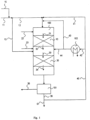
- diluting agent or product recycle in the process as described in Figure 1 , wherein an improved reactor configuration is presented, particularly for the control of the increase of temperature over catalyst bed and side reaction formation.
- a hydrotreatment process configuration is provided, comprising one or more catalyst beds in series, hydrotreated product recycle introduction on the top of the first catalyst bed and fresh feed, quench liquid and hydrogen introduction on top of each catalyst beds. This results in improved control of the reaction temperature in the catalyst beds and hence diminishes undesired side reactions.
- the hydrotreatment reactor 100 comprises two catalyst beds 10 and 20.
- Fresh feed 11 is introduced as streams 12 and 13 on the catalyst beds 10 and 20, respectively, and hydrogen as stream 22 and 23 on the catalyst beds 10 and 20, respectively.
- the fresh feed stream 12 is first mixed with the hydrotreated product recycle stream 41 and quench liquid stream 43 and the resulting mixture 31, diluted in the fresh feed concentration, is then introduced on the catalyst bed 10.
- required amount of sulphur make up is added to the fresh feed stream 11 via stream 15.
- fatty acids and fatty acid derivatives of the fresh feed stream 12 are converted to the corresponding reaction products.
- a two-phase stream 32 is withdrawn from the bottom of the catalyst bed 10 and is mixed with the fresh feed stream 13, quench liquid stream 44 and the hydrogen stream 23.
- the formed vapor-liquid mixture 33 diluted in the fresh feed concentration, is then introduced on the catalyst bed 20 at reduced temperature due to cooling effect of the hydrogen, quench liquid and fresh feed, passed through the catalyst bed 20 and finally withdrawn from the catalyst bed as a product stream 34.
- the stream 34 is separated in to a vapor stream 35 and liquid stream 36 in the high temperature separator 101.
- Vapor stream 35 is rich in hydrogen and is directed to further treatment.
- Part of the liquid stream 36 is returned to the reactor 100 as recycle stream 40, which is further divided to dilution stream 41 and total quench liquid stream 42.
- the quench liquid stream 42 is cooled in the heat exchanger 102 to provide adequate cooling effect on the top of the catalyst beds 10 and 20.
- Hydrotreated product stream 51 is directed from the hydrotreatment step to further processing.
- the catalyst beds 10 and 20 may be located in the same pressure vessel or in separate pressure vessels. In the embodiment where the catalyst beds are in the same pressure vessels the hydrogen streams 22 and 23 may alternatively be introduced on the catalyst bed 10 and then be passed through the catalyst beds 10 and 20. In the embodiment where the catalyst beds are in separate pressure vessels, the catalyst beds may operate in parallel mode with separate dilution streams, hydrogen streams and quench liquid streams.
- the number of catalyst beds may be one or two or more than two.
- the sulphur make up to the hydrotreatment step may be introduced with the fresh feed stream 11.
- required amount of sulphur may be fed with the hydrogen streams 22 and 23 as gaseous sulphur component such as hydrogen sulphide.
- Hydrogen is fed to the hydrotreating reactor in excess of the theoretical hydrogen consumption.
- triglyceride oils, fatty acids and derivatives thereof are almost theoretically converted to n-paraffins without or almost without side reactions.
- propane is formed from the glycerol part of the triglycerides, water and CO and/or CO 2 from carboxylic oxygen, H 2 S from organic sulphur compounds and NH 3 from organic nitrogen compounds.
- the temperature needed for reactions to start up is achieved in the beginning of each catalyst bed, the temperature increase in the catalyst beds is limited, harmful and partially converted product intermediates can be avoided and the catalyst life is extended considerably.
- the temperature at the end of the catalyst bed is controlled by net heat of reactions and to the extent of diluting agent used.
- Diluting agent may be any hydrocarbon available, bio-origin or non bio-origin. It can also be product recycle. If diluting agent is used, fresh feed content from total feed is less than 20 wt-%. If the product recycle is used, product recycle/fresh feed ratio is 5-30:1, preferably 10-30:1, most preferably 12-25:1. After the hydrotreatment step, the product is subjected to an isomerisation step.
- Isoparaffins may typically have mono-, di-, tri- or tetramethyl branches.
- the product obtained from the hydrotreatment step is isomerised with a catalyst under isomerisation conditions.
- the feed into the isomerisation reactor is a mixture of pure n-paraffins and the composition of the feed can be predicted from the fatty acid distribution of each individual bio oil used as feed to the hydrotreatment.
- the isomerisation step may comprise an optional purification step, wherein the reaction product from the hydrotreatment step may be purified using a suitable method such as stripping with water vapour or a suitable gas such as light hydrocarbon, nitrogen or hydrogen. Preferably acid gases and water impurities are removed as completely as possible before the hydrocarbons are contacted with the isomerization catalyst.
- a suitable method such as stripping with water vapour or a suitable gas such as light hydrocarbon, nitrogen or hydrogen.
- a suitable gas such as light hydrocarbon, nitrogen or hydrogen.
- acid gases and water impurities are removed as completely as possible before the hydrocarbons are contacted with the isomerization catalyst.
- the pressure varies in the range of 2-15 MPa, preferably in the range of 3-10 MPa and the temperature varies between 200 and 500 °C, preferably between 280 and 400 °C.
- isomerisation catalysts known in the art may be used. Suitable isomerisation catalysts contain a molecular sieve and/or a metal selected from Group VIII of the Periodic Table and/or a carrier. Preferably, the isomerisation catalyst contains SAPO-11 or SAPO-41 or ZSM-22 or ZSM-23 or ferrierite and Pt, Pd or Ni and Al 2 O 3 or SiO 2 . Typical isomerisation catalysts are, for example, Pt/SAPO-11/Al 2 O 3 , Pt/ZSM-22/Al 2 O 3 , Pt/ZSM-23/Al 2 O 3 and Pt/SAPO-11/SiO 2 . Most of these catalysts require the presence of hydrogen to reduce the catalyst deactivation.
- the isomerised diesel product consists mainly of branched hydrocarbons and also linear hydrocarbons and it has a boiling range of 180 - 350°C. Additionally some gasoline and gas may be obtained.
- the process according to the invention provides a way to reduce the formation of higher molecular weight compounds during the hydrotreatment of the fresh feed, which may contain fatty acids and derivatives thereof.
- the process according to the invention provides selective manufacture of diesel range hydrocarbons from bio oils and fats with high diesel yield and without significant side-reactions. Branched hydrocarbons can be manufactured from plant and vegetable oils and fats as well as animal and fish oils and fats using promoted assistance of decarb-reactions during hydrodeoxygenation and therefore the consumption of hydrogen is decreased by 20-60 %, typically 20-40 %.
- feeds having a high content of C 12 -C 16 fatty acids and/or their derivatives decreases hydrogen consumption in the isomerisation step and also improve cold properties of diesel fuel.
- the yield of diesel range hydrocarbons is especially increased during isomerisation of n-paraffins due to the lower cracking of n-paraffins formed from the fatty acid derivative feed to hydrotreatment.
- the C 11 -C 16 n-paraffins formed during hydrotreatment need lower conversion and lower reaction temperature during isomerisation in order to maintain same cold properties of diesel and thus significantly lower the extent of cracking and coke formation compared to heavier n-paraffins.
- improved cold properties can be achieved at the same reaction temperature without yield loss.
- the stability of the catalysts during hydrotreating and isomerisation is increased.
- Palm oil containing 0.3 area-% of free fatty acids was used as the fresh feed, along with product recycle 5:1 in the presence of hydrogen.
- the content of triglyceride C 12 -C 16 fatty acids in the fresh feed was 58.3 wt-%.
- the total feed contained alkaline and alkaline earth metals, calculated as elemental alkaline and alkaline earth metals in a amount of below 10 w-ppm.
- the amount of other metals, calculated as elemental metals, in the feed was below 10 w-ppm.
- the amount of phosphorus, calculated as elemental phosphorus was below 30 w-ppm.
- Palm oil containing 44.8 wt-% of triglyceride C 12 -C 16 fatty acids was used in the fresh feed.
- Dimethyl disulphide was added to palm oil to obtain sulphur content of about 600 w-ppm in the feed, calculated as elemental sulphur.
- the feed purity was same as in example 1, but the amount of free fatty acids was 0.2 area-%. No diluting agent was used.
- the feed was hydrotreated at 305 °C in the presence of hydrogen, reactor pressure was 5 MPa and space velocity was 2 g/g for fresh feed.
- the products contained mainly n-paraffins.
- the n-paraffin feeds were isomerised at 317 °C, 4 MPa and WHSV was 3 1/h in presence of hydrogen.
- the catalyst (A) contained Pt, SAPO-11 and an alumina support.
- the amount of hydrocarbons >C10 was 97 wt-% in the product.
- the cloud point of the liquid product was -22 °C. Results of analysis of the product are provided in table 4.
- Rapeseed oil contained of 4.5 wt-%. of triglyceride C 12 -C 16 fatty acids. Rapeseed oil was hydrotreated and isomerised at the same reaction conditions as described above. The amount of hydrocarbons >C10 was 96 wt-% in the product. The cloud point of the liquid product was -15 °C. Results of analysis of the product are provided in table 4.
- Animal fat containing 30 wt-% of triglyceride C12-C16 fatty acids was used as fresh feed.
- the feed contained alkaline and alkaline earth metals, calculated as elemental alkaline and alkaline earth metals in the amount of below 10 w-ppm.
- the amount of other metals, calculated as elemental metals, in the feed was below 10 w-ppm.
- the amount of phosphorus, calculated as elemental phosphorus was below 30 w-ppm.
- Dimethyl disulphide was added to animal fat to obtain sulphur content of about 100 w-ppm in the feed.
- Fresh feed contained free fatty acids 0.6 area-%.
- the feed was hydrotreated at 300 °C in the presence of hydrogen, reactor pressure was 5 MPa and space velocity was 2 g/g for fresh feed without any diluting agent.
- the products contained mainly n-paraffins.
- the n-paraffin feeds were isomerised at 316 °C, 4 MPa and WHSV was 1.5 1/h in the presence of hydrogen.
- the catalyst (B) contained Pt, SAPO-11 and an alumina support.
- the amount of hydrocarbons >C10 was 95 wt-% in the product.
- the cloud point of the liquid product was -20 °C.
- Rapeseed oil was hydrotreated and isomerisated at the same reaction conditions as described above. Rapeseed oil contained 4.5 wt-% of triglyceride C12-C16 fatty acids. In the isomerised product, the amount of hydrocarbons >C 10 was 95 wt-%. The cloud point of the liquid product was -14 °C.
- the hydrotreated animal fat obtained in Example 4 was isomerised at 312 °C, 4 MPa and WHSV was 1.5 1/h in the presence of hydrogen with catalyst B. This yielded a liquid product with a cloud point of -13 °C. The amount of hydrocarbons >C10 was now 98 wt-%.
Landscapes
- Chemical & Material Sciences (AREA)
- Oil, Petroleum & Natural Gas (AREA)
- Engineering & Computer Science (AREA)
- Chemical Kinetics & Catalysis (AREA)
- General Chemical & Material Sciences (AREA)
- Organic Chemistry (AREA)
- Crystallography & Structural Chemistry (AREA)
- Production Of Liquid Hydrocarbon Mixture For Refining Petroleum (AREA)
- Fats And Perfumes (AREA)
- Organic Low-Molecular-Weight Compounds And Preparation Thereof (AREA)
Priority Applications (27)
| Application Number | Priority Date | Filing Date | Title |
|---|---|---|---|
| PT50144260T PT1741767E (pt) | 2005-07-04 | 2005-07-04 | Processo para o fabrico de hidrocarbonetos de gama diesel |
| FIEP05014426.0T FI1741767T4 (fi) | 2005-07-04 | 2005-07-04 | Menetelmä dieselalueen hiilivetyjen valmistamiseksi |
| DK05014426.0T DK1741767T3 (en) | 2005-07-04 | 2005-07-04 | A process for the preparation of dieselcarbonhydrider |
| EP15174588.2A EP2990462A1 (en) | 2005-07-04 | 2005-07-04 | Process for the manufacture of diesel range hydrocarbons |
| PL05014426T PL1741767T3 (pl) | 2005-07-04 | 2005-07-04 | Sposób wytwarzania węglowodorów w zakresie oleju napędowego |
| ES05014426T ES2550244T5 (es) | 2005-07-04 | 2005-07-04 | Proceso para la fabricación de hidrocarburos de la gama diésel |
| SI200532017T SI1741767T1 (sl) | 2005-07-04 | 2005-07-04 | Postopek izdelave ogljikovodikov, ki se nahajajo v dieselskem gorivu |
| EP05014426.0A EP1741767B2 (en) | 2005-07-04 | 2005-07-04 | Process for the manufacture of diesel range hydrocarbons |
| HUE05014426A HUE025943T2 (en) | 2005-07-04 | 2005-07-04 | A method for producing hydrocarbons in the form of diesel fuels |
| HK08111704.6A HK1119734B (en) | 2005-07-04 | 2006-06-29 | Process for the manufacture of diesel range hydrocarbons |
| KR1020087002773A KR101037583B1 (ko) | 2005-07-04 | 2006-06-29 | 디젤 등급 탄화수소류의 제조 공정 |
| AP2008004335A AP2645A (en) | 2005-07-04 | 2006-06-29 | Process for the manufacture of diesel range hydrocarbons |
| PCT/FI2006/050300 WO2007003708A1 (en) | 2005-07-04 | 2006-06-29 | Process for the manufacture of diesel range hydrocarbons |
| AU2006264899A AU2006264899B2 (en) | 2005-07-04 | 2006-06-29 | Process for the manufacture of diesel range hydrocarbons |
| EA200800243A EA013754B1 (ru) | 2005-07-04 | 2006-06-29 | Способ производства углеводородов фракции дизельного топлива |
| UAA200801408A UA90906C2 (ru) | 2005-07-04 | 2006-06-29 | Способ производства углеводородов дизельной группы |
| CA2614014A CA2614014C (en) | 2005-07-04 | 2006-06-29 | Process for the manufacture of diesel range hydrocarbons |
| JP2008518886A JP4741661B2 (ja) | 2005-07-04 | 2006-06-29 | ディーゼルレンジ炭化水素の製造方法 |
| BRPI0614043A BRPI0614043B1 (pt) | 2005-07-04 | 2006-06-29 | processo para a fabricação de hidrocarbonetos na faixa de diesel |
| NZ565051A NZ565051A (en) | 2005-07-04 | 2006-06-29 | Process for the manufacture of diesel range hydrocarbons |
| MX2008000290A MX2008000290A (es) | 2005-07-04 | 2006-06-29 | Proceso para la fabricacion de hidrocarburos de la clase del diesel. |
| CN2006800274255A CN101233212B (zh) | 2005-07-04 | 2006-06-29 | 制备柴油范围烃的方法 |
| TNP2007000486A TNSN07486A1 (en) | 2005-07-04 | 2007-12-26 | Process for the manufacture of diesel range hydrocarbons |
| ZA200800056A ZA200800056B (en) | 2005-07-04 | 2008-01-02 | Process for the manufacture of diesel range hydrocarbons |
| EG2008010011A EG25348A (en) | 2005-07-04 | 2008-01-03 | Process for the manufacture of diesel range hydrocarbons. |
| NO20080282A NO348523B1 (no) | 2005-07-04 | 2008-01-15 | Fremgangsmåte for fremstilling av hydrokarboner innen dieselområde |
| MA30602A MA29689B1 (fr) | 2005-07-04 | 2008-01-28 | Procede de fabrication d'hydrocarbures de la gamme diesel |
Applications Claiming Priority (1)
| Application Number | Priority Date | Filing Date | Title |
|---|---|---|---|
| EP05014426.0A EP1741767B2 (en) | 2005-07-04 | 2005-07-04 | Process for the manufacture of diesel range hydrocarbons |
Related Child Applications (2)
| Application Number | Title | Priority Date | Filing Date |
|---|---|---|---|
| EP15174588.2A Division-Into EP2990462A1 (en) | 2005-07-04 | 2005-07-04 | Process for the manufacture of diesel range hydrocarbons |
| EP15174588.2A Division EP2990462A1 (en) | 2005-07-04 | 2005-07-04 | Process for the manufacture of diesel range hydrocarbons |
Publications (3)
| Publication Number | Publication Date |
|---|---|
| EP1741767A1 EP1741767A1 (en) | 2007-01-10 |
| EP1741767B1 EP1741767B1 (en) | 2015-07-22 |
| EP1741767B2 true EP1741767B2 (en) | 2023-04-05 |
Family
ID=36440865
Family Applications (2)
| Application Number | Title | Priority Date | Filing Date |
|---|---|---|---|
| EP05014426.0A Expired - Lifetime EP1741767B2 (en) | 2005-07-04 | 2005-07-04 | Process for the manufacture of diesel range hydrocarbons |
| EP15174588.2A Pending EP2990462A1 (en) | 2005-07-04 | 2005-07-04 | Process for the manufacture of diesel range hydrocarbons |
Family Applications After (1)
| Application Number | Title | Priority Date | Filing Date |
|---|---|---|---|
| EP15174588.2A Pending EP2990462A1 (en) | 2005-07-04 | 2005-07-04 | Process for the manufacture of diesel range hydrocarbons |
Country Status (15)
| Country | Link |
|---|---|
| EP (2) | EP1741767B2 (pl) |
| JP (1) | JP4741661B2 (pl) |
| CN (1) | CN101233212B (pl) |
| AP (1) | AP2645A (pl) |
| BR (1) | BRPI0614043B1 (pl) |
| DK (1) | DK1741767T3 (pl) |
| ES (1) | ES2550244T5 (pl) |
| FI (1) | FI1741767T4 (pl) |
| HU (1) | HUE025943T2 (pl) |
| NZ (1) | NZ565051A (pl) |
| PL (1) | PL1741767T3 (pl) |
| PT (1) | PT1741767E (pl) |
| SI (1) | SI1741767T1 (pl) |
| UA (1) | UA90906C2 (pl) |
| ZA (1) | ZA200800056B (pl) |
Cited By (1)
| Publication number | Priority date | Publication date | Assignee | Title |
|---|---|---|---|---|
| US12139678B2 (en) | 2020-12-11 | 2024-11-12 | Neste Oyj | Renewable hydrocarbon composition having good cetane number and good cold properties |
Families Citing this family (115)
| Publication number | Priority date | Publication date | Assignee | Title |
|---|---|---|---|---|
| JP4832871B2 (ja) * | 2005-11-30 | 2011-12-07 | Jx日鉱日石エネルギー株式会社 | 水素化精製方法 |
| BRPI0708352A2 (pt) * | 2006-02-28 | 2011-05-31 | Grace Gmbh & Co Kg | processo de refinamento fìsico usando partìuculas adsorventes para a produção de combustìvel biodisel |
| CA2670985C (en) | 2006-12-01 | 2015-06-09 | North Carolina State University | Process for conversion of biomass to fuel |
| FR2910483B1 (fr) * | 2006-12-21 | 2010-07-30 | Inst Francais Du Petrole | Procede de conversion de charges issues de sources renouvelables en bases carburants gazoles de bonne qualite. |
| DE102006061604A1 (de) * | 2006-12-27 | 2008-07-03 | Alois Dotzer | Verfahren zur Herstellung eines Kraftstoffs aus Pflanzenöl |
| WO2008105518A1 (ja) * | 2007-02-28 | 2008-09-04 | National Institute Of Advanced Industrial Science And Technology | バイオディーゼル燃料の製造方法及びバイオディーゼル燃料組成物 |
| GB2447684B (en) * | 2007-03-21 | 2011-11-23 | Statoil Asa | Biogasoline |
| CN104212844A (zh) | 2007-06-01 | 2014-12-17 | 索拉兹米公司 | 在微生物中生产油 |
| US8158842B2 (en) * | 2007-06-15 | 2012-04-17 | Uop Llc | Production of chemicals from pyrolysis oil |
| US8084655B2 (en) | 2007-06-15 | 2011-12-27 | E. I. Du Pont De Nemours And Company | Catalytic process for converting renewable resources into paraffins for use as diesel blending stocks |
| FR2919299B1 (fr) | 2007-07-25 | 2009-10-09 | Inst Francais Du Petrole | Procede d'hydroconversion en lit bouillonnant de charges d'origine bio-renouvelable pour la production de bases carburants. |
| US8523959B2 (en) | 2007-07-26 | 2013-09-03 | Chevron U.S.A. Inc. | Paraffinic biologically-derived distillate fuels with bio-oxygenates for improved lubricity and methods of making same |
| US7999142B2 (en) * | 2007-09-20 | 2011-08-16 | Uop Llc | Production of diesel fuel from biorenewable feedstocks |
| US7999143B2 (en) | 2007-09-20 | 2011-08-16 | Uop Llc | Production of diesel fuel from renewable feedstocks with reduced hydrogen consumption |
| US7982076B2 (en) * | 2007-09-20 | 2011-07-19 | Uop Llc | Production of diesel fuel from biorenewable feedstocks |
| US7982075B2 (en) * | 2007-09-20 | 2011-07-19 | Uop Llc | Production of diesel fuel from biorenewable feedstocks with lower hydrogen consumption |
| US7744742B2 (en) | 2007-11-28 | 2010-06-29 | Chevron U.S.A. Inc. | Integration of molecular redistribution and hydroisomerization processes for the production of paraffinic base oil |
| US8551327B2 (en) | 2007-12-27 | 2013-10-08 | Exxonmobil Research And Engineering Company | Staged co-processing of biofeeds for manufacture of diesel range hydrocarbons |
| AU2009234176B2 (en) | 2008-04-09 | 2014-08-07 | Corbion Biotech, Inc. | Direct chemical modification of microbial biomass and microbial oils |
| GB2462054A (en) * | 2008-04-29 | 2010-01-27 | Statoilhydro Asa | Biodiesel |
| US7960597B2 (en) * | 2008-07-24 | 2011-06-14 | Chevron U.S.A. Inc. | Conversion of vegetable oils to base oils and transportation fuels |
| US7960596B2 (en) * | 2008-07-24 | 2011-06-14 | Chevron U.S.A. Inc. | Conversion of vegetable oils to base oils and transportation fuels |
| RU2376062C1 (ru) * | 2008-07-24 | 2009-12-20 | Институт катализа им. Г.К. Борескова Сибирского отделения Российской академии наук (статус государственного учреждения) | Способ приготовления катализатора и способ получения дизельного топлива с использованием этого катализатора |
| US8772555B2 (en) * | 2008-07-24 | 2014-07-08 | Chevron U.S.A. Inc. | Conversion of vegetable oils to base oils and transportation fuels |
| FI2334757T4 (fi) * | 2008-09-10 | 2023-10-16 | Haldor Topsoee A/S | Vetykonversioprosessi ja katalyytti |
| US20100303989A1 (en) | 2008-10-14 | 2010-12-02 | Solazyme, Inc. | Microalgal Flour |
| US9447339B2 (en) | 2008-11-06 | 2016-09-20 | Exxonmobil Research And Engineering Company | Hydroprocessing of biodiesel fuels and blends |
| CN102712858B (zh) | 2008-11-28 | 2015-08-12 | 索拉兹米公司 | 在重组异养型微生物中制备特制油 |
| EP2356198B1 (en) * | 2008-12-12 | 2016-03-16 | E. I. du Pont de Nemours and Company | Process for making linear dicarboxylic acids from renewable resources |
| US8785701B2 (en) * | 2008-12-24 | 2014-07-22 | Exxonmobil Research And Engineering Company | Co-processing of diesel biofeed and kerosene range hydrocarbons |
| US8632675B2 (en) | 2008-12-24 | 2014-01-21 | Exxonmobil Research And Engineering Company | Co-processing of diesel biofeed and heavy oil |
| PT2226375E (pt) * | 2009-03-04 | 2012-07-20 | IFP Energies Nouvelles | Processo de hidrogenação contínua de matéria primas contendo triglicéridos |
| FI122957B (fi) | 2009-06-24 | 2012-09-14 | Neste Oil Oyj | Menetelmä rasvan tuottamiseksi |
| US8491780B2 (en) | 2009-07-17 | 2013-07-23 | Exxonmobil Research And Engineering Company | Hydroprocessing of biocomponent feedstocks with FCC off-gas |
| EP2275514A1 (en) | 2009-07-17 | 2011-01-19 | Neste Oil Oyj | Process for the preparation of light fuels |
| EP2290045A1 (en) | 2009-07-27 | 2011-03-02 | Total Petrochemicals Research Feluy | A process for the production of bio-naphtha from complex mixtures of natural occurring fats and oils |
| EP2290035A1 (en) * | 2009-07-27 | 2011-03-02 | Total Petrochemicals Research Feluy | A process for the production of bio-naptha from complex mixtures of natural occurring fats and oils |
| US8816141B2 (en) | 2009-08-28 | 2014-08-26 | Exxonmobil Research And Engineering Company | Reducing hydrogen consumption in hydrotreating of biocomponent feeds |
| FR2950895B1 (fr) * | 2009-10-06 | 2012-02-17 | Inst Francais Du Petrole | Procede d'hydrotraitement et d'hydroisomerisation de charges issues de source renouvelable mettant en oeuvre un catalyseur a base de carbure de silicium |
| FR2953854B1 (fr) * | 2009-12-16 | 2012-12-28 | Inst Francais Du Petrole | Procede de conversion de charges issues de sources renouvelables avec pretraitement des charges par dephosphatation a chaud |
| US8853474B2 (en) | 2009-12-29 | 2014-10-07 | Exxonmobil Research And Engineering Company | Hydroprocessing of biocomponent feedstocks with low purity hydrogen-containing streams |
| JP5789272B2 (ja) * | 2010-03-09 | 2015-10-07 | エクソンモービル リサーチ アンド エンジニアリング カンパニーExxon Research And Engineering Company | 再生可能ディーゼル燃料の脱ロウ処理 |
| CA2792078C (en) | 2010-03-09 | 2016-09-27 | Exxonmobil Research And Engineering Company | Hydroprocessing of diesel range biomolecules |
| ES2685502T3 (es) | 2010-05-25 | 2018-10-09 | Neste Oyj | Proceso y microorganismos para la producción de lípidos |
| FI125632B (fi) | 2010-05-25 | 2015-12-31 | Upm Kymmene Corp | Menetelmä ja laite hiilivetyjen tuottamiseksi |
| CN106135460B (zh) | 2010-05-28 | 2020-07-24 | 柯碧恩生物技术公司 | 包含特制油的食品组合物 |
| RU2429909C1 (ru) * | 2010-06-23 | 2011-09-27 | Учреждение Российской академии наук Институт катализа им. Г.К. Борескова Сибирского отделения РАН | Катализатор, способ его приготовления и способ получения дизельного топлива из сырья природного происхождения |
| US20120016167A1 (en) | 2010-07-15 | 2012-01-19 | Exxonmobil Research And Engineering Company | Hydroprocessing of biocomponent feeds with low pressure hydrogen-containing streams |
| US8366907B2 (en) | 2010-08-02 | 2013-02-05 | Battelle Memorial Institute | Deoxygenation of fatty acids for preparation of hydrocarbons |
| CA2816125C (en) | 2010-11-03 | 2018-12-11 | Solazyme, Inc. | Microbial oils with lowered pour points, dielectric fluids produced therefrom, and related methods |
| DK2465868T3 (en) | 2010-12-17 | 2016-05-17 | Neste Oyj | Enhancement of lipid production |
| FR2969642B1 (fr) * | 2010-12-22 | 2012-12-28 | IFP Energies Nouvelles | Production de carburants paraffiniques a partir de matieres renouvelables par un procede d'hydrotraitement en continu |
| ES2926521T3 (es) | 2010-12-22 | 2022-10-26 | Neste Oyj | Un proceso integrado para producir biocombustibles |
| PT2468857E (pt) | 2010-12-22 | 2014-12-22 | Neste Oil Oyj | Um sistema de processo integrado para produção de lípidos e polpação |
| DK2468877T3 (da) | 2010-12-22 | 2019-10-21 | Neste Oyj | Fremgangsmåde til fremstilling af enzymer |
| EP2476482B2 (en) | 2011-01-18 | 2020-05-13 | Neste Oyj | Method and arrangement for feeding heat-sensitive materials to fixed-bed reactors |
| CA2825691C (en) | 2011-02-02 | 2020-08-25 | Solazyme, Inc. | Tailored oils produced from recombinant oleaginous microorganisms |
| DK2489276T3 (da) | 2011-02-17 | 2014-01-20 | Neste Oil Oyj | Fremgangsmåde til udvinding af olie |
| EP2705138B1 (en) | 2011-05-06 | 2017-03-22 | TerraVia Holdings, Inc. | Genetically engineered microorganisms that metabolize xylose |
| EP2546352A1 (en) | 2011-07-15 | 2013-01-16 | Neste Oil Oyj | Process for producing lipids from palm oil production residues |
| CN103059902B (zh) * | 2011-10-24 | 2015-05-20 | 中国石油化工股份有限公司 | 一种以动植物油为原料制备喷气燃料调合组分的方法 |
| CN103059901B (zh) * | 2011-10-24 | 2015-11-25 | 中国石油化工股份有限公司 | 一种动植物油脂制备柴油组分或喷气燃料组分的方法 |
| FR2981942B1 (fr) * | 2011-10-27 | 2013-11-15 | IFP Energies Nouvelles | Procede d'hydrotraitement et d'hydroisomerisation de charges issues de la biomasse dans lequel l'effluent a hydrosiomeriser et le flux d'hydrogene contiennent une teneur limitee en oxygene |
| FR2982270B1 (fr) * | 2011-11-08 | 2013-11-08 | IFP Energies Nouvelles | Production de carburants paraffiniques a partir de matieres renouvelables par un procede d'hydrotraitement en continu comprenant une etape de pretraitement |
| FR2982271B1 (fr) * | 2011-11-08 | 2013-11-08 | Ifp Energies Now | Production de carburants paraffiniques a partir de matieres renouvelables par un procede d'hydrotraitement en continu comprenant une etape de pretraitement sous hydrogene |
| CN103102919B (zh) * | 2011-11-10 | 2015-04-15 | 中国石油化工股份有限公司 | 一种生产优质溶剂油的两段法加氢方法 |
| US9080109B2 (en) * | 2011-12-14 | 2015-07-14 | Uop Llc | Methods for deoxygenating biomass-derived pyrolysis oil |
| AU2013249172C1 (en) | 2012-04-18 | 2017-08-10 | Corbion Biotech, Inc. | Tailored oils |
| CN103773457B (zh) * | 2012-10-24 | 2016-04-27 | 中国石油化工股份有限公司 | 一种动植物油与柴油联合加氢方法 |
| CN103773455B (zh) * | 2012-10-24 | 2016-05-18 | 中国石油化工股份有限公司 | 一种动植物油、催化柴油联合加氢工艺方法 |
| CN103773459B (zh) * | 2012-10-24 | 2015-11-18 | 中国石油化工股份有限公司 | 一种动植物油与催化柴油联合加氢工艺 |
| EP2735610A1 (en) | 2012-11-26 | 2014-05-28 | Neste Oil Oyj | Oleaginous bacterial cells and methods for producing lipids |
| US9868909B2 (en) | 2012-12-31 | 2018-01-16 | Shell Oil Company | Process for converting one or more C3—C12 oxygenates |
| CN105051173A (zh) * | 2013-01-21 | 2015-11-11 | 道达尔研究技术弗吕公司 | 用于由天然存在的油脂的复杂混合物生产生物石脑油的工艺 |
| US10098371B2 (en) | 2013-01-28 | 2018-10-16 | Solazyme Roquette Nutritionals, LLC | Microalgal flour |
| US9567615B2 (en) | 2013-01-29 | 2017-02-14 | Terravia Holdings, Inc. | Variant thioesterases and methods of use |
| US9816079B2 (en) | 2013-01-29 | 2017-11-14 | Terravia Holdings, Inc. | Variant thioesterases and methods of use |
| US9783836B2 (en) | 2013-03-15 | 2017-10-10 | Terravia Holdings, Inc. | Thioesterases and cells for production of tailored oils |
| US9290749B2 (en) | 2013-03-15 | 2016-03-22 | Solazyme, Inc. | Thioesterases and cells for production of tailored oils |
| EP2993993A2 (en) | 2013-04-26 | 2016-03-16 | Solazyme, Inc. | Low polyunsaturated fatty acid oils and uses thereof |
| FR3009619B1 (fr) | 2013-08-07 | 2017-12-29 | Roquette Freres | Compositions de biomasse de microalgues riches en proteines de qualite sensorielle optimisee |
| CA2925527A1 (en) | 2013-10-04 | 2015-04-09 | Solazyme, Inc. | Tailored oils |
| CN106232825B (zh) | 2013-12-11 | 2020-12-22 | 耐思特公司 | 使用阳离子化合物加工木质纤维素材料的方法 |
| BR112016012142B1 (pt) | 2013-12-11 | 2022-05-24 | Neste Oyj | Método de produção de óleo unicelular a partir de materiais lignocelulósicos |
| CN105980573A (zh) | 2013-12-11 | 2016-09-28 | 耐思特公司 | 使用碱性脱木质化剂加工木质纤维素材料的方法 |
| CN103756720A (zh) * | 2014-01-26 | 2014-04-30 | 陈恒顺 | 一种提高蒽油加氢柴油十六烷值的生产方法 |
| CN103756723A (zh) * | 2014-01-26 | 2014-04-30 | 陈恒顺 | 一种生物柴油和煤焦油加氢生产高十六烷值柴油的方法 |
| WO2015149026A1 (en) | 2014-03-28 | 2015-10-01 | Solazyme, Inc. | Lauric ester compositions |
| US9969990B2 (en) | 2014-07-10 | 2018-05-15 | Corbion Biotech, Inc. | Ketoacyl ACP synthase genes and uses thereof |
| ES2772123T3 (es) | 2014-07-24 | 2020-07-07 | Corbion Biotech Inc | Variantes de tioesterasas y métodos de uso |
| EP3194582A2 (en) | 2014-09-18 | 2017-07-26 | TerraVia Holdings, Inc. | Acyl-acp thioesterases and mutants thereof |
| CN105733646B (zh) * | 2014-12-08 | 2017-11-03 | 中国石油化工股份有限公司 | 一种高级脂肪酸酯加氢制烃的方法 |
| WO2016142806A1 (en) * | 2015-03-10 | 2016-09-15 | Sabic Global Technologies, B.V. | Process for hydrocracking of hydrocarbon streams and pyrolysis oils |
| WO2016142807A1 (en) * | 2015-03-10 | 2016-09-15 | Sabic Global Technologies, B.V. | Process for preparation of hydrocracking catalyst for use in hydrocracking of hydrocarbon streams |
| EP3280810A1 (en) | 2015-04-06 | 2018-02-14 | TerraVia Holdings, Inc. | Oleaginous microalgae having an lpaat ablation |
| FI3455197T3 (fi) * | 2016-05-11 | 2024-01-29 | Reg Synthetic Fuels Llc | Biouusioituva kerosiini, lentopolttoaine, lentopolttoaineen sekoitusaine ja valmistusmenetelmä |
| CN106190277B (zh) * | 2016-08-18 | 2017-12-15 | 深圳市中创新能源科技有限公司 | 一种催化裂化制备生物质燃料的方法 |
| CN107974266B (zh) * | 2016-10-25 | 2020-06-12 | 中国石油化工股份有限公司 | 一种由废弃油脂生产航空燃料组分的方法及系统 |
| CN107974265B (zh) * | 2016-10-25 | 2020-08-18 | 中国石油化工股份有限公司 | 一种由废弃油脂生产航空燃料组分的方法 |
| CN106833716A (zh) * | 2017-03-27 | 2017-06-13 | 天津南开大学蓖麻工程科技有限公司 | 以蓖麻油为原料催化加氢脱氧及异构化生产生物航煤方法 |
| EP3642179A1 (en) * | 2017-06-19 | 2020-04-29 | Neste Oyj | Method for converting carboxylic acids and esters into base oil hydrocarbons |
| FI20176201A1 (en) | 2017-12-29 | 2019-06-30 | Neste Oyj | A method for determining the amount of renewable fuel in a fuel mixture. |
| FI129178B (en) * | 2017-12-29 | 2021-08-31 | Neste Oyj | Purification of biomass-based lipid material |
| SG10201803633UA (en) * | 2018-04-30 | 2019-11-28 | Green Technology Research Co Ltd | Process using bio-based material and the products thereof |
| CN118696989A (zh) * | 2018-05-03 | 2024-09-27 | 可更新能源集团 | 产生纯化的生物柴油或同时回收有价值的化学品的方法 |
| FI130601B (en) * | 2018-12-14 | 2023-12-07 | Neste Oyj | Diesel fuel composition |
| FI20195647A1 (en) | 2019-07-22 | 2021-01-23 | Neste Oyj | Paraffinic products, a method for producing paraffinic products and a use of paraffinic products |
| IT201900014778A1 (it) * | 2019-08-14 | 2021-02-14 | Nextchem S P A | Processo per il pretrattamento di alimentazioni destinate alla produzione di bio-carburanti, mediante idrolisi di grassi ad alta temperatura e pressione |
| WO2021037987A1 (en) * | 2019-08-29 | 2021-03-04 | Haldor Topsøe A/S | A process for monitoring the operation of hydrodeoxygenation of a feedstock |
| FI129823B (en) | 2019-08-30 | 2022-09-15 | Neste Oyj | Purification procedure for biological input material |
| MY209634A (en) * | 2020-09-09 | 2025-07-28 | Green Tech Research Co Ltd | Process and system for hydrotreating renewable feedstock |
| CN112592730A (zh) * | 2020-10-10 | 2021-04-02 | 中国科学院青岛生物能源与过程研究所 | 一种生产生物柴油的加氢工艺 |
| FI20216353A1 (en) | 2021-12-27 | 2023-06-28 | Neste Oyj | RENEWABLE STABILIZED NAFTA AREA HYDROCARBON FEED, THERMAL CRACKING METHOD AND ITS PRODUCTS |
| CN116396136B (zh) * | 2023-02-28 | 2025-05-06 | 北京集思拓新材料科技有限公司 | 一种生物基异构烷烃的制备方法 |
| WO2026024851A1 (en) * | 2024-07-24 | 2026-01-29 | Chevron U.S.A. Inc. | Process to convert carbon oxides into renewable products |
Citations (1)
| Publication number | Priority date | Publication date | Assignee | Title |
|---|---|---|---|---|
| US5705722A (en) † | 1994-06-30 | 1998-01-06 | Natural Resources Canada | Conversion of biomass feedstock to diesel fuel additive |
Family Cites Families (13)
| Publication number | Priority date | Publication date | Assignee | Title |
|---|---|---|---|---|
| FR2551056B1 (fr) | 1983-08-25 | 1985-11-29 | Inst Francais Du Petrole | Nouveau procede de fabrication d'olefine lineaire a partir d'acide gras ou d'ester d'acide gras sature |
| FR2607803A1 (fr) | 1986-12-08 | 1988-06-10 | Univ Paris Curie | Procede d'hydrocraquage sous pression des huiles vegetales ou des acides gras derives desdites huiles |
| US4992605A (en) | 1988-02-16 | 1991-02-12 | Craig Wayne K | Production of hydrocarbons with a relatively high cetane rating |
| US5612273A (en) | 1994-12-30 | 1997-03-18 | Intevep, S.A. | Catalyst for the hydroisomerization of contaminated hydrocarbon feedstock |
| CZ283575B6 (cs) | 1996-01-17 | 1998-05-13 | Chemopetrol, A. S. | Způsob výroby automobilového benzínu |
| FI100248B (fi) | 1996-02-05 | 1997-10-31 | Fortum Oil Oy | Keskitisleen valmistus |
| FI102767B (fi) | 1997-05-29 | 1999-02-15 | Fortum Oil Oy | Menetelmä korkealuokkaisen dieselpolttoaineen valmistamiseksi |
| CN1087339C (zh) | 1997-07-09 | 2002-07-10 | 结晶及脱胶公司 | 从脂肪物质中除去金属以及粘合在所述金属上的树胶的方法 |
| JP2003171670A (ja) * | 2001-12-07 | 2003-06-20 | Kawaken Fine Chem Co Ltd | 炭化水素類の製造方法および炭化水素類製造用触媒 |
| CN100347278C (zh) | 2002-05-30 | 2007-11-07 | 科学与工业研究委员会 | 物理精炼植物油的预处理方法 |
| CA2439577C (en) | 2002-09-06 | 2011-05-31 | Fortum Oyj | Process for producing a hydrocarbon component of biological origin |
| US7232935B2 (en) * | 2002-09-06 | 2007-06-19 | Fortum Oyj | Process for producing a hydrocarbon component of biological origin |
| DE10327059B4 (de) * | 2003-06-16 | 2005-12-22 | Fraunhofer-Gesellschaft zur Förderung der angewandten Forschung e.V. | Verfahren zum Konvertieren von fett- oder ölhaltigen Roh- und Abfallstoffen in Gemische mit hohem Kohlenwasserstoffanteil, mit diesem Verfahren hergestellte Produkte und deren Verwendung |
-
2005
- 2005-07-04 HU HUE05014426A patent/HUE025943T2/en unknown
- 2005-07-04 SI SI200532017T patent/SI1741767T1/sl unknown
- 2005-07-04 DK DK05014426.0T patent/DK1741767T3/en active
- 2005-07-04 PL PL05014426T patent/PL1741767T3/pl unknown
- 2005-07-04 ES ES05014426T patent/ES2550244T5/es not_active Expired - Lifetime
- 2005-07-04 FI FIEP05014426.0T patent/FI1741767T4/fi active
- 2005-07-04 EP EP05014426.0A patent/EP1741767B2/en not_active Expired - Lifetime
- 2005-07-04 EP EP15174588.2A patent/EP2990462A1/en active Pending
- 2005-07-04 PT PT50144260T patent/PT1741767E/pt unknown
-
2006
- 2006-06-29 NZ NZ565051A patent/NZ565051A/en unknown
- 2006-06-29 CN CN2006800274255A patent/CN101233212B/zh active Active
- 2006-06-29 UA UAA200801408A patent/UA90906C2/ru unknown
- 2006-06-29 BR BRPI0614043A patent/BRPI0614043B1/pt active IP Right Grant
- 2006-06-29 AP AP2008004335A patent/AP2645A/xx active
- 2006-06-29 JP JP2008518886A patent/JP4741661B2/ja active Active
-
2008
- 2008-01-02 ZA ZA200800056A patent/ZA200800056B/xx unknown
Patent Citations (1)
| Publication number | Priority date | Publication date | Assignee | Title |
|---|---|---|---|---|
| US5705722A (en) † | 1994-06-30 | 1998-01-06 | Natural Resources Canada | Conversion of biomass feedstock to diesel fuel additive |
Non-Patent Citations (1)
| Title |
|---|
| E. LAURENT ET AL.: "STUDY OF THE HYDRODEOXYGENATION OF CARBONYL, CARBOXYLIC AND GUAIACYL GROUPS OVER SULFIDED COMO/GAMMA-AL2O3 AND NIMO/GAMMA-AL2O3 CATALYST: II. INFLUENCE OF WATER, AMMONIA AND HYDROGEN SULFIDE", APPLIED CATALYSIS A, vol. 109, no. 1, 1994, pages 97 - 115 † |
Cited By (1)
| Publication number | Priority date | Publication date | Assignee | Title |
|---|---|---|---|---|
| US12139678B2 (en) | 2020-12-11 | 2024-11-12 | Neste Oyj | Renewable hydrocarbon composition having good cetane number and good cold properties |
Also Published As
| Publication number | Publication date |
|---|---|
| PL1741767T3 (pl) | 2015-12-31 |
| EP1741767B1 (en) | 2015-07-22 |
| BRPI0614043A2 (pt) | 2011-03-09 |
| EP2990462A1 (en) | 2016-03-02 |
| AP2645A (en) | 2013-04-17 |
| ZA200800056B (en) | 2008-12-31 |
| CN101233212A (zh) | 2008-07-30 |
| UA90906C2 (ru) | 2010-06-10 |
| JP4741661B2 (ja) | 2011-08-03 |
| ES2550244T5 (es) | 2023-06-08 |
| EP1741767A1 (en) | 2007-01-10 |
| ES2550244T3 (es) | 2015-11-05 |
| HUE025943T2 (en) | 2016-05-30 |
| PT1741767E (pt) | 2015-11-03 |
| JP2008545034A (ja) | 2008-12-11 |
| CN101233212B (zh) | 2012-10-03 |
| BRPI0614043B1 (pt) | 2016-04-19 |
| FI1741767T4 (fi) | 2023-04-25 |
| SI1741767T1 (sl) | 2016-02-29 |
| NZ565051A (en) | 2011-04-29 |
| DK1741767T3 (en) | 2015-10-26 |
Similar Documents
| Publication | Publication Date | Title |
|---|---|---|
| EP1741767B2 (en) | Process for the manufacture of diesel range hydrocarbons | |
| US11473018B2 (en) | Process for the manufacture of diesel range hydrocarbons | |
| US8278492B2 (en) | Process for the manufacture of diesel range hydrocarbons | |
| EP1741768B1 (en) | Process for the manufacture of diesel range hydrocarbons | |
| AU2006264900B2 (en) | Process for the manufacture of diesel range hydrocarbons | |
| CA2614014C (en) | Process for the manufacture of diesel range hydrocarbons | |
| US12203035B2 (en) | Process for the manufacture of diesel range hydrocarbons | |
| HK1119734B (en) | Process for the manufacture of diesel range hydrocarbons |
Legal Events
| Date | Code | Title | Description |
|---|---|---|---|
| PUAI | Public reference made under article 153(3) epc to a published international application that has entered the european phase |
Free format text: ORIGINAL CODE: 0009012 |
|
| 17P | Request for examination filed |
Effective date: 20050704 |
|
| AK | Designated contracting states |
Kind code of ref document: A1 Designated state(s): AT BE BG CH CY CZ DE DK EE ES FI FR GB GR HU IE IS IT LI LT LU LV MC NL PL PT RO SE SI SK TR |
|
| AX | Request for extension of the european patent |
Extension state: AL BA HR MK YU |
|
| AKX | Designation fees paid |
Designated state(s): AT BE BG CH CY CZ DE DK EE ES FI FR GB GR HU IE IS IT LI LT LU LV MC NL PL PT RO SE SI SK TR |
|
| 17Q | First examination report despatched |
Effective date: 20070821 |
|
| TPAC | Observations filed by third parties |
Free format text: ORIGINAL CODE: EPIDOSNTIPA |
|
| TPAC | Observations filed by third parties |
Free format text: ORIGINAL CODE: EPIDOSNTIPA |
|
| GRAP | Despatch of communication of intention to grant a patent |
Free format text: ORIGINAL CODE: EPIDOSNIGR1 |
|
| GRAS | Grant fee paid |
Free format text: ORIGINAL CODE: EPIDOSNIGR3 |
|
| GRAA | (expected) grant |
Free format text: ORIGINAL CODE: 0009210 |
|
| INTG | Intention to grant announced |
Effective date: 20150610 |
|
| AK | Designated contracting states |
Kind code of ref document: B1 Designated state(s): AT BE BG CH CY CZ DE DK EE ES FI FR GB GR HU IE IS IT LI LT LU LV MC NL PL PT RO SE SI SK TR |
|
| REG | Reference to a national code |
Ref country code: GB Ref legal event code: FG4D |
|
| REG | Reference to a national code |
Ref country code: CH Ref legal event code: EP |
|
| REG | Reference to a national code |
Ref country code: IE Ref legal event code: FG4D |
|
| REG | Reference to a national code |
Ref country code: AT Ref legal event code: REF Ref document number: 737919 Country of ref document: AT Kind code of ref document: T Effective date: 20150815 |
|
| REG | Reference to a national code |
Ref country code: DE Ref legal event code: R096 Ref document number: 602005047009 Country of ref document: DE |
|
| REG | Reference to a national code |
Ref country code: CH Ref legal event code: NV Representative=s name: HEPP WENGER RYFFEL AG, CH |
|
| REG | Reference to a national code |
Ref country code: RO Ref legal event code: EPE |
|
| REG | Reference to a national code |
Ref country code: DK Ref legal event code: T3 Effective date: 20151020 |
|
| REG | Reference to a national code |
Ref country code: PT Ref legal event code: SC4A Free format text: AVAILABILITY OF NATIONAL TRANSLATION Effective date: 20151015 |
|
| REG | Reference to a national code |
Ref country code: ES Ref legal event code: FG2A Ref document number: 2550244 Country of ref document: ES Kind code of ref document: T3 Effective date: 20151105 |
|
| REG | Reference to a national code |
Ref country code: SE Ref legal event code: TRGR |
|
| REG | Reference to a national code |
Ref country code: PL Ref legal event code: T3 |
|
| REG | Reference to a national code |
Ref country code: NL Ref legal event code: FP |
|
| PG25 | Lapsed in a contracting state [announced via postgrant information from national office to epo] |
Ref country code: LV Free format text: LAPSE BECAUSE OF FAILURE TO SUBMIT A TRANSLATION OF THE DESCRIPTION OR TO PAY THE FEE WITHIN THE PRESCRIBED TIME-LIMIT Effective date: 20150722 |
|
| PG25 | Lapsed in a contracting state [announced via postgrant information from national office to epo] |
Ref country code: IS Free format text: LAPSE BECAUSE OF FAILURE TO SUBMIT A TRANSLATION OF THE DESCRIPTION OR TO PAY THE FEE WITHIN THE PRESCRIBED TIME-LIMIT Effective date: 20151122 |
|
| REG | Reference to a national code |
Ref country code: SK Ref legal event code: T3 Ref document number: E 19647 Country of ref document: SK |
|
| REG | Reference to a national code |
Ref country code: GR Ref legal event code: EP Ref document number: 20150402134 Country of ref document: GR Effective date: 20151209 |
|
| REG | Reference to a national code |
Ref country code: DE Ref legal event code: R026 Ref document number: 602005047009 Country of ref document: DE |
|
| PLBI | Opposition filed |
Free format text: ORIGINAL CODE: 0009260 |
|
| PG25 | Lapsed in a contracting state [announced via postgrant information from national office to epo] |
Ref country code: EE Free format text: LAPSE BECAUSE OF FAILURE TO SUBMIT A TRANSLATION OF THE DESCRIPTION OR TO PAY THE FEE WITHIN THE PRESCRIBED TIME-LIMIT Effective date: 20150722 |
|
| PLBI | Opposition filed |
Free format text: ORIGINAL CODE: 0009260 |
|
| 26 | Opposition filed |
Opponent name: HALDOR TOPSOE A/S Effective date: 20160421 |
|
| REG | Reference to a national code |
Ref country code: HU Ref legal event code: AG4A Ref document number: E025943 Country of ref document: HU |
|
| 26 | Opposition filed |
Opponent name: UPM-KYMMENE CORPORATION Effective date: 20160422 |
|
| PLAX | Notice of opposition and request to file observation + time limit sent |
Free format text: ORIGINAL CODE: EPIDOSNOBS2 |
|
| REG | Reference to a national code |
Ref country code: FR Ref legal event code: PLFP Year of fee payment: 12 |
|
| PLAF | Information modified related to communication of a notice of opposition and request to file observations + time limit |
Free format text: ORIGINAL CODE: EPIDOSCOBS2 |
|
| PLBB | Reply of patent proprietor to notice(s) of opposition received |
Free format text: ORIGINAL CODE: EPIDOSNOBS3 |
|
| PG25 | Lapsed in a contracting state [announced via postgrant information from national office to epo] |
Ref country code: MC Free format text: LAPSE BECAUSE OF FAILURE TO SUBMIT A TRANSLATION OF THE DESCRIPTION OR TO PAY THE FEE WITHIN THE PRESCRIBED TIME-LIMIT Effective date: 20150722 |
|
| REG | Reference to a national code |
Ref country code: FR Ref legal event code: PLFP Year of fee payment: 13 |
|
| REG | Reference to a national code |
Ref country code: AT Ref legal event code: UEP Ref document number: 737919 Country of ref document: AT Kind code of ref document: T Effective date: 20150722 |
|
| PG25 | Lapsed in a contracting state [announced via postgrant information from national office to epo] |
Ref country code: LU Free format text: LAPSE BECAUSE OF NON-PAYMENT OF DUE FEES Effective date: 20160704 |
|
| RAP2 | Party data changed (patent owner data changed or rights of a patent transferred) |
Owner name: NESTE OYJ |
|
| RDAF | Communication despatched that patent is revoked |
Free format text: ORIGINAL CODE: EPIDOSNREV1 |
|
| STAA | Information on the status of an ep patent application or granted ep patent |
Free format text: STATUS: THE PATENT HAS BEEN GRANTED |
|
| PG25 | Lapsed in a contracting state [announced via postgrant information from national office to epo] |
Ref country code: CY Free format text: LAPSE BECAUSE OF FAILURE TO SUBMIT A TRANSLATION OF THE DESCRIPTION OR TO PAY THE FEE WITHIN THE PRESCRIBED TIME-LIMIT Effective date: 20150722 |
|
| APBM | Appeal reference recorded |
Free format text: ORIGINAL CODE: EPIDOSNREFNO |
|
| APBP | Date of receipt of notice of appeal recorded |
Free format text: ORIGINAL CODE: EPIDOSNNOA2O |
|
| REG | Reference to a national code |
Ref country code: FR Ref legal event code: PLFP Year of fee payment: 14 |
|
| APAH | Appeal reference modified |
Free format text: ORIGINAL CODE: EPIDOSCREFNO |
|
| APBQ | Date of receipt of statement of grounds of appeal recorded |
Free format text: ORIGINAL CODE: EPIDOSNNOA3O |
|
| APAH | Appeal reference modified |
Free format text: ORIGINAL CODE: EPIDOSCREFNO |
|
| PG25 | Lapsed in a contracting state [announced via postgrant information from national office to epo] |
Ref country code: BG Free format text: LAPSE BECAUSE OF NON-PAYMENT OF DUE FEES Effective date: 20210131 |
|
| PLAB | Opposition data, opponent's data or that of the opponent's representative modified |
Free format text: ORIGINAL CODE: 0009299OPPO |
|
| PGFP | Annual fee paid to national office [announced via postgrant information from national office to epo] |
Ref country code: LT Payment date: 20210622 Year of fee payment: 17 Ref country code: GR Payment date: 20210611 Year of fee payment: 17 Ref country code: SK Payment date: 20210615 Year of fee payment: 17 Ref country code: RO Payment date: 20210630 Year of fee payment: 17 Ref country code: CZ Payment date: 20210629 Year of fee payment: 17 |
|
| APBU | Appeal procedure closed |
Free format text: ORIGINAL CODE: EPIDOSNNOA9O |
|
| R26 | Opposition filed (corrected) |
Opponent name: HALDOR TOPSOE A/S Effective date: 20160421 |
|
| PGFP | Annual fee paid to national office [announced via postgrant information from national office to epo] |
Ref country code: PL Payment date: 20210618 Year of fee payment: 17 Ref country code: TR Payment date: 20210630 Year of fee payment: 17 |
|
| PGFP | Annual fee paid to national office [announced via postgrant information from national office to epo] |
Ref country code: IE Payment date: 20210712 Year of fee payment: 17 Ref country code: AT Payment date: 20210625 Year of fee payment: 17 |
|
| PLAY | Examination report in opposition despatched + time limit |
Free format text: ORIGINAL CODE: EPIDOSNORE2 |
|
| PGFP | Annual fee paid to national office [announced via postgrant information from national office to epo] |
Ref country code: DK Payment date: 20210712 Year of fee payment: 17 Ref country code: HU Payment date: 20210616 Year of fee payment: 17 Ref country code: SI Payment date: 20210617 Year of fee payment: 17 Ref country code: CH Payment date: 20210715 Year of fee payment: 17 |
|
| PLBC | Reply to examination report in opposition received |
Free format text: ORIGINAL CODE: EPIDOSNORE3 |
|
| PGFP | Annual fee paid to national office [announced via postgrant information from national office to epo] |
Ref country code: PT Payment date: 20210701 Year of fee payment: 17 |
|
| PLAY | Examination report in opposition despatched + time limit |
Free format text: ORIGINAL CODE: EPIDOSNORE2 |
|
| PLBC | Reply to examination report in opposition received |
Free format text: ORIGINAL CODE: EPIDOSNORE3 |
|
| REG | Reference to a national code |
Ref country code: CH Ref legal event code: PK Free format text: BERICHTIGUNGEN |
|
| RIC2 | Information provided on ipc code assigned after grant |
Ipc: C10G 65/04 20060101ALI20220811BHEP Ipc: C10G 45/10 20060101ALI20220811BHEP Ipc: C10G 45/08 20060101ALI20220811BHEP Ipc: C10G 45/02 20060101ALI20220811BHEP Ipc: C10G 45/58 20060101ALI20220811BHEP Ipc: C10G 3/00 20060101AFI20220811BHEP |
|
| REG | Reference to a national code |
Ref country code: LT Ref legal event code: MM4D Effective date: 20220704 |
|
| PG25 | Lapsed in a contracting state [announced via postgrant information from national office to epo] |
Ref country code: CZ Free format text: LAPSE BECAUSE OF NON-PAYMENT OF DUE FEES Effective date: 20220704 |
|
| REG | Reference to a national code |
Ref country code: SK Ref legal event code: MM4A Ref document number: E 19647 Country of ref document: SK Effective date: 20220704 |
|
| REG | Reference to a national code |
Ref country code: DK Ref legal event code: EBP Effective date: 20220731 |
|
| REG | Reference to a national code |
Ref country code: CH Ref legal event code: PL |
|
| PUAH | Patent maintained in amended form |
Free format text: ORIGINAL CODE: 0009272 |
|
| STAA | Information on the status of an ep patent application or granted ep patent |
Free format text: STATUS: PATENT MAINTAINED AS AMENDED |
|
| REG | Reference to a national code |
Ref country code: AT Ref legal event code: MM01 Ref document number: 737919 Country of ref document: AT Kind code of ref document: T Effective date: 20220704 |
|
| 27A | Patent maintained in amended form |
Effective date: 20230405 |
|
| AK | Designated contracting states |
Kind code of ref document: B2 Designated state(s): AT BE BG CH CY CZ DE DK EE ES FI FR GB GR HU IE IS IT LI LT LU LV MC NL PL PT RO SE SI SK TR |
|
| REG | Reference to a national code |
Ref country code: DE Ref legal event code: R102 Ref document number: 602005047009 Country of ref document: DE |
|
| PG25 | Lapsed in a contracting state [announced via postgrant information from national office to epo] |
Ref country code: RO Free format text: LAPSE BECAUSE OF NON-PAYMENT OF DUE FEES Effective date: 20220704 Ref country code: PT Free format text: LAPSE BECAUSE OF NON-PAYMENT OF DUE FEES Effective date: 20230104 Ref country code: LT Free format text: LAPSE BECAUSE OF NON-PAYMENT OF DUE FEES Effective date: 20220704 Ref country code: LI Free format text: LAPSE BECAUSE OF NON-PAYMENT OF DUE FEES Effective date: 20220731 Ref country code: CH Free format text: LAPSE BECAUSE OF NON-PAYMENT OF DUE FEES Effective date: 20220731 Ref country code: AT Free format text: LAPSE BECAUSE OF NON-PAYMENT OF DUE FEES Effective date: 20220704 |
|
| REG | Reference to a national code |
Ref country code: SI Ref legal event code: KO00 Effective date: 20230314 |
|
| REG | Reference to a national code |
Ref country code: NL Ref legal event code: FP |
|
| REG | Reference to a national code |
Ref country code: SE Ref legal event code: RPEO |
|
| PG25 | Lapsed in a contracting state [announced via postgrant information from national office to epo] |
Ref country code: SK Free format text: LAPSE BECAUSE OF NON-PAYMENT OF DUE FEES Effective date: 20220704 Ref country code: SI Free format text: LAPSE BECAUSE OF NON-PAYMENT OF DUE FEES Effective date: 20220705 Ref country code: HU Free format text: LAPSE BECAUSE OF NON-PAYMENT OF DUE FEES Effective date: 20220705 Ref country code: GR Free format text: LAPSE BECAUSE OF NON-PAYMENT OF DUE FEES Effective date: 20230209 |
|
| REG | Reference to a national code |
Ref country code: ES Ref legal event code: DC2A Ref document number: 2550244 Country of ref document: ES Kind code of ref document: T5 Effective date: 20230608 |
|
| P01 | Opt-out of the competence of the unified patent court (upc) registered |
Effective date: 20230525 |
|
| PG25 | Lapsed in a contracting state [announced via postgrant information from national office to epo] |
Ref country code: IE Free format text: LAPSE BECAUSE OF NON-PAYMENT OF DUE FEES Effective date: 20220704 Ref country code: DK Free format text: LAPSE BECAUSE OF NON-PAYMENT OF DUE FEES Effective date: 20220731 |
|
| PG25 | Lapsed in a contracting state [announced via postgrant information from national office to epo] |
Ref country code: PT Free format text: LAPSE BECAUSE OF FAILURE TO SUBMIT A TRANSLATION OF THE DESCRIPTION OR TO PAY THE FEE WITHIN THE PRESCRIBED TIME-LIMIT Effective date: 20230817 |
|
| PG25 | Lapsed in a contracting state [announced via postgrant information from national office to epo] |
Ref country code: PL Free format text: LAPSE BECAUSE OF NON-PAYMENT OF DUE FEES Effective date: 20220704 Ref country code: GR Free format text: LAPSE BECAUSE OF FAILURE TO SUBMIT A TRANSLATION OF THE DESCRIPTION OR TO PAY THE FEE WITHIN THE PRESCRIBED TIME-LIMIT Effective date: 20230706 |
|
| PGFP | Annual fee paid to national office [announced via postgrant information from national office to epo] |
Ref country code: GB Payment date: 20240606 Year of fee payment: 20 |
|
| PGFP | Annual fee paid to national office [announced via postgrant information from national office to epo] |
Ref country code: NL Payment date: 20240613 Year of fee payment: 20 |
|
| PGFP | Annual fee paid to national office [announced via postgrant information from national office to epo] |
Ref country code: FR Payment date: 20240621 Year of fee payment: 20 |
|
| PG25 | Lapsed in a contracting state [announced via postgrant information from national office to epo] |
Ref country code: PT Free format text: LAPSE BECAUSE OF FAILURE TO SUBMIT A TRANSLATION OF THE DESCRIPTION OR TO PAY THE FEE WITHIN THE PRESCRIBED TIME-LIMIT Effective date: 20230405 |
|
| PG25 | Lapsed in a contracting state [announced via postgrant information from national office to epo] |
Ref country code: PT Free format text: LAPSE BECAUSE OF FAILURE TO SUBMIT A TRANSLATION OF THE DESCRIPTION OR TO PAY THE FEE WITHIN THE PRESCRIBED TIME-LIMIT Effective date: 20230405 |
|
| PGFP | Annual fee paid to national office [announced via postgrant information from national office to epo] |
Ref country code: SE Payment date: 20240611 Year of fee payment: 20 Ref country code: BE Payment date: 20240617 Year of fee payment: 20 |
|
| PG25 | Lapsed in a contracting state [announced via postgrant information from national office to epo] |
Ref country code: TR Free format text: LAPSE BECAUSE OF NON-PAYMENT OF DUE FEES Effective date: 20220704 |
|
| PGFP | Annual fee paid to national office [announced via postgrant information from national office to epo] |
Ref country code: IT Payment date: 20240612 Year of fee payment: 20 |
|
| PGFP | Annual fee paid to national office [announced via postgrant information from national office to epo] |
Ref country code: DE Payment date: 20240604 Year of fee payment: 20 Ref country code: FI Payment date: 20240712 Year of fee payment: 20 |
|
| PG25 | Lapsed in a contracting state [announced via postgrant information from national office to epo] |
Ref country code: GR Free format text: LAPSE BECAUSE OF NON-PAYMENT OF DUE FEES Effective date: 20230209 |
|
| PGFP | Annual fee paid to national office [announced via postgrant information from national office to epo] |
Ref country code: ES Payment date: 20240806 Year of fee payment: 20 |
|
| PG25 | Lapsed in a contracting state [announced via postgrant information from national office to epo] |
Ref country code: PL Free format text: THE PATENT HAS BEEN ANNULLED BY A DECISION OF A NATIONAL AUTHORITY Effective date: 20230705 |
|
| PG25 | Lapsed in a contracting state [announced via postgrant information from national office to epo] |
Ref country code: PL Free format text: THE PATENT HAS BEEN ANNULLED BY A DECISION OF A NATIONAL AUTHORITY Effective date: 20230705 Ref country code: GR Free format text: LAPSE BECAUSE OF NON-PAYMENT OF DUE FEES Effective date: 20230209 |
|
| PG25 | Lapsed in a contracting state [announced via postgrant information from national office to epo] |
Ref country code: GR Free format text: LAPSE BECAUSE OF NON-PAYMENT OF DUE FEES Effective date: 20150722 |
|
| PG25 | Lapsed in a contracting state [announced via postgrant information from national office to epo] |
Ref country code: GR Free format text: LAPSE BECAUSE OF NON-PAYMENT OF DUE FEES Effective date: 20150722 |
|
| REG | Reference to a national code |
Ref country code: DE Ref legal event code: R071 Ref document number: 602005047009 Country of ref document: DE |
|
| REG | Reference to a national code |
Ref country code: NL Ref legal event code: MK Effective date: 20250703 |
|
| REG | Reference to a national code |
Ref country code: GB Ref legal event code: PE20 Expiry date: 20250703 |
|
| REG | Reference to a national code |
Ref country code: ES Ref legal event code: FD2A Effective date: 20250804 |
|
| REG | Reference to a national code |
Ref country code: BE Ref legal event code: MK Effective date: 20250704 |
|
| REG | Reference to a national code |
Ref country code: SE Ref legal event code: EUG |
|
| PG25 | Lapsed in a contracting state [announced via postgrant information from national office to epo] |
Ref country code: ES Free format text: LAPSE BECAUSE OF EXPIRATION OF PROTECTION Effective date: 20250705 |