EP1667790B1 - Dispositif et procede pour la fabrication de particules - Google Patents
Dispositif et procede pour la fabrication de particules Download PDFInfo
- Publication number
- EP1667790B1 EP1667790B1 EP04769494A EP04769494A EP1667790B1 EP 1667790 B1 EP1667790 B1 EP 1667790B1 EP 04769494 A EP04769494 A EP 04769494A EP 04769494 A EP04769494 A EP 04769494A EP 1667790 B1 EP1667790 B1 EP 1667790B1
- Authority
- EP
- European Patent Office
- Prior art keywords
- organic phase
- rotor
- particles
- stator
- suspension
- Prior art date
- Legal status (The legal status is an assumption and is not a legal conclusion. Google has not performed a legal analysis and makes no representation as to the accuracy of the status listed.)
- Expired - Lifetime
Links
- 239000002245 particle Substances 0.000 title claims abstract description 122
- 238000000034 method Methods 0.000 title claims description 30
- 239000012074 organic phase Substances 0.000 claims abstract description 148
- 239000008346 aqueous phase Substances 0.000 claims abstract description 74
- 238000002156 mixing Methods 0.000 claims abstract description 46
- 238000000265 homogenisation Methods 0.000 claims description 76
- 239000011859 microparticle Substances 0.000 claims description 75
- 239000000725 suspension Substances 0.000 claims description 63
- 239000002904 solvent Substances 0.000 claims description 43
- 229920000642 polymer Polymers 0.000 claims description 41
- 239000012071 phase Substances 0.000 claims description 38
- 239000000839 emulsion Substances 0.000 claims description 37
- 239000002105 nanoparticle Substances 0.000 claims description 36
- 238000001914 filtration Methods 0.000 claims description 29
- 238000004519 manufacturing process Methods 0.000 claims description 24
- 239000013543 active substance Substances 0.000 claims description 17
- 239000004094 surface-active agent Substances 0.000 claims description 8
- 238000010924 continuous production Methods 0.000 claims description 6
- 238000000108 ultra-filtration Methods 0.000 claims description 3
- 238000007599 discharging Methods 0.000 claims 2
- 238000003860 storage Methods 0.000 claims 2
- XEKOWRVHYACXOJ-UHFFFAOYSA-N Ethyl acetate Chemical compound CCOC(C)=O XEKOWRVHYACXOJ-UHFFFAOYSA-N 0.000 description 114
- 238000003760 magnetic stirring Methods 0.000 description 61
- XLYOFNOQVPJJNP-UHFFFAOYSA-N water Substances O XLYOFNOQVPJJNP-UHFFFAOYSA-N 0.000 description 52
- 238000005538 encapsulation Methods 0.000 description 42
- 229920001606 poly(lactic acid-co-glycolic acid) Polymers 0.000 description 42
- 239000004372 Polyvinyl alcohol Substances 0.000 description 29
- 229920002451 polyvinyl alcohol Polymers 0.000 description 29
- 235000019422 polyvinyl alcohol Nutrition 0.000 description 29
- ZBVJFYPGLGEMIN-OYLNGHKZSA-N (2s)-n-[(2s)-1-[[(2s)-1-[[(2s)-1-[[(2s)-1-[[(2r)-1-[[(2s)-1-[[(2s)-1-[(2s)-2-[(2-amino-2-oxoethyl)carbamoyl]pyrrolidin-1-yl]-5-(diaminomethylideneamino)-1-oxopentan-2-yl]amino]-4-methyl-1-oxopentan-2-yl]amino]-3-(1h-indol-3-yl)-1-oxopropan-2-yl]amino]-3-( Chemical compound C1=CC=C2C(CC=3C4=CC=CC=C4C=C(C=3O)C(=O)O)=C(O)C(C(O)=O)=CC2=C1.C([C@@H](C(=O)N[C@H](CC=1C2=CC=CC=C2NC=1)C(=O)N[C@@H](CC(C)C)C(=O)N[C@@H](CCCNC(N)=N)C(=O)N1[C@@H](CCC1)C(=O)NCC(N)=O)NC(=O)[C@H](CO)NC(=O)[C@H](CC=1C2=CC=CC=C2NC=1)NC(=O)[C@H](CC=1N=CNC=1)NC(=O)[C@H]1NC(=O)CC1)C1=CC=C(O)C=C1 ZBVJFYPGLGEMIN-OYLNGHKZSA-N 0.000 description 26
- 108010050144 Triptorelin Pamoate Proteins 0.000 description 26
- 239000008213 purified water Substances 0.000 description 26
- 229960000294 triptorelin pamoate Drugs 0.000 description 26
- 239000012528 membrane Substances 0.000 description 22
- 229920001223 polyethylene glycol Polymers 0.000 description 18
- 229920001577 copolymer Polymers 0.000 description 17
- KVWDHTXUZHCGIO-UHFFFAOYSA-N olanzapine Chemical compound C1CN(C)CCN1C1=NC2=CC=CC=C2NC2=C1C=C(C)S2 KVWDHTXUZHCGIO-UHFFFAOYSA-N 0.000 description 17
- 229960005017 olanzapine Drugs 0.000 description 17
- YMWUJEATGCHHMB-UHFFFAOYSA-N Dichloromethane Chemical compound ClCCl YMWUJEATGCHHMB-UHFFFAOYSA-N 0.000 description 12
- 108090000765 processed proteins & peptides Proteins 0.000 description 12
- VOXZDWNPVJITMN-ZBRFXRBCSA-N 17β-estradiol Chemical compound OC1=CC=C2[C@H]3CC[C@](C)([C@H](CC4)O)[C@@H]4[C@@H]3CCC2=C1 VOXZDWNPVJITMN-ZBRFXRBCSA-N 0.000 description 9
- 229920001244 Poly(D,L-lactide) Polymers 0.000 description 9
- 229960005309 estradiol Drugs 0.000 description 9
- 229930182833 estradiol Natural products 0.000 description 9
- IAZDPXIOMUYVGZ-UHFFFAOYSA-N Dimethylsulphoxide Chemical compound CS(C)=O IAZDPXIOMUYVGZ-UHFFFAOYSA-N 0.000 description 8
- ZMXDDKWLCZADIW-UHFFFAOYSA-N N,N-Dimethylformamide Chemical compound CN(C)C=O ZMXDDKWLCZADIW-UHFFFAOYSA-N 0.000 description 8
- 239000000126 substance Substances 0.000 description 8
- DNIAPMSPPWPWGF-UHFFFAOYSA-N Propylene glycol Chemical compound CC(O)CO DNIAPMSPPWPWGF-UHFFFAOYSA-N 0.000 description 7
- BBBFJLBPOGFECG-VJVYQDLKSA-N calcitonin Chemical compound N([C@H](C(=O)N[C@@H](CC(C)C)C(=O)NCC(=O)N[C@@H](CCCCN)C(=O)N[C@@H](CC(C)C)C(=O)N[C@@H](CO)C(=O)N[C@@H](CCC(N)=O)C(=O)N[C@@H](CCC(O)=O)C(=O)N[C@@H](CC(C)C)C(=O)N[C@@H](CC=1NC=NC=1)C(=O)N[C@@H](CCCCN)C(=O)N[C@@H](CC(C)C)C(=O)N[C@@H](CCC(N)=O)C(=O)N[C@@H]([C@@H](C)O)C(=O)N[C@@H](CC=1C=CC(O)=CC=1)C(=O)N1[C@@H](CCC1)C(=O)N[C@@H](CCCNC(N)=N)C(=O)N[C@@H]([C@@H](C)O)C(=O)N[C@@H](CC(N)=O)C(=O)N[C@@H]([C@@H](C)O)C(=O)NCC(=O)N[C@@H](CO)C(=O)NCC(=O)N[C@@H]([C@@H](C)O)C(=O)N1[C@@H](CCC1)C(N)=O)C(C)C)C(=O)[C@@H]1CSSC[C@H](N)C(=O)N[C@@H](CO)C(=O)N[C@@H](CC(N)=O)C(=O)N[C@@H](CC(C)C)C(=O)N[C@@H](CO)C(=O)N[C@@H]([C@@H](C)O)C(=O)N1 BBBFJLBPOGFECG-VJVYQDLKSA-N 0.000 description 7
- 239000000203 mixture Substances 0.000 description 7
- 102000004196 processed proteins & peptides Human genes 0.000 description 7
- 150000003839 salts Chemical class 0.000 description 7
- -1 thiopeta Chemical compound 0.000 description 7
- QTBSBXVTEAMEQO-UHFFFAOYSA-N Acetic acid Chemical compound CC(O)=O QTBSBXVTEAMEQO-UHFFFAOYSA-N 0.000 description 6
- 102000014150 Interferons Human genes 0.000 description 6
- 108010050904 Interferons Proteins 0.000 description 6
- NKANXQFJJICGDU-QPLCGJKRSA-N Tamoxifen Chemical compound C=1C=CC=CC=1C(/CC)=C(C=1C=CC(OCCN(C)C)=CC=1)/C1=CC=CC=C1 NKANXQFJJICGDU-QPLCGJKRSA-N 0.000 description 6
- HPPONSCISKROOD-OYLNGHKZSA-N acetic acid;(2s)-n-[(2s)-1-[[(2s)-1-[[(2s)-1-[[(2s)-1-[[(2r)-1-[[(2s)-1-[[(2s)-1-[(2s)-2-[(2-amino-2-oxoethyl)carbamoyl]pyrrolidin-1-yl]-5-(diaminomethylideneamino)-1-oxopentan-2-yl]amino]-4-methyl-1-oxopentan-2-yl]amino]-3-(1h-indol-3-yl)-1-oxopropan-2-y Chemical compound CC(O)=O.C([C@@H](C(=O)N[C@H](CC=1C2=CC=CC=C2NC=1)C(=O)N[C@@H](CC(C)C)C(=O)N[C@@H](CCCN=C(N)N)C(=O)N1[C@@H](CCC1)C(=O)NCC(N)=O)NC(=O)[C@H](CO)NC(=O)[C@H](CC=1C2=CC=CC=C2NC=1)NC(=O)[C@H](CC=1NC=NC=1)NC(=O)[C@H]1NC(=O)CC1)C1=CC=C(O)C=C1 HPPONSCISKROOD-OYLNGHKZSA-N 0.000 description 6
- KBIZSMHYSQUHDH-NCACADTJSA-N acetic acid;(4r,7s,10s,13r,16s,19r)-10-(4-aminobutyl)-n-[(2s)-1-amino-3-(1h-indol-3-yl)-1-oxopropan-2-yl]-19-[[(2r)-2-amino-3-phenylpropanoyl]amino]-16-[(4-hydroxyphenyl)methyl]-13-(1h-indol-3-ylmethyl)-6,9,12,15,18-pentaoxo-7-propan-2-yl-1,2-dithia-5,8,1 Chemical compound CC(O)=O.C([C@H]1C(=O)N[C@H](CC=2C3=CC=CC=C3NC=2)C(=O)N[C@@H](CCCCN)C(=O)N[C@H](C(N[C@@H](CSSC[C@@H](C(=O)N1)NC(=O)[C@H](N)CC=1C=CC=CC=1)C(=O)N[C@@H](CC=1C2=CC=CC=C2NC=1)C(N)=O)=O)C(C)C)C1=CC=C(O)C=C1 KBIZSMHYSQUHDH-NCACADTJSA-N 0.000 description 6
- NOESYZHRGYRDHS-UHFFFAOYSA-N insulin Chemical compound N1C(=O)C(NC(=O)C(CCC(N)=O)NC(=O)C(CCC(O)=O)NC(=O)C(C(C)C)NC(=O)C(NC(=O)CN)C(C)CC)CSSCC(C(NC(CO)C(=O)NC(CC(C)C)C(=O)NC(CC=2C=CC(O)=CC=2)C(=O)NC(CCC(N)=O)C(=O)NC(CC(C)C)C(=O)NC(CCC(O)=O)C(=O)NC(CC(N)=O)C(=O)NC(CC=2C=CC(O)=CC=2)C(=O)NC(CSSCC(NC(=O)C(C(C)C)NC(=O)C(CC(C)C)NC(=O)C(CC=2C=CC(O)=CC=2)NC(=O)C(CC(C)C)NC(=O)C(C)NC(=O)C(CCC(O)=O)NC(=O)C(C(C)C)NC(=O)C(CC(C)C)NC(=O)C(CC=2NC=NC=2)NC(=O)C(CO)NC(=O)CNC2=O)C(=O)NCC(=O)NC(CCC(O)=O)C(=O)NC(CCCNC(N)=N)C(=O)NCC(=O)NC(CC=3C=CC=CC=3)C(=O)NC(CC=3C=CC=CC=3)C(=O)NC(CC=3C=CC(O)=CC=3)C(=O)NC(C(C)O)C(=O)N3C(CCC3)C(=O)NC(CCCCN)C(=O)NC(C)C(O)=O)C(=O)NC(CC(N)=O)C(O)=O)=O)NC(=O)C(C(C)CC)NC(=O)C(CO)NC(=O)C(C(C)O)NC(=O)C1CSSCC2NC(=O)C(CC(C)C)NC(=O)C(NC(=O)C(CCC(N)=O)NC(=O)C(CC(N)=O)NC(=O)C(NC(=O)C(N)CC=1C=CC=CC=1)C(C)C)CC1=CN=CN1 NOESYZHRGYRDHS-UHFFFAOYSA-N 0.000 description 6
- JVTAAEKCZFNVCJ-UHFFFAOYSA-N lactic acid Chemical compound CC(O)C(O)=O JVTAAEKCZFNVCJ-UHFFFAOYSA-N 0.000 description 6
- 239000004626 polylactic acid Substances 0.000 description 6
- 229960000434 triptorelin acetate Drugs 0.000 description 6
- 108090000394 Erythropoietin Proteins 0.000 description 5
- 102000003951 Erythropoietin Human genes 0.000 description 5
- RSEPBGGWRJCQGY-RBRWEJTLSA-N Estradiol valerate Chemical compound C1CC2=CC(O)=CC=C2[C@@H]2[C@@H]1[C@@H]1CC[C@H](OC(=O)CCCC)[C@@]1(C)CC2 RSEPBGGWRJCQGY-RBRWEJTLSA-N 0.000 description 5
- AEMRFAOFKBGASW-UHFFFAOYSA-N Glycolic acid Chemical class OCC(O)=O AEMRFAOFKBGASW-UHFFFAOYSA-N 0.000 description 5
- 102000003982 Parathyroid hormone Human genes 0.000 description 5
- 108090000445 Parathyroid hormone Proteins 0.000 description 5
- 229940105423 erythropoietin Drugs 0.000 description 5
- 229960004766 estradiol valerate Drugs 0.000 description 5
- 239000012456 homogeneous solution Substances 0.000 description 5
- 239000000199 parathyroid hormone Substances 0.000 description 5
- OXCMYAYHXIHQOA-UHFFFAOYSA-N potassium;[2-butyl-5-chloro-3-[[4-[2-(1,2,4-triaza-3-azanidacyclopenta-1,4-dien-5-yl)phenyl]phenyl]methyl]imidazol-4-yl]methanol Chemical compound [K+].CCCCC1=NC(Cl)=C(CO)N1CC1=CC=C(C=2C(=CC=CC=2)C2=N[N-]N=N2)C=C1 OXCMYAYHXIHQOA-UHFFFAOYSA-N 0.000 description 5
- OGSPWJRAVKPPFI-UHFFFAOYSA-N Alendronic Acid Chemical compound NCCCC(O)(P(O)(O)=O)P(O)(O)=O OGSPWJRAVKPPFI-UHFFFAOYSA-N 0.000 description 4
- LYCAIKOWRPUZTN-UHFFFAOYSA-N Ethylene glycol Chemical compound OCCO LYCAIKOWRPUZTN-UHFFFAOYSA-N 0.000 description 4
- HTTJABKRGRZYRN-UHFFFAOYSA-N Heparin Chemical compound OC1C(NC(=O)C)C(O)OC(COS(O)(=O)=O)C1OC1C(OS(O)(=O)=O)C(O)C(OC2C(C(OS(O)(=O)=O)C(OC3C(C(O)C(O)C(O3)C(O)=O)OS(O)(=O)=O)C(CO)O2)NS(O)(=O)=O)C(C(O)=O)O1 HTTJABKRGRZYRN-UHFFFAOYSA-N 0.000 description 4
- ZQPQGKQTIZYFEF-WCVJEAGWSA-N Huperzine Natural products C1([C@H]2[C@H](O)C(=O)N[C@H]2[C@@H](O)C=2C=CC=CC=2)=CC=CC=C1 ZQPQGKQTIZYFEF-WCVJEAGWSA-N 0.000 description 4
- 229920006022 Poly(L-lactide-co-glycolide)-b-poly(ethylene glycol) Polymers 0.000 description 4
- 229940062527 alendronate Drugs 0.000 description 4
- 230000015572 biosynthetic process Effects 0.000 description 4
- 229960003773 calcitonin (salmon synthetic) Drugs 0.000 description 4
- 238000000605 extraction Methods 0.000 description 4
- XLXSAKCOAKORKW-UHFFFAOYSA-N gonadorelin Chemical compound C1CCC(C(=O)NCC(N)=O)N1C(=O)C(CCCN=C(N)N)NC(=O)C(CC(C)C)NC(=O)CNC(=O)C(NC(=O)C(CO)NC(=O)C(CC=1C2=CC=CC=C2NC=1)NC(=O)C(CC=1NC=NC=1)NC(=O)C1NC(=O)CC1)CC1=CC=C(O)C=C1 XLXSAKCOAKORKW-UHFFFAOYSA-N 0.000 description 4
- 229920000669 heparin Polymers 0.000 description 4
- 229940079322 interferon Drugs 0.000 description 4
- 108010068072 salmon calcitonin Proteins 0.000 description 4
- NHXLMOGPVYXJNR-ATOGVRKGSA-N somatostatin Chemical compound C([C@H]1C(=O)N[C@H](C(N[C@@H](CO)C(=O)N[C@@H](CSSC[C@@H](C(=O)N[C@@H](CCCCN)C(=O)N[C@@H](CC(N)=O)C(=O)N[C@@H](CC=2C=CC=CC=2)C(=O)N[C@@H](CC=2C=CC=CC=2)C(=O)N[C@@H](CC=2C3=CC=CC=C3NC=2)C(=O)N[C@@H](CCCCN)C(=O)N[C@H](C(=O)N1)[C@@H](C)O)NC(=O)CNC(=O)[C@H](C)N)C(O)=O)=O)[C@H](O)C)C1=CC=CC=C1 NHXLMOGPVYXJNR-ATOGVRKGSA-N 0.000 description 4
- PAPBSGBWRJIAAV-UHFFFAOYSA-N ε-Caprolactone Chemical compound O=C1CCCCCO1 PAPBSGBWRJIAAV-UHFFFAOYSA-N 0.000 description 4
- 102000055006 Calcitonin Human genes 0.000 description 3
- 108060001064 Calcitonin Proteins 0.000 description 3
- XUIIKFGFIJCVMT-GFCCVEGCSA-N D-thyroxine Chemical compound IC1=CC(C[C@@H](N)C(O)=O)=CC(I)=C1OC1=CC(I)=C(O)C(I)=C1 XUIIKFGFIJCVMT-GFCCVEGCSA-N 0.000 description 3
- LFQSCWFLJHTTHZ-UHFFFAOYSA-N Ethanol Chemical compound CCO LFQSCWFLJHTTHZ-UHFFFAOYSA-N 0.000 description 3
- 102000004877 Insulin Human genes 0.000 description 3
- 108090001061 Insulin Proteins 0.000 description 3
- 102000015696 Interleukins Human genes 0.000 description 3
- 108010063738 Interleukins Proteins 0.000 description 3
- 239000002202 Polyethylene glycol Substances 0.000 description 3
- YXFVVABEGXRONW-UHFFFAOYSA-N Toluene Chemical compound CC1=CC=CC=C1 YXFVVABEGXRONW-UHFFFAOYSA-N 0.000 description 3
- TXUZVZSFRXZGTL-QPLCGJKRSA-N afimoxifene Chemical compound C=1C=CC=CC=1C(/CC)=C(C=1C=CC(OCCN(C)C)=CC=1)/C1=CC=C(O)C=C1 TXUZVZSFRXZGTL-QPLCGJKRSA-N 0.000 description 3
- 239000000872 buffer Substances 0.000 description 3
- 229960004015 calcitonin Drugs 0.000 description 3
- 239000006185 dispersion Substances 0.000 description 3
- 235000021183 entrée Nutrition 0.000 description 3
- 229940011871 estrogen Drugs 0.000 description 3
- 239000000262 estrogen Substances 0.000 description 3
- 229960002897 heparin Drugs 0.000 description 3
- 230000002218 hypoglycaemic effect Effects 0.000 description 3
- 239000003112 inhibitor Substances 0.000 description 3
- 229940125396 insulin Drugs 0.000 description 3
- 239000004005 microsphere Substances 0.000 description 3
- 150000007524 organic acids Chemical class 0.000 description 3
- 150000002905 orthoesters Chemical class 0.000 description 3
- DWAFYCQODLXJNR-BNTLRKBRSA-L oxaliplatin Chemical compound O1C(=O)C(=O)O[Pt]11N[C@@H]2CCCC[C@H]2N1 DWAFYCQODLXJNR-BNTLRKBRSA-L 0.000 description 3
- 229960001756 oxaliplatin Drugs 0.000 description 3
- 239000008363 phosphate buffer Substances 0.000 description 3
- 102000004169 proteins and genes Human genes 0.000 description 3
- 108090000623 proteins and genes Proteins 0.000 description 3
- 229960001603 tamoxifen Drugs 0.000 description 3
- 229940034208 thyroxine Drugs 0.000 description 3
- XUIIKFGFIJCVMT-UHFFFAOYSA-N thyroxine-binding globulin Natural products IC1=CC(CC([NH3+])C([O-])=O)=CC(I)=C1OC1=CC(I)=C(O)C(I)=C1 XUIIKFGFIJCVMT-UHFFFAOYSA-N 0.000 description 3
- 229920003178 (lactide-co-glycolide) polymer Polymers 0.000 description 2
- VOUAQYXWVJDEQY-QENPJCQMSA-N 33017-11-7 Chemical compound OC(=O)CC[C@H](N)C(=O)N[C@@H](C)C(=O)N[C@@H](CCC(O)=O)C(=O)N[C@@H](CC(O)=O)C(=O)N[C@@H](CC(C)C)C(=O)N[C@@H](CCC(N)=O)C(=O)N[C@@H](C(C)C)C(=O)NCC(=O)N[C@@H](CCC(N)=O)C(=O)N[C@@H](C(C)C)C(=O)N[C@@H](CCC(O)=O)C(=O)N[C@@H](CC(C)C)C(=O)NCC(=O)NCC(=O)NCC(=O)N1CCC[C@H]1C(=O)NCC(=O)N[C@@H](C)C(=O)NCC(=O)N[C@@H](CO)C(=O)N[C@@H](CC(C)C)C(=O)N[C@@H](CCC(N)=O)C(=O)N1[C@H](C(=O)N[C@@H](CC(C)C)C(=O)N[C@@H](C)C(=O)N[C@@H](CC(C)C)C(=O)N[C@@H](CCC(O)=O)C(=O)NCC(=O)N[C@@H](CO)C(=O)N[C@@H](CC(C)C)C(=O)N[C@@H](CCC(N)=O)C(O)=O)CCC1 VOUAQYXWVJDEQY-QENPJCQMSA-N 0.000 description 2
- QTBSBXVTEAMEQO-UHFFFAOYSA-M Acetate Chemical compound CC([O-])=O QTBSBXVTEAMEQO-UHFFFAOYSA-M 0.000 description 2
- 102100033367 Appetite-regulating hormone Human genes 0.000 description 2
- 108010075254 C-Peptide Proteins 0.000 description 2
- HEDRZPFGACZZDS-UHFFFAOYSA-N Chloroform Chemical compound ClC(Cl)Cl HEDRZPFGACZZDS-UHFFFAOYSA-N 0.000 description 2
- 102400000739 Corticotropin Human genes 0.000 description 2
- 101800000414 Corticotropin Proteins 0.000 description 2
- PMATZTZNYRCHOR-CGLBZJNRSA-N Cyclosporin A Chemical compound CC[C@@H]1NC(=O)[C@H]([C@H](O)[C@H](C)C\C=C\C)N(C)C(=O)[C@H](C(C)C)N(C)C(=O)[C@H](CC(C)C)N(C)C(=O)[C@H](CC(C)C)N(C)C(=O)[C@@H](C)NC(=O)[C@H](C)NC(=O)[C@H](CC(C)C)N(C)C(=O)[C@H](C(C)C)NC(=O)[C@H](CC(C)C)N(C)C(=O)CN(C)C1=O PMATZTZNYRCHOR-CGLBZJNRSA-N 0.000 description 2
- 229930105110 Cyclosporin A Natural products 0.000 description 2
- 108010036949 Cyclosporine Proteins 0.000 description 2
- RTZKZFJDLAIYFH-UHFFFAOYSA-N Diethyl ether Chemical compound CCOCC RTZKZFJDLAIYFH-UHFFFAOYSA-N 0.000 description 2
- AOJJSUZBOXZQNB-TZSSRYMLSA-N Doxorubicin Chemical compound O([C@H]1C[C@@](O)(CC=2C(O)=C3C(=O)C=4C=CC=C(C=4C(=O)C3=C(O)C=21)OC)C(=O)CO)[C@H]1C[C@H](N)[C@H](O)[C@H](C)O1 AOJJSUZBOXZQNB-TZSSRYMLSA-N 0.000 description 2
- 229920003160 Eudragit® RS PO Polymers 0.000 description 2
- HTQBXNHDCUEHJF-XWLPCZSASA-N Exenatide Chemical class C([C@@H](C(=O)N[C@@H]([C@@H](C)CC)C(=O)N[C@@H](CCC(O)=O)C(=O)N[C@@H](CC=1C2=CC=CC=C2NC=1)C(=O)N[C@@H](CC(C)C)C(=O)N[C@@H](CCCCN)C(=O)N[C@@H](CC(N)=O)C(=O)NCC(=O)NCC(=O)N1[C@@H](CCC1)C(=O)N[C@@H](CO)C(=O)N[C@@H](CO)C(=O)NCC(=O)N[C@@H](C)C(=O)N1[C@@H](CCC1)C(=O)N1[C@@H](CCC1)C(=O)N1[C@@H](CCC1)C(=O)N[C@@H](CO)C(N)=O)NC(=O)[C@H](CC(C)C)NC(=O)[C@H](CCCNC(N)=N)NC(=O)[C@@H](NC(=O)[C@H](C)NC(=O)[C@H](CCC(O)=O)NC(=O)[C@H](CCC(O)=O)NC(=O)[C@H](CCC(O)=O)NC(=O)[C@H](CCSC)NC(=O)[C@H](CCC(N)=O)NC(=O)[C@H](CCCCN)NC(=O)[C@H](CO)NC(=O)[C@H](CC(C)C)NC(=O)[C@H](CC(O)=O)NC(=O)[C@H](CO)NC(=O)[C@@H](NC(=O)[C@H](CC=1C=CC=CC=1)NC(=O)[C@@H](NC(=O)CNC(=O)[C@H](CCC(O)=O)NC(=O)CNC(=O)[C@@H](N)CC=1NC=NC=1)[C@@H](C)O)[C@@H](C)O)C(C)C)C1=CC=CC=C1 HTQBXNHDCUEHJF-XWLPCZSASA-N 0.000 description 2
- 102000012673 Follicle Stimulating Hormone Human genes 0.000 description 2
- 108010079345 Follicle Stimulating Hormone Proteins 0.000 description 2
- DTHNMHAUYICORS-KTKZVXAJSA-N Glucagon-like peptide 1 Chemical class C([C@@H](C(=O)N[C@@H]([C@@H](C)CC)C(=O)N[C@@H](C)C(=O)N[C@@H](CC=1C2=CC=CC=C2NC=1)C(=O)N[C@@H](CC(C)C)C(=O)N[C@@H](C(C)C)C(=O)N[C@@H](CCCCN)C(=O)NCC(=O)N[C@@H](CCCNC(N)=N)C(N)=O)NC(=O)[C@H](CCC(O)=O)NC(=O)[C@H](CCCCN)NC(=O)[C@H](C)NC(=O)[C@H](C)NC(=O)[C@H](CCC(N)=O)NC(=O)CNC(=O)[C@H](CCC(O)=O)NC(=O)[C@H](CC(C)C)NC(=O)[C@H](CC=1C=CC(O)=CC=1)NC(=O)[C@H](CO)NC(=O)[C@H](CO)NC(=O)[C@@H](NC(=O)[C@H](CC(O)=O)NC(=O)[C@H](CO)NC(=O)[C@@H](NC(=O)[C@H](CC=1C=CC=CC=1)NC(=O)[C@@H](NC(=O)CNC(=O)[C@H](CCC(O)=O)NC(=O)[C@H](C)NC(=O)[C@@H](N)CC=1N=CNC=1)[C@@H](C)O)[C@@H](C)O)C(C)C)C1=CC=CC=C1 DTHNMHAUYICORS-KTKZVXAJSA-N 0.000 description 2
- 102000018997 Growth Hormone Human genes 0.000 description 2
- 108010051696 Growth Hormone Proteins 0.000 description 2
- 101000904173 Homo sapiens Progonadoliberin-1 Proteins 0.000 description 2
- VEXZGXHMUGYJMC-UHFFFAOYSA-N Hydrochloric acid Chemical compound Cl VEXZGXHMUGYJMC-UHFFFAOYSA-N 0.000 description 2
- 108010000817 Leuprolide Proteins 0.000 description 2
- NNJVILVZKWQKPM-UHFFFAOYSA-N Lidocaine Chemical compound CCN(CC)CC(=O)NC1=C(C)C=CC=C1C NNJVILVZKWQKPM-UHFFFAOYSA-N 0.000 description 2
- NWIBSHFKIJFRCO-WUDYKRTCSA-N Mytomycin Chemical compound C1N2C(C(C(C)=C(N)C3=O)=O)=C3[C@@H](COC(N)=O)[C@@]2(OC)[C@@H]2[C@H]1N2 NWIBSHFKIJFRCO-WUDYKRTCSA-N 0.000 description 2
- 108010025020 Nerve Growth Factor Proteins 0.000 description 2
- 102000015336 Nerve Growth Factor Human genes 0.000 description 2
- 102000004316 Oxidoreductases Human genes 0.000 description 2
- 108090000854 Oxidoreductases Proteins 0.000 description 2
- 102100024028 Progonadoliberin-1 Human genes 0.000 description 2
- 102100022831 Somatoliberin Human genes 0.000 description 2
- QAOWNCQODCNURD-UHFFFAOYSA-N Sulfuric acid Chemical compound OS(O)(=O)=O QAOWNCQODCNURD-UHFFFAOYSA-N 0.000 description 2
- 101000996723 Sus scrofa Gonadotropin-releasing hormone receptor Proteins 0.000 description 2
- 102400000336 Thyrotropin-releasing hormone Human genes 0.000 description 2
- 101800004623 Thyrotropin-releasing hormone Proteins 0.000 description 2
- DTQVDTLACAAQTR-UHFFFAOYSA-N Trifluoroacetic acid Chemical compound OC(=O)C(F)(F)F DTQVDTLACAAQTR-UHFFFAOYSA-N 0.000 description 2
- 239000002253 acid Substances 0.000 description 2
- RJURFGZVJUQBHK-UHFFFAOYSA-N actinomycin D Natural products CC1OC(=O)C(C(C)C)N(C)C(=O)CN(C)C(=O)C2CCCN2C(=O)C(C(C)C)NC(=O)C1NC(=O)C1=C(N)C(=O)C(C)=C2OC(C(C)=CC=C3C(=O)NC4C(=O)NC(C(N5CCCC5C(=O)N(C)CC(=O)N(C)C(C(C)C)C(=O)OC4C)=O)C(C)C)=C3N=C21 RJURFGZVJUQBHK-UHFFFAOYSA-N 0.000 description 2
- DCSBSVSZJRSITC-UHFFFAOYSA-M alendronate sodium trihydrate Chemical compound O.O.O.[Na+].NCCCC(O)(P(O)(O)=O)P(O)([O-])=O DCSBSVSZJRSITC-UHFFFAOYSA-M 0.000 description 2
- 239000005557 antagonist Substances 0.000 description 2
- 239000003472 antidiabetic agent Substances 0.000 description 2
- 229940125708 antidiabetic agent Drugs 0.000 description 2
- 229920002988 biodegradable polymer Polymers 0.000 description 2
- 229960001265 ciclosporin Drugs 0.000 description 2
- 150000001875 compounds Chemical class 0.000 description 2
- IDLFZVILOHSSID-OVLDLUHVSA-N corticotropin Chemical compound C([C@@H](C(=O)N[C@@H](CO)C(=O)N[C@@H](CCSC)C(=O)N[C@@H](CCC(O)=O)C(=O)N[C@@H](CC=1NC=NC=1)C(=O)N[C@@H](CC=1C=CC=CC=1)C(=O)N[C@@H](CCCNC(N)=N)C(=O)N[C@@H](CC=1C2=CC=CC=C2NC=1)C(=O)NCC(=O)N[C@@H](CCCCN)C(=O)N1[C@@H](CCC1)C(=O)N[C@@H](C(C)C)C(=O)NCC(=O)N[C@@H](CCCCN)C(=O)N[C@@H](CCCCN)C(=O)N[C@@H](CCCNC(N)=N)C(=O)N[C@@H](CCCNC(N)=N)C(=O)N1[C@@H](CCC1)C(=O)N[C@@H](C(C)C)C(=O)N[C@@H](CCCCN)C(=O)N[C@@H](C(C)C)C(=O)N[C@@H](CC=1C=CC(O)=CC=1)C(=O)N1[C@@H](CCC1)C(=O)N[C@@H](CC(N)=O)C(=O)NCC(=O)N[C@@H](C)C(=O)N[C@@H](CCC(O)=O)C(=O)N[C@@H](CC(O)=O)C(=O)N[C@@H](CCC(O)=O)C(=O)N[C@@H](CO)C(=O)N[C@@H](C)C(=O)N[C@@H](CCC(O)=O)C(=O)N[C@@H](C)C(=O)N[C@@H](CC=1C=CC=CC=1)C(=O)N1[C@@H](CCC1)C(=O)N[C@@H](CC(C)C)C(=O)N[C@@H](CCC(O)=O)C(=O)N[C@@H](CC=1C=CC=CC=1)C(O)=O)NC(=O)[C@@H](N)CO)C1=CC=C(O)C=C1 IDLFZVILOHSSID-OVLDLUHVSA-N 0.000 description 2
- 229960000258 corticotropin Drugs 0.000 description 2
- 229930182912 cyclosporin Natural products 0.000 description 2
- NHFDKKSSQWCEES-UHFFFAOYSA-N dihydrogen phosphate;tris(2-hydroxyethyl)azanium Chemical compound OP(O)(O)=O.OCCN(CCO)CCO NHFDKKSSQWCEES-UHFFFAOYSA-N 0.000 description 2
- XBDQKXXYIPTUBI-UHFFFAOYSA-N dimethylselenoniopropionate Natural products CCC(O)=O XBDQKXXYIPTUBI-UHFFFAOYSA-N 0.000 description 2
- 150000002148 esters Chemical class 0.000 description 2
- 229940028334 follicle stimulating hormone Drugs 0.000 description 2
- 108010077689 gamma-aminobutyryl-2-methyltryptophyl-2-methyltryptophyl-2-methyltryptophyl-lysinamide Proteins 0.000 description 2
- 239000000122 growth hormone Substances 0.000 description 2
- 150000008282 halocarbons Chemical class 0.000 description 2
- WGCNASOHLSPBMP-UHFFFAOYSA-N hydroxyacetaldehyde Natural products OCC=O WGCNASOHLSPBMP-UHFFFAOYSA-N 0.000 description 2
- 229940047124 interferons Drugs 0.000 description 2
- 229940047122 interleukins Drugs 0.000 description 2
- GFIJNRVAKGFPGQ-LIJARHBVSA-N leuprolide Chemical compound CCNC(=O)[C@@H]1CCCN1C(=O)[C@H](CCCNC(N)=N)NC(=O)[C@H](CC(C)C)NC(=O)[C@@H](CC(C)C)NC(=O)[C@@H](NC(=O)[C@H](CO)NC(=O)[C@H](CC=1C2=CC=CC=C2NC=1)NC(=O)[C@H](CC=1N=CNC=1)NC(=O)[C@H]1NC(=O)CC1)CC1=CC=C(O)C=C1 GFIJNRVAKGFPGQ-LIJARHBVSA-N 0.000 description 2
- 229960004338 leuprorelin Drugs 0.000 description 2
- 229940053128 nerve growth factor Drugs 0.000 description 2
- 239000003960 organic solvent Substances 0.000 description 2
- 239000004632 polycaprolactone Substances 0.000 description 2
- XNSAINXGIQZQOO-SRVKXCTJSA-N protirelin Chemical compound NC(=O)[C@@H]1CCCN1C(=O)[C@@H](NC(=O)[C@H]1NC(=O)CC1)CC1=CN=CN1 XNSAINXGIQZQOO-SRVKXCTJSA-N 0.000 description 2
- QZAYGJVTTNCVMB-UHFFFAOYSA-N serotonin Chemical compound C1=C(O)C=C2C(CCN)=CNC2=C1 QZAYGJVTTNCVMB-UHFFFAOYSA-N 0.000 description 2
- 238000007873 sieving Methods 0.000 description 2
- 229940034199 thyrotropin-releasing hormone Drugs 0.000 description 2
- ZROHGHOFXNOHSO-BNTLRKBRSA-N (1r,2r)-cyclohexane-1,2-diamine;oxalic acid;platinum(2+) Chemical compound [Pt+2].OC(=O)C(O)=O.N[C@@H]1CCCC[C@H]1N ZROHGHOFXNOHSO-BNTLRKBRSA-N 0.000 description 1
- POMLZACZLQPRMY-NCACADTJSA-N (4R,7S,10S,13R,16S,19R)-10-(4-aminobutyl)-N-[(2S)-1-amino-3-(1H-indol-3-yl)-1-oxopropan-2-yl]-19-[[(2R)-2-amino-3-phenylpropanoyl]amino]-16-[(4-hydroxyphenyl)methyl]-13-(1H-indol-3-ylmethyl)-6,9,12,15,18-pentaoxo-7-propan-2-yl-1,2-dithia-5,8,11,14,17-pentazacycloicosane-4-carboxamide 4-[(3-carboxy-2-hydroxynaphthalen-1-yl)methyl]-3-hydroxynaphthalene-2-carboxylic acid Chemical compound C1=CC=C2C(CC=3C4=CC=CC=C4C=C(C=3O)C(=O)O)=C(O)C(C(O)=O)=CC2=C1.C([C@H]1C(=O)N[C@H](CC=2C3=CC=CC=C3NC=2)C(=O)N[C@@H](CCCCN)C(=O)N[C@H](C(N[C@@H](CSSC[C@@H](C(=O)N1)NC(=O)[C@H](N)CC=1C=CC=CC=1)C(=O)N[C@@H](CC=1C2=CC=CC=C2NC=1)C(N)=O)=O)C(C)C)C1=CC=C(O)C=C1 POMLZACZLQPRMY-NCACADTJSA-N 0.000 description 1
- FPVKHBSQESCIEP-UHFFFAOYSA-N (8S)-3-(2-deoxy-beta-D-erythro-pentofuranosyl)-3,6,7,8-tetrahydroimidazo[4,5-d][1,3]diazepin-8-ol Natural products C1C(O)C(CO)OC1N1C(NC=NCC2O)=C2N=C1 FPVKHBSQESCIEP-UHFFFAOYSA-N 0.000 description 1
- FDKXTQMXEQVLRF-ZHACJKMWSA-N (E)-dacarbazine Chemical compound CN(C)\N=N\c1[nH]cnc1C(N)=O FDKXTQMXEQVLRF-ZHACJKMWSA-N 0.000 description 1
- BJEPYKJPYRNKOW-REOHCLBHSA-N (S)-malic acid Chemical compound OC(=O)[C@@H](O)CC(O)=O BJEPYKJPYRNKOW-REOHCLBHSA-N 0.000 description 1
- UOCLXMDMGBRAIB-UHFFFAOYSA-N 1,1,1-trichloroethane Chemical compound CC(Cl)(Cl)Cl UOCLXMDMGBRAIB-UHFFFAOYSA-N 0.000 description 1
- SCYULBFZEHDVBN-UHFFFAOYSA-N 1,1-Dichloroethane Chemical compound CC(Cl)Cl SCYULBFZEHDVBN-UHFFFAOYSA-N 0.000 description 1
- VSNHCAURESNICA-NJFSPNSNSA-N 1-oxidanylurea Chemical compound N[14C](=O)NO VSNHCAURESNICA-NJFSPNSNSA-N 0.000 description 1
- IIZPXYDJLKNOIY-JXPKJXOSSA-N 1-palmitoyl-2-arachidonoyl-sn-glycero-3-phosphocholine Chemical compound CCCCCCCCCCCCCCCC(=O)OC[C@H](COP([O-])(=O)OCC[N+](C)(C)C)OC(=O)CCC\C=C/C\C=C/C\C=C/C\C=C/CCCCC IIZPXYDJLKNOIY-JXPKJXOSSA-N 0.000 description 1
- SMZOUWXMTYCWNB-UHFFFAOYSA-N 2-(2-methoxy-5-methylphenyl)ethanamine Chemical compound COC1=CC=C(C)C=C1CCN SMZOUWXMTYCWNB-UHFFFAOYSA-N 0.000 description 1
- NIXOWILDQLNWCW-UHFFFAOYSA-N 2-Propenoic acid Natural products OC(=O)C=C NIXOWILDQLNWCW-UHFFFAOYSA-N 0.000 description 1
- PXRKCOCTEMYUEG-UHFFFAOYSA-N 5-aminoisoindole-1,3-dione Chemical compound NC1=CC=C2C(=O)NC(=O)C2=C1 PXRKCOCTEMYUEG-UHFFFAOYSA-N 0.000 description 1
- WYWHKKSPHMUBEB-UHFFFAOYSA-N 6-Mercaptoguanine Natural products N1C(N)=NC(=S)C2=C1N=CN2 WYWHKKSPHMUBEB-UHFFFAOYSA-N 0.000 description 1
- STQGQHZAVUOBTE-UHFFFAOYSA-N 7-Cyan-hept-2t-en-4,6-diinsaeure Natural products C1=2C(O)=C3C(=O)C=4C(OC)=CC=CC=4C(=O)C3=C(O)C=2CC(O)(C(C)=O)CC1OC1CC(N)C(O)C(C)O1 STQGQHZAVUOBTE-UHFFFAOYSA-N 0.000 description 1
- BFYIZQONLCFLEV-DAELLWKTSA-N Aromasine Chemical compound O=C1C=C[C@]2(C)[C@H]3CC[C@](C)(C(CC4)=O)[C@@H]4[C@@H]3CC(=C)C2=C1 BFYIZQONLCFLEV-DAELLWKTSA-N 0.000 description 1
- 229940122815 Aromatase inhibitor Drugs 0.000 description 1
- 102000015790 Asparaginase Human genes 0.000 description 1
- 108010024976 Asparaginase Proteins 0.000 description 1
- BVKZGUZCCUSVTD-UHFFFAOYSA-M Bicarbonate Chemical compound OC([O-])=O BVKZGUZCCUSVTD-UHFFFAOYSA-M 0.000 description 1
- 229940122361 Bisphosphonate Drugs 0.000 description 1
- 108010006654 Bleomycin Proteins 0.000 description 1
- 208000006386 Bone Resorption Diseases 0.000 description 1
- COVZYZSDYWQREU-UHFFFAOYSA-N Busulfan Chemical compound CS(=O)(=O)OCCCCOS(C)(=O)=O COVZYZSDYWQREU-UHFFFAOYSA-N 0.000 description 1
- DKPFZGUDAPQIHT-UHFFFAOYSA-N Butyl acetate Natural products CCCCOC(C)=O DKPFZGUDAPQIHT-UHFFFAOYSA-N 0.000 description 1
- 229920002134 Carboxymethyl cellulose Polymers 0.000 description 1
- DLGOEMSEDOSKAD-UHFFFAOYSA-N Carmustine Chemical compound ClCCNC(=O)N(N=O)CCCl DLGOEMSEDOSKAD-UHFFFAOYSA-N 0.000 description 1
- JWBOIMRXGHLCPP-UHFFFAOYSA-N Chloditan Chemical compound C=1C=CC=C(Cl)C=1C(C(Cl)Cl)C1=CC=C(Cl)C=C1 JWBOIMRXGHLCPP-UHFFFAOYSA-N 0.000 description 1
- PTOAARAWEBMLNO-KVQBGUIXSA-N Cladribine Chemical compound C1=NC=2C(N)=NC(Cl)=NC=2N1[C@H]1C[C@H](O)[C@@H](CO)O1 PTOAARAWEBMLNO-KVQBGUIXSA-N 0.000 description 1
- 102000007644 Colony-Stimulating Factors Human genes 0.000 description 1
- 108010071942 Colony-Stimulating Factors Proteins 0.000 description 1
- 239000000055 Corticotropin-Releasing Hormone Substances 0.000 description 1
- 229920001651 Cyanoacrylate Polymers 0.000 description 1
- CMSMOCZEIVJLDB-UHFFFAOYSA-N Cyclophosphamide Chemical compound ClCCN(CCCl)P1(=O)NCCCO1 CMSMOCZEIVJLDB-UHFFFAOYSA-N 0.000 description 1
- UHDGCWIWMRVCDJ-CCXZUQQUSA-N Cytarabine Chemical compound O=C1N=C(N)C=CN1[C@H]1[C@@H](O)[C@H](O)[C@@H](CO)O1 UHDGCWIWMRVCDJ-CCXZUQQUSA-N 0.000 description 1
- 108010092160 Dactinomycin Proteins 0.000 description 1
- OIFBSDVPJOWBCH-UHFFFAOYSA-N Diethyl carbonate Chemical compound CCOC(=O)OCC OIFBSDVPJOWBCH-UHFFFAOYSA-N 0.000 description 1
- ZAFNJMIOTHYJRJ-UHFFFAOYSA-N Diisopropyl ether Chemical compound CC(C)OC(C)C ZAFNJMIOTHYJRJ-UHFFFAOYSA-N 0.000 description 1
- 229940122858 Elastase inhibitor Drugs 0.000 description 1
- 102000009025 Endorphins Human genes 0.000 description 1
- 108010049140 Endorphins Proteins 0.000 description 1
- 108090000790 Enzymes Proteins 0.000 description 1
- 102000004190 Enzymes Human genes 0.000 description 1
- VGGSQFUCUMXWEO-UHFFFAOYSA-N Ethene Chemical compound C=C VGGSQFUCUMXWEO-UHFFFAOYSA-N 0.000 description 1
- 239000001856 Ethyl cellulose Substances 0.000 description 1
- ZZSNKZQZMQGXPY-UHFFFAOYSA-N Ethyl cellulose Chemical compound CCOCC1OC(OC)C(OCC)C(OCC)C1OC1C(O)C(O)C(OC)C(CO)O1 ZZSNKZQZMQGXPY-UHFFFAOYSA-N 0.000 description 1
- 108010011459 Exenatide Proteins 0.000 description 1
- GHASVSINZRGABV-UHFFFAOYSA-N Fluorouracil Chemical compound FC1=CNC(=O)NC1=O GHASVSINZRGABV-UHFFFAOYSA-N 0.000 description 1
- 101710198884 GATA-type zinc finger protein 1 Proteins 0.000 description 1
- 108010010803 Gelatin Proteins 0.000 description 1
- 102400000322 Glucagon-like peptide 1 Human genes 0.000 description 1
- 102400000932 Gonadoliberin-1 Human genes 0.000 description 1
- 108010017080 Granulocyte Colony-Stimulating Factor Proteins 0.000 description 1
- 102000004269 Granulocyte Colony-Stimulating Factor Human genes 0.000 description 1
- 108010017213 Granulocyte-Macrophage Colony-Stimulating Factor Proteins 0.000 description 1
- 102100039620 Granulocyte-macrophage colony-stimulating factor Human genes 0.000 description 1
- 101500026183 Homo sapiens Gonadoliberin-1 Proteins 0.000 description 1
- 101000825742 Homo sapiens Somatoliberin Proteins 0.000 description 1
- 102000008100 Human Serum Albumin Human genes 0.000 description 1
- 108091006905 Human Serum Albumin Proteins 0.000 description 1
- XDXDZDZNSLXDNA-TZNDIEGXSA-N Idarubicin Chemical compound C1[C@H](N)[C@H](O)[C@H](C)O[C@H]1O[C@@H]1C2=C(O)C(C(=O)C3=CC=CC=C3C3=O)=C3C(O)=C2C[C@@](O)(C(C)=O)C1 XDXDZDZNSLXDNA-TZNDIEGXSA-N 0.000 description 1
- XDXDZDZNSLXDNA-UHFFFAOYSA-N Idarubicin Natural products C1C(N)C(O)C(C)OC1OC1C2=C(O)C(C(=O)C3=CC=CC=C3C3=O)=C3C(O)=C2CC(O)(C(C)=O)C1 XDXDZDZNSLXDNA-UHFFFAOYSA-N 0.000 description 1
- 108090000723 Insulin-Like Growth Factor I Proteins 0.000 description 1
- 102000006992 Interferon-alpha Human genes 0.000 description 1
- 108010047761 Interferon-alpha Proteins 0.000 description 1
- 102000036770 Islet Amyloid Polypeptide Human genes 0.000 description 1
- 108010041872 Islet Amyloid Polypeptide Proteins 0.000 description 1
- FBOZXECLQNJBKD-ZDUSSCGKSA-N L-methotrexate Chemical compound C=1N=C2N=C(N)N=C(N)C2=NC=1CN(C)C1=CC=C(C(=O)N[C@@H](CCC(O)=O)C(O)=O)C=C1 FBOZXECLQNJBKD-ZDUSSCGKSA-N 0.000 description 1
- GQYIWUVLTXOXAJ-UHFFFAOYSA-N Lomustine Chemical compound ClCCN(N=O)C(=O)NC1CCCCC1 GQYIWUVLTXOXAJ-UHFFFAOYSA-N 0.000 description 1
- 108010046938 Macrophage Colony-Stimulating Factor Proteins 0.000 description 1
- 102000007651 Macrophage Colony-Stimulating Factor Human genes 0.000 description 1
- XADCESSVHJOZHK-UHFFFAOYSA-N Meperidine Chemical compound C=1C=CC=CC=1C1(C(=O)OCC)CCN(C)CC1 XADCESSVHJOZHK-UHFFFAOYSA-N 0.000 description 1
- CERQOIWHTDAKMF-UHFFFAOYSA-N Methacrylic acid Chemical compound CC(=C)C(O)=O CERQOIWHTDAKMF-UHFFFAOYSA-N 0.000 description 1
- SECXISVLQFMRJM-UHFFFAOYSA-N N-Methylpyrrolidone Chemical compound CN1CCCC1=O SECXISVLQFMRJM-UHFFFAOYSA-N 0.000 description 1
- GRYLNZFGIOXLOG-UHFFFAOYSA-N Nitric acid Chemical compound O[N+]([O-])=O GRYLNZFGIOXLOG-UHFFFAOYSA-N 0.000 description 1
- 239000000020 Nitrocellulose Substances 0.000 description 1
- CTQNGGLPUBDAKN-UHFFFAOYSA-N O-Xylene Chemical compound CC1=CC=CC=C1C CTQNGGLPUBDAKN-UHFFFAOYSA-N 0.000 description 1
- UQCNKQCJZOAFTQ-ISWURRPUSA-N Oxymorphone Chemical compound O([C@H]1C(CC[C@]23O)=O)C4=C5[C@@]12CCN(C)[C@@H]3CC5=CC=C4O UQCNKQCJZOAFTQ-ISWURRPUSA-N 0.000 description 1
- 229920002845 Poly(methacrylic acid) Polymers 0.000 description 1
- 229920000331 Polyhydroxybutyrate Polymers 0.000 description 1
- 229920001710 Polyorthoester Polymers 0.000 description 1
- 239000004743 Polypropylene Substances 0.000 description 1
- 229940123934 Reductase inhibitor Drugs 0.000 description 1
- 201000007737 Retinal degeneration Diseases 0.000 description 1
- DBMJMQXJHONAFJ-UHFFFAOYSA-M Sodium laurylsulphate Chemical compound [Na+].CCCCCCCCCCCCOS([O-])(=O)=O DBMJMQXJHONAFJ-UHFFFAOYSA-M 0.000 description 1
- BCKXLBQYZLBQEK-KVVVOXFISA-M Sodium oleate Chemical compound [Na+].CCCCCCCC\C=C/CCCCCCCC([O-])=O BCKXLBQYZLBQEK-KVVVOXFISA-M 0.000 description 1
- 229920002125 Sokalan® Polymers 0.000 description 1
- 102000013275 Somatomedins Human genes 0.000 description 1
- 108010056088 Somatostatin Proteins 0.000 description 1
- 102000005157 Somatostatin Human genes 0.000 description 1
- KDYFGRWQOYBRFD-UHFFFAOYSA-N Succinic acid Natural products OC(=O)CCC(O)=O KDYFGRWQOYBRFD-UHFFFAOYSA-N 0.000 description 1
- 102000019197 Superoxide Dismutase Human genes 0.000 description 1
- 108010012715 Superoxide dismutase Proteins 0.000 description 1
- 102000011923 Thyrotropin Human genes 0.000 description 1
- 108010061174 Thyrotropin Proteins 0.000 description 1
- 206010054094 Tumour necrosis Diseases 0.000 description 1
- JXLYSJRDGCGARV-WWYNWVTFSA-N Vinblastine Natural products O=C(O[C@H]1[C@](O)(C(=O)OC)[C@@H]2N(C)c3c(cc(c(OC)c3)[C@]3(C(=O)OC)c4[nH]c5c(c4CCN4C[C@](O)(CC)C[C@H](C3)C4)cccc5)[C@@]32[C@H]2[C@@]1(CC)C=CCN2CC3)C JXLYSJRDGCGARV-WWYNWVTFSA-N 0.000 description 1
- 241000700605 Viruses Species 0.000 description 1
- SMEGJBVQLJJKKX-HOTMZDKISA-N [(2R,3S,4S,5R,6R)-5-acetyloxy-3,4,6-trihydroxyoxan-2-yl]methyl acetate Chemical compound CC(=O)OC[C@@H]1[C@H]([C@@H]([C@H]([C@@H](O1)O)OC(=O)C)O)O SMEGJBVQLJJKKX-HOTMZDKISA-N 0.000 description 1
- FJWGYAHXMCUOOM-QHOUIDNNSA-N [(2s,3r,4s,5r,6r)-2-[(2r,3r,4s,5r,6s)-4,5-dinitrooxy-2-(nitrooxymethyl)-6-[(2r,3r,4s,5r,6s)-4,5,6-trinitrooxy-2-(nitrooxymethyl)oxan-3-yl]oxyoxan-3-yl]oxy-3,5-dinitrooxy-6-(nitrooxymethyl)oxan-4-yl] nitrate Chemical compound O([C@@H]1O[C@@H]([C@H]([C@H](O[N+]([O-])=O)[C@H]1O[N+]([O-])=O)O[C@H]1[C@@H]([C@@H](O[N+]([O-])=O)[C@H](O[N+]([O-])=O)[C@@H](CO[N+]([O-])=O)O1)O[N+]([O-])=O)CO[N+](=O)[O-])[C@@H]1[C@@H](CO[N+]([O-])=O)O[C@@H](O[N+]([O-])=O)[C@H](O[N+]([O-])=O)[C@H]1O[N+]([O-])=O FJWGYAHXMCUOOM-QHOUIDNNSA-N 0.000 description 1
- 229940081735 acetylcellulose Drugs 0.000 description 1
- 150000007513 acids Chemical class 0.000 description 1
- RJURFGZVJUQBHK-IIXSONLDSA-N actinomycin D Chemical compound C[C@H]1OC(=O)[C@H](C(C)C)N(C)C(=O)CN(C)C(=O)[C@@H]2CCCN2C(=O)[C@@H](C(C)C)NC(=O)[C@H]1NC(=O)C1=C(N)C(=O)C(C)=C2OC(C(C)=CC=C3C(=O)N[C@@H]4C(=O)N[C@@H](C(N5CCC[C@H]5C(=O)N(C)CC(=O)N(C)[C@@H](C(C)C)C(=O)O[C@@H]4C)=O)C(C)C)=C3N=C21 RJURFGZVJUQBHK-IIXSONLDSA-N 0.000 description 1
- 239000000556 agonist Substances 0.000 description 1
- 125000001931 aliphatic group Chemical group 0.000 description 1
- 229960000473 altretamine Drugs 0.000 description 1
- 230000000202 analgesic effect Effects 0.000 description 1
- 238000004458 analytical method Methods 0.000 description 1
- 150000008064 anhydrides Chemical class 0.000 description 1
- 239000003945 anionic surfactant Substances 0.000 description 1
- 230000001430 anti-depressive effect Effects 0.000 description 1
- 230000003178 anti-diabetic effect Effects 0.000 description 1
- 230000003556 anti-epileptic effect Effects 0.000 description 1
- 230000003579 anti-obesity Effects 0.000 description 1
- 230000000561 anti-psychotic effect Effects 0.000 description 1
- 230000000840 anti-viral effect Effects 0.000 description 1
- 239000003146 anticoagulant agent Substances 0.000 description 1
- 229940127219 anticoagulant drug Drugs 0.000 description 1
- 239000001961 anticonvulsive agent Substances 0.000 description 1
- 239000000935 antidepressant agent Substances 0.000 description 1
- 229940005513 antidepressants Drugs 0.000 description 1
- 239000003429 antifungal agent Substances 0.000 description 1
- 229940121375 antifungal agent Drugs 0.000 description 1
- 239000000427 antigen Substances 0.000 description 1
- 108091007433 antigens Proteins 0.000 description 1
- 102000036639 antigens Human genes 0.000 description 1
- 239000002246 antineoplastic agent Substances 0.000 description 1
- 239000003886 aromatase inhibitor Substances 0.000 description 1
- 150000004945 aromatic hydrocarbons Chemical class 0.000 description 1
- 229960003272 asparaginase Drugs 0.000 description 1
- DCXYFEDJOCDNAF-UHFFFAOYSA-M asparaginate Chemical compound [O-]C(=O)C(N)CC(N)=O DCXYFEDJOCDNAF-UHFFFAOYSA-M 0.000 description 1
- VSRXQHXAPYXROS-UHFFFAOYSA-N azanide;cyclobutane-1,1-dicarboxylic acid;platinum(2+) Chemical compound [NH2-].[NH2-].[Pt+2].OC(=O)C1(C(O)=O)CCC1 VSRXQHXAPYXROS-UHFFFAOYSA-N 0.000 description 1
- 230000001580 bacterial effect Effects 0.000 description 1
- 229920000249 biocompatible polymer Polymers 0.000 description 1
- 239000004621 biodegradable polymer Substances 0.000 description 1
- 150000004663 bisphosphonates Chemical class 0.000 description 1
- 229960001561 bleomycin Drugs 0.000 description 1
- OYVAGSVQBOHSSS-UAPAGMARSA-O bleomycin A2 Chemical compound N([C@H](C(=O)N[C@H](C)[C@@H](O)[C@H](C)C(=O)N[C@@H]([C@H](O)C)C(=O)NCCC=1SC=C(N=1)C=1SC=C(N=1)C(=O)NCCC[S+](C)C)[C@@H](O[C@H]1[C@H]([C@@H](O)[C@H](O)[C@H](CO)O1)O[C@@H]1[C@H]([C@@H](OC(N)=O)[C@H](O)[C@@H](CO)O1)O)C=1N=CNC=1)C(=O)C1=NC([C@H](CC(N)=O)NC[C@H](N)C(N)=O)=NC(N)=C1C OYVAGSVQBOHSSS-UAPAGMARSA-O 0.000 description 1
- 210000000988 bone and bone Anatomy 0.000 description 1
- 230000024279 bone resorption Effects 0.000 description 1
- 229960002092 busulfan Drugs 0.000 description 1
- KDYFGRWQOYBRFD-NUQCWPJISA-N butanedioic acid Chemical compound O[14C](=O)CC[14C](O)=O KDYFGRWQOYBRFD-NUQCWPJISA-N 0.000 description 1
- BVKZGUZCCUSVTD-UHFFFAOYSA-N carbonic acid Chemical compound OC(O)=O BVKZGUZCCUSVTD-UHFFFAOYSA-N 0.000 description 1
- 150000004649 carbonic acid derivatives Chemical class 0.000 description 1
- 229960004562 carboplatin Drugs 0.000 description 1
- 239000001768 carboxy methyl cellulose Substances 0.000 description 1
- 235000010948 carboxy methyl cellulose Nutrition 0.000 description 1
- 239000008112 carboxymethyl-cellulose Substances 0.000 description 1
- 229960005243 carmustine Drugs 0.000 description 1
- 239000004359 castor oil Substances 0.000 description 1
- 235000019438 castor oil Nutrition 0.000 description 1
- 229920002301 cellulose acetate Polymers 0.000 description 1
- 238000005119 centrifugation Methods 0.000 description 1
- 239000003795 chemical substances by application Substances 0.000 description 1
- JCKYGMPEJWAADB-UHFFFAOYSA-N chlorambucil Chemical compound OC(=O)CCCC1=CC=C(N(CCCl)CCCl)C=C1 JCKYGMPEJWAADB-UHFFFAOYSA-N 0.000 description 1
- 229960004630 chlorambucil Drugs 0.000 description 1
- HRYZWHHZPQKTII-UHFFFAOYSA-N chloroethane Chemical compound CCCl HRYZWHHZPQKTII-UHFFFAOYSA-N 0.000 description 1
- DQLATGHUWYMOKM-UHFFFAOYSA-L cisplatin Chemical compound N[Pt](N)(Cl)Cl DQLATGHUWYMOKM-UHFFFAOYSA-L 0.000 description 1
- 229960004316 cisplatin Drugs 0.000 description 1
- KRKNYBCHXYNGOX-UHFFFAOYSA-N citric acid Substances OC(=O)CC(O)(C(O)=O)CC(O)=O KRKNYBCHXYNGOX-UHFFFAOYSA-N 0.000 description 1
- 229960002436 cladribine Drugs 0.000 description 1
- 238000001816 cooling Methods 0.000 description 1
- 238000002425 crystallisation Methods 0.000 description 1
- 230000008025 crystallization Effects 0.000 description 1
- 229960004397 cyclophosphamide Drugs 0.000 description 1
- 229960000684 cytarabine Drugs 0.000 description 1
- 229960003901 dacarbazine Drugs 0.000 description 1
- 229960000640 dactinomycin Drugs 0.000 description 1
- STQGQHZAVUOBTE-VGBVRHCVSA-N daunorubicin Chemical compound O([C@H]1C[C@@](O)(CC=2C(O)=C3C(=O)C=4C=CC=C(C=4C(=O)C3=C(O)C=21)OC)C(C)=O)[C@H]1C[C@H](N)[C@H](O)[C@H](C)O1 STQGQHZAVUOBTE-VGBVRHCVSA-N 0.000 description 1
- 229960000975 daunorubicin Drugs 0.000 description 1
- CFCUWKMKBJTWLW-UHFFFAOYSA-N deoliosyl-3C-alpha-L-digitoxosyl-MTM Natural products CC=1C(O)=C2C(O)=C3C(=O)C(OC4OC(C)C(O)C(OC5OC(C)C(O)C(OC6OC(C)C(O)C(C)(O)C6)C5)C4)C(C(OC)C(=O)C(O)C(C)O)CC3=CC2=CC=1OC(OC(C)C1O)CC1OC1CC(O)C(O)C(C)O1 CFCUWKMKBJTWLW-UHFFFAOYSA-N 0.000 description 1
- 108010077021 depelestat Proteins 0.000 description 1
- CARVNSROHCBVAO-BUGJESOBSA-N depelestat Chemical compound O=C([C@H](C(C)C)NC(=O)CNC(=O)[C@@H]1CSSC[C@@H](C(=O)N[C@@H](CC(N)=O)C(=O)N[C@@H](CC(C)C)C(=O)N2CCC[C@H]2C(=O)N[C@H](C(N[C@H](C(=O)N[C@@H](CCCNC(N)=N)C(=O)NCC(=O)N2CCC[C@H]2C(=O)N[C@@H]2C(=O)N[C@H](C(=O)N[C@@H](C)C(=O)N[C@@H](CC=3C=CC=CC=3)C(=O)N[C@@H](CC=3C=CC=CC=3)C(=O)N3CCC[C@H]3C(=O)N[C@@H](CCCNC(N)=N)C(=O)N[C@@H](CC=3C4=CC=CC=C4NC=3)C(=O)N[C@@H](C)C(=O)N[C@@H](CC=3C=CC=CC=3)C(=O)N[C@@H](CC(O)=O)C(=O)N[C@@H](C)C(=O)N[C@H](C(=O)N[C@@H](CCCCN)C(=O)NCC(=O)N[C@@H](CCCCN)C(=O)N[C@H]3CSSC[C@H](NC(=O)[C@H](CCC(O)=O)NC(=O)[C@H](CCCCN)NC(=O)[C@H](CCC(O)=O)NC(=O)[C@H](CO)NC(=O)[C@H](CC=4C=CC(O)=CC=4)NC(=O)[C@H](CC=4C=CC=CC=4)NC(=O)[C@H](CCCCN)NC(=O)[C@H](CC(N)=O)NC(=O)CNC(=O)[C@H](CC(N)=O)NC(=O)CNC(=O)[C@H](CCC(N)=O)NC(=O)[C@@H](NC(=O)CNC(=O)CNC(=O)[C@H](CC=4C=CC(O)=CC=4)NC(=O)[C@H]4N(CCC4)C(=O)[C@H](CC=4C=CC=CC=4)NC(=O)[C@H](CC(C)C)NC(=O)[C@@H](NC3=O)C(C)C)CSSC2)C(=O)N[C@@H](CCCNC(N)=N)C(=O)N[C@@H](CCC(O)=O)C(=O)N[C@@H](CC=2C=CC(O)=CC=2)C(=O)N1)C(C)C)[C@@H](C)CC)C(C)C)=O)[C@@H](C)CC)NC(=O)[C@H](C)NC(=O)[C@@H](N)CCC(O)=O)N1CCC[C@H]1C(O)=O CARVNSROHCBVAO-BUGJESOBSA-N 0.000 description 1
- 238000009792 diffusion process Methods 0.000 description 1
- BNIILDVGGAEEIG-UHFFFAOYSA-L disodium hydrogen phosphate Chemical class [Na+].[Na+].OP([O-])([O-])=O BNIILDVGGAEEIG-UHFFFAOYSA-L 0.000 description 1
- 229960004679 doxorubicin Drugs 0.000 description 1
- 229960004199 dutasteride Drugs 0.000 description 1
- JWJOTENAMICLJG-QWBYCMEYSA-N dutasteride Chemical compound O=C([C@H]1CC[C@H]2[C@H]3[C@@H]([C@]4(C=CC(=O)N[C@@H]4CC3)C)CC[C@@]21C)NC1=CC(C(F)(F)F)=CC=C1C(F)(F)F JWJOTENAMICLJG-QWBYCMEYSA-N 0.000 description 1
- 239000003602 elastase inhibitor Substances 0.000 description 1
- 229940088598 enzyme Drugs 0.000 description 1
- FRPJXPJMRWBBIH-RBRWEJTLSA-N estramustine Chemical compound ClCCN(CCCl)C(=O)OC1=CC=C2[C@H]3CC[C@](C)([C@H](CC4)O)[C@@H]4[C@@H]3CCC2=C1 FRPJXPJMRWBBIH-RBRWEJTLSA-N 0.000 description 1
- 229960001842 estramustine Drugs 0.000 description 1
- 235000019441 ethanol Nutrition 0.000 description 1
- 150000002170 ethers Chemical class 0.000 description 1
- 235000019325 ethyl cellulose Nutrition 0.000 description 1
- 229920001249 ethyl cellulose Polymers 0.000 description 1
- 229960003750 ethyl chloride Drugs 0.000 description 1
- 125000001495 ethyl group Chemical group [H]C([H])([H])C([H])([H])* 0.000 description 1
- VJJPUSNTGOMMGY-MRVIYFEKSA-N etoposide Chemical compound COC1=C(O)C(OC)=CC([C@@H]2C3=CC=4OCOC=4C=C3[C@@H](O[C@H]3[C@@H]([C@@H](O)[C@@H]4O[C@H](C)OC[C@H]4O3)O)[C@@H]3[C@@H]2C(OC3)=O)=C1 VJJPUSNTGOMMGY-MRVIYFEKSA-N 0.000 description 1
- 229960005420 etoposide Drugs 0.000 description 1
- 238000001704 evaporation Methods 0.000 description 1
- 230000008020 evaporation Effects 0.000 description 1
- 229960000255 exemestane Drugs 0.000 description 1
- 229960001519 exenatide Drugs 0.000 description 1
- 238000011049 filling Methods 0.000 description 1
- 229960004039 finasteride Drugs 0.000 description 1
- DBEPLOCGEIEOCV-WSBQPABSSA-N finasteride Chemical compound N([C@@H]1CC2)C(=O)C=C[C@]1(C)[C@@H]1[C@@H]2[C@@H]2CC[C@H](C(=O)NC(C)(C)C)[C@@]2(C)CC1 DBEPLOCGEIEOCV-WSBQPABSSA-N 0.000 description 1
- 239000010419 fine particle Substances 0.000 description 1
- ODKNJVUHOIMIIZ-RRKCRQDMSA-N floxuridine Chemical compound C1[C@H](O)[C@@H](CO)O[C@H]1N1C(=O)NC(=O)C(F)=C1 ODKNJVUHOIMIIZ-RRKCRQDMSA-N 0.000 description 1
- 229960000961 floxuridine Drugs 0.000 description 1
- 229960000390 fludarabine Drugs 0.000 description 1
- GIUYCYHIANZCFB-FJFJXFQQSA-N fludarabine phosphate Chemical compound C1=NC=2C(N)=NC(F)=NC=2N1[C@@H]1O[C@H](COP(O)(O)=O)[C@@H](O)[C@@H]1O GIUYCYHIANZCFB-FJFJXFQQSA-N 0.000 description 1
- 239000012530 fluid Substances 0.000 description 1
- 229960002949 fluorouracil Drugs 0.000 description 1
- VZCYOOQTPOCHFL-OWOJBTEDSA-L fumarate(2-) Chemical class [O-]C(=O)\C=C\C([O-])=O VZCYOOQTPOCHFL-OWOJBTEDSA-L 0.000 description 1
- 229960003692 gamma aminobutyric acid Drugs 0.000 description 1
- BTCSSZJGUNDROE-UHFFFAOYSA-N gamma-aminobutyric acid Chemical compound NCCCC(O)=O BTCSSZJGUNDROE-UHFFFAOYSA-N 0.000 description 1
- 239000008273 gelatin Substances 0.000 description 1
- 229920000159 gelatin Polymers 0.000 description 1
- 235000019322 gelatine Nutrition 0.000 description 1
- 235000011852 gelatine desserts Nutrition 0.000 description 1
- 239000011521 glass Substances 0.000 description 1
- ZEMPKEQAKRGZGQ-XOQCFJPHSA-N glycerol triricinoleate Natural products CCCCCC[C@@H](O)CC=CCCCCCCCC(=O)OC[C@@H](COC(=O)CCCCCCCC=CC[C@@H](O)CCCCCC)OC(=O)CCCCCCCC=CC[C@H](O)CCCCCC ZEMPKEQAKRGZGQ-XOQCFJPHSA-N 0.000 description 1
- XLXSAKCOAKORKW-AQJXLSMYSA-N gonadorelin Chemical compound C([C@@H](C(=O)NCC(=O)N[C@@H](CC(C)C)C(=O)N[C@@H](CCCNC(N)=N)C(=O)N1[C@@H](CCC1)C(=O)NCC(N)=O)NC(=O)[C@H](CO)NC(=O)[C@H](CC=1C2=CC=CC=C2NC=1)NC(=O)[C@H](CC=1N=CNC=1)NC(=O)[C@H]1NC(=O)CC1)C1=CC=C(O)C=C1 XLXSAKCOAKORKW-AQJXLSMYSA-N 0.000 description 1
- 229960001442 gonadorelin Drugs 0.000 description 1
- 238000001033 granulometry Methods 0.000 description 1
- UUVWYPNAQBNQJQ-UHFFFAOYSA-N hexamethylmelamine Chemical compound CN(C)C1=NC(N(C)C)=NC(N(C)C)=N1 UUVWYPNAQBNQJQ-UHFFFAOYSA-N 0.000 description 1
- FUZZWVXGSFPDMH-UHFFFAOYSA-N hexanoic acid Chemical compound CCCCCC(O)=O FUZZWVXGSFPDMH-UHFFFAOYSA-N 0.000 description 1
- 229920001519 homopolymer Polymers 0.000 description 1
- 229940088597 hormone Drugs 0.000 description 1
- 239000005556 hormone Substances 0.000 description 1
- 238000001794 hormone therapy Methods 0.000 description 1
- 229960000908 idarubicin Drugs 0.000 description 1
- HOMGKSMUEGBAAB-UHFFFAOYSA-N ifosfamide Chemical compound ClCCNP1(=O)OCCCN1CCCl HOMGKSMUEGBAAB-UHFFFAOYSA-N 0.000 description 1
- 229960001101 ifosfamide Drugs 0.000 description 1
- 239000002955 immunomodulating agent Substances 0.000 description 1
- 229940121354 immunomodulator Drugs 0.000 description 1
- 230000002584 immunomodulator Effects 0.000 description 1
- 239000004310 lactic acid Substances 0.000 description 1
- 235000014655 lactic acid Nutrition 0.000 description 1
- 235000010445 lecithin Nutrition 0.000 description 1
- 239000000787 lecithin Substances 0.000 description 1
- 229940067606 lecithin Drugs 0.000 description 1
- RWTWIZDKEIWLKQ-IWWMGODWSA-N levorphan tartrate Chemical compound OC(=O)[C@H](O)[C@@H](O)C(O)=O.C1C2=CC=C(O)C=C2[C@]23CCN(C)[C@H]1[C@@H]2CCCC3 RWTWIZDKEIWLKQ-IWWMGODWSA-N 0.000 description 1
- 229960005157 levorphanol tartrate Drugs 0.000 description 1
- 229960004194 lidocaine Drugs 0.000 description 1
- 239000003589 local anesthetic agent Substances 0.000 description 1
- 229960002247 lomustine Drugs 0.000 description 1
- 239000003055 low molecular weight heparin Substances 0.000 description 1
- 229940127215 low-molecular weight heparin Drugs 0.000 description 1
- 210000004698 lymphocyte Anatomy 0.000 description 1
- 239000001630 malic acid Substances 0.000 description 1
- 239000000463 material Substances 0.000 description 1
- 239000011159 matrix material Substances 0.000 description 1
- HAWPXGHAZFHHAD-UHFFFAOYSA-N mechlorethamine Chemical compound ClCCN(C)CCCl HAWPXGHAZFHHAD-UHFFFAOYSA-N 0.000 description 1
- 229960004961 mechlorethamine Drugs 0.000 description 1
- SGDBTWWWUNNDEQ-LBPRGKRZSA-N melphalan Chemical compound OC(=O)[C@@H](N)CC1=CC=C(N(CCCl)CCCl)C=C1 SGDBTWWWUNNDEQ-LBPRGKRZSA-N 0.000 description 1
- 229960001924 melphalan Drugs 0.000 description 1
- GLVAUDGFNGKCSF-UHFFFAOYSA-N mercaptopurine Chemical compound S=C1NC=NC2=C1NC=N2 GLVAUDGFNGKCSF-UHFFFAOYSA-N 0.000 description 1
- 229960001428 mercaptopurine Drugs 0.000 description 1
- 229910052751 metal Inorganic materials 0.000 description 1
- 239000002184 metal Substances 0.000 description 1
- 229960000485 methotrexate Drugs 0.000 description 1
- 150000007522 mineralic acids Chemical class 0.000 description 1
- CFCUWKMKBJTWLW-BKHRDMLASA-N mithramycin Chemical compound O([C@@H]1C[C@@H](O[C@H](C)[C@H]1O)OC=1C=C2C=C3C[C@H]([C@@H](C(=O)C3=C(O)C2=C(O)C=1C)O[C@@H]1O[C@H](C)[C@@H](O)[C@H](O[C@@H]2O[C@H](C)[C@H](O)[C@H](O[C@@H]3O[C@H](C)[C@@H](O)[C@@](C)(O)C3)C2)C1)[C@H](OC)C(=O)[C@@H](O)[C@@H](C)O)[C@H]1C[C@@H](O)[C@H](O)[C@@H](C)O1 CFCUWKMKBJTWLW-BKHRDMLASA-N 0.000 description 1
- 229960004857 mitomycin Drugs 0.000 description 1
- 229960000350 mitotane Drugs 0.000 description 1
- 229960001156 mitoxantrone Drugs 0.000 description 1
- KKZJGLLVHKMTCM-UHFFFAOYSA-N mitoxantrone Chemical compound O=C1C2=C(O)C=CC(O)=C2C(=O)C2=C1C(NCCNCCO)=CC=C2NCCNCCO KKZJGLLVHKMTCM-UHFFFAOYSA-N 0.000 description 1
- 239000000178 monomer Substances 0.000 description 1
- 229960005195 morphine hydrochloride Drugs 0.000 description 1
- XELXKCKNPPSFNN-BJWPBXOKSA-N morphine hydrochloride trihydrate Chemical compound O.O.O.Cl.O([C@H]1[C@H](C=C[C@H]23)O)C4=C5[C@@]12CCN(C)[C@@H]3CC5=CC=C4O XELXKCKNPPSFNN-BJWPBXOKSA-N 0.000 description 1
- 230000000921 morphogenic effect Effects 0.000 description 1
- 229960000899 nadroparin Drugs 0.000 description 1
- UZHSEJADLWPNLE-GRGSLBFTSA-N naloxone Chemical compound O=C([C@@H]1O2)CC[C@@]3(O)[C@H]4CC5=CC=C(O)C2=C5[C@@]13CCN4CC=C UZHSEJADLWPNLE-GRGSLBFTSA-N 0.000 description 1
- 229960004127 naloxone Drugs 0.000 description 1
- DQCKKXVULJGBQN-XFWGSAIBSA-N naltrexone Chemical compound N1([C@@H]2CC3=CC=C(C=4O[C@@H]5[C@](C3=4)([C@]2(CCC5=O)O)CC1)O)CC1CC1 DQCKKXVULJGBQN-XFWGSAIBSA-N 0.000 description 1
- 229960003086 naltrexone Drugs 0.000 description 1
- 239000004081 narcotic agent Substances 0.000 description 1
- 238000002663 nebulization Methods 0.000 description 1
- 239000003176 neuroleptic agent Substances 0.000 description 1
- 230000000701 neuroleptic effect Effects 0.000 description 1
- 229910017604 nitric acid Inorganic materials 0.000 description 1
- 229920001220 nitrocellulos Polymers 0.000 description 1
- 239000002736 nonionic surfactant Substances 0.000 description 1
- 150000007523 nucleic acids Chemical class 0.000 description 1
- 102000039446 nucleic acids Human genes 0.000 description 1
- 108020004707 nucleic acids Proteins 0.000 description 1
- 239000003921 oil Substances 0.000 description 1
- 238000000399 optical microscopy Methods 0.000 description 1
- 229960005118 oxymorphone Drugs 0.000 description 1
- WLJNZVDCPSBLRP-UHFFFAOYSA-N pamoic acid Chemical compound C1=CC=C2C(CC=3C4=CC=CC=C4C=C(C=3O)C(=O)O)=C(O)C(C(O)=O)=CC2=C1 WLJNZVDCPSBLRP-UHFFFAOYSA-N 0.000 description 1
- 229960002340 pentostatin Drugs 0.000 description 1
- FPVKHBSQESCIEP-JQCXWYLXSA-N pentostatin Chemical compound C1[C@H](O)[C@@H](CO)O[C@H]1N1C(N=CNC[C@H]2O)=C2N=C1 FPVKHBSQESCIEP-JQCXWYLXSA-N 0.000 description 1
- 229960000482 pethidine Drugs 0.000 description 1
- 238000005191 phase separation Methods 0.000 description 1
- 229960003171 plicamycin Drugs 0.000 description 1
- 229920001308 poly(aminoacid) Polymers 0.000 description 1
- 239000005015 poly(hydroxybutyrate) Substances 0.000 description 1
- 229920002627 poly(phosphazenes) Polymers 0.000 description 1
- 239000004584 polyacrylic acid Substances 0.000 description 1
- 239000004417 polycarbonate Substances 0.000 description 1
- 229920000515 polycarbonate Polymers 0.000 description 1
- 239000000622 polydioxanone Substances 0.000 description 1
- 235000010482 polyoxyethylene sorbitan monooleate Nutrition 0.000 description 1
- 229920001184 polypeptide Polymers 0.000 description 1
- 229920000136 polysorbate Polymers 0.000 description 1
- 229920000053 polysorbate 80 Polymers 0.000 description 1
- 239000004814 polyurethane Substances 0.000 description 1
- 229920000036 polyvinylpyrrolidone Polymers 0.000 description 1
- 239000001267 polyvinylpyrrolidone Substances 0.000 description 1
- 235000013855 polyvinylpyrrolidone Nutrition 0.000 description 1
- 238000001556 precipitation Methods 0.000 description 1
- 238000002360 preparation method Methods 0.000 description 1
- CPTBDICYNRMXFX-UHFFFAOYSA-N procarbazine Chemical compound CNNCC1=CC=C(C(=O)NC(C)C)C=C1 CPTBDICYNRMXFX-UHFFFAOYSA-N 0.000 description 1
- 229960000624 procarbazine Drugs 0.000 description 1
- 235000019260 propionic acid Nutrition 0.000 description 1
- 238000005086 pumping Methods 0.000 description 1
- 150000004040 pyrrolidinones Chemical class 0.000 description 1
- IUVKMZGDUIUOCP-BTNSXGMBSA-N quinbolone Chemical compound O([C@H]1CC[C@H]2[C@H]3[C@@H]([C@]4(C=CC(=O)C=C4CC3)C)CC[C@@]21C)C1=CCCC1 IUVKMZGDUIUOCP-BTNSXGMBSA-N 0.000 description 1
- 239000002464 receptor antagonist Substances 0.000 description 1
- 229940044551 receptor antagonist Drugs 0.000 description 1
- 230000004258 retinal degeneration Effects 0.000 description 1
- 229960001534 risperidone Drugs 0.000 description 1
- RAPZEAPATHNIPO-UHFFFAOYSA-N risperidone Chemical compound FC1=CC=C2C(C3CCN(CC3)CCC=3C(=O)N4CCCCC4=NC=3C)=NOC2=C1 RAPZEAPATHNIPO-UHFFFAOYSA-N 0.000 description 1
- BBBFJLBPOGFECG-UHFFFAOYSA-N salmon calcitonin Chemical compound C=1N=CNC=1CC(C(=O)NC(CCCCN)C(=O)NC(CC(C)C)C(=O)NC(CCC(N)=O)C(=O)NC(C(C)O)C(=O)NC(CC=1C=CC(O)=CC=1)C(=O)N1C(CCC1)C(=O)NC(CCCNC(N)=N)C(=O)NC(C(C)O)C(=O)NC(CC(N)=O)C(=O)NC(C(C)O)C(=O)NCC(=O)NC(CO)C(=O)NCC(=O)NC(C(C)O)C(=O)N1C(CCC1)C(N)=O)NC(=O)C(CC(C)C)NC(=O)C(CCC(O)=O)NC(=O)C(CCC(N)=O)NC(=O)C(CO)NC(=O)C(CC(C)C)NC(=O)C(CCCCN)NC(=O)CNC(=O)C(CC(C)C)NC(=O)C(C(C)C)NC(=O)C1CSSCC(N)C(=O)NC(CO)C(=O)NC(CC(N)=O)C(=O)NC(CC(C)C)C(=O)NC(CO)C(=O)NC(C(C)O)C(=O)N1 BBBFJLBPOGFECG-UHFFFAOYSA-N 0.000 description 1
- 229920006395 saturated elastomer Polymers 0.000 description 1
- 238000004062 sedimentation Methods 0.000 description 1
- 229940076279 serotonin Drugs 0.000 description 1
- 235000019333 sodium laurylsulphate Nutrition 0.000 description 1
- RYYKJJJTJZKILX-UHFFFAOYSA-M sodium octadecanoate Chemical compound [Na+].CCCCCCCCCCCCCCCCCC([O-])=O RYYKJJJTJZKILX-UHFFFAOYSA-M 0.000 description 1
- 239000007787 solid Substances 0.000 description 1
- 230000007928 solubilization Effects 0.000 description 1
- 238000005063 solubilization Methods 0.000 description 1
- 239000000243 solution Substances 0.000 description 1
- JAHCMOSSKRAPEL-IBFVROBCSA-N somatorelin Chemical compound C([C@H](N)C(=O)N[C@@H](C)C(=O)N[C@@H](CC(O)=O)C(=O)N[C@@H](C)C(=O)N[C@@H]([C@@H](C)CC)C(=O)N[C@@H](CC=1C=CC=CC=1)C(=O)N[C@@H]([C@@H](C)O)C(=O)N[C@@H](CC(N)=O)C(=O)N[C@@H](CO)C(=O)N[C@@H](CC=1C=CC(O)=CC=1)C(=O)N[C@@H](CCCNC(N)=N)C(=O)N[C@@H](CCCCN)C(=O)N[C@@H](C(C)C)C(=O)N[C@@H](CC(C)C)C(=O)NCC(=O)N[C@@H](CCC(N)=O)C(=O)N[C@@H](CC(C)C)C(=O)N[C@@H](CO)C(=O)N[C@@H](C)C(=O)N[C@@H](CCCNC(N)=N)C(=O)N[C@@H](CCCCN)C(=O)N[C@@H](CC(C)C)C(=O)N[C@@H](CC(C)C)C(=O)N[C@@H](CCC(N)=O)C(=O)N[C@@H](CC(O)=O)C(=O)N[C@@H]([C@@H](C)CC)C(=O)N[C@@H](CCSC)C(=O)N[C@@H](CO)C(=O)N[C@@H](CCCNC(N)=N)C(=O)N[C@@H](CCC(N)=O)C(=O)N[C@@H](CCC(N)=O)C(=O)NCC(=O)N[C@@H](CCC(O)=O)C(=O)N[C@@H](CO)C(=O)N[C@@H](CC(N)=O)C(=O)N[C@@H](CCC(N)=O)C(=O)N[C@@H](CCC(O)=O)C(=O)N[C@@H](CCCNC(N)=N)C(=O)NCC(=O)N[C@@H](C)C(=O)N[C@@H](CCCNC(N)=N)C(=O)N[C@@H](C)C(=O)N[C@@H](CCCNC(N)=N)C(=O)N[C@@H](CC(C)C)C(N)=O)C1=CC=C(O)C=C1 JAHCMOSSKRAPEL-IBFVROBCSA-N 0.000 description 1
- 229960002090 somatorelin Drugs 0.000 description 1
- 229960000553 somatostatin Drugs 0.000 description 1
- 238000002798 spectrophotometry method Methods 0.000 description 1
- 238000001694 spray drying Methods 0.000 description 1
- 230000000087 stabilizing effect Effects 0.000 description 1
- 150000003431 steroids Chemical class 0.000 description 1
- 229960001052 streptozocin Drugs 0.000 description 1
- ZSJLQEPLLKMAKR-GKHCUFPYSA-N streptozocin Chemical compound O=NN(C)C(=O)N[C@H]1[C@@H](O)O[C@H](CO)[C@@H](O)[C@@H]1O ZSJLQEPLLKMAKR-GKHCUFPYSA-N 0.000 description 1
- 150000003890 succinate salts Chemical class 0.000 description 1
- NRUKOCRGYNPUPR-QBPJDGROSA-N teniposide Chemical compound COC1=C(O)C(OC)=CC([C@@H]2C3=CC=4OCOC=4C=C3[C@@H](O[C@H]3[C@@H]([C@@H](O)[C@@H]4O[C@@H](OC[C@H]4O3)C=3SC=CC=3)O)[C@@H]3[C@@H]2C(OC3)=O)=C1 NRUKOCRGYNPUPR-QBPJDGROSA-N 0.000 description 1
- 229960001278 teniposide Drugs 0.000 description 1
- 229960000874 thyrotropin Drugs 0.000 description 1
- 230000001748 thyrotropin Effects 0.000 description 1
- 229960003087 tioguanine Drugs 0.000 description 1
- MNRILEROXIRVNJ-UHFFFAOYSA-N tioguanine Chemical compound N1C(N)=NC(=S)C2=NC=N[C]21 MNRILEROXIRVNJ-UHFFFAOYSA-N 0.000 description 1
- 229960003048 vinblastine Drugs 0.000 description 1
- JXLYSJRDGCGARV-XQKSVPLYSA-N vincaleukoblastine Chemical compound C([C@@H](C[C@]1(C(=O)OC)C=2C(=CC3=C([C@]45[C@H]([C@@]([C@H](OC(C)=O)[C@]6(CC)C=CCN([C@H]56)CC4)(O)C(=O)OC)N3C)C=2)OC)C[C@@](C2)(O)CC)N2CCC2=C1NC1=CC=CC=C21 JXLYSJRDGCGARV-XQKSVPLYSA-N 0.000 description 1
- 229960004528 vincristine Drugs 0.000 description 1
- OGWKCGZFUXNPDA-XQKSVPLYSA-N vincristine Chemical compound C([N@]1C[C@@H](C[C@]2(C(=O)OC)C=3C(=CC4=C([C@]56[C@H]([C@@]([C@H](OC(C)=O)[C@]7(CC)C=CCN([C@H]67)CC5)(O)C(=O)OC)N4C=O)C=3)OC)C[C@@](C1)(O)CC)CC1=C2NC2=CC=CC=C12 OGWKCGZFUXNPDA-XQKSVPLYSA-N 0.000 description 1
- OGWKCGZFUXNPDA-UHFFFAOYSA-N vincristine Natural products C1C(CC)(O)CC(CC2(C(=O)OC)C=3C(=CC4=C(C56C(C(C(OC(C)=O)C7(CC)C=CCN(C67)CC5)(O)C(=O)OC)N4C=O)C=3)OC)CN1CCC1=C2NC2=CC=CC=C12 OGWKCGZFUXNPDA-UHFFFAOYSA-N 0.000 description 1
- 239000011782 vitamin Substances 0.000 description 1
- 229940088594 vitamin Drugs 0.000 description 1
- 229930003231 vitamin Natural products 0.000 description 1
- 235000013343 vitamin Nutrition 0.000 description 1
- 150000003722 vitamin derivatives Chemical class 0.000 description 1
- 239000008096 xylene Substances 0.000 description 1
- 229940072358 xylocaine Drugs 0.000 description 1
Images




Classifications
-
- A—HUMAN NECESSITIES
- A61—MEDICAL OR VETERINARY SCIENCE; HYGIENE
- A61K—PREPARATIONS FOR MEDICAL, DENTAL OR TOILETRY PURPOSES
- A61K9/00—Medicinal preparations characterised by special physical form
- A61K9/48—Preparations in capsules, e.g. of gelatin, of chocolate
- A61K9/50—Microcapsules having a gas, liquid or semi-solid filling; Solid microparticles or pellets surrounded by a distinct coating layer, e.g. coated microspheres, coated drug crystals
- A61K9/51—Nanocapsules; Nanoparticles
-
- B—PERFORMING OPERATIONS; TRANSPORTING
- B01—PHYSICAL OR CHEMICAL PROCESSES OR APPARATUS IN GENERAL
- B01F—MIXING, e.g. DISSOLVING, EMULSIFYING OR DISPERSING
- B01F27/00—Mixers with rotary stirring devices in fixed receptacles; Kneaders
- B01F27/27—Mixers with stator-rotor systems, e.g. with intermeshing teeth or cylinders or having orifices
- B01F27/271—Mixers with stator-rotor systems, e.g. with intermeshing teeth or cylinders or having orifices with means for moving the materials to be mixed radially between the surfaces of the rotor and the stator
- B01F27/2711—Mixers with stator-rotor systems, e.g. with intermeshing teeth or cylinders or having orifices with means for moving the materials to be mixed radially between the surfaces of the rotor and the stator provided with intermeshing elements
-
- A—HUMAN NECESSITIES
- A61—MEDICAL OR VETERINARY SCIENCE; HYGIENE
- A61K—PREPARATIONS FOR MEDICAL, DENTAL OR TOILETRY PURPOSES
- A61K9/00—Medicinal preparations characterised by special physical form
- A61K9/14—Particulate form, e.g. powders, Processes for size reducing of pure drugs or the resulting products, Pure drug nanoparticles
- A61K9/16—Agglomerates; Granulates; Microbeadlets ; Microspheres; Pellets; Solid products obtained by spray drying, spray freeze drying, spray congealing,(multiple) emulsion solvent evaporation or extraction
-
- A—HUMAN NECESSITIES
- A61—MEDICAL OR VETERINARY SCIENCE; HYGIENE
- A61K—PREPARATIONS FOR MEDICAL, DENTAL OR TOILETRY PURPOSES
- A61K9/00—Medicinal preparations characterised by special physical form
- A61K9/14—Particulate form, e.g. powders, Processes for size reducing of pure drugs or the resulting products, Pure drug nanoparticles
- A61K9/16—Agglomerates; Granulates; Microbeadlets ; Microspheres; Pellets; Solid products obtained by spray drying, spray freeze drying, spray congealing,(multiple) emulsion solvent evaporation or extraction
- A61K9/1682—Processes
- A61K9/1694—Processes resulting in granules or microspheres of the matrix type containing more than 5% of excipient
-
- A—HUMAN NECESSITIES
- A61—MEDICAL OR VETERINARY SCIENCE; HYGIENE
- A61K—PREPARATIONS FOR MEDICAL, DENTAL OR TOILETRY PURPOSES
- A61K9/00—Medicinal preparations characterised by special physical form
- A61K9/48—Preparations in capsules, e.g. of gelatin, of chocolate
- A61K9/50—Microcapsules having a gas, liquid or semi-solid filling; Solid microparticles or pellets surrounded by a distinct coating layer, e.g. coated microspheres, coated drug crystals
- A61K9/51—Nanocapsules; Nanoparticles
- A61K9/5107—Excipients; Inactive ingredients
- A61K9/513—Organic macromolecular compounds; Dendrimers
- A61K9/5146—Organic macromolecular compounds; Dendrimers obtained otherwise than by reactions only involving carbon-to-carbon unsaturated bonds, e.g. polyethylene glycol, polyamines, polyanhydrides
- A61K9/5153—Polyesters, e.g. poly(lactide-co-glycolide)
-
- A—HUMAN NECESSITIES
- A61—MEDICAL OR VETERINARY SCIENCE; HYGIENE
- A61K—PREPARATIONS FOR MEDICAL, DENTAL OR TOILETRY PURPOSES
- A61K9/00—Medicinal preparations characterised by special physical form
- A61K9/48—Preparations in capsules, e.g. of gelatin, of chocolate
- A61K9/50—Microcapsules having a gas, liquid or semi-solid filling; Solid microparticles or pellets surrounded by a distinct coating layer, e.g. coated microspheres, coated drug crystals
- A61K9/51—Nanocapsules; Nanoparticles
- A61K9/5192—Processes
-
- B—PERFORMING OPERATIONS; TRANSPORTING
- B01—PHYSICAL OR CHEMICAL PROCESSES OR APPARATUS IN GENERAL
- B01F—MIXING, e.g. DISSOLVING, EMULSIFYING OR DISPERSING
- B01F23/00—Mixing according to the phases to be mixed, e.g. dispersing or emulsifying
- B01F23/40—Mixing liquids with liquids; Emulsifying
- B01F23/41—Emulsifying
-
- B—PERFORMING OPERATIONS; TRANSPORTING
- B01—PHYSICAL OR CHEMICAL PROCESSES OR APPARATUS IN GENERAL
- B01F—MIXING, e.g. DISSOLVING, EMULSIFYING OR DISPERSING
- B01F25/00—Flow mixers; Mixers for falling materials, e.g. solid particles
- B01F25/30—Injector mixers
- B01F25/31—Injector mixers in conduits or tubes through which the main component flows
- B01F25/313—Injector mixers in conduits or tubes through which the main component flows wherein additional components are introduced in the centre of the conduit
- B01F25/3131—Injector mixers in conduits or tubes through which the main component flows wherein additional components are introduced in the centre of the conduit with additional mixing means other than injector mixers, e.g. screens, baffles or rotating elements
-
- B—PERFORMING OPERATIONS; TRANSPORTING
- B01—PHYSICAL OR CHEMICAL PROCESSES OR APPARATUS IN GENERAL
- B01F—MIXING, e.g. DISSOLVING, EMULSIFYING OR DISPERSING
- B01F35/00—Accessories for mixers; Auxiliary operations or auxiliary devices; Parts or details of general application
- B01F35/71—Feed mechanisms
- B01F35/712—Feed mechanisms for feeding fluids
-
- B—PERFORMING OPERATIONS; TRANSPORTING
- B01—PHYSICAL OR CHEMICAL PROCESSES OR APPARATUS IN GENERAL
- B01F—MIXING, e.g. DISSOLVING, EMULSIFYING OR DISPERSING
- B01F35/00—Accessories for mixers; Auxiliary operations or auxiliary devices; Parts or details of general application
- B01F35/71—Feed mechanisms
- B01F35/717—Feed mechanisms characterised by the means for feeding the components to the mixer
- B01F35/71825—Feed mechanisms characterised by the means for feeding the components to the mixer using means for feeding one phase surrounded by another phase without mixing during the feeding
-
- B—PERFORMING OPERATIONS; TRANSPORTING
- B01—PHYSICAL OR CHEMICAL PROCESSES OR APPARATUS IN GENERAL
- B01F—MIXING, e.g. DISSOLVING, EMULSIFYING OR DISPERSING
- B01F35/00—Accessories for mixers; Auxiliary operations or auxiliary devices; Parts or details of general application
- B01F35/75—Discharge mechanisms
- B01F35/753—Discharging at the upper side of the receptacle, e.g. by pressurising the liquid in the receptacle or by centrifugal force
-
- B—PERFORMING OPERATIONS; TRANSPORTING
- B82—NANOTECHNOLOGY
- B82Y—SPECIFIC USES OR APPLICATIONS OF NANOSTRUCTURES; MEASUREMENT OR ANALYSIS OF NANOSTRUCTURES; MANUFACTURE OR TREATMENT OF NANOSTRUCTURES
- B82Y30/00—Nanotechnology for materials or surface science, e.g. nanocomposites
-
- A—HUMAN NECESSITIES
- A61—MEDICAL OR VETERINARY SCIENCE; HYGIENE
- A61K—PREPARATIONS FOR MEDICAL, DENTAL OR TOILETRY PURPOSES
- A61K9/00—Medicinal preparations characterised by special physical form
- A61K9/14—Particulate form, e.g. powders, Processes for size reducing of pure drugs or the resulting products, Pure drug nanoparticles
- A61K9/16—Agglomerates; Granulates; Microbeadlets ; Microspheres; Pellets; Solid products obtained by spray drying, spray freeze drying, spray congealing,(multiple) emulsion solvent evaporation or extraction
- A61K9/1605—Excipients; Inactive ingredients
- A61K9/1629—Organic macromolecular compounds
- A61K9/1635—Organic macromolecular compounds obtained by reactions only involving carbon-to-carbon unsaturated bonds, e.g. polyvinyl pyrrolidone, poly(meth)acrylates
-
- A—HUMAN NECESSITIES
- A61—MEDICAL OR VETERINARY SCIENCE; HYGIENE
- A61K—PREPARATIONS FOR MEDICAL, DENTAL OR TOILETRY PURPOSES
- A61K9/00—Medicinal preparations characterised by special physical form
- A61K9/14—Particulate form, e.g. powders, Processes for size reducing of pure drugs or the resulting products, Pure drug nanoparticles
- A61K9/16—Agglomerates; Granulates; Microbeadlets ; Microspheres; Pellets; Solid products obtained by spray drying, spray freeze drying, spray congealing,(multiple) emulsion solvent evaporation or extraction
- A61K9/1605—Excipients; Inactive ingredients
- A61K9/1629—Organic macromolecular compounds
- A61K9/1641—Organic macromolecular compounds obtained otherwise than by reactions only involving carbon-to-carbon unsaturated bonds, e.g. polyethylene glycol, poloxamers
- A61K9/1647—Polyesters, e.g. poly(lactide-co-glycolide)
-
- B—PERFORMING OPERATIONS; TRANSPORTING
- B82—NANOTECHNOLOGY
- B82Y—SPECIFIC USES OR APPLICATIONS OF NANOSTRUCTURES; MEASUREMENT OR ANALYSIS OF NANOSTRUCTURES; MANUFACTURE OR TREATMENT OF NANOSTRUCTURES
- B82Y5/00—Nanobiotechnology or nanomedicine, e.g. protein engineering or drug delivery
Definitions
- the invention relates to a device for the manufacture of microparticles or nanoparticles as well as its implementation in a manufacturing process of said particles.
- microparticles and nanoparticles by carrying out processes in which an organic phase is mixed with an aqueous phase.
- the production of nanoparticles and microparticles industrially poses a problem because of their small size.
- Various methods and implementations of devices for producing microparticles and nanoparticles are described in the literature. It is particularly known to use techniques such as nebulization in a stream of hot air (spray -drying) or cold (spray-cooling), phase separation, emulsion-extraction of solvent, emulsion - evaporation of solvent or supercritical fluids.
- EP 0471 036 discloses a method for producing nanoparticles and microparticles in which, in a Silverson-type homogenizer, an organic phase is dispersed in a solvent-saturated medium identical to that contained in said organic phase, so as to form a first emulsion oil in the water.
- This emulsion consisting of micro-drops, is transferred as quickly as possible into a medium for extracting 20 to 30% of the solvent contained in the microdrops.
- This second step makes it possible to obtain hardened microparticles and nanoparticles.
- the problem with this method is that the equipment must be adapted according to the quantities of the starting organic phase.
- WO 98/35654 describes a continuous process for the production of microparticles. With the device used, the method does not make it possible to obtain particles of defined size and of regular shape. Indeed, the positioning of the inputs of the phases and that of the outlet of the homogenization compartment are such that a volume of air occupies part of the homogenization compartment throughout the homogenization phase and therefore the Turbulence is created in the compartment causing the formation of irregularly shaped particles.
- WO 03/033097 relates to the use of a rotor / stator apparatus for the manufacture of fine particles by precipitation or crystallization mode.
- the rotor used is a rotor with walls having a "hopper" type structure.
- the phases involved play brewing forces for mixing them.
- the positioning of the outlet is such that a vacuum inevitably forms which does not favor the formation of small particles of regular shape.
- US-A-4,416,548 discloses a device comprising the features of the preamble of claim 1.
- the two phases pass through the teeth and it is the shear forces that contribute to a good homogenization of the mixture and the production of regular particles of small size.
- One of the aims of the present invention is therefore to provide a device according to claim 1 for controlling the size of the finished product and thus making it possible to continuously produce both nanoparticles and microparticles of regular shape.
- Another object of the present invention is to optimize a process for manufacturing nanoparticles or microparticles by using the device according to the invention so as to rapidly and continuously produce nanoparticles or microparticles of regular, solid and individualized shape. .
- One of the objects of the present invention is a device comprising a homogenization compartment, itself comprising a filling system, a rotor / stator system and an output means, for the continuous manufacture of microparticles or nanoparticles from at least one aqueous phase and one organic phase.
- Another object of the present invention is a process for the production of microparticles or nanoparticles using said device according to claim 8, and a process for the continuous production of microparticles or nanoparticles according to claim 12.
- a rotor / stator system will be used to denote a system consisting of a fixed part, “the stator”, in which a moving part is fitted, “the rotor ".
- the rotor and the stator are provided with teeth allowing, by rotation, the mixture of different substances and their homogenization.
- rotor teeth will be used to designate the protruding parts of the rotor and stator.
- homogenization compartment will be used to designate the closed enclosure in which the phases are brought into contact and mix homogeneously.
- perforations will be used to designate holes of size less than or equal to 1 mm.
- cannula will be used to designate a conduit allowing the passage of substances.
- active substance will be used to designate a substance having at least one pharmaceutical characteristic.
- solvent will be used to designate the organic medium in which one or more polymers are solubilized.
- polymer will be used in the remainder of the text to denote the matrix consisting of polymerized units acting as agents controlling the release of the active substances.
- buffer receptacle will be used to designate the receptacle placed at the outlet of the homogenisation compartment for the purpose of collect a sufficient volume of particle suspension, to prime a pump for filtration or ultrafiltration of particles.
- aqueous phase will be used to denote the external phase composed of at least water and surfactant allowing the extraction of the organic solvent and the hardening of the particles.
- surfactant or "surfactant” will be used to designate the substance added to the aqueous phase for stabilizing the emulsion.
- organic phase will be used to denote the solution or suspension or emulsion comprising at least one polymer and an active substance.
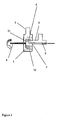
- the inlet (2) and the outlet (5) are positioned in such a way that an excess of air inlet can be avoided in the homogenisation compartment in order to avoid the formation of deformed particles.
- the inlet (2) is positioned co-axially to the axis of the mixing system (4), or in the axis of said system, and the outlet (5) is in the upper wall of the homogenization compartment (1).
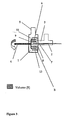
- the inlet (2) is a cannula for delivering the organic phase and the inlet (3) for delivering the aqueous phase are arranged in such a way that these two phases are delivered simultaneously and homogeneously in the homogenisation compartment (1).
- the tip (6) of said cannula is in a volume (A) delimited by the mixing system (4) in the homogenization compartment (1) and the tip (7) of said inlet (3) is in a volume (B) delimited between the wall (8) of the homogenization compartment (1) and the end (9) of the mixing system (4).
- the cannula is closed or not to its tip (6) and has perforations (10), so as to promote a fine dispersion of the organic phase in the aqueous phase, in the compartment Homogenization (1).
- the perforations (10) are on the final part of the cannula entering the volume (A). They can be on one or more rows or randomly.
- the number of perforations is at least 1 to 5. In an advantageous mode of realization, the number is 1 to 10 and in an even more advantageous mode, the number is 1 to 20.
- the perforations (10) can be obtained mechanically by perforation of the wall of the cannula using a micro-drill or a laser, for example.
- the perforations (10) can be from 0.01 mm to 1 mm.
- the perforations (10) are from 0.01 mm to 0.9 mm and even more preferably from 0.01 mm to 0.7 mm.
- the choice of the size of the perforations also makes it possible to optimize the dispersion of the organic phase in the aqueous phase in the homogenization compartment (1), but, above all, to optimize the accuracy of the desired size of the nanoparticles or nanoparticles. microparticles.
- the tangential speed of the mixing system (4) is 1.5 m / s to 50 m / s and preferably 2.5 m / s to 41 m / s.
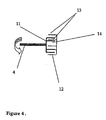
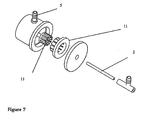
- the mixing system (4) is a rotor (11) / stator (12).
- the rotor (11) / stator (12) system may comprise at least one row of teeth (13) and the spacing (14) between the teeth (13) may be 1 to 4 mm.
- the dimensions of the rotor system (11) / stator (12) are such that said system occupies 4% to 40% of the volume of the homogenisation compartment (1).
- the present invention also relates to a continuous process for manufacturing microparticles or nanoparticles using the device according to the invention.
- Said method is such that an organic phase comprising at least one active substance, a polymer and a solvent is simultaneously delivered through the inlet (2) which is a cannula and an aqueous phase comprising at least one surfactant through the inlet ( 3) in the homogenisation compartment (1) in which the mixing system (4) has a tangential velocity of 1.5 m / s to 50 m / s simultaneously allowing the formation of an emulsion of said phases and the extraction of the solvent contained in the organic phase, so as to obtain a suspension of particles from which the nanoparticles or the microparticles are isolated.
- the tangential speed of the mixing system (4) is 1.5 m / s at 50 m / s and at least 2.5 m / at 41 m / s.
- the mixing system (4) is a rotor system (11) / stator (12).
- the organic phase is delivered via the cannula which is closed or not to its tip (6) and which has perforations (10), so as to spread radially. said phase in the aqueous phase in the homogenisation compartment (1).
- said suspension can be evacuated via the outlet (5) of the homogenisation compartment (1) and then carry out a direct or tangential filtration. It is also possible to carry out a simple or forced sedimentation with the aid of a device of centrifugal or centrifugal type, after evacuation of said suspension through the outlet (5) of the homogenisation compartment (1).
- the nanoparticles are isolated from the suspension of particles by evacuating said suspension through the outlet (5) of the homogenisation compartment (1) in a buffer vessel and then ultrafiltration of said suspension is carried out continuously.
- the microparticles are isolated from the suspension of particles by evacuating said suspension through the outlet (5) of the homogenisation compartment (1) in a buffer vessel and then continuously filtration of said suspension.
- the organic phase may comprise 1 to 30% of polymer in at least one solvent, but at least 2 to 25% and in all cases 5 to 20%.
- the polymer-active substance mixture present in the organic phase may comprise 0.1 to 50% of active substance but at least 0.5 to 40% of active substance and in all cases 1 to 30% of active substance.
- the organic phase may be in the form of a solution, an emulsion or a suspension.
- the organic phase is in the form of a solution when the active substance is solubilized with the other compounds of the organic phase.
- the organic phase is in the form of an emulsion when the active substance is solubilized in water and then emulsified with the other compounds of the organic phase.
- the organic phase is in the form of suspension when the active substance is not solubilized and it is in dispersed form in the organic phase.
- the water-soluble active substance may in particular be a peptide, a polypeptide, a protein or a pharmaceutically acceptable salt, respectively.
- the active substance may be gonadorelin (LHRH) or a derivative thereof (agonists and antagonists), thyrotropin (TSH), protirelin (TRH), follicle-stimulating hormone (FSH), parathyrin (PTH), insulin and other hypoglycemic peptides, C-peptide, exenatide analogues, GLP-1 analogues and other anti-obesity peptides, TCR receptor antagonists of lymphocytes, somatostatin or its derivatives, corticotropin (ACTH), growth hormone (GH), somatorelin (GHRH), growth hormone releasing peptide (GHRP), calcitonin, endorphin, interferon, interleukin, the factor tumor necrosis (TNF), erythropoietin (EPO), a colony stimulating factor (G-CSF, GM-CSF, M-CSF), nerve growth factor (NGF), somatomedin (IGF),
- LHRH
- the active substance may be a peptide salt. It can be a mono-, di-, or tri-salt.
- the peptide salt may be a salt formed with an inorganic acid such as hydrochloric acid, sulfuric acid or nitric acid, for example. It may also be a salt formed with an organic acid, such as, for example, carbonic acid, bicarbonate acid, succinic acid, acetic acid, propionic acid or trifluoroacetic acid.
- the peptide salt is a salt formed with an organic acid and most preferably the organic acid is acetic acid or pamoic acid.
- the preferred active substance is olanzapine, alendronate, tamoxifen, 4-OH tamoxifen, and derivatives, LHRH derivatives, in particular triptorelin pamoate, somatostatin derivatives, in particular vareotide pamoate.
- the polymer used is preferably a biodegradable or biocompatible polymer selected from poly-lactic acid, poly-glycolic acids, copolymers of lactic and glycolic acids, copolymers of lactic acid and caprolactone or other polymers biodegradable such as other aliphatic polymers, poly-citric acid, poly-malic acid, poly-succinates, poly-butyl succinates, poly-fumarates, polyhydroxybutyrates, poly-caprolactones, polycarbonates, poly-esteramides, poly-anhydrides, poly amino acids, polyorthoesters or their co-polymers with PEG, poly-alkyl-cyanoacrylates, poly-etheresters, poly-dioxanones, copolymers with polyethylene glycol such as, for example, the PBS-PEG co-blocks described in WO 99/55760, the PLA-PEG co-blocks described in US Pat.
- biodegradable or biocompatible polymer selected from
- Suitable non-biodegradable polymers are polyacrylic acid, poly-methacrylic acid, copolymers of acrylic acid and methacrylic acid, ethylcellulose, acetylcellulose, nitrocellulose, etc. These polymers may be homopolymers or copolymers of two or more monomers or mixtures of polymers.
- the polymer is selected from the group consisting of copolymers of lactic and glycolic acid, poly-lactic acid, copolymers of poly-lactic acid and caprolactone, copolymers of polyethylene glycol or poly-lactic acid.
- propylene glycol with other groups such as PBS-PEG, PLA-PEG or PLGA-PEG co-blocks, poly-orthoesters and poly-phosphazenes and their copolymers with PEG.
- the organic solvent used is chosen from immiscible or water-immiscible solvents such as esters such as ethyl acetate, butyl acetate, halogenated hydrocarbons such as dichloromethane, chloroform, chloroethane, dichloroethane, trichloroethane, ethers such as ethyl ether, isopropyl ether, aromatic hydrocarbons such as toluene, xylene, carbonates such as diethyl carbonate or the like.
- immiscible or water-immiscible solvents such as esters such as ethyl acetate, butyl acetate, halogenated hydrocarbons such as dichloromethane, chloroform, chloroethane, dichloroethane, trichloroethane, ethers such as ethyl ether, isopropyl ether, aromatic hydrocarbons such as toluene, xylene
- the solvent used is an ester or a halogenated hydrocarbon.
- the solvent used is ethyl acetate.
- Water-miscible solvents such as ethanol, dimethylformamide, dimethylsulfoxide, substituted pyrrolidones such as N-methylpyrrolidone or propylene glycol may be added to the water immiscible solvents.
- the solvents mentioned above alone or mixed can be used.
- the aqueous phase may comprise 0.05 to 5% of surfactant and at least 0.1 to 2%.
- the surfactants used are polyvinyl pyrrolidone, polyvinyl alcohol, carboxymethylcellulose, lecithin or gelatin, anionic surfactants such as sodium oleate, sodium stearate or sodium lauryl sulfate, nonionic surfactants such as polyoxyethylene sorbitan esters or a polyoxyethylenated castor oil derivative .
- the surfactant used is polyvinyl alcohol.
- the dimensions of the microparticles are measured by laser granulometry using a device, the Mastersizer® (Malvern Instruments) and the dimensions of the nanoparticles are measured using a device, the Zetasizer® (Malvern Instruments).
- a homogenizer such as Polytron PT 3000 / PT 3100 is used.
- the degree of encapsulation is measured by an appropriate analytical method, for example by HPLC-UV method following extraction in triethanolamine phosphate (TEAP) for the peptides, or by UV-visible spectrophotometry after complete solubilization in dimethylformamide. (DMF) for olanzapine.
- TEAP triethanolamine phosphate
- DMF dimethylformamide
- the encapsulation efficiency expressed in% corresponds to the ratio between the encapsulation rate measured and the theoretical encapsulation rate.
- Vapreotide acetate microparticles are prepared in low molecular weight 50/50 PLGA.
- the aqueous phase is prepared by mixing, with magnetic stirring at a temperature of 40 ° C, 5 g of polyvinyl alcohol and 245 g of water.
- the organic phase is prepared by completely dissolving 2 g of 50/50 D, L-lactide-co-glycolide polymer (PLGA) in 8 g of ethyl acetate with magnetic stirring.
- the PLGA polymer has an inherent viscosity of 0.17 dl / g corresponding to an average molecular weight of 10,000.
- 329 mg of vapreotide acetate are dissolved under magnetic stirring in 800 ⁇ l of DMSO (dimethylsulfoxide) and this solution is then added to the organic phase above. We obtain a homogeneous solution (organic phase).
- the device according to the invention is used.
- the cannula at a flow rate of 10 g / min, is simultaneously delivered with 11.1 g of the organic phase as prepared above and with inlet (3), at a flow rate of 150 ml / min, the aqueous phase as prepared above.
- the rotor (11) / stator (12) system is rotated at a tangential speed of 3.2 m / s or 4000 rpm.
- a suspension of particles is thus obtained from which the vapreotide acetate microparticles are isolated by filtration on a 1.2 .mu.m membrane.
- the particles are washed with purified water.
- the degree of encapsulation measured is 9.4% which corresponds to an encapsulation efficiency of approximately 75%.
- the average particle diameter is 25 ⁇ m.
- Vapreotide acetate microparticles were prepared in 50/50 PLGA with a molecular weight of 35,000 and an inherent viscosity of 0.34 dl / g.
- aqueous phase and the organic phase are prepared as mentioned above in Example 1.
- the device according to the invention is used.
- the cannula at a flow rate of 10 g / min, is simultaneously delivered with 11.1 g of the organic phase as prepared above and with inlet (3), at a flow rate of 150 ml / min, the aqueous phase as prepared above.
- the rotor (11) / stator (12) system is rotated at a tangential speed of 3.2 m / s or 4000 rpm.
- a suspension of particles is thus obtained from which the vapreotide acetate microparticles are isolated by filtration on a 1.2 .mu.m membrane.
- the particles are washed with purified water.
- the degree of encapsulation measured is 8.5%, which corresponds to an encapsulation efficiency of approximately 68%.
- the average particle diameter is 30 ⁇ m.
- Vapreotide pamoate microparticles were prepared in 50/50 PLGA with a molecular weight of 35,000.
- the aqueous phase is prepared by mixing, with magnetic stirring at a temperature of 40 ° C, 5 g of polyvinyl alcohol and 245 g of water.
- the organic phase is prepared by completely dissolving 4 g of 50/50 poly (D, L lactide-co-glycolide) polymer (PLGA) in 8 g of ethyl acetate with magnetic stirring. 700 mg of pamoate of vareotide is suspended in 8 g of polytron ethyl acetate at 20000 rpm for 3 minutes and then this suspension to the organic solution above and the whole is homogenized with polytron at 3000 rpm for 20 seconds.
- poly (D, L lactide-co-glycolide) polymer PLGA
- the device according to the invention is used.
- the 20 g of the organic phase as prepared above and 20.7 g of the organic phase are simultaneously delivered into the homogenisation compartment (1) via the inlet (2) and the cannula at a flow rate of 10 g / min. inlet (3), at a flow rate of 150 ml / min, the aqueous phase as prepared above.
- the rotor (11) / stator (12) system is rotated at a tangential speed of 3.2 m / s or 4000 rpm.
- a suspension of particles is thus obtained from which the vapreotide acetate microparticles are isolated by filtration on a 1.2 .mu.m membrane.
- the particles are washed with purified water.
- the degree of encapsulation measured is 10% which corresponds to an encapsulation efficiency of approximately 96%.
- the average particle diameter is 32 ⁇ m.
- Olanzapine microparticles are prepared in 50/50 PLGA with a molecular weight of 35,000.
- the aqueous phase is prepared by mixing, with magnetic stirring at a temperature of 40 ° C, 5 g of polyvinyl alcohol and 245 g of water.
- the organic phase is prepared by completely dissolving 2 g of 50/50 poly (D, L lactide-co-glycolide) polymer (PLGA) in 8 g of ethyl acetate with magnetic stirring.
- the device according to the invention is used.
- the cannula at a flow rate of 10 g / min, is simultaneously delivered with 10.2 g of the organic phase as prepared above and with inlet (3), at a flow rate of 150 ml / min, the aqueous phase as prepared above.
- the rotor (11) / stator (12) system is rotated at a tangential speed of 3.2 m / s or 4000 rpm.
- a suspension of particles is thus obtained from which the olanzapine microparticles are isolated by filtration on a 1.2 ⁇ m membrane.
- the particles are washed with purified water.
- the degree of encapsulation measured is 6.9%, which corresponds to an encapsulation efficiency of approximately 68%.
- the average particle diameter is 44 ⁇ m.
- Triptorelin acetate microparticles are prepared in 50/50 PLGA with a molecular weight of 35,000.
- the aqueous phase is prepared by mixing, with magnetic stirring at a temperature of 40 ° C, 5 g of polyvinyl alcohol and 245 g of water.
- the organic phase is prepared by completely dissolving 2 g of 50/50 poly (D, L lactide-co-glycolide) polymer (PLGA) in 4 g of ethyl acetate with magnetic stirring.
- triptorelin acetate 200 mg are suspended at 20000 rpm in 4 g of ethyl acetate and this suspension is then incorporated in the above organic phase. The whole is homogenized with Polytron at 3000 rpm
- the device according to the invention is used.
- the homogenization compartment (1) 10.2 g of the organic phase as prepared above and at least 10.2 g of the organic phase are delivered simultaneously to the homogenisation compartment (1) at a flow rate of 10 g / min. (3), at a flow rate of 150 ml / min, the aqueous phase as prepared above.
- the rotor (11) / stator (12) system is rotated at a tangential speed of 3.2 m / s or 4000 rpm.
- a suspension of particles is thus obtained from which the triptorelin acetate microparticles are isolated by filtration on a 1.2 ⁇ m membrane.
- the particles are washed with purified water.
- the degree of encapsulation measured is 8.9%, which corresponds to an encapsulation efficiency of approximately 100%.
- the average particle diameter is 45 ⁇ m.
- Salmon calcitonin microparticles are prepared in 50/50 PLGA with a mean molecular weight of 35000.
- the aqueous phase is prepared by mixing, with magnetic stirring at a temperature of 40 ° C, 5 g of polyvinyl alcohol and 245 g of water.
- the organic phase is prepared by completely dissolving 2 g of 50/50 poly (D, L lactide-co-glycolide) polymer (PLGA) in 4 g of ethyl acetate with magnetic stirring.
- 200 mg of salmon calcitonin are suspended in 4 g of ethyl acetate using a Polytron at 20000 rpm and then this suspension is incorporated in the organic phase above. The whole is homogenized with Polytron at 3000 rpm for 20 seconds.
- the device according to the invention is used.
- the homogenization compartment (1) 11.1 g of the organic phase as prepared above and 11.7 g of the organic phase are delivered simultaneously to the homogenisation compartment (1) at a flow rate of 10 g / min. the inlet (3), at a flow rate of 150 ml / min, the aqueous phase as prepared above.
- the rotor (11) / stator (12) system is rotated at a tangential speed of 3.2 m / s or 4000 rpm.
- a suspension of particles is thus obtained from which salmon calcitonin microparticles are isolated by filtration on a 1.2 .mu.m membrane.
- the particles are washed with purified water.
- the average particle diameter is 40 ⁇ m.
- Sodium alendronate microparticles are prepared in 50/50 PLGA with an average molecular weight of about 35,000.
- the aqueous phase is prepared by mixing, with magnetic stirring at a temperature of 40 ° C, 5 g of polyvinyl alcohol and 245 g of water.
- the organic phase is prepared by completely dissolving 4 g of 50/50 poly (D, L lactide-co-glycolide) polymer (PLGA) in 8 g of ethyl acetate with magnetic stirring.
- the device according to the invention is used.
- the rotor (11) / stator (12) system is rotated at a tangential speed of 3.2 m / s or 4000 rpm.
- a suspension of particles is thus obtained from which salmon calcitonin microparticles are isolated by filtration on a 1.2 .mu.m membrane.
- the particles are washed with purified water.
- the average particle diameter is 46 ⁇ m.
- Triptorelin acetate microparticles are prepared in 50/50 PLGA with a molecular weight of about 35,000.
- the aqueous phase is prepared by mixing, with magnetic stirring at a temperature of 40 ° C, 5 g of polyvinyl alcohol and 245 g of water.
- the organic phase is prepared by completely dissolving 2 g of 50/50 poly (D, L lactide-co-glycolide) polymer (PLGA) in 8 g of ethyl acetate with magnetic stirring.
- Triptorelin acetate (100 mg) is dissolved in 1.3 g of 20% Tween 80 solution and this solution is then emulsified in the above organic phase using Polytron at 15,000 rpm for 3 minutes.
- the device according to the invention is used.
- the rotor (11) / stator (12) system is rotated at a tangential speed of 3.2 m / s or 4000 rpm.
- a suspension of particles is thus obtained from which the triptorelin acetate microparticles are isolated by filtration on a 1.2 ⁇ m membrane.
- the particles are washed with purified water.
- the degree of encapsulation measured is 5.8%, which corresponds to an encapsulation efficiency of approximately 100%.
- the average particle diameter is 19 ⁇ m.
- Triptorelin pamoate microparticles were prepared in 85/15 PLGA with an average molecular weight of about 74,000.
- the aqueous phase is prepared by mixing, under magnetic stirring at a temperature of 40 ° C, 100 g of polyvinyl alcohol and 4900 g of water.
- the organic phase is prepared by completely dissolving 4 g of 85/15 poly (D, L lactide-co-glycolide) polymer (PLGA) in 15 g of dichloromethane with magnetic stirring.
- the device according to the invention is used.
- the rotor (11) / stator (12) system is rotated at a tangential speed of 4.4 m / s, ie 5500 rpm.
- a suspension of particles is thus obtained from which the triptorelin pamoate microparticles are isolated by filtration on a 1.2 ⁇ m membrane.
- the particles are washed with purified water.
- the degree of encapsulation measured is 12.54% which corresponds to an encapsulation efficiency of approximately 90%.
- the average particle diameter is 70 ⁇ m.
- Olanzapine nanoparticles are prepared in 50/50 PLGA with a molecular weight of 35,000.
- the aqueous phase is prepared by mixing, with magnetic stirring at a temperature of 40 ° C, 5 g of polyvinyl alcohol and 245 g of water.
- the organic phase is prepared by completely dissolving 2 g of 50/50 poly (D, L lactide-co-glycolide) polymer (PLGA) in 8 g of ethyl acetate with magnetic stirring.
- the device according to the invention is used.
- the homogenization compartment (1) is simultaneously delivered through the cannula (2), at a flow rate of 10 g / min, 10.2 g of the organic phase as prepared above and via the inlet (3). at a flow rate of 200 ml / min, the aqueous phase as prepared above.
- the rotor (11) / stator (12) system is rotated at a tangential speed of 40 m / s, ie 30000 rpm.
- a suspension of particles is thus obtained from which the olanzapine nanoparticles are isolated by centrifugation and filtration.
- the degree of encapsulation measured is 3.3% which corresponds to an encapsulation efficiency of approximately 33%.
- the average of the particles measured is 230 nm.
- Olanzapine nanoparticles are prepared in PBS-PEG with a molecular weight of about 30,000.
- the aqueous phase is prepared by mixing, with magnetic stirring at a temperature of 40 ° C, 40 g of polyvinyl alcohol and 1200 g of water.
- the organic phase is prepared by totally dissolving 0.9 g of PBS-PEG polymer having a viscosity of 0.64 dl / g (as produced in Example 10 of the patent application WO 99/55760) and 100 mg. olanzapine in 19 g of dichloromethane with magnetic stirring.
- the device according to the invention is used.
- the homogenization compartment (1) is simultaneously delivered through the cannula (2), at a flow rate of 10.9 ml / min, 22 g of organic phase as prepared above and via the inlet (3), at a rate of flow rate of 400 ml / min, the aqueous phase as prepared above.
- the rotor (11) / stator (12) system is rotated at a tangential velocity of 40 m / s or 30,000 rpm.
- a suspension of particles is thus obtained from which the olanzapine nanoparticles are isolated by filtration over 0.22 ⁇ m.
- the degree of encapsulation measured is 3% which corresponds to an encapsulation efficiency of approximately 30%.
- the average of the particles measured is 50 nm.
- Triptorelin pamoate microparticles were prepared in 85/15 PLGA with a molecular weight of 74,000.
- the aqueous phase is prepared by mixing, under magnetic stirring at a temperature of 40 ° C, 100 g of polyvinyl alcohol and 4900 g of water.
- the organic phase is prepared by completely dissolving 4 g of 85/15 poly (D, L lactide-co-glycolide) polymer (PLGA) in 15 g of ethyl acetate with magnetic stirring. Polytron (20000rpm, 6 minutes) is dispersed in 1000 g of triptorelin pamoate in 10 g of ethyl acetate and this suspension is then added to the organic phase above.
- PLGA poly (D, L lactide-co-glycolide) polymer
- the device according to the invention is used.
- the organic phase as prepared above and at the inlet (3) at a flow rate of 5 ml / min are simultaneously delivered to the homogenisation compartment (1) through the cannula (2).
- the rotor (11) / stator (12) system is rotated at a tangential speed of 4.4 m / s, ie 5500 rpm.
- a suspension of particles is thus obtained from which the triptorelin pamoate microparticles are isolated by filtration on a 1.2 ⁇ m membrane.
- the particles are washed with purified water.
- the degree of encapsulation measured is 11.27% which corresponds to an encapsulation efficiency of approximately 80%.
- the average particle diameter is 33.9 ⁇ m.
- Triptorelin pamoate microparticles were prepared in 85/15 PLGA with a molecular weight of 74,000.
- the aqueous phase is prepared by mixing, under magnetic stirring at a temperature of 40 ° C, 10 g of polyvinyl alcohol and 1990 g of water.
- the organic phase is prepared by completely dissolving 4 g of 85/15 poly (D, L lactide-co-glycolide) polymer (PLGA) in 15 g of ethyl acetate with magnetic stirring.
- the device according to the invention is used.
- the organic phase as prepared above and at the inlet (3) at a flow rate of 5 ml / min are simultaneously delivered to the homogenisation compartment (1) through the cannula (2).
- the rotor (11) / stator (12) system is rotated at a tangential speed of 4.4 m / s, ie 5500 rpm.
- a suspension of particles is thus obtained from which the triptorelin pamoate microparticles are isolated by filtration on a 1.2 ⁇ m membrane.
- the particles are washed with purified water.
- the degree of encapsulation measured is 12.4% which corresponds to an encapsulation efficiency of approximately 89%.
- the average particle diameter is 46.2 ⁇ m.
- Triptorelin pamoate microparticles are prepared in 90/10 PLGA with a molecular weight of about 30,000.
- the aqueous phase is prepared by mixing, with magnetic stirring at a temperature of 40 ° C, 40 g of polyvinyl alcohol and 1960 g of purified water.
- the organic phase is prepared by completely dissolving 4 g of 90/10 poly (D, L lactide-co-glycolide) polymer (PLGA) in 15 g of ethyl acetate with magnetic stirring. 1000 mg of triptorelin pamoate in 10 g of polytron ethyl acetate are suspended at 20,000 rpm for 6 minutes, and this solution is then added to the organic phase above.
- PLGA poly (D, L lactide-co-glycolide) polymer
- the device according to the invention is used.
- the organic phase as prepared above and at the inlet (3) at a flow rate of 5 ml / min are simultaneously delivered to the homogenisation compartment (1) through the cannula (2).
- the rotor (11) / stator (12) system is rotated at a tangential speed of 4.4 m / s, ie 5500 rpm.
- a suspension of particles is thus obtained from which the triptorelin pamoate microparticles are isolated by filtration on a 1.2 ⁇ m membrane.
- the particles are washed with purified water.
- the degree of encapsulation measured is 10.5%, which corresponds to an encapsulation efficiency of approximately 75%.
- the average particle diameter is 20.7 ⁇ m.
- Triptorelin pamoate microparticles are prepared in PLA of molecular weight about 30,000.
- the aqueous phase is prepared by mixing, with magnetic stirring at a temperature of 40 ° C, 40 g of polyvinyl alcohol and 1960 g of water.
- the organic phase is prepared by completely dissolving 4 g of poly (D, L lactide) - (PLA) polymer in 15 g of ethyl acetate with magnetic stirring. 1000 mg of triptorelin pamoate in 10 g of polytron ethyl acetate are suspended at 20,000 rpm for 6 minutes, and this solution is then added to the organic phase above.
- the device according to the invention is used.
- the organic phase as prepared above and at the inlet (3) at a flow rate of 5 ml / min are simultaneously delivered to the homogenisation compartment (1) through the cannula (2).
- the rotor (11) / stator (12) system is rotated at a tangential speed of 4.4 m / s, ie 5500 rpm.
- a suspension of particles is thus obtained from which the triptorelin pamoate microparticles are isolated by filtration on a 1.2 ⁇ m membrane.
- the particles are washed with purified water.
- the degree of encapsulation measured is 10% which corresponds to an encapsulation efficiency of approximately 71%.
- the average particle diameter is 21.6 ⁇ m.
- Triptorelin pamoate microparticles are prepared in PLA with a molecular weight of about 70,000.
- the aqueous phase is prepared by mixing, with magnetic stirring at a temperature of 40 ° C, 40 g of polyvinyl alcohol and 1960 g of water.
- the organic phase is prepared by completely dissolving 4 g of poly (D, L lactide) - (PLA) polymer in 15 g of ethyl acetate with magnetic stirring.
- triptorelin pamoate 1000 mg is suspended in 10 g of polytron ethyl acetate at 20000 rpm, 6 minutes, and this suspension is then added to the organic phase above.
- the device according to the invention is used.
- the organic phase as prepared above and at the inlet (3) at a flow rate of 5 ml / min are simultaneously delivered to the homogenisation compartment (1) through the cannula (2).
- the rotor (11) / stator (12) system is rotated at a tangential speed of 4.4 m / s, ie 5500 rpm.
- a suspension of particles is thus obtained from which the triptorelin pamoate microparticles are isolated by filtration on a 1.2 ⁇ m membrane.
- the particles are washed with purified water.
- the degree of encapsulation measured is 11.5% which corresponds to an encapsulation efficiency of approximately 82%.
- the average particle diameter is 32.1 ⁇ m.
- Triptorelin pamoate microparticles are prepared in PLA with a molecular weight of about 20,000.
- the aqueous phase is prepared by mixing, with magnetic stirring at a temperature of 40 ° C, 40 g of polyvinyl alcohol and 1960 g of water.
- the organic phase is prepared by completely dissolving 4 g of poly (D, L lactide) - (PLA) polymer in 15 g of ethyl acetate with magnetic stirring. 1000 mg of triptorelin pamoate is suspended in 10 g of polytron ethyl acetate at 20000 rpm, 6 minutes, and this suspension is then added to the organic phase above.
- the device according to the invention is used.
- the organic phase as prepared above and at the inlet (3) at a flow rate of 5 ml / min are simultaneously delivered to the homogenisation compartment (1) through the cannula (2).
- the rotor (11) / stator (12) system is rotated at a tangential speed of 4.4 m / s, ie 5500 rpm.
- a suspension of particles is thus obtained from which the triptorelin pamoate microparticles are isolated by filtration on a 1.2 ⁇ m membrane.
- the particles are washed with purified water.
- the degree of encapsulation measured is 8.83% which corresponds to an encapsulation efficiency of approximately 63%.
- the average particle diameter is 22.2 ⁇ m.
- Triptorelin pamoate microparticles are prepared in a 75/25 poly (D, L-lactide-co- ⁇ -caprolactone) co-polymer (PLA-PCL) with a molecular weight of 80,000.
- the aqueous phase is prepared by mixing, with magnetic stirring at a temperature of 40 ° C, 40 g of polyvinyl alcohol and 1960 g of water.
- the organic phase is prepared by completely dissolving 4 g of 75/25 poly (D, L-lactide-co- ⁇ -caprolactone) copolymer polymer (PLA-PCL) in 15 g of ethyl acetate with magnetic stirring. . 1000 mg of triptorelin pamoate is suspended in 10 g of ethyl acetate and then this suspension is incorporated in the above organic phase.
- PHA-PCL poly (D, L-lactide-co- ⁇ -caprolactone) copolymer polymer
- the device according to the invention is used.
- the organic phase is delivered simultaneously with the cannula (2) at a flow rate of 5 ml / min. prepared above and at the inlet (3), at a flow rate of 200 ml / min, the aqueous phase as prepared above.
- the rotor (11) / stator (12) system is rotated at a tangential speed of 4.4 m / s, ie 5500 rpm.
- a suspension of particles is thus obtained from which the triptorelin pamoate microparticles are isolated by filtration on a 1.2 ⁇ m membrane.
- the particles are washed with purified water. These particles can then be frozen and lyophilized.
- the average particle diameter is 35.2 ⁇ m.
- the aqueous phase is prepared by mixing, with magnetic stirring at a temperature of 40 ° C, 260 g of polyvinyl alcohol and 12740 g of H 2 O MilliQ.
- the organic phase is prepared by completely dissolving 4.26 g of a mixture comprising 50% of 50/50 poly (D, L lactide-co-glycolide) polymer (PLGA) with a viscosity of 0.5 dl / g and 50%. of Eudragit RS PO polymer in 83.5 g of ethyl acetate with magnetic stirring.
- nadroparin 750 mg of nadroparin are suspended in 16.7 ml of purified water and this solution is emulsified in the organic phase using Polytron (15000 rpm, 90 seconds).
- the device according to the invention is used.
- the cannula In the homogenization compartment (1), the cannula, at a flow rate of 5 ml / min, is simultaneously delivered through the inlet (2), the organic phase as prepared above and via the inlet (3). at a flow rate of 650 ml / min, the aqueous phase as prepared above.
- the rotor (11) / stator (12) system is rotated at a tangential speed of 3.2 m / s or 4000 rpm.
- a suspension of particles is thus obtained from which the particles are isolated by filtration on a 1.2 ⁇ m membrane.
- the particles are washed with purified water.
- the average diameter of the microparticles is 23 ⁇ m.
- Interferon microparticles are prepared.
- the aqueous phase is prepared by mixing, under magnetic stirring at a temperature of 40 ° C, 120 g of polyvinyl alcohol and 5880 g of H 2 O MilliQ.
- the organic phase is prepared by completely dissolving 1.98 g of a mixture comprising 50% of 50/50 poly (D, L lactide-co-glycolide) (PLGA) polymer with a viscosity of 0.5 dl / g and 50% of polymer.
- Eudragit RS PO in 39 ml of ethyl acetate with magnetic stirring.
- 7 ml of the interferon solution is prepared by mixing 381 ⁇ l of the interferon alpha 17 solution in pH 8 phosphate buffer (1.83 mg protein / ml), 280 ⁇ l of human serum albumin solution (50 mg / ml) in pH 8 phosphate buffer and 6939 ⁇ l of pH 8 phosphate buffer.
- the interferon solution thus prepared is emulsified in the organic phase using a Polytron (15,000 rpm, 90 seconds).
- the device according to the invention is used.
- the cannula In the homogenization compartment (1), the cannula, at a flow rate of 5 ml / min, is simultaneously delivered through the inlet (2), the organic phase as prepared above and via the inlet (3). at a flow rate of 590 ml / min, the aqueous phase as prepared above.
- the rotor (11) / stator (12) system is rotated at a tangential speed of 2.4 m / s, ie 3000 rpm.
- a suspension of particles is thus obtained from which the particles are isolated by filtration on a 1.2 ⁇ m membrane.
- the particles are washed with purified water.
- the average diameter of the microparticles is 19.1 ⁇ m.
- An aqueous phase is prepared by mixing with magnetic stirring 10 g of PVA (polyvinyl alcohol), 0.847 g of dehydrated sodium hydrogen phosphate and 489 g of H 2 O MilliQ. Finally, 39 g of ethyl acetate are added so as to stabilize the pH at 8.9.
- PVA polyvinyl alcohol
- 0.847 g of dehydrated sodium hydrogen phosphate 0.847 g of dehydrated sodium hydrogen phosphate
- 489 g of H 2 O MilliQ 489 g of H 2 O MilliQ.
- an organic phase is prepared by dissolving 3.4 g of 50/50 poly (D, L lactide-co-glycolide) polymer (PLGA) with a viscosity of 0.34 dl / g in 3.4 g of acetate. ethyl with magnetic stirring. 571 mg of leuprolide acetate are also dissolved in 1.549 g of DMSO.
- poly (D, L lactide-co-glycolide) polymer PLGA
- This solution containing leuprolide acetate is mixed in the organic phase with magnetic stirring.
- the organic phase thus prepared is pumped into the Silverson type homogenizer equipped with a 4-blade rotor rotating at 400 rpm.
- the aqueous phase is also pumped into this homogenizer at a rate of 127 ml / min.
- a portion of the solvent contained in this primary emulsion is extracted from the Silverson homogenizer by pumping purified water at a flow rate of 1790 ml / min.
- a suspension of microspheres is thus obtained which is collected in a vessel containing 500 ml of purified water in which said suspension is left under magnetic stirring for 15 minutes, so as to extract the remaining solvent contained in this suspension.
- the suspension of particles is filtered so as to obtain individualized particles which are lyophilized.
- the particles thus obtained are of elongated and inhomogeneous shape and sieving over 106 ⁇ m is difficult.
- Estradiol valerate nanoparticles are prepared in 50/50 PLGA with a molecular weight of 35,000.
- the aqueous phase is prepared by mixing, under magnetic stirring at room temperature, 5 g of polyvinyl alcohol and 245 g of water.
- the organic phase is prepared by completely dissolving 2.467 g of 50/50 poly (D, L lactide-co-glycolide) polymer (PLGA) in 50 ml of ethyl acetate with magnetic stirring.
- estradiol valerate is dissolved in the organic phase above.
- the device according to the invention is used.
- the whole of the organic phase as prepared above and at the inlet (3), at a flow rate of 5 ml / min, are simultaneously delivered into the homogenisation compartment (1) via the cannula (2) at a flow rate of 5 ml / min. a flow rate of 10 ml / min, the aqueous phase as prepared above until the organic phase is exhausted.
- the rotor (11) / stator (12) system is rotated at a tangential speed of 26.6 m / s or 20 000 rpm.
- the aqueous phase is prepared by mixing, with magnetic stirring at room temperature, 100 g of polyvinyl alcohol and 4900 g of water (2%).
- the organic phase is prepared by completely dissolving 2.27 g of polymer 75/25 poly (D, L lactide-co-glycolide) (PLGA) in 25 g of ethyl acetate with magnetic stirring.
- estradiol valerate is dissolved in the organic phase above.
- the device according to the invention is used.
- the organic phase thus prepared is pumped at a rate of 5 ml / min into the Silverson-type homogenizer equipped with a 4-blade rotor according to the patent WO 03/033097 rotating at 5500 rpm.
- the aqueous phase is also pumped into this homogenizer at a rate of 750 ml / min.
- a suspension of microspheres is thus obtained which is collected in a vessel with magnetic stirring.
- the suspension contains microspheres of non-homogeneous size as well as filaments.
- the suspension consisting of said microparticles and said filaments is filtered through a 1.2 ⁇ m filter and then lyophilized.
- the particles obtained are of filamentous and non-homogeneous form. Suspending is difficult.
- Olanzapine microparticles are prepared in low molecular weight 50/50 PLGA.
- the aqueous phase is prepared by mixing, under magnetic stirring at a temperature of 40 ° C, 80 g of polyvinyl alcohol and 3920 g of water.
- the organic phase is prepared by completely dissolving 4.5 g of 50/50 D, L-lactide-co-glycolide polymer (PLGA) in 25 g of ethyl acetate with magnetic stirring.
- the PLGA polymer has an inherent viscosity of 0.34 dl / g corresponding to an average molecular weight of 35000 Da.
- Olanzapine 500 mg was dissolved with magnetic stirring in the organic phase above. We obtain a homogeneous solution (organic phase).
- the device according to the invention is used.
- the cannula used is covered with a multiperforated grid at its end.
- the rotor (11) / stator (12) system is rotated at a tangential speed of 4.0 m / s, ie 5000 rpm.
- a suspension of particles is thus obtained from which the olanzapine microparticles are isolated by filtration on a 1.2 ⁇ m membrane.
- the particles are washed with purified water
- the degree of encapsulation measured is 8.6%, which corresponds to an encapsulation efficiency of approximately 86%.
- the average particle diameter is 32 ⁇ m.
- Estradiol microparticles are prepared in 50/50 PLGA of molecular weight 40000 Da and having an inherent viscosity of 0.42 dl / g.
- the aqueous phase is prepared by mixing, under magnetic stirring at a temperature of 40 ° C, 160 g of polyvinyl alcohol and 7840 g of water.
- the organic phase is prepared by totally dissolving 4.9 g of 50/50 D, L lactide-co-glycolide polymer (PLGA) in 50 g of ethyl acetate with magnetic stirring. 100 mg of estradiol are dissolved with magnetic stirring in 800 ⁇ l of DMSO (dimethylsulfoxide) and this solution is then incorporated into the phase organic above. We obtain a homogeneous solution (organic phase).
- DMSO dimethylsulfoxide
- the device according to the invention is used.
- the rotor (11) / stator (12) system is rotated at a tangential speed of 4.0 m / s, ie 5000 rpm.
- a suspension of particles is thus obtained from which the estradiol microparticles are isolated by filtration on a 1.2 .mu.m membrane. The particles are washed with purified water.
- the degree of encapsulation measured is 1.5%, which corresponds to an encapsulation efficiency of approximately 75%.
- the average particle diameter is 18.9 ⁇ m.
- Estradiol microparticles are prepared in 50/50 PLGA of 50,000 Da molecular weight and having an inherent viscosity of 0.5 dl / g.
- the aqueous phase is prepared by mixing, under magnetic stirring at a temperature of 40 ° C, 160 g of polyvinyl alcohol and 7840 g of water.
- the organic phase is prepared by totally dissolving 4.9 g of 50/50 D, L lactide-co-glycolide polymer (PLGA) in 50 g of ethyl acetate with magnetic stirring. 100 mg of estradiol are dissolved with magnetic stirring in 800 ⁇ l of DMSO (dimethylsulfoxide) and this solution is then added to the organic phase above. We obtain a homogeneous solution (organic phase).
- DMSO dimethylsulfoxide
- the device according to the invention is used.
- the rotor (11) / stator (12) system is rotated at a tangential speed of 4.0 m / s, ie 5000 rpm.
- a suspension of particles is thus obtained from which the estradiol microparticles are isolated by filtration on a 1.2 .mu.m membrane. The particles are washed with purified water.
- the degree of encapsulation measured is 1.7% which corresponds to an encapsulation efficiency of approximately 85%.
- the average particle diameter is 23.6 ⁇ m.
- Estradiol microparticles are prepared in 75/25 PLGA with a molecular weight of 70,000 Da and an inherent viscosity of 0.65 dl / g.
- the aqueous phase is prepared by mixing, under magnetic stirring at a temperature of 40 ° C, 160 g of polyvinyl alcohol and 7840 g of water.
- the organic phase is prepared by totally dissolving 4.65 g of 75/25 D polymer, L lactide-co-glycolide (PLGA) in 50 g of ethyl acetate with magnetic stirring. 350 mg of estradiol are dissolved with magnetic stirring in 2500 ⁇ l of DMSO (dimethylsulfoxide) and this solution is then added to the organic phase above. We obtain a homogeneous solution (organic phase).
- DMSO dimethylsulfoxide
- the device according to the invention is used.
- 57 g of the organic phase as prepared above and at the inlet (6) are delivered simultaneously to the homogenisation compartment (1) via the cannula (2) at a flow rate of 5 ml / min. a flow rate of 750 ml / min, the aqueous phase as prepared above.
- the rotor (11) / stator (12) system is rotated at a tangential speed of 4.4 m / s, ie 5500 rpm.
- a suspension of particles is thus obtained from which the estradiol microparticles are isolated by filtration on a 1.2 .mu.m membrane. The particles are washed with purified water.
- the degree of encapsulation measured is 6% which corresponds to an encapsulation efficiency of approximately 86%.
- the average particle size is 18.4 ⁇ m.
Landscapes
- Chemical & Material Sciences (AREA)
- Health & Medical Sciences (AREA)
- Engineering & Computer Science (AREA)
- Bioinformatics & Cheminformatics (AREA)
- Chemical Kinetics & Catalysis (AREA)
- Nanotechnology (AREA)
- Epidemiology (AREA)
- Life Sciences & Earth Sciences (AREA)
- Animal Behavior & Ethology (AREA)
- General Health & Medical Sciences (AREA)
- Public Health (AREA)
- Veterinary Medicine (AREA)
- Pharmacology & Pharmacy (AREA)
- Medicinal Chemistry (AREA)
- Physics & Mathematics (AREA)
- Biomedical Technology (AREA)
- Optics & Photonics (AREA)
- Composite Materials (AREA)
- Condensed Matter Physics & Semiconductors (AREA)
- General Physics & Mathematics (AREA)
- Materials Engineering (AREA)
- Crystallography & Structural Chemistry (AREA)
- Medicinal Preparation (AREA)
- Medicines That Contain Protein Lipid Enzymes And Other Medicines (AREA)
- Manufacturing Of Micro-Capsules (AREA)
- Processing And Handling Of Plastics And Other Materials For Molding In General (AREA)
- Colloid Chemistry (AREA)
- Physical Or Chemical Processes And Apparatus (AREA)
- Mixers Of The Rotary Stirring Type (AREA)
Description
- L'invention concerne un dispositif pour la fabrication de microparticules ou de nanoparticules ainsi que sa mise en oeuvre dans un procédé de fabrication desdites particules.
- Il est connu de réaliser des microparticules et des nanoparticules par la mise en oeuvre de procédés dans lesquels une phase organique est mélangée à une phase aqueuse. La réalisation de nanoparticules et de microparticules industriellement, pose un problème du fait de leur petite taille. Différents procédés et mises en oeuvre de dispositifs pour la réalisation de microparticules et de nanoparticules sont décrits dans la littérature. Il est notamment connu d'utiliser des techniques telles que la nébulisation dans un courant d'air chaud (spray -drying) ou froid (spray - cooling), la séparation de phase, l'émulsion - extraction de solvant, l'émulsion -évaporation de solvant ou encore des fluides supercritiques.
- Par ailleurs, avec les techniques couramment utilisées, il est notamment difficile d'obtenir des particules de formes régulières et de tailles homogènes. De plus, des difficultés lors de l'étape d'isolation de telles particules, notamment, par filtration ou par tamisage, ne permettent pas d'optimiser le rendement de fabrication.
- EP 0471 036 décrit un procédé de fabrication de nanoparticules et de microparticules dans lequel, dans un homogénéisateur de type Silverson, une phase organique est dispersée dans un milieu saturé en solvant identique à celui contenu dans ladite phase organique, de manière à former une première émulsion huile dans l'eau. Cette émulsion, constituée de micro-gouttes, est transférée aussi rapidement que possible dans un milieu permettant d'extraire 20 à 30% du solvant contenu dans les micro-gouttes. Cette seconde étape permet d'obtenir des microparticules et nanoparticules durcies. Par ailleurs, le problème rencontré avec ce procédé est qu'il faut adapter l'équipement en fonction des quantités de la phase organique de départ.
- WO 98/35654 décrit un procédé en continu pour la fabrication de microparticules. Avec le dispositif utilisé, le procédé ne permet pas d'obtenir des particules de taille définie et de forme régulière. En effet, le positionnement des entrées des phases et celui de la sortie du compartiment d'homogénéisation sont tels qu'un volume d'air occupe en partie le compartiment d'homogénéisation tout au long de la phase d'homogénéisation et de ce fait des turbulences se créent dans le compartiment entraînant la formation de particules de forme irrégulières.
- WO 03/033097 concerne l'utilisation d'un appareil rotor/stator pour la fabrication de fines particules par mode de précipitation ou de cristallisation. Dans le dispositif de cet art antérieur il n'est pas fait usage d'une canule et encore moins d'un moyen d'entrée perforé pour une meilleure diffusion des phases dans la chambre d'homogénéisation. Par ailleurs, le rotor utilisé est un rotor avec des parois ayant une structure type « trémie ». De plus, les phases mises en jeu subissent des forces de brassage pour leur mélange.
Enfin, il est à noter que le positionnement de la sortie est telle qu'un vide se forme inévitablement ce qui ne favorise pas la formation de petites particules de forme régulière. - Le document US-A-4 416 548 décrit un dispositif comprenant les caractéristiques du préambule de la revendication 1.
- Dans le dispositif selon la présente invention du fait du positionnement perpendiculaire des dents du rotor / stator, les deux phases passent à travers les dents et ce sont les forces de cisaillement qui contribuent à une bonne homogénéisation du mélange et la réalisation de particules régulières de petite taille.
Les problèmes rencontrés par le passé ont pu être résolus par le dispositif selon l'invention et sa mise en oeuvre dans un procédé en continu pour la fabrication de nanoparticules ou de microparticules selon l'invention. - L'un des buts de la présente invention est donc de proposer un dispositif selon la revendication 1 permettant un contrôle de la taille du produit fini et permettant, ainsi, de réaliser en continu aussi bien des nanoparticules que des microparticules de forme régulière.
- Un autre but de la présente invention est d'optimiser un procédé de fabrication de nanoparticules ou de microparticules en mettant en oeuvre le dispositif selon l'invention de manière à réaliser rapidement et en continu des nanoparticules ou des microparticules de forme régulière, solides et individualisées.
- Un des objets de la présente invention est un dispositif comprenant un compartiment d'homogénéisation, comprenant lui-même un système de remplissage, un système de rotor / stator et un moyen de sortie, pour la fabrication en continu de microparticules ou de nanoparticules à partir, au moins, d'une phase aqueuse et d'une phase organique.
- Un autre objet de la présente invention est un procédé de fabrication de microparticules ou de nanoparticules mettant en oeuvre ledit dispositif selon la revendication 8, et un procédé de fabrication en continu de microparticules ou de nanoparticules selon la revendication 12.
- De plus, dans la suite de la description, on emploiera l'expression « un système de rotor / stator » pour désigner un système constitué d'une pièce fixe, « le stator », dans laquelle est emboîtée une pièce mobile, « le rotor ». Dans un mode particulier de l'invention, « le rotor » et « le stator » sont munis de dents permettant, par rotation, le mélange de différentes substances et leur homogénéisation.
- On emploiera l'expression « dents du rotor » pour désigner les parties saillantes du rotor et du stator.
- On emploiera, dans la suite de la description, l'expression « compartiment d'homogénéisation » pour désigner l'enceinte fermée dans laquelle les phases sont mises en contact et se mélangent de manière homogène.
- Dans la suite de la description, on utilisera l'expression « perforations » pour désigner des trous de taille inférieure ou égale 1 mm.
- Dans la suite de la description, on emploiera l'expression « canule » pour désigner un conduit permettant le passage de substances.
- On emploiera, dans la suite du texte, l'expression « substance active » pour désigner une substance ayant au moins une caractéristique pharmaceutique.
- On emploiera, dans la suite du texte, l'expression « solvant » pour désigner le milieu organique dans lequel on solubilise un ou plusieurs polymères.
- On emploiera l'expression « polymère », dans la suite du texte, pour désigner la matrice constituées d'unités polymérisées jouant le rôle d'agent contrôlant la libération des substances actives.
- On emploiera l'expression « récipient tampon » pour désigner le récipient placé en sortie du compartiment d'homogénéisation dans le but de recueillir un volume suffisant de suspension de particules, permettant d'amorcer une pompe pour la filtration ou l'ultrafiltration des particules.
- On emploiera l'expression « phase aqueuse » pour désigner la phase externe composée au moins d'eau et de surfactant permettant l'extraction du solvant organique et le durcissement des particules.
- On emploiera l'expression « surfactant » ou « tensio actif » pour désigner la substance ajoutée dans la phase aqueuse permettant de stabiliser l'émulsion.
- On emploiera l'expression « phase organique » pour désigner la solution ou la suspension ou l'émulsion comprenant au moins un polymère et une substance active.
- La présente invention concerne un dispositif pour la fabrication en continu de microparticules ou de nanoparticules à partir au moins d'une phase aqueuse et d'une phase organique, constitué par un compartiment d'homogénéisation (1) comprenant au moins une entrée (2) pour délivrer la phase organique, une entrée (3) pour délivrer la phase aqueuse, un système mélangeur (4) et une sortie (5), caractérisé en ce que
- a) l'entrée (2) est une canule pour délivrer la phase organique et est positionnée co-axialement à l'axe dudit système mélangeur (4),
- b) l'embout (6) de ladite canule est dans un volume (A) délimité par le système mélangeur (4) dans le compartiment d'homogénéisation (1),
- c) l'embout (7) de l'entrée (3) est dans le volume (B) délimité entre la paroi (8) du compartiment d'homogénéisation (1) et l'extrémité (9) du système mélangeur (4), et
- d) la sortie (5) est dans la paroi supérieure du compartiment d'homogénéisation.
- Dans le dispositif selon la présente invention, l'entrée (2) et la sortie (5) sont positionnées de telle manière que l'on puisse éviter un excès d'entrée d'air dans le compartiment d'homogénéisation afin d'éviter la formation de particules déformées.
L'entrée (2) est positionnée co-axialement à l'axe du système mélangeur (4), soit dans l'axe dudit système, et la sortie (5) est dans la paroi supérieure du compartiment d'homogénéisation(1).
Dans le dispositif selon la présente invention, l'entrée (2) est une canule pour délivrer la phase organique et l'entrée (3) pour délivrer la phase aqueuse sont disposées de telle manière que ces deux phases sont délivrées simultanément et de manière homogène dans le compartiment d'homogénéisation (1). - De plus, pour favoriser une bonne dispersion de la phase organique dans la phase aqueuse, l'embout (6) de ladite canule est dans un volume (A) délimité par le système mélangeur (4) dans le compartiment d'homogénéisation (1) et l'embout (7) de ladite entrée (3) est dans un volume (B) délimité entre la paroi (8) du compartiment d'homogénéisation (1) et l'extrémité (9) du système mélangeur (4).
- De préférence, dans le dispositif selon l'invention, la canule est fermée ou non à son embout (6) et présente des perforations (10), de manière à favoriser une dispersion fine de la phase organique dans la phase aqueuse, dans le compartiment d'homogénéisation (1).
- Les perforations (10) se trouvent sur la partie finale de la canule entrant dans le volume (A). Elles peuvent être sur une ou plusieurs rangées ou de manière aléatoire.
- Dans un mode de réalisation du dispositif selon l'invention, le nombre de perforations est au minimum de 1 à 5. Dans un mode avantageux de réalisation, le nombre est de 1 à 10 et dans un mode encore plus avantageux, le nombre est de 1 à 20.
- Les perforations (10) peuvent être obtenues mécaniquement par perforation de la paroi de la canule à l'aide d'un micro-foret ou d'un laser, par exemple.
- On peut également utiliser une canule dont la partie finale se trouvant dans le volume (A), est dans un matériel comme, par exemple, du verre fritté ou de la maille métallique. On a ainsi une canule dont la partie finale a une multitude de perforations (10) pouvant être de dimension inférieure à 0,01 mm.
- Les perforations (10) peuvent être de 0,01 mm à 1 mm. De préférence, les perforations (10) sont de 0,01 mm à 0,9 mm et de manière encore plus préférée de 0,01 mm à 0,7 mm. Le choix de la dimension des perforations permet également d'optimiser la dispersion de la phase organique dans la phase aqueuse dans le compartiment d'homogénéisation (1), mais, surtout, d'optimiser l'exactitude de la taille souhaitée des nanoparticules ou des microparticules.
- Dans le dispositif selon l'invention, la vitesse tangentielle du système mélangeur (4) est de 1,5 m/s à 50 m/s et de manière préférée de 2,5 m/s à 41 m/ s.
- Dans un mode de réalisation de l'invention, le système mélangeur (4) est un rotor (11) / stator (12).
- Le système rotor (11) / stator (12) peut comprendre au moins une rangée de dents (13) et l'espacement (14) entre les dents (13) peut être de 1 à 4 mm. Plus l'espacement est petit, plus il est aisé de réaliser des particules de petite taille. A l'inverse, plus l'espacement est grand, plus il est aisé de réaliser des particules de taille plus grande.
- De préférence, les dimensions du système de rotor (11) / stator (12) sont telles que ledit système occupe 4% à 40% du volume du compartiment d'homogénéisation (1).
- La présente invention a également pour objet un procédé en continu de fabrication de microparticules ou de nanoparticules mettant en oeuvre le dispositif selon l'invention.
- Ledit procédé est tel que l'on délivre simultanément une phase organique comprenant au moins une substance active, un polymère et un solvant par l'entrée (2) qui est une canule et une phase aqueuse comprenant au moins un surfactant par l'entrée (3) dans le compartiment d'homogénéisation (1) dans lequel le système mélangeur (4) a une vitesse tangentielle de 1,5 m/s à 50 m/s permettant simultanément la formation d'une émulsion desdites phases et l'extraction du solvant contenu dans la phase organique, de manière à obtenir une suspension de particules à partir de laquelle on isole les nanoparticules ou les microparticules.
- De préférence, dans le procédé selon l'invention mettant en oeuvre ledit dispositif, la vitesse tangentielle du système mélangeur (4) est de 1,5 m/s à 50 m/ s et au moins de 2,5 m/ à 41 m/s.
- De préférence, dans le procédé selon l'invention, le système mélangeur (4) est un système rotor (11) / stator (12).
- Dans un mode préféré du procédé selon l'invention, on délivre la phase organique par la canule qui est fermée ou non à son embout (6) et qui présente des perforations (10), de manière à disperser de manière radiale ladite phase dans la phase aqueuse dans le compartiment d'homogénéisation (1).
- Pour isoler les nanoparticules ou les microparticules à partir de la suspension de particules, on peut évacuer ladite suspension par la sortie (5) du compartiment d'homogénéisation (1) puis effectuer une filtration directe ou tangentielle. On peut également effectuer une sédimentation simple ou forcée à l'aide d'un dispositif de type centrifugation en continu ou essoreuse, après évacuation de ladite suspension par la sortie (5) du compartiment d'homogénéisation (1).
- Dans un mode réalisation du procédé selon l'invention pour la fabrication de nanoparticules, on isole les nanoparticules à partir de la suspension de particules en évacuant ladite suspension par la sortie (5) du compartiment d'homogénéisation (1) dans un récipient tampon puis on effectue en continu une ultrafiltration de ladite suspension.
- Dans un autre mode réalisation du procédé selon l'invention pour la fabrication de microparticules, on isole les microparticules à partir de la suspension de particules en évacuant ladite suspension par la sortie (5) du compartiment d'homogénéisation (1) dans un récipient tampon puis on effectue en continu une filtration de ladite suspension.
- Dans le procédé selon l'invention, la phase organique peut comprendre 1 à 30% de polymère dans au moins un solvant, mais au moins 2 à 25% et en tous les cas 5 à 20 %.
- Le mélange polymère-substance active présent dans la phase organique peut comprendre 0,1 à 50% de substance active mais au moins 0,5 à 40% de substance active et en tous les cas 1 à 30% de substance active.
- Dans le procédé selon la présente invention mettant en oeuvre ledit dispositif, la phase organique peut être sous forme de solution, d'émulsion ou de suspension.
- La phase organique est sous forme de solution lorsque la substance active est solubilisée avec les autres composés de la phase organique.
- La phase organique est sous forme d'émulsion lorsque la substance active est solubilisée dans de l'eau puis émulsionnée avec les autres composés de la phase organique.
- Enfin la phase organique est sous forme de suspension lorsque la substance active n'est pas solubilisée et qu'elle se trouve sous forme dispersée dans la phase organique.
- La substance active hydrosoluble peut notamment être un peptide, un polypeptide, une protéine ou respectivement un sel acceptable d'un point de vue pharmaceutique.
- Selon la présente invention, la substance active peut être la gonadoréline (LHRH) ou un de ses dérivés (agonistes et antagonistes), la thyrotropine (TSH), la protiréline (TRH), l'hormone folliculo-stimulante (FSH), la parathyrine (PTH), l'insuline et autres peptides hypoglycémiants, le C-peptide, les analogues de l'exenatide, les analogues du GLP-1 et autres peptides anti-obésité, les antagonistes du récepteur TCR des lymphocytes, la somatostatine ou un de ses dérivés, la corticotropine (ACTH), une hormone de croissance (GH), la somatoréline (GHRH), le peptide libérant l'hormone de croissance (GHRP), la calcitonine, l'endorphine, un interféron, une interleukine, le facteur de nécrose tumorale (TNF), l'erythropoïétine (EPO), un facteur stimulant une colonie (G-CSF, GM-CSF, M-CSF), un facteur de croissance des nerfs (NGF), une somatomédine (IGF), l'amyline et ses analogues synthétiques, la bone morphogenic protein (BMP), la sérotonine, le GABA, la superoxyde dismutase, un immunomodulateur (EGF, LPS), un anticancéreux tel que l'actinomycine D, le bléomycine, le busulfan, le carboplatine, le cisplatine, l'oxaliplatine, la carmustine, le chlorambucile, la cladribine, la cyclophosphamide, la cytarabine, la dacarbazine, la daunorubicine, la doxorubicine, l'estramustine, l'étoposide, la floxuridine, la fludarabine, la fluorouracile, l'hexamethylmélamine, l'hydroxyurée, l'idarubicine, l'ifosfamide, l'asparaginase, la lomustine, la méchloréthamine, le melphalan, la mercaptopurine, le méthotrexate, la mithramycine, la mitomycine C, la mitotane, la mitozantrone, la pentostatine, la procarbazine, la streptozocine, la teniposide, la thioguanine, la thiopeta, la vinblastine, la vincristine et semblables ; un antiviral ; un analgésique tel que le chlorhydrate de péthidine, le tartrate de lévorphanol, , le chorhydrate de morphine, l'oxymorphone; un antagoniste de narcotiques tels que naloxone, naltrexone ou autres ; un anesthésique local tel que la lidocaïne, la xylocaïne et semblables; la cyclosporine et dérivés ; un antiépileptique; un antidépresseur ; un anticoagulant tel que l'héparine naturelle ou synthétique ; un inhibiteur de l'élastase telle que l'EPI-hNE, particulièrement l'EPI-hNE4; une substance pour le traitement de la dégénérescence rétinienne telle qu'un stéroïde ou autre substance peptidique, un antifongique ; un inhibiteur de la résorption osseuse tel un biphosphonate, l'alendronate, et semblables; un antigène de bactéries, un virus, un antidiabétique tel que le glizipide ; un enzyme ; un acide nucléique ; un neuroleptique antipsychotique tel que l'olanzapine, la rispéridone, et semblables ; un inhibiteur de l'alpha-réductase tel que le finastéride ou le dutastéride ; un inhibiteur de l'aromatase tel que l'anastrosole et l'exémestane; une hormone telle que les thyroxines, les estrogènes ; une substance pour la thérapie hormonale telle que le tamoxifène et le 4-OH tamoxifène; une vitamine ; l'huperzine et ses dérivés
- La substance active peut être un sel de peptide. Elle peut être un mono- , di-, ou tri - sel. Selon la présente invention, le sel de peptide peut être un sel formé avec un acide inorganique tel que l'acide chlorhydrique, l'acide sulfurique ou l'acide nitrique, par exemple. Il peut également être un sel formé avec un acide organique, tel que, par exemple, l'acide carbonique, l'acide bicarbonate, l'acide succinique, l'acide acétique, l'acide propionique ou l'acide trifluoroacétique. De préférence, le sel de peptide est un sel formé avec un acide organique et de manière avantageusement préférée l'acide organique est l'acide acétique ou l'acide pamoïque.
- La substance active préférée est l'olanzapine, l'alendronate, le tamoxifène, le 4-OH tamoxifène, et dérivés, les dérivés de la LHRH, en particulier le pamoate de triptoréline, les dérivés de la somatostatine, en particulier le pamoate de vapréotide, héparine naturelle ou synthétique, les neuroleptiques, la PTH, l'insuline et autres peptides hypoglycémiants, le C-peptide, l'exenatide et ses analogues, le GLP-1 et ses analogues, la cyclosporine et ses dérivés, la calcitonine, les interférons, les interleukines, l'EPO, le CSF, l'oxaliplatine, les antidiabétiques tel que le glizipide, les inhibiteurs de l'alpha réductase, la thyroxine, les oestrogènes, l'huperzine et ses dérivés.
- Selon la présente invention, le polymère utilisé est de préférence un polymère biodégradable ou biocompatible sélectionné parmi les acides poly-lactique, acides poly-glycoliques, les copolymères d'acides lactique et glycolique, les copolymère d'acide lactique et de caprolactone ou autres polymères biodégradables tels que d'autres polymères aliphatiques, acide poly-citrique, acide poly-malique, poly-succinates, poly-butylsuccinates, poly-fumarates, polyhydroxybutyrates, poly-caprolactones, poly-carbonates, poly-esteramides, poly-anhydrides, poly-amino acides, poly-orthoesters ou leurs co-polymères avec le PEG, poly-alkyl-cyanoacrylates, poly-etheresters, poly-dioxanones, copolymères avec le poly-éthylène glycol tels que par exemple les co-blocks PBS-PEG décrits dans WO 99/55760, les co-blocks PLA-PEG décrits dans US-5,766,635 ou les co-blocks PLGA-PEG, les poly-uréthanes biodégradables et les poly-phosphazènes ou leurs copolymères avec le PEG.
Des polymères non-biodégradables appropriés sont l'acide poly-acrylique, l'acide poly-méthacrylique, les copolymères de l'acide acrylique et de l'acide méthacrylique, l'éthylcellulose, l'acétylcellulose, nitrocellulose, etc. Ces polymères peuvent être des homopolymères ou copolymères de deux monomères ou plus ou encore des mélanges de polymères. - De préférence, le polymère est sélectionné parmi le groupe comprenant les copolymères de l'acide lactique et glycolique, l'acide poly-Iactique, les copolymères d'acide poly-lactique et de caprolactone, les copolymères de poly-éthylène glycol ou poly-propylène glycol avec d'autres groupes tels que PBS-PEG, PLA-PEG ou co-blocks PLGA-PEG, poly-orthoesters et poly-phosphazènes et leurs copolymères avec le PEG.
- Selon la présente invention, le solvant organique utilisé est choisi parmi les solvants non-miscibles ou peu miscibles à l'eau comme les esters tel que l'acétate d'éthyle, l'acétate de butyle, les hydrocarbures halogénés tel que le dichlorométhane, le chloroforme, le chloroéthane, le dichloroéthane, le trichloroéthane, les éthers tel que l'éther éthylique, l'éther isopropylique, les hydrocarbures aromatiques tel que le toluène, le xylène, les carbonates tel que le diethyl carbonate ou semblable.
- De préférence, le solvant utilisé est un ester ou un hydrocarbure halogéné.
- De préférence, le solvant utilisé est l'açétate d'éthyle.
- Des solvants miscibles à l'eau tels que l'éthanol, le diméthylformamide le diméthylsulfoxyde, les pyrrolidones substituées comme le N-méthyl pyrrolidone ou le propylène glycol peuvent être ajoutés aux solvants non miscibles à l'eau.
- Dans un mode de réalisation du procédé selon l'invention, on peut utiliser les solvants mentionnés ci-dessus seuls ou mélangés.
- Dans un mode préféré du procédé selon la présente invention, la phase organique comprend au moins
- comme substance active l'olanzapine, l'alendronate, le tamoxifène, le 4-OH tamoxifène, et dérivés, les dérivés de la LHRH, en particulier le pamoate de triptoréline, les dérivés de la somatostatine, en particulier le pamoate de vapréotide, héparine naturelle ou synthétique, les neuroleptiques, la PTH, l'insuline et autres peptides hypoglycémiants, la calcitonine, les interférons, les interleukines, l'EPO, le CSF, l'oxaliplatine, les antidiabétiques tels que le glizipide, les inhibiteurs de l'alpha réductase, la thyroxine, les oestrogènes, l'huperzine et ses dérivés,
- comme polymère, un copolymère de l'acide lactique et glycolique, l'acide poly-lactique, un copolymère d'acide poly-lactique et de caprolactone, un copolymère de poly-éthylène glycol ou un poly-propylène glycol avec d'autres groupes tels que PBS-PEG, PLA-PEG ou co-blocks PLGA-PEG, poly-orthoesters et poly-phosphazènes et leurs copolymères avec le PEG, et
- comme solvant l'acétate d'éthyle.
- Dans le procédé selon l'invention, la phase aqueuse peut comprendre 0,05 à 5% de tensio-actif et, au moins, 0,1 à 2%.
- Selon la présente invention les tensio-actifs utilisés sont le polyvinyl pyrrolidone, l'alcool polyvinylique, le carboxyméthylcellulose, la lécithine ou la gélatine, des tensio-actifs anioniques tel que l'oléate de sodium, le stéarate de sodium ou le lauryl sulfate de sodium, des tensio-actifs non ioniques tels que les esters de sorbitane polyoxyéthylènés ou un dérivé d'huile de castor polyoxyéthylènée.
- De préférence, le tensio-actif utilisé est l'alcool polyvinylique.
- Les exemples ci-dessous sont là pour illustrer l'invention mais ne sont pas limitatifs.
- Les dimensions des microparticules sont mesurées par granulométrie au laser à l'aide d'un appareil, le Mastersizer® (Malvern Instruments) et les dimensions des nanoparticules sont mesurées à l'aide d'un appareil, le Zetasizer® (Malvern Instruments).
- Pour la préparation de la phase organique, on utilise un homogénéisateur tel que le Polytron PT 3000 /PT 3100.
- Le taux d'encapsulation est mesuré par une méthode analytique appropriée, par exemple par méthode HPLC-UV suite à une extraction dans du phosphate de triéthanolamine (TEAP) pour les peptides, ou encore par spectrophotométrie UV-visible après solubilisation complète dans le diméthyl formamide (DMF) pour l'olanzapine.
- Le rendement d'encapsulation exprimé en % correspond au ratio entre le taux d'encapsulation mesuré et le taux d'encapsulation théorique.
- La description de la présente invention est faite en référence aux dessins sur lesquels :
- La figure 1 est une représentation schématique du dispositif selon la présente invention pour la fabrication de microparticules ou de nanoparticules,
- la figure 2 est une représentation schématique du volume (A) du dispositif selon la présente invention pour la fabrication de microparticules ou de nanoparticules,
- la figure 3 est une représentation schématique du volume (B) délimité entre la paroi (8) du compartiment d'homogénéisation (1) et l'extrémité (9) du système mélangeur (4) dans le dispositif selon la présente invention pour la fabrication de microparticules ou de nanoparticules,
- la figure 4 est une représentation schématique du système mélangeur (4) constitué par un rotor (11) / stator (12) et compris dans la chambre d'homogénéisation (1),
- la figure 5 est une photo de nanoparticules fabriquées selon la mise en oeuvre du procédé selon la présente invention,
- la figure 6 est également une représentation schématique du système mélangeur (4) constitué par un rotor (11) / stator (12) et compris dans la chambre d'homogénéisation (1),
- la figure 7 est une représentation schématique du rotor (11) / stator (12) compris dans la chambre d'homogénéisation (1), des entrées (2) et (3) et de la sortie (5), et
- la figure 8 est une représentation schématique d'une canule présentant des perforations (10).
- On prépare des microparticules d'acétate de vapréotide dans du PLGA 50/50 de faible poids moléculaire.
- Pour cela, on prépare la phase aqueuse en mélangeant, sous agitation magnétique à une température de 40°C, 5 g d'alcool polyvinylique et 245 g d'eau.
- Parallèlement on prépare la phase organique en dissolvant totalement 2 g de polymère 50/50 D,L lactide-co-glycolide (PLGA) dans 8 g d'acétate d'éthyle sous agitation magnétique. Le polymère PLGA présente une viscosité inhérente de 0,17 dl/g correspondant à un poids moléculaire moyen de 10 000.
On dissout 329 mg d'acétate de vapréotide sous agitation magnétique dans 800 µl de DMSO (diméthylsulfoxyde) puis on incorpore cette solution à la phase organique ci-dessus. On obtient une solution (phase organique) homogène. - On utilise le dispositif selon l'invention.
- On délivre simultanément dans le compartiment d'homogénéisation (1) par l'entrée (2), la canule, à un débit de 10 g/min, 11,1 g de la phase organique telle que préparée ci-dessus et par l'entrée (3), à un débit de 150 ml/min, la phase aqueuse telle que préparée ci-dessus.
- De manière à former simultanément une émulsion des deux phases et extraire le solvant de la phase organique, on fait tourner le système rotor (11) / stator (12) a une vitesse tangentielle de 3,2 m/s soit 4000 rpm.
- On obtient ainsi une suspension de particules à partir de laquelle on isole les microparticules d'acétate de vapréotide par filtration sur membrane 1,2 µm.
- Les particules sont lavées avec de l'eau purifiée.
- On peut ensuite congeler et lyophiliser lesdites particules.
- Le taux d'encapsulation mesuré est de 9,4% ce qui correspond à un rendement d'encapsulation d'environ 75%. Le diamètre moyen des particules est de 25 µm.
- On prépare des microparticules d'acétate de vapréotide dans du PLGA 50/50 de poids moléculaire de 35 000 et ayant une viscosité inhérente 0,34 dl/ g.
- Pour cela, on prépare la phase aqueuse et la phase organique comme mentionné ci-dessus à l'exemple 1.
- On utilise le dispositif selon l'invention.
- On délivre simultanément dans le compartiment d'homogénéisation (1) par l'entrée (2), la canule, à un débit de 10 g/min,11,1 g de la phase organique telle que préparée ci-dessus et par l'entrée (3), à un débit de 150 ml/min, la phase aqueuse telle que préparée ci-dessus.
- De manière à former simultanément une émulsion des deux phases et extraire le solvant de la phase organique, on fait tourner le système rotor (11) / stator (12) a une vitesse tangentielle de 3,2 m/s soit 4000 rpm.
- On obtient ainsi une suspension de particules à partir de laquelle on isole les microparticules d'acétate de vapréotide par filtration sur membrane 1,2 µm.
- Les particules sont lavées avec de l'eau purifiée.
- On peut ensuite congeler et lyophiliser lesdites particules.
- Le taux d'encapsulation mesuré est de 8,5% ce qui correspond à un rendement d'encapsulation d'environ 68%. Le diamètre moyen des particules est de 30 µm.
- On prépare des microparticules de pamoate de vapréotide dans du PLGA 50/50 de poids moléculaire de 35 000.
- Pour cela, on prépare la phase aqueuse en mélangeant, sous agitation magnétique à une température de 40°C, 5 g d'alcool polyvinylique et 245 g d'eau.
- Parallèlement on prépare la phase organique en dissolvant totalement 4 g de polymère 50/50 poly(D,L lactide-co-glycolide) (PLGA) dans 8 g d' acétate d'éthyle sous agitation magnétique.
On suspend 700 mg de pamoate de vapréotide dans 8 g d'acétate d'éthyle au polytron à 20000 rpm pendant 3 minutes puis on incorpore cette suspension à la solution organique ci-dessus et l'ensemble est homogénéisé au polytron à 3000 rpm pendant 20 secondes. - On utilise le dispositif selon l'invention.
- On délivre simultanément dans le compartiment d'homogénéisation (1) par l'entrée (2), la canule, à un débit de 10 g/min, 20,7 g de la phase organique telle que préparée ci-dessus et par l'entrée (3), à un débit de 150 ml/min, la phase aqueuse telle que préparée ci-dessus.
- De manière à former simultanément une émulsion des deux phases et extraire le solvant de la phase organique, on fait tourner le système rotor (11) / stator (12) a une vitesse tangentielle de 3,2 m/s soit 4000 rpm.
- On obtient ainsi une suspension de particules à partir de laquelle on isole les microparticules d'acétate de vapréotide par filtration sur membrane 1,2 µm.
- Les particules sont lavées avec de l'eau purifiée.
- On peut ensuite congeler et lyophiliser lesdites particules.
- Le taux d'encapsulation mesuré est de 10% ce qui correspond à un rendement d'encapsulation d'environ 96%. Le diamètre moyen des particules est de 32 µm.
- On prépare des microparticules d'olanzapine dans du PLGA 50/50 de poids moléculaire de 35 000.
- Pour cela, on prépare la phase aqueuse en mélangeant, sous agitation magnétique à une température de 40°C, 5 g d'alcool polyvinylique et 245 g d'eau.
- Parallèlement on prépare la phase organique en dissolvant totalement 2 g de polymère 50/50 poly(D,L lactide-co-glycolide) (PLGA) dans 8 g d'acétate d'éthyle sous agitation magnétique.
- On dissout 225 mg d'olanzapine dans la phase organique
- On utilise le dispositif selon l'invention.
- On délivre simultanément dans le compartiment d'homogénéisation (1) par l'entrée (2), la canule, à un débit de 10 g/min,10,2 g de la phase organique telle que préparée ci-dessus et par l'entrée (3), à un débit de 150 ml/min, la phase aqueuse telle que préparée ci-dessus.
- De manière à former simultanément une émulsion des deux phases et extraire le solvant de la phase organique, on fait tourner le système rotor (11) / stator (12) a une vitesse tangentielle de 3,2 m/s soit 4000 rpm.
- On obtient ainsi une suspension de particules à partir de laquelle on isole les microparticules d'olanzapine par filtration sur membrane 1,2 µm.
- Les particules sont lavées avec de l'eau purifiée.
- On peut ensuite congeler et lyophiliser lesdites particules.
- Le taux d'encapsulation mesuré est de 6,9% ce qui correspond à un rendement d'encapsulation d'environ 68%. Le diamètre moyen des particules est de 44 µm.
- On prépare des microparticules d'acétate de triptoréline dans du PLGA 50/50 de poids moléculaire de 35 000.
- Pour cela, on prépare la phase aqueuse en mélangeant, sous agitation magnétique à une température de 40°C, 5 g d'alcool polyvinylique et 245 g d'eau.
- Parallèlement on prépare la phase organique en dissolvant totalement 2 g de polymère 50/50 poly(D,L lactide-co-glycolide) (PLGA) dans 4 g d'acétate d'éthyle sous agitation magnétique.
- On suspend 200 mg d'acétate de triptoréline au polytron à 20000 rpm dans 4 g d'acétate d'éthyle puis on incorpore cette suspension à la phase organique ci-dessus. L'ensemble est homogénéisé au Polytron à 3000 rpm
- On utilise le dispositif selon l'invention.
- On délivre simultanément dans le compartiment d'homogénéisation (1)par l'entrée (2) qui est une canule, à un débit de 10 g/min,10,2 g de la phase organique telle que préparée ci-dessus et par l'entrée (3), à un débit de 150 ml/min, la phase aqueuse telle que préparée ci-dessus.
- De manière à former simultanément une émulsion des deux phases et extraire le solvant de la phase organique, on fait tourner le système rotor (11) / stator (12) a une vitesse tangentielle de 3,2 m/s soit 4000 rpm.
- On obtient ainsi une suspension de particules à partir de laquelle on isole les microparticules d'acétate de triptoréline par filtration sur membrane 1,2 µm.
- Les particules sont lavées avec de l'eau purifiée.
- On peut ensuite congeler et lyophiliser lesdites particules.
- Le taux d'encapsulation mesuré est de 8,9% ce qui correspond à un rendement d'encapsulation d'environ 100%. Le diamètre moyen des particules est de 45 µm.
- On prépare des microparticules de calcitonine de saumon dans du PLGA 50/50 de poids moléculaire moyen 35000.
- Pour cela, on prépare la phase aqueuse en mélangeant, sous agitation magnétique à une température de 40°C, 5 g d'alcool polyvinylique et 245 g d'eau.
- Parallèlement on prépare la phase organique en dissolvant totalement 2 g de polymère 50/50 poly(D,L lactide-co-glycolide)(PLGA) dans 4 g d'acétate d'éthyle sous agitation magnétique.
- On suspend 200 mg de calcitonine de saumon dans 4 g d' acétate d'éthyle à l'aide d'un Polytron à 20000 rpm puis on incorpore cette suspension à la phase organique ci-dessus. L'ensemble est homogénéisé au Polytron à 3000 rpm pendant 20 secondes.
- On utilise le dispositif selon l'invention.
- On délivre simultanément dans le compartiment d'homogénéisation (1) par l'entrée («2) qui est une canule, à un débit de 10 g/min,11,1 g de la phase organique telle que préparée ci-dessus et par l'entrée (3), à un débit de 150 ml/min, la phase aqueuse telle que préparée ci-dessus.
- De manière à former simultanément une émulsion des deux phases et extraire le solvant de la phase organique, on fait tourner le système rotor (11) / stator (12) a une vitesse tangentielle de 3,2 m/ s soit 4000 rpm.
- On obtient ainsi une suspension de particules à partir de laquelle on isole les microparticules de calcitonine de saumon par filtration sur membrane 1,2 µm.
- Les particules sont lavées avec de l'eau purifiée.
- On peut ensuite congeler et lyophiliser lesdites particules.
- Le diamètre moyen des particules est de 40 µm.
- On prépare des microparticules d'alendronate de sodium dans du PLGA 50/50 de poids moléculaire moyen environ 35000.
- Pour cela, on prépare la phase aqueuse en mélangeant, sous agitation magnétique à une température de 40°C, 5 g d'alcool polyvinylique et 245 g d'eau.
- Parallèlement on prépare la phase organique en dissolvant totalement 4 g de polymère 50/50 poly (D,L lactide-co-glycolide) (PLGA) dans 8 g d'acétate d'éthyle sous agitation magnétique.
- On suspend 200 mg d'alendronate de sodium dans 8 g d'acétate d'éthyle à l'aide d'un Polytron à 20000 rpm puis on incorpore cette suspension à la phase organique ci-dessus. L'ensemble est homogénéisé au Polytron à 3000 rpm pendant 20 secondes.
- On utilise le dispositif selon l'invention.
- On délivre simultanément dans le compartiment d'homogénéisation (1) par l'entrée (2) qui est une canule, à un débit de 10 g/min, 11,1 g de la phase organique telle que préparée ci-dessus et par l'entrée (3), à un débit de 150 ml/min, la phase aqueuse telle que préparée ci-dessus.
- De manière à former simultanément une émulsion des deux phases et extraire le solvant de la phase organique, on fait tourner le système rotor (11) / stator (12) a une vitesse tangentielle de 3,2 m/s soit 4000 rpm.
- On obtient ainsi une suspension de particules à partir de laquelle on isole les microparticules de calcitonine de saumon par filtration sur membrane 1,2 µm.
- Les particules sont lavées avec de l'eau purifiée.
- On peut ensuite congeler et lyophiliser lesdites particules.
- Le diamètre moyen des particules est de 46 µm.
- On prépare des microparticules d'acétate de triptoréline dans du PLGA 50/50 de poids moléculaire environ 35000.
- Pour cela, on prépare la phase aqueuse en mélangeant, sous agitation magnétique à une température de 40°C, 5 g d'alcool polyvinylique et 245 g d'eau.
- Parallèlement on prépare la phase organique en dissolvant totalement 2 g de polymère 50/50 poly(D,L lactide-co-glycolide) (PLGA) dans 8 g d'acétate d'éthyle sous agitation magnétique.
- On dissout 100 mg d'acétate de triptoréline dans 1,3 g de solution de Tween 80 à 20% puis on émulsionne cette solution dans la phase organique ci-dessus à l'aide du Polytron à 15000 rpm pendant 3 minutes.
- On utilise le dispositif selon l'invention.
- On délivre simultanément dans le compartiment d'homogénéisation (1) par la canule (2), à un débit de 10 g/min,10,1 g de la phase organique telle que préparée ci-dessus et par l'entrée (3), à un débit de 150 ml/ min, la phase aqueuse telle que préparée ci-dessus.
- De manière à former simultanément une émulsion des deux phases et extraire le solvant de la phase organique, on fait tourner le système rotor (11) / stator (12) a une vitesse tangentielle de 3,2 m/s soit 4000 rpm.
- On obtient ainsi une suspension de particules à partir de laquelle on isole les microparticules d'acétate de triptoréline par filtration sur membrane 1,2 µm.
- Les particules sont lavées avec de l'eau purifiée.
- On peut ensuite congeler et lyophiliser lesdites particules.
- Le taux d'encapsulation mesuré est de 5,8% ce qui correspond à un rendement d'encapsulation d'environ 100%. Le diamètre moyen des particules est de 19 µm.
- On prépare des microparticules de pamoate de triptoréline dans du PLGA 85/15 d'un poids moléculaire moyen d'environ 74 000.
- Pour cela, on prépare la phase aqueuse en mélangeant, sous agitation magnétique à une température de 40°C,100 g d'alcool polyvinylique et 4900 g d'eau.
- Parallèlement on prépare la phase organique en dissolvant totalement 4 g de polymère 85/15 poly(D,L lactide-co-glycolide) (PLGA) dans 15 g de dichlorométhane sous agitation magnétique.
- On suspend 1000 mg de pamoate de triptoréline dans 10 g de dichlorométhane sous agitation magnétique puis on incorpore cette solution à la phase organique ci-dessus.
- On utilise le dispositif selon l'invention.
- On délivre simultanément dans le compartiment d'homogénéisation (1) par la canule (2), à un débit de 5 ml/min, 30 g de la phase organique telle que préparée ci-dessus et par l'entrée (3), à un débit de 850 ml/min, la phase aqueuse telle que préparée ci-dessus.
- De manière à former simultanément une émulsion des deux phases et extraire le solvant de la phase organique, on fait tourner le système rotor (11) / stator (12) a une vitesse tangentielle de 4,4 m/s soit 5500 rpm.
- On obtient ainsi une suspension de particules à partir de laquelle on isole les microparticules de pamoate de triptoréline par filtration sur membrane 1,2 µm.
- Les particules sont lavées avec de l'eau purifiée.
- On peut ensuite congeler et lyophiliser lesdites particules.
- Le taux d'encapsulation mesuré est de 12,54% ce qui correspond à un rendement d'encapsulation d'environ 90%. Le diamètre moyen des particules est de 70 µm.
- On prépare des nanoparticules d'olanzapine dans du PLGA 50/50 de poids moléculaire de 35000.
- Pour cela, on prépare la phase aqueuse en mélangeant, sous agitation magnétique à une température de 40°C, 5 g d'alcool polyvinylique et 245 g d'eau.
- Parallèlement on prépare la phase organique en dissolvant totalement 2 g de polymère 50/50 poly(D,L lactide-co-glycolide) (PLGA) dans 8 g d'acétate d'éthyle sous agitation magnétique.
- Puis on dissout 225 mg d'olanzapine dans la phase organique ci-dessus.
- On utilise le dispositif selon l'invention.
- On délivre simultanément dans le compartiment d'homogénéisation (1) par la canule (2), à un débit de 10 g/min,10,2 g de la phase organique telle que préparée ci-dessus et par l'entrée (3), à un débit de 200 ml/min, la phase aqueuse telle que préparée ci-dessus.
- De manière à former simultanément une émulsion des deux phases et extraire le solvant de la phase organique, on fait tourner le système rotor (11) / stator (12) a une vitesse tangentielle de 40 m/s soit 30000 rpm.
- On obtient ainsi une suspension de particules à partir de laquelle on isole les nanoparticules d'olanzapine par centrifugation et filtration.
- On peut ensuite congeler et lyophiliser lesdites particules.
- Le taux d'encapsulation mesuré est de 3,3% ce qui correspond à un rendement d'encapsulation d'environ 33%. La moyenne des particules mesurées est de 230 nm.
- On prépare des nanoparticules d'olanzapine dans du PBS-PEG de poids moléculaire d'environ 30 000.
- Pour cela, on prépare la phase aqueuse en mélangeant, sous agitation magnétique à une température de 40°C, 40 g d'alcool polyvinylique et 1200 g d'eau.
- Parallèlement on prépare la phase organique en dissolvant totalement 0,9 g de polymère PBS-PEG ayant une viscosité de 0,64 dl/ g (tel que réalisé dans l'exemple 10 de la demande de brevet WO 99/55760) et 100 mg d'olanzapine dans 19 g de dichlorométhane sous agitation magnétique.
- On utilise le dispositif selon l'invention.
- On délivre simultanément dans le compartiment d'homogénéisation (1) par la canule (2), à un débit de 10,9ml/min, 22g de phase organique telle que préparée ci-dessus et par l'entrée (3), à un débit de 400 ml/min, la phase aqueuse telle que préparée ci-dessus.
- De manière à former simultanément une émulsion des deux phases et extraire le solvant de la phase organique, on fait tourner le système rotor (11) / stator (12) a une vitesse tangentielle de 40 m/s soit 30 000 rpm.
- On obtient ainsi une suspension de particules à partir de laquelle on isole les nanoparticules d'olanzapine par filtration sur 0,22 µm.
- Le taux d'encapsulation mesuré est de 3% ce qui correspond à un rendement d'encapsulation d'environ 30%. La moyenne des particules mesurées est de 50 nm.
- On prépare des microparticules de pamoate de triptoréline dans du PLGA 85/15 d'un poids moléculaire de 74000.
- Pour cela, on prépare la phase aqueuse en mélangeant, sous agitation magnétique à une température de 40°C,100 g d'alcool polyvinylique et 4900 g d'eau.
- Parallèlement on prépare la phase organique en dissolvant totalement 4 g de polymère 85/15 poly(D,L lactide-co-glycolide) (PLGA) dans 15 g d'acétate d'éthyle sous agitation magnétique.
On disperse au Polytron (20000rpm, 6 minutes) 1000 mg de pamoate de triptoréline dans 10 g d' acétate d'éthyle puis on incorpore cette suspension à la phase organique ci-dessus. - On utilise le dispositif selon l'invention.
- On délivre simultanément dans le compartiment d'homogénéisation (1) par la canule (2), à un débit de 5 ml/min, la phase organique telle que préparée ci-dessus et par l'entrée (3), à un débit de 200 ml/min, la phase aqueuse telle que préparée ci-dessus.
- De manière à former simultanément une émulsion des deux phases et extraire le solvant de la phase organique, on fait tourner le système rotor (11) / stator (12) a une vitesse tangentielle de 4,4 m/s soit 5500 rpm.
- On obtient ainsi une suspension de particules à partir de laquelle on isole les microparticules de pamoate de triptoréline par filtration sur membrane 1,2 µm.
- Les particules sont lavées avec de l'eau purifiée.
- On peut ensuite congeler et lyophiliser lesdites particules.
- Le taux d'encapsulation mesuré est de 11,27% ce qui correspond à un rendement d'encapsulation d'environ 80%. Le diamètre moyen des particules est de 33,9 µm.
- On prépare des microparticules de pamoate de triptoréline dans du PLGA 85/15 d'un poids moléculaire de 74 000.
- Pour cela, on prépare la phase aqueuse en mélangeant, sous agitation magnétique à une température de 40°C,10 g d'alcool polyvinylique et 1990 g d'eau.
- Parallèlement on prépare la phase organique en dissolvant totalement 4 g de polymère 85/15 poly(D,L lactide-co-glycolide) (PLGA) dans 15 g d'acétate d'éthyle sous agitation magnétique.
- On suspend 1000 mg de pamoate de triptoréline dans 10 g d'acétate d'éthyle au Polytron 20000 rpm, 6 minutes, puis on incorpore cette suspension à la phase organique ci-dessus.
- On utilise le dispositif selon l'invention.
- On délivre simultanément dans le compartiment d'homogénéisation (1) par la canule (2), à un débit de 5 ml/min, la phase organique telle que préparée ci-dessus et par l'entrée (3), à un débit de 200 ml/min, la phase aqueuse telle que préparée ci-dessus.
- De manière à former simultanément une émulsion des deux phases et extraire le solvant de la phase organique, on fait tourner le système rotor (11) / stator (12) a une vitesse tangentielle de 4,4 m/s soit 5500 rpm.
- On obtient ainsi une suspension de particules à partir de laquelle on isole les microparticules de pamoate de triptoréline par filtration sur membrane 1,2 µm.
- Les particules sont lavées avec de l'eau purifiée.
- On peut ensuite congeler et lyophiliser lesdites particules.
- Le taux d'encapsulation mesuré est de 12,4% ce qui correspond à un rendement d'encapsulation d'environ 89%. Le diamètre moyen des particules est de 46,2 µm.
- On prépare des microparticules de pamoate de triptoréline dans du PLGA 90/10 d'un poids moléculaire environ 30000.
- Pour cela, on prépare la phase aqueuse en mélangeant, sous agitation magnétique à une température de 40°C, 40 g d'alcool polyvinylique et 1960 g d'eau purifiée.
- Parallèlement on prépare la phase organique en dissolvant totalement 4 g de polymère 90/10 poly (D,L lactide-co-glycolide) (PLGA) dans 15 g d'acétate d'éthyle sous agitation magnétique.
On suspend 1000 mg de pamoate de triptoréline dans 10 g d'acétate d'éthyle au polytron 20000 rpm, 6 minutes, puis on incorpore cette solution à la phase organique ci-dessus. - On utilise le dispositif selon l'invention.
- On délivre simultanément dans le compartiment d'homogénéisation (1) par la canule (2), à un débit de 5 ml/min, la phase organique telle que préparée ci-dessus et par l'entrée (3), à un débit de 200 ml/min, la phase aqueuse telle que préparée ci-dessus.
- De manière à former simultanément une émulsion des deux phases et extraire le solvant de la phase organique, on fait tourner le système rotor (11) / stator (12) a une vitesse tangentielle de 4,4 m/s soit 5500 rpm.
- On obtient ainsi une suspension de particules à partir de laquelle on isole les microparticules de pamoate de triptoréline par filtration sur membrane 1,2 µm.
- Les particules sont lavées avec de l'eau purifiée.
- On peut ensuite congeler et lyophiliser lesdites particules.
- Le taux d'encapsulation mesuré est de 10,5% ce qui correspond à un rendement d'encapsulation d'environ 75%. Le diamètre moyen des particules est de 20,7 µm.
- On prépare des microparticules de pamoate de triptoréline dans du PLA de poids moléculaire environ 30 000.
- Pour cela, on prépare la phase aqueuse en mélangeant, sous agitation magnétique à une température de 40°C, 40 g d'alcool polyvinylique et 1960 g d'eau.
- Parallèlement on prépare la phase organique en dissolvant totalement 4 g de polymère poly(D,L lactide)- (PLA)dans 15 g d'acétate d'éthyle sous agitation magnétique.
On suspend 1000 mg de pamoate de triptoréline dans 10 g d'acétate d'éthyle au polytron 20000 rpm, 6 minutes, puis on incorpore cette solution à la phase organique ci-dessus. - On utilise le dispositif selon l'invention.
- On délivre simultanément dans le compartiment d'homogénéisation (1) par la canule (2), à un débit de 5 ml/min, la phase organique telle que préparée ci-dessus et par l'entrée (3), à un débit de 200 ml/min, la phase aqueuse telle que préparée ci-dessus.
- De manière à former simultanément une émulsion des deux phases et extraire le solvant de la phase organique, on fait tourner le système rotor (11) / stator (12) a une vitesse tangentielle de 4,4 m/s soit 5500 rpm.
- On obtient ainsi une suspension de particules à partir de laquelle on isole les microparticules de pamoate de triptoréline par filtration sur membrane 1,2 µm.
- Les particules sont lavées avec de l'eau purifiée.
- On peut ensuite congeler et lyophiliser lesdites particules.
- Le taux d'encapsulation mesuré est de 10% ce qui correspond à un rendement d'encapsulation d'environ 71%. Le diamètre moyen des particules est de 21,6 µm.
- On prépare des microparticules de pamoate de triptoréline dans du PLA d'un poids moléculaire environ 70 000.
- Pour cela, on prépare la phase aqueuse en mélangeant, sous agitation magnétique à une température de 40°C, 40 g d'alcool polyvinylique et 1960 g d'eau.
- Parallèlement on prépare la phase organique en dissolvant totalement 4 g de polymère poly(D,L lactide)- (PLA) dans 15 g d'acétate d'éthyle sous agitation magnétique.
- On suspend 1000 mg de pamoate de triptoréline dans 10 g d'acétate d'éthyle au Polytron à 20000 rpm, 6 minutes, puis on incorpore cette suspension à la phase organique ci-dessus.
- On utilise le dispositif selon l'invention.
- On délivre simultanément dans le compartiment d'homogénéisation (1) par la canule (2), à un débit de 5 ml/min, la phase organique telle que préparée ci-dessus et par l'entrée (3), à un débit de 200 ml/min, la phase aqueuse telle que préparée ci-dessus.
- De manière à former simultanément une émulsion des deux phases et extraire le solvant de la phase organique, on fait tourner le système rotor (11) / stator (12) a une vitesse tangentielle de 4,4 m/s soit 5500 rpm.
- On obtient ainsi une suspension de particules à partir de laquelle on isole les microparticules de pamoate de triptoréline par filtration sur membrane 1,2 µm.
- Les particules sont lavées avec de l'eau purifiée.
- On peut ensuite congeler et lyophiliser lesdites particules.
- Le taux d'encapsulation mesuré est de 11,5% ce qui correspond à un rendement d'encapsulation d'environ 82%. Le diamètre moyen des particules est de 32,1 µm.
- On prépare des microparticules de pamoate de triptoréline dans du PLA d'un poids moléculaire environ 20 000.
- Pour cela, on prépare la phase aqueuse en mélangeant, sous agitation magnétique à une température de 40°C, 40 g d'alcool polyvinylique et 1960 g d'eau.
- Parallèlement on prépare la phase organique en dissolvant totalement 4 g de polymère poly(D,L lactide)-(PLA)dans 15 g d'acétate d'éthyle sous agitation magnétique.
On suspend 1000 mg de pamoate de triptoréline dans 10 g d'acétate d'éthyle au Polytron à 20000 rpm, 6 minutes, puis on incorpore cette suspension à la phase organique ci-dessus. - On utilise le dispositif selon l'invention.
- On délivre simultanément dans le compartiment d'homogénéisation (1) par la canule (2), à un débit de 5 ml/min, la phase organique telle que préparée ci-dessus et par l'entrée (3), à un débit de 200 ml/min, la phase aqueuse telle que préparée ci-dessus.
- De manière à former simultanément une émulsion des deux phases et extraire le solvant de la phase organique, on fait tourner le système rotor (11) / stator (12) a une vitesse tangentielle de 4,4 m/s soit 5500 rpm.
- On obtient ainsi une suspension de particules à partir de laquelle on isole les microparticules de pamoate de triptoréline par filtration sur membrane 1,2 µm.
- Les particules sont lavées avec de l'eau purifiée.
- On peut ensuite congeler et lyophiliser lesdites particules.
- Le taux d'encapsulation mesuré est de 8,83% ce qui correspond à un rendement d'encapsulation d'environ 63%. Le diamètre moyen des particules est de 22,2 µm.
- On prépare des microparticules de pamoate de triptoréline dans un co-polymère 75/25 poly(D,L-lactide-co-ε-caprolactone) (PLA-PCL) d'un poids moléculaire de 80 000.
- Pour cela, on prépare la phase aqueuse en mélangeant, sous agitation magnétique à une température de 40°C, 40 g d'alcool polyvinylique et 1960 g d'eau.
- Parallèlement on prépare la phase organique en dissolvant totalement 4 g de polymère co-polymère 75/25 poly(D,L-lactide-co-ε-caprolactone) (PLA-PCL)dans 15 g d'acétate d'éthyle sous agitation magnétique.
On suspend 1000 mg de pamoate de triptoréline dans 10 g d'acétate d'éthyle puis on incorpore cette suspension à la phase organique ci-dessus. - On utilise le dispositif selon l'invention.
- On délivre simultanément dans le compartiment d'homogénéisation (1) par la canule (2), à un débit de 5 ml/min, la phase organique telle que préparée ci-dessus et par l'entrée (3), à un débit de 200 ml/min, la phase aqueuse telle que préparée ci-dessus.
- De manière à former simultanément une émulsion des deux phases et extraire le solvant de la phase organique, on fait tourner le système rotor (11) / stator (12) a une vitesse tangentielle de 4,4 m/s soit 5500 rpm.
- On obtient ainsi une suspension de particules à partir de laquelle on isole les microparticules de pamoate de triptoréline par filtration sur membrane 1,2 µm.
- Les particules sont lavées avec de l'eau purifiée.
On peut ensuite congeler et lyophiliser lesdites particules. - Le diamètre moyen des particules est de 35,2 µm.
- On prépare des microparticules d'héparine de bas poids moléculaire.
- Pour cela, on prépare la phase aqueuse en mélangeant, sous agitation magnétique à une température de 40°C, 260 g d'alcool polyvinylique et 12740 g d'H2O MilliQ.
- Parallèlement on prépare la phase organique en dissolvant totalement 4,26 g d'un mélange comprenant 50% de polymère 50/50 poly(D,L lactide-co-glycolide) (PLGA) de viscosité 0,5 dl/g et 50% de polymère Eudragit RS PO dans 83,5 g d' acétate d'éthyle sous agitation magnétique.
- On suspend 750 mg de nadroparine dans 16,7 ml d'eau purifiée puis on émulsifie cette solution dans la phase organique à l'aide du Polytron (15000 rpm, 90 secondes).
- On utilise le dispositif selon l'invention.
- On délivre simultanément dans le compartiment d'homogénéisation (1) par l'entrée (2), la canule, à un débit de 5 ml/min, la phase organique telle que préparée ci-dessus et par l'entrée (3), à un débit de 650 ml/min, la phase aqueuse telle que préparée ci-dessus.
- De manière à former simultanément une émulsion des deux phases et extraire le solvant de la phase organique, on fait tourner le système rotor (11) / stator (12) a une vitesse tangentielle de 3,2 m/s soit 4000 rpm.
- On obtient ainsi une suspension de particules à partir de laquelle on isole les particules par filtration sur membrane 1,2 µm.
- Les particules sont lavées avec de l'eau purifiée.
- On peut ensuite congeler et lyophiliser lesdites particules.
- Le diamètre moyen des microparticules est de 23 µm.
- On prépare des microparticules d'interféron.
- Pour cela, on prépare la phase aqueuse en mélangeant, sous agitation magnétique à une température de 40°C,120 g d'alcool polyvinylique et 5880 g d'H2O MilliQ.
- Parallèlement on prépare la phase organique en dissolvant totalement 1,98 g d'un mélange comprenant 50% de polymère 50/50 poly(D,L lactide-co-glycolide) (PLGA) de viscosité 0.5 dl/g et 50% de polymère Eudragit RS PO dans 39 ml d'acétate d'éthyle sous agitation magnétique.
- 7 ml de la solution d'interféron est préparée en mélangeant 381 µl de la solution d'interféron alpha 17 dans du tampon phosphate pH 8 (1,83 mg protéine / ml), 280 µl de solution d'albumine sérique humaine (50 mg/ml) dans du tampon phosphate pH 8 et 6939 µl de tampon phosphate pH 8.
- On émulsifie la solution d'interféron ainsi préparée dans la phase organique à l'aide d'un Polytron (15000 rpm, 90 secondes).
- On utilise le dispositif selon l'invention.
- On délivre simultanément dans le compartiment d'homogénéisation (1) par l'entrée (2), la canule, à un débit de 5 ml/min, la phase organique telle que préparée ci-dessus et par l'entrée (3), à un débit de 590 ml/min, la phase aqueuse telle que préparée ci-dessus.
- De manière à former simultanément une émulsion des deux phases et extraire le solvant de la phase organique, on fait tourner le système rotor (11) / stator (12) a une vitesse tangentielle de 2,4 m/s soit 3000 rpm.
- On obtient ainsi une suspension de particules à partir de laquelle on isole les particules par filtration sur membrane 1,2 µm.
- Les particules sont lavées avec de l'eau purifiée.
- On peut ensuite lyophiliser lesdites particules.
- Le diamètre moyen des microparticules est de 19,1 µm.
- On utilise le procédé ainsi qu'un homogénéisateur de type Silverson tels que décrits dans EP 0471 036.
- On prépare une phase aqueuse en mélangeant sous agitation magnétique 10 g de PVA (alcool polyvinylique), 0,847 g d'hydrogénophosphate de sodium déshydraté et 489 g de H2O MilliQ. Enfin on ajoute 39g d'acétate d' éthyle de manière à stabiliser le pH à 8,9.
- Parallèlement, on prépare une phase organique en dissolvant 3,4 g de polymère 50/50 poly(D,L lactide-co-glycolide) (PLGA) de viscosité 0,34 dl/g dans 3,4 g d'acétate d'éthyle sous agitation magnétique.
On dissout également 571 mg d'acétate de leuprolide dans 1,549 g de DMSO. - On mélange cette solution contenant l'acétate de leuprolide dans la phase organique sous agitation magnétique.
- On pompe la phase organique ainsi préparé dans l'homogénéisateur de type Silverson équipé d'un rotor à 4 pales tournant à 400 rpm.
- Parallèlement, on pompe également la phase aqueuse dans cet homogénéisateur à une vitesse de 127 ml/min.
- On obtient ainsi une première émulsion, appelée émulsion primaire. On extrait une partie du solvant contenu dans cette émulsion primaire à la sortie de l'homogénéisateur Silverson en pompant de l'eau purifiée à un débit de 1790 ml/min.
- On obtient ainsi une suspension de microsphères que l'on collecte dans un récipient contenant 500 ml d'eau purifiée dans lequel on laisse ladite suspension sous agitation magnétique pendant 15 min, de manière à extraire le solvant restant contenu dans cette suspension.
- Finalement on filtre la suspension de particules, de manière à obtenir des particules individualisées que l'on lyophilise.
- Les particules ainsi obtenues sont de forme allongée et non homogène et le tamisage sur 106 µm est difficile.
- On prépare des nanoparticules de valérate d'estradiol dans du PLGA 50/50 de poids moléculaire de 35000.
- Pour cela, on prépare la phase aqueuse en mélangeant, sous agitation magnétique à température ambiante, 5 g d'alcool polyvinylique et 245 g d'eau
- Parallèlement on prépare la phase organique en dissolvant totalement 2.467 g de polymère 50/50 poly(D,L lactide-co-glycolide) (PLGA) dans 50 ml d'acétate d'éthyle sous agitation magnétique.
- Puis on dissout 33 mg de valérate d'estradiol dans la phase organique ci-dessus.
- On utilise le dispositif selon l'invention.
- On délivre simultanément dans le compartiment d'homogénéisation (1) par la canule (2), à un débit de 5 ml/min, la totalité de la phase organique telle que préparée ci-dessus et par l'entrée (3), à un débit de 10 ml/min, la phase aqueuse telle que préparée ci-dessus jusqu'à épuisement de la phase organique.
- De manière à former simultanément une émulsion des deux phases et extraire le solvant de la phase organique, on fait tourner le système rotor (11) / stator (12) a une vitesse tangentielle de 26,6 m/s soit 20 000 rpm.
- On obtient ainsi une suspension de nanoparticules de valérate d'estradiol de taille moyenne mesurée de 300 nm.
- On peut ensuite congeler et lyophiliser lesdites particules.
- On utilise le procédé ainsi qu'un homogénéisateur de type Silverson tels que décrits dans le brevet WO 03/033097. On tente de préparer des microparticules de valérate d'estradiol dans du PLGA 75/25.
- Pour cela, on prépare la phase aqueuse en mélangeant, sous agitation magnétique à température ambiante, 100 g d'alcool polyvinylique et 4900 g d'eau (2%).
- Parallèlement on prépare la phase organique en dissolvant totalement 2,27 g de polymère 75/25 poly(D,L lactide-co-glycolide) (PLGA) dans 25 g d'acétate d'éthyle sous agitation magnétique.
- Puis on dissout 229 mg de valérate d'estradiol dans la phase organique ci-dessus.
- On utilise le dispositif selon l'invention.
- On pompe à un débit de 5 ml/min la phase organique ainsi préparé dans l'homogénéisateur de type Silverson équipé d'un rotor à 4 pales selon le brevet WO 03/033097 tournant à 5500 rpm.
- Parallèlement, on pompe également la phase aqueuse dans cet homogénéisateur à une vitesse de 750 ml/min.
- On obtient ainsi une suspension de microsphères que l'on collecte dans un récipient sous agitation magnétique.
- Par microscopie optique, la suspension contient des microsphères de taille non-homogène ainsi que des filaments.
- Finalement la suspension, constituée desdites microparticules et desdits filaments, est filtrée sur filtre 1,2 µm puis lyophilisée.
- Les particules obtenues sont de forme filamenteuse et non homogène. La mise en suspension est difficile.
- Dans cet exemple on utilisera une canule recouverte d'une grille multiperforée à son extrémité.
- On prépare des microparticules d'olanzapine dans du PLGA 50/50 de faible poids moléculaire.
- Pour cela, on prépare la phase aqueuse en mélangeant, sous agitation magnétique à une température de 40°C, 80 g d'alcool polyvinylique et 3920 g d'eau.
- Parallèlement on prépare la phase organique en dissolvant totalement 4,5 g de polymère 50/50 D,L lactide-co-glycolide (PLGA) dans 25 g d'acétate d'éthyle sous agitation magnétique. Le polymère PLGA présente une viscosité inhérente de 0,34 dl/g correspondant à un poids moléculaire moyen de 35000 Da.
On dissout 500 mg d'olanzapine sous agitation magnétique dans la phase organique ci-dessus. On obtient une solution (phase organique) homogène. - On utilise le dispositif selon l'invention. La canule employée est recouverte d'une grille multiperforée à son extrémité.
- On délivre simultanément dans le compartiment d'homogénéisation (1) par la canule (2), à un débit de 5 ml/min, 30 g de la phase organique telle que préparée ci-dessus et par l'entrée (6), à un débit de 600 ml/min, la phase aqueuse telle que préparée ci-dessus.
- De manière à former simultanément une émulsion des deux phases et extraire le solvant de la phase organique, on fait tourner le système rotor (11) / stator (12) a une vitesse tangentielle de 4,0 m/s soit 5000 rpm.
- On obtient ainsi une suspension de particules à partir de laquelle on isole les microparticules d'olanzapine par filtration sur membrane 1,2 µm.
Les particules sont lavées avec de l'eau purifiée - On peut ensuite congeler et lyophiliser lesdites particules.
- Le taux d'encapsulation mesuré est de 8,6% ce qui correspond à un rendement d'encapsulation d'environ 86%. Le diamètre moyen des particules est de 32 µm.
- On prépare des microparticules d'estradiol dans du PLGA 50/50 de poids moléculaire de 40000 Da et ayant une viscosité inhérente 0,42 dl/ g.
- Pour cela, on prépare la phase aqueuse en mélangeant, sous agitation magnétique à une température de 40°C,160 g d'alcool polyvinylique et 7840 g d'eau.
- Parallèlement on prépare la phase organique en dissolvant totalement 4.9 g de polymère 50/50 D,L lactide-co-glycolide (PLGA) dans 50 g d'acétate d'éthyle sous agitation magnétique.
On dissout 100 mg d'estradiol sous agitation magnétique dans 800 µl de DMSO (diméthylsulfoxyde) puis on incorpore cette solution à la phase organique ci-dessus. On obtient une solution (phase organique) homogène. - On utilise le dispositif selon l'invention.
- On délivre simultanément dans le compartiment d'homogénéisation (1) par la canule (2), à un débit de 5 ml/min, 55 g de la phase organique telle que préparée ci-dessus et par l'entrée (6), à un débit de 750 ml/min, la phase aqueuse telle que préparée ci-dessus.
- De manière à former simultanément une émulsion des deux phases et extraire le solvant de la phase organique, on fait tourner le système rotor (11) / stator (12) a une vitesse tangentielle de 4,0 m/s soit 5000 rpm.
- On obtient ainsi une suspension de particules à partir de laquelle on isole les microparticules d'estradiol par filtration sur membrane 1,2 µm.
Les particules sont lavées avec de l'eau purifiée. - On peut ensuite congeler et lyophiliser lesdites particules.
- Le taux d'encapsulation mesuré est de 1,5% ce qui correspond à un rendement d'encapsulation d'environ 75%. Le diamètre moyen des particules est de 18,9 µm.
- On prépare des microparticules d'estradiol dans du PLGA 50/50 de poids moléculaire de 50 000 Da et ayant une viscosité inhérente 0,5 dl/ g.
- Pour cela, on prépare la phase aqueuse en mélangeant, sous agitation magnétique à une température de 40°C,160 g d'alcool polyvinylique et 7840 g d'eau.
- Parallèlement on prépare la phase organique en dissolvant totalement 4.9 g de polymère 50/50 D,L lactide-co-glycolide (PLGA) dans 50 g d'acétate d'éthyle sous agitation magnétique.
On dissout 100 mg d'estradiol sous agitation magnétique dans 800 µl de DMSO (diméthylsulfoxyde) puis on incorpore cette solution à la phase organique ci-dessus. On obtient une solution (phase organique) homogène. - On utilise le dispositif selon l'invention.
- On délivre simultanément dans le compartiment d'homogénéisation (1) par la canule (2), à un débit de 5 ml/min, 55 g de la phase organique telle que préparée ci-dessus et par l'entrée (6), à un débit de 750 mi/min, la phase aqueuse telle que préparée ci-dessus.
- De manière à former simultanément une émulsion des deux phases et extraire le solvant de la phase organique, on fait tourner le système rotor (11) / stator (12) a une vitesse tangentielle de 4,0 m/s soit 5000 rpm.
- On obtient ainsi une suspension de particules à partir de laquelle on isole les microparticules d'estradiol par filtration sur membrane 1,2 µm.
Les particules sont lavées avec de l'eau purifiée. - On peut ensuite congeler et lyophiliser lesdites particules.
- Le taux d'encapsulation mesuré est de 1,7% ce qui correspond à un rendement d'encapsulation d'environ 85%. Le diamètre moyen des particules est de 23,6 µm.
- On prépare des microparticules d'estradiol dans du PLGA 75/25 de poids moléculaire de 70 000 Da et ayant une viscosité inhérente 0,65 dl/g.
- Pour cela, on prépare la phase aqueuse en mélangeant, sous agitation magnétique à une température de 40°C,160 g d'alcool polyvinylique et 7840 g d'eau.
- Parallèlement on prépare la phase organique en dissolvant totalement 4.65 g de polymère 75/25 D,L lactide-co-glycolide (PLGA) dans 50 g d'acétate d'éthyle sous agitation magnétique.
On dissout 350 mg d'estradiol sous agitation magnétique dans 2500 µl de DMSO (diméthylsulfoxyde) puis on incorpore cette solution à la phase organique ci-dessus. On obtient une solution (phase organique) homogène. - On utilise le dispositif selon l'invention.
- On délivre simultanément dans le compartiment d'homogénéisation (1) par la canule (2), à un débit de 5 ml/min, 57 g de la phase organique telle que préparée ci-dessus et par l'entrée (6), à un débit de 750 ml/min, la phase aqueuse telle que préparée ci-dessus.
- De manière à former simultanément une émulsion des deux phases et extraire le solvant de la phase organique, on fait tourner le système rotor (11) / stator (12) a une vitesse tangentielle de 4,4 m/s soit 5500 rpm.
- On obtient ainsi une suspension de particules à partir de laquelle on isole les microparticules d'estradiol par filtration sur membrane 1,2 µm.
Les particules sont lavées avec de l'eau purifiée. - On peut ensuite congeler et lyophiliser lesdites particules.
- Le taux d'encapsulation mesuré est de 6% ce qui correspond à un rendement d'encapsulation d'environ 86%. Le diamètre moyendes particules est de 18,4 µm.
Claims (12)
- Dispositif pour la fabrication en continu de microparticules ou de nanoparticules à partir au moins d'une phase aqueuse et d'une phase organique, comprenant un compartiment d'homogénéisation en forme de cylindre (1) qui est défini par une paroi tubulaire formant l'enveloppe dudit cylindre et par une première et une deuxième parois latérales disposées à chaque extrémité de la ladite paroi tubulaire; le dispositif comprenant en outre une première et deuxième entrées (2,3) qui traversent ladite première paroi latérale et qui sont adaptées pour délivrer respectivement une phase organique et une phase aqueuse dans le compartiment d'homogénéisation (1), une sortie (5) adaptée pour extraire du compartiment d'homogénéisation (1) une suspension de particules ; le compartiment d'homogénéisation (1) renfermant un système mélangeur (4) comprenant un ensemble rotor (11)/stator(12), dans lequela) lesdites parois latérales sont disposées selon un plan vertical,b) l'axe de symétrie dudit cylindre est disposé horizontalement,c) le rotor (11) est monté en rotation autour d'un axe horizontal qui traverse ladite deuxième paroi latérale,d) ladite première entrée (2) est une canule disposée dans le prolongement de l'axe du rotor (11),e) le compartiment d'homogénéisation (1) présente un côté supérieur sur lequel se situe ladite sortie (5).caractérisé en ce que ladite canule comprend une partie finale se situant à l'intérieur du rotor et à l'intérieur du stator.
- Dispositif selon la revendication 1 caractérisé en ce que le rotor (11) et le stator (12) sont de forme cylindrique.
- Dispositif selon la revendication 5, caractérisé en ce que le rotor (11) et stator (12) comprennent une rangée de dents (13) et que l'espacement (14) entre les dents (13) est de 1 à 4 mm.
- Dispositif selon l'une quelconque des revendications précédentes caractérisé en ce que la première entrée (2) comporte des perforations (10).
- Dispositif selon la revendication 4 caractérisé en ce que le nombre de perforations (10) est de 1 à 20.
- Dispositif selon la revendication 4 ou 5 caractérisé en ce que les perforations (10) ont un diamètre de 0,01 mm à 1 mm.
- Dispositif selon l'une quelconque des revendications précédentes caractérisé en ce que les dimensions de l'ensemble rotor (11) /stator (12) sont telles que ledit système occupe 4% à 40% du volume du compartiment d'homogénéisation (1).
- Procédé en continu de fabrication de microparticules ou de nanoparticules mettant en oeuvre le dispositif selon l'une quelconque des revendications 1 à 7, caractérisé en ce que l'on délivre simultanément dans le compartiment d'homogénéisation (1) par la première entrée (2) une phase organique comprenant une substance active, un polymère et un solvant et par la deuxième entrée (3) une phase aqueuse comprenant un surfactant et que l'on applique à l'ensemble rotor (11) / stator (12) une vitesse tangentielle de 1,5 m/s à 50 m/s de manière à simultanément former une émulsion desdites phases et extraire du solvant contenu dans la phase organique, de façon à obtenir une suspension de particules à partir de laquelle lesdites particules sont isolées.
- Procédé selon la revendication 8, caractérisé en ce que l'on disperse radialement la phase organique au travers de perforations (10) disposées sur la deuxième entrée (2).
- Procédé selon l'une des revendications 8 et 9 dans lequel on isole lesdites particules en évacuant ladite suspension par la sortie (5) du compartiment d'homogénéisation (1) dans un récipient tampon et que l'on effectue en continu une ultrafiltration de ladite suspension.
- Procédé selon l'une des revendications 8 et 9 dans lequel on isole lesdites particules en évacuant ladite suspension par la sortie (5) du compartiment d'homogénéisation (1) dans un récipient tampon et que l'on effectue en continu une filtration de ladite suspension.
- Procédé mettant en oeuvre le dispositif selon l'une quelconque des revendications 1 à 7 pour la fabrication en continu de microparticules ou de nanoparticules a partir au moins d'une phase aqueuse et d'une phase organique, ledit procédé comprenant l'introduction d'une phase organique et d'une phase aqueuse dans un compartiment d'homogénéisation (1) qui renferme un système mélangeur (4) comprenant un ensemble rotor (11)/stator (12), puis l'extraction d'une suspension de microparticules ou de nanoparticules au travers d'une sortie se situant sur un côté du compartiment d'homogénéisation (1);
caractérisé en ce quea) ladite introduction de la phase aqueuse et de la phase organique se fait horizontalement,b) on entraîne l'ensemble rotor (11)/stator (12) autour d'un axe horizontal,c) on introduit la phase organique dans un espace qui se situe à l'intérieur du rotor (11) et à l'intérieur du stator (12),d) on extrait ladite suspension à travers le côté supérieur du compartiment d'homogénéisation (1).
Applications Claiming Priority (2)
| Application Number | Priority Date | Filing Date | Title |
|---|---|---|---|
| CH16642003 | 2003-10-01 | ||
| PCT/IB2004/003151 WO2005032703A1 (fr) | 2003-10-01 | 2004-09-28 | Dispositif et procede pour la fabrication de particules |
Publications (2)
| Publication Number | Publication Date |
|---|---|
| EP1667790A1 EP1667790A1 (fr) | 2006-06-14 |
| EP1667790B1 true EP1667790B1 (fr) | 2007-05-16 |
Family
ID=34398333
Family Applications (1)
| Application Number | Title | Priority Date | Filing Date |
|---|---|---|---|
| EP04769494A Expired - Lifetime EP1667790B1 (fr) | 2003-10-01 | 2004-09-28 | Dispositif et procede pour la fabrication de particules |
Country Status (16)
| Country | Link |
|---|---|
| US (1) | US20070071825A1 (fr) |
| EP (1) | EP1667790B1 (fr) |
| JP (1) | JP2007507339A (fr) |
| KR (1) | KR20060104989A (fr) |
| CN (1) | CN100534597C (fr) |
| AT (1) | ATE362395T1 (fr) |
| AU (1) | AU2004277750B9 (fr) |
| BR (1) | BRPI0414982A (fr) |
| CA (1) | CA2539303C (fr) |
| DE (1) | DE602004006523T2 (fr) |
| DK (1) | DK1667790T3 (fr) |
| ES (1) | ES2286674T3 (fr) |
| IL (1) | IL174668A (fr) |
| MX (1) | MXPA06003599A (fr) |
| WO (1) | WO2005032703A1 (fr) |
| ZA (1) | ZA200603365B (fr) |
Cited By (1)
| Publication number | Priority date | Publication date | Assignee | Title |
|---|---|---|---|---|
| WO2025017533A1 (fr) * | 2023-07-20 | 2025-01-23 | Ferring B.V. | Microparticules chargées d'un médicament à libération prolongée |
Families Citing this family (29)
| Publication number | Priority date | Publication date | Assignee | Title |
|---|---|---|---|---|
| EP2060253A1 (fr) * | 2007-11-14 | 2009-05-20 | Laboratorios Farmaceuticos Rovi, S.A. | Formes pharmaceutiques pour la libération de composés actifs |
| AU2005307797B2 (en) * | 2004-11-16 | 2011-06-02 | Alkermes Pharma Ireland Limited | Injectable nanoparticulate olanzapine formulations |
| WO2006069419A1 (fr) * | 2004-12-31 | 2006-07-06 | Iceutica Pty Ltd | Composition de nanoparticules et procedes de synthese de cette derniere |
| ATE522549T1 (de) * | 2006-03-13 | 2011-09-15 | Basf Se | Verfahren zur herstellung von polymeren nanopartikeln |
| US20070298110A1 (en) * | 2006-06-22 | 2007-12-27 | Xerox Corporation | Methods for embedding nanoparticles |
| WO2008000042A1 (fr) | 2006-06-30 | 2008-01-03 | Iceutica Pty Ltd | Procédés de préparation de composés biologiquement actifs sous forme de nanoparticules |
| EP2063970A1 (fr) * | 2006-09-19 | 2009-06-03 | FUJIFILM Manufacturing Europe B.V. | Preparation de particules fines |
| WO2008035962A1 (fr) * | 2006-09-19 | 2008-03-27 | Fujifilm Manufacturing Europe B.V. | Procédé et dispositif pour la précipitation d'un composé organique |
| JP5076424B2 (ja) * | 2006-09-28 | 2012-11-21 | 日油株式会社 | 撹拌処理方法及び撹拌装置 |
| GB0714223D0 (en) * | 2007-07-20 | 2007-08-29 | Fujifilm Mfg Europe Bv | Preparation of fine particles |
| US8802156B2 (en) | 2007-11-14 | 2014-08-12 | Laboratorios Farmacéuticos Rovi, S.A. | Pharmaceutical forms for the release of active compounds |
| EP2213282A1 (fr) * | 2009-01-30 | 2010-08-04 | Laboratorios Farmaceuticos Rovi, S.A. | Formes pharmaceutiques pour la libération de composés actifs |
| CA2730760A1 (fr) * | 2008-07-16 | 2010-01-21 | Surmodics Pharmaceuticals, Inc. | Procede pour preparer des microparticules contenant des peptides bioactifs |
| CN101530778B (zh) * | 2009-03-09 | 2011-05-11 | 神农氏奈米科技有限公司 | 液体纳米化装置 |
| UA106231C2 (uk) | 2009-04-24 | 2014-08-11 | Айсьютика Пти Лтд | Разова доза фармацевтичної композиції індометацину (варіанти) |
| BR112012015200B1 (pt) * | 2009-12-22 | 2021-07-20 | Evonik Corporation | Processo para preparar micropartículas, e, conjunto de cabeça de trabalho para um misturador através de fluxo não estático |
| NO2526182T3 (fr) | 2010-01-20 | 2017-12-30 | ||
| RU2768492C2 (ru) | 2011-11-18 | 2022-03-24 | Ридженерон Фармасьютикалз, Инк. | Полимерные белковые микрочастицы |
| CN104549078B (zh) * | 2013-10-10 | 2016-11-23 | 南京理工大学 | 一种开孔结构含能高分子微球的制备方法 |
| CN103521149B (zh) * | 2013-10-10 | 2015-11-04 | 南京理工大学 | 含能高分子微球的制备方法 |
| CN103553853B (zh) * | 2013-11-01 | 2016-04-20 | 南京理工大学 | 水溶性氧化剂在含能复合材料中的原位超细化分散方法 |
| CN103787799B (zh) * | 2014-01-22 | 2016-07-06 | 南京理工大学 | 含能高分子微球的连续制备系统及方法 |
| US9526734B2 (en) | 2014-06-09 | 2016-12-27 | Iceutica Pty Ltd. | Formulation of meloxicam |
| CN106475574B (zh) * | 2016-11-30 | 2018-06-08 | 燕山大学 | 一种制备金纳米花的方法 |
| CN112587505A (zh) * | 2020-10-16 | 2021-04-02 | 长春斯菲尔生物科技有限公司 | 一种奥氮平双羟萘酸盐缓释微粒制剂及其制备方法 |
| US20220362323A1 (en) * | 2021-05-02 | 2022-11-17 | Kula Llc | Systems and methods for producing a kava liquid dietary supplement |
| US11801514B1 (en) | 2023-02-10 | 2023-10-31 | CR Nano, Inc. | Mechanochemical production of tunable planar materials |
| TWI900019B (zh) * | 2023-06-22 | 2025-10-01 | 台灣創新材料股份有限公司 | 一種微液滴產生裝置和方法 |
| WO2025099253A1 (fr) * | 2023-11-08 | 2025-05-15 | Debiopharm International Sa | Nouvelle composition |
Family Cites Families (17)
| Publication number | Priority date | Publication date | Assignee | Title |
|---|---|---|---|---|
| US2641453A (en) * | 1951-04-21 | 1953-06-09 | Nat Gypsum Co | Pin mixer |
| JPS5323382B2 (fr) * | 1972-07-03 | 1978-07-14 | ||
| DE2516561C3 (de) * | 1975-04-16 | 1979-10-11 | Basf Ag, 6700 Ludwigshafen | Verfahren zur Herstellung von Fibrillen aus Polymerisaten |
| US4141957A (en) * | 1976-06-29 | 1979-02-27 | Isovolta Osterreichische Isolierstoffwerke Aktiengesellschaft | Apparatus for producing polymers of high molecular weight by the two-phase interfacial method |
| SE445052C (sv) * | 1980-03-13 | 1987-11-09 | Sunds Defibrator | Sett och anordning for kontinuerlig inblandning av gas- och/eller vetskeformiga behandlingsmedel i en massasuspension |
| US4384975A (en) * | 1980-06-13 | 1983-05-24 | Sandoz, Inc. | Process for preparation of microspheres |
| FI61814C (fi) * | 1980-07-22 | 1982-10-11 | Finnreg Oy | Emulgeringsanordning |
| EP0479906B1 (fr) * | 1989-06-30 | 2001-03-14 | Accurate Polymers, Ltd. | Support ameliore a base de cellulose pour la chromatographie |
| WO1993010665A1 (fr) * | 1991-12-03 | 1993-06-10 | Niro A/S | Procede de production d'une emulsion huileuse et appareil pour sa mise en ×uvre |
| US5916596A (en) * | 1993-02-22 | 1999-06-29 | Vivorx Pharmaceuticals, Inc. | Protein stabilized pharmacologically active agents, methods for the preparation thereof and methods for the use thereof |
| AU668062B2 (en) * | 1994-03-07 | 1996-04-18 | Morton International, Inc. | Polyester dispersions, method of preparation |
| ES2078190B1 (es) * | 1994-05-20 | 1996-08-01 | Cusi Lab | Procedimiento para el recubrimiento de goticulas o particulas de tamaño nanometrico. |
| DE19616010C2 (de) * | 1996-04-23 | 1998-07-09 | Seitz Filter Werke | Verfahren und Vorrichtung zur Herstellung von Fibrets (Fibriden) aus Zellulosederivaten |
| US5945126A (en) * | 1997-02-13 | 1999-08-31 | Oakwood Laboratories L.L.C. | Continuous microsphere process |
| JP3255072B2 (ja) * | 1997-02-17 | 2002-02-12 | 日本ピー・エム・シー株式会社 | ロジン系物質の水性エマルションの製造方法、その水性エマルション組成物及びサイズ剤 |
| JP4587111B2 (ja) * | 2000-04-06 | 2010-11-24 | 栗田工業株式会社 | オゾン溶解水供給装置 |
| DE60210794T2 (de) * | 2001-10-17 | 2007-05-10 | E.I. Dupont De Nemours And Co., Wilmington | Rotor-stator apparat und verfahren zur bildung von partikeln |
-
2004
- 2004-09-28 DE DE602004006523T patent/DE602004006523T2/de not_active Expired - Lifetime
- 2004-09-28 JP JP2006530736A patent/JP2007507339A/ja active Pending
- 2004-09-28 MX MXPA06003599A patent/MXPA06003599A/es active IP Right Grant
- 2004-09-28 AU AU2004277750A patent/AU2004277750B9/en not_active Ceased
- 2004-09-28 WO PCT/IB2004/003151 patent/WO2005032703A1/fr not_active Ceased
- 2004-09-28 KR KR1020067006288A patent/KR20060104989A/ko not_active Abandoned
- 2004-09-28 EP EP04769494A patent/EP1667790B1/fr not_active Expired - Lifetime
- 2004-09-28 US US10/574,003 patent/US20070071825A1/en not_active Abandoned
- 2004-09-28 AT AT04769494T patent/ATE362395T1/de active
- 2004-09-28 CA CA2539303A patent/CA2539303C/fr not_active Expired - Fee Related
- 2004-09-28 BR BRPI0414982-3A patent/BRPI0414982A/pt not_active IP Right Cessation
- 2004-09-28 CN CNB2004800288598A patent/CN100534597C/zh not_active Expired - Fee Related
- 2004-09-28 DK DK04769494T patent/DK1667790T3/da active
- 2004-09-28 ES ES04769494T patent/ES2286674T3/es not_active Expired - Lifetime
-
2006
- 2006-03-30 IL IL174668A patent/IL174668A/en not_active IP Right Cessation
- 2006-04-26 ZA ZA200603365A patent/ZA200603365B/en unknown
Cited By (1)
| Publication number | Priority date | Publication date | Assignee | Title |
|---|---|---|---|---|
| WO2025017533A1 (fr) * | 2023-07-20 | 2025-01-23 | Ferring B.V. | Microparticules chargées d'un médicament à libération prolongée |
Also Published As
| Publication number | Publication date |
|---|---|
| CA2539303A1 (fr) | 2005-04-14 |
| AU2004277750B9 (en) | 2010-07-15 |
| AU2004277750B2 (en) | 2010-03-11 |
| AU2004277750A1 (en) | 2005-04-14 |
| DE602004006523T2 (de) | 2008-01-31 |
| IL174668A (en) | 2010-12-30 |
| BRPI0414982A (pt) | 2006-11-21 |
| WO2005032703A1 (fr) | 2005-04-14 |
| CN100534597C (zh) | 2009-09-02 |
| US20070071825A1 (en) | 2007-03-29 |
| ATE362395T1 (de) | 2007-06-15 |
| JP2007507339A (ja) | 2007-03-29 |
| MXPA06003599A (es) | 2006-06-20 |
| CN1863588A (zh) | 2006-11-15 |
| ES2286674T3 (es) | 2007-12-01 |
| ZA200603365B (en) | 2007-07-25 |
| IL174668A0 (en) | 2006-08-20 |
| DE602004006523D1 (de) | 2007-06-28 |
| EP1667790A1 (fr) | 2006-06-14 |
| KR20060104989A (ko) | 2006-10-09 |
| CA2539303C (fr) | 2012-07-17 |
| DK1667790T3 (da) | 2007-09-24 |
Similar Documents
| Publication | Publication Date | Title |
|---|---|---|
| CA2539303C (fr) | Dispositif et procede pour la fabrication de particules | |
| Zamani et al. | Protein encapsulated core–shell structured particles prepared by coaxial electrospraying: Investigation on material and processing variables | |
| Martinac et al. | Development and bioadhesive properties of chitosan-ethylcellulose microspheres for nasal delivery | |
| Das et al. | Evaluation of zidovudine encapsulated ethylcellulose microspheres prepared by water-in-oil-in-oil (w/o/o) double emulsion solvent diffusion technique | |
| ES2807350T3 (es) | Fabricación de microesferas usando un hidrociclón | |
| JP6038838B2 (ja) | 連続工程のマイクロスフェアの製造方法及びそれにより製造されたマイクロスフェア | |
| ES2640486T5 (es) | Preparación de micropartículas de polilactida-poliglicolida que tienen un perfil de liberación sigmoideo | |
| JP2003500202A (ja) | マイクロミキサによって形態学的に均一なマイクロ粒子およびナノ粒子を製造する方法 | |
| Das et al. | Microencapsulation of zidovudine by double emulsion solvent diffusion technique using ethylcellulose. | |
| JP2007526287A (ja) | 分級された生分解性微小球を調製するための方法 | |
| CN1832728A (zh) | 用于制备药物超微粒子的方法和装置 | |
| Leach et al. | Encapsulation of protein nanoparticles into uniform-sized microspheres formed in a spinning oil film | |
| WO2006123359A2 (fr) | Procede de fabrication de microspheres ou microcapsules | |
| KR20220163416A (ko) | 생리 활성 물질이 균일하게 분산된 마이크로스피어 및 그것을 함유하는 서방성 제제 | |
| EP3265061B1 (fr) | Procédé de production de microsphères polymères | |
| US20030075817A1 (en) | Process for producing microsphere | |
| Reddy | A brief review on polymeric nanoparticles for drug delivery and targeting | |
| EP3785704B1 (fr) | Procédé de préparation de microshères biodégradables à l'aide d'une solution de mélange à phase unique stabilisée | |
| EP1277465A1 (fr) | Procede de production de microspheres | |
| KR102947969B1 (ko) | 생리 활성 물질이 균일하게 분산된 마이크로스피어 및 그것을 함유하는 서방성 제제 | |
| EP1216091B1 (fr) | Procede d'encapsulation de matieres actives par coacervation de polymeres en solvant organique non-chlore | |
| O'donnell et al. | Properties of multiphase microspheres of poly (D, L-lactic-co-glycolic acid) prepared by a potentiometric dispersion technique | |
| Mohapatra et al. | A Study on the Effects of Surfactant Concentration and Particle Size on Ethylcellulose Microspheres Containing Indinavir Sulphate. | |
| JP2020535224A (ja) | 二重エマルション技術によるマイクロ粒子を調製する方法 | |
| Lagarón Cabello et al. | Pharmaceutical formulation with improved solubility and bioavailability |
Legal Events
| Date | Code | Title | Description |
|---|---|---|---|
| PUAI | Public reference made under article 153(3) epc to a published international application that has entered the european phase |
Free format text: ORIGINAL CODE: 0009012 |
|
| 17P | Request for examination filed |
Effective date: 20060320 |
|
| AK | Designated contracting states |
Kind code of ref document: A1 Designated state(s): AT BE BG CH CY CZ DE DK EE ES FI FR GB GR HU IE IT LI LU MC NL PL PT RO SE SI SK TR |
|
| AX | Request for extension of the european patent |
Extension state: AL HR LT LV MK |
|
| GRAP | Despatch of communication of intention to grant a patent |
Free format text: ORIGINAL CODE: EPIDOSNIGR1 |
|
| RIN1 | Information on inventor provided before grant (corrected) |
Inventor name: CURDY, CATHERINE Inventor name: DUCREY, BERTRAND Inventor name: PFEFFERLE, FRANCOIS Inventor name: HEIMGARTNER, FREDERIC |
|
| GRAS | Grant fee paid |
Free format text: ORIGINAL CODE: EPIDOSNIGR3 |
|
| GRAA | (expected) grant |
Free format text: ORIGINAL CODE: 0009210 |
|
| AK | Designated contracting states |
Kind code of ref document: B1 Designated state(s): AT BE BG CH CY CZ DE DK EE ES FI FR GB GR HU IE IT LI LU MC NL PL PT RO SE SI SK TR |
|
| AX | Request for extension of the european patent |
Extension state: AL HR LT LV MK |
|
| PG25 | Lapsed in a contracting state [announced via postgrant information from national office to epo] |
Ref country code: FI Free format text: LAPSE BECAUSE OF FAILURE TO SUBMIT A TRANSLATION OF THE DESCRIPTION OR TO PAY THE FEE WITHIN THE PRESCRIBED TIME-LIMIT Effective date: 20070516 |
|
| REG | Reference to a national code |
Ref country code: GB Ref legal event code: FG4D Free format text: NOT ENGLISH |
|
| REG | Reference to a national code |
Ref country code: CH Ref legal event code: EP |
|
| REG | Reference to a national code |
Ref country code: IE Ref legal event code: FG4D Free format text: LANGUAGE OF EP DOCUMENT: FRENCH |
|
| REF | Corresponds to: |
Ref document number: 602004006523 Country of ref document: DE Date of ref document: 20070628 Kind code of ref document: P |
|
| REG | Reference to a national code |
Ref country code: CH Ref legal event code: NV Representative=s name: ANDRE ROLAND S.A. |
|
| GBT | Gb: translation of ep patent filed (gb section 77(6)(a)/1977) |
Effective date: 20070808 |
|
| REG | Reference to a national code |
Ref country code: SE Ref legal event code: TRGR |
|
| LTIE | Lt: invalidation of european patent or patent extension |
Effective date: 20070516 |
|
| PG25 | Lapsed in a contracting state [announced via postgrant information from national office to epo] |
Ref country code: PL Free format text: LAPSE BECAUSE OF FAILURE TO SUBMIT A TRANSLATION OF THE DESCRIPTION OR TO PAY THE FEE WITHIN THE PRESCRIBED TIME-LIMIT Effective date: 20070516 |
|
| REG | Reference to a national code |
Ref country code: ES Ref legal event code: FG2A Ref document number: 2286674 Country of ref document: ES Kind code of ref document: T3 |
|
| REG | Reference to a national code |
Ref country code: IE Ref legal event code: FD4D |
|
| PG25 | Lapsed in a contracting state [announced via postgrant information from national office to epo] |
Ref country code: BG Free format text: LAPSE BECAUSE OF FAILURE TO SUBMIT A TRANSLATION OF THE DESCRIPTION OR TO PAY THE FEE WITHIN THE PRESCRIBED TIME-LIMIT Effective date: 20070816 Ref country code: IE Free format text: LAPSE BECAUSE OF FAILURE TO SUBMIT A TRANSLATION OF THE DESCRIPTION OR TO PAY THE FEE WITHIN THE PRESCRIBED TIME-LIMIT Effective date: 20070516 Ref country code: SI Free format text: LAPSE BECAUSE OF FAILURE TO SUBMIT A TRANSLATION OF THE DESCRIPTION OR TO PAY THE FEE WITHIN THE PRESCRIBED TIME-LIMIT Effective date: 20070516 Ref country code: CZ Free format text: LAPSE BECAUSE OF FAILURE TO SUBMIT A TRANSLATION OF THE DESCRIPTION OR TO PAY THE FEE WITHIN THE PRESCRIBED TIME-LIMIT Effective date: 20070516 |
|
| PG25 | Lapsed in a contracting state [announced via postgrant information from national office to epo] |
Ref country code: SK Free format text: LAPSE BECAUSE OF FAILURE TO SUBMIT A TRANSLATION OF THE DESCRIPTION OR TO PAY THE FEE WITHIN THE PRESCRIBED TIME-LIMIT Effective date: 20070516 |
|
| PLBE | No opposition filed within time limit |
Free format text: ORIGINAL CODE: 0009261 |
|
| STAA | Information on the status of an ep patent application or granted ep patent |
Free format text: STATUS: NO OPPOSITION FILED WITHIN TIME LIMIT |
|
| 26N | No opposition filed |
Effective date: 20080219 |
|
| PG25 | Lapsed in a contracting state [announced via postgrant information from national office to epo] |
Ref country code: GR Free format text: LAPSE BECAUSE OF FAILURE TO SUBMIT A TRANSLATION OF THE DESCRIPTION OR TO PAY THE FEE WITHIN THE PRESCRIBED TIME-LIMIT Effective date: 20070817 Ref country code: MC Free format text: LAPSE BECAUSE OF NON-PAYMENT OF DUE FEES Effective date: 20070930 |
|
| PG25 | Lapsed in a contracting state [announced via postgrant information from national office to epo] |
Ref country code: RO Free format text: LAPSE BECAUSE OF FAILURE TO SUBMIT A TRANSLATION OF THE DESCRIPTION OR TO PAY THE FEE WITHIN THE PRESCRIBED TIME-LIMIT Effective date: 20070516 |
|
| PG25 | Lapsed in a contracting state [announced via postgrant information from national office to epo] |
Ref country code: EE Free format text: LAPSE BECAUSE OF FAILURE TO SUBMIT A TRANSLATION OF THE DESCRIPTION OR TO PAY THE FEE WITHIN THE PRESCRIBED TIME-LIMIT Effective date: 20070516 |
|
| PG25 | Lapsed in a contracting state [announced via postgrant information from national office to epo] |
Ref country code: CY Free format text: LAPSE BECAUSE OF FAILURE TO SUBMIT A TRANSLATION OF THE DESCRIPTION OR TO PAY THE FEE WITHIN THE PRESCRIBED TIME-LIMIT Effective date: 20070516 |
|
| PG25 | Lapsed in a contracting state [announced via postgrant information from national office to epo] |
Ref country code: LU Free format text: LAPSE BECAUSE OF NON-PAYMENT OF DUE FEES Effective date: 20070928 |
|
| PG25 | Lapsed in a contracting state [announced via postgrant information from national office to epo] |
Ref country code: HU Free format text: LAPSE BECAUSE OF FAILURE TO SUBMIT A TRANSLATION OF THE DESCRIPTION OR TO PAY THE FEE WITHIN THE PRESCRIBED TIME-LIMIT Effective date: 20071117 Ref country code: TR Free format text: LAPSE BECAUSE OF FAILURE TO SUBMIT A TRANSLATION OF THE DESCRIPTION OR TO PAY THE FEE WITHIN THE PRESCRIBED TIME-LIMIT Effective date: 20070516 |
|
| PGFP | Annual fee paid to national office [announced via postgrant information from national office to epo] |
Ref country code: IT Payment date: 20100929 Year of fee payment: 7 |
|
| PG25 | Lapsed in a contracting state [announced via postgrant information from national office to epo] |
Ref country code: PT Free format text: LAPSE BECAUSE OF FAILURE TO SUBMIT A TRANSLATION OF THE DESCRIPTION OR TO PAY THE FEE WITHIN THE PRESCRIBED TIME-LIMIT Effective date: 20070516 |
|
| PGFP | Annual fee paid to national office [announced via postgrant information from national office to epo] |
Ref country code: CH Payment date: 20110923 Year of fee payment: 8 Ref country code: DK Payment date: 20110926 Year of fee payment: 8 |
|
| PGFP | Annual fee paid to national office [announced via postgrant information from national office to epo] |
Ref country code: SE Payment date: 20110923 Year of fee payment: 8 Ref country code: FR Payment date: 20110928 Year of fee payment: 8 Ref country code: GB Payment date: 20110920 Year of fee payment: 8 Ref country code: AT Payment date: 20110914 Year of fee payment: 8 Ref country code: DE Payment date: 20110923 Year of fee payment: 8 Ref country code: ES Payment date: 20110916 Year of fee payment: 8 |
|
| PGFP | Annual fee paid to national office [announced via postgrant information from national office to epo] |
Ref country code: NL Payment date: 20110929 Year of fee payment: 8 |
|
| PGFP | Annual fee paid to national office [announced via postgrant information from national office to epo] |
Ref country code: BE Payment date: 20110914 Year of fee payment: 8 |
|
| REG | Reference to a national code |
Ref country code: CH Ref legal event code: PCAR Free format text: ANDRE ROLAND S.A.;CASE POSTALE 5107;1002 LAUSANNE (CH) |
|
| BERE | Be: lapsed |
Owner name: DEBIO RECHERCHE PHARMACEUTIQUE S.A. Effective date: 20120930 |
|
| REG | Reference to a national code |
Ref country code: NL Ref legal event code: V1 Effective date: 20130401 |
|
| PG25 | Lapsed in a contracting state [announced via postgrant information from national office to epo] |
Ref country code: SE Free format text: LAPSE BECAUSE OF NON-PAYMENT OF DUE FEES Effective date: 20120929 |
|
| REG | Reference to a national code |
Ref country code: SE Ref legal event code: EUG Ref country code: CH Ref legal event code: PL |
|
| REG | Reference to a national code |
Ref country code: AT Ref legal event code: MM01 Ref document number: 362395 Country of ref document: AT Kind code of ref document: T Effective date: 20120928 |
|
| GBPC | Gb: european patent ceased through non-payment of renewal fee |
Effective date: 20120928 |
|
| REG | Reference to a national code |
Ref country code: DK Ref legal event code: EBP |
|
| REG | Reference to a national code |
Ref country code: FR Ref legal event code: ST Effective date: 20130531 |
|
| PG25 | Lapsed in a contracting state [announced via postgrant information from national office to epo] |
Ref country code: BE Free format text: LAPSE BECAUSE OF NON-PAYMENT OF DUE FEES Effective date: 20120930 Ref country code: DE Free format text: LAPSE BECAUSE OF NON-PAYMENT OF DUE FEES Effective date: 20130403 Ref country code: GB Free format text: LAPSE BECAUSE OF NON-PAYMENT OF DUE FEES Effective date: 20120928 Ref country code: AT Free format text: LAPSE BECAUSE OF NON-PAYMENT OF DUE FEES Effective date: 20120928 Ref country code: LI Free format text: LAPSE BECAUSE OF NON-PAYMENT OF DUE FEES Effective date: 20120930 Ref country code: CH Free format text: LAPSE BECAUSE OF NON-PAYMENT OF DUE FEES Effective date: 20120930 |
|
| PG25 | Lapsed in a contracting state [announced via postgrant information from national office to epo] |
Ref country code: IT Free format text: LAPSE BECAUSE OF NON-PAYMENT OF DUE FEES Effective date: 20120928 Ref country code: NL Free format text: LAPSE BECAUSE OF NON-PAYMENT OF DUE FEES Effective date: 20130401 Ref country code: FR Free format text: LAPSE BECAUSE OF NON-PAYMENT OF DUE FEES Effective date: 20121001 |
|
| REG | Reference to a national code |
Ref country code: DE Ref legal event code: R119 Ref document number: 602004006523 Country of ref document: DE Effective date: 20130403 |
|
| REG | Reference to a national code |
Ref country code: ES Ref legal event code: FD2A Effective date: 20131021 |
|
| PG25 | Lapsed in a contracting state [announced via postgrant information from national office to epo] |
Ref country code: DK Free format text: LAPSE BECAUSE OF NON-PAYMENT OF DUE FEES Effective date: 20121001 Ref country code: ES Free format text: LAPSE BECAUSE OF NON-PAYMENT OF DUE FEES Effective date: 20120929 |