EP1662344A2 - Funkempfänger und Verfahren zur Dekodierung von einer Vielzahl von standardmäßigen Funkzeitsignalen - Google Patents
Funkempfänger und Verfahren zur Dekodierung von einer Vielzahl von standardmäßigen Funkzeitsignalen Download PDFInfo
- Publication number
- EP1662344A2 EP1662344A2 EP20050111306 EP05111306A EP1662344A2 EP 1662344 A2 EP1662344 A2 EP 1662344A2 EP 20050111306 EP20050111306 EP 20050111306 EP 05111306 A EP05111306 A EP 05111306A EP 1662344 A2 EP1662344 A2 EP 1662344A2
- Authority
- EP
- European Patent Office
- Prior art keywords
- bit
- accordance
- time code
- signal
- format
- Prior art date
- Legal status (The legal status is an assumption and is not a legal conclusion. Google has not performed a legal analysis and makes no representation as to the accuracy of the status listed.)
- Granted
Links
- 238000000034 method Methods 0.000 title claims abstract description 140
- 238000011156 evaluation Methods 0.000 claims abstract description 62
- 239000003550 marker Substances 0.000 claims description 38
- 238000005070 sampling Methods 0.000 claims description 35
- 239000000284 extract Substances 0.000 abstract description 5
- 230000008569 process Effects 0.000 description 33
- 238000012545 processing Methods 0.000 description 28
- 238000013441 quality evaluation Methods 0.000 description 28
- 239000000543 intermediate Substances 0.000 description 25
- 238000001514 detection method Methods 0.000 description 15
- 238000010586 diagram Methods 0.000 description 9
- 238000004364 calculation method Methods 0.000 description 6
- 238000012935 Averaging Methods 0.000 description 5
- 238000004458 analytical method Methods 0.000 description 5
- 230000000630 rising effect Effects 0.000 description 5
- 238000012795 verification Methods 0.000 description 5
- 230000008859 change Effects 0.000 description 3
- 238000006243 chemical reaction Methods 0.000 description 3
- 238000007796 conventional method Methods 0.000 description 2
- 238000013461 design Methods 0.000 description 2
- 230000005684 electric field Effects 0.000 description 2
- 230000014509 gene expression Effects 0.000 description 2
- 238000005259 measurement Methods 0.000 description 2
- 238000013459 approach Methods 0.000 description 1
- 230000001174 ascending effect Effects 0.000 description 1
- 230000005540 biological transmission Effects 0.000 description 1
- 239000000969 carrier Substances 0.000 description 1
- 238000004891 communication Methods 0.000 description 1
- 230000007547 defect Effects 0.000 description 1
- 230000006866 deterioration Effects 0.000 description 1
- 101150090341 dst1 gene Proteins 0.000 description 1
- 238000005516 engineering process Methods 0.000 description 1
- 230000006870 function Effects 0.000 description 1
- 239000004973 liquid crystal related substance Substances 0.000 description 1
- 238000010606 normalization Methods 0.000 description 1
- 230000009467 reduction Effects 0.000 description 1
- 230000004044 response Effects 0.000 description 1
- 229920006395 saturated elastomer Polymers 0.000 description 1
- 230000035945 sensitivity Effects 0.000 description 1
- 238000000926 separation method Methods 0.000 description 1
Images












Classifications
-
- G—PHYSICS
- G04—HOROLOGY
- G04G—ELECTRONIC TIME-PIECES
- G04G7/00—Synchronisation
- G04G7/02—Synchronisation by radio
-
- G—PHYSICS
- G04—HOROLOGY
- G04C—ELECTROMECHANICAL CLOCKS OR WATCHES
- G04C11/00—Synchronisation of independently-driven clocks
- G04C11/02—Synchronisation of independently-driven clocks by radio
-
- G—PHYSICS
- G04—HOROLOGY
- G04C—ELECTROMECHANICAL CLOCKS OR WATCHES
- G04C9/00—Electrically-actuated devices for setting the time-indicating means
- G04C9/02—Electrically-actuated devices for setting the time-indicating means brought into action by radio transmission
-
- G—PHYSICS
- G04—HOROLOGY
- G04G—ELECTRONIC TIME-PIECES
- G04G5/00—Setting, i.e. correcting or changing, the time-indication
- G04G5/002—Setting, i.e. correcting or changing, the time-indication brought into action by radio
-
- G—PHYSICS
- G04—HOROLOGY
- G04R—RADIO-CONTROLLED TIME-PIECES
- G04R20/00—Setting the time according to the time information carried or implied by the radio signal
- G04R20/08—Setting the time according to the time information carried or implied by the radio signal the radio signal being broadcast from a long-wave call sign, e.g. DCF77, JJY40, JJY60, MSF60 or WWVB
- G04R20/10—Tuning or receiving; Circuits therefor
Definitions
- the present invention relates to a method for decoding a plurality of standard radio waves and specifically to a method for receiving a plurality of standard radio waves defined under specifications in Japan and other countries and for decoding time code signals in the respective standard radio waves, the time code signals respectively having various carriers and formats in accordance with the respective specifications.
- the present invention also relates to a standard radio wave receiver to process time data from the time code signals.
- the term "format” is used as meaning that the waveform format for each of the bit codes constituting a time code signal (hereinafter called a TCO signal) and a data format for defining a sequence of time codes which is information provided by the TCO signal.
- the standard radio wave (hereinafter called JJY) informing a user of Japan Standard Time is always broadcast on the low frequency waves of 40 kHz and 60 kHz from two stations, Kyushu radio station and Fukushima radio station, which are operated and managed by the National Institute of Information and Communications Technology (NICT).
- the carrier waves of the standard radio wave are modulated by the TCO signal which is generated with a bit rate of 1 bit/sec.
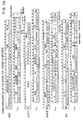
- the TCO signal has a configuration in which a frame of 60 bits is sequentially repeated every one minute. Each frame involves time data including year, month, day, hour and minute in the notation format of a BCD (Binary Coded Decimal) code (refer to Fig. 1A) .
- BCD Binary Coded Decimal
- Each of one-bit codes constituting a TCO signal in JJY represents any one of a binary 1 code representing a binary digit " 1" , a binary 0 code representing a binary digit "0" , and a marker code (shown "MK” for the sake of convenience) which is a synchronization signal for indicating a separation of time information.
- MK marker code
- Such three codes are distinguished by the differences among their H widths in a rectangular pulse (refer to Fig. 1B).
- Japanese Patent Kokai H06-258460 and Japanese Patent Kokai 2001-108770 refer to the techniques utilizing the standard radio wave from JJY.
- DCF77 (77.5 kHz) in Germany, WWVB (60 kHz) in the U.S.A, MSF (60 kHz) in England, and so on are cited in low frequency standard waves in service (refer to Fig. 1). Their details can be referred on respective homepages from respective standard radio wave stations in their respective countries.
- many different points are cited, such as differences in carrier frequencies provided by respective broadcast stations, differences in respective data formats for one minute (refer to Fig. 1A), and a difference in respective wave format of a TCO signals for one second constituting one bit are different (refer to Fig. 1B).
- some specification may have special attributes, such as summer time, leap year, and leap second.
- a decoder does not need to recognize whether 40 kHz or 60 kHz is used but it is enough to select a one with higher quality of reception.
- the design for a frequency channel selection circuit including its antenna has a degree of freedom and it is easy to develop a circuit with high sensitivity.
- a wave clock corresponds to various types of formats, it is required to select carrier frequencies according to the respective formats.
- the channel selection circuit may frequently have any limitation in design so that hardware circuits are respectively provided for the respective standard radio waves.
- the present invention is intended to solve the above problems.
- the object of the invention is to provide a method and a standard radio frequency receiver for automatically selecting a standard radio wave of a channel in a better condition at a less processing load and in a less processing time and for decoding the selected standard radio wave according to the specification of the format of the selected standard radio wave.
- One aspect of the present invention is a decoding method for receiving a plurality of standard radio waves respectively having signal configurations in accordance with respective specifications which define carrier channels and formats and for decoding time code signals carried by said standard radio waves.
- the decoding method comprises a bit synchronizing step to extract at least part of a bit waveform common to said specifications as a extracted signal from a waveform of each of said time code signals given by each of said carrier channels, and to synchronize bits to each of said time code signals in accordance with said extracted signal, a channel selection step to determine an evaluation index indicating good or bad of a reception condition for each of said carrier channels from said bit waveform, and to select a single channel from said carrier channels in accordance with said evaluation index, a specification discrimination step to extract a bit waveform corresponding to a characteristic code which characterizes said format different in each of said specifications from said time code signal of said selected channel, and to discriminate said specification of said time code signal given by said channel in accordance with the contents of said characteristic code, and a decoding step to
- One aspect of the present invention is a standard radio wave receiver for receiving a plurality of standard radio waves respectively having signal configurations in accordance with respective specifications which define carrier channels and formats and for decoding time code signals carried by said standard radio waves.
- the standard radio wave receiver comprises bit synchronizing means to extract at least part of a bit waveform common to said specifications as a extracted signal from a waveform of each of said time code signals given by each of said carrier channels, and to synchronize bits to each of said time code signals in accordance with said extracted signal, channel selection means to determine an evaluation index indicating good or bad of a reception condition for each of said carrier channels from said bit waveform, and to select a single channel from said carrier channels in accordance with said evaluation index, specification discrimination means to extract a bit waveform corresponding to a characteristic code which characterizes said format different in each of said specifications from said time code signal of said selected channel, and to discriminate said specification of said time code signal given by said channel in accordance with the contents of said characteristic code, and decoding means to decode said time code signal
- the standard radio wave receiving circuit comprises a bit synchronizing part to extract at least part of a bit waveform common to said specifications as a extracted signal from a waveform of each of said time code signals given by each of said carrier channels, and to synchronize bits to each of said time code signals in accordance with said extracted signal, a channel selection part to determine an evaluation index indicating good or bad of a reception condition for each of said carrier channels from said bit waveform, and to select a single channel from said carrier channels in accordance with said evaluation index, a specification discrimination part to extract a bit waveform corresponding to a characteristic code which characterizes said format different in each of said specifications from said time code signal of said selected channel, and to discriminate said specification of said time code signal given by said channel in accordance with the contents of said characteristic code; and a decoding part
- Fig. 2 is an embodiment of the present invention, which shows a whole configuration of a standard radio wave receiver.
- the standard radio wave receiver achieves the decoding method of the present invention.
- a standard radio wave receiver 10 comprises a plurality of RF tuned circuits 21 to 23, a carrier frequency switching circuit 24, an RF detection circuit 30, and a main processing circuit 40.
- the standard radio wave receiver 10 can be, for example, equipment, such as a wave clock, which corrects a displayed time according to time data from a standard radio wave.
- all or a part (for example, the main processing circuit 40) of the standard radio wave receiver 10 can be achieved by an integrated circuit which is formed by a single chip.
- the plurality of RF tuned circuits 21 to 23 are circuits which respectively synchronize with three standard radio waves respectively having carrier frequencies of 40 kHz, 60 kHz and 77.5 kHz.
- standard radio waves i.e., DCF7 in German, WWVB in the U.S.A., MSF in England and JJY in Japan are assumed to be used as standard radio waves (refer to Table 1).
- Each of these standard radio waves has a signal configuration according to their specifications which define a carrier channel and a format.
- the present invention is not limited to applying such four specifications, but can apply five or more specifications of standard radio waves.
- the multiple RF tuning circuits 21 to 23 respectively synchronize with the carrier frequencies of these standard radio waves to provide a synchronizing signal to the RF detection circuit 30 according to a selection by the carrier frequency switching circuit 24.
- the RF detection circuit 30 amplifies and detects the synchronizing signal of the single standard radio wave selected by the carrier frequency switching circuit 24 and extracts a TCO signal carried by the standard radio wave to provides it to the main processing circuit 40.
- the main processing circuit 40 comprises a sampling circuit 41, a random access memory (RAM) 42, a microprocessor 44, a read only memory (ROM) 45, a display circuit 43, and a channel selection control circuit 46. These parts are connected by a common bus.
- the sampling circuit 41 processes a TCO signal into digital information.
- the sampling circuit 41 samples a TCO signal which is an analog signal at a sampling rate of, for example, 50 ms and outputs sampling data which is a digital signal.
- the RAM 42 stores the sampling data as well as a result calculated by the micro processing unit 44 for the sampling data.
- the micro processing unit 44 performs a channel selection process and a format discrimination process according to a bit synchronization and a signal quality evaluation for the sampling data, and carries out an operation of a bit decoding and a frame decoding in accordance with the format of the discriminated standard radio wave to restore time data such as year, month, day, hour and minute included in the TCO signal.
- the ROM 45 stores programs for a channel selection and a format discrimination processes and a arithmetic program for operating such as a bit decoding and a frame decoding.
- the display circuit 43 displays the restored time data by using a display element such as a LED or a liquid crystal display.
- the channel selection control circuit 46 controls a channel selecting operation by the carrier frequency switching circuit 24 with instructions given by the channel selection process in the micro processing unit 44.
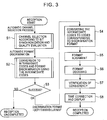
- Fig. 3 shows the whole processing procedures in the standard radio wave receiver shown in Fig. 2. As such processing procedures are mainly performed by the micro processor 44 of the main processing circuit 40 shown in Fig. 2, the components shown in Fig. 2 will be accordingly referred in the following explanation.
- a channel selection according to the bit synchronization and the quality evaluation is performed (step S1).
- the standard radio wave receiver 10 sequentially selects channels from the three carrier frequencies of 40 kHz, 60 kHz and 77.5 kHz and synchronizes with and detects the respective carrier frequencies to obtain TCO signals for respective channels.
- the TCO signal is sampled from the decoding starting point to store H/Ls of a waveform on the RAM 42.
- the sampling period is set to 50 msec, and the sampling rate is 20 sample/sec.
- the sampled TCO signal is divided for every one second to be listed.
- listing means that the segments of a TCO signal divided for one second makes a list-like multiple layers, for example, five layers which correspond to five seconds.
- a longitudinal convolution addition of the sampled data in the list can give twenty added values for 50 msec in columns.
- the statistic bit synchronization for the added values can give a bit synchronization.
- the detail of the statistic bit synchronization will be explained later regarding four different standard radio waves, i.e., DCF77 in Germany, WWVB in the U.S.A., MSF in England, and JJY in Japan (refer to Figs. 4A to 4D).
- the obtained columns of the added values for the bit synchronization are evaluated on quality by a method capable of evaluating qualities properly for various types of the standard radio waves to obtain an evaluation index.
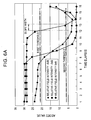
- the details of the quality evaluation method will be explained later (refer to Figs. 6A to 6G).
- a single channel with the most excellent evaluation in the obtained index is selected.
- the reception is effected for a given length of time to measure in the given length of time an incidence of error which is used as an index of the reception condition, and a low incidence of error is determined to be excellent in the reception condition.
- Step S2 a bit-decoding, conversion into an intermediate code, and format discrimination by using the intermediate code are performed for the TCO signal of the selected channel.
- the conversion into the intermediate code enables a decoding without depending on formats so as to meet various types of formats. In addition, it enables a proper decoding even if a defect factor such as a noise and a fluctuation of the TCO waveform occurs.
- the format discrimination is effected by discriminating a characteristic of each format such as a difference of a marker code value and its appearance period. Then, the success or failure of the format discrimination is judged (Step S3). When the characteristic corresponding to any of formats cannot be obtained and the discrimination is failed (NG), the process results in an incomplete reception. It is conceivable that the standard radio wave receiver 10 may display a message such as "unreceivable" as a responding process.
- the intermediate code is converted into the code corresponding to the discriminated format (Step S4).
- the intermediate code is converted into the code corresponding to the format code.
- the format alignment is effected (Step S5). The obtained code sequence is thereby aligned to respective items of time data constituting a frame based on a marker position
- the standard radio wave JJY has position markers every 10 seconds, and those position markers can be detected.
- the detection of the position marker is started from the detection starting point to detect a marker ("MK") according to the result of the bit decoding.
- a bit counting is then started. If the bit which is behind by 10 bits (10 seconds) from the marker at the detection starting point is a marker, the marker at the detection starting point is recognized as a position marker from this matching and then determined to be the position marker.
- the adjustment marker which is the beginning bit of a time code is detected.
- the detection of the adjustment bit is effected by checking if the bit data following the position marker is a marker. Adjustment markers are sequentially detected by determining if the bit data following position markers by 10 seconds are adjustment markers.
- the frame of the time code of JJY which is repeated every one minutes is determined by the detection of the adjustment markers.
- Step S6 a format decoding is executed.
- the bit data is divided into segments respectively corresponding to minute, hour, number of days starting on the specified date to convert them into effective data representing minute, hour, day, date, month, year and so on, which are adaptable for the frame format.
- Step S7 a verification of the consistency is executed.
- the consistency among the values of data items such as time, day, a day of the week, month and year, is verified as in a usual wave clock, and the standard time is obtained.
- the time data resulting from the format decoding may usually include an error except the case in which a transmission condition is good and thus no garbled bit occurs. For this reason, a plurality of time data are collected to detect an error from the contexts among the collected data. This verification is executed until accurate time information can be obtained for all items. For example, when a marker is included at an impossible position, it is assumed that an error has occurred. Then, the data including the marker is removed to execute the verification of the consistency.
- the display time in the display circuit 43 is adjusted to the standard time through the verification of the consistency to be displayed (Step S8).
- the received data is effectively converted to allow the use in the time verification and a time adjustment in the minimum time, even if the data is received with the formats of the standard radio waves such as DCF77 in German, WWVB in the U.S.A., MSF in Germany, and JJY in Japan having various specifications.
- an conventional automatic format discrimination has sequentially performed a format analysis and then determined the consistency, it has the following disadvantages; a format discrimination takes a time; times to discriminating formats are not even according to an analysis order; and an achievement of the reception takes a time because a decoding procedure starts after the format analysis has completed.
- the aspects of the present embodiments overcome those problems.
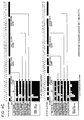
- Fig. 4A illustrates a method of a statistic bit synchronization for the standard radio wave JJY.
- the ideal TCO signal shows the change from "L” to "H” at the bit synchronization point in any code of a binary 0/ a binary 1/ a marker.
- sampling points for every 50 msec are added longitudinally in the listed sampling data. The added data is shown as "an ideal TCO added graph”.
- the real wave form includes a spike or a fluctuation in an edge signal.
- the real TCO signal is listed in the similar manner as the ideal TCO signal, it has a deformation of the waveform compared with the waveform of the ideal TCO signal.
- the real TCO signal has a deformation of the wave form, it is admitted that L changes to H at the starting point of the code and that the minimum value increases to the maximum value.
- the rising edge from the minimum value to the maximum value is set to be a bit synchronization point.
- the starting point of a bit synchronization can be statistically extracted from a plurality of codes.
- a bit synchronization is obtained from sampling data of the TCO signal by five times (for five seconds) . It is not to say if the sampling number becomes large, the synchronization accuracy is improved.
- the method can be applied to formats other than JJY.
- Fig. 4B illustrates a method of a statistic bit synchronization for the standard radio wave MSF.
- all of the waveform format of MSF have "L" periods for more than 100 msec at respective bit synchronization points except for the Fast Code ("FC" in Fig. 1A).
- FC Fast Code
- the Fast Code is a signal which varies every 25 msec. If the Fast Code is sampled at rate of 50 msec as this embodiment, the signal cannot be followed by sampling so that the signal is identified as a noise.
- Fig. 4C illustrates a method of a statistic bit synchronization for the standard radio wave DCF77.
- DCF77 both the binary 0 and the binary 1 have "L" periods for 100 msec from the bit synchronization point.
- the adjustment marker which shows the beginning of a frame of 60 seconds represents "H" in the entire intervals.
- the adjustment marker has the appearance rate of one time for sixty seconds, and there will be little problem if the number of addition is increased.
- the point which uniformly changes from the maximum value to the minimum value can be set to the bit synchronization point as in the case of MSF.
- Fig. 4D illustrates a method of a statistic bit synchronization for the standard radio wave WWVB.
- a marker as any of a marker, a binary 0, and a binary 1 has "L" period for 200 msec from the bit synchronization point, the point which uniformly changes from the maximum value to the minimum value can be set to the bit synchronization point.
- bit synchronization points is set to the falling edge from the maximum value to the minimum value in the case of MSF, DCF77, and WWVB, and the bit synchronization point is set to the rising edge from the minimum value to the maximum value in the case of JJY.
- bit waveform such as an edge part is extracted as a extracted signal, which gives effective means for detecting a bit synchronization for all formats.
- Step S1 The following explains the detail of the automatic channel selection process (Step S1) shown in Fig. 3 on the premise of use of the method for a statistic bit synchronization, which is a part of the present invention.
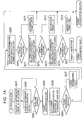
- Fig. 5A shows the detail of a processing procedure for an automatic channel selection.
- the carrier frequency channels for the standard radio waves includes three channels corresponding to three frequencies of 40/ 60/ 77.5 kHz (refer to table 1).
- An automatic selection of the best frequency is achieved by switching the frequency to be selected among three channels by means of a hardware, evaluating the reception condition of the respective frequencies, comparing the evaluation result, and then selecting the best frequency in the receiving condition.
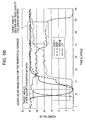
- Fig. 5B shows the respective waveforms of added value data in the standard radio waves of DCF77, WWVB, JJY andMSF.
- the standard radio wave receiver firstly selects CH1 from three channels of 40 kHz/ 60 kHz/ 77.5 kHz, which respectively corresponds to CH1 to CH3 (Step S101). This enables an RF-detection of the signal from CH1 and a TCO signal is obtained. Then, the statistic bit synchronization is started for the TCO signal (Step S102). It is determined if bit synchronization has succeeded (Step S103). When the bit synchronization has succeeded, an evaluation result by any of some methods for evaluating a signal quality (refer to Figs. 6A to 6G), which will be described later, is set to CH1 evaluation index (Step S104). In any of evaluation methods, a better evaluation result has a smaller evaluation index. Meanwhile, when it is determined that the bit synchronization has failed in Step S103, a MAX value is set to CH1 evaluation index as the worst evaluation value (Step S105).
- CH2 is processed with the similar procedures as S101 to S105 for CH1 (Step S106 to S110).
- CH3 is also processed with the same procedures (Step S111 to S115).
- the channel which gives the smallest (most excellent) evaluation index among the evaluation indexes for CH1 to CH3 is finally selected (Step S116 and S117). This allows the automatic channel selection in the best receiving condition.
- the above-mentioned processing procedures allows a circuitry of a hardware to operate independent from the format of the standard radio wave.
- the present embodiment shows the example in which one channel is selected among three channels. However, it is applicable not only to the case in which a wave clock has two channels, but also the case in which one channel is selected from more than 4 channels, and thus applicable to an increase of receiving channels for selection in future.
- the first, second and third quality evaluation methods respectively refer to Figs. 6A and 6B, Figs. 6C and 6D, and Figs. 6E to 6G.
- the first quality evaluation method evaluates the target area 51 (refer to Fig. 5B) composed of an edge part changing to the maximum value and the minimum value in the waveform of the added value.
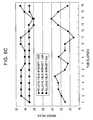
- the second and third quality evaluation methods evaluate the target area 52 (refer to Fig. 5B) composed of a flat part in the waveform of the added value.
- Fig. 6A explains the first quality evaluation method.
- the X-axis represents a time axis of which scale indicates sampling points of the target area 51 within one second, that is, the 16 points when the sampling frequency is 64 Hz.
- the Y-axis represents the added value given by a listing of a TCO signal for 31 seconds, the listing being achieved by aligning the bit-synchronized TCO signals of the standard radio wave DCF77 every one second.
- the three line plots in the graph respectively show the three cases in which the relative field intensities are 0 dB ⁇ V/m, - 3 dB ⁇ V/m and -6 dB ⁇ V/m.
- the field intensity of 0 dB ⁇ V/m represents a good condition having no error such as a spike caused by a noise in the reception.
- the waveforms of the two field intensities relatively positioned at -3 dB ⁇ V/m and -6 dB ⁇ V/m from the field intensity giving the above condition are also shown.
- the field intensity of -6 dB ⁇ V/m represents a condition near to the limit of the receivable field intensity.
- the graph of Fig. 6B shows the relation between a field intensity and a slope width.
- the relation in which the slope width varies depending on field intensity can be understood.
- a measurement of a slope width can be an index of a field intensity, i.e., a receiving condition.
- the index of a reception condition which measures a slope width can be obtained by processing a statistic bit synchronization.
- this is adaptable to all formats having a falling edge (MSF, DCF77 and WWVB). Even in the case of JJY, this can be also adapted by measuring an ascending edge.
- the slope width is evaluated for both a rising and a falling edges. Thresholds are properly selected. At an edge which is not a bit synchronization point (an rising edge, in the case of DCF77), the degree of steep is lowered and a slope width is increased due to added values for segments in which codes are mixed. For this reason, it is determined that the slope width which is smaller in the rising edge and the falling edge is the bit synchronization point. In other word, the slope widths of the both edges are measured to obtain the smaller slope width so that the reception condition can be evaluated without depending on a format.
- the first quality evaluation method evaluates the degree of steep in the edge just after the bit synchronization point even in a plurality of formats, it can provide a reception evaluation index which allows a proper evaluation among a plurality of formats.
- the evaluation with a slope width can be an effective evaluation index for a reception condition regardless of format.
- a conventional method as an evaluation cannot be started till a bit decoding has completed and codes can be determined, it takes a time to start an evaluation.
- the evaluation method for DCF77 is mainly explained. It is noted that the same evaluation method can be used for the evaluation of a reception condition in MSF and WWVB, and that it is also usable for JJY by reversing a direction of an edge.
- Fig. 6C explains the second quality evaluation method.
- the X-axis represents a time axis of which scale indicates each sampling point of the target area 52 within one second, that is, the 16 points when the sampling frequency is 64 Hz.
- the Y-axis represents the added value given by a listing of a TCO signal for 31 seconds, the listing being achieved by aligning the bit-synchronized TCO signals of the standard radio wave DCF77 every one second.
- the three line plots in the graph respectively show the three cases in which the relative field intensities are 0 dB ⁇ V/m, 3 dB ⁇ V/m and -6 dB ⁇ V/m.
- the second evaluation method evaluates a fluctuation caused by noise in a flat part.
- the flat part is a part after a lapse of approximately 800 to 1000 msec from the bit synchronization point.
- the neighborhood of the part shows "H” in MSF, DCF77 and WWVB, and "L” in JJY. This section has no edge in any formats.
- the added value should be saturated at the maximum value. This is ensured in the graph of intensity of 0 dB.
- the second quality evaluation method sets this fluctuations to the evaluation index of a reception condition.
- the second quality evaluation method evaluates fluctuations in a flat part even in a plurality of formats, it can be an effective evaluation index of a reception condition regardless of format, and it can provide a proper evaluation among a plurality of formats.
- the first quality evaluation method uses a degree of steep in an edge (a slope width) at the beginning of a bit synchronization as an evaluation index. It needs an evaluation having a higher accuracy of a digit than the sampling interval which has obtained slope widths (3.4, 1.5 or 0.8) in the first quality evaluation method, and it needs an arithmetic procedure for obtaining them from an added value waveform.
- the second quality evaluation method evaluates fluctuations caused by noises in a flat part, it needs few arithmetic procedure and is not affected by a direction property of edge. Accordingly, the second quality evaluation method can provide a simpler evaluation than that of the first quality evaluation method.
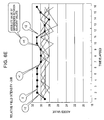
- Fig. 6E explains the third quality evaluation method.
- the X-axis represents a time axis of which scale indicates each sampling point of the target area 52 within one second, that is, the 16 points when the sampling frequency is 64 Hz, as in the second quality evaluation method.
- the Y-axis represents the added value given by a listing of a TCO signal for 31 seconds, the listing being achieved by aligning the bit-synchronized TCO signals of the standard radio wave DCF77 every one second.
- the line plots show the results of data measurements for ten times when the relative field intensity is -3 dB ⁇ V/m.
- the target area for evaluating the added value waveform used in the third quality evaluation method is a flat part in the added value waveform as in the second quality evaluation method. Instead of evaluating fluctuations of an added value with a standard deviation, the third quality evaluation method calculates a summation which adds up the absolute values in differences between adjacent added values on the time axis (hereinafter called adjacent difference summation).
- Fig. 6F is a table showing the calculation results for the cases in which the relative field intensities are -3 dB ⁇ V/m, -6 dB ⁇ V/m and 0 dB ⁇ V/m. It should be noted that the adjacent difference summation becomes large, as the field intensity is lowered. This result is shown in the following table. [table 4] Field intensity(dB) -6 -3 0 Adjacent difference summation Minimum value 11.0 3.0 0.0 Averaged value 20.7 8.0 1.1 Maximum value 27.0 17.0 3.0
- Fig. 6G shows a correlation between the adjacent difference summation and the field intensity. As it is apparent referring to the figure that the adjacent difference summation shows a monotonous reducing characteristic for the field intensity, and that it is good for an evaluation index of a reception condition.
- the above-mentioned third quality evaluation method provides a simple method for evaluating fluctuations by obtaining a summation of absolute values of adjacent differences without using a standard deviation. This provide an effective evaluation index of a reception condition in any format. Moreover, it is suitable for a microcomputer having a little calculation ability and thus a little processing ability and it has a small consumption current, as fluctuations in a flat part is evaluated with a simple calculation even in a plurality of formats. Thus, it provide an optimum method for a decoder for a wave clock which operates at low speed. The second quality evaluation method also obtained an evaluation index using fluctuations of added values.
- the second method is not suitable for a microcomputer having a low power.
- the third quality evaluation method can provide an evaluation using only a deleting and adding, it is suitable for a microcomputer having a low power.
- the automatic format discrimination process corresponds to Step 2 in the processing procedure shown in Fig. 3.
- Fig. 7A explains the details of the processing procedure for the automatic format discrimination.
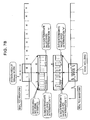
- Fig. 7B explains the method for decoding averaged bits in a conversion from a TCO signal to an intermediates signal executed at the beginning of the automatic format discrimination process.
- Fig. 7C explains the relation of each code waveform with an intermediate signal in the TCO signal.
- Fig. 7C shows a view of code waveforms of bit codes in the formats of MSF, DCF77, WWVB and JJY.
- the codes are divided for the unit of 100 msec to determine "H" / "L” for each of division units.
- H/Ls As a single code is represented by ten H/Ls, it would appear that the code consists of 10 bits.
- the "1 byte + 2 bits" expressions with LSB fast are used in the figure (hexadecimal notation).
- the expressions can be set to intermediate codes.
- the intermediate codes allow various formats to be processed in a unified way, as respective codes such as a marker, a bit 0, and a bit 1 in respective formats are expressed by different numeric values.
- Fig. 7B explains a method of bit decoding by area averaging.
- the method is directed to overcome the problem that a TCO waveform is distorted by a noise and that a bit decoding is not properly carried out.
- the method is achieved by counting the number of signals sampled with respect to a given part of 100 msec width, that is, an area and by decoding the number into either "H" or "L” by a majority based on the count results.
- the sampling frequency is set to 100 Hz in the figure, and the division area of 100 msec width includes ten samples of data.
- This bit decoding method is referred to as "an area averaging" in this description.
- the "area averaging" bit decoding method is summarized as follows; as the first step, a code waveform is divided into ten division areas by 100 msec from the bit starting point; as the second step, the number of "H” samples is counted in each division area to determines the area as "H” if it is bigger than the middle value or as "L” if it is equal to or smaller than the middle value; as the third step, one bit is assigned to each of the ten division areas to make an intermediate code of ten bits. By repeating this procedure for all bits, the intermediate code which does not depend on a format can be obtained.
- the above-mentioned method of a bit decoding by area averaging can provide a proper bit decoding with highly against noise even if the TCO waveform is distorted by noise.
- the use of the intermediate code enables a bit decoding which does not depend on a format.
- the number of formats are increased in future, it is possible to correspond the increased formats if they are defined in units of 100 msec.
- the standard radio wave receiver executes an intermediate-code encoding with bit decoding by inputting the TCO signal which is selected and bit-synchronized according to the result of an automatic channel selection process (Step S201). Then, the intermediate code is stored in a receiving buffer of a RAM (Step S202). After the predetermined time (for example, four minutes corresponding to 60 seconds/data ⁇ four data) has elapsed (Step S203), a format discrimination for the stored intermediate code data is started (Step S204).
- the format discrimination means that a standard radio wave is determined and that its specification is discriminated.
- the standard radio wave receiver processes the DCF77 format discrimination process to determine if the intermediate code data is of DCF77 format (Step S205).
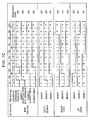
- DCF77 has a feature that a characteristic code is the marker found only at the only 59th-seconds. If the marker is detected at a specified position in the received data which has a period of one minute, it can be determined that the format is of DCF77.
- the marker of DCF77 is expressed by "03FF" with the intermediate codes. If a part corresponding to "03FF" is extracted from the received data, it can be clearly determined to be a marker.
- the received data for four minutes is sequentially assigned to the numbers of 0 to 59 from the head, and the frequency of the marker "03FF" for each number (position) is obtained.
- the frequency of the marker position will be four, and it is clearly determined that the unknown format is of DCF77.
- the discrimination format is set to "DCF77" (Step S207).
- the standard radio wave receiver processes the WWVB format discrimination process to determine if the intermediate code data is of WWVB format (Step S208).
- the both formats have features that position markers at every 10 seconds and an adjustment marker at the position of zero second are found as characteristic codes.
- the detection of the regularity of these position and adjustment markers allows to determine that the format is of WWVB or JJY.
- the marker of WWVB is expressed by "0300" in its intermediate code. If the position corresponding to "0030" in the received data is noticed, it is clearly determined that they are position and adjustment markers.
- the frequency of marker position will be four, and it is clearly determined that the unknown format is of WWVB.
- the discrimination format is set to "WWVB" (Step S210).
- the standard radio wave receiver processes the JJY format discrimination process to determine if the intermediate code data is of JJY format (Step S211).
- the marker of JJY is expressed by "0003" in the intermediate code. If a part corresponding to "0003" is extracted from the received data, it can be clearly determined to be a position and an adjustment markers. The frequency at the marker position is four, and it is clearly determined that the unknown format is of JJY.
- the discrimination format is set to "WWVB" (Step S213).
- MSF has no marker and thus no obvious feature. However, it has a bit format which is not found in DCF77, WWVB, and JJY.
- MSF has two characteristic codes; the format indicating the corresponding bit with UTC (hereinafter called UTC 0) and the format indicating one in the area of a parity to DST (hereinafter called DST 1 for the sake of convenience).
- UTC 0 the format indicating the corresponding bit with UTC
- DST 1 the format indicating one in the area of a parity to DST
- the discrimination format is set to "MSF" (Step S216).
- the discrimination format is set to "unidentified" (Step S217) and the process end.
- the format can be determine which format of DCF77, WWVB, JJY and MSF it is.
- the time for processing a software is vanishingly short in the whole time to obtain time data from a TCO signal in any format detection, the respective times required to detect respective formats of DCF77, WWVB, JJY and MSF are not changed. This enables a format selection to be executed in a short time.
- the automatic channel selection can select the best frequency channel, which enables a reception in the best receiving format.
- the decoding method and the standard radio wave receiver of the present invention solve the various problems; the problem in which a bit synchronization cannot be properly effected; the problem in which a bit decoding cannot be properly effected by a distortion of a TCO waveform caused by noise; the problem in which a channel selection has some limitation; the problem in which it takes a long time from an automatic selection of format to a successful reception; the problem in which a time for a successful reception is significantly different depending on a format; the problem in which it takes a long time to determine a failure of a reception; the problem in which there is no reception evaluation index which enables a proper evaluation among a plurality of formats; the problem in which a reception is not executed in the best reception format when a plurality of formats are in a receivable condition.
- the above embodiments has explained equipment such as a clock which receives a standard radio wave and corrects and displays the inner time information as equipment which achieves the decoding method and accommodates the standard radio wave receiver of the present invention.
- equipment such as a clock which receives a standard radio wave and corrects and displays the inner time information as equipment which achieves the decoding method and accommodates the standard radio wave receiver of the present invention.
- the present invention is not limited to such equipment but can be applied to various control equipment and home electric appliances which perform a schedule operation.
- the decoding method and the standard radio wave receiver provide a configuration which, by means of statistic bit synchronization, execute a bit synchronization, determine respective specifications regarding time code signals in respective carrier channels, then select a single channel with an evaluation index indicating good or bad of a reception condition for each carrier channel, and discriminate specifications from the time code signal of the selected channel by means of characteristics of respective formats which are different in respective specifications.
- This enables the standard radio wave in the channel of the best receiving condition to be automatically selected from various standard radio waves broadcast all over the world at less processing load and in less processing time and to be decoded in accordance with the specification of the format of the selected standard radio wave.
- Embodiments of the present invention may be summarized as a method and a standard radio wave receiver for receiving a plurality of standard radio waves respectively having signal configurations in accordance with respective specifications which define carrier channels and formats and for decoding time code signals carried by the standard radio waves.
- the method extracts at least part of a bit waveform common to the specifications as a extracted signal from a waveform of each of the time code signals given by each of the carrier channels, synchronizes bits to each of the time code signals in accordance with the extracted signal, determines an evaluation index indicating good or bad of a reception condition for each of the carrier channels from the bit waveform, and selects a single channel from the carrier channels in accordance with the evaluation index.
- the method further extracts a bit waveform corresponding to a characteristic code which characterizes the format which differs in each specifications from the time code signal of the selected channel, discriminates the specification of the time code signal given by the channel in accordance with the contents of the characteristic code, and decodes the time code signal to time data in accordance with the format of the discriminated specification.
Landscapes
- Physics & Mathematics (AREA)
- General Physics & Mathematics (AREA)
- Electric Clocks (AREA)
- Electromechanical Clocks (AREA)
- Synchronisation In Digital Transmission Systems (AREA)
Applications Claiming Priority (1)
| Application Number | Priority Date | Filing Date | Title |
|---|---|---|---|
| JP2004343869A JP4322786B2 (ja) | 2004-11-29 | 2004-11-29 | 複数標準電波のデコード方法及び標準電波受信装置 |
Publications (3)
| Publication Number | Publication Date |
|---|---|
| EP1662344A2 true EP1662344A2 (de) | 2006-05-31 |
| EP1662344A3 EP1662344A3 (de) | 2006-12-20 |
| EP1662344B1 EP1662344B1 (de) | 2010-01-13 |
Family
ID=36087688
Family Applications (1)
| Application Number | Title | Priority Date | Filing Date |
|---|---|---|---|
| EP20050111306 Expired - Lifetime EP1662344B1 (de) | 2004-11-29 | 2005-11-25 | Funkempfänger und Verfahren zur Dekodierung von einer Vielzahl von standardmäßigen Funkzeitsignalen |
Country Status (5)
| Country | Link |
|---|---|
| US (1) | US7555029B2 (de) |
| EP (1) | EP1662344B1 (de) |
| JP (1) | JP4322786B2 (de) |
| CN (1) | CN100565389C (de) |
| DE (1) | DE602005018889D1 (de) |
Cited By (5)
| Publication number | Priority date | Publication date | Assignee | Title |
|---|---|---|---|---|
| EP1892591A1 (de) * | 2006-08-25 | 2008-02-27 | Seiko Epson Corporation | Funkuhr und Verfahren zum Ändern der Wellenformabgrenzungsregel |
| EP2219087A3 (de) * | 2009-01-15 | 2010-11-03 | Casio Computer Co., Ltd. | Zeitinformationsgewinnungsvorrichtung und Funkuhr |
| CN102314149A (zh) * | 2010-07-06 | 2012-01-11 | 卡西欧计算机株式会社 | 时刻信息获取装置以及电波钟表 |
| EP2407836A3 (de) * | 2010-07-16 | 2012-04-18 | Casio Computer Co., Ltd. | Markererkennungsvorrichtung und Funkuhr |
| US8514665B2 (en) | 2010-07-27 | 2013-08-20 | Casio Computer Co., Ltd | Time information acquiring apparatus and radio-controlled timepiece |
Families Citing this family (15)
| Publication number | Priority date | Publication date | Assignee | Title |
|---|---|---|---|---|
| JP4264496B2 (ja) * | 2004-08-31 | 2009-05-20 | Okiセミコンダクタ株式会社 | 標準電波受信装置及びタイムコード復号方法 |
| JP2010008324A (ja) * | 2008-06-30 | 2010-01-14 | Casio Comput Co Ltd | タイムコード判別装置および電波時計 |
| JP5353117B2 (ja) * | 2008-08-25 | 2013-11-27 | セイコーエプソン株式会社 | 標準電波受信装置、電波修正時計および標準電波受信方法 |
| JP4678057B2 (ja) * | 2009-01-09 | 2011-04-27 | カシオ計算機株式会社 | 時刻情報受信装置、電波時計およびプログラム |
| JP4743280B2 (ja) | 2009-01-09 | 2011-08-10 | カシオ計算機株式会社 | 時刻情報受信装置、電波時計およびプログラム |
| JP4905523B2 (ja) * | 2009-09-25 | 2012-03-28 | カシオ計算機株式会社 | 時刻情報取得装置、および、電波時計 |
| JP4905536B2 (ja) * | 2009-10-29 | 2012-03-28 | カシオ計算機株式会社 | 時刻情報取得装置、および、電波時計 |
| JP4905531B2 (ja) * | 2009-10-23 | 2012-03-28 | カシオ計算機株式会社 | 時刻情報取得装置、および、電波時計 |
| JP5407705B2 (ja) * | 2009-09-29 | 2014-02-05 | カシオ計算機株式会社 | 時刻情報取得装置、および、電波時計 |
| US8533516B2 (en) | 2010-09-22 | 2013-09-10 | Xw Llc | Low power radio controlled clock incorporating independent timing corrections |
| US8270465B1 (en) | 2011-11-15 | 2012-09-18 | Xw Llc | Timing and time information extraction from a phase modulated signal in a radio controlled clock receiver |
| US8693582B2 (en) | 2012-03-05 | 2014-04-08 | Xw Llc | Multi-antenna receiver in a radio controlled clock |
| JP5494740B2 (ja) * | 2012-06-26 | 2014-05-21 | カシオ計算機株式会社 | 暦表示装置 |
| JP5505472B2 (ja) * | 2012-07-31 | 2014-05-28 | カシオ計算機株式会社 | 時刻情報取得装置、及び、電波時計 |
| KR102551354B1 (ko) | 2018-04-20 | 2023-07-04 | 삼성전자 주식회사 | 반도체 발광 소자 및 그 제조 방법 |
Citations (1)
| Publication number | Priority date | Publication date | Assignee | Title |
|---|---|---|---|---|
| JP2003279676A (ja) | 2002-03-25 | 2003-10-02 | Seiko Epson Corp | 電波修正時計および電波修正時計の制御方法 |
Family Cites Families (11)
| Publication number | Priority date | Publication date | Assignee | Title |
|---|---|---|---|---|
| US5347546A (en) * | 1992-04-28 | 1994-09-13 | Ashtech, Inc. | Method and apparatus for prefiltering a global positioning system receiver |
| JPH06258460A (ja) | 1993-03-03 | 1994-09-16 | Hitachi Ltd | 磁気記録再生装置 |
| JP3079198B2 (ja) | 1993-03-04 | 2000-08-21 | セイコークロック株式会社 | 電波修正時計 |
| JP3286283B2 (ja) | 1999-10-13 | 2002-05-27 | 株式会社ハドソン | 電波時計 |
| JP2002296374A (ja) | 2001-03-30 | 2002-10-09 | Seiko Clock Inc | 時刻情報取得方法、時刻情報取得装置および電波修正時計 |
| JP4233311B2 (ja) | 2001-11-20 | 2009-03-04 | シチズンホールディングス株式会社 | 電波時計、標準電波受信方法および電子機器 |
| JP4258213B2 (ja) * | 2002-12-19 | 2009-04-30 | カシオ計算機株式会社 | 時刻データ受信装置 |
| JP4377150B2 (ja) * | 2003-04-11 | 2009-12-02 | シチズンホールディングス株式会社 | 電波修正時計及びその制御方法 |
| JP2004004136A (ja) | 2003-09-29 | 2004-01-08 | Seiko Epson Corp | 電波修正時計の制御プログラム |
| JP3903986B2 (ja) * | 2003-12-26 | 2007-04-11 | カシオ計算機株式会社 | 時刻情報送受信装置、及び、時刻情報送受信用回路 |
| DE102004018881B4 (de) * | 2004-04-15 | 2006-03-02 | Junghans Uhren Gmbh | Funkgesteuerte Armbanduhr mit Mitteln zum Dekodieren von Signalen von Zeitzeichensendern aus mehreren Zeitzonen |
-
2004
- 2004-11-29 JP JP2004343869A patent/JP4322786B2/ja not_active Expired - Fee Related
-
2005
- 2005-03-24 CN CNB2005100592081A patent/CN100565389C/zh not_active Expired - Fee Related
- 2005-11-25 DE DE200560018889 patent/DE602005018889D1/de not_active Expired - Lifetime
- 2005-11-25 EP EP20050111306 patent/EP1662344B1/de not_active Expired - Lifetime
- 2005-11-29 US US11/288,439 patent/US7555029B2/en not_active Expired - Fee Related
Patent Citations (1)
| Publication number | Priority date | Publication date | Assignee | Title |
|---|---|---|---|---|
| JP2003279676A (ja) | 2002-03-25 | 2003-10-02 | Seiko Epson Corp | 電波修正時計および電波修正時計の制御方法 |
Cited By (10)
| Publication number | Priority date | Publication date | Assignee | Title |
|---|---|---|---|---|
| EP1892591A1 (de) * | 2006-08-25 | 2008-02-27 | Seiko Epson Corporation | Funkuhr und Verfahren zum Ändern der Wellenformabgrenzungsregel |
| US7710833B2 (en) | 2006-08-25 | 2010-05-04 | Seiko Epson Corporation | Radio-controlled timepiece and method of changing the waveform discrimination standard |
| EP2219087A3 (de) * | 2009-01-15 | 2010-11-03 | Casio Computer Co., Ltd. | Zeitinformationsgewinnungsvorrichtung und Funkuhr |
| US8264913B2 (en) | 2009-01-15 | 2012-09-11 | Casio Computer Co., Ltd. | Time information obtaining apparatus and radio wave timepiece |
| CN102314149A (zh) * | 2010-07-06 | 2012-01-11 | 卡西欧计算机株式会社 | 时刻信息获取装置以及电波钟表 |
| EP2405315A3 (de) * | 2010-07-06 | 2012-03-14 | Casio Computer Co., Ltd. | Zeitinformationsempfangseinrichtung und Funkuhr |
| US8542558B2 (en) | 2010-07-06 | 2013-09-24 | Casio Computer Co., Ltd | Time information acquiring apparatus and radio controlled timepiece |
| EP2407836A3 (de) * | 2010-07-16 | 2012-04-18 | Casio Computer Co., Ltd. | Markererkennungsvorrichtung und Funkuhr |
| US8599650B2 (en) | 2010-07-16 | 2013-12-03 | Casio Computer Co., Ltd | Marker detecting apparatus and radio-controlled timepiece |
| US8514665B2 (en) | 2010-07-27 | 2013-08-20 | Casio Computer Co., Ltd | Time information acquiring apparatus and radio-controlled timepiece |
Also Published As
| Publication number | Publication date |
|---|---|
| JP2006153626A (ja) | 2006-06-15 |
| CN1782930A (zh) | 2006-06-07 |
| US20060140282A1 (en) | 2006-06-29 |
| US7555029B2 (en) | 2009-06-30 |
| JP4322786B2 (ja) | 2009-09-02 |
| CN100565389C (zh) | 2009-12-02 |
| DE602005018889D1 (de) | 2010-03-04 |
| EP1662344B1 (de) | 2010-01-13 |
| EP1662344A3 (de) | 2006-12-20 |
Similar Documents
| Publication | Publication Date | Title |
|---|---|---|
| EP1662344B1 (de) | Funkempfänger und Verfahren zur Dekodierung von einer Vielzahl von standardmäßigen Funkzeitsignalen | |
| US7190745B2 (en) | Radio-controlled timepiece, standard frequency reception method, and electronic device | |
| US7428190B2 (en) | Time reception apparatus and wave clock | |
| US7492846B2 (en) | Standard wave receiver and time code decoding method | |
| JP2009294198A (ja) | 電波修正時計およびその制御方法 | |
| EP2146257B1 (de) | Vorrichtung zum Erhalten von Zeitinformationen und Funkuhr | |
| US7710833B2 (en) | Radio-controlled timepiece and method of changing the waveform discrimination standard | |
| US20050169230A1 (en) | Radio-controlled clock, receiver circuit and method for acquiring time information with economized receiver and microcontroller | |
| EP1787444B1 (de) | Synchronisierungsschaltung zur Zeitsynchronization mit einem empfangenen Funkuhrsignal und eine entsprechende Uhr | |
| EP2458459B1 (de) | Vorrichtung zum Erhalten von Zeitinformationen und Funkuhr | |
| JP2012189558A (ja) | 電波修正時計、およびその制御方法 | |
| JP2003215277A (ja) | 標準電波デコード回路及びマーカ検出回路並びに電波時計 | |
| JP5188911B2 (ja) | 標準電波受信装置、電波修正時計、電子機器及び時刻修正方法 | |
| JP4905536B2 (ja) | 時刻情報取得装置、および、電波時計 | |
| US20100177853A1 (en) | Time information receiver, radio wave timepiece and storage medium having program stored therein | |
| JP5810978B2 (ja) | 時刻情報取得装置、及び、電波時計 | |
| JP2009019921A (ja) | 電波修正時計、およびその制御方法 | |
| JP2011099771A (ja) | 時刻情報取得装置、および、電波時計 | |
| HK1099862B (en) | Synchronisation circuit for synchronising time with a received radio controlled clock signal and a corresponding clock | |
| JP2014077695A (ja) | 電波修正時計および電波修正時計の時刻修正方法 | |
| JP5012948B2 (ja) | 時刻情報取得装置、および、電波時計 | |
| JP3685698B2 (ja) | 電波時計 | |
| JP2010043910A (ja) | 時刻受信装置、電波修正時計および時刻受信装置の制御方法 | |
| JP2017151036A (ja) | 時刻情報受信装置、電波修正時計およびタイムコード種別判定方法 | |
| JP2011226848A (ja) | 時刻情報取得装置、および、電波時計 |
Legal Events
| Date | Code | Title | Description |
|---|---|---|---|
| PUAI | Public reference made under article 153(3) epc to a published international application that has entered the european phase |
Free format text: ORIGINAL CODE: 0009012 |
|
| AK | Designated contracting states |
Kind code of ref document: A2 Designated state(s): AT BE BG CH CY CZ DE DK EE ES FI FR GB GR HU IE IS IT LI LT LU LV MC NL PL PT RO SE SI SK TR |
|
| AX | Request for extension of the european patent |
Extension state: AL BA HR MK YU |
|
| PUAL | Search report despatched |
Free format text: ORIGINAL CODE: 0009013 |
|
| AK | Designated contracting states |
Kind code of ref document: A3 Designated state(s): AT BE BG CH CY CZ DE DK EE ES FI FR GB GR HU IE IS IT LI LT LU LV MC NL PL PT RO SE SI SK TR |
|
| AX | Request for extension of the european patent |
Extension state: AL BA HR MK YU |
|
| 17P | Request for examination filed |
Effective date: 20070314 |
|
| 17Q | First examination report despatched |
Effective date: 20070418 |
|
| AKX | Designation fees paid |
Designated state(s): DE FR GB |
|
| GRAP | Despatch of communication of intention to grant a patent |
Free format text: ORIGINAL CODE: EPIDOSNIGR1 |
|
| GRAS | Grant fee paid |
Free format text: ORIGINAL CODE: EPIDOSNIGR3 |
|
| GRAA | (expected) grant |
Free format text: ORIGINAL CODE: 0009210 |
|
| AK | Designated contracting states |
Kind code of ref document: B1 Designated state(s): DE FR GB |
|
| REG | Reference to a national code |
Ref country code: GB Ref legal event code: FG4D |
|
| REF | Corresponds to: |
Ref document number: 602005018889 Country of ref document: DE Date of ref document: 20100304 Kind code of ref document: P |
|
| PLBE | No opposition filed within time limit |
Free format text: ORIGINAL CODE: 0009261 |
|
| STAA | Information on the status of an ep patent application or granted ep patent |
Free format text: STATUS: NO OPPOSITION FILED WITHIN TIME LIMIT |
|
| 26N | No opposition filed |
Effective date: 20101014 |
|
| GBPC | Gb: european patent ceased through non-payment of renewal fee |
Effective date: 20101125 |
|
| REG | Reference to a national code |
Ref country code: FR Ref legal event code: ST Effective date: 20110801 |
|
| REG | Reference to a national code |
Ref country code: DE Ref legal event code: R119 Ref document number: 602005018889 Country of ref document: DE Effective date: 20110601 Ref country code: DE Ref legal event code: R119 Ref document number: 602005018889 Country of ref document: DE Effective date: 20110531 |
|
| PG25 | Lapsed in a contracting state [announced via postgrant information from national office to epo] |
Ref country code: FR Free format text: LAPSE BECAUSE OF NON-PAYMENT OF DUE FEES Effective date: 20101130 |
|
| PG25 | Lapsed in a contracting state [announced via postgrant information from national office to epo] |
Ref country code: GB Free format text: LAPSE BECAUSE OF NON-PAYMENT OF DUE FEES Effective date: 20101125 |
|
| PG25 | Lapsed in a contracting state [announced via postgrant information from national office to epo] |
Ref country code: DE Free format text: LAPSE BECAUSE OF FAILURE TO SUBMIT A TRANSLATION OF THE DESCRIPTION OR TO PAY THE FEE WITHIN THE PRESCRIBED TIME-LIMIT Effective date: 20110531 |