EP1656322B1 - Verfahren zur herstellung von chlor - Google Patents
Verfahren zur herstellung von chlor Download PDFInfo
- Publication number
- EP1656322B1 EP1656322B1 EP04763900A EP04763900A EP1656322B1 EP 1656322 B1 EP1656322 B1 EP 1656322B1 EP 04763900 A EP04763900 A EP 04763900A EP 04763900 A EP04763900 A EP 04763900A EP 1656322 B1 EP1656322 B1 EP 1656322B1
- Authority
- EP
- European Patent Office
- Prior art keywords
- gas stream
- oxidation
- hydrogen chloride
- chlorine
- oxygen
- Prior art date
- Legal status (The legal status is an assumption and is not a legal conclusion. Google has not performed a legal analysis and makes no representation as to the accuracy of the status listed.)
- Expired - Lifetime
Links
Images
Classifications
-
- C—CHEMISTRY; METALLURGY
- C01—INORGANIC CHEMISTRY
- C01B—NON-METALLIC ELEMENTS; COMPOUNDS THEREOF; METALLOIDS OR COMPOUNDS THEREOF NOT COVERED BY SUBCLASS C01C
- C01B7/00—Halogens; Halogen acids
- C01B7/01—Chlorine; Hydrogen chloride
- C01B7/03—Preparation from chlorides
- C01B7/04—Preparation of chlorine from hydrogen chloride
-
- C—CHEMISTRY; METALLURGY
- C01—INORGANIC CHEMISTRY
- C01B—NON-METALLIC ELEMENTS; COMPOUNDS THEREOF; METALLOIDS OR COMPOUNDS THEREOF NOT COVERED BY SUBCLASS C01C
- C01B7/00—Halogens; Halogen acids
- C01B7/01—Chlorine; Hydrogen chloride
-
- Y—GENERAL TAGGING OF NEW TECHNOLOGICAL DEVELOPMENTS; GENERAL TAGGING OF CROSS-SECTIONAL TECHNOLOGIES SPANNING OVER SEVERAL SECTIONS OF THE IPC; TECHNICAL SUBJECTS COVERED BY FORMER USPC CROSS-REFERENCE ART COLLECTIONS [XRACs] AND DIGESTS
- Y02—TECHNOLOGIES OR APPLICATIONS FOR MITIGATION OR ADAPTATION AGAINST CLIMATE CHANGE
- Y02P—CLIMATE CHANGE MITIGATION TECHNOLOGIES IN THE PRODUCTION OR PROCESSING OF GOODS
- Y02P20/00—Technologies relating to chemical industry
- Y02P20/20—Improvements relating to chlorine production
Definitions
- the invention relates to a process for the production of chlorine.
- EP-B 0 233 773 describes the catalytic hydrogen chloride oxidation of powdered chromium oxide catalysts in a fluidized bed process.
- Fluidized bed processes are characterized by the possibility of a very isothermal temperature control.
- the formation of local overheating of the catalyst bed, the formation of so-called "hot spots", can be largely avoided.
- fluidized bed processes have disadvantages. These include the difficulties in up-scaling, a sometimes significant discharge of catalyst material with the reaction gases during the operation of the fluidized bed reactors, as well as the risk of instability of the fluidized bed due to the adhesion of catalyst particles.
- the risk of sticking of catalyst particles (“sticking") is particularly great at low operating temperatures.
- EP-A 0 936 184 describes the performance of the Deacon reaction on a solid catalyst bed using ruthenium catalysts. When performing exothermic Reactions on a fixed catalyst bed, however, usually lead to the formation of "hot spots". These affect the life of the catalyst and should therefore be avoided wherever possible.
- the object of the invention is to provide an improved process for the production of chlorine from hydrogen chloride, which remedies the disadvantages of the prior art.
- an at least two-stage process in which a first partial hydrogen chloride conversion in a fluidized bed reactor stage and a second hydrogen chloride partial conversion in one or more fixed bed reactor stages is achieved.
- the Deacon reaction is an exothermic equilibrium reaction, it is advantageous from a thermodynamic point of view to work at as low temperatures as possible, but in which the catalyst still has sufficient activity to achieve the highest possible conversion.
- Low temperatures are usually associated with low space-time yields.
- High space-time yields due to the high heat usually also high temperatures.
- the implementation of the first hydrogen chloride subset in the fluidized bed reactor stage b) can be carried out at high temperatures and high space-time yields, since the risk of the formation of "hot spots" in a fluidized bed is not given.
- the high temperatures in the fluidized bed stage also do not affect the maximum total sales to be achieved by the process according to the invention, since the thermodynamically achievable conversions are aimed at only in the second oxidation stage c), ie the fixed bed reactor or stages.
- this can be operated at significantly lower temperatures in order to achieve the optimal thermodynamic equilibrium state on the product side, without having to accept too large overall losses in the space / time yield since the majority of the conversion is already achieved in the fluidized bed becomes.
- a feed gas stream 1 containing hydrogen chloride is provided.
- Hydrogen chloride for example, in the production of aromatic polyisocyanates such as toluene diisocyanate (TDI) and diphenylmethane diisocyanate (MDI) from the corresponding polyamines and phosgene, in the production of acid chlorides, in the chlorination of aromatics, in the production of vinyl chloride and in the production of polycarbonates.
- This hydrogen chloride may contain hydrocarbons or chlorinated hydrocarbons as impurities, for example, in amounts of 100 to 3000 ppm.
- other gas constituents may be present such as carbon monoxide, carbon dioxide, nitrogen and other inert gases, typically in amounts of 0 to 1 vol .-%.
- the impurities may be removed from the feed gas stream by catalytic combustion of the hydrocarbons and chlorinated hydrocarbons in the feed gas stream or by absorption of the hydrocarbons and chlorohydrocarbons on a suitable absorbent.
- the hydrocarbons or chlorinated hydrocarbons can also be converted by combustion in the oxidation states.
- chlorinated hydrocarbons such as monochlorobenzene
- the risk of formation of dioxins To avoid them, a precise control of the reaction temperature is usually required, as is characteristic of the process according to the invention.
- Hydrogen chloride is preferably fed in gaseous form.
- a feed gas stream II containing oxygen is provided.
- the feed gas stream II may consist of pure oxygen, technical oxygen, for example 94 vol .-% or 98 vol .-% technical oxygen, air or other oxygen / inert gas mixtures. Air is less preferred because of the high inert gas content, pure oxygen for cost reasons.
- a first oxidation stage b the feed gas stream 1, the feed gas stream II, optionally a hydrogen chloride-containing reflux Ia and optionally an oxygen-containing reflux IIa are fed into a first oxidation zone and brought into contact with a first oxidation catalyst, wherein the first oxidation catalyst in the first oxidation zone is present as a fluidized bed.
- oxygen in superstoichiometric amounts.
- HCl: O 2 ratio of 4: 1.5 to 1: 1 is customary. Since no loss of selectivity is to be feared, it may be economically advantageous to work at relatively high pressures and correspondingly longer residence times than normal pressure. Higher pressures lead due to the associated lower flow rates to increased risk of hot spots in a pure fixed-bed process, which is bypassed by the inventive method.
- the first process stage is carried out in a fluidized bed reactor.
- the fluidized bed reactor may have a conical or preferably cylindrical shape.
- the fluidizing gas formed from the feed gas streams is introduced at the lower end via a distributor or nozzle bottom.
- heat exchangers can be installed. These can be designed, for example, as a tube bundle, hairpin, spiral or plate heat exchanger.
- the heat exchangers can be arranged horizontally, vertically or at an angle.
- the demixing zone (catalyst particles / gas) above the fluidized bed in the fluidized-bed reactor, the so-called freeboard, is preferably cylindrical. As the solids discharge decreases with increasing cross-section, it can also be economical to expand the freeboard cross section with respect to the fluidized bed diameter.
- the diameter of the fluidized bed is generally 0.1 to 10 m.
- the freeboard height is generally 20 to 500%, preferably 50 to 250% of the height of the fluidized bed.
- the empty tube gas velocity in the fluidized bed is generally 0.05 to 20 m / s, preferably 0.1 to 1.0 m / s.
- the empty-tube gas velocity in the freeboard is generally 0.01 to 2 m / s, preferably 0.05 to 0.5 m / s.
- the pressure in the fluidized bed reactor is generally 1 to 15 bar.
- the temperature in the fluidized bed is generally 250 to 450 ° C, preferably 280 to 360 ° C.
- the residence time of the fluidizing gas formed from the feed gas streams in the fluidized bed is generally 1 to 300 seconds, preferably 1 to 30 seconds.
- Suitable oxidation catalysts for the first oxidation stage may include ruthenium oxide, ruthenium chloride or other ruthenium compounds supported on silica, alumina, titania or zirconia. Suitable catalysts can be obtained, for example, by applying ruthenium chloride to the support and then drying or drying and calcining. Suitable catalysts may, in addition to or instead of a ruthenium compound, also contain compounds of other noble metals, for example gold, palladium, platinum, osmium, iridium, silver, copper or rhenium. Suitable catalysts may further contain chromium (III) oxide.
- the bulk density of the support of the fluidized bed-forming first oxidation catalyst is 0.1 to 10 kg / l, preferably 0.5 to 2 kg / l.
- the pore volume of the catalyst is 0.01 to 2 ml / g, preferably 0.2 to 1.0 ml / g, the average particle diameter 1 to 1000 microns, preferably 10 to 200 microns.
- a gas stream III is obtained which contains chlorine, unreacted oxygen, unreacted hydrogen chloride and water vapor.
- particles of the first oxidation catalyst originating from the fluidized bed and entrained by the gas flow III are separated from the gas flow III.
- the solids separation can take place in a cyclone or by means of a solids filter.
- the separation size ie the minimum size of the catalyst particles retained by the cyclone, is generally 0.1 to 100 ⁇ m, preferably 1 to 10 ⁇ m. If the catalyst deposition by means of a solid filter, so the Abscheidekorn Struktur, so the minimum size of the retained by the filter solid particles is generally 0.01 to 100 .mu.m, preferably 0.01 to 10 microns.
- the solids filter can be operated with or without filter cleaning. It is also possible to use cyclone and solid filters in To switch row. In addition, to protect against solids discharge in case of failure or damage to the cyclone or on the filter cartridges, an additional so-called police filter can be installed behind the main filter.
- the hydrogen chloride conversion in the first oxidation stage b) is generally 40 to 80%.
- the gas stream III is fed into a second oxidation zone and brought into contact with at least one further oxidation catalyst, wherein a second portion of the hydrogen chloride is oxidized to chlorine.
- the one or more other oxidation catalysts are present in a fixed-bed bed.
- Suitable further oxidation catalysts may include ruthenium oxide, ruthenium chloride or other ruthenium compounds supported on silica, alumina, titania or zirconia. Suitable catalysts can be obtained, for example, by applying ruthenium chloride to the support and then drying or drying and calcining. Suitable catalysts may, in addition to or instead of a ruthenium compound, also contain compounds of other noble metals, for example gold, palladium, platinum, osmium, iridium, silver, copper or rhenium. Suitable catalysts may further contain chromium (III) oxide.
- the second oxidation zone may comprise one or more fixed bed reactors.
- the second oxidation zone comprises exactly one fixed bed reactor. This can be operated with a structured catalyst bed (see below).
- Process step c) may adiabatically or preferably isothermally or approximately isothermally, preferably in tube bundle reactors of heterogeneous catalysts at reactor temperatures of 180 to 400 ° C, preferably 200 to 350 ° C, more preferably 220 to 320 ° C and a pressure of 1 to 25 bar, preferably 1.2 to 20 bar, particularly preferably 1.5 to 17 bar and in particular 2.0 to 15 bar are performed.
- One embodiment consists in using in the second oxidation zone a structured catalyst bed in which the catalytic activity in the flow direction increases.
- a structured catalyst bed in which the catalytic activity in the flow direction increases.
- Such a fixed-bed bed has two or more zones of different activity.
- a structuring of the catalyst bed can be carried out by using catalysts of different activity, which are obtained by different impregnation of the catalyst support with active material, or by different dilution of the catalyst with an inert material.
- an inert material for example, rings, cylinders or balls of titanium dioxide, zirconium dioxide or mixtures thereof, alumina, steatite, ceramic, glass, graphite or stainless steel can be used.
- the inert material preferably has a similar outer shape as the shaped catalyst bodies.
- the fixed-bed bed of the second oxidation zone comprises two or more further oxidation catalysts, which are arranged in different zones of the fixed-bed bed, wherein the activity of the oxidation catalysts decreases in the flow direction.
- the second oxidation zone has two or more temperature zones.
- the two or more temperature zones can be tempered independently by a corresponding number of two or more independent heat exchanger circuits. There may be several temperature zones per packed-bed reactor.
- the second oxidation zone comprises only one fixed bed reactor having two or more temperature zones.
- the fixed bed reactor preferably has only one temperature zone.
- Suitable shaped catalyst bodies are any desired forms, preference being given to tablets, rings, cylinders, stars, carriage wheels or spheres, particular preference being given to rings, cylinders or star strands.
- Ruthenium compounds or copper compounds on support materials are particularly suitable as heterogeneous catalysts, preference being given to optionally doped ruthenium catalysts.
- Suitable support materials are, for example, silicon dioxide, graphite, rutile or anatase titanium dioxide, zirconium dioxide, aluminum oxide or mixtures thereof, preferably titanium dioxide, zirconium dioxide, Alumina or mixtures thereof, particularly preferably ⁇ - or ⁇ -alumina or mixtures thereof.
- the copper or ruthenium-supported catalysts can be obtained, for example, by impregnation of the support material with aqueous solutions of CuCl 2 or RuCl 3 and optionally promoters for doping, preferably in the form of their chlorides.
- the shaping of the catalyst can take place after or preferably before the impregnation of the support material.
- alkali metals such as lithium, sodium, potassium, rubidium and cesium, preferably lithium, sodium and potassium, more preferably potassium, alkaline earth metals such as magnesium, calcium, strontium and barium, preferably magnesium and calcium, more preferably magnesium, rare earth metals such Scandium, yttrium, lanthanum, cerium, praseodymium and neodymium, preferably scandium, yttrium, lanthanum and cerium, more preferably lanthanum and cerium, or mixtures thereof.
- alkaline earth metals such as magnesium, calcium, strontium and barium, preferably magnesium and calcium, more preferably magnesium, rare earth metals such Scandium, yttrium, lanthanum, cerium, praseodymium and neodymium, preferably scandium, yttrium, lanthanum and cerium, more preferably lanthanum and cerium, or mixtures thereof.
- the moldings can be dried, for example, at temperatures of 100 to 400 ° C, for example under a nitrogen, argon or air atmosphere and optionally calcined.
- the moldings are first dried at 100 to 150 ° C and then calcined at 300 to 400 ° C, preferably in an air atmosphere.
- the proportion of hydrogen chloride in the second oxidation stage c), based on the total conversion, is generally from 20 to 60%.
- the hydrogen chloride conversion in the first and the second oxidation stage is cumulatively generally 70 to 95%. After conversion, unreacted hydrogen chloride can be partly or completely recycled to the first oxidation zone.
- the separation of unreacted hydrogen chloride and water vapor can be carried out by condensation of aqueous hydrochloric acid from the product gas stream IV by cooling.
- hydrogen chloride is absorbed in dilute hydrochloric acid or water.
- the separation step d1) is carried out as described below.
- the product gas flow IV in an absorption zone is brought into contact with water or dilute hydrochloric acid of concentration c1 and hydrogen chloride is absorbed therein to obtain a hydrochloric acid of concentration c2 and a gas stream V containing chlorine and oxygen.
- Suitable as an absorbent is any dilute hydrochloric acid that is not saturated with hydrogen chloride. Usually, their concentration c1 will be up to 25% by weight of hydrogen chloride, for example about 15% by weight.
- the absorption temperature is usually from 0 to 150 ° C, preferably from 30 to 100 ° C, the absorption pressure is usually from 0.5 to 20 bar, preferably from 1 to 15 bar.
- a gas stream V containing or consisting essentially of chlorine and oxygen is obtained. This usually contains traces of moisture. Usually, therefore, a drying step d2) is carried out, in which the gas stream V is freed from contact with suitable drying agents by traces of moisture. Suitable drying agents are, for example, concentrated sulfuric acid, molecular sieves or hygroscopic adsorbents.
- an oxygen-containing stream is separated from the gas stream V, which can be recycled at least partially as oxygen-containing reflux IIa in the oxidation zone.
- the oxygen separation is preferably carried out by distillation, usually at a temperature in the range of -20 to +50 ° C and a pressure in the range of 1 to 20 bar in a distillation column having 10 to 100 theoretical plates.
- the oxygen-containing reflux lla is often under a high pressure.
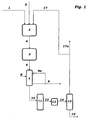
- the figure shows the process flow diagram of the method according to the invention according to one embodiment.
- An oxygen-containing feed gas stream 1, a hydrogen chloride-containing feed stream 2 and an oxygen-containing recycle stream 17 are fed to the fluidized-bed reactor 3, in which part of the hydrogen chloride is oxidized to chlorine.
- the resulting stream 4 of oxygen, chlorine, unreacted hydrogen chloride and water vapor is introduced into the tube bundle reactor 5. This contains a catalyst fixed bed.
- a product gas stream 6 containing chlorine, unreacted oxygen, unreacted hydrogen chloride and water vapor is obtained.
- the product gas stream 6 is introduced into a condenser / condenser 7, which may be formed as a quench cooler. In the cooler 7 hydrochloric acid 9 is condensed out.
- water 8 can be fed into the quench cooler 7 as a quenching or absorption agent, and a partial stream 9a of the dilute hydrochloric acid can be recycled as quenching agent into the quench cooler.
- the quench cooler 7 leaves a substantially stream of hydrogen chloride gas stream 10 of chlorine and oxygen, which still contains traces of water vapor, and which is fed to a drying stage 11.
- the gas stream 10 is brought into contact with a suitable absorbent such as sulfuric acid, molecular sieves or other hygroscopic adsorbents and thus freed from traces of water.
- the drying stage 11 may be in a drying tower or more parallel drying towers alternating to be regenerated.
- the dried gas stream 12 or 14 (optionally still a compressor 13 is provided) of chlorine and oxygen is fed to the condenser 15, is separated in the oxygen and recycled as reflux 17 in the hydrogen chloride oxidation reactor. There is obtained a product stream 16 of chlorine.
- the liquid crude chlorine product is preferably purified by distillation. To avoid the accumulation of inert gas components, a purge stream 17a is provided.
Landscapes
- Chemical & Material Sciences (AREA)
- Organic Chemistry (AREA)
- Inorganic Chemistry (AREA)
- Catalysts (AREA)
- Organic Low-Molecular-Weight Compounds And Preparation Thereof (AREA)
- Pharmaceuticals Containing Other Organic And Inorganic Compounds (AREA)
Applications Claiming Priority (2)
| Application Number | Priority Date | Filing Date | Title |
|---|---|---|---|
| DE10336522A DE10336522A1 (de) | 2003-08-08 | 2003-08-08 | Verfahren zur Herstellung von Chlor |
| PCT/EP2004/008872 WO2005014470A1 (de) | 2003-08-08 | 2004-08-06 | Verfahren zur herstellung von chlor |
Publications (2)
| Publication Number | Publication Date |
|---|---|
| EP1656322A1 EP1656322A1 (de) | 2006-05-17 |
| EP1656322B1 true EP1656322B1 (de) | 2007-09-05 |
Family
ID=34089123
Family Applications (1)
| Application Number | Title | Priority Date | Filing Date |
|---|---|---|---|
| EP04763900A Expired - Lifetime EP1656322B1 (de) | 2003-08-08 | 2004-08-06 | Verfahren zur herstellung von chlor |
Country Status (9)
| Country | Link |
|---|---|
| US (1) | US20060263290A1 (enExample) |
| EP (1) | EP1656322B1 (enExample) |
| JP (1) | JP4668190B2 (enExample) |
| KR (1) | KR101121389B1 (enExample) |
| CN (1) | CN100357175C (enExample) |
| AT (1) | ATE372299T1 (enExample) |
| DE (2) | DE10336522A1 (enExample) |
| ES (1) | ES2290748T3 (enExample) |
| WO (1) | WO2005014470A1 (enExample) |
Families Citing this family (18)
| Publication number | Priority date | Publication date | Assignee | Title |
|---|---|---|---|---|
| US20090274612A1 (en) * | 2005-04-08 | 2009-11-05 | Sumitomo Chemical Company, Limited. | Process for producing supported ruthenium oxide and process for producing chlorine |
| JP4839661B2 (ja) * | 2005-04-08 | 2011-12-21 | 住友化学株式会社 | 塩素の製造方法 |
| CA2623027A1 (en) | 2005-09-23 | 2007-03-29 | Mecs, Inc. | Ruthenium oxide catalysts for conversion of sulfur dioxide to sulfur trioxide |
| DE102005061954A1 (de) * | 2005-12-23 | 2007-07-05 | Basf Ag | Verfahren zur Wiedergewinnung von Ruthenium aus gebrauchten Rutheniumoxid-haltigen Katalysatoren |
| DE102007020140A1 (de) * | 2006-05-23 | 2007-11-29 | Bayer Materialscience Ag | Verfahren zur Herstellung von Chlor durch Gasphasenoxidation |
| JP5356233B2 (ja) * | 2006-09-19 | 2013-12-04 | ビーエーエスエフ ソシエタス・ヨーロピア | 流動床反応器中で塩素を製造する方法 |
| DE102007020148A1 (de) | 2007-04-26 | 2008-10-30 | Bayer Materialscience Ag | Prozess zur Herstellung von Chlor aus HCI |
| JP5169047B2 (ja) | 2007-07-23 | 2013-03-27 | 住友化学株式会社 | 塩素の製造方法 |
| CN101665243B (zh) * | 2008-09-04 | 2011-07-27 | 中国科学院过程工程研究所 | 一种制备氯气的方法及其系统 |
| JP5414300B2 (ja) * | 2009-02-16 | 2014-02-12 | 三井化学株式会社 | 塩素の製造方法 |
| JP2012521952A (ja) * | 2009-03-30 | 2012-09-20 | ビーエーエスエフ ソシエタス・ヨーロピア | 塩素の製造方法 |
| WO2011015503A1 (de) * | 2009-08-05 | 2011-02-10 | Basf Se | Verfahren zur herstellung von chlor durch gasphasenoxidation von chlorwasserstoff in einem wirbelschichtreaktor |
| KR101067660B1 (ko) * | 2011-01-27 | 2011-09-27 | (주)엔코아네트웍스 | 수황화나트륨 제조장치 및 제조방법 |
| US9352270B2 (en) | 2011-04-11 | 2016-05-31 | ADA-ES, Inc. | Fluidized bed and method and system for gas component capture |
| US9278314B2 (en) | 2012-04-11 | 2016-03-08 | ADA-ES, Inc. | Method and system to reclaim functional sites on a sorbent contaminated by heat stable salts |
| CN104592000B (zh) * | 2014-12-22 | 2017-01-11 | 上海方纶新材料科技有限公司 | 制备氯甲酰基取代苯的清洁工艺 |
| GB201509019D0 (en) * | 2015-05-27 | 2015-07-08 | Johnson Matthey Plc | Process and catalyst |
| CN113441091A (zh) * | 2021-07-28 | 2021-09-28 | 万华化学集团股份有限公司 | 一种HCl氧化流化床跑损催化剂的处理方法 |
Family Cites Families (15)
| Publication number | Priority date | Publication date | Assignee | Title |
|---|---|---|---|---|
| JPH0615402B2 (ja) * | 1985-11-14 | 1994-03-02 | 三井東圧化学株式会社 | 塩素の製造方法 |
| IL81532A (en) * | 1986-02-19 | 1990-06-10 | Mitsui Toatsu Chemicals | Process for production of chlorine |
| BR8707365A (pt) * | 1986-06-26 | 1988-09-13 | Mitsui Toatsu Chemicals | Processo de producao de cloro |
| JP2595018B2 (ja) * | 1988-03-01 | 1997-03-26 | 三井東圧化学株式会社 | 塩素の製造方法 |
| ES2010473A6 (es) * | 1989-03-06 | 1989-11-01 | Espan Carburos Metal | Procedimiento para la recuperacion de cloro a partir decloruro de hidrogeno mediante un proceso de catalizador transportador y equipo para la realizacion de este procedimiento. |
| US5908607A (en) * | 1996-08-08 | 1999-06-01 | Sumitomo Chemical Co., Ltd. | Process for producing chlorine |
| CA2229993A1 (en) * | 1997-02-27 | 1998-08-27 | Air Products And Chemicals, Inc. | Fixed-bed temperature swing catalytic process for chemical reactions |
| JP4192354B2 (ja) * | 1999-01-22 | 2008-12-10 | 住友化学株式会社 | 塩素の製造方法 |
| WO2000043313A1 (fr) * | 1999-01-22 | 2000-07-27 | Sumitomo Chemical Company, Limited | Procede de fabrication du chlore |
| KR101513299B1 (ko) * | 2000-01-19 | 2015-04-17 | 스미또모 가가꾸 가부시끼가이샤 | 염소의 제조 방법 |
| JP4081597B2 (ja) * | 2001-12-04 | 2008-04-30 | 住友化学株式会社 | 触媒酸化方法 |
| DE10242400A1 (de) * | 2002-09-12 | 2004-03-18 | Basf Ag | Festbettverfahren zur Herstellung von Chlor durch katalytische Gasphasen-Oxidation von Chlorwasserstoff |
| DE10250131A1 (de) * | 2002-10-28 | 2004-05-06 | Basf Ag | Verfahren zur Herstellung von Chlor aus Salzsäure |
| CN1188342C (zh) * | 2002-11-08 | 2005-02-09 | 巨化集团公司 | 氯化氢催化氧化生产氯气的工艺方法及装置 |
| JP4250969B2 (ja) * | 2003-02-06 | 2009-04-08 | 住友化学株式会社 | 担持酸化ルテニウム触媒の製造方法および塩素の製造方法 |
-
2003
- 2003-08-08 DE DE10336522A patent/DE10336522A1/de not_active Withdrawn
-
2004
- 2004-08-06 US US10/567,579 patent/US20060263290A1/en not_active Abandoned
- 2004-08-06 AT AT04763900T patent/ATE372299T1/de not_active IP Right Cessation
- 2004-08-06 DE DE502004004897T patent/DE502004004897D1/de not_active Expired - Lifetime
- 2004-08-06 ES ES04763900T patent/ES2290748T3/es not_active Expired - Lifetime
- 2004-08-06 KR KR1020067002501A patent/KR101121389B1/ko not_active Expired - Fee Related
- 2004-08-06 EP EP04763900A patent/EP1656322B1/de not_active Expired - Lifetime
- 2004-08-06 JP JP2006522334A patent/JP4668190B2/ja not_active Expired - Fee Related
- 2004-08-06 CN CNB2004800227274A patent/CN100357175C/zh not_active Expired - Fee Related
- 2004-08-06 WO PCT/EP2004/008872 patent/WO2005014470A1/de not_active Ceased
Also Published As
| Publication number | Publication date |
|---|---|
| JP2007501760A (ja) | 2007-02-01 |
| KR101121389B1 (ko) | 2012-03-09 |
| CN100357175C (zh) | 2007-12-26 |
| EP1656322A1 (de) | 2006-05-17 |
| JP4668190B2 (ja) | 2011-04-13 |
| US20060263290A1 (en) | 2006-11-23 |
| ES2290748T3 (es) | 2008-02-16 |
| WO2005014470A1 (de) | 2005-02-17 |
| ATE372299T1 (de) | 2007-09-15 |
| KR20060057598A (ko) | 2006-05-26 |
| DE502004004897D1 (de) | 2007-10-18 |
| CN1832902A (zh) | 2006-09-13 |
| DE10336522A1 (de) | 2005-02-24 |
Similar Documents
| Publication | Publication Date | Title |
|---|---|---|
| EP1656322B1 (de) | Verfahren zur herstellung von chlor | |
| EP1558521B1 (de) | Verfahren zur herstellung von chlor aus salzsäure und ein damit integriertes verfahren zur herstellung von isocyanaten | |
| EP2142470B1 (de) | Kondensations-adsorptionsprozess zur entfernung organischer komponenten aus einem chlorwasserstoff enthaltenden gasstrom | |
| EP1542923B1 (de) | Festbettverfahren zur herstellung von chlor durch katalytische gasphasen-oxidation von chlorwasserstoff | |
| EP1529033B1 (de) | Integriertes verfahren zur herstellung von isocyanaten | |
| EP1981619B1 (de) | Verfahren zur gewinnung von (chlor)kohlenwasserstofffreiem chlorwasserstoff und phosgenfreien (chlor)kohlenwasserstoffen aus einem (chlor)kohlenwasserstoffe und phosgen enthaltenden chlorwasserstoffstrom | |
| EP1981806B1 (de) | Verfahren zur herstellung von chlor | |
| EP1866239B1 (de) | Verfahren zur herstellung von chlor | |
| DE102007018016A1 (de) | Absorptionsprozess zur Entfernung anorganischer Komponenten aus einem Chlorwasserstoff enthaltenden Gasstrom | |
| EP2038212A1 (de) | Verfahren zur oxidation eines chlorwasserstoff enthaltenden gases | |
| WO2008131870A1 (de) | Verfahren zur oxidation von kohlenmonoxid in einem hcl enthaltenden gasstrom | |
| DE10252859A1 (de) | Verfahren zur Herstellung von 1,2-Dichlorethan und von Vinylchlorid | |
| WO2007134861A1 (de) | Verfahren zur herstellung von chlor aus chlorwasserstoff und sauerstoff | |
| WO2008131869A1 (de) | Verfahren zur reinigung und oxidation eines chlorwasserstoff enthaltenden gases | |
| DE10234908B4 (de) | Verfahren zur Herstellung von Chlor aus einem (Chlor)kohlenwasserstoffe enthaltenden Chlorwasserstoffstrom | |
| WO2007125004A1 (de) | Verfahren zur herstellung von katalysatoren für die katalytische chlorwasserstoff-oxidation | |
| DE102011005897A1 (de) | Verfahren zur Bereitstellung von Chlor für chemische Umsetzungen |
Legal Events
| Date | Code | Title | Description |
|---|---|---|---|
| PUAI | Public reference made under article 153(3) epc to a published international application that has entered the european phase |
Free format text: ORIGINAL CODE: 0009012 |
|
| 17P | Request for examination filed |
Effective date: 20060308 |
|
| AK | Designated contracting states |
Kind code of ref document: A1 Designated state(s): AT BE BG CH CY CZ DE DK EE ES FI FR GB GR HU IE IT LI LU MC NL PL PT RO SE SI SK TR |
|
| DAX | Request for extension of the european patent (deleted) | ||
| GRAP | Despatch of communication of intention to grant a patent |
Free format text: ORIGINAL CODE: EPIDOSNIGR1 |
|
| GRAS | Grant fee paid |
Free format text: ORIGINAL CODE: EPIDOSNIGR3 |
|
| GRAA | (expected) grant |
Free format text: ORIGINAL CODE: 0009210 |
|
| AK | Designated contracting states |
Kind code of ref document: B1 Designated state(s): AT BE BG CH CY CZ DE DK EE ES FI FR GB GR HU IE IT LI LU MC NL PL PT RO SE SI SK TR |
|
| REG | Reference to a national code |
Ref country code: GB Ref legal event code: FG4D Free format text: NOT ENGLISH |
|
| REG | Reference to a national code |
Ref country code: CH Ref legal event code: EP |
|
| REF | Corresponds to: |
Ref document number: 502004004897 Country of ref document: DE Date of ref document: 20071018 Kind code of ref document: P |
|
| GBT | Gb: translation of ep patent filed (gb section 77(6)(a)/1977) |
Effective date: 20071010 |
|
| REG | Reference to a national code |
Ref country code: IE Ref legal event code: FG4D Free format text: LANGUAGE OF EP DOCUMENT: GERMAN |
|
| ET | Fr: translation filed | ||
| PG25 | Lapsed in a contracting state [announced via postgrant information from national office to epo] |
Ref country code: FI Free format text: LAPSE BECAUSE OF FAILURE TO SUBMIT A TRANSLATION OF THE DESCRIPTION OR TO PAY THE FEE WITHIN THE PRESCRIBED TIME-LIMIT Effective date: 20070905 |
|
| REG | Reference to a national code |
Ref country code: ES Ref legal event code: FG2A Ref document number: 2290748 Country of ref document: ES Kind code of ref document: T3 |
|
| REG | Reference to a national code |
Ref country code: HU Ref legal event code: AG4A Ref document number: E002319 Country of ref document: HU |
|
| PG25 | Lapsed in a contracting state [announced via postgrant information from national office to epo] |
Ref country code: PL Free format text: LAPSE BECAUSE OF FAILURE TO SUBMIT A TRANSLATION OF THE DESCRIPTION OR TO PAY THE FEE WITHIN THE PRESCRIBED TIME-LIMIT Effective date: 20070905 |
|
| RAP2 | Party data changed (patent owner data changed or rights of a patent transferred) |
Owner name: BASF SE |
|
| REG | Reference to a national code |
Ref country code: IE Ref legal event code: FD4D |
|
| PG25 | Lapsed in a contracting state [announced via postgrant information from national office to epo] |
Ref country code: GR Free format text: LAPSE BECAUSE OF FAILURE TO SUBMIT A TRANSLATION OF THE DESCRIPTION OR TO PAY THE FEE WITHIN THE PRESCRIBED TIME-LIMIT Effective date: 20071206 |
|
| NLT2 | Nl: modifications (of names), taken from the european patent patent bulletin |
Owner name: BASF SE Effective date: 20080305 |
|
| PG25 | Lapsed in a contracting state [announced via postgrant information from national office to epo] |
Ref country code: IE Free format text: LAPSE BECAUSE OF FAILURE TO SUBMIT A TRANSLATION OF THE DESCRIPTION OR TO PAY THE FEE WITHIN THE PRESCRIBED TIME-LIMIT Effective date: 20070905 Ref country code: PT Free format text: LAPSE BECAUSE OF FAILURE TO SUBMIT A TRANSLATION OF THE DESCRIPTION OR TO PAY THE FEE WITHIN THE PRESCRIBED TIME-LIMIT Effective date: 20080206 Ref country code: CZ Free format text: LAPSE BECAUSE OF FAILURE TO SUBMIT A TRANSLATION OF THE DESCRIPTION OR TO PAY THE FEE WITHIN THE PRESCRIBED TIME-LIMIT Effective date: 20070905 Ref country code: SK Free format text: LAPSE BECAUSE OF FAILURE TO SUBMIT A TRANSLATION OF THE DESCRIPTION OR TO PAY THE FEE WITHIN THE PRESCRIBED TIME-LIMIT Effective date: 20070905 |
|
| PG25 | Lapsed in a contracting state [announced via postgrant information from national office to epo] |
Ref country code: SE Free format text: LAPSE BECAUSE OF FAILURE TO SUBMIT A TRANSLATION OF THE DESCRIPTION OR TO PAY THE FEE WITHIN THE PRESCRIBED TIME-LIMIT Effective date: 20071205 Ref country code: RO Free format text: LAPSE BECAUSE OF FAILURE TO SUBMIT A TRANSLATION OF THE DESCRIPTION OR TO PAY THE FEE WITHIN THE PRESCRIBED TIME-LIMIT Effective date: 20070905 |
|
| PLBE | No opposition filed within time limit |
Free format text: ORIGINAL CODE: 0009261 |
|
| STAA | Information on the status of an ep patent application or granted ep patent |
Free format text: STATUS: NO OPPOSITION FILED WITHIN TIME LIMIT |
|
| PG25 | Lapsed in a contracting state [announced via postgrant information from national office to epo] |
Ref country code: DK Free format text: LAPSE BECAUSE OF FAILURE TO SUBMIT A TRANSLATION OF THE DESCRIPTION OR TO PAY THE FEE WITHIN THE PRESCRIBED TIME-LIMIT Effective date: 20070905 |
|
| 26N | No opposition filed |
Effective date: 20080606 |
|
| PG25 | Lapsed in a contracting state [announced via postgrant information from national office to epo] |
Ref country code: MC Free format text: LAPSE BECAUSE OF NON-PAYMENT OF DUE FEES Effective date: 20080831 |
|
| REG | Reference to a national code |
Ref country code: CH Ref legal event code: PL |
|
| PG25 | Lapsed in a contracting state [announced via postgrant information from national office to epo] |
Ref country code: EE Free format text: LAPSE BECAUSE OF FAILURE TO SUBMIT A TRANSLATION OF THE DESCRIPTION OR TO PAY THE FEE WITHIN THE PRESCRIBED TIME-LIMIT Effective date: 20070905 |
|
| PG25 | Lapsed in a contracting state [announced via postgrant information from national office to epo] |
Ref country code: CH Free format text: LAPSE BECAUSE OF NON-PAYMENT OF DUE FEES Effective date: 20080831 Ref country code: LI Free format text: LAPSE BECAUSE OF NON-PAYMENT OF DUE FEES Effective date: 20080831 Ref country code: SI Free format text: LAPSE BECAUSE OF FAILURE TO SUBMIT A TRANSLATION OF THE DESCRIPTION OR TO PAY THE FEE WITHIN THE PRESCRIBED TIME-LIMIT Effective date: 20070905 |
|
| PG25 | Lapsed in a contracting state [announced via postgrant information from national office to epo] |
Ref country code: CY Free format text: LAPSE BECAUSE OF FAILURE TO SUBMIT A TRANSLATION OF THE DESCRIPTION OR TO PAY THE FEE WITHIN THE PRESCRIBED TIME-LIMIT Effective date: 20070905 |
|
| PG25 | Lapsed in a contracting state [announced via postgrant information from national office to epo] |
Ref country code: BG Free format text: LAPSE BECAUSE OF FAILURE TO SUBMIT A TRANSLATION OF THE DESCRIPTION OR TO PAY THE FEE WITHIN THE PRESCRIBED TIME-LIMIT Effective date: 20071205 |
|
| PG25 | Lapsed in a contracting state [announced via postgrant information from national office to epo] |
Ref country code: AT Free format text: LAPSE BECAUSE OF NON-PAYMENT OF DUE FEES Effective date: 20080806 |
|
| PG25 | Lapsed in a contracting state [announced via postgrant information from national office to epo] |
Ref country code: LU Free format text: LAPSE BECAUSE OF NON-PAYMENT OF DUE FEES Effective date: 20080806 |
|
| PG25 | Lapsed in a contracting state [announced via postgrant information from national office to epo] |
Ref country code: TR Free format text: LAPSE BECAUSE OF FAILURE TO SUBMIT A TRANSLATION OF THE DESCRIPTION OR TO PAY THE FEE WITHIN THE PRESCRIBED TIME-LIMIT Effective date: 20070905 |
|
| PGFP | Annual fee paid to national office [announced via postgrant information from national office to epo] |
Ref country code: ES Payment date: 20130926 Year of fee payment: 10 Ref country code: NL Payment date: 20130822 Year of fee payment: 10 |
|
| PGFP | Annual fee paid to national office [announced via postgrant information from national office to epo] |
Ref country code: GB Payment date: 20130902 Year of fee payment: 10 Ref country code: FR Payment date: 20130830 Year of fee payment: 10 |
|
| PGFP | Annual fee paid to national office [announced via postgrant information from national office to epo] |
Ref country code: IT Payment date: 20130822 Year of fee payment: 10 |
|
| PGFP | Annual fee paid to national office [announced via postgrant information from national office to epo] |
Ref country code: BE Payment date: 20130926 Year of fee payment: 10 Ref country code: DE Payment date: 20131031 Year of fee payment: 10 |
|
| PGFP | Annual fee paid to national office [announced via postgrant information from national office to epo] |
Ref country code: HU Payment date: 20131030 Year of fee payment: 10 |
|
| REG | Reference to a national code |
Ref country code: DE Ref legal event code: R119 Ref document number: 502004004897 Country of ref document: DE |
|
| REG | Reference to a national code |
Ref country code: NL Ref legal event code: V1 Effective date: 20150301 |
|
| GBPC | Gb: european patent ceased through non-payment of renewal fee |
Effective date: 20140806 |
|
| PG25 | Lapsed in a contracting state [announced via postgrant information from national office to epo] |
Ref country code: HU Free format text: LAPSE BECAUSE OF NON-PAYMENT OF DUE FEES Effective date: 20140807 Ref country code: NL Free format text: LAPSE BECAUSE OF NON-PAYMENT OF DUE FEES Effective date: 20150301 Ref country code: IT Free format text: LAPSE BECAUSE OF NON-PAYMENT OF DUE FEES Effective date: 20140806 Ref country code: BE Free format text: LAPSE BECAUSE OF NON-PAYMENT OF DUE FEES Effective date: 20140831 |
|
| REG | Reference to a national code |
Ref country code: DE Ref legal event code: R119 Ref document number: 502004004897 Country of ref document: DE Effective date: 20150303 |
|
| REG | Reference to a national code |
Ref country code: FR Ref legal event code: ST Effective date: 20150430 |
|
| PG25 | Lapsed in a contracting state [announced via postgrant information from national office to epo] |
Ref country code: DE Free format text: LAPSE BECAUSE OF NON-PAYMENT OF DUE FEES Effective date: 20150303 Ref country code: GB Free format text: LAPSE BECAUSE OF NON-PAYMENT OF DUE FEES Effective date: 20140806 |
|
| PG25 | Lapsed in a contracting state [announced via postgrant information from national office to epo] |
Ref country code: FR Free format text: LAPSE BECAUSE OF NON-PAYMENT OF DUE FEES Effective date: 20140901 |
|
| REG | Reference to a national code |
Ref country code: ES Ref legal event code: FD2A Effective date: 20151201 |
|
| PG25 | Lapsed in a contracting state [announced via postgrant information from national office to epo] |
Ref country code: ES Free format text: LAPSE BECAUSE OF NON-PAYMENT OF DUE FEES Effective date: 20140807 |