EP1632282A2 - Verfahren und Vorrichtung zur Gewinnung von verbesserten Produktionsraten in thermischen chemischen Reaktionen - Google Patents
Verfahren und Vorrichtung zur Gewinnung von verbesserten Produktionsraten in thermischen chemischen Reaktionen Download PDFInfo
- Publication number
- EP1632282A2 EP1632282A2 EP05077433A EP05077433A EP1632282A2 EP 1632282 A2 EP1632282 A2 EP 1632282A2 EP 05077433 A EP05077433 A EP 05077433A EP 05077433 A EP05077433 A EP 05077433A EP 1632282 A2 EP1632282 A2 EP 1632282A2
- Authority
- EP
- European Patent Office
- Prior art keywords
- catalyst
- reaction
- reaction chamber
- heat
- porous
- Prior art date
- Legal status (The legal status is an assumption and is not a legal conclusion. Google has not performed a legal analysis and makes no representation as to the accuracy of the status listed.)
- Withdrawn
Links
Images


Classifications
-
- B—PERFORMING OPERATIONS; TRANSPORTING
- B01—PHYSICAL OR CHEMICAL PROCESSES OR APPARATUS IN GENERAL
- B01J—CHEMICAL OR PHYSICAL PROCESSES, e.g. CATALYSIS OR COLLOID CHEMISTRY; THEIR RELEVANT APPARATUS
- B01J19/00—Chemical, physical or physico-chemical processes in general; Their relevant apparatus
- B01J19/0093—Microreactors, e.g. miniaturised or microfabricated reactors
-
- B—PERFORMING OPERATIONS; TRANSPORTING
- B01—PHYSICAL OR CHEMICAL PROCESSES OR APPARATUS IN GENERAL
- B01J—CHEMICAL OR PHYSICAL PROCESSES, e.g. CATALYSIS OR COLLOID CHEMISTRY; THEIR RELEVANT APPARATUS
- B01J12/00—Chemical processes in general for reacting gaseous media with gaseous media; Apparatus specially adapted therefor
- B01J12/007—Chemical processes in general for reacting gaseous media with gaseous media; Apparatus specially adapted therefor in the presence of catalytically active bodies, e.g. porous plates
-
- B—PERFORMING OPERATIONS; TRANSPORTING
- B01—PHYSICAL OR CHEMICAL PROCESSES OR APPARATUS IN GENERAL
- B01J—CHEMICAL OR PHYSICAL PROCESSES, e.g. CATALYSIS OR COLLOID CHEMISTRY; THEIR RELEVANT APPARATUS
- B01J19/00—Chemical, physical or physico-chemical processes in general; Their relevant apparatus
- B01J19/24—Stationary reactors without moving elements inside
- B01J19/248—Reactors comprising multiple separated flow channels
- B01J19/249—Plate-type reactors
-
- B—PERFORMING OPERATIONS; TRANSPORTING
- B01—PHYSICAL OR CHEMICAL PROCESSES OR APPARATUS IN GENERAL
- B01J—CHEMICAL OR PHYSICAL PROCESSES, e.g. CATALYSIS OR COLLOID CHEMISTRY; THEIR RELEVANT APPARATUS
- B01J8/00—Chemical or physical processes in general, conducted in the presence of fluids and solid particles; Apparatus for such processes
- B01J8/02—Chemical or physical processes in general, conducted in the presence of fluids and solid particles; Apparatus for such processes with stationary particles, e.g. in fixed beds
- B01J8/0285—Heating or cooling the reactor
-
- B—PERFORMING OPERATIONS; TRANSPORTING
- B01—PHYSICAL OR CHEMICAL PROCESSES OR APPARATUS IN GENERAL
- B01J—CHEMICAL OR PHYSICAL PROCESSES, e.g. CATALYSIS OR COLLOID CHEMISTRY; THEIR RELEVANT APPARATUS
- B01J8/00—Chemical or physical processes in general, conducted in the presence of fluids and solid particles; Apparatus for such processes
- B01J8/02—Chemical or physical processes in general, conducted in the presence of fluids and solid particles; Apparatus for such processes with stationary particles, e.g. in fixed beds
- B01J8/06—Chemical or physical processes in general, conducted in the presence of fluids and solid particles; Apparatus for such processes with stationary particles, e.g. in fixed beds in tube reactors; the solid particles being arranged in tubes
- B01J8/067—Heating or cooling the reactor
-
- C—CHEMISTRY; METALLURGY
- C01—INORGANIC CHEMISTRY
- C01B—NON-METALLIC ELEMENTS; COMPOUNDS THEREOF; METALLOIDS OR COMPOUNDS THEREOF NOT COVERED BY SUBCLASS C01C
- C01B3/00—Hydrogen; Gaseous mixtures containing hydrogen; Separation of hydrogen from mixtures containing it; Purification of hydrogen; Reversible storage of hydrogen
- C01B3/02—Production of hydrogen; Production of gaseous mixtures containing hydrogen
- C01B3/06—Production of hydrogen; Production of gaseous mixtures containing hydrogen by reaction of inorganic compounds containing electro-positively bound hydrogen with inorganic reducing agents
- C01B3/12—Production of hydrogen; Production of gaseous mixtures containing hydrogen by reaction of inorganic compounds containing electro-positively bound hydrogen with inorganic reducing agents by reaction of water vapour with carbon monoxide
- C01B3/16—Production of hydrogen; Production of gaseous mixtures containing hydrogen by reaction of inorganic compounds containing electro-positively bound hydrogen with inorganic reducing agents by reaction of water vapour with carbon monoxide using catalysts
-
- C—CHEMISTRY; METALLURGY
- C01—INORGANIC CHEMISTRY
- C01B—NON-METALLIC ELEMENTS; COMPOUNDS THEREOF; METALLOIDS OR COMPOUNDS THEREOF NOT COVERED BY SUBCLASS C01C
- C01B3/00—Hydrogen; Gaseous mixtures containing hydrogen; Separation of hydrogen from mixtures containing it; Purification of hydrogen; Reversible storage of hydrogen
- C01B3/02—Production of hydrogen; Production of gaseous mixtures containing hydrogen
- C01B3/32—Production of hydrogen; Production of gaseous mixtures containing hydrogen by reaction of gaseous or liquid organic compounds with gasifying agents, e.g. water, carbon dioxide or air
- C01B3/34—Production of hydrogen; Production of gaseous mixtures containing hydrogen by reaction of gaseous or liquid organic compounds with gasifying agents, e.g. water, carbon dioxide or air by reaction of hydrocarbons with gasifying agents
- C01B3/38—Production of hydrogen; Production of gaseous mixtures containing hydrogen by reaction of gaseous or liquid organic compounds with gasifying agents, e.g. water, carbon dioxide or air by reaction of hydrocarbons with gasifying agents using catalysts
-
- C—CHEMISTRY; METALLURGY
- C01—INORGANIC CHEMISTRY
- C01B—NON-METALLIC ELEMENTS; COMPOUNDS THEREOF; METALLOIDS OR COMPOUNDS THEREOF NOT COVERED BY SUBCLASS C01C
- C01B3/00—Hydrogen; Gaseous mixtures containing hydrogen; Separation of hydrogen from mixtures containing it; Purification of hydrogen; Reversible storage of hydrogen
- C01B3/02—Production of hydrogen; Production of gaseous mixtures containing hydrogen
- C01B3/32—Production of hydrogen; Production of gaseous mixtures containing hydrogen by reaction of gaseous or liquid organic compounds with gasifying agents, e.g. water, carbon dioxide or air
- C01B3/34—Production of hydrogen; Production of gaseous mixtures containing hydrogen by reaction of gaseous or liquid organic compounds with gasifying agents, e.g. water, carbon dioxide or air by reaction of hydrocarbons with gasifying agents
- C01B3/38—Production of hydrogen; Production of gaseous mixtures containing hydrogen by reaction of gaseous or liquid organic compounds with gasifying agents, e.g. water, carbon dioxide or air by reaction of hydrocarbons with gasifying agents using catalysts
- C01B3/384—Production of hydrogen; Production of gaseous mixtures containing hydrogen by reaction of gaseous or liquid organic compounds with gasifying agents, e.g. water, carbon dioxide or air by reaction of hydrocarbons with gasifying agents using catalysts with external heating of the catalyst
-
- C—CHEMISTRY; METALLURGY
- C01—INORGANIC CHEMISTRY
- C01B—NON-METALLIC ELEMENTS; COMPOUNDS THEREOF; METALLOIDS OR COMPOUNDS THEREOF NOT COVERED BY SUBCLASS C01C
- C01B3/00—Hydrogen; Gaseous mixtures containing hydrogen; Separation of hydrogen from mixtures containing it; Purification of hydrogen; Reversible storage of hydrogen
- C01B3/02—Production of hydrogen; Production of gaseous mixtures containing hydrogen
- C01B3/32—Production of hydrogen; Production of gaseous mixtures containing hydrogen by reaction of gaseous or liquid organic compounds with gasifying agents, e.g. water, carbon dioxide or air
- C01B3/34—Production of hydrogen; Production of gaseous mixtures containing hydrogen by reaction of gaseous or liquid organic compounds with gasifying agents, e.g. water, carbon dioxide or air by reaction of hydrocarbons with gasifying agents
- C01B3/48—Production of hydrogen; Production of gaseous mixtures containing hydrogen by reaction of gaseous or liquid organic compounds with gasifying agents, e.g. water, carbon dioxide or air by reaction of hydrocarbons with gasifying agents followed by reaction of water vapour with carbon monoxide
-
- F—MECHANICAL ENGINEERING; LIGHTING; HEATING; WEAPONS; BLASTING
- F28—HEAT EXCHANGE IN GENERAL
- F28D—HEAT-EXCHANGE APPARATUS, NOT PROVIDED FOR IN ANOTHER SUBCLASS, IN WHICH THE HEAT-EXCHANGE MEDIA DO NOT COME INTO DIRECT CONTACT
- F28D7/00—Heat-exchange apparatus having stationary tubular conduit assemblies for both heat-exchange media, the media being in contact with different sides of a conduit wall
-
- B—PERFORMING OPERATIONS; TRANSPORTING
- B01—PHYSICAL OR CHEMICAL PROCESSES OR APPARATUS IN GENERAL
- B01J—CHEMICAL OR PHYSICAL PROCESSES, e.g. CATALYSIS OR COLLOID CHEMISTRY; THEIR RELEVANT APPARATUS
- B01J2208/00—Processes carried out in the presence of solid particles; Reactors therefor
- B01J2208/00008—Controlling the process
- B01J2208/00017—Controlling the temperature
- B01J2208/00106—Controlling the temperature by indirect heat exchange
- B01J2208/00168—Controlling the temperature by indirect heat exchange with heat exchange elements outside the bed of solid particles
- B01J2208/00194—Tubes
-
- B—PERFORMING OPERATIONS; TRANSPORTING
- B01—PHYSICAL OR CHEMICAL PROCESSES OR APPARATUS IN GENERAL
- B01J—CHEMICAL OR PHYSICAL PROCESSES, e.g. CATALYSIS OR COLLOID CHEMISTRY; THEIR RELEVANT APPARATUS
- B01J2208/00—Processes carried out in the presence of solid particles; Reactors therefor
- B01J2208/00008—Controlling the process
- B01J2208/00017—Controlling the temperature
- B01J2208/00106—Controlling the temperature by indirect heat exchange
- B01J2208/00168—Controlling the temperature by indirect heat exchange with heat exchange elements outside the bed of solid particles
- B01J2208/00212—Plates; Jackets; Cylinders
-
- B—PERFORMING OPERATIONS; TRANSPORTING
- B01—PHYSICAL OR CHEMICAL PROCESSES OR APPARATUS IN GENERAL
- B01J—CHEMICAL OR PHYSICAL PROCESSES, e.g. CATALYSIS OR COLLOID CHEMISTRY; THEIR RELEVANT APPARATUS
- B01J2208/00—Processes carried out in the presence of solid particles; Reactors therefor
- B01J2208/00008—Controlling the process
- B01J2208/00017—Controlling the temperature
- B01J2208/00106—Controlling the temperature by indirect heat exchange
- B01J2208/00309—Controlling the temperature by indirect heat exchange with two or more reactions in heat exchange with each other, such as an endothermic reaction in heat exchange with an exothermic reaction
-
- B—PERFORMING OPERATIONS; TRANSPORTING
- B01—PHYSICAL OR CHEMICAL PROCESSES OR APPARATUS IN GENERAL
- B01J—CHEMICAL OR PHYSICAL PROCESSES, e.g. CATALYSIS OR COLLOID CHEMISTRY; THEIR RELEVANT APPARATUS
- B01J2219/00—Chemical, physical or physico-chemical processes in general; Their relevant apparatus
- B01J2219/00781—Aspects relating to microreactors
- B01J2219/00783—Laminate assemblies, i.e. the reactor comprising a stack of plates
-
- B—PERFORMING OPERATIONS; TRANSPORTING
- B01—PHYSICAL OR CHEMICAL PROCESSES OR APPARATUS IN GENERAL
- B01J—CHEMICAL OR PHYSICAL PROCESSES, e.g. CATALYSIS OR COLLOID CHEMISTRY; THEIR RELEVANT APPARATUS
- B01J2219/00—Chemical, physical or physico-chemical processes in general; Their relevant apparatus
- B01J2219/00781—Aspects relating to microreactors
- B01J2219/00788—Three-dimensional assemblies, i.e. the reactor comprising a form other than a stack of plates
-
- B—PERFORMING OPERATIONS; TRANSPORTING
- B01—PHYSICAL OR CHEMICAL PROCESSES OR APPARATUS IN GENERAL
- B01J—CHEMICAL OR PHYSICAL PROCESSES, e.g. CATALYSIS OR COLLOID CHEMISTRY; THEIR RELEVANT APPARATUS
- B01J2219/00—Chemical, physical or physico-chemical processes in general; Their relevant apparatus
- B01J2219/00781—Aspects relating to microreactors
- B01J2219/00819—Materials of construction
- B01J2219/00822—Metal
-
- B—PERFORMING OPERATIONS; TRANSPORTING
- B01—PHYSICAL OR CHEMICAL PROCESSES OR APPARATUS IN GENERAL
- B01J—CHEMICAL OR PHYSICAL PROCESSES, e.g. CATALYSIS OR COLLOID CHEMISTRY; THEIR RELEVANT APPARATUS
- B01J2219/00—Chemical, physical or physico-chemical processes in general; Their relevant apparatus
- B01J2219/00781—Aspects relating to microreactors
- B01J2219/00819—Materials of construction
- B01J2219/00835—Comprising catalytically active material
-
- B—PERFORMING OPERATIONS; TRANSPORTING
- B01—PHYSICAL OR CHEMICAL PROCESSES OR APPARATUS IN GENERAL
- B01J—CHEMICAL OR PHYSICAL PROCESSES, e.g. CATALYSIS OR COLLOID CHEMISTRY; THEIR RELEVANT APPARATUS
- B01J2219/00—Chemical, physical or physico-chemical processes in general; Their relevant apparatus
- B01J2219/00781—Aspects relating to microreactors
- B01J2219/00851—Additional features
- B01J2219/00858—Aspects relating to the size of the reactor
- B01J2219/0086—Dimensions of the flow channels
-
- B—PERFORMING OPERATIONS; TRANSPORTING
- B01—PHYSICAL OR CHEMICAL PROCESSES OR APPARATUS IN GENERAL
- B01J—CHEMICAL OR PHYSICAL PROCESSES, e.g. CATALYSIS OR COLLOID CHEMISTRY; THEIR RELEVANT APPARATUS
- B01J2219/00—Chemical, physical or physico-chemical processes in general; Their relevant apparatus
- B01J2219/00781—Aspects relating to microreactors
- B01J2219/00873—Heat exchange
-
- B—PERFORMING OPERATIONS; TRANSPORTING
- B01—PHYSICAL OR CHEMICAL PROCESSES OR APPARATUS IN GENERAL
- B01J—CHEMICAL OR PHYSICAL PROCESSES, e.g. CATALYSIS OR COLLOID CHEMISTRY; THEIR RELEVANT APPARATUS
- B01J2219/00—Chemical, physical or physico-chemical processes in general; Their relevant apparatus
- B01J2219/00781—Aspects relating to microreactors
- B01J2219/0095—Control aspects
- B01J2219/00984—Residence time
-
- B—PERFORMING OPERATIONS; TRANSPORTING
- B01—PHYSICAL OR CHEMICAL PROCESSES OR APPARATUS IN GENERAL
- B01J—CHEMICAL OR PHYSICAL PROCESSES, e.g. CATALYSIS OR COLLOID CHEMISTRY; THEIR RELEVANT APPARATUS
- B01J2219/00—Chemical, physical or physico-chemical processes in general; Their relevant apparatus
- B01J2219/24—Stationary reactors without moving elements inside
- B01J2219/2401—Reactors comprising multiple separate flow channels
- B01J2219/245—Plate-type reactors
- B01J2219/2451—Geometry of the reactor
- B01J2219/2453—Plates arranged in parallel
-
- B—PERFORMING OPERATIONS; TRANSPORTING
- B01—PHYSICAL OR CHEMICAL PROCESSES OR APPARATUS IN GENERAL
- B01J—CHEMICAL OR PHYSICAL PROCESSES, e.g. CATALYSIS OR COLLOID CHEMISTRY; THEIR RELEVANT APPARATUS
- B01J2219/00—Chemical, physical or physico-chemical processes in general; Their relevant apparatus
- B01J2219/24—Stationary reactors without moving elements inside
- B01J2219/2401—Reactors comprising multiple separate flow channels
- B01J2219/245—Plate-type reactors
- B01J2219/2451—Geometry of the reactor
- B01J2219/2454—Plates arranged concentrically
-
- B—PERFORMING OPERATIONS; TRANSPORTING
- B01—PHYSICAL OR CHEMICAL PROCESSES OR APPARATUS IN GENERAL
- B01J—CHEMICAL OR PHYSICAL PROCESSES, e.g. CATALYSIS OR COLLOID CHEMISTRY; THEIR RELEVANT APPARATUS
- B01J2219/00—Chemical, physical or physico-chemical processes in general; Their relevant apparatus
- B01J2219/24—Stationary reactors without moving elements inside
- B01J2219/2401—Reactors comprising multiple separate flow channels
- B01J2219/245—Plate-type reactors
- B01J2219/2451—Geometry of the reactor
- B01J2219/2456—Geometry of the plates
- B01J2219/2458—Flat plates, i.e. plates which are not corrugated or otherwise structured, e.g. plates with cylindrical shape
-
- B—PERFORMING OPERATIONS; TRANSPORTING
- B01—PHYSICAL OR CHEMICAL PROCESSES OR APPARATUS IN GENERAL
- B01J—CHEMICAL OR PHYSICAL PROCESSES, e.g. CATALYSIS OR COLLOID CHEMISTRY; THEIR RELEVANT APPARATUS
- B01J2219/00—Chemical, physical or physico-chemical processes in general; Their relevant apparatus
- B01J2219/24—Stationary reactors without moving elements inside
- B01J2219/2401—Reactors comprising multiple separate flow channels
- B01J2219/245—Plate-type reactors
- B01J2219/2461—Heat exchange aspects
- B01J2219/2465—Two reactions in indirect heat exchange with each other
-
- B—PERFORMING OPERATIONS; TRANSPORTING
- B01—PHYSICAL OR CHEMICAL PROCESSES OR APPARATUS IN GENERAL
- B01J—CHEMICAL OR PHYSICAL PROCESSES, e.g. CATALYSIS OR COLLOID CHEMISTRY; THEIR RELEVANT APPARATUS
- B01J2219/00—Chemical, physical or physico-chemical processes in general; Their relevant apparatus
- B01J2219/24—Stationary reactors without moving elements inside
- B01J2219/2401—Reactors comprising multiple separate flow channels
- B01J2219/245—Plate-type reactors
- B01J2219/2476—Construction materials
- B01J2219/2477—Construction materials of the catalysts
- B01J2219/2481—Catalysts in granular from between plates
-
- B—PERFORMING OPERATIONS; TRANSPORTING
- B01—PHYSICAL OR CHEMICAL PROCESSES OR APPARATUS IN GENERAL
- B01J—CHEMICAL OR PHYSICAL PROCESSES, e.g. CATALYSIS OR COLLOID CHEMISTRY; THEIR RELEVANT APPARATUS
- B01J2219/00—Chemical, physical or physico-chemical processes in general; Their relevant apparatus
- B01J2219/24—Stationary reactors without moving elements inside
- B01J2219/2401—Reactors comprising multiple separate flow channels
- B01J2219/245—Plate-type reactors
- B01J2219/2491—Other constructional details
- B01J2219/2497—Size aspects, i.e. concrete sizes are being mentioned in the classified document
-
- C—CHEMISTRY; METALLURGY
- C01—INORGANIC CHEMISTRY
- C01B—NON-METALLIC ELEMENTS; COMPOUNDS THEREOF; METALLOIDS OR COMPOUNDS THEREOF NOT COVERED BY SUBCLASS C01C
- C01B2203/00—Integrated processes for the production of hydrogen or synthesis gas
- C01B2203/02—Processes for making hydrogen or synthesis gas
- C01B2203/0205—Processes for making hydrogen or synthesis gas containing a reforming step
- C01B2203/0227—Processes for making hydrogen or synthesis gas containing a reforming step containing a catalytic reforming step
- C01B2203/0233—Processes for making hydrogen or synthesis gas containing a reforming step containing a catalytic reforming step the reforming step being a steam reforming step
-
- C—CHEMISTRY; METALLURGY
- C01—INORGANIC CHEMISTRY
- C01B—NON-METALLIC ELEMENTS; COMPOUNDS THEREOF; METALLOIDS OR COMPOUNDS THEREOF NOT COVERED BY SUBCLASS C01C
- C01B2203/00—Integrated processes for the production of hydrogen or synthesis gas
- C01B2203/02—Processes for making hydrogen or synthesis gas
- C01B2203/0283—Processes for making hydrogen or synthesis gas containing a CO-shift step, i.e. a water gas shift step
-
- C—CHEMISTRY; METALLURGY
- C01—INORGANIC CHEMISTRY
- C01B—NON-METALLIC ELEMENTS; COMPOUNDS THEREOF; METALLOIDS OR COMPOUNDS THEREOF NOT COVERED BY SUBCLASS C01C
- C01B2203/00—Integrated processes for the production of hydrogen or synthesis gas
- C01B2203/04—Integrated processes for the production of hydrogen or synthesis gas containing a purification step for the hydrogen or the synthesis gas
- C01B2203/0465—Composition of the impurity
- C01B2203/0495—Composition of the impurity the impurity being water
-
- C—CHEMISTRY; METALLURGY
- C01—INORGANIC CHEMISTRY
- C01B—NON-METALLIC ELEMENTS; COMPOUNDS THEREOF; METALLOIDS OR COMPOUNDS THEREOF NOT COVERED BY SUBCLASS C01C
- C01B2203/00—Integrated processes for the production of hydrogen or synthesis gas
- C01B2203/06—Integration with other chemical processes
- C01B2203/066—Integration with other chemical processes with fuel cells
-
- C—CHEMISTRY; METALLURGY
- C01—INORGANIC CHEMISTRY
- C01B—NON-METALLIC ELEMENTS; COMPOUNDS THEREOF; METALLOIDS OR COMPOUNDS THEREOF NOT COVERED BY SUBCLASS C01C
- C01B2203/00—Integrated processes for the production of hydrogen or synthesis gas
- C01B2203/08—Methods of heating or cooling
- C01B2203/0805—Methods of heating the process for making hydrogen or synthesis gas
- C01B2203/0811—Methods of heating the process for making hydrogen or synthesis gas by combustion of fuel
-
- C—CHEMISTRY; METALLURGY
- C01—INORGANIC CHEMISTRY
- C01B—NON-METALLIC ELEMENTS; COMPOUNDS THEREOF; METALLOIDS OR COMPOUNDS THEREOF NOT COVERED BY SUBCLASS C01C
- C01B2203/00—Integrated processes for the production of hydrogen or synthesis gas
- C01B2203/08—Methods of heating or cooling
- C01B2203/0805—Methods of heating the process for making hydrogen or synthesis gas
- C01B2203/0833—Heating by indirect heat exchange with hot fluids, other than combustion gases, product gases or non-combustive exothermic reaction product gases
-
- C—CHEMISTRY; METALLURGY
- C01—INORGANIC CHEMISTRY
- C01B—NON-METALLIC ELEMENTS; COMPOUNDS THEREOF; METALLOIDS OR COMPOUNDS THEREOF NOT COVERED BY SUBCLASS C01C
- C01B2203/00—Integrated processes for the production of hydrogen or synthesis gas
- C01B2203/10—Catalysts for performing the hydrogen forming reactions
- C01B2203/1005—Arrangement or shape of catalyst
-
- C—CHEMISTRY; METALLURGY
- C01—INORGANIC CHEMISTRY
- C01B—NON-METALLIC ELEMENTS; COMPOUNDS THEREOF; METALLOIDS OR COMPOUNDS THEREOF NOT COVERED BY SUBCLASS C01C
- C01B2203/00—Integrated processes for the production of hydrogen or synthesis gas
- C01B2203/10—Catalysts for performing the hydrogen forming reactions
- C01B2203/1005—Arrangement or shape of catalyst
- C01B2203/1023—Catalysts in the form of a monolith or honeycomb
-
- C—CHEMISTRY; METALLURGY
- C01—INORGANIC CHEMISTRY
- C01B—NON-METALLIC ELEMENTS; COMPOUNDS THEREOF; METALLOIDS OR COMPOUNDS THEREOF NOT COVERED BY SUBCLASS C01C
- C01B2203/00—Integrated processes for the production of hydrogen or synthesis gas
- C01B2203/10—Catalysts for performing the hydrogen forming reactions
- C01B2203/1005—Arrangement or shape of catalyst
- C01B2203/1029—Catalysts in the form of a foam
-
- C—CHEMISTRY; METALLURGY
- C01—INORGANIC CHEMISTRY
- C01B—NON-METALLIC ELEMENTS; COMPOUNDS THEREOF; METALLOIDS OR COMPOUNDS THEREOF NOT COVERED BY SUBCLASS C01C
- C01B2203/00—Integrated processes for the production of hydrogen or synthesis gas
- C01B2203/10—Catalysts for performing the hydrogen forming reactions
- C01B2203/1041—Composition of the catalyst
-
- C—CHEMISTRY; METALLURGY
- C01—INORGANIC CHEMISTRY
- C01B—NON-METALLIC ELEMENTS; COMPOUNDS THEREOF; METALLOIDS OR COMPOUNDS THEREOF NOT COVERED BY SUBCLASS C01C
- C01B2203/00—Integrated processes for the production of hydrogen or synthesis gas
- C01B2203/10—Catalysts for performing the hydrogen forming reactions
- C01B2203/1041—Composition of the catalyst
- C01B2203/1047—Group VIII metal catalysts
-
- C—CHEMISTRY; METALLURGY
- C01—INORGANIC CHEMISTRY
- C01B—NON-METALLIC ELEMENTS; COMPOUNDS THEREOF; METALLOIDS OR COMPOUNDS THEREOF NOT COVERED BY SUBCLASS C01C
- C01B2203/00—Integrated processes for the production of hydrogen or synthesis gas
- C01B2203/10—Catalysts for performing the hydrogen forming reactions
- C01B2203/1041—Composition of the catalyst
- C01B2203/1047—Group VIII metal catalysts
- C01B2203/1052—Nickel or cobalt catalysts
- C01B2203/1058—Nickel catalysts
-
- C—CHEMISTRY; METALLURGY
- C01—INORGANIC CHEMISTRY
- C01B—NON-METALLIC ELEMENTS; COMPOUNDS THEREOF; METALLOIDS OR COMPOUNDS THEREOF NOT COVERED BY SUBCLASS C01C
- C01B2203/00—Integrated processes for the production of hydrogen or synthesis gas
- C01B2203/10—Catalysts for performing the hydrogen forming reactions
- C01B2203/1041—Composition of the catalyst
- C01B2203/1047—Group VIII metal catalysts
- C01B2203/1064—Platinum group metal catalysts
-
- C—CHEMISTRY; METALLURGY
- C01—INORGANIC CHEMISTRY
- C01B—NON-METALLIC ELEMENTS; COMPOUNDS THEREOF; METALLOIDS OR COMPOUNDS THEREOF NOT COVERED BY SUBCLASS C01C
- C01B2203/00—Integrated processes for the production of hydrogen or synthesis gas
- C01B2203/10—Catalysts for performing the hydrogen forming reactions
- C01B2203/1041—Composition of the catalyst
- C01B2203/1082—Composition of support materials
-
- C—CHEMISTRY; METALLURGY
- C01—INORGANIC CHEMISTRY
- C01B—NON-METALLIC ELEMENTS; COMPOUNDS THEREOF; METALLOIDS OR COMPOUNDS THEREOF NOT COVERED BY SUBCLASS C01C
- C01B2203/00—Integrated processes for the production of hydrogen or synthesis gas
- C01B2203/12—Feeding the process for making hydrogen or synthesis gas
- C01B2203/1205—Composition of the feed
- C01B2203/1211—Organic compounds or organic mixtures used in the process for making hydrogen or synthesis gas
- C01B2203/1235—Hydrocarbons
- C01B2203/1241—Natural gas or methane
-
- C—CHEMISTRY; METALLURGY
- C01—INORGANIC CHEMISTRY
- C01B—NON-METALLIC ELEMENTS; COMPOUNDS THEREOF; METALLOIDS OR COMPOUNDS THEREOF NOT COVERED BY SUBCLASS C01C
- C01B2203/00—Integrated processes for the production of hydrogen or synthesis gas
- C01B2203/12—Feeding the process for making hydrogen or synthesis gas
- C01B2203/1205—Composition of the feed
- C01B2203/1211—Organic compounds or organic mixtures used in the process for making hydrogen or synthesis gas
- C01B2203/1235—Hydrocarbons
- C01B2203/1247—Higher hydrocarbons
-
- C—CHEMISTRY; METALLURGY
- C01—INORGANIC CHEMISTRY
- C01B—NON-METALLIC ELEMENTS; COMPOUNDS THEREOF; METALLOIDS OR COMPOUNDS THEREOF NOT COVERED BY SUBCLASS C01C
- C01B2203/00—Integrated processes for the production of hydrogen or synthesis gas
- C01B2203/12—Feeding the process for making hydrogen or synthesis gas
- C01B2203/1288—Evaporation of one or more of the different feed components
-
- C—CHEMISTRY; METALLURGY
- C01—INORGANIC CHEMISTRY
- C01B—NON-METALLIC ELEMENTS; COMPOUNDS THEREOF; METALLOIDS OR COMPOUNDS THEREOF NOT COVERED BY SUBCLASS C01C
- C01B2203/00—Integrated processes for the production of hydrogen or synthesis gas
- C01B2203/16—Controlling the process
- C01B2203/1614—Controlling the temperature
- C01B2203/1619—Measuring the temperature
-
- C—CHEMISTRY; METALLURGY
- C01—INORGANIC CHEMISTRY
- C01B—NON-METALLIC ELEMENTS; COMPOUNDS THEREOF; METALLOIDS OR COMPOUNDS THEREOF NOT COVERED BY SUBCLASS C01C
- C01B2203/00—Integrated processes for the production of hydrogen or synthesis gas
- C01B2203/16—Controlling the process
- C01B2203/1628—Controlling the pressure
- C01B2203/1633—Measuring the pressure
-
- C—CHEMISTRY; METALLURGY
- C01—INORGANIC CHEMISTRY
- C01B—NON-METALLIC ELEMENTS; COMPOUNDS THEREOF; METALLOIDS OR COMPOUNDS THEREOF NOT COVERED BY SUBCLASS C01C
- C01B2203/00—Integrated processes for the production of hydrogen or synthesis gas
- C01B2203/16—Controlling the process
- C01B2203/1642—Controlling the product
- C01B2203/1647—Controlling the amount of the product
- C01B2203/1652—Measuring the amount of product
-
- C—CHEMISTRY; METALLURGY
- C01—INORGANIC CHEMISTRY
- C01B—NON-METALLIC ELEMENTS; COMPOUNDS THEREOF; METALLOIDS OR COMPOUNDS THEREOF NOT COVERED BY SUBCLASS C01C
- C01B2203/00—Integrated processes for the production of hydrogen or synthesis gas
- C01B2203/16—Controlling the process
- C01B2203/1642—Controlling the product
- C01B2203/1671—Controlling the composition of the product
- C01B2203/1676—Measuring the composition of the product
-
- C—CHEMISTRY; METALLURGY
- C01—INORGANIC CHEMISTRY
- C01B—NON-METALLIC ELEMENTS; COMPOUNDS THEREOF; METALLOIDS OR COMPOUNDS THEREOF NOT COVERED BY SUBCLASS C01C
- C01B2203/00—Integrated processes for the production of hydrogen or synthesis gas
- C01B2203/16—Controlling the process
- C01B2203/169—Controlling the feed
-
- Y—GENERAL TAGGING OF NEW TECHNOLOGICAL DEVELOPMENTS; GENERAL TAGGING OF CROSS-SECTIONAL TECHNOLOGIES SPANNING OVER SEVERAL SECTIONS OF THE IPC; TECHNICAL SUBJECTS COVERED BY FORMER USPC CROSS-REFERENCE ART COLLECTIONS [XRACs] AND DIGESTS
- Y02—TECHNOLOGIES OR APPLICATIONS FOR MITIGATION OR ADAPTATION AGAINST CLIMATE CHANGE
- Y02P—CLIMATE CHANGE MITIGATION TECHNOLOGIES IN THE PRODUCTION OR PROCESSING OF GOODS
- Y02P20/00—Technologies relating to chemical industry
- Y02P20/50—Improvements relating to the production of bulk chemicals
- Y02P20/52—Improvements relating to the production of bulk chemicals using catalysts, e.g. selective catalysts
Definitions
- the present invention relates to a method and apparatus for thermal chemical reactions.
- the method and apparatus can provide an enhanced reaction rates for thermal chemical reactions.
- Thermal chemical reactions are those chemical reactions that produce (exothermic) or consume (endothermic) heat.
- thermal chemical reactions include hydrocarbon conversion reactions such as steam reforming, water-gas shift reactions and combustion. These well-known reactions are usually carried out in the presence of a catalyst at temperatures up to about 1300°C. Because the intrinsic kinetics of a thermal chemical reaction can be much faster than the heat transfer rate between the reaction vessel and the thermal sink, source or environment, the actual rate of product production (i.e., the observed rate) is slower than the intrinsic rate. Intrinsic kinetics means the rate at which products could theoretically be formed at the catalyst surface.
- residence time is equal to the volume of the reaction zone divided by the inlet volumetric flow rate of reactants at the reaction system's temperature and pressure.
- the reaction zone is the total volume of the catalyst and surrounding area through which reactants and products flow.
- the first is a diffusion limitation as reactants diffuse into and out of a catalyst-bearing porous pellet and the second is a heat transfer limitation which is a combination of heat transfer parameters (thermal conductivity and length) of catalyst supports and overall reactor geometry (shape, size, and distance to the external heat exchanger). Because the water gas shift reaction is critical to a multi-reactor fuel processing system that supports distributed energy production through the use of a fuel cell, there is a need for a smaller, faster water gas shift reactor.
- thermal chemical reaction is in the conventional methane steam reforming reactor which produces synthesis gas at an average residence time of several seconds and with an effectiveness factor of 0.01 to 0.05 as reported by Adris, A., Pruden, B., Lim, C., J. Grace, 1996, "On the reported attempts to radically improve the performance of the steam methane reforming reactor," Canadian Joumal of Chemical Engineering, 74, 177-186.
- the methane to steam ratio is run at 3:1 to prevent coke formation. Efforts to improve heat transfer between the reaction vessel for this endothermic reaction and the thermal source have made only modest improvements in product production rate.
- the present invention provides methods and apparatuses for obtaining an enhanced production rate per reaction chamber volume of a reaction chamber with an inlet and an outlet for a thermal chemical reaction, wherein a ratio of the enhanced production rate per reaction chamber volume to a conventional production rate per conventional reaction chamber volume for the thermal chemical reaction is at least 2.
- residence time is on the order of seconds whereas with the present invention, residence time is less by a factor of 2, on the order of milliseconds to tens or hundreds of milliseconds.
- the invention includes:
- the present invention further provides a method and apparatus (vessel) for providing a heat transfer rate from a reaction chamber through a wall to a heat transfer chamber (exothermic reaction) or providing heat from a heat transfer chamber through a wall to a reaction chamber (endothermic reaction) substantially matching a local heat transfer requirement of a catalytic thermal chemical reaction.
- An important aspect of this invention is the thermal distance defined on a cross sectional plane through the vessel indusive of a heat transfer chamber, reaction chamber and a wall between the chambers.
- the cross sectional plane is perpendicular to a bulk flow direction of the reactant stream, and the thermal distance is a distance between a coolest position and a hottest position on the cross sectional plane.
- the thermal distance is of a length wherein the heat transfer rate from (or to) the reaction chamber to (or from) a heat transfer chamber (heat exchanger) substantially matches the local heat transfer rate.
- the invention includes a process for the catalytic conversion of at least one reactant in a thermal chemical reaction, in which at least one reactant is passed into at least one reaction chamber, heat is transferred to or from the reaction chamber into at least one heat exchanger; and at least one product is obtained.
- the reaction chamber contains a catalyst that catalyzes the reaction of the reactant or reactants.
- the process has one or more of the following characteristics: at steady state, at least 0.6 W/(cc of total reactor volume) of heat is transferred, where total reactor volume is defined as the sum of the volume of the reaction chamber(s) and heat exchanger chamber(s) including the volume of chamber walls; the contact time of the reactant with the catalyst is less than about 0.3 seconds; and the pressure drop through the reaction chamber is less than about 15 psig.
- thermal chemical reaction that can be conducted using methods and reactors of the present invention is steam reforming of a hydrocarbon.
- a feed stream comprising hydrocarbon gas and steam is passed into a reaction chamber which contains a catalyst that catalyzes the reaction of hydrocarbon gas and steam to produce a gaseous mixture comprising at least carbon monoxide and hydrogen gas.
- This process can produce more than 0.01 SLPM of hydrogen gas per cubic centimeter of total reactor volume.
- the present invention also provides a reactor for the catalytic conversion of at least one reactant in a thermal chemical reaction, comprising: at least one reaction chamber containing a porous catalyst insert; and at least one heat exchanger that is in thermal contact with the reaction chamber.
- the reaction chamber has a length less than or equal to 6 inches and a height less than or equal to 2 inches.
- the porous catalyst insert comprises a porous metal foam having open cells ranging from about 20 ppi to about 3000 ppi.
- the invention also includes a reactor in which the reaction chamber has a height less than or equal to 2 inches; and wherein at least one heat exchanger and at least one reaction chamber are configured such that, during steady-state operation, at least 0.6 W of heat per cc of total reactor volume can be transferred between the heat exchanger and the reaction chamber.
- the invention also includes a process for the catalytic conversion of at least one reactant in a thermal chemical reaction in which at least one reactant is passed into at least one reaction chamber that contains a catalyst that catalyzes the reaction of the at least one reactant; transferring heat to or from said at least one reaction chamber from or into said at least one heat exchanger, and obtaining at least one product from the reaction chamber, where the step of transferring heat, at steady-state, transfers at least 0.6 W of heat per cc of total reactor volume, such that, at steady state, the catalyst is maintained within a temperature range that reduces the formation of at least one undesirable chemical reaction product.
- undesirable chemical product(s) can be reduced by utilizing a contact time of less than about 0.3 seconds, thereby suppressing slow reactions that may form an undesirable chemical reaction product.
- Undesired chemical products can result from secondary reactions or slow parallel reactions.
- desirable products include carbon dioxide and water, and an undesirable product is methane.
- desirable products In steam reforming of a hydrocarbon, desirable products indude hydrogen and carbon monoxide and/or carbon dioxide, and an undesirable product is coke.
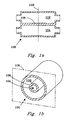
- a vessel 100 for thermal chemical reactions having two chambers 102 and 104 with a wall 106 therebetween. Either of the two chambers 102,104 may be the reaction chamber. Bulk flow of reactants within the reaction chamber 102 is substantially perpendicular to a cross section plane 108.
- the vessel 100 may have stacked chambers as in FIG. 1a or nested chambers as in FIG. 1b.
- the reaction in the reaction chamber may be endothermic or exothermic.
- reaction kinetics the steady-state rate of production (reaction kinetics) is limited by the rate of heat transfer either to (endothermic) or from (exothermic) the reaction site.
- rate of heat transfer either to (endothermic) or from (exothermic) the reaction site.
- exothermic reactions low rates of heat removal may promote undesired side reactions, or cause thermal hot spots or thermal runaway in the reactor.
- Commercial exothermic reactors are often operated with low conversion per pass to prevent hot spots and thermal excursions. Enhanced heat removal would safely permit operating at a higher production rate per unit reactor hardware volume.
- the reaction chamber preferably has a porous insert (not shown) within the reaction chamber volume wherein the porous insert within the reaction chamber volume has a mean porosity less than 1, a transport distance of the reactant(s) to the catalyst site no greater than 3 mm, and a height (a thermal transport distance from heat source to heat sink, no greater than 2 inches, thereby transferring reaction heat at an enhanced heat transfer rate through the porous insert.
- the porous insert may be a powder, a porous monolith (including but not limited to metal or ceramic foam, felt, honeycomb, tube bank, stacked microchannel assembly, and combinations thereof), fibers, wad (e.g. steel wool), or combinations thereof.
- a porous monolith including but not limited to metal or ceramic foam, felt, honeycomb, tube bank, stacked microchannel assembly, and combinations thereof
- fibers e.g. steel wool
- the porous insert may be arranged to provide single or multiple flow passages for reactants through the reaction chamber volume.
- the reaction chamber volume has a length parallel to a bulk reactant flow, the length less than or equal to 6 inches, and has a height, a thermal distance from heat sink to heat source, less than or equal to 2 inches.
- the limited length and height provide short distances permitting faster heat transfer.
- the short length reduces overall pressure drop through the reaction chamber.
- the heat transfer chamber (heat exchanger) is in thermal contact with the reaction chamber volume, the heat transfer chamber transferring heat at the enhanced heat transfer rate across the wall 106 between the heat transfer chamber and the reaction chamber, thereby obtaining the enhanced production rate per reaction chamber volume for the thermal chemical reaction.
- a preferred catalyst has a porous support, a solution deposited interfacial layer thereon, and a catalyst material on the interfacial layer.
- a more preferred catalyst has a porous support, a buffer layer, an interfacial layer, and a catalyst material. Any layer may be continuous or discontinuous as in the form of spots or dots, or in the form of a layer with gaps or holes.
- the porous support may be a porous ceramic or a metal foam.
- Other porous supports suitable for use in the present invention include carbides, nitrides, and composite materials.
- the porous support Prior to depositing the layers, has a porosity of at least 5% as measured by mercury porosimetry and an average pore size (sum of pore diameters/number of pores) of from 1 ⁇ m to 1000 ⁇ m as measured by optical and scanning electron microscopy.
- the porous support has a porosity of about 30% to about 99%, more preferably 60% to 98%.
- Preferred forms of porous supports are foams, felts, wads and combinations thereof. Foam is a structure with continuous walls defining pores throughout the structure.
- Felt is a structure of fibers with interstitial spaces therebetween.
- Wad is a structure of tangled strands, like steel wool.
- porous supports may also include other porous media such as pellets and honeycombs, provided that they have the aforementioned porosity and pore size characteristics.
- the open cells of a metal foam preferably range from about 20 pores per inch (ppi) to about 3000 ppi and more preferably about 20 to about 1000 ppi, still more preferably about 40 to about 120 ppi.
- PPI is defined as the largest number of pores per inch (in isotropic materials the direction of the measurement is irrelevant; however, in anisotropic materials, the measurement is done in the direction that maximizes pore number).
- ppi is measured by scanning electron microscopy. It has been discovered that a porous support provides several advantages in the present invention including low pressure drop, enhanced thermal conductivity over conventional ceramic pellet supports, and ease of loading/unloading in chemical reactors.
- the buffer layer if present, has different composition and/or density than both the support and the interfacial layers, and preferably has a coefficient of thermal expansion that is intermediate the thermal expansion coefficients of the porous support and the interfacial layer.
- the buffer layer is a metal oxide or metal carbide. Applicants discovered that vapor-deposited layers are superior because they exhibit better adhesion and resist flaking even after several thermal cycles.
- the buffer layer is Al 2 O 3 , TiO 2 , SiO 2 , and ZrO 2 or combinations thereof. More specifically, the Al 2 O 3 is ⁇ -Al 2 O 3 , ⁇ -Al 2 O 3 and combinations thereof. ⁇ -Al 2 O 3 is more preferred because of its excellent resistance to oxygen diffusion.
- the buffer layer may also be formed of two or more compositionally different sublayers.
- the porous support is metal, for example a stainless steel foam
- a preferred embodiment has a buffer layer formed of two compositionally different sub-layers (not shown).
- the first sublayer (in contact with the porous support) is preferably TiO 2 because it exhibits good adhesion to the porous metal support.
- the second sublayer is preferably ⁇ -Al 2 O 3 which is placed upon the TiO 2 .
- the ⁇ -Al 2 O 3 sublayer is a dense layer that provides excellent protection of the underlying metal surface. A less dense, high surface area interfacial layer such as alumina may then be deposited as support for a catalytically active layer.
- the porous support has a thermal coefficient of expansion different from that of the interfacial layer. Accordingly, for high temperature catalysis (T > 150°C) a buffer layer is needed to transition between the two coefficients of thermal expansion.
- the thermal expansion coefficient of the buffer layer can be tailored by controlling the composition to obtain an expansion coefficient that is compatible with the expansion coefficients of the porous support and interfacial layers.
- Another advantage of the buffer layer is that it provides resistance against side reactions such as coking or cracking caused by a bare metal foam surface. For chemical reactions which do not require large surface area supports such as catalytic combustion, the buffer layer stabilizes the catalyst metal due to strong metal to metal-oxide interaction.
- the buffer layer provides stronger bonding to the high surface area interfacial layer.
- the buffer layer is free of openings and pin holes - this provides superior protection of the underlying support.
- the buffer layer is nonporous.
- the buffer layer has a thickness that is less than one half of the average pore size of the porous support.
- the buffer layer is between about 0.05 and about 10 ⁇ m thick, more preferably, less than 5 ⁇ m thick.
- the buffer layer should exhibit thermal and chemical stability at elevated temperatures.
- adequate adhesion and chemical stability can be obtained without a buffer layer, so the buffer layer can be omitted, thus saving cost, providing extra volume and further enhancing heat transfer from the catalyst.
- the interfacial layer can be comprised of nitrides, carbides, sulfides, halides, metal oxides, carbon and combinations thereof.
- the interfacial layer provides high surface area and/or provides a desirable catalyst-support interaction for supported catalysts.
- the interfacial layer can be comprised of any material that is conventionally used as a catalyst support.
- the interfacial layer is a metal oxide.
- metal oxides include, but are not limited, to ⁇ -Al 2 O 3 , SiO 2 , ZrO 2 , TiO 2 , tungsten oxide, magnesium oxide, vanadium oxide, chromium oxide, manganese oxide, iron oxide, nickel oxide, cobalt oxide, copper oxide, zinc oxide, molybdenum oxide, tin oxide, calcium oxide, aluminum oxide, lanthanum series oxide(s), zeolite(s) and combinations thereof.
- the interfacial layer may serve as a catalytically active layer without any further catalytically active material deposited thereon. Usually, however, the interfacial layer is used in combination with catalytically active layer.
- the interfacial layer may also be formed of two or more compositionally different sublayers.
- the interfacial layer has a thickness that is less than one half of the average pore size of the porous support.
- the interfacial layer thickness ranges from about 0.5 to about 100 ⁇ m, more preferably from about 1 to about 50 ⁇ m.
- the interfacial layer can be either crystalline or amorphous and preferably has a BET surface area of at least 1 m 2 /g.
- the catalytically active material (when present) can be deposited on the interfacial layer. Alternatively, a catalytically active material can be simultaneously deposited with the interfacial layer.
- the catalytically active layer (when present) is typically intimately dispersed on the interfacial layer. That the catalytically active layer is "disposed on” or “deposited on” the interfacial layer includes the conventional understanding that microscopic catalytically active particles are dispersed: on the support layer (i.e., interfacial layer) surface, in crevices in the support layer, and in open pores in the support layer.
- the catalytically active layer may include: catalyst metals, including but not limited to, noble metal, transition metal and combinations thereof; metal oxides, including but not limited to, oxides of alkali elements, alkaline earth elements, boron, gallium, germanium, arsenic, selenium, tellurium, thallium, lead, bismuth, polonium, magnesium, titanium, vanadium, chromium, manganese, iron, nickel, cobalt, copper, zinc, zirconium, molybdenum, tin, calcium, aluminum, silicon, lanthanum series element(s), and combinations thereof; composites; zeolite(s); nitrides; carbides; sulfides; halides; phosphates; and combinations of any of the above.
- catalyst metals including but not limited to, noble metal, transition metal and combinations thereof
- metal oxides including but not limited to, oxides of alkali elements, alkaline earth elements, boron, gallium, germanium, arsen
- the catalyst impregnation preferably forms a porous interfacial layer having a depth less than 50 ⁇ m, preferably less than 20 ⁇ m. Therefore, the diffusion path length is at least a factor of 5 shorter than for standard catalyst particles.
- the thinner impregnated catalyst structure also enhances heat transfer, due to a shorter heat transfer pathway.
- the catalyst structure may be any geometric configuration.
- the catalyst is a porous structure such as a foam, felt, wad and combinations thereof.
- the catalyst (including the support and catalytic material). preferably is sized to fit within a reaction chamber.
- the catalyst may be a single piece of porous contiguous material, or many pieces in physical contact.
- the catalyst is preferred to have contiguous material and contiguous porosity such that molecules can diffuse through the catalyst.
- the catalyst can be disposed in a reaction chamber such that gases will flow substantially through the catalyst (single or multiple pieces) rather than around it.
- the cross-sectional area of the catalyst occupies at least 80%, more preferably at least 95% of the cross-sectional area of the reaction chamber.
- the catalytically active metal is distributed on surfaces throughout catalyst such that reactants passing through the catalyst can react anywhere along the passage through the catalyst; this is a significant advantage over pellet-type catalysts that have a large volume of unused space or catalytically ineffectively used space in the pellet's interior.
- the porous catalyst is also superior over powders because packed powders may cause a severe pressure drop.
- the catalyst preferably has a surface area, as measured by BET, of greater than about 0.5 m 2 /g, more preferably greater than about 2.0 m 2 /g.
- Catalysts of the present invention can also be characterized by the properties they exhibit. Factors that can be controlled to effect these properties indude: selection of the porous support, buffer, interfacial, and catalytically active layers; gradation of thermal expansion coefficients, crystallinity, metal-support interactions, catalyst size, thermal conductivity of the support, porosity, thermal conductance from reaction chamber, deposition techniques and other factors as are apparent in view of the descriptions herein.
- Certain preferred embodiments of the catalysts of the present invention exhibit one or more of the following properties: adhesion - after 3 thermal cydes in air, the catalyst exhibits less than 2% (by area) of flaking as viewed by SEM (scanning electron microscope) analysis; oxidation resistance, conversion of reactant(s), contact/residence times, product selectivity, pressure drop and production rates.
- a preferred method of making the inventive catalyst has the steps of selecting a porous support, depositing a buffer layer on the porous support and depositing an interfacial layer thereover.
- a catalyst layer may be deposited onto the interfacial layer. or both the interfacial layer and the catalyst layer may be simultaneously deposited on the buffer layer.
- metal foam has web surfaces that are nonporous and smooth, deposition of the buffer layer may be impeded.
- One way to mitigate this problem is to rough the metal surface via chemical etching.
- the adhesion of high surface area gamma-alumina supported metal catalysts to metal foam is significantly improved when metal foam is roughed via chemical etching using mineral acid solutions, for example 0.1 to 1M HCl. Roughed web surface also shows improved resistance to the spalling of catalyst layer under thermal cyclings.
- the metal foam is etched prior to vapor depositing the buffer layer. Etching is preferably with an acid, for example HCl.
- Deposition of the buffer layer is preferably by vapor deposition including but not limited to chemical vapor deposition, physical vapor deposition or combinations thereof. Surprisingly, it has been found that vapor deposition, which is typically conducted at high temperatures, results in polycrystalline or amorphous phases that provide good adhesion of the buffer layer to the surface of the porous support. The method is particularly advantageous for adhering a metal oxide buffer layer to a metal porous support.
- the buffer layer may be obtained by solution coating.
- the solution coating has the steps of metal surface functionalization via exposing the metal surface to water vapor to form suface hydroxyls, followed by surface reaction and hydrolysis of alkoxides to obtain a coating of metal oxide. This solution coating may be preferred as a lower cost method of depositing the buffer layer.
- the interfacial layer is preferably formed by vapor or solution deposition using precursors as are known for these techniques. Suitable precursors indude organometallic compounds, halides, carbonyls, acetonates, acetates, metals, colloidal dispersions of metal oxides, nitrates, slurries, etc.
- a porous alumina interfacial layer can be wash-coated with PQ alumina (Nyacol Products, Ashland, MA) colloidal dispersion followed by drying in a vacuum oven overnight and calcining at 500°C for 2 hours.
- the catalytically active material can be deposited by any suitable method.
- catalyst precursors can be deposited on colloidal metal oxide particles and slurry coated on a buffer-coated porous support, then dried and reduced.
- Certain embodiments of the present invention can be characterized in terms of residence or contact time. These terms have well-defined meanings in the art.
- Contact time is the total volume of the catalyst chambers divided by the total flowrate (defined as F-total) of inlet reactants assuming they are an ideal gas corrected to standard conditions (i.e., the volume of the catalyst chamber / F-total at STP where STP is 273K and 1 atm).
- the volume of the catalyst chambers indudes the volume in immediate proximity and surrounding the catalyst zone. As an example, if one were to pack one quarter of the channels with powders, then the volume of the catalyst chamber would only indude that region where gas can flow and where it can contact the catalyst, i.e.
- Residence time is the total volume of the catalyst chambers divided by the total flowrate of inlet reactants, corrected to the actual temperature and pressure of the reactants in the reactor (i.e., the volume of the catalyst chamber / F-total corrected to actual conditions).
- F-total at STP is the total volumetric flowrate of reactants (includes all reactants, and diluents if present).
- Inlet gases are typically metered with mass flow controllers set to standard conditions, i.e. the user presets the desired STP flowrate.
- F-total corrected to actual conditions F-total-STP x (Temperature in K)/273 x 1 atm/(P actual in atm): this value is used to calculate the residence time or the 'true time' within a reactor. Most practitioners prefer to use contact time, because it is a convenient method to keep the time variable fixed while stepping through 10 degree C increments in reaction temperature etc.
- the invention further provides a catalytic process comprising passage of at least one reactant into a reaction chamber comprising the inventive catalyst, conversion of said at least one reactant into at least one product, and passage of the product out of the reaction chamber.
- the catalytic process is conducted in an apparatus having microchannels. Microchannels have at least one dimension of about 1 mm or less. Examples of suitable microchannel apparatus and various process related factors are described in U.S. Patents Nos. 5,611,214, 5,811,062, 5,534,328, and U.S. Patent Applications Ser. Nos. 08/883,643, 08/938,228, 09/375,610, 09/123,781, cofiled U.S. patent application serial no.
- the catalyst is a monolith - a single contiguous, yet porous, piece of catalyst or several contiguous pieces that are stacked together (not a bed of packed powder or pellets or a coating on the wall of a microchannel) that can easily be inserted and extracted from a reaction chamber.
- the piece or stack of catalyst pieces preferably have a width of 0.1 mm to about 2 cm, with a preferred thickness of less than 1 cm, more preferably, about 1 to about 3 mm.
- the inventive catalyst may provide numerous advantages to catalytic processes such as: chemical stability, stability to repeated thermal cycling, thermal stability, efficient loading and unloading of catalysts, high rates of heat transfer and mass transfer, and maintenance of desired catalytic activity.
- thin sheets or tubes can be used to obtain high heat duties and short contact times.
- the thickness of the web between the reaction channel and the heat exchange channel can vary, but is preferably between about 0.01 inches and about 0.25 inches.
- the preferred thickness for the heat exchange channel (meaning the thickness of the smallest dimension of the heat transfer channel) preferably ranges from 100 microns to 10 millimeters. In some preferred embodiments, this smallest dimension may be channel width, in other embodiments, channel height. The preferred thickness is 250 microns to 3 millimeter.
- Flow of the heat transfer fluid may be either counter-current, cross-current, or co-current to the direction of the flow of reactants.
- Preferred heat transfer fluids include: a combustion stream (for endothermic reactions), oil (lower temperature reactions), and steam.
- the metal surfaces within microchannel apparatus can be coated with either or both the buffer and the interfacial layers. This can be done using any of the processes described herein, preferably by vapor deposition. Preferred coating materials include titania and and 5-10% SiO 2 /Al 2 O 3 .
- the interior surfaces of the reaction chamber, heat exchanger and other surfaces of microchannel apparatus may be coated.
- the walls of a reaction chamber can be coated with an optional buffer layer, an interfacial layer, and a catalytically active material - typically the catalytically active material and the interfacial layer combine to form a supported catalyst. Coatings can also be applied to metal walls in tubes and pipes that form connections to or within microchannel apparatus.
- the inventive method is preferably carried out in a reaction chamber in which the catalyst has a thickness of about 2 cm or less and is touching or in close proximity (within about 1 mm) of a reaction chamber wall, where the reaction chamber wall is in thermal contact with a heat exchanger.
- Heat transfer from (or to) the reaction chamber is preferably enhanced by addition of microchannels on at least one chamber wall through which heat is transferred, preferably, on the side of the reaction chamber wall opposite the catalyst structure.
- the catalyst preferably has contiguous and relatively large pores, such as in a foam, to avoid large pressure drops.
- the pore size of the large pores in the catalyst is between about 10 ⁇ m and about 300 ⁇ m.
- Catalytic processes of the present invention include: acetylation, addition reactions, alkylation, dealkylation, hydrodealkylation, reductive alkylation, amination, aromatization, arylation, autothermal reforming, carbonylation, decarbonylation, reductive carbonylation, carboxylation, reductive carboxylation, reductive coupling, condensation, cracking, hydrocracking, cyclization, cyclooligomerization, dehalogenation, dimerization, epoxidation, esterification, exchange, Fischer-Tropsch, halogenation, hydrohalogenation, homologation, hydration, dehydration, hydrogenation, dehydrogenation, hydrocarboxylation, hydroformylation, hydrogenolysis, hydrometallation, hydrosilation, hydrolysis, hydrotreating, hydrodesulferization/hydrodenitrogenation (HDS/HDN), isomerization, methanation, methanol synthesis, methylation, demethylation, metathesis, nitration, oxidation, partial
- reaction process or processes of the present invention can be conducted in parallel, with tens, hundreds, thousands, or millions of small reaction chambers, each chamber having an internal diameter less than about 2 inches, preferably less than about 2 cm, more preferably ranging from about 1mm to about 5 mm.
- the reaction process or processes can also be run in series. For example, products from one reaction chamber can be fed to another reaction chamber having the same or a different catalyst.
- a series of reactions could also be conducted by placing a series of different catalysts within the same reaction chamber. Reaction products can be collected and stored, for example in tanks, or immediately consumed in subsequent reactions.
- Heat flux is a particularly important characteristic in the present invention.
- the present invention preferably exhibits a heat flux during steady-state operation of at least about 0.6 W/cc, more preferably above about 1 W/cc still more preferably between about 5 and about 250 W/cc, and in another preferred range, between about 10 and 100 W/cc.
- the contact time is preferably less than about 0.3 seconds, more preferably, less than about 0.1 seconds, still more preferably, less than about 0.05 seconds and yet more preferably, less than about 0.01 seconds.
- the pressure drop through the reaction chamber is preferably less than about 15 psig (pounds per square inch gauge), more preferably less than about 10 psig, still more preferably less than about 5 psig, and yet more preferably less than about 1 psig.
- these high fluxes can be obtained in a wide variety of catalyzed reactions and is not limited to the highly exothermic, deep oxidation (combustion) reactions.
- the reactors and methods of the present invention can also be characterized by their high rates of production per unit reactor volume.
- the inventive process preferably produces more than 0.01 standard liter per minute (SLPM) of hydrogen gas per cubic centimeter (cc) of reactor hardware (the sum of the volume of the reaction chamber(s) and heat exchanger chamber(s) including the volume of chamber walls), more preferably more than 0.1 SLPM of hydrogen gas per cc of reactor hardware.
- SLPM standard liter per minute
- cc cubic centimeter
- the production rate of hydrogen case can range up to about 0.5 SLPM or more of hydrogen gas per cubic centimeter of reactor hardware.
- the reactors and methods of the present invention can consume more than about 0.01 SLPM of reactant gas per cubic centimeter of reactor hardware.
- reactors and methods of the present invention can produce thousands or millions or more of liters of product per day.
- the invention also provides a method of suppressing undesirable chemical reactions, especially coke formation.
- the reactors and methods of the present invention can be characterized by their ability to suppress chemical products that are slower forming, kinetically, or which are more likely to form within a reactor that has a lesser degree of temperature control.
- methanation is a common side reaction that does not take place as quickly as the reaction of interest, for the conversion of carbon monoxide to carbon dioxide.
- coke is a slower forming by-product in steam reforming reactions, with the prevalence for the reaction is also a function of the temperature of the catalyst surface.
- the reactors and methods of the present invention can support the primary reactions of interest (e.g., water-gas shift and steam reforming) while enhancing the ability of the system to avoid or suppress the formation of certain undesirable secondary products (e.g., methane and coke). More generally, the reactors and methods of the present invention can be used for suppressing other undesirable byproducts where their formation can be avoided through short contact times and/or enhanced temperature control.
- primary reactions of interest e.g., water-gas shift and steam reforming
- certain undesirable secondary products e.g., methane and coke.
- the reactors and methods of the present invention can be used for suppressing other undesirable byproducts where their formation can be avoided through short contact times and/or enhanced temperature control.
- a first porous insert was made with a catalyst material of a pre-reduced and stabilized 5-wt% Ru/ZrO 2 catalyst (1/8-inch extrudates) obtained from Degussa Corporation.
- the catalyst material was ground and sieved to 65 to 100 mesh.
- a second porous insert was made with Ni metal foam with 80 pores per inch (ppi) machined to fit in a 7 mm ID quartz tube, ranging from 0.5 to 2.5 cm in length.
- the metal foam was washed in a sonicator with acetone, chloroform, and water successively over 10-minute intervals. It was also etched in a 1 M HCl solution at 60°C for 30 min.
- the etched metal foam was saturated with a zirconium n-propoxide/1-propanol solution (Aldrich), followed by ambient hydrolysis with water vapor for 72 h, then calcined at 450°C for 4 h to form the interfacial layer.
- the ZrO 2 -coated metal foam was saturated with a dilute aqueous RuCl 3 solution (RuCl 3 hydrate, Aldrich). The saturation process was repeated several times until the desired Ru loading was achieved.
- the coated metal foam supported Ru catalyst was finally dried at 100 °C in vacuum overnight, followed by calcination at 350°C for 1 h. Prior to testing, the catalyst was activated with a 10%H 2 /He mixture at 350°C for at least 1 h.
- a catalytic plug flow reactor (PFR) system was used to test both porous inserts.
- the PFR was configured in a single-zone furnace as the heat transfer chamber.
- the reactor system included a steam generator placed directly prior to the reactor inlet, a PFR housed within the furnace, and a condenser located at the reactor outlet.
- the porous insert was packed in a 7 mm ID quartz tube, which was necked at the center.
- the feed water was fed to the steam generator using a Cole Parmer syringe pump. Carbon monoxide and nitrogen (a diluent) were fed to the system using Matheson mass flow controllers.
- the mixed feed stream flowed through the steam generator before entering the PFR in a downflow fashion.
- the product gases were directed through the condenser and sent to an on-line gas chromatograph, where the product stream was analyzed.
- thermocouples were placed inside the catalytic PFR system. One thermocouple was located above the porous insert. The second thermocouple was placed adjacent to the porous insert outside of the quartz tube to measure the furnace temperature. A pressure gauge at the reactor inlet was used to measure the differential pressure across the porous insert.
- the product gases were analyzed immediately upon exit from the reactor with a Microsensor Technology Inc., (MTI) M200 Gas Chromatograph.
- MMI Microsensor Technology Inc.
- the GC analyzes for hydrogen, nitrogen, oxygen, methane, carbon monoxide, air, carbon dioxide, ethane, and ethylene in 75 sec.
- the M200 used a vacuum pump to draw a small sample from the product stream with a 40-sec purge and a 100-millisecond injection time. Water was removed from the gas stream prior to entering the M200.
- Carbon monoxide conversion was calculated based on the moles of material in the inlet and outlet gas stream, as shown in equation 1.
- the selectivity to carbon dioxide (and hydrogen) or methane was calculated in equations 2 and 3, respectively.
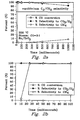
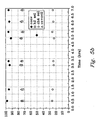
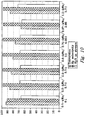
- FIGs. 2a and 2b show the performance for long and short contact times.
- 25 milliseconds on the Ru-based catalyst was sufficient to convert greater than 98% of the carbon monoxide to carbon dioxide and hydrogen.
- a CO conversion of 99.8 % was measured with a selectivity of 100% to the desired products (CO 2 and H 2 ).
- the equilibrium conversion of CO at 300°C and a steam to carbon ratio of 3:1 was 99.93%.
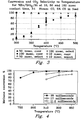
- the results with the second porous insert are shown in FIG. 3.
- the CO conversion was less than 10%.
- the measured carbon monoxide conversion reached 94% with a contact time of 50 milliseconds.
- the equilibrium conversion was 94.53% at these conditions.
- the equilibrium CO 2 selectivity was 93.52% at 500°C.
- the second porous insert of the coated metal foam had a higher activation temperature than the first porous insert of catalyst powder for two reasons.
- the catalyst washcoat had a slightly different composition and structure than the catalyst powders. Independent catalyst tests with powders made from the same washcoat verified the higher required activation temperature.
- the other distinction between the two porous inserts was a reduced weight of active catalyst (approximately 10%) on the coated metal foam.
- Table E2-1 Results for other hydrocarbons are shown in Table E2-1 wherein "time” is residence time.
- the data on butane, gasoline and kerosene were obtained using a powder catalyst while the data on isooctane were obtained using a foam catalyst.
- Table E2-1 Preliminary hydrocarbon reforming data based on 5%Rh/Al 2 O 3 catalyst screening tests Hydrocarbon Temperature (C) Time (ms) Conversion % H2 Sel. % Butane 600 25 100 96 Gasoline 800 50 95 ⁇ 95 Iso-octane A 700 25 100 89.5 Kerosene 600 50 95 ⁇ 98
- Catalyst material included a titania buffer layer
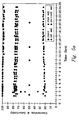
- FIG. 5a Further data for an n-butane steam reforming experiment are shown in FIG. 5a.
- A. porous insert consisted of 80 ppi stainless steel with an interfacial layer of alumina and a catalyst material of rhodium (15.6 wt% Rh on 17.1 wt% alumina, balance stainless steel foam, no buffer layer). Conditions were 650°C at 95 ms residence time with a steam to carbon ratio of 3.58:1. The pressure drop increased from negligible to over 7 psig, attributed to cracking and spalling of the interfacial and catalyst layers. The catalyst was regenerated in air to remove deposited carbon.
- FIG. 5b shows poorer performance. Pressure drop increased to over 7 psig after only 5 operating hours in two days.
- FIG. 6 A preferred, contemplated, embodiment of the invention is shown in Fig. 6.
- the distance from the heat source to heat sink is about 1 centimeter or less. This distance is a function of the heat duty, the selection of heat transfer fluid(s), and the effective thermal conductivity of the porous catalyst insert.
- the porous catalyst insert may have a porosity greater than 95%, which creates an effective thermal conductivity roughly two orders of magnitude below the pure metal or alloy forming the porous support.
- Thin sheets or tubes can be used to obtain high heat duties and short contact times.
- the thickness of the web between the reaction channel and the heat exchange channel can vary, but is preferably between about 0.01 inches and about 0.25 inches.
- the preferred thickness for the heat exchange channel preferably ranges from 100 microns to 10 millimeters.
- the preferred thickness is 250 microns to 3 millimeter.
- Flow of the heat transfer fluid may be either counter-current, cross-current, or co-current to the direction of the flow of reactants.
- the thickness for the catalyst preferably ranges from 100 microns to 10 millimeters.
- the preferred thickness is 250 microns to 1 millimeter.
- the catalyst may be comprised of a single contiguous porous monolithic catalyst, or may be created by placing multiple porous monoliths adjacent to each other.
- the porous monoliths may also be inserted with a gap between the porous monolith catalysts, or with a smaller monolith (as shown in Fig. 7 ) adjacent to and/or between larger monoliths.
- one or several equal sized monoliths are adjacent to each other; this design option will favor contact of the reactants with the catalyst surface.
- the volumetric heat flux using short contact time reactions within a device that can facilitate a high heat duty should easily exceed 0.6 W/cc. It has been shown that heat duties in the range of 1 to 10 W/cc are well within the range of this catalyst and reactor. Higher heat duties, up to 100 W/cc, can also be achieved if the contact time is less than 25 milliseconds and if the distance between the heat source and sink is on the order of one millimeter (about 0.5 to about 5 mm).
- the steam reforming reaction is often run at steam concentrations higher than the reaction stoichiometry shown above to avoid coke formation and to improve conversion.
- the steam concentration is usually given in the form of the steam to carbon ratio (S:C), the ratio of steam molecules per carbon atom in the reactant feed.
- S:C steam to carbon ratio
- a microchannel isooctane steam reformer was built, with a total volume of roughly 30 cubic centimeters.
- This reactor has integrated heat exchange to add the heat needed for this highly endothermic reaction.
- the heat exchange fluid used to heat the reactor zone was combustion gas set at 750°C and a total flowrate of roughly 100 SLPM.
- This design was built to process a hydrogen gas stream large enough to produce 1.0 kilowatt equivalent electric (kW e ) power in a PEM fuel cell.
- the reactor configuration is shown in Fig. 6.
- the reaction channels had a thickness of roughly 0.03 inches, a length of 1.1 inch, and a channel height of 1 inch.
- the heat exchange channels had an identical length and height.
- the thickness of the heat exchange channels was roughly 0.02 inches.
- the web thickness between the reaction and heat exchange channel was roughly 0.19 inches.
- the catalyst was a 15wt% Rh 2 O 3 on an aluminum containing spinel coated on a porous stainless steel foam.
- the specific details of catalyst preparation are as follows.
- Gamma alumina support (Strem) was calcined at 500°C for 5 hours.
- the incipient wetness method was used to impregnate magnesium nitrate solution on the alumina support to achieve 5wt% MgO.
- the modified support was dried at 110°C in vacuum for 4 hours followed by calcination at 900°C for 2 hours to form the aluminum containing spinel support.
- the spinel support was impregnated with a rhodium nitrate solution (Engelhard) using the incipient wetness technique to reach the desired Rh 2 O 3 loading.
- supported Rh powder catalyst was calcined at 500°C for 3 hours.
- the powdered catalyst was ball milled overnight and slurry dip-coated on a 80 ppi (Astromet, Cincinnati, Ohio) stainless steel foam. Prior to the dip-coating, the stainless steel foam was coated with the titania and alumina buffer layer using CVD.
- the data from the microchannel isooctane steam reformer's first hour of operation is shown in Fig. 9.
- the inlet flowrate of liquid isooctane was 2.54 mL/min.
- the reactor zone was operated at 650°C and one atmosphere.
- the reactants had a 6:1 steam to carbon ratio, which created a total contact time of roughly 22 milliseconds within the sum of the total reaction channels.
- the reactor was able to reach isooctane conversions ranging from 86.5% to 95%, thus requiring roughly 300 W of thermal energy.
- the hydrogen selectivity was in the 85 to 90% range.
- the results show that the microchannel isooctane steam reformer reactor can supply the heat necessary to sustain this reaction with a high processing rate per unit reactor volume.
- the reactant side pressure drop through this device was roughly 6.9 kPa (1.0 p.s.i).
- the expected fuel cell output under these conditions was sufficient to produce 0.5-kW e electrical output from a PEM fuel cell. This demonstration was continued for another hour and then shut down.
- the volumetric heat flux of the reactor was roughly 10 W/cc.
Landscapes
- Chemical & Material Sciences (AREA)
- Chemical Kinetics & Catalysis (AREA)
- Organic Chemistry (AREA)
- Engineering & Computer Science (AREA)
- Health & Medical Sciences (AREA)
- General Health & Medical Sciences (AREA)
- Combustion & Propulsion (AREA)
- Inorganic Chemistry (AREA)
- Physics & Mathematics (AREA)
- Thermal Sciences (AREA)
- Mechanical Engineering (AREA)
- General Engineering & Computer Science (AREA)
- Physical Or Chemical Processes And Apparatus (AREA)
- Catalysts (AREA)
- Hydrogen, Water And Hydrids (AREA)
- Organic Low-Molecular-Weight Compounds And Preparation Thereof (AREA)
Applications Claiming Priority (2)
| Application Number | Priority Date | Filing Date | Title |
|---|---|---|---|
| US09/492,246 US6616909B1 (en) | 1998-07-27 | 2000-01-27 | Method and apparatus for obtaining enhanced production rate of thermal chemical reactions |
| EP01906687.7A EP1251949B2 (de) | 2000-01-27 | 2001-01-24 | Verfahren zur katalytischen dampfreformierung eines kohlenwasserstoffes |
Related Parent Applications (2)
| Application Number | Title | Priority Date | Filing Date |
|---|---|---|---|
| EP01906687.7A Division-Into EP1251949B2 (de) | 2000-01-27 | 2001-01-24 | Verfahren zur katalytischen dampfreformierung eines kohlenwasserstoffes |
| EP01906687.7A Division EP1251949B2 (de) | 2000-01-27 | 2001-01-24 | Verfahren zur katalytischen dampfreformierung eines kohlenwasserstoffes |
Publications (1)
| Publication Number | Publication Date |
|---|---|
| EP1632282A2 true EP1632282A2 (de) | 2006-03-08 |
Family
ID=23955534
Family Applications (3)
| Application Number | Title | Priority Date | Filing Date |
|---|---|---|---|
| EP01906687.7A Expired - Lifetime EP1251949B2 (de) | 2000-01-27 | 2001-01-24 | Verfahren zur katalytischen dampfreformierung eines kohlenwasserstoffes |
| EP05077433A Withdrawn EP1632282A2 (de) | 2000-01-27 | 2001-01-24 | Verfahren und Vorrichtung zur Gewinnung von verbesserten Produktionsraten in thermischen chemischen Reaktionen |
| EP10003851A Withdrawn EP2208525A3 (de) | 2000-01-27 | 2001-01-24 | Verfahren zur Dampfreformierung von Kohlenwasserstoffen |
Family Applications Before (1)
| Application Number | Title | Priority Date | Filing Date |
|---|---|---|---|
| EP01906687.7A Expired - Lifetime EP1251949B2 (de) | 2000-01-27 | 2001-01-24 | Verfahren zur katalytischen dampfreformierung eines kohlenwasserstoffes |
Family Applications After (1)
| Application Number | Title | Priority Date | Filing Date |
|---|---|---|---|
| EP10003851A Withdrawn EP2208525A3 (de) | 2000-01-27 | 2001-01-24 | Verfahren zur Dampfreformierung von Kohlenwasserstoffen |
Country Status (11)
| Country | Link |
|---|---|
| US (3) | US6616909B1 (de) |
| EP (3) | EP1251949B2 (de) |
| JP (2) | JP5265833B2 (de) |
| AT (1) | ATE464117T1 (de) |
| AU (1) | AU2001234568A1 (de) |
| CA (1) | CA2396083C (de) |
| DE (1) | DE60141809D1 (de) |
| ES (1) | ES2344447T3 (de) |
| NO (1) | NO330291B1 (de) |
| PT (1) | PT1251949E (de) |
| WO (1) | WO2001054807A1 (de) |
Cited By (3)
| Publication number | Priority date | Publication date | Assignee | Title |
|---|---|---|---|---|
| WO2007071741A1 (en) * | 2005-12-22 | 2007-06-28 | Shell Internationale Research Maatschappij B.V. | Microchannel apparatus for removal of combustible , volatile contaminants |
| US7459589B2 (en) | 2005-12-22 | 2008-12-02 | Shell Oil Company | Process for the preparation of an alkylene glycol |
| US7750170B2 (en) | 2005-12-22 | 2010-07-06 | Shell Oil Company | Process for mixing an oxidant having explosive potential with a hydrocarbon |
Families Citing this family (174)
| Publication number | Priority date | Publication date | Assignee | Title |
|---|---|---|---|---|
| US6440895B1 (en) | 1998-07-27 | 2002-08-27 | Battelle Memorial Institute | Catalyst, method of making, and reactions using the catalyst |
| US6616909B1 (en) * | 1998-07-27 | 2003-09-09 | Battelle Memorial Institute | Method and apparatus for obtaining enhanced production rate of thermal chemical reactions |
| US6800269B2 (en) * | 1999-07-30 | 2004-10-05 | Conocophillips Company | Short contact time catalytic sulfur recovery system for removing H2S from a waste gas stream |
| US6946111B2 (en) * | 1999-07-30 | 2005-09-20 | Conocophilips Company | Short contact time catalytic partial oxidation process for recovering sulfur from an H2S containing gas stream |
| US6403051B1 (en) * | 1999-07-30 | 2002-06-11 | Conoco Inc. | Recovery of sulfur from H2S and concurrent production of H2 using short contact time CPOX |
| US6488838B1 (en) * | 1999-08-17 | 2002-12-03 | Battelle Memorial Institute | Chemical reactor and method for gas phase reactant catalytic reactions |
| BR0013344A (pt) * | 1999-08-17 | 2002-06-04 | Battelle Memorial Institute | Estrutura de catalisador e processo de sìntese de fischer-tropsch |
| KR100716461B1 (ko) * | 1999-08-17 | 2007-05-10 | 바텔리 메모리얼 인스티튜트 | 기체상 반응물 촉매 반응의 화학 반응기 및 방법 |
| US6969506B2 (en) * | 1999-08-17 | 2005-11-29 | Battelle Memorial Institute | Methods of conducting simultaneous exothermic and endothermic reactions |
| US6451864B1 (en) * | 1999-08-17 | 2002-09-17 | Battelle Memorial Institute | Catalyst structure and method of Fischer-Tropsch synthesis |
| US6921518B2 (en) * | 2000-01-25 | 2005-07-26 | Meggitt (Uk) Limited | Chemical reactor |
| FR2807746B1 (fr) * | 2000-04-13 | 2002-12-13 | Air Liquide | Procede de production d'un melange comportant de l'hydrogene et du co |
| US7125540B1 (en) * | 2000-06-06 | 2006-10-24 | Battelle Memorial Institute | Microsystem process networks |
| US7122170B2 (en) * | 2000-07-25 | 2006-10-17 | Conocophillips Company | Catalysts for SPOC™ enhanced synthesis gas production |
| ATE342480T1 (de) * | 2000-07-28 | 2006-11-15 | Honda Motor Co Ltd | Mehrzweck-mikrokomponent mit mikrokanälen |
| US6872919B2 (en) * | 2000-08-29 | 2005-03-29 | Maytag Corporation | Multi-stage catalyst for a cooking appliance |
| AU9061701A (en) * | 2000-09-05 | 2002-03-22 | Conoco Inc | Lanthanide-promoted rhodium catalysts and process for producing synthesis gas |
| US7326397B2 (en) * | 2000-12-18 | 2008-02-05 | Conocophillips Company | Catalytic partial oxidation process for recovering sulfur from an H2S-containing gas stream |
| US7357908B2 (en) * | 2000-12-18 | 2008-04-15 | Conocophillips Company | Apparatus and catalytic partial oxidation process for recovering sulfur from an H2S-containing gas stream |
| US7118917B2 (en) * | 2001-03-07 | 2006-10-10 | Symyx Technologies, Inc. | Parallel flow reactor having improved thermal control |
| EP1434652B1 (de) * | 2001-10-12 | 2005-02-16 | GTL Microsystems AG | Katalytischer reaktor |
| GB0124999D0 (en) * | 2001-10-18 | 2001-12-05 | Accentus Plc | Catalytic reactor |
| GB0125295D0 (en) * | 2001-10-22 | 2001-12-12 | Lattice Intellectual Property | Shift reaction |
| EP1442263A2 (de) * | 2001-10-29 | 2004-08-04 | CHART HEAT EXCHANGERS Limited Partnership | Wärmetauscher |
| GB0210794D0 (en) * | 2002-05-10 | 2002-06-19 | Chart Heat Exchangers Ltd | Heat exchangers |
| DE10153935A1 (de) * | 2001-11-06 | 2003-05-22 | Viessmann Werke Kg | Apparat zur Erzeugung von Wasserstoff |
| CA2478333C (en) * | 2002-03-11 | 2013-10-15 | Battelle Memorial Institute | Microchannel reactors with temperature control |
| US6746657B2 (en) * | 2002-03-12 | 2004-06-08 | Precision Combustion, Inc. | Method for reduced methanation |
| US7402719B2 (en) | 2002-06-13 | 2008-07-22 | Velocys | Catalytic oxidative dehydrogenation, and microchannel reactors for catalytic oxidative dehydrogenation |
| US9192929B2 (en) | 2002-08-15 | 2015-11-24 | Velocys, Inc. | Integrated combustion reactor and methods of conducting simultaneous endothermic and exothermic reactions |
| US6622519B1 (en) | 2002-08-15 | 2003-09-23 | Velocys, Inc. | Process for cooling a product in a heat exchanger employing microchannels for the flow of refrigerant and product |
| US7014835B2 (en) | 2002-08-15 | 2006-03-21 | Velocys, Inc. | Multi-stream microchannel device |
| US7250151B2 (en) * | 2002-08-15 | 2007-07-31 | Velocys | Methods of conducting simultaneous endothermic and exothermic reactions |
| US6969505B2 (en) * | 2002-08-15 | 2005-11-29 | Velocys, Inc. | Process for conducting an equilibrium limited chemical reaction in a single stage process channel |
| US7404936B2 (en) * | 2002-10-22 | 2008-07-29 | Velocys | Catalysts, in microchannel apparatus, and reactions using same |
| US6652627B1 (en) | 2002-10-30 | 2003-11-25 | Velocys, Inc. | Process for separating a fluid component from a fluid mixture using microchannel process technology |
| US7459224B1 (en) * | 2002-11-26 | 2008-12-02 | General Motors Corporation | Methods, apparatus, and systems for producing hydrogen from a fuel |
| US7105148B2 (en) * | 2002-11-26 | 2006-09-12 | General Motors Corporation | Methods for producing hydrogen from a fuel |
| GB0314790D0 (en) * | 2003-06-25 | 2003-07-30 | Accentus Plc | Catalytic reactor and process |
| CN1329286C (zh) * | 2002-12-20 | 2007-08-01 | 本田技研工业株式会社 | 生产富氢气体的方法和其中所使用的无贵金属催化剂配方 |
| US7405338B2 (en) * | 2003-04-07 | 2008-07-29 | Velocys | Dehydrogenation reactions in narrow reaction chambers and integrated reactors |
| US7294734B2 (en) * | 2003-05-02 | 2007-11-13 | Velocys, Inc. | Process for converting a hydrocarbon to an oxygenate or a nitrile |
| US7208136B2 (en) * | 2003-05-16 | 2007-04-24 | Battelle Memorial Institute | Alcohol steam reforming catalysts and methods of alcohol steam reforming |
| US7485671B2 (en) | 2003-05-16 | 2009-02-03 | Velocys, Inc. | Process for forming an emulsion using microchannel process technology |
| US8580211B2 (en) | 2003-05-16 | 2013-11-12 | Velocys, Inc. | Microchannel with internal fin support for catalyst or sorption medium |
| US7220390B2 (en) | 2003-05-16 | 2007-05-22 | Velocys, Inc. | Microchannel with internal fin support for catalyst or sorption medium |
| WO2004103539A2 (en) | 2003-05-16 | 2004-12-02 | Velocys Inc. | Process for forming an emulsion using microchannel process technology |
| US7153334B2 (en) * | 2003-05-21 | 2006-12-26 | General Motors Corporation | Fuel reforming system and method of operation |
| BRPI0411398A (pt) * | 2003-06-25 | 2006-07-18 | Velocys Inc | catalisadores, sistemas e métodos de reforma a vapor, e métodos de obtenção de catalisadores de reforma a vapor |
| US8277773B2 (en) | 2004-02-13 | 2012-10-02 | Velocys Corp. | Steam reforming method |
| US20040266615A1 (en) * | 2003-06-25 | 2004-12-30 | Watson Junko M. | Catalyst support and steam reforming catalyst |
| EP1639660A4 (de) * | 2003-06-27 | 2009-12-02 | Ultracell Corp | Effiziente mikro-brennstoffzellen-systeme und -verfahren |
| US20050207953A1 (en) * | 2003-07-22 | 2005-09-22 | The Regents Of The University Of California | High aspect ratio chemical microreactor |
| US20050203195A1 (en) * | 2003-08-05 | 2005-09-15 | Yong Wang | Tailored Fischer-Tropsch synthesis product distribution |
| US7029647B2 (en) * | 2004-01-27 | 2006-04-18 | Velocys, Inc. | Process for producing hydrogen peroxide using microchannel technology |
| US7084180B2 (en) | 2004-01-28 | 2006-08-01 | Velocys, Inc. | Fischer-tropsch synthesis using microchannel technology and novel catalyst and microchannel reactor |
| US9023900B2 (en) | 2004-01-28 | 2015-05-05 | Velocys, Inc. | Fischer-Tropsch synthesis using microchannel technology and novel catalyst and microchannel reactor |
| US8747805B2 (en) | 2004-02-11 | 2014-06-10 | Velocys, Inc. | Process for conducting an equilibrium limited chemical reaction using microchannel technology |
| US20050189097A1 (en) * | 2004-03-01 | 2005-09-01 | The Boeing Company | Formed sheet heat exchanger |
| CN1956777B (zh) * | 2004-03-23 | 2011-06-08 | 维罗西股份有限公司 | 微通道装置中修补的均匀涂层 |
| US8378163B2 (en) * | 2004-03-23 | 2013-02-19 | Velocys Corp. | Catalysts having catalytic material applied directly to thermally-grown alumina and catalytic methods using same, improved methods of oxidative dehydrogenation |
| CA2560879C (en) * | 2004-03-23 | 2014-05-13 | Velocys, Inc. | Micro-channel reactor with catalysts applied directly to thermally-grown alumina, methods using same and oxidative dehydrogenation |
| GB0408896D0 (en) * | 2004-04-20 | 2004-05-26 | Accentus Plc | Catalytic reactor |
| US7304198B2 (en) | 2004-05-14 | 2007-12-04 | Battelle Memorial Institute | Staged alkylation in microchannels |
| US7566487B2 (en) * | 2004-07-07 | 2009-07-28 | Jonathan Jay Feinstein | Reactor with primary and secondary channels |
| CA2574113C (en) | 2004-07-23 | 2014-02-18 | Anna Lee Tonkovich | Distillation process using microchannel technology |
| US7305850B2 (en) | 2004-07-23 | 2007-12-11 | Velocys, Inc. | Distillation process using microchannel technology |
| KR100786703B1 (ko) * | 2004-07-24 | 2007-12-21 | 삼성전자주식회사 | 가속도 센서를 이용한 운동량 측정장치 및 방법 |
| CN101023068B (zh) * | 2004-08-12 | 2013-02-13 | 万罗赛斯公司 | 使用微通道工艺技术将乙烯转化成环氧乙烷的方法 |
| US7129194B2 (en) * | 2004-09-23 | 2006-10-31 | Corning Incorporated | Catalyst system with improved corrosion resistance |
| EP1804964A1 (de) | 2004-10-01 | 2007-07-11 | Velocys Inc. | Mehrphasiges mischverfahren mit mikrokanalverarbeitungstechnologie |
| US7955504B1 (en) | 2004-10-06 | 2011-06-07 | State Of Oregon Acting By And Through The State Board Of Higher Education On Behalf Of Oregon State University | Microfluidic devices, particularly filtration devices comprising polymeric membranes, and method for their manufacture and use |
| US7468455B2 (en) * | 2004-11-03 | 2008-12-23 | Velocys, Inc. | Process and apparatus for improved methods for making vinyl acetate monomer (VAM) |
| US20060110311A1 (en) * | 2004-11-03 | 2006-05-25 | Dimascio Felice | Catalyst composite and methods of making and using |
| CN101128257B (zh) * | 2004-11-12 | 2010-10-27 | 万罗赛斯公司 | 使用微通道技术进行烷化或酰化反应的方法 |
| KR20100038476A (ko) | 2004-11-16 | 2010-04-14 | 벨로시스, 인코포레이티드 | 마이크로채널 기술을 사용하는 다중상 반응 과정 |
| CA2587412C (en) * | 2004-11-17 | 2013-03-26 | Velocys Inc. | Emulsion process using microchannel process technology |
| FR2879474B1 (fr) * | 2004-12-16 | 2008-06-13 | Air Liquide | Procede d'epuration d'un melange entrant comportant du dioxyde de carbone (co2) et du monoxyde de carbone (co) en vue de l'elimination du monoxyde de carbone (co) contenu dans ce melange |
| US7485161B2 (en) * | 2005-01-04 | 2009-02-03 | Air Products And Chemicals, Inc. | Dehydrogenation of liquid fuel in microchannel catalytic reactor |
| WO2006083443A2 (en) * | 2005-02-02 | 2006-08-10 | Carrier Corporation | Parallel flow heat exchangers incorporating porous inserts |
| US7507274B2 (en) * | 2005-03-02 | 2009-03-24 | Velocys, Inc. | Separation process using microchannel technology |
| JP2006248814A (ja) * | 2005-03-09 | 2006-09-21 | Hitachi Ltd | 水素供給装置および水素供給方法 |
| US7871578B2 (en) * | 2005-05-02 | 2011-01-18 | United Technologies Corporation | Micro heat exchanger with thermally conductive porous network |
| US9101890B2 (en) * | 2005-05-25 | 2015-08-11 | Velocys, Inc. | Support for use in microchannel processing |
| JP2008546533A (ja) * | 2005-06-28 | 2008-12-25 | ミレニアム セル インコーポレイテッド | 水素生成触媒及び水素生成系 |
| JP2007008731A (ja) * | 2005-06-28 | 2007-01-18 | Dainippon Printing Co Ltd | 水素製造装置およびその製造方法 |
| US20070004810A1 (en) * | 2005-06-30 | 2007-01-04 | Yong Wang | Novel catalyst and fischer-tropsch synthesis process using same |
| EP1904223A2 (de) * | 2005-07-08 | 2008-04-02 | Velocys Inc. | Verfahren für eine katalytische reaktion unter verwendung von mikrokanaltechnologie |
| KR100658684B1 (ko) * | 2005-09-28 | 2006-12-15 | 삼성에스디아이 주식회사 | 연료개질용 촉매 및 이를 포함하는 연료전지 시스템 |
| US8957259B2 (en) * | 2005-09-30 | 2015-02-17 | Battelle Memorial Institute | Dimethyl ether production from methanol and/or syngas |
| US20070154377A1 (en) * | 2005-12-22 | 2007-07-05 | Rekers Dominicus M | Process for the removal of combustible volatile contaminant materials from a process stream |
| US7226572B1 (en) * | 2006-03-03 | 2007-06-05 | Conocophillips Company | Compact sulfur recovery plant and process |
| CN102836675B (zh) * | 2006-03-23 | 2016-06-15 | 万罗赛斯公司 | 一种装置 |
| WO2007124409A2 (en) | 2006-04-20 | 2007-11-01 | Velocys, Inc. | Process for treating and/or forming a non-newtonian fluid using microchannel process technology |
| US7501111B2 (en) | 2006-08-25 | 2009-03-10 | Conoco Phillips Company | Increased capacity sulfur recovery plant and process for recovering elemental sulfur |
| US7999144B2 (en) | 2006-09-01 | 2011-08-16 | Velocys | Microchannel apparatus and methods of conducting catalyzed oxidative dehydrogenation |
| US20080108122A1 (en) * | 2006-09-01 | 2008-05-08 | State of Oregon acting by and through the State Board of Higher Education on behalf of Oregon | Microchemical nanofactories |
| WO2008052168A2 (en) * | 2006-10-26 | 2008-05-02 | Symyx Technologies, Inc. | High pressure parallel fixed bed reactor and method |
| RU2461603C2 (ru) * | 2007-01-19 | 2012-09-20 | Вилосис Инк. | Способ, установка и композиция для превращения природного газа в высокомолекулярные углеводороды посредством микроканальной технологии |
| US7923592B2 (en) | 2007-02-02 | 2011-04-12 | Velocys, Inc. | Process for making unsaturated hydrocarbons using microchannel process technology |
| DE102007020888A1 (de) * | 2007-05-04 | 2008-11-06 | Micro Systems Engineering Gmbh & Co. Kg | Keramisches Substratmaterial, Verfahren zur Herstellung und Verwendung desselben sowie Antenne oder Antennenarray |
| US7626063B2 (en) * | 2007-05-11 | 2009-12-01 | Conocophillips Company | Propane utilization in direct hydrotreating of oils and/or fats |
| US20080286177A1 (en) * | 2007-05-18 | 2008-11-20 | Tribute Creations, Llc | Reactor with differentially distributed catalytic activity |
| US8142530B2 (en) * | 2007-07-09 | 2012-03-27 | Range Fuels, Inc. | Methods and apparatus for producing syngas and alcohols |
| US8153027B2 (en) * | 2007-07-09 | 2012-04-10 | Range Fuels, Inc. | Methods for producing syngas |
| US20090014689A1 (en) * | 2007-07-09 | 2009-01-15 | Range Fuels, Inc. | Methods and apparatus for producing syngas and alcohols |
| US9227895B2 (en) * | 2007-07-09 | 2016-01-05 | Albemarle Corporation | Methods and apparatus for producing alcohols from syngas |
| US20090018371A1 (en) * | 2007-07-09 | 2009-01-15 | Range Fuels, Inc. | Methods and apparatus for producing alcohols from syngas |
| US20090093555A1 (en) * | 2007-07-09 | 2009-04-09 | Range Fuels, Inc. | Methods and apparatus for producing syngas |
| CN101815574A (zh) | 2007-10-02 | 2010-08-25 | 康帕克特Gtl有限公司 | 使用平行单元的气至液装置 |
| DE102007049172A1 (de) * | 2007-10-13 | 2009-04-16 | Micro Systems Engineering Gmbh & Co. Kg | Mikroreaktor und Verfahren zur Herstellung eines solchen sowie Verfahren zur Herstellung eines Substrats für einen Mikroreaktor |
| US8101140B2 (en) * | 2008-02-26 | 2012-01-24 | Battelle Memorial Institute | Structured catalyst bed and method for conversion of feed materials to chemical products and liquid fuels |
| US8100996B2 (en) * | 2008-04-09 | 2012-01-24 | Velocys, Inc. | Process for upgrading a carbonaceous material using microchannel process technology |
| AU2009233786B2 (en) * | 2008-04-09 | 2014-04-24 | Velocys Inc. | Process for converting a carbonaceous material to methane, methanol and/or dimethyl ether using microchannel process technology |
| DE102008044946B4 (de) * | 2008-08-29 | 2022-06-15 | Evonik Superabsorber Gmbh | Einsatz von Schaumkörpern in Oxidations-Reaktoren zur Herstellung ungesättigter Carbonsäuren |
| US20100081577A1 (en) * | 2008-09-30 | 2010-04-01 | Symyx Technologies, Inc. | Reactor systems and methods |
| US8747656B2 (en) | 2008-10-10 | 2014-06-10 | Velocys, Inc. | Process and apparatus employing microchannel process technology |
| DE102008043352A1 (de) | 2008-10-31 | 2010-05-06 | Micro Systems Engineering Gmbh | Keramisches Substratmaterial, Verfahren zur Herstellung und Verwendung desselben sowie Antenne oder Antennenarray |
| US9623393B2 (en) * | 2008-10-31 | 2017-04-18 | Asemblon, Inc. | Dehydrogenation of cyclic thioethers |
| US8889932B2 (en) * | 2008-11-26 | 2014-11-18 | Elevance Renewable Sciences, Inc. | Methods of producing jet fuel from natural oil feedstocks through oxygen-cleaved reactions |
| MY156576A (en) * | 2008-11-26 | 2016-03-15 | Elevance Renewable Sciences | Methods of producing jet fuel from natural oil feedstocks through metathesis reactions |
| US8165855B2 (en) * | 2009-05-27 | 2012-04-24 | King Fahd University Of Petroleum & Minerals | Method for modeling fluid flow over porous blocks |
| EP2260937A1 (de) * | 2009-06-12 | 2010-12-15 | DSM IP Assets B.V. | Vorrichtung zur Verarbeitung und Vorbereitung von Material, das durch eine Vorrichtung transportiert wird |
| US20100143755A1 (en) * | 2009-06-24 | 2010-06-10 | Fischer Bernhard A | Multi-Channel Fuel Reformer with Augmented Heat Transfer |
| US8801922B2 (en) * | 2009-06-24 | 2014-08-12 | State Of Oregon Acting By And Through The State Board Of Higher Education On Behalf Of Oregon State University | Dialysis system |
| JP2012531256A (ja) * | 2009-06-24 | 2012-12-10 | ステイト オブ オレゴン アクティング バイ アンド スルー ザ ステイト ボード オブ ハイヤー エデュケーション オン ビハーフ オブ オレゴン ステイト ユニバーシティー | 透析用マイクロ流体デバイス |
| US8765070B2 (en) * | 2009-09-22 | 2014-07-01 | Lockheed Martin Corporation | System and method for rejecting heat from equipment via endothermic isomerization |
| US20110083997A1 (en) * | 2009-10-09 | 2011-04-14 | Silva Laura J | Process for treating heavy oil |
| US9222056B2 (en) | 2009-10-12 | 2015-12-29 | Elevance Renewable Sciences, Inc. | Methods of refining natural oils, and methods of producing fuel compositions |
| US9175231B2 (en) | 2009-10-12 | 2015-11-03 | Elevance Renewable Sciences, Inc. | Methods of refining natural oils and methods of producing fuel compositions |
| US8735640B2 (en) | 2009-10-12 | 2014-05-27 | Elevance Renewable Sciences, Inc. | Methods of refining and producing fuel and specialty chemicals from natural oil feedstocks |
| US9382502B2 (en) | 2009-10-12 | 2016-07-05 | Elevance Renewable Sciences, Inc. | Methods of refining and producing isomerized fatty acid esters and fatty acids from natural oil feedstocks |
| US9000246B2 (en) | 2009-10-12 | 2015-04-07 | Elevance Renewable Sciences, Inc. | Methods of refining and producing dibasic esters and acids from natural oil feedstocks |
| US9169447B2 (en) | 2009-10-12 | 2015-10-27 | Elevance Renewable Sciences, Inc. | Methods of refining natural oils, and methods of producing fuel compositions |
| US9051519B2 (en) | 2009-10-12 | 2015-06-09 | Elevance Renewable Sciences, Inc. | Diene-selective hydrogenation of metathesis derived olefins and unsaturated esters |
| PL2488474T3 (pl) | 2009-10-12 | 2017-07-31 | Elevance Renewable Sciences, Inc. | Sposoby rafinacji i wytwarzania paliw z surowców na bazie olejów naturalnych |
| US9365487B2 (en) | 2009-10-12 | 2016-06-14 | Elevance Renewable Sciences, Inc. | Methods of refining and producing dibasic esters and acids from natural oil feedstocks |
| US8753515B2 (en) | 2009-12-05 | 2014-06-17 | Home Dialysis Plus, Ltd. | Dialysis system with ultrafiltration control |
| US8580161B2 (en) | 2010-05-04 | 2013-11-12 | State Of Oregon Acting By And Through The State Board Of Higher Education On Behalf Of Oregon State University | Fluidic devices comprising photocontrollable units |
| US8501009B2 (en) | 2010-06-07 | 2013-08-06 | State Of Oregon Acting By And Through The State Board Of Higher Education On Behalf Of Oregon State University | Fluid purification system |
| US8710106B2 (en) * | 2010-07-29 | 2014-04-29 | Precision Combustion, Inc. | Sabatier process and apparatus for controlling exothermic reaction |
| KR101297597B1 (ko) | 2011-04-19 | 2013-08-19 | 한국화학연구원 | 합성가스로부터 탄화수소를 제조하기 위한 반응장치 |
| KR101249204B1 (ko) | 2011-04-29 | 2013-04-09 | 한국과학기술원 | 전기 화학 반응 장치 및 전기 화학 반응 제공 방법 |
| US9950305B2 (en) | 2011-07-26 | 2018-04-24 | Battelle Memorial Institute | Solar thermochemical processing system and method |
| CN103957960B (zh) | 2011-10-07 | 2016-04-13 | 霍姆透析普拉斯有限公司 | 用于透析系统的热交换流体净化 |
| US9169174B2 (en) | 2011-12-22 | 2015-10-27 | Elevance Renewable Sciences, Inc. | Methods for suppressing isomerization of olefin metathesis products |
| US9139493B2 (en) | 2011-12-22 | 2015-09-22 | Elevance Renewable Sciences, Inc. | Methods for suppressing isomerization of olefin metathesis products |
| US9133416B2 (en) | 2011-12-22 | 2015-09-15 | Elevance Renewable Sciences, Inc. | Methods for suppressing isomerization of olefin metathesis products |
| US10961122B2 (en) | 2012-02-06 | 2021-03-30 | Helbio S.A. | Heat integrated reformer with catalytic combustion for hydrogen production |
| US11607657B2 (en) | 2012-02-06 | 2023-03-21 | Helbio S.A. | Heat integrated reformer with catalytic combustion for hydrogen production |
| CA3137624C (en) | 2012-03-08 | 2023-06-20 | Helbio Societe Anonyme Hydrogen And Energy Production Systems | Catalytically heated fuel processor with replaceable structured supports bearing catalyst for fuel cell |
| GB201214122D0 (en) | 2012-08-07 | 2012-09-19 | Oxford Catalysts Ltd | Treating of catalyst support |
| US9388098B2 (en) | 2012-10-09 | 2016-07-12 | Elevance Renewable Sciences, Inc. | Methods of making high-weight esters, acids, and derivatives thereof |
| RU2535826C2 (ru) * | 2012-12-04 | 2014-12-20 | Открытое акционерное общество "Тольяттиазот" | Способ получения синтез-газа путем паровой конверсии углеводородов |
| US9676623B2 (en) | 2013-03-14 | 2017-06-13 | Velocys, Inc. | Process and apparatus for conducting simultaneous endothermic and exothermic reactions |
| EP3838308A1 (de) | 2014-04-29 | 2021-06-23 | Outset Medical, Inc. | Dialysesysteme und -verfahren |
| FR3023494B1 (fr) * | 2014-07-09 | 2020-06-05 | L'air Liquide, Societe Anonyme Pour L'etude Et L'exploitation Des Procedes Georges Claude | Echangeur et/ou echangeur-reacteur fabrique par methode additive |
| US9943819B2 (en) | 2014-11-03 | 2018-04-17 | Singh Instrument LLC | Small-scale reactor having improved mixing |
| GB2554618B (en) | 2015-06-12 | 2021-11-10 | Velocys Inc | Synthesis gas conversion process |
| HUP1500403A1 (hu) * | 2015-09-04 | 2017-03-28 | Mol Magyar Olaj- Es Gazipari Nyilvanosan Muekoedoe Reszvenytarsasag | Átmeneti fémeket, nemfémeket és/vagy azok ötvözeteit és/vagy oxidjait tartalmazó önhordós, öntisztuló, nyílt cellás fémhabok és eljárás elõállításukra |
| GB2543849B (en) * | 2015-11-02 | 2021-08-11 | Johnson Matthey Plc | Oxidation catalyst |
| ES2908601T3 (es) | 2016-08-19 | 2022-05-03 | Outset Medical Inc | Sistema y métodos de diálisis peritoneal |
| KR102018494B1 (ko) * | 2018-03-15 | 2019-09-06 | 한국과학기술연구원 | 쉘-앤드 멀티 컨센트릭 튜브 형태의 반응기 |
| WO2019236926A2 (en) | 2018-06-06 | 2019-12-12 | Nexceris Innovation Holdings, Llc | Catalyst support materials, catalyst supports, catalysts and reaction methods using catalysts |
| US11358111B2 (en) | 2019-03-20 | 2022-06-14 | Battelle Memorial Institute, Pacific Northwest National Laboratories | Reactor assemblies and methods of performing reactions |
| US12383882B2 (en) | 2018-06-21 | 2025-08-12 | Battelle Memorial Institute | Reactor assemblies and methods of performing reactions |
| JP2021533881A (ja) | 2018-08-23 | 2021-12-09 | アウトセット・メディカル・インコーポレイテッドOutset Medical, Inc. | 透析システム及び方法 |
| BR112021021836A2 (pt) | 2019-04-30 | 2022-01-04 | Outset Medical Inc | Métodos para calcular a pressão arterial, para criar dialisato em um sistema de diálise, para medir a porcentagem de rejeição em um sistema de diálise, para coletar e analisar plasma sanguíneo, para remover gás de um circuito extracorpóreo de um sistema de diálise, para inferir uma pressão de linha em um circuito extracorpóreo de um sistema de diálise, para prover terapia de diálise extracorpórea e intracorpórea, para montar um conjunto de tubos de paciente no estilo cartucho em uma máquina de diálise e para preparar uma máquina de diálise para terapia de diálise, câmaras de fluxo e de remoção de ar, sistema de diálise, subsistema de dispensação de dialisato, filtro de micróbio/endotoxina de uso único, dialisador, dispositivo para medir pressão de um sistema de diálise, e, conjunto de tubos de sangue |
| US11325070B1 (en) * | 2019-12-09 | 2022-05-10 | Precision Combustion, Inc. | Catalytic reactor |
| CN112090388B (zh) * | 2020-09-07 | 2022-04-12 | 浙江大学 | 一种连续流反应器及其在化学反应和合成中的应用 |
| JPWO2023013182A1 (de) | 2021-08-04 | 2023-02-09 | ||
| KR102623247B1 (ko) * | 2022-02-04 | 2024-01-11 | (주)제이엠인터내셔날 | 수증기 개질 촉매 반응기 |
| DE102023127437A1 (de) * | 2023-10-09 | 2025-04-10 | Forschungszentrum Jülich GmbH | Wärmeerzeugungs- und Übertragungsvorrichtung |
| US12325674B1 (en) * | 2024-03-15 | 2025-06-10 | General Galactic Technologies Corporation | Modular system for renewable fuel generation |
Family Cites Families (105)
| Publication number | Priority date | Publication date | Assignee | Title |
|---|---|---|---|---|
| NL279655A (de) * | 1961-06-19 | |||
| BR6899414D0 (pt) * | 1963-06-06 | 1973-01-02 | Texaco Development Corp | Processo para producao de hidrogenio |
| US3829888A (en) | 1971-01-08 | 1974-08-13 | Hitachi Ltd | Semiconductor device and the method of making the same |
| CH566398A5 (de) | 1973-06-15 | 1975-09-15 | Battelle Memorial Institute | |
| US3944504A (en) | 1974-03-25 | 1976-03-16 | Olin Corporation | Catalyst for the diminution of automobile exhaust gases |
| GB1537822A (en) * | 1975-01-22 | 1979-01-04 | Shell Int Research | Process for the production of normally gaseous olefins |
| US4006102A (en) | 1975-08-25 | 1977-02-01 | Ford Motor Company | Stabilized rhenium catalyst |
| US4131643A (en) | 1975-09-05 | 1978-12-26 | Kobe Steel Limited | Catalyst for converting nitrogen oxides and method for converting nitrogen oxides in exhaust gases by using said catalyst |
| US4196099A (en) | 1978-02-10 | 1980-04-01 | Matthey Bishop, Inc. | Catalyst comprising a metal substrate |
| US4316882A (en) | 1978-04-20 | 1982-02-23 | Levine Bernard B | Compositions for testing to predict and/or diagnose allergy to penicillins |
| DE3068525D1 (en) | 1979-09-06 | 1984-08-16 | Ici Plc | A process and apparatus for catalytically reacting steam with a hydrocarbon in endothermic conditions |
| CA1137962A (en) | 1980-05-20 | 1982-12-21 | Governing Council Of The University Of Toronto (The) | Heterogeneous catalyst and process for its manufacture |
| NL8200544A (nl) | 1982-02-12 | 1983-09-01 | Veg Gasinstituut Nv | Werkwijze voor de bereiding van methaan uit koolmonoxide bevattende gasmengsels met behulp van nikkel bevattende katalysatoren. |
| US4422961A (en) | 1982-03-01 | 1983-12-27 | Olin Corporation | Raney alloy methanation catalyst |
| US5023276A (en) | 1982-09-30 | 1991-06-11 | Engelhard Corporation | Preparation of normally liquid hydrocarbons and a synthesis gas to make the same, from a normally gaseous hydrocarbon feed |
| DE3482094D1 (de) * | 1983-07-01 | 1990-06-07 | Hitachi Ltd | Bei hoher temperatur stabiler katalysator, verfahren zu dessen herstellung und verfahren zur durchfuehrung von chemischen reaktionen unter dessen verwendung. |
| US4601999A (en) | 1983-11-09 | 1986-07-22 | William B. Retallick | Metal support for a catalyst |
| DE3435319A1 (de) | 1984-09-26 | 1986-04-03 | Michael 4150 Krefeld Laumen | Katalytischer dampferzeuger |
| JPS61111140A (ja) | 1984-11-06 | 1986-05-29 | Toyota Central Res & Dev Lab Inc | 炭化水素合成用触媒 |
| DE3526383C1 (de) | 1985-07-24 | 1986-12-11 | Didier-Werke Ag, 6200 Wiesbaden | Verfahren zur Erzeugung von Katalysatoren fuer die Reduktion von Stickoxiden aus Abgasen und chemische Luftreinigungsverfahren |
| DE3640025A1 (de) | 1985-11-26 | 1987-05-27 | Toyota Motor Co Ltd | Monolithischer katalysatortraeger und monolithischer katalysator fuer die verwendung zum reinigen von auspuffgasen |
| US5227407A (en) | 1985-12-30 | 1993-07-13 | Exxon Research And Engineering Company | Water addition for increased CO/H2 hydrocarbon synthesis activity over catalysts comprising cobalt, ruthenium and mixtures thereof which may include a promoter metal |
| EP0260826B1 (de) * | 1986-09-10 | 1990-10-03 | Imperial Chemical Industries Plc | Katalysatoren |
| DK156701C (da) | 1987-08-27 | 1990-01-29 | Haldor Topsoe As | Fremgangsmaade til gennemfoerelse af heterogene katalytiske kemiske reaktioner |
| JPH0422827Y2 (de) | 1987-09-25 | 1992-05-26 | ||
| DE3810761A1 (de) | 1988-03-30 | 1989-10-12 | Didier Werke Ag | Verfahren zur herstellung von katalysatoren fuer die verminderung von stickoxiden und nach dem verfahren hergestellte katalysatoren |
| DE3813946A1 (de) | 1988-04-26 | 1989-11-09 | Asea Brown Boveri | Verfahren zum aufbringen einer aus edelmetallen und/oder edelmetallverbindungen bestehenden katalysatorschicht auf einen traeger aus keramischem material |
| EP0396650B2 (de) * | 1988-09-02 | 1995-04-12 | GebràDer Sulzer Aktiengesellschaft | Vorrichtung zur durchführung katalysierter reaktionen |
| US5440872A (en) | 1988-11-18 | 1995-08-15 | Pfefferle; William C. | Catalytic method |
| US5051241A (en) | 1988-11-18 | 1991-09-24 | Pfefferle William C | Microlith catalytic reaction system |
| US5047381A (en) | 1988-11-21 | 1991-09-10 | General Electric Company | Laminated substrate for catalytic combustor reactor bed |
| US5102851A (en) | 1988-12-28 | 1992-04-07 | Den Norske Stats Oljeselskap A.S. | Supported catalyst for hydrocarbon synthesis |
| US4945116A (en) | 1988-12-29 | 1990-07-31 | Uop | Fischer-Tropsch synthesis process employing a moderated ruthenium catalyst |
| DE69007885T2 (de) | 1989-07-13 | 1994-07-28 | Seco Tools Ab | Mit mehreren Oxiden beschichteter Karbidkörper und Verfahren zu seiner Herstellung. |
| NL8902250A (nl) | 1989-09-08 | 1991-04-02 | Veg Gasinstituut Nv | Werkwijze voor het uitvoeren van een chemische reactie en daarbij te gebruiken reactor. |
| DZ1444A1 (fr) * | 1989-09-12 | 2004-09-13 | Inst Francais Du Petrole | Procédé et réacteur d'oxydation à differentiel de perte de charge et son utilisation. |
| US5366717A (en) * | 1989-10-02 | 1994-11-22 | Research Triangle Institute | Method for producing elemental sulfur from sulfur-containing gases |
| US5354547A (en) * | 1989-11-14 | 1994-10-11 | Air Products And Chemicals, Inc. | Hydrogen recovery by adsorbent membranes |
| GB9000389D0 (en) * | 1990-01-08 | 1990-03-07 | Ici Plc | Steam reforming |
| ZA911838B (en) * | 1990-04-03 | 1991-12-24 | Standard Oil Co Ohio | Endothermic reaction apparatus |
| RU2093261C1 (ru) | 1991-05-12 | 1997-10-20 | Татьяна Николаевна Довбышева | Способ получения блочного катализатора дожига водорода в присутствии паров воды |
| DE4207905A1 (de) * | 1992-03-12 | 1993-09-16 | Bayer Ag | Festbettreaktoren mit kurzem katalysatorbett in stroemungsrichtung |
| US5846494A (en) * | 1992-04-30 | 1998-12-08 | Gaiser; Gerd | Reactor for catalytically processing gaseous fluids |
| TW216453B (en) * | 1992-07-08 | 1993-11-21 | Air Prod & Chem | Integrated plate-fin heat exchange reformation |
| US5364824A (en) * | 1992-12-08 | 1994-11-15 | Huntsman Specialty Chemicals Corporation | Catalysis for the production of maleic anhydride containing vanadium-phosphorus oxide with selected promoter elements |
| AU5741594A (en) * | 1992-12-17 | 1994-07-04 | Thermatrix Inc. | Method and apparatus for control of fugitive voc emissions |
| US5461022A (en) | 1992-12-31 | 1995-10-24 | Sandia Corporation | Thin film hydrous metal oxide catalysts |
| WO1994020789A1 (en) | 1993-03-04 | 1994-09-15 | Engelhard Corporation | Improved substrate configuration for catalytic combustion system |
| US5534328A (en) | 1993-12-02 | 1996-07-09 | E. I. Du Pont De Nemours And Company | Integrated chemical processing apparatus and processes for the preparation thereof |
| AU690568B2 (en) * | 1993-07-16 | 1998-04-30 | Thermatrix Inc. | Method and afterburner apparatus for control of highly variable flows |
| US5648582A (en) * | 1993-08-20 | 1997-07-15 | Regents Of The University Of Minnesota | Stable, ultra-low residence time partial oxidation |
| US6274113B1 (en) * | 1994-01-04 | 2001-08-14 | Chevron Phillips Chemical Company Lp | Increasing production in hydrocarbon conversion processes |
| US6040266A (en) | 1994-02-22 | 2000-03-21 | Ultramet | Foam catalyst support for exhaust purification |
| US5422331A (en) | 1994-02-25 | 1995-06-06 | Engelhard Corporation | Layered catalyst composition |
| US5512250A (en) * | 1994-03-02 | 1996-04-30 | Catalytica, Inc. | Catalyst structure employing integral heat exchange |
| JP3599370B2 (ja) | 1994-05-23 | 2004-12-08 | 日本碍子株式会社 | 水素製造装置 |
| JPH0812302A (ja) * | 1994-06-30 | 1996-01-16 | Toyota Motor Corp | 改質反応器 |
| US5480622A (en) | 1994-07-05 | 1996-01-02 | Ford Motor Company | Electrically heatable catalyst device using electrically conductive non-metallic materials |
| JPH0812303A (ja) * | 1994-07-05 | 1996-01-16 | Ishikawajima Harima Heavy Ind Co Ltd | プレートリフォーマ |
| US5611214A (en) | 1994-07-29 | 1997-03-18 | Battelle Memorial Institute | Microcomponent sheet architecture |
| US5811062A (en) * | 1994-07-29 | 1998-09-22 | Battelle Memorial Institute | Microcomponent chemical process sheet architecture |
| US6126723A (en) * | 1994-07-29 | 2000-10-03 | Battelle Memorial Institute | Microcomponent assembly for efficient contacting of fluid |
| US6129973A (en) * | 1994-07-29 | 2000-10-10 | Battelle Memorial Institute | Microchannel laminated mass exchanger and method of making |
| US5792432A (en) * | 1994-11-15 | 1998-08-11 | Babcock-Hitachi Kabushiki Kaisha | Catalyst unit and gas purifying apparatus |
| NL1000146C2 (nl) | 1995-04-13 | 1996-10-15 | Gastec Nv | Werkwijze voor het uitvoeren van een chemische reactie. |
| US5725756A (en) * | 1995-04-18 | 1998-03-10 | Center For Research, Inc. | In situ mitigation of coke buildup in porous catalysts with supercritical reaction media |
| DE19524158A1 (de) * | 1995-07-03 | 1997-01-09 | Degussa | Verfahren zur Herstellung von Blausäure |
| FR2736650B1 (fr) | 1995-07-13 | 1997-09-05 | Inst Francais Du Petrole | Procede de conversion du gaz de synthese en phase liquide |
| US6211113B1 (en) | 1995-09-12 | 2001-04-03 | Basf Aktiengesellschaft | Catalyst beds for non-steady state processes |
| JPH09192453A (ja) * | 1996-01-19 | 1997-07-29 | Ngk Insulators Ltd | 触媒コンバーター |
| US5858314A (en) * | 1996-04-12 | 1999-01-12 | Ztek Corporation | Thermally enhanced compact reformer |
| DE19636064A1 (de) | 1996-09-05 | 1998-03-12 | Basf Ag | Verfahren zur Hydrierung |
| DE19653991A1 (de) * | 1996-12-21 | 1998-06-25 | Degussa | Reaktor zur Durchführung endothermer katalytischer Reaktionen |
| US5914028A (en) * | 1997-01-10 | 1999-06-22 | Chevron Chemical Company | Reforming process with catalyst pretreatment |
| GB9702114D0 (en) * | 1997-02-01 | 1997-03-26 | British Gas Plc | A method of providing heat |
| GB2322633A (en) | 1997-02-28 | 1998-09-02 | Norske Stats Oljeselskap | Fischer-Tropsch reactor |
| JPH10273304A (ja) * | 1997-03-28 | 1998-10-13 | Sekiyu Sangyo Kasseika Center | 熱交換型改質反応器 |
| US5883138A (en) * | 1997-04-25 | 1999-03-16 | Exxon Research And Engineering Company | Rapid injection catalytic partial oxidation process and apparatus for producing synthesis gas (law 562) |
| US5855676A (en) * | 1997-05-01 | 1999-01-05 | Virginia Tech Intellectual Properties, Inc. | Tube lining apparatus |
| DE19719375A1 (de) * | 1997-05-07 | 1998-11-12 | Linde Ag | Verfahren und Reaktor zur Herstellung von Ethylenoxid |
| US6200536B1 (en) * | 1997-06-26 | 2001-03-13 | Battelle Memorial Institute | Active microchannel heat exchanger |
| CN1112961C (zh) * | 1997-07-03 | 2003-07-02 | 纳幕尔杜邦公司 | 感应加热的催化反应器 |
| US5976472A (en) * | 1997-10-15 | 1999-11-02 | Eastman Kodak Company | Integrated micro-ceramic chemical plant with insertable catalytic reaction chambers |
| US6254807B1 (en) * | 1998-01-12 | 2001-07-03 | Regents Of The University Of Minnesota | Control of H2 and CO produced in partial oxidation process |
| US6059961A (en) * | 1998-04-27 | 2000-05-09 | Uop Llc | Method to alleviate thermal cycles in moving bed radial flow reactor |
| US6616909B1 (en) * | 1998-07-27 | 2003-09-09 | Battelle Memorial Institute | Method and apparatus for obtaining enhanced production rate of thermal chemical reactions |
| US6479428B1 (en) * | 1998-07-27 | 2002-11-12 | Battelle Memorial Institute | Long life hydrocarbon conversion catalyst and method of making |
| US6540975B2 (en) * | 1998-07-27 | 2003-04-01 | Battelle Memorial Institute | Method and apparatus for obtaining enhanced production rate of thermal chemical reactions |
| US6440895B1 (en) | 1998-07-27 | 2002-08-27 | Battelle Memorial Institute | Catalyst, method of making, and reactions using the catalyst |
| US6143943A (en) | 1998-09-08 | 2000-11-07 | Uop Llc | Process using plate exchanger with high thermal density heat transfer fluid and simultaneous reaction |
| US6180846B1 (en) * | 1998-09-08 | 2001-01-30 | Uop Llc | Process and apparatus using plate arrangement for combustive reactant heating |
| US6228341B1 (en) | 1998-09-08 | 2001-05-08 | Uop Llc | Process using plate arrangement for exothermic reactions |
| US6274101B1 (en) | 1998-09-08 | 2001-08-14 | Uop Llc | Apparatus for in-situ reaction heating |
| US6168765B1 (en) | 1998-09-08 | 2001-01-02 | Uop Llc | Process and apparatus for interbed injection in plate reactor arrangement |
| US6265451B1 (en) | 1999-09-21 | 2001-07-24 | Hydrocarbon Technologies, Inc. | Skeletal iron catalyst and its preparation for Fischer-Tropsch synthesis processes |
| US6203587B1 (en) * | 1999-01-19 | 2001-03-20 | International Fuel Cells Llc | Compact fuel gas reformer assemblage |
| KR100678789B1 (ko) | 1999-01-21 | 2007-02-05 | 에이비비 루머스 글러벌 인코포레이티드 | 선택적 수소화 방법 및 이를 위한 촉매 |
| US6140266A (en) | 1999-02-18 | 2000-10-31 | International Fuel Cells, Co., Llc | Compact and light weight catalyst bed for use in a fuel cell power plant and method for forming the same |
| KR100716461B1 (ko) | 1999-08-17 | 2007-05-10 | 바텔리 메모리얼 인스티튜트 | 기체상 반응물 촉매 반응의 화학 반응기 및 방법 |
| US6488838B1 (en) * | 1999-08-17 | 2002-12-03 | Battelle Memorial Institute | Chemical reactor and method for gas phase reactant catalytic reactions |
| EP1206509B1 (de) | 1999-08-17 | 2004-10-06 | Battelle Memorial Institute | Katalysatorstruktur und fischer-tropschsyntheseverfahren |
| US7678343B2 (en) * | 1999-12-24 | 2010-03-16 | Ineos Vinyls Uk Ltd. | Metallic monolith catalyst support for selective gas phase reactions in tubular fixed bed reactors |
| US6537506B1 (en) * | 2000-02-03 | 2003-03-25 | Cellular Process Chemistry, Inc. | Miniaturized reaction apparatus |
| AU6985401A (en) | 2000-06-13 | 2001-12-24 | Conoco Inc | Supported nickel-magnesium oxide catalysts and processes for the production of syngas |
| US20020071797A1 (en) * | 2000-10-06 | 2002-06-13 | Loffler Daniel G. | Catalytic separator plate reactor and method of catalytic reforming of fuel to hydrogen |
-
2000
- 2000-01-27 US US09/492,246 patent/US6616909B1/en not_active Expired - Lifetime
-
2001
- 2001-01-24 EP EP01906687.7A patent/EP1251949B2/de not_active Expired - Lifetime
- 2001-01-24 PT PT01906687T patent/PT1251949E/pt unknown
- 2001-01-24 ES ES01906687T patent/ES2344447T3/es not_active Expired - Lifetime
- 2001-01-24 DE DE60141809T patent/DE60141809D1/de not_active Expired - Lifetime
- 2001-01-24 AT AT01906687T patent/ATE464117T1/de active
- 2001-01-24 JP JP2001554783A patent/JP5265833B2/ja not_active Expired - Fee Related
- 2001-01-24 EP EP05077433A patent/EP1632282A2/de not_active Withdrawn
- 2001-01-24 WO PCT/US2001/002509 patent/WO2001054807A1/en not_active Ceased
- 2001-01-24 AU AU2001234568A patent/AU2001234568A1/en not_active Abandoned
- 2001-01-24 EP EP10003851A patent/EP2208525A3/de not_active Withdrawn
- 2001-01-24 CA CA002396083A patent/CA2396083C/en not_active Expired - Fee Related
-
2002
- 2002-06-26 NO NO20023081A patent/NO330291B1/no not_active IP Right Cessation
-
2003
- 2003-07-01 US US10/610,282 patent/US7045114B2/en not_active Expired - Lifetime
-
2005
- 2005-09-26 US US11/236,125 patent/US20060029541A1/en not_active Abandoned
-
2009
- 2009-11-30 JP JP2009271910A patent/JP5474508B2/ja not_active Expired - Fee Related
Cited By (3)
| Publication number | Priority date | Publication date | Assignee | Title |
|---|---|---|---|---|
| WO2007071741A1 (en) * | 2005-12-22 | 2007-06-28 | Shell Internationale Research Maatschappij B.V. | Microchannel apparatus for removal of combustible , volatile contaminants |
| US7459589B2 (en) | 2005-12-22 | 2008-12-02 | Shell Oil Company | Process for the preparation of an alkylene glycol |
| US7750170B2 (en) | 2005-12-22 | 2010-07-06 | Shell Oil Company | Process for mixing an oxidant having explosive potential with a hydrocarbon |
Also Published As
| Publication number | Publication date |
|---|---|
| US7045114B2 (en) | 2006-05-16 |
| EP1251949B2 (de) | 2018-02-21 |
| US6616909B1 (en) | 2003-09-09 |
| NO330291B1 (no) | 2011-03-21 |
| CA2396083A1 (en) | 2001-08-02 |
| PT1251949E (pt) | 2010-06-09 |
| WO2001054807A1 (en) | 2001-08-02 |
| EP1251949B1 (de) | 2010-04-14 |
| JP5474508B2 (ja) | 2014-04-16 |
| NO20023081D0 (no) | 2002-06-26 |
| JP5265833B2 (ja) | 2013-08-14 |
| AU2001234568A1 (en) | 2001-08-07 |
| JP2010131595A (ja) | 2010-06-17 |
| ES2344447T3 (es) | 2010-08-27 |
| US20060029541A1 (en) | 2006-02-09 |
| US20040013606A1 (en) | 2004-01-22 |
| ATE464117T1 (de) | 2010-04-15 |
| EP2208525A2 (de) | 2010-07-21 |
| EP1251949A1 (de) | 2002-10-30 |
| NO20023081L (no) | 2002-09-11 |
| JP2003520674A (ja) | 2003-07-08 |
| CA2396083C (en) | 2009-05-19 |
| DE60141809D1 (de) | 2010-05-27 |
| EP2208525A3 (de) | 2012-04-25 |
Similar Documents
| Publication | Publication Date | Title |
|---|---|---|
| EP1251949B1 (de) | Verfahren und vorrichtung zur gewinnung verbesserter produktionsraten in thermischen chemischen reaktionen | |
| CA2657485C (en) | Method and apparatus for obtaining enhanced production rate of thermal chemical reactions | |
| US6440895B1 (en) | Catalyst, method of making, and reactions using the catalyst | |
| EP1206508B1 (de) | Katalysatorstruktur und fischer-tropschsyntheseverfahren | |
| AU2002365663B2 (en) | Process and apparatus for steam-methane reforming | |
| CA2381221C (en) | Catalyst structure and method of fischer-tropsch synthesis | |
| EP1322549A2 (de) | Katalytisches oxidationsverfahren | |
| WO2002066380A2 (en) | Catalysts, reactors and methods of producing hydrogen via the water-gas shift reaction | |
| Kolb et al. | A micro-structured 5 kW complete fuel processor for iso-octane as hydrogen supply system for mobile auxiliary power units: Part I. Development of autothermal reforming catalyst and reactor | |
| CN105451873B (zh) | 微通道反应器中的费托方法 | |
| AU2006329825A1 (en) | Alcohol synthesis from CO or CO2 | |
| EP1628755A2 (de) | Oxidationsverfahren unter anwendung von mikrokanaltechnologie und neuer katalysator dafür | |
| WO2007075429A2 (en) | Compact integrated combustion reactors, systems and methods of conducting integrated combustion reactions | |
| WO2005030390A1 (en) | Alcohol steam reforming catalysts and methods of alcohol steam reforming | |
| US7758846B2 (en) | Methods of producing hydrogen via the water-gas shift reaction over a Pd-Zn catalyst |
Legal Events
| Date | Code | Title | Description |
|---|---|---|---|
| PUAI | Public reference made under article 153(3) epc to a published international application that has entered the european phase |
Free format text: ORIGINAL CODE: 0009012 |
|
| 17P | Request for examination filed |
Effective date: 20051021 |
|
| AC | Divisional application: reference to earlier application |
Ref document number: 1251949 Country of ref document: EP Kind code of ref document: P |
|
| AK | Designated contracting states |
Kind code of ref document: A2 Designated state(s): AT BE CH CY DE DK ES FI FR GB GR IE IT LI LU MC NL PT SE TR |
|
| RIN1 | Information on inventor provided before grant (corrected) |
Inventor name: TONKOVICH, ANNA LEE Y. Inventor name: GAO, YUFEL Inventor name: WEGENG, ROBERT S. Inventor name: WANG, YONG |
|
| STAA | Information on the status of an ep patent application or granted ep patent |
Free format text: STATUS: THE APPLICATION HAS BEEN WITHDRAWN |
|
| 18W | Application withdrawn |
Effective date: 20100428 |