EP1629704B1 - Process for filling micro-blind vias - Google Patents
Process for filling micro-blind vias Download PDFInfo
- Publication number
- EP1629704B1 EP1629704B1 EP04739481A EP04739481A EP1629704B1 EP 1629704 B1 EP1629704 B1 EP 1629704B1 EP 04739481 A EP04739481 A EP 04739481A EP 04739481 A EP04739481 A EP 04739481A EP 1629704 B1 EP1629704 B1 EP 1629704B1
- Authority
- EP
- European Patent Office
- Prior art keywords
- electrolyte
- bath
- copper
- process according
- withdrawn
- Prior art date
- Legal status (The legal status is an assumption and is not a legal conclusion. Google has not performed a legal analysis and makes no representation as to the accuracy of the status listed.)
- Expired - Lifetime
Links
- 238000000034 method Methods 0.000 title claims abstract description 67
- 230000008569 process Effects 0.000 title claims abstract description 63
- 238000011049 filling Methods 0.000 title claims abstract description 23
- 239000010949 copper Substances 0.000 claims abstract description 69
- 239000003792 electrolyte Substances 0.000 claims abstract description 65
- RYGMFSIKBFXOCR-UHFFFAOYSA-N Copper Chemical compound [Cu] RYGMFSIKBFXOCR-UHFFFAOYSA-N 0.000 claims abstract description 61
- 229910052802 copper Inorganic materials 0.000 claims abstract description 61
- 229910052751 metal Inorganic materials 0.000 claims abstract description 35
- 239000002184 metal Substances 0.000 claims abstract description 35
- 238000007747 plating Methods 0.000 claims abstract description 19
- 239000007800 oxidant agent Substances 0.000 claims abstract description 18
- 239000006259 organic additive Substances 0.000 claims abstract description 17
- 238000007254 oxidation reaction Methods 0.000 claims abstract description 12
- 230000003647 oxidation Effects 0.000 claims abstract description 10
- 238000000576 coating method Methods 0.000 claims abstract description 4
- 230000001678 irradiating effect Effects 0.000 claims abstract description 3
- 238000004064 recycling Methods 0.000 claims abstract description 3
- 150000003839 salts Chemical class 0.000 claims abstract description 3
- 238000004090 dissolution Methods 0.000 claims description 16
- 239000003795 chemical substances by application Substances 0.000 claims description 12
- QAOWNCQODCNURD-UHFFFAOYSA-N Sulfuric acid Chemical compound OS(O)(=O)=O QAOWNCQODCNURD-UHFFFAOYSA-N 0.000 claims description 10
- 238000005282 brightening Methods 0.000 claims description 9
- 239000000654 additive Substances 0.000 claims description 8
- 229910000457 iridium oxide Inorganic materials 0.000 claims description 7
- 230000003197 catalytic effect Effects 0.000 claims description 6
- 239000000463 material Substances 0.000 claims description 6
- 239000000203 mixture Substances 0.000 claims description 6
- 239000000080 wetting agent Substances 0.000 claims description 6
- VEXZGXHMUGYJMC-UHFFFAOYSA-M Chloride anion Chemical compound [Cl-] VEXZGXHMUGYJMC-UHFFFAOYSA-M 0.000 claims description 5
- 239000008188 pellet Substances 0.000 claims description 5
- 239000010936 titanium Substances 0.000 claims description 5
- KDLHZDBZIXYQEI-UHFFFAOYSA-N Palladium Chemical compound [Pd] KDLHZDBZIXYQEI-UHFFFAOYSA-N 0.000 claims description 4
- RTAQQCXQSZGOHL-UHFFFAOYSA-N Titanium Chemical compound [Ti] RTAQQCXQSZGOHL-UHFFFAOYSA-N 0.000 claims description 4
- YJZATOSJMRIRIW-UHFFFAOYSA-N [Ir]=O Chemical class [Ir]=O YJZATOSJMRIRIW-UHFFFAOYSA-N 0.000 claims description 4
- 230000002378 acidificating effect Effects 0.000 claims description 4
- SOQBVABWOPYFQZ-UHFFFAOYSA-N oxygen(2-);titanium(4+) Chemical class [O-2].[O-2].[Ti+4] SOQBVABWOPYFQZ-UHFFFAOYSA-N 0.000 claims description 4
- BASFCYQUMIYNBI-UHFFFAOYSA-N platinum Chemical compound [Pt] BASFCYQUMIYNBI-UHFFFAOYSA-N 0.000 claims description 4
- 229910052719 titanium Inorganic materials 0.000 claims description 4
- OGIDPMRJRNCKJF-UHFFFAOYSA-N titanium oxide Inorganic materials [Ti]=O OGIDPMRJRNCKJF-UHFFFAOYSA-N 0.000 claims description 4
- 239000004952 Polyamide Substances 0.000 claims description 3
- 229920002647 polyamide Polymers 0.000 claims description 3
- KJTLSVCANCCWHF-UHFFFAOYSA-N Ruthenium Chemical compound [Ru] KJTLSVCANCCWHF-UHFFFAOYSA-N 0.000 claims description 2
- 239000010405 anode material Substances 0.000 claims description 2
- 239000000975 dye Substances 0.000 claims description 2
- 229910052741 iridium Inorganic materials 0.000 claims description 2
- GKOZUEZYRPOHIO-UHFFFAOYSA-N iridium atom Chemical compound [Ir] GKOZUEZYRPOHIO-UHFFFAOYSA-N 0.000 claims description 2
- 150000003951 lactams Chemical class 0.000 claims description 2
- 229910052762 osmium Inorganic materials 0.000 claims description 2
- SYQBFIAQOQZEGI-UHFFFAOYSA-N osmium atom Chemical compound [Os] SYQBFIAQOQZEGI-UHFFFAOYSA-N 0.000 claims description 2
- 229910052763 palladium Inorganic materials 0.000 claims description 2
- 239000002245 particle Substances 0.000 claims description 2
- 229910052697 platinum Inorganic materials 0.000 claims description 2
- 229920000768 polyamine Polymers 0.000 claims description 2
- 229910052703 rhodium Inorganic materials 0.000 claims description 2
- 239000010948 rhodium Substances 0.000 claims description 2
- MHOVAHRLVXNVSD-UHFFFAOYSA-N rhodium atom Chemical compound [Rh] MHOVAHRLVXNVSD-UHFFFAOYSA-N 0.000 claims description 2
- 229910052707 ruthenium Inorganic materials 0.000 claims description 2
- 150000003585 thioureas Chemical class 0.000 claims description 2
- BZVJOYBTLHNRDW-UHFFFAOYSA-N triphenylmethanamine Chemical compound C=1C=CC=CC=1C(C=1C=CC=CC=1)(N)C1=CC=CC=C1 BZVJOYBTLHNRDW-UHFFFAOYSA-N 0.000 claims description 2
- 229920000642 polymer Polymers 0.000 claims 1
- 238000004519 manufacturing process Methods 0.000 abstract description 4
- 238000002474 experimental method Methods 0.000 description 13
- 239000000243 solution Substances 0.000 description 12
- 230000006378 damage Effects 0.000 description 9
- 239000000126 substance Substances 0.000 description 9
- JPVYNHNXODAKFH-UHFFFAOYSA-N Cu2+ Chemical compound [Cu+2] JPVYNHNXODAKFH-UHFFFAOYSA-N 0.000 description 7
- RTZKZFJDLAIYFH-UHFFFAOYSA-N Diethyl ether Chemical compound CCOCC RTZKZFJDLAIYFH-UHFFFAOYSA-N 0.000 description 6
- QXNVGIXVLWOKEQ-UHFFFAOYSA-N Disodium Chemical class [Na][Na] QXNVGIXVLWOKEQ-UHFFFAOYSA-N 0.000 description 6
- WSFSSNUMVMOOMR-UHFFFAOYSA-N Formaldehyde Chemical compound O=C WSFSSNUMVMOOMR-UHFFFAOYSA-N 0.000 description 6
- 229910001431 copper ion Inorganic materials 0.000 description 5
- BWGNESOTFCXPMA-UHFFFAOYSA-N Dihydrogen disulfide Chemical compound SS BWGNESOTFCXPMA-UHFFFAOYSA-N 0.000 description 4
- FAPWRFPIFSIZLT-UHFFFAOYSA-M Sodium chloride Chemical compound [Na+].[Cl-] FAPWRFPIFSIZLT-UHFFFAOYSA-M 0.000 description 4
- QVGXLLKOCUKJST-UHFFFAOYSA-N atomic oxygen Chemical compound [O] QVGXLLKOCUKJST-UHFFFAOYSA-N 0.000 description 4
- 238000006243 chemical reaction Methods 0.000 description 4
- 239000007857 degradation product Substances 0.000 description 4
- 238000009713 electroplating Methods 0.000 description 4
- 229910052760 oxygen Inorganic materials 0.000 description 4
- 239000001301 oxygen Substances 0.000 description 4
- VEXZGXHMUGYJMC-UHFFFAOYSA-N Hydrochloric acid Chemical compound Cl VEXZGXHMUGYJMC-UHFFFAOYSA-N 0.000 description 3
- 239000002202 Polyethylene glycol Substances 0.000 description 3
- 230000032683 aging Effects 0.000 description 3
- 230000015572 biosynthetic process Effects 0.000 description 3
- 230000015556 catabolic process Effects 0.000 description 3
- 230000008021 deposition Effects 0.000 description 3
- HTXDPTMKBJXEOW-UHFFFAOYSA-N dioxoiridium Chemical compound O=[Ir]=O HTXDPTMKBJXEOW-UHFFFAOYSA-N 0.000 description 3
- 239000008151 electrolyte solution Substances 0.000 description 3
- 150000002148 esters Chemical class 0.000 description 3
- -1 ethylenedithiodipropyl sulfonic acid Chemical compound 0.000 description 3
- 229910017464 nitrogen compound Inorganic materials 0.000 description 3
- 150000002830 nitrogen compounds Chemical class 0.000 description 3
- 229920001223 polyethylene glycol Polymers 0.000 description 3
- 229920000151 polyglycol Polymers 0.000 description 3
- 239000010695 polyglycol Substances 0.000 description 3
- 238000000746 purification Methods 0.000 description 3
- 238000001179 sorption measurement Methods 0.000 description 3
- KBPLFHHGFOOTCA-UHFFFAOYSA-N 1-Octanol Chemical compound CCCCCCCCO KBPLFHHGFOOTCA-UHFFFAOYSA-N 0.000 description 2
- JWAZRIHNYRIHIV-UHFFFAOYSA-N 2-naphthol Chemical compound C1=CC=CC2=CC(O)=CC=C21 JWAZRIHNYRIHIV-UHFFFAOYSA-N 0.000 description 2
- OKTJSMMVPCPJKN-UHFFFAOYSA-N Carbon Chemical compound [C] OKTJSMMVPCPJKN-UHFFFAOYSA-N 0.000 description 2
- PXHVJJICTQNCMI-UHFFFAOYSA-N Nickel Chemical compound [Ni] PXHVJJICTQNCMI-UHFFFAOYSA-N 0.000 description 2
- 230000000996 additive effect Effects 0.000 description 2
- 230000008901 benefit Effects 0.000 description 2
- ARUVKPQLZAKDPS-UHFFFAOYSA-L copper(II) sulfate Chemical compound [Cu+2].[O-][S+2]([O-])([O-])[O-] ARUVKPQLZAKDPS-UHFFFAOYSA-L 0.000 description 2
- 239000010432 diamond Substances 0.000 description 2
- GLDOVTGHNKAZLK-UHFFFAOYSA-N octadecan-1-ol Chemical compound CCCCCCCCCCCCCCCCCCO GLDOVTGHNKAZLK-UHFFFAOYSA-N 0.000 description 2
- 229920001521 polyalkylene glycol ether Polymers 0.000 description 2
- 229920001522 polyglycol ester Polymers 0.000 description 2
- 229920001451 polypropylene glycol Polymers 0.000 description 2
- 239000000047 product Substances 0.000 description 2
- 238000006479 redox reaction Methods 0.000 description 2
- 238000000926 separation method Methods 0.000 description 2
- 239000011780 sodium chloride Substances 0.000 description 2
- 230000007306 turnover Effects 0.000 description 2
- WRIDQFICGBMAFQ-UHFFFAOYSA-N (E)-8-Octadecenoic acid Natural products CCCCCCCCCC=CCCCCCCC(O)=O WRIDQFICGBMAFQ-UHFFFAOYSA-N 0.000 description 1
- LQJBNNIYVWPHFW-UHFFFAOYSA-N 20:1omega9c fatty acid Natural products CCCCCCCCCCC=CCCCCCCCC(O)=O LQJBNNIYVWPHFW-UHFFFAOYSA-N 0.000 description 1
- QSBYPNXLFMSGKH-UHFFFAOYSA-N 9-Heptadecensaeure Natural products CCCCCCCC=CCCCCCCCC(O)=O QSBYPNXLFMSGKH-UHFFFAOYSA-N 0.000 description 1
- YECAFQPYZTXBME-UHFFFAOYSA-L C(C)OC([S-])=S.[Na+].[Na+].C(C)OC([S-])=S Chemical compound C(C)OC([S-])=S.[Na+].[Na+].C(C)OC([S-])=S YECAFQPYZTXBME-UHFFFAOYSA-L 0.000 description 1
- 229920002134 Carboxymethyl cellulose Polymers 0.000 description 1
- XTHFKEDIFFGKHM-UHFFFAOYSA-N Dimethoxyethane Chemical compound COCCOC XTHFKEDIFFGKHM-UHFFFAOYSA-N 0.000 description 1
- KCXVZYZYPLLWCC-UHFFFAOYSA-N EDTA Chemical compound OC(=O)CN(CC(O)=O)CCN(CC(O)=O)CC(O)=O KCXVZYZYPLLWCC-UHFFFAOYSA-N 0.000 description 1
- IGFHQQFPSIBGKE-UHFFFAOYSA-N Nonylphenol Natural products CCCCCCCCCC1=CC=C(O)C=C1 IGFHQQFPSIBGKE-UHFFFAOYSA-N 0.000 description 1
- ZQPPMHVWECSIRJ-UHFFFAOYSA-N Oleic acid Natural products CCCCCCCCC=CCCCCCCCC(O)=O ZQPPMHVWECSIRJ-UHFFFAOYSA-N 0.000 description 1
- 239000005642 Oleic acid Substances 0.000 description 1
- CBENFWSGALASAD-UHFFFAOYSA-N Ozone Chemical compound [O-][O+]=O CBENFWSGALASAD-UHFFFAOYSA-N 0.000 description 1
- ABRUSOQCKBKXAO-UHFFFAOYSA-M P([O-])(O)(O)=S.C(CS)(=O)O.[K+] Chemical compound P([O-])(O)(O)=S.C(CS)(=O)O.[K+] ABRUSOQCKBKXAO-UHFFFAOYSA-M 0.000 description 1
- 239000004372 Polyvinyl alcohol Substances 0.000 description 1
- 235000021355 Stearic acid Nutrition 0.000 description 1
- NINIDFKCEFEMDL-UHFFFAOYSA-N Sulfur Chemical compound [S] NINIDFKCEFEMDL-UHFFFAOYSA-N 0.000 description 1
- UCKMPCXJQFINFW-UHFFFAOYSA-N Sulphide Chemical compound [S-2] UCKMPCXJQFINFW-UHFFFAOYSA-N 0.000 description 1
- 230000001133 acceleration Effects 0.000 description 1
- 230000009471 action Effects 0.000 description 1
- 239000007864 aqueous solution Substances 0.000 description 1
- 239000001768 carboxy methyl cellulose Substances 0.000 description 1
- 235000010948 carboxy methyl cellulose Nutrition 0.000 description 1
- 239000008112 carboxymethyl-cellulose Substances 0.000 description 1
- 238000005119 centrifugation Methods 0.000 description 1
- 238000005352 clarification Methods 0.000 description 1
- 238000001816 cooling Methods 0.000 description 1
- 229910000365 copper sulfate Inorganic materials 0.000 description 1
- 229910000366 copper(II) sulfate Inorganic materials 0.000 description 1
- JZCCFEFSEZPSOG-UHFFFAOYSA-L copper(II) sulfate pentahydrate Chemical compound O.O.O.O.O.[Cu+2].[O-]S([O-])(=O)=O JZCCFEFSEZPSOG-UHFFFAOYSA-L 0.000 description 1
- 239000013078 crystal Substances 0.000 description 1
- 125000004122 cyclic group Chemical group 0.000 description 1
- 238000000354 decomposition reaction Methods 0.000 description 1
- 238000006731 degradation reaction Methods 0.000 description 1
- 230000006866 deterioration Effects 0.000 description 1
- IOGYHRRCLCUDCC-UHFFFAOYSA-L disodium hydroxy-dioxido-sulfanylidene-lambda5-phosphane Chemical compound P(=S)([O-])([O-])O.[Na+].[Na+] IOGYHRRCLCUDCC-UHFFFAOYSA-L 0.000 description 1
- HTMRLAVVSFFWBE-UHFFFAOYSA-L disodium;4-[(4-sulfonatophenyl)disulfanyl]benzenesulfonate Chemical compound [Na+].[Na+].C1=CC(S(=O)(=O)[O-])=CC=C1SSC1=CC=C(S([O-])(=O)=O)C=C1 HTMRLAVVSFFWBE-UHFFFAOYSA-L 0.000 description 1
- 230000000694 effects Effects 0.000 description 1
- 238000005265 energy consumption Methods 0.000 description 1
- 238000001914 filtration Methods 0.000 description 1
- 238000005188 flotation Methods 0.000 description 1
- QXJSBBXBKPUZAA-UHFFFAOYSA-N isooleic acid Natural products CCCCCCCC=CCCCCCCCCC(O)=O QXJSBBXBKPUZAA-UHFFFAOYSA-N 0.000 description 1
- 150000002605 large molecules Chemical class 0.000 description 1
- 238000002386 leaching Methods 0.000 description 1
- FDZZZRQASAIRJF-UHFFFAOYSA-M malachite green Chemical compound [Cl-].C1=CC(N(C)C)=CC=C1C(C=1C=CC=CC=1)=C1C=CC(=[N+](C)C)C=C1 FDZZZRQASAIRJF-UHFFFAOYSA-M 0.000 description 1
- 229940107698 malachite green Drugs 0.000 description 1
- 150000002739 metals Chemical class 0.000 description 1
- GOQYKNQRPGWPLP-UHFFFAOYSA-N n-heptadecyl alcohol Natural products CCCCCCCCCCCCCCCCCO GOQYKNQRPGWPLP-UHFFFAOYSA-N 0.000 description 1
- 229910052759 nickel Inorganic materials 0.000 description 1
- SNQQPOLDUKLAAF-UHFFFAOYSA-N nonylphenol Chemical compound CCCCCCCCCC1=CC=CC=C1O SNQQPOLDUKLAAF-UHFFFAOYSA-N 0.000 description 1
- 238000001208 nuclear magnetic resonance pulse sequence Methods 0.000 description 1
- QIQXTHQIDYTFRH-UHFFFAOYSA-N octadecanoic acid Chemical compound CCCCCCCCCCCCCCCCCC(O)=O QIQXTHQIDYTFRH-UHFFFAOYSA-N 0.000 description 1
- OQCDKBAXFALNLD-UHFFFAOYSA-N octadecanoic acid Natural products CCCCCCCC(C)CCCCCCCCC(O)=O OQCDKBAXFALNLD-UHFFFAOYSA-N 0.000 description 1
- 229920002120 photoresistant polymer Polymers 0.000 description 1
- 238000004375 physisorption Methods 0.000 description 1
- 229920002451 polyvinyl alcohol Polymers 0.000 description 1
- 239000012286 potassium permanganate Substances 0.000 description 1
- 238000002360 preparation method Methods 0.000 description 1
- 238000004886 process control Methods 0.000 description 1
- 230000005855 radiation Effects 0.000 description 1
- 230000001172 regenerating effect Effects 0.000 description 1
- 159000000000 sodium salts Chemical class 0.000 description 1
- FRTIVUOKBXDGPD-UHFFFAOYSA-M sodium;3-sulfanylpropane-1-sulfonate Chemical compound [Na+].[O-]S(=O)(=O)CCCS FRTIVUOKBXDGPD-UHFFFAOYSA-M 0.000 description 1
- 239000008117 stearic acid Substances 0.000 description 1
- 229910052717 sulfur Inorganic materials 0.000 description 1
- 239000011593 sulfur Substances 0.000 description 1
- 150000003464 sulfur compounds Chemical class 0.000 description 1
- 239000006228 supernatant Substances 0.000 description 1
- 230000009466 transformation Effects 0.000 description 1
- HRXKRNGNAMMEHJ-UHFFFAOYSA-K trisodium citrate Chemical compound [Na+].[Na+].[Na+].[O-]C(=O)CC(O)(CC([O-])=O)C([O-])=O HRXKRNGNAMMEHJ-UHFFFAOYSA-K 0.000 description 1
- 238000009281 ultraviolet germicidal irradiation Methods 0.000 description 1
- 230000035899 viability Effects 0.000 description 1
- 239000002699 waste material Substances 0.000 description 1
- XLYOFNOQVPJJNP-UHFFFAOYSA-N water Substances O XLYOFNOQVPJJNP-UHFFFAOYSA-N 0.000 description 1
Images
Classifications
-
- H—ELECTRICITY
- H05—ELECTRIC TECHNIQUES NOT OTHERWISE PROVIDED FOR
- H05K—PRINTED CIRCUITS; CASINGS OR CONSTRUCTIONAL DETAILS OF ELECTRIC APPARATUS; MANUFACTURE OF ASSEMBLAGES OF ELECTRICAL COMPONENTS
- H05K3/00—Apparatus or processes for manufacturing printed circuits
- H05K3/40—Forming printed elements for providing electric connections to or between printed circuits
- H05K3/42—Plated through-holes or plated via connections
- H05K3/423—Plated through-holes or plated via connections characterised by electroplating method
-
- C—CHEMISTRY; METALLURGY
- C25—ELECTROLYTIC OR ELECTROPHORETIC PROCESSES; APPARATUS THEREFOR
- C25D—PROCESSES FOR THE ELECTROLYTIC OR ELECTROPHORETIC PRODUCTION OF COATINGS; ELECTROFORMING; APPARATUS THEREFOR
- C25D21/00—Processes for servicing or operating cells for electrolytic coating
- C25D21/16—Regeneration of process solutions
- C25D21/18—Regeneration of process solutions of electrolytes
-
- H—ELECTRICITY
- H05—ELECTRIC TECHNIQUES NOT OTHERWISE PROVIDED FOR
- H05K—PRINTED CIRCUITS; CASINGS OR CONSTRUCTIONAL DETAILS OF ELECTRIC APPARATUS; MANUFACTURE OF ASSEMBLAGES OF ELECTRICAL COMPONENTS
- H05K3/00—Apparatus or processes for manufacturing printed circuits
- H05K3/40—Forming printed elements for providing electric connections to or between printed circuits
- H05K3/42—Plated through-holes or plated via connections
-
- H—ELECTRICITY
- H05—ELECTRIC TECHNIQUES NOT OTHERWISE PROVIDED FOR
- H05K—PRINTED CIRCUITS; CASINGS OR CONSTRUCTIONAL DETAILS OF ELECTRIC APPARATUS; MANUFACTURE OF ASSEMBLAGES OF ELECTRICAL COMPONENTS
- H05K2201/00—Indexing scheme relating to printed circuits covered by H05K1/00
- H05K2201/09—Shape and layout
- H05K2201/09209—Shape and layout details of conductors
- H05K2201/095—Conductive through-holes or vias
- H05K2201/09563—Metal filled via
-
- H—ELECTRICITY
- H05—ELECTRIC TECHNIQUES NOT OTHERWISE PROVIDED FOR
- H05K—PRINTED CIRCUITS; CASINGS OR CONSTRUCTIONAL DETAILS OF ELECTRIC APPARATUS; MANUFACTURE OF ASSEMBLAGES OF ELECTRICAL COMPONENTS
- H05K2203/00—Indexing scheme relating to apparatus or processes for manufacturing printed circuits covered by H05K3/00
- H05K2203/07—Treatments involving liquids, e.g. plating, rinsing
- H05K2203/0779—Treatments involving liquids, e.g. plating, rinsing characterised by the specific liquids involved
- H05K2203/0786—Using an aqueous solution, e.g. for cleaning or during drilling of holes
- H05K2203/0796—Oxidant in aqueous solution, e.g. permanganate
Definitions
- the present invention relates to a new process for filling so-called ⁇ -blind vias ( ⁇ -BVs) in the production of printed circuit boards.
- ⁇ -BVs serve to create an electrically conductive connection between at least two layers of a printed circuit board.
- the expression ⁇ -BVs is used when the hole diameter of the vias is less than 0.15 mm (according to IPC) or when the hole density is greater than 1,000 vias/dm 3 .
- copper plating electrolytes are subject to gradual aging which leads to a deterioration of the quality of the copper deposition or even to a complete breakdown of the plating process.
- the useful lifetime of copper electrolytes for general copper plating ranges from weeks to years.
- currently known electrolytes used for filling ⁇ -BVs generally exhibit very short useful lifetimes. Typical useful lifetimes may be as low as 100 Ah/l, i.e., weeks to months.
- the aging of the electrolytes is generally caused by degradation products of the additives used therein, by the entrainment of extraneous substances and by the leaching of basic materials and photoresists.
- ⁇ -blind vias differs markedly from other common processes for electroplating printed circuit boards, such as the copper plating of drill holes, in that it requires enhanced performance with respect to process stability and control.
- the useful lifetimes of the plating baths used may be 500 to 1,000 Ah/l.
- the enhanced performance with respect to process stability required by electrolytes used not only for metal plating of drill holes and for creating circuit paths, but also for filling ⁇ -BVs may be achieved by specifically adapted organic additives.
- EP 1 264 918 A1 describes the use of inert anodes in a dummy plating phase in order to maintain and improve the filling capacity of the electrolyte.
- DE 195 25 509 C2 describes the use of an UV/H 2 O 2 oxidation treatment for the reuse or continued use processing of a bath for electroplating articles with metallic coatings.
- a bath comprising a metal-specific basic composition and an added organic brightening agent, which is contaminated with operational degradation products, is subjected to an oxidation treatment in which the destruction of the organic brightening agent is accepted. After the oxidation treatment, the organic brightening agent is re-added to the bath.
- DE 195 25 509 C2 does not suggest a specific method for efficient removal of the organic degradation products from the bath.
- Example 1 of that patent an electrical energy consumption of about 2,000 kWh and an amount of 250 litres of H 2 O 2 (35% solution) is required per m 3 of the bath to be processed in order to obtain sufficient purification.
- Such a high consumption of energy and H 2 O 2 jeopardizes the economic viability of the process (see DE 198 10 859 A1, column 1, lines 56 to 64).
- DE 198 10 859 A1 proposes a process for the treatment of a galvanic bath, in particular, a galvanic nickel bath, in which the UV oxidation process is carried out such that a second, lighter phase is formed, which can be separated simply by a final sorption step or by skimming in a flotation step with subsequent clarification of the skimmed portion, such that a clear solution is recycled while the supernatant is discarded; the cyclic process is continued until all organic substances contained in the bath have been degraded to such an extent that the bath, after treatment in a final sorption step, has again the basic composition (see claim 1 of DE 198 10 859 A1). Due to the additional sorption step, this process is complicated.
- the process requires a "specific process control" (see column 2, lines 1 and 2), i.e., the process cannot easily be adapted to other baths. Rather, the process conditions must be selected specifically and the corresponding parameters need to be determined by laborious preliminary tests.
- a further disadvantage of known UV/H 2 O 2 oxidation treatment processes lies in the fact that they require additional treatment units of considerable volume. For example, when filling ⁇ -blind vias in manufacturing printed circuit boards, typically 10 to 15% of the total electrolyte volume is treated. Accordingly, amounts of electrolyte in the range of 3,000 to 12,000 litres must be treated in huge tanks for periods of two to three days. A large part of that time, typically about one day, is needed in order to remove excess H 2 O 2 by means of UV irradiation since excess H 2 O 2 would deteriorate the performance of the operative electrolyte.
- a method for regenerating of plating baths is also known from US 2002/0153254 A1.
- the present invention provides a process for filling ⁇ -blind vias comprising the following steps:
- the oxidizing agent added in step (iv) of the process is H 2 O 2 and the part of the electrolyte withdrawn from the bath is passed through a metal dissolution unit containing copper metal before it is recycled into the galvanic bath in step (vi) of the process.
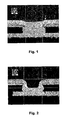
- Figure 1 shows the filling capacity of the bath shortly after it has been prepared, i.e. after an operating time of 2 Ah/l.
- the layer between the two arrows has been deposited in the test electrolyte.
- the layers lying thereunder have been deposited by the manufacturer of the test plate and play no role in the filling of ⁇ -blind vias.
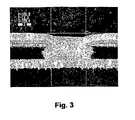
- Figure 2 shows the breakdown of the filling capacity after an operating time of 100 Ah/l.
- the ⁇ -blind via is only traced in its shape, i.e., like with a conventional electrolytic bath for surface plating, 20 ⁇ m of copper are deposited in the via and on the surface.
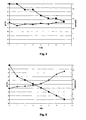
- Figure 3 shows the filling capacity of the electrolyte after an operating time of 100 Ah/l, subsequent UV/H 2 O 2 treatment and replenishing of organic additives to the desired concentration range.
- copper is added to the electrolyte as copper sulfate pentahydrate (CuSO 4 ⁇ 5 H 2 O) or as copper sulfate solution.
- the operational concentration range of copper is 8 to 60 g/l copper, preferably 15 to 60 g/l, more preferably 25 to 50 g/l.
- Sulfuric acid (H 2 SO 4 ) is added as a 50 to 96% solution.
- the operational concentration range of sulfuric acid is 40 to 300 g/l H 2 SO 4 , preferably 130 to 250 g/l.
- Chloride is added as sodium chloride (NaCl) or as hydrochloric acid solution (HCl).
- the operational concentration range of chloride is 20 to 150 mg/l chloride, preferably 30 to 60 mg/l.
- the bath electrolyte preferably comprises brightening agents, levelling agents and wetting agents as organic additives.
- wetting agents are conventionally oxygen-containing high molecular weight compounds used in concentrations of 0.005 to 20 g/l, preferably 0.01 to 5 g/l. Examples for wetting agents which may be used in the process of the invention are listed in Table 1: Table 1.
- wetting Agents carboxymethyl cellulose nonylphenol polyglycol ether octandiol bis-(polyalkylene glycol ether) octanol polyalkylene glycol ether oleic acid polyglycol ester polyethylene glycol polypropylene glycol copolymer polyethylene glycol polyethylene glycol dimethyl ether polypropylene glycol polyvinyl alcohol ⁇ -naphthol polyglycol ether stearic acid polyglycol ester stearyl alcohol polyglycol ether
- Brightening agents used are generally sulfur-containing substances such as those listed in Table 2: Table 2.
- polymeric nitrogen compounds for example, polyamines or polyamides
- nitrogen-containing sulfur compounds for example, thiourea derivatives or lactam alkoxylates, as described in DE 38 36 521 C2
- concentrations of the used substances lie in the range of 0.1 to 100 ppm.
- oligomeric and polymeric phenazonium derivates which are described in DE 41 26 502 C1 can also be used.
- Further substances which are used for filling ⁇ -blind vias are dyes based on an aminotriphenylmethane structure, such as malachite green, rosalinine or crystal violet.
- the bath is operated with direct current at a current density of 0.5 to 10 A/dm 2 , preferably 0.5 to 2.5 A/dm 2 , or with current pulses at an effective current density of 0.5 to 10 A/dm 2 .
- Improvements of the deposition can be achieved by complex pulse sequences or by combined pulse- and DC-sequences.
- an oxidizing agent is added to a part of the electrolyte withdrawn from the bath and this part is optionally irradiated with UV light.
- This treatment results in a complete destruction of the organic components and, thereby, in the purification of the basic electrolyte.
- the filling capacity of the electrolyte is maintained and the ⁇ -blind vias can be filled.
- the process of the invention is significantly more efficient than the activated charcoal treatment known in the state of the art and does not require any waste disposal. Therefore, it is not necessary to prepare fresh electrolytes, which results in considerable cost savings.
- the treatment of copper plating baths according to the present invention does not result in the formation of separate phases or unwanted deposits of the reacted organic additives.
- the specific additives of the electrolyte allow a transformation of the organic additives to volatile oxidation products such as CO 2 and N 2 without formation of residues.
- the process of the invention can be carried out without any means for physical separation of the oxidization products of the organic additives.
- the process can be carried out without treating the electrolyte by physical separation, such as filtration or centrifugation, chemisorption or physisorption, either before the oxidization treatment or thereafter.
- the oxidizing agent is preferably used in an amount which is sufficient in order to reduce the TOC concentration (i.e., the total concentration of organic components) from 1,000 to 1,500 mg/l down to 50 to 300 mg/l. It can also be useful to use an amount of oxidizing agent which is sufficient to reduce the TOC concentration to 50% of the value before the oxidation treatment.
- H 2 O 2 is used as oxidizing agent.
- the latter is preferably used as a 30% aqueous solution, for example in an amount of 3 to 30 ml per litre of plating bath.
- oxygen can be used as an oxidizing agent. This can also be the atmospheric oxygen dissolved in the bath. In the latter case, the separate addition of an oxidizing agent may become redundant.
- the process of the invention can be carried out with H 2 O 2 as the only oxidizing agent; thus, it can be carried out without gaseous oxidizing agents such as ozone.
- the irradiation is carried out with devices known per se, for example, UV lamps with a wave length range of 100 nm to 700 nm, preferably 200 nm to 550 nm.
- the radiation power is generally 0.5 to 20 W per litre of bath, preferably 1 to 5 W per litre of bath.
- the anodes used can be, for example, inert anodes without redox system (i.e., without Fe 2+/3+ system).
- inert anodes without redox system (i.e., without Fe 2+/3+ system).
- soluble anodes can also be used.
- the electrolyte is mixed in a UV chamber with small amounts of H 2 O 2 (i.e., amount of 0.01 to 0.1 ml/l of H 2 O 2 (30% solution)) and irradiated continuously.
- H 2 O 2 i.e., amount of 0.01 to 0.1 ml/l of H 2 O 2 (30% solution)
- the amount of electrolyte which is exchanged is limited because the electrolyte must be free of H 2 O 2 when it leaves the chamber.
- the amount of electrolyte exchanged is 10 to 50 I/h and preferably about 30 I/h.
- a part of the electrolyte is withdrawn and treated in a UV chamber with H 2 O 2 and UV light.
- the withdrawn part amounts to 10 to 50% of the total volume and preferably about 30% relative to the total amount of the electrolyte.
- the duration of the treatment depends on the volume, the amount of oxidizing agent, the irradiation power of the lamp and the temperature.
- the plant must be designed such that the total volume of the electrolyte can be purified over its useful lifetime.
- the useful lifetime depends on the performance required of the electrolyte.
- a third embodiment of the process no H 2 O 2 treatment is carried out.
- the purification of the electrolyte is not as effective as in the above two embodiments.
- the process according to the third embodiment can be carried out continuously.
- the oxidizing agent added in step (iv) of the process is H 2 O 2 and the part of the electrolyte withdrawn from the galvanic bath is passed through a metal dissolution unit containing copper metal after it is subjected to the UV/H 2 O 2 treatment and before it is recycled into the bath in step (vi) of the process.
- a plant for carrying out the process of the invention comprises, inter alia, a treatment unit (wherein the UV/H 2 O 2 treatment takes place), a H 2 O 2 dosing unit connected to the treatment unit, and a metal dissolution unit connected to the treatment unit.
- the part of the electrolyte withdrawn from the bath first passes through the treatment unit and subsequently passes through the metal dissolution unit before it is recycled to the galvanic bath.
- a plant for carrying out the process of the invention can also comprise a cooling unit.
- the metal dissolution unit is generally a container and contains copper metal.
- the copper metal can be provided in the form of anode material, pellets, rods or particles.
- the metal dissolution unit is preferably a column through which the treated electrolyte exiting the treatment unit can pass.
- a part of the galvanic bath is withdrawn and subjected to a UV/H 2 O 2 treatment, wherein comparatively large amount of H 2 O 2 are added and the solution is continuously irradiated with UV light in order to decompose the organic substances in the electrolyte.
- the decomposition of the organic substances can be controlled by measuring the TOC concentration, i.e., the total concentration of organic components. After the TOC concentration has reached a predetermined target value, the addition of H 2 O 2 is stopped. At this stage, the treated electrolyte contains comparatively large amounts of H 2 O 2 . The excess H 2 O 2 must be destroyed in order to ensure that the electrolyte functions properly in the filling of ⁇ -blind vias. For this reason, the H 2 O 2 concentration must typically be lowered to values of about 0.5 g/l H 2 O 2 .
- the H 2 O 2 concentration is initially lowered only to a value of about 3 to 5 g/l by further irradiation with UV light.
- the treated electrolyte with an H 2 O 2 concentration in that range is then passed through the metal dissolution unit where excess H 2 O 2 is partly destroyed due to the catalytic effect of the surfaces of the copper metal contained therein with release of oxygen.
- H 2 O 2 is consumed in the metal dissolution unit in a redox reaction wherein the H 2 O 2 is reduced to water and the copper metal is oxidized to copper ion.
- This latter redox reaction proceeds according to the following equation: H 2 O 2 + Cu + 2 H + ⁇ Cu 2+ + 2 H 2 O (1)
- H 2 O 2 reacts according to equation (1) and according to equation (2), respectively, depends on such factors as temperature, pressure, purity of the electrolyte and nature of the catalytic metal surface.
- the metal dissolution unit containing copper metal results in a significant acceleration of the destruction of excess H 2 O 2 as compared to the destruction by irradiation with UV light alone.
- this process step may typically take about one day.
- the time required for the destruction of excess H 2 O 2 can be reduced by, for example, 20 to 40%.
- the actual rate of H 2 O 2 destruction achieved by employing a metal dissolution unit depends on various factors such as the initial and desired final amount of H 2 O 2 , the nature of the catalytic metal surface, and the flow rate.
- Suitable materials for this purpose are, for example, titanium, ruthenium, rhodium, palladium, osmium, iridium, platinum, titanium oxides, mixed titanium oxides, iridium oxides, mixed iridium oxides as well as mixtures of any of these materials.
- An acidic copper plating bath with the following composition is used: copper: 44 g/l, sulfuric acid: 130 g/l, chloride: 40 mg/l, basic levelling agent Cupracid HLFTM (Atotech Deutschland GmbH): 20 ml/l and brightening additive Cupracid
- the brightening additive contains a substance from Table 2 and the basic levelling agent consists of a wetting agent from Table 1 as well as a nitrogen compound (polyamide).
- the bath is operated up to 100 Ah/l until the filling of ⁇ -blind vias breaks down. Thereafter, the bath is treated with UV/H 2 O 2 and the organic components are replaced in order to make up the initial composition indicated above. Before and after the treatment, a test plate is run in order to demonstrate the filling capacity. The plates are run in a direct current process with 1.5 A/dm 2 in a vertical standard tank with soluble copper anodes.
- UV/H 2 O 2 treatment The parameters of the UV/H 2 O 2 treatment were as follows: Volume: 600 I copper bath Cupracid HLFTM UV lamp: 12 kW; 200 nm H 2 O 2 dosing: 27 l/h or 14 l/h Electrolyte circulation: 10.5 m 3 /h TOC before treatment: 1180 mg/l TOC after treatment: 81 mg/l
- Figures 1 to 3 show the sequence of tests.
- Experiment B the process was run in the same way as in Experiment A, except, that, in a second bypass, the electrolyte solution was additionally passed, in parallel, through a copper column filled with 6 kg copper pellets (length 18 mm, diameter 7 mm, total surface about 40 dm 2 ).
- the copper column had a diameter of 90 mm, a length of 250 mm and a capacity of about 1.5 I.
- the turnover through the copper column was 360 l/h.
- the copper and H 2 O 2 concentrations were measured as before and are also shown in Table 3 and in Figure 5.
- Experiment C the process was run in the same way as in Experiment B, except that the amount of copper pellets was reduced to 3 kg. Furthermore, in Experiment D, the process was run in the same way as in Experiment C, except that a titanium grating (0.5 m 2 ) coated with mixed iridium oxide was additionally provided inside the copper column. The concentrations of H 2 O 2 and copper were again measured at regular intervals. The results are also shown in Table 3.
Landscapes
- Engineering & Computer Science (AREA)
- Chemical & Material Sciences (AREA)
- Microelectronics & Electronic Packaging (AREA)
- Electrochemistry (AREA)
- Materials Engineering (AREA)
- Metallurgy (AREA)
- Organic Chemistry (AREA)
- Manufacturing & Machinery (AREA)
- Chemical Kinetics & Catalysis (AREA)
- Electroplating Methods And Accessories (AREA)
- Printing Elements For Providing Electric Connections Between Printed Circuits (AREA)
- Chemically Coating (AREA)
- Electroplating And Plating Baths Therefor (AREA)
- Manufacturing Of Printed Wiring (AREA)
- Superconductors And Manufacturing Methods Therefor (AREA)
- Internal Circuitry In Semiconductor Integrated Circuit Devices (AREA)
- Peptides Or Proteins (AREA)
Applications Claiming Priority (2)
| Application Number | Priority Date | Filing Date | Title |
|---|---|---|---|
| DE10325101A DE10325101A1 (de) | 2003-06-03 | 2003-06-03 | Verfahren zum Auffüllen von µ-Blind-Vias (µ-BVs) |
| PCT/EP2004/005874 WO2004107834A1 (en) | 2003-06-03 | 2004-06-01 | Process for filing micro-blind vias |
Publications (2)
| Publication Number | Publication Date |
|---|---|
| EP1629704A1 EP1629704A1 (en) | 2006-03-01 |
| EP1629704B1 true EP1629704B1 (en) | 2006-12-13 |
Family
ID=33482448
Family Applications (1)
| Application Number | Title | Priority Date | Filing Date |
|---|---|---|---|
| EP04739481A Expired - Lifetime EP1629704B1 (en) | 2003-06-03 | 2004-06-01 | Process for filling micro-blind vias |
Country Status (9)
| Country | Link |
|---|---|
| EP (1) | EP1629704B1 (enExample) |
| JP (1) | JP4392019B2 (enExample) |
| KR (1) | KR20060004981A (enExample) |
| CN (1) | CN1799294B (enExample) |
| AT (1) | ATE348499T1 (enExample) |
| DE (2) | DE10325101A1 (enExample) |
| MY (1) | MY134649A (enExample) |
| TW (1) | TWI350860B (enExample) |
| WO (1) | WO2004107834A1 (enExample) |
Families Citing this family (13)
| Publication number | Priority date | Publication date | Assignee | Title |
|---|---|---|---|---|
| DE102004045451B4 (de) * | 2004-09-20 | 2007-05-03 | Atotech Deutschland Gmbh | Galvanisches Verfahren zum Füllen von Durchgangslöchern mit Metallen, insbesondere von Leiterplatten mit Kupfer |
| ATE484943T1 (de) | 2006-03-30 | 2010-10-15 | Atotech Deutschland Gmbh | Elektrolytisches verfahren zum füllen von löchern und vertiefungen mit metallen |
| DE102007036651A1 (de) * | 2007-07-25 | 2009-01-29 | A.C.K. Aqua Concept Gmbh Karlsruhe | Prozessrecycling galvanischer Bäder |
| JP4957906B2 (ja) * | 2007-07-27 | 2012-06-20 | 上村工業株式会社 | 連続電気銅めっき方法 |
| JP5471276B2 (ja) * | 2009-10-15 | 2014-04-16 | 上村工業株式会社 | 電気銅めっき浴及び電気銅めっき方法 |
| CN102427684B (zh) * | 2011-11-08 | 2014-04-23 | 汕头超声印制板(二厂)有限公司 | 一种高密度互连印制电路板的制造方法 |
| TWI539033B (zh) * | 2013-01-07 | 2016-06-21 | Chang Chun Petrochemical Co | Electrolytic copper foil and its preparation method |
| US11047064B2 (en) | 2013-01-10 | 2021-06-29 | Coventya, Inc. | Apparatus and method to maintaining trivalent chromium bath plating |
| MX382861B (es) * | 2013-01-10 | 2025-03-13 | Macdermid Inc | Aparato y metodo de mantenimiento de eficiencia galvanoplastia con baño de cromo trivalente. |
| CN103118506B (zh) * | 2013-01-22 | 2016-05-04 | 金悦通电子(翁源)有限公司 | 一种焊盘上导通孔的电镀填孔方法 |
| JP2017210644A (ja) * | 2016-05-24 | 2017-11-30 | メルテックス株式会社 | 溶解性銅陽極、電解銅めっき装置、電解銅めっき方法、及び酸性電解銅めっき液の保存方法 |
| CN111705344A (zh) * | 2020-07-01 | 2020-09-25 | 孙颖睿 | 一种用于脉冲镀铜工艺的工作液补充方法 |
| CN119481358B (zh) * | 2024-11-15 | 2025-08-22 | 广东工业大学 | 一种可用于高倍率锡金属负极和锡锰电池的水系电解液 |
Family Cites Families (10)
| Publication number | Priority date | Publication date | Assignee | Title |
|---|---|---|---|---|
| DE4344387C2 (de) * | 1993-12-24 | 1996-09-05 | Atotech Deutschland Gmbh | Verfahren zur elektrolytischen Abscheidung von Kupfer und Anordnung zur Durchführung des Verfahrens |
| DE19525509C2 (de) * | 1994-07-22 | 1997-10-02 | Lpw Anlagen Gmbh | Anwendung der UV/H¶2¶O¶2¶-Oxidationsbehandlung zur betriebsmäßigen Wiederverwendungs- oder Weiterverwendungsaufbereitung eines Bades für die galvanotechnische Beschichtung von Gegenständen mit metallischen Überzügen |
| US5523001A (en) * | 1994-12-30 | 1996-06-04 | At&T Corp. | Treatment of electroless plating waste streams |
| DE19810859A1 (de) * | 1998-03-13 | 1999-09-16 | A C K Aqua Concept Gmbh Wasser | Kombinationsverfahren zur Behandlung eines schäumend eingestellten galvanischen Bads |
| DE19915146C1 (de) * | 1999-01-21 | 2000-07-06 | Atotech Deutschland Gmbh | Verfahren zum galvanischen Bilden von Leiterstrukturen aus hochreinem Kupfer bei der Herstellung von integrierten Schaltungen |
| JP2001267726A (ja) * | 2000-03-22 | 2001-09-28 | Toyota Autom Loom Works Ltd | 配線基板の電解メッキ方法及び配線基板の電解メッキ装置 |
| US6942779B2 (en) * | 2000-05-25 | 2005-09-13 | Mykrolis Corporation | Method and system for regenerating of plating baths |
| US6881319B2 (en) * | 2000-12-20 | 2005-04-19 | Shipley Company, L.L.C. | Electrolytic copper plating solution and method for controlling the same |
| TWI268966B (en) * | 2001-06-07 | 2006-12-21 | Shipley Co Llc | Electrolytic copper plating method |
| JP4510369B2 (ja) * | 2002-11-28 | 2010-07-21 | 日本リーロナール有限会社 | 電解銅めっき方法 |
-
2003
- 2003-06-03 DE DE10325101A patent/DE10325101A1/de not_active Withdrawn
-
2004
- 2004-05-31 MY MYPI20042090A patent/MY134649A/en unknown
- 2004-05-31 TW TW093115557A patent/TWI350860B/zh not_active IP Right Cessation
- 2004-06-01 EP EP04739481A patent/EP1629704B1/en not_active Expired - Lifetime
- 2004-06-01 WO PCT/EP2004/005874 patent/WO2004107834A1/en not_active Ceased
- 2004-06-01 AT AT04739481T patent/ATE348499T1/de active
- 2004-06-01 DE DE602004003698T patent/DE602004003698T2/de not_active Expired - Lifetime
- 2004-06-01 JP JP2006508236A patent/JP4392019B2/ja not_active Expired - Fee Related
- 2004-06-01 CN CN2004800154362A patent/CN1799294B/zh not_active Expired - Fee Related
- 2004-06-01 KR KR1020057021326A patent/KR20060004981A/ko not_active Abandoned
Also Published As
| Publication number | Publication date |
|---|---|
| WO2004107834A1 (en) | 2004-12-09 |
| KR20060004981A (ko) | 2006-01-16 |
| JP2006526890A (ja) | 2006-11-24 |
| CN1799294B (zh) | 2012-02-08 |
| JP4392019B2 (ja) | 2009-12-24 |
| DE602004003698D1 (de) | 2007-01-25 |
| TW200508422A (en) | 2005-03-01 |
| ATE348499T1 (de) | 2007-01-15 |
| EP1629704A1 (en) | 2006-03-01 |
| CN1799294A (zh) | 2006-07-05 |
| DE10325101A1 (de) | 2004-12-30 |
| MY134649A (en) | 2007-12-31 |
| DE602004003698T2 (de) | 2007-04-12 |
| TWI350860B (en) | 2011-10-21 |
Similar Documents
| Publication | Publication Date | Title |
|---|---|---|
| EP1629704B1 (en) | Process for filling micro-blind vias | |
| EP0862665B1 (de) | Verfahren zur elektrolytischen abscheidung von metallschichten | |
| DE4344387C2 (de) | Verfahren zur elektrolytischen Abscheidung von Kupfer und Anordnung zur Durchführung des Verfahrens | |
| EP0039819B1 (en) | Process for treating a liquid waste composition containing copper ions and an organic complexing agent | |
| DE10013339C1 (de) | Verfahren und Vorrichtung zum Regulieren der Konzentration von Metallionen in einer Elektrolytflüssigkeit sowie Anwendung des Verfahrens und Verwendung der Vorrichtung | |
| KR101392179B1 (ko) | 백금족 금속의 회수방법 및 이에 사용되는 백금족 금속의 회수장치 | |
| EP1159467B1 (en) | Process for the recovery of tin, tin alloys or lead alloys from printed circuit boards | |
| JPS5827686A (ja) | 廃水処理装置 | |
| Gylienė et al. | Recovery of EDTA from complex solution using Cu (II) as precipitant and Cu (II) subsequent removal by electrolysis | |
| US20030089622A1 (en) | Electrochemical cell and process for reducing the amount of organic contaminants in metal plating baths | |
| US4859300A (en) | Process for treating plastics with alkaline permanganate solutions | |
| KR20020069167A (ko) | 전해 인산염 화성처리법 | |
| EP0524493A2 (en) | Electrolytic process for reducing the organic content of an aqueous composition and apparatus therefore | |
| KR100934729B1 (ko) | 무전해 주석도금액 불순물 제거장치 및 방법 | |
| JPH0236677B2 (enExample) | ||
| DE60223934T2 (de) | Edelmetallrückgewinnung | |
| EP3189170B1 (en) | Process and apparatus for metal refining | |
| US6984300B2 (en) | Method for recovering useful components from electrolytic phosphate chemical treatment bath | |
| EP1518828B1 (de) | Verfahren und Vorrichtung zur anodischen Oxidation von Cyaniden in wässrigen Lösungen | |
| CN1301313A (zh) | 用于基片电镀铜的方法 | |
| KR101364650B1 (ko) | 전기분해를 이용한 니켈의 회수방법 | |
| KR20160131426A (ko) | 황산동 도금액의 관리 방법 | |
| JPH01212788A (ja) | 高純度電解鉄およびその製造方法ならびに電解槽 | |
| JPS59139990A (ja) | 廃水処理法 | |
| JPS62158893A (ja) | 高純度電解鉄の製法 |
Legal Events
| Date | Code | Title | Description |
|---|---|---|---|
| PUAI | Public reference made under article 153(3) epc to a published international application that has entered the european phase |
Free format text: ORIGINAL CODE: 0009012 |
|
| 17P | Request for examination filed |
Effective date: 20051027 |
|
| AK | Designated contracting states |
Kind code of ref document: A1 Designated state(s): AT BE BG CH CY CZ DE DK EE ES FI FR GB GR HU IE IT LI LU MC NL PL PT RO SE SI SK TR |
|
| GRAP | Despatch of communication of intention to grant a patent |
Free format text: ORIGINAL CODE: EPIDOSNIGR1 |
|
| DAX | Request for extension of the european patent (deleted) | ||
| GRAS | Grant fee paid |
Free format text: ORIGINAL CODE: EPIDOSNIGR3 |
|
| GRAA | (expected) grant |
Free format text: ORIGINAL CODE: 0009210 |
|
| AK | Designated contracting states |
Kind code of ref document: B1 Designated state(s): AT BE BG CH CY CZ DE DK EE ES FI FR GB GR HU IE IT LI LU MC NL PL PT RO SE SI SK TR |
|
| PG25 | Lapsed in a contracting state [announced via postgrant information from national office to epo] |
Ref country code: RO Free format text: LAPSE BECAUSE OF FAILURE TO SUBMIT A TRANSLATION OF THE DESCRIPTION OR TO PAY THE FEE WITHIN THE PRESCRIBED TIME-LIMIT Effective date: 20061213 Ref country code: CZ Free format text: LAPSE BECAUSE OF FAILURE TO SUBMIT A TRANSLATION OF THE DESCRIPTION OR TO PAY THE FEE WITHIN THE PRESCRIBED TIME-LIMIT Effective date: 20061213 Ref country code: SK Free format text: LAPSE BECAUSE OF FAILURE TO SUBMIT A TRANSLATION OF THE DESCRIPTION OR TO PAY THE FEE WITHIN THE PRESCRIBED TIME-LIMIT Effective date: 20061213 Ref country code: BE Free format text: LAPSE BECAUSE OF FAILURE TO SUBMIT A TRANSLATION OF THE DESCRIPTION OR TO PAY THE FEE WITHIN THE PRESCRIBED TIME-LIMIT Effective date: 20061213 Ref country code: SI Free format text: LAPSE BECAUSE OF FAILURE TO SUBMIT A TRANSLATION OF THE DESCRIPTION OR TO PAY THE FEE WITHIN THE PRESCRIBED TIME-LIMIT Effective date: 20061213 Ref country code: CH Free format text: LAPSE BECAUSE OF FAILURE TO SUBMIT A TRANSLATION OF THE DESCRIPTION OR TO PAY THE FEE WITHIN THE PRESCRIBED TIME-LIMIT Effective date: 20061213 Ref country code: DK Free format text: LAPSE BECAUSE OF FAILURE TO SUBMIT A TRANSLATION OF THE DESCRIPTION OR TO PAY THE FEE WITHIN THE PRESCRIBED TIME-LIMIT Effective date: 20061213 Ref country code: PL Free format text: LAPSE BECAUSE OF FAILURE TO SUBMIT A TRANSLATION OF THE DESCRIPTION OR TO PAY THE FEE WITHIN THE PRESCRIBED TIME-LIMIT Effective date: 20061213 Ref country code: NL Free format text: LAPSE BECAUSE OF FAILURE TO SUBMIT A TRANSLATION OF THE DESCRIPTION OR TO PAY THE FEE WITHIN THE PRESCRIBED TIME-LIMIT Effective date: 20061213 Ref country code: LI Free format text: LAPSE BECAUSE OF FAILURE TO SUBMIT A TRANSLATION OF THE DESCRIPTION OR TO PAY THE FEE WITHIN THE PRESCRIBED TIME-LIMIT Effective date: 20061213 |
|
| REG | Reference to a national code |
Ref country code: GB Ref legal event code: FG4D |
|
| REG | Reference to a national code |
Ref country code: CH Ref legal event code: EP |
|
| REG | Reference to a national code |
Ref country code: IE Ref legal event code: FG4D |
|
| REF | Corresponds to: |
Ref document number: 602004003698 Country of ref document: DE Date of ref document: 20070125 Kind code of ref document: P |
|
| PG25 | Lapsed in a contracting state [announced via postgrant information from national office to epo] |
Ref country code: SE Free format text: LAPSE BECAUSE OF FAILURE TO SUBMIT A TRANSLATION OF THE DESCRIPTION OR TO PAY THE FEE WITHIN THE PRESCRIBED TIME-LIMIT Effective date: 20070313 Ref country code: BG Free format text: LAPSE BECAUSE OF FAILURE TO SUBMIT A TRANSLATION OF THE DESCRIPTION OR TO PAY THE FEE WITHIN THE PRESCRIBED TIME-LIMIT Effective date: 20070313 |
|
| PG25 | Lapsed in a contracting state [announced via postgrant information from national office to epo] |
Ref country code: ES Free format text: LAPSE BECAUSE OF FAILURE TO SUBMIT A TRANSLATION OF THE DESCRIPTION OR TO PAY THE FEE WITHIN THE PRESCRIBED TIME-LIMIT Effective date: 20070324 |
|
| PG25 | Lapsed in a contracting state [announced via postgrant information from national office to epo] |
Ref country code: PT Free format text: LAPSE BECAUSE OF FAILURE TO SUBMIT A TRANSLATION OF THE DESCRIPTION OR TO PAY THE FEE WITHIN THE PRESCRIBED TIME-LIMIT Effective date: 20070514 |
|
| NLV1 | Nl: lapsed or annulled due to failure to fulfill the requirements of art. 29p and 29m of the patents act | ||
| REG | Reference to a national code |
Ref country code: CH Ref legal event code: PL |
|
| ET | Fr: translation filed | ||
| PLBE | No opposition filed within time limit |
Free format text: ORIGINAL CODE: 0009261 |
|
| STAA | Information on the status of an ep patent application or granted ep patent |
Free format text: STATUS: NO OPPOSITION FILED WITHIN TIME LIMIT |
|
| 26N | No opposition filed |
Effective date: 20070914 |
|
| PG25 | Lapsed in a contracting state [announced via postgrant information from national office to epo] |
Ref country code: MC Free format text: LAPSE BECAUSE OF NON-PAYMENT OF DUE FEES Effective date: 20070630 |
|
| PG25 | Lapsed in a contracting state [announced via postgrant information from national office to epo] |
Ref country code: GR Free format text: LAPSE BECAUSE OF FAILURE TO SUBMIT A TRANSLATION OF THE DESCRIPTION OR TO PAY THE FEE WITHIN THE PRESCRIBED TIME-LIMIT Effective date: 20070314 |
|
| PG25 | Lapsed in a contracting state [announced via postgrant information from national office to epo] |
Ref country code: IE Free format text: LAPSE BECAUSE OF NON-PAYMENT OF DUE FEES Effective date: 20070601 |
|
| PG25 | Lapsed in a contracting state [announced via postgrant information from national office to epo] |
Ref country code: EE Free format text: LAPSE BECAUSE OF FAILURE TO SUBMIT A TRANSLATION OF THE DESCRIPTION OR TO PAY THE FEE WITHIN THE PRESCRIBED TIME-LIMIT Effective date: 20061213 |
|
| GBPC | Gb: european patent ceased through non-payment of renewal fee |
Effective date: 20080601 |
|
| PG25 | Lapsed in a contracting state [announced via postgrant information from national office to epo] |
Ref country code: GB Free format text: LAPSE BECAUSE OF NON-PAYMENT OF DUE FEES Effective date: 20080601 |
|
| PG25 | Lapsed in a contracting state [announced via postgrant information from national office to epo] |
Ref country code: LU Free format text: LAPSE BECAUSE OF NON-PAYMENT OF DUE FEES Effective date: 20070601 Ref country code: CY Free format text: LAPSE BECAUSE OF FAILURE TO SUBMIT A TRANSLATION OF THE DESCRIPTION OR TO PAY THE FEE WITHIN THE PRESCRIBED TIME-LIMIT Effective date: 20061213 |
|
| PG25 | Lapsed in a contracting state [announced via postgrant information from national office to epo] |
Ref country code: HU Free format text: LAPSE BECAUSE OF FAILURE TO SUBMIT A TRANSLATION OF THE DESCRIPTION OR TO PAY THE FEE WITHIN THE PRESCRIBED TIME-LIMIT Effective date: 20070614 Ref country code: TR Free format text: LAPSE BECAUSE OF FAILURE TO SUBMIT A TRANSLATION OF THE DESCRIPTION OR TO PAY THE FEE WITHIN THE PRESCRIBED TIME-LIMIT Effective date: 20061213 |
|
| PGFP | Annual fee paid to national office [announced via postgrant information from national office to epo] |
Ref country code: FI Payment date: 20100615 Year of fee payment: 7 |
|
| PGFP | Annual fee paid to national office [announced via postgrant information from national office to epo] |
Ref country code: FR Payment date: 20110630 Year of fee payment: 8 |
|
| PGFP | Annual fee paid to national office [announced via postgrant information from national office to epo] |
Ref country code: IT Payment date: 20110621 Year of fee payment: 8 |
|
| PG25 | Lapsed in a contracting state [announced via postgrant information from national office to epo] |
Ref country code: FI Free format text: LAPSE BECAUSE OF NON-PAYMENT OF DUE FEES Effective date: 20110601 |
|
| PG25 | Lapsed in a contracting state [announced via postgrant information from national office to epo] |
Ref country code: IT Free format text: LAPSE BECAUSE OF NON-PAYMENT OF DUE FEES Effective date: 20120601 |
|
| REG | Reference to a national code |
Ref country code: FR Ref legal event code: ST Effective date: 20130228 |
|
| PG25 | Lapsed in a contracting state [announced via postgrant information from national office to epo] |
Ref country code: FR Free format text: LAPSE BECAUSE OF NON-PAYMENT OF DUE FEES Effective date: 20120702 |
|
| PGFP | Annual fee paid to national office [announced via postgrant information from national office to epo] |
Ref country code: DE Payment date: 20180625 Year of fee payment: 15 |
|
| PGFP | Annual fee paid to national office [announced via postgrant information from national office to epo] |
Ref country code: AT Payment date: 20180621 Year of fee payment: 15 |
|
| REG | Reference to a national code |
Ref country code: DE Ref legal event code: R119 Ref document number: 602004003698 Country of ref document: DE |
|
| REG | Reference to a national code |
Ref country code: AT Ref legal event code: MM01 Ref document number: 348499 Country of ref document: AT Kind code of ref document: T Effective date: 20190601 |
|
| PG25 | Lapsed in a contracting state [announced via postgrant information from national office to epo] |
Ref country code: DE Free format text: LAPSE BECAUSE OF NON-PAYMENT OF DUE FEES Effective date: 20200101 Ref country code: AT Free format text: LAPSE BECAUSE OF NON-PAYMENT OF DUE FEES Effective date: 20190601 |