EP1623437B1 - Conductive carbon nanotube-polymer composite - Google Patents
Conductive carbon nanotube-polymer composite Download PDFInfo
- Publication number
- EP1623437B1 EP1623437B1 EP04760328A EP04760328A EP1623437B1 EP 1623437 B1 EP1623437 B1 EP 1623437B1 EP 04760328 A EP04760328 A EP 04760328A EP 04760328 A EP04760328 A EP 04760328A EP 1623437 B1 EP1623437 B1 EP 1623437B1
- Authority
- EP
- European Patent Office
- Prior art keywords
- polymer
- poly
- composite
- nanotube
- polymers
- Prior art date
- Legal status (The legal status is an assumption and is not a legal conclusion. Google has not performed a legal analysis and makes no representation as to the accuracy of the status listed.)
- Expired - Lifetime
Links
- 229920000642 polymer Polymers 0.000 title claims abstract description 455
- 239000002131 composite material Substances 0.000 title claims abstract description 204
- OKTJSMMVPCPJKN-UHFFFAOYSA-N Carbon Chemical compound [C] OKTJSMMVPCPJKN-UHFFFAOYSA-N 0.000 title claims abstract description 173
- 229910052799 carbon Inorganic materials 0.000 title claims abstract description 76
- -1 poly(vinyl acetate) Polymers 0.000 claims abstract description 207
- 239000002245 particle Substances 0.000 claims abstract description 191
- 239000002071 nanotube Substances 0.000 claims abstract description 155
- 239000000725 suspension Substances 0.000 claims abstract description 131
- 239000002109 single walled nanotube Substances 0.000 claims abstract description 107
- 239000002041 carbon nanotube Substances 0.000 claims abstract description 88
- 229910021393 carbon nanotube Inorganic materials 0.000 claims abstract description 88
- 229920002689 polyvinyl acetate Polymers 0.000 claims abstract description 71
- 239000002904 solvent Substances 0.000 claims abstract description 59
- 229920003169 water-soluble polymer Polymers 0.000 claims abstract description 48
- 239000011118 polyvinyl acetate Substances 0.000 claims abstract description 46
- 239000003381 stabilizer Substances 0.000 claims abstract description 43
- XLYOFNOQVPJJNP-UHFFFAOYSA-N water Substances O XLYOFNOQVPJJNP-UHFFFAOYSA-N 0.000 claims abstract description 43
- 239000004094 surface-active agent Substances 0.000 claims abstract description 36
- 238000002156 mixing Methods 0.000 claims abstract description 32
- 238000005325 percolation Methods 0.000 claims abstract description 27
- 238000000034 method Methods 0.000 claims description 69
- 239000000839 emulsion Substances 0.000 claims description 32
- 229920001577 copolymer Polymers 0.000 claims description 26
- 244000215068 Acacia senegal Species 0.000 claims description 25
- 229920000084 Gum arabic Polymers 0.000 claims description 24
- 235000010489 acacia gum Nutrition 0.000 claims description 24
- 239000000205 acacia gum Substances 0.000 claims description 23
- 229920002125 Sokalan® Polymers 0.000 claims description 20
- 229920002554 vinyl polymer Polymers 0.000 claims description 20
- YXFVVABEGXRONW-UHFFFAOYSA-N Toluene Chemical compound CC1=CC=CC=C1 YXFVVABEGXRONW-UHFFFAOYSA-N 0.000 claims description 15
- 229920000058 polyacrylate Polymers 0.000 claims description 14
- 239000002048 multi walled nanotube Substances 0.000 claims description 13
- 229920001467 poly(styrenesulfonates) Polymers 0.000 claims description 13
- 229920002401 polyacrylamide Polymers 0.000 claims description 13
- 239000011231 conductive filler Substances 0.000 claims description 12
- 229920001495 poly(sodium acrylate) polymer Polymers 0.000 claims description 12
- 239000011970 polystyrene sulfonate Substances 0.000 claims description 12
- 229960002796 polystyrene sulfonate Drugs 0.000 claims description 12
- NNMHYFLPFNGQFZ-UHFFFAOYSA-M sodium polyacrylate Chemical compound [Na+].[O-]C(=O)C=C NNMHYFLPFNGQFZ-UHFFFAOYSA-M 0.000 claims description 12
- 239000006229 carbon black Substances 0.000 claims description 11
- 229920000867 polyelectrolyte Polymers 0.000 claims description 11
- 229920002451 polyvinyl alcohol Polymers 0.000 claims description 10
- 229920003171 Poly (ethylene oxide) Polymers 0.000 claims description 9
- DBMJMQXJHONAFJ-UHFFFAOYSA-M Sodium laurylsulphate Chemical group [Na+].CCCCCCCCCCCCOS([O-])(=O)=O DBMJMQXJHONAFJ-UHFFFAOYSA-M 0.000 claims description 9
- 235000014113 dietary fatty acids Nutrition 0.000 claims description 9
- 239000000194 fatty acid Substances 0.000 claims description 9
- 229930195729 fatty acid Natural products 0.000 claims description 9
- 102000004169 proteins and genes Human genes 0.000 claims description 9
- 108090000623 proteins and genes Proteins 0.000 claims description 9
- 235000019333 sodium laurylsulphate Nutrition 0.000 claims description 9
- QAOWNCQODCNURD-UHFFFAOYSA-L Sulfate Chemical compound [O-]S([O-])(=O)=O QAOWNCQODCNURD-UHFFFAOYSA-L 0.000 claims description 8
- 229920000831 ionic polymer Polymers 0.000 claims description 8
- 239000000344 soap Substances 0.000 claims description 8
- XMWRBQBLMFGWIX-UHFFFAOYSA-N C60 fullerene Chemical class C12=C3C(C4=C56)=C7C8=C5C5=C9C%10=C6C6=C4C1=C1C4=C6C6=C%10C%10=C9C9=C%11C5=C8C5=C8C7=C3C3=C7C2=C1C1=C2C4=C6C4=C%10C6=C9C9=C%11C5=C5C8=C3C3=C7C1=C1C2=C4C6=C2C9=C5C3=C12 XMWRBQBLMFGWIX-UHFFFAOYSA-N 0.000 claims description 7
- 150000002148 esters Chemical class 0.000 claims description 7
- 229910003472 fullerene Inorganic materials 0.000 claims description 7
- 229920000126 latex Polymers 0.000 claims description 7
- 239000004816 latex Substances 0.000 claims description 7
- LNAZSHAWQACDHT-XIYTZBAFSA-N (2r,3r,4s,5r,6s)-4,5-dimethoxy-2-(methoxymethyl)-3-[(2s,3r,4s,5r,6r)-3,4,5-trimethoxy-6-(methoxymethyl)oxan-2-yl]oxy-6-[(2r,3r,4s,5r,6r)-4,5,6-trimethoxy-2-(methoxymethyl)oxan-3-yl]oxyoxane Chemical compound CO[C@@H]1[C@@H](OC)[C@H](OC)[C@@H](COC)O[C@H]1O[C@H]1[C@H](OC)[C@@H](OC)[C@H](O[C@H]2[C@@H]([C@@H](OC)[C@H](OC)O[C@@H]2COC)OC)O[C@@H]1COC LNAZSHAWQACDHT-XIYTZBAFSA-N 0.000 claims description 6
- 108091003079 Bovine Serum Albumin Proteins 0.000 claims description 6
- 229920002134 Carboxymethyl cellulose Polymers 0.000 claims description 6
- 229920002307 Dextran Polymers 0.000 claims description 6
- 229920000896 Ethulose Polymers 0.000 claims description 6
- 239000001856 Ethyl cellulose Substances 0.000 claims description 6
- ZZSNKZQZMQGXPY-UHFFFAOYSA-N Ethyl cellulose Chemical compound CCOCC1OC(OC)C(OCC)C(OCC)C1OC1C(O)C(O)C(OC)C(CO)O1 ZZSNKZQZMQGXPY-UHFFFAOYSA-N 0.000 claims description 6
- 108010010803 Gelatin Proteins 0.000 claims description 6
- 239000002202 Polyethylene glycol Substances 0.000 claims description 6
- 229940098773 bovine serum albumin Drugs 0.000 claims description 6
- 239000001768 carboxy methyl cellulose Substances 0.000 claims description 6
- 235000010948 carboxy methyl cellulose Nutrition 0.000 claims description 6
- 239000008112 carboxymethyl-cellulose Substances 0.000 claims description 6
- 229960002086 dextran Drugs 0.000 claims description 6
- 229960000633 dextran sulfate Drugs 0.000 claims description 6
- 235000019325 ethyl cellulose Nutrition 0.000 claims description 6
- 229920001249 ethyl cellulose Polymers 0.000 claims description 6
- 229920000159 gelatin Polymers 0.000 claims description 6
- 239000008273 gelatin Substances 0.000 claims description 6
- 229940014259 gelatin Drugs 0.000 claims description 6
- 235000019322 gelatine Nutrition 0.000 claims description 6
- 235000011852 gelatine desserts Nutrition 0.000 claims description 6
- 239000011976 maleic acid Substances 0.000 claims description 6
- 229920000609 methyl cellulose Polymers 0.000 claims description 6
- 125000002496 methyl group Chemical group [H]C([H])([H])* 0.000 claims description 6
- 239000001923 methylcellulose Substances 0.000 claims description 6
- 235000010981 methylcellulose Nutrition 0.000 claims description 6
- 229920000698 poly(1-vinylpyrrolidone-co-vinyl acetate) Polymers 0.000 claims description 6
- 229920000083 poly(allylamine) Polymers 0.000 claims description 6
- 229920002239 polyacrylonitrile Polymers 0.000 claims description 6
- 229920001223 polyethylene glycol Polymers 0.000 claims description 6
- JJMIAJGBZGZNHA-UHFFFAOYSA-N sodium;styrene Chemical compound [Na].C=CC1=CC=CC=C1 JJMIAJGBZGZNHA-UHFFFAOYSA-N 0.000 claims description 6
- 244000043261 Hevea brasiliensis Species 0.000 claims description 5
- 229920002313 fluoropolymer Polymers 0.000 claims description 4
- 229920003052 natural elastomer Polymers 0.000 claims description 4
- 229920001194 natural rubber Polymers 0.000 claims description 4
- 229920002635 polyurethane Polymers 0.000 claims description 4
- 239000004814 polyurethane Substances 0.000 claims description 4
- 229920003051 synthetic elastomer Polymers 0.000 claims description 4
- 239000005061 synthetic rubber Substances 0.000 claims description 4
- 239000004793 Polystyrene Substances 0.000 claims description 3
- 229920001328 Polyvinylidene chloride Polymers 0.000 claims description 3
- PMRJLMRZYXKGAT-UHFFFAOYSA-N aziridine-1-carbaldehyde Chemical compound O=CN1CC1 PMRJLMRZYXKGAT-UHFFFAOYSA-N 0.000 claims description 3
- SQNNHEYXAJPPKH-UHFFFAOYSA-N chloroethene;prop-2-enoic acid Chemical compound ClC=C.OC(=O)C=C SQNNHEYXAJPPKH-UHFFFAOYSA-N 0.000 claims description 3
- 229920005670 poly(ethylene-vinyl chloride) Polymers 0.000 claims description 3
- 229920003229 poly(methyl methacrylate) Polymers 0.000 claims description 3
- 229920005671 poly(vinyl chloride-propylene) Polymers 0.000 claims description 3
- 239000004926 polymethyl methacrylate Substances 0.000 claims description 3
- 229920002223 polystyrene Polymers 0.000 claims description 3
- 229920001343 polytetrafluoroethylene Polymers 0.000 claims description 3
- 239000004810 polytetrafluoroethylene Substances 0.000 claims description 3
- 229920000915 polyvinyl chloride Polymers 0.000 claims description 3
- 239000004800 polyvinyl chloride Substances 0.000 claims description 3
- 229920003048 styrene butadiene rubber Polymers 0.000 claims description 3
- 125000005313 fatty acid group Chemical group 0.000 claims 4
- 125000000391 vinyl group Chemical group [H]C([*])=C([H])[H] 0.000 claims 2
- 239000007788 liquid Substances 0.000 abstract description 11
- 239000000203 mixture Substances 0.000 description 31
- 239000011159 matrix material Substances 0.000 description 24
- 239000006185 dispersion Substances 0.000 description 17
- 239000000463 material Substances 0.000 description 16
- 238000003917 TEM image Methods 0.000 description 15
- 125000000217 alkyl group Chemical group 0.000 description 15
- 239000000126 substance Substances 0.000 description 14
- 125000004432 carbon atom Chemical group C* 0.000 description 13
- 239000000945 filler Substances 0.000 description 12
- 239000011203 carbon fibre reinforced carbon Substances 0.000 description 10
- WHNWPMSKXPGLAX-UHFFFAOYSA-N N-Vinyl-2-pyrrolidone Chemical compound C=CN1CCCC1=O WHNWPMSKXPGLAX-UHFFFAOYSA-N 0.000 description 9
- 239000002253 acid Substances 0.000 description 9
- 125000002947 alkylene group Chemical group 0.000 description 9
- 239000007787 solid Substances 0.000 description 9
- 239000000243 solution Substances 0.000 description 9
- 239000012535 impurity Substances 0.000 description 8
- 239000002609 medium Substances 0.000 description 8
- 239000000843 powder Substances 0.000 description 8
- 230000006641 stabilisation Effects 0.000 description 8
- 238000011105 stabilization Methods 0.000 description 8
- 230000000087 stabilizing effect Effects 0.000 description 8
- 230000015572 biosynthetic process Effects 0.000 description 7
- 230000002209 hydrophobic effect Effects 0.000 description 7
- 229920001940 conductive polymer Polymers 0.000 description 6
- 229920001519 homopolymer Polymers 0.000 description 6
- ZMXDDKWLCZADIW-UHFFFAOYSA-N N,N-Dimethylformamide Chemical compound CN(C)C=O ZMXDDKWLCZADIW-UHFFFAOYSA-N 0.000 description 5
- 229910003481 amorphous carbon Inorganic materials 0.000 description 5
- 239000003945 anionic surfactant Substances 0.000 description 5
- 239000012736 aqueous medium Substances 0.000 description 5
- 239000003054 catalyst Substances 0.000 description 5
- 150000004665 fatty acids Chemical class 0.000 description 5
- 238000007306 functionalization reaction Methods 0.000 description 5
- 125000002887 hydroxy group Chemical group [H]O* 0.000 description 5
- 229910052751 metal Inorganic materials 0.000 description 5
- 239000002184 metal Substances 0.000 description 5
- 239000002736 nonionic surfactant Substances 0.000 description 5
- 230000003647 oxidation Effects 0.000 description 5
- 238000007254 oxidation reaction Methods 0.000 description 5
- IAZDPXIOMUYVGZ-UHFFFAOYSA-N Dimethylsulphoxide Chemical compound CS(C)=O IAZDPXIOMUYVGZ-UHFFFAOYSA-N 0.000 description 4
- VEXZGXHMUGYJMC-UHFFFAOYSA-N Hydrochloric acid Chemical compound Cl VEXZGXHMUGYJMC-UHFFFAOYSA-N 0.000 description 4
- 238000013019 agitation Methods 0.000 description 4
- 150000001408 amides Chemical class 0.000 description 4
- 239000002280 amphoteric surfactant Substances 0.000 description 4
- 125000003118 aryl group Chemical group 0.000 description 4
- 229920001400 block copolymer Polymers 0.000 description 4
- 239000003093 cationic surfactant Substances 0.000 description 4
- 238000010438 heat treatment Methods 0.000 description 4
- 238000011068 loading method Methods 0.000 description 4
- 230000001590 oxidative effect Effects 0.000 description 4
- 125000001997 phenyl group Chemical group [H]C1=C([H])C([H])=C(*)C([H])=C1[H] 0.000 description 4
- 238000000746 purification Methods 0.000 description 4
- 229920005604 random copolymer Polymers 0.000 description 4
- 238000000527 sonication Methods 0.000 description 4
- LYCAIKOWRPUZTN-UHFFFAOYSA-N Ethylene glycol Chemical compound OCCO LYCAIKOWRPUZTN-UHFFFAOYSA-N 0.000 description 3
- DGAQECJNVWCQMB-PUAWFVPOSA-M Ilexoside XXIX Chemical compound C[C@@H]1CC[C@@]2(CC[C@@]3(C(=CC[C@H]4[C@]3(CC[C@@H]5[C@@]4(CC[C@@H](C5(C)C)OS(=O)(=O)[O-])C)C)[C@@H]2[C@]1(C)O)C)C(=O)O[C@H]6[C@@H]([C@H]([C@@H]([C@H](O6)CO)O)O)O.[Na+] DGAQECJNVWCQMB-PUAWFVPOSA-M 0.000 description 3
- 239000004594 Masterbatch (MB) Substances 0.000 description 3
- MUBZPKHOEPUJKR-UHFFFAOYSA-N Oxalic acid Chemical compound OC(=O)C(O)=O MUBZPKHOEPUJKR-UHFFFAOYSA-N 0.000 description 3
- ISWSIDIOOBJBQZ-UHFFFAOYSA-N Phenol Chemical compound OC1=CC=CC=C1 ISWSIDIOOBJBQZ-UHFFFAOYSA-N 0.000 description 3
- DNIAPMSPPWPWGF-UHFFFAOYSA-N Propylene glycol Chemical compound CC(O)CO DNIAPMSPPWPWGF-UHFFFAOYSA-N 0.000 description 3
- 125000003545 alkoxy group Chemical group 0.000 description 3
- 125000000129 anionic group Chemical group 0.000 description 3
- 239000003125 aqueous solvent Substances 0.000 description 3
- 125000001797 benzyl group Chemical group [H]C1=C([H])C([H])=C(C([H])=C1[H])C([H])([H])* 0.000 description 3
- KRKNYBCHXYNGOX-UHFFFAOYSA-N citric acid Chemical compound OC(=O)CC(O)(C(O)=O)CC(O)=O KRKNYBCHXYNGOX-UHFFFAOYSA-N 0.000 description 3
- 238000000576 coating method Methods 0.000 description 3
- 150000001875 compounds Chemical class 0.000 description 3
- 239000004020 conductor Substances 0.000 description 3
- 238000009826 distribution Methods 0.000 description 3
- 239000007789 gas Substances 0.000 description 3
- 150000002500 ions Chemical class 0.000 description 3
- 229920002521 macromolecule Polymers 0.000 description 3
- 239000004570 mortar (masonry) Substances 0.000 description 3
- 150000007524 organic acids Chemical class 0.000 description 3
- 239000012071 phase Substances 0.000 description 3
- 238000012545 processing Methods 0.000 description 3
- 239000000047 product Substances 0.000 description 3
- 150000003839 salts Chemical class 0.000 description 3
- 239000002002 slurry Substances 0.000 description 3
- 239000011734 sodium Substances 0.000 description 3
- 229910052708 sodium Inorganic materials 0.000 description 3
- 229940083575 sodium dodecyl sulfate Drugs 0.000 description 3
- 238000003756 stirring Methods 0.000 description 3
- 238000003786 synthesis reaction Methods 0.000 description 3
- GPRLSGONYQIRFK-MNYXATJNSA-N triton Chemical compound [3H+] GPRLSGONYQIRFK-MNYXATJNSA-N 0.000 description 3
- JKXYOQDLERSFPT-UHFFFAOYSA-N 2-[2-[2-[2-[2-[2-[2-[2-[2-[2-[2-[2-[2-[2-[2-[2-[2-[2-[2-(2-octadecoxyethoxy)ethoxy]ethoxy]ethoxy]ethoxy]ethoxy]ethoxy]ethoxy]ethoxy]ethoxy]ethoxy]ethoxy]ethoxy]ethoxy]ethoxy]ethoxy]ethoxy]ethoxy]ethoxy]ethanol Chemical compound CCCCCCCCCCCCCCCCCCOCCOCCOCCOCCOCCOCCOCCOCCOCCOCCOCCOCCOCCOCCOCCOCCOCCOCCOCCOCCO JKXYOQDLERSFPT-UHFFFAOYSA-N 0.000 description 2
- DDGPBVIAYDDWDH-UHFFFAOYSA-N 3-[dodecyl(dimethyl)azaniumyl]-2-hydroxypropane-1-sulfonate Chemical compound CCCCCCCCCCCC[N+](C)(C)CC(O)CS([O-])(=O)=O DDGPBVIAYDDWDH-UHFFFAOYSA-N 0.000 description 2
- QTBSBXVTEAMEQO-UHFFFAOYSA-N Acetic acid Chemical compound CC(O)=O QTBSBXVTEAMEQO-UHFFFAOYSA-N 0.000 description 2
- XKRFYHLGVUSROY-UHFFFAOYSA-N Argon Chemical compound [Ar] XKRFYHLGVUSROY-UHFFFAOYSA-N 0.000 description 2
- IJGRMHOSHXDMSA-UHFFFAOYSA-N Atomic nitrogen Chemical compound N#N IJGRMHOSHXDMSA-UHFFFAOYSA-N 0.000 description 2
- CPELXLSAUQHCOX-UHFFFAOYSA-M Bromide Chemical compound [Br-] CPELXLSAUQHCOX-UHFFFAOYSA-M 0.000 description 2
- CURLTUGMZLYLDI-UHFFFAOYSA-N Carbon dioxide Chemical compound O=C=O CURLTUGMZLYLDI-UHFFFAOYSA-N 0.000 description 2
- IAYPIBMASNFSPL-UHFFFAOYSA-N Ethylene oxide Chemical compound C1CO1 IAYPIBMASNFSPL-UHFFFAOYSA-N 0.000 description 2
- KRHYYFGTRYWZRS-UHFFFAOYSA-N Fluorane Chemical compound F KRHYYFGTRYWZRS-UHFFFAOYSA-N 0.000 description 2
- FXHOOIRPVKKKFG-UHFFFAOYSA-N N,N-Dimethylacetamide Chemical compound CN(C)C(C)=O FXHOOIRPVKKKFG-UHFFFAOYSA-N 0.000 description 2
- SECXISVLQFMRJM-UHFFFAOYSA-N N-Methylpyrrolidone Chemical compound CN1CCCC1=O SECXISVLQFMRJM-UHFFFAOYSA-N 0.000 description 2
- NBIIXXVUZAFLBC-UHFFFAOYSA-N Phosphoric acid Chemical compound OP(O)(O)=O NBIIXXVUZAFLBC-UHFFFAOYSA-N 0.000 description 2
- 239000004698 Polyethylene Substances 0.000 description 2
- 229920001213 Polysorbate 20 Polymers 0.000 description 2
- XBDQKXXYIPTUBI-UHFFFAOYSA-N Propionic acid Chemical class CCC(O)=O XBDQKXXYIPTUBI-UHFFFAOYSA-N 0.000 description 2
- GOOHAUXETOMSMM-UHFFFAOYSA-N Propylene oxide Chemical compound CC1CO1 GOOHAUXETOMSMM-UHFFFAOYSA-N 0.000 description 2
- ULUAUXLGCMPNKK-UHFFFAOYSA-N Sulfobutanedioic acid Chemical compound OC(=O)CC(C(O)=O)S(O)(=O)=O ULUAUXLGCMPNKK-UHFFFAOYSA-N 0.000 description 2
- QAOWNCQODCNURD-UHFFFAOYSA-N Sulfuric acid Chemical compound OS(O)(=O)=O QAOWNCQODCNURD-UHFFFAOYSA-N 0.000 description 2
- 150000007513 acids Chemical class 0.000 description 2
- 239000000853 adhesive Substances 0.000 description 2
- 230000001070 adhesive effect Effects 0.000 description 2
- 229910052783 alkali metal Inorganic materials 0.000 description 2
- 150000001340 alkali metals Chemical class 0.000 description 2
- 239000007864 aqueous solution Substances 0.000 description 2
- 239000007900 aqueous suspension Substances 0.000 description 2
- 125000002091 cationic group Chemical group 0.000 description 2
- 230000001427 coherent effect Effects 0.000 description 2
- 238000001246 colloidal dispersion Methods 0.000 description 2
- 239000000084 colloidal system Substances 0.000 description 2
- 238000005520 cutting process Methods 0.000 description 2
- BGTOWKSIORTVQH-UHFFFAOYSA-N cyclopentanone Chemical compound O=C1CCCC1 BGTOWKSIORTVQH-UHFFFAOYSA-N 0.000 description 2
- 239000008367 deionised water Substances 0.000 description 2
- 229910021641 deionized water Inorganic materials 0.000 description 2
- 230000001419 dependent effect Effects 0.000 description 2
- 238000007865 diluting Methods 0.000 description 2
- JMGZBMRVDHKMKB-UHFFFAOYSA-L disodium;2-sulfobutanedioate Chemical compound [Na+].[Na+].OS(=O)(=O)C(C([O-])=O)CC([O-])=O JMGZBMRVDHKMKB-UHFFFAOYSA-L 0.000 description 2
- 238000001035 drying Methods 0.000 description 2
- 230000002708 enhancing effect Effects 0.000 description 2
- 238000001914 filtration Methods 0.000 description 2
- 230000009477 glass transition Effects 0.000 description 2
- 229940093915 gynecological organic acid Drugs 0.000 description 2
- 239000007970 homogeneous dispersion Substances 0.000 description 2
- 238000011065 in-situ storage Methods 0.000 description 2
- 238000010348 incorporation Methods 0.000 description 2
- 238000012986 modification Methods 0.000 description 2
- 230000004048 modification Effects 0.000 description 2
- 239000000178 monomer Substances 0.000 description 2
- 235000005985 organic acids Nutrition 0.000 description 2
- 239000003960 organic solvent Substances 0.000 description 2
- 239000003973 paint Substances 0.000 description 2
- BASFCYQUMIYNBI-UHFFFAOYSA-N platinum Chemical compound [Pt] BASFCYQUMIYNBI-UHFFFAOYSA-N 0.000 description 2
- 229920001983 poloxamer Polymers 0.000 description 2
- 229920000447 polyanionic polymer Polymers 0.000 description 2
- 229920000573 polyethylene Polymers 0.000 description 2
- 229920000139 polyethylene terephthalate Polymers 0.000 description 2
- 239000005020 polyethylene terephthalate Substances 0.000 description 2
- 238000006116 polymerization reaction Methods 0.000 description 2
- 239000000256 polyoxyethylene sorbitan monolaurate Substances 0.000 description 2
- 235000010486 polyoxyethylene sorbitan monolaurate Nutrition 0.000 description 2
- 229920000136 polysorbate Polymers 0.000 description 2
- 229920000036 polyvinylpyrrolidone Polymers 0.000 description 2
- 239000001267 polyvinylpyrrolidone Substances 0.000 description 2
- 235000013855 polyvinylpyrrolidone Nutrition 0.000 description 2
- 239000000523 sample Substances 0.000 description 2
- 238000001878 scanning electron micrograph Methods 0.000 description 2
- MWZFQMUXPSUDJQ-KVVVOXFISA-M sodium;[(z)-octadec-9-enyl] sulfate Chemical compound [Na+].CCCCCCCC\C=C/CCCCCCCCOS([O-])(=O)=O MWZFQMUXPSUDJQ-KVVVOXFISA-M 0.000 description 2
- 125000004178 (C1-C4) alkyl group Chemical group 0.000 description 1
- KEQGZUUPPQEDPF-UHFFFAOYSA-N 1,3-dichloro-5,5-dimethylimidazolidine-2,4-dione Chemical compound CC1(C)N(Cl)C(=O)N(Cl)C1=O KEQGZUUPPQEDPF-UHFFFAOYSA-N 0.000 description 1
- 125000003903 2-propenyl group Chemical group [H]C([*])([H])C([H])=C([H])[H] 0.000 description 1
- BMYNFMYTOJXKLE-UHFFFAOYSA-N 3-azaniumyl-2-hydroxypropanoate Chemical compound NCC(O)C(O)=O BMYNFMYTOJXKLE-UHFFFAOYSA-N 0.000 description 1
- JQTWXHQUAZVGJI-UHFFFAOYSA-N 3-dodecyliminopropanoic acid Chemical compound CCCCCCCCCCCCN=CCC(O)=O JQTWXHQUAZVGJI-UHFFFAOYSA-N 0.000 description 1
- 235000006491 Acacia senegal Nutrition 0.000 description 1
- QGZKDVFQNNGYKY-UHFFFAOYSA-O Ammonium Chemical compound [NH4+] QGZKDVFQNNGYKY-UHFFFAOYSA-O 0.000 description 1
- 229920002799 BoPET Polymers 0.000 description 1
- 239000004215 Carbon black (E152) Substances 0.000 description 1
- UGFAIRIUMAVXCW-UHFFFAOYSA-N Carbon monoxide Chemical compound [O+]#[C-] UGFAIRIUMAVXCW-UHFFFAOYSA-N 0.000 description 1
- VEXZGXHMUGYJMC-UHFFFAOYSA-M Chloride anion Chemical compound [Cl-] VEXZGXHMUGYJMC-UHFFFAOYSA-M 0.000 description 1
- OTMSDBZUPAUEDD-UHFFFAOYSA-N Ethane Chemical compound CC OTMSDBZUPAUEDD-UHFFFAOYSA-N 0.000 description 1
- LFQSCWFLJHTTHZ-UHFFFAOYSA-N Ethanol Chemical compound CCO LFQSCWFLJHTTHZ-UHFFFAOYSA-N 0.000 description 1
- KIWBPDUYBMNFTB-UHFFFAOYSA-N Ethyl hydrogen sulfate Chemical compound CCOS(O)(=O)=O KIWBPDUYBMNFTB-UHFFFAOYSA-N 0.000 description 1
- 241000446313 Lamella Species 0.000 description 1
- WHXSMMKQMYFTQS-UHFFFAOYSA-N Lithium Chemical compound [Li] WHXSMMKQMYFTQS-UHFFFAOYSA-N 0.000 description 1
- GRYLNZFGIOXLOG-UHFFFAOYSA-N Nitric acid Chemical compound O[N+]([O-])=O GRYLNZFGIOXLOG-UHFFFAOYSA-N 0.000 description 1
- 229920002057 Pluronic® P 103 Polymers 0.000 description 1
- 239000004743 Polypropylene Substances 0.000 description 1
- 229920000289 Polyquaternium Polymers 0.000 description 1
- 239000004372 Polyvinyl alcohol Substances 0.000 description 1
- ZLMJMSJWJFRBEC-UHFFFAOYSA-N Potassium Chemical compound [K] ZLMJMSJWJFRBEC-UHFFFAOYSA-N 0.000 description 1
- KEAYESYHFKHZAL-UHFFFAOYSA-N Sodium Chemical class [Na] KEAYESYHFKHZAL-UHFFFAOYSA-N 0.000 description 1
- 229910000831 Steel Inorganic materials 0.000 description 1
- 238000005411 Van der Waals force Methods 0.000 description 1
- 239000001785 acacia senegal l. willd gum Substances 0.000 description 1
- 238000009825 accumulation Methods 0.000 description 1
- 229960000583 acetic acid Drugs 0.000 description 1
- 230000004931 aggregating effect Effects 0.000 description 1
- 239000003570 air Substances 0.000 description 1
- 150000008051 alkyl sulfates Chemical class 0.000 description 1
- 229920005603 alternating copolymer Polymers 0.000 description 1
- 229910000147 aluminium phosphate Inorganic materials 0.000 description 1
- 150000001412 amines Chemical class 0.000 description 1
- BTBJBAZGXNKLQC-UHFFFAOYSA-N ammonium lauryl sulfate Chemical compound [NH4+].CCCCCCCCCCCCOS([O-])(=O)=O BTBJBAZGXNKLQC-UHFFFAOYSA-N 0.000 description 1
- 229940063953 ammonium lauryl sulfate Drugs 0.000 description 1
- 150000001450 anions Chemical class 0.000 description 1
- 229910052786 argon Inorganic materials 0.000 description 1
- 125000006615 aromatic heterocyclic group Chemical group 0.000 description 1
- 125000003710 aryl alkyl group Chemical group 0.000 description 1
- QVGXLLKOCUKJST-UHFFFAOYSA-N atomic oxygen Chemical compound [O] QVGXLLKOCUKJST-UHFFFAOYSA-N 0.000 description 1
- 239000001569 carbon dioxide Substances 0.000 description 1
- 229910002092 carbon dioxide Inorganic materials 0.000 description 1
- 229910002091 carbon monoxide Inorganic materials 0.000 description 1
- 230000003197 catalytic effect Effects 0.000 description 1
- 238000006555 catalytic reaction Methods 0.000 description 1
- 150000001768 cations Chemical class 0.000 description 1
- 238000001311 chemical methods and process Methods 0.000 description 1
- 239000013626 chemical specie Substances 0.000 description 1
- 239000003795 chemical substances by application Substances 0.000 description 1
- XTHPWXDJESJLNJ-UHFFFAOYSA-N chlorosulfonic acid Substances OS(Cl)(=O)=O XTHPWXDJESJLNJ-UHFFFAOYSA-N 0.000 description 1
- 238000004581 coalescence Methods 0.000 description 1
- 239000011248 coating agent Substances 0.000 description 1
- 239000012141 concentrate Substances 0.000 description 1
- 125000004122 cyclic group Chemical group 0.000 description 1
- 230000007547 defect Effects 0.000 description 1
- 230000000593 degrading effect Effects 0.000 description 1
- 239000003599 detergent Substances 0.000 description 1
- 229910003460 diamond Inorganic materials 0.000 description 1
- 239000010432 diamond Substances 0.000 description 1
- 235000019329 dioctyl sodium sulphosuccinate Nutrition 0.000 description 1
- SMVRDGHCVNAOIN-UHFFFAOYSA-L disodium;1-dodecoxydodecane;sulfate Chemical compound [Na+].[Na+].[O-]S([O-])(=O)=O.CCCCCCCCCCCCOCCCCCCCCCCCC SMVRDGHCVNAOIN-UHFFFAOYSA-L 0.000 description 1
- YHAIUSTWZPMYGG-UHFFFAOYSA-L disodium;2,2-dioctyl-3-sulfobutanedioate Chemical compound [Na+].[Na+].CCCCCCCCC(C([O-])=O)(C(C([O-])=O)S(O)(=O)=O)CCCCCCCC YHAIUSTWZPMYGG-UHFFFAOYSA-L 0.000 description 1
- KSDGSKVLUHKDAL-UHFFFAOYSA-L disodium;3-[2-carboxylatoethyl(dodecyl)amino]propanoate Chemical compound [Na+].[Na+].CCCCCCCCCCCCN(CCC([O-])=O)CCC([O-])=O KSDGSKVLUHKDAL-UHFFFAOYSA-L 0.000 description 1
- 239000004815 dispersion polymer Substances 0.000 description 1
- GVGUFUZHNYFZLC-UHFFFAOYSA-N dodecyl benzenesulfonate;sodium Chemical compound [Na].CCCCCCCCCCCCOS(=O)(=O)C1=CC=CC=C1 GVGUFUZHNYFZLC-UHFFFAOYSA-N 0.000 description 1
- XJWSAJYUBXQQDR-UHFFFAOYSA-M dodecyltrimethylammonium bromide Chemical compound [Br-].CCCCCCCCCCCC[N+](C)(C)C XJWSAJYUBXQQDR-UHFFFAOYSA-M 0.000 description 1
- 229920001971 elastomer Polymers 0.000 description 1
- 239000003995 emulsifying agent Substances 0.000 description 1
- RTZKZFJDLAIYFH-UHFFFAOYSA-N ether Substances CCOCC RTZKZFJDLAIYFH-UHFFFAOYSA-N 0.000 description 1
- 125000001301 ethoxy group Chemical group [H]C([H])([H])C([H])([H])O* 0.000 description 1
- 238000001704 evaporation Methods 0.000 description 1
- 230000008020 evaporation Effects 0.000 description 1
- 239000012467 final product Substances 0.000 description 1
- 239000006260 foam Substances 0.000 description 1
- 239000012520 frozen sample Substances 0.000 description 1
- 239000012362 glacial acetic acid Substances 0.000 description 1
- 150000004676 glycans Chemical class 0.000 description 1
- 229920000578 graft copolymer Polymers 0.000 description 1
- 150000004820 halides Chemical class 0.000 description 1
- 230000017525 heat dissipation Effects 0.000 description 1
- UFIYKNIUNRVRSI-UHFFFAOYSA-N hexadecyl octadecyl sulfate;sodium Chemical compound [Na].CCCCCCCCCCCCCCCCCCOS(=O)(=O)OCCCCCCCCCCCCCCCC UFIYKNIUNRVRSI-UHFFFAOYSA-N 0.000 description 1
- GNOIPBMMFNIUFM-UHFFFAOYSA-N hexamethylphosphoric triamide Chemical compound CN(C)P(=O)(N(C)C)N(C)C GNOIPBMMFNIUFM-UHFFFAOYSA-N 0.000 description 1
- 229930195733 hydrocarbon Natural products 0.000 description 1
- 150000002430 hydrocarbons Chemical class 0.000 description 1
- XMBWDFGMSWQBCA-UHFFFAOYSA-N hydrogen iodide Chemical compound I XMBWDFGMSWQBCA-UHFFFAOYSA-N 0.000 description 1
- 229940071870 hydroiodic acid Drugs 0.000 description 1
- 229920001600 hydrophobic polymer Polymers 0.000 description 1
- 238000003384 imaging method Methods 0.000 description 1
- 230000001771 impaired effect Effects 0.000 description 1
- 239000011261 inert gas Substances 0.000 description 1
- 229910052500 inorganic mineral Inorganic materials 0.000 description 1
- 239000012212 insulator Substances 0.000 description 1
- 238000000608 laser ablation Methods 0.000 description 1
- 239000007791 liquid phase Substances 0.000 description 1
- 229910052744 lithium Inorganic materials 0.000 description 1
- 238000004519 manufacturing process Methods 0.000 description 1
- 238000005259 measurement Methods 0.000 description 1
- 239000003863 metallic catalyst Substances 0.000 description 1
- 150000002739 metals Chemical class 0.000 description 1
- VUZPPFZMUPKLLV-UHFFFAOYSA-N methane;hydrate Chemical compound C.O VUZPPFZMUPKLLV-UHFFFAOYSA-N 0.000 description 1
- JZMJDSHXVKJFKW-UHFFFAOYSA-M methyl sulfate(1-) Chemical compound COS([O-])(=O)=O JZMJDSHXVKJFKW-UHFFFAOYSA-M 0.000 description 1
- 239000000693 micelle Substances 0.000 description 1
- 238000001000 micrograph Methods 0.000 description 1
- 239000011707 mineral Substances 0.000 description 1
- DVEKCXOJTLDBFE-UHFFFAOYSA-N n-dodecyl-n,n-dimethylglycinate Chemical compound CCCCCCCCCCCC[N+](C)(C)CC([O-])=O DVEKCXOJTLDBFE-UHFFFAOYSA-N 0.000 description 1
- 229920006173 natural rubber latex Polymers 0.000 description 1
- 229910017604 nitric acid Inorganic materials 0.000 description 1
- 229910052757 nitrogen Inorganic materials 0.000 description 1
- 150000004028 organic sulfates Chemical class 0.000 description 1
- 235000006408 oxalic acid Nutrition 0.000 description 1
- 239000007800 oxidant agent Substances 0.000 description 1
- 239000001301 oxygen Substances 0.000 description 1
- 229910052760 oxygen Inorganic materials 0.000 description 1
- 150000003014 phosphoric acid esters Chemical class 0.000 description 1
- 229910052697 platinum Inorganic materials 0.000 description 1
- 229920001748 polybutylene Polymers 0.000 description 1
- 229920001522 polyglycol ester Polymers 0.000 description 1
- 229920002959 polymer blend Polymers 0.000 description 1
- 229920001155 polypropylene Polymers 0.000 description 1
- 229920001282 polysaccharide Polymers 0.000 description 1
- 239000005017 polysaccharide Substances 0.000 description 1
- 229940068977 polysorbate 20 Drugs 0.000 description 1
- 229910052700 potassium Inorganic materials 0.000 description 1
- 239000011591 potassium Substances 0.000 description 1
- 238000002360 preparation method Methods 0.000 description 1
- 239000011164 primary particle Substances 0.000 description 1
- 125000002572 propoxy group Chemical group [*]OC([H])([H])C(C([H])([H])[H])([H])[H] 0.000 description 1
- 150000003856 quaternary ammonium compounds Chemical class 0.000 description 1
- 150000003242 quaternary ammonium salts Chemical class 0.000 description 1
- 238000011160 research Methods 0.000 description 1
- 238000012552 review Methods 0.000 description 1
- 239000005060 rubber Substances 0.000 description 1
- 108700004121 sarkosyl Proteins 0.000 description 1
- 229920006395 saturated elastomer Polymers 0.000 description 1
- 229940080264 sodium dodecylbenzenesulfonate Drugs 0.000 description 1
- KSAVQLQVUXSOCR-UHFFFAOYSA-M sodium lauroyl sarcosinate Chemical compound [Na+].CCCCCCCCCCCC(=O)N(C)CC([O-])=O KSAVQLQVUXSOCR-UHFFFAOYSA-M 0.000 description 1
- 229940067741 sodium octyl sulfate Drugs 0.000 description 1
- 159000000000 sodium salts Chemical class 0.000 description 1
- UELAIMNOXLAYRW-UHFFFAOYSA-M sodium;1,4-dicyclohexyloxy-1,4-dioxobutane-2-sulfonate Chemical compound [Na+].C1CCCCC1OC(=O)C(S(=O)(=O)[O-])CC(=O)OC1CCCCC1 UELAIMNOXLAYRW-UHFFFAOYSA-M 0.000 description 1
- HRQLTGOBEVLWIH-UHFFFAOYSA-M sodium;11-methyldodecyl sulfate Chemical compound [Na+].CC(C)CCCCCCCCCCOS([O-])(=O)=O HRQLTGOBEVLWIH-UHFFFAOYSA-M 0.000 description 1
- LGORLCOUTMVEAC-UHFFFAOYSA-M sodium;2-nonylphenolate Chemical compound [Na+].CCCCCCCCCC1=CC=CC=C1[O-] LGORLCOUTMVEAC-UHFFFAOYSA-M 0.000 description 1
- DAJSVUQLFFJUSX-UHFFFAOYSA-M sodium;dodecane-1-sulfonate Chemical compound [Na+].CCCCCCCCCCCCS([O-])(=O)=O DAJSVUQLFFJUSX-UHFFFAOYSA-M 0.000 description 1
- WFRKJMRGXGWHBM-UHFFFAOYSA-M sodium;octyl sulfate Chemical compound [Na+].CCCCCCCCOS([O-])(=O)=O WFRKJMRGXGWHBM-UHFFFAOYSA-M 0.000 description 1
- 239000010959 steel Substances 0.000 description 1
- LSNNMFCWUKXFEE-UHFFFAOYSA-L sulfite Chemical class [O-]S([O-])=O LSNNMFCWUKXFEE-UHFFFAOYSA-L 0.000 description 1
- BDHFUVZGWQCTTF-UHFFFAOYSA-M sulfonate Chemical compound [O-]S(=O)=O BDHFUVZGWQCTTF-UHFFFAOYSA-M 0.000 description 1
- 230000008961 swelling Effects 0.000 description 1
- 230000002194 synthesizing effect Effects 0.000 description 1
- 229920001897 terpolymer Polymers 0.000 description 1
- 229920006029 tetra-polymer Polymers 0.000 description 1
- ISXOBTBCNRIIQO-UHFFFAOYSA-N tetrahydrothiophene 1-oxide Chemical compound O=S1CCCC1 ISXOBTBCNRIIQO-UHFFFAOYSA-N 0.000 description 1
- 230000007704 transition Effects 0.000 description 1
- ITMCEJHCFYSIIV-UHFFFAOYSA-N triflic acid Chemical compound OS(=O)(=O)C(F)(F)F ITMCEJHCFYSIIV-UHFFFAOYSA-N 0.000 description 1
- 238000007740 vapor deposition Methods 0.000 description 1
- 238000004804 winding Methods 0.000 description 1
- PAPBSGBWRJIAAV-UHFFFAOYSA-N ε-Caprolactone Chemical compound O=C1CCCCCO1 PAPBSGBWRJIAAV-UHFFFAOYSA-N 0.000 description 1
Images


Classifications
-
- H—ELECTRICITY
- H01—ELECTRIC ELEMENTS
- H01B—CABLES; CONDUCTORS; INSULATORS; SELECTION OF MATERIALS FOR THEIR CONDUCTIVE, INSULATING OR DIELECTRIC PROPERTIES
- H01B1/00—Conductors or conductive bodies characterised by the conductive materials; Selection of materials as conductors
- H01B1/20—Conductive material dispersed in non-conductive organic material
- H01B1/24—Conductive material dispersed in non-conductive organic material the conductive material comprising carbon-silicon compounds, carbon or silicon
-
- B—PERFORMING OPERATIONS; TRANSPORTING
- B82—NANOTECHNOLOGY
- B82Y—SPECIFIC USES OR APPLICATIONS OF NANOSTRUCTURES; MEASUREMENT OR ANALYSIS OF NANOSTRUCTURES; MANUFACTURE OR TREATMENT OF NANOSTRUCTURES
- B82Y10/00—Nanotechnology for information processing, storage or transmission, e.g. quantum computing or single electron logic
-
- B—PERFORMING OPERATIONS; TRANSPORTING
- B82—NANOTECHNOLOGY
- B82Y—SPECIFIC USES OR APPLICATIONS OF NANOSTRUCTURES; MEASUREMENT OR ANALYSIS OF NANOSTRUCTURES; MANUFACTURE OR TREATMENT OF NANOSTRUCTURES
- B82Y30/00—Nanotechnology for materials or surface science, e.g. nanocomposites
-
- C—CHEMISTRY; METALLURGY
- C08—ORGANIC MACROMOLECULAR COMPOUNDS; THEIR PREPARATION OR CHEMICAL WORKING-UP; COMPOSITIONS BASED THEREON
- C08K—Use of inorganic or non-macromolecular organic substances as compounding ingredients
- C08K7/00—Use of ingredients characterised by shape
- C08K7/22—Expanded, porous or hollow particles
- C08K7/24—Expanded, porous or hollow particles inorganic
Definitions
- This invention relates generally to composites comprising polymers and carbon nanotubes, and more particularly to conductive composites comprising polymers and single-wall carbon nanotubes.
- Single-wall carbon nanotubes commonly known as “buckytubes,” have been the subject of intense research since their discovery due to their unique properties, including high strength, stiffness, and thermal and electrical conductivity.
- Single-wall carbon nanotubes are fullerenes consisting essentially of sp 2 -hybridized carbon atoms typically arranged in hexagons and pentagons.
- Multi-wall carbon nanotubes are nested single-wall carbon cylinders and possess some properties similar to single-wall carbon nanotubes.
- Multi-wall carbon nanotubes have been shown to be moderately effective in enhancing the electrical conductivity of composites that comprise MWNT in a polymer matrix.
- MWNT Multi-wall carbon nanotubes
- single-wall carbon nanotubes have fewer defects than multi-wall carbon nanotubes, the single-wall carbon nanotubes are generally stronger and more conductive, and are therefore expected to provide enhancement of both mechanical properties and electrical conductivity in polymer composites. Because the thermal conductivity of single-wall carbon nanotubes along their length is comparable to that of diamond, incorporation of single-wall carbon nanotubes into a composite is expected to provide enhanced thermal conductivity to the composite. (See Biercuk et al., Applied Physics Letters, 80 (2002) p. 2767 ).
- Single-wall carbon nanotubes have substantial potential for enhancing the strength, elasticity, toughness, electrical conductivity and thermal conductivity of polymer composites, however incorporation of the nanotubes into composites has been complicated by the tendency for single-wall carbon nanotubes to aggregate and impair dispersion of the nanotubes.
- preparation of most polymer-single-wall-carbon composites has been directed to achieving a uniform SWNT dispersion in polymers using such methods as mechanical mixing, melt-blending, solvent blending, in-situ polymerization and combinations thereof.
- homogenous aqueous dispersions of single-wall carbon nanotubes have been prepared by using certain water-soluble polymers that interact with the nanotubes to give the nanotubes solubility in aqueous systems.
- Conductive polymer composites containing carbon-based fillers are desired for their unique combination of metallic conductivity and polymer flexibility. Such conductive polymer composites are useful as materials for electromagnetic interference (EMI) shielding, heat dissipation films, paints, coatings, adhesives, chemical sensors, actuators, photoconductors, and impedance adapters for organic light emitting diodes (OLEDs).
- EMI electromagnetic interference
- One carbon-based filler that has been used in polymer composites is carbon black.
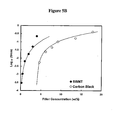
- concentrations of more than 25 wt% are often needed in the polymer when processed by typical solution or melt-based techniques. High filler loadings, such as these, can result in processing difficulties and loss of polymer properties, such as flexibility.
- the critical filler concentration needed to achieve true electrical conductivity is known as the percolation threshold.
- a need remains for a conductive polymer composite with a percolation threshold at a low critical filler concentration in order to retain polymer properties and processability, as well as provide a composite with effective conductive properties.
- a conductive carbon nanotube-polymer composite which comprises carbon nanotubes in an amount less than 1 wt.% of the composite, and polymer, wherein the polymer is in a form of coalesced polymer particles, wherein the carbon nanotubes are inhomogeneously dispersed at the microscopic level in the carbon nanotube-polymer composite, wherein the carbon nanotubes reside primarily between the polymer particles, and wherein the carbon nanotubes form an interconnecting network at the interface between at least some of the coalesced polymer particles.
- the network of carbon nanotubes in the carbon-nanotube polymer composite provides electrical and thermal conductivity to the composite.
- the carbon nanotubes can be single-wall carbon nanotubes, multi-wall carbon nanotubes or a combination thereof.
- the carbon nanotubes can be purified or unpurified.
- the composite can comprise a carbon nanotube stabilizer, a polymer particle stabilizer or both.
- the polymer particles can be provided by an emulsion, a latex, or any other polymer wherein polymer particles can be suspended by mechanical or chemical means, such as with a surfactant, protein, or water-soluble polymer.
- a suitable polymer for the matrix of the conductive carbon nanotube-polymer composite is poly(vinyl acetate), wherein polymer particles of poly(vinyl acetate) can be provided by an emulsion of poly(vinyl acetate).
- the conductive carbon nanotube-polymer composite comprises nanotubes in an amount less than about 0.1 wt% of the composite.
- the carbon nanotube-polymer composite also comprises a conductive filler, such as, but not limited to carbon black and small fullerenes, such as, C 60 (buckyballs), C 70 , and C 84 .
- a conductive filler such as, but not limited to carbon black and small fullerenes, such as, C 60 (buckyballs), C 70 , and C 84 .
- the nanotube-polymer composite comprises single-wall carbon nanotubes, wherein the polymer is polyvinyl acetate, and wherein the nanotube-polymer composite has a percolation threshold of less than about 0.04 wt% single-wall carbon nanotubes in the composite.
- the present invention provides a conductive carbon nanotube-polymer composite having electrical conductivity at a low carbon nanotube loading.
- the carbon nanotubes are inhomogeneously dispersed at the microscopic level in a polymer composite comprising coalesced polymer particles wherein the polymer particles essentially exclude the single-wall carbon nanotubes from the interior volume of the polymer particles, and wherein the nanotubes concentrate between at least some of the coalesced polymer particles to form a connective network through the carbon nanotube-polymer composite.
- a method for making a conductive carbon nanotube-polymer composite comprising forming a carbon nanotube suspension comprising carbon nanotubes and a first solvent, mixing the carbon nanotube suspension and a polymer suspension, wherein the polymer suspension comprises a polymer and a second solvent, and wherein the polymer is in a form of polymer particles, to form a carbon nanotube-polymer suspension, and removing the first solvent and second solvent from the carbon nanotube-polymer suspension to form a carbon nanotube-polymer composite, wherein the polymer particles coalesce and the carbon nanotubes reside primarily between the polymer particles, wherein the carbon nanotubes are inhomogeneously dispersed at the microscopic level in the carbon nanotube-polymer composite, and wherein said composite comprises nanotubes in an amount less than 1 wt.% of the composite.
- Another embodiment of the invention relates to a method for making a conductive carbon nanotube-polymer composite, comprising forming an aqueous nanotube suspension, mixing the nanotube suspension with an aqueous polymer suspension to form a carbon nanotube-polymer suspension, wherein the polymer is in a form of polymer particles and wherein the nanotubes are generally excluded from the interior of the polymer particles, and removing water from the carbon nanotube-polymer suspension to form a carbon nanotube-polymer composite, wherein the polymer particles coalesce and the carbon nanotubes primarily aggregate between at least some of the polymer particles.
- the nanotubes primarily aggregated in between the coalesced polymer particles form an interconnecting network and provide the polymer composite with thermal and electrical conductivity.
- the nanotube suspension, the polymer particle suspension, or both are stabilized with a surfactant or water-soluble polymer.
- Suitable surfactants include, but are not limited to, anionic, cationic, nonionic and amphoteric surfactants, fatty acid soaps and proteins.
- An example of an effective surfactant for suspending nanotubes or polymer particles is sodium dodecyl sulfate.
- Suitable water-soluble polymers include, but are not limited to amphiphilic polymers, cellulosic polymers, polyelectrolytes, ionic polymers, acrylate polymers, acrylic acid polymers, copolymers thereof and combinations thereof.
- Examples of effective water-soluble polymers for suspending carbon nanotubes are Gum Arabic and poly(vinyl pyrrolidone).
- An example of an effective water-soluble polymer for suspending polymer particles is poly(vinyl alcohol).
- the polymer matrix for the nanotube-polymer composite is formed from a polymer particle suspension, wherein the polymer particle suspension can be a polymer emulsion or latex, wherein the polymer is in a form of generally spherical polymer particles, having a size in the range of about 0.01 micron to about 100 microns in any dimension.
- Suitable matrix polymers include poly(vinyl acetate), acrylate polymers, acrylic acid polymers, polyacrylic esters, polyacrylamides, polyacrylonitriles, chlorinated polymers, fluorinated polymers, styrenic polymers, polyurethanes, natural rubber, synthetic rubber polymers, copolymers and combinations thereof.
- the invention in another embodiment, relates to a method for making a conductive carbon nanotube-polymer composite comprising forming a solvent-based carbon nanotube suspension, mixing the solvent-based carbon nanotube suspension and an aqueous polymer suspension, wherein the polymer is in a form of polymer particles, and wherein the nanotubes are generally excluded from the interior of the polymer particles, to form a carbon nanotube-polymer suspension, and removing water and solvent from the carbon nanotube-polymer suspension to form a carbon nanotube-polymer composite, wherein polymer particles coalesce and the carbon nanotubes aggregate primarily at the interface between at least some of the polymer particles.
- the carbon nanotubes form an interconnecting network in the polymer composite to impart electrical and thermal conductivity to the composite.
- the invention relates to a conductive carbon nanotube-polymer composite having electrical conductivity at a low carbon nanotube concentration or percolation threshold.
- the objective has been to achieve a homogeneous dispersion of the nanotubes in the polymer matrix.
- melt blending and solvent-blending techniques have often been used to provide a fine dispersion both at the macroscopic and microscopic level.
- Hydrocarbon-based solvents in solvent-blending methods have also often been used to provide compatibility with a polymer matrix system.
- conductivity in the composite in some embodiments of the present invention is achieved by seeking a generally homogeneous dispersion at the macroscopic level with an inhomogeneous dispersion of nanotubes at the microscopic level.
- a nanotube dispersion in one embodiment of the present invention is sought and prepared using the extremely hydrophobic nanotubes in an aqueous environment.
- a connective network of nanotubes is formed by mixing a nanotube suspension with a suspension of polymer particles, wherein the polymer particles substantially exclude the nanotubes from the interior of the polymer particles. To form the composite, water is removed from the nanotube-polymer mixture.
- the polymer particles coalesce with each other, trapping and aggregating the nanotubes in the interstitial regions between at least some of the coalesced polymer particles generally toward the outer edges of the polymer particles.
- the resulting composite comprises carbon nanotubes that are dispersed in the polymer composite generally homogeneously at the macroscopic level and inhomogeneously at the microscopic level and form a connective network through the nanotube-polymer composite that branches in between at least some of the coalesced polymer particles.
- Another embodiment in accordance with the first aspect of the invention, relates to a polymer composite comprising single-wall carbon nanotubes and a polymer, wherein the polymer composite comprises coalesced polymer particles and single-wall carbon nanotubes, wherein the single-wail carbon nanotubes primarily reside between at least some of the coalesced polymer particles and form a conductive network through the nanotube-polymer composite.
- Another embodiment, in accordance with the second aspect of the invention relates, to a method for making a conductive carbon nanotube-polymer composite, comprising forming an aqueous nanotube suspension comprising carbon nanotubes and water, mixing the nanotube suspension with an aqueous polymer suspension comprising polymer in the form of polymer particles and water to form a carbon nanotube-polymer suspension, wherein the nanotubes are generally excluded from the interior of the polymer particles, and removing water from the carbon nanotube-polymer suspension to form a carbon nanotube-polymer composite, wherein the polymer particles coalesce and the carbon nanotubes are trapped and aggregate primarily between at least some of the polymer particles and wherein the carbon nanotubes form a interconnecting network in the nanotube-polymer composite, the network of which provides electrical and thermal conductivity to the composite.
- the carbon nanotubes can be single-wall carbon nanotubes, multi-wall carbon nanotubes or a combination thereof.
- the nanotubes can be made by any known process for making carbon nanotubes, however, the composition of the nanotube material can influence the conductivity of the nanotube-polymer composite.
- a nanotube material having more single-wall carbon nanotubes with respect to multi-wall carbon nanotubes and amorphous carbon would be more conductive than a nanotube material with a lower concentration of single-wall carbon nanotubes in a similar mixture of multi-wall carbon nanotubes and amorphous carbon.
- the carbon nanotube material comprises primarily single-wall carbon nanotubes (i.e. greater than 50 wt% of the carbon-containing material), preferably greater than 70 wt% of the carbon-containing material.
- Single-wall carbon nanotubes can be made from any known means, such as by gas-phase synthesis from high temperature, high pressure carbon monoxide, catalytic vapor deposition using carbon-containing feedstocks and metal catalyst particles, laser ablation, arc method, or any other method for synthesizing single-wall carbon nanotubes.
- Single-wall carbon nanotubes obtained from synthesis are generally in the form of carbon nanotube powder.
- some multi-wall carbon nanotubes may be produced with the single-wall carbon nanotubes and be present in the carbon nanotube powder. Even if some multi-wall carbon nanotubes are present in the carbon nanotube powder, if the carbon nanotube material is mostly single-wall carbon nanotubes (i.e. the single-wall carbon nanotubes are present in a concentration greater than 50 wt% of the total carbon nanotubes), then the material will be regarded as single-wall carbon nanotube material or powder.
- single-wall carbon nanotube powder is purified to remove non-nanotube carbon, such as amorphous carbon and metallic catalyst residues.
- Metals such as Group VIB and/or VIIIB, are possible catalysts for the synthesis of single-wall carbon nanotubes.
- the metallic residues may be encapsulated in non-nanotube carbon, such as graphitic shells of carbon.
- the metallic impurities may also be oxidized through contact with air or by oxidation of the non-nanotube carbon during purification.
- the carbon nanotubes can be used as-produced or after purification. Purification can be done by any known means. Procedures for purification of single-wall carbon nanotubes are related in International Patent Publications "Process for Purifying Single-Wall Carbon Nanotubes and Compositions Thereof," WO 02/064,869, published August 22, 2002 , and “Gas Phase Process for Purifying Single-Wall Carbon Nanotubes and Compositions Thereof,” WO 02/064,868 published, August 22, 2002 , and incorporated herein in their entirety by reference. In one embodiment, the nanotubes are purified by heating at 250°C in air saturated with water vapor.
- the heating is done for a length of time so as to oxidize at least some of the non-nanotube carbon, and, may, to some extent, oxidize the metal impurities.
- the oxidation temperature can be in the range of 200°C and about 400°C, preferably about 200°C to about 300°C.
- the oxidation can be conducted in any gaseous oxidative environment, which can comprise oxidative gases, such as oxygen, air, carbon dioxide, and combinations thereof.
- the concentration of the oxidative gases can be adjusted and controlled by blending with nitrogen, an inert gas, such as argon, or combinations thereof.
- the duration of the oxidation process can range from a few minutes to days, depending on the oxidant, its concentration, and the oxidation temperature.
- the nanotubes are treated with acid to remove metallic impurities.
- the nanotubes are slurried in the acid, which can be a mineral acid, an organic acid, or combinations thereof.
- acids that could be used to treat and slurry the nanotubes include, but are not limited to, hydrochloric acid, hydrofluoric acid, hydrobromic acid, hydroiodic acid, sulfuric acid, oleum, nitric acid, citric acid, oxalic acid, chlorosulfonic acid, phosphoric acid, trifluoromethane sulfonic acid, glacial acetic acid, monobasic organic acids, dibasic organic acids, and combinations thereof.
- the acid used can be a pure acid or diluted with a liquid medium, such as an aqueous and/or organic solvent. Generally, an aqueous solvent is preferred. Concentrated aqueous hydrochloric acid is preferred for removing metallic impurities. After acid treating, the acid and impurities are removed from the nanotubes by rinsing. The nanotubes can be rinsed with water, an organic solvent or a combination thereof.
- a carbon nanotube suspension can be made in an aqueous environment using mechanical means, such as high shear mixing or sonication. Such a suspension would be unstable, in that the extremely hydrophobic nanotubes would settle out fairly rapidly. Although it is possible to use an unstable suspension of nanotubes in the present invention, a more stable suspension of nanotubes can be achieved with the use of a stabilizer.
- SWNT are extremely hydrophobic.
- Other means to suspend carbon nanotubes include, but are not limited to, functionalization with other chemical moieties or physical modification, such as cutting.
- chemical functionalization can often compromise nanotube conductivity.
- the conductivity of single-wall carbon nanotubes is reduced as a function of the amount of sidewall functionalization and the electron-withdrawing nature of the sidegroup. The more electron withdrawing the sidewall functionalization, the more the conductivity of the single-wall carbon nanotubes can decrease. Any chemical moiety that impedes electron flow along the nanotube axis can impair nanotube conductivity.
- Physical cutting of the nanotubes can also affect nanotube conductivity in a composite since the ability for the nanotubes to make a connective network throughout the composite can be impaired, at least in part by the smaller aspect ratio of the cut nanotubes.
- the carbon nanotube-polymer composite further comprises a conductive filler, such as, but not limited to, carbon black and small fullerenes, C 60 (buckyballs), C 70 , C 84 or combinations thereof.
- a conductive filler such as, but not limited to, carbon black and small fullerenes, C 60 (buckyballs), C 70 , C 84 or combinations thereof.
- the carbon nanotubes are mixed with one or more conductive fillers and suspended.
- a mixture of conductive material and nanotubes will be collectively referred to as the nanotubes or nanotube material.
- Stabilizers can improve the stability of a carbon nanotube suspension and suitable stabilizers include, but are not limited to, surfactants, proteins and water-soluble polymers.
- Suitable surfactants include, but are not limited to one or more surfactants selected from the group consisting of cationic surfactants, anionic surfactants, amphoteric surfactants, and nonionic surfactants, and mixtures thereof.
- Anionic surfactants include in particular organosulfonates and organosulfates, which can be characterized by the formula X 1 -A 1 wherein A 1 denotes sulfonate or sulfate, attached anywhere to X 1 and most often at one end of X 1 , and X 1 denotes:
- the anionic component is counterbalanced by a cation X which is preferably an alkali metal (e.g., sodium, potassium or lithium).
- a cation X which is preferably an alkali metal (e.g., sodium, potassium or lithium).
- Cationic surfactants include quaternary ammonium compounds, particularly those of the formula (Q 1 )(Q 2 )N+(Q 3 )(Q 4 )-(An) - wherein (An) - is an anion such as halide (especially bromide or chloride); methylsulfate, or ethylsulfate, and Q 1 , Q 2 , Q 3 and Q 4 are selected such that 2 or 3 thereof are C 1-4 alkyl (optionally one of which is benzyl) and I or 2 thereof are alkyl or alkylene containing 8 to 24 carbon atoms and optionally up to 3 carbon-carbon double bonds, or poly(alkoxy) wherein each alkoxy unit is ethoxy or propoxy, containing up to 200 alkoxy units.
- quaternary ammonium compounds particularly those of the formula (Q 1 )(Q 2 )N+(Q 3 )(Q 4 )-(An) - wherein (An) -
- polymeric quaternary ammonium salts including those known generically as polyquaternium -1, -2, -4, -5, -6, -7, -8, -9, -10, -11, -12, -13, and -14.
- Amphoteric surfactants particularly include those of the formulas (I) and (II) R 4 --(OC 3 H 6 ) 0-1 (C(O)NH(CH 2 ) 1-3 ) 0-1 --N(Z 1 )(Z 2 ) 0-1 -ZCOOH (I) R 4 --(OC 3 H 6 ) 0-1 (C(O)NH(CH 2 ) 1-3 ) 0-1 --N(Z 1 )(Z 2 ) 0-1 --ZSO 3 H (II) salts thereof with an alkali metal X or ammonium cation and mixtures of any the compounds and salts, wherein X is as defined above, R 4 is straight or branched alkyl or alkylene, or cyclic or heterocyclic aromatic, which is optionally substituted with alkyl, and contains 4 to 40 carbon atoms and 0-3 carbon-carbon double bonds, Z 1 and Z 2 are independently of each other H, C f H f + 1 or C f H 2f OH
- Formulas (I) and (II) embrace betaines, sulfobetaines (sultaines), glycinates and propionates, which are commercially available and/or can readily be synthesized.
- preferred amphoteric surfactants include fatty betaines such as lauryl dimethyl betaine, such as REWOTERIC ® AM-DML-35, (REWOTERIC is registered trademark of Witco Corp.) and N-lauryl ⁇ -iminopropionic acid, mono-sodium salt (e.g., REWOTERIC AM-LP); glycinates such as N-cocoylamidoethyl-N-(2-hydroxyethyl)-N-carboxymethyl glycine, sodium salt (e.g., REWOTERIC AM-2C-W) and as lauryl hydroxy sultaine (e.g., REWOTERIC-AM-B-15); propionates such as sodium cocoamphopropionate (e.g.,
- Suitable R 4 groups include alkyl and alkylene radicals derived from fatty acids.
- Other R 4 groups include benzyl and alkyl-substituted benzyl.
- Nonionic surfactants include any nonionic compounds having surface active capability. Examples include:
- surfactants for stabilizing nanotube suspensions include, but are not limited to, anionic surfactants, such as sodium dodecylsulfate, sodium lauryl sulfate, sodium oleyl sulfate, sodium dodecylsulfonate, sodium dodecylbenzenesulfonate, sodium n-lauroylsarcosinate, sodium alkyl allyl sulfosuccinate, and the sodium salt of poly(styrene sulfonate), cationic surfactants, such as dodecyltrimethylammonium bromide and ceytltrimethylammonium bromide, fatty acid soaps, nonionic surfactants, such as TRITON X ® surfactants, e.g.
- anionic surfactants such as sodium dodecylsulfate, sodium lauryl sulfate, sodium oleyl sulfate, sodium dodecylsulfonate,
- TRITON X-100, X-114, and X-405, (TRITON is a registered trademark of Rohm & Haas Corporation.), BRIJ ® surfactants, e.g. BRIJ 78 and BRIJ 700 (BRIJ is a registered trademark of Atlas Chemical Company.), PEO-PPO-PEO (polyethylene oxide-polypropylene oxide-polyethylene oxide) triblock polymer PLURONIC ® surfactants, e.g.
- PLURONIC P-103, P-104, P-105, F-108, F-98, F-68, F-127, F-87, F-127, F-87, F-77 and F-85 PLURONIC ® is a registered trademark of BASF Corporation.
- TWEEN ® surfactants e.g. TWEEN 20, 40, 60, 80 and 85.
- TWEEN is a registered trademark of Atlas Chemical Company.
- PEO-PBO-PEO polyethylene oxide-polybutylene oxide-polyethylene oxide
- Water-soluble polymers can also be used to stabilize a suspension of carbon nanotubes in an aqueous environment.
- Suitable water-soluble polymers are polymers that form polymer solutions in water.
- the water solubility of a particular polymer depends on a number of factors, including, but not limited to, polymer composition, polymer molecular weight, the critical concentration of the polymer, temperature and pressure.
- the critical concentration (c crit ) of the polymer is the highest concentration where polymer coils can still reach their maximum extension in volume.
- preferred carbon nanotube stabilizers are water-soluble polymers that can form true solutions in water, rather than suspensions of polymer particulates.
- the preferred water-soluble polymer for stabilizing the nanotube suspension is at a concentration in the aqueous media where the polymer is generally in the form of individual extended polymer chains.
- Suitable water-soluble polymers for stabilization of the nanotube suspension include, but are not limited to, amphiphilic polymers, also called polymer surfactants, which contain both hydrophobic and hydrophilic segments, cellulosic polymers, polyelectrolytes, ionic polymers, acrylate polymers, acrylic acid polymers, copolymers thereof and combinations thereof.
- Suitable specific water-soluble polymers include, but are not limited to, Gum Arabic, poly(vinyl pyrrolidone), poly(vinyl alcohol), poly(acrylic acid), poly(methacrylic acid), sodium polyacrylate, polyacrylamide, poly(ethylene oxide), polyethylene glycol, poly(ethylene formamide), polyhydroxyether, poly(vinyl oxazolidinone), methyl cellulose, ethyl cellulose, carboxymethyl cellulose, ethyl(hydroxyethyl)cellulose, sodium polyacrylate, copolymers thereof, and combinations thereof.
- Suitable water-soluble polymers for stabilizing aqueous nanotube suspensions include, but are not limited to, polystyrene sulfonate (PSS), poly(1-vinyl pyrrolidone-co-vinyl acetate), poly(1-vinyl pyrrolidone-co-acrylic acid), poly(1-vinyl pyrrolidone-co-dimethylaminoethyl methacrylate), polyvinyl sulfate, poly(sodium styrene sulfonic acid-co-maleic acid), dextran, dextran sulfate, gelatin, bovine serum albumin, poly(methyl methacrylate-co-ethyl acrylate), polyallyl amine, and combinations thereof.
- Preferable water-soluble polymers for stabilizing aqueous carbon nanotube suspensions are Gum Arabic (GA) and poly(vinyl pyrrolidone), more preferably Gum Arabic.
- the amount of stabilizer can range from about 5 wt% to about 200 wt% of the weight of the nanotubes.
- the amount of stabilizer is in the range of about 20 wt% and about 50 wt% of the weight of the nanotubes.
- Mechanical means can be used to suspend the nanotubes, with or without a stabilizer. Suitable mechanical means include, but are not limited to, high speed impeller mixing, high shear mixing and sonication. Heat can also be applied to facilitate nanotube suspension.
- the main component of the conductive polymer composite is known as the polymer matrix.
- the polymer matrix is formed from a polymer in the form of polymer particles suspended in an aqueous system, such as a polymer emulsion or latex.
- the polymer particles are preferably able to coalesce as moisture is removed from the water-based suspension.
- Suitable polymers include, but are not limited to, acrylate polymers, acrylic acid polymers, polyacrylic esters, polyacrylamides, polyacrylonitriles, chlorinated polymers, fluorinated polymers, styrenic polymers, polyurethanes, natural rubber, synthetic rubber polymers, vinylchloride-acrylate polymers, copolymers thereof and combinations thereof.
- polystyrene-acrylate copolymers examples include, but are not limited to, poly(vinyl acetate), poly(acrylic acid), poly(methyl methacrylate), polyacrylamide, polyacrylonitrile, polyvinylpropionate, polystyrene, polytetrafluoroethylene, poly(vinyl chloride), poly(vinylidene chloride), poly(vinyl chloride-ethylene), poly(vinyl chloride-propylene), poly(styrene-co-butadiene), styrene-acrylate copolymers, ethylene-vinyl chloride copolymer, poly(vinyl acetate-acrylate), poly(vinyl acetate-ethylene) and combinations thereof.
- the polymer comprises poly(vinyl acetate) or poly(vinyl acetate) copolymer.
- the polymer particles are in the form of a polymer emulsion or latex.
- the suspension of the polymer particles can be stable or unstable.
- the polymer particle suspension is stable.
- An example of an unstable polymer suspension is one in which the polymer particles settle out in a relatively short time, e.g. within an hour.
- An unstable suspension can be stabilized by mechanical means, such as by stirring, high shear mixing or sonication, to keep the polymer particles suspended for a period of time effective to add and mix with the nanotube suspension, so that the polymer particles and the nanotubes are dispersed fairly homogeneously at the macroscopic level throughout the liquid phase.
- An aqueous suspension of polymer particles can also comprise a stabilizer for the polymer particles.
- polymer particle stabilizers include, but are not limited to surfactants and polymers.
- Surfactants for polymer particle stabilization can be cationic, anionic, nonionic or amphoteric. Generally, the type of surfactant is dependent on the type of polymer and the polymerization process used. Any of the surfactants listed above for nanotubes can be used for polymer particle stabilization.
- anionic surfactants for polymer particle stabilization include, but are not limited to, alkyl sulfates, such as sodium lauryl sulfate, ammonium lauryl sulfate, sodium isotridecyl sulfate, sodium dodecyl sulfate, sodium octyl sulfate, sodium cetyl stearyl sulfate, and sodium oleyl sulfate, alkyl ether sulfates, such as sodium lauryl ether sulfate, alkyl phenol ether sulfates, such as sodium nonyl phenol ether sulfate, salts and free acids of phosphate esters, sulfosuccinates, such as sodium sulfosuccinate alcohol ethoxylate, sodium sulfosuccinate alkyl phenol ethoxylate, sodium dicyclohexyl sulfosuccinate, and sodium dioc
- nonionic surfactants for polymer particle stabilization include, but are not limited to, alkyl ethoxylates, alkyl ethoxylate blends and alkyl phenol ethoxylates.
- Fatty acid soaps and proteins can also be used to stabilize polymer particles.
- rubber particles in natural rubber latex which comes from the sap of the Hevea Brasiliensis tree, can be stabilized in a water-based system by proteins and fatty acid soaps.
- the polymer particles can also be stabilized with one or more water-soluble polymers.
- the water-soluble polymer for stabilizing the polymer particles can be the same or different than the water-soluble polymer used to stabilize the nanotube suspension.
- Suitable water-soluble polymers for stabilizing polymer particle suspensions include, but are not limited to, amphiphilic polymers, also called polymer surfactants and which contain both hydrophobic and hydrophilic segments, cellulosic polymers, polyelectrolytes, ionic polymers, acrylate polymers, acrylic acid polymers, copolymers thereof and combinations thereof.
- Suitable specific water-soluble polymers include, but are not limited to, Gum Arabic, poly(vinyl pyrrolidone), poly(vinyl alcohol), poly(acrylic acid), poly(methacrylic acid), sodium polyacrylate, polyacrylamide, poly(ethylene oxide), polyethylene glycol, poly (ethylene formamide), polyhydroxyether, poly(vinyl oxazolidinone), methyl cellulose, ethyl cellulose, carboxymethyl cellulose, ethyl(hydroxyethyl)cellulose, sodium polyacrylate, copolymers thereof, and combinations thereof.
- Suitable water-soluble polymers for stabilizing aqueous polymer particle suspensions include, but are not limited to, polystyrene sulfonate (PSS), poly(1-vinyl pyrrolidone-co-vinyl acetate), poly(1-vinyl pyrrolidone-co-acrylic acid), poly(1-vinyl pyrrolidone-co-dimethylaminoethyl methacrylate), polyvinyl sulfate, poly(sodium styrene sulfonic acid-co-maleic acid), dextran, dextran sulfate, gelatin, bovine serum albumin, poly(methyl methacrylate-co-ethyl acrylate), polyallyl amine, and combinations thereof.
- a preferable water-soluble polymer for stabilizing a poly(vinyl acetate) suspension is polyvinyl alcohol.
- the nanotube suspension is mixed with the polymer particle suspension.
- the mixing can be optionally accompanied by heating.
- Water is then removed to form a nanotube-polymer composite.
- Water can be removed by evaporation or desiccation and facilitated by application of vacuum and/or heat.
- the polymer particles coalesce, and since the nanotubes are essentially excluded from the interior of the polymer particles, the nanotubes are trapped and aggregate between at least some of the polymer particles in the interstitial region.
- the trapped nanotubes form an interconnecting network of nanotubes in the polymer matrix, wherein the nanotube network provides the composite with electrical and thermal conductivity.
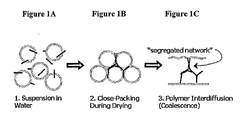
- Figure 1A shows a dispersion of nanotubes (straight lines) and polymer particles (circles) in an aqueous media wherein the dispersion is generally homogeneous at the macroscopic level.
- Figure 1B shows that when water is removed, the polymer particles becoming more close-packed and the nanotubes aggregate and become trapped in the interstitial spaces between at least a portion of the polymer particles.
- Figure 1 C shows the coalescence of the polymer particles to form a coherent composite film with the carbon nanotubes aggregated at the interface between at least some of the coalesed polymer particles wherein the nanotubes form a conductive interconnecting network throughout the polymer composite.
- the single-wall carbon nanotubes generally reside between the particles of the matrix polymer, they are only present in a small fraction of the volume of the polymer matrix and are concentrated in the interstitial region between the polymer particles.
- single-wall carbon nanotubes When in contact with each other, single-wall carbon nanotubes have the propensity, to be hold strongly together by van der Waals forces, and, thus, form networks that generally are difficult to separate into individual nanotubes.
- the particular stabilizer used to stabilize the nanotube suspension can affect the conductivity of the nanotube-polymer composite.
- the polymer can wrap around and coat individual nanotubes and, to some extent, ropes of single-wall carbon nanotubes.
- PVP poly(vinyl pyrrolidone)
- conductivity differences in stabilized-manotube-polymer composites may by due the extent the nanotube stabilizer coats the nanotubes, whereby such coating can separate the nanotubes to an extent that affects the interconnections in the nanotube network and the derived conductivity.
- in the present invention provides a conductive polymer composite wherein conductivity is achieved with very low concentrations of carbon nanotubes, i.e. at low percolation thresholds of carbon nanotubes.
- the amount of carbon nanotubes needed to provide a level of electrical conductivity, i.e. the percolation threshold, is significantly lower in the present invention than when a composite is prepared with a generally (macroscopically and microscopically) uniform dispersion of carbon nanotubes.
- the invention comprises a conductive carbon nanotube-polymer composite, wherein the polymer is polyvinyl acetate, wherein the nanotubes are single-wall carbon nanotubes stabilized with Gum Arabic (GA), and wherein the nanotube-polymer composite has a percolation threshold of less than about 0.04 wt% single-wall carbon nanotubes in the composite.
- the polymer is polyvinyl acetate
- the nanotubes are single-wall carbon nanotubes stabilized with Gum Arabic (GA)
- G Gum Arabic
- the percolation threshold is about 3 wt% to about 3.5 wt% SWNT in the composite.
- the polymer particles for forming the polymer matrix of the nanotube-polymer composite are generally spherical and have a cross-sectional dimension generally in the range of about colloidal particle size, i.e. about 0.01 micron to about 1 micron, to coarser sizes up to about 100 microns, in any dimension.
- suitable polymer particles range in size from about 0.1 micron to about 10 microns in any dimension, typically about 0.5 micron to about 5 microns in any dimension.
- the nanotube network provides electrical and thermal conductivity to the composite.
- the composite is conductive and has a percolation threshold at very low carbon nanotube loadings, for example as low as about 0.01 wt% to about 0.04 wt% nanotubes in the composite.
- the nanotubes become entrapped between at least some of the coalescing polymer particles.
- the matrix polymer particles which generally exclude nanotubes from their polymer-occupied interior so that the nanotubes reside primarily between the polymer particles, exclude nanotubes from more than 50 vol% of the composite material.
- the nanotubes would be excluded from at least about 50 vol% of the composite material.
- the polymer particles exclude the nanotubes from more than 60 vol% of the composite, more preferably the polymer particles exclude the nanotubes from more than 70 vol% of the composite, more preferably the polymer particles exclude the nanotubes from more than 80 vol% of the composite, more preferably the polymer particles exclude the nanotubes from more than 90 vol% of the composite, more preferably the polymer particles exclude the nanotubes from more than 95 vol% of the composite, more preferably the polymer particles exclude the nanotubes from more than 99 vol% of the composite.
- a lower concentration of nanotubes is needed to form conductive networks in a polymer matrix made with polymer particles that exclude the nanotubes from a larger volume of the composite matrix.
- the concentration of nanotubes needed to form a conductive network with nanotube-excluding polymer particles is substantially less than if the nanotubes were uniformly dispersed throughout the entire polymer composite.
- Single-wall carbon nanotubes in a concentration range from about 0.01 wt% to about 20 wt% of the dried polymer matrix material can be incorporated into a nanotube-polymer composite.
- the amount of nanotubes in the nanotube-polymer composite is sufficient to achieve electrical and thermal conductivity, but desirably small, so as to retain the mechanical and processing properties of the polymer.
- the nanotube material is less than about 1 wt% of the polymer matrix material, and more preferably less than about 0.1 wt% of the polymer matrix material.
- the amount of branching in the nanotube connective network is a function of the size distribution of the polymer particles, i.e. larger polymer particles would generally provide for a less branched network in a nanotube network and, conversely, smaller polymer particles would generally provide for a more branched network of the nanotubes throughout the composite.
- the polymer particle size distribution may be monodisperse, i.e. all about the same particle size, or polydisperse, i.e. present as various particle sizes or distribution of particle sizes.
- the polymer particles can comprise ordered polymer structures, such as, but not limited to, lamella, micelles and/or crystalline-packed polymers.
- the particular polymer and associated molecular weight will depend on the desired end-use application.
- the polymer molecular weights can range from between about 4,000 or 5,000 g/mole to over 1,000,000 g/mole.
- a conductive carbon nanotube-polymer composite can be made by forming a solvent-based carbon nanotube suspension, mixing the carbon nanotube suspension and an aqueous polymer suspension, wherein the polymer is in a form of polymer particles, to form an carbon nanotube-polymer suspension, and removing water and solvent from the carbon nanotube-polymer suspension to form a carbon nanotube-polymer composite, wherein polymer particles coalesce and the carbon nanotubes reside primarily between the polymer particles.
- the nanotube suspension is made with a solvent. Any solvent that can suspend carbon nanotubes can be used. The suspension can be stable or unstable. Mechanical means can also be used to promote the suspension of the nanotubes.
- Suitable solvents for carbon nanotubes, and in particular, single-wall carbon nanotubes include, but are not limited to, amides, such as N,N-dimethylformamide (DMF), N-methylpyrrolidone (NMP), dimethylacetamide (DMAc), and hexamethylphosphoramide, toluene, dimethylsulfoxide (DMSO), cyclopentanone, tetramethylene sulfoxide, ⁇ -caprolactone and combinations thereof. Any other solvent or combination of solvents that can suspend carbon nanotubes can be used.
- amides such as N,N-dimethylformamide (DMF), N-methylpyrrolidone (NMP), dimethylacetamide (DMAc), and hexamethylphosphoramide
- DMSO dimethylsulfoxide
- cyclopentanone tetramethylene sulfoxide
- ⁇ -caprolactone any other solvent or combination of solvents that can suspend carbon nanotubes can be used.
- the use of a solvent to form the nanotube suspension can reduce or eliminate the use of nanotube stabilizers, such as surfactants and polymers, described and listed above. Without a stabilizer, the nanotubes can be in intimate contact with each other throughout the nanotube network to provide enhanced conductivity in the composite.
- nanotube stabilizers such as surfactants and polymers, described and listed above.
- the carbon nanotube suspension is mixed with a polymer suspension to form a carbon nanotube-polymer suspension.
- the polymer suspension is comprised of polymer and water, and the polymer is in a form of polymer particles that essentially exclude the carbon nanotubes from entering into the particles.
- the polymer can be any polymer that can be suspended in particle form in an aqueous suspension, such as those mentioned above.
- the polymer particles may also be stabilized in the aqueous environment by any stabilizer mentioned above to stabilize polymer suspensions.
- the hydrophobic nanotubes tend to be attracted to, and accumulate on, the generally hydrophobic polymer particles in preference to being in the water-phase of the polymer suspension.
- the nanotubes' accumulation at the polymer particle surface also involves solvent/non-solvent attractive and repulsive forces.
- the water and solvent are removed from the carbon nanotube-polymer suspension to form a carbon nanotube-polymer composite, wherein polymer particles coalesce and the carbon nanotubes reside primarily between the polymer particles.
- the solvent can enhance the coalescing of the polymer particles by swelling the outside of the polymer particles.
- the removal of solvent and water can be by any known means of solvent and water removal, such as those means listed above.
- a carbon nanotube-polymer composite comprises forming a solvent-based nanotube suspension, mixing the nanotube suspension with a solvent-based polymer suspension to form a carbon nanotube-polymer suspension, wherein the polymer is in a form of particles and wherein the nanotubes are generally excluded from entering into the polymer particles, and removing solvent from the carbon nanotube-polymer suspension wherein the polymer particles coalesce and the carbon nanotubes are trapped between the polymer particles and form a interconnecting network providing the polymer composite with electrical conductivity.
- the solvent-based carbon nanotube suspension can be based on solvents cited above or any solvent known to suspend carbon nanotubes.
- the suspension can be stable or unstable, Mechanical means, such as sonication or vigorous mixing, can also be used to promote the suspension of the nanotubes.
- the suspension of polymer particles can be in the same solvent or a different solvent than that of the nanotube suspension.
- the polymer particles can be suspended in any suitable solvent, preferably a solvent that does not dissolve the polymer particles, and, more preferably, a solvent that does not substantially swell the polymer particles, and more preferably, a solvent that does not substantially penetrate into the polymer particles.
- toluene can be used to form a polymer suspension of poly(vinyl acetate) particles.
- Toluene can also be used to form a nanotube suspension.
- toluene would be a suitable solvent for a nanotube suspension and polymer particle suspension.
- the solvent is removed from the carbon nanotube-polymer suspension to form a carbon nanotube-polymer composite, wherein polymer particles coalesce and the carbon nanotubes reside primarily between the polymer particles.
- the conductive polymer composites comprising single-wall carbon nanotubes and coalesced polymer particles of the present invention have enhanced electrical and thermal conductivities which make them useful in applications that require thermal conduction, electrical conduction, electromagnetic shielding, or combinations thereof. Such compositions are useful in paints, coatings, and adhesives. Because only a small concentration of nanotubes are needed to form conductive networks in the polymer matrix comprised of polymer particles that essentially exclude the nanotubes, electrical and thermal conductivity is imparted to the composite while not degrading the desired physical and mechanical processing properties of the matrix polymer.
- the network of carbon nanotubes may additionally provide enhanced strength, elasticity, and toughness to the polymer composite.
- This example demonstrates a method for making a nanotube-polymer composite comprising SWNT and poly(vinyl acetate).
- Poly(vinyl acetate) (PVAc) homopolymer emulsion (VINAC ® XX210) was obtained from Air Products. (VINAC is a registered trademark of Air Products and Chemicals, Inc., Allentown, PA.)
- the emulsion contained approximately 55 wt% solids in water.
- the number average polymer particle size (D n ) was 105 nm (0.105 micron) and the volume average polymer particle size (D v ) was 2.5 ⁇ m (2.5 micron).
- the glass transition temperature (T s ) for this polymer system was 34°C and the minimum film formation temperature (MFFT) was approximately 15°C, permitting the formation of coherent films under ambient drying conditions.
- a cryo-SEM Sccanning Electron Micrograph
- Emulsion samples were frozen in liquid ethane and transferred to a cryogenic chamber where frost was sublimed. The frozen samples were then fractured and coated in-situ with platinum.
- the cryo-SEM of the polymer emulsion is shown in Figure 2. Although the polymer particles were approximately spherical in the emulsion, the cryogenic technique made them appear flat in the micrograph.
- the polymer particles are polydisperse in size, which ranges from less than about 0.5 micron to about 2.5 microns in diameter.
- HIPCO ® single-walled nanotubes were obtained from Carbon Nanotechnologies, Inc., Houston, Texas. (HIPCO is a registered trademark of Carbon Nanotechnologies, Inc., Houston, Texas.)
- the nanotubes (Lot# R0210) had a very fluffy consistency contained about 29 wt% impurities from metal catalyst and amorphous carbon.
- Gum Arabic (GA) in powder form was obtained from Aldrich (Milwaukee, WI) and used to stabilize the SWNT suspension.
- SWNT 1.5 g SWNT were combined with an aqueous solution of 2 wt% GA and mixed well using a mortar and pestle. After mixing, the SWNT-based slurry was further diluted with 2 wt% GA solution to achieve a 200g mixture (1.5g SWNT, 6g GA, and 192.5g deionized water). This aqueous mixture was blended with a high-speed impeller blade ("F" Style Blade with 2" diameter purchased from Paul N. Gardner in Pompano Beach, FL) mounted to a standard drill press at 3100 rpm for 15 minutes. After blending, the SWNT mixture was sonicated for 30 minutes.
- a high-speed impeller blade ("F" Style Blade with 2" diameter purchased from Paul N. Gardner in Pompano Beach, FL) mounted to a standard drill press at 3100 rpm for 15 minutes.
- TEM Transmission Electron Micrographs
- Figure 3A is a TEM at 37,500X magnification of GA-stabilized single-wall carbon nanotubes.
- Figure 3B is a TEM at 200,OOOX magnification of GA-stabilized single-wall carbon nanotubes.
- the small dark dots, in both Figure 3A and Figure 3B, are attributed to residual catalyst impurity.
- the SWNT mixture was then filtered to remove water and excess GA, and dried at 70°C for one hour.
- the resulting GA-stabilized SWNT had a 1:1 ratio with GA after filtration.
- the dried GA-stabilized SWNT was recombined with water and mixed using a mortar and pestle, after which, PVAc emulsion was added. Blending of the GA-stabilized SWNT and the PVAc was done under high shear conditions using the same high-speed impeller blade described above at 3100 rpm for 15 minutes in a 1-liter steel beaker.
- a few drops of DREWPLUS ® L-483 foam-control agent (Ashland Specialty Chemical Company) were added to the mixture to control the foam level during mixing. (DREWPLUS is a registered trademark of Ashland Inc.)
- GA-stabilized-SWNT-PVAc mixtures containing progressively smaller SWNT concentrations were prepared by successively diluting the remaining concentrated mixture by adding more water and PVAc emulsion, followed by an additional 15 minutes of impelling. All of the aqueous GA-stabilized SWNT-PVAc mixtures were impelled at a constant 10 wt% solids in water.
- Solid composite films were prepared by drying each aqueous SWNT-PVAc mixture on 50- ⁇ m polyethylene terephthalate (PET) film within a 175- ⁇ m deep (2" x 2") PET film frame. Each SWNT-PVAc composite films was dried for 24 hours under ambient conditions followed by an additional 24 hours in a dry box having less than 20% relative humidity. The resulting dried SWNT-PVAc films were 125 ⁇ 5 ⁇ m thick and had an opaque black appearance. Film thicknesses in the range of about 25 microns to about 500 microns are suitable film thicknesses for a conductive film. Below 25 microns, the film thickness would be in the two-dimensional percolation regime.
- FIG. 4A is a TEM at 10,000X magnification of a 3 wt% SWNT-PVAc composite film.
- the light gray, generally spheroidal shapes are PVAc polymer particles approximately 1-2 microns wide.
- the dark gray/black sinuous forms are single-wall carbon nanotube material.
- Figure 4B is a TEM micrograph at 27,000X magnification of the 3 wt% SWNT-PVAc composite film.
- the polymer particles appear to generally exclude the nanotube material so that the nanotubes reside between and at the edges of the coalesced polymer particles.
- the relatively long networks of S WNT can be seen winding between and around at least a portion of the comparatively large polymer particles.
- the polymer particles that exclude SWNT dramatically reduce the volume available for SWNT or other conductive fillers, such as carbon black, to form conductive networks.
- SWNT or other conductive filler can be used to attain the percolation threshold.
- a carbon black-PVAc composite was prepared in the same manner as the SWNT-PVAc composites of Example 1, except that no Gum Arabic was used to stabilize the carbon black.
- a conductive grade carbon black (CONDUCTEX ® 975 ULTRA ® , with a 21-nm mean primary particle size and density of 1.89 g/cm 3 , from Columbian Chemicals) and was slowly added as a dry powder to PVAc emulsion while stirring with an impeller blade at 880 rpm.
- CONDUCTEX and ULTRA are registered trademarks of Columbian Chemicals Company.
- Carbon black-PVAc composite films were prepared in the same manner as the SWNT-PVAc composite films prepared in Example 1.
- the film thicknesses were 200 to 400 microns.
- This example demonstrates a method of making a composite comprising SWNT and poly(vinyl acetate) wherein polyvinylpyrrolidone (PVP) was used as a stabilizer for the single-wall carbon nanotube suspension.
- Poly(vinyl acetate) homopolymer emulsion (VINAC XX210) from Air Products was from a different lot from that used in Examples I and 2, contained contained approximately 55 wt% solids in water and had a number average polymer particle size (D n ) of 108 nm, a volume average polymer particle size (D v ) of 2.5 ⁇ m, a glass transition temperature (T g ) of about 34°C and a minimum film formation temperature (MFFT) of about 15°C.
- D n number average polymer particle size
- D v volume average polymer particle size
- T g glass transition temperature
- MFFT minimum film formation temperature
- SWNT As-produced HIPCO single-walled nanotubes (SWNT), (Lot #R0210 containing about 29 wt% impurities attributed to residual catalyst metal and amorphous carbon) were obtained from Carbon Nanotechnologies, Inc., Houston, Texas.
- Polyvinyl pyrrolidone (M w 10,000 g/mole) in powder form was obtained from Aldrich (Milwaukee, WI) and used to stabilize the SWNT suspension.
- This example demonstrates the electrical conductivity of SWNT-polymer composite films prepared in Example 1. Electrical conductivity measurements were made with a Loresta AP (MCP-T4000) four-point probe made by Mitsubishi, which is able to measure conductivity down to 10 -5 S/cm (Siemens/cm).
- MCP-T4000 Loresta AP
- V is the is the volume fraction of filler
- V c is that of the volume fraction of the filler at the percolation threshold.
- the weight fraction, F of SWNT was used in lieu of the volume fraction, due to the uncertainty in estimating the SWNT density.
- the GA-stabilized-SWNT-PVAc composite data was fitted to the modified power law Equation 2, given below.
- ⁇ ⁇ o ⁇ F - F c S
- ⁇ the composite conductivity
- ⁇ o a scaling factor related to the intrinsic conductivity of the filler
- S the power law exponent
- F is the is the weight fraction of carbon nanotubes in the composite
- F c is that of the weight fraction of carbon nanotubes in the composite at the percolation threshold.
- the GA-stabilized SWNT-PVAc composite had a percolation threshold F c of approximately 0.04 wt%.
- the percolation threshold of more than 0.3 wt% SWNT would be expected to be obtained with generally homogeneously-dispamd SWNT composites made by solvent-based or melt blending techniques. (See J.M Benoit et al., Synth. Met. Vol. 121, p1215 (2001 ), E. Kymakis et al., Synth Met. 127 (2002) p. 39 , and A. Dufresne et al., J. Mater. Sci. 37 (2002) p. 3915 ).
- the percolation threshold of the carbon black-PVAc composite films made with PVAc emulsion according to Example 2 and fitted to the power law model was determined to be 4 wt%, i.e. about two orders of magnitude higher than the comparably-prepared SWNT composites.
- the percolation threshold for a carbon black composite would be expected to be obtained with composites containing more than 25 wt% carbon black, (see, J.C. Grunlan et al. J. Mater. Res. 14, (1999)p. 4132 , and M-Q. Zhang, et al., Macromolecules 31 (1998) p. 6724 ).
- Figure 5B shows a plot of log ⁇ (electrical conductivity) in units of Siemens/cm (S/cm) as a function of filler concentration for dried GA-stabilized-SWNT-PVAc composite films as prepared in Example 1 (black circles) and carbon black-PVAc composite films as prepared in Example 2 (white circles). The data for both fillers were fit to the power law equation (Eq. 2).
- the PVP-stabilized SWNT-PVAc composite had a percolation threshold at about 3 wt% SWNT.
Landscapes
- Chemical & Material Sciences (AREA)
- Engineering & Computer Science (AREA)
- Nanotechnology (AREA)
- Physics & Mathematics (AREA)
- Crystallography & Structural Chemistry (AREA)
- Mathematical Physics (AREA)
- Medicinal Chemistry (AREA)
- Dispersion Chemistry (AREA)
- Spectroscopy & Molecular Physics (AREA)
- Polymers & Plastics (AREA)
- Health & Medical Sciences (AREA)
- Theoretical Computer Science (AREA)
- Organic Chemistry (AREA)
- Chemical Kinetics & Catalysis (AREA)
- Composite Materials (AREA)
- Condensed Matter Physics & Semiconductors (AREA)
- General Physics & Mathematics (AREA)
- Materials Engineering (AREA)
- Compositions Of Macromolecular Compounds (AREA)
- Carbon And Carbon Compounds (AREA)
- Conductive Materials (AREA)
Applications Claiming Priority (2)
| Application Number | Priority Date | Filing Date | Title |
|---|---|---|---|
| US46525903P | 2003-04-24 | 2003-04-24 | |
| PCT/US2004/012432 WO2004097853A1 (en) | 2003-04-24 | 2004-04-22 | Conductive carbon nanotube-polymer composite |
Publications (2)
| Publication Number | Publication Date |
|---|---|
| EP1623437A1 EP1623437A1 (en) | 2006-02-08 |
| EP1623437B1 true EP1623437B1 (en) | 2007-12-05 |
Family
ID=33418211
Family Applications (1)
| Application Number | Title | Priority Date | Filing Date |
|---|---|---|---|
| EP04760328A Expired - Lifetime EP1623437B1 (en) | 2003-04-24 | 2004-04-22 | Conductive carbon nanotube-polymer composite |
Country Status (5)
| Country | Link |
|---|---|
| EP (1) | EP1623437B1 (enExample) |
| JP (1) | JP4797121B2 (enExample) |
| AT (1) | ATE380384T1 (enExample) |
| DE (1) | DE602004010506D1 (enExample) |
| WO (1) | WO2004097853A1 (enExample) |
Cited By (13)
| Publication number | Priority date | Publication date | Assignee | Title |
|---|---|---|---|---|
| CN101417795B (zh) * | 2008-11-24 | 2010-11-17 | 山东大学 | 一种含碳纳米管粘弹性流体的制备方法 |
| DE102011009469A1 (de) * | 2011-01-21 | 2012-07-26 | Innovent E.V. | Polymerfunktionalisierte Kohlenstoffnanoröhre und Verfahren zu deren Herstellung |
| US8236118B2 (en) | 2009-08-07 | 2012-08-07 | Guardian Industries Corp. | Debonding and transfer techniques for hetero-epitaxially grown graphene, and products including the same |
| US8460747B2 (en) | 2010-03-04 | 2013-06-11 | Guardian Industries Corp. | Large-area transparent conductive coatings including alloyed carbon nanotubes and nanowire composites, and methods of making the same |
| US8507797B2 (en) | 2009-08-07 | 2013-08-13 | Guardian Industries Corp. | Large area deposition and doping of graphene, and products including the same |
| US8518472B2 (en) | 2010-03-04 | 2013-08-27 | Guardian Industries Corp. | Large-area transparent conductive coatings including doped carbon nanotubes and nanowire composites, and methods of making the same |
| US8604332B2 (en) | 2010-03-04 | 2013-12-10 | Guardian Industries Corp. | Electronic devices including transparent conductive coatings including carbon nanotubes and nanowire composites, and methods of making the same |
| US8808810B2 (en) | 2009-12-15 | 2014-08-19 | Guardian Industries Corp. | Large area deposition of graphene on substrates, and products including the same |
| EP2448862A4 (en) * | 2009-06-30 | 2014-10-22 | Hanwha Chemical Corp | CARBON COMPOSITE WITH ENHANCED MISCIBILITY BASED ON CARBON NANOTUBES: PROCESS AND APPARATUS FOR CONTINUOUS PRODUCTION |
| US8920619B2 (en) | 2003-03-19 | 2014-12-30 | Hach Company | Carbon nanotube sensor |
| US9593019B2 (en) | 2013-03-15 | 2017-03-14 | Guardian Industries Corp. | Methods for low-temperature graphene precipitation onto glass, and associated articles/devices |
| WO2021040554A1 (ru) | 2019-08-26 | 2021-03-04 | МСД Текнолоджис С.а.р.л. | Углеродный материал, модифицированный хлором |
| WO2023199328A1 (en) * | 2022-04-13 | 2023-10-19 | Nemo Nanomaterials Ltd. | Articles for attenuation of electromagnetic radiation |
Families Citing this family (71)
| Publication number | Priority date | Publication date | Assignee | Title |
|---|---|---|---|---|
| US7454295B2 (en) | 1998-12-17 | 2008-11-18 | The Watereye Corporation | Anti-terrorism water quality monitoring system |
| US8958917B2 (en) | 1998-12-17 | 2015-02-17 | Hach Company | Method and system for remote monitoring of fluid quality and treatment |
| US9056783B2 (en) | 1998-12-17 | 2015-06-16 | Hach Company | System for monitoring discharges into a waste water collection system |
| JP4005048B2 (ja) | 2003-04-09 | 2007-11-07 | 日信工業株式会社 | 炭素繊維複合材料およびその製造方法 |
| EP1789477A2 (en) | 2004-08-02 | 2007-05-30 | University Of Houston | Carbon nanotube reinforced polymer nanocomposites |
| JP2006167710A (ja) | 2004-11-22 | 2006-06-29 | Nissin Kogyo Co Ltd | 薄膜の製造方法及び薄膜が形成された基材、電子放出材料及びその製造方法並びに電子放出装置 |
| DE102005026031A1 (de) * | 2005-06-03 | 2006-12-07 | Heitexx Ltd. | Elektrisch leitfähiges Material und ein Verfahren zur Herstellung eines elektrisch leitfähigen Materials |
| WO2007025035A1 (en) | 2005-08-24 | 2007-03-01 | University Of Houston | Nanocomposites of polymers with dispersed nanotubes |
| KR100744843B1 (ko) * | 2005-10-14 | 2007-08-06 | (주)케이에이치 케미컬 | 음향 진동판 및 이를 구비하는 스피커 |
| KR100767260B1 (ko) * | 2005-10-31 | 2007-10-17 | (주)케이에이치 케미컬 | 음향 진동판 및 이를 구비하는 스피커 |
| EP1783782A1 (en) * | 2005-11-02 | 2007-05-09 | Services Petroliers Schlumberger | High impedance thin film for strain gauge application |
| KR100682381B1 (ko) | 2005-11-16 | 2007-02-15 | 광주과학기술원 | 단일벽 탄소 나노튜브-난백 단백질 복합체 및 그 제조 방법 |
| CN100358943C (zh) * | 2005-12-29 | 2008-01-02 | 黄德欢 | 一种碳纳米管/聚苯乙烯纳米导电复合材料的制备方法 |
| JP4456576B2 (ja) * | 2006-03-31 | 2010-04-28 | 日信工業株式会社 | 電子放出材料及びその製造方法、電子放出材料が形成された基材、電子放出装置 |
| JP4394659B2 (ja) * | 2006-03-31 | 2010-01-06 | 日信工業株式会社 | 電子放出材料及びその製造方法、電子放出材料が形成された基材、電子放出装置 |
| FR2899573B1 (fr) * | 2006-04-07 | 2008-05-30 | Solvay | Emulsion aqueuse comprenant une polyolefine fonctionnalisee et des nanotubes de carbone |
| EP1845124A1 (en) * | 2006-04-14 | 2007-10-17 | Arkema France | Conductive carbon nanotube-polymer composite |
| DE102006043216A1 (de) * | 2006-06-02 | 2007-12-06 | Inoviscoat Gmbh | Verbundmaterial und Verfahren zum Herstellen eines derartigen Verbundmaterials |
| US20070287757A1 (en) * | 2006-06-08 | 2007-12-13 | Basf Aktiengesellschaft | Method for stabilization of disperse systems |
| JP2008027854A (ja) * | 2006-07-25 | 2008-02-07 | Nissin Kogyo Co Ltd | 電子放出材料及びその製造方法、電子放出材料が形成された基材、電子放出装置 |
| US20100002324A1 (en) | 2006-08-31 | 2010-01-07 | Cambridge Enterprise Limited | Optical Nanomaterial Compositions |
| US8323789B2 (en) | 2006-08-31 | 2012-12-04 | Cambridge Enterprise Limited | Nanomaterial polymer compositions and uses thereof |
| US7722786B2 (en) * | 2007-02-23 | 2010-05-25 | Henkel Ag & Co. Kgaa | Conductive materials |
| FR2915110B1 (fr) * | 2007-04-20 | 2009-07-10 | Arkema France | Procede de preparation d'une suspension aqueuse de nanotubes de carbone et suspension ainsi obtenue |
| KR100851983B1 (ko) * | 2007-05-14 | 2008-08-12 | 삼성전자주식회사 | 탄소나노튜브 분산액 |
| EP2036937A1 (en) | 2007-09-13 | 2009-03-18 | Stichting Dutch Polymer Institute | Polycarbonate and process for producing the same |
| EP2036941A1 (en) * | 2007-09-13 | 2009-03-18 | Stichting Dutch Polymer Institute | Process for the preparation of a conductive polymer composition |
| US8496796B2 (en) | 2007-10-17 | 2013-07-30 | Agency For Science, Technology And Research | Composite films comprising carbon nanotubes and polymer |
| CN101186720B (zh) * | 2007-11-07 | 2010-06-02 | 安徽大学 | 一种污水处理用聚乙烯醇发泡材料 |
| CN101239714B (zh) * | 2008-03-06 | 2010-06-09 | 广州大学 | 一种羟乙基纤维素-碳纳米管衍生物及其制备方法 |
| JPWO2010007705A1 (ja) * | 2008-07-18 | 2012-01-05 | 株式会社イノアック技術研究所 | 一次元構造体とゼロ次元構造体との複合化のためのプロセス及びその複合物 |
| US9441131B2 (en) * | 2008-08-26 | 2016-09-13 | Xerox Corporation | CNT/fluoropolymer coating composition |
| US8557345B2 (en) * | 2008-08-26 | 2013-10-15 | Xerox Corporation | Process for making CNT/PFA composite coatings for fuser applications |
| US9217968B2 (en) * | 2009-01-21 | 2015-12-22 | Xerox Corporation | Fuser topcoats comprising superhydrophobic nano-fabric coatings |
| US9062219B2 (en) | 2009-01-21 | 2015-06-23 | Xerox Corporation | Superhydrophobic nano-fabrics and coatings |
| US10164135B2 (en) | 2009-08-07 | 2018-12-25 | Guardian Glass, LLC | Electronic device including graphene-based layer(s), and/or method or making the same |
| US10167572B2 (en) | 2009-08-07 | 2019-01-01 | Guardian Glass, LLC | Large area deposition of graphene via hetero-epitaxial growth, and products including the same |
| US20110143143A1 (en) * | 2009-12-16 | 2011-06-16 | Xerox Corporation | Fuser coating composition and method of manufacture |
| US9471019B2 (en) | 2010-01-25 | 2016-10-18 | Xerox Corporation | Polymer-based long life fusers |
| US9329544B2 (en) | 2010-01-25 | 2016-05-03 | Xerox Corporation | Polymer-based long life fusers and their methods of making |
| KR20110126998A (ko) * | 2010-05-18 | 2011-11-24 | 삼성전자주식회사 | Cnt 조성물, cnt 막구조체, 액정표시장치, cnt 막구조체의 제조방법 및 액정표시장치의 제조방법 |
| US20120015098A1 (en) * | 2010-07-14 | 2012-01-19 | Qian Cheng | Carbon nanotube based transparent conductive films and methods for preparing and patterning the same |
| US8652386B2 (en) | 2010-09-16 | 2014-02-18 | Georgia Tech Research Corporation | Alignment of carbon nanotubes comprising magnetically sensitive metal oxides in nanofluids |
| MX2010013211A (es) * | 2010-12-01 | 2012-06-08 | Urbanizaciones Inmobiliarias Del Ct S A De C V | Material compuesto a base de cascarilla de arroz y aglutinante modificado con nanoestructuras de carbono. |
| KR101043273B1 (ko) * | 2011-01-19 | 2011-06-21 | 주식회사 한나노텍 | 열가소성 수지층으로 둘러싸인 탄소나노튜브 마이크로캡슐을 포함하는 전도성 고분자 충전제 및 그 제조방법 |
| US10377925B2 (en) * | 2011-02-10 | 2019-08-13 | Futurecarbon Gmbh | Adhesive material with carbon material and method for its production and use |
| JP5900860B2 (ja) * | 2011-09-29 | 2016-04-06 | 国立研究開発法人産業技術総合研究所 | カーボンナノチューブ複合材料 |
| JP5954798B2 (ja) * | 2011-11-16 | 2016-07-20 | 東ソー有機化学株式会社 | 高純度パラスチレンスルホン酸(塩)、それを用いたポリスチレンスルホン酸(塩)、およびポリスチレンスルホン酸(塩)を用いた、分散剤、導電性ポリマードーパント、ナノカーボン材料水性分散体、導電性ポリマー水性分散体、ならびにポリスチレンスルホン酸(塩)の製造方法 |
| RU2524516C1 (ru) * | 2012-01-19 | 2014-07-27 | Федеральное государственное бюджетное учреждение науки Институт неорганической химии Сибирского отделения Российской академии наук (ИНХ СО РАН) | Электропроводящий термостойкий фосфатный композиционный материал |
| MY198608A (en) * | 2012-05-22 | 2023-09-08 | Covestro Netherlands Bv | Composition and process for making a porous inorganic oxide coating |
| CA2882515C (en) | 2012-08-31 | 2016-10-18 | Soucy Techno Inc. | Rubber compositions reinforced with fibers and nanometric filamentary structures, and uses thereof |
| US10431354B2 (en) | 2013-03-15 | 2019-10-01 | Guardian Glass, LLC | Methods for direct production of graphene on dielectric substrates, and associated articles/devices |
| CA2925928C (en) | 2013-10-18 | 2018-06-19 | Soucy Techno Inc. | Rubber compositions and uses thereof |
| US9663640B2 (en) | 2013-12-19 | 2017-05-30 | Soucy Techno Inc. | Rubber compositions and uses thereof |
| US9312046B2 (en) | 2014-02-12 | 2016-04-12 | South Dakota Board Of Regents | Composite materials with magnetically aligned carbon nanoparticles having enhanced electrical properties and methods of preparation |
| SG10201403100QA (en) * | 2014-06-10 | 2016-01-28 | Innomart Pte Ltd | Electromagnetic interference shielding coating composition and method of manufacturing thereof |
| US10145005B2 (en) | 2015-08-19 | 2018-12-04 | Guardian Glass, LLC | Techniques for low temperature direct graphene growth on glass |
| CN105199641B (zh) * | 2015-10-14 | 2017-12-01 | 深圳市华星光电技术有限公司 | 碳纳米管导电球的制备方法与碳纳米管球导电胶的制备方法 |
| CN108430917B (zh) | 2015-12-17 | 2022-09-20 | 日本瑞翁株式会社 | 纤维状碳纳米结构体分散液 |
| CN108430918B (zh) | 2015-12-17 | 2022-04-08 | 日本瑞翁株式会社 | 纤维状碳纳米结构体分散液 |
| US10590296B2 (en) | 2015-12-29 | 2020-03-17 | Universidad Do Minho | Piezoresistive ink, methods and uses thereof |
| WO2017114978A1 (en) * | 2015-12-29 | 2017-07-06 | Universidade Do Minho | Piezoresistive ink, methods and uses thereof |
| KR101816173B1 (ko) | 2016-01-28 | 2018-01-09 | 전주대학교 산학협력단 | 단일벽 탄소나노튜브와 셀룰로오스 섬유가 결합된 나노 복합체 |
| CN106245139B (zh) * | 2016-08-23 | 2018-08-03 | 东华大学 | 一种导电自修复纤维及其制备方法 |
| RU2717516C2 (ru) * | 2018-04-23 | 2020-03-23 | МСД Текнолоджис С.а.р.л. | Способ получения углеродного материала, модифицированного хлором, и углеродный материал, модифицированный хлором, способ получения композиционного электропроводящего материала и электропроводящий композиционный материал |
| US12022642B2 (en) | 2018-08-21 | 2024-06-25 | Laird Technologies, Inc. | Patterned electromagnetic interference (EMI) mitigation materials including carbon nanotubes |
| JP6714134B1 (ja) * | 2019-08-16 | 2020-06-24 | 三菱商事株式会社 | カーボンナノチューブ配合凝集物の製造方法 |
| CN112310400B (zh) * | 2020-10-30 | 2023-04-07 | 重庆冠宇电池有限公司 | 一种高分散易储存的改性碳纳米管粉体及其制备方法和用途 |
| CN112501905A (zh) * | 2020-11-19 | 2021-03-16 | 嘉兴立一新材料有限公司 | 超疏水电磁屏蔽织物及其制备方法 |
| JP7767894B2 (ja) * | 2021-12-16 | 2025-11-12 | artience株式会社 | カーボンナノチューブ、およびその利用 |
| JP2025509728A (ja) * | 2022-03-14 | 2025-04-11 | エイエヌピー テクノロジーズ, インコーポレイテッド | ポリマーナノ凝集体医薬組成物およびその使用 |
Family Cites Families (3)
| Publication number | Priority date | Publication date | Assignee | Title |
|---|---|---|---|---|
| JP4302822B2 (ja) * | 1999-06-25 | 2009-07-29 | ソニー株式会社 | 炭素系複合構造体及びその製造方法 |
| US7264876B2 (en) * | 2000-08-24 | 2007-09-04 | William Marsh Rice University | Polymer-wrapped single wall carbon nanotubes |
| JP2002121404A (ja) * | 2000-10-19 | 2002-04-23 | Polymatech Co Ltd | 熱伝導性高分子シート |
-
2004
- 2004-04-22 AT AT04760328T patent/ATE380384T1/de not_active IP Right Cessation
- 2004-04-22 WO PCT/US2004/012432 patent/WO2004097853A1/en not_active Ceased
- 2004-04-22 JP JP2006513222A patent/JP4797121B2/ja not_active Expired - Lifetime
- 2004-04-22 EP EP04760328A patent/EP1623437B1/en not_active Expired - Lifetime
- 2004-04-22 DE DE602004010506T patent/DE602004010506D1/de not_active Expired - Lifetime
Cited By (22)
| Publication number | Priority date | Publication date | Assignee | Title |
|---|---|---|---|---|
| US9739742B2 (en) | 2003-03-19 | 2017-08-22 | Hach Company | Carbon nanotube sensor |
| US8920619B2 (en) | 2003-03-19 | 2014-12-30 | Hach Company | Carbon nanotube sensor |
| CN101417795B (zh) * | 2008-11-24 | 2010-11-17 | 山东大学 | 一种含碳纳米管粘弹性流体的制备方法 |
| US9567222B2 (en) | 2009-06-30 | 2017-02-14 | Hanwha Chemical Corporation | Blending improvement carbon-composite having carbon-nanotube and its continuous manufacturing method and apparatus |
| EP2448862A4 (en) * | 2009-06-30 | 2014-10-22 | Hanwha Chemical Corp | CARBON COMPOSITE WITH ENHANCED MISCIBILITY BASED ON CARBON NANOTUBES: PROCESS AND APPARATUS FOR CONTINUOUS PRODUCTION |
| US8507797B2 (en) | 2009-08-07 | 2013-08-13 | Guardian Industries Corp. | Large area deposition and doping of graphene, and products including the same |
| US8591680B2 (en) | 2009-08-07 | 2013-11-26 | Guardian Industries Corp. | Debonding and transfer techniques for hetero-epitaxially grown graphene, and products including the same |
| US8236118B2 (en) | 2009-08-07 | 2012-08-07 | Guardian Industries Corp. | Debonding and transfer techniques for hetero-epitaxially grown graphene, and products including the same |
| US9418770B2 (en) | 2009-08-07 | 2016-08-16 | Guardian Industries Corp. | Large area deposition and doping of graphene, and products including the same |
| US8808810B2 (en) | 2009-12-15 | 2014-08-19 | Guardian Industries Corp. | Large area deposition of graphene on substrates, and products including the same |
| US8697180B2 (en) | 2010-03-04 | 2014-04-15 | Guardian Industries Corp. | Large-area transparent conductive coatings including alloyed carbon nanotubes and nanowire composites, and methods of making the same |
| US8518472B2 (en) | 2010-03-04 | 2013-08-27 | Guardian Industries Corp. | Large-area transparent conductive coatings including doped carbon nanotubes and nanowire composites, and methods of making the same |
| US8460747B2 (en) | 2010-03-04 | 2013-06-11 | Guardian Industries Corp. | Large-area transparent conductive coatings including alloyed carbon nanotubes and nanowire composites, and methods of making the same |
| US8609975B2 (en) | 2010-03-04 | 2013-12-17 | Guardian Industries Corp. | Electronic devices including transparent conductive coatings including carbon nanotubes and nanowire composites, and methods of making the same |
| US8604332B2 (en) | 2010-03-04 | 2013-12-10 | Guardian Industries Corp. | Electronic devices including transparent conductive coatings including carbon nanotubes and nanowire composites, and methods of making the same |
| DE102011009469B4 (de) * | 2011-01-21 | 2013-04-18 | Innovent E.V. | Verfahren zur Herstellung von polymerfunktionalisierten Kohlenstoffnanoröhren |
| DE102011009469A1 (de) * | 2011-01-21 | 2012-07-26 | Innovent E.V. | Polymerfunktionalisierte Kohlenstoffnanoröhre und Verfahren zu deren Herstellung |
| US9593019B2 (en) | 2013-03-15 | 2017-03-14 | Guardian Industries Corp. | Methods for low-temperature graphene precipitation onto glass, and associated articles/devices |
| WO2021040554A1 (ru) | 2019-08-26 | 2021-03-04 | МСД Текнолоджис С.а.р.л. | Углеродный материал, модифицированный хлором |
| EP4023598A4 (en) * | 2019-08-26 | 2023-05-03 | MCD Technologies S.a.r.l | CHLORINE MODIFIED CARBON MATERIAL |
| WO2023199328A1 (en) * | 2022-04-13 | 2023-10-19 | Nemo Nanomaterials Ltd. | Articles for attenuation of electromagnetic radiation |
| IL292256A (en) * | 2022-04-13 | 2023-11-01 | Nemo Nanomaterials Ltd | Electromagnetic radiation suppressors |
Also Published As
| Publication number | Publication date |
|---|---|
| ATE380384T1 (de) | 2007-12-15 |
| WO2004097853A1 (en) | 2004-11-11 |
| EP1623437A1 (en) | 2006-02-08 |
| JP2006525220A (ja) | 2006-11-09 |
| JP4797121B2 (ja) | 2011-10-19 |
| DE602004010506D1 (de) | 2008-01-17 |
Similar Documents
| Publication | Publication Date | Title |
|---|---|---|
| EP1623437B1 (en) | Conductive carbon nanotube-polymer composite | |
| US7943065B2 (en) | Conductive carbon nanotube-polymer composite | |
| US20240387070A1 (en) | Utilizing Nanoscale Materials as Dispersants, Surfactants or Stabilizing Molecules, Methods of Making the Same and the Products Produced Therefrom | |
| Borode et al. | Surfactant-aided dispersion of carbon nanomaterials in aqueous solution | |
| US7977423B2 (en) | Carbon nanotube reinforced polymer and process for preparing the same | |
| EP3157864B1 (en) | Continuous process for preparing pristine graphene nanoplatelets | |
| Lisunova et al. | Stability of the aqueous suspensions of nanotubes in the presence of nonionic surfactant | |
| CN106660802B (zh) | 制备石墨烯纳米片的方法 | |
| Madni et al. | Mixed surfactant system for stable suspension of multiwalled carbon nanotubes | |
| WO2014135455A1 (en) | Concentrated water dispersion of graphene and method for the preparation thereof | |
| Sarpong et al. | Heteroaggregation of multiwalled carbon nanotubes and zinc sulfide nanoparticles | |
| Raiah et al. | Influence of the hydrocarbon chain length of imidazolium-based ionic liquid on the dispersion and stabilization of double-walled carbon nanotubes in water | |
| Sayeed et al. | Non-covalent bonding interaction of surfactants with functionalized carbon nanotubes in proton exchange membranes for fuel cell applications | |
| JP2016026983A (ja) | 導電性高分子を含むカーボンナノチューブの分散液、炭素材料及び該分散液の製造方法 | |
| Awasthi et al. | Functionalization effects on the electrical properties of multi-walled carbon nanotube-polyacrylamide composites | |
| Piri et al. | Development and characterization of MWNTs/Chitosan biocomposite fiber | |
| CN114057182A (zh) | 一种纳米材料的分散方法 | |
| JP2019172485A (ja) | 繊維状炭素ナノ構造体分散液の製造方法 | |
| KR20250148917A (ko) | 바인더를 쓰지 않는 금속 나노입자 장식 탄소나노튜브 에어로겔 제조방법 | |
| SOLS et al. | Chemical sciences | |
| Lim et al. | Preparation and electrorheological characteristics of PANI/MWNT nanocomposite |
Legal Events
| Date | Code | Title | Description |
|---|---|---|---|
| PUAI | Public reference made under article 153(3) epc to a published international application that has entered the european phase |
Free format text: ORIGINAL CODE: 0009012 |
|
| 17P | Request for examination filed |
Effective date: 20051124 |
|
| AK | Designated contracting states |
Kind code of ref document: A1 Designated state(s): AT BE BG CH CY CZ DE DK EE ES FI FR GB GR HU IE IT LI LU MC NL PL PT RO SE SI SK TR |
|
| DAX | Request for extension of the european patent (deleted) | ||
| 17Q | First examination report despatched |
Effective date: 20060213 |
|
| GRAP | Despatch of communication of intention to grant a patent |
Free format text: ORIGINAL CODE: EPIDOSNIGR1 |
|
| GRAS | Grant fee paid |
Free format text: ORIGINAL CODE: EPIDOSNIGR3 |
|
| GRAA | (expected) grant |
Free format text: ORIGINAL CODE: 0009210 |
|
| AK | Designated contracting states |
Kind code of ref document: B1 Designated state(s): AT BE BG CH CY CZ DE DK EE ES FI FR GB GR HU IE IT LI LU MC NL PL PT RO SE SI SK TR |
|
| REG | Reference to a national code |
Ref country code: GB Ref legal event code: FG4D |
|
| REG | Reference to a national code |
Ref country code: IE Ref legal event code: FG4D |
|
| REG | Reference to a national code |
Ref country code: CH Ref legal event code: EP |
|
| REF | Corresponds to: |
Ref document number: 602004010506 Country of ref document: DE Date of ref document: 20080117 Kind code of ref document: P |
|
| PG25 | Lapsed in a contracting state [announced via postgrant information from national office to epo] |
Ref country code: SE Free format text: LAPSE BECAUSE OF FAILURE TO SUBMIT A TRANSLATION OF THE DESCRIPTION OR TO PAY THE FEE WITHIN THE PRESCRIBED TIME-LIMIT Effective date: 20080305 Ref country code: NL Free format text: LAPSE BECAUSE OF FAILURE TO SUBMIT A TRANSLATION OF THE DESCRIPTION OR TO PAY THE FEE WITHIN THE PRESCRIBED TIME-LIMIT Effective date: 20071205 Ref country code: CH Free format text: LAPSE BECAUSE OF FAILURE TO SUBMIT A TRANSLATION OF THE DESCRIPTION OR TO PAY THE FEE WITHIN THE PRESCRIBED TIME-LIMIT Effective date: 20071205 Ref country code: ES Free format text: LAPSE BECAUSE OF FAILURE TO SUBMIT A TRANSLATION OF THE DESCRIPTION OR TO PAY THE FEE WITHIN THE PRESCRIBED TIME-LIMIT Effective date: 20080316 Ref country code: LI Free format text: LAPSE BECAUSE OF FAILURE TO SUBMIT A TRANSLATION OF THE DESCRIPTION OR TO PAY THE FEE WITHIN THE PRESCRIBED TIME-LIMIT Effective date: 20071205 |
|
| PG25 | Lapsed in a contracting state [announced via postgrant information from national office to epo] |
Ref country code: FI Free format text: LAPSE BECAUSE OF FAILURE TO SUBMIT A TRANSLATION OF THE DESCRIPTION OR TO PAY THE FEE WITHIN THE PRESCRIBED TIME-LIMIT Effective date: 20071205 Ref country code: PL Free format text: LAPSE BECAUSE OF FAILURE TO SUBMIT A TRANSLATION OF THE DESCRIPTION OR TO PAY THE FEE WITHIN THE PRESCRIBED TIME-LIMIT Effective date: 20071205 Ref country code: SI Free format text: LAPSE BECAUSE OF FAILURE TO SUBMIT A TRANSLATION OF THE DESCRIPTION OR TO PAY THE FEE WITHIN THE PRESCRIBED TIME-LIMIT Effective date: 20071205 |
|
| NLV1 | Nl: lapsed or annulled due to failure to fulfill the requirements of art. 29p and 29m of the patents act | ||
| REG | Reference to a national code |
Ref country code: CH Ref legal event code: PL |
|
| PG25 | Lapsed in a contracting state [announced via postgrant information from national office to epo] |
Ref country code: AT Free format text: LAPSE BECAUSE OF FAILURE TO SUBMIT A TRANSLATION OF THE DESCRIPTION OR TO PAY THE FEE WITHIN THE PRESCRIBED TIME-LIMIT Effective date: 20071205 |
|
| PG25 | Lapsed in a contracting state [announced via postgrant information from national office to epo] |
Ref country code: CZ Free format text: LAPSE BECAUSE OF FAILURE TO SUBMIT A TRANSLATION OF THE DESCRIPTION OR TO PAY THE FEE WITHIN THE PRESCRIBED TIME-LIMIT Effective date: 20071205 |
|
| PG25 | Lapsed in a contracting state [announced via postgrant information from national office to epo] |
Ref country code: BE Free format text: LAPSE BECAUSE OF FAILURE TO SUBMIT A TRANSLATION OF THE DESCRIPTION OR TO PAY THE FEE WITHIN THE PRESCRIBED TIME-LIMIT Effective date: 20071205 Ref country code: SK Free format text: LAPSE BECAUSE OF FAILURE TO SUBMIT A TRANSLATION OF THE DESCRIPTION OR TO PAY THE FEE WITHIN THE PRESCRIBED TIME-LIMIT Effective date: 20071205 Ref country code: RO Free format text: LAPSE BECAUSE OF FAILURE TO SUBMIT A TRANSLATION OF THE DESCRIPTION OR TO PAY THE FEE WITHIN THE PRESCRIBED TIME-LIMIT Effective date: 20071205 |
|
| PG25 | Lapsed in a contracting state [announced via postgrant information from national office to epo] |
Ref country code: PT Free format text: LAPSE BECAUSE OF FAILURE TO SUBMIT A TRANSLATION OF THE DESCRIPTION OR TO PAY THE FEE WITHIN THE PRESCRIBED TIME-LIMIT Effective date: 20080505 |
|
| EN | Fr: translation not filed | ||
| PLBE | No opposition filed within time limit |
Free format text: ORIGINAL CODE: 0009261 |
|
| STAA | Information on the status of an ep patent application or granted ep patent |
Free format text: STATUS: NO OPPOSITION FILED WITHIN TIME LIMIT |
|
| PG25 | Lapsed in a contracting state [announced via postgrant information from national office to epo] |
Ref country code: DE Free format text: LAPSE BECAUSE OF FAILURE TO SUBMIT A TRANSLATION OF THE DESCRIPTION OR TO PAY THE FEE WITHIN THE PRESCRIBED TIME-LIMIT Effective date: 20080306 Ref country code: DK Free format text: LAPSE BECAUSE OF FAILURE TO SUBMIT A TRANSLATION OF THE DESCRIPTION OR TO PAY THE FEE WITHIN THE PRESCRIBED TIME-LIMIT Effective date: 20071205 |
|
| 26N | No opposition filed |
Effective date: 20080908 |
|
| PG25 | Lapsed in a contracting state [announced via postgrant information from national office to epo] |
Ref country code: MC Free format text: LAPSE BECAUSE OF NON-PAYMENT OF DUE FEES Effective date: 20080430 |
|
| PG25 | Lapsed in a contracting state [announced via postgrant information from national office to epo] |
Ref country code: EE Free format text: LAPSE BECAUSE OF FAILURE TO SUBMIT A TRANSLATION OF THE DESCRIPTION OR TO PAY THE FEE WITHIN THE PRESCRIBED TIME-LIMIT Effective date: 20071205 Ref country code: GR Free format text: LAPSE BECAUSE OF FAILURE TO SUBMIT A TRANSLATION OF THE DESCRIPTION OR TO PAY THE FEE WITHIN THE PRESCRIBED TIME-LIMIT Effective date: 20080306 |
|
| PG25 | Lapsed in a contracting state [announced via postgrant information from national office to epo] |
Ref country code: BG Free format text: LAPSE BECAUSE OF FAILURE TO SUBMIT A TRANSLATION OF THE DESCRIPTION OR TO PAY THE FEE WITHIN THE PRESCRIBED TIME-LIMIT Effective date: 20080305 Ref country code: IE Free format text: LAPSE BECAUSE OF NON-PAYMENT OF DUE FEES Effective date: 20080422 Ref country code: FR Free format text: LAPSE BECAUSE OF FAILURE TO SUBMIT A TRANSLATION OF THE DESCRIPTION OR TO PAY THE FEE WITHIN THE PRESCRIBED TIME-LIMIT Effective date: 20081003 |
|
| PG25 | Lapsed in a contracting state [announced via postgrant information from national office to epo] |
Ref country code: CY Free format text: LAPSE BECAUSE OF FAILURE TO SUBMIT A TRANSLATION OF THE DESCRIPTION OR TO PAY THE FEE WITHIN THE PRESCRIBED TIME-LIMIT Effective date: 20071205 |
|
| PG25 | Lapsed in a contracting state [announced via postgrant information from national office to epo] |
Ref country code: HU Free format text: LAPSE BECAUSE OF FAILURE TO SUBMIT A TRANSLATION OF THE DESCRIPTION OR TO PAY THE FEE WITHIN THE PRESCRIBED TIME-LIMIT Effective date: 20080606 Ref country code: LU Free format text: LAPSE BECAUSE OF NON-PAYMENT OF DUE FEES Effective date: 20080422 |
|
| PG25 | Lapsed in a contracting state [announced via postgrant information from national office to epo] |
Ref country code: TR Free format text: LAPSE BECAUSE OF FAILURE TO SUBMIT A TRANSLATION OF THE DESCRIPTION OR TO PAY THE FEE WITHIN THE PRESCRIBED TIME-LIMIT Effective date: 20071205 |
|
| PG25 | Lapsed in a contracting state [announced via postgrant information from national office to epo] |
Ref country code: IT Free format text: LAPSE BECAUSE OF NON-PAYMENT OF DUE FEES Effective date: 20080430 |
|
| REG | Reference to a national code |
Ref country code: GB Ref legal event code: 732E Free format text: REGISTERED BETWEEN 20110414 AND 20110420 |
|
| PGFP | Annual fee paid to national office [announced via postgrant information from national office to epo] |
Ref country code: GB Payment date: 20230323 Year of fee payment: 20 |
|
| REG | Reference to a national code |
Ref country code: GB Ref legal event code: PE20 Expiry date: 20240421 |
|
| PG25 | Lapsed in a contracting state [announced via postgrant information from national office to epo] |
Ref country code: GB Free format text: LAPSE BECAUSE OF EXPIRATION OF PROTECTION Effective date: 20240421 |
|
| PG25 | Lapsed in a contracting state [announced via postgrant information from national office to epo] |
Ref country code: GB Free format text: LAPSE BECAUSE OF EXPIRATION OF PROTECTION Effective date: 20240421 |