EP1619261B1 - Entschwefelungsverfahren von Paste und Gitter von Bleiakkumulatoren - Google Patents
Entschwefelungsverfahren von Paste und Gitter von Bleiakkumulatoren Download PDFInfo
- Publication number
- EP1619261B1 EP1619261B1 EP20050106436 EP05106436A EP1619261B1 EP 1619261 B1 EP1619261 B1 EP 1619261B1 EP 20050106436 EP20050106436 EP 20050106436 EP 05106436 A EP05106436 A EP 05106436A EP 1619261 B1 EP1619261 B1 EP 1619261B1
- Authority
- EP
- European Patent Office
- Prior art keywords
- desulfurization
- pastel
- phase
- process according
- grids
- Prior art date
- Legal status (The legal status is an assumption and is not a legal conclusion. Google has not performed a legal analysis and makes no representation as to the accuracy of the status listed.)
- Expired - Lifetime
Links
Images


Classifications
-
- H—ELECTRICITY
- H01—ELECTRIC ELEMENTS
- H01M—PROCESSES OR MEANS, e.g. BATTERIES, FOR THE DIRECT CONVERSION OF CHEMICAL ENERGY INTO ELECTRICAL ENERGY
- H01M10/00—Secondary cells; Manufacture thereof
- H01M10/54—Reclaiming serviceable parts of waste accumulators
-
- C—CHEMISTRY; METALLURGY
- C22—METALLURGY; FERROUS OR NON-FERROUS ALLOYS; TREATMENT OF ALLOYS OR NON-FERROUS METALS
- C22B—PRODUCTION AND REFINING OF METALS; PRETREATMENT OF RAW MATERIALS
- C22B13/00—Obtaining lead
- C22B13/04—Obtaining lead by wet processes
- C22B13/045—Recovery from waste materials
-
- C—CHEMISTRY; METALLURGY
- C22—METALLURGY; FERROUS OR NON-FERROUS ALLOYS; TREATMENT OF ALLOYS OR NON-FERROUS METALS
- C22B—PRODUCTION AND REFINING OF METALS; PRETREATMENT OF RAW MATERIALS
- C22B3/00—Extraction of metal compounds from ores or concentrates by wet processes
- C22B3/20—Treatment or purification of solutions, e.g. obtained by leaching
- C22B3/44—Treatment or purification of solutions, e.g. obtained by leaching by chemical processes
-
- C—CHEMISTRY; METALLURGY
- C22—METALLURGY; FERROUS OR NON-FERROUS ALLOYS; TREATMENT OF ALLOYS OR NON-FERROUS METALS
- C22B—PRODUCTION AND REFINING OF METALS; PRETREATMENT OF RAW MATERIALS
- C22B7/00—Working up raw materials other than ores, e.g. scrap, to produce non-ferrous metals and compounds thereof; Methods of a general interest or applied to the winning of more than two metals
- C22B7/006—Wet processes
- C22B7/008—Wet processes by an alkaline or ammoniacal leaching
-
- H—ELECTRICITY
- H01—ELECTRIC ELEMENTS
- H01M—PROCESSES OR MEANS, e.g. BATTERIES, FOR THE DIRECT CONVERSION OF CHEMICAL ENERGY INTO ELECTRICAL ENERGY
- H01M4/00—Electrodes
- H01M4/02—Electrodes composed of, or comprising, active material
- H01M4/64—Carriers or collectors
- H01M4/70—Carriers or collectors characterised by shape or form
- H01M4/72—Grids
- H01M4/73—Grids for lead-acid accumulators, e.g. frame plates
-
- H—ELECTRICITY
- H01—ELECTRIC ELEMENTS
- H01M—PROCESSES OR MEANS, e.g. BATTERIES, FOR THE DIRECT CONVERSION OF CHEMICAL ENERGY INTO ELECTRICAL ENERGY
- H01M10/00—Secondary cells; Manufacture thereof
- H01M10/06—Lead-acid accumulators
-
- Y—GENERAL TAGGING OF NEW TECHNOLOGICAL DEVELOPMENTS; GENERAL TAGGING OF CROSS-SECTIONAL TECHNOLOGIES SPANNING OVER SEVERAL SECTIONS OF THE IPC; TECHNICAL SUBJECTS COVERED BY FORMER USPC CROSS-REFERENCE ART COLLECTIONS [XRACs] AND DIGESTS
- Y02—TECHNOLOGIES OR APPLICATIONS FOR MITIGATION OR ADAPTATION AGAINST CLIMATE CHANGE
- Y02E—REDUCTION OF GREENHOUSE GAS [GHG] EMISSIONS, RELATED TO ENERGY GENERATION, TRANSMISSION OR DISTRIBUTION
- Y02E60/00—Enabling technologies; Technologies with a potential or indirect contribution to GHG emissions mitigation
- Y02E60/10—Energy storage using batteries
-
- Y—GENERAL TAGGING OF NEW TECHNOLOGICAL DEVELOPMENTS; GENERAL TAGGING OF CROSS-SECTIONAL TECHNOLOGIES SPANNING OVER SEVERAL SECTIONS OF THE IPC; TECHNICAL SUBJECTS COVERED BY FORMER USPC CROSS-REFERENCE ART COLLECTIONS [XRACs] AND DIGESTS
- Y02—TECHNOLOGIES OR APPLICATIONS FOR MITIGATION OR ADAPTATION AGAINST CLIMATE CHANGE
- Y02P—CLIMATE CHANGE MITIGATION TECHNOLOGIES IN THE PRODUCTION OR PROCESSING OF GOODS
- Y02P10/00—Technologies related to metal processing
- Y02P10/20—Recycling
-
- Y—GENERAL TAGGING OF NEW TECHNOLOGICAL DEVELOPMENTS; GENERAL TAGGING OF CROSS-SECTIONAL TECHNOLOGIES SPANNING OVER SEVERAL SECTIONS OF THE IPC; TECHNICAL SUBJECTS COVERED BY FORMER USPC CROSS-REFERENCE ART COLLECTIONS [XRACs] AND DIGESTS
- Y02—TECHNOLOGIES OR APPLICATIONS FOR MITIGATION OR ADAPTATION AGAINST CLIMATE CHANGE
- Y02W—CLIMATE CHANGE MITIGATION TECHNOLOGIES RELATED TO WASTEWATER TREATMENT OR WASTE MANAGEMENT
- Y02W30/00—Technologies for solid waste management
- Y02W30/50—Reuse, recycling or recovery technologies
- Y02W30/84—Recycling of batteries or fuel cells
Definitions
- the present invention relates to a desulfurization process of the pastel contained in lead accumulators.
- the present invention derives from the field of treatment and recycling processes of lead battery components.
- phase 1) the batteries are wet ground and the various fractions are then separated.
- the fractions recovered mainly consist of the leady fraction, separators and, ebonite, polypropylene and the electrolyte.
- the leady fraction is essentially made up of a metallic fraction which comprises the grids and poles, and a paste, called pastel, which forms the active part of the battery applied to the grids, i.e. the part where the charging and discharging reactions take place.
- the term pastel therefore indicates a mixture of lead compounds such as PbSO 4 and PbO 2 with smaller quantities of Pb 2 O(SO 4 ), Pb 2 O 3 and Pb, together with silicates, chalk and other additives. Due to the presence of PbSO 4 and Pb 2 O(SO 4 ), the sulfur content of the pastel is high and equal to about 6%.
- the sulfate can be reduced to SO 2 and this is emitted to the foundry stack.
- phase 3 the metallic fraction and desulfurized pastel are converted into lead which is then refined and alloyed according to refinery demands.
- additives are generally added to the pastel, before feeding it to the oven, with the purpose of fixing the sulfur by keeping it in the slag.
- the most common additives are Na 2 CO 3 , scrap iron and coal.
- the carbonate and iron serve to block the sulfur due to the formation of a ternary matte, having the composition xNa 2 S.yFeS.zPbS, which, in addition to the sulfur, also entraps the lead which can at times reach high concentrations in the slag itself.
- the electrolyte to be neutralized is charged first, after which an alkaline material is added, generally Na 2 CO 3 or NaOH, necessary for neutralization and desulfurization in great excess, and finally the pastel to be desulfurized.
- an alkaline material generally Na 2 CO 3 or NaOH, necessary for neutralization and desulfurization in great excess, and finally the pastel to be desulfurized.
- Desulfurization with sodium carbonate generally has a sulfur removal yield ranging from 85 to 90% and provides a mixture of basic carbonates as per reactions 1) and 2).
- the ratio between the two carbonates essentially depends on the operative conditions, i.e.: temperature, final concentration of sodium sulfate and excess sodium carbonate. In order to have a desulfurization at the levels indicated, it is necessary to operate with an abundant excess of reagent (> 10%) which increases the content of NaPb 2 (CO 3 ) 2 OH with respect to the Pb 3 (CO 3 ) 2 (OH) 2 .
- the final sodium sulfate solution of the desulfurization process containing excess non-reacted carbonate, is then transferred to a second reactor to be subsequently neutralized.
- the drawback can arise of the formation of further precipitates which also require separation in an additional filtration unit.
- NaPb 2 (CO 3 ) 2 OH further complicates the sodium balance as the sodium blocked in the basic lead carbonate is not converted into sodium sulfate but is lost during the production of lead in the oven. This also contributes to the formation of slag.
- the desulfurized pastel is in contact with a solution of sodium sulfate at 18-20% and the subsequent filtration phase in a filter-press of this dispersion leaves about 12% of solution imbibed in the final cake.
- filter-presses an effective washing of the desulfurized pastel is not obtained and this means having a residual sulfur content in the final cake which can vary from 0.5 to 0.8%.
- This residual sulfur can in fact be mainly attributed to Na 2 SO 4 left by the desulfurization reaction in the imbibed solution, regardless of the desulfurization yields.
- This method has the further disadvantage of requiring a separate filtration unit as in the neutralization phase, all the metals which have been dissolved by the excess reagent, among which the lead itself, precipitate in quite significant quantities. Even with this approach, however, the sodium balance is invalidated by the formation of hydroxy-plumbite in the solid phase. Furthermore, as the residual humidity is slightly higher after filtration than with the use of Na 2 CO 3 , the quantity of soluble sulfur (imbibed) in the final cake is also higher.
- the patent application GB-A-2 073 725 also discloses a method for recovering lead values from scrap batteries.
- the paste fraction is submitted to a preliminary desulfurization treatment to convert the lead sulfate into water soluble sulphate and compound of lead which is then treated with nitric acid.
- a carbonate or a hydroxide of an alkali metal or of ammonium is used for the desulfurization.
- One of the main objectives of the present invention therefore consists in providing a desulfurization process which causes an effective removal of sulfur from pastel and the fine part of grids, together with an almost complete removal of the sodium, so as to minimize the occurrence of drawbacks in the plants downstream of the desulfurization section.
- a further objective of the present invention consists in providing a desulfurization process of the pastel and fine fractions of grids contained in lead accumulators which is capable of minimizing the sodium content in the final cake, thus reducing the formation of slag.
- a desulfurization process is provided, of the pastel and/or fine parts of grids contained in lead accumulators as disclosed in claim 1 enclosed.
- a desulfurization process is provided, of material containing PbSO 4 , in particular grids and pastel contained in lead accumulators, comprising a desulfurization in two phases, wherein, in the first phase, the lead sulfate of the pastel/grids is put in contact with Na 2 CO 3 to react according to the following reactions: 3 PbSO 4 + 3 Na 2 CO 3 + H 2 O ⁇ Pb 3 (CO 3 ) 2 (OH) 2 + 3 Na 2 SO 4 + CO 2 (I) 2 Pb 3 (CO 3 ) 2 (OH) 2 + 2 Na 2 CO 3 ⁇ 3 NaPb 2 (CO 3 ) 2 OH + NaOH (II) in the second phase, the residues formed are reacted
- a separation is generally effected, of the large part of the pastel, obtained by wet sieving the dispersion deriving from the first phase.
- the large part is recovered at the top of the sieve and is fed to a specific reactor to be desulfurized according to the requirements of the process with NaOH or Na 2 CO 3 according to the reactions described above.
- the dispersion resulting from this operation is joined to the thickened product at the bottom of the sieve (fine part) and fed to the second desulfurization phase, re-inserting the large part into the rest of the treatment cycle.
- the same reactor and chemistry also form an effective means for the desulfurization of the fine part of the grids which contains a considerable quantity of sulfur coming from the corrosion products of the inner part of the grids.
- a desodification phase is typically effected, wherein the sodium contained in the pastel is recovered according to the following reactions: Pb 3 (CO 3 ) 2 (OH) 2 + CO 2 ⁇ 3 PbCO 3 + H 2 O (IX) NaPb 2 (CO 3 ) 2 OH + CO 2 ⁇ 2 PbCO 3 + NaHCO 3 (X)
- An embodiment therefore envisages a forced desulfurization in a two-step unit in order to minimize to the utmost the sulfur content in the desulfurized pastel and/or in the grids (in particular in the fine part) and the recovery of the sodium contained in the final cake, also minimizing the quantity of reagents used for the desulfurization.
- This means aiming at the theoretical system defined by the reaction: PbSO 4 + Na 2 CO 3 ⁇ PbCO 3 + Na 2 SO 4 (XI)
- the process of the invention comprises a first desulfurization step in which the pastel is put in contact with the solution coming from the second step, a separation step of the large pastel with its desulfurization, a second desulfurization step in which the thickened product deriving from the sedimentation of the fine product of the first step and the large desulfurized product of the first step, are put in contact with a solution of Na 2 CO 3 and a desodification step wherein the thickened product in the second desulfurization step is put in contact with CO 2 .
- the CO 2 used in the desodification step is conveniently that generated in the same plant in the desulfurization reactors.
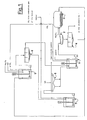
- the pastel initially fed to a reactor 1 is reacted with Na 2 CO 3 .
- This dispersion is fed to a sieve 2 where there is the separation of the large part of the pastel from the fine part of the pastel.
- the reactor 3 can also be a traditional stirred reactor fed with NaOH instead of Na 2 CO 3 where the reaction (III) takes place.
- the dispersion containing the fine part (of pastel/grids) is sent to a decanter 4 where the clarified product comprises a solution of sodium sulfate ready to be sent to the crystallization section, whereas the thickened product is fed to the reactor 5 together with the dispersion produced in the reactor 3.
- the second desulfurization step takes place in the reactor 5, according to the reactions (I) and (II) by putting the above-mentioned dispersions in contact with Na 2 CO 3 .
- the dispersion leaving the reactor 5 is sent to the decanter 6. From this, the clarified product separated is fed to the reactor 1, whereas the thickened product is fed to the sodium removal reactor 7.
- the sodium contained in the desulfurized pastel is extracted in the form of NaHCO 3 , which can be used in the reactor 1 for the desulfurization, transforming all the various basic lead carbonates into PbCO 3 .
- the dispersion leaving the reactor 7 is fed to the filter 8, for example a full flat vacuum filter producing a cake or desulfurized pastel practically sulfur-free, optionally washed, preferably in countercurrent to reduce the content of imbibed salts and consequently sodium.
- the definitively desulfurized pastel is recovered ready to be sent to the oven for the production of metallic lead.
- the filtrate which is simply a solution of sodium sulfate containing the excess bicarbonate produced in the reactor 7, can be fed to the initial step 1 of the process, recovering the carbonates contained in the desulfurization.
- this shows an embodiment of the two-step desulfurization process, which envisages a first desulfurization step in which the pastel is put in contact with Na 2 CO 3 and/or NaHCO 3 and a second desulfurization step in which the product resulting from the first step is put in contact with NaHCO 3 .
- the reagent Na 2 CO 3 is conveniently fed to the reactor 9 to be subsequently added in defect with respect to the pastel, which is also added to the same reactor where the first desulfurization phase takes place.
- the filtrate coming from the filtration of the desulfurized pastel is also conveniently fed to the reactor 9. Reaction (XI) described above takes place under these conditions.
- a defect of 5-50% by weight of a carbonate, preferably 5-15%, 10% being the optimal amount, is added to the PbSO 4 .
- the final dispersion produced in the reactor 9 is fed to a sieve 10 where the large part of the pastel is separated from the dispersion containing the fine part of the pastel.
- the large part (containing grids), collected at the top of the sieve, is fed to a specific reactor 11 where it is desulfurized alone according to reactions (I) and (II) indicated above.
- the reactor 11 can be a traditional stirred reactor fed with NaOH instead of Na 2 CO 3 where reaction (III) takes place.
- the dispersion containing the fine part (of pastel/grids) is sent to a decanter 12 where the clarified product comprises a solution of sodium sulfate ready to be sent to the crystallization section, whereas the thickened product is fed to the reactor 13 together with the dispersion produced in the reactor 11.
- the dispersion is put in contact with an excess of NaHCO 3 converting the residual PbSO 4 in the solid to PbCO 3 according to reaction (V).
- the dispersion obtained is sent to a decanter 14 where a clarified product is separated which, as already mentioned, is fed to the reactor 9, together with a thickened product which contains completely desulfurized pastel.
- the thickened product is fed to the filter 15, for example a full flat vacuum filter, producing a cake or practically sulfur-free desulfurized pastel optionally washed preferably in countercurrent to reduce the content of imbibed salts.
- the definitively desulfurized pastel is recovered ready to be sent to the oven for the production of metallic lead.
- the filtrate which is substantially simply a solution containing excess bicarbonate fed to the reactor 13, can be fed to the initial step of the process, recovering the carbonates.
- the soluble sulfur content can be reduced to practically zero, thus bringing the total sulfur (soluble and insoluble) to negligible concentrations.
- the soluble sulfur is reduced to a content of less than 0.1% by weight.
- this illustrates an embodiment of the desulfurization system of the fine part of grids, for the quantity that is found in the metallic fraction, comprising grids and poles, which can be integrated with the pastel desulfuration flow sheet providing a definitive solution to the problem of sulfur content in the treatment of the leady compounds of lead accumulators at the end of their life cycle.
- the fine part can be ground in a mill in two ways:
- the dispersion produced with approach a) is conveniently fed to the reactor of the second pastel desulfurization step and subsequently following the cycle until its completion.
- the dispersion produced with approach b) is typically fed to a solid/liquid separator 18.
- the solid, comprising metallic compounds of desulfurized lead, is fed directly to the reduction oven for producing metal, whereas the liquid is fed to the reactor of the second desulfurization step of the pastel and subsequently following the cycle until its completion.
- the embodiment of the process of the invention has considerable advantages both from a production and ecological point of view.
- the process of the invention allows the treatment costs to be minimized both by optimizing the consumption of additives in the desulfurization phase and by minimizing melting additives in the oven with the almost total recovery of the sodium as sulfate. At the end of the treatment, moreover, the water balance remains practically unaltered.
- the process of the invention can also be applied to any material containing PbSO 4 and which necessitates thermal treatment for producing metallic lead.
- the reactor is left under stirring for 1 h at 70°C after which the final dispersion is passed over a sieve with a 76 micron net, whereby a large fraction equal to about 5 kg is separated and is then fed to a ball mill with 6 kg of a solution of Na 2 CO 3 having the following composition: H 2 O 82.3% Na 2 CO 3 16.7%
- the thickened product residing in the reactor, is joined with the dispersion coming from the ball mill together with 8 kg of water and 3.2 kg of Na 2 CO 3 .
- the mixture is brought to 70°C and is left under stirring for 1 hour.
- the final dispersion is decanted, recovering 16.9 kg of clarified product having the following composition: H 2 O 77.6% NaHCO 3 1.2% Na 2 SO 4 21.2% which is recycled in the subsequent test to the first desulfurization step.
- the thickened product remaining in the reactor is reacted with 940 g of CO 2 fed by a cylinder through a gas diffuser.
- the final dispersion is filtered on a flat vacuum filter and the residue is washed with 18.6 kg of water.
- the solution is recycled to the first desulfurization phase of the next cycle.
- the desulfurized pastel has the following composition: PbCO 3 56.61% PbSO 4 0.16% PbO 2 26.84% PbO 8.60% Metallic Pb 3.22% NaHCO 3 0.09% Na 2 SO 4 0.19% Other 4.29%
- the thickened product residing in the reactor, is joined with the dispersion coming from the ball mill together with 6.3 kg of water and 1.1 kg of NaHCO 3 .
- the mixture is brought to 70°C and is left under stirring for 1 hour.
- the final dispersion is filtered on a flat vacuum filter and the residue is washed with 18.6 kg of water.
- the solution is recycled to the first desulfurization phase of the next cycle.
- the desulfurized pastel has the following composition: PbCO 3 56.56% PbSO 4 0.32% PbO 2 26.88% PbO 8.60% Metallic Pb 3.23% NaHCO 3 0.00% Na 2 SO 4 0.19% Other 4.31%
- the mixture is left to react at 70°C for 1 h and is then discharged from the mill, the dispersion obtained is filtered on a flat vacuum filter.
- a sample of fine grids ( ⁇ 1 mm) is desulfurized, having a sulfur content equal to 3.85%. 2 kg of this material are treated in a ball mill with 2 kg of a solution of Na 2 CO 3 having the following composition: H 2 O 87.5% NaOH 12.5%
- the mixture is left to react at 70°C for 1 h and is then discharged from the mill, the dispersion obtained is filtered on a flat vacuum filter.
- Example 3 The same large part as Example 3 is desulfurized, but this time with NaOH in a simple stirred reactor. 2 kg of this material are treated in a typical CX stirred reactor with 2 kg of a solution of Na 2 CO 3 having the following composition: H 2 O 87.5 % NaOH 12.5%
- the mixture is left to react at 70°C for 1 h and the dispersion obtained is filtered on a flat vacuum filter.
- a mixture of the fine part of grids ( ⁇ 1 mm) is desulfurized, which, upon wet sieving, revealed a sulfur content equal to 3.85%, in a mill into which, instead of balls, 4 kg of large grids (> 2 mm), which, when wet sieved, revealed a sulfur content equal to 0.07%.
- the mixture is left to react at 70°C for 1 h and is then discharged from the mill, the dispersion obtained is filtered on a flat vacuum filter.
Landscapes
- Chemical & Material Sciences (AREA)
- Engineering & Computer Science (AREA)
- Manufacturing & Machinery (AREA)
- Organic Chemistry (AREA)
- General Chemical & Material Sciences (AREA)
- Chemical Kinetics & Catalysis (AREA)
- Metallurgy (AREA)
- Materials Engineering (AREA)
- Mechanical Engineering (AREA)
- Life Sciences & Earth Sciences (AREA)
- General Life Sciences & Earth Sciences (AREA)
- Geology (AREA)
- Electrochemistry (AREA)
- Environmental & Geological Engineering (AREA)
- Geochemistry & Mineralogy (AREA)
- Treating Waste Gases (AREA)
- Battery Electrode And Active Subsutance (AREA)
- Solid-Sorbent Or Filter-Aiding Compositions (AREA)
- Manufacture And Refinement Of Metals (AREA)
- Secondary Cells (AREA)
- Inorganic Compounds Of Heavy Metals (AREA)
- Cell Separators (AREA)
Claims (25)
- Entschwefelungsverfahren für eine in Bleiakkumulatoren enthaltene Paste und/oder für in Bleiakkumulatoren enthaltene Gitter, welches eine Entschwefelung in zwei Schritten umfasst, wobei das Bleisulfat der Paste bei dem ersten Schritt mit Na2CO3 in Lösung in Kontakt gebracht wird, um gemäß der nachfolgenden Reaktion zu reagieren:
3 PbSO4 + 3 Na2CO3 + H2O → Pb3(CO3)2(OH)2 + 3 Na2SO4 + CO2 (I)
2 Pb3(CO3)2(OH)2 + 2 Na2CO3 → 3 NaPb2(CO3)2OH + NaOH (II)
um eine Dispersion zu liefern, welche eine auf basischen Bleicarbonaten basierende karbonisierte Paste enthält, welche in einem zweiten Schritt mit CO2 gemäß der nachfolgenden Reaktion reagiert wird:
Pb3(CO3)2(OH)2 + CO2 → 3 PbCO3 + H2O (IX)
NaPb2(CO3)2OH + CO2 → 2 PbCO3 + NaHCO3 (X),
um eine Dispersion zu ergeben, welche eine auf PbCO3 basierende entschwefelte Paste enthält, wobei die in dem ersten Schritt erhaltene Dispersion dekantiert wird, um eine auf basischen Bleicarbonaten basierende karbonisierte Paste und eine Na2CO3/NaHCO3 enthaltende basische Lösung zurück zu gewinnen, welche mit einer auf H2SO4 basierenden Lösung unter Bildung von CO2 gemäß der nachfolgenden Reaktion:
Na2CO3 + H2SO4 → Na2SO4 + CO2 + H2O (XII)
2 NaHCO3 + H2SO4 → Na2SO4 + 2 CO2 + 2 H2O (XIII)
neutralisiert wird, wobei das durch die Neutralisation der basischen Lösung hergestellte CO2 in dem zweiten Entschwefelungsschritt als Reagenz eingesetzt wird. - Verfahren nach Anspruch 1, dadurch gekennzeichnet, dass das Bleisulfat der Paste in dem ersten Entschwefelungsschritt mit einer mit Bezug zu der für ihre Entschwefelung erforderlichen theoretischen Menge überschüssigen Menge an Na2CO3 in Kontakt gebracht wird.
- Verfahren nach Anspruch 1, dadurch gekennzeichnet, dass die auf H2SO4 basierende Lösung ein Batterieelektrolyt ist.
- Verfahren nach einem der Ansprüche 1 bis 3, dadurch gekennzeichnet, dass die basische Lösung filtriert wird, um eine auf Na2SO4 basierende Lösung, welche in eine Kristallisiervorrichtung überführt wird, und eine auf Na2CO3/NaHCO3 basierende Lösung abzutrennen, welche zu dem ersten Entschwefelungsschritt zurückgeführt wird.
- Verfahren nach einem der Ansprüche 1 bis 4, dadurch gekennzeichnet, dass die die in dem zweiten Entschwefelungsschritt erhaltene, auf PbCO3 basierende entschwefelte Paste enthaltende Dispersion filtriert und/oder gewaschen wird, um den Gehalt an eingebetteten Salzen zu verringern und eine auf PbCO3 basierende entschwefelte Paste und eine basische Lösung abzutrennen.
- Verfahren nach Anspruch 5, dadurch gekennzeichnet, dass die basische Lösung Na2CO3 und NaHCO3 enthält und zu einem neuen Entschwefelungszyklus zurückgeführt wird.
- Verfahren nach einem der Ansprüche 1 bis 6, dadurch gekennzeichnet, dass es zwischen den beiden Entschwefelungsschritten der Paste einen Zwischenentschwefelungsschritt für den feinen Teil der Akkumulatorengitter umfasst.
- Verfahren nach Anspruch 7, wobei der Zwischenentschwefelungsschritt das Mahlen des feinen Teils der Gitter in einer eine Lösung von Na2CO3 enthaltenden Mühle umfasst.
- Verfahren nach Anspruch 7 oder 8, dadurch gekennzeichnet, dass der Zwischenentschwefelungsschritt des feinen Teils der Akkumulatorengitter umfasst:(i) ein Sieben der aus dem ersten Entschwefelungsschritt kommenden Dispersion, um den feinen Teil der Gitter abzutrennen,(ii) das Zuführen des feinen Teils der Gitter zu einer Mühle mit einer Lösung von Na2CO3 und(iii) das Mahlen des feinen Teils, um eine Dispersion zu ergeben, welche dem zweiten Entschwefelungsschritt zugeführt wird.
- Verfahren nach Anspruch 9, wobei das Mahlen (iii) in einer Mühle stattfindet, welcher Teile von Akkumulatorenpolen und von -gittern zugeführt werden, wobei die gebildete Dispersion zu einer Feststoff/Flüssigkeit-Trennvorrichtung geführt wird, in welcher die nachfolgenden Bestandteile voneinander getrennt werden:a) eine Feststoffkomponente, welche Metallkomponenten von entschwefeltem Blei enthalten, welche in einen Reduktionsofen überführt wird,b) eine flüssige Komponente, welche zu dem zweiten Entschwefelungsschritt des Verfahrens geführt wird.
- Entschwefelungsverfahren für eine in Bleiakkumulatoren enthaltene Paste und/oder ein in Bleiakkumulatoren enthaltenes Gitter umfassend eine Entschwefelung in zwei Schritten, wobei das Bleisulfat der Paste bei dem ersten Schritt in Kontakt mit Na2CO3 in Lösung gebracht wird, um gemäß der nachfolgenden Reaktion zu reagieren:
3 PbSO4 + 3 Na2CO3 + H2O → Pb3(CO3)2(OH)2 + 3 Na2SO4 + CO2 (I)
2 Pb3(CO3)2(OH)2 + 2 Na2CO3→ 3 NaPb2(CO3)2OH + NaOH (II)
um eine Dispersion zu liefern, welche eine basische Bleicarbonate und Bleisulfat enthaltende, teilweise karbonisierte Paste enthält, welche in einem zweiten Schritt mit NaHCO3 gemäß der nachfolgenden Reaktion reagiert wird:
PbSO4 + 2 NaHCO3 → PbCO3 + Na2SO4 + CO2 + H2O (V)
Pb3(CO3)2(OH)2 + 2 NaHCO3 → 3 PbCO3 + Na2CO3 + 2 H2O (VI)
NaPb2(CO3)2OH + NaHCO3 → 2 PbCO3 + Na2CO3 + H2O (VII)
Na2CO3 + CO2 + H2O → 2 NaHCO3 (VIII),
um eine eine auf PbCO3 basierende entschwefelte Paste enthaltende Dispersion zu ergeben. - Verfahren nach Anspruch 14, dadurch gekennzeichnet, dass das Bleisulfat der Paste in dem ersten Entschwefelungsschritt mit einer Menge an Na2CO3 in Kontakt gebracht wird, welche bezogen auf die für ihre Entschwefelung erforderliche theoretische Menge zu gering ist.
- Verfahren nach Anspruch 11 oder 12, dadurch gekennzeichnet, dass die in dem ersten Schritt erhaltene Dispersion dekantiert wird, um eine auf basischen Bleicarbonaten basierende karbonisierte Paste und eine basische Lösung zurück zu gewinnen.
- Verfahren nach einem der Ansprüche 11 bis 12, dadurch gekennzeichnet, dass die zurück gewonnene basische Lösung filtriert wird, um eine auf Na2SO4 basierende Lösung, welche in eine Kristallisiervorrichtung transferiert wird, und um eine auf Na2CO3/NaHCO3 basierende Lösung abzutrennen, welche zu dem ersten Entschwefelungsschritt zurück geführt wird.
- Verfahren nach einem der Ansprüche 1 bis 14, dadurch gekennzeichnet, dass die in dem zweiten Entschwefelungsschritt erhaltene, eine auf PbCO3 basierende entschwefelte Paste enthaltende Dispersion filtriert und/oder gewaschen wird, um den Gehalt an eingebetteten Salzen zu verringern und eine auf PbCO3 basierende entschwefelte Paste und eine basische Lösung abzutrennen.
- Verfahren nach Anspruch 15, dadurch gekennzeichnet, dass die basische Lösung NaHCO3 enthält, welche zu einem neuen Entschwefelungszyklus zurückgeführt wird.
- Verfahren nach einem der Ansprüche 11 bis 16, dadurch gekennzeichnet, dass es zwischen den beiden Entschwefelungsschritten einen Zwischenentschwefelungsschritt für den feinen Teil der Akkumulatorengitter umfasst.
- Verfahren nach Anspruch 17, wobei der Zwischenentschwefelungsschritt das Mahlen des feinen Teils der Gitter in einer eine Lösung von Na2CO3 enthaltenden Mühle umfasst.
- Verfahren nach Anspruch 17 oder 18, dadurch gekennzeichnet, dass der Zwischenentschwefelungsschritt des feinen Teils der Akkumulatorengitter umfasst:(i) ein Sieben der aus dem ersten Entschwefelungsschritt kommenden Dispersion, um den feinen Teil der Gitter abzutrennen,(ii) das Zuführen des feinen Teils der Gitter zu einer Mühle mit einer Lösung von Na2CO3 und(iii) das Mahlen des feinen Teils, um eine Dispersion zu ergeben, welche dem zweiten Entschwefelungsschritt zugeführt wird.
- Verfahren nach Anspruch 19, wobei das Mahlen (iii) in einer Mühle stattfindet, der Stücke von Akkumulatorenpolen und -gittern zugeführt werden, wobei die gebildete Dispersion in eine Feststoff/Flüssigkeit-Trennvorrichtung geführt wird, in welcher die nachfolgenden Bestandteile voneinander getrennt werden:a) eine Metallkomponenten von entschwefeltem Blei enthaltende Feststoffkomponente, welche in einen Reduktionsofen transferiert wird,b) eine flüssige Komponente, welche zu dem zweiten Entschwefelungsschritt des Verfahrens geführt wird.
- Verfahren nach einem der Ansprüche 11 bis 20, dadurch gekennzeichnet, dass bei dem zweiten Entschwefelungsschritt NaHCO3 in Überschuss zugegeben wird.
- Verfahren nach einem der Ansprüche 1 bis 21, dadurch gekennzeichnet, dass der erste und/oder zweite Entschwefelungsschritt für eine Zeit in einem Bereich zwischen 30 und 180 Minuten durchgeführt werden.
- Verfahren nach Anspruch 22, dadurch gekennzeichnet, dass der erste und/oder der zweite Entschwefelungsschritt für eine Zeit in einem Bereich zwischen 60 und 120 Minuten durchgeführt werden.
- Verfahren nach einem der Ansprüche 1 bis 23, dadurch gekennzeichnet, dass der erste und/oder der zweite Entschwefelungsschritt bei einer Temperatur in einem Bereich zwischen 30 und 90 °C durchgeführt werden.
- Verfahren nach Anspruch 24, dadurch gekennzeichnet, dass der erste und/oder der zweite Entschwefelungsschritt bei einer Temperatur in einem Bereich zwischen 60 und 80 °C durchgeführt werden.
Priority Applications (1)
| Application Number | Priority Date | Filing Date | Title |
|---|---|---|---|
| PL05106436T PL1619261T3 (pl) | 2004-07-20 | 2005-07-14 | Sposób odsiarczania pastelu i siatek akumulatorów ołowiowych |
Applications Claiming Priority (1)
| Application Number | Priority Date | Filing Date | Title |
|---|---|---|---|
| ITMI20041456 ITMI20041456A1 (it) | 2004-07-20 | 2004-07-20 | Processo di desolforazione di pastello e griglie degli accumulatori al piombo+ |
Publications (2)
| Publication Number | Publication Date |
|---|---|
| EP1619261A1 EP1619261A1 (de) | 2006-01-25 |
| EP1619261B1 true EP1619261B1 (de) | 2008-03-05 |
Family
ID=34981527
Family Applications (1)
| Application Number | Title | Priority Date | Filing Date |
|---|---|---|---|
| EP20050106436 Expired - Lifetime EP1619261B1 (de) | 2004-07-20 | 2005-07-14 | Entschwefelungsverfahren von Paste und Gitter von Bleiakkumulatoren |
Country Status (9)
| Country | Link |
|---|---|
| US (1) | US7498012B2 (de) |
| EP (1) | EP1619261B1 (de) |
| CN (1) | CN100590930C (de) |
| AT (1) | ATE388248T1 (de) |
| DE (1) | DE602005005112T2 (de) |
| ES (1) | ES2303189T3 (de) |
| IT (1) | ITMI20041456A1 (de) |
| PL (1) | PL1619261T3 (de) |
| RU (1) | RU2379364C2 (de) |
Families Citing this family (22)
| Publication number | Priority date | Publication date | Assignee | Title |
|---|---|---|---|---|
| CN1846005A (zh) * | 2003-07-18 | 2006-10-11 | 康迪股份有限公司 | 从废铅-酸电池中高产率地回收铅并降低相关的矿渣与气态释放物产生的方法 |
| CN100400424C (zh) * | 2006-03-22 | 2008-07-09 | 湖南大学 | 利用废铅蓄电池中铅泥制备三盐基硫酸铅的方法 |
| MY143055A (en) * | 2007-01-05 | 2011-02-28 | Tai Kwong Yokohama Battery Ind Sdn Bhd | Process for the production of nano lead oxides |
| ITVA20070007A1 (it) | 2007-01-17 | 2008-07-18 | Millbrook Lead Recycling Techn | Recupero del piombo sottoforma di carbonato ad altissima purezza da pastello di recupero dalla frantumazione di accumulatori al piombo esausti |
| ITMI20072257A1 (it) * | 2007-11-30 | 2009-06-01 | Engitec Technologies S P A | Processo per produrre piombo metallico a partire da pastello desolforato |
| CN102351217B (zh) * | 2011-06-21 | 2013-07-31 | 南京大学 | 一种废旧铅蓄电池回收加工副产硫酸钠的脱铅方法 |
| CN102677095B (zh) * | 2012-01-15 | 2014-08-06 | 河南科技大学 | 一种废铅酸蓄电池铅膏中铅的回收方法 |
| CN103374657A (zh) * | 2012-04-24 | 2013-10-30 | 湖北金洋冶金股份有限公司 | 利用废铅膏制备的超细氧化铅及其制备方法 |
| CN103060569A (zh) * | 2013-01-15 | 2013-04-24 | 浙江汇同电源有限公司 | 从废旧铅酸蓄电池膏体中回收铅的工艺 |
| CN103014354B (zh) * | 2013-01-15 | 2014-07-30 | 浙江汇同电源有限公司 | 从铅酸蓄电池膏体中回收铅的工艺 |
| CN103074642B (zh) * | 2013-01-15 | 2015-07-01 | 浙江汇同电源有限公司 | 废旧铅酸蓄电池膏体中回收铅的工艺 |
| US20160308261A1 (en) * | 2013-12-03 | 2016-10-20 | Verdeen Chemicals, Inc. | Zero lead pollution process for recycling used lead acid batteries |
| CN104868187B (zh) * | 2014-02-21 | 2017-06-06 | 北京化工大学 | 一种从废铅膏中直接回收铅酸电池负极用氧化铅的方法 |
| CN104862481A (zh) | 2014-02-21 | 2015-08-26 | 超威电源有限公司 | 一种含氧化铅废料的回收利用方法 |
| US9555386B2 (en) | 2014-06-20 | 2017-01-31 | Johnson Controls Technology Company | Systems and methods for closed-loop recycling of a liquid component of a leaching mixture when recycling lead from spent lead-acid batteries |
| US9670565B2 (en) | 2014-06-20 | 2017-06-06 | Johnson Controls Technology Company | Systems and methods for the hydrometallurgical recovery of lead from spent lead-acid batteries and the preparation of lead oxide for use in new lead-acid batteries |
| CN105226342B (zh) * | 2015-10-28 | 2017-07-18 | 东南大学 | 一种利用废旧铅酸电池的活性物质制备新铅酸电池的方法 |
| US10062933B2 (en) | 2015-12-14 | 2018-08-28 | Johnson Controls Technology Company | Hydrometallurgical electrowinning of lead from spent lead-acid batteries |
| CN105655661B (zh) * | 2016-01-06 | 2017-12-26 | 湘潭大学 | 一种基于石灰石的铅膏预脱硫方法 |
| CN106367594A (zh) * | 2016-08-25 | 2017-02-01 | 安徽华铂再生资源科技有限公司 | 一种低能耗、快速、可循环铅膏脱硫母液脱盐工艺 |
| CN110042247B (zh) * | 2019-04-26 | 2020-08-04 | 南京工程学院 | 一种废铅酸蓄电池中废铅膏的回收利用装置及方法 |
| CN112442603A (zh) * | 2020-10-09 | 2021-03-05 | 超威电源集团有限公司 | 一种铅废料脱硫的方法 |
Family Cites Families (12)
| Publication number | Priority date | Publication date | Assignee | Title |
|---|---|---|---|---|
| US2152242A (en) * | 1935-08-10 | 1939-03-28 | Leo P Curtin | Recovery of lead values |
| GB1368423A (en) * | 1971-12-02 | 1974-09-25 | Electric Power Storage Ltd | Recovery of metals from lead-containing scrap materials |
| US3892563A (en) * | 1973-05-14 | 1975-07-01 | Point Albert E | Method and apparatus for separating the constituents of lead-acid storage batteries |
| GB1486738A (en) * | 1974-07-25 | 1977-09-21 | Ginatta M | Process for the electrochemical extraction of the metals contained in spent electric storage batteries |
| US4269810A (en) * | 1978-10-10 | 1981-05-26 | Nl Industries, Inc. | Method for desulfation of battery mud |
| GB2073725A (en) | 1980-04-11 | 1981-10-21 | Ass Lead Mfg Ltd | A Method of Recovering Lead Values from Scrap Batteries |
| IT1191650B (it) * | 1986-01-09 | 1988-03-23 | Tecneco Spa | Processo idrometallurgico per un recupero complessivo dei componenti delle batterie acide al piombo esauste |
| DE3612491A1 (de) | 1986-04-14 | 1987-10-15 | Preussag Ag Metall | Verfahren zur gewinnung von blei aus oxidischen bzw. oxidisch-sulfatischen sekundaervorstoffen |
| CA2141099A1 (en) * | 1995-01-25 | 1996-07-26 | Adilson C. Manequini | Process for the hydrometallurgical and electrochemical treatment of the active mass of exhausted lead batteries, to obtain electrolytic lead and elemental sulphur |
| FR2764531B1 (fr) * | 1997-06-11 | 1999-09-03 | B & C Services Sarl | Procede pour traiter les residus d'epuration des fumees d'incineration d'ordures menageres et/ou de dechets industriels |
| CN1248801A (zh) * | 1999-08-31 | 2000-03-29 | 沈阳环境科学研究所 | 废旧蓄电池铅清洁回收技术 |
| RU2164537C1 (ru) * | 2000-07-24 | 2001-03-27 | Вичев Виктор Вичевич | Способ переработки свинцового аккумуляторного лома |
-
2004
- 2004-07-20 IT ITMI20041456 patent/ITMI20041456A1/it unknown
-
2005
- 2005-01-12 US US11/035,001 patent/US7498012B2/en active Active
- 2005-07-14 AT AT05106436T patent/ATE388248T1/de active
- 2005-07-14 DE DE200560005112 patent/DE602005005112T2/de not_active Expired - Lifetime
- 2005-07-14 ES ES05106436T patent/ES2303189T3/es not_active Expired - Lifetime
- 2005-07-14 PL PL05106436T patent/PL1619261T3/pl unknown
- 2005-07-14 EP EP20050106436 patent/EP1619261B1/de not_active Expired - Lifetime
- 2005-07-19 RU RU2005123404A patent/RU2379364C2/ru active
- 2005-07-20 CN CN200510092400A patent/CN100590930C/zh not_active Expired - Lifetime
Also Published As
| Publication number | Publication date |
|---|---|
| ES2303189T3 (es) | 2008-08-01 |
| ATE388248T1 (de) | 2008-03-15 |
| US7498012B2 (en) | 2009-03-03 |
| RU2005123404A (ru) | 2007-02-20 |
| US20060018819A1 (en) | 2006-01-26 |
| DE602005005112T2 (de) | 2009-03-26 |
| EP1619261A1 (de) | 2006-01-25 |
| CN100590930C (zh) | 2010-02-17 |
| ITMI20041456A1 (it) | 2004-10-20 |
| CN1728445A (zh) | 2006-02-01 |
| DE602005005112D1 (de) | 2008-04-17 |
| RU2379364C2 (ru) | 2010-01-20 |
| PL1619261T3 (pl) | 2008-08-29 |
Similar Documents
| Publication | Publication Date | Title |
|---|---|---|
| EP1619261B1 (de) | Entschwefelungsverfahren von Paste und Gitter von Bleiakkumulatoren | |
| US11695169B2 (en) | Process for the preparation of precursor compounds for lithium battery cathodes | |
| US11508999B2 (en) | Lithium-ion batteries recycling process | |
| US4118219A (en) | Process for recycling junk lead-acid batteries | |
| EP2215277B1 (de) | Verfahren zur herstellung von metallischem blei aus entschwefelter paste | |
| CN112271350A (zh) | 一种废旧电池回收制取再生铅的方法 | |
| CN112359213A (zh) | 一种铜冶炼危险废物协同处置及有价金属综合回收的方法 | |
| EP2460220A1 (de) | Rückgewinnung von blei in form von hochreinen bleiverbindungen aus rückgewonnener elektrodenpaste/-schlamm von altbleibatterien und/oder bleimineralien | |
| EP0724306B1 (de) | Verfahren zur hydrometallurgischen und elektrochemischen Behandlung der aktiven Masse verbrauchter Bleibatterien zwecks Herstellung von Elektrolyt-Blei und Elementar-Schwefel | |
| CN117089705B (zh) | 一种废旧锂电池材料的回收方法 | |
| CN101994007A (zh) | 用氯化镁从废铅酸蓄电池膏泥中脱硫的方法 | |
| JP2000109939A (ja) | 鉛滓からの鉛、錫、ビスマスの分離方法 | |
| KR20240143909A (ko) | 슬래그로부터의 리튬 회수 | |
| CN106929685B (zh) | 废铅膏湿法制备高质量柠檬酸铅的方法 | |
| US4909839A (en) | Secondary lead production | |
| RU2274669C1 (ru) | Способ комплексной переработки свинцового аккумуляторного лома | |
| WO1988001654A1 (en) | Process for the treatment of lead-zinc ores, concentrates or residues | |
| KR100199665B1 (ko) | 주성분이 황화납인 납 분진의 화학적 처리 방법 | |
| US20240092654A1 (en) | Process for the purification of manganese sulfate solutions and subsequent crystallization of high purity manganese sulfate monohydrate | |
| Olper et al. | Pb battery recycling new frontiers in paste desulphurization and lead production | |
| CN120041671A (zh) | 烟化炉产低品位锡铅锌烟尘中分离锡铅的新工艺 | |
| US20250154627A1 (en) | Process for the recovery of li, ni and co | |
| JP2026508966A (ja) | 亜鉛回収方法 | |
| CN120555752A (zh) | 一种从湿法炼锌的锌镉渣中联合回收锌镉的方法 | |
| EA043878B1 (ru) | Способ восстановления металлов из li-содержащего исходного материала |
Legal Events
| Date | Code | Title | Description |
|---|---|---|---|
| PUAI | Public reference made under article 153(3) epc to a published international application that has entered the european phase |
Free format text: ORIGINAL CODE: 0009012 |
|
| AK | Designated contracting states |
Kind code of ref document: A1 Designated state(s): AT BE BG CH CY CZ DE DK EE ES FI FR GB GR HU IE IS IT LI LT LU LV MC NL PL PT RO SE SI SK TR |
|
| AX | Request for extension of the european patent |
Extension state: AL BA HR MK YU |
|
| 17P | Request for examination filed |
Effective date: 20060714 |
|
| 17Q | First examination report despatched |
Effective date: 20060805 |
|
| AKX | Designation fees paid |
Designated state(s): AT BE BG CH CY CZ DE DK EE ES FI FR GB GR HU IE IS IT LI LT LU LV MC NL PL PT RO SE SI SK TR |
|
| GRAP | Despatch of communication of intention to grant a patent |
Free format text: ORIGINAL CODE: EPIDOSNIGR1 |
|
| RAP1 | Party data changed (applicant data changed or rights of an application transferred) |
Owner name: ENGITEC TECHNOLOGIES, S.P.A. |
|
| GRAS | Grant fee paid |
Free format text: ORIGINAL CODE: EPIDOSNIGR3 |
|
| GRAA | (expected) grant |
Free format text: ORIGINAL CODE: 0009210 |
|
| AK | Designated contracting states |
Kind code of ref document: B1 Designated state(s): AT BE BG CH CY CZ DE DK EE ES FI FR GB GR HU IE IS IT LI LT LU LV MC NL PL PT RO SE SI SK TR |
|
| REG | Reference to a national code |
Ref country code: GB Ref legal event code: FG4D |
|
| REG | Reference to a national code |
Ref country code: CH Ref legal event code: EP |
|
| REG | Reference to a national code |
Ref country code: IE Ref legal event code: FG4D |
|
| REF | Corresponds to: |
Ref document number: 602005005112 Country of ref document: DE Date of ref document: 20080417 Kind code of ref document: P |
|
| REG | Reference to a national code |
Ref country code: RO Ref legal event code: EPE |
|
| REG | Reference to a national code |
Ref country code: GR Ref legal event code: EP Ref document number: 20080401455 Country of ref document: GR |
|
| PG25 | Lapsed in a contracting state [announced via postgrant information from national office to epo] |
Ref country code: FI Free format text: LAPSE BECAUSE OF FAILURE TO SUBMIT A TRANSLATION OF THE DESCRIPTION OR TO PAY THE FEE WITHIN THE PRESCRIBED TIME-LIMIT Effective date: 20080305 |
|
| REG | Reference to a national code |
Ref country code: ES Ref legal event code: FG2A Ref document number: 2303189 Country of ref document: ES Kind code of ref document: T3 |
|
| REG | Reference to a national code |
Ref country code: PL Ref legal event code: T3 |
|
| NLV1 | Nl: lapsed or annulled due to failure to fulfill the requirements of art. 29p and 29m of the patents act | ||
| PG25 | Lapsed in a contracting state [announced via postgrant information from national office to epo] |
Ref country code: SI Free format text: LAPSE BECAUSE OF FAILURE TO SUBMIT A TRANSLATION OF THE DESCRIPTION OR TO PAY THE FEE WITHIN THE PRESCRIBED TIME-LIMIT Effective date: 20080305 Ref country code: LV Free format text: LAPSE BECAUSE OF FAILURE TO SUBMIT A TRANSLATION OF THE DESCRIPTION OR TO PAY THE FEE WITHIN THE PRESCRIBED TIME-LIMIT Effective date: 20080305 Ref country code: BE Free format text: LAPSE BECAUSE OF FAILURE TO SUBMIT A TRANSLATION OF THE DESCRIPTION OR TO PAY THE FEE WITHIN THE PRESCRIBED TIME-LIMIT Effective date: 20080305 |
|
| REG | Reference to a national code |
Ref country code: HU Ref legal event code: AG4A Ref document number: E003589 Country of ref document: HU |
|
| PG25 | Lapsed in a contracting state [announced via postgrant information from national office to epo] |
Ref country code: SK Free format text: LAPSE BECAUSE OF FAILURE TO SUBMIT A TRANSLATION OF THE DESCRIPTION OR TO PAY THE FEE WITHIN THE PRESCRIBED TIME-LIMIT Effective date: 20080305 Ref country code: PT Free format text: LAPSE BECAUSE OF FAILURE TO SUBMIT A TRANSLATION OF THE DESCRIPTION OR TO PAY THE FEE WITHIN THE PRESCRIBED TIME-LIMIT Effective date: 20080805 Ref country code: NL Free format text: LAPSE BECAUSE OF FAILURE TO SUBMIT A TRANSLATION OF THE DESCRIPTION OR TO PAY THE FEE WITHIN THE PRESCRIBED TIME-LIMIT Effective date: 20080305 Ref country code: SE Free format text: LAPSE BECAUSE OF FAILURE TO SUBMIT A TRANSLATION OF THE DESCRIPTION OR TO PAY THE FEE WITHIN THE PRESCRIBED TIME-LIMIT Effective date: 20080605 |
|
| ET | Fr: translation filed | ||
| PG25 | Lapsed in a contracting state [announced via postgrant information from national office to epo] |
Ref country code: IS Free format text: LAPSE BECAUSE OF FAILURE TO SUBMIT A TRANSLATION OF THE DESCRIPTION OR TO PAY THE FEE WITHIN THE PRESCRIBED TIME-LIMIT Effective date: 20080705 |
|
| PLBE | No opposition filed within time limit |
Free format text: ORIGINAL CODE: 0009261 |
|
| STAA | Information on the status of an ep patent application or granted ep patent |
Free format text: STATUS: NO OPPOSITION FILED WITHIN TIME LIMIT |
|
| PG25 | Lapsed in a contracting state [announced via postgrant information from national office to epo] |
Ref country code: DK Free format text: LAPSE BECAUSE OF FAILURE TO SUBMIT A TRANSLATION OF THE DESCRIPTION OR TO PAY THE FEE WITHIN THE PRESCRIBED TIME-LIMIT Effective date: 20080305 Ref country code: LT Free format text: LAPSE BECAUSE OF FAILURE TO SUBMIT A TRANSLATION OF THE DESCRIPTION OR TO PAY THE FEE WITHIN THE PRESCRIBED TIME-LIMIT Effective date: 20080305 |
|
| 26N | No opposition filed |
Effective date: 20081208 |
|
| PG25 | Lapsed in a contracting state [announced via postgrant information from national office to epo] |
Ref country code: MC Free format text: LAPSE BECAUSE OF NON-PAYMENT OF DUE FEES Effective date: 20080731 |
|
| PG25 | Lapsed in a contracting state [announced via postgrant information from national office to epo] |
Ref country code: EE Free format text: LAPSE BECAUSE OF FAILURE TO SUBMIT A TRANSLATION OF THE DESCRIPTION OR TO PAY THE FEE WITHIN THE PRESCRIBED TIME-LIMIT Effective date: 20080305 Ref country code: BG Free format text: LAPSE BECAUSE OF FAILURE TO SUBMIT A TRANSLATION OF THE DESCRIPTION OR TO PAY THE FEE WITHIN THE PRESCRIBED TIME-LIMIT Effective date: 20080605 |
|
| PG25 | Lapsed in a contracting state [announced via postgrant information from national office to epo] |
Ref country code: CY Free format text: LAPSE BECAUSE OF FAILURE TO SUBMIT A TRANSLATION OF THE DESCRIPTION OR TO PAY THE FEE WITHIN THE PRESCRIBED TIME-LIMIT Effective date: 20080305 |
|
| REG | Reference to a national code |
Ref country code: CH Ref legal event code: PL |
|
| PG25 | Lapsed in a contracting state [announced via postgrant information from national office to epo] |
Ref country code: CH Free format text: LAPSE BECAUSE OF NON-PAYMENT OF DUE FEES Effective date: 20090731 Ref country code: LI Free format text: LAPSE BECAUSE OF NON-PAYMENT OF DUE FEES Effective date: 20090731 |
|
| PG25 | Lapsed in a contracting state [announced via postgrant information from national office to epo] |
Ref country code: LU Free format text: LAPSE BECAUSE OF NON-PAYMENT OF DUE FEES Effective date: 20080714 |
|
| PG25 | Lapsed in a contracting state [announced via postgrant information from national office to epo] |
Ref country code: IT Free format text: LAPSE BECAUSE OF NON-PAYMENT OF DUE FEES Effective date: 20100714 |
|
| PGRI | Patent reinstated in contracting state [announced from national office to epo] |
Ref country code: IT Effective date: 20110616 |
|
| REG | Reference to a national code |
Ref country code: FR Ref legal event code: PLFP Year of fee payment: 12 |
|
| REG | Reference to a national code |
Ref country code: FR Ref legal event code: PLFP Year of fee payment: 13 |
|
| REG | Reference to a national code |
Ref country code: FR Ref legal event code: PLFP Year of fee payment: 14 |
|
| PGFP | Annual fee paid to national office [announced via postgrant information from national office to epo] |
Ref country code: IE Payment date: 20200709 Year of fee payment: 16 |
|
| PG25 | Lapsed in a contracting state [announced via postgrant information from national office to epo] |
Ref country code: IE Free format text: LAPSE BECAUSE OF NON-PAYMENT OF DUE FEES Effective date: 20210714 |
|
| P01 | Opt-out of the competence of the unified patent court (upc) registered |
Effective date: 20230505 |
|
| PGFP | Annual fee paid to national office [announced via postgrant information from national office to epo] |
Ref country code: GB Payment date: 20240530 Year of fee payment: 20 |
|
| PGFP | Annual fee paid to national office [announced via postgrant information from national office to epo] |
Ref country code: GR Payment date: 20240617 Year of fee payment: 20 |
|
| PGFP | Annual fee paid to national office [announced via postgrant information from national office to epo] |
Ref country code: CZ Payment date: 20240621 Year of fee payment: 20 |
|
| PGFP | Annual fee paid to national office [announced via postgrant information from national office to epo] |
Ref country code: RO Payment date: 20240625 Year of fee payment: 20 Ref country code: FR Payment date: 20240611 Year of fee payment: 20 |
|
| PGFP | Annual fee paid to national office [announced via postgrant information from national office to epo] |
Ref country code: PL Payment date: 20240528 Year of fee payment: 20 |
|
| PGFP | Annual fee paid to national office [announced via postgrant information from national office to epo] |
Ref country code: DE Payment date: 20240529 Year of fee payment: 20 |
|
| PGFP | Annual fee paid to national office [announced via postgrant information from national office to epo] |
Ref country code: ES Payment date: 20240807 Year of fee payment: 20 |
|
| PGFP | Annual fee paid to national office [announced via postgrant information from national office to epo] |
Ref country code: AT Payment date: 20240625 Year of fee payment: 20 |
|
| PGFP | Annual fee paid to national office [announced via postgrant information from national office to epo] |
Ref country code: HU Payment date: 20240626 Year of fee payment: 20 |
|
| PGFP | Annual fee paid to national office [announced via postgrant information from national office to epo] |
Ref country code: IT Payment date: 20240703 Year of fee payment: 20 |
|
| PGFP | Annual fee paid to national office [announced via postgrant information from national office to epo] |
Ref country code: TR Payment date: 20240704 Year of fee payment: 20 |
|
| REG | Reference to a national code |
Ref country code: DE Ref legal event code: R071 Ref document number: 602005005112 Country of ref document: DE |
|
| PG25 | Lapsed in a contracting state [announced via postgrant information from national office to epo] |
Ref country code: CZ Free format text: LAPSE BECAUSE OF EXPIRATION OF PROTECTION Effective date: 20250714 |
|
| REG | Reference to a national code |
Ref country code: ES Ref legal event code: FD2A Effective date: 20250728 |
|
| REG | Reference to a national code |
Ref country code: GB Ref legal event code: PE20 Expiry date: 20250713 |
|
| REG | Reference to a national code |
Ref country code: AT Ref legal event code: MK07 Ref document number: 388248 Country of ref document: AT Kind code of ref document: T Effective date: 20250714 |
|
| PG25 | Lapsed in a contracting state [announced via postgrant information from national office to epo] |
Ref country code: ES Free format text: LAPSE BECAUSE OF EXPIRATION OF PROTECTION Effective date: 20250715 |