EP1618155B1 - Farbe auf basis mindestens einer polymerdispersion - Google Patents
Farbe auf basis mindestens einer polymerdispersion Download PDFInfo
- Publication number
- EP1618155B1 EP1618155B1 EP04725371A EP04725371A EP1618155B1 EP 1618155 B1 EP1618155 B1 EP 1618155B1 EP 04725371 A EP04725371 A EP 04725371A EP 04725371 A EP04725371 A EP 04725371A EP 1618155 B1 EP1618155 B1 EP 1618155B1
- Authority
- EP
- European Patent Office
- Prior art keywords
- pigments
- paint according
- fillers
- paint
- dispersion
- Prior art date
- Legal status (The legal status is an assumption and is not a legal conclusion. Google has not performed a legal analysis and makes no representation as to the accuracy of the status listed.)
- Expired - Lifetime
Links
- 239000004815 dispersion polymer Substances 0.000 title claims abstract description 13
- 239000003973 paint Substances 0.000 claims abstract description 41
- 239000000049 pigment Substances 0.000 claims abstract description 23
- 239000000945 filler Substances 0.000 claims abstract description 17
- 239000006185 dispersion Substances 0.000 claims abstract description 13
- 239000002562 thickening agent Substances 0.000 claims abstract description 13
- 239000000654 additive Substances 0.000 claims abstract description 10
- 239000002245 particle Substances 0.000 claims abstract description 9
- 239000002270 dispersing agent Substances 0.000 claims abstract description 8
- XLYOFNOQVPJJNP-UHFFFAOYSA-N water Substances O XLYOFNOQVPJJNP-UHFFFAOYSA-N 0.000 claims abstract description 4
- 239000007787 solid Substances 0.000 claims abstract description 3
- GWEVSGVZZGPLCZ-UHFFFAOYSA-N Titan oxide Chemical compound O=[Ti]=O GWEVSGVZZGPLCZ-UHFFFAOYSA-N 0.000 claims description 10
- 239000004408 titanium dioxide Substances 0.000 claims description 5
- UQSXHKLRYXJYBZ-UHFFFAOYSA-N Iron oxide Chemical compound [Fe]=O UQSXHKLRYXJYBZ-UHFFFAOYSA-N 0.000 claims description 4
- PXHVJJICTQNCMI-UHFFFAOYSA-N Nickel Chemical compound [Ni] PXHVJJICTQNCMI-UHFFFAOYSA-N 0.000 claims description 4
- PPBRXRYQALVLMV-UHFFFAOYSA-N Styrene Chemical compound C=CC1=CC=CC=C1 PPBRXRYQALVLMV-UHFFFAOYSA-N 0.000 claims description 4
- 125000004432 carbon atom Chemical group C* 0.000 claims description 4
- 229920005646 polycarboxylate Polymers 0.000 claims description 4
- 150000001735 carboxylic acids Chemical class 0.000 claims description 3
- 150000002148 esters Chemical class 0.000 claims description 3
- 239000000178 monomer Substances 0.000 claims description 3
- 229920000642 polymer Polymers 0.000 claims description 3
- 239000003755 preservative agent Substances 0.000 claims description 3
- 239000004925 Acrylic resin Substances 0.000 claims description 2
- 229920000178 Acrylic resin Polymers 0.000 claims description 2
- VYZAMTAEIAYCRO-UHFFFAOYSA-N Chromium Chemical compound [Cr] VYZAMTAEIAYCRO-UHFFFAOYSA-N 0.000 claims description 2
- JOYRKODLDBILNP-UHFFFAOYSA-N Ethyl urethane Chemical compound CCOC(N)=O JOYRKODLDBILNP-UHFFFAOYSA-N 0.000 claims description 2
- WHNWPMSKXPGLAX-UHFFFAOYSA-N N-Vinyl-2-pyrrolidone Chemical compound C=CN1CCCC1=O WHNWPMSKXPGLAX-UHFFFAOYSA-N 0.000 claims description 2
- NRCMAYZCPIVABH-UHFFFAOYSA-N Quinacridone Chemical compound N1C2=CC=CC=C2C(=O)C2=C1C=C1C(=O)C3=CC=CC=C3NC1=C2 NRCMAYZCPIVABH-UHFFFAOYSA-N 0.000 claims description 2
- WGLPBDUCMAPZCE-UHFFFAOYSA-N Trioxochromium Chemical compound O=[Cr](=O)=O WGLPBDUCMAPZCE-UHFFFAOYSA-N 0.000 claims description 2
- 150000001408 amides Chemical class 0.000 claims description 2
- 150000008064 anhydrides Chemical class 0.000 claims description 2
- 150000004649 carbonic acid derivatives Chemical class 0.000 claims description 2
- 229920003086 cellulose ether Polymers 0.000 claims description 2
- 239000011651 chromium Substances 0.000 claims description 2
- 229910052804 chromium Inorganic materials 0.000 claims description 2
- 229910000423 chromium oxide Inorganic materials 0.000 claims description 2
- 239000010941 cobalt Substances 0.000 claims description 2
- 229910017052 cobalt Inorganic materials 0.000 claims description 2
- GUTLYIVDDKVIGB-UHFFFAOYSA-N cobalt atom Chemical compound [Co] GUTLYIVDDKVIGB-UHFFFAOYSA-N 0.000 claims description 2
- PPSZHCXTGRHULJ-UHFFFAOYSA-N dioxazine Chemical compound O1ON=CC=C1 PPSZHCXTGRHULJ-UHFFFAOYSA-N 0.000 claims description 2
- 239000010436 fluorite Substances 0.000 claims description 2
- 150000004676 glycans Chemical class 0.000 claims description 2
- 229910052759 nickel Inorganic materials 0.000 claims description 2
- IEQIEDJGQAUEQZ-UHFFFAOYSA-N phthalocyanine Chemical compound N1C(N=C2C3=CC=CC=C3C(N=C3C4=CC=CC=C4C(=N4)N3)=N2)=C(C=CC=C2)C2=C1N=C1C2=CC=CC=C2C4=N1 IEQIEDJGQAUEQZ-UHFFFAOYSA-N 0.000 claims description 2
- 229920001282 polysaccharide Polymers 0.000 claims description 2
- 239000005017 polysaccharide Substances 0.000 claims description 2
- 150000004760 silicates Chemical class 0.000 claims description 2
- 229920002050 silicone resin Polymers 0.000 claims description 2
- 239000011029 spinel Substances 0.000 claims description 2
- 229910052596 spinel Inorganic materials 0.000 claims description 2
- 239000003381 stabilizer Substances 0.000 claims description 2
- 229920001567 vinyl ester resin Polymers 0.000 claims description 2
- 239000004890 Hydrophobing Agent Substances 0.000 claims 1
- RTAQQCXQSZGOHL-UHFFFAOYSA-N Titanium Chemical compound [Ti] RTAQQCXQSZGOHL-UHFFFAOYSA-N 0.000 claims 1
- 239000002518 antifoaming agent Substances 0.000 claims 1
- WUKWITHWXAAZEY-UHFFFAOYSA-L calcium difluoride Chemical compound [F-].[F-].[Ca+2] WUKWITHWXAAZEY-UHFFFAOYSA-L 0.000 claims 1
- 150000003467 sulfuric acid derivatives Chemical class 0.000 claims 1
- 239000004711 α-olefin Substances 0.000 claims 1
- 238000000034 method Methods 0.000 description 18
- 239000007921 spray Substances 0.000 description 16
- 239000000839 emulsion Substances 0.000 description 12
- 230000008569 process Effects 0.000 description 7
- 239000000203 mixture Substances 0.000 description 5
- 238000000576 coating method Methods 0.000 description 4
- 239000003086 colorant Substances 0.000 description 4
- 230000002349 favourable effect Effects 0.000 description 4
- 239000003595 mist Substances 0.000 description 4
- 238000012545 processing Methods 0.000 description 4
- 238000005507 spraying Methods 0.000 description 4
- VTYYLEPIZMXCLO-UHFFFAOYSA-L Calcium carbonate Chemical compound [Ca+2].[O-]C([O-])=O VTYYLEPIZMXCLO-UHFFFAOYSA-L 0.000 description 3
- NIXOWILDQLNWCW-UHFFFAOYSA-N Acrylic acid Chemical compound OC(=O)C=C NIXOWILDQLNWCW-UHFFFAOYSA-N 0.000 description 2
- 239000005995 Aluminium silicate Substances 0.000 description 2
- 235000012211 aluminium silicate Nutrition 0.000 description 2
- 235000010216 calcium carbonate Nutrition 0.000 description 2
- 239000011248 coating agent Substances 0.000 description 2
- 238000010790 dilution Methods 0.000 description 2
- 239000012895 dilution Substances 0.000 description 2
- 238000011156 evaluation Methods 0.000 description 2
- 238000009472 formulation Methods 0.000 description 2
- 230000005802 health problem Effects 0.000 description 2
- 238000002347 injection Methods 0.000 description 2
- 239000007924 injection Substances 0.000 description 2
- 239000000463 material Substances 0.000 description 2
- 239000012528 membrane Substances 0.000 description 2
- 239000010445 mica Substances 0.000 description 2
- 229910052618 mica group Inorganic materials 0.000 description 2
- 230000000704 physical effect Effects 0.000 description 2
- 239000000454 talc Substances 0.000 description 2
- 229910052623 talc Inorganic materials 0.000 description 2
- SMZOUWXMTYCWNB-UHFFFAOYSA-N 2-(2-methoxy-5-methylphenyl)ethanamine Chemical compound COC1=CC=C(C)C=C1CCN SMZOUWXMTYCWNB-UHFFFAOYSA-N 0.000 description 1
- NLHHRLWOUZZQLW-UHFFFAOYSA-N Acrylonitrile Chemical compound C=CC#N NLHHRLWOUZZQLW-UHFFFAOYSA-N 0.000 description 1
- VGGSQFUCUMXWEO-UHFFFAOYSA-N Ethene Chemical compound C=C VGGSQFUCUMXWEO-UHFFFAOYSA-N 0.000 description 1
- 239000005977 Ethylene Substances 0.000 description 1
- CERQOIWHTDAKMF-UHFFFAOYSA-N Methacrylic acid Chemical compound CC(=C)C(O)=O CERQOIWHTDAKMF-UHFFFAOYSA-N 0.000 description 1
- QAOWNCQODCNURD-UHFFFAOYSA-L Sulfate Chemical compound [O-]S([O-])(=O)=O QAOWNCQODCNURD-UHFFFAOYSA-L 0.000 description 1
- XTXRWKRVRITETP-UHFFFAOYSA-N Vinyl acetate Chemical compound CC(=O)OC=C XTXRWKRVRITETP-UHFFFAOYSA-N 0.000 description 1
- 125000003158 alcohol group Chemical group 0.000 description 1
- 150000001336 alkenes Chemical class 0.000 description 1
- 125000000217 alkyl group Chemical group 0.000 description 1
- 238000000889 atomisation Methods 0.000 description 1
- 230000008901 benefit Effects 0.000 description 1
- 230000002902 bimodal effect Effects 0.000 description 1
- 239000011230 binding agent Substances 0.000 description 1
- 230000015572 biosynthetic process Effects 0.000 description 1
- 229910000019 calcium carbonate Inorganic materials 0.000 description 1
- 229910052799 carbon Inorganic materials 0.000 description 1
- 150000001732 carboxylic acid derivatives Chemical class 0.000 description 1
- 150000001733 carboxylic acid esters Chemical class 0.000 description 1
- 238000010276 construction Methods 0.000 description 1
- -1 defoamers Substances 0.000 description 1
- 230000001419 dependent effect Effects 0.000 description 1
- 238000011161 development Methods 0.000 description 1
- 230000018109 developmental process Effects 0.000 description 1
- 125000003700 epoxy group Chemical group 0.000 description 1
- UIWXSTHGICQLQT-UHFFFAOYSA-N ethenyl propanoate Chemical compound CCC(=O)OC=C UIWXSTHGICQLQT-UHFFFAOYSA-N 0.000 description 1
- 125000000524 functional group Chemical group 0.000 description 1
- 125000005843 halogen group Chemical group 0.000 description 1
- 125000002887 hydroxy group Chemical group [H]O* 0.000 description 1
- 230000001771 impaired effect Effects 0.000 description 1
- 230000003993 interaction Effects 0.000 description 1
- NLYAJNPCOHFWQQ-UHFFFAOYSA-N kaolin Chemical compound O.O.O=[Al]O[Si](=O)O[Si](=O)O[Al]=O NLYAJNPCOHFWQQ-UHFFFAOYSA-N 0.000 description 1
- 238000000691 measurement method Methods 0.000 description 1
- 125000005397 methacrylic acid ester group Chemical group 0.000 description 1
- 239000012860 organic pigment Substances 0.000 description 1
- 239000004033 plastic Substances 0.000 description 1
- 229920003023 plastic Polymers 0.000 description 1
- 230000008092 positive effect Effects 0.000 description 1
- 230000002335 preservative effect Effects 0.000 description 1
- QQONPFPTGQHPMA-UHFFFAOYSA-N propylene Natural products CC=C QQONPFPTGQHPMA-UHFFFAOYSA-N 0.000 description 1
- 125000004805 propylene group Chemical group [H]C([H])([H])C([H])([*:1])C([H])([H])[*:2] 0.000 description 1
- 230000009467 reduction Effects 0.000 description 1
- 239000005871 repellent Substances 0.000 description 1
- 230000002940 repellent Effects 0.000 description 1
- 230000000717 retained effect Effects 0.000 description 1
- 238000000518 rheometry Methods 0.000 description 1
- 150000003440 styrenes Chemical class 0.000 description 1
- 239000000758 substrate Substances 0.000 description 1
Images



Classifications
-
- C—CHEMISTRY; METALLURGY
- C09—DYES; PAINTS; POLISHES; NATURAL RESINS; ADHESIVES; COMPOSITIONS NOT OTHERWISE PROVIDED FOR; APPLICATIONS OF MATERIALS NOT OTHERWISE PROVIDED FOR
- C09D—COATING COMPOSITIONS, e.g. PAINTS, VARNISHES OR LACQUERS; FILLING PASTES; CHEMICAL PAINT OR INK REMOVERS; INKS; CORRECTING FLUIDS; WOODSTAINS; PASTES OR SOLIDS FOR COLOURING OR PRINTING; USE OF MATERIALS THEREFOR
- C09D5/00—Coating compositions, e.g. paints, varnishes or lacquers, characterised by their physical nature or the effects produced; Filling pastes
- C09D5/02—Emulsion paints including aerosols
-
- B—PERFORMING OPERATIONS; TRANSPORTING
- B05—SPRAYING OR ATOMISING IN GENERAL; APPLYING FLUENT MATERIALS TO SURFACES, IN GENERAL
- B05B—SPRAYING APPARATUS; ATOMISING APPARATUS; NOZZLES
- B05B9/00—Spraying apparatus for discharge of liquids or other fluent material, without essentially mixing with gas or vapour
- B05B9/03—Spraying apparatus for discharge of liquids or other fluent material, without essentially mixing with gas or vapour characterised by means for supplying liquid or other fluent material
- B05B9/04—Spraying apparatus for discharge of liquids or other fluent material, without essentially mixing with gas or vapour characterised by means for supplying liquid or other fluent material with pressurised or compressible container; with pump
- B05B9/0403—Spraying apparatus for discharge of liquids or other fluent material, without essentially mixing with gas or vapour characterised by means for supplying liquid or other fluent material with pressurised or compressible container; with pump with pumps for liquids or other fluent material
-
- B—PERFORMING OPERATIONS; TRANSPORTING
- B05—SPRAYING OR ATOMISING IN GENERAL; APPLYING FLUENT MATERIALS TO SURFACES, IN GENERAL
- B05B—SPRAYING APPARATUS; ATOMISING APPARATUS; NOZZLES
- B05B1/00—Nozzles, spray heads or other outlets, with or without auxiliary devices such as valves, heating means
- B05B1/14—Nozzles, spray heads or other outlets, with or without auxiliary devices such as valves, heating means with multiple outlet openings; with strainers in or outside the outlet opening
Definitions
- Paints based on at least one polymer dispersion consisting of a plastic dispersion, pigments and fillers are in the prior art a widely used coating system for coating substrates of all kinds, especially in the construction sector on interior and exterior walls.
- the property profile of the dispersion, but also of the finished products produced therefrom, is predominantly characterized by the particular polymer. So far, such emulsion paints are usually applied by known per se application means, such as rollers or brushes on the ground. In the prior art, it has hitherto also been known to process such emulsion paints by means of a spray gun.
- the resulting mist leads to the fact that no exact coatings, ie no coatings can be realized in which a sharply demarcated spray pattern can be realized and secondly, the resulting mist also leads to health problems, as in the usual spraying with the known Dispersion paints of the prior art resulting fine mist with sizes ⁇ 15 microns leads to health problems of the processing staff.
- the color of the invention hereafter called emulsion paint, accordingly consists of a polymer dispersion, pigments, fillers, a thickener and dispersants and additives, wherein the viscosity of this emulsion paint is adjusted to 3.5 to 5 ⁇ 10 2 m Pa / s.
- the viscosity was measured at a shear rate of 30,000 ⁇ 1 / s using capillary rheometry.
- Such a method of determining the viscosity is described, for example, in RW Whorlov: Rheological Techniques, Verlag Elis Horwood, New York, 1992.
- the dispersion paint essential that the specified in claim 1 range for the viscosity is maintained. It has been found that only an emulsion paint having such a composition and a viscosity when processed with a spray gun to droplets that do not fall below a certain minimum size whereby a delineated spray pattern is generated.
- the color of the invention has the further advantage that thereby inhalation of spray is largely avoided.
- the composition given in claim 1 is maintained in relation to the polymer dispersion.
- 2-20 wt .-% polymer dispersion calculated as solids content, 2-35 wt .-% pigments, 5-60 wt .-% of fillers with a particle diameter of 0.1 - 200 microns, 0 , 1 - 3 wt .-% thickener, 0.1 - 2 wt .-% dispersing agent and at most up to 5 wt .-% further additives are included.
- the polymer dispersion is selected from polymers which are composed of certain monomers.
- suitable monomers are carboxylic acid vinyl esters having 3 to 20 carbon atoms, in particular vinyl acetate, vinyl propionate and vinyl carboxylate having 9 to 11 carbon atoms in the carboxylic acid component, furthermore N-vinylpyrrolidone and its derivatives, ethylenically unsaturated carboxylic acids, their esters, their amides or anhydrides thereof, Olefins, in particular Ethylene and propylene and acrylonitrile.
- ethylenically unsaturated carboxylic acids in particular of acrylic and methacrylic acid
- ethylenically unsaturated carboxylic acid esters in particular of acrylic and methacrylic acid esters having 1 to 12 carbon atoms in the alcohol radical.
- the alcohol residue of the esters may consist of linear or branched alkyl chains, cycloaliphates or aromatics, which may additionally be modified with hydroxyl groups, halogen atoms or epoxide groups.
- styrene and styrene derivatives are particularly preferred.
- the pigments known from the prior art can be used per se.
- examples include titanium dioxide, iron oxide, chromium oxide, cobalt blue, phthalocyanine pigments, spinel pigments and nickel and chromium titanates.
- organic pigments such as azo pigments, quinacridone pigments and / or dioxazine pigments.
- Suitable fillers are in particular silicates, carbonates, fluorspar sulfate and oxides in question. Particular preference is given to kaolin, mica, talc and calcium carbonate in the fillers. It is also preferable that the above-mentioned fillers are used in the form of a mixture.
- the fillers have a diameter of 0.1 to 200, particularly preferably from 0.1 to 100 microns.
- the selection of the particle size of the fillers is obviously also important for adjusting the viscosity. It is also possible to use a bimodal particle size distribution in addition to a monomodal particle size distribution.
- Another preferred variant for controlling the viscosity of the paint according to the invention is that the surfaces of the filler particles are functionalized. Functionalized filler particles according to the present invention are understood to mean those in which the functional groups are bound to the surface both via a covalent bond or by simple interactions. It can also be subsequently treated particles z. B. be used with a hydrophobizing layer.
- a thickener is used.
- the thickener is used according to the present invention with 0.1 to 3 wt .-%. From a material point of view, in particular all thickeners known in the prior art are possible. Examples of these are polycarboxylates, urethane thickeners, polysaccharides and cellulose ethers.
- the dispersion paint according to the invention can, of course, as previously known from the prior art in addition to 0.1 to 2% by weight of dispersant more. Contains additives in an amount up to 5 wt .-%. Examples of such further additives are stabilizers, defoamers, preservatives and / or water repellents.
- the procedure is such that the dispersion paint from a reservoir is preferably fed to a paint container via a conveyor unit and a connecting line to an airless gun. It is important that the injection pressure is set at 50-135 bar, preferably 70-80 bar, measured at the gun.
- the characteristic quantities which are important for atomization such as nozzle diameter d, fin thickness 1, average outlet velocity u, the viscosity u, as well as the surface tension ⁇ and the density ⁇ are favorably influenced. This results in the process on average larger droplets compared with known per se airless method and very high order efficiencies up to 99%.
- a membrane pump is used as the conveying device. It has also proven to be favorable when the connecting line z. B. in the form of a tube, can be heated. This can ensure that the emulsion paint from the reservoir, d. H. can be performed from the color bundle through the conveyor unit to the atomizer substantially independent of the ambient temperature. It is advantageous in this case if the temperature in the range of 27-40 ° C, in particular from 30-38 ° C is set. The process must be carried out so that the above-mentioned temperatures are achieved in the spray gun. This ensures that the outstanding properties of the emulsion paint are retained as explained above.
- the positive physical properties ie. H. in particular, the high viscosity is not substantially impaired.
- the airless gun used with a double nozzle equipped As a further favorable factor, it has been proven when the airless gun used with a double nozzle equipped.
- the arrangement of the configuration of the double nozzles should be chosen so that the spray jets overlap in the longitudinal direction.
- the double nozzles in the form of two slot-like nozzle openings arranged in series are to be regarded as particularly favorable.
- the invention further relates to the use of the emulsion paint described above for applying the paint by means of an airless method.
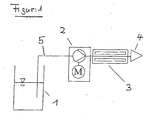
- Fig. 1 schematically shows the structure of an apparatus for performing the method.
- the device consists of a designated 1 reservoir in the form of a Farbgebindeeimers.
- the emulsion paint is transported from the paint container bucket 1 via a feed line 5 by means of a membrane pump as a paint conveyor.
- Essential in the process is now that the removed by means of the diaphragm pump from the paint container 1 color is passed through a connecting line 3 to the airless gun 4, wherein the Connecting line 3 is formed in the form of a heated tube.
- This is symbolic by the in Fig. 3 recognize structures that have been imaged.
- the process is essential that the process is performed so that an injection pressure measured on the airless gun 4 of 55-135 bar preferably from 70-80 bar is set.
- the airless gun 4 has a double nozzle.
- the double nozzle is to be chosen from the geometry and the arrangement so that spray jets overlap in the longitudinal direction. It has proven to be favorable in this case if the double nozzle is designed in the form of two slot-like nozzle openings arranged in series.
- Fig. 2 shows the comparison of the average value D v10 of the color NESPRI6 according to the invention with a color of the prior art.
- the color of the invention in all investigated pressure ranges 55, 75 and 135 bar the colors of the prior art with respect to the average value D v10 clearly superior.
- the mean value D v10 is defined so that 10% of the total volume is present in droplets which are less than or equal to the specified value. Larger in comparison to the colors of the prior art Mean values D v10 on ie a significant reduction of fines.
- the droplet size is given in ⁇ m (0-80).
- Fig. 3 shows the comparison of the color of the invention NESPRI 6 in two dilutions, namely with 10% and 5% in turn with a color of the prior art in terms of the shear viscosity in dependence on a predetermined shear rate range.
- the color of the invention in the shear rate range between 1 E 04 and 1.5 E 0.5 significantly higher viscosities. This has a positive effect on the spraying method described above.
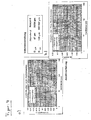
- Fig. 4 on the one hand shows in Fig. 4a, the volume distribution of the color NESPRI6 and a color of the prior art and the Fig. 4b again shows the number of droplets for the two colors mentioned above.
- the definition of D v10 and D v50 is the same as under Fig. 1 indicated, with at Fig. 4b ) the number of droplets is shown.
- Fig. 5 shows the evaluation of the spray patterns with regard to the overspray. It was not the droplets that were evaluated, but the spray pattern generated by spraying. Fig. 5 shows the superior properties of the color of the invention when an order is made by the claimed method.
- the pictured graphic after Fig. 5a shows the spray pattern with a color of the prior art. The graph shows both the number of splashes evaluated on the spray pattern and its distance from the imaginary zero line and the radius.
- Out Fig. 5a It becomes clear that the colors of the prior art overspray through very many small color dots, which are essentially between 20 and 40 microns.
Landscapes
- Chemical & Material Sciences (AREA)
- Dispersion Chemistry (AREA)
- Life Sciences & Earth Sciences (AREA)
- Engineering & Computer Science (AREA)
- Materials Engineering (AREA)
- Wood Science & Technology (AREA)
- Organic Chemistry (AREA)
- Paints Or Removers (AREA)
- Application Of Or Painting With Fluid Materials (AREA)
- Coloring (AREA)
- Colloid Chemistry (AREA)
- Compositions Of Macromolecular Compounds (AREA)
- Pigments, Carbon Blacks, Or Wood Stains (AREA)
Description
- Farben auf Basis mindestens einer Polymerdispersion die aus einer Kunststoffdispersion, Pigmenten und Füllstoffen bestehen, sind im Stand der Technik ein weit verbreitetes Beschichtungssystem zum Beschichten von Untergründen aller Art, insbesondere im Baubereich auf Innen-.und Außenwände. Das Eigenschaftsbild der Dispersion, aber auch der daraus hergestellten Fertigprodukte, wird überwiegend vom jeweiligen Polymerisat geprägt. Bisher werden derartige Dispersionsfarben üblicherweise durch an und für sich bekannte Auftragsmittel, wie Walzen oder Pinsel, auf den Untergrund aufgebracht. Im Stand der Technik ist es bisher auch schon bekannt, derartige Dispersionsfarben mittels einer Sprühpistole zu verarbeiten.
- Es hat sich dabei gezeigt, dass bei der Verarbeitung von Dispersionsfarben mit einer Spritzpistole, insbesondere der dabei entstehende Nebel in Form von feinen Tröpfchen, Schwierigkeiten bei der Verarbeitung bereitet. Zum einen führt der entstehende Nebel dazu, dass keine exakten Beschichtungen, d. h. das keine Beschichtungen realisierbar sind, bei denen ein scharf abgegrenztes Sprühbild realisiert werden kann und zweitens führt der dabei entstehende Nebel auch zu gesundheitlichen Problemen, da die bei den üblichen Spritzverfahren mit den bekannten Dispersionsfarben des Standes der Technik entstehenden feinen Nebel mit Größen < 15 µm zu gesundheitlichen Belastungen des verarbeitenden Personals führt.
- Aus der
US 6, 465, 047 B1 ist ein Verfahren zum Auftragen einer wässrigen Polymerdispersion bekannt, bei dem die Viskosität der eingesetzten Dispersion nach einem nicht bestimmten Messverfahren zwischen 10 und 5.000 mPas liegt. - Ausgehend hiervon, ist es die Aufgabe der vorliegenden Erfindung, eine Farbe auf Basis mindestens einer Polymerdispersion vorzuschlagen, die es ermöglicht, dass die Farbe möglichst nebelfrei mit einer Spritzpistole verarbeitet werden kann.
- Die Aufgabe wird durch die kennzeichnenden Merkmale des Schutzanspruches 1 gelöst. Die Unteransprüche zeigen vorteilhafte Weiterbildungen auf.
- Die erfindungsgemäße Farbe, nachfolgend Dispersionsfarbe genannt, besteht demnach aus einer Polymerdispersion, Pigmente, Füllstoffe, einem Verdicker sowie Dispergiermittel und Additive, wobei die Viskosität dieser Dispersionsfarbe auf 3,5 bis 5 · 102 m Pa/s eingestellt ist. Die Viskosität wurde dabei bei einer Schergeschwindigkeit von 30.000 · 1/s mit der Kapillarrheometrie gemessen. Eine derartige Bestimmungsmethode der Viskosität ist z.B. beschrieben in R. W. Whorlov: Rheological Techniques, Verlag Elis Horwood, New York, 1992.
- Gemäß der vorliegenden Erfindung, ist es für die Dispersionsfarbe wesentlich, dass der in Anspruch 1 angegebene Bereich für die Viskosität eingehalten wird. Es hat sich gezeigt, dass nur eine Dispersionsfarbe mit einer derartigen Zusammensetzung und einer derartigen Viskosität beim Verarbeiten mit einer Spritzpistole zu Tröpfchen führt, die eine bestimmte Mindestgröße nicht unterschreiten wodurch ein abgegrenztes Sprühbild erzeugt wird. Die erfindungsgemäße Farbe hat weiterhin den Vorteil, dass dadurch ein Einatmen von Sprühnebel weitestgehend vermieden wird.
- Bei der erfindungsgemäßen Dispersionsfarbe ist dabei darauf zu achten, dass die in Anspruch 1 angegebene Zusammensetzung in Bezug auf die Polymerdispersion eingehalten wird. Gemäß der vorliegenden Erfindung ist es vorgesehen, dass 2-20 Gew.-% Polymerdispersion gerechnet als Feststoffanteil, 2-35 Gew.-% Pigmente, 5-60 Gew.-% Füllstoffe mit einem Partikeldurchmesser von 0,1 - 200 µm, 0,1 - 3 Gew.-% Verdicker, 0,1 - 2 Gew.-% Dispergiermittel sowie maximal bis 5 Gew.-% weitere Additive enthalten sind.
- Aus stofflicher Sicht ist es bei der erfindungsgemäßen Dispersionsfarbe bevorzugt, wenn die Polymerdispersion ausgewählt ist aus Polymeren die aus bestimmten Monomeren aufgebaut ist. Geeignete Monomere sind beispielsweise Carbonsäurevinylester mit 3 bis 20 Kohlenstoffatomen, insbesondere Vinylacetat, Vinylpropionat und Carbonsäurevinylester mit 9 bis 11 Kohlenstoffatomen in der Carbonsäurekomponente, weiterhin N-Vinylpyrrolidon und dessen Derivate, ethylenisch ungesättigte Carbonsäuren, deren Ester, deren Amide oder deren Anhydride, weiterhin α-Olefine, insbesondere Ethylen und Propylen sowie Acrylnitril. Besonders bevorzugt ist die Verwendung ethylenisch ungesättigter Carbonsäuren, insbesondere von Acryl- und Methacrylsäure, weiterhin von ethylenisch ungesättigten Carbonsäureestern, insbesondere von Acryl- und Methacrylsäureestern mit 1 bis 12 Kohlenstoffatomen im Alkoholrest. Der Alkoholrest der Ester kann aus linearen oder verzweigten Alkylketten, Cycloaliphaten oder Aromaten bestehen, die zusätzlich mit Hydroxylgruppen, Halogenatomen oder Epoxidgruppen modifiziert sein können. Besonders bevorzugt ist auch der Einsatz von Styrol und Styrolderivaten.
- Für die Pigmente können an und für sich die aus dem Stand der Technik bekannten Pigmente eingesetzt werden. Beispiele hierfür sind Titandioxid, Eisenoxid, Chromoxid, Kobaltblau, Phtalocyaninpigmente, Spinellpigmente sowie Nickel und Chromtitanate. Es können auch organische Pigmente wie Azopigmente, Chinacridonpigmente und/oder Dioxazinpigmente eingesetzt werden. Bei den Pigmenten hat es sich als besonders günstig erwiesen, wenn Titandioxid eingesetzt wird. Als Füllstoffe kommen insbesondere Silikate, Carbonate, Flussspatsulfate und Oxide in Frage. Besonders bevorzugt bei den Füllstoffen sind Kaolin, Glimmer, Talkum und Kalziumcarbonat. Es ist auch bevorzugt, wenn die vorstehend erwähnten Füllstoffe in Form einer Mischung verwendet werden. Es hat sich gezeigt, dass es besonders günstig ist, wenn die Füllstoffe einen Durchmesser von 0,1 bis 200, besonders bevorzugt von 0,1 bis 100 µm aufweisen. Die Auswahl der Partikelgröße der Füllstoffe ist offensichtlich auch für Einstellung der Viskosität wichtig. Es ist hierbei auch möglich, neben einer monomodalen Teilchengrößenverteilung eine bimodale Teilchengrößenverteilung einzusetzen. Eine weitere bevorzugte Variante zur Steuerung der Viskosität der erfindungsgemäßen Farbe besteht darin, dass die Oberflächen der Füllstoffpartikel funktionalisiert werden. Unter funktionalisierten Füllstoffpartikeln gemäß der vorliegenden Erfindung werden solche verstanden, bei denen die funktionellen Gruppen sowohl über eine kovalente Bindung oder auch durch einfache Wechselwirkungen die an die Oberfläche gebunden sind. Es können auch nachträglich behandelte Partikel z. B. mit einer Hydrophobierungsschicht eingesetzt werden.
- Bei der erfindungsgemäßen Farbe ist es weiterhin wesentlich, dass ein Verdicker eingesetzt wird. Der Verdicker wird gemäß der vorliegenden Erfindung mit 0,1 - 3 Gew.-% eingesetzt. Aus stofflicher Sicht sind bei den Verdickern insbesondere alle im Stand der Technik bekannten Polycarboxylatverdicker möglich. Beispiele hierfür sind Polycarboxylate, Urethanverdicker, Polysaccharide und Celluloseether.
- Die erfindungsgemäße Dispersionsfarbe kann selbstverständlich wie bisher aus dem Stand der Technik schon bekannt neben 0,1 bis 2 Gew % Dispersionsmittel weitere. Additive in einer Menge bis zu 5 Gew.-% enthalten. Beispiele für derartige weitere Additive sind, Stabilisatoren, Entschäumer, Konservierungsmittel und/oder Hydrophobierungsmittel.
- Wesentlich ist nun, dass die Dispersionsfarbe, wie vorstehend beschrieben, ausgezeichnet geeignet ist, um sie mittels eines Spritzverfahrens zu verarbeiten. Gemäß der vorliegenden Erfindung wird dabei so vorgegangen, dass die Dispersionsfarbe aus einem Reservoir bevorzugt einem Farbgebinde über eine Fördereinheit und einer Verbindungsleitung zu einer Airless-Pistole geführt wird. Wichtig dabei ist, dass der Spritzdruck der dabei eingestellt wird, 50-135 bar bevorzugt 70-80 bar, gemessen an der Pistole, beträgt. Dadurch werden offensichtlich alle charakteristischen Größen die für eine Zerstäubung wichtig sind, wie Düsendurchmesser d, Lamellendicke 1, mittlere Austrittsgeschwindigkeit u, die Viskosität u, sowie die Oberflächenspannung σ und die Dichte ρ günstig beeinflusst. Damit ergeben sich für das Verfahren im Schnitt größere Tröpfchen verglichen mit an und für sich bekannten Airless-Verfahren sowie sehr hohe Auftragswirkungsgrade bis zu 99 %.
- Vorteilhaft ist es, wenn als Fördereinrichtung eine Membranpumpe eingesetzt wird. Es hat sich weiterhin als günstig erwiesen, wenn die Verbindungsleitung z. B. in Form eines Schlauches, beheizbar ist. Dadurch kann sichergestellt werden, dass die Dispersionsfarbe vom Reservoir, d. h. vom Farbgebinde durch die Fördereinheit zum Zerstäuber im Wesentlichen unabhängig von der Umgebungstemperatur geführt werden kann. Günstig ist es hierbei, wenn die Temperatur im Bereich von 27-40 °C, insbesondere von 30-38 °C eingestellt wird. Das Verfahren muss dabei so geführt werden, dass die vorstehend genannten Temperaturen bei der Spritzpistole erreicht wird. Dadurch wir sichergestellt, dass die überragenden Eigenschaften der Dispersionsfarbe wie vorstehend erläutert, erhalten bleibt.
- Überraschend hierbei ist es insbesondere, dass trotz der beim Verfahren eingesetzten hohen Drücke und der Temperatur die positiven physikalischen Eigenschaften, d. h. insbesonders die hohe Viskosität im Wesentlichen nicht beeinträchtigt wird.
- Als weiterhin günstiger Faktor hat es sich erwiesen, wenn die eingesetzte Airless-Pistole mit einer Doppeldüse ausgerüstet ist. Die Anordnung der Ausgestaltung der Doppeldüsen sollte dabei so gewählt sein, dass sich die Spritzstrahlen in Längsrichtung überschneiden. Hierzu sind die Doppeldüsen in Form von zwei in Reihe angeordneten schlitzartigen Düsenöffnungen als besonders günstig anzusehen.
- Die Erfindung betrifft weiterhin die Verwendung der vorstehend beschriebenen Dispersionsfarbe zum Aufbringen der Farbe mittels eines Airless-Verfahrens.
- Die Erfindung wird nachfolgend anhand einer Rahmenrezeptur und den
Fign. 1 bis 5 näher erläutert. - Fig. 1
- zeigt dabei den schematischen Aufbau einer Vorrichtung zur Durchführung des Verfah- rens;
- Fig. 2
- zeigt den Vergleich der erfindungsgemäßen Farbe mit einer Farbe des Standes der Tech- nik in Bezug auf die mittlere Tropfengröße;
- Fig. 3
- zeigt die Viskosität der erfindungsgemäßen Farbe in zwei Verdünnungsstufen mit einer Farbe des Standes der Technik in einem vor- bestimmten Scherratenbereich;
- Fig. 4
- zeigt wiederum den Vergleich einer Farbe des Standes der Technik mit der erfindungs- gemäßen Farbe in Bezug auf die Volumenver- teilung der gebildeten Tröpfchen sowie die Anzahl der Tröpfchen und
- Fig. 5
- zeigt eine Auswertung von Spritzbildern ei- ner erfindungsgemäßen Farbe und einer Farbe des Standes der Technik.
-
Gewichtsprozent Bindemittel 12 - Acrylharz, in Dispersion - Silikonharz, in Dispersion Pigmente Titandioxid 12 Füllstoffe 41 - Kaolin - Glimmer - Talkum - Calciumcarbonate Dispergiermittel 0,4 - Polycarboxylate Verdickungsmittel 0,4 - Polycarboxylate Additive 1,6 Konservierungsmittel 0,1 - Wasser 32,5 -
Fig. 1 zeigt schematisch den Aufbau einer Vorrichtung zur Durchführung des Verfahrens. Die Vorrichtung besteht aus einem mit 1 bezeichneten Reservoir in Form eines Farbgebindeeimers. Die Dispersionsfarbe wird dabei aus dem Farbgebindeeimer 1 über eine Zuleitung 5 mittels einer Membranpumpe als Farbfördereinrichtung transportiert. Wesentlich beim Verfahren ist nun, dass die mittels der Membranpumpe aus dem Farbgebinde 1 entnommene Farbe über eine Verbindungsleitung 3 zur Airless-Pistole 4 geführt wird, wobei die Verbindungsleitung 3 in Form eines beheizten Schlauches ausgebildet ist. Dies ist symbolisch durch die inFig. 3 abgebildeten Strukturen zu erkennen. Beim Verfahren ist wesentlich, dass das Verfahren so geführt wird, dass ein Spritzdruck gemessen an der Airless-Pistole 4 von 55-135 bar bevorzugt von 70-80 bar eingestellt wird. Weiterhin ist es wichtig, dass zur Sicherstellung der physikalischen Eigenschaften die Farbe in der Verbindungsleitung 3, d. h. in dem Schlauch so temperiert wird, dass der Viskositätsbereich nicht wesentlich durch den Arbeitsdruck und die Umgebungstemperatur beeinflusst wird. Hierzu ist es erforderlich, eine Temperierung durchzuführen mit der Maßgabe, dass die Temperatur gemessen an der Airless-Pistole im Bereich von 27-40°, besonders bevorzugt im Bereich von 30-38 °C liegt. Sofern diese Bedingungen eingehalten werden, ist eine optimale Tropfengrößenbildung erreicht. Wesentlich ist weiterhin, dass die Airless-Pistole 4 über eine Doppeldüse verfügt. Die Doppeldüse ist dabei von der Geometrie und der Anordnung so zu wählen, dass sich Spritzstrahlen in Längsrichtung überschneiden. Als günstig hat es sich hierbei erwiesen, wenn die Doppeldüse in Form von zwei in Reihe angeordneten schlitzartigen Düsenöffnungen ausgebildet ist. -
Fig. 2 zeigt den Vergleich des Mittelwertes Dv10 der erfindungsgemäßen Farbe NESPRI6 mit einer Farbe des Standes der Technik. WieFig. 2 zeigt, weist die erfindungsgemäße Farbe in allen untersuchten Druckbereichen 55, 75 und 135 bar den Farben des Standes der Technik in Bezug auf den Mittelwert Dv10 deutlich überlegen. Der Mittelwert Dv10 ist dabei so definiert, dass 10 % des Gesamtvolumens in Tröpfchen vorliegen, die kleiner oder gleich dem angegebenen Wert sind. Im Vergleich zu den Farben des Standes der Technik größere Mittelwerte Dv10 auf d.h. eine deutliche Reduktion der Feinanteile. Die Tröpfchengröße ist in µm (0-80) angegeben. -
Fig. 3 zeigt den Vergleich der erfindungsgemäßen Farbe NESPRI 6 in zwei Verdünnungen, nämlich mit 10 % und 5 % wiederum mit einer Farbe des Standes der Technik in Bezug auf die Scherviskosität in Abhängigkeit eines vorgegebenen Scherratenbereiches. Wie aus der Figur deutlich hervorgeht, zeigt die erfindungsgemäße Farbe im Scherratenbereich zwischen 1 E04 und 1,5 E0,5 deutlich höhere Viskositäten. Dies wirkt sich positiv beim vorstehend beschriebenen Spritzverfahren aus. -
Fig. 4 zeigt einerseits in 4a, die Volumenverteilung der Farbe NESPRI6 und einer Farbe des Standes der Technik und dieFig. 4b zeigt die Anzahl der Tröpfchen wiederum für die beiden vorstehend erwähnten Farben. Die Definition von Dv10 und Dv50 entspricht der der unterFig. 1 angegebenen, wobei beiFig. 4b ) die Tröpfchenanzahl abgebildet ist. -
Fig. 5 zeigt die Auswertung der Spritzbilder hinsichtlich des Oversprays. Ausgewertet wurden dabei nicht die Tröpfchen sondern das durch das Sprühen erzeugte Spritzbild.Fig. 5 zeigt dabei die überlegenen Eigenschaften der erfindungsgemäßen Farbe, wenn ein Auftrag mittels des beanspruchten Verfahrens erfolgt. Die abgebildete Graphik nachFig. 5a zeigt dabei das Spritzbild mit einer Farbe des Standes der Technik. Aus der Graphik sind dabei sowohl die Anzahl der auf dem Spritzbild ausgewerteten Spritzer sowie dessen Abstand von der gedachten Null-Linie und der Radius zu erkennen. AusFig. 5a wird dabei deutlich, dass die Farben des Standes der Technik einen Overspray durch sehr viele kleine Farbpunkte erzeugen, die im Wesentlichen zwischen 20 und 40 µm liegen. - Überraschenderweise gelingt es nun mit der erfindungsgemäßen.Farbe diesen Overspray nahezu vollständig zu eliminieren. Sowohl aus der graphischen Darstellung wie aus der darüber angeordneten Aufnahme des Sprühbildes wird deutlich, dass durch die erfindungsgemäße Farbe in Verbindung mit dem Auftragsverfahren eine nahezu vollständige Beseitigung des Oversprays erreicht wird.
- Aus Fig. a) ist deutlich zu erkennen, dass der Durchmesser der Tröpfchen, die mit der erfindungsgemäßen Farbe realisiert werden, deutlich größer ist, unter den gleichen Versuchsbedingungen wie diejenigen die mit einer Farbe des Standes der Technik, erreicht werden. Noch deutlicher wird der Unterschied, wenn die Anzahl der Tröpfchen wie in
Fig. 4b zu erkennen berücksichtigt wird. Daraus geht hervor, dass die erfindungsgemäße Farbe hier im Beispiel NESPRI6 eine Nebelbildung um bis zu 85 % reduziert.
Claims (9)
- Farbe auf Basis mindestens einer Polymerdispersion mit Pigmenten, Füllstoffen, Verdicker sowie Dispergiermitteln und Additiven,
dadurch gekennzeichnet , dass siea) 2-20 Gew.-% Polymerdispersion gerechnet als Feststoffanteil,b) 2-35-Gew.-% Pigmente,c) 5-60-Gew.-% Füllstoffe mit einem Partikeldurchmesser von 0,1-200µmd) 0,1-3-Gew.-% Verdicker,e) 0,1-2-Gew.-% Dispergiermittel sowief) maximal 5 Gew . - % weitere Additive
und zu 100 Gew.-% ergänzende Anteile an Wasser enthält
mit der Maßgabe, dass die Dispersion eine Viskosität von 3,5 bis 5 · 102 m Pa.s auf - weist, wobei die Viskosität bei einer Schergeschwindigkeit von 30.000 · 1/s mit der Kapillarrheometrie bestimmt worden ist. - Farbe nach Anspruch 1, dadurch gekennzeichnet, dass die Polymerdispersion ausgewählt ist aus Polymeren, die aus den Monomeren Carbonsäurevinylestern mit 3-20 C-Atomen, N-Vinylpyrrolidon, ethylenisch ungesättigten Carbonsäuren, deren Ester deren Amide oder deren Anhydride, Styrol bzw. deren Derivat, und/oder α-Olefine erhalten worden ist.
- Farbe nach Anspruch 2, dadurch gekennzeichnet, dass es eine Poly-Acrylacrylat-, Acrylharz- und/oder Silikonharzdispersion ist.
- Farbe nach einem der vorhergehenden Ansprüche,
dadurch gekennzeichnet, dass die Pigmente ausgewählt sind aus Titandioxid, Eisenoxid, Chromoxid, Kobaltblau, Phtalocyaninpigmente, Spinellpigmente sowie Nickel- und Chromtitanat, Azopigmente, Chinacridonpigmente und/oder Dioxazinpigmente. - Farbe nach Anspruch 4, dadurch gekennzeichnet, dass das Pigment Titandioxid ist.
- Farbe nach einem der vorhergehenden Ansprüche, dadurch gekennzeichnet, dass die Füllstoffe einen Durchmesser von 0,1 bis 100µm aufweisen und ausgewählt sind aus Silikaten, Carbonaten, Flussspat, Sulfaten und Oxiden.
- Farbe nach einem der vorhergehenden Anspruchs, dadurch gekennzeichnet, dass die Oberfläche der Füllstoffe funktionalisiert ist.
- Farbe nach einem der vorhergehenden Ansprüche, dadurch gekennzeichnet, dass der Verdicker ausgewählt ist aus Polycarboxylaten, Urethanverdickern, Polysacchariden und/oder Celluloseethern.
- Farbe nach einem der vorhergehenden Ansprüche, dadurch gekennzeichnet, dass die weiteren Additive Stabilisatoren, Entschäumer, Konservierungsmittel und/oder Hydrophobierungsmittel sind.
Priority Applications (1)
| Application Number | Priority Date | Filing Date | Title |
|---|---|---|---|
| PL04725371T PL1618155T3 (pl) | 2003-04-04 | 2004-04-02 | Farba na bazie co najmniej jednej dyspersji polimerowej |
Applications Claiming Priority (2)
| Application Number | Priority Date | Filing Date | Title |
|---|---|---|---|
| DE10315483A DE10315483A1 (de) | 2003-04-04 | 2003-04-04 | Farbe auf Basis mindestens einer Polymerdispersion und Verfahren zum Auftrag der Farbe |
| PCT/EP2004/003531 WO2004087822A1 (de) | 2003-04-04 | 2004-04-02 | Farbe auf basis mindestens einer polymerdispersion |
Publications (2)
| Publication Number | Publication Date |
|---|---|
| EP1618155A1 EP1618155A1 (de) | 2006-01-25 |
| EP1618155B1 true EP1618155B1 (de) | 2011-06-08 |
Family
ID=33103210
Family Applications (2)
| Application Number | Title | Priority Date | Filing Date |
|---|---|---|---|
| EP04725371A Expired - Lifetime EP1618155B1 (de) | 2003-04-04 | 2004-04-02 | Farbe auf basis mindestens einer polymerdispersion |
| EP04725319A Expired - Lifetime EP1611210B1 (de) | 2003-04-04 | 2004-04-02 | Farbe auf basis mindestens einer polymerdispersion und verfahren zum auftrag der farbe |
Family Applications After (1)
| Application Number | Title | Priority Date | Filing Date |
|---|---|---|---|
| EP04725319A Expired - Lifetime EP1611210B1 (de) | 2003-04-04 | 2004-04-02 | Farbe auf basis mindestens einer polymerdispersion und verfahren zum auftrag der farbe |
Country Status (10)
| Country | Link |
|---|---|
| US (1) | US20070129469A1 (de) |
| EP (2) | EP1618155B1 (de) |
| JP (1) | JP2006522191A (de) |
| AT (2) | ATE502088T1 (de) |
| DE (2) | DE10315483A1 (de) |
| ES (2) | ES2364402T3 (de) |
| PL (2) | PL1618155T3 (de) |
| RU (1) | RU2301240C2 (de) |
| UA (1) | UA81663C2 (de) |
| WO (2) | WO2004087822A1 (de) |
Families Citing this family (20)
| Publication number | Priority date | Publication date | Assignee | Title |
|---|---|---|---|---|
| DE102006002545A1 (de) * | 2006-01-18 | 2007-07-19 | Ewald Dörken Ag | Siliziumbasiertes Korrosionsschutzmittel |
| US8827183B2 (en) | 2007-12-05 | 2014-09-09 | Wagner Spray Tech Corporation | Dual aperture spray tip cup gun |
| US9545643B2 (en) | 2008-10-22 | 2017-01-17 | Graco Minnesota Inc. | Portable airless sprayer |
| US8596555B2 (en) | 2008-10-22 | 2013-12-03 | Graco Minnesota Inc. | Portable airless sprayer |
| AU2014201325B2 (en) * | 2008-10-22 | 2015-08-27 | Graco Minnesota Inc. | Portable airless sprayer |
| DE102009007911A1 (de) | 2009-02-06 | 2010-08-19 | Sto Ag | Viskose, kornhaltige aushärtende Beschichtungsmasse |
| EP2301645A1 (de) * | 2009-09-28 | 2011-03-30 | Cytec Surface Specialties Austria GmbH | Entschäumer für Airless-Sprüh-Auftrag |
| RU2534535C2 (ru) * | 2012-11-20 | 2014-11-27 | Евгений Генриевич Лазутин | Водно-дисперсионная краска и способ ее получения |
| DE102014001244A1 (de) | 2014-02-03 | 2015-08-06 | Burkhard Büstgens | Auftragung einer Dispersionsfarbe im Drop-on-Demand Verfahren, Thinning Kit |
| US9850166B2 (en) * | 2015-02-03 | 2017-12-26 | Construction Research & Technology, Gmbh | Liquid coloring suspension and colored cementitious composition |
| CN111318387B (zh) | 2015-04-20 | 2021-10-15 | 瓦格纳喷涂技术有限公司 | 低压喷射头构造 |
| CN110167683A (zh) * | 2017-01-05 | 2019-08-23 | 瓦格纳喷涂技术有限公司 | 高效无气喷头设计和使用 |
| US11007545B2 (en) | 2017-01-15 | 2021-05-18 | Graco Minnesota Inc. | Handheld airless paint sprayer repair |
| US20190283054A1 (en) | 2018-03-15 | 2019-09-19 | Wagner Spray Tech Corportaion | Spray tip design and manufacture |
| EP3774069A1 (de) | 2018-04-10 | 2021-02-17 | Graco Minnesota Inc. | Tragbare luftlose sprühvorrichtung für farben und andere beschichtungen |
| TWI855085B (zh) | 2019-05-31 | 2024-09-11 | 美商葛萊兒明尼蘇達股份有限公司 | 手持式流體噴霧器 |
| WO2021003124A1 (en) * | 2019-07-01 | 2021-01-07 | Aaron Auberg | Spray rig monitoring system |
| US10968903B1 (en) | 2020-06-04 | 2021-04-06 | Graco Minnesota Inc. | Handheld sanitary fluid sprayer having resilient polymer pump cylinder |
| US10926275B1 (en) | 2020-06-25 | 2021-02-23 | Graco Minnesota Inc. | Electrostatic handheld sprayer |
| DE102024113104A1 (de) | 2024-05-10 | 2025-11-13 | I.S.G. Industriesteingesellschaft mit beschränkter Haftung | Lösungsmittelarme Farbzusammensetzung, deren Herstellung, Verarbeitung und Verwendung |
Family Cites Families (21)
| Publication number | Priority date | Publication date | Assignee | Title |
|---|---|---|---|---|
| DE1669311A1 (de) * | 1968-02-22 | 1971-05-19 | Karl Sahm Chemische U Lackfabr | Verspritzbares Beschichtungsmittel zur Herstellung aufzuschmelzender Korrosionsschutzueberzuege |
| JPS6019066A (ja) * | 1983-07-14 | 1985-01-31 | Asahi Okuma Ind Co Ltd | エアレス塗装用ダイアフラムポンプ |
| DE3705815A1 (de) * | 1987-02-24 | 1988-09-01 | Kopperschmidt Mueller & Co | Elektrostatische spruehpistole |
| US5202381A (en) * | 1990-04-04 | 1993-04-13 | Rohm And Haas Company | Polymer blends including ionomers |
| FR2712293B1 (fr) * | 1993-11-10 | 1996-01-19 | Cray Valley Sa | Latex à particules structurées pour peintures sans solvant. |
| RU2102425C1 (ru) * | 1995-07-28 | 1998-01-20 | Полунин Владимир Константинович | Композиция для покрытия и способ ее получения |
| DE19724915A1 (de) * | 1997-06-12 | 1998-12-17 | Basf Ag | Verfahren zur Herstellung wäßriger Polymerisatdispersionen |
| WO1998010001A1 (de) * | 1996-09-09 | 1998-03-12 | Basf Aktiengesellschaft | Verfahren zur herstellung wässriger polymerisatdispersionen |
| JPH1119576A (ja) * | 1997-07-03 | 1999-01-26 | Nippon Paint Co Ltd | 骨材含有塗料の塗装方法及び塗装物 |
| DE69823993T2 (de) * | 1998-08-11 | 2004-10-28 | Hercules Inc., Wilmington | Verwendung von wässrigen Schutzschichtzusammensetzungen für Industrielle Beschichtungen und wässrige Beschichtungszusammensetzungen |
| JP2000140711A (ja) * | 1998-11-13 | 2000-05-23 | Toyota Motor Corp | マルチスリットノズル |
| DE19910602C5 (de) * | 1999-03-10 | 2004-11-18 | Wacker-Chemie Gmbh | Schnell trocknende Putz- und Beschichtungsmasse, Verfahren zu deren Herstellung und deren Verwendung |
| DE19964153B4 (de) * | 1999-03-10 | 2006-06-01 | Wacker Chemie Ag | Verwendung von Fällungsmittel-Konzentrat zur Herstellung von schnell trocknenden Putzmassen |
| DE19914329A1 (de) * | 1999-03-30 | 2000-10-05 | Bayer Ag | Anstrichmittel- und Beschichtungsmittelsysteme |
| JP2001025701A (ja) * | 1999-07-15 | 2001-01-30 | Kansai Paint Co Ltd | 塗装方法及び塗装ガン |
| JP2002153785A (ja) * | 2000-11-20 | 2002-05-28 | Kansai Paint Co Ltd | 飛散防止エアレス塗装機 |
| US20020129767A1 (en) * | 2001-03-15 | 2002-09-19 | Lloyd Czerwonka | Temperature controlled coating system |
| DE10113227A1 (de) * | 2001-03-19 | 2002-09-26 | Basf Ag | Wässrige Beschichtungsmasse |
| JP2003020448A (ja) * | 2001-07-10 | 2003-01-24 | Honda Motor Co Ltd | 鋼板用速硬化塗布型補強材及び鋼板補強方法 |
| US6655606B2 (en) * | 2001-07-12 | 2003-12-02 | Stephen R. Earl | Multiple nozzle tip assembly for airless paint sprayer gun |
| US6465047B1 (en) * | 2001-08-30 | 2002-10-15 | National Starch And Chemical Investment Holding Corporation | Precision polymer dispersion application by airless spray |
-
2003
- 2003-04-04 DE DE10315483A patent/DE10315483A1/de not_active Ceased
-
2004
- 2004-04-02 DE DE502004012309T patent/DE502004012309D1/de not_active Expired - Lifetime
- 2004-04-02 JP JP2006504974A patent/JP2006522191A/ja active Pending
- 2004-04-02 EP EP04725371A patent/EP1618155B1/de not_active Expired - Lifetime
- 2004-04-02 PL PL04725371T patent/PL1618155T3/pl unknown
- 2004-04-02 UA UAA200510427A patent/UA81663C2/ru unknown
- 2004-04-02 PL PL04725319T patent/PL1611210T3/pl unknown
- 2004-04-02 WO PCT/EP2004/003531 patent/WO2004087822A1/de not_active Ceased
- 2004-04-02 ES ES04725371T patent/ES2364402T3/es not_active Expired - Lifetime
- 2004-04-02 EP EP04725319A patent/EP1611210B1/de not_active Expired - Lifetime
- 2004-04-02 AT AT04725319T patent/ATE502088T1/de active
- 2004-04-02 RU RU2005131736/04A patent/RU2301240C2/ru active
- 2004-04-02 AT AT04725371T patent/ATE512203T1/de active
- 2004-04-02 WO PCT/EP2004/003530 patent/WO2004087821A1/de not_active Ceased
- 2004-04-02 ES ES04725319T patent/ES2359313T3/es not_active Expired - Lifetime
- 2004-04-02 US US10/551,730 patent/US20070129469A1/en not_active Abandoned
Also Published As
| Publication number | Publication date |
|---|---|
| JP2006522191A (ja) | 2006-09-28 |
| DE10315483A1 (de) | 2004-11-04 |
| RU2005131736A (ru) | 2006-05-10 |
| PL1611210T3 (pl) | 2011-07-29 |
| ATE502088T1 (de) | 2011-04-15 |
| US20070129469A1 (en) | 2007-06-07 |
| ES2359313T3 (es) | 2011-05-20 |
| ATE512203T1 (de) | 2011-06-15 |
| EP1618155A1 (de) | 2006-01-25 |
| WO2004087822A1 (de) | 2004-10-14 |
| DE502004012309D1 (de) | 2011-04-28 |
| RU2301240C2 (ru) | 2007-06-20 |
| PL1618155T3 (pl) | 2011-11-30 |
| ES2364402T3 (es) | 2011-09-01 |
| WO2004087821A1 (de) | 2004-10-14 |
| EP1611210A1 (de) | 2006-01-04 |
| EP1611210B1 (de) | 2011-03-16 |
| UA81663C2 (ru) | 2008-01-25 |
Similar Documents
| Publication | Publication Date | Title |
|---|---|---|
| EP1611210B1 (de) | Farbe auf basis mindestens einer polymerdispersion und verfahren zum auftrag der farbe | |
| DE2726429C3 (de) | Verfahren und Vorrichtung zum Versprühen einer lösungsmittelverdünnten flüssigen Überzugszusammensetzung | |
| DE69003420T2 (de) | Verfahren und Vorrichtung zur Erzeugung eines Schwertspritzens. | |
| DE69003421T2 (de) | Verfahren und Vorrichtung zur Erlangung einer grösseren Sprühbreite. | |
| DE2939951C2 (de) | ||
| DE1923234A1 (de) | Verfahren und Spritzduese zum Erzeugen eines Faecherstrahles | |
| DE69404159T2 (de) | Verfahren zum spritzen von polymerzusammensetzungen mit komprimierten fluiden und erhöhtem zerstäubungsgrad | |
| EP3184177B1 (de) | Luftkappe und düsenanordnung für eine spritzpistole und spritzpistole | |
| DE202007008816U1 (de) | Zerstäuberkopf für eine Spritzpistole | |
| EP3829778A2 (de) | Düsensatz für eine spritzpistole, spritzpistolensystem, verfahren zum ausgestalten eines düsen-moduls, verfahren zur auswahl eines düsen-moduls aus einem düsensatz für eine lackieraufgabe, auswahlsystem und computerprogrammprodukt | |
| EP0561196B1 (de) | Spritzvorrichtung zum Aufbringen eines flüssigen Mediums wie Farbe | |
| EP1862214A2 (de) | Verfahren und Vorrichtung zur Beleimung von Fasern im Bereich eines Blasrohrs | |
| DE20320747U1 (de) | Vorrichtung zum Auftragen von Farben | |
| DE2209896C2 (de) | Zerstäubungsverfahren für niederzuschlagende flüssige Überzugsmaterialien und Vorrichtung zur Durchführung des Zerstäubungsverfahrens | |
| DE20313201U1 (de) | Farbe auf Basis mindestens einer Polymerdispersion | |
| DE69009201T2 (de) | Hochdurchfluss-Niederdruck-Luftspritzpistole. | |
| DE2855771C2 (de) | Verfahren und Vorrichtung zum Aufbringen von wasserverdünnbaren Lacken auf Flächen durch Aufsprühen unter Druck | |
| DE19636221C2 (de) | Sprühdose | |
| DE3007990C2 (de) | ||
| DE1242307B (de) | Waessrige Kunstharz-Dispersionen zur Herstellung von Effektlackierungen und -ueberzuegen | |
| DE102005015991B4 (de) | Düse für Spritzapparate oder Spritzgeräte mit darin axial beweglicher Düsennadel | |
| EP1872864B1 (de) | Vorrichtung und Verfahren zur Aufbringung eines flüssigen Belags auf eine Oberfläche | |
| EP0695582A1 (de) | Verfahren und Vorrichtung zum elektrostatischen und / oder pneumatischen Applizieren von flüssigen Überzugsmitteln auf leitfähige Substrate | |
| DE202005012773U1 (de) | Vorrichtung zum Airless-Spritzen einer Oberfläche mit einer viskosen wässrigen Bautenfarben-Anstrichzusammensetzung | |
| DE60034798T2 (de) | Mischer |
Legal Events
| Date | Code | Title | Description |
|---|---|---|---|
| PUAI | Public reference made under article 153(3) epc to a published international application that has entered the european phase |
Free format text: ORIGINAL CODE: 0009012 |
|
| 17P | Request for examination filed |
Effective date: 20051007 |
|
| AK | Designated contracting states |
Kind code of ref document: A1 Designated state(s): AT BE BG CH CY CZ DE DK EE ES FI FR GB GR HU IE IT LI LU MC NL PL PT RO SE SI SK TR |
|
| AX | Request for extension of the european patent |
Extension state: AL HR LT LV MK |
|
| DAX | Request for extension of the european patent (deleted) | ||
| 17Q | First examination report despatched |
Effective date: 20070926 |
|
| GRAP | Despatch of communication of intention to grant a patent |
Free format text: ORIGINAL CODE: EPIDOSNIGR1 |
|
| GRAS | Grant fee paid |
Free format text: ORIGINAL CODE: EPIDOSNIGR3 |
|
| GRAA | (expected) grant |
Free format text: ORIGINAL CODE: 0009210 |
|
| AK | Designated contracting states |
Kind code of ref document: B1 Designated state(s): AT BE BG CH CY CZ DE DK EE ES FI FR GB GR HU IE IT LI LU MC NL PL PT RO SE SI SK TR |
|
| REG | Reference to a national code |
Ref country code: GB Ref legal event code: FG4D Free format text: NOT ENGLISH |
|
| REG | Reference to a national code |
Ref country code: CH Ref legal event code: NV Representative=s name: TROESCH SCHEIDEGGER WERNER AG Ref country code: CH Ref legal event code: EP |
|
| REG | Reference to a national code |
Ref country code: IE Ref legal event code: FG4D Free format text: LANGUAGE OF EP DOCUMENT: GERMAN |
|
| REG | Reference to a national code |
Ref country code: NL Ref legal event code: T3 |
|
| REG | Reference to a national code |
Ref country code: DE Ref legal event code: R096 Ref document number: 502004012580 Country of ref document: DE Effective date: 20110721 |
|
| REG | Reference to a national code |
Ref country code: SE Ref legal event code: TRGR |
|
| REG | Reference to a national code |
Ref country code: ES Ref legal event code: FG2A Ref document number: 2364402 Country of ref document: ES Kind code of ref document: T3 Effective date: 20110901 |
|
| REG | Reference to a national code |
Ref country code: SK Ref legal event code: T3 Ref document number: E 9919 Country of ref document: SK |
|
| PG25 | Lapsed in a contracting state [announced via postgrant information from national office to epo] |
Ref country code: FI Free format text: LAPSE BECAUSE OF FAILURE TO SUBMIT A TRANSLATION OF THE DESCRIPTION OR TO PAY THE FEE WITHIN THE PRESCRIBED TIME-LIMIT Effective date: 20110608 Ref country code: CY Free format text: LAPSE BECAUSE OF FAILURE TO SUBMIT A TRANSLATION OF THE DESCRIPTION OR TO PAY THE FEE WITHIN THE PRESCRIBED TIME-LIMIT Effective date: 20110608 Ref country code: SI Free format text: LAPSE BECAUSE OF FAILURE TO SUBMIT A TRANSLATION OF THE DESCRIPTION OR TO PAY THE FEE WITHIN THE PRESCRIBED TIME-LIMIT Effective date: 20110608 Ref country code: GR Free format text: LAPSE BECAUSE OF FAILURE TO SUBMIT A TRANSLATION OF THE DESCRIPTION OR TO PAY THE FEE WITHIN THE PRESCRIBED TIME-LIMIT Effective date: 20110909 |
|
| REG | Reference to a national code |
Ref country code: PL Ref legal event code: T3 |
|
| REG | Reference to a national code |
Ref country code: HU Ref legal event code: AG4A Ref document number: E011796 Country of ref document: HU |
|
| PG25 | Lapsed in a contracting state [announced via postgrant information from national office to epo] |
Ref country code: EE Free format text: LAPSE BECAUSE OF FAILURE TO SUBMIT A TRANSLATION OF THE DESCRIPTION OR TO PAY THE FEE WITHIN THE PRESCRIBED TIME-LIMIT Effective date: 20110608 Ref country code: PT Free format text: LAPSE BECAUSE OF FAILURE TO SUBMIT A TRANSLATION OF THE DESCRIPTION OR TO PAY THE FEE WITHIN THE PRESCRIBED TIME-LIMIT Effective date: 20111010 |
|
| PG25 | Lapsed in a contracting state [announced via postgrant information from national office to epo] |
Ref country code: RO Free format text: LAPSE BECAUSE OF FAILURE TO SUBMIT A TRANSLATION OF THE DESCRIPTION OR TO PAY THE FEE WITHIN THE PRESCRIBED TIME-LIMIT Effective date: 20110608 |
|
| PLBE | No opposition filed within time limit |
Free format text: ORIGINAL CODE: 0009261 |
|
| STAA | Information on the status of an ep patent application or granted ep patent |
Free format text: STATUS: NO OPPOSITION FILED WITHIN TIME LIMIT |
|
| 26N | No opposition filed |
Effective date: 20120309 |
|
| PG25 | Lapsed in a contracting state [announced via postgrant information from national office to epo] |
Ref country code: DK Free format text: LAPSE BECAUSE OF FAILURE TO SUBMIT A TRANSLATION OF THE DESCRIPTION OR TO PAY THE FEE WITHIN THE PRESCRIBED TIME-LIMIT Effective date: 20110608 |
|
| REG | Reference to a national code |
Ref country code: DE Ref legal event code: R097 Ref document number: 502004012580 Country of ref document: DE Effective date: 20120309 |
|
| PG25 | Lapsed in a contracting state [announced via postgrant information from national office to epo] |
Ref country code: MC Free format text: LAPSE BECAUSE OF NON-PAYMENT OF DUE FEES Effective date: 20120430 |
|
| PG25 | Lapsed in a contracting state [announced via postgrant information from national office to epo] |
Ref country code: BG Free format text: LAPSE BECAUSE OF FAILURE TO SUBMIT A TRANSLATION OF THE DESCRIPTION OR TO PAY THE FEE WITHIN THE PRESCRIBED TIME-LIMIT Effective date: 20110908 |
|
| REG | Reference to a national code |
Ref country code: DE Ref legal event code: R082 Ref document number: 502004012580 Country of ref document: DE Representative=s name: PFENNING MEINIG & PARTNER GBR, DE |
|
| PG25 | Lapsed in a contracting state [announced via postgrant information from national office to epo] |
Ref country code: LU Free format text: LAPSE BECAUSE OF NON-PAYMENT OF DUE FEES Effective date: 20120402 |
|
| REG | Reference to a national code |
Ref country code: SK Ref legal event code: PC4A Ref document number: E 9919 Country of ref document: SK Owner name: DAW SE, OBER-RAMSTADT, DE Free format text: FORMER OWNER: DEUTSCHE AMPHIBOLIN-WERKE VON ROBERT MURJAHN STIFTUNG & CO KG, OBER-RAMSTADT, DE Effective date: 20140507 |
|
| REG | Reference to a national code |
Ref country code: DE Ref legal event code: R081 Ref document number: 502004012580 Country of ref document: DE Owner name: DAW SE, DE Free format text: FORMER OWNER: DEUTSCHE AMPHIBOLIN-WERKE VON ROBERT MURJAHN STIFTUNG & CO. KG, 64372 OBER-RAMSTADT, DE Effective date: 20140527 Ref country code: DE Ref legal event code: R082 Ref document number: 502004012580 Country of ref document: DE Representative=s name: BOEHMERT & BOEHMERT ANWALTSPARTNERSCHAFT MBB -, DE Effective date: 20140527 Ref country code: DE Ref legal event code: R082 Ref document number: 502004012580 Country of ref document: DE Representative=s name: PFENNING MEINIG & PARTNER GBR, DE Effective date: 20140527 |
|
| REG | Reference to a national code |
Ref country code: CH Ref legal event code: PFUS Owner name: DAW SE, DE Free format text: FORMER OWNER: DEUTSCHE AMPHIBOLIN-WERKE VON ROBERT MURJAHN STIFTUNG AND CO KG, DE |
|
| REG | Reference to a national code |
Ref country code: HU Ref legal event code: GB9C Owner name: DAW SE, DE Free format text: FORMER OWNER(S): DEUTSCHE AMPHIBOLIN-WERKE VON ROBERT MURJAHN STIFTUNG & CO KG, DE |
|
| REG | Reference to a national code |
Ref country code: GB Ref legal event code: 732E Free format text: REGISTERED BETWEEN 20150416 AND 20150422 |
|
| REG | Reference to a national code |
Ref country code: ES Ref legal event code: PC2A Owner name: DAW SE Effective date: 20150521 |
|
| REG | Reference to a national code |
Ref country code: AT Ref legal event code: PC Ref document number: 512203 Country of ref document: AT Kind code of ref document: T Owner name: DAW SE, DE Effective date: 20150619 |
|
| REG | Reference to a national code |
Ref country code: DE Ref legal event code: R082 Ref document number: 502004012580 Country of ref document: DE Representative=s name: BOEHMERT & BOEHMERT ANWALTSPARTNERSCHAFT MBB -, DE |
|
| REG | Reference to a national code |
Ref country code: NL Ref legal event code: SD Effective date: 20150902 |
|
| REG | Reference to a national code |
Ref country code: FR Ref legal event code: TP Owner name: DAW SE, DE Effective date: 20150922 |
|
| REG | Reference to a national code |
Ref country code: FR Ref legal event code: PLFP Year of fee payment: 13 |
|
| PGFP | Annual fee paid to national office [announced via postgrant information from national office to epo] |
Ref country code: IE Payment date: 20160421 Year of fee payment: 13 Ref country code: ES Payment date: 20160413 Year of fee payment: 13 Ref country code: CZ Payment date: 20160331 Year of fee payment: 13 |
|
| PGFP | Annual fee paid to national office [announced via postgrant information from national office to epo] |
Ref country code: HU Payment date: 20160420 Year of fee payment: 13 |
|
| REG | Reference to a national code |
Ref country code: FR Ref legal event code: PLFP Year of fee payment: 14 |
|
| PG25 | Lapsed in a contracting state [announced via postgrant information from national office to epo] |
Ref country code: CZ Free format text: LAPSE BECAUSE OF NON-PAYMENT OF DUE FEES Effective date: 20170402 |
|
| REG | Reference to a national code |
Ref country code: IE Ref legal event code: MM4A |
|
| PG25 | Lapsed in a contracting state [announced via postgrant information from national office to epo] |
Ref country code: HU Free format text: LAPSE BECAUSE OF NON-PAYMENT OF DUE FEES Effective date: 20170403 |
|
| REG | Reference to a national code |
Ref country code: FR Ref legal event code: PLFP Year of fee payment: 15 |
|
| PG25 | Lapsed in a contracting state [announced via postgrant information from national office to epo] |
Ref country code: IE Free format text: LAPSE BECAUSE OF NON-PAYMENT OF DUE FEES Effective date: 20170402 |
|
| REG | Reference to a national code |
Ref country code: ES Ref legal event code: FD2A Effective date: 20180704 |
|
| PG25 | Lapsed in a contracting state [announced via postgrant information from national office to epo] |
Ref country code: ES Free format text: LAPSE BECAUSE OF NON-PAYMENT OF DUE FEES Effective date: 20170403 |
|
| PGFP | Annual fee paid to national office [announced via postgrant information from national office to epo] |
Ref country code: TR Payment date: 20220330 Year of fee payment: 19 Ref country code: SK Payment date: 20220331 Year of fee payment: 19 Ref country code: PL Payment date: 20220328 Year of fee payment: 19 |
|
| PGFP | Annual fee paid to national office [announced via postgrant information from national office to epo] |
Ref country code: IT Payment date: 20220420 Year of fee payment: 19 Ref country code: GB Payment date: 20220420 Year of fee payment: 19 |
|
| PGFP | Annual fee paid to national office [announced via postgrant information from national office to epo] |
Ref country code: NL Payment date: 20230419 Year of fee payment: 20 |
|
| PGFP | Annual fee paid to national office [announced via postgrant information from national office to epo] |
Ref country code: FR Payment date: 20230420 Year of fee payment: 20 Ref country code: DE Payment date: 20230420 Year of fee payment: 20 Ref country code: CH Payment date: 20230502 Year of fee payment: 20 |
|
| PGFP | Annual fee paid to national office [announced via postgrant information from national office to epo] |
Ref country code: SE Payment date: 20230420 Year of fee payment: 20 Ref country code: AT Payment date: 20230420 Year of fee payment: 20 |
|
| PGFP | Annual fee paid to national office [announced via postgrant information from national office to epo] |
Ref country code: BE Payment date: 20230419 Year of fee payment: 20 |
|
| REG | Reference to a national code |
Ref country code: SK Ref legal event code: MM4A Ref document number: E 9919 Country of ref document: SK Effective date: 20230402 |
|
| GBPC | Gb: european patent ceased through non-payment of renewal fee |
Effective date: 20230402 |
|
| PG25 | Lapsed in a contracting state [announced via postgrant information from national office to epo] |
Ref country code: SK Free format text: LAPSE BECAUSE OF NON-PAYMENT OF DUE FEES Effective date: 20230402 |
|
| PG25 | Lapsed in a contracting state [announced via postgrant information from national office to epo] |
Ref country code: GB Free format text: LAPSE BECAUSE OF NON-PAYMENT OF DUE FEES Effective date: 20230402 |
|
| PG25 | Lapsed in a contracting state [announced via postgrant information from national office to epo] |
Ref country code: SK Free format text: LAPSE BECAUSE OF NON-PAYMENT OF DUE FEES Effective date: 20230402 Ref country code: GB Free format text: LAPSE BECAUSE OF NON-PAYMENT OF DUE FEES Effective date: 20230402 |
|
| REG | Reference to a national code |
Ref country code: DE Ref legal event code: R071 Ref document number: 502004012580 Country of ref document: DE |
|
| REG | Reference to a national code |
Ref country code: NL Ref legal event code: MK Effective date: 20240401 |
|
| REG | Reference to a national code |
Ref country code: CH Ref legal event code: PL |
|
| PG25 | Lapsed in a contracting state [announced via postgrant information from national office to epo] |
Ref country code: IT Free format text: LAPSE BECAUSE OF NON-PAYMENT OF DUE FEES Effective date: 20230402 |
|
| REG | Reference to a national code |
Ref country code: BE Ref legal event code: MK Effective date: 20240402 |
|
| REG | Reference to a national code |
Ref country code: AT Ref legal event code: MK07 Ref document number: 512203 Country of ref document: AT Kind code of ref document: T Effective date: 20240402 |
|
| REG | Reference to a national code |
Ref country code: SE Ref legal event code: EUG |
|
| PG25 | Lapsed in a contracting state [announced via postgrant information from national office to epo] |
Ref country code: PL Free format text: LAPSE BECAUSE OF NON-PAYMENT OF DUE FEES Effective date: 20230402 |
|
| PG25 | Lapsed in a contracting state [announced via postgrant information from national office to epo] |
Ref country code: PL Free format text: LAPSE BECAUSE OF NON-PAYMENT OF DUE FEES Effective date: 20230402 |