EP1585145A1 - Thermistor à coefficient positif de température organique - Google Patents
Thermistor à coefficient positif de température organique Download PDFInfo
- Publication number
- EP1585145A1 EP1585145A1 EP05007120A EP05007120A EP1585145A1 EP 1585145 A1 EP1585145 A1 EP 1585145A1 EP 05007120 A EP05007120 A EP 05007120A EP 05007120 A EP05007120 A EP 05007120A EP 1585145 A1 EP1585145 A1 EP 1585145A1
- Authority
- EP
- European Patent Office
- Prior art keywords
- group
- organic
- divalent
- general formula
- epoxy resin
- Prior art date
- Legal status (The legal status is an assumption and is not a legal conclusion. Google has not performed a legal analysis and makes no representation as to the accuracy of the status listed.)
- Granted
Links
- 239000003822 epoxy resin Substances 0.000 claims abstract description 85
- 229920000647 polyepoxide Polymers 0.000 claims abstract description 85
- 150000001875 compounds Chemical class 0.000 claims abstract description 60
- 239000003795 chemical substances by application Substances 0.000 claims abstract description 59
- 239000002245 particle Substances 0.000 claims abstract description 53
- 239000000203 mixture Substances 0.000 claims abstract description 25
- 150000008065 acid anhydrides Chemical class 0.000 claims description 35
- 125000000962 organic group Chemical group 0.000 claims description 32
- PXHVJJICTQNCMI-UHFFFAOYSA-N Nickel Chemical compound [Ni] PXHVJJICTQNCMI-UHFFFAOYSA-N 0.000 claims description 28
- 125000001183 hydrocarbyl group Chemical group 0.000 claims description 25
- 150000008064 anhydrides Chemical class 0.000 claims description 15
- GYZLOYUZLJXAJU-UHFFFAOYSA-N diglycidyl ether Chemical group C1OC1COCC1CO1 GYZLOYUZLJXAJU-UHFFFAOYSA-N 0.000 claims description 14
- PEDCQBHIVMGVHV-UHFFFAOYSA-N Glycerine Chemical compound OCC(O)CO PEDCQBHIVMGVHV-UHFFFAOYSA-N 0.000 claims description 13
- WVRNUXJQQFPNMN-VAWYXSNFSA-N 3-[(e)-dodec-1-enyl]oxolane-2,5-dione Chemical compound CCCCCCCCCC\C=C\C1CC(=O)OC1=O WVRNUXJQQFPNMN-VAWYXSNFSA-N 0.000 claims description 9
- LYCAIKOWRPUZTN-UHFFFAOYSA-N Ethylene glycol Chemical compound OCCO LYCAIKOWRPUZTN-UHFFFAOYSA-N 0.000 claims description 9
- 229910052759 nickel Inorganic materials 0.000 claims description 8
- 125000004122 cyclic group Chemical group 0.000 claims description 7
- 229910052799 carbon Inorganic materials 0.000 claims description 4
- PUMIRPCJLHGLOT-UHFFFAOYSA-N 3,5-diethyloxane-2,6-dione Chemical compound CCC1CC(CC)C(=O)OC1=O PUMIRPCJLHGLOT-UHFFFAOYSA-N 0.000 claims description 3
- 125000005577 anthracene group Chemical group 0.000 claims description 3
- 125000004432 carbon atom Chemical group C* 0.000 claims description 3
- 229940093476 ethylene glycol Drugs 0.000 claims description 3
- 125000001624 naphthyl group Chemical group 0.000 claims description 3
- 239000004215 Carbon black (E152) Substances 0.000 claims 4
- 229930195733 hydrocarbon Natural products 0.000 claims 4
- 150000002430 hydrocarbons Chemical group 0.000 claims 4
- 238000000034 method Methods 0.000 description 24
- 238000010438 heat treatment Methods 0.000 description 19
- IISBACLAFKSPIT-UHFFFAOYSA-N bisphenol A Chemical compound C=1C=C(O)C=CC=1C(C)(C)C1=CC=C(O)C=C1 IISBACLAFKSPIT-UHFFFAOYSA-N 0.000 description 18
- 238000001816 cooling Methods 0.000 description 16
- RAXXELZNTBOGNW-UHFFFAOYSA-N imidazole Natural products C1=CNC=N1 RAXXELZNTBOGNW-UHFFFAOYSA-N 0.000 description 15
- 230000000694 effects Effects 0.000 description 14
- 230000000052 comparative effect Effects 0.000 description 13
- 239000011888 foil Substances 0.000 description 12
- 239000000463 material Substances 0.000 description 12
- 239000011159 matrix material Substances 0.000 description 12
- 239000004593 Epoxy Substances 0.000 description 10
- 229920005989 resin Polymers 0.000 description 10
- 239000011347 resin Substances 0.000 description 10
- LNEPOXFFQSENCJ-UHFFFAOYSA-N haloperidol Chemical compound C1CC(O)(C=2C=CC(Cl)=CC=2)CCN1CCCC(=O)C1=CC=C(F)C=C1 LNEPOXFFQSENCJ-UHFFFAOYSA-N 0.000 description 9
- 239000002923 metal particle Substances 0.000 description 9
- PXKLMJQFEQBVLD-UHFFFAOYSA-N bisphenol F Chemical compound C1=CC(O)=CC=C1CC1=CC=C(O)C=C1 PXKLMJQFEQBVLD-UHFFFAOYSA-N 0.000 description 8
- NPURPEXKKDAKIH-UHFFFAOYSA-N iodoimino(oxo)methane Chemical compound IN=C=O NPURPEXKKDAKIH-UHFFFAOYSA-N 0.000 description 7
- 238000002156 mixing Methods 0.000 description 7
- 238000011084 recovery Methods 0.000 description 7
- 229920001187 thermosetting polymer Polymers 0.000 description 7
- ZWEHNKRNPOVVGH-UHFFFAOYSA-N 2-Butanone Chemical compound CCC(C)=O ZWEHNKRNPOVVGH-UHFFFAOYSA-N 0.000 description 6
- BRLQWZUYTZBJKN-UHFFFAOYSA-N Epichlorohydrin Chemical compound ClCC1CO1 BRLQWZUYTZBJKN-UHFFFAOYSA-N 0.000 description 6
- ZMXDDKWLCZADIW-UHFFFAOYSA-N N,N-Dimethylformamide Chemical compound CN(C)C=O ZMXDDKWLCZADIW-UHFFFAOYSA-N 0.000 description 6
- 238000006243 chemical reaction Methods 0.000 description 6
- 238000010276 construction Methods 0.000 description 6
- RYGMFSIKBFXOCR-UHFFFAOYSA-N Copper Chemical compound [Cu] RYGMFSIKBFXOCR-UHFFFAOYSA-N 0.000 description 5
- 238000004519 manufacturing process Methods 0.000 description 5
- 229910052751 metal Inorganic materials 0.000 description 5
- 239000002184 metal Substances 0.000 description 5
- FJKROLUGYXJWQN-UHFFFAOYSA-N 4-hydroxybenzoic acid Chemical compound OC(=O)C1=CC=C(O)C=C1 FJKROLUGYXJWQN-UHFFFAOYSA-N 0.000 description 4
- IAZDPXIOMUYVGZ-UHFFFAOYSA-N Dimethylsulphoxide Chemical compound CS(C)=O IAZDPXIOMUYVGZ-UHFFFAOYSA-N 0.000 description 4
- KKEYFWRCBNTPAC-UHFFFAOYSA-N Terephthalic acid Chemical compound OC(=O)C1=CC=C(C(O)=O)C=C1 KKEYFWRCBNTPAC-UHFFFAOYSA-N 0.000 description 4
- 239000000919 ceramic Substances 0.000 description 4
- 230000001747 exhibiting effect Effects 0.000 description 4
- 235000011187 glycerol Nutrition 0.000 description 4
- 229920003986 novolac Polymers 0.000 description 4
- 150000002989 phenols Chemical class 0.000 description 4
- XNGIFLGASWRNHJ-UHFFFAOYSA-N phthalic acid Chemical compound OC(=O)C1=CC=CC=C1C(O)=O XNGIFLGASWRNHJ-UHFFFAOYSA-N 0.000 description 4
- 229920000768 polyamine Polymers 0.000 description 4
- 238000004080 punching Methods 0.000 description 4
- 229930195734 saturated hydrocarbon Natural products 0.000 description 4
- 239000000126 substance Substances 0.000 description 4
- 150000003512 tertiary amines Chemical class 0.000 description 4
- 229930195735 unsaturated hydrocarbon Natural products 0.000 description 4
- FALRKNHUBBKYCC-UHFFFAOYSA-N 2-(chloromethyl)pyridine-3-carbonitrile Chemical compound ClCC1=NC=CC=C1C#N FALRKNHUBBKYCC-UHFFFAOYSA-N 0.000 description 3
- MWSKJDNQKGCKPA-UHFFFAOYSA-N 6-methyl-3a,4,5,7a-tetrahydro-2-benzofuran-1,3-dione Chemical compound C1CC(C)=CC2C(=O)OC(=O)C12 MWSKJDNQKGCKPA-UHFFFAOYSA-N 0.000 description 3
- CSCPPACGZOOCGX-UHFFFAOYSA-N Acetone Chemical compound CC(C)=O CSCPPACGZOOCGX-UHFFFAOYSA-N 0.000 description 3
- IJGRMHOSHXDMSA-UHFFFAOYSA-N Atomic nitrogen Chemical compound N#N IJGRMHOSHXDMSA-UHFFFAOYSA-N 0.000 description 3
- OKTJSMMVPCPJKN-UHFFFAOYSA-N Carbon Chemical compound [C] OKTJSMMVPCPJKN-UHFFFAOYSA-N 0.000 description 3
- XEKOWRVHYACXOJ-UHFFFAOYSA-N Ethyl acetate Chemical compound CCOC(C)=O XEKOWRVHYACXOJ-UHFFFAOYSA-N 0.000 description 3
- 239000002841 Lewis acid Chemical class 0.000 description 3
- OKKJLVBELUTLKV-UHFFFAOYSA-N Methanol Chemical compound OC OKKJLVBELUTLKV-UHFFFAOYSA-N 0.000 description 3
- YXFVVABEGXRONW-UHFFFAOYSA-N Toluene Chemical compound CC1=CC=CC=C1 YXFVVABEGXRONW-UHFFFAOYSA-N 0.000 description 3
- 239000000654 additive Substances 0.000 description 3
- 150000001412 amines Chemical class 0.000 description 3
- 239000000470 constituent Substances 0.000 description 3
- 229910052802 copper Inorganic materials 0.000 description 3
- 239000010949 copper Substances 0.000 description 3
- 125000003700 epoxy group Chemical group 0.000 description 3
- 238000001125 extrusion Methods 0.000 description 3
- 239000000835 fiber Substances 0.000 description 3
- 150000007517 lewis acids Chemical class 0.000 description 3
- 239000011164 primary particle Substances 0.000 description 3
- 229940014800 succinic anhydride Drugs 0.000 description 3
- 150000005206 1,2-dihydroxybenzenes Chemical class 0.000 description 2
- 150000005207 1,3-dihydroxybenzenes Chemical class 0.000 description 2
- ALKYHXVLJMQRLQ-UHFFFAOYSA-N 3-Hydroxy-2-naphthoate Chemical compound C1=CC=C2C=C(O)C(C(=O)O)=CC2=C1 ALKYHXVLJMQRLQ-UHFFFAOYSA-N 0.000 description 2
- 229940090248 4-hydroxybenzoic acid Drugs 0.000 description 2
- 229930185605 Bisphenol Natural products 0.000 description 2
- 0 C(C1OC1)O*I1=CC=C(Cc2ccc(*IOCC3OC3)cc2)C=C1 Chemical compound C(C1OC1)O*I1=CC=C(Cc2ccc(*IOCC3OC3)cc2)C=C1 0.000 description 2
- WSFSSNUMVMOOMR-UHFFFAOYSA-N Formaldehyde Chemical compound O=C WSFSSNUMVMOOMR-UHFFFAOYSA-N 0.000 description 2
- NTIZESTWPVYFNL-UHFFFAOYSA-N Methyl isobutyl ketone Chemical compound CC(C)CC(C)=O NTIZESTWPVYFNL-UHFFFAOYSA-N 0.000 description 2
- UIHCLUNTQKBZGK-UHFFFAOYSA-N Methyl isobutyl ketone Natural products CCC(C)C(C)=O UIHCLUNTQKBZGK-UHFFFAOYSA-N 0.000 description 2
- ZOKXTWBITQBERF-UHFFFAOYSA-N Molybdenum Chemical compound [Mo] ZOKXTWBITQBERF-UHFFFAOYSA-N 0.000 description 2
- 239000004952 Polyamide Substances 0.000 description 2
- 239000002202 Polyethylene glycol Substances 0.000 description 2
- BQCADISMDOOEFD-UHFFFAOYSA-N Silver Chemical compound [Ag] BQCADISMDOOEFD-UHFFFAOYSA-N 0.000 description 2
- WYURNTSHIVDZCO-UHFFFAOYSA-N Tetrahydrofuran Chemical compound C1CCOC1 WYURNTSHIVDZCO-UHFFFAOYSA-N 0.000 description 2
- HCHKCACWOHOZIP-UHFFFAOYSA-N Zinc Chemical compound [Zn] HCHKCACWOHOZIP-UHFFFAOYSA-N 0.000 description 2
- 239000002253 acid Substances 0.000 description 2
- 125000001931 aliphatic group Chemical group 0.000 description 2
- 229910052782 aluminium Inorganic materials 0.000 description 2
- XAGFODPZIPBFFR-UHFFFAOYSA-N aluminium Chemical compound [Al] XAGFODPZIPBFFR-UHFFFAOYSA-N 0.000 description 2
- 125000003118 aryl group Chemical group 0.000 description 2
- 125000004429 atom Chemical group 0.000 description 2
- 150000001721 carbon Chemical group 0.000 description 2
- 239000006229 carbon black Substances 0.000 description 2
- BVKZGUZCCUSVTD-UHFFFAOYSA-N carbonic acid Chemical compound OC(O)=O BVKZGUZCCUSVTD-UHFFFAOYSA-N 0.000 description 2
- 239000011248 coating agent Substances 0.000 description 2
- 238000000576 coating method Methods 0.000 description 2
- 229910017052 cobalt Inorganic materials 0.000 description 2
- 239000010941 cobalt Substances 0.000 description 2
- GUTLYIVDDKVIGB-UHFFFAOYSA-N cobalt atom Chemical compound [Co] GUTLYIVDDKVIGB-UHFFFAOYSA-N 0.000 description 2
- 230000008602 contraction Effects 0.000 description 2
- 150000002148 esters Chemical class 0.000 description 2
- 150000002170 ethers Chemical class 0.000 description 2
- 229910002804 graphite Inorganic materials 0.000 description 2
- 239000010439 graphite Substances 0.000 description 2
- 230000020169 heat generation Effects 0.000 description 2
- VYKXQOYUCMREIS-UHFFFAOYSA-N methylhexahydrophthalic anhydride Chemical compound C1CCCC2C(=O)OC(=O)C21C VYKXQOYUCMREIS-UHFFFAOYSA-N 0.000 description 2
- 229910052750 molybdenum Inorganic materials 0.000 description 2
- 239000011733 molybdenum Substances 0.000 description 2
- 238000000465 moulding Methods 0.000 description 2
- 230000003647 oxidation Effects 0.000 description 2
- 238000007254 oxidation reaction Methods 0.000 description 2
- 229920002647 polyamide Polymers 0.000 description 2
- 229920001223 polyethylene glycol Polymers 0.000 description 2
- 229920006395 saturated elastomer Polymers 0.000 description 2
- 239000011163 secondary particle Substances 0.000 description 2
- 229910052709 silver Inorganic materials 0.000 description 2
- 239000004332 silver Substances 0.000 description 2
- 239000002904 solvent Substances 0.000 description 2
- 239000012798 spherical particle Substances 0.000 description 2
- 150000005846 sugar alcohols Polymers 0.000 description 2
- 229920005992 thermoplastic resin Polymers 0.000 description 2
- WFKWXMTUELFFGS-UHFFFAOYSA-N tungsten Chemical compound [W] WFKWXMTUELFFGS-UHFFFAOYSA-N 0.000 description 2
- 229910052721 tungsten Inorganic materials 0.000 description 2
- 239000010937 tungsten Substances 0.000 description 2
- 229910052725 zinc Inorganic materials 0.000 description 2
- 239000011701 zinc Substances 0.000 description 2
- SVONRAPFKPVNKG-UHFFFAOYSA-N 2-ethoxyethyl acetate Chemical compound CCOCCOC(C)=O SVONRAPFKPVNKG-UHFFFAOYSA-N 0.000 description 1
- CTQNGGLPUBDAKN-UHFFFAOYSA-N O-Xylene Chemical compound CC1=CC=CC=C1C CTQNGGLPUBDAKN-UHFFFAOYSA-N 0.000 description 1
- NINIDFKCEFEMDL-UHFFFAOYSA-N Sulfur Chemical compound [S] NINIDFKCEFEMDL-UHFFFAOYSA-N 0.000 description 1
- 125000004018 acid anhydride group Chemical group 0.000 description 1
- 230000002730 additional effect Effects 0.000 description 1
- 230000000996 additive effect Effects 0.000 description 1
- -1 aliphatic acid anhydrides Chemical class 0.000 description 1
- 125000000217 alkyl group Chemical group 0.000 description 1
- 230000004075 alteration Effects 0.000 description 1
- QVGXLLKOCUKJST-UHFFFAOYSA-N atomic oxygen Chemical compound [O] QVGXLLKOCUKJST-UHFFFAOYSA-N 0.000 description 1
- WPYMKLBDIGXBTP-UHFFFAOYSA-N benzoic acid Chemical compound OC(=O)C1=CC=CC=C1 WPYMKLBDIGXBTP-UHFFFAOYSA-N 0.000 description 1
- KGBXLFKZBHKPEV-UHFFFAOYSA-N boric acid Chemical class OB(O)O KGBXLFKZBHKPEV-UHFFFAOYSA-N 0.000 description 1
- 238000003763 carbonization Methods 0.000 description 1
- 238000004132 cross linking Methods 0.000 description 1
- FLISWPFVWWWNNP-BQYQJAHWSA-N dihydro-3-(1-octenyl)-2,5-furandione Chemical compound CCCCCC\C=C\C1CC(=O)OC1=O FLISWPFVWWWNNP-BQYQJAHWSA-N 0.000 description 1
- 239000003085 diluting agent Substances 0.000 description 1
- 229910001873 dinitrogen Inorganic materials 0.000 description 1
- 239000006185 dispersion Substances 0.000 description 1
- 238000007606 doctor blade method Methods 0.000 description 1
- 230000002349 favourable effect Effects 0.000 description 1
- 125000005842 heteroatom Chemical group 0.000 description 1
- 150000002460 imidazoles Chemical class 0.000 description 1
- 150000002736 metal compounds Chemical class 0.000 description 1
- 229910052757 nitrogen Inorganic materials 0.000 description 1
- 150000007524 organic acids Chemical class 0.000 description 1
- 229910052760 oxygen Inorganic materials 0.000 description 1
- 239000001301 oxygen Substances 0.000 description 1
- 125000001997 phenyl group Chemical group [H]C1=C([H])C([H])=C(*)C([H])=C1[H] 0.000 description 1
- 239000000843 powder Substances 0.000 description 1
- 238000007639 printing Methods 0.000 description 1
- 150000003839 salts Chemical class 0.000 description 1
- 238000007650 screen-printing Methods 0.000 description 1
- 238000001179 sorption measurement Methods 0.000 description 1
- 125000001424 substituent group Chemical group 0.000 description 1
- 229910052717 sulfur Inorganic materials 0.000 description 1
- 239000011593 sulfur Substances 0.000 description 1
- 239000008096 xylene Substances 0.000 description 1
Images
Classifications
-
- A—HUMAN NECESSITIES
- A61—MEDICAL OR VETERINARY SCIENCE; HYGIENE
- A61H—PHYSICAL THERAPY APPARATUS, e.g. DEVICES FOR LOCATING OR STIMULATING REFLEX POINTS IN THE BODY; ARTIFICIAL RESPIRATION; MASSAGE; BATHING DEVICES FOR SPECIAL THERAPEUTIC OR HYGIENIC PURPOSES OR SPECIFIC PARTS OF THE BODY
- A61H39/00—Devices for locating or stimulating specific reflex points of the body for physical therapy, e.g. acupuncture
- A61H39/04—Devices for pressing such points, e.g. Shiatsu or Acupressure
-
- H—ELECTRICITY
- H01—ELECTRIC ELEMENTS
- H01C—RESISTORS
- H01C7/00—Non-adjustable resistors formed as one or more layers or coatings; Non-adjustable resistors made from powdered conducting material or powdered semi-conducting material with or without insulating material
- H01C7/02—Non-adjustable resistors formed as one or more layers or coatings; Non-adjustable resistors made from powdered conducting material or powdered semi-conducting material with or without insulating material having positive temperature coefficient
- H01C7/027—Non-adjustable resistors formed as one or more layers or coatings; Non-adjustable resistors made from powdered conducting material or powdered semi-conducting material with or without insulating material having positive temperature coefficient consisting of conducting or semi-conducting material dispersed in a non-conductive organic material
-
- A—HUMAN NECESSITIES
- A47—FURNITURE; DOMESTIC ARTICLES OR APPLIANCES; COFFEE MILLS; SPICE MILLS; SUCTION CLEANERS IN GENERAL
- A47C—CHAIRS; SOFAS; BEDS
- A47C7/00—Parts, details, or accessories of chairs or stools
- A47C7/36—Supports for the head or the back
- A47C7/40—Supports for the head or the back for the back
-
- A—HUMAN NECESSITIES
- A61—MEDICAL OR VETERINARY SCIENCE; HYGIENE
- A61H—PHYSICAL THERAPY APPARATUS, e.g. DEVICES FOR LOCATING OR STIMULATING REFLEX POINTS IN THE BODY; ARTIFICIAL RESPIRATION; MASSAGE; BATHING DEVICES FOR SPECIAL THERAPEUTIC OR HYGIENIC PURPOSES OR SPECIFIC PARTS OF THE BODY
- A61H39/00—Devices for locating or stimulating specific reflex points of the body for physical therapy, e.g. acupuncture
- A61H39/007—Stimulation by mechanical vibrations, e.g. ultrasonic
-
- A—HUMAN NECESSITIES
- A61—MEDICAL OR VETERINARY SCIENCE; HYGIENE
- A61H—PHYSICAL THERAPY APPARATUS, e.g. DEVICES FOR LOCATING OR STIMULATING REFLEX POINTS IN THE BODY; ARTIFICIAL RESPIRATION; MASSAGE; BATHING DEVICES FOR SPECIAL THERAPEUTIC OR HYGIENIC PURPOSES OR SPECIFIC PARTS OF THE BODY
- A61H2201/00—Characteristics of apparatus not provided for in the preceding codes
- A61H2201/01—Constructive details
- A61H2201/0119—Support for the device
- A61H2201/0138—Support for the device incorporated in furniture
- A61H2201/0149—Seat or chair
-
- A—HUMAN NECESSITIES
- A61—MEDICAL OR VETERINARY SCIENCE; HYGIENE
- A61H—PHYSICAL THERAPY APPARATUS, e.g. DEVICES FOR LOCATING OR STIMULATING REFLEX POINTS IN THE BODY; ARTIFICIAL RESPIRATION; MASSAGE; BATHING DEVICES FOR SPECIAL THERAPEUTIC OR HYGIENIC PURPOSES OR SPECIFIC PARTS OF THE BODY
- A61H2201/00—Characteristics of apparatus not provided for in the preceding codes
- A61H2201/01—Constructive details
- A61H2201/0192—Specific means for adjusting dimensions
-
- A—HUMAN NECESSITIES
- A61—MEDICAL OR VETERINARY SCIENCE; HYGIENE
- A61H—PHYSICAL THERAPY APPARATUS, e.g. DEVICES FOR LOCATING OR STIMULATING REFLEX POINTS IN THE BODY; ARTIFICIAL RESPIRATION; MASSAGE; BATHING DEVICES FOR SPECIAL THERAPEUTIC OR HYGIENIC PURPOSES OR SPECIFIC PARTS OF THE BODY
- A61H2205/00—Devices for specific parts of the body
- A61H2205/08—Trunk
- A61H2205/081—Back
Definitions
- the present invention relates to an organic positive temperature coefficient thermistor having a PTC (Positive Temperature Coefficient) characteristic such that the resistance value increases drastically with increasing temperature.
- PTC Positive Temperature Coefficient
- thermoplastic resins are widely known as matrix materials for thennistor elements used in organic positive temperature coefficient thermistors.
- thermoplastic resins require crosslinking treatment and noncombustible treatment to achieve heat resistance, the production steps for such thermistor elements are complex.
- thermosetting resins examples include types wherein a fibrous conductive substance is dispersed in a thermosetting resin (for example, U.S. Patent No. 4966729), types wherein conductive particles with spike-like protrusions are dispersed in a thermosetting resin (for example, Japanese Patent Publication No. 3101047), and types wherein conductive particles with spike-like protrusions and conductive staple fibers are dispersed in a thermosetting resin (for example, Japanese Patent Publication No. 3101048).
- Organic positive temperature coefficient thermistors can be utilized in overcurrent/overheat protection elements, autoregulating heating elements, temperature sensors and the like.
- the characteristics required for such devices include an adequately low room temperature resistance value, and a sufficiently large resistance value change ratio for the PTC characteristic.
- Additional properties that are required include a low resistance value change ratio with repeated operation (small difference between room temperature resistance value at initial use and room temperature resistance value after repeated operation) and excellent "reliability", or recovery of the room temperature resistance value in the presence of heating and cooling, and it has therefore been a desired goal to develop an organic positive temperature coefficient thermistor capable of exhibiting these characteristics.
- the room temperature resistance value is particularly desirable for the room temperature resistance value to be low when an organic positive temperature coefficient thermistor is used in an overcurrent/overheat protection element.
- organic positive temperature coefficient thermistors of the prior art described above it has been difficult to achieve the desired PTC characteristic when the room temperature resistance value is set to be 10 m ⁇ or lower.
- conventional organic positive temperature coefficient thermistors have been unsatisfactory from a reliability standpoint, in terms of stably obtaining the prescribed room temperature resistance value.
- the present invention has been accomplished in light of the aforementioned problems of the prior art, and its object is to provide an organic positive temperature coefficient thermistor have an adequately low room temperature resistance value, a sufficiently large resistance value change ratio for the PTC characteristic, and excellent reliability.
- the present inventors have completed the present invention upon discovering that if a thermistor element of an organic positive characteristic thermistor is formed from a mixture whose constituent materials include a specific component comprising a compound exhibiting a specific effect, it is possible to simultaneously achieve the desired room temperature resistance value and the desired resistance change ratio in the obtained organic positive temperature coefficient thermistor, and the resulting reliability is excellent.
- the organic positive temperature coefficient (hereinafter referred to as "PTC") thermistor of the invention is provided with a pair of mutually opposing electrodes and a thermistor element with a positive resistance-temperature characteristic situated between the pair of electrodes, wherein the thennistor element contains a cured body derived from a mixture comprising an epoxy resin, a curing agent and conductive particles, and there is included in the epoxy resin and/or curing agent a compound which imparts flexibility to the cured body.
- PTC organic positive temperature coefficient
- thermosetting resins for example, epoxy resins
- the compound included in the matrix of the thermistor element imparts suitable flexibility to the thermistor element. The present inventors believe that this provides an effect whereby it is possible to adequately reduce the room temperature resistance value of the organic PTC thermistor, sufficiently increase the resistance value change ratio for the PTC characteristic, and produce excellent reliability for the organic PTC thermistor.
- Whether or not the compound "imparts flexibility to the cured body" is judged by whether or not the conditions determined by the following method are satisfied. Specifically, in order to judge a compound included in the epoxy resin, first a mixture of the epoxy resin, the compound to be judged as imparting or not imparting flexibility to the cured body, and succinic anhydride as a curing agent, mixed in an equivalent ratio of 1:1, is heat treated to form a cured body P. Separately, a mixture of bisphenol A type epoxy resin as an epoxy resin and succinic anhydride as a curing agent, mixed in an equivalent ratio of 1:1, is heat treated to form a separate cured body Q.
- a mixture of a specific epoxy resin and the curing agent, as the compound to be judged as imparting or not imparting flexibility to the cured body, mixed in an equivalent ratio of 1:1, is heat treated to form a cured body R.
- a mixture of the specific epoxy resin and succinic anhydride as a curing agent, mixed in an equivalent ratio of 1:1 is heat treated to form a separate cured body S.
- a compound satisfying such condition may be judged as "a compound which imparts flexibility to the cured body" according to the invention.
- the epoxy resin preferably contains a compound represented by the following general formula (1).
- R 1 , R 2 and R 3 each represent a single bond or a divalent organic group and at least one from among R 1 , R 2 and R 3 includes an optionally substituted C2 or greater divalent chain group, or alternatively R 1 , R 2 and R 3 in formula (1) each represent a single bond or a divalent organic group and at least one from among R 2 and R 3 includes an optionally substituted C1 or greater divalent hydrocarbon group bonded to the glycidyl ether group.
- chain group means a group having a chain structure with no cyclic structures on the main chain, and having the atoms of the main chain arranged in a linear fashion, although optionally it may have a branched structure.
- the atoms composing the main chain may consist solely of carbon, such as in saturated hydrocarbon groups or unsaturated hydrocarbon groups, or alternatively hetero atoms such as oxygen, sulfur or nitrogen may be included within the main chain skeleton.
- C2 or greater divalent chain group used according to the invention refers to a divalent chain group having two or more carbon atoms composing the main chain.
- the organic PTC thermistor has, in its thermistor element, conductive particles dispersed in a matrix formed from an epoxy resin containing a compound represented by general formula (1) above, and a curing agent. This allows the room temperature resistance value of the organic PTC thennistor to be further reduced, allows the resistance value change ratio for the PTC characteristic to be further increased, and can result in more excellent reliability of the organic PTC thermistor.
- the present inventors believe that the aforementioned effect is achieved as a result of incorporating the compound represented by general formula (1) above into the matrix of the thermistor element of the organic PTC thermistor, whereby suitable flexibility is imparted to the thermistor element.
- the epoxy resin preferably contains a compound represented by the following general formula (2).
- R 11 represents an optionally substituted C1-20 divalent chain group
- R 12 and R 13 may be the same or different and each represents a divalent organic group represented by the following general formula (a) or (b).
- -(Ar-X 1 )- In formula (a), Ar represents an optionally substituted divalent 5-membered cyclic group, 6-membered cyclic group, naphthalene group or anthracene group, and X 1 represents a C1 or greater divalent chain group.
- Y 1 represents an optionally substituted C1 or greater divalent chain group containing a carbon atom bonded to the glycidyl ether group.
- This type of construction for an organic PTC thermistor also allows the room temperature resistance value of the organic PTC thermistor to be further reduced, allows the resistance value change ratio for the PTC characteristic to be further increased, and can result in more excellent reliability of the organic PTC thermistor.
- the present inventors believe that these effects are, as described above, a result of incorporating the compound represented by general formula (2) above into the matrix of the thermistor element, so that suitable flexibility is imparted to the thermistor element.
- a preferred organic PTC thermistor of the invention is one wherein in general formula (2) above, R 11 is a divalent organic group represented by -CH 2 -, -CH(CH 3 )- or -C(CH 3 ) 2 -, and R 12 and R 13 are divalent organic groups represented by general formula (a) above wherein Ar in general formula (a) is -C 6 H 4 -.
- the epoxy resin preferably contains a compound represented by the following general formula (3).
- R 21 represents an optionally substituted C1-20 divalent chain group
- This type of construction for an organic PTC thermistor also allows the room temperature resistance value of the organic PTC thermistor to be further reduced, allows the resistance value change ratio for the PTC characteristic to be further increased, and can result in more excellent reliability of the organic PTC thennistor.
- the present inventors believe that these effects are, as described above, a result of incorporating the compound represented by general formula (3) above into the matrix of the thermistor element, so that suitable flexibility is imparted to the thermistor element.
- the epoxy resin preferably contains a compound represented by the following general formula (4).
- R 31 represents an optionally substituted C1-20 divalent chain group
- This type of construction for an organic PTC thermistor also allows the room temperature resistance value of the organic PTC thermistor to be further reduced, allows the resistance value change ratio for the PTC characteristic to be further increased, and can result in more excellent reliability of the organic PTC thermistor.
- the present inventors believe that these effects are, as described above, a result of incorporating the compound represented by general formula (4) above into the matrix of the thermistor element, so that suitable flexibility is imparted to the thermistor element.
- At least one of R 32 and R 33 in general formula (4) above contains a structural unit represented by the following general formula (5), wherein the structural unit is bonded to the glycidyl ether group. -(R 4 -O) n -
- R 4 represents a C1-20 divalent hydrocarbon group
- n is an integer of 1-10.
- the component which imparts flexibility to the cured body in the curing agent of the organic PTC thermistor of the invention preferably comprises an acid anhydride.
- the thermistor element has conductive particles dispersed in a matrix formed from an epoxy resin and a curing agent.
- the formed matrix is imparted with flexibility by the acid anhydride in the curing agent. This allows the room temperature resistance value of the organic PTC thermistor to be further reduced, allows the resistance value change ratio for the PTC characteristic to be further increased, and can result in more excellent reliability of the organic PTC thermistor.
- (E3/E2) is preferably 0.2-0.8. If (E3/E2) is greater than 0.8 it will tend to be difficult to achieve the effect of the invention, and if it is less than 0.2, the mechanical strength of the thermistor element will tend to be lower.
- An acid anhydride is used because it has an effect of lowering the room temperature resistance value in an organic PTC thermistor employing an epoxy resin, and because it imparts heat resistance and reduces the viscosity for improved workability.
- the acid anhydride in an organic PTC thermistor of the invention is preferably a compound represented by the following general formula (I), or a compound comprising one or more structural units represented by one or more of the following general formulas (II) to (IV).
- X 2 represents a divalent organic group with at least one C4 or greater hydrocarbon group.
- Y 2 represents a C4 or greater divalent hydrocarbon group.
- Z 1 represents a C2 or greater divalent hydrocarbon group.
- W 1 represents a C3 or greater trivalent hydrocarbon group.
- the acid anhydride is preferably one or more selected from the group consisting of dodecenylsuccinic anhydride, polyadipic anhydride, polyazelaic anhydride, polysebacic anhydride, poly(ethyloctadecanedioic) anhydride, poly(phenylhexadecanedioic) anhydride, 2,4-diethylglutaric anhydride, ethyleneglycol bisanhydrotrimellitate and glycerol tristrimellitate.
- the conductive particles used according to the invention are not particularly restricted so long as they are electron conductive, and for example, there may be used carbon black, graphite, metal particles of various shapes and ceramic-based conductive particles.
- materials for metal particles there may be mentioned copper, aluminum, nickel, tungsten, molybdenum, silver, zinc, cobalt and nickel-plated copper powder.
- materials for ceramic-based conductive particles there may be mentioned TiC and WC. These materials may be used alone or in combinations of two or more different types.
- Metal particles are preferably used for the invention. When metal particles are used as the conductive particles it is possible to adequately ensure the resistance change ratio of the thermistor and further reduce the room temperature resistance value, and this is preferred when, for example, the thermistor of the invention is to be used as an overcurrent protection element.
- the conductive particles may be in the form of spheres, flakes, fibers, rods or the like, but particles having surface spike-like protrusions are preferred. Using conductive particles having spike-like protrusions will facilitate flow of tunnel current between adjacent particles, so that the resistance change ratio of the organic PTC thermistor can be adequately ensured and the room temperature resistance value can be reduced with greater certainty. In addition, since conductive particles having spike-like protrusions result in greater center distances between particles compared to spherical particles, a high resistance change ratio for the PTC characteristic can be obtained with greater certainty. Moreover, variation between the room temperature resistance value of the thermistor can be minimized compared to using fiber-like particles.
- the conductive particles used for the organic PTC thennistor of the invention are most preferably nickel particles having spike-like protrusions.
- an organic PTC thermistor with an adequately low room temperature resistance value, sufficiently large resistance value change ratio for the PTC characteristic, and excellent reliability.
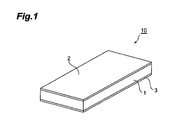
- Fig. 1 is a schematic perspective view of a preferred embodiment of an organic PTC thermistor according to the invention.
- Fig. 1 is a schematic perspective view of a preferred embodiment of an organic PTC thermistor according to the invention.
- the organic PTC thermistor (hereinafter also referred to as “thermistor”) 10 shown in Fig. 1 has a construction provided with a pair of mutually opposing electrodes 2 and 3 and a thermistor element with a positive resistance-temperature characteristic (hereinafter also referred to simply as “thermistor element”) 1 situated between the electrode 2 and electrode 3, and also if necessary a lead (not shown) electrically connected to the electrode 2 and a lead (not shown) electrically connected to the electrode 3.
- the shapes and materials of the electrode 2 and electrode 3 are not particularly restricted so long as they have electron conductivity sufficient to function as electrodes for a thermistor.
- the shapes and materials of the leads are also not particularly restricted so long as they have electron conductivity capable of releasing or introducing a charge from the electrode 2 and electrode 3 to the outside.
- the thermistor element 1 is formed from a cured body obtained by heating a mixture comprising an epoxy resin, a curing agent and conductive particles.
- the conductive particles are dispersed in the thennistor element 1 and held by a matrix formed from the epoxy resin and curing agent.
- the epoxy resin used to form the thennistor element 1 is not particularly restricted, but if the curing agent described hereunder does not impart flexibility to the cured body, the epoxy resin must be one which imparts flexibility to the cured body.
- epoxy resins for the invention there may be mentioned those having an average of two or more epoxy groups per molecule.
- polyhydric phenols such as bisphenol A, bisphenol F, bisphenol AD, catechols and resorcinols, or polyglycidyl ethers obtained by reaction between a polyhydric alcohol such as glycerin or polyethylene glycol and epichlorhydrin, glycidyl ether esters obtained by reaction between a hydroxycarboxylic acid such as p-hydroxybenzoic acid or ⁇ -hydroxynaphthoic acid and epichlorhydrin, polyglycidyl esters obtained by reaction between a polycarboxylic acid such as phthalic acid or terephthalic acid and epichlorhydrin, epoxidated phenol-novolac resins, epoxidated cresol-novolac resins and dicyclopentadiene-type epoxy resins.
- polyhydric phenols such as bisphenol A, bisphenol F, bisphenol AD, catechols and resorcinols
- polyglycidyl ethers obtained by reaction between
- a compound represented by the following general formula (1) is preferred for use as the main epoxy resin.
- R 1 , R 2 and R 3 each represent a single bond or a divalent organic group and at least one from among R 1 , R 2 and R 3 includes an optionally substituted C2 or greater divalent chain group, or alternatively R 1 , R 2 and R 3 in formula (1) each represent a single bond or a divalent organic group and at least one from among R 2 and R 3 includes an optionally substituted C1 or greater divalent hydrocarbon group bonded to the glycidyl ether group.
- divalent organic groups represented by the following general formulas (11) to (14).
- the thermistor element 1 of the organic PTC thermistor 10 of this embodiment has conductive particles dispersed in a matrix formed from an epoxy resin comprising a compound represented by general formula (1) above, and a curing agent.
- This allows the room temperature resistance value of the organic PTC thermistor to be adequately reduced, allows the resistance value change ratio for the PTC characteristic to be sufficiently increased, and can result in more excellent reliability of the organic PTC thermistor.
- the epoxy resin used to form the thermistor element 1 is an epoxy resin containing a compound represented by the following general formula (2).
- R 11 represents an optionally substituted C1-20 divalent chain group
- R 12 and R 13 may be the same or different and each represents a divalent organic group represented by the following general formula (a) or (b).
- -(Ar-X 1 )- In formula (a), Ar represents an optionally substituted divalent 5-membered cyclic group, 6-membered cyclic group, naphthalene group or anthracene group, and X 1 represents a C1 or greater divalent chain group.
- Y 1 represents an optionally substituted C1 or greater divalent chain group containing a carbon atom bonded to the glycidyl ether group.
- R 11 there may be mentioned chain groups such as -CH 2 -, -CH(CH 3 )-, -C(CH 3 ) 2 - and -C n H 2n - (where n is an integer of 2-20).
- R 12 and R 13 are the same they may both be, for example, a divalent organic group represented by (a) -C 4 H 6 -O-CH 2 CH 2 - or a divalent organic group represented by (b) -CH 2 -.
- R 12 and R 13 are different, for example, one may be a divalent organic group represented by (b) -CH 2 -, and the other a divalent organic group represented by (b) -CH 2 CH 2 -.
- R 11 is preferably a divalent organic group represented by -CH 2 -, -CH(CH 3 )- or -C(CH 3 ) 2 -
- R 12 and R 13 are preferably divalent organic groups represented by general formula (a) wherein Ar in general formula (a) is -C 6 H 4 .
- the compound is preferably represented by the following general formula (21), (22) or (23).
- X 11 represents a C1 or greater divalent chain group.
- the epoxy resin used to form the thermistor element 1 is an epoxy resin containing a compound represented by the following general formula (3), it will be possible to adequately reduce the room temperature resistance value of the organic PTC thermistor, to sufficiently increase the resistance value change ratio for the PTC characteristic, and to achieve more excellent reliability of the organic PTC thermistor.
- R 21 represents an optionally substituted C1-20 divalent chain group
- the epoxy resin used to form the thermistor element 1 is an epoxy resin containing a compound represented by the following general formula (4), it will be possible to adequately reduce the room temperature resistance value of the organic PTC thermistor, to sufficiently increase the resistance value change ratio for the PTC characteristic, and to achieve more excellent reliability of the organic PTC thermistor.
- R 31 represents an optionally substituted C1-20 divalent chain group
- R 32 and R 33 there may be mentioned divalent organic groups represented by the following general formulas (41) to (44). -(CH 2 ) d - where d represents an integer of 1-20. -(CH 2 CH 2 O) c - where e represents an integer of 1-20. -(CH 2 CH(CH 3 )O) f - or -(CH(CH 3 )CH 2 O) f - where f represents an integer of 1-20.
- At least one of R 32 and R 33 in general formula (4) above contains a structural unit represented by the following general formula (5), wherein the structural unit is bonded to the glycidyl ether group. -(R 4 -O) n -
- R 4 represents a C1-20 divalent hydrocarbon group
- n is an integer of 1-10.
- R 31 is a divalent organic group represented by -CH 2 -, -CH(CH 3 )- or -C(CH 3 ) 2 -
- R 32 and R 33 are divalent organic groups represented by -C 4 H 6 -(O-L) m - (where L represents a C1-20 chain group and m is an integer of 1-10).
- epoxy resin having a structural unit wherein at least one of R 2 and R 3 in formula (1) is -CO-O- or -O-CO- there may be mentioned "YD-171" (trade name of Toto Kasei).
- epoxy resins having a structural unit wherein at least one of R 2 and R 3 in formula (1) is -CH 2 O-, -OCH 2 -, -CH 2 S- or -SCH 2 - there may be mentioned "RIKARESIN BPO60E” (trade name of Shinnihon Rika), "YH-300” (trade name of Toto Kasei), "PG202” (trade name of Toto Kasei), "EP4085” (trade name of Asahi Denka), "RIKARESIN DME100” (trade name of Shinnihon Rika) and “RIKARESIN DME200” (trade name of Shinnihon Rika).
- the epoxy resin used to form the thennistor element 1 may consist solely of one or more compounds represented by general formula (1), (2), (3) or (4) above, or it may be a mixture of a compound represented by general formula (1), (2), (3) or (4) above and another epoxy resin. There are no particular restrictions on epoxy resins other than compounds represented by general formula (1), (2), (3) and (4) above, and for example, there may be mentioned those having an average of two or more epoxy groups per molecule.
- polyhydric phenols such as bisphenol A, bisphenol F, bisphenol AD, catechols and resorcinols, or polyglycidyl ethers obtained by reaction between a polyhydric alcohol such as glycerin or polyethylene glycol and epichlorhydrin, glycidyl ether esters obtained by reaction between a hydroxycarboxylic acid such as p-hydroxybenzoic acid or ⁇ -hydroxynaphthoic acid and epichlorhydrin, polyglycidyl esters obtained by reaction between a polycarboxylic acid such as phthalic acid or terephthalic acid and epichlorhydrin, epoxidated phenol-novolac resins, epoxidated cresol-novolac resins and dicyclopentadiene-type epoxy resins.
- polyhydric phenols such as bisphenol A, bisphenol F, bisphenol AD, catechols and resorcinols
- polyglycidyl ethers obtained by reaction between
- the aforementioned epoxy resins may be used alone or in combinations of two or more different types.
- the compounds represented by general formulas (1), (2), (3) and (4) above are preferably used in a proportion of 5-100 parts by weight, and more preferably in a proportion of 10-100 parts by weight, to 100 parts by weight as the total epoxy resin. If the proportion of compounds represented by general formulas (1), (2), (3) and (4) is less than 5 parts by weight, it will tend to be difficult for the obtained organic PTC thermistor to simultaneously exhibit the desired room temperature resistance value and the desired resistance change ratio, and the reliability will tend to be unsatisfactory.
- the curing agent used to form the thermistor element 1 there are no particular restrictions on the curing agent used to form the thermistor element 1 so long as it can react with the epoxy resin to form a cured body, but if the epoxy resin does not impart flexibility to the cured body, the curing agent must be one which imparts flexibility to the cured body.
- curing agents for the invention there may be mentioned publicly known curing agents such as acid anhydrides, aliphatic polyamines, aromatic polyamines, polyamides, phenols, polymercaptanes, tertiary amines and Lewis acid complexes.
- an acid anhydride is preferably used for this embodiment. Using an acid anhydride will tend to reduce the initial room temperature resistance value of the organic PTC thermistor compared to using an amine-based curing agent.
- Whether or not a certain compound qualifies as one which "imparts flexibility to the cured body" for this embodiment may be judged by whether or not it satisfies the condition determined by, for example, the following method.
- the condition is that for a mixture of the epoxy resin and the acid anhydride-containing curing agent in an equivalent ratio of 1:1, heat treated to form a cured body, the flexural modulus E3 (Pa) of the obtained cured body at 25°C must satisfy inequality (B) below with respect to the flexural modulus E2 (Pa) at 25°C of a cured body obtained by mixing the same epoxy resin and methylhexahydrophthalic anhydride as the curing agent in an equivalent ratio of 1:1 and heat treating it under the same conditions.
- E3 and E2 are the values measured based on a flexural modulus measuring method.
- An acid anhydride satisfying such condition may be judged as "an acid anhydride which imparts flexibility to the cured body" according to this embodiment.
- (E3/E2) is preferably 0.2-0.8. If (E3/E2) is greater than 0.8 it will tend to be difficult to achieve the effect of the invention, and if it is less than 0.2, the mechanical strength of the thermistor element will tend to be lower.
- Addition of the acid anhydride to the curing agent of this embodiment has the effect of relatively reducing the room temperature resistance value of the organic PTC thermistor employing the epoxy resin, while also imparting heat resistance and reducing the viscosity for improved workability.
- X 2 represents a divalent organic group with at least one C4 or greater hydrocarbon group.
- the C4 or greater hydrocarbon group may be a saturated hydrocarbon group or an unsaturated hydrocarbon group, and it may have a linear or branched structure.
- Y 2 represents a C4 or greater divalent hydrocarbon group.
- Z 1 represents a C2 or greater divalent hydrocarbon group.
- W 1 represents a C3 or greater trivalent hydrocarbon group.
- R 41 represents a C4-20 saturated or unsaturated hydrocarbon group.
- R 51 to R 53 may be the same or different and each represents a C4-20 saturated or unsaturated hydrocarbon group.
- R 61 represents a C4 or greater divalent hydrocarbon group.
- the hydrocarbon group may optionally have a substituent such as alkyl or phenyl so long as the number of carbon atoms of the main chain is 4 or greater.
- k in formula (VII) represents an integer of 1-20.
- R 71 represents a C2 or greater divalent hydrocarbon group.
- R 81 represents a C3 or greater trivalent hydrocarbon group.
- acid anhydrides which can impart flexibility to the cured body there may be mentioned aliphatic acid anhydrides such as dodecenylsuccinic anhydride, polyadipic anhydride, polyazelaic anhydride, polysebacic anhydride, poly(ethyloctadecanedioic) anhydride, poly(phenylhexadecanedioic) anhydride and 2,4-diethylglutaric anhydride, or aromatic acid anhydrides such as ethyleneglycol bisanhydrotrimellitate and glycerol tristrimellitate. These may be used alone or in combinations of two or more.
- the curing agent used to form the thermistor element 1 may consist solely of one or more of the aforementioned acid anhydrides, or it may be a mixture of one or more of the aforementioned acid anhydrides with one or more other curing agents.
- curing agents other than acid anhydrides which impart flexibility to the cured body so long as they can react with the epoxy resin to form a cured body
- publicly known curing agents such as acid anhydrides, aliphatic polyamines, aromatic polyamines, polyamides, phenols, polymercaptanes, tertiary amines and Lewis acid complexes, that do not satisfy formula (I) above.
- the aforementioned curing agents may be used alone or in combinations of two or more.
- the acid anhydride which imparts flexibility to the cured body is preferably used in a proportion of 5-100 parts by weight, and more preferably in a proportion of 20-100 parts by weight, to 100 parts by weight as the total curing agent. If the proportion of the acid anhydride which imparts flexibility to the cured body is less than 5 parts by weight, it will tend to be difficult for the obtained organic PTC thermistor to simultaneously exhibit the desired room temperature resistance value and the desired resistance change ratio.
- the proportion of the curing agent used to form the thermistor element I is preferably 0.5-1.5 and more preferably 0.8-1.2, as the equivalent ratio with respect to the total epoxy resin. If the equivalent ratio of the curing agent is less than 0.5 or greater than 1.5 with respect to the epoxy resin, the increased unreacted epoxy groups and acid anhydride groups will tend to result in lower mechanical strength of the thermistor element and a reduced resistance change ratio for the PTC characteristic of the thermistor.
- the conductive particles included in the thermistor element 1 are not particularly restricted so long as they have electron conductivity, and for example, there may be used carbon black, graphite, metal particles of various shapes and ceramic-based conductive particles.
- metal particles there may be mentioned copper, aluminum, nickel, tungsten, molybdenum, silver, zinc, cobalt and nickel-plated copper powder.
- ceramic-based conductive particles there may be mentioned TiC and WC. These materials maybe used alone or in combinations of two or more different types.
- Metal particles are preferably used for the organic PTC thermistor of this embodiment.
- metal particles are used as the conductive particles it is possible to adequately ensure the resistance change ratio of the thennistor and further reduce the room temperature resistance value, and this is preferred when, for example, the thermistor of the invention is to be used as an overcurrent protection element.
- the constituent material of the metal particles is preferably nickel from the standpoint of chemical stability, including resistance to oxidation.
- the shapes of the conductive particles are not particularly restricted, and they may be in the form of spheres, flakes, fibers, rods or the like, but particles having surface spike-like protrusions are preferred.
- using conductive particles having spike-like protrusions will facilitate flow of the tunnel current between adjacent particles, so that the resistance change ratio of the organic PTC thermistor can be adequately ensured and the room temperature resistance value can be further reduced.
- conductive particles having spike-like protrusions result in greater center distances between particles compared to spherical particles, a high resistance change ratio for the PTC characteristic can be obtained.
- variation between the room temperature resistance value of the thermistor can be minimized compared to using fiber-like particles.
- Conductive particles having spike-like protrusions may be in the form of a powder comprising separate individual particles (primary particles), but preferably 10-1000 primary particles are linked in chains to form filamentous secondary particles. By forming such filamentous secondary particles it is possible to obtain lower room temperature resistance and a stable room temperature resistance value with less variation.
- the material is preferably a metal, more preferably comprising nickel as the major component.
- the area to weight ratio is preferably 0.3-3.0 m 2 /g and the apparent density is preferably no greater than 3.0 g/cm 3 .
- the "area to weight ratio" is the specific surface area determined by nitrogen gas adsorption based on the BET one point method.
- the mean particle size of the primary particles is preferably 0.1-7.0 ⁇ m and more preferably 0.5-5.0 ⁇ m.
- the mean particle size is measured by the Fisher subsieve method.
- the proportion of conductive particles in the thermistor element 1 is preferably 50-90 wt% and more preferably 60-80 wt% as the content in the thermistor element. If the proportion of conductive particles is less than 50 wt% it will tend to be difficult to achieve a low room temperature resistance value, and if it is greater than 90 wt% it will tend to be difficult to achieve a larger resistance change ratio for the PTC characteristic.
- an additive such as a curing accelerator may be further added to the mixture comprising the epoxy resin, curing agent and conductive particles. Addition of a curing accelerator can lower the curing temperature for curing of the mixture and shorten the time required for curing.
- curing accelerators there may be mentioned commonly used curing accelerators such as tertiary amines, amine adduct compounds, imidazole adduct compounds, boric acid esters, Lewis acids, organic metal compounds, organic acid metal salts and imidazoles.
- imidazole adduct epoxy compounds are preferred for use as imidazole adduct compounds. They facilitate control of the curing rate and result in lower heat generation compared to tertiary amines or amine adduct compounds as curing accelerators, so that it is possible to prevent with greater certainty a level of heat generation which could cause carbonization of the resin forming the thermistor element 1.
- the amount of additives added is not particularly restricted so long as it is in a range which does not impede the effect of the invention.
- mixing step First, prescribed amounts of the epoxy resin, curing agent, conductive particles and if necessary, additives such as a curing accelerator are combined (mixing step).
- the apparatus used for the mixing step may be a publicly known apparatus such as a stirrer, disperser, mill or the like.
- the mixing time is not particularly restricted but will normally be from 10 to 60 minutes to allow thorough dispersion of the components.
- Vacuum defoaming is preferably carried out if air bubbles are to be included during the mixing treatment.
- a reactive diluent or an ordinary solvent may be used.
- solvents there may be mentioned IPA, acetone, methanol, methyl ethyl ketone (MEK), methyl isobutyl ketone (MIBK), toluene, xylene, dimethylformamide (DMF), dimethylsulfoxide (DMSO), THF, cellosolve acetate, ethyl acetate and the like.
- the obtained mixture is then coated onto a metal foil as the electrode using a method such as screen printing.
- the coated mixture is then sandwiched using another metal foil and press molded to form a sheet.
- the mixture may also be cast between metal foil electrodes such as nickel or copper to form a sheet.
- the obtained sheet is then subjected to heat treatment for curing (curing step).
- the mixture alone may be formed into a sheet using, for example, a doctor blade method and cured, and then conductive paste or the like coated thereon to form electrodes.
- the obtained cured sheet may then be punched into the desired shape (for example, 3.6 mm x 9 mm) to obtain a thermistor (punching step).
- the punching method used is not particularly restricted so long as it is a punching method ordinarily used for organic PTC thennistors.
- the surfaces of the electrodes of the thermistor obtained from the punching step may each be bonded to respective leads to fabricate a thermistor with leads.
- the lead bonding method used is not particularly restricted so long as it is one commonly employed for fabrication of organic PTC thermistors.
- the present invention is in no way limited to the preferred embodiments explained above for the organic PTC thermistor of the invention and production process therefor.
- the organic PTC thermistor may have a laminated construction comprising a plurality of thermistor elements.
- the organic PTC thermistor of the invention may be utilized as an overcurrent/overheat protection element, autoregulating heating element, temperature sensor or the like.
- BPO20E trade name of Shinnihon Rika
- epoxy equivalents 314 g/eq
- B570 trade name of Dainippon Ink Corporation
- acid anhydride equivalents 168 g/eq
- PN-40J trade name of
- filamentous nickel powder (“Type255 Nickel Powder”, trade name of INCO Ltd.; mean particle size: 2.2-2.8 ⁇ m, apparent density: 0.5-0.65 g/cm 3 , area to weight ratio: 0.68 m 2 /g) was added as conductive particles to 75 wt% of the mixture, which was further stirred to prepare a final mixture.
- the obtained mixture was coated onto a Ni foil (thickness: 25 ⁇ m) to form a coating with a thickness of 0.5 mm, and then the coated film was sandwiched with another Ni foil prior to press molding.
- the combination was placed in an oven and held for 5 hours at a temperature of 150°C for curing treatment, to obtain a cured sheet sandwiched between Ni foil electrodes.
- the obtained cured sheet was punched into a 3.6 x 9.0 mm shape to obtain an organic PTC thennistor.
- the thermistor was heated in a thermostatic chamber from room temperature (25°C) to 200°C at 3°C/min and then cooled, and the resistance value was measured at a prescribed temperature by the four-terminal method to obtain a temperature-resistance curve.
- a temperature-resistance curve was plotted for the obtained thermistor by the same method as Example 1.
- the initial room temperature resistance value was 2.0 x 10 -3 ⁇ (1.4 x 10 -2 ⁇ cm). Also, the resistance increased rapidly near 150°C, and the resistance change ratio was eight digits (10 8 ) or greater. After heating and cooling, the room temperature resistance value was 8.0 x 10 -3 ⁇ (5.6 x 10 -2 ⁇ cm).
- the room temperature resistance value after 10 cycles of a continuous load test at 6V-10A (1 cycle 10 seconds ON, 350 seconds OFF) was 0.016 ⁇ (1.1 x 10 -1 ⁇ cm).
- EPICLON850 trade name of Dainippon Ink Corporation
- epoxy equivalents 190 g/eq
- a temperature-resistance curve was plotted for the obtained thennistor by the same method as Example 1.
- the initial room temperature resistance value was 2.0 x 10 -3 ⁇ (1.4 x 10 -2 ⁇ cm). However, no significant resistance change was observed even with varying temperature, and the PTC characteristic was insufficient.
- An organic PTC thermistor was obtained in the same manner as Example 1, except that conductive particles were added to 60 wt% of the mixture.
- a temperature-resistance curve was plotted for the obtained thermistor by the same method as Example 1.
- the resistance increased rapidly near 150°C, and the resistance change ratio was eight digits (10 8 ) or greater.
- the initial room temperature resistance value was 1.0 x 10 -2 ⁇ (1.3 x 10 -1 ⁇ cm). After heating and cooling, the room temperature resistance value was 2.0 x 10 -2 ⁇ (2.6 x 10 -1 ⁇ cm).
- the room temperature resistance value after 10 cycles of a continuous load test at 6V-10A (1 cycle 10 seconds ON, 350 seconds OFF) was 0.15 ⁇ (1.06 ⁇ cm).
- the organic PTC thermistors of Examples 1 and 2 were confirmed to simultaneously exhibit adequately low room temperature resistance values and sufficiently high resistance change ratios. Also, the recovery of the room temperature resistance value after heating/cooling and the recovery of the room temperature resistance value after the continuous load test were satisfactory, thereby confirming excellent reliability.
- EPICLON850 trade name of Dainippon Ink Corporation
- epoxy equivalents 190 g/eq
- RIKASID DDSA dodecenylsuccinic anhydride
- acid anhydride equivalents 266 g/eq
- PN-40J trade name of Ajinomoto Fine
- filamentous nickel powder (“Type255 Nickel Powder”, trade name of INCO Ltd.; mean particle size: 2.2-2.8 ⁇ m, apparent density: 0.5-0.65 g/cm 3 , area to weight ratio: 0.68 m 2 /g) was added as conductive particles to 75 wt% of the mixture, which was further stirred to prepare a final mixture.
- the obtained mixture was coated onto a Ni foil (thickness: 25 ⁇ m) by a printing method to form a coating with a thickness of 0.5 mm, and then the coated film was sandwiched with another Ni foil prior to press molding.
- the combination was placed in an oven and held for 300 minutes at a temperature of 150°C for curing treatment, to obtain a cured sheet sandwiched between Ni foil electrodes.
- the obtained cured sheet was punched into a 3.6 x 9.0 mm shape to obtain an organic PTC thermistor for Example 3.
- the thermistor was heated in a thermostatic chamber from room temperature (25°C) to 200°C at 3°C/min and then cooled, and the resistance value was measured at a prescribed temperature by the four-terminal method to obtain a temperature-resistance curve.
- the organic PTC thermistor of Example 3 had an initial room temperature resistance value of 3.0 x 10 -3 ⁇ (1.3 x 10 -2 ⁇ cm). Also, the resistance increased rapidly near 130°C, and the resistance change ratio was seven digits (10 7 ) or greater. After heating and cooling, the room temperature resistance value was 6.0 x 10 -3 ⁇ (3.9 x 10 -2 ⁇ cm). These results are summarized in Table 2.
- a temperature-resistance curve was plotted for the thermistor of Example 4 by the same method as Example 3.
- the initial room temperature resistance value was 2.0 x 10 -3 ⁇ (1.3 x 10 -2 ⁇ cm). Also, the resistance increased rapidly near 130°C, and the resistance change ratio was six digits (10 6 ) or greater. After heating and cooling, the room temperature resistance value was 4.0 x 10 -3 ⁇ (2.6 x 10 -2 ⁇ cm).
- OSA octenylsuccinic anhydride
- a temperature-resistance curve was plotted for the thermistor of Example 5 by the same method as Example 3.
- the initial room temperature resistance value was 3.0 x 10 -3 ⁇ (1.9 x 10 -2 ⁇ cm). Also, the resistance increased rapidly near 130°C, and the resistance change ratio was seven digits (10 7 ) or greater. After heating and cooling, the room temperature resistance value was 4.0 x 10 -3 ⁇ (2.6 x 10 -2 ⁇ cm).
- a temperature-resistance curve was plotted for the thermistor of Comparative Example 3 by the same method as Example 3.
- the initial room temperature resistance value was 3.0 x 10 -3 ⁇ (1.9 x 10 -2 ⁇ cm).
- the resistance change ratio was less than one digit (10 1 ) even with temperature variation, and a satisfactory PTC characteristic was not achieved.
- a temperature-resistance curve was plotted for the thermistor of Comparative Example 4 by the same method as Example 3.
- the initial room temperature resistance value was 4.0 x 10 -3 ⁇ (2.6 x 10 -2 ( ⁇ cm).
- the resistance change ratio was about one digit (10 1 ) even with temperature variation, and a satisfactory PTC characteristic was not achieved.
- a temperature-resistance curve was plotted for the thermistor of Comparative Example 5 by the same method as Example 3.
- the initial room temperature resistance value was 3.0 x 10 -3 ⁇ (1.9 x 10 -2 ⁇ cm).
- the resistance change ratio was less than one digit (10 1 ) even with temperature variation, and a satisfactory PTC characteristic was not achieved.
- the organic PTC thermistors of Examples 3-5 were confirmed to simultaneously exhibit adequately low room temperature resistance values and sufficiently high resistance change ratios. Also, the recovery of the room temperature resistance value after heating/cooling was satisfactory, thereby confirming excellent reliability.
Landscapes
- Engineering & Computer Science (AREA)
- Health & Medical Sciences (AREA)
- Rehabilitation Therapy (AREA)
- Microelectronics & Electronic Packaging (AREA)
- Life Sciences & Earth Sciences (AREA)
- Ceramic Engineering (AREA)
- Animal Behavior & Ethology (AREA)
- General Health & Medical Sciences (AREA)
- Public Health (AREA)
- Veterinary Medicine (AREA)
- Pain & Pain Management (AREA)
- Epidemiology (AREA)
- Chemical & Material Sciences (AREA)
- Dispersion Chemistry (AREA)
- Physical Education & Sports Medicine (AREA)
- Physics & Mathematics (AREA)
- Electromagnetism (AREA)
- Mechanical Engineering (AREA)
- Thermistors And Varistors (AREA)
- Epoxy Resins (AREA)
Applications Claiming Priority (4)
| Application Number | Priority Date | Filing Date | Title |
|---|---|---|---|
| JP2004107791A JP4261407B2 (ja) | 2004-03-31 | 2004-03-31 | 有機質正特性サーミスタ |
| JP2004107791 | 2004-03-31 | ||
| JP2004107888 | 2004-03-31 | ||
| JP2004107888A JP4220428B2 (ja) | 2004-03-31 | 2004-03-31 | 有機質正特性サーミスタ |
Publications (2)
| Publication Number | Publication Date |
|---|---|
| EP1585145A1 true EP1585145A1 (fr) | 2005-10-12 |
| EP1585145B1 EP1585145B1 (fr) | 2007-05-09 |
Family
ID=34914558
Family Applications (1)
| Application Number | Title | Priority Date | Filing Date |
|---|---|---|---|
| EP05007120A Expired - Lifetime EP1585145B1 (fr) | 2004-03-31 | 2005-03-31 | Thermistor à coefficient positif de température organique |
Country Status (6)
| Country | Link |
|---|---|
| US (1) | US7241402B2 (fr) |
| EP (1) | EP1585145B1 (fr) |
| KR (1) | KR100673809B1 (fr) |
| CN (1) | CN100458983C (fr) |
| DE (1) | DE602005001078T2 (fr) |
| TW (1) | TW200609953A (fr) |
Families Citing this family (4)
| Publication number | Priority date | Publication date | Assignee | Title |
|---|---|---|---|---|
| JP2007042667A (ja) * | 2005-07-29 | 2007-02-15 | Tdk Corp | 有機質正特性サーミスタ |
| EP2578624A1 (fr) * | 2011-10-06 | 2013-04-10 | Henkel Italia S.p.A. | Thermistors PTC polymériques |
| US20150240099A1 (en) * | 2014-02-24 | 2015-08-27 | Xerox Corporation | Silver flake conductive paste ink with nickel particles |
| WO2017171392A1 (fr) * | 2016-03-30 | 2017-10-05 | 주식회사 아모센스 | Unité à coefficient de température positif pour dispositif de chauffage de véhicule, dispositif de chauffage à coefficient de température positif la comprenant, et dispositif de climatisation pour véhicule |
Citations (4)
| Publication number | Priority date | Publication date | Assignee | Title |
|---|---|---|---|---|
| US5250228A (en) * | 1991-11-06 | 1993-10-05 | Raychem Corporation | Conductive polymer composition |
| EP0896344A2 (fr) * | 1997-07-21 | 1999-02-10 | General Electric Company | Dispositif limitateur de courant en matériau composite électriquement conducteur et procédé de fabrication du matériau électriquement conducteur |
| US6459358B1 (en) * | 1999-09-27 | 2002-10-01 | Eaton Corporation | Flexible moldable conductive current-limiting materials |
| WO2004086421A1 (fr) * | 2003-03-25 | 2004-10-07 | Tdk Corporation | Thermistance organique a coefficient de temperature positif |
Family Cites Families (4)
| Publication number | Priority date | Publication date | Assignee | Title |
|---|---|---|---|---|
| FR2614130B1 (fr) | 1987-04-15 | 1992-01-17 | Lorraine Carbone | Materiau ayant une resistivite a coefficient de temperature positif |
| JP3101048B2 (ja) | 1992-01-20 | 2000-10-23 | ティーディーケイ株式会社 | 有機質正特性サーミスタ |
| JP3101047B2 (ja) | 1992-01-20 | 2000-10-23 | ティーディーケイ株式会社 | 有機質正特性サーミスタ |
| US6375867B1 (en) * | 1993-11-29 | 2002-04-23 | Eaton Corporation | Process for making a positive temperature coefficient conductive polymer from a thermosetting epoxy resin and conductive fillers |
-
2005
- 2005-03-23 TW TW094108980A patent/TW200609953A/zh unknown
- 2005-03-30 KR KR1020050026404A patent/KR100673809B1/ko not_active Expired - Fee Related
- 2005-03-30 US US11/092,643 patent/US7241402B2/en not_active Expired - Fee Related
- 2005-03-31 EP EP05007120A patent/EP1585145B1/fr not_active Expired - Lifetime
- 2005-03-31 DE DE602005001078T patent/DE602005001078T2/de not_active Expired - Fee Related
- 2005-03-31 CN CNB2005100598567A patent/CN100458983C/zh not_active Expired - Fee Related
Patent Citations (4)
| Publication number | Priority date | Publication date | Assignee | Title |
|---|---|---|---|---|
| US5250228A (en) * | 1991-11-06 | 1993-10-05 | Raychem Corporation | Conductive polymer composition |
| EP0896344A2 (fr) * | 1997-07-21 | 1999-02-10 | General Electric Company | Dispositif limitateur de courant en matériau composite électriquement conducteur et procédé de fabrication du matériau électriquement conducteur |
| US6459358B1 (en) * | 1999-09-27 | 2002-10-01 | Eaton Corporation | Flexible moldable conductive current-limiting materials |
| WO2004086421A1 (fr) * | 2003-03-25 | 2004-10-07 | Tdk Corporation | Thermistance organique a coefficient de temperature positif |
Also Published As
| Publication number | Publication date |
|---|---|
| CN100458983C (zh) | 2009-02-04 |
| KR100673809B1 (ko) | 2007-01-25 |
| US7241402B2 (en) | 2007-07-10 |
| TW200609953A (en) | 2006-03-16 |
| KR20060044994A (ko) | 2006-05-16 |
| US20050237148A1 (en) | 2005-10-27 |
| EP1585145B1 (fr) | 2007-05-09 |
| CN1677577A (zh) | 2005-10-05 |
| DE602005001078D1 (de) | 2007-06-21 |
| DE602005001078T2 (de) | 2007-08-30 |
Similar Documents
| Publication | Publication Date | Title |
|---|---|---|
| EP1246280B1 (fr) | Composition pour la formation d'électrodes et électrodes | |
| KR101788731B1 (ko) | 액상 조성물, 및 그것을 사용한 저항체막, 저항체 소자 및 배선판 | |
| KR101870005B1 (ko) | 고분자성 ptc 서미스터 | |
| JPS6251972B2 (fr) | ||
| JP3469491B2 (ja) | 燃料電池用セパレーター用樹脂組成物及び燃料電池用セパレーター | |
| EP0031904B1 (fr) | Composition thermodurcissable résistant à la chaleur | |
| EP1585145A1 (fr) | Thermistor à coefficient positif de température organique | |
| JP2006210223A (ja) | 燃料電池用セパレータ | |
| US4499010A (en) | Conductive paint | |
| US7314583B2 (en) | Organic positive temperature coefficient thermistor device | |
| JP3841733B2 (ja) | 導電性組成物、それを含有する導電性塗料、導電性接着剤および電磁波シールド剤 | |
| JP4261407B2 (ja) | 有機質正特性サーミスタ | |
| US7403092B2 (en) | Thermistor | |
| EP0352550B1 (fr) | Composition de résine pour laminé | |
| JP4346045B2 (ja) | 金属張り積層板の製造方法 | |
| JP4220428B2 (ja) | 有機質正特性サーミスタ | |
| US20070024413A1 (en) | Organic positive temperature coefficient thermistor | |
| JP4262152B2 (ja) | サーミスタ | |
| JP2005294550A (ja) | 有機質正特性サーミスタ | |
| CN101489351B (zh) | 线路板埋入型固体电解电容器以及使用该线路板埋入型固体电解电容器的线路板 | |
| JP2018106906A (ja) | 電極用ペーストおよび積層セラミック電子部品 | |
| JP2006019432A (ja) | サーミスタ | |
| JP5764824B2 (ja) | 導電性接着剤組成物及びそれを用いた電子素子 | |
| JPS6274975A (ja) | 導電性インキ | |
| JP2025104774A (ja) | 導電性接着剤 |
Legal Events
| Date | Code | Title | Description |
|---|---|---|---|
| PUAI | Public reference made under article 153(3) epc to a published international application that has entered the european phase |
Free format text: ORIGINAL CODE: 0009012 |
|
| AK | Designated contracting states |
Kind code of ref document: A1 Designated state(s): AT BE BG CH CY CZ DE DK EE ES FI FR GB GR HU IE IS IT LI LT LU MC NL PL PT RO SE SI SK TR |
|
| AX | Request for extension of the european patent |
Extension state: AL BA HR LV MK YU |
|
| 17P | Request for examination filed |
Effective date: 20060201 |
|
| AKX | Designation fees paid |
Designated state(s): DE FR GB NL |
|
| 17Q | First examination report despatched |
Effective date: 20060227 |
|
| GRAP | Despatch of communication of intention to grant a patent |
Free format text: ORIGINAL CODE: EPIDOSNIGR1 |
|
| GRAS | Grant fee paid |
Free format text: ORIGINAL CODE: EPIDOSNIGR3 |
|
| GRAA | (expected) grant |
Free format text: ORIGINAL CODE: 0009210 |
|
| AK | Designated contracting states |
Kind code of ref document: B1 Designated state(s): DE FR GB NL |
|
| REG | Reference to a national code |
Ref country code: GB Ref legal event code: FG4D |
|
| REF | Corresponds to: |
Ref document number: 602005001078 Country of ref document: DE Date of ref document: 20070621 Kind code of ref document: P |
|
| ET | Fr: translation filed | ||
| PLBE | No opposition filed within time limit |
Free format text: ORIGINAL CODE: 0009261 |
|
| STAA | Information on the status of an ep patent application or granted ep patent |
Free format text: STATUS: NO OPPOSITION FILED WITHIN TIME LIMIT |
|
| 26N | No opposition filed |
Effective date: 20080212 |
|
| PGFP | Annual fee paid to national office [announced via postgrant information from national office to epo] |
Ref country code: FR Payment date: 20080319 Year of fee payment: 4 |
|
| PGFP | Annual fee paid to national office [announced via postgrant information from national office to epo] |
Ref country code: DE Payment date: 20090327 Year of fee payment: 5 |
|
| GBPC | Gb: european patent ceased through non-payment of renewal fee |
Effective date: 20090331 |
|
| NLV4 | Nl: lapsed or anulled due to non-payment of the annual fee |
Effective date: 20091001 |
|
| REG | Reference to a national code |
Ref country code: FR Ref legal event code: ST Effective date: 20091130 |
|
| PG25 | Lapsed in a contracting state [announced via postgrant information from national office to epo] |
Ref country code: NL Free format text: LAPSE BECAUSE OF NON-PAYMENT OF DUE FEES Effective date: 20091001 |
|
| PG25 | Lapsed in a contracting state [announced via postgrant information from national office to epo] |
Ref country code: GB Free format text: LAPSE BECAUSE OF NON-PAYMENT OF DUE FEES Effective date: 20090331 Ref country code: FR Free format text: LAPSE BECAUSE OF NON-PAYMENT OF DUE FEES Effective date: 20091123 |
|
| PG25 | Lapsed in a contracting state [announced via postgrant information from national office to epo] |
Ref country code: DE Free format text: LAPSE BECAUSE OF NON-PAYMENT OF DUE FEES Effective date: 20101001 |