EP1583167A1 - Batterierahmen und Batterie - Google Patents
Batterierahmen und Batterie Download PDFInfo
- Publication number
- EP1583167A1 EP1583167A1 EP05006427A EP05006427A EP1583167A1 EP 1583167 A1 EP1583167 A1 EP 1583167A1 EP 05006427 A EP05006427 A EP 05006427A EP 05006427 A EP05006427 A EP 05006427A EP 1583167 A1 EP1583167 A1 EP 1583167A1
- Authority
- EP
- European Patent Office
- Prior art keywords
- insulating
- battery
- conductive
- conductive member
- insulating member
- Prior art date
- Legal status (The legal status is an assumption and is not a legal conclusion. Google has not performed a legal analysis and makes no representation as to the accuracy of the status listed.)
- Withdrawn
Links
- 230000015572 biosynthetic process Effects 0.000 abstract description 8
- 230000017525 heat dissipation Effects 0.000 description 4
- 239000005001 laminate film Substances 0.000 description 4
- XAGFODPZIPBFFR-UHFFFAOYSA-N aluminium Chemical compound [Al] XAGFODPZIPBFFR-UHFFFAOYSA-N 0.000 description 3
- 229910052782 aluminium Inorganic materials 0.000 description 3
- 238000010276 construction Methods 0.000 description 3
- 230000000694 effects Effects 0.000 description 3
- 238000003466 welding Methods 0.000 description 3
- RYGMFSIKBFXOCR-UHFFFAOYSA-N Copper Chemical compound [Cu] RYGMFSIKBFXOCR-UHFFFAOYSA-N 0.000 description 2
- 239000000470 constituent Substances 0.000 description 2
- 229910052802 copper Inorganic materials 0.000 description 2
- 239000010949 copper Substances 0.000 description 2
- 238000000034 method Methods 0.000 description 2
- FYYHWMGAXLPEAU-UHFFFAOYSA-N Magnesium Chemical compound [Mg] FYYHWMGAXLPEAU-UHFFFAOYSA-N 0.000 description 1
- 239000000853 adhesive Substances 0.000 description 1
- 230000001070 adhesive effect Effects 0.000 description 1
- 239000004020 conductor Substances 0.000 description 1
- 230000002542 deteriorative effect Effects 0.000 description 1
- 239000011810 insulating material Substances 0.000 description 1
- 238000005304 joining Methods 0.000 description 1
- 229910052749 magnesium Inorganic materials 0.000 description 1
- 239000011777 magnesium Substances 0.000 description 1
- 238000004519 manufacturing process Methods 0.000 description 1
- 239000000463 material Substances 0.000 description 1
- 230000000149 penetrating effect Effects 0.000 description 1
Images





Classifications
-
- H—ELECTRICITY
- H01—ELECTRIC ELEMENTS
- H01M—PROCESSES OR MEANS, e.g. BATTERIES, FOR THE DIRECT CONVERSION OF CHEMICAL ENERGY INTO ELECTRICAL ENERGY
- H01M50/00—Constructional details or processes of manufacture of the non-active parts of electrochemical cells other than fuel cells, e.g. hybrid cells
- H01M50/20—Mountings; Secondary casings or frames; Racks, modules or packs; Suspension devices; Shock absorbers; Transport or carrying devices; Holders
-
- H—ELECTRICITY
- H01—ELECTRIC ELEMENTS
- H01M—PROCESSES OR MEANS, e.g. BATTERIES, FOR THE DIRECT CONVERSION OF CHEMICAL ENERGY INTO ELECTRICAL ENERGY
- H01M10/00—Secondary cells; Manufacture thereof
- H01M10/04—Construction or manufacture in general
- H01M10/0486—Frames for plates or membranes
-
- H—ELECTRICITY
- H01—ELECTRIC ELEMENTS
- H01M—PROCESSES OR MEANS, e.g. BATTERIES, FOR THE DIRECT CONVERSION OF CHEMICAL ENERGY INTO ELECTRICAL ENERGY
- H01M10/00—Secondary cells; Manufacture thereof
- H01M10/02—Details
-
- H—ELECTRICITY
- H01—ELECTRIC ELEMENTS
- H01M—PROCESSES OR MEANS, e.g. BATTERIES, FOR THE DIRECT CONVERSION OF CHEMICAL ENERGY INTO ELECTRICAL ENERGY
- H01M10/00—Secondary cells; Manufacture thereof
- H01M10/04—Construction or manufacture in general
- H01M10/0413—Large-sized flat cells or batteries for motive or stationary systems with plate-like electrodes
-
- H—ELECTRICITY
- H01—ELECTRIC ELEMENTS
- H01M—PROCESSES OR MEANS, e.g. BATTERIES, FOR THE DIRECT CONVERSION OF CHEMICAL ENERGY INTO ELECTRICAL ENERGY
- H01M50/00—Constructional details or processes of manufacture of the non-active parts of electrochemical cells other than fuel cells, e.g. hybrid cells
- H01M50/50—Current conducting connections for cells or batteries
-
- Y—GENERAL TAGGING OF NEW TECHNOLOGICAL DEVELOPMENTS; GENERAL TAGGING OF CROSS-SECTIONAL TECHNOLOGIES SPANNING OVER SEVERAL SECTIONS OF THE IPC; TECHNICAL SUBJECTS COVERED BY FORMER USPC CROSS-REFERENCE ART COLLECTIONS [XRACs] AND DIGESTS
- Y02—TECHNOLOGIES OR APPLICATIONS FOR MITIGATION OR ADAPTATION AGAINST CLIMATE CHANGE
- Y02E—REDUCTION OF GREENHOUSE GAS [GHG] EMISSIONS, RELATED TO ENERGY GENERATION, TRANSMISSION OR DISTRIBUTION
- Y02E60/00—Enabling technologies; Technologies with a potential or indirect contribution to GHG emissions mitigation
- Y02E60/10—Energy storage using batteries
-
- Y—GENERAL TAGGING OF NEW TECHNOLOGICAL DEVELOPMENTS; GENERAL TAGGING OF CROSS-SECTIONAL TECHNOLOGIES SPANNING OVER SEVERAL SECTIONS OF THE IPC; TECHNICAL SUBJECTS COVERED BY FORMER USPC CROSS-REFERENCE ART COLLECTIONS [XRACs] AND DIGESTS
- Y02—TECHNOLOGIES OR APPLICATIONS FOR MITIGATION OR ADAPTATION AGAINST CLIMATE CHANGE
- Y02P—CLIMATE CHANGE MITIGATION TECHNOLOGIES IN THE PRODUCTION OR PROCESSING OF GOODS
- Y02P70/00—Climate change mitigation technologies in the production process for final industrial or consumer products
- Y02P70/50—Manufacturing or production processes characterised by the final manufactured product
Definitions
- the present invention relates to battery frames used when stacking flat cells to form a battery, and a battery in which the frames are used.
- a plurality of single cells is combined in series or parallel to form a battery or a module battery with high power and capacity.
- a plurality of flat single cells each having an electric-power generating element covered with laminate films, is connected to each other in series or parallel to form a battery with high power and capacity (see Japanese Patent Laid-Open Publication No. 2001-256939).
- a flat single cell in which an electric-power generating element is covered with laminate films is called a laminate cell.
- a battery is formed using laminate cells of this kind, a plurality of laminate cells is located on the same plane, a plurality of sets of these laminate cells on the same plane is further stacked, and then these laminate cells are connected to each other in series or parallel. By stacking the laminate cells like this, a battery with higher power and capacity can be formed.
- laminate cells are located on a plate-like frame and a plurality of frames where the cells are located is stacked, thus improving workability in assembling a stack-type battery.
- washers made of a conductive material may be incorporated in the frames at positions where electrode tabs of the laminate cells lie.
- washers made of insulating material may be incorporated in the frames.
- the washers are fixed to the frames by an adhesive or the like. If the washers and laminate cells have the same height, no loads are applied to the frames.
- An object of the present invention is to provide a battery frame which does not lower workability when assembling a battery and prevents deformation thereof, and a battery in which the frame is used.
- the first aspect of the present invention provides a battery frame comprising: any one of a conductive member and an insulating member which are sandwiched between electrode tabs of flat cells arranged in a stacking direction when a battery is formed, the conductive member electrically connecting the flat cells to each other and the insulating member electrically insulating the flat cells from each other; a holding member which holds any one of the conductive member and the insulating member so that the conductive member or the insulating member can swing in the stacking direction; and an electrode supporting portion in which the holding member is provided and which supports each of the electrode tabs of the flat cells.
- the second aspect of the present invention provides a battery comprising: a plurality of flat cells; and a plurality of frames stacked while the flat cells are mounted and positioned thereon, wherein each of the frames includes; any one of a conductive member and an insulating member which are sandwiched between electrode tabs of flat cells arranged in a stacking direction when the battery is formed, the conductive member electrically connecting the flat cells to each other and the insulating member electrically insulating the flat cells from each other; a holding member which holds any one of the conductive member and the insulating member so that the conductive member or the insulating member can swing in the stacking direction; and an electrode supporting portion in which the holding member is provided and which supports each of the electrode tabs of the flat cells.
- the third aspect of the present invention provides a battery frame, comprising: any one of a conductive member and an insulating member which are sandwiched between electrode tabs of flat cells arranged in a stacking direction when a battery is formed, the conductive member electrically connecting the flat cells to each other and the insulating member electrically insulating the flat cells from each other; holding means for holding any one of the conductive member and the insulating member so that the conductive member or the insulating member can swing in the stacking direction; and an electrode supporting portion in which the holding means is provided and which supports each of the electrode tabs of the flat cells.
- the entire battery to which the present invention is applied is first described, and then each constituent will be detailed.
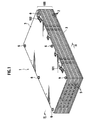
- a cell unit 100 made of a plurality of plate-shaped battery frames 2 stacked in the thickness direction, is sandwiched and pressed with heat sinks 3 from both sides in the stacking direction, and the cell unit 100 and the heat sinks 3 are held together, thus forming a battery 1.
- each frame 2 As shown in FIGS. 4 and 5, four flat single cells 10 are arranged on each frame 2.
- the frames 2 in this state are stacked so that the battery 1 is constructed.
- 24 frames are stacked and an intermediate heat sink 5 is interposed between every six frames in the stacking direction. This means that, in each battery 1, 24 sets of four parallel-located single cells are stacked. Therefore, each battery 1 has 96 single cells in total.
- Each pressure unit for connecting both heat sinks 3 and 5 to each other are attached with nuts 6, thus fixing the heat sinks 3 and 5.
- Each pressure unit includes shafts fixed to both ends of a tension coil spring with the nuts 6. By attaching this unit between the heat sinks 3 and 5, appropriate surface pressure is applied in the stacking direction to all single cells which construct the cell unit 100.
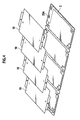
- FIG. 2 The stack construction of the battery 1 is shown in FIG. 2. This drawing simplifies the construction for easy understanding of the present invention. In this drawing, there are only four frames 2 between the heat sinks 3 and 5, but in reality there are six frames provided between the heat sinks 3 and 4 in this embodiment.
- a layer of single cells 10 is located on each frame 2, and these frames 2 are stacked within the battery 1.
- the single cell 10 is flat, and a positive electrode tab 11 and a negative electrode tab 12 are drawn out from the flat body.
- the positive electrode tab 11 and the negative electrode tab 12 are connected to an electric-power generating element within the single cell 10, respectively.
- Through holes 13 and 14 are formed in the positive and negative electrode tabs 11 and 12, respectively.
- the positive electrode tab 11 and the negative electrode tab 12 are alternately located in the stacking direction.
- the positive and negative electrode tabs 11 and 12, which are alternately located, are connected to each other on the right and left sides in FIG. 2. This means that the single cells 10 are connected to each other in series in the stacking direction.
- a method of connecting the neighboring single cells 10 to each other in the stacking direction is as follows.
- An opening portion 21 is provided in each frame 2 on the left side in FIG. 2.
- the positive and negative electrode tabs 11 and 12 of the single cells 10 neighboring each other in the stacking direction are joined together by ultrasonic welding.
- the single cell 10 is connected only to any one of the single cells 10 on the upper and lower layers.
- the positive electrode tab 11 of the first layer and the negative electrode tab 12 of the second layer are joined together by ultrasonic welding at the opening portion 21
- the positive electrode tab 11 of the third layer and the negative electrode tab 12 of the fourth layer are joined together by ultrasonic bonding at the opening portion 21. Accordingly, on the left side in the drawing, the positive and negative electrode tabs 11 and 12 neighboring each other in the stacking direction are electrically connected to each other by ultrasonic welding.
- a conductive washer 7 (a conductive member) or an insulating washer 8 (an insulating member) is located in each frame 2.
- the thicknesses of these washers are the same or larger those of the frames 2.
- the frames 2 are stacked so that the conductive washer 7 and the insulating washer 8 are arranged alternately in the stacking direction.
- the positive and negative electrode tabs 11 and 12, which sandwich the conductive washer 7, are thus electrically connected to each other, and the positive and negative electrode tabs 11 and 12, which sandwich the insulating washer 8, are insulated from each other.
- the conductive washer 7 is located between the positive electrode tab 11 of the second layer and the negative electrode tab 12 of the third layer, and the insulating washer 8 is located between the negative electrode tab 12 of the third layer and the positive electrode tab 11 of the fourth layer. Accordingly, on the right side of the drawing, the positive electrode tab 11 and the negative electrode tab 12 neighboring each other in the stacking direction are electrically connected to each other through the conductive washer 7.
- Each of the conductive washers 7 and the insulating washers 8 is held by a holding member provided in the frame 2 so that the washers can swing in the stacking direction.
- the holding member will be described later.
- a bolt 9 is inserted though the conductive washers 7 and the insulating washers 8 as well as the positive electrode tabs 11 and the negative electrode tabs 12.
- each bolt 9 at least an area which comes into contact with the conductive washers 7 and the insulating washers 8, is covered with insulating members. Both ends of the bolt 9 are fastened by the nuts 90. Therefore, the conductive washers 7 and the insulating washers 8 are pressed from both sides in the stacking direction, ensuring that the conductive washer 7 or the insulating washer 8 and the positive electrode tab 11 or the negative electrode tab 12 are connected to each other.
- a bus-bar 91 is inserted between the insulating washer 8 of the lowermost layer and the heat sink 3.
- the bus-bar 91 allows the neighboring cell units 100 to be electrically connected to each other. Therefore, all 96 single cells 10 are connected to each other in series within the battery 1.
- the single cells located on the frames 2 are serially connected to each other in the stacking direction, and the cell units 100 are connected to each other through the bus-bar 91, forming a single battery with high power.
- Reference numeral 101 in the drawing represents a negative electrode terminal of the battery and Reference numeral 102 represents a positive electrode terminal of the battery.
- the single cell 10 used in this embodiment is a flat secondary cell having a rectangular shape as shown in FIG. 3 and provided with an electric-power generating element therein in which at least a positive electrode plates and a negative electrode plates are alternately stacked.
- the single cell 10 has a construction disclosed in Japanese Patent Laid-Open Publication No. 2003-059486.
- Laminate films are used as sheath members for the single cell 10.
- the electric-power generating element within the single cell 10 is sealed by joining the outer peripheries of the laminate films by thermal bonding.
- the positive electrode tab 11 and the negative electrode tab 12 are drawn out from both sides of the single cell 10 in the longitudinal direction.
- the positive electrode tab 11 is constituted by, for example, an about 0.2 mm-thick aluminum sheet.
- the negative electrode tab 12 is constructed by, for example, an about 0.2 mm-thick copper sheet.
- the positive and negative electrode tabs 11 and 12 are provided with the through holes 13 and 14, respectively, through which the bolts 9 are inserted.
- the outer periphery of the single cell 10, which has been joined together by thermal bonding, is positioned on the frame and supported.
- the direction of stacking the single cells 10 is the same as the direction of stacking the positive and negative electrode plates which construct the electric-power generating element.
- the battery 1 is configured by single cells, each having electrode tabs of different polarities on the two opposite sides of the cell as shown in FIG. 3.
- the battery 1 may be constructed by using single cells in which electrode tabs of different polarities are attached only on one side as disclosed in Japanese Patent Laid-Open Publication No. 2003-059486. Where this type of single cells are used, however, the structure of the frame and a method of connecting the single cells will be largely different from those of this embodiment.
- a single flat cell is used as the single cell.
- a plurality of cells, which are connected to each other in series, parallel, or both in series and parallel may be held on the frame as the single cell.
- the heat sinks used in this embodiment are of two types: the heat sinks 3 located on the uppermost and lowermost layers; and the intermediate heat sink 5, at least one of which is interposed between the stacked frames 2.
- Both the heat sinks 3 and 5 play a role of heat dissipation boards which dissipate heat from the battery 1.
- the heat sinks 3 and 5 are made of, for example, copper, aluminum and magnesium, but the most suitable material is aluminum in terms of heat dissipation performance and light weight.
- the heat sink 5 has air vents penetrating therethrough in the longitudinal direction so as to improve heat dissipation efficiency.
- Locating pins for positioning the stacked frames are provided at four corners of the heat sinks 3 on the lowermost layers. Therefore, of course, the frames 2 are provided with holes (not shown) through which the locating pins are inserted. When stacking the frames 2 onto the heat sink 3, these locating pins are inserted into the holes of the frames 2 for positioning of the frames.
- the heat sinks 3 also play a role to apply appropriate surface pressure to the cell unit 100 and hold the cell unit 100 integrally with the heat sinks 3.
- the pressure units are attached between the heat sinks 3 in order to apply surface pressure to the cell unit 100.
- Each pressure unit has a tension coil spring and spring fixing portions, each being screwed with the end of the tension coil spring so that the ends of the spring are fixed to the heat sinks.
- the tension coil spring is fixed to the heat sinks 3 so that the tension coil spring is extended between the heat sinks 3. Hence, surface pressure is applied to the cell unit 100 between the heat sinks 3.
- the battery frame 2 used in this embodiment has electrode supporting portions 22 which support the positive electrode tabs 11 and the negative electrode tabs 12 of the single cells 10.
- the conductive washers 7 or insulating washers 8 are located on the electrode supporting portions 22 on one side of the frame, respectively. This is to connect the single cells 10 to each other in the stacking direction as stated earlier.
- the thickness dimension (dimension in the stacking direction) of the frame 2 is smaller than those of the conductive washers 7 or the insulating washers 8. This is because, if the thickness dimensions of the conductive washers 7 are not larger than that of the frame 2, the positive electrode tab 11 and negative electrode tab 12 cannot be electrically continuous.
- FIG. 5 explains a case where the conductive washers 7 are held on the frame 2.
- the insulating washers 8 may, of course, be held in the frame 2.
- the conductive washers 7 are held by holding members 25A formed in the electrode supporting portions 22.
- each holding member 25A is formed in each electrode supporting portion 22 and includes a circular portion 26A and a connecting portion 27A.
- the circular portion 26A is formed by making a circular cut through the electrode supporting portion 22, and the conductive washer 7 or insulating washer 8 can be fitted to the center of the circle.
- the connecting portion 27A swingably connects an end of the circular portion 26A to the electrode supporting portion 22.
- the holding member 25A is formed integrally with the electrode supporting portion 22.
- the circular portion 26A and the connecting portion 27A are formed by making a keyhole-shaped cut through the electrode supporting portion 22 so that one end of the connecting portion 27A is not detached from the electrode supporting portion 22. Therefore, no member other than the electrode supporting portion 22 is used to form the holding member 25A.
- the connecting portion 27A holds only a part of the circular portion 26A. Therefore, as the connecting portion 27A swings due to elasticity, the circular portion 26A can also swing vertically. This means that, while holding the conductive washer 7 or the insulating washer 8, the holding member 25A can allow the conductive washer 7 or the insulating washer 8 to swing in the stacking direction.
- the conductive washer 7 and the insulating washer 8 is not firmly fixed to the battery flame but held to be able to swing in the stacking direction. Accordingly, the following effects can be obtained.
- the conductive washers 7 can move to appropriate positions by the swing. This ensures that the conductive washer 7 and the positive electrode tab 11 or the negative electrode tab 12 are electrically continuous. It is also possible to prevent a failure or difficulty to allow the conductive washer 7 and the positive electrode tab 11 or the negative electrode tab 12 to come into contact with each other due to deformation of the frame 2.
- the holding member 25A for holding the conductive washer 7 or the insulating washer 8 is formed by making a cut through the electrode supporting portion 22. Therefore, the holding member 25A is easily formed, which realizes good working efficiency in forming the holding member 25A. Thus, manufacturing costs are reduced.
- the conductive washers 7 are used as conductive members and the insulating washers 8 are used as insulating members.
- the conductive members and the insulating members are not limited to those having a washer shape.
- the holding member 25A is formed integrally with the electrode supporting portion 22.
- the formation thereof is not limited to this.
- the holding member can also be formed separately from the electrode supporting portion 22. An example of such formation is shown in FIGS. 9 and 10.
- a keyhole-shaped hole is bored through the electrode supporting portion 22 and then a holding member 25B is provided in the hole.
- the holding member 25B includes a circular portion 26B, into which the conductive washer 7 or the insulating washer 8 is fitted, and a connecting portion 27B connecting the circular portion 26B to the electrode supporting portion 22.
- the connecting portion 27B is separated from the electrode supporting portion 22.
- the connecting portion 27B swingably holds the circular portion 26B by its elasticity.
- the holding member 25B can provide effects similar to those stated earlier. However, formation of the holding member 25B is not so easy as the foregoing holding member 25A since the connecting portion 27B is separated from the electrode supporting portion 22.
- the circular portions 26A and 26B, to which the conductive washers 7 and the insulating washers 8 are fitted, are able to swing, so that the conductive washers 7 and the insulating washers 8 are also able to swing relative to the frame 2.
- conductive washers 7 and insulating washers 8 are allowed to swing without being fitted into the circular portion 26A and 26B.
- a holding member Described below are only a holding member, a conductive washer 7 and an insulating washer 8. Other parts are the same as those of the first embodiment.
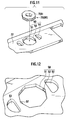
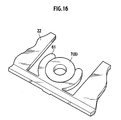
- a holding member 50 includes a positioning portion 51, protruding portions 52, and relief portions 53.
- the positioning portion 51 is provided by perforating a part of the electrode supporting portion 22 and fitted to the outer edge of a conductive washer 7 or an insulating washer 8.
- the protruding portions 52 protrude from the positioning portion 51 towards the conductive washer 7 or the insulating washer 8 when the conductive washer 7 or the insulating washer 8 is located in the positioning portion 51.
- the relief portions 53 are formed on the periphery of the positioning portion 51 by opening holes through the electrode supporting portion 22. The relief portions 53 allow the positioning portion 51 to deform so that the conductive washer 7 or the insulating washer 8 can be fit into the positioning portion 51.
- grooves 70 and 80 are formed in the circumferences of the conductive washer 7 and the insulating washer 8, respectively.
- the widths W1 of the groove 70 and 80 are larger than the widths W2 of the protruding portions 52 of the holding member 50.
- the conductive washer 7 When attempting to fit the conductive washer 7 into the positioning portion 51 as shown by an arrow in FIG. 11, the conductive washer 7 is not easily fit thereinto because the protruding portions 52 catch the conductive washer 7. However, once a force is applied, the protruding portions 52 are deformed as if they escape towards the relief portions 53. The conductive washer 7 is thus fit into the positioning portion 51. The insulating washer 8 is fit into the positioning portion 51 in the same manner.
- FIG. 13 shows a state where the conductive washer 7 has been fit to the positioning portion 51.
- the protruding portions 52 of the holding member 50 protrude into the groove 70 of the conductive washer 7. Once a force is applied to allow the protrude portions 52 to enter the groove 70, the conductive washer 7 is not removed from the holding member 50 unless a force is applied again to deform the protruding portions 52.
- the conductive washer 7 can swing in the stacking direction without allowing the protruding portions 52 to be disengaged from the groove 70.
- the holding members 50 hold the conductive washers 7 and the insulating washers 8 so that these washers can swing in the stacking direction. Therefore, the holding members 50 can provide effects similar to those of the first embodiment.
- the frames 2 are not deformed during the formation of the battery 1. Since no load is applied to the frames 2, it is possible to prevent a situation where a specific fastening force cannot be obtained due to a reaction force of the frame 2 even if the bolt 9 is fastened with nuts 6.
- the conductive washers 7 can move to appropriate positions by the swing, which ensures that the conductive washer 7 and the positive electrode tab 11 or the negative electrode tab 12 are electrically continuous. It is also possible to prevent a failure or difficulty to allow the conductive washer 7 and the positive electrode tab 11 or the negative electrode tab 12 to come into contact with each other due to deformation of the frame 2.
- the relief portions 53 are formed by making holes in the electrode supporting portion 22.
- the formation of the relief portions 53 is not limited thereto. As shown in FIG. 14, the relief portions 53 may be formed by making cuts in the electrode supporting portion 22 on the periphery of the positioning portion 51.
- the positioning portion 51 is provided by perforating a part of the electrode supporting portion 22.
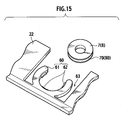
- the formation of the positioning portion 51 is not limited thereto. As shown in FIGS. 15 and 16, the positioning portion can be of clip type.
- a U-shape positioning portion 61 is formed in stead of perforating the electrode supporting portion 22.
- the U-shape positioning portion 61 has an inner circumference longer than a half of the outer circumference of the conductive washer 7 or the insulating washer 8.
- Protruding portions 62 are protruding from the positioning portion 61. Similarly to the foregoing protruding portions 52, the protruding portions 62 protrude into the groove 70 or 80 when the conductive washer 7 or the insulating washer 8 is fit into the positioning portion 61. The widths of the protruding portions 62 are smaller than those of the grooves 70 and 80.
- Clearances 63 are provided between the periphery of the positioning portion 61 and the electrode supporting portion 22. With these clearances 63, the clip-like positioning portion 61 opens when, for example, the conductive washer 7 is pushed towards the positioning portion 61. Thus, the conductive washer 7 is fit into the positioning portion 61 and held.
- the state where the conductive washer 7 has been fit into the positioning portion 61 is similar to the state shown in FIG. 14. Therefore, the conductive washer 7 can swing in the stacking direction without allowing the protruding portions 62 to be disengaged from the groove 70.
- the insulating washer 8 can also be held by the holding member 60 in the similar manner.
- the holding member As described so far, by forming the holding member into the clip type, the conductive washer 7 and the insulating washer 8 can be held by the holding member 60 more easily. Therefore, work efficiency is improved.
Landscapes
- Chemical & Material Sciences (AREA)
- Chemical Kinetics & Catalysis (AREA)
- Electrochemistry (AREA)
- General Chemical & Material Sciences (AREA)
- Engineering & Computer Science (AREA)
- Manufacturing & Machinery (AREA)
- Connection Of Batteries Or Terminals (AREA)
- Battery Mounting, Suspending (AREA)
Applications Claiming Priority (2)
| Application Number | Priority Date | Filing Date | Title |
|---|---|---|---|
| JP2004099328A JP3897029B2 (ja) | 2004-03-30 | 2004-03-30 | 組電池用フレームおよび組電池 |
| JP2004099328 | 2004-03-30 |
Publications (1)
| Publication Number | Publication Date |
|---|---|
| EP1583167A1 true EP1583167A1 (de) | 2005-10-05 |
Family
ID=34879975
Family Applications (1)
| Application Number | Title | Priority Date | Filing Date |
|---|---|---|---|
| EP05006427A Withdrawn EP1583167A1 (de) | 2004-03-30 | 2005-03-23 | Batterierahmen und Batterie |
Country Status (5)
| Country | Link |
|---|---|
| US (1) | US7288341B2 (de) |
| EP (1) | EP1583167A1 (de) |
| JP (1) | JP3897029B2 (de) |
| KR (1) | KR100681298B1 (de) |
| CN (1) | CN1327543C (de) |
Cited By (5)
| Publication number | Priority date | Publication date | Assignee | Title |
|---|---|---|---|---|
| WO2010145742A1 (de) * | 2009-06-19 | 2010-12-23 | Li-Tec Battery Gmbh | Batterieanordnung sowie verfahren zu deren herstellung |
| DE102009058444A1 (de) | 2009-12-16 | 2011-06-22 | Li-Tec Battery GmbH, 01917 | Batteriegehäuse zur Aufnahme von elektrochemischen Energiespeichereinrichtungen |
| EP2390946A3 (de) * | 2010-05-24 | 2012-01-11 | Japan Aviation Electronics Industry Limited | Leiteranschlussscheibe, Anschlussmechanismus damit und Verfahren zur Herstellung der Leiteranschlussscheibe |
| WO2013060314A1 (de) * | 2011-10-28 | 2013-05-02 | Li-Tec Battery Gmbh | Zellrahmen einer elektrochemischen zelle, elektrochemischen zelle mit zellrahmen und batterie mit entsprechenden elektrochemischen zellen |
| EP2654102A3 (de) * | 2012-04-18 | 2014-07-30 | Hitachi Maxell, Ltd. | Stapelbatterie |
Families Citing this family (32)
| Publication number | Priority date | Publication date | Assignee | Title |
|---|---|---|---|---|
| JP4992244B2 (ja) * | 2005-04-07 | 2012-08-08 | 日産自動車株式会社 | 電池モジュール、および組電池 |
| WO2007043510A1 (ja) * | 2005-10-14 | 2007-04-19 | Nec Corporation | フィルム外装電気デバイス収納システム |
| KR100920210B1 (ko) * | 2006-02-09 | 2009-10-05 | 주식회사 엘지화학 | 전지모듈 제조용 프레임 부재 |
| JP2007257849A (ja) * | 2006-03-20 | 2007-10-04 | Hitachi Maxell Ltd | ラミネート外装扁平形電池の電池モジュール |
| US20090181298A1 (en) * | 2008-01-10 | 2009-07-16 | Eaglepicher Energy Products Corporation | Integral electrochemical device |
| JP4767291B2 (ja) * | 2008-07-07 | 2011-09-07 | トヨタ自動車株式会社 | 電池保持枠および集合電池 |
| US9028986B2 (en) | 2009-01-07 | 2015-05-12 | A123 Systems Llc | Fuse for battery cells |
| US8257848B2 (en) | 2009-01-12 | 2012-09-04 | A123 Systems, Inc. | Safety venting mechanism with tearing tooth structure for batteries |
| DE102009010147A1 (de) * | 2009-02-23 | 2010-08-26 | Li-Tec Battery Gmbh | Galvanische Zelle |
| FR2943854B1 (fr) * | 2009-03-26 | 2011-06-10 | Commissariat Energie Atomique | Batterie bipolaire a fonctionnement ameliore |
| KR101266617B1 (ko) * | 2009-03-31 | 2013-05-22 | 미츠비시 쥬고교 가부시키가이샤 | 2차 전지 및 전지 시스템 |
| DE102009049043A1 (de) * | 2009-10-12 | 2011-04-14 | Li-Tec Battery Gmbh | Zellblock mit seitlicher Abstützung der Zellen |
| CN202978302U (zh) | 2009-12-04 | 2013-06-05 | A123系统公司 | 具有集成的电源管理系统和可伸缩电池断路组件的电池系统 |
| JP5748190B2 (ja) * | 2010-03-24 | 2015-07-15 | Necエナジーデバイス株式会社 | 電池ユニットおよびこれを用いた電源装置 |
| JP5577802B2 (ja) * | 2010-04-07 | 2014-08-27 | 日産自動車株式会社 | 電池モジュール |
| JP5626852B2 (ja) * | 2010-05-19 | 2014-11-19 | Necエナジーデバイス株式会社 | 電源装置 |
| KR101271567B1 (ko) * | 2010-08-16 | 2013-06-11 | 주식회사 엘지화학 | 고정부재가 플레이트들의 관통구에 삽입되어 있는 구조의 전지모듈 및 이를 포함하는 전지팩 |
| WO2014045757A1 (ja) * | 2012-09-19 | 2014-03-27 | 日産自動車株式会社 | 組電池 |
| JP5929733B2 (ja) * | 2012-12-10 | 2016-06-08 | 株式会社豊田自動織機 | 蓄電モジュール及び二次電池モジュール |
| JP6334516B2 (ja) * | 2013-04-19 | 2018-05-30 | Necエナジーデバイス株式会社 | 電池の製造方法及び電池モジュール |
| JP6020922B2 (ja) * | 2013-05-08 | 2016-11-02 | 株式会社オートネットワーク技術研究所 | 蓄電モジュール |
| JP6237450B2 (ja) | 2014-05-07 | 2017-11-29 | 株式会社オートネットワーク技術研究所 | 蓄電モジュール |
| US10103367B2 (en) | 2014-09-26 | 2018-10-16 | Johnson Controls Technology Company | Lithium ion battery module with free floating prismatic battery cells |
| US10020534B2 (en) | 2014-09-26 | 2018-07-10 | Johnson Controls Technology Company | Free floating battery cell assembly techniques for lithium ion battery module |
| JP6406983B2 (ja) * | 2014-11-12 | 2018-10-17 | 三菱電機株式会社 | 半導体装置およびその製造方法 |
| CN109565003B (zh) * | 2016-04-20 | 2023-07-25 | 康福斯能源公司 | 电池单元载体和用于包括多个电池单元载体的堆叠组件的外壳 |
| KR20180026945A (ko) * | 2016-09-05 | 2018-03-14 | 주식회사 엘지화학 | 배터리 모듈 및 이를 포함하는 배터리 팩 |
| CN111477800A (zh) * | 2020-04-30 | 2020-07-31 | 昆山宝创新能源科技有限公司 | 电池模块、电池包和车辆 |
| CN111477829A (zh) * | 2020-04-30 | 2020-07-31 | 昆山宝创新能源科技有限公司 | 电池模组和汽车 |
| CN111477828A (zh) * | 2020-04-30 | 2020-07-31 | 昆山宝创新能源科技有限公司 | 电池模块及具有其的电池模组和汽车 |
| JP7452484B2 (ja) * | 2021-03-31 | 2024-03-19 | トヨタ自動車株式会社 | 蓄電装置 |
| KR20250076175A (ko) * | 2023-11-22 | 2025-05-29 | 주식회사 엘지에너지솔루션 | 기구홀과 접지 핀을 포함하는 bmu 접지 장치 |
Citations (4)
| Publication number | Priority date | Publication date | Assignee | Title |
|---|---|---|---|---|
| JPH08171925A (ja) * | 1994-12-19 | 1996-07-02 | Mitsubishi Electric Corp | 固体高分子型燃料電池 |
| EP0930661A2 (de) * | 1998-01-14 | 1999-07-21 | Tai-Her Yang | Elektrizität-Speicher/Entladungsvorrichtung mit niedrigem inneren Widerstand Kollektorstruktur |
| JP2001256939A (ja) * | 2000-03-14 | 2001-09-21 | Matsushita Electric Ind Co Ltd | 電池パック |
| JP2003059486A (ja) * | 2001-08-10 | 2003-02-28 | Matsushita Electric Ind Co Ltd | 積層型電池およびその製造方法 |
Family Cites Families (2)
| Publication number | Priority date | Publication date | Assignee | Title |
|---|---|---|---|---|
| AU6059273A (en) * | 1972-09-25 | 1975-03-27 | Dunlop Australia Ltd | Battery construction |
| US6358641B1 (en) * | 1999-08-20 | 2002-03-19 | Plug Power Inc. | Technique and arrangement to align fuel cell plates |
-
2004
- 2004-03-30 JP JP2004099328A patent/JP3897029B2/ja not_active Expired - Fee Related
-
2005
- 2005-03-18 US US11/083,249 patent/US7288341B2/en not_active Expired - Fee Related
- 2005-03-22 CN CNB2005100548661A patent/CN1327543C/zh not_active Expired - Fee Related
- 2005-03-23 EP EP05006427A patent/EP1583167A1/de not_active Withdrawn
- 2005-03-29 KR KR1020050026095A patent/KR100681298B1/ko not_active Expired - Fee Related
Patent Citations (4)
| Publication number | Priority date | Publication date | Assignee | Title |
|---|---|---|---|---|
| JPH08171925A (ja) * | 1994-12-19 | 1996-07-02 | Mitsubishi Electric Corp | 固体高分子型燃料電池 |
| EP0930661A2 (de) * | 1998-01-14 | 1999-07-21 | Tai-Her Yang | Elektrizität-Speicher/Entladungsvorrichtung mit niedrigem inneren Widerstand Kollektorstruktur |
| JP2001256939A (ja) * | 2000-03-14 | 2001-09-21 | Matsushita Electric Ind Co Ltd | 電池パック |
| JP2003059486A (ja) * | 2001-08-10 | 2003-02-28 | Matsushita Electric Ind Co Ltd | 積層型電池およびその製造方法 |
Non-Patent Citations (3)
| Title |
|---|
| PATENT ABSTRACTS OF JAPAN vol. 1996, no. 11 29 November 1996 (1996-11-29) * |
| PATENT ABSTRACTS OF JAPAN vol. 2000, no. 26 1 July 2002 (2002-07-01) * |
| PATENT ABSTRACTS OF JAPAN vol. 2003, no. 06 3 June 2003 (2003-06-03) * |
Cited By (8)
| Publication number | Priority date | Publication date | Assignee | Title |
|---|---|---|---|---|
| WO2010145742A1 (de) * | 2009-06-19 | 2010-12-23 | Li-Tec Battery Gmbh | Batterieanordnung sowie verfahren zu deren herstellung |
| DE102009058444A1 (de) | 2009-12-16 | 2011-06-22 | Li-Tec Battery GmbH, 01917 | Batteriegehäuse zur Aufnahme von elektrochemischen Energiespeichereinrichtungen |
| WO2011072793A1 (de) | 2009-12-16 | 2011-06-23 | Li-Tec Battery Gmbh | Batteriegehäuse zur aufnahme von elektrochemischen energiespeichereinrichtungen |
| EP2390946A3 (de) * | 2010-05-24 | 2012-01-11 | Japan Aviation Electronics Industry Limited | Leiteranschlussscheibe, Anschlussmechanismus damit und Verfahren zur Herstellung der Leiteranschlussscheibe |
| CN102332644A (zh) * | 2010-05-24 | 2012-01-25 | 日本航空电子工业株式会社 | 导体连接垫片、使用它的连接机构及导体连接垫片制造方法 |
| US8303357B2 (en) | 2010-05-24 | 2012-11-06 | Japan Aviation Electronics Industry, Limited | Conductor-connecting washer, connection mechanism using the same, and method of manufacturing conductor-connecting washer |
| WO2013060314A1 (de) * | 2011-10-28 | 2013-05-02 | Li-Tec Battery Gmbh | Zellrahmen einer elektrochemischen zelle, elektrochemischen zelle mit zellrahmen und batterie mit entsprechenden elektrochemischen zellen |
| EP2654102A3 (de) * | 2012-04-18 | 2014-07-30 | Hitachi Maxell, Ltd. | Stapelbatterie |
Also Published As
| Publication number | Publication date |
|---|---|
| JP3897029B2 (ja) | 2007-03-22 |
| JP2005285625A (ja) | 2005-10-13 |
| CN1327543C (zh) | 2007-07-18 |
| KR20060044949A (ko) | 2006-05-16 |
| KR100681298B1 (ko) | 2007-02-09 |
| US7288341B2 (en) | 2007-10-30 |
| CN1677711A (zh) | 2005-10-05 |
| US20050221177A1 (en) | 2005-10-06 |
Similar Documents
| Publication | Publication Date | Title |
|---|---|---|
| US7288341B2 (en) | Battery frame and battery | |
| JP6091921B2 (ja) | 電池モジュール及び組電池 | |
| JP5544931B2 (ja) | ラミネートセル電池構造体 | |
| JP5374979B2 (ja) | 電池と組電池 | |
| JP2019046578A (ja) | バッテリパックの製造方法 | |
| WO2014091998A1 (ja) | 電池モジュール及び電池モジュールの製造方法 | |
| CN103594662B (zh) | 二次电池 | |
| JP4461940B2 (ja) | 組電池 | |
| JP7799044B2 (ja) | セルユニット、電池及び車両 | |
| JP6866405B2 (ja) | 電池モジュール、電池モジュールの製造方法 | |
| JP2018018629A (ja) | 電池モジュール | |
| JP6737577B2 (ja) | 組電池 | |
| JP2010135148A (ja) | セルユニット、電池モジュール、および組電池 | |
| JP7210519B2 (ja) | 電池セル及び電池モジュール | |
| JP7284152B2 (ja) | 電池モジュール | |
| WO2017014046A1 (ja) | 電池モジュール及び電池パック | |
| JP2023008499A (ja) | 蓄電モジュールおよび蓄電パック | |
| JP2008243639A (ja) | 加圧ホルダー付き組電池 | |
| JP6160202B2 (ja) | 電池モジュール | |
| JP2006040696A (ja) | 組電池 | |
| JP2004349473A (ja) | コンデンサユニット | |
| JP4029819B2 (ja) | 組電池 | |
| JP2022026171A (ja) | 蓄電モジュール、ならびに溶接方法およびそれを用いた蓄電モジュールの製造方法 | |
| JP2015213027A (ja) | 組電池及び組電池の製造方法 | |
| JP4186781B2 (ja) | 組電池 |
Legal Events
| Date | Code | Title | Description |
|---|---|---|---|
| PUAI | Public reference made under article 153(3) epc to a published international application that has entered the european phase |
Free format text: ORIGINAL CODE: 0009012 |
|
| 17P | Request for examination filed |
Effective date: 20050323 |
|
| AK | Designated contracting states |
Kind code of ref document: A1 Designated state(s): AT BE BG CH CY CZ DE DK EE ES FI FR GB GR HU IE IS IT LI LT LU MC NL PL PT RO SE SI SK TR |
|
| AX | Request for extension of the european patent |
Extension state: AL BA HR LV MK YU |
|
| AKX | Designation fees paid |
Designated state(s): DE FR GB |
|
| GRAP | Despatch of communication of intention to grant a patent |
Free format text: ORIGINAL CODE: EPIDOSNIGR1 |
|
| STAA | Information on the status of an ep patent application or granted ep patent |
Free format text: STATUS: THE APPLICATION IS DEEMED TO BE WITHDRAWN |
|
| 18D | Application deemed to be withdrawn |
Effective date: 20100626 |