EP1578600B1 - Drag reduction multilayer film and method of use - Google Patents
Drag reduction multilayer film and method of use Download PDFInfo
- Publication number
- EP1578600B1 EP1578600B1 EP03779499A EP03779499A EP1578600B1 EP 1578600 B1 EP1578600 B1 EP 1578600B1 EP 03779499 A EP03779499 A EP 03779499A EP 03779499 A EP03779499 A EP 03779499A EP 1578600 B1 EP1578600 B1 EP 1578600B1
- Authority
- EP
- European Patent Office
- Prior art keywords
- drag reduction
- layer
- article
- polymer
- acrylate
- Prior art date
- Legal status (The legal status is an assumption and is not a legal conclusion. Google has not performed a legal analysis and makes no representation as to the accuracy of the status listed.)
- Expired - Lifetime
Links
- OJVNUAVVPVEJHA-UHFFFAOYSA-N C[N]1(C)O[N]1(C)C Chemical compound C[N]1(C)O[N]1(C)C OJVNUAVVPVEJHA-UHFFFAOYSA-N 0.000 description 1
Images

Classifications
-
- F—MECHANICAL ENGINEERING; LIGHTING; HEATING; WEAPONS; BLASTING
- F15—FLUID-PRESSURE ACTUATORS; HYDRAULICS OR PNEUMATICS IN GENERAL
- F15D—FLUID DYNAMICS, i.e. METHODS OR MEANS FOR INFLUENCING THE FLOW OF GASES OR LIQUIDS
- F15D1/00—Influencing flow of fluids
- F15D1/10—Influencing flow of fluids around bodies of solid material
- F15D1/12—Influencing flow of fluids around bodies of solid material by influencing the boundary layer
-
- B—PERFORMING OPERATIONS; TRANSPORTING
- B32—LAYERED PRODUCTS
- B32B—LAYERED PRODUCTS, i.e. PRODUCTS BUILT-UP OF STRATA OF FLAT OR NON-FLAT, e.g. CELLULAR OR HONEYCOMB, FORM
- B32B27/00—Layered products comprising a layer of synthetic resin
- B32B27/06—Layered products comprising a layer of synthetic resin as the main or only constituent of a layer, which is next to another layer of the same or of a different material
- B32B27/08—Layered products comprising a layer of synthetic resin as the main or only constituent of a layer, which is next to another layer of the same or of a different material of synthetic resin
-
- B—PERFORMING OPERATIONS; TRANSPORTING
- B63—SHIPS OR OTHER WATERBORNE VESSELS; RELATED EQUIPMENT
- B63B—SHIPS OR OTHER WATERBORNE VESSELS; EQUIPMENT FOR SHIPPING
- B63B1/00—Hydrodynamic or hydrostatic features of hulls or of hydrofoils
- B63B1/32—Other means for varying the inherent hydrodynamic characteristics of hulls
- B63B1/34—Other means for varying the inherent hydrodynamic characteristics of hulls by reducing surface friction
- B63B1/36—Other means for varying the inherent hydrodynamic characteristics of hulls by reducing surface friction using mechanical means
-
- B—PERFORMING OPERATIONS; TRANSPORTING
- B64—AIRCRAFT; AVIATION; COSMONAUTICS
- B64C—AEROPLANES; HELICOPTERS
- B64C21/00—Influencing air flow over aircraft surfaces by affecting boundary layer flow
- B64C21/10—Influencing air flow over aircraft surfaces by affecting boundary layer flow using other surface properties, e.g. roughness
-
- C—CHEMISTRY; METALLURGY
- C09—DYES; PAINTS; POLISHES; NATURAL RESINS; ADHESIVES; COMPOSITIONS NOT OTHERWISE PROVIDED FOR; APPLICATIONS OF MATERIALS NOT OTHERWISE PROVIDED FOR
- C09J—ADHESIVES; NON-MECHANICAL ASPECTS OF ADHESIVE PROCESSES IN GENERAL; ADHESIVE PROCESSES NOT PROVIDED FOR ELSEWHERE; USE OF MATERIALS AS ADHESIVES
- C09J7/00—Adhesives in the form of films or foils
- C09J7/20—Adhesives in the form of films or foils characterised by their carriers
- C09J7/22—Plastics; Metallised plastics
- C09J7/24—Plastics; Metallised plastics based on macromolecular compounds obtained by reactions involving only carbon-to-carbon unsaturated bonds
- C09J7/245—Vinyl resins, e.g. polyvinyl chloride [PVC]
-
- C—CHEMISTRY; METALLURGY
- C09—DYES; PAINTS; POLISHES; NATURAL RESINS; ADHESIVES; COMPOSITIONS NOT OTHERWISE PROVIDED FOR; APPLICATIONS OF MATERIALS NOT OTHERWISE PROVIDED FOR
- C09J—ADHESIVES; NON-MECHANICAL ASPECTS OF ADHESIVE PROCESSES IN GENERAL; ADHESIVE PROCESSES NOT PROVIDED FOR ELSEWHERE; USE OF MATERIALS AS ADHESIVES
- C09J7/00—Adhesives in the form of films or foils
- C09J7/20—Adhesives in the form of films or foils characterised by their carriers
- C09J7/29—Laminated material
-
- A—HUMAN NECESSITIES
- A63—SPORTS; GAMES; AMUSEMENTS
- A63B—APPARATUS FOR PHYSICAL TRAINING, GYMNASTICS, SWIMMING, CLIMBING, OR FENCING; BALL GAMES; TRAINING EQUIPMENT
- A63B60/00—Details or accessories of golf clubs, bats, rackets or the like
- A63B60/006—Surfaces specially adapted for reducing air resistance
-
- B—PERFORMING OPERATIONS; TRANSPORTING
- B64—AIRCRAFT; AVIATION; COSMONAUTICS
- B64C—AEROPLANES; HELICOPTERS
- B64C2230/00—Boundary layer controls
- B64C2230/26—Boundary layer controls by using rib lets or hydrophobic surfaces
-
- C—CHEMISTRY; METALLURGY
- C09—DYES; PAINTS; POLISHES; NATURAL RESINS; ADHESIVES; COMPOSITIONS NOT OTHERWISE PROVIDED FOR; APPLICATIONS OF MATERIALS NOT OTHERWISE PROVIDED FOR
- C09J—ADHESIVES; NON-MECHANICAL ASPECTS OF ADHESIVE PROCESSES IN GENERAL; ADHESIVE PROCESSES NOT PROVIDED FOR ELSEWHERE; USE OF MATERIALS AS ADHESIVES
- C09J2301/00—Additional features of adhesives in the form of films or foils
- C09J2301/10—Additional features of adhesives in the form of films or foils characterized by the structural features of the adhesive tape or sheet
- C09J2301/16—Additional features of adhesives in the form of films or foils characterized by the structural features of the adhesive tape or sheet by the structure of the carrier layer
- C09J2301/162—Additional features of adhesives in the form of films or foils characterized by the structural features of the adhesive tape or sheet by the structure of the carrier layer the carrier being a laminate constituted by plastic layers only
-
- C—CHEMISTRY; METALLURGY
- C09—DYES; PAINTS; POLISHES; NATURAL RESINS; ADHESIVES; COMPOSITIONS NOT OTHERWISE PROVIDED FOR; APPLICATIONS OF MATERIALS NOT OTHERWISE PROVIDED FOR
- C09J—ADHESIVES; NON-MECHANICAL ASPECTS OF ADHESIVE PROCESSES IN GENERAL; ADHESIVE PROCESSES NOT PROVIDED FOR ELSEWHERE; USE OF MATERIALS AS ADHESIVES
- C09J2427/00—Presence of halogenated polymer
- C09J2427/006—Presence of halogenated polymer in the substrate
-
- C—CHEMISTRY; METALLURGY
- C09—DYES; PAINTS; POLISHES; NATURAL RESINS; ADHESIVES; COMPOSITIONS NOT OTHERWISE PROVIDED FOR; APPLICATIONS OF MATERIALS NOT OTHERWISE PROVIDED FOR
- C09J—ADHESIVES; NON-MECHANICAL ASPECTS OF ADHESIVE PROCESSES IN GENERAL; ADHESIVE PROCESSES NOT PROVIDED FOR ELSEWHERE; USE OF MATERIALS AS ADHESIVES
- C09J2433/00—Presence of (meth)acrylic polymer
- C09J2433/006—Presence of (meth)acrylic polymer in the substrate
-
- E—FIXED CONSTRUCTIONS
- E04—BUILDING
- E04D—ROOF COVERINGS; SKY-LIGHTS; GUTTERS; ROOF-WORKING TOOLS
- E04D13/00—Special arrangements or devices in connection with roof coverings; Protection against birds; Roof drainage ; Sky-lights
- E04D13/04—Roof drainage; Drainage fittings in flat roofs, balconies or the like
- E04D13/0404—Drainage on the roof surface
- E04D13/0481—Drainage guiding provisions, e.g. deflectors or stimulation by inclined surfaces
-
- Y—GENERAL TAGGING OF NEW TECHNOLOGICAL DEVELOPMENTS; GENERAL TAGGING OF CROSS-SECTIONAL TECHNOLOGIES SPANNING OVER SEVERAL SECTIONS OF THE IPC; TECHNICAL SUBJECTS COVERED BY FORMER USPC CROSS-REFERENCE ART COLLECTIONS [XRACs] AND DIGESTS
- Y02—TECHNOLOGIES OR APPLICATIONS FOR MITIGATION OR ADAPTATION AGAINST CLIMATE CHANGE
- Y02T—CLIMATE CHANGE MITIGATION TECHNOLOGIES RELATED TO TRANSPORTATION
- Y02T50/00—Aeronautics or air transport
- Y02T50/10—Drag reduction
-
- Y—GENERAL TAGGING OF NEW TECHNOLOGICAL DEVELOPMENTS; GENERAL TAGGING OF CROSS-SECTIONAL TECHNOLOGIES SPANNING OVER SEVERAL SECTIONS OF THE IPC; TECHNICAL SUBJECTS COVERED BY FORMER USPC CROSS-REFERENCE ART COLLECTIONS [XRACs] AND DIGESTS
- Y02—TECHNOLOGIES OR APPLICATIONS FOR MITIGATION OR ADAPTATION AGAINST CLIMATE CHANGE
- Y02T—CLIMATE CHANGE MITIGATION TECHNOLOGIES RELATED TO TRANSPORTATION
- Y02T70/00—Maritime or waterways transport
- Y02T70/10—Measures concerning design or construction of watercraft hulls
-
- Y—GENERAL TAGGING OF NEW TECHNOLOGICAL DEVELOPMENTS; GENERAL TAGGING OF CROSS-SECTIONAL TECHNOLOGIES SPANNING OVER SEVERAL SECTIONS OF THE IPC; TECHNICAL SUBJECTS COVERED BY FORMER USPC CROSS-REFERENCE ART COLLECTIONS [XRACs] AND DIGESTS
- Y10—TECHNICAL SUBJECTS COVERED BY FORMER USPC
- Y10T—TECHNICAL SUBJECTS COVERED BY FORMER US CLASSIFICATION
- Y10T428/00—Stock material or miscellaneous articles
- Y10T428/24—Structurally defined web or sheet [e.g., overall dimension, etc.]
- Y10T428/24479—Structurally defined web or sheet [e.g., overall dimension, etc.] including variation in thickness
- Y10T428/2457—Parallel ribs and/or grooves
-
- Y—GENERAL TAGGING OF NEW TECHNOLOGICAL DEVELOPMENTS; GENERAL TAGGING OF CROSS-SECTIONAL TECHNOLOGIES SPANNING OVER SEVERAL SECTIONS OF THE IPC; TECHNICAL SUBJECTS COVERED BY FORMER USPC CROSS-REFERENCE ART COLLECTIONS [XRACs] AND DIGESTS
- Y10—TECHNICAL SUBJECTS COVERED BY FORMER USPC
- Y10T—TECHNICAL SUBJECTS COVERED BY FORMER US CLASSIFICATION
- Y10T428/00—Stock material or miscellaneous articles
- Y10T428/24—Structurally defined web or sheet [e.g., overall dimension, etc.]
- Y10T428/24479—Structurally defined web or sheet [e.g., overall dimension, etc.] including variation in thickness
- Y10T428/24612—Composite web or sheet
-
- Y—GENERAL TAGGING OF NEW TECHNOLOGICAL DEVELOPMENTS; GENERAL TAGGING OF CROSS-SECTIONAL TECHNOLOGIES SPANNING OVER SEVERAL SECTIONS OF THE IPC; TECHNICAL SUBJECTS COVERED BY FORMER USPC CROSS-REFERENCE ART COLLECTIONS [XRACs] AND DIGESTS
- Y10—TECHNICAL SUBJECTS COVERED BY FORMER USPC
- Y10T—TECHNICAL SUBJECTS COVERED BY FORMER US CLASSIFICATION
- Y10T428/00—Stock material or miscellaneous articles
- Y10T428/28—Web or sheet containing structurally defined element or component and having an adhesive outermost layer
- Y10T428/2848—Three or more layers
Definitions
- Outer patterned backing layer 11 is capable of being formed into a pattern (described more fully herein) that imparts drag reducing characteristics to article 10.
- outer patterned backing layer 11 is sufficiently resistant to chemical and weather exposure to permit the use of drag reduction article 10 in aerospace applications.
- outer patterned backing layer 11 When used in combination with intermediate layer 12, outer patterned backing layer 11 maybe at least about 5 micrometers (0.0002 inches) thick. In another embodiment, outer patterned backing layer 11 may be as much as about 410 micrometers (0.016 inches) thick when used in combination with intermediate layer 12. Intermediate layer 12 may be at least about 3 micrometers (0.0001 inches) thick. In another embodiment, intermediate layer 12 may be as much as about 410 micrometers (0.016 inches) thick. In a further embodiment, intermediate layer 12 may be as much as about 12 micrometers (0.0005 mils) thick. Overall, the combined thickness of layers 11 and 12 may be at least about 8 micrometers (0.0003 inches). In another embodiment, the overall combined thickness of layers 11 and 12 may be as much as about 415 micrometers (0.016 inches).
- the overall combined thickness of layers 11 and 12 is at least about 50 micrometers (0.002 inches). In another embodiment, the overall combined thickness of layers 11 and 12 is as much as about 150 micrometers (0.006 inches). If the combined thickness is greater than about 410 micrometers (0.016 inches), the conformability of the drag reduction article may be decreased, and weight and cost are added to the drag reduction article which is undesirable.
- Layers 11 and 12 are typically in the form of sheet materials, each having two major surfaces.
- at least one of the surfaces of these layers may be treated to allow for bonding of the adhesive bonding layer 14, depending on which layer will be adjacent to the bonding layer.
- Such treatment methods include corona treatment, particularly corona discharge in an atmosphere containing nitrogen, and about 0.1 to about 10 volume percent of an additive gas selected from the group consisting of hydrogen, ammonia, and mixtures thereof, as disclosed in U.S. Pat. No. 5,972,176 (Kirk et al. ).
- Another useful treatment method includes a chemical etch using sodium naphthalenide.
- the adhesive bonding layer 14 is applied to outer patterned backing layer 11 on the side opposite the side having the patterned surface.
- Adhesive bonding layer 14 may be selected from adhesives, such as room temperature pressure-sensitive adhesives (PSAs), hot melt PSAs, thermoplastics, or a curable adhesive, such as a moisture curing adhesive, thermosetting adhesive, or a prepreg material (for example, one containing a curable organic resin matrix and reinforcing material, such as inorganic fibers).
- PSAs room temperature pressure-sensitive adhesives
- thermoplastics such as a curable adhesive, such as a moisture curing adhesive, thermosetting adhesive, or a prepreg material (for example, one containing a curable organic resin matrix and reinforcing material, such as inorganic fibers).
- a prepreg material for example, one containing a curable organic resin matrix and reinforcing material, such as inorganic fibers.
- Useful acrylic pressure-sensitive adhesives include those that comprise a polymer of an acrylate ester of acrylic acid with a non-tertiary alcohol. Multifunctional acrylates, copolymerizable photoinitiators, or combinations of the two may also be present so as to provide some crosslinking, which can contribute to easy removability, better fluids resistance and improved high temperature performance of the drag reduction article. Ultimately, removability is a balance among the peel adhesion, the degree of crosslinking, and the thickness of the bonding layer. Pressure-sensitive adhesives suitable for the bonding layer and methods for their preparation are disclosed in U.S. Pat. No. 6,475,616 (Dietz et al ) and described below.
- Matsuda discloses the use of multifunctional crosslinking agents whose functionalities are reactive with carboxylic acid groups, while Vesley describes additives that can cause crosslinking upon exposure to ultraviolet radiation (for example, radiation having a wavelength of about 250 nanometers to about 400 nanometers).
- a second type of nonionic crosslinking agent (that is, component C2) is a crosslinking compound which is essentially free of olefinic unsaturation and is capable of reacting with the carboxylic acid groups of monomer B. It includes at least two functional groups reactive with carboxylic acid groups. It may be added to a mixture of monomers A and B prior to their polymerization, or after they have been formed into a partially polymerized syrup, or to a copolymer of monomers A and B.
- Such components include, but are not limited to, 1,4-bis(ethyleneiminocarbonylamino)benzene; 4,4-bis(ethyleneiminocarbonylamino)diphenylmethane; 1,8-bis(ethyleneiminocarbonylamino)octane; 1,4-tolylene diisocyanate; and 1,6-hexamethylene diisocyanate, as described in U.S. Pat. No. 5,604,034 (Matsuda ).
- Another example is N,N'-bis-1,2-propyleneisophthalamide, as described in U.S. Pat. No. 4,418,120 (Kealy et al. ).
- Other such crosslinking agents are available from K.J.
- C2 crosslinking agents include diepoxides, dianhydrides, bis(amides), and bis(imides). Combinations of such crosslinking agents can be used to make the pressure-sensitive adhesive used in the present invention.
- a third type of nonionic crosslinking agent (that is, component C3) is a compound which is essentially free of olefinic unsaturation, is noncopolymerizable with monomers A and B, and, in the excited state, is capable of abstracting hydrogen. It is added to a copolymer of monomers A and B, or a partially polymerized syrup of monomers A and B. Upon irradiation of the mixture, component C3 generates free radicals on the polymer or partially polymerized material.
- crosslinking agent that can be used in addition to one or more of components C1-C3, is an acrylic crosslinking monomer (component C4) containing at least two acrylic moieties. Suitable such materials have an average of less than about 12 atoms in the chain between acrylic groups.
- examples of this type of crosslinking agent include, but are not limited to, trimethylolpropane triacrylate, 1,6-hexanediol diacrylate, pentaerythritol tetraacrylate, 1,2-ethylene glycol diacrylate, dodecyl diacrylate, and the diacrylate of ethylene oxide modified bisphenol A.
- the crosslinking agent is used in an effective amount, by which is meant an amount that is sufficient to cause crosslinking of the pressure-sensitive adhesive to provide adequate cohesive strength to produce the desired final adhesion properties to the substrate of interest.
- the crosslinking agent is used in an amount of about 0.01 part to about 2 parts by weight, based on 100 parts of the copolymer.
- the adhesive can be exposed to ultraviolet radiation having a wavelength of about 250 nm to about 400 nm.
- the radiant energy in this suitable range of wavelength required to crosslink the adhesive is about 100 millijoules/centimeter 2 (mJ/cm 2 ) to about 1,500 mJ/cm 2 , and in another embodiment, about 200 mJ/cm 2 to about 800 mJ/cm 2 .
- photoinitiators include, but are not limited to, benzoin ethers, such as benzoin methyl ether and benzoin isopropyl ether, substituted benzoin ethers, such as anisoin methyl ether, substituted acetophenones, such as 2,2-dimethoxy-2-phenylacetophenone, and substituted alpha-ketols, such as 2-methyl-2-hydroxypropiophenone.
- suitable photoinitiators include IRGACURE 651 and DAROCUR 1173, both available from Ciba-Geigy Corp., and LUCERIN TPO from BASF, Parsippany, NJ.
- the coated adhesive can be exposed to ultraviolet radiation having a wavelength of about 250 nm to about 400 nm.
- the radiant energy in this suitable range of wavelength required to crosslink the adhesive is about 100 millijoules/cm 2 to about 1,500 millijoules/cm 2 , and in another embodiment, about 200 millijoules/cm 2 to about 800 millijoules/cm 2 .
- the copolymers of the present invention can be prepared by a variety of techniques, which may or may not include solvent or chain transfer agents (for example, CBr 4 ) to control molecular weight. These techniques may involve the use of appropriate polymerization initiators.
- a suitable solvent-free polymerization method using monomers A, B, and a crosslinking agent is disclosed in U.S. Pat. No. 4,379,201 (Heilmann et al. ). Initially, a mixture of monomers A and B is polymerized with a portion of a photoinitiator by exposing the mixture to UV radiation in an inert environment for a time sufficient to form a coatable base syrup, and subsequently adding a crosslinking agent and the remainder of the photoinitiator.
- This final syrup containing a crosslinking agent (for example, having a Brookfield viscosity of about 100 centipoise to about 6000 centipoise at 23 °C, as measured with a No. 4 LTV spindle, at 60 revolutions per minute) is then coated onto a substrate, such as a backing.
- a crosslinking agent for example, having a Brookfield viscosity of about 100 centipoise to about 6000 centipoise at 23 °C, as measured with a No. 4 LTV spindle, at 60 revolutions per minute
- an inert environment that is, an environment that is nonreactive with the monomer mixture.
- Suitable inert environments include nitrogen, carbon dioxide, helium, and argon, which exclude oxygen.
- a sufficiently inert atmosphere can be achieved by covering a layer of the photoactive syrup with a polymeric film, such as silicone-treated polyethylene terephthalate (PET) film, that is transparent to UV radiation or e-beam and irradiating through the film in air.
- a polymeric film such as silicone-treated polyethylene terephthalate (PET) film, that is transparent to UV radiation or e-beam and irradiating through the film in air.
- a latex polymerization method for preparing a copolymer using monomers A, B, and a crosslinking agent is disclosed in U.S. Pat. No. 5,424,122 (Crandall et al. ).
- a latex emulsion polymerization is carried out by combining monomers A, B, and a crosslinking agent, an oleophilic nonionic free radical initiator, water, and a nonionic surfactant.
- the mixture is homogenized to form an emulsion followed by initiation of free radical polymerization, typically done using heat, while agitating the emulsion under an inert atmosphere.
- the latex can be coated onto a backing and dried, typically at a temperature of at least about 65 °C. If necessary, water can be added or removed to reach an appropriate coating viscosity.
- the adhesive surface of the article may, optionally, be protected with a temporary, removable release liner (that is, protective liner) such as a paper liner or plastic films, such as polyolefin (for example, polyethylene or polypropylene) or polyester (for example, polyethylene terephthalate) film.
- a temporary, removable release liner such as a paper liner or plastic films, such as polyolefin (for example, polyethylene or polypropylene) or polyester (for example, polyethylene terephthalate) film.
- a release material such as silicones, waxes, fluorocarbons, and the like.
- the outer patterned backing layer 11 of the present invention may be adhered to a substrate using a curable adhesive bonding layer 14, such as a thermally or moisture curable adhesive. Alternatively, such bonding layers may be applied to intermediate layer 12 when it is employed.
- curable adhesives include epoxy resins (epoxide resin + curing agent), acrylates, cyano-acrylates, and urethanes.
- the curable adhesives used in the drag reduction articles of the invention are non-tacky to the touch after curing and are thermosetting.
- Epoxide resins useful in the drag reduction articles of the invention are any organic compounds having at least one oxirane ring, that is, polymerizable by a ring opening reaction.
- Such materials broadly called epoxides, include both monomeric and polymeric epoxides and can be aliphatic, heterocyclic, cycloaliphatic, or aromatic, and can be combinations thereof. They can be liquid or solid or blends thereof, blends being useful in providing tacky adhesive films prior to cure.
- these materials generally have, on the average, at least two epoxy groups per molecule and are also called “polyepoxides.”
- the polymeric epoxides include linear polymers having terminal epoxy groups (for example, a diglycidyl ether of a polyoxyalkylene glycol), polymers having skeletal oxirane units (for example, polybutadiene polyepoxide), and polymers having pendent epoxy groups (for example, a glycidyl methacrylate polymer or copolymer).
- the molecular weight of the epoxy resin may vary from about 74 to about 100,000 or more.
- epoxide resins there are a host of commercially available epoxide resins that can be used in this invention.
- epoxides which are readily available include styrene oxide, vinylcyclohexene oxide, glycidol, glycidyl methacrylate, diglycidyl ether of Bisphenol A (for example, those available under the trade designations "EPON 828", “EPON 1004", and “EPON 1001F” from Shell Chemical Company, Houston, TX, and "DER-332” and “DER-334", from Dow Chemical Company, Midland, MI), diglycidyl ether of Bisphenol F (for example, those under the trade designations "ARALDITE GY281" from Ciba-Geigy Corp., and "EPON 862” from Shell Chemical Company), vinylcyclohexane dioxide (for example, having the trade designation "ERL-4206” from Union Carbide Corporation, Midland, MI), 3,4-epoxycyclohexyl-methyl
- curing agent is used broadly to include not only those materials that are conventionally regarded as curing agents but also those materials that catalyze epoxy polymerization as well as those materials that may act as both curing agent and catalyst.
- Suitable curing agents for the epoxide resin include, for example, room temperature curing agents, heat-activated curing agents, and combinations thereof, and photolytically activated curing agents.
- Room temperature curing agents and heat-activated curing agents can include, for example, blends of epoxy homopolymerization type curing agents and addition type curing agents.
- the curing agents react at temperatures of between about room temperature and about 200 °C, about room temperature and 150 °C, or alternatively between about room temperature and about 115 °C.
- suitable curing agents react at temperatures in the range of 200 °F (93 °C) to 350 °F (177°C), and in another embodiment, 200 °F (93 °C) to 250 °F (121 °C).
- suitable curing agents include polybasic acids and their anhydrides, for example, di-, tri- and higher carboxylic acids, such as oxalic acid, phthalic acid, terephthalic acid, succinic acid, maleic acid, alkyl and alkenyl substituted succinic acids, tartaric acid, and anhydrides, for example, phthalic anhydride, succinic anhydride, maleic anhydride, nadic anhydride and pyromellitic anhydride; polymerizable unsaturated acids, for example, those containing at least 10 carbon atoms, for example, dodecendioic acid, 10,12-eicosadiendioic acid; and mercaptans.
- di-, tri- and higher carboxylic acids such as oxalic acid, phthalic acid, terephthalic acid, succinic acid, maleic acid, alkyl and alkenyl substituted succinic acids, tartaric acid, and anhydrides, for example,
- Suitable curing agents include nitrogen containing compounds, for example, benzyldimethylamine, benzylamine, N,N-diethyl aniline, melamine, pyridine, hydrazides, and aromatic polyamines, such as o-, m-, and p-phenylene diamine, 4,4'-diaminodiphenyl sulfone, 3,3'-diaminodiphenyl sulfone, and 4,4'-diaminodiphenyl sulfide, 4,4'-diaminodiphenyl ketone, 4,4'-diaminodiphenyl ether, 4,4'-diaminodiphenyl methane, 1,3-propanediol-bis(4-aminobenzoate), fluorene-containing amines (for example, 9,9-bis(4-aminophenyl)fluorene, 9,9-bis(3-methyl-4-a
- Suitable curing agents include, for example, aliphatic nitrogen-containing compounds, including poly(ether) amines, guanidines (for example, dicyandiamide and tetramethyl guanidine), imidazoles (for example, 2-ethyl-4-methyl imidazole), cyclohexylamine, diethylenetriamine, triethylenetetraamine, cyclohexyldiamine, tetramethylpiperamine, N,N-dibutyl-1,3-propane diamine, N,N-diethyl-1,3-propane diamine, 1,2-diamino-2-methyl-propane, 2,3-diamino-2-methylbutane, 2,3-diamino-2-methylpentane, and 2,4-diamino-2,6-dimethyloctane.
- aliphatic nitrogen-containing compounds including poly(ether) amines, guanidines (for example, dicyandi
- Suitable phenolic curing agents include polyhydric phenols, for example, pyrocatechol, resorcinol, hydroquinone, 4,4'-dihydroxydiphenyl methane, 4,4'-dihydroxydiphenyl dimethylmethane, 4,4'-dihydroxy-3,3'-dimethyldiphenyl methane, 4,4'-dihydroxydiphenyl methylmethane, 4,4'-dihydroxydiphenyl cyclohexane, 4,4'-dihydroxy-3,3'-dimethyldiphenyl dimethylmethane, 4,4'-dihydroxydiphenyl sulfone, and tris-(4-hydroxyphenyl)methane; and 9,9-bis(4-hydroxyphenyl) fluorene and ortho-substituted analogs thereof.
- polyhydric phenols for example, pyrocatechol, resorcinol, hydroquinone, 4,4'-dihydroxydipheny
- Other useful curing agents include chloro-, bromo-, and fluoro-containing Lewis acids of aluminum, boron, antimony, and titanium, such as aluminum trichloride, aluminum tribromide, boron trifluoride, antimony pentafluoride, titanium tetrafluoride, and the like. It is also desirable at times that these Lewis acids be blocked to increase the latency of adhesive compositions containing them.
- blocked Lewis acids are BF 3 -monoethylamine, and the adducts of SbF 5 X, in which X is a halogen, -OH, or -OR1 in which R 1 is the residue of an aliphatic or aromatic alcohol, aniline, or a derivative thereof, as described in U.S. Pat. No. 4,503,211 .
- Suitable photolytically activated curing agents include, for example, iodonium and sulfonium salts of antimony and cobalt, and bis(arene) iron compounds.
- Examples of commercially available curing agents suitable for use in the epoxides include EPI-CURE 8535-W-50 and EPI-CURE 8537-WY-60 (available from Shell Chemical Company), HY 955 (available from Ciba Specialty Chemicals Corporation), AMICURE CG-1400, ANCAMINE 2337S, CUREZOL 2E4MZ, and CUREZOL PHZ-S (available from Air Products, Pacific Anchor Chemical, Allentown, PA), and DCA-221 (available from Dixie Chemical Company, Pasadena, TX).
- the curing agent may be present in an amount of 2 to 110 parts by weight, per 100 parts by weight of the epoxide resin.
- the curing agent is a carboxylic acid, a guanidine, a phenol, an anhydride, or a primary or secondary amine
- the curing agent suitably is present in about 0.5 to about 1.7 equivalents of acid, anhydride, or amine per equivalent of epoxide group.
- accelerators may be added in amounts of about 0.1% to about 5.0% based on the weight of epoxide resin. Accelerators may also be used alone and in the amounts noted.
- Suitable accelerators include aromatic tertiary amines, such as benzyldimethyl amine, and imidazoles, such as 2-ethyl-4-methylimidazole.
- Lewis acids are used in amounts of between about 0.1 and about 5% by weight based on the total weight of the epoxide resin.
- Useful epoxy resin adhesives include 3M TM Scotch-Weld TM epoxy resin adhesives available from 3M Company, for example, having product names DP-100; DP-105; DP-110; DP-125; DP-190; DP-270; DP-420; DP-460; 1751; 1833; 1838; 2158; 2210; 2216; and 3601.
- Other useful epoxy resin compositions are those that contain glycidyl ethers of hydroxy-phenylfluorene and/or an aminophenyl fluorene curing agent. These and other useful epoxy resin compositions that may be used as a curable adhesive are generally described in U.S. Pat. Nos. 4,684,678 ; 4,707,534 ; 4,777,084 ; 5,276,106 ; 5,369,192 ; 5,728,755 ; and 6,054,221 .
- curable crosslinking acrylate adhesives include 3M TM Scotch-Weld TM DP-8005 and the Pronto TM Instant Adhesives line of cyano-acrylate adhesives (available from 3M Company).
- Useful urethane adhesives include those that cure by exposure to moisture and crosslink.
- Commercially available curable urethane adhesives include those having the product names of 3M TM Scotch-Weld TM DP-605NS; 3592; 3535; and 3549 (available from 3M Company).
- the thickness of the adhesive bonding layer 14 is not critical and may be at least about 2.5 micrometers (0.0001 inches) thick. In another embodiment, the adhesive bonding layer 14 may be as much as about 125 micrometers (0.005 inches) thick. In one embodiment, adhesive layer 14 is at least about 13 micrometers (0.0005 inches) thick. In another embodiment, adhesive bonding layer 14 may be as much 50 micrometers (0.002 inches) thick. If the adhesive bonding layer thickness is greater than about 125 micrometers, then it may become more susceptible to swelling by fluids and the weight of the article may be unnecessarily increased. However, if the bonding layer thickness is less than about 2.5 micrometers, it may not provide enough adhesion to hold the drag reduction article in place during use.
- Drag reduction article 10 may further and optionally include a temporary liner 16 that protects adhesive bonding layer 14 from contamination by dirt and other materials and which is removed shortly before the drag reduction article is applied to a surface.
- Liner 16 may be provided as, for example, an untreated polyolefin sheet, or a silicone- or fluorosilicone-treated paper or plastic sheet.
- the outer patterned backing layer 11 includes a patterned outer surface adapted to reduce the resistance (drag) to a fluid (for example, air, gas, water, etc.) flowing over layer 11.
- the patterned surface comprises a series of essentially parallel peaks 20 separated by a series of essentially parallel valleys 22.
- the patterned surface may assume a variety of wave forms.
- FIGS. 1 to 3 show a symmetric saw tooth pattern in which each of the peaks are identical as are each of the valleys.
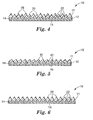
- FIG. 4 shows a series of parallel peaks 28 and 30 that are of different heights, separated by a series of parallel valleys 22.
- FIG. 5 shows a saw tooth pattern of alternating, parallel, asymmetric peaks 40 separated by a series of parallel, asymmetric valleys 42.
- peaks and valleys may terminate for a portion of the article.
- the valleys may either narrow or widen as the peak or valley progresses from one end of the article to the other.
- the height and/or width of a given peak or valley may change as the peak or valley progresses from one end of the article to the other.
- peaks and valleys are not critical to the invention provided that whatever patterned surface is employed, it provides the desired reduction in drag.
- the optimum dimensions are somewhat dependent upon the speed at which the substrate to be covered passes through the fluid (or the speed at which the fluid passes over the substrate).
- peaks having a height of at least about 10 micrometers (0.0004 inches) are useful.
- peaks having a height of as much as about 250 micrometers (0.010 inches) are useful.
- the peaks are at least about 20 micrometers (0.0008 inches) high for high speed uses (for example, aircraft).
- the peaks are as much as about 150 micrometers (0.006 inches) high for high speed uses (for example, aircraft).
- the peak-to-peak spacing between adjacent peaks likewise is not critical to the invention.
- a spacing of at least about 10 micrometers (0.0004 inches) is useful.
- a spacing of as much as about 250 micrometers (0.010 inches) is useful.
- a spacing of at least about 20 micrometers (0.0008 inches) is useful.
- a spacing of as much as about 150 micrometers (0.006 inches) is useful.
- the included angle between adjacent peaks can also vary.
- the valleys may be flat, round, or V-shaped.
- the peaks are generally V-shaped and have an included angle of at least about 15°.
- the included angle may be as much as about 140°.
- the included angle may be at least about 50°.
- the included angle may be as much as about 60°.
- Drag reduction articles according to the invention may be readily manufactured by a variety of techniques.
- the drag-reducing pattern may be imparted during the manufacture of layers 11 and/or 12, or alternatively, a pre-formed web comprising one or more of layers 11, 12, 14, and 16 may be provided and a drag-reducing pattern formed in layer 11.
- the drag reduction article can be wound about a core into roll form for easy storage, shipping, and use.
- the polymers for outer patterned backing layer 11 and intermediate layer 12 are coextruded (that is, extruded together at the same time).
- each of the layers could be extruded separately and thereafter joined together, for example, by lamination or adhesive bonding. Almost any combination of layers may be coextruded then joined to the remaining layers.
- the different layers may also be assembled by various sequential or tandem coating methods. Combinations of coating and extrusion are also contemplated.
- the patterned surface may be formed by embossing techniques utilizing heat and/or pressure. Of course, other techniques are also possible and will be readily thought of by those skilled in the art.
- the materials in adjacent layers are compatible and either adhere together by themselves or be capable of being adhered together so as to provide sufficient interlayer adhesion that the drag reduction article does not delaminate during normal use.
- a large proportion of acrylic polymer in intermediate layer 12 can provide good adhesion between outer patterned backing layer 11 and adhesive bonding layer 14.
- Intermediate layer 12 may be provided with a surface treatment, such as etching or corona treatment as described above, to promote good adhesion between intermediate layer 12 and outer patterned backing layer 11, or adhesive bonding layer 14, or both. Alternatively, such surface treatments may be employed to promote good adhesion directly between outer patterned backing layer 11 and adhesive bonding layer 14.
- Adhesive bonding layer 14 is applied to the surface of outer patterned backing layer 11 that is opposite the patterned surface.
- bonding layer 14 can be coated onto a web comprising outer patterned backing layer 11 that has been previously extruded. A temporary, removable, protective liner 16 may then be laminated to bonding layer 14.
- bonding layer 14 can be coated onto a protective liner 16 and transfer laminated to a pre-formed web comprising outer patterned backing layer 11 by passing the pre-formed web and the bonding layer-coated protective liner between rubber rolls, which may be heated if needed. The resulting drag reduction article is shown in FIG. 6.
- adhesive bonding layer is applied, using these same techniques, to the surface of intermediate layer 12 opposite that which is adjacent to outer patterned backing layer 11.
- Another useful technique comprises applying a radiation curable composition to a flexible carrier, contacting the radiation curable composition with a master bearing the positive structure of the desired pattern, and radiation curing the composition.
- the resulting tooling sheet may be removed from the master and subsequently used to impart a pattern to outer backer layer 11 by coating, extruding, or coextruding the materials for layers 11 and 12 onto the tooling sheet. Additional information about such manufacturing techniques can be found in U.S. Pat. No. 4,576,850 (Martens ); U.S. Pat. No. 5,183,597 (Lu ); and U.S. Pat. No. 5,468,540 (Lu ).
- Still another approach involves taking a web comprised of outer backing layer 11 and laminating a tooling sheet to layers 11 and 12 using heat and/or pressure in order to impart the pattern of the tooling sheet to the surface of outer backing layer 11.
- a tooling sheet can be advantageous in that it also acts as a carrier web to protect outer patterned backing layer 11 through any additional processing operations, such as corona treating, adhesive bonding layer attaching, slitting, or perforating. It may be removed prior to using the drag reduction article, or after application of drag reduction article 10 to a substrate or it can be removed at any time during the manufacture of the drag reduction article.
- the drag reduction articles of the invention may be readily applied to a variety of substrates to reduce the drag experienced when that substrate moves through a fluid medium or when a fluid moves past the substrate.
- the article is positioned on the substrate such that the patterned surface will provide maximum drag reduction.
- the patterned surface comprises parallel peaks and valleys
- maximum drag reduction is achieved when the peaks and valleys are generally parallel to the fluid flow.
- the drag reduction articles of the invention employing the bonding layers described herein are expected to possess excellent weather and fluid resistance as disclosed in U.S. Pat. No. 6,475,616 and PCT Publication No.
- WO 02/070623 may be easily applied over flat or smooth contoured surfaces, that is, essentially free of surface protrusions, for example, raised rivets, such as those typically found on the exterior surface of commercial aircraft.
- Providing perforations or other discontinuities (for example, slits) in the drag reduction article can facilitate applying the drag reduction article to a substrate and accommodates the passage of moisture and vapors through the article.
- a further advantage of the invention is its ease of manufacture and a decreased cost of production due to a reduced number of layers required for its construction.
- Drag reduction articles of the present invention do not contain a reinforcing layer, such as that described in U.S. Pat. No. 5,848,769 .
- Such materials are said to include thermoplastic polyurethanes and polyvinyl chloride. It has been found that sufficiently conformable drag reduction articles may be provided without employing such a layer. Further, elimination of the reinforcing layer is expected to contribute to improved fluid resistance in the present invention.
- a drag reduction article including outer patterned backing layer 11, and optionally intermediate layer 12 may be co-cured with the uncured composite article to form a finished composite article having a drag reduction article surface thereon.
- the uncured composite article serves as the bonding layer 14.
- a thin layer of adhesive bonding material 14 may be applied to outer patterned backing layer 11, or intermediate layer 12 when it is present, and the drag reduction article is placed over the uncured composite article and then co-cured with the uncured composite article to form a finished composite article having a drag reduction surface thereon.
- a drag reduction article having a pressure-sensitive adhesive bonding layer on one surface may be placed onto the uncured composite article and then co-cured with the uncured composite article to form a finished composite article having a drag reduction surface thereon.
- a drag reduction article of the invention having a curable adhesive layer may be placed onto a cured composite article and the curable adhesive of the drag reduction article is cured.
- hand pressure is used to bring the drag reduction articles in contact with the uncured composite articles followed by debulking (as described in Engineered Materials Handbook, Volume 1: Composites) to remove any entrapped air.
- the drag reduction article of the invention can be used to provide drag reduction surfaces on composite articles.
- a drag reduction article of the invention may be used in the initial production of a substrate having a drag reduction surface, for example, a composite article, or used in the field to provide such substrates in which case the adhesive bonding layer, if curable, may be cured at ambient temperature or may require elevated temperature.
- the required elevated temperature may be provided by known means, such as IR lamps, heat guns, portable heaters, and the like.
- the drag reduction article of the invention can be used on any substrate to which the adhesive bonding layer will bond thereto.
- substrates include painted surfaces, primed surfaces, metallic surfaces, ceramics, cured and un-cured composite surfaces, fluorinated polymer surfaces, plated surfaces, galvanized surfaces, and the like.
- a patterned tooling sheet was prepared from the following materials:
- the film with the solution thereon was passed through a squeeze roll nip with the solution contacting a cylinder engraved with a grooved pattern. While in contact with the engraved cylinder, the solution was exposed to a UV light source (medium pressure mercury lamp, 400 watts, from Actek International, Plainsville, IL), for approximately 0.1 - 1.0 second to cure the solution. The cured material was stripped from the cylinder and used as a carrier web/tooling sheet to impart the grooved pattern to the drag reduction article surface.
- a UV light source medium pressure mercury lamp, 400 watts, from Actek International, Plainsville, IL
- the pattern on the cured material surface had a cross-section similar to that of FIG. 2 with a 62.5 micrometers (2.5 mils) peak height, a 62.5 micrometers (2.5 mils) peak to peak spacing, and an included angle between adjacent peaks of 53°.
- the sample was then examined under a 100 power microscope to determine the sharpness of the profile produced.
- the sample had sharp peaks and valleys.
- a drag reduction article having a backing with a drag reduction pattern on one side and an adhesive bonding layer on the other side was prepared as follows:
- a blend of PVDF:PMMA / 90: 10 (weight ratio) was fed by a single screw extruder having a length:diameter ratio of 24:1 to a five-layer feedblock which in turn fed into a single layer extrusion die having a 914 mm x 1.02 mm (36 x 0.04 inches) opening.
- the extruder had multiple heating zones with the last zone set between 204.5 °C - 215.5 °C (400 - 420 °F).
- the coextrusion die temperature was set at 215.5 °C (420 °F).
- the extruder was plumbed to the die such that blend exited the die and was placed directly in contact with the carrier web/tooling sheet described above.
- the carrier web was fed through a nip consisting of a polished chrome roll and a matte-finished ground silicone rubber roll.
- the temperature of both nip rolls was maintained at 88 °C (190 °F).
- the hot extrudate was cast onto the carrier web/tooling sheet and immediately nipped between nip rolls at a roll pressure of 21 kg/cm (118 lbs per lineal inch). Surface speed of the rolls was 8.5 m (28 ft)/min.
- the resulting film had a total thickness, as measured from the top of the peaks to the opposite side of the backing layer of 114.3 micrometers (0.0045 inches) and exactly replicated the pattern of the carrier web/tooling sheet.
- the backing film was then corona treated on its unpatterned side after which it was laminated at room temperature to 3M TM 468 Laminating Adhesive Tape (an acrylic adhesive on a silicone release liner, available from 3M Company).
- the adhesive thickness was approximately 125 micrometers (0.005 inches).
- the drag reduction article was then examined under a 100 power microscope to determine the sharpness of the patterned profile produced.
- the patterned surface of the backing possessed sharp peaks and valleys.
Landscapes
- Engineering & Computer Science (AREA)
- Physics & Mathematics (AREA)
- Chemical & Material Sciences (AREA)
- Fluid Mechanics (AREA)
- Mechanical Engineering (AREA)
- Organic Chemistry (AREA)
- General Engineering & Computer Science (AREA)
- Aviation & Aerospace Engineering (AREA)
- Combustion & Propulsion (AREA)
- Ocean & Marine Engineering (AREA)
- Physical Education & Sports Medicine (AREA)
- General Health & Medical Sciences (AREA)
- Health & Medical Sciences (AREA)
- Chemical Kinetics & Catalysis (AREA)
- Laminated Bodies (AREA)
- Adhesive Tapes (AREA)
- Adhesives Or Adhesive Processes (AREA)
- Separation By Low-Temperature Treatments (AREA)
- Manufacturing Of Electric Cables (AREA)
- Supplying Of Containers To The Packaging Station (AREA)
- Thermistors And Varistors (AREA)
- Non-Adjustable Resistors (AREA)
- Measuring Instrument Details And Bridges, And Automatic Balancing Devices (AREA)
Applications Claiming Priority (3)
| Application Number | Priority Date | Filing Date | Title |
|---|---|---|---|
| US335496 | 2002-12-31 | ||
| US10/335,496 US7070850B2 (en) | 2002-12-31 | 2002-12-31 | Drag reduction article and method of use |
| PCT/US2003/035745 WO2004060662A1 (en) | 2002-12-31 | 2003-11-11 | Drag reduction multilayer film and method of use |
Publications (2)
| Publication Number | Publication Date |
|---|---|
| EP1578600A1 EP1578600A1 (en) | 2005-09-28 |
| EP1578600B1 true EP1578600B1 (en) | 2007-07-04 |
Family
ID=32655366
Family Applications (1)
| Application Number | Title | Priority Date | Filing Date |
|---|---|---|---|
| EP03779499A Expired - Lifetime EP1578600B1 (en) | 2002-12-31 | 2003-11-11 | Drag reduction multilayer film and method of use |
Country Status (8)
| Country | Link |
|---|---|
| US (1) | US7070850B2 (enExample) |
| EP (1) | EP1578600B1 (enExample) |
| JP (1) | JP2006512230A (enExample) |
| AT (1) | ATE366181T1 (enExample) |
| AU (1) | AU2003285175A1 (enExample) |
| BR (1) | BRPI0317475B1 (enExample) |
| DE (1) | DE60314775T2 (enExample) |
| WO (1) | WO2004060662A1 (enExample) |
Cited By (2)
| Publication number | Priority date | Publication date | Assignee | Title |
|---|---|---|---|---|
| DE102010014475A1 (de) | 2010-04-09 | 2011-10-13 | Gerhard Dorandt | Hydro-Hai-System |
| US9914150B2 (en) | 2010-09-22 | 2018-03-13 | Hexagon Technology Center Gmbh | Graphical application system |
Families Citing this family (101)
| Publication number | Priority date | Publication date | Assignee | Title |
|---|---|---|---|---|
| US7475853B2 (en) * | 2002-06-21 | 2009-01-13 | Darko Segota | Method and system for regulating external fluid flow over an object's surface, and particularly a wing and diffuser |
| US20050098685A1 (en) * | 2002-06-21 | 2005-05-12 | Darko Segota | Method and system for regulating pressure and optimizing fluid flow about a fuselage similar body |
| KR101009272B1 (ko) * | 2003-08-09 | 2011-01-18 | 다라믹, 인코퍼레이티드 | 납축전지용 분리기 |
| US7484589B2 (en) * | 2004-03-04 | 2009-02-03 | The Boeing Company | Apparatus and method for reducing aircraft noise and acoustic fatigue |
| DK176418B1 (da) | 2004-12-22 | 2008-01-21 | Lm Glasfiber As | Fremgangsmåde til fremstilling af en fiberforstærket del til et vindenergianlæg |
| WO2006085510A1 (ja) * | 2005-02-08 | 2006-08-17 | Astellas Pharma Inc. | 過敏性腸症候群の治療薬 |
| CN1730950A (zh) * | 2005-07-29 | 2006-02-08 | 邹立松 | 多重活动壁面流体减阻装置 |
| US20070095160A1 (en) * | 2005-11-03 | 2007-05-03 | The Boeing Company | Structural assessment and monitoring system and associated method |
| US7604461B2 (en) * | 2005-11-17 | 2009-10-20 | General Electric Company | Rotor blade for a wind turbine having aerodynamic feature elements |
| US8039055B2 (en) * | 2006-07-20 | 2011-10-18 | Cortana Corporation | Method to increase the efficiency of polymer drag reduction for marine and industrial applications |
| SE529509C2 (sv) * | 2006-11-29 | 2007-09-04 | Ragnar Winberg | Förfarande för att minska friktionen mellan ett fartygsskrov och dess omgivande vatten |
| US8603628B2 (en) * | 2007-04-30 | 2013-12-10 | Saint-Gobain Performance Plastics Corporation | Turbine blade protective barrier |
| JP2010536623A (ja) * | 2007-08-21 | 2010-12-02 | サン−ゴバン パフォーマンス プラスティックス コーポレイション | 屋根板材 |
| DE102007045473A1 (de) | 2007-09-21 | 2009-04-02 | Endress + Hauser Flowtec Ag | Vorrichtung zur Bestimmung und/oder Überwachung des Durchflusses eines Messmediums durch ein Messrohr |
| DE102008006437A1 (de) * | 2008-01-28 | 2009-08-13 | Eurocopter Deutschland Gmbh | Aerodynamisches Hochleistungsprofil für Luftfahrzeuge |
| US8286909B2 (en) * | 2008-02-08 | 2012-10-16 | Stratocomm Corporation | Boundary layer propulsion airship with related system and method |
| GB0805713D0 (en) * | 2008-03-28 | 2008-04-30 | Blade Dynamics Ltd | A wind turbine blade |
| US7810867B2 (en) * | 2008-04-14 | 2010-10-12 | Fastskinz, Inc. | Vehicle with drag-reducing outer surface |
| DE102008032618A1 (de) | 2008-07-11 | 2010-01-14 | Wetzel Gmbh | Verfahren zum Strukturieren der Oberfläche einer Blechbahn und Prägewalze zur Durchführung des Verfahrens |
| JP2011530443A (ja) * | 2008-08-05 | 2011-12-22 | アルコア インコーポレイテッド | 摩擦低減テクスチャ表面を有する金属シート及びプレート並びにそれらの製造方法 |
| DE102008061838A1 (de) * | 2008-12-15 | 2010-06-17 | Repower Systems Ag | Rotorblatt einer Windenergieanlage mit einem Turbulator |
| JP5519699B2 (ja) * | 2008-12-15 | 2014-06-11 | スリーエム イノベイティブ プロパティズ カンパニー | バリア層と共に粘弾性層を含む複合物品 |
| CN102307725A (zh) | 2008-12-15 | 2012-01-04 | 3M创新有限公司 | 用于具有阻挡层的复合材料的贴面膜 |
| US9352533B2 (en) * | 2009-01-29 | 2016-05-31 | The Boeing Company | Elastomeric riblets |
| US8678316B2 (en) * | 2009-01-29 | 2014-03-25 | The Boeing Company | Amorphous metal riblets |
| US8684310B2 (en) | 2009-01-29 | 2014-04-01 | The Boeing Company | Rigid tipped riblets |
| US8668166B2 (en) * | 2009-01-29 | 2014-03-11 | The Boeing Company | Shape memory riblets |
| US8226038B2 (en) * | 2009-03-18 | 2012-07-24 | Lockheed Martin Corporation | Microvanes for aircraft aft body drag reduction |
| KR101711226B1 (ko) * | 2009-04-17 | 2017-02-28 | 쓰리엠 이노베이티브 프로퍼티즈 컴파니 | 패턴화된 전도체를 갖는 낙뢰 보호 시트 |
| PL2650210T3 (pl) | 2009-04-17 | 2018-07-31 | 3M Innovative Properties Company | Kompozycja wzmacniająca do tkanin |
| US8246103B2 (en) * | 2009-06-26 | 2012-08-21 | Demetrios Tavlarides | Automotive air deflector, and a system thereof |
| US8413928B2 (en) | 2009-09-25 | 2013-04-09 | The Boeing Company | Structurally designed aerodynamic riblets |
| JP5685770B2 (ja) * | 2009-10-20 | 2015-03-18 | 日産自動車株式会社 | 物品の表面構造 |
| US20110110187A1 (en) * | 2009-11-12 | 2011-05-12 | Pgs Geophysical As | System and method for drag reduction in towed marine seismic equipment |
| US20110114794A1 (en) * | 2009-11-19 | 2011-05-19 | Boze Calvin B | Environmental compression for friction reduction |
| US8733702B1 (en) | 2009-12-02 | 2014-05-27 | The Boeing Company | Reduced solar absorptivity applique |
| JP2013514439A (ja) * | 2009-12-15 | 2013-04-25 | スリーエム イノベイティブ プロパティズ カンパニー | エポキシ接着剤を有するフルオロポリマーフィルム |
| FR2954340B1 (fr) | 2009-12-23 | 2013-02-01 | Eads Europ Aeronautic Defence | Revetement multifonctionnel pour aeronefs |
| US8757701B2 (en) * | 2010-01-15 | 2014-06-24 | Aeroserve Technologies, Ltd. | Drag reduction device for transport vehicles having randomized irregular shaped edge vortex generating channels |
| US20110186685A1 (en) * | 2010-02-02 | 2011-08-04 | The Boeing Company | Thin-Film Composite Having Drag-Reducing Riblets and Method of Making the Same |
| WO2011098266A1 (de) | 2010-02-12 | 2011-08-18 | Renolit Se | Antifouling folie |
| FR2956646B1 (fr) * | 2010-02-23 | 2012-05-25 | Airbus Operations Sas | Dispositif aerodynamique de reduction de vibrations de trappes d'un train d'atterrissage avant d'un avion |
| SG185084A1 (en) | 2010-04-28 | 2012-12-28 | 3M Innovative Properties Co | Articles including nanosilica-based primers for polymer coatings and methods |
| SG184986A1 (en) | 2010-04-28 | 2012-11-29 | 3M Innovative Properties Co | Silicone-based material |
| US8662854B1 (en) | 2010-05-21 | 2014-03-04 | Fastskinz, Inc. | Turbine with turbulence inducing surface |
| JP6247533B2 (ja) | 2010-10-06 | 2017-12-13 | スリーエム イノベイティブ プロパティズ カンパニー | ナノシリカ系コーティング及びバリア層を有する反射防止物品 |
| US20120103430A1 (en) * | 2010-10-27 | 2012-05-03 | Zuei-Ling Lin | Method of reducing the object-traveling resistance |
| US8460779B2 (en) | 2011-03-30 | 2013-06-11 | General Electric Company | Microstructures for reducing noise of a fluid dynamic structure |
| KR101225996B1 (ko) * | 2011-03-31 | 2013-01-24 | 삼성중공업 주식회사 | 풍력발전기 블레이드용 주름패널 |
| CN102248950A (zh) * | 2011-05-02 | 2011-11-23 | 李仕清 | 一种动车高效节能技术 |
| DE102011106763A1 (de) * | 2011-07-05 | 2013-01-10 | Eads Deutschland Gmbh | Verfahren zur Herstellung einer Oberfläche eines Bauteils mit reduziertem Luftströmungswiderstand und Bauteil mit reduziertem Luftströmungswiderstand |
| USD677196S1 (en) | 2011-10-13 | 2013-03-05 | Fastskinz, Inc. | Set of drag reducing panels for a road tractor |
| USD704112S1 (en) | 2011-10-14 | 2014-05-06 | Fastskinz, Inc. | Day cab road tractor with drag-reducing film system |
| US20130146217A1 (en) * | 2011-12-09 | 2013-06-13 | Nicholas Joseph Kray | Method of Applying Surface Riblets to an Aerodynamic Surface |
| DE102011121054B4 (de) * | 2011-12-14 | 2024-08-08 | Airbus Operations Gmbh | Riblet-Struktur auf einer Strömungsfläche, Verfahren zum Herstellen einer Riblet-Struktur auf einer Strömungsfläche und Verwendung von Verstärkungselementen in Riblets für eine Strömungsfläche |
| JP6087766B2 (ja) * | 2012-09-04 | 2017-03-01 | 日東電工株式会社 | 防汚用粘着シートおよびこれを用いた構造物の防汚処理方法 |
| CN102966487A (zh) * | 2012-11-28 | 2013-03-13 | 苏州源源机械设备有限公司 | 水平轴降噪风力发电机风叶 |
| US8939410B2 (en) * | 2013-02-06 | 2015-01-27 | Reginald J Exton | Boundary layer flow disruptors for delaying transition to turbulent flow |
| HK1218104A1 (zh) | 2013-03-12 | 2017-02-03 | Texas Tech University System | 減少空氣動力和流體動力的壁表面上的粘性阻力的纖維狀結構 |
| KR20150139835A (ko) * | 2013-03-29 | 2015-12-14 | 제이엑스 닛코닛세키에너지주식회사 | 프리프레그, 섬유 강화 복합 재료 및 입자 함유 수지 조성물 |
| US8899318B1 (en) | 2014-04-24 | 2014-12-02 | Ronald C. Parsons | Applying an aggregate to expandable tubular |
| US9308987B1 (en) * | 2014-05-15 | 2016-04-12 | The Curators Of The University Of Missouri | Drag reduction utilizing driven micro-cavities |
| US9765793B2 (en) * | 2014-06-30 | 2017-09-19 | Regal Beloit America, Inc. | Fan impeller blade |
| US9751618B2 (en) | 2015-05-06 | 2017-09-05 | The Boeing Company | Optical effects for aerodynamic microstructures |
| US9868135B2 (en) | 2015-05-06 | 2018-01-16 | The Boeing Company | Aerodynamic microstructures having sub-microstructures |
| US9714083B2 (en) | 2015-05-06 | 2017-07-25 | The Boeing Company | Color applications for aerodynamic microstructures |
| USD823486S1 (en) * | 2015-10-12 | 2018-07-17 | Playsafer Surfacing Llc | Multi-level unitary safety surface tile |
| US10766185B2 (en) | 2015-10-13 | 2020-09-08 | The Boeing Company | Methods and apparatus for forming microscopic features on a film layer |
| US10107302B2 (en) | 2015-12-10 | 2018-10-23 | General Electric Company | Durable riblets for engine environment |
| WO2024073158A2 (en) * | 2022-06-15 | 2024-04-04 | University Of Southern California | Reduced skin-friction drag surface textures and materials, designs, methods and systems |
| US10105877B2 (en) * | 2016-07-08 | 2018-10-23 | The Boeing Company | Multilayer riblet applique and methods of producing the same |
| US10322436B2 (en) | 2016-10-06 | 2019-06-18 | Nano And Advanced Materials Institute Limited | Method of coating interior surfaces with riblets |
| US11111395B2 (en) | 2016-12-22 | 2021-09-07 | 3M Innovative Properties Company | Surface structured articles and methods of making the same |
| DE102017205912A1 (de) * | 2017-04-06 | 2018-10-11 | Lufthansa Technik Ag | Selbstklebende Kunststofffolie |
| DE102017118257A1 (de) * | 2017-08-10 | 2019-02-14 | Airbus Operations Gmbh | Ribletfolie zur Luftwiderstandsreduktion von Flugzeugen |
| US10393155B2 (en) * | 2017-08-21 | 2019-08-27 | Out of the Box Audio, LLC | Methods and apparatus for improving sound within an acoustical boundary layer |
| USD858155S1 (en) * | 2017-09-10 | 2019-09-03 | ShenZhen ORICO Technologies Co., Ltd. | Multifunctional storage rack |
| USD833781S1 (en) * | 2017-09-22 | 2018-11-20 | B-O-F Corporation | Multi-channel product display shelf |
| US10760600B2 (en) * | 2017-10-27 | 2020-09-01 | General Electric Company | Method of applying riblets to an aerodynamic surface |
| JP2020078916A (ja) * | 2018-11-14 | 2020-05-28 | スリーエム イノベイティブ プロパティズ カンパニー | フィルム |
| DE102019101485A1 (de) * | 2019-01-22 | 2020-07-23 | Lufthansa Technik Aktiengesellschaft | Riblet-Folie und Verfahren zu deren Herstellung |
| US11279468B2 (en) * | 2019-01-22 | 2022-03-22 | The Boeing Company | Systems and methods for aircraft structure surface covers |
| AU2020354334B2 (en) * | 2019-09-25 | 2023-08-03 | Basf Coatings Gmbh | Process to prepare a structured article using a removable protective layer and structured article obtained by said process |
| CN114901550A (zh) * | 2019-11-14 | 2022-08-12 | P·奈瑟 | 过滤装置和方法 |
| DE102019135084A1 (de) * | 2019-12-19 | 2021-06-24 | Lufthansa Technik Aktiengesellschaft | Verschmutzungsschutz für Riblet-Folien |
| US11905983B2 (en) | 2020-01-23 | 2024-02-20 | Deep Science, Llc | Systems and methods for active control of surface drag using electrodes |
| US12065236B2 (en) * | 2020-01-23 | 2024-08-20 | Enterprise Science Fund, Llc | Systems and methods for active control of surface drag using intermittent or variable actuation |
| DE102020007632A1 (de) * | 2020-12-14 | 2022-06-15 | Giesecke+Devrient Currency Technology Gmbh | Verfahren zur Aufbringung von geprägten Strukturen auf eine Oberfläche eines Objekts |
| US11618511B2 (en) | 2021-01-12 | 2023-04-04 | Honda Motor Co., Ltd. | Surface pattern for a vehicle |
| CN113000845B (zh) * | 2021-02-07 | 2023-08-22 | 江苏科技大学 | 一种仿生减阻表面及其制造方法 |
| WO2022177960A1 (en) | 2021-02-17 | 2022-08-25 | Deep Science, Llc | In-plane transverse momentum injection to disrupt large-scale eddies in a turbulent boundary layer |
| US11725524B2 (en) | 2021-03-26 | 2023-08-15 | General Electric Company | Engine airfoil metal edge |
| JP7658181B2 (ja) * | 2021-06-10 | 2025-04-08 | 大日本印刷株式会社 | 凹凸樹脂フィルムおよび積層フィルム |
| US11987021B2 (en) | 2021-09-01 | 2024-05-21 | The Boeing Company | Multilayer riblet appliques |
| JP7770011B2 (ja) * | 2021-09-14 | 2025-11-14 | 国立研究開発法人宇宙航空研究開発機構 | リブレット構造体及び対象物 |
| US12377949B2 (en) | 2022-03-30 | 2025-08-05 | The Boeing Company | Co-cured UV/visible light-resistant coated composite material for aircraft fuselage assembly |
| US12350915B2 (en) | 2022-03-30 | 2025-07-08 | The Boeing Company | Co-cured UV/visible light-resistant composite material for structural aircraft assembly |
| US12350892B2 (en) | 2022-03-30 | 2025-07-08 | The Boeing Company | Co-cured UV/visible light-resistant fiberglass coated composite material for aircraft fuselage assembly |
| US12466574B2 (en) | 2022-03-30 | 2025-11-11 | The Boeing Company | Co-cured UV-resistant fiberglass coated composite material for aircraft wing fuel tank assembly |
| US11767607B1 (en) | 2022-07-13 | 2023-09-26 | General Electric Company | Method of depositing a metal layer on a component |
| WO2025072436A1 (en) * | 2023-09-27 | 2025-04-03 | The Penn State Research Foundation | Apparatus, material, and process for superhydrophobic drag reduction |
Family Cites Families (30)
| Publication number | Priority date | Publication date | Assignee | Title |
|---|---|---|---|---|
| US3018262A (en) * | 1957-05-01 | 1962-01-23 | Shell Oil Co | Curing polyepoxides with certain metal salts of inorganic acids |
| NL298323A (enExample) * | 1959-12-24 | |||
| US4576850A (en) * | 1978-07-20 | 1986-03-18 | Minnesota Mining And Manufacturing Company | Shaped plastic articles having replicated microstructure surfaces |
| US4330590A (en) * | 1980-02-14 | 1982-05-18 | Minnesota Mining And Manufacturing Company | Photoactive mixture of acrylic monomers and chromophore-substituted halomethyl-2-triazine |
| US4329384A (en) * | 1980-02-14 | 1982-05-11 | Minnesota Mining And Manufacturing Company | Pressure-sensitive adhesive tape produced from photoactive mixture of acrylic monomers and polynuclear-chromophore-substituted halomethyl-2-triazine |
| US4379201A (en) * | 1981-03-30 | 1983-04-05 | Minnesota Mining And Manufacturing Company | Multiacrylate cross-linking agents in pressure-sensitive photoadhesives |
| US4418120A (en) * | 1982-07-19 | 1983-11-29 | Minnesota Mining And Manufacturing Co. | Tackified crosslinked acrylic adhesives |
| US4503211A (en) * | 1984-05-31 | 1985-03-05 | Minnesota Mining And Manufacturing Co. | Epoxy resin curing agent, process and composition |
| US4684678A (en) * | 1985-05-30 | 1987-08-04 | Minnesota Mining And Manufacturing Company | Epoxy resin curing agent, process, and composition |
| US4986496A (en) * | 1985-05-31 | 1991-01-22 | Minnesota Mining And Manufacturing | Drag reduction article |
| US5133516A (en) * | 1985-05-31 | 1992-07-28 | Minnesota Mining And Manufacturing Co. | Drag reduction article |
| US4737559A (en) * | 1986-05-19 | 1988-04-12 | Minnesota Mining And Manufacturing Co. | Pressure-sensitive adhesive crosslinked by copolymerizable aromatic ketone monomers |
| US4707534A (en) * | 1986-12-09 | 1987-11-17 | Minnesota Mining And Manufacturing Company | Glycidylethers of fluorene-containing bisphenols |
| US4777084A (en) * | 1987-10-08 | 1988-10-11 | Minnesota Mining And Manufacturing Company | Phenolic-modified epoxy adhesive including the reaction product of bisphenol A and the monoglycidyl ether of bisphenol A |
| US5183597A (en) * | 1989-02-10 | 1993-02-02 | Minnesota Mining And Manufacturing Company | Method of molding microstructure bearing composite plastic articles |
| DE3914374A1 (de) * | 1989-04-29 | 1990-10-31 | Basf Ag | Durch ultraviolette strahlung unter luftsauerstoffatmosphaere vernetzbare copolymerisate |
| DE69027295T2 (de) * | 1990-01-19 | 1997-01-23 | Minnesota Mining & Mfg | Wärmehärtbare Zusammensetzung |
| US5254390B1 (en) * | 1990-11-15 | 1999-05-18 | Minnesota Mining & Mfg | Plano-convex base sheet for retroreflective articles |
| US5424122A (en) * | 1991-12-09 | 1995-06-13 | Minnesota Mining And Manufacturing Company | Nonionic, Ph-neutral pressure sensitive adhesive |
| US5604034A (en) * | 1992-04-28 | 1997-02-18 | Minnesota Mining And Manufacturing Company | Vinyl marking film having plasticizer resistant pressure sensitive adhesive |
| US5369192A (en) * | 1993-06-28 | 1994-11-29 | Minnesota Mining And Manufacturing Company | Binder resin for resin transfer molding preforms |
| US5506279A (en) * | 1993-10-13 | 1996-04-09 | Minnesota Mining And Manufacturing Company | Acrylamido functional disubstituted acetyl aryl ketone photoinitiators |
| US5728755A (en) * | 1995-09-22 | 1998-03-17 | Minnesota Mining And Manufacturing Company | Curable epoxy resin compositions with 9,9'-bis(4-aminophenyl)fluorenes as curatives |
| US5848769A (en) * | 1996-08-26 | 1998-12-15 | Minnesota Mining & Manufacturing Company | Drag reduction article |
| US5972176A (en) * | 1997-10-03 | 1999-10-26 | 3M Innovative Properties Company | Corona treatment of polymers |
| US5976671A (en) * | 1997-10-20 | 1999-11-02 | The Boeing Company | Polyvinylidene fluoride-based decorative laminate |
| US6475616B1 (en) * | 1999-11-30 | 2002-11-05 | 3M Innovative Properties Company | Paint replacement appliques |
| US7141303B2 (en) | 2001-03-06 | 2006-11-28 | 3M Innovative Properties Company | Protective articles |
| JP2002338706A (ja) * | 2001-05-16 | 2002-11-27 | Denki Kagaku Kogyo Kk | フッ化ビニリデン系樹脂フィルム |
| DE10150247B4 (de) | 2001-10-11 | 2013-01-03 | Josef Moser | Außenhaut eines fluidumströmten Körpers, Verfahren zu deren Herstellung |
-
2002
- 2002-12-31 US US10/335,496 patent/US7070850B2/en not_active Expired - Lifetime
-
2003
- 2003-11-11 EP EP03779499A patent/EP1578600B1/en not_active Expired - Lifetime
- 2003-11-11 WO PCT/US2003/035745 patent/WO2004060662A1/en not_active Ceased
- 2003-11-11 AT AT03779499T patent/ATE366181T1/de not_active IP Right Cessation
- 2003-11-11 JP JP2004564897A patent/JP2006512230A/ja active Pending
- 2003-11-11 BR BRPI0317475A patent/BRPI0317475B1/pt not_active IP Right Cessation
- 2003-11-11 AU AU2003285175A patent/AU2003285175A1/en not_active Abandoned
- 2003-11-11 DE DE60314775T patent/DE60314775T2/de not_active Expired - Lifetime
Cited By (3)
| Publication number | Priority date | Publication date | Assignee | Title |
|---|---|---|---|---|
| DE102010014475A1 (de) | 2010-04-09 | 2011-10-13 | Gerhard Dorandt | Hydro-Hai-System |
| WO2011124318A1 (de) | 2010-04-09 | 2011-10-13 | Gerhardt Dorandt | Verfahren zum strukturieren einer oberfläche |
| US9914150B2 (en) | 2010-09-22 | 2018-03-13 | Hexagon Technology Center Gmbh | Graphical application system |
Also Published As
| Publication number | Publication date |
|---|---|
| DE60314775D1 (de) | 2007-08-16 |
| DE60314775T2 (de) | 2008-04-10 |
| BR0317475A (pt) | 2005-11-16 |
| US7070850B2 (en) | 2006-07-04 |
| WO2004060662A1 (en) | 2004-07-22 |
| AU2003285175A1 (en) | 2004-07-29 |
| ATE366181T1 (de) | 2007-07-15 |
| BRPI0317475B1 (pt) | 2016-02-10 |
| EP1578600A1 (en) | 2005-09-28 |
| US20040126541A1 (en) | 2004-07-01 |
| JP2006512230A (ja) | 2006-04-13 |
Similar Documents
| Publication | Publication Date | Title |
|---|---|---|
| EP1578600B1 (en) | Drag reduction multilayer film and method of use | |
| US6475616B1 (en) | Paint replacement appliques | |
| EP1373425B1 (en) | Protective articles and methods employing the same | |
| JP4761428B2 (ja) | 粘着テープ類 | |
| US8043682B2 (en) | Release liner and pressure-sensitive adhesive sheet using the same | |
| JP5820619B2 (ja) | 粘着テープ | |
| EP3170874B1 (en) | Polyvinylidene fluoride resin adhesive film | |
| JPH01138284A (ja) | 両面粘着テープ及びその使用方法 | |
| EP4033210B1 (en) | Sensor package and method for attaching sensor package | |
| EP1094941B1 (en) | Paint replacement appliques | |
| JP5183015B2 (ja) | 粘接着フィルム | |
| JP3007733B2 (ja) | 感圧性接着テ―プの製法 | |
| KR20190064461A (ko) | 점착 시트 | |
| JP5540815B2 (ja) | フレキシブルプリント基板、及び補強フレキシブルプリント基板 | |
| CN102686650A (zh) | 具有环氧树脂粘合剂的含氟聚合物膜 | |
| EP4495200A1 (en) | Easily dismantled adhesive sheet, laminate, joined body, method for producing joined body, and method for dismantling joined body | |
| JP2025043894A (ja) | 接着シート | |
| KR20250006826A (ko) | 센서 패키지, 센서 패키지의 설치 방법, 센서 패키지 및 경화제를 포함하는 세트, 그리고 접착 구조체 | |
| JP2022035313A (ja) | 剥離フィルムおよび積層体 |
Legal Events
| Date | Code | Title | Description |
|---|---|---|---|
| PUAI | Public reference made under article 153(3) epc to a published international application that has entered the european phase |
Free format text: ORIGINAL CODE: 0009012 |
|
| 17P | Request for examination filed |
Effective date: 20050719 |
|
| AK | Designated contracting states |
Kind code of ref document: A1 Designated state(s): AT BE BG CH CY CZ DE DK EE ES FI FR GB GR HU IE IT LI LU MC NL PT RO SE SI SK TR |
|
| AX | Request for extension of the european patent |
Extension state: AL LT LV MK |
|
| DAX | Request for extension of the european patent (deleted) | ||
| GRAP | Despatch of communication of intention to grant a patent |
Free format text: ORIGINAL CODE: EPIDOSNIGR1 |
|
| GRAS | Grant fee paid |
Free format text: ORIGINAL CODE: EPIDOSNIGR3 |
|
| GRAA | (expected) grant |
Free format text: ORIGINAL CODE: 0009210 |
|
| AK | Designated contracting states |
Kind code of ref document: B1 Designated state(s): AT BE BG CH CY CZ DE DK EE ES FI FR GB GR HU IE IT LI LU MC NL PT RO SE SI SK TR |
|
| REG | Reference to a national code |
Ref country code: GB Ref legal event code: FG4D |
|
| REG | Reference to a national code |
Ref country code: CH Ref legal event code: EP |
|
| REG | Reference to a national code |
Ref country code: IE Ref legal event code: FG4D |
|
| REF | Corresponds to: |
Ref document number: 60314775 Country of ref document: DE Date of ref document: 20070816 Kind code of ref document: P |
|
| ET | Fr: translation filed | ||
| NLV1 | Nl: lapsed or annulled due to failure to fulfill the requirements of art. 29p and 29m of the patents act | ||
| REG | Reference to a national code |
Ref country code: CH Ref legal event code: PL |
|
| PG25 | Lapsed in a contracting state [announced via postgrant information from national office to epo] |
Ref country code: PT Free format text: LAPSE BECAUSE OF FAILURE TO SUBMIT A TRANSLATION OF THE DESCRIPTION OR TO PAY THE FEE WITHIN THE PRESCRIBED TIME-LIMIT Effective date: 20071204 Ref country code: SI Free format text: LAPSE BECAUSE OF FAILURE TO SUBMIT A TRANSLATION OF THE DESCRIPTION OR TO PAY THE FEE WITHIN THE PRESCRIBED TIME-LIMIT Effective date: 20070704 Ref country code: FI Free format text: LAPSE BECAUSE OF FAILURE TO SUBMIT A TRANSLATION OF THE DESCRIPTION OR TO PAY THE FEE WITHIN THE PRESCRIBED TIME-LIMIT Effective date: 20070704 Ref country code: BG Free format text: LAPSE BECAUSE OF FAILURE TO SUBMIT A TRANSLATION OF THE DESCRIPTION OR TO PAY THE FEE WITHIN THE PRESCRIBED TIME-LIMIT Effective date: 20071004 Ref country code: ES Free format text: LAPSE BECAUSE OF FAILURE TO SUBMIT A TRANSLATION OF THE DESCRIPTION OR TO PAY THE FEE WITHIN THE PRESCRIBED TIME-LIMIT Effective date: 20071015 Ref country code: NL Free format text: LAPSE BECAUSE OF FAILURE TO SUBMIT A TRANSLATION OF THE DESCRIPTION OR TO PAY THE FEE WITHIN THE PRESCRIBED TIME-LIMIT Effective date: 20070704 |
|
| PG25 | Lapsed in a contracting state [announced via postgrant information from national office to epo] |
Ref country code: LI Free format text: LAPSE BECAUSE OF FAILURE TO SUBMIT A TRANSLATION OF THE DESCRIPTION OR TO PAY THE FEE WITHIN THE PRESCRIBED TIME-LIMIT Effective date: 20070704 Ref country code: CH Free format text: LAPSE BECAUSE OF FAILURE TO SUBMIT A TRANSLATION OF THE DESCRIPTION OR TO PAY THE FEE WITHIN THE PRESCRIBED TIME-LIMIT Effective date: 20070704 Ref country code: AT Free format text: LAPSE BECAUSE OF FAILURE TO SUBMIT A TRANSLATION OF THE DESCRIPTION OR TO PAY THE FEE WITHIN THE PRESCRIBED TIME-LIMIT Effective date: 20070704 |
|
| PG25 | Lapsed in a contracting state [announced via postgrant information from national office to epo] |
Ref country code: BE Free format text: LAPSE BECAUSE OF FAILURE TO SUBMIT A TRANSLATION OF THE DESCRIPTION OR TO PAY THE FEE WITHIN THE PRESCRIBED TIME-LIMIT Effective date: 20070704 |
|
| PG25 | Lapsed in a contracting state [announced via postgrant information from national office to epo] |
Ref country code: DK Free format text: LAPSE BECAUSE OF FAILURE TO SUBMIT A TRANSLATION OF THE DESCRIPTION OR TO PAY THE FEE WITHIN THE PRESCRIBED TIME-LIMIT Effective date: 20070704 Ref country code: GR Free format text: LAPSE BECAUSE OF FAILURE TO SUBMIT A TRANSLATION OF THE DESCRIPTION OR TO PAY THE FEE WITHIN THE PRESCRIBED TIME-LIMIT Effective date: 20071005 |
|
| PLBE | No opposition filed within time limit |
Free format text: ORIGINAL CODE: 0009261 |
|
| STAA | Information on the status of an ep patent application or granted ep patent |
Free format text: STATUS: NO OPPOSITION FILED WITHIN TIME LIMIT |
|
| PG25 | Lapsed in a contracting state [announced via postgrant information from national office to epo] |
Ref country code: CZ Free format text: LAPSE BECAUSE OF FAILURE TO SUBMIT A TRANSLATION OF THE DESCRIPTION OR TO PAY THE FEE WITHIN THE PRESCRIBED TIME-LIMIT Effective date: 20070704 Ref country code: SK Free format text: LAPSE BECAUSE OF FAILURE TO SUBMIT A TRANSLATION OF THE DESCRIPTION OR TO PAY THE FEE WITHIN THE PRESCRIBED TIME-LIMIT Effective date: 20070704 |
|
| 26N | No opposition filed |
Effective date: 20080407 |
|
| PG25 | Lapsed in a contracting state [announced via postgrant information from national office to epo] |
Ref country code: RO Free format text: LAPSE BECAUSE OF FAILURE TO SUBMIT A TRANSLATION OF THE DESCRIPTION OR TO PAY THE FEE WITHIN THE PRESCRIBED TIME-LIMIT Effective date: 20070704 Ref country code: SE Free format text: LAPSE BECAUSE OF FAILURE TO SUBMIT A TRANSLATION OF THE DESCRIPTION OR TO PAY THE FEE WITHIN THE PRESCRIBED TIME-LIMIT Effective date: 20071004 Ref country code: MC Free format text: LAPSE BECAUSE OF NON-PAYMENT OF DUE FEES Effective date: 20071130 |
|
| PG25 | Lapsed in a contracting state [announced via postgrant information from national office to epo] |
Ref country code: IE Free format text: LAPSE BECAUSE OF NON-PAYMENT OF DUE FEES Effective date: 20071112 |
|
| PG25 | Lapsed in a contracting state [announced via postgrant information from national office to epo] |
Ref country code: EE Free format text: LAPSE BECAUSE OF FAILURE TO SUBMIT A TRANSLATION OF THE DESCRIPTION OR TO PAY THE FEE WITHIN THE PRESCRIBED TIME-LIMIT Effective date: 20070704 |
|
| PG25 | Lapsed in a contracting state [announced via postgrant information from national office to epo] |
Ref country code: CY Free format text: LAPSE BECAUSE OF FAILURE TO SUBMIT A TRANSLATION OF THE DESCRIPTION OR TO PAY THE FEE WITHIN THE PRESCRIBED TIME-LIMIT Effective date: 20070704 |
|
| PG25 | Lapsed in a contracting state [announced via postgrant information from national office to epo] |
Ref country code: LU Free format text: LAPSE BECAUSE OF NON-PAYMENT OF DUE FEES Effective date: 20071111 |
|
| PG25 | Lapsed in a contracting state [announced via postgrant information from national office to epo] |
Ref country code: TR Free format text: LAPSE BECAUSE OF FAILURE TO SUBMIT A TRANSLATION OF THE DESCRIPTION OR TO PAY THE FEE WITHIN THE PRESCRIBED TIME-LIMIT Effective date: 20070704 Ref country code: HU Free format text: LAPSE BECAUSE OF FAILURE TO SUBMIT A TRANSLATION OF THE DESCRIPTION OR TO PAY THE FEE WITHIN THE PRESCRIBED TIME-LIMIT Effective date: 20080105 |
|
| PG25 | Lapsed in a contracting state [announced via postgrant information from national office to epo] |
Ref country code: IT Free format text: LAPSE BECAUSE OF NON-PAYMENT OF DUE FEES Effective date: 20071130 |
|
| REG | Reference to a national code |
Ref country code: FR Ref legal event code: PLFP Year of fee payment: 13 |
|
| REG | Reference to a national code |
Ref country code: FR Ref legal event code: PLFP Year of fee payment: 14 |
|
| REG | Reference to a national code |
Ref country code: FR Ref legal event code: PLFP Year of fee payment: 15 |
|
| REG | Reference to a national code |
Ref country code: FR Ref legal event code: PLFP Year of fee payment: 16 |
|
| PGFP | Annual fee paid to national office [announced via postgrant information from national office to epo] |
Ref country code: DE Payment date: 20181030 Year of fee payment: 16 |
|
| PGFP | Annual fee paid to national office [announced via postgrant information from national office to epo] |
Ref country code: FR Payment date: 20181011 Year of fee payment: 16 Ref country code: GB Payment date: 20181107 Year of fee payment: 16 |
|
| REG | Reference to a national code |
Ref country code: DE Ref legal event code: R119 Ref document number: 60314775 Country of ref document: DE |
|
| GBPC | Gb: european patent ceased through non-payment of renewal fee |
Effective date: 20191111 |
|
| PG25 | Lapsed in a contracting state [announced via postgrant information from national office to epo] |
Ref country code: DE Free format text: LAPSE BECAUSE OF NON-PAYMENT OF DUE FEES Effective date: 20200603 Ref country code: FR Free format text: LAPSE BECAUSE OF NON-PAYMENT OF DUE FEES Effective date: 20191130 Ref country code: GB Free format text: LAPSE BECAUSE OF NON-PAYMENT OF DUE FEES Effective date: 20191111 |