EP1575028A2 - System zum Simulieren des Klangs einer Brennkraftmaschine - Google Patents
System zum Simulieren des Klangs einer Brennkraftmaschine Download PDFInfo
- Publication number
- EP1575028A2 EP1575028A2 EP05005314A EP05005314A EP1575028A2 EP 1575028 A2 EP1575028 A2 EP 1575028A2 EP 05005314 A EP05005314 A EP 05005314A EP 05005314 A EP05005314 A EP 05005314A EP 1575028 A2 EP1575028 A2 EP 1575028A2
- Authority
- EP
- European Patent Office
- Prior art keywords
- engine
- sound
- vehicle
- engine sound
- filter
- Prior art date
- Legal status (The legal status is an assumption and is not a legal conclusion. Google has not performed a legal analysis and makes no representation as to the accuracy of the status listed.)
- Withdrawn
Links
- 238000000034 method Methods 0.000 claims description 13
- 230000004044 response Effects 0.000 abstract description 14
- 238000001914 filtration Methods 0.000 abstract description 7
- 230000005236 sound signal Effects 0.000 description 16
- 238000004880 explosion Methods 0.000 description 9
- 230000000694 effects Effects 0.000 description 7
- 238000010586 diagram Methods 0.000 description 4
- 230000006870 function Effects 0.000 description 3
- 230000003247 decreasing effect Effects 0.000 description 2
- 230000002459 sustained effect Effects 0.000 description 2
- 238000004260 weight control Methods 0.000 description 2
- 230000002238 attenuated effect Effects 0.000 description 1
- 238000006073 displacement reaction Methods 0.000 description 1
- 239000012774 insulation material Substances 0.000 description 1
Images


Classifications
-
- G—PHYSICS
- G10—MUSICAL INSTRUMENTS; ACOUSTICS
- G10K—SOUND-PRODUCING DEVICES; METHODS OR DEVICES FOR PROTECTING AGAINST, OR FOR DAMPING, NOISE OR OTHER ACOUSTIC WAVES IN GENERAL; ACOUSTICS NOT OTHERWISE PROVIDED FOR
- G10K15/00—Acoustics not otherwise provided for
- G10K15/02—Synthesis of acoustic waves
Definitions
- the present invention relates to an engine sound processing system that processes an engine sound of a vehicle (automobile) to reproduce the processed engine sound in an interior of the vehicle.
- the quiet is required of the interior of the vehicle.
- the engine sound such a design is adopted that the engine sound does not escape into the interior of the vehicle to the utmost, by interposing the thick noise insulation material between the engine room and the interior of the vehicle, or the like.
- the interior space of the vehicle in the above high quiet is always the most comfortable driving circumstances for the passenger of the vehicle.
- the driver as the driving fan, or the like feels more comfortable in the situation that such driver can hear the moderate engine sound in the interior of the vehicle as the driving circumstances.
- Patent Literatures 1, 2, 3 also generates another sound that is different from the actual engine sound of the vehicle. Therefore, even if the driving conditions are sensed by using other types of sensors, the sound on which the actual engine sound is reflected exactly in response to the driving conditions cannot be always produced.
- the invention is characterized by having the following arrangement.
- the audio circuit for outputting the engine sound processed by the signal processing portion into the interior of the vehicle via the speaker may be provided in the engine sound processing system, otherwise the processed engine sound may be output via the existing vehicle audio device such as the vehicle stereo, or the like connected to the engine sound processing system.
- the actual engine sound on which the driving conditions at that time are reflected exactly is collected, and then such engine sound is processed to emphasize further the driving conditions at that time.
- the actual engine sound that is emphasized further in response to the driving conditions at that time can be output into the interior of the vehicle, and also the interior space of the vehicle in which the driving fan feels comfortable can be produced.
- the actual engine sound is collected by a microphone installed outside the interior of the vehicle, and the engine sound capable of emphasizing the driving conditions by processing the actual engine sound can be output into the interior of the vehicle. Therefore, the realistic engine sound effect can be produced by the easy process, and also the interior space of the vehicle in which the driving fan feels comfortable can be produced.
- the engine sounds corrected by each microphone can be processed individually, effect of the engine sound can be changed to create comfortable vehicle interior space in response to preference of the driving fun.
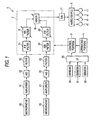
- FIG.1 is a block diagram of the same engine sound processing system.
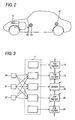
- FIG.2 is a view explaining mounted positions of microphones and speakers in the engine sound processing system.
- an engine sound processing system 1 includes two microphones 10, 20, which are provided to an intake port of an engine and a wall surface of an engine room on the vehicle interior side respectively.
- the number and installed positions of the microphones are not limited to this embodiment.
- the microphone may be arranged at the vicinity of a muffler to collect the exhaust gas, or may be arranged at the vicinity of an engine head to collect mechanical sound of a chain, for example.
- the system may be structured so that plural microphones are arranged at the respective arranged position and the collected sounds are mixed.
- the microphone arranged at a wall surface of an engine room at the interior side can collect an operating sounds of difference portions of the engine depending on the arranged position. Therefore, the microphones may arranged at the wall surface of the engine room at the interior side and the sounds collected by the respective microphone are mixed. A mixing ratio is adjusted on the basis of the necessary sound quality and the engine operating noise is collected.
- the microphone is not limited to a sound microphone.
- a vibration sensor capable of picking up a vibration of audio frequency band can be employed, for example.
- the vibration sensor by arranging the vibration sensor on the engine, the vibration of the audio frequency band of the engine can be directly collected, that is, the vibration of the engine before it is transformed into sound can be collected.
- the vibration sensor does not detect a vibration pulse of the engine but picks up a signal as a sound source of the engine.
- the vibration sensor By arranging the vibration sensor at the intake port, the sound such as wind noise which is not related to the engine revolutions is not collected and only the intake sound can be collected.
- a sound microphone is arranged at the vicinity of the mounting portion of the muffler and an exhaust sound having a frequency peak corresponding to the engine revolution degree. Accordingly, the sound microphone and the vibration microphone can be arranged according to the arranged position.
- speakers 41 i.e., front left and right speakers and rear left and right speakers, are provided in the interior of the vehicle. These speakers 41 are used commonly in the audio device, and are not originally designed for the engine sound processing system. In other words, in this engine sound processing system, the engine sound is collected and processed, then the audio signal is input into a vehicle audio device 5, and then the engine sound is output into the interior of the vehicle via the vehicle audio device 5.
- the microphone 10 and the microphone 20 are connected to an amplifier 11 and an amplifier 21 respectively.
- the amplifier 11 and the amplifier 21 amplify the sound signals (intake noise, engine sound) input from the microphone 10 and the microphone 20, respectively.
- the amplified sound signals are converted into digital signals by A/D converters 12, 22, respectively.
- Unnecessary frequency bands which substantially does not include the intake sound and the engine explosion sound are cut away from the digital sound signals by filters 13, 23. When a signal level is too large, the sound signals are attenuated by these filters. Therefore, the filters 13, 23 may be constituted by a combination of a low-pass filter, a high-pass filter, an attenuator, etc. respectively.
- the signals, a frequency band and a signal level of which are limited by the filter 13 and the filter 23 respectively, are input into a signal processing portion 2.
- the signal processing portion 2 applies two-step filtering process to both the intake noise collected via the microphone 10 and the engine sound on the wall surface of the engine room collected via the microphone 20 in separate systems respectively. In this case, this filtering process may be executed in one system after both signals are mixed.
- a filter 14 and a filter 24 are filters that simulate the noise insulating characteristic of the wall surface of the interior of the vehicle.
- the sound signal contains the mechanical noise in a high frequency range at a high level and thus is widely different from the engine sound that is heard in the interior of the vehicle by the passenger such as the driver, or the like. Therefore, in order to put this sound signal close to the quality of sound (frequency distribution) similar to the engine sound that is heard in the interior of the vehicle, the sound signal is processed into the sound, in which the high tone range is cut and the low tone range is left, by simulating the noise insulating characteristic of the wall surface of the interior of the vehicle by the filters 14, 24.
- This noise insulating characteristic may not be always detected by simulating the noise insulating characteristic of the vehicle into which this system is installed, and may be detected by simulating the noise insulating characteristic of the sports car or the high-class automobile.
- the filter characteristic (noise insulating characteristic) of the filter 14 and the filter 24 may be fixed, but their settings may be varied to change the sounding way of the engine sound.
- Filter 15and filter 25 of subsequent-stage are active filters the characteristics of which are changed in response to the driving conditions, and process the engine sound (the intake noise and the engine explosion sound collected by the microphone 10 and the microphone 20) in response to the driving conditions. Therefore, the filters 15, 25 are constituted by the active filter whose characteristic is changed in real time in response to the driving conditions. The change in the filter characteristic will be described later.
- the intake noise and the engine explosion sound output from two-stage filter 14 - filter15 and a filter 24- a filter 25 are mixed into a sound signal in one system by a mixer 16, then is converted into analog audio signal by the D/A converter 17, and then is output to the audio device 5.
- the sound signal of this 1 system includes stereo outputs (L/R).
- an engine revolution sensor 30 for sensing an engine revolution As the sensor for sensing the driving conditions, an engine revolution sensor 30 for sensing an engine revolution, an accelerator opening angle sensor 31 for sensing an opening angle of an accelerator, and a speed sensor 32 for sensing a speed of the vehicle are provided. Sensed values of respective sensors are input into a control portion 3 via an interface 33. An A/D converter is built in the interface 33 as the case may be.
- the control portion 3 may calculate the number of revolution of the engine and the speed based on an integrated value of the pulses or a pulse interval.
- the control portion 3 determines parameters that define filter characteristics of the filter 15 and the filter 25 and a mixing ratio thereof according to the output of the sensors.
- the control portion 3 outputs the determined parameters and mixing ratio to the signal processing portion 2 to control the filter 15, the filter 25 and the mixer 16.
- An operating portion 4 is connected to the control portion 3. This operating portion 4 may be shared with the vehicle audio device 5, or the signal may be input from the operation portion of the audio device.
- the user sets control characteristics of the filters 15, 25 and the mixer 16 by operating the operating portion 4 in response to the driving conditions (outputs from the sensors 30, 31, 32).
- the user sets the filter characteristic (noise insulating characteristic) of the filters 14, 24 by operating the operating portion 4.
- FIG.3 a control system of the engine sound processing system is illustrated as shown in FIG.3.
- the control characteristics of the filter 14, the filter 24, the filter 15, the filter 25 and the mixer 16 are set by the setting on the operating portion 4. Out of them, the filters 15 and the filer 25 and the mixer 16 are formed of the active filter respectively and their characteristics are controlled in real time in response to the outputs of the sensors 30, 31, 32.
- one or plural parameters may be set in respective filters by the manual operation, or one or plural parameter sets are stored previously in the control portion 3 and then any of the parameter sets may be selected and set.
- a parameter set to give the engine sound effect like a sports vehicle a parameter set to give the engine sound effect like a cruising of a high-class motorcar, etc. are prepared previously and then the mode may be switched to a sports vehicle mode, a cruising mode, etc. In this case, of course it is possible that the engine sound effect should not be produced by turning OFF the function of the engine sound processing system.
- the system may be provided with a connector for a flash memory and/or ROM pack, and a parameter set may be supplied from the flash memory and /or ROM pack.
- the parameter set may be supplied through a hard disc of a vehicle navigation system.
- the parameter set may be downloaded through an Internet.
- the system may be provided with a connector such as a LAN connector and structured so that the parameter set is supplied or an user can manually set the parameter through a computer (notebook-sized personal computer) connected to the system via the connector.
- Fig. 6 shows a block diagram showing an engine sound processing system that is an example in which a plurality of microphones (for example, 4) are further provided. Since this example includes elements which are common to the above engine sound processing system, its description is omitted and the same reference numbers are assigned to the common elements.
- the engine sound processing system 100 are provided with a microphone 50 and a microphone 60.
- the microphone 50 is arranged at the exhaust portion (vicinity of the muffler) of the engine and the microphone 60 is arranged is arranged at the engine head.
- the microphone 50 arranged at the exhaust port collect an engine exhaust sound.
- the microphone 60 arranged at the engine head collects the mechanical sound of the engine head.
- the microphone 50 and the microphone 60 are connected to the amplifier 51 and the amplifier 61, respectively.
- the amplifier 51 and the amplifier 61 amplify the sound signals (exhaust sound and mechanical sound) inputted from the microphone 51 and the microphone 61.
- the amplified sound signals are converted into the digital signals by an A/D converter 52 and an A/D converter 63, respectively.
- a filter 53 and a filter 63 cut an unnecessary frequency band of the sound signal converted into the digital signals.
- the signals, frequency band and signal level of which are restricted by the filter 53 and the filter 63 are input to a mixer 70.
- the signals (intake sound and engine explosion sound) , frequency band and signal level of which are restricted by the filter 13 and the filter 23 is output to an mixer 70 in the same manner.
- the mixer 70 outputs mixes the four signals and outputs to the signal processing portion 2 in two systems.
- the mixing ratio is controlled by the control portion 3.
- the signal processing portion 2 performs filtering process.
- the four signals may be output to the filter 14 and the filter 24 with a predetermined mixing ratio, and alternatively may be set by the user manually. For example, only a sound signal of the exhaust signal is input to the filter 14 and the other sound signals are input to the filter 24.
- the filter 14 and the filter 15 performs the filtering process only on the sourid signal of the exhaust sound, and the filter 24 and the filter 25 performs the filtering process on the other signals. Therefore, the exhaust sound can be more emphasized than other sounds. As described above, the user can select the sound that the user wants to emphasize by changing mixing ration according to the user's preference.
- the system may be structured so that filters are in response to a number of installed microphones and the filtering process is performed by each sound system.
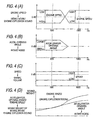
- the horizontal axis of the graphs shown in Figs. 4A to 4C represents a frequency of the filter and the vertical axis represents a frequency gain of the filter.
- the frequency gain of the filter shown in the figures has the following characteristics.
- FIG.4A shows filter control characteristics of the intake noise and the wall surface noise based on the engine revolution, and both filter characteristics are controlled based on two rules
- FIG.4B shows the filter control characteristic of the intake noise based on the accelerator opening angle, and the filter characteristic is controlled based on two rules
- FIG.4C shows the control characteristic of the entire volume based on the speed, and the entire volume is controlled based on two rules
- FIG.4D shows a mixing weight control characteristic of the intake noise and the wall surface noise based on the accelerator opening angle and the engine revolution, and the mixing weight is controlled based on two rules
- the mixing rate is decided by a rate of the mixing weights of the mixing weight of the intake noise and the mixing weight of the wall surface noise.
- the above rules are decided based on the effect that "The low tone is emphasized to produce the engine atmosphere of the large engine capacity when the engine revolution is low, while the high tone is emphasized to emphasize the high-speed revolution of the engine when the engine revolution is high. Since the load is applied to the engine when the accelerator opening angle is large, not only the intake noise is increased but also the mixing rate of the intake noise is increased. Since the noises such as the wind noise, the tire noise, etc. except the engine sound are increased when the speed is high, the entire volume are increased.”, and this rule is applied to the sports car mode.
- the sports car mode employs the rule for emphasizing the driving conditions at the time in addition to the actual engine sound.
- FIG. 5A to 5D Another example of the characteristics control of the filter 15 and filter 26 will be described Figs 5A to 5D with reference to Figs. 5A to 5D.
- Fig. 5A shows the filter control characteristics of the intake sound and the engine explosion sound according in response to the engine revolution, and the characteristics are controlled based on the following rule:
- Fig. 5B shows the filter control characteristics of the intake sound in response to the accelerator opening angle, and the characteristic are controlled based on the following rule:
- Fig. 5C shows the control characteristics of the entire volume based on the vehicle speed, and the characteristics are controlled based on the following rules:
- Fig. 5D shows a mixing weight control characteristic of the intake noise and the wall surface noise based on the accelerator opening angle and the engine revolution, and the mixing weight is controlled based on two rules
- the above rule is decided based on the effect that "when the engine revolution is low, the low tone is suppressed in order to emphasize a silent characteristic, and when the engine revolution is high, the low tone is emphasize into order to emphasize that a calm atmosphere that the high-class motorcar having large displacement engine have.
- the accelerator opening angle is large, although a large load is normally applied to the engine and the intake sound is large, the low tone of the intake sound is suppressed in order to emphasize the silent characteristic.
- the vehicle speed is high, although the entire volume and the engine explosion sound are large since the noise such as wind sound and the tire noise except the engine noise become large, the volume is increased by a small amount in view of importance of a silent characteristics.
- the mixing weight of the engine explosion sound and the intake sound are not changed depending on the engine revolution and the accelerator opening angle.”
- This rule is applied to the cruising mode.
- the cruising mode employs this rule in order to provide a calm atmosphere to the user without emphasizing the engine sound as compared with the driving condition at that time.
- center frequencies in the low tone range and the high tone range may be decided based on the frequency distribution of the engine sound. Normally the center frequency in the low tone range may be set to almost 500 Hz, and the center frequency in the high tone range may be set to almost 1000 Hz.
- control rules of the filter characteristics are not limited to the above rules.
- the filter characteristic curve may be derived by forming the function using respective sensor outputs as a variable and then inputting the sensor output into the function, or the filter characteristic curve may be derived by the fuzzy inference.
- the concerned filter characteristic may be read by formulating previously a table to decide the filter characteristic every predetermined steps of respective sensor outputs and then searching the table based on the sensor outputs. In any case, suppose that the information used to derive the filter characteristic based on the sensor outputs are contained in the above parameter sets that are set by the user.
Landscapes
- Health & Medical Sciences (AREA)
- Audiology, Speech & Language Pathology (AREA)
- General Health & Medical Sciences (AREA)
- Physics & Mathematics (AREA)
- Engineering & Computer Science (AREA)
- Acoustics & Sound (AREA)
- Multimedia (AREA)
- Fittings On The Vehicle Exterior For Carrying Loads, And Devices For Holding Or Mounting Articles (AREA)
- Soundproofing, Sound Blocking, And Sound Damping (AREA)
Applications Claiming Priority (4)
| Application Number | Priority Date | Filing Date | Title |
|---|---|---|---|
| JP2004067799 | 2004-03-10 | ||
| JP2004067799 | 2004-03-10 | ||
| JP2005013330A JP4140607B2 (ja) | 2004-03-10 | 2005-01-20 | エンジン音加工装置 |
| JP2005013330 | 2005-01-20 |
Publications (1)
| Publication Number | Publication Date |
|---|---|
| EP1575028A2 true EP1575028A2 (de) | 2005-09-14 |
Family
ID=34829502
Family Applications (1)
| Application Number | Title | Priority Date | Filing Date |
|---|---|---|---|
| EP05005314A Withdrawn EP1575028A2 (de) | 2004-03-10 | 2005-03-10 | System zum Simulieren des Klangs einer Brennkraftmaschine |
Country Status (3)
| Country | Link |
|---|---|
| US (1) | US7961894B2 (de) |
| EP (1) | EP1575028A2 (de) |
| JP (1) | JP4140607B2 (de) |
Cited By (4)
| Publication number | Priority date | Publication date | Assignee | Title |
|---|---|---|---|---|
| CN102483914A (zh) * | 2009-08-19 | 2012-05-30 | 斯堪尼亚商用车有限公司 | 用于产生发动机声发射的方法和装置、计算机程序和计算机程序产品 |
| DE102011102709A1 (de) | 2011-05-20 | 2012-11-22 | RocketAudio Traffic GmbH | Einrichtung zur simulierenden Erzeugung von Betriebsgeräuschen eines Fahrzeuges, insbesondere eines Kraftfahrzeuges |
| EP2028644A3 (de) * | 2007-08-21 | 2013-05-29 | Yamaha Corporation | Vorrichtung zur Motorenklangbearbeitung |
| EP1865494B1 (de) * | 2005-03-11 | 2016-11-09 | Yamaha Corporation | Motorgeräusch-verarbeitungseinrichtung |
Families Citing this family (26)
| Publication number | Priority date | Publication date | Assignee | Title |
|---|---|---|---|---|
| JP4946117B2 (ja) * | 2006-03-22 | 2012-06-06 | ヤマハ株式会社 | 波形合成装置およびそのプログラム |
| JP4635931B2 (ja) * | 2006-03-28 | 2011-02-23 | ヤマハ株式会社 | 波形生成装置およびプログラム |
| JP4961807B2 (ja) * | 2006-04-05 | 2012-06-27 | 株式会社Jvcケンウッド | 車載装置、音声情報提供システムおよび発話速度調整方法 |
| JP4539634B2 (ja) * | 2006-10-06 | 2010-09-08 | ヤマハ株式会社 | エンジン音加工装置 |
| JP4957168B2 (ja) * | 2006-10-13 | 2012-06-20 | ヤマハ株式会社 | エンジン音加工装置 |
| DE102006055012B4 (de) * | 2006-11-22 | 2021-01-14 | Robert Bosch Gmbh | Verfahren zur Diagnose einer Brennkraftmaschine in einem Kraftfahrzeug |
| JP4760694B2 (ja) * | 2006-12-08 | 2011-08-31 | ヤマハ株式会社 | エンジン音再生装置 |
| JP4384681B2 (ja) | 2007-07-25 | 2009-12-16 | 本田技研工業株式会社 | 能動型効果音発生装置 |
| US8009839B2 (en) * | 2008-03-13 | 2011-08-30 | Hagen Gary E | Automotive sensory enhancement system |
| US8045725B2 (en) * | 2009-04-16 | 2011-10-25 | GM Global Technology Operations LLC | Vehicle interior active noise cancellation |
| DE102009040898B4 (de) * | 2009-09-11 | 2024-11-14 | Volkswagen Ag | Fahrzeug mit einer Audioanlage zur Erzeugung eines Motorgeräuschs |
| JP5440087B2 (ja) * | 2009-10-13 | 2014-03-12 | ヤマハ株式会社 | エンジン音生成装置 |
| US8955455B2 (en) * | 2010-01-29 | 2015-02-17 | Pioneer Corporation | Device and method for pseudonoise generation |
| US8634574B2 (en) * | 2010-04-13 | 2014-01-21 | Mann+Hummel Gmbh | Sound transmitting device |
| US9177544B2 (en) | 2012-04-02 | 2015-11-03 | Bose Corporation | Engine harmonic enhancement control |
| CN102651215B (zh) * | 2012-04-27 | 2014-03-12 | 浙江吉利汽车研究院有限公司杭州分公司 | 汽车发动机噪声产生装置及其控制方法 |
| ITUB20159781A1 (it) * | 2015-01-13 | 2017-06-30 | Ask Ind Spa | Sistema di arricchimento del suono del motore in un veicolo. |
| DE102016201984A1 (de) * | 2016-02-10 | 2017-08-10 | Bayerische Motoren Werke Aktiengesellschaft | Wiedergabeeinrichtung für ein Kraftfahrzeug sowie Verfahren zum Betreiben einer solchen Wiedergabeeinrichtung |
| US20170297486A1 (en) * | 2016-04-16 | 2017-10-19 | Rene Magana | Noise simulator |
| US20170374460A1 (en) * | 2016-06-23 | 2017-12-28 | Hyundai Motor Company | Apparatus and method of processing sound from engine, vehicle, and method of controlling the vehicle |
| KR101916731B1 (ko) * | 2017-04-20 | 2018-11-08 | 엘지전자 주식회사 | 차량에 구비된 차량 제어 장치 및 차량의 제어방법 |
| US10290293B2 (en) * | 2017-11-08 | 2019-05-14 | Intel Corporation | Systems, apparatus, and methods for drone audio noise reduction |
| US10406976B2 (en) * | 2018-01-31 | 2019-09-10 | Ford Global Technologies, Llc | Multi-purpose automotive sound device |
| US11282493B2 (en) * | 2018-10-05 | 2022-03-22 | Westinghouse Air Brake Technologies Corporation | Adaptive noise filtering system |
| KR102692478B1 (ko) * | 2018-12-13 | 2024-08-07 | 현대자동차주식회사 | 차량 사운드 인덱스 기반 인공지능 엔진음색 제어시스템 및 방법 |
| KR20210116272A (ko) * | 2020-03-16 | 2021-09-27 | 하만인터내셔날인더스트리스인코포레이티드 | 차량 사운드 향상을 위한 시스템 및 방법 |
Family Cites Families (23)
| Publication number | Priority date | Publication date | Assignee | Title |
|---|---|---|---|---|
| JPH0241953A (ja) | 1988-08-02 | 1990-02-13 | Mazda Motor Corp | 車室内音制御装置 |
| US5371802A (en) * | 1989-04-20 | 1994-12-06 | Group Lotus Limited | Sound synthesizer in a vehicle |
| JPH0454742U (de) | 1990-09-18 | 1992-05-11 | ||
| JPH0580790A (ja) | 1991-09-21 | 1993-04-02 | Hitachi Ltd | 車室内音響制御装置 |
| US5237617A (en) * | 1991-10-17 | 1993-08-17 | Walter Miller | Sound effects generating system for automobiles |
| JPH07149186A (ja) | 1993-11-29 | 1995-06-13 | Nippondenso Co Ltd | 車両用聴音装置 |
| JPH07182587A (ja) * | 1993-12-21 | 1995-07-21 | Honda Motor Co Ltd | 電気車両用擬似音発生装置 |
| JPH07302093A (ja) | 1994-04-28 | 1995-11-14 | Nippon Seiki Co Ltd | エンジン音生成装置 |
| JP2970447B2 (ja) * | 1994-11-25 | 1999-11-02 | ヤマハ株式会社 | エンジン排気音の合成装置 |
| DE19531402C2 (de) * | 1995-08-26 | 1999-04-01 | Mannesmann Sachs Ag | Vorrichtung und Verfahren zum Beeinflussen von Schwingungen in einem Fahrgastraum eines Kraftfahrzeugs und Vorrichtung und Verfahren zum Erkennen von Defekten an einem Kraftfahrzeug |
| US5820442A (en) * | 1996-12-09 | 1998-10-13 | Helder; Glenn R. | Super sound engine/transmission sound enhancer |
| US5917920A (en) * | 1997-05-29 | 1999-06-29 | Humphries; Alan | Safety vehicle communication system |
| US6317503B1 (en) * | 1997-09-24 | 2001-11-13 | Sony Corporation | Multi-mode LED indicator for recording services |
| US6275590B1 (en) * | 1998-09-17 | 2001-08-14 | Robert S. Prus | Engine noise simulating novelty device |
| JP2000172281A (ja) | 1998-12-03 | 2000-06-23 | Fuji Heavy Ind Ltd | 車室内音制御装置 |
| DE19945259C1 (de) * | 1999-09-21 | 2001-01-11 | Bayerische Motoren Werke Ag | Vorrichtung zur elektroakustischen Geräuscherzeugung bei einem Kraftfahrzeug |
| US6356185B1 (en) * | 1999-10-27 | 2002-03-12 | Jay Sterling Plugge | Classic automobile sound processor |
| JP3771773B2 (ja) | 2000-04-14 | 2006-04-26 | 株式会社東海理化電機製作所 | ドアミラー構造 |
| US6959094B1 (en) * | 2000-04-20 | 2005-10-25 | Analog Devices, Inc. | Apparatus and methods for synthesis of internal combustion engine vehicle sounds |
| US6859539B1 (en) * | 2000-07-07 | 2005-02-22 | Yamaha Hatsudoki Kabushiki Kaisha | Vehicle sound synthesizer |
| US6592375B2 (en) * | 2001-02-09 | 2003-07-15 | Midway Games West Inc. | Method and system for producing engine sounds of a simulated vehicle |
| US7096169B2 (en) * | 2002-05-16 | 2006-08-22 | Crutchfield Corporation | Virtual speaker demonstration system and virtual noise simulation |
| US8155343B2 (en) * | 2005-03-11 | 2012-04-10 | Yamaha Corporation | Engine sound processing system |
-
2005
- 2005-01-20 JP JP2005013330A patent/JP4140607B2/ja not_active Expired - Fee Related
- 2005-03-10 EP EP05005314A patent/EP1575028A2/de not_active Withdrawn
- 2005-03-10 US US11/076,660 patent/US7961894B2/en not_active Expired - Fee Related
Cited By (6)
| Publication number | Priority date | Publication date | Assignee | Title |
|---|---|---|---|---|
| EP1865494B1 (de) * | 2005-03-11 | 2016-11-09 | Yamaha Corporation | Motorgeräusch-verarbeitungseinrichtung |
| EP2028644A3 (de) * | 2007-08-21 | 2013-05-29 | Yamaha Corporation | Vorrichtung zur Motorenklangbearbeitung |
| CN102483914A (zh) * | 2009-08-19 | 2012-05-30 | 斯堪尼亚商用车有限公司 | 用于产生发动机声发射的方法和装置、计算机程序和计算机程序产品 |
| EP2467849A4 (de) * | 2009-08-19 | 2013-03-13 | Scania Cv Ab | Verfahren und vorrichtung zur erzeugung akustischer motoremissionen, computerprogramm und computerprogrammprodukt |
| DE102011102709A1 (de) | 2011-05-20 | 2012-11-22 | RocketAudio Traffic GmbH | Einrichtung zur simulierenden Erzeugung von Betriebsgeräuschen eines Fahrzeuges, insbesondere eines Kraftfahrzeuges |
| DE102011102709B4 (de) | 2011-05-20 | 2020-08-06 | RocketAudio Traffic GmbH | Einrichtung zur simulierenden Erzeugung von Betriebsgeräuschen eines Fahrzeuges, insbesondere eines Kraftfahrzeuges |
Also Published As
| Publication number | Publication date |
|---|---|
| JP4140607B2 (ja) | 2008-08-27 |
| US20050201570A1 (en) | 2005-09-15 |
| JP2005289354A (ja) | 2005-10-20 |
| US7961894B2 (en) | 2011-06-14 |
Similar Documents
| Publication | Publication Date | Title |
|---|---|---|
| US7961894B2 (en) | Engine sound processing system | |
| US7203321B1 (en) | Device for electroacoustic sound generation in a motor vehicle | |
| JP4888386B2 (ja) | エンジン音加工装置 | |
| JP5191750B2 (ja) | 音響装置 | |
| JP7511336B2 (ja) | 車両サウンドクオリティインデックスベースの人工知能エンジン音色制御システムおよび方法 | |
| JP5802261B2 (ja) | 車両用音響装置および車両用音響方法 | |
| EP2028644B1 (de) | Vorrichtung zur Motorenklangbearbeitung | |
| EP1575163B1 (de) | Verfahren zur Verarbeitung von Tonsignalen für ein Automobil und System zur Durchführung des Verfahrens | |
| US20160180832A1 (en) | Vehicle engine sound enhancement | |
| EP3882908B1 (de) | Systeme und verfahren zur fahrzeugschallverbesserung | |
| CN108806660A (zh) | 对车辆中音调噪声的主动声音去敏感 | |
| KR20150050855A (ko) | 스마트폰을 이용한 차량의 실내 음향 제어 시스템 및 방법 | |
| JPH04504916A (ja) | 音響エンハンスメントシステム | |
| US20050094826A1 (en) | Processing equipment of the sound of a car | |
| KR102166703B1 (ko) | 차량용 독립 음장 형성 장치 및 차량용 독립 음장 형성 방법 | |
| JP3287747B2 (ja) | 騒音感応自動音量調整装置 | |
| US20240282287A1 (en) | Method for masking undesirable disturbing noises and vehicle | |
| JP4914742B2 (ja) | 効果音発生装置 | |
| JPH0876772A (ja) | アクティブ消音装置 | |
| JP4957168B2 (ja) | エンジン音加工装置 | |
| JP5125203B2 (ja) | 音加工装置 | |
| JP4887988B2 (ja) | エンジン音加工装置 | |
| JPH0480798A (ja) | 車両用音響制御装置 | |
| JP3077331B2 (ja) | 能動騒音低減装置 | |
| CN119673139A (zh) | 一种主动声浪的发声控制方法和系统 |
Legal Events
| Date | Code | Title | Description |
|---|---|---|---|
| PUAI | Public reference made under article 153(3) epc to a published international application that has entered the european phase |
Free format text: ORIGINAL CODE: 0009012 |
|
| AK | Designated contracting states |
Kind code of ref document: A2 Designated state(s): AT BE BG CH CY CZ DE DK EE ES FI FR GB GR HU IE IS IT LI LT LU MC NL PL PT RO SE SI SK TR |
|
| AX | Request for extension of the european patent |
Extension state: AL BA HR LV MK YU |
|
| RAP1 | Party data changed (applicant data changed or rights of an application transferred) |
Owner name: YAMAHA CORPORATION |
|
| STAA | Information on the status of an ep patent application or granted ep patent |
Free format text: STATUS: THE APPLICATION HAS BEEN WITHDRAWN |
|
| 18W | Application withdrawn |
Effective date: 20170310 |