EP1566804A1 - Datenaufzeichnungs- und wiedergabeeinrichtung und datenaufzeichnungs- und wiedergabeverfahren - Google Patents
Datenaufzeichnungs- und wiedergabeeinrichtung und datenaufzeichnungs- und wiedergabeverfahren Download PDFInfo
- Publication number
- EP1566804A1 EP1566804A1 EP02785986A EP02785986A EP1566804A1 EP 1566804 A1 EP1566804 A1 EP 1566804A1 EP 02785986 A EP02785986 A EP 02785986A EP 02785986 A EP02785986 A EP 02785986A EP 1566804 A1 EP1566804 A1 EP 1566804A1
- Authority
- EP
- European Patent Office
- Prior art keywords
- data
- recording
- ecc
- iterative
- data units
- Prior art date
- Legal status (The legal status is an assumption and is not a legal conclusion. Google has not performed a legal analysis and makes no representation as to the accuracy of the status listed.)
- Withdrawn
Links
Images







Classifications
-
- G—PHYSICS
- G11—INFORMATION STORAGE
- G11B—INFORMATION STORAGE BASED ON RELATIVE MOVEMENT BETWEEN RECORD CARRIER AND TRANSDUCER
- G11B20/00—Signal processing not specific to the method of recording or reproducing; Circuits therefor
- G11B20/10—Digital recording or reproducing
- G11B20/18—Error detection or correction; Testing, e.g. of drop-outs
-
- G—PHYSICS
- G11—INFORMATION STORAGE
- G11B—INFORMATION STORAGE BASED ON RELATIVE MOVEMENT BETWEEN RECORD CARRIER AND TRANSDUCER
- G11B20/00—Signal processing not specific to the method of recording or reproducing; Circuits therefor
- G11B20/10—Digital recording or reproducing
- G11B20/18—Error detection or correction; Testing, e.g. of drop-outs
- G11B20/1806—Pulse code modulation systems for audio signals
- G11B20/1813—Pulse code modulation systems for audio signals by adding special bits or symbols to the coded information
-
- G—PHYSICS
- G11—INFORMATION STORAGE
- G11B—INFORMATION STORAGE BASED ON RELATIVE MOVEMENT BETWEEN RECORD CARRIER AND TRANSDUCER
- G11B20/00—Signal processing not specific to the method of recording or reproducing; Circuits therefor
- G11B20/10—Digital recording or reproducing
-
- G—PHYSICS
- G11—INFORMATION STORAGE
- G11B—INFORMATION STORAGE BASED ON RELATIVE MOVEMENT BETWEEN RECORD CARRIER AND TRANSDUCER
- G11B20/00—Signal processing not specific to the method of recording or reproducing; Circuits therefor
- G11B20/10—Digital recording or reproducing
- G11B20/12—Formatting, e.g. arrangement of data block or words on the record carriers
Definitions
- the present invention relates generally to a data format for data being recorded on a recording medium, a data recording/reproducing apparatus, and a data recording /reproducing method.
- the present invention particularly relates to a data format for realizing effective error correction for errors that occur due to dust and/or scratches, for example, on the recording medium.
- Various types of data recording/reproducing apparatuses exist including those for recording data on a recording medium such as a magnetic disk, a magnetic tape, an optical disk, and a magneto-optical disk.
- a magnetic recording mark is usually used.
- These recording media are less expensive than semiconductor memory and are able to store data on a permanent basis.
- these recording media are widely used as information recording media for computers to handle large amounts of information such as images and image information. It is desired that a recording/reproducing apparatus for recording data on such recording media be able to operate with high reliability and effectively correct data errors occurring as a result of dust and scratches on the recording media.
- FIG.1 is a diagram illustrating ECC (error correcting code) sectors, their respective data formats, and a corresponding recording data sequence according to a conventional scheme.
- the recording data includes plural ECC sectors, ECC sector 0 (100), ECC sector 1 (110), ECC sector 2n-1 (120), and ECC sector 2n (130).
- each ECC sector is further divided into plural data blocks.
- the ECC sector 0 (100) includes data 0/0 (101), data 0/1 (102), and data 0/15 (103) as data blocks.
- Each data block includes header information that indicates the head of the data block and data contents.
- a data recording/reproducing apparatus uses an error correcting code (ECC) to accurately restore data recorded on a recording medium.
- ECC error correcting code
- the data recording/reproducing apparatus reproduces data of a recording medium
- the data reproduced from the recording medium may be erred or parts of the data may be skipped due to influence of dust and scratches, for example, on the recording medium. Accordingly, redundancy data are added to the original recording data so that data may be accurately reproduced from the recording medium even when such data error occurs, and the redundancy data are used to correct errors and inadequacies upon relaying the data.
- ECC format the parity code and the CRC code are known.
- the Reed-Solomon code is known as a representative format for the ECC. Any of these ECC formats may be used to encode data recorded on a recording medium to generate an ECC sector therefrom.
- an ECC sector corresponds to a group of data that are encoded by an error correcting code.
- an ECC sector such as the ECC sector ECC 0 (100) of FIG.1 may be divided into data blocks such as data 0/0 (101), data 0/1 (102), and data 0/15 (103), for example.
- Each data block may be arranged to include a header at its front end portion for enabling detection of the head of the data block upon reproducing the data block.
- the data blocks divided in the above-described manner may then be recorded on a recording medium.
- the recording data sequence shown in part (C) of FIG.1 indicates the order in which the divided data blocks of the ECC sectors are to be recorded. As is shown in this drawing, the data sequence is recorded according to the order in which the divided data blocks are arranged.
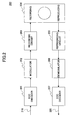
- FIG.2 is a block diagram showing an exemplary configuration of a data recording/reproducing apparatus.
- the data recording/reproducing apparatus 200 of FIG.2 includes an ECC encoder 201, a modulator 202, a recording circuit 203, a recording medium 204, a reproducing circuit 205, a demodulator 206, and an ECC decoder 207.
- recording data 210 that are to be recorded on the recording medium 204 are supplied to the ECC encoder 201.
- data may be encoded and divided into data blocks in the manner described above. Then, the data divided into data blocks are transmitted to the modulator 202.
- the divided data are modulated into a modulation code that is suited for the present recording/reproducing system implementing the recording medium 204.
- a modulation code that is suited for the present recording/reproducing system implementing the recording medium 204.
- the (1, 7) RLL (run length limited) code or the EFM (eight to fourteen modulation ) code may be used as the modulation code in a case where the recording medium 204 corresponds to an optical disk.
- the modulated data obtained at the modulator 202 are then transmitted to the recording circuit 203.
- the recording circuit 203 converts the modulated data into a recording signal, and supplies the recording signal to a recording head so that the modulated data may be recorded on the recording medium.
- a reproducing signal that is detected from the recording medium 204 by a reproducing head is reproduced by the reproducing circuit 205.
- the reproducing signal is then transmitted to the demodulator circuit 206.
- the demodulator circuit 206 demodulates the modulated code data that are modulated in the manner described above to reproduce the data blocks.
- the reproduced data blocks are then transmitted to the ECC decoder 207.
- the ECC decoder 207 accumulates the divided data blocks to generate an ECC sector, and then corrects error data within the generated ECC sector to output decoded data 220.
- recording media such as the optical disk, the magneto-optical disk, the magnetic disk, and the magnetic tape have partial defects that are created during their manufacture. Additionally, defective portions of commutative media such as optical disks and magnetic tape may increase owing to influences from dust and scratches created by mishandling of the media. As is described above, the ECC is provided in order to correct such errors occurring in the reproduced signal.
- Data decoding using the iterative decoding scheme is an effective method for accurately decoding data in a case where the SNR (signal to noise ratio) of the signal decreases.
- the likelihood information represented by such a burst error signal may be significantly different from the likelihood information that may be represented by the correct data.
- influences from the differing likelihood information may be propagated to the other correctly reproduced data through prior information obtained from a previous decoding result that is used in the data decoding. In this way, error propagation may occur, and desired effects of the iterative decoding may not be sufficiently obtained.
- the above described problem may be solved by handling a data block containing the burst error as lost data in the iterative decoding process and conducting an error correction process at the ECC decoder.
- a burst error resides over two data blocks, these two data blocks need to be handled as lost data.
- error correction required for the lost data may be beyond the error correction capacity of the ECC so that the required error correction may not be realized.
- the present invention has been conceived in response to the one or more problems of the related art and its object is to provide a data format, a data recording/reproducing method, and a data recording/reproducing apparatus for realizing a more effective correction of data errors generated due to dust and scratches on a recording medium even when using conventional ECC.
- the present invention provides a data recording/reproducing apparatus, including an error correction encoder that conducts error correction encoding on input data; an iterative encoder that conducts iterative encoding on data output from the error correction encoder; a generation unit that generates iterative encoded data units by dividing an ECC sector including an error correction code generated by the error correction encoder into prescribed data units and conducting iterative encoding by the iterative encoder on each of the prescribed data units, and generates predetermined data units constituted by the iterative encoded data units; a recording unit that records the predetermined data units constituted by the iterative encoded data units on a recording medium; a reproducing unit that reproduces the predetermined data units from the recording medium; an iterative decoder that conducts iterative decoding on the reproduced predetermined data units; an error correction decoder that conducts error correction on data output by the iterative decoder; the apparatus characterized by comprising:
- the present invention provides a data recording/reproducing apparatus, including an error correction encoder that conducts error correction encoding on input data; a generation unit that generates predetermined data units by dividing an ECC sector including an error correction code generated by the error correction encoder into the predetermined data units; a recording unit that records the predetermined data units generated by the generation unit on a recording medium; an error correction decoder that conduct error correction on data reproduced from the recording medium; the apparatus being characterized by comprising: a distribution unit that distributes the predetermined data units generated by the generation unit, the distribution unit being configured to realize the data distribution in units of the predetermined data units using at least two ECC sectors, and output the distributed predetermined data units to the recording unit to be recorded on the recording medium.
- the distribution is realized in a manner such that the predetermined data units of a same ECC sector are arranged in a non-consecutive order.
- an apparatus of the present invention further includes a memory having a data capacity that is greater than or equal to the amount of data of an ECC sector to be distributed.
- the distribution involves interchanging odd numbered predetermined data units of differing ECC sectors.
- the distribution involves interchanging odd numbered predetermined data units of one ECC sector with even numbered predetermined data units of another ECC sector.
- the recording unit and the reproducing unit when the recording unit and the reproducing unit are capable of recording or reproducing at least two data blocks simultaneously, the recording unit and the reproducing unit distribute the predetermined data units of at least two ECC sectors.
- an apparatus of the present invention further includes a data buffer configured to monitor continuity of the input data.
- the data buffer determines that the input data continue over a data amount that is greater than or equal to a data amount for two ECC sectors, data of the two ECC sectors are distributed and recorded on the recording medium.
- the data buffer determines that the input data continue over a data amount that is less than or equal to a data amount for a single ECC sector, data of the single ECC sector and recorded data or dummy data are distributed and recorded.
- a file allocation table is referred to for determining whether unrecorded sectors for recording data of two ECC sectors are available within the recording medium.
- an apparatus of the present invention further includes a burst error detector.
- the error correction decoder processes data reproduced from the recording medium as lost data.
- the iterative encoder attaches parity codes to the iterative encoded data units, and the iterative decoder uses the parity codes to determine whether the iterative encoded data units that are reproduced from the recording medium correspond to lost data.
- the distribution is realized using at least three ECC sectors.
- the predetermined data units are distributed and recorded on differing tracks of the recording medium.
- the predetermined data units are distributed and recorded on a fore side and a rear side of the recording medium.
- the present invention provides a data recording/reproducing method, including an error correction encoding step of conducting error correction encoding on input data; an iterative encoding step of conducting iterative encoding on data output in the error correction encoding step; a generation step of generating iterative encoded data units through dividing an ECC sector including an error correction code generated in the error correction encoding step into prescribed data units and conducting the iterative encoding of the iterative encoding step on each of the prescribed data units, and generating predetermined data units constituted by the iterative encoded data units; a recording step of recording the predetermined data units constituted by the iterative encoded data units on a recording medium; a reproducing step of reproducing the predetermined data units from the recording medium; an iterative decoding step of conducting iterative decoding on the reproduced predetermined data units; and an error correction decoding step of conducting error correction on data output by the iterative decoding step; the method being characterized by further comprising:
- the present invention provides a data recording/reproducing method including an error correction encoding step of conducting error correction encoding on input data; a generation step of generating predetermined data units by dividing an ECC sector including an error correction code generated in the error correction encoding step into the predetermined data units; a recording step of recording the predetermined data units generated in the generation step on a recording medium; and an error correction decoding step of conducting error correction on data reproduced from the recording medium; the method being characterized by further comprising:
- the positions of data blocks (data units) into which one ECC sector is divided are interchanged with the positions of the data blocks of another ECC sector to realize data distribution recording.
- a long burst error spanning plural data blocks of an ECC sector occurs owing to the presence of dust or scratches on the recording medium.
- the burst error may be beyond the error correction capacity of the ECC, and error correction may not be effectively realized.
- data recorded using a format according to an embodiment of the present invention are arranged such that data blocks are distributed over plural ECC sectors, and thereby, a burst error originating from defects at the recording medium may be take the form of short errors scattered over plural ECC sectors.
- the data blocks may be distributed over plural ECC sectors upon data recording so that the number of data units (blocks) that may be handled as lost data may be increased and error correction may be accurately realized for longer burst errors compared to the convention system.
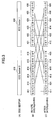
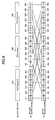
- FIG.3 is a diagram illustrating a data distribution scheme according to a first embodiment of the present invention. Specifically, this drawing illustrates a data interleaving or distributing method conducted by a data recording/reproducing apparatus in which the positions of even numbered data blocks of one ECC sector and odd numbered data blocks of another ECC sector are interchanged.
- the positions of odd numbered data blocks of ECC sector 0 (410) and even numbered data blocks of ECC sector 1 (420) are interchanged. That is, the ECC sector 0 (410) of the ECC sectors shown in part (A) of FIG.3 includes data blocks D 0/0 (411), D 0/1 (412), D 0/2 (413), D 0/3 (414), D 0/4 (415), and D 0/5 (416) before an interleaving process as is shown in part (B) of FIG.3.
- the ECC sector 1 (420) of the ECC sectors shown in part (A) of FIG.3 includes data blocks D 1/0 (421), D 1/1 (422), D 1/2 (423), D 1/3 (424), D 1/4 (425), and D 1/5 (426) before the interleaving process.
- the positions of the odd numbered data blocks D 0/1 (412), D 0/3 (414), and D 0/5 (416) and the even numbered data blocks D 1/0 (421), D 1/2 (423), and D 1/4 (425) are interchanged.
- data blocks of differing ECC sectors are sequentially recorded on the recording medium, namely, the data blocks are recorded in the following sequence: D 0/0 (411), D 1/0 (421), D 0/2 (413), D 1/2 (423), D 0/4 (415), D 1/4 (425), D 0/1 (412), D 1/1 (422), D 0/3 (414), D 1/3 (424), D 0/5 (416), and D 1/5 (426).
- the data blocks sustaining the error in the original ECC frame may be distributed and the ECC may be combined to realize error correction.
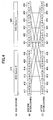
- FIG.4 illustrates a data distribution scheme according to a second embodiment of the present invention.
- This drawing illustrates a data interleaving method that is conducted by a data recording/reproducing apparatus in which the positions of odd numbered data blocks of one ECC sector and odd numbered data blocks of another ECC sector are interchanged. It is noted that elements shown in the present drawing that are identical to those shown in FIG.3 are given the same numerical references.
- the positions of odd numbered data blocks of ECC sector 0 (410) and odd numbered data blocks of ECC sector 1 (420) are interchanged. That is, the ECC sector 0 (410) of the ECC sectors shown in part (A) of FIG.4 includes data blocks D 0/0 (411), D 0/1 (412), D 0/2 (413), D 0/3 (414), D 0/4 (415), and D 0/5 (416) before an interleaving process as is shown in part (B) of FIG.4.
- the ECC sector 1 (420) of the ECC sectors shown in part (A) of FIG.4 includes data blocks D 1/0 (421), D 1/1 (422), D 1/2 (423), D 1/3 (424), D 1/4 (425), and D 1/5 (426) before the interleaving process.
- the positions of the odd numbered data blocks D 0/1 (412), D 0/3 (414), and D 0/5 (416) of ECC sector 0 (410) and the odd numbered data blocks D 1/1 (422), D 1/3 (424), and D 1/5 (426) of ECC sector 1 (420) are interchanged.
- the data blocks of the differing ECC sectors are sequentially recorded on the recording medium, namely, the data blocks are recorded in the following sequence: D 0/0 (411), D 1/1 (422), D 0/2 (413), D 1/3 (424), D 0/4 (415), D 1/5 (426), D 1/0 (421), D 0/1 (412), D 1/2 (423), D 0/3 (414), D 1/4 (425), and D 0/5 (416).
- FIG.5 illustrates an exemplary data format implementing the data distribution scheme of the second embodiment.
- the data distribution scheme according to the second embodiment of interchanging the positions of odd numbered data blocks of one ECC sector and odd numbered data blocks of another ECC sector is applied to the ECC sectors shown in part (A) and the data block formats of the ECC sectors shown in part (B) that are identical to the ECC sectors and data block formats shown in FIG.1 to generate a recording data sequence as is shown in part (C) of FIG.5.
- the odd numbered data blocks such as data 0/1 (102) of the ECC sector 0 (100) and the odd numbered data blocks such as data 1/1 (112) of the ECC sector 1 (110) are interchanged. In this way the recording order of the data blocks may be changed with respect to the recording data sequence shown in part (C) of FIG.1.
- the interleaving process conducted by the data recording/reproducing apparatus involves interchanging the positions of the odd numbered data blocks of an ECC sector and the odd numbered data blocks of another ECC sector.
- the interleaving process may also be realized by interchanging the positions of even numbered data blocks of an ECC sector and even numbered data blocks of another ECC sector.
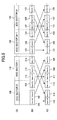
- FIG.6 is a diagram illustrating a data distribution scheme (three sector scheme) according to a third embodiment of the present invention.
- the present embodiment involves interchanging the positions of data blocks of three differing ECC sectors so that the data blocks of each ECC sector may be distributed over the three ECC frames. It is noted that elements shown in FIG.6 that are identical to those shown in FIG.3 are given the same numerical references.
- the ECC sector 0 (410) of the ECC sectors shown in part (A) of FIG.6 includes data blocks D 0/0 (411), D 0/1 (412), D 0/2 (413), D 0/3 (414), D 0/4 (415), and D 0/5 (416) before an interleaving process as is shown in part (B) of FIG.6.
- the ECC sector 1 (420) of the ECC sectors shown in part (A) of FIG.6 includes data blocks D 1/0 (421), D 1/1 (422), D 1/2 (423), D 1/3 (424), D 1/4 (425), and D 1/5 (426) before the interleaving process.
- ECC sector 2 (430) of the ECC sectors shown in part (A) of FIG.6 includes data blocks D 2/0 (431), D 2/1 (432), D 2/2 (433), D 2/3 (434), D 2/4 (435), and D 2/5 (436) before the interleaving process.
- the 0 th data block D 0/0 (411) of the ECC sector 0 (410), the 0 th data block D 1/0 (421) of the ECC sector 1 (420), and the 0 th data block D 2/0 (431) of the ECC sector 2 (430) are gathered together.
- the 3 rd data block D 0/3 (414) of the ECC sector 0 (410), the 3 rd data block D 1/3 (424) of the ECC sector 1 (420), and the 3 rd data block D 2/3 (434) of the ECC sector 2 (430) are gathered together.
- the data blocks to be recorded are arranged in the following sequence: D 0/0 (411), D 1/0 (421), D 2/0 (431), D 0/3 (414), D 1/3 (424), D 2/3 (434), and so on, as is shown in part (C) of FIG.6.
- FIG.7 is a diagram illustrating an exemplary data format implementing the data distribution scheme of the third embodiment. It is noted that part (A) of FIG.7 represents ECC sectors of encoded data, part (B) represents data block formats of the ECC sectors, and part (C) represents a recording data sequence.
- the recording data sequence of FIG.7 is arranged according to the data distribution scheme of the third embodiment in which data blocks are successively extracted from the ECC sector 0, the ECC sector 1, and the ECC sector 2, respectively, and rearranged into a predetermined sequence: D 0/0 (701), D 1/0 (711), D 2/0 (721), ... , D 2/12 (724), D 0/1 (702), D 1/1 (712), D 2/1 (722), ... , and so on.
- data blocks of an ECC sector are distributed over three ECC frames.
- the present embodiment is not limited to this example, and the data blocks may also be distributed over more than three ECC sectors.
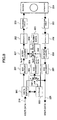
- FIG.8 is a diagram illustrating a configuration of a data recording/reproducing apparatus for realizing data distribution recording according to a fourth embodiment of the present invention.
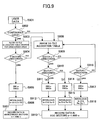
- FIG.9 is a flowchart illustrating an operation of the data recording/reproducing apparatus of the fourth embodiment for realizing the data distribution recording.
- the data recording/reproducing apparatus of the fourth embodiment as is shown in FIG.8 for realizing data distribution recording includes an ECC encoder 201, a modulator 202, a recording circuit 203, a recording medium 204, a reproducing circuit 205, a demodulator 206, an ECC demodulator 207, a data buffer 801, a controller 802, a first switch 803, an ECC encoder 804, a dummy data generator 805, a second switch 806, an interleaver 807, and a de-interleaver 808.
- step S901 of FIG.9 the data recording/reproducing apparatus of FIG.8 acquires user data 210 that are divided into recording units according to a logical format (e.g., 2 KB or 32 KB according to the data size supported by the operating system (OS)), the data being supplied to the data buffer 801 from a superordinate apparatus such as a personal computer via an interface provided between the superordinate apparatus and the data recording/reproducing apparatus.
- a superordinate apparatus such as a personal computer via an interface provided between the superordinate apparatus and the data recording/reproducing apparatus.
- ECC encoding/decoding is conducted in units of the data size into which the supplied user data 210 are divided.
- step S902 the supplied user data 210 are taken in by the data buffer 801 while monitoring the data size thereof. Specifically, the controller 802 monitors the data size to determine whether the supplied data may need to use two or more ECC sectors, and controls the first switch according to the determination result. If the supplied data continue over two or more EC sectors, the operation proceeds to step S903.
- step S903 a file allocation table that is recorded at a predetermined location of the recording medium is referred to in order to find an area in which data extending over two ECC sectors may be recorded.
- step S904 a determination is made as to whether an unrecorded area that may store two ECC sectors of data has been found. If such unrecorded area for storing two ECC sectors of data is found, the operation proceeds to step S905.
- step S905 positions 'a' for the first switch and the second switch, respectively, are selected by the controller 802.
- step S906 data (In-D1) of one ECC sector are ECC encoded by the ECC encoder 201, and data (In-D2) of the other ECC sector are input to the ECC encoder 804 via the first switch 803 to be ECC encoded. Then, the data (In-D1) and (In-D2) of the two ECC sectors that are ECC encoded at the ECC encoders 201 and 804, respectively, may be rearranged by the interleaver 807 according to the data distribution scheme of FIG.3, for example, to obtain a data sequence in which data blocks of the same ECC sector may be positioned apart from one another.
- step S907 data interleaved by the interleaver 807 are transmitted to the modulator 202 to be modulated by a suitable modulation code for recording and reproducing.
- a suitable modulation code for recording and reproducing.
- the (1, 7) RLL code or the EFM modulation code may be used as is described above.
- the recording circuit 203 may record the modulated data on the unrecorded area of the recording medium 204 for two ECC sectors of data that has been detected in step S904.
- the file allocation table may be referred to in order to locate the data distributed over plural locations. Then, the data recorded at the respective locations may be reproduced by the reproducing circuit 205, and the reproduced data may be modulated by the modulation circuit 206. Then, the modulated data may be rearranged back to the data sequence state prior to being interleaved or distributed by the de-interleaver 808, after which error correction may be conducted on errors included in the reproduced data by the EC decoder 207 so that the resulting data may be reproduced as user data 220.
- step S902 When it is determined in step S902 that the input user data 210 does not continue over two ECC sectors, namely, only one ECC sector is required to encode the user data 210, the operation proceeds to step S908.
- step S908 the file allocation table is referred to in order to find an available recording area within the recording medium 204 for storing one ECC sector of data.
- states of two consecutive sectors n-1 and n of the recording medium 204 may be classified into the following three categories:
- step S909 if it is determined in step S909 that sector n-1 is unrecorded (recordable) and it is also determined in step S910 that sector n is unrecorded (recordable) as well (corresponding to case (1)), the operation proceeds to step S911.
- the first switch may be set to any position and the second switch is set to position b.
- step S912 the data encoded at the ECC encoder 201 and dummy data generated by the dummy data generator 805 are interleaved by the interleaver 807 in the manner described above.
- step S913 the data interleaved by the interleaver 807 are transmitted to the modulator 202 to be modulated by a suitable modulation code for realizing data recording/reproduction.
- a suitable modulation code for realizing data recording/reproduction.
- the (1, 7) RLL code or the EFM modulation code may be used as is described above.
- the recording circuit 203 may record the modulated data on the two sectors of the recording medium 204 that have been detected as unrecorded areas. It is noted that the dummy data may be handled as unrecorded in cases (2) and (3).
- step S909 If it is determined in step S909 that sector n-1 is unrecorded (recordable) and it is determined in step S910 that sector n is already recorded (corresponding to case (2)), the operation proceeds to step S914.
- step S914 the controller 802 sets the first switch 803 to position 'b' and sets the second switch 806 to position 'a'.
- step S915 data that are already recorded are reproduced by the reproducing circuit 205, demodulated by the demodulation circuit 206, de-interleaved by the de-interleaver 808, and reproduced (ECC decoded) by the ECC decoder 207.
- the reproduced data are transmitted from the first switch 803 to the ECC encoder 804 to be ECC encoded again.
- the encoded data are interleaved with the data encoded by the ECC encoder 201 by the interleaver 807.
- step S913 the interleaved data are recorded on the recording medium 204 in the manner described above.
- step 909 If it is determined in step 909 that sector n-1 is already recorded and it is determined in step S916 that sector n is unrecorded (recordable) (corresponding to case (3)), the operation proceeds to step S917.
- step S917 the first switch 803 is set to position 'b' and the second switch 806 is set to position 'a'.
- step S918 the already recorded data are reproduced by the reproducing circuit 205, demodulated by the demodulator 206, de-interleaved by the de-interleaver 808, and reproduced (ECC decoded) by the ECC decoder 206. Then, the reproduced data are transmitted from the first switch 803 to the ECC encoder 804 to be encoded again. Then, the encoded data are interleaved with the data encoded at the ECC encoder 201 by the interleaver 807.
- step S913 the interleaved data are recorded on the recording medium 204 in the manner described above.
- step S916 If it is determined in step S916 that sector n is already recorded, the operation proceeds back to step S908 in which the file allocation table is referred to in order to find a recording area on the recording medium 204 for recording one sector of data.
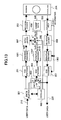
- FIG.10 is a block diagram illustrating a configuration of a data recording/reproducing apparatus (parallel recording system) for realizing data distribution recording according to a fifth embodiment of the present invention. It is noted that elements shown in FIG.10 that are identical to those shown in FIG.8 are given the same numerical references.
- the data recording/reproducing apparatus of FIG.10 for realizing data distribution recording includes a third switch 1001 and a fourth switch 1002 in addition to the elements included in the data recording/reproducing apparatus of FIG.8. Further, in the data recording/reproducing apparatus according to the present embodiment, the recording circuit 203 of FIG.8 is divided into two recording circuits 203-1 and 203-2, and the reproducing circuit 205 of FIG.8 is divided into two reproducing circuits 205-1 and 205-2.
- an optical disk apparatus implements single optical heads for recording and reproducing, respectively, since optical heads tend to be expensive.
- a configuration as described above may be realized in an optical disk apparatus.
- plural optical heads may be provided at one side of a recording medium or at both sides of the recording medium.
- a recording head 1 and a reproducing head 1 are provided at the fore side surface of the recording medium 204 and a recording head 2 and a reproducing head 2 are provided at a rear side surface of the recording medium 204.
- a data sequence including data blocks that are distributed over plural ECC sector frames in a discontinuous arrangement is modulated into a suitable modulation code for realizing data recording and reproduction, and the third switch 1001 is controlled by the controller 802 to realize data recording on the fore side and rear side of the recording medium 204, respectively.
- the recording data sequence of data 0/0, data 1/1, ..., data 1/15 may be recorded on the fore side of the recording medium 204 and the recording data sequence of data 1/0, data 0/1, ..., data 0/15 may be recorded on the rear side of the recording medium 204 in a parallel manner.
- reproducing heads 1 and 2 are used to reproduce data recorded on the respective sides of the recording medium 204, and the fourth switch 1002 is used to successively output the reproduced data to the demodulation circuit 206.
- the recording circuits 203-1 and 203-2 and the reproducing circuits 205-1 and 205-2 are arranged to be parallel; however, the modulator 202 and demodulator 206 may also be arranged to have parallel configurations and the recording data on the fore side of the recording medium 204 and the recording data on the rear side of the recording medium 204 may be separated at the interleaver 807 and de-interleaver 808, for example.
- the recording system and the reproducing system are each arranged into two system configurations; however, the recording system and the reproducing system may also be arranged to have three or more systems as well. Further, the optical heads of the systems may be provided at the same side of the recording to record/reproduce data on/from different tracks, for example.
- FIG.11 shows a configuration of a data recording/reproducing apparatus that conducts iterative decoding.
- the data recording/reproducing apparatus of FIG.11 includes an ECC encoder 201, an iterative encoder 1101, a recording circuit 203, a recording medium 204, a reproducing circuit 205, an iterative decoder 1102, and an ECC decoder 207.
- data recording is realized by ECC encoding input user data 210 with the ECC encoder 210, and encoding the data again with the iterative encoder 1101 using an iterative code. Then, the data encoded by the iterative encoder 1101 may be recorded on the recording medium 204 through the recording circuit 203.
- the data are divided into block units (iterative block data) for conducting iterative decoding.
- iterative code a recursive convolution code may be used so that iterative decoding may be realized.
- data reproduction may be realized by decoding recorded data in block units for iterative decoding by the iterative decoder 1102, and ECC decoding the iterative decoded data by the ECC decoder 207 to reproduce user data 220.
- FIG.12 is a diagram illustrating an exemplary case in which a data distribution scheme according to an embodiment of the present invention is applied to a system implementing iterative decoding.
- the principles of the data distribution scheme of FIG.5 are applied; however, when such a data distribution scheme is applied to iterative decoding, the data are distributed in iterative decoding block units (BD) so that data blocks of the same ECC sector of the recording medium 204 may be positioned apart from one another to realize a discontinuous arrangement of the recording data.
- BD iterative decoding block units
- FIG.13 is a block diagram illustrating a configuration of an iterative decoding recording/reproducing apparatus that realizes data distribution recording according to a sixth embodiment of the present invention. It is noted that elements shown in FIG.13 that are identical to those shown in FIG.8 are given the same numerical references.
- the iterative decoding recording/reproducing apparatus of FIG.13 includes the elements shown in FIG.8 except for the modulator 202 and the demodulator 206, and also includes iterative encoders 1301 and 1302, and an iterative decoder 1303.
- the operation of the iterative decoding recording/reproducing apparatus of FIG.13 is similar to the operation of the data recording/reproducing apparatus of FIG.8.
- further encoding is conducted by the iterative encoders 1301 and 1302 using an iterative code, after which the encoded data are interleaved by the interleaver 807 and recorded on the recording medium 204 in a manner such that data blocks of the same ECC sector may not be consecutively arranged within the same sector of the recording medium 204.
- a reproducing signal is transmitted to the de-interleaver 808 via the reproducing circuit 205 to be de-interleaved, after which the de-interleaved data are decoded at the iterative decoder 1303 and ECC decoded at the ECC decoder 207.
- FIG.14 is a block diagram illustrating an exemplary configuration of a burst error detection circuit that may be included in the reproducing circuit 205 shown in FIG.13.
- the burst error detection circuit of FIG.14 includes comparators 1401 and 1402, shift registers 1403 and 1404, and a logical OR gate 1405. Reproduced data y i that are input to the comparators 1401 and 1402 are compared to comparison levels 1420 and 1430, respectively, at the comparators 1401 and 1402. The comparison results are then input to the shift registers 1403 and 1404.
- the shift register 1403 stores comparison results in which the amount of the reproduced data y i is determined to be greater than the predetermined comparison level 1420.
- the shift register 1404 stores comparison results in which the amount of the reproduced data y i is determined to be less than the predetermined comparison level 1430. Then, a logical sum (OR) of the comparison results stored in the shift resisters 1403 and 1404 is calculated by the OR gate 1405, and output as a burst error detection result.
- the burst error detection circuit 1400 of FIG.14 the occurrence of a burst error within a reproducing signal may be monitored.
- burst information is supplied to the iterative decoder 1303 and ECC decoder 207 to control the number of iterations, or a flag for indicating that the burst error be handled as lost data may be sent.
- the ECC decoder 207 may conduct lost data compensation.
- parity codes e.g.
- the iterative decoder 1303 may be arranged to handle the reproducing data as lost data upon detecting data errors of more than a predetermined amount (including random errors), and the ECC decoder 207 may be arranged to process the reproduced data as lost data.
- FIG.15 is a diagram illustrating an exemplary impact of a burst error on data reproduction.
- FIG.16 is a diagram illustrating an advantageous effect that may be realized by an embodiment of the present invention with respect to the impact of a burst error.
- part (A) shows ECC sectors 1510 and 1520 at the time of encoding
- part (B) shows data blocks 1511, 1512, 1513, 1521, 1522, and 1523 of a recording data sequence
- part (C) shows ECC sectors 1530 and 1540 at the time of data decoding.
- the error correction capacity of the ECC allows error correction of up to 80 data units
- a burst error 1550 of 100 data units is generated across two data blocks 1511 and 1512 in the example of FIG.15, this results in a data error of 100 data units within one ECC sector so that error correction may not be effectively realized by the ECC in the ECC sector 1530.
- the two data blocks may be distributed over two differing ECC sectors 1530 and 1540 and the data error may be divided into two data error parts each amounting to 50 data units, for example, so that error correction may be effectively realized on the data error and accurate data decoding may be realized.
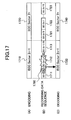
- FIG.17 illustrates an exemplary impact of a burst error on data reproduction in a system implementing iterative decoding.
- FIG.18 illustrates an advantageous effect that may be realized by an embodiment of the present invention with respect to the impact of a burst error occurring in the system implementing iterative decoding.
- part (A) shows ECC sectors 1710 and 1720 at the time of data encoding
- part (B) shows data blocks 1711, 1712, 1713, 1721, 1722, 1723 of a recording data sequence
- part (C) shows ECC sectors 1730 and 1740 at the time of decoding.
- the ECC is able to handle 5 blocks of lost data
- a burst error 1750 occurs is generated across seven iterative decoding blocks in the example shown in FIG.17
- the data in the ECC sector 1730 may not be accurately decoded.
- the burst error may be distributed as four blocks of lost data in ECC sector 1730 and three blocks of lost data in ECC sector 1740 so that error correction may be realized by the ECC in both ECC sectors 1730 and 1740.
- a data recording/reproducing system that has an enhanced error correction capacity for handling such long burst errors and thereby having a high decoding capacity may be realized without changing the ECC.
Landscapes
- Engineering & Computer Science (AREA)
- Signal Processing (AREA)
- Multimedia (AREA)
- Signal Processing For Digital Recording And Reproducing (AREA)
- Error Detection And Correction (AREA)
Applications Claiming Priority (1)
| Application Number | Priority Date | Filing Date | Title |
|---|---|---|---|
| PCT/JP2002/012529 WO2004051650A1 (ja) | 2002-11-29 | 2002-11-29 | データ記録再生装置及び、データ記録再生方法 |
Publications (2)
| Publication Number | Publication Date |
|---|---|
| EP1566804A1 true EP1566804A1 (de) | 2005-08-24 |
| EP1566804A4 EP1566804A4 (de) | 2008-04-16 |
Family
ID=32448970
Family Applications (1)
| Application Number | Title | Priority Date | Filing Date |
|---|---|---|---|
| EP02785986A Withdrawn EP1566804A4 (de) | 2002-11-29 | 2002-11-29 | Datenaufzeichnungs- und wiedergabeeinrichtung und datenaufzeichnungs- und wiedergabeverfahren |
Country Status (7)
| Country | Link |
|---|---|
| US (2) | US7430702B2 (de) |
| EP (1) | EP1566804A4 (de) |
| JP (1) | JPWO2004051650A1 (de) |
| KR (1) | KR100591973B1 (de) |
| CN (1) | CN100432945C (de) |
| AU (1) | AU2002354137A1 (de) |
| WO (1) | WO2004051650A1 (de) |
Families Citing this family (9)
| Publication number | Priority date | Publication date | Assignee | Title |
|---|---|---|---|---|
| EP1954311A4 (de) * | 2005-12-07 | 2009-12-23 | Medarex Inc | Ctla-4-antikörper-dosierungseskalationstherapien |
| US7747925B2 (en) * | 2006-03-06 | 2010-06-29 | Fujifilm Corporation | Apparatus and method for error correction code striping |
| TWI415118B (zh) | 2006-03-10 | 2013-11-11 | Ibm | 將資訊嵌入資料之裝置 |
| US7984367B1 (en) * | 2006-07-25 | 2011-07-19 | Marvell International Ltd. | Method for iterative decoding in the presence of burst errors |
| JP2008112516A (ja) * | 2006-10-31 | 2008-05-15 | Fujitsu Ltd | 誤り訂正回路及び情報再生装置 |
| JP4932505B2 (ja) * | 2007-01-19 | 2012-05-16 | ルネサスエレクトロニクス株式会社 | 光ディスクコントローラ及び光ディスクドライブシステム |
| JP4946844B2 (ja) * | 2007-12-13 | 2012-06-06 | ソニー株式会社 | 記録再生装置および記録再生方法 |
| KR100988325B1 (ko) * | 2008-10-10 | 2010-10-18 | 포항공과대학교 산학협력단 | 광학 미디어 상에 오류정정부호를 이용한 데이터의 분산 기록 방법 |
| KR101623730B1 (ko) * | 2009-11-23 | 2016-05-25 | 삼성전자주식회사 | 인터리버 장치 |
Family Cites Families (33)
| Publication number | Priority date | Publication date | Assignee | Title |
|---|---|---|---|---|
| JPH0764085B2 (ja) * | 1981-06-08 | 1995-07-12 | 富士ゼロックス株式会社 | 感熱記録装置 |
| US4602295A (en) * | 1982-10-23 | 1986-07-22 | Pioneer Electronic Corporation | Recording and reproducing method for video format signal |
| US4701815A (en) * | 1985-03-11 | 1987-10-20 | Sony Corporation | Tracking servo system for disc memory |
| JP2526875B2 (ja) * | 1986-11-05 | 1996-08-21 | ソニー株式会社 | デイジタル情報記録装置 |
| US5241546A (en) * | 1991-02-01 | 1993-08-31 | Quantum Corporation | On-the-fly error correction with embedded digital controller |
| US5459850A (en) * | 1993-02-19 | 1995-10-17 | Conner Peripherals, Inc. | Flash solid state drive that emulates a disk drive and stores variable length and fixed lenth data blocks |
| JP3687115B2 (ja) * | 1994-10-27 | 2005-08-24 | ソニー株式会社 | 再生装置 |
| US5696774A (en) * | 1994-12-01 | 1997-12-09 | Mitsubishi Denki Kabushiki Kaisha | Digital signal recording device, digital signal playback device, and digital signal decoding device therefor |
| US5978958A (en) * | 1995-04-03 | 1999-11-02 | Matsushita Electric Industrial Co., Ltd. | Data transmission system, data recording and reproducing apparatus and recording medium each having data structure of error correcting code |
| JPH09153259A (ja) * | 1995-11-30 | 1997-06-10 | Sony Corp | 情報記録再生方法及び装置 |
| US6112324A (en) * | 1996-02-02 | 2000-08-29 | The Arizona Board Of Regents Acting On Behalf Of The University Of Arizona | Direct access compact disc, writing and reading method and device for same |
| WO1997032306A1 (en) * | 1996-02-27 | 1997-09-04 | Sony Corporation | Disk-like recording medium and disk drive using the same |
| US6511848B2 (en) * | 1996-04-17 | 2003-01-28 | Winfried Albert | Process for producing and multiplying lymphocytes |
| JP3586041B2 (ja) * | 1996-04-26 | 2004-11-10 | 株式会社東芝 | 記録データ生成方法およびデータ再生装置 |
| JPH10188489A (ja) | 1996-12-25 | 1998-07-21 | Sony Corp | 光ディスク、光ディスク記録装置および光ディスク再生装置 |
| KR100354744B1 (ko) * | 1998-08-04 | 2002-12-11 | 삼성전자 주식회사 | 고밀도기록매체를위한인터리브방법및그회로 |
| JP3397152B2 (ja) | 1998-12-15 | 2003-04-14 | 松下電器産業株式会社 | マルチトラックディスク再生装置及びその再生方法 |
| FR2790621B1 (fr) * | 1999-03-05 | 2001-12-21 | Canon Kk | Dispositif et procede d'entrelacement pour turbocodage et turbodecodage |
| JP3515701B2 (ja) * | 1999-03-31 | 2004-04-05 | 松下電器産業株式会社 | 符号化処理装置およびレピティション方法 |
| JP2001093234A (ja) | 1999-09-22 | 2001-04-06 | Matsushita Electric Ind Co Ltd | ディスク媒体並びにその記録方法、記録装置及び再生装置 |
| JP2001101806A (ja) | 1999-09-27 | 2001-04-13 | Hitachi Ltd | ディジタル信号記録方法、及びその装置、記録媒体 |
| JP2001169243A (ja) * | 1999-12-03 | 2001-06-22 | Sony Corp | 記録装置および方法、ならびに、再生装置および方法 |
| US6668349B1 (en) * | 2000-04-14 | 2003-12-23 | Hitachi, Ltd. | Data recording/readback method and data recording/readback device for the same |
| JP4190136B2 (ja) * | 2000-06-27 | 2008-12-03 | 富士通株式会社 | データ記録再生装置 |
| JP3752995B2 (ja) * | 2000-09-27 | 2006-03-08 | 日本ビクター株式会社 | 情報記録再生装置 |
| US6604220B1 (en) * | 2000-09-28 | 2003-08-05 | Western Digital Technologies, Inc. | Disk drive comprising a multiple-input sequence detector selectively biased by bits of a decoded ECC codedword |
| JP3928414B2 (ja) * | 2000-12-01 | 2007-06-13 | 株式会社日立製作所 | ディジタルデータ記録再生方法、ディジタルデータ記録再生装置及び記録媒体 |
| US20020078416A1 (en) * | 2000-12-01 | 2002-06-20 | Hitachi, Ltd. | Method of recording/reproducing digital data and apparatus for same |
| JP4130534B2 (ja) * | 2001-02-07 | 2008-08-06 | 株式会社東芝 | 情報記録媒体、情報記録装置、情報記録方法、情報再生装置、及び情報再生方法 |
| US7159165B2 (en) * | 2001-04-20 | 2007-01-02 | Samsung Electronics Co., Ltd. | Optical recording medium, data recording or reproducing apparatus and data recording or reproducing method used by the data recording or reproducing apparatus |
| JP2002342942A (ja) * | 2001-05-14 | 2002-11-29 | Toshiba Corp | 情報記憶媒体、情報記録方法、および情報記録再生装置 |
| JP3964634B2 (ja) * | 2001-06-14 | 2007-08-22 | 株式会社東芝 | 同期コード生成方法、情報記録方法、情報再生方法、情報再生装置及び情報記憶媒体 |
| KR100833880B1 (ko) * | 2001-11-06 | 2008-06-02 | 엘지전자 주식회사 | 유자 형상의 스캔을 이용한 광디스크 데이터기록장치/방법 및 재생장치/방법 |
-
2002
- 2002-11-29 EP EP02785986A patent/EP1566804A4/de not_active Withdrawn
- 2002-11-29 AU AU2002354137A patent/AU2002354137A1/en not_active Abandoned
- 2002-11-29 CN CNB028294688A patent/CN100432945C/zh not_active Expired - Fee Related
- 2002-11-29 JP JP2004556776A patent/JPWO2004051650A1/ja active Pending
- 2002-11-29 KR KR1020057002842A patent/KR100591973B1/ko not_active Expired - Fee Related
- 2002-11-29 WO PCT/JP2002/012529 patent/WO2004051650A1/ja not_active Ceased
-
2005
- 2005-01-25 US US11/041,248 patent/US7430702B2/en not_active Expired - Fee Related
-
2008
- 2008-08-19 US US12/194,306 patent/US20090031187A1/en not_active Abandoned
Also Published As
| Publication number | Publication date |
|---|---|
| EP1566804A4 (de) | 2008-04-16 |
| KR20050074437A (ko) | 2005-07-18 |
| US20050204257A1 (en) | 2005-09-15 |
| US7430702B2 (en) | 2008-09-30 |
| US20090031187A1 (en) | 2009-01-29 |
| WO2004051650A1 (ja) | 2004-06-17 |
| KR100591973B1 (ko) | 2006-06-22 |
| JPWO2004051650A1 (ja) | 2006-04-06 |
| CN100432945C (zh) | 2008-11-12 |
| AU2002354137A1 (en) | 2004-06-23 |
| CN1650364A (zh) | 2005-08-03 |
Similar Documents
| Publication | Publication Date | Title |
|---|---|---|
| US20090031187A1 (en) | Data recording/reproducing apparatus and data recording/reproducing method | |
| JP3993035B2 (ja) | データ記録方法、記録媒体、および再生装置 | |
| US6891690B2 (en) | On-drive integrated sector format raid error correction code system and method | |
| CN1815615B (zh) | 用于确定在光媒体上的缺陷区域的器件和方法 | |
| US20020078416A1 (en) | Method of recording/reproducing digital data and apparatus for same | |
| US20100017679A1 (en) | Recording and reproducing data to/from a recording medium having a user data area and an information area for storing information about the recording medium | |
| US7478306B2 (en) | Method of detecting error location, and error detection circuit, error correction circuit, and reproducing apparatus using the method | |
| WO1995024037A1 (en) | Digital signal encoding method and apparatus, digital signal recording medium, and digital signal decoding method and apparatus | |
| JP2007528566A (ja) | エラー訂正符号化方法及びその装置、並びにエラー訂正復号化方法及びその装置 | |
| JP3362146B2 (ja) | 再生装置および記録再生装置 | |
| JP4140344B2 (ja) | 復号化装置及びコンピュータプログラム | |
| JP2005209286A (ja) | データ記録方法、記録媒体及び再生装置 | |
| JP2004146014A (ja) | データ符号化復号化方法及び装置 | |
| KR20040108823A (ko) | 기록 매체, 기록 방법, 기록 장치, 재생 방법 및 재생장치 | |
| JP2001189059A (ja) | 記録再生装置 | |
| JP3476014B2 (ja) | データ処理方法 | |
| JP4079906B2 (ja) | 誤り訂正回路および再生装置 | |
| JP2004348930A (ja) | エラー訂正方法、エラー訂正装置 | |
| JP2005252973A (ja) | データ構造および記録媒体 |
Legal Events
| Date | Code | Title | Description |
|---|---|---|---|
| PUAI | Public reference made under article 153(3) epc to a published international application that has entered the european phase |
Free format text: ORIGINAL CODE: 0009012 |
|
| 17P | Request for examination filed |
Effective date: 20050216 |
|
| AK | Designated contracting states |
Kind code of ref document: A1 Designated state(s): AT BE CH CY DE DK ES FI FR GB GR IE IT LI LU MC NL PT SE TR |
|
| AX | Request for extension of the european patent |
Extension state: AL LT LV MK RO SI |
|
| DAX | Request for extension of the european patent (deleted) | ||
| RBV | Designated contracting states (corrected) |
Designated state(s): DE FR GB |
|
| A4 | Supplementary search report drawn up and despatched |
Effective date: 20080319 |
|
| STAA | Information on the status of an ep patent application or granted ep patent |
Free format text: STATUS: THE APPLICATION HAS BEEN WITHDRAWN |
|
| 18W | Application withdrawn |
Effective date: 20080611 |