EP1566153B1 - Inseminationsbesteck, umfassend einen Besamungskatheter und eine Spermatube, für die künstliche Besamung von Nutztieren - Google Patents
Inseminationsbesteck, umfassend einen Besamungskatheter und eine Spermatube, für die künstliche Besamung von Nutztieren Download PDFInfo
- Publication number
- EP1566153B1 EP1566153B1 EP05001752A EP05001752A EP1566153B1 EP 1566153 B1 EP1566153 B1 EP 1566153B1 EP 05001752 A EP05001752 A EP 05001752A EP 05001752 A EP05001752 A EP 05001752A EP 1566153 B1 EP1566153 B1 EP 1566153B1
- Authority
- EP
- European Patent Office
- Prior art keywords
- insemination
- catheter
- tube
- diameter
- catheter shaft
- Prior art date
- Legal status (The legal status is an assumption and is not a legal conclusion. Google has not performed a legal analysis and makes no representation as to the accuracy of the status listed.)
- Expired - Lifetime
Links
- 230000009027 insemination Effects 0.000 title claims description 34
- 241001465754 Metazoa Species 0.000 title claims description 3
- 239000004033 plastic Substances 0.000 claims description 8
- 229920003023 plastic Polymers 0.000 claims description 8
- -1 polypropylene Polymers 0.000 claims description 8
- 239000004743 Polypropylene Substances 0.000 claims description 5
- 229920001155 polypropylene Polymers 0.000 claims description 5
- 239000004698 Polyethylene Substances 0.000 claims description 3
- 229920000573 polyethylene Polymers 0.000 claims description 3
- 241000282887 Suidae Species 0.000 claims description 2
- 239000000463 material Substances 0.000 description 7
- 238000010168 coupling process Methods 0.000 description 6
- 238000005859 coupling reaction Methods 0.000 description 6
- 238000000034 method Methods 0.000 description 6
- 230000008878 coupling Effects 0.000 description 5
- 230000003247 decreasing effect Effects 0.000 description 3
- 229920001684 low density polyethylene Polymers 0.000 description 3
- 239000004702 low-density polyethylene Substances 0.000 description 3
- 230000004323 axial length Effects 0.000 description 2
- 238000010276 construction Methods 0.000 description 2
- 230000000694 effects Effects 0.000 description 2
- 229920002457 flexible plastic Polymers 0.000 description 2
- 238000003780 insertion Methods 0.000 description 2
- 230000037431 insertion Effects 0.000 description 2
- 238000004519 manufacturing process Methods 0.000 description 2
- 210000001215 vagina Anatomy 0.000 description 2
- 241000283690 Bos taurus Species 0.000 description 1
- VGGSQFUCUMXWEO-UHFFFAOYSA-N Ethene Chemical compound C=C VGGSQFUCUMXWEO-UHFFFAOYSA-N 0.000 description 1
- 210000003484 anatomy Anatomy 0.000 description 1
- 210000003679 cervix uteri Anatomy 0.000 description 1
- 230000003749 cleanliness Effects 0.000 description 1
- 230000000295 complement effect Effects 0.000 description 1
- 238000005520 cutting process Methods 0.000 description 1
- 238000011161 development Methods 0.000 description 1
- 230000018109 developmental process Effects 0.000 description 1
- 238000005553 drilling Methods 0.000 description 1
- 239000000428 dust Substances 0.000 description 1
- 230000005489 elastic deformation Effects 0.000 description 1
- 230000004720 fertilization Effects 0.000 description 1
- 239000012530 fluid Substances 0.000 description 1
- 239000006260 foam Substances 0.000 description 1
- 230000005484 gravity Effects 0.000 description 1
- 238000011065 in-situ storage Methods 0.000 description 1
- 239000007788 liquid Substances 0.000 description 1
- 244000144972 livestock Species 0.000 description 1
- 238000003754 machining Methods 0.000 description 1
- 230000014759 maintenance of location Effects 0.000 description 1
- 239000002184 metal Substances 0.000 description 1
- 230000035515 penetration Effects 0.000 description 1
- 238000007789 sealing Methods 0.000 description 1
- 239000007787 solid Substances 0.000 description 1
- 238000003860 storage Methods 0.000 description 1
- 230000008719 thickening Effects 0.000 description 1
- 238000003466 welding Methods 0.000 description 1
Images
Classifications
-
- A—HUMAN NECESSITIES
- A61—MEDICAL OR VETERINARY SCIENCE; HYGIENE
- A61D—VETERINARY INSTRUMENTS, IMPLEMENTS, TOOLS, OR METHODS
- A61D19/00—Instruments or methods for reproduction or fertilisation
- A61D19/02—Instruments or methods for reproduction or fertilisation for artificial insemination
- A61D19/022—Containers for animal semen, e.g. pouches or vials ; Methods or apparatus for treating or handling animal semen containers, e.g. filling or closing
-
- A—HUMAN NECESSITIES
- A61—MEDICAL OR VETERINARY SCIENCE; HYGIENE
- A61D—VETERINARY INSTRUMENTS, IMPLEMENTS, TOOLS, OR METHODS
- A61D19/00—Instruments or methods for reproduction or fertilisation
- A61D19/02—Instruments or methods for reproduction or fertilisation for artificial insemination
- A61D19/027—Devices for injecting semen into animals, e.g. syringes, guns, probes
Definitions
- the invention relates to an at least two-piece Inseminationsbesteck for the artificial insemination of livestock, especially pigs, comprising an insemination catheter with a plastic tube consisting of a catheter shaft, usually with a thickening at the distal end, and a counterpart thereto, namely a Spermatube with a dispensing spout, for receiving the sperm to be applied.
- the insemination catheter has a distal end that is inserted into the vagina of the animal and a proximal end to which the sperm tube is attached.
- the usual insemination catheter consists of a plastic tube approximately 50 cm long with an outer diameter of 7 mm and an inner diameter of 4 mm and thus a wall thickness of approximately 1.5 mm, which at its distal tip has a thickened head matched to the anatomy of the pig. in particular a foam body having.
- the tubes are usually tubes made of a flexible plastic, in particular of low density polyethylene, with a filling volume of the order of up to 100 ml.
- the tube and the catheter are coupled by inserting the spout of the sperm tube into the posterior, proximal tube end of the in situ insemination catheter is screwed after the Tüllenspitze has been separated, and the tube contents is applied through the catheter.
- the outwardly projecting piece of the catheter shaft is slightly bent upwards, so that the T Wegnerhalt is conveyed by gravity. He will be allowed enough time for this introduction.
- Insemination sets are devices for single use, for which the production costs should be as low as possible.
- cutting the internal threads into the cut-to-length pieces of the catheter plastic tube requires some effort to remove the resulting plastic chips, none of which may remain in the catheter shaft.
- the internal thread also does not seal well when insemination instead of the Tubentülle an extension of a harder material than LDPE is inserted into the catheter end and the tube is then in turn coupled to the other end of the extension.
- the invention provides an insemination device with catheter-Tüb-coupling to be created, which can be produced with less effort and also allows catheter extensions with a reliable seal. This is achieved, starting from an insemination device with a holding structure in the catheter shaft, in that the inner wall of the catheter shaft has axially inwardly sharp-edged diameter steps of decreasing diameter up to the inner diameter of the catheter shaft from the catheter end.
- a step profile is formed, in particular a step cone.
- This measure results in a design of the catheter end, by a positive retention of the dispensing spout of the tube in the catheter shaft and thus a sufficiently stable hold, which facilitates the Besamer handling of the insemination process, especially at a time-extended application, is made possible with a device in the series production of the cost of removing the machining chips is reduced ,
- the diameter stages can be made by drilling, with a large part of the chips is immediately removed to the rear. Subsequently, residual dust can be easily wiped out, as it does not settle in grooves or the like, as it has a thread.
- the hold of the coupling proves to be sufficient for the purpose, and the edges of the diameter stages effect in conjunction with the material of the Tubentülle a complete seal, so that no sperm liquid is lost.
- the dispensing spout of the sperm tube need not be specially processed, the annular step edges of the catheter shaft generate annular sealing areas between the catheter shaft and the spout and at the same time a stable grip.
- a suitable material comparison here is polypropylene / polyethylene or other plastics with comparable characteristics.
- the polyethylene material for the tube is sufficiently elastic that the edges of the step profile press in, and is also sperm-compatible, easy to work, and easily closable, for example, by a heat pulse method, an infrared method or by ultrasonic welding.
- polypropylene is harder and is also bendable with good kink resistance. In itself, hard PVC would come into question, but this has a poor kink resistance.
- the step profile can be dimensioned such that the catheter shaft has a constant inner diameter over a large part of its length and several, preferably one after another, from the catheter shaft end to the region of the inner diameter of the catheter shaft that is constant over its length four, regions each having a constant diameter and increased over most of the length of increased diameter, wherein the edges of the diameter steps lie in a conical surface, which is geometrically similar to the initially smooth outer surface of the dispensing spout of the tube. It may be cut 10 to 20 mm into the catheter shaft, provided that the length of the spout is 28 mm, and its resulting cone angle between the surface and axis may be in the range of 2.5 ° to 5 °, preferably 3 ° to 3.3 °, lie.
- the length of the step profile should not exceed the length of the dispensing spout, since beyond its mouth a smooth inner catheter wall is to be preferred.
- the step profile by means of a drill in the form of a metal mandrel with the end to gradually decreasing diameter of z. B. 6 mm to 4 mm, each 1.5 mm to 2 mm long, are cut. The resulting chips of material are completely removed by suitable grooves of the drill and finally, if necessary, even by a simple wiping.
- the process is easy to automate, which is advantageous for carrying out the invention.
- an insemination catheter 1 which consists of a catheter shaft 2 and a seated at its distal tip, not visible in the figures form body, inserted into the vagina of the pig to the cervix.
- the catheter shaft in the example described consists of an about 50 cm long tube made of polypropylene with an outer diameter of 7 mm, a wall thickness of 1.5 mm and an inner diameter of 4 mm.
- the sperm to be administered are brought into a Spermatube 9.
- the Spermatuben 9 each consist of a container part 10 and a discharge spout 11.
- the entire Spermatube 9 has a length of 172 mm.
- the dispensing spout 11 is 28 mm long and slightly conical, having at its base an outer diameter of 4 mm to 6 mm, in particular: 5.4 mm, and at its tip an outer diameter of 2 mm to 3.5 mm, im Special: about 3 mm, has.
- the discharge spout 11 is closed at the front at the top.
- the spout 11 which indeed serves to deliver the T Weg 1halts is hollow inside, while the closure body 13 may be solid.
- the parts 10, 11 and 13 together constitute a one-piece flexible plastic injection-molded part, a blow-molded element or a low-density polyethylene element produced by a combined injection-blown process.
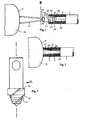
- Fig. 1 breaks or cuts the Besamer before Besamungsvorgang the Tüllenspitze with the widening 13 from, as symbolized by a pair of scissors.
- a step profile 15 is cut into the proximal end 14 of the catheter shaft 2. It has an axial length of the order of 10 to 15 mm and consists of four stages 20, 21, 22 and 23 with decreasing diameter from the end and with intermediate sharp projecting edges 25, 26, 27 and 28, which form circular circulation lines and have in the axial section angles of the order of 90 °.
- the diameter steps have in the example shown each constant diameter, a small taper would also be possible.
- the diameter steps each have an axial length of 1.5 mm and a diameter difference between adjacent steps of the order of 0 , 16 mm to 0.17 mm.
- the four stages 20, 21, 22 and 23 and the tube lumen 24, between which the sharp-edged circular step edges 25, 26, 27 and 28 are located are shown.
- This design results in a conical surface connecting these annular edges with a cone angle of slightly more than 6 °, which also essentially corresponds to the cone angle of the conical spout 11.
- the spout 11 is inserted into the catheter shaft 2, optionally with slight rotation, it wedged at the edges 25 to 28, which press the material of the spout 11 light or dent.
- the dispensing spout 11 is thus inserted with force to the stop, which forms by the elastic deformation in the tube closer half of the spout 11 temporary annular grooves in which abut the hard edges with a certain pressure, with the double effect that, first, the spout 11 is connected to the attached seed tube 10 fixed to the catheter 1 and that, secondly, the pressure between the edges 25, 26 and 27 and the outside of the spout 11 results in a complete seal that prevents the seepage of sperm fluid even with a longer insemination process. It has been proven that even by a hit with the pig's tail the so coupled tube 9 is not knocked out of the catheter 1.
- Fig. 3 shows still - not to scale - in side view a countersink or drill 29, which can be used to produce the step profile at the shaft end. He has a step profile complementary to the step profile in the catheter shaft, also a contact surface 30, with which the tool finally strikes after reaching the required penetration depth on the pipe edge.
- the countersink or drill 29 cuts when turning the catheter shaft on the inside machined and transported by means of grooves 31, the resulting chips backwards and thus out of the catheter shaft. After complete sinking of the drill into the shaft end, it is withdrawn, leaving the step profile in the shaft end again, in which case the shaft inside is largely free of chips. In order to remove even small chips and dusts, for example, a rotating round brush can be introduced, which causes the remaining cleanliness.
- the individual diameter steps are each axially 1.5 mm long and have diameters of 5.53 mm, 5.365 mm, 5.2 mm, 5.035 mm and 4.87 mm.
Landscapes
- Health & Medical Sciences (AREA)
- Life Sciences & Earth Sciences (AREA)
- Veterinary Medicine (AREA)
- Reproductive Health (AREA)
- Engineering & Computer Science (AREA)
- Wood Science & Technology (AREA)
- Zoology (AREA)
- Animal Behavior & Ethology (AREA)
- General Health & Medical Sciences (AREA)
- Public Health (AREA)
- Animal Husbandry (AREA)
- Media Introduction/Drainage Providing Device (AREA)
Description
- Die Erfindung bezieht sich auf ein wenigstens zweiteiliges Inseminationsbesteck für die künstliche Besamung von Nutztieren, insbesondere Schweinen, umfassend einen Besamungskatheter mit einem aus einem Kunststoffrohr bestehenden Katheterschaft, zumeist mit einer Verdickung am distalen Ende, und ein Gegenstück hierzu, nämlich eine Spermatube mit einer Abgabetülle, zur Aufnahme des zu applizierenden Spermas. Der Besamungskatheter hat ein distales Ende, das in die Vagina des Tiers eingeführt wird, und ein proximales Ende, an dem die Spermatube angesetzt wird.
- Bei der künstlichen Besamung wird das zumeist bereits einige Tage alte oder aus tiefgefrorenem Lagerzustand aufgetaute Sperma einerseits möglichst sparsam, andererseits aber doch so reichlich, daß eine gute Befruchtungseffizienz erzielt wird, und außerdem möglichst schonend und ohne Druckstöße, die das Sperma schädigen könnten, appliziert. Bei der Schweinebesamung, bei der je Applikation relativ große Mengen an Sperma verabreicht werden müssen, wird das eingangs genannte Inseminationsbesteck verwendet, nämlich jeweils für den Einmalgebrauch ein Besamungskatheter und eine Spermatube. Diese Teile und deren Verwendung sind an sich bekannt, beispielsweise beschreibt
DE 91 13 536 U Konstruktionen der Spermatube,EP 1 169 978 A1 Konstruktionen des Besamungskatheters undDE 200 15 979 A die Kombination der beiden Teile als Inseminationsbesteck. Bei einem Inseminationsbesteck für die Rinderbesamung ist es aus derDE 16 16 899 A bekannt, daß der Spermabehälter an seinem auf den Besamungskatheter aufsetzbaren Ende mit einem Außengewinde versehen und in das mit entsprechendem Innengewinde versehene Ende des Katheters einschraubbar ist. Und in derEP 1 380 269 A1 , auf der der Oberbegriff des Anspruchs 1 basiert ist, ist ein Inseminationsbesteck beschrieben, bei dem in das Ende des Katheterschafts ein Gewinde geschnitten ist, in das die Tülle der Spermatube eingeschraubt wird, deren Außenform sich an das Gewinde anpaßt. - Der übliche Besamungskatheter besteht aus einem etwa 50 cm langen Kunststoffrohr mit einem Außendurchmesser von 7 mm und einem Innendurchmesser von 4 mm und also einer Wandstärke von ca. 1,5 mm, das an seiner distalen Spitze einen auf die Anatomie des Schweins abgestimmten verdickten Kopf, insbesondere einen Schaumstoffkörper, aufweist. Die Tuben sind üblicherweise Tuben aus einem flexiblen Kunststoff, insbesondere aus Polyäthylen niedriger Dichte, mit einem Füllungsvolumen in der Größenordnung von bis zu 100 ml. Zur Durchführung der Besamung werden z. B. gemäß der genannten
EP 1 380 269 A1 die Tube und der Katheter gekoppelt, indem in das hintere, proximale Rohrende des in situ befindlichen Besamungskatheters die Tülle der Spermatube eingeschraubt wird, nachdem die Tüllenspitze abgetrennt worden ist, und wird der Tubeninhalt durch den Katheter hindurch appliziert. Zum schonenden Einführen des Tübeninhalts wird beispielsweise das nach außen überstehende Stück des Katheterschafts leicht nach oben gebogen, so daß der Tübeninhalt durch die Schwerkraft weiterbefördert wird. Für diese Einführung wird ihm ausreichend Zeit gelassen. Durch die Verschraubung werden Probleme vermieden, die sich andernfalls dadurch ergeben, daß die Koppelung der Tube am Katheterende, wenn sie nur durch das Einstecken der konischen Tülle in den Katheterschaft bewirkt wird, unzureichend ist, insbesondere da das Schwein dazu neigt, durch Wedeln mit dem Schwanz die Tube vom Katheter zu schlagen. - Inseminationsbestecke sind Geräte für den Einmalgebrauch, für die der Herstellungsaufwand möglichst niedrig sein soll. Das Schneiden der Innengewinde in die abgelängten Stücke des Katheter-Kunststoffrohrs erfordert jedoch einigen Aufwand zur Entfernung der dabei entstehenden Kunststoffspäne, von denen nichts im Katheterschaft zurückbleiben darf. Das Innengewinde dichtet auch nicht gut ab, wenn bei der Besamung anstelle der Tubentülle eine Verlängerung aus einem härteren Material als LDPE in das Katheterende gesteckt wird und die Tube dann ihrerseits an das andere Ende der Verlängerung angekoppelt wird.
- Durch die Erfindung soll ein Inseminationsbesteck mit Katheter-Tüben-Koppelung geschaffen werden, das mit kleinerem Aufwand herstellbar ist und auch mit Katheterverlängerungen eine zuverlässige Abdichtung erlaubt. Dies wird, ausgehend von einem Inseminationsbesteck mit einer Haltestruktur im Katheterschaft, dadurch erreicht, daß die Innenwand des Katheterschafts vom Katheterende axial einwärts scharfkantige Durchmesserstufen abnehmenden Durchmessers bis zum Innendurchmesser des Katheterschafts aufweist. Im Katheterschaftende ist also ein Stufenprofil gebildet, insbesondere ein Stufenkonus. Durch diese Maßnahme ergibt sich eine Gestaltung des Katheterschaftendes, durch die ein formschlüssiger Halt der Abgabetülle der Tube im Katheterschaft und dadurch ein ausreichend stabiler Halt, der dem Besamer die Handhabung des Besamungsvorgangs insbesondere bei einer zeitlich ausgedehnteren Applikation erleichtert, mit einem Gerät ermöglicht wird, bei dessen Serienproduktion der Aufwand des Entfernens der Bearbeitungsspäne vermindert ist. Die Durchmesserstufen können durch Ausbohren hergestellt werden, wobei ein Großteil der Späne sogleich nach hinten abgeführt wird. Anschließend kann restlicher Staub leicht herausgewischt werden, da er sich nicht in Rinnen oder dergleichen, wie sie ein Gewinde aufweist, festsetzt. Der Halt der Koppelung erweist sich als für den Zweck ausreichend, und die Kanten der Durchmesserstufen bewirken in Verbindung mit dem Material der Tubentülle eine vollständige Abdichtung, so daß keine Spermaflüssigkeit verloren geht. Insbesondere durch passende Materialauswahl und Gestaltung des Stufenprofils als spitzen Stufenkegel braucht die Abgabetülle der Spermatube nicht besonders bearbeitet zu sein, die ringförmigen Stufenkanten des Katheterschafts erzeugen ringförmige Dichtbereiche zwischen dem Katheterschaft und der Tülle und gleichzeitig einen stabilen Halt.
- Eine geeignete Materialgegenüberstellung ist hierbei Polypropylen/Polyäthylen oder andere Kunststoffe mit vergleichbaren Charakteristiken. Das Polyäthylen als Material für die Tube ist ausreichend elastisch, daß sich die Kanten des Stufenprofils darin eindrücken, und ist außerdem spermaverträglich, gut bearbeitbar, und beispielsweise durch ein Hitzeimpulsverfahren, ein Infrarotverfahren oder durch Ultraschallschweißung leicht verschließbar. Polypropylen ist demgegenüber härter und ist obendrein biegbar bei guter Knickfestigkeit. An sich käme auch Hart-PVC in Frage, dieses hat aber eine mangelhafte Knickfestigkeit. Das Stufenprofil kann so bemessen sein, daß der Katheterschaft über einen Großteil seiner Länge einen konstanten Innendurchmesser hat und sich vom Katheterschaftende bis zum Bereich des über seine Länge konstanten Innendurchmessers des Katheterschafts hintereinander mehrere, vorzugsweise vier, Bereiche mit jeweils ebenfalls konstantem und gegenüber dem Großteil der Länge erhöhtem Durchmesser erstrecken, wobei die Kanten der Durchmesserstufen in einer Konusfläche liegen, die der zunächst glatten Außenfläche der Abgabetülle der Tube geometrisch ähnlich ist. Es kann - unter der Voraussetzung, daß die Länge der Abgabentülle 28 mm beträgt - 10 bis 20 mm weit in den Katheterschaft eingeschnitten sein und sein resultierender Konuswinkel zwischen Mantellinie und Achse kann im Bereich von 2,5° bis 5°, vorzugsweise bei 3° bis 3,3°, liegen. Vorzugsweise soll die Länge des Stufenprofils die Länge der Abgabetülle nicht überschreiten, da jenseits von deren Mündung eine glatte Katheter-Innenwand zu bevorzugen ist.
- In das Katheterrohr aus Polypropylen kann das Stufenprofil mit Hilfe eines Bohrers in Form eines Metalldorns mit zum Ende zu stufenweise abnehmendem Durchmesser von z. B. 6 mm bis 4 mm, jeweils 1,5 mm bis 2 mm lang, eingeschnitten werden. Die entstehenden Materialspäne werden durch passende Rinnen des Bohrers und schließlich erforderlichenfalls noch durch einen einfachen Wischvorgang vollständig entfernt. Der Vorgang läßt sich leicht automatisieren, was für die Durchführung der Erfindung vorteilhaft ist.
- Weitere Einzelheiten, Vorteile und Weiterbildungen der Erfindung ergeben sich aus der folgenden Beschreibung eines bevorzugten Ausführungsbeispiels unter Bezugnahme auf die Zeichnung. Es zeigen:
-
Fig. 1 in teilweise geschnittener Seitenansicht das distale Ende einer Spermatube und das proximale Ende eines Katheterschafts kurz vor deren Koppelung; -
Fig. 2 eine Darstellung entsprechendFig. 1 des Zustands nach der Koppelung; -
Fig. 3 in vergrößertem Maßstab ein zur Herstellung eines Stufenprofils verwendetes Werkzeug. - Zur künstlichen Besamung eines Schweins wird ein Besamungskatheter 1, der aus einem Katheterschaft 2 und einem an dessen distaler Spitze sitzenden, in den Figuren nicht sichtbaren Formkörper besteht, in die Vagina des Schweins bis zur Cervix eingeführt. Der Katheterschaft besteht beim beschriebenen Beispiel aus einem etwa 50 cm langen Rohr aus Polypropylen mit einem Außendurchmesser von 7 mm, einer Wandstärke von 1,5 mm und einem Innendurchmesser von 4 mm.
- Die zu applizierenden Spermien werden in einer Spermatube 9 herangebracht. Die Spermatuben 9 bestehen jeweils aus einem Behälterteil 10 und einer Abgabetülle 11. Beim dargestellten Modell hat die gesamte Spermatube 9 eine Länge von 172 mm. Die Abgabetülle 11 ist 28 mm lang und leicht konisch ausgebildet, indem sie an ihrem Fußpunkt einen Außendurchmesser von 4 mm bis 6 mm, im Speziellen: 5,4 mm, und an ihrer Spitze einen Außendurchmesser von 2 mm bis 3,5 mm, im Speziellen: ca. 3 mm, hat. Die Abgabetülle 11 ist vorne an der Spitze geschlossen. An die Spitze schließt sich nach vorne noch eine etwa hammerförmige Verbreiterung 13 an, die als Stapelhilfe beim Stapeln der zunächst noch leeren Tuben dient, indem sie verhindert, daß beim Stapeln die konischen Tüllen ineinandergesteckt werden und sich dann nur noch schwer trennen lassen. Die Tülle 11, die ja dem Abgeben des Tübeninhalts dient, ist innen hohl, während der Verschlußkörper 13 massiv sein kann. Die Teile 10, 11 und 13 stellen zusammen ein einstückiges flexibles Kunststoff-Spritzgußstück, ein in Blastechnik hergestelltes Element oder ein in einem kombinierten Spritz-Blas-Verfahren hergestelltes Element aus Polyäthylen niedriger Dichte dar.
- Wie
Fig. 1 zeigt, bricht oder schneidet der Besamer vor dem Besamungsvorgang die Tüllenspitze mit der Verbreiterung 13 ab, wie durch eine Schere symbolisiert ist. - Zur stabilen Ankoppelung der Spermatube 9 an den Besamungskatheter 1 ist in das proximale Ende 14 des Katheterschafts 2 ein Stufenprofil 15 eingeschnitten. Es hat eine axiale Länge in der Größenordnung von 10 bis 15 mm und besteht aus vier Stufen 20, 21, 22 und 23 mit vom Ende her abnehmendem Durchmesser und mit dazwischenliegenden scharfen vorspringenden Kanten 25, 26, 27 und 28, die kreisförmige Umlauflinien bilden und im Axialschnitt Winkel in der Größenordnung von 90° haben. Die Durchmesserstufen haben im gezeichneten Beispiel jeweils konstanten Durchmesser, eine geringe Konizität würde aber auch möglich sein. Beim beschriebenen bevorzugten Beispiel, bei dem das Rohr des Katheterschafts 2 bei einem Außendurchmesser von 7 mm eine Wandstärke von 1,1 mm hat, haben die Durchmesserstufen jeweils eine axiale Länge von 1,5 mm und eine Durchmesserdifferenz zwischen benachbarten Stufen in der Größenordnung von 0,16 mm bis 0,17 mm. In der vergrößernden Darstellung sind die vier Stufen 20, 21, 22 und 23 und das Rohrlumen 24, zwischen denen die scharfkantige kreisförmige Stufenkanten 25, 26, 27 und 28 liegen, gezeigt. Durch diese Bemessung ergibt sich eine diese ringförmigen Kanten verbindende Konusfläche mit einem Konuswinkel von etwas mehr als 6°, was auch im wesentlichen dem Konuswinkel der konischen Tülle 11 entspricht. Wird nun die Tülle 11 in den Katheterschaft 2 gegebenenfalls unter leichtem Drehen eingeschoben, so verkeilt sie sich an den Kanten 25 bis 28, die das Material der Tülle 11 leicht eindrücken oder einbeulen. Die Abgabetülle 11 wird also mit Kraft bis zum Anschlag eingeschoben, wobei sich durch die elastische Formänderung in der tubennäheren Hälfte der Tülle 11 vorübergehende ringförmige Rinnen bilden, in denen die harten Kanten mit einer gewissen Pressung anliegen, mit dem doppelten Effekt, daß erstens die Tülle 11 mit der daranhängenden Samentube 10 fest mit dem Katheter 1 verbunden ist und daß zweitens die Pressung zwischen den Kanten 25, 26 und 27 und der Außenseite der Tülle 11 eine vollständige Abdichtung ergibt, die auch bei einem längeren Besamungsvorgang das Aussickern von Spermaflüssigkeit verhindert. Es hat sich erwiesen, daß auch durch einen Schlag mit dem Schweineschwanz die so angekoppelte Tube 9 nicht aus dem Katheter 1 herausgeschlagen wird.
-
Fig. 3 zeigt noch - nicht maßstäblich - in Seitenansicht einen Senker oder Bohrer 29, der zur Herstellung des Stufenprofils am Schaftende verwendet werden kann. Er weist ein Stufenprofil komplementär zum Stufenprofil im Katheterschaft auf, außerdem eine Anlagefläche 30, mit der das Werkzeug schließlich nach Erreichen der erforderlichen Eindringtiefe am Rohrrand anschlägt. Der Senker oder Bohrer 29 schneidet beim Drehen den Katheterschaft innenseitig spanabhebend und transportiert mit Hilfe von Nuten 31 die anfallenden Späne nach hinten und somit aus dem Katheterschaft heraus. Nach vollständigem Einsenken des Bohrers in das Schaftende wird er unter Hinterlassung des Stufenprofils im Schaftende wieder zurückgezogen, wobei dann die Schaftinnenseite weitgehend frei von Spänen ist. Um auch noch kleine Späne und Stäube zu entfernen, kann noch beispielsweise eine rotierende Rundbürste eingeführt werden, die die restliche Sauberkeit bewirkt. Bei einer beispielhaften Ausführung sind die einzelnen Durchmesserstufen jeweils axial 1,5 mm lang und haben Durchmesser von 5,53 mm, 5,365 mm, 5,2 mm, 5,035 mm und 4,87 mm.
Claims (7)
- Inseminationsbesteck, bestehend aus einem Besamungskatheter (1) und einer Spermatube (9), von deren der Besamungskatheter (1) einen aus einem Kunststoffrohr bestehenden Katheterschaft (2) für die künstliche Besamung von Nutztieren, insbesondere Schweinen, hat und die Spermatube (9), die das zu applizierende Sperma aufnimmt, eine mit dem Besamungskatheter zu koppelnde Abgabetülle (11) aufweist, wobei an der Innenwand des Katheterschafts (2) im Bereich seines proximalen Endes (14) eine von der Zylinderform abweichende Form zum Festhalten der Abgabetülle (11) der Tube (9) gebildet ist, dadurch gekennzeichnet, daß die Innenwand des Katheterschafts (2) vom Katheterende axial einwärts scharfkantige Durchmesserstufen (20, 21, 22, 23) abnehmenden Durchmessers bis zum Innendurchmesser (bei 24) des Katheterschafts aufweist.
- Inseminationsbesteck nach Anspruch 1, dadurch gekennzeichnet, daß die Abgabetülle (11) der Tube (9) von konischer, ursprünglich glatter Außenfläche ist und durch Eindrücken in das Ende des Katheterschafts (2) durch dessen Durchmesserstufen (20 - 23) entlang Umfangskreisen (25 - 28) eindrückbar ist.
- Inseminationsbesteck nach Anspruch 1 oder 2, dadurch gekennzeichnet, daß sich die Durchmesserstufen (20 - 23) an der Schaftinnenwand des Besamungskatheters (1) in einem Bereich befinden, der ab dem Schaftende (14) eine Länge bis maximal dem Dreifachen des Schaftinnendurchmessers hat.
- Inseminationsbesteck nach einem der Ansprüche 1 bis 3, dadurch gekennzeichnet, daß das Rohr des Katheterschafts (2) aus einem Kunststoff mit den Härteeigenschaften des Polypropylens und die Abgabetülle (11) der Spermatube (9) aus einen Kunststoff mit den Härteeigenschaften von Polyäthylen mit niedriger Dichte bestehen.
- Inseminationsbesteck nach einem der Ansprüche 1 bis 4, dadurch gekennzeichnet, daß der Katheterschaft (2) über einen Großteil (24) seiner Länge konstanten Innendurchmesser hat und sich vom Katheterschaftende (14) bis zum Bereich (24) des über seine Länge konstanten Innendurchmessers des Katheterschafts hintereinander mehrere, vorzugsweise vier, Bereiche (20 - 23) mit jeweils ebenfalls konstantem und gegenüber dem Großteil der Länge erhöhtem Durchmesser erstrecken.
- Inseminationsbesteck nach Anspruch 5, dadurch gekennzeichnet, daß die Kanten (25 - 28) der Durchmesserstufen (20 - 23) in einer Konusfläche liegen, die der zunächst glatten Außenfläche der Abgabetülle (11) der Tube (9) geometrisch ähnlich ist.
- Inseminationsbesteck nach Anspruch 6, dadurch gekennzeichnet, daß der Konuswinkel der Konusflächen im Bereich von 2,5° bis 5°, vorzugsweise von 3° bis 3,3°, liegt.
Applications Claiming Priority (2)
| Application Number | Priority Date | Filing Date | Title |
|---|---|---|---|
| DE202004002822U | 2004-02-20 | ||
| DE202004002822U DE202004002822U1 (de) | 2004-02-20 | 2004-02-20 | Inseminationsbesteck, umfassend einen Besamungskatheter und eine Spermatube, für die künstliche Besamung von Nutztieren |
Publications (3)
| Publication Number | Publication Date |
|---|---|
| EP1566153A2 EP1566153A2 (de) | 2005-08-24 |
| EP1566153A3 EP1566153A3 (de) | 2006-01-11 |
| EP1566153B1 true EP1566153B1 (de) | 2009-07-29 |
Family
ID=34706980
Family Applications (1)
| Application Number | Title | Priority Date | Filing Date |
|---|---|---|---|
| EP05001752A Expired - Lifetime EP1566153B1 (de) | 2004-02-20 | 2005-01-28 | Inseminationsbesteck, umfassend einen Besamungskatheter und eine Spermatube, für die künstliche Besamung von Nutztieren |
Country Status (2)
| Country | Link |
|---|---|
| EP (1) | EP1566153B1 (de) |
| DE (2) | DE202004002822U1 (de) |
Family Cites Families (6)
| Publication number | Priority date | Publication date | Assignee | Title |
|---|---|---|---|---|
| DE1616899A1 (de) | 1968-03-06 | 1970-11-05 | Ernst Schuett Jun Laboratorium | Verfahren und Vorrichtung zur kuenstlichen Besamung von Tieren,insbesondere von Rindvieh |
| DE9113536U1 (de) | 1991-10-30 | 1992-01-02 | Simmet, Ludwig, Dr.Med.Vet., 8300 Landshut | Tube aus Kunststoff |
| US6149579A (en) * | 1998-03-23 | 2000-11-21 | Lee; Won Ku | Semen storage container and its stopper |
| DE20011406U1 (de) | 2000-06-29 | 2000-09-14 | Minitüb Abfüll- und Labortechnik GmbH & Co KG, 84184 Tiefenbach | Besamungskatheter |
| DE20015979U1 (de) | 2000-09-15 | 2000-12-28 | Minitüb Abfüll- und Labortechnik GmbH & Co KG, 84184 Tiefenbach | Inseminationsbesteck für die künstliche Befruchtung von Schweinen, und hierin verwendbare Tube |
| ATE395878T1 (de) | 2002-07-09 | 2008-06-15 | Minitueb Abfuell & Labortechnik Gmbh & Co Kg | Besamungskatheter und spermatube für die künstliche besamung von nutztieren |
-
2004
- 2004-02-20 DE DE202004002822U patent/DE202004002822U1/de not_active Expired - Lifetime
-
2005
- 2005-01-28 EP EP05001752A patent/EP1566153B1/de not_active Expired - Lifetime
- 2005-01-28 DE DE502005007763T patent/DE502005007763D1/de not_active Expired - Lifetime
Also Published As
| Publication number | Publication date |
|---|---|
| EP1566153A3 (de) | 2006-01-11 |
| EP1566153A2 (de) | 2005-08-24 |
| DE502005007763D1 (de) | 2009-09-10 |
| DE202004002822U1 (de) | 2005-06-23 |
Similar Documents
| Publication | Publication Date | Title |
|---|---|---|
| EP2826514B1 (de) | Katheter-Set | |
| DE102009060377B4 (de) | Trokarhülse | |
| DE2540120A1 (de) | Vorrichtung zum herausspuelen von eizellen aus kuehen oder stuten | |
| DE2513241A1 (de) | Vorrichtung zum einfuehren eines intrauterinen einlagekoerpers | |
| DE3106306C2 (de) | ||
| DE3889960T2 (de) | Ansatz für Sauger. | |
| DE29813921U1 (de) | Vorrichtung zur Besamung von Tieren, insbesondere Sauen | |
| CH714669A2 (de) | Vorrichtung und Verfahren zum Reinigen des äusseren Gehörgangs. | |
| CH701982A1 (de) | Applikator zum Einführen eines länglichen Gegenstands in eine menschliche oder tierische Körperöffnung. | |
| DE3106712A1 (de) | "fuss fuer slalomstangen" | |
| EP1380269B1 (de) | Besamungskatheter und Spermatube für die künstliche Besamung von Nutztieren | |
| DE202004002822U1 (de) | Inseminationsbesteck, umfassend einen Besamungskatheter und eine Spermatube, für die künstliche Besamung von Nutztieren | |
| DE29703451U1 (de) | Besamungskatheter, insbesondere für Schweine | |
| DE60117608T2 (de) | Vorrichtung für transzervikale artifizielle insemination und embryonentransfer | |
| EP2926687A1 (de) | Applikator mit einem Besatz aus mindestens einem profilierten Borstenbüschel | |
| DE20011406U1 (de) | Besamungskatheter | |
| DE2650371A1 (de) | Kupplungsrohrteil aus kunststoff und verfahren zu seiner herstellung | |
| DE102004057789B4 (de) | Verfahren zum grabenlosen Erneuern von im Boden verlegten Versorgungsleitungen | |
| EP0411265B1 (de) | Drainage-Set für Ureter-Drainage | |
| DE102016012129C5 (de) | Ventilvorrichtung für Futterbehälter | |
| EP2926683A1 (de) | Innengespeister Applikator mit Fingern und Folienvorratsbehälter | |
| AT329336B (de) | Rohrverbindung | |
| DE102006029297B4 (de) | Anbohrarmatur | |
| DE102019126337A1 (de) | Verpackung für zumindest einen Gegenstand, insbesondere für einen in der Chirurgie verwendbaren Gegenstand | |
| DE20015979U1 (de) | Inseminationsbesteck für die künstliche Befruchtung von Schweinen, und hierin verwendbare Tube |
Legal Events
| Date | Code | Title | Description |
|---|---|---|---|
| PUAI | Public reference made under article 153(3) epc to a published international application that has entered the european phase |
Free format text: ORIGINAL CODE: 0009012 |
|
| AK | Designated contracting states |
Kind code of ref document: A2 Designated state(s): AT BE BG CH CY CZ DE DK EE ES FI FR GB GR HU IE IS IT LI LT LU MC NL PL PT RO SE SI SK TR |
|
| AX | Request for extension of the european patent |
Extension state: AL BA HR LV MK YU |
|
| PUAL | Search report despatched |
Free format text: ORIGINAL CODE: 0009013 |
|
| AK | Designated contracting states |
Kind code of ref document: A3 Designated state(s): AT BE BG CH CY CZ DE DK EE ES FI FR GB GR HU IE IS IT LI LT LU MC NL PL PT RO SE SI SK TR |
|
| AX | Request for extension of the european patent |
Extension state: AL BA HR LV MK YU |
|
| 17P | Request for examination filed |
Effective date: 20060516 |
|
| AKX | Designation fees paid |
Designated state(s): DE ES FR |
|
| GRAP | Despatch of communication of intention to grant a patent |
Free format text: ORIGINAL CODE: EPIDOSNIGR1 |
|
| GRAS | Grant fee paid |
Free format text: ORIGINAL CODE: EPIDOSNIGR3 |
|
| GRAA | (expected) grant |
Free format text: ORIGINAL CODE: 0009210 |
|
| AK | Designated contracting states |
Kind code of ref document: B1 Designated state(s): DE ES FR |
|
| REF | Corresponds to: |
Ref document number: 502005007763 Country of ref document: DE Date of ref document: 20090910 Kind code of ref document: P |
|
| PG25 | Lapsed in a contracting state [announced via postgrant information from national office to epo] |
Ref country code: ES Free format text: LAPSE BECAUSE OF FAILURE TO SUBMIT A TRANSLATION OF THE DESCRIPTION OR TO PAY THE FEE WITHIN THE PRESCRIBED TIME-LIMIT Effective date: 20091109 |
|
| PLBE | No opposition filed within time limit |
Free format text: ORIGINAL CODE: 0009261 |
|
| STAA | Information on the status of an ep patent application or granted ep patent |
Free format text: STATUS: NO OPPOSITION FILED WITHIN TIME LIMIT |
|
| 26N | No opposition filed |
Effective date: 20100503 |
|
| REG | Reference to a national code |
Ref country code: FR Ref legal event code: PLFP Year of fee payment: 11 |
|
| PGFP | Annual fee paid to national office [announced via postgrant information from national office to epo] |
Ref country code: DE Payment date: 20150130 Year of fee payment: 11 |
|
| PGFP | Annual fee paid to national office [announced via postgrant information from national office to epo] |
Ref country code: FR Payment date: 20150108 Year of fee payment: 11 |
|
| REG | Reference to a national code |
Ref country code: DE Ref legal event code: R119 Ref document number: 502005007763 Country of ref document: DE |
|
| REG | Reference to a national code |
Ref country code: FR Ref legal event code: ST Effective date: 20160930 |
|
| PG25 | Lapsed in a contracting state [announced via postgrant information from national office to epo] |
Ref country code: DE Free format text: LAPSE BECAUSE OF NON-PAYMENT OF DUE FEES Effective date: 20160802 |
|
| PG25 | Lapsed in a contracting state [announced via postgrant information from national office to epo] |
Ref country code: FR Free format text: LAPSE BECAUSE OF NON-PAYMENT OF DUE FEES Effective date: 20160201 |