EP1565504B1 - Verwendung eines polymerisats, geppfropftes alkoxy- oder hydroxypolyalkylenglycol enthaltend, als verbesserer beim optischen aufhellen, und die produkte - Google Patents
Verwendung eines polymerisats, geppfropftes alkoxy- oder hydroxypolyalkylenglycol enthaltend, als verbesserer beim optischen aufhellen, und die produkte Download PDFInfo
- Publication number
- EP1565504B1 EP1565504B1 EP03767912A EP03767912A EP1565504B1 EP 1565504 B1 EP1565504 B1 EP 1565504B1 EP 03767912 A EP03767912 A EP 03767912A EP 03767912 A EP03767912 A EP 03767912A EP 1565504 B1 EP1565504 B1 EP 1565504B1
- Authority
- EP
- European Patent Office
- Prior art keywords
- group
- copolymer
- calcium carbonate
- dry weight
- mixtures
- Prior art date
- Legal status (The legal status is an assumption and is not a legal conclusion. Google has not performed a legal analysis and makes no representation as to the accuracy of the status listed.)
- Expired - Lifetime
Links
- 229920001577 copolymer Polymers 0.000 title claims abstract description 266
- 230000003287 optical effect Effects 0.000 title claims abstract description 97
- 230000004913 activation Effects 0.000 title claims abstract description 44
- 229920001515 polyalkylene glycol Polymers 0.000 title claims abstract description 23
- 125000003827 glycol group Chemical group 0.000 title claims abstract description 16
- 125000003545 alkoxy group Chemical group 0.000 title claims description 20
- 238000005282 brightening Methods 0.000 title abstract description 66
- 125000004356 hydroxy functional group Chemical group O* 0.000 title description 6
- 239000000178 monomer Substances 0.000 claims abstract description 159
- 238000000034 method Methods 0.000 claims abstract description 82
- 229910052500 inorganic mineral Inorganic materials 0.000 claims abstract description 56
- 239000011707 mineral Substances 0.000 claims abstract description 56
- 239000000945 filler Substances 0.000 claims abstract description 49
- 239000007900 aqueous suspension Substances 0.000 claims abstract description 24
- 239000003795 chemical substances by application Substances 0.000 claims abstract description 22
- VTYYLEPIZMXCLO-UHFFFAOYSA-L Calcium carbonate Chemical compound [Ca+2].[O-]C([O-])=O VTYYLEPIZMXCLO-UHFFFAOYSA-L 0.000 claims description 313
- 239000000725 suspension Substances 0.000 claims description 188
- 229910000019 calcium carbonate Inorganic materials 0.000 claims description 156
- 239000000203 mixture Substances 0.000 claims description 146
- 238000000227 grinding Methods 0.000 claims description 139
- NIXOWILDQLNWCW-UHFFFAOYSA-N acrylic acid group Chemical group C(C=C)(=O)O NIXOWILDQLNWCW-UHFFFAOYSA-N 0.000 claims description 125
- 239000000123 paper Substances 0.000 claims description 123
- -1 vinylic ethers Chemical class 0.000 claims description 112
- 229910052739 hydrogen Inorganic materials 0.000 claims description 111
- 239000001257 hydrogen Substances 0.000 claims description 111
- 150000003254 radicals Chemical group 0.000 claims description 108
- UFHFLCQGNIYNRP-UHFFFAOYSA-N Hydrogen Chemical compound [H][H] UFHFLCQGNIYNRP-UHFFFAOYSA-N 0.000 claims description 102
- CERQOIWHTDAKMF-UHFFFAOYSA-M Methacrylate Chemical compound CC(=C)C([O-])=O CERQOIWHTDAKMF-UHFFFAOYSA-M 0.000 claims description 92
- 238000000576 coating method Methods 0.000 claims description 85
- 239000011248 coating agent Substances 0.000 claims description 76
- SMZOUWXMTYCWNB-UHFFFAOYSA-N 2-(2-methoxy-5-methylphenyl)ethanamine Chemical compound COC1=CC=C(C)C=C1CCN SMZOUWXMTYCWNB-UHFFFAOYSA-N 0.000 claims description 66
- 239000000049 pigment Substances 0.000 claims description 59
- 238000004519 manufacturing process Methods 0.000 claims description 50
- CERQOIWHTDAKMF-UHFFFAOYSA-N Methacrylic acid Chemical compound CC(=C)C(O)=O CERQOIWHTDAKMF-UHFFFAOYSA-N 0.000 claims description 48
- 125000004432 carbon atom Chemical group C* 0.000 claims description 48
- QAOWNCQODCNURD-UHFFFAOYSA-L Sulfate Chemical compound [O-]S([O-])(=O)=O QAOWNCQODCNURD-UHFFFAOYSA-L 0.000 claims description 44
- 239000004215 Carbon black (E152) Substances 0.000 claims description 39
- 229930195733 hydrocarbon Natural products 0.000 claims description 39
- LYCAIKOWRPUZTN-UHFFFAOYSA-N Ethylene glycol Chemical compound OCCO LYCAIKOWRPUZTN-UHFFFAOYSA-N 0.000 claims description 30
- 150000002148 esters Chemical class 0.000 claims description 30
- 125000000391 vinyl group Chemical group [H]C([*])=C([H])[H] 0.000 claims description 28
- QUPDWYMUPZLYJZ-UHFFFAOYSA-N ethyl Chemical compound C[CH2] QUPDWYMUPZLYJZ-UHFFFAOYSA-N 0.000 claims description 23
- 125000002496 methyl group Chemical group [H]C([H])([H])* 0.000 claims description 23
- DOEXKUOGPAEBAD-UHFFFAOYSA-N ethyl n-(2-methylprop-2-enoyl)carbamate Chemical compound CCOC(=O)NC(=O)C(C)=C DOEXKUOGPAEBAD-UHFFFAOYSA-N 0.000 claims description 21
- 239000000463 material Substances 0.000 claims description 21
- PPBRXRYQALVLMV-UHFFFAOYSA-N Styrene Chemical compound C=CC1=CC=CC=C1 PPBRXRYQALVLMV-UHFFFAOYSA-N 0.000 claims description 20
- GWEVSGVZZGPLCZ-UHFFFAOYSA-N Titan oxide Chemical compound O=[Ti]=O GWEVSGVZZGPLCZ-UHFFFAOYSA-N 0.000 claims description 20
- 239000000654 additive Substances 0.000 claims description 20
- 239000011575 calcium Substances 0.000 claims description 20
- 229910052791 calcium Inorganic materials 0.000 claims description 20
- 125000000746 allylic group Chemical group 0.000 claims description 19
- 150000001408 amides Chemical class 0.000 claims description 19
- IPZIVCLZBFDXTA-UHFFFAOYSA-N ethyl n-prop-2-enoylcarbamate Chemical compound CCOC(=O)NC(=O)C=C IPZIVCLZBFDXTA-UHFFFAOYSA-N 0.000 claims description 19
- 150000003949 imides Chemical class 0.000 claims description 19
- 125000005395 methacrylic acid group Chemical group 0.000 claims description 19
- OCAAZRFBJBEVPS-UHFFFAOYSA-N prop-2-enyl carbamate Chemical compound NC(=O)OCC=C OCAAZRFBJBEVPS-UHFFFAOYSA-N 0.000 claims description 19
- 239000005995 Aluminium silicate Substances 0.000 claims description 18
- VGGSQFUCUMXWEO-UHFFFAOYSA-N Ethene Chemical compound C=C VGGSQFUCUMXWEO-UHFFFAOYSA-N 0.000 claims description 18
- QGZKDVFQNNGYKY-UHFFFAOYSA-O Ammonium Chemical compound [NH4+] QGZKDVFQNNGYKY-UHFFFAOYSA-O 0.000 claims description 17
- OYPRJOBELJOOCE-UHFFFAOYSA-N Calcium Chemical compound [Ca] OYPRJOBELJOOCE-UHFFFAOYSA-N 0.000 claims description 17
- 235000011130 ammonium sulphate Nutrition 0.000 claims description 17
- NIXOWILDQLNWCW-UHFFFAOYSA-M Acrylate Chemical compound [O-]C(=O)C=C NIXOWILDQLNWCW-UHFFFAOYSA-M 0.000 claims description 16
- 125000002947 alkylene group Chemical group 0.000 claims description 16
- IAYPIBMASNFSPL-UHFFFAOYSA-N Ethylene oxide Chemical group C1CO1 IAYPIBMASNFSPL-UHFFFAOYSA-N 0.000 claims description 15
- WGCNASOHLSPBMP-UHFFFAOYSA-N hydroxyacetaldehyde Natural products OCC=O WGCNASOHLSPBMP-UHFFFAOYSA-N 0.000 claims description 15
- 229920002554 vinyl polymer Polymers 0.000 claims description 15
- HRPVXLWXLXDGHG-UHFFFAOYSA-N Acrylamide Chemical compound NC(=O)C=C HRPVXLWXLXDGHG-UHFFFAOYSA-N 0.000 claims description 13
- WHNWPMSKXPGLAX-UHFFFAOYSA-N N-Vinyl-2-pyrrolidone Chemical compound C=CN1CCCC1=O WHNWPMSKXPGLAX-UHFFFAOYSA-N 0.000 claims description 13
- 230000000996 additive effect Effects 0.000 claims description 13
- XTXRWKRVRITETP-UHFFFAOYSA-N Vinyl acetate Chemical compound CC(=O)OC=C XTXRWKRVRITETP-UHFFFAOYSA-N 0.000 claims description 12
- 125000002348 vinylic group Chemical group 0.000 claims description 12
- 235000012211 aluminium silicate Nutrition 0.000 claims description 11
- NLYAJNPCOHFWQQ-UHFFFAOYSA-N kaolin Chemical compound O.O.O=[Al]O[Si](=O)O[Si](=O)O[Al]=O NLYAJNPCOHFWQQ-UHFFFAOYSA-N 0.000 claims description 11
- 239000000454 talc Substances 0.000 claims description 11
- 229910052623 talc Inorganic materials 0.000 claims description 11
- GYLZSBPASSUYIS-UHFFFAOYSA-N tert-butyl n-benzyl-n-prop-1-en-2-ylcarbamate Chemical compound CC(C)(C)OC(=O)N(C(=C)C)CC1=CC=CC=C1 GYLZSBPASSUYIS-UHFFFAOYSA-N 0.000 claims description 11
- 239000004408 titanium dioxide Substances 0.000 claims description 11
- ADTJPOBHAXXXFS-UHFFFAOYSA-N n-[3-(dimethylamino)propyl]prop-2-enamide Chemical compound CN(C)CCCNC(=O)C=C ADTJPOBHAXXXFS-UHFFFAOYSA-N 0.000 claims description 10
- 125000001495 ethyl group Chemical group [H]C([H])([H])C([H])([H])* 0.000 claims description 9
- 229910052602 gypsum Inorganic materials 0.000 claims description 9
- 239000010440 gypsum Substances 0.000 claims description 9
- FPYJFEHAWHCUMM-UHFFFAOYSA-N maleic anhydride Chemical compound O=C1OC(=O)C=C1 FPYJFEHAWHCUMM-UHFFFAOYSA-N 0.000 claims description 9
- 229910021532 Calcite Inorganic materials 0.000 claims description 8
- 125000002877 alkyl aryl group Chemical group 0.000 claims description 8
- 125000000217 alkyl group Chemical group 0.000 claims description 8
- 150000008064 anhydrides Chemical class 0.000 claims description 8
- 125000003710 aryl alkyl group Chemical group 0.000 claims description 8
- 125000003118 aryl group Chemical group 0.000 claims description 8
- 125000002091 cationic group Chemical group 0.000 claims description 8
- 150000001768 cations Chemical class 0.000 claims description 8
- 239000004579 marble Substances 0.000 claims description 8
- 239000010445 mica Substances 0.000 claims description 8
- 229910052618 mica group Inorganic materials 0.000 claims description 8
- 239000011734 sodium Substances 0.000 claims description 7
- 229910052708 sodium Inorganic materials 0.000 claims description 7
- DBCAQXHNJOFNGC-UHFFFAOYSA-N 4-bromo-1,1,1-trifluorobutane Chemical compound FC(F)(F)CCCBr DBCAQXHNJOFNGC-UHFFFAOYSA-N 0.000 claims description 6
- FBPFZTCFMRRESA-FSIIMWSLSA-N D-Glucitol Natural products OC[C@H](O)[C@H](O)[C@@H](O)[C@H](O)CO FBPFZTCFMRRESA-FSIIMWSLSA-N 0.000 claims description 6
- FBPFZTCFMRRESA-JGWLITMVSA-N D-glucitol Chemical compound OC[C@H](O)[C@@H](O)[C@H](O)[C@H](O)CO FBPFZTCFMRRESA-JGWLITMVSA-N 0.000 claims description 6
- GDFCSMCGLZFNFY-UHFFFAOYSA-N Dimethylaminopropyl Methacrylamide Chemical compound CN(C)CCCNC(=O)C(C)=C GDFCSMCGLZFNFY-UHFFFAOYSA-N 0.000 claims description 6
- CZMRCDWAGMRECN-UGDNZRGBSA-N Sucrose Chemical compound O[C@H]1[C@H](O)[C@@H](CO)O[C@@]1(CO)O[C@@H]1[C@H](O)[C@@H](O)[C@H](O)[C@@H](CO)O1 CZMRCDWAGMRECN-UGDNZRGBSA-N 0.000 claims description 6
- 229930006000 Sucrose Natural products 0.000 claims description 6
- GSEJCLTVZPLZKY-UHFFFAOYSA-N Triethanolamine Chemical compound OCCN(CCO)CCO GSEJCLTVZPLZKY-UHFFFAOYSA-N 0.000 claims description 6
- 125000005250 alkyl acrylate group Chemical group 0.000 claims description 6
- XYLMUPLGERFSHI-UHFFFAOYSA-N alpha-Methylstyrene Chemical compound CC(=C)C1=CC=CC=C1 XYLMUPLGERFSHI-UHFFFAOYSA-N 0.000 claims description 6
- 125000000129 anionic group Chemical group 0.000 claims description 6
- STVZJERGLQHEKB-UHFFFAOYSA-N ethylene glycol dimethacrylate Substances CC(=C)C(=O)OCCOC(=O)C(C)=C STVZJERGLQHEKB-UHFFFAOYSA-N 0.000 claims description 6
- 150000002734 metacrylic acid derivatives Chemical class 0.000 claims description 6
- FQPSGWSUVKBHSU-UHFFFAOYSA-N methacrylamide Chemical compound CC(=C)C(N)=O FQPSGWSUVKBHSU-UHFFFAOYSA-N 0.000 claims description 6
- WXZMFSXDPGVJKK-UHFFFAOYSA-N pentaerythritol Chemical compound OCC(CO)(CO)CO WXZMFSXDPGVJKK-UHFFFAOYSA-N 0.000 claims description 6
- 229920005862 polyol Polymers 0.000 claims description 6
- 150000003077 polyols Chemical class 0.000 claims description 6
- 239000000600 sorbitol Substances 0.000 claims description 6
- 239000005720 sucrose Substances 0.000 claims description 6
- FZGFBJMPSHGTRQ-UHFFFAOYSA-M trimethyl(2-prop-2-enoyloxyethyl)azanium;chloride Chemical compound [Cl-].C[N+](C)(C)CCOC(=O)C=C FZGFBJMPSHGTRQ-UHFFFAOYSA-M 0.000 claims description 6
- OEIXGLMQZVLOQX-UHFFFAOYSA-N trimethyl-[3-(prop-2-enoylamino)propyl]azanium;chloride Chemical compound [Cl-].C[N+](C)(C)CCCNC(=O)C=C OEIXGLMQZVLOQX-UHFFFAOYSA-N 0.000 claims description 6
- XHZPRMZZQOIPDS-UHFFFAOYSA-N 2-Methyl-2-[(1-oxo-2-propenyl)amino]-1-propanesulfonic acid Chemical compound OS(=O)(=O)CC(C)(C)NC(=O)C=C XHZPRMZZQOIPDS-UHFFFAOYSA-N 0.000 claims description 5
- 239000002253 acid Substances 0.000 claims description 5
- LVHBHZANLOWSRM-UHFFFAOYSA-N itaconic acid Chemical class OC(=O)CC(=C)C(O)=O LVHBHZANLOWSRM-UHFFFAOYSA-N 0.000 claims description 5
- TURITJIWSQEMDB-UHFFFAOYSA-N 2-methyl-n-[(2-methylprop-2-enoylamino)methyl]prop-2-enamide Chemical compound CC(=C)C(=O)NCNC(=O)C(C)=C TURITJIWSQEMDB-UHFFFAOYSA-N 0.000 claims description 4
- DGAQECJNVWCQMB-PUAWFVPOSA-M Ilexoside XXIX Chemical compound C[C@@H]1CC[C@@]2(CC[C@@]3(C(=CC[C@H]4[C@]3(CC[C@@H]5[C@@]4(CC[C@@H](C5(C)C)OS(=O)(=O)[O-])C)C)[C@@H]2[C@]1(C)O)C)C(=O)O[C@H]6[C@@H]([C@H]([C@@H]([C@H](O6)CO)O)O)O.[Na+] DGAQECJNVWCQMB-PUAWFVPOSA-M 0.000 claims description 4
- DAKWPKUUDNSNPN-UHFFFAOYSA-N Trimethylolpropane triacrylate Chemical compound C=CC(=O)OCC(CC)(COC(=O)C=C)COC(=O)C=C DAKWPKUUDNSNPN-UHFFFAOYSA-N 0.000 claims description 4
- CBTVGIZVANVGBH-UHFFFAOYSA-N aminomethyl propanol Chemical compound CC(C)(N)CO CBTVGIZVANVGBH-UHFFFAOYSA-N 0.000 claims description 4
- PAFZNILMFXTMIY-UHFFFAOYSA-N cyclohexylamine Chemical compound NC1CCCCC1 PAFZNILMFXTMIY-UHFFFAOYSA-N 0.000 claims description 4
- ZIUHHBKFKCYYJD-UHFFFAOYSA-N n,n'-methylenebisacrylamide Chemical compound C=CC(=O)NCNC(=O)C=C ZIUHHBKFKCYYJD-UHFFFAOYSA-N 0.000 claims description 4
- 230000003472 neutralizing effect Effects 0.000 claims description 4
- 229910052700 potassium Inorganic materials 0.000 claims description 4
- QTECDUFMBMSHKR-UHFFFAOYSA-N prop-2-enyl prop-2-enoate Chemical compound C=CCOC(=O)C=C QTECDUFMBMSHKR-UHFFFAOYSA-N 0.000 claims description 4
- 229940096522 trimethylolpropane triacrylate Drugs 0.000 claims description 4
- 239000000159 acid neutralizing agent Substances 0.000 claims description 3
- 230000002378 acidificating effect Effects 0.000 claims description 3
- 239000011777 magnesium Substances 0.000 claims description 3
- 229910052749 magnesium Inorganic materials 0.000 claims description 3
- SZHIIIPPJJXYRY-UHFFFAOYSA-M sodium;2-methylprop-2-ene-1-sulfonate Chemical compound [Na+].CC(=C)CS([O-])(=O)=O SZHIIIPPJJXYRY-UHFFFAOYSA-M 0.000 claims description 3
- QUSNBJAOOMFDIB-UHFFFAOYSA-N Ethylamine Chemical compound CCN QUSNBJAOOMFDIB-UHFFFAOYSA-N 0.000 claims description 2
- WHXSMMKQMYFTQS-UHFFFAOYSA-N Lithium Chemical compound [Li] WHXSMMKQMYFTQS-UHFFFAOYSA-N 0.000 claims description 2
- FYYHWMGAXLPEAU-UHFFFAOYSA-N Magnesium Chemical compound [Mg] FYYHWMGAXLPEAU-UHFFFAOYSA-N 0.000 claims description 2
- XTUVJUMINZSXGF-UHFFFAOYSA-N N-methylcyclohexylamine Chemical compound CNC1CCCCC1 XTUVJUMINZSXGF-UHFFFAOYSA-N 0.000 claims description 2
- REYJJPSVUYRZGE-UHFFFAOYSA-N Octadecylamine Chemical compound CCCCCCCCCCCCCCCCCCN REYJJPSVUYRZGE-UHFFFAOYSA-N 0.000 claims description 2
- ZLMJMSJWJFRBEC-UHFFFAOYSA-N Potassium Chemical compound [K] ZLMJMSJWJFRBEC-UHFFFAOYSA-N 0.000 claims description 2
- HCHKCACWOHOZIP-UHFFFAOYSA-N Zinc Chemical compound [Zn] HCHKCACWOHOZIP-UHFFFAOYSA-N 0.000 claims description 2
- 125000001931 aliphatic group Chemical group 0.000 claims description 2
- XAGFODPZIPBFFR-UHFFFAOYSA-N aluminium Chemical compound [Al] XAGFODPZIPBFFR-UHFFFAOYSA-N 0.000 claims description 2
- 229910052782 aluminium Inorganic materials 0.000 claims description 2
- 150000001412 amines Chemical class 0.000 claims description 2
- 150000001735 carboxylic acids Chemical class 0.000 claims description 2
- HPNMFZURTQLUMO-UHFFFAOYSA-N diethylamine Chemical compound CCNCC HPNMFZURTQLUMO-UHFFFAOYSA-N 0.000 claims description 2
- 150000002169 ethanolamines Chemical class 0.000 claims description 2
- 229910052744 lithium Inorganic materials 0.000 claims description 2
- 239000011591 potassium Substances 0.000 claims description 2
- 239000011701 zinc Substances 0.000 claims description 2
- 229910052725 zinc Inorganic materials 0.000 claims description 2
- WNROFYMDJYEPJX-UHFFFAOYSA-K aluminium hydroxide Chemical compound [OH-].[OH-].[OH-].[Al+3] WNROFYMDJYEPJX-UHFFFAOYSA-K 0.000 claims 10
- 125000004435 hydrogen atom Chemical group [H]* 0.000 claims 9
- 150000003673 urethanes Chemical class 0.000 claims 9
- GQOKIYDTHHZSCJ-UHFFFAOYSA-M dimethyl-bis(prop-2-enyl)azanium;chloride Chemical compound [Cl-].C=CC[N+](C)(C)CC=C GQOKIYDTHHZSCJ-UHFFFAOYSA-M 0.000 claims 2
- RRHXZLALVWBDKH-UHFFFAOYSA-M trimethyl-[2-(2-methylprop-2-enoyloxy)ethyl]azanium;chloride Chemical compound [Cl-].CC(=C)C(=O)OCC[N+](C)(C)C RRHXZLALVWBDKH-UHFFFAOYSA-M 0.000 claims 2
- UZNHKBFIBYXPDV-UHFFFAOYSA-N trimethyl-[3-(2-methylprop-2-enoylamino)propyl]azanium;chloride Chemical compound [Cl-].CC(=C)C(=O)NCCC[N+](C)(C)C UZNHKBFIBYXPDV-UHFFFAOYSA-N 0.000 claims 2
- FKEGGMFJJUTYFT-UHFFFAOYSA-N 2-methylprop-2-enoic acid phosphoric acid prop-1-ene Chemical compound C(C(=C)C)(=O)O.C=CC.P(O)(O)(O)=O FKEGGMFJJUTYFT-UHFFFAOYSA-N 0.000 claims 1
- 239000005977 Ethylene Substances 0.000 claims 1
- 239000004411 aluminium Substances 0.000 claims 1
- UIONFLFYBWNLOJ-UHFFFAOYSA-N ethene;2-methylprop-2-enoic acid;phosphoric acid Chemical compound C=C.OP(O)(O)=O.CC(=C)C(O)=O UIONFLFYBWNLOJ-UHFFFAOYSA-N 0.000 claims 1
- QIQXOROUKBLCCO-UHFFFAOYSA-N ethene;phosphoric acid;prop-2-enoic acid Chemical compound C=C.OC(=O)C=C.OP(O)(O)=O QIQXOROUKBLCCO-UHFFFAOYSA-N 0.000 claims 1
- 150000002689 maleic acids Chemical class 0.000 claims 1
- JAMKSFBTGLCRNL-UHFFFAOYSA-N phosphoric acid;prop-1-ene;prop-2-enoic acid Chemical compound CC=C.OC(=O)C=C.OP(O)(O)=O JAMKSFBTGLCRNL-UHFFFAOYSA-N 0.000 claims 1
- 239000006255 coating slurry Substances 0.000 abstract 2
- 238000003801 milling Methods 0.000 abstract 1
- 238000012360 testing method Methods 0.000 description 211
- HEMHJVSKTPXQMS-UHFFFAOYSA-M Sodium hydroxide Chemical compound [OH-].[Na+] HEMHJVSKTPXQMS-UHFFFAOYSA-M 0.000 description 169
- 239000012764 mineral filler Substances 0.000 description 91
- 239000002245 particle Substances 0.000 description 81
- 235000011121 sodium hydroxide Nutrition 0.000 description 61
- 235000015067 sauces Nutrition 0.000 description 57
- WCYWZMWISLQXQU-UHFFFAOYSA-N methyl Chemical compound [CH3] WCYWZMWISLQXQU-UHFFFAOYSA-N 0.000 description 44
- 235000010755 mineral Nutrition 0.000 description 39
- 229940082150 encore Drugs 0.000 description 30
- 230000008569 process Effects 0.000 description 29
- 125000004429 atom Chemical group 0.000 description 26
- 229920001223 polyethylene glycol Polymers 0.000 description 23
- 239000002202 Polyethylene glycol Substances 0.000 description 22
- 229920000642 polymer Polymers 0.000 description 22
- 239000003086 colorant Substances 0.000 description 21
- 230000006872 improvement Effects 0.000 description 19
- 125000000956 methoxy group Chemical group [H]C([H])([H])O* 0.000 description 19
- WOBHKFSMXKNTIM-UHFFFAOYSA-N Hydroxyethyl methacrylate Chemical compound CC(=C)C(=O)OCCO WOBHKFSMXKNTIM-UHFFFAOYSA-N 0.000 description 18
- 229920001519 homopolymer Polymers 0.000 description 18
- 238000003756 stirring Methods 0.000 description 18
- 239000004816 latex Substances 0.000 description 17
- 229920000126 latex Polymers 0.000 description 17
- 238000005259 measurement Methods 0.000 description 15
- 239000012467 final product Substances 0.000 description 13
- 125000000524 functional group Chemical group 0.000 description 13
- 239000000126 substance Substances 0.000 description 13
- VEXZGXHMUGYJMC-UHFFFAOYSA-M Chloride anion Chemical compound [Cl-] VEXZGXHMUGYJMC-UHFFFAOYSA-M 0.000 description 12
- 239000011230 binding agent Substances 0.000 description 12
- 229910019142 PO4 Inorganic materials 0.000 description 11
- 239000006185 dispersion Substances 0.000 description 11
- 239000010452 phosphate Substances 0.000 description 11
- NBIIXXVUZAFLBC-UHFFFAOYSA-K phosphate Chemical compound [O-]P([O-])([O-])=O NBIIXXVUZAFLBC-UHFFFAOYSA-K 0.000 description 11
- JOYRKODLDBILNP-UHFFFAOYSA-N Ethyl urethane Chemical compound CCOC(N)=O JOYRKODLDBILNP-UHFFFAOYSA-N 0.000 description 10
- QYKIQEUNHZKYBP-UHFFFAOYSA-N Vinyl ether Chemical class C=COC=C QYKIQEUNHZKYBP-UHFFFAOYSA-N 0.000 description 10
- 239000000835 fiber Substances 0.000 description 10
- 238000001033 granulometry Methods 0.000 description 10
- 229920002451 polyvinyl alcohol Polymers 0.000 description 10
- 239000004372 Polyvinyl alcohol Substances 0.000 description 9
- 239000010410 layer Substances 0.000 description 9
- 125000001436 propyl group Chemical group [H]C([*])([H])C([H])([H])C([H])([H])[H] 0.000 description 9
- XLYOFNOQVPJJNP-UHFFFAOYSA-N water Substances O XLYOFNOQVPJJNP-UHFFFAOYSA-N 0.000 description 9
- 239000011256 inorganic filler Substances 0.000 description 8
- 229910003475 inorganic filler Inorganic materials 0.000 description 8
- MXRIRQGCELJRSN-UHFFFAOYSA-N O.O.O.[Al] Chemical compound O.O.O.[Al] MXRIRQGCELJRSN-UHFFFAOYSA-N 0.000 description 7
- 235000011116 calcium hydroxide Nutrition 0.000 description 7
- 238000009472 formulation Methods 0.000 description 7
- 238000003860 storage Methods 0.000 description 7
- 229920003048 styrene butadiene rubber Polymers 0.000 description 7
- VZTGWJFIMGVKSN-UHFFFAOYSA-O trimethyl-[3-(2-methylprop-2-enoylamino)propyl]azanium Chemical compound CC(=C)C(=O)NCCC[N+](C)(C)C VZTGWJFIMGVKSN-UHFFFAOYSA-O 0.000 description 7
- 239000002174 Styrene-butadiene Substances 0.000 description 6
- MTAZNLWOLGHBHU-UHFFFAOYSA-N butadiene-styrene rubber Chemical compound C=CC=C.C=CC1=CC=CC=C1 MTAZNLWOLGHBHU-UHFFFAOYSA-N 0.000 description 6
- 239000011247 coating layer Substances 0.000 description 6
- 150000001875 compounds Chemical class 0.000 description 6
- 239000002270 dispersing agent Substances 0.000 description 6
- 239000000243 solution Substances 0.000 description 6
- 239000011115 styrene butadiene Substances 0.000 description 6
- 229910021653 sulphate ion Inorganic materials 0.000 description 6
- 239000004753 textile Substances 0.000 description 6
- 239000000470 constituent Substances 0.000 description 5
- 239000003599 detergent Substances 0.000 description 5
- 238000006386 neutralization reaction Methods 0.000 description 5
- 239000003973 paint Substances 0.000 description 5
- LDHQCZJRKDOVOX-UHFFFAOYSA-N trans-crotonic acid Natural products CC=CC(O)=O LDHQCZJRKDOVOX-UHFFFAOYSA-N 0.000 description 5
- RUACIFFMSHZUKZ-UHFFFAOYSA-O 3-Acrylamidopropyl trimethylammonium Chemical compound C[N+](C)(C)CCCNC(=O)C=C RUACIFFMSHZUKZ-UHFFFAOYSA-O 0.000 description 4
- QTBSBXVTEAMEQO-UHFFFAOYSA-M Acetate Chemical compound CC([O-])=O QTBSBXVTEAMEQO-UHFFFAOYSA-M 0.000 description 4
- DNIAPMSPPWPWGF-UHFFFAOYSA-N Propylene glycol Chemical compound CC(O)CO DNIAPMSPPWPWGF-UHFFFAOYSA-N 0.000 description 4
- 150000001252 acrylic acid derivatives Chemical class 0.000 description 4
- 238000004132 cross linking Methods 0.000 description 4
- LDHQCZJRKDOVOX-NSCUHMNNSA-N crotonic acid Chemical compound C\C=C\C(O)=O LDHQCZJRKDOVOX-NSCUHMNNSA-N 0.000 description 4
- 238000009826 distribution Methods 0.000 description 4
- 229920000036 polyvinylpyrrolidone Polymers 0.000 description 4
- 239000001267 polyvinylpyrrolidone Substances 0.000 description 4
- 235000013855 polyvinylpyrrolidone Nutrition 0.000 description 4
- 239000000047 product Substances 0.000 description 4
- 125000001453 quaternary ammonium group Chemical group 0.000 description 4
- 229910001415 sodium ion Inorganic materials 0.000 description 4
- OGIDPMRJRNCKJF-UHFFFAOYSA-N titanium oxide Inorganic materials [Ti]=O OGIDPMRJRNCKJF-UHFFFAOYSA-N 0.000 description 4
- MPNXSZJPSVBLHP-UHFFFAOYSA-N 2-chloro-n-phenylpyridine-3-carboxamide Chemical compound ClC1=NC=CC=C1C(=O)NC1=CC=CC=C1 MPNXSZJPSVBLHP-UHFFFAOYSA-N 0.000 description 3
- SEILKFZTLVMHRR-UHFFFAOYSA-N 2-phosphonooxyethyl 2-methylprop-2-enoate Chemical compound CC(=C)C(=O)OCCOP(O)(O)=O SEILKFZTLVMHRR-UHFFFAOYSA-N 0.000 description 3
- YFICSDVNKFLZRQ-UHFFFAOYSA-N 3-trimethylsilylpropyl 2-methylprop-2-enoate Chemical compound CC(=C)C(=O)OCCC[Si](C)(C)C YFICSDVNKFLZRQ-UHFFFAOYSA-N 0.000 description 3
- 208000031968 Cadaver Diseases 0.000 description 3
- BHPQYMZQTOCNFJ-UHFFFAOYSA-N Calcium cation Chemical compound [Ca+2] BHPQYMZQTOCNFJ-UHFFFAOYSA-N 0.000 description 3
- 206010016807 Fluid retention Diseases 0.000 description 3
- OKKJLVBELUTLKV-UHFFFAOYSA-N Methanol Chemical compound OC OKKJLVBELUTLKV-UHFFFAOYSA-N 0.000 description 3
- 229920002472 Starch Polymers 0.000 description 3
- YXFVVABEGXRONW-UHFFFAOYSA-N Toluene Chemical compound CC1=CC=CC=C1 YXFVVABEGXRONW-UHFFFAOYSA-N 0.000 description 3
- BFNBIHQBYMNNAN-UHFFFAOYSA-N ammonium sulfate Chemical compound N.N.OS(O)(=O)=O BFNBIHQBYMNNAN-UHFFFAOYSA-N 0.000 description 3
- 229910001424 calcium ion Inorganic materials 0.000 description 3
- 238000007334 copolymerization reaction Methods 0.000 description 3
- 125000000118 dimethyl group Chemical group [H]C([H])([H])* 0.000 description 3
- 230000000694 effects Effects 0.000 description 3
- PYGSKMBEVAICCR-UHFFFAOYSA-N hexa-1,5-diene Chemical group C=CCCC=C PYGSKMBEVAICCR-UHFFFAOYSA-N 0.000 description 3
- 230000014759 maintenance of location Effects 0.000 description 3
- 239000008107 starch Substances 0.000 description 3
- 235000019698 starch Nutrition 0.000 description 3
- ZVEMLYIXBCTVOF-UHFFFAOYSA-N 1-(2-isocyanatopropan-2-yl)-3-prop-1-en-2-ylbenzene Chemical group CC(=C)C1=CC=CC(C(C)(C)N=C=O)=C1 ZVEMLYIXBCTVOF-UHFFFAOYSA-N 0.000 description 2
- JAHNSTQSQJOJLO-UHFFFAOYSA-N 2-(3-fluorophenyl)-1h-imidazole Chemical compound FC1=CC=CC(C=2NC=CN=2)=C1 JAHNSTQSQJOJLO-UHFFFAOYSA-N 0.000 description 2
- SGWPKMIGYJYWKM-UHFFFAOYSA-N 2-methylprop-2-enoylperoxysilyl 2-methylprop-2-enoate Chemical compound CC(=C)C(=O)OO[SiH2]OC(=O)C(C)=C SGWPKMIGYJYWKM-UHFFFAOYSA-N 0.000 description 2
- AGBXYHCHUYARJY-UHFFFAOYSA-N 2-phenylethenesulfonic acid Chemical compound OS(=O)(=O)C=CC1=CC=CC=C1 AGBXYHCHUYARJY-UHFFFAOYSA-N 0.000 description 2
- UDXXYUDJOHIIDZ-UHFFFAOYSA-N 2-phosphonooxyethyl prop-2-enoate Chemical compound OP(O)(=O)OCCOC(=O)C=C UDXXYUDJOHIIDZ-UHFFFAOYSA-N 0.000 description 2
- BRWBXCPVJZQRHJ-UHFFFAOYSA-N 2-phosphonooxypropyl 2-methylprop-2-enoate Chemical compound OP(=O)(O)OC(C)COC(=O)C(C)=C BRWBXCPVJZQRHJ-UHFFFAOYSA-N 0.000 description 2
- ZWJWOOXWVLIPPX-UHFFFAOYSA-N 2-phosphonooxypropyl prop-2-enoate Chemical compound OP(=O)(O)OC(C)COC(=O)C=C ZWJWOOXWVLIPPX-UHFFFAOYSA-N 0.000 description 2
- BXAAQNFGSQKPDZ-UHFFFAOYSA-N 3-[1,2,2-tris(prop-2-enoxy)ethoxy]prop-1-ene Chemical compound C=CCOC(OCC=C)C(OCC=C)OCC=C BXAAQNFGSQKPDZ-UHFFFAOYSA-N 0.000 description 2
- IRLPACMLTUPBCL-KQYNXXCUSA-N 5'-adenylyl sulfate Chemical compound C1=NC=2C(N)=NC=NC=2N1[C@@H]1O[C@H](COP(O)(=O)OS(O)(=O)=O)[C@@H](O)[C@H]1O IRLPACMLTUPBCL-KQYNXXCUSA-N 0.000 description 2
- CSCPPACGZOOCGX-UHFFFAOYSA-N Acetone Chemical compound CC(C)=O CSCPPACGZOOCGX-UHFFFAOYSA-N 0.000 description 2
- 102100032029 Epidermal growth factor-like protein 6 Human genes 0.000 description 2
- LFQSCWFLJHTTHZ-UHFFFAOYSA-N Ethanol Chemical compound CCO LFQSCWFLJHTTHZ-UHFFFAOYSA-N 0.000 description 2
- JIGUQPWFLRLWPJ-UHFFFAOYSA-N Ethyl acrylate Chemical compound CCOC(=O)C=C JIGUQPWFLRLWPJ-UHFFFAOYSA-N 0.000 description 2
- 101000921196 Homo sapiens Epidermal growth factor-like protein 6 Proteins 0.000 description 2
- KFZMGEQAYNKOFK-UHFFFAOYSA-N Isopropanol Chemical compound CC(C)O KFZMGEQAYNKOFK-UHFFFAOYSA-N 0.000 description 2
- YNAVUWVOSKDBBP-UHFFFAOYSA-N Morpholine Chemical compound C1COCCN1 YNAVUWVOSKDBBP-UHFFFAOYSA-N 0.000 description 2
- NPYPAHLBTDXSSS-UHFFFAOYSA-N Potassium ion Chemical compound [K+] NPYPAHLBTDXSSS-UHFFFAOYSA-N 0.000 description 2
- ATUOYWHBWRKTHZ-UHFFFAOYSA-N Propane Chemical compound CCC ATUOYWHBWRKTHZ-UHFFFAOYSA-N 0.000 description 2
- WYURNTSHIVDZCO-UHFFFAOYSA-N Tetrahydrofuran Chemical compound C1CCOC1 WYURNTSHIVDZCO-UHFFFAOYSA-N 0.000 description 2
- QCWXUUIWCKQGHC-UHFFFAOYSA-N Zirconium Chemical compound [Zr] QCWXUUIWCKQGHC-UHFFFAOYSA-N 0.000 description 2
- 239000012190 activator Substances 0.000 description 2
- 238000010560 atom transfer radical polymerization reaction Methods 0.000 description 2
- DGNCZDFCCFBHJO-UHFFFAOYSA-N butyl 2-methylprop-2-eneperoxoate Chemical compound CCCCOOC(=O)C(C)=C DGNCZDFCCFBHJO-UHFFFAOYSA-N 0.000 description 2
- 238000006243 chemical reaction Methods 0.000 description 2
- 150000007973 cyanuric acids Chemical class 0.000 description 2
- BNKAXGCRDYRABM-UHFFFAOYSA-N ethenyl dihydrogen phosphate Chemical compound OP(O)(=O)OC=C BNKAXGCRDYRABM-UHFFFAOYSA-N 0.000 description 2
- 239000001023 inorganic pigment Substances 0.000 description 2
- 238000012705 nitroxide-mediated radical polymerization Methods 0.000 description 2
- 150000001282 organosilanes Chemical class 0.000 description 2
- 238000010422 painting Methods 0.000 description 2
- PNJWIWWMYCMZRO-UHFFFAOYSA-N pent‐4‐en‐2‐one Natural products CC(=O)CC=C PNJWIWWMYCMZRO-UHFFFAOYSA-N 0.000 description 2
- 125000005010 perfluoroalkyl group Chemical group 0.000 description 2
- 229920002401 polyacrylamide Polymers 0.000 description 2
- 229910001414 potassium ion Inorganic materials 0.000 description 2
- 238000010526 radical polymerization reaction Methods 0.000 description 2
- 238000005096 rolling process Methods 0.000 description 2
- 239000004094 surface-active agent Substances 0.000 description 2
- 238000012546 transfer Methods 0.000 description 2
- GETQZCLCWQTVFV-UHFFFAOYSA-N trimethylamine Chemical compound CN(C)C GETQZCLCWQTVFV-UHFFFAOYSA-N 0.000 description 2
- ZTWTYVWXUKTLCP-UHFFFAOYSA-N vinylphosphonic acid Chemical compound OP(O)(=O)C=C ZTWTYVWXUKTLCP-UHFFFAOYSA-N 0.000 description 2
- NLVXSWCKKBEXTG-UHFFFAOYSA-N vinylsulfonic acid Chemical compound OS(=O)(=O)C=C NLVXSWCKKBEXTG-UHFFFAOYSA-N 0.000 description 2
- 229910052726 zirconium Inorganic materials 0.000 description 2
- WBYWAXJHAXSJNI-VOTSOKGWSA-M .beta-Phenylacrylic acid Chemical group [O-]C(=O)\C=C\C1=CC=CC=C1 WBYWAXJHAXSJNI-VOTSOKGWSA-M 0.000 description 1
- WPWHSFAFEBZWBB-UHFFFAOYSA-N 1-butyl radical Chemical compound [CH2]CCC WPWHSFAFEBZWBB-UHFFFAOYSA-N 0.000 description 1
- ATVJXMYDOSMEPO-UHFFFAOYSA-N 3-prop-2-enoxyprop-1-ene Chemical compound C=CCOCC=C ATVJXMYDOSMEPO-UHFFFAOYSA-N 0.000 description 1
- QGZKDVFQNNGYKY-UHFFFAOYSA-N Ammonia Chemical compound N QGZKDVFQNNGYKY-UHFFFAOYSA-N 0.000 description 1
- 229920002134 Carboxymethyl cellulose Polymers 0.000 description 1
- WBYWAXJHAXSJNI-SREVYHEPSA-N Cinnamic acid Chemical group OC(=O)\C=C/C1=CC=CC=C1 WBYWAXJHAXSJNI-SREVYHEPSA-N 0.000 description 1
- 244000024675 Eruca sativa Species 0.000 description 1
- 235000014755 Eruca sativa Nutrition 0.000 description 1
- 244000166124 Eucalyptus globulus Species 0.000 description 1
- JLVVSXFLKOJNIY-UHFFFAOYSA-N Magnesium ion Chemical compound [Mg+2] JLVVSXFLKOJNIY-UHFFFAOYSA-N 0.000 description 1
- OFOBLEOULBTSOW-UHFFFAOYSA-N Malonic acid Chemical compound OC(=O)CC(O)=O OFOBLEOULBTSOW-UHFFFAOYSA-N 0.000 description 1
- LRHPLDYGYMQRHN-UHFFFAOYSA-N N-Butanol Chemical class CCCCO LRHPLDYGYMQRHN-UHFFFAOYSA-N 0.000 description 1
- ABLZXFCXXLZCGV-UHFFFAOYSA-N Phosphorous acid Chemical class OP(O)=O ABLZXFCXXLZCGV-UHFFFAOYSA-N 0.000 description 1
- KWYUFKZDYYNOTN-UHFFFAOYSA-M Potassium hydroxide Chemical compound [OH-].[K+] KWYUFKZDYYNOTN-UHFFFAOYSA-M 0.000 description 1
- 229920002125 Sokalan® Polymers 0.000 description 1
- RTAQQCXQSZGOHL-UHFFFAOYSA-N Titanium Chemical compound [Ti] RTAQQCXQSZGOHL-UHFFFAOYSA-N 0.000 description 1
- 229920006243 acrylic copolymer Polymers 0.000 description 1
- 230000009471 action Effects 0.000 description 1
- 239000000853 adhesive Substances 0.000 description 1
- 230000001070 adhesive effect Effects 0.000 description 1
- 150000001346 alkyl aryl ethers Chemical class 0.000 description 1
- 239000001166 ammonium sulphate Substances 0.000 description 1
- 229910052799 carbon Inorganic materials 0.000 description 1
- 150000001244 carboxylic acid anhydrides Chemical class 0.000 description 1
- 239000000969 carrier Substances 0.000 description 1
- 239000005018 casein Substances 0.000 description 1
- BECPQYXYKAMYBN-UHFFFAOYSA-N casein, tech. Chemical compound NCCCCC(C(O)=O)N=C(O)C(CC(O)=O)N=C(O)C(CCC(O)=N)N=C(O)C(CC(C)C)N=C(O)C(CCC(O)=O)N=C(O)C(CC(O)=O)N=C(O)C(CCC(O)=O)N=C(O)C(C(C)O)N=C(O)C(CCC(O)=N)N=C(O)C(CCC(O)=N)N=C(O)C(CCC(O)=N)N=C(O)C(CCC(O)=O)N=C(O)C(CCC(O)=O)N=C(O)C(COP(O)(O)=O)N=C(O)C(CCC(O)=N)N=C(O)C(N)CC1=CC=CC=C1 BECPQYXYKAMYBN-UHFFFAOYSA-N 0.000 description 1
- 235000021240 caseins Nutrition 0.000 description 1
- 230000003197 catalytic effect Effects 0.000 description 1
- 239000004568 cement Substances 0.000 description 1
- 239000007795 chemical reaction product Substances 0.000 description 1
- 229930016911 cinnamic acid Chemical group 0.000 description 1
- 235000013985 cinnamic acid Nutrition 0.000 description 1
- 238000010790 dilution Methods 0.000 description 1
- 239000012895 dilution Substances 0.000 description 1
- YIOJGTBNHQAVBO-UHFFFAOYSA-N dimethyl-bis(prop-2-enyl)azanium Chemical compound C=CC[N+](C)(C)CC=C YIOJGTBNHQAVBO-UHFFFAOYSA-N 0.000 description 1
- 125000002147 dimethylamino group Chemical group [H]C([H])([H])N(*)C([H])([H])[H] 0.000 description 1
- 239000000839 emulsion Substances 0.000 description 1
- FWDBOZPQNFPOLF-UHFFFAOYSA-N ethenyl(triethoxy)silane Chemical compound CCO[Si](OCC)(OCC)C=C FWDBOZPQNFPOLF-UHFFFAOYSA-N 0.000 description 1
- 239000000706 filtrate Substances 0.000 description 1
- 125000001153 fluoro group Chemical group F* 0.000 description 1
- 238000013467 fragmentation Methods 0.000 description 1
- 238000006062 fragmentation reaction Methods 0.000 description 1
- 238000007306 functionalization reaction Methods 0.000 description 1
- 150000002334 glycols Chemical class 0.000 description 1
- 230000005484 gravity Effects 0.000 description 1
- 229910010272 inorganic material Inorganic materials 0.000 description 1
- 239000011147 inorganic material Substances 0.000 description 1
- 230000003993 interaction Effects 0.000 description 1
- LDHQCZJRKDOVOX-IHWYPQMZSA-N isocrotonic acid Chemical group C\C=C/C(O)=O LDHQCZJRKDOVOX-IHWYPQMZSA-N 0.000 description 1
- 239000012948 isocyanate Substances 0.000 description 1
- 150000002513 isocyanates Chemical class 0.000 description 1
- 125000000555 isopropenyl group Chemical group [H]\C([H])=C(\*)C([H])([H])[H] 0.000 description 1
- 229910001425 magnesium ion Inorganic materials 0.000 description 1
- 230000007246 mechanism Effects 0.000 description 1
- 230000001404 mediated effect Effects 0.000 description 1
- WBYWAXJHAXSJNI-UHFFFAOYSA-N methyl p-hydroxycinnamate Chemical group OC(=O)C=CC1=CC=CC=C1 WBYWAXJHAXSJNI-UHFFFAOYSA-N 0.000 description 1
- 238000002156 mixing Methods 0.000 description 1
- 125000000896 monocarboxylic acid group Chemical group 0.000 description 1
- 230000007935 neutral effect Effects 0.000 description 1
- 239000012860 organic pigment Substances 0.000 description 1
- 238000010951 particle size reduction Methods 0.000 description 1
- 239000002798 polar solvent Substances 0.000 description 1
- 239000004584 polyacrylic acid Substances 0.000 description 1
- 229920001296 polysiloxane Polymers 0.000 description 1
- 229940072033 potash Drugs 0.000 description 1
- BWHMMNNQKKPAPP-UHFFFAOYSA-L potassium carbonate Substances [K+].[K+].[O-]C([O-])=O BWHMMNNQKKPAPP-UHFFFAOYSA-L 0.000 description 1
- 235000015320 potassium carbonate Nutrition 0.000 description 1
- 239000000843 powder Substances 0.000 description 1
- 238000001556 precipitation Methods 0.000 description 1
- 238000002360 preparation method Methods 0.000 description 1
- BDERNNFJNOPAEC-UHFFFAOYSA-N propan-1-ol Chemical compound CCCO BDERNNFJNOPAEC-UHFFFAOYSA-N 0.000 description 1
- 239000001294 propane Substances 0.000 description 1
- 230000005855 radiation Effects 0.000 description 1
- 238000007670 refining Methods 0.000 description 1
- 230000001105 regulatory effect Effects 0.000 description 1
- 238000011160 research Methods 0.000 description 1
- 239000011347 resin Substances 0.000 description 1
- 229920005989 resin Polymers 0.000 description 1
- 230000002441 reversible effect Effects 0.000 description 1
- 239000006254 rheological additive Substances 0.000 description 1
- 150000003839 salts Chemical class 0.000 description 1
- 238000004062 sedimentation Methods 0.000 description 1
- 239000011122 softwood Substances 0.000 description 1
- 239000002904 solvent Substances 0.000 description 1
- 230000003068 static effect Effects 0.000 description 1
- 239000012209 synthetic fiber Substances 0.000 description 1
- 229920002994 synthetic fiber Polymers 0.000 description 1
- YLQBMQCUIZJEEH-UHFFFAOYSA-N tetrahydrofuran Natural products C=1C=COC=1 YLQBMQCUIZJEEH-UHFFFAOYSA-N 0.000 description 1
- 239000010936 titanium Substances 0.000 description 1
- 229910052719 titanium Inorganic materials 0.000 description 1
- DVKJHBMWWAPEIU-UHFFFAOYSA-N toluene 2,4-diisocyanate Chemical compound CC1=CC=C(N=C=O)C=C1N=C=O DVKJHBMWWAPEIU-UHFFFAOYSA-N 0.000 description 1
- GXQFALJDHPPWKR-UHFFFAOYSA-L trimethyl-[2-(2-methylprop-2-enoyloxy)ethyl]azanium;sulfate Chemical compound [O-]S([O-])(=O)=O.CC(=C)C(=O)OCC[N+](C)(C)C.CC(=C)C(=O)OCC[N+](C)(C)C GXQFALJDHPPWKR-UHFFFAOYSA-L 0.000 description 1
- 238000001429 visible spectrum Methods 0.000 description 1
- 229920003169 water-soluble polymer Polymers 0.000 description 1
Classifications
-
- C—CHEMISTRY; METALLURGY
- C08—ORGANIC MACROMOLECULAR COMPOUNDS; THEIR PREPARATION OR CHEMICAL WORKING-UP; COMPOSITIONS BASED THEREON
- C08F—MACROMOLECULAR COMPOUNDS OBTAINED BY REACTIONS ONLY INVOLVING CARBON-TO-CARBON UNSATURATED BONDS
- C08F290/00—Macromolecular compounds obtained by polymerising monomers on to polymers modified by introduction of aliphatic unsaturated end or side groups
- C08F290/08—Macromolecular compounds obtained by polymerising monomers on to polymers modified by introduction of aliphatic unsaturated end or side groups on to polymers modified by introduction of unsaturated side groups
- C08F290/14—Polymers provided for in subclass C08G
-
- C—CHEMISTRY; METALLURGY
- C08—ORGANIC MACROMOLECULAR COMPOUNDS; THEIR PREPARATION OR CHEMICAL WORKING-UP; COMPOSITIONS BASED THEREON
- C08G—MACROMOLECULAR COMPOUNDS OBTAINED OTHERWISE THAN BY REACTIONS ONLY INVOLVING UNSATURATED CARBON-TO-CARBON BONDS
- C08G77/00—Macromolecular compounds obtained by reactions forming a linkage containing silicon with or without sulfur, nitrogen, oxygen or carbon in the main chain of the macromolecule
- C08G77/42—Block-or graft-polymers containing polysiloxane sequences
-
- C—CHEMISTRY; METALLURGY
- C08—ORGANIC MACROMOLECULAR COMPOUNDS; THEIR PREPARATION OR CHEMICAL WORKING-UP; COMPOSITIONS BASED THEREON
- C08F—MACROMOLECULAR COMPOUNDS OBTAINED BY REACTIONS ONLY INVOLVING CARBON-TO-CARBON UNSATURATED BONDS
- C08F290/00—Macromolecular compounds obtained by polymerising monomers on to polymers modified by introduction of aliphatic unsaturated end or side groups
- C08F290/08—Macromolecular compounds obtained by polymerising monomers on to polymers modified by introduction of aliphatic unsaturated end or side groups on to polymers modified by introduction of unsaturated side groups
- C08F290/14—Polymers provided for in subclass C08G
- C08F290/142—Polyethers
-
- C—CHEMISTRY; METALLURGY
- C08—ORGANIC MACROMOLECULAR COMPOUNDS; THEIR PREPARATION OR CHEMICAL WORKING-UP; COMPOSITIONS BASED THEREON
- C08F—MACROMOLECULAR COMPOUNDS OBTAINED BY REACTIONS ONLY INVOLVING CARBON-TO-CARBON UNSATURATED BONDS
- C08F290/00—Macromolecular compounds obtained by polymerising monomers on to polymers modified by introduction of aliphatic unsaturated end or side groups
- C08F290/08—Macromolecular compounds obtained by polymerising monomers on to polymers modified by introduction of aliphatic unsaturated end or side groups on to polymers modified by introduction of unsaturated side groups
- C08F290/14—Polymers provided for in subclass C08G
- C08F290/148—Polysiloxanes
-
- C—CHEMISTRY; METALLURGY
- C08—ORGANIC MACROMOLECULAR COMPOUNDS; THEIR PREPARATION OR CHEMICAL WORKING-UP; COMPOSITIONS BASED THEREON
- C08K—Use of inorganic or non-macromolecular organic substances as compounding ingredients
- C08K3/00—Use of inorganic substances as compounding ingredients
-
- C—CHEMISTRY; METALLURGY
- C09—DYES; PAINTS; POLISHES; NATURAL RESINS; ADHESIVES; COMPOSITIONS NOT OTHERWISE PROVIDED FOR; APPLICATIONS OF MATERIALS NOT OTHERWISE PROVIDED FOR
- C09C—TREATMENT OF INORGANIC MATERIALS, OTHER THAN FIBROUS FILLERS, TO ENHANCE THEIR PIGMENTING OR FILLING PROPERTIES ; PREPARATION OF CARBON BLACK ; PREPARATION OF INORGANIC MATERIALS WHICH ARE NO SINGLE CHEMICAL COMPOUNDS AND WHICH ARE MAINLY USED AS PIGMENTS OR FILLERS
- C09C1/00—Treatment of specific inorganic materials other than fibrous fillers; Preparation of carbon black
- C09C1/02—Compounds of alkaline earth metals or magnesium
- C09C1/021—Calcium carbonates
-
- C—CHEMISTRY; METALLURGY
- C09—DYES; PAINTS; POLISHES; NATURAL RESINS; ADHESIVES; COMPOSITIONS NOT OTHERWISE PROVIDED FOR; APPLICATIONS OF MATERIALS NOT OTHERWISE PROVIDED FOR
- C09C—TREATMENT OF INORGANIC MATERIALS, OTHER THAN FIBROUS FILLERS, TO ENHANCE THEIR PIGMENTING OR FILLING PROPERTIES ; PREPARATION OF CARBON BLACK ; PREPARATION OF INORGANIC MATERIALS WHICH ARE NO SINGLE CHEMICAL COMPOUNDS AND WHICH ARE MAINLY USED AS PIGMENTS OR FILLERS
- C09C1/00—Treatment of specific inorganic materials other than fibrous fillers; Preparation of carbon black
- C09C1/36—Compounds of titanium
- C09C1/3607—Titanium dioxide
- C09C1/3676—Treatment with macro-molecular organic compounds
-
- C—CHEMISTRY; METALLURGY
- C09—DYES; PAINTS; POLISHES; NATURAL RESINS; ADHESIVES; COMPOSITIONS NOT OTHERWISE PROVIDED FOR; APPLICATIONS OF MATERIALS NOT OTHERWISE PROVIDED FOR
- C09C—TREATMENT OF INORGANIC MATERIALS, OTHER THAN FIBROUS FILLERS, TO ENHANCE THEIR PIGMENTING OR FILLING PROPERTIES ; PREPARATION OF CARBON BLACK ; PREPARATION OF INORGANIC MATERIALS WHICH ARE NO SINGLE CHEMICAL COMPOUNDS AND WHICH ARE MAINLY USED AS PIGMENTS OR FILLERS
- C09C1/00—Treatment of specific inorganic materials other than fibrous fillers; Preparation of carbon black
- C09C1/40—Compounds of aluminium
- C09C1/405—Compounds of aluminium containing combined silica, e.g. mica
-
- C—CHEMISTRY; METALLURGY
- C09—DYES; PAINTS; POLISHES; NATURAL RESINS; ADHESIVES; COMPOSITIONS NOT OTHERWISE PROVIDED FOR; APPLICATIONS OF MATERIALS NOT OTHERWISE PROVIDED FOR
- C09C—TREATMENT OF INORGANIC MATERIALS, OTHER THAN FIBROUS FILLERS, TO ENHANCE THEIR PIGMENTING OR FILLING PROPERTIES ; PREPARATION OF CARBON BLACK ; PREPARATION OF INORGANIC MATERIALS WHICH ARE NO SINGLE CHEMICAL COMPOUNDS AND WHICH ARE MAINLY USED AS PIGMENTS OR FILLERS
- C09C1/00—Treatment of specific inorganic materials other than fibrous fillers; Preparation of carbon black
- C09C1/40—Compounds of aluminium
- C09C1/42—Clays
-
- C—CHEMISTRY; METALLURGY
- C09—DYES; PAINTS; POLISHES; NATURAL RESINS; ADHESIVES; COMPOSITIONS NOT OTHERWISE PROVIDED FOR; APPLICATIONS OF MATERIALS NOT OTHERWISE PROVIDED FOR
- C09C—TREATMENT OF INORGANIC MATERIALS, OTHER THAN FIBROUS FILLERS, TO ENHANCE THEIR PIGMENTING OR FILLING PROPERTIES ; PREPARATION OF CARBON BLACK ; PREPARATION OF INORGANIC MATERIALS WHICH ARE NO SINGLE CHEMICAL COMPOUNDS AND WHICH ARE MAINLY USED AS PIGMENTS OR FILLERS
- C09C3/00—Treatment in general of inorganic materials, other than fibrous fillers, to enhance their pigmenting or filling properties
- C09C3/10—Treatment with macromolecular organic compounds
-
- C—CHEMISTRY; METALLURGY
- C11—ANIMAL OR VEGETABLE OILS, FATS, FATTY SUBSTANCES OR WAXES; FATTY ACIDS THEREFROM; DETERGENTS; CANDLES
- C11D—DETERGENT COMPOSITIONS; USE OF SINGLE SUBSTANCES AS DETERGENTS; SOAP OR SOAP-MAKING; RESIN SOAPS; RECOVERY OF GLYCEROL
- C11D3/00—Other compounding ingredients of detergent compositions covered in group C11D1/00
- C11D3/16—Organic compounds
- C11D3/37—Polymers
- C11D3/3788—Graft polymers
-
- C—CHEMISTRY; METALLURGY
- C11—ANIMAL OR VEGETABLE OILS, FATS, FATTY SUBSTANCES OR WAXES; FATTY ACIDS THEREFROM; DETERGENTS; CANDLES
- C11D—DETERGENT COMPOSITIONS; USE OF SINGLE SUBSTANCES AS DETERGENTS; SOAP OR SOAP-MAKING; RESIN SOAPS; RECOVERY OF GLYCEROL
- C11D3/00—Other compounding ingredients of detergent compositions covered in group C11D1/00
- C11D3/40—Dyes ; Pigments
- C11D3/42—Brightening agents ; Blueing agents
-
- D—TEXTILES; PAPER
- D06—TREATMENT OF TEXTILES OR THE LIKE; LAUNDERING; FLEXIBLE MATERIALS NOT OTHERWISE PROVIDED FOR
- D06L—DRY-CLEANING, WASHING OR BLEACHING FIBRES, FILAMENTS, THREADS, YARNS, FABRICS, FEATHERS OR MADE-UP FIBROUS GOODS; BLEACHING LEATHER OR FURS
- D06L4/00—Bleaching fibres, filaments, threads, yarns, fabrics, feathers or made-up fibrous goods; Bleaching leather or furs
- D06L4/60—Optical bleaching or brightening
- D06L4/671—Optical brightening assistants, e.g. enhancers or boosters
-
- D—TEXTILES; PAPER
- D21—PAPER-MAKING; PRODUCTION OF CELLULOSE
- D21H—PULP COMPOSITIONS; PREPARATION THEREOF NOT COVERED BY SUBCLASSES D21C OR D21D; IMPREGNATING OR COATING OF PAPER; TREATMENT OF FINISHED PAPER NOT COVERED BY CLASS B31 OR SUBCLASS D21G; PAPER NOT OTHERWISE PROVIDED FOR
- D21H21/00—Non-fibrous material added to the pulp, characterised by its function, form or properties; Paper-impregnating or coating material, characterised by its function, form or properties
- D21H21/14—Non-fibrous material added to the pulp, characterised by its function, form or properties; Paper-impregnating or coating material, characterised by its function, form or properties characterised by function or properties in or on the paper
- D21H21/30—Luminescent or fluorescent substances, e.g. for optical bleaching
-
- C—CHEMISTRY; METALLURGY
- C01—INORGANIC CHEMISTRY
- C01P—INDEXING SCHEME RELATING TO STRUCTURAL AND PHYSICAL ASPECTS OF SOLID INORGANIC COMPOUNDS
- C01P2006/00—Physical properties of inorganic compounds
- C01P2006/22—Rheological behaviour as dispersion, e.g. viscosity, sedimentation stability
-
- C—CHEMISTRY; METALLURGY
- C01—INORGANIC CHEMISTRY
- C01P—INDEXING SCHEME RELATING TO STRUCTURAL AND PHYSICAL ASPECTS OF SOLID INORGANIC COMPOUNDS
- C01P2006/00—Physical properties of inorganic compounds
- C01P2006/60—Optical properties, e.g. expressed in CIELAB-values
-
- D—TEXTILES; PAPER
- D21—PAPER-MAKING; PRODUCTION OF CELLULOSE
- D21H—PULP COMPOSITIONS; PREPARATION THEREOF NOT COVERED BY SUBCLASSES D21C OR D21D; IMPREGNATING OR COATING OF PAPER; TREATMENT OF FINISHED PAPER NOT COVERED BY CLASS B31 OR SUBCLASS D21G; PAPER NOT OTHERWISE PROVIDED FOR
- D21H19/00—Coated paper; Coating material
- D21H19/36—Coatings with pigments
- D21H19/44—Coatings with pigments characterised by the other ingredients, e.g. the binder or dispersing agent
Definitions
- the present invention relates to the technical sector of paper, textile, detergency, paint, and especially the field of mass loads and paper coating coatings, with a view to improving the activation of the optical brightening at the level of the final product.
- the invention firstly relates to the use of a water-soluble copolymer having at least one alkoxy or hydroxy-polyalkylene glycol function grafted on at least one ethylenic unsaturated monomer, as agent improving the activation of the optical brightening of the product. final.
- the invention also relates to the agent improving the activation of the optical brightening of the final product.
- the invention also relates to the use of a water-soluble copolymer having at least one alkoxy or hydroxy-polyalkylene glycol function grafted onto at least one ethylenic unsaturated monomer, as agent improving the activation of the optical brightening of the final product, and implemented in a dispersion process of pigments and / or mineral fillers in aqueous suspension. It also relates to the dispersion process using said copolymer and the aqueous suspensions thus obtained.
- the invention also relates to the use of a water-soluble copolymer having at least one alkoxy or hydroxy-polyalkylene glycol function grafted onto at least one ethylenic unsaturated monomer, as agent improving the activation of the optical brightening of the final product, and implemented in a process for grinding pigments and / or mineral fillers in aqueous suspension. It also relates to the grinding process using said copolymer as well as the aqueous suspensions thus obtained.
- the invention also relates to the use of a water-soluble copolymer having at least one alkoxy or hydroxy-polyalkylene glycol function grafted onto at least one ethylenic unsaturated monomer, as agent improving the activation of the optical brightening of the final product, and implemented in a method of manufacturing mass charges. It also relates to the method of manufacturing the mass charges using said copolymer and the mass charges thus obtained.
- the invention also relates to the use of a water-soluble copolymer having at least one alkoxy or hydroxy-polyalkylene glycol function grafted onto at least one ethylenic unsaturated monomer, as agent improving the activation of the optical brightening of the final product, and implemented in a method of manufacturing coating sauces. It also relates to the manufacturing process coating layers using said copolymer and the coating so obtained.
- the invention relates to the use of water-soluble copolymers according to the invention as additives in the manufacture of previously dispersed and / or crushed mineral material suspensions. It also relates to the use of the suspensions thus obtained in the manufacture of papermaking sauces.
- the invention relates to the use of water-soluble copolymers according to the invention as additives improving the activation of optical brightening in textile, detergent or paint compositions and also relates to the textile, detergent and paint compositions containing them.
- the method of manufacturing a paper comprises several steps, including: aqueous suspension of the pigments and / or mineral fillers; use of said suspensions for making mass charges and / or coating colors; use of said sauces and said mass loads to bed and / or manufacture the papers.
- the mineral fillers and / or the pigments such as calcium carbonate, dolomites, kaolin, talc, gypsum, titanium oxide, satin white or aluminum trihydroxide, are initially suspended in water alone or in mixtures.
- dispersion and / or grinding aid of these pigments and / or mineral fillers also called mineral materials.
- dispersing agents and / or grinding aid behave as rheology modifiers in the sense that they fluidize said suspensions.
- the mechanical action of grinding facilitated by the use of grinding aid agents, also provides a particle size reduction effect. It is also possible to use additives for regulating the viscosity of said suspensions of mineral matter.
- the document US 5,491,209 relates to copolymers having an unsaturated polyethylene glycol ethylenic function, as indicated in column 5, lines 35 to 51. And as indicated in column 5, lines 51 to 58, this copolymer makes it possible to improve the brightness of the paper, by a mechanism interaction between said polymer and the inorganic pigments: this is different from the optical brightening property, in which the brightening support will interact with optical brighteners which are fluorescent substances, according to the present application.
- the document JP 02 11951 refers to a resin, compound used as a binder in particular in the paintings (claimed in this document), which is not the function of the present copolymer. On the other hand, this document does not concern the improvement of the activation of optical brightening.
- the document JP 10 030010 relates to surfactants, which are not part of the object of the present invention: such surfactants improve the state of dispersion of the pigments in paints, while improving the water resistance of the latter.
- Said aqueous suspensions of pigments and / or mineral fillers then enter the composition of the mass charges and / or coating colors.
- said charges are added to the fibers before the manufacture of the paper sheet; we speak of charges added to the mass, or of mass charges, during the manufacture of the fibrous suspension which feeds the paper machine, as indicated in the document WO 99/42657 .
- Said fillers may be added to the fibers in the form of pigment suspensions and / or mineral fillers.
- Optical brighteners can also be added to the fibers. These are fluorescent substances "added to detergents or used to treat textiles or papers to increase their whiteness" ( A Dictionary of Science, Oxford University Press, 1999 Market House Books ), this whiteness being a fundamental element for the end user.
- Optical brighteners are generally stylbene molecules that have the property of absorbing a portion of the light radiation in the wavelengths of the UV, to emit it in the visible spectrum, thus improving the whiteness of the final product.
- Whiteness can also be characterized by the factor W (CIE) measured according to ISO / FDIS 11475.
- said sauces are made by adding a number of additives to aqueous suspensions of pigments and / or mineral fillers.
- latex is used as a binder, as well as optical brighteners.
- optical brighteners it is possible to add to these substances compounds known as “carriers” or “Activators” optical brighteners, in the sense that they develop the activity of said brighteners, thereby improving the whiteness of the final product.
- the Applicant has surprisingly found that the use in grinding processes of pigments and / or mineral fillers, in dispersion processes of pigments and / or mineral fillers, in mass-production processes, in coating-coating manufacturing processes, in a water-soluble copolymer having at least one alkoxy or hydroxy-polyalkylene glycol graft function on at least one an unsaturated ethylenic monomer makes it possible to obtain an increase in the activation of the optical brightening of the papers, and thus to improve the whiteness of the final product.
- a water-soluble copolymer as an activator of optical brightening is characterized in that the copolymer has at least one alkoxy or hydroxy-polyalkylene glycol function grafted onto at least one ethylenic unsaturated monomer.
- Said copolymer has led to an improvement in the activation of the optical brightening of the papers.
- the copolymer used according to the invention is obtained by known processes for radical copolymerization in solution, in direct or inverse emulsion, in suspension or precipitation in appropriate solvents, in the presence of known catalytic systems and transfer agents, or by controlled radical polymerization processes such as the method called Reversible Addition Fragmentation Transfer (RAFT), the method called Atom Transfer Radical Polymerization (ATRP), the method called Nitroxide Mediated Polymerization (NMP) or the method called Cobaloxime Mediated Free Radical Polymerization.
- RAFT Reversible Addition Fragmentation Transfer
- ATRP Atom Transfer Radical Polymerization
- NMP Nitroxide Mediated Polymerization
- Cobaloxime Mediated Free Radical Polymerization the method called Cobaloxime Mediated Free Radical Polymerization.
- This copolymer obtained in acid form and possibly distilled may also be partially or completely neutralized by one or more neutralization agents having a monovalent neutralizing function or a polyvalent neutralizing function such as for example for the monovalent function those chosen in the group consisting of alkaline cations, in particular sodium, potassium, lithium, ammonium or primary, secondary or tertiary aliphatic and / or cyclic amines, such as, for example, stearylamine, ethanolamines (mono-, di-, triethanolamine), mono and diethylamine, cyclohexylamine, methylcyclohexylamine, amino methyl propanol, morpholine, or else for the polyvalent function those selected from the group consisting of divalent alkaline earth cations, in particular magnesium and calcium, or zinc, as well as trivalent cations, including in particular aluminum or by some higher valence cations.
- a monovalent neutralizing function or a polyvalent neutralizing function such as for example for the mono
- Each neutralization agent then acts according to neutralization rates specific to each valence function.
- the copolymer resulting from the copolymerization reaction may, optionally before or after the total or partial neutralization reaction, be treated and separated into several phases, according to static or dynamic methods known to those skilled in the art, by a or a plurality of polar solvents belonging in particular to the group consisting of water, methanol, ethanol, propanol, isopropanol, butanols, acetone, tetrahydrofuran or their mixtures.
- One of the phases corresponds to the copolymer used according to the invention as an agent for improving the activation of the optical brightening of the papers.
- the invention also relates to said copolymer having at least one alkoxy or hydroxy polyalkylene glycol function grafted onto at least one ethylenic unsaturated monomer, allowing the improvement of the activation of the optical brightening of the papers, the detergents of the textiles and the paintings.
- the agent improving the activation of the optical brightening is characterized in that it is the aforementioned water-soluble copolymer.
- the specific viscosity of the copolymer is symbolized by the symbol ⁇ spe and is determined in the following manner.
- the capillary tube is generally chosen such that the flow time of the pure bipermed water is about 60 to 100 seconds, thus giving specific viscosity measurements of very good accuracy.
- the invention also relates to the dispersion process using said copolymer.
- This dispersion process according to the invention is characterized in that the said copolymer is used, and in particular in that from 0.05% to 5% by dry weight of the said copolymer is used relative to the dry weight of the fillers. and / or pigments, and more particularly in that one uses from 0.1% to 3% by dry weight of said copolymer relative to the dry weight of the fillers and / or pigments.
- This method of dispersion in aqueous suspension of mineral matter according to the invention is characterized in that the mineral material is selected from calcium carbonate, dolomites, kaolin, talc, gypsum, titanium oxide, white satin or alternatively aluminum trihydroxide, mica and the mixture of these fillers with each other, such as talc-calcium carbonate, calcium carbonate-kaolin mixtures, or mixtures of calcium carbonate with aluminum trihydroxide, or mixtures with synthetic or natural fibers or the co-structures of minerals such as talc-calcium carbonate or talc-titanium dioxide co-structures, and is more particularly calcium such as natural calcium carbonate selected from marble, calcite, chalk or mixtures thereof.
- the mineral material is selected from calcium carbonate, dolomites, kaolin, talc, gypsum, titanium oxide, white satin or alternatively aluminum trihydroxide, mica and the mixture of these fillers with each other, such as talc-calcium carbonate, calcium carbonate-kaolin mixtures
- the invention also relates to the grinding process using said copolymer.
- This method of grinding an aqueous suspension of mineral matter according to the invention is characterized in that the said copolymer is used, and in particular in that from 0.05% to 5% by dry weight of the said copolymer is used. relative to the dry weight of the fillers and / or pigments, and more particularly in that one uses from 0.1% to 3% by dry weight of said copolymer relative to the dry weight of the fillers and / or pigments.
- This grinding process in aqueous suspension of mineral matter according to the invention is characterized in that the mineral material is selected from calcium carbonate, dolomites, kaolin, talc, gypsum, titanium oxide, white satin or alternatively aluminum trihydroxide, mica and the mixture of these fillers with each other, such as talc-calcium carbonate, calcium carbonate-kaolin mixtures, or mixtures of calcium carbonate with aluminum trihydroxide, or else blends with synthetic or natural fibers or the co-structures of minerals such as talc-calcium carbonate or talc-titanium dioxide co-structures, and is more particularly calcium carbonate such as natural calcium carbonate chosen from marble, calcite, chalk or their mixtures.
- the mineral material is selected from calcium carbonate, dolomites, kaolin, talc, gypsum, titanium oxide, white satin or alternatively aluminum trihydroxide, mica and the mixture of these fillers with each other, such as talc-calcium carbonate, calcium carbonate-kaolin mixtures
- the invention also relates to the mass-charge manufacturing process using said copolymer.
- This mass-production process according to the invention is characterized in that said copolymer is used, and in particular in that from 0.05% to 5% by dry weight of said copolymer relative to the dry weight of the fillers and / or pigments, and more particularly in that from 0.1% to 1% by dry weight of said copolymer is used relative to the dry weight of the fillers and / or pigments.
- the invention also relates to the method of manufacturing coating diapers using said copolymer.
- This method of manufacturing coating coatings according to the invention is characterized in that the said copolymer is used, and in particular in that from 0.05% to 5% by dry weight of the said copolymer is used relative to dry weight of the fillers and / or pigments, and more particularly in that one uses from 0.1% to 3% by dry weight of said copolymer relative to the dry weight of the fillers and / or pigments.
- the aqueous suspensions of fillers and / or pigments also called mineral matter, dispersed, and / or milled, and / or additive of the copolymer according to the invention are characterized in that they contain said copolymer and more particularly in that they contain from 0.05% to 5% by dry weight of said copolymer relative to the total dry weight of the fillers and / or pigments, and even more particularly 0.1% to 3.0% by dry weight of said copolymer relative to the dry weight fillers and / or pigments.
- the filler and / or pigment is chosen from calcium carbonate, dolomites, kaolin, talc, gypsum, titanium oxide, satin white or aluminum trihydroxide, mica and the mixture of these fillers together, such as talc-calcium carbonate, calcium carbonate-kaolin mixtures, or mixtures of calcium carbonate with aluminum trihydroxide, or mixtures with synthetic fibers or natural or co-structures of minerals such talc co-structures-calcium carbonate or titanium talc-dioxide or any other filler and / or pigment usually used in the paper industry and mixtures thereof.
- the aqueous suspensions of mineral matter according to the invention are characterized in that the mineral material is calcium carbonate such as natural calcium carbonate selected from marble, calcite, chalk or mixtures thereof.
- the mass charges according to the invention are characterized in that they contain said copolymer and more particularly in that they contain from 0.05% to 5% by dry weight of said copolymer relative to the total dry weight of the fillers and / or pigments, and even more particularly 0.1% to 1% by dry weight of said copolymer relative to the total dry weight of the fillers and / or pigments.
- the coating sauces according to the invention are characterized in that they contain said copolymer and more particularly in that they contain from 0.05% to 5% by dry weight of said copolymer relative to the total dry weight of the fillers and / or pigments, and even more particularly 0.1% to 2% by dry weight of said copolymer relative to the total dry weight of the fillers and / or pigments.
- the papers manufactured and / or coated according to the invention are characterized in that they contain said copolymer.
- the textile compositions according to the invention are characterized in that they contain said copolymer.
- the detergent compositions according to the invention are characterized in that they contain said copolymer.
- the paint compositions according to the invention are characterized in that they contain said copolymer.
- This example relates to the use of copolymers according to the invention in a process for the dispersion of mineral fillers. It also relates to the use of the suspensions thus obtained in the manufacture of paper sauces, said sauces being used to coat papers. This example also relates to optical brightening and whiteness of the papers thus obtained. More specifically, this example is intended to demonstrate the effectiveness of a water-soluble copolymer according to the invention containing at least one alkoxy or hydroxy polyalkylene glycol function grafted onto at least one ethylenic unsaturated monomer, with respect to polymers of the art. prior not having this function grafted.
- a dispersion of a mineral material is first dispersed according to one of the methods well known to those skilled in the art.
- the Brookfield TM viscosity of said suspensions is determined as follows.
- Brookfield TM viscosity of the suspension is measured using a Brookfield TM type RVT viscometer, in the unstirred bottle, at a temperature of 23 ° C and at two rotational speeds of 10 and 100 rpm with the mobile phone. Playback is performed after 1 minute of rotation. This gives 2 Brookfield TM viscosity measurements respectively denoted ⁇ 10 and ⁇ 100 .
- the Brookfield TM viscosity of the suspension is measured by introducing into the flask of the appropriate mobile Brookfield TM viscometer RVT type, at a temperature of 23 ° C and 2 rotational speeds of 10 and 100 revolutions ( ⁇ 10 and ⁇ 100 ). The reading is performed after 1 minute of rotation (Brookfield TM viscosity before stirring). The same Brookfield TM viscosity measurements ( ⁇ 10 and ⁇ 100 ) are also performed once the flask is stirred for 5 minutes (Brookfield TM viscosity after stirring).
- each of the coating colors is produced by incorporating, for 100 parts by weight of dry pigment of said ground calcium carbonate suspension, 15 parts expressed by dry weight of styrene-butadiene latex marketed by DOW CHEMICAL under the name name DL920 TM, and 1 part by weight in the state of optical brightener marketed by the company BAYER under the name Blancophor P TM.
- the initial viscosity of said coating colors can be determined by the same method as that applied to aqueous suspensions of mineral matter.
- Said coating sauces are used to coat sheets of cardboard support manufactured by the company CASCADES LA ROCHETTE, whose whiteness is characterized by the parameters R 457 + UV , R 457 - UV , UV and W (CIE) respectively equal to 70.3 - 70.0 - 0.3 and 49.4.
- R 457 + UV , R 457 - UV , UV and W CIE
- For each coating test there is a support board sheet of dimensions 21 x 29.7 cm with a specific gravity of 223 g / m 2 that is layered with the coating color to be tested.
- Said coating is carried out by means of an exchangeable rolling bar laboratory coater sold by ERICHSEN under the name Mod. KCC 202 TM. Each sheet of cardboard is thus coated at 21 g / m 2 and then dried in an unventilated oven for 5 minutes at 50 ° C.
- This test illustrates the prior art and uses 0.75% by dry weight measured with respect to the dry weight of mineral filler of a copolymer according to the prior art for dispersing a suspension of calcium carbonate, of which 75% by weight particles having a diameter of less than 1 micron determined using a Sedigraph TM 5100 granulometer, and having a dry matter content of 72%.
- Said copolymer consists (by weight) of 70% of acrylic acid and 30% of maleic anhydride. It has a specific viscosity of 1.4 and is neutralized by sodium hydroxide.
- This test illustrates the invention and uses 0.75% by dry weight, measured with respect to the dry weight of inorganic filler of a copolymer according to the invention for dispersing a suspension of calcium carbonate, of which 75% by weight of the particles have a diameter of less than 1 ⁇ m determined using a Sedigraph TM 5100 granulometer, and having a dry matter content of 72%.
- Table I shows that the use of the copolymer according to the invention containing a methoxy polyethylene glycol methacrylate graft function of molecular weight 2000, as indicated in test No. 2 through the description of monomer b), improves the activation of optical brightening and the whiteness of coated cartons, significantly.
- This example relates to the use of copolymers according to the invention in a process for grinding mineral fillers. It also relates to the use of the suspensions thus obtained in the manufacture of paper sauces, said sauces being used to coat papers. This example also relates to measurements of the optical brightening and the whiteness of the papers thus obtained. Finally, this example is intended to illustrate the influence of the monomer level b) on the whiteness of the coated papers.
- the particle size of said suspensions is determined as follows.
- a sample of the pigment suspension is recovered from a flask whose particle size (expressed in% by weight of the particles less than 2 micrometers) is measured using a Sedigraph TM 5100 particle size analyzer.
- Brookfield TM viscosity of said suspensions is determined according to the method described in Example 1.
- each of the coating colors is produced by incorporating, per 100 parts by weight of dry pigment of said ground calcium carbonate suspension, 10 parts by dry weight of styrene-butadiene latex marketed by DOW CHEMICAL under the name DL950. TM, and 1 part by weight in the state of optical brightener marketed by the company BAYER under the name Blancophor P TM.
- Said coating sauces are used to lay down sheets of precut paper. Their whiteness is characterized by the parameters R 457 + UV , R 457 - UV , UV and W (CIE) respectively equal to 88.4 - 85.8 - 2.6 and 89.5.
- each coating test there is a sheet of dimensions 21 x 29.7 cm with a specific weight of 96 g / m 2 that is layered with the coating color to be tested. Said coating is carried out by means of an exchangeable rolling bar laboratory coater sold by ERICHSEN under the name Mod. KCC 202 TM. Each sheet of paper is thus coated at 15 g / m 2 and then dried in an unventilated oven for 5 minutes at 50 ° C.
- This test illustrates the prior art and uses 0.65% by dry weight, measured with respect to the dry weight of mineral filler of a homopolymer of acrylic acid according to the prior art for grinding a suspension of calcium carbonate.
- the calcium carbonate suspension contains, before grinding, 20% by weight of particles with a diameter of less than 2 ⁇ m determined using a Sedigraph TM 5100 granulometer, and has a dry matter content of 76%.
- Said homopolymer of acrylic acid has a specific viscosity of 0.64 and is neutralized with calcium and sodium hydroxides.
- This test illustrates the invention and uses 0.65% by dry weight measured with respect to the dry weight of mineral filler of a copolymer according to the invention for grinding a suspension of calcium carbonate.
- the suspension of calcium carbonate contains before grinding, 20% by weight of particles with a diameter of less than 2 ⁇ m determined using a Sedigraph TM 5100 granulometer, and has a dry matter content of 76%.
- This test illustrates the invention and uses 0.65% by dry weight measured with respect to the dry weight of mineral filler of a copolymer according to the invention for grinding a suspension of calcium carbonate.
- the calcium carbonate suspension contains, before grinding, 20% by weight of particles with a diameter of less than 2 ⁇ m determined using a Sedigraph TM 5100 granulometer, and has a dry matter content of 76%.
- This test illustrates the invention and uses 0.65% by dry weight, measured with respect to the dry weight of inorganic filler of a copolymer according to the invention for grinding an suspension of calcium carbonate.
- the calcium carbonate suspension contains, before grinding, 20% by weight of particles with a diameter of less than 2 ⁇ m determined using a Sedigraph TM 5100 granulometer, and has a dry matter content of 76%.
- This test illustrates the invention and uses 0.70% by dry weight measured with respect to the dry weight of mineral filler of a copolymer according to the invention for grinding a suspension of calcium carbonate.
- the calcium carbonate suspension contains, before grinding, 20% by weight of particles with a diameter of less than 2 ⁇ m determined using a Sedigraph TM 5100 granulometer, and has a dry matter content of 76%.
- This test illustrates the prior art and uses 1% by dry weight measured with respect to the dry weight of mineral filler of a homopolymer of acrylic acid according to the prior art for grinding a suspension of calcium carbonate.
- the calcium carbonate suspension contains, before grinding, 20% by weight of particles with a diameter of less than 2 ⁇ m determined using a Sedigraph TM 5100 granulometer, and has a dry matter content of 76%.
- Said homopolymer of acrylic acid has a specific viscosity of 0.64 and is neutralized with calcium and sodium hydroxides.
- This test illustrates the invention and uses 1% by dry weight measured with respect to the dry weight of mineral filler of a copolymer according to the invention for grinding a suspension of calcium carbonate.
- the calcium carbonate suspension contains, before grinding, 20% by weight of particles with a diameter of less than 2 ⁇ m determined using a Sedigraph TM 5100 granulometer, and has a dry matter content of 76%.
- Reading Table II shows that the copolymers according to the invention, used in a grinding process of mineral fillers, can provide a significant improvement in the activation of the optical brightening of coated papers, and a significant improvement their whiteness, regardless of the level of monomer b) as described in tests 4, 5, 6, 7 and 9.
- This example relates to the use of copolymers according to the invention in a process for grinding mineral fillers. It also relates to the use of the suspensions thus obtained in the manufacture of paper sauces, said sauces being used to coat papers. This example also relates to the measurement of the optical brightening and the whiteness of the papers thus obtained. Finally, this example is intended to illustrate the influence of the length of the alkoxy polyalkylene glycol grafted chain (ie the value of (m + n + p) q in formula (I) which enters into the description of the monomer b)), as well as the influence of the chemical nature of the molecule grafting said alkoxy polyalkylene glycol group to the main chain of the polymer.
- the mineral matter suspensions are first milled according to the method described for Example 2. Their particle size and their Brookfield TM viscosity are determined according to the methods described for Example 2. Said suspensions then enter the composition. coating layers formulated according to the method described for Example 2. Said coating sauces are finally used to lay sheets of paper according to the method described for Example 2, with a layer weight equal to 15 g / m 2 . Said sheets are precoated sheets of paper 21 x 29.7 cm in size with a specific weight of 96 g / m 2 . Their whiteness is characterized by the parameters R 457 + UV , R 457 - UV , UV and W (CIE) respectively equal to 88.4 - 85.8 - 2.6 and 89.5.
- R 457 + UV , R 457 - UV , UV and W CIE
- This test illustrates the prior art and uses 0.65% by dry weight, measured with respect to the dry weight of mineral filler of a homopolymer of acrylic acid according to the prior art for grinding a suspension of calcium carbonate.
- the calcium carbonate suspension contains, before grinding, 20% by weight of particles with a diameter of less than 2 ⁇ m determined using a Sedigraph TM 5100 granulometer, and has a dry matter content of 76%.
- Said homopolymer of acrylic acid has a specific viscosity of 0.64 and is neutralized with calcium and sodium hydroxides.
- This test illustrates the invention and uses 0.65% by dry weight measured with respect to the dry weight of mineral filler of a copolymer according to the invention for grinding a suspension of calcium carbonate.
- the calcium carbonate suspension contains, before grinding, 20% by weight of particles with a diameter of less than 2 ⁇ m determined using a Sedigraph TM 5100 granulometer, and has a dry matter content of 76%.
- This test illustrates the invention and uses 0.65% by dry weight measured with respect to the dry weight of mineral filler of a copolymer according to the invention for grinding a suspension of calcium carbonate.
- the suspension of calcium carbonate contains, before grinding, 20% by weight of particles with a diameter of less than 2 ⁇ m determined using a Sedigraph TM 5100 granulometer, and has a dry matter content of 76%.
- This test illustrates the invention and uses 0.65% by dry weight measured with respect to the dry weight of mineral filler of a copolymer according to the invention for grinding a suspension of calcium carbonate.
- the calcium carbonate suspension contains, before grinding, 20% by weight of particles with a diameter of less than 2 ⁇ m determined using a Sedigraph TM 5100 granulometer, and has a dry matter content of 76%.
- This test illustrates the invention and uses 0.65% by dry weight measured with respect to the dry weight of mineral filler of a copolymer according to the invention for grinding a suspension of calcium carbonate.
- the calcium carbonate suspension contains, before grinding, 20% by weight of particles with a diameter of less than 2 ⁇ m determined using a Sedigraph TM 5100 granulometer, and has a dry matter content of 76%.
- Reading from Table III demonstrates that the copolymers according to the invention, used in a process for grinding mineral fillers, bring about a noticeable improvement in the optical brightening of coated papers and their whiteness, and this, for different types of monomer b) containing the alkoxy polyalkylene glycol group on the one hand, and on the other hand for a value of (m + n + p) q of between 5 and 150, in the definition of the monomer b) as described by the formula (I ).
- This example relates to the use of copolymers according to the invention in a process for grinding mineral fillers. It also relates to the use of the suspensions thus obtained in the manufacture of paper sauces, said sauces being used to coat papers. This example also relates to the measurement of the optical brightening and the whiteness of the papers thus obtained. Finally, this example is intended to illustrate the influence of the nature of the monomer chosen from constituents c) and d) of the copolymer according to the invention.
- the mineral matter suspensions are first milled according to the method described for Example 2. Their particle size and their Brookfield TM viscosity are determined according to the methods described for Example 2. Said suspensions then enter the composition. coating layers formulated according to the method described for Example 2. Said coating sauces are finally used to lay sheets of paper according to the method described for Example 2, with a layer weight equal to 15 g / m 2 . Said sheets are precoated sheets of paper 21 x 29.7 cm in size with a specific weight of 96 g / m 2 . Their whiteness is characterized by the parameters R 457 + UV , R 457 - UV , UV and W (CIE) respectively equal to 88.4 - 85.8 - 2.6 and 89.5.
- R 457 + UV , R 457 - UV , UV and W CIE
- This test illustrates the prior art and uses 0.70% by dry weight measured with respect to the dry weight of mineral filler of a homopolymer of acrylic acid according to the prior art for grinding a suspension of calcium carbonate.
- the calcium carbonate suspension contains, before grinding, 20% by weight of particles with a diameter of less than 2 ⁇ m determined using a Sedigraph TM 5100 granulometer, and has a dry matter content of 76%.
- Said homopolymer of acrylic acid has a specific viscosity of 0.64 and is neutralized with calcium and sodium hydroxides.
- This test illustrates the invention and uses 0.70% by dry weight measured with respect to the dry weight of mineral filler of a copolymer according to the invention for grinding a suspension of calcium carbonate.
- the calcium carbonate suspension contains, before grinding, 20% by weight of particles with a diameter of less than 2 ⁇ m determined using a Sedigraph TM 5100 granulometer, and has a dry matter content of 76%.
- This test illustrates the invention and uses 0.70% by dry weight measured with respect to the dry weight of mineral filler of a copolymer according to the invention for grinding a suspension of calcium carbonate.
- the calcium carbonate suspension contains, before grinding, 20% by weight of particles with a diameter of less than 2 ⁇ m determined using a Sedigraph TM 5100 granulometer, and has a dry matter content of 76%.
- This test illustrates the invention and uses 0.70% by dry weight measured with respect to the dry weight of mineral filler of a copolymer according to the invention for grinding a suspension of calcium carbonate.
- the calcium carbonate suspension contains, before grinding, 20% by weight of particles with a diameter of less than 2 ⁇ m determined using a Sedigraph TM 5100 granulometer, and has a dry matter content of 76%.
- This test illustrates the invention and uses 0.70% by dry weight measured with respect to the dry weight of mineral filler of a copolymer according to the invention for grinding a suspension of calcium carbonate.
- the calcium carbonate suspension contains, before grinding, 20% by weight of particles with a diameter of less than 2 ⁇ m determined using a Sedigraph TM 5100 granulometer, and has a dry matter content of 76%.
- This test illustrates the invention and uses 0.70% by dry weight measured with respect to the dry weight of mineral filler of a copolymer according to the invention for grinding a suspension of calcium carbonate.
- the calcium carbonate suspension contains, before grinding, 20% by weight of particles with a diameter of less than 2 ⁇ m determined using a Sedigraph TM 5100 granulometer, and has a dry matter content of 76%.
- This test illustrates the invention and uses 0.70% by dry weight measured with respect to the dry weight of mineral filler of a copolymer according to the invention for grinding a suspension of calcium carbonate.
- the calcium carbonate suspension contains, before grinding, 20% by weight of particles with a diameter of less than 2 ⁇ m determined using a Sedigraph TM 5100 granulometer, and has a dry matter content of 76%.
- This test illustrates the invention and uses 0.70% by dry weight measured with respect to the dry weight of mineral filler of a copolymer according to the invention for grinding a suspension of calcium carbonate.
- the calcium carbonate suspension contains, before grinding, 20% by weight of particles with a diameter of less than 2 ⁇ m determined using a Sedigraph TM 5100 granulometer, and has a dry matter content of 76%.
- Reading Table IV demonstrates that the copolymers according to the invention, used in a process for grinding mineral fillers, provide a significant improvement in the optical brightening of coated papers and their whiteness and this, for different monomers c) or d ) of the copolymer according to the invention.
- This example relates to the use of copolymers according to the invention in a process for grinding mineral fillers. It also relates to the use of the suspensions thus obtained in the manufacture of paper sauces, said sauces being used to coat papers. This example also relates to the measurement of the optical brightening and the whiteness of the papers thus obtained. This example is finally intended to illustrate the influence of the specific viscosity of the copolymer according to the invention, for a constant monomeric composition.
- the mineral matter suspensions are first milled according to the method described for Example 2. Their particle size and their Brookfield TM viscosity are determined according to the methods described for Example 2. Said suspensions then enter the composition. coating layers formulated according to the method described for Example 2. Said coating sauces are finally used to lay sheets of paper according to the method described for Example 2, with a layer weight equal to 15 g / m 2 . Said sheets are precoated sheets of paper 21 x 29.7 cm in size with a specific weight of 96 g / m 2 . Their whiteness is characterized by the parameters R 457 + UV , R 457 - UV , UV and W (CIE) respectively equal to 88.4 - 85.8 - 2.6 and 89.5.
- R 457 + UV , R 457 - UV , UV and W CIE
- This test illustrates the invention and uses 0.65% by dry weight measured with respect to the dry weight of mineral filler of a copolymer according to the invention for grinding a suspension of calcium carbonate.
- the calcium carbonate suspension contains, before grinding, 20% by weight of particles with a diameter of less than 2 ⁇ m determined using a Sedigraph TM 5100 granulometer, and has a dry matter content of 76%.
- Said copolymer which has a specific viscosity of 0.77 is neutralized with sodium hydroxide.
- This test illustrates the invention and uses 0.65% by dry weight measured with respect to the dry weight of mineral filler of a copolymer according to the invention for grinding a suspension of calcium carbonate.
- the calcium carbonate suspension contains, before grinding, 20% by weight of particles with a diameter of less than 2 ⁇ m determined using a Sedigraph TM 5100 granulometer, and has a dry matter content of 76%.
- Said copolymer which has a specific viscosity of 1.00 is neutralized with sodium hydroxide.
- This test illustrates the invention and uses 0.65% by dry weight measured with respect to the dry weight of mineral filler of a copolymer according to the invention for grinding a suspension of calcium carbonate.
- the calcium carbonate suspension contains, before grinding, 20% by weight of particles with a diameter of less than 2 ⁇ m determined using a Sedigraph TM 5100 granulometer, and has a dry matter content of 76%.
- Said copolymer which has a specific viscosity of 1.40 is neutralized with sodium hydroxide.
- This test illustrates the invention and uses 0.65% by dry weight measured with respect to the dry weight of mineral filler of a copolymer according to the invention for grinding a suspension of calcium carbonate.
- the calcium carbonate suspension contains, before grinding, 20% by weight of particles with a diameter of less than 2 ⁇ m determined using a Sedigraph TM 5100 granulometer, and has a dry matter content of 76%.
- Said copolymer which has a specific viscosity of 2.72 is neutralized with sodium hydroxide.
- This test illustrates the invention and uses 0.65% by dry weight measured with respect to the dry weight of mineral filler of a copolymer according to the invention for grinding a suspension of calcium carbonate.
- the calcium carbonate suspension contains, before grinding, 20% by weight of particles with a diameter of less than 2 ⁇ m determined using a Sedigraph TM 5100 granulometer, and. has a dry matter content of 76%.
- Said copolymer which has a specific viscosity of 4.79 is neutralized with sodium hydroxide.
- This test illustrates the invention and uses 0.65% by dry weight measured with respect to the dry weight of mineral filler of a copolymer according to the invention for grinding a suspension of calcium carbonate.
- the calcium carbonate suspension contains, before grinding, 20% by weight of particles with a diameter of less than 2 ⁇ m determined using a Sedigraph TM 5100 granulometer, and has a dry matter content of 76%.
- Said copolymer which has a specific viscosity of 7.85 and is neutralized with sodium hydroxide.
- copolymers according to the invention as described in tests Nos. 23 to 28 are compared in this example with the polymer of the prior art described in test No. 10 of Example 3.
- Reading Table V demonstrates that the copolymers according to the invention, used in a process for grinding mineral fillers, provide a significant improvement in the activation of the optical brightening of coated papers and their whiteness, for a wide range of specific viscosity ranging from 0.5 to 8.
- This example relates to the use of copolymers according to the invention in a process for grinding mineral fillers. It also relates to the use of the suspensions thus obtained in the manufacture of paper sauces, said sauces being used to coat papers. This example also relates to the measurement of the optical brightening and the whiteness of the papers thus obtained. Finally, this example is intended to illustrate the influence of the monomeric composition of a copolymer according to the invention, for a constant level of methoxy polyethylene glycol methacrylate of molecular weight 5000.
- the mineral matter suspensions are first milled according to the method described for Example 2. Their particle size and their Brookfield TM viscosity are determined according to the methods described for Example 2. Said suspensions then enter the composition. coating layers formulated according to the method described for Example 2. Said coating sauces are finally used to lay sheets of paper according to the method described for Example 2, with a layer weight equal to 15 g / m 2 . Said sheets are precoated sheets of paper 21 x 29.7 cm in size with a specific weight of 96 g / m 2 . Their whiteness is characterized by the parameters R 457 + UV , R 457 - UV , UV and W (CIE) respectively equal to 88.4 - 85.8 - 2.6 and 89.5.
- R 457 + UV , R 457 - UV , UV and W CIE
- This test illustrates the prior art and uses 0.65% by dry weight, measured with respect to the dry weight of mineral filler of a homopolymer of acrylic acid. according to the prior art for grinding a suspension of calcium carbonate.
- the calcium carbonate suspension contains, before grinding, 20% by weight of particles with a diameter of less than 2 ⁇ m determined using a Sedigraph TM 5100 granulometer, and has a dry matter content of 76%.
- Said homopolymer of acrylic acid has a specific viscosity of 0.64 and is neutralized with calcium and sodium hydroxides.
- This test illustrates the invention and uses 0.65% by dry weight measured with respect to the dry weight of mineral filler of a copolymer according to the invention for grinding a suspension of calcium carbonate.
- the calcium carbonate suspension contains, before grinding, 20% by weight of particles with a diameter of less than 2 ⁇ m determined using a Sedigraph TM 5100 granulometer, and has a dry matter content of 76%.
- This test illustrates the invention and uses 0.65% by dry weight measured with respect to the dry weight of mineral filler of a copolymer according to the invention for grinding a suspension of calcium carbonate.
- the calcium carbonate suspension contains, before grinding, 20% by weight of particles with a diameter of less than 2 ⁇ m determined using a Sedigraph TM 5100 granulometer, and has a dry matter content of 76%.
- This test illustrates the invention and uses 0.65% by dry weight measured with respect to the dry weight of mineral filler of a copolymer according to the invention for grinding a suspension of calcium carbonate.
- the calcium carbonate suspension contains, before grinding, 20% by weight of particles with a diameter of less than 2 ⁇ m determined using a Sedigraph TM 5100 granulometer, and has a dry matter content of 76%.
- This test illustrates the invention and uses 0.65% by dry weight measured with respect to the dry weight of mineral filler of a copolymer according to the invention for grinding a suspension of calcium carbonate.
- the suspension of calcium carbonate contains before grinding, 20% by weight of particles with a diameter of less than 2 ⁇ m determined using a Sedigraph TM 5100 granulometer, and has a dry matter content of 76%.
- This test illustrates the invention and uses 0.65% by dry weight measured with respect to the dry weight of mineral filler of a copolymer according to the invention for grinding a suspension of calcium carbonate.
- the calcium carbonate suspension contains, before grinding, 20% by weight of particles with a diameter of less than 2 ⁇ m determined using a Sedigraph TM 5100 granulometer, and has a dry matter content of 76%.
- copolymers according to the invention as described in tests Nos. 30 to 33 are compared in this example with the polymer of the prior art described in test No. 10 of Example 3.
- the copolymer according to the invention as described in Test No. 34 is compared in this example with the polymer of the prior art described in Test No. 29 of this example. Indeed, as seen in the corresponding table of values, polymers that have made it possible to obtain suspensions of mineral matter of similar granulometry are compared.
- This example relates to the use of copolymers according to the invention in a process for grinding mineral fillers. It also relates to the use of the suspensions thus obtained in the manufacture of paper sauces, said sauces being used to coat papers. This example also relates to the measurement of the optical brightening and the whiteness of the papers thus obtained. Finally, this example is intended to illustrate the influence of the rate and the nature of the neutralization system of the copolymer according to the invention, for a constant monomeric composition.
- the mineral matter suspensions are first milled according to the method described for Example 2. Their particle size and their Brookfield TM viscosity are determined according to the methods described for Example 2. Said suspensions then enter the composition. coating layers formulated according to the method described for Example 2. Said coating sauces are finally used to lay sheets of paper according to the method described for Example 2, with a layer weight equal to 15 g / m 2 . Said sheets are pigmented paper sheets of dimensions 21 x 29.7 cm with a specific weight of 96 g / m 2 . Their whiteness is characterized by the parameters R 457 + UV , R 457 - UV , UV and W (CIE) respectively equal to 90.9 - 83.8 - 7.1 and 103.6.
- R 457 + UV , R 457 - UV , UV and W CIE
- This test illustrates the prior art and uses 0.65% by dry weight, measured with respect to the dry weight of mineral filler of a homopolymer of acrylic acid according to the prior art for grinding a suspension of calcium carbonate.
- the suspension of calcium carbonate contains, before grinding, 20% by weight of particles with a diameter of less than 2 ⁇ m determined using a Sedigraph TM 5100 granulometer, and has a dry matter content of 76%.
- Said homopolymer which has a specific viscosity of 0.64 when neutralized with sodium hydroxide, is neutralized by a system composed in moles of 70% of sodium ions and 30% of calcium ions for this test.
- This test illustrates the invention and uses 0.65% by dry weight measured with respect to the dry weight of mineral filler of a copolymer according to the invention for grinding a suspension of calcium carbonate.
- the calcium carbonate suspension contains, before grinding, 20% by weight of particles with a diameter of less than 2 ⁇ m determined using a Sedigraph TM 5100 granulometer, and has a dry matter content of 76%.
- Said copolymer which has a specific viscosity of 1.08 when neutralized with sodium hydroxide, is completely neutralized by the potassium ion for this test.
- This test illustrates the invention and uses 0.65% by dry weight measured with respect to the dry weight of mineral filler of a copolymer according to the invention for grinding a suspension of calcium carbonate.
- the suspension of calcium carbonate contains before grinding, 20% by weight of particles with a diameter of less than 2 ⁇ m determined using a Sedigraph TM 5100 granulometer, and has a dry matter content of 76%.
- Said copolymer which has a specific viscosity of 1.08 when neutralized with sodium hydroxide, is neutralized by a system composed in moles of 70% of sodium ions and 30% of calcium ions for this test.
- This test illustrates the invention and uses 0.65% by dry weight measured with respect to the dry weight of mineral filler of a copolymer according to the invention for grinding a suspension of calcium carbonate.
- the calcium carbonate suspension contains, before grinding, 20% by weight of particles with a diameter of less than 2 ⁇ m determined using a Sedigraph TM 5100 granulometer, and has a dry matter content of 76%.
- Said copolymer which has a specific viscosity of 1.08 when neutralized with sodium hydroxide, is neutralized by a system composed in moles of 50% of sodium ions and 50% of magnesium ions for this test.
- This test illustrates the invention and uses 0.65% by dry weight measured with respect to the dry weight of mineral filler of a copolymer according to the invention for grinding a suspension of calcium carbonate.
- the calcium carbonate suspension contains, before grinding, 20% by weight of particles with a diameter of less than 2 ⁇ m determined using a Sedigraph TM 5100 granulometer, and has a dry matter content of 76%.
- Said copolymer which has a specific viscosity of 1.08 when neutralized with sodium hydroxide, is neutralized with amino methyl propanol for this test.
- This test illustrates the prior art and uses 0.65% by dry weight, measured with respect to the dry weight of mineral filler of a homopolymer of acrylic acid according to the prior art for grinding a suspension of calcium carbonate.
- the suspension of calcium carbonate contains, before grinding, 20% by weight of particles with a diameter of less than 2 ⁇ m determined using a Sedigraph TM 5100 granulometer, and has a dry matter content of 76%.
- Said homopolymer which has a specific viscosity of 0.64 when neutralized with sodium hydroxide, is neutralized by a system composed in moles of 70% of sodium ions and 30% of calcium ions for this test.
- This test illustrates the invention and uses 0.65% by dry weight measured with respect to the dry weight of mineral filler of a copolymer according to the invention for grinding a suspension of calcium carbonate.
- the calcium carbonate suspension contains, before grinding, 20% by weight of particles with a diameter of less than 2 ⁇ m determined using a Sedigraph TM 5100 granulometer, and has a dry matter content of 76%.
- Said copolymer which has a specific viscosity of 1.08 when it is neutralized with sodium hydroxide, is not neutralized for this test (all its carboxylic functions remain acidic).
- This test illustrates the invention and uses 0.65% by dry weight measured with respect to the dry weight of mineral filler of a copolymer according to the invention for grinding a suspension of calcium carbonate.
- the calcium carbonate suspension contains, before grinding, 20% by weight of particles with a diameter of less than 2 ⁇ m determined using a Sedigraph TM 5100 granulometer, and has a dry matter content of 76%.
- Said copolymer which has a specific viscosity of 1.08 when neutralized with sodium hydroxide, is completely neutralized with triethanolamine for this test.
- This test illustrates the invention and uses 0.65% by dry weight measured with respect to the dry weight of mineral filler of a copolymer according to the invention for grinding a suspension of calcium carbonate.
- the suspension of calcium carbonate contains, before grinding, 20% by weight of particles with a diameter of less than 2 ⁇ m determined using a Sedigraph TM 5100 granulometer, and has a dry matter content of 76%.
- Said copolymer which has a specific viscosity of 1.08 when neutralized with sodium hydroxide, is completely neutralized by the ammonium ion for this test.
- This test illustrates the invention and uses 0.65% by dry weight measured with respect to the dry weight of mineral filler of a copolymer according to the invention for grinding a suspension of calcium carbonate.
- the calcium carbonate suspension contains, before grinding, 20% by weight of particles with a diameter of less than 2 ⁇ m determined using a Sedigraph TM 5100 granulometer, and has a dry matter content of 76%.
- Said copolymer which has a specific viscosity of 1.08 when it is neutralized with sodium hydroxide, is neutralized to 50% by the potassium ion, 50% of its functions remaining acidic.
- Reading from Table VII demonstrates that the copolymers according to the invention, used in a process for grinding mineral fillers, provide a significant improvement in the activation of the optical brightening of coated papers and their whiteness, for a constant monomeric composition and this, for different rates and nature of the proposed neutralization system.
- This example relates to the use of copolymers according to the invention in a process for grinding mineral fillers. It also relates to the use of the suspensions thus obtained in the manufacture of paper sauces, said sauces being used to coat papers. This example also relates to the measurement of the optical brightening and the whiteness of the papers thus obtained. This example is finally intended to illustrate different monomeric compositions of a copolymer according to the invention.
- the mineral matter suspensions are first milled according to the method described for Example 2. Their particle size and their Brookfield TM viscosity are determined according to the methods described for Example 2. Said suspensions then enter the composition. coating solutions made by incorporating per 100 parts by weight of dry pigment of said crushed calcium carbonate suspension, 10 parts by dry weight of styrene-butadiene latex marketed by DOW CHEMICAL under the name DL950 TM, 0.2 parts a co-binder marketed by COATEX under the name of Rheocoat TM 35, and 1 part by weight in the state of optical brightener marketed by BAYER under the name Blancophor P TM.
- Said coating sauces are used finally to lay sheets of paper according to the method described for Example 2, with a weight of layer equal to 15 g / m 2 .
- said leaves are 21 x 29.7 cm size sheets of precoated paper with a specific weight of 96 g / m 2 .
- This test illustrates the prior art and uses 0.65% by dry weight, measured with respect to the dry weight of mineral filler of a homopolymer of acrylic acid according to the prior art for grinding a suspension of calcium carbonate.
- the calcium carbonate suspension contains, before grinding, 20% by weight of particles with a diameter of less than 2 ⁇ m determined using a Sedigraph TM 5100 granulometer, and has a dry matter content of 78.2% by weight.
- Said homopolymer of acrylic acid has a specific viscosity of 0.64 and is neutralized with calcium and sodium hydroxides.
- This test illustrates the invention and uses 1.50% by dry weight measured with respect to the dry weight of mineral filler of a copolymer according to the invention for grinding a suspension of calcium carbonate.
- the calcium carbonate suspension contains, before grinding, 20% by weight of particles with a diameter of less than 2 ⁇ m determined using a Sedigraph TM 5100 granulometer, and has a dry matter content of 78.3% by weight.
- This test illustrates the invention and uses 1.20% by dry weight measured with respect to the dry weight of inorganic filler of a copolymer according to the invention for grinding a suspension of calcium carbonate.
- the suspension of calcium carbonate contains, before grinding, 20% by weight of particles with a diameter of less than 2 ⁇ m determined using a Sedigraph TM 5100 particle size analyzer, and has a dry matter content of 78.6% by weight.
- This test illustrates the invention and uses 1.50% by dry weight measured with respect to the dry weight of mineral filler of a copolymer according to the invention for grinding a suspension of calcium carbonate.
- the suspension of calcium carbonate contains, before grinding, 20% by weight of particles with a diameter of less than 2 ⁇ m determined using a Sedigraph TM 5100 granulometer, and has a dry matter content of 75%.
- Reading Table VIII demonstrates that copolymers according to the invention of different monomeric compositions, used in a process for grinding mineral fillers, provide a significant improvement in the optical brightening of coated papers and their whiteness.
- This example relates to the use of copolymers according to the invention in a method of manufacturing mass charges. It also relates to the use of the mass charges thus obtained in the manufacture of paper. This example also relates to the measurement of the optical brightening and the whiteness of the papers thus obtained. Finally, this example is intended to illustrate the effectiveness of copolymers according to the invention as improving the activation of the optical brightening and the whiteness of the manufactured papers.
- Example 2 it is first crushed a suspension of mineral material, according to the method described for Example 2.
- the inorganic filler is calcium carbonate.
- Each test is used a constant amount of grinding aid agent which is either a copolymer according to the invention or a grinding aid agent of the prior art; this amount is equal to 0.35% by dry weight of copolymer measured relative to the dry weight of mineral filler.
- the mass load is used to make a sheet of paper according to the following method.
- the filler is then added in the form of an aqueous suspension at a level of 30% by dry weight relative to the total dry weight of fibers. Dilution is performed to obtain a sheet with a final basis weight of 80 g / m 2 .
- a retention system of the cationic starch / polyacrylamide type is also introduced.
- the cationic starch is Hi-Cat TM 5283 sold by Roquette and the polyacrylamide is Percol TM 178 sold by CIBA.
- the amount of retention agent is adjusted so as to have a percentage of residual charges of 20% by weight in the resulting sheet.
- This test illustrates the prior art and uses 0.35% by dry weight measured with respect to the dry weight of mineral filler of a homopolymer of acrylic acid according to the prior art for grinding a suspension of calcium carbonate.
- the calcium carbonate suspension contains, before grinding, 20% by weight of particles with a diameter of less than 2 ⁇ m determined using a Sedigraph TM 5100 granulometer, and has a dry matter content of 65% by weight.
- Said homopolymer of acrylic acid has a specific viscosity of 0.64 and is neutralized with calcium and sodium hydroxides.
- This test illustrates the invention and uses 0.35% by dry weight measured with respect to the dry weight of inorganic filler of a copolymer according to the invention for grinding a suspension of calcium carbonate.
- the suspension of calcium carbonate contains, before grinding, 20% by weight of particles with a diameter of less than 2 ⁇ m determined using a Sedigraph TM 5100 granulometer, and has a dry matter content of 65%.
- This test illustrates the invention and uses 0.35% by dry weight measured with respect to the dry weight of inorganic filler of a copolymer according to the invention for grinding a suspension of calcium carbonate.
- the calcium carbonate suspension contains, before grinding, 20% by weight of particles with a diameter of less than 2 ⁇ m determined using a Sedigraph TM 5100 granulometer, and has a dry matter content of 65% by weight.
- This test illustrates the invention and uses 0.35% by dry weight measured with respect to the dry weight of inorganic filler of a copolymer according to the invention for grinding a suspension of calcium carbonate.
- the suspension of calcium carbonate contains before grinding 20% by weight of particles with a diameter of less than 2 ⁇ m determined using a Sedigraph TM 5100 grain size analyzer, and has a dry matter content of 65% by weight.
- This test illustrates the invention and uses 0.35% by dry weight measured with respect to the dry weight of inorganic filler of a copolymer according to the invention for grinding a suspension of calcium carbonate.
- the calcium carbonate suspension contains, before grinding, 20% by weight of particles with a diameter of less than 2 ⁇ m determined using a Sedigraph TM 5100 granulometer, and has a dry matter content of 65% by weight.
- This example relates to the use of copolymers according to the invention as additives in a method of manufacturing coating colors. It also relates to the use of coating coatings thus obtained in the manufacture of coated paper. This example also relates to the measurement of the optical brightening and the whiteness of the coated papers thus obtained. Finally, this example is intended to illustrate the effectiveness of copolymers according to the invention as improving the activation of optical brightening and the whiteness of coated papers.
- sauces are then used to coat sheets of paper according to the method described in Example 2, with a layer weight equal to 15 g / m 2 .
- Said sheets are pigmented paper sheets of dimensions 21 x 29.7 cm with a specific weight of 76 g / m 2 .
- Their whiteness is characterized by the parameters R 457 + UV , R 457 - UV , UV and W (CIE) respectively equal to 90.9 - 83.8 - 7.1 and 103.6.
- the value of the water retention for each coating color is also determined according to the method described in the document EP 1 001 083 .
- the coating color is subjected to a pressure of 7 bar in a standardized cylinder, equipped with a filter-type surface capable of passing water. Then determines the sauce volume of filtrate collected after 20 minutes (V 20 min in milliliters) and the time at which the first drop through the filter paper (t 1st drop in minutes). The retention is even better than the value of V 20 min is low and the value of t 1st drop is high.
- Brookfield TM viscosities of the coating colors obtained according to the invention are compatible with the usual industrial application.
- This example relates to the use of copolymers according to the invention as additives in the manufacture of suspensions of mineral matter previously dispersed and / or crushed. It also relates to the use of the suspensions thus obtained in the manufacture of paper sauces, said sauces being used to coat papers. This example also relates to the measurement of the optical brightening and the whiteness of the papers thus obtained. Finally, this example is intended to illustrate the effectiveness of copolymers according to the invention as improving the activation of optical brightening and the whiteness of coated papers.
- a copolymer according to the invention is then optionally incorporated in these suspensions in a proportion of 1% by dry weight, measured relative to the dry weight of mineral filler.
- the coating color is prepared by incorporating, for 100 parts by weight of dry pigment, 10 parts by dry weight of a styrene-butadiene latex sold by DOW CHEMICAL under the name DL920 TM and 1 part by weight in weight. optical brightener state marketed by the company BAYER under the name Blancophor P TM. Said coating sauces are used finally to lay sheets of paper according to the method described for Example 2, with a weight of layer equal to 15 g / m 2 . said leaves are 21 x 29.7 cm size sheets of precoated paper with a specific weight of 96 g / m 2 . Their whiteness is characterized by the parameters R 457 + UV , R 457-UV , UV and W (CIE) respectively equal to 88.4-85.8-2.6 and 89.5.
- R 457 + UV , R 457-UV , UV and W CIE
- the sheets of paper are coated according to the method described in Example 2.
- This test illustrates the invention and uses 1% by dry weight measured with respect to the dry weight of mineral filler of a copolymer according to the invention as an additive in the suspension of calcium carbonate Hydrocarb 90 TM.
- This test illustrates the prior art and uses in the manufacture of the coating color suspension of calcium carbonate Hydrocarb 90 TM. It also uses in the manufacture of the coating color 1 part (per 100 parts by weight of dry pigment) in dry weight of an optical brightening support of the prior art, which is polyvinylpyrrolidone marketed by the BASF company under the name K30 TM.
- This test illustrates the invention and uses 1% by dry weight measured with respect to the dry weight of mineral filler of a copolymer according to the invention as an additive in the suspension of calcium carbonate Hydrocarb 90 TM.
- This test illustrates the prior art and uses in the manufacture of the coating color suspension of calcium carbonate Hydrocarb 90 TM. It also uses in the manufacture of the coating color 1 part (per 100 parts by weight of dry pigment) in dry weight of an optical brightening medium of the prior art, which is methoxy polyethylene glycol of weight molecular 5000.
- This test illustrates the invention and uses 1% by dry weight measured with respect to the dry weight of mineral filler of a copolymer according to the invention as an additive in the suspension of calcium carbonate Hydrocarb 90 TM.
- Reading Table XI demonstrates that the introduction as an additive in the suspension of mineral material of a copolymer according to the invention improves the activation of the optical brightening of the final product and its whiteness.
- Brookfield TM viscosities of the coating colors obtained according to the invention are compatible with the usual industrial application.
- This example relates to the use of copolymers according to the invention as additives in the manufacture of papermaking coatings, and more specifically as binders. This example also relates to the measurement of the optical brightening and the whiteness of the papers thus obtained. Finally, this example is intended to illustrate the effectiveness of copolymers according to the invention as improving the activation of optical brightening and the whiteness of coated papers.
- the coating is prepared by incorporating, for 100 parts by weight of dry pigment, 10 parts expressed by dry weight of a styrene-butadiene latex marketed by DOW CHEMICAL under the name DL950 TM, the quantity of co-binder to be tested and 1 part by weight in the state of optical brightener sold by Bayer under the name Blancophor P TM.
- Said coating sauces are used finally to lay sheets of paper according to the method described for Example 2, with a weight of layer equal to 15 g / m 2 .
- Said sheets are precoated sheets of paper 21 x 29.7 cm in size with a specific weight of 96 g / m 2 .
- the sheets of paper are coated according to the method described in Example 2.
- This test illustrates the invention and uses, in the manufacture of the coating color, 0.2 parts of a copolymer according to the invention as a co-binder additive.
- This test illustrates the invention and uses, as a co-binder additive in the manufacture of the coating color 0.8 of the same copolymer according to the invention as that used in test No. 67.
- This test illustrates the invention and uses as co-binder additive in the manufacture of the coating color 3 parts of the same copolymer according to the invention as that used in test No. 67.
- This test illustrates the invention and uses as co-binder additive in the manufacture of the coating color 4 parts of the same copolymer according to the invention as that used in test No. 67.
- Reading Table XII demonstrates that the use of the copolymers according to the invention as an additive in the coating color lead to an improvement in the activation of optical brightening for coated papers, as well as to an improvement in their whiteness. .
Landscapes
- Chemical & Material Sciences (AREA)
- Organic Chemistry (AREA)
- Chemical Kinetics & Catalysis (AREA)
- Health & Medical Sciences (AREA)
- Polymers & Plastics (AREA)
- Medicinal Chemistry (AREA)
- Engineering & Computer Science (AREA)
- Wood Science & Technology (AREA)
- Life Sciences & Earth Sciences (AREA)
- Oil, Petroleum & Natural Gas (AREA)
- Dispersion Chemistry (AREA)
- Textile Engineering (AREA)
- Paper (AREA)
- Macromonomer-Based Addition Polymer (AREA)
- Addition Polymer Or Copolymer, Post-Treatments, Or Chemical Modifications (AREA)
- Graft Or Block Polymers (AREA)
- Polyethers (AREA)
- Treatments For Attaching Organic Compounds To Fibrous Goods (AREA)
- Paints Or Removers (AREA)
- Macromolecular Compounds Obtained By Forming Nitrogen-Containing Linkages In General (AREA)
- Compositions Of Macromolecular Compounds (AREA)
- Cosmetics (AREA)
- Detergent Compositions (AREA)
Claims (12)
- Verwendung eines wasserlöslichen Copolymers als Mittel zur Verbesserung der Aktivierung der optischen Weißung, dadurch gekennzeichnet, dass das besagte Copolymer mindestens über eine Alkoxy- oder Hydroxy-Polyalkylenglycol-Funktion verfügt, welche auf mindestens ein ethylenisch ungesättigtes Monomer aufgepfropft ist.
- Verwendung eines wasserlöslichen Copolymers als Mittel zur Verbesserung der Aktivierung der optischen Weißung nach Anspruch 1, dadurch gekennzeichnet, dass sich das besagte Copolymer aus mindestens einem Monomer der Formel (I):
 - m und p eine Anzahl von Alkylenoxidmustern kleiner oder gleich 150 darstellen,- n eine Anzahl von Ethylenoxidmustern kleiner oder gleich 150 darstellt,- q eine ganze Zahl von mindestens 1 und wie 5 ≤ (m+n+p)q ≤ 150, und vorzugsweise wie 15 ≤ (m+n+p)q ≤ 120, darstellt- R1 den Wasserstoff oder das Methyl- oder Ethylradikal darstellt,- R2 den Wasserstoff oder das Methyl- oder Ethylradikal darstellt,- R das Radikal mit einer polymerisierbaren, ungesättigten Funktion darstellt, welches zur Gruppe der Vinyle sowie zur Gruppe der Acryl-, Methacryl-, Malein, Itacon-, Croton-, Vinylphtal-Ester sowie zur Gruppe der ungesättigten Urethane wie Acrylurethan, Methacrylurethan, α-α' Dimethyl-Isopropenyl-Benzylurethan, Allylurethan, ebenso wie zur Gruppe der substituierten oder nicht substituierten Allyl- oder Vinylether oder auch zur Gruppe der ethylenisch ungesättigten Amide oder Imide gehört,- R' den Wasserstoff oder ein hydrocarbonisiertes Radikal mit 1 bis 40 Kohlenstoffatomen darstellt, und vorzugsweise ein hydrocarbonisiertes Radikal mit 1 bis 12 Kohlenstoffatomen und noch bevorzugterweise ein hydrocarbonisiertes Radikal mit 1 bis 4 Kohlenstoffatomen darstellt.
 - Verwendung eines wasserlöslichen Copolymers als Mittel zur Verbesserung der Aktivierung der optischen Weißung nach einem der Ansprüche 1 oder 2, dadurch gekennzeichnet, dass sich das besagte Copolymer zusammensetzt ausa) mindestens einem anionischen Monomer mit Carboxyl- oder Dicarboxyl- oder Phosphor- oder Phosphon- oder Sulfonfunktion oder Mischungen daraus,b) mindestens einem nicht ionischen Monomer, wobei das nicht ionische Monomer aus mindestens einem Monomer der Formel (I):
 - m und p eine Anzahl von Alkylenoxidmustern kleiner oder gleich 150 darstellen,- n eine Anzahl von Ethylenoxidmustem kleiner oder gleich 150 darstellt,- q eine ganze Zahl von mindestens 1 und wie 5 ≤ (m+n+p)q ≤ 150, und vorzugsweise wie 15 ≤ (m+n+p)q ≤ 120, darstellt- R1 den Wasserstoff oder das Methyl- oder Ethylradikal darstellt,- R2 den Wasserstoff oder das Methyl- oder Ethylradikal darstellt,- R das Radikal mit einer polymerisierbaren, ungesättigten Funktion darstellt, welches zur Gruppe der Vinyle sowie zur Gruppe der Acryl-, Methacryl-, Malein-, Itacon-, Croton-, Vinylphtal-Ester sowie zur Gruppe der ungesättigten Urethane wie Acrylurethan, Methacrylurethan, α-α' Dimethyl-Isopropenyl-Benzylurethan, Allylurethan, ebenso wie zur Gruppe der substituierten oder nicht substituierten Allyl- oder Vinylether oder auch zur Gruppe der ethylenisch ungesättigten Amide oder Imide gehört,- R' den Wasserstoff oder ein hydrocarbonisiertes Radikal mit 1 bis 40 Kohlenstoffatomen darstellt, und vorzugsweise ein hydrocarbonisiertes Radikal mit 1 bis 12 Kohlenstoffatomen und noch bevorzugterweise ein hydrocarbonisiertes Radikal mit 1 bis 4 Kohlenstoffatomen darstellt,oder der Mischung mehrerer Monomere der Formel (I),c) gegebenenfalls mindestens einem Acrylamid- oder Methacrylamid-Monoper oder deren Derivaten wie N-[3-(dimethylamino)propyl]-Acrylamid oder N-[3-(dimethylamino)propyl]-Methacrylamid und Mischungen daraus, oder aber aus mindestens einem nicht wasserlöslichen Monomer wie die Alkylacrylate oder -methacrylate, ungesättigten Ester wie N-[2-(dimethylamino)-ethyl]-Methacrylat oder N-[2-(dimethylamino)-ethyl]-Acrylat, Vinylen wie Vinylacetat, Vinylpyrrolidon, Styrol, Alphamethylstyrol und ihre Derivate, oder mindestens einem kationischen Monomer oder quaternären Ammonium wie [2-(Methacryloyloxy)ethyl]trimethylammoniumchlorid oder -sulfat, [2-(Acryloyloxy)ethyl]trimethylammoniumchlorid oder -sulfat, [3-(Acrylamido) propyl]trimethylammoniumchlorid oder -sulfat, Dimethyldiallylammoniumchlorid oder -sulfat, [3-(Methacrylamido)propyl]trimethylammoniumchlorid oder -sulfat, oder auch mindestens einem organosilierten oder organofluorierten Monomer, oder einem Gemisch von mehreren dieser Monomere,d) gegebenenfalls mindestens einem Monomer mit mindestens zwei ethylenischen Nichtsättigungen, vernetzendes Monomer genannt, >
wobei die Anteile der Bestandteile a), b), c) und d) insgesamt 100 % darstellen.1 - Verwendung eines Copolymers als Mittel zur Verbesserung der Aktivierung der optischen Weißung nach einem der Ansprüche 1 bis 3, dadurch gekennzeichnet, dass das organosilierte Monomer unter den Molekülen der Formeln (IIa) oder (IIb) gewählt wird:
Mit Formel (IIa)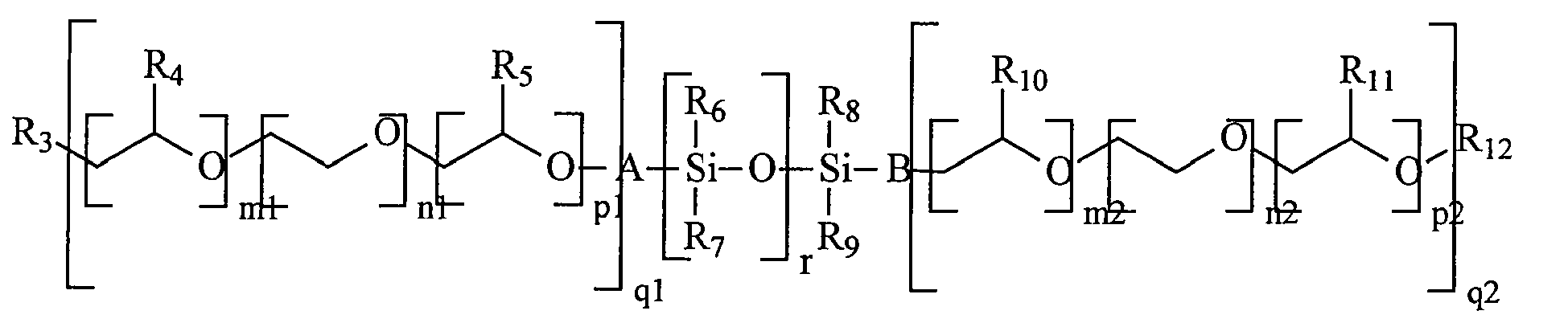 - m1, p1, m2 und p2 eine Anzahl von Alkylenoxidmustern von weniger als oder gleich 150 darstellen,- n1 und n2 eine Anzahl von Alkylenoxidmustern von weniger als oder gleich 150 darstellen,- q1 und q2 eine ganze Zahl von mindestens gleich 1 darstellen, wie 0 ≤ (m1+n1+p1)q1 ≤ 150 und 0 ≤ (m2+n2+p2)q2 ≤ 150,- r eine Zahl wie 1 ≤ r ≤ 200 darstellt,- R3 ein Radikal mit einer polymerisierbaren, ungesättigten Funktion darstellt, welches vorzugsweise zur Gruppe der Vinyle sowie zur Gruppe der Acryl-, Methacryl-, Malein-, Itacon-, Croton-, Vinylphtal-Ester sowie zur Gruppe der ungesättigten Urethane wie beispielsweise die Acrylurethane, Methacrylurethane, α-α' Dimethyl-Isopropenyl-Benzylurethan, Allylurethan, ebenso wie zur Gruppe der substituierten oder nicht substituierten Allyl- oder Vinylether oder auch zur Gruppe der ethylenisch ungesättigten Amide oder Imide gehört,- R4, R5, R10 und R11 den Wasserstoff oder das Methyl- oder Ethylradikal darstellen,- R6, R7, R8 und R9 geradkettige oder verzweigte Alkyl-, oder Aryl-, oder Alkylaryloder Arylalkylgruppen mit 1 bis 20 Kohlenstoffatomen, oder Mischungen daraus, darstellen,- R12 ein hydrocarbonisiertes Radikal mit 1 bis 40 Kohlenstoffatomen darstellt,- Eine gegebenenfalls vorhandene Gruppe mit einem hydrocarbonisierten Radikal von 1 bis 4 Kohlenstoffatomen sind,mit Formel (IIb)
R-A-Si(OB)3
wobei:- R ein Radikal mit einer polymerisierbaren, ungesättigten Funktion darstellt, welches vorzugsweise zur Gruppe der Vinyle sowie zur Gruppe der Acryl-, Methacryl-, Malein-, Itacon-, Croton-, Vinylphtal-Ester sowie zur Gruppe der ungesättigten Urethane wie Acrylurethan, Methacrylurethan, α-α' Dimethyl-Isopropenyl-Benzylurethan, Allylurethan, ebenso wie zur Gruppe der substituierten oder nicht substituierten Allyl- oder Vinylether oder auch zur Gruppe der ethylenisch ungesättigten Amide oder Imide gehört,- A eine gegebenenfalls vorhandene Gruppe mit einem hydrocarbonisierten Radikal mit 1 bis 4 Kohlenstoffatomen ist,- B ein hydrocarbonisiertes Radikal mit 1 bis 4 Kohlenstoffatomen darstellt,
oder aus der Mischung mehrerer dieser Monomere,
und dass das Monomer gewählt wird aus der Gruppe bestehend aus Ethylenglycoldimethacrylat, Trimethylolpropantriacrylat, Allylacrylat, Allylmaleaten, Methylen-bis-Acrylamid, Methylen-bis-Methacrylamid, Tetrallyloxyethan, Triallylcyanurate, Allylether, welche aus Polyolen wie Pentaerythritol gewonnen werden, Sorbitol, Sucrose, oder unter den Molekülen der Formel (III):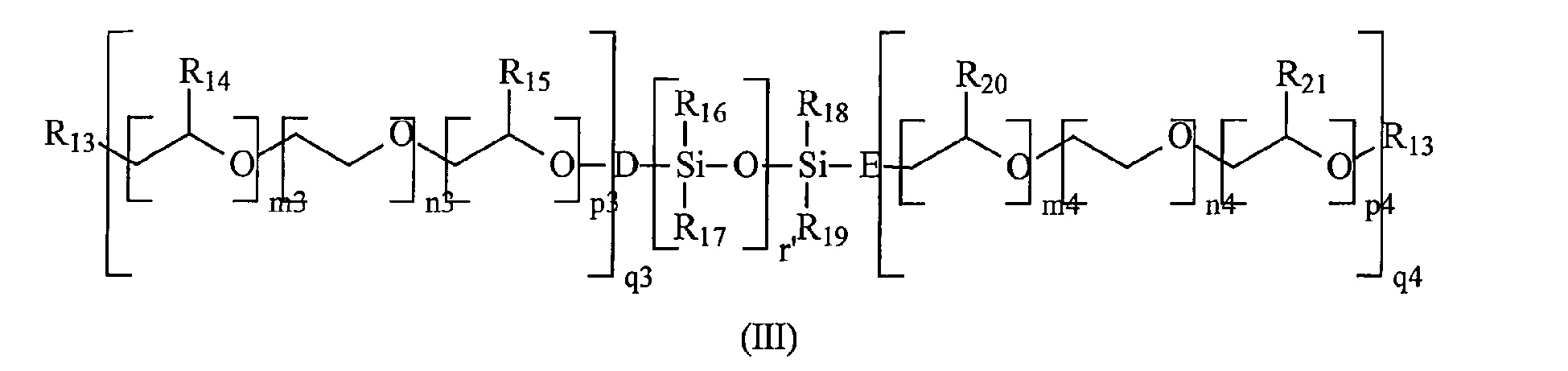 - m3, p3, m4 und p4 eine Anzahl von Alkylenoxidmustern von weniger als oder gleich 150 darstellen,- n3 und n4 eine Anzahl von Ethylenoxidmustem von weniger als oder gleich 150 darstellen,- q3 und q4 eine ganze Zahl von mindestens gleich 1 darstellen, wie 0 < (m3+n3+p3)q3 < 150 und ≤ (m4+n4+p4)q4 ≤ 150,- r' eine ganze Zahl wie 1 ≤ r' ≤ 200 darstellt,- R13 ein Radikal mit einer polymerisierbaren, ungesättigten Funktion darstellt, welches vorzugsweise zur Gruppe der Vinyle sowie zur Gruppe der Acryl-, Methacryl-, Malein-, Itacon-, Croton-, Vinylphtal-Ester sowie zur Gruppe der ungesättigten Urethane wie beispielsweise die Acrylurethane, Methacrylurethane, α-α' Dimethyl-Isopropenyl-Benzylurethan, Allylurethan, ebenso wie zur Gruppe der substituierten oder nicht substituierten Allyl- oder Vinylether oder auch zur Gruppe der ethylenisch ungesättigten Amide oder Imide gehört,- R14, R15, R20 und R21 den Wasserstoff oder das Methyl- oder Ethylradikal darstellen,- R16, R17, R18 und R19 geradkettige oder verzweigte Alkyl-, oder Aryl-, oder Alkylaryloder Arylalkylgruppen mit 1 bis 20 Kohlenstoffatomen, oder Mischungen daraus, darstellen,- D und E gegebenenfalls vorhandene Gruppen mit einem hydrocarbonisierten Radikal mit 1 bis 4 Kohlenstoffatomen sind,oder Mischungen mehrerer dieser Monomere.
 - Verwendung eines wasserlöslichen Copolymers als Mittel zur Verbesserung der Aktivierung der optischen Weißung nach einem der Ansprüche 1 bis 4, dadurch gekennzeichnet, dass sich das besagte Copolymer, ausgedrückt in Gewicht, wie folgt zusammensetzt:a) 2 % bis 95 % und insbesondere 5 % bis 90 % mindestens eines ethylenisch ungesättigten anionischen Monomers mit Monocarboxylfunktion wie Acryl- oder Methacrylsäure, oder auch Halbester zweiwertiger Säuren wie die Monoester mit 1 bis 4 C-Atomen der Malein- oder Itaconsäure, oder Mischungen daraus, oder gewählt unter den ethylenisch ungesättigten Monomeren mit Dicarboxyl wie Croton-, Isocroton-, Zimt-, Itacon-, Maleinsäure, oder auch den Carboxyl-Säureanhydriden wie Maleinanhydrid, oder gewählt unter den ethylenisch ungesättigten Monomeren mit Sulfonfunktion wie Acrylamido-Methyl-Propan-Sulfonsäure, Natrium-Methallylsulfonat, Vinylsulfonsäure und Styrolsulfonsäure, oder noch gewählt unter den ethylenisch ungesättigten Monomeren mit Phosphonfunktion wie Vinylphosphorsäure, Ethylenglycol-Methacrylat-Phosphat, Propylenglycol-Methacrylat-Phosphat, Ethylenglycol-Acrylat-Phosphat, Propylenglycol-Acrylat-Phosphat und deren Ethoxylate, oder weiterhin gewählt unter den ethylenisch ungesättigten Monomeren mit Phosphonfunktionwie Vinylphosphorsäure, oder Mischungen daraus,b) 2 bis 95 % und insbesondere 5 % bis 90 % mindestens eines ethylenisch ungesättigten nicht ionischen Monomers der Formel (I):
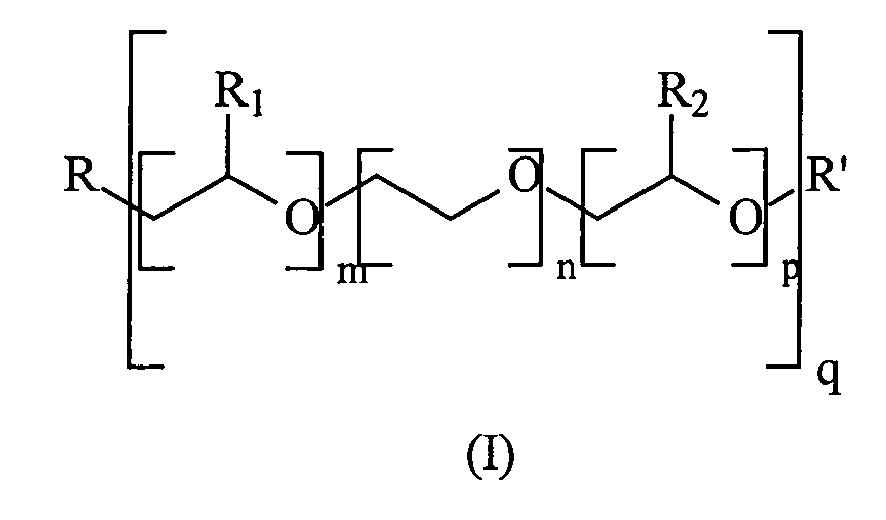 - m und p eine Anzahl von Alkylenoxidmustern kleiner oder gleich 150 darstellen,- n eine Anzahl von Ethylenoxidmustern kleiner oder gleich 150 darstellt,- q eine ganze Zahl von mindestens 1 und wie 5 ≤ (m+n+p)q ≤ 150, und vorzugsweise wie 15 ≤ (m+n+p)q ≤ 120, darstellt- R1 den Wasserstoff oder das Methyl- oder Ethylradikal darstellt,- R2 den Wasserstoff oder das Methyl- oder Ethylradikal darstellt,- R das Radikal mit einer polymerisierbaren, ungesättigten Funktion darstellt, welches zur Gruppe der Vinyle sowie zur Gruppe der Acryl-, Methacryl-, Malein-, Itacon-, Croton-, Vinylphtal-Ester sowie zur Gruppe der ungesättigten Urethane wie Acrylurethan, Methacrylurethan, α-α' Dimethyl-Isopropenyl-Benzylurethan, Allylurethan, ebenso wie zur Gruppe der substituierten oder nicht substituierten Allyl- oder Vinylether oder auch zur Gruppe der ethylenisch ungesättigten Amide oder Imide gehört,- R' den Wasserstoff oder ein hydrocarbonisiertes Radikal mit 1 bis 40 Kohlenstoffatomen darstellt, und vorzugsweise ein hydrocarbonisiertes Radikal mit 1 bis 12 Kohlenstoffatomen und noch bevorzugterweise ein hydrocarbonisiertes Radikal mit 1 bis 4 Kohlenstoffatomen darstellt.
oder aus der Mischung von mehreren Monomeren der Formel (I),c) 0 % bis 50 % mindestens eines Monomers vom Typ Acrylamid oder Methacrylamid oder deren Derivaten wie N-[3-(dimethylamino)propyl]-Acrylamid oder N-[3-(dimethylamino)propyl]-Methacrylamid und Mischungen daraus, oder aber aus mindestens einem nicht wasserlöslichen Monomer wie Alkylacrylate oder -methacrylate, ungesättigte Ester wie N-[2-(dimethylamino)-ethyl]-Methacrylat oder N-[2-(dimethylamino)-ethyl]-Acrylat, Vinylen wie Vinylacetat, Vinylpyrrolidon, Styrol, Alphamethylstyrol und ihre Derivaten, oder mindestens einen kationischen Monomer oder quaternären Ammonium wie [2-(Methacryloyloxy)ethyl]trimethylammoniumchlorid oder -sulfat, [2-(Acryloyloxy)ethyl]trimethylammoniumchlorid oder -sulfat, [3-(Acrylamido) propyl] trimethylammoniumchlorid oder -sulfat, Dimethyldiallylammoniumchlorid oder -sulfat, [3-(Methacrylamido)propyl]trimethylammoniumchlorid oder -sulfat, oder auch mindestens einem organofluorierten Monomer, oder auch einem organosilierten Monomer, vorzugsweise gewählt unter den Molekülen der Formeln (IIa) oder (IIb):
Mit Formel (IIa): - m1, p1, m2 und p2 eine Anzahl von Alkylenoxidmustern von weniger als oder gleich 150 darstellen,- n1 und n2 eine Anzahl von Alkylenoxidmustern von weniger als oder gleich 150 darstellen,- q1 und q2 eine ganze Zahl von mindestens gleich 1 darstellen, wie 0 ≤ (m1+n1+p1)q1 ≤ 150 und 0 ≤ (m2+n2+p2)q2 ≤ 150,- r eine Zahl wie 1 ≤ 200 darstellt,- R3 ein Radikal mit einer polymerisierbaren, ungesättigten Funktion darstellt, welches vorzugsweise zur Gruppe der Vinyle sowie zur Gruppe der Acryl-, Methacryl-, Malein-, Itacon-, Croton-, Vinylphtal-Ester sowie zur Gruppe der ungesättigten Urethane wie beispielsweise die Acrylurethane, Methacrylurethane, α-α' Dimethyl-Isopropenyl-Benzylurethan, Allylurethan, ebenso wie zur Gruppe der substituierten oder nicht substituierten Allyl- oder Vinylether oder auch zur Gruppe der ethylenisch ungesättigten Amide oder Imide gehört,- R4, R5, R10 und R11 den Wasserstoff oder das Methyl- oder Ethylradikal darstellen,- R6, R7, R8 und R9 geradkettige oder verzweigte Alkyl-, Aryl-, Alkylaryl- oder Arylalkylgruppen mit 1 bis 20 Kohlenstoffatomen, oder Mischungen daraus, darstellen,- R12 ein hydrocarbonisiertes Radikal mit 1 bis 40 Kohlenstoffatomen darstellt,- A und B gegebenenfalls vorhandene Gruppen mit einem hydrocarbonisierten Radikal von 1 bis 4 Kohlenstoffatomen sind,Mit Formel (IIb)
R-A-Si(OB)3
wobei:- R ein Radikal mit einer polymerisierbaren, ungesättigten Funktion darstellt, welches vorzugsweise zur Gruppe der Vinyle sowie zur Gruppe der Acryl-, Methacryl-, Malein-, Itacon-, Croton-, Vinylphtal-Ester sowie zur Gruppe der ungesättigten Urethane wie Acrylurethan, Methacrylurethan, α-α' Dimethyl-Isopropenyl-Benzylurethan, Allylurethan, ebenso wie zur Gruppe der substituierten oder nicht substituierten Allyl- oder Vinylether oder auch zur Gruppe der ethylenisch ungesättigten Amide oder Imide gehört,- A eine gegebenenfalls vorhandene Gruppe mit einem hydrocarbonisierten Radikal mit 1 bis 4 Kohlenstoffatomen ist,- B ein hydrocarbonisiertes Radikal mit 1 bis 4 Kohlenstoffatomen darstellt,oder eine Mischung mehrerer dieser Monomere,d) 0 % bis 3 % mindestens eines vernetzenden Monomers, gewählt in der Gruppe bestehend aus Ethylenglycoldimethacrylat, Trimethylolpropantriacrylat, Allylacrylat, Allylmaleaten, Methylen-bis-Acrylamid, Methylen-bis-Methacrylamid, Tetrallyloxyethan, Triallylcyanurate, Allylether, welche aus Polyolen wie Pentaerythritol gewonnen werden, Sorbitol, Sucrose, oder unter den Molekülen der Formel (III): - m3, p3, m4 und p4 eine Anzahl von Alkylenoxidmustern von weniger als oder gleich 150 darstellen,- n3 und n4 eine Anzahl von Ethylenoxidmustem von weniger als oder gleich 150 darstellen,- q3 und q4 eine ganze Zahl von mindestens gleich 1 darstellen, wie 0 ≤ (m3+n3+p3)q3 ≤ 150 und 0 ≤ (m4+n4+p4)q4 ≤ 150,- r' eine ganze Zahl wie 1 ≤ r' ≤ 200 darstellt,- R13 ein Radikal mit einer polymerisierbaren, ungesättigten Funktion darstellt, welches vorzugsweise zur Gruppe der Vinyle sowie zur Gruppe der Acryl-, Methacryl-, Malein-, Itacon-, Croton-, Vinylphtal-Ester sowie zur Gruppe der ungesättigten Urethane wie beispielsweise die Acrylurethane, Methacrylurethane, α-α' Dimethyl-Isopropenyl-Benzylurethan, Allylurethan; ebenso wie zur Gruppe der substituierten oder nicht substituierten Allyl- oder Vinylether oder auch zur Gruppe der ethylenisch ungesättigten Amide oder Imide gehört,- R14, R15, R20 und R21 den Wasserstoff oder das Methyl- oder Ethylradikal darstellen,- R16, R17, R18 und R19 geradkettige oder verzweigte Alkyl-, oder Aryl-, oder Alkylaryloder Arylalkylgruppen mit 1 bis 20 Kohlenstoffatomen, oder Mischungen daraus, darstellen,- D und E gegebenenfalls vorhandene Gruppen mit einem hydrocarbonisierten Radikaloder die Mischung mehrerer dieser Monomere,
mit 1 bis 4 Kohlenstoffatomen sind,
wobei die Anteile der Bestandteile a), b), c) und d) insgesamt 100 % darstellen. - Verwendung eines wasserlöslichen Copolymers als Mittel zur Verbesserung der Aktivierung der optischen Weißung nach einem der Ansprüche 1 bis 5, dadurch gekennzeichnet, dass das besagte Copolymer in seiner Säureform vorliegt oder ganz oder teilweise durch ein oder mehrere Neutralisierungsmittel mit einer einwertigen neutralisierenden Funktion oder einer mehrwertigen neutralisierenden Funktion neutralisiert wird, wobei das oder die Neutralisierungsmittel für die einwertige Funktion aus der Gruppe der Alkalikationen, wie insbesondere Natrium, Kalium, Lithium, Ammonium oder aliphatische und/oder zyklische primäre, sekundäre oder terziäre Amine wie z. B. Stearylamin, Ethanolamin (Mono-, Di-, Triethanolamin), Mono- und Diethylamin, Cyclohexylamin, Methylcyclohexylamin, Aminomethylpropanol, Morpholin, oder für die mehrwertige Funktion aus der Gruppe bestehend aus bivalenten Alkali-Erde-Kationen, insbesondere Magnesium und Calcium, oder auch Zink, ebenso wie aus dreiwertigen Kationen wie insbesondere Aluminium, oder aber bestimmte höherwertige Kationen gewählt wird.
- Verwendung eines wasserlöslichen Copolymers als Mittel zur Verbesserung der Aktivierung der optischen Weißung nach Anspruch 6- in einem Dispersionsverfahren in wässriger Suspension von Mineralstoffen, dadurch gekennzeichnet, dass man 0,05 % bis 5 % Trockengewicht des besagten Copolymers im Verhältnis zum Trockengewicht der Ladungen und/oder Pigmente verwendet, und insbesondere dadurch, dass man 0,1 % bis 3 % Trockengewicht des besagten Copolymers im Verhältnis zum Trockengewicht der Ladungen und/oder Pigmente verwendet, und dass der Mineralstoff gewählt wird unter Calciumcarbonat, Dolomiten, Kaolin, Talk, Gips, Titandioxid, weißglänzender Emulsion, oder auch Aluminiumtrioxyd, Glimmer oder der Mischung dieser Ladungen untereinander, wie die Mischungen Talk-Calciumcarbonat mit Aluminiumtrihydroxid oder auch die Mischungen mit synthetischen oder natürlichen Fasern, oder weiterhin die Co-Strukturen von Mineralen wie die Co-Strukturen Talk-Calciumcarbonat oder Talk-Titandioxid, und vorzugsweise ein Calciumcarbonat wie das natürliche Calciumcarbonat, gewählt unter Marmor, Kalkspat, Kreide oder Mischungen daraus, ist,- in einem Mahlverfahren in wässriger Suspension von Mineralstoffen, dadurch gekennzeichnet, dass man 0,05 % bis 5 % Trockengewicht des besagten Copolymers im Verhältnis zum Trockengewicht der Ladungen und/oder Pigmente verwendet, und insbesondere dadurch, dass man 0,1 % bis 3 % Trockengewicht des besagten Copolymers im Verhältnis zum Trockengewicht der Ladungen und/oder Pigmente verwendet, und dass der Mineralstoff gewählt wird unter Calciumcarbonat, Dolomiten, Kaolin, Talk, Gips, Titandioxid, weißglänzender Emulsion, oder auch Aluminiumtrioxyd, Glimmer oder der Mischung dieser Ladungen untereinander, wie die Mischungen Talk-Calciumcarbonat mit Aluminiumtrihydroxid oder auch die Mischungen mit synthetischen oder natürlichen Fasern, oder weiterhin die Co-Strukturen von Mineralen wie die Co-Strukturen Talk-Calciumcarbonat oder Talk-Titandioxid, und vorzugsweise ein Calciumcarbonat wie das natürliche Calciumcarbonat, gewählt unter Marmor, Kalkspat, Kreide oder Mischungen daraus, ist,- in einem Herstellungsverfahren von Füllmassen, dadurch gekennzeichnet, dass man 0,05 % bis 5 % Trockengewicht des besagten Copolymers im Verhältnis zum Trockengewicht der Ladungen und/oder Pigmente verwendet, und insbesondere dadurch, dass man 0,1 % bis 1 % Trockengewicht des besagten Copolymers im Verhältnis zum Trockengewicht der Ladungen und/oder Pigmente verwendet, und dass der Mineralstoff gewählt wird unter Calciumcarbonat, Dolomiten, Kaolin, Talk, Gips, Titandioxid, weißglänzender Emulsion, oder auch Aluminiumtrioxyd, Glimmer oder der Mischung dieser Ladungen untereinander, wie die Mischungen Talk-Calciumcarbonat mit Aluminiumtrihydroxid oder auch die Mischungen mit synthetischen oder natürlichen Fasern, oder weiterhin die Co-Strukturen von Mineralen wie die Co-Strukturen Talk-Calciumcarbonat oder Talk-Titandioxid,
und vorzugsweise ein Calciumcarbonat wie das natürliche Calciumcarbonat, gewählt unter Marmor, Kalkspat, Kreide oder Mischungen daraus, ist,- in einem Herstellungsverfahren von Streichmasse, dadurch gekennzeichnet, dass man 0,05 % bis 5 % Trockengewicht des besagten Copolymers im Verhältnis zum Trockengewicht der Ladungen und/oder Pigmente verwendet, und insbesondere dadurch, dass man 0,1 % bis 2 % Trockengewicht des besagten Copolymers im Verhältnis zum Trockengewicht der Ladungen und/oder Pigmente verwendet, und dass der Mineralstoff gewählt wird unter Calciumcarbonat, Dolomiten, Kaolin, Talk, Gips, Titandioxid, weißglänzender Emulsion, oder auch Aluminiumtrioxyd, Glimmer oder der Mischung dieser Ladungen untereinander, wie die Mischungen Talk-Calciumcarbonat, Calciumcarbonat-Kaolin, oder auch die Mischungen von Calciumcarbonat mit Aluminiumtrihydroxid oder auch die Mischungen mit synthetischen oder natürlichen Fasern, oder weiterhin die Co-Strukturen von Mineralen wie die Co-Strukturen Talk-Calciumcarbonat oder Talk-Titandioxid, und vorzugsweise ein Calciumcarbonat wie das natürliche Calciumcarbonat, gewählt unter Marmor, Kalkspat, Kreide oder Mischungen daraus, ist,- als Zusatzstoff, welcher den Suspensionen aus dispersierten Mineralstoffen beigemischt wird,- als Zusatzstoff, welcher den Suspensionen aus gemahlenen Mineralstoffen beigemischt wird. - Wässrige Suspension aus dispersierten Mineralstoffen, dadurch gekennzeichnet, dass sie das Copolymer gemäß einem der Ansprüche 1 bis 6 enthält, und insbesondere dadurch, dass sie 0,05 % bis 5 % Trockengewicht des besagten Copolymers im Verhältnis zum Trockengewicht der Ladungen und/oder Pigmente enthält, und noch insbesondere dadurch, dass sie 0,1 % bis 3 % Trockengewicht des besagten Copolymers im Verhältnis zum Trockengewicht der Ladungen und/oder Pigmente enthält.
- Wässrige Suspension aus gemahlenen Mineralstoffen, dadurch gekennzeichnet, dass sie das Copolymer gemäß einem beliebigen der Ansprüche 1 bis 6 enthält, und insbesondere dadurch, dass sie 0,05 % bis 5 % Trockengewicht des besagten Copolymers im Verhältnis zum Trockengewicht der Ladungen und/oder Pigmente enthält, und noch insbesondere dadurch, dass sie 0,1 % bis 3 % Trockengewicht des besagten Copolymers im Verhältnis zum Trockengewicht der Ladungen und/oder Pigmente enthält.
- Füllmasse, dadurch gekennzeichnet, dass sie das Copolymer gemäß einem beliebigen der Ansprüche 1 bis 6 enthält, und insbesondere dadurch, dass sie 0,05 % bis 5 % Trockengewicht des besagten Copolymers im Verhältnis zum Gesamttrockengewicht der Ladungen und/oder Pigmente enthält, und noch insbesondere dadurch, dass sie 0,1 % bis 1 % Trockengewicht des besagten Copolymers im Verhältnis zum Gesamttrockengewicht der Ladungen und/oder Pigmente enthält.
- Streichmasse, dadurch gekennzeichnet, dass sie das Copolymer gemäß einem der Ansprüche 1 bis 6 enthält, und insbesondere dadurch, dass sie 0,05 % bis 5 % Trockengewicht des besagten Copolymers im Verhältnis zum Gesamttrockengewicht der Ladungen und/oder Pigmente enthält, und noch insbesondere dadurch, dass sie 0,1 % bis 2 % Trockengewicht des besagten Copolymers im Verhältnis zum Gesamttrockengewicht der Ladungen und/oder Pigmente enthält.
- Suspension, Füllmasse oder Streichmasse nach einem beliebigen der Ansprüche 8 bis 11, dadurch gekennzeichnet, dass der Mineralstoff unter Calciumcarbonat, Dolomiten, Kaolin, Talk, Gips, Titandioxid, weißglänzender Emulsion, oder auch Aluminiumtrioxyd, Glimmer oder der Mischung dieser Ladungen untereinander, wie die Mischungen Talk-Calciumcarbonat, Calciumcarbonat-Kaolin, oder auch Mischungen von Calciumcarbonat mit Aluminiumtrihydroxid, oder auch die Mischungen mit synthetischen oder natürlichen Fasern, oder weiterhin die Co-Strukturen von Mineralen wie die Co-Strukturen Talk-Calciumcarbonat oder Talk-Titandioxid gewählt wird, und vorzugsweise ein Calciumcarbonat wie das natürliche Calciumcarbonat, gewählt unter Marmor, Kalkspat, Kreide oder Mischungen daraus, ist.
Applications Claiming Priority (3)
| Application Number | Priority Date | Filing Date | Title |
|---|---|---|---|
| FR0214000A FR2846978B1 (fr) | 2002-11-08 | 2002-11-08 | Utilisation d'un copolymere disposant d'au moins une fonction greffee alkoxy ou hydroxy polyalkylene glycol, comme agent ameliorant l'activation de l'azurage optique et produits obtenus |
| FR0214000 | 2002-11-08 | ||
| PCT/FR2003/003300 WO2004044022A1 (fr) | 2002-11-08 | 2003-11-05 | Utilisation d'un copolymere disposant d'au moins une fonction greffee alkoxy ou hydroxy polyalkylene glycol, comme agent ameliorant l'activation de l'azurage optique et produits obtenus. |
Publications (2)
| Publication Number | Publication Date |
|---|---|
| EP1565504A1 EP1565504A1 (de) | 2005-08-24 |
| EP1565504B1 true EP1565504B1 (de) | 2011-08-10 |
Family
ID=32116468
Family Applications (1)
| Application Number | Title | Priority Date | Filing Date |
|---|---|---|---|
| EP03767912A Expired - Lifetime EP1565504B1 (de) | 2002-11-08 | 2003-11-05 | Verwendung eines polymerisats, geppfropftes alkoxy- oder hydroxypolyalkylenglycol enthaltend, als verbesserer beim optischen aufhellen, und die produkte |
Country Status (21)
| Country | Link |
|---|---|
| US (1) | US7772351B2 (de) |
| EP (1) | EP1565504B1 (de) |
| JP (1) | JP4741240B2 (de) |
| KR (1) | KR101200643B1 (de) |
| CN (1) | CN100480292C (de) |
| AT (1) | ATE519794T1 (de) |
| AU (1) | AU2003292345A1 (de) |
| BR (1) | BR0315301B1 (de) |
| CA (1) | CA2505099C (de) |
| CO (1) | CO5590966A2 (de) |
| EA (1) | EA010797B1 (de) |
| ES (1) | ES2372954T3 (de) |
| FR (1) | FR2846978B1 (de) |
| MX (1) | MX280383B (de) |
| NO (1) | NO333166B1 (de) |
| PL (1) | PL376623A1 (de) |
| PT (1) | PT1565504E (de) |
| TW (1) | TW200422311A (de) |
| UY (1) | UY28071A1 (de) |
| WO (1) | WO2004044022A1 (de) |
| ZA (1) | ZA200503918B (de) |
Families Citing this family (49)
| Publication number | Priority date | Publication date | Assignee | Title |
|---|---|---|---|---|
| FR2846971B1 (fr) * | 2002-11-08 | 2006-09-29 | Omya Ag | Utilisation d'un copolymere disposant d'au moins une fonction greffee alkoxy ou hydroxy polyalkylene glycol, comme agent ameliorant la brillance du papier et produits obtenus |
| DE602004016178D1 (de) * | 2003-09-03 | 2008-10-09 | Rhodia | Neues copolymer mit kontrolliertem aufbau und verwendung davon |
| WO2006081501A1 (en) * | 2005-01-27 | 2006-08-03 | Imerys Pigments, Inc. | Aqueous mineral suspensions |
| US7666963B2 (en) * | 2005-07-21 | 2010-02-23 | Akzo Nobel N.V. | Hybrid copolymers |
| FR2893031B1 (fr) * | 2005-11-04 | 2008-02-08 | Coatex Sas | Procede de fabrication d'une resine thermoplastique avec une resistance a l'impact amelioree mettant en oeuvre un polymere peigne avec au moins une fonction greffee oxyde de polyalkylene et resines obtenues. |
| FR2894998A1 (fr) * | 2005-12-16 | 2007-06-22 | Coatex Sas | Procede de fabrication de sauces de couchage a la retention d'eau et a la viscosite brookfield ameliorees mettant en oeuvre un polymere peigne avec au moins une fonction greffee oxyde de polyalkylene. |
| US20080020961A1 (en) * | 2006-07-21 | 2008-01-24 | Rodrigues Klin A | Low Molecular Weight Graft Copolymers |
| US8674021B2 (en) * | 2006-07-21 | 2014-03-18 | Akzo Nobel N.V. | Sulfonated graft copolymers |
| FR2907788B1 (fr) * | 2006-10-31 | 2008-12-19 | Coatex Sas | Utilisation comme agent compatibilisant de charges minerales pour materiaux thermoplastiques chlores d'un polymere peigne avec au moins une fonction greffee oxyde de polyalkylene. |
| FR2913427B1 (fr) * | 2007-03-05 | 2011-10-07 | Omya Development Ag | Procede de broyage a sec d'un ou plusieurs materiaux comprenant au moins un carbonate de calcium |
| FI122734B (fi) * | 2007-05-21 | 2012-06-15 | Kemira Oyj | Prosessikemikaali käytettäväksi paperin tai kartongin valmistuksessa |
| FR2917091B1 (fr) * | 2007-06-08 | 2009-08-28 | Coatex S A S Soc Par Actions S | Procede de fabrication d'une formulation aqueuse a base de solution d'un polymere peigne acrylique et d'emulsion epaississante acrylique, formulation obtenue et ses utilisations dans le couchage papetier |
| ES2793576T3 (es) * | 2007-07-10 | 2020-11-16 | Bausch & Lomb | Agentes de entrecruzamiento y su uso |
| FR2922452B1 (fr) * | 2007-10-19 | 2010-01-22 | Coatex Sas | Formulations de composes organoplatiniques en presence de polymeres associatifs, produits obtenus et leurs utilisations |
| EP2075374A1 (de) | 2007-12-17 | 2009-07-01 | Omya Development AG | Verfahren zur Herstellung einer Streichmasse unter Einbringung eines acrylischen Verdickers mit verzweigter wasserabweisender Kettenstruktur und so erhaltene Streichmasse |
| FR2925365B1 (fr) * | 2007-12-20 | 2016-07-29 | Coatex Sas | Procede d'encapsulation des huiles en milieu aqueux avec des emulsions polymeres de type hase, produits obtenus et leurs utilisations |
| FR2926558B1 (fr) * | 2008-01-17 | 2010-03-05 | Coatex Sas | Amelioration d'un procede de fabrication de polymeres peignes par ajout d'un antioxydant, polymeres obtenus et leurs applications |
| FR2931161B1 (fr) * | 2008-05-14 | 2010-04-23 | Coatex Sas | Utilisation d'un couple dispersant acrylique-epaississant associatif dans une peinture alkyde pour ameliorer la retention du niveau de brillant |
| FR2940295B1 (fr) * | 2008-12-18 | 2010-12-17 | Coatex Sas | Macromonomeres ameliorant la stabilite thermique de polymeres (meth)acryliques peigne, utilisation de ces polymeres dans des compositions plastiques chargees |
| FR2941235B1 (fr) * | 2009-01-16 | 2011-01-14 | Coatex Sas | Utilisation de polymeres acryliques peigne avec des groupes hydrophobes comme agents de couplage dans un procede de broyage de matieres minerales avec des liants. |
| IT1393466B1 (it) | 2009-03-16 | 2012-04-20 | Lamberti Spa | Composizioni per la patinatura della carta |
| IT1393465B1 (it) | 2009-03-16 | 2012-04-20 | Lamberti Spa | Poliuretano idrofilico a pettine |
| MX341475B (es) | 2009-07-31 | 2016-08-19 | Akzo Nobel N V * | Composiciones de copolimero hibrido para aplicaciones de cuidado personal. |
| WO2011146604A2 (en) | 2010-05-18 | 2011-11-24 | Milliken & Company | Optical brighteners and compositions comprising the same |
| BR112012029188B1 (pt) | 2010-05-18 | 2020-12-08 | Milliken & Company | compostos clareadores óticos e composições compreendendo os mesmos |
| FR2961211B1 (fr) | 2010-06-10 | 2012-07-27 | Coatex Sas | Polymeres peignes (meth)acryliques a fonction hydroxy polyalkylene glycol, leur utilisation comme agent rheofluidifiant dans des sauces de couchage et sauces les contenant. |
| FR2963934B1 (fr) | 2010-08-19 | 2013-10-25 | Coatex Sas | Polymeres (meth)acryliques peignes amphiphiles et non hydrosolubles |
| FR2963939B1 (fr) | 2010-08-19 | 2013-11-15 | Coatex Sas | Utilisation en sauces de couchage papetieres de polymeres (meth)acryliques peignes amphiphiles et non hydrosolubles |
| IT1402349B1 (it) | 2010-09-15 | 2013-08-30 | Lamberti Spa | Composizioni per la patinatura della carta |
| IT1402689B1 (it) | 2010-09-15 | 2013-09-13 | Lamberti Spa | Poliuretani a pettine utili per la patinatura della carta |
| WO2012092986A1 (en) * | 2011-01-07 | 2012-07-12 | Omya Development Ag | Process for water based mineral material slurry surface whitening |
| US8636918B2 (en) | 2011-08-05 | 2014-01-28 | Ecolab Usa Inc. | Cleaning composition containing a polysaccharide hybrid polymer composition and methods of controlling hard water scale |
| US8853144B2 (en) | 2011-08-05 | 2014-10-07 | Ecolab Usa Inc. | Cleaning composition containing a polysaccharide graft polymer composition and methods of improving drainage |
| US8841246B2 (en) | 2011-08-05 | 2014-09-23 | Ecolab Usa Inc. | Cleaning composition containing a polysaccharide hybrid polymer composition and methods of improving drainage |
| US8679366B2 (en) | 2011-08-05 | 2014-03-25 | Ecolab Usa Inc. | Cleaning composition containing a polysaccharide graft polymer composition and methods of controlling hard water scale |
| EP2771418B2 (de) | 2011-10-26 | 2021-12-29 | Lubrizol Advanced Materials, Inc. | Dispersionszusammensetzung |
| MX2014005094A (es) | 2011-11-04 | 2014-08-08 | Akzo Nobel Chemicals Int Bv | Copolimeros de dendrita hibridos, composiciones de los mismos y metodos para producirlos. |
| EP2773321B1 (de) | 2011-11-04 | 2015-09-09 | Akzo Nobel Chemicals International B.V. | Dendrit-pfropfcopolymere und verfahren zu ihrer herstellung |
| ES2545857T3 (es) * | 2011-11-10 | 2015-09-16 | Basf Se | Aditivo de baño de estucado de papel que comprende monómero de ácido, monómero asociativo y monómero no iónico |
| ITVA20110030A1 (it) | 2011-11-11 | 2013-05-12 | Lamberti Spa | Composizione acquosa di polimeri per la patinatura della carta |
| FR2992969B1 (fr) * | 2012-07-06 | 2014-07-11 | Coatex Sas | Utilisation de nouveaux additifs, dans une formulation de peinture comprenant des particules de dioxyde de titane, comme agents ameliorant l'opacite du film sec ou en cours de sechage |
| FR2993278B1 (fr) * | 2012-07-13 | 2016-02-19 | Coatex Sas | Utilisation d'un polymere peigne pour preparer une suspension contenant du carbonate de calcium et presentant une sensibilite a la temperature reduite. |
| PT2684999E (pt) * | 2012-07-13 | 2015-03-03 | Omya Int Ag | Pastas aquosas de alto teor de sólidos e baixa viscosidade de carbonato de cálcio compreendendo materiais com estabilidade reológica melhorada sob temperatura aumentada |
| US8945314B2 (en) | 2012-07-30 | 2015-02-03 | Ecolab Usa Inc. | Biodegradable stability binding agent for a solid detergent |
| KR101674990B1 (ko) | 2012-12-07 | 2016-11-10 | 제일모직 주식회사 | 컬러필터용 감광성 수지 조성물 및 이를 이용한 컬러필터 |
| US9126866B2 (en) * | 2013-03-06 | 2015-09-08 | Construction Research & Technology Gmbh | Polycarboxylate ethers with branched side chains |
| US9365805B2 (en) | 2014-05-15 | 2016-06-14 | Ecolab Usa Inc. | Bio-based pot and pan pre-soak |
| FR3122431B1 (fr) | 2021-04-29 | 2024-05-10 | Coatex Sas | Couche barrière pour substrat cellulosique |
| CA3248562A1 (en) | 2022-06-07 | 2023-12-14 | Omya International Ag | Porous coatings containing minerals and a deoxygenating agent to improve food shelf life |
Family Cites Families (19)
| Publication number | Priority date | Publication date | Assignee | Title |
|---|---|---|---|---|
| JPS57194038A (en) * | 1981-05-27 | 1982-11-29 | Nippon Shokubai Kagaku Kogyo Co Ltd | Dispersant for calcium carbonate |
| JPS58109700A (ja) * | 1981-12-22 | 1983-06-30 | サンノプコ株式会社 | 紙の表面処理剤および表面処理法 |
| JP2556706B2 (ja) * | 1987-07-14 | 1996-11-20 | 丸尾カルシウム株式会社 | 製紙用炭酸カルシウムの製造方法 |
| JPH02253836A (ja) * | 1989-03-28 | 1990-10-12 | Kanzaki Paper Mfg Co Ltd | 分散剤および粉末の分散液 |
| CN1092430A (zh) * | 1989-10-25 | 1994-09-21 | 陶氏化学公司 | 纸张涂料组合物用的胶乳共聚物 |
| JP3049407B2 (ja) * | 1993-01-19 | 2000-06-05 | 三洋化成工業株式会社 | 顔料分散用樹脂 |
| JP2945822B2 (ja) * | 1993-08-18 | 1999-09-06 | 株式会社日本触媒 | 水溶性グラフト重合体の製造方法 |
| EP0639592A1 (de) * | 1993-08-18 | 1995-02-22 | Nippon Shokubai Co., Ltd. | Wasserlösliche Pfropfcopolymerisate und Verfahren zur Herstellung davon |
| JPH0753993A (ja) * | 1993-08-18 | 1995-02-28 | Nippon Shokubai Co Ltd | ビルダーおよび洗剤組成物 |
| JPH1030010A (ja) * | 1996-07-15 | 1998-02-03 | Toyo Ink Mfg Co Ltd | ノニオン系高分子界面活性剤、その製造方法、及びその顔料分散体 |
| FR2766106B1 (fr) * | 1997-07-18 | 2001-09-07 | Coatex Sa | Utilisation d'un copolymere a structure tensio-active comme agent dispersant et/ou d'aide au broyage |
| FR2766107B1 (fr) * | 1997-07-18 | 1999-08-20 | Pluss Stauffer Ag | Suspensions aqueuses de matieres minerales et leurs utilisations |
| JP4145383B2 (ja) * | 1998-03-30 | 2008-09-03 | 株式会社日本触媒 | サイズ剤組成物 |
| JP3325830B2 (ja) * | 1998-03-30 | 2002-09-17 | 株式会社日本触媒 | 漂白剤組成物 |
| JP2000229233A (ja) * | 1999-02-09 | 2000-08-22 | Denki Kagaku Kogyo Kk | 無機粉末用分散剤 |
| US6413306B1 (en) * | 1999-10-07 | 2002-07-02 | E. I. Du Pont De Nemours And Company | Pigment dispersions containing ABC-block polymer dispersant |
| FR2810261B1 (fr) * | 2000-06-15 | 2002-08-30 | Coatex Sa | Utilisation de copolymeres faiblement anioniques comme agent dispersant et/ou d'aide au broyage de suspension aqueuse de matieres minerales, suspensions aqueuses obtenues et leurs utilisations |
| FR2846972B1 (fr) * | 2002-11-08 | 2005-02-18 | Omya Ag | Suspensions aqueuses de matieres minerales broyees, faiblement chargees ioniquement et leurs utilisations |
| FR2846971B1 (fr) * | 2002-11-08 | 2006-09-29 | Omya Ag | Utilisation d'un copolymere disposant d'au moins une fonction greffee alkoxy ou hydroxy polyalkylene glycol, comme agent ameliorant la brillance du papier et produits obtenus |
-
2002
- 2002-11-08 FR FR0214000A patent/FR2846978B1/fr not_active Expired - Lifetime
-
2003
- 2003-11-05 ZA ZA200503918A patent/ZA200503918B/en unknown
- 2003-11-05 EA EA200500789A patent/EA010797B1/ru not_active IP Right Cessation
- 2003-11-05 MX MXPA05004816 patent/MX280383B/es active IP Right Grant
- 2003-11-05 PL PL376623A patent/PL376623A1/pl not_active Application Discontinuation
- 2003-11-05 TW TW092130910A patent/TW200422311A/zh unknown
- 2003-11-05 CN CNB2003801045048A patent/CN100480292C/zh not_active Expired - Fee Related
- 2003-11-05 CA CA2505099A patent/CA2505099C/fr not_active Expired - Fee Related
- 2003-11-05 KR KR1020057008191A patent/KR101200643B1/ko not_active Expired - Fee Related
- 2003-11-05 AT AT03767912T patent/ATE519794T1/de not_active IP Right Cessation
- 2003-11-05 PT PT03767912T patent/PT1565504E/pt unknown
- 2003-11-05 WO PCT/FR2003/003300 patent/WO2004044022A1/fr not_active Ceased
- 2003-11-05 US US10/533,794 patent/US7772351B2/en not_active Expired - Fee Related
- 2003-11-05 JP JP2004550741A patent/JP4741240B2/ja not_active Expired - Fee Related
- 2003-11-05 ES ES03767912T patent/ES2372954T3/es not_active Expired - Lifetime
- 2003-11-05 BR BRPI0315301-0A patent/BR0315301B1/pt not_active IP Right Cessation
- 2003-11-05 EP EP03767912A patent/EP1565504B1/de not_active Expired - Lifetime
- 2003-11-05 AU AU2003292345A patent/AU2003292345A1/en not_active Abandoned
- 2003-11-07 UY UY28071A patent/UY28071A1/es not_active Application Discontinuation
-
2005
- 2005-06-02 CO CO05053818A patent/CO5590966A2/es not_active Application Discontinuation
- 2005-06-07 NO NO20052759A patent/NO333166B1/no not_active IP Right Cessation
Also Published As
| Publication number | Publication date |
|---|---|
| MXPA05004816A (es) | 2005-07-22 |
| UY28071A1 (es) | 2004-06-30 |
| NO333166B1 (no) | 2013-03-25 |
| US7772351B2 (en) | 2010-08-10 |
| PL376623A1 (pl) | 2006-01-09 |
| TW200422311A (en) | 2004-11-01 |
| US20060106186A1 (en) | 2006-05-18 |
| ZA200503918B (en) | 2007-03-28 |
| JP2006505707A (ja) | 2006-02-16 |
| PT1565504E (pt) | 2011-10-06 |
| FR2846978B1 (fr) | 2007-05-18 |
| ES2372954T3 (es) | 2012-01-30 |
| EA010797B1 (ru) | 2008-12-30 |
| AU2003292345A1 (en) | 2004-06-03 |
| WO2004044022A1 (fr) | 2004-05-27 |
| MX280383B (es) | 2010-10-27 |
| EA200500789A1 (ru) | 2005-12-29 |
| BR0315301A (pt) | 2005-08-16 |
| CN100480292C (zh) | 2009-04-22 |
| CO5590966A2 (es) | 2005-12-30 |
| CN1717425A (zh) | 2006-01-04 |
| FR2846978A1 (fr) | 2004-05-14 |
| CA2505099A1 (fr) | 2004-05-27 |
| KR101200643B1 (ko) | 2012-11-12 |
| NO20052759D0 (no) | 2005-06-07 |
| EP1565504A1 (de) | 2005-08-24 |
| KR20050074559A (ko) | 2005-07-18 |
| ATE519794T1 (de) | 2011-08-15 |
| BR0315301B1 (pt) | 2014-02-11 |
| NO20052759L (no) | 2005-08-05 |
| CA2505099C (fr) | 2013-08-20 |
| JP4741240B2 (ja) | 2011-08-03 |
Similar Documents
| Publication | Publication Date | Title |
|---|---|---|
| CA2505099C (fr) | Utilisation d'un copolymere disposant d'au moins une fonction greffee alkoxy ou hydroxy polyalkylene glycol, comme agent ameliorant l'activation de l'azurage optique et produits obtenus | |
| CA2505074C (fr) | Copolymere disposant d'au moins une fonction greffee alkoxy ou hydroxy polyalkylene glycol et son utilisation | |
| EP1572764B1 (de) | Wässrige lösungen aus bodenmineralmaterialien mit geringer ionenbelastung und deren verwendungen | |
| EP1966441B1 (de) | Verfahren zur herstellung von streichmassen mit erhöhter wasserretention und erhöhter brookfield-viskosität unter einsatz eines kammpolymers mit mindestens einer aufgepfropften polyalkylenoxidfunktion | |
| EP0892111B1 (de) | Wässrige Suspensionen von anorganischen Materialien und ihre Verwendung | |
| EP1347834B1 (de) | Mahlhilfsmittel mineralischer stoffe in wässerigen suspensionen, suspensionen und deren verwendungen | |
| EP1347835B1 (de) | Mahlhilfsmittel und/oder dispergiermittel mineralischer stoffe in wässeriger suspension, suspensionen und deren verwendungen | |
| EP2087048B1 (de) | Verwendung eines kammpolymers mit mindestens einer aufgepfropften polyalkylenoxidfunktion als verträglichkeitsmacher für chlorhaltige thermoplaste gegenüber mineralstoffzusätzen | |
| EP2078109B1 (de) | Verwendung einer Suspension oder wässrigen Dispersion von mineralischen Materialien umfassend ein wasserlösliches Copolymer mit hydrophoben Gruppen zur Herstellung von Papierblättern | |
| EP1795265A2 (de) | Verwendung schwachanionischer Copolymere, als Mahlhilfsmittel wässriger Suspensionen mineralischer Stoffe, hergestellte wässrige Suspensionen und deren Verwendungen. | |
| EP3519472A1 (de) | Verdickendes anionisches copolymer | |
| EP2222920B1 (de) | Verfahren zur herstellung einer streichmasse unter einbringung eines acrylischen verdickers mit verzweigter wasserabweisender kettenstruktur und so erhaltene streichmasse | |
| EP1888657A2 (de) | Verwendung von wasserlöslichen polymeren, die durch kontrollierte radikalische polymerisation erhalten werden, als mittel zur verbesserung der opazität und/oder helligkeit von diese enthaltenden trockenen produkten | |
| EP2222737B1 (de) | Acrylverdicker mit verzweigter hydrophober kette für eine papierstreichmasse mit verbesserter wasserrückhaltung |
Legal Events
| Date | Code | Title | Description |
|---|---|---|---|
| PUAI | Public reference made under article 153(3) epc to a published international application that has entered the european phase |
Free format text: ORIGINAL CODE: 0009012 |
|
| 17P | Request for examination filed |
Effective date: 20050608 |
|
| AK | Designated contracting states |
Kind code of ref document: A1 Designated state(s): AT BE BG CH CY CZ DE DK EE ES FI FR GB GR HU IE IT LI LU MC NL PT RO SE SI SK TR |
|
| AX | Request for extension of the european patent |
Extension state: AL LT LV MK |
|
| 17Q | First examination report despatched |
Effective date: 20061107 |
|
| GRAP | Despatch of communication of intention to grant a patent |
Free format text: ORIGINAL CODE: EPIDOSNIGR1 |
|
| GRAS | Grant fee paid |
Free format text: ORIGINAL CODE: EPIDOSNIGR3 |
|
| GRAA | (expected) grant |
Free format text: ORIGINAL CODE: 0009210 |
|
| AK | Designated contracting states |
Kind code of ref document: B1 Designated state(s): AT BE BG CH CY CZ DE DK EE ES FI FR GB GR HU IE IT LI LU MC NL PT RO SE SI SK TR |
|
| AX | Request for extension of the european patent |
Extension state: AL LT LV MK |
|
| REG | Reference to a national code |
Ref country code: GB Ref legal event code: FG4D Free format text: NOT ENGLISH |
|
| REG | Reference to a national code |
Ref country code: CH Ref legal event code: EP |
|
| REG | Reference to a national code |
Ref country code: IE Ref legal event code: FG4D Free format text: LANGUAGE OF EP DOCUMENT: FRENCH |
|
| REG | Reference to a national code |
Ref country code: CH Ref legal event code: NV Representative=s name: KIRKER & CIE S.A. |
|
| REG | Reference to a national code |
Ref country code: DE Ref legal event code: R096 Ref document number: 60337999 Country of ref document: DE Effective date: 20111006 Ref country code: PT Ref legal event code: SC4A Free format text: AVAILABILITY OF NATIONAL TRANSLATION Effective date: 20110928 |
|
| REG | Reference to a national code |
Ref country code: NL Ref legal event code: T3 |
|
| LTIE | Lt: invalidation of european patent or patent extension |
Effective date: 20110810 |
|
| REG | Reference to a national code |
Ref country code: ES Ref legal event code: FG2A Ref document number: 2372954 Country of ref document: ES Kind code of ref document: T3 Effective date: 20120130 |
|
| PG25 | Lapsed in a contracting state [announced via postgrant information from national office to epo] |
Ref country code: SE Free format text: LAPSE BECAUSE OF FAILURE TO SUBMIT A TRANSLATION OF THE DESCRIPTION OR TO PAY THE FEE WITHIN THE PRESCRIBED TIME-LIMIT Effective date: 20110810 |
|
| PGFP | Annual fee paid to national office [announced via postgrant information from national office to epo] |
Ref country code: CZ Payment date: 20111014 Year of fee payment: 9 Ref country code: CH Payment date: 20111114 Year of fee payment: 9 Ref country code: PT Payment date: 20111107 Year of fee payment: 9 |
|
| REG | Reference to a national code |
Ref country code: AT Ref legal event code: MK05 Ref document number: 519794 Country of ref document: AT Kind code of ref document: T Effective date: 20110810 |
|
| PG25 | Lapsed in a contracting state [announced via postgrant information from national office to epo] |
Ref country code: AT Free format text: LAPSE BECAUSE OF FAILURE TO SUBMIT A TRANSLATION OF THE DESCRIPTION OR TO PAY THE FEE WITHIN THE PRESCRIBED TIME-LIMIT Effective date: 20110810 Ref country code: SI Free format text: LAPSE BECAUSE OF FAILURE TO SUBMIT A TRANSLATION OF THE DESCRIPTION OR TO PAY THE FEE WITHIN THE PRESCRIBED TIME-LIMIT Effective date: 20110810 Ref country code: CY Free format text: LAPSE BECAUSE OF FAILURE TO SUBMIT A TRANSLATION OF THE DESCRIPTION OR TO PAY THE FEE WITHIN THE PRESCRIBED TIME-LIMIT Effective date: 20110810 Ref country code: GR Free format text: LAPSE BECAUSE OF FAILURE TO SUBMIT A TRANSLATION OF THE DESCRIPTION OR TO PAY THE FEE WITHIN THE PRESCRIBED TIME-LIMIT Effective date: 20111111 |
|
| REG | Reference to a national code |
Ref country code: IE Ref legal event code: FD4D |
|
| PG25 | Lapsed in a contracting state [announced via postgrant information from national office to epo] |
Ref country code: SK Free format text: LAPSE BECAUSE OF FAILURE TO SUBMIT A TRANSLATION OF THE DESCRIPTION OR TO PAY THE FEE WITHIN THE PRESCRIBED TIME-LIMIT Effective date: 20110810 Ref country code: IE Free format text: LAPSE BECAUSE OF FAILURE TO SUBMIT A TRANSLATION OF THE DESCRIPTION OR TO PAY THE FEE WITHIN THE PRESCRIBED TIME-LIMIT Effective date: 20110810 |
|
| PG25 | Lapsed in a contracting state [announced via postgrant information from national office to epo] |
Ref country code: EE Free format text: LAPSE BECAUSE OF FAILURE TO SUBMIT A TRANSLATION OF THE DESCRIPTION OR TO PAY THE FEE WITHIN THE PRESCRIBED TIME-LIMIT Effective date: 20110810 Ref country code: RO Free format text: LAPSE BECAUSE OF FAILURE TO SUBMIT A TRANSLATION OF THE DESCRIPTION OR TO PAY THE FEE WITHIN THE PRESCRIBED TIME-LIMIT Effective date: 20110810 |
|
| PLBE | No opposition filed within time limit |
Free format text: ORIGINAL CODE: 0009261 |
|
| STAA | Information on the status of an ep patent application or granted ep patent |
Free format text: STATUS: NO OPPOSITION FILED WITHIN TIME LIMIT |
|
| PG25 | Lapsed in a contracting state [announced via postgrant information from national office to epo] |
Ref country code: DK Free format text: LAPSE BECAUSE OF FAILURE TO SUBMIT A TRANSLATION OF THE DESCRIPTION OR TO PAY THE FEE WITHIN THE PRESCRIBED TIME-LIMIT Effective date: 20110810 Ref country code: MC Free format text: LAPSE BECAUSE OF NON-PAYMENT OF DUE FEES Effective date: 20111130 |
|
| 26N | No opposition filed |
Effective date: 20120511 |
|
| REG | Reference to a national code |
Ref country code: DE Ref legal event code: R097 Ref document number: 60337999 Country of ref document: DE Effective date: 20120511 |
|
| REG | Reference to a national code |
Ref country code: PT Ref legal event code: MM4A Free format text: LAPSE DUE TO NON-PAYMENT OF FEES Effective date: 20130506 |
|
| PG25 | Lapsed in a contracting state [announced via postgrant information from national office to epo] |
Ref country code: LU Free format text: LAPSE BECAUSE OF NON-PAYMENT OF DUE FEES Effective date: 20111105 |
|
| PG25 | Lapsed in a contracting state [announced via postgrant information from national office to epo] |
Ref country code: BG Free format text: LAPSE BECAUSE OF FAILURE TO SUBMIT A TRANSLATION OF THE DESCRIPTION OR TO PAY THE FEE WITHIN THE PRESCRIBED TIME-LIMIT Effective date: 20111110 |
|
| REG | Reference to a national code |
Ref country code: CH Ref legal event code: PL |
|
| PG25 | Lapsed in a contracting state [announced via postgrant information from national office to epo] |
Ref country code: CH Free format text: LAPSE BECAUSE OF NON-PAYMENT OF DUE FEES Effective date: 20121130 Ref country code: CZ Free format text: LAPSE BECAUSE OF NON-PAYMENT OF DUE FEES Effective date: 20121105 Ref country code: LI Free format text: LAPSE BECAUSE OF NON-PAYMENT OF DUE FEES Effective date: 20121130 |
|
| PG25 | Lapsed in a contracting state [announced via postgrant information from national office to epo] |
Ref country code: PT Free format text: LAPSE BECAUSE OF NON-PAYMENT OF DUE FEES Effective date: 20130506 |
|
| PG25 | Lapsed in a contracting state [announced via postgrant information from national office to epo] |
Ref country code: HU Free format text: LAPSE BECAUSE OF FAILURE TO SUBMIT A TRANSLATION OF THE DESCRIPTION OR TO PAY THE FEE WITHIN THE PRESCRIBED TIME-LIMIT Effective date: 20110810 |
|
| PGFP | Annual fee paid to national office [announced via postgrant information from national office to epo] |
Ref country code: GB Payment date: 20131030 Year of fee payment: 11 |
|
| PGFP | Annual fee paid to national office [announced via postgrant information from national office to epo] |
Ref country code: ES Payment date: 20131011 Year of fee payment: 11 Ref country code: NL Payment date: 20131109 Year of fee payment: 11 Ref country code: BE Payment date: 20131113 Year of fee payment: 11 |
|
| PG25 | Lapsed in a contracting state [announced via postgrant information from national office to epo] |
Ref country code: TR Free format text: LAPSE BECAUSE OF NON-PAYMENT OF DUE FEES Effective date: 20121105 |
|
| REG | Reference to a national code |
Ref country code: NL Ref legal event code: V1 Effective date: 20150601 |
|
| PG25 | Lapsed in a contracting state [announced via postgrant information from national office to epo] |
Ref country code: BE Free format text: LAPSE BECAUSE OF NON-PAYMENT OF DUE FEES Effective date: 20141130 |
|
| GBPC | Gb: european patent ceased through non-payment of renewal fee |
Effective date: 20141105 |
|
| PG25 | Lapsed in a contracting state [announced via postgrant information from national office to epo] |
Ref country code: NL Free format text: LAPSE BECAUSE OF NON-PAYMENT OF DUE FEES Effective date: 20150601 |
|
| REG | Reference to a national code |
Ref country code: FR Ref legal event code: PLFP Year of fee payment: 13 |
|
| PG25 | Lapsed in a contracting state [announced via postgrant information from national office to epo] |
Ref country code: GB Free format text: LAPSE BECAUSE OF NON-PAYMENT OF DUE FEES Effective date: 20141105 |
|
| REG | Reference to a national code |
Ref country code: ES Ref legal event code: FD2A Effective date: 20151229 |
|
| PG25 | Lapsed in a contracting state [announced via postgrant information from national office to epo] |
Ref country code: ES Free format text: LAPSE BECAUSE OF NON-PAYMENT OF DUE FEES Effective date: 20141106 |
|
| REG | Reference to a national code |
Ref country code: FR Ref legal event code: PLFP Year of fee payment: 14 |
|
| REG | Reference to a national code |
Ref country code: FR Ref legal event code: PLFP Year of fee payment: 15 |
|
| REG | Reference to a national code |
Ref country code: FR Ref legal event code: PLFP Year of fee payment: 16 |
|
| PGFP | Annual fee paid to national office [announced via postgrant information from national office to epo] |
Ref country code: DE Payment date: 20201020 Year of fee payment: 18 Ref country code: FR Payment date: 20201013 Year of fee payment: 18 Ref country code: FI Payment date: 20201109 Year of fee payment: 18 Ref country code: IT Payment date: 20201013 Year of fee payment: 18 |
|
| REG | Reference to a national code |
Ref country code: DE Ref legal event code: R119 Ref document number: 60337999 Country of ref document: DE |
|
| REG | Reference to a national code |
Ref country code: FI Ref legal event code: MAE |
|
| PG25 | Lapsed in a contracting state [announced via postgrant information from national office to epo] |
Ref country code: FI Free format text: LAPSE BECAUSE OF NON-PAYMENT OF DUE FEES Effective date: 20211105 |
|
| PG25 | Lapsed in a contracting state [announced via postgrant information from national office to epo] |
Ref country code: DE Free format text: LAPSE BECAUSE OF NON-PAYMENT OF DUE FEES Effective date: 20220601 |
|
| PG25 | Lapsed in a contracting state [announced via postgrant information from national office to epo] |
Ref country code: FR Free format text: LAPSE BECAUSE OF NON-PAYMENT OF DUE FEES Effective date: 20211130 |
|
| PG25 | Lapsed in a contracting state [announced via postgrant information from national office to epo] |
Ref country code: IT Free format text: LAPSE BECAUSE OF NON-PAYMENT OF DUE FEES Effective date: 20211105 |