EP1564291A2 - Oligonucléotides, agents les renfermant et leur utilisation - Google Patents
Oligonucléotides, agents les renfermant et leur utilisation Download PDFInfo
- Publication number
- EP1564291A2 EP1564291A2 EP04024018A EP04024018A EP1564291A2 EP 1564291 A2 EP1564291 A2 EP 1564291A2 EP 04024018 A EP04024018 A EP 04024018A EP 04024018 A EP04024018 A EP 04024018A EP 1564291 A2 EP1564291 A2 EP 1564291A2
- Authority
- EP
- European Patent Office
- Prior art keywords
- oligonucleotide
- oligonucleotides
- residue
- acid
- nucleobases
- Prior art date
- Legal status (The legal status is an assumption and is not a legal conclusion. Google has not performed a legal analysis and makes no representation as to the accuracy of the status listed.)
- Withdrawn
Links
- CJVPBSQVSMOJBM-UHFFFAOYSA-N CC(C)CCCC(C)CCCC(C)CCCC(C)(CCc1c2C)Oc1c(C)c(C)c2OCC(COC(c1ccccc1)(c(cc1)ccc1OC)c(cc1)ccc1OC)O Chemical compound CC(C)CCCC(C)CCCC(C)CCCC(C)(CCc1c2C)Oc1c(C)c(C)c2OCC(COC(c1ccccc1)(c(cc1)ccc1OC)c(cc1)ccc1OC)O CJVPBSQVSMOJBM-UHFFFAOYSA-N 0.000 description 1
Images



Classifications
-
- C—CHEMISTRY; METALLURGY
- C07—ORGANIC CHEMISTRY
- C07H—SUGARS; DERIVATIVES THEREOF; NUCLEOSIDES; NUCLEOTIDES; NUCLEIC ACIDS
- C07H21/00—Compounds containing two or more mononucleotide units having separate phosphate or polyphosphate groups linked by saccharide radicals of nucleoside groups, e.g. nucleic acids
-
- A—HUMAN NECESSITIES
- A61—MEDICAL OR VETERINARY SCIENCE; HYGIENE
- A61P—SPECIFIC THERAPEUTIC ACTIVITY OF CHEMICAL COMPOUNDS OR MEDICINAL PREPARATIONS
- A61P35/00—Antineoplastic agents
-
- C—CHEMISTRY; METALLURGY
- C12—BIOCHEMISTRY; BEER; SPIRITS; WINE; VINEGAR; MICROBIOLOGY; ENZYMOLOGY; MUTATION OR GENETIC ENGINEERING
- C12N—MICROORGANISMS OR ENZYMES; COMPOSITIONS THEREOF; PROPAGATING, PRESERVING, OR MAINTAINING MICROORGANISMS; MUTATION OR GENETIC ENGINEERING; CULTURE MEDIA
- C12N15/00—Mutation or genetic engineering; DNA or RNA concerning genetic engineering, vectors, e.g. plasmids, or their isolation, preparation or purification; Use of hosts therefor
- C12N15/09—Recombinant DNA-technology
- C12N15/11—DNA or RNA fragments; Modified forms thereof; Non-coding nucleic acids having a biological activity
- C12N15/117—Nucleic acids having immunomodulatory properties, e.g. containing CpG-motifs
-
- C—CHEMISTRY; METALLURGY
- C12—BIOCHEMISTRY; BEER; SPIRITS; WINE; VINEGAR; MICROBIOLOGY; ENZYMOLOGY; MUTATION OR GENETIC ENGINEERING
- C12N—MICROORGANISMS OR ENZYMES; COMPOSITIONS THEREOF; PROPAGATING, PRESERVING, OR MAINTAINING MICROORGANISMS; MUTATION OR GENETIC ENGINEERING; CULTURE MEDIA
- C12N2310/00—Structure or type of the nucleic acid
- C12N2310/10—Type of nucleic acid
- C12N2310/17—Immunomodulatory nucleic acids
-
- C—CHEMISTRY; METALLURGY
- C12—BIOCHEMISTRY; BEER; SPIRITS; WINE; VINEGAR; MICROBIOLOGY; ENZYMOLOGY; MUTATION OR GENETIC ENGINEERING
- C12N—MICROORGANISMS OR ENZYMES; COMPOSITIONS THEREOF; PROPAGATING, PRESERVING, OR MAINTAINING MICROORGANISMS; MUTATION OR GENETIC ENGINEERING; CULTURE MEDIA
- C12N2310/00—Structure or type of the nucleic acid
- C12N2310/10—Type of nucleic acid
- C12N2310/18—Type of nucleic acid acting by a non-sequence specific mechanism
Definitions
- the present invention relates to certain oligonucleotides, pharmaceutical agents which contain these oligonucleotides, and their therapeutic use.
- the oligonucleotides For example, they are able to inhibit the proliferation of pancreatic tumors. In order to these oligonucleotides have a therapeutic potential for the treatment of human Tumors.
- pancreatic carcinomas with a 5-year survival rate of 0.4% have one extremely bad prognosis.
- Oligodeoxyribonucleotides have more recently been grouped promising agents, with different mechanisms of action to be discussed.
- great expectations are in the so-called antisense oligodeoxyribonucleotides (ASODN), which has the expression of a specific protein, e.g. of an oncogene.
- non-sequence-specific oligonucleotides have now been found with which the proliferation of human pancreatic tumors can be suppressed in vitro in cell cultures and in vivo in the orthotopic xenograft model.
- Particularly advantageous are those oligonucleotides which have covalently bound, lipophilic molecular groups in the terminal 3'- and / or 5'-positions.
- Oligonucleotides according to the invention thus have at least part of the sequence SEQ ID NO: 1 up.
- oligonucleotides according to the invention have further nucleobases, which in linear Oligonucleotides at the 3'-terminus and / or 5'-terminus of the sequence or partial sequence are arranged. These additional nucleobases are in principle freely selectable but will advantageously, the embodiments of the invention described herein selected accordingly.
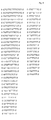
- Oligonucleotides can be of different lengths. In terms of use of the oligonucleotides according to the invention, the partial sequence should be at least 6, in particular at least 8, preferably at least 10 and more preferably at least 12 Consecutive nucleobases from the sequence SEQ ID NO: 1 correspond. The term "consecutive" is used here in the sense of successive. This results in for subsequences of the sequence SEQ ID NO: 1 specific to the person skilled in the art. Some subsequences are shown in FIG.
- inventive oligonucleotides of the Expert one or more than one, for example 2, the same or different of these Partial sequences, optionally with the addition of additional nucleobases, in order appropriate so as to obtain an oligonucleotide according to the invention.
- oligonucleotide means an oligomer of ribonucleic acid (RNA) or Deoxyribonucleic acid (DNA) or mimetics thereof. These include oligonucleotides that from naturally occurring nucleobases, sugars, and covalent internucleoside linkages (Backbone), as well as oligonucleotides with structures that exist in the Nature does not occur, but whose function is similar to the naturally occurring. Such modified oligonucleotides become the native forms according to the invention preferred because they have desired properties, such as increased cellular Uptake, an increased affinity for target nucleic acids and increased stability in Have presence of nucleases.
- nucleotides may be modifications or substitutions to the Nucleobases (also referred to simply as "base” here) have.
- base also referred to simply as "base” here
- unmodified or natural nucleobases include the purine bases adenine (A) and guanine (G), and the Pyrimidine bases thymine (T), cytosine (C) and uracil (U).
- nucleobases include synthetic nucleobases such as 5-methylcytosine (5-Me-C), 5-hydroxymethylcytosine, xanthine, hypoxanthine, 2-aminoadenine, 6-methyl and other alkyl derivatives of adenine and guanine, 2-thiouracil, 2-thiothymine and 2-thiocytosine, 5-Halouracil and 5-Halocytosine, 5-Propynyluracil and 5-Propynylcytosine, 6-Azouracil, 6-azocytosine and 6-azothymine, 5-uracil (pseudouracil), 4-thiouracil, 8-halo, 8-amino, 8-thiol, 8-thioalkyl, 8-hydroxyl and other 8-substituted adenines and guanines, 5-halo, especially 5-bromo, 5-trifluoromethyl and other 5-substituted
- nucleobases are especially useful for increasing binding affinity. These include 5-substituted pyrimidines, 6-azapyrimidines and N-2, N-6 and O-6 substituted Purines, e.g. 2-aminopropyladenine, 5-propynyluracil and 5-propynylcytosine. For example, it could be shown that 5-methylcytosine the stability of a Nucleic acid duplex increased by 0.6-1.2 ° C.
- T-rich oligonucleotides in which more than 50%, in particular more than 60% and preferably more than 70% of the nucleobases Thymidine residues or mimetics thereof.
- Mimetics of thymidine residues are in the above sense modified nucleobases that have similar binding properties, ie, above all the same Base pairing specificity, but quite different affinity for complementary Have nucleobases. The same applies to mimetics of other nucleobases.
- a T / C ratio of 2: 1 or more, and preferably 3: 1 or more is advantageous.
- oligonucleotides according to the invention at least one GT or TG motif, i. at least one thymidine residue or Mimetic thereof is in a consecutive sequence (sequence) to a guanine or a Mimetic arranged.
- oligonucleotides according to the invention contain an arrangement of 6, in particular 8, preferably 10 and more preferably 12 consecutive bases without adenine. Especially Oligonucleotides according to the invention contain no adenine.
- oligonucleotides according to the invention are at least 8, preferably at least 10 and in particular at least 12 nucleobases. This is particularly important for the effectiveness of the oligonucleotides.
- oligonucleotides of the invention typically have less than 50, preferably less than 30 and in particular less than 25 nucleobases. This Aspect is for the uptake of oligonucleotides into cells and thus for bioavailability and also corresponds to expediency considerations, according to which an oligonucleotide of the invention given as little effect as possible nucleobases should be as low as possible to minimize the complexity and the effort of synthesis hold. Particular preference is therefore given to oligonucleotides having 8 to 50, in particular 10 up to 30 and above all with 12 to 25, for example with 13, 14, 15, 16, 17, 18, 19, 20, 21, 22, 23 or 24 bases.
- the arrangement of the nucleobases in oligonucleotides according to the invention is usually thereby ensuring that the nucleobases are linked together in a suitable manner are.
- an oligomer with a consecutive sequence of nucleobases results (Sequence) linked by a backbone forming the main chain. While linear oligomers are preferred, in certain cases branched, be cyclic or even networked structures suitable.
- the oligonucleotides are usually linked together Nucleosides, i. Base-sugar combinations.
- the base part of the nucleosides is usually a heterocyclic base, in most cases a purine or a Pyrimidine.
- the nucleosides are usually covalently attached to the sugar moiety of the Nucleoside linked group linked together. In those nucleosides that have a Having pentofuranosyl sugars, this group can be attached either to the 2 ', 3' or 5 'hydroxyl group be bound to the sugar. In general, these groups link covalently adjacent nucleosides together to form a linear, oligomeric compound.
- the respective ends of this linear, oligomeric structure may in turn be interconnected be connected to form cyclic structures. Open, linear structures are however preferred.
- the linking groups form generally the internucleoside backbone of the oligonucleotide.
- the normal link or the normal backbone of RNA and DNA are 3'-5'-phosphodiester linkages, i.e. the linking groups are phosphate groups.
- oligonucleotides which are a modified backbone are preferred or non-natural internucleoside linkages.
- preferred modified oligonucleotide backbones belong on the one hand phosphate-free analogues and on the other hand phosphate derivatives.
- phosphorothioates partially or completely sulfurized, e.g. chiral Phosphothioates, phosphomonothioates and phosphodithioates.
- Further modified backbones are phosphotriesters, alkyl phosphotriesters, Aminoalkyl phosphotriesters, methyl and other alkyl phosphonates, e.g. 3'-alkylene phosphonates and chiral phosphonates, phosphinates, phosphoramidates, e.g.
- Particular modified oligonucleotide backbones without phosphorus atom are generally formed by short chain alkyl or cycloalkyl internucleoside linkages, which may optionally also include heteroatoms or heterocycles. These include those with morpholino linkages (partially formed by the sugar portion of the nucleoside); Siloxane backbones; Sulfide, sulfoxide and sulfone backbones; Formacetyl and thioformacetyl backbones; Methylene formacetyl and thioformacetyl backbones; Alkene containing backbones; Sulfamate backbones; Methyleneimino and methylenehydrazino backbones; Sulfonate and sulfonamide backbones; Amide backbones; and others with mixed N, O, S and CH 2 component parts.
- oligonucleotides both the sugar and the internucleoside linkage, i.e. modified the backbone of natural nucleotide units.
- Such oligomeric compound i. an oligonucleotide with excellent Hybridization properties is referred to as "Peptide Nucleic Acid” (PNA).
- PNA Peptide Nucleic Acid
- PNA connections is the sugar backbone of an oligonucleotide through an amide-like Backbone, especially an aminoethylglycine backbone replaced.
- the nucleobases are and directly or indirectly, for example via a methylcarbonyl linker, to the Nitrogen atoms of the amide portion of the backbone bound.
- the present invention relates to oligonucleotides having phosphorothioate backbones and further to oligonucleosides having heteroatom backbones which are based in particular on structural units, such as -CH 2 -NH-O-CH 2 -, -CH 2 -N (CH 3 ) -O-CH 2 - [known as methylenemethylimino or MMI backbone for short], -CH 2 -ON (CH 3 ) -CH 2 -, -CH 2 -N (CH 3 ) -N (CH 3 ) -CH 2 - or -ON (CH 3 ) -CH 2 -CH 2 -.
- structural units such as -CH 2 -NH-O-CH 2 -, -CH 2 -N (CH 3 ) -O-CH 2 - [known as methylenemethylimino or MMI backbone for short], -CH 2 -ON (CH 3 ) -CH 2 -, -CH 2
- Modified oligonucleotides may also contain one or more substituted sugar groups.
- the 2'-position for example in the 4'-thio and 4'-aza derivatives, especially the 2'-position may be substituted, eg with OH, F, O, S or N- Alkyl, OS or N-alkenyl, O-, S- or N-alkynyl, or O-alkyl-O-alkyl, wherein alkyl, alkenyl and alkynyl preferably substituted or unsubstituted C 1 -C 10 alkyl or C 2 -C 10 alkenyl or alkynyl.
- substituents such as O ((CH 2 ) n O) m CH 3 , O (CH 2 ) n OCH 3 , O (CH 2 ) n NH 2 , O (CH 2 ) n CH 3 , O (CH 2 ) n NH 2 and O (CH 2 ) n ON [(CH 2 ) n CH 3 )] 2 , where n and m are integers from 1 to 10.
- Preferred modifications include an alkoxy-alkoxy group, eg, 2'-methoxyethoxy (2'-O-CH 2 CH 2 OCH 3 , also known as 2'-O- (2-methoxymethyl) or 2'-MOE).
- Another preferred modification includes 2'-dimethylaminooxyethoxy, ie, an O (CH 2 ) 2 ON (CH 3 ) 2 group, also known as 2'-DMAOE.
- oligonucleotides of the present invention may have sugar mimetics such as cyclobutyl groups instead of the pentofuranosyl sugar.
- Another preferred sugar modification is the term "locked nucleic acid", in short Known as LNA.
- LNA locked nucleic acid
- the C4'-atom and the C2'-atom are via a methylene bridge linked together to give a [2.2.1] bicyclo nucleoside.
- oligonucleotides include attaching to the oligonucleotide one or more molecular groups which modify the activity, cellular distribution or cellular uptake of the oligonucleotides.
- groups include, in particular, those which increase the lipophilic character of the oligonucleotides.
- Polyglycols in particular polyalkylene glycols, preferably polyethylene glycols, peptides, proteins and especially lipophilic radicals, such as alicyclic hydrocarbons, waxes, terpenes and fatty acid radicals preferably having 8 to 32 carbon atoms, which may be saturated or mono- or polyunsaturated, steroids and especially vitamins and derivatives Of these, particular mention should be made.
- Suitable steroid molecules include in particular the bile acids, eg cholic acid, deoxycholic acid and dehydrocholic acid, cortisone, digoxigenin, testosterone, cholesterol and cationic steroids, eg cortisone having a trimethylaminomethylhydrazide group attached to the 3-position of the cortisone ring via a double bond.
- Suitable vitamins include both water-soluble and fat-soluble vitamins.
- Thiamine, riboflavin, nicotinic acid or niacin, the pyridoxal group of vitamin B 6 , pantothenic acid, biotin, folic acid, the B 12 -cobamide coenzymes, inositol, choline and ascorbic acid are to be mentioned in particular as water-soluble vitamins.
- the fat-soluble vitamins such as the vitamin A family, for example retinoic acid and retinol, vitamin D and its derivatives, for example vitamin D and its ergosterol precursors, the vitamin E family, eg ⁇ - (D, L) Tocopherol and other tocopherols, and vitamin K and its derivatives, eg vitamin K and related quinone or phytol compounds.
- the vitamin A family for example retinoic acid and retinol
- vitamin D and its derivatives for example vitamin D and its ergosterol precursors
- the vitamin E family eg ⁇ - (D, L) Tocopherol and other tocopherols
- vitamin K and its derivatives eg vitamin K and related quinone or phytol compounds.
- suitable molecule groups also include conjugates, such as nanoparticles, the are expediently positively charged. Diameters of 100 to 500 nm are useful. Polymers find particular use in this context. So are in particular Call polystyrene or polyacrylate particles.
- oligonucleotides which are terminally modified.
- Terminal-modified oligonucleotides include, in particular, those which do not have a free 3'-OH group and / or 5'-phosphate group.
- inventive Oligonucleotides at the 3'- and / or 5'-terminus modified Suitable for this purpose in particular the molecule groups described above, where polyalkylene glycols, lipophilic Residues and peptides are preferred.
- polyalkylene glycols are in particular Polyethylene glycols, for example hexaethylene glycol or those with a middle Molecular mass of 150 to 5000 daltons to call.
- the lipophilic radicals are in particular Fatty acid residues, steroid residues and vitamin residues and their derivatives. Especially Preference is given to residues of fat-soluble vitamins such as tocopherols.
- oligonucleotides according to the invention terminally bound ⁇ -tocopheryl, preferably ⁇ -D-tocopheryl and / or Polyethylene glycol on.
- oligonucleotides according to the invention can be used in the context of this embodiment at one terminus a Polyethylenglykolrest and at the other Terminus have a tocopheryl, wherein it is preferred that the Polyethylene glycol residue at the 3'-terminus and the tocopheryl residue is attached to the 5'-terminus.
- terminal residues may in principle be arbitrarily bound to the oligonucleotide. Due to structural requirements of the oligonucleotide and its relatively simple however, synthetic accessibility is afforded by amide, ester or ether linkages especially for the 3'- and 5'-termini.
- the binding to the termini can be direct or via suitable linker compounds, optionally as explained below Anchor connections or parts thereof may be made.
- esters also useful are pharmaceutically acceptable salts, esters, salts of the esters or any other compounds which, after administration to an animal, in particular People who are able, directly or indirectly, the biologically active metabolite or to deliver a part of it.
- Prodrugs are also useful. This is an inactive form of the drug that is converted to an active form in vivo.
- Prodrug versions of oligonucleotides can be used, for example, as S- (acetyl-2-thioethyl) phosphate derivatives to be provided.
- the pharmaceutically acceptable base addition salts include salts with metals or Amines, such as alkali and alkaline earth metals or organic amines, in particular cations such as sodium, potassium, ammonium, magnesium and calcium or polyamines such as spermine and spermidine.
- metals or Amines such as alkali and alkaline earth metals or organic amines, in particular cations such as sodium, potassium, ammonium, magnesium and calcium or polyamines such as spermine and spermidine.
- the pharmaceutically acceptable acid addition salts include salts with inorganic Bases, e.g. Hydrochloric acid, hydrobromic acid, sulfuric acid, phosphoric acid, Nitric acid and the like, as well as with organic acids, e.g. Acetic acid, oxalic acid, Tartaric acid, succinic acid, maleic acid, fumaric acid, gluconic acid, citric acid, Malic acid, ascorbic acid, benzoic acid, tannic acid, palmitic acid, alginic acid, Polyglutamic acid, naphthalenesulfonic acid, methanesulfonic acid, p-toluenesulfonic acid, Naphthalenedisulfonic acid, polygalactoronic acid and the like.
- inorganic Bases e.g. Hydrochloric acid, hydrobromic acid, sulfuric acid, phosphoric acid, Nitric acid and the like
- organic acids e.g. Acetic acid, oxalic acid, Tartaric
- the compounds according to the invention can be prepared in a manner known per se getting produced.
- known solid phase synthesis systems such as Phosphoramidite method, application.
- Suitable devices are commercially available, for example, Applied Biosystems (Foster City, California). Accordingly, the Compounds synthesized in vitro.
- the modification of the oligonucleotides with molecular groups can also be known per se Done way. Depending on the starting point, different methods are available to especially to base, sugar and / or phosphate backbone modifications can.
- the modification can be done after completion of the actual synthesis, ie after the Cleavage of the oligonucleotide from the support material and deprotection, to the oligonucleotide.
- carrier materials with trifunctional anchor compounds are equipped. These anchor connections point in addition to a cleavable binding site to the support material (first reaction center) and an optionally protected hydroxy group to which the oligonucleotide is added stepwise is built (second reaction center), a further functionalization, usually a hydroxy or amino group on (third reaction center) to which the can be bound.
- oligonucleotide can in principle before or after the Oligonucleotide synthesis, if necessary, a suitable acid-stable Protecting group, e.g. Fmoc is used at the third reaction center. This can be after the Oligonucleotide synthesis are split off in a conventional manner. That's how it works Finally oligonucleotide are cleaved from the carrier material, wherein the oligonucleotide and the molecule group to be introduced to obtain linking part of the anchor compound remains.
- a suitable acid-stable Protecting group e.g. Fmoc
- anchor compounds The structure of suitable anchor compounds is largely variable. It should be noted that the anchor compound and its bonds to the molecular group to be introduced with the for the synthesis of the oligonucleotide used should be compatible. There Usually the amidite chemistry is used, the bonds should neither acid-still base labile, which is why ester and amide bonds between the Anchor connection and the molecule group to be introduced are only conditionally suitable, whereas ether bonds are preferred.
- Suitable anchor compounds are known per se.
- glycerol derivatives can be mentioned as C 3 anchors.
- the hydroxyl groups in the 1- and 3-position serve to bind the molecule group or the oligonucleotide to be introduced and the hydroxyl group in the 2-position forms the point of attachment to the carrier material via a cleavable bond, which are established, if necessary, with the aid of a suitable spacer between hydroxyl group and carrier material can.
- Another variant is 2-substituted 1,3-propanediol derivatives.
- the hydroxyl groups in the 1- and 3-position serve to bind the oligonucleotide or the carrier material.
- the substituent in the 2-position serves to bind the molecule group to be introduced. For example, one can form amide or urethane bonds with amino-C 1-6 -alkyl radicals.
- a preferred example of such an anchor compound is 2- (4-aminobutyl) -1,3-propanediol
- the molecule groups to be introduced themselves have hydroxyl groups on which the oligonucleotide can be synthesized. This is for example Alkyl glycols the case. These can therefore initially in a suitable manner to the Carrier material are bound. These are the starting point for the Oligonucleotide hydroxyl groups, if necessary, in an appropriate manner, for example with Fmoc groups, protected. The cleavage of these protecting groups provides then the hydroxyl groups required for oligonucleotide synthesis ready.
- Suitable carrier materials are known per se and essentially correspond to the customary supports used for solid-phase synthesis of oligonucleotides.
- molecular groups may suitably be appropriately modified monomers, ie in particular phosphoramidites, are introduced. This in on known amide accessible as the last monomer to the synthesized oligonucleotide coupled.
- oligonucleotide having the following sequence:
- Another object of the present invention is the use of a Compound of the invention for proliferation inhibition of tumor cells.
- This use also includes a method of inhibiting proliferation Tumor cells, wherein at least one inventive oligonucleotide on tumor cells allow to act.
- this method may be an in vitro, ex vivo or act in vivo.
- Corresponding systems e.g. in the form of cells or Tissues may be provided in culture in a manner known per se in vitro or ex vivo become.
- An in vivo application usually involves the administration of the Oligonucleotide to the individual in question.
- tumor cell systems may be accomplished in a conventional manner by the Professional.
- techniques are known for using organisms and cells corresponding degeneration, for example via recombinant techniques to cause.
- organisms, cells or tissues in an appropriate manner and in particular the proliferation by means of suitable assays qualitatively and if desired, to assess quantitatively.
- inventive oligonucleotides can be with accomplish common technical knowledge.
- the individual becomes a particular one Quantity of at least one oligonucleotide according to the invention, usually the formulated according to pharmaceutical or veterinary practice.
- the present invention also relates to agents and in particular pharmaceutical Means comprising at least one oligonucleotide according to the invention and, if desired suitable adjuvants, in particular a pharmaceutically acceptable Formulation basis include.
- suitable adjuvants in particular a pharmaceutically acceptable Formulation basis include.
- the preparation of such agents is common Expertise.
- oligonucleotides according to the invention can be used within the scope of these uses and Procedures for example serve scientific purposes. Above all, the Oligonucleotides according to the invention can be used for therapeutic purposes.
- Treatment means preventive or prophylactic in this regard or at least delay in time, or alleviate or remedy acutely or chronically, i. in particular reduce the proliferation of the tumor and optionally suppress it and reduce the extent of the tumor as well as the risk or the incidence of metastases, which are derived from the primary tumor, lower.
- the subject of the present invention is therefore also the use of at least one oligonucleotide according to the invention for the treatment of tumors.
- This use also includes a method wherein an effective amount of at least one oligonucleotide according to the invention to an individual to be treated, in particular a human and also a commercial or pet.
- the administration usually takes place once or several times daily, if necessary together or in the Change with other active substances or active substance-containing preparations. In this sense can the therapy includes the use of other treatments, e.g. Chemotherapy by administration of cytostatics or radiotherapy.
- oligonucleotide synthesizer 394 DNA / RNA Synthesizer (Applied Biosystems) 392 DNA / RNA Synthesizer (Applied Biosystems) Mass spectrometry: ES-MS: API III TAGA 6000E Triple Quadrupole Mass Spectrometer (Sciex, Perkin Elmer Corp.)
- FD-MS MAT 711 A, TSQ 70 (Finnigan) HPLC system Analytical: S8110, S1100 (Sykam), UVIS 205 (Linear) Data System: Pyramid Chromatography Manager Axxiom) Preparative: S8110, S1020, S 2000 (Sykam), UVIS 200 (Linear) HPLC columns Nucleosil C18 5 ⁇ 250x4,6mm (Grom) Gromsil ODS-2 FE 5 ⁇ 250x4,6mm (Grom) Gromsil ODS-2 FE 5 ⁇ 250x25mm (Grom) capillary Capillary electrophoresis system Beckman P
- the modified ODNs are probed on an Applied Biosystem Model 394 DNA / RNA Synthesizer with TentaGel®N (copolymer based on a cross-linked polystyrene matrix having about 50-70% by weight polyethylene glycol grafted via benzyl ether linkages available from Rapp Polymere Tübingen) Carrier made. Modified protocols for the synthesis of Tentagel are used according to the literature (E. Bayer, M. Maier, K. Bleicher, H.-J. Gaus, Z.
- PEG, fatty acid residues, cholesteryl and tocopheryl residues at the 5 'end were introduced as phosphoramidites into CH 2 Cl 2 and acetonitrile (0.1 M), respectively.
- 0.1 M iodine in pyridine / THF / H 2 O is used for the oxidation and then a washing step with 0.1 M ascorbic acid in dioxane / H 2 O (9: 1) is inserted, to remove excess iodine.
- DCM can be used as the solvent.
- DMT-HEG 1- (4,4'-Dimethoxytrityl) hexaethylene glycol
- HEG hexaethylene glycol
- 10 g of hexaethylene glycol are dried by coevaporation with twice 30 ml of absolute pyridine and then dissolved in 20 ml of absolute pyridine.
- the HEG is reacted with 10 g of DMT-Cl dissolved in 50 ml of absolute pyridine (29.5 mmol).
- the dried product gives a tough yellow oil.
- the following procedure is applicable to both DMT-PEG 1500 and DMT-HEG.
- the heart is then filtered off and washed thoroughly with DMF, DCM and methanol and dried in vacuo. Unreacted amino functions on the resin can be acetylated both manually and on the DNA synthesizer. The completeness of the coupling can be checked with a Kaiser test. The loading can be determined spectrometrically via DMT cleavage. This results in a loading of 75 .mu.mol / g.
- the loading is determined as described via DMT cleavage. It results in a Loading of 138 ⁇ mol / g.
- the organic phase is washed twice with 15 ml of a 10% NaHCO 3 solution and twice with a saturated NaCl solution and then dried over Na 2 SO 4 .
- the solvent is removed and the crude product is purified by column chromatography on silica gel with ethyl acetate / TEA (99: 1).
- the product-containing fractions are identified by TLC, combined and concentrated to dryness. Drying in a high vacuum results in a yellowish-brown, very viscous oil, which is cooled and stored under exclusion of light.
- the resulting tocopherol-modified phosphoramidite is then used in the context of Solid phase synthesis of the already synthesized, but still on the support material coupled oligonucleotide coupled.
- pancreatic tumor cells mainly Panc-Tu-I, Panc-Tu-II, A818-4 and HPAF cell lines used.
- the uptake of the modified ODN by the cells was with confocal laser microscopy.
- Cell suspensions (7 x 10 4 cells ml -1 ) were added to each well of a 96-well microtiter plate (Nunc, Wiesbaden). After 24 hours, the medium was changed and the cell cultures (with the respective ODN treatment MON1, MON2 or MON3 and controls without treatment) were incubated in 100 ⁇ l batches with 10 ⁇ l medium containing 7.4 kBq of methyl 3 H-thymidine (Amersham, Braunschweig) during the last 3 hours of the indicated incubation times. Subsequently, the cells were harvested and the radioactivity was measured with a liquid scintillation counter.
- mice Female SCID mice were used which were not older than eight weeks. After laparotomy, the animals were injected with 1 ⁇ 10 6 PancTu-1 cells into the pancreas under anesthesia. The mice were divided into five treatment groups and a control group of six animals each. The mice of the control group were injected intraperitoneally with 500 ⁇ l PBS daily from the 7th day to the mice of the treatment groups MON1 at different dosages and intervals: Treatment group 1 was given in interval A (alternating three days treatment and three days break) at 6 mg / kg body weight treated intraperitoneally, treatment group 2 with the same dose in interval B (6 days treatment, 12-day break alternately).
- Treatment group 3 received the same cumulative dose as treatment groups 1 and 2 (72 mg / kg body weight) but by daily administration of 3 mg / kg body weight intraperitoneally.
- Treatment group 4 was also treated at 3 mg / kg body weight but in interval A with a cumulative dose of 36 mg / kg body weight.
- Treatment group 5 was treated with a daily dose of 1 mg / kg body weight and a cumulative dose of 24 mg / kg body weight. All groups were treated for a period of 24 days.
- mice were killed after 24 days.
- the pancreatic tumors were weighed and measure to calculate the volume according to the formula ⁇ / 6x height x length x width.
- the weight of the entire tumor tissue was also determined.
- Liver, lungs, omentum and spleens were removed to detect typical metastasis pathways. From the Difference between the weights of the removed pancreatic tumors and the weights of the entire tumor tissue, it can be seen that the animal model used is not limited to a primary tumor based, but also metastasized in the abdomen.
- the antiproliferative activity of the oligonucleotide MON1 was clearly superior to the proliferation-inhibiting effect of the oligonucleotides MON2 and MON3. This was evident in both the 3 H proliferation assay (FIG. 1). It was also observed that the effect was time- and dose-dependent. With MON 1, even at the lower dose of 2.5 ⁇ M after 24 hours, a clear inhibition of proliferation to approximately 25% was observed relative to the untreated control. When the dose was 5 ⁇ M, the growth of the human pancreatic tumor cells Panc-Tu-I decreased to approximately 4% compared to the untreated control. The oligonucleotides MON2 and MON3 showed a significantly less pronounced growth inhibition.
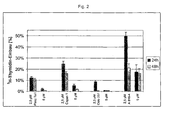
- the strong proliferation-inhibiting effect of the oligonucleotide MON1 could be observed not only on cells of the Panc-Tu1 cell line, but also on other pancreatic carcinoma cell lines (Capan1, Colo357, A818-4) under the conditions described above ( Figure 2).
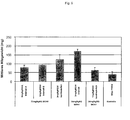
- the primary tumors of the treated mice weighed between 59% after 24 days of therapy. and 64% of the average primary tumor weight of the untreated mice. Only in treatment group 5 (continuous 1 mg / kg body weight MON1) failed Change compared to the control group can be determined. The best results Treatment groups 1 (6 mg / kg body weight per day, 3 days therapy, 3 Day break) and 3 (continuous 3 mg / kg body weight per day) with one each on 59% reduced tumor growth (FIG. 3).
Landscapes
- Health & Medical Sciences (AREA)
- Life Sciences & Earth Sciences (AREA)
- Chemical & Material Sciences (AREA)
- Organic Chemistry (AREA)
- Engineering & Computer Science (AREA)
- Genetics & Genomics (AREA)
- Molecular Biology (AREA)
- General Health & Medical Sciences (AREA)
- Biotechnology (AREA)
- Biochemistry (AREA)
- Biomedical Technology (AREA)
- Zoology (AREA)
- General Engineering & Computer Science (AREA)
- Bioinformatics & Cheminformatics (AREA)
- Wood Science & Technology (AREA)
- Physics & Mathematics (AREA)
- Microbiology (AREA)
- Plant Pathology (AREA)
- Biophysics (AREA)
- Immunology (AREA)
- Chemical Kinetics & Catalysis (AREA)
- General Chemical & Material Sciences (AREA)
- Medicinal Chemistry (AREA)
- Nuclear Medicine, Radiotherapy & Molecular Imaging (AREA)
- Pharmacology & Pharmacy (AREA)
- Animal Behavior & Ethology (AREA)
- Public Health (AREA)
- Veterinary Medicine (AREA)
- Pharmaceuticals Containing Other Organic And Inorganic Compounds (AREA)
- Medicines That Contain Protein Lipid Enzymes And Other Medicines (AREA)
Applications Claiming Priority (2)
| Application Number | Priority Date | Filing Date | Title |
|---|---|---|---|
| DE10346721A DE10346721A1 (de) | 2003-10-08 | 2003-10-08 | Oligonukleotide, diese enthaltende Mittel und deren Verwendung |
| DE10346721 | 2003-10-08 |
Publications (2)
| Publication Number | Publication Date |
|---|---|
| EP1564291A2 true EP1564291A2 (fr) | 2005-08-17 |
| EP1564291A3 EP1564291A3 (fr) | 2011-07-06 |
Family
ID=34399360
Family Applications (1)
| Application Number | Title | Priority Date | Filing Date |
|---|---|---|---|
| EP04024018A Withdrawn EP1564291A3 (fr) | 2003-10-08 | 2004-10-08 | Oligonucléotides, agents les renfermant et leur utilisation |
Country Status (2)
| Country | Link |
|---|---|
| EP (1) | EP1564291A3 (fr) |
| DE (1) | DE10346721A1 (fr) |
Cited By (9)
| Publication number | Priority date | Publication date | Assignee | Title |
|---|---|---|---|---|
| US20090324584A1 (en) * | 2006-07-31 | 2009-12-31 | Curevac Gmbh | Nucleic Acid of Formula (I): GIXmGn, or (II): CIXmCn, in Particular as an Immune-Stimulating Agent/Adjuvant |
| US8968746B2 (en) | 2010-07-30 | 2015-03-03 | Curevac Gmbh | Complexation of nucleic acids with disulfide-crosslinked cationic components for transfection and immunostimulation |
| US9314535B2 (en) | 2009-09-03 | 2016-04-19 | Curevac Ag | Disulfide-linked polyethyleneglycol/peptide conjugates for the transfection of nucleic acids |
| US9572874B2 (en) | 2008-09-30 | 2017-02-21 | Curevac Ag | Composition comprising a complexed (M)RNA and a naked mRNA for providing or enhancing an immunostimulatory response in a mammal and uses thereof |
| US10111967B2 (en) | 2007-09-04 | 2018-10-30 | Curevac Ag | Complexes of RNA and cationic peptides for transfection and for immunostimulation |
| US10369216B2 (en) | 2014-04-01 | 2019-08-06 | Curevac Ag | Polymeric carrier cargo complex for use as an immunostimulating agent or as an adjuvant |
| US10441653B2 (en) | 2006-07-31 | 2019-10-15 | Curevac Ag | Nucleic acid comprising GlXmGn as an immune-stimulating agent/adjuvant |
| US11690910B2 (en) | 2012-01-31 | 2023-07-04 | CureVac SE | Pharmaceutical composition comprising a polymeric carrier cargo complex and at least one protein or peptide antigen |
| US11739125B2 (en) | 2013-08-21 | 2023-08-29 | Cure Vac SE | Respiratory syncytial virus (RSV) vaccine |
Family Cites Families (5)
| Publication number | Priority date | Publication date | Assignee | Title |
|---|---|---|---|---|
| US6451968B1 (en) * | 1991-05-24 | 2002-09-17 | Isis Pharmaceuticals, Inc. | Peptide nucleic acids |
| IL112820A0 (en) * | 1994-03-07 | 1995-05-26 | Merck & Co Inc | Coordinate in vivo gene expression |
| US6670342B2 (en) * | 2000-03-29 | 2003-12-30 | Georgetown University | Method of treating hepatitis delta virus infection |
| DE10048091A1 (de) * | 2000-09-28 | 2002-04-25 | Ernst Bayer | Anwendung chemisch modifizierter Oligodesoxyribonukleotide zur Unterdrückung der Proliferation von humanem Pankreastumor |
| EP1386004A4 (fr) * | 2001-04-05 | 2005-02-16 | Ribozyme Pharm Inc | Modulation de l'expression genique associee a la proliferation inflammatoire et a la croissance de neurites, par des procedes faisant intervenir l'acide nucleique |
-
2003
- 2003-10-08 DE DE10346721A patent/DE10346721A1/de not_active Withdrawn
-
2004
- 2004-10-08 EP EP04024018A patent/EP1564291A3/fr not_active Withdrawn
Cited By (15)
| Publication number | Priority date | Publication date | Assignee | Title |
|---|---|---|---|---|
| US10441653B2 (en) | 2006-07-31 | 2019-10-15 | Curevac Ag | Nucleic acid comprising GlXmGn as an immune-stimulating agent/adjuvant |
| US20090324584A1 (en) * | 2006-07-31 | 2009-12-31 | Curevac Gmbh | Nucleic Acid of Formula (I): GIXmGn, or (II): CIXmCn, in Particular as an Immune-Stimulating Agent/Adjuvant |
| US10111967B2 (en) | 2007-09-04 | 2018-10-30 | Curevac Ag | Complexes of RNA and cationic peptides for transfection and for immunostimulation |
| US9572874B2 (en) | 2008-09-30 | 2017-02-21 | Curevac Ag | Composition comprising a complexed (M)RNA and a naked mRNA for providing or enhancing an immunostimulatory response in a mammal and uses thereof |
| US9907862B2 (en) | 2009-09-03 | 2018-03-06 | Curevac Ag | Disulfide-linked polyethyleneglycol/peptide conjugates for the transfection of nucleic acids |
| US9314535B2 (en) | 2009-09-03 | 2016-04-19 | Curevac Ag | Disulfide-linked polyethyleneglycol/peptide conjugates for the transfection of nucleic acids |
| US10751424B2 (en) | 2009-09-03 | 2020-08-25 | Curevac Ag | Disulfide-linked polyethyleneglycol/peptide conjugates for the transfection of nucleic acids |
| US8968746B2 (en) | 2010-07-30 | 2015-03-03 | Curevac Gmbh | Complexation of nucleic acids with disulfide-crosslinked cationic components for transfection and immunostimulation |
| US11690910B2 (en) | 2012-01-31 | 2023-07-04 | CureVac SE | Pharmaceutical composition comprising a polymeric carrier cargo complex and at least one protein or peptide antigen |
| US12139513B2 (en) | 2013-08-21 | 2024-11-12 | CureVac SE | Respiratory syncytial virus (RSV) vaccine |
| US12240873B2 (en) | 2013-08-21 | 2025-03-04 | CureVac SE | Respiratory syncytial virus (RSV) vaccine |
| US11739125B2 (en) | 2013-08-21 | 2023-08-29 | Cure Vac SE | Respiratory syncytial virus (RSV) vaccine |
| US11965000B2 (en) | 2013-08-21 | 2024-04-23 | CureVac SE | Respiratory syncytial virus (RSV) vaccine |
| US10369216B2 (en) | 2014-04-01 | 2019-08-06 | Curevac Ag | Polymeric carrier cargo complex for use as an immunostimulating agent or as an adjuvant |
| US11110166B2 (en) | 2014-04-01 | 2021-09-07 | Curevac Ag | Polymeric carrier cargo complex for use as an immunostimulating agent or as an adjuvant |
Also Published As
| Publication number | Publication date |
|---|---|
| DE10346721A1 (de) | 2005-05-04 |
| EP1564291A3 (fr) | 2011-07-06 |
Similar Documents
| Publication | Publication Date | Title |
|---|---|---|
| MacKellar et al. | Synthesis and physical properties of anti-HIV antisense oligonucleotides bearing terminal lipophilic groups | |
| EP0399330B1 (fr) | Procédé amide-ester phosphoreux modifié pour la préparation d'acides nucléiques modifiés | |
| EP0152459B1 (fr) | Procede de fabrication d'oligonucleotides | |
| DE69227793T2 (de) | Verfahren und Verbindungen für die Festphase-Synthese von Oligonukleotiden und Analogen | |
| DE69233599T2 (de) | Unterbrochene 2'-modifizierte Oligonukleotide | |
| DE69432315T2 (de) | ANTISENSE NUKLEINSÄUREN ZUR VORBEUGUNG UND BEHANDLUNG VON BESCHWERDEN IN WELCHEN DIE EXPRIMIERUNG VON C-erbB-2 EINE ROLLE SPIELT | |
| DE69027443T2 (de) | Oligonukleotidanaloga mit neuartigen bindungen | |
| DE69404835T2 (de) | Triesters von phosphorothioaten oligonukleotiden und verfahren zur herstellung | |
| EP0707591B1 (fr) | Esters d'acide methylphosphonique, leur procede de preparation et leur utilisation | |
| DE69838449T2 (de) | Aminooxy-modifizierte oligonukleotide | |
| DE69732911T2 (de) | Oligoribonukleotide und ribonukleasen zur spaltung von rns | |
| EP2447274B1 (fr) | Composants oligomères et procédés | |
| WO2007095976A2 (fr) | Adjuvant sous forme d'acide nucléique modifié par un lipide | |
| DE4110085A1 (de) | 2'-o-alkyl-oligoribonukleotide, verfahren zu deren herstellung und deren verwendung als antisense-oligonukleotide | |
| WO2001007602A2 (fr) | Oligonucleotides permettant d'inhiber l'expression de la proteine eg5 humaine | |
| EP0818460B1 (fr) | Synthèse d'oligonucléotides sur support solide. | |
| DE4408528A1 (de) | Peptid-Oligonucleotid-Derivate, deren Herstellung und Verwendung | |
| EP0552767B1 (fr) | Analogues des oligonucléotides dérivées en position 3', avec des groupes non-nucléotidics, leur préparation et leur utilisation | |
| DE69918149T2 (de) | Verbessertea verfahren zur oligonucleotid-synthese | |
| DE69725440T2 (de) | 2-substituierte nukleosid- und oligonukleotid- derivate | |
| EP1276760A2 (fr) | Derives d'acide nucleique polyamide, agents et procedes permettant de les preparer | |
| DE69405396T2 (de) | Verfahren zur synthese von nukleinsäuren auf einem festträger und verbindungen verwendbar als festträger in diesem verfahren | |
| DE69733150T2 (de) | Verfahren zur herstellung von nukleotiden oder oligonukleotiden phosphoramitiden | |
| DE69130569T2 (de) | Mit psoralen konjugierte methylphosphonat-oligonukleotide als therapeutische wirkstoffe für chronische myologene leukämie | |
| WO2001008707A2 (fr) | Conjugats et procedes permettant de les preparer, et leur utilisation pour transporter des molecules par l'intermediaire de membranes biologiques |
Legal Events
| Date | Code | Title | Description |
|---|---|---|---|
| PUAI | Public reference made under article 153(3) epc to a published international application that has entered the european phase |
Free format text: ORIGINAL CODE: 0009012 |
|
| AK | Designated contracting states |
Kind code of ref document: A2 Designated state(s): AT BE BG CH CY CZ DE DK EE ES FI FR GB GR HU IE IT LI LU MC NL PL PT RO SE SI SK TR |
|
| AX | Request for extension of the european patent |
Extension state: AL HR LT LV MK |
|
| RAP1 | Party data changed (applicant data changed or rights of an application transferred) |
Owner name: UNIVERSITAETSKLINIKUM SCHLESWIG-HOLSTEIN |
|
| PUAL | Search report despatched |
Free format text: ORIGINAL CODE: 0009013 |
|
| AK | Designated contracting states |
Kind code of ref document: A3 Designated state(s): AT BE BG CH CY CZ DE DK EE ES FI FR GB GR HU IE IT LI LU MC NL PL PT RO SE SI SK TR |
|
| AX | Request for extension of the european patent |
Extension state: AL HR LT LV MK |
|
| AKY | No designation fees paid | ||
| REG | Reference to a national code |
Ref country code: DE Ref legal event code: R108 Effective date: 20120314 |
|
| STAA | Information on the status of an ep patent application or granted ep patent |
Free format text: STATUS: THE APPLICATION IS DEEMED TO BE WITHDRAWN |
|
| 18D | Application deemed to be withdrawn |
Effective date: 20120110 |