EP1564291A2 - Oligonucleotides, agents containing them and their use - Google Patents
Oligonucleotides, agents containing them and their use Download PDFInfo
- Publication number
- EP1564291A2 EP1564291A2 EP04024018A EP04024018A EP1564291A2 EP 1564291 A2 EP1564291 A2 EP 1564291A2 EP 04024018 A EP04024018 A EP 04024018A EP 04024018 A EP04024018 A EP 04024018A EP 1564291 A2 EP1564291 A2 EP 1564291A2
- Authority
- EP
- European Patent Office
- Prior art keywords
- oligonucleotide
- oligonucleotides
- residue
- acid
- nucleobases
- Prior art date
- Legal status (The legal status is an assumption and is not a legal conclusion. Google has not performed a legal analysis and makes no representation as to the accuracy of the status listed.)
- Withdrawn
Links
- CJVPBSQVSMOJBM-UHFFFAOYSA-N CC(C)CCCC(C)CCCC(C)CCCC(C)(CCc1c2C)Oc1c(C)c(C)c2OCC(COC(c1ccccc1)(c(cc1)ccc1OC)c(cc1)ccc1OC)O Chemical compound CC(C)CCCC(C)CCCC(C)CCCC(C)(CCc1c2C)Oc1c(C)c(C)c2OCC(COC(c1ccccc1)(c(cc1)ccc1OC)c(cc1)ccc1OC)O CJVPBSQVSMOJBM-UHFFFAOYSA-N 0.000 description 1
Images



Classifications
-
- C—CHEMISTRY; METALLURGY
- C07—ORGANIC CHEMISTRY
- C07H—SUGARS; DERIVATIVES THEREOF; NUCLEOSIDES; NUCLEOTIDES; NUCLEIC ACIDS
- C07H21/00—Compounds containing two or more mononucleotide units having separate phosphate or polyphosphate groups linked by saccharide radicals of nucleoside groups, e.g. nucleic acids
-
- A—HUMAN NECESSITIES
- A61—MEDICAL OR VETERINARY SCIENCE; HYGIENE
- A61P—SPECIFIC THERAPEUTIC ACTIVITY OF CHEMICAL COMPOUNDS OR MEDICINAL PREPARATIONS
- A61P35/00—Antineoplastic agents
-
- C—CHEMISTRY; METALLURGY
- C12—BIOCHEMISTRY; BEER; SPIRITS; WINE; VINEGAR; MICROBIOLOGY; ENZYMOLOGY; MUTATION OR GENETIC ENGINEERING
- C12N—MICROORGANISMS OR ENZYMES; COMPOSITIONS THEREOF; PROPAGATING, PRESERVING, OR MAINTAINING MICROORGANISMS; MUTATION OR GENETIC ENGINEERING; CULTURE MEDIA
- C12N15/00—Mutation or genetic engineering; DNA or RNA concerning genetic engineering, vectors, e.g. plasmids, or their isolation, preparation or purification; Use of hosts therefor
- C12N15/09—Recombinant DNA-technology
- C12N15/11—DNA or RNA fragments; Modified forms thereof; Non-coding nucleic acids having a biological activity
- C12N15/117—Nucleic acids having immunomodulatory properties, e.g. containing CpG-motifs
-
- C—CHEMISTRY; METALLURGY
- C12—BIOCHEMISTRY; BEER; SPIRITS; WINE; VINEGAR; MICROBIOLOGY; ENZYMOLOGY; MUTATION OR GENETIC ENGINEERING
- C12N—MICROORGANISMS OR ENZYMES; COMPOSITIONS THEREOF; PROPAGATING, PRESERVING, OR MAINTAINING MICROORGANISMS; MUTATION OR GENETIC ENGINEERING; CULTURE MEDIA
- C12N2310/00—Structure or type of the nucleic acid
- C12N2310/10—Type of nucleic acid
- C12N2310/17—Immunomodulatory nucleic acids
-
- C—CHEMISTRY; METALLURGY
- C12—BIOCHEMISTRY; BEER; SPIRITS; WINE; VINEGAR; MICROBIOLOGY; ENZYMOLOGY; MUTATION OR GENETIC ENGINEERING
- C12N—MICROORGANISMS OR ENZYMES; COMPOSITIONS THEREOF; PROPAGATING, PRESERVING, OR MAINTAINING MICROORGANISMS; MUTATION OR GENETIC ENGINEERING; CULTURE MEDIA
- C12N2310/00—Structure or type of the nucleic acid
- C12N2310/10—Type of nucleic acid
- C12N2310/18—Type of nucleic acid acting by a non-sequence specific mechanism
Definitions
- the present invention relates to certain oligonucleotides, pharmaceutical agents which contain these oligonucleotides, and their therapeutic use.
- the oligonucleotides For example, they are able to inhibit the proliferation of pancreatic tumors. In order to these oligonucleotides have a therapeutic potential for the treatment of human Tumors.
- pancreatic carcinomas with a 5-year survival rate of 0.4% have one extremely bad prognosis.
- Oligodeoxyribonucleotides have more recently been grouped promising agents, with different mechanisms of action to be discussed.
- great expectations are in the so-called antisense oligodeoxyribonucleotides (ASODN), which has the expression of a specific protein, e.g. of an oncogene.
- non-sequence-specific oligonucleotides have now been found with which the proliferation of human pancreatic tumors can be suppressed in vitro in cell cultures and in vivo in the orthotopic xenograft model.
- Particularly advantageous are those oligonucleotides which have covalently bound, lipophilic molecular groups in the terminal 3'- and / or 5'-positions.
- Oligonucleotides according to the invention thus have at least part of the sequence SEQ ID NO: 1 up.
- oligonucleotides according to the invention have further nucleobases, which in linear Oligonucleotides at the 3'-terminus and / or 5'-terminus of the sequence or partial sequence are arranged. These additional nucleobases are in principle freely selectable but will advantageously, the embodiments of the invention described herein selected accordingly.
- Oligonucleotides can be of different lengths. In terms of use of the oligonucleotides according to the invention, the partial sequence should be at least 6, in particular at least 8, preferably at least 10 and more preferably at least 12 Consecutive nucleobases from the sequence SEQ ID NO: 1 correspond. The term "consecutive" is used here in the sense of successive. This results in for subsequences of the sequence SEQ ID NO: 1 specific to the person skilled in the art. Some subsequences are shown in FIG.
- inventive oligonucleotides of the Expert one or more than one, for example 2, the same or different of these Partial sequences, optionally with the addition of additional nucleobases, in order appropriate so as to obtain an oligonucleotide according to the invention.
- oligonucleotide means an oligomer of ribonucleic acid (RNA) or Deoxyribonucleic acid (DNA) or mimetics thereof. These include oligonucleotides that from naturally occurring nucleobases, sugars, and covalent internucleoside linkages (Backbone), as well as oligonucleotides with structures that exist in the Nature does not occur, but whose function is similar to the naturally occurring. Such modified oligonucleotides become the native forms according to the invention preferred because they have desired properties, such as increased cellular Uptake, an increased affinity for target nucleic acids and increased stability in Have presence of nucleases.
- nucleotides may be modifications or substitutions to the Nucleobases (also referred to simply as "base” here) have.
- base also referred to simply as "base” here
- unmodified or natural nucleobases include the purine bases adenine (A) and guanine (G), and the Pyrimidine bases thymine (T), cytosine (C) and uracil (U).
- nucleobases include synthetic nucleobases such as 5-methylcytosine (5-Me-C), 5-hydroxymethylcytosine, xanthine, hypoxanthine, 2-aminoadenine, 6-methyl and other alkyl derivatives of adenine and guanine, 2-thiouracil, 2-thiothymine and 2-thiocytosine, 5-Halouracil and 5-Halocytosine, 5-Propynyluracil and 5-Propynylcytosine, 6-Azouracil, 6-azocytosine and 6-azothymine, 5-uracil (pseudouracil), 4-thiouracil, 8-halo, 8-amino, 8-thiol, 8-thioalkyl, 8-hydroxyl and other 8-substituted adenines and guanines, 5-halo, especially 5-bromo, 5-trifluoromethyl and other 5-substituted
- nucleobases are especially useful for increasing binding affinity. These include 5-substituted pyrimidines, 6-azapyrimidines and N-2, N-6 and O-6 substituted Purines, e.g. 2-aminopropyladenine, 5-propynyluracil and 5-propynylcytosine. For example, it could be shown that 5-methylcytosine the stability of a Nucleic acid duplex increased by 0.6-1.2 ° C.
- T-rich oligonucleotides in which more than 50%, in particular more than 60% and preferably more than 70% of the nucleobases Thymidine residues or mimetics thereof.
- Mimetics of thymidine residues are in the above sense modified nucleobases that have similar binding properties, ie, above all the same Base pairing specificity, but quite different affinity for complementary Have nucleobases. The same applies to mimetics of other nucleobases.
- a T / C ratio of 2: 1 or more, and preferably 3: 1 or more is advantageous.
- oligonucleotides according to the invention at least one GT or TG motif, i. at least one thymidine residue or Mimetic thereof is in a consecutive sequence (sequence) to a guanine or a Mimetic arranged.
- oligonucleotides according to the invention contain an arrangement of 6, in particular 8, preferably 10 and more preferably 12 consecutive bases without adenine. Especially Oligonucleotides according to the invention contain no adenine.
- oligonucleotides according to the invention are at least 8, preferably at least 10 and in particular at least 12 nucleobases. This is particularly important for the effectiveness of the oligonucleotides.
- oligonucleotides of the invention typically have less than 50, preferably less than 30 and in particular less than 25 nucleobases. This Aspect is for the uptake of oligonucleotides into cells and thus for bioavailability and also corresponds to expediency considerations, according to which an oligonucleotide of the invention given as little effect as possible nucleobases should be as low as possible to minimize the complexity and the effort of synthesis hold. Particular preference is therefore given to oligonucleotides having 8 to 50, in particular 10 up to 30 and above all with 12 to 25, for example with 13, 14, 15, 16, 17, 18, 19, 20, 21, 22, 23 or 24 bases.
- the arrangement of the nucleobases in oligonucleotides according to the invention is usually thereby ensuring that the nucleobases are linked together in a suitable manner are.
- an oligomer with a consecutive sequence of nucleobases results (Sequence) linked by a backbone forming the main chain. While linear oligomers are preferred, in certain cases branched, be cyclic or even networked structures suitable.
- the oligonucleotides are usually linked together Nucleosides, i. Base-sugar combinations.
- the base part of the nucleosides is usually a heterocyclic base, in most cases a purine or a Pyrimidine.
- the nucleosides are usually covalently attached to the sugar moiety of the Nucleoside linked group linked together. In those nucleosides that have a Having pentofuranosyl sugars, this group can be attached either to the 2 ', 3' or 5 'hydroxyl group be bound to the sugar. In general, these groups link covalently adjacent nucleosides together to form a linear, oligomeric compound.
- the respective ends of this linear, oligomeric structure may in turn be interconnected be connected to form cyclic structures. Open, linear structures are however preferred.
- the linking groups form generally the internucleoside backbone of the oligonucleotide.
- the normal link or the normal backbone of RNA and DNA are 3'-5'-phosphodiester linkages, i.e. the linking groups are phosphate groups.
- oligonucleotides which are a modified backbone are preferred or non-natural internucleoside linkages.
- preferred modified oligonucleotide backbones belong on the one hand phosphate-free analogues and on the other hand phosphate derivatives.
- phosphorothioates partially or completely sulfurized, e.g. chiral Phosphothioates, phosphomonothioates and phosphodithioates.
- Further modified backbones are phosphotriesters, alkyl phosphotriesters, Aminoalkyl phosphotriesters, methyl and other alkyl phosphonates, e.g. 3'-alkylene phosphonates and chiral phosphonates, phosphinates, phosphoramidates, e.g.
- Particular modified oligonucleotide backbones without phosphorus atom are generally formed by short chain alkyl or cycloalkyl internucleoside linkages, which may optionally also include heteroatoms or heterocycles. These include those with morpholino linkages (partially formed by the sugar portion of the nucleoside); Siloxane backbones; Sulfide, sulfoxide and sulfone backbones; Formacetyl and thioformacetyl backbones; Methylene formacetyl and thioformacetyl backbones; Alkene containing backbones; Sulfamate backbones; Methyleneimino and methylenehydrazino backbones; Sulfonate and sulfonamide backbones; Amide backbones; and others with mixed N, O, S and CH 2 component parts.
- oligonucleotides both the sugar and the internucleoside linkage, i.e. modified the backbone of natural nucleotide units.
- Such oligomeric compound i. an oligonucleotide with excellent Hybridization properties is referred to as "Peptide Nucleic Acid” (PNA).
- PNA Peptide Nucleic Acid
- PNA connections is the sugar backbone of an oligonucleotide through an amide-like Backbone, especially an aminoethylglycine backbone replaced.
- the nucleobases are and directly or indirectly, for example via a methylcarbonyl linker, to the Nitrogen atoms of the amide portion of the backbone bound.
- the present invention relates to oligonucleotides having phosphorothioate backbones and further to oligonucleosides having heteroatom backbones which are based in particular on structural units, such as -CH 2 -NH-O-CH 2 -, -CH 2 -N (CH 3 ) -O-CH 2 - [known as methylenemethylimino or MMI backbone for short], -CH 2 -ON (CH 3 ) -CH 2 -, -CH 2 -N (CH 3 ) -N (CH 3 ) -CH 2 - or -ON (CH 3 ) -CH 2 -CH 2 -.
- structural units such as -CH 2 -NH-O-CH 2 -, -CH 2 -N (CH 3 ) -O-CH 2 - [known as methylenemethylimino or MMI backbone for short], -CH 2 -ON (CH 3 ) -CH 2 -, -CH 2
- Modified oligonucleotides may also contain one or more substituted sugar groups.
- the 2'-position for example in the 4'-thio and 4'-aza derivatives, especially the 2'-position may be substituted, eg with OH, F, O, S or N- Alkyl, OS or N-alkenyl, O-, S- or N-alkynyl, or O-alkyl-O-alkyl, wherein alkyl, alkenyl and alkynyl preferably substituted or unsubstituted C 1 -C 10 alkyl or C 2 -C 10 alkenyl or alkynyl.
- substituents such as O ((CH 2 ) n O) m CH 3 , O (CH 2 ) n OCH 3 , O (CH 2 ) n NH 2 , O (CH 2 ) n CH 3 , O (CH 2 ) n NH 2 and O (CH 2 ) n ON [(CH 2 ) n CH 3 )] 2 , where n and m are integers from 1 to 10.
- Preferred modifications include an alkoxy-alkoxy group, eg, 2'-methoxyethoxy (2'-O-CH 2 CH 2 OCH 3 , also known as 2'-O- (2-methoxymethyl) or 2'-MOE).
- Another preferred modification includes 2'-dimethylaminooxyethoxy, ie, an O (CH 2 ) 2 ON (CH 3 ) 2 group, also known as 2'-DMAOE.
- oligonucleotides of the present invention may have sugar mimetics such as cyclobutyl groups instead of the pentofuranosyl sugar.
- Another preferred sugar modification is the term "locked nucleic acid", in short Known as LNA.
- LNA locked nucleic acid
- the C4'-atom and the C2'-atom are via a methylene bridge linked together to give a [2.2.1] bicyclo nucleoside.
- oligonucleotides include attaching to the oligonucleotide one or more molecular groups which modify the activity, cellular distribution or cellular uptake of the oligonucleotides.
- groups include, in particular, those which increase the lipophilic character of the oligonucleotides.
- Polyglycols in particular polyalkylene glycols, preferably polyethylene glycols, peptides, proteins and especially lipophilic radicals, such as alicyclic hydrocarbons, waxes, terpenes and fatty acid radicals preferably having 8 to 32 carbon atoms, which may be saturated or mono- or polyunsaturated, steroids and especially vitamins and derivatives Of these, particular mention should be made.
- Suitable steroid molecules include in particular the bile acids, eg cholic acid, deoxycholic acid and dehydrocholic acid, cortisone, digoxigenin, testosterone, cholesterol and cationic steroids, eg cortisone having a trimethylaminomethylhydrazide group attached to the 3-position of the cortisone ring via a double bond.
- Suitable vitamins include both water-soluble and fat-soluble vitamins.
- Thiamine, riboflavin, nicotinic acid or niacin, the pyridoxal group of vitamin B 6 , pantothenic acid, biotin, folic acid, the B 12 -cobamide coenzymes, inositol, choline and ascorbic acid are to be mentioned in particular as water-soluble vitamins.
- the fat-soluble vitamins such as the vitamin A family, for example retinoic acid and retinol, vitamin D and its derivatives, for example vitamin D and its ergosterol precursors, the vitamin E family, eg ⁇ - (D, L) Tocopherol and other tocopherols, and vitamin K and its derivatives, eg vitamin K and related quinone or phytol compounds.
- the vitamin A family for example retinoic acid and retinol
- vitamin D and its derivatives for example vitamin D and its ergosterol precursors
- the vitamin E family eg ⁇ - (D, L) Tocopherol and other tocopherols
- vitamin K and its derivatives eg vitamin K and related quinone or phytol compounds.
- suitable molecule groups also include conjugates, such as nanoparticles, the are expediently positively charged. Diameters of 100 to 500 nm are useful. Polymers find particular use in this context. So are in particular Call polystyrene or polyacrylate particles.
- oligonucleotides which are terminally modified.
- Terminal-modified oligonucleotides include, in particular, those which do not have a free 3'-OH group and / or 5'-phosphate group.
- inventive Oligonucleotides at the 3'- and / or 5'-terminus modified Suitable for this purpose in particular the molecule groups described above, where polyalkylene glycols, lipophilic Residues and peptides are preferred.
- polyalkylene glycols are in particular Polyethylene glycols, for example hexaethylene glycol or those with a middle Molecular mass of 150 to 5000 daltons to call.
- the lipophilic radicals are in particular Fatty acid residues, steroid residues and vitamin residues and their derivatives. Especially Preference is given to residues of fat-soluble vitamins such as tocopherols.
- oligonucleotides according to the invention terminally bound ⁇ -tocopheryl, preferably ⁇ -D-tocopheryl and / or Polyethylene glycol on.
- oligonucleotides according to the invention can be used in the context of this embodiment at one terminus a Polyethylenglykolrest and at the other Terminus have a tocopheryl, wherein it is preferred that the Polyethylene glycol residue at the 3'-terminus and the tocopheryl residue is attached to the 5'-terminus.
- terminal residues may in principle be arbitrarily bound to the oligonucleotide. Due to structural requirements of the oligonucleotide and its relatively simple however, synthetic accessibility is afforded by amide, ester or ether linkages especially for the 3'- and 5'-termini.
- the binding to the termini can be direct or via suitable linker compounds, optionally as explained below Anchor connections or parts thereof may be made.
- esters also useful are pharmaceutically acceptable salts, esters, salts of the esters or any other compounds which, after administration to an animal, in particular People who are able, directly or indirectly, the biologically active metabolite or to deliver a part of it.
- Prodrugs are also useful. This is an inactive form of the drug that is converted to an active form in vivo.
- Prodrug versions of oligonucleotides can be used, for example, as S- (acetyl-2-thioethyl) phosphate derivatives to be provided.
- the pharmaceutically acceptable base addition salts include salts with metals or Amines, such as alkali and alkaline earth metals or organic amines, in particular cations such as sodium, potassium, ammonium, magnesium and calcium or polyamines such as spermine and spermidine.
- metals or Amines such as alkali and alkaline earth metals or organic amines, in particular cations such as sodium, potassium, ammonium, magnesium and calcium or polyamines such as spermine and spermidine.
- the pharmaceutically acceptable acid addition salts include salts with inorganic Bases, e.g. Hydrochloric acid, hydrobromic acid, sulfuric acid, phosphoric acid, Nitric acid and the like, as well as with organic acids, e.g. Acetic acid, oxalic acid, Tartaric acid, succinic acid, maleic acid, fumaric acid, gluconic acid, citric acid, Malic acid, ascorbic acid, benzoic acid, tannic acid, palmitic acid, alginic acid, Polyglutamic acid, naphthalenesulfonic acid, methanesulfonic acid, p-toluenesulfonic acid, Naphthalenedisulfonic acid, polygalactoronic acid and the like.
- inorganic Bases e.g. Hydrochloric acid, hydrobromic acid, sulfuric acid, phosphoric acid, Nitric acid and the like
- organic acids e.g. Acetic acid, oxalic acid, Tartaric
- the compounds according to the invention can be prepared in a manner known per se getting produced.
- known solid phase synthesis systems such as Phosphoramidite method, application.
- Suitable devices are commercially available, for example, Applied Biosystems (Foster City, California). Accordingly, the Compounds synthesized in vitro.
- the modification of the oligonucleotides with molecular groups can also be known per se Done way. Depending on the starting point, different methods are available to especially to base, sugar and / or phosphate backbone modifications can.
- the modification can be done after completion of the actual synthesis, ie after the Cleavage of the oligonucleotide from the support material and deprotection, to the oligonucleotide.
- carrier materials with trifunctional anchor compounds are equipped. These anchor connections point in addition to a cleavable binding site to the support material (first reaction center) and an optionally protected hydroxy group to which the oligonucleotide is added stepwise is built (second reaction center), a further functionalization, usually a hydroxy or amino group on (third reaction center) to which the can be bound.
- oligonucleotide can in principle before or after the Oligonucleotide synthesis, if necessary, a suitable acid-stable Protecting group, e.g. Fmoc is used at the third reaction center. This can be after the Oligonucleotide synthesis are split off in a conventional manner. That's how it works Finally oligonucleotide are cleaved from the carrier material, wherein the oligonucleotide and the molecule group to be introduced to obtain linking part of the anchor compound remains.
- a suitable acid-stable Protecting group e.g. Fmoc
- anchor compounds The structure of suitable anchor compounds is largely variable. It should be noted that the anchor compound and its bonds to the molecular group to be introduced with the for the synthesis of the oligonucleotide used should be compatible. There Usually the amidite chemistry is used, the bonds should neither acid-still base labile, which is why ester and amide bonds between the Anchor connection and the molecule group to be introduced are only conditionally suitable, whereas ether bonds are preferred.
- Suitable anchor compounds are known per se.
- glycerol derivatives can be mentioned as C 3 anchors.
- the hydroxyl groups in the 1- and 3-position serve to bind the molecule group or the oligonucleotide to be introduced and the hydroxyl group in the 2-position forms the point of attachment to the carrier material via a cleavable bond, which are established, if necessary, with the aid of a suitable spacer between hydroxyl group and carrier material can.
- Another variant is 2-substituted 1,3-propanediol derivatives.
- the hydroxyl groups in the 1- and 3-position serve to bind the oligonucleotide or the carrier material.
- the substituent in the 2-position serves to bind the molecule group to be introduced. For example, one can form amide or urethane bonds with amino-C 1-6 -alkyl radicals.
- a preferred example of such an anchor compound is 2- (4-aminobutyl) -1,3-propanediol
- the molecule groups to be introduced themselves have hydroxyl groups on which the oligonucleotide can be synthesized. This is for example Alkyl glycols the case. These can therefore initially in a suitable manner to the Carrier material are bound. These are the starting point for the Oligonucleotide hydroxyl groups, if necessary, in an appropriate manner, for example with Fmoc groups, protected. The cleavage of these protecting groups provides then the hydroxyl groups required for oligonucleotide synthesis ready.
- Suitable carrier materials are known per se and essentially correspond to the customary supports used for solid-phase synthesis of oligonucleotides.
- molecular groups may suitably be appropriately modified monomers, ie in particular phosphoramidites, are introduced. This in on known amide accessible as the last monomer to the synthesized oligonucleotide coupled.
- oligonucleotide having the following sequence:
- Another object of the present invention is the use of a Compound of the invention for proliferation inhibition of tumor cells.
- This use also includes a method of inhibiting proliferation Tumor cells, wherein at least one inventive oligonucleotide on tumor cells allow to act.
- this method may be an in vitro, ex vivo or act in vivo.
- Corresponding systems e.g. in the form of cells or Tissues may be provided in culture in a manner known per se in vitro or ex vivo become.
- An in vivo application usually involves the administration of the Oligonucleotide to the individual in question.
- tumor cell systems may be accomplished in a conventional manner by the Professional.
- techniques are known for using organisms and cells corresponding degeneration, for example via recombinant techniques to cause.
- organisms, cells or tissues in an appropriate manner and in particular the proliferation by means of suitable assays qualitatively and if desired, to assess quantitatively.
- inventive oligonucleotides can be with accomplish common technical knowledge.
- the individual becomes a particular one Quantity of at least one oligonucleotide according to the invention, usually the formulated according to pharmaceutical or veterinary practice.
- the present invention also relates to agents and in particular pharmaceutical Means comprising at least one oligonucleotide according to the invention and, if desired suitable adjuvants, in particular a pharmaceutically acceptable Formulation basis include.
- suitable adjuvants in particular a pharmaceutically acceptable Formulation basis include.
- the preparation of such agents is common Expertise.
- oligonucleotides according to the invention can be used within the scope of these uses and Procedures for example serve scientific purposes. Above all, the Oligonucleotides according to the invention can be used for therapeutic purposes.
- Treatment means preventive or prophylactic in this regard or at least delay in time, or alleviate or remedy acutely or chronically, i. in particular reduce the proliferation of the tumor and optionally suppress it and reduce the extent of the tumor as well as the risk or the incidence of metastases, which are derived from the primary tumor, lower.
- the subject of the present invention is therefore also the use of at least one oligonucleotide according to the invention for the treatment of tumors.
- This use also includes a method wherein an effective amount of at least one oligonucleotide according to the invention to an individual to be treated, in particular a human and also a commercial or pet.
- the administration usually takes place once or several times daily, if necessary together or in the Change with other active substances or active substance-containing preparations. In this sense can the therapy includes the use of other treatments, e.g. Chemotherapy by administration of cytostatics or radiotherapy.
- oligonucleotide synthesizer 394 DNA / RNA Synthesizer (Applied Biosystems) 392 DNA / RNA Synthesizer (Applied Biosystems) Mass spectrometry: ES-MS: API III TAGA 6000E Triple Quadrupole Mass Spectrometer (Sciex, Perkin Elmer Corp.)
- FD-MS MAT 711 A, TSQ 70 (Finnigan) HPLC system Analytical: S8110, S1100 (Sykam), UVIS 205 (Linear) Data System: Pyramid Chromatography Manager Axxiom) Preparative: S8110, S1020, S 2000 (Sykam), UVIS 200 (Linear) HPLC columns Nucleosil C18 5 ⁇ 250x4,6mm (Grom) Gromsil ODS-2 FE 5 ⁇ 250x4,6mm (Grom) Gromsil ODS-2 FE 5 ⁇ 250x25mm (Grom) capillary Capillary electrophoresis system Beckman P
- the modified ODNs are probed on an Applied Biosystem Model 394 DNA / RNA Synthesizer with TentaGel®N (copolymer based on a cross-linked polystyrene matrix having about 50-70% by weight polyethylene glycol grafted via benzyl ether linkages available from Rapp Polymere Tübingen) Carrier made. Modified protocols for the synthesis of Tentagel are used according to the literature (E. Bayer, M. Maier, K. Bleicher, H.-J. Gaus, Z.
- PEG, fatty acid residues, cholesteryl and tocopheryl residues at the 5 'end were introduced as phosphoramidites into CH 2 Cl 2 and acetonitrile (0.1 M), respectively.
- 0.1 M iodine in pyridine / THF / H 2 O is used for the oxidation and then a washing step with 0.1 M ascorbic acid in dioxane / H 2 O (9: 1) is inserted, to remove excess iodine.
- DCM can be used as the solvent.
- DMT-HEG 1- (4,4'-Dimethoxytrityl) hexaethylene glycol
- HEG hexaethylene glycol
- 10 g of hexaethylene glycol are dried by coevaporation with twice 30 ml of absolute pyridine and then dissolved in 20 ml of absolute pyridine.
- the HEG is reacted with 10 g of DMT-Cl dissolved in 50 ml of absolute pyridine (29.5 mmol).
- the dried product gives a tough yellow oil.
- the following procedure is applicable to both DMT-PEG 1500 and DMT-HEG.
- the heart is then filtered off and washed thoroughly with DMF, DCM and methanol and dried in vacuo. Unreacted amino functions on the resin can be acetylated both manually and on the DNA synthesizer. The completeness of the coupling can be checked with a Kaiser test. The loading can be determined spectrometrically via DMT cleavage. This results in a loading of 75 .mu.mol / g.
- the loading is determined as described via DMT cleavage. It results in a Loading of 138 ⁇ mol / g.
- the organic phase is washed twice with 15 ml of a 10% NaHCO 3 solution and twice with a saturated NaCl solution and then dried over Na 2 SO 4 .
- the solvent is removed and the crude product is purified by column chromatography on silica gel with ethyl acetate / TEA (99: 1).
- the product-containing fractions are identified by TLC, combined and concentrated to dryness. Drying in a high vacuum results in a yellowish-brown, very viscous oil, which is cooled and stored under exclusion of light.
- the resulting tocopherol-modified phosphoramidite is then used in the context of Solid phase synthesis of the already synthesized, but still on the support material coupled oligonucleotide coupled.
- pancreatic tumor cells mainly Panc-Tu-I, Panc-Tu-II, A818-4 and HPAF cell lines used.
- the uptake of the modified ODN by the cells was with confocal laser microscopy.
- Cell suspensions (7 x 10 4 cells ml -1 ) were added to each well of a 96-well microtiter plate (Nunc, Wiesbaden). After 24 hours, the medium was changed and the cell cultures (with the respective ODN treatment MON1, MON2 or MON3 and controls without treatment) were incubated in 100 ⁇ l batches with 10 ⁇ l medium containing 7.4 kBq of methyl 3 H-thymidine (Amersham, Braunschweig) during the last 3 hours of the indicated incubation times. Subsequently, the cells were harvested and the radioactivity was measured with a liquid scintillation counter.
- mice Female SCID mice were used which were not older than eight weeks. After laparotomy, the animals were injected with 1 ⁇ 10 6 PancTu-1 cells into the pancreas under anesthesia. The mice were divided into five treatment groups and a control group of six animals each. The mice of the control group were injected intraperitoneally with 500 ⁇ l PBS daily from the 7th day to the mice of the treatment groups MON1 at different dosages and intervals: Treatment group 1 was given in interval A (alternating three days treatment and three days break) at 6 mg / kg body weight treated intraperitoneally, treatment group 2 with the same dose in interval B (6 days treatment, 12-day break alternately).
- Treatment group 3 received the same cumulative dose as treatment groups 1 and 2 (72 mg / kg body weight) but by daily administration of 3 mg / kg body weight intraperitoneally.
- Treatment group 4 was also treated at 3 mg / kg body weight but in interval A with a cumulative dose of 36 mg / kg body weight.
- Treatment group 5 was treated with a daily dose of 1 mg / kg body weight and a cumulative dose of 24 mg / kg body weight. All groups were treated for a period of 24 days.
- mice were killed after 24 days.
- the pancreatic tumors were weighed and measure to calculate the volume according to the formula ⁇ / 6x height x length x width.
- the weight of the entire tumor tissue was also determined.
- Liver, lungs, omentum and spleens were removed to detect typical metastasis pathways. From the Difference between the weights of the removed pancreatic tumors and the weights of the entire tumor tissue, it can be seen that the animal model used is not limited to a primary tumor based, but also metastasized in the abdomen.
- the antiproliferative activity of the oligonucleotide MON1 was clearly superior to the proliferation-inhibiting effect of the oligonucleotides MON2 and MON3. This was evident in both the 3 H proliferation assay (FIG. 1). It was also observed that the effect was time- and dose-dependent. With MON 1, even at the lower dose of 2.5 ⁇ M after 24 hours, a clear inhibition of proliferation to approximately 25% was observed relative to the untreated control. When the dose was 5 ⁇ M, the growth of the human pancreatic tumor cells Panc-Tu-I decreased to approximately 4% compared to the untreated control. The oligonucleotides MON2 and MON3 showed a significantly less pronounced growth inhibition.
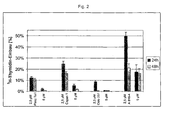
- the strong proliferation-inhibiting effect of the oligonucleotide MON1 could be observed not only on cells of the Panc-Tu1 cell line, but also on other pancreatic carcinoma cell lines (Capan1, Colo357, A818-4) under the conditions described above ( Figure 2).
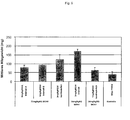
- the primary tumors of the treated mice weighed between 59% after 24 days of therapy. and 64% of the average primary tumor weight of the untreated mice. Only in treatment group 5 (continuous 1 mg / kg body weight MON1) failed Change compared to the control group can be determined. The best results Treatment groups 1 (6 mg / kg body weight per day, 3 days therapy, 3 Day break) and 3 (continuous 3 mg / kg body weight per day) with one each on 59% reduced tumor growth (FIG. 3).
Landscapes
- Health & Medical Sciences (AREA)
- Life Sciences & Earth Sciences (AREA)
- Chemical & Material Sciences (AREA)
- Organic Chemistry (AREA)
- Engineering & Computer Science (AREA)
- Genetics & Genomics (AREA)
- Molecular Biology (AREA)
- General Health & Medical Sciences (AREA)
- Biotechnology (AREA)
- Biochemistry (AREA)
- Biomedical Technology (AREA)
- Zoology (AREA)
- General Engineering & Computer Science (AREA)
- Bioinformatics & Cheminformatics (AREA)
- Wood Science & Technology (AREA)
- Physics & Mathematics (AREA)
- Microbiology (AREA)
- Plant Pathology (AREA)
- Biophysics (AREA)
- Immunology (AREA)
- Chemical Kinetics & Catalysis (AREA)
- General Chemical & Material Sciences (AREA)
- Medicinal Chemistry (AREA)
- Nuclear Medicine, Radiotherapy & Molecular Imaging (AREA)
- Pharmacology & Pharmacy (AREA)
- Animal Behavior & Ethology (AREA)
- Public Health (AREA)
- Veterinary Medicine (AREA)
- Pharmaceuticals Containing Other Organic And Inorganic Compounds (AREA)
- Medicines That Contain Protein Lipid Enzymes And Other Medicines (AREA)
Abstract
Die vorliegende Erfindung betrifft bestimmte Oligonukleotide, pharmazeutische Mittel, die diese Oligonukleotide enthalten, und deren therapeutische Verwendung. Die Oligonukleotide sind insbesondere in der Lage, die Proliferation von Prankreastumoren zu hemmen. Damit besitzen diese Oligonukleotide ein therapeutisches Potential zur Behandlung von Pankreastumoren.The present invention relates to certain oligonucleotides, pharmaceutical agents which contain these oligonucleotides, and their therapeutic use. The oligonucleotides in particular are able to inhibit the proliferation of pancreatic tumors. In order to These oligonucleotides have a therapeutic potential for the treatment of Pancreatic tumors.
Description
Die vorliegende Erfindung betrifft bestimmte Oligonukleotide, pharmazeutische Mittel, die diese Oligonukleotide enthalten, und deren therapeutische Verwendung. Die Oligonukleotide sind beispielsweise in der Lage, die Proliferation von Pankreastumoren zu hemmen. Damit besitzen diese Oligonukleotide ein therapeutisches Potential zur Behandlung humaner Tumoren.The present invention relates to certain oligonucleotides, pharmaceutical agents which contain these oligonucleotides, and their therapeutic use. The oligonucleotides For example, they are able to inhibit the proliferation of pancreatic tumors. In order to these oligonucleotides have a therapeutic potential for the treatment of human Tumors.
Trotz großer Fortschritte bei der Aufklärung der Kanzerogenese, bleibt die effektive Behandlung von Krebs eines der dringlichsten Probleme der heutigen Medizin. Beispielsweise haben Pankreaskarzinome mit einer 5-Jahres-Überlebensrate von 0,4 % eine extrem schlechte Prognose.Despite much progress in educating carcinogenesis, it remains effective Treatment of cancer is one of the most urgent problems of today's medicine. For example, pancreatic carcinomas with a 5-year survival rate of 0.4% have one extremely bad prognosis.
Oligodesoxyribonukleotide (ODN) haben sich in jüngerer Zeit als eine Gruppe vielversprechender Wirkstoffe erwiesen, wobei unterschiedliche Wirkungsmechanismen diskutiert werden. Große Erwartungen sind in die sogenannten Antisense-Oligodesoxyribonukleotide (ASODN) gesetzt worden, welche die Expression eines spezifischen Proteins, z.B. eines Onkogens, unterdrücken sollen.Oligodeoxyribonucleotides (ODN) have more recently been grouped promising agents, with different mechanisms of action to be discussed. Great expectations are in the so-called antisense oligodeoxyribonucleotides (ASODN), which has the expression of a specific protein, e.g. of an oncogene.
Trotz dieser großen Erwartungen und dem Nachweis in vitro, dass ein bestimmtes Gen weniger exprimiert wird, ist bisher nur ein einziges ASODN als Arzneimittel, Vitravene (ISIS, Carlsbad), gegen die zur Erblindung führende Zytomegalie-Retinitis zugelassen worden. Ausgehend von der ursprünglichen Vorstellung einer sterischen Blockade des entsprechenden ribosomalen Translationsprozesses hat sich mittlerweile ein wesentlich differenzierteres Bild möglicher Wirkungsweisen von Antisense-Oligodesoxiribonukleotiden ergeben.Despite these high expectations and in vitro evidence that a particular gene is less expressed, so far only a single ASODN has been approved as a drug, Vitravene (ISIS, Carlsbad), against blindness leading to cytomegalovirus retinitis. Starting from the original idea of a steric blockade of the corresponding ribosomal translation process, a much more differentiated picture of possible modes of action of antisense oligodeoxiribonucleotides has emerged.
Darüber hinaus wird auch über sogenannte unspezifische biologische Wirkungen von Oligodesoxyribonukleotide berichtet, die nicht die Sequenz eines ASODN aufweisen.In addition, so-called nonspecific biological effects of Oligodeoxyribonucleotides that do not have the sequence of an ASODN have been reported.
So sind in der WO 02/26754 neben spezifisch gegen p53 gerichteten ASODN auch Sequenzen aus randomisierten Oligonukleotid-Bibliotheken beschrieben, die eine ähnlich starke proliferationshemmende Wirkung auf Pankreastumorzellen zeigen wie die ASODN. Über eine ähnliche Beobachtung wird auch in Fiedler A. et al., Langenbecks Arch Surg (1998) 383: 269-275 berichtet. Thus, in WO 02/26754 as well as specific against p53 ASODN also Sequences from randomized oligonucleotide libraries are described which have a similar strong proliferation-inhibiting effect on pancreatic tumorous cells show as the ASODN. A similar observation is also made in Fiedler A. et al., Langenbeck's Arch Surg (1998) 383: 269-275.
Es wurden nun weitere nicht sequenzspezifische Oligonukleotide gefunden, mit denen die Proliferation humaner Pankreastumoren in vitro in Zellkulturen und in vivo im orthotopen Xenotransplantationsmodell unterdrückt werden kann. Von Vorteil sind dabei insbesondere solche Oligonukleotide, die in den terminalen 3'- und/oder 5'-Stellungen kovalent gebundene, lipophile Molekülgruppen aufweisen.Other non-sequence-specific oligonucleotides have now been found with which the proliferation of human pancreatic tumors can be suppressed in vitro in cell cultures and in vivo in the orthotopic xenograft model. Particularly advantageous are those oligonucleotides which have covalently bound, lipophilic molecular groups in the terminal 3'- and / or 5'-positions.
Gegenstand der vorliegenden Erfindung sind daher die in den Ansprüchen angegebenen Oligonukleotide.The subject of the present invention are therefore those specified in the claims Oligonucleotides.
Erfindungsgemäße Oligonukleotide weisen somit wenigstens einen Teil der Sequenz SEQ ID NO:1 auf. Zusätzlich zur Sequenz SEQ ID NO:1 oder einer Teilsequenz davon können erfindungsgemäße Oligonukleotide weitere Nukleobasen aufweisen, die bei linearen Oligonukleotiden am 3'-Terminus und/oder 5'-Terminus der Sequenz bzw. Teilsequenz angeordnet sind. Diese zusätzlichen Nukleobasen sind im Prinzip frei wählbar, werden aber vorteilhafterweise den hier beschriebenen erfindungsgemäßen Ausführungsformen entsprechend gewählt.Oligonucleotides according to the invention thus have at least part of the sequence SEQ ID NO: 1 up. In addition to the sequence SEQ ID NO: 1 or a partial sequence thereof oligonucleotides according to the invention have further nucleobases, which in linear Oligonucleotides at the 3'-terminus and / or 5'-terminus of the sequence or partial sequence are arranged. These additional nucleobases are in principle freely selectable but will advantageously, the embodiments of the invention described herein selected accordingly.
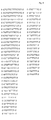
Von der Sequenz SEQ ID NO:1 abgeleitete Teilsequenzen erfindungsgemäßer Oligonukleotide können von unterschiedlicher Länge sein. Im Hinblick auf die erfindungsgemäße Verwendung der Oligonukleotide sollte die Teilsequenz wenigstens 6, insbesondere wenigstens 8, bevorzugt wenigstens 10 und noch bevorzugter wenigstens 12 konsekutiven Nukleobasen aus der Sequenz SEQ ID NO:1 entsprechen. Der Begriff "konsekutiv" wird hier im Sinne von aufeinanderfolgend verwendet. Damit ergeben sich für den Fachmann bestimmte Teilsequenzen der Sequenz SEQ ID NO:1. Einige Teilsequenzen sind in Figur 6 dargestellt. Zum Aufbau erfindungsgemäßer Oligonukleotide kann der Fachmann eine oder mehr als eine, beispielsweise 2, gleiche oder verschiedene dieser Teilsequenzen, gegebenenfalls unter Hinzufügung von zusätzlichen Nukleobasen, in geeigneter Weise anordnen, um so ein erfindungsgemäßes Oligonukleotid zu erhalten.Partial sequences derived from the sequence SEQ ID NO: 1 according to the invention Oligonucleotides can be of different lengths. In terms of use of the oligonucleotides according to the invention, the partial sequence should be at least 6, in particular at least 8, preferably at least 10 and more preferably at least 12 Consecutive nucleobases from the sequence SEQ ID NO: 1 correspond. The term "consecutive" is used here in the sense of successive. This results in for subsequences of the sequence SEQ ID NO: 1 specific to the person skilled in the art. Some subsequences are shown in FIG. For the construction of inventive oligonucleotides of the Expert one or more than one, for example 2, the same or different of these Partial sequences, optionally with the addition of additional nucleobases, in order appropriate so as to obtain an oligonucleotide according to the invention.
Der Begriff "Oligonukleotid" meint ein Oligomer aus Ribonukleinsäure (RNA) oder Desoxyribonukleinsäure (DNA) oder Mimetika davon. Hierzu gehören Oligonukleotide, die aus natürlich vorkommenden Nukleobasen, Zuckern und kovalenten Internukleosid-Verknüpfungen (Rückgrat) bestehen, genauso wie Oligonukleotide mit Strukturen, die in der Natur nicht vorkommen, deren Funktion aber den natürlich vorkommenden ähnlich ist. Derartig modifizierte Oligonukleotide werden den nativen Formen erfindungsgemäß vorgezogen, da sie gewünschte Eigenschaften, beispielsweise eine erhöhte zelluläre Aufnahme, eine erhöhte Affinität für Target-Nukleinsäuren und eine erhöhte Stabilität in Gegenwart von Nukleasen aufweisen.The term "oligonucleotide" means an oligomer of ribonucleic acid (RNA) or Deoxyribonucleic acid (DNA) or mimetics thereof. These include oligonucleotides that from naturally occurring nucleobases, sugars, and covalent internucleoside linkages (Backbone), as well as oligonucleotides with structures that exist in the Nature does not occur, but whose function is similar to the naturally occurring. Such modified oligonucleotides become the native forms according to the invention preferred because they have desired properties, such as increased cellular Uptake, an increased affinity for target nucleic acids and increased stability in Have presence of nucleases.
Insbesondere können die Nukleotide Modifizierungen oder Substitutionen an den Nukleobasen (hier auch einfach als "Base" bezeichnet) aufweisen. Zu den nicht modifizierten oder natürlichen Nukleobasen gehören die Purinbasen Adenin (A) und Guanin (G), und die Pyrimidinbasen Thymin (T), Cytosin (C) und Uracil (U). Zu modifizierten Nukleobasen (Mimetika der natürlichen Nukleobasen) gehören synthetische Nukleobasen wie 5-Methylcytosin (5-Me-C), 5-Hydroxymethylcytosin, Xanthin, Hypoxanthin, 2-Aminoadenin, 6-Methyl- und weitere Alkyl-Derivate von Adenin und Guanin, 2-Thiouracil, 2-Thiothymin und 2-Thiocytosin, 5-Halouracil und 5-Halocytosin, 5-Propinyluracil und 5-Propinylcytosin, 6-Azouracil, 6-Azocytosin und 6-Azothymin, 5-Uracil (Pseudouracil), 4-Thiouracil, 8-Halo-, 8-Amino-, 8-Thiol-, 8-Thioalkyl-, 8-Hydroxyl- und weitere 8-substituierte Adenine und Guanine, 5-Halo-, insbesondere 5-Bromo-, 5-Trifluormethyl- und weitere 5-substituierte Uracile und Cytosine, 7-Methylguanin und 7-Methyladenin, 8-Azaguanin und 8-Azaadenin, 7-Deazaguanin und 7-Deazaadenin und 3-Deazaguanin und 3-Deazaadenin. Von diesen Nukleobasen sind bestimmte besonders brauchbar zur Erhöhung der Bindungsaffinität. Hierzu gehören 5-substituierte Pyrimidine, 6-Azapyrimidine und N-2-, N-6- und O-6-substituierte Purine, z.B. 2-Aminopropyladenin, 5-Propinyluracil und 5-Propinylcytosin. Beispielsweise konnte gezeigt werden, dass 5-Methylcytosin die Stabilität eines Nukleinsäure-Duplex um 0,6-1,2°C erhöht.In particular, the nucleotides may be modifications or substitutions to the Nucleobases (also referred to simply as "base" here) have. Among the unmodified or natural nucleobases include the purine bases adenine (A) and guanine (G), and the Pyrimidine bases thymine (T), cytosine (C) and uracil (U). To modified nucleobases (Mimetics of natural nucleobases) include synthetic nucleobases such as 5-methylcytosine (5-Me-C), 5-hydroxymethylcytosine, xanthine, hypoxanthine, 2-aminoadenine, 6-methyl and other alkyl derivatives of adenine and guanine, 2-thiouracil, 2-thiothymine and 2-thiocytosine, 5-Halouracil and 5-Halocytosine, 5-Propynyluracil and 5-Propynylcytosine, 6-Azouracil, 6-azocytosine and 6-azothymine, 5-uracil (pseudouracil), 4-thiouracil, 8-halo, 8-amino, 8-thiol, 8-thioalkyl, 8-hydroxyl and other 8-substituted adenines and guanines, 5-halo, especially 5-bromo, 5-trifluoromethyl and other 5-substituted uracils and Cytosines, 7-methylguanine and 7-methyladenine, 8-azaguanine and 8-azaadenine, 7-deazaguanine and 7-deazaadenine and 3-deazaguanine and 3-deazaadenine. Of these Certain nucleobases are especially useful for increasing binding affinity. These include 5-substituted pyrimidines, 6-azapyrimidines and N-2, N-6 and O-6 substituted Purines, e.g. 2-aminopropyladenine, 5-propynyluracil and 5-propynylcytosine. For example, it could be shown that 5-methylcytosine the stability of a Nucleic acid duplex increased by 0.6-1.2 ° C.
Erfindungsgemäß geeignet sind T-reiche Oligonukleotide, in denen mehr als 50 %, insbesondere mehr als 60 % und vorzugsweise mehr als 70 % der Nukleobasen Thymidinreste oder Mimetika davon sind. Mimetika von Thymidinresten sind in obigem Sinne modifizierte Nukleobasen, die ähnliche Bindungseigenschaften, also vor allem gleiche Basenpaarungsspezifität, aber durchaus unterschiedliche Affinität für komplemetäre Nukleobasen aufweisen. Analoges gilt für Mimetika anderer Nukleobasen.T-rich oligonucleotides in which more than 50%, in particular more than 60% and preferably more than 70% of the nucleobases Thymidine residues or mimetics thereof. Mimetics of thymidine residues are in the above sense modified nucleobases that have similar binding properties, ie, above all the same Base pairing specificity, but quite different affinity for complementary Have nucleobases. The same applies to mimetics of other nucleobases.
Ein im Vergleich zur insbesondere in Säugern und vor allem Menschen vorkommenden natürlichen Basenverteilung erhöhtes Verhältnis von Thymidin oder Mimetika davon zu Cytosin oder Mimetika davon ist erfindungsgemäß zweckmäßig. Ein T/C-Verhältnis von 2:1 oder mehr und vorzugsweise von 3:1 oder mehr ist von Vorteil.An compared to in particular in mammals and especially humans occurring natural base distribution increased ratio of thymidine or mimetics thereof Cytosine or mimetics thereof is useful in the present invention. A T / C ratio of 2: 1 or more, and preferably 3: 1 or more is advantageous.
Gemäß einer besonderen Ausführungsform weisen erfindungsgemäße Oligonukleotide wenigstens ein GT- bzw. TG-Motiv auf, d.h. mindestens ein Thymidinrest oder ein Mimetikum davon ist in konsekutiver Abfolge (Sequenz) zu einem Guanin oder einem Mimetikum davon angeordnet.According to a particular embodiment, oligonucleotides according to the invention at least one GT or TG motif, i. at least one thymidine residue or Mimetic thereof is in a consecutive sequence (sequence) to a guanine or a Mimetic arranged.
Ferner ist ein relativ geringer Anteil, vorzugsweise von weniger als 15 % und insbesondere von weniger als 10 % Adenin oder Mimetika davon an der Gesamtsequenz des Oligonukleotids erfindungsgemäß zweckmäßig. Gemäß einer besonderen Ausführungsform enthalten erfindungsgemäße Oligonukleotide eine Anordnung von 6, insbesondere 8, vorzugsweise 10 und noch bevorzugter 12 konsekutiven Basen ohne Adenin. Insbesondere enthalten erfindungsgemäße Oligonukleotide kein Adenin.Furthermore, it is a relatively small proportion, preferably less than 15%, and in particular of less than 10% adenine or mimetics thereof in the overall sequence of Oligonucleotide according to the invention expedient. According to a particular embodiment oligonucleotides according to the invention contain an arrangement of 6, in particular 8, preferably 10 and more preferably 12 consecutive bases without adenine. Especially Oligonucleotides according to the invention contain no adenine.
In der Regel ist es zweckmäßig, dass die erfindungsgemäßen Oligonukleotide wenigstens 8, vorzugsweise wenigstens 10 und insbesondere wenigstens 12 Nukleobasen aufweisen. Dies ist insbesondere für die Wirksamkeit der Oligonukleotide von Bedeutung. Einem weiteren Aspekt zufolge weisen erfindungsgemäße Oligonukleotide in der Regel weniger als 50, vorzugsweise weniger als 30 und insbesondere weniger als 25 Nukleobasen auf. Dieser Aspekt ist für die Aufnahme der Oligonukleotide in Zellen und damit für die Bioverfügbarkeit von Bedeutung und entspricht darüber hinaus auch Zweckmäßigkeitserwägungen, wonach ein erfindungsgemäßes Oligonukleotid bei gegebener Wirkung möglichst wenig Nukleobasen aufweisen sollte, um die Komplexizität und den Syntheseaufwand so gering wie möglich zu halten. Besonders bevorzugt sind daher Oligonukleotide mit 8 bis 50, insbesondere mit 10 bis 30 und vor allem mit 12 bis 25, beispielsweise mit 13, 14, 15, 16, 17, 18, 19, 20, 21, 22, 23 oder 24 Basen.In general, it is expedient for the oligonucleotides according to the invention to be at least 8, preferably at least 10 and in particular at least 12 nucleobases. This is particularly important for the effectiveness of the oligonucleotides. Another Aspect, oligonucleotides of the invention typically have less than 50, preferably less than 30 and in particular less than 25 nucleobases. This Aspect is for the uptake of oligonucleotides into cells and thus for bioavailability and also corresponds to expediency considerations, according to which an oligonucleotide of the invention given as little effect as possible nucleobases should be as low as possible to minimize the complexity and the effort of synthesis hold. Particular preference is therefore given to oligonucleotides having 8 to 50, in particular 10 up to 30 and above all with 12 to 25, for example with 13, 14, 15, 16, 17, 18, 19, 20, 21, 22, 23 or 24 bases.
Die Anordnung der Nukleobasen in erfindungsgemäßen Oligonukleotiden wird in der Regel dadurch gewährleistet, dass die Nukleobasen in geeigneter Weise miteinander verknüpft sind. In der Regel ergibt sich ein Oligomer mit einer konsekutiven Abfolge von Nukleobasen (Sequenz), die über ein die Hauptkette bildendes Rückgrat miteinander verknüpft sind. Während lineare Oligomere bevorzugt sind, können in bestimmten Fällen auch verzweigte, cyklische oder gar vernetzte Strukturen geeignet sein.The arrangement of the nucleobases in oligonucleotides according to the invention is usually thereby ensuring that the nucleobases are linked together in a suitable manner are. As a rule, an oligomer with a consecutive sequence of nucleobases results (Sequence) linked by a backbone forming the main chain. While linear oligomers are preferred, in certain cases branched, be cyclic or even networked structures suitable.
Bei den Oligonukleotiden handelt es sich in der Regel um miteinander verknüpfte Nukleoside, d.h. Base-Zucker-Kombinationen. Der Basenteil der Nukleoside ist normalerweise eine heterozyklische Base, in den meisten Fällen ein Purin oder ein Pyrimidin. Die Nukleoside werden in der Regel durch eine kovalent an den Zuckerteil des Nukleosids gebundene Gruppe miteinander verknüpft. In denjenigen Nukleosiden, die einen Pentofuranosyl-Zucker aufweisen, kann diese Gruppe entweder an die 2'-, 3'- oder 5'-Hydroxylgruppe des Zuckers gebunden sein. In der Regel verknüpfen diese Gruppen kovalent benachbarte Nukleoside miteinander zu einer linearen, oligomeren Verbindung. Die jeweiligen Enden dieser linearen, oligomeren Struktur können wiederum miteinander verbunden werden, um cyclische Strukturen zu bilden. Offene, lineare Strukturen sind allerdings bevorzugt. Innerhalb der Oligonukleotidstruktur bilden die verknüpfenden Gruppen im Allgemeinen das Internukleosid-Rückgrat des Oligonukleotids. Die normale Verknüpfung oder das normale Rückgrat von RNA und DNA sind 3'-5'-Phosphodiester-Verknüpfungen, d.h. die verknüpfenden Gruppen sind Phosphatgruppen.The oligonucleotides are usually linked together Nucleosides, i. Base-sugar combinations. The base part of the nucleosides is usually a heterocyclic base, in most cases a purine or a Pyrimidine. The nucleosides are usually covalently attached to the sugar moiety of the Nucleoside linked group linked together. In those nucleosides that have a Having pentofuranosyl sugars, this group can be attached either to the 2 ', 3' or 5 'hydroxyl group be bound to the sugar. In general, these groups link covalently adjacent nucleosides together to form a linear, oligomeric compound. The respective ends of this linear, oligomeric structure may in turn be interconnected be connected to form cyclic structures. Open, linear structures are however preferred. Within the oligonucleotide structure, the linking groups form generally the internucleoside backbone of the oligonucleotide. The normal link or the normal backbone of RNA and DNA are 3'-5'-phosphodiester linkages, i.e. the linking groups are phosphate groups.
Erfindungsgemäß bevorzugt sind allerdings Oligonukleotide, die ein modifiziertes Rückgrat bzw. nicht natürliche Internukleosid-Verknüpfungen aufweisen.According to the invention, however, oligonucleotides which are a modified backbone are preferred or non-natural internucleoside linkages.
Insbesondere gehören zu bevorzugten modifizierten Oligonukleotid-Rückgraten einerseits phosphatfreie Analoga und andererseits Phosphatderivate.In particular, preferred modified oligonucleotide backbones belong on the one hand phosphate-free analogues and on the other hand phosphate derivatives.
Insbesondere sind Phosphothioate, partielll oder vollständig sulfuriert, z.B. chirale Phosphothioate, Phosphomonothioate und Phosphodithioate zu nennen. Weitere modifizierte Rückgrate sind Phosphotriester, Alkylphosphotriester, Aminoalkylphosphotriester, Methyl- und weitere Alkylphosphonate, z.B. 3'-Alkylenphosphonate und chirale Phosphonate, Phosphinate, Phosphoramidate, z.B. 3'-Aminophosphoramidate und Aminoalkylphosphoramidate, Thionophosphoramidate, Thionoalkylphosphonate, Thionoalkylphosphotriester und Borphosphate mit normalen 3'-5'-Verknüpfungen, 2'-5'-verknüpfte Analoga davon, und solche mit entgegengesetzter Polarität, wobei die benachbarten Paare von Nukleosid-Einheiten 3'-5' zu 5'-3' oder 2'-5' zu 5'-2' verknüpft sind.In particular, phosphorothioates, partially or completely sulfurized, e.g. chiral Phosphothioates, phosphomonothioates and phosphodithioates. Further modified backbones are phosphotriesters, alkyl phosphotriesters, Aminoalkyl phosphotriesters, methyl and other alkyl phosphonates, e.g. 3'-alkylene phosphonates and chiral phosphonates, phosphinates, phosphoramidates, e.g. 3'-Aminophosphoramidate and aminoalkylphosphoramidates, thionophosphoramidates, Thionoalkyl phosphonates, thionoalkyl phosphotriesters and boron phosphates having normal 3'-5 'linkages, 2'-5'-linked analogs thereof, and those of opposite polarity, the adjacent pairs of nucleoside units 3'-5 'to 5'-3' or 2'-5 'to 5'-2' are linked.
Besondere modifizierte Oligonukleotid-Rückgrate ohne Phosphoratom werden im allgemeinen durch kurzkettige Alkyl- oder Cykloalkyl-Internukleosid-Verknüpfungen, die gegebenenfalls auch Heteroatome oder Heterocyklen umfassen können, gebildet. Hierzu gehören diejenigen mit Morpholino-Verknüpfungen (teilweise vom Zuckerteil des Nukleosids gebildet); Siloxan-Rückgrate; Sulfid-, Sulfoxid- und Sulfon-Rückgrate; Formacetyl- und Thioformacetyl-Rückgrate; Methylenformacetyl- und Thioformacetyl-Rückgrate; Alkenenthaltende Rückgrate; Sulfamat-Rückgrate; Methylenimino- und Methylenhydrazino-Rückgrate; Sulfonate- und Sulfonamid-Rückgrate; Amid-Rückgrate; und weitere mit gemischten N-, O-, S- und CH2-Komponententeilen.Particular modified oligonucleotide backbones without phosphorus atom are generally formed by short chain alkyl or cycloalkyl internucleoside linkages, which may optionally also include heteroatoms or heterocycles. These include those with morpholino linkages (partially formed by the sugar portion of the nucleoside); Siloxane backbones; Sulfide, sulfoxide and sulfone backbones; Formacetyl and thioformacetyl backbones; Methylene formacetyl and thioformacetyl backbones; Alkene containing backbones; Sulfamate backbones; Methyleneimino and methylenehydrazino backbones; Sulfonate and sulfonamide backbones; Amide backbones; and others with mixed N, O, S and CH 2 component parts.
In weiteren besonderen Oligonukleotiden sind sowohl der Zucker als auch die Internukleosid-Verknüpfung, d.h. das Rückgrat natürlicher Nukleotid-Einheiten modifiziert. Eine derartige oligomere Verbindung, d.h. ein Oligonukleotid mit ausgezeichneten Hybridisierungseigenschaften, wird als "Peptide Nucleic Acid" (PNA) bezeichnet. In PNA-Verbindungen ist das Zucker-Rückgrat eines Oligonukleotids durch ein Amid-artiges Rückgrat, insbesondere ein Aminoethylglycin-Rückgrat, ersetzt. Die Nukleobasen sind erhalten und direkt oder indirekt, beispielsweise über einen Methylcarbonyl-Linker, an die Stickstoffatome des Amidteils des Rückgrats gebunden.In other particular oligonucleotides, both the sugar and the internucleoside linkage, i.e. modified the backbone of natural nucleotide units. Such oligomeric compound, i. an oligonucleotide with excellent Hybridization properties is referred to as "Peptide Nucleic Acid" (PNA). In PNA connections is the sugar backbone of an oligonucleotide through an amide-like Backbone, especially an aminoethylglycine backbone replaced. The nucleobases are and directly or indirectly, for example via a methylcarbonyl linker, to the Nitrogen atoms of the amide portion of the backbone bound.
Gemäß einer besonders bevorzugten Ausführungsform betrifft die vorliegende Erfindung Oligonukleotide mit Phosphothioat-Rückgraten und ferner Oligonukleoside mit Heteroatom-Rückgraten, die insbesondere auf Struktureinheiten basieren, wie -CH2-NH-O-CH2-, -CH2-N(CH3)-O-CH2- [als Methylenmethylimino- oder kurz MMI-Rückgrat bekannt], -CH2-O-N(CH3)-CH2-, -CH2-N(CH3)-N(CH3)-CH2- oder -O-N(CH3)-CH2-CH2-.According to a particularly preferred embodiment, the present invention relates to oligonucleotides having phosphorothioate backbones and further to oligonucleosides having heteroatom backbones which are based in particular on structural units, such as -CH 2 -NH-O-CH 2 -, -CH 2 -N (CH 3 ) -O-CH 2 - [known as methylenemethylimino or MMI backbone for short], -CH 2 -ON (CH 3 ) -CH 2 -, -CH 2 -N (CH 3 ) -N (CH 3 ) -CH 2 - or -ON (CH 3 ) -CH 2 -CH 2 -.
Modifizierte Oligonukleotide können auch eine oder mehrere substituierte Zuckergruppen enthalten. Neben der Variation der 4'-Position, beispielsweise bei den 4'-Thio- und 4'-Aza-Derivaten, kann vor allem die 2'-Position substituiert sein, z.B. mit OH, F, O-, S- oder N-Alkyl, O-S- oder N-Alkenyl, O-, S- oder N-Alkinyl, oder O-Alkyl-O-Alkyl, worin Alkyl, Alkenyl und Alkinyl vorzugsweise substituiertes oder unsubstituiertes C1-C10-Alkyl oder C2-C10-Alkenyl bzw. -Alkinyl sind. Insbesondere bevorzugt sind Substituenten, wie O((CH2)nO]mCH3, O(CH2)nOCH3, O(CH2)nNH2, O(CH2)nCH3, O(CH2)nNH2 und O(CH2)nON[(CH2)nCH3)]2, worin n und m ganze Zahlen von 1 bis 10 sind. Zu bevorzugten Modifizierungen gehört eine Alkoxy-Alkoxy-Gruppe, z.B. 2'-Methoxyethoxy (2'-O-CH2CH2OCH3, ebenfalls als 2'-O-(2-Methoxymethyl) oder 2'-MOE bekannt). Zu einer weiteren bevorzugten Modifizierung gehört 2'-Dimethylaminooxyethoxy, d.h. eine O(CH2)2ON(CH3)2-Gruppe, ebenfalls als 2'-DMAOE bekannt.Modified oligonucleotides may also contain one or more substituted sugar groups. In addition to the variation of the 4'-position, for example in the 4'-thio and 4'-aza derivatives, especially the 2'-position may be substituted, eg with OH, F, O, S or N- Alkyl, OS or N-alkenyl, O-, S- or N-alkynyl, or O-alkyl-O-alkyl, wherein alkyl, alkenyl and alkynyl preferably substituted or unsubstituted C 1 -C 10 alkyl or C 2 -C 10 alkenyl or alkynyl. Particularly preferred are substituents such as O ((CH 2 ) n O) m CH 3 , O (CH 2 ) n OCH 3 , O (CH 2 ) n NH 2 , O (CH 2 ) n CH 3 , O (CH 2 ) n NH 2 and O (CH 2 ) n ON [(CH 2 ) n CH 3 )] 2 , where n and m are integers from 1 to 10. Preferred modifications include an alkoxy-alkoxy group, eg, 2'-methoxyethoxy (2'-O-CH 2 CH 2 OCH 3 , also known as 2'-O- (2-methoxymethyl) or 2'-MOE). Another preferred modification includes 2'-dimethylaminooxyethoxy, ie, an O (CH 2 ) 2 ON (CH 3 ) 2 group, also known as 2'-DMAOE.
Zu weiteren bevorzugten Modifizierungen gehören 2'-Methoxy (2'-O-CH3), 2'-Aminopropoxy (2'-OCH2CH2CH2NH2) und 2'-Fluoro (2'-F). Ähnliche Modifizierungen können auch an anderen Positionen des Oligonukleotids, insbesondere an der 3'-Position des Zuckers des 3'terminalen Nukleotids oder in 2'-5'-verknüpften Oligonukleotiden, und an der 5'-Position des 5'-terminalen Nukleotids vorgenommen werden. Ebenfalls können erfindungsgemäße Oligonukleotide Zucker-Mimetika, wie Cyclobutyl-Gruppen anstatt des Pentofuranosyl-Zuckers aufweisen.Other preferred modifications include 2'-methoxy (2'-O-CH 3 ), 2'-aminopropoxy (2'-OCH 2 CH 2 CH 2 NH 2 ) and 2'-fluoro (2'-F). Similar modifications may also be made to other positions of the oligonucleotide, particularly at the 3'-position of the sugar of the 3'-terminal nucleotide or in 2'-5'-linked oligonucleotides, and at the 5'-position of the 5'-terminal nucleotide , Also, oligonucleotides of the present invention may have sugar mimetics such as cyclobutyl groups instead of the pentofuranosyl sugar.
Eine weitere bevorzugte Zuckermodifikation ist unter dem Begriff "locked nucleic acid", kurz LNA bekannt. Hierbei sind das C4'-Atom und das C2'-Atom über eine Methylenbrücke miteinander verknüpft, so dass sich ein [2.2.1]-Bicyclo-Nükleosid ergibt. Another preferred sugar modification is the term "locked nucleic acid", in short Known as LNA. Here, the C4'-atom and the C2'-atom are via a methylene bridge linked together to give a [2.2.1] bicyclo nucleoside.
Weitere Modifikationen erfindungsgemäßer Oligonukleotide beinhalten, dass man an das Oligonukleotid eine oder mehrere Molekülgruppen knüpft, die Aktivität, celluläre Verteilung oder celluläre Aufnahme der Oligonukleotide modifizieren. Zu derartigen Gruppen gehören insbesondere solche, die den lipophilen Charakter der Oligonukleotide erhöhen. Polyglykole, insbesondere Polyalkylenglykole, vorzugsweise Polyethylenglykole, Peptide, Proteine und vor allem lipophile Reste, wie alicyclische Kohlenwasserstoffe, Wachse, Terpene und Fettsäurereste mit vorzugsweise 8 bis 32 Kohlenstoffatomen, die gesättigt oder einfach oder mehrfach ungesättigt sein können, Steroide und vor allem Vitamine sowie Derivate davon sind insbesondere zu nennen. Zu geeigneten Steroidmolekülen gehören insbesondere die Gallensäuren, z.B. Cholinsäure, Desoxycholinsäure und Dehydrocholinsäure, Cortison, Digoxigenin, Testosteron, Cholesterol und kationische Steroide, z.B. Cortison mit einer an die 3-Position des Cortisonrings über eine Doppelbindung gebundenen Trimethylaminomethylhydrazid-Gruppe. Zu geeigneten Vitaminen gehören sowohl wasserlösliche als auch fettlösliche Vitamine. Thiamin, Riboflavin, Nicotinsäure oder Niacin, die Pyridoxal-Gruppe des Vitamins B6, Pantothensäure, Biotin, Folsäure, die B12-Cobamid-Coenzyme, Inositol, Cholin und Ascorbinsäure sind insbesondere als wasserlösliche Vitamine zu nennen. Erfindungsgemäß bevorzugt sind die fettlöslichen Vitamine, wie die Vitamin-A-Familie, z.B. Retinsäure und Retinol, Vitamin D und dessen Derivate, z.B. Vitamin D und dessen Ergosterol-Vorstufen, die Vitamin-E-Familie, z.B. α-(D,L)Tocopherol und weitere Tocopherole, und Vitamin K und dessen Derivate, z.B. Vitamin K und verwandte Chinon- bzw. Phytolverbindungen.Other modifications of oligonucleotides according to the invention include attaching to the oligonucleotide one or more molecular groups which modify the activity, cellular distribution or cellular uptake of the oligonucleotides. Such groups include, in particular, those which increase the lipophilic character of the oligonucleotides. Polyglycols, in particular polyalkylene glycols, preferably polyethylene glycols, peptides, proteins and especially lipophilic radicals, such as alicyclic hydrocarbons, waxes, terpenes and fatty acid radicals preferably having 8 to 32 carbon atoms, which may be saturated or mono- or polyunsaturated, steroids and especially vitamins and derivatives Of these, particular mention should be made. Suitable steroid molecules include in particular the bile acids, eg cholic acid, deoxycholic acid and dehydrocholic acid, cortisone, digoxigenin, testosterone, cholesterol and cationic steroids, eg cortisone having a trimethylaminomethylhydrazide group attached to the 3-position of the cortisone ring via a double bond. Suitable vitamins include both water-soluble and fat-soluble vitamins. Thiamine, riboflavin, nicotinic acid or niacin, the pyridoxal group of vitamin B 6 , pantothenic acid, biotin, folic acid, the B 12 -cobamide coenzymes, inositol, choline and ascorbic acid are to be mentioned in particular as water-soluble vitamins. Preferred according to the invention are the fat-soluble vitamins, such as the vitamin A family, for example retinoic acid and retinol, vitamin D and its derivatives, for example vitamin D and its ergosterol precursors, the vitamin E family, eg α- (D, L) Tocopherol and other tocopherols, and vitamin K and its derivatives, eg vitamin K and related quinone or phytol compounds.
Ferner gehören zu geeigneten Molekülgruppen auch Konjugate, wie Nanopartikel, die zweckmäßigerweise positiv geladen sind. Durchmesser von 100 bis 500 nm sind brauchbar. Polymere finden in diesem Zusammenhang besondere Verwendung. So sind insbesondere Partikel auf Polystyrol- oder Polyacrylatbasis zu nennen.In addition, suitable molecule groups also include conjugates, such as nanoparticles, the are expediently positively charged. Diameters of 100 to 500 nm are useful. Polymers find particular use in this context. So are in particular Call polystyrene or polyacrylate particles.
Durch die Modifikation mit derartigen Molekülgruppen vor allem in 3'- und 5'-Stellung kann die Bioverfügbarkeit wegen der um Größenordnungen verlängerten Halbwertszeit gegenüber dem Angriff von Nukleasen erhöht werden. Konjugiert man die erfindungsgemäßen Oligonukleotide an positiv geladene Nanopartikel, wird ebenfalls die Stabilität gegenüber dem Angriff von Nukleasen sowohl bei nicht modifizierten, Phosphothioat-Verknüpfungen aufweisenden, als auch terminal modifizierten Oligonukleotiden erhöht und eine vorzügliche Aufnahme in Tumorzellen beobachtet. Due to the modification with such molecular groups, especially in the 3'- and 5'-position the bioavailability because of the half-life extended by orders of magnitude increased by the attack of nucleases. If one conjugates the inventive Oligonucleotides on positively charged nanoparticles will also face stability the attack of nucleases on both unmodified, phosphothioate linkages increased as well as terminally modified oligonucleotides and an excellent Uptake observed in tumor cells.
Erfindungsgemäß besonders bevorzugt sind Oligonukleotide, die terminal modifiziert sind. Zu terminal modifizierten Oligonukleotiden gehören insbesondere solche, die keine freie 3'-OH-Gruppe und/oder 5'-Phosphat-Gruppe aufweisen. Dementsprechend sind erfindungsgemäße Oligonukleotide am 3'- und/oder 5'-Terminus modifiziert. Zu diesem Zweck eignen sich insbesondere die oben beschriebenen Molekülgruppen, wobei Polyalkylenglykole, lipophile Reste und Peptide bevorzugt sind. Von den Polyalkylenglykolen sind insbesondere Polyethylenglykole, beispielsweise Hexaethylenglykol oder solche mit einer mittleren Molmasse von 150 bis 5000 Dalton zu nennen. Von den lipophilen Resten sind insbesondere Fettsäurereste, Steroidreste und Vitaminreste sowie deren Derivate zu nennen. Besonders bevorzugt sind Reste fettlöslicher Vitamine wie Tocopherole.Especially preferred according to the invention are oligonucleotides which are terminally modified. To Terminal-modified oligonucleotides include, in particular, those which do not have a free 3'-OH group and / or 5'-phosphate group. Accordingly, inventive Oligonucleotides at the 3'- and / or 5'-terminus modified. Suitable for this purpose in particular the molecule groups described above, where polyalkylene glycols, lipophilic Residues and peptides are preferred. Of the polyalkylene glycols are in particular Polyethylene glycols, for example hexaethylene glycol or those with a middle Molecular mass of 150 to 5000 daltons to call. Of the lipophilic radicals are in particular Fatty acid residues, steroid residues and vitamin residues and their derivatives. Especially Preference is given to residues of fat-soluble vitamins such as tocopherols.
Gemäß einer besonderen Ausführungsform weisen erfindungsgemäße Oligonukleotide terminal gebundenes α-Tocopheryl, vorzugsweise α-D-Tocopheryl und/oder Polyethylenglykol auf. Insbesondere können erfindungsgemäße Oligonukleotide im Rahmen dieser Ausführungsform an einem Terminus einen Polyethylenglykolrest und am anderen Terminus einen Tocopherylrest aufweisen, wobei es bevorzugt ist, dass der Polyethylenglykolrest am 3'-Terminus und der Tocopherylrest am 5'-Terminus gebunden ist. Besonders bevorzugt sind im Rahmen dieser Ausführungsform erfindungsgemäße Oligonukleotide, die an beiden Termini einen Tocopherylrest aufweisen.According to a particular embodiment, oligonucleotides according to the invention terminally bound α-tocopheryl, preferably α-D-tocopheryl and / or Polyethylene glycol on. In particular, oligonucleotides according to the invention can be used in the context of this embodiment at one terminus a Polyethylenglykolrest and at the other Terminus have a tocopheryl, wherein it is preferred that the Polyethylene glycol residue at the 3'-terminus and the tocopheryl residue is attached to the 5'-terminus. Particular preference is given in the context of this embodiment according to the invention Oligonucleotides having a tocopheryl residue on both termini.
Die terminalen Reste können im Prinzip beliebig an das Oligonukleotid gebunden sein. Aufgrund struktureller Vorgaben durch das Oligonukleotid und ihrer relativ einfachen synthetischen Zugänglichkeit bieten sich allerdings Amid-, Ester- oder Etherbindungen insbesondere für die 3'- und 5'-Termini an. Die Bindung an die Termini kann die direkt oder über geeignete Linkerverbindungen, die gegebenenfalls den unten erläuterten Ankerverbindungen oder Teilen davon entsprechen können, erfolgen.The terminal residues may in principle be arbitrarily bound to the oligonucleotide. Due to structural requirements of the oligonucleotide and its relatively simple however, synthetic accessibility is afforded by amide, ester or ether linkages especially for the 3'- and 5'-termini. The binding to the termini can be direct or via suitable linker compounds, optionally as explained below Anchor connections or parts thereof may be made.
Zudem können weitere Modifizierungen erfindungsgemäßer Oligonukleotide einzelne Nukleoside betreffen, wobei mehrere Nukleoside unterschiedlich oder einheitlich modifiziert sein können. Auch Gemische aus unterschiedlich modifizierten Oligonukleotiden sind insbesondere im Hinblick auf die erfindungsgemäße Anwendung erfindungsgemäß brauchbar.In addition, further modifications of inventive oligonucleotides individual Nucleosides relate, with multiple nucleosides modified differently or uniformly could be. Also mixtures of differently modified oligonucleotides are in particular with regard to the use according to the invention according to the invention useful.
Brauchbar sind ebenfalls pharmazeutisch verträgliche Salze, Ester, Salze der Ester oder beliebige weitere Verbindungen, die nach Verabreichung an ein Tier, insbesondere Menschen, in der Lage sind, direkt oder indirekt den biologisch aktiven Metaboliten oder einen Teil davon, zu liefern. Also useful are pharmaceutically acceptable salts, esters, salts of the esters or any other compounds which, after administration to an animal, in particular People who are able, directly or indirectly, the biologically active metabolite or to deliver a part of it.
So sind beispielsweise auch sogenannte "Prodrugs" brauchbar. Hierbei handelt es sich um eine inaktive Form des Wirkstoffs, die in-vivo in eine aktive Form umgewandelt wird. Prodrug-Versionen von Oligonukleotiden können beispielsweise als S-(Acetyl-2-thioethyl)phosphat-Derivate bereitgestellt werden.For example, so-called "prodrugs" are also useful. This is an inactive form of the drug that is converted to an active form in vivo. Prodrug versions of oligonucleotides can be used, for example, as S- (acetyl-2-thioethyl) phosphate derivatives to be provided.
Zu den pharmazeutisch verträglichen Basenadditionssalzen gehören Salze mit Metallen oder Aminen, wie Alkali- und Erdalkalimetallen oder organischen Aminen, insbesondere Kationen wie Natrium, Kalium, Ammonium, Magnesium und Calcium bzw. Polyaminen wie Spermin und Spermidin.The pharmaceutically acceptable base addition salts include salts with metals or Amines, such as alkali and alkaline earth metals or organic amines, in particular cations such as sodium, potassium, ammonium, magnesium and calcium or polyamines such as spermine and spermidine.
Zu den pharmazeutisch akzeptablen Säureadditionssalzen gehören Salze mit anorganischen Basen, z.B. Chlorwasserstoffsäure, Bromwasserstoffsäure, Schwefelsäure, Phosphorsäure, Salpetersäure und dergleichen, sowie mit organischen Säuren, z.B. Essigsäure, Oxalsäure, Weinsäure, Bernsteinsäure, Maleinsäure, Fumarsäure, Gluconsäure, Zitronensäure, Äpfelsäure, Ascorbinsäure, Benzoesäure, Tanninsäure, Palmitinsäure, Algininsäure, Polyglutaminsäure, Naphthalinsulfonsäure, Methansulfonsäure, p- Toluolsulfonsäure, Naphthalindisulfonsäure, Polygalactoronsäure und dergleichen.The pharmaceutically acceptable acid addition salts include salts with inorganic Bases, e.g. Hydrochloric acid, hydrobromic acid, sulfuric acid, phosphoric acid, Nitric acid and the like, as well as with organic acids, e.g. Acetic acid, oxalic acid, Tartaric acid, succinic acid, maleic acid, fumaric acid, gluconic acid, citric acid, Malic acid, ascorbic acid, benzoic acid, tannic acid, palmitic acid, alginic acid, Polyglutamic acid, naphthalenesulfonic acid, methanesulfonic acid, p-toluenesulfonic acid, Naphthalenedisulfonic acid, polygalactoronic acid and the like.
Die erfindungsgemäßen Verbindungen können in an sich bekannter Art und Weise hergestellt werden. Insbesondere finden bekannte Festphasensynthese-Systeme, wie die Phosphoramidit-Methode, Anwendung. Geeignete Vorrichtungen sind kommerziell erhältlich, beispielsweise von Applied Biosystems (Foster City, Kalifornien). Demnach werden die Verbindungen in-vitro synthetisiert.The compounds according to the invention can be prepared in a manner known per se getting produced. In particular, known solid phase synthesis systems, such as Phosphoramidite method, application. Suitable devices are commercially available, for example, Applied Biosystems (Foster City, California). Accordingly, the Compounds synthesized in vitro.
Auch die Synthese von sulfurierten Oligonukleotiden (Phosphothioaten) kann in Anlehnung an die Phosphoramidit-Chemie erfolgen. Im Unterschied zur Herstellung von Phosphodiestern wird anstelle der Oxydation des dreiwertigen Phosphors ein Sulfurierungsschritt durchgeführt. Hierfür eignen sich eine Vielzahl bekannter Sulfurierungsmittel, wobei 3H-1,2-Benzodithiol-3-on-1,1-dioxid, das sogenannte Beaucage-Reagens, üblicherweise und ferner Tetraethylthiuramdisulfid (TETD) häufig verwendet werden. Auch Phenylacetyldisulfid, das sogenannte Van-Boom-Reagens, hat sich als günstig erwiesen. Neben der Phosphoramidit-Chemie kann auch die allgemeine Phosphonat-Methode in entsprechend modifizierter Form zur Herstellung von Phosphothioaten verwendet werden. The synthesis of sulfurized oligonucleotides (Phosphothioaten) can by analogy to the phosphoramidite chemistry. Unlike the production of Phosphodiester is substituted for the oxidation of the trivalent phosphorus Sulfurierungsschritt performed. For this purpose, a variety of known Sulfurizing agent, 3H-1,2-benzodithiol-3-one-1,1-dioxide, the so-called Beaucage reagent, Usually and further tetraethylthiuram disulfide (TETD) is commonly used become. Also, phenylacetyl disulfide, the so-called Van Boom reagent, has proved to be proved favorable. In addition to the phosphoramidite chemistry, the general Phosphonate method in modified form for the preparation of Phosphothioaten be used.
Auch die Modifizierung der Oligonukleotide mit Molekülgruppen kann in an sich bekannter Weise erfolgen. Je nach Anknüpfungspunkt stehen verschiedene Methoden bereit, um insbesondere an Base, Zucker und/oder Phosphat-Rückgrat Modifizierungen vomehmen zu können.The modification of the oligonucleotides with molecular groups can also be known per se Done way. Depending on the starting point, different methods are available to especially to base, sugar and / or phosphate backbone modifications can.
Für die terminale Modifizierung am 3'-Terminus bieten sich grundsätzlich zwei Möglichkeiten an. Die Modifizierung kann nach Beendigung der eigentlichen Synthese, also nach der Abspaltung des Oligonukleotids vom Trägermaterial und der Entfernung der Schutzgruppen, an das Oligonukleotid erfolgen. Alternativ kann man Trägermaterialien verwenden, die mit trifunktionellen Ankerverbindungen ausgerüstet sind. Diese Ankerverbindungen weisen neben einer spaltbaren Bindungsstelle zum Trägermaterial (erstes Reaktionszentrum) und einer gegebenenfalls geschützten Hydroxygruppe, an der das Oligonukleotid schrittweise aufgebaut wird (zweites Reaktionszentrum), eine weitere Funktionalisierung, üblicherweise eine Hydroxy- oder Aminogruppe, auf (drittes Reaktionszentrum), an welche die einzuführende Gruppe gebunden werden kann. Letzteres kann prinzipiell vor oder nach der Oligonukleotid-Synthese erfolgen, wobei erforderlichenfalls eine geeignete säurestabile Schutzgruppe, z.B. Fmoc am dritten Reaktionszentrum verwendet wird. Diese kann nach der Oligonukleotid-Synthese in an sich bekannter Weise abgespalten werden. So kann das Oligonukleotid schließlich vom Trägermaterial abgespalten werden, wobei der Oligonukleotid und die einzuführende Molekülgruppe verknüpfende Teil der Ankerverbindung erhalten bleibt.There are basically two options for terminal modification at the 3'-terminus at. The modification can be done after completion of the actual synthesis, ie after the Cleavage of the oligonucleotide from the support material and deprotection, to the oligonucleotide. Alternatively, one can use carrier materials with trifunctional anchor compounds are equipped. These anchor connections point in addition to a cleavable binding site to the support material (first reaction center) and an optionally protected hydroxy group to which the oligonucleotide is added stepwise is built (second reaction center), a further functionalization, usually a hydroxy or amino group on (third reaction center) to which the can be bound. The latter can in principle before or after the Oligonucleotide synthesis, if necessary, a suitable acid-stable Protecting group, e.g. Fmoc is used at the third reaction center. This can be after the Oligonucleotide synthesis are split off in a conventional manner. That's how it works Finally oligonucleotide are cleaved from the carrier material, wherein the oligonucleotide and the molecule group to be introduced to obtain linking part of the anchor compound remains.
Die Struktur geeigneter Ankerverbindungen ist weitgehend variabel. Zu beachten ist, dass die Ankerverbindung und deren Bindungen an die einzuführende Molekülgruppe mit der für die Synthese des Oligonukleotids verwendeten Chemie kompatibel sein sollte. Da üblicherweise die Amidit-Chemie zur Anwendung kommt, sollten die Bindungen weder säure- noch basenlabil sein, weshalb Ester- und Amidbindungen zwischen der Ankerverbindung und der einzuführenden Molekülgruppe nur bedingt geeignet sind, wohingegen Etherbindungen bevorzugt werden.The structure of suitable anchor compounds is largely variable. It should be noted that the anchor compound and its bonds to the molecular group to be introduced with the for the synthesis of the oligonucleotide used should be compatible. There Usually the amidite chemistry is used, the bonds should neither acid-still base labile, which is why ester and amide bonds between the Anchor connection and the molecule group to be introduced are only conditionally suitable, whereas ether bonds are preferred.
Geeignete Ankerverbindungen sind an sich bekannt. Beispielsweise sind Glycerinderivate als C3-Anker zu nennen. Hierbei dienen die Hydroxylgruppen in 1- und 3-Position zur Bindung der einzuführenden Molekülgruppe bzw. des Oligonukleotids und die Hydroxylgruppe in 2-Position bildet den Anknüpfungspunkt zum Trägermaterial über eine spaltbare Bindung, die erforderlichenfalls mit Hilfe eines geeigneten Spacers zwischen Hydroxylgruppe und Trägermaterial etabliert werden kann. Eine weitere Variante sind 2-substituierte 1,3-Propandiol-Derivate. Hierbei dienen die Hydroxyl-Gruppen in 1- und 3-Position zur Bindung des Oligonukleotids bzw. des Trägermaterials. Der Substituent in 2-Position dient zur Bindung der einzuführenden Molekülgruppe. Beispielsweise kann man mit Amino-C1-6-Alkylresten Amid- oder Urethanbindungen ausbilden. Ein bevorzugtes Beispiel für eine derartige Ankerverbindung ist 2-(4-Aminobutyl)-1,3-propandiol.Suitable anchor compounds are known per se. For example, glycerol derivatives can be mentioned as C 3 anchors. Here, the hydroxyl groups in the 1- and 3-position serve to bind the molecule group or the oligonucleotide to be introduced and the hydroxyl group in the 2-position forms the point of attachment to the carrier material via a cleavable bond, which are established, if necessary, with the aid of a suitable spacer between hydroxyl group and carrier material can. Another variant is 2-substituted 1,3-propanediol derivatives. Here, the hydroxyl groups in the 1- and 3-position serve to bind the oligonucleotide or the carrier material. The substituent in the 2-position serves to bind the molecule group to be introduced. For example, one can form amide or urethane bonds with amino-C 1-6 -alkyl radicals. A preferred example of such an anchor compound is 2- (4-aminobutyl) -1,3-propanediol.
In bestimmten Fällen weisen die einzuführenden Molekülgruppen selbst Hydroxylgruppen auf, an denen sich das Oligonukleotid synthetisieren lässt. Dies ist beispielsweise bei Alkylenglykolen der Fall. Diese können daher zunächst in geeigneter Weise an das Trägermaterial gebunden werden. Dabei sind die als Anknüpfungspunkt für das Oligonukleotid dienenden Hydroxylgruppen erforderlichenfalls in geeigneter Weise, beispielsweise mit Fmoc-Gruppen, geschützt. Die Abspaltung dieser Schutzgruppen stellt anschließend die zur Oligonukleotid-Synthese erforderlichen Hydroxylgruppen bereit.In certain cases, the molecule groups to be introduced themselves have hydroxyl groups on which the oligonucleotide can be synthesized. This is for example Alkyl glycols the case. These can therefore initially in a suitable manner to the Carrier material are bound. These are the starting point for the Oligonucleotide hydroxyl groups, if necessary, in an appropriate manner, for example with Fmoc groups, protected. The cleavage of these protecting groups provides then the hydroxyl groups required for oligonucleotide synthesis ready.
Geeignete Trägermaterialien sind an sich bekannt und entsprechen im Wesentlichen den üblichen, zur Festphasensynthese von Oligonukleotiden verwendeten Trägern.Suitable carrier materials are known per se and essentially correspond to the customary supports used for solid-phase synthesis of oligonucleotides.
Am 5'-Terminus können Molekülgruppen zweckmäßigerweise über entsprechend modifizierte Monomere, also insbesondere Phosphoramidite, eingeführt werden. Diese in an sich bekannter Weise zugänglichen Amidite werden als letztes Monomer an das synthetisierte Oligonukleotid angekoppelt.At the 5'-terminus, molecular groups may suitably be appropriately modified monomers, ie in particular phosphoramidites, are introduced. This in on known amide accessible as the last monomer to the synthesized oligonucleotide coupled.
Ein erfindungsgemäßes Beispiel für eine hervorragende Hemmung der Proliferation von
humanen Pankreastumorzellen ist das Oligonukleotid mit folgender Sequenz:

Insbesondere von Vorteil sind die entsprechenden Phosphothioate. Auch die
Modifizierungen in 3'-Stellung mit Polyethylenglykol (z.B. Hexaethylenglykol und
insbesondere PEG mit einer mittleren Molmasse von 1500) oder mit α-Tocopherol, und in 5'-Stellung
mit α-Tocopherol bringen zusätzliche Vorteile, so dass folgende Oligonukleotide
besonders bevorzugt sind:


Die Sequenz SEQ ID NO:1 ist ein Beispiel für eine aus einer randomisierten Oilgonukleotidbiblïothek ausgewählte Sequenz. Weitere Sequenzen können aus randomisierten Oilgonukleotidbibliotheken im Rahmen der Erfindung ausgewählt und gegebenenfalls modifiziert werden, indem man insbesondere eines oder mehrere der folgenden Selektionskriterien anwendet:
- Hemmung der Proliferation des Wachstums von Pankreastumorzellen durch Bestimmung des 3H-Thymidineinbaus;
- Stabilität der Konstrukte gegen den Angriff von endo- und/oder exo-Nukleasen durch Messung der Halbwertszeit der Oligonukleotide mittels Kapillarelektrophorese;
- Bestimmung der Aufnahme der Oligonukleotide in Zellen durch konfokale Laser-Scanning-Mikroskopie;
- Apoptose-Induktion.
- Inhibition of proliferation of pancreatic tumor cell growth by determination of 3 H-thymidine incorporation;
- Stability of the constructs against the attack of endo- and / or exo-nucleases by measuring the half-life of the oligonucleotides by capillary electrophoresis;
- Determination of uptake of oligonucleotides into cells by confocal laser scanning microscopy;
- Apoptosis induction.
Ein weiterer Gegenstand der vorliegenden Erfindung ist die Verwendung einer erfindungsgemäßen Verbindung zur Proliferationshemmung von Tumorzellen.Another object of the present invention is the use of a Compound of the invention for proliferation inhibition of tumor cells.
Diese Verwendung beinhaltet auch ein Verfahren zur Proliferationshemmung von Tumorzellen, wobei man wenigstens ein erfindungsgemäßes Oligonukleotid auf Tumorzellen einwirken lässt. Grundsätzlich kann es sich bei diesem Verfahren um ein in-vitro-, ex-vivooder in-vivo-Verfahren handeln. Entsprechende Systeme, z.B. in Form von Zellen oder Geweben, können in an sich bekannter Weise in-vitro- oder ex-vivo als Kultur bereitgestellt werden. Eine in-vivo-Anwendung beinhaltet in der Regel die Verabreichung des Oligonukleotids an das betreffende Individuum.This use also includes a method of inhibiting proliferation Tumor cells, wherein at least one inventive oligonucleotide on tumor cells allow to act. Basically, this method may be an in vitro, ex vivo or act in vivo. Corresponding systems, e.g. in the form of cells or Tissues may be provided in culture in a manner known per se in vitro or ex vivo become. An in vivo application usually involves the administration of the Oligonucleotide to the individual in question.
Die Bereitstellung derartiger Tumorzellsysteme kann in herkömmlicher Weise durch den Fachmann erfolgen. Insbesondere sind Techniken bekannt, um Organismen und Zellen zur entsprechenden Entartung, beispielsweise über rekombinante Techniken, zu veranlassen. Es ist auch geläufiges Fachwissen, Organismen, Zellen oder Gewebe in geeigneter Weise zu kultivieren und insbesondere die Proliferation anhand geeigneter Assays qualitativ und gewünschtenfalls auch quantitativ zu beurteilen. Insbesondere ist es eine Sache der Optimierung des Verfahrens, geeignete Bedingungen zu wählen, unter denen das Einwirken erfindungsgemäßer Oligonukleotide eine Modulation der Proliferation bewirkt.The provision of such tumor cell systems may be accomplished in a conventional manner by the Professional. In particular, techniques are known for using organisms and cells corresponding degeneration, for example via recombinant techniques to cause. It is also common knowledge, organisms, cells or tissues in an appropriate manner and in particular the proliferation by means of suitable assays qualitatively and if desired, to assess quantitatively. In particular, it is a matter of Optimization of the procedure to select suitable conditions under which the action Oligonucleotides of the invention causes a modulation of proliferation.
Auch die Verabreichung erfindungsgemäßer Oligonukleotide an ein Individuum lässt sich mit geläufigem Fachwissen bewerkstelligen. In der Regel wird dem Individuum eine bestimmte Menge wenigstens eines erfindungsgemäßen Oligonukleotids, in der Regel der pharmazeutischen oder tierarzneilichen Praxis entsprechend formuliert, verabreicht.Also, the administration of inventive oligonucleotides to an individual can be with accomplish common technical knowledge. As a rule, the individual becomes a particular one Quantity of at least one oligonucleotide according to the invention, usually the formulated according to pharmaceutical or veterinary practice.
Demgemäß betrifft die vorliegende Erfindung auch Mittel und insbesondere pharmazeutische Mittel, die wenigstens ein erfindungsgemäßes Oligonukleotid sowie gewünschtenfalls geeignete Hilfsstoffe, die insbesondere eine pharmazeutisch verträgliche Formulierungsgrundlage bilden, umfassen. Die Herstellung derartiger Mittel ist geläufiges Fachwissen.Accordingly, the present invention also relates to agents and in particular pharmaceutical Means comprising at least one oligonucleotide according to the invention and, if desired suitable adjuvants, in particular a pharmaceutically acceptable Formulation basis include. The preparation of such agents is common Expertise.
Die erfindungsgemäßen Oligonukleotide können im Rahmen dieser Verwendungen und Verfahren beispielsweise wissenschaftlichen Zwecken dienen. Vor allem können die erfindungsgemäßen Oligonukleotide für therapeutische Zwecke verwendet werden.The oligonucleotides according to the invention can be used within the scope of these uses and Procedures for example serve scientific purposes. Above all, the Oligonucleotides according to the invention can be used for therapeutic purposes.
Therapeutische Zwecke von besonderer Bedeutung betreffen die Behandlung von Tumoren. Behandlung meint in diesem Zusammenhang präventiv bzw. prophylaktisch vermeiden oder zumindest zeitlich verzögern, bzw. akut oder chronisch lindern oder beheben, d.h. insbesondere die Proliferation des Tumors verringern und gegebenenfalls unterdrücken und damit die Tumorausdehnung verringern sowie das Risiko bzw. die Inzidenz für Metastasen, die sich vom Primärtumor ableiten, senken.Therapeutic purposes of particular importance concern the treatment of tumors. Treatment means preventive or prophylactic in this regard or at least delay in time, or alleviate or remedy acutely or chronically, i. in particular reduce the proliferation of the tumor and optionally suppress it and reduce the extent of the tumor as well as the risk or the incidence of metastases, which are derived from the primary tumor, lower.
Gegenstand der vorliegenden Erfindung ist daher auch die Verwendung wenigstens eines erfindungsgemäßen Oligonukleotids zur Behandlung von Tumoren. Diese Verwendung beinhaltet auch ein Verfahren, bei dem eine wirksame Menge wenigstens eines erfindungsgemäßen Oligonukleotids einem zu behandelnden Individuum, insbesondere einem Menschen und auch einem Nutz- oder Haustier, verabreicht wird. Die Verabreichung erfolgt in der Regel einmalig oder mehrmalig täglich, gegebenenfalls zusammen oder im Wechsel mit anderen Wirkstoffen oder wirkstoffhaltigen Präparaten. In diesem Sinne kann die Therapie die Anwendung weiterer Behandlungsmaßnahmen miteinschließen, z.B. Chemotherapie durch Verabreichung von Cytostatika oder Strahlentherapie.The subject of the present invention is therefore also the use of at least one oligonucleotide according to the invention for the treatment of tumors. This use also includes a method wherein an effective amount of at least one oligonucleotide according to the invention to an individual to be treated, in particular a human and also a commercial or pet. The administration usually takes place once or several times daily, if necessary together or in the Change with other active substances or active substance-containing preparations. In this sense can the therapy includes the use of other treatments, e.g. Chemotherapy by administration of cytostatics or radiotherapy.
Besondere Vorteile ergeben sich bei der Behandlung von Pankreastumoren insbesondere beim Menschen.Particular advantages arise in the treatment of pancreatic tumors in particular in humans.
Die vorliegende Erfindung wird nun anhand der nachfolgenden Beispiele weiter erläutert. The present invention will now be further elucidated with reference to the following examples.
In den Zeichnungen zeigt
Figur 1- ein Balkendiagramm, in dem die anhand des 3H-Thymidin-Einbaus gemessene Proliferationshemmung bei Einwirkung der Oligonukleotide MON1 (erfindungsgemäß) sowie MON2 und MON3 (Vergleich) auf PancTu1-Zellen nach 24 h (Figur 1a) und 48 h (Figur 1 b) bezogen auf unbehandelte PancTu1-Zellen dargestellt ist;
Figur 2- ein Balkendiagramm, in dem die anhand des 3H-Thymidineinbaus gemessene Proliferationshemmung bei Einwirkung des Oligonukleotids MON1 (erfindungsgemäß) auf PancTu1-, Capan1-, colo357- und A818-4-Zellen nach 24 h (Figur 1 a) und 48 h (Figur 1b) bezogen auf unbehandelte PancTu1 -Zellen dargestellt ist;
Figur 3- ein Balkendiagramm, in dem das mittlere Gewicht des Primärtumors, der im Anschluss an die angegebene Behandlung mit MON10 Mäusen (n = 42) mit orthotopen PancTu1-Tumoren entnommen wurde, dargestellt ist;
- Figur 4
- ein Balkendiagramm, in dem das mittlere Gewicht von Gesamttumorgewebe, das im Anschluss an die angegebene Behandlung mit MON10 Mäusen (n = 42) mit orthotopen PancTu1-Tumoren entnommen wurde, dargestellt ist;
Figur 5- ein Balkendiagramm, in welches das mittlere Gewicht der Milz, die im Anschluss an die angegebene Behandlung mit MON10 Mäusen mit orthotopen PancTu1-Tumoren entnommen wurde, dargestellt ist.
- Figur 6
- eine Auflistung von Teilsequenzen der Sequenz SEQ ID NO:1 mit 6 bis 14 Nukleobasen.
- FIG. 1
- a bar graph in which the proliferation inhibition measured on the basis of the 3 H-thymidine incorporation on exposure of the oligonucleotides MON1 (according to the invention) and MON2 and MON3 (comparison) to PancTu1 cells after 24 h (Figure 1a) and 48 h (Figure 1 b) based on untreated PancTu1 cells;
- FIG. 2
- a bar graph in which the proliferation inhibition measured on the basis of the 3 H-thymidine incorporation on exposure of the oligonucleotide MON1 (according to the invention) to PancTu1, Capan1, colo357 and A818-4 cells after 24 h (Figure 1 a) and 48 h (FIG 1b) relative to untreated PancTu1 cells;
- FIG. 3
- a bar graph depicting the mean weight of the primary tumor obtained following the indicated treatment with MON10 mice (n = 42) with orthotopic PancTu1 tumors;
- FIG. 4
- a bar graph depicting the mean weight of total tumor tissue harvested following the indicated treatment with MON10 mice (n = 42) with orthotopic PancTu1 tumors;
- FIG. 5
- a bar graph showing the mean weight of the spleen taken following the indicated treatment with MON10 mice with orthotopic PancTu1 tumors.
- FIG. 6
- a listing of partial sequences of the sequence SEQ ID NO: 1 with 6 to 14 nucleobases.
CPG: Proligo Biochemie GmbH Primer Support (PS hochvernetzt): Amersham Pharmacia Biotechpolymers
CPG: Proligo Biochemistry GmbH Primer Support (PS highly crosslinked): Amersham Pharmacia Biotech
Die modifizierten ODN werden an einem Applied Biosystem Modell 394 DNA/RNA Synthesizer mit TentaGel®N (Copolymer auf Basis einer quervernetzten Polystyrol-Matrix mit etwa 50-70 Gew.-% über Benzylether-Verknüpfungen aufgepfropftem Polyethylenglycol; erhältlich von Rapp Polymere Tübingen) als Träger hergestellt. Modifizierte Protokolle für die Synthese an Tentagel werden entsprechend der Literatur (E. Bayer, M. Maier, K. Bleicher, H.-J. Gaus, Z. Naturforsch. 50b, 671-676 (1995) verwendet. Als Reagenzien werden dabei folgende Lösungen eingesetzt: 3 % Trichloressigsäure (TCA) in 4-(Dicyanmethylen)-6-(4-dimethylaminostyryl)-2-methyl-4H-pyran (DCM) zur Abspaltung der 4,4'-Dimethoxytriphenylmethyl (DMT)-Schutzgruppe, Amidite in einer Konzentration von 0,1 M in Acetonitril sowie 0,25 M DCI in Acetonitril zur Kopplung, ein Acetanhydrid/Lutidin/1-Methylimidazol-Gemisch in Tetrahydrofuran (THF) als Capping-Komponente und zur Sulfurierung TETD oder Beaucage-Reagenz in Acetonitril gelöst (0,05-0,2 M).The modified ODNs are probed on an Applied Biosystem Model 394 DNA / RNA Synthesizer with TentaGel®N (copolymer based on a cross-linked polystyrene matrix having about 50-70% by weight polyethylene glycol grafted via benzyl ether linkages available from Rapp Polymere Tübingen) Carrier made. Modified protocols for the synthesis of Tentagel are used according to the literature (E. Bayer, M. Maier, K. Bleicher, H.-J. Gaus, Z. Naturforsch 50b, 671-676 (1995)) Solutions used: 3% trichloroacetic acid (TCA) in 4- (dicyanomethylene) -6- (4-dimethylaminostyryl) -2-methyl-4H-pyran (DCM) to cleave the 4,4'-dimethoxytriphenylmethyl (DMT) protecting group, amidites in a concentration of 0.1 M in acetonitrile and 0.25 M DCI in acetonitrile for coupling, an acetic anhydride / lutidine / 1-methylimidazole mixture in tetrahydrofuran (THF) as a capping component and for sulfurizing TETD or Beaucage reagent in acetonitrile dissolved (0.05-0.2 M).
PEG, Fettsäurereste, Cholesteryl- und Tocopherylrste am 5'-Ende wurden als Phosphoramidite in CH2Cl2 bzw. Acetonitril (0,1 M) eingeführt. Sollen ODN mit einem Phosphodiester-Rückgrat hergestellt werden, wird zur Oxidation 0,1 M lod in Pyridin/THF/H2O verwendet und anschließend ein Waschschritt mit 0,1 M Ascorbinsäure in Dioxan/H2O (9:1) eingefügt, um überschüssiges lod zu entfernen. Sind Amidite, die zur Lipidmodifizierung eingesetzt werden, in Acetonitril nicht ausreichend löslich, (z.B. das Tocopherylamidit), kann DCM als Lösungsmittel verwendet werden. PEG, fatty acid residues, cholesteryl and tocopheryl residues at the 5 'end were introduced as phosphoramidites into CH 2 Cl 2 and acetonitrile (0.1 M), respectively. If ODNs are to be prepared with a phosphodiester backbone, 0.1 M iodine in pyridine / THF / H 2 O is used for the oxidation and then a washing step with 0.1 M ascorbic acid in dioxane / H 2 O (9: 1) is inserted, to remove excess iodine. If amidites used for lipid modification are not sufficiently soluble in acetonitrile (eg tocopheryl amidite), DCM can be used as the solvent.
Allerdings müssen dann die Leitungen vor und nach der Kopplung mit DCM gespült werden,
um ein Ausfallen des Amidites zu verhindern. Eine zusätzliche Verlängerung der
Kopplungszeiten ist beim Tocopherylamidit nicht erforderlich. Die Abspaltung der ODN vom
Trägermaterial sowie die Hydrolyse der Schutzgruppen erfolgt in konzentriertem Ammoniak
(25 %) bei 55 °C (7-8 h). Die Reinigung der DMT-geschützten ODN's wird mit HPLC
durchgeführt: 15 min. linearer Gradient 20-80 % Acetonitril in 0.1 M Triethylammoniumacetat,
Fluß 1 ml/min, Säule Nucleosil 100 C18, 250x4 mm, bzw. Fluß 15 ml/min, Säule GROM-SIL
100 ODS2 FE, 250x20 mm (Grom, Herrenberg).However, then the lines must be flushed with DCM before and after the coupling,
to prevent precipitation of the amidite. An additional extension of the
Coupling times are not required for tocopherylamidite. The splitting off of the ODN from
Support material and the hydrolysis of the protective groups is carried out in concentrated ammonia
(25%) at 55 ° C (7-8 h). The purification of the DMT-protected ODN's is done by HPLC
carried out: 15 min. linear gradient 20-80% acetonitrile in 0.1 M triethylammonium acetate,
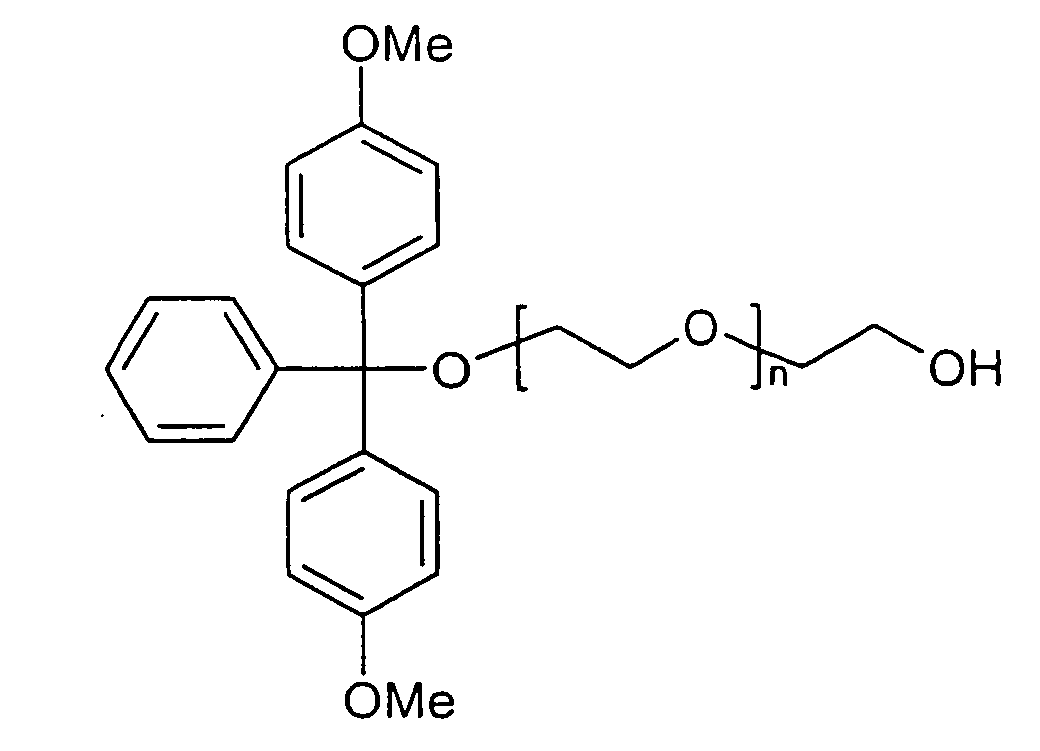
21 g PEG1500 (14 mmol) werden zur Trocknung zweimal in je 30 ml absolutem Pyridin gelöst,
das anschließend azeotrop abdestilliert wird. Das getrocknete Edukt wird in 35 ml absolutem
Pyridin gelöst. Zu dieser Lösung werden über einen Zeitraum von 30 min 4,7 g in 35 ml
absolutem Pyridin gelöstes 4,4'-Dimethoxytritylchlorid (13,9 mmol) zugetropft. Es wird
weitere 2 h bei RT gerührt und dabei der Reaktionsverlauf mittels Dünnschichtchromatographie
(DC) kontrolliert. Neben des Nachweises der DMT-Gruppe mittels UV-Lampe
können die DC-Platten in zwei Schritten entwickelt werden: 1. in HCl-gesättigter Atmosphäre
zum Nachweis von DMT; 2. in der lodkammer zum Nachweis von PEG; PEG kann
außerdem mit dem Dragendorff-Bürger-Sprühreagenz nachgewiesen werden. Nach
Beendigung der Reaktion wird das Lösungsmittel entfernt und das Produkt in 50 ml DCM
aufgenommen. Die organische Phase wird zweimal mit je 25 ml 5 % NaHCO3-Lösung sowie
zweimal mit je 25 ml H2O gewaschen. Die Phasentrennung zwischen wässriger und
organischer Phase ist dabei langwierig, da PEG sowohl hydrophoben als auch hydrophilen
Charakter besitzt. Nach dem Trocknen über Na2SO4 wird das Lösungsmittel entfernt und das
Rohprodukt säulenchromatographisch über Kieselgel mit DCM/MeOH/TEA = 18:2:0,5
gereinigt. Die produkthaltigen Fraktionen werden mittels DC identifiziert, vereinigt und zur
Trockne eingeengt. Man erhält ein gelbliches Öl, das nach dem Trocknen im Hochvakuum
zu einem wachsartigen Feststoff wird.
Ausbeute: 18,3 g (72,5 % der Theorie)
DC (DCM/MeOH/TEA = 18:2:0,5): Rf-Wert 0,55 (durch die Molmassenverteilung von PEG
verbreitertes Signal)21 g of PEG 1500 (14 mmol) are dissolved twice for drying in 30 ml of absolute pyridine, which is then distilled off azeotropically. The dried educt is dissolved in 35 ml of absolute pyridine. 4.7 g of 4,4'-dimethoxytrityl chloride (13.9 mmol) dissolved in 35 ml of absolute pyridine are added dropwise to this solution over a period of 30 minutes. The mixture is stirred for a further 2 h at RT and the reaction is monitored by thin-layer chromatography (TLC). In addition to the detection of the DMT group by UV lamp, the TLC plates can be developed in two steps: 1. in HCl-saturated atmosphere for the detection of DMT; 2. in the iodine chamber for the detection of PEG; PEG can also be detected with the Dragendorff Citizen Spray Reagent. After completion of the reaction, the solvent is removed and the product taken up in 50 ml of DCM. The organic phase is washed twice with 25 ml of 5% NaHCO 3 solution and twice with 25 ml H 2 O each time. The phase separation between aqueous and organic phase is tedious, since PEG has both hydrophobic and hydrophilic character. After drying over Na 2 SO 4 , the solvent is removed and the crude product is purified by column chromatography on silica gel with DCM / MeOH / TEA = 18: 2: 0.5. The product-containing fractions are identified by TLC, combined and concentrated to dryness. A yellowish oil is obtained which, after drying in a high vacuum, becomes a waxy solid.
Yield: 18.3 g (72.5% of theory)
TLC (DCM / MeOH / TEA = 18: 2: 0.5): R f value 0.55 (signal broadened by the molecular weight distribution of PEG)
10 g Hexaethylenglykol (HEG; 35 mmol) werden durch Coevaporation mit zweimal je 30 ml
absolutem Pyridin getrocknet und anschließend in 20 ml absolutem Pyridin gelöst. Analog
zur Vorschrift für DMT-PEG1500 wird das HEG mit 10 g in 50 ml absolutem Piridin gelöstem
DMT-Cl (29,5 mmol) umgesetzt. Die säulenchromatigraphische Aufreinigung erfolgt mit
Ethylacetat /TEA = 95:5. Als getrocknetes Produkt erhält man ein zähes gelbes Öl.
Ausbeute: 12,5 g (60,5 % der Theorie)
DC (DCM/MeOH = 95,5): Rf-Wert = 0,59
MS (FD): m/z 583,9 (M+)
1H-NMR (CDCl3): δ 3,21 (t, DMT-OCH2), 3,47-3,68 (m, -CH2-), 3,76 (s, -CH3), 6,77-7,46 (m,
Aromaten)10 g of hexaethylene glycol (HEG, 35 mmol) are dried by coevaporation with twice 30 ml of absolute pyridine and then dissolved in 20 ml of absolute pyridine. Analogously to the protocol for DMT-PEG 1500 , the HEG is reacted with 10 g of DMT-Cl dissolved in 50 ml of absolute pyridine (29.5 mmol). The column-chromatographic purification is carried out with ethyl acetate / TEA = 95: 5. The dried product gives a tough yellow oil. Yield: 12.5 g (60.5% of theory)
TLC (DCM / MeOH = 95.5): R f = 0.59
MS (FD): m / z 583.9 (M + )
1 H-NMR (CDCl 3 ): δ 3.21 (t, DMT-OCH 2 ), 3.47-3.68 (m, -CH 2 -), 3.76 (s, -CH 3 ), 6 , 77-7.46 (m, aromatics)
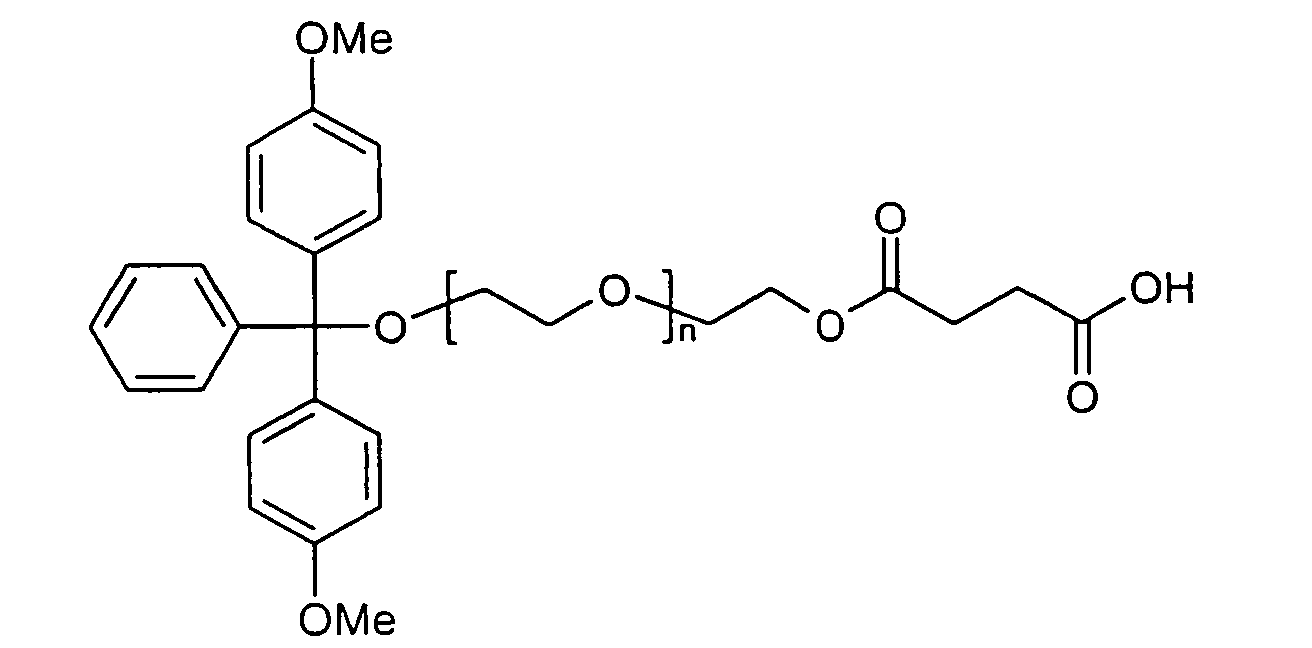
Nachstehende Arbeitsvorschrift ist sowohl für DMT-PEG1500 als auch für DMT-HEG anwendbar.The following procedure is applicable to both DMT-PEG 1500 and DMT-HEG.
5 g DMT-PEG1500 (2,8 mmol) werden in 25 ml DCM/Pyridin = 5:1 gelöst und mit 420 mg in 7 ml Pyridin gelöstem Bernsteinsäureanhydrid (4,2 mmol, d.h. 1,5 eq) sowie mit 170 mg in 3 ml Pyridin gelöstem Dimethylaminopyridin (DMAP) (1,4 mmol, d.h. 0,6 eq) versetzt. Nach 12 h Rühren bei RT werden die Lösungsmittel im Vakuum abgezogen und der Rückstand in DCM aufgenommen. Die organische Phase wird gründlich dreimal mit NaHCO3-Lösung (10 % in H2O) und zweimal mit gesättigter wässriger NaCl-Lösung gewaschen, um die überschüssige Bernsteinsäure abzutrennen. Nach dem Trocknen über Na2SO4 wird das Lösungsmittel entfernt. Die Succinate können nach gründlicher Trocknung am Hochvakuum ohne weitere Aufarbeitung zur Kopplung auf aminomodifizierte Trägermaterialien eingesetzt werden.5 g DMT-PEG 1500 (2.8 mmol) are dissolved in 25 ml DCM / pyridine = 5: 1 and treated with 420 mg succinic anhydride dissolved in 7 ml pyridine (4.2 mmol, ie 1.5 eq) and with 170 mg in 3 ml of pyridine dissolved dimethylaminopyridine (DMAP) (1.4 mmol, ie 0.6 eq). After 12 h stirring at RT, the solvents are removed in vacuo and the residue taken up in DCM. The organic phase is washed thoroughly three times with NaHCO 3 solution (10% in H 2 O) and twice with saturated aqueous NaCl solution to separate off the excess succinic acid. After drying over Na 2 SO 4 , the solvent is removed. The succinates can be used after thorough drying in a high vacuum without further workup for coupling to amino-modified support materials.
Beladung von PS-PEG Trägermaterial mit DMT-PEG1500SucLoading of PS-PEG Support Material with DMT-PEG 1500 Suc
Bei der Beladung von PS-PEG Trägermaterial mit DMT-PEG1500-Suc wird mit Überschüssen gearbeitet. Die Beladung kann über die eingesetzte Menge Succinat gesteuert werden. Nachstehend ein Beispielprotokoll für die Derivatisierung von Tentagel® mit DMT-PEG1500.When loading PS-PEG support material with DMT-PEG 1500 -Suc is worked with surpluses. The loading can be controlled by the amount of succinate used. Below is an example protocol for the derivatization of Tentagel® with DMT-PEG 1500 .
Man lässt 3 g Tentagel (0,25 mmol/g) in 20 ml DCM quellen. 1,5 mmol DMT-PEG1500-Suc (2,85 g) werden in 15 ml DCM gelöst und zum Harz gegeben. 468 mg O-(Benzotriazol-1-yl)-N,N,N',N'-tetramethyluroniumtetrafluorborat (TBTU) (1,5 mmol) werden in ca. 7 ml DMF gelöst und ebenso wie 330 µl N-Methylmorpholin (NMM) (3 mmol) zum Reakktionsgemisch gegeben. Die Mischung wird lichtgeschützt 12 h geschüttelt. Anschließend wird das Herz abfiltriert und gründlich mit DMF, DCM und Methanol gewaschen und im Vakuum getrocknet. Nicht umgesetzte Aminofunktionen auf dem Harz können sowohl manuell als auch am DNA-Synthesizer acetyliert werden. Die Vollständigkeit der Kopplung kann mit einem Kaisertest überprüft werden. Die Beladung kann spektrometrisch über DMT-Abspaltung bestimmt werden. Es ergibt sich eine Beladung von 75 µmol/g.3 g of Tentagel (0.25 mmol / g) are swollen in 20 ml DCM. 1.5 mmol DMT-PEG 1500 -Suc (2.85 g) are dissolved in 15 ml DCM and added to the resin. 468 mg of O- (benzotriazol-1-yl) -N, N, N ', N'-tetramethyluronium tetrafluoroborate (TBTU) (1.5 mmol) are dissolved in about 7 ml of DMF and, similarly, 330 μl of N-methylmorpholine (NMM ) (3 mmol) was added to the reaction mixture. The mixture is shaken light protected for 12 h. The heart is then filtered off and washed thoroughly with DMF, DCM and methanol and dried in vacuo. Unreacted amino functions on the resin can be acetylated both manually and on the DNA synthesizer. The completeness of the coupling can be checked with a Kaiser test. The loading can be determined spectrometrically via DMT cleavage. This results in a loading of 75 .mu.mol / g.
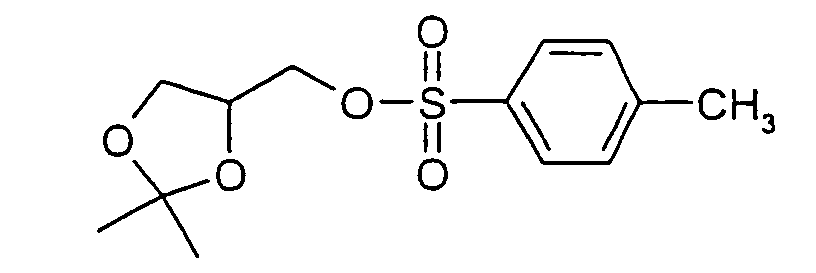
200 mmol Isopropylidenglycerol (26,4 g) werden in 200 ml Acetonitril gelöst und mit 22,2 g
Triethylamin (220 mmol) versetzt. 220 mmol p-Toluolsulfonsäurechlorid (41,9 g) werden in
250 ml Acetonitril gelöst und unter Rühren über 2 h zum Reaktionsgemisch zugetropft. Man
lässt weitere 20 h bei RT rühren, wobei ein weißer Niederschlag ausfällt, welcher nach
Beendigung der Reaktion abfiltriert wird. Das Lösungsmittel wird entfernt und das
Rohprodukt über Kieselgel säurenchromatographisch mit n-Hexan/Ethylacetat = 2:1
aufgereinigt. Die produkthaltigen Fraktionen werden mittels DC identifiziert, vereinigt und zur
Trockne eingeengt. Das Produkt wird am Hochvakuum getrocknet. Es resultiert ein
gelbliches Öl.
Ausbeute: 31,3 g (54,7 % der Theorie)
DC (n-Hexan/Ethylacetat = 2:1): Rf-Wert = 0,2
MS (FD): m/z 272,0 (M+-CH) (286,3 berechnet)
1H-NMR (CDCl3): δ 1,31 (s); 1,34 (s); 2,45 (s); 3,74-3,79 (m); 3,90-4,08 (m); 4,23-4,32 (m);
7,36 (d); 7,77 (d)
13C-NMR: δ 21,7; 25,2; 26,7 (Methyl-C); 66,2; 69,5; 72,9 (Glycerin-C); 110,1 (Methylen-C);
128,0; 129,9; 132,7; 145,1 (Aromaten-C)200 mmol of isopropylideneglycerol (26.4 g) are dissolved in 200 ml of acetonitrile and treated with 22.2 g of triethylamine (220 mmol). 220 mmol of p-toluenesulfonyl chloride (41.9 g) are dissolved in 250 ml of acetonitrile and added dropwise with stirring over 2 h to the reaction mixture. The mixture is stirred for a further 20 h at RT, wherein a white precipitate precipitates, which is filtered off after completion of the reaction. The solvent is removed and the crude product is purified by silica gel chromatography using n-hexane / ethyl acetate = 2: 1. The product-containing fractions are identified by TLC, combined and concentrated to dryness. The product is dried under high vacuum. The result is a yellowish oil.
Yield: 31.3 g (54.7% of theory)
TLC (n-hexane / ethyl acetate = 2: 1): R f = 0.2
MS (FD): m / z 272.0 (M + -CH) (286.3 calculated)
1 H-NMR (CDCl3): δ 1.31 (s); 1.34 (s); 2.45 (s); 3.74-3.79 (m); 3.90-4.08 (m); 4.23-4.32 (m); 7,36 (d); 7.77 (d)
13 C-NMR: δ 21.7; 25.2; 26.7 (methyl-C); 66.2; 69.5; 72.9 (glycerol-C); 110.1 (methylene-C); 128.0; 129.9; 132.7; 145.1 (aromatic C)

Zu 56 mmol D,L-α-Tocopherol (24,06 g) in 280 ml DMSO werden 5,6 g pulverisiertes
Kaliumhydroxid (100 mmol) zugegeben. Nach 2 h Rühren bei RT unter Lichtausschluss
werden 56 mmol in 20 ml DMSO gelöstes 1-Tosyl-2,3-isopropylidenglycerol (16 g) zugetropft
und weitere 12 h bei 60 °C gerührt. Danach wird das Reaktionsgemisch auf 1 I Eiswasser
hydrolysiert und die wässrige Phase mit 1,5 I Toluol extrahiert. Nachdem über Natriumsulfat
getrocknet wurde, wird das Lösungsmittel entfernt. Das Rohprodukt wird über Kieselgel
säulenchromatographisch mit n-Hexan/Ethylacetat = 1:1 aufgereinigt. Die produkthaltigen
Fraktionen werden mittels DC identifiziert, vereinigt und zur Trockne eingeengt. Das Produkt
wird im Hochvakuum getrocknet und unter Lichtausschluss aufbewahrt. Es resultiert ein
gelbliches Öl.
Ausbeute: 24,2 g (79,2 % der Theorie)
DC (n-Hexan/Etzylacetat = 1:1 ): Rf-Wert = 0,69
MS (FD): m/z 544,6 (M+)To 56 mmol of D, L-α-tocopherol (24.06 g) in 280 ml of DMSO is added 5.6 g of powdered potassium hydroxide (100 mmol). After stirring for 2 h at RT under exclusion of light, 56 mmol of 1-tosyl-2,3-isopropylideneglycerol (16 g) dissolved in 20 ml of DMSO are added dropwise and the mixture is stirred at 60 ° C. for a further 12 h. Thereafter, the reaction mixture is hydrolyzed to 1 l of ice water and the aqueous phase extracted with 1.5 l of toluene. After drying over sodium sulfate, the solvent is removed. The crude product is purified by silica gel column chromatography with n-hexane / ethyl acetate = 1: 1. The product-containing fractions are identified by TLC, combined and concentrated to dryness. The product is dried in a high vacuum and stored under exclusion of light. The result is a yellowish oil.
Yield: 24.2 g (79.2% of theory)
TLC (n-hexane / ethyl acetate = 1: 1): R f = 0.69
MS (FD): m / z 544.6 (M + )

16,9 mmol Toc1 (9,2 g) werden in 100 ml HCl(2 M)/THF (1: 1) gelöst und 2 h bei RT unter
Lichtausschluss gerührt. Anschließend wird das Lösungsmittel entfernt, der Rückstand
zweimal mit je 650 ml absolutem Ethanol versetzt und das Gemisch wieder zur Trockne
eingeengt. Das Rohprodukt wird mit Diethylether/Toluol = 1:1 über Kieselgel
säulenchromatographisch aufgerein9gt. Die produkthaltigen Fraktionen werden mit DC
identifiziert, vereinigt und zur Trockne eingeengt. Das Produkt wird am Hochvakuum
getrocknet und unter Lichtausschluss aufbewahrt. Es resultiert ein gelbes Öl.
Ausbeute: 6,6 g (77,5 % der Theorie)
DC (Diethylether/Toluol = 1:1): Rf-Wert = 0,22
MS (FD): m/z 504,4 (M+)16.9 mmol Toc1 (9.2 g) are dissolved in 100 ml HCl (2 M) / THF (1: 1) and stirred for 2 h at RT with exclusion of light. Subsequently, the solvent is removed, the residue is added twice with 650 ml of absolute ethanol and the mixture is evaporated again to dryness. The crude product is purified by column chromatography on silica gel with diethyl ether / toluene = 1: 1. The product-containing fractions are identified by TLC, combined and concentrated to dryness. The product is dried under high vacuum and stored in the dark. This results in a yellow oil. Yield: 6.6 g (77.5% of theory)
TLC (diethyl ether / toluene = 1: 1): R f = 0.22
MS (FD): m / z 504.4 (M + )
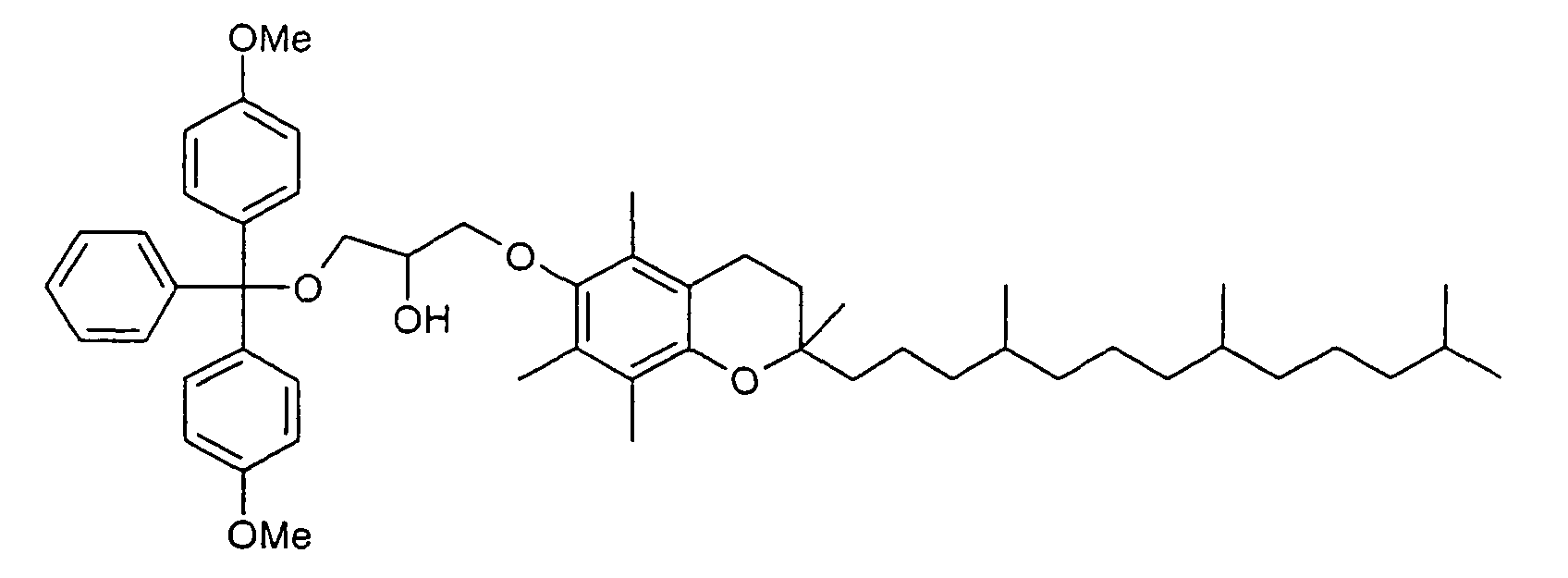
6,6 g Toc2 (13 mmol) werden zum Trocknen zweimal in 16 ml absolutem Pyridin gelöst, das
wieder azeotrop abdestilliert wird. Das getrocknete Edukt wird in 60 ml absolutem Pyridin
gelöst und mit 5,34 g DMT-Cl (15,8 mmol) versetzt. Nach 12 h Rühren bei RT unter
Lichtausschluss wird die Reaktion durch die Zugabe von 50 ml Methanol beendet und das
Reaktionsgemisch zur Trockne eingeengt. Der Rückstand wird in 500 ml Dichlormethan
aufgenommen und zweimal mit je 150 ml wässriger, gesättigter NaCl-Lösung und
anschließend einmal mit 150 ml Wasser gewaschen. Nachdem über Na2SO4 getrocknet
wurde, wird das Lösungsmittel entfernt und der Rückstand säurenchromatographisch über
Kieselgel gereinigt (n-Hexan/Diethylether/Triethylamin = 40:60:1). Die produkthaltigen
Fraktionen werden mittels DC identifiziert, vereinigt und zur Trockne eingeengt. Das Produkt
wird am Hochvakuum getrocknet. Es resultiert ein gelbliches Öl, das unter Lichtausschluss
aufbewahrt wird.
Ausbeute: 8,5 g (81 % der Theorie)
DC (n-Hexan/Diethylether/TEA = 40:60: 1): Rf-Wert = 0,43
MS (FD): m/z 807,2 6.6 g of Toc 2 (13 mmol) are dissolved twice in 16 ml of absolute pyridine for drying, which is again distilled off azeotropically. The dried educt is dissolved in 60 ml of absolute pyridine and treated with 5.34 g of DMT-Cl (15.8 mmol). After 12 h stirring at RT under exclusion of light, the reaction is terminated by the addition of 50 ml of methanol and the reaction mixture was concentrated to dryness. The residue is taken up in 500 ml of dichloromethane and washed twice with 150 ml of aqueous, saturated NaCl solution and then once with 150 ml of water. After drying over Na 2 SO 4 , the solvent is removed and the residue is purified by column chromatography on silica gel (n-hexane / diethyl ether / triethylamine = 40: 60: 1). The product-containing fractions are identified by TLC, combined and concentrated to dryness. The product is dried under high vacuum. The result is a yellowish oil, which is stored under the exclusion of light.
Yield: 8.5 g (81% of theory)
TLC (n-hexane / diethyl ether / TEA = 40: 60: 1): R f = 0.43
MS (FD): m / z 807.2
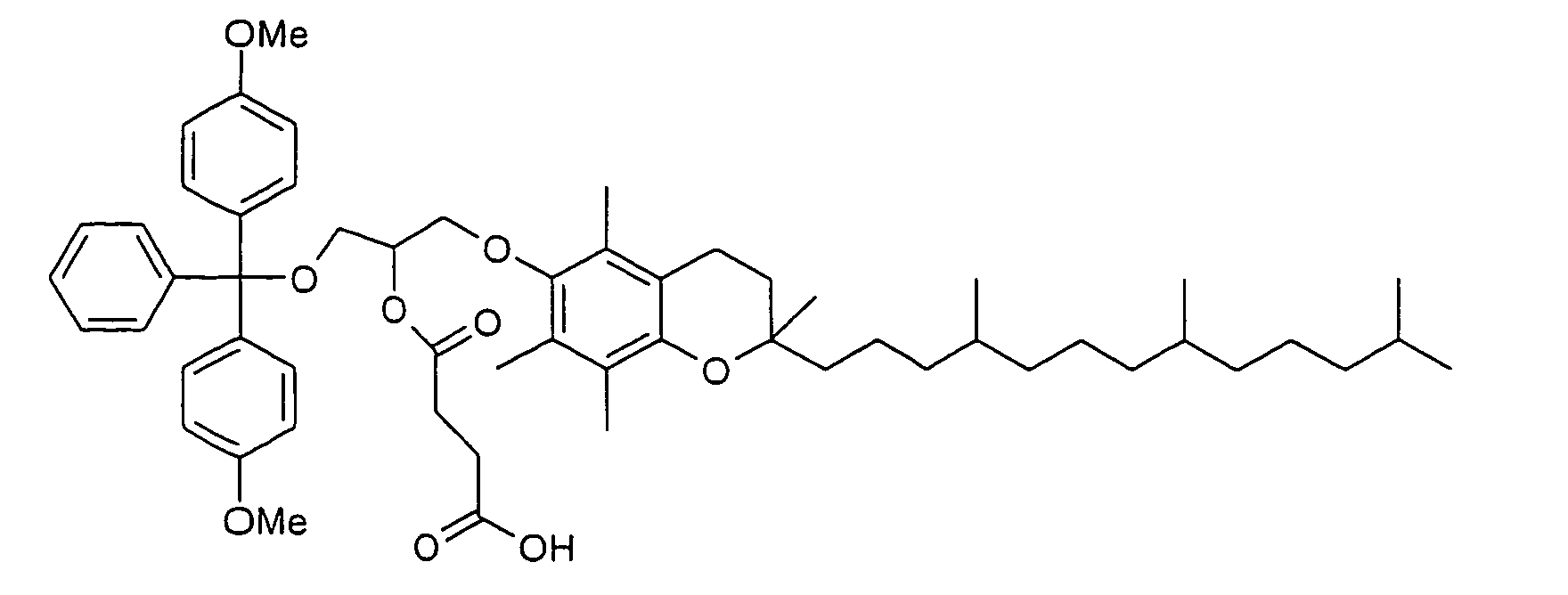
1,45 g Toc3 (1,8 mmol) werden zur Trocknung zweimal in je 6 ml absolutem Pyridin gelöst,
das azeotrop wieder abdestilliert wird. Nachdem das Edukt in 8 ml absolutem Pyridin gelöst
wurde, gibt man im Argongegenstrom 140 mg DMAP (1,08 mmol) und 194,4 mg
Bernsteinsäureanhydrid (1,8 mmol) zu. Anschließend wird 18 h unter Lichtausschluss bei RT
gerührt. Zur Aufarbeitung wird die Reaktionslösung mit 45 ml DCM versetzt und viermal mit
je 60 ml Wasser gewaschen. Nach Trocknung über Natriumsulfat wird das Lösungsmittel
entfernt und das Rohprodukt säurenchromatographisch über Kieselgel mit
Ethylacetat/Methanol/NH3 (25 % in H2O) = 5:1:1 gereinigt. Die produkthaltigen Fraktionen
werden mittels DC identifiziert, vereinigt und zur Trockne eingeengt. Nach Trocknung im
Hochvakuum resultiert ein bräunliches, zähes Öl, das gekühlt und unter Lichtausschluss
aufbewahrt wird.
Ausbeute: 1,35 g (82,8 % der Theorie)
DC (EtOAc/NH3/MeOH = 5:1:1): Rf-Wert = 0,30
MS (FD): m/z 906,2 (M+), 604,2 (M+-DMT)1.45 g of Toc3 (1.8 mmol) are dissolved twice in 6 ml of absolute absolute pyridine for drying, which is distilled off again azeotropically. After the starting material was dissolved in 8 ml of absolute pyridine, 140 mg of DMAP (1.08 mmol) and 194.4 mg of succinic anhydride (1.8 mmol) are added in an argon countercurrent. The mixture is then stirred at RT for 18 h, with exclusion of light. For working up, the reaction solution is mixed with 45 ml of DCM and washed four times with 60 ml of water each time. After drying over sodium sulfate, the solvent is removed and the crude product is purified by column chromatography on silica gel with ethyl acetate / methanol / NH 3 (25% in H 2 O) = 5: 1: 1. The product-containing fractions are identified by TLC, combined and concentrated to dryness. Drying under high vacuum results in a brownish, viscous oil, which is cooled and stored under exclusion of light.
Yield: 1.35 g (82.8% of theory)
TLC (EtOAc / NH 3 / MeOH = 5: 1: 1): R f = 0.30
MS (FD): m / z 906.2 (M + ), 604.2 (M + -DMT)
Beladung von PS-PEG Trägermaterial mit Toc4Loading of PS-PEG carrier material with Toc4
Zur Durchführung einer large scale Synthese ist eine möglichst hohe Beladung (100 µmol) mit der Ankerverbindung wünschenswert, weshalb mit größeren Mengen Succinat gearbeitet wird als üblich.To carry out a large-scale synthesis, the highest possible loading (100 μmol) with the anchor compound is desirable, which is why larger quantities of succinate are used than usual.
Man lässt 1,7 g Tentagel® (0,25 mmol/g) in 15 ml DCM quellen. 310 mg in 10 ml DCM gelöstes Toc4 (341 µmol) werden zum Harz gegeben. 106 mg TBTU werden in ca. 5 ml DMF gelöst und ebenso wie 37 µl NMM zum Reaktionsgemisch gegeben. Die Mischung wird lichtgeschützt 12 h geschüttelt. Anschließend wird das Harz abfiltriert und gründlich mit DMF, DCM und Methanol gewaschen und im Vakuum getrocknet. Um nicht umgesetzte Aminofunktionen zu blockieren, wird ein Capping-Schritt mit je 10 ml der beiden kommerziell erhältlichen Capping-Lösungen (Cap A: Acetanhydrid in THF/Pyridin; Cap B: N-Methylimidazol in THF) durchgeführt (15 min Schütteln). Es wird erneut gewaschen.1.7 g Tentagel® (0.25 mmol / g) are swollen in 15 ml DCM. 310 mg in 10 ml DCM dissolved Toc4 (341 μmol) are added to the resin. 106 mg of TBTU are dissolved in about 5 ml of DMF dissolved and added to the reaction mixture as well as 37 .mu.l of NMM. The mixture will protected against light, shaken for 12 h. The resin is then filtered off and washed thoroughly with DMF, DCM and methanol and dried in vacuo. To unreacted To block amino functions, a capping step with 10 ml each of the two is commercial available capping solutions (Cap A: acetic anhydride in THF / pyridine; Cap B: N-methylimidazole in THF) (shaking for 15 min). It is washed again.
Die Beladung wird wie beschrieben über DMT-Abspaltung bestimmt. Es ergibt sich eine Beladung von 138 µmol/g.The loading is determined as described via DMT cleavage. It results in a Loading of 138 μmol / g.

5 g D, L-α-Tocopherol (11,6 mmol) werden zweimal mit je 25 ml Pyridin versetzt und durch
azeotropes Schleppen getrocknet. Das Edukt wird in 40 ml DCMabs gelöst. Im
Argongegenstrom werden 7,9 ml DIPEAabs (46,4 mmol) und 2,5 ml 2-Cyanoethyl-N,N-diisopropylphosphinchlorid
(11 mmol) langsam zugetropft. Nachdem das Reaktionsgemisch
1 h bei RT unter Lichtausschluss gerührt hat, wird es mit 100 ml Ethylacetat/TEA (20:1)
verdünnt und zweimal mit 25 ml 10 % NaHCO3 sowie zweimal mit gesättigter NaCl-Lösung
gewaschen. Anschließend wird die organische Phase über Na2SO4 getrocknet und das
Lösungsmittel am Vakuum entfernt. Das Rohprodukt wird über Kieselgel
säulenchromatographisch mit Ethylacetat gereinigt.
Ausbeute: 5,62 g (81 % der Theorie)
DC (EtOAc): Rf-Wert = 0,75
MS (FD): m/z 630,1 (M+)
31p-NMR: δ 152,245 g of D, L-α-tocopherol (11.6 mmol) are added twice with 25 ml of pyridine and dried by azeotropic towing. The educt is dissolved in 40 ml DCM abs . In the argon countercurrent, 7.9 ml of DIPEA abs (46.4 mmol) and 2.5 ml of 2-cyanoethyl-N, N-diisopropylphosphinchlorid (11 mmol) are slowly added dropwise. After the reaction mixture has been stirred at RT under exclusion of light for 1 h, it is diluted with 100 ml of ethyl acetate / TEA (20: 1) and washed twice with 25 ml of 10% NaHCO 3 and twice with saturated NaCl solution. Subsequently, the organic phase is dried over Na 2 SO 4 and the solvent removed in vacuo. The crude product is purified by silica gel chromatography on a column of ethyl acetate.
Yield: 5.62 g (81% of theory)
TLC (EtOAc): R f = 0.75
MS (FD): m / z 630.1 (M + )
31 P NMR: δ 152.24

1 g Toc3 (1,24 mmol) wird zur Trocknung zweimal in je 10 ml absolutem Pyridin gelöst, das
azeotrop wieder abdestilliert wird. Anschließend löst man das Edukt in 20 ml DCMabs und
tropft im Argongegenstrom 0,84 ml DIPEAabs (4,96 mmol) zu. Danach werden 0,27 ml 2-Cyanoethyl-N,N-diisopropylphosphinchlorid
(1,19 mmol) im Argongegenstrom langsam
zugetropft. Man lässt das Reaktionsgemisch 1 h bei RT rühren, bevor die Lösung mit 50 ml
Ethylacetat/TEA (20:1) verdünnt wird. Die organische Phase wird zweimal mit 15 ml einer 10
%igen NaHCO3-Lösung und zweimal mit einer gesättigten NaCl-Lösung gewaschen und
anschließend über Na2SO4 getrocknet. Das Lösungsmittel wird entfernt und das Rohprodukt
säulenchromatographisch über Kieselgel mit Ethylacetat/TEA (99:1) gereinigt. Die
produkthaltigen Fraktionen werden mittels DC identifiziert, vereinigt und zur Trockne
eingeengt. Nach Trocknung im Hochvakuum resultiert ein gelbbräunliches, sehr zähes Öl,
das gekühlt und unter Lichtausschluss aufbewahrt wird.
Ausbeute: 0,76 g (63,4 % der Theorie)
DC (EtOAc, 1 % TEA): Rf-Wert = 0,68
MS (FD): m/z 1006,4 (M+), 953,6 (M+-Cyanoethyl) 651,4 (M+-DMT, -Cyanoethyl), 603,1 (M+-DMT,
-diisopropylamin), 303,1 (DMT+)
31 P-NMR: 8 150,51 g Toc3 (1.24 mmol) is dissolved to dry twice in 10 ml of absolute pyridine, which is distilled off again azeotropically. Subsequently, the starting material is dissolved in 20 ml of DCM abs and added dropwise in an argon countercurrent 0.84 ml of DIPEA abs (4.96 mmol). Thereafter, 0.27 ml of 2-cyanoethyl-N, N-diisopropylphosphinchlorid (1.19 mmol) are slowly added dropwise in argon countercurrent. The reaction mixture is allowed to stir at RT for 1 h before the solution is diluted with 50 ml of ethyl acetate / TEA (20: 1). The organic phase is washed twice with 15 ml of a 10% NaHCO 3 solution and twice with a saturated NaCl solution and then dried over Na 2 SO 4 . The solvent is removed and the crude product is purified by column chromatography on silica gel with ethyl acetate / TEA (99: 1). The product-containing fractions are identified by TLC, combined and concentrated to dryness. Drying in a high vacuum results in a yellowish-brown, very viscous oil, which is cooled and stored under exclusion of light.
Yield: 0.76 g (63.4% of theory)
TLC (EtOAc, 1% TEA): R f = 0.68
MS (FD): m / z 1006.4 (M + ), 953.6 (M + -cyanoethyl) 651.4 (M + -DMT, -cyanoethyl), 603.1 (M + -DMT, -diisopropylamine) , 303.1 (DMT + )
31 P NMR: 8 150.5
Das resultierende Tocopherol-modifizierte Phosphoramidit wird dann im Rahmen der Festphasensynthese an das bereits synthetisierte, aber noch an das Trägermaterial gebundene Oligonukleotid angekoppelt.The resulting tocopherol-modified phosphoramidite is then used in the context of Solid phase synthesis of the already synthesized, but still on the support material coupled oligonucleotide coupled.
Auf diese Art und Weise wurden folgende Oligonukleotide synthetisiert:



Weiterhin konnte gezeigt werden, dass trotz der hoch effektiven Proliferationshemmung humaner Pankreastumorzellen durch MON1 nichtmaligne Zellen wie humane Fibroblasten in ihrem Wachstum im Wesentlichen nicht beeinflusst wurden.Furthermore, it could be shown that despite the highly effective proliferation inhibition of human pancreatic tumor cells by MON1 non-malignant cells such as human fibroblasts in Their growth was essentially unaffected.
Als humane Pankreastumorzellen wurden vor allem Panc-Tu-I-, Panc-Tu-II-, A818-4 und HPAF-Zelllinien verwendet. Die Aufnahme der modifizierten ODN durch die Zellen wurde mit konfokaler Lasermikroskopie bestimmt.As human pancreatic tumor cells, mainly Panc-Tu-I, Panc-Tu-II, A818-4 and HPAF cell lines used. The uptake of the modified ODN by the cells was with confocal laser microscopy.
Zellsuspensionen (7 x 10⁴ Zellen ml-1) wurden in jede Kavität einer Mikrotiterplatte mit 96 Kavitäten (Nunc, Wiesbaden) gegeben. Nach 24 Stunden wurde das Medium gewechselt und die Zellkulturen (mit der jeweiligen ODN-Behandlung MON1, MON2 oder MON3 und die Kontrollen ohne Behandlung) wurden in 100 µl Ansätzen mit 10 µl Medium, das 7.4 kBq Methyl-3H-Thymidin (Amersham, Braunschweig) enthielt, während der letzten 3 Stunden der angegebenen Inkubationszeiten markiert. Anschließend wurden die Zellen geerntet und die Radioaktivität mit einem Flüssig-Szintillationszähler gemessen.Cell suspensions (7 x 10 4 cells ml -1 ) were added to each well of a 96-well microtiter plate (Nunc, Wiesbaden). After 24 hours, the medium was changed and the cell cultures (with the respective ODN treatment MON1, MON2 or MON3 and controls without treatment) were incubated in 100 μl batches with 10 μl medium containing 7.4 kBq of methyl 3 H-thymidine (Amersham, Braunschweig) during the last 3 hours of the indicated incubation times. Subsequently, the cells were harvested and the radioactivity was measured with a liquid scintillation counter.
Es wurden weibliche SCID Mäuse verwendet, die nicht älter als acht Wochen waren. Den
Tieren wurden nach Laparotomie in Narkose 1 x 10⁶ PancTu-1 Zellen in das Pankreas
injiziert. Die Mäuse wurden in fünf Behandlungsgruppen sowie eine Kontrollgruppe zu je
sechs Tieren eingeteilt. Den Mäusen der Kontrollgruppe wurde ab dem 7. Tag täglich 500 µl
PBS intraperitoneal injiziert, den Mäusen der Behandlungsgruppen MON1 in verschiedenen
Dosierungen und Intervallen: Behandlungsgruppe 1 wurde in Intervall A (abwechselnd drei
Tage Behandlung und drei Tage Pause) mit 6 mg/kg Körpergewicht intraperitoneal
behandelt, Behandlungsgruppe 2 mit gleicher Dosierung in Intervall B (6 Tage Behandlung,
12 Tage Pause im Wechsel). Behandlungsgruppe 3 erhielt die gleiche kumulative Dosis wie
die Behandlungsgruppen 1 und 2 (72 mg/kg Körpergewicht), allerdings durch tägliche
Applikation von 3 mg/kg Körpergewicht intraperitoneal. Behandlungsgruppe 4 wurde
ebenfalls mit 3 mg/kg Körpergewicht behandelt, jedoch in Intervall A mit einer kumulativen
Dosis von 36 mg/kg Körpergewicht. Behandlungsgruppe 5 wurde mit einer täglichen Dosis
von 1 mg/kg Körpergewicht und einer kumulativen Dosis von 24 mg/kg Körpergewicht
behandelt. Alle Gruppen wurden über einen Zeitraum von 24 Tagen behandelt.Female SCID mice were used which were not older than eight weeks. After laparotomy, the animals were injected with 1 × 10 6 PancTu-1 cells into the pancreas under anesthesia. The mice were divided into five treatment groups and a control group of six animals each. The mice of the control group were injected intraperitoneally with 500 μl PBS daily from the 7th day to the mice of the treatment groups MON1 at different dosages and intervals:
Die Mäuse wurden nach 24 Tagen getötet. Die Pankreastumoren wurden gewogen und vermessen, um das Volumen nach der Formel Π/6x Höhe x Länge x Breite zu berechnen. Auch das Gewicht des gesamten Tumorgewebes wurde bestimmt. Leber, Lungen, Omentum und Milz wurden entnommen, um typische Metastasierungswege zu erfassen. Aus der Differenz zwischen den Gewichten der entnommenen Pankreastumoren und den Gewichten des gesamten Tumorgewebes ist ersichtlich, dass das verwendete Tiermodell nicht nur auf einem Primärtumor basierte, sondern durchaus auch Metastasen im Bauchraum auftraten.The mice were killed after 24 days. The pancreatic tumors were weighed and measure to calculate the volume according to the formula Π / 6x height x length x width. The weight of the entire tumor tissue was also determined. Liver, lungs, omentum and spleens were removed to detect typical metastasis pathways. From the Difference between the weights of the removed pancreatic tumors and the weights of the entire tumor tissue, it can be seen that the animal model used is not limited to a primary tumor based, but also metastasized in the abdomen.
Die proliferationshemmende Wirkung des Oligonukleotids MON1 war der proliferationshemmenden
Wirkung der Oligonukleotide MON2 und MON3 deutlich überlegen. Dies zeigte
sich sowohl im 3H-Proliferations-Assay (Figur 1). Ferner war zu beobachten, dass die
Wirkung zeit- und dosisabhängig war. Mit MON 1 war auch bei der geringeren Dosierung von
2,5 µM bereits nach 24 Stunden eine deutliche Proliferationshemmung auf ca. 25 % relativ
zur unbehandelten Kontrolle zu beobachten. Betrug die Dosis 5 µM ging das Wachstum der
humanen Pankreastumorzellen Panc-Tu-I im Vergleich zur unbehandelten Kontrolle auf ca. 4
% zurück. Die Oligonukleotide MON2 und MON3 zeigten eine deutlich weniger stark
ausgeprägte Wachstumshemmung. Die stark proliferationshemmende Wirkung des
Oligonukleotids MON1 konnte nicht nur an Zellen der Panc-Tu1-Zelllinie, sondern auch an
weiteren Pankreaskarzinom-Zelllinien (Capan1; Colo357; A818-4) unter den vorstehend
beschriebenen Bedingungen beobachtet werden (Figur 2).The antiproliferative activity of the oligonucleotide MON1 was clearly superior to the proliferation-inhibiting effect of the oligonucleotides MON2 and MON3. This was evident in both the 3 H proliferation assay (FIG. 1). It was also observed that the effect was time- and dose-dependent. With
Die Primärtumoren der behandelten Mäuse wogen nach 24 Tagen Therapie zwischen 59 % und 64 % des durchschnittlichen Primärtumorgewichts der unbehandelten Mäuse. Lediglich bei Behandlungsgruppe 5 (kontinuierlich 1 mg/kg Körpergewicht MON1) konnte keine Veränderung im Vergleich zur Kontrollgruppe festgestellt werden. Die besten Resultate zeigten die Behandlungsgruppen 1 (6 mg/kg Körpergewicht pro Tag, 3 Tage Therapie, 3 Tage Pause) und 3 (kontinuierlich 3 mg/kg Körpergewicht pro Tag) mit einem jeweils auf 59 % reduzierten Tumorwachstum (Figur 3).The primary tumors of the treated mice weighed between 59% after 24 days of therapy. and 64% of the average primary tumor weight of the untreated mice. Only in treatment group 5 (continuous 1 mg / kg body weight MON1) failed Change compared to the control group can be determined. The best results Treatment groups 1 (6 mg / kg body weight per day, 3 days therapy, 3 Day break) and 3 (continuous 3 mg / kg body weight per day) with one each on 59% reduced tumor growth (FIG. 3).
Ein ähnliches Bild zeigte sich bei der Untersuchung des Gesamtrumorgewichts (Figur 4).
Hier bringt die hohe Dosierung (6 mg/kg Körpergewicht pro Tag bei gleichmäßigen
Therapieintervallen (3 Tage Therapie, 3 Tage Pause) die besten Resultate. In
Behandlungsgruppe 1 war das Wachstum des Gesamttumorgewebes um 50 %
zurückgegangen. Die restlichen Behandlungsgruppen zeigten mit einem
Wachstumsrückgang auf 59-63 % ähnliche Resultate wie bei der Auswertung des
Primärtumorgewichts. Ein geringfügig schlechteres Ergebnis (63 %) erhielt man bei der
Intervallbehandlung mit 3 mg/kg Körpergewicht pro Tag. Behandlungsgruppe 5
(kontinuierlich täglich 1 mg/kg Körpergewicht) zeigte wiederum praktisch keinen Unterschied
zur Kontrollgruppe.A similar picture was found in the examination of the total tumor weight (FIG. 4).
Here brings the high dosage (6 mg / kg body weight per day with uniform
Therapy intervals (3 days therapy, 3 days break) the best results. In
Die pathologische Untersuchung der Mausorgane ergab abgesehen von den üblichen postmortalen Erscheinungen keine Besonderheiten, d.h. sie waren durch die MON-Behandlung nicht geschädigt. Die Milz der behandelten Tiere war in allen Versuchsgruppen deutlich vergrößert (Figur 5). Die geringste Veränderung war in Behandlungsgruppe 5 (kontinuierlich 1 mg/kg Körpergewicht pro Tag) mit einer 50 %igen Gewichtszunahme zu finden. Allerdings war in dieser Gruppe das Tumorwachstum auch kaum gehemmt. Die Milz der Tiere der Behandlungsgruppe 4 war die schwerste, ihr Gewicht hatte sich in Bezug auf die unbehandelte Kontrolle mehr als vervierfacht. Sonstige Nebenwirkungen waren bis auf einen reversiblen Rückgang der Leukozyten und einer reversiblen leichten Thrombozytopenie, die bei Behandlung mit polyanionischen Molekülen oft beschrieben wird, nicht zu beobachten. The pathological examination of the mouse organs revealed apart from the usual postmortem phenomena no special features, i. they were through the MON treatment not damaged. Spleens of treated animals were in all experimental groups significantly enlarged (Figure 5). The slightest change was in treatment group 5 (continuous 1 mg / kg body weight per day) with a 50% increase in weight too Find. However, tumor growth was hardly inhibited in this group. The spleen The animals of treatment group 4 were the heaviest, their weight had in relation to the untreated control more than quadrupled. Other side effects were up a reversible decrease in leukocytes and a reversible slight Thrombocytopenia, which is often described when treated with polyanionic molecules, not to watch.
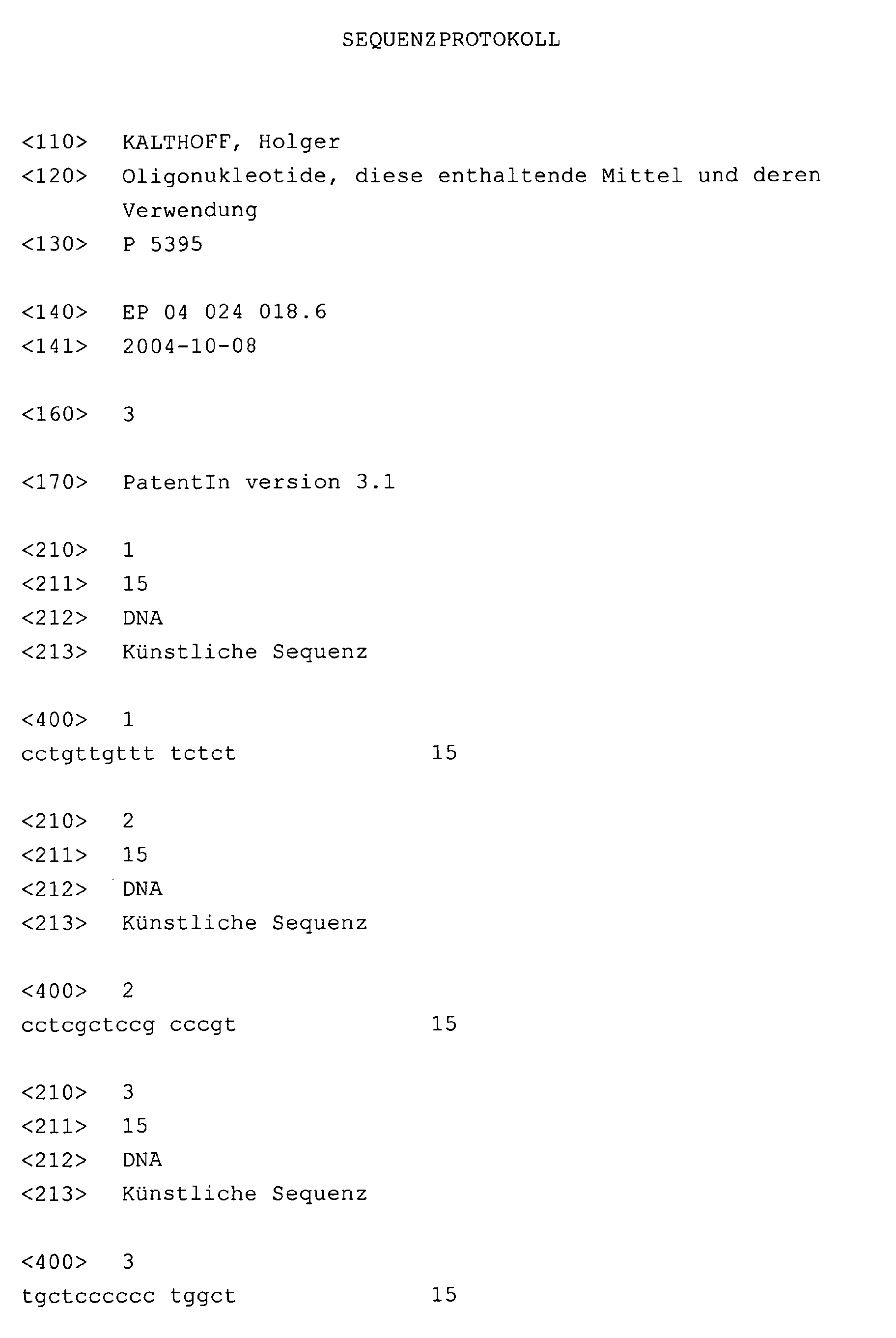
Claims (13)
Applications Claiming Priority (2)
| Application Number | Priority Date | Filing Date | Title |
|---|---|---|---|
| DE10346721A DE10346721A1 (en) | 2003-10-08 | 2003-10-08 | New oligonucleotides, useful for treating cancer, especially of the pancreas, are not species specific but induce apoptosis or inhibit proliferation |
| DE10346721 | 2003-10-08 |
Publications (2)
| Publication Number | Publication Date |
|---|---|
| EP1564291A2 true EP1564291A2 (en) | 2005-08-17 |
| EP1564291A3 EP1564291A3 (en) | 2011-07-06 |
Family
ID=34399360
Family Applications (1)
| Application Number | Title | Priority Date | Filing Date |
|---|---|---|---|
| EP04024018A Withdrawn EP1564291A3 (en) | 2003-10-08 | 2004-10-08 | Oligonucleotides, agents containing them and their use |
Country Status (2)
| Country | Link |
|---|---|
| EP (1) | EP1564291A3 (en) |
| DE (1) | DE10346721A1 (en) |
Cited By (9)
| Publication number | Priority date | Publication date | Assignee | Title |
|---|---|---|---|---|
| US20090324584A1 (en) * | 2006-07-31 | 2009-12-31 | Curevac Gmbh | Nucleic Acid of Formula (I): GIXmGn, or (II): CIXmCn, in Particular as an Immune-Stimulating Agent/Adjuvant |
| US8968746B2 (en) | 2010-07-30 | 2015-03-03 | Curevac Gmbh | Complexation of nucleic acids with disulfide-crosslinked cationic components for transfection and immunostimulation |
| US9314535B2 (en) | 2009-09-03 | 2016-04-19 | Curevac Ag | Disulfide-linked polyethyleneglycol/peptide conjugates for the transfection of nucleic acids |
| US9572874B2 (en) | 2008-09-30 | 2017-02-21 | Curevac Ag | Composition comprising a complexed (M)RNA and a naked mRNA for providing or enhancing an immunostimulatory response in a mammal and uses thereof |
| US10111967B2 (en) | 2007-09-04 | 2018-10-30 | Curevac Ag | Complexes of RNA and cationic peptides for transfection and for immunostimulation |
| US10369216B2 (en) | 2014-04-01 | 2019-08-06 | Curevac Ag | Polymeric carrier cargo complex for use as an immunostimulating agent or as an adjuvant |
| US10441653B2 (en) | 2006-07-31 | 2019-10-15 | Curevac Ag | Nucleic acid comprising GlXmGn as an immune-stimulating agent/adjuvant |
| US11690910B2 (en) | 2012-01-31 | 2023-07-04 | CureVac SE | Pharmaceutical composition comprising a polymeric carrier cargo complex and at least one protein or peptide antigen |
| US11739125B2 (en) | 2013-08-21 | 2023-08-29 | Cure Vac SE | Respiratory syncytial virus (RSV) vaccine |
Family Cites Families (5)
| Publication number | Priority date | Publication date | Assignee | Title |
|---|---|---|---|---|
| US6451968B1 (en) * | 1991-05-24 | 2002-09-17 | Isis Pharmaceuticals, Inc. | Peptide nucleic acids |
| IL112820A0 (en) * | 1994-03-07 | 1995-05-26 | Merck & Co Inc | Coordinate in vivo gene expression |
| US6670342B2 (en) * | 2000-03-29 | 2003-12-30 | Georgetown University | Method of treating hepatitis delta virus infection |
| DE10048091A1 (en) * | 2000-09-28 | 2002-04-25 | Ernst Bayer | Use of chemically modified oligodeoxyribonucleotides to suppress the proliferation of human pancreatic tumors |
| EP1386004A4 (en) * | 2001-04-05 | 2005-02-16 | Ribozyme Pharm Inc | Modulation of gene expression associated with inflammation proliferation and neurite outgrowth, using nucleic acid based technologies |
-
2003
- 2003-10-08 DE DE10346721A patent/DE10346721A1/en not_active Withdrawn
-
2004
- 2004-10-08 EP EP04024018A patent/EP1564291A3/en not_active Withdrawn
Cited By (15)
| Publication number | Priority date | Publication date | Assignee | Title |
|---|---|---|---|---|
| US10441653B2 (en) | 2006-07-31 | 2019-10-15 | Curevac Ag | Nucleic acid comprising GlXmGn as an immune-stimulating agent/adjuvant |
| US20090324584A1 (en) * | 2006-07-31 | 2009-12-31 | Curevac Gmbh | Nucleic Acid of Formula (I): GIXmGn, or (II): CIXmCn, in Particular as an Immune-Stimulating Agent/Adjuvant |
| US10111967B2 (en) | 2007-09-04 | 2018-10-30 | Curevac Ag | Complexes of RNA and cationic peptides for transfection and for immunostimulation |
| US9572874B2 (en) | 2008-09-30 | 2017-02-21 | Curevac Ag | Composition comprising a complexed (M)RNA and a naked mRNA for providing or enhancing an immunostimulatory response in a mammal and uses thereof |
| US9907862B2 (en) | 2009-09-03 | 2018-03-06 | Curevac Ag | Disulfide-linked polyethyleneglycol/peptide conjugates for the transfection of nucleic acids |
| US9314535B2 (en) | 2009-09-03 | 2016-04-19 | Curevac Ag | Disulfide-linked polyethyleneglycol/peptide conjugates for the transfection of nucleic acids |
| US10751424B2 (en) | 2009-09-03 | 2020-08-25 | Curevac Ag | Disulfide-linked polyethyleneglycol/peptide conjugates for the transfection of nucleic acids |
| US8968746B2 (en) | 2010-07-30 | 2015-03-03 | Curevac Gmbh | Complexation of nucleic acids with disulfide-crosslinked cationic components for transfection and immunostimulation |
| US11690910B2 (en) | 2012-01-31 | 2023-07-04 | CureVac SE | Pharmaceutical composition comprising a polymeric carrier cargo complex and at least one protein or peptide antigen |
| US12139513B2 (en) | 2013-08-21 | 2024-11-12 | CureVac SE | Respiratory syncytial virus (RSV) vaccine |
| US12240873B2 (en) | 2013-08-21 | 2025-03-04 | CureVac SE | Respiratory syncytial virus (RSV) vaccine |
| US11739125B2 (en) | 2013-08-21 | 2023-08-29 | Cure Vac SE | Respiratory syncytial virus (RSV) vaccine |
| US11965000B2 (en) | 2013-08-21 | 2024-04-23 | CureVac SE | Respiratory syncytial virus (RSV) vaccine |
| US10369216B2 (en) | 2014-04-01 | 2019-08-06 | Curevac Ag | Polymeric carrier cargo complex for use as an immunostimulating agent or as an adjuvant |
| US11110166B2 (en) | 2014-04-01 | 2021-09-07 | Curevac Ag | Polymeric carrier cargo complex for use as an immunostimulating agent or as an adjuvant |
Also Published As
| Publication number | Publication date |
|---|---|
| DE10346721A1 (en) | 2005-05-04 |
| EP1564291A3 (en) | 2011-07-06 |
Similar Documents
| Publication | Publication Date | Title |
|---|---|---|
| MacKellar et al. | Synthesis and physical properties of anti-HIV antisense oligonucleotides bearing terminal lipophilic groups | |
| EP0399330B1 (en) | Modified phosphoramidite process for preparing modified nucleic acids | |
| EP0152459B1 (en) | Process for producing oligonucleotides | |
| DE69227793T2 (en) | Methods and compounds for solid phase synthesis of oligonucleotides and analogs | |
| DE69233599T2 (en) | Broken 2'-modified oligonucleotides | |
| DE69432315T2 (en) | ANTISENSE NUCLEIC ACIDS FOR PREVENTING AND TREATING COMPLAINTS IN WHICH THE EXPRESSION OF C-ERBB-2 PLAYS A ROLE | |
| DE69027443T2 (en) | OLIGONUCLEOTID ANALOGUE WITH NEW BINDINGS | |
| DE69404835T2 (en) | TRIESTERS OF PHOSPHOROTHIOAT OLIGONUCLEOTIDES AND METHOD FOR THE PRODUCTION THEREOF | |
| EP0707591B1 (en) | Methylphosphonic acid ester, process for preparing the same and its use | |
| DE69838449T2 (en) | AMINOOXY-MODIFIED OLIGONUCLEOTIDES | |
| DE69732911T2 (en) | OLIGORIBONUCLEOTIDES AND RIBONUCLEASES FOR CLEANING RNA | |
| EP2447274B1 (en) | Oligomeric compounds and methods | |
| WO2007095976A2 (en) | Adjuvant in the form of a lipid-modified nucleic acid | |
| DE4110085A1 (en) | New 2'O-alkyl-oligo-ribonucleotide(s) with 8-35 nucleotide units - useful as anti-sense oligo-nucleotide(s), primers and probes | |
| WO2001007602A2 (en) | Oligonucleotides for inhibiting the expression of human eg5 | |
| EP0818460B1 (en) | Synthesis of Oligonucleotides on a solid support. | |
| DE4408528A1 (en) | Peptide oligonucleotide derivatives, their preparation and use | |
| EP0552767B1 (en) | 3'-derivatised oligonucleotide analogues with non-nucleotidic groups, their preparation and use | |
| DE69918149T2 (en) | IMPROVED METHOD OF OLIGONUCLEOTIDE SYNTHESIS | |
| DE69725440T2 (en) | 2-SUBSTITUTED NUCLEOSIDE AND OLIGONUCLEOTIDE DERIVATIVES | |
| EP1276760A2 (en) | Polyamide nucleic acid derivatives, agents and methods for producing them | |
| DE69405396T2 (en) | METHOD FOR SYNTHESISING NUCLEIC ACIDS ON A SOLID SUPPORT AND COMPOUNDS USED AS SOLID SUPPORT IN THIS METHOD | |
| DE69733150T2 (en) | PROCESS FOR THE PRODUCTION OF NUCLEOTIDES OR OLIGONUCLEOTIDES PHOSPHORAMITIDES | |
| DE69130569T2 (en) | METHYLPHOSPHONATE OLIGONUCLEOTID CONJUGUGED WITH PSORAL AS A THERAPEUTIC ACTIVE SUBSTANCE FOR CHRONIC MYOLOGICAL LEUKEMIA | |
| WO2001008707A2 (en) | Conjugates and methods for the production thereof, and their use for transporting molecules via biological membranes |
Legal Events
| Date | Code | Title | Description |
|---|---|---|---|
| PUAI | Public reference made under article 153(3) epc to a published international application that has entered the european phase |
Free format text: ORIGINAL CODE: 0009012 |
|
| AK | Designated contracting states |
Kind code of ref document: A2 Designated state(s): AT BE BG CH CY CZ DE DK EE ES FI FR GB GR HU IE IT LI LU MC NL PL PT RO SE SI SK TR |
|
| AX | Request for extension of the european patent |
Extension state: AL HR LT LV MK |
|
| RAP1 | Party data changed (applicant data changed or rights of an application transferred) |
Owner name: UNIVERSITAETSKLINIKUM SCHLESWIG-HOLSTEIN |
|
| PUAL | Search report despatched |
Free format text: ORIGINAL CODE: 0009013 |
|
| AK | Designated contracting states |
Kind code of ref document: A3 Designated state(s): AT BE BG CH CY CZ DE DK EE ES FI FR GB GR HU IE IT LI LU MC NL PL PT RO SE SI SK TR |
|
| AX | Request for extension of the european patent |
Extension state: AL HR LT LV MK |
|
| AKY | No designation fees paid | ||
| REG | Reference to a national code |
Ref country code: DE Ref legal event code: R108 Effective date: 20120314 |
|
| STAA | Information on the status of an ep patent application or granted ep patent |
Free format text: STATUS: THE APPLICATION IS DEEMED TO BE WITHDRAWN |
|
| 18D | Application deemed to be withdrawn |
Effective date: 20120110 |