DE69918149T2 - IMPROVED METHOD OF OLIGONUCLEOTIDE SYNTHESIS - Google Patents
IMPROVED METHOD OF OLIGONUCLEOTIDE SYNTHESIS Download PDFInfo
- Publication number
- DE69918149T2 DE69918149T2 DE69918149T DE69918149T DE69918149T2 DE 69918149 T2 DE69918149 T2 DE 69918149T2 DE 69918149 T DE69918149 T DE 69918149T DE 69918149 T DE69918149 T DE 69918149T DE 69918149 T2 DE69918149 T2 DE 69918149T2
- Authority
- DE
- Germany
- Prior art keywords
- ppm
- acetonitrile
- water content
- nucleoside
- separation
- Prior art date
- Legal status (The legal status is an assumption and is not a legal conclusion. Google has not performed a legal analysis and makes no representation as to the accuracy of the status listed.)
- Expired - Lifetime
Links
- 238000000034 method Methods 0.000 title claims abstract description 56
- 238000002515 oligonucleotide synthesis Methods 0.000 title abstract description 18
- WEVYAHXRMPXWCK-UHFFFAOYSA-N Acetonitrile Chemical compound CC#N WEVYAHXRMPXWCK-UHFFFAOYSA-N 0.000 claims abstract description 411
- 108091034117 Oligonucleotide Proteins 0.000 claims abstract description 107
- XLYOFNOQVPJJNP-UHFFFAOYSA-N water Substances O XLYOFNOQVPJJNP-UHFFFAOYSA-N 0.000 claims abstract description 97
- 239000003153 chemical reaction reagent Substances 0.000 claims abstract description 61
- 239000002777 nucleoside Substances 0.000 claims abstract description 56
- 239000002904 solvent Substances 0.000 claims abstract description 48
- 239000007787 solid Substances 0.000 claims abstract description 41
- 150000003833 nucleoside derivatives Chemical class 0.000 claims abstract description 29
- 230000001590 oxidative effect Effects 0.000 claims abstract description 27
- 230000002194 synthesizing effect Effects 0.000 claims abstract description 3
- 238000000926 separation method Methods 0.000 claims description 46
- 238000005859 coupling reaction Methods 0.000 claims description 30
- 230000008878 coupling Effects 0.000 claims description 28
- 238000010168 coupling process Methods 0.000 claims description 28
- -1 phosphoramidite nucleoside Chemical class 0.000 claims description 24
- 238000007254 oxidation reaction Methods 0.000 claims description 17
- 230000003647 oxidation Effects 0.000 claims description 16
- 229910052698 phosphorus Inorganic materials 0.000 claims description 9
- 239000011574 phosphorus Substances 0.000 claims description 9
- 125000002887 hydroxy group Chemical group [H]O* 0.000 claims description 8
- 239000004793 Polystyrene Substances 0.000 claims description 4
- 229920002223 polystyrene Polymers 0.000 claims description 4
- 230000002209 hydrophobic effect Effects 0.000 claims description 2
- JLCPHMBAVCMARE-UHFFFAOYSA-N [3-[[3-[[3-[[3-[[3-[[3-[[3-[[3-[[3-[[3-[[3-[[5-(2-amino-6-oxo-1H-purin-9-yl)-3-[[3-[[3-[[3-[[3-[[3-[[5-(2-amino-6-oxo-1H-purin-9-yl)-3-[[5-(2-amino-6-oxo-1H-purin-9-yl)-3-hydroxyoxolan-2-yl]methoxy-hydroxyphosphoryl]oxyoxolan-2-yl]methoxy-hydroxyphosphoryl]oxy-5-(5-methyl-2,4-dioxopyrimidin-1-yl)oxolan-2-yl]methoxy-hydroxyphosphoryl]oxy-5-(6-aminopurin-9-yl)oxolan-2-yl]methoxy-hydroxyphosphoryl]oxy-5-(6-aminopurin-9-yl)oxolan-2-yl]methoxy-hydroxyphosphoryl]oxy-5-(6-aminopurin-9-yl)oxolan-2-yl]methoxy-hydroxyphosphoryl]oxy-5-(6-aminopurin-9-yl)oxolan-2-yl]methoxy-hydroxyphosphoryl]oxyoxolan-2-yl]methoxy-hydroxyphosphoryl]oxy-5-(5-methyl-2,4-dioxopyrimidin-1-yl)oxolan-2-yl]methoxy-hydroxyphosphoryl]oxy-5-(4-amino-2-oxopyrimidin-1-yl)oxolan-2-yl]methoxy-hydroxyphosphoryl]oxy-5-(5-methyl-2,4-dioxopyrimidin-1-yl)oxolan-2-yl]methoxy-hydroxyphosphoryl]oxy-5-(5-methyl-2,4-dioxopyrimidin-1-yl)oxolan-2-yl]methoxy-hydroxyphosphoryl]oxy-5-(6-aminopurin-9-yl)oxolan-2-yl]methoxy-hydroxyphosphoryl]oxy-5-(6-aminopurin-9-yl)oxolan-2-yl]methoxy-hydroxyphosphoryl]oxy-5-(4-amino-2-oxopyrimidin-1-yl)oxolan-2-yl]methoxy-hydroxyphosphoryl]oxy-5-(4-amino-2-oxopyrimidin-1-yl)oxolan-2-yl]methoxy-hydroxyphosphoryl]oxy-5-(4-amino-2-oxopyrimidin-1-yl)oxolan-2-yl]methoxy-hydroxyphosphoryl]oxy-5-(6-aminopurin-9-yl)oxolan-2-yl]methoxy-hydroxyphosphoryl]oxy-5-(4-amino-2-oxopyrimidin-1-yl)oxolan-2-yl]methyl [5-(6-aminopurin-9-yl)-2-(hydroxymethyl)oxolan-3-yl] hydrogen phosphate Polymers Cc1cn(C2CC(OP(O)(=O)OCC3OC(CC3OP(O)(=O)OCC3OC(CC3O)n3cnc4c3nc(N)[nH]c4=O)n3cnc4c3nc(N)[nH]c4=O)C(COP(O)(=O)OC3CC(OC3COP(O)(=O)OC3CC(OC3COP(O)(=O)OC3CC(OC3COP(O)(=O)OC3CC(OC3COP(O)(=O)OC3CC(OC3COP(O)(=O)OC3CC(OC3COP(O)(=O)OC3CC(OC3COP(O)(=O)OC3CC(OC3COP(O)(=O)OC3CC(OC3COP(O)(=O)OC3CC(OC3COP(O)(=O)OC3CC(OC3COP(O)(=O)OC3CC(OC3COP(O)(=O)OC3CC(OC3COP(O)(=O)OC3CC(OC3COP(O)(=O)OC3CC(OC3COP(O)(=O)OC3CC(OC3COP(O)(=O)OC3CC(OC3CO)n3cnc4c(N)ncnc34)n3ccc(N)nc3=O)n3cnc4c(N)ncnc34)n3ccc(N)nc3=O)n3ccc(N)nc3=O)n3ccc(N)nc3=O)n3cnc4c(N)ncnc34)n3cnc4c(N)ncnc34)n3cc(C)c(=O)[nH]c3=O)n3cc(C)c(=O)[nH]c3=O)n3ccc(N)nc3=O)n3cc(C)c(=O)[nH]c3=O)n3cnc4c3nc(N)[nH]c4=O)n3cnc4c(N)ncnc34)n3cnc4c(N)ncnc34)n3cnc4c(N)ncnc34)n3cnc4c(N)ncnc34)O2)c(=O)[nH]c1=O JLCPHMBAVCMARE-UHFFFAOYSA-N 0.000 abstract description 60
- 150000008300 phosphoramidites Chemical class 0.000 abstract description 29
- 238000005406 washing Methods 0.000 abstract description 21
- 239000007790 solid phase Substances 0.000 abstract description 9
- 230000008569 process Effects 0.000 abstract description 4
- 238000003786 synthesis reaction Methods 0.000 description 56
- 230000015572 biosynthetic process Effects 0.000 description 54
- YXFVVABEGXRONW-UHFFFAOYSA-N Toluene Chemical compound CC1=CC=CC=C1 YXFVVABEGXRONW-UHFFFAOYSA-N 0.000 description 36
- ITQTTZVARXURQS-UHFFFAOYSA-N 3-methylpyridine Chemical compound CC1=CC=CN=C1 ITQTTZVARXURQS-UHFFFAOYSA-N 0.000 description 24
- JXTHNDFMNIQAHM-UHFFFAOYSA-N dichloroacetic acid Chemical compound OC(=O)C(Cl)Cl JXTHNDFMNIQAHM-UHFFFAOYSA-N 0.000 description 24
- 239000002773 nucleotide Substances 0.000 description 17
- 125000003729 nucleotide group Chemical group 0.000 description 16
- 230000004048 modification Effects 0.000 description 15
- 238000012986 modification Methods 0.000 description 15
- IXGZXXBJSZISOO-UHFFFAOYSA-N s-(2-phenylacetyl)sulfanyl 2-phenylethanethioate Chemical compound C=1C=CC=CC=1CC(=O)SSC(=O)CC1=CC=CC=C1 IXGZXXBJSZISOO-UHFFFAOYSA-N 0.000 description 13
- 238000005987 sulfurization reaction Methods 0.000 description 13
- 150000003536 tetrazoles Chemical group 0.000 description 13
- KMEMIMRPZGDOMG-UHFFFAOYSA-N 2-cyanoethoxyphosphonamidous acid Chemical class NP(O)OCCC#N KMEMIMRPZGDOMG-UHFFFAOYSA-N 0.000 description 12
- 238000006642 detritylation reaction Methods 0.000 description 12
- 229960005215 dichloroacetic acid Drugs 0.000 description 12
- 108020004707 nucleic acids Proteins 0.000 description 12
- 102000039446 nucleic acids Human genes 0.000 description 12
- 150000007523 nucleic acids Chemical class 0.000 description 12
- PBCJIPOGFJYBJE-UHFFFAOYSA-N acetonitrile;hydrate Chemical compound O.CC#N PBCJIPOGFJYBJE-UHFFFAOYSA-N 0.000 description 11
- 238000011160 research Methods 0.000 description 10
- 108091032973 (ribonucleotides)n+m Proteins 0.000 description 9
- 239000003795 chemical substances by application Substances 0.000 description 9
- 235000000346 sugar Nutrition 0.000 description 9
- RYYWUUFWQRZTIU-UHFFFAOYSA-K thiophosphate Chemical compound [O-]P([O-])([O-])=S RYYWUUFWQRZTIU-UHFFFAOYSA-K 0.000 description 9
- 239000012071 phase Substances 0.000 description 7
- 238000010532 solid phase synthesis reaction Methods 0.000 description 7
- WYURNTSHIVDZCO-UHFFFAOYSA-N Tetrahydrofuran Chemical compound C1CCOC1 WYURNTSHIVDZCO-UHFFFAOYSA-N 0.000 description 6
- 238000010511 deprotection reaction Methods 0.000 description 6
- 238000004519 manufacturing process Methods 0.000 description 6
- 229910052717 sulfur Inorganic materials 0.000 description 6
- 108020004414 DNA Proteins 0.000 description 5
- 102100034343 Integrase Human genes 0.000 description 5
- 101710203526 Integrase Proteins 0.000 description 5
- 230000003213 activating effect Effects 0.000 description 5
- 239000000074 antisense oligonucleotide Substances 0.000 description 5
- 238000012230 antisense oligonucleotides Methods 0.000 description 5
- 238000013459 approach Methods 0.000 description 5
- 108020004999 messenger RNA Proteins 0.000 description 5
- 108090000623 proteins and genes Proteins 0.000 description 5
- 108020000948 Antisense Oligonucleotides Proteins 0.000 description 4
- 101710163270 Nuclease Proteins 0.000 description 4
- NINIDFKCEFEMDL-UHFFFAOYSA-N Sulfur Chemical compound [S] NINIDFKCEFEMDL-UHFFFAOYSA-N 0.000 description 4
- IQFYYKKMVGJFEH-XLPZGREQSA-N Thymidine Chemical compound O=C1NC(=O)C(C)=CN1[C@@H]1O[C@H](CO)[C@@H](O)C1 IQFYYKKMVGJFEH-XLPZGREQSA-N 0.000 description 4
- 125000000217 alkyl group Chemical group 0.000 description 4
- 230000000694 effects Effects 0.000 description 4
- 239000000178 monomer Substances 0.000 description 4
- 125000003835 nucleoside group Chemical group 0.000 description 4
- 150000004713 phosphodiesters Chemical class 0.000 description 4
- 238000002360 preparation method Methods 0.000 description 4
- 102000004169 proteins and genes Human genes 0.000 description 4
- 239000000758 substrate Substances 0.000 description 4
- 239000011593 sulfur Substances 0.000 description 4
- WFDIJRYMOXRFFG-UHFFFAOYSA-N Acetic anhydride Chemical compound CC(=O)OC(C)=O WFDIJRYMOXRFFG-UHFFFAOYSA-N 0.000 description 3
- 230000000692 anti-sense effect Effects 0.000 description 3
- 230000001413 cellular effect Effects 0.000 description 3
- 238000006243 chemical reaction Methods 0.000 description 3
- 239000005289 controlled pore glass Substances 0.000 description 3
- 230000014509 gene expression Effects 0.000 description 3
- 229910052760 oxygen Inorganic materials 0.000 description 3
- 125000006239 protecting group Chemical group 0.000 description 3
- YLQBMQCUIZJEEH-UHFFFAOYSA-N tetrahydrofuran Natural products C=1C=COC=1 YLQBMQCUIZJEEH-UHFFFAOYSA-N 0.000 description 3
- YBJHBAHKTGYVGT-ZKWXMUAHSA-N (+)-Biotin Chemical compound N1C(=O)N[C@@H]2[C@H](CCCCC(=O)O)SC[C@@H]21 YBJHBAHKTGYVGT-ZKWXMUAHSA-N 0.000 description 2
- MYRTYDVEIRVNKP-UHFFFAOYSA-N 1,2-Divinylbenzene Chemical compound C=CC1=CC=CC=C1C=C MYRTYDVEIRVNKP-UHFFFAOYSA-N 0.000 description 2
- LRSASMSXMSNRBT-UHFFFAOYSA-N 5-methylcytosine Chemical compound CC1=CNC(=O)N=C1N LRSASMSXMSNRBT-UHFFFAOYSA-N 0.000 description 2
- XKRFYHLGVUSROY-UHFFFAOYSA-N Argon Chemical compound [Ar] XKRFYHLGVUSROY-UHFFFAOYSA-N 0.000 description 2
- DWRXFEITVBNRMK-UHFFFAOYSA-N Beta-D-1-Arabinofuranosylthymine Natural products O=C1NC(=O)C(C)=CN1C1C(O)C(O)C(CO)O1 DWRXFEITVBNRMK-UHFFFAOYSA-N 0.000 description 2
- LYCAIKOWRPUZTN-UHFFFAOYSA-N Ethylene glycol Chemical compound OCCO LYCAIKOWRPUZTN-UHFFFAOYSA-N 0.000 description 2
- 108091093037 Peptide nucleic acid Proteins 0.000 description 2
- 239000004952 Polyamide Substances 0.000 description 2
- RYYWUUFWQRZTIU-UHFFFAOYSA-N Thiophosphoric acid Chemical class OP(O)(S)=O RYYWUUFWQRZTIU-UHFFFAOYSA-N 0.000 description 2
- ISAKRJDGNUQOIC-UHFFFAOYSA-N Uracil Chemical compound O=C1C=CNC(=O)N1 ISAKRJDGNUQOIC-UHFFFAOYSA-N 0.000 description 2
- 239000002253 acid Substances 0.000 description 2
- 150000007513 acids Chemical class 0.000 description 2
- DZBUGLKDJFMEHC-UHFFFAOYSA-N acridine Chemical compound C1=CC=CC2=CC3=CC=CC=C3N=C21 DZBUGLKDJFMEHC-UHFFFAOYSA-N 0.000 description 2
- 239000012190 activator Substances 0.000 description 2
- 150000001412 amines Chemical group 0.000 description 2
- IQFYYKKMVGJFEH-UHFFFAOYSA-N beta-L-thymidine Natural products O=C1NC(=O)C(C)=CN1C1OC(CO)C(O)C1 IQFYYKKMVGJFEH-UHFFFAOYSA-N 0.000 description 2
- 230000015556 catabolic process Effects 0.000 description 2
- OPTASPLRGRRNAP-UHFFFAOYSA-N cytosine Chemical compound NC=1C=CNC(=O)N=1 OPTASPLRGRRNAP-UHFFFAOYSA-N 0.000 description 2
- 238000006731 degradation reaction Methods 0.000 description 2
- AUZONCFQVSMFAP-UHFFFAOYSA-N disulfiram Chemical compound CCN(CC)C(=S)SSC(=S)N(CC)CC AUZONCFQVSMFAP-UHFFFAOYSA-N 0.000 description 2
- 238000005516 engineering process Methods 0.000 description 2
- UYTPUPDQBNUYGX-UHFFFAOYSA-N guanine Chemical compound O=C1NC(N)=NC2=C1N=CN2 UYTPUPDQBNUYGX-UHFFFAOYSA-N 0.000 description 2
- FDGQSTZJBFJUBT-UHFFFAOYSA-N hypoxanthine Chemical compound O=C1NC=NC2=C1NC=N2 FDGQSTZJBFJUBT-UHFFFAOYSA-N 0.000 description 2
- 230000005764 inhibitory process Effects 0.000 description 2
- 230000007246 mechanism Effects 0.000 description 2
- LSCYTCMNCWMCQE-UHFFFAOYSA-N n-methylpyridin-4-amine Chemical compound CNC1=CC=NC=C1 LSCYTCMNCWMCQE-UHFFFAOYSA-N 0.000 description 2
- 239000007800 oxidant agent Substances 0.000 description 2
- 150000003018 phosphorus compounds Chemical class 0.000 description 2
- 229920002647 polyamide Polymers 0.000 description 2
- 229920000642 polymer Polymers 0.000 description 2
- 238000010561 standard procedure Methods 0.000 description 2
- CIHOLLKRGTVIJN-UHFFFAOYSA-N tert‐butyl hydroperoxide Chemical compound CC(C)(C)OO CIHOLLKRGTVIJN-UHFFFAOYSA-N 0.000 description 2
- 229940104230 thymidine Drugs 0.000 description 2
- RWQNBRDOKXIBIV-UHFFFAOYSA-N thymine Chemical compound CC1=CNC(=O)NC1=O RWQNBRDOKXIBIV-UHFFFAOYSA-N 0.000 description 2
- JAUFWTSSYRTLLB-UHFFFAOYSA-N (2-phenylacetyl) 2-phenylacetate Chemical compound C=1C=CC=CC=1CC(=O)OC(=O)CC1=CC=CC=C1 JAUFWTSSYRTLLB-UHFFFAOYSA-N 0.000 description 1
- BHQCQFFYRZLCQQ-UHFFFAOYSA-N (3alpha,5alpha,7alpha,12alpha)-3,7,12-trihydroxy-cholan-24-oic acid Natural products OC1CC2CC(O)CCC2(C)C2C1C1CCC(C(CCC(O)=O)C)C1(C)C(O)C2 BHQCQFFYRZLCQQ-UHFFFAOYSA-N 0.000 description 1
- QGVQZRDQPDLHHV-DPAQBDIFSA-N (3s,8s,9s,10r,13r,14s,17r)-10,13-dimethyl-17-[(2r)-6-methylheptan-2-yl]-2,3,4,7,8,9,11,12,14,15,16,17-dodecahydro-1h-cyclopenta[a]phenanthrene-3-thiol Chemical compound C1C=C2C[C@@H](S)CC[C@]2(C)[C@@H]2[C@@H]1[C@@H]1CC[C@H]([C@H](C)CCCC(C)C)[C@@]1(C)CC2 QGVQZRDQPDLHHV-DPAQBDIFSA-N 0.000 description 1
- JUDOLRSMWHVKGX-UHFFFAOYSA-N 1,1-dioxo-1$l^{6},2-benzodithiol-3-one Chemical compound C1=CC=C2C(=O)SS(=O)(=O)C2=C1 JUDOLRSMWHVKGX-UHFFFAOYSA-N 0.000 description 1
- JAAIPIWKKXCNOC-UHFFFAOYSA-N 1h-tetrazol-1-ium-5-thiolate Chemical compound SC1=NN=NN1 JAAIPIWKKXCNOC-UHFFFAOYSA-N 0.000 description 1
- AOTQGWFNFTVXNQ-UHFFFAOYSA-N 2-(1-adamantyl)acetic acid Chemical compound C1C(C2)CC3CC2CC1(CC(=O)O)C3 AOTQGWFNFTVXNQ-UHFFFAOYSA-N 0.000 description 1
- 125000004200 2-methoxyethyl group Chemical group [H]C([H])([H])OC([H])([H])C([H])([H])* 0.000 description 1
- LQLQRFGHAALLLE-UHFFFAOYSA-N 5-bromouracil Chemical compound BrC1=CNC(=O)NC1=O LQLQRFGHAALLLE-UHFFFAOYSA-N 0.000 description 1
- JDBGXEHEIRGOBU-UHFFFAOYSA-N 5-hydroxymethyluracil Chemical compound OCC1=CNC(=O)NC1=O JDBGXEHEIRGOBU-UHFFFAOYSA-N 0.000 description 1
- ZGZLYKUHYXFIIO-UHFFFAOYSA-N 5-nitro-2h-tetrazole Chemical compound [O-][N+](=O)C=1N=NNN=1 ZGZLYKUHYXFIIO-UHFFFAOYSA-N 0.000 description 1
- CKOMXBHMKXXTNW-UHFFFAOYSA-N 6-methyladenine Chemical compound CNC1=NC=NC2=C1N=CN2 CKOMXBHMKXXTNW-UHFFFAOYSA-N 0.000 description 1
- LOSIULRWFAEMFL-UHFFFAOYSA-N 7-deazaguanine Chemical compound O=C1NC(N)=NC2=C1CC=N2 LOSIULRWFAEMFL-UHFFFAOYSA-N 0.000 description 1
- ZCYVEMRRCGMTRW-UHFFFAOYSA-N 7553-56-2 Chemical compound [I] ZCYVEMRRCGMTRW-UHFFFAOYSA-N 0.000 description 1
- LPXQRXLUHJKZIE-UHFFFAOYSA-N 8-azaguanine Chemical compound NC1=NC(O)=C2NN=NC2=N1 LPXQRXLUHJKZIE-UHFFFAOYSA-N 0.000 description 1
- 229960005508 8-azaguanine Drugs 0.000 description 1
- MSSXOMSJDRHRMC-UHFFFAOYSA-N 9H-purine-2,6-diamine Chemical compound NC1=NC(N)=C2NC=NC2=N1 MSSXOMSJDRHRMC-UHFFFAOYSA-N 0.000 description 1
- 229930024421 Adenine Natural products 0.000 description 1
- GFFGJBXGBJISGV-UHFFFAOYSA-N Adenine Chemical compound NC1=NC=NC2=C1N=CN2 GFFGJBXGBJISGV-UHFFFAOYSA-N 0.000 description 1
- KXDHJXZQYSOELW-UHFFFAOYSA-M Carbamate Chemical compound NC([O-])=O KXDHJXZQYSOELW-UHFFFAOYSA-M 0.000 description 1
- 239000004380 Cholic acid Substances 0.000 description 1
- 102000053602 DNA Human genes 0.000 description 1
- 230000004543 DNA replication Effects 0.000 description 1
- BWGNESOTFCXPMA-UHFFFAOYSA-N Dihydrogen disulfide Chemical compound SS BWGNESOTFCXPMA-UHFFFAOYSA-N 0.000 description 1
- 102100031780 Endonuclease Human genes 0.000 description 1
- 108010042407 Endonucleases Proteins 0.000 description 1
- 102000004190 Enzymes Human genes 0.000 description 1
- 108090000790 Enzymes Proteins 0.000 description 1
- UGQMRVRMYYASKQ-UHFFFAOYSA-N Hypoxanthine nucleoside Natural products OC1C(O)C(CO)OC1N1C(NC=NC2=O)=C2N=C1 UGQMRVRMYYASKQ-UHFFFAOYSA-N 0.000 description 1
- 238000005481 NMR spectroscopy Methods 0.000 description 1
- REYJJPSVUYRZGE-UHFFFAOYSA-N Octadecylamine Chemical compound CCCCCCCCCCCCCCCCCCN REYJJPSVUYRZGE-UHFFFAOYSA-N 0.000 description 1
- OAICVXFJPJFONN-UHFFFAOYSA-N Phosphorus Chemical compound [P] OAICVXFJPJFONN-UHFFFAOYSA-N 0.000 description 1
- 239000002202 Polyethylene glycol Substances 0.000 description 1
- 230000006819 RNA synthesis Effects 0.000 description 1
- 101100054666 Streptomyces halstedii sch3 gene Proteins 0.000 description 1
- RLXCFCYWFYXTON-JTTSDREOSA-N [(3S,8S,9S,10R,13S,14S,17R)-3-hydroxy-10,13-dimethyl-17-[(2R)-6-methylheptan-2-yl]-2,3,4,7,8,9,11,12,14,15,16,17-dodecahydro-1H-cyclopenta[a]phenanthren-16-yl] N-hexylcarbamate Chemical group C1C=C2C[C@@H](O)CC[C@]2(C)[C@@H]2[C@@H]1[C@@H]1CC(OC(=O)NCCCCCC)[C@H]([C@H](C)CCCC(C)C)[C@@]1(C)CC2 RLXCFCYWFYXTON-JTTSDREOSA-N 0.000 description 1
- 150000004075 acetic anhydrides Chemical class 0.000 description 1
- 239000003377 acid catalyst Substances 0.000 description 1
- 230000004913 activation Effects 0.000 description 1
- 229960000643 adenine Drugs 0.000 description 1
- 125000001931 aliphatic group Chemical group 0.000 description 1
- 125000002877 alkyl aryl group Chemical group 0.000 description 1
- 150000001408 amides Chemical group 0.000 description 1
- 125000005122 aminoalkylamino group Chemical group 0.000 description 1
- 229910052786 argon Inorganic materials 0.000 description 1
- 125000003710 aryl alkyl group Chemical group 0.000 description 1
- 238000003556 assay Methods 0.000 description 1
- 230000033228 biological regulation Effects 0.000 description 1
- 229960002685 biotin Drugs 0.000 description 1
- 235000020958 biotin Nutrition 0.000 description 1
- 239000011616 biotin Substances 0.000 description 1
- 238000001818 capillary gel electrophoresis Methods 0.000 description 1
- 230000004700 cellular uptake Effects 0.000 description 1
- HVYWMOMLDIMFJA-DPAQBDIFSA-N cholesterol group Chemical group [C@@H]1(CC[C@H]2[C@@H]3CC=C4C[C@@H](O)CC[C@]4(C)[C@H]3CC[C@]12C)[C@H](C)CCCC(C)C HVYWMOMLDIMFJA-DPAQBDIFSA-N 0.000 description 1
- BHQCQFFYRZLCQQ-OELDTZBJSA-N cholic acid Chemical compound C([C@H]1C[C@H]2O)[C@H](O)CC[C@]1(C)[C@@H]1[C@@H]2[C@@H]2CC[C@H]([C@@H](CCC(O)=O)C)[C@@]2(C)[C@@H](O)C1 BHQCQFFYRZLCQQ-OELDTZBJSA-N 0.000 description 1
- 229960002471 cholic acid Drugs 0.000 description 1
- 235000019416 cholic acid Nutrition 0.000 description 1
- 238000003776 cleavage reaction Methods 0.000 description 1
- 238000004440 column chromatography Methods 0.000 description 1
- 150000001875 compounds Chemical class 0.000 description 1
- 229920001577 copolymer Polymers 0.000 description 1
- 125000000753 cycloalkyl group Chemical group 0.000 description 1
- 125000001995 cyclobutyl group Chemical group [H]C1([H])C([H])([H])C([H])(*)C1([H])[H] 0.000 description 1
- 229940104302 cytosine Drugs 0.000 description 1
- KXGVEGMKQFWNSR-UHFFFAOYSA-N deoxycholic acid Natural products C1CC2CC(O)CCC2(C)C2C1C1CCC(C(CCC(O)=O)C)C1(C)C(O)C2 KXGVEGMKQFWNSR-UHFFFAOYSA-N 0.000 description 1
- 239000002274 desiccant Substances 0.000 description 1
- NAGJZTKCGNOGPW-UHFFFAOYSA-K dioxido-sulfanylidene-sulfido-$l^{5}-phosphane Chemical compound [O-]P([O-])([S-])=S NAGJZTKCGNOGPW-UHFFFAOYSA-K 0.000 description 1
- 201000010099 disease Diseases 0.000 description 1
- 208000037265 diseases, disorders, signs and symptoms Diseases 0.000 description 1
- 150000002019 disulfides Chemical class 0.000 description 1
- NAGJZTKCGNOGPW-UHFFFAOYSA-N dithiophosphoric acid Chemical class OP(O)(S)=S NAGJZTKCGNOGPW-UHFFFAOYSA-N 0.000 description 1
- GTZOYNFRVVHLDZ-UHFFFAOYSA-N dodecane-1,1-diol Chemical compound CCCCCCCCCCCC(O)O GTZOYNFRVVHLDZ-UHFFFAOYSA-N 0.000 description 1
- 229940079593 drug Drugs 0.000 description 1
- 239000003814 drug Substances 0.000 description 1
- CHNUOJQWGUIOLD-NFZZJPOKSA-N epalrestat Chemical compound C=1C=CC=CC=1\C=C(/C)\C=C1/SC(=S)N(CC(O)=O)C1=O CHNUOJQWGUIOLD-NFZZJPOKSA-N 0.000 description 1
- GNBHRKFJIUUOQI-UHFFFAOYSA-N fluorescein Chemical compound O1C(=O)C2=CC=CC=C2C21C1=CC=C(O)C=C1OC1=CC(O)=CC=C21 GNBHRKFJIUUOQI-UHFFFAOYSA-N 0.000 description 1
- 238000001502 gel electrophoresis Methods 0.000 description 1
- 125000003827 glycol group Chemical group 0.000 description 1
- 125000005842 heteroatom Chemical group 0.000 description 1
- 125000000623 heterocyclic group Chemical group 0.000 description 1
- 125000000592 heterocycloalkyl group Chemical group 0.000 description 1
- 238000004128 high performance liquid chromatography Methods 0.000 description 1
- 238000009396 hybridization Methods 0.000 description 1
- WGCNASOHLSPBMP-UHFFFAOYSA-N hydroxyacetaldehyde Natural products OCC=O WGCNASOHLSPBMP-UHFFFAOYSA-N 0.000 description 1
- 239000012535 impurity Substances 0.000 description 1
- 239000011261 inert gas Substances 0.000 description 1
- 230000000977 initiatory effect Effects 0.000 description 1
- 238000009830 intercalation Methods 0.000 description 1
- 230000002452 interceptive effect Effects 0.000 description 1
- PNDPGZBMCMUPRI-UHFFFAOYSA-N iodine Chemical compound II PNDPGZBMCMUPRI-UHFFFAOYSA-N 0.000 description 1
- 229910052740 iodine Inorganic materials 0.000 description 1
- 239000011630 iodine Substances 0.000 description 1
- 239000003446 ligand Substances 0.000 description 1
- 238000011068 loading method Methods 0.000 description 1
- 238000005259 measurement Methods 0.000 description 1
- 230000010534 mechanism of action Effects 0.000 description 1
- YACKEPLHDIMKIO-UHFFFAOYSA-N methylphosphonic acid Chemical class CP(O)(O)=O YACKEPLHDIMKIO-UHFFFAOYSA-N 0.000 description 1
- 125000004573 morpholin-4-yl group Chemical group N1(CCOCC1)* 0.000 description 1
- 238000003541 multi-stage reaction Methods 0.000 description 1
- GZCNJTFELNTSAB-UHFFFAOYSA-N n'-(7h-purin-6-yl)hexane-1,6-diamine Chemical compound NCCCCCCNC1=NC=NC2=C1NC=N2 GZCNJTFELNTSAB-UHFFFAOYSA-N 0.000 description 1
- 229910052757 nitrogen Inorganic materials 0.000 description 1
- 238000007899 nucleic acid hybridization Methods 0.000 description 1
- 230000000269 nucleophilic effect Effects 0.000 description 1
- 125000001181 organosilyl group Chemical group [SiH3]* 0.000 description 1
- 125000000913 palmityl group Chemical group [H]C([*])([H])C([H])([H])C([H])([H])C([H])([H])C([H])([H])C([H])([H])C([H])([H])C([H])([H])C([H])([H])C([H])([H])C([H])([H])C([H])([H])C([H])([H])C([H])([H])C([H])([H])C([H])([H])[H] 0.000 description 1
- ONTNXMBMXUNDBF-UHFFFAOYSA-N pentatriacontane-17,18,19-triol Chemical compound CCCCCCCCCCCCCCCCC(O)C(O)C(O)CCCCCCCCCCCCCCCC ONTNXMBMXUNDBF-UHFFFAOYSA-N 0.000 description 1
- 230000003285 pharmacodynamic effect Effects 0.000 description 1
- 150000003003 phosphines Chemical class 0.000 description 1
- 150000003904 phospholipids Chemical class 0.000 description 1
- 229920000768 polyamine Polymers 0.000 description 1
- 229920001223 polyethylene glycol Polymers 0.000 description 1
- 238000000746 purification Methods 0.000 description 1
- 125000004219 purine nucleobase group Chemical group 0.000 description 1
- 125000006853 reporter group Chemical group 0.000 description 1
- 238000012552 review Methods 0.000 description 1
- 229920002477 rna polymer Polymers 0.000 description 1
- XTDHBAVVPOKCKF-UHFFFAOYSA-N s-(benzoyltrisulfanyl) benzenecarbothioate Chemical compound C=1C=CC=CC=1C(=O)SSSSC(=O)C1=CC=CC=C1 XTDHBAVVPOKCKF-UHFFFAOYSA-N 0.000 description 1
- 239000000523 sample Substances 0.000 description 1
- 230000007017 scission Effects 0.000 description 1
- 238000003746 solid phase reaction Methods 0.000 description 1
- 125000001424 substituent group Chemical group 0.000 description 1
- 238000006467 substitution reaction Methods 0.000 description 1
- 150000008163 sugars Chemical class 0.000 description 1
- 150000003460 sulfonic acids Chemical class 0.000 description 1
- 238000001308 synthesis method Methods 0.000 description 1
- 230000001225 therapeutic effect Effects 0.000 description 1
- 150000003568 thioethers Chemical class 0.000 description 1
- 229940113082 thymine Drugs 0.000 description 1
- 238000000870 ultraviolet spectroscopy Methods 0.000 description 1
- 229940035893 uracil Drugs 0.000 description 1
- 239000002699 waste material Substances 0.000 description 1
Classifications
-
- C—CHEMISTRY; METALLURGY
- C07—ORGANIC CHEMISTRY
- C07H—SUGARS; DERIVATIVES THEREOF; NUCLEOSIDES; NUCLEOTIDES; NUCLEIC ACIDS
- C07H21/00—Compounds containing two or more mononucleotide units having separate phosphate or polyphosphate groups linked by saccharide radicals of nucleoside groups, e.g. nucleic acids
-
- C—CHEMISTRY; METALLURGY
- C07—ORGANIC CHEMISTRY
- C07B—GENERAL METHODS OF ORGANIC CHEMISTRY; APPARATUS THEREFOR
- C07B2200/00—Indexing scheme relating to specific properties of organic compounds
- C07B2200/11—Compounds covalently bound to a solid support
Landscapes
- Chemical & Material Sciences (AREA)
- Organic Chemistry (AREA)
- Life Sciences & Earth Sciences (AREA)
- Biochemistry (AREA)
- Molecular Biology (AREA)
- Health & Medical Sciences (AREA)
- Engineering & Computer Science (AREA)
- Biotechnology (AREA)
- General Health & Medical Sciences (AREA)
- Genetics & Genomics (AREA)
- Saccharide Compounds (AREA)
- Tea And Coffee (AREA)
- Low-Molecular Organic Synthesis Reactions Using Catalysts (AREA)
- Nitrogen Condensed Heterocyclic Rings (AREA)
Abstract
Description
GEBIET DER ERFINDUNGAREA OF INVENTION
Diese Erfindung betrifft ein verbessertes Verfahren zum Koppeln eines Phosphoramidit-Nukleosids an ein an einen festen Träger gebundenes Nukleosid. Die vorliegende Erfindung ist nützlich für die Synthese von Oligonukleotiden. Diese Erfindung ist der Synthese von Oligonukleotiden im großen Maßstab unter Anwendung des Phosphoramidit-Verfahrens zugänglich.These The invention relates to an improved method for coupling a Phosphoramidite nucleoside to a bound to a solid support Nucleoside. The present invention is useful for the synthesis of oligonucleotides. This invention is the large scale synthesis of oligonucleotides Application of the phosphoramidite method accessible.
HINTERGRUND DER ERFINDUNGBACKGROUND THE INVENTION
Oligonukleotide und ihre Analoga werden routinemäßig in vielen diagnostischen und Forschungs-Anwendungen verwendet, als Sonden, Primer, Linker, Adaptoren und Antisense-Oligonukleotide. Antisense-Oligonukleotide sind routinemäßig in der Forschung verwendet worden, um die Funktionen von Genprodukten, d. h. Proteinen, durch Modulation ihrer Expression zu studieren. Diese Oligonukleotide sind gestaltet, um in einer spezifischen Weise an eine bestimmte mRNA-Sequenz durch Hybridisierung zu binden (d. h. Oligonukleotide, die spezifisch hybridisierbar sind mit einer Target-mRNA). Solche Oligonukleotide und Oligonukleotidanaloga sollen die Aktivität der ausgewählten mRNA durch irgendeinen einer Anzahl von Mechanismen hemmen, d. h. durch Interferieren mit Translationsreaktionen, durch welche durch die mRNA codierte Proteine hergestellt werden, oder durch Initiieren von RNase H-Abbau der mRNA. Die Hemmung der Bildung der spezifischen Proteine, die durch die mRNA-Sequenzen codiert werden, erlaubt das Studium der Funktionen bestimmter Gene.oligonucleotides and their analogues are routinely in many diagnostic and research applications used as probes, Primers, linkers, adapters and antisense oligonucleotides. Antisense oligonucleotides are routinely in the Research has been used to understand the functions of gene products, i. H. Proteins to study by modulation of their expression. These Oligonucleotides are designed to act in a specific manner to bind a particular mRNA sequence by hybridization (i.e. Oligonucleotides that are specifically hybridizable with a target mRNA). Such oligonucleotides and oligonucleotide analogues are intended to enhance the activity of the selected mRNA by any of a number of mechanisms, d. H. by Interfering with translational reactions through which mRNA-encoded proteins, or by initiation of RNase H degradation of mRNA. Inhibition of formation of specific Proteins encoded by the mRNA sequences allow this Study of the functions of certain genes.
Die Spezifität der Antisense-Oligonukleotide und ihrer Analoga legen nahe, daß sie therapeutische nützlich sein könnten. Ihr Wirkmechanismus sollte die Nebenwirkungen beschränken, während er die Spezifität erhöht. Gegenwärtig sind zahlreiche Antisense-Oligonukleotide in klinischen Studien gegen eine große Breite von Targets und Krankheiten, und kürzlich wurde das erste Antisense-Oligonukleotid von der FDA für die Vermarktung zugelassen.The specificity The antisense oligonucleotides and their analogs suggest that they are therapeutically useful could. Their mechanism of action should limit the side effects while he is the specificity elevated. Present are numerous antisense oligonucleotides in clinical trials a big width of Targets and Diseases, and recently became the first antisense oligonucleotide from the FDA for the Marketing allowed.
Anwendungen von Oligonukleotiden und Oligonukleotidanaloga als Antisense-Mittel für therapeutische Zwecke, diagnostische Zwecke und als Forschungsreagenzien erfordern oft, daß die Oligonukleotide oder Oligonukleotidanaloga in großen Mengen synthetisiert werden. Dies gilt insbesondere für ihre Verwendung als kommerziell erhältliche Arzneimittel. Die Synthese im großen Maßstab von Oligonukleotiden in einem ökonomischen Maßstab stellt Herausforderungen, die von denen bei der Synthese kleiner Mengen für die Forschung verschieden sind.applications of oligonucleotides and oligonucleotide analogs as antisense agents for therapeutic Purposes, diagnostic purposes and as research reagents often that Oligonucleotides or oligonucleotide analogues in large quantities be synthesized. This is especially true for their use as commercial available Drug. The large-scale synthesis of oligonucleotides in an economic scale poses challenges smaller than those of synthesis Quantities for the research is different.
Die Synthese von Oligonukleotiden kann unter Anwendung von sowohl Lösungsphasen- als auch Festphasen-Verfahren erreicht werden. Eine allgemeine Übersicht von Festphasen- versus Lösungsphasen-Oligonukleotid-Synthese wird im Hintergrund-Abschnitt von Urdea et al., US-Patent mit der Nr. 4,517,338 mit dem Titel "Multiple Reactor System And Method For Oligonucleotide Synthesis", gegeben. Oligonukleotid-Synthese über Lösungsphase kann mit einigen Kopplungsmechanismen erreicht werden.The Synthesis of oligonucleotides can be achieved using both solution phase and as well as solid-phase method can be achieved. A general overview of solid-phase versus solution-phase oligonucleotide synthesis is described in U.S. Pat Background section of Urdea et al., U.S. Patent No. 4,517,338 the title "Multiple Reactor System And Method For Oligonucleotide Synthesis ", given. Oligonucleotide synthesis via solution phase can be achieved with some coupling mechanisms.
Eine solche Lösungsphasen-Herstellung benutzt Phosphortriester. Yau, E. K. et al., Tetrahedron Letters, 1990, 31, 1953, berichten über die Verwendung von Phosphortriestern zur Herstellung von Thymidin-Dinukleosid- und Thymidin-Dinukleotid-Phosphordithioaten. Allerdings erfordert die Lösungsphasen-Chemie Reinigung nach jeder Internukleotid-Kopplung, was arbeitsintensiv und zeitraubend ist.A such solution phase preparation uses Phosphortriester. Yau, E.K. et al., Tetrahedron Letters, 1990, 31, 1953, report the use of phosphorus triesters for the preparation of thymidine dinucleoside and thymidine dinucleotide phosphorodithioates. However, solution-phase chemistry requires purification after each internucleotide coupling, which is labor intensive and time consuming is.
Weitere Details von Verfahren, die für die Herstellung von Oligonukleotiden nützlich sind, können bei Sekine, M. et al., J. Org. Chem., 1979, 44, 2325; Dahl, O., Sulfur Reports, 1991, 11, 167–192; Kresse, J. et al., Nucleic Acids Res., 1975, 2, 1–9; Eckstein, F., Ann. Rev. Biochem., 1985, 54, 367–402; und Yau, E. K., US-Patent mit der Nr. 5,210,264, gefunden werden.Further Details of procedures for the production of oligonucleotides are useful in the case of Sekine, M. et al., J. Org. Chem., 1979, 44, 2325; Dahl, O., Sulfur Reports, 1991, 11, 167-192; Kresse, J. et al., Nucleic Acids Res., 1975, 2, 1-9; Cornerstone, F., Ann. Rev. Biochem., 1985, 54, 367-402; and Yau, E.K., U.S. Patent No. 5,210,264.
Das gegenwärtige Verfahren der Wahl für die Herstellung von natürlich vorkommenden Oligonukleotiden sowie von Oligonukleotiden mit modifizierten Internukleotid-Verknüpfungen wie Phosphorthioat- und Phosphordithioat-Oligonukleotiden ist über Festphasensynthese. Die Festphasensynthese umfaßt die Bindung eines Nukleosids an einen festen Träger, wie einen Polymerträger, und die Addition eines zweiten Nukleotids an das trägergebundene Nukleotid. Weitere Nukleotide werden hinzugegeben, wobei ein Oligonukleotid gebildet wird, welches an einen festen Träger gebunden ist. Das Oligonukleotid kann dann von dem festen Träger abgespalten werden, wenn die Synthese der gewünschten Länge und Sequenz des Oligonukleotids erreicht ist.The current Method of choice for the production of course occurring oligonucleotides and oligonucleotides with modified Internucleotide linkages such as phosphorothioate and phosphorodithioate oligonucleotides is via solid phase synthesis. The solid phase synthesis includes the binding of a nucleoside to a solid support, such as a polymer support, and the addition of a second nucleotide to the carrier-bound nucleotide. Further Nucleotides are added to form an oligonucleotide which is attached to a solid support is bound. The oligonucleotide can then be cleaved from the solid support when the synthesis of the desired length and sequence of the oligonucleotide is reached.
Festphasensynthese beruht auf der sequentiellen Addition von Nukleotiden an ein Ende einer wachsenden Oligonukleotidkette. Typischerweise wird ein erstes Nukleosid mit Schutzgruppen an allen vorhandenen exocyclischen Aminfunktionalitäten an einen geeigneten festen Träger gebunden. Aktivierte Phosphorverbindungen, typischerweise Nukleotid-Phosphoramidite, die ebenfalls geeignete Schutzgruppen tragen, werden stufenweise hinzugegeben, um die wachsende Kette zu verlängern. Die aktivierten Phosphorverbindungen werden mit dem wachsenden Oligonukleotid unter Anwendung der "Fließbett"-Technologie umgesetzt, um die Reagenzien zu mischen.Solid phase synthesis is based on the sequential addition of nucleotides to one end a growing oligonucleotide chain. Typically, a first Nucleoside with protecting groups on all existing exocyclic amine functionalities to one suitable solid support bound. Activated phosphorus compounds, typically nucleotide phosphoramidites, which also carry suitable protective groups, will be phased added to extend the growing chain. The activated phosphorus compounds are reacted with the growing oligonucleotide using the "fluidized bed" technology to prepare the reagents to mix.
Eine Anzahl von Festphasensynthesizern sind kommerziell erhältlich. Diese sind geeignet für das Herstellen vergleichsweise kleiner Mengen an Oligonukleotiden, d. h. von etwa dem mikromolaren (μmol) bis zum millimolaren (mmol) Bereich. Sie sind typischerweise aufgrund der hohen Kosten für die Reagenzien der Herstellung der größeren Mengen an Oligonukleotiden nicht zugänglich, die für biophysikalische Studien, präklinische und klinische Versuche und kommerzielle Herstellung notwendig sind.A Number of solid phase synthesizers are commercially available. These are suitable for the production of comparatively small amounts of oligonucleotides, d. H. of about the micromolar (μmol) to the millimolar (mmol) range. They are typically due the high cost of the reagents of the production of larger amounts of oligonucleotides inaccessible, the for biophysical studies, preclinical and clinical trials and commercial production are necessary.
Instrumente für Festphasensynthese im großen Maßstab von Oligonukleotiden sind ebenfalls kommerziell erhältlich, zum Beispiel Pharmacia OligoPilot II und Milligen/Biosearch 8800. Obwohl das von diesen Vorrichtungen verwendete Verfahren gut verstanden ist, erfordern sie die Verwendung teurer Reagenzien. Berücksichtigt man die großen Mengen an Oligonukleotidsynthesen, die für Forschungsanwendungen und die Herstellung im großen Maßstab für klinische Versuche ausgeführt werden, ist jede Verschwendung dieser teuren Reagenzien ein bedeutendes ökonomisches Problem.instruments for solid phase synthesis in the large scale oligonucleotides are also commercially available, for example Pharmacia OligoPilot II and Milligen / Biosearch 8800. Although the method used by these devices is well understood is, they require the use of expensive reagents. Considered you the big ones Amounts of oligonucleotide syntheses required for research applications and the production in the big one scale for clinical Trials performed Every waste of these expensive reagents is a significant economic one Problem.
Ein in großen Mengen verwendetes Reagenz ist Acetonitril, welches in zahlreichen Waschschritten, als ein Lösungsmittel für einen Aktivator während des Kopplungsschritts des Phosphoramidit-Verfahrens und als ein Lösungsmittel für Phosphoramidite, eine Abtrennlösung und ein Oxidationsreagenz verwendet wird. Es ist ein anerkanntes Dogma der Fachleute, daß Acetonitril mit "geringem Wassergehalt", d. h. mit einem Wassergehalt von weniger als 30 ppm, zwingend für die Oligonukleotidsynthese ist. Siehe im allgemeinen Gait, M. S., Oligonucleotide Synthesis A Practical Approach, IRL Press 1985, S. 18–19. Es wird geglaubt, daß die Verwendung von Acetonitril mit einem größeren Wassergehalt während irgendeinem der Syntheseschritte zu suboptimalen Ausbeuten führt. Es wird angenommen, daß die Anwesenheit von Wasser in dem System mit der Kopplungsreaktion interferiert. Konsequenterweise wird teures Acetonitril mit geringem Wassergehalt universell für die Oligonukleotidsynthese verwendet. "Reagenziengrad"-Acetonitril, Acetonitril mit einem Wassergehalt von mehr als 30 ppm, ist erhältich, aber das Verfahren zum Entfernen von Wasser und anderen Verunreinigungen aus Acetonitril von solchem Reagenziengrad ist teuer und langwierig. Siehe US-Patent 5,440,068 für eine Übersicht über den Stand der Technik.One in big Amounts of reagent used is acetonitrile, which is available in numerous Washes, as a solvent for one Activator during the coupling step of the phosphoramidite method and as a solvent for phosphoramidites, a separation solution and an oxidizing reagent is used. It is a recognized one Dogma of professionals that acetonitrile with "low water content", d. H. with a Water content of less than 30 ppm, mandatory for oligonucleotide synthesis is. See, in general, Gait, M.S., Oligonucleotide Synthesis A Practical Approach, IRL Press 1985, pp. 18-19. It is believed that the use of acetonitrile with a greater water content while any of the synthesis steps leads to suboptimal yields. It it is assumed that the Presence of water in the system interferes with the coupling reaction. Consequently, expensive acetonitrile with low water content universal for used the oligonucleotide synthesis. "Reagent grade" acetonitrile, acetonitrile with a Water content of more than 30 ppm, is available, but the method for Removal of water and other impurities from acetonitrile of such reagent level is expensive and tedious. See US patent 5,440,068 for a review of the State of the art.
Somit besteht ein Bedarf für verbesserte und ökonomischere Verfahren für die Oligonukleotidsynthese fort.Consequently there is a need for improved and more economical Procedure for the oligonucleotide synthesis continues.
ZUSAMMENFASSUNG DER ERFINDUNGSUMMARY THE INVENTION
Die vorliegende Erfindung betrifft verbesserte Verfahren zum Binden eines Phosphoramidit-Nukleosids an ein an einen festen Träger gebundenes Nukleosid. Die vorliegende Erfindung umfaßt ferner die Synthese von Oligonukleotiden. Die Erfindung basiert auf dem Befund, daß die Oligonukleotidsyntheseeffizienz, gemessen durch Kopplungseffizienz und Prozent Gesamtlänge, sich nicht signifikant vermindern muß, wenn Acetonitril mit einem Wassergehalt von mehr als 30 ppm und weniger als 1250 ppm Acetonitril mit wenig Wasser substituiert in den Waschschritten des Syntheseverfahrens oder als ein Lösungsmittel für Abtrennreagenzien (Cap-Reagenzien) oder als ein Lösungsmittel für eine Anzahl von Oxidations/Schwefelungsreagenzien. Diese Erfindung verkörpert Verfahren der Festphasen-Oligonukleotidsynthese, umfassend Koppeln eines Phosphoramidit-Nukleosids mit einer reaktiven Hydroxylgruppe eines Nukleosids, das an einen Festphasenträger gebunden ist. Dies wird bevorzugt getan in Gegenwart eines aktivierenden Reagenzes, wobei eine Phosphorbindung zwischen den zwei Nukleosiden gebildet wird, Abtrennen jedes nicht gekoppelten, entschützten, trägergebundenen Nukleosids mit einem Abtrennreagenz und Oxidieren der Phosphor-Nukleosid-Bindung mit einem Oxidierungsreagenz. Der feste Träger wird mit Acetonitril vor oder nach mindestens einer der Kopplungs-, Abtrenn- und Oxidierungsreaktionen gewaschen, wobei das Acetonitril einen Wassergehalt von mehr als 30 ppm und weniger als etwa 1250 ppm aufweist. Alternativ ist mindestens eines der Abtrennreagenzien oder der Oxidierungsreagenzien in einem Acetonitril-Lösungsmittel mit einem Wassergehalt von mehr als 30 ppm und weniger als etwa 1250 ppm. Die hier beschriebenen verbesserten Verfahren stellen Mittel für ökonomischere Synthesen von Oligonukleotiden bereit.The The present invention relates to improved methods of bonding of a phosphoramidite nucleoside to a solid support-bound nucleoside. The present invention includes also the synthesis of oligonucleotides. The invention is based on the finding that the Oligonucleotide synthesis efficiency measured by coupling efficiency and percent total length, does not have to decrease significantly when acetonitrile with a Water content of more than 30 ppm and less than 1250 ppm acetonitrile with little water substituted in the washing steps of the synthesis process or as a solvent for separation reagents (Cap reagents) or as a solvent for one Number of oxidation / sulfurization reagents. This invention embodies methods solid phase oligonucleotide synthesis comprising coupling a phosphoramidite nucleoside with a reactive hydroxyl group of a nucleoside attached to a Solid phase support is bound. This is preferably done in the presence of an activating Reagent, with a phosphorus bond between the two nucleosides Disconnecting any uncoupled, deprotected, carrier-bound Nucleosides with a separation reagent and oxidizing the phosphorus nucleoside bond with an oxidizing reagent. The solid support is with acetonitrile or after at least one of the coupling, separation and oxidation reactions the acetonitrile has a water content of more than 30 ppm and less than about 1250 ppm. Alternatively, at least one of the separation reagents or the oxidizing reagents in one Acetonitrile solvent with a water content of more than 30 ppm and less than about 1250 ppm. The improved methods described herein provide a means for more economical Syntheses of oligonucleotides ready.
DETAILLIERTE BESCHREIBUNG DER BEVORZUGTEN AUSFÜHRUNGSFORMENDETAILED DESCRIPTION OF THE PREFERRED EMBODIMENTS
Die vorliegende Erfindung betrifft Verfahren zum Binden eines Phosphoramidit-Nukleosids an ein an einen festen Träger gebundenes Nukleosid. Diese Verfahren umfassen das Binden eines ersten Nukleosids mit einer geschützten Hydroxylgruppe an einen festen Träger mittels einer kovalenten Bindung. Das erste Nukleosid kann an den festen Träger entweder direkt oder über einen Linker unter Anwendung von Standardverfahren und Vorschriften, die im Stand der Technik bekannt sind, gebunden werden. Siehe z. B. Oligonucleotides and Analogues: A Practical Approach, Eckstein, F., Hrsg., IRL Press, N.Y., 1991, hiermit in seiner Gesamtheit durch Bezugnahme eingefügt. Ein Beispiel ist ein langkettiger Alkylamin-Linker, der eine Carbamat-Verknüpfung einschließt. Das gebundene geschützte Nukleosid wird dann mit einem Entschützungsreagenz entschützt und mit einem zweiten Phosphoramidit-Nukleosid gekoppelt, um eine Phosphor-Nukleosid-Bindung zwischen dem ersten Nukleosid und dem zweiten Nukleosid zu bilden. Diese Kopplung tritt an der Hydroxylgruppe des ersten Nukleosids auf, welche durch die Entschützung mit dem Entschützungsreagenz reaktiv wird. Nach diesem Kopplungsschritt wird das verbleibende entschützte aber nicht gekoppelte erste Nukleosid optional mit einem Abtrennreagenz abgetrennt. Die entstehende Phosphor-Nukleosid-Bindung wird als nächstes mit einem Oxidierungsmittel oxidiert. Gemäß den Verfahren der vorliegenden Erfindung wird während des Verknüpfens eines Phosphoramidit-Nukleosids an ein Nukleosid, das an einen festen Träger gebunden ist, der feste Träger mit Acetonitril vor und nach mindestens einem der Kopplungs-, Abtrenn- oder Oxidierungsschritte gewaschen, wobei das Acetonitril einen Wassergehalt zwischen 30 ppm und etwa 1250 ppm aufweist, oder ist mindestens eines der Kopplungs- oder Oxidierungsreagenzien in einem Acetonitril-Lösungsmittel mit einem Wassergehalt zwischen 30 ppm und etwa 1250 ppm.The The present invention relates to methods of attaching a phosphoramidite nucleoside to a to a solid support bound nucleoside. These methods include binding a first nucleoside having a protected hydroxyl group to one solid carrier by means of a covalent bond. The first nucleoside can be attached to the solid carrier either directly or via a linker using standard procedures and regulations, which are known in the art, are bound. See, for example, B. Oligonucleotides and Analogues: A Practical Approach, Eckstein, F., ed., IRL Press, N.Y., 1991, hereby incorporated by reference Reference inserted. An example is a long-chain alkylamine linker that includes a carbamate linkage. The bound protected Nucleoside is then deprotected with a deprotection reagent and coupled with a second phosphoramidite nucleoside to form a phosphorus-nucleoside bond between the first nucleoside and the second nucleoside. These Coupling occurs at the hydroxyl group of the first nucleoside, which by the deprotection with the deprotection reagent becomes reactive. After this coupling step, the remaining deprotected but not coupled first nucleoside optionally with a separation reagent separated. The resulting phosphorus-nucleoside bond is next with an oxidizing agent oxidized. According to the procedures the present invention is during the linking of a Phosphoramidite nucleoside to a nucleoside attached to a solid carrier is bound, the solid carrier with acetonitrile before and after at least one of the coupling, separation and or oxidation steps, the acetonitrile having a Water content between 30 ppm and about 1250 ppm, or is at least one of the coupling or oxidizing reagents in an acetonitrile solvent with a water content between 30 ppm and about 1250 ppm.
In einer bevorzugten Ausführungsform wird der feste Träger mit Acetonitril vor oder nach mindestens einem der Kopplungs-, Abtrenn- oder Oxidierungsschritte gewaschen, wobei das Acetonitril einen Wassergehalt zwischen 30 ppm und etwa 1250 ppm aufweist, und ist mindestens eines der Abtrenn- oder Oxidierungsreagenzien in einem Acetonitril-Lösungsmittel mit einem Wassergehalt zwischen 30 ppm und etwa 1250 ppm.In a preferred embodiment becomes the solid carrier with acetonitrile before or after at least one of the coupling, separation and or oxidation steps, the acetonitrile having a Water content between 30 ppm and about 1250 ppm, and is at least one of the separation or oxidizing reagents in one Acetonitrile solvent with a water content between 30 ppm and about 1250 ppm.
In einer anderen bevorzugten Ausführungsform wird der feste Träger mit Acetonitril vor oder nach mindestens einem der Kopplungs-, Abtrenn- oder Oxidierungsschritte gewaschen, wobei das Acetonitril einen Wassergehalt zwischen 30 ppm und etwa 1250 ppm aufweist, und sind die Abtrenn- und Oxidierungsreagenzien in einem Acetonitril-Lösungsmittel mit einem Wassergehalt zwischen 30 ppm und etwa 1250 ppm.In another preferred embodiment becomes the solid carrier with acetonitrile before or after at least one of the coupling, separation and or oxidation steps, wherein the acetonitrile has a water content between 30 ppm and about 1250 ppm, and are the separation and oxidizing reagents in an acetonitrile solvent with a water content between 30 ppm and about 1250 ppm.
In einer anderen bevorzugten Ausführungsform ist der Wassergehalt des Acetonitrils zwischen 30 ppm und 400 ppm. Es ist weiter bevorzugt, daß der Wassergehalt zwischen 30 ppm und 200 ppm ist. In noch einer weiteren bevorzugten Ausführungsform ist der Wassergehalt zwischen 200 und 400 ppm.In another preferred embodiment the water content of the acetonitrile is between 30 ppm and 400 ppm. It is further preferred that the Water content is between 30 ppm and 200 ppm. In yet another preferred embodiment the water content is between 200 and 400 ppm.
Verfahren zum Synthetisieren von Oligonukleotiden schließen die Umwandlung eines Nukleosids oder einer Nukleobase in eine aktivierte Phosphor-Verbindung, gefolgt von Lösungsphasen- oder Festphasenchemie zur Kopplung der aktivierten Phosphor-Verbindung an eine wachsende Oligonukleotidkette ein. Lösungs- und Festphasenchemie schließen typischerweise einen vielstufigen Reaktionszyklus ein, welcher für jede Addition der aktivierten Phosphor-Verbindung wiederholt wird. Repräsentative Lösungsphasentechniken werden in den US-Patenten mit den Nrn. 5,210,264 und 5,571,902, beide hiermit durch Bezugnahme eingefügt, beschrieben. Repräsentative Festphasentechniken sind solche, die typischerweise für DNA- und RNA-Synthese unter Nutzung der Standard-Phosphoramidit-Chemie eingesetzt werden. Siehe z. B. Protocols For Oligonucleotides And Analogs, Agrawal, S., Hrsg., Humana Press, Totowa, NJ, 1993. Ein typischer Festphasenreaktionszyklus unter Verwendung von Phosphoramiditen schließt die folgenden Schritte ein: Waschen des festen Trägers, Detritylieren, das den Zuckerrest entschützt, Waschen, Koppeln eines Phosphoramidit-Monomeren mit dem detritylierten Nukleosid, Waschen, Abtrennen des nicht umgesetzten/nicht gekoppelten, an den Träger gebundenen Phosphoramidit-Monomeren, Waschen, Oxidieren der Phosphor-Nukleosid-Bindung und Waschen. Siehe z. B. Oligonucleotides and Analogues: A Practical Approach, Eckstein, F., Hrsg., IRL Press, N.Y., 1991. Oxidation kann dem Abtrennen folgen und wird in Schema 1 zusammen mit allen Waschschritten gezeigt.method synthesizing oligonucleotides involves the conversion of a nucleoside or a nucleobase into an activated phosphorus compound of solution phase or solid phase chemistry for coupling the activated phosphorus compound to a growing oligonucleotide chain. Solution and solid phase chemistry shut down typically a multi-stage reaction cycle, which for each addition the activated phosphorus compound is repeated. Representative Solution phase techniques are disclosed in U.S. Patent Nos. 5,210,264 and 5,571,902, both of which are incorporated herein by reference. Representative Solid phase techniques are those typically used for DNA and DNA RNA synthesis under Use of the standard phosphoramidite chemistry can be used. Please refer z. Protocols For Oligonucleotides And Analogs, Agrawal, S., eds. Humana Press, Totowa, NJ, 1993. A Typical Solid-Phase Reaction Cycle using phosphoramidites includes the following steps: Washing the solid support, Detritylieren, which deprotects the sugar residue, washing, coupling one Phosphoramidite monomers with the detritylated nucleoside, washing, Separating the unreacted / uncoupled, bound to the support Phosphoramidite monomers, washing, oxidizing the phosphorus nucleoside linkage and washing. See, for example, B. Oligonucleotides and Analogues: A Practical Approach, Eckstein, F., Eds., IRL Press, N.Y., 1991. Oxidation can follow the separation and is shown in Scheme 1 along with all Washing steps shown.
SCHEMA
1
Synthesezyklus 
Die vorliegende Erfindung stellt auch Verfahren für die Synthese eines Oligonukleotids bereit, umfassend die Schritte des Bindens eines ersten geschützten Nukleosids an einen festen Träger mittels einer kovalenten Verknüpfung. Das erste Nukleosid kann an den festen Träger entweder direkt oder über einen Linker gebunden werden, unter Anwendung von Standardverfahren und Vorschriften, die im Stand der Technik bekannt sind. Siehe z. B. Oligonucleotides and Analogues: A Practical Approach, Eckstein, F., Hrsg., IRL Press, N.Y., 1991, hiermit in seiner Gesamtheit durch Bezugnahme eingefügt. Der Bindungsschritt wird dann gefolgt vom Entschützen der Hydroxylgruppe, um eine reaktive Hydroxylgruppe freizulegen. Dies wird gefolgt von dem Koppeln eines zweiten Phosphoramidits mit der reaktiven Hydroxylgruppe des ersten Nukleosids zur Bildung einer Phosphor-Nukleosid-Bindung, Abtrennen jedes verbleibenden nicht gekoppelten aber ungeschützten ersten Nukleosids und Oxidieren der Phosphor-Nukleosid-Bindung mit einem Oxidierungsreagenz. Die Entschützungs-, Kopplungs-, Abtrenn- und Oxidierungsschritte werden iterativ wiederholt, bis ein Oligonukleotid der gewünschten Sequenz und Länge gebildet worden ist. Gemäß den Verfahren der vorliegenden Erfindung wird der feste Träger während der Synthese eines Oligonukleotids mit Acetonitril vor oder nach mindestens einem der Kopplungs-, Abtrenn- oder Oxidierungsschritte gewaschen, wobei das Acetonitril einen Wassergehalt zwischen 30 ppm und etwa 1250 ppm aufweist, oder ist mindestens eines der Abtrenn- oder Oxidierungsreagenzien in einem Acetonitril-Lösungsmittel mit einem Wassergehalt zwischen 30 ppm und etwa 1250 ppm.The present invention also provides methods for the synthesis of an oligonucleotide comprising the steps of attaching a first protected nucleoside to a solid support via a covalent linkage. The first nucleoside can be attached to the solid support, either directly or via a linker, using standard procedures and protocols known in the art. See, for example, Oligonucleotides and Analogues: A Practical Approach, Eckstein, F., Eds., IRL Press, NY, 1991, incorporated herein by reference in its entirety. The binding step is then followed by deprotection of the hydroxyl group to expose a reactive hydroxyl group. This is followed by coupling a second phosphoramidite to the reactive hydroxyl group of the first nucleoside to form a phosphorus nucleoside bond, separating any remaining uncoupled but unprotected first nucleoside and oxidizing the phosphorus nucleoside linkage with an oxidizing reagent. The deprotection, coupling, separation and oxidation steps are repeated iteratively until an oligonucleotide of the desired sequence and length has been formed. According to the methods of the present invention the solid support is washed during the synthesis of an oligonucleotide with acetonitrile before or after at least one of the coupling, separation or oxidation steps, the acetonitrile having a water content between 30 ppm and about 1250 ppm, or at least one of the separation or oxidizing reagents in an acetonitrile solvent having a water content between 30 ppm and about 1250 ppm.
In einer bevorzugten Ausführungsform wird der feste Träger mit Acetonitril vor oder nach mindestens einem der Kopplungs-, Abtrenn- oder Oxidierungsschritte gewaschen, wobei das Acetonitril einen Wassergehalt zwischen 30 ppm und etwa 1250 ppm aufweist, und sind mindesten eines der Abtrenn- oder Oxidierungsreagenzien in einem Acetonitril-Lösungsmittel mit einem Wassergehalt zwischen 30 ppm und etwa 1250 ppm.In a preferred embodiment becomes the solid carrier with acetonitrile before or after at least one of the coupling, separation and or oxidation steps, the acetonitrile having a Water content between 30 ppm and about 1250 ppm, and are At least one of the separation or oxidizing reagents in one Acetonitrile solvent with a water content between 30 ppm and about 1250 ppm.
In einer anderen bevorzugten Ausführungsform wird der feste Träger mit Acetonitril vor oder nach mindestens einem der Kopplungs-, Abtrenn- oder Oxidierungsschritte gewaschen, wobei das Acetonitril einen Wassergehalt zwischen 30 ppm und etwa 1250 ppm aufweist, und sind die Abtrenn- und Oxidierungsreagenzien in einem Acetonitril-Lösungsmittel mit einem Wassergehalt zwischen 30 ppm und etwa 1250 ppm.In another preferred embodiment becomes the solid carrier with acetonitrile before or after at least one of the coupling, separation and or oxidation steps, wherein the acetonitrile has a water content between 30 ppm and about 1250 ppm, and are the separation and oxidizing reagents in an acetonitrile solvent having a water content between 30 ppm and about 1250 ppm.
In einer weiteren Ausführungsform der vorliegenden Erfindung ist es bevorzugt, daß der Wassergehalt des Acetonitrils zwischen 30 ppm und 400 ppm ist. Es ist ferner bevorzugt, daß der Wassergehalt zwischen 30 ppm und 200 ppm ist. In noch einer weiteren bevorzugten Ausführungsform ist der Wassergehalt zwischen 200 ppm und 400 ppm.In a further embodiment In the present invention, it is preferable that the water content of the acetonitrile between 30 ppm and 400 ppm. It is further preferred that the water content between 30 ppm and 200 ppm. In yet another preferred embodiment the water content is between 200 ppm and 400 ppm.
Es ist universell geglaubt worden, daß Acetonitril mit geringem Wassergehalt im gesamten Oligonukleotidsyntheseverfahren verwendet muß. Die vorliegende Erfindung stellt Verfahren zur Verwendung von Acetonitril mit einem Wassergehalt von mehr als 30 ppm, aber weniger als 1250 ppm während der Waschschritte der Oligonukleotidsynthese oder als ein Lösungsmittel für die Abtrennlösung oder als ein Lösungsmittel für ein Oxidations/Schwefelungsmittel bereit. Große Einsparungen in der Zeit und den Kosten werden dadurch erreicht.It It has been universally believed that acetonitrile with low Water content used throughout the oligonucleotide synthesis method got to. The The present invention provides methods of using acetonitrile with a water content of more than 30 ppm, but less than 1250 ppm during the washing steps of the oligonucleotide synthesis or as a solvent for the stripping solution or as a solvent for an oxidation / sulfurizing agent ready. Size Savings in time and costs are achieved.
In der Festphasensynthese wird das entschützte 5'-Hydroxyl des an den Träger gebundenen Nukleosids oder der wachsenden Oligonukleotidkette mit einem 5'-geschützten aktivierten Phosphoramidit-Nukleosid umgesetzt, um eine kovalente Verknüpfung zwischen dem an den Träger gebundenen Nukleosid und dem Phosphoramidit-Nukleosid herzustellen. Die aktivierte Phosphorverbindung ist eine, von der bekannt ist, daß sie eine Kopplungsreaktion mit dem geschützten 5'-Hydroxyl einer wachsenden oligomeren Kette nach den Standardsynthesemethoden, wie zum Beispiel den Phosphoramidit-, Phosphotriester- und N-Phosphonat-Syntheseverfahren, eingeht. Siehe z. B. Caruthers, US-Patente mit den Nrn. 4,415,732, 4,458,066, 4,500,707, 4,668,777, 4,973,679 und 5,132,418; Yau, E. K., US-Patent mit der Nr. 5,210,264, und Koster, US-Patente mit den Nrn. 4,725,677 und Re. 34,069; wobei die Offenbarungen jedes dieser Patente hiermit durch Bezugnahme in ihrer Gesamtheit eingefügt werden; Sekine, M. et al., J. Org. Chem., 1979, 44, 2325; Dahl, O., Sulfur Reports, 1991, 11, 167–192; Kresse, J. et al., Nucleic Acids Res., 1975, 2, 1–9; Eckstein, F., Ann. Rev. Biochem., 1985, 54, 367–402; und Oligonucleotides and Analogues: A Practical Approach, Eckstein, F., Hrsg., IRL Press, New York, 1991.In solid phase synthesis becomes the deprotected 5'-hydroxyl of the substrate bound Nucleoside or the growing oligonucleotide chain reacted with a 5'-protected activated phosphoramidite nucleoside, a covalent link between that to the wearer bound nucleoside and the phosphoramidite nucleoside. The activated phosphorus compound is one known to that she a coupling reaction with the protected 5'-hydroxyl of a growing oligomeric Chain according to the standard synthesis methods, such as phosphoramidite, Phosphotriester- and N-phosphonate synthesis process, received. Please refer z. Caruthers, U.S. Pat. Nos. 4,415,732, 4,458,066, 4,500,707, 4,668,777, 4,973,679 and 5,132,418; Yau, E.K., US Patent to the Nos. 5,210,264, and Koster, U.S. Patent Nos. 4,725,677 and 4,210,264 Re. 34.069; the disclosures of each of these patents are hereby incorporated by reference Be inserted in their entirety; Sekine, M. et al. J. Org. Chem., 1979, 44, 2325; Dahl, O., Sulfur Reports, 1991, 11, 167-192; Kresse, J. et al., Nucleic Acids Res., 1975, 2, 1-9; Cornerstone, F., Ann. Rev. Biochem., 1985, 54, 367-402; and oligonucleotides and Analogues: A Practical Approach, Eckstein, F., ed., IRL Press, New York, 1991.
Jedes aktivierende Mittel, oder jeder Aktivator, das/der den Phosphor gegenüber nukleophilem Angriff aktivieren kann, ohne mit der wachsenden Nukleotidkette zu interagieren, kann für die Verwendung in der vorliegenden Erfindung geeignet sein. Solche Mittel sind im allgemeinen milde Säurekatalysatoren. Ein bevorzugtes aktivierendes Mittel ist Tetrazol. Einige allgemein verwendete, kommerziell erhältliche aktivierende Mittel sind Thiotetrazol, Nitrotetrazol und N,N-Diisopropylaminohydrotetrazolid. Andere geeignete aktivierende Mittel werden auch in den oben eingefügten Patenten sowie in dem US-Patent 4,725,677, hiermit durch Bezugnahme eingefügt, und in Berner, S. et al., Nucleic Acids Res. 1989, 17: 853, Dahl, B. H. et al., Nucleic Acids Res. 1987, 15: 1729, und Nielsen, J. et al., Chem Res., Synop. 1986, 1, 26–27, offenbart.each activating agent, or any activator, containing the phosphorus across from can activate nucleophilic attack without involving the growing nucleotide chain can interact for the use in the present invention will be suitable. Such Agents are generally mild acid catalysts. A preferred one activating agent is tetrazole. Some commonly used, commercially available activating agents are thiotetrazole, nitrotetrazole and N, N-diisopropylaminohydrotetrazolide. Other suitable activating agents are also disclosed in the above incorporated patents as well as in the US patent 4,725,677, hereby incorporated by reference, and in Berner, S. et al., Nucleic Acids Res. 1989, 17: 853, Dahl, B.H. et al., Nucleic Acids Res. 1987, 15: 1729, and Nielsen, J. et al., Chem. Res., Synop. 1986 1, 26-27, disclosed.
In einigen bevorzugten Ausführungsformen wird eine Oxidation der Phosphitbindung zu einer Phosphodiesterbindung nach jedem Entschützungs-Kopplungs-Schritt durchgeführt. Nützliche Oxidierungsmittel für die Herstellung von Phosphodiester-Oligonukleotiden schließen Iod und t-Butylhydroperoxid ein.In some preferred embodiments oxidation of the phosphite bond becomes a phosphodiester bond after each deprotection coupling step carried out. helpful Oxidizing agent for the preparation of phosphodiester oligonucleotides include iodine and t-butyl hydroperoxide.
Alternativ wird Oxidation mit Schwefelungsmitteln eingesetzt, um Phosphorthioat-Verknüpfungen zu bilden. Diese schließen Beaucage-Reagenz (siehe z. B. Iyer, R. P. et al., J. Chem. Soc., 1990, 112, 1253–1254, und Iyer, R. P. et al., J. Org. Chem, 1990, 55, 4693–4699), Tetraethylthiuramdisulfid (siehe z. B. Vu, H. und Hirschbein, B. L., Tetrahedron Lett., 1991, 32, 3005–3008), Dibenzoyltetrasulfid (siehe z. B. Rao, M. V. et al., Tetrahedron Lett., 1992, 33, 4839–4842), Di(phenylacetyl)disulfid (PADS) (siehe z. B. Karner, P. C. J., Tetrahedron Lett., 1989, 30, 6757–6760), 1,2,4-Dithiuazolin-5-on (DtsNH) und 3-Ethoxy-1,2,4-dithiuazolin-5-on (EDITH) und (siehe Xu et al., Nucleic Acids Research, 1996, 24, 3643–3644, und Xu et al., Nucleic Acids Research, 1996, 24, 1602–1607), Thiophosphor-Verbindungen, wie solche, die in dem US-Patent mit der Nr. 5,292,875 für Stec et al., und in dem US-Patent mit der Nr. 5,151,510 für Stec et al. offenbart sind, insbesondere Bis(O,O-diisopropoxyphosphinothioyl)disulfid, Disulfide von Sulfonsäuren, wie solche, die in Efimov et al., Nucleic Acids Research, 1995, 23, 4029–4033, offenbart sind, Schwefel, Schwefel in Kombination mit Liganden wie Triaryl-, Trialkyl-, Triaralkyl- oder Trialkaryl-Phosphinen ein. Bevorzugte Oxidations/Schwefelungsmittel für diese Erfindung schließen Iod, t-Butylhydroperoxid und PADS ein.Alternatively, oxidation with sulfurizing agents is used to form phosphorothioate linkages. These include Beaucage reagent (see, e.g., Iyer, RP et al., J. Chem. Soc., 1990, 112, 1253-1254, and Iyer, RP et al., J. Org. Chem, 1990, 55 , 4693-4699), tetraethylthiuram disulfide (see, e.g., Vu, H. and Hirschbein, BL, Tetrahedron Lett., 1991, 32, 3005-3008), dibenzoyl tetrasulfide (see, e.g., Rao, MV et al., Tetrahedron Lett., 1992, 33, 4839-4842), di (phenylacetyl) disulfide (PADS) (see, for example, Karner, PCJ, Tetrahedron Lett., 1989, 30, 6757-6760), 1,2,4-dithiuazoline 5-one (DtsNH) and 3-ethoxy-1,2,4-dithiuazolin-5-one (EDITH) and (see Xu et al., Nucleic Acids Research, 1996, 24, 3643-3644, and Xu et al., Nucleic Acids Research, 1996, 24, 1602-1607), thiophosphorus compounds such as those described in U.S. Pat in U.S. Patent No. 5,292,875 to Stec et al., and U.S. Patent No. 5,151,510 to Stec et al. in particular, bis (O, O-diisopropoxyphosphinothioyl) disulfide, disulfides of sulfonic acids such as those disclosed in Efimov et al., Nucleic Acids Research, 1995, 23, 4029-4033, sulfur, sulfur in combination with ligands such as triaryl, trialkyl, triaralkyl or trialkaryl phosphines. Preferred oxidation / sulfurizing agents for this invention include iodine, t-butyl hydroperoxide and PADS.
Abtrennreagenzien (Cap-Bildungsreagenzien) schließen kommerziell erhältliche Lösungen ein, die für solche Zwecke bestimmt sind. Der Abtrennschritt schützt nicht umgesetztes, trägergebundenes Phosphoramidit-Monomer davor, in einem späteren Schritt zu reagieren. Ein üblicher Satz an Abtrennreagenzien ist Acetanhydridlösung in Acetonitril und eine 4-Methylaminopyridin-Lösung in Tetrahydrofuran (THF). Acetonitril kann auch anstelle von THF als ein Lösungsmittel für 4-Methylaminopyridin verwendet werden. Die meisten anderen verwendeten Abtrennreagenzien sind Derivate von Acetanhydrid. Beispielsweise wird, wenn Phenoxyacetyl als Schutzgruppe für exocyclische Amine verwendet wird, Phenylessigsäureanhydrid als Abtrennreagenz verwendet.capping reagents (Cap-Forming Reagents) commercially available solutions one for such Purposes are determined. The separation step protects unreacted, carrier-bound Phosphoramidite monomer from reacting in a later step. A common one Set of separation reagents is acetic anhydride solution in acetonitrile and a 4-methylaminopyridine solution in tetrahydrofuran (THF). Acetonitrile can also be used instead of THF as a solvent for 4-methylaminopyridine be used. Most other separation reagents used are derivatives of acetic anhydride. For example, when phenoxyacetyl is used as Protective group for exocyclic amines is used, phenylacetic anhydride as a separation reagent used.
Feste Träger, die in der Festphasen-Oligonukleotidsynthese verwendet werden, schließen Controlled Pore-Glass (CPG), Oxalyl-Controlled Pore-Glass (siehe z. B. Alul et al., Nucleic Acids Research 1991, 19, 1527), TentaGel Support – ein Aminopolyethylenglykol-derivatisierter Träger (siehe z. B. Wright et al., Tetrahedron Letters 1993, 34, 3373), Poros – ein Copolymer aus Polystyrol/Divinylbenzol oder PRIMER SUPPORT® HL, 30 – ein Träger auf Polystyrol-Basis (Pharmacia Biotech, Piscataway, NJ) ein. Bevorzugte feste Träger, die dieser Erfindung zugänglich sind, schließen solche ein, die hydrophob sind. Bevorzugte Ausführungsformen der Erfindung benutzen feste Träger auf Polystyrol-Basis. Viele andere feste Träger sind kommerziell erhältlich und der vorliegenden Erfindung zugänglich.Solid supports used in solid phase oligonucleotide synthesis include Controlled Pore-Glass (CPG), Oxalyl-Controlled Pore-Glass (see, e.g., Alul et al., Nucleic Acids Research 1991, 19, 1527), TentaGel Support An aminopolyethylene glycol derivatized support (see, e.g., Wright et al., Tetrahedron Letters 1993, 34, 3373), Poros - a polystyrene / divinylbenzene or PRIMER SUPPORT ® HL copolymer, 30 - a polystyrene-based support (Pharmacia Biotech, Piscataway, NJ). Preferred solid supports of this invention include those which are hydrophobic. Preferred embodiments of the invention use polystyrene-based solid supports. Many other solid supports are commercially available and are amenable to the present invention.
Es wird erkannt, daß die Äquivalente von Phosphoramidit variieren können. Äquivalente sind definiert als das Molverhältnis von Phosphoramiditen zur Beladung des festen Trägers. Es ist bekannt, daß Phosphoramidite als Trocknungsmittel wirken. Daher können bei der Verwendung von mehr Äquivalenten an Phosphoramiditen größere Mengen an Wasser im Acetonitril vorhanden sein, das in der Erfindung verwendet wird. Beispielsweise kann bei 2,5 Äquivalenten Acetonitril mit einem Wassergehalt von mehr als 30 ppm und weniger als 1250 ppm verwendet werden. Bevorzugt ist die Verwendung von Acetonitril mit einem Wassergehalt zwischen 30 ppm und 1000 ppm. Bei 2,5 Äquivalenten kann Acetonitril mit einem Wassergehalt zwischen 30 ppm und 850 ppm verwendet werden. Bevorzugt ist die Verwendung von Acetonitril mit einem Wassergehalt zwischen 30 ppm und 600 ppm. Bei 1,75 Äquivalenten kann Acetonitril mit einem Wassergehalt zwischen 30 ppm und 650 ppm verwendet werden. Bevorzugt ist die Verwendung von Acetonitril mit einem Wassergehalt zwischen 30 ppm und 400 ppm. Bei 1,5 Äquivalenten kann Acetonitril mit einem Wassergehalt von mehr als 30 ppm und weniger als 1250 ppm verwendet werden. Bevorzugt ist die die Verwendung von Acetonitril mit einem Wassergehalt zwischen 30 ppm und 1000 ppm. Basierend auf dieser Information kann der mögliche Wassergehalt, der mit anderen Äquivalenten zu verwenden ist, bestimmt werden.It it is recognized that the equivalents of phosphoramidite can vary. equivalent are defined as the molar ratio of phosphoramidites for loading the solid support. It is known that phosphoramidites act as a drying agent. Therefore, when using more equivalents on phosphoramidites larger amounts be present in water in the acetonitrile used in the invention becomes. For example, with 2.5 equivalents of acetonitrile with a water content of more than 30 ppm and less than 1250 ppm be used. Preference is given to the use of acetonitrile with a water content between 30 ppm and 1000 ppm. At 2.5 equivalents can acetonitrile with a water content between 30 ppm and 850 ppm are used. Preference is given to the use of acetonitrile with a water content between 30 ppm and 600 ppm. At 1.75 equivalents can acetonitrile with a water content between 30 ppm and 650 ppm are used. Preference is given to the use of acetonitrile with a water content between 30 ppm and 400 ppm. At 1.5 equivalents can acetonitrile with a water content of more than 30 ppm and less than 1250 ppm can be used. Preferably, this is the use of acetonitrile with a water content between 30 ppm and 1000 ppm. Based on this information, the possible water content associated with other equivalents is to be determined.
Die Verfahren der Erfindung sind den wohlbekannten Techniken der Festphasensynthese zugänglich. Die Ausstattung für eine solche Synthese wird von einigen Anbietern einschließlich Applied Biosystems, Pharmacia und Milligen verkauft. Sowohl die Applied Biosystems- als auch die Milligen-Systeme benutzen einen aufrechten Reaktionsbehälter zum Halten des festen Trägers. Lösungsmittel werden in den Behälter gepumpt und mit dem festen Träger gemischt. Ein Inertgas, typischerweise Argon, wird verwendet, um Lösungsmittel rasch zu entfernen. Solche Instrumente verwenden eine Fließbett-Technologie. Instrumente wie das OligoPilot II, verkauft von Pharmacia, verwenden einen Durchflußreaktor, ähnlich dem Konzept der Säulenchromatographie. Die Verwendung von Instrumenten, die einen Durchflußreaktor benutzen, ist bevorzugt. Alle anderen Mittel für eine solche Synthese können ebenfalls eingesetzt werden, die tatsächliche Synthese der Oligonukleotide ist gut im Bereich der Fähigkeiten eines erfahrenen Fachmanns.The Methods of the invention are the well-known techniques of solid phase synthesis accessible. The Equipment for Such a synthesis is being used by some providers including Applied Biosystems, Pharmacia and Milligen sold. Both the Applied Biosystems- as well as the Milligen systems use an upright reaction vessel to Holding the solid support. solvent be in the container pumped and with the solid support mixed. An inert gas, typically argon, is used to Solvent quickly to remove. Such instruments use a fluidized bed technology. Use instruments like the OligoPilot II, sold by Pharmacia a flow reactor, similar to the Concept of column chromatography. The use of instruments containing a flow reactor use is preferred. All other means for such synthesis can also be used be used, the actual Synthesis of oligonucleotides is good in the area of capabilities an experienced professional.
Es ist wohlbekannt, ähnliche Techniken zu verwenden, um Oligonukleotide, die Phosphorthioat-Bindungen enthalten, und Oligonukleotide, die 2'-Alkoxy- oder 2'-Alkoxyalkoxy-Modifikationen enthalten, einschließlich 2'-O-Methoxyethyl (Martin, P., Helv. Chim. Acta 1995, 78, 486), herzustellen. Es ist ebenfalls wohlbekannt, ähnliche Techniken und kommerziell erhältliche modifizierte Phosphoramidite wie Biotin-, Fluorescein-, Acridin- oder Psoralen-modifizierte Phosphoramidite (erhältlich von Glen Research, Sterling, VA) zu verwenden, um fluoreszenzmarkierte, biotinylierte oder andere konjugierte Oligonukleotide zu synthetisieren.It is well known, similar Techniques to use oligonucleotides that phosphorothioate bonds and oligonucleotides containing 2'-alkoxy or 2'-alkoxyalkoxy modifications, including 2'-O-methoxyethyl (Martin, P., Helv. Chim. Acta 1995, 78, 486). It is also well known, similar Techniques and commercially available modified phosphoramidites such as biotin, fluorescein, acridine or psoralen-modified phosphoramidites (available from Glen Research, Sterling, VA) to fluorescently labeled, biotinylated or others to synthesize conjugated oligonucleotides.
In einer bevorzugten Ausführungsform der Erfindung wird Acetonitril mit einem Wassergehalt von mehr als 30 ppm und kleiner als 1250 ppm von kommerziellen Quellen gekauft und verwendet, wie es ist. Acetonitril solcher Qualität ist leicht erhältlich von vielen Anbietern, einschließlich J. T. Baker (Phillipsburg, NJ), und kann als HPLC-Qualität markiert sein. In anderen Ausführungsformen der Erfindung kann Acetonitril mit wenig Wasser nach der Verwendung rezyklisiert werden. Typischerweise wird das Acetonitril nach der Oligonukleotid-Synthese verworfen. Es wird geglaubt, daß das Acetonitril zuviel Wasser enthalten wird, um nützlich zu sein. Die hier offenbarte Erfindung unterstützt die Verwendung von rezyklisiertem Acetonitril, das einen Wassergehalt von mehr als 30 ppm enthält.In a preferred embodiment of the invention, acetonitrile having a water content of purchased and used as much as 30 ppm and less than 1250 ppm from commercial sources. Such quality acetonitrile is readily available from many suppliers, including JT Baker (Phillipsburg, NJ), and may be labeled as HPLC grade. In other embodiments of the invention, acetonitrile can be recycled with little water after use. Typically, the acetonitrile is discarded after oligonucleotide synthesis. It is believed that the acetonitrile will contain too much water to be useful. The invention disclosed herein supports the use of recycled acetonitrile containing a water content greater than 30 ppm.
Im Zusammenhang dieser Erfindung bezieht sich der Ausdruck "Oligonukleotid" auf ein Oligomer oder Polymer von Ribonukleinsäure oder Desoxyribonukleinsäure. Dieser Ausdruck schließt Oligonukleotide ein, die aus natürlich vorkommenden Nukleobasen, Zuckern und kovalenten Zwischenzucker-(Rückgrat-)Verknüpfungen aufgebaut sind, sowie Oligonukleotide mit nicht natürlich vorkommenden Teilen, welche ähnlich wirken, ein. Solche modifizierten oder substituierten Oligonukleotide sind oft gegenüber nativen Formen bevorzugt wegen erwünschter Eigenschaften wie zum Beispiel erhöhte zelluläre Aufnahme, verstärkte Bindung an das Target und erhöhte Stabilität in Gegenwart von Nukleasen.in the In the context of this invention, the term "oligonucleotide" refers to an oligomer or polymer of ribonucleic acid or deoxyribonucleic acid. This expression concludes Oligonucleotides that are natural occurring nucleobases, sugars and covalent intersugar (backbone) linkages are constructed, as well as oligonucleotides with non-naturally occurring Share, which is similar act, a. Such modified or substituted oligonucleotides are often opposite native forms preferred because of desirable properties such as Example increased cellular Recording, amplified Binding to the target and increased stability in the presence of nucleases.
Spezifische Beispiele bevorzugter modifizierter Oligonukleotide schließen solche ein, die Phosphorthioate, Phosphotriester, Methylphosphonate, kurzkettige Alkyl- oder Cycloalkyl-Interzucker-Verknüpfungen oder kurzkettige Heteroatom- oder heterocyclische Interzucker-Verknüpfungen enthalten. Am meisten bevorzugt sind Oligonukleotide mit Phosphorthioaten (abgekürzt als P=S) und solche mit CH2-NH-O-CH2-, CH2-N(CH3)-O-CH2- [bekannt als ein Methylen(methylimino)- oder MMI-Rückgrat], CH2-O-N(CH3)-CH2-, CH2-N(CH3)-N(CH3)-CH2- und O-N(CH3)-CH2-CH2-Rückgraten, wobei das native Phosphodiester-Rückgrat (abgekürzt als P=O) als O-P-O-CH2 dargestellt wird. Ebenfalls bevorzugt sind Oligonukleotide mit Morpholino-Rückgrat-Strukturen (Summerton und Weller, US-Patent 5,034,506). Weiter bevorzugt sind Oligonukleotide mit NR-C(*)-CH2-CH2-, CH2-NR-C(*)-CH2-, CH2-CH2-NR-C(*)-, C(*)-NR-CH2-CH2- und CH2-C(*)-NR-CH2-Rückgraten, wobei "*" O oder S darstellt (bekannt als Amid-Rückgrate, DeMesmaeker et al., WO 92/20823, veröffentlicht am 26. November 1992). In anderen bevorzugten Ausführungsformen wie dem Peptid-Nukleinsäure-(PNA-)Rückgrat ist das Phosphodiester-Rückgrat des Oligonukleotids durch ein Polyamid-Rückgrat ersetzt, wobei die Nukleobasen direkt oder indirekt an die Aza-Stickstoffatome des Polyamid-Rückgrats gebunden sind (Nielsen et al., Science 1991, 254, 1497; US-Patent mit der Nr. 5,539,082). Andere bevorzugte modifizierte Oligonukleotide können einen oder mehrere substituierte Zuckerreste enthalten, umfassend einen der folgenden in der 2'-Position: OH, SH, SCH3, F, OCN, OCH3OCH3, OCH3O(CH2)nCH3, O(CH2)nNH2 oder O(CH2)nCH3, wobei n von 1 bis etwa 10 ist; O-R oder O-R-O-R, wobei R C1 bis C10 Niederalkyl, substituiertes Niederalkyl, Alkaryl oder Aralkyl ist; O-substituiertes Niederalkyl, Cl; Br; CN; CF3; OCF3; O-, S- oder N-Alkyl; O-, S- oder N-Alkenyl; SOCH3; SO2CH3; ONO2; NO2; N3; NH2; Heterocycloalkyl; Heterocycloalkaryl; Aminoalkylamino; Polyalkylamino; substituiertes Silyl; eine RNA-spaltende Gruppe; eine Reportergruppe; eine interkalierende Verbindung; eine Gruppe zum Verbessern der pharmakokinetischen Eigenschaften eines Oligonukleotids; oder eine Gruppe zum Verbessern der pharmakodynamischen Eigenschaften eines Oligonukleotids und andere Substituenten mit ähnlichen Eigenschaften. Eine bevorzugte Modifikation schließt 2'-O-Methoxyethyl [welches als 2'-O-CH2CH2OCH3 geschrieben werden kann und auch als 2'-O-(2-Methoxyethyl) oder 2'-Methoxyethoxy bekannt ist] (Martin et al., Helv. Chim. Acta 1995, 78, 486) ein. Andere bevorzugte Modifikationen schließen 2'-Methoxy (2'-O-CH3), 2'-Propoxy (2'-OCH2CH2CH3) und 2'-Fluor (2'-F) ein. Ähnliche Modifikationen können auch an anderen Positionen an dem Oligonukleotid gemacht werden, insbesondere an der 3'-Position des Zuckers am 3'-terminalen Nukleotid und an der 5'-Position am 5'-terminalen Nukleotid. Oligonukleotide können auch Zuckermimetika wie Cyclobutyle anstelle der Pentofuranosylgruppe aufweisen.Specific examples of preferred modified oligonucleotides include those containing phosphorothioates, phosphotriesters, methylphosphonates, short chain alkyl or cycloalkyl intersugar linkages, or short chain heteroatom or heterocyclic intersugar linkages. Most preferred are oligonucleotides with phosphorothioates (abbreviated as P = S) and those with CH 2 -NH-O-CH 2 -, CH 2 -N (CH 3 ) -O-CH 2 - [known as a methylene (methylimino) or MMI backbone], CH 2 -ON (CH 3 ) -CH 2 -, CH 2 -N (CH 3 ) -N (CH 3 ) -CH 2 -, and ON (CH 3 ) -CH 2 -CH 2 Backbones, where the native phosphodiester backbone (abbreviated as P = O) is represented as OPO-CH 2 . Also preferred are oligonucleotides having morpholino backbone structures (Summerton and Weller, U.S. Patent 5,034,506). Further preferred are oligonucleotides with NR-C (*) - CH 2 -CH 2 -, CH 2 -NR-C (*) - CH 2 -, CH 2 -CH 2 -NR-C (*) -, C (* ) -NR-CH 2 -CH 2 - and CH 2 -C (*) - NR-CH 2 backbones, wherein "*" represents O or S (known as amide backbones, DeMesmaeker et al., WO 92/20823 , published November 26, 1992). In other preferred embodiments, such as the peptide nucleic acid (PNA) backbone, the phosphodiester backbone of the oligonucleotide is replaced by a polyamide backbone, which nucleobases are directly or indirectly attached to the aza nitrogen atoms of the polyamide backbone (Nielsen et al , Science 1991, 254, 1497; U.S. Patent No. 5,539,082). Other preferred modified oligonucleotides may contain one or more substituted sugar moieties include, comprising one of the following at the 2 'position: n CH 3 OH, SH, SCH3, F, OCN, OCH 3 OCH 3, OCH 3 O (CH 2), O (CH 2 ) n NH 2 or O (CH 2 ) n CH 3 , wherein n is from 1 to about 10; OR or OROR, wherein RC 1 to C 10 is lower alkyl, substituted lower alkyl, alkaryl or aralkyl; O-substituted lower alkyl, Cl; Br; CN; CF 3 ; OCF 3 ; O, S or N-alkyl; O-, S- or N-alkenyl; SOCH 3 ; SO 2 CH 3 ; ONO 2 ; NO 2 ; N 3 ; NH 2 ; heterocycloalkyl; heterocycloalkaryl; aminoalkylamino; polyalkylamino; substituted silyl; an RNA-cleaving group; a reporter group; an intercalating connection; a group for improving the pharmacokinetic properties of an oligonucleotide; or a group for improving the pharmacodynamic properties of an oligonucleotide and other substituents having similar properties. A preferred modification includes 2'-O-methoxyethyl [which can be written as 2'-O-CH 2 CH 2 OCH 3 and is also known as 2'-O- (2-methoxyethyl) or 2'-methoxyethoxy] (Martin et al., Helv. Chim. Acta 1995, 78, 486). Other preferred modifications include 2'-methoxy (2'-O-CH 3 ), 2'-propoxy (2'-OCH 2 CH 2 CH 3 ) and 2'-fluoro (2'-F). Similar modifications may also be made at other positions on the oligonucleotide, particularly at the 3'-position of the sugar at the 3'-terminal nucleotide and at the 5'-position at the 5'-terminal nucleotide. Oligonucleotides may also have sugar mimetics such as cyclobutyls instead of the pentofuranosyl group.
Die durch die Erfindung hergestellten Oligonukleotide können zusätzlich oder alternativ Nukleobasenmodifikationen oder -substitutionen aufweisen. Wie hier verwendet schließen "nicht modifizierte" oder "natürliche" Nukleobasen Adenin (A), Guanin (G), Thymin (T), Cytosin (C) und Uracil (U) ein. Modifizierte Nukleobasen schließen Nukleobasen ein, die nur selten oder vorübergehend in natürlichen Nukleinsäuren gefunden werden, z. B. Hypoxanthin, 6-Methyladenin und 5-Methylcytosin, sowie synthetische Nukleobasen, z. B. 5-Bromuracil, 5-Hydroxymethyluracil, 8-Azaguanin, 7-Deazaguanin, N6(6-Aminohexyl)adenin und 2,6-Diaminopurin (Kornberg, A., DNA Replication, W. H. Freeman & Co., San Francisco, 1974, S. 75–77; Gebeyehu, G. et al., Nucleic Acids Res. 1987, 15, 4513). 5-Methylcytosin (5-me-C) ist gegenwärtig eine bevorzugte Nukleobase, insbesondere in Kombination mit 2'-O-Methoxyethyl-Modifikationen.The oligonucleotides produced by the invention may additionally or alternatively have nucleobase modifications or substitutions. As used herein, "unmodified" or "natural" nucleobases include adenine (A), guanine (G), thymine (T), cytosine (C), and uracil (U). Modified nucleobases include nucleobases that are found only rarely or transiently in natural nucleic acids, e.g. Hypoxanthine, 6-methyladenine and 5-methylcytosine, as well as synthetic nucleobases, e.g. B. 5-bromouracil, 5-hydroxymethyluracil, 8-azaguanine, 7-deazaguanine, N6 (6-aminohexyl) adenine and 2,6-diaminopurine (Kornberg, A., DNA Replication, WH Freeman & Co., San Francisco, 1974, pp. 75-77; Gebeyehu, G. et al., Nucleic Acids Res. 1987, 15, 4513). 5-methylcytosine (5-me-C) is currently a preferred nucleobase, especially in combination with 2'-O-methoxyethyl modifications.
Eine andere bevorzugte zusätzliche oder alternative Modifikation der Oligonukleotide, die gemäß den Verfahren der Erfindung hergestellt werden, schließt das chemische Verknüpfen mit dem Oligonukleotid von einem oder mehreren lipophilen Resten, welche die zelluläre Aufnahme des Oligonukleotids erhöhen, ein. Solche lipophilen Reste können mit einem Oligonukleotid an einigen verschiedenen Positionen an dem Oligonukleotid verknüpft sein. Einige bevorzugte Positionen schließen die 3'-Position des Zuckers des 3'-terminalen Nukleotids, die 5'-Position des Zuckers des 5'-terminalen Nukleotids und die 2'-Position des Zuckers irgendeines Nukleotids ein. Die N6-Position einer Purin-Nukleobase kann auch benutzt werden, um einen lipophilen Rest an ein Oligonukleotid der Erfindung zu binden (Gebeyehu, G. et al., Nucleic Acids Res. 1987, 15, 4513). Solche lipophilen Reste schließen ein, sind aber nicht beschränkt auf einen Cholesterylrest (Letsinger er al., Proc. Natl. Acad. Sci. USA 1989, 86, 6553), Cholsäure (Manoharan et al., Bioorg. Med. Chem. Let. 1994, 4, 1053), einen Thioether, z. B. Hexyl-S-tritylthiol (Manoharan et al., Ann. N.Y. Acad. Sci. 1992, 660, 306; Manoharan et al., Bioorg. Med. Chem. Let. 1993, 3, 2765), ein Thiocholesterol (Oberhauser et al., Nucl. Acids Res. 1992, 20, 533), eine aliphatische Kette, z. B. Dodecandiol- oder Undecylreste (Saison-Behmoaras et al., EMBO J. 1991, 10, 111; Kabanov et al., FEBS Lett. 1990, 259, 327; Svinarchuk et al., Biochimie 1993, 75, 49), ein Phospholipid, z. B. Dihexadecyl-rac-glycerol oder Triethylammonium-1,2-di-O-hexadecyl-rac-glycero-3-H-phosphonat (Manoharan et al., Tetrahedron Lett. 1995, 36, 3651; Shea et al., Nucl. Acids Res. 1990, 18, 3777), eine Polyamin- oder eine Polyethylenglykolkette (Manoharan et al., Nucleosides & Nucleosides 1995, 14, 969) oder Adamantanessigsäure (Manoharan et al., Tetrahedron Lett. 1995, 36, 3651), einen Palmitylrest (Mishra et al., Biochim. Biophys. Acta 1995, 1264, 229) oder einen Octadecylamin- oder Hexylamino-carbonyloxycholesterol-Rest (Crooke et al., J. Pharmacol. Exp. Ther. 1996, 277, 923). Oligonukleotide, die lipophile Reste umfassen, und Verfahren zum Herstellen solcher Oligonukleotide werden offenbart in den US-Patenten mit der Nr. 5,138,045, mit der Nr. 5,218,105 und mit der Nr. 5,459,255, deren Inhalte hiermit durch Bezugnahme eingefügt werden.Another preferred additional or alternative modification of the oligonucleotides prepared according to the methods of the invention involves chemically linking to the oligonucleotide one or more lipophilic moieties which enhance cellular uptake of the oligonucleotide. Such lipophilic residues may be linked to an oligonucleotide at several different positions on the oligonucleotide be linked to kleotid. Some preferred positions include the 3'-position of the sugar of the 3'-terminal nucleotide, the 5'-position of the sugar of the 5'-terminal nucleotide and the 2'-position of the sugar of any nucleotide. The N 6 position of a purine nucleobase can also be used to attach a lipophilic moiety to an oligonucleotide of the invention (Gebeyehu, G. et al., Nucleic Acids Res. 1987, 15, 4513). Such lipophilic residues include, but are not limited to, a cholesteryl residue (Letsinger et al., Proc. Natl. Acad Sci., USA, 1989, 86, 6553), cholic acid (Manoharan et al., Bioorg., Med. 1994, 4, 1053), a thioether, e.g. For example, hexyl-S-tritylthiol (Manoharan et al., Ann NY Acad Sci., 1992, 660, 306; Manoharan et al., Bioorg. Med. Chem. Let., 1993, 3, 2765), a thiocholesterol (Oberhauser et al., Nucl. Acids Res. 1992, 20, 533), an aliphatic chain, e.g. B. Dodecanediol or undecyl radicals (Behmoaras, et al., EMBO J. 1991, 10, 111; Kabanov et al., FEBS Lett. 1990, 259, 327, Svinarchuk et al., Biochimie 1993, 75, 49), a phospholipid, e.g. Dihexadecyl-rac-glycerol or triethylammonium-1,2-di-O-hexadecyl-rac-glycero-3-H-phosphonate (Manoharan et al., Tetrahedron Lett. 1995, 36, 3651, Shea et al., Nucl Acids Res. 1990, 18, 3777), a polyamine or a polyethylene glycol chain (Manoharan et al., Nucleosides & Nucleosides 1995, 14, 969) or adamantaneacetic acid (Manoharan et al., Tetrahedron Lett. 1995, 36, 3651), a palmityl residue (Mishra et al., Biochim., Biophys., Acta 1995, 1264, 229) or an octadecylamine or hexylamino-carbonyloxycholesterol residue (Crooke et al., J. Pharmacol., Exp. Ther., 1996, 277, 923). Oligonucleotides comprising lipophilic moieties and methods of making such oligonucleotides are disclosed in U.S. Patent Nos. 5,138,045, 5,218,105 and 5,459,255, the contents of which are incorporated herein by reference.
Oligonukleotide, welche chimärische Oligonukleotide sind, können auch gemäß den Verfahren der vorliegenden Erfindung hergestellt werden. "Chimärische" Oligonukleotide oder "Chimären" sind im Zusammenhang dieser Erfindung Oligonukleotide, welche zwei oder mehrere chemisch unterschiedliche Regionen enthalten, wobei jede aus mindestens einem Nukleotid gebildet ist. Diese Oligonukleotide enthalten typischerweise mindestens eine Region, in der das Oligonukleotid modifiziert ist, so daß dem Oligonukleotid erhöhte Widerstandskraft gegenüber Nukleaseabbau, erhöhte zelluläre Aufnahme und/oder erhöhte Bindungsaffinität für die Target-Nukleinsäure verliehen wird. Eine zusätzliche Region des Oligonukleotids kann als ein Substrat für Enzyme dienen, die in der Lage sind, RNA:DNA- oder RNA:RNA-Hybride zu spalten. Beispielsweise ist RNase H eine zelluläre Endonuklease, welche den RNA-Strang eines RNA:DNA-Doppelstrangs abspaltet. Aktivierung von RNase H führt daher zur Spaltung des RNA-Targets, wodurch die Wirksamkeit der Antisense-Hemmung der Genexpression stark gesteigert wird. Spaltung des RNA-Targets kann routinemäßig durch Gelelektrophorese und, falls notwendig, durch assoziierte Nukleinsäure-Hybridisierungstechniken detektiert werden.oligonucleotides which chimeric Oligonucleotides are, can also according to the procedures of the present invention. "Chimeric" oligonucleotides or "chimeras" are related This invention oligonucleotides, which two or more chemically different regions, each consisting of at least one Nucleotide is formed. These oligonucleotides typically contain at least one region in which the oligonucleotide is modified, so that the Oligonucleotide increased resistance across from Nuclear degradation, increased cellular Admission and / or increased Conferred binding affinity for the target nucleic acid becomes. An additional Region of the oligonucleotide can be used as a substrate for enzymes which are able to cleave RNA: DNA or RNA: RNA hybrids. For example, RNase H is a cellular endonuclease containing the RNA strand of a RNA: DNA double strand splits off. Activation of RNase H therefore results to cleave the RNA target, thereby increasing the effectiveness of antisense inhibition gene expression is greatly increased. Cleavage of the RNA target can be routinely done by gel electrophoresis and, if necessary, by associated nucleic acid hybridization techniques be detected.
Beispiele chimärischer Oligonukleotide schließen ein, sind aber nicht beschränkt auf "Gapmere", in welchen drei unterschiedliche Regionen vorhanden sind, normalerweise mit einer zentralen Region, die von zwei Regionen flankiert wird, welche chemisch zueinander äquivalent, aber verschieden von dem Gap (Zwischenraum) sind. Ein bevorzugtes Beispiel eines Gapmeren ist ein Oligonukleotid, in welchem ein zentraler Teil (der "Gap") des Oligonukleotids als ein Substrat für RNase H dient und bevorzugt aus 2'-Desoxynukleotiden zusammengesetzt ist, während die flankierenden Teile (die 5'- und 3'-"Flügel") modifiziert sind, um eine größere Affinität für das Target-RNA-Molekül aufzuweisen, aber unfähig sind, Nukleaseaktivität zu unterstützen (z. B. 2'-Fluor- oder 2'-O-Methoxyethyl-substituiert). Andere Chimären schließen "Wingmere" ein, auch bekannt als "Hemimere", das sind Oligonukleotide mit zwei unterschiedlichen Regionen. In einem bevorzugten Beispiel eines Wingmeren dient der 5'-Teil des Oligonukleotids als ein Substrat für RNase H und ist bevorzugt aus 2'-Desoxynukleotiden zusammengesetzt, während der 3'-Teil in einer solchen Weise modifiziert ist, daß er eine größere Affinität für das Target-RNA-Molekül aufweist, aber unfähig ist, Nukleaseaktivität zu unterstützen (z. B. 2'-Fluor- oder 2'-O-Methoxyethyl-substituiert), oder umgekehrt. In einer Ausführungsform enthalten die Oligonukleotide der vorliegenden Erfindung eine 2'-O-Methoxyethyl-(2'-O-CH2CH2OCH3-)Modifikation an dem Zuckerrest wenigstens eines Nukleotids. Es ist gezeigt worden, daß diese Modifikation sowohl die Affinität des Oligonukleotids für sein Target als auch Nukleaseresistenz des Oligonukleotids steigert. Erfindungsgemäß können eine, eine Vielzahl oder alle Nukleotid-Untereinheiten der Oligonukleotide der Erfindung eine 2'-O-Methoxyethyl-(2'-O-CH2CH2OCH3-)Modifikation tragen. Oligonukleotide, umfassend eine Vielzahl von Nukleotid-Untereinheiten mit einer 2'-O-Methoxyethyl-Modifikation, können eine solche Modifikation an jedweder Nukleotid-Untereinheit in dem Oligonukleotid aufweisen und können chimärische Oligonukleotide sein. Abgesehen davon oder zusätzlich zu den 2'-O-Methoxyethyl-Modifikationen sind auch Oligonukleotide, die andere Modifikationen enthalten, welche die Antisense-Wirkungsstärke, -Wirksamkeit oder Target-Affinität steigern, bevorzugt. Chimärische Oligonukleotide, umfassend eine oder mehrere solcher Modifikationen, sind gegenwärtig bevorzugt. Oligonukleotide, die gemäß den Verfahren dieser Erfindung hergestellt werden, sind von 5 bis 50 Nukleotide lang. Im Zusammenhang dieser Erfindung wird verstanden, daß diese nicht natürlich vorkommende Oligomere, wie hier zuvor beschrieben, mit 5 bis 50 Monomeren umfaßt.Examples of chimeric oligonucleotides include, but are not limited to, "gapmers" in which there are three distinct regions, usually with a central region flanked by two regions that are chemically equivalent to each other but different from the gap , A preferred example of a gapmer is an oligonucleotide in which a central part (the "gap") of the oligonucleotide serves as a substrate for RNase H, and is preferably composed of 2'-deoxynucleotides, while the flanking portions (the 5 'and 3''-"wings") are modified to have a greater affinity for the target RNA molecule but are unable to support nuclease activity (e.g., 2'-fluoro or 2'-O-methoxyethyl substituted). Other chimeras include "Wingmere", also known as "hemimers", which are oligonucleotides with two distinct regions. In a preferred example of a Wingmeren, the 5 'portion of the oligonucleotide serves as a substrate for RNase H and is preferably composed of 2'-deoxynucleotides, while the 3' portion is modified in such a way that it has a greater affinity for the Target RNA molecule, but is unable to support nuclease activity (eg, 2'-fluoro or 2'-O-methoxyethyl substituted), or vice versa. In one embodiment, the oligonucleotides of the present invention contain a 2'-O-methoxyethyl- (2'-O-CH 2 CH 2 OCH 3 -) modification on the sugar moiety of at least one nucleotide. This modification has been shown to enhance both the affinity of the oligonucleotide for its target and the nuclease resistance of the oligonucleotide. According to the invention, one, a plurality or all of the nucleotide subunits of the oligonucleotides of the invention may carry a 2'-O-methoxyethyl- (2'-O-CH 2 CH 2 OCH 3 -) modification. Oligonucleotides comprising a plurality of nucleotide subunits with a 2'-O-methoxyethyl modification may have such modification to any nucleotide subunit in the oligonucleotide and may be chimeric oligonucleotides. Aside from or in addition to the 2'-O-methoxyethyl modifications, oligonucleotides containing other modifications that enhance antisense potency, potency, or target affinity are also preferred. Chimeric oligonucleotides comprising one or more such modifications are currently preferred. Oligonucleotides prepared according to the methods of this invention are from 5 to 50 nucleotides in length. In the context of this invention, it is understood that these include non-naturally occurring oligomers as hereinbefore described with from 5 to 50 monomers.
BEISPIELEEXAMPLES
Beispiel 1: Herstellung von AcetonitrilExample 1: Preparation of acetonitrile
Zu Acetonitril mit wenig Wasser wurden verschiedene Mengen destillierten Wassers hinzugegeben, berechnet, um Acetonitril mit Wassergehalten von 200, 400 und 1200 ppm zu ergeben. Der tatsächliche Wassergehalt wurde unter Anwendung des Karl-Fischer-Verfahrens gemessen. Acetonitril mit Wassergehalten von 243, 396 und 650 ppm wurde erhalten.To Acetonitrile with a little water were distilled various amounts Water added calculated to acetonitrile with water contents of 200, 400 and 1200 ppm. The actual water content was measured using the Karl Fischer method. acetonitrile with water contents of 243, 396 and 650 ppm was obtained.
Beispiel 2: Synthese von vollmodifiziertem 5'-d(TCC-CGC-CTG-TGA-CAT-GCA-TT)-3'-Phosphorthioat-Oligonukleotid mit 243 ppm-AcetonitrilExample 2: Synthesis of fully modified 5'-d (TCC-CGC-CTG-TGA-CAT-GCA-TT) -3'-phosphorothioate oligonucleotide with 243 ppm acetonitrile
Die Synthese der obigen Sequenz wurde auf einem Pharmacia OligoPilot II-Synthesizer unter Anwendung von Standardbedingungen in einem 175 mmol-Maßstab unter Verwendung der Cyanoethylphosphoramidite (Amersham Pharmacia Biotech, Piscataway, NJ) und Pharmacias PRIMER SUPPORT® HL, 30, ausgeführt. Amiditlösungen wurden in Acetonitril mit wenig Wasser hergestellt. 1,75 Äquivalente Phosphoramidit wurden verwendet. Detritylierung wurde unter Verwendung von 3% Dichloressigsäure in Toluol (Volumen/Volumen) ausgeführt. Schwefeln wurde unter Verwendung einer 0,2 M Lösung von Phenylacetyldisulfid in 243 ppm-Acetonitril : 3-Picolin (1 : 1 Vol./Vol.) für 2 Minuten ausgeführt. Acetonitril enthaltend 243 ppm Wasser wurde für das Waschen und als ein Lösungsmittel für die Abtrennreagenzien verwendet. Acetonitril mit wenig Wasser wurde als ein Lösungsmittel für Tetrazol verwendet. Am Ende der Synthese wurde der Träger mit Acetonitril gewaschen, abgespalten, entschützt und in üblicher Weise gereinigt (Protocols for Oligonucleotides and Analogs, Agrawal, S., Hrsg., Humana Press, New Jersey 1993, 33–61).The synthesis of the above sequence was performed on a Pharmacia OligoPilot II Synthesizer, using standard conditions in a 175 mmole scale using the cyanoethyl phosphoramidites (Amersham Pharmacia Biotech, Piscataway, NJ) and Pharmacia's PRIMER SUPPORT® HL ®, 30 is executed. Amidite solutions were prepared in acetonitrile with a little water. 1.75 equivalents of phosphoramidite were used. Detritylation was carried out using 3% dichloroacetic acid in toluene (v / v). Sulfurization was carried out using a 0.2 M solution of phenylacetyl disulfide in 243 ppm acetonitrile: 3-picoline (1: 1 v / v) for 2 minutes. Acetonitrile containing 243 ppm of water was used for washing and as a solvent for the separation reagents. Low water acetonitrile was used as a solvent for tetrazole. At the end of the synthesis, the support was washed with acetonitrile, cleaved, deprotected and purified in a conventional manner (Protocols for Oligonucleotides and Analogs, Agrawal, S., Ed., Humana Press, New Jersey 1993, 33-61).
Beispiel 3: Synthese von vollmodifiziertem 5'-d(TCC-CGC-CTG-TGA-CAT-GCA-TT)-3'-Phosphorthioat-Oligonukleotid mit 396 ppm-AcetonitrilExample 3: Synthesis of fully modified 5'-d (TCC-CGC-CTG-TGA-CAT-GCA-TT) -3'-phosphorothioate oligonucleotide with 396 ppm acetonitrile
Die Synthese der obigen Sequenz wurde auf einem Pharmacia OligoPilot II-Synthesizer in einem 175 mmol-Maßstab unter Verwendung der Cyanoethylphosphoramidite und Pharmacias PRIMER SUPPORT® HL, 30, ausgeführt. Amiditlösungen wurden in Acetonitril mit wenig Wasser hergestellt. 1,75 Äquivalente Phosphoramidit wurden verwendet. Detritylierung wurde unter Verwendung von 3% Dichloressigsäure in Toluol (Volumen/Volumen) ausgeführt. Schwefeln wurde unter Verwendung einer 0,2 M Lösung von Phenylacetyldisulfid in 396 ppm-Acetonitril : 3-Picolin (1 : 1 Vol./Vol.) für 2 Minuten ausgeführt. Acetonitril enthaltend 396 ppm Wasser wurde für das Waschen und als ein Lösungsmittel für die Abtrennreagenzien verwendet. Acetonitril mit wenig Wasser wurde als ein Lösungsmittel für Tetrazol verwendet. Am Ende der Synthese wurde der Träger mit Acetonitril gewaschen, abgespalten, entschützt und in üblicher Weise gereinigt.The synthesis of the above sequence was performed on a Pharmacia OligoPilot II Synthesizer on a 175 mmole scale using the cyanoethyl phosphoramidites and Pharmacia's PRIMER SUPPORT and HL ®, 30 is executed. Amidite solutions were prepared in acetonitrile with a little water. 1.75 equivalents of phosphoramidite were used. Detritylation was carried out using 3% dichloroacetic acid in toluene (v / v). Sulfurization was carried out using a 0.2 M solution of phenylacetyl disulfide in 396 ppm acetonitrile: 3-picoline (1: 1 v / v) for 2 minutes. Acetonitrile containing 396 ppm of water was used for washing and as a solvent for the separation reagents. Low water acetonitrile was used as a solvent for tetrazole. At the end of the synthesis, the support was washed with acetonitrile, cleaved, deprotected and purified in the usual way.
Beispiel 4: Synthese von vollmodifiziertem 5'-d(TCC-CGC-CTG-TGA-CAT-GCA-TT)-3'-Phosphorthioat-Oligonukleotid mit 650 ppm-AcetonitrilExample 4: Synthesis of fully modified 5'-d (TCC-CGC-CTG-TGA-CAT-GCA-TT) -3'-phosphorothioate oligonucleotide with 650 ppm acetonitrile
Die Synthese der obigen Sequenz wurde auf einem Pharmacia OligoPilot II-Synthesizer in einem 175 mmol-Maßstab unter Verwendung der Cyanoethylphosphoramidite und Pharmacias PRIMER SUPPORT® HL, 30, ausgeführt. Amiditlösungen wurden in Acetonitril mit wenig Wasser hergestellt. 1,75 Äquivalente Phosphoramidit wurden verwendet. Detritylierung wurde unter Verwendung von 3% Dichloressigsäure in Toluol (Volumen/Volumen) ausgeführt. Schwefeln wurde unter Verwendung einer 0,2 M Lösung von Phenylacetyldisulfid in 650 ppm-Acetonitril : 3-Picolin (1 : 1 Vol./Vol.) für 2 Minuten ausgeführt. Acetonitril enthaltend 650 ppm Wasser wurde für das Waschen und als ein Lösungsmittel für die Abtrennreagenzien verwendet. Acetonitril mit wenig Wasser wurde als ein Lösungsmittel für Tetrazol verwendet. Am Ende der Synthese wurde der Träger mit Acetonitril gewaschen, abgespalten, entschützt und in üblicher Weise gereinigt.The synthesis of the above sequence was performed on a Pharmacia OligoPilot II Synthesizer on a 175 mmole scale using the cyanoethyl phosphoramidites and Pharmacia's PRIMER SUPPORT and HL ®, 30 is executed. Amidite solutions were prepared in acetonitrile with a little water. 1.75 equivalents of phosphoramidite were used. Detritylation was carried out using 3% dichloroacetic acid in toluene (v / v). Sulfurization was carried out using a 0.2 M solution of phenylacetyl disulfide in 650 ppm acetonitrile: 3-picoline (1: 1 v / v) for 2 minutes. Acetonitrile containing 650 ppm of water was used for washing and as a solvent for the separation reagents. Low water acetonitrile was used as a solvent for tetrazole. At the end of the synthesis, the support was washed with acetonitrile, cleaved, deprotected and purified in the usual way.
Beispiel 5: Synthese von vollmodifiziertem 5'-d(GCC-CAA-GCT-GGC-ATC-CGT-CA)-3'-Phosphorthioat-Oligonukleotid mit 243 ppm-AcetonitrilExample 5: Synthesis of fully modified 5'-d (GCC-CAA-GCT-GGC-ATC-CGT-CA) -3'-phosphorothioate oligonucleotide with 243 ppm acetonitrile
Die Synthese der obigen Sequenz wurde auf einem Pharmacia OligoPilot II-Synthesizer in einem 620 mmol-Maßstab unter Verwendung der Cyanoethylphosphoramidite und Pharmacias PRIMER SUPPORT® HL, 30, ausgeführt. Amiditlösungen wurden in Acetonitril mit wenig Wasser hergestellt. 1,75 Äquivalente Phosphoramidit wurden verwendet. Detritylierung wurde unter Verwendung von 3% Dichloressigsäure in Toluol (Volumen/Volumen) ausgeführt. Schwefeln wurde unter Verwendung einer 0,2 M Lösung von Phenylacetyldisulfid in 243 ppm-Acetonitril : 3-Picolin (1 : 1 Vol./Vol.) für 2 Minuten ausgeführt. Acetonitril enthaltend 243 ppm Wasser wurde für das Waschen und als ein Lösungsmittel für die Abtrennreagenzien verwendet. Acetonitril mit wenig Wasser wurde als ein Lösungsmittel für Tetrazol verwendet. Am Ende der Synthese wurde der Träger mit Acetonitril gewaschen, abgespalten, entschützt und in üblicher Weise gereinigt.The synthesis of the above sequence was performed on a Pharmacia OligoPilot II Synthesizer on a 620 mmole scale using the cyanoethyl phosphoramidites and Pharmacia's PRIMER SUPPORT® HL ®, 30 is executed. Amidite solutions were prepared in acetonitrile with a little water. 1.75 equivalents of phosphoramidite were used. Detritylation was carried out using 3% dichloroacetic acid in toluene (v / v). Sulfurization was carried out using a 0.2 M solution of phenylacetyl disulfide in 243 ppm acetonitrile: 3-picoline (1: 1 v / v) for 2 minutes. Acetonitrile containing 243 ppm of water was used for washing and as a solvent for the separation reagents. Acetonitrile with we Water was used as a solvent for tetrazole. At the end of the synthesis, the support was washed with acetonitrile, cleaved, deprotected and purified in the usual way.
Beispiel 6: Synthese von vollmodifiziertem 5'-d(GCC-CAA-GCT-GGC-ATC-CGT-CA)-3'-Phosphorthioat-Oligonukleotid mit 396 ppm-AcetonitrilExample 6: Synthesis of fully modified 5'-d (GCC-CAA-GCT-GGC-ATC-CGT-CA) -3'-phosphorothioate oligonucleotide with 396 ppm acetonitrile
Die Synthese der obigen Sequenz wurde auf einem Pharmacia OligoPilot II-Synthesizer in einem 620 mmol-Maßstab unter Verwendung der Cyanoethylphosphoramidite und Pharmacias PRIMER SUPPORT® HL, 30, ausgeführt. Amiditlösungen wurden in Acetonitril mit wenig Wasser hergestellt. 1,75 Äquivalente Phosphoramidit wurden verwendet. Detritylierung wurde unter Verwendung von 3% Dichloressigsäure in Toluol (Volumen/Volumen) ausgeführt. Schwefeln wurde unter Verwendung einer 0,2 M Lösung von Phenylacetyldisulfid in 396 ppm-Acetonitril : 3-Picolin (1 : 1 Vol./Vol.) für 2 Minuten ausgeführt. Acetonitril enthaltend 396 ppm Wasser wurde für das Waschen und als ein Lösungsmittel für die Abtrennreagenzien verwendet. Acetonitril mit wenig Wasser wurde als ein Lösungsmittel für Tetrazol verwendet. Am Ende der Synthese wurde der Träger mit Acetonitril gewaschen, abgespalten, entschützt und in üblicher Weise gereinigt.The synthesis of the above sequence was performed on a Pharmacia OligoPilot II Synthesizer on a 620 mmole scale using the cyanoethyl phosphoramidites and Pharmacia's PRIMER SUPPORT® HL ®, 30 is executed. Amidite solutions were prepared in acetonitrile with a little water. 1.75 equivalents of phosphoramidite were used. Detritylation was carried out using 3% dichloroacetic acid in toluene (v / v). Sulfurization was carried out using a 0.2 M solution of phenylacetyl disulfide in 396 ppm acetonitrile: 3-picoline (1: 1 v / v) for 2 minutes. Acetonitrile containing 396 ppm of water was used for washing and as a solvent for the separation reagents. Low water acetonitrile was used as a solvent for tetrazole. At the end of the synthesis, the support was washed with acetonitrile, cleaved, deprotected and purified in the usual way.
Beispiel 7: Synthese von vollmodifiziertem 5'-d(GCC-CAA-GCT-GGC-ATC-CGT-CA)-3'-Phosphorthioat-Oligonukleotid mit 650 ppm-AcetonitrilExample 7: Synthesis of fully modified 5'-d (GCC-CAA-GCT-GGC-ATC-CGT-CA) -3'-phosphorothioate oligonucleotide with 650 ppm acetonitrile
Die Synthese der obigen Sequenz wurde auf einem Pharmacia OligoPilot II-Synthesizer in einem 620 mmol-Maßstab unter Verwendung der Cyanoethylphosphoramidite und Pharmacias PRIMER SUPPORT® HL, 30, ausgeführt. Amiditlösungen wurden in Acetonitril mit wenig Wasser hergestellt. 1,75 Äquivalente Phosphoramidit wurden verwendet. Detritylierung wurde unter Verwendung von 3% Dichloressigsäure in Toluol (Volumen/Volumen) ausgeführt. Schwefeln wurde unter Verwendung einer 0,2 M Lösung von Phenylacetyldisulfid in 650 ppm-Acetonitril : 3-Picolin (1 : 1 Vol./Vol.) für 2 Minuten ausgeführt. Acetonitril enthaltend 650 ppm Wasser wurde für das Waschen und als ein Lösungsmittel für die Abtrennreagenzien verwendet. Acetonitril mit wenig Wasser wurde als ein Lösungsmittel für Tetrazol verwendet. Am Ende der Synthese wurde der Träger mit Acetonitril gewaschen, abgespalten, entschützt und in üblicher Weise gereinigt.The synthesis of the above sequence was performed on a Pharmacia OligoPilot II Synthesizer on a 620 mmole scale using the cyanoethyl phosphoramidites and Pharmacia's PRIMER SUPPORT® HL ®, 30 is executed. Amidite solutions were prepared in acetonitrile with a little water. 1.75 equivalents of phosphoramidite were used. Detritylation was carried out using 3% dichloroacetic acid in toluene (v / v). Sulfurization was carried out using a 0.2 M solution of phenylacetyl disulfide in 650 ppm acetonitrile: 3-picoline (1: 1 v / v) for 2 minutes. Acetonitrile containing 650 ppm of water was used for washing and as a solvent for the separation reagents. Low water acetonitrile was used as a solvent for tetrazole. At the end of the synthesis, the support was washed with acetonitrile, cleaved, deprotected and purified in the usual way.
Beispiel 8: Synthese von vollmodifiziertem 5'-d(GCG-TTT-GCT-CTT-CTT-CTT-GCG)-3'-Phosphorthioat-Oligonukleotid mit 243 ppm-AcetonitrilExample 8: Synthesis of Fully Modified 5'-d (GCG-TTT-GCT-CTT-CTT-CTT-GCG) -3 'Phosphorothioate Oligonucleotide with 243 ppm acetonitrile
Die Synthese der obigen Sequenz wurde auf einem Pharmacia OligoPilot II-Synthesizer in einem 620 mmol-Maßstab unter Verwendung der Cyanoethylphosphoramidite und Pharmacias PRIMER SUPPORT® HL, 30, ausgeführt. Amiditlösungen wurden in Acetonitril mit wenig Wasser hergestellt. 1,75 Äquivalente Phosphoramidit wurden verwendet. Detritylierung wurde unter Verwendung von 3% Dichloressigsäure in Toluol (Volumen/Volumen) ausgeführt. Schwefeln wurde unter Verwendung einer 0,2 M Lösung von Phenylacetyldisulfid in 243 ppm-Acetonitril : 3-Picolin (1 : 1 Vol./Vol.) für 2 Minuten ausgeführt. Acetonitril enthaltend 243 ppm Wasser wurde für das Waschen und als ein Lösungsmittel für die Abtrennreagenzien verwendet. Acetonitril mit wenig Wasser wurde als ein Lösungsmittel für Tetrazol verwendet. Am Ende der Synthese wurde der Träger mit Acetonitril gewaschen, abgespalten, entschützt und in üblicher Weise gereinigt.The synthesis of the above sequence was performed on a Pharmacia OligoPilot II Synthesizer on a 620 mmole scale using the cyanoethyl phosphoramidites and Pharmacia's PRIMER SUPPORT® HL ®, 30 is executed. Amidite solutions were prepared in acetonitrile with a little water. 1.75 equivalents of phosphoramidite were used. Detritylation was carried out using 3% dichloroacetic acid in toluene (v / v). Sulfurization was carried out using a 0.2 M solution of phenylacetyl disulfide in 243 ppm acetonitrile: 3-picoline (1: 1 v / v) for 2 minutes. Acetonitrile containing 243 ppm of water was used for washing and as a solvent for the separation reagents. Low water acetonitrile was used as a solvent for tetrazole. At the end of the synthesis, the support was washed with acetonitrile, cleaved, deprotected and purified in the usual way.
Beispiel 9: Synthese von vollmodifiziertem 5'-d(GCG-TTT-GCT-CTT-CTT-CTT-GCG)-3'-Phosphorthioat-Oligonukleotid mit 396 ppm-AcetonitrilExample 9: Synthesis of Fully Modified 5'-d (GCG-TTT-GCT-CTT-CTT-CTT-GCG) -3 'Phosphorothioate Oligonucleotide with 396 ppm acetonitrile
Die Synthese der obigen Sequenz wurde auf einem Pharmacia OligoPilot II-Synthesizer in einem 620 mmol-Maßstab unter Verwendung der Cyanoethylphosphoramidite und Pharmacias PRIMER SUPPORT® HL, 30, ausgeführt. Amiditlösungen wurden in Acetonitril mit wenig Wasser hergestellt. 1,75 Äquivalente Phosphoramidit wurden verwendet. Detritylierung wurde unter Verwendung von 3% Dichloressigsäure in Toluol (Volumen/Volumen) ausgeführt. Schwefeln wurde unter Verwendung einer 0,2 M Lösung von Phenylacetyldisulfid in 396 ppm-Acetonitril : 3-Picolin (1 : 1 Vol./Vol.) für 2 Minuten ausgeführt. Acetonitril enthaltend 396 ppm Wasser wurde für das Waschen und als ein Lösungsmittel für die Abtrennreagenzien verwendet. Acetonitril mit wenig Wasser wurde als ein Lösungsmittel für Tetrazol verwendet. Am Ende der Synthese wurde der Träger mit Acetonitril gewaschen, abgespalten, entschützt und in üblicher Weise gereinigt.The synthesis of the above sequence was performed on a Pharmacia OligoPilot II Synthesizer on a 620 mmole scale using the cyanoethyl phosphoramidites and Pharmacia's PRIMER SUPPORT® HL ®, 30 is executed. Amidite solutions were prepared in acetonitrile with a little water. 1.75 equivalents of phosphoramidite were used. Detritylation was carried out using 3% dichloroacetic acid in toluene (v / v). Sulfurization was carried out using a 0.2 M solution of phenylacetyl disulfide in 396 ppm acetonitrile: 3-picoline (1: 1 v / v) for 2 minutes. Acetonitrile containing 396 ppm of water was used for washing and as a solvent for the separation reagents. Low water acetonitrile was used as a solvent for tetrazole. At the end of the synthesis, the support was washed with acetonitrile, cleaved, deprotected and purified in the usual way.
Beispiel 10: Synthese von vollmodifiziertem 5'-d(GCG-TTT-GCT-CTT-CTT-CTT-GCG)-3'-Phosphorthioat-Oligonukleotid mit 650 ppm-AcetonitrilExample 10: Synthesis of fully modified 5'-d (GCG-TTT-GCT-CTT-CTT-CTT-GCG) -3 'phosphorothioate oligonucleotide with 650 ppm acetonitrile
Die Synthese der obigen Sequenz wurde auf einem Pharmacia OligoPilot II-Synthesizer in einem 620 mmol-Maßstab unter Verwendung der Cyanoethylphosphoramidite und Pharmacias PRIMER SUPPORT® HL, 30, ausgeführt. Amiditlösungen wurden in Acetonitril mit wenig Wasser hergestellt. 1,75 Äquivalente Phosphoramidit wurden verwendet. Detritylierung wurde unter Verwendung von 3% Dichloressigsäure in Toluol (Volumen/Volumen) ausgeführt. Schwefeln wurde unter Verwendung einer 0,2 M Lösung von Phenylacetyldisulfid in 650 ppm-Acetonitril : 3-Picolin (1 : 1 Vol./Vol.) für 2 Minuten ausgeführt. Acetonitril enthaltend 650 ppm Wasser wurde für das Waschen und als ein Lösungsmittel für die Abtrennreagenzien verwendet. Acetonitril mit wenig Wasser wurde als ein Lösungsmittel für Tetrazol verwendet. Am Ende der Synthese wurde der Träger mit Acetonitril gewaschen, abgespalten, entschützt und in üblicher Weise gereinigt.The synthesis of the above sequence was performed on a Pharmacia OligoPilot II Synthesizer on a 620 mmole scale using the cyanoethyl phosphoramidites and Pharmacia's PRIMER SUPPORT® HL ®, 30, executed. Amidite solutions were prepared in acetonitrile with a little water. 1.75 equivalents of phosphoramidite were used. Detritylation was carried out using 3% dichloroacetic acid in toluene (v / v). Sulfurization was carried out using a 0.2 M solution of phenylacetyl disulfide in 650 ppm acetonitrile: 3-picoline (1: 1 v / v) for 2 minutes. Acetonitrile containing 650 ppm of water was used for washing and as a solvent for the separation reagents. Low water acetonitrile was used as a solvent for tetrazole. At the end of the synthesis, the support was washed with acetonitrile, cleaved, deprotected and purified in the usual way.
Beispiel 11: Synthese von vollmodifiziertem 5'-d(GTT-CTC-GCT-GGT-GAG-TTT-CA)-3'-Phosphorthioat-Oligonukleotid mit 243 ppm-AcetonitrilExample 11: Synthesis of fully modified 5'-d (GTT-CTC-GCT-GGT-GAG-TTT-CA) -3 'phosphorothioate oligonucleotide with 243 ppm acetonitrile
Die Synthese der obigen Sequenz wurde auf einem Pharmacia OligoPilot II-Synthesizer in einem 620 mmol-Maßstab unter Verwendung der Cyanoethylphosphoramidite und Pharmacias PRIMER SUPPORT® HL, 30, ausgeführt. Amiditlösungen wurden in Acetonitril mit wenig Wasser hergestellt. 1,75 Äquivalente Phosphoramidit wurden verwendet. Detritylierung wurde unter Verwendung von 3% Dichloressigsäure in Toluol (Volumen/Volumen) ausgeführt. Schwefeln wurde unter Verwendung einer 0,2 M Lösung von Phenylacetyldisulfid in 243 ppm-Acetonitril : 3-Picolin (1 : 1 Vol./Vol.) für 2 Minuten ausgeführt. Acetonitril enthaltend 243 ppm Wasser wurde für das Waschen und als ein Lösungsmittel für die Abtrennreagenzien verwendet. Acetonitril mit wenig Wasser wurde als ein Lösungsmittel für Tetrazol verwendet. Am Ende der Synthese wurde der Träger mit Acetonitril gewaschen, abgespalten, entschützt und in üblicher Weise gereinigt.The synthesis of the above sequence was performed on a Pharmacia OligoPilot II Synthesizer on a 620 mmole scale using the cyanoethyl phosphoramidites and Pharmacia's PRIMER SUPPORT® HL ®, 30 is executed. Amidite solutions were prepared in acetonitrile with a little water. 1.75 equivalents of phosphoramidite were used. Detritylation was carried out using 3% dichloroacetic acid in toluene (v / v). Sulfurization was carried out using a 0.2 M solution of phenylacetyl disulfide in 243 ppm acetonitrile: 3-picoline (1: 1 v / v) for 2 minutes. Acetonitrile containing 243 ppm of water was used for washing and as a solvent for the separation reagents. Low water acetonitrile was used as a solvent for tetrazole. At the end of the synthesis, the support was washed with acetonitrile, cleaved, deprotected and purified in the usual way.
Beispiel 12: Synthese von vollmodifiziertem 5'-d(GTT-CTC-GCT-GGT-GAG-TTT-CA)-3'-Phosphorthioat-Oligonukleotid mit 396 ppm-AcetonitrilExample 12: Synthesis of fully modified 5'-d (GTT-CTC-GCT-GGT-GAG-TTT-CA) -3 'phosphorothioate oligonucleotide with 396 ppm acetonitrile
Die Synthese der obigen Sequenz wurde auf einem Pharmacia OligoPilot II-Synthesizer in einem 620 mmol-Maßstab unter Verwendung der Cyanoethylphosphoramidite und Pharmacias PRIMER SUPPORT® HL, 30, ausgeführt. Amiditlösungen wurden in Acetonitril mit wenig Wasser hergestellt. 1,75 Äquivalente Phosphoramidit wurden verwendet. Detritylierung wurde unter Verwendung von 3% Dichloressigsäure in Toluol (Volumen/Volumen) ausgeführt. Schwefeln wurde unter Verwendung einer 0,2 M Lösung von Phenylacetyldisulfid in 396 ppm-Acetonitril : 3-Picolin (1 : 1 Vol./Vol.) für 2 Minuten ausgeführt. Acetonitril enthaltend 396 ppm Wasser wurde für das Waschen und als ein Lösungsmittel für die Abtrennreagenzien verwendet. Acetonitril mit wenig Wasser wurde als ein Lösungsmittel für Tetrazol verwendet. Am Ende der Synthese wurde der Träger mit Acetonitril gewaschen, abgespalten, entschützt und in üblicher Weise gereinigt.The synthesis of the above sequence was performed on a Pharmacia OligoPilot II Synthesizer on a 620 mmole scale using the cyanoethyl phosphoramidites and Pharmacia's PRIMER SUPPORT® HL ®, 30 is executed. Amidite solutions were prepared in acetonitrile with a little water. 1.75 equivalents of phosphoramidite were used. Detritylation was carried out using 3% dichloroacetic acid in toluene (v / v). Sulfurization was carried out using a 0.2 M solution of phenylacetyl disulfide in 396 ppm acetonitrile: 3-picoline (1: 1 v / v) for 2 minutes. Acetonitrile containing 396 ppm of water was used for washing and as a solvent for the separation reagents. Low water acetonitrile was used as a solvent for tetrazole. At the end of the synthesis, the support was washed with acetonitrile, cleaved, deprotected and purified in the usual way.
Beispiel 13: Synthese von vollmodifiziertem 5'-d(GTT-CTC-GCT-GGT-GAG-TTT-CA)-3'-Phosphorthioat-Oligonukleotid mit 650 ppm-AcetonitrilExample 13: Synthesis of fully modified 5'-d (GTT-CTC-GCT-GGT-GAG-TTT-CA) -3 'phosphorothioate oligonucleotide with 650 ppm acetonitrile
Die Synthese der obigen Sequenz wurde auf einem Pharmacia OligoPilot II-Synthesizer in einem 620 mmol-Maßstab unter Verwendung der Cyanoethylphosphoramidite und Pharmacias PRIMER SUPPORT® HL, 30, ausgeführt. Amiditlösungen wurden in Acetonitril mit wenig Wasser hergestellt. 1,75 Äquivalente Phosphoramidit wurden verwendet. Detritylierung wurde unter Verwendung von 3% Dichloressigsäure in Toluol (Volumen/Volumen) ausgeführt. Schwefeln wurde unter Verwendung einer 0,2 M Lösung von Phenylacetyldisulfid in 650 ppm-Acetonitril : 3-Picolin (1 : 1 Vol./Vol.) für 2 Minuten ausgeführt. Acetonitril enthaltend 650 ppm Wasser wurde für das Waschen und als ein Lösungsmittel für die Abtrennreagenzien verwendet. Acetonitril mit wenig Wasser wurde als ein Lösungsmittel für Tetrazol verwendet. Am Ende der Synthese wurde der Träger mit Acetonitril gewaschen, abgespalten, entschützt und in üblicher Weise gereinigt.The synthesis of the above sequence was performed on a Pharmacia OligoPilot II Synthesizer on a 620 mmole scale using the cyanoethyl phosphoramidites and Pharmacia's PRIMER SUPPORT® HL ®, 30 is executed. Amidite solutions were prepared in acetonitrile with a little water. 1.75 equivalents of phosphoramidite were used. Detritylation was carried out using 3% dichloroacetic acid in toluene (v / v). Sulfurization was carried out using a 0.2 M solution of phenylacetyl disulfide in 650 ppm acetonitrile: 3-picoline (1: 1 v / v) for 2 minutes. Acetonitrile containing 650 ppm of water was used for washing and as a solvent for the separation reagents. Low water acetonitrile was used as a solvent for tetrazole. At the end of the synthesis, the support was washed with acetonitrile, cleaved, deprotected and purified in the usual way.
Beispiel 14: Effizienz der Oligonukleotidsynthese unter Verwendung von Acetonitril mit variierenden WassergehaltmengenExample 14: Efficiency oligonucleotide synthesis using acetonitrile with varying amounts of water
Die Sequenz 5'-TCC-CGC-CTG-TGA-CAT-GCA-TT-3' wurde wie in den Beispielen 2–4 beschrieben synthetisiert. Eine zusätzliche Synthese wurde im wesentlichen wie beschrieben ausgeführt unter Verwendung von Acetonitril mit wenig Wasser. Messungen der Qualität der Synthesen wurden wie in Tabelle 1 gezeigt erhalten. Alle durchgeführten Tests waren wie in Protocols for Oligonucleotides and Analogs, Agrawal, S., Hrsg., Humana Press, New Jersey 1993, beschrieben. Der Gesamtlängengehalt wurde mittels Kapillargelelektrophorese analysiert. Das Verhältnis von Phosphorthioat zu Phosphodiester (P=S : P=O) wurde mittels 31P-NMR gemessen. Die Rohausbeute wurde mittels UV-Spektrophotometrie gemessen.The sequence 5'-TCC-CGC-CTG-TGA-CAT-GCA-TT-3 'was synthesized as described in Examples 2-4. An additional synthesis was carried out essentially as described using acetonitrile with a little water. Measurements of the quality of the syntheses were obtained as shown in Table 1. All assays performed were as described in Protocols for Oligonucleotides and Analogs, Agrawal, S., Eds., Humana Press, New Jersey 1993. The total length content was analyzed by capillary gel electrophoresis. The ratio of phosphorothioate to phosphodiester (P = S: P = O) was measured by 31 P-NMR. The crude yield was measured by UV spectrophotometry.
Es ist klar, daß die Verwendung von Acetonitril mit einem Wassergehalt zwischen 30 ppm und 400 ppm nicht zu einer verminderten Effizienz der Oligonukleotidsynthese führt. Die Verwendung von Acetonitril mit einem Wassergehalt von 650 ppm führte zu verminderten Rohausbeuten, aber andere Qualitätsmaße wurden nicht beeinflußt.It is clear that the use of acetonitrile with a water content between 30 ppm and 400 ppm does not lead to a reduced efficiency of the oligonucleotide synthesis. The use of acetonitrile with egg A water content of 650 ppm resulted in reduced crude yields, but other quality measures were not affected.
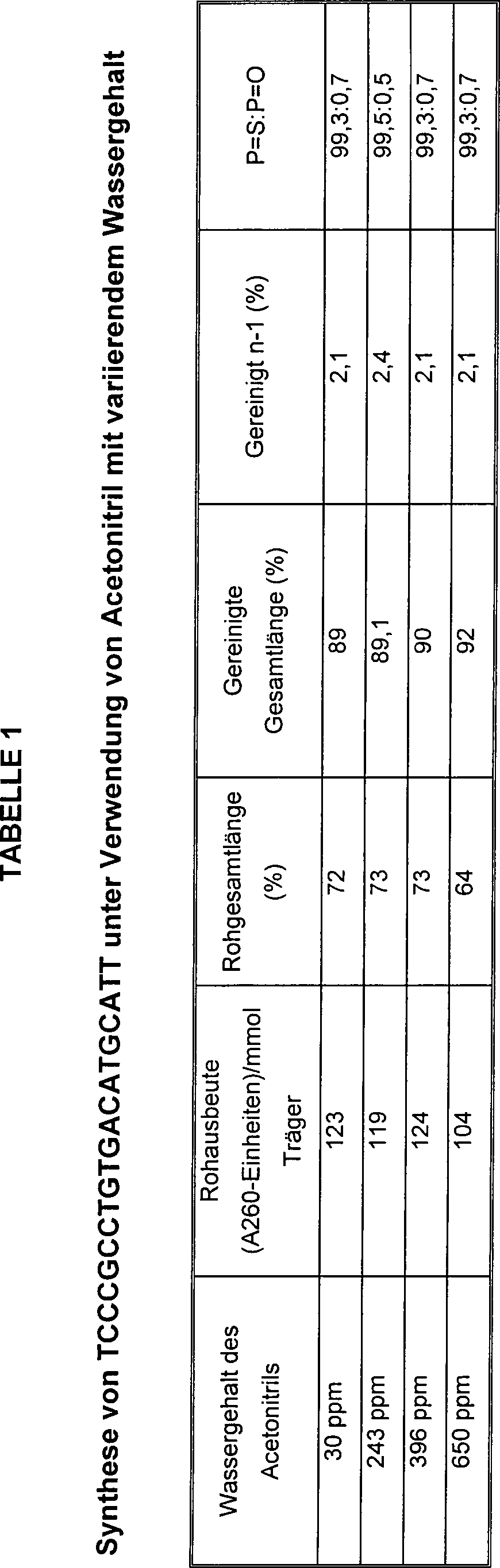
Claims (17)
Applications Claiming Priority (3)
| Application Number | Priority Date | Filing Date | Title |
|---|---|---|---|
| US09/167,165 US6069243A (en) | 1998-10-06 | 1998-10-06 | Process for oligonucleotide synthesis |
| US167165 | 1998-10-06 | ||
| PCT/US1999/022892 WO2000020431A1 (en) | 1998-10-06 | 1999-10-01 | Improved process for oligonucleotide synthesis |
Publications (3)
| Publication Number | Publication Date |
|---|---|
| DE69918149D1 DE69918149D1 (en) | 2004-07-22 |
| DE69918149T2 true DE69918149T2 (en) | 2005-06-09 |
| DE69918149T8 DE69918149T8 (en) | 2005-09-29 |
Family
ID=22606209
Family Applications (1)
| Application Number | Title | Priority Date | Filing Date |
|---|---|---|---|
| DE69918149T Active DE69918149T8 (en) | 1998-10-06 | 1999-10-01 | IMPROVED METHOD FOR OLIGONUCLEOTIDE SYNTHESIS |
Country Status (6)
| Country | Link |
|---|---|
| US (1) | US6069243A (en) |
| EP (1) | EP1119578B1 (en) |
| AT (1) | ATE269351T1 (en) |
| AU (1) | AU6409399A (en) |
| DE (1) | DE69918149T8 (en) |
| WO (1) | WO2000020431A1 (en) |
Families Citing this family (18)
| Publication number | Priority date | Publication date | Assignee | Title |
|---|---|---|---|---|
| FR2790955B1 (en) | 1999-03-19 | 2003-01-17 | Assist Publ Hopitaux De Paris | USE OF STABILIZED OLIGONUCLEOTIDES AS ANTI-TUMOR ACTIVE INGREDIENT |
| US6610842B1 (en) * | 1999-05-06 | 2003-08-26 | Isis Pharmaceuticals, Inc. | Processes for the synthesis of oligomers using phosphoramidite compositions |
| EP1176151B1 (en) * | 2000-07-28 | 2014-08-20 | Agilent Technologies, Inc. | Synthesis of polynucleotides using combined oxidation/deprotection chemistry |
| DE10041539A1 (en) * | 2000-08-24 | 2002-03-07 | Febit Ferrarius Biotech Gmbh | New amidite derivatives for the synthesis of polymers on surfaces |
| US6693187B1 (en) * | 2000-10-17 | 2004-02-17 | Lievre Cornu Llc | Phosphinoamidite carboxlates and analogs thereof in the synthesis of oligonucleotides having reduced internucleotide charge |
| US6768005B2 (en) | 2000-12-20 | 2004-07-27 | Avecia Limited | Process |
| AU2002220870A1 (en) * | 2000-12-05 | 2002-06-18 | Avecia Limited | Process for the preparation of phosphorothionate oligonucleotides |
| ES2276914T3 (en) * | 2001-01-30 | 2007-07-01 | Isis Pharmaceuticals, Inc. | PROCEDURES FOR DETECTION OF CHLORINE HYDRATE IN DICHLOROACETIC ACID. |
| US6858720B2 (en) | 2001-10-31 | 2005-02-22 | Agilent Technologies, Inc. | Method of synthesizing polynucleotides using ionic liquids |
| US6852850B2 (en) * | 2001-10-31 | 2005-02-08 | Agilent Technologies, Inc. | Use of ionic liquids for fabrication of polynucleotide arrays |
| US6696298B2 (en) | 2001-12-07 | 2004-02-24 | Biosearch Technologies, Inc. | Multi-channel reagent dispensing apparatus |
| US7169916B2 (en) * | 2002-04-01 | 2007-01-30 | Isis Pharmaceuticals, Inc. | Chloral-free DCA in oligonucleotide synthesis |
| WO2014028739A1 (en) * | 2012-08-15 | 2014-02-20 | Isis Pharmaceuticals, Inc. | Method of preparing oligomeric compounds using modified capping protocols |
| DK2951191T3 (en) * | 2013-01-31 | 2019-01-14 | Ionis Pharmaceuticals Inc | PROCEDURE FOR MANUFACTURING OLIGOMERIC COMPOUNDS USING MODIFIED CLUTCH PROTOCOLS |
| EP2782332B1 (en) | 2013-03-22 | 2017-08-30 | Harvest Imaging bvba | Digital camera with focus-detection pixels used for light metering |
| US10040048B1 (en) | 2014-09-25 | 2018-08-07 | Synthego Corporation | Automated modular system and method for production of biopolymers |
| EP3681637A4 (en) | 2017-09-11 | 2021-06-02 | Synthego Corporation | BIOPOLYMER SYNTHESIS PROCESS AND SYSTEM |
| MX2023007242A (en) * | 2020-12-18 | 2023-06-29 | Lilly Co Eli | OSCILLATING FLUIDIZED BED OLIGONUCLEOTIDE SYNTHESIZER. |
Family Cites Families (23)
| Publication number | Priority date | Publication date | Assignee | Title |
|---|---|---|---|---|
| US34069A (en) * | 1862-01-07 | Improved combined knife, fork, and spoon | ||
| US4458066A (en) * | 1980-02-29 | 1984-07-03 | University Patents, Inc. | Process for preparing polynucleotides |
| US5132418A (en) * | 1980-02-29 | 1992-07-21 | University Patents, Inc. | Process for preparing polynucleotides |
| US4500707A (en) * | 1980-02-29 | 1985-02-19 | University Patents, Inc. | Nucleosides useful in the preparation of polynucleotides |
| US4415732A (en) * | 1981-03-27 | 1983-11-15 | University Patents, Inc. | Phosphoramidite compounds and processes |
| US4973679A (en) * | 1981-03-27 | 1990-11-27 | University Patents, Inc. | Process for oligonucleo tide synthesis using phosphormidite intermediates |
| US4668777A (en) * | 1981-03-27 | 1987-05-26 | University Patents, Inc. | Phosphoramidite nucleoside compounds |
| US4517338A (en) * | 1983-06-20 | 1985-05-14 | Chiron Corporation | Multiple reactor system and method for polynucleotide synthesis |
| USRE34069E (en) | 1983-08-18 | 1992-09-15 | Biosyntech Gmbh | Process for the preparation of oligonucleotides |
| DE3329892A1 (en) * | 1983-08-18 | 1985-03-07 | Köster, Hubert, Prof. Dr., 2000 Hamburg | METHOD FOR PRODUCING OLIGONUCLEOTIDES |
| US5034506A (en) * | 1985-03-15 | 1991-07-23 | Anti-Gene Development Group | Uncharged morpholino-based polymers having achiral intersubunit linkages |
| US5459255A (en) * | 1990-01-11 | 1995-10-17 | Isis Pharmaceuticals, Inc. | N-2 substituted purines |
| US5151510A (en) * | 1990-04-20 | 1992-09-29 | Applied Biosystems, Inc. | Method of synethesizing sulfurized oligonucleotide analogs |
| US5292875A (en) * | 1990-04-20 | 1994-03-08 | Lynx Therapeutics, Inc. | Method of synthesizing sulfurized oligonucleotide analogs |
| US5378825A (en) * | 1990-07-27 | 1995-01-03 | Isis Pharmaceuticals, Inc. | Backbone modified oligonucleotide analogs |
| US5138045A (en) * | 1990-07-27 | 1992-08-11 | Isis Pharmaceuticals | Polyamine conjugated oligonucleotides |
| US5218105A (en) * | 1990-07-27 | 1993-06-08 | Isis Pharmaceuticals | Polyamine conjugated oligonucleotides |
| US5539082A (en) * | 1993-04-26 | 1996-07-23 | Nielsen; Peter E. | Peptide nucleic acids |
| US5210264A (en) * | 1992-01-10 | 1993-05-11 | Isis Pharmaceuticals, Inc. | S-(2,4-dichlorobenzyl)-β-cyanoethyl phosphorothioate diester |
| US5571902A (en) * | 1993-07-29 | 1996-11-05 | Isis Pharmaceuticals, Inc. | Synthesis of oligonucleotides |
| US5440068A (en) * | 1993-12-30 | 1995-08-08 | The Standard Oil Company | Acetonitrile purification via an adsorption-based process |
| US5889136A (en) * | 1995-06-09 | 1999-03-30 | The Regents Of The University Of Colorado | Orthoester protecting groups in RNA synthesis |
| US5902881A (en) * | 1997-03-03 | 1999-05-11 | Isis Pharmaceuticals, Inc. | Reagent useful for synthesizing sulfurized oligonucleotide analogs |
-
1998
- 1998-10-06 US US09/167,165 patent/US6069243A/en not_active Expired - Lifetime
-
1999
- 1999-10-01 DE DE69918149T patent/DE69918149T8/en active Active
- 1999-10-01 AT AT99951708T patent/ATE269351T1/en not_active IP Right Cessation
- 1999-10-01 EP EP99951708A patent/EP1119578B1/en not_active Expired - Lifetime
- 1999-10-01 WO PCT/US1999/022892 patent/WO2000020431A1/en not_active Ceased
- 1999-10-01 AU AU64093/99A patent/AU6409399A/en not_active Abandoned
Also Published As
| Publication number | Publication date |
|---|---|
| DE69918149D1 (en) | 2004-07-22 |
| US6069243A (en) | 2000-05-30 |
| EP1119578A4 (en) | 2002-04-17 |
| ATE269351T1 (en) | 2004-07-15 |
| EP1119578A1 (en) | 2001-08-01 |
| DE69918149T8 (en) | 2005-09-29 |
| WO2000020431A1 (en) | 2000-04-13 |
| EP1119578B1 (en) | 2004-06-16 |
| AU6409399A (en) | 2000-04-26 |
Similar Documents
| Publication | Publication Date | Title |
|---|---|---|
| EP1801114B1 (en) | Polynucleotides with a phosphate mimetic | |
| DE69026963T2 (en) | METHOD FOR PRODUCING OLIGONUCLEOTIDES, APPLICABLE FOR SERIAL PRODUCTION | |
| DE69725866T2 (en) | SOLID PHASE SYNTHESIS | |
| EP0399330B1 (en) | Modified phosphoramidite process for preparing modified nucleic acids | |
| DE69233599T2 (en) | Broken 2'-modified oligonucleotides | |
| DE69937439T2 (en) | Improved deprotection method for the synthesis of oligomer compounds | |
| DE69407032T2 (en) | OLIGONUCLEOTIDES WITH AMIDE CHAINS USE THE PHOSPHOESTER CHAINS | |
| DE69924930T2 (en) | Synthesis of oligonucleotides | |
| DE69632456T2 (en) | NUCLEIC ACID SYNTHESIS USING MEDIUM-SHIFTABLE PROTECTION GROUPS | |
| EP0152459B1 (en) | Process for producing oligonucleotides | |
| DE3855275T2 (en) | Non-nucleotide binding reagent for nucleotide samples | |
| DE69027443T2 (en) | OLIGONUCLEOTID ANALOGUE WITH NEW BINDINGS | |
| DE69128250T2 (en) | NUCLEOSIDE ANALOGS | |
| EP1119578B1 (en) | Improved process for oligonucleotide synthesis | |
| DE69724218T2 (en) | UNIVERSAL FIXED CARRIERS AND METHOD FOR THEIR USE | |
| DE69116864T2 (en) | METHOD AND MEANS FOR THE SYNTHESIS OF OLIGONUCLEOTIDES | |
| EP0593901B1 (en) | Oligoribonucleotide- and ribozyme-analoguer with terminal 3',3'- and 5',5'-bonds respectively | |
| DE69733150T2 (en) | PROCESS FOR THE PRODUCTION OF NUCLEOTIDES OR OLIGONUCLEOTIDES PHOSPHORAMITIDES | |
| DE69731112T2 (en) | PROCESS FOR SYNTHESIS OF PHOSPHOROTHIOAT OLIGONUCELOTIDES | |
| DE69402177T2 (en) | SYNTHESIS OF DIMER BLOCKS AND THEIR USE IN THE COMPOSITION OF OLIGONUCLEOTIDES | |
| US6399765B1 (en) | Methods for removing dimethoxytrityl groups from oligonucleotides | |
| EP1564291A2 (en) | Oligonucleotides, agents containing them and their use | |
| DE69732101T2 (en) | COMBINATIONAL PROTECTION GROUP STRATEGY FOR MULTIFUNCTIONAL MOLECULES | |
| US6107479A (en) | Process for the preparation of an oligomeric compound | |
| DE69423042T2 (en) | PROTECTIVE GROUP FOR USE IN OLIGODEOXYRIBONUCLEOTID SYNTHESIS |
Legal Events
| Date | Code | Title | Description |
|---|---|---|---|
| 8364 | No opposition during term of opposition |