EP1555631A2 - Signalrauschfilterung - Google Patents
Signalrauschfilterung Download PDFInfo
- Publication number
- EP1555631A2 EP1555631A2 EP05000945A EP05000945A EP1555631A2 EP 1555631 A2 EP1555631 A2 EP 1555631A2 EP 05000945 A EP05000945 A EP 05000945A EP 05000945 A EP05000945 A EP 05000945A EP 1555631 A2 EP1555631 A2 EP 1555631A2
- Authority
- EP
- European Patent Office
- Prior art keywords
- weight
- spline
- measurement data
- signal processing
- spline filter
- Prior art date
- Legal status (The legal status is an assumption and is not a legal conclusion. Google has not performed a legal analysis and makes no representation as to the accuracy of the status listed.)
- Withdrawn
Links
Images




Classifications
-
- G—PHYSICS
- G01—MEASURING; TESTING
- G01D—MEASURING NOT SPECIALLY ADAPTED FOR A SPECIFIC VARIABLE; ARRANGEMENTS FOR MEASURING TWO OR MORE VARIABLES NOT COVERED IN A SINGLE OTHER SUBCLASS; TARIFF METERING APPARATUS; MEASURING OR TESTING NOT OTHERWISE PROVIDED FOR
- G01D1/00—Measuring arrangements giving results other than momentary value of variable, of general application
-
- G—PHYSICS
- G01—MEASURING; TESTING
- G01B—MEASURING LENGTH, THICKNESS OR SIMILAR LINEAR DIMENSIONS; MEASURING ANGLES; MEASURING AREAS; MEASURING IRREGULARITIES OF SURFACES OR CONTOURS
- G01B21/00—Measuring arrangements or details thereof, where the measuring technique is not covered by the other groups of this subclass, unspecified or not relevant
- G01B21/02—Measuring arrangements or details thereof, where the measuring technique is not covered by the other groups of this subclass, unspecified or not relevant for measuring length, width, or thickness
- G01B21/04—Measuring arrangements or details thereof, where the measuring technique is not covered by the other groups of this subclass, unspecified or not relevant for measuring length, width, or thickness by measuring coordinates of points
- G01B21/045—Correction of measurements
-
- G—PHYSICS
- G01—MEASURING; TESTING
- G01D—MEASURING NOT SPECIALLY ADAPTED FOR A SPECIFIC VARIABLE; ARRANGEMENTS FOR MEASURING TWO OR MORE VARIABLES NOT COVERED IN A SINGLE OTHER SUBCLASS; TARIFF METERING APPARATUS; MEASURING OR TESTING NOT OTHERWISE PROVIDED FOR
- G01D3/00—Indicating or recording apparatus with provision for the special purposes referred to in the subgroups
- G01D3/02—Indicating or recording apparatus with provision for the special purposes referred to in the subgroups with provision for altering or correcting the law of variation
- G01D3/022—Indicating or recording apparatus with provision for the special purposes referred to in the subgroups with provision for altering or correcting the law of variation having an ideal characteristic, map or correction data stored in a digital memory
-
- G—PHYSICS
- G06—COMPUTING OR CALCULATING; COUNTING
- G06T—IMAGE DATA PROCESSING OR GENERATION, IN GENERAL
- G06T5/00—Image enhancement or restoration
- G06T5/70—Denoising; Smoothing
Definitions
- the present invention relates to a signal processing method, more specifically, relates to a signal processing method for filtering a data obtained by measuring surface texture of an object to be measured such as roughness or a contour etc. of the object to be measured.
- Measuring instruments for measuring surface texture of an object to be measured e.g. contour, roughness, waviness, etc. of a surface of the object to be measured
- a coordinate measuring machine for measuring a three-dimensional shape of the object to be measured a form measuring machine or an image measuring machine for measuring a two-dimensional contour
- a roundness measuring machine for measuring roundness and further, a surface roughness tester for measuring waviness and roughness etc. of the surface of the object to be measured have been conventionally known.
- a contact type or non-contact type sensor and the object to be measured are moved relatively, to collect measurement data of the surface of the object to be measured.
- disturbances such as noise are contained in thus collected measurement data.
- the disturbance is usually an electric and magnetic induction noise etc. containing high-frequency components
- the surface roughness and the waviness can be the disturbance of the contour.
- a spline filter is known as such a filter (refer to Document 1: Japanese Patent Laid-Open Publication No. HEI 9-179992, and Document 2: Japanese Patent Laid-Open Publication No. HEI 8-278343). Further, a robust spline filter is known for applying weight on each measurement data and for repeating to update of the weight until this weighting is optimized.
- the robust spline filter has been applicable to curve data, but it has not been applicable to curved surface data obtained by measuring a surface area.
- a primary object of the present invention is to provide a signal processing method having a high reliability, which allows data obtained by measuring the surface area to be utilized, maintaining a distinctive feature of the spline filter, and is also capable of being applied to surface measurement data such as the surface texture of the object to be measured, and in addition hereto, to provide a signal processing program, a recording medium storing the signal processing program and a signal processor.
- a signal-processing method is for filtering a measurement data obtained by measuring the surface area the method including: a measurement data input step for inputting the measurement data; a selecting step for selecting a predetermined weighted spline filter formula; an initializing step for applying weight on the measurement data by a unit matrix to obtain an initial value of a spline filter output; a weight-adjusting step for adjusting and determining the weight on the measurement data; a spline filter output calculating step for calculating the spline filter output using the weight determined in the weight-adjusting step; a convergence test step for determining a convergence of the weight; and an output step for outputting a signal-processing result based on the spline filter output, wherein, when it is not judged that the weight is converged in the convergence judging step, the weight is updated and the weight-adjusting step and the spline-filter output-calculating step are repeated and wherein a smoothing spline curved surface corresponding to the measurement data is
- the weighted-spline filter formula is selected and the spline curved surface as a spline filtering output is repeatedly calculated while sequentially updating its weight based upon the selected spline filter formula, so that the robust-spline filtering having the filter output as the signal processing result of the spline curve when the weight is converged can be applied on the measurement data. Accordingly a deformation at the start or end area of the measurement data (an end-effect) can be prevented, and the shape contained in the measurement data can be extracted without being influenced by trackability for waviness component and the noise component in the measurement data. As a result, the filtering with excellent shape trackability can be conducted thereby further enhancing the reliability of the measurement data.
- the measurement data obtained by measuring the surface area refers to, for example, data etc. obtained by scanning the surface of the object to be measured with the coordinate measuring machine or the surface texture measuring machine. That is, it refers to data to be represented with height data f (x, y) from the surface with respect to a sampling position (x, y).
- the weight determined in the weight-adjusting step is preferably adjusted to smaller value as a deviation of the measurement data from the spline curve calculated by the weighted-spline filter formula becomes greater.
- the weight of the measurement data is adjusted smaller as the deviation of the measurement data from the spline curve calculated by the weighted-spline filter formula becomes greater, robust-spline filtering without being influenced by singular point data contained in the measurement data is provided.
- the spline curve is repeatedly calculated while applying small weight on the measurement data remote from the spline curve and applying heavy weight on the measurement data near the spline curve. Then, the spline curve is gradually approximated to the original shape component (for example, a true shape value etc. of the object to be measured) contained in the measurement data.
- the final spline curve when the weight is judged converged is regarded as a shape component having sufficiently small error relative to the original shape component.
- the extremely accurate robust-spline filtering can be conducted.
- the weight is preferably judged converged when amount of weight-change in the weight adjusting step becomes a predetermined value or less in the convergence judging step,
- the output step preferably includes: a weight-updating step for updating the weight to 1 when the weight of the measurement data exceeds a predetermined value, a spline filter re-output calculating step for calculating the spline filter output, based upon the updated weight, and a signal process result output step for outputting the spline filter output in the spline filter re-output calculating step as a signal processing result.
- the weight of the measurement data exceeds a predetermined value the weight is updated to 1 and when the weight of the measured data is not greater than a predetermined value the weight is updated to 0, and the spline filter output is re-calculated to be outputted as a signal processing result.
- the measurement data where its weight exceeds a predetermined value is considered as an efficient data with its weight being updated to 1, however, the measurement data where its weight is not greater than a predetermined value is considered as an inefficient data with its weight being updated to 0, and the spline filter output after the updating is obtained again so that the robust spline filter processing can be more securely conducted.
- the result is outputted as the signal-processing result, a spline curve with sufficiently small error relative to the original shape component contained in the measurement data can be calculated. Consequently, robust spline filtering with excellent shape trackability can be achieved.
- the measurement data inputting step preferably includes a step of deleting singular point data separated locally as against the measurement data.
- the signal process program of the present invention causes a computer to execute the above-mentioned signal processing method.
- the recording medium of the present invention has the above-mentioned signal process program recorded computer-readably.
- the signal processing unit of the present invention causes a computer to execute the above-mentioned signal processing program.
- the computer having a CPU (Central Processing Unit) and a memory (memory device) is built-in the signal processing unit and the program is configurated so as for computer to execute each step
- parameters can be easily change, for example, various parameters including decision of the separation quantity according to the dimension of the measurement data in addition to the weight adjustment or the convergence determination etc.
- the recording medium with this program recorded therein may be directly inserted into the computer, thereby to install the program in the computer, and a read device for reading out information of the recording medium may be externally attached to the computer, thereby to install the program in the computer from this read device.
- the program may be supplied to and installed in the computer via communication lines such as an Internet, a LAN cable, and a telephone circuit, or a wireless.
- the signal processing method of the present invention primarily relates to a signal processing method of performing a filter process for the curved surface data obtained by measuring the surface area; however the robust spline filter (spline filter) for the curve data is shown as a reference technology on the premise of explaining the present invention.
- weighted spline filter will be described below.
- a spline filter is obtained by minimizing sum of squares of residual error relative to measurement data under the condition that spline energy is minimized.
- the spline filter is obtained by minimizing the I(s) (where ⁇ represents Lagrange constant).
- the spline function s is digitized at a constant pitch where the second term is modified as
- the weighted spline filter is defined as a spline function for minimizing I(s) in the formula (6).
- Transfer function H(z) of the spline filter is represented by
- Z e j ⁇ x so that following formula is established.
- H ( ⁇ ) 1 1 + ⁇ ( e - 2 j ⁇ x - 4 e- j ⁇ x +6-4 e j ⁇ x +e j ⁇ x )
- amplitude characteristic can be represented as
- the matrix is solved by singular value decomposition method.
- singular value decomposition method when singular value decomposition method is employed, a great-capacity storage and much processing time are required.
- the present invention to the actual measurement data, it is rare that the matrix M becomes singular, and when the matrix M is singular, it is presumed that the measurement data itself is defective. Therefore, Gill-Murray modified Cholesky decomposition capable of outputting some solution even when the matrix M is singular is applied to achieve both calculation efficiency and countermeasure for singular matrix.
- Weighted spline filter supported by a solution can be deduced as described above and a robust spline filter is obtained by repeating calculation until convergence condition is satisfied while updating the weight W.
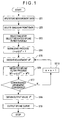
- FIG. 1 is a flowchart showing a first process and FIG. 2 is a functional block diagram of a device executing the robust spline processing.
- a measurement data input step for inputting a measurement data and a selecting step (ST3) for selecting weighted spline filter formula are initially executed.
- a step ST1 for inputting the measurement data from a measuring instrument etc. by an input unit 1 to store the data in a storage such as a computer, and a step ST2 for deleting locally isolated singular point data contained in the stored measurement data by a singular point data deleting unit 3 are executed.
- the measurement data is a one-dimensional time-series data measured by a roughness-measuring machine, where, for instance, a probe of a surface roughness tester is moved in a direction (x-direction) to obtain a roughness data y at a predetermined pitch in x-direction.
- a data is a singular point data or not can be easily determined by checking whether deviation of the measurement data relative to least square curve is not less than a predetermined value and not more than a predetermined width or not.
- the selecting step ST3 whether the measurement data is non-periodic or periodic is judged by a judging unit 4 and weighted spline filter formula is selected in accordance with the judgment. Specifically, the formula (12) and the formula (17) are selectably used in accordance with the judgment whether the measurement data is non-periodic or periodic.
- weight W m is adjusted and determined by a weight adjuster 5 according to below-described process (ST5).
- adaptive biweight method is applied as follows.
- FIG. 3A and FIG. 3B show examples where a signal-processing method by the robust spline filtering in the first reference technology is conducted for a one-dimensional time-series data.
- both of a spline curve processed by normal spline filtering and a spline curve processed by the robust spline filtering according to the present invention are applied on the measurement data applied with a spike noise, which are shown in a superposing manner.
- a spline curve along original shape is obtained by the robust spline filtering.
- excellent trackability for a shape having gentle waviness can be obtained.
- the measurement data as a two-dimensional data refers to, for instance, (x, y) coordinates value etc. obtained by measuring contour curve of a workpiece under constant z-coordinate by a predetermined pitch using a coordinate measuring machine and the like or a data obtained by importing a figure drawn on a plane with a scanner.
- the object to be processed is only y-coordinate in the first reference technology, both of x-coordinate and y-coordinate are processed in the third reference technology.
- the basic arrangement of the third reference technology is the same as the first reference technology, which is characterized in a formula corresponding to the formula (6) in starting the calculation of spline curve s.
- a spline curve for minimizing sum of squares of the X and Y-direction distance between the measurement data (x k , y k ) and point (s x (x k , y k ), s y (x k , y k )) on the spline curve s corresponding to the measurement data (x k , y k ) is calculated.
- a spline curve s capable of minimizing I(s) represented by the following formula is calculated.
- weighted spline filter described in the first reference technology is applied for each x component and y component (see formula (37)).
- a spline filter for deducing the spline curve for each section of the two-dimensional measurement data can be constructed.
- (y k- s k m ) in formula (38) is set as a distance between two points as represented in the following formula, which specifically is a distance between the measurement data (x k , y k ) and the point (s x (x k , y k ), s y(x k , y k )) on the spline curve s corresponding to the measurement data (x k , y k ).
- d k ⁇ x k - s x ( x k , y k ) ⁇ 2 + ⁇ y k - s y (x k , y k ) ⁇ 2
- the convergence of the weight W calculated by the formula (38) applying the formula (49) is judged based on the formula (41).
- a spline curve corresponding to measurement data is calculated based on the output value S m (spline function).
- the spline curve is outputted to the output unit.
- FIG. 4A shows a comparison of a result of spline processing on an input data applying spike nose on a folium and a result of robust spline processing thereon.
- FIG. 4A shows a comparison of a result of spline processing on an input data applying spike nose on a folium and a result of robust spline processing thereon.
- FIG. 4B shows a result of spline processing on an input data applying spike noise on an airfoil and a result of robust spline processing thereon, which exhibits the same result as FIG. 4A.
- the measurement data as a three-dimensional data refers to, for instance, (x, y, z) coordinates value etc. obtained by measuring a surface of a workpiece at a predetermined pitch using a coordinate measuring machine and the like.
- the object to be processed is only y-coordinate in the first reference technology, all of x-coordinate, y-coordinate and z-coordinate are processed in the fourth reference technology.
- the basic arrangement of the fourth reference technology is the same as the first reference technology, which is characterized in a formula corresponding to the formula (6) in starting the calculation of spline curve s.
- a spline curve s capable of minimizing I(s) represented by the following formula is calculated.
- weighted spline filter described in the first reference technology is applied for each x, y and z component (see formula (37)).
- the constant ⁇ is defined based on a sampling pitch ⁇ 1 along measurement path in the three-dimensional space and cutoff wavelength ⁇ c ' according to the formula (48).
- a spline filter for deducing the spline curve for each section of the three-dimensional measurement data can be constructed.
- (y k- s k m ) in formula (38) is set as a distance between two points as represented in the following formula, which specifically is a distance between the measurement data (x k , y k , z k ) and point (s x (x k , y k , z k ), s y (x k , y k , z k ), s z (x k , y k , z k )) on the spline curve s corresponding to the measurement data (x k , y k , z k ).
- d k ( x k -s x ( x k , y k ,z k ) ⁇ 2 + ⁇ y k -s y ( x k , y k , z k ) ⁇ 2 + ( z k -s z ( x k , y k , z k ) ⁇ 2
- the convergence of the weight W calculated by the formula (38) applying the formula (51) is judged based on the formula (41).
- a spline curve corresponding to measurement data is calculated based on the output value S m (spline function).
- the spline curve is outputted to the output unit.
- FIG. 6 shows a modification of spline curve output (ST9) of FIG. 1.
- the calculated output value S m is inputted (ST91). Subsequently, whether re-calculation is to be conducted or not is determined (ST92). For instance, “YES” is selected when highly accurate signal-processing result is to be obtained and “NO” is selected when it is considered that sufficient accuracy has been obtained by an operator at the time, or in advance.
- the spline curve of the output value S m is outputted by the output unit 7.
- weight exceeding a predetermined value designated in advance is updated to 1 and weight not greater than a predetermined value is updated to 0 (ST93).
- the measurement data having weight exceeding the predetermined value is judged effective and 100% contribution on the spline processing is set thereon and the measurement data having weight not greater than the predetermined value is judged inefficient and 0 % contribution is set.
- weighted spline filtering is conducted based on the updated weight to obtain an output (ST94).
- the obtained spline curve is outputted by the output unit 7 as a signal-processing result (ST95).
- the reference variant can be applied on all of the first to fourth reference technologies, where the following advantage as well as the advantages (1) to (9) can be obtained.
- the so-called curved surface data signifies, for example, surface roughness data or form data etc. obtained by scanning the surface of the object to be measured by the coordinate measuring machine or the surface texture measuring machine.
- a basic processing procedure of the first embodiment is similar to that of the first reference technology or the second reference technology; however its special feature lies in an formula of a bending energy of the spline and so on, which is caused by the fact that data to be applied is curved surface data.
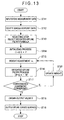
- the weighted spline filter on the measurement data of the surface area has been defined. Thereupon, by solving the weighted spline filter repeatedly while updating the weight for the residual according to the Biweight method it is made possible to obtain the robust spline filter on the measurement data of the surface area. Additionally, the computation for updating the weight is carried out with the formula (38) to the formula (41) explained in the first reference technology. And, such processes are realized with the flowchart of Fig. 13 and the functional block diagram of Fig. 2.
- W is an n ⁇ n diagonal matrix with a weight w i assumed to be a diagonal element
- Q is an n ⁇ n coefficient matrix
- S is an n-dimensional filter output vector
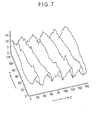
- Fig. 7 is a view illustrating measurement data obtained in the measurement
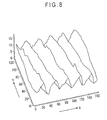
- Fig. 8 is a view illustrating a result obtained by applying the robust spline filter on the measurement data of Fig. 7.
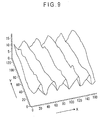
- Fig. 9 a result obtained by applying the Gaussian filter on the measurement data of Fig. 7 is shown as a comparative example.
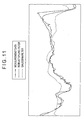
- a sectional profile along the X direction of Fig. 7 is shown, and in Fig. 11, a sectional profile along the Y direction of Fig. 7 is shown.
- H x (Z x ) z 2 x -4z x + 6 - 4z x -1 + z x -2
- H y ( z y ) z 2 y - 4 z y + 6 - 4 z y -1 + z y -2
- z x and z y are expressed as follows respectively.
- z x e j ⁇ x ⁇ x
- z y e j ⁇ y ⁇ y
- this filter is a phase compensating filter without a delay.
- ⁇ x 1 16sin 4 ( ⁇ c ⁇ x 2 )
- ⁇ y 1 16sin 4 ( ⁇ c ⁇ y 2 )
- ⁇ xy 1-16 ⁇ x sin 4 ( ⁇ c ⁇ x 2 2 )-16 ⁇ y sin 4 ( ⁇ c ⁇ y 2 2 ) 16sin 2 ( ⁇ c ⁇ x 2 2 )sin 2 ( ⁇ c ⁇ y 2 2 )
- the present invention which is not restricted to each of these embodiments, can be carried out for, for example, all of three-dimensional roughness data, measurement data by the contour measuring machine, data measured in the roundness measuring machine, form data measured in the coordinate measuring machine, data measured in the image measuring machine, etc.
- the present invention can be carried out for electric signal data etc. as well, which occurs in a time-series manner.
- a signal processing program for a computer which executes the signal processing method of the present invention, may be employed, and this signal processing program can be filed in a form, which is executable by various computers, by employing a portable-type storage medium such as a CD-ROM.
- this signal processing program may be of compile format to be translated into a machine language, or may be of interpreter format to be translated into an intermediate language.
- causing the computer to execute the signal processing program enables the signal processing unit to be configured. That is, by causing the computer to execute the measurement data inputting step, the selecting step, the initializing step, the weight adjusting step, the spline filter output calculating step, the convergence determining step, and the outputting step respectively, the measurement data inputting device, the selector, the initializing device, the weight adjusting device, the spline filter output calculator, the converge judging unit, and the outputting device are configured respectively, thereby allowing the signal processing unit to be configured.
Landscapes
- Physics & Mathematics (AREA)
- General Physics & Mathematics (AREA)
- Engineering & Computer Science (AREA)
- Technology Law (AREA)
- Theoretical Computer Science (AREA)
- Length Measuring Devices With Unspecified Measuring Means (AREA)
- Indication And Recording Devices For Special Purposes And Tariff Metering Devices (AREA)
- Radar Systems Or Details Thereof (AREA)
- Measurement Of Mechanical Vibrations Or Ultrasonic Waves (AREA)
- Image Analysis (AREA)
- Image Processing (AREA)
Applications Claiming Priority (2)
| Application Number | Priority Date | Filing Date | Title |
|---|---|---|---|
| JP2004010918A JP2005201869A (ja) | 2004-01-19 | 2004-01-19 | 信号処理方法、信号処理プログラム、この信号処理プログラムを記録した記録媒体および信号処理装置 |
| JP2004010918 | 2004-01-19 |
Publications (2)
| Publication Number | Publication Date |
|---|---|
| EP1555631A2 true EP1555631A2 (de) | 2005-07-20 |
| EP1555631A3 EP1555631A3 (de) | 2015-09-02 |
Family
ID=34616945
Family Applications (1)
| Application Number | Title | Priority Date | Filing Date |
|---|---|---|---|
| EP05000945.5A Withdrawn EP1555631A3 (de) | 2004-01-19 | 2005-01-18 | Signalrauschfilterung |
Country Status (4)
| Country | Link |
|---|---|
| US (1) | US7188054B2 (de) |
| EP (1) | EP1555631A3 (de) |
| JP (1) | JP2005201869A (de) |
| CN (1) | CN100468391C (de) |
Families Citing this family (15)
| Publication number | Priority date | Publication date | Assignee | Title |
|---|---|---|---|---|
| JP4390569B2 (ja) * | 2004-01-19 | 2009-12-24 | 株式会社ミツトヨ | 信号処理装置、および測定機 |
| DE102004032822A1 (de) * | 2004-07-06 | 2006-03-23 | Micro-Epsilon Messtechnik Gmbh & Co Kg | Verfahren zur Verarbeitung von Messwerten |
| JP4514206B2 (ja) * | 2004-08-30 | 2010-07-28 | 株式会社ロゼフテクノロジー | 粗さ曲線の抽出プログラムおよび3次元表面粗さ形状の抽出プログラム |
| JP4705815B2 (ja) * | 2005-07-12 | 2011-06-22 | 株式会社ミツトヨ | データ処理装置、およびデータ処理方法、データ処理プログラム |
| JP4967989B2 (ja) * | 2007-10-26 | 2012-07-04 | トヨタ自動車株式会社 | 設計支援装置、設計支援方法、および設計支援プログラム |
| JP4390851B2 (ja) * | 2009-06-16 | 2009-12-24 | 株式会社ミツトヨ | 信号処理装置、および測定機 |
| JP5540977B2 (ja) * | 2010-08-05 | 2014-07-02 | Jfeスチール株式会社 | 平面形状の測定方法 |
| CN102708282B (zh) * | 2012-04-16 | 2015-04-15 | 天津大学 | 一种轮廓线数据的滤波方法 |
| US9797715B2 (en) | 2013-07-23 | 2017-10-24 | Landau Gage, Inc. | Gage for verifying profile of part and method of verifying profile of part |
| CN104462014B (zh) * | 2014-11-19 | 2017-06-16 | 上海理工大学 | 一种基于改进非局部均值的cpmg信号去噪算法 |
| JP6376081B2 (ja) * | 2015-08-31 | 2018-08-22 | Jfeスチール株式会社 | 被検体の形状算出方法、鋼板のプレス矯正方法および鋼板の製造方法 |
| JP6803241B2 (ja) * | 2017-01-13 | 2020-12-23 | アズビル株式会社 | 時系列データ処理装置および処理方法 |
| JP6954346B2 (ja) * | 2017-04-27 | 2021-10-27 | 日本電気株式会社 | パラメータ推定装置、パラメータ推定方法、及びプログラム |
| CN109029328A (zh) * | 2018-06-21 | 2018-12-18 | 哈尔滨工业大学 | 一种基于m估计的表面轮廓稳健样条滤波方法 |
| CN109802655B (zh) * | 2019-02-25 | 2019-11-05 | 哈尔滨工业大学 | 用于表面计量的各向同性二维高阶样条滤波方法 |
Family Cites Families (17)
| Publication number | Priority date | Publication date | Assignee | Title |
|---|---|---|---|---|
| GB2202659B (en) * | 1987-02-23 | 1991-07-17 | Mitutoyo Corp | Coordinate measuring instrument and method of generating pattern data concerning shape of work to be measured |
| JP3327622B2 (ja) * | 1992-04-29 | 2002-09-24 | キヤノン株式会社 | ベジェスプラインから2次多項式フラグメントへの変換 |
| JP3108317B2 (ja) * | 1995-04-07 | 2000-11-13 | 古河電気工業株式会社 | 信号処理装置および信号処理方法 |
| JP2785784B2 (ja) * | 1995-12-23 | 1998-08-13 | 日本電気株式会社 | スプライン曲線及びスプライン曲面の生成方法及び生成装置 |
| US6175643B1 (en) * | 1997-12-18 | 2001-01-16 | Siemens Corporate Research, Inc. | Neural network based auto-windowing system for MR images |
| JP2001052039A (ja) * | 1999-08-11 | 2001-02-23 | Sony Corp | 情報処理装置及び方法、表示装置及び方法並びに記録媒体 |
| US6523467B2 (en) * | 1999-12-17 | 2003-02-25 | Heidelberger Druckmaschinen Aktiengesellschaft | Method for measuring engraving cups |
| GB0003571D0 (en) * | 2000-02-17 | 2000-04-05 | Secr Defence Brit | Signal processing technique |
| JP3827549B2 (ja) * | 2001-10-04 | 2006-09-27 | 株式会社ミツトヨ | プローブの校正方法および校正プログラム |
| US6772100B2 (en) * | 2001-12-17 | 2004-08-03 | Lockheed Martin Corporation | Multipath mitigation filter |
| JP3821739B2 (ja) * | 2002-03-22 | 2006-09-13 | 株式会社ミツトヨ | 測定データ整形方法 |
| JP4427258B2 (ja) * | 2002-07-18 | 2010-03-03 | 株式会社ミツトヨ | 信号処理方法、信号処理プログラム、この信号処理プログラムを記録した記録媒体および信号処理装置 |
| US6816799B2 (en) * | 2002-08-05 | 2004-11-09 | Robert Bosch Corporation | Vehicle operating parameter determination system and method |
| GB0228163D0 (en) * | 2002-12-03 | 2003-01-08 | Qinetiq Ltd | Decorrelation of signals |
| US6885980B2 (en) * | 2003-02-18 | 2005-04-26 | Mitutoyo Corporation | Signal-processing method, signal-processing program, recording medium, storing the signal-processing program and signal processor |
| JP4427272B2 (ja) * | 2003-05-07 | 2010-03-03 | 株式会社ミツトヨ | 信号処理装置、信号処理方法、信号処理プログラム、信号処理プログラムを記録した記録媒体および測定機 |
| JP4390569B2 (ja) * | 2004-01-19 | 2009-12-24 | 株式会社ミツトヨ | 信号処理装置、および測定機 |
-
2004
- 2004-01-19 JP JP2004010918A patent/JP2005201869A/ja not_active Withdrawn
-
2005
- 2005-01-18 US US11/037,936 patent/US7188054B2/en not_active Expired - Lifetime
- 2005-01-18 EP EP05000945.5A patent/EP1555631A3/de not_active Withdrawn
- 2005-01-19 CN CNB2005100017732A patent/CN100468391C/zh not_active Expired - Fee Related
Non-Patent Citations (1)
| Title |
|---|
| None * |
Also Published As
| Publication number | Publication date |
|---|---|
| JP2005201869A (ja) | 2005-07-28 |
| US7188054B2 (en) | 2007-03-06 |
| US20050159931A1 (en) | 2005-07-21 |
| CN1645360A (zh) | 2005-07-27 |
| EP1555631A3 (de) | 2015-09-02 |
| CN100468391C (zh) | 2009-03-11 |
Similar Documents
| Publication | Publication Date | Title |
|---|---|---|
| US7188054B2 (en) | Signal processing method, signal processing program, recording medium storing the signal processing program and signal processor | |
| US6781681B2 (en) | System and method for wavefront measurement | |
| US7440115B2 (en) | System and methods for wavefront measurement | |
| CN107430013B (zh) | 使用参考光纤干涉数据配准测量的光纤干涉数据 | |
| JP2001066122A (ja) | 表面形状測定方法及びその装置 | |
| JP2017127398A (ja) | 情報処理装置、情報処理システム、情報処理方法及びプログラム | |
| US7461112B2 (en) | Signal processor, signal processing method, signal processing program, recording medium with the signal processing program recorded therein and measuring instrument | |
| CN120064946A (zh) | 芯片电源噪声影响测试方法及装置 | |
| CN115790401A (zh) | 一种基于视觉测量的位移测量方法及相关设备 | |
| CN120525851A (zh) | 基于机器视觉的智能加工定位方法及系统 | |
| JP4427258B2 (ja) | 信号処理方法、信号処理プログラム、この信号処理プログラムを記録した記録媒体および信号処理装置 | |
| JPWO2003036229A1 (ja) | 表面形状測定方法およびその装置 | |
| EP3588120B1 (de) | System und verfahren zur verbesserten signaldetektion in der nmr-spektroskopie | |
| EP1450485B1 (de) | Signalverarbeitungsverfahren und -programm, Aufzeichnungsmedium zur Speicherung des Programms und Signalprozessor | |
| Halilovič et al. | Computationally efficient stress reconstruction from full-field strain measurements | |
| EP2561542B1 (de) | Bestimmung von eigenschaften | |
| CN116819561A (zh) | 一种点云数据匹配方法、系统、电子设备及存储介质 | |
| JP5333143B2 (ja) | 形状測定装置、形状測定方法およびプログラム | |
| EP1157253B1 (de) | Topografische rekonstruktion einer probe | |
| CN119805153A (zh) | 一种半导体测试方法及装置 | |
| He et al. | Narrow-band frequency analysis for laser-based glass thickness measurement | |
| JP4390851B2 (ja) | 信号処理装置、および測定機 | |
| Xing et al. | Optimizing dynamic measurement accuracy for machine tools and industrial robots with unscented Kalman filter and particle swarm optimization methods | |
| He et al. | The Calculation of Roughness Uncertainty by Fitting B‐Spline Filter Assessment Middle Lines | |
| CN120846255B (zh) | 基于工业物联网的工件平整度测量方法、装置、介质及设备 |
Legal Events
| Date | Code | Title | Description |
|---|---|---|---|
| PUAI | Public reference made under article 153(3) epc to a published international application that has entered the european phase |
Free format text: ORIGINAL CODE: 0009012 |
|
| AK | Designated contracting states |
Kind code of ref document: A2 Designated state(s): AT BE BG CH CY CZ DE DK EE ES FI FR GB GR HU IE IS IT LI LT LU MC NL PL PT RO SE SI SK TR |
|
| AX | Request for extension of the european patent |
Extension state: AL BA HR LV MK YU |
|
| PUAL | Search report despatched |
Free format text: ORIGINAL CODE: 0009013 |
|
| AK | Designated contracting states |
Kind code of ref document: A3 Designated state(s): AT BE BG CH CY CZ DE DK EE ES FI FR GB GR HU IE IS IT LI LT LU MC NL PL PT RO SE SI SK TR |
|
| AX | Request for extension of the european patent |
Extension state: AL BA HR LV MK YU |
|
| RIC1 | Information provided on ipc code assigned before grant |
Ipc: G01D 1/00 20060101ALI20150730BHEP Ipc: G06T 5/00 20060101AFI20150730BHEP Ipc: G01D 3/02 20060101ALI20150730BHEP Ipc: G01B 21/04 20060101ALI20150730BHEP |
|
| 17P | Request for examination filed |
Effective date: 20151006 |
|
| RBV | Designated contracting states (corrected) |
Designated state(s): AT BE BG CH CY CZ DE DK EE ES FI FR GB GR HU IE IS IT LI LT LU MC NL PL PT RO SE SI SK TR |
|
| AKX | Designation fees paid |
Designated state(s): DE FR GB IT |
|
| AXX | Extension fees paid |
Extension state: YU Extension state: MK Extension state: BA Extension state: LV Extension state: AL Extension state: HR |
|
| 17Q | First examination report despatched |
Effective date: 20190122 |
|
| STAA | Information on the status of an ep patent application or granted ep patent |
Free format text: STATUS: THE APPLICATION HAS BEEN WITHDRAWN |
|
| 18W | Application withdrawn |
Effective date: 20190529 |