EP1554361B1 - Kovalent an konjugierte polymere gebundene metallkomplexe und sie enthaltende elektronische bauteile - Google Patents
Kovalent an konjugierte polymere gebundene metallkomplexe und sie enthaltende elektronische bauteile Download PDFInfo
- Publication number
- EP1554361B1 EP1554361B1 EP03784837A EP03784837A EP1554361B1 EP 1554361 B1 EP1554361 B1 EP 1554361B1 EP 03784837 A EP03784837 A EP 03784837A EP 03784837 A EP03784837 A EP 03784837A EP 1554361 B1 EP1554361 B1 EP 1554361B1
- Authority
- EP
- European Patent Office
- Prior art keywords
- type
- groups
- inert spacer
- functional groups
- covalently bound
- Prior art date
- Legal status (The legal status is an assumption and is not a legal conclusion. Google has not performed a legal analysis and makes no representation as to the accuracy of the status listed.)
- Expired - Lifetime
Links
Images




Classifications
-
- C—CHEMISTRY; METALLURGY
- C07—ORGANIC CHEMISTRY
- C07D—HETEROCYCLIC COMPOUNDS
- C07D209/00—Heterocyclic compounds containing five-membered rings, condensed with other rings, with one nitrogen atom as the only ring hetero atom
- C07D209/56—Ring systems containing three or more rings
- C07D209/80—[b, c]- or [b, d]-condensed
- C07D209/82—Carbazoles; Hydrogenated carbazoles
- C07D209/88—Carbazoles; Hydrogenated carbazoles with hetero atoms or with carbon atoms having three bonds to hetero atoms with at the most one bond to halogen, e.g. ester or nitrile radicals, directly attached to carbon atoms of the ring system
-
- H—ELECTRICITY
- H10—SEMICONDUCTOR DEVICES; ELECTRIC SOLID-STATE DEVICES NOT OTHERWISE PROVIDED FOR
- H10K—ORGANIC ELECTRIC SOLID-STATE DEVICES
- H10K85/00—Organic materials used in the body or electrodes of devices covered by this subclass
- H10K85/10—Organic polymers or oligomers
- H10K85/141—Organic polymers or oligomers comprising aliphatic or olefinic chains, e.g. poly N-vinylcarbazol, PVC or PTFE
-
- C—CHEMISTRY; METALLURGY
- C07—ORGANIC CHEMISTRY
- C07D—HETEROCYCLIC COMPOUNDS
- C07D271/00—Heterocyclic compounds containing five-membered rings having two nitrogen atoms and one oxygen atom as the only ring hetero atoms
- C07D271/02—Heterocyclic compounds containing five-membered rings having two nitrogen atoms and one oxygen atom as the only ring hetero atoms not condensed with other rings
- C07D271/10—1,3,4-Oxadiazoles; Hydrogenated 1,3,4-oxadiazoles
- C07D271/107—1,3,4-Oxadiazoles; Hydrogenated 1,3,4-oxadiazoles with two aryl or substituted aryl radicals attached in positions 2 and 5
-
- C—CHEMISTRY; METALLURGY
- C07—ORGANIC CHEMISTRY
- C07F—ACYCLIC, CARBOCYCLIC OR HETEROCYCLIC COMPOUNDS CONTAINING ELEMENTS OTHER THAN CARBON, HYDROGEN, HALOGEN, OXYGEN, NITROGEN, SULFUR, SELENIUM OR TELLURIUM
- C07F15/00—Compounds containing elements of Groups 8, 9, 10 or 18 of the Periodic Table
- C07F15/0006—Compounds containing elements of Groups 8, 9, 10 or 18 of the Periodic Table compounds of the platinum group
- C07F15/0033—Iridium compounds
-
- C—CHEMISTRY; METALLURGY
- C08—ORGANIC MACROMOLECULAR COMPOUNDS; THEIR PREPARATION OR CHEMICAL WORKING-UP; COMPOSITIONS BASED THEREON
- C08G—MACROMOLECULAR COMPOUNDS OBTAINED OTHERWISE THAN BY REACTIONS ONLY INVOLVING UNSATURATED CARBON-TO-CARBON BONDS
- C08G61/00—Macromolecular compounds obtained by reactions forming a carbon-to-carbon link in the main chain of the macromolecule
- C08G61/02—Macromolecular compounds containing only carbon atoms in the main chain of the macromolecule, e.g. polyxylylenes
-
- C—CHEMISTRY; METALLURGY
- C08—ORGANIC MACROMOLECULAR COMPOUNDS; THEIR PREPARATION OR CHEMICAL WORKING-UP; COMPOSITIONS BASED THEREON
- C08G—MACROMOLECULAR COMPOUNDS OBTAINED OTHERWISE THAN BY REACTIONS ONLY INVOLVING UNSATURATED CARBON-TO-CARBON BONDS
- C08G61/00—Macromolecular compounds obtained by reactions forming a carbon-to-carbon link in the main chain of the macromolecule
- C08G61/12—Macromolecular compounds containing atoms other than carbon in the main chain of the macromolecule
- C08G61/122—Macromolecular compounds containing atoms other than carbon in the main chain of the macromolecule derived from five- or six-membered heterocyclic compounds, other than imides
-
- C—CHEMISTRY; METALLURGY
- C08—ORGANIC MACROMOLECULAR COMPOUNDS; THEIR PREPARATION OR CHEMICAL WORKING-UP; COMPOSITIONS BASED THEREON
- C08G—MACROMOLECULAR COMPOUNDS OBTAINED OTHERWISE THAN BY REACTIONS ONLY INVOLVING UNSATURATED CARBON-TO-CARBON BONDS
- C08G61/00—Macromolecular compounds obtained by reactions forming a carbon-to-carbon link in the main chain of the macromolecule
- C08G61/12—Macromolecular compounds containing atoms other than carbon in the main chain of the macromolecule
- C08G61/122—Macromolecular compounds containing atoms other than carbon in the main chain of the macromolecule derived from five- or six-membered heterocyclic compounds, other than imides
- C08G61/123—Macromolecular compounds containing atoms other than carbon in the main chain of the macromolecule derived from five- or six-membered heterocyclic compounds, other than imides derived from five-membered heterocyclic compounds
- C08G61/125—Macromolecular compounds containing atoms other than carbon in the main chain of the macromolecule derived from five- or six-membered heterocyclic compounds, other than imides derived from five-membered heterocyclic compounds with a five-membered ring containing one oxygen atom in the ring
-
- C—CHEMISTRY; METALLURGY
- C08—ORGANIC MACROMOLECULAR COMPOUNDS; THEIR PREPARATION OR CHEMICAL WORKING-UP; COMPOSITIONS BASED THEREON
- C08G—MACROMOLECULAR COMPOUNDS OBTAINED OTHERWISE THAN BY REACTIONS ONLY INVOLVING UNSATURATED CARBON-TO-CARBON BONDS
- C08G61/00—Macromolecular compounds obtained by reactions forming a carbon-to-carbon link in the main chain of the macromolecule
- C08G61/12—Macromolecular compounds containing atoms other than carbon in the main chain of the macromolecule
- C08G61/122—Macromolecular compounds containing atoms other than carbon in the main chain of the macromolecule derived from five- or six-membered heterocyclic compounds, other than imides
- C08G61/123—Macromolecular compounds containing atoms other than carbon in the main chain of the macromolecule derived from five- or six-membered heterocyclic compounds, other than imides derived from five-membered heterocyclic compounds
- C08G61/126—Macromolecular compounds containing atoms other than carbon in the main chain of the macromolecule derived from five- or six-membered heterocyclic compounds, other than imides derived from five-membered heterocyclic compounds with a five-membered ring containing one sulfur atom in the ring
-
- C—CHEMISTRY; METALLURGY
- C09—DYES; PAINTS; POLISHES; NATURAL RESINS; ADHESIVES; COMPOSITIONS NOT OTHERWISE PROVIDED FOR; APPLICATIONS OF MATERIALS NOT OTHERWISE PROVIDED FOR
- C09K—MATERIALS FOR MISCELLANEOUS APPLICATIONS, NOT PROVIDED FOR ELSEWHERE
- C09K11/00—Luminescent materials, e.g. electroluminescent or chemiluminescent
- C09K11/06—Luminescent materials, e.g. electroluminescent or chemiluminescent containing organic luminescent materials
-
- H—ELECTRICITY
- H05—ELECTRIC TECHNIQUES NOT OTHERWISE PROVIDED FOR
- H05B—ELECTRIC HEATING; ELECTRIC LIGHT SOURCES NOT OTHERWISE PROVIDED FOR; CIRCUIT ARRANGEMENTS FOR ELECTRIC LIGHT SOURCES, IN GENERAL
- H05B33/00—Electroluminescent light sources
- H05B33/12—Light sources with substantially two-dimensional [2D] radiating surfaces
- H05B33/20—Light sources with substantially two-dimensional [2D] radiating surfaces characterised by the chemical or physical composition or the arrangement of the material in which the electroluminescent material is embedded
-
- H—ELECTRICITY
- H10—SEMICONDUCTOR DEVICES; ELECTRIC SOLID-STATE DEVICES NOT OTHERWISE PROVIDED FOR
- H10K—ORGANIC ELECTRIC SOLID-STATE DEVICES
- H10K50/00—Organic light-emitting devices
- H10K50/10—OLEDs or polymer light-emitting diodes [PLED]
-
- H—ELECTRICITY
- H10—SEMICONDUCTOR DEVICES; ELECTRIC SOLID-STATE DEVICES NOT OTHERWISE PROVIDED FOR
- H10K—ORGANIC ELECTRIC SOLID-STATE DEVICES
- H10K50/00—Organic light-emitting devices
- H10K50/10—OLEDs or polymer light-emitting diodes [PLED]
- H10K50/11—OLEDs or polymer light-emitting diodes [PLED] characterised by the electroluminescent [EL] layers
-
- H—ELECTRICITY
- H10—SEMICONDUCTOR DEVICES; ELECTRIC SOLID-STATE DEVICES NOT OTHERWISE PROVIDED FOR
- H10K—ORGANIC ELECTRIC SOLID-STATE DEVICES
- H10K85/00—Organic materials used in the body or electrodes of devices covered by this subclass
- H10K85/10—Organic polymers or oligomers
- H10K85/111—Organic polymers or oligomers comprising aromatic, heteroaromatic, or aryl chains, e.g. polyaniline, polyphenylene or polyphenylene vinylene
- H10K85/114—Poly-phenylenevinylene; Derivatives thereof
-
- H—ELECTRICITY
- H10—SEMICONDUCTOR DEVICES; ELECTRIC SOLID-STATE DEVICES NOT OTHERWISE PROVIDED FOR
- H10K—ORGANIC ELECTRIC SOLID-STATE DEVICES
- H10K85/00—Organic materials used in the body or electrodes of devices covered by this subclass
- H10K85/10—Organic polymers or oligomers
- H10K85/111—Organic polymers or oligomers comprising aromatic, heteroaromatic, or aryl chains, e.g. polyaniline, polyphenylene or polyphenylene vinylene
- H10K85/115—Polyfluorene; Derivatives thereof
-
- H—ELECTRICITY
- H10—SEMICONDUCTOR DEVICES; ELECTRIC SOLID-STATE DEVICES NOT OTHERWISE PROVIDED FOR
- H10K—ORGANIC ELECTRIC SOLID-STATE DEVICES
- H10K85/00—Organic materials used in the body or electrodes of devices covered by this subclass
- H10K85/10—Organic polymers or oligomers
- H10K85/151—Copolymers
-
- H—ELECTRICITY
- H10—SEMICONDUCTOR DEVICES; ELECTRIC SOLID-STATE DEVICES NOT OTHERWISE PROVIDED FOR
- H10K—ORGANIC ELECTRIC SOLID-STATE DEVICES
- H10K85/00—Organic materials used in the body or electrodes of devices covered by this subclass
- H10K85/30—Coordination compounds
- H10K85/341—Transition metal complexes, e.g. Ru(II)polypyridine complexes
- H10K85/342—Transition metal complexes, e.g. Ru(II)polypyridine complexes comprising iridium
-
- H—ELECTRICITY
- H10—SEMICONDUCTOR DEVICES; ELECTRIC SOLID-STATE DEVICES NOT OTHERWISE PROVIDED FOR
- H10K—ORGANIC ELECTRIC SOLID-STATE DEVICES
- H10K85/00—Organic materials used in the body or electrodes of devices covered by this subclass
- H10K85/30—Coordination compounds
- H10K85/341—Transition metal complexes, e.g. Ru(II)polypyridine complexes
- H10K85/346—Transition metal complexes, e.g. Ru(II)polypyridine complexes comprising platinum
-
- H—ELECTRICITY
- H10—SEMICONDUCTOR DEVICES; ELECTRIC SOLID-STATE DEVICES NOT OTHERWISE PROVIDED FOR
- H10K—ORGANIC ELECTRIC SOLID-STATE DEVICES
- H10K85/00—Organic materials used in the body or electrodes of devices covered by this subclass
- H10K85/60—Organic compounds having low molecular weight
-
- H—ELECTRICITY
- H10—SEMICONDUCTOR DEVICES; ELECTRIC SOLID-STATE DEVICES NOT OTHERWISE PROVIDED FOR
- H10K—ORGANIC ELECTRIC SOLID-STATE DEVICES
- H10K85/00—Organic materials used in the body or electrodes of devices covered by this subclass
- H10K85/60—Organic compounds having low molecular weight
- H10K85/615—Polycyclic condensed aromatic hydrocarbons, e.g. anthracene
-
- H—ELECTRICITY
- H10—SEMICONDUCTOR DEVICES; ELECTRIC SOLID-STATE DEVICES NOT OTHERWISE PROVIDED FOR
- H10K—ORGANIC ELECTRIC SOLID-STATE DEVICES
- H10K85/00—Organic materials used in the body or electrodes of devices covered by this subclass
- H10K85/60—Organic compounds having low molecular weight
- H10K85/615—Polycyclic condensed aromatic hydrocarbons, e.g. anthracene
- H10K85/621—Aromatic anhydride or imide compounds, e.g. perylene tetra-carboxylic dianhydride or perylene tetracarboxylic di-imide
-
- H—ELECTRICITY
- H10—SEMICONDUCTOR DEVICES; ELECTRIC SOLID-STATE DEVICES NOT OTHERWISE PROVIDED FOR
- H10K—ORGANIC ELECTRIC SOLID-STATE DEVICES
- H10K85/00—Organic materials used in the body or electrodes of devices covered by this subclass
- H10K85/60—Organic compounds having low molecular weight
- H10K85/649—Aromatic compounds comprising a hetero atom
-
- H—ELECTRICITY
- H10—SEMICONDUCTOR DEVICES; ELECTRIC SOLID-STATE DEVICES NOT OTHERWISE PROVIDED FOR
- H10K—ORGANIC ELECTRIC SOLID-STATE DEVICES
- H10K85/00—Organic materials used in the body or electrodes of devices covered by this subclass
- H10K85/60—Organic compounds having low molecular weight
- H10K85/649—Aromatic compounds comprising a hetero atom
- H10K85/656—Aromatic compounds comprising a hetero atom comprising two or more different heteroatoms per ring
- H10K85/6565—Oxadiazole compounds
-
- C—CHEMISTRY; METALLURGY
- C09—DYES; PAINTS; POLISHES; NATURAL RESINS; ADHESIVES; COMPOSITIONS NOT OTHERWISE PROVIDED FOR; APPLICATIONS OF MATERIALS NOT OTHERWISE PROVIDED FOR
- C09K—MATERIALS FOR MISCELLANEOUS APPLICATIONS, NOT PROVIDED FOR ELSEWHERE
- C09K2211/00—Chemical nature of organic luminescent or tenebrescent compounds
- C09K2211/10—Non-macromolecular compounds
- C09K2211/1018—Heterocyclic compounds
- C09K2211/1025—Heterocyclic compounds characterised by ligands
- C09K2211/1029—Heterocyclic compounds characterised by ligands containing one nitrogen atom as the heteroatom
-
- C—CHEMISTRY; METALLURGY
- C09—DYES; PAINTS; POLISHES; NATURAL RESINS; ADHESIVES; COMPOSITIONS NOT OTHERWISE PROVIDED FOR; APPLICATIONS OF MATERIALS NOT OTHERWISE PROVIDED FOR
- C09K—MATERIALS FOR MISCELLANEOUS APPLICATIONS, NOT PROVIDED FOR ELSEWHERE
- C09K2211/00—Chemical nature of organic luminescent or tenebrescent compounds
- C09K2211/14—Macromolecular compounds
- C09K2211/1408—Carbocyclic compounds
-
- C—CHEMISTRY; METALLURGY
- C09—DYES; PAINTS; POLISHES; NATURAL RESINS; ADHESIVES; COMPOSITIONS NOT OTHERWISE PROVIDED FOR; APPLICATIONS OF MATERIALS NOT OTHERWISE PROVIDED FOR
- C09K—MATERIALS FOR MISCELLANEOUS APPLICATIONS, NOT PROVIDED FOR ELSEWHERE
- C09K2211/00—Chemical nature of organic luminescent or tenebrescent compounds
- C09K2211/14—Macromolecular compounds
- C09K2211/1408—Carbocyclic compounds
- C09K2211/1416—Condensed systems
-
- C—CHEMISTRY; METALLURGY
- C09—DYES; PAINTS; POLISHES; NATURAL RESINS; ADHESIVES; COMPOSITIONS NOT OTHERWISE PROVIDED FOR; APPLICATIONS OF MATERIALS NOT OTHERWISE PROVIDED FOR
- C09K—MATERIALS FOR MISCELLANEOUS APPLICATIONS, NOT PROVIDED FOR ELSEWHERE
- C09K2211/00—Chemical nature of organic luminescent or tenebrescent compounds
- C09K2211/14—Macromolecular compounds
- C09K2211/1408—Carbocyclic compounds
- C09K2211/1425—Non-condensed systems
-
- C—CHEMISTRY; METALLURGY
- C09—DYES; PAINTS; POLISHES; NATURAL RESINS; ADHESIVES; COMPOSITIONS NOT OTHERWISE PROVIDED FOR; APPLICATIONS OF MATERIALS NOT OTHERWISE PROVIDED FOR
- C09K—MATERIALS FOR MISCELLANEOUS APPLICATIONS, NOT PROVIDED FOR ELSEWHERE
- C09K2211/00—Chemical nature of organic luminescent or tenebrescent compounds
- C09K2211/14—Macromolecular compounds
- C09K2211/1441—Heterocyclic
- C09K2211/1466—Heterocyclic containing nitrogen as the only heteroatom
-
- C—CHEMISTRY; METALLURGY
- C09—DYES; PAINTS; POLISHES; NATURAL RESINS; ADHESIVES; COMPOSITIONS NOT OTHERWISE PROVIDED FOR; APPLICATIONS OF MATERIALS NOT OTHERWISE PROVIDED FOR
- C09K—MATERIALS FOR MISCELLANEOUS APPLICATIONS, NOT PROVIDED FOR ELSEWHERE
- C09K2211/00—Chemical nature of organic luminescent or tenebrescent compounds
- C09K2211/14—Macromolecular compounds
- C09K2211/1441—Heterocyclic
- C09K2211/1475—Heterocyclic containing nitrogen and oxygen as heteroatoms
-
- C—CHEMISTRY; METALLURGY
- C09—DYES; PAINTS; POLISHES; NATURAL RESINS; ADHESIVES; COMPOSITIONS NOT OTHERWISE PROVIDED FOR; APPLICATIONS OF MATERIALS NOT OTHERWISE PROVIDED FOR
- C09K—MATERIALS FOR MISCELLANEOUS APPLICATIONS, NOT PROVIDED FOR ELSEWHERE
- C09K2211/00—Chemical nature of organic luminescent or tenebrescent compounds
- C09K2211/18—Metal complexes
- C09K2211/185—Metal complexes of the platinum group, i.e. Os, Ir, Pt, Ru, Rh or Pd
-
- H—ELECTRICITY
- H10—SEMICONDUCTOR DEVICES; ELECTRIC SOLID-STATE DEVICES NOT OTHERWISE PROVIDED FOR
- H10K—ORGANIC ELECTRIC SOLID-STATE DEVICES
- H10K50/00—Organic light-emitting devices
-
- H—ELECTRICITY
- H10—SEMICONDUCTOR DEVICES; ELECTRIC SOLID-STATE DEVICES NOT OTHERWISE PROVIDED FOR
- H10K—ORGANIC ELECTRIC SOLID-STATE DEVICES
- H10K85/00—Organic materials used in the body or electrodes of devices covered by this subclass
- H10K85/30—Coordination compounds
- H10K85/321—Metal complexes comprising a group IIIA element, e.g. Tris (8-hydroxyquinoline) gallium [Gaq3]
- H10K85/324—Metal complexes comprising a group IIIA element, e.g. Tris (8-hydroxyquinoline) gallium [Gaq3] comprising aluminium, e.g. Alq3
-
- Y—GENERAL TAGGING OF NEW TECHNOLOGICAL DEVELOPMENTS; GENERAL TAGGING OF CROSS-SECTIONAL TECHNOLOGIES SPANNING OVER SEVERAL SECTIONS OF THE IPC; TECHNICAL SUBJECTS COVERED BY FORMER USPC CROSS-REFERENCE ART COLLECTIONS [XRACs] AND DIGESTS
- Y10—TECHNICAL SUBJECTS COVERED BY FORMER USPC
- Y10S—TECHNICAL SUBJECTS COVERED BY FORMER USPC CROSS-REFERENCE ART COLLECTIONS [XRACs] AND DIGESTS
- Y10S428/00—Stock material or miscellaneous articles
- Y10S428/917—Electroluminescent
Definitions
- the present invention relates to polymeric metal complex compositions comprising metallic complexes covalently bound to conjugated polymers.
- the invention further relates to electronic devices in which the active layer includes such polymeric metal complex compositions.
- Organic electronic devices that emit light, such as light-emitting diodes that make up displays, can be used in many different kinds of electronic equipment.
- an organic active layer is sandwiched between two electrical contact layers. At least one of the electrical contact layers is light-transmitting so that light can pass through the electrical contact layer.
- the organic active layer emits light through the light-transmitting electrical contact layer upon application of a voltage across the electrical contact layers.
- organic electroluminescent compounds As the active component in light-emitting diodes. Simple organic molecules such as anthracene, thiadiazole derivatives, and coumarin derivatives are known to show electroluminescence. Semiconductive conjugated polymers have also been used as electroluminescent components, as had been disclosed in, for example, Friend et al., U.S. Patent 5,247,190 , Heeger et al., U.S. Patent 5,408,109 , and Nakano et al., Published European Patent Application 443 861 . Polymeric materials with stilbenyl or oxadiazole side chains have been reported by Holmes et al., U.S. Patent 5,653,914 .
- Electroluminescent devices with an active layer of polyvinyl carbazole (PVK) doped with metallic complexes of iridium have been described by Burrows and Thompson in published PCT applications WO 00/70655 and WO 01/41512 .
- Electroluminescent emissive layers comprising a charge carrying host material and a phosphorescent platinum complex have been described by Thompson et al., in U.S. Patent 6,303,238 , Bradley et al., in Synth. Met. (2001), 116 (1-3), 379-383 , and Campbell et al., in Phys. Rev. B, Vol. 65 085210 .
- WO 02/31896 discloses polymer-bound metal complexes for use in electroluminescent devices. However, the polymers serve only to disperse the metal complexes in the emission layer, preventing their migration under the application of an electric field.
- Small molecule light-emitting materials are usually deposited by evaporative techniques. The equipment required for such processes can be quite expensive and may not be adaptable to continuous processing. Small molecule light-emitting materials can be coated from solution. However, they have a tendency to crystallize with evaporation of the coating solvent, which reduces their electroluminescent effectiveness.
- the present invention is directed to a polymeric metal complex composition
- a polymeric metal complex composition comprising (a) a conjugated polymeric backbone which facilitates charge transport; (b) a plurality of first-type functional groups; and (c) a plurality of first-type inert spacer groups, wherein each of the plurality of first-type functional groups is covalently bound to but not conjugated with at least one of the plurality of first-type inert spacer groups, which first-type inert spacer group is covalently bound to the polymeric backbone and wherein at least one of the first-type inert spacer group is an alkyl chain having from 4 to 12 carbon atoms, and wherein at least a portion of each of the plurality of first-type functional group is coordinated to at least one metal.
- the present invention is directed to an electroluminescent material containing at least one polymeric metal complex.
- the present invention is directed to an organic electronic device comprising at least one polymeric metal complex of the present invention.
- conjugated is intended to mean an unsaturated organic system having adjacent atoms with pi electrons where there is extended pi overlap across the system.
- the atoms can be sp 2 or sp hydbridized carbon atoms or other atoms with unshared electron pairs which can be hybridized into p orbitals.
- inert spacer group is intended to mean a connecting organic group that does not provide direct conjugation from one end point to the other end point.
- compound is intended to mean an electrically uncharged substance made up of molecules that further consist of atoms, wherein the atoms cannot be separated by physical means.
- ligand is intended to mean a molecule, ion, or atom that is attached to the coordination sphere of a metallic ion.
- parent ligand compound is intended to mean the neutral compound from which an ionic ligand is derived.
- complex when used as a noun, is intended to mean a compound having at least one metallic ion and at least one ligand.
- functional group is intended to mean a group that is capable of coordinating to a metal ion or atom.
- functionalized polymer is intended to mean a polymer having at least one functional group(s) prior to complexation with a metal.
- precursor metal compound is intended to mean a metal compound before it is attached to the functionalized polymer.
- polymeric metal complex is intended to mean polymeric material containing first-type functional groups where at least a portion of the first-type functional groups are coordinated to at least one metal containing complex.
- ⁇ -dicarbonyl is intended to mean a neutral compound in which two ketone groups are present, separated by a CHR group.
- ⁇ -enolate is intended to mean the anionic form of the ⁇ -dicarbonyl in which the proton from the CHR group between the two carbonyl groups has been abstracted.
- group is intended to mean a part of a compound, such as a substituent in an organic compound or a ligands in a complex.
- coordinated is intended to mean that one atom of a functional group forms a bond with a metal atom, where the functional group atom is a Lewis base donor atom, and the metal atom is a Lewis acid acceptor atom.
- hetero indicates that one or more carbon atoms has been replaced with a different atom.
- arylene is intended to mean a group derived from an aromatic hydrocarbon having two points of attachment, which group may be unsubstituted or substituted.
- heteroarylene is intended to mean a group derived from an aromatic group having at least one heteroatom and having two points of attachment, which group may be unsubstituted or substituted. Unless otherwise indicated, all groups can be unsubstituted or substituted.
- luminescence is intended to mean the emission of light without high temperature or incandescence.
- the adjective “luminescent” refers to materials which exhibit luminescence.
- adjacent to when used to refer to layers in a device, does not necessarily mean that one layer is immediately next to another layer.
- the phrase “adjacent R groups,” is used to refer to R groups that are next to each other in a chemical formula (i.e., R groups that are on atoms joined by a bond).
- the term “(H+F)” is intended to mean all combinations of hydrogen and fluorine, including completely hydrogenated, partially fluorinated or perfluorinated substituents.
- emission maximum is meant the wavelength, in nanometers, at which the maximum intensity of electroluminescence is obtained. Electroluminescence is generally measured in a diode structure, in which the material to be tested is sandwiched between two electrical contact layers and a voltage is applied. The light intensity and wavelength can be measured, for example, by a photodiode and a spectrograph, respectively.
- the IUPAC numbering system is used throughout, where the groups from the Periodic Table are numbered from left to right as 1 through 18 (CRC Handbook of Chemistry and Physics, 81 st Edition, 2000).
- the polymeric metal complex has a composition in which there is a covalent attachment between the metal complex and the conjugated polymer.
- the polymeric metal complex is formed by coordinating a precursor metal complex to a functionalized polymer, where the functionalized polymer comprises a conjugated polymeric backbone, a plurality of first-type functional groups, and inert spacer groups linking the first-type functional groups to the conjugated polymeric backbone.
- the conjugated polymeric backbone facilitates charge transport.
- a suitable polymeric backbone should have sufficient conjugation to achieve good transport properties.
- the polymeric backbone, in the absence of the metallic complex, can be luminescent itself, or it can be non-luminescent.
- the polymeric backbone can be a homopolymer or a copolymer, and can be substituted or unsubstituted.
- suitable conjugated polymeric backbones include polyphenylenes, polypyridines, polyarylamines, polyphenylenevinylenes, polyfluorenes, polyoxadiazoles, polythiophenes, and copolymers thereof. If the polymeric backbone has a non-conjugated portion, that portion may also provide charge transport properties, such as with vinylcarbazolediyl or triarylmethanediyl monomeric units.
- non-conjugated segments can be, for example, acrylic, methacrylic, vinyl, or other known monomeric units.
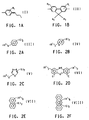
- the conjugated polymer is preferably a polyphenylene vinylene having at least one repeating unit having Formula I, shown in Figure 1 , or a polyfluorene having at least one repeating unit having Formula II, shown in Figure 1 , where:
- the preferred R 1 groups are alkyl groups having from 1 to 12 carbon atoms, heteroalkyl groups having 1 to 12 carbon atoms and one or more heteroatoms of S, N, or O, aryl groups having from 6 to 20 carbon atoms, and heteroaryl groups having from 2 to 20 carbon atoms and one or more heteroatoms of S, N, or O.
- R 1 groups include n- and iso-butyl, pentyls, both linear and branched, hexyls, octyls, including 2-ethylhexyl, up through hexadecyls and above, with and without olefinic unsaturation; phenyl, thiophene, carbazole, alkoxy, phenoxy and cyano groups. More preferred R 1 groups on the phenyl ring of the phenylenevinylene polymer are H, C 1 through C 12 alkoxy, C 1 through C 12 alkyl, C 6 through C 12 aryl and C 6 through C 25 alkoxy-substituted aryls.
- R 1 groups on the carbon atom in the 9-position of the fluorene repeating unit are linear and branched C 6 through C 12 alkyls. More preferred R 1 groups on the phenyl rings of the fluorene repeating unit are H, C 6 through C 12 alkoxy, phenoxy, C 6 through C 12 alkyl, phenyl or cyano.
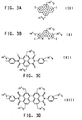
- Suitable fluorene copolymers can include additional repeating units selected from Formulae III through XII, shown in Figures 2 and 3 , where R 1 and R 2 are as defined above, and
- the first-type functional group is a group that is capable of coordinating to a metal.
- Useful first-type functional groups generally contain at least one nitrogen, oxygen, phosphorus or sulfur atom.
- suitable first-type functional groups include: carboxylic acid groups, or the acid salt; sulfonic acid groups, or the acid salt; groups having an -OH moiety, such as alkoxyl and phenoxyl; primary, secondary and tertiary amines; imines and diimines, such as pyridine, bipyridine and phenanthroline, and derivatives, including their oxides; phosphines; phosphine oxides; ⁇ -dicarbonyl groups, nitriles and isonitriles, cyanates, isocyanates, and any other coordinating groups.
- first-type functional groups are carboxylic acid, sulfonic acid, alkoxyl, bipyridine, phenanthroline, and ⁇ -dicarbonyl. It should be understood that the composition of a first-type functional group in the functionalized polymer may be identical to or different from the composition of another first-type functional group in the same functionalized polymer.
- the first-type functional group is attached to the conjugated backbone with at least one first-type inert spacer group.
- At least one metal ion or atom is coordinated to a plurality of ligands, at least one of which is the first-type functional group on the conjugated polymeric backbone.
- the nature of the other ligands can, in some cases, affect the luminescence strength, wavelength, efficiency and other properties of the electroluminescent material. The other ligands are discussed in more detail below.
- Preferred metals are the lanthanide metals, the Group 7, 8, 9, 10, and 11 transition metals, and the Group 12 and 13 metals. Particularly preferred metals are europium, terbium, thulium, rhenium, ruthenium, osmium, rhodium, iridium, platinum, palladium, gold, aluminum and zinc. Most preferred, are iridium and platinum.
- Polymeric-metal complexes of the present invention can be obtained from combining at least one functionalized polymer with at least one precursor metal compound.
- the functionalized polymeric compounds that are useful in the present invention can be generally described as having: (a) a conjugated polymeric backbone; (b) a plurality of first-type functional groups; (c) a plurality of first-type inert spacer groups, wherein each of the pluarity of first-type functional groups is attached to at least one of the plurality of the first-type spacer group, which first-type inert spacer groups are attached to the polymeric backbone; and optionally (d) a plurality of second-type functional groups.
- the number of first-type functional groups in the functionalized polymer which also can be described as the "density of functional groups", will determine the "maximum loading of the metal complex” (the amount of metal that can be coordinated to the functionalized polymer).
- the functionalized polymer can also have second-type functional groups.
- the second-type functional groups can be present to modify the physical processing properties or the photophysical properties of the final polymeric metal complex.
- groups which modify the processing properties include plasticizing groups, such as alkylene oxide groups, and reactive and/or crosslinkable groups, such as terminal vinyl groups and epoxy groups.
- groups which modify the photophysical properties include charge transport groups, such as carbazole or oxadiazole groups.
- the second-type functional groups can be covalently attached directly to the polymer backbone, or it can be attached to second-type inert spacer groups, which is covalently attached to the polymer backbone.
- Both the first-type inert spacer groups and the second-type inert spacer groups are spacer groups that are not conjugated with the conjugated polymeric backbone.
- the inert spacer groups do not contain any atoms with pi electrons.
- Examples of useful inert spacer groups include alkyl chains of from 1 through 12 carbon atoms, preferably 4 through 12.
- the inert spacer groups can also contain ether, ester, thioether, amide, imine, amine, or aromatic constituents, provided that such groups do not extend the conjugation of the polymeric backbone to the emissive center of the metal complex.
- the functionalized polymer may contain inert spacer groups that are the same or different in composition from each other.
- the functionalized polymer may have first-type spacer groups that have compositions different from each other.
- second-type of inert spacer groups are also present, the second-type inert spacer groups may be the same or different in composition from each other, and from the first-type inert spacer groups.
- Each inert spacer group is attached to one or more first-type functional groups.
- each second-type inert spacer group is attached to one or more second-type functional groups. If the spacer group is branched, it could be covalently bound to more than one functional groups.
- each of the first-type functionalized group is covalently bound to one first-type inert spacer group, such that the ratio of the number of first-type functionalized group to the number of first-type spacer group is 1:1.
- each of the second-type functionalized group is covalently bound to one second-type inert spacer group such that the ratio number of the second-type functionalized group to the number of second-type inert spacer group is 1:1.
- the term "plurality of" component is intended to encompass components of the same or different composition. Therefore, for example, in one embodiment the functionalized polymer may have first-type functional groups having the same composition from each other, while in another embodiment the functionalized polymers may have first-type functional groups having various compositions, which results in polymer metal complexes having first-type functional group having various compositions.
- the present invention further encompasses second-type functional groups having identical and various compositions.
- the functionalized polymer can be made by polymerizing monomer(s) having the desired functional group(s) attached with a spacer group, using conventional polymerization techniques.
- a polymer can be formed having spacer groups that are covalently attached to a first reactive group.
- the functional groups can be added to polymeric backbones by reacting a compound having the functional group and a second reactive group with the polymer having the first reactive group.
- a compound having the functional group and an acid chloride group can be reacted with a polymer with spacer groups attached to hydroxyl functional groups, to form an ester linkage between the spacer group and the functional group.
- the acid chloride group can be the functional group attached to a spacer group on a polymer and can be reacted with a compound having an hydroxyl group.
- a variety of synthetic routes are available in the organic chemistry literature.
- the density of first-type functional groups is determined by the relative proportion of monomers having first-type functional groups ("first-type functional monomers) to monomers not having functional groups ("non-functional monomers") in the polymer.
- first-type functional monomers monomers having first-type functional groups
- non-functional monomers monomers not having functional groups
- the ratio of first-types functional monomers to non-functional monomers can be in the range of about 100:0 (no non-functional monomers) to 0.1:99.9.
- the amount of metal in the polymeric metal complex is about 0.1 to 10% by weight, based on the total weight of the polymeric metal complex.
- the precursor metal compound is one which will coordinate to the first-type functional group on the functionalized polymer and provide the desired property(ies), luminescence and/or charge transport, in the final polymeric-metal complex.
- the precursor metal compound can be a simple metal salt, optionally in the presence of additional ligands, or it can be a metal complex. In some cases the precursor metal complexes may be present in more than one isomeric form, or mixtures of different complexes may be present. It will be understood that the term "precursor metal compound” is intended to encompass mixtures of compounds and/or isomers. It is also possible to use two or more different metals to coordinate to the functionalized polymer.
- Appropriate metal complexes include and metal/ligand combinations which produce a high photoluminescent quantum yield, preferably greater than 10%.
- Some typical examples include Al or Zn complexes of quinolinato or polydentate Schiff base ligands. More preferred, are metal/ligand combinations which also give rise to short-lived, i.e., less than 10 microseconds, triplet excited states.
- noble metal complexes such as Ir, Pt, Ru, Re, Os, or Au
- cyclometallated ligands such as phenylpyridines, imine ligands, such as bipyridine, or phosphine ligands such as triphenylphosphine
- rare earth metals such as Eu and Tb, in combination with acetylacetonate-derived ligands.
- polymeric-metal complexes of the invention will be described in terms of four representative types of metals: lanthanides, iridium, platinum, and aluminum.
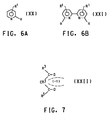
- the lanthanide metal is coordinated to at least one ligand selected from monophosphine oxides having Formula XIII shown in Figure 4 ; bisphosphine dioxides having Formula XIV, shown in Figure 4 , where in Formula XIV, x is 2, y is 1, and r is 1, or where x is 1, y is 2, and r is 0; trisphosphine trioxide having Formula XIV, shown in Figure 4 , where in Formula XIV, x is 1, y is 2, and r is 0; bis-phosphine oxide-sulfides having Formula XV, shown in Figure 4 ; pyridine N-oxides having Formula XVI, Formula XVII or Formula XVIII, shown in Figure 5 ; phosphine oxide-pyridine N-oxides having Formula XIX, shown in Figure 5 ; a mono-imine having a Formula XX, shown in Figure 6 , and a di
- phosphine oxide ligand is intended to mean a ligand having one or more phosphine oxide groups, hereinafter shown as "P(O)".
- bis-phosphine oxide-sulfide ligand is intended to mean a ligand having one phosphine oxide group and one phosphine sulfide group, where the phosphine sulfide group is hereinafter shown as "P(S)”.
- pyridine N-oxide ligand is intended to mean a ligand having a substituted or unsubstituted pyridine N-oxide fragment.
- phosphine oxide-pyridine N-oxide is intended to mean a ligand having one phosphine oxide group and one pyridine N-oxide fragment.
- Suitable monophosphineoxide ligands include:
- diphosphine dioxide ligands examples include:
- the oxides of monodentate phosphines, dioxides of bidentate phosphines (except for dppfcO 2 and dppcbO 2 ) and trioxides of tridentate phosphines are generally prepared by the oxidation of the corresponding phosphine with aqueous hydrogen peroxide in ethanol, as described in: Ellermann, J.; Schirmacher, D. Chem. Ber. 1967, 100, 2220 ; Siegl, W. O.; Lapporte, S. J.; Collman, J. P. Inorg. Chem. 1971, 10, 2158 ; Lindner, E.; Beer, H. Chem. Ber. 1972, 105, 3261 .
- the hydrogen peroxide oxidation is also used to prepare dppcbO 2 , but in THF at room temperature.
- the bis-phosphine monoxides can be synthesized via the selective Pd-catalyzed biphasic anaerobic oxidation of the corresponding bidentate phosphines with 1,2-dibromoethane in the presence of alkali, as described in: Grushin, V. V. J. Am. Chem. Soc. 1999, 121, 5831 ; U.S. Patent 5919984, 1999 .
- This Pd-catalyzed oxidation is also applied to the preparation of dppfcO 2 .
- the phosphine oxide group can be attached to a polymeric backbone by a variety of synthetic routes available in the organic chemistry literature.
- N-oxide ligands examples include, but are not limited to:
- N-oxide compounds are commercially available. Others can be made by oxidizing a nitrogen containing ligand with oxidants such as, for example, hydrogen peroxide.
- the N-oxides can be attached to a polymeric backbone using known synthetic techniques. In some cases it is possible to attach the nitrogen-containing ligand and then oxidize.
- Suitable mono-imines include:
- Suitable diimines include:
- the diimine and mono-imine ligands are commercially available from, for example, Aldrich Chemical Company (Milwaukee, WI).
- FMbipy can be prepared according to: Furue, Masaoki; Maruyama, Kazunori; Oguni, Tadayoshi; Naiki, Masahiro; Kamachi, Mikiharu. Inorg. Chem. 1992, 31(18), 3792-5 .
- 2-FMPbipy”, “3-FMPbipy”, and “FPbipy” can be prepared by Suzuki coupling, according to analogous literature procedures found in: Damrauer, Niels H.; Boussie, Thomas R.; Devenney, Martin; McCusker, James K. J. Am. Chem. Soc. 1997, 119(35), 8253-8268 .
- the above-described ligands can be added separately, or they can be present as the first-type functional group on the polymer.
- the remaining coordination sites are preferably occupied by ⁇ -enolate ligands.
- the ⁇ -enolate ligands can be present separately, or as the first-type functional group on the polymer.
- the ⁇ -enolate ligands generally have Formula XXII shown in Figure 7 , where R 3 is the same or different at each occurrence.
- the R 3 groups can be hydrogen, halogen, substituted or unsubstituted alkyl, aryl, alkylaryl or heterocyclic groups, or OR 2 groups, where R 2 is as defined above. Adjacent Regroups can be joined to form five- and six-membered rings, which can be substituted.
- Preferred R 3 groups are selected from H, F, C n (H+ F ) 2n+1 , -OC n (H+F) 2n+1 -OC n (H+F) 2n -, -C 6 H 5 , -C 4 H 3 S, and -C 4 H 3 O, where n is an integer from 1 to 12, preferably from 1 to 6.
- the ⁇ -enolate ligands are derived from ⁇ -dicarbonyl parent ligand compounds.
- suitable ⁇ -dicarbonyl parent ligand compounds include the compounds listed below.
- the abbreviation for the ⁇ -enolate form is given below in brackets:
- the ⁇ -dicarbonyl parent compounds are generally available commercially.
- the parent compound of F7acac, 1,1,1,3,5,5,5-heptafluoro-2,4-pentanedione, CF 3 C(O)CFHC(O)CF 3 can be prepared using a two-step synthesis, based on the reaction of perfluoropentene-2 with ammonia, followed by a hydrolysis step. This compound should be stored and reacted under anyhydrous conditions as it is susceptible to hydrolysis.
- the polymeric-metal complexes with iridium metal are preferably made from precursor iridium compounds which are complexes having at least one ligand, L, which is selected from Formulae XXIII through XXVII, shown in Figure 8 , and from Formulae XXVIII through XXXXII, shown in Figure 9 , where:
- Ligand L having Formula XXIII, shown in Figure 8 is derived from a phenylpyridine compound.
- Ligand L having Formula XXIV, shown in Figure 8 is derived from a phenyl-quinoline compound.
- Ligand L having Formula XXV or Formula XXVI, shown in Figure 8 is derived from a phenyl-isoquinoline compound.
- Ligand L having formula XXVII, shown in Figure 8 is derived from a phenyl-diazine compound, or the analog with 2 or more nitrogens. In Formulae XXIII through XXVII, it is preferred that there is at least one substituent on one of the rings selected from F, C n (H+F) 2n+1 , and OC n (H+F) 2n+1 .
- Ligand L having Formula XXVIII is derived from a thienyl-pyridine (when A is S) or pyrrolyl-pyridine (when A is NR 5 ) compound.
- Ligand L having Formula XXIX is derived from a thienyl- or a pyrrolyl-quinoline compound.
- Ligand L having Formula XXX or Formula XXXI is derived from a thienyl- or a pyrrolyl-isoquinoline compound.
- Ligand L having Formula XXXII is derived from a thienyl- or a pyrrolyl-diazine compound, or the analog with 2 or more nitrogens.
- R 5 is CH 3 .
- all the substituents on the thienyl or pyrrolyl ring are H or D.
- there is at least one substituent on one of the nitrogen-containing rings selected from F, C n (H+F) 2n+1 , and OC n (H+F) 2n+1 .
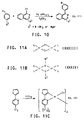
- the parent ligand compounds, HL can generally be prepared by standard palladium-catalyzed Suzuki or Kumada cross-coupling of the corresponding heterocyclic aryl chloride with an organoboronic acid or organomagnesium reagent, as described in, for example, O. Lohse, P.Thevenin, E. Waldvogel Synlett, 1999,45-48 . This reaction is illustrated for a phenyl-isoquinoline in Equation (1) in Figure 10 , where R 1 is as defined above.
- a more preferred precursor iridium complex is an iridium dimer with the L type ligand.
- the dimer can be the dichloro bridged dimer having Formula XXXIII, shown in Figure 11 , or the dihydroxo bridged dimer having Formula XXXIV, shown in Figure 11 , where:
- the dichloro bridged dimers having Formula XXXIII can generally be prepared by reacting iridium trichloride hydrate with the HL ligand precursors, in a suitable solvent, such as 2-ethoxyethanol. This is illustrated for a thienyl-pyridine ligand in Equation (2), shown in Figure 11 .
- the hydroxo bridged dimers having Formula XXXIV can generally be prepared by reacting iridium trichloride hydrate with the HL ligand precursors, and then adding NaOH. These dicyclometalated complexes can be isolated and (optionally) purified before further reaction.
- the polymeric-metal complexes with platinum metal are preferably made from precursor platinum compounds which are complexes having at least one ligand, L, which is selected from Formulae XXIII through XXVII, shown in Figure 8 , and from Formulae XXVIII through XXXXII, shown in Figure 9 , as described above.
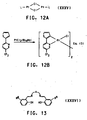
- the preferred precursor platinum complex is a platinum dichloro bridged dimer with the L type ligand, having Formula XXXV, shown in Figure 12 , where each L can be the same or different.
- the dichloro bridged dimers having Formula XXXV can generally be prepared by reacting platinum dichloride with the HL ligand precursors, in a suitable solvent, such as chlorobenzene or 2-ethoxyethanol, in the presence of an ammonium chloride salt, such as tetrabutylammonium chloride. This is illustrated with a thienyl-pyridine ligand in Equation (3), shown in Figure 12 .
- the bridged dichloro complexes can be isolated and (optionally) purified before further reaction.
- Preferred precursor aluminum compounds are complexes including a multidentate Schiff base ligand.
- Schiff bases are compounds that are prepared by a condensation reaction between an aldehyde or ketone derivative and a primary amine. By choosing various different poly-amines andaldehydes or ketones, it is possible to generate a wide array of multidentate anionic ligands.
- a preferred class of Schiff base ligands Formula XXXVI shown in Figure 13 where A 1 represents a bridging group derived from the poly-amine reactant, which can be alkyl, cycloalkyl, or aryl; R 8 and R 9 represent substituents on the phenyl group of the salicylaldehyde reactant, which can be alkyl or aryl groups.
- One useful precursor aluminum complex can be made by the addition of one molar equivalent of triethylaluminum to the Schiff base compound in hexane or toluene solvent. This forms the ethyl aluminum Schiff base complex.
- the polymeric-metal complexes are generally prepared by adding a precursor metal compound to a functionalized polymer to which it will coordinate.
- the specific choice of functionalized polymer is dependent on the nature of the precursor metal compound to be added. More than one type of metal can be coordinated to a single functionalized polymer.
- a general means of attachment of a metal-ligand precursor complex to a polymeric backbone involves two different approaches. Both require the use of a polymer derivative that contains a Lewis base functionality (X) appended to the primary polymer chain (backbone).
- This functionality can be ( Method A , shown below) the first-type functional group which coordinates directly to the metal, thus making it a ligand in the metal primary coordination sphere (with additional ligands, L n ).
- Method B shown below
- the polymer functionality can be attached covalently at a proximal site on a ligand (L') that is a component of the primary coordination sphere (with additional ligands, L n ).
- Either method may be used to append any metal-to-ligand charge transfer (MLCT) emitters (including Re-,Ru-, and Os-diimine and Rh-, Ir-, Pd-, and Pt-phenylpyridyl complexes), any intraligand charge transfer emitter complexes (including Al and Zn Schiff base complexes), or any lanthanide (atomic) emitter complexes (including Eu acetylacetonate complexes).
- MLCT metal-to-ligand charge transfer
- the polymer-bound Lewis base could either be directly attached to the metal or be attached via an acceptor functionality appended from a bipyridyl or phenylpyridyl ligand.
- Method A can be directly coordinated to Re using Method A.
- Method B can be used to condense a polymer-bound hydroxyethyl functionality with a 2,2'-bipyridyl derivative that has a carboxylic acid functionality appended from a pyridyl carbon atom.
- the exact reaction conditions vary with the specific materials used. In general, moderate heat is applied, such as refluxing in a solvent with a boiling point of 100°C or less. The reaction products can then be recovered by standard solvent removal and purification procedures.
- the polymeric lanthanide complexes can generally be prepared by the addition of simple metal salts, such as the halide or acetate salts, to polymers having ⁇ -dicarbonyl functional groups in the presence of the other phosphine oxide, N-oxide, or diimine ligands. Solvents such as methylene chloride can be used. Alternatively, complexes of the lanthanides with ⁇ -dicarbonyls can be added to polymers having diimine functional groups, such as phenanthroline or bipyridine; phosphine oxide functional groups; or N-oxide functional groups.
- simple metal salts such as the halide or acetate salts
- Solvents such as methylene chloride can be used.
- complexes of the lanthanides with ⁇ -dicarbonyls can be added to polymers having diimine functional groups, such as phenanthroline or bipyridine; phosphine oxide functional groups; or N-oxide functional groups.
- the polymeric iridium and platinum complexes are most conveniently prepared from the precursor metal dimers, Formulae XII, XIV, or XV, and polymers with ⁇ -dicarbonyl functionality. This is illustrated for an iridium complex in Equation (4) shown in Figure 14 .
- the reaction rate is very dependent upon the nature of the solvent. In THF it requires several days; in dichloromethane, several hours.
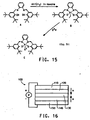
- the polymeric aluminum complexes are conveniently prepared from the ethyl aluminum Schiff base precursor complex and an acidic functionalized polymer. This is illustrated in the reaction scheme shown as Equation (5) in Figure 15 .
- Q 4 H represents the polymer functionalized with a carboxylic or sulfonic acid group.
- ethane is evolved and the conjugate base of the polymeric acid (Q 4 ) becomes bonded to the aluminum.
- the polymeric metal complexes of the invention can generally be coated from conventional solvents.
- the solvent used will depend on the nature of the polymeric backbone.
- solvents such as tetrahydrofuran, toluene, chlorobenzene, chloroform, and methylene chloride, can be used.
- preferred polymeric backbones are polyfluorenes.
- Copolymers of fluorene type monomers can generally be prepared by three known synthetic routes.
- the dihalo, preferably dibromo, derivatives of the monomeric units are reacted with a stoichiometric amount of a zerovalent nickel compound, such as bis(1,5-cyclooctadiene)nickel(0).
- a zerovalent nickel compound such as bis(1,5-cyclooctadiene)nickel(0).
- the second method as described in Colon et al., Journal of Polymer Science, Part A, Polymer chemistry Edition, Vol. 28, p.
- the dihalo, preferably dibromo, derivatives of the monomeric units are reacted with catalytic amounts of Ni(II) compounds in the presence of stoichiometric amounts of a material capable of reducing the divalent nickel ion to zerovalent nickel.
- Suitable materials include zinc, magnesium, calcium and lithium.
- a dihalo derivative of one monomeric unit is reacted with a derivative of another monomeric unit having two reactive groups selected from boronic acid, boronic acid esters, and boranes, in the presence of a zerovalent palladium catalyst, such as tetrakis(triphenylphosphine)Pd.
- a zerovalent palladium catalyst such as tetrakis(triphenylphosphine)Pd.
- Preferred metals are Ir and Pt, having one or more ligands selected from Formulae XXIII through XXXII.
- the polymeric metal complex of the invention is useful as a luminescent material, because, the charge transport and processing properties of conjugated polymers are combined with the luminescent efficiency and color of metal complex emitters.
- the luminescent material of the invention contains at least one polymeric metal complex composition described above.
- the luminescent material may exhibit photoluminescence, where the luminescence results from the application of visible, infrared, or ultraviolet radiation, usually ultraviolet.
- the luminescent material may exhibit electroluminescense, where the luminescence results from the application of an electric field.
- the luminescent material may exhibit both electroluminescence and photoluminescence.
- the electronic properties of the metal complex moiety are not coupled with the conjugated polymeric backbone because of the first-type inert spacer group.
- the luminescent properties of the polymeric metal complex are therefore primarily governed by the choice of the metal and the coordinated ligands.
- Electronic devices of the present invention are useful to exhibit photoluminescent and/or electroluminescent properties. They can be used in light-emitting diodes, which are discussed further below, photodiodes, photodetectors, as photoconductors, as in xerographic applications, and in illumination devices.
- Light-emitting diodes are referred to as LEDs or, when the active material is organic, as OLEDs.
- OLEDs generally have a structure in which an organic active layer is sandwiched between two electrical contact layers. OLEDs frequently have additional hole transport and electron transport layers.
- a typical structure is shown in Figure 16 .
- the device 100 has an anode layer 110 and a cathode layer 150. Adjacent to the anode is an optional layer 120 comprising hole transport material. Adjacent to the cathode is an optional layer 140 comprising an electron transport material. Between the anode or hole transport layer and the cathode or electron transport layer is the emitting layer 130.
- the electrons and holes move in the directions indicated by the arrows.
- the electrons and holes combine in the light-emitting layer to form an excited state, sometimes called an exciton. It is from the excitons that photons 160 are emitted.
- the exciton can also decay via non-radiative processes. This is known as quenching.
- the polymeric metal complexes of the invention are particularly useful as the active material in the emitting layer of an OLED.
- the emitting layer includes the polymeric metal complex
- additional materials can be present in the emitting layer with the polymeric-metal complex.
- a luminescent dye may be present to alter the color of emission.
- the polymeric metal complex may also be useful as a charge transportmaterial.
- the charge transport materials can be hole transport materials or electron transport materials.
- hole transport material is defined as material that can receive a positive charge and move it through the thickness of the material with relatively high efficiency and small loss.
- Electron transport material is defined as material that can receive a negative charge and move it through the thickness of the material with relatively high efficiency and small loss.
- the HOMO (highest occupied molecular orbital) of the hole transport material should align with the work function of the anode
- the LUMO (lowest unoccupied molecular orbital) of the electron transport material should align with the work function of the cathode.
- Chemical compatibility and processibility of the materials are also important considerations in selecting the electron and hole transport materials.
- charge transport materials include, but are not limited to, for optional layer 120, hole transport materials listed, in Kirk-Othmer Encyclopedia of Chemical Technology, Fourth Edition, Vol. 18, p. 837-860, 1996, by Y. Wang . Both hole transporting molecules and polymers can be used.
- hole transporting molecules are: N,N'-diphenyl-N,N'-bis(3-methylphenyl)-[1,1'-biphenyl]-4,4'-diamine (TPD), 1,1-bis[(di-4-tolylamino) phenyl]cyclohexane (TAPC), N,N'-bis(4-methylphenyl)-N,N'-bis(4-ethylphenyl)-[1,1'-(3,3'-dimethyl)biphenyl]-4,4'-diamine (ETPD), tetrakis-(3-methylphenyl)-N,N,N',N'-2,5-phenylenediamine (PDA), a-phenyl-4-N,N-diphenylaminostyrene (TPS), p-(diethylamino)benzaldehyde diphenylhydrazone (DEH), triphenylamine (TPA), bis
- hole transporting polymers are polyvinylcarbazole (PVK), (phenylmethyl)polysilane, poly(3,4-ethylenedioxythiophene) (PEDOT), and polyaniline (PANI). It is also possible to obtain hole transporting polymers by doping hole transporting molecules such as those mentioned above into polymers such as polystyrene and polycarbonate.
- Suitable electron transport materials include metal chelated oxinoid compounds, such as tris(8-hydroxyquinolato)aluminum (Alq 3 ); phenanthroline-based compounds, such as 2,9-dimethyl-4,7-diphenyl-1,10-phenanthroline (DDPA) or 4,7-diphenyl-1,10-phenanthroline (DPA); and azole compounds such as 2-(4-biphenylyl)-5-(4-t-butylphenyl)-1,3,4-oxadiazole (PBD), 4,4'-N,N'-dicarbazole biphenyl (BCP), and 3-(4-biphenylyl)-4-phenyl-5-(4-t-butylphenyl)-1,2,4-triazole (TAZ).
- Layer 140 can function both to facilitate electron transport, and also serve as a buffer layer or confinement layer to prevent quenching of the exciton at layer interfaces.
- DDPA 2,9-d
- the other layers in the OLED can be selected from any materials that are known to be useful in such layers.
- the anode 110 is an electrode that is particularly efficient for injecting positive charge carriers. It can be made of, for example materials containing a metal, mixed metal, alloy, metal oxide or mixed-metal oxide, or it can be a conducting polymer. Suitable metals include the Group 11 metals, the metals in Groups 4, 5, and 6, and the Groups 8-10 transition metals, as shown on the periodic table of elements (current IUPAC format). If the anode is to be light-transmitting, mixed-metal oxides of Groups 2, 3,4,13 and 14 metals, such as indium-tin-oxide, or a conducting polymer, such as polyaniline, can be used. At least one of the anode and cathode should be at least partially transparent to allow the generated light to be observed.
- the cathode 150 is an electrode that is particularly efficient for injecting electrons or negative charge carriers.
- the cathode can be any metal or nonmetal having a lower work function than the anode.
- Materials for the cathode can be selected from alkali metals of Group 1 (e.g., Li, Cs), the Group 2 (alkaline earth) metals, the Group 12 metals, the lanthanides, and the actinides. Materials such as aluminum, indium, calcium, barium, and magnesium, as well as combinations, can be used.
- Li-containing compounds can also be deposited between the organic layer and the cathode layer to lower the operating voltage.
- the OLED can be prepared by sequentially depositing the individual layers on a suitable substrate. Substrates such as glass and polymeric films can be used.
- the organic layers can be coated from solutions or dispersions in suitable solvents, using any conventional coating technique. In general, the different layers will have the following range of thicknesses: anode 110, 500-5000 ⁇ , preferably 1000-2000 ⁇ ; optional hole transport layer 120,50-3000 ⁇ , preferably600-2000 ⁇ ; light-emitting layer 130, 10-1000 ⁇ , preferably 100-800 ⁇ ; optional electron transport layer 140, 50-1000 ⁇ , preferably 200-800 ⁇ ; cathode 150, 200-10000 ⁇ , preferably 300-5000 ⁇ .
- the location of the electron-hole recombination zone in the device, and thus the emission spectrum of the device, can be affected by the relative thickness of each layer.
- the thickness of the electron-transport layer should be chosen so that the electron-hole recombination zone is in the light-emitting layer.
- the desired ratio of layer thicknesses will depend on the exact nature of the materials used.
- the efficiency of devices made with the polymeric-metal complexes of the invention can be further improved by optimizing the other layers in the device.
- more efficient cathodes such as Ca, Ba or Li can be used.
- Shaped substrates and novel hole transport materials that result in a reduction in operating voltage or increase quantum efficiency are also applicable.
- Additional layers can also be added to tailor the energy levels of the various layers and facilitate electroluminescence.
- This example illustrates the formation of a functionalized conjugated polymer.
- a fluorene monomer will be prepared by reaction of a dibromofluorene with a bromoalkanol, having a protected alcohol group (-OX 1 ).
- the alcohol group will be protected by any of the standard techniques know to those skilled in the art.
- the protecting group X 1 can be, for example, a pyranyl ether (-OTHP, where THP is tetrahydropyran) or a silylether (-OSiR 3 , where R is a bulky alkyl group such as t-butyl or i-propyl).
- Equation 6 in a first step, 3,6-dibromo fluorene is reacted with 6-bromohexanol protected with THP under phase transfer conditions using sodium hydroxide base to give a hexyl alcohol derivatized fluorene monomer.
- the initial product will be reacted with excess alkyl iodide, also under phase transfer conditions.
- R is an alkyl group having from 1 to 12 carbon atoms.
- This monomer will then be polymerized under standard conditions with bis-9-(2-ethylhexyl)-dibromofluorene in a mole ratio of 1:9.
- DMF 5 ml
- a 50 ml Schlenck tube equipped with a stirring bar and containing bis(1,5-cyclooctadiene)nickel(0) (5 mmol), 2,2'-bipyridyl (5 mmol), and 1,5-cyclooctadiene (5 mmol).
- the ensuing deep blue/purple solution will be stirred at 60 °C for 30 minutes, and then a solution of the hexyl alcohol derivatized fluorene monomer prepared above (0.25 mmol) and bis-9-(2-ethylhexyl)-dibromofluorene (2.25 mmol) in toluene (20 ml) will be added via syringe.
- the reaction mixture then will be stirred at 75 °C for 1 day.
- the mixture will be cooled to room temperature and precipitated into a solution of methanol (100 ml), acetone (100 ml) and concentrated hydrochloric acid (5 ml).
- the alcohol protecting group will be removed by reaction with the acid.
- This example illustrates the preparation of the hydroxo dimer, [IrOH ⁇ 2-(2,4-difluoro-phenyl)-isoquinoline ⁇ 2 ] 2 , as a precursor iridium complex.
- 2,4-difluorophenylboronic acid (Aldrich Chemical Co., 13.8 g, 87.4 mmol), 1-chloroisoquinoline (Adrich Chemical Co., 13 g, 79.4 mmol), tetrakistriphenylphosphine palladium(0) (Aldrich, 3.00 g, 2.59 mmol), potassium carbonate (EM Science, 24.2 g, 175 mmol), water (300 mL), and dimethoxyethane (Aldrich, 300 mL) were allowed to stir at reflux for 20 h under N 2 , after which time the mixture was cooled to room temperature and the organic and aqueous layers were separated.
- the aqueous layer was extracted with 3 X 150 mL of diethyl ether, and the combined organic fractions were dried with sodium sulfate, filtered, and the filtrate was evaporated to dryness.
- the pure product fractions were collected and dried in vacuo, to afford 17.7 g (92% isolated yield) of a light yellow solid, >95% pure NMR spectroscopy.
- the solid will be vigorously stirred under reflux with 30 mL of 1,2-dichloroethane and aqueous NaOH (2.2 g in 8 mL of water) for 6 hours.
- the organic solvent will be evaporated from the mixture to leave a suspension of a red solid in the aqueous phase.
- the red solid will be separated by filtration, thoroughly washed with water, and dried under vacuum to produce the iridium hydroxo dimer.
- Equation 7 one half of an equivalent (per functional group of the conjugated polymer) of the iridium hydroxo dimer precursor complex from Example 2 will be dissolved in THF containing the conjugated functionalized polymer from Example 1. Excess sodium carbonate will be added and the mixture stirred and warmed for 24 hours under nitrogen. The solution will be cooled and solvent evaporated to leave a solid residue, which will be extracted extensively with methylene chloride. This solution will be then evaporated and dried to yield the desired Ir functionalized polymeric material which will be a red emitter.
- This example illustrates the formation of thin film OLED devices.
- a substrate of indium tin oxide (ITO) on glass will be used, having an ITO thickness of about 1000 to 1500 ⁇ .
- the HT layer will be spin-coated onto the ITO substrate.
- the HT layer will be PEDOT (Baytron® P from Bayer, Germany) at a thickness of2000 ⁇ .
- the polymeric metal complex 200 mg will be dissolved in 10 mL toluene (0.5-2.0% w/v), filtered through a 0.45 micron filter, and spin-coated to a thickness of 500-1000 ⁇ .
- Ba and Al layers will be vapor deposited on top of the EL layers under a vacuum of 1 x 10 -6 torr.
- the final thickness of the Ba layer will be 30 ⁇ ; the thickness of the At layer will be 3000 ⁇ .
- Device performance will be tested inside a dry box using a calibrated Si photodiode.
- This example illustrates the preparation of the hydroxo dimer. [IrOH ⁇ 1-(4-tert-butyl-phenyl)-isoquinoline ⁇ 2 ] 2 , as a precursor iridium complex.
- the aqueous layer was extracted with 3 X 75 mL of diethyl ether, and the combined organic fractions were dried with sodium sulfate, filtered, and the filtrate was evaporated to dryness.
- the pure product fractions were collected and dried in vacuo, to afford 4.5 g (56% isolated yield) of a light yellow solid, >95% pure NMR spectroscopy.
- 1-(4-t-Bu-phenyl)-isoquinoline from above (1.00 g, 3.82 mmol), IrCl 3 (H 2 O) 3 (Strem Chemicals, 633 mg, 1.79 mmol), and 2-ethoxyethanol (Aldrich Chemical Co., 40 mL) were allowed to stir at reflux for 15 h, after which time the mixture was poured into an equal volume of water. The resulting orange precipitate was isolated by filtration, washed with water, and allowed to dry in vacuo. Then the solid was re-dissolved in dichloromethane and passed through a silica gel pad. The red eluted dichloromethane solution was evaporated to dryness, and the resulting solid was suspended in hexanes.
- This example illustrates the formation of a polymer which can be converted to a functionalized polymer.
- DMF (6 ml) was added to a Schlenck tube equipped with a stirring bar and containing, bis (1,5-cyclooctadiene)nickel (0) (1.667 g, 6.06 mmol), 2,2'-bipyridyl (0.947 g, 6.06 mmol), and 1,5-cyclooctadiene (0.656 g, 6.06 mmol).
- the reaction mixture was then stirred at 75 °C for 24 h.
- the mixture was cooled to room temperature and precipitated into a solution of methanol (100 ml), acetone (100 ml) and concentrated hydrochloric acid (5 ml). After stirring for 2 hours, the mixture was filtered.
- the solid residue was then dissolved in chloroform, and again precipitated into a solution of methanol (100 ml), acetone (100 ml) and concentrated hydrochloric acid (5 ml). After stirring for 1 hour, the mixture was filtered. The solid was again dissolved in chloroform and precipitated in pure methanol. Finally the residue was successively washed with methanol, water and methanol and dried in vacuo.
Landscapes
- Chemical & Material Sciences (AREA)
- Organic Chemistry (AREA)
- Engineering & Computer Science (AREA)
- Materials Engineering (AREA)
- Physics & Mathematics (AREA)
- Health & Medical Sciences (AREA)
- Polymers & Plastics (AREA)
- Medicinal Chemistry (AREA)
- Chemical Kinetics & Catalysis (AREA)
- Spectroscopy & Molecular Physics (AREA)
- Inorganic Chemistry (AREA)
- Crystallography & Structural Chemistry (AREA)
- Optics & Photonics (AREA)
- Electroluminescent Light Sources (AREA)
- Addition Polymer Or Copolymer, Post-Treatments, Or Chemical Modifications (AREA)
- Polyoxymethylene Polymers And Polymers With Carbon-To-Carbon Bonds (AREA)
- Polymers With Sulfur, Phosphorus Or Metals In The Main Chain (AREA)
Claims (38)
- Polymere Metallkomplex-Zusammensetzung, die aufweist: (a) ein konjugiertes Polymergerüst, das den Ladungstransport erleichtert; (b) mehrere funktionelle Gruppen eines ersten Typs und (c) mehrere inerte Spacergruppen eines ersten Typs, wobei:jede der mehreren funktionellen Gruppen des ersten Typs kovalent an mindestens eine der mehreren inerten Spacergruppen des ersten Typs gebunden ist, welche inerten Spacergruppen des ersten Typs kovalent an das Polymergerüst gebunden, aber nicht mit diesem konjugiert sind, und wobei mindestens eine der inerten Spacergruppen des ersten Typs eine Alkylkette mit 4 bis 12 Kohlenstoffatomen ist; undmindestens ein Teil jeder der mehreren funktionellen Gruppen des ersten Typs koordinativ an mindestens ein Metall gebunden ist.
- Zusammensetzung nach Anspruch 1, die ferner (d) mehrere funktionellen Gruppen eines zweiten Typs aufweist.
- Zusammensetzung nach Anspruch 2, wobei mindestens eine der mehreren funktionellen Gruppen des zweiten Typs kovalent an mindestens eine von mehreren inerten Spacergruppen eine zweiten Typs gebunden ist, welche inerten Spacergruppen des zweiten Typs kovalent an das Polymergerüst gebunden, aber nicht mit diesem konjugiert sind.
- Zusammensetzung nach Anspruch 3, wobei mindestens eine der mehreren inerten Spacergruppen des ersten Typs die gleiche Zusammensetzung aufweist wie mindestens eine der mehreren inerten Spacergruppen des zweiten Typs.
- Zusammensetzung nach Anspruch 4, wobei mindestens eine der mehreren funktionellen Gruppen des ersten Typs kovalent an eine inerte Spacergruppe gebunden ist, die außerdem kovalent an mindestens eine der funktionellen Gruppen des zweiten Typs gebunden ist.
- Zusammensetzung nach Anspruch 1, wobei das Verhältnis der Anzahl der mehreren inerten Spacergruppen des ersten Typs zur Anzahl der mehreren funktionellen Gruppen des ersten Typs gleich 1:1 ist.
- Zusammensetzung nach Anspruch 3, wobei das Verhältnis der Anzahl der mehreren inerten Spacergruppen des zweiten Typs zur Anzahl der mehreren funktionellen Gruppen des zweiten Typs gleich 1:1 ist.
- Zusammensetzung nach Anspruch 1, wobei das konjugierte Polymergerüst mindestens eine monomere Grundeinheit aufweist, die unter Fluorendiylen, Phenylenen, Phenylenvinylenen, Oxadiazoldiylen, Thiophendiylen und Arylamindiylen ausgewählt ist.
- Zusammensetzung nach Anspruch 1, wobei das konjugierte Polymergerüst ein nichtkonjugiertes Segment mit monomeren Grundeinheiten aufweist, die unter Vinylcarbazoldiylen und Triarylmethandiylen ausgewählt sind.
- Zusammensetzung nach Anspruch 3, wobei mindestens eine der mehreren inerten Spacergruppen des zweiten Typs eine Alkylkette mit 1 bis 12 Kohlenstoffatomen ist.
- Zusammensetzung nach Anspruch 1, wobei mindestens eine der mehreren funktionellen Gruppen des ersten Typs unter β-Dicarbonylen, Phosphinoalkanolen, Aminocarbonsäuren, Iminocarbonsäuren, Salicylsäuren und Hydroxychinolinen ausgewählt ist.
- Zusammensetzung nach Anspruch 1, wobei mindestens eines der Metalle unter Iridium, Platin, Rhenium und Ruthenium ausgewählt ist.
- Zusammensetzung nach Anspruch 12, wobei mindestens eines der Metalle ferner koordinativ an mindestens einen Liganden gebunden ist, der unter 2-Arylpyridinen, 2-Arylpyrimidinen und 2-Arylchinolinen, 2-Thienylpyridinen, 2-Thienylchinolinen, 2-Thienyldiazinen, 2-Pyrrolylpyridinen, 2-Pyrrolylchinolinen und 2-Pyrrolyldiazinen ausgewählt ist.
- Leuchtstoff mit mindestens einer polymeren Metallkomplex-Zusammensetzung, die aufweist: (a) ein konjugiertes Polymergerüst, das den Ladungstransport erleichtert; (b) mehrere funktionelle Gruppen eines ersten Typs und (c) mehrere inerte Spacergruppen eines ersten Typs, wobei:jede der mehreren funktionellen Gruppen des ersten Typs kovalent an mindestens eine der mehreren inerten Spacergruppen des ersten Typs gebunden ist, welche inerte Spacergruppe des ersten Typs kovalent an das Polymergerüst gebunden, aber nicht mit diesem konjugiert ist, und wobei mindestens eine der inerten Spacergruppen des ersten Typs eine Alkylkette mit 4 bis 12 Kohlenstoffatomen ist; undmindestens ein Teil jeder der mehreren funktionellen Gruppen des ersten Typs koordinativ an mindestens ein Metall gebunden ist.
- Leuchtstoff nach Anspruch 14, wobei die mindestens eine polymere Metallkomplex-Zusammensetzung ferner (d) mehrere funktionelle Gruppen eines zweiten Typs aufweist.
- Leuchtstoff nach Anspruch 15, wobei die mindestens eine von den mehreren funktionellen Gruppen des zweiten Typs kovalent an mindestens eine von mehreren inerten Spacergruppen des zweiten Typs gebunden ist, welche inerten Spacergruppen des zweiten Typs kovalent an das Polymergerüst gebunden, aber nicht mit diesem konjugiert sind.
- Leuchtstoff nach Anspruch 16, wobei mindestens eine der mehreren inerten Spacergruppen des ersten Typs die gleiche Zusammensetzung aufweist wie mindestens eine der mehreren inerten Spacergruppen des zweiten Typs.
- Leuchtstoff nach Anspruch 16, wobei mindestens eine der funktionellen Gruppen des ersten Typs kovalent an eine inerte Spacergruppe gebunden ist, die außerdem kovalent an mindestens eine der funktionellen Gruppen des zweiten Typs gebunden ist.
- Leuchtstoff nach Anspruch 14, wobei das Verhältnis der Anzahl der mehreren inerten Spacergruppen des ersten Typs zur Anzahl der mehreren funktionellen Gruppen des ersten Typs gleich 1:1 ist.
- Leuchtstoff nach Anspruch 16, wobei das Verhältnis der Anzahl der mehreren inerten Spacergruppen des zweiten Typs zur Anzahl der mehreren funktionellen Gruppen des zweiten Typs gleich 1:1 ist.
- Leuchtstoff nach Anspruch 14, wobei das konjugierte Polymergerüst mindestens eine monomere Grundeinheit aufweist, die unter Fluorendiylen, Phenylenen, Phenylenvinylenen, Oxadiazoldiylen und Thiophendiylen ausgewählt ist.
- Leuchtstoff nach Anspruch 16, wobei mindestens eine der mehreren inerten Spacergruppen des zweiten Typs eine Alkylkette mit 1 bis 12 Kohlenstoffatomen ist.
- Leuchtstoff nach Anspruch 14, wobei mindestens eine der funktionellen Gruppen des ersten Typs unter β-Dicarbonylen, Phosphinoalkanolen, Aminocarbonsäuren, Iminocarbonsäuren, Salicylsäuren und Hydroxychinolinen ausgewählt ist.
- Leuchtstoff nach Anspruch 14, wobei mindestens eines der Metalle unter Iridium, Platin, Rhenium und Ruthenium ausgewählt ist.
- Leuchtstoff nach Anspruch 24, wobei mindestens eines der Metalle ferner koordinativ an mindestens einen Liganden gebunden ist, der unter 2-Arylpyridinen, 2-Arylpyrimidinen und 2-Arylchinolinen, 2-Thienylpyridinen, 2-Thienylchinolinen, 2-Thienyldiazinen, 2-Pyrrolylpyridinen, 2-Pyrrolylchinolinen und 2-Pyrrolyldiazinen ausgewählt ist.
- Leuchtstoff nach Anspruch 14, wobei das konjugierte Polymergerüst mindestens eine monomere Fluorendiyl-Grundeinheit aufweist, die funktionelle Gruppe des ersten Typs ein β-Dicarbonyl ist und das Metall Iridium ist.
- Organisches elektronisches Bauelement mit mindestens einer polymeren Metallkomplex-Zusammensetzung, die aufweist: (a) ein konjugiertes Polymergerüst, das den Ladungstransport erleichtert; (b) mehrere funktionelle Gruppen eines ersten Typs und (c) mehrere inerte Spacergruppen eines ersten Typs, wobei:jede der mehreren funktionellen Gruppen des ersten Typs kovalent an mindestens eine der mehreren inerten Spacergruppen des ersten Typs gebunden ist, welche inerte Spacergruppe des ersten Typs kovalent an das Polymergerüst gebunden, aber nicht mit diesem konjugiert ist, und wobei mindestens eine der inerten Spacergruppen des ersten Typs eine Alkylkette mit 4 bis 12 Kohlenstoffatomen ist; undmindestens ein Teil jeder der mehreren funktionellen Gruppen des ersten Typs koordinativ an mindestens ein Metall gebunden ist.
- Bauelement nach Anspruch 27, wobei die mindestens eine polymere Metallkomplex-Zusammensetzung ferner (d) mehrere funktionelle Gruppen eines zweiten Typs aufweist.
- Bauelement nach Anspruch 28, wobei mindestens eine der mehreren funktionellen Gruppen des zweiten Typs kovalent an mindestens eine von mehreren inerten Spacergruppen des zweiten Typs gebunden ist, welche inerten Spacergruppen des zweiten Typs kovalent an das Polymergerüst gebunden, aber nicht mit diesem konjugiert sind.
- Bauelement nach Anspruch 29, wobei mindestens eine der mehreren inerten Spacergruppen des ersten Typs die gleiche Zusammensetzung aufweist wie mindestens eine der mehreren inerten Spacergruppen des zweiten Typs.
- Bauelement nach Anspruch 30, wobei mindestens eine der mehreren funktionellen Gruppen des ersten Typs kovalent an eine inerte Spacergruppe gebunden ist, die außerdem kovalent an mindestens eine der funktionellen Gruppen des zweiten Typs gebunden ist.
- Bauelement nach Anspruch 27, wobei das Verhältnis der Anzahl der mehreren inerten Spacergruppen des ersten Typs zur Anzahl der mehreren funktionellen Gruppen des ersten Typs gleich 1:1 ist.
- Bauelement nach Anspruch 29, wobei das Verhältnis der Anzahl der mehreren inerten Spacergruppen des zweiten Typs zur Anzahl der mehreren funktionellen Gruppen des zweiten Typs gleich 1:1 ist.
- Bauelement nach Anspruch 27, wobei das konjugierte Polymergerüst mindestens eine monomere Grundeinheit aufweist, die unter Fluorendiylen, Phenylenen, Phenylenvinylenen, Oxadiazoldiylen und Thiophendiylen ausgewählt ist.
- Bauelement nach Anspruch 29, wobei mindestens eine der mehreren inerten Spacergruppen des zweiten Typs eine Alkylkette mit 1 bis 12 Kohlenstoffatomen ist.
- Bauelement nach Anspruch 27, wobei mindestens eine der funktionellen Gruppen des ersten Typs unter β-Dicarbonylen, Phosphinoalkanolen, Aminocarbonsäuren, Iminocarbonsäuren, Salicylsäuren und Hydroxychinolinen ausgewählt ist.
- Bauelement nach Anspruch 27, wobei mindestens eines der Metalle unter Iridium, Platin, Rhenium und Ruthenium ausgewählt ist.
- Bauelement nach Anspruch 27, wobei mindestens eines der Metalle ferner koordinativ an mindestens einen Liganden gebunden ist, der unter 2-Arylpyridinen, 2-Arylpyrimidinen und 2-Arylchinolinen, 2-Thienylpyridinen, 2-Thienylchinolinen, 2-Thienyldiazinen, 2-Pyrrolylpyridinen, 2-Pyrrolylchinolinen und 2-Pyrrolyldiazinen ausgewählt ist.
Applications Claiming Priority (3)
| Application Number | Priority Date | Filing Date | Title |
|---|---|---|---|
| US39993402P | 2002-07-30 | 2002-07-30 | |
| US399934P | 2002-07-30 | ||
| PCT/US2003/023690 WO2004015025A1 (en) | 2002-07-30 | 2003-07-29 | Metallic complexes covalently bound to conjugated polymers and electronic devices containing such compositions |
Publications (2)
| Publication Number | Publication Date |
|---|---|
| EP1554361A1 EP1554361A1 (de) | 2005-07-20 |
| EP1554361B1 true EP1554361B1 (de) | 2010-03-17 |
Family
ID=31715688
Family Applications (1)
| Application Number | Title | Priority Date | Filing Date |
|---|---|---|---|
| EP03784837A Expired - Lifetime EP1554361B1 (de) | 2002-07-30 | 2003-07-29 | Kovalent an konjugierte polymere gebundene metallkomplexe und sie enthaltende elektronische bauteile |
Country Status (11)
| Country | Link |
|---|---|
| US (1) | US7090929B2 (de) |
| EP (1) | EP1554361B1 (de) |
| JP (1) | JP5021161B2 (de) |
| KR (2) | KR20100119904A (de) |
| CN (1) | CN1671818A (de) |
| AT (1) | ATE461258T1 (de) |
| AU (1) | AU2003256975A1 (de) |
| CA (1) | CA2494086A1 (de) |
| DE (1) | DE60331754D1 (de) |
| TW (1) | TWI341861B (de) |
| WO (1) | WO2004015025A1 (de) |
Families Citing this family (33)
| Publication number | Priority date | Publication date | Assignee | Title |
|---|---|---|---|---|
| JP3890242B2 (ja) * | 2002-03-26 | 2007-03-07 | キヤノン株式会社 | 高分子化合物及び電界発光素子 |
| US20040108509A1 (en) * | 2002-09-03 | 2004-06-10 | Caballero Gabriel Joseph | Light emitting molecules and organic light emitting devices including light emitting molecules |
| US7138483B2 (en) | 2003-02-12 | 2006-11-21 | E.I. Du Pont De Nemours And Company | Monomers, conjugated polymers and electronic devices using such polymers |
| JP4896716B2 (ja) * | 2003-07-16 | 2012-03-14 | 住友化学株式会社 | 芳香族モノマー−及び共役ポリマー−金属錯体 |
| US7288329B2 (en) * | 2004-02-25 | 2007-10-30 | Eastman Kodak Company | Electroluminescent devices including conjugated polymers containing an azole structure |
| US20050244674A1 (en) * | 2004-04-28 | 2005-11-03 | Jsr Corporation | Phosphorescent polymer and production process thereof, organic electroluminescence device, and metal conplex-containing compond and production process thereof |
| DE102004023278A1 (de) | 2004-05-11 | 2005-12-08 | Covion Organic Semiconductors Gmbh | Elektrolumineszierende Polymere |
| DE102004023277A1 (de) * | 2004-05-11 | 2005-12-01 | Covion Organic Semiconductors Gmbh | Neue Materialmischungen für die Elektrolumineszenz |
| KR20070085976A (ko) * | 2004-11-10 | 2007-08-27 | 내셔널 유니버시티 오브 싱가포르 | 희토류 금속 착체를 포함하는 다작용성 공중합체 및 그를포함하는 장치 |
| US7198977B2 (en) * | 2004-12-21 | 2007-04-03 | Eastman Kodak Company | N,N′-di(phenylalky)-substituted perylene-based tetracarboxylic diimide compounds as n-type semiconductor materials for thin film transistors |
| CN100340586C (zh) * | 2005-06-17 | 2007-10-03 | 华南理工大学 | 含金属配合物的白光共轭聚合物及其应用 |
| JP5135690B2 (ja) * | 2006-02-08 | 2013-02-06 | Jsr株式会社 | 有機エレクトロルミネッセンス素子用材料およびその製造方法、並びに有機エレクトロルミネッセンス素子 |
| JP5510526B2 (ja) * | 2006-04-14 | 2014-06-04 | 日立化成株式会社 | 有機エレクトロニクス用材料及びこれを用いた有機エレクトロニクス素子、有機エレクトロルミネセンス素子 |
| US9118020B2 (en) * | 2006-04-27 | 2015-08-25 | Global Oled Technology Llc | Electroluminescent devices including organic eil layer |
| JP5444715B2 (ja) * | 2006-09-08 | 2014-03-19 | コニカミノルタ株式会社 | 有機エレクトロルミネッセンス素子、照明装置及び表示装置 |
| TWI586673B (zh) * | 2006-12-08 | 2017-06-11 | 環球展覽公司 | 可交聯之銥錯合物及使用其之有機發光裝置 |
| US20080284318A1 (en) * | 2007-05-17 | 2008-11-20 | Deaton Joseph C | Hybrid fluorescent/phosphorescent oleds |
| US20080284317A1 (en) * | 2007-05-17 | 2008-11-20 | Liang-Sheng Liao | Hybrid oled having improved efficiency |
| US8034465B2 (en) * | 2007-06-20 | 2011-10-11 | Global Oled Technology Llc | Phosphorescent oled having double exciton-blocking layers |
| JP2009091560A (ja) * | 2007-09-19 | 2009-04-30 | Univ Fukuoka | 金属錯体残基を含む共役系高分子化合物及びそれを用いた素子 |
| US20090191427A1 (en) * | 2008-01-30 | 2009-07-30 | Liang-Sheng Liao | Phosphorescent oled having double hole-blocking layers |
| JP5609022B2 (ja) * | 2008-06-23 | 2014-10-22 | 住友化学株式会社 | 金属錯体の残基を含む高分子化合物及びそれを用いた素子 |
| GB0814971D0 (en) | 2008-08-15 | 2008-09-24 | Cambridge Display Tech Ltd | Opto-electrical devices and methods of manufacturing the same |
| CN102300954B (zh) * | 2008-12-05 | 2015-04-29 | 通用电气公司 | 用于光电器件的官能化聚芴 |
| TWI388056B (zh) * | 2008-12-05 | 2013-03-01 | Chunghwa Picture Tubes Ltd | 有機電致發光元件 |
| TWI468493B (zh) * | 2009-02-27 | 2015-01-11 | Nippon Steel & Sumikin Chem Co | A polymer luminescent material, a method for manufacturing the same, and an organic electroluminescent device |
| CN102421858A (zh) | 2009-06-22 | 2012-04-18 | 默克专利有限公司 | 导电制剂 |
| KR20120123361A (ko) | 2009-12-23 | 2012-11-08 | 메르크 파텐트 게엠베하 | 유기 반도성 화합물을 포함하는 조성물 |
| CN102844902B (zh) | 2010-04-12 | 2016-06-08 | 默克专利有限公司 | 用于制备有机电子器件的组合物和方法 |
| WO2011147523A1 (en) | 2010-05-27 | 2011-12-01 | Merck Patent Gmbh | Formulation and method for preparation of organic electronic devices |
| CN104059631B (zh) * | 2013-03-19 | 2016-06-15 | 宁波大学 | 一种含铱聚合物红光材料及其合成方法 |
| CN108864167A (zh) * | 2018-09-20 | 2018-11-23 | 宁波高新区诠宝绶新材料科技有限公司 | 一种金属配合物oled主体材料的制备方法 |
| CN112250843B (zh) * | 2020-10-16 | 2023-05-30 | 湘潭大学 | 四种D-A’-(π-A)2型聚合烷基化水杨醛席夫碱衍生物合金属配合物及其制备方法与用途 |
Family Cites Families (29)
| Publication number | Priority date | Publication date | Assignee | Title |
|---|---|---|---|---|
| GB8909011D0 (en) | 1989-04-20 | 1989-06-07 | Friend Richard H | Electroluminescent devices |
| DE69110922T2 (de) | 1990-02-23 | 1995-12-07 | Sumitomo Chemical Co | Organisch elektrolumineszente Vorrichtung. |
| US5408109A (en) | 1991-02-27 | 1995-04-18 | The Regents Of The University Of California | Visible light emitting diodes fabricated from soluble semiconducting polymers |
| GB9226475D0 (en) | 1992-12-18 | 1993-02-10 | Cambridge Display Tech Ltd | Chromophoric polymeric compositions |
| DE4305959A1 (de) | 1993-02-26 | 1994-09-01 | Bayer Ag | Lumineszierende Copolymere |
| US5552678A (en) | 1994-09-23 | 1996-09-03 | Eastman Kodak Company | AC drive scheme for organic led |
| US6303238B1 (en) | 1997-12-01 | 2001-10-16 | The Trustees Of Princeton University | OLEDs doped with phosphorescent compounds |
| EP1729327B2 (de) | 1999-05-13 | 2022-08-10 | The Trustees Of Princeton University | Verwendung einer phosphoreszierenden Iridiumverbindung als Emissionsmolekül in einer organischen lichtemittierenden Vorrichtung |
| EP1933395B2 (de) | 1999-12-01 | 2019-08-07 | The Trustees of Princeton University | Komplex der Formel L2IrX |
| US6565994B2 (en) | 2000-02-10 | 2003-05-20 | Fuji Photo Film Co., Ltd. | Light emitting device material comprising iridium complex and light emitting device using same material |
| EP1138746B2 (de) | 2000-03-31 | 2014-01-01 | Sumitomo Chemical Company, Limited | Polymerisches fluoreszentes Material, Verfahren zu ihrer Herstellung, und lumineszentes Polymergerät worin es eingesetzt wird |
| JP5034140B2 (ja) * | 2000-03-31 | 2012-09-26 | 住友化学株式会社 | 高分子蛍光体、その製造方法、およびそれを用いた高分子発光素子 |
| EP1297060B2 (de) | 2000-06-12 | 2012-04-04 | Sumitomo Chemical Company Limited | Elektrolumineszierende materialien und gegenstände aus einer polymermatrix |
| US20020121638A1 (en) | 2000-06-30 | 2002-09-05 | Vladimir Grushin | Electroluminescent iridium compounds with fluorinated phenylpyridines, phenylpyrimidines, and phenylquinolines and devices made with such compounds |
| IL154960A0 (en) * | 2000-10-10 | 2003-10-31 | Du Pont | Polymers having attached luminescent metal complexes and devices made with sych polymers |
| JP4048810B2 (ja) * | 2001-03-27 | 2008-02-20 | 住友化学株式会社 | 高分子発光体およびそれを用いた高分子発光素子 |
| JP4848999B2 (ja) * | 2001-03-27 | 2011-12-28 | 住友化学株式会社 | 高分子発光体およびそれを用いた高分子発光素子 |
| SG92833A1 (en) * | 2001-03-27 | 2002-11-19 | Sumitomo Chemical Co | Polymeric light emitting substance and polymer light emitting device using the same |
| JP3969152B2 (ja) * | 2001-06-21 | 2007-09-05 | 昭和電工株式会社 | 有機発光素子および発光材料 |
| JP4035976B2 (ja) * | 2001-10-02 | 2008-01-23 | 昭和電工株式会社 | 重合性化合物およびその製造方法 |
| JP4986004B2 (ja) * | 2001-08-09 | 2012-07-25 | 昭和電工株式会社 | 重合性イリジウム錯体、その重合体およびその製造方法 |
| JP4574936B2 (ja) * | 2001-08-31 | 2010-11-04 | 日本放送協会 | 燐光発光性化合物及び燐光発光性組成物 |
| US7250226B2 (en) * | 2001-08-31 | 2007-07-31 | Nippon Hoso Kyokai | Phosphorescent compound, a phosphorescent composition and an organic light-emitting device |
| JP2003253258A (ja) * | 2002-02-28 | 2003-09-10 | Jsr Corp | 燐光発光剤、その製造方法および発光性組成物 |
| JP3782366B2 (ja) * | 2002-03-20 | 2006-06-07 | 日本電信電話株式会社 | 超臨界処理方法及び超臨界処理装置 |
| JP4228741B2 (ja) * | 2002-03-26 | 2009-02-25 | 住友化学株式会社 | 高分子発光体およびそれを用いた高分子発光素子 |
| JP3890242B2 (ja) | 2002-03-26 | 2007-03-07 | キヤノン株式会社 | 高分子化合物及び電界発光素子 |
| GB0209652D0 (en) * | 2002-04-26 | 2002-06-05 | Univ Cambridge Tech | Solution-processable phosphorescent materials |
| CN100353581C (zh) * | 2002-06-04 | 2007-12-05 | H·C·施塔克股份有限公司 | 磷光和发光共轭聚合物及其在电致发光组件中的应用 |
-
2003
- 2003-07-22 US US10/625,096 patent/US7090929B2/en not_active Expired - Lifetime
- 2003-07-29 EP EP03784837A patent/EP1554361B1/de not_active Expired - Lifetime
- 2003-07-29 DE DE60331754T patent/DE60331754D1/de not_active Expired - Lifetime
- 2003-07-29 CN CN03818311.0A patent/CN1671818A/zh active Pending
- 2003-07-29 WO PCT/US2003/023690 patent/WO2004015025A1/en not_active Ceased
- 2003-07-29 KR KR1020107023401A patent/KR20100119904A/ko not_active Ceased
- 2003-07-29 AU AU2003256975A patent/AU2003256975A1/en not_active Abandoned
- 2003-07-29 AT AT03784837T patent/ATE461258T1/de not_active IP Right Cessation
- 2003-07-29 CA CA002494086A patent/CA2494086A1/en not_active Abandoned
- 2003-07-29 KR KR1020057001557A patent/KR20050033625A/ko not_active Withdrawn
- 2003-07-29 JP JP2004527669A patent/JP5021161B2/ja not_active Expired - Fee Related
- 2003-07-30 TW TW092120856A patent/TWI341861B/zh not_active IP Right Cessation
Also Published As
| Publication number | Publication date |
|---|---|
| WO2004015025A1 (en) | 2004-02-19 |
| KR20100119904A (ko) | 2010-11-11 |
| JP5021161B2 (ja) | 2012-09-05 |
| JP2006503126A (ja) | 2006-01-26 |
| US20040072018A1 (en) | 2004-04-15 |
| DE60331754D1 (de) | 2010-04-29 |
| CN1671818A (zh) | 2005-09-21 |
| KR20050033625A (ko) | 2005-04-12 |
| AU2003256975A1 (en) | 2004-02-25 |
| TW200406480A (en) | 2004-05-01 |
| CA2494086A1 (en) | 2004-02-19 |
| EP1554361A1 (de) | 2005-07-20 |
| US7090929B2 (en) | 2006-08-15 |
| ATE461258T1 (de) | 2010-04-15 |
| TWI341861B (en) | 2011-05-11 |
Similar Documents
| Publication | Publication Date | Title |
|---|---|---|
| EP1554361B1 (de) | Kovalent an konjugierte polymere gebundene metallkomplexe und sie enthaltende elektronische bauteile | |
| US6869693B2 (en) | Polymers having attached luminescent metal complexes and devices made with such polymers | |
| JP5673432B2 (ja) | 高分子発光体およびそれを用いた高分子発光素子 | |
| JP4048810B2 (ja) | 高分子発光体およびそれを用いた高分子発光素子 | |
| JP3981079B2 (ja) | 赤橙色または赤色発光を有するエレクトロルミネセンスイリジウム化合物及びかかる化合物で製造されたデバイス | |
| EP2264123B1 (de) | Verfahren zur herstellung von in lösung verarbeitbare phosphoreszente verbindungen | |
| JP2005508438A (ja) | エレクトロルミネセンス白金化合物及びかかる化合物で製造されたデバイス | |
| JP2005519988A (ja) | ホスフィンオキシド、ホスフィンオキシド−スルフィド、ピリジンn−オキシド、およびホスフィンオキシド−ピリジンn−オキシドを有する光活性ランタニド錯体、ならびにそのような錯体で製造されたデバイス | |
| WO2003084973A1 (en) | Metal complexes and organic electroluminescent devices | |
| JP4848999B2 (ja) | 高分子発光体およびそれを用いた高分子発光素子 | |
| JP2008019443A (ja) | 高分子発光体およびそれを用いた高分子発光素子 | |
| JP2004002755A (ja) | 高分子発光体およびそれを用いた高分子発光素子 | |
| JP2007182458A (ja) | 錯体およびその製造方法 |
Legal Events
| Date | Code | Title | Description |
|---|---|---|---|
| PUAI | Public reference made under article 153(3) epc to a published international application that has entered the european phase |
Free format text: ORIGINAL CODE: 0009012 |
|
| 17P | Request for examination filed |
Effective date: 20050117 |
|
| AK | Designated contracting states |
Kind code of ref document: A1 Designated state(s): AT BE BG CH CY CZ DE DK EE ES FI FR GB GR HU IE IT LI LU MC NL PT RO SE SI SK TR |
|
| AX | Request for extension of the european patent |
Extension state: AL LT LV MK |
|
| DAX | Request for extension of the european patent (deleted) | ||
| RIN1 | Information on inventor provided before grant (corrected) |
Inventor name: HERRON, NORMAN Inventor name: UCKERT, FRANK, P. Inventor name: LECLOUX, DANIEL, DAVID Inventor name: SIMMONS, HOWARD, E., III |
|
| GRAP | Despatch of communication of intention to grant a patent |
Free format text: ORIGINAL CODE: EPIDOSNIGR1 |
|
| RIC1 | Information provided on ipc code assigned before grant |
Ipc: C08G 61/02 20060101ALI20090812BHEP Ipc: H01L 51/54 20060101ALI20090812BHEP Ipc: C08G 61/12 20060101ALI20090812BHEP Ipc: H05B 33/14 20060101ALI20090812BHEP Ipc: C09K 11/06 20060101AFI20090812BHEP Ipc: H01L 51/50 20060101ALI20090812BHEP |
|
| GRAS | Grant fee paid |
Free format text: ORIGINAL CODE: EPIDOSNIGR3 |
|
| GRAA | (expected) grant |
Free format text: ORIGINAL CODE: 0009210 |
|
| AK | Designated contracting states |
Kind code of ref document: B1 Designated state(s): AT BE BG CH CY CZ DE DK EE ES FI FR GB GR HU IE IT LI LU MC NL PT RO SE SI SK TR |
|
| REG | Reference to a national code |
Ref country code: GB Ref legal event code: FG4D |
|
| REG | Reference to a national code |
Ref country code: CH Ref legal event code: EP |
|
| REG | Reference to a national code |
Ref country code: IE Ref legal event code: FG4D |
|
| REF | Corresponds to: |
Ref document number: 60331754 Country of ref document: DE Date of ref document: 20100429 Kind code of ref document: P |
|
| REG | Reference to a national code |
Ref country code: NL Ref legal event code: VDEP Effective date: 20100317 |
|
| PG25 | Lapsed in a contracting state [announced via postgrant information from national office to epo] |
Ref country code: AT Free format text: LAPSE BECAUSE OF FAILURE TO SUBMIT A TRANSLATION OF THE DESCRIPTION OR TO PAY THE FEE WITHIN THE PRESCRIBED TIME-LIMIT Effective date: 20100317 Ref country code: SI Free format text: LAPSE BECAUSE OF FAILURE TO SUBMIT A TRANSLATION OF THE DESCRIPTION OR TO PAY THE FEE WITHIN THE PRESCRIBED TIME-LIMIT Effective date: 20100317 Ref country code: FI Free format text: LAPSE BECAUSE OF FAILURE TO SUBMIT A TRANSLATION OF THE DESCRIPTION OR TO PAY THE FEE WITHIN THE PRESCRIBED TIME-LIMIT Effective date: 20100317 |
|
| PG25 | Lapsed in a contracting state [announced via postgrant information from national office to epo] |
Ref country code: NL Free format text: LAPSE BECAUSE OF FAILURE TO SUBMIT A TRANSLATION OF THE DESCRIPTION OR TO PAY THE FEE WITHIN THE PRESCRIBED TIME-LIMIT Effective date: 20100317 Ref country code: BE Free format text: LAPSE BECAUSE OF FAILURE TO SUBMIT A TRANSLATION OF THE DESCRIPTION OR TO PAY THE FEE WITHIN THE PRESCRIBED TIME-LIMIT Effective date: 20100317 Ref country code: CY Free format text: LAPSE BECAUSE OF FAILURE TO SUBMIT A TRANSLATION OF THE DESCRIPTION OR TO PAY THE FEE WITHIN THE PRESCRIBED TIME-LIMIT Effective date: 20100317 Ref country code: EE Free format text: LAPSE BECAUSE OF FAILURE TO SUBMIT A TRANSLATION OF THE DESCRIPTION OR TO PAY THE FEE WITHIN THE PRESCRIBED TIME-LIMIT Effective date: 20100317 Ref country code: ES Free format text: LAPSE BECAUSE OF FAILURE TO SUBMIT A TRANSLATION OF THE DESCRIPTION OR TO PAY THE FEE WITHIN THE PRESCRIBED TIME-LIMIT Effective date: 20100628 Ref country code: GR Free format text: LAPSE BECAUSE OF FAILURE TO SUBMIT A TRANSLATION OF THE DESCRIPTION OR TO PAY THE FEE WITHIN THE PRESCRIBED TIME-LIMIT Effective date: 20100618 Ref country code: RO Free format text: LAPSE BECAUSE OF FAILURE TO SUBMIT A TRANSLATION OF THE DESCRIPTION OR TO PAY THE FEE WITHIN THE PRESCRIBED TIME-LIMIT Effective date: 20100317 Ref country code: SE Free format text: LAPSE BECAUSE OF FAILURE TO SUBMIT A TRANSLATION OF THE DESCRIPTION OR TO PAY THE FEE WITHIN THE PRESCRIBED TIME-LIMIT Effective date: 20100317 |
|
| PG25 | Lapsed in a contracting state [announced via postgrant information from national office to epo] |
Ref country code: CZ Free format text: LAPSE BECAUSE OF FAILURE TO SUBMIT A TRANSLATION OF THE DESCRIPTION OR TO PAY THE FEE WITHIN THE PRESCRIBED TIME-LIMIT Effective date: 20100317 Ref country code: SK Free format text: LAPSE BECAUSE OF FAILURE TO SUBMIT A TRANSLATION OF THE DESCRIPTION OR TO PAY THE FEE WITHIN THE PRESCRIBED TIME-LIMIT Effective date: 20100317 Ref country code: BG Free format text: LAPSE BECAUSE OF FAILURE TO SUBMIT A TRANSLATION OF THE DESCRIPTION OR TO PAY THE FEE WITHIN THE PRESCRIBED TIME-LIMIT Effective date: 20100617 |
|
| PLBE | No opposition filed within time limit |
Free format text: ORIGINAL CODE: 0009261 |
|
| STAA | Information on the status of an ep patent application or granted ep patent |
Free format text: STATUS: NO OPPOSITION FILED WITHIN TIME LIMIT |
|
| PG25 | Lapsed in a contracting state [announced via postgrant information from national office to epo] |
Ref country code: PT Free format text: LAPSE BECAUSE OF FAILURE TO SUBMIT A TRANSLATION OF THE DESCRIPTION OR TO PAY THE FEE WITHIN THE PRESCRIBED TIME-LIMIT Effective date: 20100719 Ref country code: DK Free format text: LAPSE BECAUSE OF FAILURE TO SUBMIT A TRANSLATION OF THE DESCRIPTION OR TO PAY THE FEE WITHIN THE PRESCRIBED TIME-LIMIT Effective date: 20100317 |
|
| 26N | No opposition filed |
Effective date: 20101220 |
|
| PG25 | Lapsed in a contracting state [announced via postgrant information from national office to epo] |
Ref country code: MC Free format text: LAPSE BECAUSE OF NON-PAYMENT OF DUE FEES Effective date: 20100731 |
|
| REG | Reference to a national code |
Ref country code: CH Ref legal event code: PL |
|
| PG25 | Lapsed in a contracting state [announced via postgrant information from national office to epo] |
Ref country code: IT Free format text: LAPSE BECAUSE OF FAILURE TO SUBMIT A TRANSLATION OF THE DESCRIPTION OR TO PAY THE FEE WITHIN THE PRESCRIBED TIME-LIMIT Effective date: 20100317 |
|
| PG25 | Lapsed in a contracting state [announced via postgrant information from national office to epo] |
Ref country code: LI Free format text: LAPSE BECAUSE OF NON-PAYMENT OF DUE FEES Effective date: 20100731 Ref country code: CH Free format text: LAPSE BECAUSE OF NON-PAYMENT OF DUE FEES Effective date: 20100731 |
|
| PG25 | Lapsed in a contracting state [announced via postgrant information from national office to epo] |
Ref country code: IE Free format text: LAPSE BECAUSE OF NON-PAYMENT OF DUE FEES Effective date: 20100729 |
|
| PG25 | Lapsed in a contracting state [announced via postgrant information from national office to epo] |
Ref country code: HU Free format text: LAPSE BECAUSE OF FAILURE TO SUBMIT A TRANSLATION OF THE DESCRIPTION OR TO PAY THE FEE WITHIN THE PRESCRIBED TIME-LIMIT Effective date: 20100918 Ref country code: LU Free format text: LAPSE BECAUSE OF NON-PAYMENT OF DUE FEES Effective date: 20100729 |
|
| PG25 | Lapsed in a contracting state [announced via postgrant information from national office to epo] |
Ref country code: TR Free format text: LAPSE BECAUSE OF FAILURE TO SUBMIT A TRANSLATION OF THE DESCRIPTION OR TO PAY THE FEE WITHIN THE PRESCRIBED TIME-LIMIT Effective date: 20100317 |
|
| PGFP | Annual fee paid to national office [announced via postgrant information from national office to epo] |
Ref country code: DE Payment date: 20130724 Year of fee payment: 11 |
|
| PGFP | Annual fee paid to national office [announced via postgrant information from national office to epo] |
Ref country code: FR Payment date: 20130724 Year of fee payment: 11 Ref country code: GB Payment date: 20130724 Year of fee payment: 11 |
|
| REG | Reference to a national code |
Ref country code: DE Ref legal event code: R119 Ref document number: 60331754 Country of ref document: DE |
|
| GBPC | Gb: european patent ceased through non-payment of renewal fee |
Effective date: 20140729 |
|
| REG | Reference to a national code |
Ref country code: FR Ref legal event code: ST Effective date: 20150331 |
|
| PG25 | Lapsed in a contracting state [announced via postgrant information from national office to epo] |
Ref country code: DE Free format text: LAPSE BECAUSE OF NON-PAYMENT OF DUE FEES Effective date: 20150203 |
|
| REG | Reference to a national code |
Ref country code: DE Ref legal event code: R119 Ref document number: 60331754 Country of ref document: DE Effective date: 20150203 |
|
| PG25 | Lapsed in a contracting state [announced via postgrant information from national office to epo] |
Ref country code: FR Free format text: LAPSE BECAUSE OF NON-PAYMENT OF DUE FEES Effective date: 20140731 Ref country code: GB Free format text: LAPSE BECAUSE OF NON-PAYMENT OF DUE FEES Effective date: 20140729 |