EP1548264B1 - Einlasskanalstruktur für eine Brennkraftmaschine - Google Patents
Einlasskanalstruktur für eine Brennkraftmaschine Download PDFInfo
- Publication number
- EP1548264B1 EP1548264B1 EP04029890.3A EP04029890A EP1548264B1 EP 1548264 B1 EP1548264 B1 EP 1548264B1 EP 04029890 A EP04029890 A EP 04029890A EP 1548264 B1 EP1548264 B1 EP 1548264B1
- Authority
- EP
- European Patent Office
- Prior art keywords
- intake
- intake air
- port structure
- intake port
- air flow
- Prior art date
- Legal status (The legal status is an assumption and is not a legal conclusion. Google has not performed a legal analysis and makes no representation as to the accuracy of the status listed.)
- Expired - Lifetime
Links
- 238000002485 combustion reaction Methods 0.000 title claims description 36
- 239000000446 fuel Substances 0.000 claims description 144
- 238000002347 injection Methods 0.000 claims description 8
- 239000007924 injection Substances 0.000 claims description 8
- 239000000203 mixture Substances 0.000 description 28
- 239000007921 spray Substances 0.000 description 25
- 238000000889 atomisation Methods 0.000 description 20
- XLYOFNOQVPJJNP-UHFFFAOYSA-N water Substances O XLYOFNOQVPJJNP-UHFFFAOYSA-N 0.000 description 14
- 239000000498 cooling water Substances 0.000 description 13
- 238000011144 upstream manufacturing Methods 0.000 description 13
- 230000000694 effects Effects 0.000 description 4
- 238000002156 mixing Methods 0.000 description 4
- 230000015572 biosynthetic process Effects 0.000 description 3
- 230000001186 cumulative effect Effects 0.000 description 3
- 238000001816 cooling Methods 0.000 description 2
- 238000009834 vaporization Methods 0.000 description 2
- 230000008016 vaporization Effects 0.000 description 2
- 238000010276 construction Methods 0.000 description 1
- 230000003247 decreasing effect Effects 0.000 description 1
- 230000001419 dependent effect Effects 0.000 description 1
- 238000010586 diagram Methods 0.000 description 1
- 239000006185 dispersion Substances 0.000 description 1
- 238000005192 partition Methods 0.000 description 1
- 238000000638 solvent extraction Methods 0.000 description 1
- 238000005507 spraying Methods 0.000 description 1
- 230000001052 transient effect Effects 0.000 description 1
Images




Classifications
-
- F—MECHANICAL ENGINEERING; LIGHTING; HEATING; WEAPONS; BLASTING
- F02—COMBUSTION ENGINES; HOT-GAS OR COMBUSTION-PRODUCT ENGINE PLANTS
- F02F—CYLINDERS, PISTONS OR CASINGS, FOR COMBUSTION ENGINES; ARRANGEMENTS OF SEALINGS IN COMBUSTION ENGINES
- F02F1/00—Cylinders; Cylinder heads
- F02F1/24—Cylinder heads
- F02F1/42—Shape or arrangement of intake or exhaust channels in cylinder heads
- F02F1/4235—Shape or arrangement of intake or exhaust channels in cylinder heads of intake channels
- F02F1/4242—Shape or arrangement of intake or exhaust channels in cylinder heads of intake channels with a partition wall inside the channel
-
- F—MECHANICAL ENGINEERING; LIGHTING; HEATING; WEAPONS; BLASTING
- F02—COMBUSTION ENGINES; HOT-GAS OR COMBUSTION-PRODUCT ENGINE PLANTS
- F02F—CYLINDERS, PISTONS OR CASINGS, FOR COMBUSTION ENGINES; ARRANGEMENTS OF SEALINGS IN COMBUSTION ENGINES
- F02F1/00—Cylinders; Cylinder heads
- F02F1/24—Cylinder heads
- F02F1/42—Shape or arrangement of intake or exhaust channels in cylinder heads
- F02F1/4235—Shape or arrangement of intake or exhaust channels in cylinder heads of intake channels
-
- F—MECHANICAL ENGINEERING; LIGHTING; HEATING; WEAPONS; BLASTING
- F02—COMBUSTION ENGINES; HOT-GAS OR COMBUSTION-PRODUCT ENGINE PLANTS
- F02M—SUPPLYING COMBUSTION ENGINES IN GENERAL WITH COMBUSTIBLE MIXTURES OR CONSTITUENTS THEREOF
- F02M69/00—Low-pressure fuel-injection apparatus ; Apparatus with both continuous and intermittent injection; Apparatus injecting different types of fuel
- F02M69/04—Injectors peculiar thereto
- F02M69/042—Positioning of injectors with respect to engine, e.g. in the air intake conduit
- F02M69/044—Positioning of injectors with respect to engine, e.g. in the air intake conduit for injecting into the intake conduit downstream of an air throttle valve
-
- F—MECHANICAL ENGINEERING; LIGHTING; HEATING; WEAPONS; BLASTING
- F02—COMBUSTION ENGINES; HOT-GAS OR COMBUSTION-PRODUCT ENGINE PLANTS
- F02B—INTERNAL-COMBUSTION PISTON ENGINES; COMBUSTION ENGINES IN GENERAL
- F02B2275/00—Other engines, components or details, not provided for in other groups of this subclass
- F02B2275/16—Indirect injection
-
- Y—GENERAL TAGGING OF NEW TECHNOLOGICAL DEVELOPMENTS; GENERAL TAGGING OF CROSS-SECTIONAL TECHNOLOGIES SPANNING OVER SEVERAL SECTIONS OF THE IPC; TECHNICAL SUBJECTS COVERED BY FORMER USPC CROSS-REFERENCE ART COLLECTIONS [XRACs] AND DIGESTS
- Y02—TECHNOLOGIES OR APPLICATIONS FOR MITIGATION OR ADAPTATION AGAINST CLIMATE CHANGE
- Y02T—CLIMATE CHANGE MITIGATION TECHNOLOGIES RELATED TO TRANSPORTATION
- Y02T10/00—Road transport of goods or passengers
- Y02T10/10—Internal combustion engine [ICE] based vehicles
- Y02T10/12—Improving ICE efficiencies
Definitions
- the present invention relates to an intake port structure for an internal combustion engine according to the preamble of independent claim 1.
- Such an internal combustion engine can be taken from JP H11 159424 A .
- JP 5-321678 A describes one example of a conventional intake port structure for an internal combustion engine with spark ignition combustion.
- This intake port structure includes a fuel injector disposed in an intake air passage and a pair of intake valves provided for each cylinder of the engine. More specifically, the intake air passage includes a collector passageway disposed in an upstream section of the intake air passage and a pair of branching passageways downstream of the collector passageway such that the intake air passage branches into two paths from the collector passageway toward the intake valves.
- both of the branching passageways are formed to have a considerable length in a substantially linear form.
- a crotch portion is formed between the branching passageways as a convex surface that protrudes toward the collector passageway (i.e., toward the upstream side of the intake port).
- the fuel injector is disposed in an upper portion of the collector passageway, and is configured and arranged to inject fuel toward a lower portion of the collector passageway to form an air-fuel mixture.
- the thermal efficiency can be improved by using a fuel injector that promotes atomization of the fuel spray by the fuel injector itself.
- the atomization of the fuel spray can be achieved to a certain extent by using this kind of fuel injector, the cost of achieving further atomization is higher when the fuel injector alone is used to promote the atomization of the fuel spray.
- It is the object of the present invention is to provide an intake port structure that can further atomize the fuel spray when the air-fuel mixture is introduced from the intake port structure to the combustion chamber.
- an intake port structure for an internal combustion engine comprising an intake air passage, a fuel injector and an intake air flow impact section.
- the intake air passage includes a collector passageway and a pair of first and second branching passageways branching from the collector passageway toward first and second intake valve openings, respectively.
- the fuel injector is arranged in the intake air passage to inject a fuel stream into intake air that flows through the intake air passage.
- the intake air flow impact section is formed on a crotch portion between the first and second branching passageways, the intake air flow impact section being configured and arranged such that a portion of the intake air flowing in the intake passage collides against the intake air flow impact section to laterally disperse the intake air into the first and second branching passageways at areas encompassed by imaginary tubes projected from the first and second intake valve openings in a direction parallel to a center combustion chamber axis.
- the intake port structure 1 of the present invention includes an intake air passage comprising a collector passageway 2 disposed in the upstream of the intake air passage and a pair of first and second branching passageways 3 and 4 disposed in the downstream of the intake air passage.
- a fuel injector 5 is preferably provided in an upper portion of the collector passageway 2 such that the fuel injector 5 injects fuel sprays toward the downstream of the intake air passage.
- Figure 1 is a cross-sectional view of the intake port structure 1 taken across the collector passageway 2 in a direction substantially perpendicular to the direction of flow in the intake air passage (from the upstream to the downstream) and viewed from an upstream side of the intake air passage. More specifically, Figure 1 illustrates a structure of the first and second branching passageways 3 and 4 where the first and second branching passageways 3 and 4 branch from the collector passageway 2 toward the downstream section of the intake port structure 1.
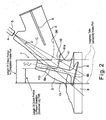
- Figure 2 is a schematic side view of inside of the intake port structure 1 illustrated in Figure 1 .
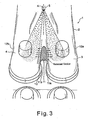
- Figure 3 is a schematic perspective view illustrating a state in which fuel is sprayed from the fuel injector 5 toward the downstream section of the intake air passage of the intake port structure 1.
- Figure 3 substantially corresponds to a view from upper side of the intake port structure1 in a direction.
- Figure 4 is an enlarged, partial cross-sectional view of the intake port structure 1 taken along a center line of the fuel injected from the fuel injector 5 as shown by a broken line C in Figure 2 .
- the intake port structure 1 is preferably arranged at each cylinder of an internal combustion engine in which the intake port structure 1 of the present invention is equipped.
- the first and second branching passageways 3 and 4 are arranged to branch from the collector passageway 2 into two distinct paths.
- the first and second branching passageways 3 and 4 extend from the collector passageway 2 to first and second intake valve openings that are defined by the valve seats for a pair of first and second intake valves 6 and 7, respectively.
- the first and second intake valves 6 and 7 are configured and arranged to selectively control an introduction of intake air from the intake port structure 1 to a combustion chamber 8 (inside the cylinder) disposed in the downstream side of the intake port structure 1.
- the collector passageway 2 is preferably provided with a partition wall 9 for partitioning the collector passageway 2 into upper and lower portions.
- each cylinder of the engine preferably has a fuel injector disposed in the intake port structure of the corresponding cylinder in the same construction as in Figures 1-4 .
- the fuel injector 5 has a center axis AL that is preferably arranged in a plane that includes a center axis of the corresponding cylinder and the center axis of the collector passageway 2.
- the intake port structure of the present invention can be alternatively arranged to have a single fuel injector used for injecting fuel into the intake air that is fed through the intake port structures to all cylinders of the internal combustion engine instead of providing the fuel injector 5 in each of the intake port structures 1 (only one shown) for each of the cylinders of the internal combustion engine.
- the single fuel injector 5 can be disposed in an intake air collector (not shown) of an intake manifold (not shown).
- an air-fuel mixture is preferably formed in the intake manifold and distributed to each intake port structure 1 for each of the cylinders of the internal combustion engine.
- the fuel injector 5 includes a fuel spray nozzle at a tip thereof such that fuel is sprayed in a cone shaped stream from the fuel spray nozzle towards head portions of the first and second intake valves 6 and 7 located in the intake ports of the intake port structure 1 as seen in Figures 2 and 3 . More specifically, the fuel injector 5 in the present embodiment preferably includes a two-way fuel injection valve that is configured and arranged to spray fuel from the upper portion of the collector passage 2 of the intake port structure 1 in two distinct directions into the first and second branching passageways 3 and 4 so that the fuel is sprayed from the fuel injector 5 directly against each of the head portions of the first and second intake valves 6 and 7.
- Two-way fuel injection valves are conventional components that are well known in the art. Since the two-way fuel injection valve is well known in the art, the structure of such valve will not be discussed or illustrated in detail herein.
- the fuel injector 5 is preferably configured and arranged to inject the fuel with a fuel spray angle ⁇ in the longitudinal direction of the fuel injector 5 with respect to a vertical plan of the intake port structure 1.
- the fuel spray angle ⁇ is preferably set to approximately 10° as shown in Figure 2 .
- the intake port structure 1 includes a ridge or crotch portion 10 formed between the first and second branching passageways 3 and 4.
- the crotch portion 10 is configured and arranged to form an intake air flow impact section 11.
- the intake air flow impact section 11 is preferably disposed in a path of the intake air flow that flows from an upstream section of the intake port structure 1 to a downstream section of the intake port structure 1 so that the intake air flow in the intake port structure 1 collides against the intake air flow impact section 11.
- the intake air flow impact section 11 is configured and arranged such that the portion of the intake air that collides against the intake air flow impact section 11 is laterally dispersed into the first and second branching passageways 3 and 4 at areas encompassed by imaginary tubes (see Figure 2 ) projecting from the first and second intake valve openings in a direction parallel to a center combustion chamber axis CL.
- the intake air flow impact section 11 is preferably arranged as a shape in which a crotch portion of a comparison intake port structure (shown with a two-dotted chain line 30 in Figure 2 ) is partially cut away and recessed in a direction of a flow of the fuel spray.
- the intake air flow impact section 11 formed as a recessed section in the crotch portion 10.
- the intake air flow impact section 11 is preferably arranged to be recessed (comparing to the crotch portion of the comparison intake port structure) toward the head portions of the first and second intake valves 6 and 7 along the center axis of the fuel sprayed from the fuel injector 5 to the vicinity of stem portions 6a and 7a of the first and second intake valves 6 and 7 as viewed from the side of the intake port structure 1.
- the crotch portion of the comparison intake port structure shown in Figure 2 will be described in more detail below to further clarify the differences between the comparison intake port structure and the intake port structure 1 of the present invention.
- the intake air flow impact section 11 preferably includes a first impact surface 11a and a second impact surface 11b that are preferably configured as generally flat surfaces that are angled relative to each other.
- the first and second impact surfaces 11a and 11b are disposed on planes that are both substantially perpendicular to a hypothetical plane (i.e., a plane parallel to the surface of the paper in Figure 2 ) that includes the center axis of the cylinder and the center axis of the collector passage 2.
- the first impact surface 11a is preferably formed substantially parallel to valve end surfaces 6b and 7b of the head portions of the first and second intake valves 6 and 7, as viewed from the side of the intake port structure 1 as shown in Figure 2 .
- the second impact surface 11b is preferably formed substantially perpendicular to the impact surface 11a as shown in Figures 2 and 4 .
- the first impact surface 11a is preferably formed substantially perpendicular to the longitudinal center axes of the stem portions 6a and 7a of the first and second intake valves 6 and 7.
- the first impact surface 11a is disposed on one side of the crotch portion 10 shown as a hatched portion (referred as "recessed section") in Figure 3 .
- the second impact surface 11b is preferably inclined in the axial direction of the stem portions 6a and 7a of the first and second intake valves 6 and 7 when viewed perpendicular to the hypothetical plane that includes the center axis of the cylinder and the center axis of the collector passageway 2 as shown in Figure 2 .
- the second impact surface 11b is preferably parallel to the longitudinal center axes of the stem portions 6a and 7a of the first and second intake valves 6 and 7 when viewed perpendicular to the hypothetical plane that includes the center axis of the cylinder and the center axis of the collector passageway 2 as shown in Figure 2 .
- the first impact surface 11a and the second impact surface 11b of the intake air flow impact section 11 are configured and arranged to disperse a portion of the intake air flow that flows from the collector passageway 2 in a lateral direction (i.e., the direction substantially perpendicular to the intake air flow) as shown in Figure 3 .
- a portion of the intake air flow that flows inside the intake port structure 1 from the collector passageway 2 toward the downstream section of the air intake passage collides against the first impact surface 11a and the second impact surface 11b such that the intake air flow is dispersed in the lateral direction as viewed from above as in Figure 3 .
- the dispersion of the intake air flow inside the intake port structure 1 is further enhanced because portions of the intake air flow that collided against the first and second impact surfaces 11a and 11b merge and collide at a connecting portion between the first impact surface 11a and the second impact surface 11b shown in Figure 2 .
- the turbulent energy in the first branching passageway 3 and the second branching passageway 4 can be increased by providing the intake air flow impact section 11 as explained above.
- the intake air flow impact section 11 including the first and second impact surfaces 11a and 11b is preferably formed on the center axis AL of the fuel injector 5 in the top plan view as shown Figure 3 . Therefore, after the fuel is sprayed from the fuel injector 5 toward the first and second branching passageways 3 and 4 (i.e., toward the head portions of the intake valves 6 and 7), the fuel can be further atomized by being mixed with the intake air flow dispersed in the lateral direction after the intake air collides against the intake air flow impact section 11 as shown Figure 3 .
- the crotch portion 10 of the intake port structure 1 of the first embodiment is formed considerably recessed to the vicinity of the stem portions 6a and 7a of the first and second intake valves 6 and 7 comparing to the crotch portion of the comparison intake port structure (shown with the two-dotted chain line 30 in Figure 2 ) which is formed further upstream from the stem portions 6a and 7a of the first and second intake valves 6 and 7.
- a distance between the tip of the fuel injector 5 and the intake air flow impact section 11 is larger in the intake port structure 1 of the present invention than in the comparison example of the intake port structure.
- atomization of the fuel is further promoted because the intake air flow disperses in the lateral direction (toward the first branching passageway 3 and the second branching passageway 4) of the intake air flow impact section 11 formed on the crotch portion 10 such that the intake air flow is mixed with the fuel spray injected from the fuel injector 5 when the intake air flow collides against the impact surface 11, as shown in Figure 3 .
- an increase in the turbulent energy in the first and second branching passageways 3 and 4 can be ensured.
- fuel deposits due to wall flows on back sides of the head portions of the first and second intake valves 6 and 7 can be reduced.
- HC emission during startup can be reduced and a response characteristic during transient period can be improved.
- the intake air flow impact section 11 preferably has an effective lateral width W (e.g., a lateral width of the first and second impact surfaces 11a and 11b) that is relatively large as shown in Figure 1 .
- W e.g., a lateral width of the first and second impact surfaces 11a and 11b
- the turbulent energy can be further increased in the first and second branching passageways 3 and 4, and the fuel spray can be further atomized so that homogeneousness of the air-fuel mixture within the combustion chamber 8 can be improved when the intake air flow collides against the intake air flow impact section 11.
- the fuel is atomized by providing the intake air flow impact section 11 even when, for example, the temperatures of the first and second intake valves 6 and 7 are low during low-temperature startup, and thus, the wall flows can be reduced during the low-temperature startup.
- a diameter of the intake passage is preferably constricted in order to match the velocity of the intake air flow (flow rate) in the collector passageway 2 of the intake port structure 1 with the flow rate (overall flow rate) of the air-fuel mixture in the first branching passageway 3 and the second branching passageway 4, as shown in Figure 3 .
- a pair of cross-sectional area adjustment portions 12a and 12b are preferably provided at the connecting portion between the collector passageway 2 and the first and second branching passageways 3 and 4 on both sides of the intake air flow impact section 11.
- the cross-sectional area adjustment portions 12a and 12b are preferably constricted so that the total cross-sectional area of the first and second branching passageways 3 and 4 is substantially equal to the cross-sectional area of the collector passageway 2.
- the comparison example of the intake port structure that does not include the cross-sectional area adjustment portions 12a and 12b is indicated with dotted lines in Figure 3 .
- the intake port structure 1 of the first embodiment can be arranged such that branching angles of the first and second branching passageways 3 and 4 (i.e., the angles at which center axes of the first and second branching passageways 3 and 4 intersect with the center axis of collector passageway 2) are larger than the angles shown in Figure 3 .
- branching angles of the first and second branching passageways 3 and 4 i.e., the angles at which center axes of the first and second branching passageways 3 and 4 intersect with the center axis of collector passageway 2 are larger than the angles shown in Figure 3 .
- the intensity of the flow of the air-fuel mixture in the downstream of the intake air flow impact section 11 i.e., in the first and second branching passageways 3 and 4) is increased, and the homogeneousness of the air-fuel mixture can be improved.
- comparison intake port structure (a comparison intake port structure 21) as mentioned above is illustrated in detail with reference to Figures 7 to 9 to further clarify the differences between the intake port structure 1 of the present invention and the comparison intake port structure 21.
- the comparison intake port structure 21 illustrated in Figures 7 to 9 substantially corresponds to, for example, the intake port structure disclosed in Japanese Laid-Open Patent Publication No. 5-321678 as mentioned above.
- Figure 7 is a cross-sectional view taken at a collector passageway 22 in a lateral direction such that first and second branching passageways 23 and 24 are viewed from the upstream of the collector passageway 22.
- Figure 8 is a schematic side elevational view of the comparison intake port structure 21.
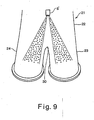
- Figure 9 is a diagram showing the state in which fuel is sprayed from a fuel injector 5' in the conventional intake port structure 21.
- the comparison intake port structure 21 provided for each cylinder includes a collector passageway 22 in the upstream side and the first and second branching passageways 23 and 24 that branch into two paths in the downstream section of the intake passage from the collector passageway 22 toward first and second intake valves 6' and 7', respectively.
- the first and second branching passageways 23 and 24 are formed with a considerable length in substantially linear shapes.
- a crotch portion 30 between the first and second branching passageways 23 and 24 is formed as a convex surface.
- the fresh intake air introduced into the collector passageway 22 is mixed with the fuel spray injected from the fuel injector 5' toward the first and second intake valves 6' and 7' to form an air-fuel mixture.
- the air-fuel mixture is kept in a layered-flow state as the air-fuel mixture is introduced into a combustion chamber 8' (into the cylinder) by controlling the first and second intake valves 6' and 7', which are disposed downstream of the first and second branching passageways 23 and 24, respectively.
- a portion of the intake air flow (fresh intake air) is directed either into the first branching passageway 23 or into the second branching passageway 24 by the crotch portion 30.
- the crotch portion 30 is formed as a smooth convex surface that protrudes toward the upstream side of the comparison intake port structure 21, the intake air flow is divided by the crotch portion 30 and introduced into the combustion chamber 8' while remaining a layered flow. The layered state in the tumbling flow inside the combustion chamber 8' is promoted and stable, lean combustion can be maintained.
- the fuel cannot be inadequately atomized in the air-fuel mixture because the intake air flow cannot obtain sufficient energy to adequately atomize the fuel merely through mixing the intake air flow with the fuel spray from the fuel injector 5'.
- the homogeneousness of the air-fuel mixture cannot be improved in the comparison intake port structure 21.
- Main reasons why the atomization of the fuel is not promoted in the comparison intake port structure 21 include that the lengths of the first and second branching passageways 23 and 24 are insufficient, and that the crotch portion 30 is formed as a smooth convex surface.
- the turbulent energies in the first and second branching passageways 3 and 4 are increased by providing the intake flow impact section 11, and thus, further atomization of the fuel spray is ensured.
- the first and second branching passageways 3 and 4 are formed with relatively short lengths (shorten leg shapes) comparing to the first and second branching passageways 23 and 24 of the comparison intake port structure 21, and the intake air flow impact section 11 is provided on the crotch portion 10 against which the intake air flow collides on the crotch portion 10.
- the homogeneousness in the air-fuel mixture is improved as the intake air flow collides against the intake flow impact section 11 and the atomization of the fuel in a formation of the air-fuel mixture is promoted.
- atomization of the spray is promoted by laterally dispersing a portion of the intake air flow by the intake air flow impact section 11 to increase the energy of the intake air flow, and mixing the fuel sprayed from the fuel injector 5 with the dispersed intake air flow.
- Figure 4 is a schematic cross-sectional view of a cylinder head 13 and the intake port structure 1 illustrating a water jacket 14 formed in the cylinder head 13.
- Figure 4 shows a wall of the water jacket 14 in the intake port structure 1 of the present invention in comparison with a wall of a water jacket in a comparison intake port structure such as the comparison intake port structure 21.
- the crotch portion 10 of the intake port structure 1 is recessed to the vicinity of the stem portions 6a and 7a of the first and second intake valves 6 and 7 as shown in Figure 2 in order to form the intake air flow impact section 11 of the present invention.
- a cooling water passage in the water jacket 14 is partially constricted at a portion where the crotch portion 10 is recessed.
- the cooling water passage in the water jacket 14 becomes too narrow, knocking or other undesired effects may occur as a result of insufficient cooling with cooling water in the cylinder head 13.
- the wall of the water jacket is configured such that an adequate cooling water passage is formed in the water jacket because the crotch portion (as shown in the two-dotted chain line 30) of the comparison intake port structure 21 is formed with a considerable length.
- the intake port structure 1 is provided with the relatively short crotch portion 10 as in the present invention, the cooling water passage in the water jacket 14 in a portion shown by the shaded area in Figure 4 becomes narrow.
- a portion of the cooling water passage of the water jacket 14 between the first and second branching passageways 3 and 4 and an ignition plug wall 15 becomes narrow.
- the ignition plug wall 15 is preferably formed relatively thinner (e.g., thinner than an ignition plug wall in a conventional intake port structure) to provide an adequate cooling water passage between the first and second branching passageways 3 and 4 and the ignition plug wall 15.
- a wall of the cooling water passage in the vicinity of the first and second intake valves 6 and 7 is preferably also formed relatively thinner such that an adequate flow of the cooling water in the cooling water passage can be supplied as well as sufficient strength can be maintained.
- the crotch portion 10 is recessed to the stem portions 6a and 7a of the first and second intake valves 6 and 7 to form the intake air flow impact section 11. If the crotch portion 10 is recessed beyond the stem portions 6a and 7a of the first and second intake valves 6 and 7 from that as shown in Figure 2 , then a cross-sectional area of the cooling water passage of the water jacket 14 will be further reduced. In such case, the moldability of the water jacket 14 may become degraded, and the cooling effect of the water jacket 14 may be decreased.
- the crotch portion 10 with the intake air flow impact section 11 should preferably be formed in a position that is in the vicinity of the stem portions 6a and 7a of the first and second intake valves 6 and 7 as shown in Figure 2 .
- the turbulent energy in the intake air flow is thereby increased while the cooling water flow rate in the water jacket 14 that is substantially equal to the cooling water flow rate in the comparison example of the intake port structure can be secured.
- the occurrence of knocking and other undesired effects can be effectively prevented in the intake port structure 1 of the present invention.
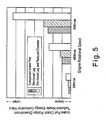
- Figure 5 is a bar chart for explaining a comparison between cumulative values of the turbulent kinetic energy for different rotational speeds in the comparison intake port structure 21 and the intake port structure 1 in accordance with the first embodiment of the present invention. More specifically, the cumulative values of the turbulent kinetic energy downstream of the crotch portion 10 of the present invention and the crotch portion 30 of the comparison example (i.e., the first branching passageways 3 and 23 or the second branching passageways 4 and 24) are compared at various rotational speeds (2,000, 4,000, and 6,000 rpm) in the intake port structure 1 of the present invention and the comparison intake port structure 21.
- a "shortened leg port” refers to the intake port structure 1 of the present invention in which the intake air flow impact section 11 is formed on the crotch portion 10 where the first and second branching passageways 3 and 4 are formed
- a "shortened leg port and reduced diameter” refers to the intake port structure 1 in accordance with the present invention in which the intake air flow impact section 11 is formed on the crotch portion 10 and the diameters of the first and second branching passageways 3 and 4 are reduced by providing the cross-sectional area adjustment portions 12a and 12b as the intake port structure 1 illustrated in Figures 1 to 3 .
- the intake port structure 1 of the present invention (i.e., "shortened leg port” and “shortened leg port and reduced diameter”) has an increased turbulent kinetic energy on the downstream side of the crotch portion 10 (the intake air flow impact section 11) of the intake port structure 1 than the turbulent kinetic energy on the downstream side of the crotch portion 30 of the comparison intake port structure 21 at each of the rotational speeds.
- the turbulent energy can be further increased.
- the intake port structure 1 of the present invention is configured and arranged to increase the turbulent energy in the downstream of the crotch portion 10 to promote the atomization of the fuel injected from the fuel injector 5.
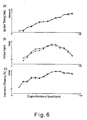
- Figure 6 is a series of line charts of engine characteristics at full throttle including volumetric efficiency (%), torque (kgm), and ignition timing (deg) with respect to the engine speed in a comparison intake port structure 21 and the intake port structure 1 in accordance with the first embodiment of the present invention.
- black circles “ ⁇ ” indicate the characteristics of the engine when the comparison intake port structure 21 is used
- white circles “ ⁇ ” indicate the characteristics of the engine when the intake port structure 1 (shortened leg port) of the present invention is used.
- the torque output is improved by an amount equivalent to the difference between the intake port structure 1 of the present invention (shown with the white circles “O") and the comparison intake port structure 21 (shown with black circles “ ⁇ ") even when the volumetric efficiency (bottom in Figure 6 ) and the ignition timing (top in Figure 6 ) are substantially equal in the intake port structure 1 of the present invention and the comparison intake port structure 21.
- This torque difference between the intake port structure 1 of the present invention and the comparison intake port structure 21 is considered to be occurred because the portion of the fuel, which is not combusted when the comparison intake port structure 21 is used, is combusted in the intake port structure 1 of the present invention. Therefore, it is apparent that thermal efficiency is improved by using the intake port structure 1 of the present invention.
- Figure 6 shows an increase in torque across a broad range can be ensured in the low and medium speed ranges when the intake port structure 1 of the present invention is used.
- the flow rate of the air-fuel mixture in the intake port structure 1 is inherently high, so homogeneousness of the air-fuel mixture in the combustion chamber 8 may not be adequately improved even if the turbulent energy in the intake port structure 1 is high, as shown in Figure 5 .
- the amount of fuel injected directly into the cylinder during the intake stroke is increased such that the latent heat of vaporization produced by the fuel is used to cool the internal combustion engine.
- the air intake temperature is reduced to improve the charging efficiency of the air.
- latent heat of vaporization is used in the intake port structure 1 of the present invention to improve the charging efficiency of air in the cylinder.
- the air-fuel mixture is formed in advance in the intake port structure 1, and the air-fuel mixture is introduced to the cylinder when the first and second intake valves 6 and 7 are open.
- the timing of fuel injection from the fuel injector 5 is changed and the fuel is sprayed toward the head portions 6a and 7a of the first and second intake valves 6 and 7 when the first and second intake valves 6 and 7 are open.
- the turbulent energy of the intake air flow is increased by the intake air flow impact section 11.
- atomization of the fuel is further promoted, and charging efficiency in the cylinder is improved.
- the intake port structure 1 for the internal combustion engine includes the fuel injector 5 disposed in the intake passage (e.g., upper portion of the collector passageway 2), the first and second intake valves 6 and 7 provided for each cylinder.
- the intake port structure 1 is provided for each cylinder of the engine, and has the collector passageway 2 on the upstream side, and the first and second branching passageways 3 and 4 that branch two ways from the collector passageway 2 and are directed toward the first and second intake valves 6 and 7.
- the intake port structure 1 further includes the intake air flow impact section 11 formed on the crotch portion 10 between the first and second branching passageways 3 and 4 against which the intake air flow in the intake passage collide.
- the turbulent energy in the intake port structure 1 i.e., turbulent energy in the first and second branching passageways 3 and 4
- the fuel spray can be further atomized in the intake port structure 1.
- Further atomization of the fuel spray improves the homogeneousness of the air-fuel mixture in the combustion chamber 8.
- the thermal efficiency can be improved and a reduction in the unburned gas (HC and the like) in the exhaust gas can be ensured.
- the intake port structure 1 of the present invention can also effectively improve the atomization of the fuel spray for the fuel injected during the intake stroke.
- the intake air flow impact section 11 is formed in a position recessed to the vicinity of the stem portions 6a and 7a of the first and second intake valves 6 and 7, respectively. Therefore, the turbulent energy on the downstream side of the intake air flow impact section 11 is increased than in the comparison intake port structure 21. As a result, atomization of the fuel in the air-fuel mixture is further promoted, and the thermal efficiency can be improved as a result of increasing the homogeneousness of the air-fuel mixture inside the combustion chamber 8.
- the intake air flow impact section 11 is configured and arranged to include at least one flat surface (the first or second impact surface 11a or 11b). Therefore, the intake air flow is configured and arranged to collide against the at least one flat surface of the intake air flow impact section 11. Accordingly, the turbulent energy on the downstream side of the intake air flow impact section 11 can be further increased.
- the first and second impact surfaces 11a and 11b constituting the intake air flow impact section 11 are formed substantially perpendicular to the hypothetical plane (a plane parallel to the paper surface of Figure 2 ) that includes the center axis of the cylinder and the center axis of the collector passageway 2. Therefore, the intake air flow in the intake passage of the intake port structure 1 can be dispersed in the lateral direction of the first and second impact surfaces 11a and 11b (i.e., direction substantially perpendicular to the hypothetical plane), and the turbulent energy of the intake air flow can be further increased.
- the intake air flow impact section 11 is configured and arranged to include the first impact surface 11a that is formed substantially parallel to the valve end surfaces 6b and 7b of the first and second intake valves 6 and 7. Therefore, atomization of the fuel can be promoted by mixing fuel sprayed from the fuel injector 5 and the intake air flow dispersed by the first impact surface 11a.
- the intake air flow impact section 11 is further configured and arranged to include the second impact surface 11b that is inclined in the axial direction of the stem portions 6a and 7a of the first and second intake valves 6 and 7 when viewed perpendicular to the hypothetical plane (a plane parallel to the paper surface of Figure 2 ) that includes the center axis of the cylinder and the center axis of the collector passageway 2. Therefore, atomization of the fuel can be promoted by mixing fuel sprayed from the fuel injector 5 and the intake air flow dispersed by the second impact surface 11b.
- the connector portion between the collector passageway 2 and the first and second branching passageways 3 and 4 preferably includes the cross-sectional area adjustment portions 12a and 12b in which the diameters of the first and second branching passageways 3 and 4 are constricted so that the overall cross sectional area of the first and second branching passageways 3 and 4 are substantially equal to the cross-sectional area of the collector passageway 2. Therefore, the intake air flow rate (flow rate) in the collector passageway 2 and the flow rate (overall flow rate) of the air-fuel mixture in the first and second branching passageways 3 and 4 can be substantially matched.
- the fuel injector 5 is disposed in the upper portion of the collector passageway 2 of the intake port structure 1, and the center axis AL of the fuel injector 5 is disposed in the hypothetical plane that includes the center axis of the cylinder and the center axis of the collector passageway 2. Therefore, the fuel injected from the fuel injector 5 can be easily sprayed toward the first and second branching passageways 3 and 4.
- the fuel injector 5 preferably includes the two-way fuel injection valve for spraying fuel along two distinct paths from the upper portion of the collector passageway 2 of the intake port structure 1 into the first and second branching passageways 3 and 4. Therefore, atomization of the fuel spray is promoted when fuel spray injected from the fuel injector 5 is mixed with the intake air flow dispersed to both sides of the intake air flow impact section 11 when the intake air flow collides against the intake air flow impact section 11.
- the intake port structure 1 of the present invention has the effect of increasing the turbulent energy inside the intake port structure 1 (i.e., in the first and second branching passageways 3 and 4) by providing the intake air flow impact section 11 on the crotch portion 10 between the first and second branching passageways 3 and 4.
- the intake port structure 1 of the present invention is configured and arranged to promote further atomization of the fuel spray injected from the fuel injector 5. Further atomization of the fuel spray improves the homogeneousness of the air-fuel mixture and the thermal efficiency, which results in a better exhaust performance.
Landscapes
- Engineering & Computer Science (AREA)
- Chemical & Material Sciences (AREA)
- Combustion & Propulsion (AREA)
- Mechanical Engineering (AREA)
- General Engineering & Computer Science (AREA)
- Cylinder Crankcases Of Internal Combustion Engines (AREA)
- Fuel-Injection Apparatus (AREA)
Claims (3)
- Eine Einlass-Anschluss-Struktur für eine Brenn-Kraft-Maschine mit innerer Verbrennung die umfasst:einen Einlass-Luft-Durchgang, der einen Sammel-Durchgangs-Weg (2) und ein paar von ersten und zweiten Abzweig-Durchgangs-Wegen (3, 4) beinhaltet, die jeweils von dem Sammel-Durchgangs-Weg (2) zu ersten und zweiten Einlass-Ventil-Öffnungen abzweigen;einen Kraftstoff-Einspritzer (5), der in dem Sammel-Durchgangs-Weg (2) des Einlass-Luft-Durchgangs angeordnet ist, um einen Kraftstoff-Strom in Einlass-Luft, welche durch den Einlass-Luft-Durchgang strömt, einzuspritzen; undeinen Einlass-Luft-Strom-Aufprall-Abschnitt (11), der an einem Abzweig-Abschnitt (10) zwischen dem ersten und zweiten Abzweig-Durchgangs-Weg (3, 4) ausgebildet ist, der Einlass-Luft-Strom-Aufprall-Abschnitt (11) ist konfiguriert und angeordnet, sodass ein Teil der Einlass-Luft, die in dem Einlass-Durchgang strömt, gegen den Einlass-Luft-Strom-Aufprall-Abschnitt (11) kollidiert, um die Einlass-Luft lateral in die ersten und zweiten Abzweig-Durchgangs-Wege (3, 4) zu verteilen, in Bereichen welche durch imaginäre Röhren umfasst sind, die von den ersten und zweiten Einlass-Ventil-Öffnungen in eine Richtung, parallel zu einer Mitten-Verbrennungskammer-Achse, vorspringen, wobei der Einlass-Luft-Strom-Aufprall-Abschnitt (11) zumindest eine erste, im Wesentlichen flache, Fläche (11a) beinhaltet, wobei diese erste, im Wesentlichen flache, Fläche (11a) des Einlass-Luft-Strom-Aufprall-Abschnitts (11) im wesentlichen senkrecht zu einer Ebene orientiert ist, die durch die Verbrennungskammer-Achse (CL) und einer Mitten-Achse des Sammel-Durchgangs-Wegs hindurchtritt, die erste im Wesentlichen flache Fläche (11a) ist im Wesentlichen parallel zu einer Ebene ausgebildet, welche die ersten und zweiten Einlass-Ventil-Öffnungen umfasst, wobei der Kraftstoff-Einspritzer (5) in dem Sammel-Durchgangs-Weg (2) positioniert ist, sodass eine Mitten-Achse des Kraftstoff-Einspritzers (5) in einer Ebene positioniert ist, welche die Verbrennungskammer-Achse (CL) und die Mitten-Achse des Sammel-Durchgangs-Wegs (2) beinhaltet, und der Kraftstoff-Einspritzer (5) beinhaltet ein Zwei-Wege-Kraftstoff-Einspritz-Ventil, das konfiguriert und angeordnet ist um Kraftstoff in zwei Pfade von dem Sammel-Durchgangs-Weg (2) zu den ersten und zweiten Abzweig-Durchgangs-Wegen (3, 4) einzuspritzen, dadurch gekennzeichnet dass der Einlass-Luft-Strom-Aufprall-Abschnitt (11) zumindest eine zweite, im Wesentlichen flache, Fläche (11b) beinhaltet, die in einer Ebene orientiert ist, die im Wesentlichen senkrecht zu einer Ebene ist, welche die ersten und zweiten Einlass-Ventil-Öffnungen umfasst, wobei diese zweite, im Wesentlichen flache, Fläche (11b) des Einlass-Luft-Strom-Aufprall-Abschnitts (11) im Wesentlichen senkrecht zu einer Ebene orientiert ist, die durch die Verbrennungskammer-Achse (CL) und einer Mitten-Achse des Sammel-Durchgangs-Wegs (2) hindurchtritt.
- Eine Einlass-Anschluss-Struktur gemäß Anspruch 1, dadurch gekennzeichnet dass der Einlass-Luft-Strom-Aufprall-Abschnitt (11) in einer Umgebung der Mitten-Achse (L1) der ersten und zweiten Ventil-Öffnungen ausgenommen ist.
- Eine Einlass-Anschluss-Struktur gemäß Anspruch 1 oder 2, dadurch gekennzeichnet dass die ersten und zweiten Abzweig-Durchgangs-Wege (3, 4) einen Querschnitts-Bereich-Anpassungs-Abschnitt (12a, 12b) beinhalten, der konfiguriert und angeordnet ist, um einen Gesamt-Querschnitts-Bereich des ersten und zweiten Abzweig-Durchgangs-Weges (3, 4) zu beschränken, sodass der Gesamt-Querschnitts-Bereich des ersten und zweiten Abzweig-Durchgangs-Wegs (3, 4) im Wesentlichen gleich einem Querschnitts-Bereich des Sammel-Durchgangs-Wegs 2 ist.
Applications Claiming Priority (2)
| Application Number | Priority Date | Filing Date | Title |
|---|---|---|---|
| JP2003429598 | 2003-12-25 | ||
| JP2003429598A JP4285235B2 (ja) | 2003-12-25 | 2003-12-25 | 内燃機関の吸気ポート構造 |
Publications (3)
| Publication Number | Publication Date |
|---|---|
| EP1548264A2 EP1548264A2 (de) | 2005-06-29 |
| EP1548264A3 EP1548264A3 (de) | 2009-12-23 |
| EP1548264B1 true EP1548264B1 (de) | 2018-10-24 |
Family
ID=34545013
Family Applications (1)
| Application Number | Title | Priority Date | Filing Date |
|---|---|---|---|
| EP04029890.3A Expired - Lifetime EP1548264B1 (de) | 2003-12-25 | 2004-12-16 | Einlasskanalstruktur für eine Brennkraftmaschine |
Country Status (4)
| Country | Link |
|---|---|
| US (1) | US7150267B2 (de) |
| EP (1) | EP1548264B1 (de) |
| JP (1) | JP4285235B2 (de) |
| CN (1) | CN100404836C (de) |
Families Citing this family (14)
| Publication number | Priority date | Publication date | Assignee | Title |
|---|---|---|---|---|
| JP2005307904A (ja) * | 2004-04-23 | 2005-11-04 | Denso Corp | 燃料噴射装置 |
| US7565894B2 (en) * | 2005-09-12 | 2009-07-28 | Hitachi, Ltd. | Fuel injection apparatus for and method of internal combustion engine, and fuel injection valve |
| JP4521334B2 (ja) * | 2005-09-12 | 2010-08-11 | 日立オートモティブシステムズ株式会社 | ポート噴射式エンジンの燃料噴射弁およびポート噴射式エンジン |
| US7715974B2 (en) * | 2007-10-09 | 2010-05-11 | Ford Global Technologies, Llc | Method for controlling air-fuel ratio for an alternating valve engine |
| JP5012594B2 (ja) * | 2008-03-11 | 2012-08-29 | トヨタ自動車株式会社 | 内燃機関 |
| FR2931207A1 (fr) * | 2008-05-14 | 2009-11-20 | Renault Sas | Dispositif de transfert de gaz d'admission ou d'echappement |
| JP2012188938A (ja) * | 2011-03-08 | 2012-10-04 | Mitsubishi Motors Corp | 内燃機関 |
| JP2012246885A (ja) * | 2011-05-31 | 2012-12-13 | Toyota Motor Corp | 内燃機関のポート |
| US11098681B2 (en) * | 2016-08-31 | 2021-08-24 | Cummins Inc. | Cobra head air intake ports and intake manifolds |
| US11143149B2 (en) | 2016-08-31 | 2021-10-12 | Cummins Inc. | Cobra head air intake ports |
| JP7003626B2 (ja) * | 2017-12-19 | 2022-01-20 | 三菱自動車工業株式会社 | 内燃機関の吸気構造 |
| CN108825410A (zh) * | 2018-05-25 | 2018-11-16 | 哈尔滨工程大学 | 一种分流式燃气喷射装置及其燃气喷管 |
| JP2020070726A (ja) * | 2018-10-29 | 2020-05-07 | トヨタ自動車株式会社 | シリンダヘッド |
| US11655777B2 (en) * | 2021-09-07 | 2023-05-23 | Southwest Research Institute | Parallel intake valve tumble flow engine |
Citations (5)
| Publication number | Priority date | Publication date | Assignee | Title |
|---|---|---|---|---|
| EP0558081A1 (de) * | 1992-02-28 | 1993-09-01 | Mitsubishi Jidosha Kogyo Kabushiki Kaisha | Brennkraftmaschine mit geschichteter Verbrennung |
| JPH05321679A (ja) * | 1992-03-27 | 1993-12-07 | Mitsubishi Motors Corp | 内燃機関の吸気ポート構造 |
| JPH11141435A (ja) * | 1997-11-04 | 1999-05-25 | Toyota Motor Corp | 内燃機関の燃料噴射装置 |
| JPH11159424A (ja) * | 1997-11-27 | 1999-06-15 | Denso Corp | 内燃機関の燃料噴射装置 |
| US20040164187A1 (en) * | 2003-01-22 | 2004-08-26 | Hitachi, Ltd. | Fuel injection valve |
Family Cites Families (8)
| Publication number | Priority date | Publication date | Assignee | Title |
|---|---|---|---|---|
| JPS60100569U (ja) * | 1983-12-15 | 1985-07-09 | トヨタ自動車株式会社 | 複吸気エンジンの燃料噴射弁 |
| JPS60147537A (ja) * | 1984-01-13 | 1985-08-03 | Toyota Motor Corp | 内燃機関の吸気装置 |
| JPS60187366U (ja) * | 1984-05-22 | 1985-12-12 | トヨタ自動車株式会社 | 複吸気エンジンの吸気ポ−ト |
| JPS6153453A (ja) * | 1984-08-21 | 1986-03-17 | Toyota Motor Corp | 燃料噴射内燃機関における吸気ポ−ト |
| JPS62284919A (ja) * | 1986-06-04 | 1987-12-10 | Mazda Motor Corp | エンジンの燃焼室構造 |
| US4805569A (en) * | 1987-02-13 | 1989-02-21 | Mazda Motor Corporation | Intake system for an engine |
| JP3040008B2 (ja) * | 1991-06-26 | 2000-05-08 | 株式会社日立製作所 | 電磁式燃料噴射弁 |
| JP3718902B2 (ja) * | 1996-05-10 | 2005-11-24 | マツダ株式会社 | エンジンの吸気ポート構造 |
-
2003
- 2003-12-25 JP JP2003429598A patent/JP4285235B2/ja not_active Expired - Lifetime
-
2004
- 2004-12-10 US US11/008,661 patent/US7150267B2/en not_active Expired - Lifetime
- 2004-12-16 EP EP04029890.3A patent/EP1548264B1/de not_active Expired - Lifetime
- 2004-12-24 CN CNB2004100114812A patent/CN100404836C/zh not_active Expired - Lifetime
Patent Citations (5)
| Publication number | Priority date | Publication date | Assignee | Title |
|---|---|---|---|---|
| EP0558081A1 (de) * | 1992-02-28 | 1993-09-01 | Mitsubishi Jidosha Kogyo Kabushiki Kaisha | Brennkraftmaschine mit geschichteter Verbrennung |
| JPH05321679A (ja) * | 1992-03-27 | 1993-12-07 | Mitsubishi Motors Corp | 内燃機関の吸気ポート構造 |
| JPH11141435A (ja) * | 1997-11-04 | 1999-05-25 | Toyota Motor Corp | 内燃機関の燃料噴射装置 |
| JPH11159424A (ja) * | 1997-11-27 | 1999-06-15 | Denso Corp | 内燃機関の燃料噴射装置 |
| US20040164187A1 (en) * | 2003-01-22 | 2004-08-26 | Hitachi, Ltd. | Fuel injection valve |
Also Published As
| Publication number | Publication date |
|---|---|
| JP2005188361A (ja) | 2005-07-14 |
| EP1548264A3 (de) | 2009-12-23 |
| US7150267B2 (en) | 2006-12-19 |
| EP1548264A2 (de) | 2005-06-29 |
| CN100404836C (zh) | 2008-07-23 |
| US20050139195A1 (en) | 2005-06-30 |
| JP4285235B2 (ja) | 2009-06-24 |
| CN1637268A (zh) | 2005-07-13 |
Similar Documents
| Publication | Publication Date | Title |
|---|---|---|
| US5295464A (en) | Stratified burning internal combustion engine | |
| EP0694682B1 (de) | Eine fremdgezündete Brennkraftmaschine mit direkter Kraftstoffeinspritzung | |
| US6045063A (en) | Fuel injector | |
| US7150267B2 (en) | Intake port structure for internal combustion engine | |
| US20030140891A1 (en) | Internal combustion engines and control | |
| JPH11141338A (ja) | 筒内直噴式エンジン | |
| US8074621B2 (en) | In-cylinder injection type internal combustion engine | |
| US6047904A (en) | Fuel injector for an internal combustion engine | |
| JP2501556Y2 (ja) | 内燃機関の吸気装置 | |
| JPH0315623A (ja) | 吸気3弁エンジン | |
| JP2697518B2 (ja) | 内燃機関の吸気ポート構造 | |
| JP3262380B2 (ja) | 層状燃焼内燃機関の吸気ポート構造 | |
| JP2861496B2 (ja) | 複吸気弁式内燃機関の吸気装置 | |
| JP3468055B2 (ja) | 希薄燃焼内燃機関 | |
| JP3903200B2 (ja) | 筒内噴射式火花点火内燃機関 | |
| JP3275470B2 (ja) | 副室式エンジン | |
| WO2024201934A1 (ja) | 副燃焼室付内燃機関 | |
| JP3911869B2 (ja) | 筒内噴射式火花点火機関 | |
| JP3198688B2 (ja) | 内燃機関 | |
| WO2024201935A1 (ja) | 副燃焼室付内燃機関 | |
| JPH0217689B2 (de) | ||
| CN118462423A (zh) | 一种发动机气缸盖、发动机及车辆 | |
| AU2001237137B2 (en) | Internal combustion engines and control | |
| CA1074644A (en) | Diesel engine combustion chambers | |
| JPS5819301Y2 (ja) | 渦流室式燃焼室 |
Legal Events
| Date | Code | Title | Description |
|---|---|---|---|
| PUAI | Public reference made under article 153(3) epc to a published international application that has entered the european phase |
Free format text: ORIGINAL CODE: 0009012 |
|
| 17P | Request for examination filed |
Effective date: 20041216 |
|
| AK | Designated contracting states |
Kind code of ref document: A2 Designated state(s): AT BE BG CH CY CZ DE DK EE ES FI FR GB GR HU IE IS IT LI LT LU MC NL PL PT RO SE SI SK TR |
|
| AX | Request for extension of the european patent |
Extension state: AL BA HR LV MK YU |
|
| PUAL | Search report despatched |
Free format text: ORIGINAL CODE: 0009013 |
|
| AK | Designated contracting states |
Kind code of ref document: A3 Designated state(s): AT BE BG CH CY CZ DE DK EE ES FI FR GB GR HU IE IS IT LI LT LU MC NL PL PT RO SE SI SK TR |
|
| AX | Request for extension of the european patent |
Extension state: AL BA HR LV MK YU |
|
| RIC1 | Information provided on ipc code assigned before grant |
Ipc: F02M 69/04 20060101ALI20091117BHEP Ipc: F02F 1/42 20060101ALI20091117BHEP Ipc: F02F 1/24 20060101AFI20050111BHEP |
|
| AKX | Designation fees paid |
Designated state(s): DE FR GB |
|
| 17Q | First examination report despatched |
Effective date: 20110408 |
|
| GRAP | Despatch of communication of intention to grant a patent |
Free format text: ORIGINAL CODE: EPIDOSNIGR1 |
|
| INTG | Intention to grant announced |
Effective date: 20180627 |
|
| RAP1 | Party data changed (applicant data changed or rights of an application transferred) |
Owner name: NISSAN MOTOR CO., LTD. |
|
| GRAS | Grant fee paid |
Free format text: ORIGINAL CODE: EPIDOSNIGR3 |
|
| GRAA | (expected) grant |
Free format text: ORIGINAL CODE: 0009210 |
|
| AK | Designated contracting states |
Kind code of ref document: B1 Designated state(s): DE FR GB |
|
| REG | Reference to a national code |
Ref country code: GB Ref legal event code: FG4D |
|
| REG | Reference to a national code |
Ref country code: DE Ref legal event code: R096 Ref document number: 602004053323 Country of ref document: DE |
|
| RIC2 | Information provided on ipc code assigned after grant |
Ipc: F02F 1/24 20060101AFI20050111BHEP Ipc: F02M 69/04 20060101ALI20091117BHEP Ipc: F02F 1/42 20060101ALI20091117BHEP |
|
| REG | Reference to a national code |
Ref country code: DE Ref legal event code: R097 Ref document number: 602004053323 Country of ref document: DE |
|
| PLBE | No opposition filed within time limit |
Free format text: ORIGINAL CODE: 0009261 |
|
| STAA | Information on the status of an ep patent application or granted ep patent |
Free format text: STATUS: NO OPPOSITION FILED WITHIN TIME LIMIT |
|
| 26N | No opposition filed |
Effective date: 20190725 |
|
| PGFP | Annual fee paid to national office [announced via postgrant information from national office to epo] |
Ref country code: GB Payment date: 20231121 Year of fee payment: 20 |
|
| PGFP | Annual fee paid to national office [announced via postgrant information from national office to epo] |
Ref country code: FR Payment date: 20231122 Year of fee payment: 20 Ref country code: DE Payment date: 20231121 Year of fee payment: 20 |
|
| REG | Reference to a national code |
Ref country code: DE Ref legal event code: R071 Ref document number: 602004053323 Country of ref document: DE |
|
| REG | Reference to a national code |
Ref country code: GB Ref legal event code: PE20 Expiry date: 20241215 |
|
| PG25 | Lapsed in a contracting state [announced via postgrant information from national office to epo] |
Ref country code: GB Free format text: LAPSE BECAUSE OF EXPIRATION OF PROTECTION Effective date: 20241215 |
|
| PG25 | Lapsed in a contracting state [announced via postgrant information from national office to epo] |
Ref country code: GB Free format text: LAPSE BECAUSE OF EXPIRATION OF PROTECTION Effective date: 20241215 |