EP1545109A1 - Videotelefon-simultanübersetzungssystem und videotelefon-simultan bersetzverfahren - Google Patents
Videotelefon-simultanübersetzungssystem und videotelefon-simultan bersetzverfahren Download PDFInfo
- Publication number
- EP1545109A1 EP1545109A1 EP03798475A EP03798475A EP1545109A1 EP 1545109 A1 EP1545109 A1 EP 1545109A1 EP 03798475 A EP03798475 A EP 03798475A EP 03798475 A EP03798475 A EP 03798475A EP 1545109 A1 EP1545109 A1 EP 1545109A1
- Authority
- EP
- European Patent Office
- Prior art keywords
- terminal
- audio
- interpreter
- callee
- caller
- Prior art date
- Legal status (The legal status is an assumption and is not a legal conclusion. Google has not performed a legal analysis and makes no representation as to the accuracy of the status listed.)
- Withdrawn
Links
Images








Classifications
-
- H—ELECTRICITY
- H04—ELECTRIC COMMUNICATION TECHNIQUE
- H04N—PICTORIAL COMMUNICATION, e.g. TELEVISION
- H04N7/00—Television systems
- H04N7/14—Systems for two-way working
- H04N7/141—Systems for two-way working between two video terminals, e.g. videophone
- H04N7/147—Communication arrangements, e.g. identifying the communication as a video-communication, intermediate storage of the signals
-
- H—ELECTRICITY
- H04—ELECTRIC COMMUNICATION TECHNIQUE
- H04M—TELEPHONIC COMMUNICATION
- H04M3/00—Automatic or semi-automatic exchanges
- H04M3/42—Systems providing special services or facilities to subscribers
- H04M3/50—Centralised arrangements for answering calls; Centralised arrangements for recording messages for absent or busy subscribers ; Centralised arrangements for recording messages
- H04M3/51—Centralised call answering arrangements requiring operator intervention, e.g. call or contact centers for telemarketing
-
- H—ELECTRICITY
- H04—ELECTRIC COMMUNICATION TECHNIQUE
- H04M—TELEPHONIC COMMUNICATION
- H04M3/00—Automatic or semi-automatic exchanges
- H04M3/42—Systems providing special services or facilities to subscribers
- H04M3/56—Arrangements for connecting several subscribers to a common circuit, i.e. affording conference facilities
-
- H—ELECTRICITY
- H04—ELECTRIC COMMUNICATION TECHNIQUE
- H04M—TELEPHONIC COMMUNICATION
- H04M2203/00—Aspects of automatic or semi-automatic exchanges
- H04M2203/20—Aspects of automatic or semi-automatic exchanges related to features of supplementary services
- H04M2203/2061—Language aspects
-
- H—ELECTRICITY
- H04—ELECTRIC COMMUNICATION TECHNIQUE
- H04M—TELEPHONIC COMMUNICATION
- H04M3/00—Automatic or semi-automatic exchanges
- H04M3/42—Systems providing special services or facilities to subscribers
- H04M3/42025—Calling or Called party identification service
- H04M3/42085—Called party identification service
- H04M3/42102—Making use of the called party identifier
- H04M3/4211—Making use of the called party identifier where the identifier is used to access a profile
Definitions
- the present invention relates to a videophone interpretation system and a videophone interpretation method which provide an interpretation service for a conversation with a videophone between persons using different languages, and in particular to a videophone interpretation system and a videophone interpretation method which provide administration services such as those offered by a public office, a hospital and a police station, to a foreigner incapable of using the local language, without an interpreter being resident in an administrative body mentioned above.
- a three-way call had to be established by using a multipoint conferencing unit offering a teleconference service between a caller wishing to have a conversation, a callee as a conversation partner, and an interpreter who interprets between a language used by the caller and a language used by the callee.
- Fig. 22 shows a prior art configuration whereby an interpretation service is obtained by using a video conference service with a multipoint conferencing unit.
- a numeral 10 represents a videophone terminal for the caller (hereinafter referred to as a caller terminal), 20 a videophone terminal for the callee (hereinafter referred to as a callee terminal), 30 a videophone terminal for the interpreter (hereinafter referred to as an interpreter terminal), 50 a public telephone line, and 1 a multipoint conferencing unit.
- Each videophone terminal comprises a camera (a) for picking up the user, a display (b) for displaying a received video, a dial pad (c) for dialing the number of a distant party, a headset (d) including a microphone for acquiring the voice of the user and listening to the received audio.
- the multipoint conferencing unit 1 offers a videoconferencing service and has a function to accept a call from a reserved terminal, synthesizing videos and audios transmitted from the terminals connected and transmitting to each terminal the synthesized video and audio.
- a caller searches for and calls an interpreter capable of interpreting between the language used by the caller and that used by the callee.
- the called interpreter calls the callee based on the request made by the caller and determines a conversation date/time.
- the caller reserves a teleconferencing at the multipoint conferencing unit 1.
- the caller, the callee and the interpreter check in to the multipoint conferencing unit 1 with respective videophone terminal by using the specified login information when the reserved date/time is reached. This starts a teleconferencing between the caller terminal 10, callee terminal 20 and the interpretation terminal 30.
- a video obtained by synthesizing the video of the caller, the video of the callee and the video of the interpreter is displayed.
- an audio obtained by synthesizing the audio of the caller, the audio of the callee and the audio of the interpreter is output.
- a main object of the invention is to provide a videophone interpretation system and a videophone interpretation method which eliminates the need for a caller to search for an interpreter and consult with a callee in advance and which are available also in an emergency, thereby minimizing the restraint time of the interpreter and reducing the interpretation service cost.
- a videophone interpretation system is a videophone interpretation system where an interpreter interprets a videophone conversation between a caller and a callee using different languages, the videophone interpretation system comprising connection means for connecting a caller terminal, a callee terminal and an interpreter terminal, and communication means for communicating a video and an audio between the terminals connected by the connection means, characterized in that the connection means includes an interpreter registration table where at least the language types interpretable by an interpreter and the terminal number of the interpreter are registered, a function to accept a call from a caller terminal, a function to acquire the terminal number of a callee, language type of the caller and the language type of the callee from the caller terminal for which the call was accepted, a function to extract the terminal number of the interpreter by referencing the interpreter registration table from the acquired language type of the caller and language type of the callee, a function to call the interpreter terminal by using the terminal number of the interpreter extracted, and a function to call the callee terminal by
- the terminal number of an interpreter capable of interpreting between the language of the caller and the language of the callee is extracted from the interpreter registration table, and the caller terminal, the callee terminal and the interpreter terminal are automatically connected, and a video and an audio required for interpretation are communicated.
- the caller need not previously search for an interpreter and hold consultation with the callee thus providing a videophone interpretation service which may be available even in an emergency.
- the interpreter can join a videophone conversation anywhere he/she may be, as long as he/she can be called. This minimizes the restraint time of the interpreter and reduces the interpretation service cost.
- the videophone interpretation system is the videophone interpretation system according to claim 1, characterized in that the communication means includes a function to transmit a video obtained by synthesizing a video from the callee terminal as a main window and a video from the interpreter terminal as a sub window to the caller terminal, a function to transmit a video obtained by synthesizing a video from the caller terminal as a main window and a video from the interpreter terminal as a sub window to the callee terminal, and a function to transmit a video obtained by synthesizing a video from the caller terminal and a video from the callee terminal to the interpreter terminal.
- the interpreter can check the expression of the caller and the expression of the callee so that a precise interpretation is enabled.
- the videophone interpretation system is the videophone interpretation system according to claim 1 or 2, the communication means including a first audio transmission function to synthesize an audio from the callee terminal and an audio from the interpreter terminal and transmit the resultant to the caller terminal, a second audio transmission function to synthesize an andio from the caller terminal and an audio from the interpreter terminal and transmit the resultant to the callee terminal, a third audio transmission function to synthesize an audio from the caller terminal and an audio from the callee terminal and transmit the resultant to the interpreter terminal, and an unnecessary side audio suppression function to suppress an unnecessary side audio either an audio from the interpreter terminal supplied to the first audio transmission function or an audio from the interpreter terminal supplied to the second audio transmission function based on a command from the interpreter terminal, characterized in that the first audio transmission function includes a callee audio suppression function to suppress an audio from the callee terminal when an audio from the interpreter terminal is detected and that the second audio transmission function includes a caller audio suppression function to suppress an audio from the caller terminal
- an audio obtained by synthesizing the audios of the three parties is transmitted to each terminal.
- the interpreter awaits the completion of the speech of the caller before interpretation
- a callee awaits the completion of the interpretation before speech
- the interpreter awaits the completion of the speech of the callee before interpretation. Since such a procedure must be repeated in a conference, it has been difficult to perform a speedy and precise interpretation.
- the unnecessary side audio suppression function suppresses an unnecessary side transmission of an audio of the interpreter to either the caller or the callee, based on a command from the interpreter terminal.
- the callee audio suppression function When the audio of the interpreter is detected, transmission of the original audio of the callee to the caller is suppressed by the callee audio suppression function.
- the caller audio suppression function When the audio of the interpreter is detected, transmission of the original audio of the caller to the callee is suppressed by the caller audio suppression function.
- the suppression includes a case where the level of an audio signal is lowered in order to allow hearing to some extent and a case where the audio signal is shut off so as to mute the audio.
- the unnecessary audio suppression function includes a case where the audio of the interpreter is transmitted selectively to either the caller or the callee.
- the videophone interpretation system is the videophone interpretation system according to claim 1 or 2, the communication means including a first audio transmission function to selectively transmit either an audio from the callee terminal or an audio from the interpreter terminal to the caller terminal, a second audio transmission function to selectively transmit either an audio from the caller terminal or an audio from the interpreter terminal to the callee terminal, a third audio transmission function to synthesize an audio from the caller terminal and an audio from the callee terminal and transmit the resultant to the interpreter terminal, and an unnecessary side audio suppression function to suppress an unnecessary side audio either an audio from the interpreter terminal supplied to the first audio transmission function or an audio from the interpreter terminal supplied to the second audio transmission function by a command from the interpreter terminal, characterized in that the first audio transmission function includes a function to shut off an audio from the callee terminal and transmit an audio from the interpreter terminal when an audio from the interpreter is detected and that the second audio transmission function includes a function to shut off an audio from the caller terminal and transmit an audio from the interpreter terminal when an
- the unnecessary side audio suppression function suppresses an unnecessary side transmission of an audio of the interpreter to either the caller or callee, based on a command from the interpreter terminal.
- the original audio of the callee switches to the audio of the interpreter.
- the original audio of the callee switches to the audio of the interpreter.
- the unnecessary audio suppression function includes a case where the audio of the interpreter is transmitted selectively to either the caller or the callee.
- the videophone interpretation system is the videophone interpretation system according to claim 1 or 2, characterized in that the communication means includes a first audio transmission function to perform audio multiplexing on an audio from the callee terminal and an audio from the interpreter terminal and transmit the resultant to the caller terminal, a second audio transmission function to performs audio multiplexing on an audio from the caller terminal and an audio from the interpreter terminal and transmit the resultant to the callee terminal, a third audio transmission function to perform audio multiplexing on an audio from the caller terminal and an audio from the callee terminal and transmit the resultant to the interpreter terminal, and an unnecessary side audio suppression function to suppress an unnecessary side audio either an audio from the interpreter terminal supplied to the first audio transmission function or an audio from the interpreter terminal supplied to the second audio transmission function, based on a command from the interpreter terminal.
- the communication means includes a first audio transmission function to perform audio multiplexing on an audio from the callee terminal and an audio from the interpreter terminal and transmit the resultant to the caller terminal, a second audio transmission function
- the unnecessary side audio suppression function suppresses an unnecessary side transmission of an audio of the interpreter to either the caller or callee, by a command from the interpreter terminal.
- the first audio transmission function the original audio of the callee and the audio of the interpreter are multiplexed and the resultant is transmitted to the caller.
- the second audio transmission function the original audio of the caller and the audio of the interpreter are multiplexed and the resultant is transmitted to the callee.
- the unnecessary side audio suppression function includes a case where the audio of the interpreter is selectively transmitted to either the caller or callee.
- the videophone interpretation system is the videophone interpretation system according to any one of claims 1 through 5, characterized in that the communication means includes a function to record a video including a video from the caller terminal, a video from the callee terminal and a video from the interpreter terminal and an audio including an audio from the caller terminal, an audio from the callee terminal and an audio from the interpreter terminal, and a function to reproduce and transmit the recorded video and audio by a request from a terminal.
- a video may be recorded by recording a synthesized video of a video to be transmitted to a caller terminal and a video to be transmitted to a callee terminal. By doing so, it is possible to check the video received by the caller or callee.
- An audio may be recorded by recording an audio obtained by performing audio multiplexing on an audio to be transmitted to a caller terminal and an audio to be transmitted to a callee terminal. By doing so, it is possible to check the contents by the language of the caller and that of the callee separately from a terminal equipped with an audio demultiplexing function.
- an audio to be transmitted to a caller terminal and an audio to be transmitted to a callee terminal may be recorded separately and the audio of a side specified based on a command from a terminal may be reproduced for transmission. By doing so, it is possible to check the contents by the language of the caller and that of the callee separately even from a terminal not equipped with an audio demultiplexing function.
- a videophone interpretation system is a videophone interpretation system where a videophone conversation between a caller and a callee using different languages is interpreted by a first interpreter who interprets the language of the callee to the language of the caller and a second interpreter who interprets the language of the caller into the language of the callee, the videophone interpretation system comprising connection means for connecting a caller terminal, a callee terminal, a first interpreter terminal and a second interpreter terminal and communication means for communicating a video and an audio between the terminals connected by the connection means, characterized in that the connection means includes an interpreter registration table where at least the language types interpretable by an interpreter and the terminal number of the interpreter are registered, a function to accept a call from a caller terminal, a function to acquire the terminal number of a callee, language type of the caller and the language type of the callee from the caller terminal for which the call was accepted, a function to extract the terminal number of the first interpreter by referencing the interpret
- the terminal number of the first interpreter who interprets the language of the callee into the language of the caller and the terminal number of the second interpreter who interprets the language of the caller into the language of the callee are extracted from the interpreter registration table.
- the caller terminal, the callee terminal, the first interpreter terminal and the second interpreter terminal are automatically connected and a video and an audio required for interpretation are communicated.
- the caller need not previously search for an interpreter and hold consultation with the callee thus providing a videophone interpretation service which may be available even in an emergency.
- the interpreter can join a videophone conversation anywhere he/she may be, as long as he/she can be called. This minimizes the restraint time of the interpreter and reduces the interpretation service cost.
- the videophone interpretation system is the videophone interpretation system according to claim 7, characterized in that the communication means includes a function to transmit a video obtained by synthesizing a video from the callee terminal as a main window and a video from the first interpreter terminal as a sub window to the caller terminal, a function to transmit a video obtained by synthesizing a video from the caller terminal as a main window and a video from the second interpreter terminal as a sub window to the callee terminal, a function to transmit a video obtained by synthesizing a video from the callee terminal and a video from the caller terminal to the first interpreter terminal, and a function to transmit a video obtained by synthesizing a video from the caller terminal and a video from the callee terminal to the second interpreter terminal.
- the videophone interpretation system is the videophone interpretation system according to claim 7 or 8, the communication means including a first audio transmission function to synthesize an audio from the callee terminal and an audio from the first interpreter terminal and transmit the resultant to the caller terminal, a second audio transmission function to synthesize an audio from the caller terminal and an audio from the second interpreter terminal and transmit the resultant to the callee terminal, a third audio transmission function to transmit at least an audio from the callee terminal to the first interpreter terminal, and a fourth audio transmission function to transmit at least an audio from the caller terminal to the second interpreter terminal, characterized in that the first audio transmission function includes a callee audio suppression function to suppress an audio from the callee terminal when an audio from the first interpreter terminal is detected and that the second audio transmission function includes a caller audio suppression function to suppress an audio from the caller terminal when an audio from the second interpreter terminal is detected.
- the caller and the callee can grasp the interpretation even when their speech overlap that of the interpreter, thereby providing a speedy and precise videophone interpretation service.
- the suppression includes a case where the level of an audio signal is lowered in order to allow hearing to some extent and a case where the audio signal is shut off so as to mute the audio.
- the videophone interpretation system is the videophone interpretation system according to claim 7 or 8, the communication means including a first audio transmission function to selectively transmit either an audio from the callee terminal or an audio from the first interpreter terminal to the caller terminal, a second audio transmission function to selectively transmit either an audio from the caller terminal or an audio from the second interpreter terminal to the callee terminal, a third audio transmission function to transmit at least an audio from the callee terminal to the first interpreter terminal, and a fourth audio transmission function to transmit at least an audio from the caller terminal to the second interpreter terminal, characterized in that the first audio transmission function includes a function to shut off an audio from the callee terminal and transmit an audio from the first interpreter terminal when detecting an audio from the first interpreter terminal and that the second audio transmission function includes a function to shut off an audio from the caller terminal and transmit an audio from the second interpreter terminal when detecting an audio from the second interpreter terminal.
- the original audio of the callee is switched to the audio of the first interpreter.
- the audio of the second interpreter is detected in the second audio transmission function, the original audio of the callee is switched to the audio of the second interpreter.
- the videophone interpretation system is the videophone interpretation system according to claim 7 or 8, characterized in that the communication means includes a first audio transmission function to perform audio multiplexing on an audio from the callee terminal and an audio from the first interpreter terminal and transmit the resultant to the caller terminal, a second audio transmission function to perform audio multiplexing on an audio from the caller terminal and an audio from the second interpreter terminal and transmit the resultant to the callee terminal, a third audio transmission function to transmit at least an audio from the callee terminal to the first interpreter terminal, and a fourth audio transmission function to transmit at least an audio from the caller terminal to the second interpreter terminal.
- the communication means includes a first audio transmission function to perform audio multiplexing on an audio from the callee terminal and an audio from the first interpreter terminal and transmit the resultant to the caller terminal, a second audio transmission function to perform audio multiplexing on an audio from the caller terminal and an audio from the second interpreter terminal and transmit the resultant to the callee terminal, a third audio transmission function to transmit at
- the original audio of the callee and the audio of the first interpreter are audio multiplexed and the resultant is transmitted to the caller.
- the original audio of the caller and the audio of the second interpreter are audio multiplexed and the resultant voice is transmitted to the callee.
- the videophone interpretation system is the videophone interpretation system according to any one of claims 7 through 11, characterized in that the communication means includes a function to record a video including a video from the caller terminal, a video from the callee terminal, a video from the first interpreter terminal and a video from the second interpreter terminal and an audio including an audio from the caller terminal, an audio from the callee terminal, an audio from the first interpreter terminal and an audio from the second interpreter terminal, and a function to reproduce and transmit the recorded video and audio by a request from a terminal.
- a video may be recorded by recording a synthesized video of a video to be transmitted to a caller terminal and a video to be transmitted to a callee terminal. By doing so, it is possible to check the video received by the caller or the callee.
- An audio may be recorded by recording an audio obtained by performing audio multiplexing on an audio to be transmitted to a caller terminal and an audio to be transmitted to a callee terminal. By doing so, it is possible to check the contents by the language of the caller and that of the callee separately from a terminal equipped with an audio demultiplexing function.
- an audio to be transmitted to a caller terminal and an audio to be transmitted to a callee terminal may be recorded separately and the audio of a side specified by a command from a terminal may be reproduced and transmitted. By doing so, it is possible to check the contents by the language of the caller and that of the callee separately even from a terminal not equipped with an audio demultiplexing function.
- the videophone interpretation system is the videophone interpretation system according to any one of claims 1 through 12, characterized in that selection information for selecting an interpreter is registered in the interpreter registration table and that the connection means includes a function to acquire the conditions for selecting an interpreter from the caller terminal and a function to extract the terminal number of an interpreter who satisfies the acquired selection conditions by referencing the interpreter registration table.
- Selection interpretation for selecting an interpreter includes information on a sex, an age, a habitation, a specialty, and a qualification.
- the user can select an interpreter of a desired level for an interpretation between specified languages.
- An interpreter can register a plirality of languages, if any, which he/she can provide. This allows flexible and efficient selection of an interpreter.
- a listening comprehension level and a speaking level may be separately registered as interpretation levels by language to be registered in the interpreter registration table.
- the videophone interpretation system according to claim 14 is the videophone interpretation system according to any one of claims 1 through 13, characterized in that an availability flag to indicate whether an interpreter is available is registered in the interpreter registration table and that the connection means includes a function to refer an availability flag in the interpreter registration table to extract the terminal number of an available interpreter.
- the videophone interpretation system is the videophone interpretation system according to any one of claims 1 through 14, characterized in that the connection means includes a function to generate a text message to be transmitted to each of the terminals and that the communication means includes a function to transmit the generated text message to each of the terminals.
- the videophone interpretation system according to claim 16 is the videophone interpretation system according to any one of claims 1 through 15, characterized in that the connection means includes a function to generate a voice message to be transmitted to each of the terminals and that the communication means includes a function to transmit the generatedvoice message to each of the terminals.
- a videophone interpretation method is the videophone interpretation system according to any one of claims 1 through 16, characterized in that the connection means includes a function to register a term used during a conversation based on a command from each of the terminals and a function to extract the registered term and generate a telop based on a command from each of the terminals and that the communication means includes a function to transmit the generated telop to each of the terminals.
- a videophone interpretation method is the videophone interpretation system according to any one of claims 1 through 17, characterized in that accounting information on an interpreter is registered in the interpreter registration table and that the connection means includes a function to measure the time that the caller terminal or callee terminal obtains an interpretation service and a function to calculate a fee from the measured time and accounting information registered in the interpreter registration table.
- the interpreter registration table may register the interpretation level of an interpreter by language and an accounting table which specifies the relationship between the interpretation level and the hourly rates may be used to determine accounting information. By doing so, it is possible to account an appropriate fee corresponding to the level of the interpreter.
- a videophone interpretation method is a videophone interpretation method where an interpreter interprets a videophone conversation between a caller and a callee using different languages, the method using an interpreter registration table where at least the language types interpretable by an interpreter and the terminal number of the interpreter are registered, characterized in that the method comprises steps of accepting a call from a caller terminal, acquiring the terminal number of a callee, language type of the caller and the language type of the callee from the caller terminal for which the call was accepted, extracting the terminal number of the interpreter by referencing the interpreter registration table from the acquired language type of the caller and language type of the callee, calling the interpreter terminal by using the terminal number of the interpreter extracted, calling the callee terminal by using the acquired terminal number of the callee, transmitting a video including at least a video from the callee terminal and an audio including at least an audio from the interpreter terminal to the caller terminal, transmitting a video including at least a video from the caller terminal and an interpreter terminal
- the terminal number of an interpreter capable of interpreting between the language of the caller and the language of the callee is extracted from the interpreter registration table, and the caller terminal, the callee terminal and the interpreter terminal are automatically connected, and a video and an audio required for interpretation are communicated.
- the caller need not previously search for an interpreter and hold consultation with the callee thus providing a videophone interpretation service which may be available even in an emergency.
- the interpreter can join a videophone conversation anywhere he/she may be, as long as he/she can be called. This minimizes the restraint time of the interpreter and reduces the interpretation service cost.
- a videophone interpretation method is a videophone interpretation method where a videophone conversation between a caller and a callee using different languages is interpreted by a first interpreter who interprets the language of a callee into the language of a caller and a second interpreter who interprets the language of the caller into the language of the callee, the method using an interpreter registration table where at least the language types interpretable by an interpreter and terminal number of the interpreter are registered, characterized in that the method comprises steps of accepting a call from a caller terminal, acquiring the terminal number of a callee, language type of the caller and the language type of the callee from the caller terminal for which the call was accepted, extracting the terminal number of a first interpreter by referencing the interpreter registration table from the acquired language type of the callee and language type of the caller, calling the first interpreter terminal by using the terminal number of the first interpreter extracted, extracting the terminal number of a second interpreter by referencing the interpreter registration table from the acquired language
- the terminal number of a first interpreter who interprets the language of the callee to the language of the caller and the terminal number of a second interpreter who interprets the language of the caller into the language of the callee are extracted.
- the caller terminal, the callee terminal, the first interpreter terminal, and the second interpreter terminal are automatically connected, followed by communications of a video and an audio required for interpretation.
- the caller need not previously search for an interpreter and hold consultation with the callee thus providing a videophone interpretation service which may be available even in an emergency.
- the interpreter can join a videophone conversation anywhere he/she may be, as long as he/she can be called. This minimizes the restraint time of the interpreter and reduces the interpretation service cost.
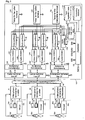
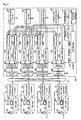
- Fig. 1 is a system block diagram of a videophone interpretation system according to a first embodiment of the invention. This embodiment shows a system configuration example assuming that a terminal used by a caller, a callee or an interpreter is a telephone-type videophone terminal connected to a public telephone line.
- a numeral 100 represents a videophone interpretation system installed in an interpretation center which provides an interpretation service.
- the videophone interpretation system 100 interconnects a videophone terminal used by a caller (hereinafter referred to as a caller terminal) 10, a videophone terminal used by a callee (hereinafter referred to as a callee terminal) 20, and a videophone terminal used by an interpreter (hereinafter referred to as an interpreter terminal) 30 via a public telephone line 40 in order to provides a videophone interpretation service where a videophone conversation between a caller and a callee is interpreted by an interpreter.
- the caller terminal 10, callee terminal 20 and interpreter terminal 30 each comprises a television camera (a) for capturing each user, a display screen (b) for displaying the received video, a dial pad (c) for input of a number or information, and a headset (d) for audio input/output. While input/output of voice is not necessarily made using a headset but a handset on a typical telephone set may be used instead.
- Such a videophone terminal connected to a public line may be an ISDN videophone terminal based on ITU-T recommendation H.320.
- the invention may use a videophone terminal which employs a unique protocol.
- the public telephone line may be of a wireless type.
- the videophone terminal may be a cellular phone or a portable terminal equipped with a videophone function.
- the interpretation videophone system 100 comprises a caller terminal line interface (interface being hereinafter referred to as I/F) 120 to connect to a caller terminal, a callee terminal line I/F 140 to connect to a callee terminal, and an interpreter terminal line I/F 160 to connect to an interpreter terminal.
- I/F caller terminal line interface
- I/F 140 callee terminal line
- I/F 160 interpreter terminal line
- a multiplexer/demultiplexer 122, 142, 162 for multiplexing/demultiplexing a video signal, an audio signal or a data signal
- a video CODEC (coder/decoder) 124, 144, 164 for compressing/expanding a video signal
- an audio CODEC 126, 146, 166 for compressing/expanding an audio signal.
- Each line I/F, each multiplexer/demultiplexer, and each video CODEC or each audio CODEC performs call control, streaming control and compression/
- a video synthesizer 128 for synthesizing the video output of the callee terminal video CODEC 144, the video output of the interpreter terminal video CODEC 164 and the output of the caller terminal telop memory 132 are connected.
- a video synthesizer 148 for synthesizing the video output of the caller terminal video CODEC 124, the video output of the interpreter terminal video CODEC 164, and the output of the callee terminal telop memory 152 are connected.
- a video synthesizer 168 for synthesizing the video output of the caller terminal video CODEC 124, the video output of the callee terminal video CODEC 144, and the output of the interpreter terminal telop memory 172 are connected.
- video display of an interpreter may be omitted on a caller terminal or a callee terminal
- understanding of the voice interpreted by the interpreter is made easy by displaying the video of the interpreter, so that it is preferable to be able to synthesize the video of an interpreter.
- video display of a caller or a callee may be omitted on an interpreter terminal, understanding of the voice interpreted by the interpreter is made easy by displaying the videos, so that it is preferable to be able to display the video of a caller or a callee.
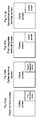
- Fig. 2 shows an example of a video displayed on the screen of each terminal during a videophone conversation by way of the videophone interpretation system 100.
- Fig. 2(a) shows the screen of a caller terminal, on which a synthesized video of a callee and an interpreter obtained by the video synthesizer 128 is displayed. While the video of the callee is displayed as a main window and the video of the interpreter is displayed as a sub window in a Picture-in-Picture fashion in this example, a Picture-in-Picture display is also possible assuming the video of the interpreter as a main window and the video of the callee as a sub window. Or, these videos may be displayed in equal size.
- Fig. 1 shows the screen of a caller terminal, on which a synthesized video of a callee and an interpreter obtained by the video synthesizer 128 is displayed. While the video of the callee is displayed as a main window and the video of the interpreter is displayed as a sub
- FIG. 2(b) shows the screen of a callee terminal, on which a synthesized video of a caller and an interpreter obtained by the video synthesized 148 is displayed. While the video of the caller is displayed as a main window and the video of the interpreter is displayed as a sub window in a Picture-in-Picture fashion in this example, a Picture-in-Picture display is also possible assuming the video of the interpreter as a main window and the video of the caller as a sub window. Or, these videos may be displayed in equal size.
- Fig. 2(c) shows the screen of an interpreter terminal, on which a synthesized video of a caller and a callee obtained by the video synthesizer 168 is displayed.
- an audio synthesizer 130 for synthesizing the audio output of the callee terminal audio CODEC 146 and the audio output of the interpreter terminal audio CODEC 166 are connected.
- an audio synthesizer 150 for synthesizing the audio output of the caller terminal audio CODEC 126 and the audio output of the interpreter terminal audio CODEC 166 are connected.
- an audio synthesizer 170 for synthesizing the audio output of the caller terminal audio CODEC 126 and the audio output of the callee terminal audio CODEC 146 are connected.
- the audio output of the interpreter terminal audio CODEC 166 is input to a selector 174. Based on a command from an interpreter terminal, the audio output is supplied to the caller terminal audio synthesizer 130 in case the interpreter interprets the language of the callee to the language of a caller, and to the callee terminal audio synthesizer 150 in case the interpreter interprets the language of a caller to the language of the callee. As a result, the audio of the interpreter is transmitted to either the caller or the callee requiring the audio. Thus, it is possible to prevent the speech of a caller or a callee from being disturbed by the unnecessary voice of an interpreter, thereby providing a smooth conversation.
- the caller terminal audio synthesizer 130 is equipped with a function to suppress an audio level from the callee terminal or switch an audio from the callee terminal to an audio from the interpreter terminal when an audio from the interpreter terminal is detected.
- the callee terminal audio synthesizer 150 is equipped with a function to suppress an audio level from the caller terminal or switch an auido from the callee terminal to an audio from the interpreter terminal when an audio from the interpreter terminal is detected. This prevents overlapping of the audio of the interpretation by the interpreter over the audio of the opponent party which causes difficulty in listening.
- the interpreter can simultaneously interpret the speech of the speaker thus allowing a speedy and precise interpretation.
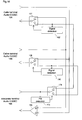
- Fig. 15 shows specific examples of the function to switch the destination of the interpreter audio in the selector 174 and the function to suppress the audio of the callee or caller in the audio synthesizers 130, 150.
- the audio output of the interpreter terminal audio CODEC 166 is connected to a caller terminal audio signal adder 190 and an callee terminal audio signal adder 193 via the switch 174.
- the audio of the interpreter is supplied to either the caller of callee by a signal from a PB detector 175.
- the PB detector 175 detects a predetermined number for selecting a caller or a callee on the dial pad of a terminal is pressed based on a data signal or a tone signal included in an audio signal from the interpreter terminal, and switches the selector 174 into the specified side.
- the interpreter specifies the caller or callee as a destination of his/her voice by the dial pad before he/she interprets. Thus, the caller or the callee who need not listen to the audio of the interpreter does not receive the audio of the interpreter.
- the audio output of the callee terminal audio CODEC 146 is connected via an attenuator 191, which attenuates the audio from the callee terminal when the audio from the interpreter is detected by the signal detector 192.
- the audio output of the caller terminal audio CODEC 126 is connected via an attenuator 194, which attenuates the audio from the caller terminal when the audio of the interpreter is detected by the signal detector 195.
- the signal detectors 192, 195 are set to an appropriate detection level in order to prevent the audio of the opponent party from being attenuated by mistake due to a noise and the like.
- an appropriate signal delay unit may be provided at the interpreter audio input of the audio signal adder 190, 193.
- a switch may be used instead to shut off the audio of the opponent party.
- Fig. 16 shows an example where the audio of the opponent party is shut off when the audio of the interpreter is transmitted and only the audio of the interpreter is transmitted.
- switches 197, 198 are used instead of the audio signal adders 190, 193.
- the switches 197, 198 are turned from the audio of the opponent party to the audio of the interpreter.
- the remaining configuration is the same as that shown in Fig. 15.
- an appropriate signal delay unit may be provided at the interpreter audio input of the switches 197, 198.
- audio signal adder 190, 193 simply adds the audio of the interpreter and the audio of the opponent party in the above example
- audio multiplexing of two signals may be employed as well.
- a stereophonic synthesis is performed to the audio of the opponent party as the left channel and the audio of the interpreter as the right channel and the resultant signal is transmitted to a terminal, where the receiving party selects a necessary audio.
- the receiving party listens to the audios while adjusting the volume balance of the right and left channels of a headset.
- the audio of the interpreter may be supplied to each of the audio signal adder 190 (or the switch 197) and the audio signal adder 193 (or the switch 198) via an attenuator in order to attenuate an audio signal to a party where the audio is not required based on detection by the PB detector 175.
- some of the audio of the interpreter is transmitted to the speaker by using an attenuator. The speaker thus checks that his/her speech is interpreted while he/she is speaking.
- the videophone interpretation system 100 is equipped with an interpreter registration table 112 where the terminal number of an interpreter is registered and includes a controller 110 connected to each of the line I/Fs 120, 140, 160, multiplexers/demultiplexers 122, 142, 162, video synthesizers 128, 148, 168, audio synthesizers 130, 150, 170, and telop memories 132, 152, 172.
- the controller 110 provides a function to connect a caller terminal, a callee terminal and an interpreter terminal by way of a function to accept a call from a caller terminal, a function to acquire the language type of the caller and the language type of the callee, a function to acquire the selection conditions for selecting an interpreter, a function to extract the terminal number of the interpreter by referencing the interpreter registration table 112 by using the acquired language type and selection conditions, a function to call the interpreter terminal by using the terminal number of the interpreter extracted, and a function to call the callee terminal by using the acquired terminal number of the callee.
- Operation of the video synthesizers 128, 148, 168 and audio synthesizers 130, 150, 170 is controlled by the controller 110.
- a function is included where the user changes the video output method or audio output method by pressing a predetermined number button of a dial pad of each terminal.
- the multiplexer/demultiplexer 122, 142, 162 detects the number button on the dial pad of each terminal is pressed based on a data signal or a tone signal and signals the detection to the controller. This ensures flexibility in the usage of the system on each terminal. For example, only necessary videos or audios are selected and displayed/output in accordance with the object or it is possible to replace a main window with a sub window, or change the position of the sub window.
- a caller terminal telop memory 132 To the input of the audio synthesizers 128, 148, 168, a caller terminal telop memory 132, a calee terminal telop memory 152, and a interpreter terminal telop memory 172 are connected respectively. Contents of each telop memory 132, 152, 172 can be set from the controller 110. With this configuration, by setting a message to be displayed on each terminal to the telop memory 132, 152, 172 and issuing a command to select a signal of the telop memory 132, 152, 172 to the audio synthesizer 128, 148, 168 in the setup of a videophone conversation via interpretation, it is possible to transmit necessary messages to respective terminals to establish a three-way call.
- connection processing by the controller 110 for establishing a videophone conversation via interpretation is described.
- an interpreter selection information and a terminal number of a terminal used by each interpreter are registered in the interpreter registration table 112 of the controller 110 from an appropriate terminal (not shown).
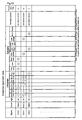
- Fig. 3 shows an example of registration item to be registered in the interpreter registration table 112.
- the interpreter selection information is information for selecting a interpreter desired by a user, which includes a gender, an age, supported languages, a habitation, a specialty, and the like.
- the level of an interpreter is registered by language to allow the user to select an interpreter of a desired level between the target languages.
- the levels of interpretation are represented by 1 (Advanced), 2 (Middle) and 3 (Basic).
- the habitation assumes a case where the user desires a person who has geographic knowledge on a specific area and, in this example, a ZIP code is used to specify an area.
- the specialty assumes a case where, in case the conversation pertains to a specific field, the user desires a person who has expert knowledge on the field or is familiar with the topics in the field.
- the fields an interpreter is familiar with are classified into several categories to be registered, such as politics, law, business, education, science and technology, medical care, language, sports, and hobby.
- the specialties are diverse, so that they may be registered hierarchically and searched through at a level desired by the user when selected.
- qualifications of interpreter may be registered in advance so that the user can select a qualified person as an interpreter.
- the terminal number to be registered is the telephone number of the terminal, because in this example a videophone terminal to connect to a public telephone line is assumed.
- an availability flag to indicate whether an interpreter accepts interpretation.
- a registered interpreter can call the interpretation center from his/her terminal and enter a command by using a dial pad to set/reset the availability flag.
- an interpreter registered in the interpreter registration table can set the availability flag only when he/she is available for interpretation, thereby eliminating useless calling and allowing the user to select an available interpreter without delay.
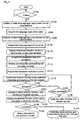
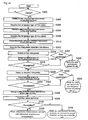
- Fig. 4 shows a processing flowchart of the connection processing by the controller 110.
- the videophone interpretation system 100 accepts an order for an interpretation service when the caller calls a telephone number of the caller terminal line I/F.
- the videophone interpretation system 100 then calls the interpreter terminal and the callee terminal, and establishes a connection for the videophone interpretation service.
- the presence of a call to the caller terminal line I/F 120 is detected initially (S100).
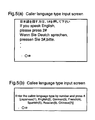
- a screen to prompt input of the language type of the caller is displayed on the caller terminal (S102). This is accomplished for example by setting a message shown in Fig. 5(a) to the caller terminal telop memory 132.
- the language type of the caller input by the caller is acquired (S104). Afterwards, messaging to the caller terminal and the interpreter terminal is made using the language type of the caller acquired.
- a screen to prompt input of a language type of the callee is displayed on the caller terminal (S106). This is accomplished for example by setting a message shown in Fig. 5(b) to the caller terminal telop 132.
- the language type of the callee input by the caller is acquired (S108). Afterwards, messaging to the callee terminal is made using the language type of the callee acquired.
- a screen to prompt input of interpreter selection conditions is displayed on the caller terminal (S110). This is accomplished for example by setting a message shown in Fig. 6 (a) to the caller terminal telop memory 132.
- the interpreter selection conditions input by the caller are acquired (S112).
- the interpreter selection conditions input by the caller are a gender, an age bracket, an area, a specialty and an interpretation level.
- the area is specified by using a ZIP code and an interpreter is selected starting with the habitation closest to the specified area. For any selections, in case it is not necessary to specify a condition, N/A may be selected.
- an interpreter who has a specified interpretation level of the language of the caller and the language of the callee, and whose gender, age, habitation and specialty satisfy the acquired selection conditions, with his/her availability flag being set is extracted referring to the interpreter registration table 112, and the caller terminal displays a list of interpreter candidates to prompt input of the selection number of a desired interpreter (S114). This is accomplished for example by setting a message and an interpreter list shown in Fig. 6(a) to the caller terminal telop memory 132. In this practice, the hourly rates of the interpreter (not shown) registered in the interpreter registration table 112 is extracted and displayed as a fee. This allows the user to consider the cost of the interpretation service before selecting an appropriate interpreter.
- the hourly rates of the interpreter may be determined from the interpretation level of the selected interpreter by referencing an accounting table which specifies the relationship between the interpretation level and the hourly rates.
- the selection number input by the caller referring to the interpreter candidate list is acquired (S116).
- the terminal number of the selected interpreter is extracted from the interpreter registration table 112 and called (S118).
- Personal information on a caller, language types of the caller and callee, and interpreter selection conditions may be communicated to the interpreter terminal by using the interpreter terminal telop memory 172 so as to accept the interpretation.
- Personal information on the caller may be available for example from pre-registered member information for the interpretation service being a membership service.
- a screen to prompt input of the terminal number of the callee is displayed on the caller terminal (S122). This is accomplished for example by setting a message shown in Fig. 7 to the caller terminal telop memory 132.
- the terminal number of the callee input by the caller is extracted and the callee is called (S124).
- personal information on a caller, language types of the caller and callee, and interpreter selection conditions may be communicated to the callee terminal by using the callee terminal telop memory 152 so as to confirm whether to accept the call and an error in the set conditions, if any.
- the controller 110 has a timer (not shown) for calculating the fee of the interpretation service.
- the timer measures the time from when the connection is established to when it is released.
- the fee is calculated from the time measured by the timer and the hourly rates mentioned above and registered in a accounting database 114, and charged to the user later.
- an interpretation reservation table to register a caller terminal number and a callee terminal number may be provided and the caller and the callee may be notified on a later response from the selected interpreter to set a videophone conversation.
- a telephone number of an interpretation center may be specified per language type of the caller or per combination of the language type of the caller and the language type of the callee in order to acquire the language type of the caller or the callee.
- the caller may be first inquired of whether to specify the interpreter selection conditions, and in case he/she has determined not to specify the interpreter selection conditions, only the input language types may be used to select an interpreter.
- Configuration is allowed where, in an emergency, the caller first dials a specific number to automatically call an interpreter dedicated to an emergency case.
- the videophone interpretation system 100 comprises a line I/F, a multiplexer/demultiplexer, a video CODEC, an audio CODEC, a video synthesizer, an audio synthesizer and a controller in the above embodiment, these components need not be implemented by individual hardware (H/W) but the function of each component may be implemented by software processing running on a computer.
- H/W hardware
- interpreter terminal 30 same as the caller terminal 10 and the callee terminal 20, is located outside the interpretation center and called from the interpretation center over a public telephone line to provide an interpretation service in the above embodiment, the invention is not limited thereto but some or all of the interpreter terminals may be installed in the interpretation center so that the interpretation services are provided from the interpretation center.
- an interpreter can join an interpretation service anywhere he/she may be, as long as he/she has a terminal which can be connected to a public telephone line.
- the interpreter can provide an interpretation service by using the availability flag to make efficient use of free time. This allows efficient and stably operation of interpretation services which often have difficulty in securing necessary personnel.
- a function may be provided to input the video signal of the home terminal and synthesize and display to check the video on the terminal.
- video synthesizers 128, 148, 168 are used to synthesize videos for each terminal in the above embodiment, the invention is not limited thereto but videos from all terminals may be synthesized at once and the resultant may be transmitted to each terminal.
- videos from all terminals may be synthesized at once and the resultant may be transmitted to each terminal.
- a video of the caller, a video of the callee and a video of the interpreter may be displayed in a four split screen.
- telop memories 132, 152, 172 are provided and their outputs are added to the corresponding video synthesizers 128, 148, 168 respectively in order to display a text telop on each terminal
- a function may be provided whereby telop memories to store audio information are provided and each output is added to the audio synthesizers 130, 150, 170 in order to output an audio message on each terminal. This makes it possible to provide a videophone interpretation service even in case any of the caller, the callee or the interpreter is a visually impaired person.
- Fig. 8 is a system block diagram of a videophone interpretation system according to a second embodiment of the invention.
- the system configuration example includes the terminals used by a caller, a callee and an interpreter are IP(Internet Protocol) type videophone terminals to be connected to the Internet equipped with a web browser.
- a numeral 200 represents a videophone interpretation system installed in an interpretation center to provide an interpretation service.
- the videophone interpretation system 200 connects a caller terminal 60 used by a caller, a callee terminal 70 used by a callee, and any of the interpreter terminals used by an interpreter 231, 232,... via the Internet 80 in order to provide a videophone interpretation service to the caller and the callee.
- a general-purpose processing device such as a personal computer having a video input I/F function, an audio input/output I/F function and a network connection function
- the processing device equipped with a keyboard (b) and
- the videophone terminal connected to the Internet may be an IP videophone terminal based on ITU-T recommendation H.323, the invention is not limited thereto but may use a videophone terminal which employs a unique protocol.
- the Internet may be of a wireless LAN type.
- the videophone terminal may be a cellular phone or a portable terminal equipped with a videophone function and also including a web access function.
- the videophone interpretation system 200 comprises: a communications server 220 including a connection table 222 for setting the terminal addresses of a caller terminal, a callee terminal and an interpreter terminal as well as a function to interconnect the terminals registered in the connection table 222 and synthesize a video and an audio received from each terminal and transmit the synthesized video and audio to each terminal; a web server 210 including an interpreter registration table 212 for registering the interpreter selection information, terminal address and availability flag of each interpreter as mentioned earlier, as well as a function to select a desired interpreter based on an access from a caller terminal by using a web browser and set the terminal address of each of the caller terminal, the callee terminal and interpreter terminal in the connection table 222 of the communications server 220; a router 250 for connecting the web server 210 and the communications server 220 to the Internet; and a plurality of interpreter terminals 231, 232,..., 23N connected to the communications server 220 via a network.
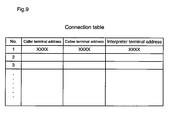
- Fig. 9 shows an example of a connection table 222.
- the terminal address of a caller terminal, the terminal address of a callee terminal and the terminal address of an interpreter terminal are registered as a set in the connection table 222. This provides a single interpretation service.
- the connection table 222 is designed to register a plurality of such terminal address sets depending on the throughput of the communications server 220, thereby simultaneously providing a plurality of interpretation services.
- connection table 222 is an address on the Internet and is generally an IP address, the invention is not limited thereto but for example a name given by a directory server may be used.
- the communications server 220 performs packet communications using a predetermined protocol with the caller terminal, the callee terminal and interpreter terminal set to the connection table 222 and provides, by way of software processing, the functions similar to those provided by a multiplexer/demultiplexer 122, 142, 162, a video CODEC 124, 144, 164, an audio CODEC 126, 146, 166, a video synthesizer 128, 148, 168, an audio synthesizer 130, 150, 170 in the videophone interpretation system 100.
- While the videophone interpretation system 100 uses the controller 110 and the telop memories 132, 152, 172 to extract a term registered in the term registration table 113 during a videophone conversation by a command from a terminal and displays the term as a telop on the terminal, the same function may be provided by way of software processing by the communications server 220 in this embodiment also.
- a term specified by each terminal may be displayed as a popup message on the other terminal by way of the web server 210.
- a telop memory may be provided in the communications server 220 and a term specified by each terminal may be written into the telop memory via the web server 210 to display a text telop on each terminal.
- the aforementioned interpretation center uses the controller 110 to interconnect a caller terminal, a callee terminal and an interpreter terminal
- the connection procedure is made by the web server 210 in this embodiment because each terminal has a web access function.
- Fig. 10 is a processing flowchart of a connection procedure by the web server 210.
- a caller terminal may access and log into the web server 210 in the interpretation center, which starts the acceptance of the interpretation service.
- the web server 210 first acquires the terminal address of a caller (S200) and sets the terminal address to the connection table 222 (S202). Next, the web server delivers a screen to prompt input of the language type of the caller similar to that shown in Fig. 5(a) (S204) to the caller terminal. The language type of the caller input by the caller is acquired (S206). The web server delivers a screen to prompt input of the language type of the callee similar to that shown in Fig. 5(b) (S208) to the caller terminal. The language type of the callee input by the caller is acquired (S210). The web server delivers a screen to prompt input of the selection conditions similar to that shown in Fig. 6(a) to the caller terminal (S212). The interpreter selection conditions input by the caller are acquired (S214).
- an interpreter with availability flag set is selected from among the interpreters satisfying the language type and selection conditions referring to the interpreter registration table 212.
- the web server 210 delivers a list of interpreter candidates similar to that shown in Fig. 6(b) to the caller terminal to prompt input of the selection number of a desired interpreter (S216).
- the selection number of the interpreter input by the caller is acquired and the terminal address of the selected interpreter is acquired from the interpreter registration table 212 (S218).
- the web server 210 delivers a calling screen to the interpreter terminal (S220). In case the call is accepted by the interpreter (S222), the terminal address of the interpreter is set to the connection table 222 (S224).
- the web server 210 delivers a screen to prompt input of the terminal address of the callee similar to that shown in Fig. 7 to the caller terminal (S226).
- the terminal address of the callee input by the caller is acquired (S228).
- the web server 210 delivers a calling screen to the callee terminal (S230).
- the callee terminal address is set to the connection table 222 (S234).
- a videophone interpretation service starts (S236).
- the interpreter terminal does not accept the call in S222, whether another candidate is available is determined (S238). In case another candidate is available, the web server delivers a message to prompt the caller to select another candidate to the caller terminal (S240), then execution returns to S218. In case another candidate is not found, the web server notifies the caller terminal as such (S242) and the call is released. In case the callee terminal does not accept the call in S232, the caller terminal and the selected interpreter terminal are notified as such (S244) and the call is released.
- an interpretation reservation table to register a caller terminal address and a callee terminal address may be provided and the caller and the callee may be notified on a later response from the selected interpreter to set a videophone interpretation service.
- interpreter terminal is located in the videophone interpretation system 200 of the interpretation center in the above embodiment, the invention is not limited thereto but some or all of the interpreters may be installed outside the interpretation center and connected via the Internet. Theses terminals may be addressed by the same processing.
- the configuration of the videophone interpretation system has been described for a case where a videophone terminal used by a caller, a callee or an interpreter is a telephone-type videophone terminal connected to a public telephone line and a case where the videophone terminal is an IP-type videophone terminal connected to the Internet, the telephone-type videophone terminal and the IP-type videophone terminal can communicate with each other by arranging a gateway to perform protocol conversion therebetween.
- a videophone interpretation system conforming to one protocol may be provided to support a videophone terminal which uses another protocol.
- the videophone interpretation system allows the user to enjoy or provide an interpretation service anywhere he/she may be, as long as he/she has a terminal which can be connected to a public telephone line or the Internet.
- An interpreter does not always have to visit an interpretation center but can join a conversation via interpretation from his/her home or a facility or site where a videophone terminal is located, or provide an interpretation service by using a cellular phone or a portable terminal equipped with a videophone function.
- a person with the ability of interpretation may wish to register in the interpreter registration table in the interpretation center in order to provide an interpretation service anytime when it is convenient to him/her. From the viewpoint of the operation of the interpretation center, it is not necessary to summon interpreters to the center. This allows efficient operation of the interpretation center both in terms of time and costs.
- a first interpreter to interpret the language of the callee into the language of the caller and a second interpreter to interpret the language of the caller into the language of the callee may be individually set to perform a bidirectional simultaneous interpretation.
- Fig. 11 shows an example of the system configuration of a videophone interpretation system which provides a bidirectional simultaneous interpretation according to a third embodiment of the invention. While this example uses a telephone-type videophone, an IP-type videophone may be used instead as mentioned above.
- a numeral 300 represents a videophone interpretation system installed in an interpretation center which provides a bidirectional simultaneous interpretation service.
- the videophone interpretation system 300 interconnects a videophone terminal used by a caller (hereinafter referred to as a caller terminal) 10, a videophone terminal used by a callee (hereinafter referred to as a callee terminal) 20, a videophone terminal used by a first interpreter (hereinafter referred to as a first interpreter terminal) 32, and a videophone terminal used by a second interpreter (hereinafter referred to as a second interpreter terminal) 34 via a public telephone line 40 in order to provide a videophone interpretation service where a videophone conversation between a caller and a callee is interpreted by the first interpreter and the second interpreter.
- the videophone interpretation system 300 comprises a caller terminal line I/F 320, a callee terminal line I/F 340, a first interpretation terminal line I/F 360 and a second interpretation terminal line I/F 380.
- a multiplexer/demultiplexer 322, 342, 362, 382 for multiplexing/demultiplexing a video signal, an audio signal or a data signal a video CODEC (coder/decoder) 324, 344, 364, 384 for compressing/expanding a video signal, and an audio CODEC 326, 346, 366, 386 for compressing/expanding an audio signal are connected.
- Each line I/F, each multiplexer/demultiplexer, and each video CODEC or each audio CODEC performs call control, streaming control and compression/expansion of a video/audio signal in accordance with a protocol used by each terminal.
- a video synthesizer 328 for synthesizing the video output of the callee terminal video CODEC 344, the video output of the first interpreter terminal video CODEC 364 and the output of the caller terminal telop memory 332 is connected.
- a video synthesizer 348 for synthesizing the video output from the caller terminal video CODEC 324, the video output from the second interpreter terminal video CODEC 384, and the output of the callee terminal telop memory 352 is connected.
- a video synthesizer 368 for synthesizing the video output of the caller terminal video CODEC 324, the video output of the callee terminal video CODEC 344, and the output of the first interpreter terminal telop memory 372 is connected.
- a video synthesizer 388 for synthesizing the video output of the callee terminal video CODEC 344, the video output of the caller terminal video CODEC 324, and the output of the second interpreter terminal telop memory 392 is connected.
- While video display of a first interpreter or a second interpreter may be omitted on a caller terminal or a callee terminal, understanding of the voice interpreted by the interpreter is made easy by displaying the video of the interpreter, so that it is preferable to be able to synthesize the video of an interpreter.
- video display of a caller or a callee may be omitted on a first interpreter terminal or a second interpreter terminal, understanding of the voice interpreted by the interpreter is made easy by displaying the videos, so that it is preferable to be able to display the video of a caller or a callee.
- Fig. 12 shows an example of a video displayed on the screen of each terminal during a videophone conversation by way of the videophone interpretation system 300.
- Fig. 12(a) shows the screen of a caller terminal, on which a synthesized video of a caller and a first interpreter obtained by the video synthesizer 328 is displayed. While the video of the callee is displayed as a main window and the video of the first interpreter is displayed as a sub window in a Picture-in-Picture fashion in this example, a Picture-in-Picture display is also possible assuming the video of the first interpreter as a main window and the video of the callee as a sub window. Or, these videos may be displayed in equal size.
- Fig. 12(a) shows the screen of a caller terminal, on which a synthesized video of a caller and a first interpreter obtained by the video synthesizer 328 is displayed. While the video of the callee is displayed as a main window and the video of the first
- FIG. 12(b) shows the screen of a callee terminal, on which a synthesized video of a caller and a second interpreter obtained by the video synthesizer 348 is displayed. While the video of the caller is displayed as a main window and the video of the second interpreter is displayed as a sub window in a Picture-in-Picture fashion in this example, a Picture-in-Picture display is also possible assuming the video of the second interpreter as a main window and the video of the callee as a sub window. Or, these videos may be displayed in equal size. Fig.
- FIG. 12(c) shows the screen of a first interpreter terminal, on which a synthesized video of a callee and a caller obtained by the video synthesizer 368 is displayed. While the video of the callee is displayed as a main window and the video of the caller is displayed as a sub window in a Picture-in-Picture fashion in this example, the videos may appear in opposite windows. Or, these videos may be displayed in equal size.
- Fig. 12(d) shows the screen of a second interpreter terminal, on which a synthesized video of a caller and a callee obtained by the video synthesizer 388 is displayed. While the video of the caller is displayed as a main window and the video of the callee is displayed as a sub window in a Picture-in-Picture fashion in this example, the videos may appear in opposite windows. Or, these videos may be displayed in equal size.
- an audio synthesizer 330 for synthesizing the audio output of the callee terminal audio CODEC 346 and the audio output of the first interpreter terminal audio CODEC 366 is connected.
- an audio synthesizer 350 for synthesizing the audio output of the caller terminal audio CODEC 326 and the audio output of the second interpreter terminal audio CODEC 386 is connected.
- the audio output of the callee terminal audio CODEC 346 is connected.
- the audio output of the caller terminal audio CODEC 326 is connected.
- the audio of the first interpreter is transmitted only to the caller, and the audio of the second interpreter is transmitted only to the callee.
- the speech of the caller is not disturbed by the audio of the second interpreter and the speech of the callee is not disturbed by the audio of the first interpreter, thereby providing a smooth conversation.
- the caller terminal audio synthesizer 330 is equipped with a function to suppress the audio level from the callee terminal when the audio from the first interpreter terminal is detected
- the callee terminal audio synthesizer 350 is equipped with a function to suppress the audio level from the caller terminal when the audio from the second interpreter terminal is detected. This prevents overlapping of the audio of the first interpreter or the second interpreter over the audio of the opponent partywhich causes difficulty in listening.
- the first interpreter and the second interpreter can simultaneously interpret the speech of the speaker thus allowing a speedy and precise interpretation.
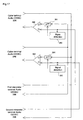
- Fig. 17 shows specific examples of the function to suppress the audio of the callee or caller in the audio synthesizers 330, 350.
- the audio output of the first interpreter terminal audio CODEC 366 is connected to a callee terminal audio signal adder 390.
- the audio output of the second interpreter terminal audio CODEC 386 is connected to a callee terminal audio signal adder 393.
- the audio output of the callee terminal audio CODEC 346 is connected via an attenuator 391, which attenuates the audio from the callee terminal when the audio of the first interpreter is detected by the signal detector 392.
- the audio output of the caller terminal audio CODEC 326 is connected via an attenuator 394, which attenuates the audio from the caller terminal when the audio of the second interpreter is detected by the signal detector 395.
- the signal detectors 392, 395 are set to an appropriate detection level in order to prevent the audio of the opponent party from being attenuated by mistake due to a noise and the like.
- an appropriate signal delay unit may be provided at the interpreter audio input of the audio signal adder 390, 393.
- a switch may be used instead to shut off the audio of the opponent party.
- Fig. 18 shows an example where the audio of the opponent party is shut off when the audio of the interpreter is transmitted and only the audio of the interpreter is transmitted.
- switches 397, 398 are used instead of the audio signal adders 390, 393.
- the switches 397, 398 are turned from the audio of the opponent party to the audio of the interpreter.
- the remaining configuration is the same as that shown in Fig. 17.
- an appropriate signal delay unit may be provided at the interpreter audio input of the switch 397, 398.
- audio signal adder 390, 393 simply adds the audio of the interpreter and the audio of the opponent party in the above example
- audio multiplexing of two signals may be employed as well.
- a terminal supports a stereophonic audio
- stereophonic synthesis is performed to the audio of the opponent party as the left channel and the audio of the interpreter as the right channel and the resultant is transmitted to a terminal, where the receiving party selects a necessary audio.
- the receiving party listens to the audios while adjusting the volume balance of the right and left channels of a headset.
- the audio of the caller and the audio of the second interpreter may be attenuated and added to or audio multiplexed into the audio to be transmitted to the first interpreter, and also the audio of the callee and the audio of the first interpreter may be attenuated and added to or audio multiplexed into the audio to be transmitted to the second interpreter.
- each interpreter can perform interpretation while checking the progress of the whole conversation and the response of the interpretee.
- the videophone interpretation system 300 is equipped with an interpreter registration table 312 where the terminal number of a terminal used by an interpreter is registered and includes a controller 310 connected to each of the line I/Fs 320, 340, 360, 380, multiplexers/demultiplexers 322, 342, 362, 382, video synthesizers 328, 348, 368, 388, audio synthesizers 330, 350, and telop memories 332, 352, 372, 392.
- the controller 310 provides a function to connect a caller terminal, a callee terminal, a first interpreter terminal, and a second interpreter terminal by way of a function to accept a call from a caller terminal, a function to acquire the language type of the caller and the language type the a callee, a function to acquire the selection conditions for selecting an interpreter, a function to extract the terminal number of the first interpreter and the terminal number of the second interpreter by referencing an interpreter registration table 312 by using the acquired language types and selection conditions, a function to call the first interpreter terminal and second interpreter terminal by using the terminal numbers of the interpreters extracted, and a function to call the callee terminal by using the acquired terminal number of the callee.
- Operation of the video synthesizers 328, 348, 368, 388 and audio synthesizers 330, 350 is controlled by the controller 310.
- a function is included where the user changes the video output method or audio output method by pressing a predetermined number button of a dial pad of each terminal.
- the multiplexer/demultiplexer 322, 342, 362, 382 detects the number button on the dial pad of each terminal is pressed based on a data signal or a tone signal and signals the detection to the controller. This ensures flexibility in the usage of the system on each terminal. For example, only necessary videos or audios are selected and displayed/output in accordance with the object or it is possible to replace a main window with a sub window, or change the position of the sub window.
- a caller terminal telop memory 332 To the input of the audio synthesizers 328, 348, 368, 388, a caller terminal telop memory 332, a callee terminal telop memory 352, a first interpreter terminal telop memory 372 and a second interpreter terminal telop memory 392 are connected respectively. Contents of each telop memory 332, 352, 372, 392 can be set from the controller 310.
- connection processing by the controller 310 for establishing a videophone conversation via bidirectional simultaneous interpretation is described.
- an interpreter selection information and a terminal number of a terminal used by each interpreter are registered in the interpreter registration table 312 of the controller 310 from an appropriate terminal (not shown).
- Fig. 13 shows an example of registration item to be registered in the interpreter registration table 312.
- items registered in the interpreter registration table 312 are same as those registered in the interpreter registration table 112 shown in Fig. 3 except that a listening comprehension level and a speaking level are separately registered for a supported language.
- Fig. 14 shows a processing flowchart of the connection processing by the controller 310.
- the videophone interpretation system 300 accepts an order for an interpretation services, when the caller calls to a telephone number of the caller terminal line I/F.
- the videophone interpretation system 100 then calls the first interpreter terminal, second interpreter terminal, callee terminal, and establishes a connection for a bidirectional simultaneous interpretation service is established.
- the presence of the call to the caller terminal line I/F 320 is detected initially (S300).
- a screen to prompt input of the language type of the caller similar to that shown in Fig. 5(a) is displayed on the caller terminal (S302).
- the language type of the caller input by the caller is acquired (S304).
- a screen to prompt input of the language type of the callee similar to that shown in Fig. 5(b) is displayed on the caller terminal (S306).
- the language type of the callee input by the caller is acquired (S308).
- a screen to prompt the interpreter selection conditions similar to that shown in Fig. 6(a) is displayed on the caller terminal (S310).
- the interpreter selection conditions input by the caller are acquired (S312).
- the interpreter selection conditions are, same as the previous single interpretation, a gender, an age bracket, an area, a specialty and an interpretation level.
- the area is specified by using a ZIP code and an interpreter is selected starting with the habitation closest to the specified area. For any selections, in case it is not necessary to specify a condition, N/A may be selected.
- an interpreter who has a specified listening comprehension level of the language of the callee and a speaking level of the language of the caller, and whose gender, age, habitation and specialty satisfy the acquired selection conditions, with his/her availability flag being set is selected as a first interpreter referring to the interpreter registration table 312 (S314).
- the terminal number of the selected interpreter is extracted and called (S316).
- a configuration is also possible where, same as the first embodiment, a candidate list similar to that shown in Fig. 6(b) is displayed and the caller selects an interpreter from the list.
- the hourly rates (not shown) of each of the first interpreter and second interpreter registered in the interpreter registration table 312 may be extracted and displayed as a charge. This allows the user to consider the cost of the interpretation service before selecting an appropriate interpreter.
- the hourly rates of the interpreter may be determined from the interpretation level of the selected interpreter by referencing an accounting table which specifies the relationship between the interpretation level and the hourly rates.
- the controller 310 comprises a timer (not shown) for calculating the fee of the interpretation service.
- the timer measures the time from when the connection is established to when it is released.
- the fee is calculated from the time measured by the timer and sum of the hourly rates of the first interpreter and the second interpreter mentioned above and registered in a accounting database 314, and charged to the user later.
- an interpretation reservation table to register a caller terminal number and a callee terminal number may be provided and the caller and the callee may be notified on a later response from both the selected first interpreter and second interpreter to set a videophone conversation.
- the videophone interpretation system 300 comprises a line I/F, a multiplexer/demultiplexer, a video CODEC, an audio CODEC, a video synthesizer, an audio synthesizer and a controller in the above embodiment, these components need not be implemented by individual hardware (H/W) but the function of each component may be implemented by software processing on a computer.
- H/W hardware
- first interpreter terminal 32 and the second interpreter terminal 34 same as the caller terminal 10 and the callee terminal 20, is located outside the interpretation center and called from the interpretation center over a public telephone line to provide an interpretation service in the above embodiment, the invention is not limited thereto but some or all of the interpreter terminals may be installed in the interpretation center so that the interpretation services are provided from the interpretation center.
- an interpreter can join an interpretation service anywhere he/she may be, as long as he/she has a terminal which can be connected to a public telephone line.
- the interpreter can provide an interpretation service by using the availability flag to make efficient use of free time. This allows efficient and stably operate of interpretation services which often have difficulty in securing necessary personel.
- a function may be provided to input the video signal of the home terminal and synthesize and display to check the video on the terminal.
- video synthesizers 328, 348, 368, 388 are used to synthesize videos for each terminal in the above embodiment
- videos from all terminals may be synthesized at once and the resultant may be transmitted to each terminal.
- a video of the caller, a video of the callee, a video of the first interpreter and a video of the second interpreter may be displayed in a four split screen.
- telop memories 332, 352, 372, 392 are provided and their outputs are added to the corresponding video synthesizers 328, 348, 368, 388 respectively in order to display a text telop on each terminal in the above embodiment
- a function may be provided whereby telop memories to store audio information are provided and their outputs are added to the audio synthesizers 330, 350 and an audio synthesizers is provided at the input of each of the first interpreter terminal audio CODEC 366 and the second interpreter terminal audio CODEC 386, and the outputs of the corresponding telop memories are added in order to output an audio message on each terminal.
- Fig. 19 shows an example of a recording/reproduction function in the videophone interpretation system according to the first embodiment.
- a video from the caller terminal video CODEC 124, a video from the callee terminal video CODEC 144 , and a video from the interpreter terminal video CODEC 164 are synthesized by the video synthesizer 116 and the resultant is transmitted to a video/audio recorder/player 118.
- the audio output of the audio synthesizer 130 to be transmitted to the caller terminal and the audio output of the audio synthesizer 150 to be transmitted to the callee terminal are audio multiplexed by an audio multiplexer 117 assuming the former as the left-channel and the latter as the right-channel, and the resultant is transmitted to the video/audio recorder/player 118.
- the video output of the video synthesizer 116 and the audio output of the audio multiplexer 117 during an interpretation service are automatically recorded onto the video/audio recorder/player 118 and stored for each user based on a command from the controller 110.
- the video and audio stored in the video/audio recorder/player 118 are reproduced based on a command from the controller 110 when the multiplexer/demultiplexer 122 or 142 detect a predetermined dial number is pressed on the caller terminal or callee terminal, and the reproduced video and audio are transmitted to each terminal via the video synthesizer 128 or 148 and the audio synthesizer 130 or 150 for the detected terminal.
- Fig. 21(a) This allows the user to check a video from each terminal during an interpretation in a four split screen shown in Fig. 21(a) and the like.
- the user terminal is equipped with an audio multiplexing/demultiplexing function, an audio from each terminal can be checked, by the language of the caller in left-channel and by the language of the callee in right-channel.
- the user may call the interpretation center at a later time and input a predetermined access code from his/her terminal to reproduce and check a video and an audio stored in the video/audio recorder/player 118.
- a method for synthesizing a video or audio to be recorded onto a video/audio recorder/player is not limited to the above example but may be any method as long as the user can check the contents of the interpretation service.
- an audio transmitted to the caller and an audio transmitted to the callee may be individually recorded and the audio specified by a terminal may be reproduced and transmitted.
- the user may be a person other than the person who has obtained the interpretation service.
- a person granted an access right has called the interpretation center from a videophone terminal and input an access code, he/she may receive a video and an audio stored in the video/audio recorder/player 118.
- Fig. 20 shows an example of a recording/reproduction function in the videophone interpretation system with bidirectional simultaneous interpretation according to the third embodiment.
- a video from the caller terminal video CODEC 24 a video from the callee terminal video CODEC 344, a video from the first interpreter terminal video CODEC 364, and a video from the second interpreter terminal video CODEC 384 are synthesized by the video synthesizer 316 and the resultant is transmitted to a video/audio recorder/player 318.
- the audio output of the audio synthesizer 330 to be transmitted to the caller terminal and the audio output of the audio synthesizer 350 to be transmitted to the callee terminal are audio multiplexed by an audio multiplexer 317 assuming the former as the left-channel and the latter as the right-channel, and the resultant is transmitted to the video/audio recorder/player 318.
- the video output of the video synthesizer 316 and the audio output of the audio multiplexer 317 during an interpretation service are automatically recorded onto the video/audio recorder/player 318 and stored for each user based on a command from the controller 310.
- the video and audio stored in the video/audio recorder/player 318 are reproduced based on a command from the controller 310 when the multiplexer/demultiplexer 322 or 342 detect a predetermined dial number is pressed on the caller terminal or callee terminal is detected, and the reproduced video and audio are transmitted to each terminal via the video synthesizer 328 or 348 and the audio synthesizer 330 or 350 for the detected terminal.
- Fig. 21(b) This allows the user to check a video from each terminal during an interpretation in a four split screen shown in Fig. 21(b) and the like.
- the user terminal is equipped with an audio multiplexing/demultiplexing function, an audio from each terminal can be checked, by the language of the caller in left-channel and by the language of the callee in right-channel.
- the user may call the interpretation center at a later time and input a predetermined access code from his /her terminal to reproduce and check a video and an audio stored in the video/audio recorder/player 318.
- a method for synthesizing a video or audio to be recorded onto a video/audio recorder/player is not limited to the above example but may be any method as long as the user can check the contents of the interpretation service.
- an audio transmitted to the caller and an audio transmitted to the callee may be individually recorded and the audio specified by a terminal may be reproduced and transmitted.
- the user may be a person other than the person who has obtained the interpretation service.
- a person granted an access right has called the interpretation center from a videophone terminal and input an access code, he/she may receive a video and an audio stored in the video/audio recorder/player 318.
- the videophone interpretation system or videophone interpretation method of the invention is advantageous in that a caller does not have to search for an interpreter in advance and hold consultation with a callee and that the system and the method are available also in an emergency, thereby minimizing the restraint time of the interpreter to reduce the interpretation service cost.
Landscapes
- Engineering & Computer Science (AREA)
- Signal Processing (AREA)
- Multimedia (AREA)
- Business, Economics & Management (AREA)
- Marketing (AREA)
- Telephonic Communication Services (AREA)
- Two-Way Televisions, Distribution Of Moving Picture Or The Like (AREA)
Applications Claiming Priority (3)
| Application Number | Priority Date | Filing Date | Title |
|---|---|---|---|
| JP2002282880 | 2002-09-27 | ||
| JP2002282880 | 2002-09-27 | ||
| PCT/JP2003/012191 WO2004030328A1 (ja) | 2002-09-27 | 2003-09-25 | テレビ電話通訳システムおよびテレビ電話通訳方法 |
Publications (2)
| Publication Number | Publication Date |
|---|---|
| EP1545109A1 true EP1545109A1 (de) | 2005-06-22 |
| EP1545109A4 EP1545109A4 (de) | 2006-05-03 |
Family
ID=32040544
Family Applications (1)
| Application Number | Title | Priority Date | Filing Date |
|---|---|---|---|
| EP03798475A Withdrawn EP1545109A4 (de) | 2002-09-27 | 2003-09-25 | Videotelefon-simultanübersetzungssystem und videotelefon-simultan bersetzverfahren |
Country Status (11)
| Country | Link |
|---|---|
| US (1) | US20060120307A1 (de) |
| EP (1) | EP1545109A4 (de) |
| JP (1) | JPWO2004030328A1 (de) |
| KR (1) | KR100695926B1 (de) |
| CN (1) | CN1685698A (de) |
| AU (1) | AU2003266592B2 (de) |
| CA (1) | CA2500999A1 (de) |
| HK (1) | HK1078711A1 (de) |
| RU (1) | RU2293369C2 (de) |
| TW (1) | TW200411511A (de) |
| WO (1) | WO2004030328A1 (de) |
Cited By (2)
| Publication number | Priority date | Publication date | Assignee | Title |
|---|---|---|---|---|
| RU2317645C1 (ru) * | 2006-03-24 | 2008-02-20 | Валерий Юрьевич Тарасов | Способ обслуживания голосовых вызовов в коммуникационной сети |
| EP2019549A1 (de) * | 2007-07-23 | 2009-01-28 | LG Electronics Inc. | Mobiles Endgerät und Verfahren zur Verarbeitung eines Anrufsignals darin |
Families Citing this family (71)
| Publication number | Priority date | Publication date | Assignee | Title |
|---|---|---|---|---|
| US6555449B1 (en) | 1996-05-28 | 2003-04-29 | Trustees Of Columbia University In The City Of New York | Methods for producing uniform large-grained and grain boundary location manipulated polycrystalline thin film semiconductors using sequential lateral solidfication |
| JP2006512749A (ja) | 2002-08-19 | 2006-04-13 | ザ トラスティーズ オブ コロンビア ユニヴァーシティ イン ザ シティ オブ ニューヨーク | 種々の照射パターンを有するシングルショット半導体処理システム及び方法 |
| TWI359441B (en) | 2003-09-16 | 2012-03-01 | Univ Columbia | Processes and systems for laser crystallization pr |
| CN100375087C (zh) * | 2005-03-09 | 2008-03-12 | 邱聪智 | 实时翻译系统 |
| US7542916B2 (en) * | 2005-08-05 | 2009-06-02 | International Business Machines Corporation | Queue busting through assignment of kiosks to users |
| CN100458772C (zh) * | 2005-10-21 | 2009-02-04 | 华为技术有限公司 | 文字信息通信方法及其系统 |
| US7701930B2 (en) * | 2005-10-25 | 2010-04-20 | Ittiam Systems (P) Ltd. | Technique for providing virtual N-way video conferencing to IP videophones |
| JP2007166391A (ja) * | 2005-12-15 | 2007-06-28 | Connect One:Kk | 通訳者の自動案内システム |
| CN101496387B (zh) | 2006-03-06 | 2012-09-05 | 思科技术公司 | 用于移动无线网络中的接入认证的系统和方法 |
| US7372851B2 (en) | 2006-06-28 | 2008-05-13 | International Business Machines Corporation | Method and system for automatic language negotiation on voice (over IP) calls |
| WO2008009429A1 (de) | 2006-07-19 | 2008-01-24 | Deutsche Telekom Ag | Verfahren, sprachdialogsystem und telekommunikationsendgerät zur multilingualen sprachausgabe |
| CN101702762B (zh) * | 2006-09-30 | 2012-03-21 | 华为技术有限公司 | 一种实现多语言会议的多点控制单元和会议终端 |
| CN1937664B (zh) * | 2006-09-30 | 2010-11-10 | 华为技术有限公司 | 一种实现多语言会议的系统及方法 |
| JP5033816B2 (ja) * | 2007-02-14 | 2012-09-26 | 株式会社マスターリンク | 商品又は役務の提供方法、サーバ、端末、及びシステム |
| US8570373B2 (en) * | 2007-06-08 | 2013-10-29 | Cisco Technology, Inc. | Tracking an object utilizing location information associated with a wireless device |
| CN101471804B (zh) | 2007-12-28 | 2011-08-10 | 华为技术有限公司 | 一种音频处理方法、系统和控制服务器 |
| US8797377B2 (en) | 2008-02-14 | 2014-08-05 | Cisco Technology, Inc. | Method and system for videoconference configuration |
| US8355041B2 (en) | 2008-02-14 | 2013-01-15 | Cisco Technology, Inc. | Telepresence system for 360 degree video conferencing |
| US8319819B2 (en) | 2008-03-26 | 2012-11-27 | Cisco Technology, Inc. | Virtual round-table videoconference |
| US8390667B2 (en) | 2008-04-15 | 2013-03-05 | Cisco Technology, Inc. | Pop-up PIP for people not in picture |
| US8374325B2 (en) * | 2008-09-16 | 2013-02-12 | Shawn N. Robotka | Bilingual communication system |
| US8694658B2 (en) | 2008-09-19 | 2014-04-08 | Cisco Technology, Inc. | System and method for enabling communication sessions in a network environment |
| US20100150331A1 (en) * | 2008-12-15 | 2010-06-17 | Asaf Gitelis | System and method for telephony simultaneous translation teleconference |
| US8659637B2 (en) | 2009-03-09 | 2014-02-25 | Cisco Technology, Inc. | System and method for providing three dimensional video conferencing in a network environment |
| US8477175B2 (en) | 2009-03-09 | 2013-07-02 | Cisco Technology, Inc. | System and method for providing three dimensional imaging in a network environment |
| US20100283829A1 (en) * | 2009-05-11 | 2010-11-11 | Cisco Technology, Inc. | System and method for translating communications between participants in a conferencing environment |
| US8659639B2 (en) | 2009-05-29 | 2014-02-25 | Cisco Technology, Inc. | System and method for extending communications between participants in a conferencing environment |
| US9082297B2 (en) | 2009-08-11 | 2015-07-14 | Cisco Technology, Inc. | System and method for verifying parameters in an audiovisual environment |
| US9225916B2 (en) | 2010-03-18 | 2015-12-29 | Cisco Technology, Inc. | System and method for enhancing video images in a conferencing environment |
| USD626102S1 (en) | 2010-03-21 | 2010-10-26 | Cisco Tech Inc | Video unit with integrated features |
| USD626103S1 (en) | 2010-03-21 | 2010-10-26 | Cisco Technology, Inc. | Video unit with integrated features |
| USD628968S1 (en) | 2010-03-21 | 2010-12-14 | Cisco Technology, Inc. | Free-standing video unit |
| USD628175S1 (en) | 2010-03-21 | 2010-11-30 | Cisco Technology, Inc. | Mounted video unit |
| US9313452B2 (en) | 2010-05-17 | 2016-04-12 | Cisco Technology, Inc. | System and method for providing retracting optics in a video conferencing environment |
| US8817966B2 (en) * | 2010-07-08 | 2014-08-26 | Lisa Marie Bennett Wrench | Method of collecting and employing information about parties to a televideo conference |
| US8896655B2 (en) | 2010-08-31 | 2014-11-25 | Cisco Technology, Inc. | System and method for providing depth adaptive video conferencing |
| US8599934B2 (en) | 2010-09-08 | 2013-12-03 | Cisco Technology, Inc. | System and method for skip coding during video conferencing in a network environment |
| US8599865B2 (en) | 2010-10-26 | 2013-12-03 | Cisco Technology, Inc. | System and method for provisioning flows in a mobile network environment |
| US8699457B2 (en) | 2010-11-03 | 2014-04-15 | Cisco Technology, Inc. | System and method for managing flows in a mobile network environment |
| US9338394B2 (en) | 2010-11-15 | 2016-05-10 | Cisco Technology, Inc. | System and method for providing enhanced audio in a video environment |
| US8902244B2 (en) | 2010-11-15 | 2014-12-02 | Cisco Technology, Inc. | System and method for providing enhanced graphics in a video environment |
| US9143725B2 (en) | 2010-11-15 | 2015-09-22 | Cisco Technology, Inc. | System and method for providing enhanced graphics in a video environment |
| US8730297B2 (en) | 2010-11-15 | 2014-05-20 | Cisco Technology, Inc. | System and method for providing camera functions in a video environment |
| US8542264B2 (en) | 2010-11-18 | 2013-09-24 | Cisco Technology, Inc. | System and method for managing optics in a video environment |
| US8723914B2 (en) | 2010-11-19 | 2014-05-13 | Cisco Technology, Inc. | System and method for providing enhanced video processing in a network environment |
| US9111138B2 (en) | 2010-11-30 | 2015-08-18 | Cisco Technology, Inc. | System and method for gesture interface control |
| USD682854S1 (en) | 2010-12-16 | 2013-05-21 | Cisco Technology, Inc. | Display screen for graphical user interface |
| USD678307S1 (en) | 2010-12-16 | 2013-03-19 | Cisco Technology, Inc. | Display screen with graphical user interface |
| USD682294S1 (en) | 2010-12-16 | 2013-05-14 | Cisco Technology, Inc. | Display screen with graphical user interface |
| USD678308S1 (en) | 2010-12-16 | 2013-03-19 | Cisco Technology, Inc. | Display screen with graphical user interface |
| USD678894S1 (en) | 2010-12-16 | 2013-03-26 | Cisco Technology, Inc. | Display screen with graphical user interface |
| USD682864S1 (en) | 2010-12-16 | 2013-05-21 | Cisco Technology, Inc. | Display screen with graphical user interface |
| USD682293S1 (en) | 2010-12-16 | 2013-05-14 | Cisco Technology, Inc. | Display screen with graphical user interface |
| USD678320S1 (en) | 2010-12-16 | 2013-03-19 | Cisco Technology, Inc. | Display screen with graphical user interface |
| US8692862B2 (en) | 2011-02-28 | 2014-04-08 | Cisco Technology, Inc. | System and method for selection of video data in a video conference environment |
| US8670019B2 (en) | 2011-04-28 | 2014-03-11 | Cisco Technology, Inc. | System and method for providing enhanced eye gaze in a video conferencing environment |
| US8786631B1 (en) | 2011-04-30 | 2014-07-22 | Cisco Technology, Inc. | System and method for transferring transparency information in a video environment |
| US8934026B2 (en) | 2011-05-12 | 2015-01-13 | Cisco Technology, Inc. | System and method for video coding in a dynamic environment |
| US9253329B1 (en) * | 2011-06-10 | 2016-02-02 | West Corporation | Services via a conference bridge |
| US8947493B2 (en) | 2011-11-16 | 2015-02-03 | Cisco Technology, Inc. | System and method for alerting a participant in a video conference |
| US8682087B2 (en) | 2011-12-19 | 2014-03-25 | Cisco Technology, Inc. | System and method for depth-guided image filtering in a video conference environment |
| CN102821259B (zh) * | 2012-07-20 | 2016-12-21 | 冠捷显示科技(厦门)有限公司 | 具有多国语言语音翻译的tv系统及其实现方法 |
| US9160967B2 (en) * | 2012-11-13 | 2015-10-13 | Cisco Technology, Inc. | Simultaneous language interpretation during ongoing video conferencing |
| US9681154B2 (en) | 2012-12-06 | 2017-06-13 | Patent Capital Group | System and method for depth-guided filtering in a video conference environment |
| US9843621B2 (en) | 2013-05-17 | 2017-12-12 | Cisco Technology, Inc. | Calendaring activities based on communication processing |
| SE1450295A1 (sv) * | 2014-03-17 | 2015-09-18 | Simultanex Ab | System och metod för simultantolkning |
| JP6462291B2 (ja) * | 2014-09-25 | 2019-01-30 | 綜合警備保障株式会社 | 通訳サービスシステム及び通訳サービス方法 |
| EP3410676B1 (de) * | 2016-01-29 | 2021-08-04 | Ricoh Company, Ltd. | Kommunikationsendgerät, kommunikationssystem, anzeigesteuerungsverfahren und programm |
| CN110290344B (zh) * | 2019-05-10 | 2021-10-08 | 上海平安智慧教育科技有限公司 | 基于远程会议的在线翻译方法、系统、设备及存储介质 |
| JP2021125006A (ja) * | 2020-02-06 | 2021-08-30 | 株式会社Abelon | サーバ装置、端末装置、同時通訳音声送信方法、多重化音声受信方法、およびプログラム |
| DE102020132775A1 (de) | 2020-12-09 | 2022-06-09 | alfaview Video Conferencing Systems GmbH & Co. KG | Videokonferenzsystem, Verfahren zum Übertragen von Informationen und Computerprogrammprodukt |
Family Cites Families (25)
| Publication number | Priority date | Publication date | Assignee | Title |
|---|---|---|---|---|
| US3912874A (en) * | 1974-06-04 | 1975-10-14 | American Telephone & Telegraph | Conference arrangement |
| JPS59216361A (ja) * | 1983-05-23 | 1984-12-06 | Mitsubishi Electric Corp | 会議通話トランク |
| JPH0340585A (ja) * | 1989-07-06 | 1991-02-21 | Sharp Corp | テレビ電話装置 |
| JPH04185156A (ja) * | 1990-11-20 | 1992-07-02 | Matsushita Electric Ind Co Ltd | 同時通訳用通信装置 |
| US5233663A (en) * | 1991-03-28 | 1993-08-03 | Wood William H | Simultaneous interpretation system |
| US5392343A (en) * | 1992-11-10 | 1995-02-21 | At&T Corp. | On demand language interpretation in a telecommunications system |
| CA2143591C (en) * | 1994-04-29 | 1999-01-26 | David N. Horn | Teleconferencing audio bridge |
| US6181778B1 (en) * | 1995-08-30 | 2001-01-30 | Hitachi, Ltd. | Chronological telephone system |
| US6477239B1 (en) * | 1995-08-30 | 2002-11-05 | Hitachi, Ltd. | Sign language telephone device |
| US5815196A (en) * | 1995-12-29 | 1998-09-29 | Lucent Technologies Inc. | Videophone with continuous speech-to-subtitles translation |
| JP2000032422A (ja) * | 1998-07-08 | 2000-01-28 | Nec Corp | 画像伝送装置 |
| JP2000206983A (ja) * | 1999-01-19 | 2000-07-28 | Sony Corp | 情報処理装置および方法、並びに提供媒体 |
| RU2143135C1 (ru) * | 1999-04-22 | 1999-12-20 | Ким Дарья Сергеевна | Способ сотовой радиотелефонной связи с синхронным переводом |
| DE19941529A1 (de) * | 1999-09-01 | 2001-03-08 | Alcatel Sa | Verfahren und Diensterechner zum Einbeziehen eines Übersetzers in ein Telefongespräch |
| JP2001292234A (ja) * | 2000-04-07 | 2001-10-19 | Nec Corp | 翻訳サービス提供方法 |
| AU2000243158A1 (en) * | 2000-04-28 | 2001-11-12 | Yoji Abe | Interpretation management system, interpretation management method and recordingmedium in which interpretation management program is recorded |
| JP2002027039A (ja) * | 2000-07-06 | 2002-01-25 | Hitachi Ltd | 通信通訳システム |
| JP2002073783A (ja) * | 2000-09-05 | 2002-03-12 | Yasumitsu Suzuki | 通訳システム |
| US7130792B2 (en) * | 2000-10-16 | 2006-10-31 | Iis Inc. | Method for offering multilingual information translated in many languages through a communication network |
| JP4135307B2 (ja) * | 2000-10-17 | 2008-08-20 | 株式会社日立製作所 | 音声通訳サービス方法および音声通訳サーバ |
| JP3918437B2 (ja) * | 2001-01-26 | 2007-05-23 | 株式会社日立製作所 | 通訳サービス管理装置 |
| TW200405988A (en) * | 2002-09-17 | 2004-04-16 | Ginganet Corp | System and method for sign language translation |
| TWI276357B (en) * | 2002-09-17 | 2007-03-11 | Ginganet Corp | Image input apparatus for sign language talk, image input/output apparatus for sign language talk, and system for sign language translation |
| TW200417228A (en) * | 2002-09-17 | 2004-09-01 | Ginganet Corp | Sign language image presentation apparatus, sign language image input/output apparatus, and system for sign language translation |
| WO2004030330A1 (ja) * | 2002-09-27 | 2004-04-08 | Ginganet Corporation | 電話通訳補助装置およびそれを用いた電話通訳システム |
-
2003
- 2003-09-25 EP EP03798475A patent/EP1545109A4/de not_active Withdrawn
- 2003-09-25 HK HK05112102.5A patent/HK1078711A1/zh unknown
- 2003-09-25 TW TW092126546A patent/TW200411511A/zh unknown
- 2003-09-25 CN CNA038231514A patent/CN1685698A/zh active Pending
- 2003-09-25 CA CA002500999A patent/CA2500999A1/en not_active Abandoned
- 2003-09-25 US US10/529,113 patent/US20060120307A1/en not_active Abandoned
- 2003-09-25 RU RU2005112745/09A patent/RU2293369C2/ru not_active IP Right Cessation
- 2003-09-25 KR KR1020057004394A patent/KR100695926B1/ko not_active Expired - Fee Related
- 2003-09-25 JP JP2004539512A patent/JPWO2004030328A1/ja not_active Ceased
- 2003-09-25 AU AU2003266592A patent/AU2003266592B2/en not_active Ceased
- 2003-09-25 WO PCT/JP2003/012191 patent/WO2004030328A1/ja not_active Ceased
Cited By (3)
| Publication number | Priority date | Publication date | Assignee | Title |
|---|---|---|---|---|
| RU2317645C1 (ru) * | 2006-03-24 | 2008-02-20 | Валерий Юрьевич Тарасов | Способ обслуживания голосовых вызовов в коммуникационной сети |
| EP2019549A1 (de) * | 2007-07-23 | 2009-01-28 | LG Electronics Inc. | Mobiles Endgerät und Verfahren zur Verarbeitung eines Anrufsignals darin |
| US8736657B2 (en) | 2007-07-23 | 2014-05-27 | Lg Electronics Inc. | Mobile terminal and method of processing call signal therein |
Also Published As
| Publication number | Publication date |
|---|---|
| KR20050084551A (ko) | 2005-08-26 |
| AU2003266592B2 (en) | 2007-02-15 |
| KR100695926B1 (ko) | 2007-03-19 |
| AU2003266592A1 (en) | 2004-04-19 |
| RU2005112745A (ru) | 2006-08-27 |
| RU2293369C2 (ru) | 2007-02-10 |
| CN1685698A (zh) | 2005-10-19 |
| HK1078711A1 (zh) | 2006-03-17 |
| US20060120307A1 (en) | 2006-06-08 |
| WO2004030328A1 (ja) | 2004-04-08 |
| TW200411511A (en) | 2004-07-01 |
| JPWO2004030328A1 (ja) | 2006-01-26 |
| EP1545109A4 (de) | 2006-05-03 |
| CA2500999A1 (en) | 2004-04-08 |
Similar Documents
| Publication | Publication Date | Title |
|---|---|---|
| AU2003266592B2 (en) | Video telephone interpretation system and video telephone interpretation method | |
| AU2003264434B2 (en) | Sign language interpretation system and sign language interpretation method | |
| JP4150724B2 (ja) | 電話通訳システム | |
| JP3620855B2 (ja) | オーディオおよびマルチメディア会議を記録して索引をつける方法と装置 | |
| US7266189B1 (en) | Who said that? teleconference speaker identification apparatus and method | |
| JP4150725B2 (ja) | 電話通訳補助装置およびそれを用いた電話通訳システム | |
| WO2009073194A1 (en) | System and method for establishing a conference in tow or more different languages | |
| CA2499127A1 (en) | A videophone sign language interpretation assistance device and a sign language interpretation system | |
| AU2003264436A1 (en) | A videophone sign language conversation assistance device and a sign language interpretation system using the same | |
| EP2207311A1 (de) | Sprachkommunikationsgerät | |
| JP4768578B2 (ja) | テレビ会議システム、及び、テレビ会議システムにおける制御方法 | |
| JP2004007482A (ja) | 電話会議サーバおよび電話会議システム |
Legal Events
| Date | Code | Title | Description |
|---|---|---|---|
| PUAI | Public reference made under article 153(3) epc to a published international application that has entered the european phase |
Free format text: ORIGINAL CODE: 0009012 |
|
| 17P | Request for examination filed |
Effective date: 20050405 |
|
| AK | Designated contracting states |
Kind code of ref document: A1 Designated state(s): AT BE BG CH CY CZ DE DK EE ES FI FR GB GR HU IE IT LI LU MC NL PT RO SE SI SK TR |
|
| AX | Request for extension of the european patent |
Extension state: AL LT LV MK |
|
| DAX | Request for extension of the european patent (deleted) | ||
| RBV | Designated contracting states (corrected) |
Designated state(s): DE FR GB IT |
|
| A4 | Supplementary search report drawn up and despatched |
Effective date: 20060322 |
|
| 17Q | First examination report despatched |
Effective date: 20070207 |
|
| GRAP | Despatch of communication of intention to grant a patent |
Free format text: ORIGINAL CODE: EPIDOSNIGR1 |
|
| STAA | Information on the status of an ep patent application or granted ep patent |
Free format text: STATUS: THE APPLICATION IS DEEMED TO BE WITHDRAWN |
|
| 18D | Application deemed to be withdrawn |
Effective date: 20090331 |