EP1544227B1 - Verwendung hydroxylgruppenhaltiger Phosphinate als und zur Herstellung von Flammschutzmitteln, die sich zur Einbindung in Polymerharze eignen, damit hergestellte neue Phosphinate mit organisch polymerisierbaren Gruppen sowie flammgeschützte Polymerharze - Google Patents
Verwendung hydroxylgruppenhaltiger Phosphinate als und zur Herstellung von Flammschutzmitteln, die sich zur Einbindung in Polymerharze eignen, damit hergestellte neue Phosphinate mit organisch polymerisierbaren Gruppen sowie flammgeschützte Polymerharze Download PDFInfo
- Publication number
- EP1544227B1 EP1544227B1 EP20040029597 EP04029597A EP1544227B1 EP 1544227 B1 EP1544227 B1 EP 1544227B1 EP 20040029597 EP20040029597 EP 20040029597 EP 04029597 A EP04029597 A EP 04029597A EP 1544227 B1 EP1544227 B1 EP 1544227B1
- Authority
- EP
- European Patent Office
- Prior art keywords
- formula
- phosphinate
- group
- chr
- carbon atoms
- Prior art date
- Legal status (The legal status is an assumption and is not a legal conclusion. Google has not performed a legal analysis and makes no representation as to the accuracy of the status listed.)
- Expired - Lifetime
Links
Images
Classifications
-
- C—CHEMISTRY; METALLURGY
- C08—ORGANIC MACROMOLECULAR COMPOUNDS; THEIR PREPARATION OR CHEMICAL WORKING-UP; COMPOSITIONS BASED THEREON
- C08G—MACROMOLECULAR COMPOUNDS OBTAINED OTHERWISE THAN BY REACTIONS ONLY INVOLVING UNSATURATED CARBON-TO-CARBON BONDS
- C08G18/00—Polymeric products of isocyanates or isothiocyanates
- C08G18/06—Polymeric products of isocyanates or isothiocyanates with compounds having active hydrogen
- C08G18/28—Polymeric products of isocyanates or isothiocyanates with compounds having active hydrogen characterised by the compounds used containing active hydrogen
- C08G18/30—Low-molecular-weight compounds
- C08G18/38—Low-molecular-weight compounds having heteroatoms other than oxygen
- C08G18/3878—Low-molecular-weight compounds having heteroatoms other than oxygen having phosphorus
- C08G18/388—Low-molecular-weight compounds having heteroatoms other than oxygen having phosphorus having phosphorus bound to carbon and/or to hydrogen
-
- C—CHEMISTRY; METALLURGY
- C08—ORGANIC MACROMOLECULAR COMPOUNDS; THEIR PREPARATION OR CHEMICAL WORKING-UP; COMPOSITIONS BASED THEREON
- C08F—MACROMOLECULAR COMPOUNDS OBTAINED BY REACTIONS ONLY INVOLVING CARBON-TO-CARBON UNSATURATED BONDS
- C08F8/00—Chemical modification by after-treatment
- C08F8/40—Introducing phosphorus atoms or phosphorus-containing groups
-
- C—CHEMISTRY; METALLURGY
- C08—ORGANIC MACROMOLECULAR COMPOUNDS; THEIR PREPARATION OR CHEMICAL WORKING-UP; COMPOSITIONS BASED THEREON
- C08K—Use of inorganic or non-macromolecular organic substances as compounding ingredients
- C08K5/00—Use of organic ingredients
- C08K5/49—Phosphorus-containing compounds
- C08K5/51—Phosphorus bound to oxygen
- C08K5/53—Phosphorus bound to oxygen bound to oxygen and to carbon only
- C08K5/5313—Phosphinic compounds, e.g. R2=P(:O)OR'
Definitions
- the present invention relates to the use in particular of hydroxylated phosphinates for the preparation of suitable flame retardants derivatives having organic polymerizable groups with which they are covalently incorporated or polymerizable polymers, as well as for the immediate production of flame-retardant polymers by direct copolymerization of these hydroxylated phosphinates with corresponding comonomers or Oligomers or by their copolymerization into corresponding polymer compositions, resulting in flame-resistant and fracture-resistant polymers.
- Phosphinic acid derivatives whose molecule contains an organically polymerizable double bond are known.
- Such compounds are for example according to US 4,222,780 used as an adhesive for human hard tissues such as teeth or bones.
- hydrolysis-stable and polymerizable acrylic phosphonic acids are known, which are resistant to hydrolysis in aqueous solution and are therefore particularly suitable for dental materials. They are only very complicated to produce.
- DOPO 9,10-dihydro-9-oxa-10-phenanthrene-10-oxide
- DBDE decabromodiphenyl ether
- 09124668 describes the preparation of a mixture of various methacrylic acid esters of a phosphinylpropionic acid by transesterification of the corresponding methyl phosphinylpropionate with hydroxyethyl methacrylate.
- These methacrylic acid derivatives can be copolymerized as flame retardants in corresponding resins and do not bleed. Although these flame retardants are relatively homogeneously distributed by the covalent integration and can not diffuse in the resin; However, they contain only a relatively small proportion of phosphorus. However, the achievable flame retardancy is directly proportional to the amount by weight of phosphorus, so that it would be desirable to provide molecules with higher levels of phosphorus.
- the object of the present invention is to provide improved flame retardancy for organic polymers by compounds which have a high phosphorus content and, as required, can be reacted either with organic monomers or oligomers having polymerizable groups, which in turn are used as flame retardants with comonomers or oligomeric polymerizable to said organic polymers, or are polymerizable directly into corresponding polymers.
- organic monomers or oligomers having polymerizable groups which in turn are used as flame retardants with comonomers or oligomeric polymerizable to said organic polymers, or are polymerizable directly into corresponding polymers.
- specific embodiments of the invention can be achieved with these compounds not only improved flame retardancy, but also other properties of the resulting organic polymers.
- the compounds produced according to the invention and the polymerizable products obtained therefrom are said to have only a slight sensitivity to hydrolysis.
- the organically reactive group should have a relatively close proximity to the phosphorus atom to produce relatively short chain products with relatively high phosphorus content.
- it is intended to provide organically polymerisable products with which it is possible to produce electron beam-curable reactive resins which give, after curing, fracture-resistant and flame-resistant polymers.
- the radicals R 1 and R 2 may optionally contain heteroatoms such as silicon, nitrogen, phosphorus, oxygen, sulfur, halogens or organometallic fragments.
- at least one of these two radicals contains an aryl radical or is a phenyl group. More preferred are compounds of formula (I) in which the carbon atoms of R 1 and R 2 are joined together, for example to form an oxaphosphaphenanthrene, hexane or benzene system.
- the radical (R 1 O) (R 2 ) P (O) is a derivative of 1: 9,10-dihydro-9-oxa-10-phosphaphenanthrene-10-oxide (DOPO), wherein the rest via a fifth, free valency on the phosphorus to the moiety - (CHR 3 ) m -CH (OH)] n R 4 is attached.
- DOPO is a non-toxic, long-term storage-stable substance.
- radicals R 1 and R 2 are independently selected from methyl, ethyl, propyl, cyclohexyl and phenyl, or together they form the radical DOPO described above.
- R 3 and R 5 are independently of each other preferably hydrogen, methyl or ethyl.
- the substituents hydrogen and methyl are preferred, hydrogen is very particularly preferred for both groups.
- Particularly favorable phosphinates of the present invention have relatively light substituents, thereby increasing the relative phosphorus content.
- the phosphorus content of these compounds is about 1 to 32% by weight, preferably about 5 to 20% by weight, based on the total weight of the compounds of the formula (I).
- compounds in which m is zero and R 3 is hydrogen are favorable.
- R 4 contains as few C atoms as possible per n phosphorus-containing substituent, for example not more than 9, preferably not more than 5 or even 3 C atoms, thereby increasing the relative amount of phosphorus.
- the phosphinates of formula (I) can be represented in several ways. Some of these are already described in the literature.
- phosphinic acid derivatives react with phosphinic acid derivatives, in particular in the presence of triethanolamine (TMA), with the opening of the three-membered ring to give the corresponding phosphinic acid alcohols.
- TMA triethanolamine
- phosphine of the general formula (II) (R 1 O) (R 2 ) P (O) H (II) reacting n mol of phosphine of the general formula (II) (R 1 O) (R 2 ) P (O) H (II) with an epoxide of the formula (III) [(CH 2 -CHR 3 -O)] n R 4 (III) wherein the radicals and indices have the meaning given above for formula (I), phosphinates of the formula (I) wherein R 5 is hydrogen and m is 1.
- This reaction is exemplified by reacting DOPO with an epoxide having n epoxide groups below:
- Phosphinic acid derivatives also react with aldehydes and ketones according to the following scheme.
- the compounds of the formula (I) thus obtainable are distinguished from those with m equal to 1 by a higher flameproofing efficiency, since they have a higher phosphorus content with a comparable molecular structure.
- phosphinates of the formula (I) it is possible according to the invention to obtain phosphinates of the formula (V) [(R 1 O) (R 2 ) P (O) - (CHR 3 ) m -CH (OR *)] n R 4 (V) wherein OR * is an ester group or a urethane group-containing group coupled to the rest of the molecule and incorporable into an organic polymer, and the remaining groups and indices have the same meaning as for formula (I) (including those as preferred meanings which are also to be regarded as preferred for the formulas (V).
- Organic binding is to be understood as meaning both radical polymerization and polymerization with an ionic mechanism such as ester or amide formation.
- OR * into organic polymers preferably results from the presence of polyaddable and / or polycondensable groups, in particular (meth) acrylate groups or other groups which can be polymerized via double bonds, in particular Michael systems which can be incorporated into (meth) acrylate resins, of hydroxyl and hydroxyl groups in particular carboxyl groups, which allow condensation in polyester resins, or of silane groups, which allow integration into silicone-based reactive resins.
- polyaddable and / or polycondensable groups in particular (meth) acrylate groups or other groups which can be polymerized via double bonds
- Michael systems which can be incorporated into (meth) acrylate resins, of hydroxyl and hydroxyl groups in particular carboxyl groups, which allow condensation in polyester resins, or of silane groups, which allow integration into silicone-based reactive resins.
- these are also suitable as flame retardants.
- these should preferably have a phosphorus content in the range from 1 to 32% by weight, more preferably from 5 to 20% by weight, based on the total weight of the respective compound ( V).
- (meth) acrylic acid derivatives can be coupled not only via an activated acid group to a phosphinate of the formula (I), but also via a urethane group.
- Si (R 8 ) 3 can be incorporated , in which R 8 can be identical or different and optionally substituted alkyl, aryl, arylalkyl, alkylaryl, alkoxy, aryloxy or arylalkoxy having preferably 1 to 10 carbon atoms for aryl-free Groups and preferably 6 to 18 carbon atoms for aryl-containing groups, and more preferably methyl, ethyl or a C 1 -C 6 alkoxy.
- urethane coupling groups is achieved by reacting phosphinates of the formula (I) with isocyanates, which in turn is shown by way of example with reference to the reaction with a phosphinate of the formula (I) in which m is 0:
- X is as in the above scheme an optionally substituted alkylene or arylene or other group which can not react with the alcoholate residue of the phosphinate.
- the isocyanates reacting with the hydroxyphosphinate may of course carry one or more other polymerisable group (s) such as (meth) acrylates, olefins, etc.
- polymerisable group such as (meth) acrylates, olefins, etc.
- X again represents an optionally substituted alkylene, arylene or other group which can not interfere with the reaction process.
- the hydroxy group may be modified so that the phosphinate bears a carboxy function, for example a -COOH group or an activated acid group such as an acid chloride.
- This modification succeeds, for example, by reaction with a short-chain anhydride to form an acid function bonded via an ester group or by phosgenation of the hydroxy group to form an acid chloride.
- the formation of an amine function (e.g., for incorporation into polyamides) is possible, for example, by further reaction of the carboxy function generated above with diamines.
- hydroxyl-containing phosphinates if they contain two or more hydroxyl groups, can be polymerized directly into polyester.
- a reaction takes place in this case with aliphatic or aromatic dicarboxylic acids or their anhydrides:
- Phosphinates with only one hydroxy group can also be used; they have the property of toughening modifiers in addition to the flame retardant effect, since they induce chain termination.
- polyesters may, with appropriate functionalization, contain further comonomers or polymers, for example styrene in the case of unsaturated polyester chains.
- Cyanate resins can also be improved by incorporation of hydroxyl-containing phosphinates with respect to their flame resistance.
- a schematic illustration of the reaction of Dicyanatmonomeren with monohydroxyl weakness Anlagennique Anlagentude is as follows, resulting in the formation of triazine systems.
- the alcohol installation does not have imperatively only be done on a ring system, but can also be distributed over two triazine rings, so that they can then act no more than three times cross-linking system, however, still double acting bridging.
- the (meth) acrylate phosphinates according to the invention can be copolymerized directly into (meth) acrylate resins, in particular so-called reactive resins. This makes it possible to incorporate phosphorus-containing flame retardant covalently into thermosetting poly (meth) acrylates.
- the incorporation of these compounds can be carried out thermally or by means of UV or electron irradiation, which makes the phosphinates appear suitable, in corresponding resins such as those from Ebecrylen (eg from ucb Chemicals, Drogenbos (Belgium), which are different (meth) acrylate esters of Bisphenol A, urethane and the like).
- the phosphinates can be radically or catalytically initiated incorporated into corresponding polymers. These need not necessarily also have (meth) acrylate groups; they may also possess other activated double bonds polymerisable in the manner mentioned, such as, for example, triallyl isocyanurate. Monofunctionalized systems can also serve as covalently installable flame retardants in thermoplastics such as PMMA, polystyrene, etc. It has been found that the flame retardancy was then satisfactory (eg UL 95-VO) when the phosphinates of the invention were added in an amount corresponding to about 2% phosphorus by weight.
- (Meth) Acrylate-containing resins are characterized by high temperature resistance (for example, high glass transition temperatures), and a low smoke density and low toxicity in the event of fire.
- high temperature resistance for example, high glass transition temperatures
- low smoke density and low toxicity in the event of fire.
- the copolymers By a suitable choice of the copolymers, it is possible to set the refractive index targeted and to vary widely.
- the high transparency of the resins allows optical applications from the coating to the waveguide.
- Examples of comonomers with which the compounds according to the invention can be polymerized are Ebecryl® 284, an aliphatic urethane-diacrylate oligomer diluted with a hexanediol diacrylate, Ebecryl® 600: Ebecryl® 610: or triallyl isocyanurate:
- Silane-containing phosphinates according to the invention can be incorporated into siloxane resins by hydrolytic condensation. A surface modification of silane-containing surfaces is also possible with these phosphinates.
- the compounds of formulas (I) and (V) are used in such an amount that the phosphorus content of the respective polymer resin thus obtained is in the range of about 0.1 to 10 wt .-%, preferably in the range of about 1 to 5 wt .-%, based on the weight of the polymer resin is.
- fillers for example optionally with a melamine resin encapsulated ammonium polyphosphate or aluminum trihydroxide (ATH) and / or micro- and / or nanoparticles (for example inorganic oxides (SiO 2 , TiO 2 , Al 2 O 3 , ZrO 2 , etc.).
- a melamine resin encapsulated ammonium polyphosphate or aluminum trihydroxide (ATH) and / or micro- and / or nanoparticles for example inorganic oxides (SiO 2 , TiO 2 , Al 2 O 3 , ZrO 2 , etc.).
- Carbides eg SiC
- nitrides eg BN
- carbon nanotubes etc.
- All reactive resins are suitable, for example, as matrix resins for fiber composites.
- Cyclohexane-1,4-dimethanol diglycidyl ethers (Polypox® R11, UPPC AG, Montgomeryingen-Baltringen, Germany) , glycerol triglycidyl ether (Polypox® R12, UPPC AG, Wunschingen-Baltringen, Germany), neopentyl glycol diglycidyl ether can be used in an analogous manner (Polypox® R14, UPPC AG, Montgomeryingen-Baltringen, Germany), pentaerythritol tetraglycidyl ether (Polypox® R16, UPPC AG, Ricoingen-Baltringen, Germany), trimethylolpropane triglycidyl ether (Polypox® R20, UPPC AG, Mangaingen-Baltringen, Germany), 4 , 4'-methylenebis ( N, N -diglycidylaniline) and glycid
- Example 3.1 Reaction of 1- ⁇ 4- [2-hydroxy-3- (10-oxo-10H-9-oxa-10 ⁇ 5 -phospha-phenanthren-10-yl) -propoxy] -butoxy ⁇ -3- (10-oxo-10-yl) 10H-9-oxa-10 ⁇ 5 -phosphaphenanthren-10-yl) -propan-2-ol ( 2 ) (1,4-butanediol diglycidyl ether with dihydro-9-oxa-10-phenanthrene-10-oxide) with methacrylic acid chloride 9
- Example 3.2 Reaction of 1- (10-oxo-10H-9-oxa-10 ⁇ 5 -phosphaphenanthren-10-yl) -3-phenoxypropan-2-ol ( 6 ) (phenyl glycidyl ether with dihydro-9-oxa-10-phenanthren-10 oxide) with methacrylic chloride to 13
- the contents of the flask are then washed twice with 300 ml of ice-water each time and finally brought to a pH of 7 by washing with dilute hydrochloric acid.
- the organic fraction is dried over sodium sulfate and the volatiles are removed on a rotary evaporator under reduced pressure (20 mbar).
- the methacrylate product 13 obtained in this way is a slightly brownish, clear and very viscous liquid.
- the yield was 23.07 g (98% of theory).
- Example 3.3 reacting 1- [4- (1- ⁇ 4- [2-hydroxy-3- (10-oxo-10H-9-oxa-5 10 ⁇ -phosphaphenanthren-10-yl) -propoxy] -phenyl ⁇ 1-methyl-ethyl) -phenoxy] -3- (10-oxo-10H-9-oxa-10 ⁇ 5 -phosphaphenanthren-10-yl) -propan-2-ol ( 7 ) (diglycidyl ether of bisphenol A with dihydrochloride). 9-oxa-10-phenanthren-10-oxide) with methacrylic chloride to 14
- the reaction mixture is further stirred for 3 h with cooling and then for 16 h for complete reaction without cooling. Thereafter, the contents of the flask are added to 500 ml of ice-water, washed once with 500 ml of water with 2 ml of concentrated hydrochloric acid and washed once with 500 ml of water (until pH 7 is reached), the organic phase separated and dried over sodium sulfate. The methacrylate product 16 was left in chloroform for stability until further processing. An analysis of the solids content showed a content of 16 of 34.20 g (75%). By IR-spectroscopic investigation, a complete reaction by a disappearance of the hydroxyl band and a clear appearance of a carbonyl band at 1719 cm -1 were found. Further purity controls were carried out by chromatographic methods.
- Example 3.4 Reaction of (10-oxo-10H-9-oxa-10 ⁇ 5 -phosphaphenanthren-10-yl) -methanol (synthesis of paraformaldehyde and dihydro-9-oxa-10-phenanthren-10-oxide) with [3- (triethoxysilyl) -propyl isocyanate to give [3- (triethoxysilyl) -propyl-carbamate-10-oxo-10H-9-oxa-10 ⁇ 5 -phosphaphenanthren-10-ylmethyl ester ( 17 )
- Reactive resin R1 Ebecryl® 284, triallyl isocyanurate and methacrylate system 11
- Ebecryl® 284, triallyl isocyanurate (weight ratio 2: 1) and methacrylate system 11 are dissolved in chloroform to form a straight flowable homogeneous solution containing 2% by weight of phosphorus. This is placed in a corresponding aluminum mold (50 mm x 50 mm x 10 mm), and then the solvent is slowly removed in a vacuum oven. The electron beam curable mixture is then exposed to an absorbed dose of 150 kGy. It comes to complete curing of the reactive resin system.
- Reactive resin R2 Ebecryl® 600 and methacrylate system 13
- Ebecryl® 600 and methacrylate system 13 are dissolved in chloroform to form a straight flowable homogeneous solution containing 2% by weight phosphorus. This is placed in a corresponding aluminum mold (50 mm x 50 mm x 10 mm) and then the solvent is slowly removed in a vacuum oven. The electron beam curable mixture is then exposed to an absorbed dose of 150 kGy. It comes to complete curing of the reactive resin system.
- Ebecryl® 600 and methacrylate system 10 are dissolved in chloroform to form a straight flowable homogeneous solution containing a 2% by weight phosphorus content. This is placed in a corresponding aluminum mold (50 mm x 50 mm x 10 mm) and then the solvent is slowly removed in a vacuum oven. The electron beam curable mixture is then exposed to an absorbed dose of 150 kGy. It comes to complete curing of the reactive resin system. By sol-gel analysis, a polymer content of 97.57% was determined.
- Reactive resin R4 Ebecryl® 600 and methacrylate system 11
- Ebecryl® 600 and methacrylate system 11 are dissolved in chloroform to form a straight flowable homogeneous solution containing a 2% by weight phosphorus. This is placed in a corresponding aluminum mold (50 mm x 50 mm x 10 mm) and then the solvent is slowly removed in a vacuum oven. The electron beam curable mixture is then exposed to an absorbed dose of 150 kGy. It comes to complete curing of the reactive resin system. By sol-gel analysis, a gel retention of the polymer of 97.32% was determined.
- Ebecryl® 610 and methacrylate system 10 are dissolved in chloroform to form a straight flowable homogeneous solution containing a 2% by weight phosphorus. This is placed in a corresponding aluminum mold (50 mm x 50 mm x 10 mm) and then the solvent is slowly removed in a vacuum oven. The electron beam curable mixture is then exposed to an absorbed dose of 100 kGy. It comes to complete curing of the reactive resin system.
- Ebecryl® 610 and methacrylate system 11 are dissolved in chloroform to form a straight flowable homogeneous solution containing 2% by weight of phosphorus. This is placed in a corresponding aluminum mold (50 mm x 50 mm x 10 mm) and then the solvent is slowly removed in a vacuum oven. The electron beam curable mixture is then exposed to an absorbed dose of 100 kGy. It comes to complete curing of the reactive resin system. By sol-gel analysis, a gel retention of the polymer of 98.72% was determined.
- Ebecryl® 610 and methacrylate system 9 are dissolved in chloroform to form a straight flowable homogeneous solution containing 2% by weight of phosphorus. This is placed in a corresponding aluminum mold (50 mm x 50 mm x 10 mm) and then in the vacuum oven the Solvent removed slowly. The electron beam curable mixture is then exposed to an absorbed dose of 100 kGy. It comes to complete curing of the reactive resin system. By sol-gel analysis, a gel retention of the polymer of 98.67% was determined.
- methyl methacrylate and the phosphorus-containing methacrylate 16 were combined with stirring so that the phosphorus content was 2%, and exposed to UV radiation.
- a, a-dimethoxy-a-phenylacetophenone was added as a photoinitiator.
- the stirring was stopped to form a homogeneously UV-crosslinked polymer. This was a flame test based on UL 94 HB which the polymer was in contrast to the re-modified PMMA.
- a glass transition temperature T g of 95.8 ° C was determined.
- Masses and polymers (resins) obtained by mixing and optionally polymerizing the products of example groups 1 and 2 with comonomers; thermal curing
- Cyanate resin C1 Dicyanate of bisphenol A ( 18 ) with 1- (10-oxo-10H-9-oxa-10 ⁇ 5 -phosphaphenanthren-10-yl) -3-phenoxypropan-2-ol ( 6 )
- the reaction mixture was left for 10 h at 140 ° C, then followed a stepwise increase in temperature up to 240 ° C, wherein in 20 ° C increments each 30 min heating time were granted and then 60 min at the correspondingly reached temperature, this was kept constant , Finally, it was again heated to 250 ° C. for 30 minutes, and this temperature was maintained for a further hour before the resin was cooled slowly. This resulted in a total curing time of 19 h.
- the cyanate resin thus obtained achieved a classification V-0 according to the ASTM test method (ASTM: American Society for Testing and Materials) UL 94. Cone calorimeter investigations showed a mean heat release rate HHR total of 152.0 kW / m 2 , see FIG. 2 ,
- Cyanate resin C2 dicyanate of bisphenol A ( 18 ) with (10-oxo-10H-9-oxa-10 ⁇ 5 -phosphaphenanthren-10-yl) -methanol (prepared from paraformaldehyde with dihydro-9-oxa-10-phenanthren-10) oxide)
- Irradiation equipment Electron Beam Hardening: Electron Accelerator Elektronika U-003; UV curing: Hönle Uvahand 250
- the crack tracking is done by means of a CCD camera and is computer-aided evaluated.
- the test specimens are produced by CNC milling.
- Sol-gel analysis Sol-gel analyzes were carried out to determine the crosslinking resulting from the irradiation as follows. After the sample was exposed for 48 hours to dichloromethane (10% by volume of sample), the crosslinked fraction (gel) of unsintered or low-crosslinked fraction (sol) was separated off via a frit (P3). By drying and then weighing the gel, the highly cross-linked portion was determined.
- Cone calorimeter measurements were taken on a Cone calorimeter from Fire Testing Technologies, East Grinstead, UK.
- the mean heat release rate HRRtotal indicates which heat is released from the time of ignition until the time of extinction of the sample.
- Sample dimensions 100 mm x 100 mm x 6.6 mm.
Landscapes
- Chemical & Material Sciences (AREA)
- Health & Medical Sciences (AREA)
- Chemical Kinetics & Catalysis (AREA)
- Medicinal Chemistry (AREA)
- Polymers & Plastics (AREA)
- Organic Chemistry (AREA)
- General Chemical & Material Sciences (AREA)
Description
- Die vorliegende Erfindung betrifft die Verwendung insbesondere hydroxylierter Phosphinate zur Herstellung von als Flammschutzmittel geeigneten Derivaten mit organisch polymerisierbaren Gruppen, mit denen sie kovalent in Polymere einbaubar bzw. einpolymerisierbar sind, sowie zur unmittelbaren Herstellung von flammgeschützten Polymeren durch direktes Copolymerisieren dieser hydroxylierten Phosphinate mit entsprechenden Comonomeren oder Oligomeren bzw. durch deren Einpolymerisieren in entsprechende Polymermassen, wobei flammfeste und ggf. bruchzähe Polymere entstehen.
- Phosphinsäurederivate (Phosphinate), deren Molekül eine organisch polymerisierbare Doppelbindung enthält, sind bekannt. Solche Verbindungen werden z.B. gemäß
US 4,222,780 als Kleber für menschliche harte Gewebe wie Zähne oder Knochen eingesetzt. Aus derDE 197 46 708 C2 sind hydrolysestabile und polymerisierbare Acrylphosphonsäuren bekannt, die in wässriger Lösung hydrolysestabil sind und sich daher vor allem für Dentalmaterialien eignen. Sie sind nur sehr umständlich herstellbar. In derEP 1 090 922 A2 werden Derivate von 1:9,10-Dihydro-9-oxa-10-phenanthren-10-oxid (DOPO)vorgeschlagen, die ebenfalls Doppelbindungen enthalten können. Allerdings findet sich in dieser Druckschrift kein Hinweis darauf, wie man zu solchen Verbindungen gelangen könnte. Des weiteren beschreibt dieDE 199 18 984 A1 Dentalwerkstoffe mit polymerisierbaren Phosphonsäuren, die sich sehr gut als Zahnfüllmaterialien eignen. Es handelt sich dabei um (Meth-)Acrylsäurephosphonsäurealkylester, die sich dadurch herstellen lassen, dass Phosphorsäuredialkylester mit doppelbindungshaltigen Ethern zu Monoalkylphosphonsäureestern umgesetzt werden, die, ggf. nach Hydrolyse, mit (Meth-)Acrylsäurechlorid zur Reaktion gebracht werden. Die Produkte werden anschließend einer Hydrolyse unterworfen. Dieser Herstellungsweg ist äußerst mühsam. Auch ist anzumerken, dass Phosphonsäurederivate weniger hydrolysestabil als Phosphinsäurederivate sind. - Ein in der Vergangenheit sehr häufig eingesetztes Flammschutzmittel für organische Polymere ist Decabromdiphenylether (DBDE). Seiner Verwendung stehen jedoch nicht nur ökologische Bedenken entgegen; auch seine UV-Stabilität lässt zu wünschen übrig. So verliert DBDE unter Sonneneinstrahlung einen Teil seiner Bromatome, was seine flammhemmende Wirkung verringert (Inez Hua et al., Environ. Toxicol. Chem. 22, 793 (2003)). Es ist auch seit langem bekannt, Phosphorverbindungen als Flammschutzmittel einzusetzen. Das japanische Abstract mit der Veröffentlichungsnummer 09124668 beschreibt die Herstellung einer Mischung verschiedener Methacrylsäureester einer Phosphinylpropionsäure durch Umesterung des entsprechenden Phosphinylpropionsäuremethylesters mit Hydroxyethylmethacrylat. Diese Methacrylsäurederivate können als Flammschutzmittel in entsprechende Harze einpolymerisiert werden und bluten nicht aus. Zwar sind diese Flammschutzmittel durch die kovalente Einbindung relativ homogen verteilbar und können im Harz nicht diffundieren; sie enthalten jedoch einen nur relativ geringen Phosphoranteil. Die erzielbare Flammschutzwirkung ist der gewichtsmäßigen Menge an Phosphor allerdings direkt proportional, so dass die Bereitstellung von Molekülen mit höheren Gewichtsanteilen Phosphor wünschenswert wäre.
- Aufgabe der vorliegenden Erfindung ist es, einen verbesserten Flammschutz für organische Polymere bereitzustellen, und zwar durch Verbindungen, die einen hohen Phosphoranteil besitzen und je nach Bedarf entweder mit organischen, polymerisierbare Gruppen aufweisenden Monomeren oder Oligomeren umsetzbar sind, die ihrerseits als Flammschutzmittel mit Comonomeren oder -oligomeren zu den genannten organischen Polymeren polymerisierbar sind, oder aber direkt in entsprechende Polymere einpolymerisierbar sind. In spezifischen Ausgestaltungen der Erfindung lassen sich mit diesen Verbindungen nicht nur ein verbesserter Flammschutz, sondern auch andere Eigenschaften der damit erhaltenen organischen Polymere erzielen. Die erfindungsgemäß erzeugten Verbindungen sowie die daraus gewonnenen polymerisierbaren Produkte sollen eine nur geringe Hydrolyseempfindlichkeit aufweisen. Die organisch reaktive Gruppe sollte eine relativ große Nähe zum Phosphoratom aufweisen, damit relativ kurzkettige Produkte mit relativ hohem Phosphorgehalt hergestellt werden können. In einer spezifischen Ausgestaltung der Erfindung sollen organisch polymerisierbare Produkte zur Verfügung gestellt werden, mit denen sich elektronenstrahl-härtbare Reaktivharze erzeugen lassen, die nach Härtung bruchzähe und flammfeste Polymere ergeben.
- Diese Aufgabe wird durch den Vorschlag gelöst, Hydroxygruppen enthaltende Phosphinate der allgemeinen Formel (I)
[(R1O)(R2)P(O)-(CHR3)m-CR5(OH)]nR4 (I)
worin - R1 und R2 unabhängig voneinander eine gegebenenfalls substituierte Alkyl-, Aryl-, Arylalkyl-, Alkylaryl oder Alkylarylalkylgruppe mit vorzugsweise 1 bis 20 Kohlenstoffatomen darstellen,
- R3 und R5 jeweils unabhängig voneinander Wasserstoff oder eine gegebenenfalls substituierte Alkyl-, Aryl-, Arylalkyl-, Alkylaryl oder Alkylarylalkylgruppe mit vorzugsweise 1 bis 20 Kohlenstoffatomen ist,
- R4 Wasserstoff oder ein organischer Rest mit mindestens einem und vorzugsweise bis zu etwa 40 bis 50 Kohlenstoffatomen darstellt, der n-fach mit dem phosphorhaltigen Rest substituiert ist und ggf. weitere Substituenten trägt, wobei im Rest R4 dann, wenn er mehr als ein Kohlenstoffatom enthält, benachbarte Kohlenstoffatome einer Kohlenstoffkette durch Sauerstoffatome, Schwefelatome oder Aminogruppen unterbrochen sein können,
- m gleich 0 oder 1 ist und
- n eine ganze Zahl von 1 bis 6 darstellt, wobei dann, wenn n mehr als 1 ist, R4 nicht Wasserstoff sein darf,
- Die Reste R1 und R2 können gegebenenfalls Heteroatome wie Silicium, Stickstoff, Phosphor, Sauerstoff, Schwefel, Halogene oder metallorganische Fragmente enthalten. Vorzugsweise enthält mindestens einer dieser beiden Reste einen Arylrest oder ist eine Phenylgruppe. Stärker bevorzugt sind Verbindungen der Formel (I), in denen die Kohlenstoffatome der Reste R1 und R2 miteinander verbunden sind, beispielsweise unter Bildung eines Oxaphosphaphenanthren-, -hexan- oder -benzolsystems. Ganz bevorzugt handelt es sich bei dem Rest (R1O)(R2)P(O) um ein Derivat von 1:9,10-Dihydro-9-oxa-10-phosphaphenanthren-10-oxid (DOPO), wobei der Rest

-(CHR3)m-CH(OH)]nR4 gebunden ist. DOPO ist eine nicht toxische, Langzeit-lagerstabile Substanz. - In einer anderen ebenfalls stärker bevorzugten Ausführungsform sind die Reste R1 und R2 unabhängig voneinander ausgewählt unter Methyl, Ethyl, Propyl, Cyclohexyl und Phenyl, oder sie bilden zusammen den oben beschriebenen Rest DOPO.
- R3 und R5 sind unabhängig voneinander vorzugsweise Wasserstoff, Methyl oder Ethyl. Die Substituenten Wasserstoff und Methyl sind bevorzugt, Wasserstoff ist für beide Gruppen ganz besonders bevorzugt.
- R4 enthält vorzugsweise eine oder mehrere Ether- oder Thioethergruppe(n) oder sekundäre Aminogruppe(n). In spezifischen Ausgestaltungen weist R4 Strukturelemente auf, die sich von C2-C6-Alkandiolen, der Trimethylolpropangruppe, der Pentaerythritgruppe, der Glycerolstruktur oder einem Cyclohexandimethanol oder von den entsprechenden Aminverbindungen ableiten. In einer anderen Ausgestaltung der Erfindung weist R4 als Strukturelement eine Bisphenol-A-Gruppe auf. R4 kann geradkettige, verzweigtkettige, cyclische, aliphatische, aromatische oder heteroaromatische Gruppen aufweisen, welche weiterhin metallorganische Fragmente enthalten können (z.B. Ferrocenylfragmente, Si-, Al-, Ti-organische Reste). Beispielhaft seien angeführt:
- Methoxyalkyl, (Anzahl der Methoxygruppen 1-10, vorzugsweise 1, 2, 3 oder 4; C-Alkyl 1-40)
- Methoxyaryl, (Anzahl der Methoxygruppen 1-10, vorzugsweise 1, 2, 3 oder 4; C-Aryl 1-40)
- Methoxyalkylaryl, (Anzahl der Methoxygruppen 1-10, vorzugsweise 1, 2, 3 oder 4; C-Alkyl-Aryl 1-40)
- Besonders günstige Phosphinate der vorliegenden Erfindung besitzen relativ leichte Substituenten, wodurch der relative Phosphoranteil steigt. Für den Einsatz als Flammschutzmittel ist es günstig, wenn der Phosphorgehalt dieser Verbindungen bei etwa 1 bis 32 Gew.-%, vorzugsweise bei etwa 5 - 20 Gew.-%, bezogen auf das Gesamtgewicht der Verbindungen der Formel (I), liegt. Günstig sind daher beispielsweise Verbindungen, in denen m null ist und R3 Wasserstoff ist. Außerdem ist es unter diesem Aspekt bevorzugt, dass R4 pro n phosphorhaltigem Substituenten eine möglichst geringe Anzahl von C-Atomen enthält, z.B. nicht mehr als 9, vorzugsweise nicht mehr als 5 oder sogar 3 C-Atome, wodurch der relative Phosphoranteil steigt.
- Die Phosphinate der Formel (I) lassen sich auf mehreren Wegen darstellen. Einige davon sind bereits in der Literatur beschrieben.
- Beispielsweise reagieren Glycidylether- oder Glycidylamingruppen tragende Verbindungen mit Phosphinsäureerivaten insbesondere in Gegenwart von Triethanolamin (TMA) unter Öffnung des Dreirings zu den entsprechenden Phosphinsäurealkoholen. So werden durch Umsetzung von n mol Phosphin der allgemeinen Formel (II)
(R1O)(R2)P(O)H (II)
mit einem Epoxid der Formel (III)
[(CH2-CHR3―O)]nR4 (III)
worin die Reste und Indices die oben für Formel (I) angegebene Bedeutung haben, Phosphinate der Formel (I) erhalten, worin R5 Wasserstoff bedeutet und m gleich 1 ist. - Diese Reaktion sei anhand der Umsetzung von DOPO mit einem Epoxid mit n Epoxidgruppen nachstehend beispielhaft dargestellt:

- Beispielhaft seien nachstehend einige Verbindungen der Formel (I) angegeben:


- Verbindung 7 ist in der Literatur bereits beschrieben worden (C. S. Wang, C. H. Lin, J. Polym. Sci. A: Polym. Chem., 1999, 37, 3903-3909). Weiterhin findet sich in der JP-Anmeldung (
JP Pat. Kokai 10-7766, 1998 - Phosphinsäurederivate reagieren auch mit Aldehyden und Ketonen nach folgenden Schema.

- In einer zweiten Variante werden dementsprechend Phosphinsäurederivate der Formel (II)
(R1O)(R2)P(O)H (II)
mit einem Aldehyd oder Keton (IV)
R4R5CO (IV)
umgesetzt, worin R4 und R5 wie für Formel (I) angegeben und insbesondere Wasserstoff oder eine Alkylgruppe mit vorzugsweise nicht mehr als 4 Kohlenstoffatomen sind, unter der Bedingung, dass R4 und R5 nicht gleichzeitig Wasserstoff sein können, und die übrigen Reste die für Formel (I) angegebene Bedeutung besitzen, wobei man Phosphinate der Formel (I) erhält, worin m null ist. - Das Prinzip dieser Umsetzung von DOPO mit Ketonen ist bekannt. Es wurde von Y. L. Liu in J. Appl. Polym. Science, 2002, 83, 1697-1701, beschrieben. Die Umsetzung von DOPO mit Paraformaldehyd (Polyoxymethylen) ist ebenfalls bekannt; sie wurde beschrieben in der folgenden Literatur: J.-Y. Shieh, C.-S. Wang, Polymer 42, 2001, 7617-7625.
- Mit dieser Umsetzung lässt sich zum Beispiel eine Gruppe von Verbindungen mit der nachstehenden Struktureinheit erhalten:
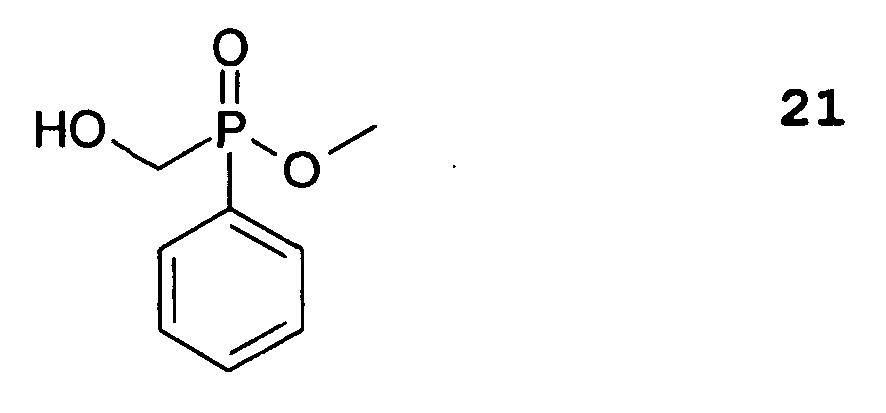
- Die so erhältlichen Verbindungen der Formel (I) zeichnen sich gegenüber denjenigen mit m gleich 1 durch eine höhere Flammschutzeffizienz aus, da sie bei vergleichbarer Molekülstruktur einen höheren Phosphorgehalt besitzen.
- Aus Phosphinaten der Formel (I) lassen sich erfindungsgemäß Phosphinate der Formel (V)
[(R1O)(R2)P(O)-(CHR3)m-CH(OR*)]nR4 (V)
herstellen, worin OR* ein eine Estergruppe oder eine Urethangruppe enthaltender und über diese Gruppe an den Rest des Moleküls gekoppelter, in ein organisches Polymer einbindbarer Rest ist und die übrigen Reste und Indices die gleiche Bedeutung wie für Formel (I) (einschließlich der als bevorzugt angegebenen Bedeutungen, die auch für die Formeln (V) als bevorzugt angesehen werden sollen) besitzen. Unter organischer Einbindbarkeit soll dabei sowohl eine radikalische Polymerisation als auch eine Polymerisation mit ionischem Mechanismus wie Ester- oder Amidbildung verstanden werden. - Die Einbindbarkeit von OR* in organische Polymere resultiert vorzugsweise aus dem Vorhandensein von polyaddierbaren und/oder polykondensierbaren Gruppen, insbesondere (Meth)Acrylatgruppen oder anderen über Doppelbindungen polymerisierbaren Gruppen, insbesondere Michaelsystemen, die in (Meth)Acrylatharze eingearbeitet werden können, von Hydroxyl- und insbesondere Carboxylgruppen, die ein Einkondensieren in Polyesterharze gestatten, oder von Silangruppen, die eine Einbindung in siliconbasierte Reaktivharze ermöglichen.
- Infolge der Möglichkeit, Verbindungen mit der Formel (V) in organische Polymere einzubinden, eignen sich auch diese als Flammschutzmittel. Für eine Anwendung hierfür, beispielsweise durch Einpolymerisieren in die jeweiligen organischen Massen, sollten sie bevorzugt einen Phosphorgehalt im Bereich von 1 bis 32 Gew.-%, stärker bevorzugt von 5 bis 20 Gew.-% aufweisen, bezogen auf das Gesamtgewicht der jeweiligen Verbindung (V).
- Die Herstellung von Verbindungen der Formel (V), worin OR* eine (Meth)Acrylatgruppe umfasst, gelingt sehr elegant und bequem durch Umsetzung eines aktivierten Derivates der (Meth)Acrylsäure selbst, z.B. mit (Meth)Acrylsäurechlorid, vorzugsweise in Gegenwart eines basischen Katalysators wie Triethylamin. Man erhält Verbindungen der Formel (VI)
[(R1O)(R2)P(O)-(CHR3)m-CH{O(O)C-CR6=CH2}]nR4 (VI)
mit R6 gleich Wasserstoff oder Methyl, wobei die übrigen Reste und Indices die für Formel (I) angegebene Bedeutung haben. - Beispielhaft seien nachstehende Verbindungen der Formel (VI) aufgezeigt:


- Statt dessen können natürlich auch (Meth)Acrylsäurederivate mit aktivierten Säuregruppen eingesetzt werden, deren (Meth)Acrylatgruppe(n) nicht oder nur zum Teil direkt an der Umsetzung beteiligt sind, wobei man Verbindungen der Formel (VII)
[(R1O)(R2)P(O)-(CHR3)m-CH{-O(O)C-R**}]nR4 (VII)
erhält, worin R** der oben als neben der Ester- oder Urethangruppe vorhandene Bestandteil von OR* genannte, organisch einbindbare Rest ist, der im konkreten Falle eine oder mehrere (Meth)Acrylatgruppen trägt, und die übrigen Reste und Indices die für Formel (I) angegebene Bedeutung besitzen. - (Meth)Acrylsäurederivate können aber nicht nur über eine aktivierte Säuregruppe an ein Phosphinat der Formel (I) angekoppelt werden, sondern auch über eine Urethangruppe. Damit lassen sich unter vielen anderen z.B. auch Silangruppen Si(R8)3 einbinden, worin R8 gleich oder verschieden sein kann und ggf. substituiertes Alkyl, Aryl, Arylalkyl, Alkylaryl, Alkoxy, Aryloxy oder Arylalkoxy mit vorzugsweise 1 bis 10 Kohlenstoffatomen für arylfreie Gruppen und vorzugsweise 6 bis 18 Kohlenstoffatomen für arylhaltige Gruppen und ganz bevorzugt Methyl, Ethyl oder ein C1-C6-Alkoxy ist. Die Bildung von Urethan-Kopplungsgruppen gelingt durch Umsetzung von Phosphinaten der Formel (I) mit Isocyanaten, was wiederum beispielhaft anhand der Umsetzung mit einem Phosphinat der Formel (I) gezeigt sei, in dem m gleich 0 ist:

- In diesem Schema steht X wie im obigen Schema für eine ggf. substituierte Alkylenoder Arylen- oder sonstige Gruppe, die nicht mit dem Alkoholatrest des Phosphinats reagieren kann.
- Man erhält auf diese Weise Phosphinate der Formel
[(R1O)(R2)P(O)-(CHR3)m-CH{-O(O)C-NH-R**}]nR4 (X)
worin die Reste und Indices die oben angegebenen Bedeutungen besitzen,
und insbesondere Phosphinate der Formel (XI):
[(R1O)(R2)P(O)-(CHR3)m-CH{-O(O)C-NH-R7-Si(R8)3}]nR4 (XI)
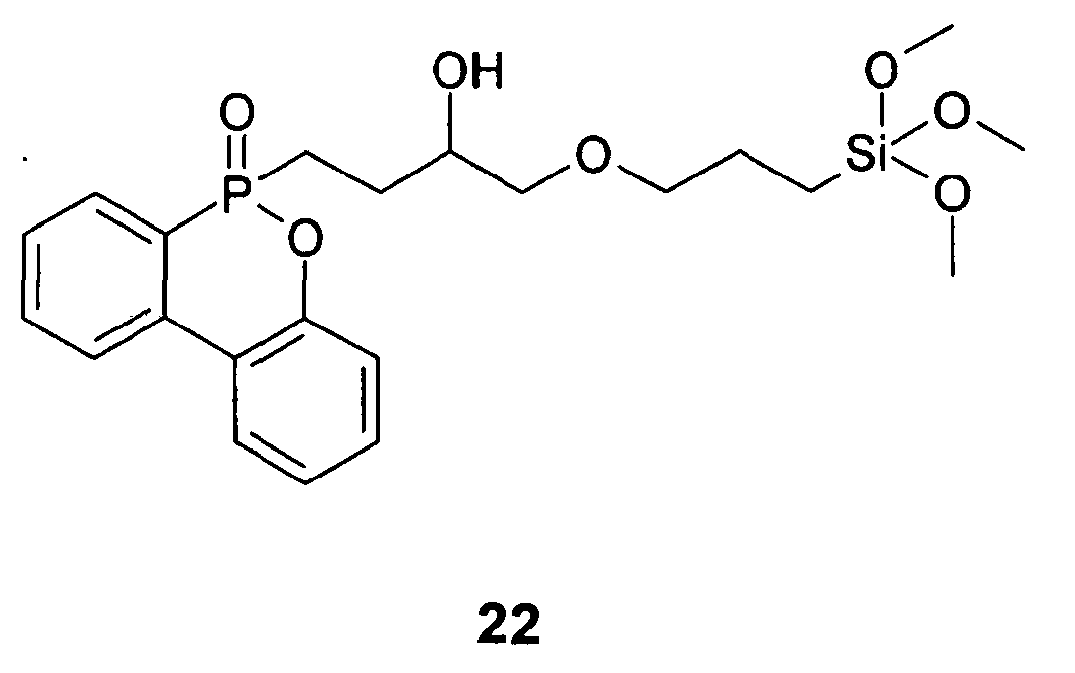
worin R7 für eine ggf. substituierte Alkylen- oder Arylengruppe mit vorzugsweise 1 bis 20 Kohlenstoffatomen oder eine sonstige Gruppe steht, die nicht mit dem Alkoholatrest des Phosphinats der Formel (I) reagieren kann, beispielsweise ein durch ein Heteroatom unterbrochener Alkylen- oder Arylenrest, und worin die sonstigen Reste und Indices die oben angegebenen Bedeutungen besitzen. - Beispielhaft sei die nachstehende Verbindungen der Formel (XI) aufgezeigt:

- Anstelle von Silylgruppen können die mit dem Hydroxyphosphinat reagierenden Isocyanate selbstverständlich eine oder mehrere andere beliebige polymerisierbare Gruppe(n) tragen wie beispielsweise (Meth)Acrylate, Olefine, etc.. Durch die Verwendung von Di- oder Multiisocyanaten mit multihydroxyhaltigen Phosphinaten können Polyurethane (linear bzw. verzweigt) direkt flammfest gemacht werden, z.B. nach folgendem Schema:
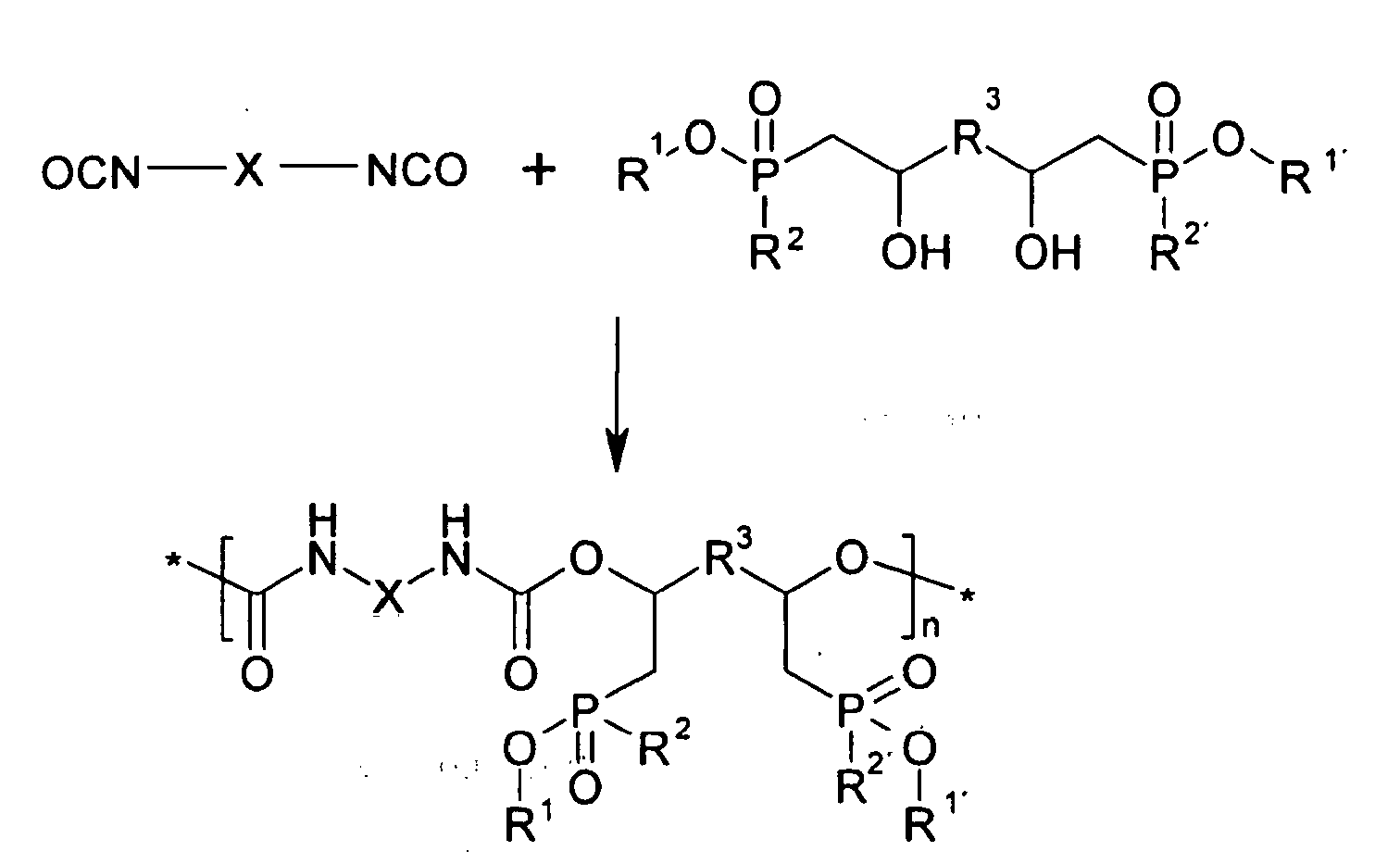
- Auch in diesem Schema steht X wieder für eine ggf. substituierte Alkylen-, Arylen- oder sonstige Gruppe, die nicht ins Reaktionsgeschehen eingreifen kann.
- Wird die Einbindung flammhemmender Phosphinate in Polyester oder Polyamide gewünscht, so kann die Hydroxygruppe so modifiziert werden, dass das Phosphinat eine Carboxyfunktion trägt, beispielsweise eine -COOH-Gruppe oder eine aktivierte Säuregruppe wie ein Säurechlorid. Diese Modifikation gelingt beispielsweise durch Umsetzung mit einem kurzkettigen Anhydrid unter Ausbildung einer über eine Estergruppe gebundenen Säurefunktion oder durch Phosgenierung der Hydroxygruppe zu einem Säurechlorid. Auch die Ausbildung einer Aminfunktion (z.B. zum Einbau in Polyamide) ist möglich, beispielsweise durch eine weitere Reaktion der wie oben erzeugten Carboxyfunktion mit Diaminen.
- Man erhält auf diese Weise Phosphinate der Formel (XII)
[(R1O)(R2)P(O)-(CHR3)m-CH{-O(O)C-(CR3R5)p-C(O)OH}]nR4 (XII),
der Formel (IX)
[(R1O)(R2)P(O)-(CHR3)m-CH{-O(O)C-(CR3R5)p-C(O)NH-R7NH2}]nR4 (IX)
beziehungsweise der Formel (XIII)
[(R1O)(R2)P(O)-(CHR3)m-C(O)CI]nR4 (XIII),
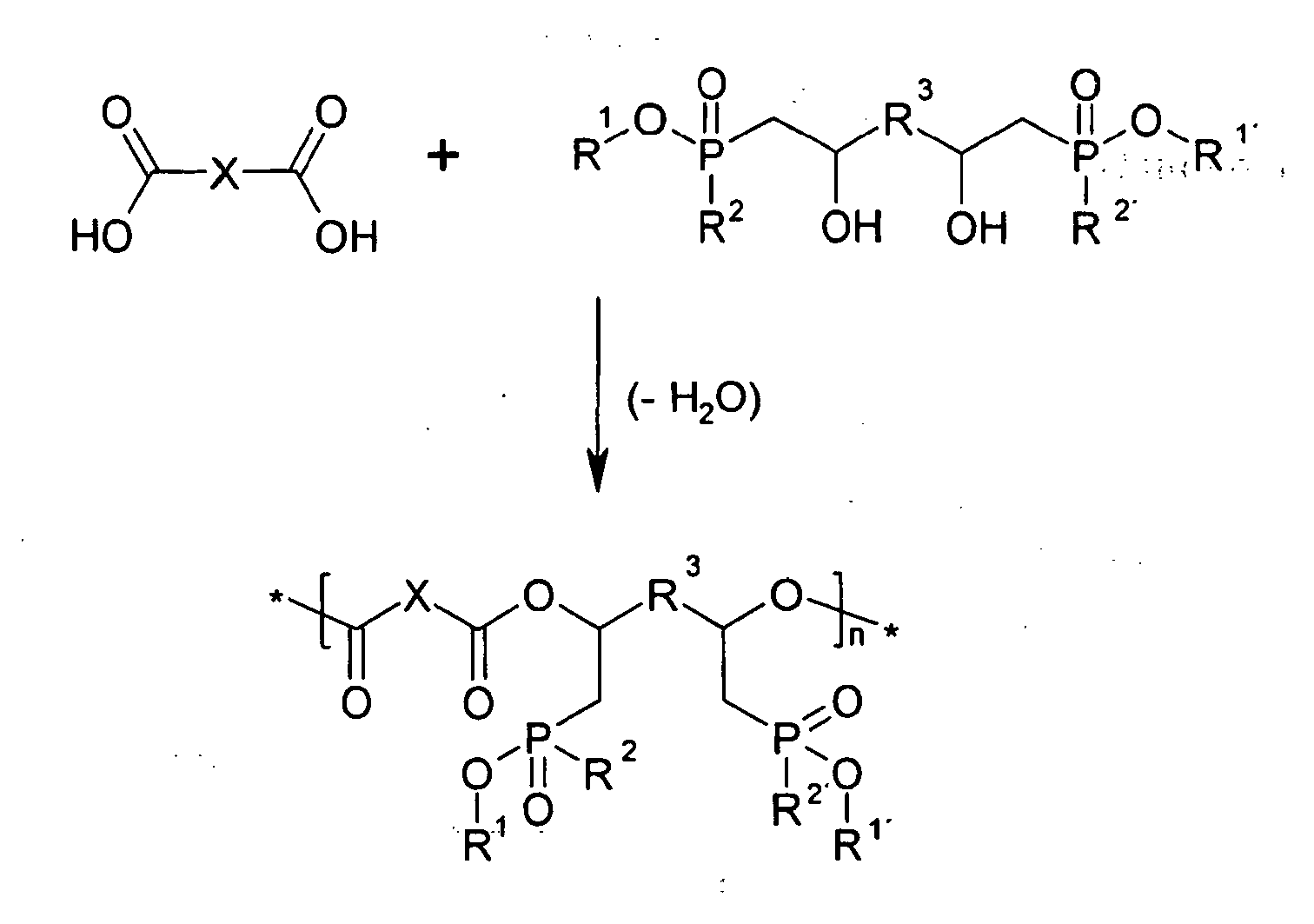
worin p gleich 0 bis vorzugsweise 4 ist und die übrigen Reste und Indices die oben angegebenen Bedeutungen besitzen. - Darüber hinaus können hydroxylgruppenhaltigen Phosphinate, falls sie zwei oder mehr Hydroxylgruppen enthalten, direkt in Polyester einpolymerisiert werden. Eine Umsetzung erfolgt in diesem Fall mit aliphatischen oder aromatischen Dicarbonsäuren oder deren Anhydriden:
- Phosphinate mit nur einer Hydroxygruppe können ebenfalls eingesetzt werden; sie besitzen neben der Flammschutzwirkung die Eigenschaft von Zähigkeitsmodifikatoren, da sie Kettenabbrüche induzieren.
- Derartige Polyester können bei entsprechender Funktionalisierung weitere Comonomere bzw. -polymere enthalten, wie zum Beispiel Styrol im Fall von ungesättigten Polyesterketten.
- Cyanatharze lassen sich ebenfalls durch Einbau von hydroxylgruppenhaltigen Phosphinaten bezüglich ihrer Flammfestigkeit verbessern. Gleichzeitig kommt es in Fall von Monohydroxysystemen zu einer teilweisen Unterbrechung der Netzwerkstruktur, so dass das Flammschutzmittel gleichzeitig die Aufgabe eines Zähmodifikators übernimmt. Eine schematische Abbildung der Reaktion von Dicyanatmonomeren mit monohydroxylgruppenhaltigen Phosphinaten stellt sich wie folgt dar, wobei es zur Ausbildung von Triazinsystemen kommt. Weiterhin muss der Alkoholeinbau nicht zwingend nur an einem Ringsystem erfolgen, sondern kann sich auch über zwei Triazinringe verteilen, so dass diese dann zwar nicht mehr als dreifach vernetzendes System fungieren können, jedoch immer noch zweifach verbrückend wirken.

- Typische Beispiele für Dicyanatsysteme sind im folgenden aufgezeigt:



- Die erfindungsgemäßen (Meth)Acrylat-Phosphinate lassen sich direkt in (Meth)Acrylatharze, insbesondere sogenannte Reaktivharze, einpolymerisieren. Damit lässt sich phosphorhaltiges Flammschutzmittel kovalent in duromere Poly(meth)acrylate einbinden. Der Einbau dieser Verbindungen kann thermisch oder mit Hilfe von UV- oder Elektronenbestrahlung erfolgen, was die Phosphinate geeignet erscheinen lässt, in entsprechende Harze wie z.B. solchen aus Ebecrylen (z.B. von ucb Chemicals, Drogenbos (Belgien), das sind verschiedene (Meth)acrylatester von Bisphenol A, Urethan und dgl.) einpolymerisiert zu werden. Weiterhin können die Phosphinate radikalisch oder katalytisch initiiert in entsprechende Polymere eingebaut werden. Diese müssen nicht notwendigerweise ebenfalls (Meth)Acrylatgruppen aufweisen; sie können auch andere auf die genannte Weise polymerisierbare aktivierte Doppelbindungen besitzen wie z.B. Triallylisocyanurat. Monofunktionalisierte Systeme können auch als kovalent einbaubare Flammschutzmittel in Thermoplaste wie PMMA, Polystyrol, etc. dienen. Es hat sich herausgestellt, dass die Flammfestigkeit dann zufrieden stellend war (z.B. UL 95-VO), wenn die erfindungsgemäßen Phosphinate in einer Menge zugegeben wurden, die einem Gewichtsanteil von etwa 2 % Phosphor entspricht. (Meth)Acrylathaltige Harze zeichnen sich durch hohe Temperaturbeständigkeit (beispielsweise hohe Glasübergangstemperaturen), sowie eine geringe Rauchgasdichte und eine niedrige Toxizität im Brandfall aus. Durch geeignete Wahl der Copolymere ist es möglich, den Brechungsindex gezielt einzustellen und in breitem Rahmen zu variieren. Die hohe Transparenz der Harze ermöglicht optische Anwendungen von der Beschichtung bis zum Wellenleiter.
- Beispiele von Comonomeren, mit denen die erfindungsgemäßen Verbindungen polymerisiert werden können, sind Ebecryl® 284, ein aliphatisches Urethan-Diacrylat-Oligomer, verdünnt mit einem Hexandioldiacrylat,
Ebecryl® 600 :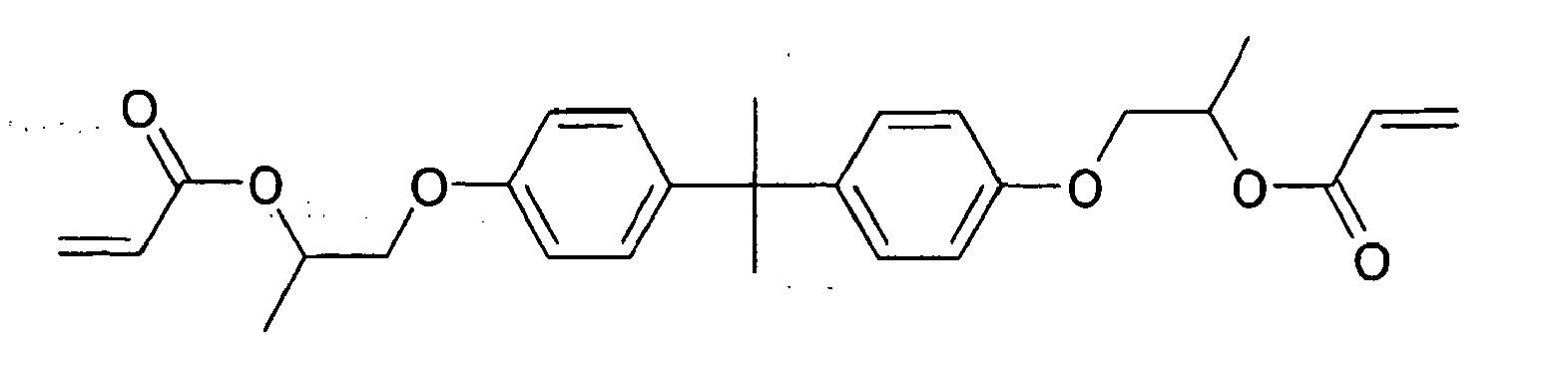


- Silangruppenhaltige erfindungsgemäße Phosphinate lassen sich durch hydrolytische Kondensation in Siloxanharze einbauen. Auch eine Oberflächenmodifizierung silanhaltiger Oberflächen ist mit diesen Phosphinaten möglich.
- Um eine ausreichende Flammfestigkeit der erhaltenen Polymerharze zu gewährleisten, ist es wünschenswert, dass die Verbindungen der Formeln (I) bzw. (V) in einer solchen Menge eingesetzt werden, dass der Phosphorgehalt des damit erhaltenen, jeweiligen Polymerharzes im Bereich von etwa 0,1 bis 10 Gew.-%, bevorzugt im Bereich von etwa 1 bis 5 Gew.-%, bezogen auf das Gewicht des Polymerharzes, liegt.
- Durch den Zusatz von Füllstoffen, beispielsweise ggf. mit einem Melaminharz verkapseltem Ammoniumpolyphosphat oder Aluminiumtrihydroxid (ATH) und/oder Mikro- und/oder Nanopartikeln (beispielsweise anorganische Oxide (SiO2, TiO2, Al2O3, ZrO2,etc.) Carbide (z. B. SiC), Nitride (z. B. BN), Carbonnanotubes, etc.), lässt sich sowohl die Flammfestigkeit als auch die Bruchzähigkeit der erhaltenen Komposite weiter steigern. Sämtliche Reaktivharze, eignen sich z.B. als Matrixharze für Faserverbundwerkstoffe.
- Nachstehend soll die Erfindung anhand von Beispielen näher erläutert werden.
- Umsetzung von Glycidylether- oder Glycidylamingruppen tragenden Verbindungen mit einem Phosphinat
- In einem 100 ml-Dreihalskolben werden 74,2 mmol 1,4-Butandiol-diglycidether, 48,5 mmol Dihydro-9-oxa-10-phenanthren-10-oxid (DOPO) und 0,31 g Triethanolamin unter Rühren auf 130°C erhitzt. Nach Reaktionsstart (Temperaturerhöhung im Reaktionsgefäß) wird die zweite Charge DOPO (48,5 mmol) hinzugegeben, bis erneut eine Temperaturanstieg zu beobachten ist. Fällt dieser wiederum ab gibt man das restliche DOPO (48,5 mmol) hinzu, welches zur vollständigen Umsetzung der Glycidethergruppen benötigt wird. Das Reaktionsgemisch wird auf 140°C erhitzt und verbleibt 12 h bei dieser Temperatur. Das blassgelbe hochviskose Produkt 2 erhält man analytisch rein mit einer Ausbeute von 42,03 g (90,6 %).
- In einem 100 ml-Dreihalskolben werden 15,02 g (100 mmol) Phenylglycidether, 7,0 g (32,4 mmol) Dihydro-9-oxa-10-phenanthren-10-oxid (DOPO) und 0,115 g (0,7 mmol) Triethanolamin gegeben und unter Rühren auf eine Kolbeninnentemperatur von 140°C gebracht. Unmittelbar nach Erreichen der angegebenen Temperatur wurden erneut 7,0 g (32,4 mmol) DOPO dem Reaktionsgemisch zugegeben. Nach dem Aufschmelzen des zugebenen DOPO und erneuten Anstieg der Temperatur der Reaktionsgemisches (Exothermie der Additionsreaktion) wurde schließlich die letzte Zugabe von DOPO (7,62 g ; 35,2 mmol) durchgeführt, um einen vollständigen stöchiometrischen Umsatz des Phenylglycidethers zu erreichen. Anschließend wurde das Reaktionsgemische 30 h bei 145°C gehalten. Bei dem so entstandenen Alkohol 6 wurde mittels Titration (iodometrisch) ein Gehalt an freiem DOPO von 0,45 % ermittelt. Neben chromatographischen und IR-spektroskopischen Untersuchungen wurden zur Kontrolle des Reaktionsverlaufes 31P{1H}-NMR-Messungen durchgeführt, welche durch einen deutlichen Tieffeldshift des Reaktionsgemisches auf 39,1 ppm im Vergleich zum reinen DOPO (16,5 ppm) zeigen und somit die Kopplungsreaktion belegen.
- In einem 500 ml-Dreihalskolben werden 80,07 g (235,2 mmol) Diglycidether-Bisphenol-A (DGEBA), 33,0 g (152,6 mmol) Dihydro-9-oxa-10-phenanthren-10-oxid (DOPO) und 0,452 g (3 mmol) Triethanolamin gegeben. Das Reaktionsgemisch wird unter Rühren auf 140°C erhitzt, wobei die Kopplungsreaktion nach 90 min einsetzt, was zu einer deutlichen Temperaturerhöhung (160°C) führt. Anschließend wird die zweite Charge DOPO (33,0 g ; 152,6 mmol) hinzugeben. Nach erneuten Anstieg und anschließendem Abfall der Temperatur erfolgt die Zugabe des für einen stöchiometrischen Umsatz notwendigen restlichen DOPO's (35,7 g ; 165,2 mmol).Abschließend wurde das Reaktionsgemisch noch 4 h bei 145°C erhitzt. Das erhaltene Produkt 7 in einer Ausbeute von 172,4 g (94,8 % der Theorie) wurde mittels HPLC analytisch untersucht und hatte eine Reinheit von 92,4 %. An dieser Stelle wurde auf eine weitere Aufreinigung verzichtet.
- In analoger Weise lassen sich Cyclohexan-1,4-dimethanol-diglycidether (Polypox® R11; UPPC AG, Mietingen-Baltringen, Deutschland), Glycerin-triglycidether (Polypox® R12; UPPC AG, Mietingen-Baltringen, Deutschland), Neopentylglykol-diglycidether (Polypox® R14 ; UPPC AG, Mietingen-Baltringen, Deutschland), Pentaerythrittetraglycidether (Polypox® R16 ; UPPC AG, Mietingen-Baltringen, Deutschland), Trimethylolpropan-Triglycidether (Polypox® R20 ; UPPC AG, Mietingen-Baltringen, Deutschland), 4,4'-Methylenbis(N,N-diglycidylanilin) und Glycidylmethacrylat mit DOPO umsetzen.
- Umsetzung von Aldehyden und Ketonen mit Phosphinsäureestern
- Diese Umsetzung erfolgte nach der Vorschrift aus J.-Y. Shieh, C.-S. Wang Polymer, 42, 2001, 7617-7625.
- In einem 50 ml-Dreihalskolben mit Thermometer, Stickstoffzuleitung und Rückflußkühler werden 10,81 g (50 mmol) Dihydro-9-oxa-10-phenanthren-10-oxid (DOPO), 2,90 g (50 mmol) Aceton (wasserfrei) und 0,1 g (0,9 mmol) Triethanolamin unter schwachem Stickstoffstrom und Rühren auf 140 °C erhitzt. Das Reaktionsgemisch wird 4 h bei dieser Temperatur gehalten. Das weiße, feste Produkt mit einer Ausbeute von 13 g (95 %) wurde IR-spektektroskopisch untersucht. Dabei wurde keine Carbonylbande des Acetons mehr beobachtet. Stattdessen trat bei 3305 cm-1 eine Hydroxylbande des Hydroxylphosphinates auf, was auf eine vollständige Umsetzung des DOPOs hinweist.
- Umsetzung der Produkte der Beispielgruppe 1 mit (Meth)Acrylsäurechlorid
- In einem 500 ml Dreihalskolben mit Thermometer, Tropftrichter, Stickstoffzuleitung und Rückflusskühler wird 9 (31,49 g ; 50 mmol) in 85 ml Chloroform gelöst (ca. 20 %-ige Lösung). Nach der Zugabe von 20,74 g (205 mmol) Triethylamin, gelöst in 35 ml Chloroform, wird das Reaktionsgemisch auf -2 °C abgekühlt. Anschließend werden 21,91 g (200 mmol) Methacrylsäurechlorid, gelöst in 20 ml Chloroform, zugetropft, wobei die Temperatur des Reaktionsgemisches unter 0 °C gehalten wird. Das Reaktionsgemisch wird 4 h unter Kühlung weitergerührt und anschließend 16 h zur vollständigen Nachreaktion ohne Kühlung gebracht. Danach wird der Kolbeninhalt zweimal mit 500 ml Eiswasser ausgewaschen, die organische Phase abgetrennt und über Natriumsulfat getrocknet. Das Methacrylatprodukt 9 wurde in Chloroform aus Stabilisierungsgründen bis zur weiteren Verarbeitung belassen. Eine Analyse des Feststoffgehaltes ergab eine Umsetzung von 98 %. Mittels IR-spekroskopischer Untersuchung konnte eine vollständige Umsetzung durch ein Fernbleiben der Hydroxylbande und einem deutlichen Erscheinen einer Carbonylbande bei 1717 cm-1 festgestellt werden. Weitere Reinheitskontrollen fanden durch chromatographische Methoden statt.
- In einem 500 ml Dreihalskolben mit Thermometer, Tropftrichter, Stickstoffzuleitung und Rückflusskühler wird 6 (18,32 g ; 50 mmol) in 50 ml Chloroform gelöst (ca. 20 %-ige Lösung). Nach der Zugabe von 11,13 g (110 mmol) Triethylamin, gelöst in 10 ml Chloroform, wird das Reaktionsgemisch auf-5 °C abgekühlt. Anschließend werden 10,45 g (100 mmol) Methacrylsäurechlorid, gelöst in 10 ml Chloroform, zugetropft, wobei die Temperatur des Reaktionsgemisches unter 0 °C gehalten wird. Das Reaktionsgemisch wird 4 h unter Kühlung weitergerührt und anschließend 72 h zur vollständigen Nachreaktion ohne Kühlung weitergerührt. Anschließend wird der Kolbeninhalt zweimal mit jeweils 300 ml Eiswasser gewaschen schließlich durch Waschen mit verdünnter Saltsäure auf einen pH-Wert von 7 gebracht. Die organische Fraktion wird über Natriumsulfat getrocknet und die leichtflüchtigen Bestandteile werden am Rotationsverdampfer unter vermindertem Druck (20 mbar) entfernt. Bei dem auf diese Weise erhaltenen Methacrylatprodukt 13 handelt es sich um eine leicht bräunliche, klare und sehr viskose Flüssigkeit. Die Ausbeute betrug 23,07 g (98 % der Theorie). Mittels IR-spekroskopischer Untersuchung konnte eine vollständige Umsetzung durch ein Fernbleiben der Hydroxylbande und einem deutlichen Erscheinen einer Carbonylbande bei 1718 cm-1 festgestellt werden. Weitere Reinheitskontrollen fanden durch chromatographische Methoden statt. Weiterhin wurden 1H-, 13C{1H}- und 31P{1H}-NMR-spektroskopische Untersuchungen durchgeführt. Dabei wird im 31P{1H}-NMR-Spektrum ein eine chemische Verschiebung von 34,3 ppm beobachtet, welche sich deutlich von der chemischen Verschiebung des entsprechenden Alkohols bei 39,1 ppm unterscheidet.
- In einem 500 ml Dreihalskolben mit Thermometer, Tropftrichter, Stickstoffzuleitung und Rückflusskühler wird 7 (33,64 g ; 50 mmol) in 105 ml Chloroform gelöst (ca. 20 %-ige Lösung). Nach der Zugabe von 10,12 g (100 mmol) Triethylamin, gelöst in 15 ml Chloroform, wird das Reaktionsgemisch auf -2 °C abgekühlt. Anschließend werden 10,46 g (100 mmol) Methacrylsäurechlorid, gelöst in 20 ml Chloroform, zugetropft, wobei die Temperatur des Reaktionsgemisches unter 0 °C gehalten wird. Das Reaktionsgemisch wird 4 h unter Kühlung und anschließend 16 h zur vollständigen Nachreaktion ohne Kühlung weitergerührt. Danach wird der Kolbeninhalt auf 300 ml Eiswasser gegeben, zweimal mit 400 ml Eiswasser gewaschen (bis pH-Wert 7 erreicht ist), die organische Phase abgetrennt und über Natriumsulfat getrocknet. Das Methacrylatprodukt 14 wurde in Chloroform aus Stabilitätsgründen bis zur weiteren Verarbeitung belassen. Eine Analyse des Feststoffgehaltes ergab eine Umsetzung von 96 %. Mittels IR-spekroskopischer Untersuchung konnte eine vollständige Umsetzung durch ein Fernbleiben der Hydroxylbande und einem deutlichen Erscheinen einer Carbonylbande bei 1720 cm-1 festgestellt werden. Weitere Reinheitskontrollen fanden durch chromatographische Methoden statt.
- In einem 500 ml-Dreihalskolben mit Thermometer, Stickstoffzuleitung und Rückflusskühler wird (10-Oxo-10H-9-oxa-10λ5 -phosphaphenanthren-10-yl)-methanol (24,62 g ; 100 mmol) in 70 ml Chloroform suspendiert. Nach der Zugabe von 20,74 g (205 mmol) Triethylamin, gelöst in 35 ml Chloroform, wird das Reaktionsgemisch auf -2°C abgekühlt. Anschließend werden 20,91 g (200 mmol) Methacrylsäurechlorid, gelöst in 20 ml Chloroform, zugetropft, wobei die Temperatur des Reaktionsgemisches unter 0 °C gehalten wird. Das Reaktionsgemisch wird 3 h unter Kühlung und anschließend 16 h zur vollständigen Nachreaktion ohne Kühlung weitergerührt. Danach wird der Kolbeninhalt auf 500 ml Eiswasser gegeben, einmal mit 500 ml Wasser versetzt mit 2 ml konzentrierter Salzsäure und einmal mit 500 ml Wasser gewaschen (bis pH-Wert 7 erreicht ist), die organische Phase abgetrennt und über Natriumsulfat getrocknet. Das Methacrylatprodukt 16 wurde in Chloroform aus Stabilitätsgründen bis zur weiteren Verarbeitung belassen. Eine Analyse des Feststoffgehaltes ergab einen Gehalt an 16 von 34,20 g (75 %). Mittels IR-spekroskopischer Untersuchung konnte eine vollständige Umsetzung durch ein Fernbleiben der Hydroxylbande und einem deutlichen Erscheinen einer Carbonylbande bei 1719 cm-1 festgestellt werden. Weitere Reinheitskontrollen fanden durch chromatographische Methoden statt.
- Umsetzung der Produkte der Beispielgruppe 1 mit
[3-(Triethoxysilyl)]-propylisocyanat - In einem 100 ml Rundkolben werden 3,00 g (12,2 mmol) (10-Oxo-10H-9-oxa-10λ5-phosphaphenanthren-10-yl)-methanol in 25 ml Pyridin gelöst. Anschließend erfolgt die Zugabe von 3,01 g (12,2 mmol) [3-(Triethoxysilyl)-propylisocyanat. Anschließend wird das Reaktionsgemisch 24 h bei 120°C gehalten und das Pyridin danach im Vakuum entfernt. Man erhält 5,2 g (87 %) des Siloxans 17. IR-spektroskopische Untersuchungen ein vollständiges Verschwinden der Hydroxylbande des (10-Oxo-10H-9-oxa-10λ5-phosphaphenanthren-10-yl)-methanol (3234 cm-1), sowie der Isocyanatbande des [3-(Triethoxysilyl)-propylisocyanat (2272 cm-1). Dafür trat eine völlig neue Bande bei 1733 cm-1 auf, welche der Carbonylschwingung einer Urethangruppe entspricht, was einen quantitativen Verlauf der Umsetzung belegt.
- Massen und Polymere (Harze), erhalten durch Mischen und ggf. Polymerisieren der Produkte der Beispielgruppe 3 mit Comonomeren; Härtung durch Elektronenbestrahlung
- Ebecryl® 284, Triallylisocyanurat (Gewichtsverhältnis 2:1) und Methacrylatsystem 11 werden in Chloroform gelöst, so dass eine gerade fließfähige homogene Lösung entsteht, welche einen Masseanteil an Phosphor von 2 % enthält. Diese wird in eine entsprechende Aluminiumgießform (50 mm x 50 mm x 10 mm) gegeben, und anschließend wird im Vakuumtrockenschrank das Lösungsmittel langsam entfernt. Das elektronenstrahlhärtbare Gemisch wird anschließend einer Energiedosis von 150 kGy ausgesetzt. Es kommt zur vollständigen Aushärtung des Reaktivharzsystems.
- Ebecryl® 600 und Methacrylatsystem 13 werden in Chloroform gelöst, so dass eine gerade fließfähige homogene Lösung entsteht, welche einen Masseanteil an Phosphor von 2 % enthält. Diese wird in eine entsprechende Aluminiumgießform (50 mm x 50 mm x 10 mm) gegeben und anschließend wird im Vakuumtrockenschrank das Lösungsmittel langsam entfernt. Das elektronenstrahlhärtbare Gemisch wird anschließend einer Energiedosis von 150 kGy ausgesetzt. Es kommt zur vollständigen Aushärtung des Reaktivharzsystems.
- Ebecryl® 600 und Methacrylatsystem 10 werden in Chloroform gelöst, so dass eine gerade fließfähige homogene Lösung entsteht, welche einen Masseanteil an Phosphor von 2 % enthält. Diese wird in eine entsprechende Aluminiumgießform (50 mm x 50 mm x 10 mm) gegeben und anschließend wird im Vakuumtrockenschrank das Lösungsmittel langsam entfernt. Das elektronenstrahlhärtbare Gemisch wird anschließend einer Energiedosis von 150 kGy ausgesetzt. Es kommt zur vollständigen Aushärtung des Reaktivharzsystems. Mittels Sol-Gel-Analyse wurde ein Gehalt des Polymers von 97,57 % bestimmt.
- Ebecryl® 600 und Methacrylatsystem 11 werden in Chloroform gelöst, so dass eine gerade fließfähige homogene Lösung entsteht, welche einen Masseanteil an Phosphor von 2 % enthält. Diese wird in eine entsprechende Aluminiumgießform (50 mm x 50 mm x 10 mm) gegeben und anschließend wird im Vakuumtrockenschrank das Lösungsmittel langsam entfernt. Das elektronenstrahlhärtbare Gemisch wird anschließend einer Energiedosis von 150 kGy ausgesetzt. Es kommt zur vollständigen Aushärtung des Reaktivharzsystems. Mittels Sol-Gel-Analyse wurde ein Gelhalt des Polymers von 97,32 % bestimmt.
- Ebecryl® 610 und Methacrylatsystem 10 werden in Chloroform gelöst, so dass eine gerade fließfähige homogene Lösung entsteht, welche einen Masseanteil an Phosphor von 2 % enthält. Diese wird in eine entsprechende Aluminiumgießform (50 mm x 50 mm x 10 mm) gegeben und anschließend wird im Vakuumtrockenschrank das Lösungsmittel langsam entfernt. Das elektronenstrahlhärtbare Gemisch wird anschließend einer Energiedosis von 100 kGy ausgesetzt. Es kommt zur vollständigen Aushärtung des Reaktivharzsystems.
- Ebecryl® 610 und Methacrylatsystem 11 werden in Chloroform gelöst, so dass eine gerade fließfähige homogene Lösung entsteht, welche einen Masseanteil an Phosphor von 2 % enthält. Diese wird in eine entsprechende Aluminiumgießform (50 mm x 50 mm x 10 mm) gegeben und anschließend wird im Vakuumtrockenschrank das Lösungsmittel langsam entfernt. Das elektronenstrahlhärtbare Gemisch wird anschließend einer Energiedosis von 100 kGy ausgesetzt. Es kommt zur vollständigen Aushärtung des Reaktivharzsystems. Mittels Sol-Gel-Analyse wurde ein Gelhalt des Polymers von 98,72 % bestimmt.
- Ebecryl® 610 und Methacrylatsystem 9 werden in Chloroform gelöst, so dass eine gerade fließfähige homogene Lösung entsteht, welche einen Masseanteil an Phosphor von 2 % enthält. Diese wird in eine entsprechende Aluminiumgießform (50 mm x 50 mm x 10 mm) gegeben und anschließend wird im Vakuumtrockenschrank das Lösungsmittel langsam entfernt. Das elektronenstrahlhärtbare Gemisch wird anschließend einer Energiedosis von 100 kGy ausgesetzt. Es kommt zur vollständigen Aushärtung des Reaktivharzsystems. Mittels Sol-Gel-Analyse wurde ein Gelhalt des Polymers von 98,67 % bestimmt.
Tabelle I: Glastemperatur, Bruchzähigkeit und Brandverhalten der beschriebenen Reaktivharzsysteme: Reaktivharz Tg [°C] K1c [MN/m3/2] UL 94 HB[1] Ebecryl® 284 79,0 1,25 - R1 84,8 0,44 + Ebecryl® 600 152,7 0,72 - R2 73,5 0,63 + R3 104,3 0,38 + R4 102,7 0,60 + Ebecryl® 610[2] 155,7 0,44 - R5 [2] 125,6 0,48 + R6 [2] 137,0 0,48 + R7 [2] 145,0 0,42 + Energiedosis 150 kGy
Tg = Glastemperatur (DMA)
K1c = Bruchzähigkeit
[1] Durchführung des Brandtestes in Anlehnung an UI 94 HB
[2] Energiedosis 100 kGy - Massen und Polymere (Harze), erhalten durch Mischen und ggf. Polymerisieren der Produkte der Beispielgruppe 3 mit Comonomeren; Härtung mittels UV-Bestrahlung
- In einer Abdampfschale wurden Methylmethacrylat und das phosphorhaltige Methacrylat 16 unter Rühren zusammengegeben, so dass der Phosphoranteil 2 % betrug, und UV-Strahlung ausgesetzt. Zusätzlich wurde als Photoinitiator a,a-Dimethoxy-a-phenylacetophenon zugegeben. Kurz vor dem Gelieren des Reaktionsgemisches wurde das Rühren eingestellt, so dass ein homogen UVvernetztes Polymer entstand. Dieses wurde einem Flammtest in Anlehnung an UL 94 HB unterzogen, welchen das Polymer in Gegensatz zum ummodifizierten PMMA bestand. Mittels DSC wurde eine Glastemperatur Tg von 95,8°C ermittelt.
- Massen und Polymere (Harze), erhalten durch Mischen und ggf. Polymerisieren der Produkte der Beispielgruppe 1 und 2 mit Comonomeren; thermische Härtung
- Nachdem die Zeit bis zum Erreichen des Gelpunktes (B-Zeit) einer Reaktionsmischung des Dicyanates 18 und des hydroxylgruppenhaltigen Phosphinats 6 mit einem Phosphoranteil von 2 % bei einer Temperatur von 180°C mit 29 min ermittelt wurde, wurden Platten mit einer Kantenlänge von 19 cm x 15 cm x 0,6 cm gegossen. Dazu wurde ein Reaktionsgemisch von 48 g des Phosphinates 6 mit 154,8 g des Dicyanates 18 bei 140°C geschmolzen, homogenisiert und entgast. Anschließend wurde es heiß in eines Edelstahlform mit oben beschriebenen Abmessungen gegossen. Die Härtung des Cyanatharzes erfolgte stufenweise. Zunächst wurde des Reaktionsgemisch 10 h bei 140°C belassen, danach erfolgte eine stufenweise Temperaturerhöhung bis auf 240°C, wobei in 20°C-Schritten jeweils 30 min Aufheizzeit gewährt wurden und anschließend 60 min bei der entsprechend erreichten Temperatur, diese konstant gehalten wurde. Abschließend wurde nochmals 30 min auf 250°C erwärmt und diese Temperatur eine weitere Stunde gehalten, bevor das Harz langsam abgekühlt wurde. Damit ergab sich eine Gesamtzeit der Härtung von 19 h. Das auf die Weise erhaltene Cyanatharz erreichte nach der ASTM-Prüfmethode (ASTM: American Society for Testing and Materials) UL 94 eine Klassifizierung V-0. Cone-Kalorimeter-Untersuchungen ergaben eine mittlere Wärmefreisetzungsrate HHRtotal von 152,0 kW/m2, siehe
Figur 2 . - Nachdem die Zeit bis zum Erreichen des Gelpunktes (B-Zeit) einer Reaktionsmischung des Dicyanates 18 und (10-Oxo-10H-9-oxa-10λ5-phosphaphenanthren-10-yl)-methanol mit einem Phosphoranteil von 2 % bei einer Temperatur von 180°C mit 28 min ermittelt wurde, wurden Platten mit einer Kantenlänge von 19 cm x 15 cm x 0,6 cm gegossen. Dazu wurde ein Reaktionsgemisch von 48 g des (10-Oxo-10H-9-oxa-10λ5-phosphaphenanthren-10-yl)-methanol mit 154,8 g des Dicyanates 18 bei 140°C geschmolzen, homogenisiert und entgast. Anschließend wurde es heiß in eines Edelstahlform mit oben beschriebenen Abmessungen gegossen. Die Härtung des Cyanatharzes erfolgte stufenweise. Zunächst wurde des Reaktionsgemisch 10 h bei 140°C belassen, danach erfolgte eine stufenweise Temperaturerhöhung bis auf 240°C, wobei in 20°C-Schritten jeweils 30 min Aufheizzeit gewährt wurden und anschließend 60 min bei der entsprechend erreichten Temperatur, diese konstant gehalten wurde. Abschließend wurde nochmals 30 min auf 250°C erwärmt und diese Temperatur eine weitere Stunde gehalten, bevor das Harz langsam abgekühlt wurde. Damit ergab sich eine Gesamtzeit der Härtung von 19 h. Das auf die Weise erhaltene Cyanatharz erreichte nach der ASTM-Prüfmethode (ASTM: American Society for Testing and Materials) UL 94 eine Klassifizierung V-0. Cone-Kalorimeter-Untersuchungen ergaben eine mittelere Wärmefreisetzungsrate HHRtotal von 92,8 kW/m2, siehe
Figur 2 . Der Wert liegt damit deutlich unter dem Wert des Harzes C1, was auf einen geringeren Organikanteil im Harz C2, aufgrund kleineren Phosphinatsystems zurückzuführen ist.Reaktivharz Tg [°C] K1c [MN/m3/2] UL 94 C1 183,4 - V-0 C2 228,2 0,72 V-0 Tg = Glastemperatur
K1c = Bruchzähigkeit
Probenpräparation: - Bestrahlungsapparaturen: Elektronenstrahlhärtung: Elektronenbeschleuniger Elektronika U-003 ; UV-Härtung: Hönle Uvahand 250
- DMA (Dynamisch-Mechanische Analyse): Die Glastemperatur wurde mit Hilfe der Dynamisch-Mechanischen Analyse bestimmt. Dazu wurde die Probe mit einer Heizrate von 4 K/min erwärmt und gleichzeitig einer Schwingung (f = 1 Hz ; Amplitude 1,56 mrad) ausgesetzt. Geräteintern wurden Speicher- und Verlustmodul und der sich daraus ergebende tan δ ermittelt. Die Glastemperatur Tg ergibt sich bei dieser Messmethode aus dem Maximum der tan δ-Kurve.
- Bruchzähigkeitsbestimmung: Die Bruchzähigkeit K1c der Proben wurde auf Basis von Bruchmechanikversuchen nach dem OCT-Verfahren (Optical Crack Tracing) durchgeführt. Das Meßprinzip dieses Verfahrens beruht auf der optischen Bestimmung der Länge eines Risses und dessen Verlauf durch den Probekörper (siehe
Figur 1 ; die Figur zeigt einen Probekörper für optische Rißverfolgung (w = 35 mm, Dicke 6,0 mm)). - Die Rißverfolgung erfolgt mittels CCD-Kamera und wird computergestützt ausgewertet. Die Herstellung der Probekörper erfolgt durch CNC-Fräsen.
- Sol-Gel-Analyse: Zur Ermittlung der durch die Bestrahlung entstandenen Vernetzung wurden Sol-Gel-Analysen wie folgt durchgeführt. Nachdem die Probe 48 h Dichlormethan ausgesetzt wurde (10 Vol-% Probenmenge) wurde über eine Fritte (P3) der vernetzte Anteil (Gel) von un- bzw. niedervernetztem Anteil (Sol) abgetrennt. Durch Trocknen und anschließendes Auswiegen des Gels konnte der hochvernetzte Anteil bestimmt werden.
- Cone-Kalorimeter: Messungen wurden durchgeführt an einem Cone-Kalorimeter der Fa. Fire Testing Technologies, East Grinstead, Großbritannien. Die mittlere Wärmefreisetzungsrate HRRtotal gibt an, welche Wärme von der Zeit der Entzündung bis zur Zeit des Erlöschens der Probe freigesetzt wird. Probenmaße: 100 mm x 100 mm x 6,6 mm.
- Brandverhalten in Anlehnung an UL 94 HB: Mittels CNC-Fräse wurden Probekörper mit Kantenlängen von 45 mm x 5 mm x 3 mm hergestellt. Anschließend wurden diese 10 s horizontal den Flammkegel einer Bunsenbrennerflamme gehalten. Brannte die Probe beim zweitem Durchlauf nach Entfernen der Flamme nicht weiter, galt sie als flammfest in Anlehnung an den Test UL 94 HB.

Claims (26)
- Verwendung eines Phosphinates der Formel (I),
[(R1O)(R2)P(O)-(CHR3)m-CR5(OH)]nR4 (I)
worin:R1 und R2 unabhängig voneinander eine gegebenenfalls substituierte Alkyl-, Aryl-, Arylalkyl-, Alkylaryl oder Alkylarylalkylgruppe mit vorzugsweise 1 bis 20 Kohlenstoffatomen darstellen,R3 und R5 jeweils unabhängig voneinander Wasserstoff oder eine gegebenenfalls substituierte Alkyl-, Aryl-, Arylalkyl-, Alkylaryl oder Alkylarylalkylgruppe mit vorzugsweise 1 bis 20 Kohlenstoffatomen sind,R4 Wasserstoff oder ein organischer Rest mit mindestens einem Kohlenstoffatom darstellt, der n-fach mit dem phosphorhaltigen Rest substituiert ist und ggf. weitere Substituenten trägt, wobei im Rest R4 dann, wenn er mehr als ein Kohlenstoffatom enthält, benachbarte Kohlenstoffatome einer Kohlenstoffkette durch Sauerstoffatome, Schwefelatome oder Aminogruppen unterbrochen sein können,m gleich 0 oder 1 ist undn eine ganze Zahl von 1 bis 6 darstellt, wobeidann, wenn n mehr als 1 ist, R4 nicht Wasserstoff sein darf,zur Herstellung von polymerisierbaren Phosphinaten der Formel (V):
[(R1O)(R2)P(O)-(CHR3)m-CR5(OR*)]nR4 (V),
worin:OR* ein eine Estergruppe oder eine Urethangruppe enthaltender und über diese Gruppe an den Rest des Moleküls gekoppelter, in ein organisches Polymer einbindbarer Rest ist und die übrigen Reste und Indices wie für Formel (I) definiert sind,oder als Bestandteil eines Polymeren, wobei die Einbindung der Verbindung mit der Formel (I) in dieses Polymer durch Verestern der freien Hydroxygruppe(n) oder durch Umsetzung dieser Gruppe(n) zu einer oder mehreren Urethangruppe(n) erfolgt. - Verwendung nach Anspruch 1, worin das Phosphinat der Formel (V) die folgende Formel (VII):
[(R1O)(R2)P(O)-(CHR3)m-CR5{-O(O)C-R**}]nR4 (VII)
oder die Formel (X)
I(R1O)(R2)P(O)-(CHR3)m-CR5{-O(O)C-NH-R**}]nR4 (X)
besitzt,
worin:R** der oben als Bestandteil von R* genannte, organisch einbindbare Rest ist und die übrigen Reste und Indices die für Formel (V) angegebene Bedeutung besitzen. - Verwendung nach Anspruch 2, worin das Phosphinat der Formel (V) die folgende Formel (VI)
[(R1O)(R2)P(O)-(CHR3)m-CH{O(O)C-CR6=CH2}]nR4 (VI)
oder die Formel (XI)
[(R1O)(R2)P(O)-(CHR3)m-CH{-O(O)C-NH-R7-Si(R8)3}]nR4 (XI)
besitzt,
worin:R6 Wasserstoff oder Methyl ist, R7 für eine ggf. substituierte Alkylen- oder Arylengruppe mit vorzugsweise 1 bis 20 Kohlenstoffatomen steht, worin die Kohlenstoffkette ggf. durch ein Stickstoff-, Sauerstoff- oder Schwefelatom unterbrochen sein kann, R8 gleich oder verschieden sein kann und ggf. substituiertes Alkyl, Aryl, Arylalkyl, Alkylaryl, Alkoxy, Aryloxy oder Arylalkoxy mit vorzugsweise 1 bis 10 Kohlenstoffatomen für arylfreie Gruppen und vorzugsweise 6 bis 18 Kohlenstoffatomen für arylhaltige Gruppen ist und die übrigen Reste und Indices die für Formel (V) angegebene Bedeutung besitzen,und
die übrigen Reste und Indices die für Formel (V) in Anspruch 1 angegebene Bedeutung besitzen. - Verwendung nach einem der voranstehenden Ansprüche, worin im Phosphinat der Formel (V) m null ist.
- Verwendung nach einem der voranstehenden Ansprüche, worin im Phosphinat der Formel (V) m 1 ist und R3 Wasserstoff ist.
- Verwendung nach einem der voranstehenden Ansprüche, worin im Phosphinat der Formel (V) R1 Phenyl ist und R2 ein Alkoxid, vorzugsweise Methoxid oder Ethoxid ist.
- Verwendung nach einem der voranstehenden Ansprüche, worin im Phosphinat der Formel (V) (R1O)(R2)P(O)

- Verwendung nach einem der voranstehenden Ansprüche, wobei die Phosphinate der Formel (I) und/oder die Phosphinate der Formel (V) zur Herstellung flammfester und bruchzäher Polymerharze eingesetzt werden.
- Verwendung nach Anspruch einem der voranstehenden Ansprüche, worin die Harze ausgewählt sind unter (Meth)Acrylaten, Polyestern, Polyamiden, Polyurethanen und Siliconharzen.
- Phosphinat der Formel (V)
[(R1O)(R2)P(O)-(CHR3)m-CR5(OR*)]nR4 (V)
worin:R1 und R2 unabhängig voneinander eine gegebenenfalls substituierte Alkyl-, Aryl-, Arylalkyl-, Alkylaryl oder Alkylarylalkylgruppe mit vorzugsweise 1 bis 20 Kohlenstoffatomen darstellen,R3 und R5 jeweils unabhängig voneinander Wasserstoff oder eine gegebenenfalls substituierte Alkyl-, Aryl-, Arylalkyl-, Alkylaryl oder Alkylarylalkylgruppe mit vorzugsweise 1 bis 20 Kohlenstoffatomen ist,R4 Wasserstoff oder ein organischer Rest mit mindestens einem Kohlenstoffatom darstellt, der n-fach mit dem phosphorhaltigen Rest substituiert ist und ggf. weitere Substituenten trägt, wobei im Rest R4 dann, wenn er mehr als ein Kohlenstoffatom enthält, benachbarte Kohlenstoffatome einer Kohlenstoffkette durch Sauerstoffatome, Schwefelatome oder Aminogruppen unterbrochen sein können,OR* ein eine Estergruppe oder eine Urethangruppe enthaltender und über diese Gruppe an den Rest des Moleküls gekoppelter, in ein organisches Polymer einbindbarer Rest ist,m gleich 0 oder 1 ist undn eine ganze Zahl von 1 bis 6 darstellt, wobeidann, wenn n mehr als 1 ist, R4 nicht Wasserstoff sein darf. - Phosphinat nach Anspruch 10 mit der Formel (VII):
[(R1O)(R2)P(O)-(CHR3)m-CR5{-O(O)C-R**}]nR4 (VII)
oder der Formel (X)
[(R1O)(R2)P(O)-(CHR3)m-CR5{-O(O)C-NH-R**}]nR4 (X)
worin R** der oben als Bestandteil von R* genannte, organisch einbindbare Rest ist und die übrigen Reste und Indices die für Formel (V) angegebene Bedeutung besitzen. - Phosphinat nach Anspruch 11 mit der Formel (VI)
[(R1O)(R2)P(O)-(CHR3)m-CH{O(O)C-CR6=CH2}]nR4 (VI)
oder mit der Formel (IX)
[(R1O)(R2)P(O)-(CHR3)m-CH{-O-R7-NH2}]nR4 (IX)
oder mit der Formel (XI)
[(R1O)(R2)P(O)-(CHR3)m-CH{-O(O)C-NH-R7-Si(R8)3}]nR4 (XI)
worin
R6 Wasserstoff oder Methyl ist, R7 für eine ggf. substituierte Alkylen- oder Arylengruppe mit vorzugsweise 1 bis 20 Kohlenstoffatomen steht, worin die Kohlenstoffkette ggf. durch ein Stickstoff-, Sauerstoff- oder Schwefelatom unterbrochen sein kann, R8 gleich oder verschieden sein kann und ggf. substituiertes Alkyl, Aryl, Arylalkyl, Alkylaryl, Alkoxy, Aryloxy oder Arylalkoxy mit vorzugsweise 1 bis 10 Kohlenstoffatomen für arylfreie Gruppen und vorzugsweise 6 bis 18 Kohlenstoffatomen für arylhaltige Gruppen ist und die übrigen Reste und Indices die für Formel (V) angegebene Bedeutung
und
die übrigen Reste und Indices die für Formel (V) angegebene Bedeutung besitzen. - Phosphinat nach einem der Ansprüche 10 bis 12, worin m null ist.
- Phosphinat nach einem der Ansprüche 10 bis 13, worin m 1 ist und R3 Wasserstoff ist.
- Phosphinat nach einem der Ansprüche 10 bis 14, worin R1 Phenyl ist und R2 ein Alkoxid, vorzugsweise Methoxid oder Ethoxid ist.
- Phosphinat nach einem der Ansprüche 10 bis 14, worin (R1O)(R2)P(O)

- Verwendung eines Phosphinates der Formel (V) wie in einem der Ansprüche 10 bis 16 definiert als Bestandteil eines Polymeren, wobei die Einbindung der Verbindung mit der Formel (V) in dieses Polymer über die organisch einbindbare Gruppe OR* erfolgt.
- Copolymerisat, erhalten durch Copolymerisation eines Phosphinates der Formel der Formel (I),
[(R1O)(R2)P(O)-(CHR3)m-CR5(OH)]nR4 (I)
worin:R1 und R2 unabhängig voneinander eine gegebenenfalls substituierte Alkyl-, Aryl-, Arylalkyl-, Alkylaryl oder Alkylarylalkylgruppe mit vorzugsweise 1 bis 20 Kohlenstoffatomen darstellen,R3 und R5 jeweils unabhängig voneinander Wasserstoff oder eine gegebenenfalls substituierte Alkyl-, Aryl-, Arylalkyl-, Alkylaryl oder Alkylarylalkylgruppe mit vorzugsweise 1 bis 20 Kohlenstoffatomen ist,R4 Wasserstoff oder ein organischer Rest mit mindestens einem Kohlenstoffatom darstellt, der n-fach mit dem phosphorhaltigen Rest substituiert ist und ggf. weitere Substituenten trägt, wobei im Rest R4 dann, wenn er mehr als ein Kohlenstoffatom enthält, benachbarte Kohlenstoffatome einer Kohlenstoffkette durch Sauerstoffatome, Schwefelatome oder Aminogruppen unterbrochen sein können,m gleich 0 oder 1 ist undn eine ganze Zahl von 1 bis 6 darstellt, wobeidann, wenn n mehr als 1 ist, R4 nicht Wasserstoff sein darf,über eine Veresterung der freien Hydroxygruppe(n) oder durch Umsetzung dieser Gruppe(n) zu einer oder mehreren Urethangruppe(n)
und/oder eines Phosphinates der Formel (V):
[(R1O)(R2)P(O)-(CHR3)m-CR5(OR*)]nR4 (V),
worin:OR* ein eine Estergruppe oder eine Urethangruppe enthaltender und über diese Gruppe an den Rest des Moleküls gekoppelter, in ein organisches Polymer einbindbarer Rest ist und die übrigen Reste und Indices wie für Formel (I) definiert sind,mit einem oder mehreren weiteren Monomeren, Oligomeren oder Polymeren. - Cyanatharz, Polyurethan oder Polyester, erhalten unter Verwendung mindestens eines Phosphinates der Formel (I) wie in Anspruch 1 definiert.
- Cyanatharz, Polyurethan oder Polyester nach Anspruch 19, wobei in Formel (I) n mehr als 1 ist.
- Additions- oder Kondensationspolymerisat, erhalten unter Verwendung mindestens eines Phosphinates der Formel (V) wie in Anspruch 10 oder einem davon abhängigen Anspruch definiert.
- Additions- oder Kondensationpolymerisat nach Anspruch 21, wobei in Formel (V) n mehr als 1 ist.
- Poly(meth)acrylat nach Anspruch 21 oder 22, erhalten unter Verwendung mindestens eines Phosphinates der Formel (VI) wie in Anspruch 12 definiert.
- Kieselsäureheteropolykondensat nach Anspruch 21 oder 22, erhalten unter Verwendung eines Phosphinates der Formel (XI) wie in Anspruch 12 definiert.
- Verfahren zum Herstellen einer Verbindung der Formel (VII)
I(R1O)(R2)P(O)-(CHR3)m-CR5{-O(O)C-R**}]nR4 (VII)
wie in Anspruch 11 definiert, worin ein Phosphinat der Formel (I) wie in Anspruch 1 definiert unter Veresterungsbedingungen mit einer Carbonsäure mit der Formel R**-C(O)OH oder einer aktivierten Form dieser Säure umgesetzt wird. - Verfahren zum Herstellen einer Verbindung der Formel (X)
[(R1O)(R2)P(O)-(CHR3)m-CR5{-O(O)C-NH-R**}]nR4 (X)
wie in Anspruch 11 definiert, worin ein Phosphinat der Formel (I) wie in Anspruch 1 definiert mit einem Isocyanat der Formel R**-NCO zur Reaktion gebracht wird.
Applications Claiming Priority (2)
| Application Number | Priority Date | Filing Date | Title |
|---|---|---|---|
| DE10359269 | 2003-12-17 | ||
| DE2003159269 DE10359269B4 (de) | 2003-12-17 | 2003-12-17 | Verwendung hydroxylgruppenhaltiger Phosphinate als und zur Herstellung von Flammschutzmitteln, die sich zur Einbindung in Polymerharze eignen oder als Bestandteil flammgeschützter Polymere, mit diesen Phosphinaten hergestellte neue Phosphinate mit organisch polymerisierbaren Gruppen, deren Herstellung sowie Verwendung in flammgeschützten Polymerharzen |
Publications (2)
| Publication Number | Publication Date |
|---|---|
| EP1544227A1 EP1544227A1 (de) | 2005-06-22 |
| EP1544227B1 true EP1544227B1 (de) | 2014-04-02 |
Family
ID=34485440
Family Applications (1)
| Application Number | Title | Priority Date | Filing Date |
|---|---|---|---|
| EP20040029597 Expired - Lifetime EP1544227B1 (de) | 2003-12-17 | 2004-12-14 | Verwendung hydroxylgruppenhaltiger Phosphinate als und zur Herstellung von Flammschutzmitteln, die sich zur Einbindung in Polymerharze eignen, damit hergestellte neue Phosphinate mit organisch polymerisierbaren Gruppen sowie flammgeschützte Polymerharze |
Country Status (2)
| Country | Link |
|---|---|
| EP (1) | EP1544227B1 (de) |
| DE (1) | DE10359269B4 (de) |
Families Citing this family (31)
| Publication number | Priority date | Publication date | Assignee | Title |
|---|---|---|---|---|
| DE102005005879A1 (de) | 2005-02-09 | 2006-08-17 | Schill + Seilacher "Struktol" Ag | Stickstoffhaltige verbrückte Derivate von 6H-Dibenz[c,e][1,2]-oxaphosphorin-6-oxiden, Verfahren zu ihrer Herstellung sowie ihre Verwendung |
| DE102005015605B4 (de) | 2005-04-05 | 2008-04-17 | Schill + Seilacher "Struktol" Aktiengesellschaft | Phosphororganische Verbindungen enthaltende Prepolymere und Verwendungen dafür |
| EP1777257B1 (de) * | 2005-10-20 | 2018-08-22 | Arkema France | Flammgeschützte methacrylzusammensetzung |
| FR2892422B1 (fr) * | 2005-10-20 | 2011-08-05 | Arkema | Composition methacrylique ignifugee |
| DE102006015084A1 (de) | 2006-03-31 | 2007-10-04 | Schill + Seilacher "Struktol" Ag | Halogenfreie flammgeschützte Epoxidharz-Formulierungen |
| EP1854827B1 (de) * | 2006-05-11 | 2015-04-29 | Fraunhofer-Gesellschaft zur Förderung der angewandten Forschung e.V. | Flammfeste, niedrigtemperaturhärtende, cyanatbasierte Harze mit verbesserten Eigenschaften |
| CN101663374B (zh) | 2007-04-03 | 2014-10-15 | 巴斯夫欧洲公司 | Dopo阻燃剂组合物 |
| JP5309478B2 (ja) * | 2007-06-06 | 2013-10-09 | Jnc株式会社 | 難燃剤、およびこれを用いた硬化性組成物 |
| GB2451233A (en) * | 2007-07-21 | 2009-01-28 | Leigh S Paints | Intumescent coating composition |
| WO2010004959A1 (ja) * | 2008-07-11 | 2010-01-14 | 日本化薬株式会社 | 光学レンズシート用エネルギー線硬化型樹脂組成物及びその硬化物 |
| US8580903B2 (en) * | 2009-08-24 | 2013-11-12 | Kaneka Corporation | Flame retardant, production method therefor, and flame retardant thermoplastic resin composition comprising the same |
| TWI432445B (zh) | 2011-07-06 | 2014-04-01 | Nat Univ Chung Hsing | 新穎磷系單官能、雙官能及多官能酚類與其衍生物及其製造方法 |
| MX2015017290A (es) * | 2013-06-14 | 2016-08-05 | Basf Se | Retardantes de llama reactivos. |
| CA2937136C (en) | 2014-01-17 | 2023-09-12 | Qed Labs Inc. | Articles with improved flame retardancy and/or melt dripping properties |
| CN103897104B (zh) * | 2014-03-04 | 2016-01-06 | 华北理工大学 | 一种含dopo侧基的聚合型磷-硅阻燃剂及其制备方法 |
| MX2017008298A (es) * | 2014-12-30 | 2017-10-02 | 3M Innovative Properties Co | Adhesivo y cinta libres de halogeno, retardantes de fuego y sensibles a la presion. |
| EP3078723B1 (de) | 2015-04-09 | 2018-10-31 | Evonik Degussa GmbH | Addukte aus isocyanatoalkyltrimethoxysilanen und mit ihnen reaktiven flammschutzmitteln |
| CN106349290B (zh) * | 2016-08-18 | 2018-06-26 | 中国林业科学研究院林产化学工业研究所 | 含磷植物油基阻燃型多元醇及其制备方法和应用 |
| CN106543228B (zh) * | 2016-10-25 | 2018-07-17 | 北京工商大学 | 一种含磷杂菲基团的烷基次膦酸盐衍生物阻燃剂及其制备方法 |
| TWI643881B (zh) * | 2017-04-17 | 2018-12-11 | 國立清華大學 | 磷系活性聚酯及其製備方法、環氧樹脂組成物及固化物 |
| CN108314787B (zh) * | 2018-03-15 | 2020-09-04 | 厦门大学 | 一种含磷氮硅聚合物改性氧化石墨烯阻燃剂及其制备方法 |
| EP3540000A1 (de) | 2018-03-16 | 2019-09-18 | Stutz, Felix Benjamin | Flammhemmendes polyamid 6-masterbatch und daraus hergestellte fasern |
| CN111763232B (zh) * | 2020-05-09 | 2022-11-04 | 北京工商大学 | 一种含有反应基团的磷杂菲/次磷酸盐双基阻燃剂及其制备方法 |
| US20230219987A1 (en) | 2020-06-17 | 2023-07-13 | Renolit Se | Flameproof acrylate |
| CN111808233B (zh) * | 2020-09-04 | 2020-12-11 | 中国科学院宁波材料技术与工程研究所 | 无卤阻燃型丙烯酸树脂组合物、模塑料制品、制法与应用 |
| CN112794987B (zh) * | 2020-12-31 | 2022-10-28 | 中珀科技(北京)有限公司 | 一种阻燃聚脲-聚氨酯 |
| JPWO2023167019A1 (de) * | 2022-03-03 | 2023-09-07 | ||
| CN115651024B (zh) * | 2022-07-28 | 2025-02-07 | 上海皓以科技有限公司 | 阻燃剂及其制备方法和应用、阻燃胶粘剂及其制备方法 |
| CN115960331B (zh) * | 2023-02-07 | 2025-12-19 | 现代纺织技术创新中心(鉴湖实验室) | 一种阻燃和紫外屏蔽水性聚氨酯及其制备方法 |
| CN117343103A (zh) * | 2023-09-28 | 2024-01-05 | 中国林业科学研究院林产化学工业研究所 | 一种dopo反应型阻燃剂及其制备方法和应用 |
| CN119350599A (zh) * | 2024-09-14 | 2025-01-24 | 北京工商大学 | 一种笼状磷酸酯阻燃微交联聚合物及其制备方法 |
Family Cites Families (5)
| Publication number | Priority date | Publication date | Assignee | Title |
|---|---|---|---|---|
| DE2449733A1 (de) * | 1974-10-19 | 1976-04-29 | Hoechst Ag | Ungesaettigte phosphorverbindungen, verfahren zu deren herstellung und deren verwendung |
| DE19613064C2 (de) * | 1996-04-01 | 1998-12-17 | Clariant Gmbh | Phosphormodifizierte Epoxidharzmischungen aus Epoxidharzen, phosphorhaltigen Verbindungen und einem Härter, Verfahren zu ihrer Herstellung und ihre Verwendung |
| DE19619095A1 (de) * | 1996-05-06 | 1997-11-13 | Schill & Seilacher | Flammfeste Epoxidharze und Flammschutzmittel für Epoxidharze |
| US6245880B1 (en) * | 1999-10-08 | 2001-06-12 | Toyo Boseki Kabushiki Kaisha | Organophosphorous composition, method of producing organophosphorous compound, polyester composition and method of producing the same |
| DE10153780C1 (de) * | 2001-11-02 | 2002-11-28 | Clariant Gmbh | Verfahren zur Herstellung von Carboxyethylmethylphosphinsäureglykolester und ihre Verwendung |
-
2003
- 2003-12-17 DE DE2003159269 patent/DE10359269B4/de not_active Expired - Fee Related
-
2004
- 2004-12-14 EP EP20040029597 patent/EP1544227B1/de not_active Expired - Lifetime
Also Published As
| Publication number | Publication date |
|---|---|
| EP1544227A1 (de) | 2005-06-22 |
| DE10359269B4 (de) | 2012-05-24 |
| DE10359269A1 (de) | 2005-07-14 |
Similar Documents
| Publication | Publication Date | Title |
|---|---|---|
| DE10359269B4 (de) | Verwendung hydroxylgruppenhaltiger Phosphinate als und zur Herstellung von Flammschutzmitteln, die sich zur Einbindung in Polymerharze eignen oder als Bestandteil flammgeschützter Polymere, mit diesen Phosphinaten hergestellte neue Phosphinate mit organisch polymerisierbaren Gruppen, deren Herstellung sowie Verwendung in flammgeschützten Polymerharzen | |
| DE2646218C3 (de) | Phosphorhaltige Verbindungen, Verfahren zu deren Herstellung und Verwendung derselben zur Flammfestmachung | |
| EP0682033B1 (de) | Hydrolisierbare und polymerisierbare Silane | |
| EP0021213B1 (de) | Aromatische Polyesterphosphonate und ihre Verwendung zur Herstellung thermoplastischer Formkörper | |
| US4280951A (en) | Flame retardants | |
| EP1710264B1 (de) | Phosphororganische Verbindungen enthaltende Prepolymere und Verwendungen dafür | |
| DE69818611T2 (de) | Flammhemmende Thermoplaste | |
| DE69032456T2 (de) | Piperidinyl-Verbindungen und deren Anwendung zur Photostabilisierung von Polymeren | |
| DE2728843C2 (de) | Verfahren zur Herstellung eines wärmehärtbaren Reaktionsprodukts | |
| EP2284208B1 (de) | Phosphorhaltiges Flammschutzmittel | |
| DE2743843A1 (de) | Borsiloxanpolymere und ein verfahren zu deren herstellung | |
| EP1854827B1 (de) | Flammfeste, niedrigtemperaturhärtende, cyanatbasierte Harze mit verbesserten Eigenschaften | |
| DE19619095A1 (de) | Flammfeste Epoxidharze und Flammschutzmittel für Epoxidharze | |
| DE102008009298A1 (de) | Polyester-Flammschutzmittel | |
| EP3283494B1 (de) | Härter und härtungsbeschleuniger mit flammschutzwirkung zur härtung von epoxidharzen | |
| DE3205030A1 (de) | Phosphatderivate, verfahren zu ihrer herstellung und fuellstoffe | |
| EP3740516A1 (de) | Phosphorhaltige thermoplastische polymere | |
| DE102019219029A1 (de) | Flammhemmendes Polymer umfassend phosphorhaltiger Wiederholungseinheiten, Kunststoffzusammensetzung umfassend das flammhemmende Polymer, Verfahren zur Herstellung des flammhemmenden Polymers sowie dessen Verwendung | |
| Gunderen et al. | Harnessing metal-free click chemistry: phosphorus and triazole synergy for improved flame retardant epoxy thermosets | |
| EP2271709B1 (de) | Phenolharz-aufweisende polymerzusammensetzung | |
| DE3685874T2 (de) | Mit poly(phenylen-ether) verbundener uv-absorber. | |
| EP2718399A1 (de) | Herstellung von gehärteten epoxidharzen mit flammhemmenden phosphonaten | |
| EP2773699B1 (de) | Flammhemmend modifizierte novolake | |
| WO2009132923A1 (de) | Kontinuierliches verfahren zur herstellung eines reaktivpolymers | |
| Antonucci et al. | Dimethacrylates derived from hydroxybenzoic acids |
Legal Events
| Date | Code | Title | Description |
|---|---|---|---|
| PUAI | Public reference made under article 153(3) epc to a published international application that has entered the european phase |
Free format text: ORIGINAL CODE: 0009012 |
|
| AK | Designated contracting states |
Kind code of ref document: A1 Designated state(s): AT BE BG CH CY CZ DE DK EE ES FI FR GB GR HU IE IS IT LI LT LU MC NL PL PT RO SE SI SK TR |
|
| AX | Request for extension of the european patent |
Extension state: AL BA HR LV MK YU |
|
| RIN1 | Information on inventor provided before grant (corrected) |
Inventor name: BAUER, MONIKA |
|
| 17P | Request for examination filed |
Effective date: 20051208 |
|
| AKX | Designation fees paid |
Designated state(s): AT BE BG CH CY CZ DE DK EE ES FI FR GB GR HU IE IS IT LI LT LU MC NL PL PT RO SE SI SK TR |
|
| 17Q | First examination report despatched |
Effective date: 20060317 |
|
| GRAP | Despatch of communication of intention to grant a patent |
Free format text: ORIGINAL CODE: EPIDOSNIGR1 |
|
| INTG | Intention to grant announced |
Effective date: 20131004 |
|
| GRAS | Grant fee paid |
Free format text: ORIGINAL CODE: EPIDOSNIGR3 |
|
| GRAA | (expected) grant |
Free format text: ORIGINAL CODE: 0009210 |
|
| AK | Designated contracting states |
Kind code of ref document: B1 Designated state(s): AT BE BG CH CY CZ DE DK EE ES FI FR GB GR HU IE IS IT LI LT LU MC NL PL PT RO SE SI SK TR |
|
| REG | Reference to a national code |
Ref country code: GB Ref legal event code: FG4D Free format text: NOT ENGLISH |
|
| REG | Reference to a national code |
Ref country code: AT Ref legal event code: REF Ref document number: 660092 Country of ref document: AT Kind code of ref document: T Effective date: 20140415 Ref country code: CH Ref legal event code: EP |
|
| REG | Reference to a national code |
Ref country code: IE Ref legal event code: FG4D Free format text: LANGUAGE OF EP DOCUMENT: GERMAN |
|
| REG | Reference to a national code |
Ref country code: DE Ref legal event code: R096 Ref document number: 502004014570 Country of ref document: DE Effective date: 20140515 |
|
| REG | Reference to a national code |
Ref country code: CH Ref legal event code: NV Representative=s name: KELLER AND PARTNER PATENTANWAELTE AG, CH |
|
| REG | Reference to a national code |
Ref country code: NL Ref legal event code: T3 |
|
| REG | Reference to a national code |
Ref country code: LT Ref legal event code: MG4D |
|
| PG25 | Lapsed in a contracting state [announced via postgrant information from national office to epo] |
Ref country code: BG Free format text: LAPSE BECAUSE OF FAILURE TO SUBMIT A TRANSLATION OF THE DESCRIPTION OR TO PAY THE FEE WITHIN THE PRESCRIBED TIME-LIMIT Effective date: 20140702 Ref country code: CZ Free format text: LAPSE BECAUSE OF FAILURE TO SUBMIT A TRANSLATION OF THE DESCRIPTION OR TO PAY THE FEE WITHIN THE PRESCRIBED TIME-LIMIT Effective date: 20140402 Ref country code: CY Free format text: LAPSE BECAUSE OF FAILURE TO SUBMIT A TRANSLATION OF THE DESCRIPTION OR TO PAY THE FEE WITHIN THE PRESCRIBED TIME-LIMIT Effective date: 20140402 Ref country code: IS Free format text: LAPSE BECAUSE OF FAILURE TO SUBMIT A TRANSLATION OF THE DESCRIPTION OR TO PAY THE FEE WITHIN THE PRESCRIBED TIME-LIMIT Effective date: 20140802 Ref country code: GR Free format text: LAPSE BECAUSE OF FAILURE TO SUBMIT A TRANSLATION OF THE DESCRIPTION OR TO PAY THE FEE WITHIN THE PRESCRIBED TIME-LIMIT Effective date: 20140703 Ref country code: LT Free format text: LAPSE BECAUSE OF FAILURE TO SUBMIT A TRANSLATION OF THE DESCRIPTION OR TO PAY THE FEE WITHIN THE PRESCRIBED TIME-LIMIT Effective date: 20140402 Ref country code: FI Free format text: LAPSE BECAUSE OF FAILURE TO SUBMIT A TRANSLATION OF THE DESCRIPTION OR TO PAY THE FEE WITHIN THE PRESCRIBED TIME-LIMIT Effective date: 20140402 |
|
| PG25 | Lapsed in a contracting state [announced via postgrant information from national office to epo] |
Ref country code: PL Free format text: LAPSE BECAUSE OF FAILURE TO SUBMIT A TRANSLATION OF THE DESCRIPTION OR TO PAY THE FEE WITHIN THE PRESCRIBED TIME-LIMIT Effective date: 20140402 Ref country code: SE Free format text: LAPSE BECAUSE OF FAILURE TO SUBMIT A TRANSLATION OF THE DESCRIPTION OR TO PAY THE FEE WITHIN THE PRESCRIBED TIME-LIMIT Effective date: 20140402 Ref country code: ES Free format text: LAPSE BECAUSE OF FAILURE TO SUBMIT A TRANSLATION OF THE DESCRIPTION OR TO PAY THE FEE WITHIN THE PRESCRIBED TIME-LIMIT Effective date: 20140402 |
|
| PG25 | Lapsed in a contracting state [announced via postgrant information from national office to epo] |
Ref country code: PT Free format text: LAPSE BECAUSE OF FAILURE TO SUBMIT A TRANSLATION OF THE DESCRIPTION OR TO PAY THE FEE WITHIN THE PRESCRIBED TIME-LIMIT Effective date: 20140804 |
|
| REG | Reference to a national code |
Ref country code: DE Ref legal event code: R097 Ref document number: 502004014570 Country of ref document: DE |
|
| PG25 | Lapsed in a contracting state [announced via postgrant information from national office to epo] |
Ref country code: RO Free format text: LAPSE BECAUSE OF FAILURE TO SUBMIT A TRANSLATION OF THE DESCRIPTION OR TO PAY THE FEE WITHIN THE PRESCRIBED TIME-LIMIT Effective date: 20140402 Ref country code: SK Free format text: LAPSE BECAUSE OF FAILURE TO SUBMIT A TRANSLATION OF THE DESCRIPTION OR TO PAY THE FEE WITHIN THE PRESCRIBED TIME-LIMIT Effective date: 20140402 Ref country code: EE Free format text: LAPSE BECAUSE OF FAILURE TO SUBMIT A TRANSLATION OF THE DESCRIPTION OR TO PAY THE FEE WITHIN THE PRESCRIBED TIME-LIMIT Effective date: 20140402 Ref country code: DK Free format text: LAPSE BECAUSE OF FAILURE TO SUBMIT A TRANSLATION OF THE DESCRIPTION OR TO PAY THE FEE WITHIN THE PRESCRIBED TIME-LIMIT Effective date: 20140402 |
|
| PLBE | No opposition filed within time limit |
Free format text: ORIGINAL CODE: 0009261 |
|
| STAA | Information on the status of an ep patent application or granted ep patent |
Free format text: STATUS: NO OPPOSITION FILED WITHIN TIME LIMIT |
|
| 26N | No opposition filed |
Effective date: 20150106 |
|
| PG25 | Lapsed in a contracting state [announced via postgrant information from national office to epo] |
Ref country code: IT Free format text: LAPSE BECAUSE OF FAILURE TO SUBMIT A TRANSLATION OF THE DESCRIPTION OR TO PAY THE FEE WITHIN THE PRESCRIBED TIME-LIMIT Effective date: 20140402 |
|
| REG | Reference to a national code |
Ref country code: DE Ref legal event code: R097 Ref document number: 502004014570 Country of ref document: DE Effective date: 20150106 |
|
| PG25 | Lapsed in a contracting state [announced via postgrant information from national office to epo] |
Ref country code: BE Free format text: LAPSE BECAUSE OF NON-PAYMENT OF DUE FEES Effective date: 20141231 |
|
| REG | Reference to a national code |
Ref country code: DE Ref legal event code: R119 Ref document number: 502004014570 Country of ref document: DE |
|
| REG | Reference to a national code |
Ref country code: NL Ref legal event code: V1 Effective date: 20150701 |
|
| REG | Reference to a national code |
Ref country code: NL Ref legal event code: V1 Effective date: 20150701 |
|
| PG25 | Lapsed in a contracting state [announced via postgrant information from national office to epo] |
Ref country code: SI Free format text: LAPSE BECAUSE OF FAILURE TO SUBMIT A TRANSLATION OF THE DESCRIPTION OR TO PAY THE FEE WITHIN THE PRESCRIBED TIME-LIMIT Effective date: 20140402 Ref country code: LU Free format text: LAPSE BECAUSE OF FAILURE TO SUBMIT A TRANSLATION OF THE DESCRIPTION OR TO PAY THE FEE WITHIN THE PRESCRIBED TIME-LIMIT Effective date: 20141214 |
|
| REG | Reference to a national code |
Ref country code: CH Ref legal event code: PL |
|
| GBPC | Gb: european patent ceased through non-payment of renewal fee |
Effective date: 20141214 |
|
| REG | Reference to a national code |
Ref country code: IE Ref legal event code: MM4A |
|
| REG | Reference to a national code |
Ref country code: FR Ref legal event code: ST Effective date: 20150831 |
|
| PG25 | Lapsed in a contracting state [announced via postgrant information from national office to epo] |
Ref country code: NL Free format text: LAPSE BECAUSE OF NON-PAYMENT OF DUE FEES Effective date: 20150701 |
|
| PG25 | Lapsed in a contracting state [announced via postgrant information from national office to epo] |
Ref country code: LI Free format text: LAPSE BECAUSE OF NON-PAYMENT OF DUE FEES Effective date: 20141231 Ref country code: GB Free format text: LAPSE BECAUSE OF NON-PAYMENT OF DUE FEES Effective date: 20141214 Ref country code: CH Free format text: LAPSE BECAUSE OF NON-PAYMENT OF DUE FEES Effective date: 20141231 Ref country code: DE Free format text: LAPSE BECAUSE OF NON-PAYMENT OF DUE FEES Effective date: 20150701 Ref country code: IE Free format text: LAPSE BECAUSE OF NON-PAYMENT OF DUE FEES Effective date: 20141214 |
|
| PG25 | Lapsed in a contracting state [announced via postgrant information from national office to epo] |
Ref country code: FR Free format text: LAPSE BECAUSE OF NON-PAYMENT OF DUE FEES Effective date: 20141231 |
|
| REG | Reference to a national code |
Ref country code: AT Ref legal event code: MM01 Ref document number: 660092 Country of ref document: AT Kind code of ref document: T Effective date: 20141214 |
|
| PG25 | Lapsed in a contracting state [announced via postgrant information from national office to epo] |
Ref country code: AT Free format text: LAPSE BECAUSE OF NON-PAYMENT OF DUE FEES Effective date: 20141214 Ref country code: MC Free format text: LAPSE BECAUSE OF FAILURE TO SUBMIT A TRANSLATION OF THE DESCRIPTION OR TO PAY THE FEE WITHIN THE PRESCRIBED TIME-LIMIT Effective date: 20140402 |
|
| PG25 | Lapsed in a contracting state [announced via postgrant information from national office to epo] |
Ref country code: HU Free format text: LAPSE BECAUSE OF FAILURE TO SUBMIT A TRANSLATION OF THE DESCRIPTION OR TO PAY THE FEE WITHIN THE PRESCRIBED TIME-LIMIT; INVALID AB INITIO Effective date: 20041214 Ref country code: TR Free format text: LAPSE BECAUSE OF FAILURE TO SUBMIT A TRANSLATION OF THE DESCRIPTION OR TO PAY THE FEE WITHIN THE PRESCRIBED TIME-LIMIT Effective date: 20140402 |