EP1539644B1 - Siliciumdioxiddispersion - Google Patents
Siliciumdioxiddispersion Download PDFInfo
- Publication number
- EP1539644B1 EP1539644B1 EP03790828A EP03790828A EP1539644B1 EP 1539644 B1 EP1539644 B1 EP 1539644B1 EP 03790828 A EP03790828 A EP 03790828A EP 03790828 A EP03790828 A EP 03790828A EP 1539644 B1 EP1539644 B1 EP 1539644B1
- Authority
- EP
- European Patent Office
- Prior art keywords
- silicon dioxide
- dioxide powder
- dispersion
- hydroxyl group
- group density
- Prior art date
- Legal status (The legal status is an assumption and is not a legal conclusion. Google has not performed a legal analysis and makes no representation as to the accuracy of the status listed.)
- Expired - Lifetime
Links
- VYPSYNLAJGMNEJ-UHFFFAOYSA-N Silicium dioxide Chemical compound O=[Si]=O VYPSYNLAJGMNEJ-UHFFFAOYSA-N 0.000 title claims abstract description 101
- 230000007062 hydrolysis Effects 0.000 claims abstract description 24
- 238000006460 hydrolysis reaction Methods 0.000 claims abstract description 24
- 125000002887 hydroxy group Chemical group [H]O* 0.000 claims abstract description 23
- 238000000034 method Methods 0.000 claims abstract description 23
- 239000002253 acid Substances 0.000 claims abstract description 19
- 239000000377 silicon dioxide Substances 0.000 claims description 28
- 239000000843 powder Substances 0.000 claims description 27
- 235000012239 silicon dioxide Nutrition 0.000 claims description 20
- 238000006243 chemical reaction Methods 0.000 claims description 8
- 239000000084 colloidal system Substances 0.000 claims description 5
- 230000035484 reaction time Effects 0.000 claims description 4
- 239000012280 lithium aluminium hydride Substances 0.000 claims description 3
- XUIMIQQOPSSXEZ-UHFFFAOYSA-N Silicon Chemical group [Si] XUIMIQQOPSSXEZ-UHFFFAOYSA-N 0.000 claims description 2
- 239000011541 reaction mixture Substances 0.000 claims description 2
- 239000006185 dispersion Substances 0.000 abstract description 46
- 239000011521 glass Substances 0.000 abstract description 6
- 239000007864 aqueous solution Substances 0.000 abstract description 2
- VEXZGXHMUGYJMC-UHFFFAOYSA-N Hydrochloric acid Chemical compound Cl VEXZGXHMUGYJMC-UHFFFAOYSA-N 0.000 description 19
- 238000004519 manufacturing process Methods 0.000 description 14
- XLYOFNOQVPJJNP-UHFFFAOYSA-N water Substances O XLYOFNOQVPJJNP-UHFFFAOYSA-N 0.000 description 13
- 229910052681 coesite Inorganic materials 0.000 description 8
- 229910052906 cristobalite Inorganic materials 0.000 description 8
- 229910052682 stishovite Inorganic materials 0.000 description 8
- 229910052905 tridymite Inorganic materials 0.000 description 8
- 150000007513 acids Chemical class 0.000 description 7
- 239000002245 particle Substances 0.000 description 7
- KWYUFKZDYYNOTN-UHFFFAOYSA-M Potassium hydroxide Chemical compound [OH-].[K+] KWYUFKZDYYNOTN-UHFFFAOYSA-M 0.000 description 6
- QAOWNCQODCNURD-UHFFFAOYSA-N Sulfuric acid Chemical compound OS(O)(=O)=O QAOWNCQODCNURD-UHFFFAOYSA-N 0.000 description 4
- 239000002585 base Substances 0.000 description 4
- 239000000203 mixture Substances 0.000 description 4
- YGSDEFSMJLZEOE-UHFFFAOYSA-N salicylic acid Chemical compound OC(=O)C1=CC=CC=C1O YGSDEFSMJLZEOE-UHFFFAOYSA-N 0.000 description 4
- QTBSBXVTEAMEQO-UHFFFAOYSA-N Acetic acid Chemical compound CC(O)=O QTBSBXVTEAMEQO-UHFFFAOYSA-N 0.000 description 3
- OKTJSMMVPCPJKN-UHFFFAOYSA-N Carbon Chemical compound [C] OKTJSMMVPCPJKN-UHFFFAOYSA-N 0.000 description 3
- MHAJPDPJQMAIIY-UHFFFAOYSA-N Hydrogen peroxide Chemical compound OO MHAJPDPJQMAIIY-UHFFFAOYSA-N 0.000 description 3
- 230000015572 biosynthetic process Effects 0.000 description 3
- KRKNYBCHXYNGOX-UHFFFAOYSA-N citric acid Chemical compound OC(=O)CC(O)(C(O)=O)CC(O)=O KRKNYBCHXYNGOX-UHFFFAOYSA-N 0.000 description 3
- 230000000052 comparative effect Effects 0.000 description 3
- 238000005260 corrosion Methods 0.000 description 3
- 230000007797 corrosion Effects 0.000 description 3
- 239000007789 gas Substances 0.000 description 3
- 239000001257 hydrogen Substances 0.000 description 3
- 229910052739 hydrogen Inorganic materials 0.000 description 3
- 239000003112 inhibitor Substances 0.000 description 3
- 150000007524 organic acids Chemical class 0.000 description 3
- 235000005985 organic acids Nutrition 0.000 description 3
- 239000007800 oxidant agent Substances 0.000 description 3
- 238000005498 polishing Methods 0.000 description 3
- 230000001698 pyrogenic effect Effects 0.000 description 3
- 239000002210 silicon-based material Substances 0.000 description 3
- 239000011734 sodium Substances 0.000 description 3
- VXEGSRKPIUDPQT-UHFFFAOYSA-N 4-[4-(4-methoxyphenyl)piperazin-1-yl]aniline Chemical compound C1=CC(OC)=CC=C1N1CCN(C=2C=CC(N)=CC=2)CC1 VXEGSRKPIUDPQT-UHFFFAOYSA-N 0.000 description 2
- QGZKDVFQNNGYKY-UHFFFAOYSA-N Ammonia Chemical compound N QGZKDVFQNNGYKY-UHFFFAOYSA-N 0.000 description 2
- AEMRFAOFKBGASW-UHFFFAOYSA-N Glycolic acid Chemical compound OCC(O)=O AEMRFAOFKBGASW-UHFFFAOYSA-N 0.000 description 2
- UFHFLCQGNIYNRP-UHFFFAOYSA-N Hydrogen Chemical compound [H][H] UFHFLCQGNIYNRP-UHFFFAOYSA-N 0.000 description 2
- WHXSMMKQMYFTQS-UHFFFAOYSA-N Lithium Chemical compound [Li] WHXSMMKQMYFTQS-UHFFFAOYSA-N 0.000 description 2
- ATUOYWHBWRKTHZ-UHFFFAOYSA-N Propane Chemical compound CCC ATUOYWHBWRKTHZ-UHFFFAOYSA-N 0.000 description 2
- LCTONWCANYUPML-UHFFFAOYSA-N Pyruvic acid Chemical compound CC(=O)C(O)=O LCTONWCANYUPML-UHFFFAOYSA-N 0.000 description 2
- 239000013543 active substance Substances 0.000 description 2
- QVGXLLKOCUKJST-UHFFFAOYSA-N atomic oxygen Chemical compound [O] QVGXLLKOCUKJST-UHFFFAOYSA-N 0.000 description 2
- 125000003178 carboxy group Chemical group [H]OC(*)=O 0.000 description 2
- 150000001735 carboxylic acids Chemical class 0.000 description 2
- 239000003795 chemical substances by application Substances 0.000 description 2
- 238000000576 coating method Methods 0.000 description 2
- 239000010419 fine particle Substances 0.000 description 2
- 239000002737 fuel gas Substances 0.000 description 2
- 229910052500 inorganic mineral Inorganic materials 0.000 description 2
- 239000000463 material Substances 0.000 description 2
- VNWKTOKETHGBQD-UHFFFAOYSA-N methane Chemical compound C VNWKTOKETHGBQD-UHFFFAOYSA-N 0.000 description 2
- 150000007522 mineralic acids Chemical class 0.000 description 2
- 239000001301 oxygen Substances 0.000 description 2
- 229910052760 oxygen Inorganic materials 0.000 description 2
- FJKROLUGYXJWQN-UHFFFAOYSA-N papa-hydroxy-benzoic acid Natural products OC(=O)C1=CC=C(O)C=C1 FJKROLUGYXJWQN-UHFFFAOYSA-N 0.000 description 2
- 239000011164 primary particle Substances 0.000 description 2
- 229960004889 salicylic acid Drugs 0.000 description 2
- 239000013049 sediment Substances 0.000 description 2
- 238000004062 sedimentation Methods 0.000 description 2
- 239000005049 silicon tetrachloride Substances 0.000 description 2
- 239000007787 solid Substances 0.000 description 2
- 239000003381 stabilizer Substances 0.000 description 2
- WGTYBPLFGIVFAS-UHFFFAOYSA-M tetramethylammonium hydroxide Chemical compound [OH-].C[N+](C)(C)C WGTYBPLFGIVFAS-UHFFFAOYSA-M 0.000 description 2
- 229910002016 Aerosil® 200 Inorganic materials 0.000 description 1
- 229910002013 Aerosil® 90 Inorganic materials 0.000 description 1
- VHUUQVKOLVNVRT-UHFFFAOYSA-N Ammonium hydroxide Chemical compound [NH4+].[OH-] VHUUQVKOLVNVRT-UHFFFAOYSA-N 0.000 description 1
- OTMSDBZUPAUEDD-UHFFFAOYSA-N Ethane Chemical compound CC OTMSDBZUPAUEDD-UHFFFAOYSA-N 0.000 description 1
- DGAQECJNVWCQMB-PUAWFVPOSA-M Ilexoside XXIX Chemical compound C[C@@H]1CC[C@@]2(CC[C@@]3(C(=CC[C@H]4[C@]3(CC[C@@H]5[C@@]4(CC[C@@H](C5(C)C)OS(=O)(=O)[O-])C)C)[C@@H]2[C@]1(C)O)C)C(=O)O[C@H]6[C@@H]([C@H]([C@@H]([C@H](O6)CO)O)O)O.[Na+] DGAQECJNVWCQMB-PUAWFVPOSA-M 0.000 description 1
- GRYLNZFGIOXLOG-UHFFFAOYSA-N Nitric acid Chemical compound O[N+]([O-])=O GRYLNZFGIOXLOG-UHFFFAOYSA-N 0.000 description 1
- ZLMJMSJWJFRBEC-UHFFFAOYSA-N Potassium Chemical compound [K] ZLMJMSJWJFRBEC-UHFFFAOYSA-N 0.000 description 1
- 238000001069 Raman spectroscopy Methods 0.000 description 1
- 229910020269 SiP2 Inorganic materials 0.000 description 1
- 238000003917 TEM image Methods 0.000 description 1
- 239000000654 additive Substances 0.000 description 1
- 239000003513 alkali Substances 0.000 description 1
- 229910001854 alkali hydroxide Inorganic materials 0.000 description 1
- 150000008044 alkali metal hydroxides Chemical class 0.000 description 1
- AZDRQVAHHNSJOQ-UHFFFAOYSA-N alumane Chemical compound [AlH3] AZDRQVAHHNSJOQ-UHFFFAOYSA-N 0.000 description 1
- 239000004411 aluminium Substances 0.000 description 1
- 229910052782 aluminium Inorganic materials 0.000 description 1
- XAGFODPZIPBFFR-UHFFFAOYSA-N aluminium Chemical compound [Al] XAGFODPZIPBFFR-UHFFFAOYSA-N 0.000 description 1
- 229910000091 aluminium hydride Inorganic materials 0.000 description 1
- 150000001412 amines Chemical class 0.000 description 1
- 229910021529 ammonia Inorganic materials 0.000 description 1
- 239000000908 ammonium hydroxide Substances 0.000 description 1
- 125000000129 anionic group Chemical group 0.000 description 1
- 239000011260 aqueous acid Substances 0.000 description 1
- 239000012736 aqueous medium Substances 0.000 description 1
- 150000001556 benzimidazoles Chemical class 0.000 description 1
- QRUDEWIWKLJBPS-UHFFFAOYSA-N benzotriazole Chemical compound C1=CC=C2N[N][N]C2=C1 QRUDEWIWKLJBPS-UHFFFAOYSA-N 0.000 description 1
- 239000012964 benzotriazole Substances 0.000 description 1
- BVKZGUZCCUSVTD-UHFFFAOYSA-N carbonic acid Chemical class OC(O)=O BVKZGUZCCUSVTD-UHFFFAOYSA-N 0.000 description 1
- 125000002091 cationic group Chemical group 0.000 description 1
- 238000005336 cracking Methods 0.000 description 1
- 238000000354 decomposition reaction Methods 0.000 description 1
- 238000010586 diagram Methods 0.000 description 1
- 229910003460 diamond Inorganic materials 0.000 description 1
- 239000010432 diamond Substances 0.000 description 1
- 150000001991 dicarboxylic acids Chemical class 0.000 description 1
- LIKFHECYJZWXFJ-UHFFFAOYSA-N dimethyldichlorosilane Chemical compound C[Si](C)(Cl)Cl LIKFHECYJZWXFJ-UHFFFAOYSA-N 0.000 description 1
- 238000001035 drying Methods 0.000 description 1
- 238000002296 dynamic light scattering Methods 0.000 description 1
- 238000002474 experimental method Methods 0.000 description 1
- 238000001914 filtration Methods 0.000 description 1
- 238000005189 flocculation Methods 0.000 description 1
- 230000016615 flocculation Effects 0.000 description 1
- 238000001879 gelation Methods 0.000 description 1
- 229960004275 glycolic acid Drugs 0.000 description 1
- 238000000227 grinding Methods 0.000 description 1
- 238000010438 heat treatment Methods 0.000 description 1
- 150000002431 hydrogen Chemical class 0.000 description 1
- 229910052744 lithium Inorganic materials 0.000 description 1
- 239000005055 methyl trichlorosilane Substances 0.000 description 1
- JLUFWMXJHAVVNN-UHFFFAOYSA-N methyltrichlorosilane Chemical compound C[Si](Cl)(Cl)Cl JLUFWMXJHAVVNN-UHFFFAOYSA-N 0.000 description 1
- 239000011707 mineral Substances 0.000 description 1
- 238000006386 neutralization reaction Methods 0.000 description 1
- 229910017604 nitric acid Inorganic materials 0.000 description 1
- 150000004967 organic peroxy acids Chemical class 0.000 description 1
- 230000020477 pH reduction Effects 0.000 description 1
- 229910052700 potassium Inorganic materials 0.000 description 1
- 239000011591 potassium Substances 0.000 description 1
- 239000001294 propane Substances 0.000 description 1
- 239000005053 propyltrichlorosilane Substances 0.000 description 1
- 150000003216 pyrazines Chemical class 0.000 description 1
- 150000003217 pyrazoles Chemical class 0.000 description 1
- 229940107700 pyruvic acid Drugs 0.000 description 1
- 150000003839 salts Chemical class 0.000 description 1
- 238000005245 sintering Methods 0.000 description 1
- 229910052708 sodium Inorganic materials 0.000 description 1
- 238000003980 solgel method Methods 0.000 description 1
- 230000006641 stabilisation Effects 0.000 description 1
- 239000007858 starting material Substances 0.000 description 1
- 238000003860 storage Methods 0.000 description 1
- 239000000126 substance Substances 0.000 description 1
- 239000000725 suspension Substances 0.000 description 1
- ZOYFEXPFPVDYIS-UHFFFAOYSA-N trichloro(ethyl)silane Chemical compound CC[Si](Cl)(Cl)Cl ZOYFEXPFPVDYIS-UHFFFAOYSA-N 0.000 description 1
- DOEHJNBEOVLHGL-UHFFFAOYSA-N trichloro(propyl)silane Chemical compound CCC[Si](Cl)(Cl)Cl DOEHJNBEOVLHGL-UHFFFAOYSA-N 0.000 description 1
Images
Classifications
-
- C—CHEMISTRY; METALLURGY
- C01—INORGANIC CHEMISTRY
- C01B—NON-METALLIC ELEMENTS; COMPOUNDS THEREOF; METALLOIDS OR COMPOUNDS THEREOF NOT COVERED BY SUBCLASS C01C
- C01B33/00—Silicon; Compounds thereof
- C01B33/113—Silicon oxides; Hydrates thereof
- C01B33/12—Silica; Hydrates thereof, e.g. lepidoic silicic acid
- C01B33/14—Colloidal silica, e.g. dispersions, gels, sols
- C01B33/141—Preparation of hydrosols or aqueous dispersions
- C01B33/1415—Preparation of hydrosols or aqueous dispersions by suspending finely divided silica in water
-
- C—CHEMISTRY; METALLURGY
- C01—INORGANIC CHEMISTRY
- C01B—NON-METALLIC ELEMENTS; COMPOUNDS THEREOF; METALLOIDS OR COMPOUNDS THEREOF NOT COVERED BY SUBCLASS C01C
- C01B33/00—Silicon; Compounds thereof
- C01B33/113—Silicon oxides; Hydrates thereof
-
- C—CHEMISTRY; METALLURGY
- C01—INORGANIC CHEMISTRY
- C01B—NON-METALLIC ELEMENTS; COMPOUNDS THEREOF; METALLOIDS OR COMPOUNDS THEREOF NOT COVERED BY SUBCLASS C01C
- C01B33/00—Silicon; Compounds thereof
- C01B33/113—Silicon oxides; Hydrates thereof
- C01B33/12—Silica; Hydrates thereof, e.g. lepidoic silicic acid
-
- C—CHEMISTRY; METALLURGY
- C01—INORGANIC CHEMISTRY
- C01B—NON-METALLIC ELEMENTS; COMPOUNDS THEREOF; METALLOIDS OR COMPOUNDS THEREOF NOT COVERED BY SUBCLASS C01C
- C01B33/00—Silicon; Compounds thereof
- C01B33/113—Silicon oxides; Hydrates thereof
- C01B33/12—Silica; Hydrates thereof, e.g. lepidoic silicic acid
- C01B33/18—Preparation of finely divided silica neither in sol nor in gel form; After-treatment thereof
-
- C—CHEMISTRY; METALLURGY
- C01—INORGANIC CHEMISTRY
- C01B—NON-METALLIC ELEMENTS; COMPOUNDS THEREOF; METALLOIDS OR COMPOUNDS THEREOF NOT COVERED BY SUBCLASS C01C
- C01B33/00—Silicon; Compounds thereof
- C01B33/113—Silicon oxides; Hydrates thereof
- C01B33/12—Silica; Hydrates thereof, e.g. lepidoic silicic acid
- C01B33/18—Preparation of finely divided silica neither in sol nor in gel form; After-treatment thereof
- C01B33/181—Preparation of finely divided silica neither in sol nor in gel form; After-treatment thereof by a dry process
- C01B33/183—Preparation of finely divided silica neither in sol nor in gel form; After-treatment thereof by a dry process by oxidation or hydrolysis in the vapour phase of silicon compounds such as halides, trichlorosilane, monosilane
-
- C—CHEMISTRY; METALLURGY
- C01—INORGANIC CHEMISTRY
- C01P—INDEXING SCHEME RELATING TO STRUCTURAL AND PHYSICAL ASPECTS OF SOLID INORGANIC COMPOUNDS
- C01P2002/00—Crystal-structural characteristics
- C01P2002/50—Solid solutions
- C01P2002/52—Solid solutions containing elements as dopants
- C01P2002/54—Solid solutions containing elements as dopants one element only
-
- C—CHEMISTRY; METALLURGY
- C01—INORGANIC CHEMISTRY
- C01P—INDEXING SCHEME RELATING TO STRUCTURAL AND PHYSICAL ASPECTS OF SOLID INORGANIC COMPOUNDS
- C01P2006/00—Physical properties of inorganic compounds
- C01P2006/12—Surface area
-
- C—CHEMISTRY; METALLURGY
- C01—INORGANIC CHEMISTRY
- C01P—INDEXING SCHEME RELATING TO STRUCTURAL AND PHYSICAL ASPECTS OF SOLID INORGANIC COMPOUNDS
- C01P2006/00—Physical properties of inorganic compounds
- C01P2006/22—Rheological behaviour as dispersion, e.g. viscosity, sedimentation stability
-
- C—CHEMISTRY; METALLURGY
- C01—INORGANIC CHEMISTRY
- C01P—INDEXING SCHEME RELATING TO STRUCTURAL AND PHYSICAL ASPECTS OF SOLID INORGANIC COMPOUNDS
- C01P2006/00—Physical properties of inorganic compounds
- C01P2006/80—Compositional purity
- C01P2006/82—Compositional purity water content
-
- C—CHEMISTRY; METALLURGY
- C01—INORGANIC CHEMISTRY
- C01P—INDEXING SCHEME RELATING TO STRUCTURAL AND PHYSICAL ASPECTS OF SOLID INORGANIC COMPOUNDS
- C01P2006/00—Physical properties of inorganic compounds
- C01P2006/90—Other properties not specified above
Definitions
- the invention concerns a silicon dioxide powder produced by flame hydrolysis and displaying a hydroxyl group density of 2.5 to 4.7 OH/nm 2 and a process for its production.
- Aqueous silicon dioxide dispersions are used in polishing applications (CMP), in the paper sector (inkjet) or in glass production.
- dispersions having a high content of silicon dioxide powder is desirable here. Economic can refer for example to the reduction of costs by transporting more highly filled dispersions. Such a dispersion can then be diluted to the desired content on site.
- aqueous silicon dioxide dispersion can be converted first of all into a green body which by means of further heat treatment, optionally with subsequent sintering, is converted into a glass body.
- the use of a highly filled dispersion reduces shrinkage during production of the green body and minimises cracking.
- US 5116535 describes a process for producing a stable, aqueous dispersion containing at least 35 wt.% of silicon dioxide produced by a flame hydrolysis process and likewise no stabilisers.
- silicon dioxide is introduced into water in a quantity that initially leads to a higher concentration in the dispersion than is desired.
- this predispersion is diluted with water to the desired concentration.
- the higher fill content achieved in comparison to US 4042361 results from the higher viscosity of the predispersion, which increases the efficiency of dispersion.
- the disadvantage is that production of the dispersion involves two steps, and because of the high viscosity of the predispersion high dispersion energies are necessary.
- US 5246624 describes the production of a stabilised dispersion wherein silicon dioxide is introduced into acidified water in a concentration that is higher than desired. Acidification is preferably performed with mineral acids. The subsequent addition of base leads to a stabilisation of the dispersions in the alkaline pH range and the dispersion can be diluted to the desired concentration.
- the disadvantage here is that production has to be started in the acid range. During the subsequent addition of base, the neutralisation causes salts to form, which can cause a disadvantageous change in the rheological properties of the dispersion.
- J. Mathias and G. Wannemacher disclose in Journal of Colloid and Interface Science, Vol .125, No. 1, 61 - 68 a method for the determination of the hydroxy densities of pyrogenic silicas using litium aluminium hydride. According to Mathias and Wannemacher the hydroxyl density of pyrogenic silicas is below 2.5.
- the object of the invention is to provide a silicon dioxide powder that can be incorporated into aqueous dispersions with high fill contents.
- the invention provides silicon dioxide powder that is characterised in that it is a silicon dioxide powder produced by flame hydrolysis and displaying a hydroxyl group density of 2.5 to 4.7 OH/nm 2 and where the hydroxyl group density is determined by reaction of the silicon dioxide powder with lithium aluminium hydride according to the method of J. Mathias and G. Wannemacher in Journal of Colloid and Interface Science 125 (1988) 61 .
- Flame hydrolysis according to the invention refers to the formation of silicon dioxide by flame hydrolysis of at least one evaporable, silicon-containing compound in the gas phase of a flame.
- the flame is generated by the reaction of a hydrogen-containing fuel gas and an oxygen-containing gas.
- water is formed in the form of water vapour, which leads to a hydrolysis of the silicon-containing compound with formation of silicon dioxide.
- the surface of the untreated silicon dioxide powder produced by flame hydrolysis displays a hydroxyl group density of approx. 1.8 to 2.5 OH/nm 2 . Even if additional water vapour is charged into the process, as described for example in DE-A-1150955 , the hydroxyl group density remains within this range.
- non-porous primary particles are initially formed which, as the reaction continues, can coalesce to form aggregates, and these can congregate further to form agglomerates.
- Suitable silicon-containing compounds are for example silicon tetrachloride, methyl trichlorosilane, ethyl trichlorosilane, propyl trichlorosilane, dimethyl dichlorosilane and mixtures thereof. Silicon tetrachloride is particularly preferred.
- Suitable fuel gases are hydrogen, methane, ethane, propane, with hydrogen being particularly preferred.
- the preferred oxygen-containing gas is air.
- silicon dioxide particles produced by means of the sol-gel method which are highly porous, spherical and non-aggregated, can be treated with acids to increase the hydroxyl group density.
- the silicon dioxide powder according to the invention can be incorporated into aqueous media substantially faster than untreated silicon dioxide powder produced by flame hydrolysis.
- Silicon dioxide powders produced by flame hydrolysis also include such powders that in addition to the silicon dioxide display a doping component.
- Typical doping components are for example aluminium, potassium, sodium or lithium.
- the content of doping component should be no more than 1 wt.%.
- Silicon dioxide powders produced by flame hydrolysis also additionally include silicon-metal mixed oxide powders produced by flame hydrolysis, wherein the content of silicon dioxide is at least 60%.
- the hydroxyl group density of the silicon dioxide powder can be between 3 and 4 OH/nm 2
- the BET surface area of the silicon dioxide powder can be between 5 and 600 m 2 /g. It can preferably be between 20 and 200 m 2 /g.
- the invention also provides a process for producing the silicon dioxide powder according to the invention, which is characterised in that a silicon dioxide powder produced by a flame hydrolysis process and having a hydroxyl group density of less than 2.5 OH/nm 2 is treated at temperatures of 40 to 700°C under acid conditions and for reaction times of 5 minutes to 20 hours and is subsequently separated from the reaction mixture.
- Acid conditions refer to aqueous acids.
- Inorganic mineral acids such as e.g. hydrochloric acid, sulfuric acid or water-miscible carboxylic acids can be used in particular.
- the treatment can preferably be performed with aqueous hydrochloric acid.
- An embodiment can likewise be preferred wherein the acid residues, generally hydrochloric acid, from the production process adhere to the silicon dioxide powder produced by flame hydrolysis.
- reaction times vary with the reaction temperature and with the nature and quantity of the acid involved in the reaction.
- the silicon dioxide powder according to the invention can be obtained directly in a step following on from the process.
- a step following on from the process refers to processing stages following the deacidification stage.
- a simplified flow diagram of the known process is reproduced for example in Ullmann's Encylopedia of Industrial Chemistry, Vol. A23, page 636, 5th editi on.
- the invention also provides an aqueous dispersion containing the silicon dioxide powder according to the invention.
- the content of silicon dioxide in the dispersion can vary over broad ranges. Dispersions can be obtained with a content of 10 to 70 wt.%. The range between 20 and 60 wt.% is preferred, the range between 30 and 50 wt.% being particularly preferred.
- the pH of the dispersion can be in a range between 3 and 12.
- ranges between 3 and 6 are preferred, the range between 4 and 5 being particularly preferred.
- the ranges between 8.5 and 12 are preferred, the range between 9 and 10.5 being particularly preferred.
- the pH of the dispersion can be adjusted using acids or bases if necessary.
- Both inorganic and organic acids can be used as acids.
- inorganic acids are hydrochloric acid, nitric acid or sulfuric acid.
- Particularly preferred organic acids can be acetic acid, citric acid and salicylic acid.
- Alkali hydroxides, amines or ammonia can be used to raise the pH.
- Ammonium hydroxide, potassium hydroxide and tetramethyl ammonium hydroxide can be particularly preferred.
- acids or bases can be added to the dispersion to establish a desired pH.
- the average aggregate diameter of the silicon dioxide powder in the dispersion can be less than 200 nm and particularly preferably less than 100 nm.
- the average aggregate diameter in the dispersion can be determined by dynamic light scattering. Dispersions with such fine-particle silicon dioxide can be used for polishing surfaces.
- the dispersion can also contain oxidising agent.
- the content of oxidising agent can be between 0.3 and 20 wt.%, relative to the dispersion.
- Typical oxidising agents can be hydrogen peroxide, hydrogen peroxide adducts or organic per-acids.
- the dispersion can also contain corrosion inhibitors.
- the content of corrosion inhibitors can be 0.001 to 2 wt.%, relative to the dispersion.
- Suitable examples of corrosion inhibitors can be benzotriazole, substituted benzimidazoles, substituted pyrazines, substituted pyrazoles and mixtures thereof.
- Surface-active substances which can be of a non-ionic, cationic, anionic or amphoteric nature, can be added to further stabilise the dispersion according to the invention, for example against sedimentation, flocculation and decomposition of additives.
- the content of surface-active substances can be 0.001 to 10 wt.%, relative to the dispersion.
- the invention also provides a process for producing the dispersion which is characterised in that a silicon dioxide powder produced by flame hydrolysis and having a hydroxyl group density of 2.5 to 4.7 OH/nm 2 is incorporated into an aqueous solution by means of a dispersing device.
- High-speed mixers a toothed disc, rotor-stator machines, ball mills or attrition mills, for example, are suitable for incorporating the silicon dioxide powder.
- Higher energy inputs are possible with a planetary kneader/mixer.
- the efficiency of this system depends on a sufficiently high viscosity of the mixture to be processed, however, in order for the high shear energies needed to break down the particles to be introduced.
- Aqueous dispersions having average aggregate sizes of below 0.1 ⁇ m can be obtained with high-pressure homogenisers.
- the predispersion can again be placed under high pressure, but the particles collide against armoured sections of wall.
- the operation can be repeated any number of times to obtain smaller particle sizes.
- the invention also provides the use of the dispersion for the production of transparent coatings, for chemical mechanical polishing, for glass production, for the production of sol-gel glass articles, for example overcladdings, crucibles, accessories, coatings, sintered materials, inkjet papers.
- the BET surface area of the particles is determined according to DIN 66131.
- the hydroxyl group density is determined by the method published by J. Mathias and G. Wannemacher in Journal of Colloid and Interface Science 125 (1988 ) by reaction with lithium aluminium hydride.
- the viscosity is determined with a Brookfield viscometer at 23 degrees C.
- the loss on drying (LOD) is determined at 105 °C / 2 hours by reference to DIN/ISO 787/II, ASTM D 280, JIS K 5101/21.
- Comparative materials bear the index 0 and are untreated samples.
- the analytical data for the treated and untreated silicon dioxide powders is reproduced in the table.
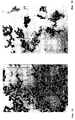
- the table shows that the treatment according to the invention of silicon dioxide produced by a flame hydrolysis process under acid conditions results in a markedly increased hydroxyl group density, whilst the BET surface area of the treated and untreated powders remains unchanged within the limits of determination accuracy. Further evidence that the treatment according to the invention causes no substantial changes in the structure of the powder is provided by the transmission electron micrographs in Figures 1A and 1B.
- Figure 1A shows the powder according to the invention from Example PA1
- Figure 1B shows the untreated powder from Example PA0.
Landscapes
- Chemical & Material Sciences (AREA)
- Organic Chemistry (AREA)
- Inorganic Chemistry (AREA)
- Dispersion Chemistry (AREA)
- Silicon Compounds (AREA)
- Ink Jet Recording Methods And Recording Media Thereof (AREA)
- Pharmaceuticals Containing Other Organic And Inorganic Compounds (AREA)
Claims (6)
- Siliciumdioxidpulver, dadurch gekennzeichnet, dass es ein flammenhydrolytisch hergestelltes Siliciumdioxidpulver ist und eine Hydroxylgruppendichte von 2,5 bis 4,7 OH/nm2 aufweist, wobei die Hydroxylgruppendichte durch Reaktion des Siliciumdioxidpulvers mit Lithiumaluminiumhydrid nach der Methode von J. Mathias und G. Wannemacher in Journal of Colloid and Interface Science 125 (1988) 61 bestimmt wird.
- Siliciumdioxidpulver nach Anspruch 1, dadurch gekennzeichnet, dass das Siliciumdioxidpulver ein dotiertes Siliciumdioxidpulver ist.
- Siliciumdioxidpulver nach den Ansprüchen 1 oder 2, dadurch gekennzeichnet, dass das Siliciumdioxidpulver ein Silicium-Metall-Mischoxidpulver ist, dessen Siliciumdioxidgehalt mindestens 60% beträgt.
- Siliciumdioxidpulver nach den Ansprüchen 1 bis 3, dadurch gekennzeichnet, dass die Hydroxylgruppendichte des Siliciumdioxidpulvers zwischen 3 und 4 OH/nm2 liegt.
- Siliciumdioxidpulver nach den Ansprüchen 1 bis 4, dadurch gekennzeichnet, dass die BET-Oberfläche des Siliciumdioxidpulvers zwischen 5 und 600 m2/g liegt.
- Verfahren zur Herstellung des Siliciumdioxidpulvers gemäß den Ansprüchen 1 bis 5, dadurch gekennzeichnet, dass ein nach einem flammenhydrolytischen Verfahren hergestelltes Siliciumdioxidpulver mit einer Hydroxylgruppendichte von weniger als 2,5 OH/nm2 bei Temperaturen von 40 bis 700°C unter sauren Bedingungen und über Reaktionszeiten von 5 Minuten bis 20 Stunden behandelt und nachfolgend vom Reaktionsgemisch abgetrennt wird.
Applications Claiming Priority (3)
| Application Number | Priority Date | Filing Date | Title |
|---|---|---|---|
| DE10239144 | 2002-08-27 | ||
| DE10239144A DE10239144A1 (de) | 2002-08-27 | 2002-08-27 | Dispersion |
| PCT/EP2003/008332 WO2004020334A1 (en) | 2002-08-27 | 2003-07-29 | Silicon dioxide dispersion |
Publications (2)
| Publication Number | Publication Date |
|---|---|
| EP1539644A1 EP1539644A1 (de) | 2005-06-15 |
| EP1539644B1 true EP1539644B1 (de) | 2011-03-30 |
Family
ID=31724107
Family Applications (1)
| Application Number | Title | Priority Date | Filing Date |
|---|---|---|---|
| EP03790828A Expired - Lifetime EP1539644B1 (de) | 2002-08-27 | 2003-07-29 | Siliciumdioxiddispersion |
Country Status (9)
| Country | Link |
|---|---|
| US (3) | US7824643B2 (de) |
| EP (1) | EP1539644B1 (de) |
| JP (1) | JP2005536435A (de) |
| KR (1) | KR100779813B1 (de) |
| CN (1) | CN100381357C (de) |
| AT (1) | ATE503724T1 (de) |
| AU (1) | AU2003260333A1 (de) |
| DE (2) | DE10239144A1 (de) |
| WO (1) | WO2004020334A1 (de) |
Families Citing this family (6)
| Publication number | Priority date | Publication date | Assignee | Title |
|---|---|---|---|---|
| DE10360464A1 (de) * | 2003-12-22 | 2005-07-14 | Wacker-Chemie Gmbh | Dispersion die mindestens 2 Arten von Partikeln enthält |
| DE102004031785A1 (de) * | 2004-07-01 | 2006-01-26 | Degussa Ag | Polyol enthaltende Siliciumdioxid-Dispersion |
| DE102004054392A1 (de) * | 2004-08-28 | 2006-03-02 | Heraeus Quarzglas Gmbh & Co. Kg | Verfahren zum Verbinden von Bauteilen aus hochkieselsäurehaltigem Werkstoff, sowie aus derartigen Bauteilen zusammengefügter Bauteil-Verbund |
| DE102007049742A1 (de) * | 2007-10-16 | 2009-04-23 | Evonik Degussa Gmbh | Verfahren zur Herstellung einer Titan-Silicium-Mischoxid enthaltenden Dispersion |
| JP5653637B2 (ja) * | 2010-03-01 | 2015-01-14 | 古河電気工業株式会社 | 正極活物質材料、正極、2次電池及びこれらの製造方法 |
| EP3467052B1 (de) | 2017-10-06 | 2022-04-13 | Evonik Operations GmbH | Wässrige dispersion enthaltend siliziumdioxid und trimethyl 1,6-hexamethylendiamin |
Family Cites Families (21)
| Publication number | Priority date | Publication date | Assignee | Title |
|---|---|---|---|---|
| EP0272904B1 (de) * | 1986-12-23 | 1992-03-18 | E.I. Du Pont De Nemours And Company | Verfahren zur Porositätskontrolle und Rehydroxylierung von Kieselkörpern |
| AU598665B2 (en) | 1987-05-15 | 1990-06-28 | W.R. Grace & Co.-Conn. | Adsorptive material and process for the removal of chlorophyll, color bodies and phospholipids from glyceride oils |
| US5256386A (en) * | 1987-06-29 | 1993-10-26 | Eka Nobel Ab | Method for preparation of silica particles |
| JP3214982B2 (ja) * | 1994-07-04 | 2001-10-02 | 株式会社トクヤマ | 無機組成物 |
| DE19620942A1 (de) | 1995-06-05 | 1996-12-12 | Gen Electric | Effizientes Verfahren zum Hydrophobieren von anorganischem Pulver |
| JPH092812A (ja) | 1995-06-15 | 1997-01-07 | Nippon Cambridge Filter Kk | フィルタテスト用シリカエアロゾル |
| US5623028A (en) * | 1995-12-01 | 1997-04-22 | General Electric Company | Heat cured rubbers |
| JPH10172935A (ja) * | 1996-12-05 | 1998-06-26 | Fujimi Inkooporeetetsudo:Kk | 研磨用組成物 |
| SG54606A1 (en) * | 1996-12-05 | 1998-11-16 | Fujimi Inc | Polishing composition |
| DE19650500A1 (de) * | 1996-12-05 | 1998-06-10 | Degussa | Dotierte, pyrogen hergestellte Oxide |
| KR20000006595A (ko) * | 1998-09-22 | 2000-02-07 | 유현식 | 반도체소자 cmp용 금속산화물 슬러리의 제조방법 |
| DE19943057A1 (de) * | 1999-09-09 | 2001-03-15 | Degussa | Bakterizides, mit Silber dotiertes Siliciumdioxid |
| RU2152903C1 (ru) * | 1999-09-17 | 2000-07-20 | Исангулов Кашфиль Исмагилович | Способ получения модифицированного дисперсного кремнезема |
| DE19953029A1 (de) * | 1999-11-04 | 2001-05-17 | Degussa | Polyester |
| AUPQ463799A0 (en) * | 1999-12-14 | 2000-01-13 | Novio Phenolic Foam Pty Ltd | Fire resistant compositions |
| US6569908B2 (en) * | 2000-01-19 | 2003-05-27 | Oji Paper Co., Ltd. | Dispersion of silica particle agglomerates and process for producing the same |
| JP3876610B2 (ja) * | 2000-01-19 | 2007-02-07 | 王子製紙株式会社 | シリカ微粒子分散液及びその製造方法 |
| JP4094798B2 (ja) | 2000-05-15 | 2008-06-04 | 信越化学工業株式会社 | ウエハレベルバーンイン装置用ウエハ支持台 |
| JP4674936B2 (ja) * | 2000-07-17 | 2011-04-20 | チタン工業株式会社 | 疎水性微粒子及びその応用 |
| JP4240796B2 (ja) | 2000-10-11 | 2009-03-18 | 電気化学工業株式会社 | 真球状シリカ超微粉、その製造方法及び用途 |
| DE10326049A1 (de) | 2003-06-10 | 2004-12-30 | Degussa Ag | Flammenhydrolytisch hergestelltes Siliciumdioxid, Verfahren zu seiner Herstellung und Verwendung |
-
2002
- 2002-08-27 DE DE10239144A patent/DE10239144A1/de not_active Ceased
-
2003
- 2003-07-29 KR KR1020057003206A patent/KR100779813B1/ko not_active Expired - Lifetime
- 2003-07-29 WO PCT/EP2003/008332 patent/WO2004020334A1/en not_active Ceased
- 2003-07-29 JP JP2004531828A patent/JP2005536435A/ja active Pending
- 2003-07-29 US US10/524,037 patent/US7824643B2/en active Active
- 2003-07-29 CN CNB038202778A patent/CN100381357C/zh not_active Expired - Lifetime
- 2003-07-29 DE DE60336566T patent/DE60336566D1/de not_active Expired - Lifetime
- 2003-07-29 EP EP03790828A patent/EP1539644B1/de not_active Expired - Lifetime
- 2003-07-29 AU AU2003260333A patent/AU2003260333A1/en not_active Abandoned
- 2003-07-29 AT AT03790828T patent/ATE503724T1/de not_active IP Right Cessation
-
2009
- 2009-08-05 US US12/536,150 patent/US7888396B2/en not_active Expired - Lifetime
- 2009-10-16 US US12/580,384 patent/US7892510B2/en not_active Expired - Fee Related
Also Published As
| Publication number | Publication date |
|---|---|
| CN100381357C (zh) | 2008-04-16 |
| CN1678525A (zh) | 2005-10-05 |
| JP2005536435A (ja) | 2005-12-02 |
| AU2003260333A1 (en) | 2004-03-19 |
| KR100779813B1 (ko) | 2007-11-28 |
| US7892510B2 (en) | 2011-02-22 |
| US20060093542A1 (en) | 2006-05-04 |
| US20100037800A1 (en) | 2010-02-18 |
| ATE503724T1 (de) | 2011-04-15 |
| US7824643B2 (en) | 2010-11-02 |
| DE60336566D1 (de) | 2011-05-12 |
| US7888396B2 (en) | 2011-02-15 |
| US20100071594A1 (en) | 2010-03-25 |
| EP1539644A1 (de) | 2005-06-15 |
| WO2004020334A1 (en) | 2004-03-11 |
| DE10239144A1 (de) | 2004-03-18 |
| KR20050059090A (ko) | 2005-06-17 |
Similar Documents
| Publication | Publication Date | Title |
|---|---|---|
| EP1611054B1 (de) | Verfahren zur herstellung von metalloxid- und metalloid-oxid-dispersionen | |
| EP1606218B1 (de) | Pyrogenes siliciumdioxidpulver und dispersion hiervon | |
| EP1761461B1 (de) | Polyol enthaltende siliciumdioxiddispersion | |
| US6676719B2 (en) | Aqueous dispersion, a process for the preparation and the use thereof | |
| JP3990559B2 (ja) | 半導体基板またはその上に施こされた層をポリシングするための水性分散液およびその製造法 | |
| JP3883969B2 (ja) | 水性分散液、その製造方法及びその使用 | |
| EP1572587B1 (de) | Pyrogenes sio2 und dispersion desselben | |
| KR20020068960A (ko) | 수성 분산액, 이의 제조방법 및 용도 | |
| US7892510B2 (en) | Silicon dioxide dispersion | |
| JP5453300B2 (ja) | 二酸化ケイ素分散液の製造方法 | |
| JPH10310415A (ja) | シリカの水性分散体の製造方法 |
Legal Events
| Date | Code | Title | Description |
|---|---|---|---|
| PUAI | Public reference made under article 153(3) epc to a published international application that has entered the european phase |
Free format text: ORIGINAL CODE: 0009012 |
|
| 17P | Request for examination filed |
Effective date: 20050113 |
|
| AK | Designated contracting states |
Kind code of ref document: A1 Designated state(s): AT BE BG CH CY CZ DE DK EE ES FI FR GB GR HU IE IT LI LU MC NL PT RO SE SI SK TR |
|
| AX | Request for extension of the european patent |
Extension state: AL LT LV MK |
|
| DAX | Request for extension of the european patent (deleted) | ||
| RAP1 | Party data changed (applicant data changed or rights of an application transferred) |
Owner name: DEGUSSA GMBH |
|
| RIN1 | Information on inventor provided before grant (corrected) |
Inventor name: SCHUMACHER, KAI Inventor name: OSWALD, MONIKA |
|
| RAP1 | Party data changed (applicant data changed or rights of an application transferred) |
Owner name: EVONIK DEGUSSA GMBH |
|
| 17Q | First examination report despatched |
Effective date: 20071122 |
|
| RAP1 | Party data changed (applicant data changed or rights of an application transferred) |
Owner name: EVONIK DEGUSSA GMBH |
|
| GRAP | Despatch of communication of intention to grant a patent |
Free format text: ORIGINAL CODE: EPIDOSNIGR1 |
|
| GRAS | Grant fee paid |
Free format text: ORIGINAL CODE: EPIDOSNIGR3 |
|
| GRAA | (expected) grant |
Free format text: ORIGINAL CODE: 0009210 |
|
| AK | Designated contracting states |
Kind code of ref document: B1 Designated state(s): AT BE BG CH CY CZ DE DK EE ES FI FR GB GR HU IE IT LI LU MC NL PT RO SE SI SK TR |
|
| REG | Reference to a national code |
Ref country code: GB Ref legal event code: FG4D |
|
| REG | Reference to a national code |
Ref country code: CH Ref legal event code: EP |
|
| REG | Reference to a national code |
Ref country code: IE Ref legal event code: FG4D |
|
| REF | Corresponds to: |
Ref document number: 60336566 Country of ref document: DE Date of ref document: 20110512 Kind code of ref document: P |
|
| REG | Reference to a national code |
Ref country code: DE Ref legal event code: R096 Ref document number: 60336566 Country of ref document: DE Effective date: 20110512 |
|
| REG | Reference to a national code |
Ref country code: NL Ref legal event code: T3 |
|
| PG25 | Lapsed in a contracting state [announced via postgrant information from national office to epo] |
Ref country code: GR Free format text: LAPSE BECAUSE OF FAILURE TO SUBMIT A TRANSLATION OF THE DESCRIPTION OR TO PAY THE FEE WITHIN THE PRESCRIBED TIME-LIMIT Effective date: 20110701 Ref country code: SE Free format text: LAPSE BECAUSE OF FAILURE TO SUBMIT A TRANSLATION OF THE DESCRIPTION OR TO PAY THE FEE WITHIN THE PRESCRIBED TIME-LIMIT Effective date: 20110330 |
|
| PG25 | Lapsed in a contracting state [announced via postgrant information from national office to epo] |
Ref country code: AT Free format text: LAPSE BECAUSE OF FAILURE TO SUBMIT A TRANSLATION OF THE DESCRIPTION OR TO PAY THE FEE WITHIN THE PRESCRIBED TIME-LIMIT Effective date: 20110330 Ref country code: SI Free format text: LAPSE BECAUSE OF FAILURE TO SUBMIT A TRANSLATION OF THE DESCRIPTION OR TO PAY THE FEE WITHIN THE PRESCRIBED TIME-LIMIT Effective date: 20110330 Ref country code: CY Free format text: LAPSE BECAUSE OF FAILURE TO SUBMIT A TRANSLATION OF THE DESCRIPTION OR TO PAY THE FEE WITHIN THE PRESCRIBED TIME-LIMIT Effective date: 20110330 Ref country code: FI Free format text: LAPSE BECAUSE OF FAILURE TO SUBMIT A TRANSLATION OF THE DESCRIPTION OR TO PAY THE FEE WITHIN THE PRESCRIBED TIME-LIMIT Effective date: 20110330 |
|
| PG25 | Lapsed in a contracting state [announced via postgrant information from national office to epo] |
Ref country code: PT Free format text: LAPSE BECAUSE OF FAILURE TO SUBMIT A TRANSLATION OF THE DESCRIPTION OR TO PAY THE FEE WITHIN THE PRESCRIBED TIME-LIMIT Effective date: 20110801 Ref country code: EE Free format text: LAPSE BECAUSE OF FAILURE TO SUBMIT A TRANSLATION OF THE DESCRIPTION OR TO PAY THE FEE WITHIN THE PRESCRIBED TIME-LIMIT Effective date: 20110330 |
|
| PG25 | Lapsed in a contracting state [announced via postgrant information from national office to epo] |
Ref country code: CZ Free format text: LAPSE BECAUSE OF FAILURE TO SUBMIT A TRANSLATION OF THE DESCRIPTION OR TO PAY THE FEE WITHIN THE PRESCRIBED TIME-LIMIT Effective date: 20110330 Ref country code: ES Free format text: LAPSE BECAUSE OF FAILURE TO SUBMIT A TRANSLATION OF THE DESCRIPTION OR TO PAY THE FEE WITHIN THE PRESCRIBED TIME-LIMIT Effective date: 20110711 Ref country code: SK Free format text: LAPSE BECAUSE OF FAILURE TO SUBMIT A TRANSLATION OF THE DESCRIPTION OR TO PAY THE FEE WITHIN THE PRESCRIBED TIME-LIMIT Effective date: 20110330 Ref country code: RO Free format text: LAPSE BECAUSE OF FAILURE TO SUBMIT A TRANSLATION OF THE DESCRIPTION OR TO PAY THE FEE WITHIN THE PRESCRIBED TIME-LIMIT Effective date: 20110330 |
|
| PLBE | No opposition filed within time limit |
Free format text: ORIGINAL CODE: 0009261 |
|
| STAA | Information on the status of an ep patent application or granted ep patent |
Free format text: STATUS: NO OPPOSITION FILED WITHIN TIME LIMIT |
|
| PG25 | Lapsed in a contracting state [announced via postgrant information from national office to epo] |
Ref country code: DK Free format text: LAPSE BECAUSE OF FAILURE TO SUBMIT A TRANSLATION OF THE DESCRIPTION OR TO PAY THE FEE WITHIN THE PRESCRIBED TIME-LIMIT Effective date: 20110330 Ref country code: MC Free format text: LAPSE BECAUSE OF NON-PAYMENT OF DUE FEES Effective date: 20110731 |
|
| REG | Reference to a national code |
Ref country code: CH Ref legal event code: PL |
|
| 26N | No opposition filed |
Effective date: 20120102 |
|
| REG | Reference to a national code |
Ref country code: IE Ref legal event code: MM4A |
|
| REG | Reference to a national code |
Ref country code: DE Ref legal event code: R097 Ref document number: 60336566 Country of ref document: DE Effective date: 20120102 |
|
| PG25 | Lapsed in a contracting state [announced via postgrant information from national office to epo] |
Ref country code: LI Free format text: LAPSE BECAUSE OF NON-PAYMENT OF DUE FEES Effective date: 20110731 Ref country code: CH Free format text: LAPSE BECAUSE OF NON-PAYMENT OF DUE FEES Effective date: 20110731 |
|
| PG25 | Lapsed in a contracting state [announced via postgrant information from national office to epo] |
Ref country code: IT Free format text: LAPSE BECAUSE OF FAILURE TO SUBMIT A TRANSLATION OF THE DESCRIPTION OR TO PAY THE FEE WITHIN THE PRESCRIBED TIME-LIMIT Effective date: 20110330 |
|
| PG25 | Lapsed in a contracting state [announced via postgrant information from national office to epo] |
Ref country code: IE Free format text: LAPSE BECAUSE OF NON-PAYMENT OF DUE FEES Effective date: 20110729 |
|
| PG25 | Lapsed in a contracting state [announced via postgrant information from national office to epo] |
Ref country code: LU Free format text: LAPSE BECAUSE OF NON-PAYMENT OF DUE FEES Effective date: 20110729 |
|
| PG25 | Lapsed in a contracting state [announced via postgrant information from national office to epo] |
Ref country code: BG Free format text: LAPSE BECAUSE OF FAILURE TO SUBMIT A TRANSLATION OF THE DESCRIPTION OR TO PAY THE FEE WITHIN THE PRESCRIBED TIME-LIMIT Effective date: 20110630 |
|
| PG25 | Lapsed in a contracting state [announced via postgrant information from national office to epo] |
Ref country code: TR Free format text: LAPSE BECAUSE OF FAILURE TO SUBMIT A TRANSLATION OF THE DESCRIPTION OR TO PAY THE FEE WITHIN THE PRESCRIBED TIME-LIMIT Effective date: 20110330 |
|
| PG25 | Lapsed in a contracting state [announced via postgrant information from national office to epo] |
Ref country code: HU Free format text: LAPSE BECAUSE OF FAILURE TO SUBMIT A TRANSLATION OF THE DESCRIPTION OR TO PAY THE FEE WITHIN THE PRESCRIBED TIME-LIMIT Effective date: 20110330 |
|
| REG | Reference to a national code |
Ref country code: FR Ref legal event code: PLFP Year of fee payment: 14 |
|
| PGFP | Annual fee paid to national office [announced via postgrant information from national office to epo] |
Ref country code: NL Payment date: 20160720 Year of fee payment: 14 |
|
| REG | Reference to a national code |
Ref country code: FR Ref legal event code: PLFP Year of fee payment: 15 |
|
| REG | Reference to a national code |
Ref country code: NL Ref legal event code: MM Effective date: 20170801 |
|
| PG25 | Lapsed in a contracting state [announced via postgrant information from national office to epo] |
Ref country code: NL Free format text: LAPSE BECAUSE OF NON-PAYMENT OF DUE FEES Effective date: 20170801 |
|
| REG | Reference to a national code |
Ref country code: FR Ref legal event code: PLFP Year of fee payment: 16 |
|
| REG | Reference to a national code |
Ref country code: DE Ref legal event code: R081 Ref document number: 60336566 Country of ref document: DE Owner name: EVONIK OPERATIONS GMBH, DE Free format text: FORMER OWNER: EVONIK DEGUSSA GMBH, 45128 ESSEN, DE |
|
| REG | Reference to a national code |
Ref country code: BE Ref legal event code: HC Owner name: EVONIK OPERATIONS GMBH; DE Free format text: DETAILS ASSIGNMENT: CHANGE OF OWNER(S), CHANGEMENT DE NOM DU PROPRIETAIRE; FORMER OWNER NAME: EVONIK DEGUSSA GMBH Effective date: 20191122 |
|
| PGFP | Annual fee paid to national office [announced via postgrant information from national office to epo] |
Ref country code: GB Payment date: 20220720 Year of fee payment: 20 Ref country code: DE Payment date: 20220720 Year of fee payment: 20 |
|
| PGFP | Annual fee paid to national office [announced via postgrant information from national office to epo] |
Ref country code: FR Payment date: 20220720 Year of fee payment: 20 Ref country code: BE Payment date: 20220720 Year of fee payment: 20 |
|
| P01 | Opt-out of the competence of the unified patent court (upc) registered |
Effective date: 20230526 |
|
| REG | Reference to a national code |
Ref country code: DE Ref legal event code: R071 Ref document number: 60336566 Country of ref document: DE |
|
| REG | Reference to a national code |
Ref country code: BE Ref legal event code: MK Effective date: 20230729 |
|
| REG | Reference to a national code |
Ref country code: GB Ref legal event code: PE20 Expiry date: 20230728 |
|
| PG25 | Lapsed in a contracting state [announced via postgrant information from national office to epo] |
Ref country code: GB Free format text: LAPSE BECAUSE OF EXPIRATION OF PROTECTION Effective date: 20230728 |