EP1535757A1 - Verbundvollreifen - Google Patents
Verbundvollreifen Download PDFInfo
- Publication number
- EP1535757A1 EP1535757A1 EP03721042A EP03721042A EP1535757A1 EP 1535757 A1 EP1535757 A1 EP 1535757A1 EP 03721042 A EP03721042 A EP 03721042A EP 03721042 A EP03721042 A EP 03721042A EP 1535757 A1 EP1535757 A1 EP 1535757A1
- Authority
- EP
- European Patent Office
- Prior art keywords
- tire
- cover
- peripheral surface
- core
- cover tire
- Prior art date
- Legal status (The legal status is an assumption and is not a legal conclusion. Google has not performed a legal analysis and makes no representation as to the accuracy of the status listed.)
- Withdrawn
Links
- 239000007787 solid Substances 0.000 title claims abstract description 53
- 150000001875 compounds Chemical class 0.000 title claims abstract description 48
- 230000002093 peripheral effect Effects 0.000 claims abstract description 83
- 239000000203 mixture Substances 0.000 claims description 11
- 230000014509 gene expression Effects 0.000 claims description 3
- 239000000835 fiber Substances 0.000 description 6
- 238000011156 evaluation Methods 0.000 description 5
- 229910000831 Steel Inorganic materials 0.000 description 3
- 239000010959 steel Substances 0.000 description 3
- 239000000463 material Substances 0.000 description 2
- 238000012986 modification Methods 0.000 description 2
- 230000004048 modification Effects 0.000 description 2
- 230000002787 reinforcement Effects 0.000 description 2
- 230000000007 visual effect Effects 0.000 description 2
- 230000000052 comparative effect Effects 0.000 description 1
- 239000013013 elastic material Substances 0.000 description 1
- 238000003780 insertion Methods 0.000 description 1
Images


Classifications
-
- B—PERFORMING OPERATIONS; TRANSPORTING
- B60—VEHICLES IN GENERAL
- B60C—VEHICLE TYRES; TYRE INFLATION; TYRE CHANGING; CONNECTING VALVES TO INFLATABLE ELASTIC BODIES IN GENERAL; DEVICES OR ARRANGEMENTS RELATED TO TYRES
- B60C11/00—Tyre tread bands; Tread patterns; Anti-skid inserts
- B60C11/02—Replaceable treads
-
- B—PERFORMING OPERATIONS; TRANSPORTING
- B60—VEHICLES IN GENERAL
- B60C—VEHICLE TYRES; TYRE INFLATION; TYRE CHANGING; CONNECTING VALVES TO INFLATABLE ELASTIC BODIES IN GENERAL; DEVICES OR ARRANGEMENTS RELATED TO TYRES
- B60C11/00—Tyre tread bands; Tread patterns; Anti-skid inserts
-
- B—PERFORMING OPERATIONS; TRANSPORTING
- B60—VEHICLES IN GENERAL
- B60C—VEHICLE TYRES; TYRE INFLATION; TYRE CHANGING; CONNECTING VALVES TO INFLATABLE ELASTIC BODIES IN GENERAL; DEVICES OR ARRANGEMENTS RELATED TO TYRES
- B60C7/00—Non-inflatable or solid tyres
-
- B—PERFORMING OPERATIONS; TRANSPORTING
- B60—VEHICLES IN GENERAL
- B60C—VEHICLE TYRES; TYRE INFLATION; TYRE CHANGING; CONNECTING VALVES TO INFLATABLE ELASTIC BODIES IN GENERAL; DEVICES OR ARRANGEMENTS RELATED TO TYRES
- B60C7/00—Non-inflatable or solid tyres
- B60C7/10—Non-inflatable or solid tyres characterised by means for increasing resiliency
- B60C7/101—Tyre casings enclosing a distinct core, e.g. foam
-
- Y—GENERAL TAGGING OF NEW TECHNOLOGICAL DEVELOPMENTS; GENERAL TAGGING OF CROSS-SECTIONAL TECHNOLOGIES SPANNING OVER SEVERAL SECTIONS OF THE IPC; TECHNICAL SUBJECTS COVERED BY FORMER USPC CROSS-REFERENCE ART COLLECTIONS [XRACs] AND DIGESTS
- Y10—TECHNICAL SUBJECTS COVERED BY FORMER USPC
- Y10T—TECHNICAL SUBJECTS COVERED BY FORMER US CLASSIFICATION
- Y10T152/00—Resilient tires and wheels
- Y10T152/10—Tires, resilient
- Y10T152/10279—Cushion
- Y10T152/10288—Sectional
- Y10T152/10297—Annular
-
- Y—GENERAL TAGGING OF NEW TECHNOLOGICAL DEVELOPMENTS; GENERAL TAGGING OF CROSS-SECTIONAL TECHNOLOGIES SPANNING OVER SEVERAL SECTIONS OF THE IPC; TECHNICAL SUBJECTS COVERED BY FORMER USPC CROSS-REFERENCE ART COLLECTIONS [XRACs] AND DIGESTS
- Y10—TECHNICAL SUBJECTS COVERED BY FORMER USPC
- Y10T—TECHNICAL SUBJECTS COVERED BY FORMER US CLASSIFICATION
- Y10T152/00—Resilient tires and wheels
- Y10T152/10—Tires, resilient
- Y10T152/10279—Cushion
- Y10T152/10288—Sectional
- Y10T152/10297—Annular
- Y10T152/10306—Superimposed
-
- Y—GENERAL TAGGING OF NEW TECHNOLOGICAL DEVELOPMENTS; GENERAL TAGGING OF CROSS-SECTIONAL TECHNOLOGIES SPANNING OVER SEVERAL SECTIONS OF THE IPC; TECHNICAL SUBJECTS COVERED BY FORMER USPC CROSS-REFERENCE ART COLLECTIONS [XRACs] AND DIGESTS
- Y10—TECHNICAL SUBJECTS COVERED BY FORMER USPC
- Y10T—TECHNICAL SUBJECTS COVERED BY FORMER US CLASSIFICATION
- Y10T152/00—Resilient tires and wheels
- Y10T152/10—Tires, resilient
- Y10T152/10279—Cushion
- Y10T152/10378—Casing enclosed core
- Y10T152/10387—Separate core
- Y10T152/10396—Removable
-
- Y—GENERAL TAGGING OF NEW TECHNOLOGICAL DEVELOPMENTS; GENERAL TAGGING OF CROSS-SECTIONAL TECHNOLOGIES SPANNING OVER SEVERAL SECTIONS OF THE IPC; TECHNICAL SUBJECTS COVERED BY FORMER USPC CROSS-REFERENCE ART COLLECTIONS [XRACs] AND DIGESTS
- Y10—TECHNICAL SUBJECTS COVERED BY FORMER USPC
- Y10T—TECHNICAL SUBJECTS COVERED BY FORMER US CLASSIFICATION
- Y10T152/00—Resilient tires and wheels
- Y10T152/10—Tires, resilient
- Y10T152/10279—Cushion
- Y10T152/10378—Casing enclosed core
- Y10T152/10387—Separate core
- Y10T152/10396—Removable
- Y10T152/10414—Removable with core compression
-
- Y—GENERAL TAGGING OF NEW TECHNOLOGICAL DEVELOPMENTS; GENERAL TAGGING OF CROSS-SECTIONAL TECHNOLOGIES SPANNING OVER SEVERAL SECTIONS OF THE IPC; TECHNICAL SUBJECTS COVERED BY FORMER USPC CROSS-REFERENCE ART COLLECTIONS [XRACs] AND DIGESTS
- Y10—TECHNICAL SUBJECTS COVERED BY FORMER USPC
- Y10T—TECHNICAL SUBJECTS COVERED BY FORMER US CLASSIFICATION
- Y10T152/00—Resilient tires and wheels
- Y10T152/10—Tires, resilient
- Y10T152/10279—Cushion
- Y10T152/10378—Casing enclosed core
- Y10T152/10387—Separate core
- Y10T152/10396—Removable
- Y10T152/1045—Integral structure
- Y10T152/10459—Recessed
Definitions
- the present invention concerns a compound solid tire with a two-layered structure of a core and a cover tire, and more particularly, a compound solid tire that prevents the core tire from deviating from the cover tire and also prevents the side part of the cover tire from opening.
- a solid tire being composed of solid elastic materials, is better than a pneumatic tire in terms of higher load support capabilities and the absence of any air leaking, and is particularly used in heavy transportation vehicles and so on.
- the Inventor has proposed composing a solid tire of a core tire and a cover tire (the tread) by fitting them in a non-bonding state, as disclosed in Japanese Patent Publication No. 3245619.
- Such a compound solid tire has the advantage of enabling to show the flexible elasticity as in a pneumatic tire without damaging load capacity, and to reduce the running cost of a tire by replacing worn cover tires.
- the core tire and cover tire are fitted in a non-bonding state as in the aforementioned compound tire, for instance, the core tire can be deviated from the cover tire in the circumferential direction of the tire during braking or driving, thus the braking or driving force can be insufficiently transmitted. Also, the core tire can be deviated from the cover tire in the axial direction of the tire when turned in a non-driving state, and the side part of the cover tire may open. Therefore, these inconveniences have made it difficult to put to practical use the aforementioned compound solid tire.
- An object of the present invention is to provide a compound solid tire capable of preventing the core tire and the cover tire from deviating and preventing the side part of the cover tire from opening.
- a compound solid tire comprises of a core tire made of an annular elastic body and an annular cover tire with an inner peripheral surface to be fitted to the outer peripheral surface of the core tire, the cover tire comprising the tread part and side parts, wherein the inner peripheral length of the cover tire at the center position of the inner peripheral surface is set to 92 to 99.5% of the outer peripheral length of the core tire at the center position of the outer peripheral surface.
- the expanded width of the inner peripheral surface of the cover tire is preferable to 95 to 100% of that of the outer peripheral surface of the core tire.
- a flange on the inner peripheral edge of the side part of the cover tire, thereby more securely preventing any deviation between the core tire and the cover tire, opening of the side part of the cover tire and dislocation of the cover tire.
- any deviation between the core tire and the cover tire, opening of the side part of the cover tire and dislocation of the cover tire can be prevented more securely in the compound solid tire with a two-layered structure of the core tire and the cover tire.
- JIS A hardness of the rubber compositions which form the cover tire is 60 to 75, and the modulus at 300% elongation is 7 to 14 MPa. Thereby, any deviation between the core tire and the cover tire, opening of the side part of the cover tire and dislocation of the cover tire can be prevented more securely.
- the cover tire it is preferable to provide at least one longitudinal groove extending in the circumferential direction and a plurality of transverse grooves extending in the tire axial direction on the outer peripheral surface of the core tire, and on the other hand, to provide a protrusion to engage the longitudinal groove and transverse grooves on the inner peripheral surface of the cover tire.
- Fig. 1 shows a compound solid tire composed of an embodiment of the present invention.
- This compound solid tire is composed of annular core tire 1 and annular cover tire 11, as shown in Fig. 1.
- the cover tire 11 is layered onto the core tire 1 in a non-bonding state, entirely fitting the inner peripheral surface 12 thereof to the outer peripheral surface 2 of core tire 1.
- the core tire 1 is composed of an elastic body mainly composed of rubber compositions.
- Rubber compositions of the core tire 1 are not specially defined, and materials used for an ordinary solid tire can be selected conveniently. Particularly, a rubber composition having JIS A hardness of 80 to 90 is preferable so as to secure load capacity.
- steel rings or steel cords extending in the circumferential direction of the tire may be embedded in the core tire 1, and reinforcement fibers composed of short fiber or long fiber may be blended in the rubber composition.
- the cover tire 11 is similarly made of an elastic body mainly composed of rubber compositions.
- the rubber compositions of the cover tire 11 are not specially defined, and materials used for an ordinary solid tire can be selected conveniently.
- a rubber composition having JIS A hardness of 60 to 75 and the modulus of 7 to 14 MPa when elongated by 300% at 25 °C is preferable for imparting a sufficient tightening force to the cover tire 11, and for satisfying the required tire characteristics such as abrasive resistance at the same time.
- the cover tire 11 comprises a tread part 13 covering the core tire 1 from the outer periphery and side parts 14 for covering the core tire 1 from both right and left sides.
- a plurality of lug grooves 15 extending in the axial direction of the tire are formed in the tread part 13 of the cover tire 11.
- lug grooves are provided in the tread part of the cover tire as to form a lug pattern; however, grooves in the circumferential direction may be provided in the tread part as to form a rib pattern, or grooves in the circumferential direction and lug grooves may be provided in the tread part as to form a rib and lug pattern.
- steel cords may be embedded in the tread part 13 of the cover tire 11, and reinforcement fibers composed of short fiber or long fiber may be blended in the rubber composition.
- Fig. 2 shows the core tire of the aforementioned compound solid tire
- Fig. 3 shows the cover tire of the aforementioned compound solid tire.
- dimensions and shapes of the core tire 1 and the cover tire 11 are defined as follows.
- the inner peripheral length at the center position P 11 of the inner peripheral surface 12 of the cover tire 11 is set to 92 to 99.5%, preferably 92 to 99%, and more preferably 92 to 98% of the outer peripheral length at the center position P 1 of the outer peripheral surface 2 of the core tire 1.
- the center position P 1 of the outer peripheral surface 2 of the core tire 1 is a position where the arc or virtual arc of the curvature radius R 1 in the axial direction of the tire on which the outer peripheral surface 2 is drawn crosses the tire equatorial plane P and the center position P 11 of the inner peripheral surface 12 of the cover tire 11 is a position where the arc or virtual arc of the curvature radius R 11 in the axial direction of the tire on which the inner peripheral surface 12 is drawn crosses the tire equatorial plane P.
- the tightening force by the cover tire 11 can be increased, by making the inner peripheral length at the center position P 11 of the inner peripheral surface 12 of the cover tire 11 shorter than the outer peripheral length at the center position P 1 of the outer peripheral surface 2 of the core tire 1 as mentioned above.
- the inner peripheral length at the center position P 11 of the inner peripheral surface 12 of the cover tire 11 is too short, it becomes difficult to assemble the core tire 1 and the cover tire 11.
- the expanded width W 11 of the inner peripheral surface 12 of the cover tire 11 is set to 95 to 100%, more preferably 95 to 99% of the expanded width W 1 of the outer peripheral surface 2 of the core tire 1.
- the tightening force by the cover tire 11 can be increased, by making the expanded width W 11 of the inner peripheral surface 12 of the cover tire 11 shorter than the expanded width W 1 of the outer peripheral surface 2 of the core tire 1 as mentioned above.
- the expanded width W 11 of the inner peripheral surface 12 of the cover tire 11 is too short, it becomes difficult to assemble the core tire 1 and the cover tire 11.
- the tire axial curvature radius R 11 of the inner peripheral surface 12 of the cover tire 11 is set to 60 to 75% of the tire axial curvature radius R 1 of the outer peripheral surface 2 of the core tire 1.
- the tightening force by the cover tire 11 can be increased, by making the curvature radius R 11 of the inner peripheral surface 12 of the cover tire 11 shorter than the curvature radius R 1 of the outer peripheral surface 2 of the core tire 1 in this manner.
- the curvature radius R 11 of the inner peripheral surface 12 of the cover tire 11 is too short, it becomes difficult to assemble the core tire 1 and the cover tire 11.
- the curvature radius R 11 meets the aforementioned relation with respect to the curvature radius R 1 ; however, it is sufficient if it is equal to or lower than 100% of the curvature radius R 1 .
- the core tire 1 may well have a square shoulder as shown by X part in Fig. 2, while the cover tire 11 may well have a round shoulder as shown by Y part in Fig. 3.
- the internal surface 16 connecting to the inner peripheral surface 12 of the cover tire 11 is preferably composed of a curved surface of the curvature radius RS as shown in Fig. 4.
- the stability of the core tire 1 and the cover tire 11 increased by selecting such shoulder shapes.
- the inner peripheral surface 12 of the cover tire 11 and the internal surface 16 may be connected by the curved surface of the curvature radius RS' as shown in Fig. 5.
- the shoulder edge constituting the standard of the expanded width W 11 shall be decided by the intersection point of the extension line of the inner peripheral surface 12 and the extension line of the internal surface 16 as illustrated.
- the tightening force of the core tire 1 by the cover tire 11 can be increased, and these core tire 1 and cover tire 11 are prevented from deviating in the circumferential direction of the tire and the axial direction of the tire, by fitting dimensions and shape of the cover tire 11 with respect to the core tire 1 as mentioned above.
- the side part 14 of the cover tire 11 is effectively prevented from opening when turned in the non-driving state, and the cover tire 11 is effectively prevented from coming off the core tire 1.
- a flange 17 that is thicker than adjacent parts of the core tire 11 is formed on the inner peripheral edge of the side part 14 of the cover tire 11.
- Such flange 17 controls expansion of the side part 14, and any deviation between the core tire 1 and the cover tire 11, opening of the side part 14 of the cover tire 11 and dislocation of the cover tire 11 can be prevented more securely.
- the section height of an assembly of the core tire 1 and the cover tire 11 be A
- the section height of the cover tire 11 be B
- the tread thickness at the center position of the inner peripheral surface of the cover tire 11 be C
- the tread thickness at the shoulder position of the cover tire 11 be D
- the flange thickness of the cover tire 11 be E
- the proportion (%) of these dimensions satisfies the following expressions (1) to (4).
- the tread thickness C is a tread thickness from the center position P11 of the inner peripheral surface of the cover tire 11 to the center position of the tread surface.
- the tread thickness D is a tread thickness from the shoulder edge of the core tire 1 to the shoulder edge of the cover tire 11. 35 ⁇ B/A ⁇ 100 ⁇ 70 5 ⁇ C/A ⁇ 100 ⁇ 30 100 ⁇ D/C ⁇ 100 ⁇ 120 30 ⁇ E/C ⁇ 100 ⁇ 60
- any deviation between the core tire 1 and the cover tire 11, opening of the side part of the cover tire 11 and dislocation of the cover tire 11 can be prevented more securely, for the compound solid tire with two-layered structure of core tire 1 and cover tire 11.
- the proportion of the section height B with respect to the section height A is lower than 35%, the core tire 1 and the cover tire 11 deviate easily, and on the contrary, if it exceeds 70%, the tire assembly operation becomes difficult.
- the proportion of the tread thickness C with respect to the section height A is lower than 5%, the core tire 1 and the cover tire 11 deviate easily due to the deformation of the cover tire 11, and on the contrary, if it exceeds 30%, the tire assembly operation becomes difficult.
- the proportion of the tread thickness D with respect to the tread thickness C is lower than 100% or more than 120%, the core tire 1 and the cover tire 11 deviate easily.
- the proportion of the flange thickness E with respect to the tread thickness C is lower than 30%, the core tire 1 and the cover tire 11 deviate easily, and on the contrary, if it exceeds 60%, the assembly operation becomes difficult. Though it is preferable that the tread thickness C and the flange thickness E satisfy the aforementioned relation, it is sufficient enough if 25 ⁇ E/C x 100 ⁇ 100.
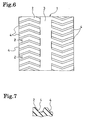
- At least one longitudinal groove 3 extending in the circumferential direction of the tire and a plurality of transverse grooves 4 extending in the axial direction of the tire are formed on the outer peripheral surface 2 of the core tire 1.
- the side walls of these transverse grooves 4 are slant in the taper shape as shown in Fig. 7.
- protrusions 18, 19 engaging with the longitudinal groove 3 and transverse grooves 4 are formed in the inner peripheral surface 12 of the cover tire 11.
- the protrusion 18 extending in the circumferential direction of the tire is destined to prevent deviation mainly in the axial direction of the tire.
- the protrusion 19 extending in the axial direction of the tire is destined to prevent deviation mainly in the circumferential direction of the tire.
- the transverse grooves 4 are slant with respect to the axial direction of the tire by curving as illustrated or the like. Therefore, the protrusion 19 engaging with the transverse groove 4 not only prevents deviation in the circumferential direction of the tire but also comes to have a role to prevent deviation in the axial direction of the tire.
- the transverse grooves 4 are slant with respect to the axial direction of the tire, if the pattern by the longitudinal groove 3 and the transverse grooves 4 are directional, the mounting direction might be mistaken when the core tire 1 and the cover tire 11 are assembled.
- an erroneous fitting during the tire assembly can be avoided securely, by differentiating the inclination direction of the transverse grooves 4 on both side parts of the tire equatorial plane P as illustrated, in other words, by forming a non-directional pattern, by making the groove pattern point-symmetrical around an arbitrary axis included in the tire equatorial plane P and extending in the tire radial direction.
- protrusions 18, 19 adhere to the grooves 3, 4, a gap may exist between these grooves 3, 4 and protrusions 18, 19.
- riding comfort can be improved by increasing the flexibility of the core tire 1, if the depth of the longitudinal groove 3 is larger than the height of the protrusion 18.
- notches or grooves extending in the circumferential direction of the tire may be added to the outer peripheral surface 2 of the core tire 1, in order to improve the riding comfort.
- the protrusion 18 extending in the circumferential direction of the tire may be eliminated, and the protrusion 19 may exist continuously in the axial direction of the tire.
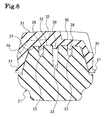
- Fig. 8 shows a compound solid tire according to another embodiment of the present invention.
- This compound solid tire is composed of an annular core tire 21 and an annular cover tire 31, as shown in Fig. 8.
- the cover tire 31 is layered on the core tire 21 in a non-bonding state, fitting the inner peripheral surface 32 thereof to the outer peripheral surface 22 of the core tire 21.
- Dimensions of the core tire 21 and cover tire 31 are set similarly to the core tire 1 and the cover tire 11 as mentioned above.
- the cover tire 31 comprises a tread part 33 covering the core tire 21 from the outer periphery side and side parts 34 for covering the core tire 21 from both right and left sides, and a plurality of lug grooves 35 extending in the axial direction of the tire are formed in the tread part 33, while a flange 37 is formed in the inner peripheral edge of the side part 34.
- three (3) longitudinal grooves 23 extending in the circumferential direction of the tire are formed in the outer peripheral surface 22 of the core tire 21.
- a protrusion 38 engaging with the longitudinal groove 23 is formed in the inner peripheral surface 32 of the cover tire 31. The depth of these longitudinal grooves 23 is set larger than the height of the protrusion 38.
- the tightening force of the core tire 21 by the cover tire 31 is increased, by fitting dimensions and shape of the cover tire 31 with respect to the core tire 21, these core tire 21 and cover tire 31 are prevented from deviating in the circumferential direction of the tire and the axial direction of the tire, and the side part 34 is effectively prevented from opening.
- a compound solid tire (example 1) with a tire structure shown in Fig. 1 and dimensions shown in Table 1, and a compound solid tire (example 2) with a tire structure shown in Fig. 8 and dimensions shown in Table 1 were manufactured.
- compound solid tires comparativative example 1 to 3 with the tire structure shown in Fig. 8 and different dimensions shown in Table 1 were manufactured respectively.
- the inner peripheral length of the cover tire is shown by the proportion (%) to the outer peripheral length of the core tire, in Table 1.
- the expanded width of the inner peripheral surface of the cover tire is shown by the proportion (%) to the expanded width of the outer peripheral surface of the core tire.
- the curvature radius of the inner peripheral surface of the cover tire is shown by the proportion (%) to the curvature radius of the outer peripheral surface of the core tire.
- Table 1 also shows the proportion (%) of the section height B with respect to the section height A, the proportion (%) of the tread thickness C with respect to the section height A, the proportion (%) of the tread thickness D with respect to the tread thickness C, and the proportion (%) of the flange thickness E with respect to the tread thickness C.
- the core tire and the cover tire were superposed one on the other coaxially, the core tire was pressed in the cover tire using a press machine, and the pressure was measured at that time.
- the pressure (MPa) during the press-insertion is shown as it is. Smaller is this pressure, better is the assembling workability.
- Each compound solid tire was mounted on the front wheel (corresponding to 7.00 - 12) of a fork lift capable of loading the maximum weight of 2.5 tons, a sudden braking was applied from a driving state of 15km/h with 2 tons load, and deviation degree in the circumferential direction of the tire between the core tire and the cover was measured. As evaluation result, the deviation degree (mm) is shown as it is.
- Each compound solid tire was mounted on the front wheel (corresponding to 7.00 - 12) of a fork lift capable of loading the maximum weight of 2.5 tons, a turning motion was executed from the non-driving state with 2 tons load, and the occurrence condition of side part opening was confirmed by visual observation. As evaluation result, absence of the opening is shown by "o ⁇ ", slight occurrence of the opening by “ ⁇ ”, eminent occurrence of the opening by " ⁇ ” and drive impossibility due to the opening by "X”.
- Each compound solid tire was mounted on the front wheel (corresponding to 7.00 - 12) of a fork lift capable of loading the maximum weight of 2.5 tons, it was served for work inside premises with 2 tons load, and deviation in the axial direction of the tire between the core tire and the cover was confirmed by visual observation.
- absence of the deviation in the axial direction is shown by "o ⁇ "
- slight occurrence of the deviation in the axial direction by " ⁇ ” eminent occurrence of the deviation in the axial direction by " ⁇ ”
- the compound solid tire according to the present invention comprises a core tire made of an annular elastic body and an annular cover tire with its inner peripheral surface to be fitted to an outer peripheral surface of said core tire, the cover tire comprising a tread part and side parts, and enables to prevent the core tire and cover tire from deviating and the side part of the cover tire from opening, by fitting dimensions and shape of the cover tire to the core tire.
- a compound solid tire with a two-layered structure of core tire and cover tire without problem until the wear life of the cover tire, and to promote the generalization of compound solid tires excellent in economy.
Landscapes
- Engineering & Computer Science (AREA)
- Mechanical Engineering (AREA)
- Tires In General (AREA)
Applications Claiming Priority (3)
| Application Number | Priority Date | Filing Date | Title |
|---|---|---|---|
| JP2002240507 | 2002-08-21 | ||
| JP2002240507A JP2004074976A (ja) | 2002-08-21 | 2002-08-21 | 複合ソリッドタイヤ |
| PCT/JP2003/005680 WO2004018235A1 (ja) | 2002-08-21 | 2003-05-07 | 複合ソリッドタイヤ |
Publications (2)
| Publication Number | Publication Date |
|---|---|
| EP1535757A1 true EP1535757A1 (de) | 2005-06-01 |
| EP1535757A4 EP1535757A4 (de) | 2005-10-19 |
Family
ID=31943936
Family Applications (1)
| Application Number | Title | Priority Date | Filing Date |
|---|---|---|---|
| EP03721042A Withdrawn EP1535757A4 (de) | 2002-08-21 | 2003-05-07 | Verbundvollreifen |
Country Status (7)
| Country | Link |
|---|---|
| US (1) | US20050247389A1 (de) |
| EP (1) | EP1535757A4 (de) |
| JP (1) | JP2004074976A (de) |
| KR (1) | KR20050056984A (de) |
| CN (1) | CN100366445C (de) |
| AU (1) | AU2003235858A1 (de) |
| WO (1) | WO2004018235A1 (de) |
Families Citing this family (9)
| Publication number | Priority date | Publication date | Assignee | Title |
|---|---|---|---|---|
| US7334617B2 (en) * | 2004-05-18 | 2008-02-26 | Giles A. Hill, III | Solid rubber tire with flexible hub and replaceable tire tread |
| JP2008273453A (ja) * | 2007-05-02 | 2008-11-13 | Hinomoto Osaka:Kk | 鞄用車輪 |
| WO2011105673A1 (ko) * | 2010-02-25 | 2011-09-01 | Son Young-Il | 타이어 커버 어셈블리 및 이를 위한 타이어 구조 |
| KR100980180B1 (ko) * | 2009-03-26 | 2010-09-03 | 손영일 | 타이어 커버의 장착을 위한 타이어 구조를 구비한 타이어 어셈블리 |
| WO2015120572A1 (zh) * | 2014-02-11 | 2015-08-20 | 厦门连科工业有限公司 | 组合式轮胎 |
| US20150343840A1 (en) * | 2014-06-03 | 2015-12-03 | Caterpillar Inc. | Core of non-pneumatic tire and method of forming core |
| US20160303910A1 (en) * | 2015-04-17 | 2016-10-20 | Xiamen Lenco Co.,Ltd. | Combined Tyre |
| KR200481929Y1 (ko) * | 2015-04-21 | 2016-11-28 | 김하늘 | 노펑크 타이어 |
| JP7262564B1 (ja) * | 2021-12-24 | 2023-04-21 | 横浜ゴム株式会社 | ソリッドタイヤ及びその製造方法 |
Family Cites Families (13)
| Publication number | Priority date | Publication date | Assignee | Title |
|---|---|---|---|---|
| US3827792A (en) * | 1972-03-24 | 1974-08-06 | Hollins J R | Resilient tire and wheel assembly |
| US3815651A (en) * | 1972-07-13 | 1974-06-11 | Tred X Corp | Replacement tread and method |
| LU84420A1 (fr) * | 1982-10-12 | 1984-05-10 | Bergougnan Benelux | Pneu plein en caoutchouc ou matiere analogue a bande de roulement amovible |
| JPS61229602A (ja) * | 1985-04-04 | 1986-10-13 | Ohtsu Tire & Rubber Co Ltd | 自動車用タイヤトレツド |
| ES2075277T3 (es) * | 1990-12-27 | 1995-10-01 | Bandag Licensing Corp | Banda de rodadura de repuesto dotada de perfil. |
| JPH05154941A (ja) * | 1991-12-03 | 1993-06-22 | Bridgestone Corp | リキャプタイヤの製造方法及びリキャプタイヤ |
| CN2145719Y (zh) * | 1992-12-08 | 1993-11-10 | 刘胜天 | 可拆装胎面花纹的轮胎 |
| JP2916077B2 (ja) * | 1993-12-29 | 1999-07-05 | 住友ゴム工業株式会社 | ニューマチック型ソリッドタイヤ |
| TW400288B (en) * | 1996-08-22 | 2000-08-01 | Fukunaga Engineering Co Ltd | Solid tire |
| US5837072A (en) * | 1996-08-22 | 1998-11-17 | Fukunaga Engineering Co., Ltd. | Solid tire |
| JPH1086609A (ja) * | 1996-09-11 | 1998-04-07 | Takeshi Iketani | トレッド交換式タイヤ |
| JPH10315347A (ja) * | 1997-05-19 | 1998-12-02 | Riyoukichi Watanabe | 古タイヤを再利用させるための被覆タイヤ |
| US6439284B1 (en) * | 1997-10-03 | 2002-08-27 | The Goodyear Tire & Rubber Company | Tread for a pneumatic tire including aquachannel |
-
2002
- 2002-08-21 JP JP2002240507A patent/JP2004074976A/ja active Pending
-
2003
- 2003-05-07 AU AU2003235858A patent/AU2003235858A1/en not_active Abandoned
- 2003-05-07 EP EP03721042A patent/EP1535757A4/de not_active Withdrawn
- 2003-05-07 KR KR1020057002539A patent/KR20050056984A/ko not_active Withdrawn
- 2003-05-07 WO PCT/JP2003/005680 patent/WO2004018235A1/ja not_active Ceased
- 2003-05-07 CN CNB038198452A patent/CN100366445C/zh not_active Expired - Fee Related
- 2003-05-07 US US10/520,617 patent/US20050247389A1/en not_active Abandoned
Also Published As
| Publication number | Publication date |
|---|---|
| CN1675076A (zh) | 2005-09-28 |
| WO2004018235A1 (ja) | 2004-03-04 |
| KR20050056984A (ko) | 2005-06-16 |
| CN100366445C (zh) | 2008-02-06 |
| JP2004074976A (ja) | 2004-03-11 |
| EP1535757A4 (de) | 2005-10-19 |
| US20050247389A1 (en) | 2005-11-10 |
| AU2003235858A1 (en) | 2004-03-11 |
Similar Documents
| Publication | Publication Date | Title |
|---|---|---|
| JP5485255B2 (ja) | タイヤ | |
| EP0605177B1 (de) | Luftreifen | |
| JP2010522666A (ja) | 張力に基づいた非空気圧式タイヤ | |
| EP3785934B1 (de) | Luftloser reifen | |
| EP1535757A1 (de) | Verbundvollreifen | |
| EP0819554A1 (de) | Radialer luftreifen | |
| WO2015030007A1 (ja) | 非空気入りタイヤ | |
| EP2360032B1 (de) | Festkörperreifen | |
| US5429165A (en) | Pneumatic-shaped solid tire | |
| EP3176004B1 (de) | Reifen | |
| JP4410575B2 (ja) | サポートリング及びそれを用いたタイヤ組立体 | |
| JP4390895B2 (ja) | 産業車両用バイアスタイヤ | |
| JP2002087019A (ja) | 空気入りタイヤ | |
| US20040025994A1 (en) | Tire/wheel assembly and run-flat support member | |
| JP4410000B2 (ja) | 乗用車用空気入りタイヤとホイールとの組立体、及び、乗用車用空気入りタイヤ | |
| US20060272761A1 (en) | Pneumatic tire | |
| KR100821549B1 (ko) | 내마모성 향상을 위한 벨트층이 구비된 중하중용 공기입타이어 | |
| JP2556915B2 (ja) | 空気入りタイヤ | |
| JP4819713B2 (ja) | 空気入りタイヤ | |
| JP6987022B2 (ja) | 空気入りタイヤ、及び、空気入りタイヤの製造方法 | |
| JPH05139110A (ja) | 産業車両用ソリツドタイヤ | |
| KR101931443B1 (ko) | 공기입 타이어 | |
| JP2024083808A (ja) | 空気入りタイヤ | |
| JPH06156009A (ja) | ニューマチック型ソリッドタイヤ | |
| JPH02225101A (ja) | 商用車用タイヤ |
Legal Events
| Date | Code | Title | Description |
|---|---|---|---|
| PUAI | Public reference made under article 153(3) epc to a published international application that has entered the european phase |
Free format text: ORIGINAL CODE: 0009012 |
|
| 17P | Request for examination filed |
Effective date: 20041217 |
|
| AK | Designated contracting states |
Kind code of ref document: A1 Designated state(s): AT BE BG CH CY CZ DE DK EE ES FI FR GB GR HU IE IT LI LU MC NL PT RO SE SI SK TR |
|
| AX | Request for extension of the european patent |
Extension state: AL LT LV MK |
|
| A4 | Supplementary search report drawn up and despatched |
Effective date: 20050905 |
|
| RIC1 | Information provided on ipc code assigned before grant |
Ipc: 7B 60C 7/10 B Ipc: 7B 60C 11/02 B Ipc: 7B 60C 11/00 B Ipc: 7B 60C 7/00 A |
|
| DAX | Request for extension of the european patent (deleted) | ||
| RBV | Designated contracting states (corrected) |
Designated state(s): DE FR GB IT |
|
| GRAP | Despatch of communication of intention to grant a patent |
Free format text: ORIGINAL CODE: EPIDOSNIGR1 |
|
| STAA | Information on the status of an ep patent application or granted ep patent |
Free format text: STATUS: THE APPLICATION IS DEEMED TO BE WITHDRAWN |
|
| 18D | Application deemed to be withdrawn |
Effective date: 20071025 |