EP1529082B1 - Pigmentzubereitungen auf basis von diketopyrrolopyrrolpigmenten zum verzugsfreien pigmentieren von teilkristallinen kunststoffen - Google Patents
Pigmentzubereitungen auf basis von diketopyrrolopyrrolpigmenten zum verzugsfreien pigmentieren von teilkristallinen kunststoffen Download PDFInfo
- Publication number
- EP1529082B1 EP1529082B1 EP03792169A EP03792169A EP1529082B1 EP 1529082 B1 EP1529082 B1 EP 1529082B1 EP 03792169 A EP03792169 A EP 03792169A EP 03792169 A EP03792169 A EP 03792169A EP 1529082 B1 EP1529082 B1 EP 1529082B1
- Authority
- EP
- European Patent Office
- Prior art keywords
- pigment
- formula
- alkyl
- hydrogen
- weight
- Prior art date
- Legal status (The legal status is an assumption and is not a legal conclusion. Google has not performed a legal analysis and makes no representation as to the accuracy of the status listed.)
- Expired - Lifetime
Links
- 239000000049 pigment Substances 0.000 title claims description 150
- 238000002360 preparation method Methods 0.000 title claims description 47
- 229920001887 crystalline plastic Polymers 0.000 title claims description 12
- FYNROBRQIVCIQF-UHFFFAOYSA-N pyrrolo[3,2-b]pyrrole-5,6-dione Chemical compound C1=CN=C2C(=O)C(=O)N=C21 FYNROBRQIVCIQF-UHFFFAOYSA-N 0.000 title claims description 10
- 230000019612 pigmentation Effects 0.000 title claims description 6
- 239000002270 dispersing agent Substances 0.000 claims description 54
- -1 C5-C30-cycloalkyl Chemical group 0.000 claims description 51
- 229910052739 hydrogen Inorganic materials 0.000 claims description 24
- 239000001257 hydrogen Substances 0.000 claims description 22
- UFHFLCQGNIYNRP-UHFFFAOYSA-N Hydrogen Chemical compound [H][H] UFHFLCQGNIYNRP-UHFFFAOYSA-N 0.000 claims description 18
- 239000000976 ink Substances 0.000 claims description 17
- 229920005989 resin Polymers 0.000 claims description 14
- 239000011347 resin Substances 0.000 claims description 14
- 150000002431 hydrogen Chemical class 0.000 claims description 13
- 239000004698 Polyethylene Substances 0.000 claims description 12
- 229920000573 polyethylene Polymers 0.000 claims description 12
- 125000004093 cyano group Chemical group *C#N 0.000 claims description 11
- 125000001997 phenyl group Chemical group [H]C1=C([H])C([H])=C(*)C([H])=C1[H] 0.000 claims description 11
- 229920003023 plastic Polymers 0.000 claims description 11
- 239000004033 plastic Substances 0.000 claims description 11
- 238000000034 method Methods 0.000 claims description 10
- 229910052757 nitrogen Inorganic materials 0.000 claims description 10
- 125000002496 methyl group Chemical group [H]C([H])([H])* 0.000 claims description 9
- 239000000843 powder Substances 0.000 claims description 9
- 125000004178 (C1-C4) alkyl group Chemical group 0.000 claims description 8
- ZAMOUSCENKQFHK-UHFFFAOYSA-N Chlorine atom Chemical compound [Cl] ZAMOUSCENKQFHK-UHFFFAOYSA-N 0.000 claims description 8
- 238000000576 coating method Methods 0.000 claims description 8
- 229910052736 halogen Inorganic materials 0.000 claims description 8
- 150000002367 halogens Chemical class 0.000 claims description 8
- QGZKDVFQNNGYKY-UHFFFAOYSA-O Ammonium Chemical compound [NH4+] QGZKDVFQNNGYKY-UHFFFAOYSA-O 0.000 claims description 7
- 238000004519 manufacturing process Methods 0.000 claims description 7
- 229920000728 polyester Polymers 0.000 claims description 7
- 125000004433 nitrogen atom Chemical group N* 0.000 claims description 6
- 239000003973 paint Substances 0.000 claims description 6
- 125000001424 substituent group Chemical group 0.000 claims description 6
- 229910052717 sulfur Inorganic materials 0.000 claims description 6
- 125000000999 tert-butyl group Chemical group [H]C([H])([H])C(*)(C([H])([H])[H])C([H])([H])[H] 0.000 claims description 6
- 239000004952 Polyamide Substances 0.000 claims description 5
- 230000015572 biosynthetic process Effects 0.000 claims description 5
- 239000000460 chlorine Substances 0.000 claims description 5
- 229910052801 chlorine Inorganic materials 0.000 claims description 5
- 239000006185 dispersion Substances 0.000 claims description 5
- 239000008187 granular material Substances 0.000 claims description 5
- 229920002647 polyamide Polymers 0.000 claims description 5
- 125000000229 (C1-C4)alkoxy group Chemical group 0.000 claims description 4
- MYRTYDVEIRVNKP-UHFFFAOYSA-N 1,2-Divinylbenzene Chemical compound C=CC1=CC=CC=C1C=C MYRTYDVEIRVNKP-UHFFFAOYSA-N 0.000 claims description 4
- 239000004743 Polypropylene Substances 0.000 claims description 4
- 125000005529 alkyleneoxy group Chemical group 0.000 claims description 4
- 125000003118 aryl group Chemical group 0.000 claims description 4
- 125000003178 carboxy group Chemical group [H]OC(*)=O 0.000 claims description 4
- 125000004122 cyclic group Chemical group 0.000 claims description 4
- 125000005842 heteroatom Chemical group 0.000 claims description 4
- 229920001903 high density polyethylene Polymers 0.000 claims description 4
- 239000004700 high-density polyethylene Substances 0.000 claims description 4
- 229910052760 oxygen Inorganic materials 0.000 claims description 4
- 229920001155 polypropylene Polymers 0.000 claims description 4
- 238000003786 synthesis reaction Methods 0.000 claims description 4
- 125000000923 (C1-C30) alkyl group Chemical group 0.000 claims description 3
- 125000000739 C2-C30 alkenyl group Chemical group 0.000 claims description 3
- 239000004793 Polystyrene Substances 0.000 claims description 3
- 125000003342 alkenyl group Chemical group 0.000 claims description 3
- 125000005037 alkyl phenyl group Chemical group 0.000 claims description 3
- 229920001400 block copolymer Polymers 0.000 claims description 3
- 125000000753 cycloalkyl group Chemical group 0.000 claims description 3
- 238000002955 isolation Methods 0.000 claims description 3
- 229910052751 metal Inorganic materials 0.000 claims description 3
- 239000002184 metal Substances 0.000 claims description 3
- 229920002223 polystyrene Polymers 0.000 claims description 3
- 239000004800 polyvinyl chloride Substances 0.000 claims description 3
- 229920000915 polyvinyl chloride Polymers 0.000 claims description 3
- 229920001169 thermoplastic Polymers 0.000 claims description 3
- 239000004416 thermosoftening plastic Substances 0.000 claims description 3
- 125000001272 (C1-C4)-alkylene-phenyl group Chemical group 0.000 claims description 2
- BLDFSDCBQJUWFG-UHFFFAOYSA-N 2-(methylamino)-1,2-diphenylethanol Chemical compound C=1C=CC=CC=1C(NC)C(O)C1=CC=CC=C1 BLDFSDCBQJUWFG-UHFFFAOYSA-N 0.000 claims description 2
- VGGSQFUCUMXWEO-UHFFFAOYSA-N Ethene Chemical compound C=C VGGSQFUCUMXWEO-UHFFFAOYSA-N 0.000 claims description 2
- 229920002292 Nylon 6 Polymers 0.000 claims description 2
- 229920002302 Nylon 6,6 Polymers 0.000 claims description 2
- 150000001768 cations Chemical class 0.000 claims description 2
- 229910052729 chemical element Inorganic materials 0.000 claims description 2
- 229920001519 homopolymer Polymers 0.000 claims description 2
- 125000004435 hydrogen atom Chemical group [H]* 0.000 claims description 2
- 229920000554 ionomer Polymers 0.000 claims description 2
- 229920001684 low density polyethylene Polymers 0.000 claims description 2
- 239000004702 low-density polyethylene Substances 0.000 claims description 2
- 229920001179 medium density polyethylene Polymers 0.000 claims description 2
- 239000004701 medium-density polyethylene Substances 0.000 claims description 2
- 230000000737 periodic effect Effects 0.000 claims description 2
- 229920000139 polyethylene terephthalate Polymers 0.000 claims description 2
- 239000005020 polyethylene terephthalate Substances 0.000 claims description 2
- 229920005604 random copolymer Polymers 0.000 claims description 2
- 229920001897 terpolymer Polymers 0.000 claims description 2
- 125000005843 halogen group Chemical group 0.000 claims 1
- 230000007704 transition Effects 0.000 claims 1
- 239000002585 base Substances 0.000 description 18
- 239000000203 mixture Substances 0.000 description 16
- 239000000126 substance Substances 0.000 description 14
- 235000014113 dietary fatty acids Nutrition 0.000 description 13
- 239000000194 fatty acid Substances 0.000 description 13
- 229930195729 fatty acid Natural products 0.000 description 13
- 150000004665 fatty acids Chemical class 0.000 description 11
- 239000012860 organic pigment Substances 0.000 description 10
- YMWUJEATGCHHMB-UHFFFAOYSA-N Dichloromethane Chemical compound ClCCl YMWUJEATGCHHMB-UHFFFAOYSA-N 0.000 description 9
- 229920000642 polymer Polymers 0.000 description 9
- XLYOFNOQVPJJNP-UHFFFAOYSA-N water Substances O XLYOFNOQVPJJNP-UHFFFAOYSA-N 0.000 description 8
- YXFVVABEGXRONW-UHFFFAOYSA-N Toluene Chemical compound CC1=CC=CC=C1 YXFVVABEGXRONW-UHFFFAOYSA-N 0.000 description 6
- 239000000654 additive Substances 0.000 description 6
- 239000003086 colorant Substances 0.000 description 6
- RTZKZFJDLAIYFH-UHFFFAOYSA-N ether Substances CCOCC RTZKZFJDLAIYFH-UHFFFAOYSA-N 0.000 description 6
- 150000002191 fatty alcohols Chemical class 0.000 description 6
- 229920000151 polyglycol Polymers 0.000 description 6
- 239000010695 polyglycol Substances 0.000 description 6
- FYSNRJHAOHDILO-UHFFFAOYSA-N thionyl chloride Chemical compound ClS(Cl)=O FYSNRJHAOHDILO-UHFFFAOYSA-N 0.000 description 6
- QTBSBXVTEAMEQO-UHFFFAOYSA-N Acetic acid Chemical compound CC(O)=O QTBSBXVTEAMEQO-UHFFFAOYSA-N 0.000 description 5
- 239000003795 chemical substances by application Substances 0.000 description 5
- 238000002347 injection Methods 0.000 description 5
- 239000007924 injection Substances 0.000 description 5
- 239000000178 monomer Substances 0.000 description 5
- 239000011368 organic material Substances 0.000 description 5
- 229920000098 polyolefin Polymers 0.000 description 5
- 239000001993 wax Substances 0.000 description 5
- RAXXELZNTBOGNW-UHFFFAOYSA-N 1H-imidazole Chemical compound C1=CNC=N1 RAXXELZNTBOGNW-UHFFFAOYSA-N 0.000 description 4
- VEXZGXHMUGYJMC-UHFFFAOYSA-N Hydrochloric acid Chemical compound Cl VEXZGXHMUGYJMC-UHFFFAOYSA-N 0.000 description 4
- 150000001412 amines Chemical class 0.000 description 4
- 229940077464 ammonium ion Drugs 0.000 description 4
- 125000002091 cationic group Chemical group 0.000 description 4
- 239000011248 coating agent Substances 0.000 description 4
- 238000004040 coloring Methods 0.000 description 4
- 125000001495 ethyl group Chemical group [H]C([H])([H])C([H])([H])* 0.000 description 4
- 239000000463 material Substances 0.000 description 4
- 125000000956 methoxy group Chemical group [H]C([H])([H])O* 0.000 description 4
- MSXVEPNJUHWQHW-UHFFFAOYSA-N 2-methylbutan-2-ol Chemical compound CCC(C)(C)O MSXVEPNJUHWQHW-UHFFFAOYSA-N 0.000 description 3
- NQRYJNQNLNOLGT-UHFFFAOYSA-N Piperidine Chemical compound C1CCNCC1 NQRYJNQNLNOLGT-UHFFFAOYSA-N 0.000 description 3
- KYQCOXFCLRTKLS-UHFFFAOYSA-N Pyrazine Chemical compound C1=CN=CC=N1 KYQCOXFCLRTKLS-UHFFFAOYSA-N 0.000 description 3
- JUJWROOIHBZHMG-UHFFFAOYSA-N Pyridine Chemical compound C1=CC=NC=C1 JUJWROOIHBZHMG-UHFFFAOYSA-N 0.000 description 3
- KAESVJOAVNADME-UHFFFAOYSA-N Pyrrole Chemical compound C=1C=CNC=1 KAESVJOAVNADME-UHFFFAOYSA-N 0.000 description 3
- 239000002253 acid Substances 0.000 description 3
- 125000000217 alkyl group Chemical group 0.000 description 3
- 125000000129 anionic group Chemical group 0.000 description 3
- 230000000740 bleeding effect Effects 0.000 description 3
- 239000007859 condensation product Substances 0.000 description 3
- 238000001035 drying Methods 0.000 description 3
- 238000004043 dyeing Methods 0.000 description 3
- 239000003822 epoxy resin Substances 0.000 description 3
- 150000002148 esters Chemical class 0.000 description 3
- 150000002170 ethers Chemical class 0.000 description 3
- LNEPOXFFQSENCJ-UHFFFAOYSA-N haloperidol Chemical compound C1CC(O)(C=2C=CC(Cl)=CC=2)CCN1CCCC(=O)C1=CC=C(F)C=C1 LNEPOXFFQSENCJ-UHFFFAOYSA-N 0.000 description 3
- 239000012943 hotmelt Substances 0.000 description 3
- 239000003960 organic solvent Substances 0.000 description 3
- 229920000058 polyacrylate Polymers 0.000 description 3
- 229920000768 polyamine Polymers 0.000 description 3
- 229920000647 polyepoxide Polymers 0.000 description 3
- 238000006116 polymerization reaction Methods 0.000 description 3
- 239000004814 polyurethane Substances 0.000 description 3
- 150000003839 salts Chemical class 0.000 description 3
- 239000000243 solution Substances 0.000 description 3
- 239000000725 suspension Substances 0.000 description 3
- BSKHPKMHTQYZBB-UHFFFAOYSA-N 2-methylpyridine Chemical compound CC1=CC=CC=N1 BSKHPKMHTQYZBB-UHFFFAOYSA-N 0.000 description 2
- 229920000178 Acrylic resin Polymers 0.000 description 2
- 239000004925 Acrylic resin Substances 0.000 description 2
- LSNNMFCWUKXFEE-UHFFFAOYSA-M Bisulfite Chemical compound OS([O-])=O LSNNMFCWUKXFEE-UHFFFAOYSA-M 0.000 description 2
- WKBOTKDWSSQWDR-UHFFFAOYSA-N Bromine atom Chemical compound [Br] WKBOTKDWSSQWDR-UHFFFAOYSA-N 0.000 description 2
- 101100116570 Caenorhabditis elegans cup-2 gene Proteins 0.000 description 2
- 101100116572 Drosophila melanogaster Der-1 gene Proteins 0.000 description 2
- LFQSCWFLJHTTHZ-UHFFFAOYSA-N Ethanol Chemical compound CCO LFQSCWFLJHTTHZ-UHFFFAOYSA-N 0.000 description 2
- 229920000877 Melamine resin Polymers 0.000 description 2
- YNAVUWVOSKDBBP-UHFFFAOYSA-N Morpholine Chemical compound C1COCCN1 YNAVUWVOSKDBBP-UHFFFAOYSA-N 0.000 description 2
- UFWIBTONFRDIAS-UHFFFAOYSA-N Naphthalene Chemical compound C1=CC=CC2=CC=CC=C21 UFWIBTONFRDIAS-UHFFFAOYSA-N 0.000 description 2
- ABLZXFCXXLZCGV-UHFFFAOYSA-N Phosphorous acid Chemical group OP(O)=O ABLZXFCXXLZCGV-UHFFFAOYSA-N 0.000 description 2
- GLUUGHFHXGJENI-UHFFFAOYSA-N Piperazine Chemical compound C1CNCCN1 GLUUGHFHXGJENI-UHFFFAOYSA-N 0.000 description 2
- SMWDFEZZVXVKRB-UHFFFAOYSA-N Quinoline Chemical compound N1=CC=CC2=CC=CC=C21 SMWDFEZZVXVKRB-UHFFFAOYSA-N 0.000 description 2
- VYPSYNLAJGMNEJ-UHFFFAOYSA-N Silicium dioxide Chemical compound O=[Si]=O VYPSYNLAJGMNEJ-UHFFFAOYSA-N 0.000 description 2
- PPBRXRYQALVLMV-UHFFFAOYSA-N Styrene Chemical compound C=CC1=CC=CC=C1 PPBRXRYQALVLMV-UHFFFAOYSA-N 0.000 description 2
- 229960000583 acetic acid Drugs 0.000 description 2
- 150000007513 acids Chemical class 0.000 description 2
- 230000000996 additive effect Effects 0.000 description 2
- 229910052783 alkali metal Inorganic materials 0.000 description 2
- 239000003963 antioxidant agent Substances 0.000 description 2
- 125000001797 benzyl group Chemical group [H]C1=C([H])C([H])=C(C([H])=C1[H])C([H])([H])* 0.000 description 2
- 239000011230 binding agent Substances 0.000 description 2
- GDTBXPJZTBHREO-UHFFFAOYSA-N bromine Substances BrBr GDTBXPJZTBHREO-UHFFFAOYSA-N 0.000 description 2
- 229910052794 bromium Inorganic materials 0.000 description 2
- 150000001732 carboxylic acid derivatives Chemical group 0.000 description 2
- 238000001816 cooling Methods 0.000 description 2
- 229920001577 copolymer Polymers 0.000 description 2
- 229920001971 elastomer Polymers 0.000 description 2
- 239000000945 filler Substances 0.000 description 2
- 125000000524 functional group Chemical group 0.000 description 2
- 238000000227 grinding Methods 0.000 description 2
- 230000003165 hydrotropic effect Effects 0.000 description 2
- 125000002887 hydroxy group Chemical group [H]O* 0.000 description 2
- 239000005457 ice water Substances 0.000 description 2
- 239000012948 isocyanate Substances 0.000 description 2
- 150000002513 isocyanates Chemical class 0.000 description 2
- AWJUIBRHMBBTKR-UHFFFAOYSA-N isoquinoline Chemical compound C1=NC=CC2=CC=CC=C21 AWJUIBRHMBBTKR-UHFFFAOYSA-N 0.000 description 2
- 238000004898 kneading Methods 0.000 description 2
- 239000007788 liquid Substances 0.000 description 2
- 239000004530 micro-emulsion Substances 0.000 description 2
- 239000002245 particle Substances 0.000 description 2
- ISWSIDIOOBJBQZ-UHFFFAOYSA-N phenol group Chemical group C1(=CC=CC=C1)O ISWSIDIOOBJBQZ-UHFFFAOYSA-N 0.000 description 2
- 229920001568 phenolic resin Polymers 0.000 description 2
- 229920001225 polyester resin Polymers 0.000 description 2
- 239000004645 polyester resin Substances 0.000 description 2
- 229920000570 polyether Polymers 0.000 description 2
- 229920002635 polyurethane Polymers 0.000 description 2
- 238000010298 pulverizing process Methods 0.000 description 2
- HNJBEVLQSNELDL-UHFFFAOYSA-N pyrrolidin-2-one Chemical compound O=C1CCCN1 HNJBEVLQSNELDL-UHFFFAOYSA-N 0.000 description 2
- 239000005060 rubber Substances 0.000 description 2
- 239000000344 soap Substances 0.000 description 2
- 239000011734 sodium Substances 0.000 description 2
- 239000007787 solid Substances 0.000 description 2
- 238000007711 solidification Methods 0.000 description 2
- 230000008023 solidification Effects 0.000 description 2
- 239000002904 solvent Substances 0.000 description 2
- 239000003381 stabilizer Substances 0.000 description 2
- 229940124530 sulfonamide Drugs 0.000 description 2
- 150000003456 sulfonamides Chemical class 0.000 description 2
- 239000004094 surface-active agent Substances 0.000 description 2
- XOAAWQZATWQOTB-UHFFFAOYSA-N taurine Chemical compound NCCS(O)(=O)=O XOAAWQZATWQOTB-UHFFFAOYSA-N 0.000 description 2
- NJVOHKFLBKQLIZ-UHFFFAOYSA-N (2-ethenylphenyl) prop-2-enoate Chemical compound C=CC(=O)OC1=CC=CC=C1C=C NJVOHKFLBKQLIZ-UHFFFAOYSA-N 0.000 description 1
- 125000004191 (C1-C6) alkoxy group Chemical group 0.000 description 1
- JYEUMXHLPRZUAT-UHFFFAOYSA-N 1,2,3-triazine Chemical compound C1=CN=NN=C1 JYEUMXHLPRZUAT-UHFFFAOYSA-N 0.000 description 1
- KEQGZUUPPQEDPF-UHFFFAOYSA-N 1,3-dichloro-5,5-dimethylimidazolidine-2,4-dione Chemical compound CC1(C)N(Cl)C(=O)N(Cl)C1=O KEQGZUUPPQEDPF-UHFFFAOYSA-N 0.000 description 1
- YLGDYASRRVBIRS-UHFFFAOYSA-N 1,4-bis(4-phenylphenyl)-2,5-dihydropyrrolo[3,4-c]pyrrole-3,6-dione Chemical class C=12C(=O)NC(C=3C=CC(=CC=3)C=3C=CC=CC=3)=C2C(=O)NC=1C(C=C1)=CC=C1C1=CC=CC=C1 YLGDYASRRVBIRS-UHFFFAOYSA-N 0.000 description 1
- CBCKQZAAMUWICA-UHFFFAOYSA-N 1,4-phenylenediamine Chemical compound NC1=CC=C(N)C=C1 CBCKQZAAMUWICA-UHFFFAOYSA-N 0.000 description 1
- NHQDETIJWKXCTC-UHFFFAOYSA-N 3-chloroperbenzoic acid Chemical compound OOC(=O)C1=CC=CC(Cl)=C1 NHQDETIJWKXCTC-UHFFFAOYSA-N 0.000 description 1
- BTXXTMOWISPQSJ-UHFFFAOYSA-N 4,4,4-trifluorobutan-2-one Chemical compound CC(=O)CC(F)(F)F BTXXTMOWISPQSJ-UHFFFAOYSA-N 0.000 description 1
- BQACOLQNOUYJCE-FYZZASKESA-N Abietic acid Natural products CC(C)C1=CC2=CC[C@]3(C)[C@](C)(CCC[C@@]3(C)C(=O)O)[C@H]2CC1 BQACOLQNOUYJCE-FYZZASKESA-N 0.000 description 1
- RSWGJHLUYNHPMX-UHFFFAOYSA-N Abietic-Saeure Natural products C12CCC(C(C)C)=CC2=CCC2C1(C)CCCC2(C)C(O)=O RSWGJHLUYNHPMX-UHFFFAOYSA-N 0.000 description 1
- NIXOWILDQLNWCW-UHFFFAOYSA-M Acrylate Chemical compound [O-]C(=O)C=C NIXOWILDQLNWCW-UHFFFAOYSA-M 0.000 description 1
- WOEMLSFTSUXNPC-UHFFFAOYSA-N CCC(C)(CC)CS(N(C)C)(=O)=O Chemical compound CCC(C)(CC)CS(N(C)C)(=O)=O WOEMLSFTSUXNPC-UHFFFAOYSA-N 0.000 description 1
- 0 CCC*N*(*)N Chemical compound CCC*N*(*)N 0.000 description 1
- 239000001856 Ethyl cellulose Substances 0.000 description 1
- ZZSNKZQZMQGXPY-UHFFFAOYSA-N Ethyl cellulose Chemical compound CCOCC1OC(OC)C(OCC)C(OCC)C1OC1C(O)C(O)C(OC)C(CO)O1 ZZSNKZQZMQGXPY-UHFFFAOYSA-N 0.000 description 1
- JOYRKODLDBILNP-UHFFFAOYSA-N Ethyl urethane Chemical compound CCOC(N)=O JOYRKODLDBILNP-UHFFFAOYSA-N 0.000 description 1
- 239000004606 Fillers/Extenders Substances 0.000 description 1
- MHAJPDPJQMAIIY-UHFFFAOYSA-N Hydrogen peroxide Chemical compound OO MHAJPDPJQMAIIY-UHFFFAOYSA-N 0.000 description 1
- WRYCSMQKUKOKBP-UHFFFAOYSA-N Imidazolidine Chemical compound C1CNCN1 WRYCSMQKUKOKBP-UHFFFAOYSA-N 0.000 description 1
- AMQJEAYHLZJPGS-UHFFFAOYSA-N N-Pentanol Chemical compound CCCCCO AMQJEAYHLZJPGS-UHFFFAOYSA-N 0.000 description 1
- 239000000020 Nitrocellulose Substances 0.000 description 1
- 235000021314 Palmitic acid Nutrition 0.000 description 1
- PCNDJXKNXGMECE-UHFFFAOYSA-N Phenazine Natural products C1=CC=CC2=NC3=CC=CC=C3N=C21 PCNDJXKNXGMECE-UHFFFAOYSA-N 0.000 description 1
- 229920002125 Sokalan® Polymers 0.000 description 1
- 235000021355 Stearic acid Nutrition 0.000 description 1
- 239000002174 Styrene-butadiene Substances 0.000 description 1
- 229920001807 Urea-formaldehyde Polymers 0.000 description 1
- 239000006096 absorbing agent Substances 0.000 description 1
- 150000001242 acetic acid derivatives Chemical class 0.000 description 1
- 150000008065 acid anhydrides Chemical class 0.000 description 1
- NIXOWILDQLNWCW-UHFFFAOYSA-N acrylic acid group Chemical group C(C=C)(=O)O NIXOWILDQLNWCW-UHFFFAOYSA-N 0.000 description 1
- 239000002671 adjuvant Substances 0.000 description 1
- 230000032683 aging Effects 0.000 description 1
- 150000001298 alcohols Chemical class 0.000 description 1
- 125000001931 aliphatic group Chemical group 0.000 description 1
- 150000001447 alkali salts Chemical class 0.000 description 1
- 150000001336 alkenes Chemical class 0.000 description 1
- 229920000180 alkyd Polymers 0.000 description 1
- 150000001414 amino alcohols Chemical class 0.000 description 1
- 229920003180 amino resin Polymers 0.000 description 1
- 150000003863 ammonium salts Chemical class 0.000 description 1
- 230000003078 antioxidant effect Effects 0.000 description 1
- ZSIQJIWKELUFRJ-UHFFFAOYSA-N azepane Chemical compound C1CCCNCC1 ZSIQJIWKELUFRJ-UHFFFAOYSA-N 0.000 description 1
- 239000012496 blank sample Substances 0.000 description 1
- MTAZNLWOLGHBHU-UHFFFAOYSA-N butadiene-styrene rubber Chemical compound C=CC=C.C=CC1=CC=CC=C1 MTAZNLWOLGHBHU-UHFFFAOYSA-N 0.000 description 1
- QHIWVLPBUQWDMQ-UHFFFAOYSA-N butyl prop-2-enoate;methyl 2-methylprop-2-enoate;prop-2-enoic acid Chemical compound OC(=O)C=C.COC(=O)C(C)=C.CCCCOC(=O)C=C QHIWVLPBUQWDMQ-UHFFFAOYSA-N 0.000 description 1
- BVKZGUZCCUSVTD-UHFFFAOYSA-N carbonic acid Chemical class OC(O)=O BVKZGUZCCUSVTD-UHFFFAOYSA-N 0.000 description 1
- 125000005392 carboxamide group Chemical group NC(=O)* 0.000 description 1
- 150000007942 carboxylates Chemical group 0.000 description 1
- 150000001733 carboxylic acid esters Chemical class 0.000 description 1
- 150000001735 carboxylic acids Chemical class 0.000 description 1
- 239000005018 casein Substances 0.000 description 1
- BECPQYXYKAMYBN-UHFFFAOYSA-N casein, tech. Chemical compound NCCCCC(C(O)=O)N=C(O)C(CC(O)=O)N=C(O)C(CCC(O)=N)N=C(O)C(CC(C)C)N=C(O)C(CCC(O)=O)N=C(O)C(CC(O)=O)N=C(O)C(CCC(O)=O)N=C(O)C(C(C)O)N=C(O)C(CCC(O)=N)N=C(O)C(CCC(O)=N)N=C(O)C(CCC(O)=N)N=C(O)C(CCC(O)=O)N=C(O)C(CCC(O)=O)N=C(O)C(COP(O)(O)=O)N=C(O)C(CCC(O)=N)N=C(O)C(N)CC1=CC=CC=C1 BECPQYXYKAMYBN-UHFFFAOYSA-N 0.000 description 1
- 235000021240 caseins Nutrition 0.000 description 1
- 229920006217 cellulose acetate butyrate Polymers 0.000 description 1
- 229920001727 cellulose butyrate Polymers 0.000 description 1
- 229920003086 cellulose ether Polymers 0.000 description 1
- 239000000919 ceramic Substances 0.000 description 1
- 238000007385 chemical modification Methods 0.000 description 1
- 238000006243 chemical reaction Methods 0.000 description 1
- 125000001309 chloro group Chemical group Cl* 0.000 description 1
- XTHPWXDJESJLNJ-UHFFFAOYSA-N chlorosulfonic acid Substances OS(Cl)(=O)=O XTHPWXDJESJLNJ-UHFFFAOYSA-N 0.000 description 1
- 150000001875 compounds Chemical class 0.000 description 1
- 239000004567 concrete Substances 0.000 description 1
- 238000009833 condensation Methods 0.000 description 1
- 230000005494 condensation Effects 0.000 description 1
- 238000007796 conventional method Methods 0.000 description 1
- 238000005336 cracking Methods 0.000 description 1
- 238000002425 crystallisation Methods 0.000 description 1
- 230000008025 crystallization Effects 0.000 description 1
- MGNCLNQXLYJVJD-UHFFFAOYSA-N cyanuric chloride Chemical compound ClC1=NC(Cl)=NC(Cl)=N1 MGNCLNQXLYJVJD-UHFFFAOYSA-N 0.000 description 1
- 150000001991 dicarboxylic acids Chemical class 0.000 description 1
- QGBSISYHAICWAH-UHFFFAOYSA-N dicyandiamide Chemical compound NC(N)=NC#N QGBSISYHAICWAH-UHFFFAOYSA-N 0.000 description 1
- LAWOZCWGWDVVSG-UHFFFAOYSA-N dioctylamine Chemical compound CCCCCCCCNCCCCCCCC LAWOZCWGWDVVSG-UHFFFAOYSA-N 0.000 description 1
- 150000002009 diols Chemical class 0.000 description 1
- 238000009826 distribution Methods 0.000 description 1
- 238000009837 dry grinding Methods 0.000 description 1
- 229920001249 ethyl cellulose Polymers 0.000 description 1
- 235000019325 ethyl cellulose Nutrition 0.000 description 1
- 238000011156 evaluation Methods 0.000 description 1
- 238000002474 experimental method Methods 0.000 description 1
- 238000001125 extrusion Methods 0.000 description 1
- 239000010419 fine particle Substances 0.000 description 1
- 238000005189 flocculation Methods 0.000 description 1
- 230000016615 flocculation Effects 0.000 description 1
- 239000012362 glacial acetic acid Substances 0.000 description 1
- 239000011521 glass Substances 0.000 description 1
- 150000004820 halides Chemical class 0.000 description 1
- 239000003752 hydrotrope Substances 0.000 description 1
- 150000002460 imidazoles Chemical class 0.000 description 1
- 150000002462 imidazolines Chemical class 0.000 description 1
- 238000010348 incorporation Methods 0.000 description 1
- 239000004615 ingredient Substances 0.000 description 1
- 239000001023 inorganic pigment Substances 0.000 description 1
- 239000004922 lacquer Substances 0.000 description 1
- 239000004611 light stabiliser Substances 0.000 description 1
- 239000000314 lubricant Substances 0.000 description 1
- 150000002688 maleic acid derivatives Chemical class 0.000 description 1
- 239000000155 melt Substances 0.000 description 1
- 238000002844 melting Methods 0.000 description 1
- 230000008018 melting Effects 0.000 description 1
- 125000001570 methylene group Chemical group [H]C([H])([*:1])[*:2] 0.000 description 1
- 238000002156 mixing Methods 0.000 description 1
- 238000012986 modification Methods 0.000 description 1
- 230000004048 modification Effects 0.000 description 1
- 125000005608 naphthenic acid group Chemical class 0.000 description 1
- 239000000025 natural resin Substances 0.000 description 1
- 229920001220 nitrocellulos Polymers 0.000 description 1
- ODUCDPQEXGNKDN-UHFFFAOYSA-N nitroxyl Chemical compound O=N ODUCDPQEXGNKDN-UHFFFAOYSA-N 0.000 description 1
- 239000002667 nucleating agent Substances 0.000 description 1
- 230000006911 nucleation Effects 0.000 description 1
- 238000010899 nucleation Methods 0.000 description 1
- JRZJOMJEPLMPRA-UHFFFAOYSA-N olefin Natural products CCCCCCCC=C JRZJOMJEPLMPRA-UHFFFAOYSA-N 0.000 description 1
- 235000021313 oleic acid Nutrition 0.000 description 1
- 150000002889 oleic acids Chemical class 0.000 description 1
- 230000003287 optical effect Effects 0.000 description 1
- 150000002894 organic compounds Chemical class 0.000 description 1
- 150000002918 oxazolines Chemical class 0.000 description 1
- TWNQGVIAIRXVLR-UHFFFAOYSA-N oxo(oxoalumanyloxy)alumane Chemical compound O=[Al]O[Al]=O TWNQGVIAIRXVLR-UHFFFAOYSA-N 0.000 description 1
- IPCSVZSSVZVIGE-UHFFFAOYSA-N palmitic acid group Chemical group C(CCCCCCCCCCCCCCC)(=O)O IPCSVZSSVZVIGE-UHFFFAOYSA-N 0.000 description 1
- 239000000123 paper Substances 0.000 description 1
- GJVFBWCTGUSGDD-UHFFFAOYSA-L pentamethonium bromide Chemical compound [Br-].[Br-].C[N+](C)(C)CCCCC[N+](C)(C)C GJVFBWCTGUSGDD-UHFFFAOYSA-L 0.000 description 1
- 125000002080 perylenyl group Chemical group C1(=CC=C2C=CC=C3C4=CC=CC5=CC=CC(C1=C23)=C45)* 0.000 description 1
- CSHWQDPOILHKBI-UHFFFAOYSA-N peryrene Natural products C1=CC(C2=CC=CC=3C2=C2C=CC=3)=C3C2=CC=CC3=C1 CSHWQDPOILHKBI-UHFFFAOYSA-N 0.000 description 1
- 239000005011 phenolic resin Substances 0.000 description 1
- 150000003013 phosphoric acid derivatives Chemical class 0.000 description 1
- 150000003014 phosphoric acid esters Chemical class 0.000 description 1
- 230000000485 pigmenting effect Effects 0.000 description 1
- 125000005936 piperidyl group Chemical group 0.000 description 1
- 239000004014 plasticizer Substances 0.000 description 1
- 229920006112 polar polymer Polymers 0.000 description 1
- 229920002492 poly(sulfone) Polymers 0.000 description 1
- 239000004584 polyacrylic acid Substances 0.000 description 1
- 229920002239 polyacrylonitrile Polymers 0.000 description 1
- 229920000515 polycarbonate Polymers 0.000 description 1
- 239000004417 polycarbonate Substances 0.000 description 1
- 238000006068 polycondensation reaction Methods 0.000 description 1
- 229920006149 polyester-amide block copolymer Polymers 0.000 description 1
- 239000004848 polyfunctional curative Substances 0.000 description 1
- 229920001522 polyglycol ester Polymers 0.000 description 1
- 229920001228 polyisocyanate Polymers 0.000 description 1
- 239000005056 polyisocyanate Substances 0.000 description 1
- 229920005862 polyol Polymers 0.000 description 1
- 150000003077 polyols Chemical class 0.000 description 1
- 229920001296 polysiloxane Polymers 0.000 description 1
- 229920005749 polyurethane resin Polymers 0.000 description 1
- 239000003755 preservative agent Substances 0.000 description 1
- 239000000047 product Substances 0.000 description 1
- UMJSCPRVCHMLSP-UHFFFAOYSA-N pyridine Natural products COC1=CC=CN=C1 UMJSCPRVCHMLSP-UHFFFAOYSA-N 0.000 description 1
- 150000003242 quaternary ammonium salts Chemical class 0.000 description 1
- 238000010992 reflux Methods 0.000 description 1
- 238000001226 reprecipitation Methods 0.000 description 1
- 238000000518 rheometry Methods 0.000 description 1
- CVHZOJJKTDOEJC-UHFFFAOYSA-N saccharin Chemical compound C1=CC=C2C(=O)NS(=O)(=O)C2=C1 CVHZOJJKTDOEJC-UHFFFAOYSA-N 0.000 description 1
- 229940081974 saccharin Drugs 0.000 description 1
- 235000019204 saccharin Nutrition 0.000 description 1
- 239000000901 saccharin and its Na,K and Ca salt Substances 0.000 description 1
- 239000000377 silicon dioxide Substances 0.000 description 1
- 235000012239 silicon dioxide Nutrition 0.000 description 1
- 229920002050 silicone resin Polymers 0.000 description 1
- 229910052979 sodium sulfide Inorganic materials 0.000 description 1
- GRVFOGOEDUUMBP-UHFFFAOYSA-N sodium sulfide (anhydrous) Chemical compound [Na+].[Na+].[S-2] GRVFOGOEDUUMBP-UHFFFAOYSA-N 0.000 description 1
- QUCDWLYKDRVKMI-UHFFFAOYSA-M sodium;3,4-dimethylbenzenesulfonate Chemical compound [Na+].CC1=CC=C(S([O-])(=O)=O)C=C1C QUCDWLYKDRVKMI-UHFFFAOYSA-M 0.000 description 1
- 238000009987 spinning Methods 0.000 description 1
- 238000001256 steam distillation Methods 0.000 description 1
- 239000011115 styrene butadiene Substances 0.000 description 1
- 229920003048 styrene butadiene rubber Polymers 0.000 description 1
- 125000000547 substituted alkyl group Chemical group 0.000 description 1
- 125000000020 sulfo group Chemical group O=S(=O)([*])O[H] 0.000 description 1
- 125000001273 sulfonato group Chemical group [O-]S(*)(=O)=O 0.000 description 1
- 125000002130 sulfonic acid ester group Chemical group 0.000 description 1
- 229920003002 synthetic resin Polymers 0.000 description 1
- 239000000057 synthetic resin Substances 0.000 description 1
- 229960003080 taurine Drugs 0.000 description 1
- 238000012360 testing method Methods 0.000 description 1
- 239000004753 textile Substances 0.000 description 1
- 125000000101 thioether group Chemical group 0.000 description 1
- 125000000391 vinyl group Chemical group [H]C([*])=C([H])[H] 0.000 description 1
- 229920002554 vinyl polymer Polymers 0.000 description 1
- 239000004034 viscosity adjusting agent Substances 0.000 description 1
- 238000001238 wet grinding Methods 0.000 description 1
- 239000000080 wetting agent Substances 0.000 description 1
- 239000002023 wood Substances 0.000 description 1
Classifications
-
- C—CHEMISTRY; METALLURGY
- C09—DYES; PAINTS; POLISHES; NATURAL RESINS; ADHESIVES; COMPOSITIONS NOT OTHERWISE PROVIDED FOR; APPLICATIONS OF MATERIALS NOT OTHERWISE PROVIDED FOR
- C09B—ORGANIC DYES OR CLOSELY-RELATED COMPOUNDS FOR PRODUCING DYES, e.g. PIGMENTS; MORDANTS; LAKES
- C09B57/00—Other synthetic dyes of known constitution
- C09B57/004—Diketopyrrolopyrrole dyes
-
- C—CHEMISTRY; METALLURGY
- C08—ORGANIC MACROMOLECULAR COMPOUNDS; THEIR PREPARATION OR CHEMICAL WORKING-UP; COMPOSITIONS BASED THEREON
- C08K—Use of inorganic or non-macromolecular organic substances as compounding ingredients
- C08K5/00—Use of organic ingredients
- C08K5/0008—Organic ingredients according to more than one of the "one dot" groups of C08K5/01 - C08K5/59
- C08K5/0041—Optical brightening agents, organic pigments
-
- C—CHEMISTRY; METALLURGY
- C09—DYES; PAINTS; POLISHES; NATURAL RESINS; ADHESIVES; COMPOSITIONS NOT OTHERWISE PROVIDED FOR; APPLICATIONS OF MATERIALS NOT OTHERWISE PROVIDED FOR
- C09B—ORGANIC DYES OR CLOSELY-RELATED COMPOUNDS FOR PRODUCING DYES, e.g. PIGMENTS; MORDANTS; LAKES
- C09B67/00—Influencing the physical, e.g. the dyeing or printing properties of dyestuffs without chemical reactions, e.g. by treating with solvents grinding or grinding assistants, coating of pigments or dyes; Process features in the making of dyestuff preparations; Dyestuff preparations of a special physical nature, e.g. tablets, films
- C09B67/0033—Blends of pigments; Mixtured crystals; Solid solutions
- C09B67/0034—Mixtures of two or more pigments or dyes of the same type
- C09B67/0039—Mixtures of diketopyrrolopyrroles
-
- C—CHEMISTRY; METALLURGY
- C09—DYES; PAINTS; POLISHES; NATURAL RESINS; ADHESIVES; COMPOSITIONS NOT OTHERWISE PROVIDED FOR; APPLICATIONS OF MATERIALS NOT OTHERWISE PROVIDED FOR
- C09D—COATING COMPOSITIONS, e.g. PAINTS, VARNISHES OR LACQUERS; FILLING PASTES; CHEMICAL PAINT OR INK REMOVERS; INKS; CORRECTING FLUIDS; WOODSTAINS; PASTES OR SOLIDS FOR COLOURING OR PRINTING; USE OF MATERIALS THEREFOR
- C09D11/00—Inks
- C09D11/02—Printing inks
-
- C—CHEMISTRY; METALLURGY
- C08—ORGANIC MACROMOLECULAR COMPOUNDS; THEIR PREPARATION OR CHEMICAL WORKING-UP; COMPOSITIONS BASED THEREON
- C08K—Use of inorganic or non-macromolecular organic substances as compounding ingredients
- C08K5/00—Use of organic ingredients
- C08K5/0008—Organic ingredients according to more than one of the "one dot" groups of C08K5/01 - C08K5/59
- C08K5/0083—Nucleating agents promoting the crystallisation of the polymer matrix
Definitions
- the pigments for non-partially crystalline plastics and also for dyeing be suitable for other high molecular weight organic materials, and for example in paint or printing systems can be used, where other requirements are made, such as low viscosity of the Anreibungsformultechniken or the finished printing and coating colors, good flocculation stability, solvent and overcoating fastness, high Gloss, in the case of metallic paints high transparency.
- pigments coated with silicon dioxide or aluminum oxide are obtained according to EP 4,296,107 by ethylcellulose-coated pigments, according to EP 0 466 646 by pigments coated with polar polymers, according to DE 42 14 868 by ternary pigment preparations of base pigment, according to DE 43 13 090 by organic pigments which have been exposed to a low-temperature plasma, according to EP 659 840 by coating the pigment with phosphate complexes and according to EP 952 183 by use of long-chain substituted diketopyrrolopyrroles by sulfonic acid or alkali metal sulfonate modified organic pigment and polymeric ammonium salt.
- DE 199 58 181 discloses sulfonamide-substituted 3,6-bis - ([1,1'-biphenyl] -4-yl) -2,5-dihydro-pyrrolo (3,4-c) pyrrole-1,4- diones as pigment dispersants.
- pigment dispersants of the formula (I) with s or t equal to 0.2 to 3.0 and n equal to 0 to 0.5 in particular pigment dispersants of the formula (I) with s or t equal to 0.5 to 2.5 and n is 0 to 0.2.
- the pigment dispersants according to the invention can be prepared by processes known to those skilled in the art.
- Base pigment is understood to mean diketopyrrolopyrrole pigments or mixtures of pigments which comprise at least one diketopyrrolopyrrole pigment, which may also be present as customary pigment preparations.
- diketopyrrolopyrrole pigments of the formula (V) as basic pigments in which R 21 and R 23 are each hydrogen and R 20 and R 22 are the same or different and are hydrogen, methyl, tert-butyl, chloro, cyano or phenyl.
- the pigment preparations according to the invention may also contain c) auxiliaries, for example surfactants, nonpigmentary and pigmentary dispersants, fillers, setting agents, resins, waxes, defoamers, antidusting agents, extenders, colorants for shading, preservatives, drying retardants , Rheology control additives, wetting agents, antioxidants, UV absorbers, light stabilizers, or a combination thereof.
- auxiliaries for example surfactants, nonpigmentary and pigmentary dispersants, fillers, setting agents, resins, waxes, defoamers, antidusting agents, extenders, colorants for shading, preservatives, drying retardants , Rheology control additives, wetting agents, antioxidants, UV absorbers, light stabilizers, or a combination thereof.
- Suitable surfactants are anionic or anionic, cationic or cationic and nonionic substances or mixtures of these agents.
- Anionic substances for example, fatty acid taurides, fatty acid N-methyltaurides, fatty acid isethionates, alkylphenylsulfonates, alkylnaphthalenesulfonates, alkylphenol polyglycol ether sulfates, fatty alcohol polyglycol ether, fatty acid amide polyglycol ether sulfates, alkyl sulfosuccinamates, alkenylsuccinic, Fettalkoholpolyglykolethersulfosuccinate, alkane sulfonates, fatty acid glutamates, alkyl sulfosuccinates, fatty acid sarcosides; Fatty acids, for example palmitic, stearic and oleic acids; Soaps, for example, alkali metal salts of fatty acids, naphthenic acids and resin acids, for example abietic acid, alkali-soluble resins, for example ros
- Resin soaps ie alkali salts of resin acids
- Suitable cationic substances are, for example, quaternary ammonium salts, fatty aminoxalkylates, alkoxylated polyamines, fatty amine polyglycol ethers, fatty amines, di- and polyamines derived from fatty amines or fatty alcohols and their oxalkylates, imidazolines derived from fatty acids, and salts of these cationic substances, for example acetates.
- non-ionic substances are amine oxides, fatty alcohol polyglycol ethers, fatty acid polyglycol esters, betaines, such as fatty acid amide N-propyl betaines, phosphoric esters of aliphatic and aromatic alcohols, fatty alcohols or fatty alcohol polyglycol ethers, Fatty acid amide ethoxylates, fatty alcohol-alkylene oxide adducts and Alkylphenolpolyglykolether into consideration.
- betaines such as fatty acid amide N-propyl betaines, phosphoric esters of aliphatic and aromatic alcohols, fatty alcohols or fatty alcohol polyglycol ethers, Fatty acid amide ethoxylates, fatty alcohol-alkylene oxide adducts and Alkylphenolpolyglykolether into consideration.
- nonpigmentary dispersants substances which are not structurally derived from organic pigments. They are added as dispersants either already in the production of pigments, but often also during the incorporation of the pigments into the application media to be dyed, for example in the production of paints or printing inks by dispersing the pigments in the corresponding binders. They may be polymeric substances, for example polyolefins, polyesters, polyethers, polyamides, polyimines, polyacrylates, polyisocyanates, block copolymers thereof, copolymers of the corresponding monomers or polymers of one class which are modified with a few monomers of a different class.
- Nonpigmentary dispersants may also be chemically functional group modified aromatic non-organic pigment derived substances. Such nonpigmentary dispersants are known to the person skilled in the art and are commercially available in some cases (eg Solsperse®, Avecia, Disperbyk®, Byk-Chemie, Efka®, Efka).
- any other substances described can be used, for example condensation products of isocyanates and alcohols, diols or polyols, aminoalcohols or di- or polyamines, polymers of hydroxycarboxylic acids, copolymers of olefin monomers or vinyl monomers and ethylenically unsaturated carboxylic acids and esters, urethane-containing polymers of ethylenically unsaturated monomers, urethane-modified polyesters, cyanuric halide-based condensation products, nitroxyl-containing polymers, polyesteramides, modified polyamides, modified acrylic polymers, comb-like structure dispersants of polyesters and acrylic polymers, phosphoric acid esters derived from triazine Polymers, modified polyethers, or dispersants derived from aromatic, non-pigmentary substances.
- condensation products of isocyanates and alcohols, diols or polyols, aminoalcohols or di- or polyamines polymers of hydroxycarboxy
- pigmentary dispersants pigment dispersants derived from an organic pigment as a base and prepared by chemical modification of this body, for example saccharin-containing pigment dispersants, piperidyl-containing pigment dispersants, naphthalene or perylene-derived pigment dispersants, pigment dispersants having functional groups having a methylene group with the Pigment basic body are combined with polymers chemically modified pigment base, sulfo acid, sulfonamide or sulfonic acid ester group-containing pigment dispersants, ether or thioether group-containing pigment, or carboxylic acid, carboxylic ester or carboxamide groups containing pigment.
- the pigment preparations according to the invention can be used as preferably aqueous presscakes, but as a rule they are solid systems of free-flowing, powdery nature or granules.
- the distortion improvement achievable according to the invention is presumably based on a modification of the surface structure of the base pigments with the pigment dispersant.
- the effectiveness of the pigment dispersant and the quality of the pigment preparations produced therewith depend on the time of addition of the pigment dispersant in the production process of the base pigment. If more than one pigment dispersant is used, they may be added simultaneously or at different times, or may be mixed before addition.
- the effectiveness of the pigment dispersant may also depend on its particle size and particle shape, as well as on the extent of the pigment surface which can be used. It may be advantageous to add the pigment dispersant to the base pigment only in the application medium envisaged.
- the respective optimal concentration of the pigment dispersant must be determined by preliminary preliminary experiments, since the improvement in the properties of the base pigments is not always accompanied by a linear amount of pigment dispersant.
- the pigment preparations of the invention may be mixtures of one or more, preferably 1, 2 or 3, base pigments with one or more, preferably 1 or 2, of the pigment dispersants.
- the pigment dispersant can also be added to the preferably water-moist pigment press cake before drying and incorporated, wherein the pigment dispersant itself may also be present as a press cake. It is also possible to make dry blends of the powder or granules of the pigment dispersant with the powder or granules of the base pigment, or to achieve the mixture in a grinding or pulverization of the base pigment and the pigment dispersant.
- the pigment preparations according to the invention can be used for pigmenting high molecular weight organic materials of natural or synthetic origin, for example plastics, resins, lacquers, paints or electrophotographic toners and developers, as well as inks and printing inks.
- High molecular weight organic materials which can be pigmented with the abovementioned pigment preparations are, for example, cellulose ethers, nitrocellulose, cellulose acetate or cellulose butyrate, natural resins or synthetic resins, such as polymerization resins or condensation resins, for example aminoplasts, in particular urea- and melamine-formaldehyde resins, alkyd resins, Acrylic resins, phenolic resins, polycarbonates, polyolefins such as polystyrene, polyvinyl chloride, polyethylene, polypropylene, polyacrylonitrile, polyacrylic acid esters, polyamides, polyurethanes or polyesters, rubber, casein, silicone and silicone resins, singly or in mixtures.
- natural resins or synthetic resins such as polymerization resins or condensation resins, for example aminoplasts, in particular urea- and melamine-formaldehyde resins, alkyd resins, Acrylic resins, phenolic resins, poly
- the mentioned high molecular weight organic compounds are present as plastic compositions, melts or in the form of spinning solutions, paints, coatings or printing inks.
- the pigment preparations of the invention are used in an amount of 0.05 to 30% by weight, preferably 0.1 to 15% by weight.
- the pigment preparations according to the invention are also suitable as colorants in electrophotographic toners and developers, such as, for example, one- or two-component powder toners (also called one- or two-component developers), magnetic toners, liquid toners, polymerization toners and special toners.
- electrophotographic toners and developers such as, for example, one- or two-component powder toners (also called one- or two-component developers), magnetic toners, liquid toners, polymerization toners and special toners.
- Typical toner binders are polymerization, polyaddition and polycondensation resins, such as styrene, styrene acrylate, styrene butadiene, acrylate, polyester, phenolic epoxy resins, polysulfones, polyurethanes, individually or in combination, as well as polyethylene and polypropylene, which contain other ingredients, such as charge control agents, waxes or flow aids, or may be subsequently modified with these additives.
- resins such as styrene, styrene acrylate, styrene butadiene, acrylate, polyester, phenolic epoxy resins, polysulfones, polyurethanes, individually or in combination, as well as polyethylene and polypropylene, which contain other ingredients, such as charge control agents, waxes or flow aids, or may be subsequently modified with these additives.
- the pigment preparations of the invention are suitable as colorants in powders and powder coatings, in particular in triboelectrically or electrokinetically sprayable powder coatings, which are used for surface coating of objects made of, for example, metal, wood, plastic, glass, ceramic, concrete, textile material, paper or rubber.
- epoxy resins typically epoxy resins, carboxyl- and hydroxyl-containing polyester resins, polyurethane and acrylic resins are used together with conventional curing agents. Combinations of resins are also used. For example, epoxy resins are frequently used in combination with polyester resins containing carboxyl and hydroxyl groups.
- Typical hardener components are, for example, acid anhydrides, imidazoles and dicyandiamide and their derivatives, blocked isocyanates, bisacylurethanes, phenolic and melamine resins, triglycidyl isocyanurates, oxazolines and dicarboxylic acids.
- the pigment preparations according to the invention are suitable as colorants in aqueous and nonaqueous based ink-jet inks and also in inks which work according to the hot-melt method.
- Ink-jet inks generally contain a total of 0.5 to 15 wt .-%, preferably 1.5 to 8 wt .-%, (calculated dry) one or more of the pigment preparations of the invention.
- Microemulsion inks generally contain 0.5 to 15 wt .-%, preferably 1.5 to 8 wt .-%, one or more of the pigment preparations according to the invention, 5 to 99 wt .-% water and 0.5 to 94.5 wt. % organic solvent and / or hydrotrope.
- "Solvent based" ink jet inks preferably contain 0.5 to 15% by weight of one or more of the pigment preparations according to the invention, 85 to 99.5% by weight of organic solvent and / or hydrotropic compounds.
- Hot-melt inks are usually based on waxes, fatty acids, fatty alcohols or sulfonamides, which are solid at room temperature and liquid when heated, with the preferred melting range between about 60 ° C and about 140 ° C.
- Hot melt ink jet inks consist of e.g. essentially from 20 to 90% by weight of wax and from 1 to 10% by weight of one or more of the pigment preparations according to the invention.
- wt .-% of an additional polymer 0 to 5 wt .-% dispersing aid, 0 to 20 wt .-% viscosity modifier, 0 to 20 wt .-% plasticizer, 0 to 10 wt % Of tackiness additive, 0 to 10% by weight of transparency stabilizer (prevents, for example, crystallization of the waxes) and 0 to 2% by weight of antioxidant.
- Typical additives and adjuvants are e.g. in U.S. Patent 5,560,760.
- pigment preparations according to the invention are also suitable as colorants for color filters for both additive and subtractive color generation and for electronic inks.
- the pigment preparations according to the invention are outstandingly suitable for coloring semi-crystalline plastics. Therefore, a further object of the present invention is the use of the pigment preparation according to the invention described above for distortion-free pigmentation of semicrystalline plastics in the mass.
- Partially crystalline plastics are generally thermoplastic high molecular weight organic materials having a molecular weight (M w ) of 10 4 to 10 8 g / mol, preferably 10 5 to 10 7 g / mol, and a degree of crystallinity (X c ) of 10 to 99.9%. , preferably from 40 to 99%, more preferably from 80 to 99%.
- M w molecular weight
- X c degree of crystallinity
- Preferred semicrystalline plastics are homopolymers, block or random copolymers and terpolymers of ethylene, propylene, butylene, styrene and / or divinylbenzene, in particular polyolefins, such as polyethylene (HDPE, MDPE, LDPE), polypropylene, in particular high density polyethylene (HDPE) also polystyrene, PVC, polyesters such as polyethylene terephthalate, polyamides such as nylon 6 and nylon 66, and thermoplastic ionomers.
- polyolefins such as polyethylene (HDPE, MDPE, LDPE), polypropylene, in particular high density polyethylene (HDPE) also polystyrene, PVC, polyesters such as polyethylene terephthalate, polyamides such as nylon 6 and nylon 66, and thermoplastic ionomers.
- the semi-crystalline plastics may still contain additives in conventional amounts, e.g. Stabilizers, optical brighteners, fillers and lubricants.
- the pigment preparation according to the invention is expediently used in an amount of from 0.01 to 5% by weight, preferably from 0.05 to 1% by weight, based on the weight of the plastic.
- the coloration itself can be determined by conventional methods, e.g. by extrusion, done.
- the examination of the influence of distortion of polyolefin by the pigment preparation according to the invention is carried out on an injection molded part in the form of a plate. After aging, the dimensions of the plate (length, width) are measured to determine the delay.
- the pigment preparations according to the invention have an improved bleeding behavior according to DIN EN 20105-A03 and an increased temperature resistance according to DIN EN 12877 compared to mixtures described in EP 952 183.
- the pigment preparation is used to pigment polyethylene sheets (600 g of ®Novolen and 0.6 g of pigment preparation) and the distortion is determined.
- the pigmented with the pigment preparation of the invention polyethylene plates have a significantly lower distortion than the above P.R.254 without pigment dispersant.
- the P.R 254 Chromophtal-Red 2028 additized with the pigment dispersant from EP 952183 shows a lower bleeding fastness with a value of 4 according to DIN EN 20105-A03 compared with the pigment preparation according to the invention according to Example 1 with a bleed fastness of 4-5.
Landscapes
- Chemical & Material Sciences (AREA)
- Organic Chemistry (AREA)
- Chemical Kinetics & Catalysis (AREA)
- Polymers & Plastics (AREA)
- Health & Medical Sciences (AREA)
- Medicinal Chemistry (AREA)
- Materials Engineering (AREA)
- Wood Science & Technology (AREA)
- Engineering & Computer Science (AREA)
- Life Sciences & Earth Sciences (AREA)
- Crystallography & Structural Chemistry (AREA)
- Inks, Pencil-Leads, Or Crayons (AREA)
- Compositions Of Macromolecular Compounds (AREA)
- Paints Or Removers (AREA)
Description
- Die Erfindung betrifft Pigmentpräparationen auf Basis von Diketopyrrolopyrrolpigmenten mit von Diketopyrrolopyrrol abgeleiteten Pigmentdispergatoren zum Einfärben von hochmolekularem Material, besonders zum verzugsfreien Pigmentieren von teilkristallinen Kunststoffen, insbesondere Polyolefinen.
- Bei der Einfärbung von teilkristallinen Kunststoffen mit organischen Pigmenten treten häufig Störungen im Material auf, die als Verzugserscheinungen bezeichnet werden. Die Pigmentierung großvolumiger Spritzgussteile, insbesondere solcher aus Polyethylen, führt zu Verformungen, Schrumpfungen und Rissbildungen (innere Spannungen), die je nach Anwendungsgebiet die eingefärbten Artikel unbrauchbar machen. Beispielsweise ist bei Flaschenkästen aufgrund von Deformation mit dem Verlust der Stapelbarkeit zu rechnen.
- Diese Nachteile beziehen sich auf die Mehrzahl organischer Pigmente, während sich die anorganischen Pigmente und eine Minderzahl von organischen Pigmenten neutral verhalten. Es wird angenommen, dass Pigmente bei der Erstarrung der Polymerschmelze als Nukleierungszentren wirken und so zu einem zum Verzug neigenden Polymer führen.
- Neben Verzugsfreiheit werden bei der Verwendung von Pigmenten zum Färben von Kunststoffen hohe Anforderungen an die anwendungstechnischen Eigenschaften der Pigmente gestellt, wie gute Dispergierbarkeit, hohe Farbstärke, reine Farbtöne von hohem Chroma, hohe Temperaturechtheit, gute Ausblutechtheit und gute Licht- und Wetterechtheiten. Wünschenswert ist außerdem, wenn sich die Einsetzbarkeit der Pigmente nicht auf ein System beschränkt, sondern eine möglichst universelle Einsetzbarkeit gegeben ist. So sollen die Pigmente auch für nicht teilkristalline Kunststoffe und auch zum Färben von anderen hochmolekularen organischen Materialien geeignet sein, und beispielsweise auch in Lack- oder Drucksystemen eingesetzt werden können, wo noch andere Anforderungen gestellt werden, wie beispielsweise niedrige Viskosität der Anreibungsformulierungen oder der fertigen Druck- und Lackfarben, gute Flockungsstabilität, Lösemittel- und Überlackierechtheiten, hoher Glanz, im Falle von Metalliclackierungen hohe Transparenz.
- Es sind bereits verschiedene Methoden vorgeschlagen worden, um dem Verzugsproblem entgegenzuwirken. Zu verzugsfreien Pigmenten gelangt man gemäß US 4 880 472 durch mit Siliciumdioxid oder Aluminiumoxid beschichtete Pigmente, gemäß EP 0 296 107 durch ethylcelluloseüberzogene Pigmente, gemäß EP 0 466 646 durch mit polaren Polymeren beschichtete Pigmente, gemäß DE 42 14 868 durch ternäre Pigmentzubereitungen aus Basispigment, durch Sulfonsäure- oder Alkalimetallsulfonatgruppen modifiziertes organisches Pigment und polymerem Ammoniumsalz, gemäß DE 43 13 090 durch organische Pigmente, die einem Niedertemperaturplasma ausgesetzt wurden, gemäß EP 659 840 durch Beschichtung des Pigments mit Phosphatkomplexen und gemäß EP 952 183 durch Einsatz von langkettig substituierten Diketopyrrolopyrrolen.
Die DE 199 58 181 offenbart mit Sulfonamidgruppen substituierte 3,6-bis-([1,1'-biphenyl]-4-yl)-2,5-dihydro-pyrrolo(3,4-c)pyrrol-1,4-dione als Pigmentdispergatoren. - Diese Methoden genügen jedoch nicht immer den heutigen Anforderungen an die oben beschriebenen anwendungstechnischen Eigenschaften. Es bestand die Aufgabe, neue Wege zum verzugsfreien Einfärben von teilkristallinen Kunststoffen mit Diketopyrrolopyrrolpigmenten zu finden.
- Es wurde gefunden, dass die Aufgabe überraschenderweise durch eine nachstehend beschriebene neue Pigmentzubereitung gelöst wird.
- Gegenstand der Erfindung ist eine Pigmentzubereitung, gekennzeichnet durch einen Gehalt an
- a) mindestens einem Diketopyrrolopyrrolpigment der Formel (V) als Basispigment,

- R20, R21, R22 und R23
- unabhängig voneinander Wasserstoff, Halogen, wie beispielsweise Chlor oder Brom, C1-C4-Alkyl, wie beispielsweise Methyl, Ethyl oder tert.-Butyl, C1-C4-Alkoxy, wie beispielweise Methoxy, Cyano oder Phenyl bedeuten;
- b) mindestens einem Pigmentdispergator der Formel (I),

- R31
- einen Rest der Formel (VI), (VIII) oder (IX) darstellt,
- R32
- einen Rest der Formel (VII) darstellt,
- s oder t
- eine Zahl von 0,1 bis 4,0 darstellen


- n
- eine Zahl von 0 bis 2 darstellt, mit der Maßgabe, dass n die Zahl 0 darstellt, wenn R31 einen Rest der Formel (VIII) oder (IX) darstellt,
- E+
- H+ oder das Äquivalent Mm+/m eines Metallkations Mm+ aus der 1. bis 5. Hauptgruppe oder aus der 1. oder 2. oder der 4. bis 8. Nebengruppe des Periodensystems der chemischen Elemente bezeichnet, wobei m eine der Zahlen 1, 2 oder 3 ist, wie z.B. Li1+, Na1+, K1+, Mg2+, Ca2+, Sr2+, Ba2+, Mn2+, Cu2+, Ni2+, Co2+, Zn2+, Fe2+, Al3+, Cr3+ oder Fe3+; ein Ammoniumion N+R9R10R11R12, wobei die Substituenten R9, R10, R11 und R12 unabhängig voneinander jeweils ein Wasserstoffatom, C1-C30-Alkyl, C2-C30-Alkenyl, C5-C30-Cycloalkyl, Phenyl, (C1-C8)-Alkyl-phenyl, (C1-C4)-Alkylen-phenyl, beispielsweise Benzyl, oder eine (Poly)alkylenoxy-gruppe der Formel -[CH(R80)-CH(R80)-O]k-H sind, in der k eine Zahl von 1 bis 30 ist und die beiden Reste R80 unabhängig voneinander Wasserstoff, C1-C4-Alkyl oder, sofern k > 1 ist, eine Kombination davon bedeuten; und worin als R9, R10, R11, und/oder R12 ausgewiesenes Alkyl, Alkenyl, Cycloalkyl, Phenyl oder Alkylphenyl durch Amino, Hydroxy, und/oder Carboxy substituiert sein können;
oder wobei die Substituenten R9 und R10 zusammen mit dem quartären N-Atom ein fünf- bis siebengliedriges gesättigtes Ringsystem, das ggf. noch weitere Heteroatome aus der Gruppe O, S und N enthält, bilden können, z.B. vom Pyrrolidon-, Imidazolidin-, Hexamethylenimin-, Piperidin-, Piperazin- oder Morpholin-Typ;
oder wobei die Substituenten R9, R10, und R11 zusammen mit dem quartären N-Atom ein fünf- bis siebengliedriges aromatisches Ringsystem, das ggf. noch weitere Heteroatome aus der Gruppe O, S und N enthält und an dem ggf. zusätzliche Ringe ankondensiert sind, bilden können, z.B. vom Pyrrol-, Imidazol-, Pyridin-, Picolin-, Pyrazin-, Chinolin- oder Isochinolin-Typ;

- R15, R16, R17 und R18
- unabhängig voneinander Wasserstoff oder eine (Poly)alkylenoxygruppe der Formel -[CH(R80)-CH(R80)O]k-H bedeuten, in der k eine Zahl von 1 bis 30 ist und die beiden Reste R80 unabhängig voneinander Wasserstoff, C1-C4-Alkyl oder, sofern k > 1 ist, eine Kombination davon bedeuten;
- q
- eine Zahl von 1 bis 10, vorzugsweise 1, 2, 3, 4 oder 5 ist;
- p
- eine Zahl von 1 bis 5, wobei p ≤q+1 ist;
- T
- einen verzweigten oder unverzweigten C2-C6-Alkylenrest bedeutet; oder worin T, wenn q > 1 ist, auch eine Kombination von verzweigten oder unverzweigten C2-C6-Alkylenresten sein kann;
- Z1 und Z2
- gleich oder verschieden sind und Wasserstoff oder C1-C30-Alkyl- oder C1-C30-Alkenyl-Reste bedeuten, die linear oder verzweigt und unsubstituiert oder durch Halogen, Hydroxy, Hydroxycarbonyl oder C1-C6-Alkoxy substituiert sind, wobei der Alkenylrest ein- oder mehrfach ungesättigt sein kann, mit der Maßgabe, dass Z1 und Z2 nicht gleichzeitig Wasserstoff bedeuten;
- Q
- ein Rest einer Diketopyrrolopyrrolverbindung der Formel (la) ist,
- Von besonderem Interesse sind Pigmentdispergatoren der Formel (I) mit s oder t gleich 0,2 bis 3,0 und n gleich 0 bis 0,5, insbesondere Pigmentdispergatoren der Formel (I) mit s oder t gleich 0,5 bis 2,5 und n gleich 0 bis 0,2.
- Von besonderem Interesse sind weiterhin Pigmentdispergatoren der Formel (I), worin
- Z1 und Z2
- gleich oder verschieden sind und C2-C16-Alkyl bedeuten,
- R24 und R26
- jeweils Wasserstoff, und
- R25 und R27
- Wasserstoff, Methyl, tert.-Butyl, Chlor oder Cyano bedeuten.
- Die erfindungsgemäßen Pigmentdispergatoren lassen sich nach dem Fachmann bekannten Verfahren herstellen.
- Unter Basispigment werden Diketopyrrolopyrrolpigmente oder Mischungen von Pigmenten, die mindestens ein Diketopyrrolpyrrolpigment enthalten, verstanden, die auch als übliche Pigmentzubereitungen vorliegen können.
Von besonderem Interesse sind Diketopyrrolopyrrolpigmente der Formel (V) als Basispigmente, worin
R21 und R23 jeweils Wasserstoff und
R20 und R22 gleich oder verschieden sind und Wasserstoff, Methyl, tert.-Butyl, Chlor, Cyano oder Phenyl bedeuten. - Bevorzugte Diketopyrrolopyrrolpigmente, die als Basispigmente eingesetzt werden können, sind beispielsweise C.I. Pigment Orange 71, 73, 81 und C.I. Pigment Red 254, 255, 264, 270, 272.
- Wenn das Basispigment neben dem Diketopyrrolopyrrolpigment andere Pigmente enthält, so können diese anderen Pigmente die im Colour Index International Fourth Edition Online angeführten sein.
- Die erfindungsgemäßen Pigmentzubereitungen können neben dem a) Basispigment und dem b) Pigmentdispergator noch c) Hilfsmittel enthalten, wie beispielsweise Tenside, nichtpigmentäre und pigmentäre Dispergiermittel, Füllstoffe, Stellmittel, Harze, Wachse, Entschäumer, Antistaubmittel, Extender, Farbmittel zum Nuancieren, Konservierungsmittel, Trocknungsverzögerungsmittel, Additive zur Steuerung der Rheologie, Netzmittel, Antioxidantien, UV-Absorber, Lichtstabilisatoren, oder eine Kombination davon.
- Bevorzugte Pigmentzubereitungen im Sinne der vorliegenden Erfindung bestehen im wesentlichen aus
- a) 50 bis 99,9 Gew.-%, vorzugsweise 55 bis 99,5 Gew.-%, besonders bevorzugt 60 bis 99 Gew.-%, mindestens eines Basispigments gemäß a),
- b) 0,1 bis 25 Gew.-%, vorzugsweise 0,5 bis 20 Gew.-%, besonders bevorzugt 1 bis 15 Gew.-%, mindestens eines, vorzugsweise 1 oder 2, Pigmentdispergators gemäß b),
- c) 0 bis 25 Gew.-%, vorzugsweise 0 bis 15 Gew.-% an Hilfsmitteln,
- Als Tenside kommen anionische oder anionaktive, kationische oder kationaktive und nichtionische Substanzen oder Mischungen dieser Mittel in Betracht.
- Als anionaktive Substanzen kommen beispielsweise Fettsäuretauride, FettsäureN-methyltauride, Fettsäureisethionate, Alkylphenylsulfonate, Alkylnaphthalinsulfonate, Alkylphenolpolyglykolethersulfate, Fettalkoholpolyglykolethersulfate, Fettsäureamid-polyglykolethersulfate, Alkylsulfosuccinamate, Alkenylbernsteinsäurehalbester, Fettalkoholpolyglykolethersulfosuccinate, Alkansulfonate, Fettsäureglutamate, Alkylsulfosuccinate, Fettsäuresarkoside; Fettsäuren, beispielsweise Palmitin-, Stearin- und Ölsäure; Seifen, beispielsweise Alkalisalze von Fettsäuren, Naphthensäuren und Harzsäuren, beispielsweise Abietinsäure, alkalilösliche Harze, beispielsweise kolophoniummodifizierte Maleinatharze und Kondensationsprodukte auf Basis von Cyanurchlorid, Taurin, N,N'-Diethylaminopropylamin und p-Phenylendiamin in Betracht. Besonders bevorzugt sind Harzseifen, d.h. Alkalisalze von Harzsäuren.
Als kationaktive Substanzen kommen beispielsweise quaternäre Ammoniumsalze, Fettaminoxalkylate, oxalkylierte Polyamine, Fettaminpolyglykolether, Fettamine, von Fettaminen oder Fettalkoholen abgeleitete Di- und Polyamine und deren Oxalkylate, von Fettsäuren abgeleitete Imidazoline, und Salze dieser kationenaktiven Substanzen, wie beispielsweise Acetate, in Betracht.
Als nichtionogene Substanzen kommen beispielsweise Aminoxide, Fettalkoholpolyglykolether, Fettsäurepolyglykolester, Betaine, wie Fettsäureamid-N-propyl-betaine, Phosphorsäureester von aliphatischen und aromatischen Alkoholen, Fettalkoholen oder Fettalkoholpolyglykolethern, Fettsäureamidethoxylate, Fettalkohol-alkylenoxid-Addukte und Alkylphenolpolyglykolether in Betracht. - Mit nichtpigmentären Dispergiermitteln sind Substanzen gemeint, die strukturell nicht von organischen Pigmenten abgeleitet sind. Sie werden als Dispergiermittel entweder bereits bei der Herstellung von Pigmenten, oft aber auch bei der Einarbeitung der Pigmente in die zu färbenden Anwendungsmedien, beispielsweise bei der Herstellung von Lacken oder Druckfarben durch Dispergierung der Pigmente in den entsprechenden Bindemitteln, zugegeben. Es können polymere Substanzen sein, beispielsweise Polyolefine, Polyester, Polyether, Polyamide, Polyimine, Polyacrylate, Polyisocyanate, Block-Copolymere daraus, Copolymere aus den entsprechenden Monomeren oder Polymere einer Klasse, die mit wenigen Monomeren einer anderen Klasse modifiziert sind. Diese polymeren Substanzen tragen polare Ankergruppen wie beispielsweise Hydroxy-, Amino-, Imino- und Ammoniumgruppen, Carbonsäure- und Carboxylatgruppen, Sulfonsäure- und Sulfonatgruppen oder Phosphonsäure- und Phosphonatgruppen, und können auch mit aromatischen, nicht pigmentären Substanzen modifiziert sein. Nichtpigmentäre Dispergiermittel können des weiteren auch chemisch mit funktionellen Gruppen modifizierte aromatische, nicht von organischen Pigmenten abgeleitete Substanzen sein. Derartige nichtpigmentäre Dispergiermittel sind dem Fachmann bekannt und zum Teil im Handel erhältlich (z.B. Solsperse®, Avecia; Disperbyk®, Byk-Chemie, Efka®, Efka). Es sollen im Folgenden stellvertretend einige Typen genannt werden, zum Einsatz können jedoch prinzipiell beliebige andere, beschriebene Substanzen kommen, beispielsweise Kondensationsprodukte aus Isocyanaten und Alkoholen, Di- oder Polyolen, Aminoalkoholen oder Di- oder Polyaminen, Polymere aus Hydroxycarbonsäuren, Copolymere aus Olefinmonomeren oder Vinylmonomeren und ethylenisch ungesättigten Carbonsäuren und -estern, urethanhaltige Polymere von ethylenisch ungesättigten Monomeren, urethanmodifizierte Polyester, Kondensationsprodukte auf Basis von Cyanurhalogeniden, Nitroxylverbindungen enthaltende Polymere, Polyesteramide, modifizierte Polyamide, modifizierte Acrylpolymere, Dispergiermittel mit kammartiger Struktur aus Polyestern und Acrylpolymeren, Phosphorsäureester, von Triazin abgeleitete Polymere, modifizierte Polyether, oder von aromatischen, nichtpigmentären Substanzen abgeleitete Dispergiermittel. Dabei werden diese Grundstrukturen vielfach weiter modifiziert, beispielsweise durch chemische Umsetzung mit weiteren, funktionelle Gruppen tragenden Substanzen oder durch Salzbildung.
Mit pigmentären Dispergiermitteln sind Pigmentdispergatoren gemeint, die sich von einem organischen Pigment als Grundkörper ableiten und durch chemische Modifizierung dieses Grundkörpers hergestellt werden, beispielsweise saccharinhaltige Pigmentdispergatoren, piperidylhaltige Pigmentdispergatoren, von Naphthalin oder Perylen abgeleitete Pigmentdispergatoren, Pigmentdispergatoren mit funktionellen Gruppen, die über eine Methylengruppe mit dem Pigmentgrundkörper verknüpft sind, mit Polymeren chemisch modifizierte Pigmentgrundkörper, Sulfosäure-, Sulfonamid- oder Sulfosäureestergruppen haltige Pigmentdispergatoren, Ether- oder Thioethergruppen haltige Pigmentdispergatoren, oder Carbonsäure-, Carbonsäureester- oder Carbonamidgruppen haltige Pigmentdispergatoren. - Die erfindungsgemäßen Pigmentzubereitungen können als vorzugsweise wässrige Presskuchen zum Einsatz kommen, in der Regel handelt es sich jedoch um feste Systeme von rieselfähiger, pulverförmiger Beschaffenheit oder um Granulate.
- Die erfindungsgemäß erzielbare Verbesserung des Verzugs beruht vermutlich auf einer Modifizierung der Oberflächenstruktur der Basispigmente mit dem Pigmentdispergator. So sind in einer Reihe von Fällen die Wirksamkeit des Pigmentdispergators und die Qualität der damit erzeugten Pigmentzubereitungen abhängig vom Zeitpunkt der Zugabe des Pigmentdispergators im Herstellungsprozess des Basispigments. Werden mehr als ein Pigmentdispergator eingesetzt, so können sie gleichzeitig oder zu verschiedenen Zeitpunkten zugegeben werden oder können vor der Zugabe gemischt werden.
- Die Wirksamkeit des Pigmentdispergators kann auch von seiner Teilchengröße und Teilchenform sowie vom Umfang der belegbaren Pigmentoberfläche abhängen. Es kann vorteilhaft sein, den Pigmentdispergator erst im in Aussicht genommenen Anwendungsmedium dem Basispigment zuzufügen. Die jeweilige optimale Konzentration des Pigmentdispergators muss durch orientierende Vorversuche ermittelt werden, da die Verbesserung der Eigenschaften der Basispigmente nicht immer linear mit der Pigmentdispergatormenge einhergeht.
- Die erfindungsgemäßen Pigmentzubereitungen können Mischungen von einem oder mehreren, vorzugsweise 1, 2 oder 3, Basispigmenten mit einem oder mehreren, vorzugsweise 1 oder 2, der Pigmentdispergatoren sein.
- Gegenstand der Erfindung ist auch ein Verfahren zur Herstellung einer erfindungsgemäßen Pigmentzubereitung, dadurch gekennzeichnet, dass man den oder die Pigmentdispergator(en) und das oder die Basispigment(e) miteinander mischt oder während ihres Herstellungsprozesses aufeinander einwirken lässt. Der Herstellungsprozess eines Diketopyrrolopyrrolpigments umfasst dessen Synthese, Feinverteilung und/oder Dispergierung, beispielsweise durch Mahlung, Knetung oder Umfällen, gegebenenfalls Finish, sowie die Isolierung als Presskuchen oder als trockenes Granulat oder Pulver. Beispielsweise kann der Pigmentdispergator vor, während oder nach einem der üblichen Verfahrensschritte wie beispielsweise der Synthese, Feinverteilungsprozess, Finish, Isolation, Trocknung oder Pulverisierung zugegeben werden. So kann beispielsweise eine Zugabe bereits bei der Synthese zu feinen Teilchen führen. Selbstverständlich kann der Pigmentdispergator auch in Teilportionen zu unterschiedlichen Zeiten zugegeben werden.
- Die Zugabe des Pigmentdispergators im Rahmen eines Feinverteilungsprozesses erfolgt beispielsweise vor oder während einer Salzknetung, vor oder während einer Trockenmahlung eines Rohpigments oder vor oder während einer Nassmahlung eines Rohpigments.
Gleichfalls bewährt hat sich die Zugabe des Pigmentdispergators vor oder nach einem Finish des Basispigments in wässrigem oder wässrig-organischem Medium bei beliebigen pH-Werten oder in organischem Medium. - Der Pigmentdispergator kann auch dem vorzugsweise wasserfeuchten Pigmentpresskuchen vor der Trocknung zugesetzt und eingearbeitet werden,
wobei der Pigmentdispergator selbst ebenfalls als Presskuchen vorliegen kann. Es ist weiterhin möglich, Trockenmischungen vom Pulver oder Granulat des Pigmentdispergators mit dem Pulver oder Granulat des Basispigments vorzunehmen, oder die Mischung bei einer Mahlung oder Pulverisierung des Basispigments und des Pigmentdispergators zu erzielen.
Die erfindungsgemäßen Pigmentzubereitungen lassen sich zum Pigmentieren von hochmolekularen organischen Materialien natürlicher oder synthetischer Herkunft einsetzen, beispielsweise von Kunststoffen, Harzen, Lacken, Anstrichfarben oder elektrophotographischen Tonern und Entwicklern, sowie von Tinten und Druckfarben. - Hochmolekulare organische Materialien, die mit den genannten Pigmentzubereitungen pigmentiert werden können, sind beispielsweise Celluloseether und -ester, wie Ethylcellulose, Nitrocellulose, Celluloseacetat oder Cellulosebutyrat, natürliche Harze oder Kunstharze, wie Polymerisationsharze oder Kondensationsharze, beispielsweise Aminoplaste, insbesondere Harnstoff- und Melaminformaldehydharze, Alkydharze, Acrylharze, Phenoplaste, Polycarbonate, Polyolefine, wie Polystyrol, Polyvinylchlorid, Polyethylen, Polypropylen, Polyacrylnitril, Polyacrylsäureester, Polyamide, Polyurethane oder Polyester, Gummi, Casein, Silikon und Silikonharze, einzeln oder in Mischungen. Dabei spielt es keine Rolle, ob die erwähnten hochmolekularen organischen Verbindungen als plastische Massen, Schmelzen oder in Form von Spinnlösungen, Lacken, Anstrichstoffen oder Druckfarben vorliegen. Je nach Verwendungszweck erweist es sich als vorteilhaft, die erfindungsgemäßen Pigmentzubereitungen als Blend oder in Form von Präparationen oder Dispersionen zu benutzen. Bezogen auf das zu pigmentierende, hochmolekulare organische Material setzt man die erfindungsgemäßen Pigmentzubereitungen in einer Menge von 0,05 bis 30 Gew.-%, vorzugsweise 0,1 bis 15 Gew.-%, ein.
- Die erfindungsgemäßen Pigmentzubereitungen sind auch geeignet als Farbmittel in elektrophotographischen Tonern und Entwicklern, wie beispielsweise Ein- oder Zweikomponentenpulvertonern (auch Ein- oder Zweikomponenten-Entwickler genannt), Magnettoner, Flüssigtoner, Polymerisationstoner sowie Spezialtoner.
- Typische Tonerbindemittel sind Polymerisations-, Polyadditions- und Polykondensationsharze, wie Styrol-, Styrolacrylat-, Styrolbutadien-, Acrylat-, Polyester-, Phenol-Epoxidharze, Polysulfone, Polyurethane, einzeln oder in Kombination, sowie Polyethylen und Polypropylen, die noch weitere Inhaltsstoffe, wie Ladungssteuermittel, Wachse oder Fließhilfsmittel, enthalten können oder im nachhinein mit diesen Zusätzen modifiziert werden.
- Des weiteren sind die erfindungsgemäßen Pigmentzubereitungen geeignet als Farbmittel in Pulver und Pulverlacken, insbesondere in triboelektrisch oder elektrokinetisch versprühbaren Pulverlacken, die zur Oberflächenbeschichtung von Gegenständen aus beispielsweise Metall, Holz, Kunststoff, Glas, Keramik, Beton, Textilmaterial, Papier oder Kautschuk zur Anwendung kommen.
- Als Pulverlackharze werden typischerweise Epoxidharze, carboxyl- und hydroxylgruppenhaltige Polyesterharze, Polyurethan- und Acrylharze zusammen mit üblichen Härtern eingesetzt. Auch Kombinationen von Harzen finden Verwendung. So werden beispielsweise häufig Epoxidharze in Kombination mit carboxyl- und hydroxylgruppenhaltigen Polyesterharzen eingesetzt. Typische Härterkomponenten (in Abhängigkeit vom Harzsystem) sind beispielsweise Säureanhydride, Imidazole sowie Dicyandiamid und deren Abkömmlinge, verkappte Isocyanate, Bisacylurethane, Phenol- und Melaminharze, Triglycidylisocyanurate, Oxazoline und Dicarbonsäuren.
- Außerdem sind die erfindungsgemäßen Pigmentzubereitungen als Farbmittel in Ink-Jet Tinten auf wässriger und nichtwässriger Basis sowie in solchen Tinten, die nach dem Hot-melt-Verfahren arbeiten, geeignet.
- Ink-Jet-Tinten enthalten im allgemeinen insgesamt 0,5 bis 15 Gew.-%, vorzugsweise 1,5 bis 8 Gew.-%, (trocken gerechnet) einer oder mehrerer der erfindungsgemäßen Pigmentzubereitungen.
- Mikroemulsionstinten basieren auf organischen Lösemitteln, Wasser und ggf. einer zusätzlichen hydrotropen Substanz (Grenzflächenvermittler).
- Mikroemulsionstinten enthalten im allgemeinen 0,5 bis 15 Gew.-%, vorzugsweise 1,5 bis 8 Gew.-%, einer oder mehrerer der erfindungsgemäßen Pigmentzubereitungen, 5 bis 99 Gew.-% Wasser und 0,5 bis 94,5 Gew.-% organisches Lösungsmittel und/oder hydrotrope Verbindung.
"Solvent based" Ink-Jet-Tinten enthalten vorzugsweise 0,5 bis 15 Gew.-% einer oder mehrerer der erfindungsgemäßen Pigmentzubereitungen, 85 bis 99,5 Gew.-% organisches Lösungsmittel und/oder hydrotrope Verbindungen. - Hot-Melt-Tinten basieren meist auf Wachsen, Fettsäuren, Fettalkoholen oder Sulfonamiden, die bei Raumtemperatur fest sind und bei Erwärmen flüssig werden, wobei der bevorzugte Schmelzbereich zwischen ca. 60°C und ca. 140°C liegt. Hot-Melt Ink-Jet-Tinten bestehen z.B. im wesentlichen aus 20 bis 90 Gew.-% Wachs und 1 bis 10 Gew.-% einer oder mehrerer der erfindungsgemäßen Pigmentzubereitungen. Weiterhin können 0 bis 20 Gew.-% eines zusätzlichen Polymers (als "Farbstofflöser"), 0 bis 5 Gew.-% Dispergierhilfsmittel, 0 bis 20 Gew.-% Viskositätsveränderer, 0 bis 20 Gew.-% Plastifizierer, 0 bis 10 Gew.-% Klebrigkeitszusatz, 0 bis 10 Gew.-% Transparenzstabilisator (verhindert z.B. Kristallisation der Wachse) sowie 0 bis 2 Gew.-% Antioxidans enthalten sein. Typische Zusatzstoffe und Hilfsmittel sind z.B. in US-PS 5,560,760 beschrieben.
- Weiterhin sind die erfindungsgemäßen Pigmentzubereitungen auch als Farbmittel für Farbfilter sowohl für die additive wie subtraktive Farberzeugung sowie für elektronische Tinten ("electronic inks") geeignet.
- Die erfindungsgemäßen Pigmentzubereitungen eignen sich hervorragend zum Einfärben von teilkristallinen Kunststoffen. Daher ist ein weiterer Gegenstand der vorliegenden Erfindung die Verwendung der obenbeschriebenen, erfindungsgemäßen Pigmentzubereitung zum verzugsfreien Pigmentieren von teilkristallinen Kunststoffen in der Masse.
- Im Sinne der vorliegenden Erfindung bedeutet der Begriff "verzugsfrei" einen im Vergleich zum unbehandelten Pigment deutlich herabgesetzten Verzug.
- Unter teilkristallinen Kunststoffen werden solche verstanden, welche bei der Erstarrung kleine kristalline Kerne oder Aggregate bilden, manchmal auch nur in Gegenwart von Nukleierungsmitteln (zum Beispiel organischen Pigmenten). Teilkristalline Kunststoffe sind im allgemeinen thermoplastische hochmolekulare organische Materialien mit einem Molekulargewicht (Mw) von 104 bis 108 g/mol, bevorzugt 105 bis 107 g/mol, und einem Kristallinitätsgrad (Xc) von 10 bis 99,9%, bevorzugt von 40 bis 99%, besonders bevorzugt von 80 bis 99%. Bevorzugte teilkristalline Kunststoffe sind Homopolymere, Block- oder statistische Copolymere und Terpolymere von Ethylen, Propylen, Butylen, Styrol und/oder Divinylbenzol, insbesondere Polyolefine, wie Polyethylen (HDPE, MDPE, LDPE), Polypropylen, insbesondere Polyethylen hoher Dichte (HDPE), weiterhin auch Polystyrol, PVC, Polyester, wie Polyethylenterephthalat, Polyamide, wie Nylon 6 und Nylon 66, und thermoplastische lonomere.
- Die teilkristallinen Kunststoffe können noch Additive in üblichen Mengen enthalten, wie z.B. Stabilisatoren, optische Aufheller, Füllmittel und Gleitmittel.
- Bei der Einfärbung der teilkristallinen Kunststoffe wird die erfindungsgemäße Pigmentzubereitung zweckmäßigerweise in einer Menge von 0,01 bis 5 Gew.-%, vorzugsweise 0,05 bis 1 Gew.-%, bezogen auf das Gewicht des Kunststoffs, eingesetzt. Die Einfärbung selbst kann nach üblichen Methoden, wie z.B. durch Extrusion, erfolgen.
- Die Prüfung der Verzugsbeeinflussung von Polyolefin durch die erfindungsgemäße Pigmentzubereitung erfolgt an einem Spritzgussfertigteil in Form einer Platte.
Nach der Alterung werden die Dimensionen der Platte (Länge, Breite) ausgemessen und so der Verzug ermittelt. - Die erfindungsgemäßen Pigmentzubereitungen besitzen ein verbessertes Ausblutverhalten laut DIN EN 20105-A03 und eine erhöhte Temperaturbeständigkeit gemäß DIN EN 12877 gegenüber in EP 952 183 beschriebenen Mischungen.
- In den folgenden Beispielen bedeuten Prozentangaben Gewichtsprozente, sofern nicht anders angegeben.
- 13,5 Teile P.R.254, hergestellt nach dem in EP 94 911 offenbarten Verfahren, werden in einer Mischung aus 150 Teilen Wasser und 150 Teilen tert.-Amylalkohol angerührt. Nach Zugabe von 1,5 Teilen Pigmentdispergator der Formel (X),

- hergestellt gemäß Beispiel 4, wird mit Essigsäure auf pH 5 gestellt und 10 Stunden bei 85°C gerührt. Mit Wasserdampfdestillation wird der Amylalkohol entfernt, die Suspension wird filtriert, der Presskuchen mit Wasser gewaschen, bei 80°C getrocknet und gemahlen. Man erhält 13,6 Teile Pigmentzubereitung.
- Mit der Pigmentzubereitung werden Polyethylen-Platten (600 g ®Novolen und 0,6 g Pigmentzubereitung) pigmentiert und der Verzug bestimmt.
- Methode: Schwindungs-Prüfung organischer Pigmente in Polyethylen im Spritzguss. Als Formplatte dient eine rechteckige Platte mit Filmanguss und den Maßen 60 mal 60 mm. Die Auswertung erfolgt durch Vermessen längs und quer zur Spritzrichtung. Es werden jeweils 10 Spritzlinge hergestellt und vermessen, wobei der jeweilige Durchschnittswert Anwendung findet. Als Nullprobe werden 10 Spritzlinge aus nichtpigmentiertem Kunststoff verwendet. Dabei ist es wichtig, dass dieses Material exakt die gleiche Aufbereitung erfährt wie das pigmentierte System.
- Die mit der erfindungsgemäßen Pigmentzubereitung pigmentierten Polyethylen-Platten weisen einen deutlich niedrigeren Verzug auf als obiges P.R.254 ohne Pigmentdispergator.
- Wenn das P.R.254, hergestellt nach dem in EP 94911 offenbarten Verfahren, mit dem Pigmentdispergator aus DE 19958181, hergestellt gemäß Beispiel 10a, behandelt wird, zeigt diese Pigmentzubereitung einen wesentlich stärkeren Verzug verglichen mit der erfindungsgemäßen Pigmentzubereitung gemäß Beispiel 1.
- Das mit dem Pigmentdispergator aus EP 952183 additivierte P.R 254 Chromophtal-Rot 2028 zeigt eine geringere Ausblutechtheit mit einem Wert von 4 laut DIN EN 20105-A03 verglichen mit der erfindungsgemäßen Pigmentzubereitung gemäß Beispiel 1 mit einer Ausblutechtheit von 4-5.
- 50 Teile eines handelsüblichen P.R.255 werden in 500 Teile Chlorsulfonsäure eingetragen und 3 Stunden bei 80°C gerührt. Nach Abkühlen auf 50°C werden 53,8 Teile Thionylchlorid zugetropft und 2 Stunden bei 60°C gerührt. Nach Abkühlen auf Raumtemperatur wird die Mischung auf ein Gemisch aus 400 Teilen Wasser und 800 Teile Eis geschüttet, die Suspension filtriert, der Presskuchen mit Eiswasser gewaschen und in 1000 Teilen Wasser angerührt. Es wird 3 Stunden unter Rückfluss gerührt, bei 60°C werden 300 Teile Salzsäure 33 %ig zugegeben, auf 15°C abgekühlt, filtriert und mit 10 %iger Salzsäure gewaschen. 69 Teile des Presskuchens werden in 700 Teile Toluol eingetragen und das Wasser wird abdestilliert. Bei 50°C werden 26,9 Teile Thionylchlorid in 30 Minuten zugetropft. Es wird 2 Stunden bei 55°C gerührt und das überschüssige Thionylchlorid unter Vakuum bei 50°C abdestilliert. Dann werden 83,8 Teile Dioctylamin zugegeben und 2 Stunden bei 60°C gerührt. Die Suspension wird filtriert, mit Toluol, Ethanol und Wasser gewaschen und der Presskuchen bei 80°C getrocknet. Es werden 32,4 Teile Pigmentdispergator der Formel (X) erhalten.
-
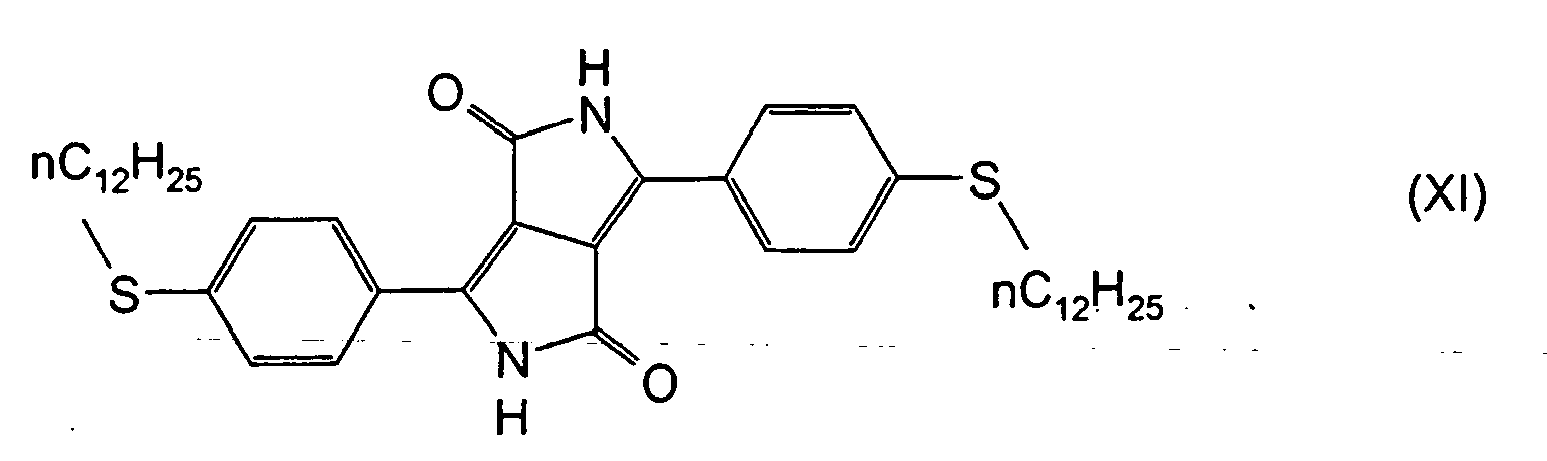
- Es werden 5,9 Teile Pigmentdispergator der Formel (XII) erhalten.

- 95 Teile P.R.254 werden mit 5 Teilen Pigmentdispergator der Formel (XII), hergestellt gemäß Beispiel 5, vermischt. Es werden farbstarke Färbungen mit reinem Farbton in Polyethylen erhalten. Der Verzug der mit dieser Mischung pigmentierten Polyethylenplatten ist deutlich erniedrigt.
- 3,46 Teile DPP-Derivat der Formel (XII) werden in 265 Teile Methylenchlorid eingetragen und auf 0°C abgekühlt. Eine Lösung aus 2,73 Teilen 3-Chlorperbenzoesäure 70 %ig in 93 Teilen Methylenchlorid wird in 20 Minuten bei 0°C zugetropft. Dann wird 5 Stunden bei Raumtemperatur gerührt. Es wird zweimal mit 10 %iger wässriger Natriumsulfidlösung gewaschen und das Methylenchlorid abdestilliert.
Es werden 1,8 Teile Pigmentdispergator der Formel (XIII) erhalten.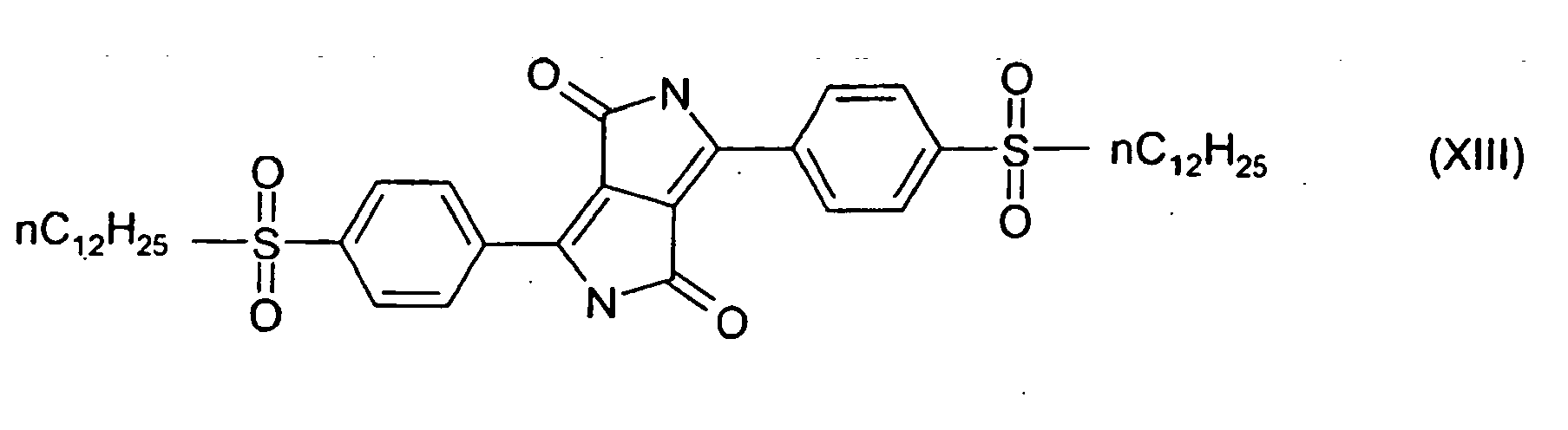
- 95 Teile P.R.254 werden mit 5 Teilen Pigmentdispergator, hergestellt gemäß Beispiel 7 vermischt. Es werden farbstarke Färbungen mit reinem Farbton in Polyethylen erhalten. Der Verzug der mit dieser Mischung pigmentierten Polyethylenplatten ist deutlich erniedrigt.

Claims (12)
- Pigmentzubereitung, gekennzeichnet durch einen Gehalt ana) mindestens einem Diketopyrrolopyrrolpigment der Formel (V) als Basispigment,

R20, R21, R22 und R23 unabhängig voneinander Wasserstoff, Halogen, C1-C4-Alkyl, C1-C4-Alkoxy, Cyano oder Phenyl bedeuten;
undb) mindestens einem Pigmentdispergator der Formel (I),worin R31 einen Rest der Formel (VI), (VIII) oder (IX) darstellt,R32 einen Rest der Formel (VII) darstellt,s oder t eine Zahl von 0,1 bis 4,0 darstellen,


 n eine Zahl von 0 bis 2 darstellt, mit der Maßgabe, dass n die Zahl 0 darstellt, wenn R31 einen Rest der Formel (VIII) oder (IX) darstellt,E+ H+ oder das Äquivalent Mm+/m eines Metallkations Mm+ aus der 1. bis 5. Hauptgruppe oder aus der 1. oder 2. oder der 4. bis 8. Nebengruppe des Periodensystems der chemischen Elemente bezeichnet, wobei m eine der Zahlen 1, 2 oder 3 ist; ein Ammoniumion N+R9R10R11R12, wobei die Substituenten R9, R10, R11 und R12 unabhängig voneinander jeweils ein Wasserstoffatom, C1-C30-Alkyl, C2-C30-Alkenyl, C5-C30-Cycloalkyl, Phenyl, (C1-C8)-Alkyl-phenyl, (C1-C4)-Alkylen-phenyl, oder eine (Poly)alkylenoxy-gruppe der Formel -[CH(R80)-CH(R80)-O]k-H sind, in der k eine Zahl von 1 bis 30 ist und die beiden Reste R80 unabhängig voneinander Wasserstoff, C1-C4-Alkyl oder, sofern k > 1 ist, eine Kombination davon bedeuten;oder worin E+ ein Ammoniumion der Formel (Ic) definiert,
und worin als R9, R10, R11, und/oder R12 ausgewiesenes Alkyl, Alkenyl, Cycloalkyl, Phenyl oder Alkylphenyl durch Amino, Hydroxy, und/oder Carboxy substituiert sein können;
oder wobei die Substituenten R9 und R10 zusammen mit dem quartären N-Atom ein fünf- bis siebengliedriges gesättigtes Ringsystem, das ggf. noch weitere Heteroatome aus der Gruppe O, S und N enthält, bilden können; oder wobei die Substituenten R9, R10, und R11 zusammen mit dem quartären N-Atom ein fünf- bis siebengliedriges aromatisches Ringsystem, das ggf. noch weitere Heteroatome aus der Gruppe O, S und N enthält und an dem ggf. zusätzliche Ringe ankondensiert sind, bilden können; R15, R16, R17 und R18 unabhängig voneinander Wasserstoff oder eine (Poly)alkylenoxygruppe der Formel -[CH(R80)-CH(R80)O]k-H bedeuten, in der k eine Zahl von 1 bis 30 ist und die beiden Reste R80 unabhängig voneinander Wasserstoff, C1-C4-Alkyl oder, sofern k > 1 ist, eine Kombination davon bedeuten;q eine Zahl von 1 bis 10;p eine Zahl von 1 bis 5, wobei p ≤q+1 ist;T einen verzweigten oder unverzweigten C2-C6-Alkylenrest bedeutet; oder worin T, wenn q > 1 ist, auch eine Kombination von verzweigten oder unverzweigten C2-C6-Alkylenresten sein kann;Z1 und Z2 gleich oder verschieden sind und Wasserstoff oder C1-C30-Alkyl- oder C1-C30-Alkenyl-Reste bedeuten, die linear oder verzweigt und unsubstituiert oder durch Halogen, Hydroxy, Hydroxycarbonyl oder C1-C6-Alkoxy substituiert sind, wobei der Alkenylrest ein- oder mehrfach ungesättigt sein kann, mit der Maßgabe, dass Z1 und Z2 nicht gleichzeitig Wasserstoff bedeuten;
undQ ein Rest einer Diketopyrrolopyrrolverbindung der Formel (la) ist,
- Pigmentzubereitung nach Anspruch 1, dadurch gekennzeichnet, dass s oder t gleich 0,2 bis 3,0 und n gleich 0 bis 0,5 sind.
- Pigmentzubereitung nach Anspruch 1 oder 2, dadurch gekennzeichnet, dassZ1 und Z2 gleich oder verschieden sind und C2-C16-Alkyl bedeuten,R24 und R26 jeweils Wasserstoff, undR25 und R27 Wasserstoff, Methyl, tert.-Butyl, Chlor oder Cyano bedeuten.
- Pigmentzubereitung nach mindestens einem der Ansprüche 1 bis 3, dadurch gekennzeichnet, dass im Basispigment der Formel (V)R21 und R23 jeweils Wasserstoff, undR20 und R22 gleich oder verschieden sind und Wasserstoff, Methyl, tert.-Butyl, Chlor, Cyano oder Phenyl bedeuten.
- Pigmentzubereitung nach mindestens einem der Ansprüche 1 bis 4,
dadurch
gekennzeichnet, dass das Basispigment C.I. Pigment Orange 71, 73, 81, C.I. Pigment Red 254, 255, 264, 270 oder 272 ist. - Pigmentzubereitung nach mindestens einem der Ansprüche 1 bis 5, bestehend im wesentlichen ausa) 50 bis 99,9 Gew.-% mindestens eines Basispigments gemäß a),b) 0,1 bis 25 Gew.-% mindestens eines Pigmentdispergators gemäß b), undc) 0 bis 25 Gew.-% an Hilfsmitteln,wobei die Anteile der jeweiligen Komponenten auf das Gesamtgewicht der Zubereitung (100 Gew.-%) bezogen sind.
- Verfahren zur Herstellung einer Pigmentzubereitung nach mindestens einem der Ansprüche 1 bis 6, dadurch gekennzeichnet, dass man den oder die Pigmentdispergator(en) und das oder die Basispigment(e) miteinander mischt oder während ihres Herstellungsprozesses, umfassend Synthese, Feinverteilung, Dispergierung, gegebenenfalls Finish, sowie die Isolierung als Presskuchen oder als trockenes Granulat oder Pulver, aufeinander einwirken lässt.
- Verwendung einer Pigmentzubereitung nach einem oder mehreren der Ansprüche 1 bis 6 zum Pigmentieren von Kunststoffen, Harzen, Lacken, Anstrichfarben oder elektrophotographischen Tonern und Entwicklern, sowie von Tinten, Druckfarben und Farbfiltern.
- Verwendung nach Anspruch 8 zum verzugsfreien Pigmentieren von teilkristallinen Kunststoffen in der Masse.
- Verwendung nach Anspruch 9, dadurch gekennzeichnet, dass der teilkristalline Kunststoff ein Homopolymer, Block- oder statistisches Copolymer oder Terpolymer von Ethylen, Propylen, Butylen, Styrol und/oder Divinylbenzol ist.
- Verwendung nach Anspruch 9 oder 10, dadurch gekennzeichnet, dass der teilkristalline Kunststoff ein Polyethylen, ein Polypropylen, Polystyrol, PVC, ein Polyester, ein Polyamid oder ein thermoplastisches lonomer ist.
- Verwendung nach einem oder mehreren der Ansprüche 9 bis 11, dadurch gekennzeichnet, dass der teilkristalline Kunststoff HDPE, MDPE, LDPE, Polyethylenterephthalat, Nylon 6 oder Nylon 66 ist.
Applications Claiming Priority (3)
| Application Number | Priority Date | Filing Date | Title |
|---|---|---|---|
| DE10235573A DE10235573A1 (de) | 2002-08-03 | 2002-08-03 | Pigmentzubereitungen auf Basis von Diketopyrrolopyrrolpigmenten zum verzugsfreien Pigmentieren von teilkristallinen Kunststoffen |
| DE10235573 | 2002-08-03 | ||
| PCT/EP2003/007025 WO2004018566A1 (de) | 2002-08-03 | 2003-07-02 | Pigmentzubereitungen auf basis von diketopyrrolopyrrolpigmenten zum verzugsfreien pigmentieren von teilkristallinen kunststoffen |
Publications (2)
| Publication Number | Publication Date |
|---|---|
| EP1529082A1 EP1529082A1 (de) | 2005-05-11 |
| EP1529082B1 true EP1529082B1 (de) | 2006-10-04 |
Family
ID=30128708
Family Applications (1)
| Application Number | Title | Priority Date | Filing Date |
|---|---|---|---|
| EP03792169A Expired - Lifetime EP1529082B1 (de) | 2002-08-03 | 2003-07-02 | Pigmentzubereitungen auf basis von diketopyrrolopyrrolpigmenten zum verzugsfreien pigmentieren von teilkristallinen kunststoffen |
Country Status (8)
| Country | Link |
|---|---|
| US (2) | US7153358B2 (de) |
| EP (1) | EP1529082B1 (de) |
| JP (1) | JP4486886B2 (de) |
| KR (1) | KR101008805B1 (de) |
| CN (1) | CN100357360C (de) |
| DE (2) | DE10235573A1 (de) |
| ES (1) | ES2273075T3 (de) |
| WO (1) | WO2004018566A1 (de) |
Families Citing this family (28)
| Publication number | Priority date | Publication date | Assignee | Title |
|---|---|---|---|---|
| DE10235573A1 (de) * | 2002-08-03 | 2004-02-12 | Clariant Gmbh | Pigmentzubereitungen auf Basis von Diketopyrrolopyrrolpigmenten zum verzugsfreien Pigmentieren von teilkristallinen Kunststoffen |
| DE10338730A1 (de) * | 2003-08-21 | 2005-03-24 | Clariant Gmbh | Verfahren zum verzugsfreien Pigmentieren von teilkristallinen Kunststoffen mit Phthalocyaninpigmenten |
| BRPI0415831A (pt) | 2003-10-23 | 2007-01-02 | Ciba Sc Holding Ag | misturas de pigmento de dicetopirrolopirrol estáveis ao calor |
| DE102004039954A1 (de) * | 2004-08-18 | 2006-02-23 | Clariant Gmbh | Verfahren zum verzugsfreien Pigmentieren von teilkristallinen Kunststoffen |
| EP1731576B1 (de) * | 2005-02-22 | 2010-05-12 | Dainichiseika Color & Chemicals Mfg. Co., Ltd. | Diketopyrrolopyrrole-Pigmentdispergatoren und ihre Verwendung |
| KR20080000675A (ko) * | 2005-04-21 | 2008-01-02 | 시바 스페셜티 케미칼스 홀딩 인크. | 안료 제형 |
| US8679341B2 (en) * | 2005-05-06 | 2014-03-25 | Fujifilm Corporation | Method of concentrating nanoparticles and method of deaggregating aggregated nanoparticles |
| KR101266569B1 (ko) * | 2005-05-09 | 2013-05-22 | 후지필름 가부시키가이샤 | 유기 입자 분산액의 제조 방법 |
| DE102005050512A1 (de) * | 2005-10-21 | 2007-04-26 | Clariant Produkte (Deutschland) Gmbh | Pigmentzubereitungen auf Basis von Diketopyrrolopyrrolen |
| DE102006007621A1 (de) * | 2006-02-18 | 2007-08-23 | Clariant International Limited | Diketopyrrolopyrrol-Pigmente mit erhöhten Echtheiten und Verfahren zu deren Herstellung |
| JP5192734B2 (ja) * | 2006-06-02 | 2013-05-08 | 富士フイルム株式会社 | 有機顔料粒子分散組成物、並びにそれらを含有する着色感光性樹脂組成物、インクジェットインク、感光性樹脂転写材料、それらを用いたカラーフィルタ、液晶表示装置、及びccdデバイス |
| DE102007011067A1 (de) * | 2007-03-07 | 2008-09-11 | Clariant International Limited | Pigmentzubereitungen auf Basis von Diketopyrrolopyrrolen |
| DE102007011068A1 (de) * | 2007-03-07 | 2008-09-11 | Clariant International Ltd. | Verfahren zur direkten Herstellung feinteiliger Diketopyrrolopyrrolpigmente |
| CN101918497B (zh) * | 2007-12-26 | 2014-05-28 | 东洋油墨制造股份有限公司 | 红色滤色器用颜料组合物、该颜料组合物的制造方法、使用该颜料组合物的着色组合物和滤色器 |
| TWI553062B (zh) | 2008-01-31 | 2016-10-11 | Sakata Inx Corp | Pigment dispersions and color filters for pigment dispersion photoresist compositions |
| DE102008032090A1 (de) * | 2008-07-08 | 2010-01-14 | Clariant International Ltd. | PR 254-Pigmentzubereitung zur Verwendung in Colorfiltern |
| DE102008032092A1 (de) * | 2008-07-08 | 2010-01-14 | Clariant International Ltd. | Binäre Diketopyrrolopyrrol-Pigmentzusammensetzung zur Verwendung in Colorfiltern |
| JP5748665B2 (ja) * | 2009-10-28 | 2015-07-15 | 東洋インキScホールディングス株式会社 | ジケトピロロピロール顔料分散剤、それを用いた顔料組成物、着色組成物およびカラーフィルタ |
| US8207248B2 (en) | 2010-02-17 | 2012-06-26 | Equistar Chemicals, Lp | Polyethylene composition having reduced warpage in molded articles |
| KR101385174B1 (ko) * | 2012-05-31 | 2014-04-14 | 한국생산기술연구원 | 내열성, 내약품성이 향상된 컬러 필터용 유기 염료 또는 유기 안료 및 이의 조성물 |
| CN104892979B (zh) * | 2014-12-31 | 2019-01-15 | 先尼科化工(上海)有限公司 | 在塑料中具有抗翘曲性能的颜料组合物 |
| JP6227584B2 (ja) * | 2015-03-30 | 2017-11-08 | 富士フイルム株式会社 | インクジェット用顔料分散体及びその製造方法、インクセット、並びに画像形成方法 |
| CN109923179A (zh) | 2016-12-12 | 2019-06-21 | 贝克顿·迪金森公司 | 水溶性聚合物染料 |
| WO2019133399A1 (en) | 2017-12-26 | 2019-07-04 | Becton, Dickinson And Company | Deep ultraviolet-excitable water-solvated polymeric dyes |
| CN110791118A (zh) * | 2018-08-01 | 2020-02-14 | 浙江浩川科技有限公司 | 吡咯并吡咯二酮类颜料衍生物合成方法及其制成产品用途 |
| CN112566985A (zh) * | 2018-08-22 | 2021-03-26 | 富士胶片株式会社 | 着色组合物、固化膜、图案形成方法、滤色器、固体摄像元件及图像显示装置 |
| CN109735102A (zh) * | 2019-01-05 | 2019-05-10 | 江苏博云塑业股份有限公司 | 一种无荧光的红色尼龙材料及其制备方法 |
| JP6928755B1 (ja) * | 2020-03-13 | 2021-09-01 | 東洋インキScホールディングス株式会社 | 顔料分散剤、カラーフィルタ用顔料組成物、着色組成物、およびカラーフィルタ |
Family Cites Families (20)
| Publication number | Priority date | Publication date | Assignee | Title |
|---|---|---|---|---|
| ATE22104T1 (de) * | 1982-05-17 | 1986-09-15 | Ciba Geigy Ag | Herstellung von pyrrolo-(3,4-c)-pyrrolen. |
| US4880472A (en) * | 1987-06-16 | 1989-11-14 | Ciba-Geigy Corporation | Organic pigments coated with metal oxides |
| US4791204A (en) * | 1985-11-26 | 1988-12-13 | Ciba-Geigy Corporation | 1,4-diketopyrrolo[3,4-c]pyrrole pigments |
| EP0243304B1 (de) * | 1986-04-08 | 1993-06-02 | Ciba-Geigy Ag | Zubereitungen von oberflächenmodifizierten Pigmenten |
| US4889562A (en) | 1987-06-16 | 1989-12-26 | Ciba-Geigy Corporation | Organic pigments coated with crosslinked ethyl cellulose |
| DE58907880D1 (de) * | 1988-07-20 | 1994-07-21 | Ciba Geigy | Verfahren zur Herstellung aminierter Diketodi(het)aryl-pyrrolopyrrole und Verwendung derselben als photoleitfähige Substanzen. |
| JP2584515B2 (ja) * | 1989-06-23 | 1997-02-26 | 東洋インキ製造株式会社 | 顔料分散剤および顔料組成物 |
| KR0143777B1 (ko) | 1989-11-28 | 1998-07-01 | 월터 클리웨인, 한스-피터 위트린 | 디케토피롤로피롤을 기재로 하는 물질의 조성물 |
| EP0466646B1 (de) * | 1990-07-11 | 1996-08-28 | Ciba-Geigy Ag | Verfahren zum verzugsfreien Pigmentieren von Polyolefinen |
| CH685162A5 (de) * | 1991-05-07 | 1995-04-13 | Ciba Geigy Ag | Pigmentzusammensetzungen. |
| DE4313090A1 (de) | 1993-04-22 | 1994-10-27 | Basf Ag | Verfahren zum verzugsfreien Pigmentieren von hochpolymeren organischen Materialien |
| EP0659840B1 (de) | 1993-12-22 | 2000-04-26 | Ciba SC Holding AG | Mit Zirkonium oder Titan-Phosphatkomplexen beschichtete organische Pigmente |
| US5560760A (en) * | 1994-10-12 | 1996-10-01 | The United States Of America As Represented By The United States Department Of Energy | Method for optical and mechanically coupling optical fibers |
| DE59606863D1 (de) * | 1995-06-15 | 2001-06-13 | Ciba Sc Holding Ag | Pigmentzusammensetzungen aus Diketopyrrolopyrrolen |
| DE59911647D1 (de) * | 1998-04-22 | 2005-03-31 | Ciba Sc Holding Ag | Verzugsfreie Pigmentzusammensetzungen enthaltend Diaryl-diketopyrrolo 3,4c pyrrole |
| CN1125069C (zh) | 1998-04-22 | 2003-10-22 | 西巴特殊化学品控股有限公司 | 烷硫基-和/或芳硫基-取代的二酮-二芳基-吡咯并吡咯的制备 |
| DE19958181A1 (de) * | 1999-12-02 | 2001-06-07 | Clariant Gmbh | Pigmentdispergatoren auf Basis von Diketopyrrolopyrrolverbindungen und Pigmentzubereitungen |
| CN1481424B (zh) | 2000-12-13 | 2010-04-28 | 西巴特殊化学品控股有限公司 | 流变性能改进剂和具有改进的流变性能的颜料组合物 |
| DE10106147A1 (de) * | 2001-02-10 | 2002-08-14 | Clariant Gmbh | Saure Pigmentdispergatoren und Pigmentzubereitungen |
| DE10235573A1 (de) * | 2002-08-03 | 2004-02-12 | Clariant Gmbh | Pigmentzubereitungen auf Basis von Diketopyrrolopyrrolpigmenten zum verzugsfreien Pigmentieren von teilkristallinen Kunststoffen |
-
2002
- 2002-08-03 DE DE10235573A patent/DE10235573A1/de not_active Withdrawn
-
2003
- 2003-07-02 WO PCT/EP2003/007025 patent/WO2004018566A1/de not_active Ceased
- 2003-07-02 ES ES03792169T patent/ES2273075T3/es not_active Expired - Lifetime
- 2003-07-02 DE DE50305284T patent/DE50305284D1/de not_active Expired - Lifetime
- 2003-07-02 US US10/523,676 patent/US7153358B2/en not_active Expired - Lifetime
- 2003-07-02 KR KR1020057001930A patent/KR101008805B1/ko not_active Expired - Fee Related
- 2003-07-02 EP EP03792169A patent/EP1529082B1/de not_active Expired - Lifetime
- 2003-07-02 CN CNB03818639XA patent/CN100357360C/zh not_active Expired - Fee Related
- 2003-07-02 JP JP2004529989A patent/JP4486886B2/ja not_active Expired - Lifetime
-
2005
- 2005-08-16 US US11/660,333 patent/US20080194742A1/en not_active Abandoned
Also Published As
| Publication number | Publication date |
|---|---|
| KR101008805B1 (ko) | 2011-01-14 |
| DE50305284D1 (de) | 2006-11-16 |
| JP2005534794A (ja) | 2005-11-17 |
| WO2004018566A1 (de) | 2004-03-04 |
| ES2273075T3 (es) | 2007-05-01 |
| US7153358B2 (en) | 2006-12-26 |
| US20080194742A1 (en) | 2008-08-14 |
| DE10235573A1 (de) | 2004-02-12 |
| JP4486886B2 (ja) | 2010-06-23 |
| EP1529082A1 (de) | 2005-05-11 |
| CN1675315A (zh) | 2005-09-28 |
| CN100357360C (zh) | 2007-12-26 |
| US20060052490A1 (en) | 2006-03-09 |
| KR20050035255A (ko) | 2005-04-15 |
Similar Documents
| Publication | Publication Date | Title |
|---|---|---|
| EP1529082A1 (de) | Pigmentzubereitungen auf basis von diketopyrrolopyrrolpigmenten zum verzugsfreien pigmentieren von teilkristallinen kunststoffen | |
| EP1362081B1 (de) | Saure pigmentdispergatoren und pigmentzubereitungen | |
| EP1834996B1 (de) | Pigmentzubereitungen auf Basis von PY 155 | |
| EP1572809B2 (de) | Verfahren zur herstellung von phthalocyaninpigmentzubereitungen | |
| EP1694777B1 (de) | Verwendung einer pigmentzubereitung auf basis von c.i. pigment yellow 74 | |
| DE10353127A1 (de) | Pigmentzusammensetzungen aus gelbem Disazopigment und organischem Pigment | |
| EP1694778B1 (de) | Monoazopigmentzubereitungen auf basis von c.i. pigment yellow 74 | |
| EP1029899B1 (de) | Pigmentzubereitungen auf Basis von Diketopyrrolopyrrolpigmenten mit basischen Perylendispergatoren | |
| EP1664203A1 (de) | Pigmentzusammensetzungen aus organischen und anorganischen pigmenten | |
| DE19836714A1 (de) | Verfahren zur Herstellung von N,N'-Dimethyl-perylen-3,4,9,10- tetracarbonsäurediimid in transparenter Pigmentform | |
| WO2003087231A1 (de) | Verfahren zur herstellung von verküpbaren organischen pigmenten | |
| EP1784450B1 (de) | Verfahren um verzugsfreien pigmentieren von teilkristallinen kunststoffen | |
| EP1723202A1 (de) | Pigmentzubereitungen auf basis von phthalocyaninpigmenten | |
| DE10005186A1 (de) | Verfahren zur Herstellung von Perylen-3,4,9,10-tetracarbonsäurediimid in transparenter Pigmentform | |
| EP1597323B1 (de) | Verfahren zur herstellung von transparenten pigmentzubereitungen auf basis von perylen-3,4,9,10-tetracarbons urediimid | |
| EP1521755B1 (de) | Neue diketopyrrolopyrrolpigmente | |
| EP2370523B1 (de) | Flockungsstabile diketopyrrolopyrrol-pigmentzubereitungen | |
| DE10224279A1 (de) | Neue Derivate von C.I. Pigment Red 170 | |
| DE102007011066A1 (de) | Pigmentzubereitungen auf Basis von Diketopyrrolopyrrolen |
Legal Events
| Date | Code | Title | Description |
|---|---|---|---|
| PUAI | Public reference made under article 153(3) epc to a published international application that has entered the european phase |
Free format text: ORIGINAL CODE: 0009012 |
|
| 17P | Request for examination filed |
Effective date: 20050303 |
|
| AK | Designated contracting states |
Kind code of ref document: A1 Designated state(s): AT BE BG CH CY CZ DE DK EE ES FI FR GB GR HU IE IT LI LU MC NL PT RO SE SI SK TR |
|
| RAP1 | Party data changed (applicant data changed or rights of an application transferred) |
Owner name: CLARIANT PRODUKTE (DEUTSCHLAND) GMBH |
|
| GRAP | Despatch of communication of intention to grant a patent |
Free format text: ORIGINAL CODE: EPIDOSNIGR1 |
|
| RBV | Designated contracting states (corrected) |
Designated state(s): CH DE ES FR GB IT LI |
|
| GRAS | Grant fee paid |
Free format text: ORIGINAL CODE: EPIDOSNIGR3 |
|
| GRAA | (expected) grant |
Free format text: ORIGINAL CODE: 0009210 |
|
| AK | Designated contracting states |
Kind code of ref document: B1 Designated state(s): CH DE ES FR GB IT LI |
|
| PG25 | Lapsed in a contracting state [announced via postgrant information from national office to epo] |
Ref country code: IT Free format text: LAPSE BECAUSE OF FAILURE TO SUBMIT A TRANSLATION OF THE DESCRIPTION OR TO PAY THE FEE WITHIN THE PRESCRIBED TIME-LIMIT;WARNING: LAPSES OF ITALIAN PATENTS WITH EFFECTIVE DATE BEFORE 2007 MAY HAVE OCCURRED AT ANY TIME BEFORE 2007. THE CORRECT EFFECTIVE DATE MAY BE DIFFERENT FROM THE ONE RECORDED. Effective date: 20061004 |
|
| REG | Reference to a national code |
Ref country code: GB Ref legal event code: FG4D Free format text: NOT ENGLISH |
|
| REG | Reference to a national code |
Ref country code: CH Ref legal event code: EP |
|
| REF | Corresponds to: |
Ref document number: 50305284 Country of ref document: DE Date of ref document: 20061116 Kind code of ref document: P |
|
| GBT | Gb: translation of ep patent filed (gb section 77(6)(a)/1977) |
Effective date: 20061218 |
|
| ET | Fr: translation filed | ||
| REG | Reference to a national code |
Ref country code: ES Ref legal event code: FG2A Ref document number: 2273075 Country of ref document: ES Kind code of ref document: T3 |
|
| PLBE | No opposition filed within time limit |
Free format text: ORIGINAL CODE: 0009261 |
|
| STAA | Information on the status of an ep patent application or granted ep patent |
Free format text: STATUS: NO OPPOSITION FILED WITHIN TIME LIMIT |
|
| 26N | No opposition filed |
Effective date: 20070705 |
|
| PGFP | Annual fee paid to national office [announced via postgrant information from national office to epo] |
Ref country code: ES Payment date: 20100609 Year of fee payment: 8 Ref country code: FR Payment date: 20100621 Year of fee payment: 8 |
|
| PGFP | Annual fee paid to national office [announced via postgrant information from national office to epo] |
Ref country code: IT Payment date: 20100625 Year of fee payment: 8 |
|
| REG | Reference to a national code |
Ref country code: FR Ref legal event code: ST Effective date: 20120330 |
|
| PG25 | Lapsed in a contracting state [announced via postgrant information from national office to epo] |
Ref country code: FR Free format text: LAPSE BECAUSE OF NON-PAYMENT OF DUE FEES Effective date: 20110801 |
|
| PG25 | Lapsed in a contracting state [announced via postgrant information from national office to epo] |
Ref country code: IT Free format text: LAPSE BECAUSE OF NON-PAYMENT OF DUE FEES Effective date: 20110702 |
|
| REG | Reference to a national code |
Ref country code: ES Ref legal event code: FD2A Effective date: 20130606 |
|
| PG25 | Lapsed in a contracting state [announced via postgrant information from national office to epo] |
Ref country code: ES Free format text: LAPSE BECAUSE OF NON-PAYMENT OF DUE FEES Effective date: 20110703 |
|
| REG | Reference to a national code |
Ref country code: CH Ref legal event code: PCOW Free format text: NEW ADDRESS: PATENT MANAGEMENT INDUSTRIEPARK HOECHST / G 860, 65926 FRANKFURT AM MAIN (DE) |
|
| PGFP | Annual fee paid to national office [announced via postgrant information from national office to epo] |
Ref country code: DE Payment date: 20200928 Year of fee payment: 18 Ref country code: GB Payment date: 20200724 Year of fee payment: 18 |
|
| PGFP | Annual fee paid to national office [announced via postgrant information from national office to epo] |
Ref country code: CH Payment date: 20200723 Year of fee payment: 18 |
|
| REG | Reference to a national code |
Ref country code: DE Ref legal event code: R119 Ref document number: 50305284 Country of ref document: DE |
|
| REG | Reference to a national code |
Ref country code: CH Ref legal event code: PL |
|
| GBPC | Gb: european patent ceased through non-payment of renewal fee |
Effective date: 20210702 |
|
| PG25 | Lapsed in a contracting state [announced via postgrant information from national office to epo] |
Ref country code: LI Free format text: LAPSE BECAUSE OF NON-PAYMENT OF DUE FEES Effective date: 20210731 Ref country code: GB Free format text: LAPSE BECAUSE OF NON-PAYMENT OF DUE FEES Effective date: 20210702 Ref country code: DE Free format text: LAPSE BECAUSE OF NON-PAYMENT OF DUE FEES Effective date: 20220201 Ref country code: CH Free format text: LAPSE BECAUSE OF NON-PAYMENT OF DUE FEES Effective date: 20210731 |