EP1528836A2 - Öffnungssystem und Wärmeabfuhr in akustischen Vorrichtungen - Google Patents
Öffnungssystem und Wärmeabfuhr in akustischen Vorrichtungen Download PDFInfo
- Publication number
- EP1528836A2 EP1528836A2 EP04105332A EP04105332A EP1528836A2 EP 1528836 A2 EP1528836 A2 EP 1528836A2 EP 04105332 A EP04105332 A EP 04105332A EP 04105332 A EP04105332 A EP 04105332A EP 1528836 A2 EP1528836 A2 EP 1528836A2
- Authority
- EP
- European Patent Office
- Prior art keywords
- port
- enclosure
- acoustic
- airflow
- opening
- Prior art date
- Legal status (The legal status is an assumption and is not a legal conclusion. Google has not performed a legal analysis and makes no representation as to the accuracy of the status listed.)
- Granted
Links
Images







Classifications
-
- H—ELECTRICITY
- H04—ELECTRIC COMMUNICATION TECHNIQUE
- H04R—LOUDSPEAKERS, MICROPHONES, GRAMOPHONE PICK-UPS OR LIKE ACOUSTIC ELECTROMECHANICAL TRANSDUCERS; ELECTRIC HEARING AIDS; PUBLIC ADDRESS SYSTEMS
- H04R9/00—Transducers of moving-coil, moving-strip, or moving-wire type
- H04R9/02—Details
- H04R9/022—Cooling arrangements
-
- H—ELECTRICITY
- H04—ELECTRIC COMMUNICATION TECHNIQUE
- H04R—LOUDSPEAKERS, MICROPHONES, GRAMOPHONE PICK-UPS OR LIKE ACOUSTIC ELECTROMECHANICAL TRANSDUCERS; ELECTRIC HEARING AIDS; PUBLIC ADDRESS SYSTEMS
- H04R1/00—Details of transducers, loudspeakers or microphones
- H04R1/02—Casings; Cabinets ; Supports therefor; Mountings therein
Definitions
- the invention relates to porting and heat removal in acoustic devices, and more particularly to heat removal from ported acoustic enclosures. It is an important object of the invention to provide an improved apparatus fo r porting. It is another object to remove undesired heat from an acoustic device.
- an electroacoustical device comprises a loudspeaker enclosure including a first acoustic port, an acoustic driver mounted in the loudspeaker enclosure; and a heat producing device.
- the acoustic driver and the acoustic port are constructed and arranged to coact to provide a cooling, substantially unidirectional airflow across the heat producing device, thereby transferring heat from the heat producing device.
- an electroacoustical device in another aspect of the invention, includes an acoustic enclosure, a first acoustic port in the acoustic enclosure, an acoustic driver mounted in the acoustic enclosure for cau sing a first airflow in the port.
- the first airflow flows alternatingly inward and outward in the port.
- the device further includes a heat producing device.
- the acoustic port is constructed and arranged so that the first airflow creates a substantially unidirectional second airflow.
- the device also includes structure for causing the unidirectional airflow to flow across the heat producing device.
- a loudspeaker enclosure having an interior and an exterior includes a fi rst port having a first end having a cross-sectional area and a second end having a cross-sectional area, wherein the first end cross-sectional area is greater than the second end cross-sectional area.
- the first end abuts the interior, and the second end abuts the exterior.
- the enclosure also includes a second port. The first port is typically located below the second port.
- a loudspeaker in another aspect of the invention, includes an electroacoustical transducer and a loudspeaker enclosure.
- the loudspe aker enclosure has a first port having an interior end and an exterior end, each having cross-sectional area.
- the exterior end cross-sectional area is larger than the interior end cross-sectional area.
- the device also includes a second port having an interior end and an exterior end. The first port is typically located above the second port.
- a loudspeaker enclosure in another aspect of the invention, includes a first port having an interior end and an exterior end, each having a cross-sectional area.
- the first port interior end cross-sectional area is smaller than the first port exterior end cross-sectional area.
- the enclosure also includes a second port having an interior end and an exterior end, each end having a cross-sectional area.
- the second port interior end cross-sectional area is larger than the second port exterior end cross -sectional area.
- an electroacoustical device in another aspect of the invention, includes a first enclosure having a port having a terminal point for an outward airflow to exit the enclosure to an ambient environment and for an inward airflow to enter the enclosure.
- the device also includes an electroacoustical transducer, comprising a vibratile surface for generating pressure waves resulting in the outward airflow and the inward airflow.
- the device also includes a second en closure having a first opening and a second opening.
- the port terminal point is positioned near the first opening and oriented so that the port terminal outward flow flows toward the second opening.
- the port and the electroacoustical transducer coact to cause a substantially unidirectional airflow into the first opening.
- the enclosure includes a port having an exit for radiating pressure waves.
- the electroacoustical device further includes an electroacoustical transducer, positioned in the acoustic enclosure, to provide the pressure waves.
- the device also includes an elongated second enclosure having a first extremity and a second extremity in a direction of elongation. There is a first opening at the first extremity and a second opening at the second extremity.
- the port exit is positioned in the first opening so that the pressure waves are radiated into the second enclosure through the first opening toward the second opening.
- the device also includes a mounting position for a heat producing device in the elongated second enclosure, positioned so that air flowing into the opening from the ambient environment flows across the mounting position.
- an electroacoustical device in still another aspect of the invention, includes a first enclosure having a port having a terminal point for an outward airflow to exit the enclosure and for an inward airflow to enter the enclosure.
- the device also includes an electroacoustical transducer, having a vibratile surface, mounted in the first enclosure, for generating pressure waves resulting in the outward airflow and the inward airflow.
- the device also includes a second enclosure havi ng a first opening and a second opening.
- the port terminal point is positioned with the port terminal point in the second enclosure, oriented so that the port terminal outward flow flows toward the second opening.
- the port and the electroacoustical transducer coact to cause a substantially unidirectional airflow into the first opening.
- a loudspeaker enclosure having a loudspeaker driver and a port tube formed with a vent intermediate its ends constructed and arranged to introduce leakage resistance into the port tube that reduces the Q of at least one standing wave excited in the port tube when acoustic energy is transmitted therethrough. Venting may occur into the acoustic enclosure, into the space outside the enclosure, to a different part of the port tube, into a small volume, into a closed end resonant tube, or other suitable volume.
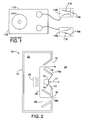
- a loudspeaker 110 includes an enclosure 112 and an acoustic driver 114.
- Ports 116 and 118 are flared.
- the upper port 118 is flared inwardly, that is, the interior end 118i has a larger cross-sectional area than the exterior end 118e.
- the lower port is flared outwardly, that is, the exterior end 116e has a larger cross-sectional area than the interior end 116i.
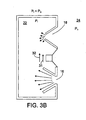
- Loudspeaker 10 includes an enclosure 12 and an acoustic driver 14 having a motor structure 15.
- In the enclosure are two ports, 16 and 18, positioned so that one port 16 is positioned lower in the enclosure 12 than the other port 18.
- Lower port 16 is flared inwardly, that is, interior end 16i has a larger cross -sectional area than the exterior end 16e.
- Upper port 18 is flared outwardly, that is, exterior end 18e has a larger cross-sectional area than the interior end 18i.
- the flares of port 16 and 18 are exaggerated. Actual dimensions of an exemplary port are presented below.
- In the enclosure there are heat producing elements.
- the heat producing elements may include the motor structure 15 of the acoustic driver, or an optional heat producing device 20, such as a power supply or amplifier for loudspeaker 10 or for another loudspeaker, not shown, or both.
- Optional heat producing device 20 may be positioned lower than upper port 18 for better results. It may be advantageous to remove heat from motor structure 15, positioning it lower than upper port 18 for better results.
- a surface, such as cone 13, of acoustic driver 14 is driven by motor structure 15 so that the cone 13 vibrates in the direction indicated by arrow 17, radiating sound waves, in this case to the exterior 24 of the enclosure and the interior 22 of the enclosure.
- the motor structure 15 In driving the acoustic driver cone, the motor structure 15 generates heat that is introduced into enclosure interior 22. Sound waves radiated to the interior 22 of the enclosure result in sound waves radiated out through ports 16 and 18. In addition to the sound waves radiated out through the ports, there is a DC airflow as indicated by arrow 26.
- the DC airflow is described in more detail below.
- the DC airflow transfers heat away from motor structure 15 and optional heat producing element 20 through upper port 18 and out of the enclosure, thereby cooling the motor structure 15 and the optional heat producing element 20.
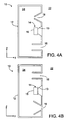
- the loudspeaker of FIG. 2 is shown to explain the DC airflow of FIG. 2.
- the air pressure P i inside the enclosure alternately increases and decreases relative to the pressure P o of the air outside the enclosure.
- the pressure differential urges the air to flow from the interior 22 to the exterior 24 of the enclosure.
- the pressure differential urges the air to flow from the exterior 24 to the interior 22.
- a loudspeaker according to the invention is advantageous because there is a port-induced airflow that is in the same direction as the convective airflow, increasing the cooling efficiency.
- Empirical results indicate that thermal rise of a test setup using the configuration of FIG. 1 was reduced by about 21% as compared to the thermal rise with no signal to the acoustic driver 114. With the configuration of FIG. 2, the thermal rise was reduced by about 75% as compared to the thermal rise with no signal to acoustic driver 14.
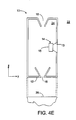
- FIGS. 4A - 4I several embodiments of the invention are shown.
- lower port 16 is a straight walled port, and the upper port is flared outwardly.
- upper port 18 is a straight walled port, and the lower port is flared inwardly.
- the embodiments of FIGS. 4A and 4B have an airflow similar to the airflow of the embodiment of FIGS. 2 and 3, but the airflow is not as pronounced.
- FIG. 4C it is shown that the ports 16 and 18 can be on different sides of the enclosure 12; if the enclosure has curved sides, the ports 16 and 18 can be at any point on the curve.
- FIG. 4A lower port 16 is a straight walled port, and the upper port is flared outwardly.
- upper port 18 is a straight walled port, and the lower port is flared inwardly.
- FIGS. 4A and 4B have an airflow similar to the airflow of the embodiment of FIGS. 2 and 3, but the airflow is not as pronounced.
- FIG. 4D is a front view, showing that acoustic driver 14 and the two ports 16 and 18 may be non-collinear.
- the position of the acoustic driver 14 and alternate locations shown in dashed lines, and the position of ports 16 and 18 and alternate locations shown in dashed lines show that the acoustic driver 14 need not be equidistant from ports 16 and 18 and that the acoustic driver need not be vertically centered between ports 16 and 18.
- the outwardly flaring upper port 18 is in the upper surface, facing upward, and the inwardly flaring lower port 16 is in the lower surface. If the lower port 16 is in the lower surface as in FIG.
- the enclosure wo uld typically have legs or some other spacing structure to space lower port 16 from surface 28 on which loudspeaker 10 rests.
- FIG. 4F shows that the port walls need not diverge linearly, and that the walls, in cross section, need not be straight lines.
- the embodiment of FIG. 4G shows that the divergence need not be monotonic, but can be flared both inwardly and outwardly, so long as the cross sectional area at the exterior end 18e of the upper port 18 is larger than the cross sectional area at the interior end 18i, or so long as the cross sectional area at the exterior end 16e of the lower port 16 is smaller than the cross sectional area at the interior end 16i, or both.
- Flaring a port in both directions may have acoustic advantages over straight walled ports or ports flared monotonically.
- the invention is incorporated in loudspeakers with more complex port and chamber structures, and with an acoustic driver that does not radiate directly to the exterior environment.
- Third port 117 of FIG. 5 is used for acoustic purposes.
- the operation of the embodiments of FIGS. 4H and 4I causes interior pressure P i to cycle above and below exterior pressure P o , resulting in a net DC airflow as in the other embodiments, even though acoustic driver 14 does not radiate sound waves directly to the exterior of the enclosure.
- FIGS. 4A - 4I can be combined.
- FIGS. 4A - 4I illustrate some of the many ways in which the invention may be implemented, not to show all the possible embodiments of the invention.
- there are an upper port and a lower port and either the upper port has a net outward flare, or the lower port has a net inward flare, or both.
- FIG. 5 there is shown a partially transparent view of a loudspeaker incorporating the invention.
- the cover 30 of the unit is removed to show internal detail of the loudspeaker.
- the embodiment of FIG. 5 is in the form of FIG. 4I.
- the reference numerals identify the elements of FIG. 5 that correspond to the like-numbered elements of FIG. 4I.
- Acoustic driver 14 (not shown in this view) is mounted in cavity 32. Openings 19 help reduce standing waves in the port tube as described below.
- the variations in the cross sectional areas of ports 16 and 18 are accomplished by varying the dimensions in the x, y, and z directions. Table 1 below shows exemplary dimensions of the two ports 16 and 18 of the loudspeaker of FIG. 5.
- FIGS. 6A and 6B there are shown two diagrammatic views of another embodiment of the invention.
- ported loudspeaker 10 has a port 40 that has a port exit 35 inside airflow passage 38.
- port 40 and airflow passage 38 are both pipe-like structures with one dimension long relative to the other dimensions, and with openings at the two lengthwise ends; port exit 35 has a cross-sectional area As smaller than the cross-sectional area A of the airflow passage 38; and port exit 35 is positioned in the airflow passage so that the longitudinal axes are parallel or coincident.
- Some considerations for the shape, dimensions, and placement of port 40, port exit 35, and airflow passage 38 are presented below.
- Positioned inside airflow passage 38 is heat producing device 20 or 20', shown at two locations. In an actual implementation, the heat producing device or devices can be placed at many other locations in airflow passage 38.
- acoustic driver 14 When acoustic driver 14 operates, it induces an airflow in and out of the port 40.
- the port and airflow pa ssage act as a jet pump, which causes airflow in the airflow passage 38 in the same direction as the airflow out of the port, in this example in airflow passage opening 42, through the airflow passage in direction 45 and out airflow passage opening 44.
- Jet pumps are described generally in documents such as at the internet location http://www.mas.ncl.ac.uk/ ⁇ sbrooks/book/nish.mit.edu/2006/Textbook/Nodes/cha p05/node16.html .
- the acoustic driver induced airflow is in direction 36, there is a jet pump effect that causes an airflow in airflow passage op ening 42 and out passage opening 44.
- the acoustic driver induced airflow is in the direction 37, there is little net airflow in airflow passage 38.
- the net result of the operation of the acoustic driver is a net DC airflow in direction 45.
- the net DC airflow can be used to transfer heat away from heat producing elements, such as devices 20 and 20', that are placed in the airflow path.
- the combined acoustic effect of port 40 and passage 38 is preferably in accordance with desired acoustic properties. It may be desirable to arrange port 40 to have the desired acoustic property and airflow passage 38 to have significantly less acoustic effect while maintaining the momentum of the airflow in desired direction 45 and to deter momentum in directions transverse to the desired direction. To this end port 40 may be relatively elongated and with a straight axis of elongation parallel to the desired momentum direction. It may be desirable to structure airflow passage 38 to increase the proportion of the airflow is laminar and decrease the proportion of the airflow that is turbulent while providing a desired amount of airflow.
- FIG. 7 there is shown a mechanical schematic drawing of an actual test implementation of the embodiment of FIGS. 6A and 6B, the elements numbered similarly to the corresponding elements of FIGS. 6A and 6B.
- the airflow passage 38 and the heat producing device were both parts of a unitary structure.
- a resistor was placed in thermal contact with at heat sink in a tubular form with appropriate dimensions so it could function as the airflow pass age 38.
- the temperature in the vicinity of the heatsink rose 47° C.
- the acoustic driver operating at 1/8 power, the temperature in the vicinity of the heatsink rose 39° C.
- the temperature in the vicinity of the heatsink rose 25° C.
- the thermal effect of the device at other points in the loudspeaker enclosure was measured. For example, at area 55, convection heating caused the temperature to rise 30.5° C with current flowing through the resistor and with acoustic driver 14 not operating.
- the acoustic driver operating at 1/3 power the temperature in the vicinity of the heatsink rose 30.5° C.
- the acoustic driver operating at 1/8 power radiating pink noise the temperature in the vicinity of the heatsink rose 30.5° C.
- the acoustic driver operating at 1/3 power radiating pink noise the temperature in the vicinity of the heatsink rose 21° C.
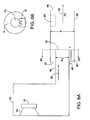
- FIG. 8 there is shown a diagrammatic representation of a loudspeaker enclosure 61 having a driver 62 and a port tube 63 formed with a vent 64 typically located at a point along the length of port tube 63 corresponding to the pressure maximum of the dominant standing wave established in port tube 63 when driver 62 is excited to reduce audible port noise.
- Acoustic damping material 90 for example, polyester or cloth, may be positioned in or near vent 64. This aspect of the invention reduces the objectionability of port noise caused by self resonances.
- the standing waves in the port tube generate the highest pressure midway between the ends of port tube 63.
- the acoustic damping material 90 may further reduce the Q of high frequency resonances.
- the leak can occur through vent 64 into the acoustic enclosure as shown in FIG. 8.
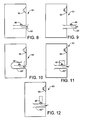
- the leak can leak into the space outside enclosure 61 through vent 64' of port tube 63' as shown in FIG. 9.
- the port tube 63" could leak through vent 64" to a different part of port tube 63" as shown in FIG. 10.
- Port tube 63"' could leak throug h vent 64"' into a small volume 65 as shown in FIG. 11.
- the port tube 63"" could leak through vent 64"" into a closed end resonant tube 65'.
- An advantage of the embodiments of FIGS. 11 and 12 is that the disclosed structure may have insignificant impact on the low frequency output.
- the acoustic damping material 90 may further reduce the Q of high frequency resonances.
- each may have dedicated closed end resonant tubes.
- vents may be used, including a slot, which can be considered as a series of contiguous vents.
- venting structures structures defining volumes for venting, including resonant closed end tubes.
- FIG. 13 there is shown a schematic representation of an embodiment of the invention for reducing Q of the half-wave resonance of a port tube 73 of length A1 in enclosure 71 having driver 72 using tube 75 with a closed end of length 0.3 A1 having its open end at vent 74.
- FIG. 13 there is shown a schematic representation of an embodiment of the invention for reducing Q of the half-wave resonance of a port tube 73 of length A1 in enclosure 71 having driver 72 using tube 75 with a closed end of length 0.3 A1 having its open end at vent 74.
- FIG. 14 shows the standing wave for the half-wave resonance along the length of tube 73, (in the absence of resonant tube 75), showing the pressure distribution 76 and volume velocity distribution 77.
- the pressure is at a maximum at point 74.
- Energy from the standing wave in the port tube 73 is removed from the port tube at maximum pressure point 74.
- the energy may be dissipated by damping material 90 in the resonant tube, significantly reducing the Q of the half-wave resonance.
- resonant tube 75 may be acoustic damping material.
- the acoustic damping material may fill only a small portion of the resonant tube 75 as indicated by acoustic damping material 90, or may substantially fill resonant tube as indicated in dotted line by acoustic damping material 90'.
- the acoustic damping material 90 or 90' reduces the Q of high frequency multiples of the half-wave resonant frequency.
- FIG. 15 there is shown a diagrammatic representation of a port tube 83 with a vent 84 six-tenths of the port tube length s from the left end and four-tenths of the port tube length from the right end terminated in a closed end resonant tube 85 of length 0.5 the length of port tube 83 and diameter d1 of 3" and another closed end tube 85' of length 0.25 that of port tube 83 and diameter d2 of 1.5".
- closed end resonant tube 85 and closed end resonant tube 85' may be acoustic damping material 90.
- the acoustic damping material may fill a portion of one or both of closed end resonant tubes 85, 85', or may substantially fill one or both of close end resonant tubes 85, 85'.
Landscapes
- Physics & Mathematics (AREA)
- Engineering & Computer Science (AREA)
- Acoustics & Sound (AREA)
- Signal Processing (AREA)
- Details Of Audible-Bandwidth Transducers (AREA)
- Electrostatic, Electromagnetic, Magneto- Strictive, And Variable-Resistance Transducers (AREA)
Applications Claiming Priority (2)
| Application Number | Priority Date | Filing Date | Title |
|---|---|---|---|
| US699304 | 1985-02-07 | ||
| US10/699,304 US7463744B2 (en) | 2003-10-31 | 2003-10-31 | Porting |
Publications (3)
| Publication Number | Publication Date |
|---|---|
| EP1528836A2 true EP1528836A2 (de) | 2005-05-04 |
| EP1528836A3 EP1528836A3 (de) | 2006-06-07 |
| EP1528836B1 EP1528836B1 (de) | 2010-01-20 |
Family
ID=34423443
Family Applications (1)
| Application Number | Title | Priority Date | Filing Date |
|---|---|---|---|
| EP20040105332 Expired - Lifetime EP1528836B1 (de) | 2003-10-31 | 2004-10-27 | Öffnungssystem und Wärmeabfuhr in akustischen Vorrichtungen |
Country Status (5)
| Country | Link |
|---|---|
| US (4) | US7463744B2 (de) |
| EP (1) | EP1528836B1 (de) |
| JP (1) | JP4874536B2 (de) |
| CN (1) | CN1617629B (de) |
| DE (1) | DE602004025187D1 (de) |
Cited By (8)
| Publication number | Priority date | Publication date | Assignee | Title |
|---|---|---|---|---|
| EP1996006A3 (de) * | 2007-05-23 | 2010-04-07 | Funai Electric Co., Ltd. | Gerät mit eingebautem Lautsprecher und LCD-Fernsehgerät |
| FR2955731A1 (fr) * | 2010-01-22 | 2011-07-29 | Canon Kk | Enceinte acoustique comprenant au moins une membrane d'attenuation acoustique |
| EP2698538A3 (de) * | 2012-08-15 | 2014-06-18 | General Electric Company | Multifunktioneller synthetischer Strahl und Verfahren zu seiner Herstellung |
| US9716940B2 (en) | 2013-03-22 | 2017-07-25 | Flare Audio Technologies Limited | Acoustic device |
| WO2018144389A1 (en) * | 2017-01-31 | 2018-08-09 | Sonos, Inc. | Noise reduction for high-airflow audio transducers |
| EP3383059A1 (de) * | 2017-03-27 | 2018-10-03 | Vestel Elektronik Sanayi ve Ticaret A.S. | Unterhaltungselektronikvorrichtung und verfahren zum betrieb einer unterhaltungselektronikvorrichtung |
| CN108702562A (zh) * | 2015-12-28 | 2018-10-23 | 伯斯有限公司 | 具有声学电阻性元件的带端口换能器包围件 |
| GB2559476B (en) * | 2016-12-30 | 2020-09-16 | Google Llc | Design for compact home assistant with combined acoustic waveguide and heat sink |
Families Citing this family (41)
| Publication number | Priority date | Publication date | Assignee | Title |
|---|---|---|---|---|
| US10842677B2 (en) * | 1996-03-11 | 2020-11-24 | Horst Burghardt Minkofski | Sound baffling device and material |
| US7463744B2 (en) * | 2003-10-31 | 2008-12-09 | Bose Corporation | Porting |
| US7565948B2 (en) * | 2004-03-19 | 2009-07-28 | Bose Corporation | Acoustic waveguiding |
| US7584820B2 (en) * | 2004-03-19 | 2009-09-08 | Bose Corporation | Acoustic radiating |
| US7689197B2 (en) * | 2006-12-22 | 2010-03-30 | Bose Corporation | Portable audio system with docking cradle |
| US8103035B2 (en) * | 2006-12-22 | 2012-01-24 | Bose Corporation | Portable audio system having waveguide structure |
| JP5128919B2 (ja) * | 2007-11-30 | 2013-01-23 | 船井電機株式会社 | マイクロフォンユニット及び音声入力装置 |
| JP2009290346A (ja) * | 2008-05-27 | 2009-12-10 | Panasonic Electric Works Co Ltd | パネルスピーカ装置 |
| DE102009046889A1 (de) * | 2009-11-19 | 2011-07-21 | K+H Vertriebs- und Entwicklungsgesellschaft mbH, 30900 | Lautsprechereinheit |
| CN102143418B (zh) * | 2011-02-18 | 2014-11-05 | 徐新国 | 空气对流式倒相音箱 |
| WO2013010017A1 (en) * | 2011-07-12 | 2013-01-17 | Strata Audio LLC | Balanced momentum inertial duct |
| US8561756B2 (en) | 2012-02-17 | 2013-10-22 | Bose Corporation | Acoustic ports aligned to create free convective airflow |
| US8798308B2 (en) | 2012-02-21 | 2014-08-05 | Bose Corporation | Convective airflow using a passive radiator |
| US9173018B2 (en) | 2012-06-27 | 2015-10-27 | Bose Corporation | Acoustic filter |
| CN103220608B (zh) * | 2013-04-16 | 2016-08-24 | 歌尔声学股份有限公司 | 扬声器模组 |
| US9301043B2 (en) | 2013-05-01 | 2016-03-29 | Harman International Industries, Inc. | Sealed speaker system having a pressure vent |
| TWI531248B (zh) * | 2013-08-23 | 2016-04-21 | 宏碁股份有限公司 | 音箱結構 |
| US20160037253A1 (en) * | 2014-07-30 | 2016-02-04 | Goal Zero Llc | Portable speaker system |
| US10045461B1 (en) * | 2014-09-30 | 2018-08-07 | Apple Inc. | Electronic device with diaphragm cooling |
| US9860660B1 (en) | 2014-09-30 | 2018-01-02 | Apple Inc. | Electronic device with speaker cavity cooling |
| US10631093B2 (en) * | 2015-01-26 | 2020-04-21 | Harman International Industries, Incorporated | Vented loudspeaker system with duct for cooling of internal components |
| US9571935B2 (en) | 2015-01-26 | 2017-02-14 | Harman International Industries, Inc. | Loudspeaker with ducts for transducer voice coil cooling |
| US10701491B2 (en) * | 2015-12-17 | 2020-06-30 | Eric Jay Alexander | Fluid diode loudspeaker |
| US9906855B2 (en) * | 2015-12-28 | 2018-02-27 | Bose Corporation | Reducing ported transducer array enclosure noise |
| US10123111B2 (en) * | 2016-06-03 | 2018-11-06 | Fulcrum Acoustic, LLC | Passive cardioid speaker |
| CN106792335B (zh) * | 2017-01-05 | 2019-09-06 | 联想(北京)有限公司 | 一种电子设备 |
| JP6641644B2 (ja) * | 2017-02-15 | 2020-02-05 | カシオ計算機株式会社 | スピーカボックスおよび投影装置 |
| US10438868B2 (en) * | 2017-02-20 | 2019-10-08 | Microjet Technology Co., Ltd. | Air-cooling heat dissipation device |
| WO2018163700A1 (ja) * | 2017-03-07 | 2018-09-13 | ソニー株式会社 | コンテンツ提示システム、コンテンツ提示装置及び風提示装置 |
| US10306356B2 (en) | 2017-03-31 | 2019-05-28 | Bose Corporation | Acoustic deflector as heat sink |
| USD872054S1 (en) | 2017-08-04 | 2020-01-07 | Bose Corporation | Speaker |
| JP6277314B1 (ja) * | 2017-08-07 | 2018-02-07 | 勝巳 瀬戸 | スピーカー装置 |
| WO2019040108A2 (en) * | 2017-08-21 | 2019-02-28 | Out of the Box Audio, LLC | METHODS AND APPARATUS FOR ENHANCING SOUND WITHIN AN ACOUSTIC LIMIT LAYER |
| CN111133771B (zh) * | 2017-09-27 | 2022-09-13 | 哈曼贝克自动系统股份有限公司 | 扬声器装置 |
| US10425739B2 (en) * | 2017-10-03 | 2019-09-24 | Bose Corporation | Acoustic deflector with convective cooling |
| US20190253790A1 (en) | 2018-02-15 | 2019-08-15 | Alexander B Ralph | Ported tweeter |
| DE102019108423B4 (de) * | 2019-04-01 | 2021-08-05 | Svetlomir Aleksandrov | Lautsprecherbox und Lautsprecher |
| US11540417B2 (en) * | 2019-08-14 | 2022-12-27 | AAC Technologies Pte. Ltd. | Sounding device and mobile terminal |
| US11310587B2 (en) | 2019-10-08 | 2022-04-19 | Bose Corporation | Horn loudspeakers |
| JP6857271B1 (ja) * | 2019-10-14 | 2021-04-14 | シャープ株式会社 | スピーカ装置及び表示装置 |
| US11917361B2 (en) * | 2020-08-12 | 2024-02-27 | Michael Levy | Loudspeaker |
Citations (2)
| Publication number | Priority date | Publication date | Assignee | Title |
|---|---|---|---|---|
| JPS61219289A (ja) | 1985-03-25 | 1986-09-29 | Matsushita Electric Ind Co Ltd | アンプ付スピ−カシステム |
| JP2001346283A (ja) | 2000-06-01 | 2001-12-14 | Matsushita Electric Ind Co Ltd | スピーカシステム |
Family Cites Families (64)
| Publication number | Priority date | Publication date | Assignee | Title |
|---|---|---|---|---|
| US3393766A (en) | 1966-05-18 | 1968-07-23 | American District Telegraph Co | Speaker system |
| US3517390A (en) * | 1968-02-29 | 1970-06-23 | Layne Whitehead | High power acoustic radiator |
| GB1487847A (en) | 1974-09-25 | 1977-10-05 | Ard Anstalt | Microphone units |
| JPS5333613A (en) | 1976-09-09 | 1978-03-29 | Matsushita Electric Ind Co Ltd | Microphone and its manufacture |
| US4146744A (en) | 1976-09-02 | 1979-03-27 | Bose Corporation | Low q multiple in phase high compliance driver ported loudspeaker enclosure |
| JPS6013167Y2 (ja) | 1977-09-07 | 1985-04-26 | 株式会社日立製作所 | マグネトロン |
| JPS55152766A (en) * | 1979-05-17 | 1980-11-28 | Canon Inc | Recording liquid |
| US4307825A (en) | 1979-09-24 | 1981-12-29 | Pattermann Norbert C | Bricklayers trowel holster |
| DE3025569A1 (de) | 1980-07-05 | 1982-02-04 | Klaus 4400 Münster Burhans | Zusatzvorrichtung fuer eine wasserstrahlpumpe |
| JPS57131069A (en) * | 1981-02-06 | 1982-08-13 | Matsushita Electric Works Ltd | Circuit for detecting voltage variation |
| US4906864A (en) | 1984-10-01 | 1990-03-06 | United Technologies Corporation | Linear slope peak detector |
| JPS62143841A (ja) | 1985-12-16 | 1987-06-27 | Nippon Sheet Glass Co Ltd | カルコゲナイドガラス |
| JPS6374297A (ja) | 1986-09-17 | 1988-04-04 | Mitsubishi Electric Corp | スピ−カ−システム |
| US4802227A (en) | 1987-04-03 | 1989-01-31 | American Telephone And Telegraph Company | Noise reduction processing arrangement for microphone arrays |
| US4811403A (en) * | 1987-06-10 | 1989-03-07 | U.S. Sound, Inc. | Ultralight loudspeaker enclosures |
| JPH01149192A (ja) * | 1987-12-07 | 1989-06-12 | Toshiba Corp | ショーケース兼用形自動販売機 |
| JPH01241296A (ja) | 1988-03-23 | 1989-09-26 | Yamaha Corp | 音響装置 |
| US5012890A (en) * | 1988-03-23 | 1991-05-07 | Yamaha Corporation | Acoustic apparatus |
| JPH01241297A (ja) | 1988-03-23 | 1989-09-26 | Yamaha Corp | 音響装置 |
| DE68919495T2 (de) * | 1988-03-25 | 1995-07-20 | Yamaha Corp | Akustischer Apparat. |
| EP0336303A3 (de) | 1988-04-04 | 1991-05-15 | Yamaha Corporation | Akustischer Apparat |
| US4875546A (en) * | 1988-06-02 | 1989-10-24 | Teledyne Industries, Inc. | Loudspeaker with acoustic band-pass filter |
| EP0361445A3 (de) * | 1988-09-28 | 1991-05-22 | Yamaha Corporation | Akustisches Gerät |
| US4903300A (en) * | 1989-01-05 | 1990-02-20 | Polk Investment Corporation | Compact and efficient sub-woofer system and method for installation in structural partitions |
| US5150471A (en) * | 1989-04-20 | 1992-09-22 | Ncr Corporation | Method and apparatus for offset register address accessing |
| NL8902831A (nl) * | 1989-11-16 | 1991-06-17 | Philips Nv | Luidsprekersysteem bevattende een helmholtz resonator gekoppeld met een akoestische buis. |
| JP3186049B2 (ja) * | 1990-03-13 | 2001-07-11 | 松下電器産業株式会社 | スピーカ装置 |
| US5275693A (en) | 1990-03-30 | 1994-01-04 | Yamato Kako Kabushiki Kaisha | Film forming process |
| US5005744A (en) | 1990-08-03 | 1991-04-09 | Gleason Dana W | Adjustable backpack |
| US5150417A (en) | 1991-02-25 | 1992-09-22 | Socon Ab | Bass reflex type speaker system |
| US5357586A (en) * | 1991-05-16 | 1994-10-18 | The Nordschow/Wright Loudspeaker Company | Flow-through air-cooled loudspeaker system |
| EP0529169A1 (de) * | 1991-08-29 | 1993-03-03 | International Business Machines Corporation | Anordnung zum Anschluss einer Kommunkationseinrichtung an einem digitalen Kommunkationsnetzwerk mit mindestens zwei digitalen Kommunikationskanälen |
| JP3279612B2 (ja) | 1991-12-06 | 2002-04-30 | ソニー株式会社 | 雑音低減装置 |
| US5740259A (en) | 1992-06-04 | 1998-04-14 | Bose Corporation | Pressure wave transducing |
| DE69323258T2 (de) * | 1992-09-23 | 1999-08-05 | Koninklijke Philips Electronics N.V., Eindhoven | Lautsprechersystem mit mehreren Rohren |
| US5373564A (en) | 1992-10-02 | 1994-12-13 | Spear; Robert J. | Transmission line for planar waves |
| JPH06167982A (ja) | 1992-11-30 | 1994-06-14 | Mitsubishi Electric Corp | 多孔質吸音材を用いた吸音ダクト |
| JPH06245286A (ja) * | 1993-02-19 | 1994-09-02 | Sony Corp | スピーカ |
| US6278789B1 (en) | 1993-05-06 | 2001-08-21 | Bose Corporation | Frequency selective acoustic waveguide damping |
| US5589799A (en) | 1994-09-29 | 1996-12-31 | Tibbetts Industries, Inc. | Low noise amplifier for microphone |
| JPH08140177A (ja) | 1994-11-14 | 1996-05-31 | Matsushita Electric Ind Co Ltd | スピーカシステム |
| GB2295518B (en) * | 1994-12-23 | 1998-08-05 | Graeme John Huon | Loudspeaker system incorporating acoustic waveguide filters and method of construction |
| US5533132A (en) * | 1995-01-23 | 1996-07-02 | Jbl Incorporated | Loudspeaker thermal management structure |
| IL117666A0 (en) | 1995-03-31 | 1996-07-23 | Bsg Lab Inc | Low frequency audio coupler and method of coupling |
| US5673330A (en) | 1995-11-08 | 1997-09-30 | Chang; Ching-Lu | Microphone transducer with noise reducing member |
| US6009184A (en) | 1996-10-08 | 1999-12-28 | Umevoice, Inc. | Noise control device for a boom mounted noise-canceling microphone |
| JPH10148181A (ja) * | 1996-11-19 | 1998-06-02 | Shinten Sangyo Kk | エアポンプ |
| US5792999A (en) * | 1997-01-23 | 1998-08-11 | Bose Corporation | Noise attenuating in ported enclosure |
| US6275597B1 (en) * | 1998-05-27 | 2001-08-14 | U.S. Philips Corporation | Loudspeaker system having a bass-reflex port |
| US6549637B1 (en) * | 1998-09-24 | 2003-04-15 | Peavey Electronics Corp. | Loudspeaker with differential flow vent means |
| US6169811B1 (en) * | 1999-03-02 | 2001-01-02 | American Technology Corporation | Bandpass loudspeaker system |
| US7103193B2 (en) * | 2000-09-15 | 2006-09-05 | American Technology Corporation | Bandpass woofer enclosure with multiple acoustic fibers |
| US6549037B1 (en) * | 2000-06-26 | 2003-04-15 | Intel Corporation | Apparatus and circuit having reduced leakage current and method therefor |
| AU1320502A (en) | 2000-10-12 | 2002-04-22 | Reveo Inc | Digital light processing based 3d projection system and method |
| US7426280B2 (en) * | 2001-01-02 | 2008-09-16 | Bose Corporation | Electroacoustic waveguide transducing |
| JP2004525569A (ja) | 2001-01-12 | 2004-08-19 | ヴレックス、インク. | デジタル光処理による列交互配置データを用いた立体表示法および装置 |
| US7711134B2 (en) * | 2001-06-25 | 2010-05-04 | Harman International Industries, Incorporated | Speaker port system for reducing boundary layer separation |
| JP4086622B2 (ja) * | 2002-03-11 | 2008-05-14 | ローランド株式会社 | スピーカ装置 |
| US7123736B2 (en) * | 2002-09-27 | 2006-10-17 | Sony Ericsson Mobile Communications Ab | Double-resonator micro-speaker assemblies and methods for tuning the same |
| JP2004285895A (ja) | 2003-03-20 | 2004-10-14 | Toyoda Gosei Co Ltd | 吸気装置 |
| US7463744B2 (en) * | 2003-10-31 | 2008-12-09 | Bose Corporation | Porting |
| US7584820B2 (en) | 2004-03-19 | 2009-09-08 | Bose Corporation | Acoustic radiating |
| JP2008131199A (ja) | 2006-11-17 | 2008-06-05 | Pioneer Electronic Corp | スピーカ装置 |
| US8351630B2 (en) * | 2008-05-02 | 2013-01-08 | Bose Corporation | Passive directional acoustical radiating |
-
2003
- 2003-10-31 US US10/699,304 patent/US7463744B2/en not_active Expired - Lifetime
-
2004
- 2004-10-27 DE DE200460025187 patent/DE602004025187D1/de not_active Expired - Lifetime
- 2004-10-27 EP EP20040105332 patent/EP1528836B1/de not_active Expired - Lifetime
- 2004-10-29 CN CN200410089636.4A patent/CN1617629B/zh not_active Expired - Fee Related
- 2004-10-29 JP JP2004315046A patent/JP4874536B2/ja not_active Expired - Fee Related
-
2008
- 2008-10-09 US US12/248,326 patent/US20090041282A1/en not_active Abandoned
-
2009
- 2009-04-01 US US12/416,516 patent/US8107662B2/en not_active Expired - Fee Related
-
2011
- 2011-12-22 US US13/335,533 patent/US8831263B2/en not_active Expired - Lifetime
Patent Citations (2)
| Publication number | Priority date | Publication date | Assignee | Title |
|---|---|---|---|---|
| JPS61219289A (ja) | 1985-03-25 | 1986-09-29 | Matsushita Electric Ind Co Ltd | アンプ付スピ−カシステム |
| JP2001346283A (ja) | 2000-06-01 | 2001-12-14 | Matsushita Electric Ind Co Ltd | スピーカシステム |
Cited By (15)
| Publication number | Priority date | Publication date | Assignee | Title |
|---|---|---|---|---|
| EP1996006A3 (de) * | 2007-05-23 | 2010-04-07 | Funai Electric Co., Ltd. | Gerät mit eingebautem Lautsprecher und LCD-Fernsehgerät |
| US8077901B2 (en) | 2007-05-23 | 2011-12-13 | Funai Electric Co., Ltd. | Apparatus with a built-in loud speaker and LCD television receiver |
| FR2955731A1 (fr) * | 2010-01-22 | 2011-07-29 | Canon Kk | Enceinte acoustique comprenant au moins une membrane d'attenuation acoustique |
| US10165343B2 (en) | 2012-08-15 | 2018-12-25 | General Electric Company | Multi-function synthetic jet and method of manufacturing same |
| US9215520B2 (en) | 2012-08-15 | 2015-12-15 | General Electric Company | Multi-function synthetic jet and method of manufacturing same |
| EP2698538A3 (de) * | 2012-08-15 | 2014-06-18 | General Electric Company | Multifunktioneller synthetischer Strahl und Verfahren zu seiner Herstellung |
| US9716940B2 (en) | 2013-03-22 | 2017-07-25 | Flare Audio Technologies Limited | Acoustic device |
| CN108702562A (zh) * | 2015-12-28 | 2018-10-23 | 伯斯有限公司 | 具有声学电阻性元件的带端口换能器包围件 |
| CN108702562B (zh) * | 2015-12-28 | 2019-10-18 | 伯斯有限公司 | 具有声学电阻性元件的带端口换能器包围件 |
| EP3398352B1 (de) * | 2015-12-28 | 2021-07-14 | Bose Corporation | Treibergehäuse mit öffnung und akustischen widerstandselementen |
| GB2559476B (en) * | 2016-12-30 | 2020-09-16 | Google Llc | Design for compact home assistant with combined acoustic waveguide and heat sink |
| WO2018144389A1 (en) * | 2017-01-31 | 2018-08-09 | Sonos, Inc. | Noise reduction for high-airflow audio transducers |
| CN110476439A (zh) * | 2017-01-31 | 2019-11-19 | 搜诺思公司 | 用于高气流音频换能器的降噪 |
| CN110476439B (zh) * | 2017-01-31 | 2020-11-06 | 搜诺思公司 | 用于高气流音频换能器的降噪 |
| EP3383059A1 (de) * | 2017-03-27 | 2018-10-03 | Vestel Elektronik Sanayi ve Ticaret A.S. | Unterhaltungselektronikvorrichtung und verfahren zum betrieb einer unterhaltungselektronikvorrichtung |
Also Published As
| Publication number | Publication date |
|---|---|
| US8107662B2 (en) | 2012-01-31 |
| CN1617629A (zh) | 2005-05-18 |
| US7463744B2 (en) | 2008-12-09 |
| US20050094837A1 (en) | 2005-05-05 |
| HK1078231A1 (en) | 2006-03-03 |
| US20090041282A1 (en) | 2009-02-12 |
| US8831263B2 (en) | 2014-09-09 |
| EP1528836A3 (de) | 2006-06-07 |
| JP2005176316A (ja) | 2005-06-30 |
| JP4874536B2 (ja) | 2012-02-15 |
| US20120328141A1 (en) | 2012-12-27 |
| EP1528836B1 (de) | 2010-01-20 |
| DE602004025187D1 (de) | 2010-03-11 |
| US20090245563A1 (en) | 2009-10-01 |
| CN1617629B (zh) | 2015-09-30 |
Similar Documents
| Publication | Publication Date | Title |
|---|---|---|
| US8831263B2 (en) | Porting | |
| CN101405508B (zh) | 冷却器件和包括这种冷却器件的电子器件 | |
| US11381919B2 (en) | Speaker box and speaker | |
| CN104205870B (zh) | 用于重现声信号的装置及冷却音箱的方法 | |
| US8561756B2 (en) | Acoustic ports aligned to create free convective airflow | |
| US7793709B2 (en) | Jet generating device and electronic apparatus | |
| CN111194558B (zh) | 具有对流冷却的声偏转器 | |
| CN101542724A (zh) | 脉动冷却系统 | |
| WO2019227924A1 (zh) | 微型扬声器模组 | |
| JP2002532913A (ja) | 熱伝達増加装置 | |
| WO2016000373A1 (zh) | 发声器件 | |
| JP2011512108A (ja) | 導波路電気音響変換 | |
| CN101889145B (zh) | 低噪声冷却设备 | |
| CN101729956A (zh) | 显示装置内部置式被动音箱 | |
| JPH0727750Y2 (ja) | 音響装置 | |
| CN116472719A (zh) | 具有低频扩展滤波器的音频装置 | |
| EP4230873A1 (de) | Geräuschreduzierte gebläsemittel und deren verwendung in elektrowerkzeugen und vorrichtungen | |
| HK1078231B (en) | Porting | |
| CN217183467U (zh) | 无源辐射器和扬声器系统 | |
| US20250274715A1 (en) | Speaker apparatus | |
| CN223666423U (zh) | 音箱 | |
| WO2017053714A1 (en) | Compact audio output electronic device with heat dissipation | |
| CN121865151A (zh) | 一种具有散热通道结构的音箱 | |
| JP6665613B2 (ja) | スピーカ装置 | |
| CN219328888U (zh) | 一种降噪装置及核磁共振设备 |
Legal Events
| Date | Code | Title | Description |
|---|---|---|---|
| PUAI | Public reference made under article 153(3) epc to a published international application that has entered the european phase |
Free format text: ORIGINAL CODE: 0009012 |
|
| AK | Designated contracting states |
Kind code of ref document: A2 Designated state(s): AT BE BG CH CY CZ DE DK EE ES FI FR GB GR HU IE IT LI LU MC NL PL PT RO SE SI SK TR |
|
| AX | Request for extension of the european patent |
Extension state: AL HR LT LV MK |
|
| PUAL | Search report despatched |
Free format text: ORIGINAL CODE: 0009013 |
|
| AK | Designated contracting states |
Kind code of ref document: A3 Designated state(s): AT BE BG CH CY CZ DE DK EE ES FI FR GB GR HU IE IT LI LU MC NL PL PT RO SE SI SK TR |
|
| AX | Request for extension of the european patent |
Extension state: AL HR LT LV MK |
|
| 17P | Request for examination filed |
Effective date: 20061201 |
|
| AKX | Designation fees paid |
Designated state(s): DE GB |
|
| 17Q | First examination report despatched |
Effective date: 20070618 |
|
| GRAP | Despatch of communication of intention to grant a patent |
Free format text: ORIGINAL CODE: EPIDOSNIGR1 |
|
| GRAS | Grant fee paid |
Free format text: ORIGINAL CODE: EPIDOSNIGR3 |
|
| GRAA | (expected) grant |
Free format text: ORIGINAL CODE: 0009210 |
|
| AK | Designated contracting states |
Kind code of ref document: B1 Designated state(s): DE GB |
|
| REG | Reference to a national code |
Ref country code: GB Ref legal event code: FG4D |
|
| REF | Corresponds to: |
Ref document number: 602004025187 Country of ref document: DE Date of ref document: 20100311 Kind code of ref document: P |
|
| PLBE | No opposition filed within time limit |
Free format text: ORIGINAL CODE: 0009261 |
|
| STAA | Information on the status of an ep patent application or granted ep patent |
Free format text: STATUS: NO OPPOSITION FILED WITHIN TIME LIMIT |
|
| 26N | No opposition filed |
Effective date: 20101021 |
|
| PGFP | Annual fee paid to national office [announced via postgrant information from national office to epo] |
Ref country code: GB Payment date: 20191028 Year of fee payment: 16 |
|
| PGFP | Annual fee paid to national office [announced via postgrant information from national office to epo] |
Ref country code: DE Payment date: 20201028 Year of fee payment: 17 |
|
| GBPC | Gb: european patent ceased through non-payment of renewal fee |
Effective date: 20201027 |
|
| PG25 | Lapsed in a contracting state [announced via postgrant information from national office to epo] |
Ref country code: GB Free format text: LAPSE BECAUSE OF NON-PAYMENT OF DUE FEES Effective date: 20201027 |
|
| REG | Reference to a national code |
Ref country code: DE Ref legal event code: R119 Ref document number: 602004025187 Country of ref document: DE |
|
| PG25 | Lapsed in a contracting state [announced via postgrant information from national office to epo] |
Ref country code: DE Free format text: LAPSE BECAUSE OF NON-PAYMENT OF DUE FEES Effective date: 20220503 |